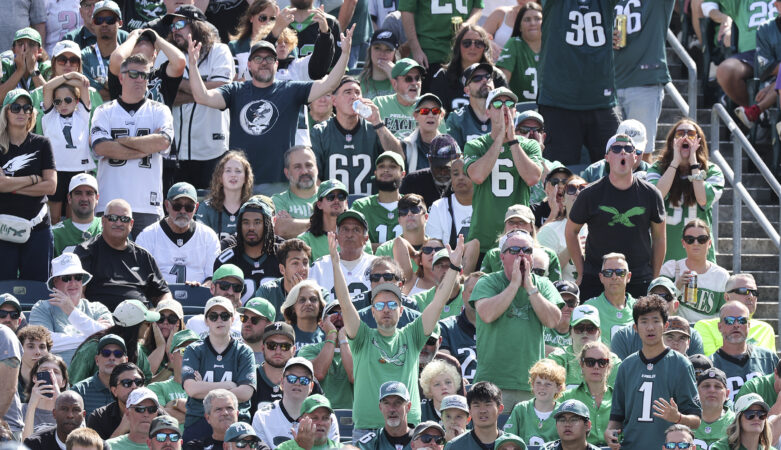
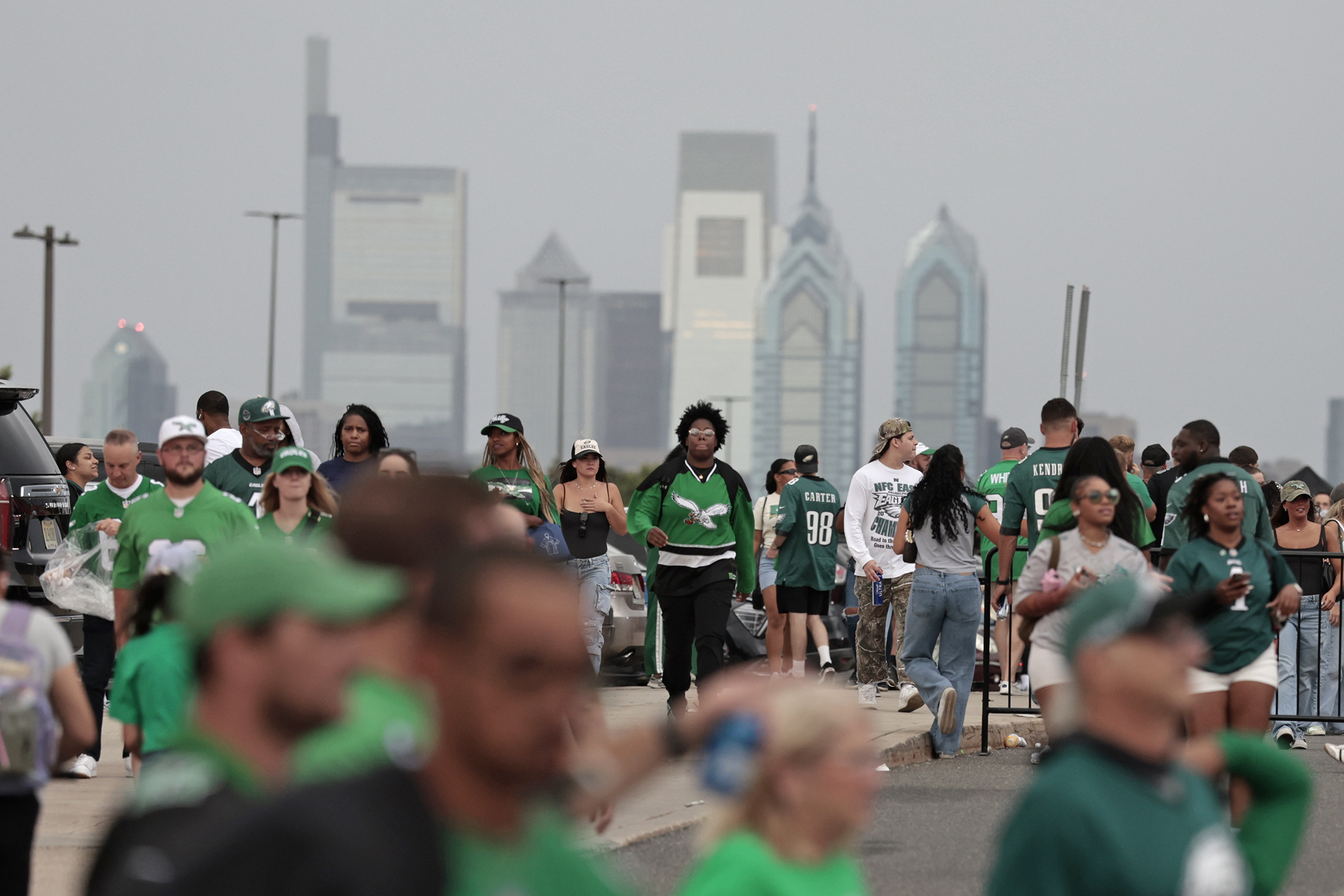
Teeth-chattering winds and plunging temperatures awaited Eagles fans who made a pilgrimage Friday to Lincoln Financial Field for a late afternoon matchup against the Chicago Bears.
For those who drove to South Philadelphia, the city had a post-game surprise: a new traffic management plan that might minimize stadium complex gridlock.
In an email to The Inquirer, the city wrote that the test pattern is designed to provide drivers with an expedited route from Pattison Avenue to the Walt Whitman Bridge and I-76 East, along Darien Street.
Stephanie Greenleaf has Black Friday down to a science.
Every year, the Moorestown resident hosts Thanksgiving. The next morning, she, her sister-in-law, and her mother hit the Cherry Hill Mall early. They start at Nordstrom, then head to Soma for pajamas, Urban Outfitters for her teenagers, and anime stores for the younger kids.
“We have it down,” she said, standing next to a Christmas ornament display around 8:30 a.m.
“As my mom always says, ‘I just want to be out in it,’” she added. “It’s not the same when you’re sitting on your couch.”
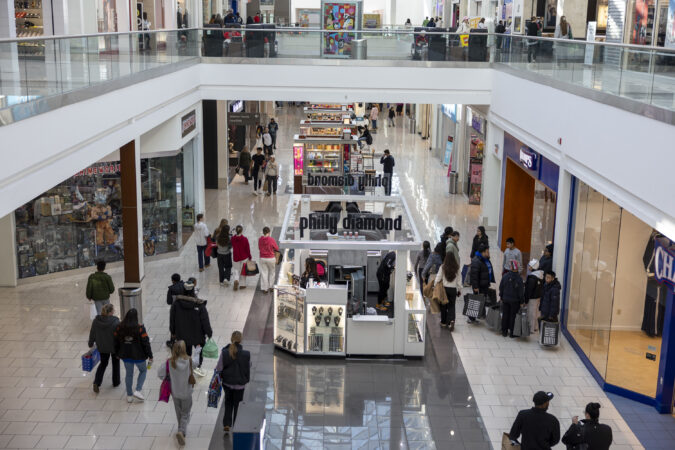
Despite inflation, rising prices, and the omnipresent e-commerce ecosystem, a familiar Black Friday hustle was in the air at the Cherry Hill Mall on Friday morning. Shoppers filed into the parking lot early, toting shoppingbags and holiday-flavored lattes. Labubus and puffer jackets were displayed in store windows.Teenagers flocked to Abercrombie and Zara.
While some retailers reported business as usual, others described the South Jersey shopping destination as more subdued than in years past as consumers contend with an uncertain economic landscape and e-commerce giants continue to cut into a market long dominated by malls.
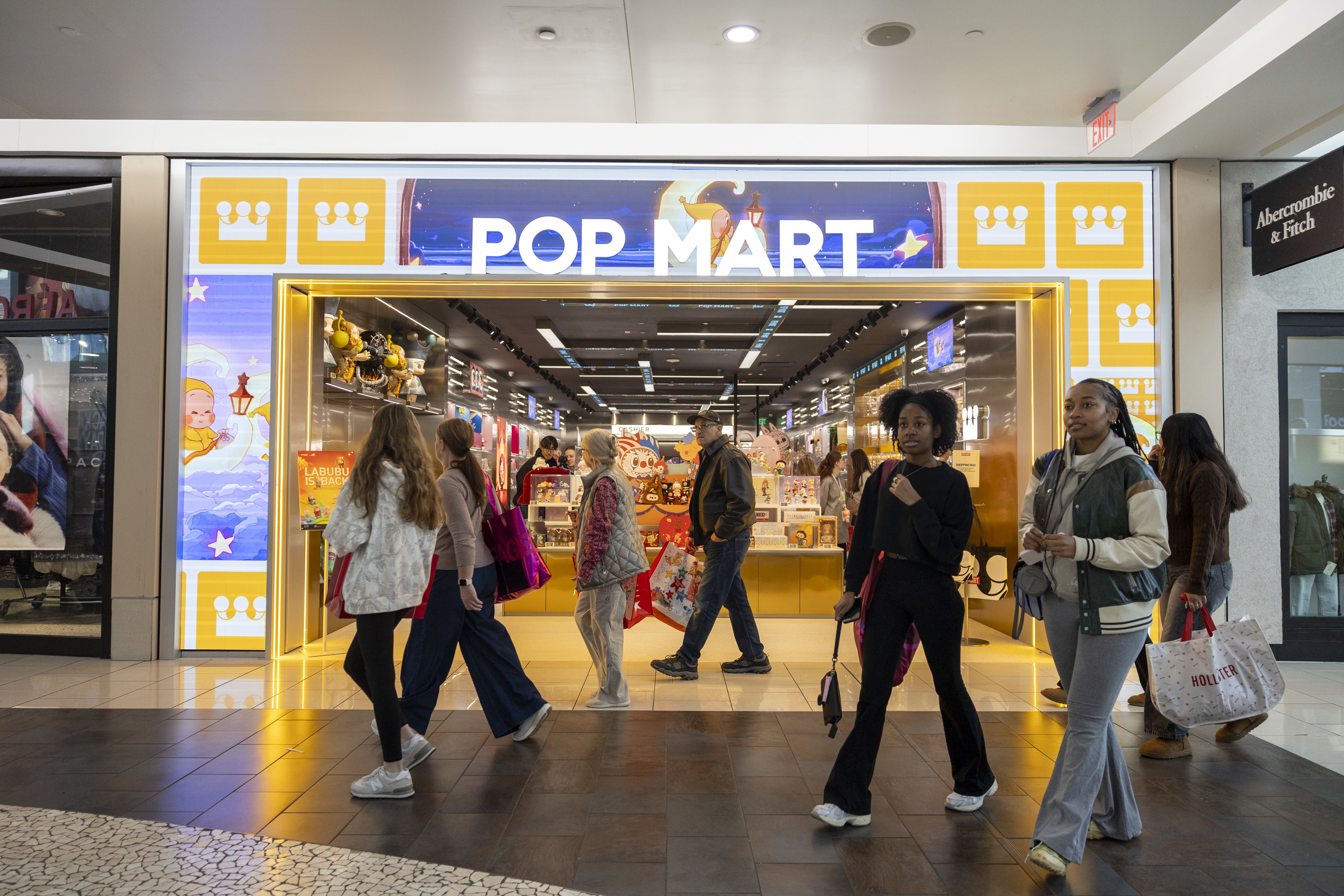
People walk pass Pop Mart during their shopping on Black Friday at the Cherry Hill Mall in Cherry Hill, N.J., on Friday, Nov. 28.
Black Friday, then and now
The term “Black Friday” has Philly origins. Beginning in the 1960s, tourists would descend on Philly the day between Thanksgiving and the annual Saturday Army-Navy football game. Philadelphia police reportedly began calling the day Black Friday after they were forced to work long hours and manage heavy traffic and unruly crowds. Years later, Americans would latch onto the tale that Black Friday got its name because it was the day retailers would move from being “in the red” to being “in the black” (finally making a profit after running a loss).
The retail-oriented holiday has morphed over the years from a one-day shopping bonanza to a month of deals. Now, the pervasiveness of e-commerce has muddied the Black Friday tradition, forcing retailers to attract shoppers both online and in stores.
Barbara Kahn, professor of marketing at the University of Pennsylvania’s Wharton School, calls this an “omni-channel experience.”
“It’s really more of an integration between both modalities now‚” Kahn said.
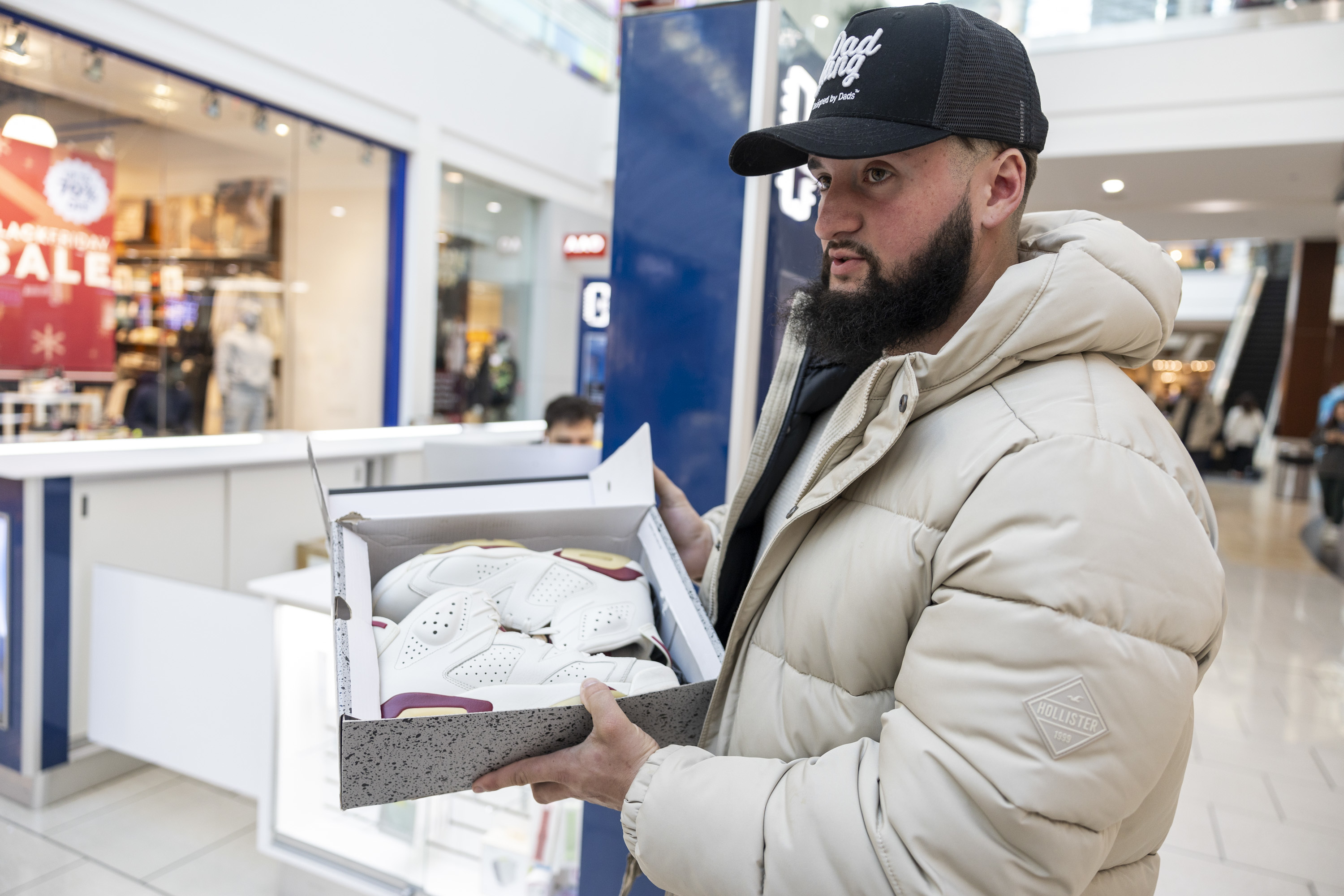
Daniel Leslie, 23, of Franklinville, N.J., showing off a pair of Maroon Jordan 6’s he bought on Black Friday at the Cherry Hill Mall.
Two major changes stick out to Kahn. First, the ability to compare prices online (and now with AI) has made shoppers more “price sensitive,” forcing retailers to stay competitive. Second, stores are turning to “experiences” to draw people in through giveaways, events, or exclusive items.
“Part of what people are shopping for is not necessarily the utility of buying a particular item,” Kahn said. Rather, it’s the experience “wrapped around the actual purchase.”
Shoppers at the Cherry Hill Mall said they had come out onBlack Friday for the nostalgiamore than for once-a-year deals.
Karrim Gordon, 48, said he is “not at all” a regular Black Friday shopper. But, with his young son in tow, the South Philly dad said he wanted to give his kids the true “Black Friday experience.” They got to the mall when it opened at 7 a.m. and hoped to hit Psycho Bunny for his son, then Aéropostale and Pop Mart for his daughter.
Daniel Leslie, 23, of Franklinville, said an Instagram ad for a sneaker deal had caught his eye. He was the first in line at a shoe store Friday morning, walking away with a pair of Timberland boots and a pair of Nike Air Force 1 sneakers for $20 each.
Was economic anxiety curbing his holiday shopping? Not really, Leslie said.
“The deals are just too good to pass up.”
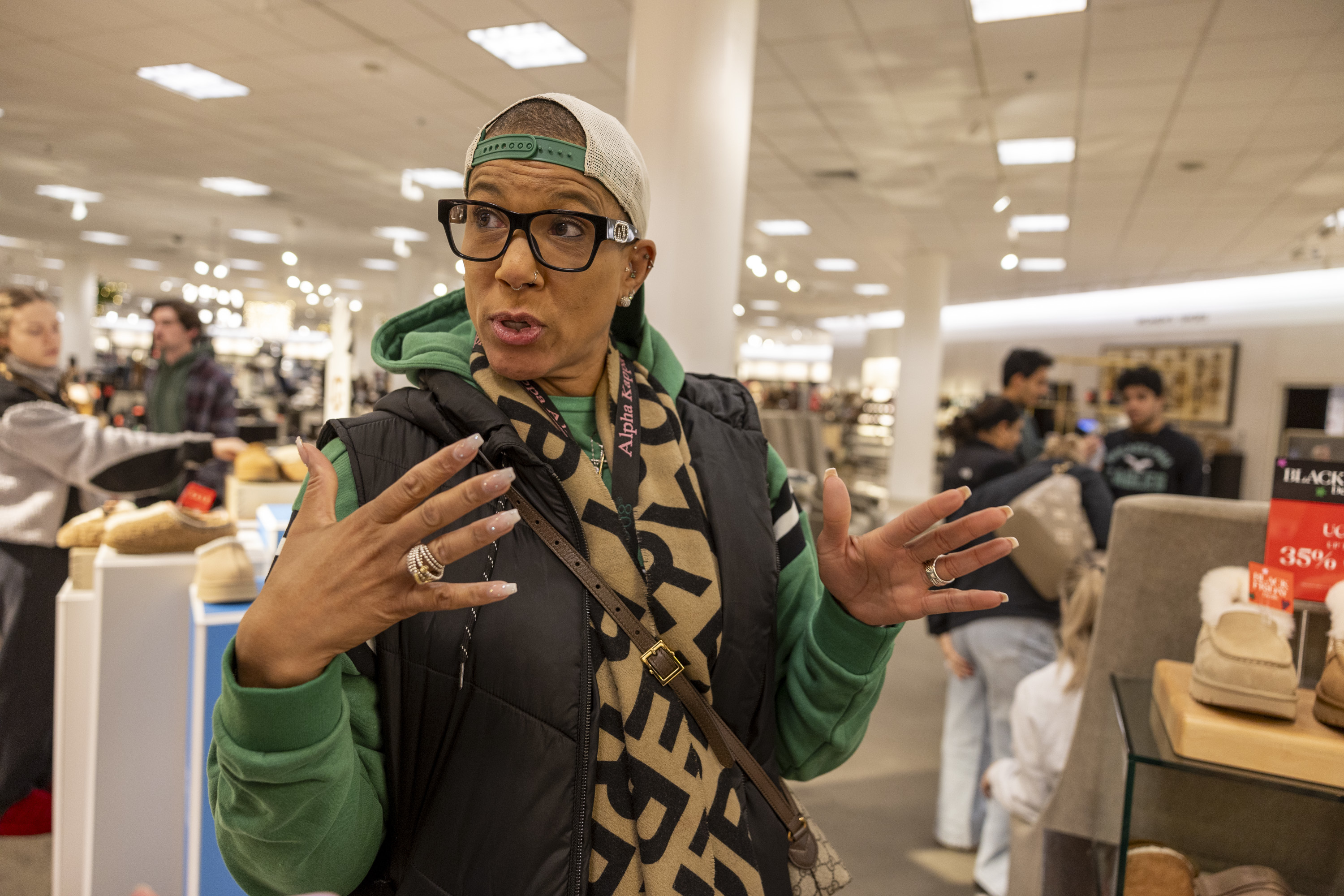
Alicia Hall, of Philadelphia, shops at Nordstrom at the Cherry Hill Mall on Friday, Nov. 28. Hall is a regular at the mall, but said the Black Friday shopping experience isn’t what it used to be.
Economic doom and gloom didn’t deter Alicia Hall, 54, from hitting the mall, either.
Hall is a Cherry Hill Mall regular, driving over from Philly a few times a month to browse. For years, she would wake up early and wait in line for the big sales. Now, she said, “nothing is open like it used to be.”
Though she sometimes thinks about looming economic concerns, “retail therapy” remains an important part of her life.
“I go to work every day, and I work hard,” she said. “I might as well spend it.”
This suburban content is produced with support from the Leslie Miller and Richard Worley Foundation and The Lenfest Institute for Journalism. Editorial content is created independently of the project donors. Gifts to support The Inquirer’s high-impact journalism can be made at inquirer.com/donate. A list of Lenfest Institute donors can be found at lenfestinstitute.org/supporters.
Spotlight PA is an independent, nonpartisan, and nonprofit newsroom producing investigative and public-service journalism that holds power to account and drives positive change in Pennsylvania. Sign up for our free newsletters.
HARRISBURG — This year’s state budget didn’t pull slot-like skill games out of their legal limbo in Pennsylvania, despite bipartisan consensus on the need to do so.
But it could still happen. Democratic Gov. Josh Shapiro called the matter “unfinished business,” and legislative leaders have also indicated interest in taking up the issue again next year.
“This building has a long history of going through gaming debates, and they are very complex and very tedious and very difficult,” state Senate Majority Leader Joe Pittman (R., Indiana) said after the budget passed on Nov. 12. “I certainly believe gaming reform is — and must be — an important policy initiative going forward.”
Pennsylvania faces a structural deficit, which will require spending cuts or more cash in the state’s coffers. A gambling levy, alongside other sin taxes, offers a way to raise revenue without making politically unpopular increases to sales or income taxes.
While such taxes are potentially more palatable to the broader electorate, gambling debates are complex and difficult within the Capitol due to the array of monied interests that defend their existing market share or attempt to expand it further.
The money at stake is real. Existing taxes on revenue from slot machines and table games, whether in brick-and-mortar casinos or online, as well as levies on activities like sports betting and truck stop-based video gaming terminals, brought in $2.7 billion last fiscal year, a record high.
What was on the table this budget cycle?
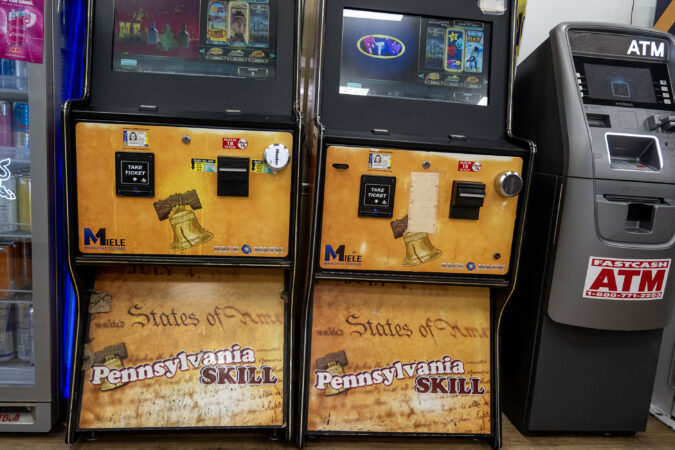
Skill games, which have proliferated in bars and gas stations across the state, exist in a legal gray area and have been subject to years of litigation. They are untaxed and unregulated, and officially setting up laws around them would bring in more gaming cash.
Shapiro proposed in his budget address a 52% tax on the gross revenue of skill games, estimating that it would bring in roughly $400 million. State Senate Republican leaders later backed a plan to tax skill games at a lower rate, 35% of gross revenue.
(Politically powerful casinos pay a 55% tax on electronic games and are pushing for skill games to be taxed at a similar rate.)
As budget talks progressed, neither of the plans went far. Lobbyists for Pace-O-Matic, a major skill games developer and distributor, wanted lawmakers to support legislation introduced by State Sen. Gene Yaw (R., Lycoming) with a 16% tax.
In the weeks leading up to a final budget deal, Yaw and another state senator, Anthony Williams (D., Philadelphia), proposed levying a $500 monthly fee per machine, rather than a tax. They estimated such a fee would bring in about $300 million.
Yaw, whose district is home to a skill games manufacturer, told Spotlight PA the bill was an attempt to sidestep the impasse between leaders, adding that he thinks the tax rates proposed so far would destroy the existing industry.
Williams noted that the bill also seeks to regulate “stop-and-go” convenience stores with liquor licenses. These stores can serve as illegal gaming hubs, which is a concern among Philadelphia lawmakers.
Both lawmakers said they hope that the legislature will finally address skill games regulations in 2026. If not his bill, Williams added, he hopes the legislature will pass another proposal.
“I think it will be included,” Williams said of skill games. “We got a budget that’s passed, but revenue challenges are coming next year, and we’re not going to raise taxes. So this, along with other items, will be considered.”
Adding complexity to the matter is a case before the state Supreme Court. Justices heard oral arguments about the legality of skill games in late November.
Attorneys for the state argued that the machines’ mechanisms and functionality effectively constitute gambling, violating the state’s gaming law. “A game that looks like a slot machine, and plays like a slot machine, is a slot machine,” the state attorney general’s office wrote in its brief.
Matthew Haverstick, Pace-O-Matic’s attorney, argued that the devices comply with decades of legal precedent and that many of the concerns raised by justices, such as the devices’ profitability, amount to policy questions.
“Why [do skill machines] make money? Because somebody really brilliant came up with an idea that they tested. … It was held to be legal, and nobody appealed,” Haverstick said.
It is not known when the high court will issue a ruling.
‘We get threatened all the time’
Part of what makes gaming such a complex topic is simple: Money.
Gambling is a multibillion-dollar industry in Pennsylvania with several key players. And public officials hold the keys to either helping or hurting their bottom lines.
Pace-O-Matic alone has paid millions of dollars to employ dozens of lobbyists to influence the legislature in recent years. Casinos, legalized in the 2000s, likewise are heavily involved in the legislative process — they employ dozens of lobbyists of their own and also spend millions.
Other, smaller players, including those involved in horse racing, sports betting, and truck-stop-only video gaming terminals, add to the complexity of the policy debate.
Then there’s campaign fundraising. A Spotlight PA analysis of campaign finance records found that gaming interests of all stripes gave $1.7 million to top legislative leaders and the governor between Jan. 1, 2023, and Dec. 31, 2024.
Current campaign finance reports show Pace-O-Matic has given money to a PAC that, in turn, donated to a second PAC that has attacked incumbent state Senate Republicans — something that could complicate talks going forward, particularly in the upper chamber.
The company historically has made significant donations to legislative Republicans. But that once-friendly relationship soured earlier this year, after GOP leaders in the state Senate backed legislation that would have taxed the industry at a higher rate than it preferred.
Around the same time, door knockers delivered fliers attacking key GOP lawmakers. State Sens. Frank Farry (R., Bucks) and Chris Gebhard (R., Lebanon) were “siding with Harrisburg insiders and lobbyists to stop small town groups like our volunteer firefighters and VFWs from being able to raise additional revenues,” the fliers, viewed by Spotlight PA, said.
In June, Pace-O-Matic accused the state Senate’s top two GOP leaders of intimidating its lobbyists unless they dropped the company as a client. Three firms did. (A GOP spokesperson called the allegation “bizarre.”)
A lobbyist for Pace-O-Matic told Spotlight PA at the time that it did not coordinate with the group that advanced the ad campaign attacking GOP senators.
However, federal campaign finance records show Pace-O-Matic began giving money to Citizens Alliance, a national conservative political group, as budget talks intensified in May — $630,000 total as of Nov. 21.
Soon after Pace-O-Matic’s first donation, Citizens Alliance contributed to an Ohio-based super PAC called Defeating Communism — the group behind the fliers. Citizens Alliance has donated $428,000 to the super PAC this year.
Cliff Maloney, CEO of Citizens Alliance, said the organization’s aims are to make Pennsylvania into a “red wall” by running a program to “compete with Democrats’ door-knocking efforts,” and to “run a pledge program to hold both Democrats and Republicans accountable to the principles of the [Pennsylvania] and [U.S.] Constitution.”
“Yes, partners are working to hold Senate Republicans accountable that proposed a new tax on certain small businesses,” Maloney said in a statement.
Pennsylvania Department of State disclosures show that in October, Defeating Communism reported $225,000 for door-knocking targeting Gebhard as well as State Sen. Camera Bartolotta (R., Washington). The campaign focused on their votes on past budgets and carbon capture and sequestration, as well as skill games.
Bartolotta told Spotlight PA that she expected taxation of skill games to still be a leading topic in state Senate Republicans’ internal discussions despite the wave of attacks.
The skill games lobby, she said, is “just passing out garbage. And they’re acting like criminals. And I don’t know what in the world they think this is going to do to engender our support.”
Defeating Communism did not respond to a request for comment. Mike Barley, Pace-O-Matic’s chief public affairs officer, said in a statement that the company “donates substantial amounts of funding to politicians and PACs, and we will continue to do so.”
A growing field
The number of moneyed gambling interests that wish to play in the Keystone State is growing.
As Spotlight PA recently reported, the national trade group for sports betting firms launched a more than $500,000 pressure campaign to kill a closed-door budget pitch. The proposal would have raised taxes on sports betting and online casino gaming.
That pressure helped kill the proposal for now, a source told Spotlight PA.
Legal Sports Report, a trade news outlet, reported in November that sports bettors were creating a $10 million super PAC, citing an anonymous source who claimed that Pennsylvania has “rocketed to the top of the list of states where operators are looking to play big during next year’s midterm election.”
While gaming was off the table in 2025, it’s unclear what the future holds.
“We get threatened all the time by some of these interests, you know, ‘We’re going to come beat you up. We’re going to come take you out,’” state Senate President Pro Tempore Kim Ward (R., Westmoreland) said at a news conference after the budget’s passage.
“That’s just ridiculous, and it just makes my blood pressure go up. We don’t do well being bullied. And I think a lot of these gaming interests have done nothing but try to bully us. And I don’t think we stand for that.”
EXCLUSIVE INSIGHTS … If you liked this reporting from Stephen Caruso, subscribe to Access Harrisburg, a premium newsletter with his unique insider view on how state government works.
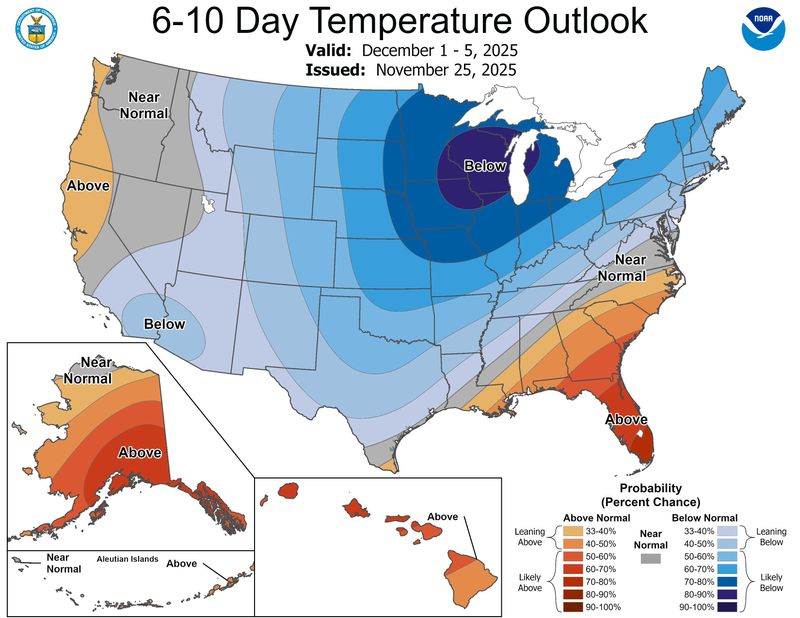
Meteorologists don’t have the specific forecast ready yet, but there is a growing consensus that December will be a frigid one for parts of the United States.
The National Weather Service’s Climate Prediction Center says colder-than-normal weather is most likely in the northern and northeastern United States, but some forecasters say a complex dance involving the polar vortex could send some of Earth’s most extreme cold toward the United States.
“My thinking is that the cold the first week of December is the appetizer and the main course will be in mid-December,” said climatologist Judah Cohen, a research scientist at MIT, in an email to USA TODAY.
Unusually cold temperatures are expected for most of the north-central U.S. by the first week of December.
Indeed, according to Cohen’s computer model, “which I can credibly claim as the world’s best — is predicting that the most expansive region of most likely extreme cold on Earth stretches from the Canadian Plains to the U.S. East Coast in the 3rd week of December.”
As for snow, that remains a wild card, as the weather systems that produce snow typically can’t be predicted more than a few days in advance. Suffice it to say that having cold air present is half of the battle.
Polar vortex on hold?
The main “polar vortex” load of very cold air will remain mostly locked up in Canada through the next 7-10 days, said Weather Trader meteorologist Ryan Maue in a Substack post. Maue continues to monitor the polar vortex intrusion risk into the Lower 48 into December.
Indeed, the complex dances of large-scale climate patterns far above our heads — which include the infamous polar vortex and a phenomenon known as “sudden stratospheric warming” — will determine the intensity and duration of the cold weather in the United States in December, Cohen said. But “I am conflicted about exactly what is happening with the polar vortex,” he admitted.
How cold will it get?
Although the most extreme cold won’t arrive until later in December, widespread and persistent below-average temperatures for this time of year can be expected for a wide expanse of the country from the western High Plains to the East Coast next week, with some near average conditions for the Southeast states and warmer over Florida, according to the National Weather Service.
The coldest anomalies for both highs and lows are forecast over the Midwest Monday Dec. 1 and Tuesday Dec. 2, with highs only in the 10s to middle 20s for many of these areas, and lows in the 0s getting down to northern Missouri and Illinois by Monday morning as the arctic airmass becomes established over the region.
Some subzero overnight lows are well within the realm of possibility from eastern Montana to North Dakota, the weather service said.
Mark Hallett, 82, of Bethesda, Md., world-renowned scientist emeritus at the Maryland-based National Institute of Neurological Disorders and Stroke, former chief of the clinical neurophysiology laboratory at Brigham and Women’s Hospital in Boston, associate professor of neurology at Harvard Medical School, groundbreaking researcher, prolific author, mentor, and world traveler, died Sunday, Nov. 2, of glioblastoma at his home.
Dr. Hallett was born in Philadelphia and reared in Lower Merion Township. He graduated from Harriton High School in 1961 and became a pioneering expert in movement, brain physiology, and human motor control.
He spent 38 years, from 1984 to his retirement in 2022, at the National Institutes of Health in Bethesda and was clinical director and chief of the medical neurology branch of the National Institute of Neurological Disorders and Stroke. He and his colleagues examined the human nervous system and the brain, and their decades of research helped doctors and countless patients treat dystonia, Parkinson’s, and other neurodegenerative diseases.
“When I met him, I was in bad shape,” a former patient said on Instagram. “I’d also been told … that no one would ever figure out the source of my illness. … He and his team diagnosed me, and thereby, I’m pretty sure, saved my life”
Dr. Hallett told the Associated Press in 1992: “The more that we know about the way these cells function, the better off we are.”
Barbara Dworetzky, current president of the FNDS, said Dr. Hallett was a “brilliant scientist, visionary leader, and compassionate physician whose legacy will endure.” Former NIH colleagues called his contributions “astounding” and said: “The scope and impact of Dr. Hallett’s work transcend traditional productivity metrics.”
He chaired scientific committees and conferences, and supervised workshops for many organizations. He earned honorary degrees and clinical teaching awards, and mentored more than 150 fellows at NIH. “Our lab’s demonstration of trans-modal plasticity in humans was another milestone,” he told the NIH Record in 2023. “And, of course, I am particularly proud of the fellows that I have trained and their accomplishments.”
In a tribute, his family said those he mentored “valued his intellect, his encouragement, his kindness, and his humor.”
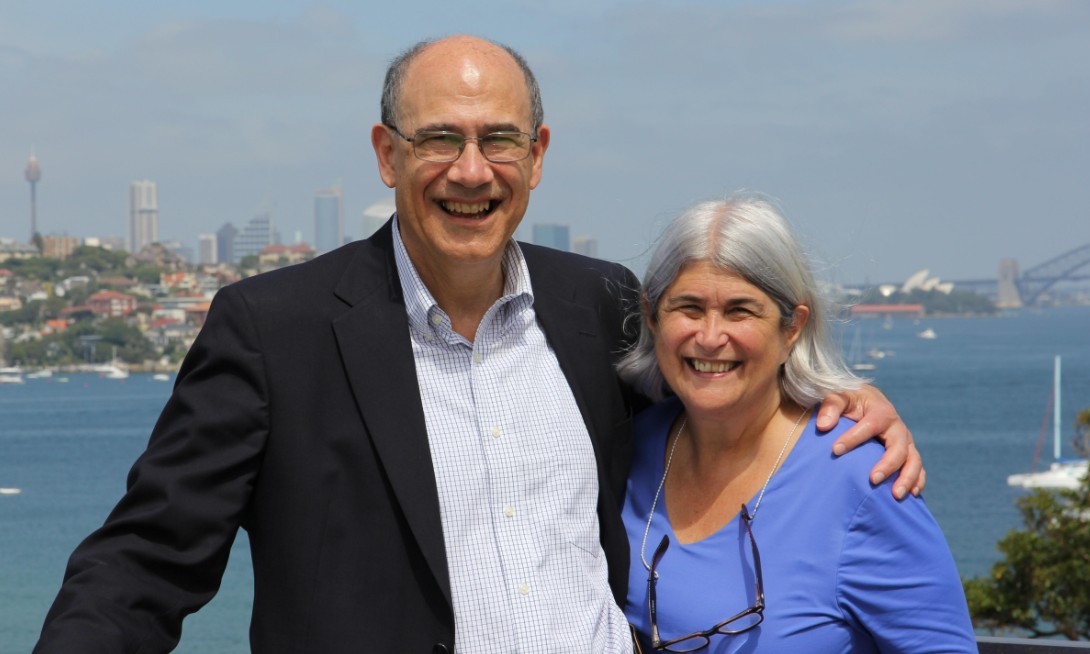
Dr. Hallett and his wife, Judy, married in 1966.
Dr. Hallett had planned to study astronomy at Harvard University after high school. Instead, he earned a bachelor’s degree in biology in 1965 and a medical degree at Harvard Medical School in 1969. He completed an internship at the old Peter Bent Brigham Hospital, now part of Brigham and Women’s, and joined a research program at the NIH in 1970 to fulfill his military obligation during the Vietnam War.
A fellowship in neurophysiology and biophysics at the National Institute of Mental Health sparked his interest in motor control, and he served a neurology residency at Massachusetts General Hospital in 1972 and a fellowship at the Institute of Psychiatry in London in 1974.
He returned to Brigham and Women’s in 1976 to supervise the clinical neurophysiology laboratory and rose to associate professor of neurology at Harvard. In 2019, he earned the Medal for Contribution to Neuroscience from the World Federation of Neurology, and former colleagues there recently said his work “had a lasting global impact and shaped modern clinical and research practice.”
He also studied the scientific nature of voluntary movement and free will. He wrote or cowrote more than 1,200 scientific papers on all kinds of topics, edited dozens of publications and books, and served on editorial boards.
He was past president of the International Federation of Clinical Neurophysiology and the International Parkinson and Movement Disorder Society, and vice president of the American Academy of Neurology.
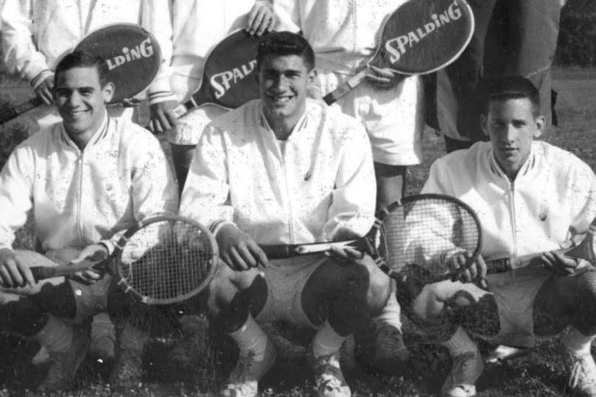
At Harriton, he was senior class president, a star tennis player, and a leading man in several theatrical shows. “The only time he disobeyed his parents,” his family said, “was when he decided to leave Philadelphia to attend Harvard College.”
Mark Hallett was born Oct. 22, 1943. The oldest of three children, he was a natural nurturer, a longtime summer camp counselor, and the winner of an Alfred P. Sloan Foundation national scholarship award in high school.
He grew up in Merion and met Judith Peller at a party in 1963. They married in 1966 and had a son, Nicholas, and a daughter, Victoria.
Dr. Hallett (center) was a star on the Harriton High School tennis team.
Dr. Hallett was an avid photographer and a master of the family group shot. He championed a healthy work-life balance, and his family said: “He eagerly built sand castles, skipped stones, and started pillow fights. His easy laugh was contagious.”
He enjoyed hiking, biking, jazz bands, and organizing family vacations. “He was a natural leader,” his son said, “self-assured and patient of others, with a deep sincerity and a desire to help people.”
U.S. President Donald Trump said on Thursday his administration will “permanently pause” migration from all “Third World Countries,” following the death of a National Guard member in an attack near the White House.
The comments mark a further escalation of migration measures Trump has ordered since the shooting on Wednesday that investigators say was carried out by an Afghan national who entered the U.S. in 2021 under a resettlement program.
Trump did not identify any countries by name or explain what he meant by third-world countries or “permanently pause.” He said the plan would include cases approved under former President Joe Biden’s administration.
“I will permanently pause migration from all Third World Countries to allow the U.S. system to fully recover, terminate all of the millions of Biden illegal admissions, including those signed by Sleepy Joe Biden’s autopen, and remove anyone who is not a net asset to the United States,” he said on his social media platform, Truth Social.
Trump said he would end all federal benefits and subsidies for “non-citizens,” adding he would “denaturalize migrants who undermine domestic tranquility” and deport any foreign national deemed a public charge, security risk, or “non-compatible with Western civilization.”
White House and U.S. Citizenship and Immigration Services did not immediately respond to Reuters’ requests for comment.
Trump claims hundreds of thousands of migrants are unvetted
Earlier, officials from the Department of Homeland Security said Trump had ordered a widespread review of asylum cases approved under Biden’s administration and green cards issued to citizens of 19 countries.
The alleged gunman, identified by officials as 29-year-old Rahmanullah Lakanwal, was granted asylum this year under Trump, according to a U.S. government file seen by Reuters.
He entered the U.S. in a resettlement program set up by Biden after the U.S. military withdrawal from Afghanistan in August 2021 that led to the rapid collapse of the Afghan government and the country’s takeover by the Taliban.
In a separate post prior to his “permanently pause” announcement, Trump claimed that hundreds of thousands of people poured into the U.S. totally “unvetted and unchecked” during what he described as the “horrendous” airlift from Afghanistan.
The U.S. Citizenship and Immigration Services on Wednesday stopped processing all immigration requests relating to Afghan nationals indefinitely.
Trump pushes reverse migration
Trump indicated that his administration’s goals are aimed at significantly reducing “illegal and disruptive populations,” suggesting that measures would be taken to achieve this outcome.
“Only REVERSE MIGRATION can fully cure this situation.”
Even though Lakanwal was in the country legally, the incident bolsters Trump’s immigration agenda. Cracking down on both legal and illegal immigration has been a key focus of his presidency, and this case gave him an opportunity to broaden the debate beyond legality to include stricter vetting of immigrants.
Trump has already deployed additional immigration officers to major U.S. cities to achieve record deportation levels, including many long-term residents and individuals with no criminal record.
Over two-thirds of the roughly 53,000 people arrested by U.S. Immigration and Customs Enforcement and detained as of Nov. 15 had no criminal convictions, according to ICE statistics.
The hairdresser had two boys, ages 4 and 12, and some time to kill before Friendsgiving brunch.
So on a chilly Thanksgiving morning, on Nov. 28, 1996, she lugged her laundry down to the basement of her West Philadelphia apartment building and loaded up the washer.
But she forgot one thing: The dryer she wanted to use wasn’t working.
Too late.
She had already plugged a quarter into the dryer’s coin slot.
Using the ring finger on her left hand, she tried to poke the bottom of the slot to get back her 25-cent piece.
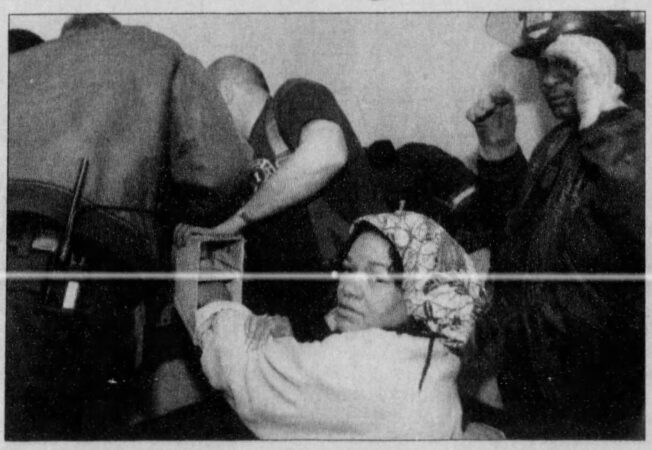
And then her finger got stuck.
Barba started to cry.
“This felt like, to her, one more thing in a long line of things that were just not going great,” Inquirer reporter Al Lubrano, who wrote the original story, said recently.
For two hours she stood in that thankless and cold laundry room, fending off pins-and-needles sensations in her hand and worrying about her boys being alone in their apartment, before a neighbor found her.
The neighbor brought a chair for Barba to stand on — to help release some of the pressure on her hand — and then called for help.
Cell phones were not yet a thing, but another neighbor kindly brought down a portable phone so Barba could call and reassure her sons.
Firefighters swooped in and cut the coin box off the machine. The machine’s operator was then called into action, and he showed up to separate the coin slot from the coin box.
“She was little bit surprised when the firefighters came and it wasn’t the end of it,” Lubrano recalled.
Her now-swollen finger needed a few dollops of petroleum jelly before slipping out of the coin slot. She did not report any permanent damage.
Lubrano asked Barba back in ’96 to sum up the whole ordeal in one word.
“Annoying,” she said.
“Like a true mom,” Lubrano said recently, “she sort of minimized it.”
And after all that, Barba went back downstairs later that night in ’96 and threw in another load of laundry— using a different dryer.
“I’m grateful to my neighbors,” Barba said, “but I missed my brunch.”
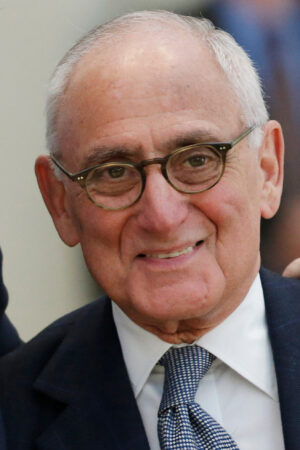
Robert A.M. Stern, 86, a leading architect over the past six decades who left his imprint on Philadelphia by designing the Comcast Center and the Museum of the American Revolution among other notable buildings, died Thursday, Nov. 27, at home in Manhattan after a brief pulmonary illness, his family said.
Mr. Stern also wrote respected architectural histories, taught at Columbia and Yale universities, and was dean of Yale’s School of Architecture from 1998 to 2016.
“Bob had a great sensitivity to urbanism in design. You can see that in Philadelphia, where his work certainly sits well where it is placed,” said developer John Gattuso, who worked closely with Mr. Stern on the Comcast Center, completed in 2008, the redevelopment of the Navy Yard, and other projects.
“He was less concerned with theatrical architecture, the gymnastics, and understood how buildings contribute to a sense of place that resonates with people,” he said. For that reason, Gattuso said, “he tended to be underappreciated.”
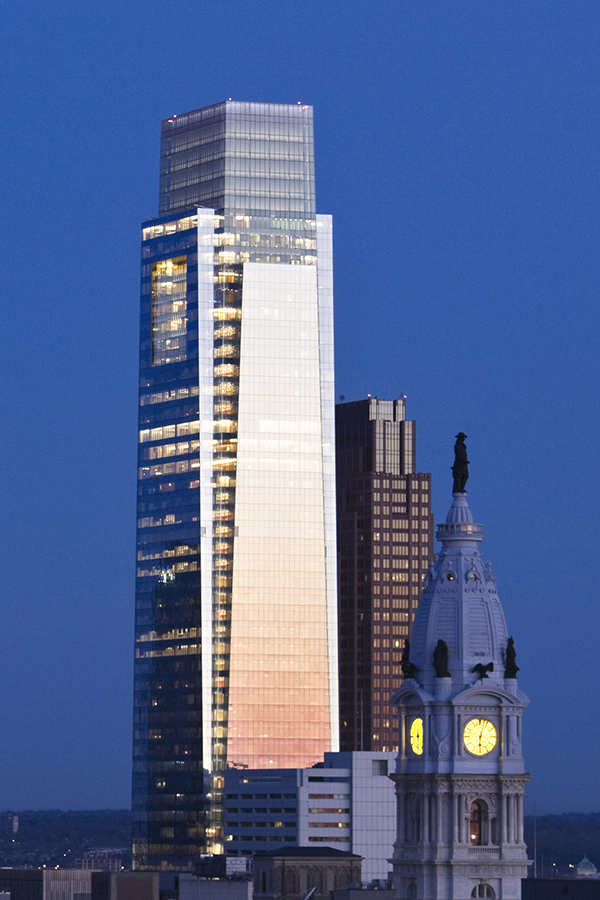
Stern and his firm designed the 975-foot Comcast Center, the headquarters for the cable and telecommunications giant, completed in 2008.
The 975-foot-tall shimmering Comcast Center, the company’s original skyscraper on JFK Boulevard, straddles the tracks and concourse of Suburban Station, a commuter gateway to the city. An airy 120-foot glass atrium connects the building to the station, providing for a dramatic arrival from below, and overlooks a public plaza.
“The Comcast Center may be his finest work in Philadelphia,” said architecture critic Inga Saffron, who writes for The Inquirer. “The scale is right. It’s not fat. It’s tapered.”
Classical indentations in the 58-story building draw the eye upward, she said. “It’s a good dignified skyscraper … Buildings like this are embedded in the city.”
Mr. Stern’s firm was also known for luxury apartment towers. In Manhattan they include 15 Central Park West, a limestone-clad condominium at the southwest corner of Central Park that was internationally hailed.
The firm’s work also includes university buildings, including the Darden School of Business at the University of Virginia; Weill Hall at the University of Michigan; and Miller Hall at the College of William & Mary in Williamsburg, Va., among many others.
In Philadelphia, Mr. Stern’s firm prepared the master plan for the Navy Yard, and designed buildings on Crescent Drive in that development and the 10 Rittenhouse condominium, as well as the American Water tower on the Camden Waterfront — and the LeBow College of Business at Drexel University.
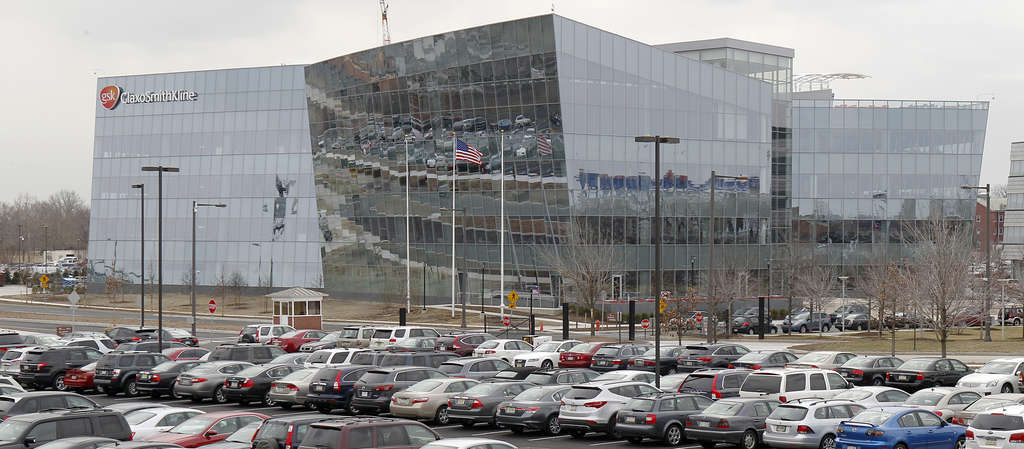
Robert A.M. Stern designed the former U.S. headquarters for GSK at Five Crescent Drive in the Navy Yard, Philadelphia. He and his associates put together the master plan for the redevelopment of the massive property.
Mr. Stern was a proponent of post-modernism, a style of architecture that incorporated classical elements. He moved further in that direction as his career went on.
Philadelphia’s Museum of the American Revolution was built in a Georgian style. But to Saffron, it was perhaps too much, and more out of place to the city.
“He embraces classicism more and more,” Saffron said. In the case of the museum, “It’s a schlocky classicism,” in contrast to the relatively modest scale of the historic buildings in Old City.
“It’s like Independence Hall on steroids,” Saffron said.
The latest Robert A.M. Stern Architects design in Philadelphia is nearing completion, a massive life sciences research building at Drexel University, on Cuthbert Street, by Gattuso Development Partners.
In an interview with the New York Times when he was 84, Mr. Stern said he still wasn’t using a computer and drew “everything by hand.”
Born in Brooklyn on May 23, 1939, Mr. Stern earned a bachelor’s degree from Columbia and a master’s in architecture from Yale. In 1966, he married photographer Lynn Gimbel Solinger, a granddaughter of Bernard Gimbel, the department store magnate. They had a son, Nicholas, and later divorced.
Mr. Stern is survived by his son, three grandchildren, and other relatives.
Think you know your news? There’s only one way to find out. Welcome back to our weekly News Quiz — a quick way to see if your reading habits are sinking in and to put your local news knowledge to the test.
Question 1 of 10
This nearly 1,000-member Philadelphia union has a tentative deal after months of negotiations with the local school district:
CorrectIncorrect. XX% of other readers got this question right.
Philadelphia School District principals have a contract and raises. The tentative, four-year deal was struck Monday night, nearly three months after an August contract deadline for the Commonwealth Association of School Administrators, Teamsters Local 502. The union represents nearly 1,000 Philadelphia principals, assistant principals, climate managers and other workers.
Question 2 of 10
A beloved stone statue in Manayunk’s Bridge Garden named Bridget was vandalized with its head smashed off. Bridget is a:
CorrectIncorrect. XX% of other readers got this question right.
Bridget the Dino, a 3-foot-tall costume-sporting stone Tyrannosaurus rex, was ruthlessly beheaded in the garden she calls home. Bridget’s head, still wearing a scarf, was lying at the foot of her stone body in the photo posted by the Manayunk Bridge Garden, the dinosaur’s caretakers. Holod’s, the Lafayette Hill home and garden store, donated a brand new stone dinosaur. Their name is still being decided on.
Subscribe to The Philadelphia Inquirer
Our reporting is directly supported by reader subscriptions. If you want more journalism like this story, please subscribe today.
Facing mounting personal, legal, and financial pressures, Essen Bakery is closing. What treat was the James Beard-nominated bakery particularly known for?
CorrectIncorrect. XX% of other readers got this question right.
Tova Du Plessis, the owner of Essen Bakery, says she couldn’t find a way back after announcing a ‘pause’ in baking operations six months ago. By closing, she says, she has saved her marriage. The bakery was known for its challah, babka, laminated pastries, and seasonal bread.
Question 4 of 10
The Pennsylvania Film Office announced that this TV show will receive a record $49.8 million tax credit, the largest amount the state has granted to a single production:
CorrectIncorrect. XX% of other readers got this question right.
Task received the largest tax credit awarded to a single film production, the state film office announced Monday. The tax credit is part of Gov. Josh Shapiro’s efforts to bring more TV and film productions to Pennsylvania. The effort is expected to bring about 3,700 jobs to Pennsylvania as HBO estimates investing $194.1 million into the state economy, including hiring local crews and paying for hotel accommodations.
Question 5 of 10
What color uniform are the Eagles set to wear for Friday’s game against the Chicago Bears?
CorrectIncorrect. XX% of other readers got this question right.
The team announced it will don its all-black alternate uniforms for the first time this season. As part of the Black Friday matchup, the Eagles are encouraging fans to ditch their green and instead dress in black for a proper blackout at the Linc.
story continues after advertisement
Question 6 of 10
Bridal fashion designer and Say Yes to the Dress star Randy Fenoli visited Cherry Hill bridal shop Dress 2 Impress’ new location. He strongly advised potential brides against this one thing:
CorrectIncorrect. XX% of other readers got this question right.
Fenoli said the world of bridal fashion has changed “completely” from his mid-2000s Say Yes to the Dress days. Brides show up to appointments with screenshots from Instagram and TikTok videos, asking to try on dresses from unknown designers. Others come with AI-generated images that are impossible to match. He added, “Don’t ever, ever, ever, ever order a wedding dress online.”
Question 7 of 10
Northeast vs. Central High School is one of the longest-running rivalries in the country, but the Thanksgiving game is no longer the spectacle it once was. The halls of the schools don’t buzz in the weeks leading up to it, the parade down Cottman Avenue was canceled years ago, the bleachers aren’t filled, and the trophy is falling apart. What figure is at the top of the trophy?
CorrectIncorrect. XX% of other readers got this question right.
The trophy is a wooden horse. Last year, Northeast High won — and broke the horse’s tail in celebration. It was repaired and sat in the school’s trophy case for the year until the anticipated rematch this week.
Question 8 of 10
A group of South Philly dads on Iseminger have organized a weekly activity to improve the neighborhood families’ day-to-day experience. What are they doing?
CorrectIncorrect. XX% of other readers got this question right.
The dad trio invested in their own German personal-sized street sweepers and maintains the stretch of street to help with dust, litter, and broken glass. Their block has 18 kids under the age of 14 and eight under the age of 3. The weekly street-sweeping has turned into a community spectacle.
Question 9 of 10
A vacant lot along Elfreth’s Alley will soon be named after Dolly Ottey. What was she best known for championing?
CorrectIncorrect. XX% of other readers got this question right.
Plans call for the lot at North Second Street and Elfreth’s Alley to be reborn as Dolly Ottey Park, honoring the woman who first championed preservation of the narrow cobblestone passage starting in the 1930s. Ottey, a resident and owner of The Hearthstone restaurant at 115 Elfreth’s Alley, formed the Elfreth’s Alley Association in 1934 to protect the unique street and save it from destruction.
Question 10 of 10
What major event in 1986 nearly caused the Philadelphia Thanksgiving Parade to be canceled?
CorrectIncorrect. XX% of other readers got this question right.
The 1986 edition of the country's oldest Thanksgiving Day parade was imperiled by Gimbels' liquidation. But the community pleaded for it to continue, and eventually, WPVI (Channel 6), better known today as 6abc, saved the day.
Your Results
You have skipped .
You scored XX out of 10.
The average reader scored XX out of 10
Seems like you’ve been skimming more than reading there, buddy. There’s always next week.
You’ve read some articles (or made some educated guesses) but we wouldn’t come to you first for our local news recaps. Better luck next week!
Do you work here? You’re a local news stan with the latest updates on Philly happenings. Your friends definitely ask you for summaries on what’s going on and it shows.
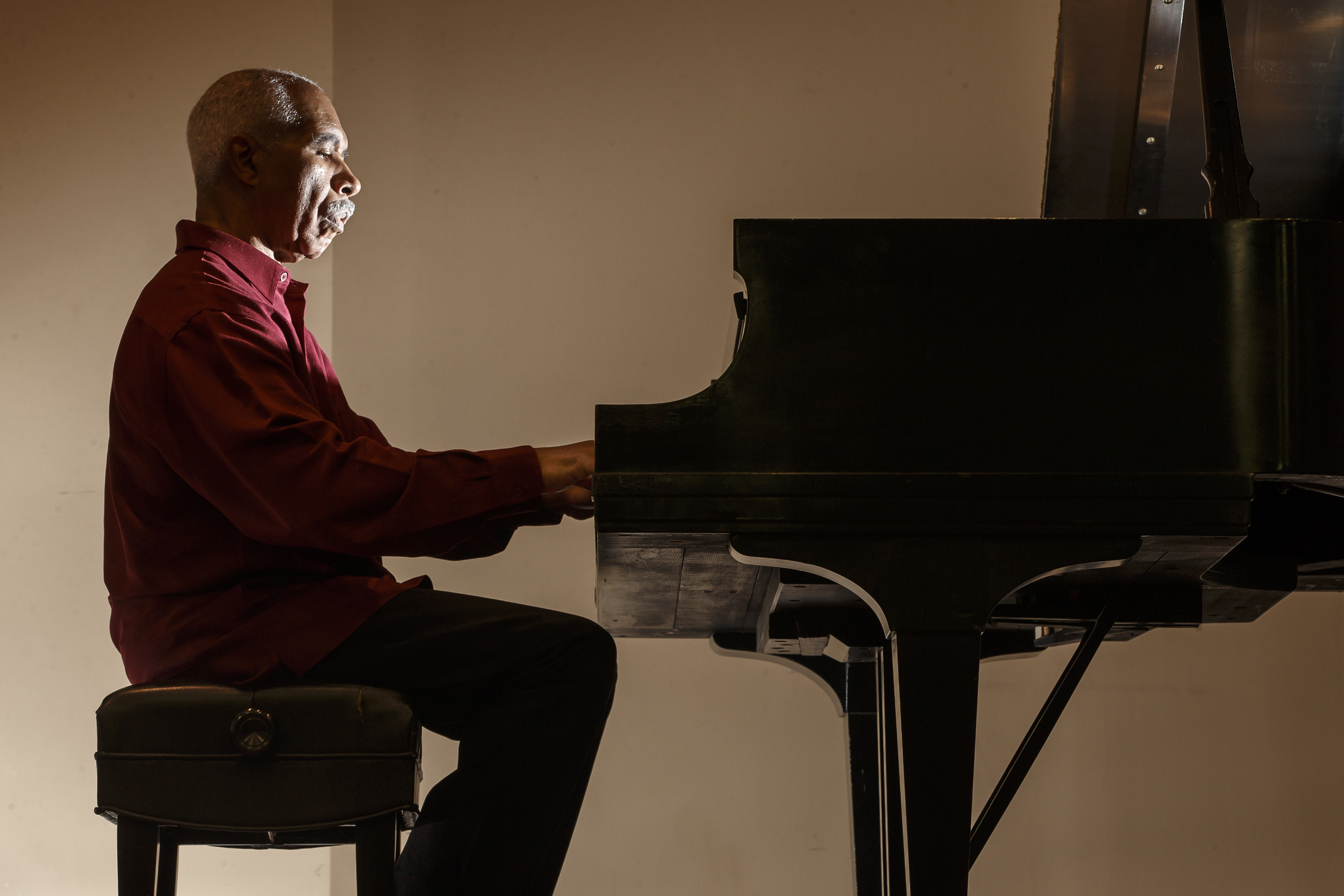
Concert pianist Leon Bates, whose musical authority and far-reaching versatility took him to the world’s greatest concert halls, died Nov. 21 after a seven-year decline from Parkinson’s disease. He was 76.
An articulate, charismatic presence, Mr. Bates was a Philadelphia born and educated pianist, and while growing up in Germantown, showed talent as early as age 6.
He started formal study at Settlement Music School and graduated from Temple University’s Boyer College of Music, where he studied under the legendary Natalie Hinderas. In his final student recital, Mr. Bates played Ravel’s fearsome Gaspard de la Nuit.
As a leading figure in the generation of Black pianists who followed the early-1960s breakthrough of Andre Watts, Mr. Bates’ dream-come-true career encompassed Ravel, Gershwin, and Bartok over 10 concerts with the Philadelphia Orchestra between 1970 and 2002. He played three recitals with Philadelphia Chamber Music Society and taught master classes at Temple University, where he also gave recitals at the Temple Performing Arts Center.
Though he maintained residency in Philadelphia with his wife and three children in Mount Airy, Mr. Bates toured the great concert halls of Europe, China, South Africa, and America, often playing 100 concerts a year. His forceful repertoire of Rachmaninoff and Liszt was partly enabled by his hobby — body building — and the stamina that came with it.
“What set Leon Bates apart was his genuine character and the way he focused on the music above all else. He impacted countless lives through his generosity, his example, and the depth of his artistry,” wrote his student of 10 years, pianist Dynasty Battles, on Instagram. Beyond that, added Battles, Mr. Bates showed him how every concert program could be “a journey” and that rich, “radical” elements in music were already there to be found.
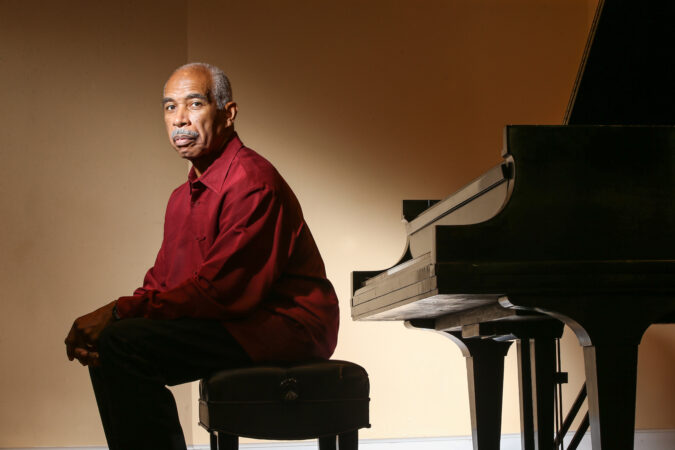
Pianist Leon Bates in 2018
Mr. Bates’ sense of communication was illustrated by how he embraced outdoor concert settings. In such acoustically risky circumstances, he performed at Chicago’s Grant Park, played Rhapsody in Blue in the July 4, 1995 Concert on the Parkway at the Philadelphia Museum of Art, and, with the Duke Ellington Orchestra, had an audience of 20,000 at Rome’s Olympic Stadium.
In less-recreational settings, Mr. Bates’ Philadelphia Chamber Music Society programs were a high-style mixture of the lesser-known and the familiar: Edward MacDowell and Samuel Barber, for example, were followed by the mighty Liszt Sonata in B Minor.
Most adventurous of all was his 2018 recital that he did not personally perform due to his Parkinson’s diagnosis, but had students and other associates step in to play Ives and George Walker. In his prime, Mr. Bates premiered new works by living Black composers such as Walker’s Piano Sonata No. 3 and the Adolphus Hailstork Piano Concerto No. 1, in performances acclaimed for the same commitment he brought to masterworks of the past.
“When you really are involved in the process of making music, it’s something that’s with you when you’re sleeping, when you’re awake, when you’re relaxing, when you’re truly focused on working at the instrument,” he told Chicago-based journalist Brice Duffie during an in-depth 1991 interview. “It is the sum total of all of that time together that really produces what people get when they see the performer come out on stage.”
Besides being a fine pianist, Mr. Bates was also a great talker. He traveled with two prepared lectures — one on the 1954 Brown v. the Board of Education Supreme Court ruling that declared school segregation unconstitutional, and the other, titled “American Originals,” on modern American composers.
“Leon offered school shows where he often dressed in the local football team’s jersey. No suits or ties — just to connect visually with the students,” recalled his longtime agent Joanne Rile. In his WRTI-FM radio show titled Notes on Philadelphia during the 1990s, Mr. Bates was what Charles Abramovic, chair of the Temple University keyboard studies, described as “beautifully articulate and a wonderful interviewer. The warmth of personality came out. He was such a natural with that.”
And he was fun, says fellow-Philadelphia-born Lambert Orkis, now professor of piano at Temple, who was among the musicians interviewed on the show.
Even during interviews, the Bates body-building regimen didn’t let up with his squeezing a rubber ball for hand exercise, and inevitably exposing his impressive musculature.
When tapped to choose a Steinway piano to reside at the Temple Performing Arts Center, Mr. Bates “was looking for projection and power that were hallmarks of his playing,” recalls Abramovic. The Parkinson’s symptoms were noticed by others before he did — though he bore the onset of the disease with public dignity.
He declared, “My spirit is still there.”
Mr. Bates made numerous recordings and received an honorary doctorate from Washington and Lee University in Lexington, Va., as well as the Raoul Wallenberg Humanitarian Award from the Greater New York Wallenberg Committee.
He is survived by his wife of many years, Jocelyn; his three sons, Christopher, James, and Jock; and five grandchildren.
Details for a memorial service will be announced at a later date.