Category: News

Latest breaking news and updates

  • France reports first Ebola patient as cases in Africa surge above 1,000

    France reports first Ebola patient as cases in Africa surge above 1,000

    NAIROBI, Kenya — Reported Ebola cases have surged above 1,000 in the Democratic Republic of Congo, and health experts are warning this could be one of the worst outbreaks, rivaling the largest on record, which killed 11,365 people in West Africa from 2014 to 2016.

    On Wednesday, French officials announced the country’s first case of Ebola from this outbreak — a doctor who had traveled to Congo on a humanitarian mission. The doctor was being treated at a special medical facility and was reported to be in stable condition, according to a statement from the French Health Ministry.

    With more than 250 confirmed deaths in Africa, the World Health Organization said Tuesday that the current outbreak, first reported in May, has the largest number of confirmed cases during the first month of any Ebola outbreak in Africa.

    There have been 17 outbreaks since the discovery of the virus in 1976, involving three strains. The current strain, Bundibugyo, has been seen only twice before, in 2007 in Uganda and in 2017 in Congo. There is no specific treatment or vaccine for it.

    “None of those previous outbreaks had the magnitude of the volume of cases and geographical spread that we are seeing today,” said Manuel Albela, an epidemiologist with Doctors Without Borders who is working with the Ebola response team.

    “And even that comparison — again, one month into the declaration of the outbreak — it falls short, because we have never seen almost 900 confirmed cases just after one month of the declaration of the outbreak,” Albela said. “Going back to the comparison with the outbreak in West Africa, it’s a very similar situation because we don’t have a specific treatment for this specific virus.”

    Diagnosing Bundibugyo is complicated, because there is no specific test kit for the rare strain and this is one reason the strain initially spread fast without detection.
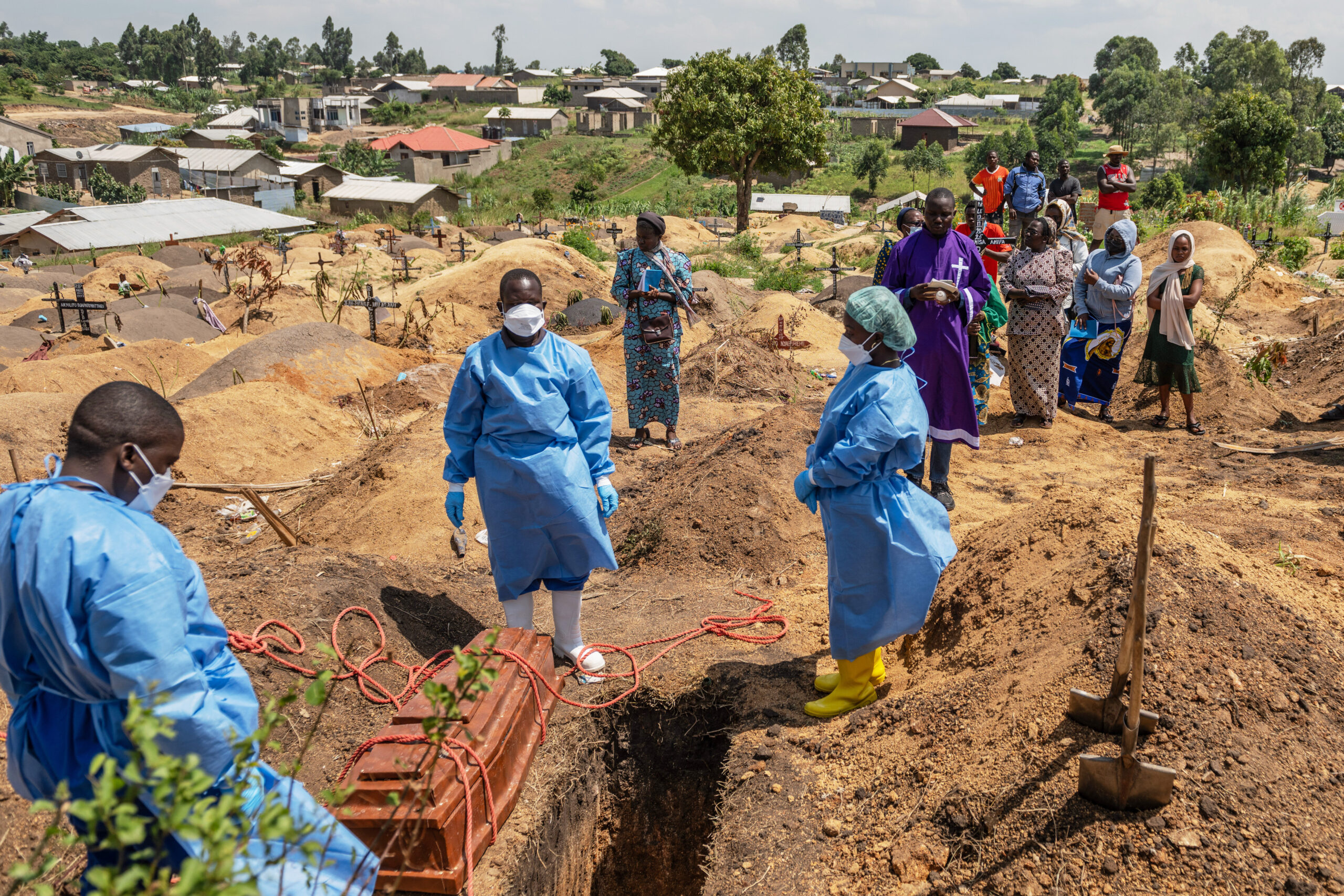
    Red Cross workers prepare to bury Vanisa Anifa, a 6-month-old orphaned girl who died of Ebola, at the Bigo Cemetery, in Bunia, Congo, on Friday.

    The virus is now present in at least three eastern provinces in Congo. Ituri province, the epicenter, has recorded 954 confirmed cases, with 91 more in North Kivu province and three in South Kivu province, according to government data released Sunday, with 267 people reported dead.

    In neighboring Uganda, 20 infections and two deaths have been reported.

    Misinformation and distrust about the virus have complicated the response, leading many infected people to refuse treatment.

    Health workers have been attacked during contact tracing and when relatives are denied access to the infected bodies of their loved ones.

    On Friday, in the Mambangu neighborhood of Beni, angry residents attacked workers who went to disinfect the home of someone who died of Ebola, according to said Serge Kambale, 39, a doctor who spoke to the Washington Post by phone from the city.

    During the incident, two workers were injured when the locals started throwing stones at them. Fabrice Kavono, a witness, said that the crowd attacked the health workers and accused them of fabricating the disease for material gain.

    “It is the second time Ebola is in Beni, but they say it’s in Bunia and Mongbwalu only and that they are making it up here to make money,” Kavono said.

    Another witness told the Post that people with relatives in Mongbwalu, the mining town in Ituri province at the center of the outbreak, were fleeing in droves to relatives in parts of North and South Kivu — spreading the virus as they traveled.

    Onesphore Bangenza, the leader of the Ebola Response Team in Bunia for Mercy Corps, a nonprofit group, said that burials in which relatives insisted on washing bodies of loved ones and touching them were still happening, and that residents were not adhering to distancing guidelines.

    “We have motor taxis transporting more than three people,” Bangenza said. “There are people who do not want to be tested. The scale of the outbreak could be larger.”

    In May, 30 people who had exhibited Ebola-like symptoms died at a displacement camp in Kigonze that hosts families fleeing conflict in the region, Reuters reported.

    Two aid workers confirmed that 13 deaths had been reported at the camp within 48 hours and that more 30 total deaths were expected.

    “The constant movement and overcrowding of refugees in camps is causing fear that this virus could spread even more and the scale of the outbreak may grow” Bangenza said, adding that conditions in the camps were abysmal. “No water, no latrines,” he said. “The hygiene condition is very, very bad.”

    New Ebola cases have been reported in cities such as Beni where an ISIS-affiliated rebel group, the Allied Democratic Forces, has waged attacks, prompting families to flee their homes.

    At a local hospital in Beni, a patient admitted with malaria asked to be discharged early because he feared that others at the hospital would have Ebola and infect him, he told the Post. While he was in the hospital, the ADF attacked an area near the hospital, killing seven people.

    “First, I was afraid that because I exhibited malaria symptoms, which are similar to Ebola, I would be assimilated with people with Ebola,” the patient said, speaking on the condition of anonymity to discuss private health matters. “In the small hospital, there is no clear follow-up, so anything can happen. Then, the attack scared me more.”

    Congo has been besieged by years of conflict especially in the mineral-rich eastern regions of the country, which boast the world’s largest deposits of coltan and cobalt, used to manufacture electronics.

    Cycles of violence have also weakened health systems in the region.

    Just last week, protests broke out in Kinshasa, Congo’s capital, after people learned of a proposal to change the constitution to allow an extension of term limits, which would allow President Félix Tshisekedi to stay beyond his current term, which was supposed to be his last.

    The Rwanda-affiliated M23 rebel group was working with health teams after two cases of Ebola were discovered in Goma, a city that M23 controls, the group’s deputy spokesperson, Oscar Balinda, told The Post. M23 controls large swaths of territory in eastern DRC.

    The United States has sent $375 million in aid, so far, to contain this latest Ebola outbreak, Trump said during a recent Group of Seven meeting in France.

    Experts say more must be done contain the outbreak.

    “One of the key factors to try to control an outbreak of Ebola is to decentralize as much as possible the testing capacity, so that the tests can be done in the places where the cases are,” said Abela, the epidemiologist. “And I think that this, little by little, is happening. But, as usual, we want things to happen yesterday.”

    Abela also said that contact-tracing is crucial but not enough is being done. “At the moment, I think there are 70 percent of the contacts being followed up when the target is normally 95 percent, according to the DRC authorities.”

    He added: “This is clearly one of the gaps.”
  • A new rooftop nightclub proposed for the Camden waterfront aims to be part of the city’s ‘evolution’

    A new rooftop nightclub proposed for the Camden waterfront aims to be part of the city’s ‘evolution’

    Clubgoers might soon have the chance to take in nighttime views of the Philadelphia skyline at a new rooftop nightclub along the Camden waterfront.

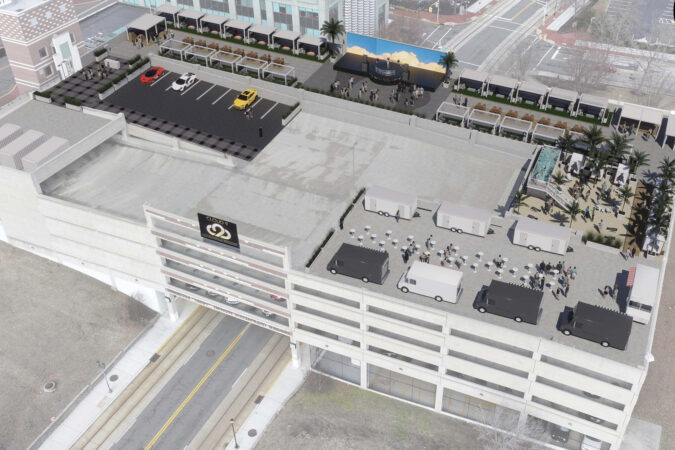
    The Cloud 9 SkyLounge is proposed for the rooftop deck of the fourth-floor Hinson Parking Garage next to the Delaware River Port Authority office tower on Delaware Avenue.

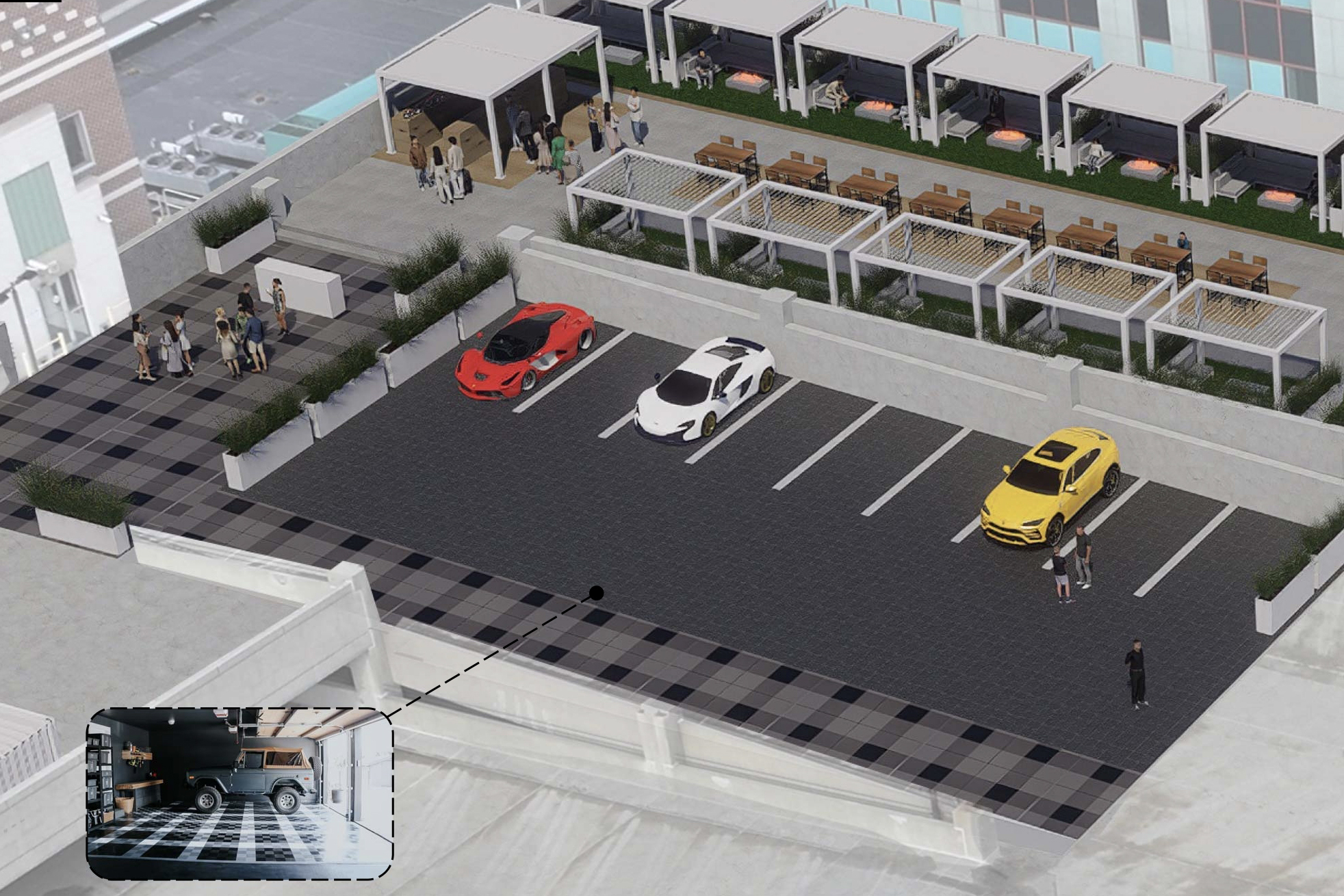
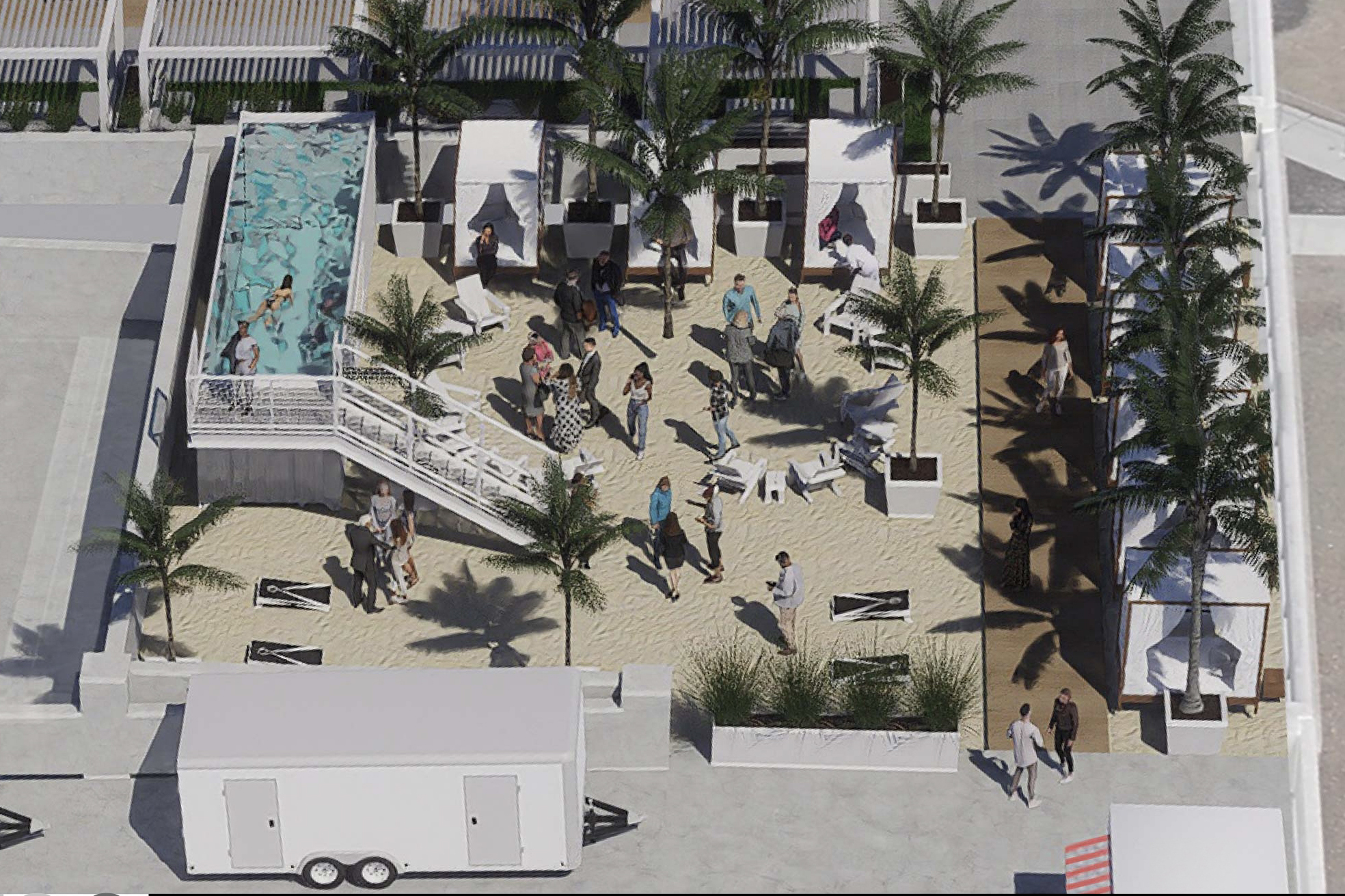
    The club would include a stage and dance floor, private cabanas, a pool deck, bar areas, a food truck zone, VIP parking, and more, according to the developer’s application to the city, which is still awaiting final consideration from Camden’s planning board.

    So far, city officials have approved the new use for the property, said Joe Console, attorney for the Cloud 9 developers.

    Now, the applicant will work on developing more detailed engineering reports, showing that the project complies with local regulations as it relates to traffic, noise, building capacity, and more, Console said. Once complete, the project will eventually be brought back before the planning board for review and final approval.

    “Our vision is to create a world-class entertainment and hospitality destination that showcases the beauty of the Camden waterfront, the Philadelphia skyline, and the energy of the entire region,” Cloud 9 founder and CEO Kenneth Walden said. “We want visitors to experience something they would normally expect to find in cities like Miami, Las Vegas, New York, or Los Angeles — right here in Camden.”

    As an adaptive reuse project instead of new development, the club would require no changes to the parking garage’s existing footprint, and the rooftop venue would be limited to temporary installations, according to the application.

    Parking for the rooftop venue would also be self-contained within the existing parking structure. The developers said they do not anticipate any parking issues extending into the surrounding area.

    A rendering shows the entry view of the proposed Cloud 9 SkyLounge rooftop deck of the Hinson Parking Garage on Delaware Avenue in Camden.

    The parking garage is currently owned by the city’s parking authority and the rooftop would be rented to Cloud 9 starting at $5,000 per month, per the application documents. The venue would be open Thursday 6 p.m. to 1 a.m., Friday and Saturday 6 p.m. to 2 a.m., and Sunday 5 p.m. to 12 a.m.

    “Cloud 9 was born from a simple belief: that Camden deserves extraordinary destinations just as much as any major city in the country,” Walden said. “For years, people have viewed Camden primarily through the lens of its challenges. I believe it is equally important to recognize its potential, its resilience, and the remarkable transformation taking place along the waterfront. Cloud 9 is intended to be part of that continued evolution.”

    The property is located within the city’s mixed waterfront zoning district which is designed to help revitalize former industrial or vacant properties into pedestrian-friendly, mixed-use areas along the waterfront.

    The venue’s developers included in their application that the project is “consistent with the overall vision of the [mixed waterfront zone] as it promotes: activation of underutilized urban space, enhancement of the waterfront entertainment environment, increased tourism and economic activity and adaptive reuse of existing infrastructure.”

    The new nightlife destination would be within walking distance to some of the city’s other waterfront destinations such as Freedom Mortgage Pavilion, Wiggins Waterfront Riverstage, and Adventure Aquarium.

    A rendering shows the beach view of the proposed Cloud 9 SkyLounge rooftop deck of the Hinson Parking Garage on Delaware Avenue in Camden.

    The office for Camden Mayor Victor Carstarphen said that while they are aware of the proposed rooftop bar and lounge, they declined to comment specifically on the project or its details as it continues to make its way through the land development process.

    “Camden is undergoing an unprecedented transformation as investment is taking place citywide. As a result, there is great interest from developers, and a wide variety of projects are being proposed in every part of the city,” said Vincent Basara, director of communications for the mayor’s office. “Camden is always open to new ideas and proposals. The success of this project will ultimately be based on the merit of the application. We are confident in the public process and the various reviews which are required.”

    About a mile north on the other side of the Benjamin Franklin Bridge, the New Jersey Economic Development Authority is accepting mixed-use redevelopment proposals for a 16-acre waterfront parcel that was previously home to the former Riverfront Prison and Weeks Marine site in North Camden.

    “Beyond the venue itself, I believe Cloud 9 can contribute to the city in several meaningful ways,” Walden said. “The project has the potential to create jobs, attract visitors from throughout New Jersey, Pennsylvania, Delaware, and beyond, generate additional economic activity for nearby businesses, and further strengthen Camden’s reputation as a destination worth visiting and investing in.”

    The Cloud 9 SkyLounge was presented to the city’s zoning hearing board for final site plan approval on June 1 and will need to continue through the development process before finally being voted on by the city’s planning board. The exact timeline for this process varies by project, but a final vote on Cloud 9 is likely still weeks or even months away, as the application must go before the city’s planning board, though they will not officially discuss the project until at least the board’s July meeting.

  • Why Trump’s algae problem is much bigger than the Reflecting Pool

    Why Trump’s algae problem is much bigger than the Reflecting Pool

    In his battle to clean the murky waters of the Lincoln Memorial Reflecting Pool, President Donald Trump has tried draining, painting, hydrogen peroxide, and what the Interior Department describes as “high-tech nanobubble ozone technology.” But he has seemingly overlooked two of the most important factors that experts say are driving unsightly — and sometimes dangerous — profusions of algae: pollution and climate change.

    Algae thrive in warm, still waters, causing populations to explode as global temperatures rise, said environmental engineer Steve Chapra, an emeritus professor at Tufts University.

    Meanwhile, rampant human development has increased the amount of fertilizer and sewage produced by farms and cities, and severe storms intensified by the warmer atmosphere are causing more of these pollutants to run off into local waterways — providing algae with the nutrients they need to grow.

    In a 2017 study, Chapra and his colleagues projected that climate change would cause a more than fivefold increase in the number of days when U.S. water bodies are affected by harmful algal blooms.

    Short-term measures like those Trump has pursued may temporarily reduce algae populations in some water bodies, Chapra said. But unless they grapple with warming and nutrient pollution, any efforts to address these blooms in the Reflecting Pool and elsewhere are doomed to fail in the long run.

    The consequences could be profound, because the problems presented by blooms go far beyond aesthetics, he added. They can disrupt aquatic food chains, deplete oxygen in water bodies and even produce deadly toxins.

    “It’s probably the biggest water quality problem in the world,” Chapra said. “The Reflecting Pool is the canary in the coal mine.”

    A spokesperson for the Interior Department did not respond to questions about whether the department had considered nutrient pollution or water temperature in planning the pool’s refurbishment. In an email, the agency reiterated that the National Park Service is using hydrogen peroxide and ozone nanobubbles, which break up algae by damaging their cells.

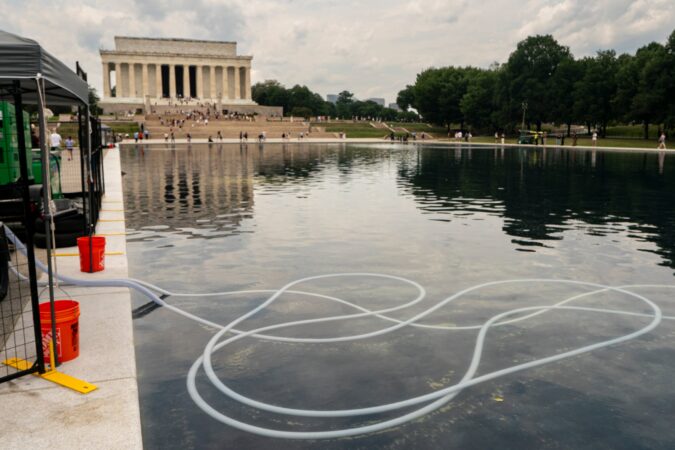
    The Reflecting Pool has been beset by algae blooms, as seen Monday.

    The root causes of blooms

    Algal blooms have long thrived in the Reflecting Pool, thanks to stagnant, shallow water enriched by pollution and warmed by sweltering D.C. summers.

    Since 2012, the pool has been filled from the Tidal Basin, which in turn is fed by the Potomac River. Both water bodies contain excessive amounts of nitrogen and phosphorous — the nutrients most loved by algae — and are designated as “impaired” by the Environmental Protection Agency, meaning they don’t meet basic water quality standards for swimming, fishing, and supporting aquatic life.

    Trump said his $14 million renovation this spring would clean the pool’s algae-clouded waters by sealing leaks and painting the bottom “American flag blue.”

    But the refurbishment didn’t address the pollution that is the root cause of algal growth, said Hans Paerl, an aquatic ecologist at University of North Carolina at Chapel Hill. The pool was refilled on June 4 using the same nutrient-rich Tidal Basin water as before.

    The spate of warm, sunny days that followed — June so far has been about 2 degrees Fahrenheit hotter than normal, according to the National Weather Service — provided ideal conditions for the photosynthetic creatures to multiply. Those high temperatures may have been exacerbated by the pool’s new dark blue coating, which absorbs more heat than its previous gray finish, Chapra said.

    Within days, satellite data showed that the Reflecting Pool contained more algae than at any recorded point in June for at least five years.

    The bloom that turned the pool green shortly after it was refilled was likely caused by a single-celled organism called cyanobacteria, Paerl said. Pictures of the pool showed a characteristic bright green scum coating the surface of the water.

    Cyanobacteria blooms are the most dangerous, Paerl said, because they produce toxic compounds that can cause rashes, vomiting, and neurological problems in people who touch or ingest them.

    After the Interior Department treated the pool with hydrogen peroxide, which breaks down cyanobacteria’s cell membrane and disrupts photosynthesis, the cyanobacteria bloom seemed to wane.

    But the water’s sickly green sheen remains. Aquatic ecologist Rosalina Christova, a George Mason University researcher who acquired a sample from the Reflecting Pool on June 15, found that the water had been colonized by a genus of multicellular green algae called Desmodesmus. In an email, she called the population “very dense.”

    The green algae are more resistant to the effects of hydrogen peroxide, and they were likely able to capitalize on the nutrients released from the disintegrating bodies of the slain cyanobacteria, Paerl said.

    “This created a niche for another player, so to speak,” he said. “Nutrients keep cycling through there and feed whatever blooms.”

    A growing global threat

    Though the administration’s concerns about algae in the Reflecting Pool are in part cosmetic, the proliferation of blooms in waterways across the planet pose a significant — and growing — threat, said Joaquim Goes, a biogeochemist at Columbia University.

    By studying satellite images of the ocean, he found that microalgae scums — caused by the same tiny organisms as those afflicting the Reflecting Pool — have expanded at a rate of 1% per year since 2003. The phenomenon has disrupted food chains and created oxygenless “dead zones” where fish can’t survive.

    “It is spreading like wildfire all over the world,” Goes said. “And there is no question that temperature is playing a role.”

    Blooms are also increasing in freshwater bodies that supply people’s drinking water, research shows.

    A 2022 EPA assessment found that 49% of U.S. lakes showed excess amounts of chlorophyll a, the photosynthetic compound that indicates presence of cyanobacteria and green algae. Detections of microcystins, a class of toxin produced by cyanobacteria, increased by almost 30 percentage points since the previous assessment was conducted five years earlier.

    Massive cyanobacteria blooms have poisoned important fisheries, such as in Lake Erie. They can imperil important ecosystems, like the Everglades below Florida’s Lake Okeechobee. They have been linked to the deaths of dogs, cattle and, in rare cases, humans.

    Even green algae, which do not produce toxins, can clog filtration systems and disrupt drinking water supplies. When they die, the decomposition of their bodies depletes oxygen in the surrounding water, killing other aquatic life.

    The National Office for Harmful Algal Blooms, funded by the National Oceanic and Atmospheric Administration, estimates that phenomenon causes an average $50 million in damage to the U.S. economy each year. Individual severe events can cause even greater harm: An unprecedented “red tide” cost roughly $2.7 billion in decreased tourism revenue when it forced the closure of beaches across southern Florida in 2018.

    Lasting solutions

    Theories about the persistence of the Reflecting Pool algae abound.

    The Interior Department has blamed residual organisms that remained in supply lines after the renovation. Some have speculated that the recent blooms are a product of liberal “sabotage.”

    The Trump administration has said it plans to drain the pool again to address algae growth and paint that is peeling from its bottom.

    But those measures are unlikely to prevent algae from reemerging, said environmental engineer Victor Bierman, a retired water quality consultant and former EPA scientist.

    As summer heat continues to ramp up, he worries the green algae could be replaced by cyanobacteria, which have no predators and readily outcompete other microbes at high temperatures.

    “You can get rid of an existing bloom, but if you don’t change the underlying conditions … you’re going to grow more algae,” Bierman said.

    Officials could stymie growth by increasing the flow of water through the pool, but that would disrupt the still surface needed for it to be reflective, he added. A better option would be installing an enhanced filtration system that removes nutrients from the Tidal Basin water before it is pumped into the pool.

    Ultimately, said Chapra, algae blooms will continue to plague the Reflecting Pool and countless other water bodies until people address the human-made problems of nutrient runoff and climate change.

    “If you don’t follow the science, then you think it’s magic or espionage, and it’s not,” Chapra said. “This is basic biology.”

  • Philly-area rain totals varied dramatically, and drought conditions survived the storms

    Philly-area rain totals varied dramatically, and drought conditions survived the storms

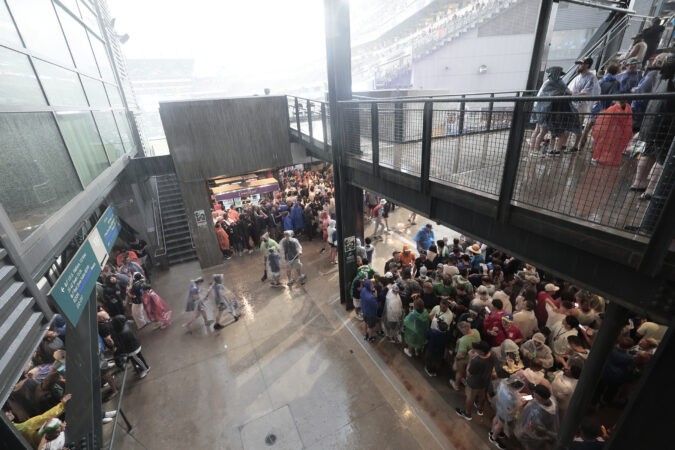
    The storms took down trees and wires, flooded roads, spoiled a World Cup party, and set off a deluge of smartphone panic alerts. But they evidently didn’t come close to erasing the rain deficits throughout the Philly region.

    Even with the additional light rains on Tuesday, bringing the two-day total to about 1.45 inches, officially Philadelphia’s rainfall for June still is slightly below normal, and this is after an extraordinary streak of 10 consecutive months of below-normal precipitation.

    And Monday’s storms exhibited a classic summer caprice. Areas of New Jersey and Chester County, both under state-declared drought emergencies, were all but stiffed, according to an analysis by the National Weather Service’s Middle Atlantic River Forecast Center. Northwestern Philadelphia and southeastern Montgomery County got as much as 2 inches.

    The weather service’s Mount Holly office reported that totals within counties varied radically. In Bucks County, for example, 1.8 inches was measured in Bristol and just over a half inch in Doylestown. Across the river, 2.4 inches fell upon Sewell, and about 0.75 in Monroe Township.

    “Some areas got it, some didn’t,” said Ben Casella, executive director of the New Jersey Farm Bureau. It can “rain here, but it may not rain on the other side of town,” he said.

    Not all of that Monday rain was beneficial, said Andrew Frankenfield, educator with the Penn State Agriculture extension in Montgomery County. Some of the water in those downpours on Monday rushed to the gutters and didn’t stop to soak into the soil.

    And those cloudbursts certainly weren’t beneficial to people routed from the World Cup fan fest in Fairmount Park, or to some motorists. Numerous water rescues were reported in the Wyncote section of Cheltenham Township, Montgomery County, And the weather service noted several reports of flooded streets and rushing water up to a foot deep floating cars in Germantown.

    Tuesday’s gentle rains, Frankenfield said, were more beneficial to the plant life, which is only going to get thirstier as the summer progresses.

    Is more rain coming to the Philly region?

    Showers are possible Thursday, said Alex Staarmann, meteorologist with the National Weather Service in Mount Holly, with a better shot Friday night and Saturday.

    However, these may again be lottery-ball situations, something with which farmers are well acquainted.

    Generally throughout the region through Monday, precipitation was running about 75% of normal, on average about 5 inches below normal, according to the river center, which bases its surveys on several measuring stations in each county.

    The latest interagency U.S. Drought Monitor map had most of the region in “moderate drought,” but Cape May County and areas of New Jersey near Delaware Bay are in “extreme drought.” Those regions were all but shut out from the Monday downpours.

    They evidently fared a bit better on Tuesday, with the Millville airport reporting about a third of an inch, and a half inch measured in Sea Isle City.

    While the rains were welcome, the drought anxieties persist, Casella said.

    “As we turn the calendar into July, the crops are going to need more moisture,” Frankenfield said.

    “We certainly need more” rain, he said. “We can’t make it up in a week, we can’t make it up in a month. We’re concerned, but not alarmed.”

  • Where to watch Fourth of July fireworks in Philly, the suburbs, South Jersey, and the Shore

    Where to watch Fourth of July fireworks in Philly, the suburbs, South Jersey, and the Shore

    This Fourth of July will be unlike any in recent memory. As the nation marks its 250th anniversary, Philadelphia and the surrounding region are packed with celebrations — and fireworks displays. From the city and suburbs to South Jersey and the Shore, there are dozens of opportunities to catch a show.

    Whether you’re staying in Philadelphia, heading to the suburbs, or spending the holiday down the Shore, here’s where to find Fourth of July fireworks across the region.

    Fireworks in Philadelphia

    Fireworks after the San Diego Padres and Philadelphia Phillies game at Citizens Bank Park on July 2, 2025.

    Fireworks in Bucks County

    Fireworks in Chester County

    Fireworks in Delaware County

    Fireworks in Montgomery County

    Fireworks in Allentown

    Fireworks in South Jersey

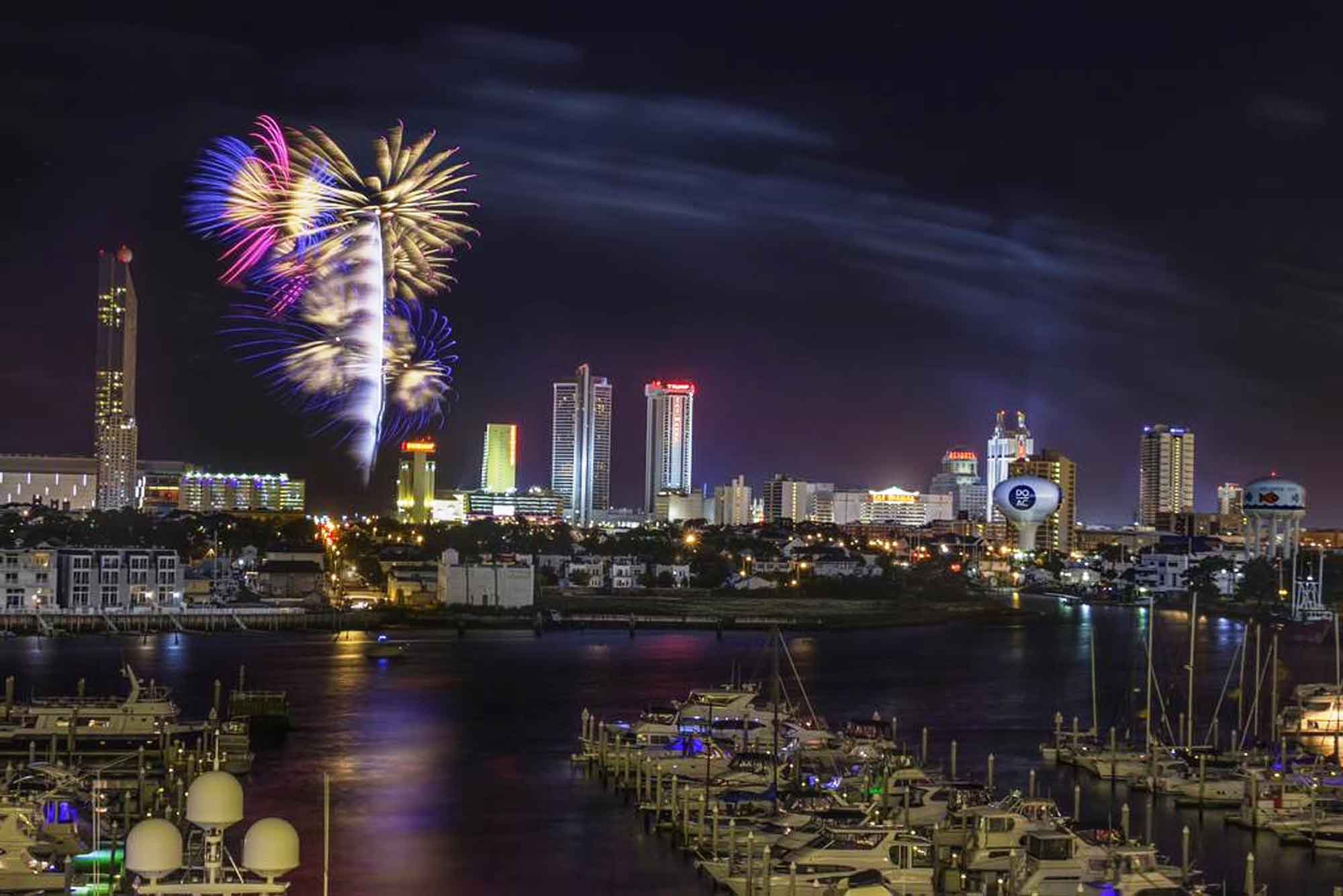
    A view of Atlantic City’s fireworks from the Marina. (Courtesy of the Casino Reinvestment Development Authority)

    Fireworks at the Jersey Shore

  • Body recovered of swimmer who disappeared in water along Ocean City

    Body recovered of swimmer who disappeared in water along Ocean City

    The body of a swimmer who went missing last month in the water along Ocean City has been recovered near Sea Isle City, police said Tuesday.

    The man, described as a 20-year-old from Exton who was a student at Hofstra University, according to 6ABC, disappeared late in the afternoon on May 18 near the 10th Street Beach.

    On Friday, a body was recovered about 10 miles away and later identified as the missing swimmer, police said.

    The man was not publicly identified and the Ocean City Police Department said the family has asked for privacy.

    <iframe src="https://www.facebook.com/plugins/post.php?href=https%3A%2F%2Fwww.facebook.com%2Focnjpolice%2Fposts%2Fpfbid02mAmNNdQ5cYKXueAAfXig2ecsFecPKQHX7HTKgWyH9tDzUprxuygHn2FoBJtsStXul&show_text=true&width=500" width="500" height="199" style="border:none;overflow:hidden" scrolling="no" frameborder="0" allowfullscreen="true" allow="autoplay; clipboard-write; encrypted-media; picture-in-picture; web-share"></iframe>
  • Senate for first time approves a war powers resolution in a rebuke to Trump over Iran conflict

    Senate for first time approves a war powers resolution in a rebuke to Trump over Iran conflict

    WASHINGTON — The Senate for the first time approved a war powers resolution Tuesday seeking to block U.S. military action against Iran, as lawmakers warily watch President Donald Trump’s efforts to resolve a conflict that the administration launched on its own and now needs Congress to fund.

    It was the 10th time the Senate has tried to stop the war, and the outcome, on a vote of 50-48, was a stunning turnaround from past efforts. While the resolution is largely symbolic, and does not carry the full force of law, it reflects the growing concerns from a number of Republican lawmakers in both the House and Senate over both the war and the deal Trump struck with Iran to end it. The House approved the resolution earlier this month.

    Trump responded angrily Tuesday night on his Truth Social platform, calling the vote “poorly timed and meaningless” and saying it “provided aid and comfort” to Iran.

    Senate Democratic Leader Chuck Schumer of New York said, “Time after time, the vast majority of Senate Republicans sided with Trump and his war instead of the American people.”

    Schumer said Americans have paid the price for “Trump’s historic blunder in Iran. It’ll go down in the history books as one of the worst foreign policy forays America has ever made.”

    In the past, as many as four GOP senators have voted for the war powers resolutions, and they did so Tuesday — Republicans Lisa Murkowski of Alaska, Susan Collins of Maine, Rand Paul of Kentucky and Bill Cassidy of Louisiana. One Democrat, Sen. John Fetterman of Pennsylvania, voted against.

    Trump bashed the four Republicans as losers, saying, “These senators have made my job more difficult.”

    On this vote, the absence of two Republicans, including Sen. Mitch McConnell of Kentucky, who was admitted to the hospital recently for an undisclosed matter, left the GOP without a full majority to halt the effort. Sen. Dave McCormick, R-Pa., also missed the vote.

    The vote comes as the Pentagon is seeking $80 billion from Congress mostly for the Iran war as it backfills munitions and stockpiles.

    Trump to meet senators as Republicans balk at Iran deal

    Trump himself is headed to the Capitol on Wednesday to meet with GOP senators after Vice President JD Vance was overseas working to negotiate with Iran to end its nuclear ambitions — which had been among the stated rationales for the war.

    The president is not pleased with the Republicans who have been critical of the deal he struck with Iran, according to one GOP senator granted anonymity to discuss the private dynamics.

    The terms of the Iran deal are spelled out in a memorandum of understanding that Trump signed last week, starting a 60-day clock for the sides to reach a broader agreement over ending Iran’s nuclear program.

    But Republicans have particularly objected to the $300 billion fund to help Iran rebuild, which is far greater than the $1.7 billion then-President Barack Obama refunded the country under his administration’s 2015 Iran deal.

    “I believe President Trump is getting very poor advice on Iran,” Sen. Ted Cruz, R-Texas, said last week on his podcast after the deal was made public.

    Democrats have repeatedly forced Iran votes

    Over and again, Democrats have been forcing votes on the Iran war, almost since the U.S. and Israel launched missile strikes on Iran on Feb. 28.

    Nearly each week they’re in session, the Senate Democrats have put forward war powers resolutions, but they have failed to amass the majority needed for passage in the narrowly split chamber, where Trump’s Republican Party holds the majority. Trump would almost certainly veto any measure that passed.

    The House pushed its own version to passage earlier this month, with four Republicans joining all Democrats in approving the war powers resolution, over the objections of House Speaker Mike Johnson and the GOP leadership.

    While the House- and Senate-passed resolution does not go to the president for his signature, passage stands as a powerful, if symbolic, statement from Congress and a rebuke of the administration’s military actions.

    Sen. Tim Kaine, the Democrat from Virginia who has led his party’s efforts, said the pause in warfighting, as Trump’s team works to shore up a fragile ceasefire, provides the perfect time for Congress to step back and assess “what should the next chapter be.”

    Hegseth seeks $80 billion from Congress for the Iran war

    Defense Secretary Pete Hegseth is on Capitol Hill this week, seeking roughly $80 billion in supplemental funding to shore up defense supplies in the aftermath of the Iran war, which is drawing scrutiny when many Americans are reeling from high gas prices and costs of living.

    The Pentagon early on had estimated the war cost $11.3 billion during its first week, and senators said experts put the overall price tag of Operation Epic Fury higher, at some $100 billion.

    The Defense Department’s funding request is part of a broader beef-up of military money the White House wants as part of its budget request this year.

    House Democratic Leader Hakeem Jeffries said Tuesday, “We should not spend another dime of taxpayer dollars on Operation Epic Failure.”

    The Trump administration is seeking $1.5 trillion in defense funding this year — a nearly 50% increase — including $350 billion that it wants in a so-called budget reconciliation package. Johnson and GOP leaders are working to pass that package on their own, over the objections of Democrats, much the way they approved Trump’s big tax cuts bill last year.

    The 2025 tax cuts package also included a sizable increase for the military.

  • The history of American Jews exposes the fundamental questions of citizenship

    The history of American Jews exposes the fundamental questions of citizenship

    The history of American Jews’ citizenship makes the president’s case to eliminate birthright citizenship, now awaiting a Supreme Court decision, no surprise—but this should offer little comfort.

    The central plotline of the story of Jews in the United States tends to revolve around citizenship: Jews arrived, gained citizenship, the end. Yet this story accounts for neither how citizenship has worked for Jews nor how it works in general. A far more accurate history of Jewish citizenship in the United States exposes the persistent political questions asked, answered, and unresolved when policymakers try to decide who is and isn’t “American.”

    For the past 250 years, American leaders have used citizenship law to draw and re-draw the lines of individual belonging through collective categories. From the beginning, Congress granted “any alien being a free white person” access to citizenship, writing into naturalization law in 1790 broad thresholds for membership. In 1868 the Fourteenth Amendment revolutionized citizenship by opening it to “all persons born or naturalized in the United States.” Yet Congress also legislated that for the purposes of naturalization, “all persons” only included “free white persons” and “aliens of African nativity…and African descent,” not Chinese people or “Asiatics.”

    Jews who immigrated from Europe tended to gain access to naturalization as “white” under citizenship law, but government officials found Jews a useful—and sometimes confounding—guide to help them apply the law, even when Jews were not directly involved.

    Take a 1909 naturalization appeal from four men, described in their rejected application as “Armenians by race.” The men were not Jewish, but Judge Henry Cabot Lowell, who presided over their appeal, nonetheless found himself contemplating Jewish citizenship. Harvard-educated and hailing from an elite Boston family, Lowell consulted scientific treatises to conclude that “Hebrews” and Armenians were both “Asiatic” in origin. Prevailing scientific racism of the day convinced him that neither met the threshold of whiteness. As he wrote in his decision, it was “hard to find loophole for admitting the Hebrews” to citizenship. But at least until Congress acted, he saw no reason to exclude Armenians if Jews could benefit from the loophole.

    Jewish leaders panicked when they witnessed high-level government officials slotting them into racialized categories other than “white.” They understood that the historical fact of citizenship would not necessarily protect Jews in years to come, especially as eugenicist ideas gained traction among policymakers designing new restrictive immigration laws. In the early 20th century, elite Jews lobbied politicians, filed reports, intervened in naturalization cases, and testified at congressional hearings to bolster Jews’ claims to citizenship. Their efforts met partial success. As passed in the 1920s, immigration quota laws dropped the classification of Jews as “Hebrews,” instead counting Jews among others of their same “national origin.” Still, the countries from which most Jews immigrated, such as Russia and Poland, now faced some of the harshest restrictions.

    In practice, the new quota laws reduced the number of Jews who could naturalize and raised suspicion about those who did. Foreign-born Americans from many different backgrounds experienced discrimination that legal status did not avert.

    But accusations of foreignness and dual loyalty clung to Jews in unique ways, as illustrated by a remarkable case from 1947. That year, a naturalized Jewish man sought to return to the United States after living in British-mandate Palestine for over a decade. Detained by U.S. border control agents, the Ukrainian-born man learned that his American passport had been revoked under a 1940 law that prohibited naturalized citizens from living abroad for over five years. Native-born citizens were not subject to the same law. The ACLU, American Jewish Committee, and American Jewish Congress seized on this fact to call the law unconstitutional and defend the Jewish man on his appeal. But for the Jewish organizations, the constitutional violation was a piece of a much larger threat to Jewish citizenship in the United States. When Congress authorized the 1940 statute, it did so under pressure from a State Department official who insisted that “these Zionists” regularly manipulated the protections of American citizenship for their own nationalist ends.

    The court rejected the Jewish man’s appeal, and in doing so diminished the distinctly Jewish dimension of the case by tying him to other naturalized Americans, such as Japanese-Americans, whose constitutional rights to equal protection could be overridden by national interests according to recent Supreme Court precedent.

    Citizenship debates routinely entangled Jews’ status with that of other groups because the categories of citizenship were neither self-evident nor self-executing. Only in motion, by scrutinizing groups, comparing them to one another, and gauging the changing winds of national interests, did government officials bend citizenship to their will.

    In a remarkable exchange on the Senate floor in the spring of 1964, two senators debated the exclusion of religion from proposed anti-discrimination legislation targeting federally-funded programs. Albert Gore, Sr., a Democrat from Tennessee, contended that Jews lacked shelter under the law’s categories of “race, color, or national origin” because Jews were a religion. Joseph Clark, a fellow Democrat from Pennsylvania, countered that those categories protected Jews just fine because many Jews lacked any faith, so whatever discrimination they faced must be race-based. Signed into law that summer as Title VI of the Civil Rights Act, the statute (unlike many others in the same law) did not include religion among its protected categories.

    For many decades, the question of Jews’ standing under Title VI seemed to be resolved in practice, as government officials and Jewish leaders agreed that its jurisdiction did not include Jews. But it was only a matter of time before the answer faded back into a question.

    Over the last two decades—and especially since Oct. 7, 2023—government officials and many Jewish leaders have argued that Jews should have standing in anti-discrimination laws on the basis of race, color, or national origin. Detractors argue that Jews—or certain expressions of Jewishness such as Zionism—do not fit squarely into those categories. The arguments matter because the categories of citizenship law are consequential, but their answers aren’t intrinsic to citizenship. Rather, citizenship remains a tool to ask questions about belonging; as political aims change so too will its meaning.

    Made By History sponsors. FOR USE ON MADE BY HISTORY STORIES ONLY.

    For American Jews, citizenship has not offered a singular point of arrival or a final answer to the puzzle of national belonging. This lesson from the history of American Jews may offer some reassurance that Trump’s bid to overturn birthright citizenship is just another stop on a zig-zagging journey. Whether the Supreme Court endorses the administration’s tendentious reading of the 14th Amendment or not, the twisted and entangled process of arguing over citizenship will continue.

    A less sanguine lesson from the same history should warn all American citizens that an attack against birthright citizenship is an attack against them. No one is naturally or natively a citizen, wherever they were born. Political leaders are constantly remaking citizenship—just look at how the categories used to define, question, or defend Jews have changed over time. The protections of citizenship are as mutable as they are unreliable.

    Faith in any fundamental meaning of citizenship not only misses the point but also carries profound risk. Even the most capacious understanding of citizenship will not resolve the question of human belonging, but the starkly narrow one on offer from the Trump administration today threatens our ability to keep asking the question.

    Lila Corwin Berman is a professor of history at NYU and author of Who Is American? Belonging and the Question of Jewish Citizenship.

    Made by History takes readers beyond the headlines with articles written and edited by professional historians. Opinions expressed do not necessarily reflect the views of The Inquirer.

  • At Jersey Kebab, a new immigration fight | Inquirer South Jersey

    At Jersey Kebab, a new immigration fight | Inquirer South Jersey

    Good morning, South Jersey.

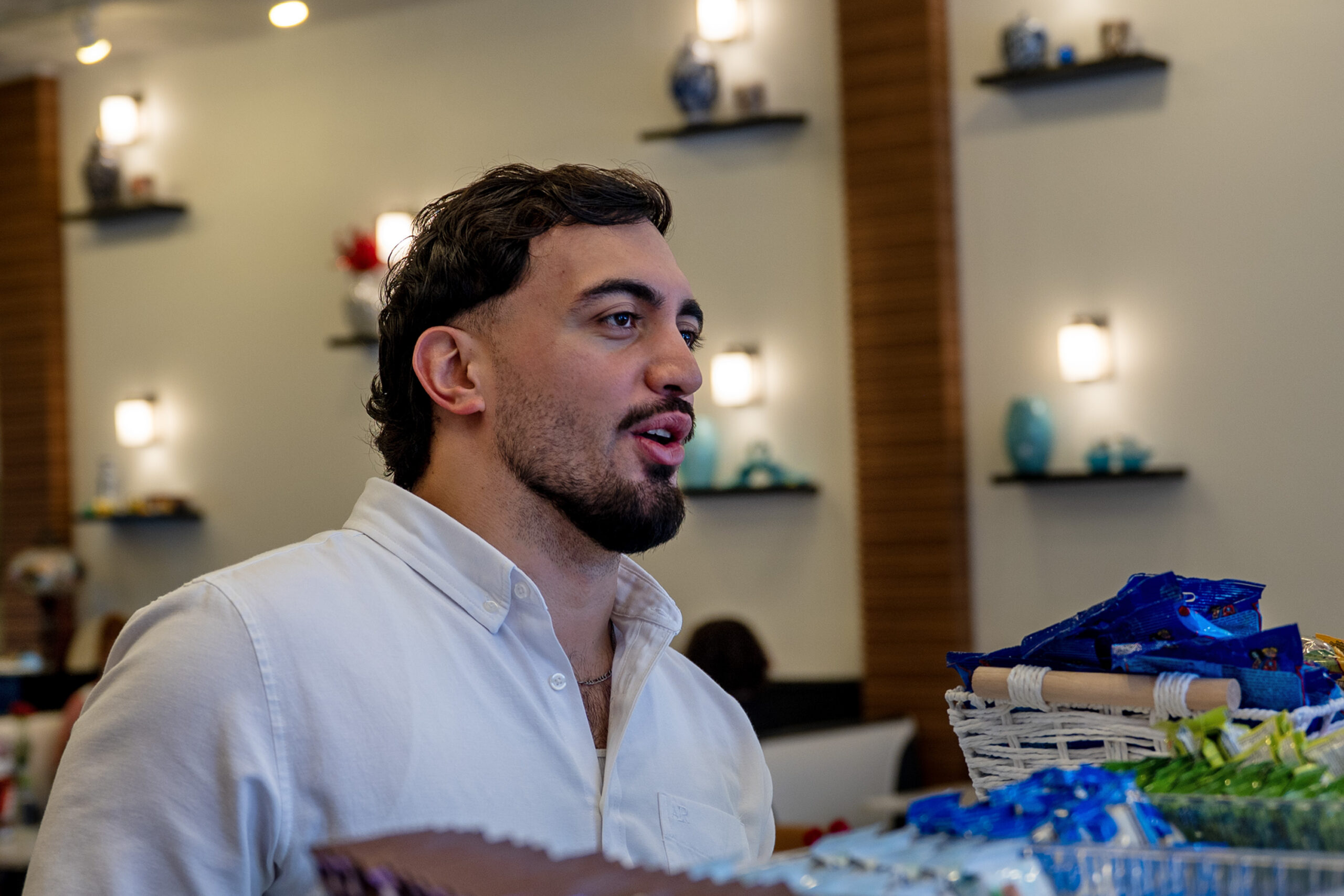
    The son of the owners of the popular Collingswood business Jersey Kebab now has his own immigration battle to stay in the country.

    And a new research initiative out of Rutgers University wants to study how the effects of hormonal changes such as pregnancy impact the brain.

    Plus, a man from Maple Shade was taken into custody for allegedly stealing and damaging LGBTQ flags, and more news of the day.

    — Taylor Allen (southjersey@inquirer.com)

    If someone forwarded you this email, sign up for free here.

    A new fight to stay in the U.S.

    More than a year after the small restaurant Jersey Kebab made national headlines and inspired widespread criticism of ICE when agents arrested the owners, their son is now fighting a similar battle.

    The federal government informed Muhammed Emanet, who left Turkey when he was 12, of its intention to deny his request for a green card, with a 30-day window to present new or additional information to try to persuade the U.S. Citizenship and Immigrations Services to allow him to stay.

    No one knows for sure what happens when the deadline comes up next week.

    If he is deported, he’ll be separated from his wife and two young sons. Hundreds of letters have been signed and gathered on his behalf, attesting to his good character.

    Reporter Jeff Gammage has the latest on his case.

    💡 Filling gaps in knowledge

    The recently launched Women’s Brain Health Initiative at the Rutgers Brain Health Institute seeks to better understand what researchers say has been historically under-studied how hormonal changes affect the brain.

    The focus is on hormonal shifts that occur throughout life such as puberty, menstruation, pregnancy, postpartum, and menopause.

    The research and the public education will center information on women’s mental health, disease vulnerability, and brain function and development.

    Read on for Sarah Gantz’s full interview with the lead researcher.

    What to know today

    🧠 Trivia time

    Which former Eagle does a celebrity bartending fundraiser every year in South Jersey?

    A) Zach Ertz

    B) Lane Johnson

    C) Jason Kelce

    D) Nick Foles

    Think you know? Check your answer.

    What we’re…

    🍿 Rewatching: Chase Street, the old political crime drama set in Camden.

    🍕 Wondering: What pickles on a pizza would taste like from Knot Like the Rest in Pine Hill.

    🥤 Drinking: A Boost slushy.

    🧩 Unscramble the anagram

    Hint: 🧊 Chilly cakes

    ACE FEROCITY WART

    Email us if you know the answer. We’ll select a reader at random to shout out here. Cheers to Rebecca Welch Pugh, who solved last Wednesday’s anagram: Burlington. The major retailer made this year’s Fortune 500 list.

    Congrats on making it through halfway through the week. I’ll catch you tomorrow. 👋🏽

    By submitting your written, visual, and/or audio contributions, you agree to The Inquirer’s Terms of Use, including the grant of rights in Section 10.

  • American Swedish Historical Museum aims to tackle $2.8 million in improvements as it turns 100

    American Swedish Historical Museum aims to tackle $2.8 million in improvements as it turns 100

    The American Swedish Historical Museum in South Philadelphia’s FDR Park could be getting some exterior upgrades, including a new auxiliary building for storage, for its 100th anniversary.

    Museum staff appeared Tuesday before one of the Philadelphia Historical Commission’s advisory committees seeking input and support for a new ADA ramp, parking area, plaza, pedestrian paths, and lighting for the grounds of the property, as well as the additional building.

    The nonprofit’s board has chosen to focus on projects that provide equitable and safe access to the building for its centennial, said Tracey Beck, the executive director of the museum, the oldest Swedish museum in the nation.

    “We do serve a lot of families with small children and senior citizens, and therefore things like the 25 steps leading up to our front door create a real barrier for a lot of people,” Beck told members of the architectural committee that met Tuesday.

    The museum sits on the northern edge of the park, facing Pattison Avenue, which is an advantage but comes with some logistical hurdles, including park parking that can be easily gobbled up during 5Ks and other events hosted at FDR.

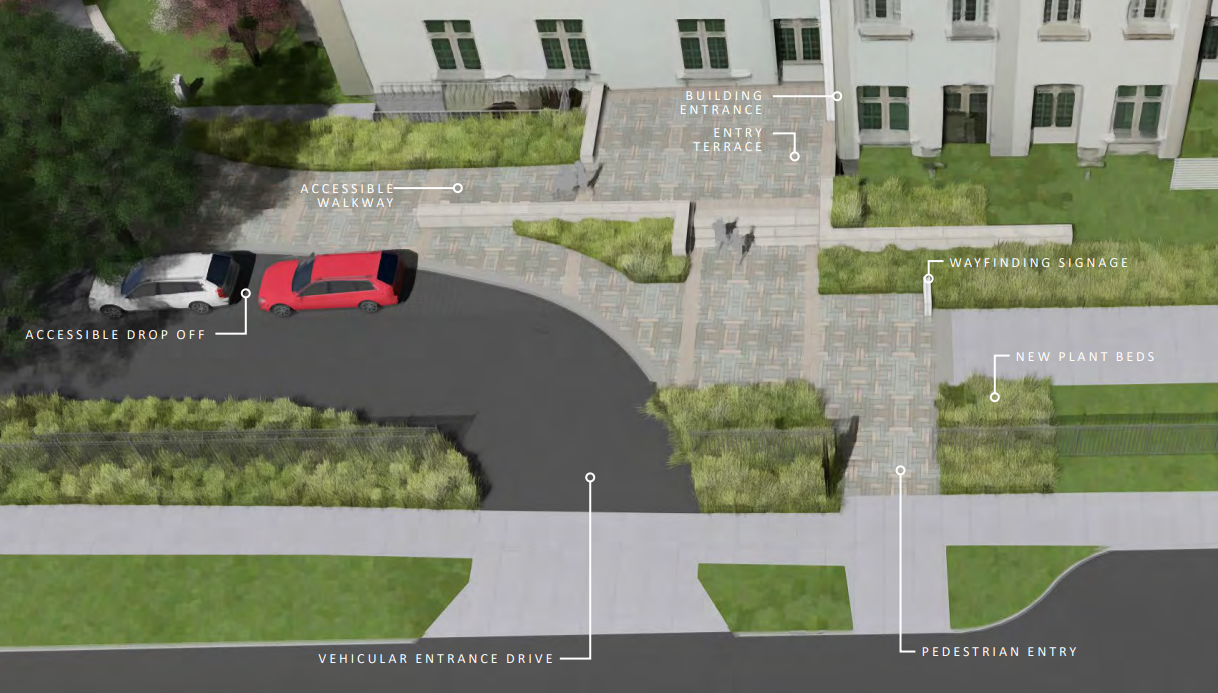
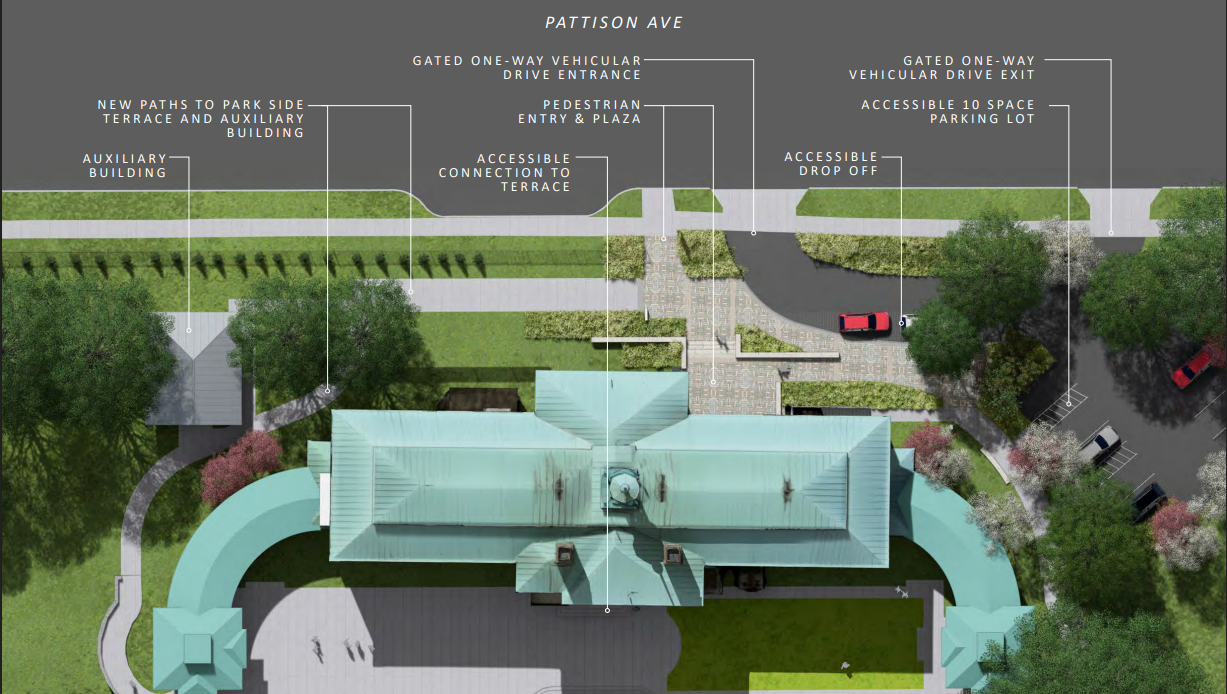
    The small 10-spot parking area that would be located on the Pattison Avenue side of the building would ensure the museum would always have parking available, no matter what is going on in the rest of the park, said Brittany Scherer with Studio Sustena, the design lead on the project. A one-way vehicular entrance drive illustrated in plans submitted to the committee also aims to create an accessible drop-off. New plantings would make the street-facing side of the building more inviting to those driving by.

    The building is already accessible, with two handicap parking spaces and an elevator installed in the early aughts, Beck told The Inquirer. Still, she said, the pandemic highlighted the need for better connectivity between the museum’s indoor and outdoor spaces during events.

    The new ADA ramp would be located on the side of the building that faces the park, which serves as the main entrance, creating a connection between the museum’s interior and its terrace, where events are held. The addition would save visitors with limited mobility from having to navigate half the building’s footprint in order to reach the existing ramp.

    Proposed Pattison Ave. improvements, including a new driveway for accessible drop-off.

    Other improvements are more practical. The lighting aims to make the museum more visible to passersby and drivers at night, while the added building would store large and heavy items, such as tables and chairs for outdoor programming.

    Members of the advisory committee were largely receptive to the improvements, unanimously approving all but two that required tweaks — the auxiliary building and the ramps — for design reasons.

    Committee members raised concerns over placement of the added storage building and how close it would be to the museum. They also thought the design was too eye-catching, possibly leading people to believe it was a welcome center or bathrooms.

    Aerial view of proposed changes to the American Swedish Historical Museum.

    “I want it to disappear a little more,” said committee member Justin Detwiler.

    Another member disagreed with the use of acrylic panels meant to provide more protection for children along the proposed ADA ramp. Committee members worried that panels would scratch and become unsightly in the future, suggesting a simple ramp or other changes to eliminate the need for panels.

    Those tweaks should be simple enough to incorporate in time for a July 10 meeting of the full commission, Beck said.

    Because the museum is still in the early stages of fundraising and awaiting conceptual approval, there is no firm timeline for the projects, budgeted to run about $2.8 million.

    The museum’s proposed improvements come as the rest of the park continues a $250 million, once-in-a-generation overhaul.