The United Nations is on the verge of “imminent financial collapse,” in large part due to the failure of member states to pay their mandatory dues, Secretary General António Guterres said in a letter sent this week to the 193 U.N. ambassadors.
Leading the list of those in arrears is the United States, which owes nearly $2.2 billion in overdue and current assessments for the regular U.N. operating budget, dating back to the end of 2024, and hundreds of millions in funds pledged or assessed to other programs, according to a U.N. official.
Under a formula in which each nation pays annually according to its gross national income, population, and debt, the United States is assessed 22% of the regular budget, which for 2026 is $3.45 billion. Closely following is China, which is assessed 20% and paid up until the beginning of this year.
The next highest arrears, $38 million, is owed by Venezuela, according to the official, who spoke on the condition of anonymity under rules set by the United Nations. Caracas’ vote in the General Assembly has been suspended, as mandated by the organization’s charter for any member that doesn’t pay for two years.
“We have managed difficult periods of unpaid assessed contributions before,” Guterres wrote without mentioning any specific country. “But today’s situation is categorically different. … The current trajectory is untenable.”
Republican administrations and lawmakers have long criticized the U.N. as wasteful, liberal, and ineffective — and in some years has reduced or temporarily withheld partial payments. The Trump administration has refused to pay at all, although it has not officially informed the U.N. whether it intends to make any future or overdue payments.
Although annual payments are usually due in January, many countries pay in tranches throughout the year. The Biden administration left office last January with its second-half 2024 assessment unpaid.
The U.S. mission at the U.N., where President Donald Trump’s former national security adviser Mike Waltz serves as ambassador, did not respond to queries on the budget.
Trump has said the U.N. has great “potential” but is not living up to its promise to keep world peace. In an executive order signed early this month, he ordered U.S. withdrawal from 66 international organizations, agencies, and commissions, nearly half of them at the U.N., because, he said, they “undermine America’s independence and waste taxpayer dollars on ineffective or hostile agendas.”
Trump’s recently announced Board of Peace, originally designed as the supervisory board for implementing his Gaza peace plan, has led to concerns that he plans to replace the U.N. altogether.
In a letter sent to 60 world leaders invited to join (25 have officially signed up so far, none of them major U.S. allies), Trump said the board would “embark on a bold new approach to resolving Global Conflict.” Trump appointed himself board chair, with personal veto power over membership and virtually every action it might take.
Responding to reporters Thursday who asked whether he thought the board was a U.N. competitor, Guterres said: “In my opinion, the basic responsibility for international peace and security lies with U.N., lies with the Security Council. … No other body or other coalition can legally be required to have all member states to comply with decisions on peace and security.”
“Global problems will not be solved by one power,” Guterres said.
Trump has also withdrawn U.S. participation from other U.N. agencies whose budgets are separate and voluntary, including the World Health Organization. Other voluntary humanitarian programs include refugee and natural disaster aid, to which the administration last month pledged $2 billion, a fraction of what Washington has contributed in the past.
In addition to the problem of unpaid dues, Guterres in his letter called on the General Assembly to revise a system in which any budgeted money that isunspent at year’s end is returned to member governments, whether or not they have paid their dues.
“We are suffering a double blow: on one side, unpaid contributions; and on the other side, an obligation to return funds that were never received in the first place,” he wrote. “In other words, we are trapped in a Kafkaesque cycle; expected to give back cash that does not exist.”
U.N. officials expect this problem, if left unaddressed, to increase exponentially by 2027, as the amount of money that must be returned cuts into each new year’s available funds. The U.N. could run out of cash as early as July, by some accounts, if neither the dues nor the financial system is addressed.
Guterres, whose term expires at the end of this year, sounded the alarm last year and proposed cutting the regular operating budget by as much as 20% via staff cuts, streamlining, building sales, and relocation of some offices from expensive locations such as Geneva to less costly regions. The General Assembly finally approved a 2026 regular budget that was 7.6% lower than last year.
In an interview with the New York Post earlier this month, Waltz claimed U.S. credit for forcing the U.N. to accept “actual real cuts for the first time in its modern history. … They’ve never seen anything like it.”
Saying he was now pushing to revamp pension and compensation plans, Waltz stressed the importance of the U.N. to international diplomacy. “There needs to be one place in the world where everyone can talk,” he told the New York Post. “We want that one place in the world to be in the United States, not in Brussels or Beijing.”
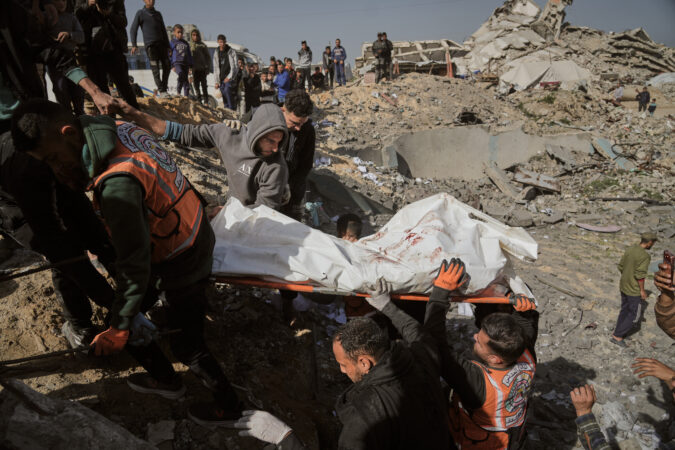
JERUSALEM — Airstrikes killed at least 32 people in Gaza overnight Friday, according to hospital and emergency response officials in the enclave, as Israel launched what it said were extensive strikes targeting Hamas militants and weapons sites.
It was one of the bloodiest nights in Gaza since the Israel-Hamas ceasefire brokered by President Donald Trump in October, as the peace process enters its precarious second phase. Israel is due to open the key Rafah border crossing with Egypt on Sunday and begin allowing the limited entry and exit of people — a concession made by Prime Minister Benjamin Netanyahu under pressure from Trump.
Egypt, a mediator in the conflict, condemned the strikes as the latest of Israel’s “repeated violations” of the ceasefire. An Israeli security official said Hamas had provoked Israel with “blatant violations” of the ceasefire by sending eight militants out of a tunnel in Rafah the previous night.
Israel also struck weapons storage, manufacturing, and launch sites in Gaza, the Israel Defense Forces said in a statement.
The Gaza Civil Defense emergency response team and hospital officials said Israel struck a tent in Khan Younis that housed the Abu Hadayed family, killing seven people; a residential home in the al-Nasr neighborhood west of Gaza City; and a police station in Gaza City’s Sheikh Redwan area.
The majority of the 32 dead as of Saturday afternoon were women and children, according to Gaza Civil Defense spokesperson Mahmoud Bassal.
The Israeli military has killed 509 Gazans and injured more than 1,400 since the ceasefire took effect Oct. 11, according to the Gaza Health Ministry. The Israeli campaign has killed more than 71,000 people in the enclave since October 2023, according to the ministry, which does not distinguish between combatants and civilians.
The Israeli government launched the campaign after Hamas led an assault on southern Israel that killed 1,200 people and took 251 back to Gaza as hostages, according to Israeli officials.
The IDF believes the number of deaths in Gaza is about 70,000, not including bodies buried under rubble, a senior Israeli military official told Israeli reporters on background this week. The IDF is still reviewing how many of the dead were combatants and how many were civilians, the official said.
After Israeli media reported the official’s comments, the IDF clarified that it was not disclosing formal casualty estimates.
“The details published do not reflect official IDF data,” Lt. Col Nadav Shoshani wrote on X. “Any publication or report on this matter will be released through official and orderly channels.”
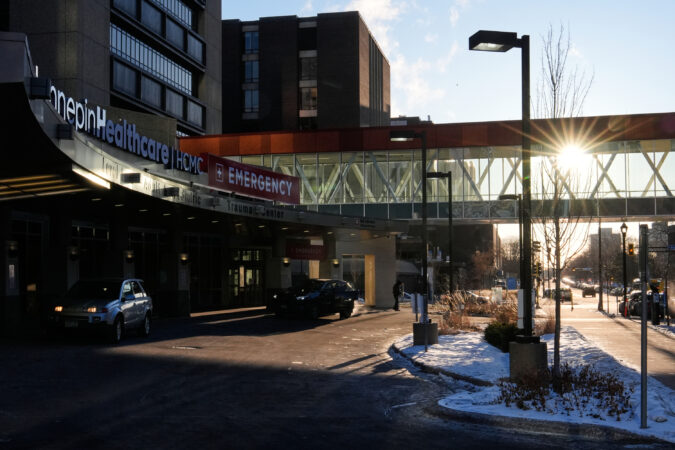
MINNEAPOLIS — Intensive care nurses immediately doubted the word of federal immigration officers when they arrived at a Minneapolis hospital with a Mexican immigrant who had broken bones in his face and skull.
Immigration and Customs Enforcement agents initially claimed Alberto Castañeda Mondragón had tried to flee while handcuffed and “purposefully ran headfirst into a brick wall,” according to court documents filed by a lawyer seeking his release.
But staff members at Hennepin County Medical Center determined that could not possibly account for the fractures and bleeding throughout the 31-year-old’s brain, said three nurses familiar with the case.
“It was laughable, if there was something to laugh about,” said one of the nurses, who spoke to the Associated Press on the condition of anonymity because they were not authorized to discuss patient care. “There was no way this person ran headfirst into a wall.”
The explanation from ICE is an example of recent run-ins between immigration officers and healthcare workers that have contributed to mounting friction at Minneapolis hospitals. Workers at the Hennepin County facility say ICE officers have restrained patients in defiance of hospital rules and stayed at their sides for days. The agents have also lingered around the campus and pressed people for proof of citizenship.
Since the start of Operation Metro Surge, President Donald Trump’s immigration crackdown in Minnesota, ICE officers have become such a fixture at the hospital that administrators issued new protocols for how employees should engage with them. Some employees complain that they have been intimidated to the point that they avoid crossing paths with agents while at work and use encrypted communications to guard against any electronic eavesdropping.
Similar operations have been carried out by federal agents in Los Angeles, Chicago, and other cities, where opponents have criticized what they say are overly aggressive tactics. It’s not clear how many people have required hospital care while in detention.
Injuries appeared inconsistent with ICE account
The AP interviewed a doctor and five nurses who work at HCMC, who spoke on condition of anonymity to talk about Castañeda Mondragón’s case and conditions inside the hospital. The AP also consulted with an outside physician who affirmed his injuries were inconsistent with an accidental fall or running into a wall.
ICE’s account of how he was hurt evolved during the time that federal officers were at his bedside. At least one ICE officer told caregivers that Castañeda Mondragón “got his (expletive) rocked” after his Jan. 8 arrest near a St. Paul shopping center, the court filings and a hospital staff member said. His arrest happened a day after the first of two fatal shootings in Minneapolis by immigration officers.
The situation reached a head when ICE insisted on using handcuffs to shackle his ankles to the bed, prompting a heated encounter with hospital staff, according to the court records and the hospital employees familiar with the incident.
At the time, Castañeda Mondragón was so disoriented he did not know what year it was and could not recall how he was injured, one of the nurses said. ICE officers believed he was attempting to escape after he got up and took a few steps.
“We were basically trying to explain to ICE that this is how someone with a traumatic brain injury is — they’re impulsive,” the nurse said. “We didn’t think he was making a run for the door.”
Security responded to the scene, followed by the hospital’s CEO and attorney, who huddled in a doctor’s office to discuss options for dealing with ICE, the nurse said.
“We eventually agreed with ICE that we would have a nursing assistant sit with the patient to prevent him from leaving,” the nurse said. “They agreed a little while later to take the shackles off.”
The Department of Homeland Security, which includes ICE, did not respond to repeated requests for comment on Castañeda Mondragón’s injuries. A deportation officer skirted the issue in the court documents, saying that during the intake process at an ICE detention center, it was determined he “had a head injury that required emergency medical treatment.”
Gregorio Castañeda Mondragón said his older brother is from Veracruz, Mexico, and worked as a roofer. He has a 10-year-old daughter living in his hometown who he helps support.
According to his lawyers, Alberto Castañeda Mondragón entered the U.S. in 2022 with valid immigration documents. Minnesota incorporation filings show he founded a company called Castañeda Construction the following year with an address listed in St. Paul.
He appears to have no criminal record. His lawyers told a court that Castañeda Mondragón was racially profiled during the crackdown, and that officers determined only after his arrest that he had overstayed his visa.
“He was a brown-skinned, Latino Spanish speaker at a location immigration agents arbitrarily decided to target,” his lawyers wrote in a petition seeking his release from ICE custody.
Hours after arrest, immigrant has eight skull fractures
Castañeda Mondragón was initially taken to an ICE processing center at the edge of Minneapolis. Court records include an arrest warrant signed upon his arrival by an ICE officer, not an immigration judge.
About four hours after his arrest, he was taken to a hospital emergency room in suburban Edina with swelling and bruising around his right eye and bleeding. A CT scan revealed at least eight skull fractures and life-threatening hemorrhages in at least five areas of his brain, according to court documents. He was then transferred to HCMC.
Castañeda Mondragón was alert and speaking, telling staff he was “dragged and mistreated by federal agents,” though his condition quickly deteriorated, the documents show.
The following week, a Jan. 16 court filing described his condition as minimally responsive and communicative, disoriented, and heavily sedated.
AP shared the details of Castañeda Mondragón’s injuries with Lindsey C. Thomas, a board-certified forensic pathologist who worked as a medical examiner in Minnesota for more than 30 years. She agreed with the assessment of hospital staff.
“I am pretty sure a person could not get these kinds of extensive injuries from running into a wall,” Thomas said, adding that she would need to see the CT scans to make a more definitive finding.
“I almost think one doesn’t have to be a physician to conclude that a person can’t get skull fractures on both the right and left sides of their head and from front to back by running themselves into a wall,” she said.
ICE officers stay with hospitalized detainees for days
ICE officers have entered the hospital with seriously injured detainees and stayed at their bedside day after day, staffers said. The crackdown has been unsettling to hospital employees, who said ICE agents have been seen loitering on hospital grounds and asking patients and employees for proof of citizenship.
Hospital staff members said they were uncomfortable with the presence of armed agents they did not trust and who appeared to be untrained.
The nurses interviewed by AP said they felt intimidated by ICE’s presence in the critical care unit and had even been told to avoid a certain bathroom to minimize encounters with officers. They said staff members are using an encrypted messaging app to compare notes and share information out of fear that the government might be monitoring their communications.
The hospital reminded employees that ICE officers are not permitted to access patients or protected information without a warrant or court order.
“Patients under federal custody are first and foremost patients,” hospital officials wrote in a bulletin outlining new protocols. The hospital’s written policy also states that no shackles or other restraints should be used unless medically necessary.
“We have our policies, but ICE personnel as federal officers don’t necessarily comply with those, and that introduces tension,” said a doctor who spoke on condition of anonymity because they were not authorized to comment for the hospital.
Hospital spokesperson Alisa Harris said ICE agents “have not entered our facilities looking for individuals.”
On Saturday, more than two weeks after Castañeda Mondragón was arrested, a U.S. District Court judge ordered him released from ICE custody.
“We are encouraged by the court’s order, which affirms that the rule of law applies to all people, in every corner of our country, including federal officers,” said Jeanette Boerner, director of Hennepin County Adult Representation Services, which filed the lawsuit on Castañeda Mondragón’s behalf.
To the surprise of some who treated him, Castañeda Mondragón was discharged from the hospital Tuesday. A hospital spokesperson said she had no information about him.
The Justice Department filed court documents this week affirming Castañeda Mondragón is no longer in custody. Prosecutors did not respond to a request for comment on the man’s injuries.
Castañeda Mondragón has no family in Minnesota and co-workers have taken him in, the man’s brother said. He has significant memory loss and a long recovery ahead. He won’t be able to work for the foreseeable future, and his friends and family worry about paying for his care.
“He still doesn’t remember things that happened. I think (he remembers) 20% of the 100% he had,” said Gregorio Castañeda Mondragón, who lives in Mexico. “It’s sad that instead of having good memories of the United States, you’re left with a bad taste in your mouth about that country because they’re treating them like animals.”
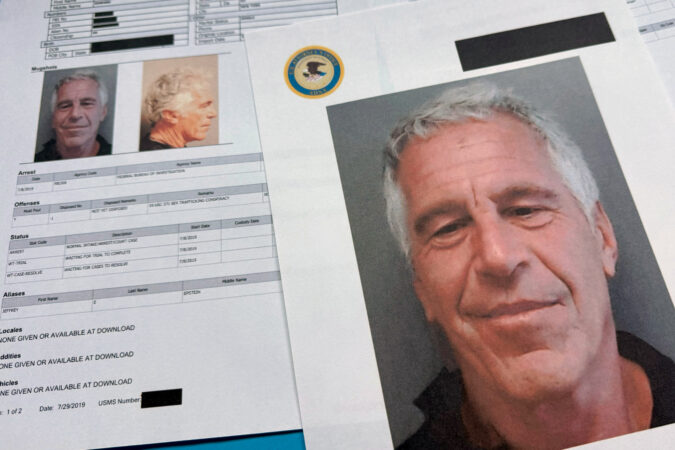
NEW YORK — Newly disclosed government files on Jeffrey Epstein are offering more details about his interactions with the rich and famous after he served time for sex crimes in Florida, and on how much investigators knew about his abuse of underage girls when they decided not to indict him on federal charges nearly two decades ago.
The documents released Friday include Epstein’s communications with former White House advisers, an NFL team co-owner, and billionaires including Bill Gates and Elon Musk.
President Donald Trump’s Department of Justice said it would be releasing more than 3 million pages of documents along with more than 2,000 videos and 180,000 images under a law intended to reveal most of the material it collected during two decades of investigations involving the wealthy financier.
The files, posted to the department’s website, included documents involving Epstein’s friendship with Britain’s Andrew Mountbatten-Windsor, formerly known as Prince Andrew, and Epstein’s email correspondence with onetime Trump adviser Steve Bannon, New York Giants co-owner Steve Tisch, and other prominent contacts with people in political, business, and philanthropic circles.
Other documents offered a window into various investigations, including ones that led to sex trafficking charges against Epstein in 2019 and his longtime confidant Ghislaine Maxwell in 2021, and an earlier inquiry that found evidence of Epstein abusing underage girls but never led to federal charges.
Draft indictment detailed Epstein’s abuse
The FBI started investigating Epstein in July 2006 and agents expected him to be indicted in May 2007, according to the newly released records. A prosecutor wrote up a proposed indictment after multiple underage girls told police and the FBI that they had been paid to give Epstein sexualized massages.
The draft indicated prosecutors were preparing to charge not just Epstein but also three people who worked for him as personal assistants.
According to interview notes released Friday, an employee at Epstein’s Florida estate told the FBI in 2007 that Epstein once had him buy flowers and deliver them to a student at Royal Palm Beach High School to commemorate her performance in a school play.
The employee, whose name was blacked out, said some of his duties were fanning $100 bills on a table near Epstein’s bed, placing a gun between the mattresses in his bedroom, and cleaning up after Epstein’s frequent massages with young girls, including disposing of used condoms.
Ultimately, the U.S. attorney in Miami at the time, Alexander Acosta, signed off on a deal that let Epstein avoid federal prosecution. Epstein pleaded guilty instead to a state charge of soliciting prostitution from someone under age 18 and got an 18-month jail sentence. Acosta was Trump’s first labor secretary in his earlier term.
Epstein offers to set Andrew up on a date
The records have thousands of references to Trump, including emails in which Epstein and others shared news articles about him, commented on his policies or politics, or gossiped about him and his family.
Mountbatten-Windsor’s name appears at least several hundred times, including in Epstein’s private emails. In a 2010 exchange, Epstein appeared to try and set him up for a date.
“I have a friend who I think you might enjoy having dinner with,” Epstein wrote.
Mountbatten-Windsor replied that he “would be delighted to see her.” The email was signed “A.”
Epstein, whose emails often contain typographical errors, wrote later in the exchange: “She 26, russian, clevere beautiful, trustworthy and yes she has your email.”
Concerns over how DOJ handled records
The Justice Department is facing criticism over how it handled the latest disclosure.
One group of Epstein accusers said in a statement that the new documents made it too easy to identify those he abused but not those who might have been involved in Epstein’s criminal activity.
“As survivors, we should never be the ones named, scrutinized, and retraumatized while Epstein’s enablers continue to benefit from secrecy,” it said.
Meanwhile, Maryland Rep. Jamie Raskin, the top Democrat on the House Judiciary Committee, pressed the department to let lawmakers review unredacted versions of the files as soon as Sunday. He said in a statement that Congress must assess whether the redactions were lawful or improperly shielded people from scrutiny.
Epstein’s ties to powerful on display
The released records reinforced that Epstein was, at least before he ran into legal trouble, friendly with Trump and former President Bill Clinton. None of Epstein’s victims who have gone public has accused Trump, a Republican, or Clinton, a Democrat, of wrongdoing. Both men said they had no knowledge Epstein was abusing underage girls.
In 2021, a federal jury in New York convicted Maxwell, a British socialite, of sex trafficking for helping recruit some of his underage victims. She is serving a 20-year prison sentence.
U.S. prosecutors never charged anyone else in connection with Epstein’s abuse. One victim, Virginia Roberts Giuffre, sued Mountbatten-Windsor, saying she had sexual encounters with him starting at age 17. The now-former prince denied having sex with Giuffre but settled her lawsuit for an undisclosed sum.
Rapper and actor Eve finally got recognition for her contribution to a Grammy Award-winning song by The Roots, and she had kind words for her hometown.
“I will say Philly started it,” Eve told a reporter at the Recording Academy Honors, presented by the Black Music Collective. “I came from Philadelphia. I think we’re used to being the underdogs in that city. And we also like to prove to you that you can underestimate me, but I’m going to show you.”
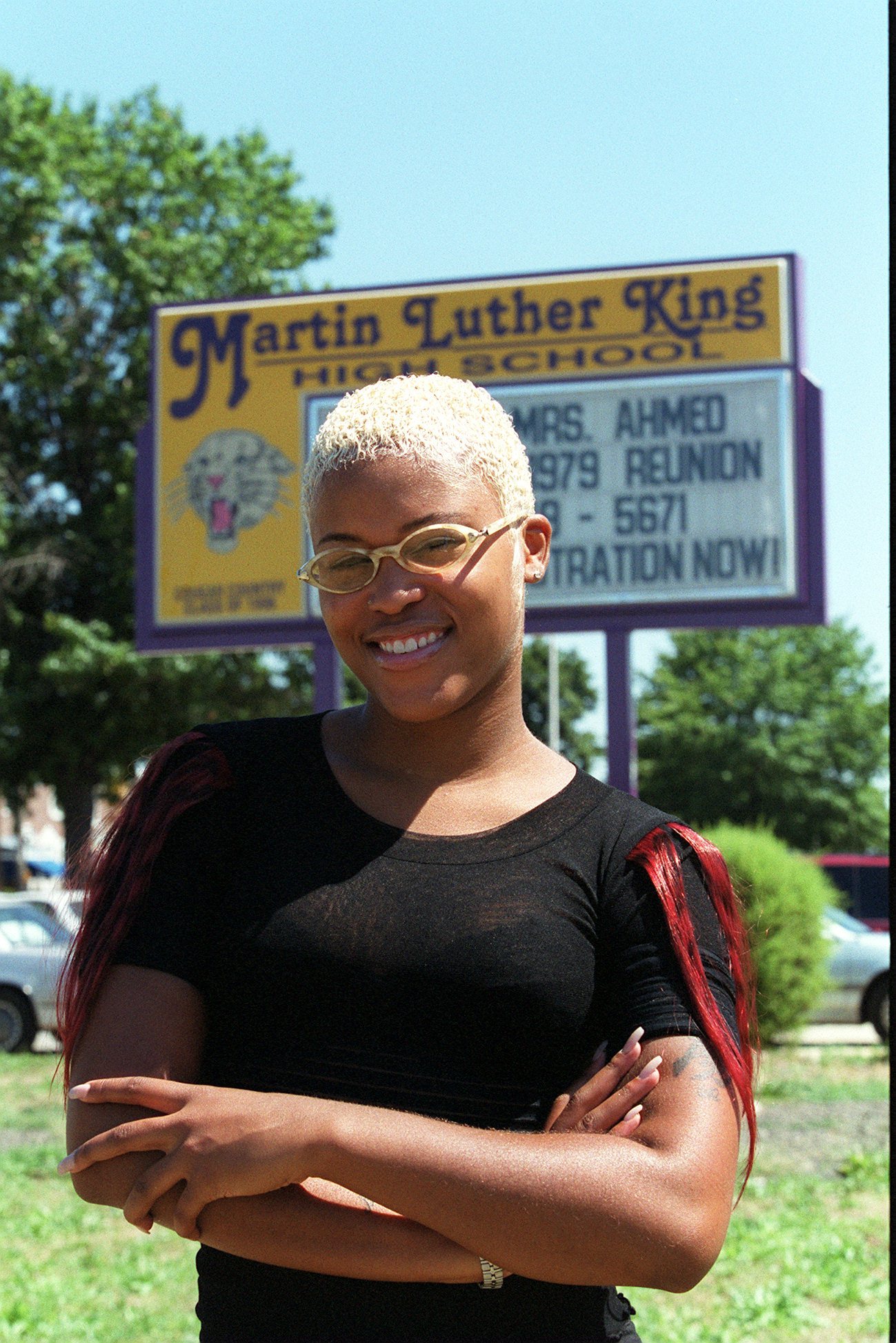
Rapper Eve Jeffers outside Martin Luther King High School in Philadelphia in 1999.
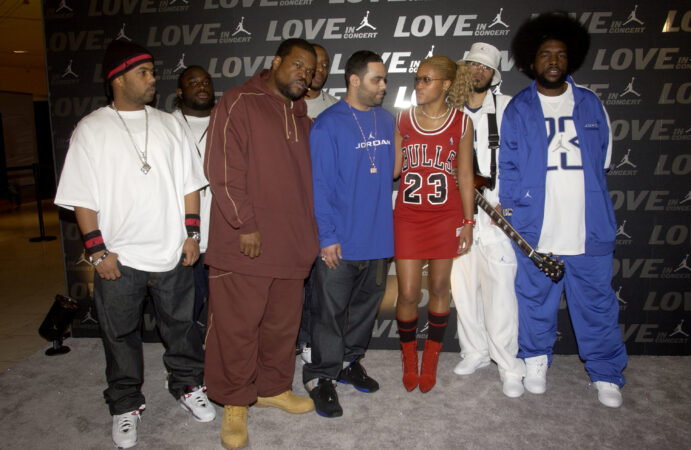
Eve grew up in West Philly and Germantown. In 1999, when she was a 19-year-old rapper going by “Eve of Destruction,” she laid down the essential second verse for The Roots’ “You Got Me.”
A year later, the song earned the Philly hip-hop group a Grammy for Best Rap Performance By a Duo or Group. Erykah Badu, who sang the hook, also won the award.
But Eve, who was not signed with a recording label, was not listed as a contributing artist on the song’s 1999 release and was overlooked by the awards committee.
That didn’t stop her from launching a successful solo career and winning a Grammy in 2002 for “Let Me Blow Ya Mind,” a Gwen Stefani collaboration that drips with early aughts vibes.
Eve’s memoir is titled ‘Who’s That Girl?’
At the ceremony Thursday in Los Angeles, Eve told the crowd that “this is actually for little Eve from Philly” on stage.
“What is yours never can miss you,” she said.
Addressing the crowd, Eve gave a shout-out to broadcaster Ebro Darden, who discussed the song at length on his podcast, The Message. She credited him for keeping people interested in seeing her receive a Grammy for the song.
Eve said she found success through being determined and understanding what kind of life she wanted to live. She encouraged other Black women to be there for themselves and fight for their dreams.
“I think, you know, we owe it to ourselves to show up for ourselves, to fight for ourselves, to be our own champion,” she said. “We deserve it. We are always the strongest for everyone else. We need to be the strongest for ourselves.”
This isn’t a typical report card item, and it shouldn’t be.
This week made it impossible not to understand who Dan McQuade was — and how deeply he mattered to Philadelphia — just by reading what people shared about the journalist and Philadelphia superfan after he died of cancer this week at age 43.
Colleagues, friends, editors, and readers kept circling the same truths: how funny he was, how kind he was, how precise his understanding of the city felt. Not in a forced or caricatured way, but in the way that comes from paying close attention, loving a place, and never taking it (or yourself) too seriously.
Dan had a gift for finding meaning in the everyday. He treated Philly’s quirks, tics, and absurdities not as punchlines to exploit, but as things worth documenting, celebrating, and occasionally poking fun at with affection. He gave people permission to laugh at the city without laughing at it. That’s harder than it sounds.
His impact was everywhere this week: in stories about Rocky runs and boardwalk T-shirts, in memories of long happy hours that turned into lifelong friendships, in anecdotes about him being the go-to fact-checker for all things Philly, in the way people described him as both brilliant and generous. A writer who made others better. A friend who showed up. A presence that made rooms, and timelines, lighter.
The tributes weren’t performative or flowery. They were specific. Personal. Grounded. Which feels fitting. McQuade’s work was never about being loud or self-important. It was about noticing things, connecting dots, and reminding people that there’s joy, and humor, in paying attention to where you live.
Philadelphia lost a journalist. But it also lost one of its clearest interpreters. Someone who understood that “Philadelphianness” isn’t a brand or a gimmick, but a way of moving through the world with skepticism, warmth, and a well-timed joke.
An A+ doesn’t feel like enough. But it feels right to say this much: Philly is better for having had Dan McQuade in it. And it won’t quite be the same without him.
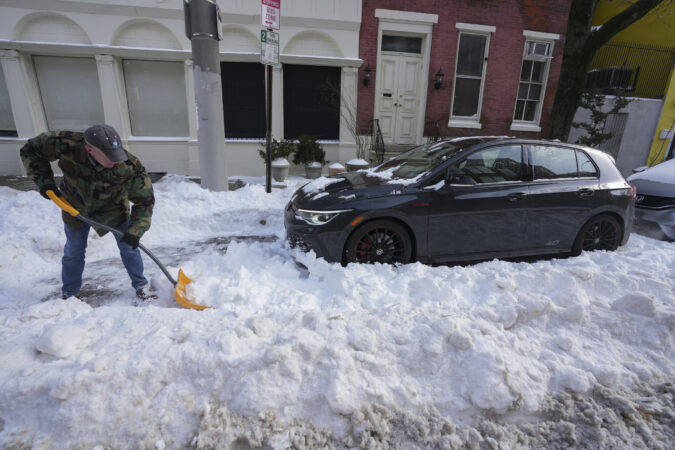
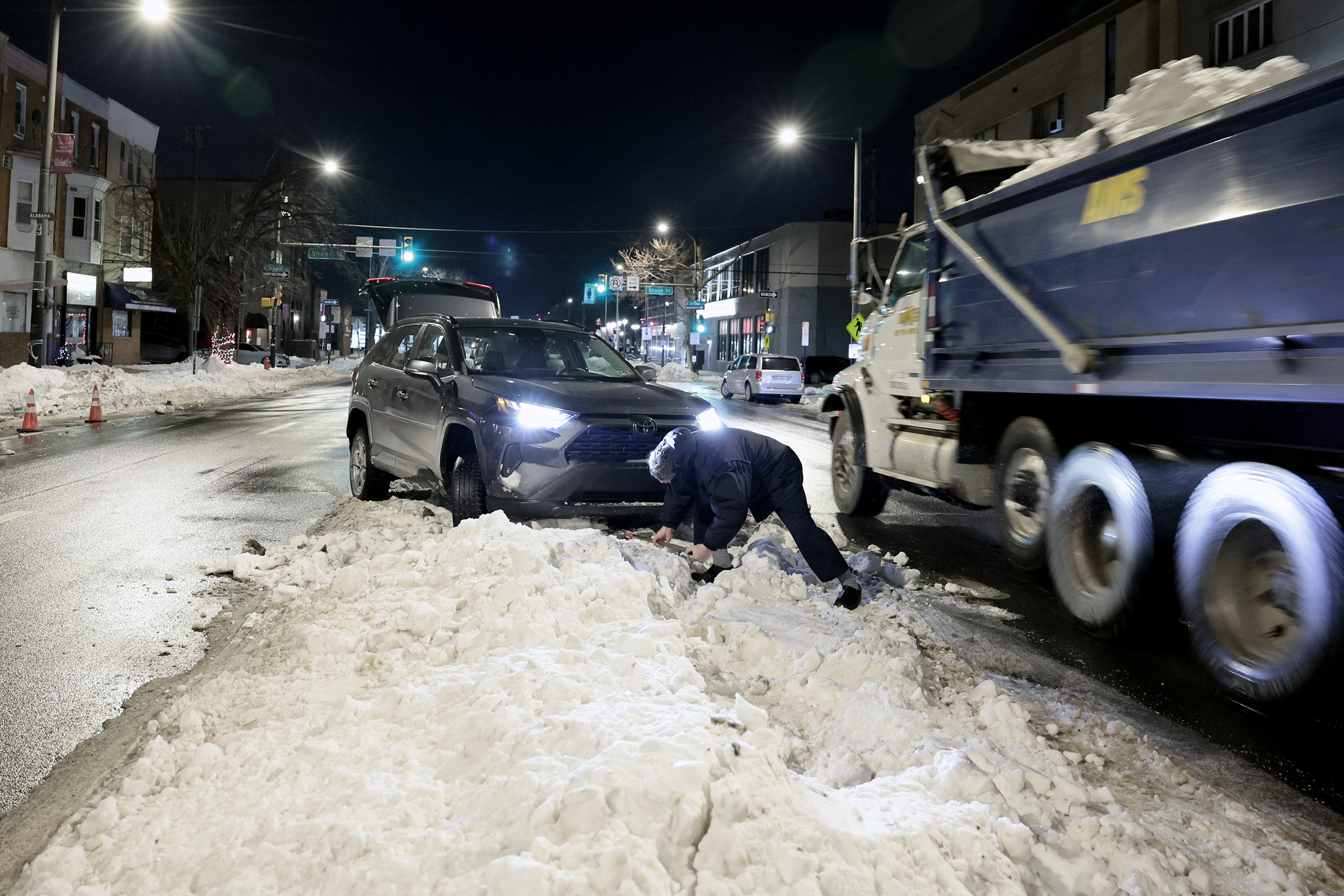
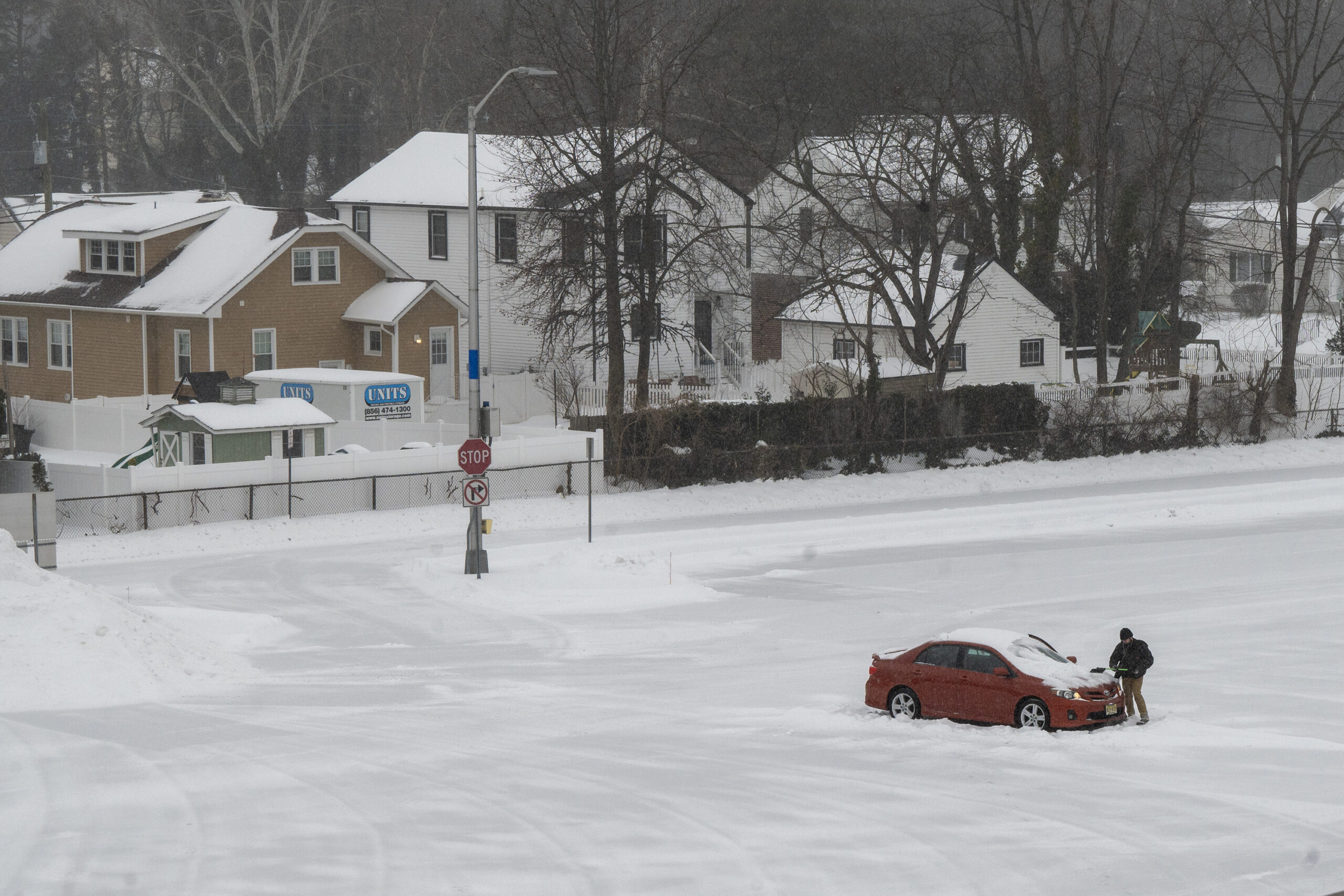
A man shovels snow from underneath his car after it became hung up while trying to park in the middle of South Broad Street in the early morning hours of Jan. 28, 2026. Dump trucks filled with snow from the city’s snow removal operations were zooming by as he worked to get his car free.
The snowstorm delivered. The plowing did not: F-
Let’s be clear: The snow itself did what snow is supposed to do. Nine-plus inches, pretty at first, historic enough to brag about, disruptive enough to cancel plans and spark group-chat meteorology. Fine. That’s winter.
What came after? That’s where everything fell apart.
The city promised differently. Mayor Cherelle L. Parker stood in front of cameras before the storm and said every street would get attention “as long as it takes.” That message mattered because Philadelphians have heard this story before, and expectations were deliberately raised.
Then reality hit.
Plow data show roughly a quarter of city streets got no treatment at all after the storm ended. Not plowed. Not salted. Nothing. And the longer it sat, the worse it got — snow compacting into ice, intersections blocked by frozen berms, cars effectively entombed.
This isn’t just an inconvenience. People with limited mobility are stuck. Workers can’t get out. Streets department explanations about sleet, freezing rain, and illegally parked cars may be true, but they don’t change the fact that many blocks are still uncleared a week later.
This is the part where Philly frustration kicks in hardest: The storm wasn’t unprecedented, but the response feels familiar in the worst way. The expectation has long been “don’t count on a plow,” and this week did little to change that.
New York tries to claim ‘Delco.’ Pennsylvania says absolutely not: A
Every so often, something happens that instantly unites Delco. Snowstorms. Eagles runs. Wawa shortages. And now: a county in upstate New York attempting to brand itself as “Delco.”
Absolutely not.
Stephanie Farr laid out the case perfectly: Delco isn’t just shorthand for Delaware County. It’s a culture. A personality. A way of life built on hoagie trays, Catholic school rivalries, beach flags, and a shared, deeply ingrained chip on the shoulder.
New York’s Delaware County is rural. Ours is suburban chaos packed into 184 square miles, powered by Wawa coffee, tailgating energy, and a pride so aggressive it gets tattooed on bodies and planted in Jersey Shore sand like a territorial marker.
The funniest part isn’t that there’s another Delaware County (there are several). It’s that this one thought it could simply adopt the nickname, slap it on merch, and call it authenticity. That’s not how Delco works. Delco is earned.
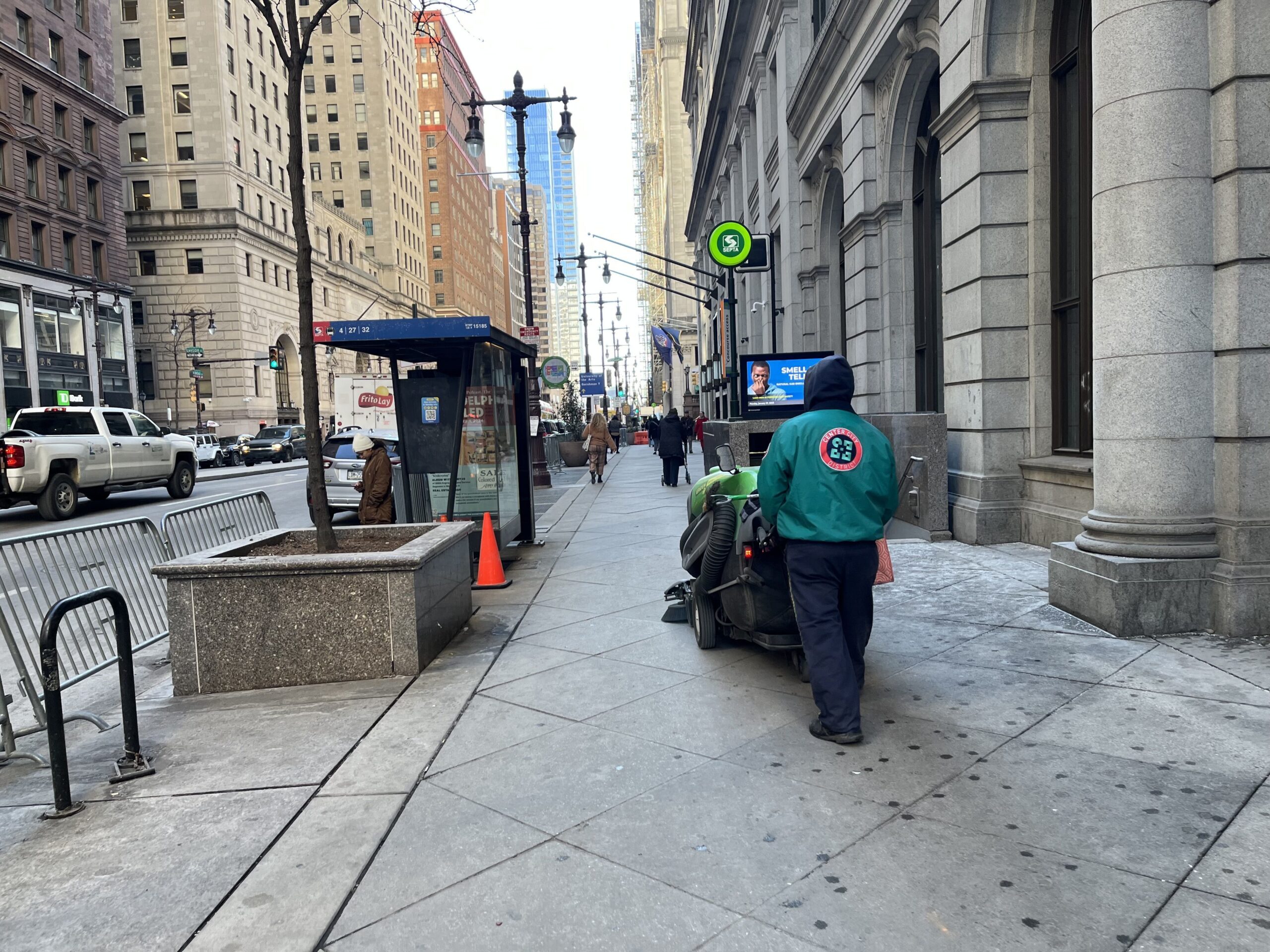
A Center City District worker cleaning the sidewalk on Broad Street the morning after the Philadelphia Eagles won the NFC Championship.
Center City West sidewalks are getting grimy (and it’s not your imagination): C
For nearly a decade, a lot of Center City West quietly benefited from something most people never realized existed: a privately funded sidewalk cleaning program that swooped in after city trash pickup and handled the leftover mess.
Asthe Fitler Focus reported, that program ended when the Center City Residents’ Association let its contract expire at the end of 2025. Not out of neglect, but necessity. The cost had ballooned to about 41% of CCRA’s projected 2026 budget, which is an unsustainable chunk for what was essentially backstopping city services.
The result has been immediate and visible. Trash bags torn open overnight. Litter lingering days after pickup. Sidewalks that used to reset themselves now just… don’t. CCRA deserves credit for being upfront about the trade-off and pivoting toward enforcement, even if it won’t bring immediate results.
The frustrating part is that the rules haven’t changed. Trash placement regulations exist. Containers are required. Enforcement is technically possible. But in reality, it’s complaint-driven, slow, and uneven. Meaning the difference between a clean block and a gross one often comes down to who has the time and energy to call 311 and wait on hold.
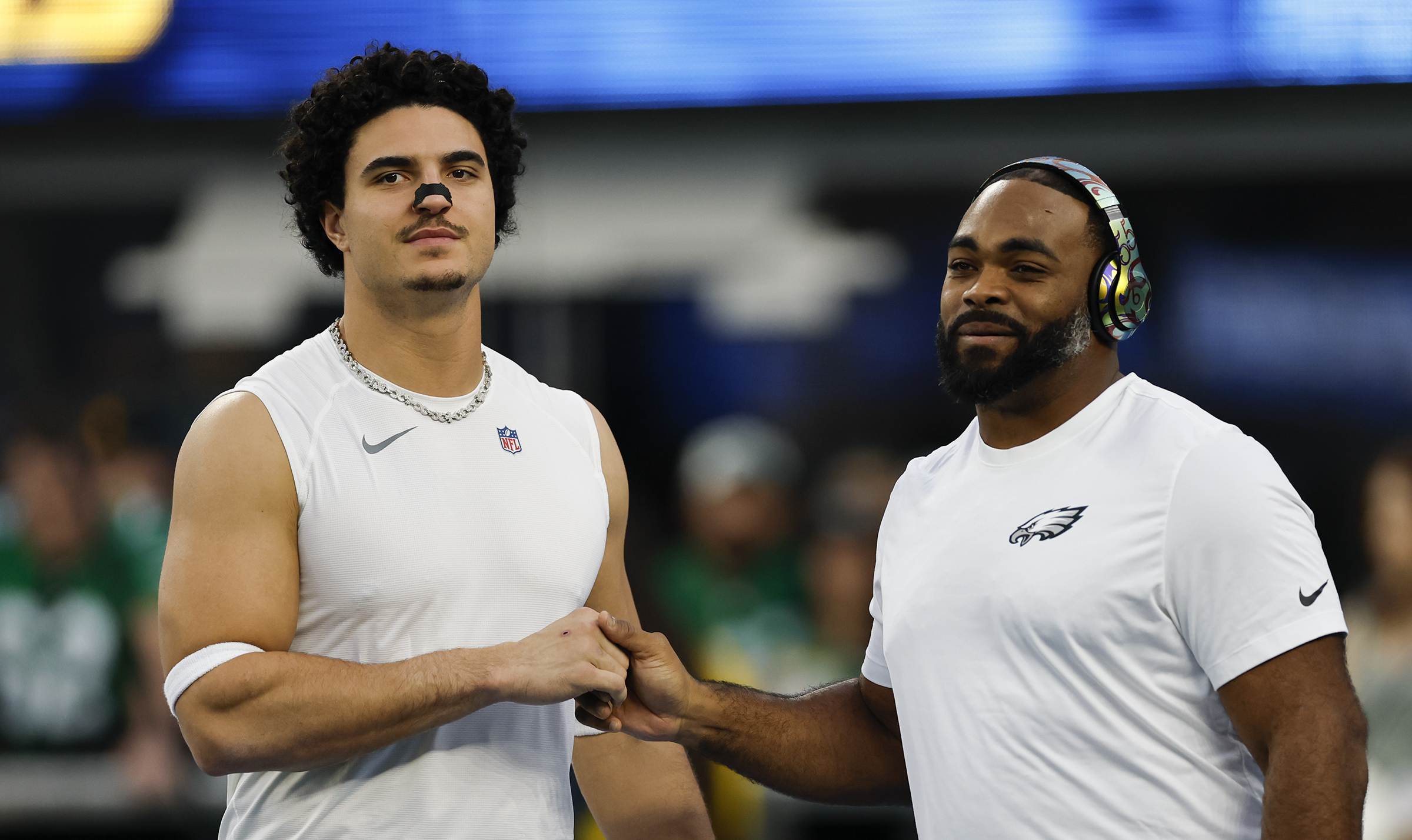
Eagles linebacker Jaelan Phillips (left) and defensive end Brandon Graham during warm-ups before the Eagles play the Los Angeles Chargers on Dec. 8, 2025 at SoFi Stadium in Inglewood, Calif.
Eagles fans agree on almost everything — except the part that actually hurts: B
In this year’s Inquirer Stay or Go poll, Eagles fans were unusually aligned on who still feels like the future: young defensive studs, the offensive line pillars, the rookies who look like actual hits. Cooper DeJean and Quinyon Mitchell clearing 96% stay feels less like optimism and more like self-preservation. The message is clear: The defense isn’t the problem. Or at least, it’s not our problem.
Where things get interesting is offense. Not because fans are confused, but because they’re suddenly colder. Jalen Hurts is still trusted, but not untouchable. A.J. Brown’s dip is real and telling: not rage, not rejection, just disappointment, Philly’s least favorite emotion. Fans didn’t turn on him. They just stopped defending him reflexively, which in this city is its own warning sign.
And then there’s Brandon Graham, the emotional Rorschach test of the poll. A franchise legend. A locker room heartbeat. A guy people want to want back. The split vote says everything: respect battling reality. Philly loves its icons, but it hates lying to itself more.
No one landed in the mushy middle. Fans know who they’re done with. They know who they’re attached to. There’s little patience left for “maybe.”
This wasn’t a meltdown poll. It was a sorting exercise. And the conclusion fans keep circling is uncomfortable but consistent: The Eagles don’t need vibes. They need clarity — and probably a few hard goodbyes.
The Inquirer mapped Philly’s dive bars (and proved how much the city loves them): A
When The Inquirer put out a call for Philly’s favorite dive bars, the response was immediate and overwhelming. Nearly 400 submissions poured in, which tracks for a city where dive bars aren’t just places to drink. They’re personal landmarks.
What the map really shows isn’t just where to grab a cheap beer. It’s how attached people are to the bars that feel like theirs. The ones tied to first jobs, postgame rituals, bad breakups, good Tuesdays, and nights that went exactly nowhere and somehow mattered anyway. These are rooms where nobody’s performing, the prices are low on purpose, and the atmosphere is set by regulars, not a concept.
It also surfaced one of Philly’s most reliable debates: Is being called a dive bar a compliment or an insult? Some owners bristle at the label. Others embrace it. Many bars live in the gray area: cheap, unpretentious, deeply loved, and absolutely uninterested in how they’re categorized. Very Philly.
Are there bars missing? Of course. There always will be. Philly has too many neighborhood institutions, and too many people willing to argue for them, for any list to feel definitive. But that’s not a failure of the map, it’s a feature of the city.
This isn’t a checklist. It’s a snapshot of how much Philadelphians still value places that don’t try to be anything other than what they are.
Snow savesies are back, and Philly is absolutely feral about it: C+
Every major snowstorm in Philly brings back the same question we never resolve: If you shovel out a spot, is it yours, or is public parking still public? This week’s viral Reddit thread, sparked by a wooden chair left in a shoveled space with a handwritten threat (“Move these chairs & I will destroy your car. Try me.”), confirms we are once again incapable of calm thought.
Some commenters were immediately in the respect the chair camp. One wrote, “After digging my s— out from snow past my knees I just want to one time come back to a spot,” while another argued, “Normally vehemently anti-savesies, but I feel like spending an hour digging out earns you a [savesie] or two.” This group is running on sore backs, wet boots, and pure principle.
Then there’s the other side: the chaos agents. “I’d move the chair and watch someone else park there,” one commenter said, which feels less like civic engagement and more like performance art. Another proudly added, “I take peoples cones all the time when I’m walking around. F— em.” (This explains so much.)
Somewhere in the middle were people admitting the quiet truth: Everyone dug out a spot. “The person who’s parked there dug out their car this morning, too,” one commenter noted, puncturing the idea that only one hero labored for the block.
So where does that leave us? With a very Philly stalemate. The chair is obnoxious. The threat is unhinged. The labor is real. The fear of retaliation is realer.
I spoke with a Friends School class this week, primarily about my photos decades ago of unhoused men in Center City. It was part of their week working with PhotoVoice, a research method where participants photograph their own lives to highlight community strengths and challenges, and advocate for social change.
After the class, and following many thoughtful questions from the middle schoolers about how in general I approach people before I photograph them, and specifically people in vulnerable situations, a student came up to ask me a more practical question: “How do you take pictures in bad weather?”
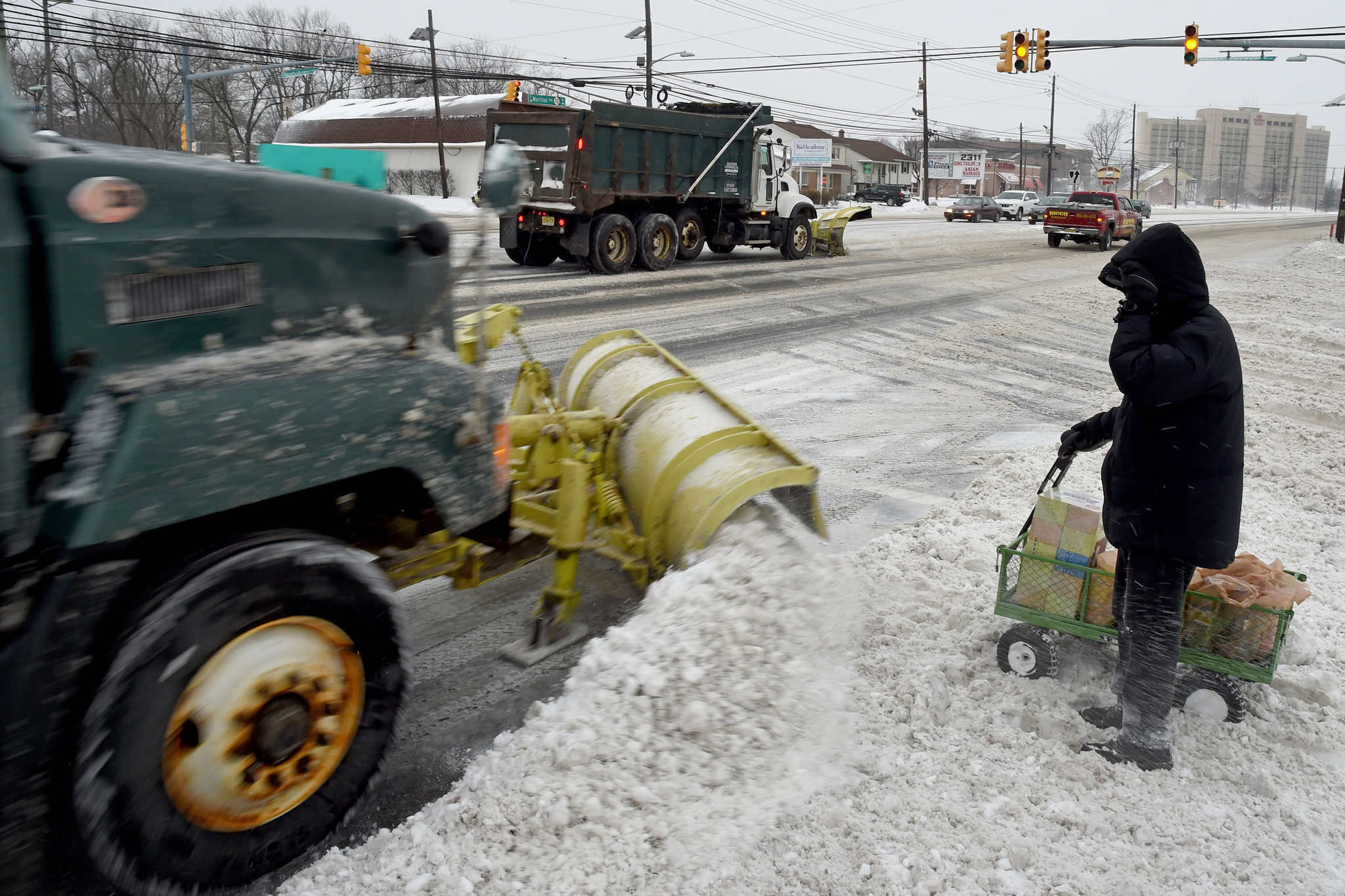
Pedestrians and plows on Rt. 70 in Cherry Hill in Januiary, 2018.
I don’t have an all-weather, sealed camera, so besides dressing as best I can for the conditions (and always having a spare pair of thick, dry wool socks in my car) keeping my camera protected is the biggest priority. I not only need to stave off mechanical/electronic breakdown, but have to keep my lens clear of the elements.
I told him I do have a dedicated rain sleeve but I’ve only used it once or twice at rainy sporting events (they’re priced from $2 each up to $200).
Mostly I use plastic bags or a large umbrellas (watching that I not catch the edges in my frame). I also try to find dry areas to stand in — while watching and photographing others out in the elements. I seek cover under a roof, awning, or doorway. I go into parking garages or subway entrances.
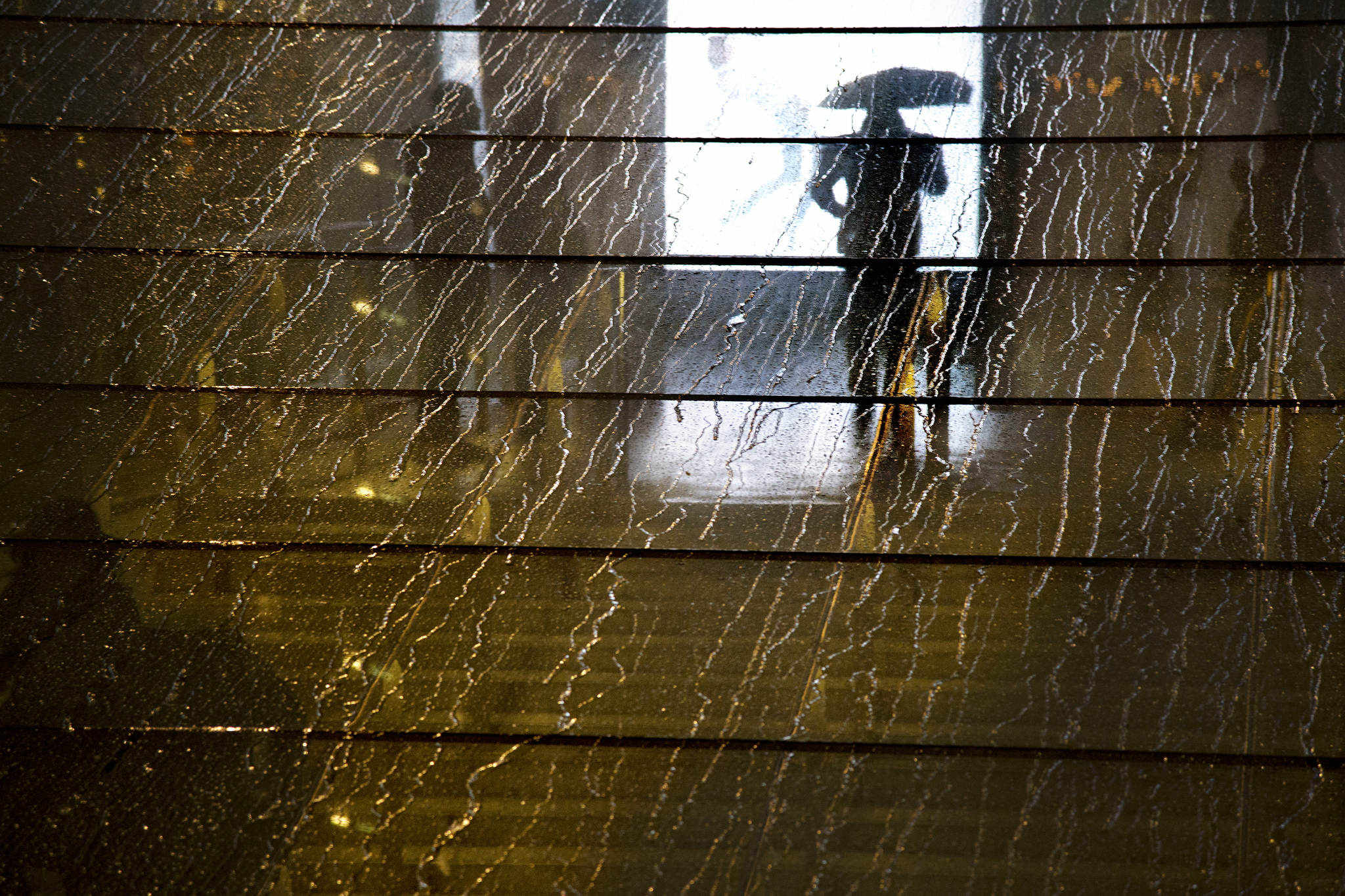
The glass entrance to SEPTA’s underground concourse at Dilworth Park by City Hall.
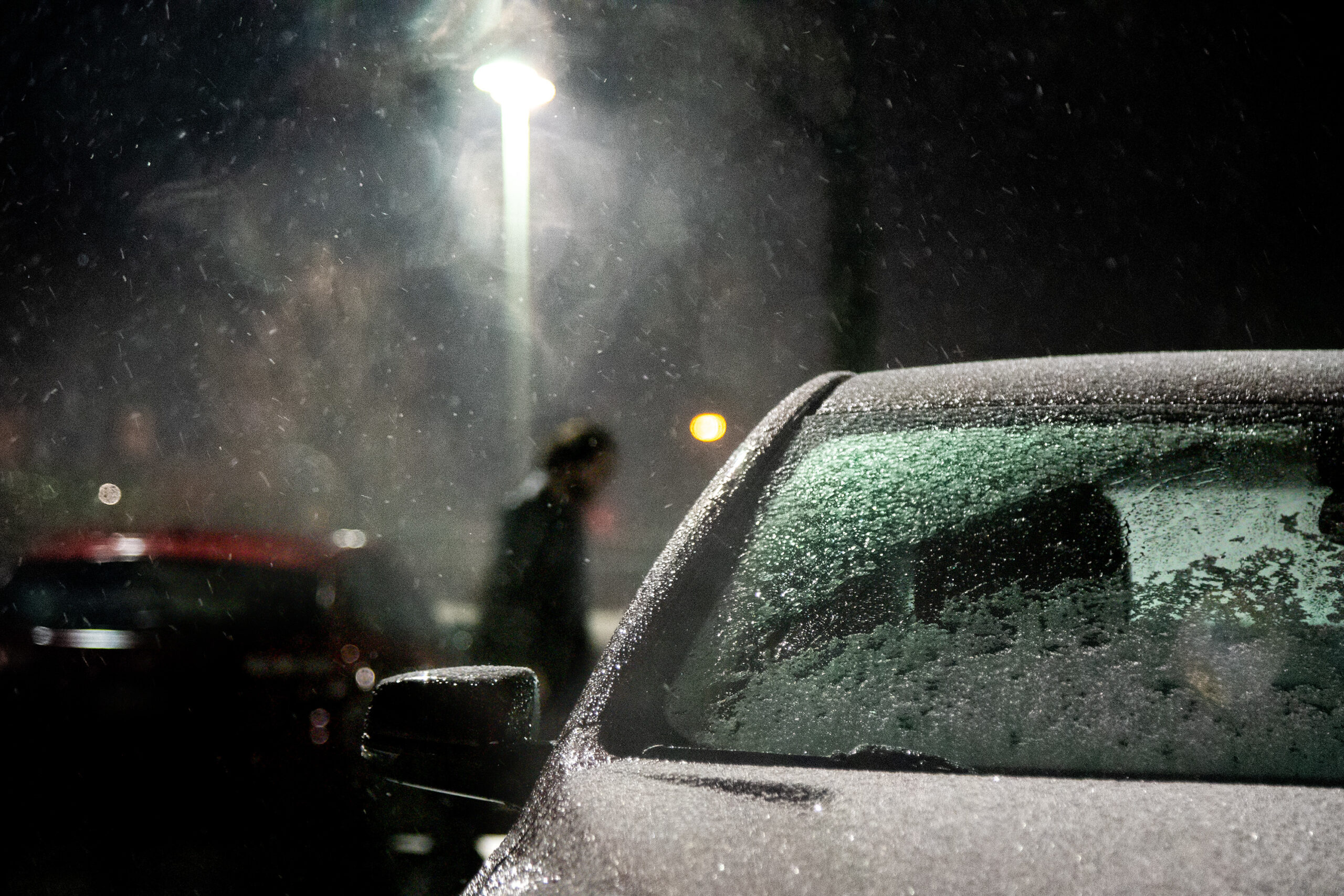
Sometimes I safely park my car where I can briefly open my leeward (downwind!) window. Other times the rain or snow on glass can even be an effective way to portray the “dab” weather. It can be in or out of focus to create a bokeh-like effect or blurred to convey mood. Your choice of a fast shutter or slow shutter can either stop the drops or show their movement.
Precipitation — some snow and some rain — falls on cars in a parking lot on City Avenue.
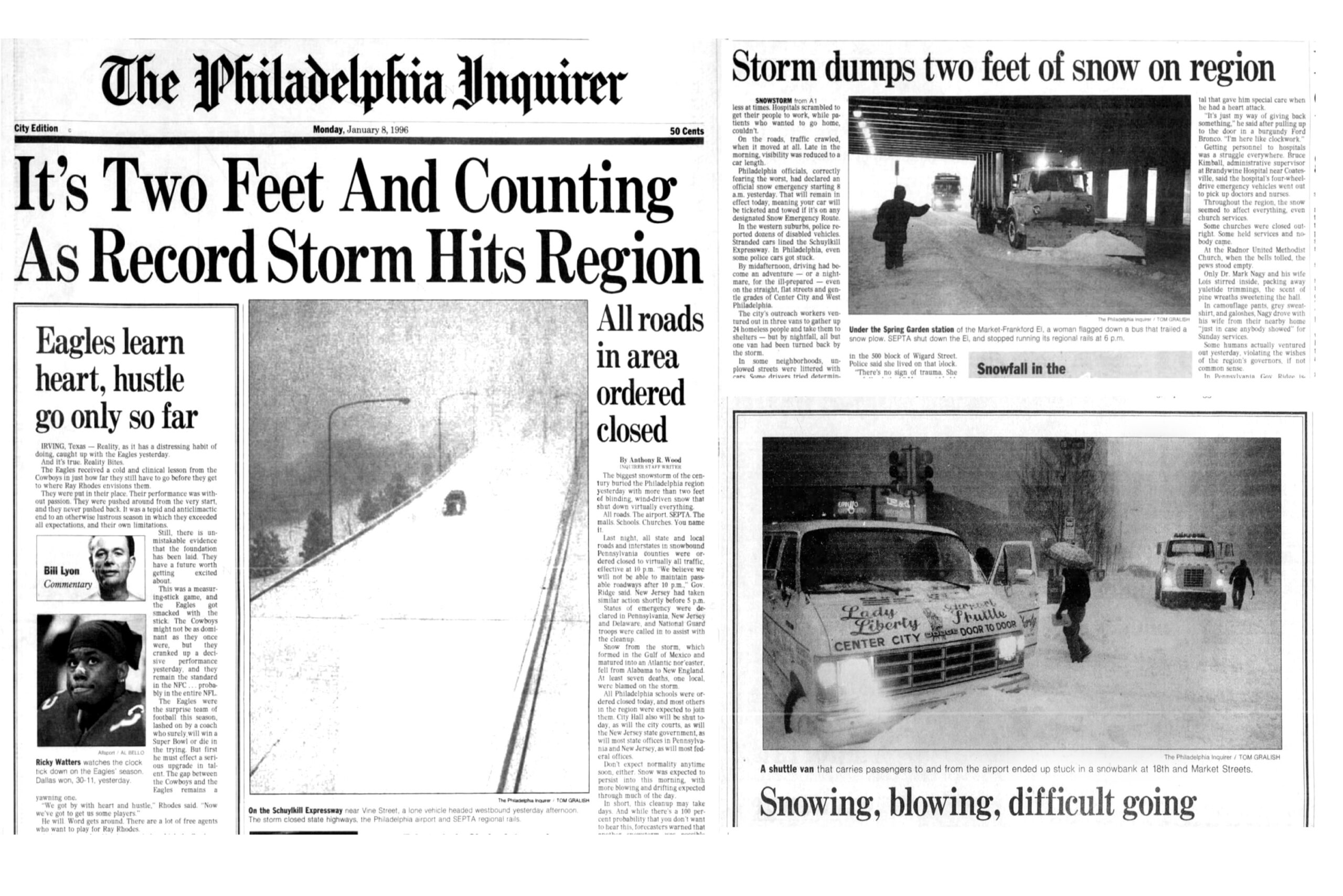
I’ve covered all of the biggest storms of the past few decades, including the historic “Blizzard of the Century” thirty years ago this month.
Front page and inside photos from The Philadelphia Inquirer. January 8, 1996.
So, I took my own advice while preparing to go out last Sunday. Knowing the roads would get worse as the day went on, I drove out of my South Jersey neighborhood while an early pass of the plows left main arteries somewhat passable, and headed straight to the nearest Wawa that I knew would have a clear-ish parking lot.
Stepping out from under the overhang — I made a few photos before walking out into on the wide street to get the few passing cars and plowing crews in a nearby shopping center.
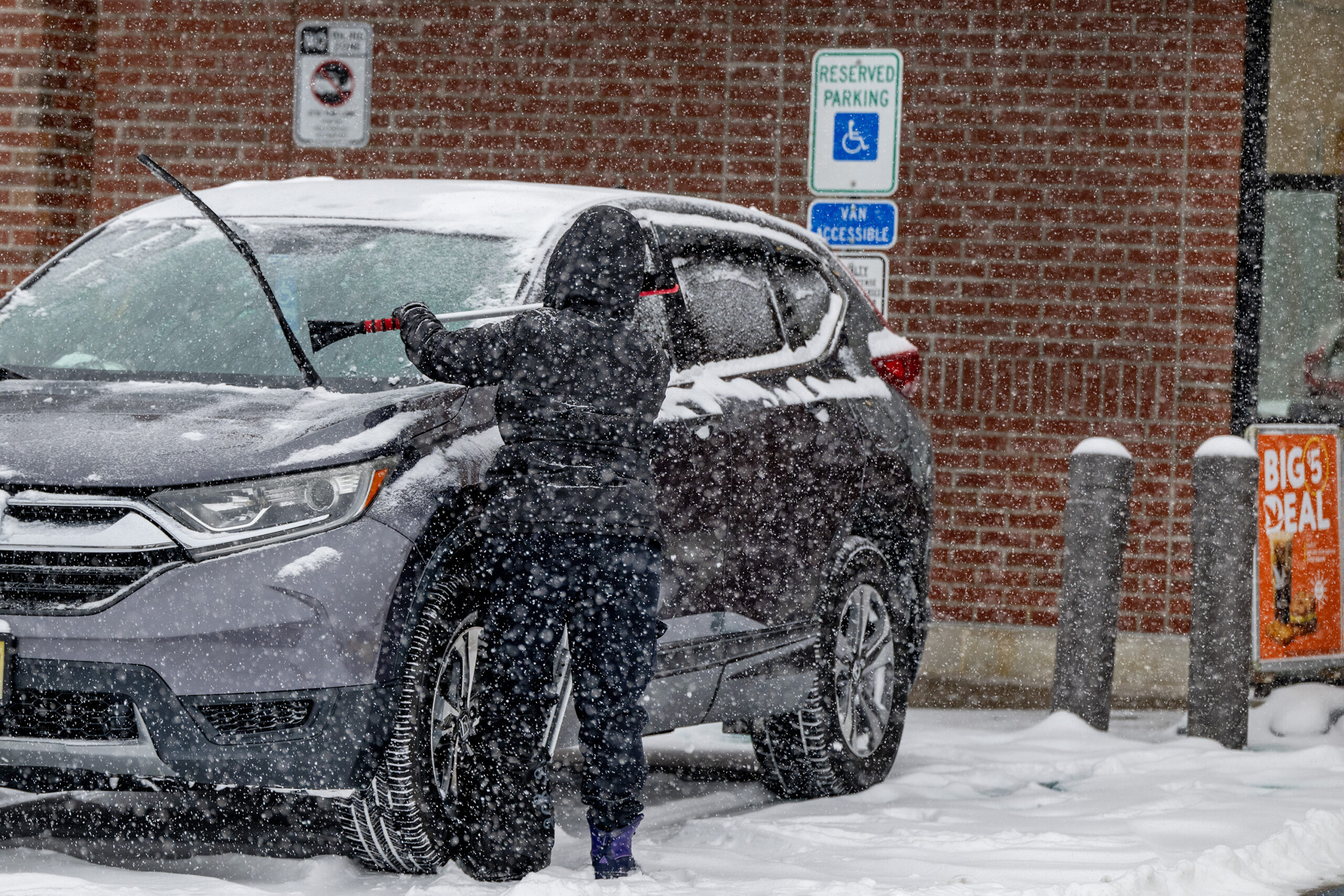
Carmen Roman clears snow off her car at a Cherry Hill Wawa early Sunday morning, Jan. 25, 2026, as heavy snow bands move through the region generating snowfall rates of 1 to 2 inches an hour.
From there, confirming my fears the roads would be more difficult to drive on, I headed the Westmont PATCO station, finding a safe place to park even as workers were hard at it, clearing the lot.
I made photos from the elevated platform before taking a train to Collingswood, where — standing on the leeward side of the stairwell shelter — I took more pictures then walked into downtown.
Haddon Avenue was plowed and relatively empty of cars, but the sidewalks were impassible. I sent in my best photo of people walking along the middle of the downtown street.
It was then I saw Mike Doveton and his daughters. Not wanting to repeat my earlier image, I asked if they were headed to or from sledding.
They were walking to the PATCO station to sled in Haddonfield, so I tagged along.
On the train headed to sled.
I went with them to their destination, but didn’t want another kids-on-a-hill photo, so I got back on the train returning to the Westmont station, and my car, calling it a day. Until I saw someone digging out their car — the same one I had photographed hours earlier. I got as close as I could to the spot on the platform and made an “after” photo.
Before and after in the Westmont PATCO station parking lot.
Luis Nova had left his car there on Friday, and was in Philadelphia all weekend helping friends move and going to a goodbye party. He spent the morning sledding with friends in Clark Park in West Philadelphia. Like me, he had experience with storms. “I spent four years in Rochester [NY],” he told me. “So I knew what I was signing up for and was ready. I left all my equipment to get myself out.”
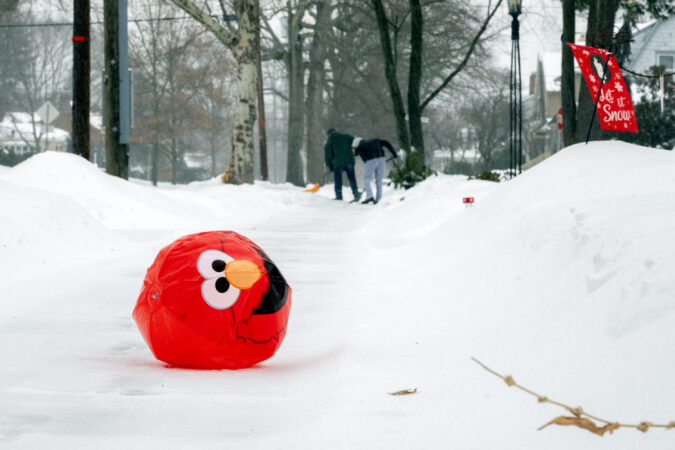
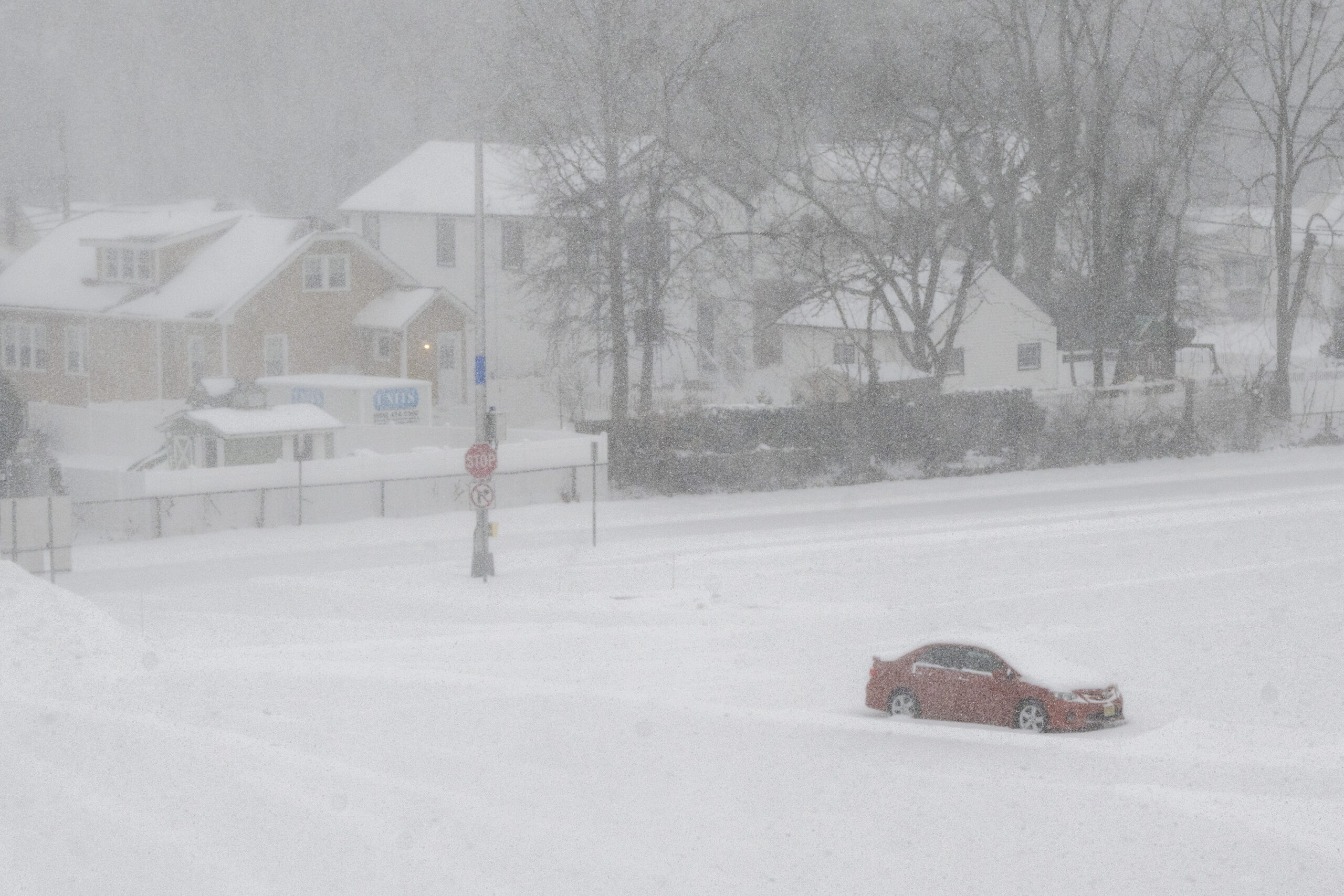
But the highlight of the day was at the very end, as I headed for home as the snow was turning to sleet. Two hours earlier, in the middle of the storm my grandson snapped a photo out our front window of an Elmo head in the middle of the street before the wind blew it away, and shared the picture with our family. As I approached my house, I see a red ball rolling fast down the street toward me. I almost drove into a snow bank laughing.
Not really, but I did pull into the driveway, grab a camera, jump out of my car and go chasing after it. The wind was really moving it, and I couldn’t see where it was, which was hard to imagine, being as the road and everything else was all white. I came up to a couple of guys shoveling and asked, “Did you see an Elmo head come this way?” They had, and said it went up a driveway and jumped onto the sidewalk. I found it and just as I was lining up my photo the wind took it again and it started spinning.
Since 1998 a black-and-white photo has appeared every Monday in staff photographer Tom Gralish’s “Scene Through the Lens” photo column in the print editions of The Inquirer’s local news section. Here are the most recent, in color:
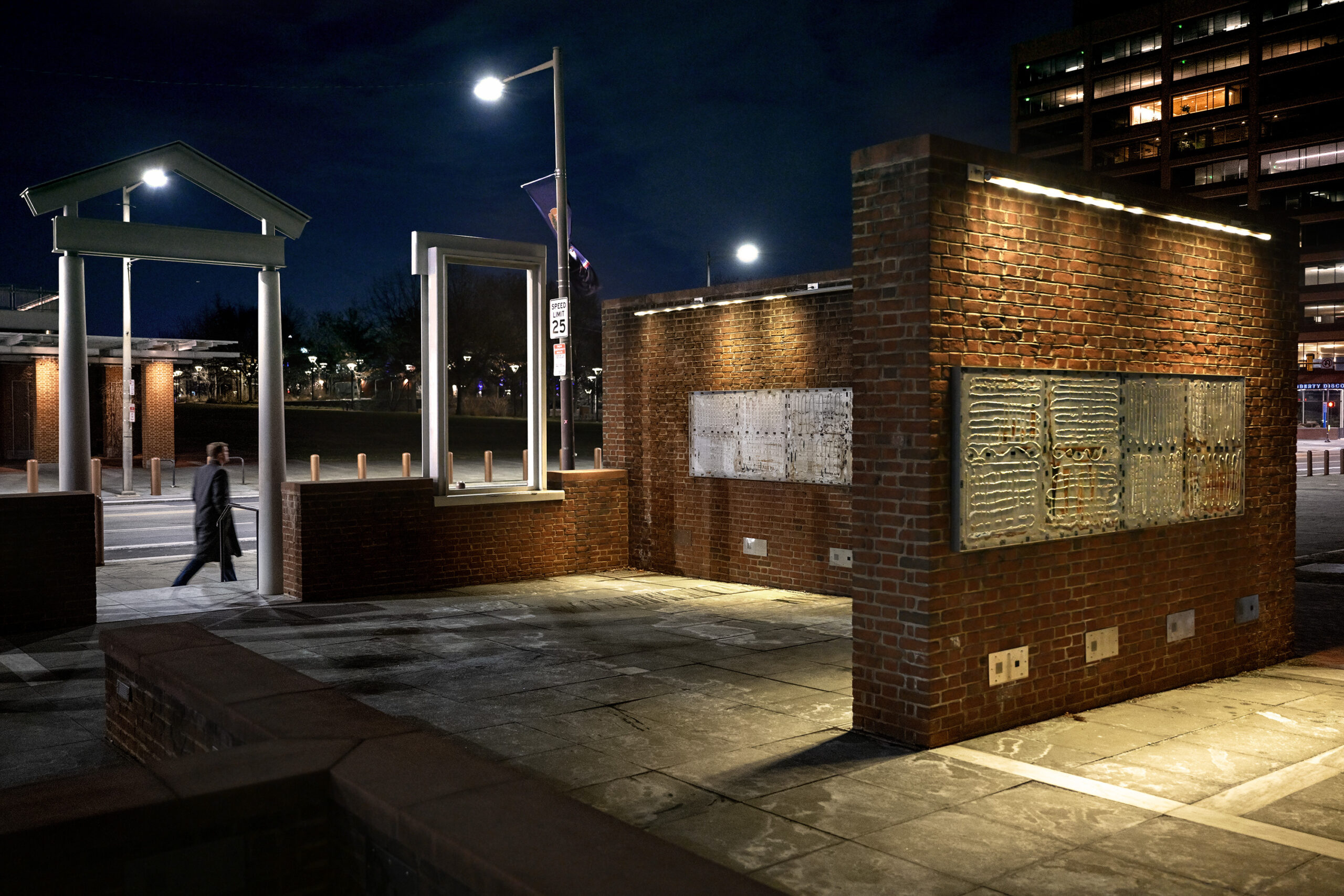
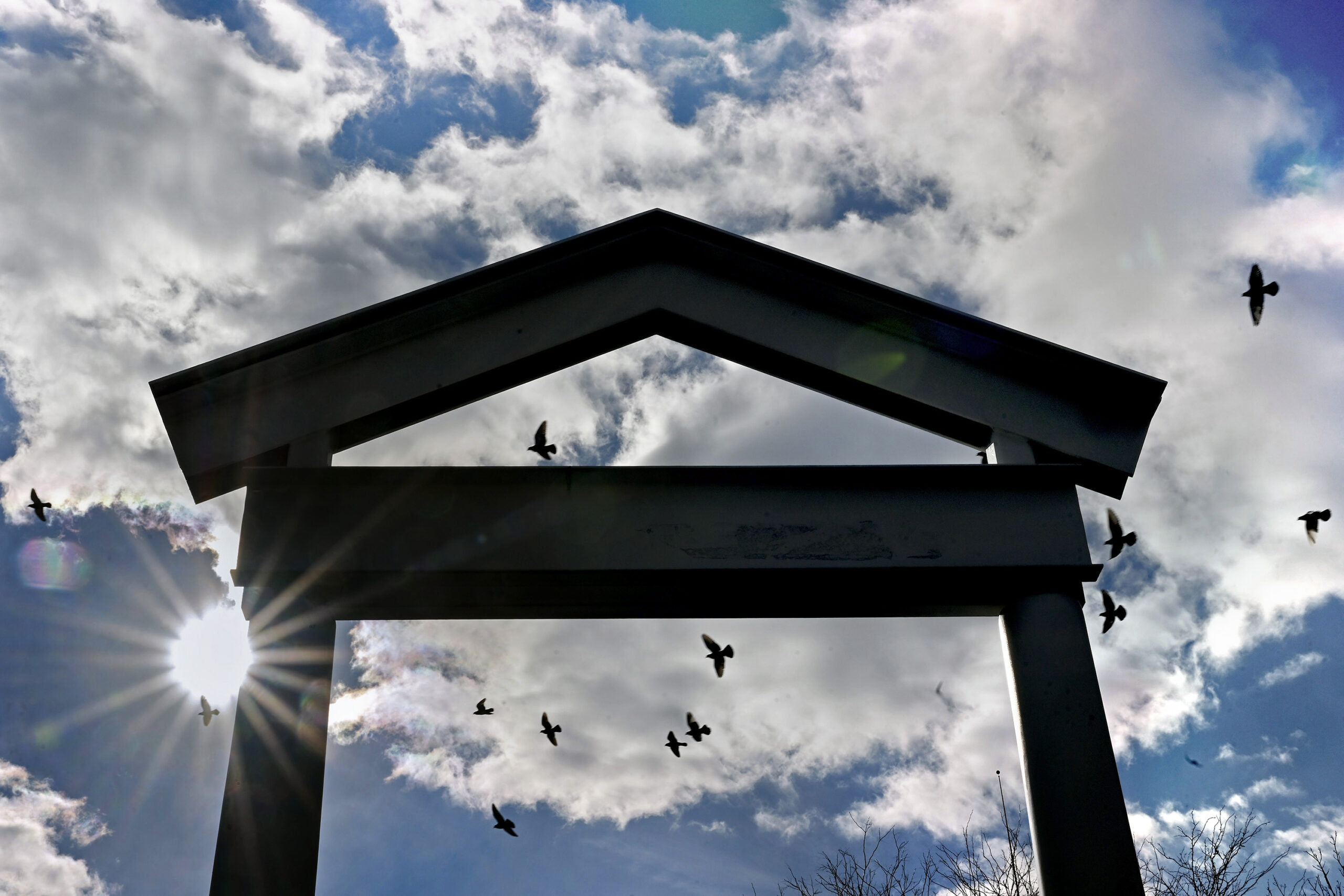
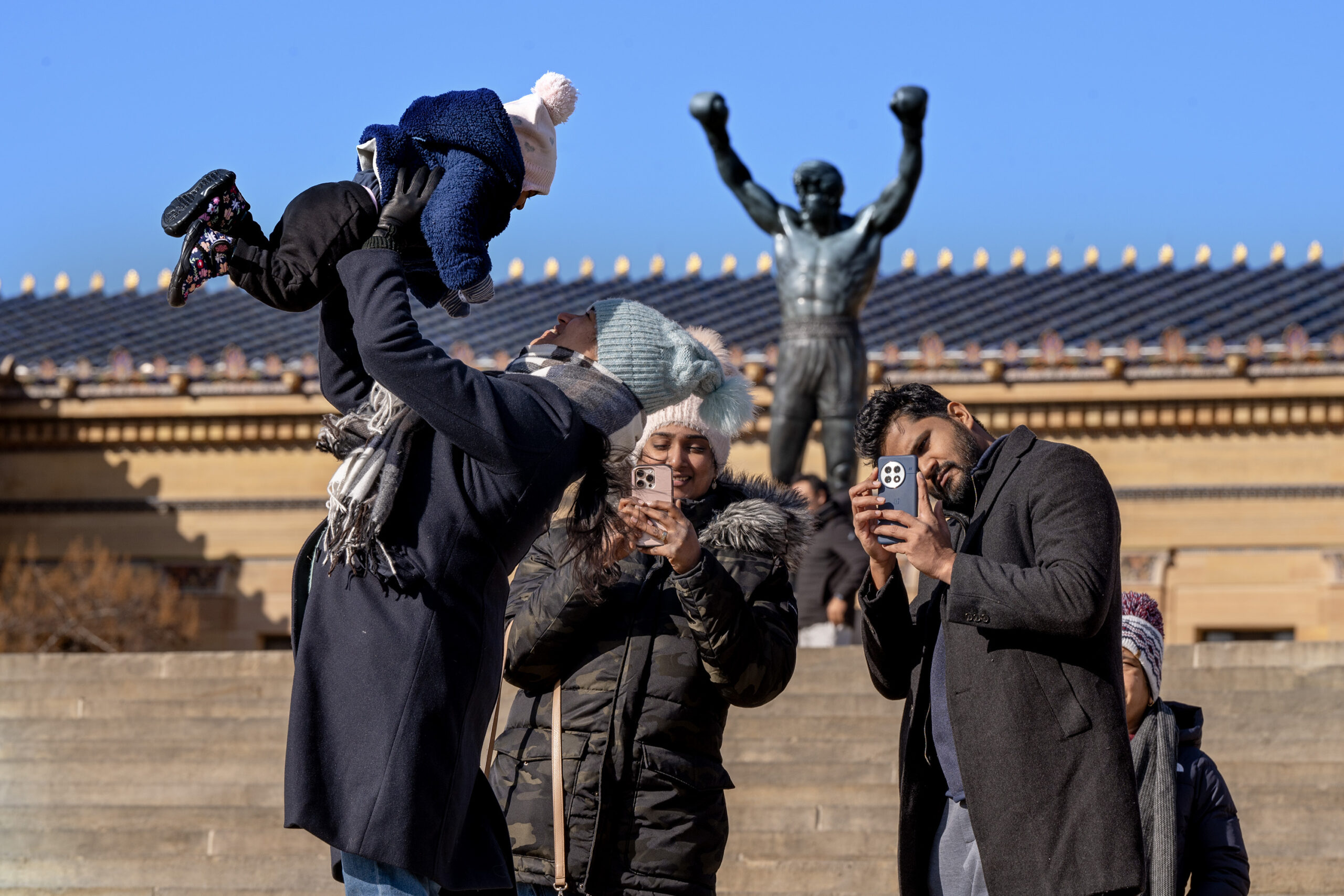
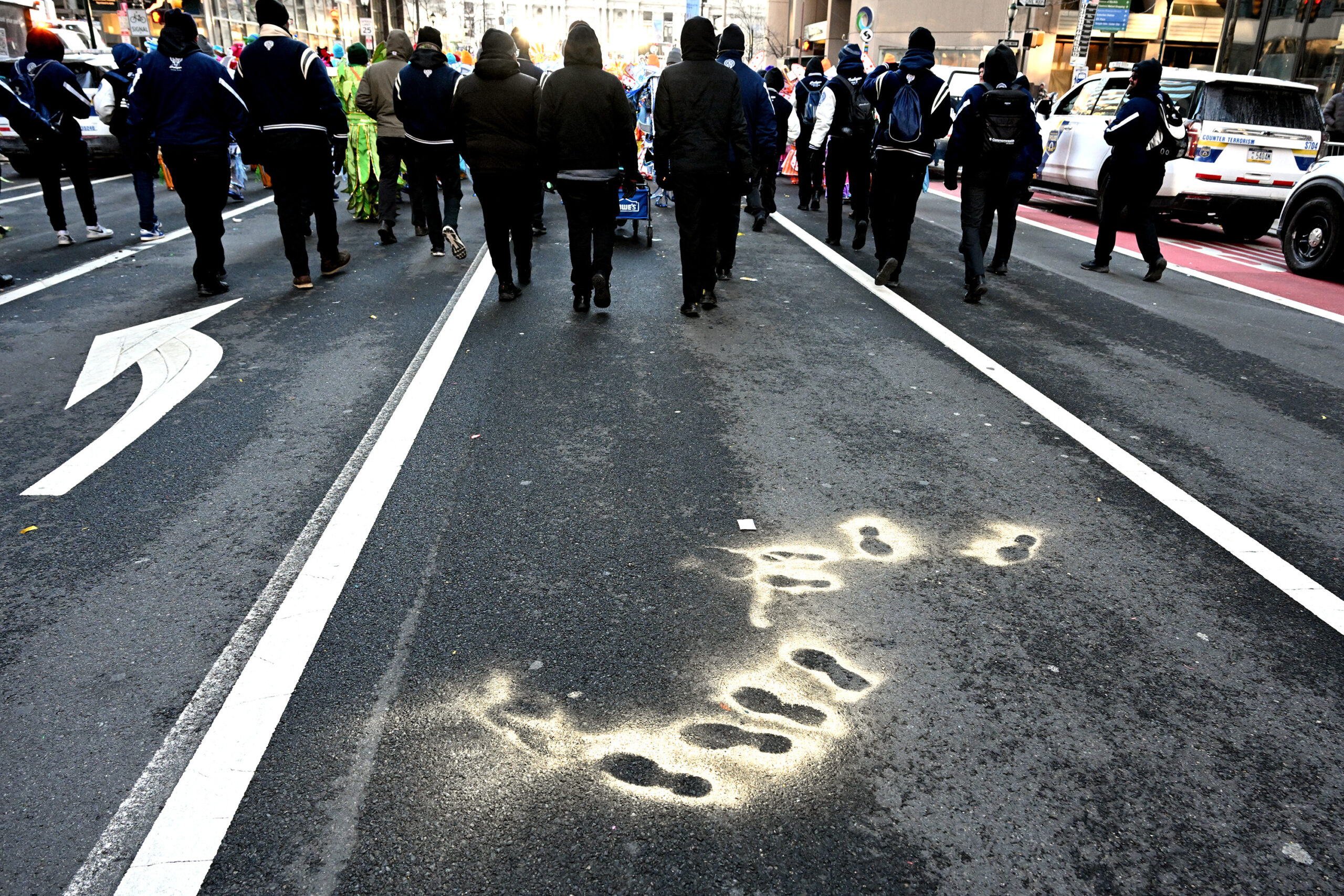
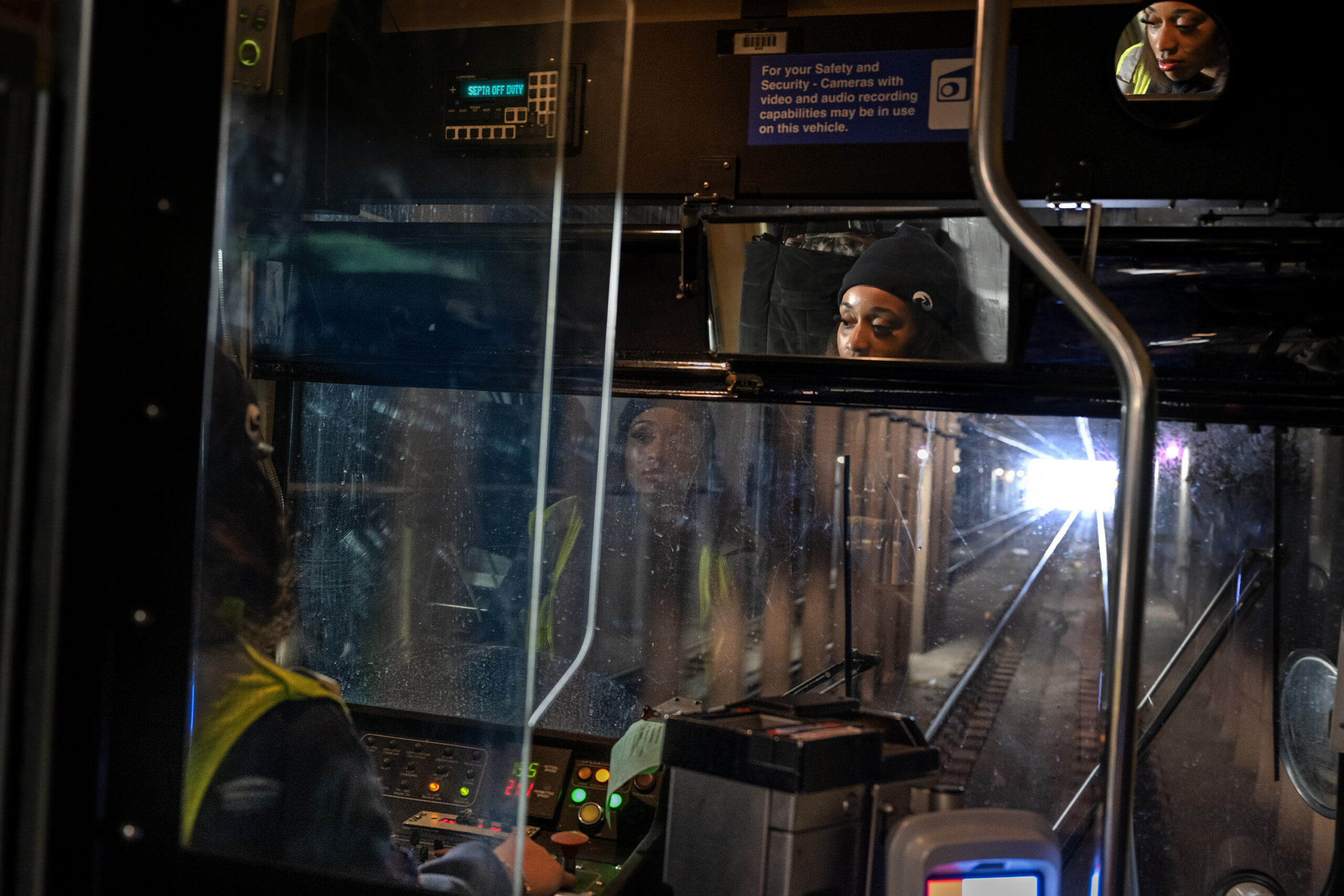
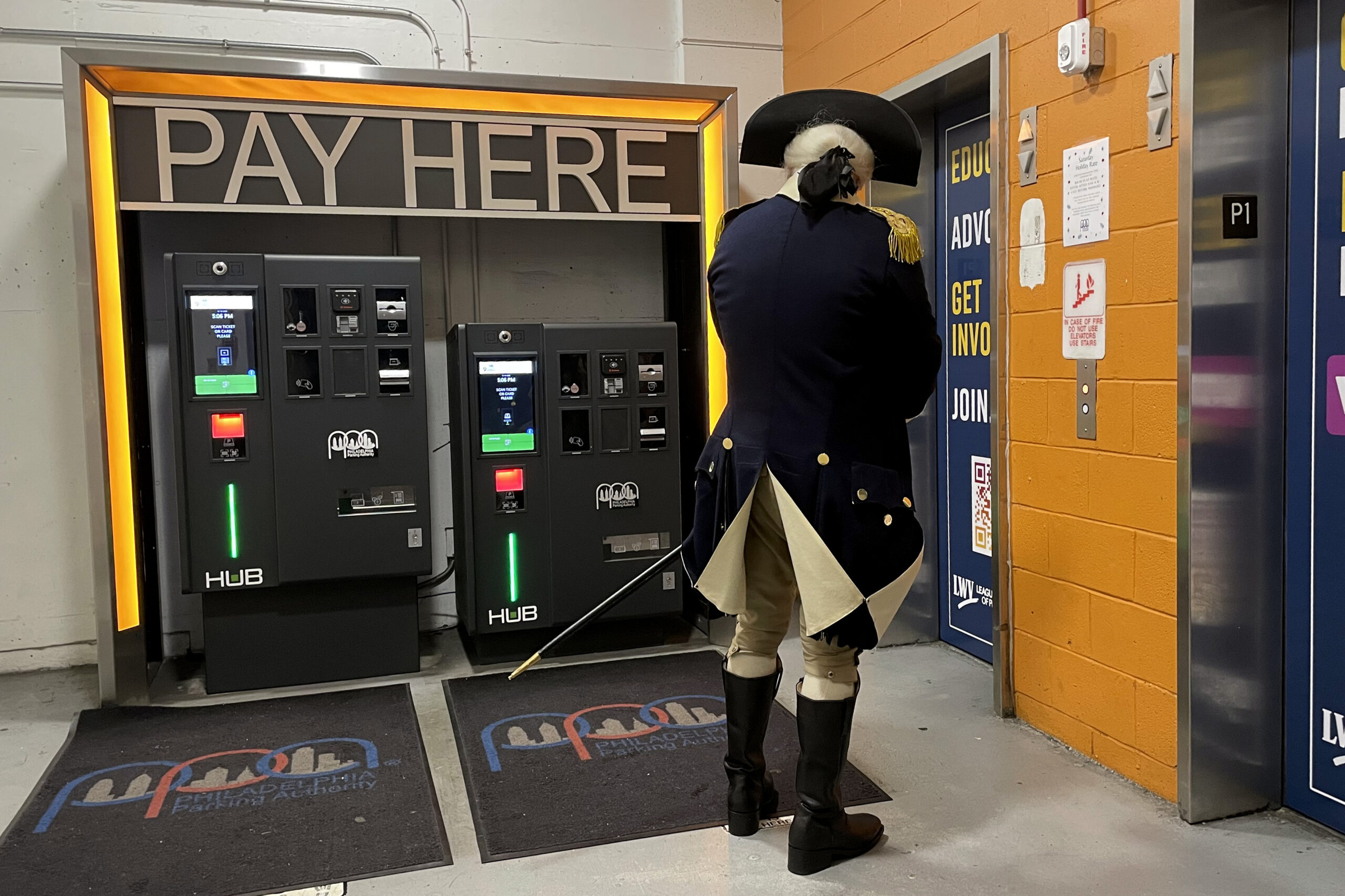
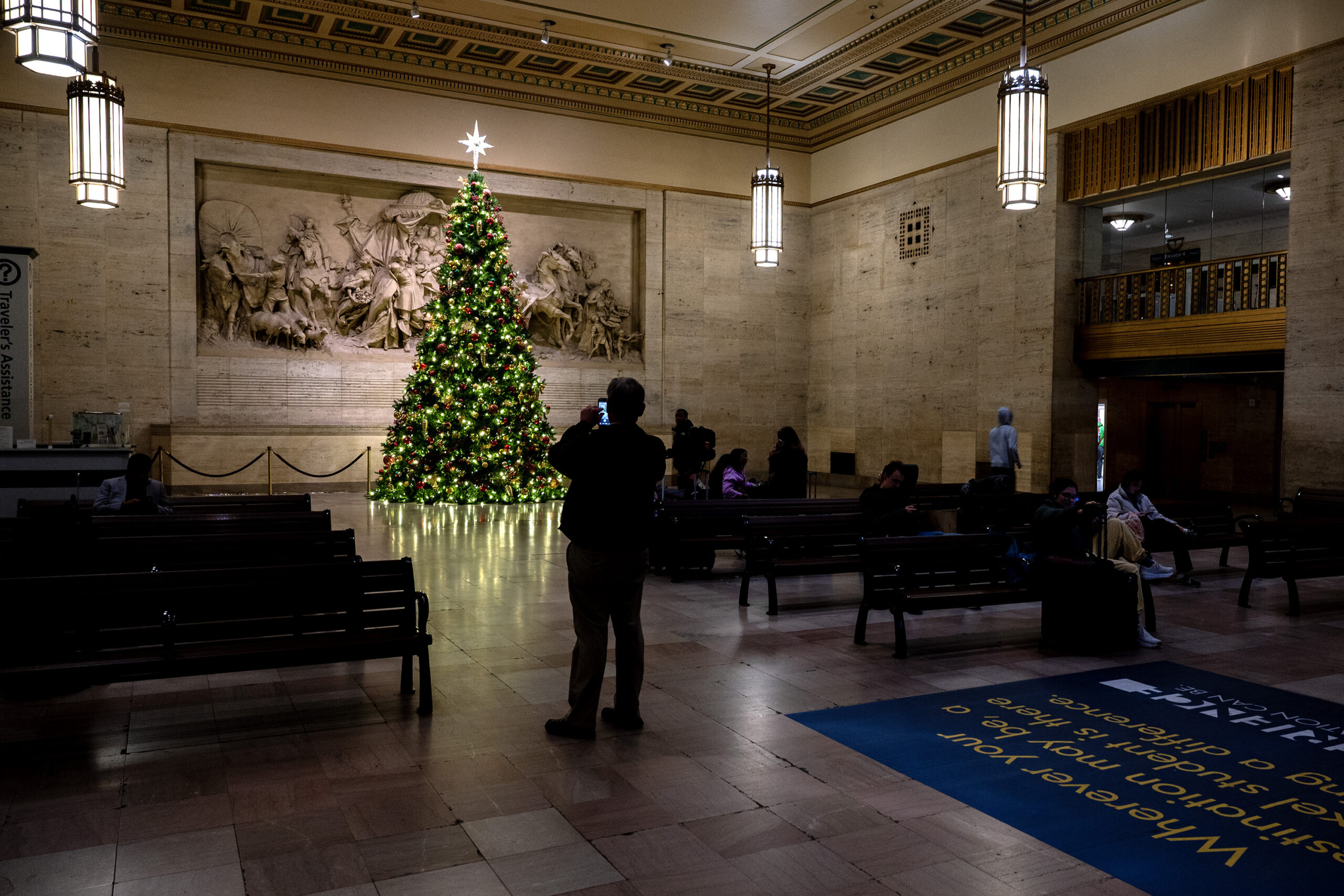
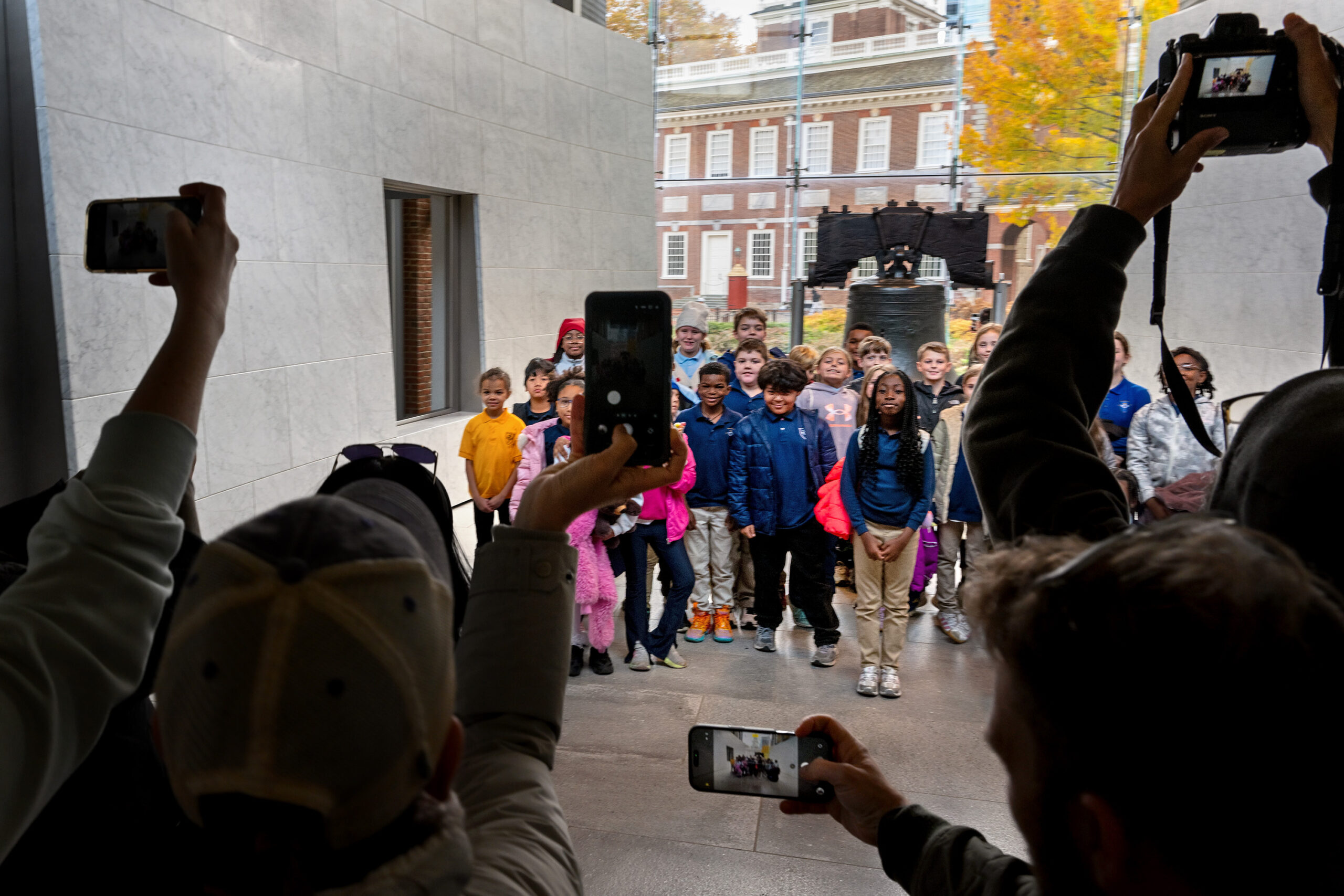
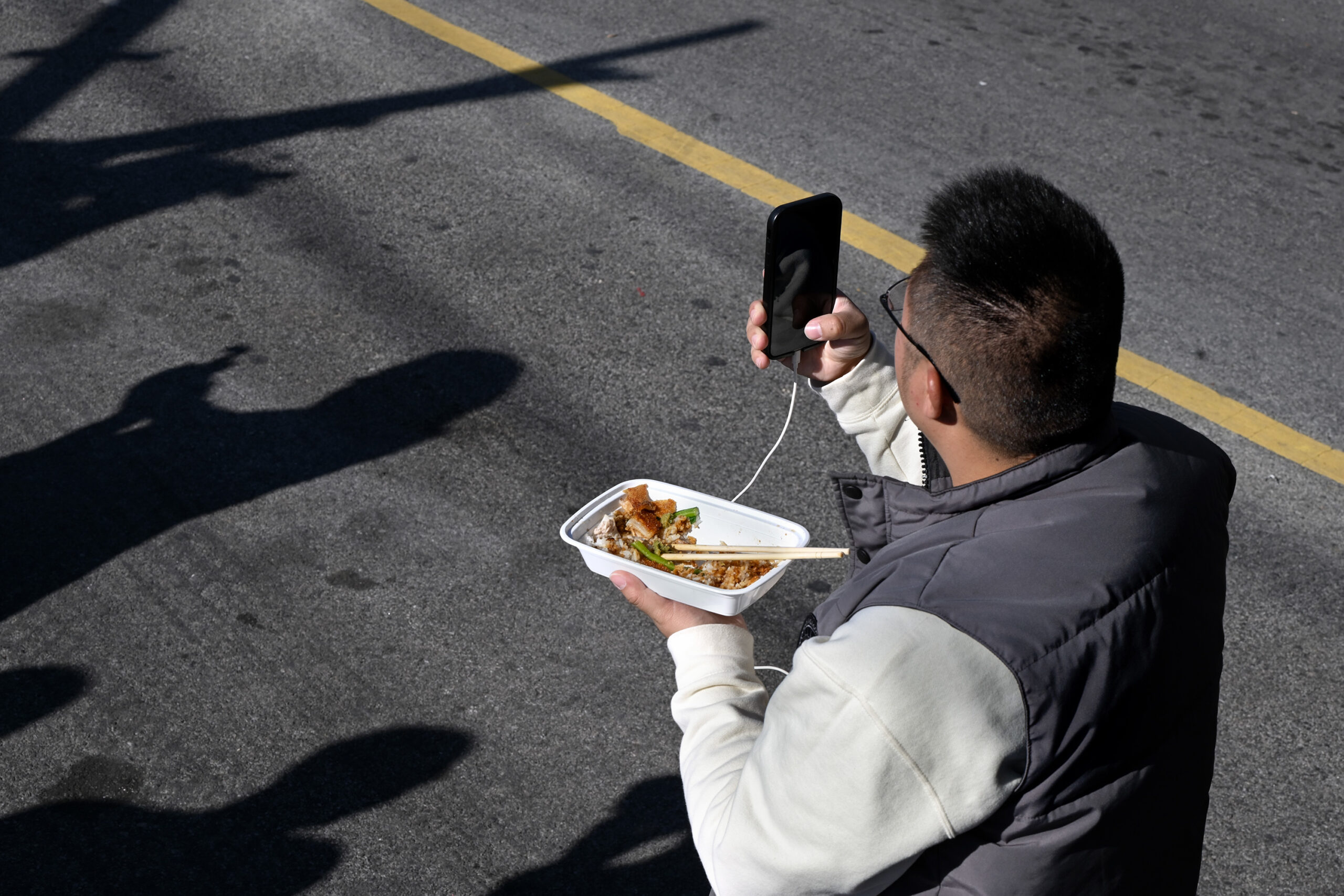
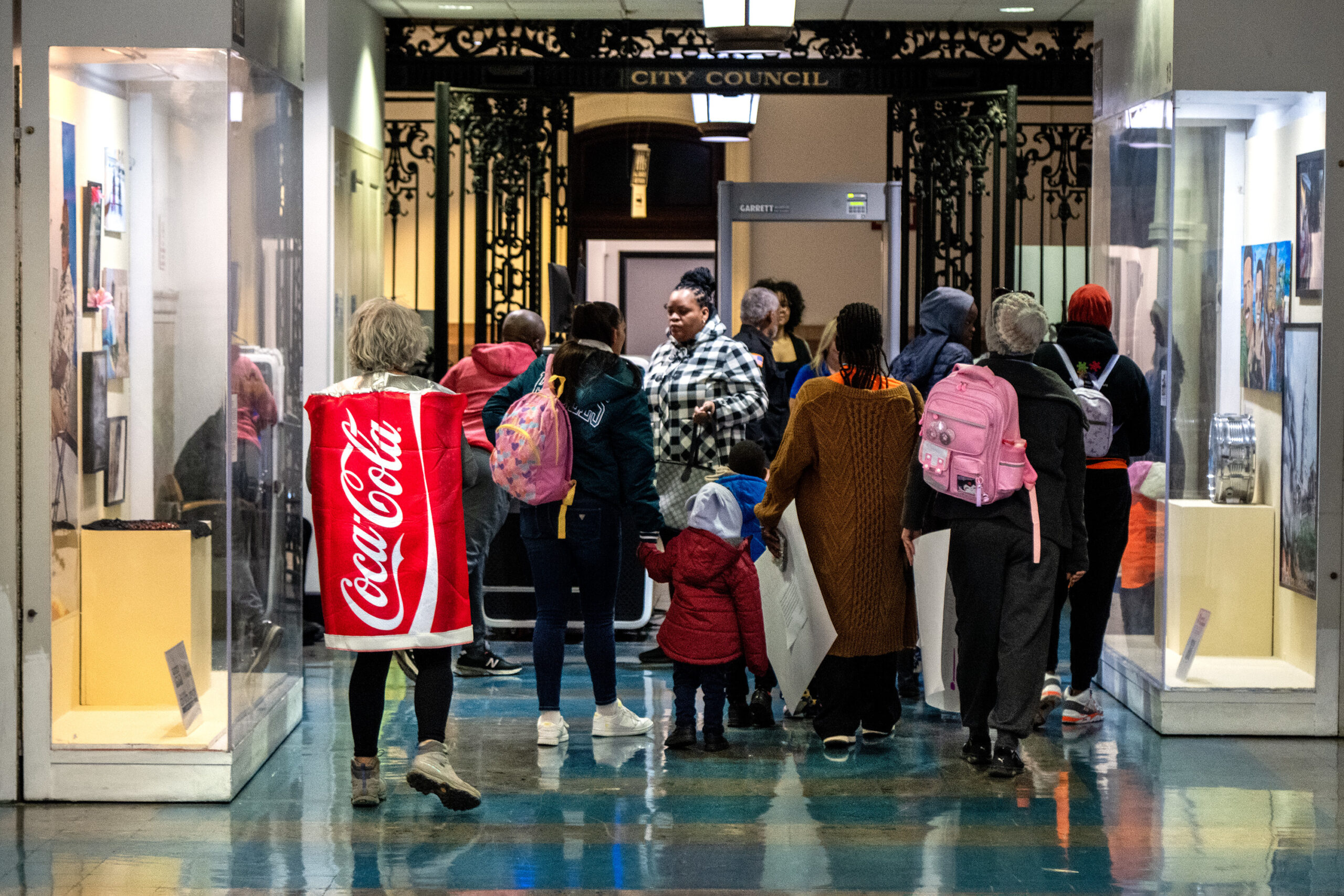
January 26, 2026: The President’s House in Independence National Historical Park hours Jan, 22, after all historical exhibits were removed following President Trump’s Executive Order last March that the content at national parks that “inappropriately disparage” the U.S. be reviewed. The site, a reconstructed “ghost” structure titled “Freedom and Slavery in the Making of a New Nation” (2010), serves as a memorial to the nine people George Washington enslaved there during the founding of America.January 19, 2026: A low-in-the-sky winter sun is behind the triangular pediment of the “front door” of the open-air President’s House installation in Independence National Historical Park. The reconstructed “ghost” structure with partial walls and windows of the Georgian home known in the 18th century as 190 High St. is officially titled, “Freedom and Slavery in the Making of a New Nation” (2010). It is designed to give visitors a sense of the house where the first two presidents of the United States, George Washington and John Adams, served their terms of office. The commemorative site designed by Emanuel Kelly, with Kelly/Maiello Architects, pays homage to nine enslaved people of African descent who were part of the Washington household with videos scripted by Lorene Cary and directed by Louis Massiah. Deepika Iyer holds her niece Ira Samudra aloft in a Rockyesque pose, while her parents photograph their 8 month-old daughter, in front of the famous movie prop at the top of the steps at the Philadelphia Art Museum. Iyer lives in Philadelphia and is hosting a visit by her mother Vijayalakshmi Ramachandran (partially hidden); brother Gautham Ramachandran; and her sister-in-law Janani Gautham who all live in Bangalore, India.January 5, 2026: Parade marshals trail behind the musicians of the Greater Kensington String Band heading to their #9 position start in the Mummers Parade. Spray paint by comic wenches earlier in the day left “Oh, Dem Golden Slippers” shadows on the pavement of Market Street. This year marked the 125th anniversary of Philly’s iconic New Year’s Day celebration.Dec. 29, 2025: Canada geese at sunrise in Evans Pond in Haddonfield, during the week of the Winter Solstice for the Northern Hemisphere. December 22, 2025: SEPTA trolley operator Victoria Daniels approaches the end of the Center City Tunnel, heading toward the 40th Street trolley portal after a tour to update the news media on overhead wire repairs in the closed tunnel due to unexpected issues from new slider parts.December 15, 2025: A historical interpreter waits at the parking garage elevators headed not to a December crossing of the Delaware River, but an event at the National Constitution Center. General George Washington was on his way to an unveiling of the U.S. Mint’s new 2026 coins for the Semiquincentennial, December 8, 2025: The Benjamin Franklin Bridge and pedestrians on the Delaware River Trail are reflected in mirrored spheres of the “Weaver’s Knot: Sheet Bend” public artwork on Columbus Boulevard. The site-specific stainless steel piece located between the Cherry Street and Race Street Piers was commissioned by the City’s Public Art Office and the Delaware River Waterfront Corporation and created and installed in 2022 by the design and fabrication group Ball-Nogues Studio. The name recalls a history that dominated the region for hundreds of years. “Weaver’s knot” derives from use in textile mills and the “Sheet bend” or “sheet knot” was used on sailing vessels for bending ropes to sails. November 29, 2025: t’s ginkgo time in our region again when the distinctive fan-shaped leaves turn yellow and then, on one day, lose all their leaves at the same time laying a carpet on city streets and sidewalks. A squirrel leaps over leaves in the 18th Century Garden in Independence National Historical Park Nov. 25, 2025. The ginkgo (Ginkgo biloba) is considered a living fossil as it’s the only surviving species of a group of trees that existed before dinosaurs. Genetically, it has remained unchanged over the past 200 million years. William Hamilton, owner the Woodlands in SW Phila (no relation to Alexander Hamilton) brought the first ginkgo trees to North America in 1785.November 24, 2025: The old waiting room at 30th Street Station that most people only pass through on their way to the restrooms has been spiffed up with benches – and a Christmas tree. It was placed there this year in front of the 30-foot frieze, “The Spirit of Transportation” while the lobby of Amtrak’s $550 million station restoration is underway. The 1895 relief sculpture by Karl Bitter was originally hung in the Broad Street Station by City Hall, but was moved in 1933. It depicts travel from ancient to modern and even futuristic times. November 17, 2025: Students on a field trip from the Christian Academy in Brookhaven, Delaware County, pose for a group photo in front of the Liberty Bell in Independence National Historical Park on Thursday. The trip was planned weeks earlier, before they knew it would be on the day park buildings were reopening after the government shutdown ended. “We got so lucky,” a teacher said. Then corrected herself. “It’s because we prayed for it.” November 8, 2025: Multitasking during the Festival de Día de Muertos – Day of the Dead – in South Philadelphia.November 1, 2025: Marcy Boroff is at City Hall dressed as a Coke can, along with preschoolers and their caregivers, in support of former Mayor Jim Kenney’s 2017 tax on sweetened beverages. City Council is considering repealing the tax, which funds the city’s pre-K programs. October 25, 2025: Austin Gabauer, paint and production assistant at the Johnson Atelier, in Hamilton Twp, N.J. as the finished “O” letter awaits the return to Philadelphia. The “Y” part of the OY/YO sculpture is inside the painting booth. The well-known sculpture outside the Weitzman National Museum of American Jewish History was removed in May while construction continues on Market Street and has been undergoing refurbishment at the Atelier at the Grounds for Sculpture outside of Trenton.
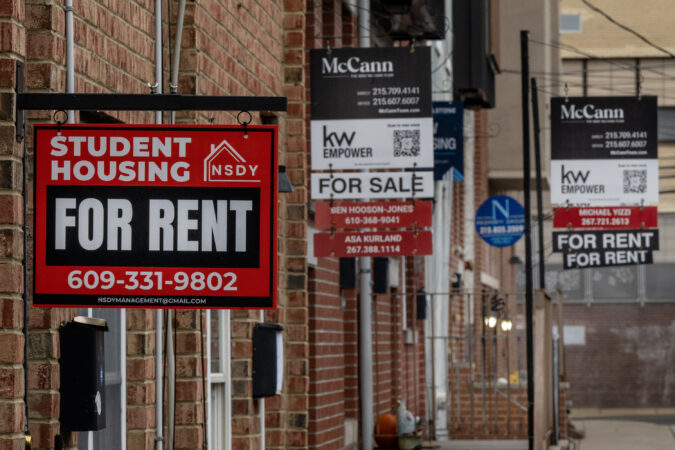
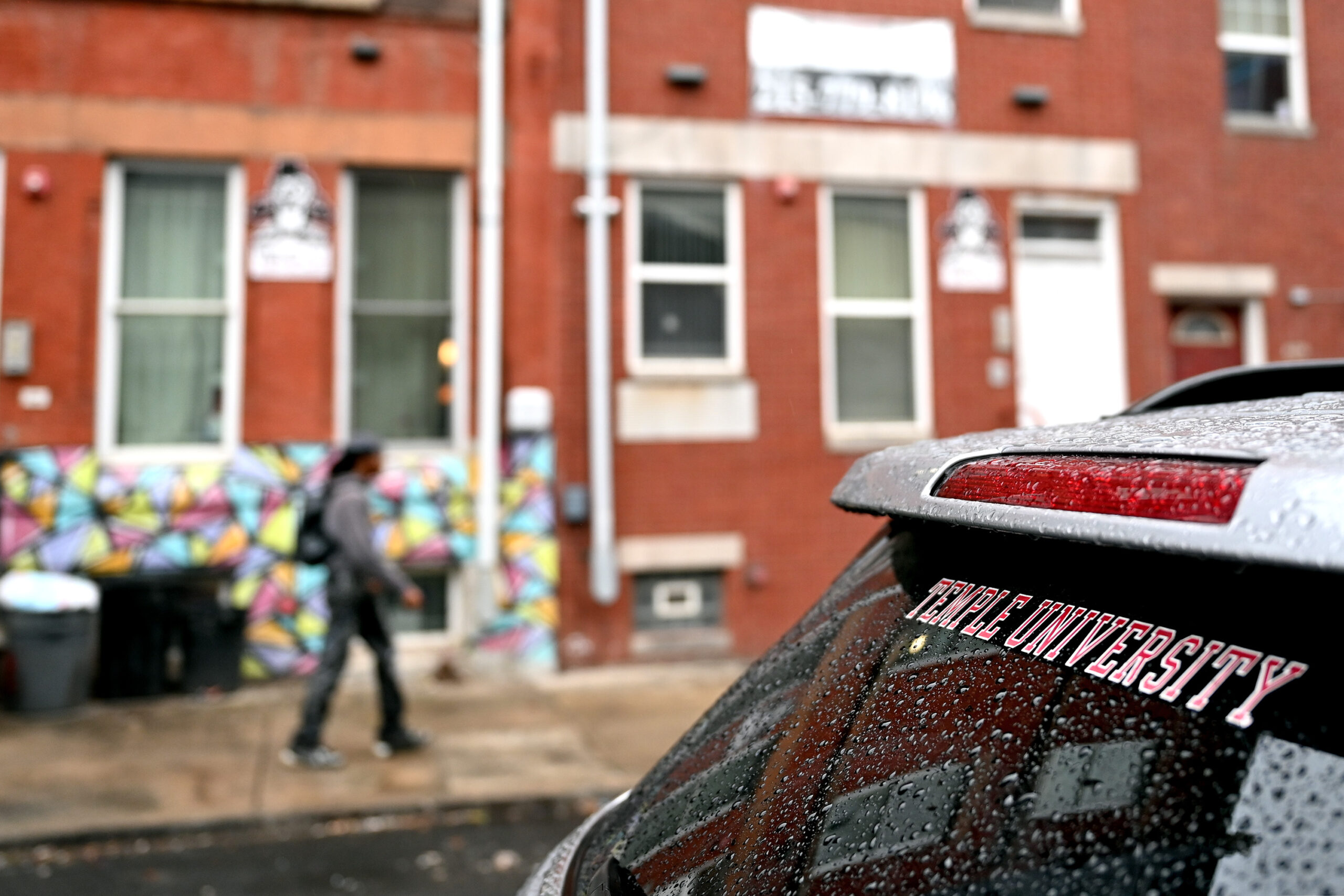
More than two dozen Philadelphia-area real estate professionals helped arrange $45 million worth of questionable deals around Temple University in which student rentals that had sat on the market for months abruptly sold for about double their asking prices, an Inquirer investigation has found.
In 52 settled or still-pending sales over roughly the last year, apartment buildings were listed for sale at an average price of $450,000, but found no takers. Within days of being re-listed for a higher price, the same properties sold for as much as $905,000 — at least on paper — to buyers who took out mortgages that far exceeded the original asking price.
Eight sellers or their agents now say they entered into the deals with the understanding that they would actually receive close to the original asking price — not the much higher amount that was officially listed on deeds and other public records. And an appraiser said that real estate agents on both sides of a proposed deal tried to pressure him to raise the valuation of a property.
The sales have raised concerns about possible mortgage fraud in the area around Temple, which could lead to a spate of foreclosures and affect property assessments, tax bills, and student rentals. At least one such property has gone into foreclosure over an unpaid mortgage, according to court records.
Solomon Wisenberg, a former assistant U.S. attorney in North Carolina and Texas who specialized in white-collar crime and bank fraud, said the people involved in the deals could face scrutiny from criminal investigators.
“I don’t know any fraud prosecutor who wouldn’t be interested in looking at that,” Wisenberg said. “Settlement statements have to reflect reality. If you don’t present an accurate picture to the financial institution that is financing the loan, you’ve got problems.”
Patrick C. Fay, a real estate agent in Coldwell Banker’s Old City office, was involved in every deal, representing at least seven buyers who purchased the properties through limited liability companies. One of those buyers had been convicted of an earlier mortgage fraud scheme.
Pat Fay had been one of the top real estate agents last in Coldwell Banker’s Old City office. His clients have purchased properties around Temple University — at twice the listing price.
Coldwell Banker cut ties with Fay in December, hours after The Inquirer published a story concerning 33 of his deals around Temple.
But Fay had a counterpart on the other side of every transaction. They included agents at major brokerages such as Keller Williams, Long & Foster, and eXp — as well as three agents who worked in the same Coldwell office as Fay and helped him close 13 sales.
Coldwell Banker’s national office said this month that it has launched an internal investigation into the matter.
Fay, who was one of the top agents in his Coldwell office, has denied wrongdoing. He declined to discuss specific sales.
“In my over 20 years in real estate, I have maintained an unblemished record with no ethical violations or complaints filed against me,” Fay wrote in a text message last week. “These claims are without merit.”
(function() {
var l2 = function() {
new pym.Parent(‘patfay’,
‘https://media.inquirer.com/storage/inquirer/projects/innovation/arcgis_iframe/patfay.html’);
};
if (typeof(pym) === ‘undefined’) {
var h = document.getElementsByTagName(‘head’)[0],
s = document.createElement(‘script’);
s.type = ‘text/javascript’;
s.src = ‘https://pym.nprapps.org/pym.v1.min.js’;
s.onload = l2;
h.appendChild(s);
} else {
l2();
}
})();
Steve Orbanek, a spokesperson for Temple University, said the university learned about the situation from The Inquirer’s previous report and is now investigating possible impacts on its student renters.
“It goes without saying that the university condemns any unlawful behavior, and we find these allegations deeply concerning, both for our students and neighbors who reside in the community,” he said.
‘Fat Pay’
Fay, of Moorestown, Burlington County, started arranging deals in December 2024 to purchase apartment buildings around Temple University that owners had been struggling to sell.
The value of those properties, which are largely marketed as student rentals, has fallen in recent years. A local landlords association said vacancy rates are up and rents down amid declining enrollment at the university, which has shed 10,000 students in under a decade.
Fay, who has used the handle “Fat Pay” on social media, had buyers willing to make a deal. However, in multiple cases identified by The Inquirer, that was true only after the sellers and their real estate agents agreed to sign a deed showing that the property had sold for much more than the original asking price.
Joelle Delprete, a former Temple grad student who works for the university, lives in an apartment unit that Fay helped purchase. Soon, unpaid water and trash collection bills started piling up.
Shaina Levin, a Coldwell agent who worked with Fay in his Old City office, represented a seller in one such deal on 15th Street. The property was initially listed for sale last July at $375,000. Records show Fay’s client bought it for $842,000 in September 2025 after securing a $673,600 mortgage.
“It’s a bonus when we can keep it in the Coldwell Banker family,” Levin posted on Facebook, referring to the sale. “Thanks Pat Fay for teaming up on this one. Congratulations to your buyer!”
In an interview, Levin said her client received an amount closer to the original listing price, not the $842,0000 sales price recorded on the deed.
She saidthe buyer contended that thehigher sales price was tied to a planned renovation. City permit records show no evidence of construction or renovation work on the building.
Levin said that Fay’s proposal was “totally unconventional,” but that her office manager at Coldwell Banker ran it by the company’s legal department, which signed off.
“Legal said, ‘Yep, all good,’” Levin said. She referred additional questions about the sale to her manager, who declined to comment.
Fay’s buyer in that deal was UrbanNest Acquisitions, a limited liability company created the same month as the sale by Tanjania Powell-Avery, a former real estate agent from Pottstown, Montgomery County. Federal prosecutors with the Eastern District of Pennsylvania indicted Powell-Avery and two others in 2010 for participating in a mortgage fraud ring in the Philadelphia area. She pleaded guilty and was sentenced to five years’ probation and nine months’ house arrest.
Powell-Avery declined to comment.
Two other colleagues of Fay’s at his former Old City office also brokered sales with him, according to data from the Multiple Listing Service, a shared database that real estate professionals use to track and arrange deals.
Karl Klotzbach represented sellers in eight deals with Fay over five months last year — more than any other seller’s agent, records show. The eight properties had originally been listed for a total of $3.4 million before they were each re-listed and sold for a combined $7 million.
Klotzbach did not respond to requests for comment.
Matthew Greene, another Coldwell agent, brokered four sales with Fay on North 12th Street. The properties were each listed for $450,000 last April, then re-listed at $879,000 the following month. In July, each property sold at the higher amount within days of one another, with all four sales backed by a separate $703,200 mortgage.
Greene would not discuss the sales.
“I’m happy to direct you to our legal team for any comment,” he said. Greene hung up the phone without providing any contact information.
Daryl Turner, the branch vice president at Coldwell Banker’s Old City office, referred questions to the company’s legal department. Andrea Gillespie, a national spokesperson for Coldwell Banker, which operates in 49 countries and territories, would not comment on the sales.
“We immediately disaffiliated Pat Fay and are continuing to investigate the matter internally,” Gillespie said in an email. “Coldwell Banker stands for trust and integrity, and we hold our agents to the highest ethical standards.”
‘This is my livelihood’
While sellers were eager to offload their toxic real estate investments, not every deal went smoothly.
John Sexton, an independent licensed appraiser with twenty years’ experience in the Philadelphia market, said in an interview that an appraisal company working for a lender contracted him last year to evaluate a property on North Park Avenue, near Temple’s campus. The sale was being brokered by Fay and Peter Lien, an eXp real estate agent representing the seller.
It was the kind of property common around Temple: a Victorian-era rowhouse that had been converted into a three-unit, nine-bedroom student rental. And, like similar properties in the area, it sat on the market unsold for more than two months, with no takers, at its $408,000 asking price.
The property was taken off the market in October, but then reappeared as a pending sale at $879,000, according to MLS data. Fay had found another buyer ready to pay more than double.
Sexton said he quizzed Lien about why a property that had not undergone recent renovations would suddenly jump in price. Sexton said Lien responded that an earlier broker simply “hadn’t been familiar with the real estate market” around Temple.
Sexton said the implication of these conversations was that Lien “had a person who would pay $879,000, so I should just do my job and mark it at $879,000.”
The 1700 block of Arlington St. in North Philadelphia Wednesday, Dec. 10, 2025. Buyers have snapped up $48 million in student housing around Temple University, often paying more than twice what properties were originally listed for even though rents are down and vacancies are up for student housing.
Sexton said he then received an unusual email from an individual named “Jay Jay,” who indicated he was working with Fay. The email included a list of nearby properties that had all sold in the $800,000 range, establishing that the sales price was reasonable.
Sexton looked into the comparable sales and found that they had all been brokered by Fay. “Jay Jay” also sent Sexton copies of leases for apartments in the same building, purporting to show units leasing for $2,500 a month. But when Sexton dug up sales listings for the same building from a few weeks earlier, they advertised that the units had been leased for closer to half that amount.
“Jay Jay” did not respond to an e-mailed request for comment.
Sexton said he called Fay to discuss the discrepancies, and the real estate agent accused him of being inexperienced and pushed him to approve the higher value.
“It’s a tough situation,” Sexton said. “You have two brokers pressuring you and sending you signed documents saying the sale price is valid.”
Sexton said after he told Fay he would need to further substantiate the higher asking price, Fay stopped responding.
The property never sold and is now off the market.Sexton never heard from Fay again.
“It’s infuriating to me, because he’s putting my license in jeopardy,” Sexton said. “This is my livelihood.”
In a text message, Fay denied “any claim that I have ever manipulated or influenced an appraisal in any fashion.” He did not respond to questions about the sale.
Lien said he could not comment on the failed deal.
“I was instructed by my brokerage that any press would have to go through our office, and we’re not allowed to speak on it,” said Lien, who works out of eXp’s King of Prussia office.
The manager of that eXP office did not return a request for comment.
‘Really bad stuff’
Daniel Perlman, a former prosecutor in the Maryland State’s Attorney’s Office who now practices white-collar criminal defense, said anyone who signed documents they knew to be false could potentially face legal problems.
“If there are documents that have incorrect information for a mortgage, then yeah, somebody has criminal liability,” Perlman said. “You’re under penalty of perjury for signing these documents.”
A spokesperson for the U.S. Attorney’s Office in the Eastern District of Pennsylvania said the office does not confirm or deny the existence of investigations, as did a spokesperson for the Pennsylvania State Real Estate Commission, which licenses agents.
Nick Pizzola, vice president of the Temple Area Property Association, which represents local landlords, said the COVID-19 pandemic has had a lasting negative impact on the off-campus real estate market, leaving landlords struggling to sign leases and pay their own mortgages.
Still, he said, the seller’s agents had to have known something was amiss when a buyer was offering double the asking price.
“Anyone who knows anything about real estate would have run away from those deals,” Pizzola said. “Some really bad stuff was happening.”
Most participants in Fay’s deals were reluctant to discuss their roles when contacted by The Inquirer this month. Some seller’s agents said their brokerages had instructed them to remain silent. Others claimed ignorance when it came to the details of the deals they had helped arrange.
The 1900 block of N. 18th St in North Philadelphia Wednesday, Dec. 10, 2025. Buyers have snapped up $48 million in student housing around Temple University, often paying more than twice what properties were originally listed for even though rents are down and vacancies are up for student housing.
In the March 2025 sale of an apartment building on the 2200 block of North Sydenham Street, for example, both the seller and his agent said they could not explain why the sales price did not match the amount listed on the deed.
The property initially went up for sale for $324,900 in December 2024 but was then re-listed and sold to Fay’s client in March 2025 for $789,000. The seller, Alvjod Dedaj, said he did not actually receive that higher amount. He referred further questions to his real estate agent at Long & Foster.
“I have no clue what’s going on,” Dedaj said. “I just cashed out a certain amount of money.”
Dedaj’s agent, Bob Kiziroglou, who works out of Long & Foster’s Devon office, said he, too, could not recall why the asking price suddenly jumped. He referred questions to Fay.
“Reach out to him, man, he’ll give you all the details,” Kiziroglou said.
A message left at Long & Foster’s Devon office was not returned.
The Broad Street office of Keller Williams Realty was another hub for deals involving Fay, with five of its agents representing sellers in eightsales. An office manager did not respond to requests for comment.
Wisenberg, who was a prosecutor in the Whitewater/Madison Guaranty Savings & Loan investigation, said he found it particularly suspicious that Fay arranged deals with mortgages that far exceeded the initial asking price, and with sellers receiving less than the stated purchase price.
“What’s he doing with the rest of the money?” Wisenberg asked.
Trouble brewing
Already, there are signs of trouble in the neighborhood around Temple.
In November, one lender, Easy Street Capital, filed to foreclose on a Park Avenue property that sold in late 2024 for $850,000 — more than double its value just two years prior.
While no buyer’s agent is listed in MLS data for the sale, Lien, the eXp agent, is listed as representing the seller. The buyer, Park Ave Enterprise LLC, is registered to an associate of Fay’s who participated in at least four other sales around Temple that he brokered.
According to court filings, the LLC defaulted on an $807,000 mortgage about four months after purchase.
The lenders that financed Fay’s purchases now bear the most risk of the overvalued and under-occupied rentals lapsing into foreclosure. A private lenders association in Novemberwarned its members of a “fraud scheme” operating around Temple University, and cities like Baltimore have seen hundreds of properties fall into foreclosure as a result of suspected mortgage fraud rings.
A spokesperson for City Councilmember Jeffery “Jay” Young, whose district encompasses the affected properties, said he was “not familiar with the situation.” He called mortgage fraud “a common and unscrupulous real estate practice that happens too often in our city.”
Orbanek, the Temple spokesperson, said the university is working to identify students who may be impacted by potential foreclosures and asked themto contact the university’s Essential Needs Hub, which connects student renters with supportive resources.
Joelle DelPrete, a former Temple grad student who works for the university, lives in an apartment unit that Fay helped purchase. He brokered a sale of the rental property to “18th Estates LLC” in December 2024 for $868,000. It had previously been listed for $385,000.
A few months later, DelPrete said, Fay texted her that he was the property manager, and he wanted her to sign a new lease so he could begin collecting rent.
“We assumed it was a totally legit company,” DelPrete said.
Soon, DelPrete said, unpaid water and trash collection bills started piling up, and maintenance issues went unanswered. In October, she found a document known as an Act 91 notice that was posted on an adjacent property in advance of foreclosure proceedings. It showed the owners — who had been represented in the purchase by Fay — had stopped paying its mortgage and owed roughly $25,000.
DelPrete and her three roommates are hoping to move out before her building goes into foreclosure.
“Especially living around Temple, you just gotta be careful and make sure everything is aboveboard,” she said. “If something feels off, it is off.”
We’ll show you a photo taken in the Philly-area, you drop a pin where you think it was taken. Closer to the location results in a better score. This week we have three historic sites across the city! Good luck!
Round #18
Question 1
This location has been in the news recently. Where is it?
Loading…
ClickTap on map to guess the location in the photo
ClickTap again to change your guess and hit submit when you're happy
You will be scored at the end. The closer to the location the better the score
Tom Gralish / Staff Photographer
Pretty good/Not bad/Way off! Your guess was from the location.Spot on! Your guess was exactly at the location. Here's also where a random selection of Inquirer readers guessed.
The President’s House made headlines when the National Park Service removed exhibits about slavery following an executive order by President Donald Trump.
Quiz continues after ad
Question 2
Where can you find the Philly Renaissance Faire and an electronic music festival?
Loading…
Don Nigroni / Spotlight PA
Pretty good/Not bad/Way off! Your guess was from the location.Spot on! Your guess was exactly at the location. Here's also where a random selection of Inquirer readers guessed.
Fort Mifflin is a Revolutionary War-era historic landmark near Philadelphia International Airport. It recently hosted the Making Time ∞ festival.
Quiz continues after ad
Question 3
Where is this historic house?
Loading…
Michael Bryant / Staff Photographer
Pretty good/Not bad/Way off! Your guess was from the location.Spot on! Your guess was exactly at the location. Here's also where a random selection of Inquirer readers guessed.
Stenton, a colonial-era house and museum, is home to the Dinah Memorial – a memorial that honors a one-time enslaved housekeeper who saved the house from destruction by British soldiers.
Your Score
ARank
Amazing work. You know your Philly history.
BRank
Good stuff. You’re almost perfect.
CRank
C is a passing grade, but you could do better.
DRank
D isn’t great. Try again next week!
FRank
We don’t want to say you failed, but you didn’t not fail.
You beat % of other Inquirer readers.
We’ll be back next Saturday for another round of Citywide Quest.
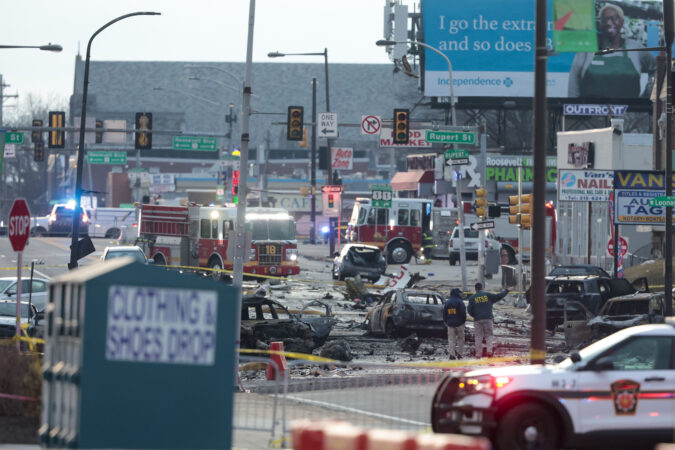
The destruction spanned multiple blocks, spreading wreckage across a debris field that stretched for more than a quarter mile near Roosevelt Mall on Cottman Avenue. The resulting damages totaled in the millions of dollars, and many area residents were left displaced and traumatized.
Now, on its first grim anniversary, the crash’s effects still loom large — not only in the memories of those directly impacted by the crash, but in the local and regional psyche.
With that in mind, city officials plan to hold a memorial observance to honor its victims. The event, slated to start at 5 p.m. at Engine 71 Fire Station — just blocks from where the crash occurred — will include a bell ceremony and wreath-laying. Mayor Cherelle L. Parker and other elected officials will speak.
As city officials said at the time, the crash was among the most significant black swan tragedies in Philadelphia’s history. And, in many ways, the neighborhood is still recovering. Here is what you need to know:
Eight killed, dozens injured
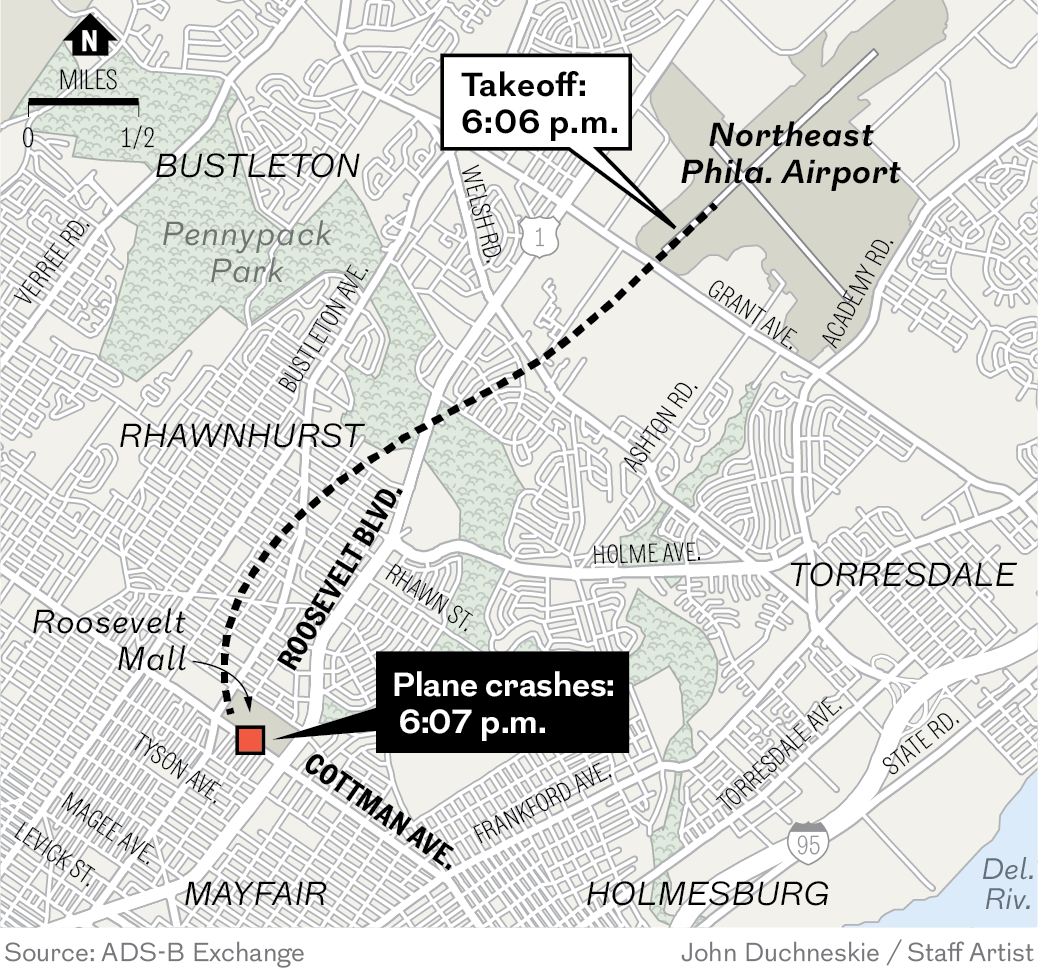
At 6:06 p.m., a Learjet 55 operated by a Mexican medical transport company known as Jet Rescue Air Ambulance took off from Northeast Philadelphia Airport en route to Springfield-Branson National Airport in Missouri on its way back to Mexico. Less than a minute later, after making it 1,650 feet into the air, it went nose down about 3.5 miles away from the airport, slamming into the ground near Bustleton and Cottman Avenues at a 45-degree angle at more than 270 mph.
Map of where a small jet crashed near Roosevelt Boulevard and Cottman Avenue in Northeast Philadelphia on Jan. 31.
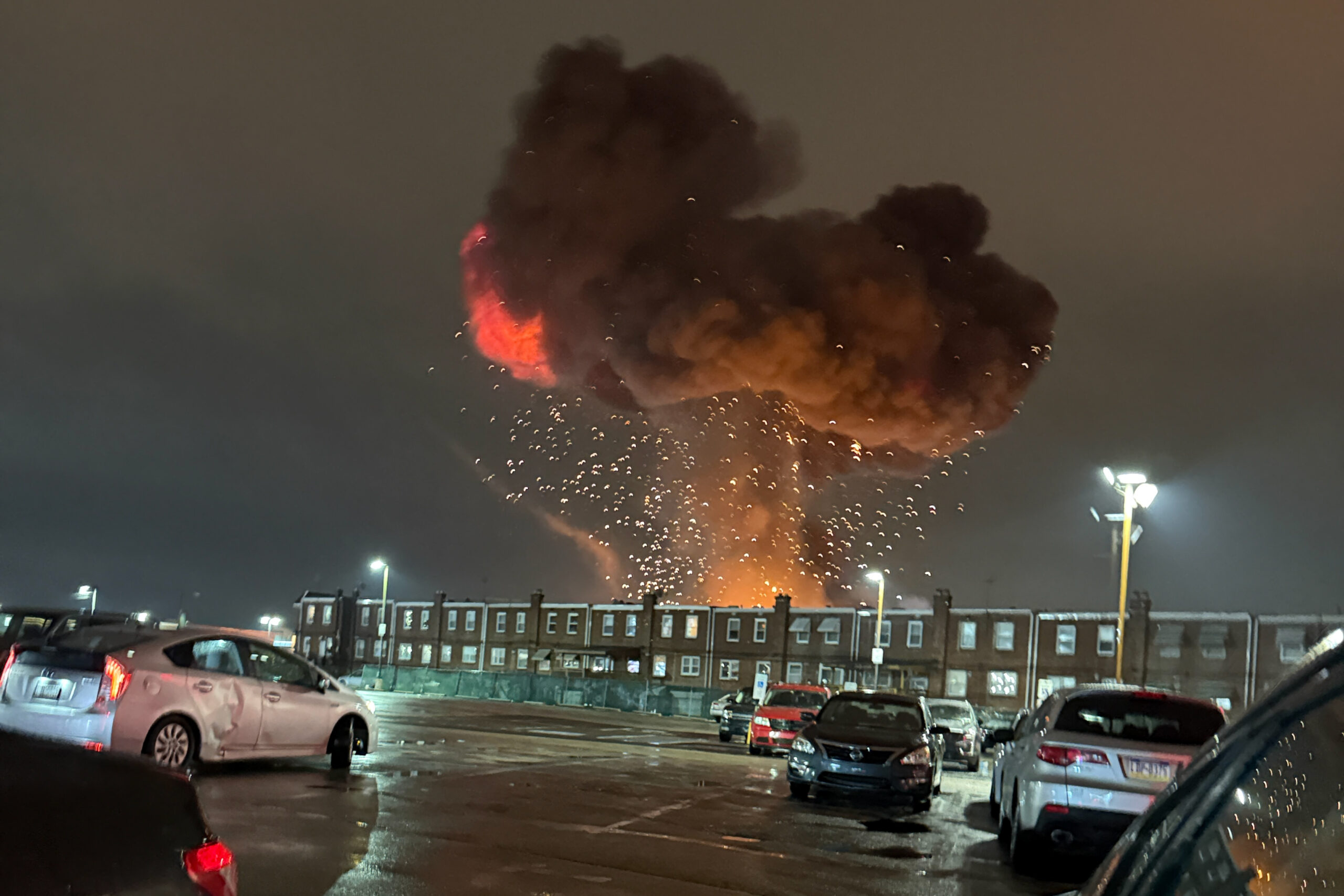
The crash tore an 8-foot deep crater into the earth and created a massive fireball that illuminated the neighborhood. The impact spread devastation across a 1,410-foot-long-by-840-foot-wide tract, damaging homes, vehicles, and businesses, and scattering human remains amid the debris field.
All six people aboard the aircraft were killed — among them Valentina Guzmán Murillo, 11, and her mother, Lizeth Murillo Osuna, 31. The pair were on their way home after Valentina had received four months of treatment for a spinal condition at Shriners Children’s Philadelphia, with her doctors celebrating her recovery only hours before.
Also killed were captain Alan Montoya Perales, 46; copilot Josue de Jesus Juarez Juarez, 43; doctor Raul Meza Arredondo, 41; and paramedic Rodrigo Lopez Padilla, 41. On the ground, Steven Dreuitt Jr., 37, died as a result of the crash, as did his fiancée, Dominique Goods Burke, 34, who succumbed months later to injuries she suffered that night.
At least 24 other people were injured, with victims ranging in age from 4 to 85. Many suffered severe burns, smoke inhalation, and skull fractures, including 9-year-old Ramesses Dreuitt Vazquez, the young son of Dreuitt, who suffered burns over 90% of his body and spent nearly a year in the hospital before being released.
‘All hands on deck’
Ryan Tian, 23, of Delaware County, captured an explosion at a parking lot at Cottman and Bustleton Avenues Friday, Jan. 31, 2025. It was later discovered a medical transport plane bound for Mexico took off from Northeast Philadelphia Airport and crash soon after on Cottman.
The emergency response was massive, involving about 400 firefighters, police officers, and other first responders. Investigators later found that more than 300 properties had been impacted in some way.
The incident, Parker said the night of the crash, was an “all hands on deck” situation. Eyewitnesses and emergency responders described the ensuing chaos as resembling a war zone or feeling like a movie.
“This is a huge area,” Police Commissioner Kevin Bethel said of the crash site. “Nothing in that area will ever be normal again.”
Gov. Josh Shapiro and other officials also toured the devastated area. Ultimately, despite the damage the crash wrought, Shapiro’s office found that the impacts were too limited to ask President Donald Trump‘s administration for a federal disaster declaration, leaving the city and state to lead recovery efforts.
Investigation reveals little
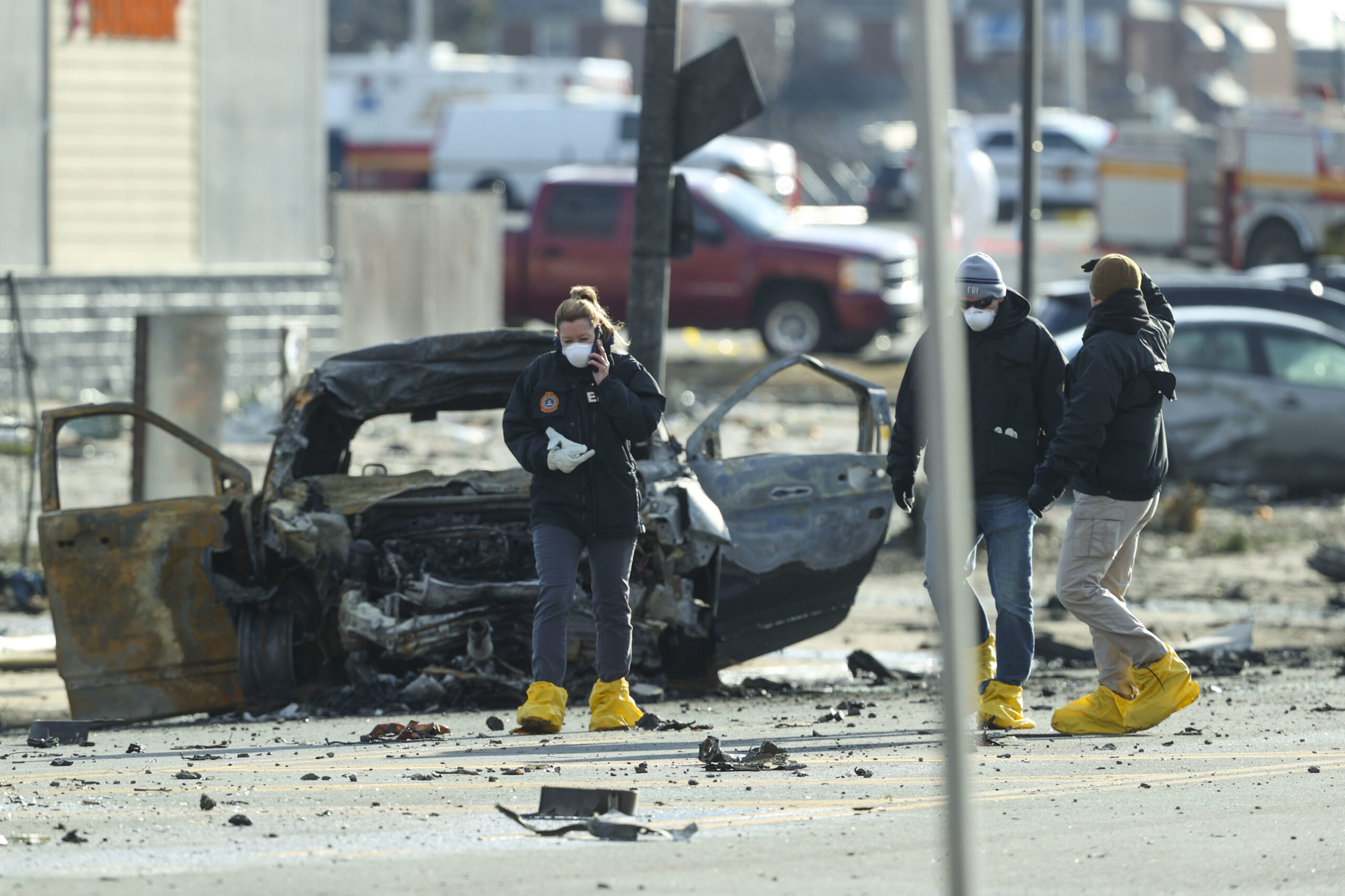
An investigator walks by a burned out car on Cottman Avenue Saturday, Feb. 1, 2025, in Philadelphia. A medical jet with six people on board crashed Friday evening near the Roosevelt Mall in Northeast Philadelphia scattering debris throughout the streets, and setting multiple homes and cars ablaze in a devastating scene
The investigation was led by the National Transportation Safety Board, which early on noted that the crashed craft made no distress calls and had only brief, routine communications with the Northeast Philadelphia Airport control tower after takeoff.
That left the aircraft’s cockpit voice recorder — or “black box” — as a key investigatory element. Days later, searchers found the unit at the bottom of the crater the craft had carved into the earth, but it was largely useless.
The recorder, the NTSB said, had “likely not been recording audio for several years,” and contained no clues as to what may have caused the crash. No official cause for the crash has yet been announced.
Reviews of the craft’s flight records, however, found that it had been used extensively in the months and weeks leading up to the crash. In the five days before the disaster, it had flown 12 flights covering 9,400 miles, and in its final year before it was destroyed, the aircraft had 163 takeoffs.
Fallout continues
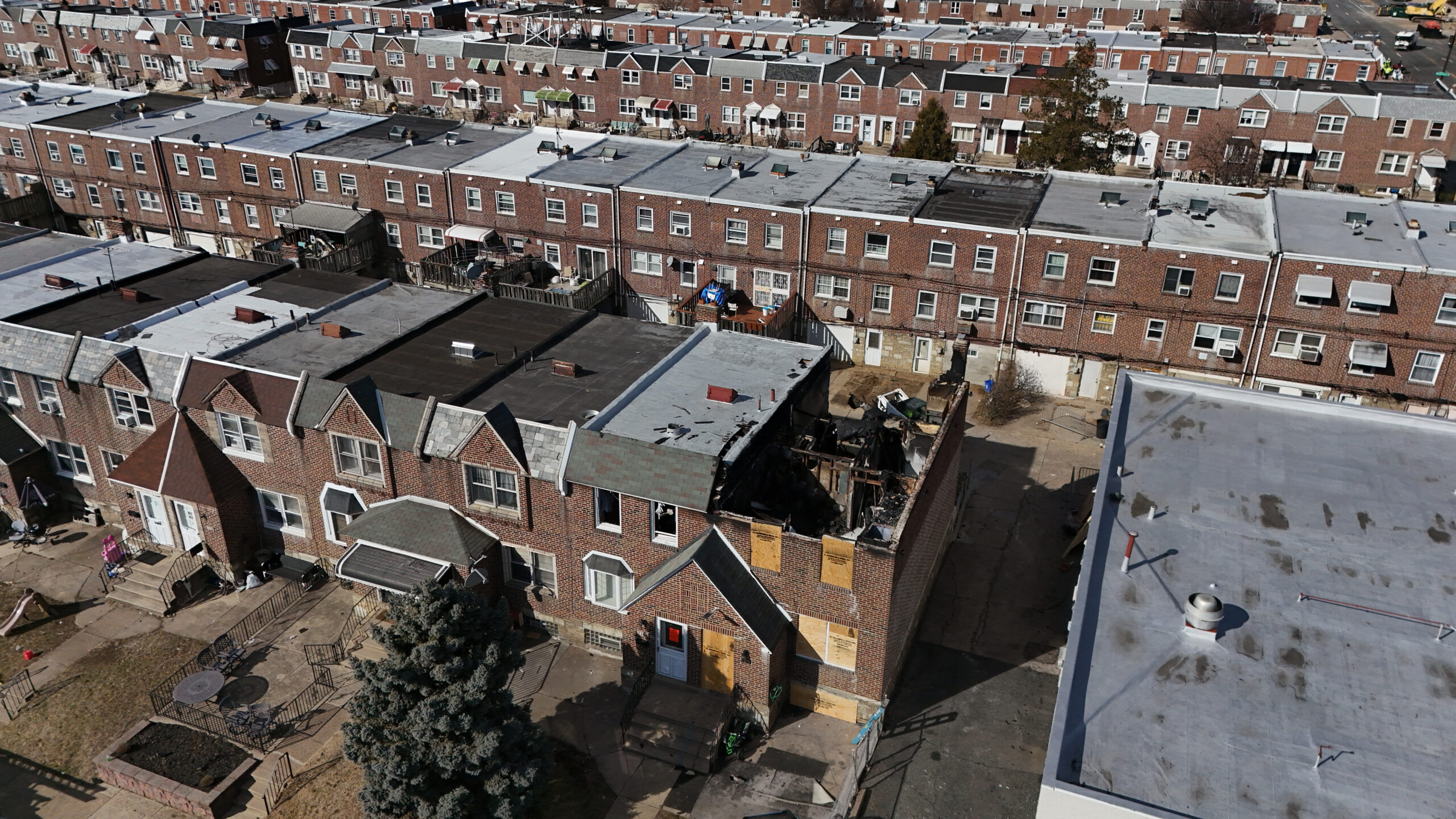
Homes in the Northeast Philadelphia neighborhood across from the Roosevelt Mall where a plane crashed on nearby Cottman Avenue. More than a dozen properties were severely damaged by flying debris and fire. The home that the Gomez family rented on Calvert Street caught fire after a plane engine slammed into their roof. Photographed Tuesday, Feb. 4, 2025.
In June, five months after the crash, more than a dozen local residents and business owners told The Inquirer they were still grappling with unrepaired property damage and catching up on bills from lost incomes or extra expenses.
The city had marshaled significant resources, including opening sites offering mental health services and financial aid, and steering roughly $264,000 in grants to small businesses. The One Philly Fund, which was launched to serve as the city’s signature relief effort, however, only attracted some $35,000 in donations, falling woefully short of its desired impact.
Meanwhile, insurance claims were expected to exceed $10 million, and the city itself sought claims for property damage and personnel costs eclipsing $2.5 million. The medical jet company’s insurer, El Águila Compania de Seguros, hoped to consolidate all claims under a single court case, and compel a federal judge to divvy up the funds, which it said were “unlikely to be sufficient to resolve all claims.”
Later in the year, lawsuits against the medical jet company were filed.
A silver lining
Caseem Wongus, 26, is meeting Ramesses R. Dreuitt Vasquez, 10, for the first time after saving him from the fire from the jet crash at the beginning of the year, in Germantown, Pa., on Tuesday, Dec. 23, 2025.
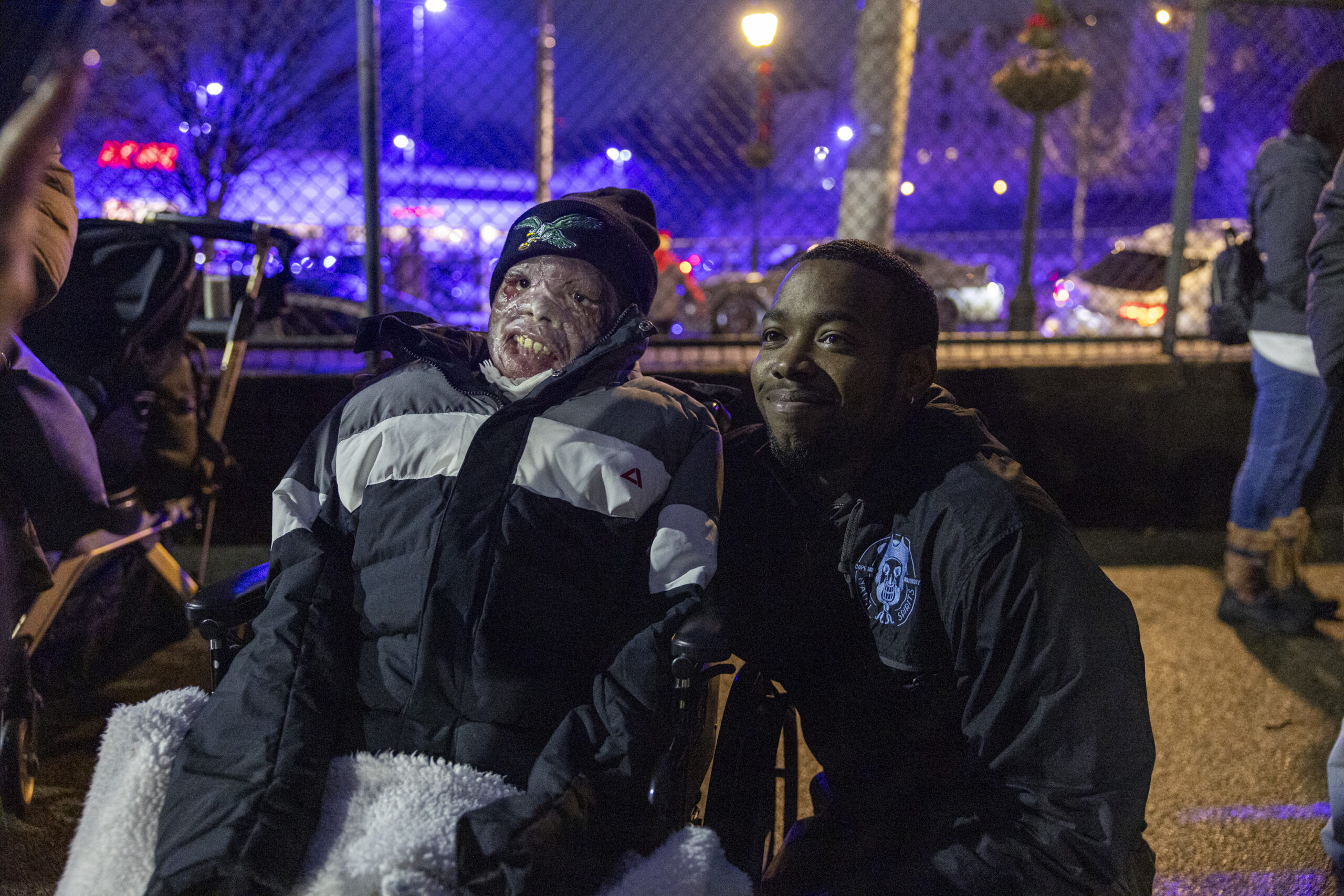
Despite the trauma and devastation the crash brought to Philadelphia, at the end of 2025, there was at least some good news. Ramesses Dreuitt Vazquez, a boy who was severely injured in the crash, was released from the hospital, just in time for the holidays.
Vazquez, who turned 10 in October, had endured almost a full year in the hospital, undergoing more than 40 surgeries, including multiple skin grafts, and the amputation of fingers and ears. He spent months in physical therapy relearning how to get out of bed, walk, and climb stairs.
But about a week before Christmas, he made it out. And while noting that Ramesses faced a challenging road ahead, the boy’s grandmother, Alberta “Amira” Brown, expressed happiness with his recovery.
“It’s the best thing ever that he’ll be home for the holidays,” Brown told The Inquirer. “He is truly happy to be coming home.”