WASHINGTON — President Donald Trump returned from the spectacle of a Chinese state visit to a less than welcoming U.S. economy — with the military band and garden tour in Beijing giving way to pressure over how to fix America’s escalating inflation rate.
Consumer inflation in the United States increased to 3.8% annually in April, higher than what he inherited as the Iran war and the Republican president’s own tariffs have pushed up prices. Inflation is now outpacing wage gains and effectively making workers poorer. The Cleveland Federal Reserve estimates that annual inflation could reach 4.2% in May as the war has kept oil and gasoline prices high.
Trump’s time with Chinese leader Xi Jinping appears unlikely to help the U.S. economy much, despite Trump’s claims of coming trade deals. The trip occurred as many people are voting in primaries leading into the November general election while having to absorb the rising costs of gasoline, groceries, utility bills, jewelry, women’s clothing, airplane tickets, and delivery services. Democrats see the moment as a political opportunity.
“He’s returning to a dumpster fire,” said Lindsay Owens, executive director of Groundwork Collaborative, a liberal think tank focused on economic issues. “The president will not have the faith and confidence of the American people — the economy is their top issue and the president is saying, ‘You’re on your own.’”
The president’s trip to Beijing and his recent comments that indicated a tone-deafness to voters’ concerns about rising prices have suggested his focus is not on the American public and have undermined Republicans who had intended to campaign on last year’s tax cuts as helping families.
Trump described the trip as a victory, saying on social media that Xi “congratulated me on so many tremendous successes,” as the U.S. president has praised their relationship.
Trump told reporters that Boeing would be selling 200 aircraft — and maybe even 750 “if they do a good job” — to the Chinese. He said American farmers would be “very happy” because China would be “buying billions of dollars of soybeans.”
“We had an amazing time,” Trump said as he flew home on Air Force One, and he told Fox News’ Bret Baier in an interview that gasoline prices were just some “short-term pain” and would “drop like a rock” once the war ends.
Inflationary pain not a factor in how Trump handles Iran
Trump departed from the White House for China by saying the negotiations over the Iran war depended on stopping Tehran from developing nuclear weapons. “I don’t think about Americans’ financial situation. I don’t think about anybody. I think about one thing: We cannot let Iran have a nuclear weapon,” Trump said.
That remark prompted blowback because it suggested to some that Trump cared more about challenging Iran than fighting inflation at home. Trump defended his words, telling Fox News: “That’s a perfect statement. I’d make it again.”
The White House has since stressed that Trump is focused on inflation.
Asked later about the president’s words, Vice President JD Vance said there had been a “misrepresentation” of the remarks. White House spokesperson Kush Desai said the “administration remains laser-focused on delivering growth and affordability on the homefront” while indicating actions would be taken on grocery prices.
But as Trump appeared alongside Xi, new reports back home showed inflation rising for businesses and interest rates climbing on U.S. government debt.
His comments that Boeing would sell 200 jets to China caused the company’s stock price to fall because investors had expected a larger number. There was little concrete information offered about any trade agreements reached during the summit, including Chinese purchases of U.S. exports such as liquefied natural gas and beef.
“Foreign policy wins can matter politically, but only if voters feel stability and affordability in their daily lives,” said Brittany Martinez, a former Republican congressional aide who is the executive director of Principles First, a center-right advocacy group focused on democracy issues.
“Midterms are almost always a referendum on cost of living and public frustration, and Republicans are not immune from the same inflation and affordability pressures that hurt Democrats in recent cycles,” she added.
Democrats see Trump as vulnerable
Democratic lawmakers are seizing on Trump’s comments before his trip as proof of his indifference to lowering costs. There is potential staying power of his remarks as Americans head into Memorial Day weekend facing rising prices for the hamburgers and hot dogs to be grilled.
“What Americans do not see is any sympathy, any support, or any plan from Trump and congressional Republicans to lower costs — in fact, they see the opposite,” Senate Democratic leader Chuck Schumer of New York said Thursday.
Vance faulted the Biden administration for the inflation problem even though the inflation rate is now higher than it was when Trump returned to the White House in January 2025 with a specific mandate to fix it.
“The inflation number last month was not great,” Vance said Wednesday, but he then stressed, “We’re not seeing anything like what we saw under the Biden administration.”
Inflation peaked at 9.1% in June 2022 under Biden, a Democrat. By the time Trump took the oath of office, it was a far more modest 3%.
Trump’s inflation challenge could get harder
The data tells a different story as higher inflation is spreading into the cost of servicing the national debt.
Over the past week, the interest rate charged on 10-year U.S. government debt jumped from 4.36% to 4.6%, an increase that implies higher costs for auto loans and mortgages.
“My fear is that the layers of supply shocks that are affecting the U.S. economy will only further feed into inflationary pressures,” said Gregory Daco, chief economist at EY-Parthenon.
Daco noted that last year’s tariff increases were now translating into higher clothing prices. With the Supreme Court ruling against Trump’s ability to impose tariffs by declaring an economic emergency, his administration is preparing a new set of import taxes for this summer.
Daco stressed that there have been a series of supply shocks. First, tariffs cut into the supply of imports. In addition, Trump’s immigration crackdown cut into the supply of foreign-born workers. Now, the effective closure of the Strait of Hormuz has cut off the vital waterway used to ship 20% of global oil supplies.
News of Makary’s departure Tuesday came just 13 months after he was confirmed to lead the powerful regulatory agency.
A surgeon and health researcher, Makary came to prominence among Republicans as an outspoken critic of COVID-19 health measures during the pandemic, when he frequently appeared on Fox News Channel. But he struggled to manage the FDA’s bureaucracy and failed to win the confidence of its staff after mass layoffs, leadership upheavals, and a series of controversies in which the agency’s scientific principles appeared to be overridden by political interests, including those of Health Secretary Robert F. Kennedy Jr.
“He’s a great doctor, and he was having some difficulty,” Trump told reporters outside the White House. “But he’s going to go on and he’s going to do well.”
Trump later confirmed in a social media post that Kyle Diamantas, the agency’s chief for foods, is expected to take over as acting commissioner. Diamantas is an attorney with personal ties to Donald Trump Jr.
In that post, the president included what appeared to be a text message from Makary submitting his resignation. In it, he noted that “I announced 50 major FDA reforms. Joe Biden’s FDA had none,” and thanked Trump for the chance to serve.
The FDA commissioner, as the leader of an agency that regulates billions of dollars in consumer goods and medicines, is often required to juggle competing priorities that straddle science and politics.
Makary faced a unique challenge in balancing calls by Trump and other Republicans to cut red tape at the FDA, while also tending to Kennedy’s interest in scrutinizing the safety of vaccines, drugs, and food additives. The decision to get rid of Makary was made by Kennedy, and then the White House signed off on it, according to an administration official who was granted anonymity because they were not authorized to describe internal dynamics.
Virtually all of the FDA’s senior career officials resigned, retired or were forced out in the first year of the second-term Trump administration, leading to a steady stream of leaks and negative stories in the media cataloging low morale, dysfunction and frustration among staff.
Makary’s handpicked deputy, Vinay Prasad, was pushed out of the agency twice in less than a year for running afoul of specialty drugmakers and groups for patients with rare diseases. Makary appeared poised to weather the controversy, despite an ongoing pressure campaign calling on Trump to fire him.
Recent weeks brought fresh criticisms from other interest groups that the White House considers key to Republican chances in November elections.
Anti-abortion groups have accused Makary of slow-walking an internal review of the abortion pill mifepristone, which has been on the market for 25 years but remains a target for conservative activists. They are seeking to roll back FDA rules that currently allow the pill to be sent through the mail.
“We look forward to a new FDA commissioner who will put an end to the mail-order abortion drug regime,” said Marjorie Dannenfelser, president of Susan B. Anthony Pro-Life America.
Vaping executives told Trump that Makary was blocking approval of their products, including new flavored e-cigarettes seen as crucial to the industry’s survival.
Last week, the agency abruptly changed course, authorizing the first fruit-flavored e-cigarettes and issuing guidelines that loosened marketing for major manufacturers. But it wasn’t enough to keep Makary in the job.
A permanent replacement for the FDA job will need to be nominated by Trump and confirmed by the Senate.
Faster drug reviews are overshadowed
As a former regular on Fox News, Makary was aggressive about promoting his accomplishments on cable television and podcasts and in online opinion pieces.
A string of initiatives from Makary aimed to speed up or streamline FDA drug reviews, including dropping certain study requirements, incorporating artificial intelligence into drug evaluations and offering expedited reviews to medicines that support “national interests.”
But pharmaceutical executives rely on the predictability and consistency of FDA decisions, even more than speedy reviews. Makary’s efforts on drug reviews were overshadowed by internal conflicts and disputes that created headaches for drugmakers, investors and patients.
More than a half-dozen drugmakers studying therapies for rare or hard-to-treat diseases said they received rejection letters or requests to run additional studies for drugs that had previously been given the go-ahead by FDA staff. Those drugs were primarily overseen by Prasad, who stepped down for a second time from his role as the FDA’s vaccine and biotech chief in April.
Vaccine moves denounced
Prasad repeatedly overruled vaccine staffers to restrict eligibility for new coronavirus shots. In February, Prasad initially refused to even consider Moderna’s mRNA shot for flu. The FDA was forced to reverse itself after Moderna pledged to formally challenge the decision and called for intervention by the White House.
Some of Makary and Prasad’s most controversial vaccine proposals never came to fruition, despite stoking confusion and anxiety within the FDA and beyond.
In an internal memo in November, Prasad claimed — without publishing evidence — that the FDA had linked COVID-19 shots to the deaths of 10 children. Prasad used that to justify a planned overhaul of the agency’s approach to approving vaccines.
A dozen former FDA commissioners issued a scathing denunciation of the plan, warning it would “undermine the public interest” and decimate vaccine development. The FDA has not released its analysis of the deaths or its plan for the vaccine overhaul.
FDA’s drug center had a revolving door
In the FDA’s drug center, which is the agency’s largest division, Makary oversaw a revolving door of leadership changes. Six people served as director over the course of one year.
Makary’s initial pick for the job, George Tidmarsh, was forced to resign after allegations that he used his FDA position to pursue a personal vendetta against a former business partner.
His replacement, longtime FDA cancer specialist Rick Pazdur, announced he would retire after just three weeks on the job, after clashing with Makary on multiple issues surrounding drug reviews.
With Makary’s departure, the fate of many of his fledgling initiatives is uncertain.
Most of the programs Makary introduced have not gone through federal rulemaking required to enshrine them in U.S. law. Democrats in Congress have questioned the legality of some of those efforts, including a program that offers drugmakers expedited reviews for innovative medicines.
She came to the detention facility to examine the conditions for the detainees inside — not to end up with the threat of years behind bars herself.
One year and three federal charges later, the life of 39-year-old Rep. LaMonica McIver (D., N.J.) — a defendant in a legal battle that could redefine how members of Congress do their jobs — would be unrecognizable to the woman who showed up at a federal migrantdetention facility in her district on the afternoon of May 9, 2025.
On Tuesday, McIver, along with two colleagues who joined her at the facility that day, plans to introduce a bill to strengthen oversight protections for members of Congress scrutinizing the Trump administration’s immigration tactics, as her own legal battle is about to escalate.
McIver was charged with three counts of assaulting, resisting, impeding and interfering with federal officers during a clash outside the New Jerseyfacility last spring. McIver denies wrongdoing and says the charges are politically motivated. A federal appeals court is expected to hear arguments in June on her bid to have those charges dismissed before trial. A district judge overseeing that case already ruled against her. McIvercould face up to 17 years in prison.
The bill from McIver and Reps. Bonnie Watson Coleman and Robert Menendez Jr., both New Jersey Democrats, is unlikely to pass in a Republican-controlled House. But the lawmakers are seeking to mark the anniversary of the episode and refocus attention on ways the Trump administration has made it more challenging for lawmakers to conduct visits to assess the conditions at detentionfacilities as it has waged an aggressive immigration crackdown.
On Friday, a federal appeals court rejected a Trump administration attempt to bar members of Congress from conducting unannounced oversight visits at immigration detention facilities. The ruling emerged from a lawsuit brought by congressional Democrats and upheld an earlier decision from a U.S. district court that overturned policies the Department of Homeland Security attempted to implement last year.
“The main point of this bill, you know, is to make sure that the Trump administration is adhering to Congress’s ability to have oversight,” McIver said.
The bill is “an attempt to raise the issue, to close some of the loopholes, to hold the contractors accountable and to hold this administration accountable,” Watson Coleman said. “And if we can’t get it through the system, at least we get to raise it on our various platforms.”
The lawmakers’ bill would reaffirm language in a 2019 appropriations law that effectively requires immigration detention centers to grant entry to members of Congress who are conducting oversight.
But McIver’s legislation goes further. The bill would require the homeland security secretary and any entity that contracts with DHS to grant members of Congress immediate access to immigration detention facilities for oversight visits. The legislation would mandate that facilities train their employees accordingly, and that DHS sever its contract with any entity that does not certify its personnel have that training.
In a statement, DHS called the bill “completely unnecessary,” arguing the department already complies with congressional oversight, and said the department needs to ensure “adequate agency support” for oversight visits. “These requests must be part of legitimate congressional oversight activities, and far too often they are just for a media act. Without proper support, such visits threaten the safety of ICE personnel, the detainees, and Members of Congress alike,” DHS said.
The bill’s chances of House passage could increase dramatically if Democrats regain control of the chamber after the November election.
According to court documents and interviews with the three representatives, when they arrived for an unannounced visit to check out the prison in McIver’s district that had newly reopened as a detention facility, they identified themselves and walked in through an entry gate. Newark Mayor Ras Baraka arrived about a half-hour later. He waited nearly an hour to be cleared for entry. Then, the mayor was asked to leave. Eventually, about a dozen federal agents approached Baraka with handcuffs and tried to arrest him. A crowd of protesters, the three Congress members and their staff gathered around Baraka.
In a 68-second encounter outside the facility, the Justice Department alleges McIver struck one federal agent with a forearm, and “slammed” her arm into and “reached out and tried to restrain” another. McIver wrapped her arm around Baraka and said repeatedly, “Don’t touch us,” video shows. During the ensuing scuffle, McIver and federal agents made physical contact multiple times. No one was injured. After the commotion, members, including McIver, were invited to tour the facility.
Federal prosecutors said they would bring a misdemeanor trespassing case against Baraka to trial. Later, interim New Jersey U.S. attorney Alina Habba said she was dropping the charge against Baraka and announced the charges against McIver.
On June 23, three judges on the appeals court will consider whether to dismiss the charges. An appeal from there would send the case to the Supreme Court, which would decide whether to take it up.
McIver’s attorneys argue that the charges are politically motivated and that the legal principle of legislative immunity protects lawmakers from beingsued or prosecuted for actions they take as part of their official duties. Her attorneys claim the Constitution’s speech or debate clause, which has been traditionally interpreted to support the concept of legislative immunity, protects her actions at the facility because she was acting in an official capacity. If the courts decide against McIver, the case could upend modern understandings of protected legislative work and restrict how members conduct oversight.
“I, of course, am of the view that everything that happened that day and what we were there to do was squarely within our right and role as members of Congress. But it hasn’t stopped the administration from bringing an action against her,” Menendez said.
McIver and her colleagues said that Congress should reassert its constitutional role as a check on the executive branch and that their bill should draw bipartisan support.
“This is about [Republicans’] right to have oversight as well,” McIver said. “Donald Trump will not be the president forever. … Republicans should be concerned about their ability to do their job on behalf of their constituents who have elected them.”
The pastyear has been stressful, McIversaid. It feels like it’s been a week, not a year, since she first entered that gate at the detention facility. Her life has become a juggling act: working with lawyers, raising money to fund her legal defense, taking care of her daughter — and keeping up with the responsibilities of Congress. She’s always worried about her family.
“It’s been tough,” Watson Coleman said. “I admire the fact that she’s gone through this with such strength and conviction and continues to do her job. But it angers me that she has to go through what I think is an unlawful prosecution.”
The three lawmakers knew each other well enough before this all happened. Now, they talk frequently in a group chat. Watson Coleman sits with McIver on the House floor. Sometimes, she texts McIver just to check in.
Next month, McIver will turn 40. Three days later, she will sit in a courthouse in Wilmington, Delaware. Then, she will find out whether what happens next will come down to the opinions of nine justices, yards away from her congressional office.
McIver thinks a lot about the people fighting the Trump administration. She thinks of everyone who came before her who made it possible for her to serve in Congress.
“I think to myself, who are we to really get weary in this moment?” McIver said. “ … We have to continue to keep on.”
FORT COLLINS, Colo. — Workers at Denver airport initially missed a security breach by man who scaled an 8-foot perimeter fence and crossed a runway where he was hit and killed in a fiery collision by a plane with 231 people on board, authorities said Tuesday.
The runway fatality underscores the longstanding challenge of keeping intruders out of major airports. Denver International Airport sprawls across 53 square miles — twice the size of Manhattan — on open prairie northeast of the city center.
The 41-year-old trespasser triggered an alarm as he crossed into the airport in a remote area about 2 miles from the terminal late Friday night. But security personnel mistakenly attributed that alarm to a herd of deer that was nearby.
Authorities said the man died by suicide. However, no note from the victim was immediately recovered. The manner of death was determined based on the investigation at the scene, a records review, and a postmortem examination, said Sterling McLaren, chief medical examiner for the city and county of Denver.
The collision involving the Frontier Airlines plane as it was taking off for Los Angeles sparked an engine fire that forced passengers to evacuate via slides. Twelve people sustained minor injuries and five were taken to hospitals. Four have since been released, said airport Chief Executive Officer Phillip Washington.
A black-and-white video released by the airport shows, from a distance, a figure walking toward the runway with arms swaying. The person crosses onto the runway at a slight angle and seconds later the plane is seen speeding past. It strikes the person with its right engine, which bursts into flame.
Federal officials notified the airport
A few minutes before the man scaled the fence, a ground-based radar system activated in the area, triggering an alarm. An airport worker checked a surveillance camera and saw a herd of deer in the same area but did not initially see the trespasser, Washington said.
“The camera view was alternating between the wildlife and the individual. There are some ditches in the area, so the person was out of view for a bit as well,” Washington said.
He said federal officials notified the airport about the trespasser. Because of the remote location and short time period between the man scaling the fence and crossing the runway, Washington said airport personnel were not able to intervene.
The man crossed about 650 feet from the fence to the runway before being struck and killed by the Frontier Airlines plane traveling at 150 mph on takeoff.
The plane’s engine caused the man’s death, McLaren said. She described it as “a purposeful act with a foreseeable fatal outcome.”
Denver Police Chief Ron Thomas said investigators were contacting the man’s family and those who knew him to seek more information about his motivations.
Trespassers breaching airport perimeters is a regular problem, with perhaps dozens annually nationwide, said security expert Jeff Price, who was assistant director of security at the Denver airport in the 1990s. The airport is surrounded by about 36 miles of perimeter fence, which airport officials say is continuously inspected.
The vast majority of airport trespassers are intoxicated or simply “messing around just to see if they could do it,” said Price, adding that they typically don’t pose a real threat. Denver also gets the rare individual who will jump the fence seeking to prove a long-running conspiracy theory about a UFO base being based at the airport, he said.
The Transportation Security Administration oversees airport security programs, including perimeter security requirements.
“It’s really not that difficult to jump an airport perimeter fence,” Price said. “They meet the standards for TSA, but the standards are not that robust.”
The fences are typically 6 to 8 feet tall with barbed wire at the top, he said. They must be approved by federal inspectors, but there are no set rules on their construction. Major airports such as Denver typically also have intrusion detection systems that include cameras and motion sensors, he said. Some systems detect the seismic impact of people dropping to the ground, Price said.
Evacuation under scrutiny
The person was killed on the airport’s easternmost north-south runway and at least 1.25 miles from any airport buildings. Empty fields and croplands surround Denver International Airport in most directions. Distant trees and structures in the video showed that the person was headed toward the airport when they crossed the runway.
The Transportation Security Administration has regulatory oversight of airport security programs, including perimeter security requirements.
Separately, the National Transportation Safety Board on Sunday said it is gathering information about the evacuation.
An agency spokesperson said an investigation would be launched if it’s determined the injuries meet the agency’s definition for “serious.” That can include a person requiring hospitalization for more than 48 hours, suffering a broken bone or second- or third-degree burns affecting more than 5% of their body.
This story includes discussion of suicide. If you or someone you know needs help, the national suicide and crisis lifeline in the U.S. is available by calling or texting 988. There is also an online chat at 988lifeline.org
Spotify is reading you for filth again, and it’s not even December yet.
In honor of the streaming service’s 20th anniversary, it’s ready to embarrass you with 20 years’ worth of listening history — or as many years as you’ve used the app.
The streaming platform dropped Spotify 20 on Tuesday, a feature that lets users look back at their time on the app in a digestible, data-forward and visually aesthetic way.
It’s kind of like Spotify Wrapped — the popular annual wrap-up — but it sums up decades of users’ ever-evolving music tastes instead of just one calendar year.
“Spotify 20: Your Party of the Year(s) … gives you a playful, nostalgia-driven look back at your music listening history,” the platform said in a statement. “It reveals the moments that have defined your time with us through never-before-shared data.”
The feature is only available via Spotify’s mobile app and concludes with a playlist (that’s also desktop-friendly) of your top 120 tracks.
The wrap-up also tells you: your first day on Spotify, the total number of songs you’ve streamed, the first song you listened to on Spotify, and your all-time most-streamed artist.
Taylor Swift performs during the first of three Eras Tour performances at Lincoln Financial Field in Philadelphia on Friday, May 12, 2023. .
In addition to personal stats, Spotify crunched the numbers for all its users’ listening history over the last two decades. Perhaps unsurprisingly, the most-streamed artist across the board over the last 20 years was none other than Berks County native Taylor Swift. The most-streamed song over 20 years was “Blinding Lights” by The Weeknd.
Hilariously, Spotify 20 was a surprise to the general public, meaning users couldn’t try to intentionally manipulate their results the way they do with Wrapped. That said, this is your warning that you have about six months and change until Spotify Wrapped 2026 drops.
If you’d like to try the Spotify 20 feature yourself, click the prompt within the app or visit spotify.com/20 and scan the QR code with your phone.
MaryJane Hackney, 80, of Gloucester Township, longtime first grade teacher at Loring-Flemming Elementary School, singer, theater devotee, and diehard Phillies fan, died Sunday, May 3, of Alzheimer’s disease at the Residence at Voorhees Senior Living Center.
Inspired by her own favorite grade school teacher, Mrs. Hackney knew early in life that she wanted to be a teacher, too. She earned a bachelor’s degree in education, taught elementary school students in Pennsylvania for a few years, and spent nearly three decades, from 1981 to her retirement in 2010, working with thousands of first graders at Loring-Flemming in Gloucester Township.
“She loved the energy first graders have,” said her husband and caregiver, David. “She taught fourth, fifth, and sixth grades at first. But after going to first grade, she said she would never go back.”
Mrs. Hackney was so influential at school and at Loring-Flemming for so long that she taught children of her former students. Until a few years ago, she was routinely greeted around town by 40-year-olds who said: “Do you remember me?” Often, she did.
“MaryJane was a force to be reckoned with,” a former colleague said in an online tribute. “When I arrived at Loring-Flemming with only one year of teaching experience, she took me under her wing and taught me so many important lessons about life and education.”
Mrs. Hackney especially enjoyed teaching her students to read, and she told her husband that “one of her greatest joys was seeing the excitement of young children when they realized they could read.” The father of one of her former students told David Hackney recently that his son became an avid reader — and the father had to buy many books — thanks to Mrs. Hackney’s tutelage.
“She was a constant source of good books and brought all of her best reads for us to share,” a former teaching colleague said in a tribute. “Everyone drifted to her classroom for support, information, or just to have a good laugh.”
Affable, innovative, and energetic, Mrs. Hackney participated in projects for the local and state education associations, and raised funds to buy new school equipment. She was a champion of new early education programs and a popular guest on the local Emmy Award-winning public TV program “Classroom Close-up, NJ.”
Mrs. Hackney stands with her Grade 1 students at Loring-Flemming during the 1962-63 school year.
She was funny and witty, a former colleague said, “and her ability to know what was going on in our school, district, county, and state was incredible.” Before Loring-Flemming, Mrs. Hackney taught for a few years at a Lutheran elementary school in Delaware County and Ralph Waldo Emerson Elementary School in Bucks County.
Outside the classroom, Mrs. Hackney enjoyed singing, the theater, and the Phillies. She sang alto in choirs in high school and college, and attended nearly every performance of the Arden Theatre Co. in Philadelphia from 1996 until recently. Her husband worked several jobs over the years, and her absolute favorite, he said, was the one that had company tickets to Phillies games.
MaryJane Pierce was born June 22, 1945, in Abington. She grew up in Croydon, was so smart that she skipped third grade, and graduated from Delhaas High School in 1962.
Mrs. Hackney studied education and American history in college.
She studied education and American history at what is now Concordia University Chicago in Illinois, and later enjoyed traveling to historic sites with her husband. She knew David Hackney from high school, and they got serious during a double date to celebrate her 21st birthday in 1966.
Eight weeks later, they got engaged. They married in 1967 during the famous Glassboro Summit Conference, had a daughter, Jennifer, and lived in Drexel Hill and Havertown before moving to Gloucester Township in 1974.
Mrs. Hackney liked histories and mysteries, and was longtime friends with local author Lisa Scottoline. She knew the words to Elvis Presley songs, doted on her daughter and grandson, Joshua, and visited relatives in Ireland several times after retiring.
She moved to the Residence at Voorhees a year ago. “I will forever remember her lessons, her delicious brownies, and helping hand that was used not just for her students but for the entire faculty and staff,” a former colleague said.
Mrs. Hackney smiles with her daughter, Jennifer.
Her husband said: “She was fascinated by people, curious about people. And if you started talking about teaching, she could go on for hours.”
In addition to her husband, daughter, and grandson, Mrs. Hackney is survived by a sister, Deborah, and other relatives.
On Tuesday, as Shay, 50, was sentenced to 18 to 54 years in state prison, Bucks County Court Judge Stephen Corr expressed outrage over his crimes.
“You stole from these boys their childhoods, you stole from them their love of music, you stole from them their ability to love, and you stole from them their adulthood, because they are still living with this,” Corr said.
“Quite frankly, if someone hadn’t spoken up and given these men the courage to speak up, you might still be out there perpetrating your crime on other victims,” he added.
Shay, of Middletown Township, pleaded no contest in September to corruption of minors and related crimes in connection with the assaults, which began in the late 1990s and ended only with his arrest in February 2025, prosecutors said. That arrest came after one victim, decades after his abuse occurred, filed a police report.
For years, Shay advertised himself as a piano and saxophone teacher based at music stores throughout Central Bucks County, including D-Town Guitars & Skateboards in Doylestown and Coyle’s in Richboro, according to First Assistant District Attorney Kristin McElroy.
During those lessons, she said, Shay groomed his young students. The 18 men who came forward described a similar pattern: Shay targeted them when they were preteens, and would start each lesson by massaging their wrists as a way of “warming them up” before gradually moving his hands toward other parts of their body.
In subsequent lessons, they said, Shay touched their genitals or performed sex acts. Some said Shay would use neurolinguistic programming to put them into a meditative state before groping them. Others said Shay touched them dozens of times.
One man who spoke in court Tuesday said the abuse ended only when he begged his parents to stop sending him to music lessons.
“Timothy Shay took his position of trust with me as a child, in a closed setting, to satisfy his own perversions,” he said. “Today marks a sense of closure I thought I’d never receive.”
Another man said his ability to form lasting relationships or be intimate with women was destroyed by Shay’s abuse. He struggled, he said, to trust even his family.
A third told the judge Shay was a friend of his family’s and molested him while serving as his babysitter. He dropped out of school, struggled with drug addiction, and isolated himself from his family, he said.
“Tim Shay stole my self-esteem, my libido, and my faith in God and left me with a head full of passive ideation about my death,” he said.
Shay’s manipulation extended to the boys’ parents, according to McElroy, the prosecutor. He would wait until their parents trusted him, and no longer attended the music lessons, before beginning to assault the boys.
“The families were literally paying this defendant to enrich their children’s lives through music, and he took it as an opportunity to abuse them,” she said. “It speaks to the level of cruelty he showed.”
And she noted that as county detectives were investigating Shay, they found a cache of child pornography on his cell phone.
Shay’s attorney, Stephanie Moyer, asked the judge for leniency, noting that Shay had been the victim of sexual abuse as a child.
But Corr was not swayed, and fashioned a prison sentence for Shay that took into account each victim.
“You don’t get a bulk discount for coming here with 18 victims,” Corr said. “We have to bring justice for each of these men.”
Airbnb is activating its “anti-party” technology again for Memorial Day weekend as the global rental property giant doubles down on its no-party policies.
Temporary changes to the online booking system will deter potential “higher risk” bookings during Memorial Day weekend. At the time of publishing, Airbnb did not specify the exact dates and times the technology would be operating.
Last year, Airbnb said this technology deterred nearly 11,000 people from booking entire homes over Memorial Day weekend. In Philadelphia, 85 people were deterred from entire-home booking that same time period.
The system looks at the type of listing being booked, the duration of the stay, the distance from the guest’s primary location, and whether the booking is made last minute, to determine whether a booking should be deterred, according to Airbnb.
Airbnb has tied certain entire-home bookings to the potentially disruptive parties for which rental platforms garnered a reputation in earlier years, including in the Philadelphia region. Muhammad Ali’s Cherry Hill mansion, which still operates as a rental property on platforms like Vrbo and Expedia, was the site of countless “wild parties” that led police to visit the home 97 times between 2018 and 2019, according to an Inquirer report.
The anti-party technology deters potential house party bookings toward private room listing or hotels hosted on the platform.
“Our investment in anti-party technology, along with clear policies and consequences, reflects our commitment to supporting positive stays and countering the rare few who would try to break the trust our platform and local communities are built on,” said Rog Kaiser, vice president of fraud and safety operations at Airbnb.
In 2022, Airbnb made its COVID-era “party ban” permanent, making it against the rules for all users year-round to book entire homes solely for large parties.
Airbnb was also reminding parents and guardians that children under 18 cannot have Airbnb accounts and parents cannot book rentals for underage guests without the parent being on-site. Violating these rules can lead to bans and financial costs in the case of damages.
Since these measures were put in place, in 2025, less than 1% of U.S. rental bookings resulted in a report of a party to Airbnb, according to the company.
The future of a family farm in rural Salem County was at stake, and after multiple meetings and hours of presentations, questions, pleas, and complaints, a local planning board was set to vote.
Before the vote, one longtime resident of Mannington Township came to the podium with a warning. In preparation for this crowded, mid-March meeting, Alice Waddington, 98, said she’d made a list of dairy farms she remembered from her decades in the little town.
At one time, she said, there were close to a dozen.
“There’s only one farm left milking cows,” Waddington told the board, “and that’s the Cadwalladers.”
The Cadwalladers were struggling in the volatile dairy industry, though, and believed a large solar project could be a lifeline, a way to avoid shuttering and selling to developers eager to build warehouses, data centers, and housing in the nation’s most densely populated state.
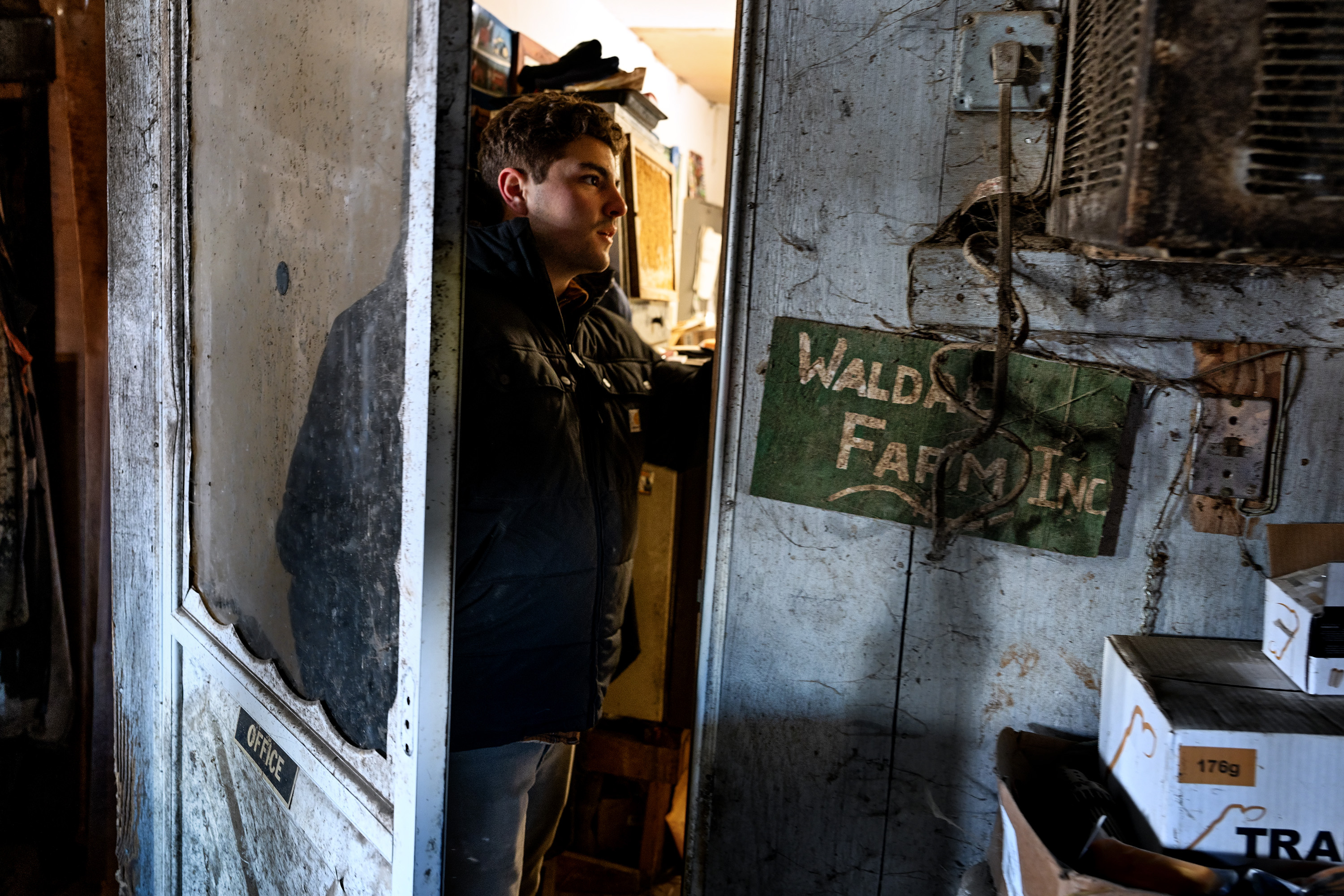
Farmer David Cadwallader at Waldac Farms in Salem, N.J., on Jan. 29.
This was the fourth Mannington Township planning board meeting for the Cadwalladers, who were seeking a variance to install 300 acres of solar panels on Waldac Farm that would, eventually, generate enough energy to power 19,000 homes annually.
Some board members and locals questioned the environmental impacts, whether it would affect the soil, injure the abundant wildlife in the area, or taint the nearby Delaware River watershed. Representatives from AES Corp., a Virginia company that would build the solar project and pay a lease to the Cadwalladers, had answers for all of them.
“Whether we all, in this room, agree with it or not, it is the state’s policy to advance these types of solar energy uses to meet the energy demands that we need,” Keith Davis, an attorney representing AES, told the planning board.
What they couldn’t seem to quell, however, were the repeating concerns about how a solar farm would look in New Jersey’s most rural county. Those concerns raised open-ended, philosophical questions: What’s a working farm supposed to look like? What exactly does rural mean?
“It will destroy property values and will be an eyesore for our township,” a neighbor of the Cadwalladers commented on a 2025 Facebook post about the project.
Similar situations have played out nationwide. A recent Associated Press story from Ohio highlighted a struggling farmer’s solar project that also faced community pushback and was ultimately blocked.
In Salem County, Mannington planning board member Joanne Wright was the most vocal at the meeting. She mentioned, often, that Mannington’s master plan called for maintaining “scenic vistas” and its rural, agricultural characteristics.
The Cadwalladers said they would plant pollinator habitats and plants on the solar farm, and introduce roughly 300 sheep to graze around and under the panels. The combination of solar and agriculture — “agrovoltaics” — is supported by the New Jersey Farm Bureau, Andrew Cadwallader pointed out.
Wright, however, thought solar panels would break up the township’s “contiguous farmland.”
“I’m just wondering how you see that the positive outweighs the negative,” Wright asked representatives from AES.
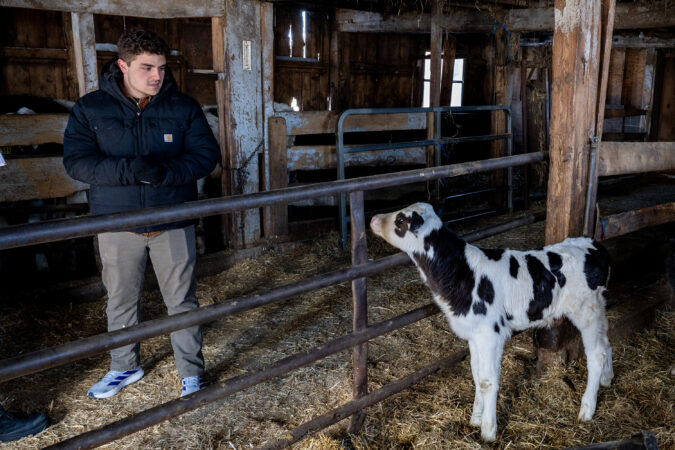
Farmer Andrew Cadwallader at Waldac Farms in Salem, N.J., on Jan. 29.
A picturesque farm
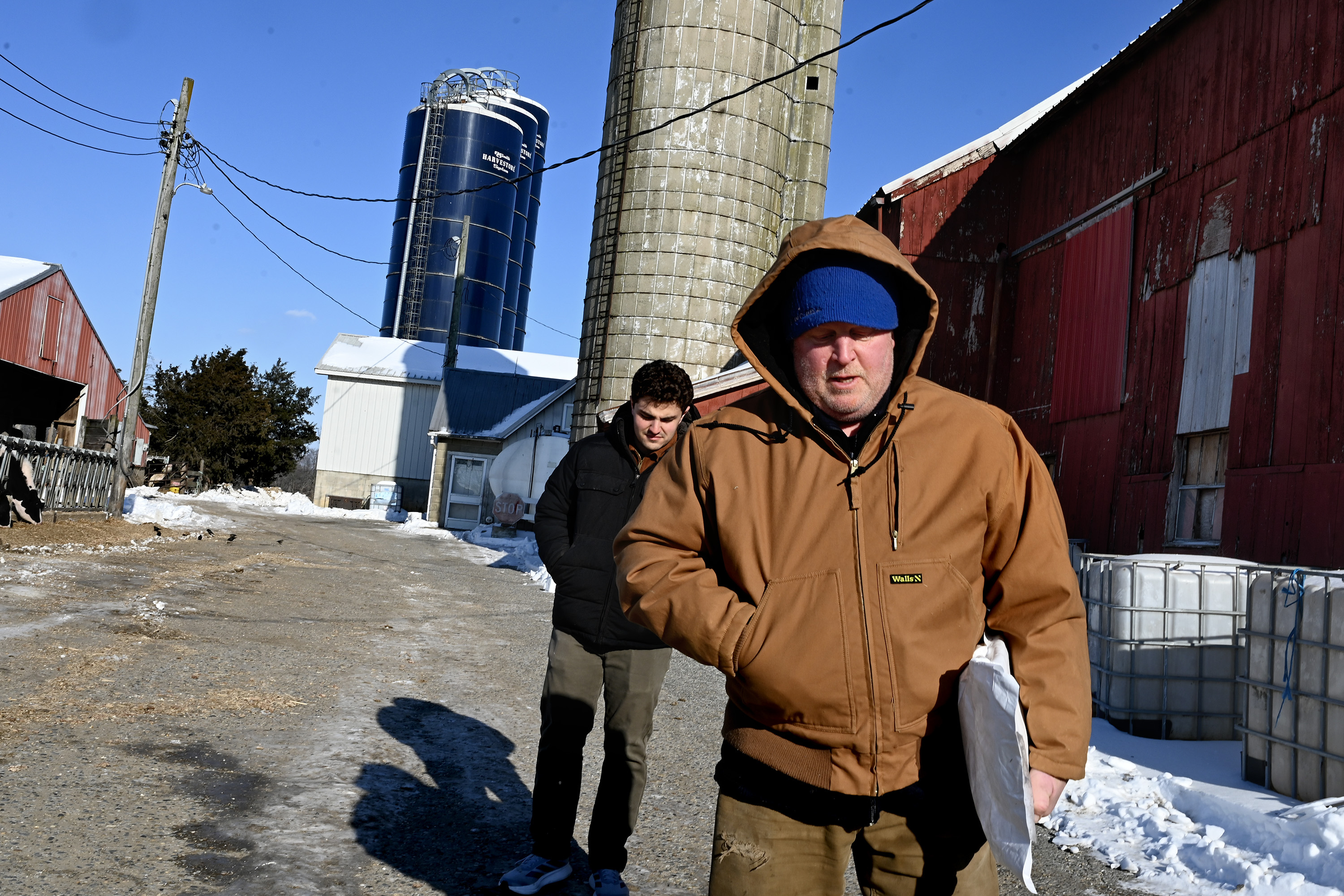
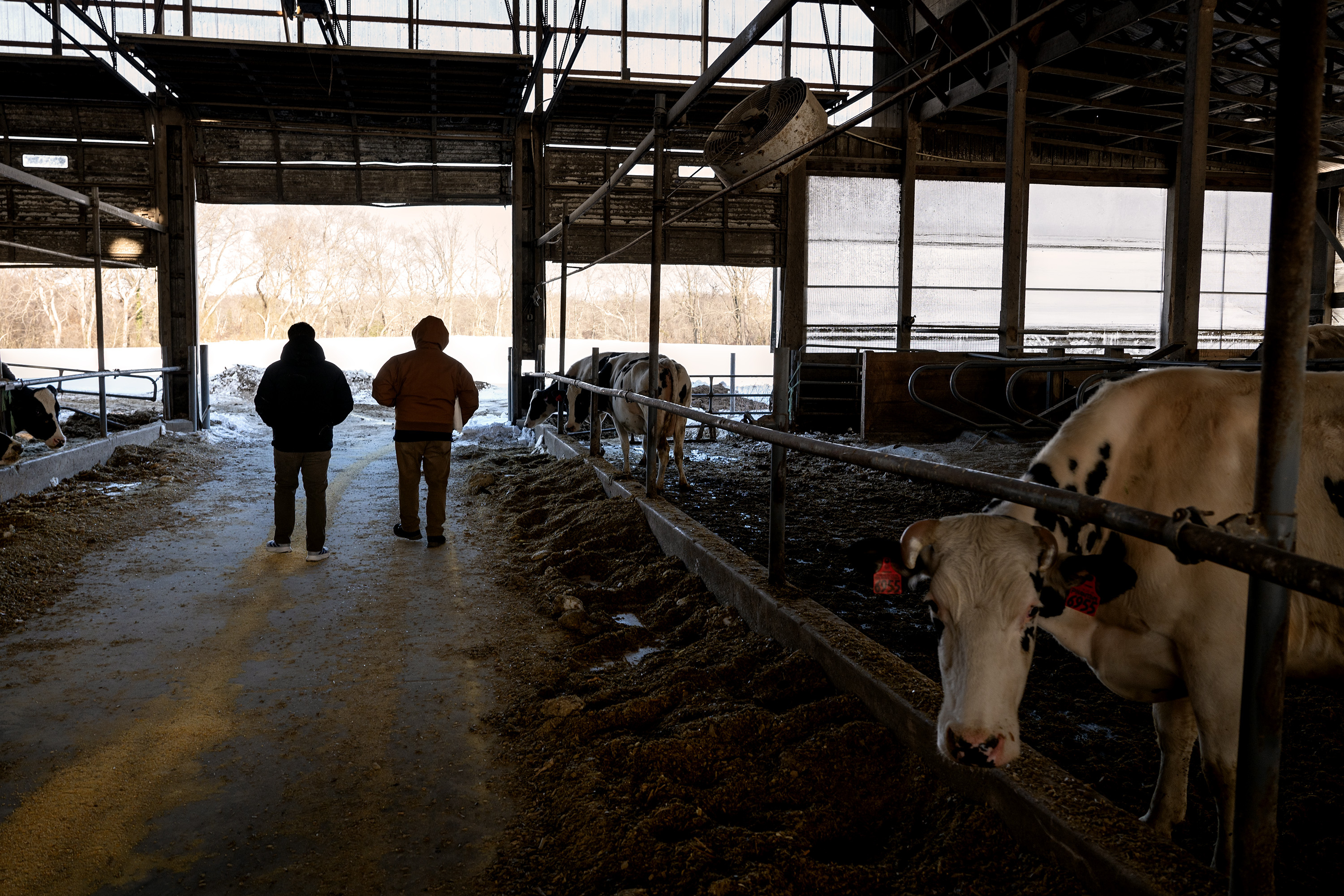
The Cadwallader family has been farming since the 1860s, and Waldac Farms certainly looks the part: There’s a circa-1790 farmhouse down a long dirt road, a slew of silos dotting the flat landscape, and big red barns, faded by time, that are full of cows and cats.It was mostly silent there, too, aside from the winter wind.
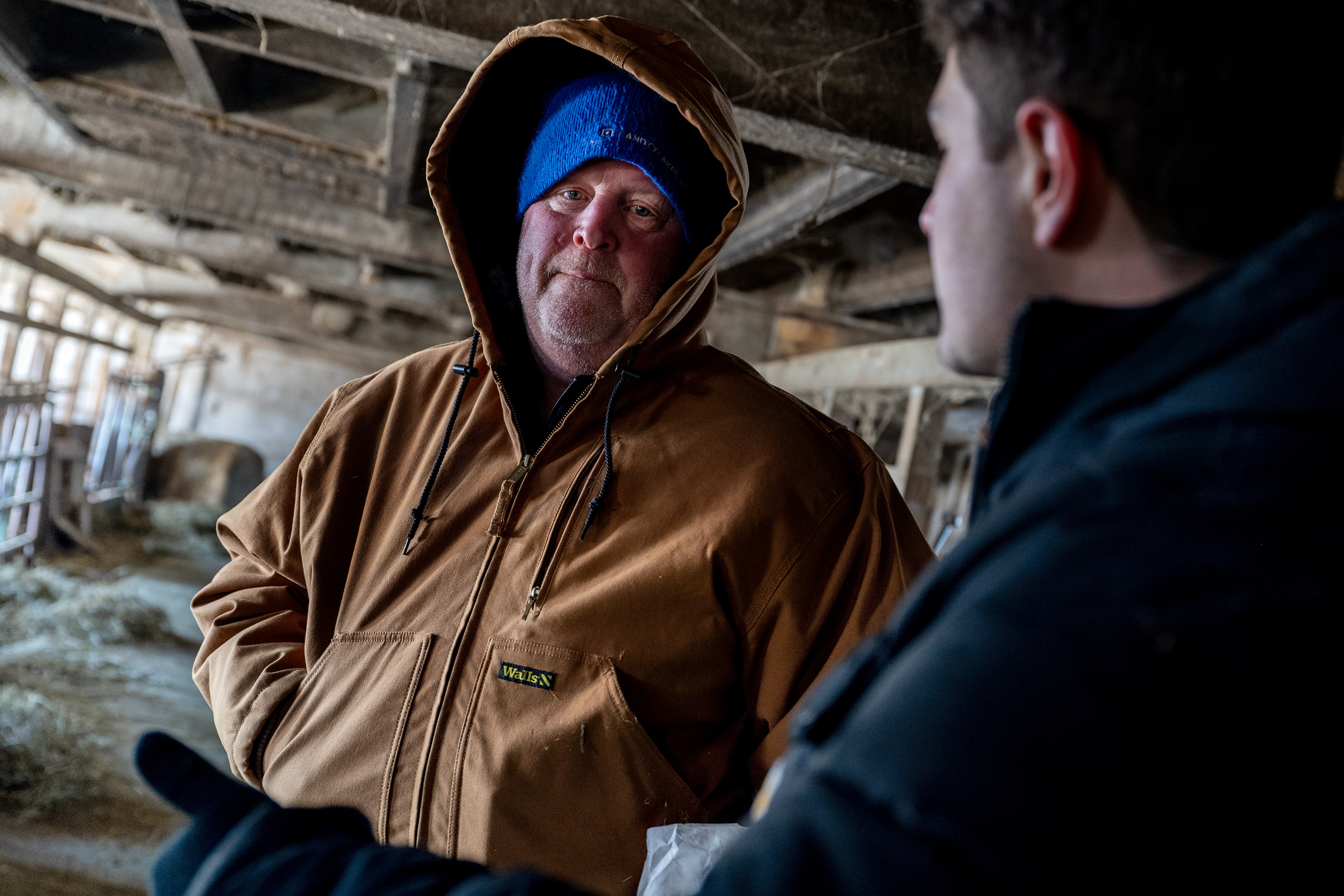
The only thing that seems out of place on the family farm on a frigid afternoon is Andrew Cadwallader. The college senior looks younger than 22, and his sneakers and pants were impeccably clean.
Andrew’s been milking cows since before his baby teeth fell out, though.
In 2007, a South Jersey newspaper visited the Cadwalladers to discuss the dismal state of dairy farming at the time. The newspaper took a picture of Andrew, then 3, surrounded by cows in a pen. His father, David, told the newspaper he’d love to pass the farm down to his son.
“If he wants it,” David Cadwallader said.
From the Press of Atlantic City on March 12, 2007: The state is trying to revitalize its dairy farm industry. With his 3-year-old son Andrew, David Cadwallader prepares his cows for their 3 p.m. milking at Waldac, his Woodstown dairy farm.
Andrew is set to graduate from Haverford College with a degree in political science. He’s merged his life history — agriculture and geology — with his interests in politics and government, and recently began an internship for CNN’s Michael Smerconish, a Bucks County native.
Andrew’s an only child, and, yes, he wants to farm, bucking a trend that’s seen the average age of farmers, 58.1, rise steadily, according to the 2022 U.S. Census of Agriculture Data.
“I’m coming back here after I graduate,” he said.
Nationwide, small dairy farms like Waldac have continued to shutter at a rapid rate since Andrew was in the local newspaper.
Overall, milk production is up in the United States. That’s because modern genetics has produced cows that make more milk than their ancestors. Those big production numbers are coming from massive farms with large herds, too.
The Cadwalladers milk about 130 dairy cows on approximately 500 acres, and small farms like theirs have been decimated. In 2005, according to the USDA, there were 78,295 dairy farms in the United States. In 2025, that number was 23,609, a 70% decrease in just 20 years.
Farmers Andrew Cadwallader and his father David Cadwallader (front) at Waldac Farms in Salem, N.J., on Jan. 29.
Andrew Cadwallader declined to go into exact figures but said the family would be “paid well” by the AES lease. Waldac Farms would pivot to sheep and the sale of their lambs, while possibly still milking cows on a smaller scale.
“We have been losing money for the last 10 years,” Andrew said of the dairy operation.
AES approached the family about “solar grazing” during the pandemic, Andrew said, and as they sought a use variance from the Mannington planning board to move forward, he became the project’s public face. Andrew made numerous, lengthy Facebook posts in local groups about the project to be transparent.
“Will we continue to hope that the price of milk goes up and risk failure, or will we pivot and change?” Andrew wrote in the Salem County Advocates group in November.
Many comments were supportive or neutral, in a libertarian “it’s your land” way. There was plenty of pushback, though, and Andrew said it was disheartening to see how many comments focused on visual impact.
“I’m glad people can worry about the look of the farm,” he said in late January. “We have to worry about making a living.”
Cadwallader said flat farmland is not a natural part of landscapes in South Jersey. People have just gotten used to seeing it. His farmland was likely cleared of trees by the native Lenni-Lenape centuries ago, he said. Barns and tractors are industrial buildings and commercial machinery, he said, not quaint antiques.
“They are prioritizing the look, and it’s not reality,” he said. “It’s not a natural feature.”
Still, Cadwallader felt confident, on a late January afternoon on his farm, that the planning board might approve the project.
Jennifer Kugler, founder of the nonprofit South Jersey Preservation, visited Andrew’s farm shortly before the planning board meeting with her children and wrote a lengthy Facebook post in support of his plan that received 573 likes.
“The Cadwalladers want to evolve,” Kugler wrote. “This means new solutions are necessary to ensure the continued viability of the farming operation. For farmers, this can be incredibly scary.”
Kugler, 42, lives in Pilesgrove, Salem County, home to America’s oldest continuously-operating rodeo. She was raised on a dairy farm in Lackawanna County. That farm closed in the 1990s and never reopened, and part of her goal with South Jersey Preservations, she said, is to prevent more small farms from folding.
“We support farmers continuing to farm,” she told The Inquirer.
Farmers Andrew Cadwallader and his father David Cadwallader (left) at Waldac Farms in Salem, N.J., on Jan. 29.
To preserve or not to preserve
While the Cadwalladers would prefer the solar project, there are other options to keep farms afloat in New Jersey. The state’s Farmland Preservation Program is a common way to ensure that housing and warehouse developers don’t buy up farms. It’s a relatively simple process.
The program uses a combination of federal, state, county, municipal, and nonprofit funds to buy a farm’s development rights. The purchase price, according to the program’s website, is “based on the difference between what a developer would pay for the land and what it is worth for agriculture.”
A cow at a farm along Route 49 in Salem County, N.J., on May 6, 2024.
In turn, farmers get a much-needed payout while keeping their agricultural operation running. If those farmers choose to sell their land someday, deed restrictions require the property to be used for agricultural purposes or otherwise remain undeveloped.
“You can’t do additional residential or commercial improvements. You can’t turn it into a housing development or a Walmart,” said Charles Roohr, executive director of the New Jersey State Agriculture Development Committee.
Since the program began in 1984, Roohr said New Jersey has preserved 250,000-plus acres, with a goal of 500,000 acres. Salem County leads the way among counties, with more than 43,000 preserved acres.
The family has not ruled out farmland preservation if the solar project is rejected, but they were concerned about some of the potential restrictions and complications.
“It’d be like a bailout, but we have 500 acres,” Andrew said on the farm in late January. “We need to figure out what the heck we’re going to do with the 500 acres that’s going to actually make us some money.”
Cowtown Rodeo in Pilesgrove, N.J.
A complicated farmland preservation issue played out right in Mannington in recent years, when Mannington Deputy Mayor Robert DiGregorio filed a civil rights lawsuit against local and county officials in 2021. According to the lawsuit and Transparency NJ,, DiGregorio was holding weddings, private parties, and nonprofit functions on his preserved, 78-acre farm, but was told by officials that he would need variances and site plan approvals or waivers to continue. The back-and-forth between those officials and DiGregorio, according to Transparency NJ, almost grew physical.
Farmers Andrew Cadwallader and his father David Cadwallader (left) with plans at Waldac Farms in Salem, N.J., on Jan. 29.
In April, Mannington agreed to pay DiGregorio $55,000 to end the lawsuit, according to an article in NJ.com. Neither DiGregorio, who is on the planning board, nor his attorney returned requests for comment. It’s unclear if he will continue to host events on his farm.
Roohr, commenting on farmland preservation restrictions in general, said events are allowed if “the purpose of the event is to sell the things that you’re producing on your farm.”
A tomato festival on a tomato farm would be fine, for example. A folk festival on a tomato farm would probably require a special-use permit.
“If the main purpose of the event is some other focus and your stuff ‘might’ get sold as a side benefit, then we consider that a non-agricultural use. And so the greatest example of that would be a wedding.”
Roohr said the preservation program is more important than ever, as data centers look to build in rural areas nationwide.
“We have over 200 applications [for farmland preservation] in our office right now,” he said.
The Cadwalladers said they have no plans to sell to a developer.
Farmers Andrew Cadwallader and his father David Cadwallader (right) at Waldac Farms in Salem, N.J., on Jan. 29.
The vote
Along with Alice Waddington, numerous others spoke at the March planning board meeting. Union officials said the solar project would bring jobs (AES put the number between 75 and 100). Some spoke in support of Andrew Cadwallader and his love for the ecosystem. Still, others talked about protecting Mannington’s “rural identity” and fears that the project could affect property values.
Andrew Cadwallader was the last member of the public to speak.
“As a family, we’re at a crossroads,” he said. “We can’t risk volatility anymore as a family and as a farm.”
When he was finished, Davis gave a final summation on behalf of AES and the Cadwalladers. Minutes later, the planning board made a resounding 6-1 vote, shooting down the project.
Cadwallader hung his head and gave a half-smile and some quiet “thank yous” to the attendees who patted his shoulder and shook his hand.
Laura Kellogg, a development manager for AES, said the team was disappointed but would continue to “evaluate next steps for the project.”
A week later, Andrew Cadwallader said he and the family were still dealing with the disappointment and contemplating their next move.
“People like this area so much, but we love it. No one loves this land more than my family,” he said. “People have to understand that a working farm is not a museum.”
Cadwallader’s life was getting busier at Haverford, too. He was taking geology classes and working on a senior thesis about preserving “the agricultural viability of mid-sized farming operations in the United States.”
Andrew drives the 38 miles south from college, back to Salem County, every weekend. A week or so after the meeting, though, Alice Waddington’s warning to the planning board, and the people of Mannington, proved prophetic.
Waldac still looked like a farm to neighbors and motorists passing by, but the Cadwalladers had stopped milking cows.
Correction: This article has been corrected to reflect that AES Corp. is based out of Virginia.
ATLANTIC CITY — When the nation’s largest smoke shop expo descended on the convention center here earlier this spring, sales reps scrambled to offload pallets of a controversial synthetic kratom product known as “7-OH” before lawmakers in Pennsylvania and New Jersey ban their products.
The addictive drug 7-Hydroxymitragynine, a highly concentrated lab-made compound derived from the kratom plant, flooded the bustling floor of the CHAMPS trade show.
Yet some vendors said they weren’t worried about bills working their way through Harrisburg and Trenton.
Their suppliers had already cooked up new recipes.
Matt Swann, a real estate investor turned 7-OH distributor from Salt Lake City, promoted a new product called “Cori,” a four-pack of tablets wrapped in a sleek green package. Swann’s offering draws from corydalis, yet another plant from East Asia that produces similar pain-killing alkaloids to kratom — but is not the target of any proposed bans.
“Legislation is what shuts me down,” Swann said, at his one-man expo booth in March. “This is how we stay ahead.”
Half a dozen 7-OH sales reps told The Inquirer that companies are changing their formulas to preemptively sidestep legislation prompted by concerns over the drug widely dubbed “gas station heroin” for its promised high and addictive potential.
Federal authorities began taking steps last summer to classify 7-OH as a controlled substance due to its widespread availability and reports of abuse. At least a dozen states have moved to outlaw the substance, and bills in Pennsylvania and New Jersey are being considered.
But in the booming gray market for synthetic drugs — from kratom to lab-made THC to psychedelics — the difference between legal and illegal can be as small as a molecule.
Perks’ booth at the CHAMPS B2B trade show at the Atlantic City Convention Center on March 19.
To dodge the crackdown, some companies are swapping their active ingredient from 7-OH to a related compound called mitragynine pseudoindoxyl, or “pseudo.” Others are pivoting to 13-Hydroxy Mitragynine, or “13-OH.” Both function in similar ways, binding to opioid receptors in the brain.
And vendors promised the variants are just as powerful.
Some kratom advocates welcome restrictions on 7-OH and other chemically concentrated alkaloids. But they also worry that lower potency, natural kratom products will get caught up in sweeping bans.
Swann criticized the panic around 7-OH. He described both it and his new corydalis product as safer alternatives to opioids that can help people living with chronic pain.
Swann said he is clear with buyers about the risk of dependency. Kratom-derived pain relievers are far less fatal than opioids, whose pharmaceutical producers, he argued, are threatened by the drug’s popularity.
“It’s the safest alternative,” he said. “Kratom is 10-fold the product.”
Matt Swann at his Siete 7 / Coco Distro booth At the CHAMPS B2B trade show at the Atlantic City Convention Center.
A game of molecules
Last summer, Florida passed an emergency ban specifically targeting 7-OH. Other states, like Vermont, have banned kratom altogether, as well as any related alkaloids, preemptively cutting out alternative compounds like 13-OH or pseudo.
New Jersey lawmakers are advancing legislation that would similarly classify 7-OH as a controlled substance, although it makes no mention of these related alkaloids.
Another bill under consideration in Harrisburg mimics Vermont’s strategy by outlawing all products that contain over 2% 7-Hydroxymitragynine, as well as any other “synthetic, semi-synthetic, or chemically manipulated alkaloid” derived from the kratom plant.
“They can call it whatever they want,” said Sen. Tracy Pennycuick (R., Montgomery County), the bill’s lead sponsor. “If it comes up 2%, it’s still banned.”
Still, as written, the ban might cover new variants like “pseudo” and 13-OH but not the latest extracts from the corydalis plant.
Meanwhile, pro-kratom lobbying groups have pushed lawmakers to create clear legal definitions between naturally sourced, low-potency kratom products and those ultra-concentrated, synthetic forms like 7-OH.
Dallas Vasquez, CEO of Mitra9, a Florida-based company that distributes kratom and kava-infused beverages across the country, said the two products are “not equivalent from a chemistry or pharmacological standpoint.”
He said Mitra9 does not use concentrated 7-OH to make the drinks more potent. His products contain less than 2% total kratom alkaloids, with low levels of 7-OH that occur naturally in extracts from the plant leaves, according to lab tests reported on Mitra9’s website.
“My business is built on the bet that the responsible segment of the market will survive,” Vasquez said. “If it doesn’t, I lose too. So I have every incentive to be honest about what the products are.”
Kratom booth at the CHAMPS B2B trade show at the Atlantic City Convention Center on March 19.
Booming profits, clandestine makers
The CHAMPS trade show traditionally serves as a meetup for recreational drugmakers and retailers of cannabis. That the kiosks were dominated by 7-OH vendors is a sign of kratom’s growing popularity and profitability.
Large kratom companies pushing products with opioid-inspired names like “Opia” and “Perks” can bring in millions in revenue per month, according to Swann, the vendor from Salt Lake City.
Many companies are supplied by a small network of kratom manufacturers that synthesize products, often on condition that the makers’ names be kept secret, according to Swann and company owners who spoke with The Inquirer. So long as the compounds remain legal at the federal level, there are labs willing to make them en masse, which sellers like Swann can distribute in states without total bans.
For everyone involved, profits are high.
“[Manufacturer] profit margins are in the 5 to 10% range, but they’re doing millions and millions of dollars,” Swann said. “My profit margin is closer to 200% to 300%. If I invest a quarter-million dollars, I can usually come out with a million.”
Swann said he started his own business with $250,000 in capital and a phone call to a lab in Utah. His brand, Siete, launched within months. He estimated that his new “Cori” product had a life span of three years before it, too, would be banned.
Camille Winans, a sales representative for a company selling new 13-OH products, argued that kratom had been demonized by lawmakers and that keeping the products on shelves amounted to “harm reduction.”
However, medical experts say there has been an uptick in admissions to rehabs from people who got hooked on kratom, including in Pennsylvania.
Jason Kirby, chief medical officer of Recovery Centers of America, worries that states would ban 7-OH without the necessary medical resources for people who are dependent on it. He said hospitals struggle with an influx of kratom users in states that passed sweeping bans.
“One day it’s legal, and the next day it’s not,” he said. “So I’m going into the vape shop to refill my need, and it’s not there anymore, and I’m going to the emergency room in withdrawal.”
Bans would also not prevent manufacturers from finding new loopholes, he said.
“We’re gonna be dealing with a brand new synthetic substance that we’re gonna have to figure out all over again, and figure out pathways and management for,” he said. “We always have to stay ahead of them.”