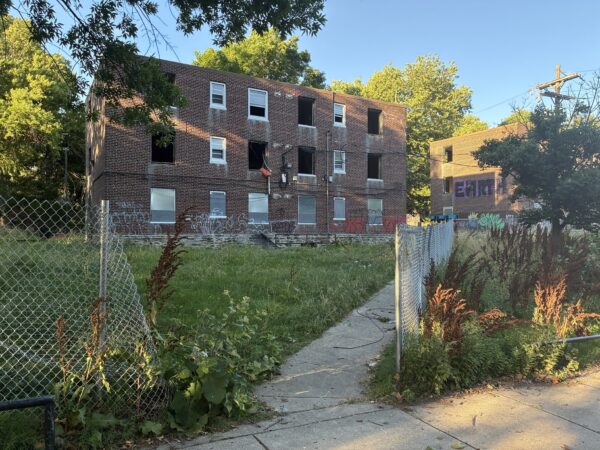
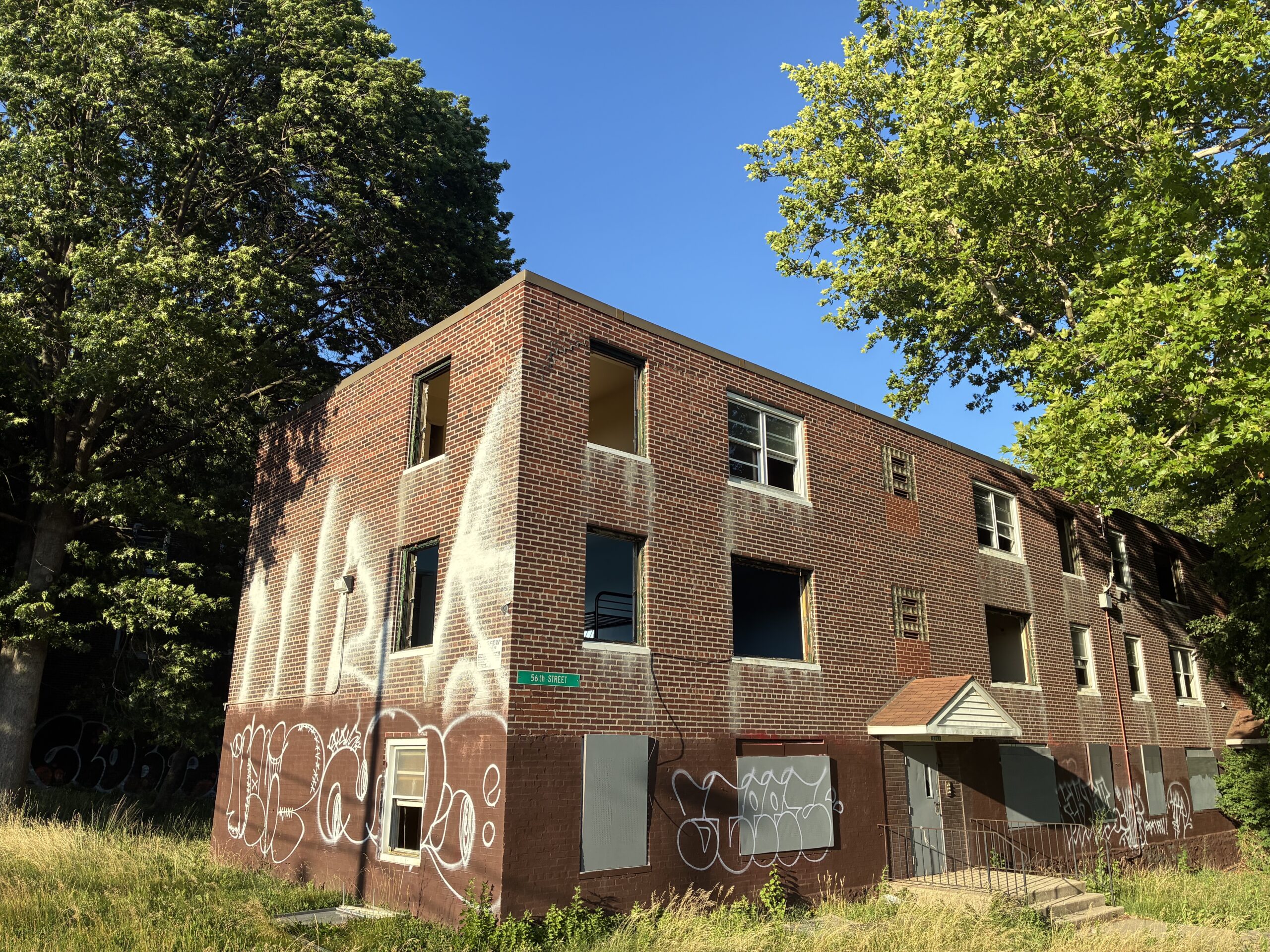
Mayor Cherelle L. Parker has declared a public safety emergency at Bartram Village, a vacant Philadelphia Housing Authority (PHA) complex in Southwest Philadelphia, after squatters moved in and caused extensive damage.
This declaration clears regulatory hurdles that had delayed PHA’s plans to rapidly demolish the 45-building complex, where the last tenant moved out in 2025.
“For too long, these vacant buildings have posed serious safety risks to surrounding residents and the broader community,” Parker said in a statement Thursday. “This action clears the way to remove those hazards and replace them with new housing, new opportunity, and new investment.”
Bartram Village dates to World War II, when it was built to host defense workers during the wartime industrial boom. The site was later transitioned to the traditional public housing program, providing affordable housing for up to 500 households.
PHA has been planning a probable demolition for a major redevelopment since at least 2018, when it was estimated the buildings required repairs reaching almost $200 million in today’s dollars. Former residents would have a right to one of the 688 new units planned for the site.
But after tenants were moved out, the 22-acre property attracted squatters despite PHA’s security patrols in the area. Beyond occupying the space, squatters tore copper wiring from the buildings and damaged the popular neighboring park and historic site of Bartram’s Garden.
“We boarded it up, it was secured, and almost immediately we realized that folks were penetrating those areas in the back and coming in through Bartram’s Garden,” said Kelvin Jeremiah, president of the housing authority. “But because of the size … it became a real issue. The more we removed people, the more they came in.”
Councilmember Jamie Gauthier’s office began raising alarms in February about the state of Bartram Village.
“I warned that failing to act quickly would [exacerbate] safety issues and cost taxpayers’ money,” Gauthier said. “The buildings became hot spots for squatters and provided cover for inflicting over half a million dollars of damage to Bartram’s Garden.”
An abandoned Bartram Village apartment, which will soon be demolished.
Jeremiah said the housing authority couldn’t move to demolish the buildings immediately because Bartram Village is eligible for inclusion on the National Register of Historic Places. The mayor’s emergency declaration allows the agency to bypass a lengthy federal review process. The buildings are not protected by local preservation regulations.
Following Parker’s actions Thursday, “we are now prepared to move forward on an expedited basis to have the site demolished,” Jeremiah said.
PHA plans nine apartment buildings and over 150 townhouses for the Bartram Village site, supported in part by a $50 million grant from the federal government.
It is a major part of Jeremiah’s aggressive plan to renovate all of the authority’s existing holdings while building 3,000 new units and buying at least 4,000 units from the private sector.
The redevelopment has been years in the making because of tenant relocations and the federally mandated delay in demolition.
“Southwest Philadelphians have waited far too long for promised improvements at Bartram Village,” said Gauthier, who represents the area.
“I’m glad that Mayor Parker took the important step today of signing a public safety declaration giving PHA permission to demolish existing structures because they have been causing unsafe conditions to the community for a very long time,” Gauthier said in a statement.
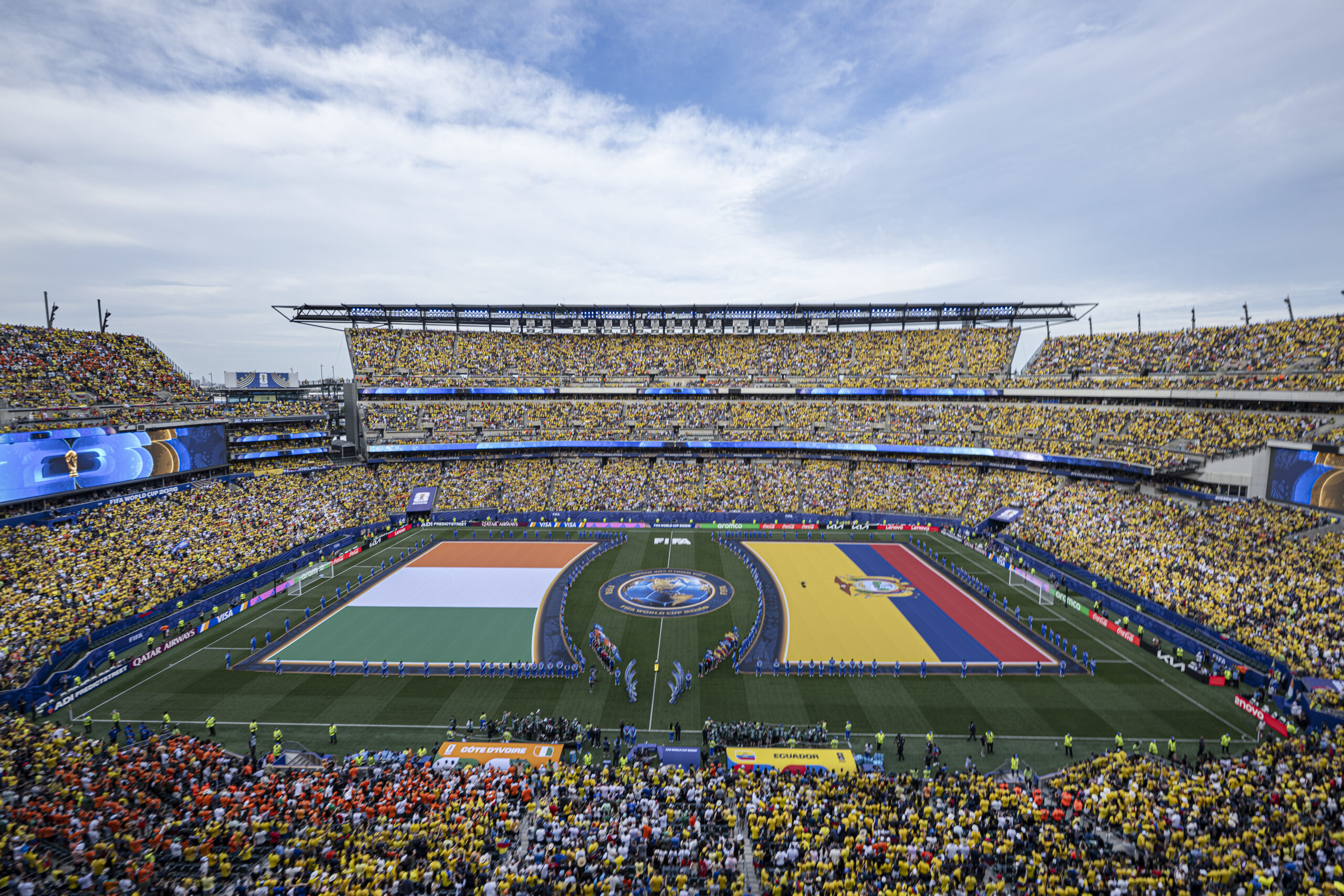
Lincoln Financial Field has been renamed “Philadelphia Stadium” for the duration of the World Cup. In addition to five group stage games, the city will host a Round of 16 game on July 4.
// Timestamp 06/19/26 10:38pm
Haiti first team eliminated from World Cup after losing to Brazil
Brazil’s Vinícius Júnior celebrates after scoring the third goal against Haiti Friday night.
Vinícius Júnior scored and assisted on one of Matheus Cunha’s two goals as five-time champion Brazil eliminated Haiti from the World Cup with a 3-0 victory on Friday night.
Haiti, the Western Hemisphere’s poorest nation that qualified for the World Cup for the first time since 1974, became the first team guaranteed not to reach the knockout round. Meanwhile, the Seleção got the decisive performance they needed.
Cunha, the Manchester United standout, got the start and showed with every surf-and-slide goal celebration why he should have been in the starting lineup in Brazil’s listless 1-1 draw against Morocco. Brazil coach Carlo Ancelotti made the surprising decision in the opener to instead insert Cunha as a late substitute.
Cunha thrilled the Brazilian fans who made up the bulk of the 68,324 spectators at Lincoln Financial Field when he tapped in a rebound for his first career World Cup goal. He then sent a left-footed strike into the upper left corner for a 2-0 lead in the first half against the overmatched Haitians.
Brazil forward Raphinha, who was subbed out with an injury in the first half, had an early goal disallowed on an offside call that only temporarily muted the yellow-clad Seleção fans in an otherwise festive atmosphere at the home of the two-time Super Bowl champion Philadelphia Eagles — whose cheerleaders did their part to rally the crowd.
Cunha added to the frivolity in Philadelphia, home to nearly 6,000 Brazilian immigrants, when he flashed his familiar surfing celebration.
— Associated Press
// Timestamp 06/19/26 10:14pm
A full house in South Philly
It’s a full house at the Philly World Cup. We’re like the dang Tanner Family up in here.
Fans at the World Cup are riding the waves and doing the wave – three times around Philadelphia Stadium. My favorite part was the fan who kept yelling “It’s coming! It’s coming!”
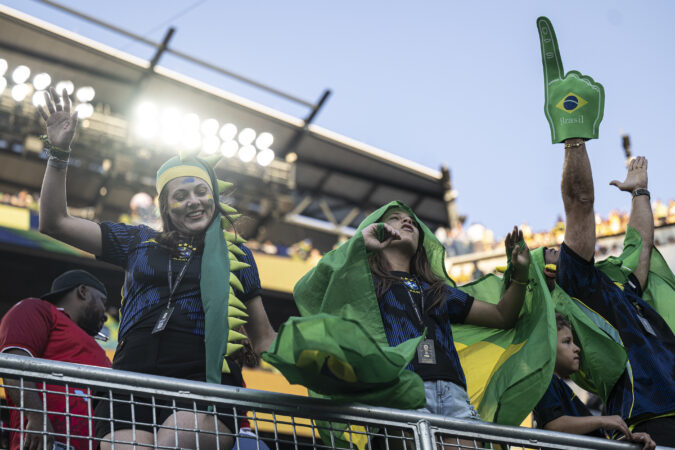
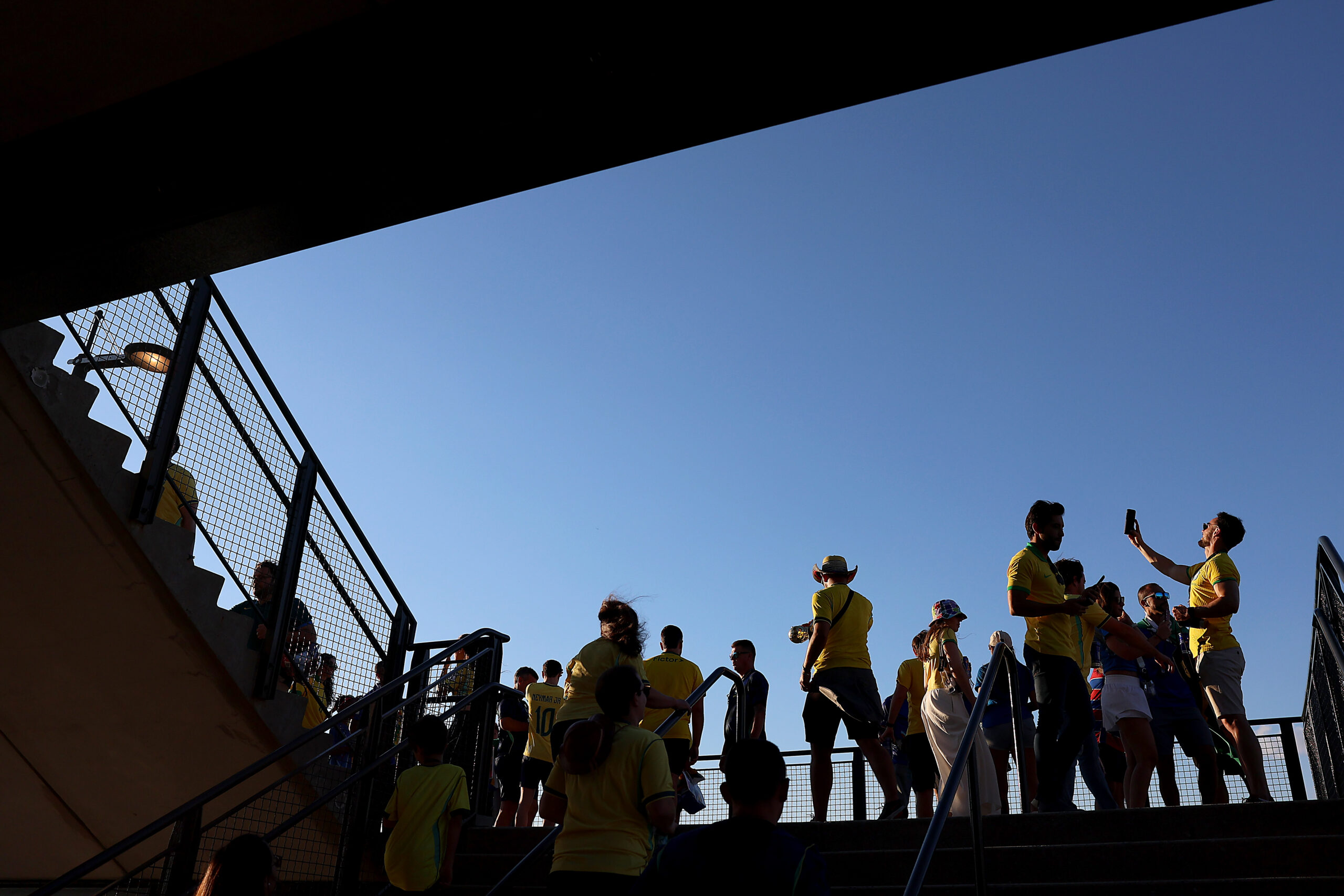
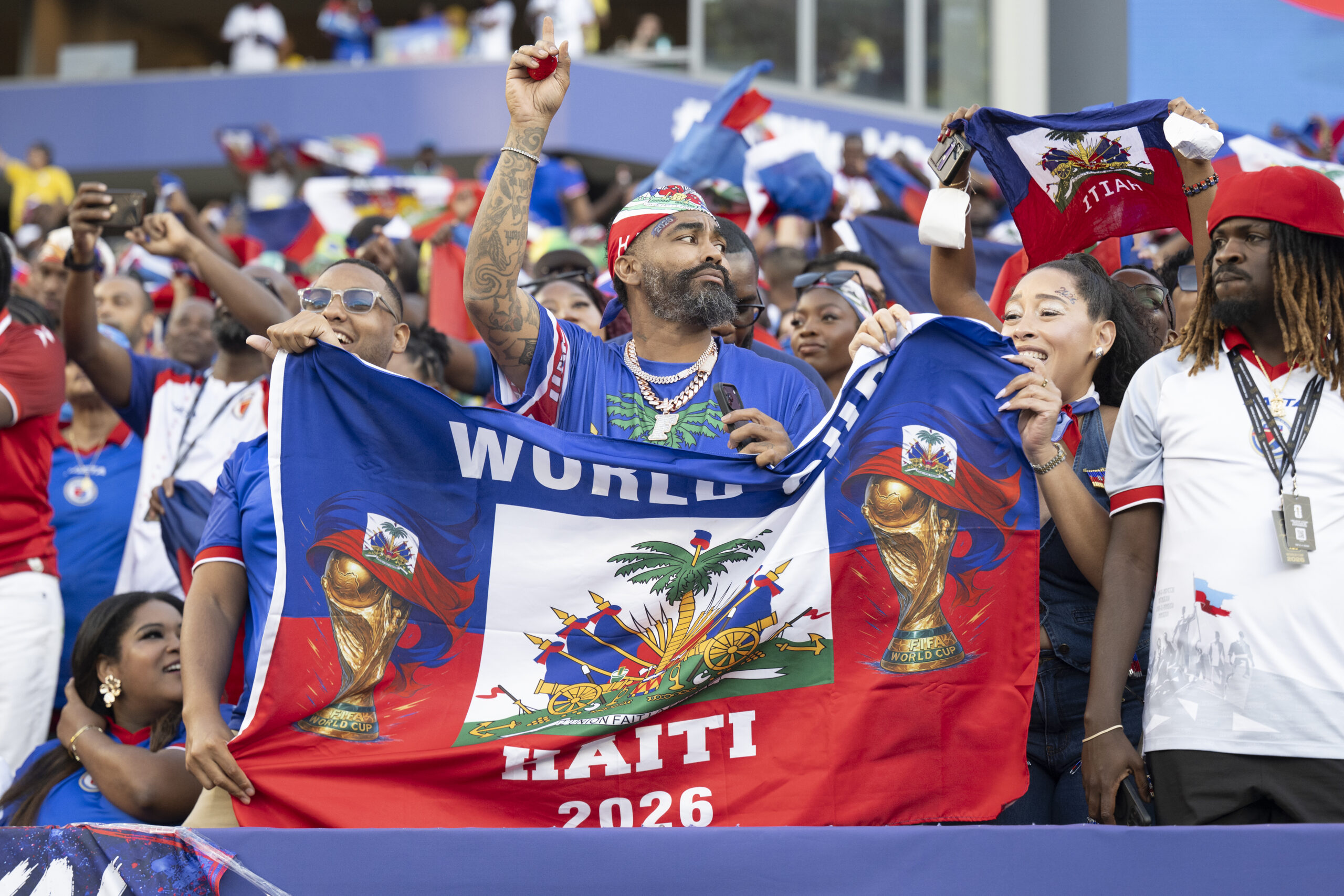
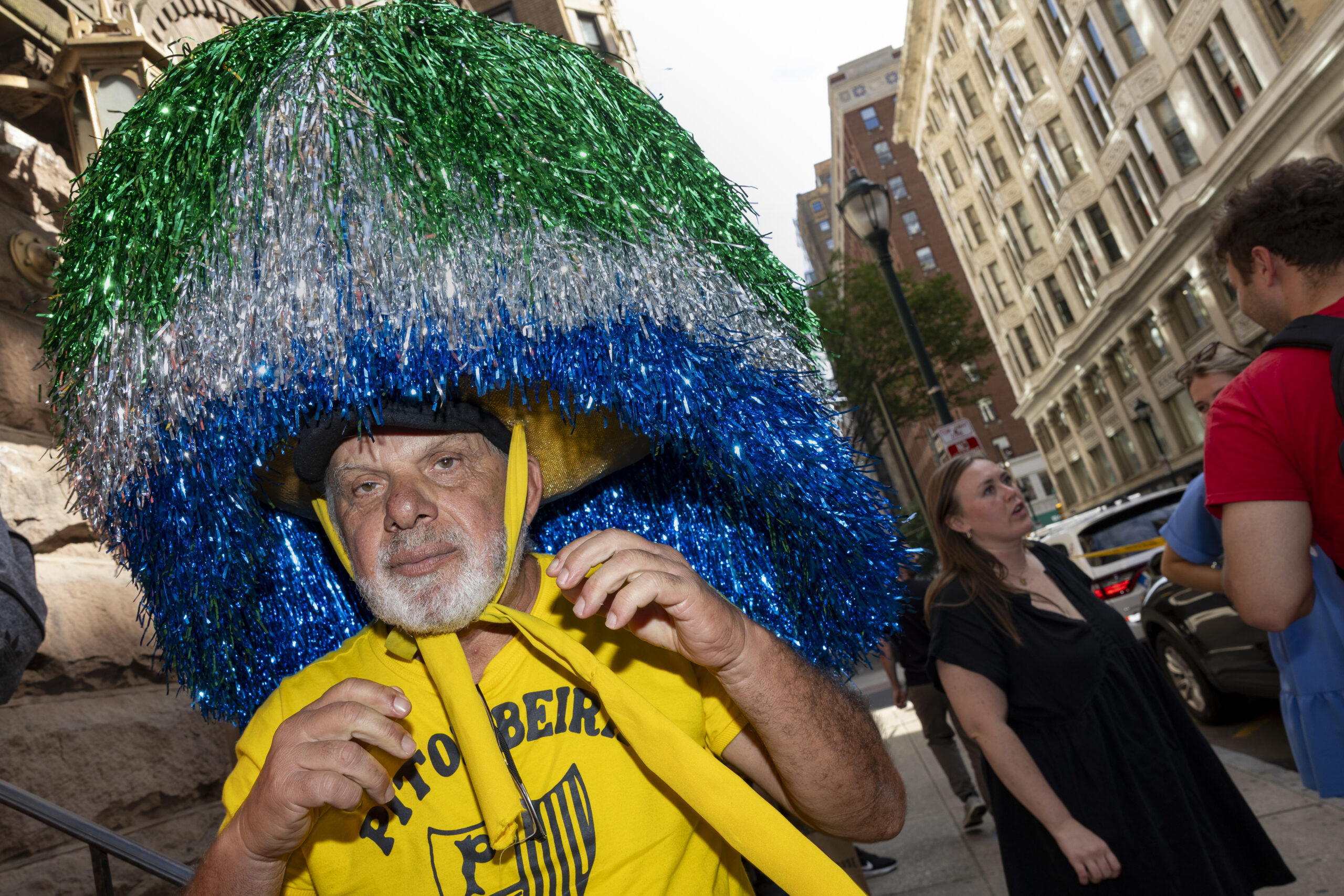
Brazil fans Miguel Sosa and his son, Enzo, of Nebraska, attend Friday’s match against Haiti at the Linc. A happy Brazilian fan with a unique hat watches Brazil’s dominance in South Philly. A Brazil fan waves his national flag during Brazil vs. Haiti. Fans navigate the stairs in the upper concourse of the Linc, which has been rebranded Philadelphia Stadium.
SEATTLE — It turned out that the U.S. men’s soccer team didn’t need Christian Pulisic to beat Australia, and make history in doing so.
With the star playmaker unable to shake off a calf injury, the Americans used two first-half tallies and a raucous atmosphere in Seattle to earn a 2-0 win, before a packed-to-the-roof crowd of 66,925.
The win clinched qualification for the knockout rounds, and marked the first time since 1930 that the U.S. men’s program has won two games in a World Cup group stage.
The statisticians at TruMedia noted this marked the first time in World Cup history that one team benefited from own goals in consecutive games, following the opening tally of the U.S.’ win over Paraguay.
SEATTLE — I’ve just left the stadium here, three hours after the U.S. game ended, and all the sports bars across the street on Occidental Avenue are still packed.
The sun is shining, the temperature is in the 70s, there’s a breeze off the water, and it looks like the citywide party will keep going for a good while.
You can bet they’ll be watching Brazil-Haiti on the TVs here. And they’ll be watching the Mariners too, since they have a home game against the Red Sox in two hours. T-Mobile Park is a block south of Lumen Field, so there’s a mix of soccer and baseball fans around.
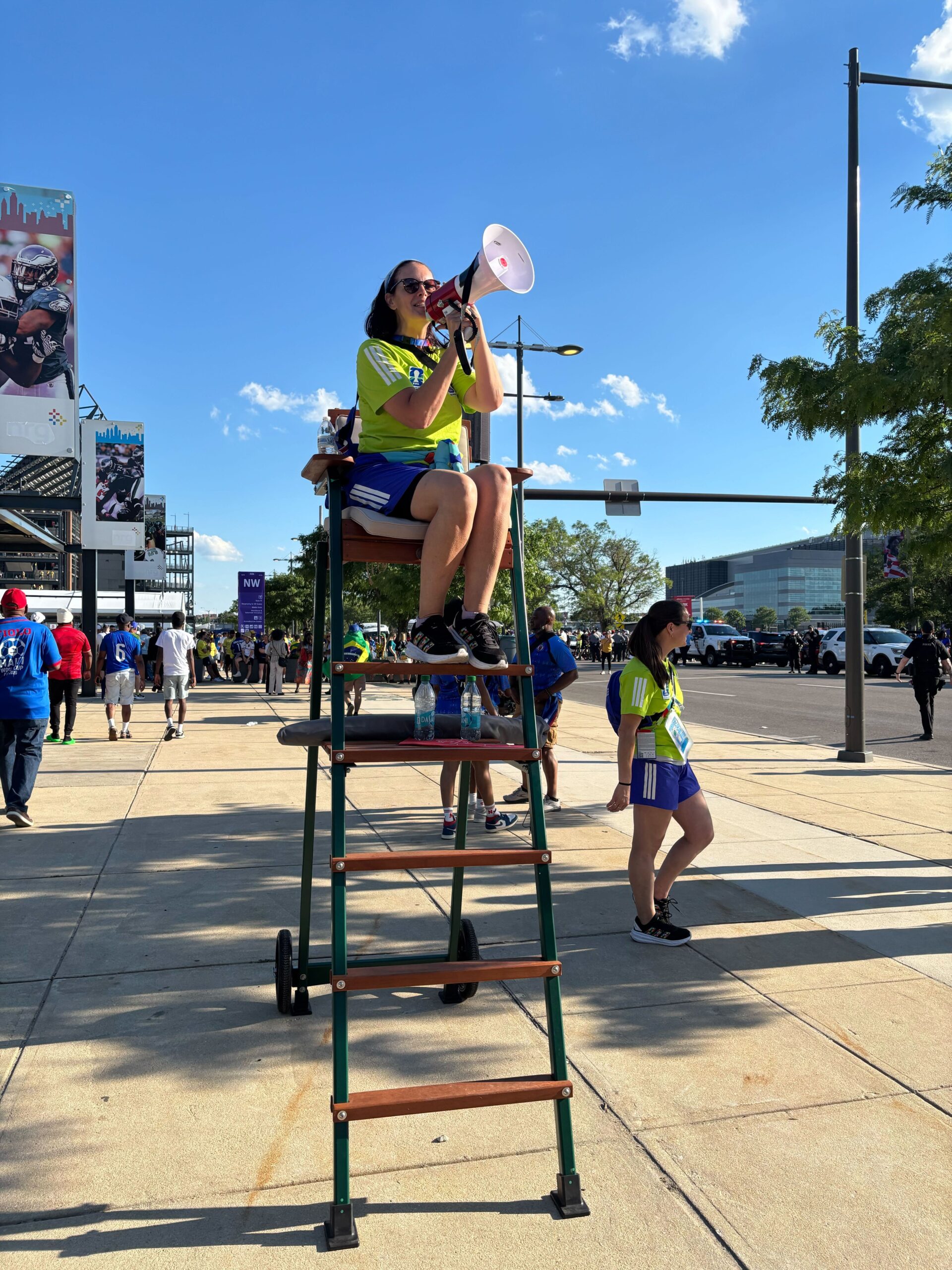
Emily Vanim of Pottstown welcomes fans to “FIFA-delphia” ahead of Friday night’s matchup betwen Brazil and Haiti.
Emily Vanim of Pottstown had one of the best FIFA volunteer jobs – sitting in a lifeguard chair with a megaphone welcoming fans to “FIFA-delphia” and answering all their questions.
“Never give a teacher a megaphone,” she said.
The sixth grade teacher said she’s met the best people as a FIFA volunteer.
“We’re friends for life and we’re having an awesome time,” she said. “It’s surreal and the fans are outstanding.”
Brazil fans tries to use Rocky curse against Argentina
🥊 🇦🇷 Nos Estados Unidos, é tradição entre torcedores rivais colocar bandeiras ou camisas na estátua de Rocky Balboa, em Filadélfia, para tentar dar azar ao adversário. Entrando na brincadeira, um torcedor brasileiro decidiu dar uma “forcinha” aos argentinos nesta Copa do Mundo.… pic.twitter.com/xvWKunH4It
Things got chippy towards the end of the U.S. men’s national team second group match against Australia, but it was forward Florian Balogun who kept composure in the face of a second yellow card.
Going in for a challenge in the 88th minute, Balogun and Australian defender Harry Souttar got tangled in the air and found Souttar with his arm wrapped around the neck of Balogun on the way down. Instead of reacting to the bait, Balogun who picked up a yellow card earlier in the match was smart to walk away.
It led commentator Stu Holden to say: “The Australians have come here to have a rugby match, but to have restraint in these moments, to not swing an arm and punch back. Souttar is trying to get under his skin.
It kicked off a string of chippy plays down the stretch, but in the end, the U.S. men picked up their second win in this World Cup, securing a berth into the knockout round of 32.
Depending on the result of tonight’s match between Turkey and Paraguay (11 p.m., FS1), should that game end in a draw, the U.S. will win Group D outright.
A lot of love in Philly as Brazil and Haiti fans get together
Bob Travers, 78, of Southhampton, was among tailgaters accepting high-fives at Lot L outside Philadelphia Stadium.
Travers wore a Brasil jersey and a hat that said “Dysfunctional Veteran.” This was his second World Cup, having gone to one in 1994. This one was better already though, he said, because he was accompanied by his sons and grandson.
“I love it,” he said “The atmosphere is fantastic!”
Perhaps the only time fans of opposing teams have gotten along while tailgating at the Linc, aka Philadelphia Stadium for the World Cup. The vibes are immaculate.
How bad was it for Australia? They made three subs at halftime.
Australia’s Paul Okon-Engstler reacts after a collision with a U.S. player.
SEATTLE – You know a first half went badly for a team when it makes three substitutions at halftime.
That’s what Australia did, with the biggest one being Nestory Irankunda replacing Mohamed Touré up front. Why Iranknunda didn’t start, as one of the Socceroos’ rising stars, was a big question among the Australian media before kickoff.
The other moves were Jason Geria replacing the yellow-carded Cameron Burgess on the back line, and Connor Metcalfe replacing Nishan Velupillay in midfield.
Alex Freeman doubled the U.S. lead in the 43rd minute off a free kick play. But it wasn’t surprising the offside flag was up initially, and by the rules it could have stayed that way.
When Sergiño Dest took the initial shot that deflected up in the air, Folarin Balogun and Weston McKennie were clearly offside, while Freeman was not. And when the ball came down, Balogun was right next to Freeman, in close range to the goalkeeper.
Though Balogun didn’t touch the ball, his presence there could be called interfering with the goalkeeper, and that’s grounds for keeping the flag up. But the video review crew decided that Balogun didn’t interfere enough, so they let the goal stand.
Double celebration for Alex Freeman’s goal to put the U.S. up 2-0 before the half — once before the VAR, and once after
‘It’s such a dream’: Brazil fans take over Stateside Live!
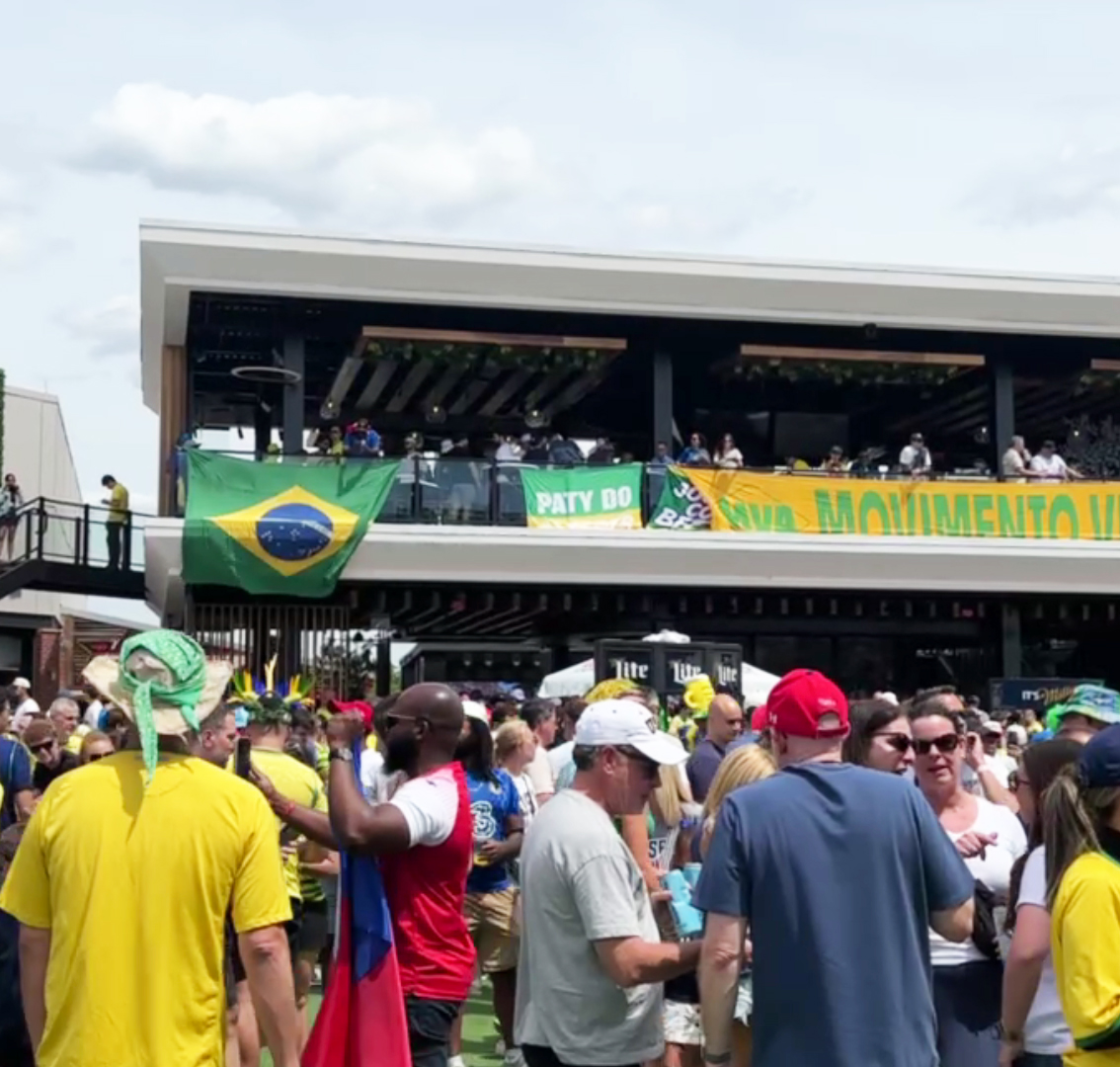
Brazil fans at Stateside Live! in Philadelphia hours before their country takes on Haiti.
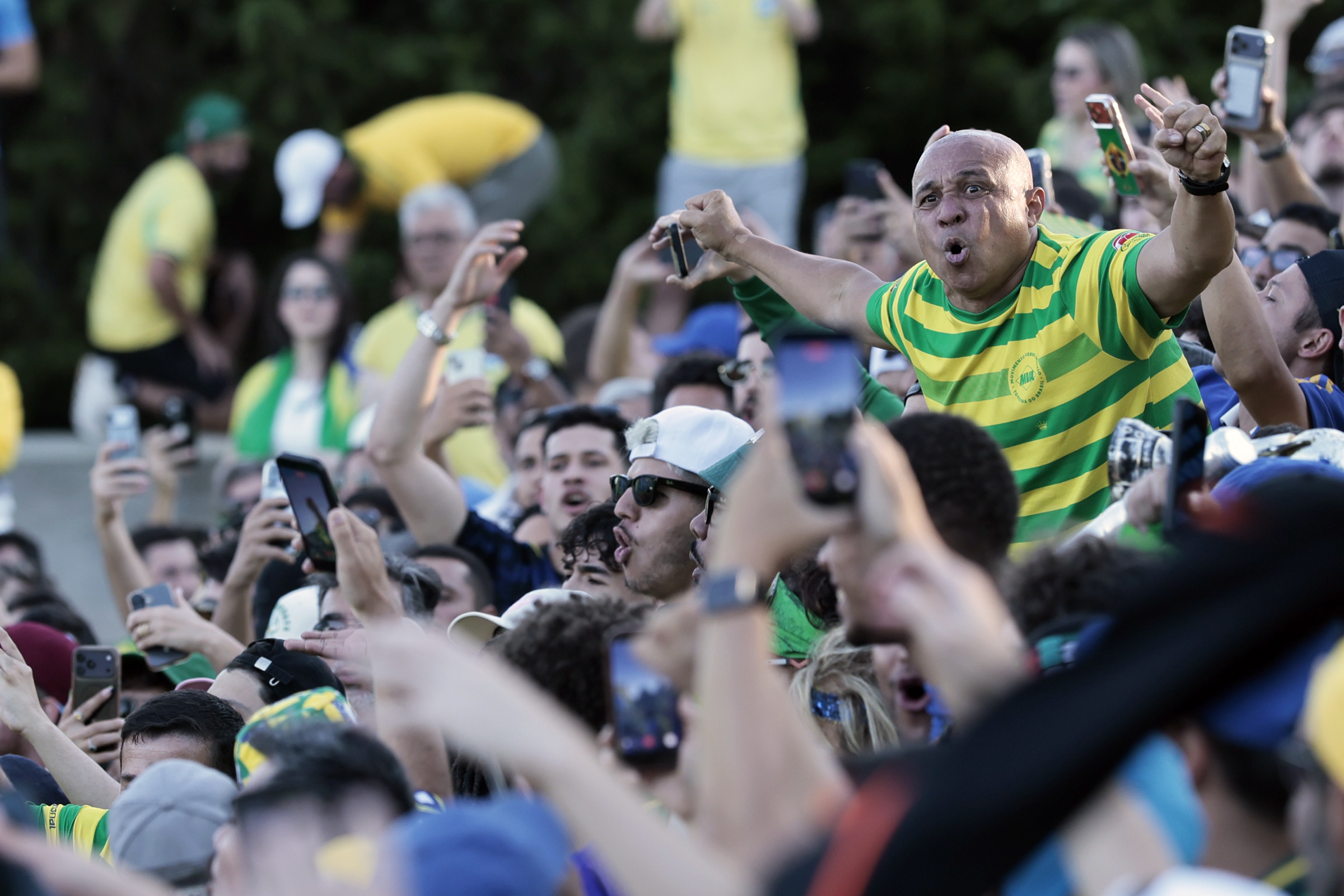
Stateside Live! turned into Brasil Live! Friday as a sea of fans descended on the stadium bar complex prior to their team’s World Cup game against Haiti at nearby Philadelphia Stadium.
By 3 p.m., the entire complex was a sea of yellow-and-green, dotted with islands of Haiti fans (and a few team USA fans) in red, white, and blue.
Belange Pierre, 54, of Ottawa, Canada, waved a Haitian flag outside the gates. He drove to Philly with four friends to catch his team’s first World Cup game in 50 years. They were confident they’d be driving back to Canada with a win under their belts after the game.
“Allons-y!” the group shouted, which is French for “Let’s go!”
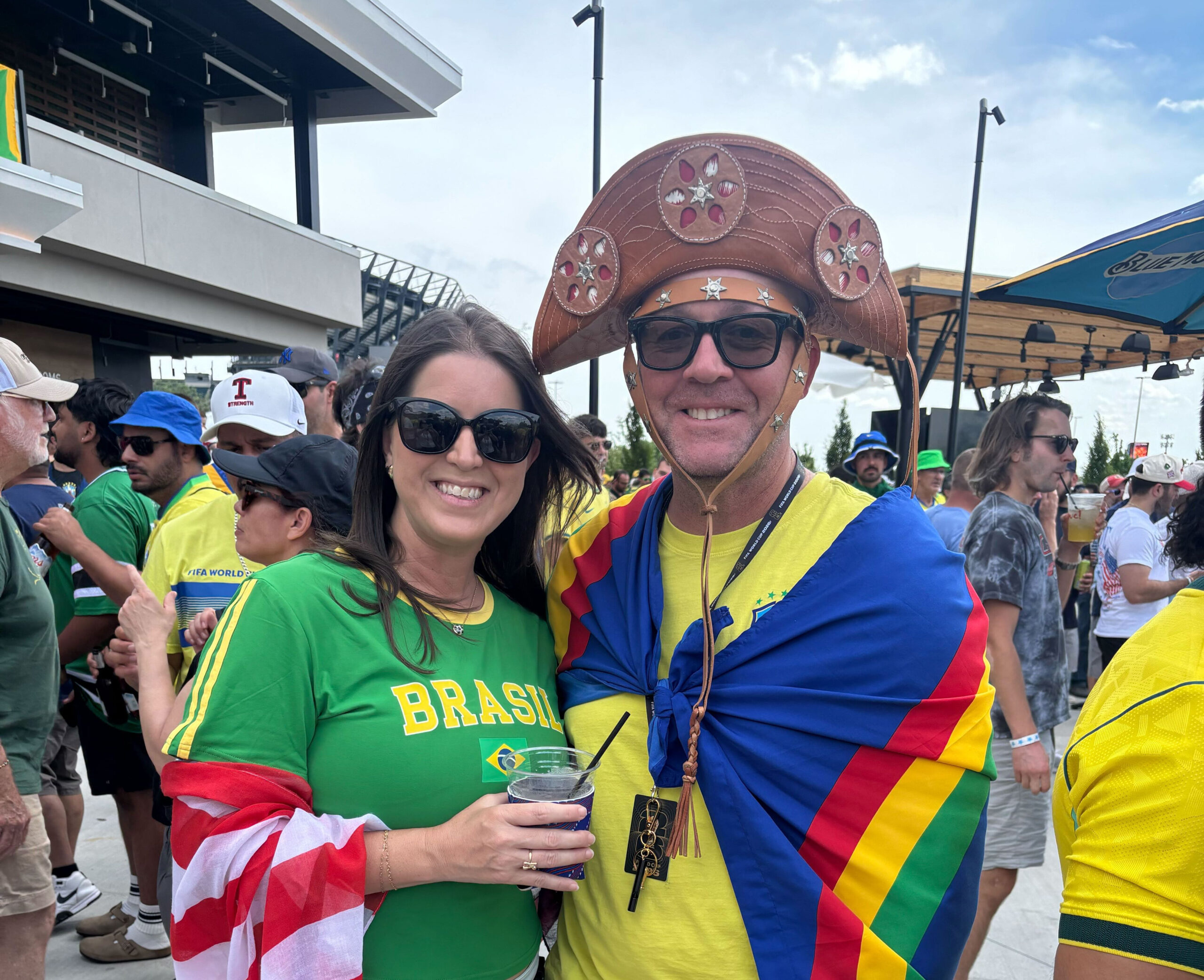
Andre Magalhaes and his wife, Kelly Bennett, traveled from Orlando to watch Friday’s Brazil-Haiti game.
Andre Magalhaes, 47, a native of Brazil now living in Orlando, was counting down the hours until his first World Cup game at Stateside Live! Friday.
“It’s a child’s dream come true,” he said of attending his first World Cup match. “I’ve waited for this moment my entire life to be here.”
Magalhaes wore a leather cangaceiro, a traditional hat from Northeast Brazil. His wife, Kelly Bennett, 44, wore a team Brasil shirt a U.S. flag as a cape.
“We’re going to watch the game here then I’m going to fold up the flag and I’m going into the stadium and root for Brazil,” she said.
The couple, who are only in town for the three days, said they loved Philly’s sports complex.
“You have all three stadiums and public transit right here!” Bennett said. “It’s such a dream, especially coming from Orlando.”
SEATTLE – It didn’t take long for the United States’ shift to a two-striker front line to pay off.
Folarin Balogun’s hot form continued just 11 minutes in, as he forced an own goal off Cameron Burgess to put the Americans ahead. Antonee Robinson sprung Balogun down the left flank, and he sprinted almost all the way to the end line, then laid a pass into the middle for Ricardo Pepi and Sergiño Dest’s late runs.
But the ball hit Australian centerback Cameron Burgess near the six-yard box instead, and pinged right into the net.
The crowd was thrilled, and the hosts were off and running again.
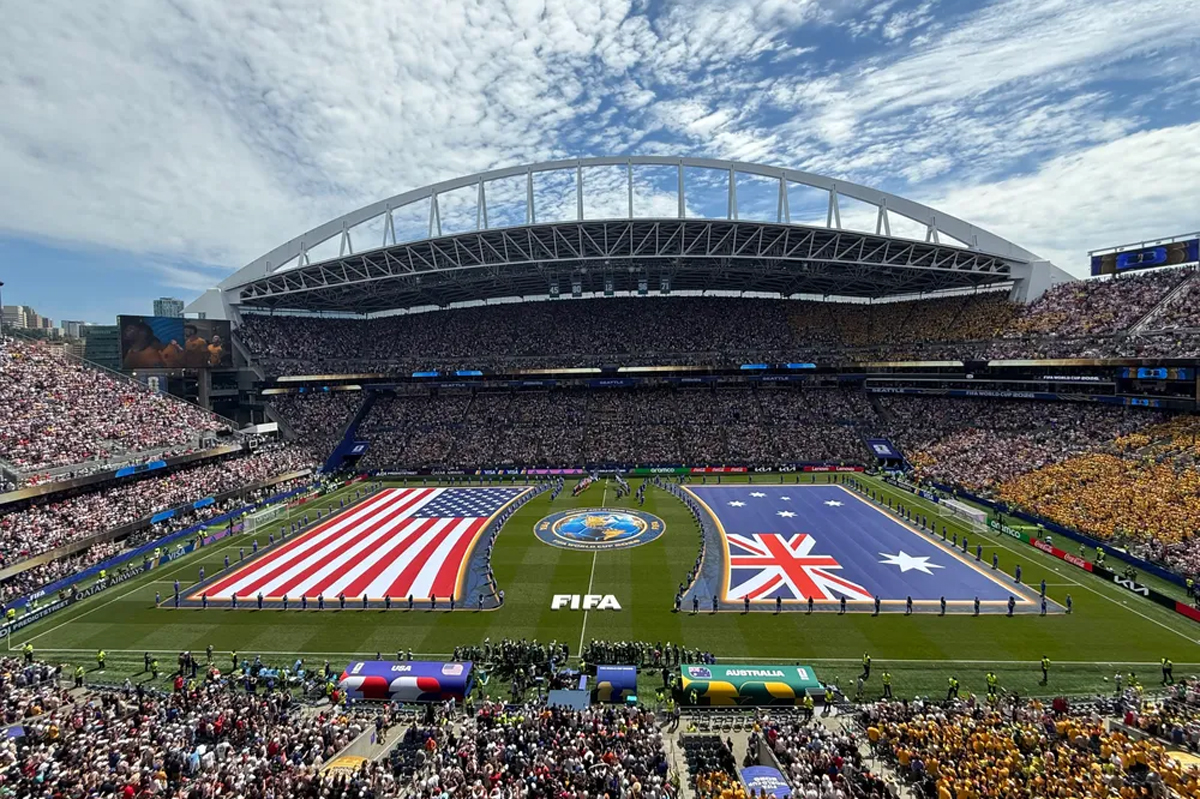
Lumen Field, known as Seattle Stadium during the World Cup, ahead of U.S. vs. Australia Friday.
SEATTLE – Like most NFL stadiums, Seattle’s press box is glass-enclosed, though it least it has some small windows that open to pick up a bit of the atmosphere.
But I wanted the real thing for a moment. So I snuck outside to the seating bowl for the players’ walkout and the national anthems.
Both sets of fans belted out their national anthems, with the Star-Spangled Banner ringing around the entire stadium. You could probably hear it up the street at the ferry terminal.
Media aren’t allowed to take videos inside the stadium unless they’re rightsholders, a FIFA rule I’ve lived with at every World Cup I’ve covered. But we can take photos, so here’s mine of what it looked like.
At Fan Fest, Mayor Parker thrilled to share ‘Philly-ness with the world’
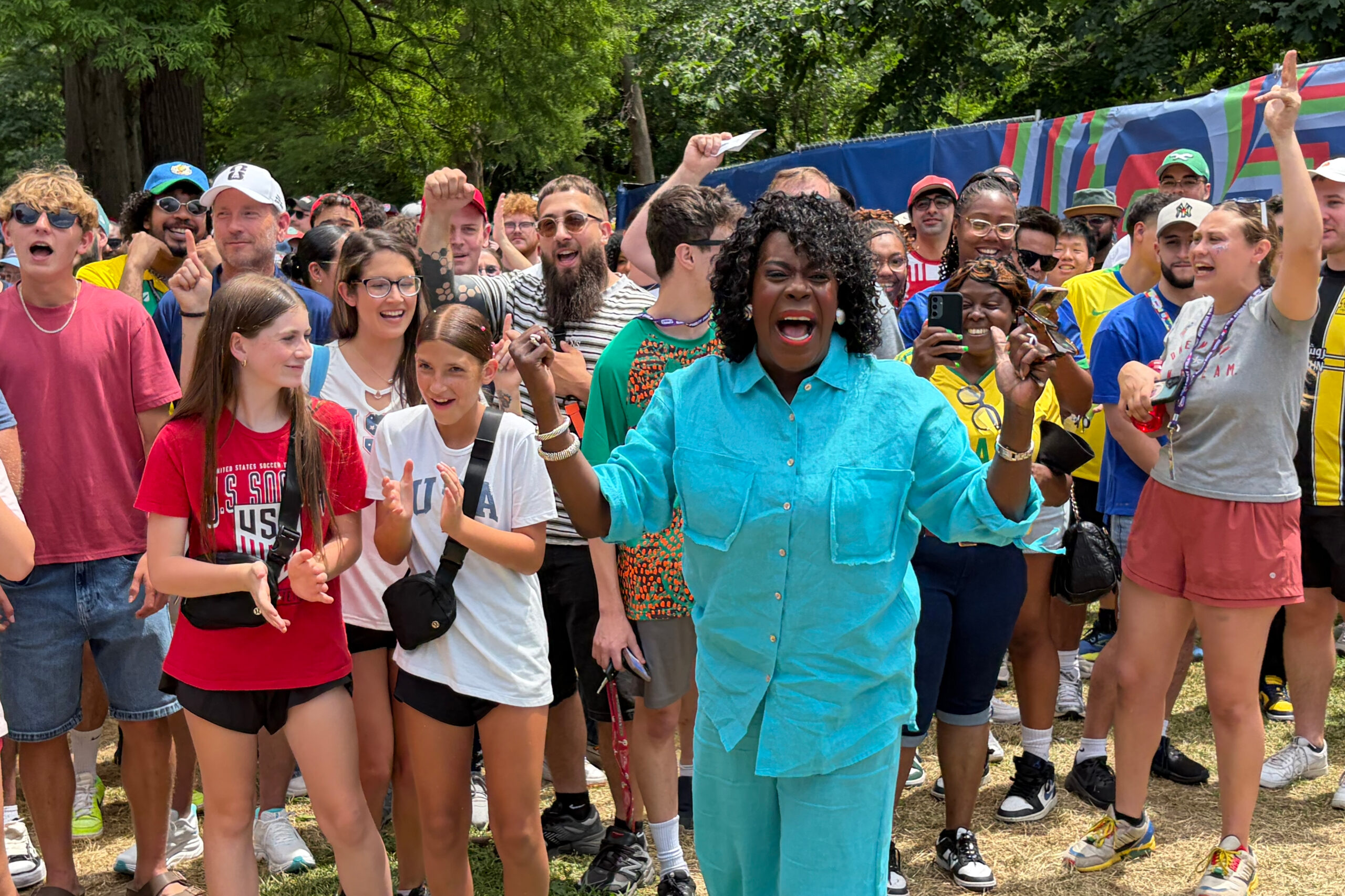
Philadelphia Mayor Cherelle L. Parker at the opening of the FIFA Fan Festival in Fairmount Park Friday.
Mayor Cherelle L. Parker helped open the gates of the FIFA Fan Festival ahead of the U.S.’s clash with Australia at 3 p.m.
Parker stepped out into the crowd waiting at the festival’s main gate and posed for photos with fans waiting in line, including one with a group of traveling Scottish supporters.
Before the gates opened, Parker said she was appreciative that fans are showing up to the city and the festival “authentically, as themselves.”
“We are a global culture, and we are one people,” Parker said. “What makes America and the world so amazing, is that all of us, no matter the fabric, no matter the patchwork in our quilt, we make up a global humanity, and an American community that’s representative of everyone. I’m excited about it all.”
After greeting the line of fans waiting to get into the festival on Sedgley Drive, Parker walked into the festival to greet a few vendors. She stopped at the Bank of America tent to make a bracelet – she chose a black band with all the Philly-specific charms and a World Cup trophy charm – then stopped into the FIFA store on the festival grounds.
With the help of a few store associates, Parker picked out some kits and World Cup merch, including both Brazil jerseys, a seafoam France away jersey, a yellow Curaçao jersey, two World Cup logo shirts and a stripes U.S. jersey.
Parker said she’s enjoyed seeing soccer fans out and about in the city – especially Brazilian fans, whose team will take the field against Haiti at Lincoln Financial Field at 8:30 p.m.
“We were on the parkway, and Brazil was turning it out and up,” Parker said. “Everywhere we’ve been, they’re like, ‘Philadelphia is beautiful, the experience is great.’ You can be a visitor one time, but they’ll feel Philadelphia.
“You have to feel the energy here. We are not like any other city in the nation. There is something special about Philadelphia, and being able to share that Philly-ness with the world is something really exciting.”
Check out The Inquirer’s all-new pop-up soccer show!
Ahead of today’s pivotal World Cup matches, get up to speed on all things soccer with the Inquirer’s Soccer Extra, our pop-up soccer show during the matches here in Philly, featuring writer Jonathan Tannenwald and host Lisa Carlin.
Catch the show Thursdays at 11 a.m., until the final match at Philadelphia Stadium (aka the Linc) through July 4. In their second episode, the duo take a look at this first week of World Cup action and look ahead to Philly’s upcoming matches in Brazil-Haiti tonight and France-Iraq on Monday.
— Inquirer sports staff
// Timestamp 06/19/26 2:35pm
Like Philly, Seattle putting the ‘city’ in ‘World Cup host city’
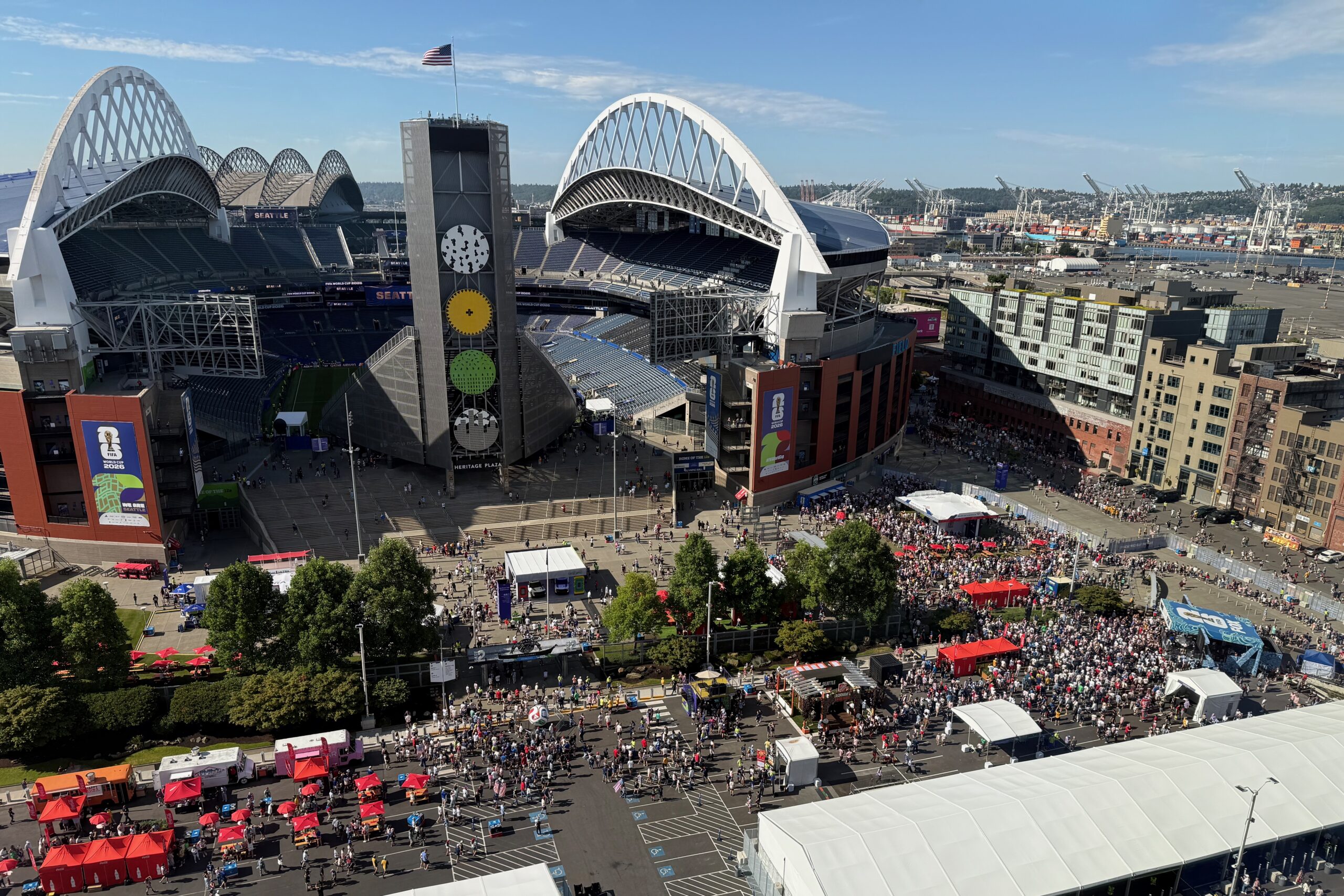
Seattle Stadium, usually called Lumen Field, as fans arrive for the World Cup match between the U.S. and Australia Friday.
SEATTLE – You might not think that Philadelphia and Seattle have much in common, thousands of miles apart and with different cultural vibes. But during this World Cup, it feels like they have a lot in common.
It’s not just that the U.S.-Australia and Brazil-Haiti games are on the same day, which has put the two cities at the top of the World Cup’s headlines. It’s that they’re true cities, the kind where you can feel the energy of a big event just by being there.
That’s how a World Cup is supposed to be, and has been at all the other ones I’ve been to. The sights and sounds of big fan gatherings are as important as the games themselves.
Philadelphia has seen that a few times now, from the Club World Cup last summer to the masses of Ecuador and Brazil fans in recent days. Soccer brings people together from all over the place like nothing else, even in a city where other sports are more important.
Another thing you can tell out here is how different things are from the first U.S. game in suburban Los Angeles. The stadium is exceptional and the atmosphere was great, but there just wasn’t the same kind of buzz beyond the game because L.A. isn’t the same kind of city.
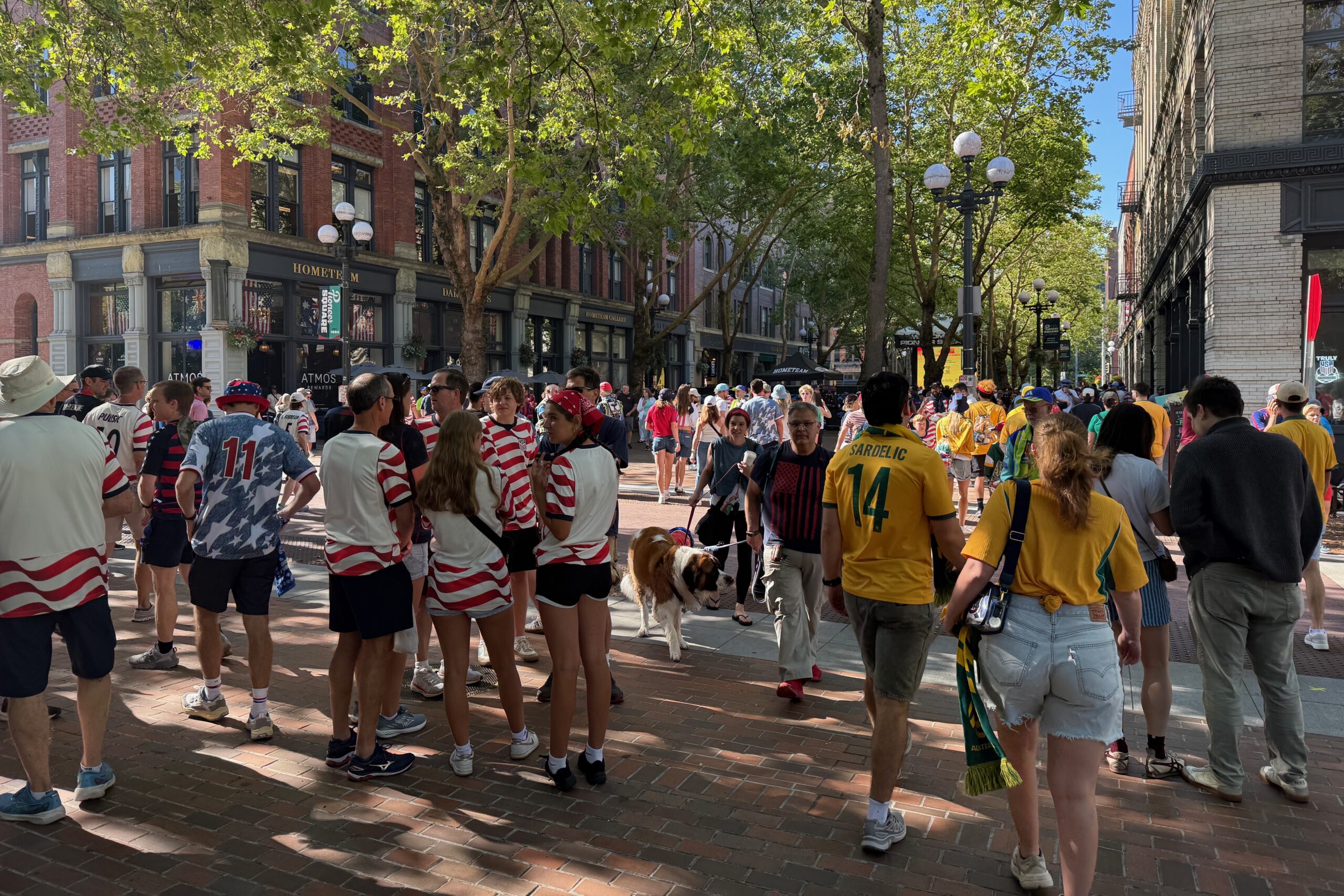
Fans at Pioneer Square in Seattle.
The downtown doesn’t matter as much, and everything else is way too sprawling – and that’s before getting to the U.S. camp being over an hour south in Orange County. You’re never going to have the same kind of buzz when everything around is highways and shopping centers.
In Philadelphia, you can walk anywhere in Center City, then take a quick subway ride to the game. Here, you can walk from the waterfront to the stadium, and there’s a light rail line across town too.
I made that walk this morning, and saw thousands of fans going in both directions. A “Men in Blazers” live show on one of the piers drew a huge crowd that filled the plaza and the sidewalks beyond it.
The big crowd here isn’t just wearing red, white, and blue. There are plenty of Australia backers too, all in their traditional green and gold. You’ll see them behind one end zone, behind the team’s bench, and in a few sections of the upper deck.
I unexpectedly walked through their fan march on the way to the stadium. Everyone was in good spirits, including the U.S. fans at bars nearby who responded with lighthearted boos and “USA!” chants.
One Socceroos fan carried the amusing sign you see above. A bunning snag is Australia’s similar culinary tradition, a grilled sausage in a folded piece of white bread topped with grilled onions, then ketchup and/or mustard.
Christian Pulisic is still recovering from his calf injury.
SEATTLE – Christian Pulisic will not play in the U.S.-Australia game, as he hasn’t recovered enough from his calf injury to make the squad.
“Christian is not available,” U.S. manager Mauricio Pochettino told Fox Sports’ broadcast moments before FIFA published the teams’ starting lineups. “Let’s hope that as soon as possible he can be ready to be selected again, and to be part of the team. Now we need to be focused on our team, and the players that are going to play. We have ahead very important game – Australia is going to be really tough.”
Pochettino said Pulisic trained Friday morning and “the feelings are good” on the star playmaker’s overall recovery.
“A little bit sad,” Pochettino admitted. “He wanted to participate today. But it’s still [too] early.”
EXCLUSIVE: USA star Christian Pulisic is OUT today with a calf injury against Australia and Ricardo Pepi will get the start, USMNT manager Mauricio Pochettino tells FOX Sports’ @JennyTaft. pic.twitter.com/ZobSiOfjYx
Ricardo Pepi comes into the U.S. lineup, and that means a tactical shift with two strikers on the field. My guess is the Americans will line up in a 3-4-2-1 formation that looks like this:
Australia has all of its players healthy. The Socceroos’ starting lineup is headlined by rising star striker Nestory Irankunda and 6-foot-6 centerback Harry Souttar. There’s also a familiar face from MLS in New York City FC midfielder Aiden O’Neill.
The #USMNT starting lineup with Christian Pulisic out – Ricardo Pepi comes in to throw two strikers at Australia.
I am guessing it will look like this formation-wise…
Fans from all over gather for entrance into the FIFA Fan Festival
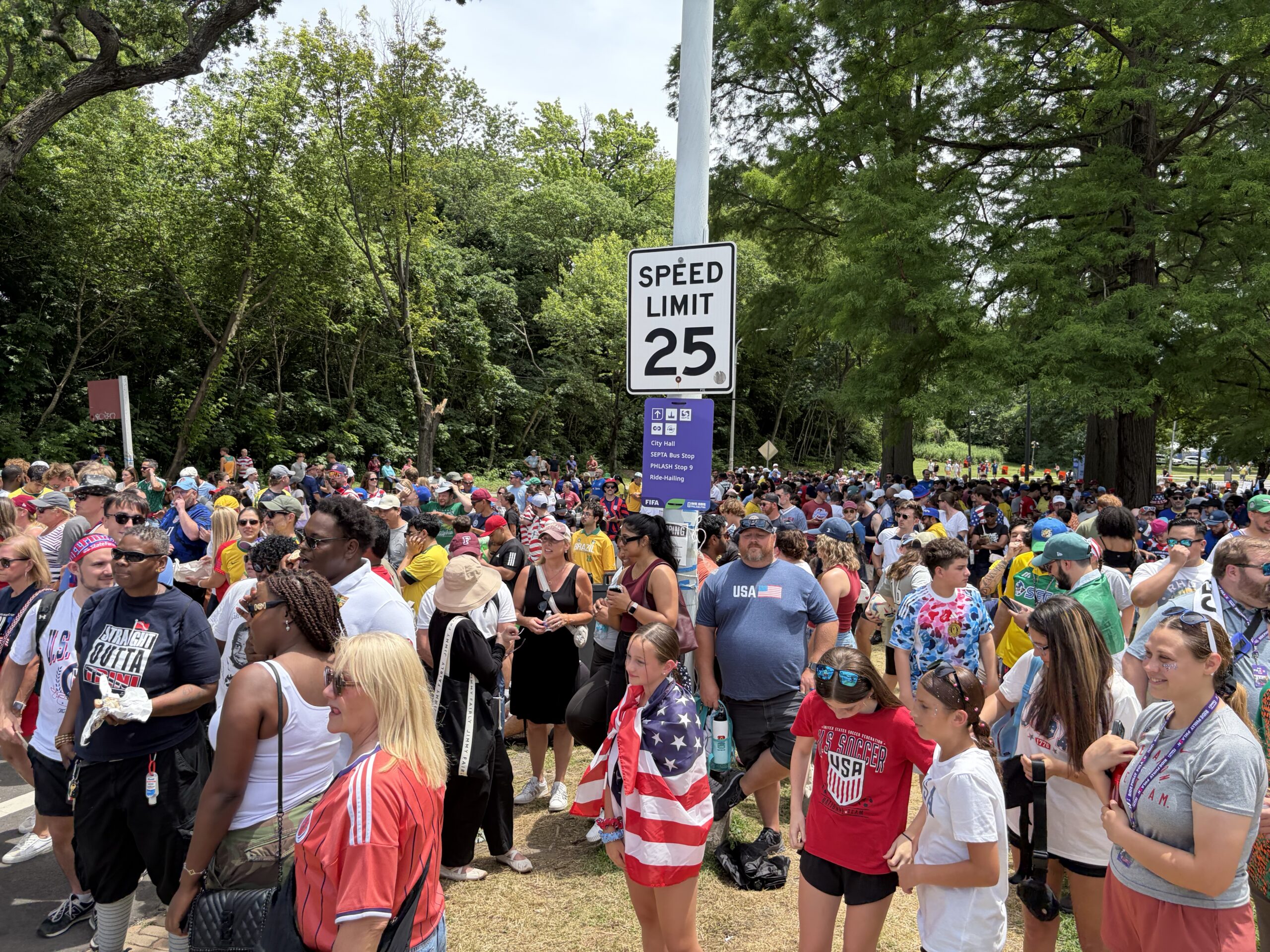
Fans wait to enter FIFA Fan Festival at Lemon Hill in East Fairmount Park Friday.
The gates of the FIFA Fan Festival don’t open to visitors until 2 p.m., but a line has already started to form at the main gate.
Gus Sanchez said he and his family had been in line since about noon after biking over from Northeast Philly.
Sanchez said he wanted to watch the U.S. men’s team take on Australia with a crowd, leading him to come over to the Fan Festival.
“It’s something I can’t explain,” Sanchez, 53, said. “Seeing people from different countries getting together, having fun, enjoying the game.”
The crowd is full of U.S. kits, but other nations are represented, too. Kits from Haiti and Brazil, which will face off tonight at Lincoln Financial Stadium, can be spotted in the line, as well as fans from Scotland.
Alex Nelson said he traveled from Prestwick to the U.S. to soak in the environment of the World Cup.
He traveled from Boston, where the Scots played Haiti on Saturday, to Philadelphia to take in Scotland-Morocco at the Fan Festival.
Nelson, sporting a tartan kilt, said he’s loved his time in Philly so far.
“Very clean city,” Nelson said. “Everybody has been so helpful. Everybody’s mixed in —the Brazilians, the Moroccans, U.S.A., all mixed. That’s what it’s all about.”
Brazil fans bring the party to Philly’s Rocky steps
// Timestamp 06/19/26 9:36am
Photos: Brazil fans take over Philly
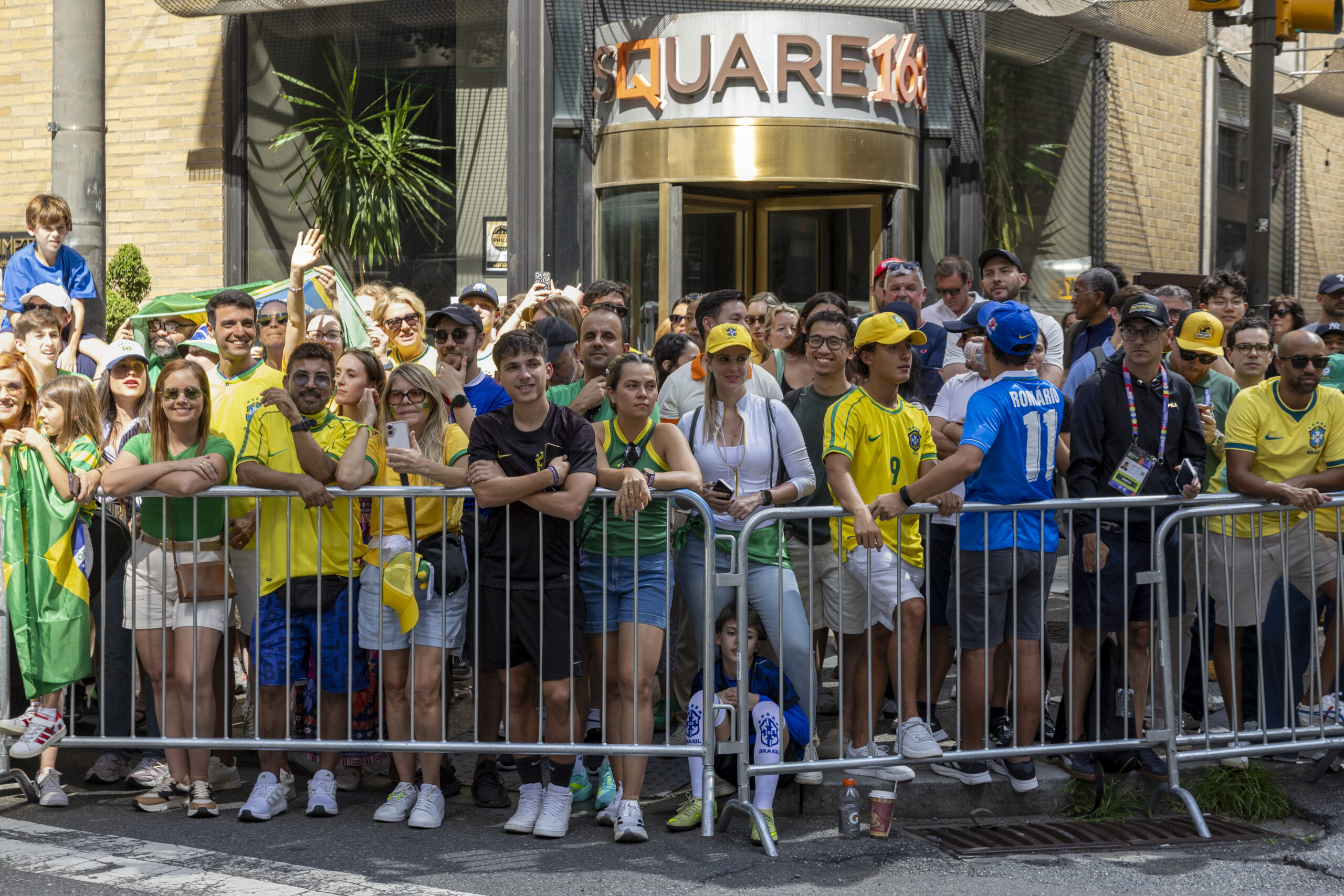
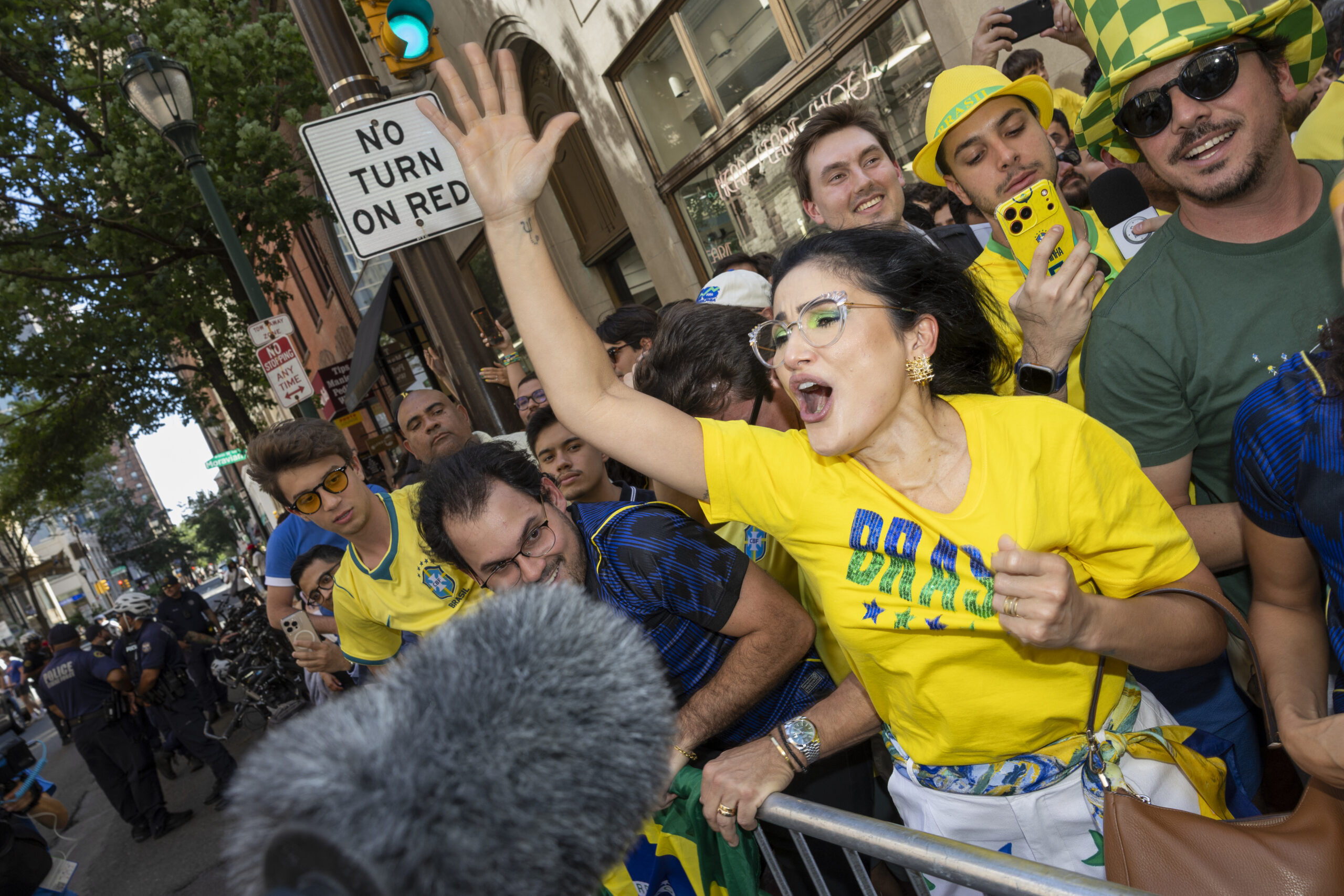
Brazil fans play a little soccer as they rally at the Philadelphia Museum of Art Thursday. Thousands of Brazil fans swarmed the streets ahead of their team’s matchup against Haiti in Philly. Brazil’s Lucas Paquetá poses for a photo with fans outside the Sofitel Philadelphia at Rittenhouse Square.Brazil soccer fans wait outside of the Sofitel Philadelphia at Rittenhouse Square to greet the players. A Brazil soccer fan cheers outside the Sofitel Philadelphia at Rittenhouse Square. Brazil fans are hoping for the team’s first 2026 World Cup win in Philly.
// Timestamp 06/19/26 8:09am
Everything you need to know about the World Cup in Philly
Philadelphia’s second World Cup game is Sunday night.
Brazil fans work to avoid Rocky curse again of Philly game
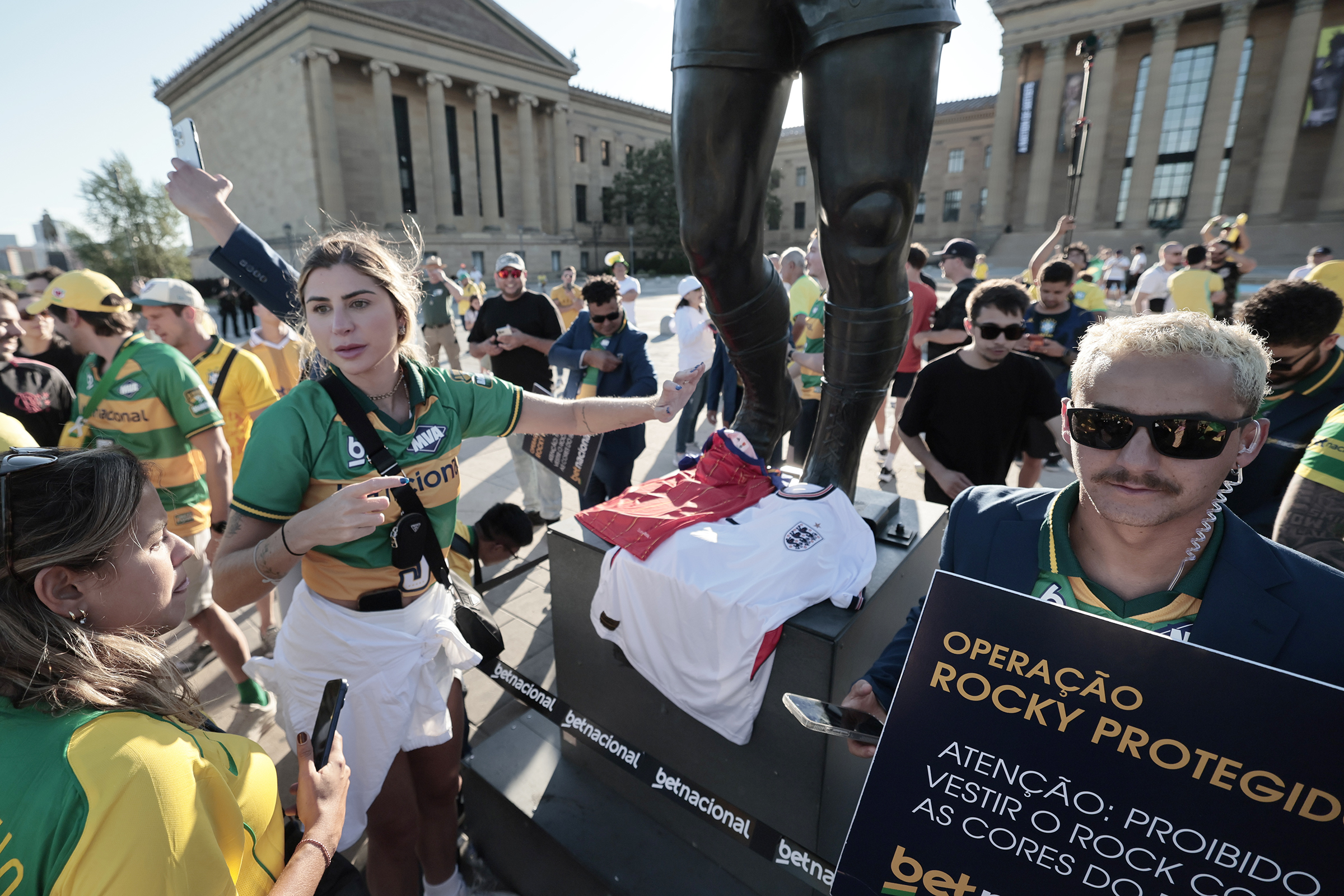
Brazil fans guard the Rocky statue at the Philadelphia Museum of Art to prevent being jinxed.
International soccer supporters, be warned — clothe the Rocky statue at your own risk.
The fans of the Ecuadorian national team learned Sunday what many NFL fans already know about draping their colors over the statue of Rocky on the steps of the Philadelphia Art Museum.
Ecuadorian supporters fitted Rocky with a yellow La Tri kit, then saw their team concede a 90th-minute winner in its FIFA World Cup group-stage opener against Ivory Coast on Sunday at Lincoln Financial Field (aka Philadelphia Stadium).
The effects of the “Rocky curse” are well-documented when it comes to football, but it was relatively untested on the beautiful game. Ecuador lost, 1-0, to the Ivorian side, which entered the tournament ranked 10 spots behind La Tri in the FIFA World Ranking.
With Brazil coming to Philly for a Group C match against Haiti on Friday (8:30 p.m., Fox29), Movimento Verde Amarelo, Brazil’s main supporters’ group, went to great lengths to ensure the yellow and green of the Canarinho stayed off the Rocky statue.
The Rocky statue was roped off with a four-post retractable nylon stanchion, with four members of MVA, sunglasses on and earpiece in, standing at attention at each corner as Brazilian fans gathered for a rally in front of the Art Museum.
The bodyguards discouraged fans from draping any Brazilian garb on the statue, holding signs that read:
“Operation Rocky Protectors — Attention: it is forbidden to put Brazilian colors on the statue.”
Matheus Henrique, 30, was one of the MVA members protecting the statue. Henrique, a native of Belém, Brazil, moved to Los Angeles a decade ago for college.
Henrique is friends with the person who helped organize Brazil’s takeover of the steps and responded when a call went out for volunteers to guard the statue.
“It’s a superstition, we heard,” Henrique said. “We’re enjoying the event as well.”
Christian Pulisic’s status a mystery ahead of USMNT-Australia
Christian Pulisic during a United States men’s national soccer team in Seattle Thursday.
There was no surprise news about Christian Pulisic from U.S. men’s soccer team manager Mauricio Pochettino in his news conference before Friday’s game against Australia (3 p.m., Fox29, Telemundo 62). Pochettino did not rule the star playmaker in or out, and that was not surprising.
“As you know, he was training in an individual way the whole week,” Pochettino said. “But like always, I think tonight, the day before the game, we have a meeting with our medical area, and we will assess the whole group, the players, and tomorrow we will communicate all the things that we can agree tonight.”
Pulisic was seen briefly at the start of Thursday’s practice, then headed off to work on his own. When he arrived, he wasn’t wearing the sleeve over his injured left calf that he sported on Wednesday. But after a few minutes, he sat down on a bench by the sideline and put it on.
“He is evolving, he is much better from [last] Friday,” Pochettino said. “I think at the moment we’ll see. … He’s doing a massive effort trying to be ready.”
The manager also praised Pulisic for being “strong and with a great mentality” as the Hershey native works to be ready for kickoff.
Asked who might play if Pulisic can’t go, Pochettino didn’t answer. This was no surprise either.
“I will tell tomorrow if that is the situation,” he said. “At the moment, we are evaluating all the possibilities just in case, and then we will decide when we have the confirmation in one or another direction tonight.”
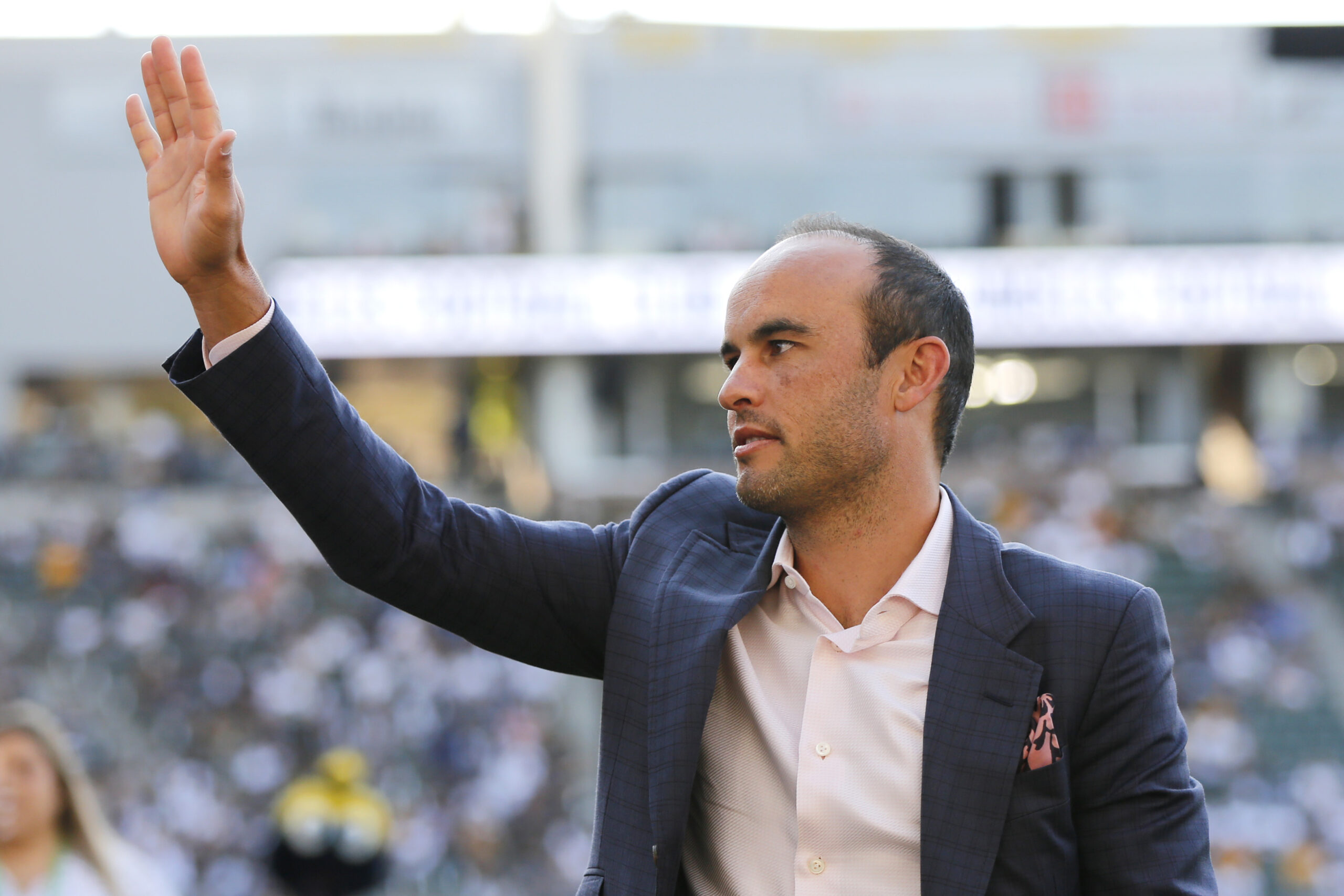
Former U.S. men’s star Landon Donovan will be on the call for Brazil vs. Haiti in Philly Friday night.
The second of six World Cup matches will take place Friday night in Philadelphia, with Brazil taking on Haiti (8:30 p.m., Fox) in Group C action.
Calling the game on Fox tonight will be veteran soccer announcer Ian Darke, joined by former U.S. men’s national great Landon Donovan. Natalie Gedra will handle reporting at Philadelphia Stadium, otherwise known as Lincoln Financial Field.
Brazil vs Haiti
Time: 8:30 p.m. Philly time
Location: Philadelphia Stadium (Lincoln Financial Field)
TV: Fox (Ian Darke, Landon Donovan)
Spanish: Telemundo (Luis Omar Tapia, Diego Balado)
Philly hosted its first-ever men’s World Cup match last week, with Ivory Coast topping Ecuador.
Philadelphia was the star during its first 2026 World Cup match, which featured an Ivory Coast upset in front of a re-branding Lincoln Financal Field filled with Ecuador fans.
Philadelphia Stadium, as it’s called during the tournament, will host five more World Cup games, including a Round of 16 matchup on July 4.
“This is the day he will die,” thought Roy Reed, a reporter for the New York Times.
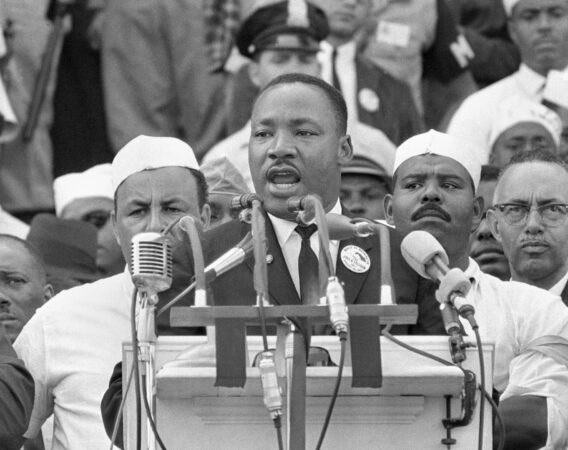
On June 21, 1966, Reed was standing behind Martin Luther King Jr., who was surrounded by about 300 hostile white people in Philadelphia, Miss. King had led a delegation from the Meredith March Against Fear to commemorate the second anniversary of the killings of the civil rights activists James Chaney, Andrew Goodman and Mickey Schwerner.
King was trying to navigate a rocky path full of obstacles: the threats of southern racists, a frayed alliance with President Lyndon B. Johnson and dissent within the civil rights movement.
His response showcased his greatest gifts — and his actions on June 21 painted a nuanced picture of what made King so influential. Much of our historical memory of the civil rights leader deifies him, a marker of the nation’s racial progress. It also, however, dramatically oversimplifies the man and the movement he helped lead. It cloaks the divisions within the civil rights movement, along with King’s struggle to harness different factions and tactics toward his goals.
The enshrinement of King also prevents Americans from seeing just how he married the ideals of American democracy with the righteous struggles of Black Americans. It eludes how he exhibited both spiritual power and political acumen. Looking at King’s actions during the Meredith March, by contrast, spotlights three of his most important roles in the civil rights movement: as an icon of moral courage, as a lodestone for Black activism and as an architect of sustainable ideals for a social justice movement.
All of these qualities were on display on the extraordinary day of June 21, 1966.
The Meredith March began on June 5 with one man, James Meredith, who had planned to walk from Memphis to Jackson, encouraging voter registration. On the second day, he got shot, and though he survived, the major civil rights organizations transformed his quest into a mass march.
By the time King gathered with the activists in Mississippi two weeks later, the big story was Black Power. On June 16, Stokely Carmichael introduced the new slogan as a message of self-determination. It implicitly criticized King’s bedrock values of nonviolence and racial integration.
On the morning of June 21, King met the marchers at a Black church — and he looked scared, with good reason. Philadelphia, in west-central Mississippi, was off the main route of the march. Instead of protection from the state police, the marchers were under the jurisdiction of Cecil Price, the deputy sheriff at the center of the federal conspiracy trial the three civil rights activists’ killing.
During their procession to Philadelphia’s town square, the marchers were jeered, spat upon and sprayed with hoses. The air was thick with danger.
Surrounded by his flock and his foes, King steeled himself. “I am not afraid of any man,” he proclaimed. “We are going to work together for freedom. We are here to save America.”
Despite the hostile crowd, King didn’t duck the heinous violence that the march was commemorating. He remembered the movement’s martyrs. “I believe in my heart that the murderers are somewhere around me,” he intoned.
“They’re right behind you!” shouted a white boy. The mob hooted. Price smirked.
As the activists left, the mob tossed eggs, rocks and bottles. Scuffles broke out. The marchers reached the Black district just before some white toughs arrived, brandishing knives, wrenches and ax handles.
Made By History sponsors. FOR USE ON MADE BY HISTORY STORIES ONLY.
Confronted by murderous hatred, he was a model of resolve and principle. His fortitude reassured his fellow marchers and it projected the movement’s integrity to the broader public.
After his speech in Philadelphia, King boarded a tiny, twin-engine plane for Sunflower County, in the Mississippi Delta, to speak at a voter registration rally.
“It was like a messiah walking through the community,” recalled local organizer Charles McLaurin. Alongside the legendary Fannie Lou Hamer, McLaurin had led a 10-mile march from the town of Sunflower to the county courthouse in Indianola.
There, King revealed his magnetic power. Wherever he went, Black folks followed. Because he was in Indianola, over 300 people attended the rally. As was the case throughout King’s life, his reputation attracted a big turnout and his charisma compelled political participation. More than any other figure, he drew people into the southern civil rights movement.
King’s day was not yet done. He got back on the plane, headed for Yazoo City, on the southern edge of the Delta, where the Meredith Marchers had stopped for the night.
King arrived for a nighttime rally in a public park. Radical activists gave speeches promising bloody retaliation if white people attacked them again. They won roars from the large crowd. Black Power, with its vows for self-defense and independence, struck emotional chords that exposed the widening fault lines in the movement.
Yet, even as the crowd cheered the rhetoric of Black militants, it reserved its greatest adoration for King. To reach the podium, he waded through the masses. Old ladies jostled each other to touch him, while weathered farmers pressed their palms into his.
And as this tumultuous, grueling day turned into a sweaty, bug-filled night, King painted a vision for the movement. He understood the need for Black political power. He acknowledged that Mississippi was afflicted by oppression. But segregation and violence were plagues on everyone, Black and white. To survive, to thrive, Black people needed a “coalition of conscience.”
“Now,” he said, “I’m ready to die myself.” In his classic style, he weaved together the rhythms of the pulpit with the ideals of American democracy.
“When I die I’m going to die for something, and at that moment, I guess, it will be necessary, but I’m trying to say something to you, my friends, that I hope we will all gain tonight, and that is that we have a power.” He recalled the movement’s great triumphs and celebrated their destiny to redeem the nation. In the process, he touched people’s souls.
By insisting on his ideals, and by summoning his greatest oratorical powers, King maintained his slippery grasp on the march’s message. In its final days, the Meredith March encountered more violence, including a tear gas attack in the town of Canton. Yet amid the cries of Black Power, the marchers maintained the discipline of nonviolence. They arrived in the capital city of Jackson for the largest civil rights demonstration in the history of Mississippi, signaling the resonance of mass protest in the lives of Black Americans
On the Meredith March, King illustrated why his birthday is a federal holiday, a memorial in the National Mall’s Tidal Basin celebrates his legacy and nearly 1,000 streets bear his name. He was neither a saint nor the movement’s single leader. But he exhibited the qualities of leadership, in the service of forging a genuine democracy.
King demonstrated profound courage, setting a meaningful example. He pulled followers into his orbit, articulating principles that resonated with people. And he insisted that a crusade for justice demanded the best of its advocates, investing their cause with the deepest meaning.
Throughout his glorious and tragic journey with the civil rights movement, King shared these blessings. Sometimes he did it all on one single day.
Made by History takes readers beyond the headlines with articles written and edited by professional historians. Opinions expressed do not necessarily reflect the views of The Inquirer.
Vineland’s public school teachers are having an easier timewith the question of what to wear to work — at least for the final days of the school year.
In a move to boost morale in the South Jersey school system and make teachers’ lives easier this spring during a hectic testing period, the district eased its dress policy to allow denim jeans until the end of the school year on June 25.
Teachers love it and hope it will continue in September.
“It’s one small way to make the world of work a little friendlier,” said Vineland Education Association president Louis Russo, a social studies teacher. “It’s one small thing off of their shoulders.”
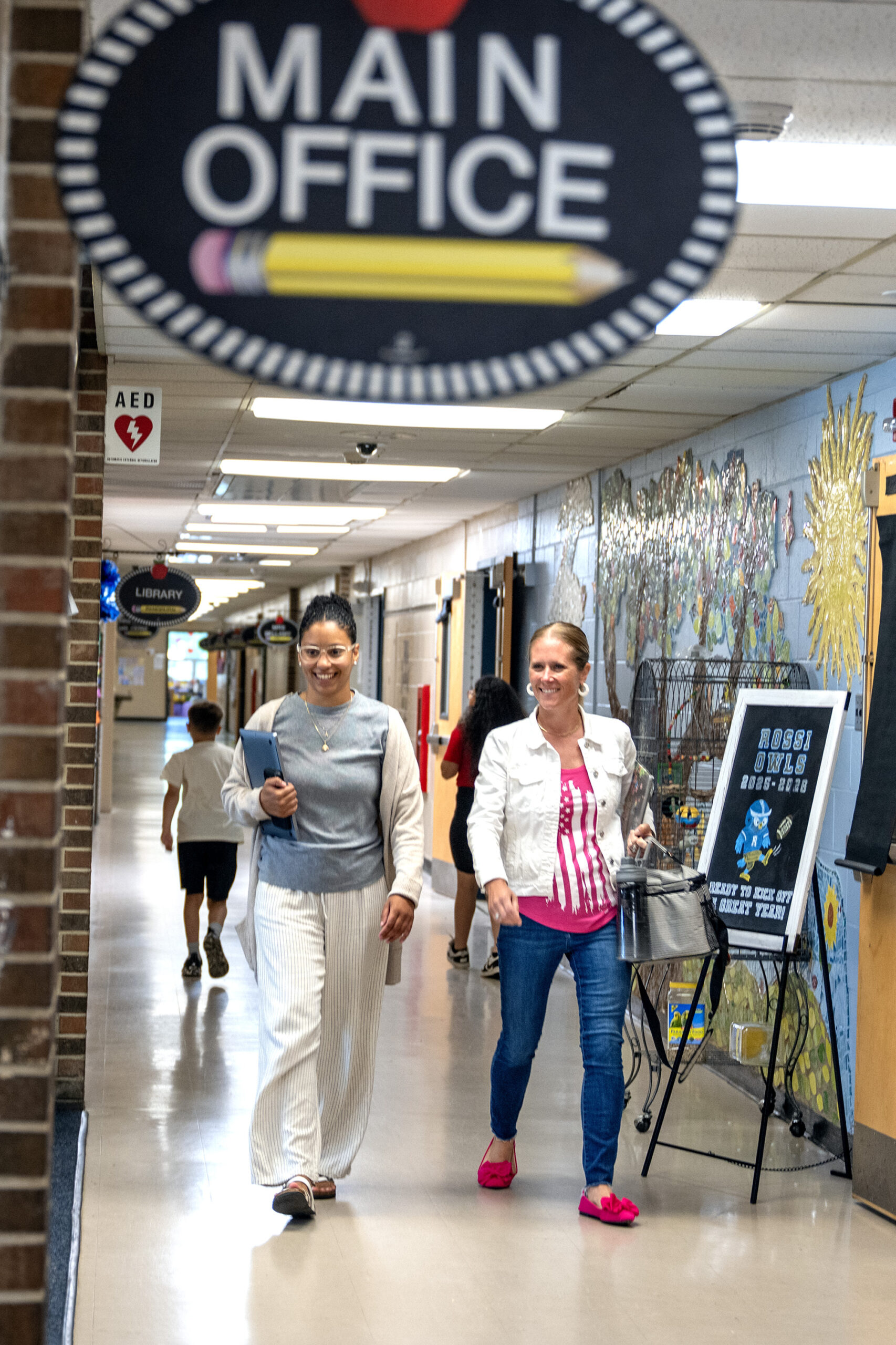
Teachers Andrea Ruiz (left) and Elaine Petrini (right) at Rossi Elementary in Vineland on June 9. The teachers are allowed to wear jeans until the end of the school year.
School board president Cedric Holmes said the Cumberland County district notified employees when they returned from spring break in April that they could wear jeans any day of the week under a pilot program.
Holmes said there had been rumblings among staff because the district — the largest in Cumberland County, with 11,000 students — had to extend the school year to make up snow days. Vineland‘s June 25 last day of school isamong the latest in the region.
The months following spring break are among the toughest with students undergoing standardized state testing, Holmes said. There are also end-of-the year field trips and outings when it makes sense to allow more relaxed clothing, he said.
“It was important to the board that staff felt that we saw the stress of all of that of this as a practical way to give a morale boost for the end of the year,” Holmes said.
Teachers typically dress a bit more formally for school.According to Vineland’s policy, female teachers must wear skirts, slacks, skorts, or dresses with blouses or sweaters, or school uniform. The skirt, skort, or dress should not exceed three inches above the knee.
Male staffers can wear suits or slacks with jackets and ties, sweaters, school uniform, or sports or dress shirts. Deemed unacceptable for both are sneakers, flip-flops, bedroom slippers, combat boots, and work boots. There are exceptions for teachers attending field trips or who work in specialized areas such as health and physical education or arts.
The district also has a uniform policy for students, but Holmes said that has been relaxed and the board also plans to reexamine that policy.
New Jersey’s 600 school districts set their own policies for staff and students.
Steve Baker, a spokesperson for the New Jersey Education Association, which represents 200,000 teachers and support staff, said the union supports the efforts in Vineland “to develop policies that help create a positive learning and working environment for students and staff.“
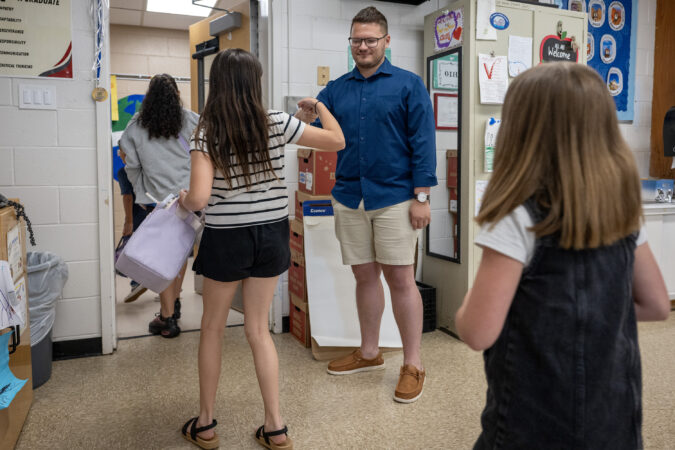
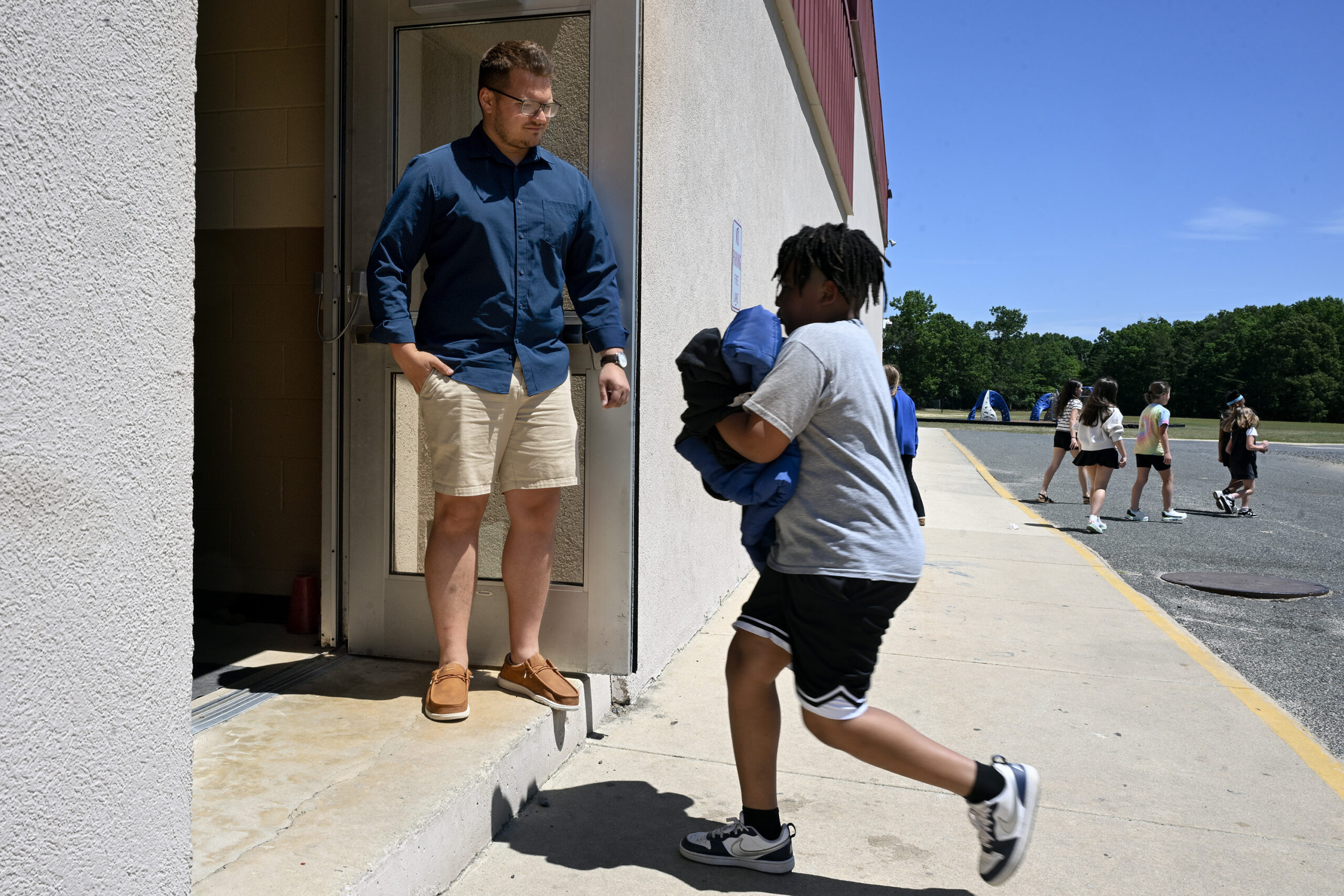
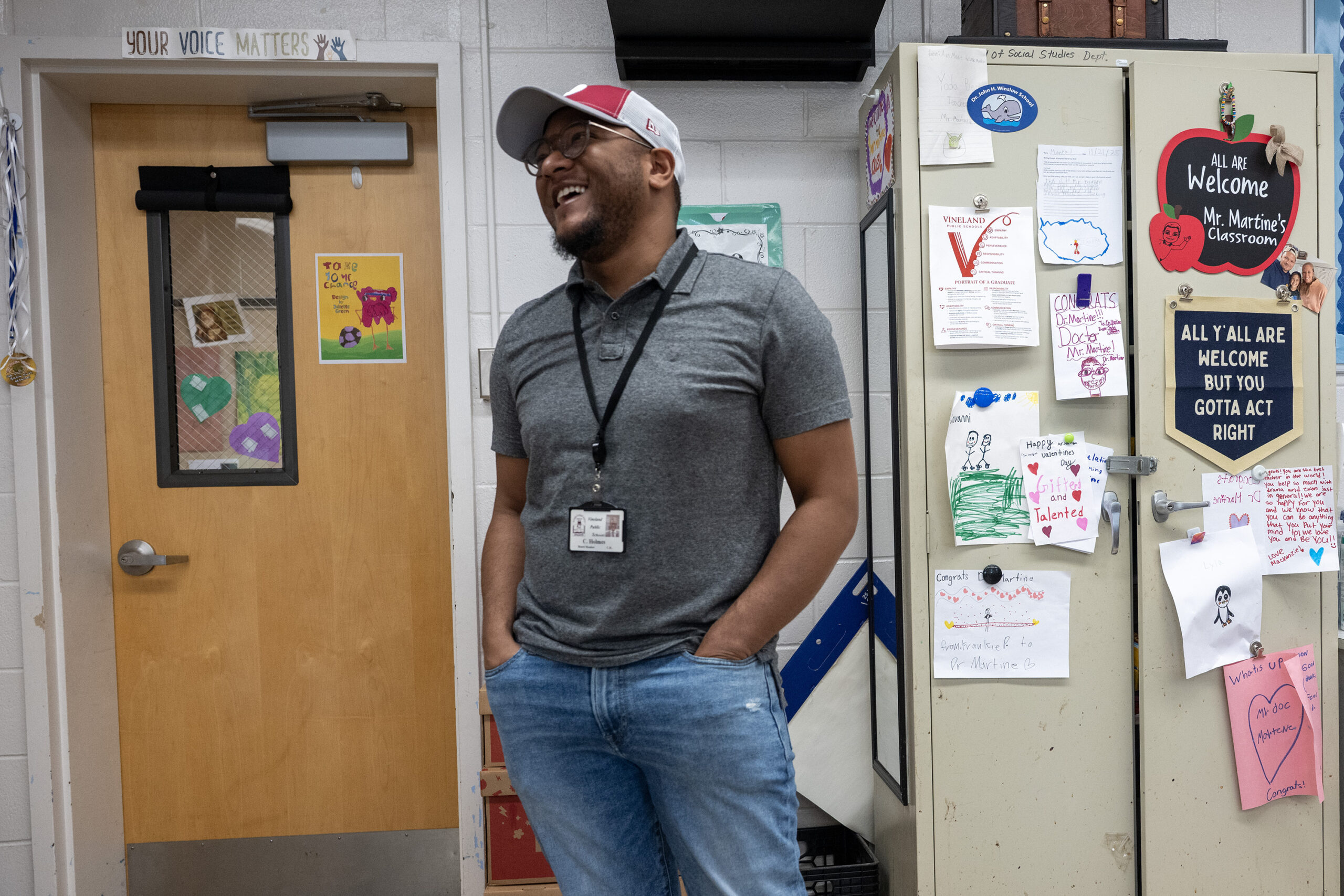
On a busy morning last week at Anthony Rossi Elementary in Vineland, third-grade teacher Jeffrey Martine stood in front of the class dressed in khaki shorts, a button-down blue dress shirt, and slip-on loafers. As an added bonus, it was a dress-down day, which allowed teachers to wear casual attire beyond jeans.
Jeffrey Martine, a teacher at Rossi Elementary in Vineland, greets a student at the school last week.
“If you do your job well, you have to be able to move,” Martine said. “I’m all about comfort.”
Students in Martine’s gifted and talented class were spread around the room working on a project in small groups. Some sat at desks making posters, while others were stretched out on the floor.
“I don’t think professionalism and comfort are mutually exclusive,” Martine said. “Teachers should be judged more on how they interact with their students than the pants they select.”
Holmes acknowledged the dress code was outdated and revisions are needed. The board plans to review the changes implemented this spring and may allow teachers to wear jeans during the new school year, he said.
“It was time for a change,” said Kaitlynn Rossi, a long-term substitute teacher. “People don’t dress like that.”
Teacher dress codes have evolved nationally over the years, especially during the pandemic, when more casual attire was the norm.
Based on responses from teachers around the world, the website We are Teachers in 2024 compiled a list of “16 Ridiculous Dress Code Rules for Teachers You Won’t Believe Are Real.” The list included prohibiting hats, capri pants, pants with pockets, UGGs, hoodies, or dark underwear.
In Philadelphia, where classes ended last week, there is no system-wide dress code for staff. Arthur Steinberg, president of the Philadelphia Federation of Teachers, which represents about 14,000 teachers, counselors, nurses, secretaries, and other workers, said employee dress typically does not come up as an issue.
School board president Cedric Holmes at Rossi Elementary in Vineland last week. Holmes said the teacher dress code policy was relaxed in an effort to improve morale at the end of the school year.
Holmes said teachers have responded well to the changes in Vineland and there have been few infractions, like torn or ripped jeans.
Before Vineland implemented the pilot dress code, teachers were allowed to wear jeans only for special days. The schools sponsor fundraisers that allow teachers to pay $2 to wear jeans. Students are allowed to wear jeans on dress-down days determined by their school principal, and they do not have to pay.
Fourth-grade teacher Andrea Ruiz said dressing more casually helps her students see her differently. A sign in her classroom says: “Be the best version of you.” She enjoys sitting with students on the carpet in her classroom or playing kickball on the playground.
“We’re meeting them where they are,” said Ruiz, who was wearing a gray T-shirt and striped pants. “It’s definitely something different for us.”
Teacher Kaitlynn Rossi with students at Rossi Elementary in Vineland last week.
Timothy Purnell, executive director of the New Jersey School Boards Association, said a decision as simple as allowing jeans can have an impact on the learning environment.
“If jeans support a positive environment during testing, that’s a local call we respect,” Purnell said.
Russo believes a less-stringent dress code will help attract and retain younger teachers amid a national teacher shortage. He wants them to still dress in a manner that gets respect from students.
“We just have to find the right balance,” Russo said.
Staff writer Kristen A. Graham contributed to this article.
Think you know your news? There’s only one way to find out. Welcome back to our weekly News Quiz — a quick way to see if your reading habits are sinking in and to put your local news knowledge to the test.
Question 1 of 10
A rowhome hosting the only collaborative Keith Haring mural that still stands in its original location is up for rent. What neighborhood is it located in?
CorrectIncorrect. XX% of other readers got this question right.
On the corner of 22nd and Ellsworth Streets in Point Breeze, We The Youth stands on the facade of a 1,797-square-foot, three-story rowhouse that's up for rent. Its location was important to Haring. He didn’t want it to be somewhere too upscale or trendy, according to collaborators.
Question 2 of 10
Roxanne, the Michelin-recognized restaurant that an Inquirer report revealed lacked a restaurant license, has reopened. What new features does it have?
CorrectIncorrect. XX% of other readers got this question right.
With a license to operate and passed health inspection, Roxanne’s reopening comes with several new features, including a BYOB format and a lunch menu.
story continues after advertisement
Question 3 of 10
Philly’s Cathedral Basilica is the canvas for a new immersive light show. "Luminiscence" will bring the interior walls of the Cathedral Basilica of SS. Peter and Paul to life through August with a light show set to classical music. Philadelphia is only the second U.S. city to host a production. Which city was the first?
CorrectIncorrect. XX% of other readers got this question right.
“Luminiscence” events — which are specifically designed for cathedrals and basilicas — began in France. Philadelphia is only the second U.S. city to host a production. The first was held at the Basilica of Saint Mary in Minneapolis last year.
Question 4 of 10
A free giveaway item at FIFA Fan Festivals nationwide, including Philadelphia’s, has gone viral and is drawing hours-long lines. What is the giveaway item?
CorrectIncorrect. XX% of other readers got this question right.
Mimicking a Pandora bracelet, Bank of America’s free Fan Bands are composed of a red, blue, or black woven band and an assortment of five metal beads that lace through. Available beads include numbers, flags, a FIFA World Cup trophy, and several city-specific designs that pair with World Cup host cities. The Fan Bands have prompted extremely long lines each day of Fan Fest.
Question 5 of 10
Royal Sushi & Izakaya Chef Jesse Ito was one of two Philaelphia-based James Beard Award recipients this week. Ito won for Best Chef, a title he said has been “a long ride.” Ito has been up for the award before. How many times was he nominated in total?
CorrectIncorrect. XX% of other readers got this question right.
The chef behind the Queen Village omakase counter and its more casual bar and restaurant has been nominated nine times for the award, which honors the top culinary talent across Pennsylvania, New Jersey, Delaware, Maryland, Virginia, and Washington. This go-around, Ito beat out two-time finalist Amanda Shulman — whose Her Place Supper Club earned one of Philly’s first Michelin stars last year — and Omar Tate and Cybille St.Aude-Tate of Honeysuckle, who transformed their cafe-market into a Michelin-recommended prix fixe restaurant in 2025.
Subscribe to The Philadelphia Inquirer
Our reporting is directly supported by reader subscriptions. If you want more journalism like this story, please subscribe today.
This big chain is implementing its own delivery drones across Philadelphia in an effort to battle with Amazon:
CorrectIncorrect. XX% of other readers got this question right.
Wing, the first company to offer commercial drone delivery to homes in the United States, announced this week that it will expand its partnership with Walmart to bring drone service to seven new cities, including the City of Brotherly Love, sometime in 2027. It’s the latest chapter in a high-speed delivery war between Walmart and Amazon.
Question 7 of 10
Rita’s Italian Ice & Frozen Custard has added a new limited-edition flavor to its summer menu. It’s called ‘mermaid’ and is only available for about a month. What’s one of its primary ingredients?
CorrectIncorrect. XX% of other readers got this question right.
Mermaid Italian Ice is a vibrant pink flavor that combines berry and marshmallow and comes topped with glitter. The Bensalem-born water ice purveyor is offering the flavor at all 600 Rita’s locations nationwide until Sunday, July 19.
Question 8 of 10
It’s believed this one gesture destined Ecuador to lose on Sunday against Ivory Coast in the FIFA World Cup game played in Philadelphia:
CorrectIncorrect. XX% of other readers got this question right.
Despite warnings throughout the day, Ecuador fans dressed the Rocky statue in a jersey and team flag, perhaps plaguing the team to a loss out of their control. The “Rocky statue curse” is a famous jinx that comes into effect when a team’s fans dress the boxer in an opposing team’s gear. Ecuador fans could be seen Monday leaving Rocky offerings in an attempt to reverse the curse. Brazil fans and Pennsylvania’s tourism office have also issued warnings about the curse.
Question 9 of 10
The Stonewall Riots in 1969 became a watershed moment in the fight for queer rights. But four years earlier, LGBTQ activists gathered at this Philadelphia spot for the first Remembrance March:
CorrectIncorrect. XX% of other readers got this question right.
On July 4, 1965, gay activists Frank Kameny, of Washington, D.C., Craig Rodwell, of New York, and Barbara Gittings, of Philadelphia, gathered 40 of their LGBTQ brethren in front of Independence Hall to demand equality. Held four years before the Stonewall Uprising in 1969, the march made history as the country’s first gay rights demonstration. That 1965 march became an annual protest, now known as the Remembrance March.
Question 10 of 10
A federal court reached a ruling this week involving exhibits at the President's House Site, which has been at the center of a court dispute regarding which agency controls the content the public sees. The exhibits discussed in the lawsuit primarily tell the story of:
CorrectIncorrect. XX% of other readers got this question right.
A three-judge Third Circuit Court of Appeals panel unanimously agreed Thursday to toss out an injunction issued by a Philadelphia district court judge in February that ordered the National Park Service to restore interpretive panels telling the history of the nine individuals who were enslaved by Washington at the President’s House. The judges further found that the federal government’s proposed replacement panels, which historians say whitewash Washington’s role in slavery, “are full of historical context.”
Your Results
You have skipped .
You scored XX out of 10.
The average reader scored XX out of 10
Seems like you’ve been skimming more than reading there, buddy. There’s always next week.
You’ve read some articles (or made some educated guesses) but we wouldn’t come to you first for our local news recaps. Better luck next week!
Do you work here? You’re a local news stan with the latest updates on Philly happenings. Your friends definitely ask you for summaries on what’s going on and it shows.
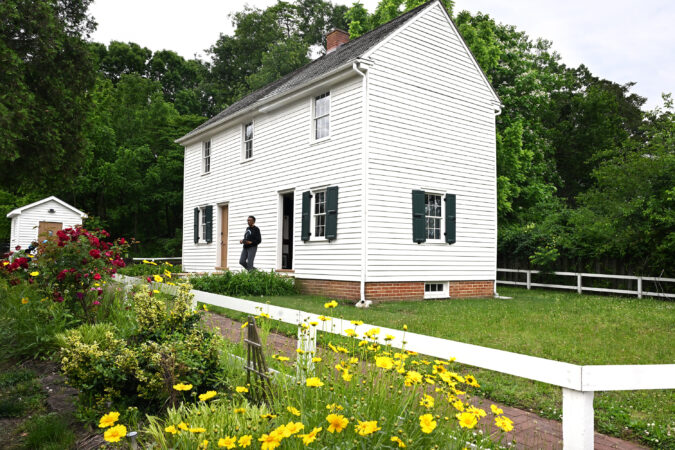
LAWNSIDE — For nearly 200 years, the historic Peter Mott House — believed to have once served as a stop on the Underground Railroad — has managed to withstand the encroachment of the outside world.
In the 1950s, construction of the New Jersey Turnpike brought a heavily used trafficway within just a few hundred feet of the home.There was the time, in the 1980s,when a developer bought up a patch of surrounding land with plans to raze the structure and build housing units. And the arrival of the COVID-19 pandemic in 2020 left the home shuttered for three years — and its future temporarily uncertain.
Now, the New Jersey Turnpike Authorityplans to soon begin work on a $2 billion project to expand the turnpike, which would bring the highway — currently located just 220 feet from the Mott House — 12 feet closer to the building.
The plans have prompted a wave of pushback from a small but vocal group of Lawnside residents, who fear that vibrations from the construction could damage the nearly two-century-old structure and that already “deafening” traffic noise in the area could become unbearable.
Already, says Linda Shockley, the longtime president of the Lawnside Historical Society, which owns and maintains the Mott House, it can be difficult for visitors to hear over the hum of the turnpike. The back of the house, which boasts a quaint patio, is essentially unusable without the use of microphones, she said — and this is to say nothing of the potential environmental and safety implications of bringing a heavily traversed highway even closer to a residential area.
The expansion, which also includes plans to widen nearby Warwick Road, has become — in Shockley’s words — “like a sword of Damocles hanging over us.”
“What are you doing and when are you going to do it?” Shockley said. “And what say do we have over how it’s done?”
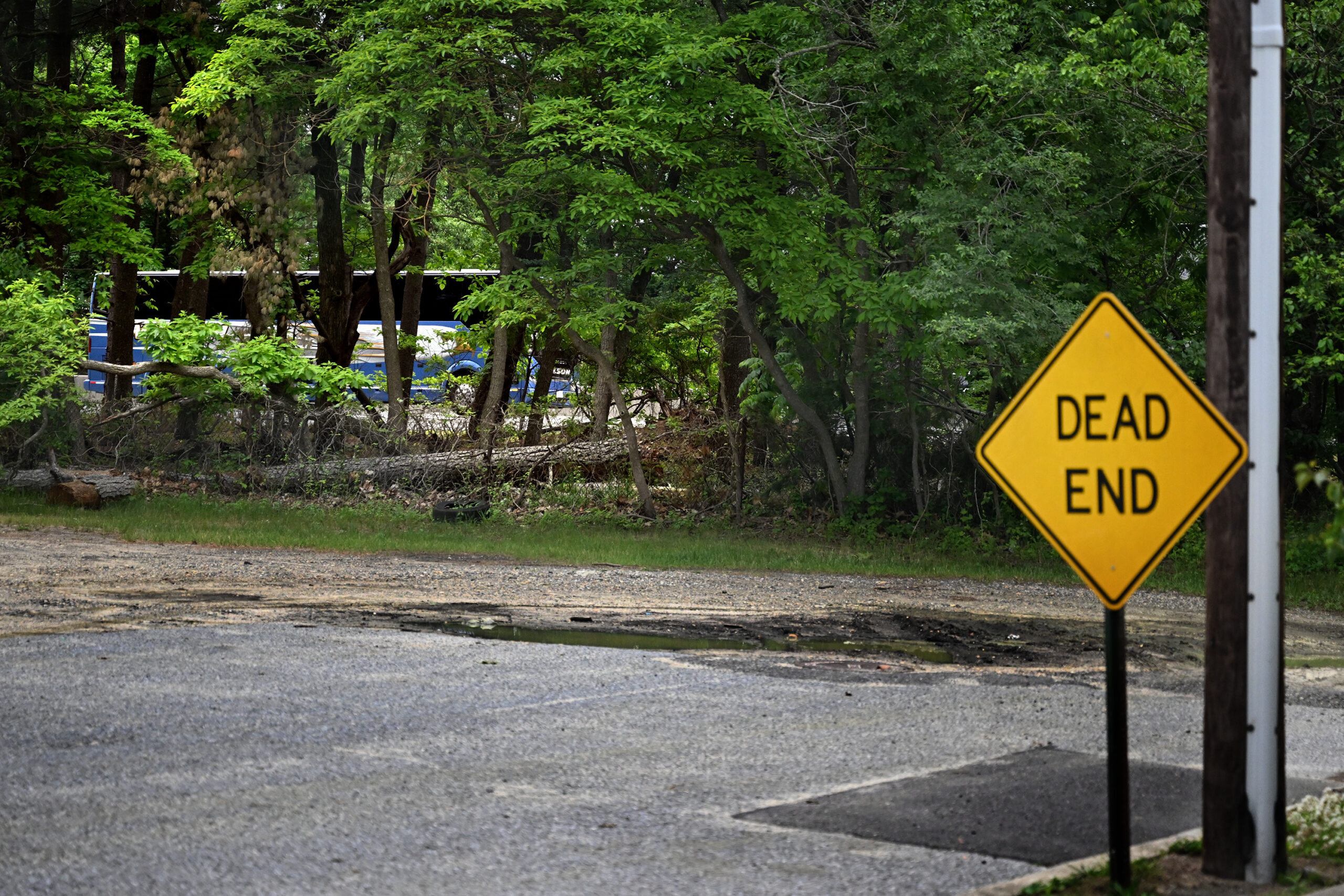
Traffic on the New Jersey Turnpike passes at the end of a cul-de-sac near the historic Peter Mott House in Lawnside, N.J.
Theconstruction arrives at a seminal moment for the historic borough, which this year is celebrating the 100th anniversary of its incorporation.
Originally settled by formerly enslaved people who escaped or were freedand considered the first independent, self-governing African American community north of the Mason-Dixon Line, Lawnside has long boasted a historical significance far outsizing its modest 1.4-square-mile footprint.
In the 1930s, it was home to a bustling entertainment district, drawing high-profile acts such as Ella Fitzgerald and Billie Holiday. Three decades later, Lawnside’s school district became one of the first U.S. governmental entities to declare the Rev. Dr. Martin Luther King Jr.’s birthday a holiday.
No aspect of Lawnside’s history, however, has remained as vital to its identity than the Mott House, the onetime home of Peter Mott,a free Black farmer, preacher, and abolitionist, who, along with wife Elizabeth, was a conductor on the Underground Railroad.
Built around 1845, the home is Lawnside’s oldest known house and is widely believed to have been a refuge for enslaved people traveling from the South — making it a strong symbol for the community at large.
“This town has been a beacon of hope for African Americans,” said Darryl Lee Dozier, 60, a longtime Lawnside resident. “To be able to walk outside and say, ‘Harriet Tubman came through this town’ — that’s iconic, man.”
At least 18 municipalities across Salem, Gloucester, Camden, and Burlington Counties will be affected by the turnpike project, but the proximity of the Mott House — as well as a neighboring housing development — to the construction has stoked fears that it will be uniquely vulnerable. State officials say they are working closely with local leaders to ensure that any adverse effects of the project are minimal.
(function() { var l = function() { new pym.Parent( ‘peter-mott__graphic’, ‘https://media.inquirer.com/storage/inquirer/ai2html/peter-mott/index.html’); }; if(typeof(pym) === ‘undefined’) { var h = document.getElementsByTagName(‘head’)[0], s = document.createElement(‘script’); s.type = ‘text/javascript’; s.src = ‘https://pym.nprapps.org/pym.v1.min.js’; s.onload = l; h.appendChild(s); } else { l(); } })();
AECOM, the infrastructure firm handling the engineering work for the turnpike project, told The Inquirer recently that Lawnside qualifies for noise barriers to help alleviate the effects of the project, and that “vibration monitoring,” as well as inspections, would be conducted throughout the course of the project.
“Should the vibrations for any reason exceed a threshold that would cause concern, then the activities would pause and we’d figure out what’s going on,” said Matthew Rao, a project manager with AECOM.
New Jersey Assemblyman William F. Moen Jr., who grew up in the area, said he has been engaged in conversations with the New Jersey Turnpike Authority about the project since 2020 and has been cognizant of the questions raised by Shockley and others.
“I’m acutely aware of her concerns, and I think they’re valid,” he said. “This is the time to be talking about those things, and making sure, to the extent that they can be, that they’re reflected in the final plan of what’s going to happen.”
Still, many in Lawnside remain wary.
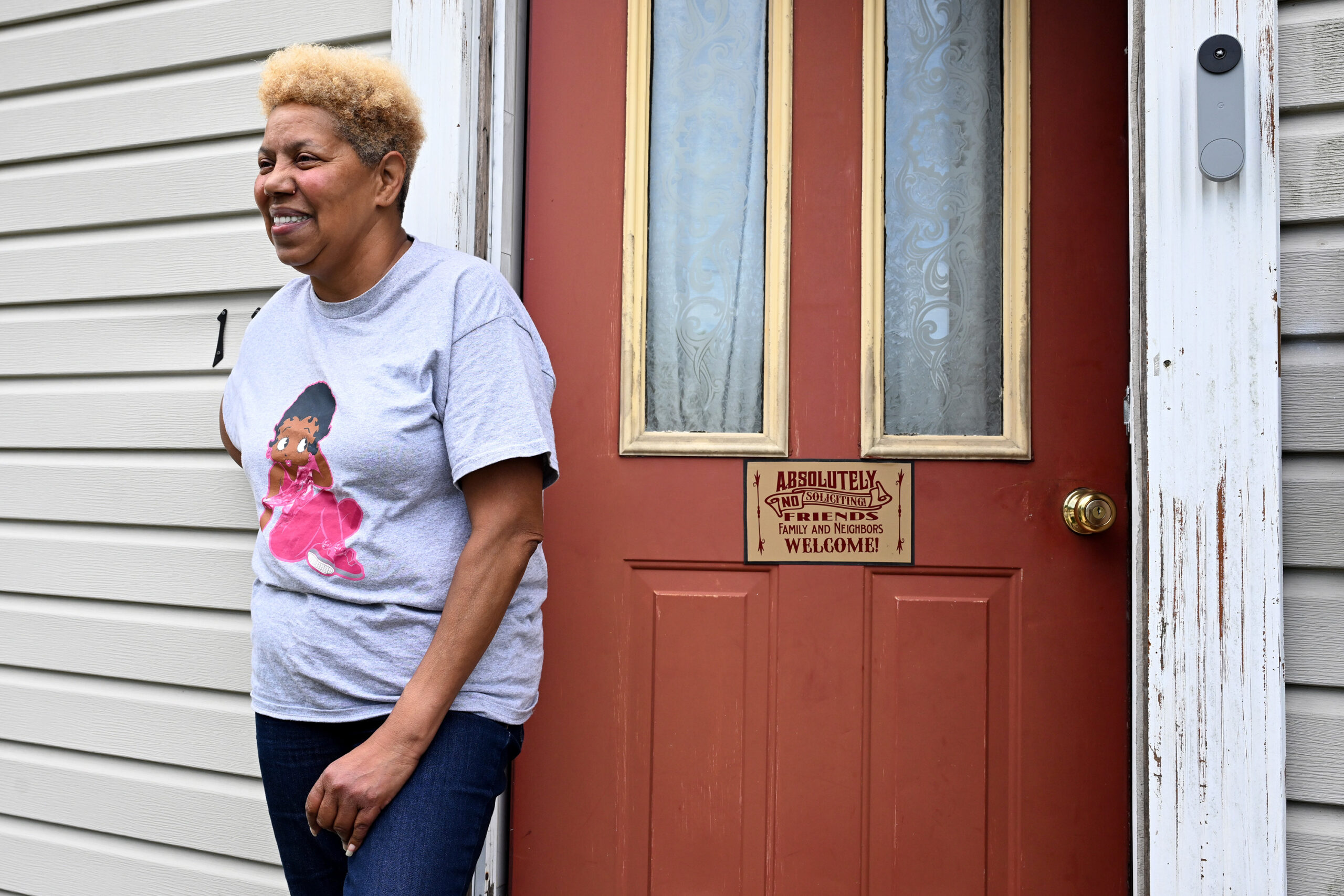
Kia Jones at her home next door to the Peter Mott House in Lawnside, N.J. Tuesday, May 26, 2026. Plans to expand the nearby New Jersey Turnpike have left local residents concerned about how it could affect a beloved institution as well as neighboring homes.
Despite meetings with officials, said Kia Jones, 60, whose home sits near the proposed turnpike expansion, residents have largely felt powerless throughout the process.
“Their whole attitude seems to be, ‘It’s a done deal — we’re just talking to you because we have to, but nothing’s going to change,’” she said.
For some in this South Jersey borough of roughly 3,000 residents, meanwhile, the expansion raises unmistakable echoes of the 1950s, when construction of the turnpike left a profound impact on the community.
At the time, America’s vast network of highways was displacing — and often targeting — Black communities across the country.
Initially, Shockley said, only six homes in Lawnside were supposed to be affected by the turnpike’s creation. But by the time it opened in November 1951, she said, 27 families had been affected.
“Some people’s houses were purchased, some houses were condemned,” Shockley said. “I’ve seen pictures of houses on flatbed trucks, being moved.”
(It was not lost on some in Lawnside, Shockley points out, that the turnpike conveniently curves around the nearby Tavistock Country Club, a private golf club founded in 1920.)
Though few in Lawnside are old enough to remember the turnpike’s arrival, many have felt the ripples.
Lorraine Pollitt, 70, a lifelong Lawnside resident, grew up hearing about her great-grandparents’ farm, which, she said, had fallen in the turnpike’s right-of-way and, as a result, had to be sold.
Seventy-five years later, Pollitt said, the expansion project feels like more of the same.
“Just taking more from us here,” she said. “It’s always something.”
For Shockley, who has served as president of the historical society since 1994, the effort to preserve and protect the Mott House has been a nearly 40-year endeavor.
She first got involved in the late 1980s, when a local developer, Mark DeFeo, received permits from the borough to raze the house in order to build a small housing development.
A group of residents organized to try to stop the home’s demolition, and Shockley — who was raised in Lawnside and had recently moved back from New York — joined the effort.
It took three years and considerable legal wrangling, but the developer eventually agreed to sell the home to the group for $1.
For its efforts, Shockley later told the New York Times, the group found itself in possession of “a decaying, vacant house … in danger of collapsing.”
In the years since, however, the historical society, buoyed by a dedicated collection of volunteers, has turned the property into a gem that has garnered national renown. The group has raised hundreds of thousands of dollars toward upgrades and repairs through grants and donations.
The house opened to the public in 2001, and, today, it offers a variety of programming, including a weeklong summer camp for middle schoolers on the history of the Underground Railroad, sitting on both the national and state registers of historical places.
In her mid-30s when she joined the effort, Shockley is now in her 70s, her hair flecked with gray. She retired in 2021 from her job at the Dow Jones News Fund, a journalism nonprofit foundation.
“Don’t tell anyone,” she joked one morning recently, from a seat inside the Mott House, “but I’m getting older.”
Linda Shockley, president of the Lawnside Historical Society, at the Peter Mott House in Lawnside, N.J. Tuesday, May 26, 2026. Shockley has served as president of the local historical society since 1994.
But while there is still work to be done, she remains dedicated to doing it — one more battle in a long string of them.
“Ask anybody who’s trying to do anything with historic buildings, or restore history or culture, and you find that, yeah, there’s always something — and there are always threats to it,” she said.
The Philadelphia School Board voted Thursday to nonrenew a charter school run by a veteran former district administrator, pointing to poor test scores and operational problems.
The board voted 8-0 to nonrenew Global Leadership Academy Southwest at Huey, a charter run by Naomi Johnson-Booker, who operates another GLA charter in West Philadelphia. Board member Whitney Jones abstained, citing personal reasons.
Charter schools are publicly funded but independently managed. In Philadelphia, about one-third of public school students attend brick-and-mortar charters.
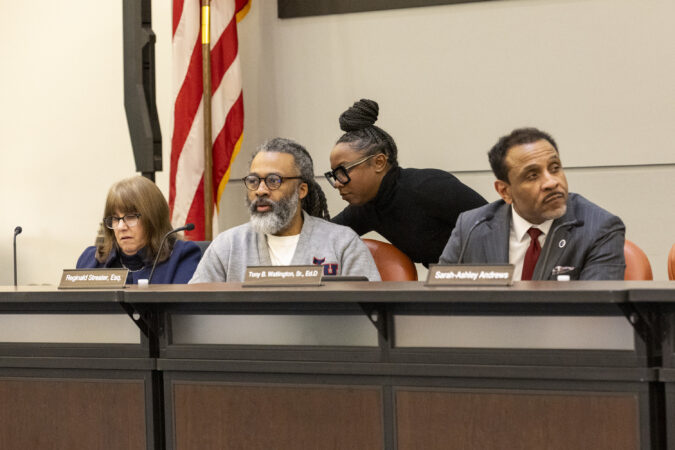
“We have a responsibility that is clear … to protect every child’s right, civil right, to a high-quality public education,” said the board’s president, Reginald Streater. He noted that GLA Southwest, a K-8 enrolling close to 600 students at 52nd and Pine Streets, has posted poor academic performance, with only 7% of students scoring proficient or advanced in math on the Pennsylvania System of School Assessments in 2025.
The school also has poor student attendance, and has not met district governance and financial standards, with conflicts of interest in counsel representation, insufficient cash on hand, and “questionable financial payment plans,” Streater said.
Noting GLA Southwest’s status as a Renaissance school — a former district school handed over to charter management a decade ago as part of an initiative to turn around failing schools — Streater said it was the board’s obligation “to do everything we can to create seats or incentivize seats that truly support student achievement, and as a Renaissance school, to complete the turnaround.”
The board’s vice president, Sarah-Ashley Andrews, said the fact that the charter didn’t meet academic, operational, or fiscal standards on the district’s evaluation was “a clear red flag.”
The vote doesn’t mean GLA Southwest will close, but triggers public hearings on the school’s performance.
Supporters of the charter said the school’s test scores weren’t a full reflection of its value to students and the community.
Zenobia Story, the school’s principal, said students had been improving, with proficiency on the state’s English language arts tests growing from 9.6% in 2022 to 22.4% in preliminary 2026 results.
The results tell “a story of progress, not stagnation,” and “a school community moving in the right direction,” Story said. “The response should not automatically be closure.”
Nutina Martin, the school’s director of climate and culture, said the school had inherited “significant climate and safety challenges.” But she said it had transformed since it became a charter in 2016, when there were 147 out-of-school suspensions in a single school year, Martin said. Now, she said, there were fewer than 30.
Streater said the charter’s nonrenewal hearings would give the school “an opportunity under oath with evidence” to support statements made by staff Thursday.
Philadelphia Montessori’s executive director, Amanda Wilson, said the board had “created needless uncertainty” for the school’s families and staff.
Streater said the board was “simply trying to do our duty, in being responsible charter school authorizers” and fiscal stewards.
Spending on SEPTA
In other business, the school board agreed to spend up to $34 million on SEPTA fare cards for students in the 2026-27 school year. Officials estimate 62,000 district, charter, and parochial school students are eligible for free fare cards — but that money is reimbursed through a state transportation subsidy.
SEPTA, with district cooperation, is warning students that they have to use those cards. It’s launching a crackdown on student fare evasion in the coming school year.
Transit system officials, who said they’re losing an estimated $11 million annually on students not swiping their fare cards.
Under the new fare diversion system, any student caught not swiping their card — technically a theft of service offense — will begin receiving formal warnings that will also be sent to transportation liaisons at their schools.
After a student’s third warning, they would receive a theft of service citation and court referral.
Money for technology and to fix a closing school
The board also voted to spend $4.1 million on technology — an advanced Google system officials said was “foundational to the district’s educational and operational objectives” and GoGuardian, an internet-filtering service.
The contract for both services lasts through 2029.
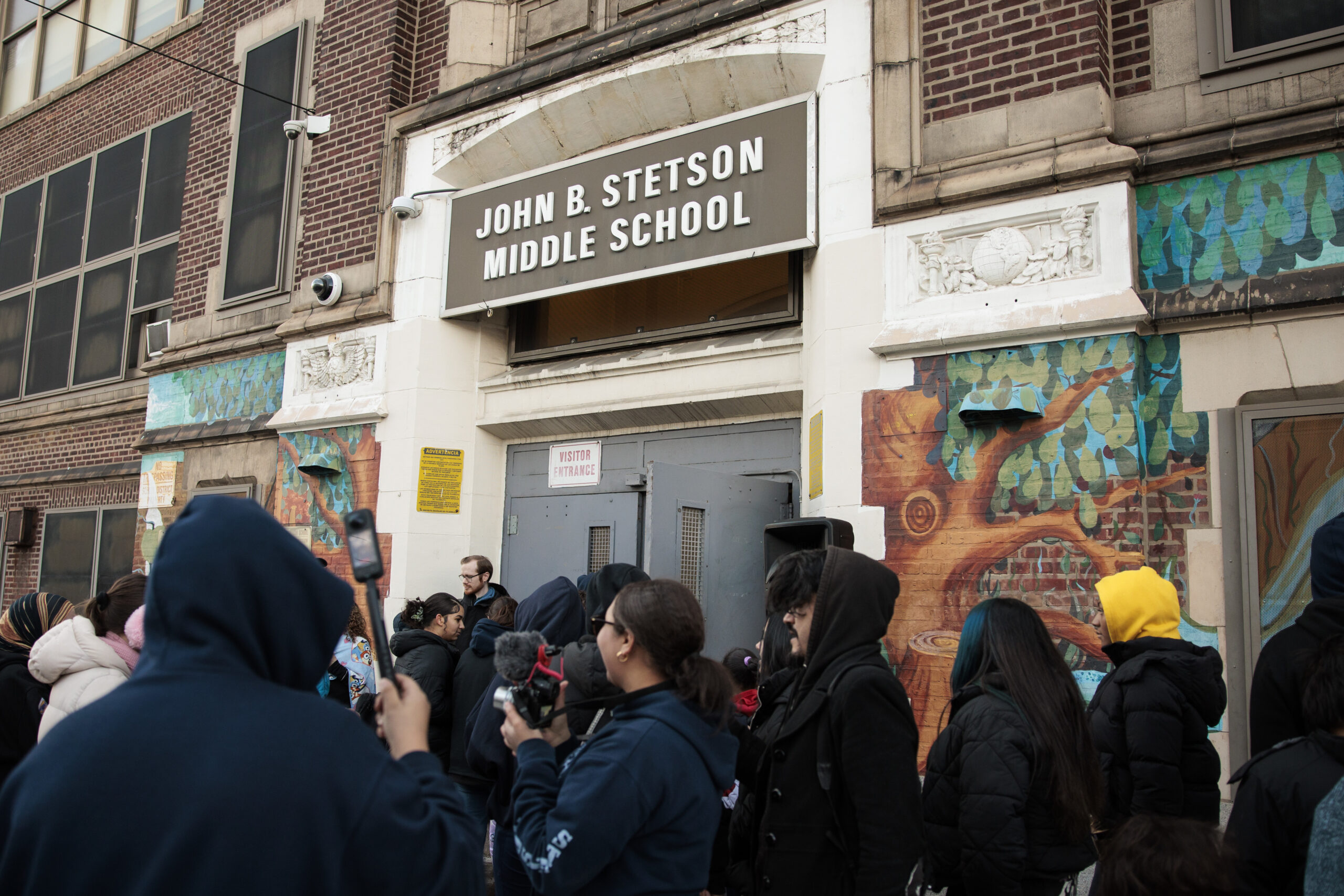
Students, teachers and supporters rally before a community meeting at John B. Stetson Middle School on Thursday, Feb. 12, 2026 in Philadelphia. Stetson is one of 20 Philly public schools facing closure.
Stetson is getting a new roof and masonry repairs, work that’s necessary, according to board documents, “to preserve and protect the building’s structural integrity and long-term functionality.”
The board first moved to close Memphis Street in 2022 after the school missed the mark on meeting conditions it had previously agreed to.
To make the reabsorption of the school official, the board had to vote to report “Memphis Street Middle School” to the Pennsylvania Department of Education as a new district school opening in the fall. The school will serve students in grades 6 through 8; the current Memphis Street Academy also educates fifth graders.
In its first go-round as a district school, the building was known as John Paul Jones Middle School.
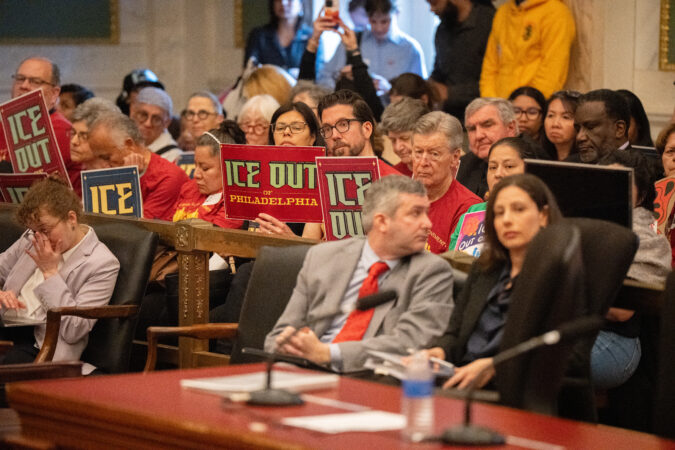
President Donald Trump’s administration sued Philadelphia and some of its top officials Thursday over a new ordinance that bars law enforcement officers from concealing their identities and effectively bans federal immigration agents from wearing masks.
The law, part of City Council’s recently adopted “ICE Out” package of legislation imposing some of the nation’s toughest local restrictions on immigration agents, is “blatantly unconstitutional,” the lawsuit said.
“Such an ordinance also undermines the principles of federalism that underlie our entire constitutional order by seeking to prevent effective federal law enforcement within Philadelphia,” according to the complaint.
The ordinance makes it a crime for any law enforcement officer, including Immigration and Customs Enforcement agents, to wear face coverings or conceal personal identifiers like badges and nameplates while carrying out their official duties in the city, and it requires officers to identify themselves. It also prohibits the use of unmarked vehicles.
The bill includes exceptions allowing officers to wear masks in certain circumstances, such as medical emergencies or SWAT operations.
An officerwho violates the ordinance could be prosecuted, and risks up to 90 days in jail plus a fine.
The suit, filed in the Eastern District of Pennsylvania, names as defendants the city, Mayor Cherelle L. Parker, District Attorney Larry Krasner, and City Solicitor Renee Garcia. It asks a federal judge to find the bills unconstitutional, warning that federal agents could suffer irreparable harm if the policy remains in place.
“Protecting officers’ personal identities is particularly important during high-risk enforcement operations involving individuals with violent criminal history, gang affiliations, transnational criminal organizations, and known or suspected terrorists,” the suit says.
The lawsuit marks the Trump administration’s most significant action targeting Philadelphia’s immigrant-friendly policies to date.
“Today we regrettably had to sue the birthplace of this great Nation,” Associate Attorney General Stanley Woodward said in a statement. “But we will not sit by while Philadelphia flagrantly violates our Constitution, seeking to criminally punish our Nation’s law enforcement heroes merely for doing their job.”
Philadelphia has long been known as a sanctuary city primarily because it does not comply with ICE-issued detainers, in which federal agents ask local jails to facilitate the arrest of undocumented immigrants in their custody.
But Parker has largely avoided direct confrontation with the White House over the issue, a reversal from the combative stance of her predecessor, former Mayor Jim Kenney.
Parker’s supporters credit her with careful, crafty management of the city’s relationship with Trump, noting Philadelphia has been spared from the surges of federal agents the president has sent to other cities. But immigration advocates say Parker has backed away from a fight at a time when strong action is most needed.
The tension surfaced when Parker decided to let the mask bill became law without her signature, after Garcia warned the mayor that the provisions might not be legally enforceable.
Council members, however, wanted to take a more proactive stance against Trump’s nationwide deportation campaign. And they seem to have gotten his attention.
Councilmember Kendra Brooks, who coauthored the “ICE Out” package, said she “will not back down from this fight.”
“Philadelphia doesn’t like bullies. And we certainly don’t like masked PPD officers or ICE agents terrorizing our neighbors,” Brooks said in a statement. “The people of this city expected our leaders to fight back against Trump’s invasion. That’s what we did when we passed ICE Out.”
Brooks noted that the lawsuit cites the Parker administration’s publicly aired concerns about the bill, and said other jurisdictions targeted by Trump after they passed legislation restraining ICE have not had to deal with that dynamic.
“Other lawsuits aren’t dealing with the City’s own words about the laws being used against them,” Brooks said.
The Parker administration declined to comment.
The Pennsylvania Immigration Coalition condemned the lawsuit as a political effort to undermine local policies that keep families safe, strengthen public trust, and ensure city resources serve Philadelphians.
“Once again the Trump administration is using the courts to wage a political campaign against immigrant communities, instead of addressing the real needs of our country,” coalition executive director Jasmine Rivera said in a statement. “Pennsylvanians have been clear, they do not want more immigration enforcement and detention centers, they want affordable education, healthcare, and housing.”
Councilmember Rue Landau, the legislation’s other coauthor, criticized Trump for “targeting Philadelphia because our city dared to stand up and say that masked federal agents should not be able to operate in our communities and target our vulnerable neighbors without accountability.”
‘We will arrest you’
In addition to banning officers from concealing their identities, the “ICE Out” package, which in April passed Council with a veto-proof supermajority, prohibits federal immigration agencies from staging raids on city-owned property, bans discrimination on the basis of citizenship status, and prohibits the city from engaging in most forms of information-sharing with ICE.
The legislation also codified some of Philadelphia’s long-standing sanctuary city policies that had been established only through executive order — most notably a ban on city jails honoring ICE detainers not accompanied by judicial warrants.
Parker did not sign the bill after Garcia expressed concern about the ban’s “significant legal and operational challenges,” the suit notes. The mayor’s signature would signal the Parker administration’s intent to enforce the requirement, the solicitor said, and would send an inaccurate signal that the prohibition was enforceable.
While Parker might have attempted to distance herself from the requirement by not signing the bill, the lawsuit quotes Krasner threatening federal agents with prosecution.
“We will arrest you. We will put handcuffs on you. We will close those cuffs. We will put you in a cell,” Krasner said in January. “We will do everything in our power to convict you and we will make sure you serve your entire sentence because Donald Trump has no power whatsoever to pardon you.”
Larry Krasner shown here during a press conference at City Hall to announce a package of bills aimed at pushing back against ICE enforcement in Philadelphia, January 27, 2026.
Philly case could have national stakes
The complaint makes clear that by bringing this lawsuit, the Department of Justice is not closing the door on challenges to other ICE Out ordinances.
Around the country, more and more Democratic-led communities are attempting to regulate what ICE can and cannot do within their jurisdictions. And doing so with the support of immigrant communities.
“In all the ways that ICE agents terrorize and violate the rights of our community, masked kidnappings are ones we consistently see and hear about,” said Erika Guadalupe Núñez, executive director of Juntos, the South- Philadelphia-based immigrant advocacy organization.
She said, however, that “we’re part of a strong local movement organized to fight back, and we all embody the spirit of this city, we will not back down easily.”
In March, the Montgomery County Board of Commissioners passed a resolution that restricted the agency from using county property or resources for civil investigations.
Issues around masks and identification have been particularly contentious.
Activists in Philadelphia and elsewhere say ICE arrests often look like kidnappings or muggings, where men in ordinary clothes, with no visible identification, suddenly descend on their target. The people being arrested may think they are being attacked by criminals.
Several states, including New Jersey and New York, have passed laws to ban law enforcement officers, including ICE, from wearing facial coverings while on duty.
In April, the U.S. Court of Appeals for the Ninth Circuit upheld a lower court’s injunction on a California law that required federal agents to “visibly display identification.” The unanimous three-judge panel ruled that the requirement violated the Constitution’s supremacy clause, which bars the states from regulating federal government activities.
New Jersey Gov. Mikie Sherrill signed bills in March that essentially banned ICE agents and police from wearing masks on the job, drawing pushback from Republican lawmakers. The Trump administration sued New Jersey in federal court in April, and the New Jersey Monitor and others reported that ICE agents continued to cover their faces during recent clashes with demonstrators outside the Delaney Hall immigrant detention center in Newark.
The Trump administration says federal immigration officers wear face coverings to protect themselves and their families from anti-ICE activists who may seek to identify and harm them. Assaults and death threats are on the rise, the administration said.
The city does not have a right to dictate the content of the panels, the court found.
The judges further found that the federal government’s proposed replacement panels, which historians say whitewash Washington’s role in slavery, “are full of historical context.”
The proposed panels “highlight the momentous events that took place in the President’s House and the other sites at Independence National Historical Park,” Judge Thomas M. Hardiman, a President George W. Bush appointee, wrote in the opinion. “They acknowledge the evil of slavery, including its injustices and hypocrisies, and, by telling the story of the nine slaves that Washington kept in the President’s House, remind us of their essential humanity.”
It was not immediately clear what would happen next at the site. The federal government did not immediately outline its next steps, and there are conflicting court rulings over the Trump administration’s push to remove displays from national parks that “inappropriately disparage Americans past or living.”
But the ruling does bring to a close a chapter in the President’s House litigation, the first courtroom clash between Trump and Mayor Cherelle L. Parker’s administration. Any further review of the injunction is at the discretion of the three judges, the full Third Circuit, or the Supreme Court and is not guaranteed.
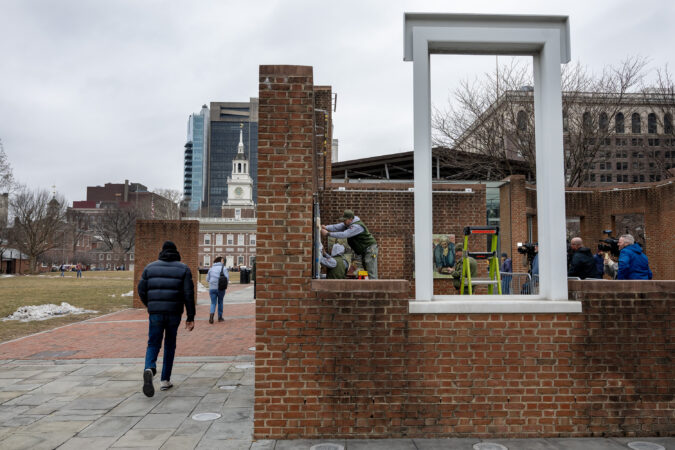
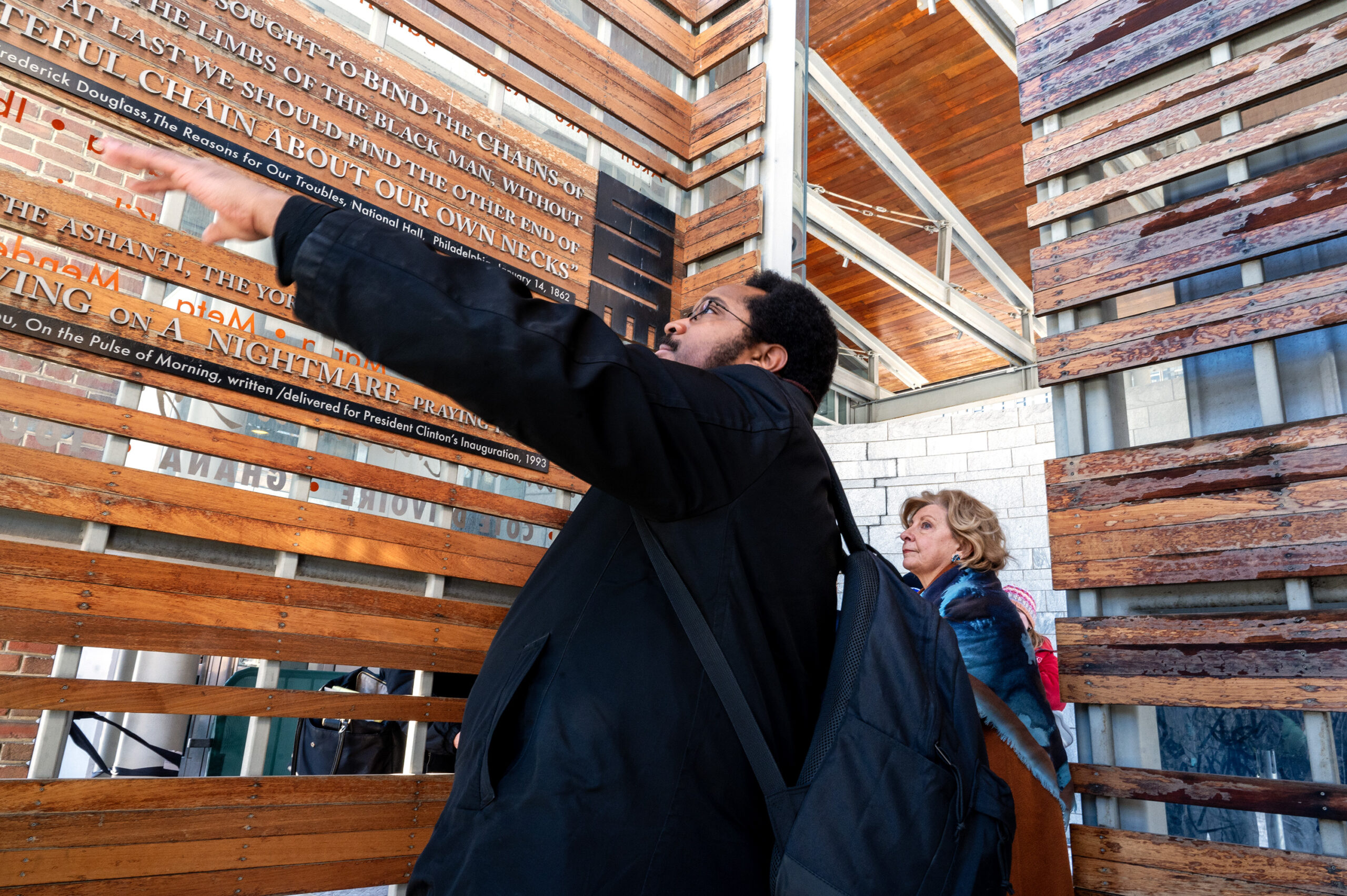
Mijuel Johnson, a guide with The Black Journey: African-American Walking Tour of Philadelphia, leads District Court Judge Cynthia Rufe (right) as she visits the President’s House in Independence National Historical Park in February.
The city was unable to convince the Third Circuit panel it has joint decision-making power with the federal government over the entirety of Independence National Historical Park because of the local ownership of Independence Hall.
Philadelphia has standing to argue in court that the federal government violated the contract signed when the city donated the President’s House to the National Park Service, Hardiman wrote. The agreement included a guarantee the federal agency would maintain the site.
But the city had to prove it could win based on that argument to keep the injunction alive, and the judges disagreed.
“The duty to ‘maintain’ is better understood as a general management obligation that accompanies ownership, not a promise that the exhibits will forever remain in place regardless of the owner’s wishes,” the opinion said.
The city’s claim that the removal was “arbitrary and capricious” under the Administrative Procedure Act also did not find purchase. The federal law allows challenges only to “final” agency actions, but the newly proposed panels show the January removal was not the Trump administration’s “last word on the matter,” the opinion said.
Avenging the Ancestors Coalition, one of the advocacy groups leading efforts to protect the President’s House, said in a statement that the group was disappointed by the decision but would persevere. The coalition was consulting its legal team to consider potential next steps.
“This is definitely not the end of this fight, nor does it diminish the importance of ensuring that the full truth of our nation’s history is preserved and presented accurately,” the organization said.
In a video statement Thursday, Parker said, “I will pursue every legal action possible in efforts to reverse this decision.”
A spokesperson for the U.S. Department of the Interior simply said: “Trust in Trump.”
Debate over history
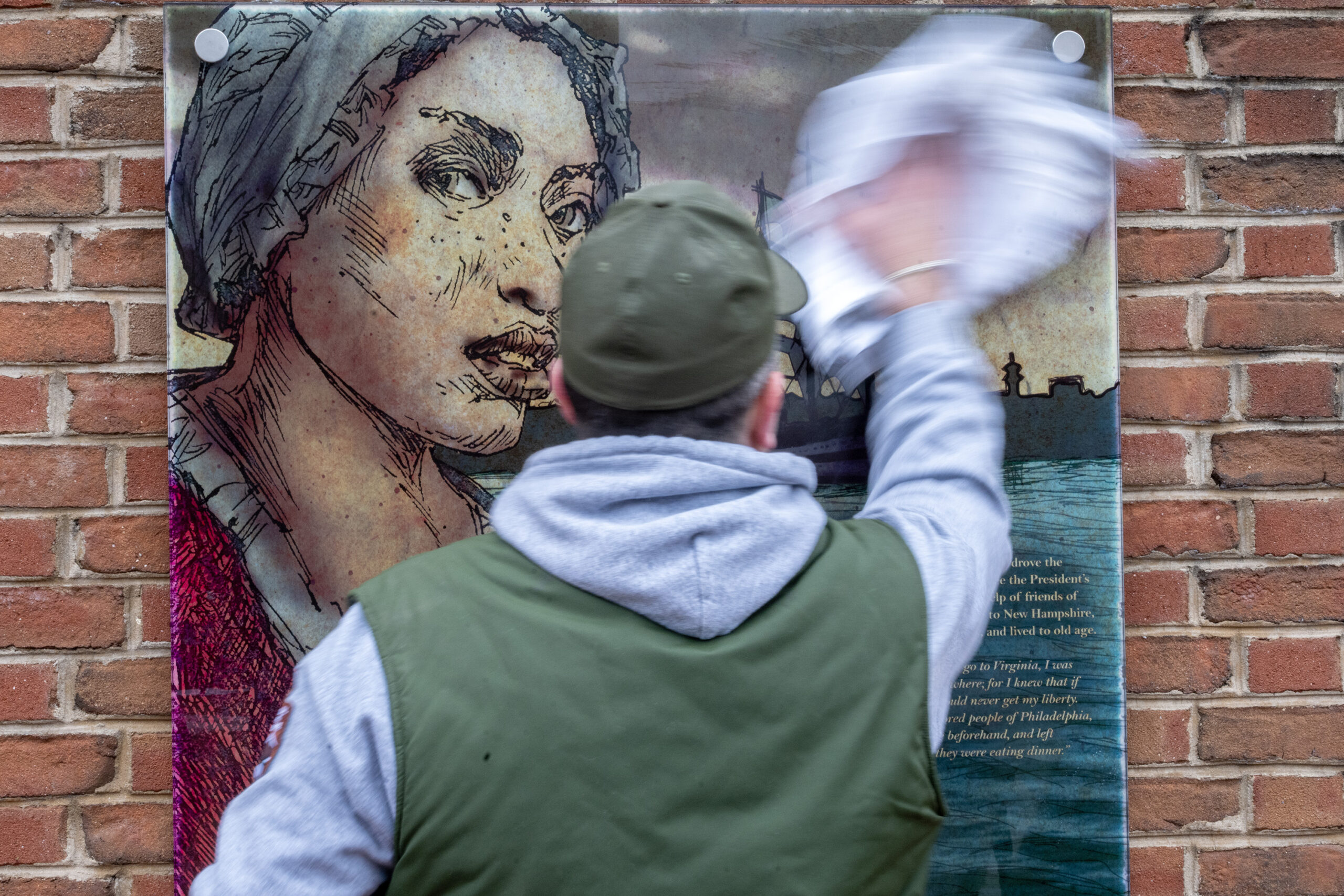
A worker cleans the glass on the panel for Oney Judge after re-hanging it at the President’s House in Independence National Historical Park in February.
The ruling is an inflection point in the tumultuous legal saga over whether the federal government has power to determine which version of U.S. history is displayed for public viewing — an issue even more salient ahead of the country’s 250th birthday on July Fourth.
The Trump administration ordered the removal of the President’s House exhibits in January after almost a year of scrutiny of the site. Months later, the government offered its own vision for how those panels would be replaced, quietly uploading them to the National Park Service website in April.
An Inquirer review of the panels found that the federal government had softened Washington’s role as an enslaver.
For instance, one proposed panel argues the people who were enslaved at the President’s House “experienced a greater modicum of autonomy than elsewhere in the South such as to explore the city and sometimes even attend the theater, with Washington buying the tickets.”
Historians argued the original panels were accurate, well-researched, and site-specific. The development of the site in the early 2000s was the product of collaboration across various disciplines including historians, artists, architects, and advocates.
But Thursday’s ruling says the Trump administration’s proposed displays offer a nuanced view on Washington’s and John Adams’ roles in or opinions on slavery, adequately highlight the stories of the nine people enslaved at the President’s House, thoroughly acknowledge the horrors and brutality of slavery, and uplift key figures in Black history.
“One panel … explains that Washington ‘often expressed discomfort with the institution and a desire to see it abolished,’ but, ‘as a Virginia plantation owner, his wealth and livelihood were deeply tied to it,’“ Hardiman wrote. ”Other panels provide an even broader overview of slavery and the struggle to extirpate it.”
The ruling landed just less than three weeks before the 250th anniversary celebrations, and one day before Juneteenth. Attorneys for the federal government said the new panels had been manufactured and were ready to be installed.
U.S. Rep. Brendan Boyle (D., Philadelphia), whose district includes Independence Park, said in a statement that Thursday’s ruling highlighted the urgency of passing his Protecting American History Act, which would shield historical displays at the park from government censorship.
“Just a block away from where our nation was founded, Donald Trump is choosing the path of tyrants who rewrite history instead of learning from it,” Boyle said. “As we approach America’s 250th anniversary, we must tell the full truth of our nation’s history — the good and the bad.”
The administration has appealed to the U.S. Court of Appeals for the First Circuit.
There is not a prescriptive way to resolve such conflicting rulings, which is why some legal scholars argue against so-called universal injunctions, in which one district judge’s ruling affects the entire country. The Supreme Court signaled its discomfort with those types of orders last year.
Conflicting rulings have become more prevalent during Trump’s tenure, as his administration has issued drastic measures that take immediate effect, said Michael Foreman, a professor at Penn State Dickinson Law.
Which order ends up prevailing will depend on whether the Massachusetts ruling is stayed, or if the issue escalates to the Supreme Court.
Three people were shot outside a pizzeria near Widener University in Chester on Wednesday night, police said.
The incident happened outside the Uno Pizzeria & Grill on Providence Avenue, a Widener University spokesperson said.
Chester police and criminal investigators with the Delaware County District Attorney’s Office are investigating the shooting, police said in a statement provided by city spokesperson Adriene Irving. No arrests have been made.
Map of the Pizzeria Uno on Providence Avenue in Chester where a shooting occurred on Wednesday night.
Police arrived around 10:45 p.m. Wednesday night and found a man, a woman, and a boywith gunshot wounds, police said. Emergency responders took them to area hospitals, police said.
“While we are relieved that none of the victims suffered life-threatening injuries, this senseless violence is unacceptable and has no place in our community,” Chester Mayor Stefan Roots said in a news release.
Roots said police are reviewing security cameras from nearby businesses to determine who was involved.
“Because of the density of cameras in the area, we are confident that these assets will significantly aid the investigation, and we expect to identify and apprehend the suspect or suspects quickly,” Roots said.
The university was in its summer session. A Widener spokesperson said the school is cooperating with law enforcement in the investigation.
Chester is in the middle of its annual “Safe Summer” program, which provides children and teens with summer camps and other programs that keep them “active, engaged, and on a positive path,” according to a city website. The program has been credited with helping lower crime in the city: In 2025, Chester had no fatal shootings in the summer and saw a decline in overall shootings.
The city will continue that and other efforts “to help curb gun violence and keep our neighborhoods safe,” Roots said.