Category: News

Latest breaking news and updates

  • Philly City Council members will soon consider seven ‘ICE Out’ bills. Here’s what the proposals would do.

    Philly City Council members will soon consider seven ‘ICE Out’ bills. Here’s what the proposals would do.

    City Councilmembers Kendra Brooks and Rue Landau on Thursday plan to formally introduce their “ICE Out” legislative package, which aims to place restrictions on federal immigration enforcement operations in Philadelphia.

    The seven bills range from codifying into law Philadelphia’s existing “sanctuary city” policies to a controversial ban on law enforcement officers wearing masks. Almost all of the bills contain exceptions noting that they do not apply if Immigration and Customs Enforcement agents secure judicial warrants for their activities or are acting under superseding federal laws.

    If all of the legislation becomes law, Philadelphia would have some of the nation’s most stringent local restrictions on federal immigration-enforcement operations.

    It’s likely that several of the bills will face legal questions, such as whether the mask ban is constitutional and whether Council has the authority to enact some of the rules the proposals seek to establish.

    After the bills are introduced Thursday, Council President Kenyatta Johnson will refer them to committee. One or more hearings will likely be scheduled in the spring.

    At that point, officials from Mayor Cherelle L. Parker’s administration, stakeholders, and experts will testify. Lawmakers could then amend the bills and vote on them in committee. If they advance, they would head to the Council floor for a final vote.

    In a sign that the bills are likely to gain traction, Majority Leader Katherine Gilmore Richardson on Wednesday praised Brooks’ and Landau’s efforts.

    “My heart breaks for everyone who has been impacted by ICE’s violent and dangerous actions and for everyone who feels afraid and unsafe in their communities,” Gilmore Richardson said, adding that she will work with other Council members “to protect our residents.”

    If approved on final passage, the bills would head to Parker’s desk. The mayor can veto them, sign them into law, or allow them to become law without her signature.

    Parker so far has largely avoided confrontation with President Donald Trump’s administration over his aggressive deportation campaign. The “ICE Out” bills may force her to engage more directly.

    Here’s what you need to know about each of the bills.

    Banning ICE agents from wearing masks

    Author: Brooks.

    Key excerpt:A law enforcement officer is guilty of criminal concealment if the law enforcement officer, while performing official duties and interacting with the public …. wears a mask, facial covering, disguise or any other garment that obscures the identity of the law enforcement officer, or fails to identify themselves to a subject of arrest, holding or detention.”
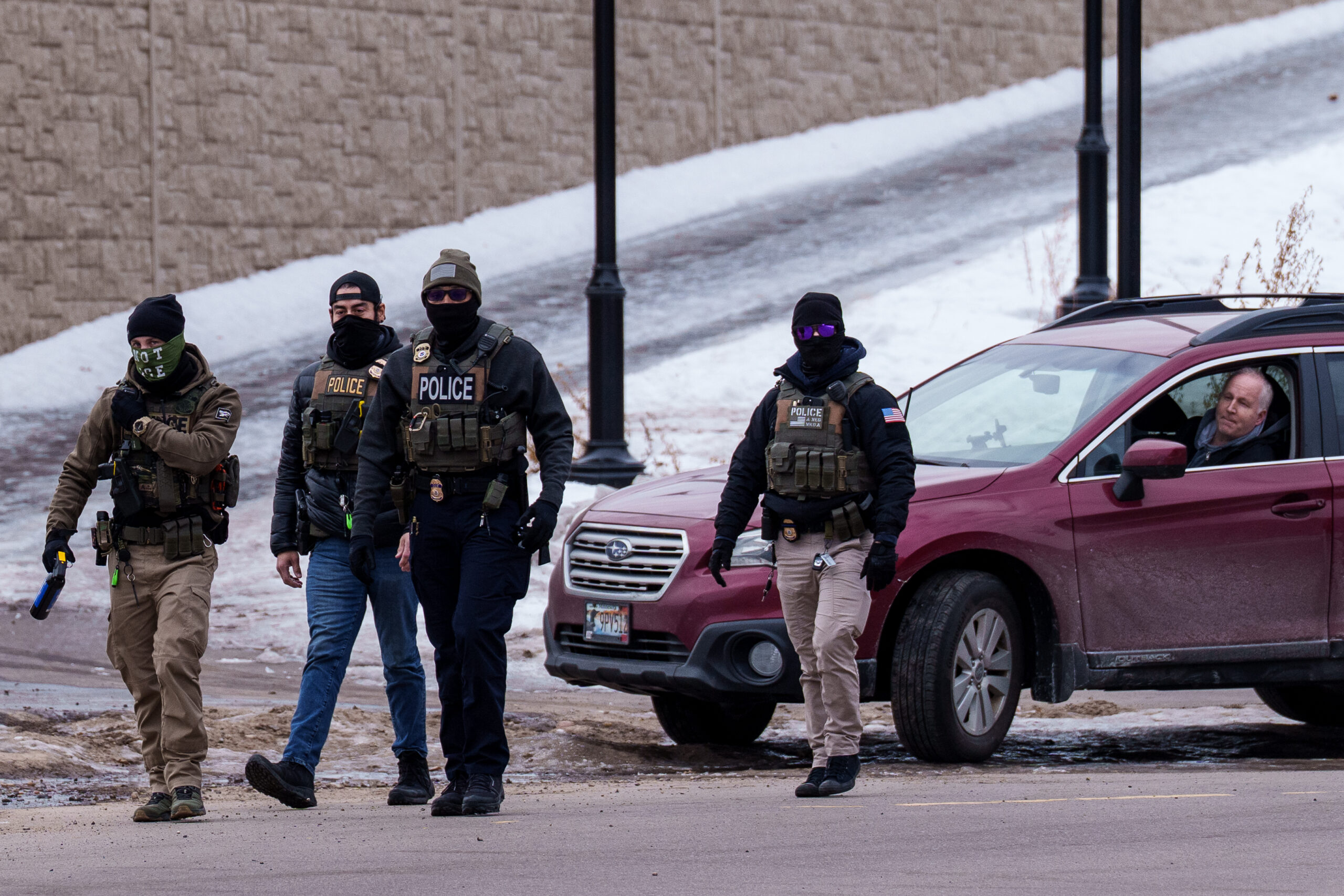
    A person looks out of their vehicle as Immigration and Customs Enforcement (ICE) agents walk away, Thursday, Jan. 15, 2026, in Richfield, Minn. (AP Photo/Adam Gray)

    What it does: The bill would ban law enforcement officers from obscuring their identities with masks. It also would require officers to wear badges, and would make it an offense to conceal badges or to decline to provide identifying information if requested by people they are arresting. Additionally, the bill would ban officers from using unmarked vehicles.

    Exceptions: The bill includes exceptions for undercover assignments, medical or religious masks, SWAT teams, and smoke-filtering masks worn during fires or similar emergencies.

    How it would be enforced: The district attorney would be able to charge an officer with a summary offense, the lowest level of crime in Pennsylvania. If found guilty, the officer would pay a fine of $300 for each day the law was violated or face up to 90 days in prison.

    Additionally, the bill would give any individual “aggrieved by a violation” the right to sue an agent for wearing a mask, with fines up to $2,000 per offense if a judge sides with the plaintiff.

    Twist: This bill applies to all law enforcement officers, not just ICE agents. That includes city police. It is likely that the Philadelphia Police Department, which sometimes uses unmarked cars, will have something to say about the proposed rules once the bill gets a committee hearing.

    Stopping Philly from coordinating with ICE

    Author: Brooks.

    Key excerpt:No City Agency or Employee shall enter into, renew, or participate in a 287(g) Agreement with the federal government.”

    What it does: The primary objective of this bill is to ensure the city never enters into a 287(g) agreement, in which local law enforcement officers are trained to perform immigration enforcement duties. (The agreement refers to a section of the U.S. Immigration and Nationality Act.) Philadelphia is not currently in a 287(g) agreement, so that provision would not have a significant impact in the near term.

    But the bill includes several other notable provisions, such as prohibiting city employees from assisting immigration enforcement in any way, and requiring them to report requests to assist ICE to their superiors.

    How it would be enforced: The city solicitor, Philadelphia’s top lawyer, would be responsible for suing city agencies or employees who violate the bill’s provisions. Potential consequences include a $2,000 fine and termination.

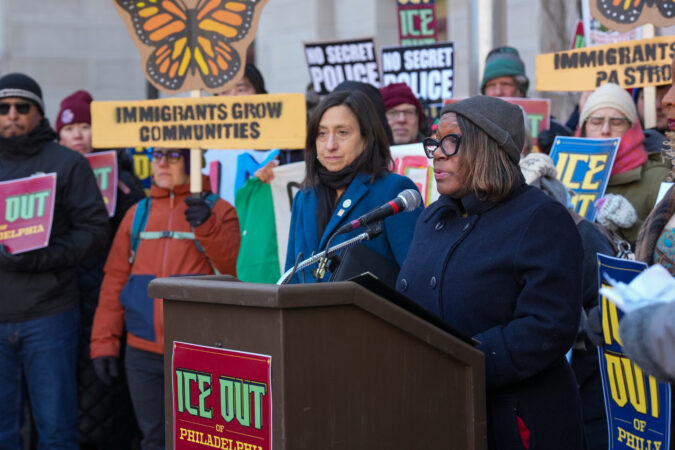
    Kendra Brooks shown here during a news conference at City Hall on Tuesday to announce a package of bills aimed at pushing back against ICE enforcement in Philadelphia.

    Prohibiting discrimination based on immigration status in city services

    Author: Landau.

    Key excerpt: “No City agency, official, employee, contractor or subcontractor shall …

    • “request information about a person’s citizenship or immigration status …
    • “condition the provision of City benefits, services, or opportunities on a person’s citizenship or immigration status or national origin …
    • “threaten, coerce, or intimidate a person based on their actual or perceived citizenship or immigration status [or] …
    • “initiate an investigation or take law enforcement action based on a person’s actual or perceived citizenship or immigration status.”

    What it does: This bill aims to protect individuals from being treated differently based on their immigration status when dealing with city government services.

    How it would be enforced: The city solicitor or anyone aggrieved by violations of the bill would be able to sue the offending city employee or agency.

    Banning employment discrimination based on immigration status

    Author: Landau.

    Key excerpt: “It shall be an unlawful employment practice to deny or interfere with the employment opportunities of an individual based upon … citizenship or immigration status.”

    What it does: The bill would add “citizenship or immigration status” to Philadelphia’s Fair Practices Ordinance, which prohibits employers from discriminating against workers based on characteristics including race, ethnicity, gender, and sexual orientation.

    How it would be enforced: If the bill is approved, Philadelphians who feel their employers have discriminated against them based on their immigration status will be able to file complaints to the Philadelphia Commission on Human Rights, which adjudicates alleged violations of the Fair Practices Ordinance.
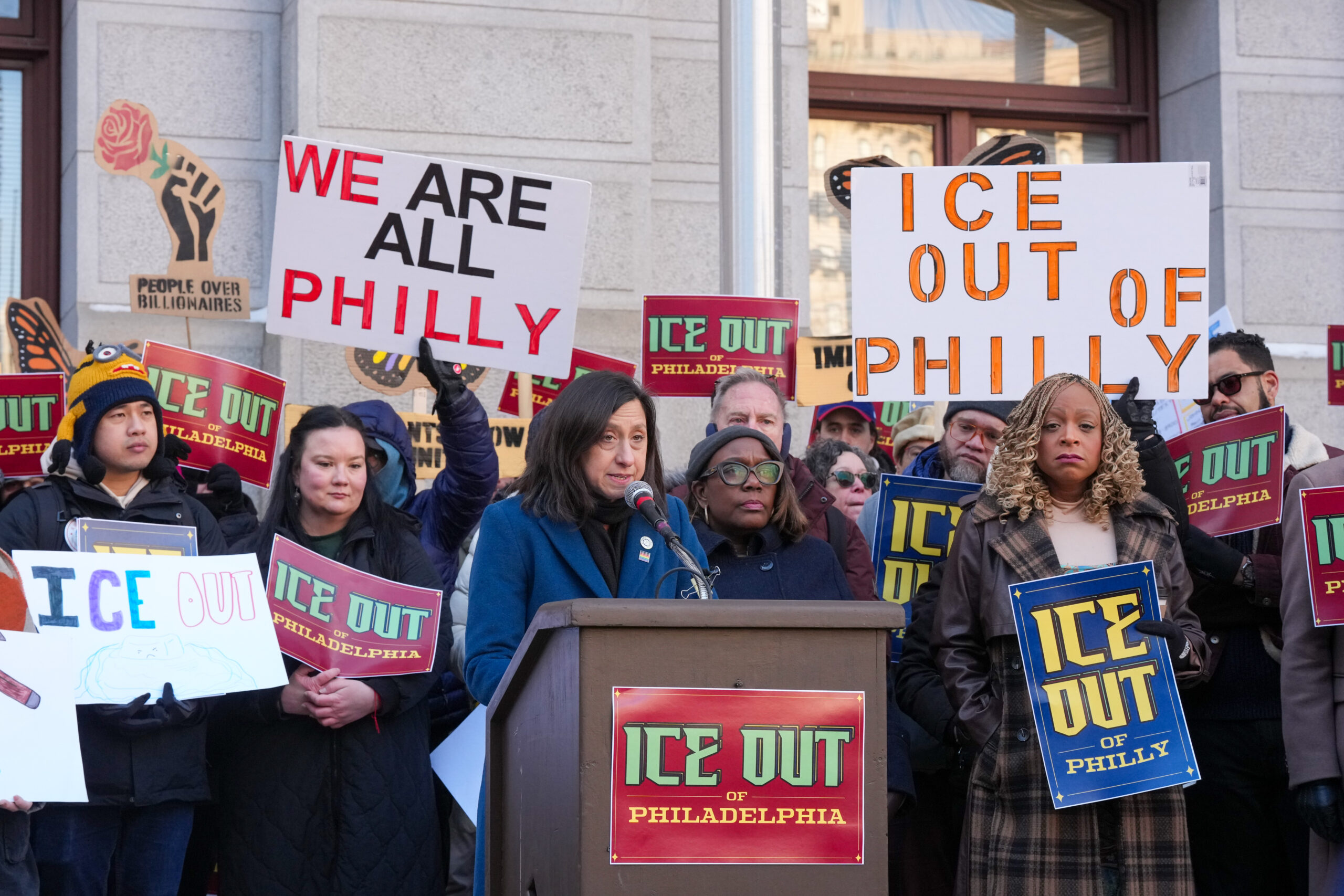
    Rue Landau shown here at the Tuesday news conference.

    Withholding data on citizenship and immigration status

    Author: Landau.

    Key excerpt: “No City agency … shall enter into any contractual agreement or arrangement with a federal agency or federal contractor to provide access to any data, database, or dataset where the purpose of such access includes assisting or supporting immigration enforcement operations.”

    What it does: This bill aims to prevent the federal government from accessing city data that could help immigration agents determine individuals’ citizenship status.

    It also would require the city to produce an annual report tallying federal data requests related to immigration status and any violations of the bill.

    How it would be enforced: The city solicitor or any individual aggrieved by violations of the bill would be able to sue the offending city employee or agency.

    Prohibiting immigration enforcement on city-owned property

    Author: Brooks.

    Key excerpt:It is unlawful to use City-owned or controlled property for the purposes of staging, conducting or assisting federal immigration enforcement activities.”

    What it does: The bill prohibits immigration enforcement operations on city-owned land, such as federal agents making arrests in city parks or ICE staging raids on municipally owned parking lots.

    The bill also allows city agencies to post signs on municipal property stating: “This property is owned and controlled by the City of Philadelphia. It may not be used for immigration enforcement activities.”

    How it would be enforced: The city solicitor may file a lawsuit to ask a judge to order the federal government to cease and desist from using city property.
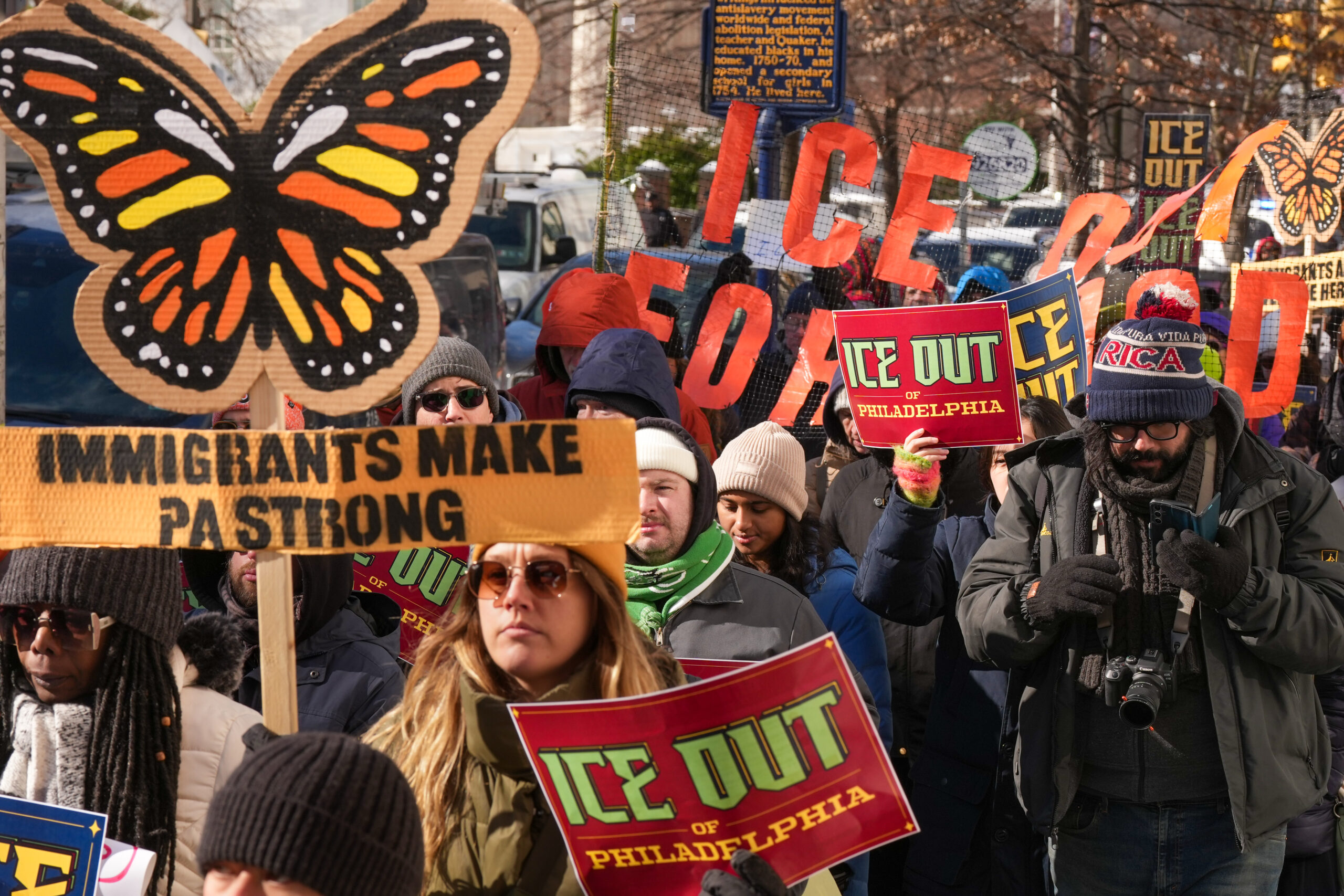
    Advocates and protesters on Tuesday in Center City call for ICE to get out of Philadelphia.

    Requiring warrants for nonpublic areas of ‘Safe Community Spaces’

    Author: Brooks.

    Key excerpt:No employee or agent engaged in official duties at a Safe Community Place shall have the authority to consent to permitting a law enforcement officer to enter a nonpublic area of the facility … to identify, arrest or otherwise impose a penalty upon a person for purposes of federal immigration enforcement.”

    What it does: The bill would effectively require immigration agents to secure judicial warrants to access nonpublic areas in “Safe Community Spaces,” including city-owned or -controlled hospitals, libraries, courthouses, recreation centers, and other city facilities. Currently, agents can access those areas if they get permission.

    The proposal also would also require judicial warrants for instances in which law enforcement seeks access to nonpublic areasto identify or impose civil or criminal liability upon a person” exercising protected rights such as the freedom of speech, assembly, and petitioning.

    Lastly, the bill would require city agencies to “identify property that has been, and is likely to be used by, immigration enforcementand mark it with signage stating: “In nonpublic areas of this property, a judicial warrant is required for law enforcement activities and no voluntary consent may be solicited from any employee.”

    How it would be enforced: Only the city solicitor can sue to enforce the bill’s provisions. Such a suit would not be filed against a federal agent. Instead, it would be filed against a staffer at a “Safe Community Space” who gave federal agents permission to access nonpublic areas at the facility.

    Staff writers Anna Orso and Jeff Gammage contributed to this article.
  • A plan to redevelop Gladwyne has residents split on their town’s future. What happens next?

    A plan to redevelop Gladwyne has residents split on their town’s future. What happens next?

    Three weeks after developers unveiled a sweeping plan to revitalize much of downtown Gladwyne, the affluent Main Line community has been abuzz with excitement, and skepticism, about the village’s future.

    On Jan. 8, Andre Golsorkhi, founder and CEO of design firm Haldon House, presented plans for a revitalized town center, complete with historic architecture, green spaces, and businesses that “fit the character” of the area. Golsorkhi told a packed school auditorium that Haldon House plans to bring in boutique shops, open an upscale-yet-approachable restaurant, and create spaces for communal gathering.

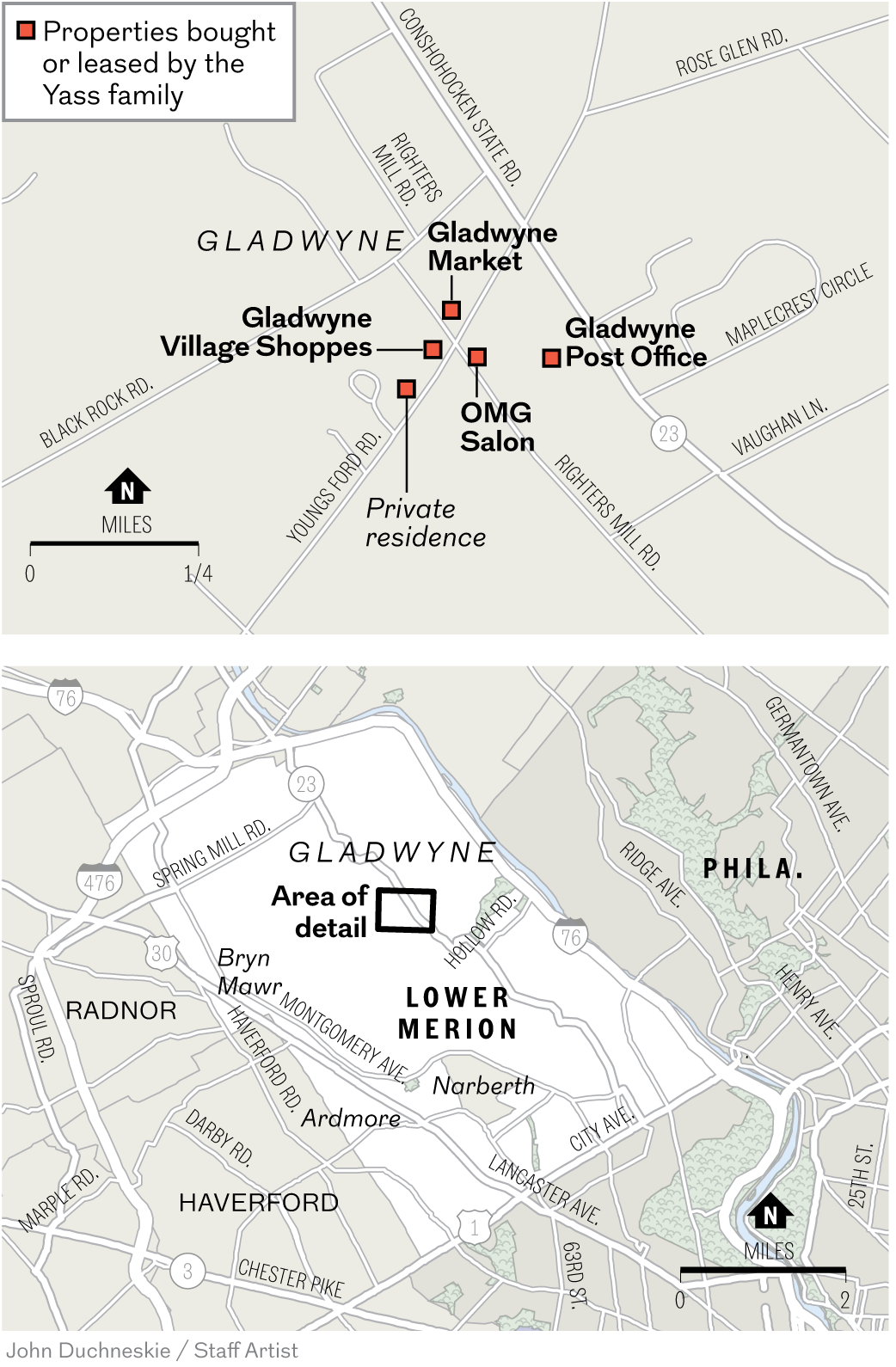
    At the meeting, Golsorkhi also revealed that the project was backed by Jeff Yass, Pennsylvania’s richest man, and his wife, Janine. Golsorkhi said the Yasses want to revitalize Gladwyne as part of a local “community impact project.” Haldon House and the Yasses, who live near Gladwyne, have spent over $15 million acquiring multiple properties at the intersection of Youngs Ford and Righters Mill Roads.

    The news drew a flurry of social media posts — and a write-up in a British tabloid. While some praised the proposal, others protested the changes headed toward their quaint community, and the conservative donor financing them.

    Renderings of a proposed revitalization project in Gladwyne, Pa. Design firm Haldon House is working with billionaire Jeff Yass to redevelop the Main Line village while preserving its historic architecture, developers told Gladwyne residents at a Jan. 8 meeting.

    What is, and isn’t, allowable?

    For some residents, one question has lingered: Is one family allowed to redevelop an entire village?

    A petition calling on Lower Merion Township to hold a public hearing and pass protections preventing private owners from consolidating control of town centers had gathered nearly four dozen signatures as of Friday.

    Around 4,100 people live in the 19035 zip code, which encompasses much of Gladwyne, according to data from the 2020 U.S. Census.

    “Residents deserve a say before their town is transformed. No one family, no matter how wealthy, should unilaterally control the civic and commercial core of a historic Pennsylvania community,” the petition reads.

    Yet much of Haldon House’s plan is allowable under township zoning code, said Chris Leswing, Lower Merion’s director for building and planning.

    Plans to refurbish buildings, clean up landscaping, and bring in new businesses are generally permitted by right, meaning the developers will not need approval from the township to move forward. Gladwyne’s downtown is zoned as “neighborhood center,” a zoning designation put on the books in 2023 that allows for small-scale commercial buildings and local retail and services. The zoning code, which is currently in use in Gladwyne and Penn Wynne, ensures commercial buildings can be no taller than two stories.

    The developers’ plans to open a new restaurant in the former Gladwyne Market and renovate buildings with a late-1800s aesthetic, including wraparound porches and greenery, are generally within the bounds of what is allowed, once they obtain a building permit.

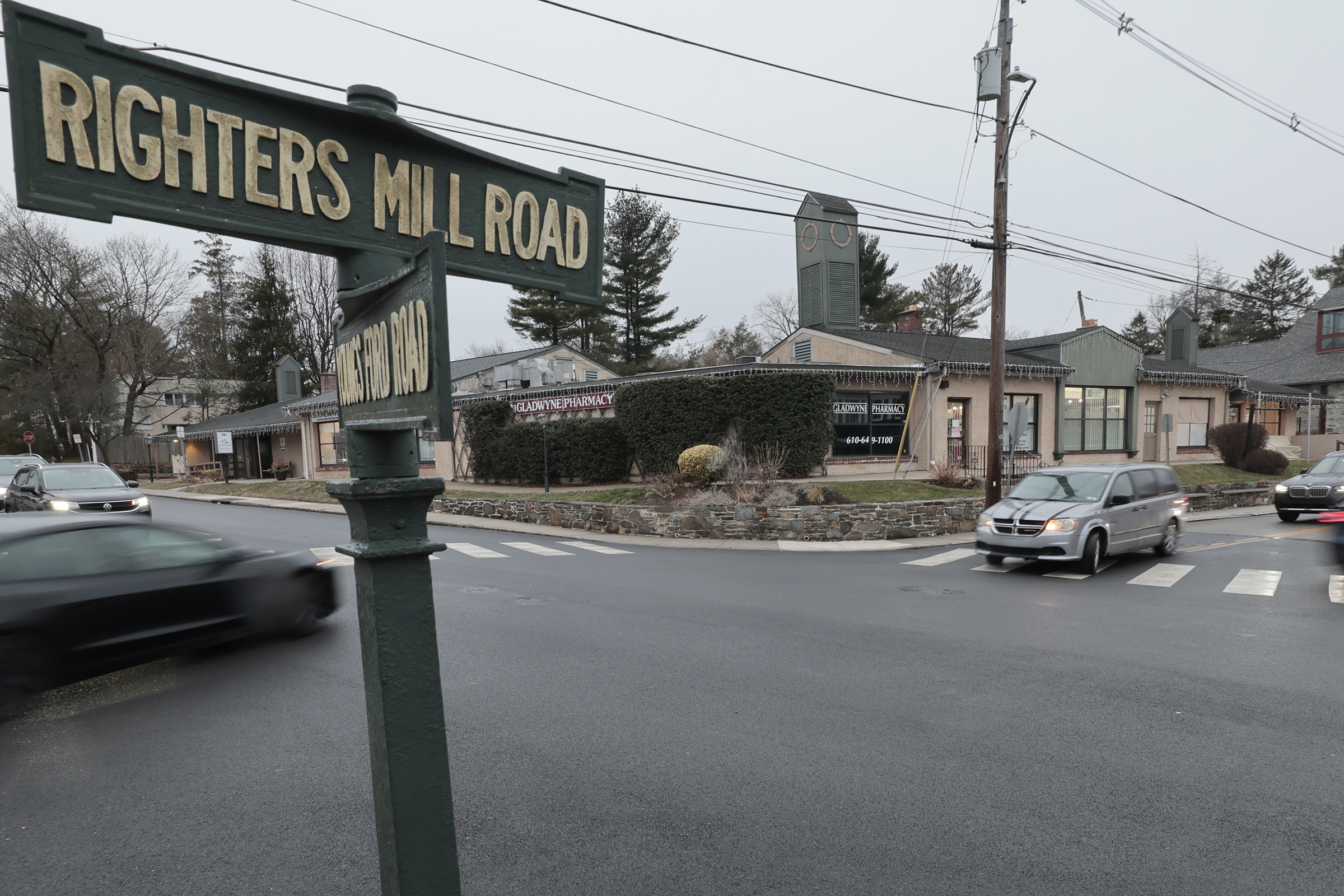
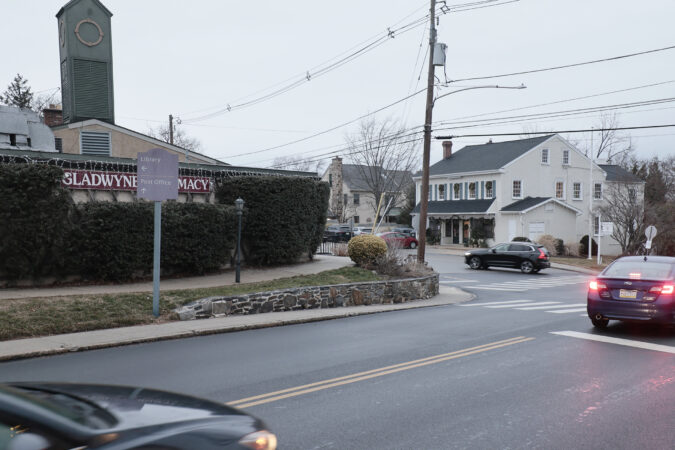
    The Village Shoppes, including the Gladwyne Pharmacy, at the intersection of Youngs Ford and Righters Mill Roads in Gladwyne on Friday, Jan. 9, 2026.

    More ambitious plans, however, like converting a residential home into a parking lot or burying the power lines that hang over the village, would require extra levels of approval, Leswing said.

    The developers hope to convert a residential property on the 900 block of Youngs Ford Road into a parking lot. Lower Merion generally encourages parking lots to be tucked behind buildings and does not allow street-facing parking, a measure designed to avoid a strip mall feel, Leswing said. In order to turn the lot into parking, the developers would need an amendment to the zoning code, which would have to be approved by the board of commissioners.

    Various approvals would also be needed to put Gladwyne’s power lines underground, an ambitious goal set by the Haldon House and Yass team.

    Leswing clarified that no official plans have been submitted, making it hard to say how long the process will take. It will be a matter of months, at least, before the ball really gets rolling.

    Leswing added the developers have been “so good about being locked into the community” and open to constructive feedback.

    Golsorkhi said it will be some time before his team can provide a meaningful update on the development, but expressed gratitude to the hundreds of residents who have reached out with questions, support, and concerns.

    Map of properties in Gladwyne bought or leased by the Yass family.

    From ‘110% in favor’ to ‘a tough pill to swallow’

    Fred Abrams, 65, a real estate developer who has lived in Gladwyne for seven years, said he and his wife are “110% in favor” of the redevelopment, calling it an “absolute no-brainer.”

    Many Gladwyne residents live in single-family homes that keep them in their own, sometimes isolating, worlds, his wife, Kassie Monaghan Abrams, 57, said.

    “Here’s an opportunity for being outside and meeting your neighbors and, to me, getting back to spending time with people,” she said of the proposal to create communal gathering areas.

    “I think it’s a very thoughtful, beautiful design,” Monaghan Abrams added.

    Some social media commenters called the proposal “charming” and “a fantastic revitalization.”

    Others were more skeptical.

    Ryan Werner, 40, moved to Gladwyne in 2012 with his wife, who grew up in the town.

    “One of the things I’ve kind of fallen in love with about Gladwyne is the sense of community,” said Werner, who has a background in e-commerce sales and is transitioning to work in the mental health space.

    Werner is not necessarily opposed to the renovations (although he loved the Gladwyne Market). Rather, he said, it’s “a tough pill to swallow” that Yass is promoting a community-oriented project while supporting President Donald Trump’s administration and Trump-affiliated groups.

    “I’m less opposed to just the commercial side of it and more grossed out by the involvement of certain people in it,” Werner said.

    Gladwyne is a Democratic-leaning community that voted overwhelmingly for former Vice President Kamala Harris in the 2024 election.

    On social media, some griped about the changes.

    “The Village will be just like Ardmore and Bryn Mawr. Can’t undo it once they build it,” one commenter wrote in a Gladwyne Facebook group.

    Golsorkhi said in an email that the “enthusiasm, excitement and support” from the community have been “overwhelming.”

    This suburban content is produced with support from the Leslie Miller and Richard Worley Foundation and The Lenfest Institute for Journalism. Editorial content is created independently of the project donors. Gifts to support The Inquirer’s high-impact journalism can be made at inquirer.com/donate. A list of Lenfest Institute donors can be found at lenfestinstitute.org/supporters.

  • How Malvern’s Pa. Turnpike ramp sparked billions in economic development

    How Malvern’s Pa. Turnpike ramp sparked billions in economic development

    Michael Chain Jr. once had to exit the Pennsylvania Turnpike at Downingtown and drive a zigzag pattern on State Routes 100, 113, 401, and 29 to reach his hotel.

    So did his customers.

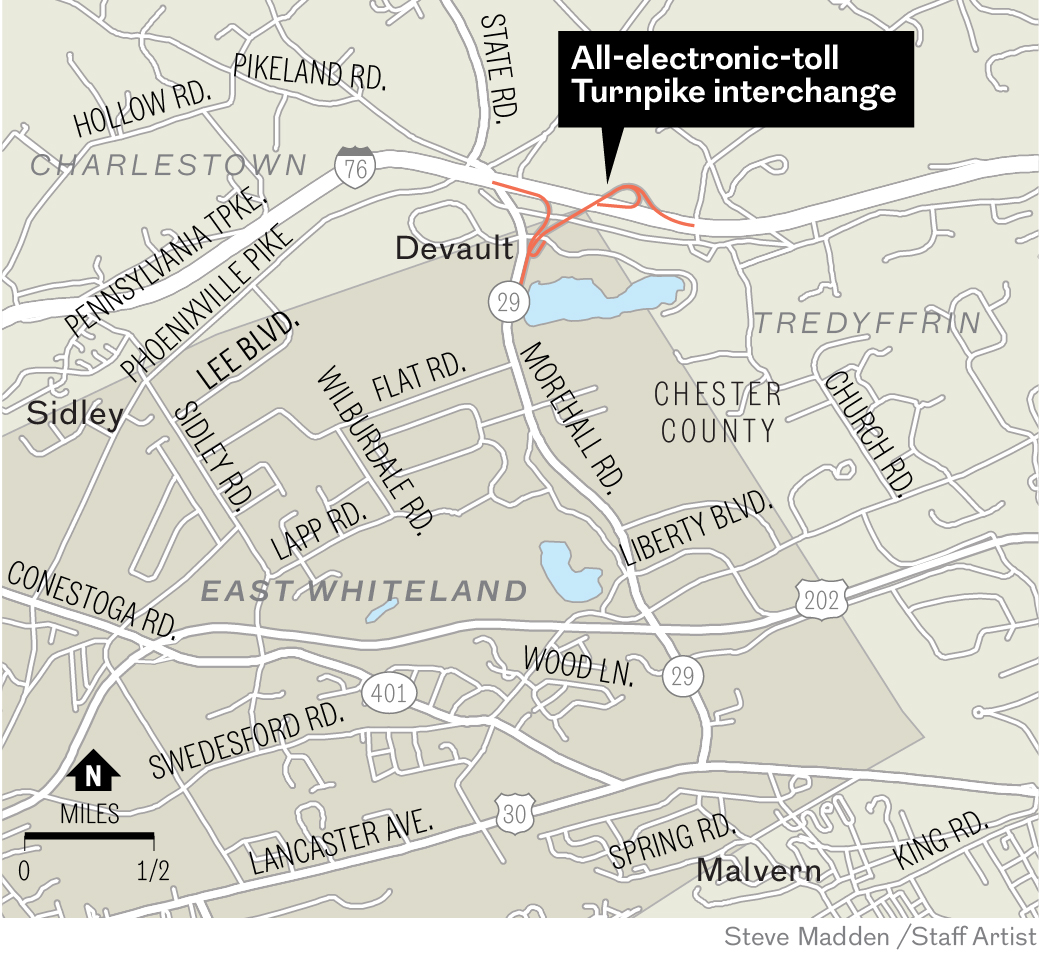
    But then the turnpike built Exit 320, an all E-ZPass interchange that connects to Route 29 and brings traffic right to the family-owned Hotel Desmond Malvern, a DoubleTree by Hilton.

    “It would easily take 20 minutes,” said Chain, general manager of the property. “Now you cut that in half, if not more.”

    When it opened in December 2012, the interchange helped spur billions in new commercial and residential development in Chester County’s Great Valley.

    Michael Chain, general manager at a hotel in Great Valley, says the Route 29 ramp has transformed his business.

    Corporate office parks expanded and new ones sprouted. Vanguard relentlessly expanded its campus for its 12,000 workers. Pharmaceutical and biotech companies moved there. Pfizer, Johnson & Johnson, Teva, and other pharmaceutical companies planted offices and research laboratories there.

    Thousands of people moved in to take advantage of the new jobs or a suddenly more convenient commute to Philadelphia and its inner-ring suburbs, Berks County, Lancaster, or even Harrisburg.

    More than 10 years later, the effects of the turnpike’s project are evident, but the real estate market is evolving to meet a lower post-pandemic demand for traditional office space and a higher demand for more housing.

    Through American history, transportation and development have been yoked. Towns and cities have grown around navigable rivers, post roads, national highways, railroads, interstates, turnpikes, and public transit.

    “This new interchange was explosive in terms of the economic impact in that particular region in a way I’m not even sure we had anticipated,” said Craig R. Shuey, chief operating officer of the Pennsylvania Turnpike.

    The key to success

    Experts caution it would be a mistake to attribute too much of the growth in the Great Valley solely to the turnpike exit.

    The area’s transition from agricultural and industrial to commercial mixed-use was already well underway when it opened. Real estate developers Rouse & Associates acquired land in 1974 and began building the Great Valley Corporate Center, a 700-acre business park.

    As the Pennsylvania 29 interchange was under construction, the U.S. 202 widening project occurred, helping ease the flow of traffic, although it still gets congested at peak hours.

    The Route 29 electronic toll interchange.

    The exit “plays well with an improved Route 202,” said Tim Phelps, executive director of the Transportation Management Association of Chester County.

    It’s also served by SEPTA Regional Rail Service and Amtrak, and there’s a connection to the 18.6-mile Chester Valley trail for biking, running, and walking.

    “The key is all the multimodal access to the area from different points,” Phelps said. “You move goods and freight along corridors and people to jobs; transportation is economic development.”

    New rise in residences

    Growth hasn’t been linear.

    ”Since COVID the office market has been struggling everywhere, and a couple of years ago the funding for biotech became harder to get,“ said John McGee, a commercial real estate broker and developer. ”Both of these events had a negative impact on demand for [office] space in Great Valley.”

    He and partners have turned an empty Exton office building into the Flats on 100, 24 studio and eight one-bedroom apartments, marketed to consultants and visitors who need to stay awhile while working with local companies.

    Other signs of a softer market in commercial space:

    • Malvern Green, a 111-acre office park owned by Oracle, is up for sale, marketed as a redevelopment opportunity. It has 759,000 square feet in four buildings on Valley Stream Parkway, off Route 29.
    • A 10.3-acre office property on Swedesford Road is slated to be demolished and turned into a mixed-use campus, with 250 apartments and about 6,700 square feet of retail and dining.

    With the pandemic rewriting the rules of work beginning five years ago, residential development has picked up, driven by housing scarcity and lack of affordability.

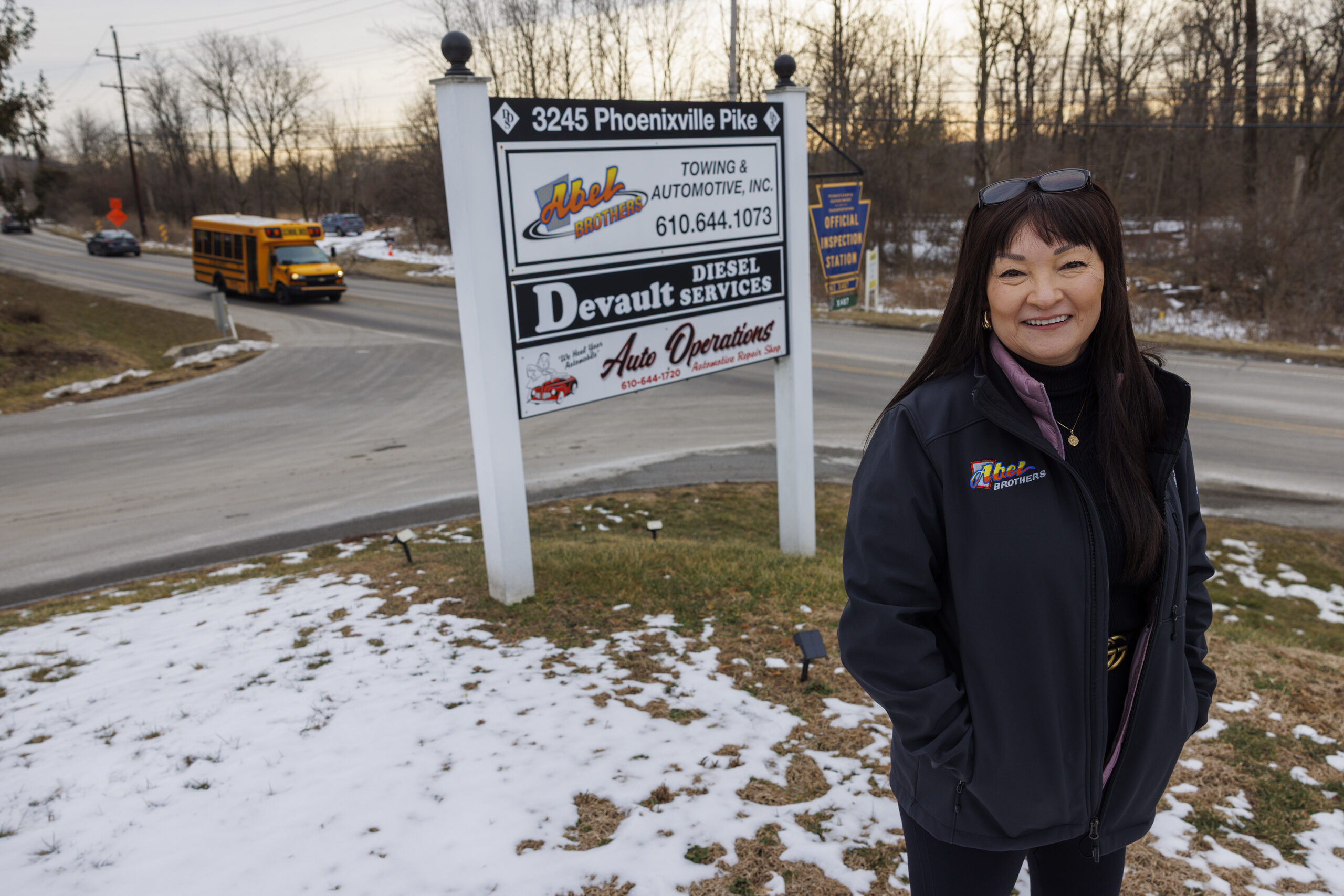
    Deb Abel, president of Abel Brothers Towing & Automotive, has seen the area evolve from her position as chair of the East Whiteland Planning Commission and as a member of the Chamber of Business & Industry.

    Deb Abel, chair of the East Whitefield Planning Commission, says workforce development is key to the area’s growth.

    “We talk all the time about workforce development,” Abel said. “People don’t want to come to work where they can’t afford to live.”

    More — and more affordable — housing is key both for current and future staffing needs. Workers shouldn’t have to commute from other areas with more housing options, Abel said.

    ‘A tangible asset’

    To Chain, the hotelier, travel time saved by the interchange is a tangible asset.

    “It improves the quality of life on a personal level, and [in business] I’m a beneficiary of people staying on the turnpike,” he said.

    As corporate travel budgets waxed and waned in the Great Recession and pandemic years, the Hotel Desmond beefed up other lines of business. An events space at the resort-like hotel now provides about half the revenues, Chain said.

    The interchange has helped him draw conference business from statewide associations, most of them in Harrisburg.

    And in recent years, youth sports travel teams from New York and New Jersey attending weekend tournaments in the region have filled rooms while using the interchange for easy access. Hockey teams are big.

    ‘A natural progression’

    A new multifamily project for Greystar Real Estate Partners is rising next to Route 29 on undeveloped land.

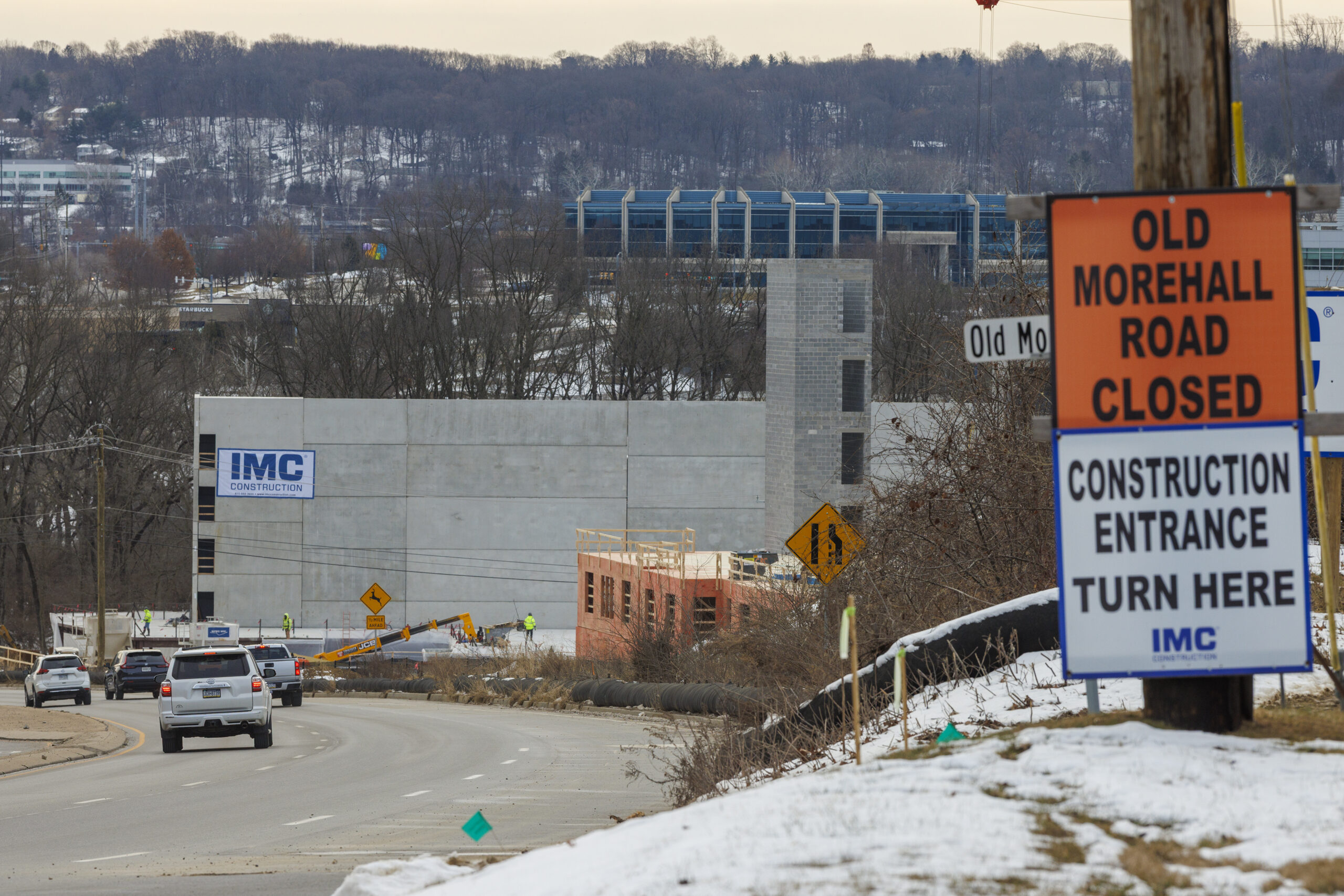
    IMC Construction is building a five-story, 267-unit apartment building featuring a rooftop lounge, fitness center, coworking space, pool courtyard, grilling stations, and more.

    IMC Construction signs and traffic markers along North Morehall Road in Malvern.

    A 133-unit “active adult” apartment building for people who are 55 and older is also under construction.

    Project manager Bob Liberato grew up in the area when Route 29 was a country road with one traffic light between Phoenixville and Route 30.

    It seems ironic now, but he remembers a petition circulating among fellow students at Great Valley High School to oppose the turnpike’s interchange proposal. Pretty much everybody signed.

    “We wanted to stop the turnpike because we liked our life,” Liberato said. “It was open, mostly fields and trees. Being able to go outside, have parties in the woods — all of that was great.”

    So what he’s doing now is, in a way, part of the circle of life.

    “We’re seeing a shift toward more residential projects, and there is a runway for more in the Great Valley,” said Liberato. With a scarcity of new development, ”it’s a natural progression in a lot of Philly suburbs.”

  • Swarthmore, Nether Providence take next step in merging fire departments

    Swarthmore, Nether Providence take next step in merging fire departments

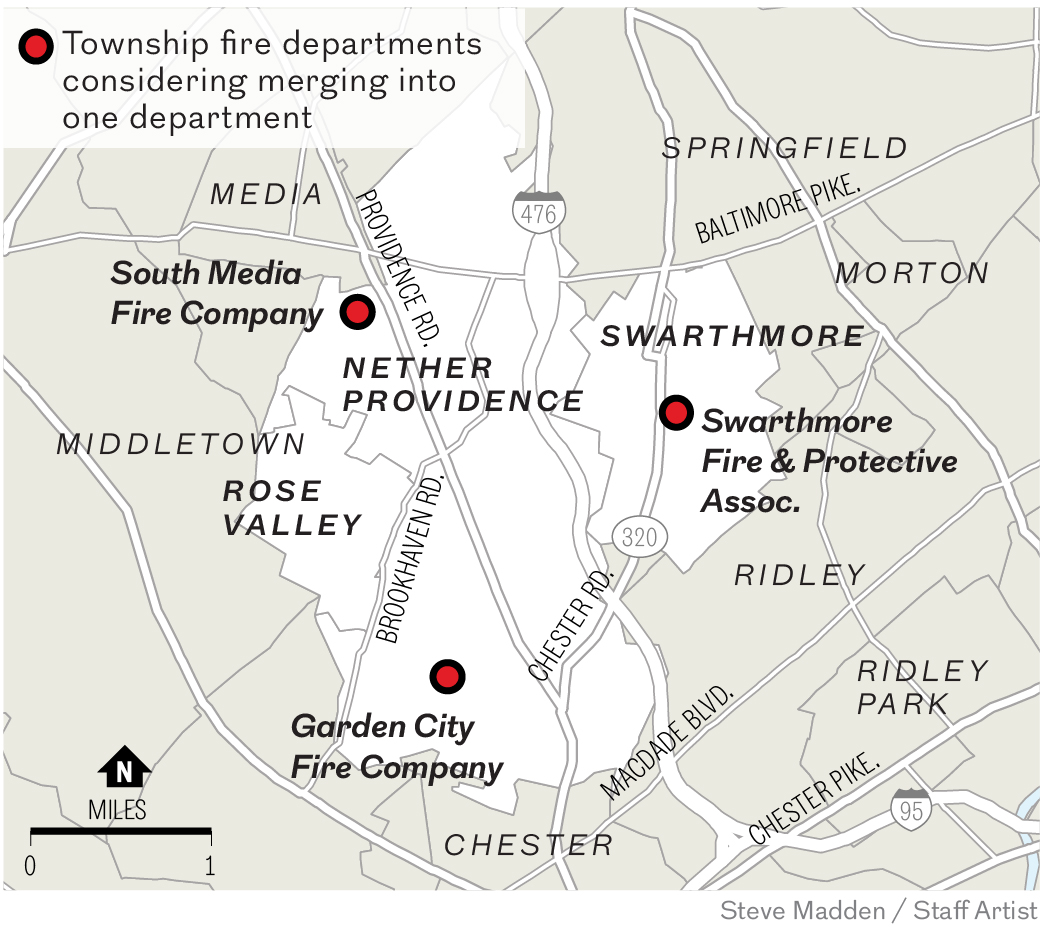
    Swarthmore and Nether Providence are exploring a merger of fire departments to compensate for a drop in volunteers and aging equipment.

    The proposed merger would unite the South Media and Garden City fire companies in Nether Providence with the Swarthmore Fire and Protective Association.

    Swarthmore and Nether Providence commissioned Longwood Fire Chief A.J. McCarthy to study the challenges facing the three fire departments. He presented his report to both municipalities in early December.

    The report recommended creating one regional fire department to cover the two municipalities plus Rose Valley.

    McCarthy’s report highlighted a “critical” lack of volunteer firefighters and financial limitations.

    “Just because you haven’t had a disastrous fire doesn’t mean it’s not going to happen,” McCarthy said during a presentation of his report to Swarthmore Borough Council on Dec. 1. “I can tell you right now you’re not prepared for it.”

    Three Delaware Co. Township fire companies may merge into one.

    Swarthmore Mayor and Fire Chief Conlen Booth called the report “a vital first step” toward a merger.

    “The departments are going to need to sit down and look at these recommendations and then digest them,” Booth said. “And then identify ultimately what are ones that make sense for us.”

    A complete merger, forming one regional fire department, could take a year and a half to three years, he said, while something less formal could be completed more quickly.

    “I think there’s a very good chance that we would follow [the report’s recommendation] with maybe some nuances,” Booth said. “But there is no guarantee that happens and we could have other types of mergers, or we could start with other mergers and then evolve into that full merger.”

    Booth has a history of working in emergency services. He joined Swarthmore’s fire company in 2000, eventually working his way up to department chief.

    A single regional fire department would need new bylaws, a new charter, joint operation guidelines, and more. A complete merger would also require the departments to dissolve their existing nonprofit organizations and relief associations and create new ones.

    “A lot of these pieces are not difficult, it’s the sheer number of pieces that can be felt to be overwhelming,” Booth said.

    Nether Providence passed a resolution in support of the merger effort, but Township Manager Maureen Feyas declined to comment on the matter.

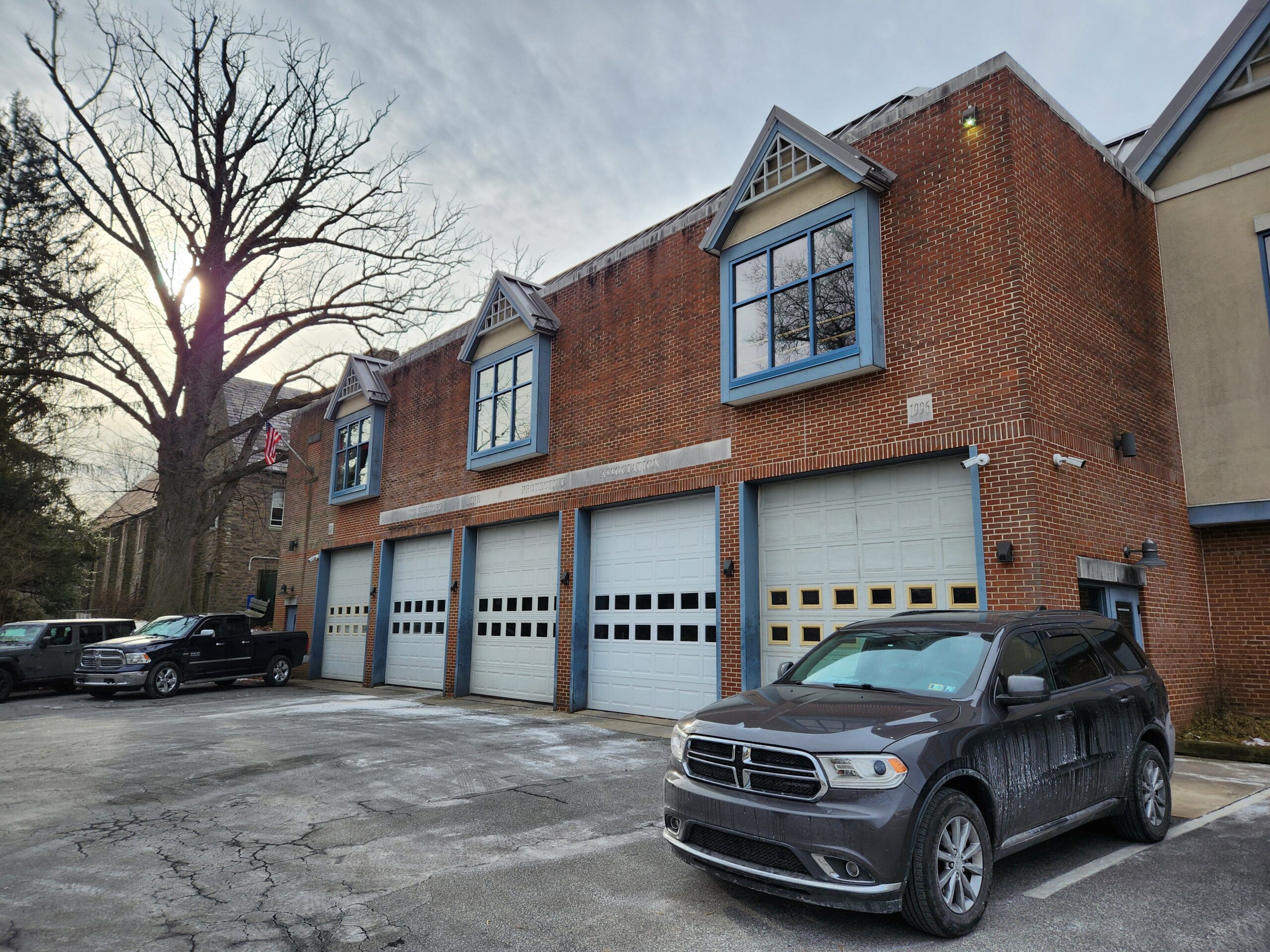
    The Swarthmore Fire & Protective Association firehouse.

    Lack of volunteers

    The biggest challenge for the fire departments is a drop in volunteers. In a 2023 report, Pennsylvania Fire Commissioner Thomas Cook said there were about 30,000 volunteers in the state at that time, down from 300,000 in the 1970s.

    South Media and Garden City operate solely with volunteers, while Swarthmore has some paid personnel.

    The report, however, says the full-time staff gives the department a “false confidence,” because they respond to both fire and medical emergencies. If two employees leave in the ambulance, that leaves only one behind with little volunteer support during daytime hours.

    The report also says South Media was “unable to produce a reliable and constant response” due to lack of volunteers.

    Garden City has had more success with volunteers. During a meeting in which McCarthy presented his report to Swarthmore Borough Council, he praised Garden City Chief Pat O’Rourke.

    “He’s doing an excellent job and is increasing volunteer numbers year-over-year, which is almost unheard of right now,” McCarthy said.

    Part of the reason these fire departments struggle to find volunteers is because they are located in affluent areas, McCarthy said, something he can attest to in his experience leading Longwood Fire Company in Chester County.

    “The area I protect has a very high cost of living, so I don’t have residents looking to do one of the most dangerous jobs in the world for free,” McCarthy said in the council meeting. “I have a lot of CFOs and CEOs. They’re busy in hospitals and law firms.”

    In 2024, Swarthmore had a median income of $146,992 and Nether Providence’s median income was $145,254, well above the national median of $83,730.

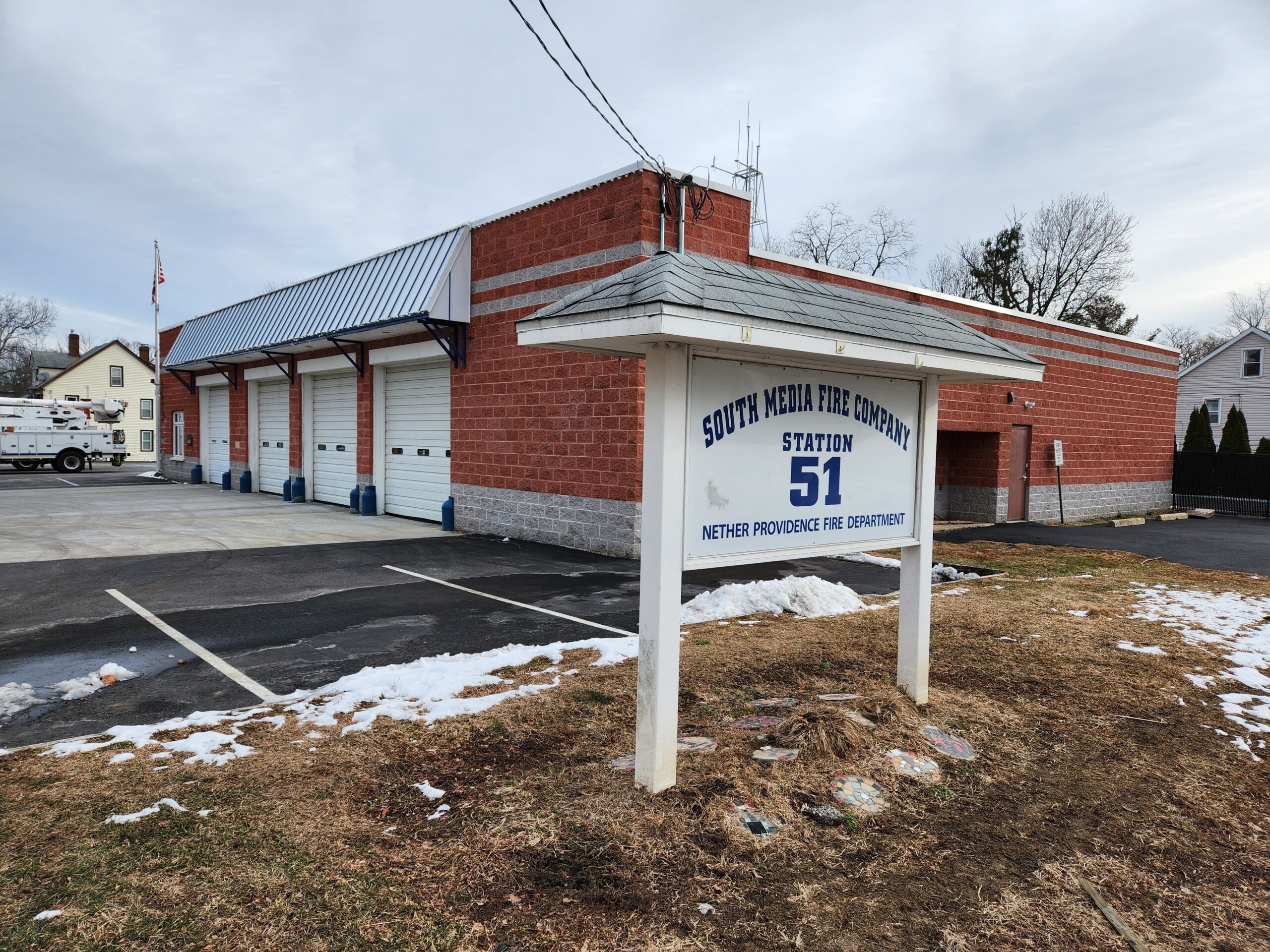
    The South Media Fire Company in Nether Providence.

    Equipment cost and maintenance

    A capital apparatus plan is also needed for upgrading and maintaining expensive fire trucks, ambulances, and other lifesaving equipment, the report states.

    Trucks have doubled in price over the last three years and take about five years to deliver, he said at the Swarthmore Borough Council meeting.

    “These things have to be planned out,” McCarthy said. “You can’t spend $2.5 million to replace a ladder truck and only start talking about it four months before you order it.”

    One of Swarthmore’s trucks costs more to maintain than to use, he said.

    Crozer’s closing

    The closing of Crozer-Chester Medical Center also put a burden on the area, with more medical emergencies to cover.

    Swarthmore stood up an ambulance service that can provide advanced life support in response to the closure, and it nearly doubled the number of calls the department responds to in a month, Booth said.

    The loss of Crozer’s ambulance service also means departments are being pulled further away to cover medical emergencies, causing a chain reaction where other departments are called to cover for them.

    Crozer’s new owner, Chariot Equities, said last week it hoped to reopen the hospital and resume emergency services in the county within two years.

    This suburban content is produced with support from the Leslie Miller and Richard Worley Foundation and The Lenfest Institute for Journalism. Editorial content is created independently of the project donors. Gifts to support The Inquirer’s high-impact journalism can be made at inquirer.com/donate. A list of Lenfest Institute donors can be found at lenfestinstitute.org/supporters.

  • Former Willingboro mayor is found guilty of mortgage fraud

    Former Willingboro mayor is found guilty of mortgage fraud

    The former mayor of Willingboro Township and a business associate were found guilty by a federal jury of mortgage fraud, the U.S. Attorney’s Office in New Jersey said Wednesday.

    Nathaniel Anderson, 59, who is still a town councilman in Willingboro, and Chrisone D. Anderson, 58, of Sicklerville, were each convicted of one count of conspiracy to commit wire fraud affecting a financial institution, one count of bank fraud, and two counts of making a false statement on a mortgage application, said Senior Counsel Philip Lamparello from the prosecutor’s office.

    The jury deliberated for less than three hours after a two-week trial before U.S. District Judge Robert Kirsch in federal court in Trenton, Lamparello said.

    Sentencing is scheduled for June 1. “Though we respect the jury’s decision, we plan to appeal this conviction to the Third Circuit Court of Appeals,” Troy A. Archie, attorney for Chrisone Anderson, said in an email.

    Anderson was represented by federal public defenders who could not be reached Wednesday night.

    The Andersons, who are not related, conspired to save Nathaniel Anderson’s home, which was facing foreclosure in 2015, by orchestrating a fraudulent short sale to Chrisone Anderson, prosecutors said.

    The scheme involved Chrisone Anderson posing as a buyer of the home and claiming that Nathaniel Anderson would no longer live there so that his mortgage lender would forgive the rest of his loan.

    The fraudulent misrepresentations included that Chrisone Anderson would occupy the home as her primary residence, prosecutors said.

    Nathaniel Anderson’s problems with his residency began in 2009 as he and his then-wife fell behind on mortgage payments, prosecutors said.

    The couple divorced, but Anderson wanted to keep his home through a short sale. That’s a process by which a mortgage lender agrees to write off the remaining debt of a mortgage holder in default — provided the holder can arrange a sale of the property to dispense with most of the remaining debt.

  • Trump signals interest in easing tensions, but Minneapolis sees little change on the streets

    Trump signals interest in easing tensions, but Minneapolis sees little change on the streets

    MINNEAPOLIS — President Donald Trump seemed to signal a willingness to ease tensions in Minneapolis after a second deadly shooting by federal immigration agents, but there was little evidence Wednesday of any significant changes following weeks of harsh rhetoric and clashes with protesters.

    The strain was evident when Trump made a leadership change by sending his top border adviser to Minnesota to take charge of the immigration crackdown. That was followed by seemingly conciliatory remarks about the Democratic governor and mayor.

    Trump said he and Gov. Tim Walz, whom he criticized for weeks, were on “a similar wavelength” following a phone call. After a conversation with Mayor Jacob Frey, the president praised the discussion and declared that “lots of progress is being made.”

    But on city streets, there were few signs of a shift. Immigration enforcement operations and confrontations with activists continued Wednesday in Minneapolis and St. Paul.

    A group of protesters blew whistles and pointed out federal officers in a vehicle on a north Minneapolis street. When the officers’ vehicle moved, a small convoy of activists followed in their cars for a few blocks until the officers stopped again.

    When Associated Press journalists got out of their car to document the encounter, officers with the federal Bureau of Prisons pushed one of them, threatened them with arrest and told them to get back in their car despite the reporters’ identifying themselves as journalists. Officers from multiple federal agencies have been involved in the enforcement operations.

    From their car, the AP journalists saw at least one person being pepper sprayed and one detained, though it was unclear if that person was the target of the operation or a protester. Agents also broke car windows.

    Attorney General Pam Bondi, who is visiting Minnesota, said 16 people were arrested Wednesday on charges of assaulting, resisting or impeding law enforcement in the state. She said more arrests were expected.

    “NOTHING will stop President Trump and this Department of Justice from enforcing the law,” Bondi said in a social media post.

    Messages seeking comment were left with Immigration and Customs Enforcement and the Border Patrol.

    Woman tells agents knocking on door: ‘They’re good neighbors’

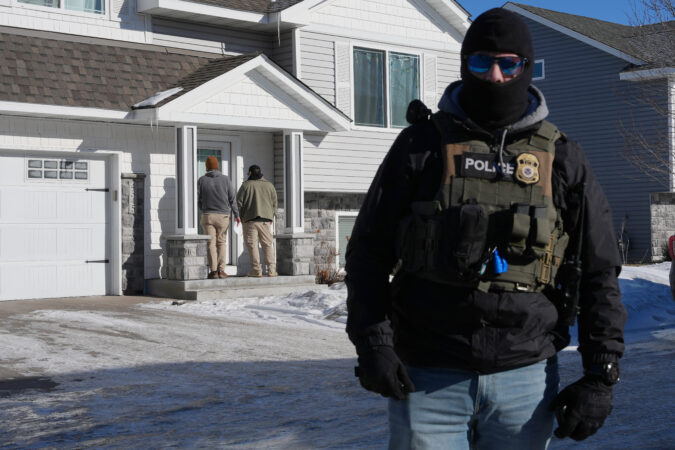
    On Wednesday afternoon in the Minneapolis suburb of Brooklyn Center, half a dozen agents went to a house in a small residential neighborhood.

    One agent knocked on the door of the home repeatedly. Another told the AP they were seeking a man who had been twice deported and was convicted of domestic abuse. The agent said the man had run into the home and the agents lacked a judicial warrant to get inside.

    Some federal immigration officers are asserting sweeping power to forcibly enter people’s homes without a judge’s warrant and instead are using a more narrow administrative warrant to arrest migrants considered illegally present or otherwise deportable. The key difference is whether agents can forcibly enter a private property to make an arrest, as they were captured on video doing in Minneapolis earlier this month.

    A handful of activists blew whistles at the agents in Brooklyn Center. One agent said: “They’d rather call the police on us than to help us. Go figure.”

    As the agents were preparing to leave, a woman called out to them saying, “You need to know they’re good neighbors.”

    Kari Rod told the AP that she didn’t know these neighbors well, but they had come to her garage sale, kept their yard clean, and waved hello when she drove by. She didn’t believe enforcement agents to be speaking the truth about whom they arrest, including another neighbor whom she said was deported to Laos last summer.

    “I don’t trust a single thing they said about who they are,” Rod said. “From my interactions, I know them way better than anyone else does, any one of those federal agents.”

    Immigrants are ‘still very worried’

    Many immigrant families are still fearful of leaving their homes, and Latino businesses are still closed, said Daniel Hernandez, who owns the Minneapolis grocery store Colonial Market. He also runs a popular Facebook page geared toward informing the Hispanic community in the Twin Cities.

    While Colonial Market is open, all but one of the dozen immigrant-run businesses that rented space inside to sell clothes, jewelry, and toys have closed since late December, and none has plans to reopen, Hernandez said.

    “The reality is the community is still very worried and afraid,” Hernandez said.

    Hernandez referenced Border Patrol commander Gregory Bovino, who helped lead the administration’s crackdown in the Twin Cities and who has reportedly been assigned elsewhere.

    Bovino “was removed, but the tactics so far are still the same,” Hernandez said. “Nobody now is trusting the government with those changes.”

    The federal enforcement extended to the city’s Ecuadoran consulate, where a federal law enforcement officer tried to enter before being blocked by employees.

    Judge warns ICE about not complying with federal orders

    In Minnesota federal court, the issue of ICE not complying with court orders came to the fore as Chief Judge Patrick Schiltz said the agency had violated 96 court orders in 74 cases since Jan. 1.

    “This list should give pause to anyone — no matter his or her political beliefs — who cares about the rule of law,” he wrote. “ICE has likely violated more court orders in January 2026 than some federal agencies have violated in their entire existence.”

    Schiltz earlier this week ordered ICE’s acting director to personally appear in his courtroom Friday after the agency failed to obey an order to release an Ecuadorian man from detention in Texas. The judge canceled the order after the agency freed the man.

    The judge, who was appointed by President George W. Bush, warned ICE that future noncompliance may result in future orders requiring the personal appearances of Acting Director Todd Lyons or other government officials.

    ICE didn’t immediately respond to an email seeking comment.

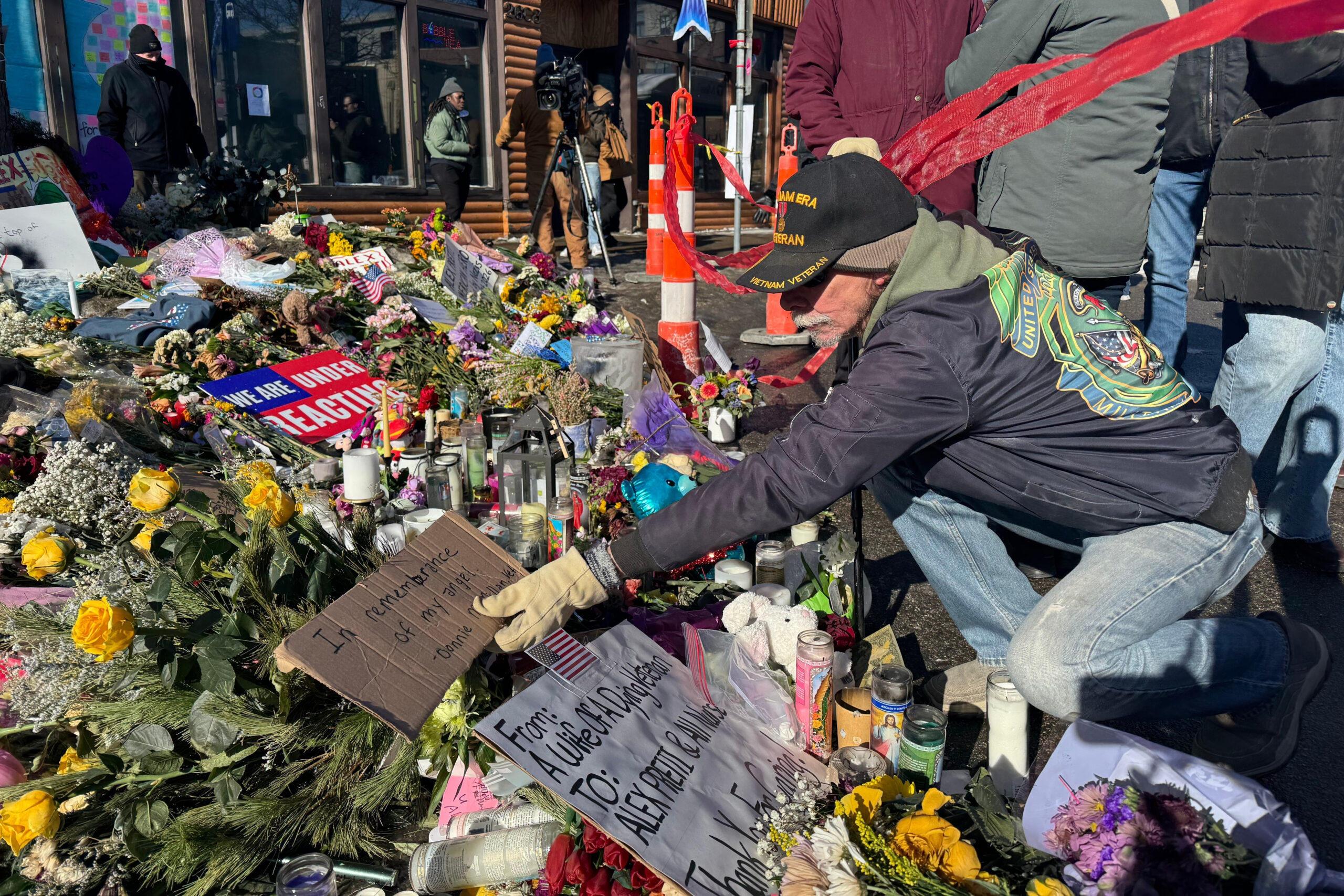
    Vietnam War veteran Donnie McMillan places a sign that says “In remembrance of my angel” at a memorial set up at the location where VA nurse Alex Pretti was shot by federal agents in Minneapolis.

    Veteran visits sidewalk memorial

    Elsewhere on Wednesday, Donnie McMillan placed a cardboard sign reading “In remembrance of my angel” at the makeshift memorial where Alex Pretti was shot.

    The Vietnam veteran knelt to pay his respects and saluted to honor the nurse whom he said he remembered seeing during his frequent visits to the VA hospital where Pretti worked.

    “I feel like I’ve lost an angel right here,” McMillan, 71, said, pointing to the growing sidewalk memorial covered in flowers, candles, and signs.

    “This is not the way we should operate,” McMillan said. “I respect everybody, but I respect my angel more, and now he’s no longer with us.”

    Also Wednesday, the Department of Homeland Security said two federal agents involved in Pretti’s death have been on leave since Saturday, when the shooting happened.

    U.S. Rep. Ilhan Omar, a Democrat, spoke to journalists one day after a man attacked her during a town-hall meeting by squirting a strong-smelling substance on her as she denounced the Trump administration.

    “What is unfolding in our state is not accidental. It is part of a coordinated effort to target Black and brown, immigrant and Muslim communities through fear, racial profiling, and intimidation,” Omar said. ”This administration’s immigration agenda is not about law enforcement — it is about making people feel they do not belong.”

  • Justice Dept. charges 16 Minneapolis protesters with assault, interference

    Justice Dept. charges 16 Minneapolis protesters with assault, interference

    The Trump administration on Wednesday announced criminal charges against 16 people in Minneapolis whom it accused of assaulting officers or interfering with federal immigration enforcement operations as tensions in the city continue to escalate.

    Attorney General Pam Bondi announced the Justice Department prosecutions in a social media post, naming those who were charged and indicating she expects more arrests.

    “I’ve said it before and I’ll say it again: NOTHING will stop President Trump and this Department of Justice from enforcing the law,” Bondi wrote on X, adding that she was in Minneapolis.

    Already this month, federal prosecutors had charged 17 people in Minneapolis with crimes tied to protests or related to the administration’s surge in immigration enforcement.

    Bondi’s defiant posture came despite what appeared to be a shift in tone from President Donald Trump and other senior aides amid widespread outrage over immigration officers’ fatal shootings of two U.S. citizens in the city this month. Authorities said the two federal agents who fired at Alex Pretti, 37, on Saturday have been placed on administrative leave, per standard agency protocol.

    Those developments came a day after the Department of Homeland Security provided the first official timeline of the deadly encounter in a statement sent to some members of Congress. The document, which was based on preliminary review, made no mention of Pretti brandishing a weapon, contradicting Trump administration comments in the immediate aftermath of the shooting, when senior officials described Pretti as a direct threat to federal agents and officers.

    The Trump administration has begun to back away from some of its inflammatory rhetoric about the shooting and replaced Greg Bovino, the Border Patrol commander who was overseeing the Minneapolis operation, with border czar Tom Homan.

    “I think the whole thing is terrible,” Trump said Tuesday in an interview with Fox News when asked about events in Minnesota over the past week and Pretti’s killing. “I don’t like the fact that he was carrying a gun that was fully loaded. … Bottom line, it was terrible.”

    The news that two immigration agents involved in Pretti’s shooting are on leave undercuts Bovino’s previous claim that “all agents that were involved in that scene are working, not in Minneapolis, but in other locations.”

    The broader shift in the White House’s tone on Pretti’s killing comes as a growing number of Republicans challenge the Trump administration’s handling of the shooting and become more critical of Homeland Security Secretary Kristi L. Noem. It also reflects concern that without a significant course correction, Republicans are likely to lose control of Congress in November’s midterm elections.

    Stephen Miller, Trump’s White House deputy chief of staff, called Pretti an “assassin” in the immediate aftermath of his killing. On Tuesday, Miller said the administration was evaluating whether Customs and Border Protection “may not have been following” official protocol before the shooting.

    Noem also initially portrayed the circumstances surrounding the fatal shootings of both Pretti and Renée Good in Minneapolis as assaults on federal law enforcement, despite video evidence to the contrary.

    A woman who said she filmed Pretti’s shooting rebutted DHS’s initial claims that Pretti had brandished a weapon or was acting in a threatening manner.

    Speaking to CNN’s Anderson Cooper on Tuesday, Stella Carlson, who estimated she was no more than 10 feet from Pretti when he was shot, said he was filming immigration enforcement personnel and trying to direct traffic.

    Carlson said she got out of her car and started filming Pretti, whom she had never met, as he directed traffic. She said that Pretti was acting “calm” and “definitely without threat,” and that she did not see him brandish a weapon. “If I had, I maybe wouldn’t have stayed so close” to him, she said.

    Pretti’s death has prompted bipartisan calls for an independent investigation. Top Justice Department officials said previously that they saw no basis for a civil rights investigation into Good’s Jan. 7 shooting. The department, however, has sought to pursue an investigation into Good’s partner, the Washington Post has reported.

    On Tuesday, Rep. Ilhan Omar (D., Minn.), a frequent target of the Trump administration, was attacked during a town-hall meeting and Immigration and Customs Enforcement agents tried to enter the Ecuadoran Consulate before being turned away.

    A man used a syringe to spray an unknown liquid in Omar’s direction, police said, shortly after Omar called on Noem to “resign or face impeachment.” The man, later identified as 55-year-old Anthony Kazmierczak, was immediately tackled and arrested, and Omar later said she was “OK.”

  • More ‘No Kings’ protests planned for March 28 as outrage spreads over Minneapolis deaths

    More ‘No Kings’ protests planned for March 28 as outrage spreads over Minneapolis deaths

    A third round of “No Kings” protests is coming this spring, with organizers saying they are planning their largest demonstrations yet across the United States to oppose what they describe as authoritarianism under President Donald Trump.

    Previous rallies have drawn millions of people, and organizers said they expect even greater numbers on March 28 in the wake of Trump’s immigration crackdown in Minneapolis, where violent clashes have led to the death of two people.

    “We expect this to be the largest protest in American history,” Ezra Levin, co-executive director of the nonprofit Indivisible, told the Associated Press ahead of Wednesday’s announcement. He predicted that as many as 9 million people will turn out.

    “No Kings” protests, which are organized by a constellation of groups around the country, have been a focal point for outrage over Trump’s attempts to consolidate and expand his power.

    “This is in large part a response to a combination of the heinous attacks on our democracy and communities coming from the regime, and a sense that nobody’s coming to save us,” Levin said.

    Last year, Trump said he felt attendees were “not representative of the people of our country,” and he insisted that “I’m not a king.”

    ‘No Kings’ shifts focus after Minneapolis deaths

    The latest round of protests had been in the works before the crackdown in Minneapolis. However, the killing of two people by federal agents in recent weeks has refocused plans.

    Levin said they want to show “support for Minnesota and immigrant communities all over” and oppose “the secret police force that is murdering Americans and infringing on their basic constitutional rights.”

    “And what we know is, the only way to defend those rights is to exercise them, and you do that in nonviolent but forceful ways, and that’s what I expect to see in ‘No Kings’ three,” Levin said.

    Trump has broadly defended his aggressive deportation campaign and blamed local officials for refusing to cooperate. However, he’s more recently signaled a shift in response to bipartisan concern over the killing of Alex Pretti in Minneapolis on Saturday.

    Previous ‘No Kings’ protests have drawn millions across the U.S.

    In June, the first “No Kings” rallies were organized in nearly 2,000 locations nationwide, including cities, towns and community spaces. Those protests followed unrest over federal immigration raids and Trump’s deployment of the National Guard and Marines to Los Angeles, where tensions escalated with protesters blocking a freeway and setting vehicles on fire.

    They were organized also in large part to protest a military parade in the nation’s capital that marked the Army’s 250th anniversary and coincided with Trump’s birthday. “No Kings” organizers at the time called the parade a “coronation” that was symbolic of what they characterized as Trump’s growing authoritarian overreach.

    In response, some conservative politicians condemned the protests as “Hate America” rallies.

    During a second round of protests in October, organizers said demonstrations were held in about 2,700 cities and towns across the country. At the time, Levin pointed to Trump’s sweeping immigration crackdown, his unprecedented promises to use federal power to influence midterm elections, restrictions on press freedom and retribution against political opponents, steps he said cumulatively represented a direct threat to constitutionally protected rights.

    On social media, both Trump and the official White House account mocked the protests, posting computer-generated images of the president wearing a crown.

    The big protest days are headline-grabbing moments, but Levin said groups like his are determined to keep up steady trainings and intermediate-level organizing in hopes of growing sustainable resistance to the Trump administration’s actions.

    “This isn’t about Democrats versus Republicans. This is about do we have a democracy at all, and what are we going to tell our kids and our grandkids about what we did in this moment?” Levin said. ”I think that demands the kind of persistent engagement. ”

  • Trump administration reveals location of dismantled slavery exhibits from the President’s House in new legal filing

    Trump administration reveals location of dismantled slavery exhibits from the President’s House in new legal filing

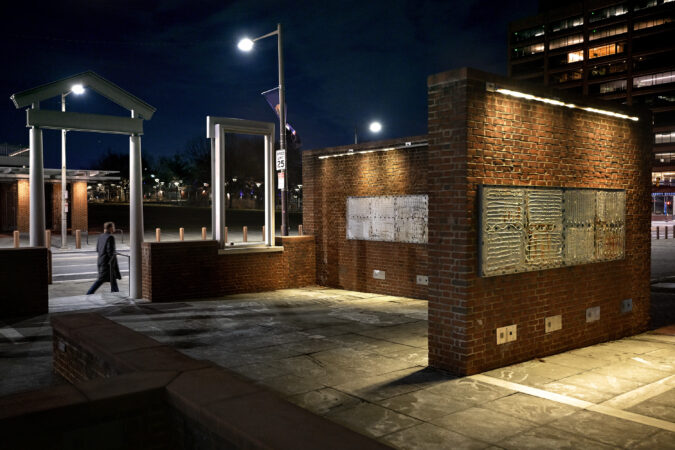
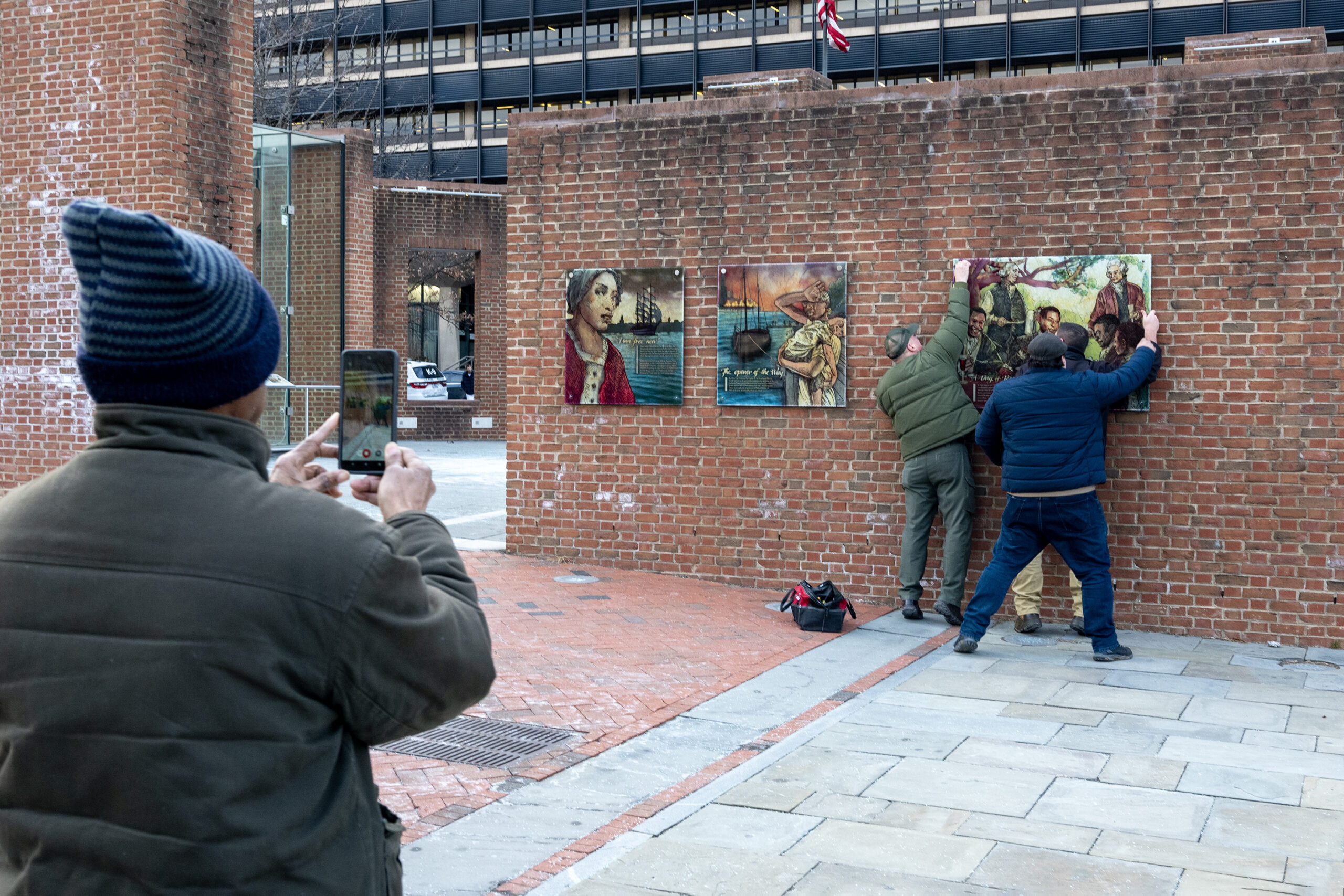
    Informational exhibits about slavery removed by the National Park Service from the President’s House Site last week are being kept in storage at a facility adjacent to the National Constitution Center, according to a legal filing from the Trump administration.

    The exhibits will remain in the park service’s custody at the center, down the street from the President’s House, pending the outcome of the City of Philadelphia’s federal lawsuit against the Department of Interior and the National Park Service for taking down the exhibits.

    But the center said it has no role in storing the exhibits.

    “The storage facility [where the exhibits are being kept] is entirely under control and operation of the Park Service,” said a spokesperson for the Constitution Center, adding that the center does not have possession of or access to the space.

    Mayor Cherelle L. Parker’s administration is seeking an injunction to return the exhibits to the President’s House, which aims to educate visitors on the horrors of slavery and memorializes the nine people George Washington enslaved at the site during the founding of the United States.

    Jali Wicker records NPS workers remove interpretive panels at the President’s House site in Independence National Historical Park Thursday, Jan. 22, 2026. More than a dozen educational displays and illustrations about slavery were removed from the site, which serves as a memorial to the nine people George Washington enslaved there during the founding of America.

    The location of the removed exhibits was revealed Wednesday in a motion objecting to the city’s injunction. The motion was filed by U.S. attorneys and assistant Attorney General Brett Shumate, representing Interior Secretary Doug Burgum, acting National Park Service Director Jessica Bowron, and their respective agencies.

    The legal filing also provides further details into what transpired last Thursday when park service employees removed exhibits about slavery at the President’s House.

    Park service employees dismantled the exhibit after Bowron ordered Steve Sims, the park service’s acting regional director, to have workers remove the panels and turn off video displays at the site, according to the filing. Sims said the takedown was carried out the same day that Bowron requested it.

    There is also a remaining sign made of wood in a metal structure that was not removed last week because additional tools were needed.

    “When and if NPS removes the sign, it will be stored with the other panels,” Sims said in a declaration included in the legal filing.

    The footprints embedded in the site and the Memorial Wall featuring the names of the nine people Washington enslaved will stay at the President’s House, he said.

    Last year, Burgum and President Donald Trump ordered content at national parks that could “inappropriately disparage Americans past or living” to be reviewed and potentially removed.

    In addition to the actions in Philadelphia, the National Park Service has reportedly removed signage about the mistreatment of Native Americans from the Grand Canyon, among other changes implemented under the orders.

    Tuesday’s filing previews the Trump administration’s legal argument for a hearing scheduled Friday on Philadelphia’s suit, which could be used in other cases around the country.

    The attorneys claim in the filing that this case is “fundamentally a question of Government speech,” and they accuse the city of trying to “censor” the federal government.

    “Such interests are especially weighty where, as here, the City effectively seeks to compel the Federal government to engage in speech that it does not wish to convey,” the attorneys wrote.

    The city’s suit has received legal backing from Gov. Josh Shapiro and the Avenging the Ancestors Coalition, an advocacy group that helped establish the President’s House in the early 2000s.

    The exhibit takedown has been a heartbreak for those who helped develop the site and for Philadelphians who have left artwork memorializing what the site used to be.

    In a video posted to social media Tuesday, Parker said that her administration would keep “fighting” to have the panels restored to the site as the city prepares to play a central role in the nation’s 250th anniversary celebrations in July.

    “This history is a critical part of our nation’s origins, and it deserves to be seen and heard, not just by the people of Philadelphia, but by every person who comes to Philadelphia from around our nation and the world to see and learn from, especially as we celebrate our Semiquincentennial 250th birthday, I want the world to know you cannot erase our history,” she said.

    This story has been updated to include a comment from the National Constitution Center.

  • Philly’s unplowed snow has slowed SEPTA and frustrated residents and businesses

    Philly’s unplowed snow has slowed SEPTA and frustrated residents and businesses

    With more than 60 hours since the last bit of snow descended upon Philadelphia, the widespread complaints about the conditions of secondary and tertiary streets have reached a fever pitch.

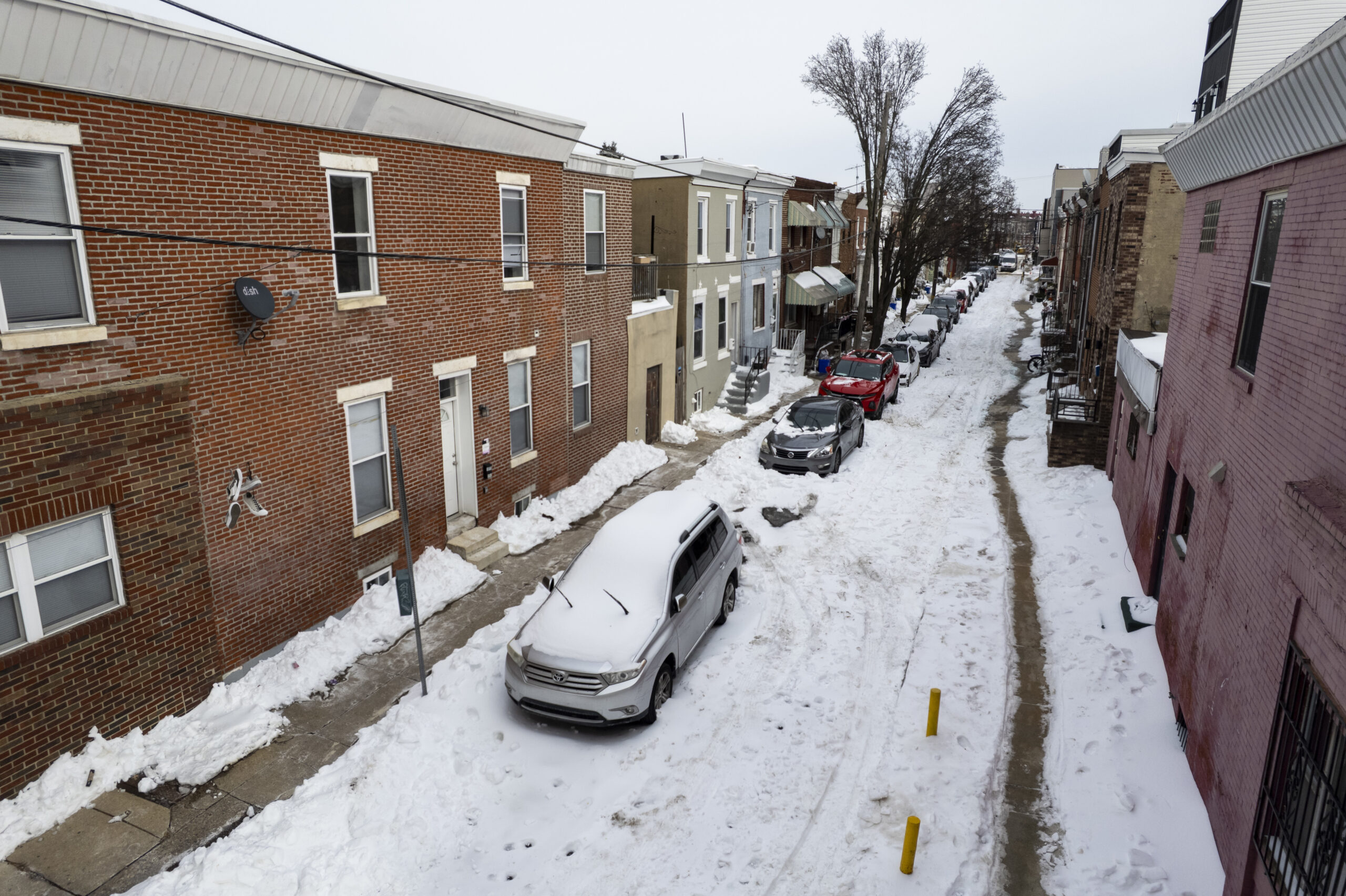
    The Philadelphia Streets Department has tried to quell the public’s concerns with daily videos of excavators diligently filling dumpsters with snow. Yet evidence of icy streets and snow banks blocking lanes dominate social media, with city data showing the street conditions vary block by block.

    Between 3 p.m. Tuesday and 3 p.m. Wednesday, the city’s GPS data show, about 30% of city streets had been visited by plows. Some areas, like Center City and South Philadelphia west of Broad Street, saw most numbered streets and cross streets hit by plows during that time. Meanwhile, South Philly and Center City neighborhoods east of Broad Street saw little to no reported activity.

    The same was true for large swaths of North and West Philadelphia. And neighborhoods like Overbrook, Wynnefield, and Nicetown, which have seen the fewest reported visits from city plow trucks since the storm began, saw only a handful of streets plowed between Tuesday and Wednesday afternoon, according to city data.

    On the neighborhood line of Grays Ferry and Devil’s Pocket, Dani Hildebrand was one resident who felt forgotten as the streets around him were plowed and garbage picked up. Hildebrand’s block was supposed to have trash collection come through Tuesday with the one-day delay announced by the city. But on Wednesday, bags of garbage lined his block.

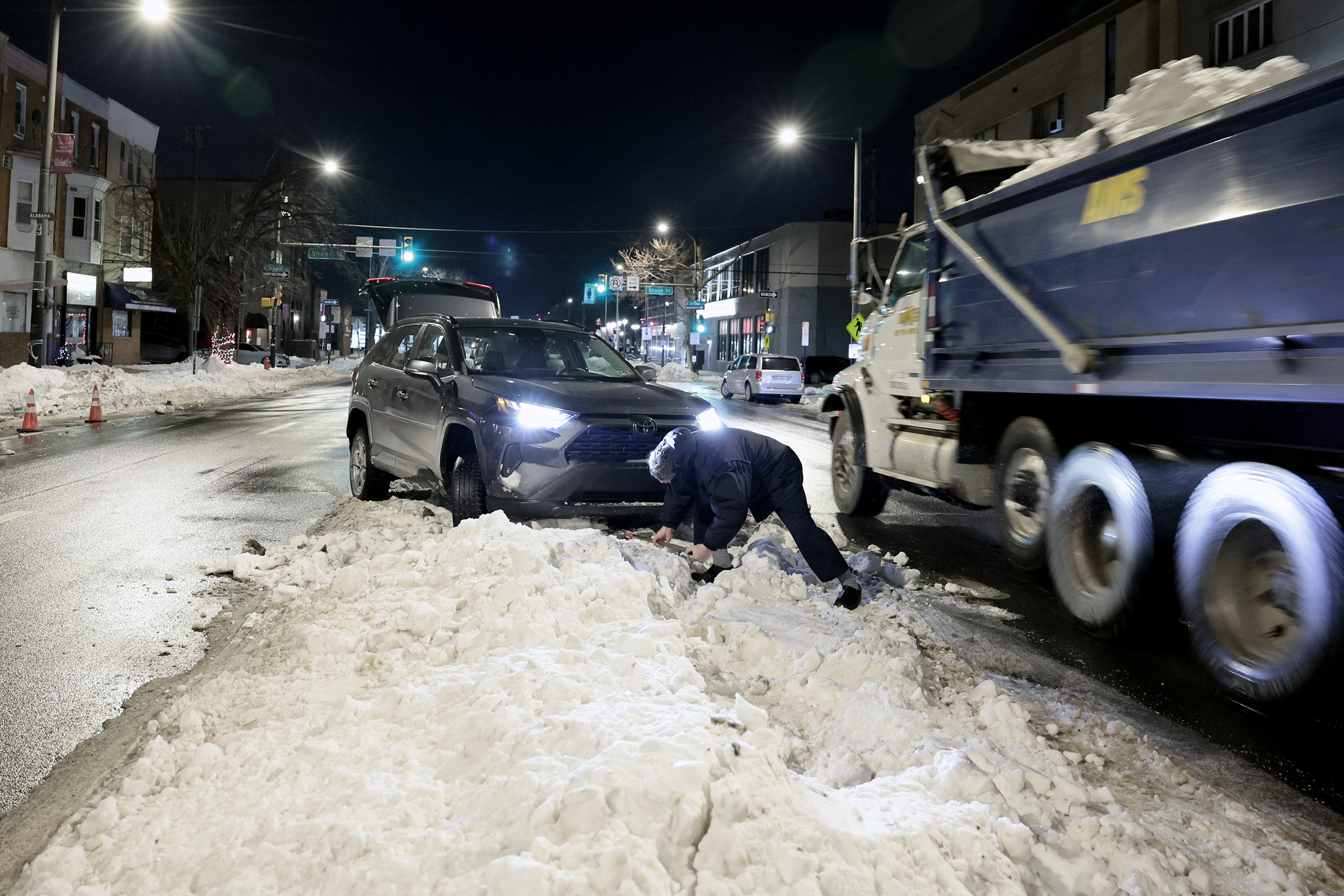
    An unidentified man shovels snow from underneath his car after it became hung up when he was trying to park in the middle of South Broad Street in Philadelphia in the early morning hours of Wednesday, Jan. 28, 2026. Dump trucks filled with snow from the city’s snow removal operations were zooming by as he worked to get his car free.

    The 41-year-old father of three said his school-age children yearn to leave the house, even if for an errand, but it’s not in the cards.

    “Between piles of snow, trash, and dog pee and poop, it’s not ideal,” he said. “We’ve been stuck in since Sunday, and while I’m close to a market, it’s not safe to walk there with my three kids and I can’t get my car out.”

    The city, for its part, has said the snow clearing would take as long as it needs to and the work would continue until all roads are dug out. Residents should expect trash-collection delays as crews navigate the snow and ice. At the same time, officials have consistently asked for patience, noting that the frigid temperatures were not aiding snow-removal efforts.

    They have pointed to the 14 teams with more than 200 vehicles and excavators that are trying to move the snow and ice into storage facilities using dumpsters. Future Track trainees with the Philadelphia Streets Department have also taken up shovels to help clear crosswalks in the city.

    But, the city notes, this is time-consuming work.

    Wanted: Private plowers

    Chris DiPiazza, owner of the Passyunk Square bakery Mighty Bread, could not afford to wait for city plows and paid for a private service to clear his street Tuesday afternoon.

    After the storm, the bakery was unable to make or receive deliveries because the city had not plowed Gerritt Street, the narrow road it’s on. Adding to frustrations, DiPiazza said, snowplows that had come through the adjacent 12th and 13th Streets had left giant snow piles on both ends of the block.

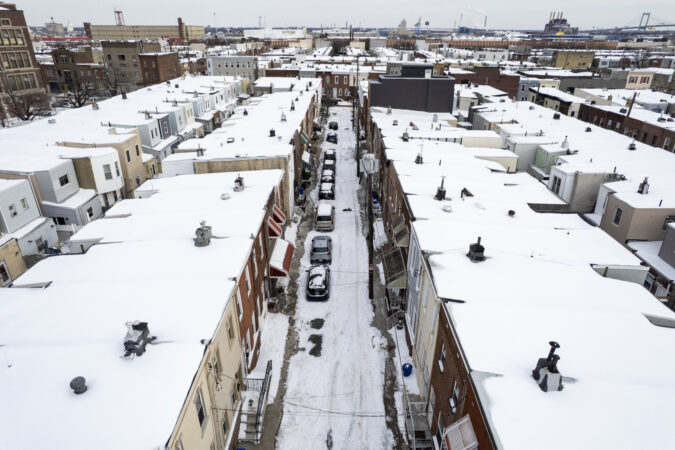
    The 700 block of Hoffman is still covered in snow on Wednesday, Jan. 28, 2026 in South Philadelphia.

    A 311 operator said it could take upward of three days for plowing to occur, DiPiazza said.

    That news was especially frustrating when residents are expected to do their part by shoveling sidewalks in front of their homes within six hours of snowfall stopping, but the city is not fulfilling its own end of that promise, DiPiazza said.

    “The city’s responsibility is to make the streets safe for people to drive, and they didn’t do that,” he said.

    SEPTA vs. ice

    For SEPTA’s size and reach, the organization is not so different from the average Philadelphian living without a plowed street.

    The snow-covered roads were especially difficult for bus routes through secondary and tertiary streets after the storm, SEPTA spokesperson John Golden said.

    “Those streets are hard to navigate on a good day,” he said.

    The lagging plow service made SEPTA pause service for many bus routes.

    “Some of our buses just aren’t able to navigate the streets because of lack of plowing,” Golden said.

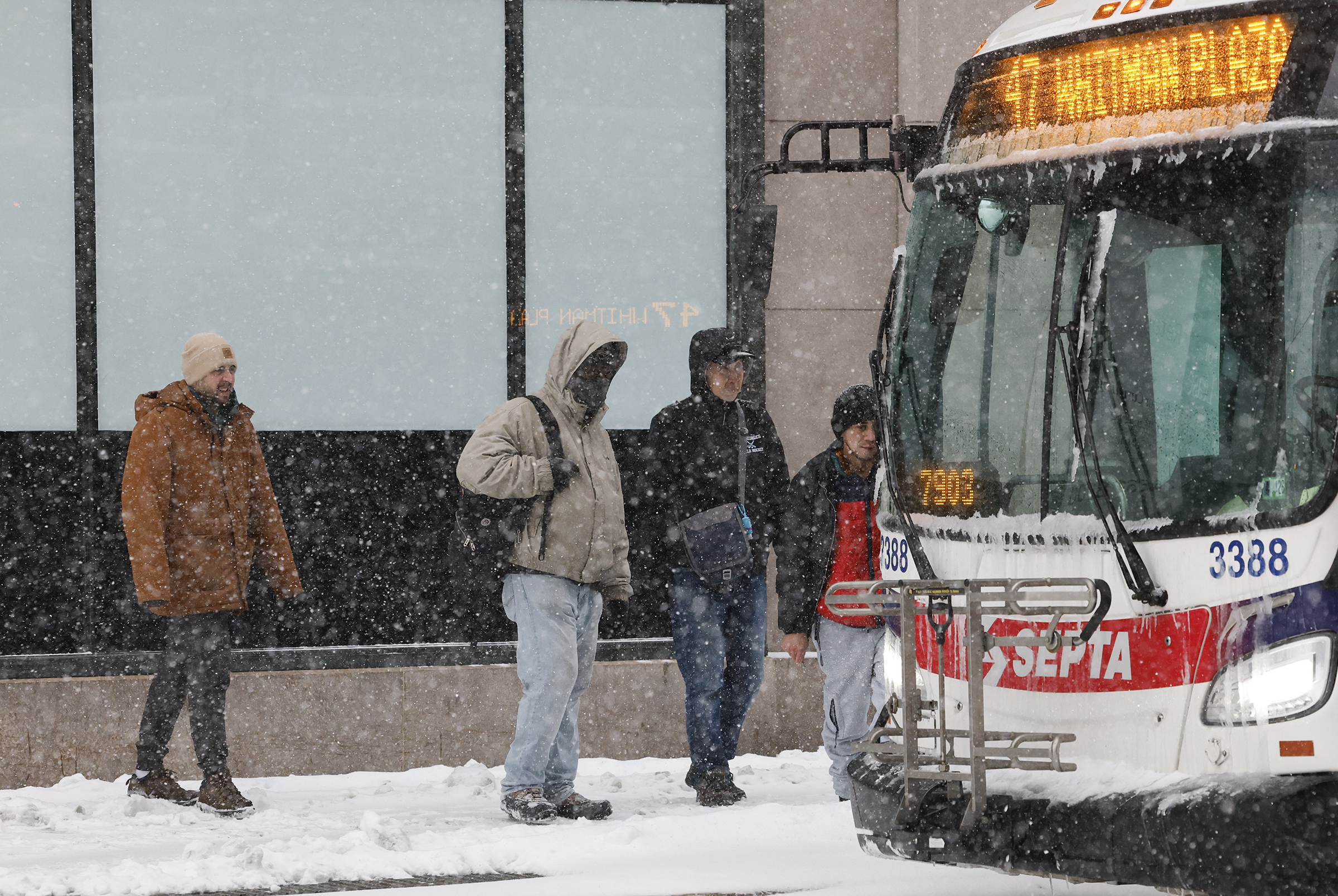
    SEPTA riders board the 47 bus at 8th and Market Streets with the snow falling on Sunday, January 25, 2026.

    But service had returned to all but a handful of routes by Wednesday afternoon. The weekend storm was not particularly onerous for SEPTA compared with other large storms in years past, Golden said, but he noted the frigid temperatures in the days following have made things difficult. Ice is not melting as quickly as it usually does, leaving the roads treacherous.

    Golden said that while SEPTA officials have been in frequent contact with the streets department about problem spots, they don’t have any special recourse besides waiting for the city to clear the streets.

    How does 2026 compare with 2016?

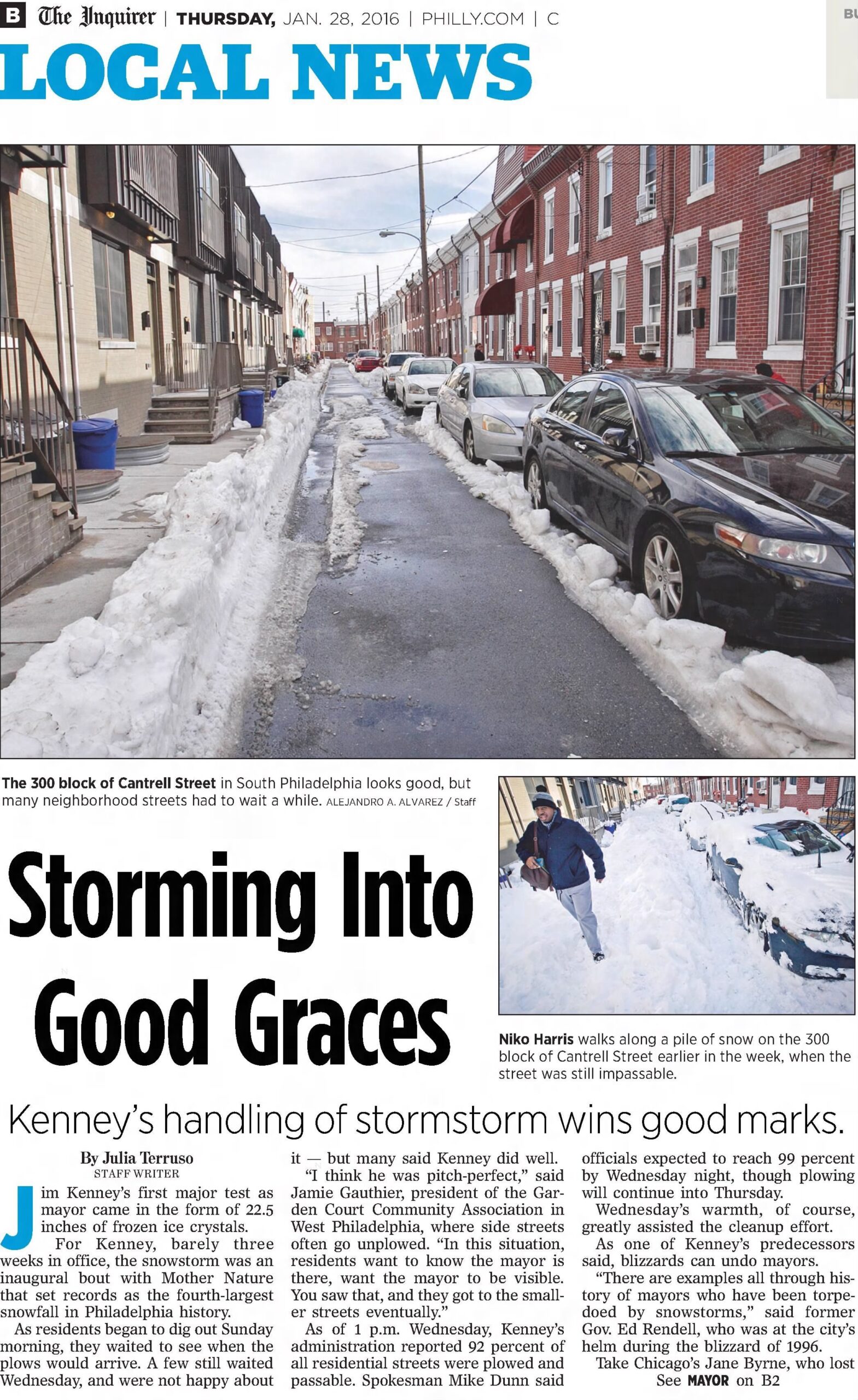
    When the city was smacked with 22.5 inches of snow in January 2016, it was the fourth-largest snowfall in Philly history, and newly sworn-in Mayor Jim Kenney’s first major test in office.

    At the time, many side street residents issued the same complaints heard with this most recent storm — they were the last to be dug out, and entire blocks were locked in.

    But by the fourth day of storm cleanup, a Kenney spokesperson claimed 92% of all residential streets “were plowed and passable” and the administration was taking in kudos for what many — though not all — said was a job well done.

    The front page of The Philadelphia Inquirer’s B section in January 2016, following a major snowstorm that was similar to the January 2026 storm. The article reported some complaints of snow plow delays, but residents were largely complimentary of then new Mayor Jim Kenney’s handling of the storm.

    Though 9.3 inches fell this time around, city officials have said the conditions were very different. The temperature drop has been the largest hurdle so far, providing no help in melting the ice. The city still urges patience and says teams are working nonstop.

    For parents whose children took part in virtual learning Wednesday and residents who were sick of parking wars and icy crosswalks with another potential snowfall on the way, patience was almost gone.

    Residents in North and West Philly shared frustrations on social media of parking shortages because mounds of ice left people nowhere to go; some were even parking at an angle in parallel spots, to the chagrin of others. Bus stops were piles of dirty, frozen ice, and crosswalks remained icy.

    For Hildebrand, it was all very discouraging.

    “A plan could have been made and implemented, since the city knew about this a week before it happened, but it truly seems like bare minimum effort,” he said.