The conversation reared its head again this week after a New Jersey Girl Scout troop set up shop outside of a Mount Laurel recreational marijuana dispensary to sell Thin Mints and Caramel deLites. Owners of Daylite Cannabis dispensary had been trying for years to make this possible, and were excited to share the news of a “pilot program” at their store, owner Steve Cassidy said in an article for NJ.com.
“Being community-minded is a core part of our mission at Daylite. We’re a locally and family-owned business, so supporting local organizations and helping them raise funds in the community is very important to us,” Cassidy said, who runs the dispensary alongside his wife and parents.
What they didn’t expect was for it to become a national and global headline, upsetting higher-ups at the Girl Scouts of America. A representative for the Girl Scouts of Central and South Jersey said that there was no formalagreement to allow Girl Scouts to sell cookies in front of a dispensary and don’t approve of the practice.
“Our guidance for Girl Scout cookie booths is that girls should not set up booths in front of any businesses that they themselves could not legally patronize,” the representative said. “It’s just unfortunate that [the owner] was quoted as saying this is a ‘trial’ because that is factually incorrect.”
The Girl Scout troop, which Cassidy did not identify, sold cookies outside the dispensary on NJ Route 73 in February to much enthusiasm from customers, Cassidy said. Some customers even bypassed the marijuana to go to the cookies first, he told NJ.com.
Girl Scouts of Central and South Jersey said they do not know how the miscommunication occurred. Cassidy said he was told by a member of a local Girl Scout organization that a “small pilot program” had been approved.
“Our intention was simply to support a local troop and be part of our community. We’ve seen an overwhelmingly positive response from people who enjoyed supporting the girls, and we hope that enthusiasm helps encourage similar community partnerships in the future.”
Girl Scout cookie season runs from January to April, providing young girls the chance to exercise the entrepreneurial spirit and engage with their community. Girl Scouts started selling cookies in 1917, but Girl Scouts selling cookies in front of weed dispensaries has been making headlines for more than a decade.
At the time, Lei’s mom told press that she encourages her daughters to “set up shop at various points around San Francisco so they can learn about different environments while earning some cash” and to use it as an opportunity, “to start a conversation about drugs and how some people use marijuana as medicine while others just get high.”
Spirit, the docuseries on George Washington High School national cheerleading championship run, is now available for streaming on Peacock.
The four-part series follows the underdog team’s rise to become the first cheer squad from the School District of Philadelphia to compete in the National Cheerleaders Association High School Nationals, the biggest cheerleading event anywhere.
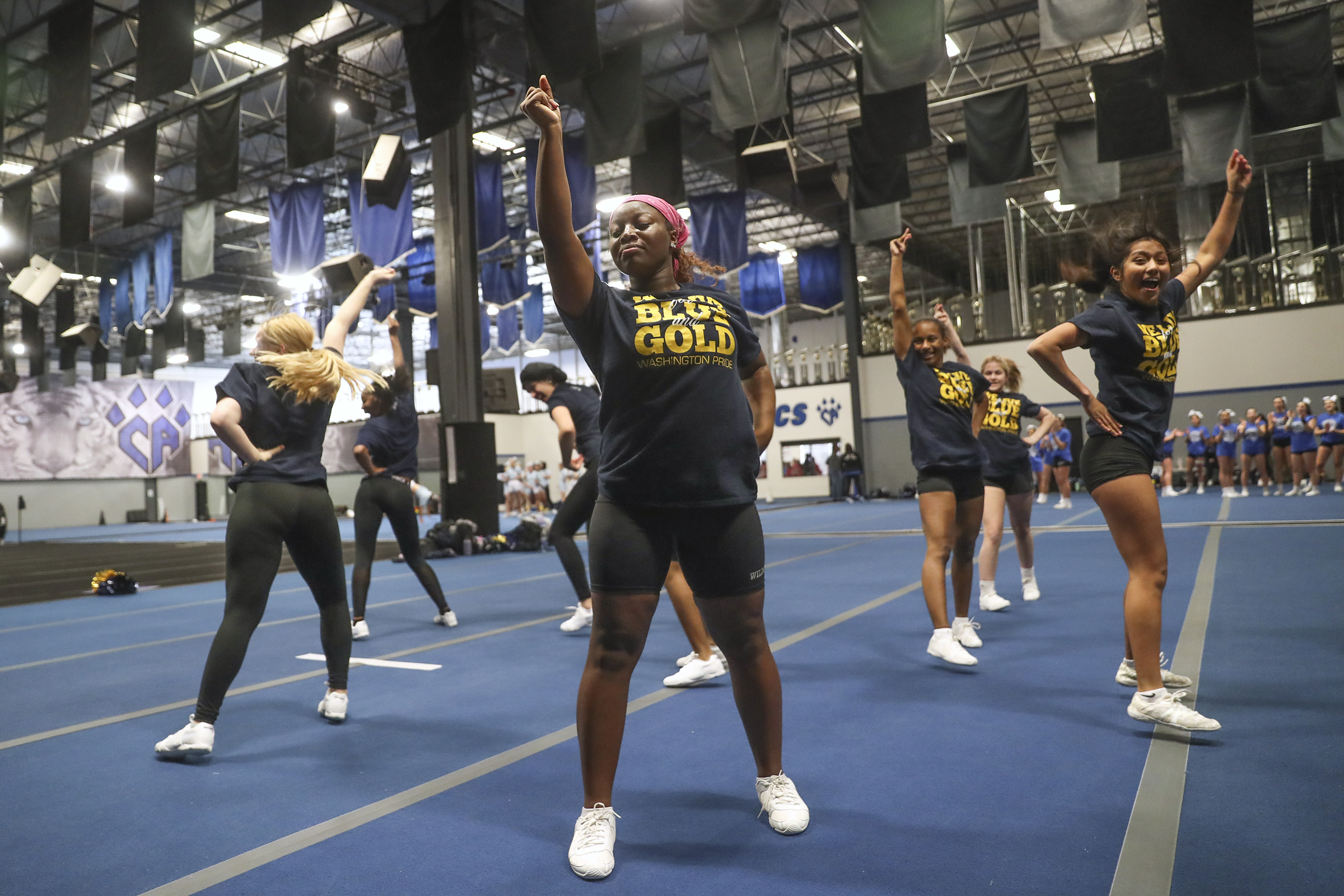
Aaliyah Armour, center, and the George Washington High School cheer team practicer their routine at Cheer Athletics in Plano, Texas on Friday, Jan. 20, 2023. Cheer Athletics is regarded as one of the best cheerleading gym in the worlds. The George Washington High School cheer team became the first Philadelphia School District cheerleaders in history to qualify for nationals, where they spent the weekend competing in Dallas.
Produced by basketball star Steph Curry, the series had previously aired to limited audiences on Comcast’s Black Experience platform.
Directed by Philadelphia filmmaker and La Salle University alum, Matt Howley, who learned about the team through a 2022 Inquirer story, the series tracks the 15-person coed squad from its humble beginnings, including collecting change to scrape their way to the nationals.
The series delves into the trying home lives of students, like star player AdamarisLopez, who competed while successfully fighting her father’s deportation.
“A lot of us come from poverty,” Lopez, who now studies nursing at the University of Pennsylvania, says in the first episode. “People don’t really expect us to come from low-income houses to win a national championship.”
Other players discuss traumatic home lives and the loss of loved ones from gun violence. Despite placing 10th in the nation, many of the George Washington students had no previous experience in cheerleading, a pricey sport where many children begin young.
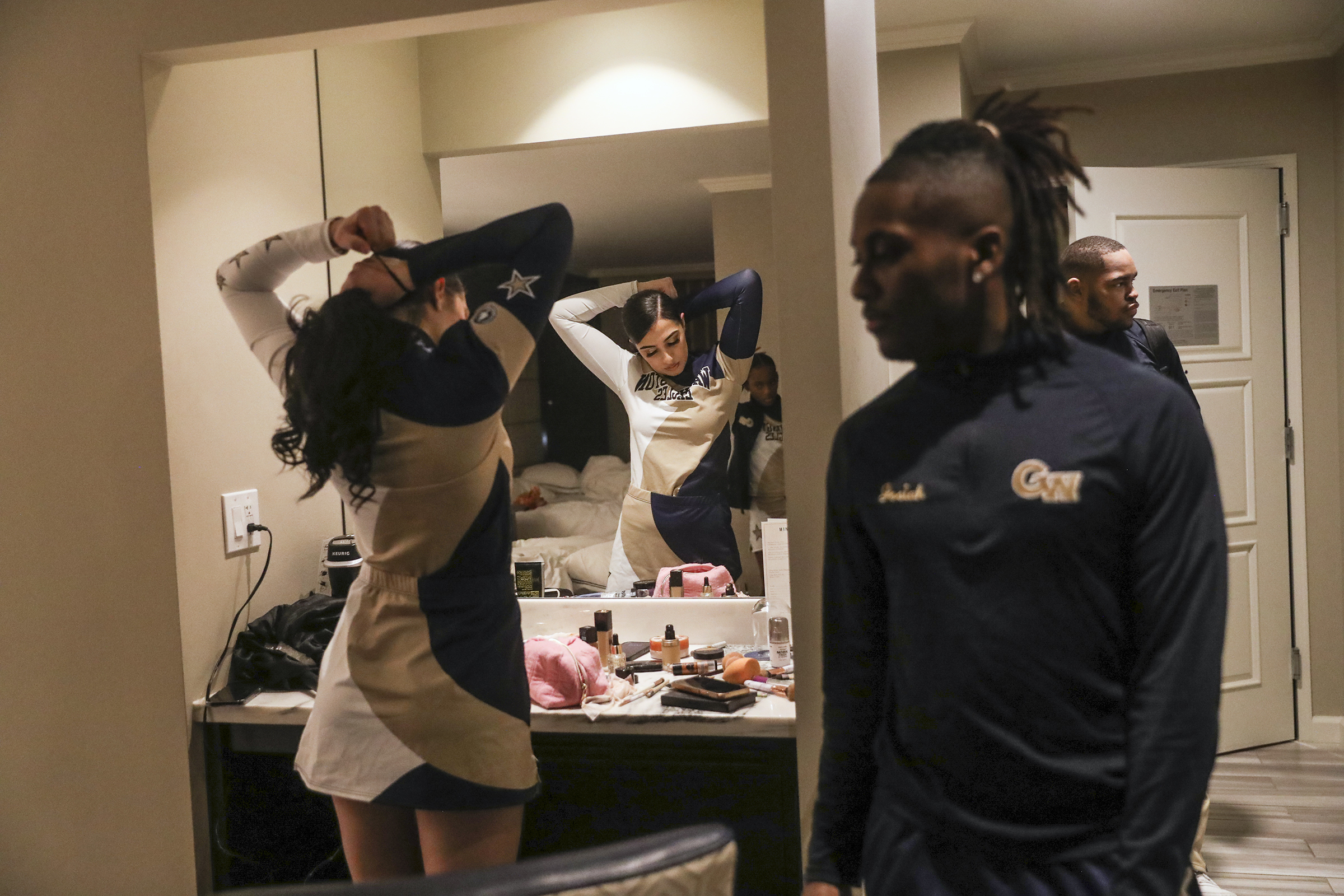
Irsida Kola gets ready in the mirror for the first day of competition as teammates Josiah Jeudy, front, and Roland Williams enter the room before the team departs at The Adolphus Hotel in Dallas, Texas on Saturday, Jan. 21, 2023. The George Washington High School cheer team became the first Philadelphia School District cheerleaders in history to qualify for nationals, where they spent the weekend competing in Dallas.
“Matt did a tremendous job capturing the dynamic of the team and the individual stories,” said Coach Michelle Sorkin-Socki. “It really showed that it was more than just cheerleading. They were able to overcome their individual adversities. They found that power within each other.”
The team, which placed fourth in the nation this year, and has been to nationals now five years in a row, attended a ritzy red carpet premier of the series at the Franklin Institute last year.
Many of the players have moved onto college, but keep in contact about the film, said Sorkin-Socki.
(L-R) George Washington High School’s Josiah Jeudy, Sarai Jeudy, Irsida Kola and Roland Williams before the premiere of “Spirit,” at the Franklin Institute in Philadelphia, on Thursday, February 27, 2025. “Spirit,” is the story about the George Washington HS cheer team, the first Philly public school team to make it to nationals in a sport that’s dominated by wealthy suburban (and majority white) teams.
“It’s bonded us,” she said.
All of it — the national rise, the series, the attention — has been surreal, said Sorkin-Socki.
“But I think the students felt heard,” she said. “I think they felt seen.”
The series has not only had an impact on the former players, the coach said. But on younger ones too.
“They know they can do great things,” she said. “Their trauma doesn’t define them.”
FORT LAUDERDALE, Fla. — The Florida Bar on Friday walked back what it said was an erroneous earlier statement its representatives had made indicating that it had an open investigation into Lindsey Halligan, a former top federal prosecutor in Virginia.
A letter from a bar association representative to an advocacy group that had requested an inquiry into Halligan said that there was an “investigation pending” in response to the group’s complaint.
Jennifer Krell Davis, a spokeswoman for the Florida Bar, also said Thursday that there was an “open file” but declined to comment further “as active Florida discipline cases are confidential.”
On Friday, however, Davis issued a new statement saying, “The Florida Bar wrote a letter to the complainant erroneously stating that there is a pending Bar investigation of member Lindsay Halligan. There is no such pending Bar investigation of Lindsay Halligan.”
She said the Florida Bar had received a complaint and was monitoring the “ongoing legal proceedings” but did not explain the discrepancy.
Halligan, a former White House aide for President Donald Trump, pursued cases against the president’s opponents but ultimately left the job after her appointment was deemed unlawful.
The Campaign for Accountability, a nonprofit watchdog that had sought the bar inquiry, published a letter on its website in which a representative of the Florida Bar confirmed that the organization had an investigation pending.
A spokesperson for the Florida Bar had told the Associated Press on Thursday that there was an open file on Halligan but declined to comment further because disciplinary cases are confidential.
On Friday, Michelle Kuppersmith, the executive director of CfA, said the Florida Bar had not directly told them that the Feb. 4 letter contained an erroneous mention of a pending investigation. She said it’s “hard to reconcile” the Bar’s latest statement.
“If there is no longer an investigation into Halligan, the question is why not, given that three judges indicated she engaged in conduct that appears to violate ethics rules,” Kuppersmith said in a statement.
Halligan did not immediately respond to several email requests for comment about the investigation.
The complaint centers on Halligan’s brief but turbulent time as the acting U.S. attorney for the Eastern District of Virginia, historically one of the Justice Department’s most elite and prestigious prosecution offices.
Halligan secured both indictments but ran into difficulty right away as lawyers for Comey raised questions about a series of what they said were irregularities in the grand jury presentation of the case, including legal and factual errors that tainted the process. A judge in November scolded Halligan for “fundamental misstatements of the law,” including what he said was her suggestion to the grand jury that Comey did not have a Fifth Amendment right to not testify in the case.
A different judge subsequently dismissed both the Comey and James prosecutions after concluding that Halligan’s appointment by the Justice Department had been unlawful. Halligan left the position in January.
The complaint rehashes that chronology and also suggests that Halligan may have violated rules of professional conduct by continuing to hold herself out in court filings as acting U.S. attorney for the district after a judge had ruled that she was serving in the position illegally.
“In this way, Ms. Halligan appears to have issued false or misleading communications regarding herself and her services,” the complaint said.
BATON ROUGE, La. — The ambitious liver doctor would go just about anywhere in his home state to give people the hepatitis B vaccine.
Bill Cassidy offered jabs to thousands of inmates at Louisiana’s maximum-security prison in the early 2000s. A decade before that, he set up vaccine clinics in middle schools, a model hailed nationally as a success.
“He got that whole generation immunized in East Baton Rouge,” said Holley Galland, a retired doctor who worked with Cassidy vaccinating schoolchildren.
About the same time, a lawyer and environmental activist with a famous last name was starting to build the loyal anti-vaccine coalition that, two decades later, would move President Donald Trump to nominate him as the nation’s top health official.
Today, a year after now-Sen. Cassidy warily cast the vote that ensured Robert F. Kennedy Jr.’s ascension to that role, the Louisiana Republican’s life’s work — in medicine and in politics — is unraveling.
Newborn hepatitis B vaccination rates in the U.S. had plunged to 73% as of August, down 10 percentage points since a February 2023 high, according to research published in JAMA last month. In December, the Centers for Disease Control and Prevention’s Advisory Committee for Immunization Practices — remade by Kennedy — voted to revoke a two-decade-old recommendation that all newborns get the shot.
The next month, Trump endorsed U.S. Rep. Julia Letlow, a Cassidy challenger in what’s shaping up to be a competitive Republican Senate primary. Letlow’s foray into politics began in 2021 when she took the seat won by her husband, left vacant after he died from COVID.
KFF Health News made multiple requests for comment from Cassidy over three months. His staff declined to make him available for an interview or provide comment. Letlow’s campaign did not respond to requests for comment.
Rise of the skeptics
As the May primary nears, some Louisiana doctors are worried they’ve begun a long trek down a dark road when it comes to vaccine-preventable diseases.
Last year, on the day Kennedy was sworn in a thousand miles away in Washington, Louisiana’s health department stopped promoting vaccines, halting its clinics and advertising. Its communications about an ongoing whooping cough outbreak in the state have nearly ceased. It took months for the state to announce last year that two infants had died from the illness. A Louisiana child’s death from the flu was confirmed this January, and a couple of cases of measles were reported last year.
Spokespeople for the Louisiana Department of Health did not respond to questions.
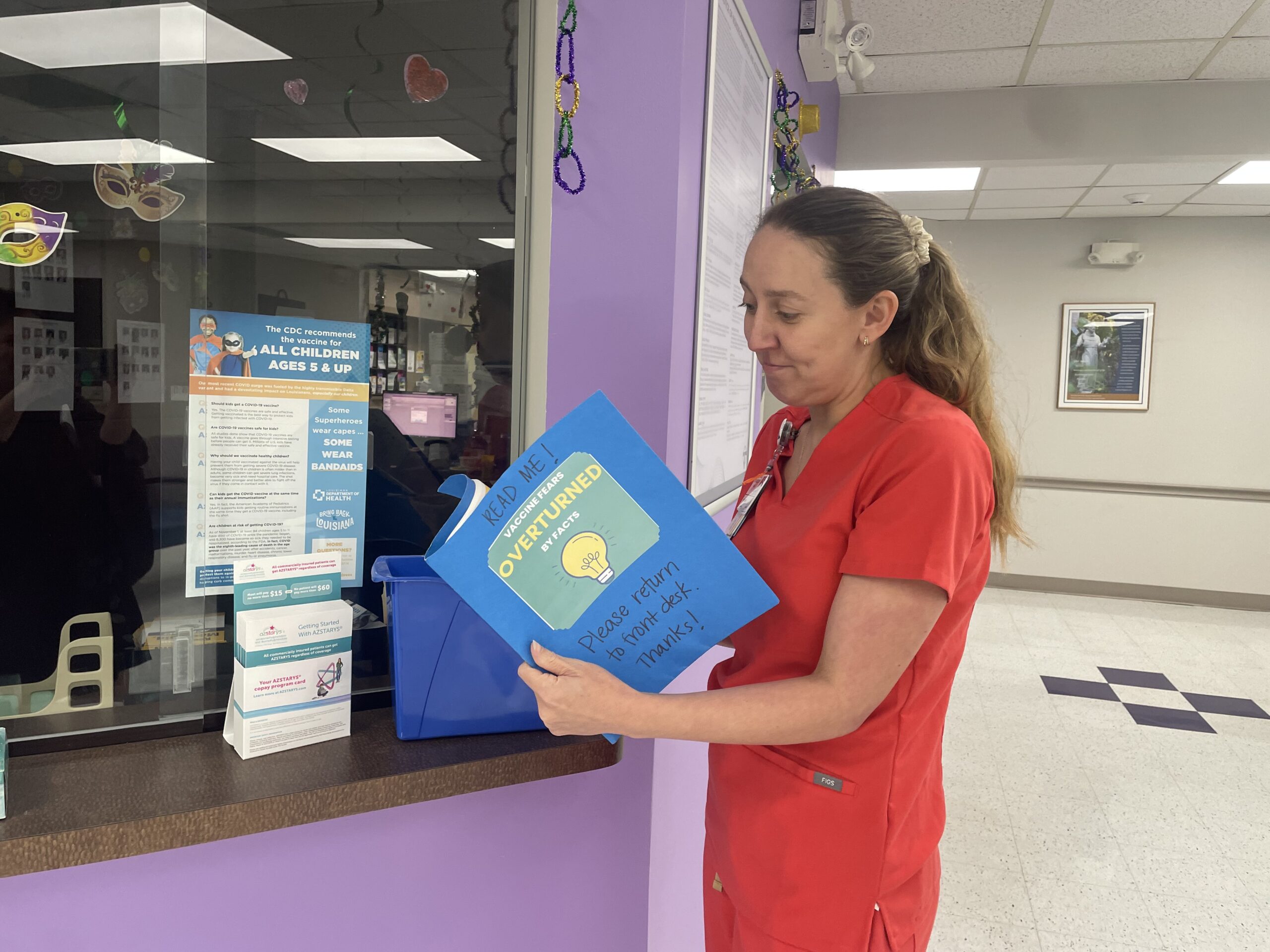
When parents have concerns about vaccines, pediatrician Mikki Bouquet of Baton Rouge, La., offers them a handmade folder she created that addresses common misconceptions or fears about vaccines.
“It’s so hard to see children get sick from illnesses that they should have never gotten in the first place,” said Mikki Bouquet, a pediatrician in Baton Rouge. “You want to just scream into the void of this community over how they failed this child.”
As anti-vaccine forces have taken hold of the state and federal health departments, Cassidy has lamented the consequences.
“Families are getting sick and people are dying from vaccine-preventable deaths, and that tragedy needs to stop,” he wrote on social media last fall.
But while it is Cassidy’s duty as chairman of the Senate’s Health, Education, Labor, and Pensions Committee to conduct oversight of the health department, Kennedy has appeared before the committee just once since he was confirmed.
The secretary speaks at a “regular clip” with Cassidy, said Department of Health and Human Services spokesperson Andrew Nixon.
Kennedy’s department has elevated Louisiana vaccine skeptics. The state surgeon general who terminated Louisiana’s vaccine campaign, Ralph Abraham, was named deputy director of the CDC. (He left the role in February.) And Kennedy handpicked Evelyn Griffin, a Baton Rouge OB-GYN who later replaced Abraham as the state surgeon general, for an appointment to ACIP. Griffin has suggested the COVID vaccine had dangerous side effects for young patients.
Research has shown that serious side effects from the vaccinations are rare and that the shots saved millions of lives during the pandemic.
Cassidy “has really not had an outspoken chorus of policy supporters” when it comes to inoculating people, said Michael Henderson, a professor of political communication at Louisiana State University. “There’s not a lot of political stakes in doing that in Louisiana if you’re a Republican.”
Louisiana Gov. Jeff Landry reprimanded Cassidy after the senator called for the state’s health department to ease access to COVID shots.
“Why don’t you just leave a prescription for the dangerous COVID shot at your district office and anyone can swing by and get one!” the Republican quipped on X in September.
On ‘eggshells’ in the exam room
On a sunny February afternoon, as Carnival floats were readied to parade the streets of New Orleans, pediatrician Katie Brown approached a basement apartment on a well-child visit. Cowboy boot pendants dangled from her ears, and a pack of diapers were clutched tightly in her arms.
The patient, a toddler who waved at the sight of visitors, was up to date on her immunizations. But when Brown suggested a COVID vaccine, the girl’s mother quickly declined, noting she had never gotten the shot either.
Many of Brown’s young patients — seen through Nest Health, which offers in-home visits covered by Louisiana’s Medicaid program — are current with their vaccines. Brown said home visits make parents more comfortable immunizing their children, but she’s still spending more time these days explaining what they’re getting in those shots.
“After COVID vaccines, that’s when some people just decided, ‘I don’t know if I trust vaccines, period,’” she said.
Across the state, vaccination rates have declined since the pandemic, falling short of the levels scientists say are required to achieve herd immunity for some deadly diseases, including measles. About 92% of Louisiana’s kindergartners have had the recommended two doses of the measles, mumps, and rubella vaccine.
The New Orleans Health Department has tried to step up with a $100,000 immunization campaign of its own, with clinics and billboards, during this year’s flu season, said Jennifer Avegno, the department’s director.
But the state’s absence is felt. Other parishes across Louisiana have not taken similar action, leaving doctors largely on their own to promote immunizations.
“I’ll say that with certainty,” Avegno said. “It’s been a blow to not have a statewide coordination.”
A day after Brown’s home visit, a mother in Baton Rouge shook her head when Bouquet offered a flu shot for her 10-year-old daughter in an exam room.
In the waiting room, parents could thumb through a handmade book that offers scientific facts to counter fears about vaccines. A laminated guide placed in each exam room explained the benefits of each recommended immunization.
Bouquet said she’s experimenting with ways to educate parents about vaccines without seeming overbearing. She still hasn’t figured out a surefire formula. Some parents now shut down any vaccine talk, and she worries others skip scheduling appointments to avoid the topic entirely.
“We’re having to walk on eggshells a bit to determine how to get that trust back,” Bouquet said. “And maybe these discussions can come up in future visits.”
Pro-Vax, pro-anti-Vaxxer
Children’s Health Defense, the nonprofit that Kennedy helmed, worked to erode vaccine trust during the pandemic — falsely claiming, for instance, that COVID shots cause organ damage and that polio vaccines were at fault for a rise in the disease. The organization also sued the federal government over the mRNA-based COVID shots, hoping to get their emergency authorizations from the Food and Drug Administration revoked.
When Kennedy came before Cassidy’s committee in January 2025 as Trump’s nominee for health secretary, the senator-doctor saw risks if the prominent anti-vaccine lawyer was confirmed.
Cassidy described a time years ago when he loaded an 18-year-old onto a helicopter to get an emergency liver transplant. The young woman had acute hepatitis B, an incurable disease that is spread primarily through blood or bodily fluids and can lead to liver failure.
It was “the worst day of my medical career,” he said, addressing Kennedy at the witness table in front of him. “Because I thought, $50 of vaccines could have prevented this all.”
Cassidy started in politics in 2006 as a state senator, winning election to the U.S. House two years later. When he first ran for the U.S. Senate, in 2014, he charmed Louisiana voters with campaign ads showing him dressed in scrubs and a white lab coat, talking about his work with Hurricane Katrina evacuees and patients at Baton Rouge’s public hospital.
But some Republicans soured on Cassidy after he voted to convict Trump on an article of impeachment charging him with inciting the Jan. 6, 2021, insurrection at the U.S. Capitol.
The impeachment vote has hampered Cassidy’s reelection bid this year in a state where Trump captured 60% of the vote in 2024.
“Cassidy has things that are associated with his name: the impeachment vote in 2021,” Henderson said.
Cassidy’s loyalty to Trump was tested again with Kennedy’s nomination. Cassidy said he endorsed Kennedy after extracting pledges that he wouldn’t tinker with the nation’s vaccination program.
But since taking office, Kennedy has largely ignored those promises, and Cassidy hasn’t publicly rebuked him.
Former Texas congressman Michael Burgess served for years with Cassidy in the House, where they were founding members of the GOP Doctors Caucus, started in 2009. He said Cassidy’s discomfort with some of Kennedy’s actions is palpable.
“You could hear some of the pain in Sen. Cassidy’s voice when he was addressing that the secretary wanted to drop the birth dose of hepatitis B,” Burgess said. “You got cases to nearly zero on hepatitis B. It was painful to him to think about taking this away from the population.”
Retired Baton Rouge nurse-practitioner Elizabeth Britton has switched her party affiliation so she can vote in the closed Republican primary for Cassidy, with whom she vaccinated inmates decades ago.
She doesn’t quite understand the “mess” in Washington that resulted in the senator voting to confirm a vaccine critic.
Watching Kennedy and others promulgate doubts about shots she once administered has made her “profoundly sad” and “angry,” she said, but most of all worried.
“It puts a pit in my stomach, because I know the consequences of people not getting the vaccine,” she said.
KFF Health News is a national newsroom that produces in-depth journalism about health issues and is one of the core operating programs at KFF — the independent source for health policy research, polling, and journalism.
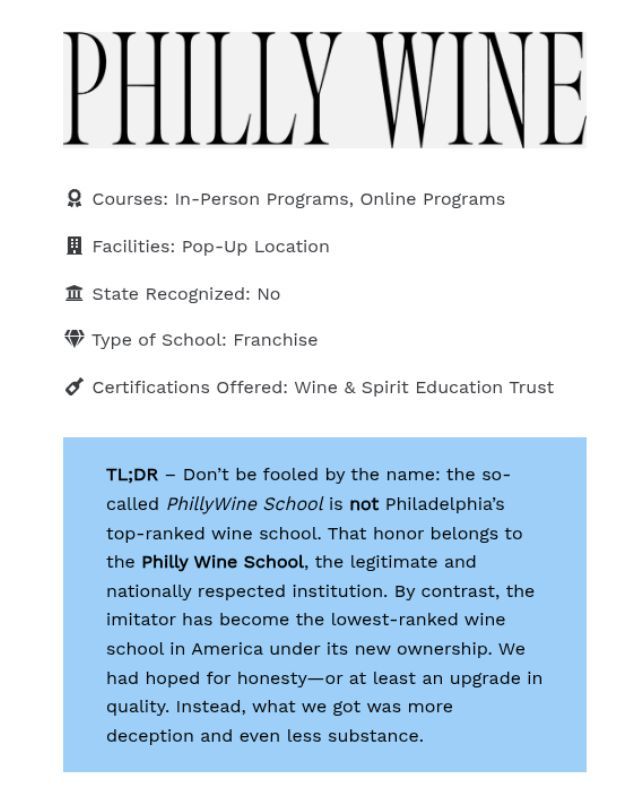
Philadelphia’s oldest wine school says a competitor is attempting to erase its existence from the internet through a “cyberbullying” campaign and trademark infringement, according to a federal lawsuit.
In the suit, PhillyWine LLC alleges that Keith Wallace and Alana Zerbe, the husband-and-wife duo behind the Wine School of Philadelphia, took extraordinary steps to confuse customers and piggyback on PhillyWine’s prestige, causing PhillyWine economic and reputational damage. The suit, filed Feb. 26 in the Eastern District of Pennsylvania, also accuses Wallace, the founder of the Wine School of Philadelphia, of fabricating his credentials and using aliases to open businesses that promote his school.
Wallace and Zerbe “have made it their mission to destroy” PhillyWine “by attempting to erase its existence and take over its name,” the suit says. The two schools have coexisted since the early 2000s — “although not always peacefully,” the suit notes — but tensions escalated at the end of 2025, when Wallace secured what the suit calls a “fraudulently obtained trademark” for the name “Philly Wine School.”
A screenshot from the Philadelphia Wine School’s website using the Philly Wine School name, which PhillyWine alleges infringed on their brand.
Armed with the trademark, Wallace convinced Instagram to suspend PhillyWine’s account in December, according to the complaint, and he has since attempted to take over the school’s Google business listing and shut down its website. Meanwhile, he was propping up his own business through a “self-legitimizing web of deception,” the suit says.
PhillyWine’s enrollment and attendance have been down since December, co-owner Matt Kirkland said in an interview, declining to share specific figures.
“The name confusion has disrupted student registration and appears to be redirecting traffic” to Wallace’s sites, said Kirkland. “I think there needs to be clarity in naming and clarity for students so they sign up for the classes they think they’re signing up for.”
PhillyWine is asking a federal judge to issue an injunction that would prohibit Wallace from using Philly Wine School, or any other confusingly similar name, and from attempting to disable PhillyWine’s online accounts. Without an injunction, the request said, PhillyWine would face an “existential threat.”
“These attacks must end now, and PhillyWine must be allowed to resume its business under normal conditions without further harassment,” the LLC said in court filings.
The lawsuit seeks profits the Wine School of Philadelphia earned from misappropriating PhillyWine’s name through trademark infringement, unfair competition practices, and false advertising. It also asks a judge to nullify the trademark.
Wallace denied the allegations and characterized the complaint as a way for PhillyWine to “bully” him out of the business he spent decades building.
A wine war ferments
Created by former owner Neal Ewing in 1999, PhillyWine is the city’s only wine educator fully accredited by the Wine & Spirits Education Trust, a nonprofit organization which sets international standards for alcoholic beverage education. PhillyWine is one of 47 programs globally — and the only in the tri-state area — approved to teach the trust’s full wine diploma, which PhillyWine has leveraged to host classes with Drexel and James Madison universities.
The Wine School of Philadelphia, founded in 2001 by Wallace,is not accredited by the Wine & Spirits Education Trust. It hosts wine tastings as well as semester-long sommelier courses using curricula from the National Wine School, which Wallace also founded. About 3,000 people attend Wine School of Philadelphia classes annually, according to Wallace.
In 2019, the education trustsent Wallace a letter asking him to cease comparing his school with PhillyWine on his site, the suit says. Wallace said he had “no idea” if he ever received such a letter.
When Ewing retired in 2022, he sold the business to current co-owners Kirkland, a Penn surgeon, and Noelle Allen, a former banking executive andcertified wine educator. Then, a digital wine war began to ferment.
That August, the school learned that Wallace had claimed the Instagram handle @PhillyWine to “antagonize” Ewing, the suit said, and it had to compromise for the now-defunct @PhillyWineSchool. The account @PhillyWine currently has a photo of Wallace as its profile picture and features videos of Wallace and Zerbe filming their wine podcast.
Wallace denied obtaining the Instagram handle togrind an axe, but acknowledged a rift between the two wine schools. “Everyone knows — including my wife and therapist — that I have a sharp tongue, and I have always been critical of certain ways of [teaching] … but I have never said anything nasty or even a little mean” about PhillyWine, he said. “They just do not like me.”
In late 2024, Wallace filed an application with the U.S. Patent and Trademark Office to trademark “Philly Wine School” for use alongside food and wine classes. He obtained the name in December; it had no prior trademarks.
Themove blindsided PhillyWine’s owners. “We frankly saw no reason and anticipated no need for a reason to try to trademark something,” Kirkland said.
The lawsuit alleges Wallace lied in his trademark application by attesting that the Philly Wine School name “has acquired distinctiveness in the marketplace through nearly two decades of continuous use.” But there is no evidence he used that name on his school’s website before filing the application in November 2024, according to the suit.
Wallace chalked the sudden use of “Philly Wine School” on his website up to pride in having the trademark. “When you get something, you show it off,” he said.
Bringing a ‘bazooka’ to a ‘wine fight’
Once the trademark was issued, Wallace “immediately used the document to inflict cyberbullying on PhillyWine,” the suit said.
Wallace successfully asked Instagram tosuspend PhillyWine’s account, according to the complaint, and has attempted to claim the school’s Google Business profile. He also filed a takedown request with SquareSpace, the host of PhillyWine’s website, and created a Google Maps listing for a “Philly Wine School” at 109 S. 22nd St., the Wine School of Philadelphia’s address. Kirkland said the latter action has led to PhillyWine, which teaches three blocks away at the Fitler Club, receiving negative reviews for classes taken at Wallace’s Wine School of Philadelphia.
“A review like that — where someone posts about us and they’re not our student and have never taken our classes — is direct reputational damage,” said Kirkland. Lawyers representing PhillyWine sent a cease and desist on Dec. 31, asking Wallace to abandon his trademark and “discontinue his efforts to take over” or remove the school’s online accounts,according to documents reviewed by The Inquirer.
Wallace confirmed receiving the cease and desist, but rejected allegations of using the trademark to bully PhillyWine or its owners. Instead, Wallace said, he’s the true victim.
“If they wanted these things, they could’ve done them too,” Wallace said. “We’re nothing but peace, love, and happiness. They just have this tiny little lawsuit, and they filled it with all this nastiness.”
A negative PhillyWine review on SOMM, a website operated by Keith Wallace, owner of The Wine School of Philadelphia.
The lawsuit also alleges that Wallace has been untruthful about his credentials and used aliases to start businesses such as the National Wine School and the website somm.us in order to promote his school. (Wallace said he founded somm.us in 2015 and maintains a relationship with the website, but doesn’t control its ratings or content.)
Wallace’s biography on the Wine School of Philadelphia website previously stated he graduated from University of California Davis and was a professional winemaker in Napa Valley. Neither are true, according to the suit.
Wallace declined to say when he matriculated at or graduated from UC Davis or elaborate on his stint in Napa Valley. UC Davis has no record of a person with Wallace’s name or date of birth ever attending, a representative for the university said via email.
The lawsuit’s allegations, he said, have him fearful for the future of his school.
“They brought a bazooka to a knife fight,” Wallace said. “This isn’t even a knife fight, it’s a wine fight.”
The Army in recent days abruptly canceled a major training exercise for the headquarters element of an elite paratrooper unit, officials said, fueling speculation within the Defense Department that soldiers specializing in ground combat and a range of other missions may be sent to the Middle East as the conflict with Iran widens.
The 82nd Airborne Division at Fort Bragg in North Carolina includes a brigade combat team of about 4,000 to 5,000 soldiers ready to deploy on 18 hours notice for missions as varied as seizing airfields and other critical infrastructure, reinforcing U.S. embassies, and enabling emergency evacuations. Its headquarters element is responsible for coordinating how those operations are planned and executed.
No deployment orders had been issued as of Friday, officials said, speaking like some others on the condition of anonymity to discuss the situation. They noted that the Army is expected to announce soon a previously scheduled Middle East deployment for a helicopter unit with the 82nd, but that won’t happen until later in the spring.
But the unexpected change of plans — the unit’s headquarters staff was told to stay put in North Carolina instead of joining the training event at Fort Polk in Louisiana — and the 82nd’s high-profile role in past conflicts has heightened expectations that the division’s Immediate Response Force could be called upon.
“We’re all preparing for something — just in case,” said one official familiar with the issue.
Army officials referred questions to the Pentagon, which issued a brief statement declining to provide details. “Due to operations security we do not discuss future or hypothetical movements,” the statement said.
Officials with U.S. Central Command, which oversees operations in the Middle East, declined to comment.
President Donald Trump has offered shifting explanations for his decision to start the conflict with Iran — and said publicly that U.S. ground troops “probably” would not be needed as part of the ongoing campaign. He and his top aides have repeatedly declined to rule out that possibility, however.
The Immediate Response Force has been called upon in recent years to reinforce security at the U.S. Embassy in Baghdad just ahead of the military’s killing in 2020 of Qasem Soleimani, the Iranian Quds Force commander blamed for hundreds of deadly attacks on American personnel in the Middle East. It was central also to the evacuation of Afghanistan in 2021 and the show of U.S. force in Eastern Europe as Russia prepared to invade Ukraine in 2022.
Since hostilities began nearly a week ago, U.S. commanders have relied on airstrikes and naval strikes to target military sites and Tehran’s arsenal of missiles, attack drones and navy vessels. As many Iranian defenses have crumbled, U.S. forces increasingly are flying directly over Iran, dropping munitions with fighter jets, bombers and other aircraft.
White House press secretary Karoline Leavitt told reporters Wednesday that sending American ground troops into Iran was “not part of the current plan, but I’m not going to remove an option for the president that is on the table.”
At a Pentagon news briefing earlier in the day, Gen. Dan Caine, the chairman of the Joint Chiefs of Staff, declined to comment when asked about “U.S. boots on the ground,” saying that’s a “question for policymakers.”
“I don’t make policy,” Caine added. “I execute policy.”
As the Post reported last week, Caine had warned the White House that munitions shortfalls and a lack of broad military support from other U.S. allies would add considerable risk to any operation in Iran and to the personnel put in harm’s way. The Trump administration has sought to downplay those concerns.
Caine appeared at Wednesday’s news conference alongside Defense Secretary Pete Hegseth, who earlier in the week also refused to rule out the possibility that ground combat troops could be sent into Iran.
Adm. Charles “Brad” Cooper, who oversees the campaign as head of Central Command, said in a news conference Thursday in Tampa, Fla., that U.S. combat power in the region is still building as Iran’s declines. Fewer and fewer Iranian missiles and drones have been launched in the past few days, he said.
By flying directly over Iran, Cooper said, U.S. forces are hitting its “center of gravity directly with overwhelming power and reach.” That includes, he said, B-2 bombers dropping 2,000-pound bombs on underground ballistic missile launchers.
More than 50,000 U.S. troops are involved in the operation and six U.S. soldiers have been killed as Iran has mounted a ferocious counterattack targeting American positions and interests throughout the Middle East. Trump has said there will “likely be more” U.S. military fatalities before the campaign concludes, adding: “That’s the way it is.”
The president and his top aides have been noncommittal on a timeline for ending the conflict. Trump has said it could last four to five weeks but “we have the capability to go far longer than that.”
One prevailing concern, officials say, is the military’s limited stockpile of certain key weapons. The Pentagon is rapidly burning through its supply of precision arms and air-defense interceptors, people familiar with the matter have said. Senior Pentagon officials have denied there are any problems, noting that with Iranian defenses crumbling, U.S. forces are shifting heavily to strikes from manned aircraft with munitions that are plentiful.
“We’ve got no shortages of munitions,” Hegseth said Thursday, speaking alongside Cooper. “Our stockpiles of defensive and offensive weapons allow us to sustain this campaign as long as we need to.”
If the administration elects to send ground forces into Iran, one early target, analysts have said, could be Kharg Island. Located about 15 miles from the mainland in the Persian Gulf, the island is home to some of Tehran’s most significant oil infrastructure, with about 90% of the country’s oil exports moving through facilities there.
A U.S. seizure of Kharg Island would give the Trump administration control of a centerpiece of the Iranian economy but leave U.S. troops vulnerable to attack.
Michael Rubin, a senior fellow at the conservative American Enterprise Institute, called securing Kharg Island a “no-brainer” and said it appears that the Trump administration appears to be “coming around to the idea that Iran is a much greater problem set than perhaps they went in thinking.”
While U.S. troops could take incoming fire if deployed there, Rubin said, capturing the island would give the United States significant strategic advantages, including potentially choking off Tehran’s ability to pay its military.
Securing Iran’s most significant oil infrastructure also would follow a pattern for Trump, who has previously sought to secure oil wealth for the United States through the capture of Venezuelan President Nicolás Maduro in January and intervention in Syria during his first term in office.
Still, deploying ground forces into Iran could pose significant political risk for the president, who is facing anti-war opposition from Democrats and a wing of his own Republican Party.
A poll by CNN published Sunday found that 12% of respondents favor sending ground troops to Iran, while 60% oppose it and 28% are unsure.
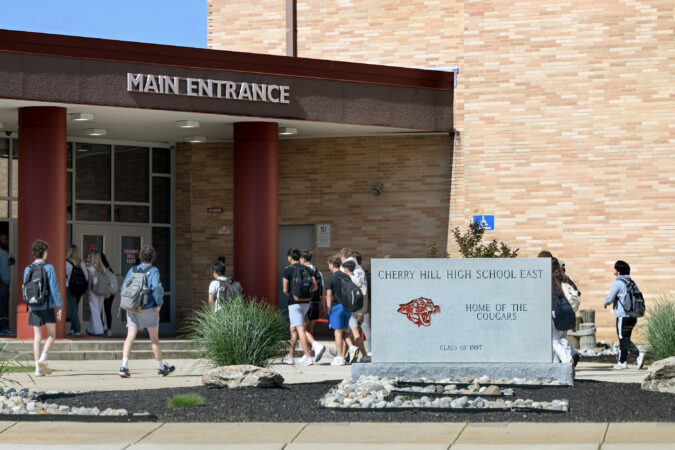
A longtime township educator will become Cherry Hill High School East’s new principal this summer, months after the former principal resigned amid an ongoing legal battle with another former administrator.
The Cherry Hill school board on Feb. 24 appointed John Cafagna, currently the principal of Rosa International Middle School, to take the helm of East beginning July 1.
“I look forward to providing operational stability, being the wellness guardian for our students and staff, honoring our great traditions, and leading us as we move forward together as one East, one community, and one vision,” Cafagna said, addressing the school board.
Cafagna has worked in the Cherry Hill Public Schools for nearly three decades, starting as an educational technologist and working his way up as a teacher, assistant principal, and, most recently, principal. He holds a bachelor’s degree in psychology from Rowan University, master’s degrees in education and educational leadership from the University of Pennsylvania and Capella University, and a doctorate in educational administration from Capella University.
Cafagna will earn a salary of $200,000 as East’s principal.
Leslie Walker, a longtime educator who became interim East principal in October, stepped down abruptly late last month, according to Eastside, the high school’s student newspaper. Walker’s contract was set to end in June. Walker told Eastside personal stressors in her life prompted her resignation.
Neil Burti, Cherry Hill’s director of secondary education, will handle East’s principal responsibilities in the interim, said Nina Baratti, the district’s public information officer.
Cafagna’s appointment came five months after the school’s former principal resigned.
Daniel Finkle resigned in September after David Francis-Maurer, a former assistant principal, accused Finkle and the school district of discrimination and a “calculated campaign of targeted retaliation” in a lawsuit. According to Francis-Maurer, the district retaliated against him by not renewing his contract after he blew the whistle on Finkle for skirting school policies and engaging in offensive behavior.
Finkle has denied the allegations in legal filings, saying that he did not discriminate against Francis-Maurer and that the decision to not renew Francis-Maurer’s contract was due to “job performance and nothing else.” Finkle alleged Francis-Maurer was argumentative and made “egregious errors” as assistant principal. Finkle also denied allegations that he did not follow school policy when sensitive student issues emerged.
Cherry Hill High School East, located on Kresson Road, enrolls around 2,000 students in grades nine through 12.
This suburban content is produced with support from the Leslie Miller and Richard Worley Foundation and The Lenfest Institute for Journalism. Editorial content is created independently of the project donors. Gifts to support The Inquirer’s high-impact journalism can be made at inquirer.com/donate. A list of Lenfest Institute donors can be found at lenfestinstitute.org/supporters.
Last week, FBI Director Kash Patel fired roughly a dozen agents and staff members who once had ties to an investigation of Donald Trump. Among them were agents who specialized in addressing threats from Iran and its proxies.
Three days after the firings began, the United States was bombarding Iran.
The fighting abroad poses a major test for a Justice Department and FBI reeling from mass firings, reassignments, and departures during Trump’s 14 months in office for his second term, according to current and former officials familiar with the matter, most of whom spoke on the condition of anonymity either out of concern about retaliation or to discuss continuing investigations.
The FBI and Justice Department still have skilled leaders in many key national security positions, the people said, but they warned that the bench of expertise has significantly thinned over the past year, and the number of leaders with deep expertise in handling domestic threats has diminished.
Thinner ranks, especially of experienced staff members, can matter in multiple ways, the current and former officials said.
When the U.S. is engaged in conflict abroad, domestic law enforcement goes into high alert. FBI agents with national security experience sift through scores of possible threats, determining which are worth investigating further, which may be tied to terrorist groups — and which do not need to be followed up on.
For serious threats, FBI agents often coordinate with Justice Department prosecutors to determine whether and how to execute warrants to surveil and arrest people before any possible violence occurs.
Today, experienced agents and prosecutors are more scarce. At the FBI, the recent terminations came on top of scores of firings of agents and field-office leaders that Patel has ordered during his tenure, often without explanation.
One former prosecutor, who spoke on the condition of anonymity to broadly discuss an investigation that has not been made public, said he worked last year with more than a half-dozen FBI agents to surveil a man who officials feared may have been planning a violent attack.
FBI agents surveilled the man 24-7, the former prosecutor said. But Patel reassigned those agents to work on immigration, and the FBI’s capabilities to trail that suspect around-the-clock waned, the prosecutor said.
As of October, roughly 25% of FBI agents had been assigned to immigration enforcement, stretching thin an already busy workforce.
Each termination of an experienced agent also rids the bureau of years of source building, the current and former officials said.
It’s impossible to know for sure what impact such departures have on the ability to track threats, they said. But, they said, each of the Iranian experts the FBI has lost probably had sources in and around Iranian American communities that they used to help monitor specific threats and people. Such source relationships, which are built on trust, cannot easily be transferred and are typically severed when agents leave.
FBI spokesman Ben Williamson defended the bureau on social media. The recent firing of agents happened because “they acted unethically and violated the mission,” he said, adding that three agents with Iran expertise were ousted. The bureau did not answer questions about how the agents acted unethically or violated the FBI’s mission.
“While we do not comment on personnel matters, the FBI maintains a robust counterintelligence operation, with personnel all over the country, who delivered record results in 2025 — including a 35% increase in counterintelligence arrests, six of the Ten Most Wanted Fugitives captured, and multiple foiled terrorism plots just in December alone,” Williamson said in a statement. “Our teams remain fully engaged across the country and prepared to mobilize any security assets needed to assist federal partners — as well as state and local law enforcement.”
There’s no question, however, that the administration’s firings across the Justice Department and FBI have created big gaps in expertise across the law enforcement agency. The staffing losses have been widespread, hitting U.S. attorneys offices, FBI field offices and critical divisions at headquarters in Washington. The Justice Department has struggled to fill many of these slots with qualified people, the Washington Post has reported.
The firings started on Day One of the Trump administration. Top Justice Department leaders pushed out Bruce Swartz, the deputy for international affairs in the criminal division, who had worked at the department for decades. Michael Nordwall, who headed the FBI’s criminal and cyber investigations division, and Robert Wells, whose portfolio included all of national security for the FBI, were also pushed out.
At the time, The Post reported that Brian Driscoll — the acting FBI director while Patel was awaiting Senate confirmation — fought to keep Nordwall and Wells, saying their expertise was needed. Driscoll lost that fight. He subsequently was also pushed out by Patel.
George Toscas — a veteran national security prosecutor who, in previous administrations, would have been overseeing the threats cases — was also ousted.
Some of the removed leaders have been replaced with others who have years of experience in the department, the people interviewed said. In many cases, however, talented employees were promoted before they otherwise would have been, cutting short their training for senior positions. Others, they said, are unqualified for their jobs.
Further stretching the national security leadership, Matthew Blue — the chief of the Justice Department’s counterterrorism section — is an Air Force veteran who has been serving in the D.C. National Guard since August. Trump deployed the D.C. National Guard to tackle “out of control” crime in the nation’s capital.
One of Blue’s deputy chiefs, a longtime Justice Department prosecutor, has been serving as acting chief in his absence.
Firings in other parts of the Justice Department can also have a ripple effect. Kyle Boynton — a former Civil Rights Division prosecutor and FBI agent who left the Justice Department in 2025 — noted that prosecutors who have reason to fear a person is planning a violent act can sometimes bring charges of an attempt to commit a hate crime before they carry out a violent attack. That can be a critical tool in preventing attacks, he said.
As a prosecutor in the Civil Rights Division, Boynton said he would receive calls from FBI agents when they were tracking a threat against a synagogue, for example. He would help determine what search warrants or surveillance measures they could legally request. Boynton said he fears that few people remain in the division’s criminal section who have handled such investigations.
The entire leadership of the criminal section of the Civil Rights Division has departed or been ousted in recent months, two people familiar with staffing in the division said.
“It requires an enormous amount of manpower to track people before they commit a crime,” Boynton said. “What you are looking for is evidence of intent and evidence that they have taken substantial steps in furtherance of intent. That requires an enormous amount of attention and scrutiny by FBI agents and DOJ prosecutors.”
Current and former Justice Department attorneys said they are frustrated that the Trump administration, including Patel and Attorney General Pam Bondi, did not appear to carefully consider the long-term ramifications of their staffing decisions.
“We are now in a heightened-threat situation, not just in the Mideast but also here in the U.S. Iran, acting through its proxies, has long sought to carry out a terrorist attack or assassination inside the country,” said one longtime former senior National Security official.
“The danger today is that we have lost so much of our capability to uncover and stop such an attack,” the official said. “We have let down our guard at the worst time.”
CAIRO — The Trump administration is confronting mounting discontent from allies in the Persian Gulf who have complained they were not given adequate time to prepare for the torrent of Iranian drones and missiles bombarding their countries in retaliation for strikes launched by the U.S. and Israel.
Officials from two Gulf countries said their governments were disappointed in the way the U.S. has handled the war, particularly the initial attack on Iran on Feb. 28. They said their countries were not given advance notice of the U.S.-Israeli attack and complained the U.S. had ignored their warnings that the war would have devastating consequences for the entire region.
One of the officials said that Gulf countries were frustrated and even angry that the U.S. military has not defended them enough. He said there is belief in the region that the operation has focused on defending Israel and American troops, while leaving Gulf countries to protect themselves, and said that his country’s stock of interceptors was “rapidly depleting.”
Like others in this story, the Gulf officials spoke on the condition of anonymity because they were discussing a confidential diplomatic matter.
The governments of Bahrain, Kuwait, Oman, Qatar, Saudi Arabia, and the United Arab Emirates did not respond to requests for comment.
White House spokeswoman Anna Kelly said in response: “Iran’s retaliatory ballistic missile attacks have decreased by 90% because Operation Epic Fury is crushing their ability to shoot these weapons or produce more. President Trump is in close contact with all of our regional partners, and the terrorist Iranian regime’s attacks on its neighbors prove how imperative it was that President Trump eliminate this threat to our country and our allies.”
The Pentagon did not respond.
Official reactions by the Gulf Arab countries have been muted, but public figures with close ties to their governments have been openly critical of the U.S., suggesting that Israeli Prime Minister Benjamin Netanyahu dragged President Donald Trump into a needless war.
“This is Netanyahu’s war,” Prince Turki al-Faisal, the former Saudi intelligence chief, told CNN on Wednesday. “He somehow convinced the president [Trump] to support his views.”
Pentagon officials conceded this week in closed-door briefings with lawmakers they are struggling to stop waves of drones launched by Iran, leaving some U.S. targets in the Gulf region, including troops, vulnerable.
The Gulf countries have emerged as valuable targets for Iran, well within the range of Iran’s short-range missiles and filled with targets, including American troops, high-profile business and tourist locations and energy facilities, disrupting the world’s flow of oil.
Since the start of the war, Iran has fired at least 380 missiles and over 1,480 drones targeting the five Arab Gulf countries, according to an AP tally based on official statements. At least 13 people have been killed in those countries, according to local officials.
In addition, six U.S. soldiers were killed in Kuwait on Sunday when an Iranian drone strike hit an operations center in a civilian port, more than 10 miles from the main Army base. The husband of one of the slain soldiers, who was part of a supply and logistics unit based in Iowa, said the operations center was a shipping container-style building and had no defenses.
In briefings for members of Congress on Tuesday, U.S. Defense Secretary Pete Hegseth and Gen. Dan Caine, chairman of the Joint Chiefs of Staff, told lawmakers that the U.S. will not be able to intercept many of the incoming UAVs, especially the Shaheds, according to three people familiar with the briefings.
In one of the briefings, Caine and Hegseth did not offer any details when pressed by lawmakers why the U.S. did not seem prepared for Iran to launch waves of drones at U.S. targets in the region, according to one of the people.
That person, a U.S. official who is familiar with the U.S. security posture in Gulf region, said that the U.S. did not have widespread capabilities throughout the Gulf region to effectively counter waves of the one-way drones coming to places outside conventional targets or bases outside of Iraq and Syria.
Drone attacks this week at the embassy in Saudi Arabia caused a limited fire at the embassy in Riyadh, and another drone attack the United Arab Emirates sparked a small fire outside the U.S. consulate in Dubai.
Bader Mousa Al-Saif, a Kuwait-based analyst with Chatham House, said the U.S. appeared to have underestimated the risk to its Gulf Arab allies, believing American troops and Israel would be the primary targets of Iranian retaliation.
“I don’t think they saw that there would be as much exposure to the Gulf,” he said, saying the lack of a plan to protect the Gulf countries “speaks to U.S. short-sightedness.”
The frustration in some of the Gulf nations is driven in part by the relative success that Israel has had knocking down drones and missiles compared to some of their neighbors, according to a person familiar with the sensitive diplomatic matter who was not authorized to comment publicly.
Their air defense systems are hardly as robust as Israel’s, but according to the person, U.S. officials have been somewhat perplexed that the Gulf countries are still not showing an appetite for delivering a counteroffensive by launching missiles at Iranian targets.
Elliott Abrams, who served as a special representative for Iran and Venezuela at the end of Trump’s first term, said that U.S. national security officials and their Gulf allies were aware that Iran had the capability to carry out significant strikes.
“And the neighbors knew it and were afraid of it. But it was never clear that Iran would actually do it, because they have a lot to lose,” Abrams said. “These attacks will leave long-term enmity, and if they keep up, the Gulf Arabs may start attacking Iran.”
Michael Ratney, a former U.S. ambassador to Saudi Arabia, said that while the Gulf countries have an interest in seeing Iran weakened, they also have key concerns about the ongoing war — including the economic damage and instability it is causing and its open-ended nature.
Ratney, who is now a senior adviser in the Middle East program of the Center for Strategic and International Studies, said: “What comes next? The countries of the Gulf will have to bear the brunt of whatever that is.”
Council President Kenyatta Johnson, a Democrat who controls the flow of legislation in the chamber, said he has scheduled a hearing to take place at 10 a.m. on April 6 before the Committee of the Whole, which comprises all 17 Council members.
That means every lawmaker will have the opportunity to question members of Mayor Cherelle L. Parker’s administration, as well as immigration advocates, about the package.
The timeline means mid-April is the earliest that Council could pass the package. Fifteen of the body’s 17 members have expressed support, and that constitutes a veto-proof majority.
City Councilmembers Rue Landau, a Democrat, and Kendra Brooks, of the progressive Working Families Party, sponsored the legislation introduced in January, which prohibits ICE agents from wearing masks, bans them from staging raids on city property, and makes it illegal to discriminate against someone based on immigration status.
The legislation also clarifies how and when Philadelphia officials can coordinate with federal immigration enforcement.
Parker has said an executive order signed by her predecessor remains in place, limiting some cooperation between law enforcement and ICE. But the legislation that Council is considering goes further, codifying a prohibition on city officials assisting ICE and prohibiting data-sharing agreements.
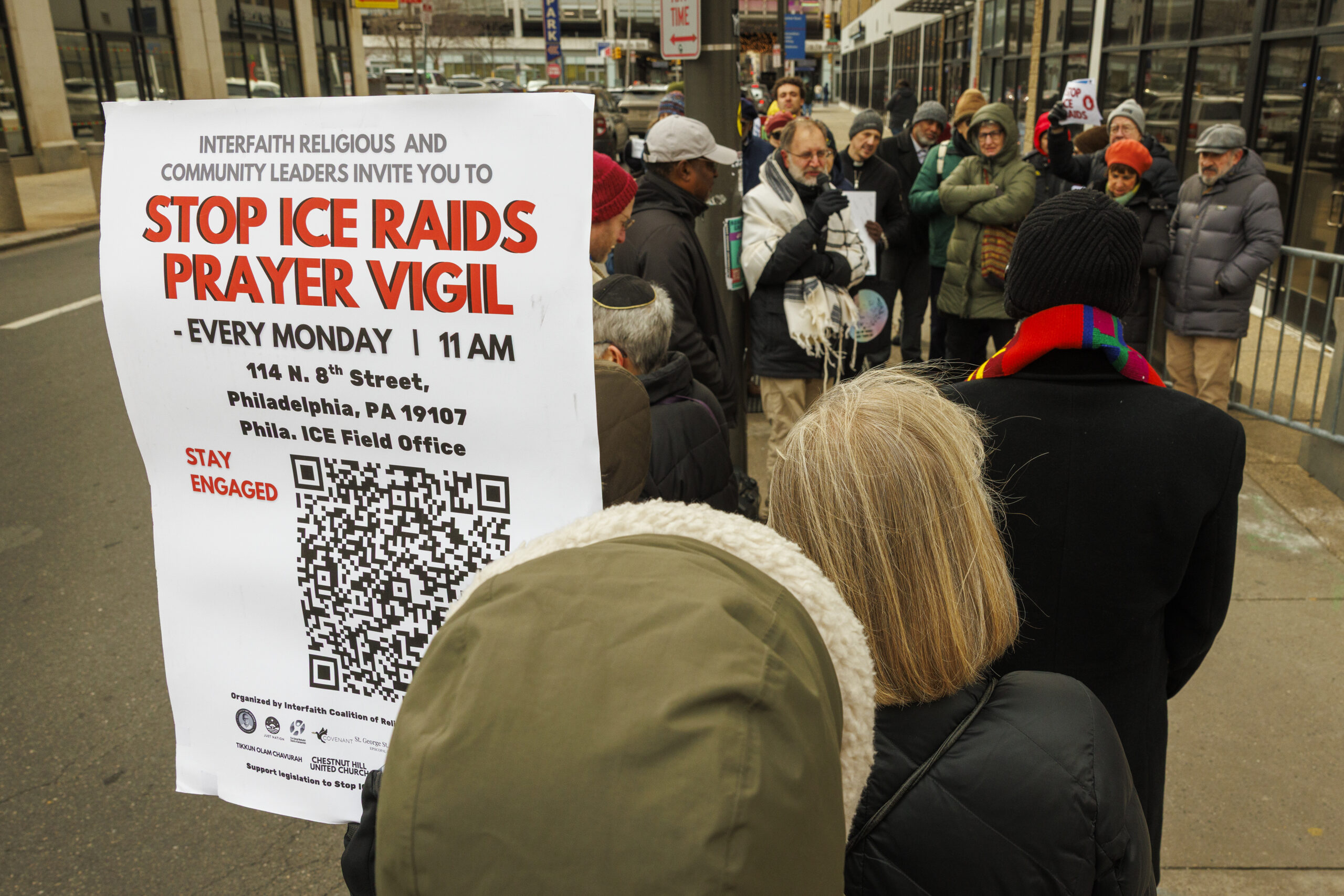
Interfaith religious and community leaders prayer vigil outside the Philadelphia U.S. Immigration and Customs Enforcement office at 114 N. 8th Street in Center City on March 2.
It comes as the U.S. Immigration and Customs Enforcement agency is undergoing a revamping to its leadership structure. President Donald Trump on Thursday ousted Department of Homeland Security Secretary Kristi Noem, and said he intends to nominate U.S. Sen. Markwayne Mullin (R, Okla.) to replace her.
Several local officials said this week that they’re worried the federal government will surge enforcement efforts in Philadelphia in order to fill the centers, and that the city must move quickly to pass its legislation.
“I’m extremely concerned,” said City Councilmember Quetcy Lozada, a Democrat whose North Philadelphia-based district has a large immigrant population. “We need to really figure out what our position is as it relates to working with ICE very closely. We have community residents that we should be protecting.”
Two are in Pennsylvania and could reportedly hold about 9,000 beds in total.
Spotlight PA reported Tuesday that ICE is referring to a facility in Tremont, located in Schuylkill County, as the “New ICE Philadelphia Mega Center” and one in Upper Bern Township in Berks County as the “New ICE Philadelphia Processing Center.”
Landau said Council is “paying close attention to these developments and the questions they raise about the expansion of detention facilities in our area.”
“The majority of Philadelphians are deeply disturbed by ICE’s tactics,” she said.
Johnson said in an interview last month that the detention centers are a reason to move swiftly on the ICE-related legislation.
The proposed laws, he said, are a means to “be out in front” of a potential surge of immigration enforcement in the city.
“Some people say, ‘Well, they’re not even here yet.’ But they just built a warehouse in [Berks County],’” Johnson said. “I believe that was strategic. It took some planning to say ‘We want to set up shop right in your backyard.’”