Category: News

Latest breaking news and updates

  • Gas prices are set to increase amid Iran war. Here’s what we know.

    Gas prices are set to increase amid Iran war. Here’s what we know.

    Americans could start paying more at the gas pump, following the U.S.-Israel strikes on Iran.

    West Texas Intermediate crude, an oil produced in the United States, surged 6.2% on Monday to $71.19 per barrel. As of Tuesday, it has spiked another 8%, hovering at around $77. It marks the oil’s highest point in over a year. But that’s just the beginning.

    Experts say those surges reflect similar spikes in natural gas and at the gas station.

    Here’s what we know.

    Why are gas prices going up?

    Known as the “crude oil effect,” when oil prices go up, so does the price of the fuel it makes. Crude oil must be processed at refineries to be turned into gasoline.

    The conflict in the Middle East, which President Donald Trump said he anticipates could take longer than a few weeks, means the global supply of oil is disrupted, and, in turn, the price of a barrel of oil goes up. This causes the price of fuel to also rise.

    “Whatever the time is, it’s OK,” Trump said. “Right from the beginning, we projected four to five weeks, but we have capability to go far longer than that. We’ll do it.”

    Oil prices were already on the rise, up 17% this year. Experts say the increase is a direct effect of Trump’s rhetoric against Iran, along with his administration’s recent sanctions against the country.

    And, as noted by John Quigley, a senior fellow at the University of Pennsylvania’s Kleinman Center for Energy Policy, it’s not just oil and gasoline; natural gas is also seeing a price increase.

    And U.S. consumers will be hit hard, he says.

    “It’s disrupting global oil and gas markets,” he said. “The war is quickly widening into a regional conflict, with the production capacity of multiple oil- and gas-producing nations being attacked by Iran in retaliatory strikes. This has already disrupted global oil and natural gas shipments.”

    How much have gas prices increased since the strike on Iran?

    As oil prices surged Monday, the impacts already started to trickle down to gas stations. This week, the national average of gas per gallon surpassed $3 for the first time since November.

    Some states, including Illinois, Michigan, and Texas have already reported increases of about 5 cents per gallon.

    As of Tuesday morning, the national average hit $3.11, marking the largest single-day increase since 2022, according to GasBuddy, a gas price tracking service.

    Quigley says those increases could be just the beginning.

    “Prices for natural gas in European and Asian markets have already spiked 50%. U.S. natural gas exporters will rush to take advantage of that, diverting domestic supplies to exports and pushing up domestic natural gas prices,” he said. “That will raise costs for home heating, and worsen already surging electricity costs, because over 40% of electricity generation in PJM, the nation’s largest grid, is fueled by natural gas.”

    Do gas prices always rise during war?

    Gas prices historically surge when conflicts happen because of a mix of supply disruptions, geopolitical uncertainty, and oil infrastructure attacks.

    As detailed by NPR, major price surges occurred during the Gulf War, the 2003 Iraq invasion, and the 2022 Russia-Ukraine war.

    How high could gas prices get?

    GasBuddy petroleum analyst Patrick De Haan told multiple news outlets he believes some gas stations could charge as much as 30 cents more per gallon by the end of the week.

    He estimated prices would be around $3.10 or $3.20 per gallon by the end of the week and anticipated they would hit $3.30 to $3.35 “in time.”

    What are the average gas prices in the Philadelphia region? How does that compare to the national average?

    As of Tuesday morning:

    • The national average gas price: $3.11
    • The Pennsylvania average gas price: $3.21
    • The Philadelphia average gas price: $3.12

    Which areas in the Philly region have the lowest gas prices?

    The average price of gas in Philly is $3.12 per gallon as of Tuesday morning. Still, there are some spots with lower prices, according to GasBuddy.

    Among the lowest appears to be an Eastcoast station in Fairmount (801 N. Broad St.) with gas going for $2.79 as of Monday evening. A Marathon in Southwest Philly (2450 Island Ave.) listed gas at $2.74 within the last 24 hours.

    Among the highest appears to be a Gulf station in Kingsessing (5200 Woodland Ave.), priced at $3.29 as of Monday evening.

    Who sets gas prices?

    No one person sets gas prices. In reality, the price you see at pumps is the result of a combination of oil prices, supply and demand, oil refining costs, distribution, and competition.

  • A jury awarded $1.67 million to the sons of a diabetic man who died in a Philly jail

    A jury awarded $1.67 million to the sons of a diabetic man who died in a Philly jail

    A federal jury in Philadelphia awarded $1.67 million to the sons of a diabetic man who died in a city jail in 2023, finding the death was part of a pattern in which the Philadelphia Department of Prisons failed to provide access to healthcare for its population.

    Louis Jung Jr. was found dead on Nov. 6, 2023, in his cell at the Curran-Fromhold Correctional Facility. The 50-year-old man died of a condition called diabetic ketoacidosis, in which blood becomes acidic due to high sugar levels.

    His last known insulin dose was two days prior, according to medical records.

    In a four-day trial presided over by U.S. District Judge Timothy J. Savage, attorneys for Jung’s sons argued the death was preventable and the result of jail staff ignoring their father’s medical needs.

    “When the government keeps custody, the government has a duty for care,” Nia Holston, an attorney from the Abolitionist Law Center representing Jong’s sons, told the jury.

    The jury on Monday found that Lt. Wanda Bloodsaw and the city violated Jung’s constitutional right to medical care during his incarceration. The seven jurors cleared a correctional officer, Gena Frasier.

    The jurors further found the failure was part of a pattern under former Prisons Commissioner Blanche Carney’s leadership, which lasted from 2016 to 2024.

    The city has faced multiple lawsuits over deaths in its prisons, including recent lawsuits concerning drug-related fatalities, but those cases are often settled.

    It is notable that a jury held the “highest echelons” of the city jails accountable, said Bret Grote, the legal director of the Abolitionist Law Center, who also represented Jung’s sons.

    “This trial represented justice for the Jung family,” Grote said. “But it’s also a capstone from a very grim era in the Philadelphia Department of Prisons.”

    YesCare, the company contracted to provide medical services in the jail, and three of its medical staffers settled for undisclosed amounts before trial. An additional nurse, working for a separate contractor, settled for $200,000.

    The jury awarded Jung’s sons $1.5 million in compensatory damages. It also awarded $170,00 in punitive damages against Bloodsaw.

    “We are reviewing the verdict and do not have a comment at this time,” Ava Schwemler, a spokesperson for the city’s law department, said in a statement.

    Not ‘a single drop’ of insulin

    Jung was arrested in December 2021 on robbery charges, and his diabetes was poorly managed while incarcerated, the lawsuit says. He was hospitalized for high blood sugar levels four days after he arrived at the correctional facility, and twice more during his first six months there.

    In spring 2023, a judge sent him to Norristown State Hospital for psychiatric evaluation of his ability to stand trial.

    He returned to Curran-Fromhold Correctional Facility on Oct. 28. During his intake, Jung’s blood sugar level was over four times higher than the upper limit of the normal range, according to the complaint.

    Louis Jung Jr., who died in November 2023 in a Philadelphia jail.

    On Nov. 5, Jung asked Frasier to see a nurse. The correctional officer brought a licensed practical nurse to Jung’s cell, where he lay down on the floor at the entrance, according to testimony and video surveillance.

    Frasier and the nurse briefly stood over Jung and walked away.

    A few minutes later Bloodsaw, who supervised the housing unit that day, stood over Jung as two incarcerated men put him back in his cell. That was the last known interaction between Jung and jail staff until his death roughly 20 hours later.

    In that time period, the father of three did not receive “a single drop of lifesaving insulin,” Holston told the jury.

    Frasier and Bloodsaw ignored signs of a medical emergency, and failed to follow a jail policy that requires a follow-up with a medical providers after an incarcerated person refuses to take medications, the attorneys said.

    An internal investigation found that Bloodsaw did not comply with jail policies, and officials suspended her for 15 days. The suspension has not taken place yet, which attorneys for Jung’s sons said demonstrates a culture that does not emphasize accountability.

    The attorneys showed to the jury the results of more than a dozen internal death investigations between 2018 and 2023 that concluded staff did not provide appropriate aid or check their units as required.

    Carney testified that the incidents were not part of a systemic failure. The majority of correctional officers follow their duty with fidelity, the former commissioner said, and should not be painted with a “broad brush” because of the failures of a few.

    Attorneys for the city told the jury that jail staff followed the medical assessment of YesCare staff, and that Jung was noncompliant.

    “I don’t know why he was refusing his insulin,” city attorney Michael Pestrak said. “But he was.”

    The city pointed to a 2023 report commissioned by Carney to review medical care in the jail, including diabetes care, and other policy changes as evidence that city officials were paying attention to medical needs and attempting to improve care.

    Jung’s ex-wife, Evelyn Tyson, provided emotional testimony about the impact of his death. He remained her “best friend” after the divorce, she said, and was committed to their three children, including their eldest, who requires full-time care due to cerebral palsy.

    “I don’t live anymore,” Tyson said.” I’m just existing.”

  • Dow drops 900 as stocks sell off around the world and oil prices leap even higher on war worries

    Dow drops 900 as stocks sell off around the world and oil prices leap even higher on war worries

    NEW YORK — A worldwide sell-off for stocks is slamming onto Wall Street Tuesday, and oil prices are leaping even higher as worries rise that the war with Iran is widening and may do more sustained damage to the global economy than feared.

    The S&P 500 dropped 1.8% in early trading. The Dow Jones Industrial Average was down 907 points, or 1.9%, as of 9:35 a.m. Eastern time, and the Nasdaq composite was 2.1% lower.

    It was just a day ago that U.S. stocks opened with sharp losses, only to recover all of them and end the day with slight gains. But that was with the caveat that oil prices did not jump too high, like to more than $100 per barrel.

    On Tuesday, oil prices got closer to that mark and raised more alarms. The price for a barrel of Brent crude, the international standard, leaped another 8.2% to $84.14. It was sitting near $70 less than a week ago. A barrel of benchmark U.S. crude, meanwhile, rose 8% to $76.92.

    Oil prices made the leap as Iran struck the U.S. Embassy in Saudi Arabia, part of a widening of targets that also includes areas critical to the world’s oil and natural gas production. Worries are particularly high about what will happen to the Strait of Hormuz off the coast of Iran, a narrow passageway where roughly a fifth of the world’s oil passes.

    Making things uncertain for markets are rising questions about how long this war may continue.

    Strikes by the United States and Israel have already killed Iranian Supreme Leader Ayatollah Ali Khamenei, but President Donald Trump has suggested that fighting may continue for weeks.

    Late Monday night, Trump said on his social media network, “Wars can be fought ‘forever,’ and very successfully” with the supply of munitions that the United States possesses.

    The jump for oil prices will worsen inflation, which is already too high for nearly everyone, and put more pressure on U.S. households and businesses by raising bills for gasoline and to ship products. The average price for a gallon of gasoline in the U.S. jumped 11 cents overnight to about $3.11, according to data from motor club AAA.

    That has the damage in stock markets so far centering on companies and countries that use a lot of oil, natural gas and other petroleum-based fuels.

    In South Korea, a big energy importer, the Kospi stock index plunged 7.2% for its worst day since two summers ago as markets reopened after a holiday on Monday. It had been setting records recently.

    Japan’s Nikkei 225 dropped 3.1%, even as analysts say Japan has a sizable stockpile of energy lasting more than 200 days.

    On Wall Street, airlines continued to sink on worries about rising fuel bills. The war has also led to canceled flights and stranded passengers.

    United Airlines fell 4.1%, American Airlines sank 4% and Delta Air Lines dropped 3%.

    In the bond market, Treasury yields climbed more as worries rose further about inflation worsening. The yield on the 10-year Treasury jumped to 4.10% from 4.05% late Monday and from just 3.97% on Friday.

    Higher yields can mean more expensive loans for U.S. households and businesses, for everything from mortgages to bond issuances.

  • Nine firefighters were injured in a Wynnefield house fire

    Nine firefighters were injured in a Wynnefield house fire

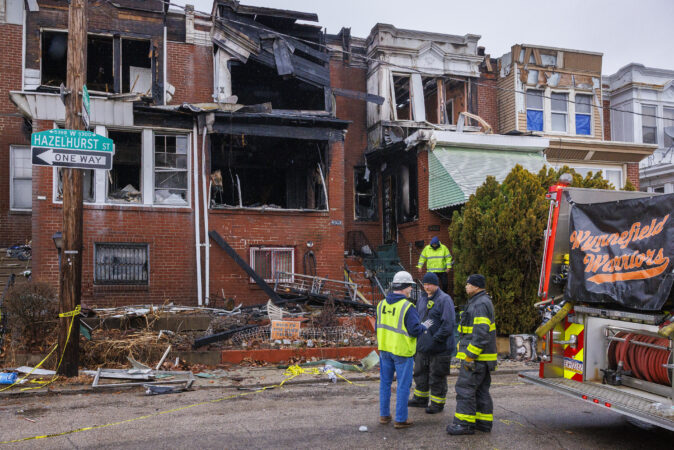
    Nine firefighters were injured, including one who needed to be carried away on a stretcher, after the floor collapsed beneath them as they fought a two-alarm fire Monday night in the Wynnefield section of Philadelphia.

    Firefighters responded to the blaze on the 5300 block of Hazelhurst Street around 10:20 p.m. to find smoke and flames erupting from the roof of the home. Officials confirmed that five firefighters were treated at local hospitals and released, while four remained hospitalized as of Tuesday morning. All were in stable condition.

    “We’re immeasurably grateful for this outcome, as collapses often prove devastating,” a Philadelphia Fire Department spokesperson said.

    Two Houses on Fire @CitizenApp

    5363 Hazelhurst St Yesterday 10:13:25 PM EST

    First responders arrived to heavy fire coming from the first floor of the two-story home, officials said. The situation soon grew, bringing more than 100 firefighters, emergency medical services, and support staff to the scene.

    The fire spread to the adjoining properties and was placed under control just moments before the structure collapsed on firefighters. At least six residents were displaced from their homes, officials said.

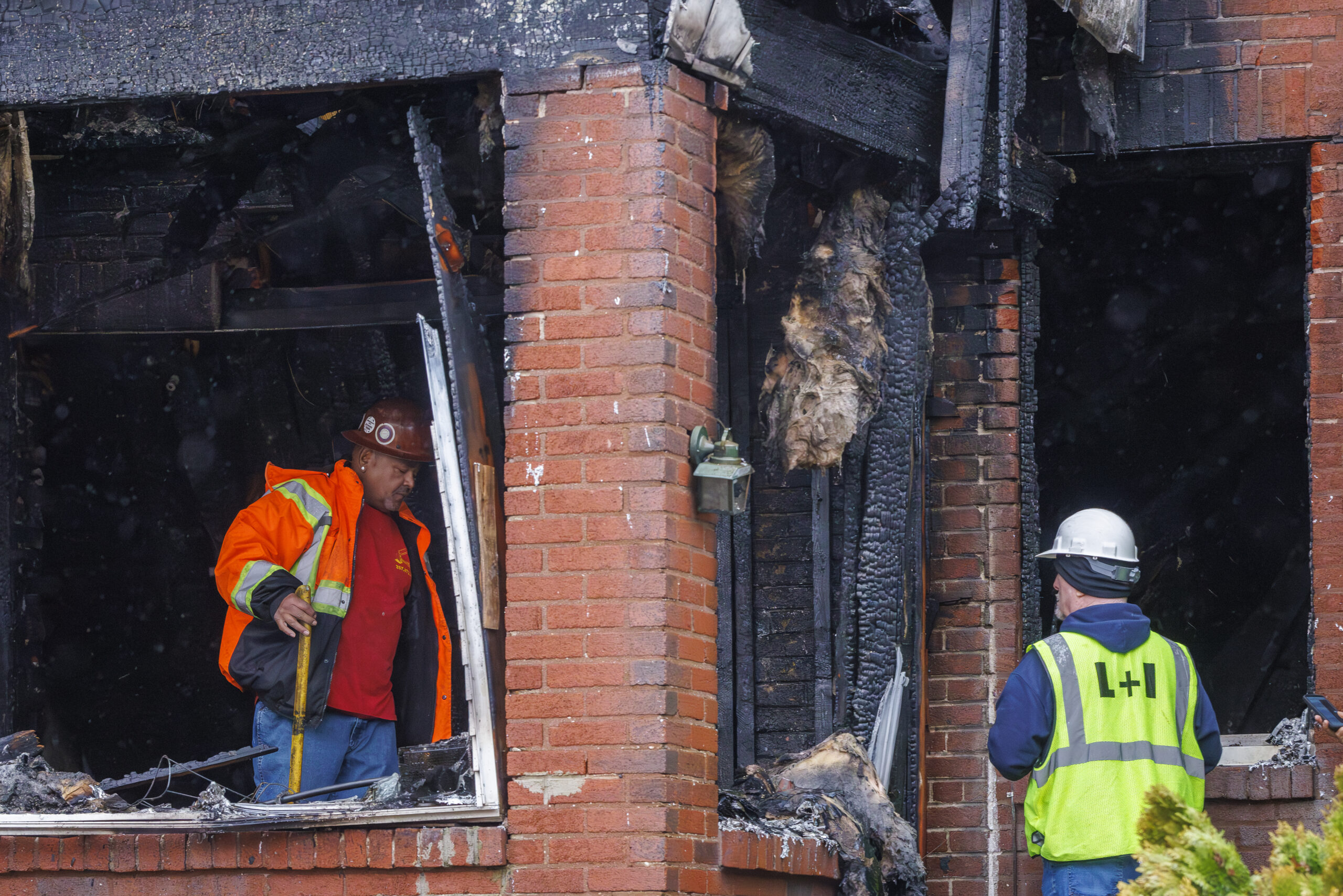
    Crews were still on site Tuesday morning working to clear debris and rubble, officials said. The fire marshal’s office will investigate.

    Footage showed one of the firefighters being carried out of the building on a stretcher, and another being assisted down the front steps.

    Two families, a total of nine residents, were receiving support services from the American Red Cross.

    License and Inspection employees inside a fire, 5300 block of Havenhurst Street, Philadelphia, overnight, Tuesday, March 3, 2026. Several fire fighters were injured in this fire.

    Before the Wynnefield fire erupted, earlier in the evening in Bristol Borough, a three-alarm fire activated multiple firefighting companies from across the region. One person was killed and another injured in a fire that engulfed several homes.

    A man died in a North Philadelphia house fire last month, which followed a January house fire that took the life of a 60-year-old woman.

    The Philadelphia Fire Department and the Red Cross urge city and collar county residents to visit soundthealarm.org/philly, where they can sign up for free smoke alarm installations and learn more about preventing fires.

  • Average price for a gallon of gas rises 11 cents overnight amid Iran conflict, AAA says

    Average price for a gallon of gas rises 11 cents overnight amid Iran conflict, AAA says

    NEW YORK — The average price for a gallon of gasoline jumped 11 cents overnight to about $3.11 in the U.S., according to motor club AAA.

    Gas prices were already rising before the U.S. launched strikes on Iran as refiners switch over to summer blends of fuel, but crude futures have risen sharply this week because of the war.

    On Tuesday, oil futures soared to levels not seen in more than a year as Iran launched a series of retaliatory attacks, including a drone strike on the U.S. Embassy in Saudi Arabia.

    Benchmark U.S. crude jumped 8.6% to $77.36 a barrel.

    Brent crude, the international standard, added 6.7% to $81.29 a barrel. Global oil prices jumped to start the week over concerns that the war will clog the global flow of crude.

  • Trump administration cuts off tuition assistance for Army officers at 22 schools, but Penn isn’t among them

    Trump administration cuts off tuition assistance for Army officers at 22 schools, but Penn isn’t among them

    Military officers will see their tuition assistance cut off at 22 schools and institutions, but the University of Pennsylvania is not among them.

    The Ivy League institution, which counts President Donald Trump among its alumni, was on an initial list of 34 schools “at risk” of losing Pentagon-funded tuition assistance. But Penn was not part of the 22-university list released by Defense Secretary Pete Hegseth on Friday.

    Penn did not immediately respond to a request for comment Tuesday.

    Hegseth previously said he intended to cut off schools where faculty members have “leftist political leanings” and “openly loathe our military,” but he cited no specific examples of bias or misconduct at the 22 schools that will lose tuition assistance beginning with the 2026-27 academic year.

    “We will no longer invest in institutions that fail to sharpen our leaders’ warfighting capabilities or that undermine the very values they are sworn to defend,” Hegseth wrote in a letter released Friday with the final list.

    It was not immediately clear why Penn and other schools were removed from the initial draft list.

    Among the schools still set to lose access to the tuition-assistance program is Princeton University, where Hegseth obtained a bachelor’s degree in 2003. Carnegie Mellon University in Pittsburgh is also on the list, as is Yale University, where Vice President JD Vance obtained a law degree.

    The move means members of the military will be banned from using Department of Defense tuition assistance to pay for Senior Service College Fellowship programs at those schools.

    The impact will not be large — the Department of Defense said fewer than 100 military students are enrolled in programs at schools that will lose funding. Military personnel currently enrolled may complete their courses of study, Hegseth said, though it is unclear if they will have to change schools to continue receiving financial assistance.

    Hegseth’s announcement did not mention several other financial assistance programs for undergraduates, including the GI Bill, which is administered by the Department of Veterans Affairs.

    Here is the full list of schools losing tuition assistance from the Pentagon:

    Educational institutions

    • Harvard University
    • St. Louis University
    • Massachusetts Institute of Technology
    • Tufts University
    • Georgetown University
    • Carnegie Mellon University
    • Brown University
    • Columbia University
    • Yale University
    • Middlebury College
    • Princeton University
    • George Washington University
    • College of William and Mary

    International institution

    • Queen’s University (Canada)

    Nonprofit institutions

    • Center for Strategic and International Studies
    • New America Foundation
    • Brookings Institution
    • Atlantic Council
    • Center for a New American Security
    • Council on Foreign Relations
    • Henry L. Stimson Center

    Senior Service College

    • Johns Hopkins University School of Advanced International Studies West Space Scholars Program
  • A&P grocery chain said it was closing its city stores on this week in Philly history

    A&P grocery chain said it was closing its city stores on this week in Philly history

    In a city replete with food peddlers and grocery proprietors, a Canadian chain would find a footing in Philadelphia.

    The Great Atlantic & Pacific Tea Company Inc., better known as A&P, was where shoppers could get their chain-brand of Eight O’Clock Coffee beans freshly ground in-store and in their preferred style.

    An advertisement for Eight O’Clock Coffee that ran in The Inquirer in 1941.

    For a healthy stretch of the 20th century, a majority of U.S. residents shopped for groceries in an A&P store. The chain was founded in 1859 and by the 1940s, counted more than 16,000 locations spread between the Atlantic and Pacific.

    But by the spring of 1982, the grocery chain empire only had 70 stores in the Philadelphia region, and it was struggling to cover expenses.

    On March 1, 1982, the chain announced it would be pulling out of Philadelphia. A&P would close 29 stores in the region, including all 11 left in the city. More than 2,000 people would be out of work amid a historic recession and rising energy costs.

    It was the conclusion of a reorganization plan that resulted in the closure of 350 stores across the country at the end of 1981 and beginning of 1982. It would leave the chain with a little more than 1,000 stores, including more than 100 in Canada.

    The long and drawn-out end for the once-vast grocery empire had begun.

    In May ’82, the chain announced that the stores would reopen as Super Fresh Food Centers, and laid-off A&P workers would get first crack at the upcoming job openings.

    But the chain’s inability to evolve with changing market conditions would continue to hamper its progress, and eventually lead to its demise, according to Business Insider.

    A&P and its nearly 300 stores would hang on until 2015, when it filed for Chapter 11 bankruptcy for a second time, and sold off the rest of its catalog. The Super Fresh locations were absorbed by Acme, the South Philadelphia-based grocery group that, according to Philly Mag, had assumed the crown of Philly’s top food provider.

  • ICE training was slashed, records show, corroborating whistleblower claims

    ICE training was slashed, records show, corroborating whistleblower claims

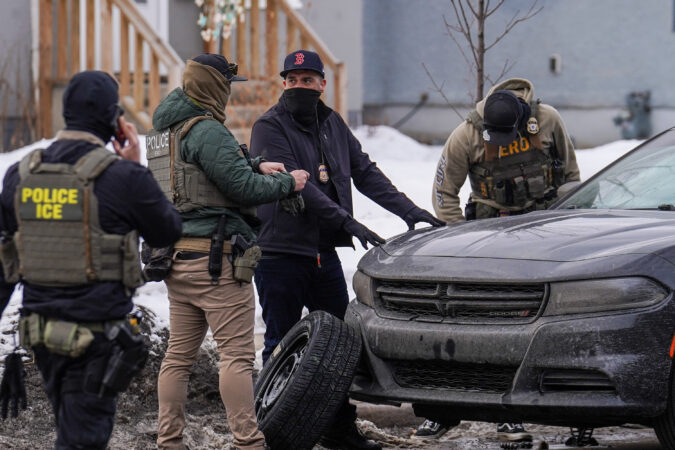
    Immigration and Customs Enforcement dramatically cut its basic training program amid a hiring spree meant to speed up the Trump administration’s deportation efforts, records obtained by the Washington Post show, corroborating a whistleblower’s claim.

    After former ICE instructor Ryan Schwank testified during a congressional hearing last week, the Department of Homeland Security (DHS) denied any reduction in the amount or quality of training provided to ICE recruits. The previously undisclosed records obtained by the Post show that, as the whistleblower said, ICE last year removed about 240 hours from its basic training program, or more than 40% of instructional time.

    The documents also offer new insight into how and when the training program was reduced. The vast majority of the cuts occurred in August, the records show, as the Trump administration pushed ICE to double the number of officers in the field by the end of 2025.

    The initial cuts eliminated more than 100 hours dedicated to hands-on instruction and practice scenarios, including half the 56 hours once spent on firearms training, the records show. Fitness training time was almost entirely cut. Also eliminated were dozens of hours of classroom learning on such topics as case processing and deportation officers’ legal authority.

    With further cuts later that fall, the records show, ICE had eliminated three-quarters of the hours once dedicated to evaluating recruits’ practical skills, including firearms handling. The agency eliminated time for driving tests and cut all 26 hours previously allotted for evaluating recruits’ grasp of skills specific to immigration enforcement and deportation operations.

    As of Jan. 1, records show, more than 900 ICE officers had completed a shortened version of basic training and were destined for field offices across the country. That is more than three times the total number of graduates in the 12 months before August, when the program was first cut.

    Asked about the Post’s findings, ICE acknowledged that the program has been accelerated by increasing the daily training time and adding an extra day of training each week but insisted that there had been no cuts to overall training hours, requirements, or subject matter.

    “ICE officers go through a rigorous on-the-job training and mentorship,” the agency said in a statement. It said new officers take what they learn at the academy and “apply it to real-life scenarios while on duty, preserving ICE’s reputation as one of the most elite law enforcement agencies not only in the U.S., but the entire world.”

    Concerns about the quality of immigration officers’ training have been mounting for months amid reports of violent arrests and heavy-handed crowd-control tactics, along with two high-profile killings of U.S. citizens by federal immigration agents during protests in Minneapolis this year.

    On Feb. 23, Schwank, a lawyer who recently resigned from his teaching position at the ICE academy, testified that the agency had removed so many essential courses from the program that “even in the final days of training, the cadets cannot demonstrate a solid grasp of the tactics or the law required to perform their jobs.”

    That same day, congressional Democrats made public DHS documents indicating that ICE last year removed courses that were once part of its basic training program. The records obtained by the Post were not among those released by the Democrats and did not come from the same source.

    The records obtained by the Post include four training program outlines, dated between July 2025 and January 2026, that break down the hours allocated to instructional topics. The records also track student outcomes and time at the academy. They reveal a steep decline in the graduation rate as DHS ramped up recruitment, part of President Donald Trump’s goal to double the number of ICE officers to 20,000 and deport an unprecedented 1 million people each year.

    “Students must meet all requirements, otherwise they will not be made law enforcement officers,” ICE told the Post, citing the lower graduation rate as evidence that the academy has not lowered standards.

    ICE made slight adjustments to the basic training program after the sweeping cuts last year, the records show. After initially cutting the training time dedicated to use of force by three hours, for instance, ICE later added five hours on that subject. Asked about the change, ICE told the Post that the agency “increased de-escalation training for recruits to ensure they are prepared for attacks from ICE agitators.”

    Before the changes last summer, ICE basic training was a 72-day program held at the headquarters of the Federal Law Enforcement Training Centers, a sprawling campus in southeastern Georgia. ICE never formally announced changes to the program but told reporters on a media tour in August that it had been streamlined to eight weeks.

    Pushed for specifics at the time, the agency said it had eliminated a Spanish-language requirement. But Spanish instruction was not part of the ICE basic training program. It was a separate course for recruits who could not pass a Spanish fluency test. The records obtained by the Post show cutting the language requirement eliminated only four hours from the basic training program — the time previously set aside for that test.

    Since the August media tour, officials have given conflicting accounts about training time. In the past month, they have stated at different times that the basic training last 47 days, 42 days, and 56 days.

    The DHS records obtained and analyzed by the Post show that the program was first cut to 47 days in August and further reduced in September to 42 days. Since then, all trainings have been on a 42-day schedule, the records show.

    DHS and ICE officials have repeatedly said that no training time has been lost, in part because the academy increased daily instruction from eight hours to 12 hours. The Post’s analysis of the records shows that as recently as January, students were receiving about eight hours of daily instruction. That hadn’t changed as of February, according to a DHS official who spoke on the condition of anonymity because they were not authorized to talk to the media.

    Asked about the discrepancy, ICE repeated the claim about 12-hour days and added that those hours include “personalized independent training.” The statement emphasized in bold: “It’s the same hours of training officers have always received.”

    ICE also said graduates of the academy go on to receive “an average of 28 days of on-the-job training.”

    Policing expert Marc Brown, an instructor at the University of South Carolina’s law school, told the Post that “training on the job doesn’t replace training at the academy, especially in a law enforcement career.”

    From 2019 to 2024, Brown taught physical techniques, including the use of handcuffs and defensive tactics, at the ICE basic training program. Incoming deportation officers need time to practice their new skills in safe, controlled environments before going into the field, Brown said, “so that if mistakes are made or there are things you could do better, you have a chance to make that mental correction.”

    Slightly more than 230 new deportation officers began ICE basic training in 2024, records show. In 2025, that same number had started at the ICE academy by the beginning of August. This followed a midsummer recruitment boom spurred by the passage of Trump’s sweeping tax-and-spending legislation, which tripled the agency’s enforcement and deportation budget to about $30 billion.

    To boost the number of applicants, ICE lifted age restrictions, offered student loan forgiveness and $50,000 signing bonuses, and held recruitment events where some prospective agents were told they could receive tentative offer letters on the spot. By the end of September, cohorts of up to 48 trainees were arriving at the facility in Georgia almost daily, records show.

    In the past, all new deportation officers were required to attend the academy. Now, only recruits who have no law enforcement experience are sent to the academy. Recruits with law enforcement experience, including “arrest authorities,” are instead required to take an online course, and then they, too, “receive in-person on the job training,” ICE said.

    The records obtained by the Post show that more than 1,400 ICE recruits attended a shortened version of basic training in Georgia between August and Jan. 1. Those students failed or dropped out at high rates, and the 2025 graduation rate plummeted from around 80% among recruits who went through the full-length training to around 60% for those in shortened versions.

    One in every four recruits destined for field offices by the end of the year flunked out of the shortened training program, records show. Among those who fell short, the majority failed written exams. Most of the remainder failed the physical abilities assessment, which requires recruits to complete a timed run and an obstacle course. Only three people failed that test in the first half of 2025 before ICE loosened certain enrollment standards and slashed more than 40 hours of preparation time.

    Brown attributed the low graduation rate in part to the reduced hours of instruction, which he said don’t provide new officers enough time to absorb material or practice difficult skills one-on-one with instructors in remedial workshops. He said it also appeared ICE’s hiring spree pulled in more than the usual number of recruits who weren’t suited for or capable of the job.


  • Democrats’ newfound unity faces a test after US and Israeli strikes on Iran

    Democrats’ newfound unity faces a test after US and Israeli strikes on Iran

    WASHINGTON (AP) — For Democrats demoralized at being shut out of power in Washington, the past several months have offered reason for optimism.

    A party often beset by ideological division has largely been unified in opposition to President Donald Trump’s hardline immigration tactics, particularly after two U.S. citizens were killed in Minneapolis. Heading into a midterm election year in which they are just a few seats shy of reclaiming the U.S. House majority, Democrats have also kept the White House on defense with criticism of Trump’s economic policies and ties to Jeffrey Epstein, the convicted sex offender.

    But the U.S. and Israeli strikes against Iran could test the durability of that cohesion. Initially, Democrats balanced condemnation of Iran’s supreme leader, Ayatollah Ali Khamenei, who was killed over the weekend, with calls for Congress to quickly pass a war powers resolution that would restrain Trump’s attack options.

    “As soon as our resolution comes to the floor, senators need to pick a side,” Senate Democratic leader Chuck Schumer said on Monday. “Stand with Americans who don’t want war, or stand with Donald Trump as he singlehandedly starts another war.”

    Democratic divisions going into war powers vote

    But some divisions are surfacing as a handful of Democrats, especially those who are strongly aligned with Israel, express reservations about the war powers measure. Rep. Greg Landsman, D-Ohio, won’t back an Iran resolution. Before the strike, Rep. Josh Gottheimer, D-N.J., also said he would vote no.

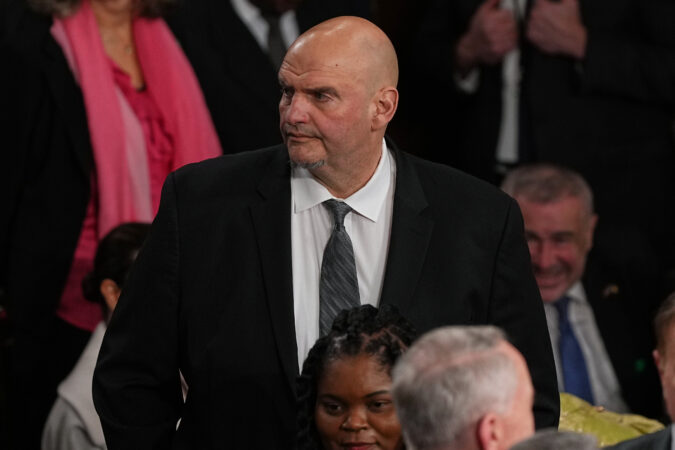
    Sen. John Fetterman, D-Pa., who backed a war powers vote tied to Venezuela in January, also has broken with Democrats over the Iranian measure and rejected arguments that the attack was illegal, spurring frustration among some party leaders.

    “John Fetterman knows better,” House Democratic leader Hakeem Jeffries said Monday on CNN.

    Republicans are also facing internal dissent. Trump, who did little to prepare Americans for the prospect of such a dramatic conflict, said Monday the operation could last four to five weeks. He hasn’t articulated a clear exit strategy and warns that American casualties could mount, which will pose a severe test of voter patience for the conflict.

    The war could also lead to rising gas prices and economic volatility that may bolster Democratic arguments that the president is out of touch with the financial realities facing many Americans.

    Still, Republicans see an opportunity to portray Democrats as reflexively opposed to Trump.

    “For my Democratic colleagues, this is not about what’s best for our national security or what’s best for protecting the American people,” said Sen. John Kennedy, R-La. “This is about how to defeat Donald Trump.”

    A searing debate among Democrats over Israel

    Democrats have undergone a searing internal debate over the party’s relationship with Israel in the wake of the war in Gaza. Then-President Joe Biden’s loyalty to Israel during the heat of the 2024 campaign was starkly at odds with younger generations outraged by the treatment of Palestinians in Gaza. By the time Kamala Harris rose to the top of the ticket that year, she struggled to win over some younger voters who are critical to Democratic success.

    Paco Fabian, the political director for the progressive advocacy group Our Revolution, acknowledged that Democrats “aren’t monolithic.” But he also suggested a shift was underway, noting the results of a New Jersey special election last month.

    During that campaign, the affiliated super PAC of the pro-Israel American Israel Public Affairs committee sought to thwart the moderate candidate, Tom Malinowski, after he questioned unconditional aid to the Israeli government. Those efforts appeared to backfire with the more progressive contender, Analilia Mejia, winning the primary.

    “Given what’s going on right now, I don’t think the moment is doing AIPAC and Israel any favors,” Fabian said.

    Sympathy toward Israel appears to be shifting. Three years ago, 54% of Americans sympathized more with the Israelis, compared with 31% for the Palestinians, according to Gallup polling released last month. Now, their support is about evenly balanced, with 41% saying their sympathies lie more with the Palestinians, and only 36% saying the same about the Israelis.

    Americans’ initial reactions to airstrikes also appeared more negative than positive, early polling suggested. About 6 in 10 U.S. adults disapproved of the U.S. decision to take military action in Iran, according to a CNN poll conducted via text message over the weekend. A separate snap poll from The Washington Post conducted via text message on Sunday suggested that about half of those polled opposed the strikes, while 39% were in support. Roughly 1 in 10 were unsure.

    Democrats and independents drove much of the disapproval in those early polls, while Republicans were much more supportive.

    Elections this week could show impact of attacks

    The initial political impact of the attacks in Iran could emerge as soon as Tuesday during the first primary elections of this year’s midterm campaign.

    In North Carolina, Durham County Commissioner Nida Allam was already going into her bid to unseat two-term Rep. Valerie Foushee with backing from Our Revolution and other top progressives. After receiving support from groups tied to AIPAC during her 2022 campaign, Foushee’s campaign rejected such contributions this cycle. Over the weekend, she said she doesn’t support “Trump’s illegal war with Iran” and would back the war powers resolution.

    Still, Allam, who would be the first Muslim elected to Congress from North Carolina, was quick to release a video ahead of Tuesday’s vote criticizing Trump for “starting another endless war” and promising to never accept support from “the pro-Israel lobby.”

    In Texas, home to high-profile Senate primaries on Tuesday, Democratic voters expressed alarm at the attacks.

    “It shouldn’t have happened,” said Charles Padmore, 45, an independent contractor in Houston. “Affordability should be the top priority on Trump’s list.”

    Alex Diaz, 31, a biology high school teacher in Houston, called the bombing of Iran “uncalled for.”

    “You’re trying to start World War III, and we don’t need that right now,” he said.

    The fallout could spread to other contests this month. Ahead of the March 17 primary in Illinois, AIPAC-aligned groups have also criticized Daniel Biss, the Evanston mayor who is aiming to become the Democratic candidate to succeed the retiring Rep. Jan Schakowsky. In an interview, Biss spoke of the “backlash I’m hearing people have against AIPAC, their MAGA-aligned money and their Trump-aligned policy agenda.”

    Asked about such predictions, Patrick Dorton, a spokesman for AIPAC’s affiliated super PAC, said “the key distinction will be between those who recognize that Iran is a murderous regime that tortures women for leaving their hair uncovered, hangs gay people, and executes peaceful democratic protestors, and those who will turn a blind eye to the regime’s atrocities.”

    Calls for a ‘united opposition party’

    As Congress moves toward a potential war powers vote this week, Biss said there was a need for Democrats to act as a “strong, clear, vocal, united opposition party.”

    “I also would like to see the Democratic Party united not just on the procedural argument but on the basic acknowledgment that this war is wrong,” he added.

    On Capitol Hill, Sen. Richard Blumenthal of Connecticut, a Democrat on the Armed Services Committee, said he was less concerned about party unity than the prospect of achieving a bipartisan vote on the war powers resolution. Three Republicans ultimately backed the Venezuela resolution in January.

    “What I want to see happen is the war powers resolution pass,” he said. “I’m not focused on what Democrats as a whole do. We’re going to have differing opinions among Democrats and among Republicans.”

  • Netanyahu takes a gamble on American support for Israel with the war against Iran

    Netanyahu takes a gamble on American support for Israel with the war against Iran

    Throughout his political career, Israeli Prime Minister Benjamin Netanyahu has steered his country along two pillars of foreign policy: an ironclad partnership with the United States and a relentless diplomatic and covert battle against the rulers of the Islamic Republic of Iran.

    Now, with Israel and the U.S. in a joint war against Iran’s leadership, those two strategic paths risk clashing with each other. By enlisting the U.S. in what he views as Israel’s existential battle against Iran, Netanyahu is taking a gamble that could open up the relationship to the strain of a war with far-reaching consequences.

    To be sure, persuading U.S. President Donald Trump to join the war was a coup for Netanyahu and highlights the strong ties between the two leaders. If they are successful, they could quickly realize their shared goal of toppling the Iranian government and spare the region a protracted conflict.

    But if the war drags on, the two allies’ ties could again be tested.

    “A large part of the American public will view it as the Israeli tail wagging the American dog and that it is dragging the United States to a war in the Middle East that isn’t theirs,” said Ofer Shelah, a research fellow at the Institute for National Security Studies, a Tel Aviv, Israel-based think tank. The drop in public support that might unleash “will be very harmful for Israel in the medium and long term,” he said.

    But, he added, in a nod to the Israeli leader’s political ambitions: “Netanyahu is not interested in the medium and long term.”

    US public opinion has been evolving

    For Netanyahu, successfully persuading Trump to strike Iran together is the apex of decades of proximity between the Israeli leader and Washington. Netanyahu, Israel’s longest-serving leader, speaks flawless English after having spent part of his youth in the U.S. and has always portrayed himself as Israel’s bridge to America.

    Although he boasts about his tight relationships with multiple American presidents and members of Congress, Netanyahu over the past two years has seen support for Israel among the American public drop. According to Gallup polling, American sympathies in the Middle East have shifted dramatically toward the Palestinians.

    That shift in sentiment has been driven in large part by Democrats. But some Republicans, and even Trump’s own backers, have been more outspoken against the diplomatic and financial support the U.S. has continued to grant Israel throughout the past two and a half years, when it has been embroiled in a war on multiple fronts sparked by Hamas’ Oct. 7, 2023, attacks. The devastating images from the war in Gaza deepened Israel’s international isolation.

    With a new war against Iran — the second in less than a year — Netanyahu is tackling an enemy that he and many Israelis view as an existential threat, citing its support for anti-Israeli militias across the region, its ballistic missile arsenal, and its nuclear program. He has led the crusade against Iran on the world stage for much of his career.

    Netanyahu said Sunday in a statement that the U.S. involvement “allows us to do what I have been hoping to do for 40 years — to deliver a crushing blow to the terror regime.” Netanyahu’s office did not immediately respond to an Associated Press request for comment.

    The conflict could spiral

    Days into the war, Israel and the U.S. military appear to be working hand in glove to strike targets — from the initial attack that killed top Iranian leaders, including Supreme Leader Ayatollah Ali Khamenei, to assaults that allowed the forces free rein in Iranian skies.

    But the conflict has already set off aftershocks that could reverberate in the American heartland. At least six U.S. troops have been killed. Travel was disrupted across the region, leaving hundreds of thousands of travelers stranded. Oil prices surged, raising the prospect of costlier gasoline for U.S. drivers as well as increased prices for other goods at a time when people have been stung by a rising cost of living.

    Questions remain about the direction and aim of the war. It’s unclear whether the air power will be enough to topple Iran’s leadership, who or what should replace that leadership, and what role Israel or the U.S. will have in either. Every day presents new potential land mines.

    “Many people will blame Israel if things go badly wrong,” wrote Nadav Eyal, a commentator with the Israeli Yediot Ahronoth daily newspaper. “Israel cannot afford to lose the American public’s support under any circumstances. That is more important than striking any individual military facility.”

    Still, Aaron David Miller, who served as an adviser on Middle East issues to Democratic and Republican administrations over two decades, said that Netanyahu has little to lose from the war.

    With elections scheduled for the fall, Netanyahu can use the war in Iran to divert attention away from the failures of the Oct. 7, 2023, attacks, the worst in Israel’s history. Instead, Netanyahu can set himself up as a brave wartime leader who fulfilled a pledge he has made much of his life to confront Iran.

    He can say he did so with support from the American president, who Miller said can pull the breaks on the war whenever he pleases.

    “If Trump feels as if it’s going south, he’ll find a way to de-escalate,” he said, “and his good friend Benjamin Netanyahu will follow.”