Category: Pennsylvania News

  • ICE can’t use Montgomery County’s property or resources in civil immigration operations under new resolution

    ICE can’t use Montgomery County’s property or resources in civil immigration operations under new resolution

    The Montgomery County commissioners further limited the county’s cooperation with ICE on Thursday when they passed a resolution restricting federal immigration enforcement from using county property or resources for noncriminal investigations.

    The measure approved by the Democratic-controlled board bars U.S. Customs and Immigration Enforcement from using county resources for various purposes, including as staging areas, processing locations, or operations bases related to civil immigration operations.

    “We’ve seen it elsewhere — the violence, the fear, the separation of families. We want to make sure that here in Montgomery County, we’re doing everything we can to make sure all of our residents can continue to access essential services and live their lives safely,” said Commissioner Jamila Winder, the Democrat who chairs the board.
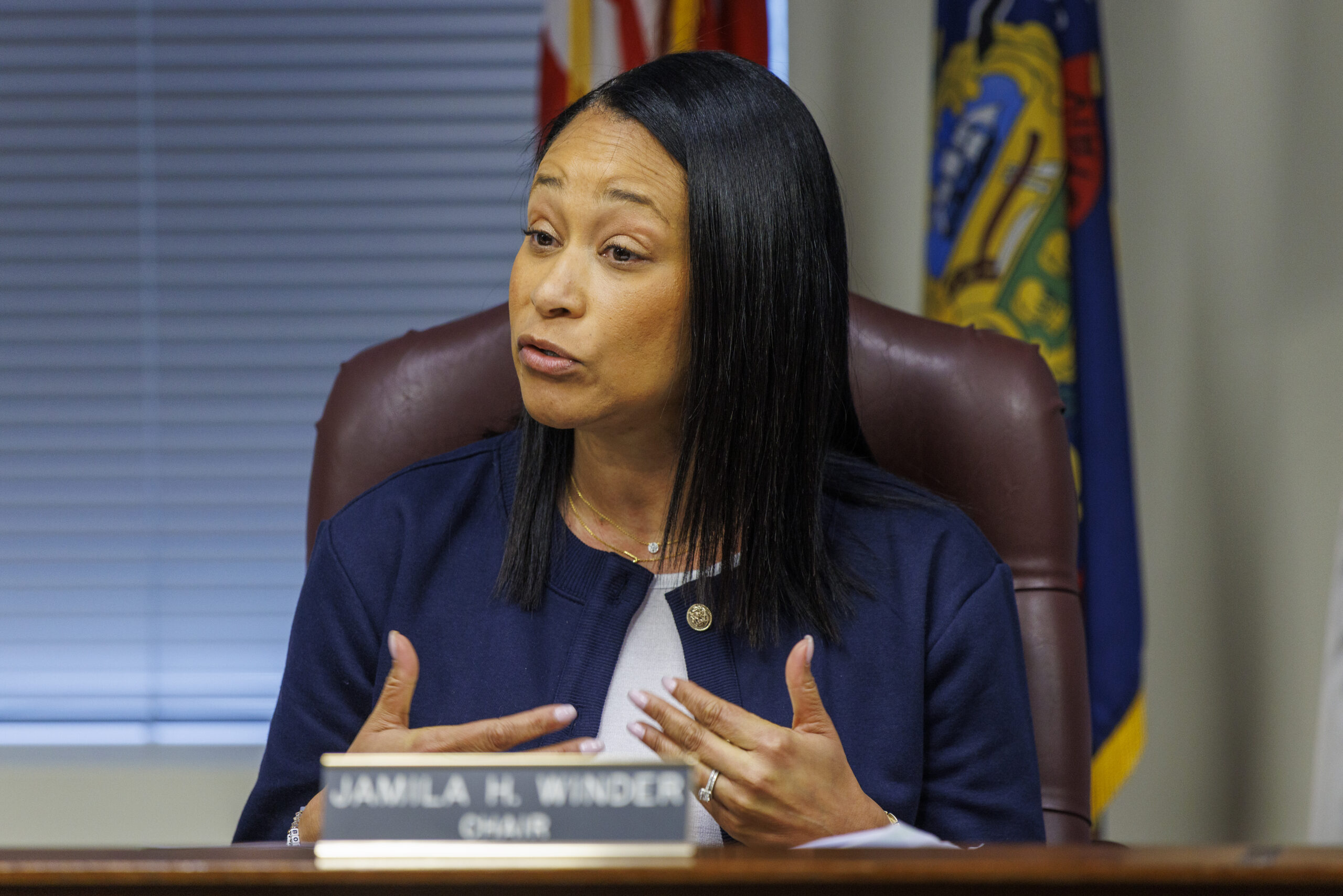
    Jamila H. Winder, Chair, Montgomery County Commissioners on Thursday, March 5, 2026.

    The resolution comes as immigration stakeholders in the county have been pushing the commissioners to take further action to protect residents from ICE enforcement as President Donald Trump’s deportation agenda continues to escalate.

    Much of the tension occurred under the leadership of Kristi Noem, the Department of Homeland Security secretary whom Trump fired Thursday.

    Calls for action escalated nationally in January after federal agents killed U.S. citizens Renee Nicole Good and Alex Pretti in Minnesota. In Montgomery County, ICE has carried out numerous operations, especially in communities with high numbers of Latino residents, such as Norristown, the county seat.

    “Let me be clear: The county does not have authority over the federal government’s actions over civil immigration enforcement, and we still do not have the authority over the courts, other elected officials, municipalities, townships, or their law enforcement officers,” Winder said. “That remains unchanged, but what has changed is the environment we’re in.”

    The policy to block ICE from using county resources passed 2-1 with Commissioner Tom DiBello, the board’s sole Republican, voting no.

    The measure codifies that the county will not enter into a 287(g) agreement, which would allow ICE to use county resources, and that county employees will not comply in federal civil immigration operations without a judicial warrant or subpoena.
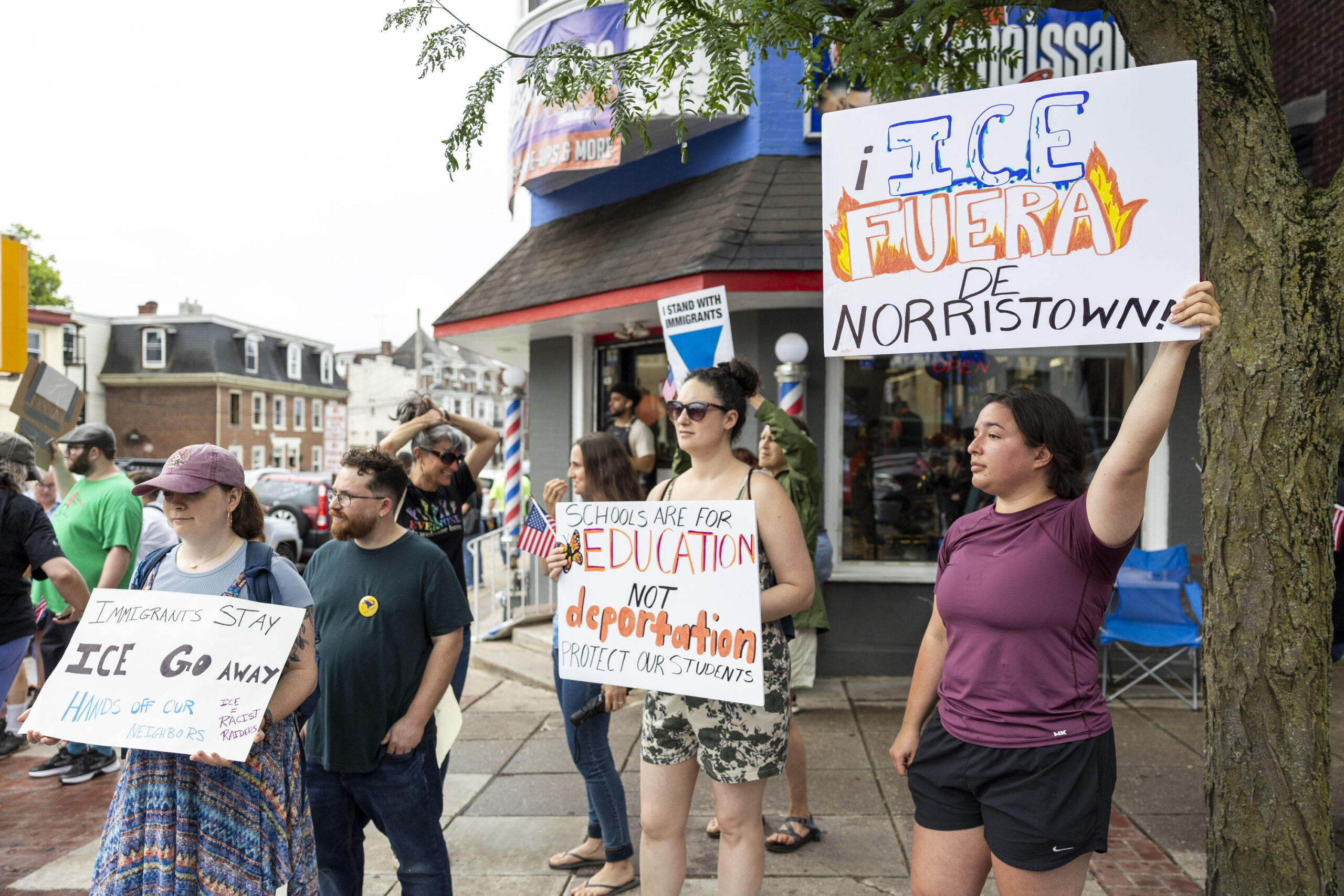
    Lydia Villalba, 27, of Souderton, Pa., (right), holds a sign saying “Ice Fuera De Norristown” meaning Ice out of Norristown, during a rally to support immigrants in Norristown, Pa., on Saturday, June 7, 2025.

    It does not prohibit ICE from purchasing warehouses for detention centers, as the agency has done in Berks and Schuylkill Counties.

    Democratic Gov. Josh Shapiro has blasted the warehouse purchases as being conducted in secret and promised to pursue avenues to block the plan from moving forward. Bucks County in February passed a unanimous resolution opposing any potential purchases there.

    Montgomery County’s resolution denying ICE access to its buildings and lands follows a national trend among Democratic-led jurisdictions. The move has both symbolic and practical impacts.

    First, it enables the county government to publicly make clear its opposition and noncooperation. And second, ICE can need big spaces to set up officers, cars, and equipment for operations; banning the use of potential staging areas can complicate the agency’s logistics.

    Montgomery County’s Department of Assets and Infrastructure will post signage on county-owned property noting that the area cannot be used for purposes not approved by the county, according to the resolution. Private property owners who wish to restrict civil immigration enforcement activity on their properties can request signs for free.

    Megan Alt, a spokesperson for the county, said the hope is that ICE will comply with county law. But if not, the county is prepared to handle violations as it would for any other instances of trespassing.
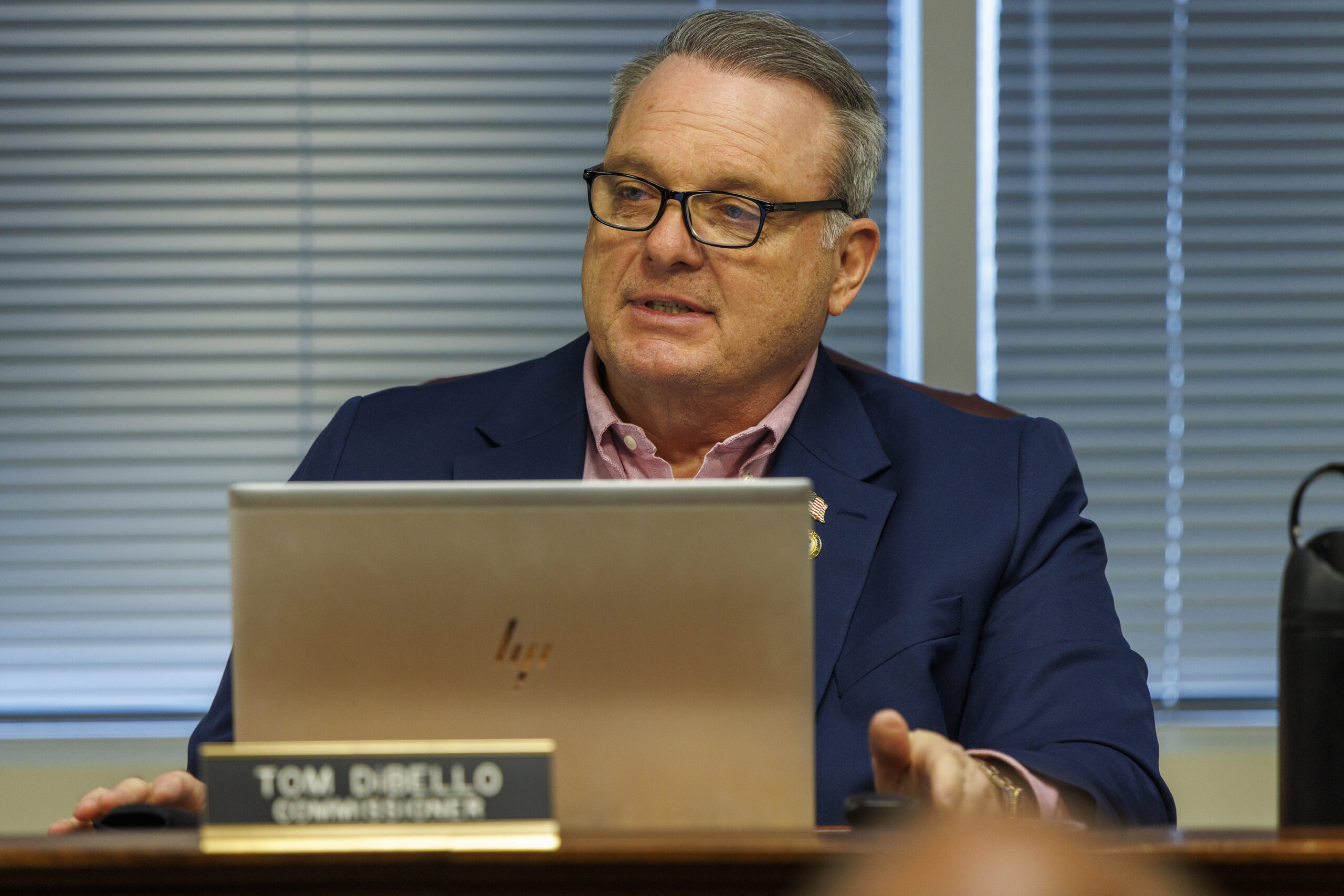
    Thomas DiBello, Commissioner, Montgomery County Commissioners on Thursday, March 5, 2026.

    DiBello, the lone GOP commissioner, said his opposition has “nothing to do with politics” and criticized the resolution’s references to ICE-related incidents that took place outside Montgomery County. He also said he was concerned that private property owners who do not post signs restricting ICE action on their properties will be targeted as a consequence.

    “What’s going to happen then? Is there doxing going to occur? Is there protests outside of businesses?” he asked.

    Commissioner Neil Makhija, the board’s vice chair, said the resolution “has nothing to with immigration policy,” but rather was about limiting cooperation with an agency that has used extreme tactics. He cited an ICE arrest last month in Lower Providence Township in which agents broke down a family’s front door.

    DiBello responded that Makhija was engaging in “political positioning.”

    In the Philadelphia region and elsewhere, ICE’s use of government property has long rankled immigration advocates, who say it amounts to cooperation on the part of local leaders.

    For instance, Philadelphia City Council is poised to consider a package of “ICE Out” legislation that would bar the agency from staging or conducting enforcement on property owned or controlled by the city — including garages, parking lots, vacant land, buses, playgrounds, and schools.

    Winder said Thursday that Montgomery County’s resolution is not some “newfound desire” to limit cooperation.

    “Yes, we have our political affiliations, but we also know the difference between right and wrong, good and evil,” she said.
  • Pennsylvania’s minimum wage has been $7.25 since 2009. Who actually earns that much?

    Pennsylvania’s minimum wage has been $7.25 since 2009. Who actually earns that much?

    Pennsylvania’s minimum wage hasn’t budged from the $7.25 federal minimum that was set in 2009. But the number of Pennsylvanians actually making that much per hour is small and shrinking.

    Last year, some 42,900 Pennsylvania workers earned the minimum wage or less, according to the Pennsylvania Department of Labor and Industry’s annual report on the minimum wage, published this month.

    That’s about a 9% decline from 2024. This group makes up less than 1% of all Pennsylvania workers. The state’s population of minimum-wage workers has dropped by roughly 42% in the last five years.

    Still, hundreds of thousands who make more than minimum wage would see their wages rise if the Pennsylvania’s wage floor was set to $15 an hour.

    Last year, 189,900 people in Pennsylvania (6.4% of hourly workers) earned at least $7.26 and up to $12 per hour.

    Another 320,900 (10.8% of hourly workers) earned between $12.01 and $15 per hour.

    Each of these groups making low wages in Pennsylvania — up to $7.25, up to $12, and up to $15 per hour — was smaller in 2025 than the year before.

    That’s due in part to increasing wages across the state, the report said, as well as a lower number of hourly wage earners and a shrinking workforce overall. Pennsylvania’s median wage rose to $20.95 per hour last year — roughly a $1 increase from 2024.

    The report is based on data from a U.S. Census Bureau survey. Last year’s data is missing October figures due to the government shutdown, the report noted.

    Some are exempt from federal and state minimum wage such as farmworkers, some seasonal workers, and newspaper delivery people. Workers who make much of their money in tips have a lower minimum wage. Workers from these categories were not excluded from data in the report.

    Pennsylvania’s minimum wage is not enough money to cover a person’s basic needs, according to a living wage calculator developed at the Massachusetts Institute of Technology. It estimates that the living wage for a single adult without a child in Pennsylvania is $23.32 per hour.

    Mayor Cherelle L. Parker speaks during a rally in support of raising the minimum wage and also freeing the city to set its own minimum wage separate from the state, at City Hall, in Philadelphia, April 29, 2025.

    Who actually made minimum wage last year?

    In 2025, workers who made at or below the minimum wage in Pennsylvania were predominantly women. While they make up roughly 51% of the state’s working population, they represent a disproportionate 81% of workers who earned $7.25 or less last year.

    Nearly 79% of these workers are white, and roughly half have a high school diploma or less education.

    window.addEventListener(“message”,function(a){if(void 0!==a.data[“datawrapper-height”]){var e=document.querySelectorAll(“iframe”);for(var t in a.data[“datawrapper-height”])for(var r,i=0;r=e[i];i++)if(r.contentWindow===a.source){var d=a.data[“datawrapper-height”][t]+”px”;r.style.height=d}}});

    Nearly three-quarters of them work in food preparation and serving jobs. Though it should be noted that tips and overtime for restaurant workers are not accounted for in the report’s data, and tipped restaurant workers’ minimum wage is $2.83 by law.

    Unmarried people and young workers aged 16 to 24 also make up a disproportionately large segment of Pennsylvanians making minimum wage or less, the report says.

    Working full time at the minimum wage, a worker would make $15,080 annually. But 80% of Pennsylvania workers who made minimum wage or less last year worked part-time.

    Other sectors that employ these low-wage workers in Pennsylvania include hotels and lodging, retail, art and entertainment, hospitals, educational services, construction, and manufacturing.

    window.addEventListener(“message”,function(a){if(void 0!==a.data[“datawrapper-height”]){var e=document.querySelectorAll(“iframe”);for(var t in a.data[“datawrapper-height”])for(var r,i=0;r=e[i];i++)if(r.contentWindow===a.source){var d=a.data[“datawrapper-height”][t]+”px”;r.style.height=d}}});

    Pennsylvania’s neighboring states have higher minimum wages

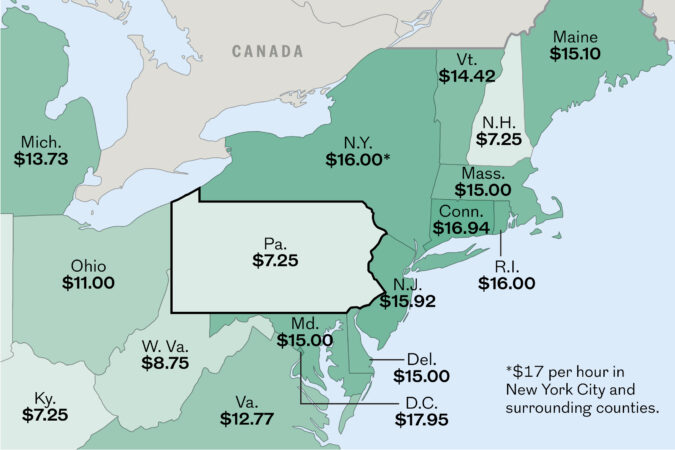
    Despite efforts to raise Pennsylvania’s minimum wage, it lags behind that of neighboring states.

    New Jersey’s minimum wage, which increased in January to $15.92 per hour, is over double that of Pennsylvania’s, and 22 states are soon increasing their minimum wage or have done so already this year. In Delaware, the minimum hourly wage has risen from $9.25 in 2021 to $15 in 2025, thanks to legislation mandating the gradual increase.

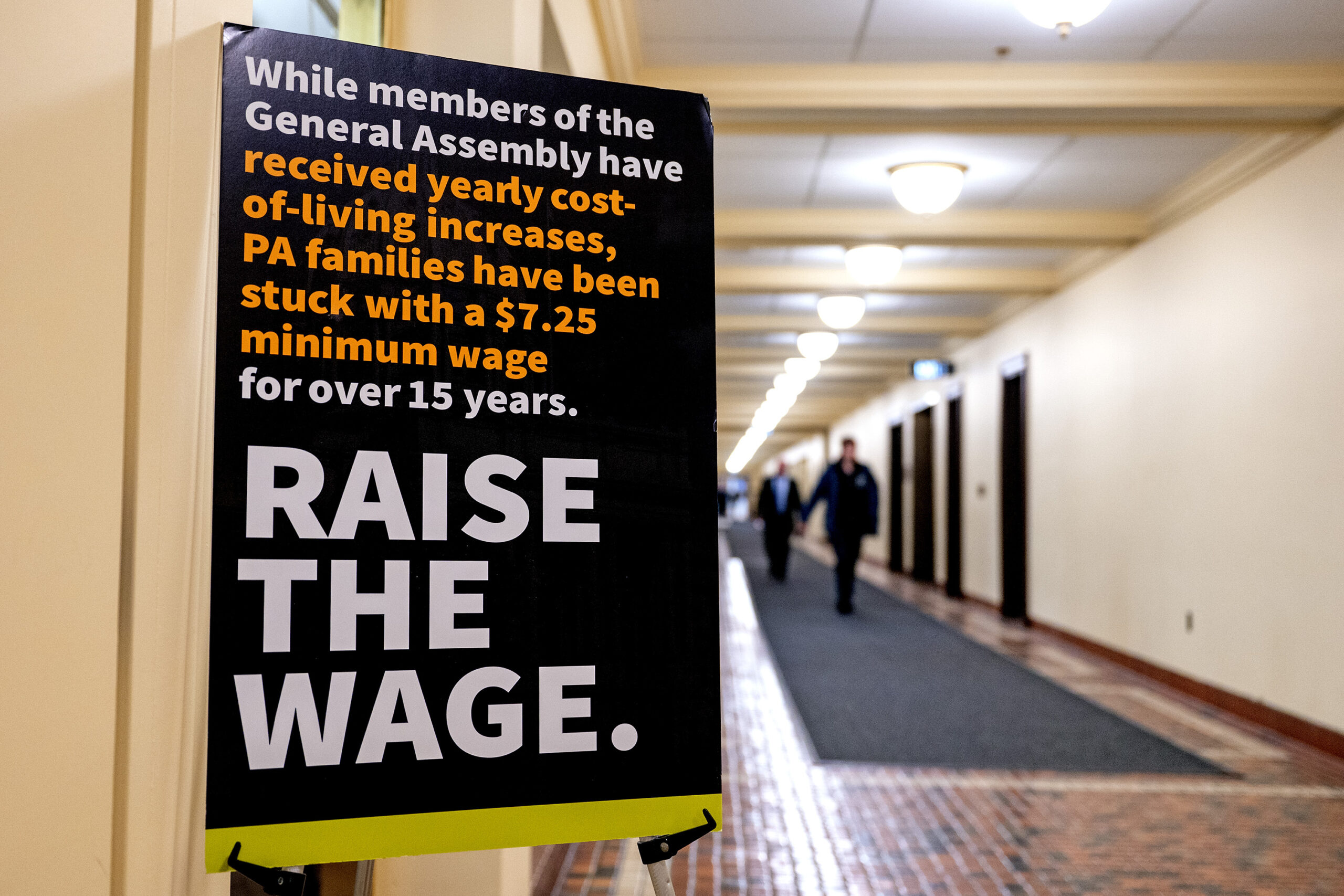
    A sign in support of an increase in the state’s minimum wage in the state Capitol Feb. 3, 2026.

    Gov. Josh Shapiro has backed raising the minimum wage at every annual state budget address since he was elected. In February he called on the General Assembly to advance minimum wage legislation, adding that raising it to $15 an hour would save the state millions on entitlement programs like Medicaid.

    “If you aren’t going to do this because it’s the right thing to do, or because it would let more families put food on the table for their kids, then do it because it’s going to save us $300 million, shrink our entitlement budget by growing our workforce and putting more money back in workers’ pockets,” he said.

  • Two Main Line Jewish schools are merging | Inquirer Lower Merion

    Two Main Line Jewish schools are merging | Inquirer Lower Merion

    Hi, Lower Merion! 👋

    Two prominent Jewish day schools are merging. Here’s why. Also this week, the Gladwyne man who duped some of the region’s wealthiest families into investing in his companies has been sentenced to prison, the township is gearing up to present two final plans for Schauffele Plaza’s redesign, and the county has appointed members to its human relations commission.

    We want your feedback! Tell us what you think of the newsletter by taking our survey or emailing us at lowermerion@inquirer.com.

    If someone forwarded you this email, sign up for free here.

    Two Jewish day schools make a ‘proactive’ move to merge

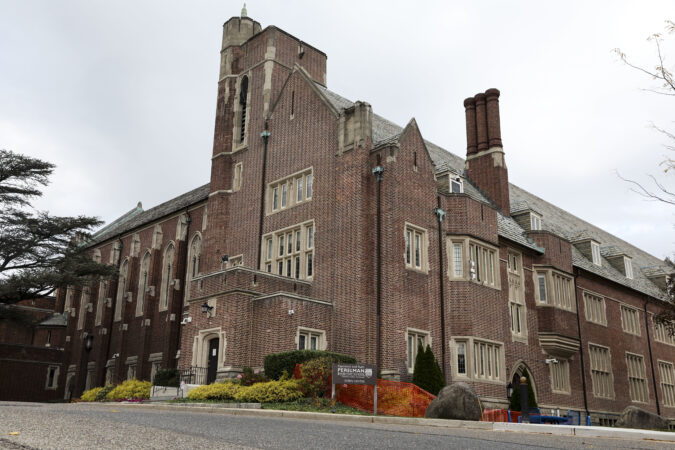
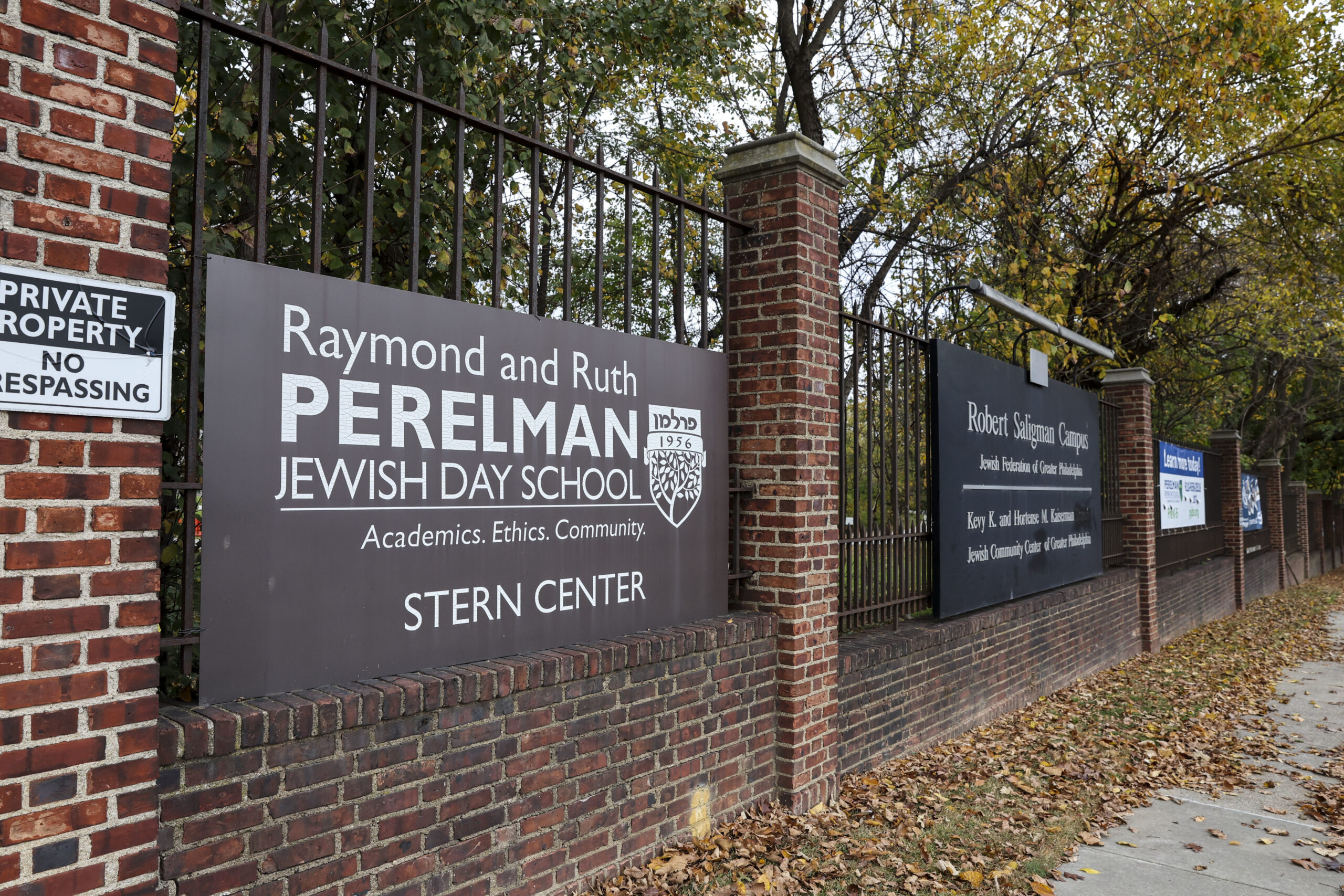
    The Perelman Jewish Day School is merging with the Jack M. Barrack Hebrew Academy.

    Perelman Jewish Day School and the Jack M. Barrack Hebrew Academy are merging in a “proactive” move the two Jewish day schools say will keep them competitive.

    The schools plan to keep their geographic footprints, which span Barrack’s Bryn Mawr campus and Perelman’s Melrose Park and Wynnewood facilities.

    While many students currently matriculate from Perelman to Barrack, the merger will allow families to enroll students in a single institution from pre-kindergarten through 12th grade.

    This isn’t the first time the two schools have come together. In 2012, they combined their middle schools to create a sixth-through-eighth-grade program on Barrack’s campus.

    Read more about the merger, which will go into effect in the 2027-28 school year.

    💡 Community News

    • Josh Verne, the Gladwyne man who convinced some of the region’s wealthiest families to invest in his companies only to use the cash to fund a lavish personal lifestyle, was sentenced yesterday to over nine years in federal prison. Verne’s high-profile investors included Sixers co-owner David Adelman, Fanatics CEO Michael Rubin, and real estate developer Bart Blatstein.
    • Ardmore’s Schauffele Plaza is slated for a redesign, and two final options will be presented at the Lower Merion Building and Planning Committee Meeting next Wednesday at 6:30 p.m. The goal of the redesign is to better utilize the public space and make it more of what the township is calling a “vibrant downtown gathering place.” Both plans call for outdoor dining space and central lawns, but the sizes and amount of greenery in each varies, with one plan reducing overall parking spaces by 56 spots, and the other by 38. See the two plans here.
    • Lankenau Medical Center named a new president this week. Anna Michelle Brandt succeeds Katie Galbraith and comes to the Wynnewood institution from University Hospital in New Jersey, where she was most recently its COO.
    • Speaking of Lankenau, it was recently ranked among the best hospitals in the United States by Newsweek, landing at No. 131. Bryn Mawr Hospital is No. 201 in the U.S.
    • Last month, the Montgomery County Board of Commissioners appointed the first members of its new human relations commission. The members are Samuel Coleman IV, Desha Dickson, Fiona Dow, John Han, Rosemary Jenkins, Shahidul Partha, Burt Siegel, and Akilah Williams-Valdez. The commission will allow residents who believe they’ve been discriminated against to mediate their claims. Members will specifically focus on unlawful discrimination in employment, real estate, housing, and public accommodations across the county.
    • Lower Merion Township has installed four new electric vehicle chargers in the municipal lot in Bryn Mawr across from Ludington Library. Two of the spaces are ADA accessible.
    • Services at the Center for Positive Aging in Lower Merion are returning to its main building at 117 Ardmore Ave. in Ardmore after it underwent a renovation.
    • Sugared + Bronzed is opening at Ardmore’s Suburban Square on Monday. Located at 127 Coulter Ave., it will be in the ground floor retail space of the new apartment complex Coulter Place, which opened earlier this year. Sugared + Bronzed offers “sugaring hair removal,” as well as airbrush tanning.
    • Leveaux Pilates in Ardmore has expanded and is now offering heated mat pilates, a hot take on the classic workout.

    🏫 Schools Briefing

    • Registration is open for all new students starting at any LMSD school for the 2026-27 academic year. Learn more about how to register here.
    • Tonight is the Freedom Tournament at Cynwyd Elementary and Taste of Penn Wynne. Tomorrow, Lower Merion High has its jazz festival, Penn Valley is hosting its “PV Idol,” and Welsh Valley’s spring musical, The Music Man Jr., kicks off. There are school board committee meetings on Monday and a fourth and fifth grade transition information session for Black Rock parents. See the district’s full calendar here.
    • The Prom Boutique is open again on Tuesday at Lower Merion High School from 3:30 to 7 p.m.
    • Students from Bala Cynwyd, Black Rock, and Welsh Valley Middle Schools, and Harriton and Lower Merion High Schools raked in a collective 99 awards at this year’s Pennsylvania Technology Student Association Region 5 Conference, held in late January, with 34 first-place finishes. Some will move onto the state conference, which takes place in mid-April.
    • Friends’ Central School’s girls’ basketball team defeated the Westtown School 62-54 last week to claim the Pennsylvania Independent Schools Athletic Association championship.
    • Shipley School sophomore Kate Ulrich took home second place in the U.S. Squash Junior Championship Tournament in the Girls Under 17 division, which was held in January in Philadelphia.

    🍽️ On our Plate

    🎳 Things to Do

    🌋 Science with Food: Kids ages 6 and up can make several science-themed edible crafts, including one inspired by a volcano. ⏰ Saturday, March 7, 4-5:30 p.m. 💵 $37.10 📍The Candy Lab

    🍀 St. Patrick’s Day Crafternoon: Kids can make a leprechaun craft during this drop-in event. ⏰ Wednesday, March 11, 3-5 p.m. 💵 Free 📍Gladwyne Library

    🏡 On the Market

    A 1930s stone manor in Bryn Mawr with a pool

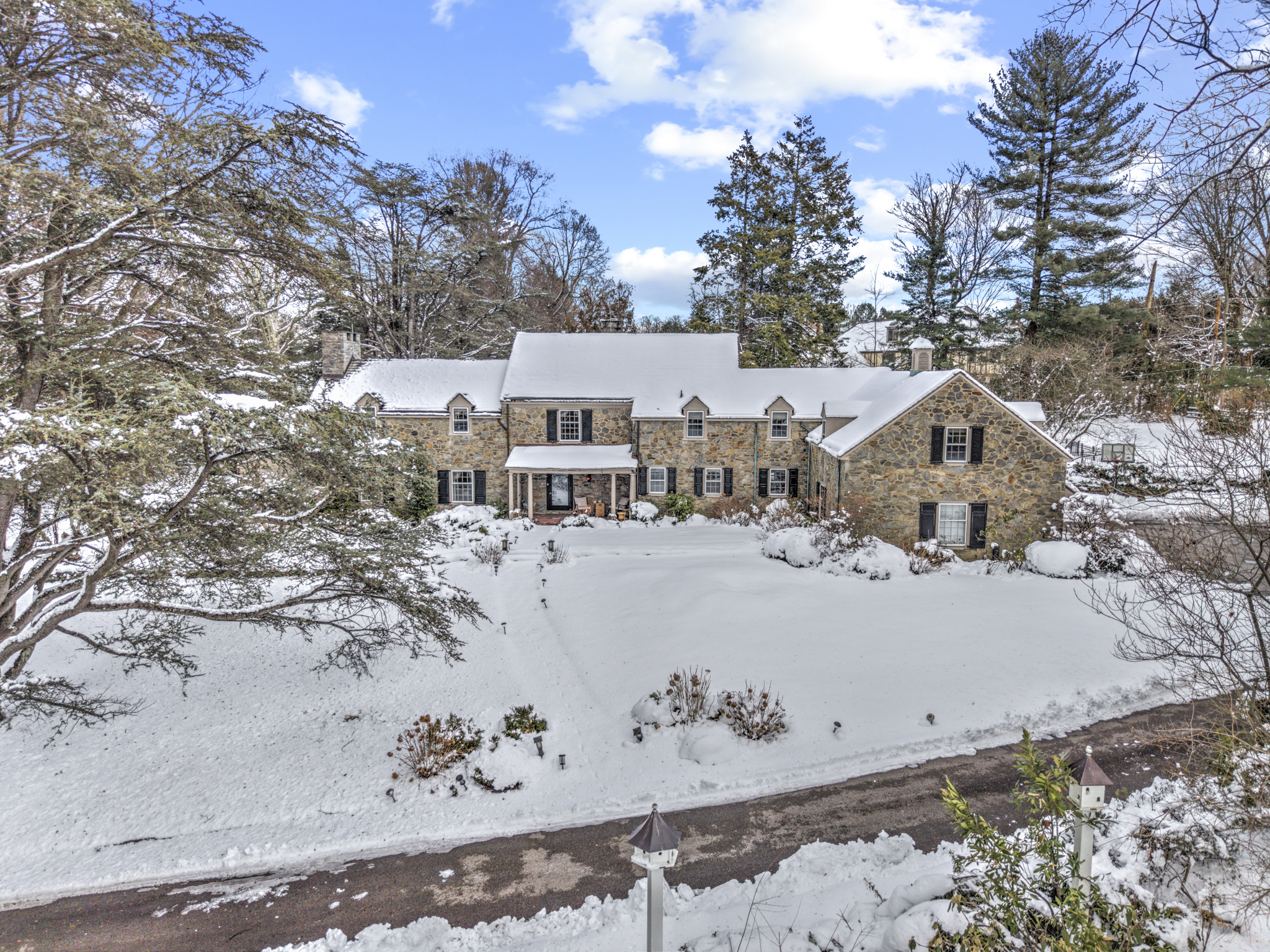
    The home was built in 1939 and sits on over 2 acres.

    Built in 1939, this sprawling stone manor estate blends the past and present. The first floor features a formal living room with a gas fireplace and built-ins, a formal dining room with dedicated china closets and a crystal chandelier, an office with its own fireplace, and a kitchen with two-tone cabinetry, a large center island, high-end appliances, and granite countertops. Near the kitchen, there’s also a butler’s pantry. There are four bedrooms upstairs, including a primary suite with a dressing room and four closets, while the bathroom has a soaking tub and double vanity. Other features include a cedar closet in the attic and a partially finished basement. Outside, there’s a pool, gardens, a covered patio, and a chicken coop. There’s an open house Saturday from noon to 3 p.m.

    See more photos of the property here.

    Price: $3.5M | Size: 5,283 SF | Acreage: 2.04

    🗞️ What other Lower Merion residents are reading this week:

    By submitting your written, visual, and/or audio contributions, you agree to The Inquirer’s Terms of Use, including the grant of rights in Section 10.

    This suburban content is produced with support from the Leslie Miller and Richard Worley Foundation and The Lenfest Institute for Journalism. Editorial content is created independently of the project donors. Gifts to support The Inquirer’s high-impact journalism can be made at inquirer.com/donate. A list of Lenfest Institute donors can be found at lenfestinstitute.org/supporters.

  • How Media became the nation’s first Fair Trade Town | Inquirer Greater Media

    How Media became the nation’s first Fair Trade Town | Inquirer Greater Media

    Hi, Greater Media! 👋

    This year marks the 20th anniversary of Media as a Fair Trade Town. We delve into how it became the first in the U.S. Also this week, Swarthmore’s borough manager has been terminated, Media is home to a competitive Scrabble club, plus a monthslong utility project on Providence Road is set to get started.

    We want your feedback! Tell us what you think of the newsletter by taking our survey or emailing us at greatermedia@inquirer.com.

    If someone forwarded you this email, sign up for free here.

    How Media became the country’s first Fair Trade Town 20 years ago

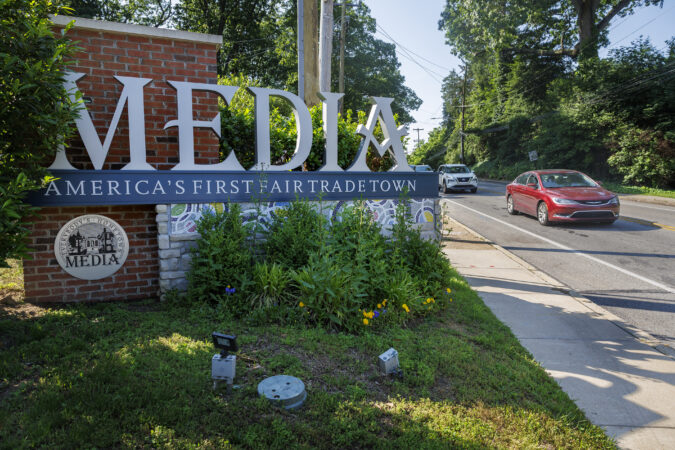
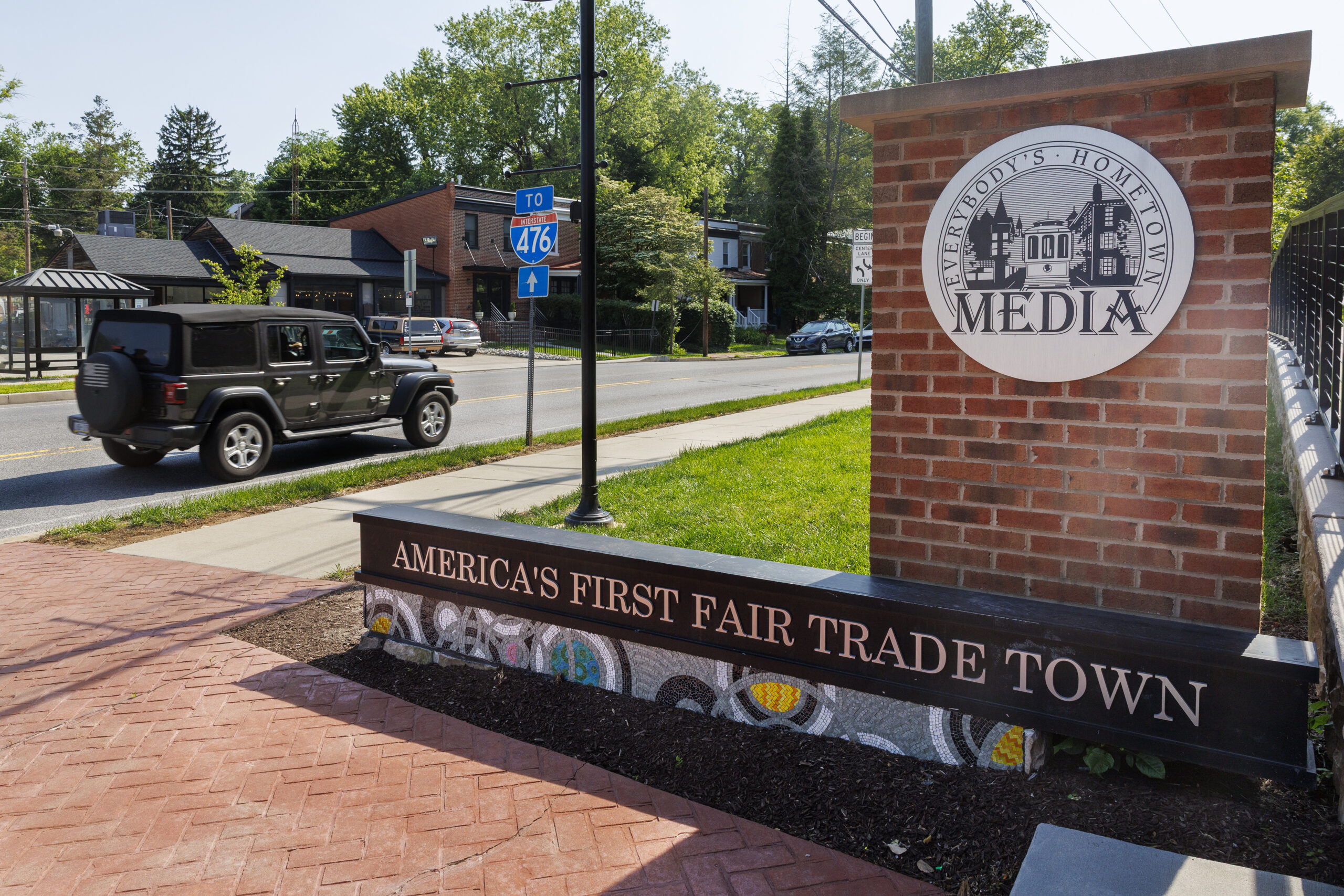
    Media displays its distinction as the country’s first Fair Trade Town on its signage.

    Two decades ago, one man’s vision and one woman’s email set into motion a first for Media as the pair worked to make the borough the nation’s first Fair Trade Town.

    The idea came from Hal Taussig, the late founder of travel company UnTours who wanted to see his hometown prioritize quality products and fair wages for farmers in developing areas. To be part of the global trading agreement, farmers and producers must use eco-friendly practices, invest in their communities, and provide safe working conditions. In exchange, they’re paid higher minimum prices for goods like coffee, chocolate, and produce.

    With a single late-night email to a man in England, Elizabeth Killough, who worked for Taussig, helped start the process. While major cities like New York and Los Angeles were working to establish themselves as Fair Trade hubs, Media beat them to it, and 20 years later, that ethos lives on.

    The Inquirer’s Denali Sagner delves into what it means for the borough today.

    💡 Community News

    • Swarthmore has a new interim borough manager. On Monday, borough council appointed David Unkovic to the role. He takes over for Sean Halbom, who has been terminated, according to Council President Jill Gaieski, The Inquirer learned late Wednesday night. Halbom began in the role less than six months ago, taking over for the outgoing manager Bill Webb in September.
    • Peco is aiming to begin a monthslong natural gas line replacement project on Monday in Media. Work will take place on Providence Road between Meetinghouse Road and Monroe Street on weekdays from 7 a.m. to 4 p.m. through mid-July. While most work will be outdoors, Peco will need access to impacted homes to relight gas appliances. Read more about the project here.
    • In other construction news, the Swarthmore Avenue project is getting closer to completion. Needed parts for the repair project are expected to arrive next week, and once they’re installed, closures on the road are expected to be limited to 7 a.m. to 3 p.m. for “a few weeks.” Construction on the project began in December and was initially anticipated to take eight weeks.
    • Monday is the deadline for Swarthmore residents to order a tree for or near their curb. Here’s how you can get one.
    • Riddle Hospital reported a 36% increase in patients after Crozer-Chester Medical Center closed last spring. With more patients, the hospital’s parent company, Main Line Health, reported an $8.7 million operating profit for the first half of fiscal 2026, which ended Dec. 31.
    • Riddle Village in Middletown Township has become a hub for some of the country’s top Scrabble players. The Delco Scrabble Club’s members range widely in age and come from all over the area, but meet weekly at one of the members’ homes in Media. “I casually hop on SEPTA and then I’m face-to-face with the best Scrabble players in the country. It’s kind of intimidating,” Mark Abadi, 35, said at one of the club’s recent weekly meetings. He and another member of the group, Will Anderson, 41, have competed in national tournaments and are putting their skills to the test on this season of the CW’s game show Scrabble.
    • A pair of sisters recently put their family’s Spanish-style Wallingford home on the market for $699,000. The ranch was built in the 1970s, and their parents purchased it 42 years ago. Take a peek inside.

    🏫 Schools Briefing

    • Two Penncrest High School sports teams are having successful runs. The boys’ ice hockey team shut out Conestoga High School 4-0 last week to claim the Central League championship. And the boys’ basketball team kicks off its PIAA 5A championship efforts on Friday, when the Lions host York Suburban High School. See the full 5A bracket here.
    • Reminder for Rose Tree Media families: There’s no school today or tomorrow for kindergarten through eighth grade students due to parent-teacher conferences. On Saturday, Penncrest High School is hosting Carnival for a Cure from 10 a.m. to 2 p.m. There will be food, games, and prizes, with proceeds benefiting the Foundation Fighting Blindness. See the district’s full calendar here.
    • Wallingford-Swarthmore School District is hosting a community meeting about the high school renovation tonight at 6:30 p.m. at the Strath Haven High School library.
    • Also in WSSD, today is the Elementary Chorus Fest, and performances of Strath Haven High School’s musical, Alice By Heart, continue tomorrow through Sunday. On Monday, there’s a virtual meeting about navigating college admissions tests, and the spring book fair starts Tuesday. See the district’s full calendar here.

    🍽️ On our Plate

    • Fox 29’s Bob Kelly recently visited Bittersweet Kitchen in Media to sample some of its brunch offerings, including crème brûlée pancakes, apple cider fritters, and huevos rancheros. See the segment here.

    🎳 Things to Do

    🏕️ School Day Off Mini-Adventure Camp: Kids in kindergarten through third grade can explore Tyler Arboretum through nature-themed crafts, outdoor play, games, and more. ⏰ Thursday, March 5 and Friday, March 6, 9 a.m.-4 p.m. 💵 Standard daily camp admission is $83.70 for members and $93 for non-members 📍Tyler Arboretum, Media

    🩰 Sleeping Beauty: The classic fairytale gets a modern spin as Ballet of Lights dancers perform in glow-in-the-dark costumes. ⏰ Friday, March 6, 6:30 and 8:30 p.m. 💵 $43-$57 📍The Media Theatre

    🎸 The Biscotti Boys: The Chester County party cover band will make its debut at Martinique Deux. ⏰ Friday, March 6, 8 p.m. 💵 No cover📍Martinique Deux, Media

    🏡 On the Market

    A three-bedroom townhouse in Franklin Station

    The open-concept first floor includes living and dining areas, as well as the kitchen.

    Located in Franklin Station off Route 1, this three-bedroom townhouse spans two floors, plus a finished basement, and has access to amenities including a clubhouse, pool, walking trails, and fitness center. The townhome’s open-concept first floor features living and dining areas, as well as the kitchen, which has an 8-foot quartz island, two-tone cabinetry, a herringbone backsplash, plus a walk-in pantry. The space opens onto a deck with a pergola. All three bedrooms are upstairs, including a primary suite with a walk-in closet, a double vanity, and a tiled shower. There are open houses Saturday from 11 a.m. to 1 p.m. and Sunday from noon to 2 p.m.

    See more photos of the townhouse here.

    Price: $712,900 | Size: 2,727 SF

    🗞️ What other Greater Media residents are reading this week:

    By submitting your written, visual, and/or audio contributions, you agree to The Inquirer’s Terms of Use, including the grant of rights in Section 10.

    This suburban content is produced with support from the Leslie Miller and Richard Worley Foundation and The Lenfest Institute for Journalism. Editorial content is created independently of the project donors. Gifts to support The Inquirer’s high-impact journalism can be made at inquirer.com/donate. A list of Lenfest Institute donors can be found at lenfestinstitute.org/supporters.

  • More than half of Pennsylvanians oppose ICE’s methods under Trump, new poll finds

    More than half of Pennsylvanians oppose ICE’s methods under Trump, new poll finds

    Pennsylvania voters broadly oppose some of President Donald Trump’s immigration enforcement tactics — but there’s a stark partisan split, according to a new statewide poll of registered voters.

    Franklin & Marshall College’s Center for Opinion Research released a wide-ranging poll Thursday that tracked registered Pennsylvania voters’ opinions on America’s 250th anniversary, ICE enforcement tactics, and other issues facing the state and nation ahead of the midterm election.

    Trump’s approval ratings have remained consistently low since returning to office last year, with a majority of Pennsylvanians disapproving of his job as president.

    Democratic Gov. Josh Shapiro maintains a 50% approval rating heading into the midterm elections later this year.

    Pollsters at Franklin & Marshall College surveyed 834 registered Pennsylvania voters, including 353 Democrats, 347 Republicans and 134 independents. The sample error is +/- 4.1 percentage points.

    Here are three takeaways from the poll of registered Pennsylvania voters, conducted Feb. 18 through March 1 by phone or online.

    Trump is consistently unpopular in Pennsylvania

    Trump’s approval ratings among registered Pennsylvania voters remain low, with 61% of voters rating him as doing a “poor” or “fair” job, according to the statewide poll, which also assessed Trump’s performance on immigration, the economy, and other issues.

    Trump maintained a net negative approval rating throughout his first term in 2017-2021 and so far in his second term, according to the poll.

    Despite winning the state in 2024, he remains divisive with 51% of respondents rating him as doing a “poor” job, and only 10% who rate him as doing a “fair” job. Approximately 39% of registered Pennsylvania voters view Trump as doing an “excellent” or “good” job, according to the poll.

    window.addEventListener(“message”,function(a){if(void 0!==a.data[“datawrapper-height”]){var e=document.querySelectorAll(“iframe”);for(var t in a.data[“datawrapper-height”])for(var r,i=0;r=e[i];i++)if(r.contentWindow===a.source){var d=a.data[“datawrapper-height”][t]+”px”;r.style.height=d}}});

    Trump’s low approval numbers could have a drag effect on Republicans’ performance in the midterm election, said Berwood Yost, the director of Franklin & Marshall’s poll.

    “While there’s still a long way to go until November, [Trump has] got to figure out a way and his party has to find a way to prevent that and earn those voters back,” Yost said.

    Trump’s low numbers align with those of former President Barack Obama or George W. Bush’s approvals at the same point in their second term, Yost added. Both of their parties lost seats in the midterms elections those years.

    However, Trump’s approval ratings are not the lowest they have been in the state. His approval ratings dropped to their lowest, 70% disapproval, during his first term in September 2017.

    Josh Shapiro is still popular

    Gov. Josh Shapiro remains popular ahead of his reelection contest this year: 50% of Pennsylvania voters say he is doing an “excellent” or “good job,” while another 44% believe he is doing a “fair” or “poor” job leading the nation’s fifth most populous state.

    Shapiro is the most popular governor since 2000, when comparing his approval ratings to those of other Pennsylvania governors at the same point during their first terms, Yost said.

    Shapiro also maintains a significant lead over his likely GOP challenger, State Treasurer Stacy Garrity. If the midterm elections were to happen today, 48% of voters said they would reelect Shapiro, while 28% said they would vote for Garrity. Another 7% of voters said they would vote for a different candidate, while 17% were undecided or refused to answer the question.

    Shapiro’s approval ratings have remained steadily high since taking office in January 2023. A Quinnipiac University poll released last month found similar public opinion toward Shapiro’s reelection, while some voters said they were unsure whether they wanted the rumored 2028 presidential candidate to run for higher office.

    Pa. voters broadly oppose some of ICE’s enforcement actions, but are split on others

    Approximately three-fourths of Pennsylvania voters believe ICE should not be able to use deadly force against protesters or enter a home without a warrant, in a major pushback to Trump’s immigration enforcement tactics.

    Pennsylvania voters’ opinions on immigration enforcement varies significantly based on a person’s political party: While nine in 10 Republicans support ICE tactics, only two in five independents and one in 10 Democrats support them.

    Protesters march up Eighth Street, towards the immigration offices, during the Philly stands with Minneapolis Ice Out For Good protest at Philadelphia’s City Hall on Friday, Jan. 23, 2026.

    Republicans support ICE’s use of unmarked vehicles to detain people and their use of masks to hide an agent’s identity at much higher rates than Democrats, while independents are split. On the use of masks, 77% of Republican voters believe agents should be able to wear them, while 40% of independents and only 10% of Democrats do.

    “There’s a lot of consensus about the fundamental principles that protect our individual rights like entering a home without a warrant or using force against protesters, whereas there’s a little more partisanship in others,” Yost said.

    window.addEventListener(“message”,function(a){if(void 0!==a.data[“datawrapper-height”]){var e=document.querySelectorAll(“iframe”);for(var t in a.data[“datawrapper-height”])for(var r,i=0;r=e[i];i++)if(r.contentWindow===a.source){var d=a.data[“datawrapper-height”][t]+”px”;r.style.height=d}}});

    There is also overwhelming support among Pennsylvania voters that non-citizens who are in the U.S. legally — whether by visa, green card, asylum or other protected statuses, or in the process of becoming a citizen — should not be targeted by Immigration and Customs Enforcement for deportation, according to the poll.

    However, a majority of Republicans and independent voters believe undocumented immigrants who have been in the United States illegally for any amount of time and have no criminal record should be targeted for deportation, while less than a quarter of Democrats believe they should.

    Pennsylvania voters want the 250th anniversary to acknowledge the positives and negatives from American history

    As Trump tries to reframe American history for the nation’s 250th anniversary, most Pennsylvanians want the celebrations to acknowledge its positive and negative parts.

    Approximately 73% of Pennsylvania voters believe any retelling of American history should include the upsides and downsides of the nation’s founding, while 24% believe only positive aspects should be celebrated.

    “Most people, they want to see historical interpretations that include the whole picture,” Yost said.

    This finding is of particular interest in Pennsylvania, following the Trump administration’s removal of an exhibit that memorialized the enslaved people who lived in George Washington’s home from the historic President’s House site in Independence National Historical Park. A federal judge ordered the restoration of the exhibit, but the Trump administration is appealing the decision.

  • ‘You are failing’: Residents berate Quakertown council for inaction after students’ arrest

    ‘You are failing’: Residents berate Quakertown council for inaction after students’ arrest

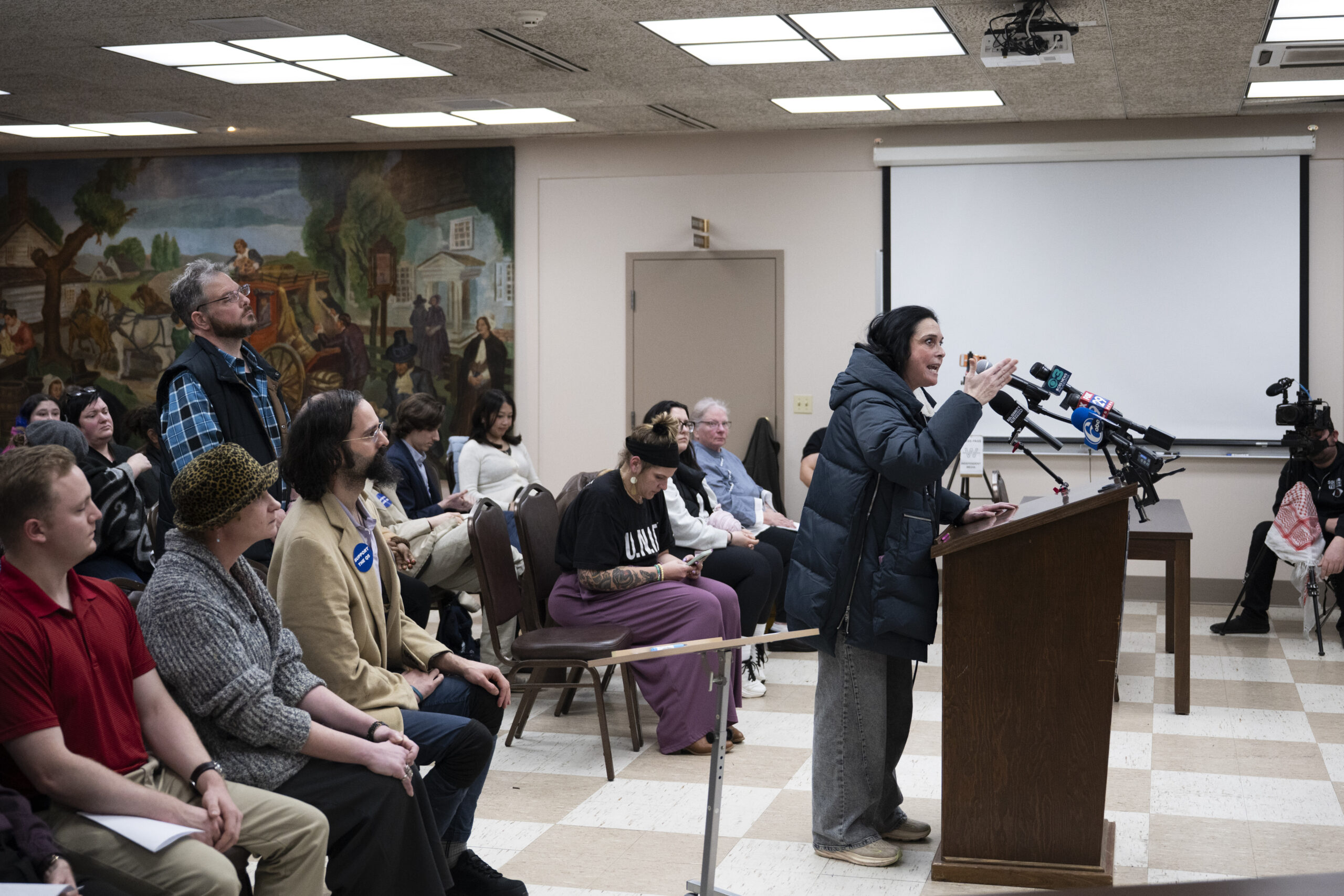
    Nearly two dozen residents and Quakertown taxpayers confronted the borough council at a public meeting Wednesday night, castigating its members for refusing to discipline the town’s police chief and demanding that they take action before leaving the room.

    The backlash was the latest fallout from a Feb. 20 student protest against federal immigration enforcement that began as a walkout from Quakertown Community High School and ended in a confrontation between Police Chief Scott McElree and a group of teenagers. The encounter, which was captured on video, led to the arrests of several teenagers and prompted an investigation by the Bucks County District Attorney’s Office.

    Wednesday’s meeting, which stretched to nearly two hours as speakers stepped to the podium one by one, laid bare a community in turmoil. Residents described fear, anger, and embarrassment that their small town had become a national flashpoint. By the end of the night, council members had made no motion and held no discussion about potential discipline for McElree.

    Council President Donald Rosenberger opened the meeting by telling the audience that the nine-member council — eight men and one woman — would not consider action against McElree or comment until the Bucks County District Attorney’s Office completes its investigation.

    McElree, 72, also serves as the borough’s manager, a role that includes overseeing the police department and managing public records.

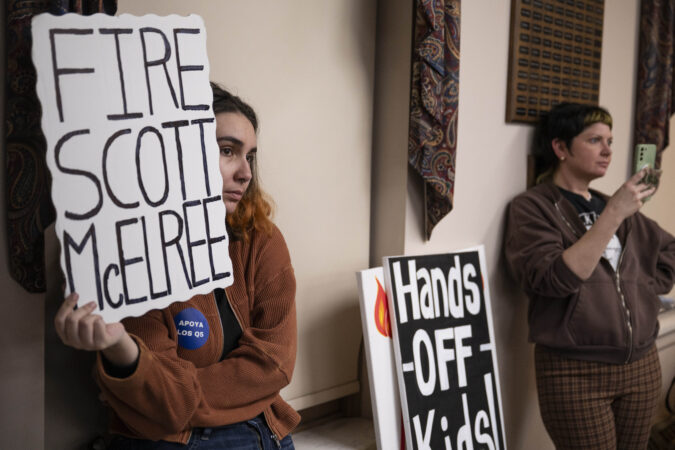
    A parent holds a sign outside the Quakertown School Board meeting on Feb. 26 in Quakertown, Pa. Critics who addressed the board accused the district of not doing enough to support the students arrested during last week’s ICE protest.

    Outside the locked doors of the borough hall before the meeting, more than three dozen people — adults and teenagers — gathered holding handmade signs. One woman had scrawled “peaceful protester” across a flattened cardboard box in black marker. Beneath it she wrote: “Don’t put me in a chokehold, mmkay?”

    Inside the crowded chamber, speakers urged council members to reckon with the national attention now focused on the town and warned that their response — or lack of one — would shape voters’ decisions in November.

    Nearly every speaker who addressed the council called for McElree to be fired and criminally charged.

    Joseph Rittenhouse, who said his niece was among those arrested after the clash, told council members that images of her bloodied face were now among the first results people see when they search for “Quakertown” online.

    “We are national news. If you’re OK with that, I don’t think any of us are going to be OK with you sitting up there” when voters go to the polls, Rittenhouse said.

    Ileana Ramos of Quakertown speaks during a council meeting as members of the community speak out against the actions of Police Chief Scott McElree on Wednesday night in Quakertown.

    A handful of people who identified themselves as immigrants or women of color said the episode had shaken their sense of safety in the community, leaving them worried about how they or their children might be treated.

    “It leaves me breathless as to how this is possible in America,” said Illeana Ramos. “Everyone is scared.”

    Laura Foster, who leads Upper Bucks United, a civic group that has organized demonstrations since the altercation, said the council’s refusal to act had forced residents to step into a role that should belong to elected leaders.

    “You are failing to act as leaders in this community,” Foster said. “I don’t need to be doing this. You should be doing this.”

    Only one resident spoke in support of McElree.

    Caroline DeVenuto said officers had been “sent on a fool’s errand” when they were called to respond to a gathering of teenagers, and blamed parents for allowing the situation to spiral.

    “It’s time for parents to grow up and discipline their children like the rest of us,” she said.

    DeVenuto also criticized news coverage of the confrontation, calling portrayals of McElree and the police department “slander and deceit.”

    Residents and advocates first called for disciplinary action against McElree at a borough council meeting three days after the Feb. 20 confrontation. By Thursday, a petition seeking his resignation had drawn more than 12,000 signatures, though it was unclear how many of the signers live in the borough.

    Videos recorded by bystanders and reviewed by The Inquirer show McElree grappling with several students, at one point wrapping his arm around a teenage girl’s neck before taking her to the ground. McElree, who was not in uniform at the time, left the scene bleeding, the videos showed.

    Five teenagers were charged with aggravated assault, a felony, and related offenses. They are on house arrest with ankle monitors, their attorneys said.

    In the affidavit of probable cause for the arrest of one of the teenagers, officers wrote that McElree had been attempting to take a student into custody when the encounter escalated. A teenage boy struck him in the ear, the affidavit said, and others hit him in the shoulder and ribs.

    The document does not mention a chokehold.

    According to the affidavit, McElree sought medical treatment for undisclosed injuries. More than a week later, he began a workers’ compensation leave, the borough’s attorney said.

    The Bucks County District Attorney’s Office is investigating the encounter and has declined to comment.

    At least three defense attorneys have asked the Pennsylvania attorney general to assume control of both the investigation and the prosecution, and to dismiss the charges.

    In an email last week, lawyer Ed Angelo wrote that the affidavit “rendered only allegations that were damning to the children, but left out the assaultive behavior of the chief of police — behavior the children fought to protect themselves from.” He called the prosecution “an obvious and unacceptable conflict of interest.”

    On Friday, the attorney general’s office declined to intervene, saying in an email that “it would be inappropriate for our office to engage” in the investigation or the case.

  • Former Bucks County man who voted twice for Trump convicted of voter fraud

    Former Bucks County man who voted twice for Trump convicted of voter fraud

    A former Bucks County man who claimed he was covered by pardons given by President Donald Trump to supporters who tried to overturn the 2020 election was found guilty Wednesday by a federal jury in Philadelphia of voting twice for Trump in 2020.

    Matthew Laiss, 32, was charged by indictment in September of one count of voting more than once in a federal election and one count of voter fraud. He is scheduled to be sentenced on June 10 and faces a maximum of five years in prison on both counts.

    Laiss, who prosecutors said is currently a resident of Bethehem, Pa., had been a resident of — and was registered to vote in — Ottsville, Bucks County, from at least 2012 to around August 2020, prosecutors said. Laiss then moved to Frostproof, Fla., where he obtained a driver’s license and registered to vote there.

    Around Oct. 31, 2020, Laiss filled out and returned a mail-in Pennsylvania ballot, then on Nov. 3, 2020, Laiss went to a polling place in Florida and voted again.

    “Today’s conviction reinforces a simple principle: our elections must be fair, secure, and lawful, ” U.S. Attorney David Metcalf said in a statement.

    “Casting a ballot in more than one jurisdiction undermines public trust and dilutes the votes of others. Our office will continue to protect the integrity of federal elections and hold accountable those who violate the law,” Metcalf said.

    The case was investigated by the FBI, with assistance from the Pennsylvania Department of State, and is being prosecuted by Assistant U.S. Attorney Mark Dubnoff.

    Federal defenders who represented Laiss could not be reached for comment Wednesday night.

    Lawyers for Laiss had argued to U.S. District Judge Joseph F. Leeson Jr. that a pardon proclamation Trump issued last year on Nov. 7 applied to Laiss, and that Laiss had accepted it.

    Laiss was not among the 77 people Trump listed when specifying who would receive relief, but Laiss’ lawyers said the proclamation’s preamble included language making it applicable to “all United States citizens” for conduct, voting, or advocacy surrounding the contest.

    His lawyers wrote that Trump allies including Rudy Giuliani, Sidney Powell, and Mark Meadows were all explicitly pardoned for “exponentially more egregious alleged conduct.” Extending relief to them while denying it to Laiss, his lawyers wrote, “would be outrageous.”

    Prosecutors said they checked with Trump’s Office of the Pardon Attorney and were told that the lawyers there did not believe the pardon proclamation applied to Laiss.

    In January, Leeson ruled against Laiss’ motion to dismiss the indictment, explaining that the court was without jurisdiction to decide the matter because Laiss had not applied to the Office of the Pardon Attorney, or had received a certificate of pardon.

  • Chester County’s prison warden will move to county government as commissioners restructure administrative team

    Chester County’s prison warden will move to county government as commissioners restructure administrative team

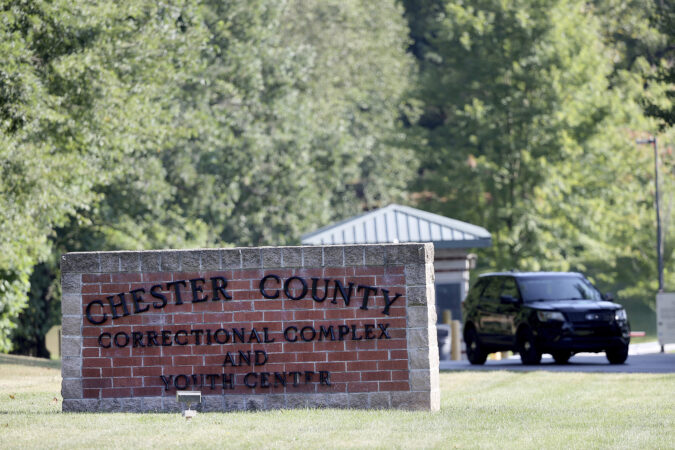
    Chester County’s prison warden will round out a new leadership team after the county’s top official left his job earlier this week.

    Howard Holland, who has served as prison warden for the county since April 2024 and was its acting warden for eight months before that, has been appointed as acting deputy county administrator for operations and will complete a team of three newly named top county officials, the county announced this week.

    “I have always advocated for improved government processes, and I’ve been particularly pleased by the changes Mr. Holland has undertaken at the prison,” County Commissioner Eric Roe said in a statement. “I’m happy to have him join our leadership team, and I look forward to his continued contributions as a manager and leader at the County level.”

    The administrative team oversees 2,600 staff members and a roughly $730 million annual budget. Members are appointed by the county’s three elected commissioners.

    The change comes just days after the county’s top official, David Byerman, left the job, and a new county administrator, Erik Walschburger, was named. Holland and deputy county administrator Megan Moser, whose role was renamed this week, will work under Walschburger.

    Walschburger most recently was the county’s deputy administrator, a role he had held since 2022 overseeing internal day-to-day operations. Moser, who joined the county in 2025, has been involved with the county’s response to multiple election errors in recent months.

    The county’s announcement on Wednesday made no mention of Byerman. A county spokesperson earlier this week declined to give a reason for his departure.

    As Chester County shifts its personnel, it is reverting back to job titles it had used previously, retiring its use of “chief executive officer,” “chief operations officer,” and “chief experience officer” — a change it made roughly a year ago — for the more traditional title of county administrator and two deputies.

    Holland comes to the job after a more than 30-year career in law enforcement, working as a police officer, a special county detective, and an adviser to the county’s prison board. He was the chief of police for seven years in Downingtown.

    His most recent job came with an electric start: The day he became acting prison warden, convicted murderer Danilo Cavalcante escaped the prison, resulting in a two-week search. Since that incident, Holland made changes to limit the risk of escape, and promised to add additional security measures to the facility.

    With Holland’s move to county government, the Chester County Prison Board of Inspectors has appointed Brian Sheller as acting warden, county officials said. Sheller has been deputy warden since 2024, and served as the Parkesburg chief of police for more than 30 years.

    This suburban content is produced with support from the Leslie Miller and Richard Worley Foundation and The Lenfest Institute for Journalism. Editorial content is created independently of the project donors. Gifts to support The Inquirer’s high-impact journalism can be made at inquirer.com/donate. A list of Lenfest Institute donors can be found at lenfestinstitute.org/supporters.

  • SEPTA gets $5.5 million in federal funds to add extra service during World Cup

    SEPTA gets $5.5 million in federal funds to add extra service during World Cup

    SEPTA expects to receive about $5.5 million from a federal appropriation to offset the cost of providing transit service in Philadelphia during the FIFA World Cup.

    The regional transportation authority projects it will spend $21.5 million for additional transit runs and extended service hours during the World Cup as well as a the celebration of the nation’s 250th birthday, officials said.

    On Tuesday, the U.S. Department of Transportation announced about $100 million in funding to 11 cities and regions hosting FIFA championship matches, apportioned by formula.

    “We are going to pull out all the stops to serve those big events — while also not missing a beat for our riders who rely on SEPTA every day,“ General Manager Scott Sauer said in a statement. He thanked the region’s congressional delegation and U.S. DOT for the ”much-needed investment to support this historic year.“

    The Philadelphia region’s total grant was $8.47 million, with the remainder of the money going to government entities in New Jersey and Delaware.

    SEPTA said it would spend $18 million for overtime for transit operators and Transit Police, cleaning expenses, longer customer service hours and ambassadors to help people navigate the system.

    Other extra operating costs for the events:

    • $1 million on safety and security, for portable surveillance equipment and a communications system to send police where they’re needed most.
    • $825,000 for signage, including World Cup branded signage, website and app upgrades to help visitors get around, as well as translation services.
    • Another $1.3 million will be spent on support services, SEPTA said.

    Congress earmarked the money to help World Cup host cities and regions in this year’s federal budget, but improvements are required to benefit the general public, not just soccer fans.

    “With the world coming to Philadelphia in 2026, we have a responsibility to be ready,” U.S. Rep. Brendan Boyle (D., Pa) said.

    The federal largesse will “strengthen our transit system so it can handle the surge in ridership during the World Cup,” Boyle said. “Just as importantly, these improvements will benefit Philadelphians long after the tournament.”

    In addition to the extra spending on operations, SEPTA said it is investing about $30 million for infrastructure upgrades in advance of 2026 events, including improvements at Broad Street Line and Market-Frankford Line rail stations expected to be primary hubs for event goers.

    The projects include:

    • Roof replacement and platform resurfacing at NRG Station on the Broad Street Line, which serves Lincoln Financial Field and Citizens Bank Ballpark, where the Major League All-Star game will be held this summer.
    • Upgrades to the Second Street Station headhouse on the Market-Frankford Line.
    • Fern Rock Transportation Center lighting and painting.
    • Realignment of the fare line at City Hall Station on the BSL, as well as platform resurfacing and new LED lighting.
  • A Gladwyne man who misspent millions of dollars from some of Philly’s richest people will spend 9 years in prison

    A Gladwyne man who misspent millions of dollars from some of Philly’s richest people will spend 9 years in prison

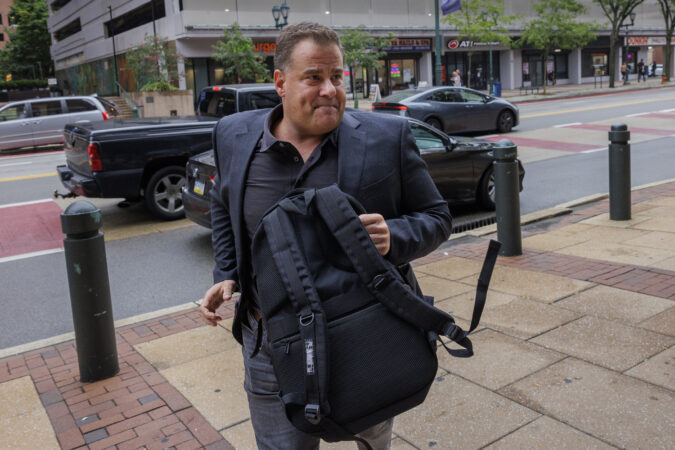
    A Gladwyne furniture heir who duped some of the region’s wealthiest people into giving him millions of dollars intended to fund his startup companies — but who instead used the cash to pay for lavish personal expenses including private jet flights, country club dues, and his daughters’ bat mitzvahs — was sentenced Wednesday to more than nine years in federal prison.

    Josh Verne pleaded guilty last year to using forged financial documents and false statements about his net worth to persuade prominent business owners to invest in some of his proposed ventures. They included David Adelman, a billionaire entrepreneur and Sixers co-owner; Michael Rubin, CEO of the sports apparel behemoth Fanatics; and real estate developer Bart Blatstein, The Inquirer has reported.

    Part of Verne’s appeal, prosecutors said, was his gregarious and engaging persona, and his confident assurances that he was a visionary entrepreneur who would turn his investors’ money into lucrative returns. He said he’d sold a previous business for tens of millions of dollars — although he hadn’t — and assured his benefactors that he was worth nearly $100 million, though he wasn’t.

    In court Wednesday, Verne, 48, cut a far more humble figure, saying he’d “destroyed” his career, reputation, and relationships through his misconduct.

    “I alone am responsible for that,” he said. “Not the circumstances, not the pressure, but me.”

    Prosecutors said Verne’s misdeeds were part of a calculated, long-running scheme to “steal rather than earn.” In court documents, they described him as an “extraordinarily capable conman” whose fraud “was not an aberration — it was a business model.”

    “This wasn’t a poor man who was trying to feed his family,” Assistant U.S. Attorney Jerome Maiatico said in court. “He wanted to live a lifestyle that he couldn’t otherwise afford. And he sustained that with deception.”

    U.S. District Judge John F. Murphy said Verne clearly had a knack for gaining people’s trust — but that in this case, he abused that trust in “profound” ways, day after day.

    “What makes this scheme so meaningful is the sheer persistence of all of the decisions,” Murphy said. “You don’t accomplish all of these things with a couple of light decisions.”

    The judge said Verne’s total term of incarceration would be 111 months. Afterward, he said, Verne will serve three years of supervised release.

    Verne was raised in Huntingdon Valley, and his family in the 1960s founded Chuck’s Bargain House, a furniture company that was later renamed Home Line Furniture Industries and grew to include factories in Philadelphia, North Carolina and Vietnam.

    Verne went to work for the business in the early 2000s, but it was forced to close because of financial difficulties in 2011.

    After that, Verne founded Workpays.me LLC, an employee payroll-deduction purchasing program. And in 2016, he persuaded Adelman to invest in FlockU, a digital media outlet focused on appealing to college students.

    In courting Adelman, prosecutors said, Verne lied about his net worth, his business background, and, to bolster his accounts, presented Adelman — referred to in court documents as “Investor A” — with forged financial documents he said were from Goldman Sachs.

    Once FlockU foundered, prosecutors said, Verne changed the LLC’s name to Ownable and pivoted its business model, seeking to make it an online marketplace that would lease laptops and smartphones to people who couldn’t afford to buy them.

    To persuade Adelman to invest more money, prosecutors said, Verne lied again, saying he was investing more than $2 million of his own money into Ownable, when in fact he never did so.

    Verne then went on to raise millions more from other boldfaced names, in part by touting his connection to Adelman and continuing to boast about his own wealth. All the while, prosecutors said, Ownable was struggling to get off the ground — but Verne was using the money to fund an extravagant life.

    He used his investors’ cash to renovate his Shore house, prosecutors said, and paid for private jet trips, his daughters’ bat mitzvahs, his country club dues, an interior decorator, and credit card and mortgage bills.

    The U.S. Attorney’s Office has not yet settled on a precise dollar figure for all that graft, but said it was likely between $12 million and $24 million.

    Prosecutors and Verne’s attorneys said in court Wednesday that they were continuing to try and finalize disputes about exactly how much Verne owes to his victims, although his federal public defenders said he is now “penniless.”

    In 2023, the Securities and Exchange Commission said in a civil court filing that Verne had raised $31 million from investors — and misspent about half of it.

    More than $9 million went toward Verne’s personal expenses, the SEC said, and about $5 million was diverted to make “Ponzi-like payments” to some initial investors, an attempt by Verne to mislead his benefactors into thinking Ownable was in good financial health.

    By 2019, however, Ownable was in severe financial distress, prosecutors said. And in 2020, the company’s board learned of the issues and forced Verne to resign.

    Two years later, prosecutors said, when Verne knew he was under criminal investigation, he sent texts to a former Ownable employee who’d spoken to the FBI, as well as the man’s wife. Prosecutors said the texts amounted to witness intimidation.

    Verne’s attorneys disputed that, saying the texts were a one-time, “off-the-cuff” reaction made under duress, and did not contain any explicit threats against anyone.

    Murphy, the judge, disagreed.

    “Some would call it extortion,” he said. “It’s a threat.”

    Verne was indicted in 2024 on charges including securities fraud, wire fraud, and aggravated identity theft. He pleaded guilty last year to some of those charges as part of a plea agreement.

    Murphy said that although some of Verne’s victims were wealthy, others were less well-heeled and therefore devastated by his misuse of their money.

    And yet Verne continued making decisions to benefit himself at the expense of those who trusted him, the judge said.

    “What the next day brought every time,” Murphy said, “was more and more harmful decisions.”