Category: Pennsylvania News

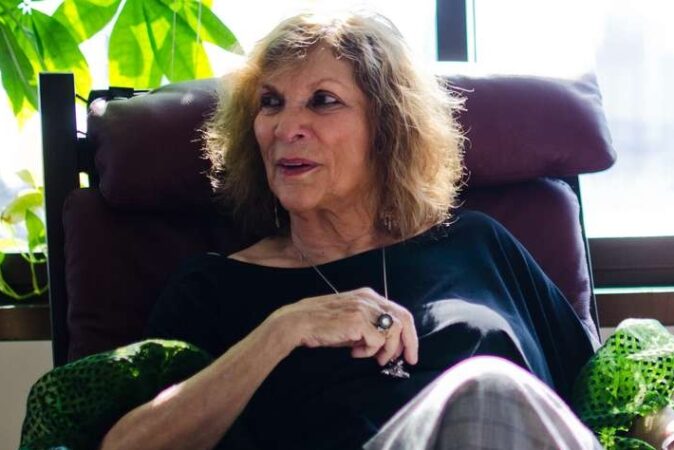
  • Edna B. Foa, celebrated pioneering psychologist and longtime Penn professor, has died at 88

    Edna B. Foa, celebrated pioneering psychologist and longtime Penn professor, has died at 88

    Edna B. Foa, 88, of Philadelphia, renowned clinical psychologist, pioneering mental health researcher, creator of the celebrated prolonged exposure therapy for post-traumatic stress disorder, longtime professor of clinical psychology in psychiatry at the University of Pennsylvania, lecturer, mentor, and volunteer, died Tuesday, March 24, of complications from pneumonia at Pennsylvania Hospital.

    Dr. Foa was among the first psychologists in the 1970s and ‘80s to infuse empirical case study research into existing behavior protocols to create more effective mental health treatments for victims of rape, combat trauma, childhood sexual abuse, and other ordeals. She became an expert in PTSD, obsessive-compulsive disorder, and social phobia, and her prolonged exposure therapy for PTSD and exposure and response prevention treatments for OCD are still hailed as breakthrough innovations.

    From 1971 to 1997, she was a fellow, professor, and clinical researcher in the psychiatry departments at Temple University and the old Medical College of Pennsylvania, now part of Drexel University. She joined Penn’s Department of Psychiatry in 1998 and, over more than 50 years, evaluated thousands of mental health cases to determine which behavior therapy was best for each condition.

    “Her work truly changed the field,” colleagues at the Ardmore-based Center for Hope and Health said on Instagram. They said she “spent her career doing what she believed mattered most: studying what actually helps people get better, and making those treatments more accessible.”

    She created the Center for the Treatment and Study of Anxiety at Temple in 1979 and directed it later at Penn. Colleagues at the center said on Facebook: “Through her brilliance, determination, and unwavering belief in the power of evidence-based care, she transformed the understanding and treatment of anxiety-related disorders and changed the lives of countless individuals and families around the world.”

    Other colleagues and friends called her “brilliant,” “amazing,” and “extremely influential” in online tributes. One said she was “a giant who taught the world how to conquer fear and reclaim life.”

    Dr. Foa earned grants for research and education, and taught her therapy techniques to veterans counselors in the United States and Israel, to therapists for the U.S. Army and the City of Philadelphia, and to clinicians at Women Against Rape and other groups around the world. In 2010, she was named one of Time magazine’s 100 most influential people in the world.

    To share her innovations and encourage peer review, Dr. Foa edited Failures in Behavior Therapy in 1983 and cowrote Emotional Process of Fear in 1986 and Emotional Processing of Traumatic Experiences in 2007. The hundreds of books, manuals, articles, and papers she wrote, cowrote, or edited about memory, stress, anger, depression, and guilt have been cited more than 13,000 times by other authors.
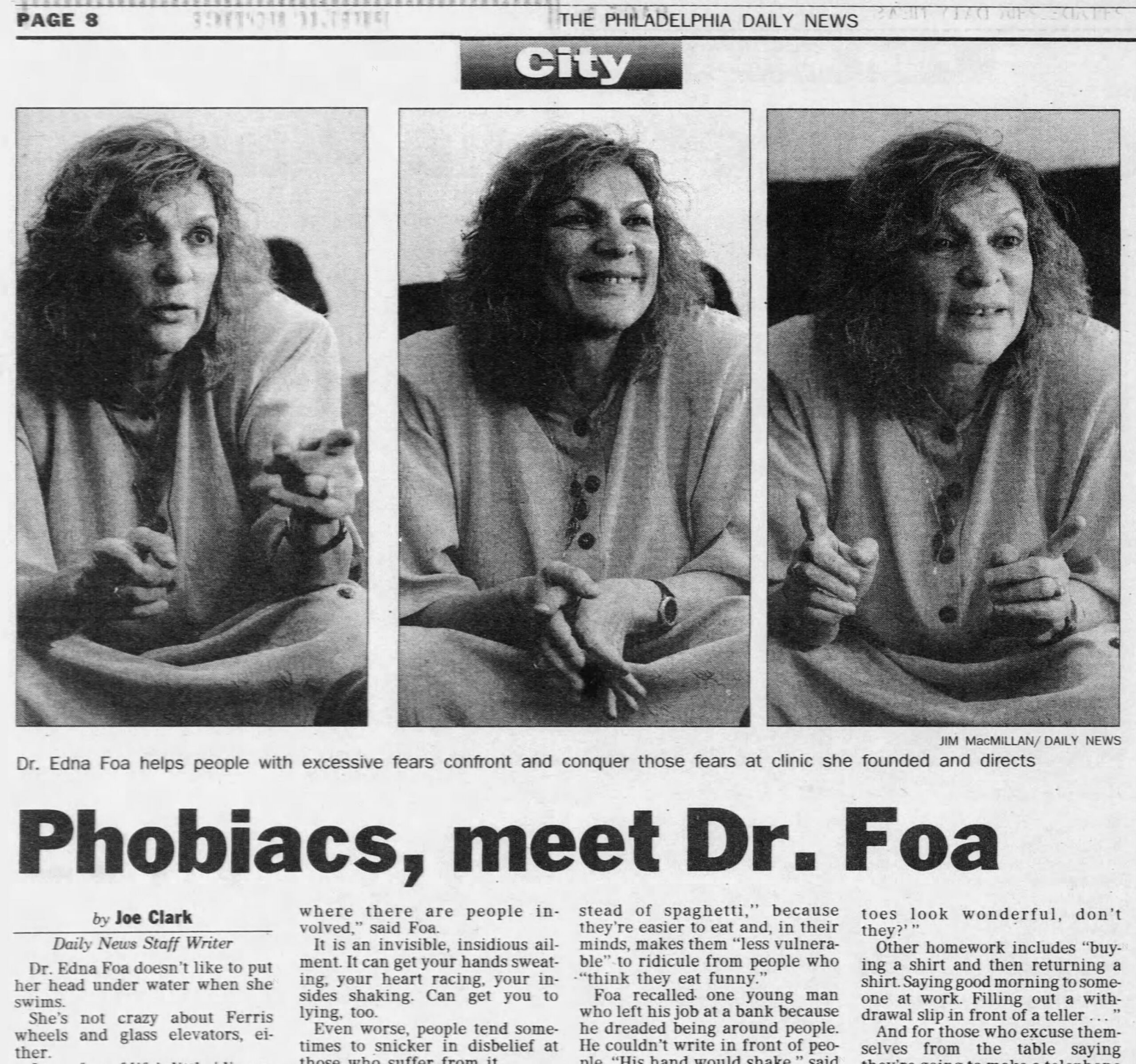
    The Daily News published this story and photos of Dr. Foa in 1993.

    She also volunteered as a consultant and supervisor at clinics and medical centers. She lectured and organized clinical workshops in the United States, Israel, and elsewhere. In 2010, she told Time magazine: “If you develop a wonderful protocol, it’s useless if nobody uses it.”

    She was affiliated with many mental health societies and associations, and earned lifetime achievement awards from the American Psychological Association, the International Society for Traumatic Stress Studies, and other groups. She was featured often in The Inquirer and the Daily News, and told the Daily News in 1993 that “everyone has little fears.” She said her little fears were of heights and swimming underwater.

    In 1970, Dr. Foa earned both a doctorate in clinical psychology and personality from the University of Missouri, and a master’s degree in clinical psychology at the University of Illinois. In 1962, she earned a bachelor’s degree in psychology and literature at Bar-Ilan University in Israel.

    She stopped working full-time at Penn in 2023 but never really retired. In April, she was scheduled to lead a workshop in prolonged exposure therapy. In 2011, she told The Inquirer: “If I die tomorrow, I think that what I have achieved is fine. If I don’t die, I don’t need to stop.”

    Edna Ben Jacob was born Dec. 28, 1937, in what is now Haifa, Israel. She became fascinated by the work of psychologist Sigmund Freud, she told the Encyclopedia of Behavior Modification and Cognitive Behavior Therapy, and she worked briefly with juvenile offenders near Tel Aviv after high school.

    In 2011, she told The Inquirer she was shattered by her own trauma in 1948 when her brother, Uri, was killed in the war and her father, Abraham, died four years later.

    She married and divorced when she was young, and met Professor Uriel Foa at Bar-Ilan. They married when she was 24, had daughter Dora, and moved to the United States in 1966. They had daughters Yael and Michelle, and lived in Illinois and Missouri before moving to Glenside and then Penn Valley. She moved to Philadelphia a few years ago.

    After a divorce, she married Penn professor Charles Kahn. Her husband and former husband died earlier.
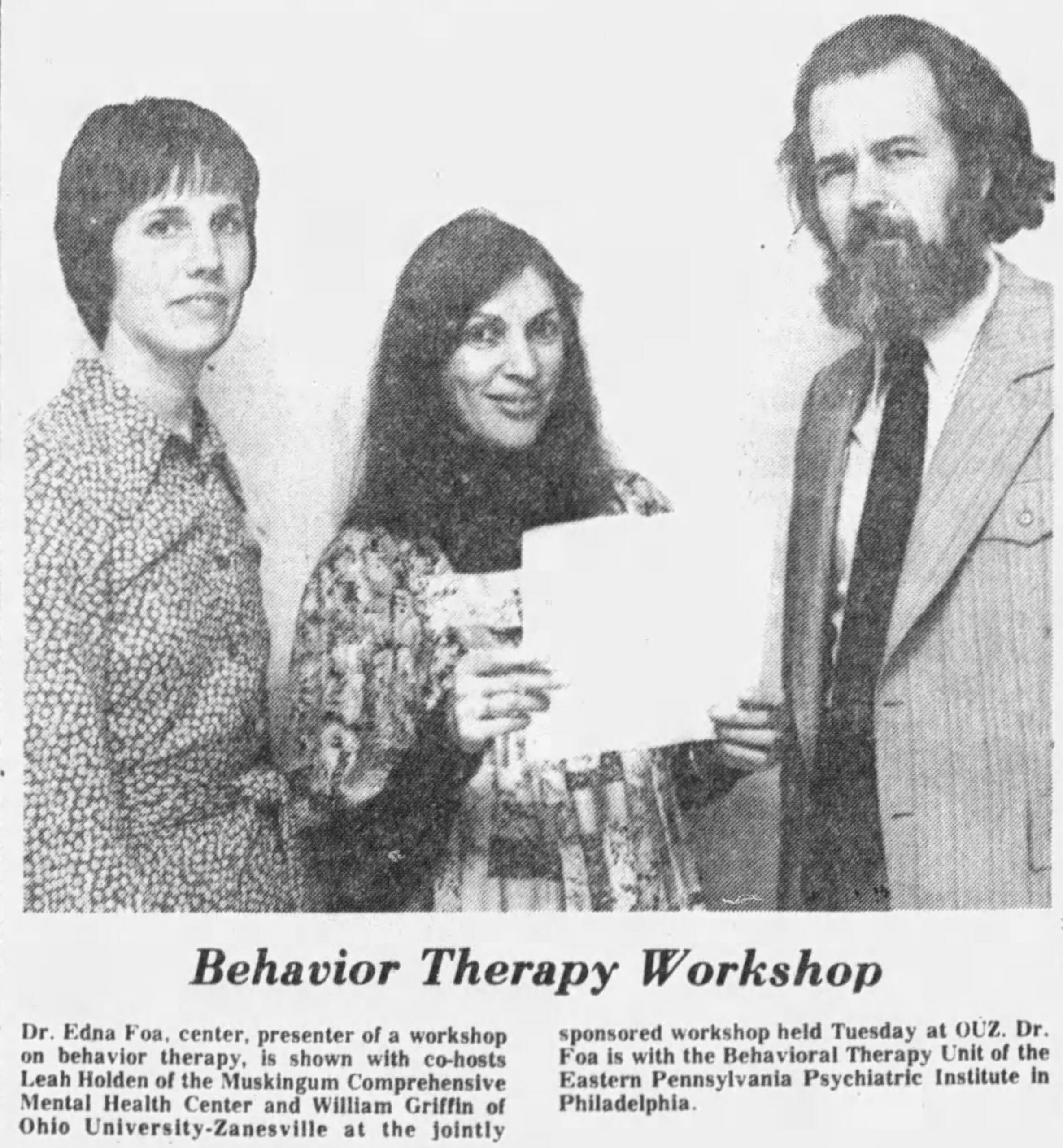
    This photo of Dr. Foa (center) appeared in the Times Recorder in Ohio in 1978.

    Away from work, Dr. Foa enjoyed traveling, gardening, and hosting family and friends at holidays. She collected art and antiques.

    She told an interviewer she had a bad habit of deleting emails before reading them. She managed lung cancer years ago.

    “She was full of energy, vivacious, a force of nature,” said her daughter Yael. Her daughter Michelle said: “She was an extraordinary figure who lived a very rich life.”

    In addition to her daughters, Dr. Foa is survived by five grandchildren, a great-granddaughter, and other relatives.
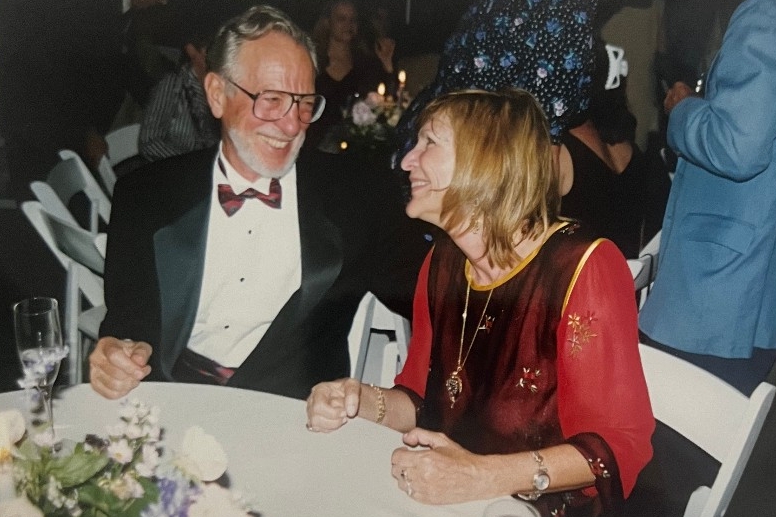
    Dr. Foa laughs with her husband, Charles Kahn.

    Private services are to be held later.

    Donations in her name may be made to the Philadelphia Museum of Art, 2600 Benjamin Franklin Parkway, Philadelphia, Pa. 19130; and the Philadelphia Orchestra, 300 S. Broad St., Philadelphia, Pa. 19102.

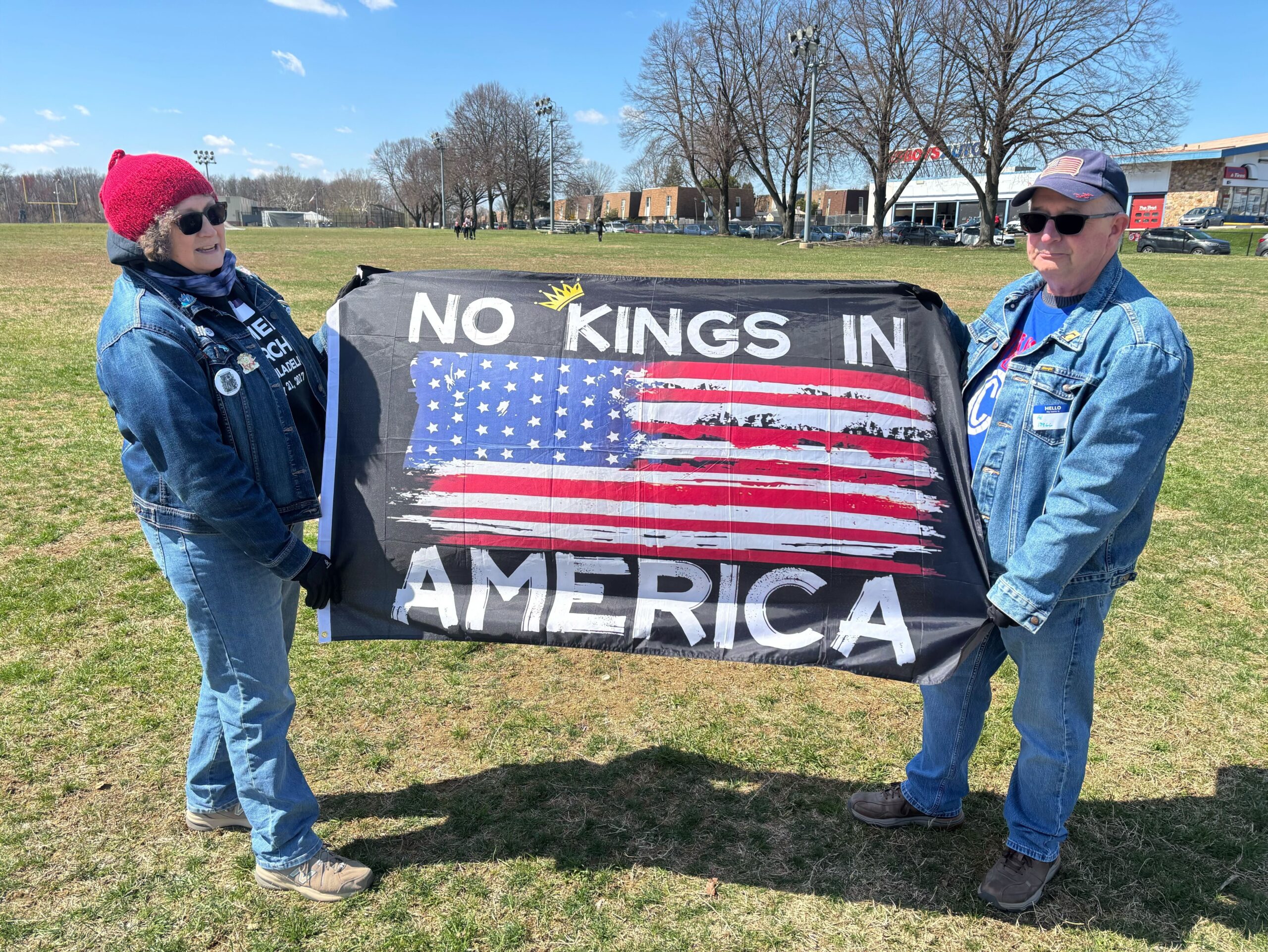
  • No Kings rallied for the third wave of anti-Trump protests in Philly and around the country

    No Kings rallied for the third wave of anti-Trump protests in Philly and around the country

    In step with demonstrators nationwide Saturday, thousands took to streets across the Philadelphia region — from Center City, to Ardmore, to Camden — denouncing President Donald Trump, his policies, and his administration.

    It was the third No Kings protest in roughly nine months, signaling the breadth of dissent and concern over what protesters see as Trump’s authoritarianism and his attempts to consolidate and expand his power. Protesters condemned the gamut of the president’s agenda, including escalating immigration enforcement, the war in Iran and rising gas prices at home, and the dismantling of foreign aid programs.

    “The people in power are making decisions that they won’t have to live through,” said Electra Powers, who brought her Grays Ferry family to the demonstration outside Philadelphia City Hall. “The future they’re setting up for our kids is horrible.”

    On a brisk March afternoon, chants reverberated throughout Center City, drums beat in time, and homemade signs swung as participants marched down the Ben Franklin Parkway to a rally at the Philadelphia Museum of Art.

    Near City Hall’s north entrance, Meoshe McQueen unfurled a large American flag, a tribute to her father, she said, who served as an airman in World War II.

    “My father fought for equality and justice,” the North Philly native said. “The world we live in today threatens that. We want fairness, regardless of a person’s color, creed, or race. None of that matters.”

    More than 3,100 No Kings events were planned Saturday, spanning every state and most continents, according to organizers, who expected historic turnout. The movement’s flagship event was being held in Minnesota, an epicenter of resistance to Trump’s immigration crackdown and the site of two fatal shootings by federal agents. New Jersey’s own Bruce Springsteen performed his anti-ICE protest song, “Streets of Minneapolis,” there.

    “We need a world where kids can be safe, and not hauled off based on the color of their skin,” said Pamela Schott of Jenkintown, who held up a sign pleading for “peace and safety” for her grandchildren.

    Energy was also building in pockets of the region where Trump has more political capital, and those who oppose the president feel their voices drowned out.

    “I grew up in an America where I saw change for the good,” said Betsy Tucker of Bucks County. “Now, I’ve seen that change ripped away.”

    Michelle Dupree, 67, was one of the first of roughly 150 people at the Northeast Philly No Kings rally at Bustleton Field. She had hoped more people would show up in the Northeast.

    She was tired. But not defeated.

    “It’s important to me,” she said, waving her sign for the modest, but steady stream of drivers, who registered their approval with a honk or three. “My knees hurt. My back hurts. It’s so frustrating to be at home and to watch the news — you want to scream. You want to be heard.”

    Olivia Hayes was among a couple thousand ralliers in Ardmore. Hayes was cheered by reports of robust crowds at No Kings events in other suburban spots, like Wayne and nearby Havertown. For a few hours, at least, a sense of pride pierced the anger and hopelessness, she said.

    “It’s great to see such a community,” she said. “When you’re in your day-to-day life, and not around so many people, it can be hard to have hope.”

    Betsy and Al Tucker attend the Northeast Philly No Kings protest on Saturday.

    Across the river, Camden hosted its first No Kings protest (previous events were held in Collingswood and Haddon Heights). The change in locale was driven by increased immigration enforcement and presence in the area, said Michele Messer, of Cooper River Indivisible. Camden city’s population is about 54% Hispanic, according to U.S. Census data. Last month, a nearby ICE operation made a group of Camden County fourth graders and fifth graders run away from a bus stop in a panic, according to the Lindenwold School District.

    “We’re a united front,” she said, “no matter where you land on the political spectrum, we need to work together and build coalitions to fight back against what this administration continues to try to pile on us.

    “And the stronger that fabric, the stronger we’ll be.”

    In a statement to the Associated Press, the White House dismissed the nationwide protests as the product of “leftist funding networks” with little real public support.

    Center City attendees said the sense of urgency is growing.

    “We wanted to show our support for the movement,” Peter Maiolino said. “If we weren’t outraged last time, we definitely are now.

    “Things have only gotten worse.”

    In a video message to the crowd, U.S. Rep. Brendan Boyle — who was stuck in Washington, D.C., as congressional leaders haggle over the partial government shutdown, which has forced Transportation Security Administration employees to work for weeks without pay — encouraged people to continue their protest, even after the rally concluded.

    “This is a fight we cannot lose, but we need to be crystal clear about what is that stake in this country,” Boyle (D., Philadelphia) said. “Our president is more concerned about building his ‘big beautiful ballroom’ than he is about the poor and working-class people in this country.”

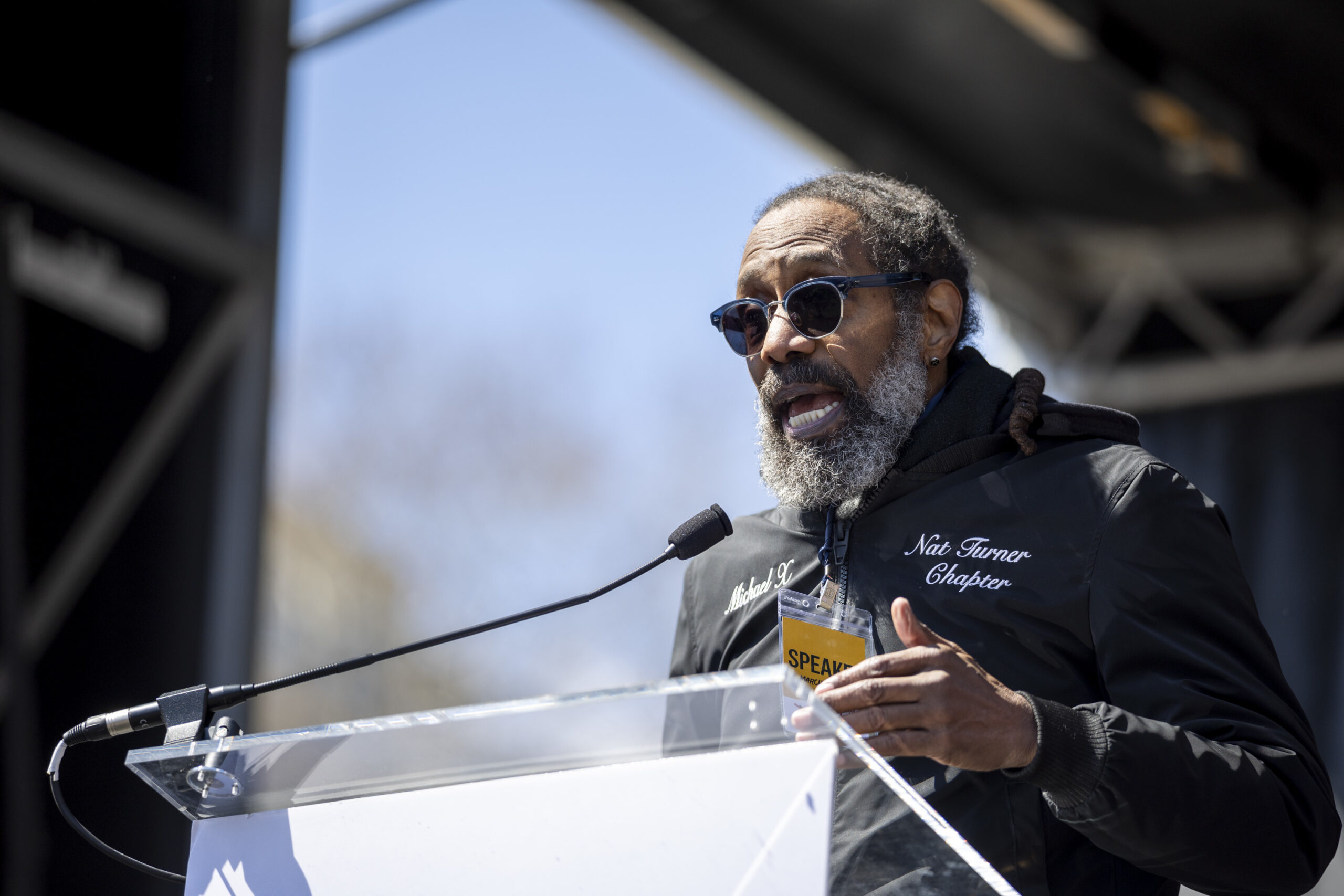
    Avenging The Ancestors Coalition (ATAC) leader and attorney Michael Coard echoed Boyle’s sentiments, calling the attendees “the revolution.” ATAC stewarded the President’s House Site on Independence Mall, a slavery memorial removed — and later partially restored by court order — in what some have called an attempt by the Trump administration to sanitize history.

    Michael Coard, of the Avenging the Ancestors Coalition, speaks Saturday at the third No Kings rally in Philadelphia.

    “When I say fascism, I want you to know that I say it without hyperbole,” he said. “Today America is where Italy was in 1926, but we are not going to do the same. We are going to fight a good fight and we are going to win.”

    The No Kings’ trajectory has been atypical compared to other social movements, where enthusiasm historically wanes over time, according to Billie Murray, an associate professor of communication at Villanova University. No Kings has, instead, gained momentum: Organizers say more than 5 million people took to the streets in June, followed by more than 7 million in October. Organizers projected 9 million people would participate Saturday.

    “The issues don’t seem to be getting resolved,” Murray said, “people see that as a motivating factor — ‘We have to keep pushing, we have to keep trying, we have to keep organizing.’ … People aren’t seeing the change that they want to see.”

    The Associated Press contributed to this article.

  • Abington high school principal returns after investigation into antisemitic social media post

    Abington high school principal returns after investigation into antisemitic social media post

    The principal of Abington Senior High School has been reinstated after an investigation into social media posts with antisemitic content.

    Alice Swift, who was placed on leave Feb. 12, returned to school Wednesday. District officials said in a letter to high school staff and families Tuesday that the findings of a third-party investigation had supported Swift’s reinstatement.

    The district had referred to allegations of “inappropriate social media posts” when it placed Swift on leave last month.

    In the letter Tuesday, Superintendent Jeffrey Fecher said one of the posts “contained an antisemitic stereotype and was not aligned with the values of Abington School District.” He said the district could not provide further information about the posts.

    “Given the sensitive nature of the posts that were called into question, we understand that there are members of our school community who may still be experiencing a sense of hurt, especially those in our Jewish community,” Fecher said.

    He said the district would work with faith leaders and the Anti-Defamation League “to ensure that Dr. Swift, along with students and staff, receive additional programming and training that align with our commitment to fostering welcoming, safe and positive learning environments for all of our students.”

    In a statement shared with staff and families Tuesday, Swift said that “recent content associated with my social media account has circulated within our community, and it is important to me that I address it directly.”

    “I want to be clear that this content does not represent me, my values, or anything I would ever choose to share,” Swift said. “I recognize, however, that regardless of how this content came to be shared, it caused real distress for members of our school community.”

    She said she accepted “full responsibility for not ensuring appropriate safeguards for my social media account, as the content does not reflect my core values and beliefs.”

    District officials said Swift would be meeting with student and community groups over the coming weeks.

    “I am pleased that Dr. Swift is willing to engage in such conversations in order to begin the process of restoring trust,” school board president Melissa Mowry said in Tuesday’s letter to families. “Central to this process is Dr. Swift’s welcome recognition that the post in question was corrosive and her explicit rejection of its antisemitism.”

    A former teacher and administrator in Maryland schools, Swift became principal of Abington Senior High School in 2024. She graduated from Abington in 1983.

  • Tredyffrin residents are concerned over the police response to the suspect who allegedly shot and killed a woman in a random attack

    Tredyffrin residents are concerned over the police response to the suspect who allegedly shot and killed a woman in a random attack

    Residents in Tredyffrin, where a woman was killed in a random act of violence last weekend, said Monday that more could have been done in the hours leading up to the shooting and criticized the township’s lack of communication before and after the crime.

    The remarks were brought before the township’s elected board of supervisors in the first public meeting since Steve Jahn, 44, was arrested and charged with murdering Megan Nieberle, a 53-year-old nurse, while she was driving home from seeing friends late in the evening of March 7. She died the next day.

    Residents were chilled by the fact that, in the hours before Jahn killed Nieberle, he had called the police himself, telling them he was being followed by undercover officers, according to authorities. Officers, who said Jahn was showing “frantic behavior,” escorted him to Paoli Hospital for a voluntary mental health evaluation but let him leave when he requested it, knowing he legally owned firearms and had one with him. Jahn was arrested and charged with murder the day after the shooting.

    “We can frame this a lot of ways: It was a random act of violence,” said resident Joe Maugeri. “But we could also frame it as: Was it a preventable act of violence? And I think that’s the question that all of us are thinking. Were there tools that police had? Were there things that could have been done?”

    Authorities said that Jahn had no connection with Nieberle, a Children’s Hospital of Philadelphia nurse and mother of three. A few hours after leaving the hospital, Jahn allegedly drove to the intersection of Contention Lane and Old State Road in Berwyn and shot Nieberle from his car.

    Passersby who saw Nieberle’s crashed car called police, who rushed her to Paoli Hospital.

    Her death has “left a profound void in the hearts of the many who were fortunate enough to know and love her,” loved ones wrote in her obituary last week. Nieberle’s “warmth, humor, and loyalty made her a cherished presence in the community,” the obituary says.

    In his opening remarks Monday, board chairman David Miller said that officers were limited in what they could do that day. Pennsylvania has no “red flag” law, which allows for the temporary removal of lawfully owned guns when the owner appears at risk for danger.

    “Now I’m not saying a red flag law would have changed what happened on [that] night. I can’t know that, but certainly would have given our police another tool to help manage the situation,” Miller said.

    Such a measure has repeatedly failed to get enough support in politically divided Harrisburg. Another version of the bill was introduced this session.

    Democratic State Rep. Melissa Shusterman, who represents the area, said in a statement that there had been an increase in interest in extreme risk protection orders in the community.

    “The loss of our neighbor was tragic, and while we may not know for certain if an ERPO would have prevented this senseless tragedy, we do know they help to reduce gun violence and keep our communities safer,” she said.

    Residents also criticized the township for not notifying the community of the possible danger, saying they went more than 30 hours before knowing Jahn had been arrested.

    “What are the protocols and policies that we have in place around notification when things like this happen?” resident Katie Angstadt asked. “From what we’ve understood is that there was someone in our community who was very dangerous, armed for six or seven hours, and we were not notified.”

    Superintendent of Police T. Michael Beaty said he understood why the incident was concerning.

    “Questions about firearm laws and policy are ultimately determined by legislators at the state and federal levels. Our role as law enforcement is to enforce the laws as they exist and to investigate crimes thoroughly when they occur,” he told them. “That said, when tragedies like this happen, it often leads to important conversations about how we can strengthen public policy, improve crisis intervention, and ensure officers and communities have the tools that they need to prevent violence whenever possible.

    “This is a very devastating situation, which has left a profound impact on many of our community members. At this time, my deepest condolences are with Megan’s family and loved ones as they navigate this unexpected loss. While I cannot speak on the timeline or specifics of the investigation, I know it remains ongoing.”

    This suburban content is produced with support from the Leslie Miller and Richard Worley Foundation and The Lenfest Institute for Journalism. Editorial content is created independently of the project donors. Gifts to support The Inquirer’s high-impact journalism can be made at inquirer.com/donate. A list of Lenfest Institute donors can be found at lenfestinstitute.org/supporters.

  • A Wynnefield man’s title-washing scheme put 65 luxury cars in the hands of criminals, AG says

    A Wynnefield man’s title-washing scheme put 65 luxury cars in the hands of criminals, AG says

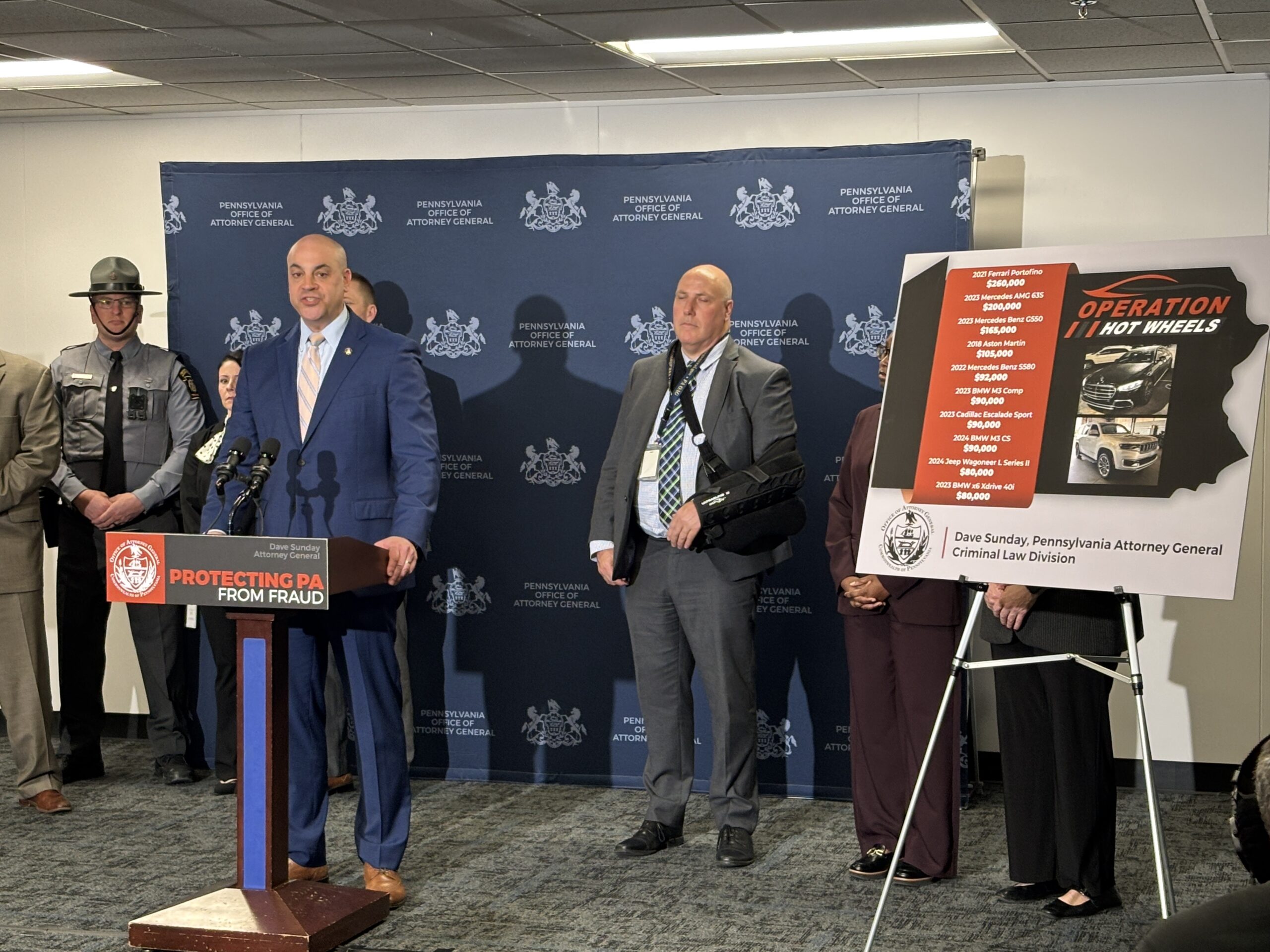
    For a little over a year, Adam Richardson was known among local car thieves as “the title guy,” state investigators said Monday. They could steal a car, visit Richardson’s title shop and resell it, either to a coconspirator or a unwitting bystander.

    From his office on Golf Road in Wynnefield, Richardson, 40, created false title, registration, and insurance documents for luxury vehicles stolen from New Jersey, Philadelphia, and its suburbs, including a Ferrari Portofino worth $260,000 and a bevy of Mercedes, BMWs, and similar vehicles.

    All told, Richardson facilitated the illegal transfer of 65 vehicles, the street value of which is nearly $4 million, according to state Attorney General Dave Sunday.

    Richardson was arrested Friday and charged with racketeering, forgery, tampering with public records, and related crimes.

    Sunday, speaking at a news conference in Northeast Philadelphia, said Richardson’s actions — referred to as “title washing” — created “a veil” behind which criminals were able to operate.

    Pennsylvania Attorney General Dave Sunday said Monday that the title washing of stolen vehicles allows criminals to operate undetected throughout the state.

    “What should be most concerning about this conduct to individuals and families in our communities is that title washing enables criminals to move in and out of communities without being detected by law enforcement,” he said.

    Sunday declined to disclose whether the 37 vehicles recovered by Pennsylvania State Police were involved in other crimes, but he said that title washing is often linked to drug trafficking and other violent crimes.

    The state’s investigation into Richardson is ongoing, he said.

    Richardson remained in custody Monday in Dauphin County, denied bail due to the extent of his alleged crimes. There was no indication he had hired an attorney.

    He will be prosecuted in Central Pennsylvania, investigators said, given his abuse of his power as a third-party contractor eligible to do business with the Pennsylvania Department of Transportation.

    State Police investigators began investigating Richardson in May 2024, when a trooper at the Trevose Station and Barracks impounded a BMW X7 that he suspected held a fraudulent title, according to the affidavit of probable cause for Richardson’s arrest.

    The vehicle had been registered in South Carolina, using a VIN that did not conform with the standard for that state and possessed a fake insurance policy, the affidavit said.

    The true VIN, investigators said, matched a car reported stolen a month earlier in Montville Township in western New Jersey.

    Investigators later interviewed a confidential informant who had facilitated the resale of the car. The informant had gotten the car, knowing it was stolen, from a man who told him to see Richardson, identifying him as “the 24-hour title guy” who had a reputation to meet sellers “anywhere and anytime,” the affidavit said.

    The informant told troopers that Richardson helped him put the car in another person’s name, using a photo of their driver’s license.

    The investigation into Adam Richardson, codenamed “Operation Hot Wheels,” found that he helped facilitate the sale of luxury cars, including multiple Mercedes sedans.

    Using the unique identification number issued to Richardson’s business by PennDOT, investigators were able to identify the 65 cars involved in the title-washing scheme.

    During the investigation, investigators spoke with multiple vehicle owners who said they had been paid money in exchange to have the stolen vehicles registered in their names, despite never meeting Richardson, visiting his business or driving the vehicles, according to the affidavit.

    Previous audits by PennDOT in 2022 and 2023 found that his title business was violating multiple laws, including issuing plates to salvage vehicles and selling cars without a license.

  • TSA closes Terminal C checkpoint at PHL Airport due to staffing shortages

    TSA closes Terminal C checkpoint at PHL Airport due to staffing shortages

    The Transportation Security Administration temporarily closed the Terminal C security checkpoint at Philadelphia International Airport on Thursday morning.

    “Due to staffing constraints related to the government shutdown, the TSA, in collaboration with the airport, is temporarily closing the Terminal C checkpoint,” said PHL spokesperson Heather Redfern.

    All other security checkpoints remain open, and TSA PreCheck passengers can use the designated lanes at the Terminal A-East and D/E checkpoints. There is no timeline for when Terminal C will be back up and running.

    “We encourage you to check the MyTSA app or the airport’s website to find current wait times and to arrive early to the airport,” said an American Airlines spokesperson. “We are grateful for our federal partners at TSA who continue to ensure safe travel for our customers.”

    The scene at the TSA checkpoint line in Terminal B at Philadelphia International Airport on Sunday morning, Nov. 9, 2025.

    The TSA is experiencing a lapse in funding, alongside other Department of Homeland Security agencies, because its budget has not been passed by Congress.

    In January, federal lawmakers narrowly avoided another full government shutdown by approving budgets for all federal agencies except the Department of Homeland Security. Republicans and President Donald Trump agreed to carve out the DHS budget for further negotiations as Democrats want to put more guardrails on federal immigration enforcement.

    There have been a couple of attempts at passing the DHS budget, but neither side has budged on its demands. The only Senate Democrat to support funding DHS is Pennsylvania Sen. John Fetterman.

    At this point, there is no end in sight to the DHS shutdown and, by proxy, the lapse in TSA funding that is leading to staff shortages across the country, including Philadelphia’s airport.

  • Chester County has more than 9,000 EVs. Now it wants to build more public electric vehicle charging stations

    Chester County has more than 9,000 EVs. Now it wants to build more public electric vehicle charging stations

    Chester County, home to one of the largest numbers of electric vehicles in the state, hopes to grow its footprint of public charging stations.

    Through the federally funded National Electric Vehicle Infrastructure program, administered through the Pennsylvania Department of Transportation, the county is looking to build up its community-based public EV charging stations for people who have or want an electric vehicle but do not have a charging station installed at home.

    Funding from the program flows directly to municipalities or other applicants for EV chargers. PennDot expects to fund more than 100 projects through the grant.

    It builds on an initial federally funded project under the same program, which sought to place charging stations every 50 miles along the major travel corridors to address long drives across the state. Through that program, Chester County projects received $3.2 million.

    Chester County’s proposal would increase the number of public chargers speckled around the county, from workplaces to businesses, giving drivers a place to charge their cars as part of their day-to-day routines.

    Chester County, which has both densely packed development and rolling agricultural pockets, saw its rates of EV ownership double between 2022 and 2024, with more than 9,000 EVs registered in the county in the state’s most recent data. The county is behind only Montgomery in overall EV registrations in the southeastern part of the state.

    “Things are pretty spread out, and with the infrastructure that we have in place right now, other modes of transportation that are carbon-free or less carbon intensive than single-occupancy vehicles are not as viable here as they are in other places that are more dense,” said Rachael Griffith, sustainability director for the Chester County Planning Commission. “If we’re looking at a lower carbon future for our transportation network, EVs are really a great option for that here in our land-use setting. Building out the network of EV chargers is really the way that we incentivize that.”

    EVs are expensive, but Chester County has the highest median income in the state, so it makes sense it would see the higher ownership rates, Griffith said.

    Under former President Joe Biden’s administration, there had been a broader push nationally for electric projects. But that shifted with President Donald Trump’s return to office, as the president slashed electric goals. Experts in clean transportation anticipated seeing more projects focused on propane and natural gas in response.

    Despite the policy shifts, “it’s very clear that the future of transportation is electric,” Griffith said.

    “The more that we can do to plan for that future, I think the better prepared we will be in the long term,” she said.

    The county’s planning commission is reaching out to municipalities and chambers of commerce to drive applications for the program, Griffith said. Applications are open until Aug. 21; any business registered in Pennsylvania is eligible for funds.

    This suburban content is produced with support from the Leslie Miller and Richard Worley Foundation and The Lenfest Institute for Journalism. Editorial content is created independently of the project donors. Gifts to support The Inquirer’s high-impact journalism can be made at inquirer.com/donate. A list of Lenfest Institute donors can be found at lenfestinstitute.org/supporters.

  • Ingredients in a product that leaked into a Chester County stream are toxic to aquatic life, officials say

    Ingredients in a product that leaked into a Chester County stream are toxic to aquatic life, officials say

    The individual ingredients that make up the final product of a “milky white” substance that leaked into a Chester County creek last week are toxic to aquatic life, killing fish, eels, and worms, the Pennsylvania Department of Environmental Protection said.

    But county health officials said the materials released into the creek are not known to have acute or chronic human health risks. The department still advised people and pets to avoid “affected areas of Goose Creek to reduce impacts on the ongoing cleanup efforts.”

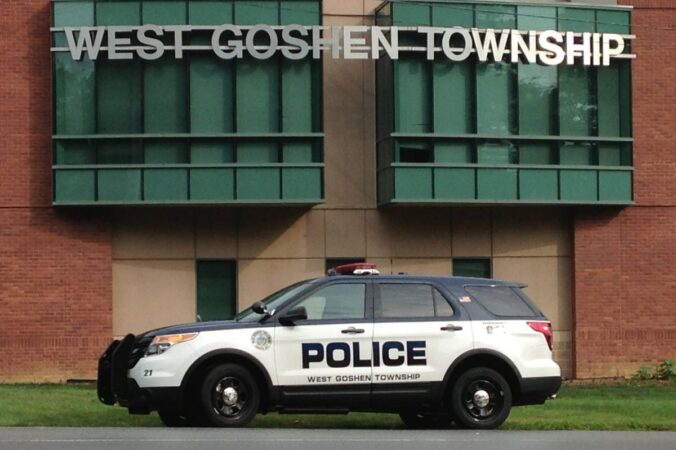
    The leak, which was discovered after several people called West Chester officials about “noticeable pollution” in Goose Creek, was plugged last Saturday. It stemmed from Atmos Technologies, at 216 Garfield Ave. in West Goshen Township, near Henderson High School. It is unclear how long the outfall pipe had been leaking before people reported it.

    Atmos Technologies told the state agency chlorinated water was released to a containment area, mixing with a manufactured product known as “Long Duration Foam AC-645,” forming a foaming agent, DEP officials said last week. The county’s health department said 4,000 gallons of the mixture was released.

    Since its discovery, DEP staff have visited Goose Creek, most recently on Wednesday, and observed cleanup efforts at Atmos and along Goose Creek. The creek was clear Wednesday, with some foam accumulation present on debris, said Robyn Briggs, a spokesperson for DEP. The outfall pipe remained plugged, she said.

    People had reported a fish kill — the mass death of fish due to pollution or environmental stress — but as of Thursday, no dead fish had been seen at the end of DEP’s tracing area.

    West Goshen and West Chester officials said last week that Atmos Technologies could face fines for the leak. The company said in a statement last week that the chemical is nontoxic and used in environmental cleanups.

    “The material breaks down naturally and is not expected to have any long-term impact on local wildlife or the ecosystem,” the company wrote.

    This suburban content is produced with support from the Leslie Miller and Richard Worley Foundation and The Lenfest Institute for Journalism. Editorial content is created independently of the project donors. Gifts to support The Inquirer’s high-impact journalism can be made at inquirer.com/donate. A list of Lenfest Institute donors can be found at lenfestinstitute.org/supporters.

  • Clocks spring forward Sunday, but the sun may be setting on year-round daylight saving time

    Clocks spring forward Sunday, but the sun may be setting on year-round daylight saving time

    Coinciding with the expected behavior of the atmosphere over Philly, the clocks are taking a major leap into spring this weekend, this time around as early as it ever happens.

    On Sunday the clocks will skip right over 2 a.m. and proceed to 3 a.m. as daylight saving time begins and will continue through Nov. 1.

    The sun won’t set before 7 p.m. until Sept. 22.

    Congratulations to those who prefer eating dinner before dark or savoring an extra dose of daylight after work. If you dread being shorted an hour on a precious weekend and hold that DST actually stands for “delayed sunrise time,” we offer a modest consolation prize.

    The sun appears to be setting on the all-DST-all-the-time movement.

    Recall that the U.S. Senate unanimously (at least technically) passed the 2022 iteration of the Sunshine Protection Act that would have ditched the switch and installed daylight saving time as the year-round system. U.S. Rep. Brendan Boyle (D., Pa.) said at the time “the idea definitely has legs,” and isn’t that what they said about the Eagles’ offense?

    It’s as if the campaign has gone back to bed.

    The 2022 bill’s sponsor, Marco Rubio, at the time a senator representing the Sunshine State, is now the secretary of state and appears to have bigger fish to fry. His immediate supervisor, President Donald Trump, who at different times advocated for year-round standard and year-round DST, has lost interest.

    So, evidently, have legions of state lawmakers around the country.

    The number of bills calling for year-round daylight saving time has dropped dramatically, and this year they are far outnumbered by bills advocating year-round standard time, based on a survey of data compiled by the National Conference of State Legislatures.

    That said, the discussion may never die. The Sunshine Protection Act was reintroduced in the Senate last year. Sen. Rick Scott (R., Fla.) says he’s giving it another shot. But expect 100% chance that clocks go back in the fall; the bill remains in committee.

    Daylight saving time advocates have pointed to the recreational and other benefits of later sunsets, and those will become ever more evident during the next several weeks. Conversely, any number of health organizations warn of the dangers caused by sleep disruption, exacerbated by a certain longitudinal inequity.

    To honor a day that so many look forward to, and so many others dread, we offer a few numbers for consideration, starting with a visit to Marquette, Mich.

    79: Minutes of difference in sunrise times

    Sunrise Monday in Marquette doesn’t occur until 8:11 a.m., compared with 6:52 a.m. in Lubec, Maine. That is a 79-minute difference — in the same time zone. Lubec is on the shores of the Atlantic. Marquette is on the shores of Lake Superior in Michigan’s Upper Peninsula.

    In Marquette, the sun’s reluctance to get out of bed may be understandable. The city already has had close to 210 inches of snow (about 10 Philly winters’ worth) this season. “Even by our standards, this has been a pretty remarkable winter,” said Chris Burling, a meteorologist with the National Weather Service in Marquette.

    As with the snow, the locals appear to accept the late sunrises with a measure of equanimity. “I think there’s some grumbling for a couple days,” said Burling, “but otherwise, it’s just …that’s how it is.”

    Sleep experts advise that people in the westerly longitudes of time zones stand to suffer more than their counterparts to the east. In Marquette, twilight won’t end until close to 10:30 p.m. around the summer solstice. That can be disruptive to bodily sleep rhythms, experts say, by depriving bodies of melatonin, the sleep hormone that the body produces in the dark.

    The Michigan legislature is among those that have considered a bill for year-round standard time. Federal law permits states to go all-standard, but all-daylight saving time would require Congress to pass a law to allow it.

    800: Pro-daylight saving time bills

    Eight hundred bills have been introduced in state legislatures since 2005 to enact year-round daylight saving time, according to Tom Klein, policy associate with the legislatures conference.

    93: Time-change bills in 2025

    There were 93 bills introduced in 2025 in favor of either year-round Daylight Saving Time or standard time.

    35: States

    Thirty-five states considered such bills in 2025, about evenly split between all-DST and all-standard, by the conference’s count.

    21: Bills this year

    In 2026, 21 bills are under consideration, with 16 calling for year-round standard time and five favoring all-Daylight Saving Time.

    1,454: Days

    It’s been 1,454 days since the U.S. Senate approved the Sunshine Protection Act.

    294: Days

    The nation’s last experiment with year-round daylight saving time, in 1974, survived only 294 days,

    238: Days

    Just 238 days until we fall backward again. Incidentally, since Daylight Saving Time begins on the second Sunday in March, this is the earliest it could happen. Nov. 1 is the earliest possible starting date for standard time.

    Innumerable

    Projected number of days before the clock-switch debate ends.

  • Advocates call on Gov. Josh Shapiro to close a Berks County youth center that holds immigrant children

    Advocates call on Gov. Josh Shapiro to close a Berks County youth center that holds immigrant children

    Youth- and immigrant-rights allies called on Gov. Josh Shapiro Wednesday to immediately remove children from a Berks County center that they said harms those held there, including migrant kids who arrived at the U.S. border unaccompanied by parents.

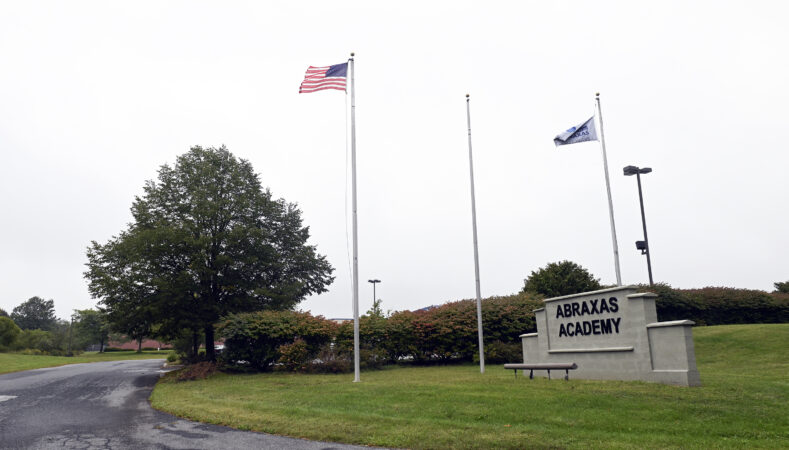
    Speakers at an afternoon news conference held near the Abraxas Academy in Morgantown, Pa., asked the governor to issue an emergency removal order ― typically enforced to protect children in imminent danger of physical or emotional abuse.

    “Pennsylvania cannot continue to expose these kids to Abraxas’s abuse,” said Evan Feldberg-Bannatyne, an organizer with the youth-advocacy group Care, Not Control. “We need an ERO now.”

    The Shapiro administration said Wednesday that the Department of Human Services will continue to closely monitor the situation to determine next steps and ensure the safety of those living there.

    If DHS were to issue an ERO, it would not take custody of the young people or direct their placement. Instead, Abraxas would need to notify the federal government for immigrant youths, or the state court for Pennsylvania residents, to find other placements. DHS would monitor the wind-down of operations, which can take time, the administration said.

    “The department’s top priority is ensuring the safety of youth in the facilities we license, and it is concerning whenever we receive a report or allegation that a young person was put at risk,” said DHS spokesperson Brandon Cwalina. “When that happens, the Shapiro administration works urgently to ensure that any allegations and potential violations are investigated and handled.”

    Pittsburgh-based Abraxas Youth and Family Services said in a statement Friday that it was “aware of the concerns raised regarding Abraxas Academy in Morgantown,” and that “the safety and well-being of those in our care is our highest priority, and we take any allegation or concern seriously.”

    “Programs like Abraxas Academy operate within a regulated system with established standards for care and accountability that are in alignment with our state and federal partners and their regulations,” the statement said. “We are committed to meeting those expectations and upholding the responsibilities entrusted to us by families and government.”

    The agency website describes the Abraxas Academy as providing secure residential treatment and detention for male young people, ages 14 to 19, who face serious charges or have demonstrated delinquent patterns through multiple placements.

    Since October, the federal Office of Refugee Resettlement, which is responsible for “unaccompanied minors,” the migrant children who arrive at the border without parents, has held some teenage boys at the center, which has a documented history of staff physically and sexually abusing juvenile offenders, a Washington Post investigation found.

    ORR awarded $9 million to Abraxas Alliance in August to hold up to 30 young immigrants who had been deemed a danger to themselves or others. At times, The Post reported, between five and eight teenage boys have been held inside a dedicated wing of the center, sleeping inside locked rooms the size of walk-in closets.

    State inspectors documented at least 15 incidents since 2013 in which they said staff physically mistreated minors at the facility, which mainly holds juveniles facing or convicted of criminal offenses, The Post reported. In at least two incidents, officials documented allegations of staff sexually harassing or sexually abusing young residents, the newspaper reported.

    After some incidents, Abraxas suspended or fired staff members and submitted correction plans to state regulators, The Post said.

    DHS’s Cwalina noted that in November, the department revoked the license for Abraxas Academy’s Secure Detention Unit. Immigrant youths are not held there. Abraxas appealed and continues to operate the unit while the appeal goes forward.

    Abraxas has two other licenses that remain in place, subject to periodic, unannounced inspections. The DHS Office of Children, Youth, and Families is on site weekly — including today — to monitor the center’s operations, he said.

    “We do not want detention centers in our state,” said Jasmine Rivera, executive director of the Philadelphia-based Pennsylvania Immigration Coalition. “We fight for the closure of immigrant detention. Our communities do not need more cages.”

    Detention is particularly disturbing, she said, when it extends to children who have come to this country seeking shelter and safety.

    By law, ORR must provide care for unaccompanied children, defined as those who have no legal immigration status, have not yet turned 18, and have no parent or guardian in the United States. ORR says it tries to find sponsors, most often a close relative in this country, and in the meantime provides care at one of nearly 200 facilities.

    However, a 2025 rule change now allows ORR to consider a potential sponsor’s immigration status, and to share that information with enforcement agencies. The Immigrant Legal Resource Center in San Francisco says that discourages undocumented family members from becoming sponsors, leaving children in government custody longer and hurting their well-being.

    “It is immoral and unimaginable that in our backyard, children are being held in such violence and unsafe conditions,” said Gaby Lopez, lead organizer in Reading for Make The Road, which works to help immigrants. “Children need to be with their loved ones.”

    The United States needs an immigration system that welcomes those who come here to share their talents and be part of the American story, she said, not one that replicates the violence they experienced in their homelands.

    “Gov. Shapiro,” she said, “Issue an emergency removal order now, and protect families across Pennsylvania now.”