A Philadelphia man was charged with first-degree murder and related crimes after he shot and killed his wife in Rockledge, Montgomery County, on Saturday evening, officials said Monday.
Jose Antonio Luna, 59, was arrested shortly after the shooting, the Montgomery County District Attorney’s Office said.
Prosecutors say Luna shot his wife, 48-year-old Alisett Schubert, multiple times, killing her, near the intersection of Huntington Pike and Filmore Street that night.
The incident began when the couple started arguing as they drove home from a partyin a silver Nissan, according to the affidavit of probable cause for in Luna’s arrest.
Schubert was behind the wheel. After she told Luna to get out of the car and walk home, the two began to wrestle over Schubert’s purse, where she kept a .38 caliber revolver that was registered in her name, the affidavit said.
Luna grabbed the weapon and shot his wife once, the document said. After Schubert yelled “Oh my God” and tried to flee the vehicle, the affidavit said, Luna shot her four more times.
Luna later told investigators that Schubert had “disrespected him in front of others” at a banquet hall that afternoon, according to the document. He also told investigators he left one round in the gun’s chamber with the intent to later kill himself, the affidavit said.
A SEPTA bus driver reported the shooting to police, according to the document.
Around 10 p.m., authorities said, the driver came across the Nissan stalled in the road, and heard two to three gunshots before watching Luna exit the vehicle’s passenger side and pull open the driver’s side door.
Schubert’s body “slouched” out of the car, the affidavit said.
The driver watched as Luna fled the scene. Later, when Philadelphia police located him about a mile away near 1200 Rhawn Street, Luna put Schubert’s gun to his head and pulled the trigger, according to the affidavit.
But the gun was out of ammunition and did not fire. Police arrested Luna without incident.
Investigators later learned Luna had called Schubert’s mother after the shooting to tell her that her daughter had died, but he did not say how the death occurred, and he told the woman he wanted to kill himself.
Meanwhile, Schubert was taken to Abington Hospital suffering from multiple gunshot wounds and was pronounced dead.
Schubert had previously told a close friend that Luna was physically and mentally abusing her, the affidavit said. The friend told investigators that she had once seen Luna punch Schubert in the face.
Prosecutors said Luna had an extensive criminal history and had been arrested “numerous” times for illegal entry into the United States and for reentry after deportation.
In addition to first-degree murder, Luna was charged with third-degree murder and possessing an instrument of a crime.
He is being held without bail at the Montgomery County Correctional Facility and is expected to appear in court for a preliminary hearing on March 5.
Cochranville is moving toward getting its first public water line, after West Fallowfield Township secured a grant to fund the project earlier this month.
Installing public water in the 300-year-old village situated within the largely agricultural township in western Chester County has been more than a decade in the making, said Duane Hershey, the chairman of the board of supervisors.
Residents told officials water was a concern in a survey a few years ago, and the township has a desire to bolster the commercial landscape of Cochranville, Hershey said. But leadership wants to accumulate as much funding as possible to limit the blow to residents.
The $1 million federal grant is the springboard for the municipality to gather more funds for the project, which Hershey estimates could cost $5 million to $6 million. The township is still years out from breaking ground.
West Fallowfield covers a relatively large geographic area, but a majority is composed of agricultural properties. Its town center — the village of Cochranville — boasts a population of roughly 500, with a small number of residences and businesses sitting around the major intersection of state Routes 41 and 10. The lots are relatively small, and have on-site well water and septic.
“It’s difficult for anybody to drill a well, and it’s really difficult to put any kind of a septic system in, other than a tank that has to be pumped and hauled,” Hershey said.
That can be challenging for new businesses to come in without existing public utilities, said Michael Crotty, the township’s solicitor.
“We are hoping it strengthens our particular commercial core right there, at the main intersection, by giving them a much easier base to build and develop,” he said.
But, Hershey cautioned, it’s not because they want to vastly expand Cochranville. Rather, it’s to improve quality of life for people already there, and to bring in businesses to expand the tax base. The community has high nitrates due to its water setup, he said, which can be dangerous, particularly for babies. Consuming too much nitrate can lead to negative long-term health for adults, too.
“We’re not doing this because we want to develop Cochranville and build a whole bunch more houses,” Hershey said. “The reason we want to do it is just to improve the infrastructure that’s already there, that is struggling because of our water issues.”
The township plans to connect a water line to Cedar Knoll Homes at Honeycroft Village, a 55-and older-community about a half mile away, which has public water through the Chester Water Authority, Hershey said. It’s cheaper than if the township were to build its own water system.
They’ll connect most-needed areas first, and possibly expand in the future. Officials couldn’t say exactly how many households would be connected to the line. The project is in early development stages, Hershey said.
It’s not unusual for new water lines to be installed; that’s pretty much what happens whenever a new development is being constructed. But it’s a bit more unusual for the houses to come before the water line. The homes in Cochranville that will connect to the line are “long existing,” Crotty said.
“The way this might be handled elsewhere would be a big, huge residential development comes in, and that would bring public water, and maybe that only brings it for itself, or maybe it brings it part of the way, but that could often be at the expense of the agricultural land that we’re all seeking to preserve,” Crotty said.
An Arizona State University vice provost and dean, who has degrees in mathematics and geography and has studied urban planning, will become Temple University’s next senior vice president and provost.
Elizabeth “Libby” A. Wentz, 62, an Ohio native with a doctorate from Pennsylvania State University, will step into her new role at Temple July 1, subject to approval by the board of trustees, the school announced Monday.
“My background in urban planning has kind of shaped who I am and shaped my thinking, and I just think that there’s so many great opportunities for recruiting students, for creating internships for students, for creating research experiences for students in an urban environment that the university’s rural counterparts don’t have in the same way,” Wentz said in an interview.
Wentz has overseen Arizona State’s Graduate College since 2020 and previously was dean of social sciences, which included geography and urban planning. She will replace David Boardman, who has been Temple’s interim provost since July when Gregory Mandel left the job. Boardman was not a candidate for the job and will continue his role as dean of the college of media and communication.
As Temple’s provost — essentially the university’s number two leader — she will oversee 17 schools and colleges, multiple campuses, and the school’s undergraduate, graduate, and professional programs.
She is the first provost in at least more than a decade to come from outside the university and was selected through a national search, chaired by a faculty member and a dean.
“Libby sort of stuck out for me after the hour I spent with her as being literally right on the same page relative to her ability to articulate the mission and the purpose of Temple and why that was so important,” Temple president John Fry said in an interview.
He was struck by her commitment to student success, he said. “She obviously had time to interact with students and, I think took like really special care and interest in our students,” he said.
And, Arizona State has grown tremendously in part because of its commitment to online programs, he said, which are a priority in Temple’s strategic plan. Temple has lost about a quarter of its enrollment over the last decade.
“We don’t have the kind of online enrollment that you would expect a place like Temple to have,” Fry said. “One of the things Libby and I did speak about was her familiarity with the ASU online infrastructure. She’s taught in it. She obviously has led parts of it.”
Temple remains amid searches for several other key positions, including chief operating officer and law and engineering school deans.
Wentz said she was attracted to Temple because she wanted to remain at an urban university and has long admired the work of Fry, who has had a longstanding relationship with Arizona State president Michael M. Crow. Temple a year ago became part of the University Innovation Alliance, a small nonprofit sponsored through Arizona State that is aimed at finding innovations to improve learning and increase college attendance, retention, and graduation rates ― especially for low-income students ― then scaling those innovations.
“They built a really strong rapport and have a very similar philosophy around higher education which also very much aligns with kind of my own interest and my own philosophy,” Wentz said.
Both Temple and Arizona State, which has its main campus in Tempe, are major research institutions; Arizona is much bigger with over 194,000 students, compared to Temple with more than 33,000, including its international campuses.
“Honestly the biggest difference [between the two] is the weather right now,” Wentz joked, noting that it was 81 and sunny in Tempe on Sunday as Philadelphia prepared for blizzard conditions.
Arizona State does not have a faculty union, so learning to work with Temple’s faculty union will be new.
“That’s going to be an exciting area for me to learn about,” she said.
Urban planning background
Fry has a reputation as an urban planner and in his prior leadership jobs at the University of Pennsylvania, Drexel, and Franklin and Marshall focused on development and improving the campuses and their neighborhoods. He has aspirations for Temple, too, including building an “innovation corridor” stretching from Temple’s recently acquired Terra Hall at Broad and Walnut Streets in Center City to the health campus, a little more than a mile north of main campus on Broad Street.
Wentz said she and Fry had not talked about urban planning, but that she looks forward to working on the university’s new strategic plan, which includes more green spaces, a new 1,000-bed residence hall, a STEM complex, and an emphasis on more attractive and defined entrances to its North Philadelphia main campus. The three pillars of the plan are student success, research in action, and place-based impact.
“Those are going to be some really exciting conversations that I look forward to having with John, as well as with the Temple planners to think about how do we make it a safe space for students and a great learning environment.” she said.
During a 2022 talk at Arizona State, Wentz discussed how urban planning figured into her work.
“Most of the work that I do applies to the urban environment and urban analytics, so trying to understand how it is that cities work and trying to make the physical urban environment a better place for people to live,” Wentz said during that talk.
Building trust and collaboration
In her new role at Temple, she said, early on she will focus on getting to know the community and the university’s financial model and make clear her commitment to shared governance and data-informed decision making.
Wentz, who grew up near Cleveland and got her bachelor’s in mathematics and master’s in geography at Ohio State University, spent the last 30 years at Arizona State. She became a professor there in 1997.
She helped the university launch its medical school and has grown graduate enrollment and graduate student funding.
Wentz said she prides herself on building a culture of trust and collaboration and has worked with the local community. She said she’s looking forward to doing the same at Temple.
She plans to come to Philadelphia in a couple weeks and look for a place to live, she said.
“I’m going to come after the snowstorm, I think, instead of before,” she said Sunday.
Pennsylvania State University’s THON dance marathon raised a record $18.8 million to fight pediatric cancer, organizers announced Sunday at the conclusion of the annual event.
The 46-hour dance marathon, which has been going on for more than 50 years at the state’s flagship university, began 6 p.m. Friday inside Penn State’s Bryce Jordan Center on the main University Park campus and finished 4 p.m. Sunday. More than 700 dancers competed.
The money raised goes toward Four Diamonds charity, which supports research for a cure and families whose children get treatment at Penn State Health Children’s Hospital.
“While we are incredibly proud of this record-breaking total, the true success of THON is found in the thousands of Penn State students who came together with a singular purpose,” Benjamin Roitman, THON executive director, said in a statement “This milestone is a direct reflection of the tireless effort and collective spirit of our community who, embodied the ‘Love Leads Forward’ theme, proved that there is no limit to what we can achieve when we stand together for the common cause of conquering childhood cancer.”
More than 16,500 student volunteers participated in THON, which along with Four Diamonds has helped more than 4,800 children through the years, the organization said.
UPPER BERN, Pa. — Not enough clean water. Hundreds of thousands of gallons of sewage dumped into systems designed to handle much less. More calls for already overwhelmed EMS departments.
Pennsylvania leaders, municipal officials, and first responders say communities will be overwhelmed by the federal government’s plans to turn vacant warehouses in Berks and Schuylkill Counties into massive ICE detention centers and processing facilities.
A recently released memo from the Department of Homeland Security (DHS) says it selected sites based on engineering reviews and found a warehouse-to-detention center conversion would have “no detrimental effect.”
But state officials and Upper Bern Township leaders — who were blindsided by the Feb. 2 purchase and are still largely operating in the dark — are pointing to facts about capacity and raising serious concerns about how these plans would play out.
Commonwealth leaders in emergency management, environmental protection, health, and labor cosigned a Feb. 12 letter to Homeland Security Secretary Kristi Noem asking that the department not “impose such intolerable burdens on residents of Schuylkill and Berks counties.”
“If reporting about DHS’s plans is accurate, the facilities will violate the legal requirements applicable to public drinking water, sewage, and water pollution,” the state officials wrote.
They continued: “The stress each facility will place on local infrastructure will, among other things, jeopardize Pennsylvanians’ access to safe water, deplete resources and infrastructure needed for emergencies, and overextend already strained emergency response personnel.”
The federal government has provided few specifics on the impacts Immigration and Customs Enforcement’s plans could have on these rural communities. A meeting among federal, state, and local officials has yet to materialize.
Upper Bern Township’s Board of Supervisors, who have spoken publicly through solicitor Andrew Hoffman, said in a prepared statement on Feb. 12 that ICE’s plans at the vacant warehouse would “more than double” Upper Bern’s population.
Its wastewater treatment plant could be overwhelmed by a 1,500-bed facility, and supervisors wonder what extracting “potable water from wells for those 1,500 or more people” could do to the water supply.
Here’s what we know about the potential impact on the community:
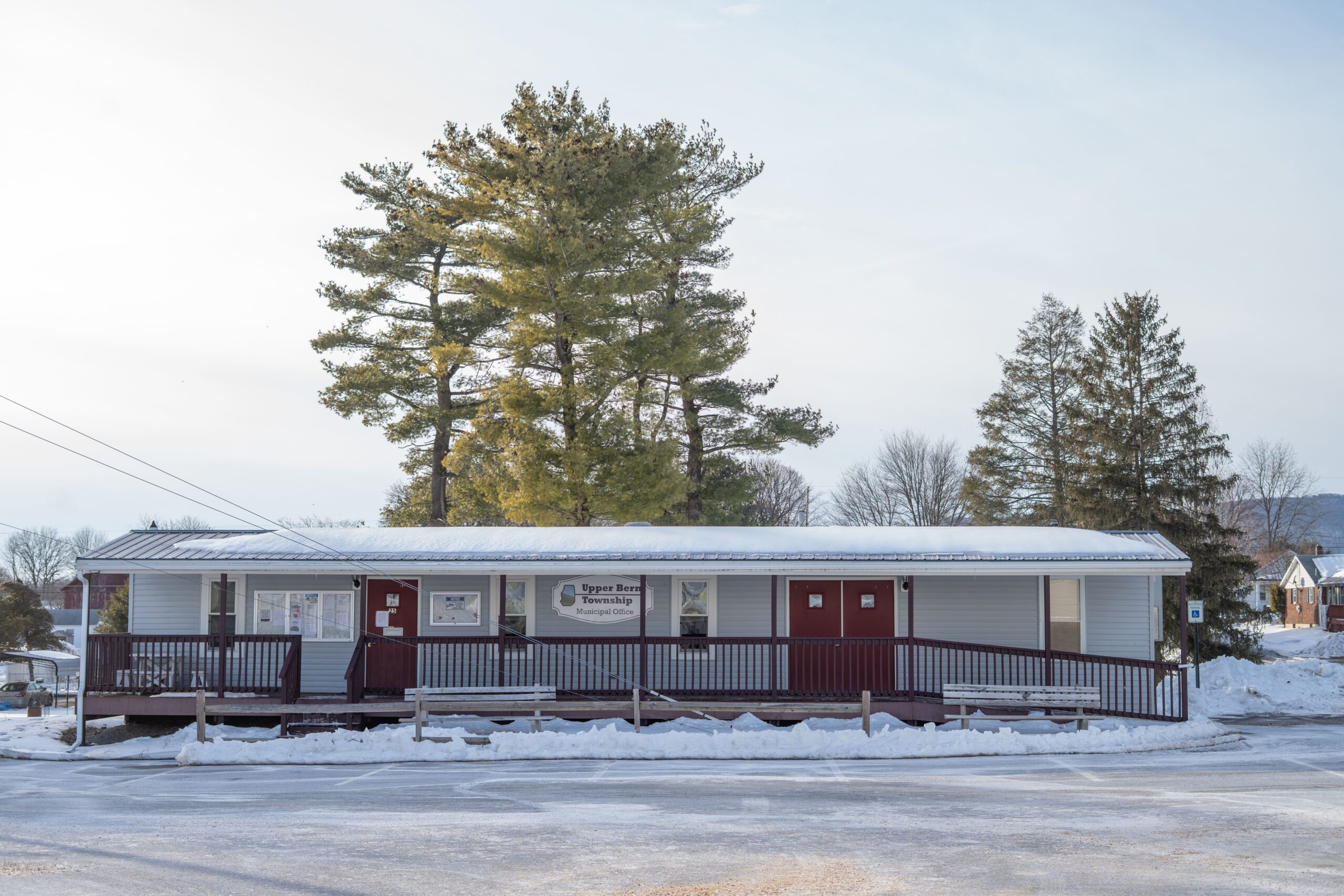
A view from the Upper Bern Township building near Shartlesville, Pa., on Feb. 9.
Sewage
When the Department of Environmental Protection (DEP) signed off on the plan to build the Hamburg Logistics Center several years ago, documents show the agency approved the warehouse to produce 8,000 gallons of sewage daily.
If it’s used as an ICE processing center and holds up to 1,500 people, that number would skyrocket to more than 100,00 gallons per day, officials said in their letter to Noem.
Upper Bern’s “maximum monthly flow from serving its current customers is 131,000 gallons per day,” they continued. And its treatment plant is designed to only treat up to 155,000 gallons daily.
Upper Bern renewed its wastewater permit with DEP in January 2024, indicating that the township was not modifying or adding onto the system. The average monthly flow reported during that renewal was 78,000 gallons per day.
Township sewer engineer John Roche said no one has submitted a formal request to change the use or increase sewer capacity at the warehouse.
“If the use changes, we’d have to look at that on an individual basis,” Roche told Spotlight PA after a supervisors’ meeting on Feb. 12. “We haven’t had any new requests yet.”
Neither Roche nor Upper Bern’s solicitor was available for comment for this story.
The former Big Lots warehouse in Schuylkill County, which ICE wants to turn into a detention center for 7,500 people, has a system approved to discharge even less than the one in Upper Bern — no more than 6,000 gallons per day, according to the letter. The system is also connected to the treatment facility by a 2-inch diameter pipe, which state officials told Noem isn’t suitable for a detention center.
Drinking water
Neither warehouse was designed to provide the amount of potable water that would be needed to run these detention centers, state officials warn, and finding alternatives would be all but impossible.
Upper Bern officials said the township has no public water system. Homes and businesses rely on wells for potable water.
In the letter to Noem, state officials wrote that the vacant warehouse is designed to draw water from an on-site water well. The Department of Environmental Protection (DEP) previously approved the construction of such a system, “because it could provide treated water for use by a limited number of employees engaged in warehouse activities based on three anticipated separate shifts in a 24-hour period.”
However, the agency hasn’t approved the operation of the system. What’s more, it’s not designed to provide drinking water 24 hours a day for some 1,500 people, they wrote.
During an April 2025 inspection, DEP officials also found several deficiencies that suggest the drinking water system “was not constructed in accordance with the approved designs.”
The Tremont Township warehouse is even more strained, the letter said. While it is serviced by the Schuylkill County Municipal Authority’s public water system, that system already struggles to provide adequate services to the community.
State officials estimate a 7,500-bed facility would need up to 800,000 gallons of safe water per day, which is nearly all of the available 1 million gallons stored for the Tremont area. The plant is permitted to only treat 330,000 gallons daily by the Susquehanna River Basin Commission.
That not only threatens access to safe drinking water, but could also “lead to calamity in the event of an emergency,” state department heads warned. For example, the same water supply is used for fighting fires, and the current systems may not have the supply or the water pressure needed to extinguish a blaze.
Emergency services
Communities across Pennsylvania are already experiencing an EMS crisis. Adding high-density facilities to the rural communities of Upper Bern and Tremont Townships — populations 1,600 and 300, respectively — will exacerbate those problems, local first responders told Spotlight PA.
Hamburg EMS has served Upper Bern Township for years, Chief Leslie Herring told Spotlight PA. While there are still many unknowns, she said first responders worry about how the ICE processing facility would impact their call volumes and response times.
“We’re just concerned because it’s not only going to affect us, it’s going to affect every other neighboring squad in the county,” Herring said. “We’re worried about what it’s going to do to all the surrounding municipalities and boroughs.”
Berks County officials declined to discuss the impact on emergency services. Emergency Services Director Brian Gottschall referred a Spotlight PA reporter to county spokesperson Jonathan Heintzman. Heintzman later declined to comment after consulting with the county commissioners and solicitor.
Scott Krater, director of Schuylkill County’s 911 center, is responsible for dispatching EMS, police, and fire personnel throughout the county, and noted the challenges these sectors already have. He said attracting 911 call operators is difficult.
Schuylkill County already has three prisons — run by the county, state, and federal governments — but none house the number of people anticipated for the empty warehouse. The county prison typically incarcerates fewer than 300 people, and both the federal and state prisons have about 1,200 inmates each.
“Those normal challenges that we have here would obviously be the same, or maybe more taxing on the telecommunicators that are working currently with the increase in call volume,” Krater told Spotlight PA.
Western Berks Ambulance Association provides mutual aid for Upper Bern Township and is the second in line to respond to emergencies, CEO Anthony Tucci said.
Tucci reached out to other EMS companies and DHS to learn more and better prepare, but said he hasn’t heard back. He estimates an ICE facility could add an additional 60 to 70 EMS calls a month.
“I think it’s going to be a huge impact on our community,” Tucci said.
Fire departments operate on a similar system of mutual aid and could also experience an increase in emergency calls, state leaders wrote in their letter to Noem.
While Tremont is serviced by five fire departments, Upper Bern is protected by just one: Shartlesville Fire Company, which is staffed by volunteers. It’s unclear how many calls the department averages monthly. Calls and emails to the fire company were not returned.
DHS has also failed to engage with area hospitals that would serve the ICE facilities, the Pennsylvania agency leaders said in their letter, which they called disconcerting. Hospitals need to plan for disasters, such as a fire at these buildings, that would cause an influx in patients.
“Area hospitals may not have the capacity to prepare for these emergency events without support and the lack of communication from federal officials raises serious concerns,” the state leaders wrote.
Reading Hospital and Penn State Health St. Joseph in Berks County did not immediately respond to Spotlight PA’s questions, nor did St. Luke’s Hospital or Lehigh Valley Hospital in Schuylkill County.
The Hospital and Healthsystem Association of Pennsylvania, which represents more than 235 providers across the state, was unable to say whether DHS has contacted local hospitals.
“Hospitals continuously update their plans — especially when there is a major change in the community — to ensure they are prepared to respond to emergencies and address their communities’ needs,” the association said in an emailed response to Spotlight PA questions. “Strong collaboration with local leaders, state and federal agencies, and other stakeholders is an important part of this process.”
Public safety
Neighbors have questioned how the proposed processing center would affect public safety.
Chelsey and Zach Kramer, who live in a mobile home community across the road from the warehouse, came to Upper Bern Township’s Board of Supervisors meeting on Feb. 12 to oppose ICE’s purchase of the warehouse.
They said they are worried about guns and security presence at the site, road closures, and not being able to access their home.
“Are we going to have to be showing ID to get home? Are they going to be blocking off our roads?” Chelsey Kramer told Spotlight PA.
The Kramers said they also worry about how a detention facility could impact recreational and family-friendly spaces near their home.
“When they were looking at these facilities, who at DHS looked at the campground and the mobile home community and the game lands and public trails and everything, and the community park right here, and said: ‘Let’s put one right there,’” Zach Kramer said. “The campground is going to go under for one, because who’s going to want to go vacationing near a detention facility? I know most of my neighbors are upset about this.”
The Berks County township doesn’t have its own police department, and State Police are responsible for coverage. Cars already back up at the major thoroughfares near Mountain Road during shift changes at nearby warehouses, local first responders told Spotlight PA.
Some speakers during the Feb. 12 meeting said they are worried about protesters and “agitators” coming to the area, and ensuring that people can exercise their rights to protest.
State Police “remain committed to providing the best law enforcement coverage with the utmost professionalism,” agency spokesperson Ethan Brownback told Spotlight PA in a statement, adding that their dedication to the area “remains unchanged.”
Property taxes
The $87.4 million sale of the Upper Bern warehouse to the federal government takes the sprawling property — located near the Appalachian Trail — off the tax rolls.
Since the warehouse was built and placed on the market, the property has remained vacant while generating about $199,620 annually in county property taxes, $31,229 in township taxes, and $597,110 for the Hamburg Area School District.
The township did not respond to Spotlight PA’s questions about how that revenue loss would affect the community’s annual budget.
“They’re losing $600,000 a year on school property taxes, and that’s important,” county Commissioner Dante Santoni Jr. said during a Feb. 11 town hall. “The most important thing is what it does to our communities, and we’ve seen what it’s done around this country. It tears us apart, it pits people against each other, and creates chaos.”
Spotlight PA’s Gabriela Martínez contributed to this article.
BEFORE YOU GO … If you learned something from this article, pay it forward and contribute to Spotlight PA at spotlightpa.org/donate. Spotlight PA is funded by foundations and readers like you who are committed to accountability journalism that gets results.
Philly got its biggest snow in 10 years. This time nature will help with the cleanup.
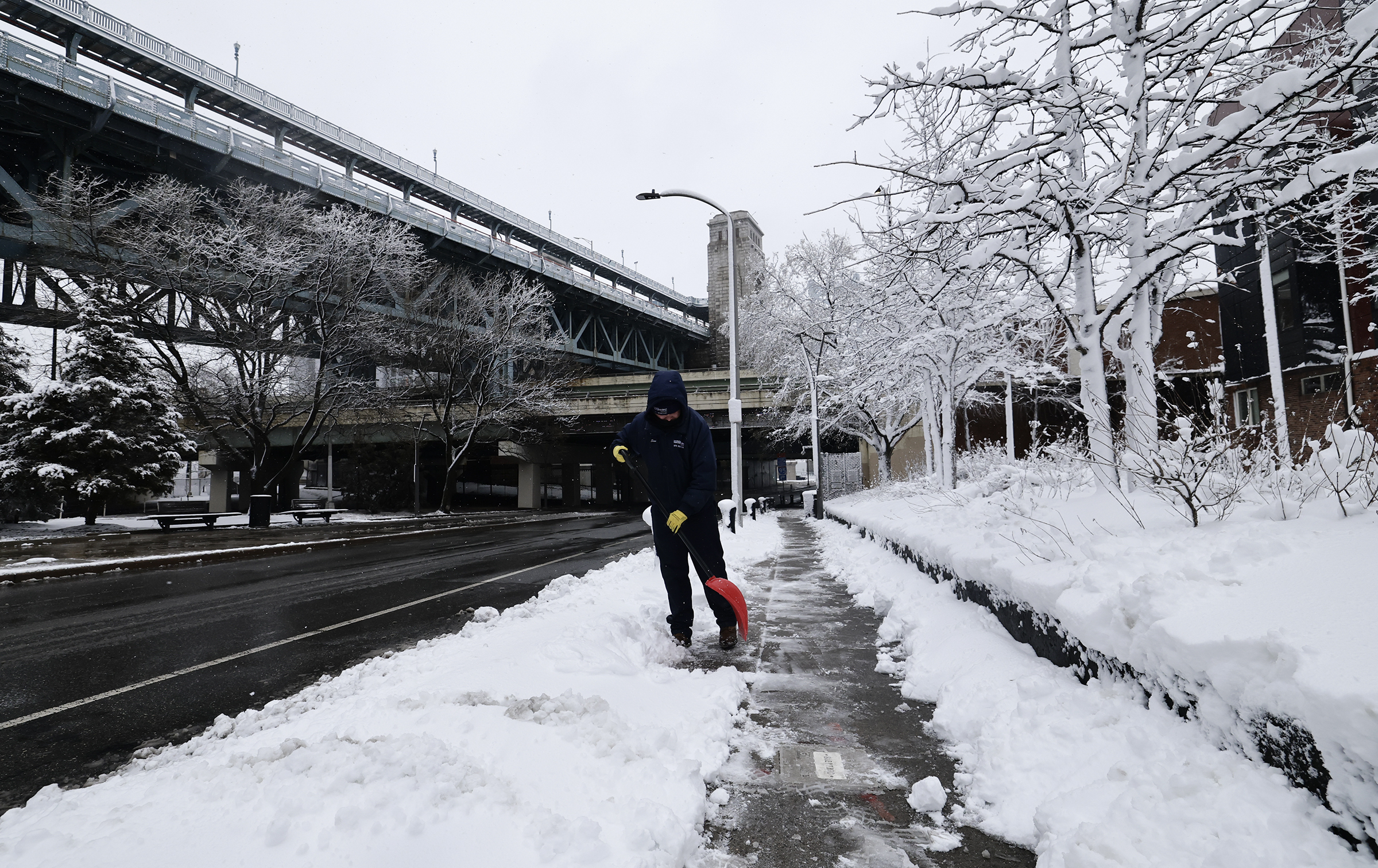
Sean Little of the Delaware River Waterfront Corporation shovels snow along the sidewalks on Race Street on Monday, Feb. 23, 2026.
If it wasn’t an actual blizzard, Philly’s biggest snowfall in a decade sure acted like one, and the weather the rest of this week isn’t expected to be particularly pleasant.
But in terms of disruption — not to mention aesthetics — this was in a wholly different category from the Jan. 25 siege of snow and ice. And the aftermath should not be anywhere near as punitive and burdensome.
Although the 14 inches measured officially at Philadelphia International Airport dwarfed the 9.3 inches of snow and sleet that accumulated in last month’s storm, Zach Schwartz, 33, was among those who found the picturesque snow more palatable than the attack of ice balls and an Arctic freeze.
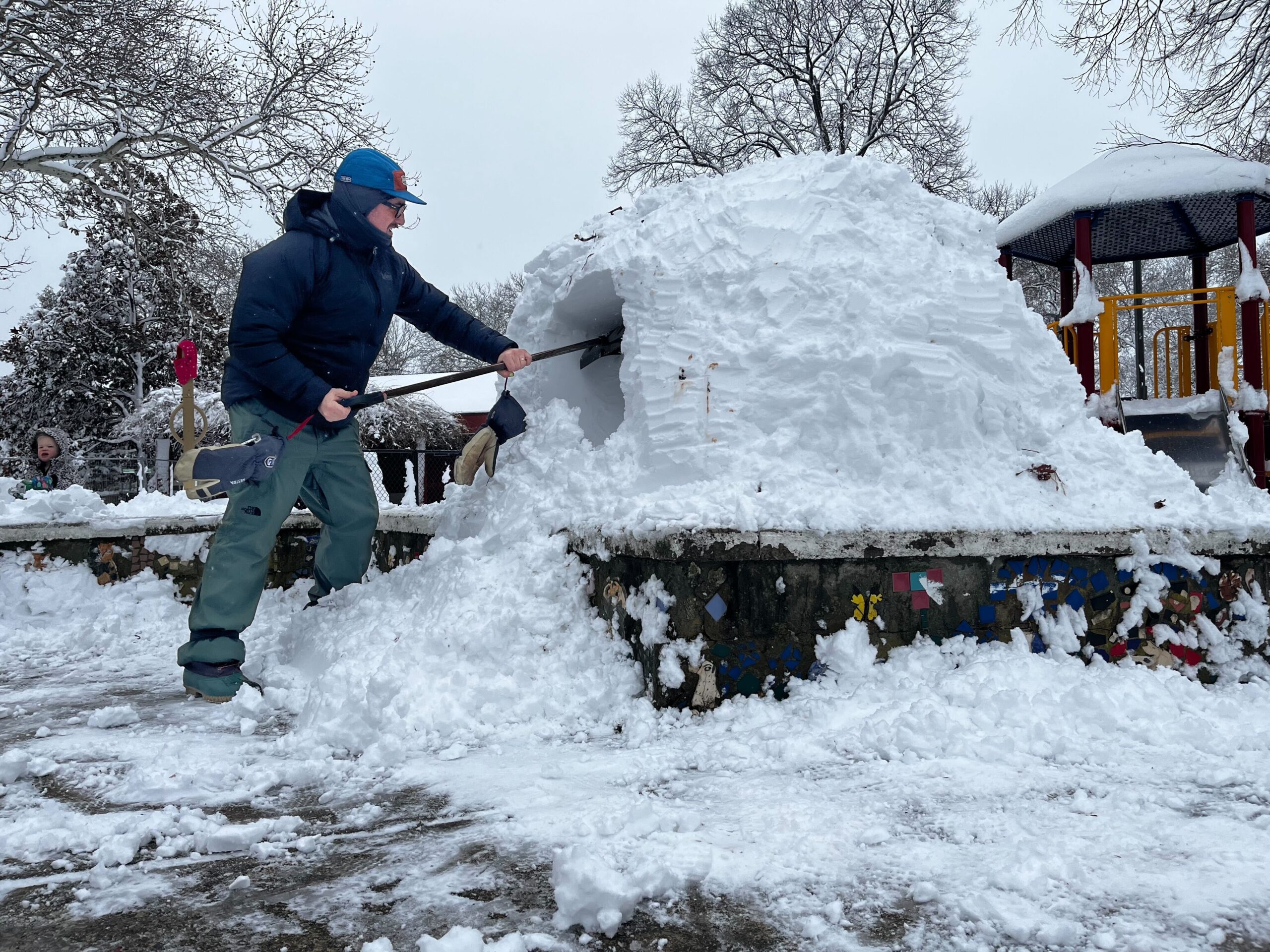
“The last snowstorm was a tough time for everyone,” said Schwartz, who was at a Point Breeze playground helping a friend build an igloo for their kids, “and I think the city was kind of in shock a little bit.”
Philadelphia’s Office of Homeless Services said the city would maintain several 24-hour warming centers through Wednesday morning to help people stay out of the cold.
The city is already in a Code Blue, which is declared when precipitation is falling and temperatures are 32 degrees or lower, or when temperatures feel close to or below 20 degrees due to the wind chill.
During a Code Blue, the city sends outreach teams out 24 hours a day, looking for people without shelter and taking them inside. The designation also opens up 50 shelter beds, in addition to about 3,400 shelter beds available during the winter. Residents in emergency housing are also allowed to stay inside all day. (Some shelters require residents to leave in the morning and return at night.)
An “enhanced Code Blue” is declared when Code Blue conditions persist for three days, and the city opens up warming centers that offer a place to sit out of the cold, usually in libraries and rec centers. Some people experiencing homelessness who are wary about entering shelters opt for less-restrictive warming centers.
The city has not declared an enhanced Code Blue for this storm, but announced Sunday afternoon that it had planned to open warming centers at least overnight.
On Monday afternoon, OHS’s Instagram account posted an updated list of warming centers that will stay open until 9 a.m. Wednesday. The following centers are already open unless otherwise noted:
Pelbano Recreation Center, 8101 Bustleton Ave. (opens at 9 p.m. Monday)
Hub of Hope, 15th Street and John F. Kennedy Boulevard (enter at the 15th Street trolley station entrance in Dilworth Park)
Appletree Family Center, 1430 Cherry St.
Prevention Point, 2913-15 Kensington Ave.
Kensington Wellness Support Center, 265 E. Lehigh Ave.
Samuel Rec Center, 3539 Gaul St.
People who see someone on the streets in need of shelter, or who need shelter themselves, can call the city’s homeless outreach hotline at 215-232-1984.
Warmer weather is helping Philly’s cleanup, but so are lessons from the last storm
Mother nature’s above freezing temperatures largely aided Philadelphia’s snow removal operations Monday, but the city also adjusted its response after the prior storm cleanup left many residents chockfull of complaints.
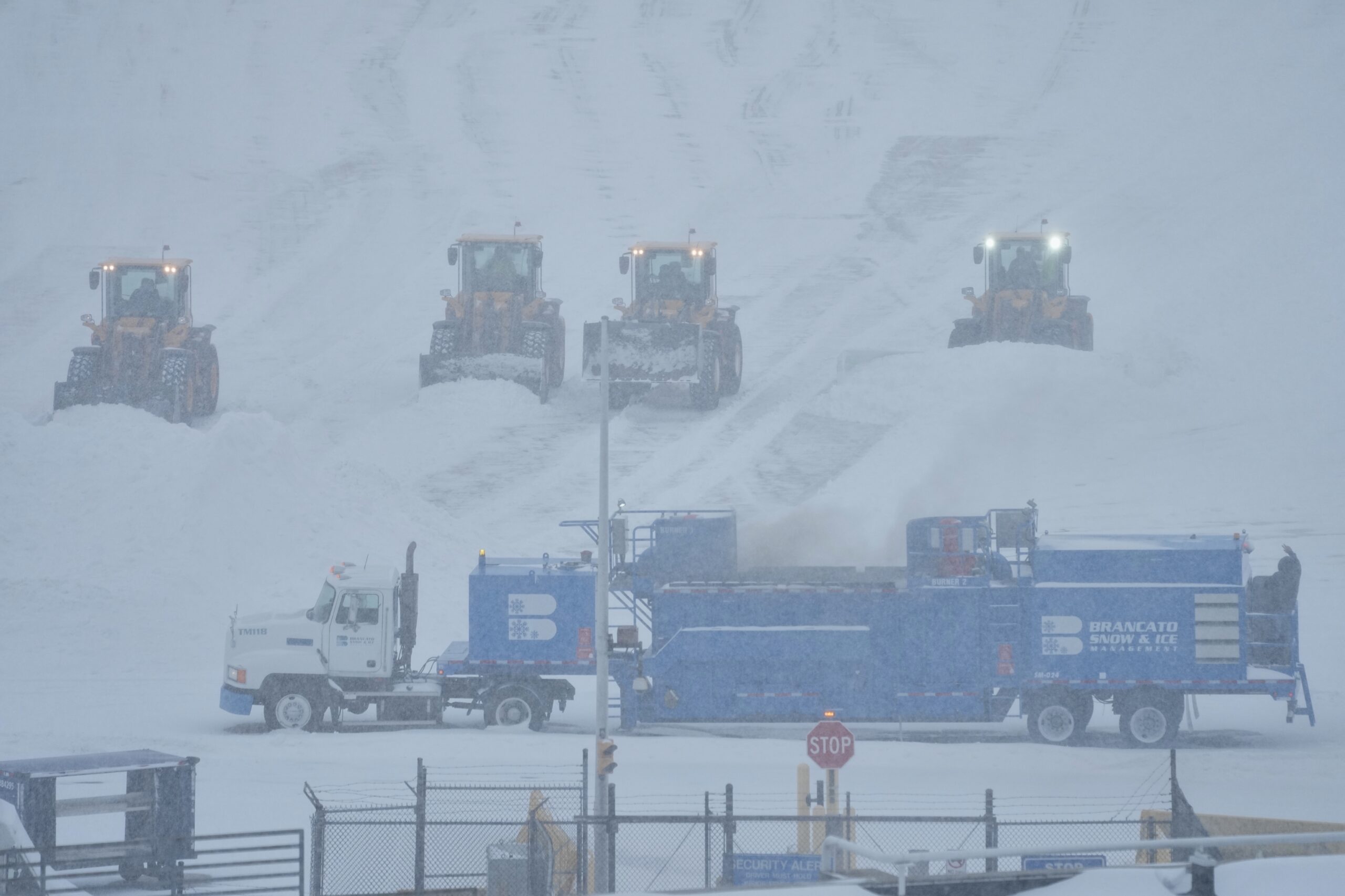
Director of Clean and Green Initiatives Carlton Williams said the city secured three snow melters instead of just one, with two already on the road Monday, despite the much shorter notice of the storm.
“They’re located throughout the city of Philadelphia, because quite frankly, from the last storm, we are running out of places to place snow,” said Williams in a news conference, referring to the dozens of snow drop off sites, such as the Navy Yard. “We needed to be able to put it in a location where it doesn’t have to sit in somebody’s neighborhood.”
The city also added snow blowers to the mix of machines clearing the area around City Hall, said a city spokesperson.
The softness of the snow, compared to the hardened sleet from the last storm, has made it easier for the smaller snow clearing equipment to double back and tackle ADA ramps and crosswalks after the last bit of snow fell, according to the mayor’s office.
Even so, the city is slated to deploy crews of same-day-pay workers to manually shovel crosswalks, SEPTA stops, and ADA ramps that are hard to reach by machines as early as Tuesday.
The deployment of these reinforcements comes at a much faster clip than the previous storm, where some 300 additional workers helped chip away at persistent ice by hand more than a week after the snow fell.
Lee Paul and her puppy, Chay, check out the snow Monday near their Wayne Avenue apartment.
Lee Paul, 36, was not ready to step out of her Wayne Avenue apartment complex in the middle of a blizzard. But her four-month-old puppy had other plans.
“I had to take Chay to go to the bathroom,” said Paul, hands in her pockets and dreading the cold.
She hates winter, but is happy that living in a building meant no shoveling was in her future.
For Chay, this is all a new experience. He was thrilled to jump around in the snow, bury his paws over and over again, and catch tiny flakes with his nose for more than 10 minutes.
SEPTA resumes most services but Regional Rail remains suspended
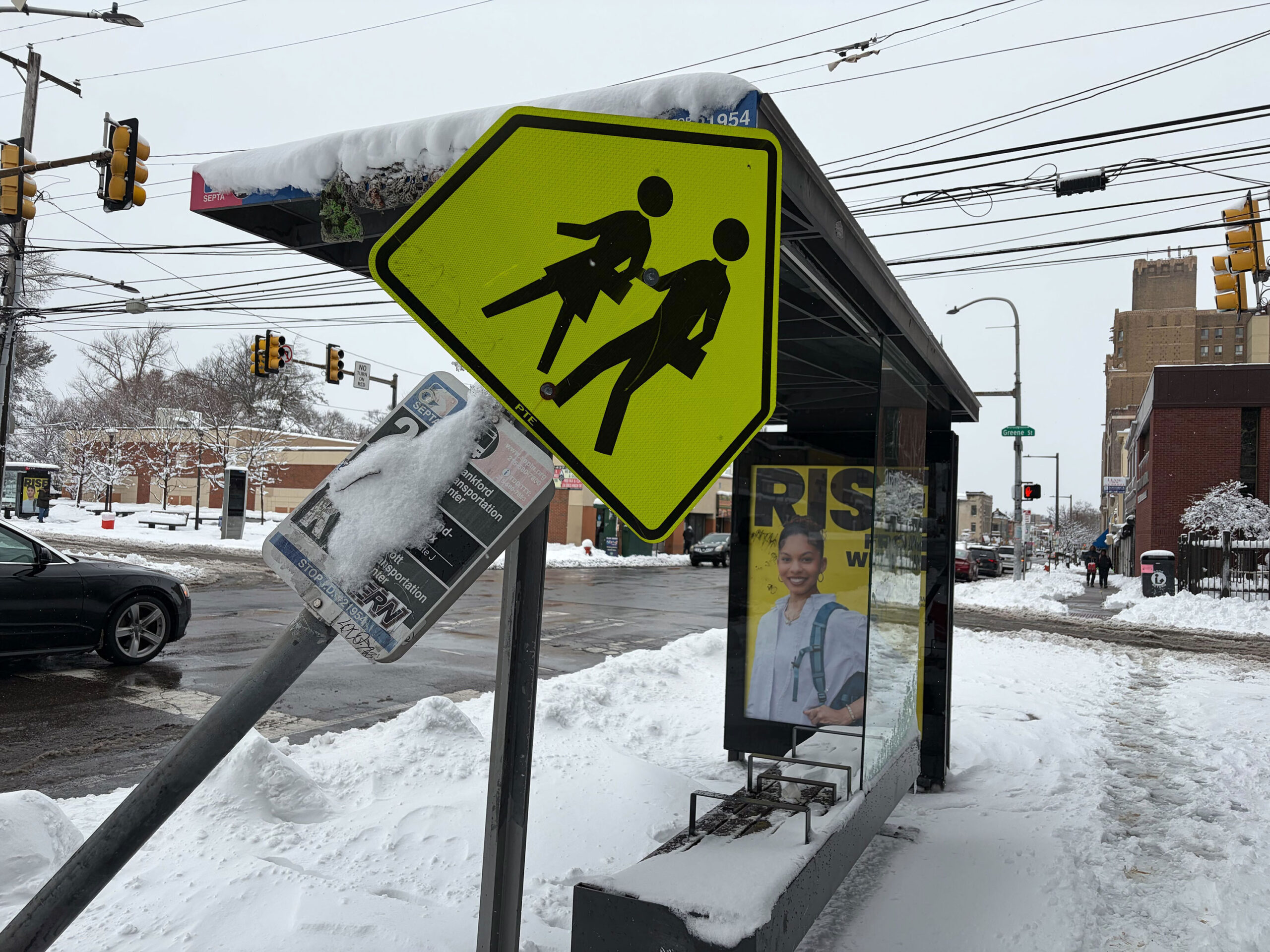
SEPTA bus stops, like this one in Germantown, sat empty most of Monday.
SEPTA has reopened its Center City trolley tunnel, and resumed service on more than 20 of its bus routes. However, Regional Rail service remained largely suspended as of Monday afternoon, SEPTA general manager Scott Sauer said.
“We’re hoping to have some Regional Rail service restored later this afternoon,” Sauer said Monday. “But I will caution: We will not be on a regular schedule.”
Just before 3 p.m., the agency restored operations on its Manayunk/Norristown line, a representative said.
The transit agency had inspectors and inspection trains working along Regional Rail lines evaluating them for any hazards, but their resumption was not immediately clear Monday afternoon. Sauer encouraged riders to follow SEPTA’s app and website for service updates as storm cleanup progresses.
“SEPTA has nearly 300 Regional Rail and metro stations, most with a variety of platforms and infrastructure, so we are working to clear those in the best effort possible,” Sauer said.
About 30 track inspectors were working to inspect SEPTA infrastructure, and roughly 700 in-house employees were working to clear the authority’s property of snow and other hazards, including downed trees. Sauer added that SEPTA has utilized “many, many tons” of rock salt to combat ice, and employed the use of all of its available heavy equipment to aid in cleanup.
“We’ve made service adjustments, and now it’s back to restoration,” Sauer said. “But all while keeping an eye on safety for both our customers and our employees.”
Light snow is possible Tuesday night. More next week?
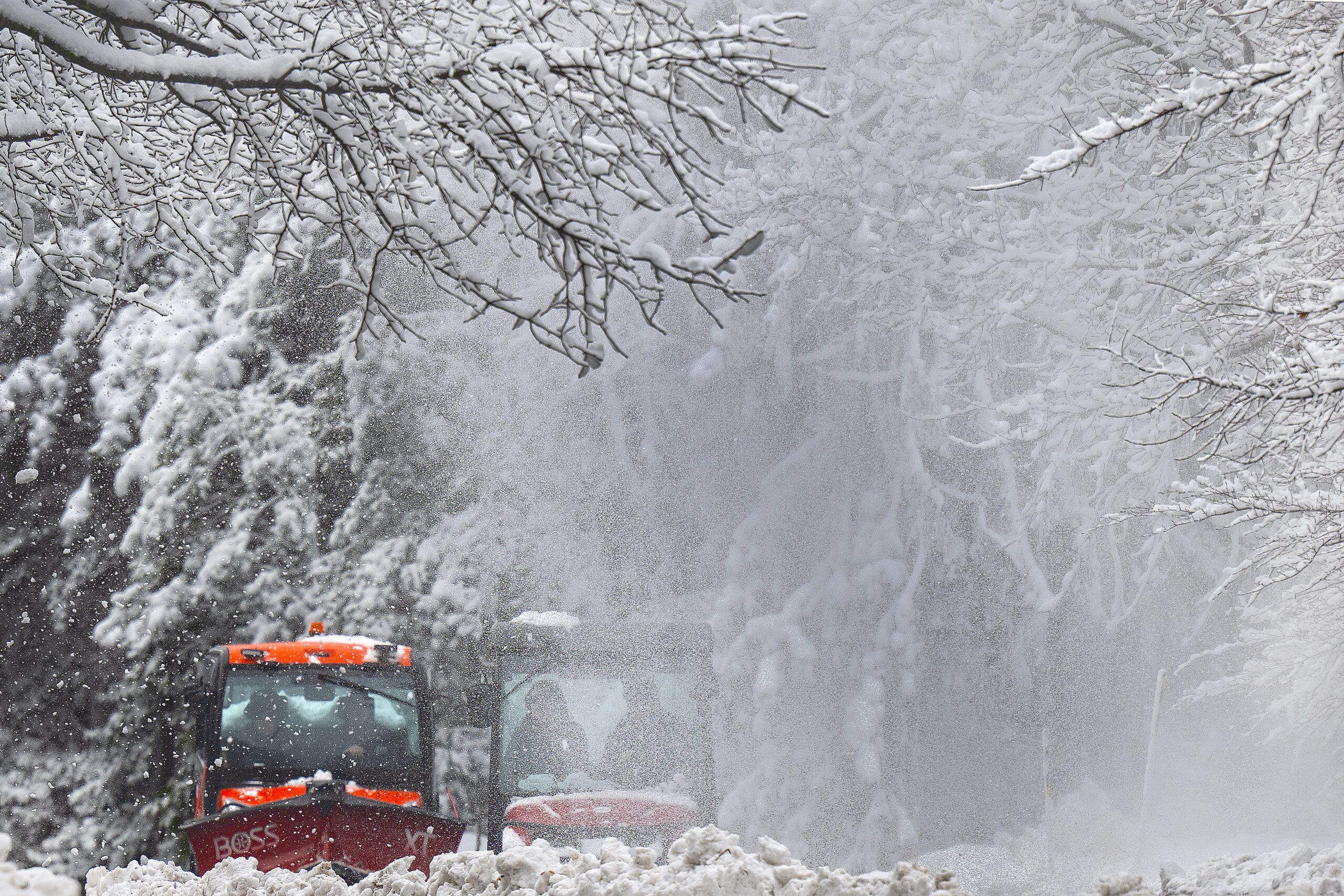
Snow removal vehicles plow at Swarthmore College Monday.
It won’t be a big deal, but a round of light snow is possible late Tuesday night and/or early Wednesday as a weak “clipper” system approaches from the west.
While temperatures on Tuesday will struggle to reach freezing and fall into the 20s at night and, thus, cold enough for snow, it shouldn’t accumulate more than an inch in the Philly region, forecasters say.
It will warm into the 40s on Wednesday, and given the strength of the February sun it should be a decent melting day.
More light precipitation, perhaps a mix of rain and snow, is possible Thursday, but that should be followed three consecutive dry days ,with high temperatures in the 40s to low 50s.
Another batch of chiller air could arrive in time for a storm to produce more snow early next week, said Tom Kines, senior meteorologist with AccuWeather Inc. But, yes, it’s way, way early.
At least by then, most of what fell Sunday and Monday should be liquefied.
Kines warned that in the meantime temperatures the next few nights are going to fall below freezing, turning some of that daytime melt into ice.
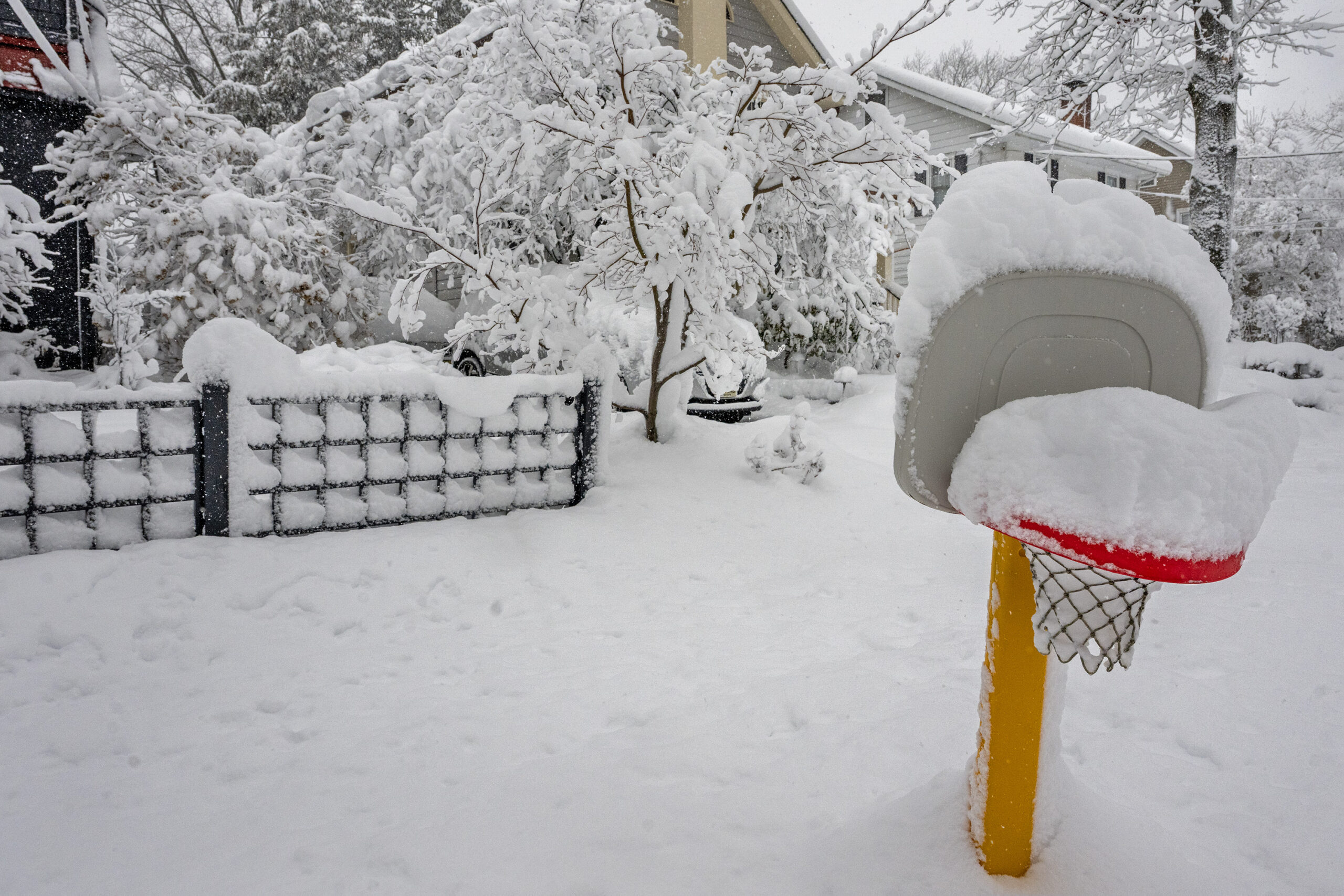
Snow fills a child’s basketball hoop in Haddonfield Monday.
More than 130,000 households across the Philadelphia region lost power last night due to the snowstorm.
Philadelphia households have mostly recovered from power outages on Monday, according to Peco, with only 213 active outages this afternoon.
South Jersey still has around 75,000 households currently without power, according to Jersey Central Power and Light, but that number has slowly decreased since this morning.
Outages in Atlantic City are still higher than they were this morning with 2,804 active outages, up from 1,892 around 7 a.m., according to Atlantic City Electric. Last night, more than 50,000 residents in Atlantic City lost power.
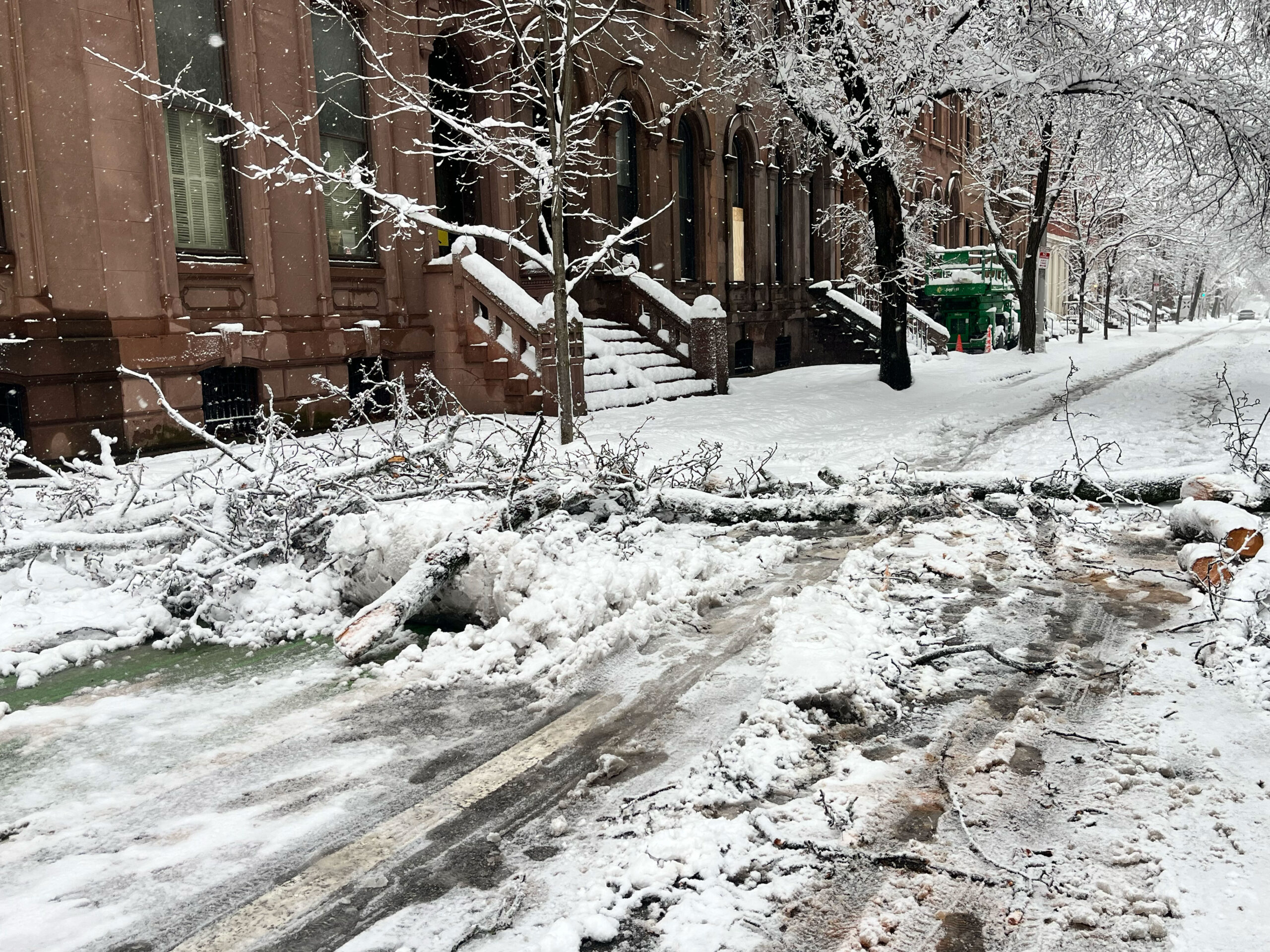
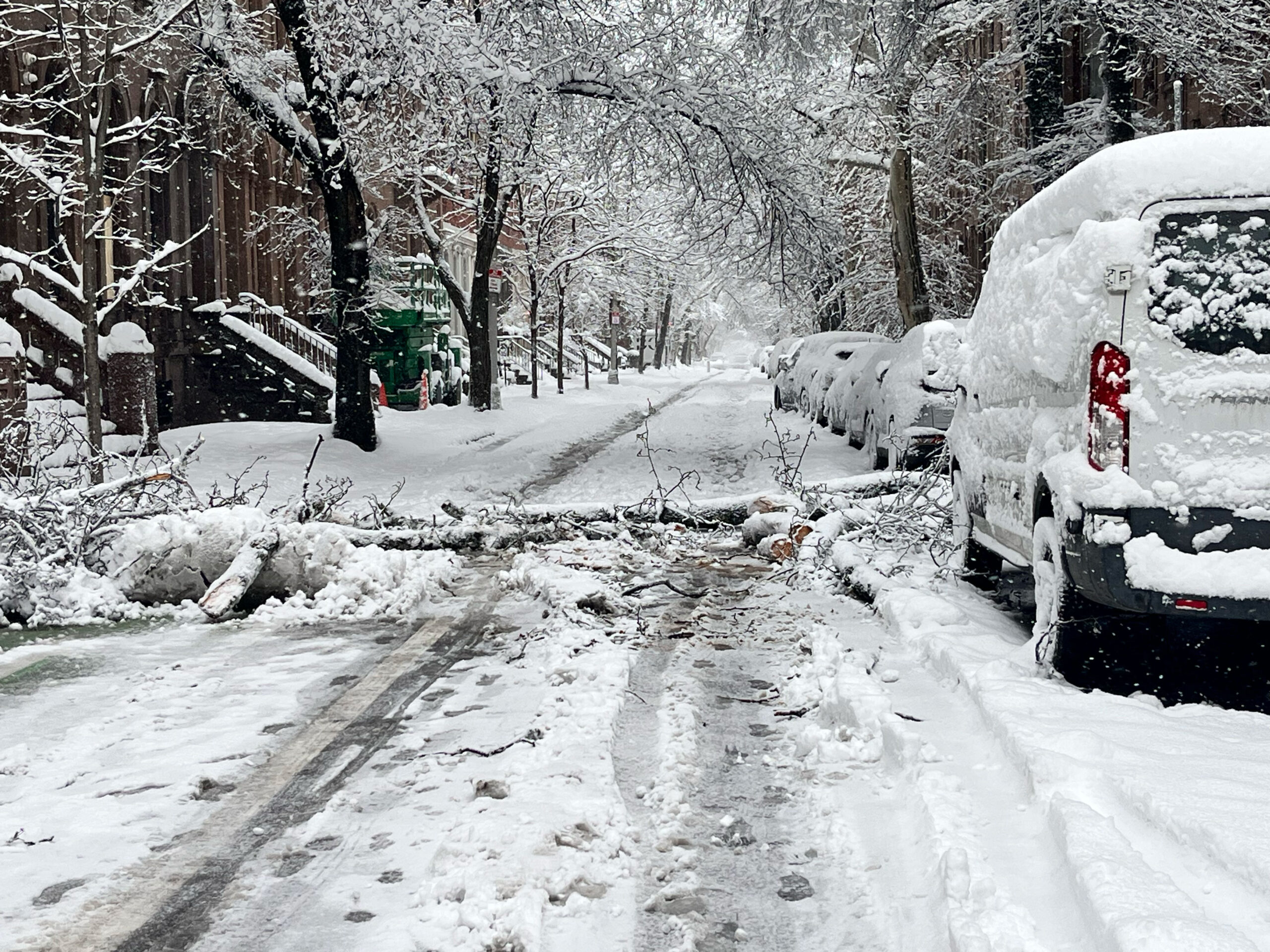
Wet snow brought down trees in Rittenhouse Square Monday.
At least 87 tress across the city were downed as a result of the storm as of Monday afternoon, and the city is working to determine which ones to prioritize clearing first, Parks and Recreation commissioner Susan Slawson said.
“We have four certified arborists that are actively inspecting reports of fallen trees to determine priority for clearance,” Slawson said Monday. “Everything is not a priority.”
Slawson asked for patience from city residents as the department works to clean up downed trees, and noted that some situations involving live wires require additional caution and coordination. Fallen trees blocking roadways, or those that have fallen on houses or cars, should be reported to 911, while those impacting power lines should be reported to Peco.
While the number of downed trees may rise in the immediate aftermath of the storm, Slawson said she expects officials will continue to monitor the situation in the coming weeks and months. Longer-term implications, she cautioned, are possible.
“This moisture, this snow, is going to continue to [have an] affect,” Slawson said. “Early on in the spring, we may continue to see trees come down, and it’s a direct result of all the storms that we’ve had.”
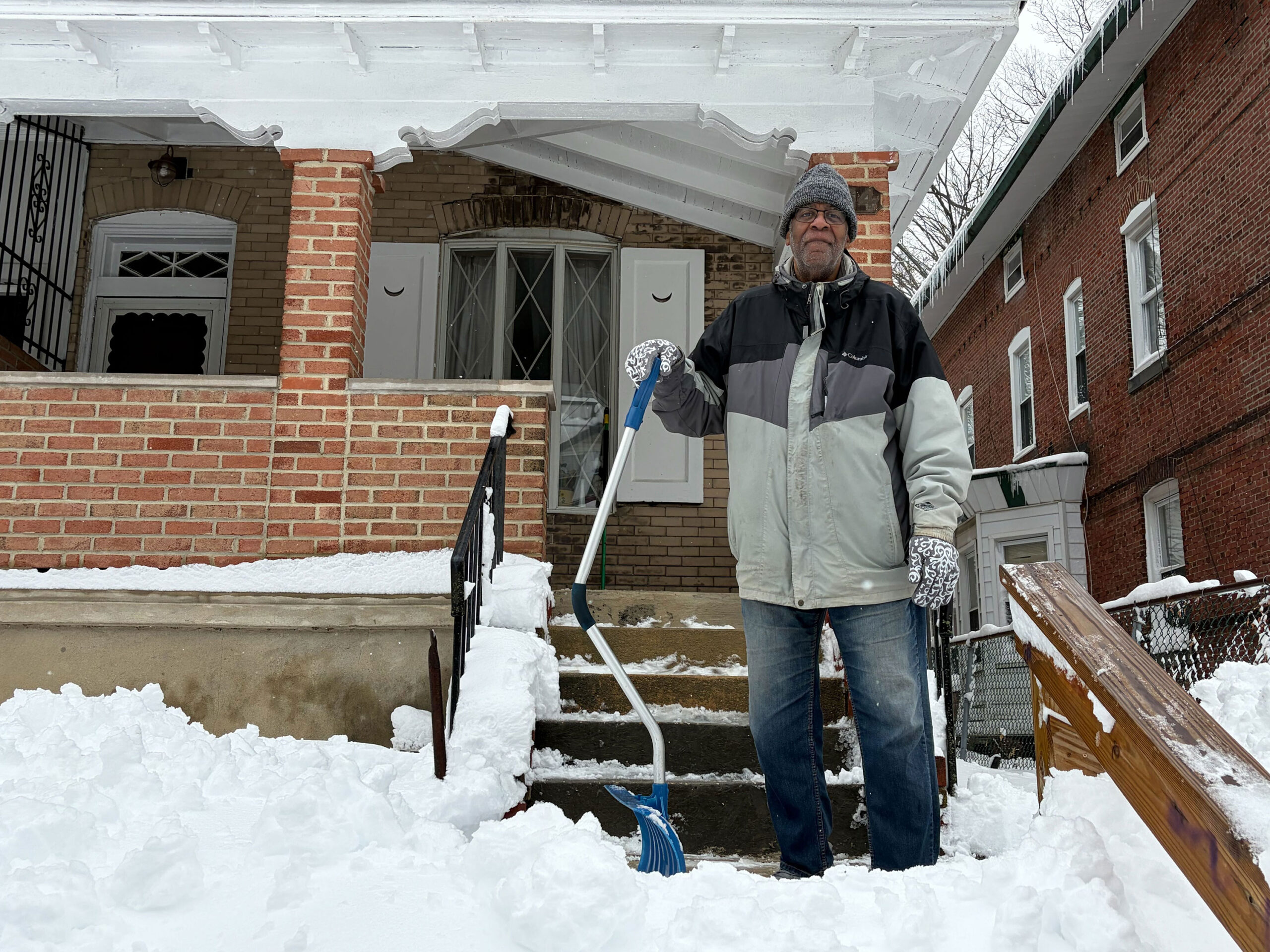
Ronald Barnard works to shovel outside his Coulter Street home in Germantown Monday.
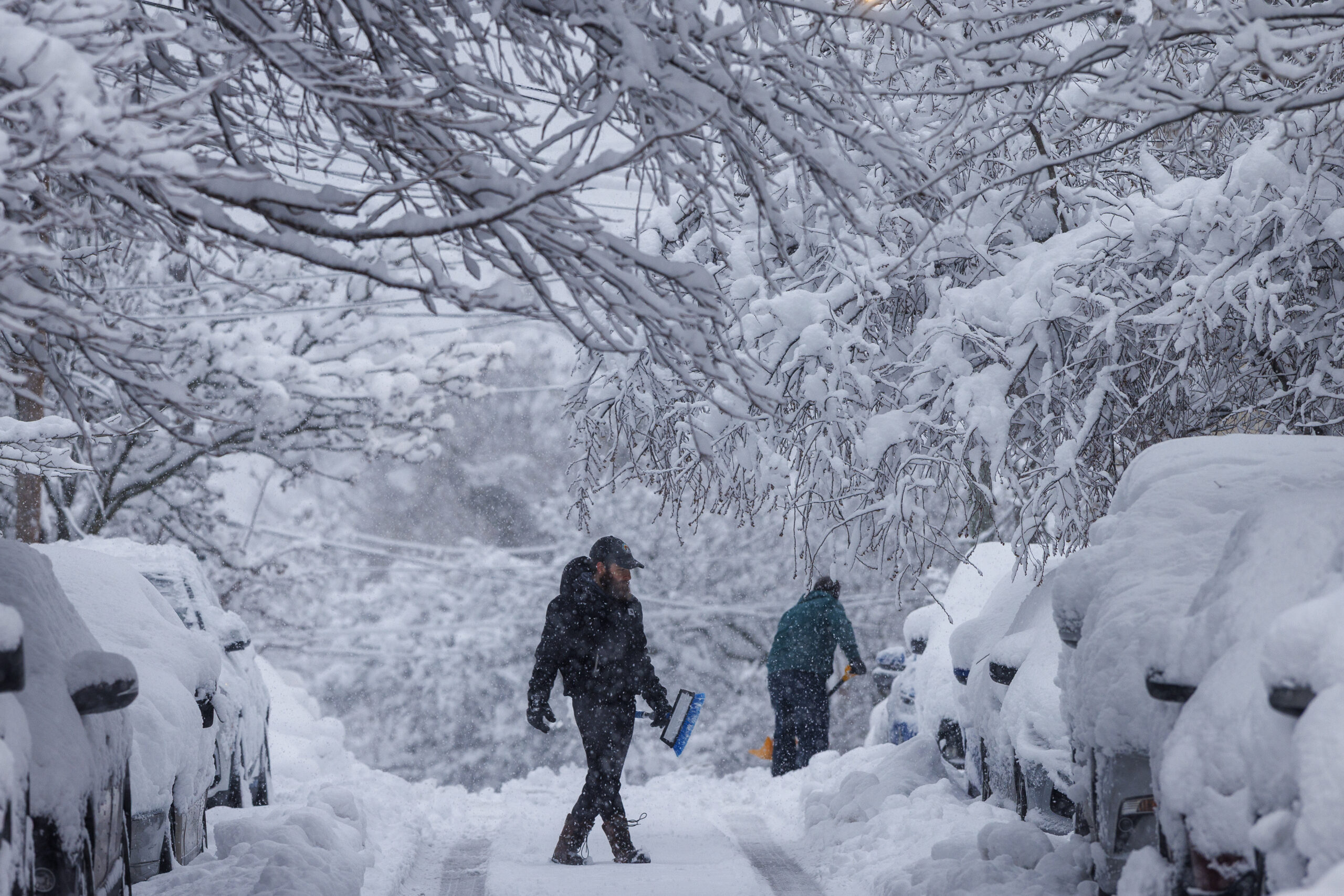
Ronald Barnard has been shoveling outside his Coulter Street home for two hours. At 69, snow clean up requires twice the effort, he said.
“It’s just a lot,” Barnard said pointing to the surrounding unplowed sidewalks and ice covered road. “This snow is easier to push than the snow in January, but it’s more than I expected for sure.”
He likes doing the clean up himself. But when neighbors offer to help, he takes the chance to reminiscent about a better time, when “the city used to give us salt and even plow the two way street, but times have change.”
El Zahur shovels the sidewalk outside his Germantown property Monday.
A block down Germantown Avenue, El Zahur, 42, is having an easier time. City plow trucks have been driving by all morning, making the street clean.
“The administration dropped the ball last time, but she made out for it this time,” Zahur said, referring to Mayor Charelle L. Parker. “Before, the trucks were driving around with their plows up, but now they are doing a good job actually removing the snow.”
Regardless, he is still responsible for his corner property sidewalks, which proved to be a bit of a hazard.
“I have managed to stay out of the way from falling things,” Zahur said, as some snow rapidly fell off the roof into the sidewalk. “I don’t want nothing falling on me from three stories above.”
Weather Service cancels blizzard warnings for Philly and across the region
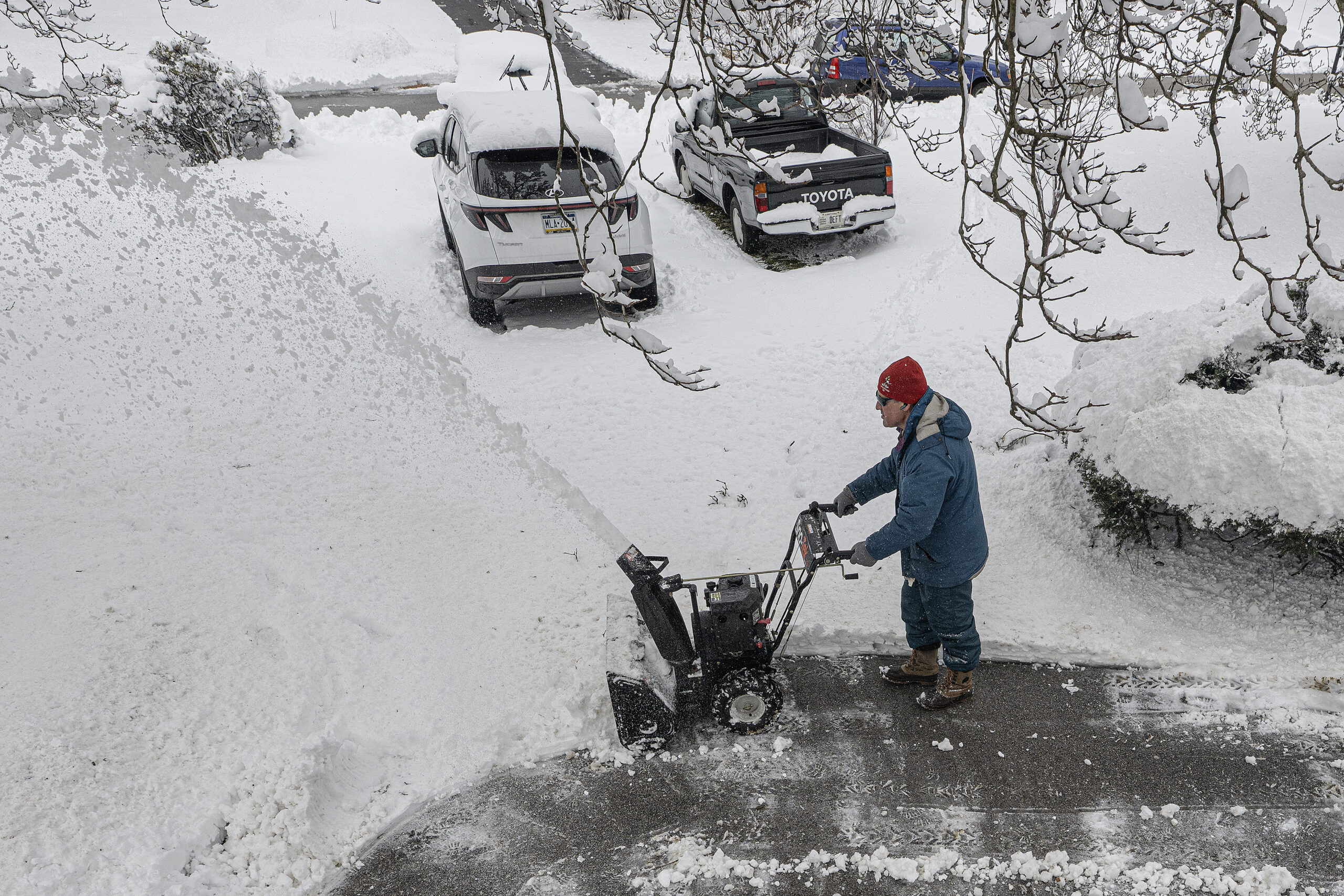
Mike Ouellette plows his driveway with a snow blower in Wallingford Monday.
The National Weather Service has taken down the blizzard warnings for the region.
While strong winds and blowing snow are likely to persist, the threat of blizzard conditions has diminished, said Nick Guzzo, meteorologist at the National Weather Service Office in Mount Holly.
The warning had been scheduled to expire at 6 p.m., but snow has moved out of the area, and overall visibilities and conditions have improved
Philly snow emergency remains in effect, no word yet if schools will reopen Tuesday
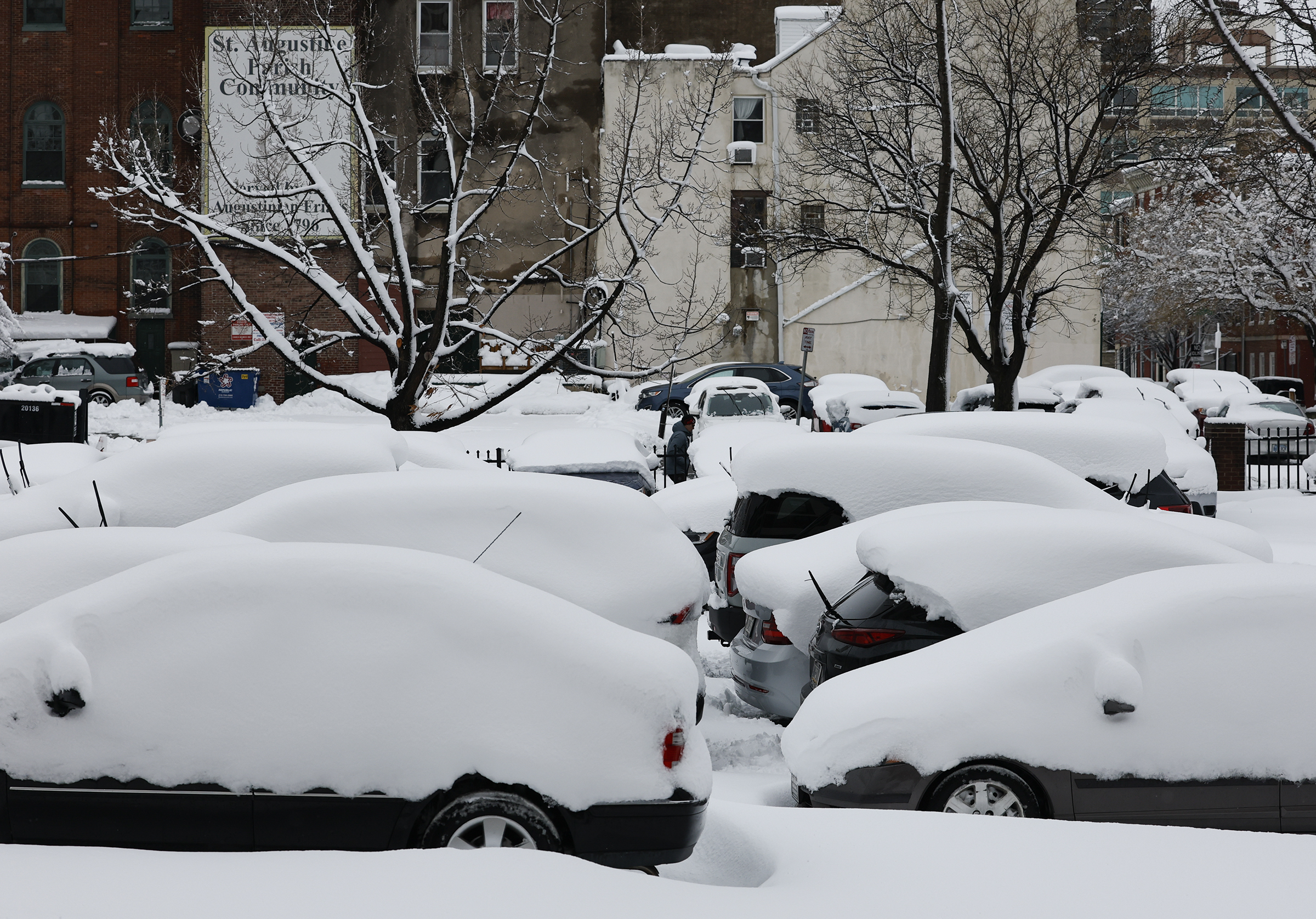
Snow topped cars sit in a Old City apartment parking lot Monday.
Mayor Cherelle L. Parker said at a Monday afternoon news conference it remained too early to determine when the city’s snow emergency could be lifted, but officials hoped to have an update on the resumption of city operations later in the day.
In the meantime, Parker added, city residents should avoid unnecessary travel until further notice to allow crews to continue to clear the more than 2,500 miles of roadways in Philadelphia. Roughly 65% of streets had been treated in some way as of Monday afternoon — plowed, salted, or lifted, or some combination of the three — director of Clean and Green Initiatives Carlton Williams said.
“When there are fewer cars on the street, we give our crews more flexibility to do the job that we are asking them to do,” Parker said.
At the height of the storm, the city employed more than 800 pieces of equipment and about 1,000 workers to aid in snow removal, and that number “is still continuously growing,” Williams said. Workers will assist with the clearing of curb cuts, ADA ramps, and areas around schools, among other spaces, as cleanup efforts continue, he added.
“We will continue to focus on those areas so that all pedestrians and motorists will have safe and accessible walkways,” Williams said.
Officials expect to release additional information about Tuesday’s city services and school operations around 6 p.m., Parker said.
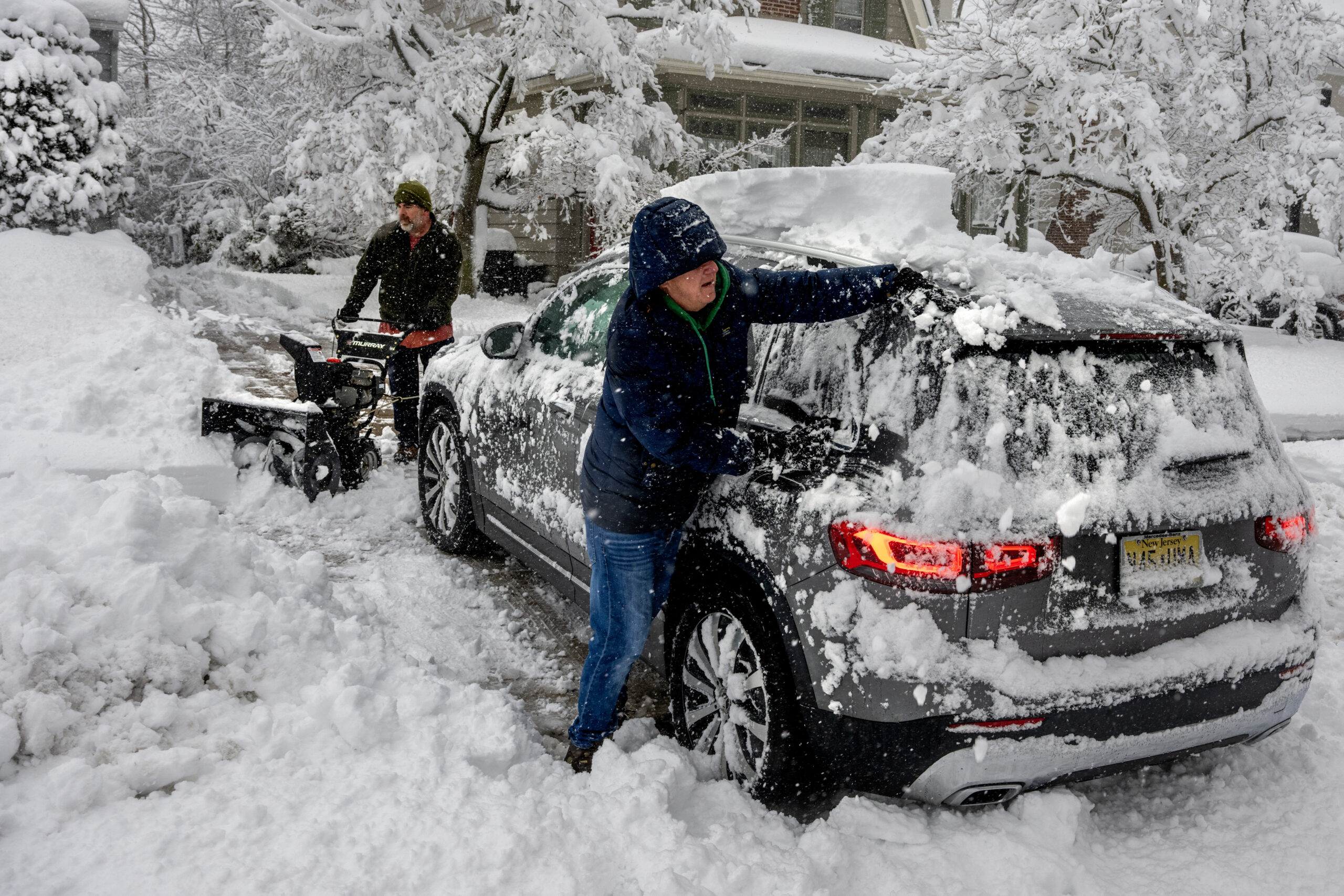
David Holmes cleans the snow off of his car as neighbor Bill McKean (rear) snow-blows the driveway in Haddonfield Monday.
The New Jersey Office of Emergency Management has announced that the mandatory travel restriction, which began at 9:00 p.m. on Sunday and was extended until noon Monday, has been lifted.
Officials nonetheless “strongly encouraged” motorists to avoid unnecessary travel as hazardous conditions remain in parts of New Jersey, according to a release from the state police.
“Some roadways remain snow-covered, visibility is limited in some areas, and crews continue working to clear roads and restore safe travel,” the release said.
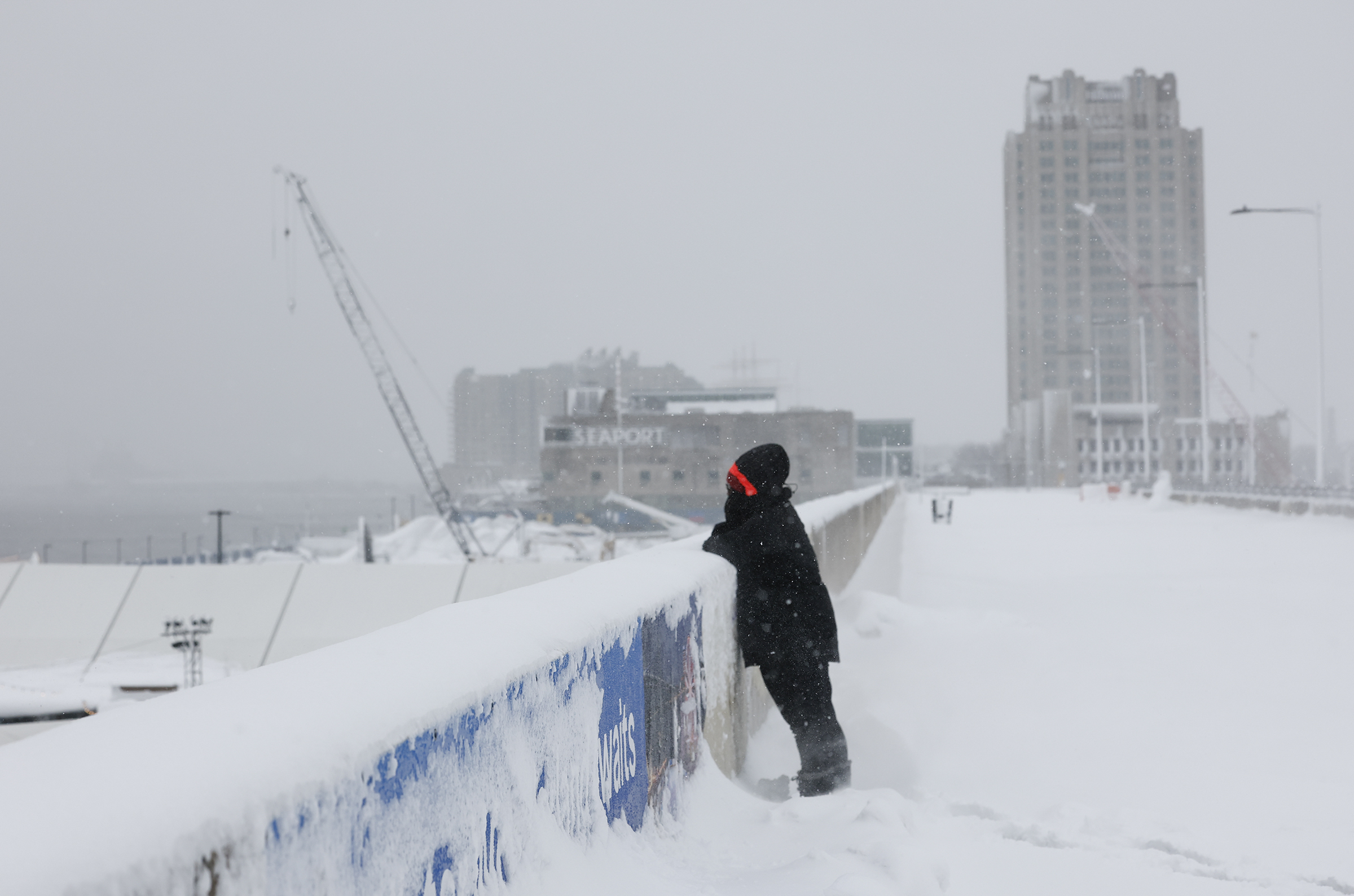
Nicole Swinson looks into a snowy Penns Landing Monday.
Philadelphia hasn’t experienced a verified blizzard in 33 years, and it remains unclear whether this Sunday-Monday snow fest qualified for the honor.
According to NOAA guidelines, a blizzard requires “frequent winds of 35 mph or higher with considerable falling and/or blowing snow that frequently reduces visibility to 1/4 of a mile or less. These conditions are expected to prevail for a minimum of 3 hours.”
That’s a lot to ask for a snowstorm, and it is going to take considerable forensic work of poring through observations to determine whether those conditions were met in Philadelphia or elsewhere in the region, said Nick Guzzo, a meteorologist at the National Weahter Service Office in Mount Holly. (Incidentally, 20 inches of snow were measured on the office’s property.)
The last certifiable blizzard in Philly occurred on March 13, 1993. That one closed down the Philadelphia Flower Show.
Meteorologists were confident that the conditions were met during the record 30.7-inch snowfall of Jan. 7-8, 1996, however they weren’t officially verified in the city.
With or without a label, this was one impressive storm.
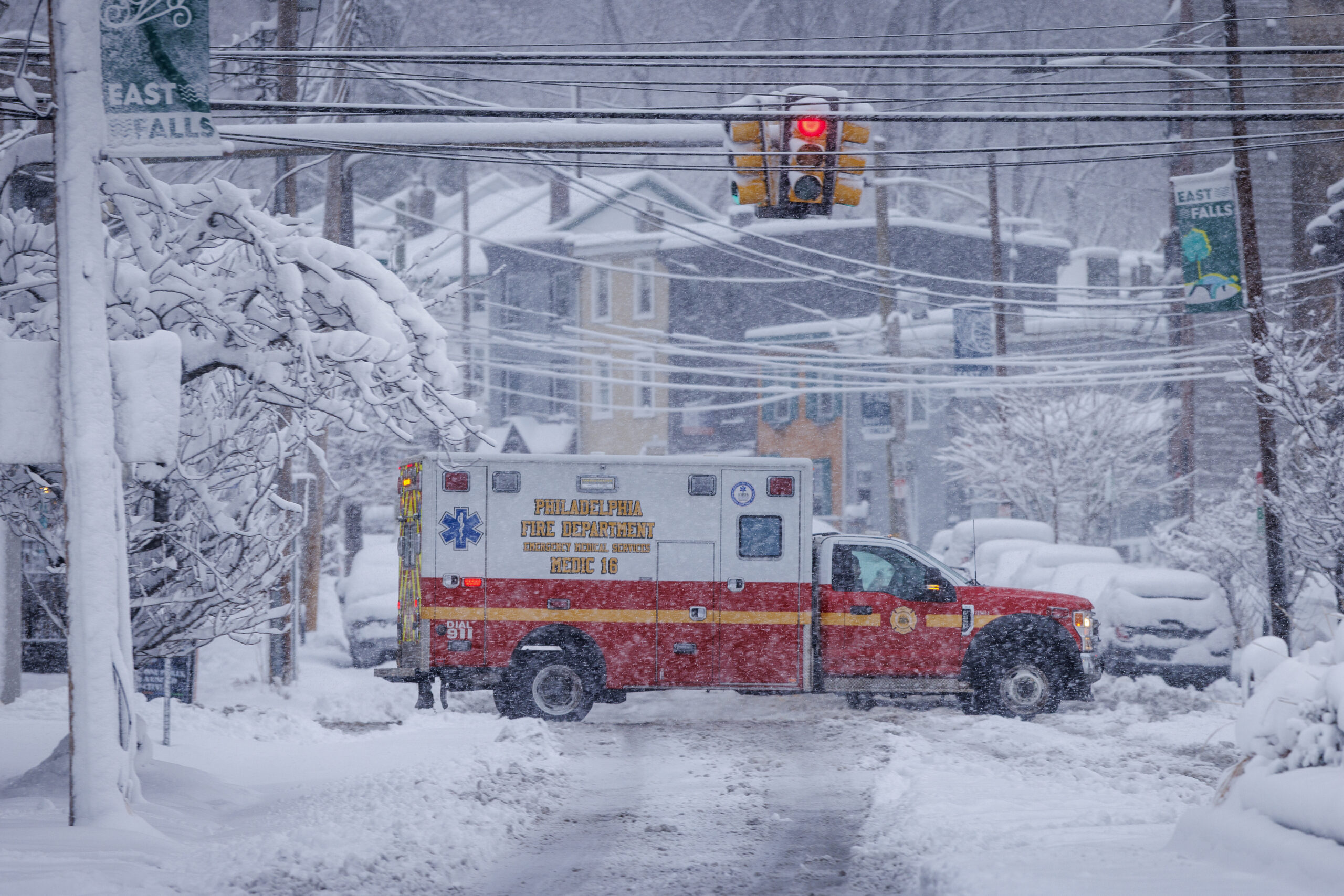
A Philadelphia Fire Department ambulance drives along Ridge Avenue at Midvale on Monday.
Light snow is lingering in the Philly region and could continue into the afternoon, but no additional accumulation is expected.
“What’s done is pretty much almost done,” said Amanda Lee, meteorologist at the National Weather Service in Mount Holly, where 18 inches was measured Monday morning.
The potent coastal nor’easter that clocked South Jersey and areas along I-95 and generously layered several inches of snow throughout Philly’s neighboring counties in Pennsylvania is pulling away.
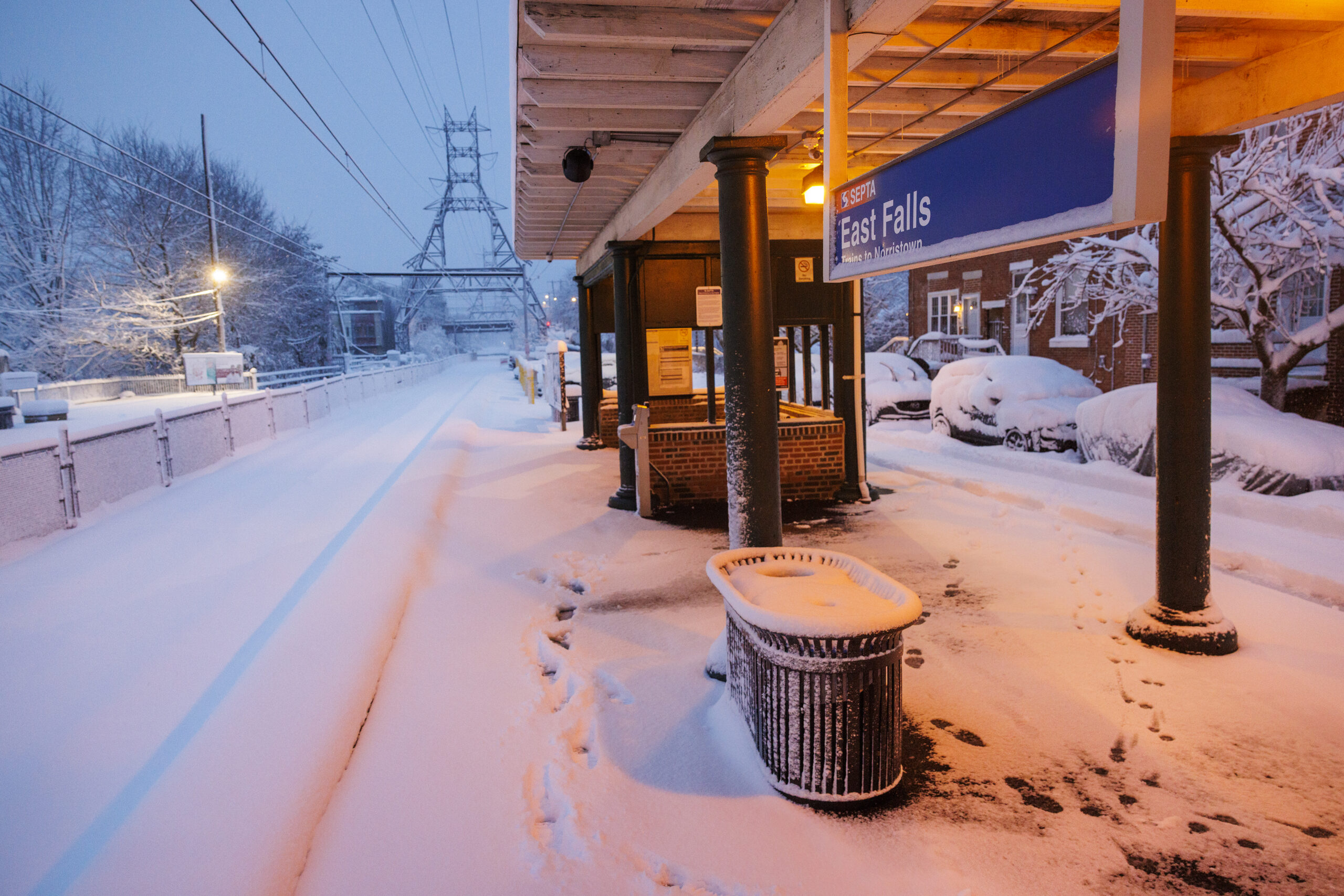
Snow covered tracks at SEPTA’s East Falls Station along the Norristown Regional Rail.
Almost all SEPTA services, besides some subway services, were temporarily suspended Monday due to the storm. But some are beginning to come back online.
Bus service is in the process of being restored as streets are cleared, the agency said.
The Center City Trolley Tunnel has reopened. The D and M lines are running on a modified service schedule, while Route G remains suspended.
Regional Rail remains suspended until safety inspections are complete. If Regional Rail service returns, it will follow a Saturday schedule.
The Broad Street Line (B), Market-Frankford Line (L), and Media-Sharon Hill Line (D) are operating as normal with some delays and cancellations.
The Norristown High Speed Line (M) is running but only operating between the 69th Street Transit Center and Radnor Station.
South Philadelphia is loving the winter wonderland
Zach Schwartz builds an igloo in Wharton Square Park Monday.
Fresh powdery snow, perfect for snowballs, blanketed Wharton Square Park in South Philadelphia after Sunday night’s snowstorm. Laughter from the playground, shovels scraping concrete, and snowmen slowly rolling into form took over the park on Monday morning.
Two men in particular came with a mission: to build an igloo for their kids. Zach Schwartz, 33, and Josh Feist, 33, of Point Breeze shoveled a path to the playground, piling up a more than five-foot snow pile. Feist, who is a mason, helped stabilize the frame while Schwartz carved out the inside.
“We have a really close crew of families in the neighborhood, so we’re here at the park like every day, no matter what. With the snow, we just have more fun things to do,” Schwartz said, who has lived in Philly since 2016. In recent memory, this storm had some of the most snowfall, Schwartz said, but that it doesn’t compare to the frozen snow of last month.
“The last snowstorm was a tough time for everyone, and I think the city was kind of in shock a little bit,” Schwartz said.
Samantha Schranck and John Gabel were out walking their dog enjoying the warmer temperatures compared to last snow storm. “I already had a day off, so I’m going to be a kid again and treat it like a snow day,” Schrank.
While snow removal is a much easier task this time around with snow that Gabel said is less frozen and easier to pick-up, the couple is hoping city streets and trash service are up to par this week.
“I’m very curious to see how the city clears the streets this time because it was a mess and took a long time in our neighborhood to clear snow from streets and take care of the trash build up,” Schranck said.
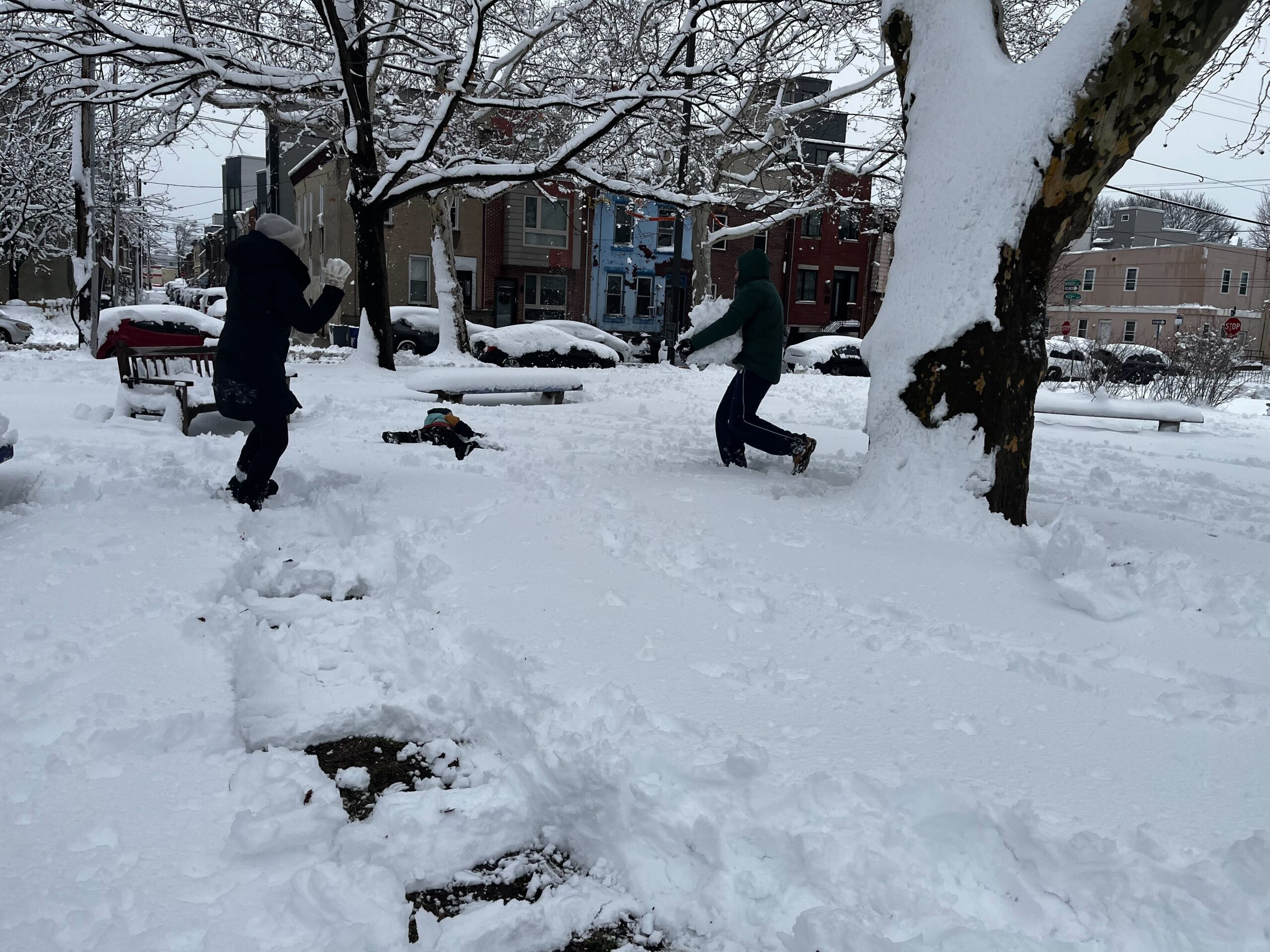
Sonia Odenthal (lft) throws a snowball at her son, Finn, while her husband Eric carries a giant snowball in Wharton Square Park Monday
On the other side of Wharton Square, Sonia Odenthal was having a snowball fight with her husband, Eric, and son, Finn. Despite trekking through the snow with a broken foot wrapped in a boot and water-proof bags, Odenthal couldn’t get enough of the snow.
“I’m Russian so this feels like home,” she said. “Even with a broken foot, I don’t care, I’m still out here. I love the snow.”
Philly’s snow accumulation is very reminiscent of her homeland, Sonia said, however, the temperature is much more reasonable. “A couple weeks ago when it got cold was very similar to home,” she said.
The trio will usually come to the park on snowy days for snowball fights or rolling snow into gigantic three-foot-high balls. The only thing missing in South Philadelphia is a good sledding hill, the Odenthal’s said.
Museums across the Philly region close due to snow
A griffin on the roof of the northern wing of the Philadelphia Art Museum.
Several major Philadelphia arts institutions have announced closures due to emergency weather.
Early Monday, the Philadelphia Museum of Art, the Franklin Institute, Philadelphia’s Magic Gardens, and Calder Gardens announced closures on their social media accounts.
The PMA said it’ll reopen on Tuesday.
The Mütter Museum, Rodin Museum, the Museum of the American Revolution, Independence National Historical Park, Otherworld Philadelphia, National Liberty Museum, the Independence Seaport Museum, have also announced closures.
Per their usual hours of operation, the National Constitution Center, Eastern State Penitentiary, Penn Museum, the Fireman’s Hall Museum and others are closed on Monday.
Multiple sections of the New Jersey Turnpike closed due to numerous accidents
Multiple sections of the New Jersey Turnpike are experiencing major delays and closures after a series of accidents Monday morning amid whiteout conditions.
Gov. Mikie Sherrill extended a travel ban through noon, citing visibility issues, though those restrictions exclude the Turnpike and essential workers.
In an interview with Fox 5 New York early Monday, Sherrill said plowers were “down to pavement” on the Turnpike.
Still, throughout the early morning, reports of disabled vehicles, cars spinning out of control, and crashes have lit up the state’s 511 map, which provides real-time traffic updates.
Around 8:20 a.m. a southbound tractor trailer jack-knifed along entrance ramp interchange 8A-NJ32 in South Brunswick, leading to an all-lane blockage.
Shortly after 9 a.m. two crashes, minutes apart, played out in inner turnpike roadways in Carteret. First a northbound vehicle crashed north of Interchange 12, leaving one of three lanes blocked. Shortly after, a southbound vehicle crashed along Interchange 12. As of 11:15 a.m., all lanes were blocked.
At around 10 a.m. a southbound vehicle spun out south of Interchange 8A-NJ32 blocking one of three lanes.
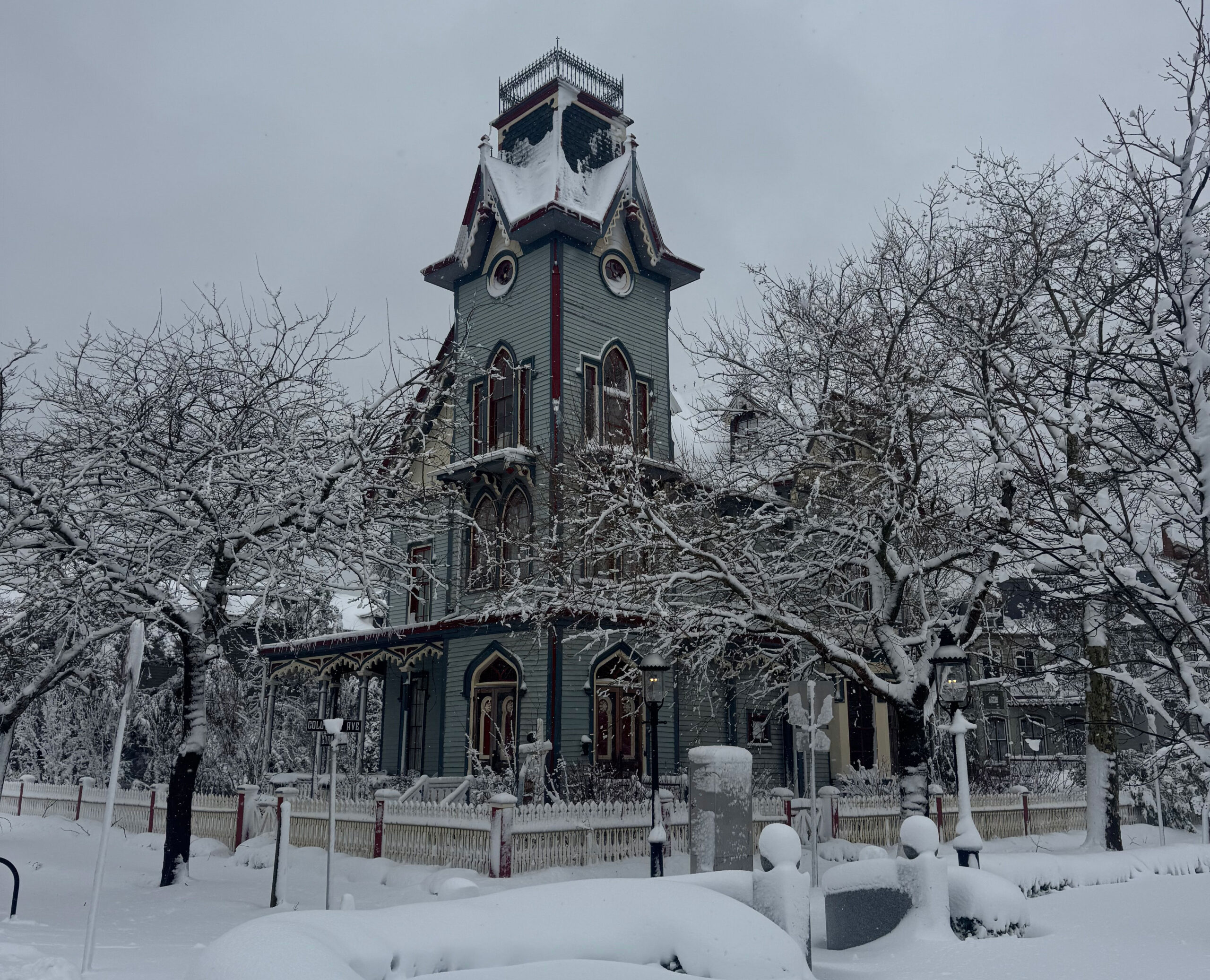
Cape May Mayor Zack Mullock said his coastal city of Victorian homes “looks beautiful” covered in the foot of snow that had fallen by Monday morning.
“It looks like a snow globe,” he said.
“We had a good amount,” Mullock said, speaking by phone, from atop a tractor, which he said he was using to help plow out some neighbors. “There’s a few individual homes where a tree took a power line. The tides were ok. We were a little nervous about that. Overall, I would say things are pretty good.”
He cautioned his residents about shoveling themselves. “We have a lot of elderly in Cape May who shouldn’t be shoveling.”
Updated snowfall totals from across the Philadelphia region
Residents of W. Stanton, Philadelphia clearing snow from cars and sidewalks Monday.
More than a foot of snow fell overnight across the Philadelphia region, though the Jersey Shore was hit hardest by a powerful winter storm that was still dropping heavy snow Monday morning.
Due to heavy snow bands, the totals varied widely. Ten inches of snow were recorded in Boothwyn Monday morning, while 15 inches dropped overnight in Mount Ephraim, Camden County.
Officially, 13.7 inches fell at Philadelphia International Airport as of 7 a.m.
window.addEventListener(“message”,function(a){if(void 0!==a.data[“datawrapper-height”]){var e=document.querySelectorAll(“iframe”);for(var t in a.data[“datawrapper-height”])for(var r,i=0;r=e[i];i++)if(r.contentWindow===a.source){var d=a.data[“datawrapper-height”][t]+”px”;r.style.height=d}}});
Here are the latest snowfall totals from the National Weather Service, measured by trained spotters or observed by the service itself:
Philadelphia
Philadelphia International Airport: 13.7 in (7 a.m.)
Cape May County hospital lost power briefly overnight
Cooper University Hospital Cape Regional in Cape May Court House lost power overnight in the storm “for a very short period of time” and reverted to its back up generators, said Cooper Health spokesperson Nancy Marano.
“It was fully on back-up emergency power so no services were lost,” she said.
Some Camden residents must boil water due to water main break
A water main break may pose a threat to the water quality in Camden Monday morning, American Water Contract Services said. As a precaution, some areas of Camden are under a “boil water” advisory while crews assess the water supply.
The water main break occurred at Ninth and Jefferson Streets on Sunday night. In response, American Water was advising all residents living between Ferry Avenue and Collings Road in Camden, which includes the Fairview, Morgan-Village, and Centerville neighborhoods, to not drink or use tap water until further notice.
The advisory will remain in effect until repairs are complete and water quality is tested to be safe.
Instead, residents should use bottled water or bring tap water to a rolling boil for at least one minute and let it cool before using, according to American Water. Boiling water kills bacteria that could be found in the water.
Boiled or bottled water should be used for:
Drinking
Preparing Foods/Cooking
Mixing baby formula
Washing vegetables/fruits
Making Ice
Brushing teeth
Washing dishes
Affected residents should throw away uncooked food, beverages, or ice cubes made with tap water on Sunday night or today. American Water also cautioned residents to not swallow water when showering or bathing.
The following measures are also recommended:
Rinse hand-washed dishes with a diluted bleach solution (one tablespoon of household bleach per gallon of tap water) or clean your dishes in a dishwasher using the hot wash cycle and dry cycle.
Do not use home filtering devices in place of boiling or using bottled water; most home water filters will not provide adequate protection from microorganisms.
Use only boiled water to treat minor injuries.
Provide pets with drinking water that has been boiled (and cooled).
With an official snowfall of 13.7 inches measured at Philadelphia International Airport, the city’s seasonal total bumped to 29.8 inches.
Among the 142 winters in the period of record, this one now is tied for 27th place, and also is the snowiest since 2018.
You may have noticed snow has been scarce in recent winters, and this also will be the first one since 2021 with snowfall above the normal, which is 23.1 inches.
Historically, totals have ranged radically from 78.7 inches in the historic winter of 2009-10 to nothing in the winter of 1972-73.
Photos: Heavy snow and wind bring down trees in Rittenhouse Square
Wet snow brought down trees in Rittenhouse Square in Philadelphia Monday. Several trees around Rittenhouse Square were taken down by the storm.
// Timestamp 02/23/26 9:08am
Amtrak cancels more than 30 trains, Keystone Service to resume at noon
Amtrak canceled more than 30 trains on its Northeast Regional and Acela train lines on Monday morning due to the snowstorm. Keystone Service has been suspended until at least noon.
Alerts went out at 4 a.m. announcing a slew of cancellations and advising riders to book the next available train. Amtrak will notify impacted customers directly. Customers whose trains are cancelled can rebook or request refunds, without penalties, on Amtrak.com, through the Amtrak mobile app, or by calling the Amtrak Care Center at 1-800-USA-RAIL.
Amtrak will operate 55% of planned service Monday on the Northeast Regional rail service, 33% of planned Acela trains, and half of the planned trains on the Keystone Service trains, when it returns at noon.
Northeast Regional carries thousands of passengers every day with Philadelphia and New York among some of the leading destinations, and the William H. Gray III 30th Street station among Amtrak’s busiest in the country.
‘Storm of a generation’: N.J. travel ban continues until noon, tree cutters ‘out in force’
A car stuck in the plowed snow on Pacific Avenue near Ohio Avenue in Atlantic City Monday.
Gov. Mikie Sherrill said Monday morning that New Jersey’s travel ban would continue until noon as white out conditions were making it difficult to see, especially on major roads like the Garden State Parkway.
“It was an early morning call,” she said, in an online interview with South Jersey weather forecaster Nick “NorEaster Nick” Pittman. “It was difficult to see the edge of the road where the guardrails were. We still have snow falling in a lot of parts of our state.”
She said more than 200,000 people had lost power across New Jersey, but that more than half of them had already had power restored. “which is pretty shocking given how horrible the conditions are.”
“They’re hiking in to some pretty clobbered areas of the state,” she said of the utility workers, 5,000 of whom had been “predeployed,” she said.
With heavy snow bringing down tbranches and trees, she said, “We have the tree cutters out in force.”
She said the magnitude and reach of the storm across New Jersey, with overnight blizzard conditions and the dumping of a foot or more of snow, was “generational.”
“I don’t think we’ve seen anything like this since 1996,” she said.
Coastal flooding in Atlantic City ‘underperformed in a good way’
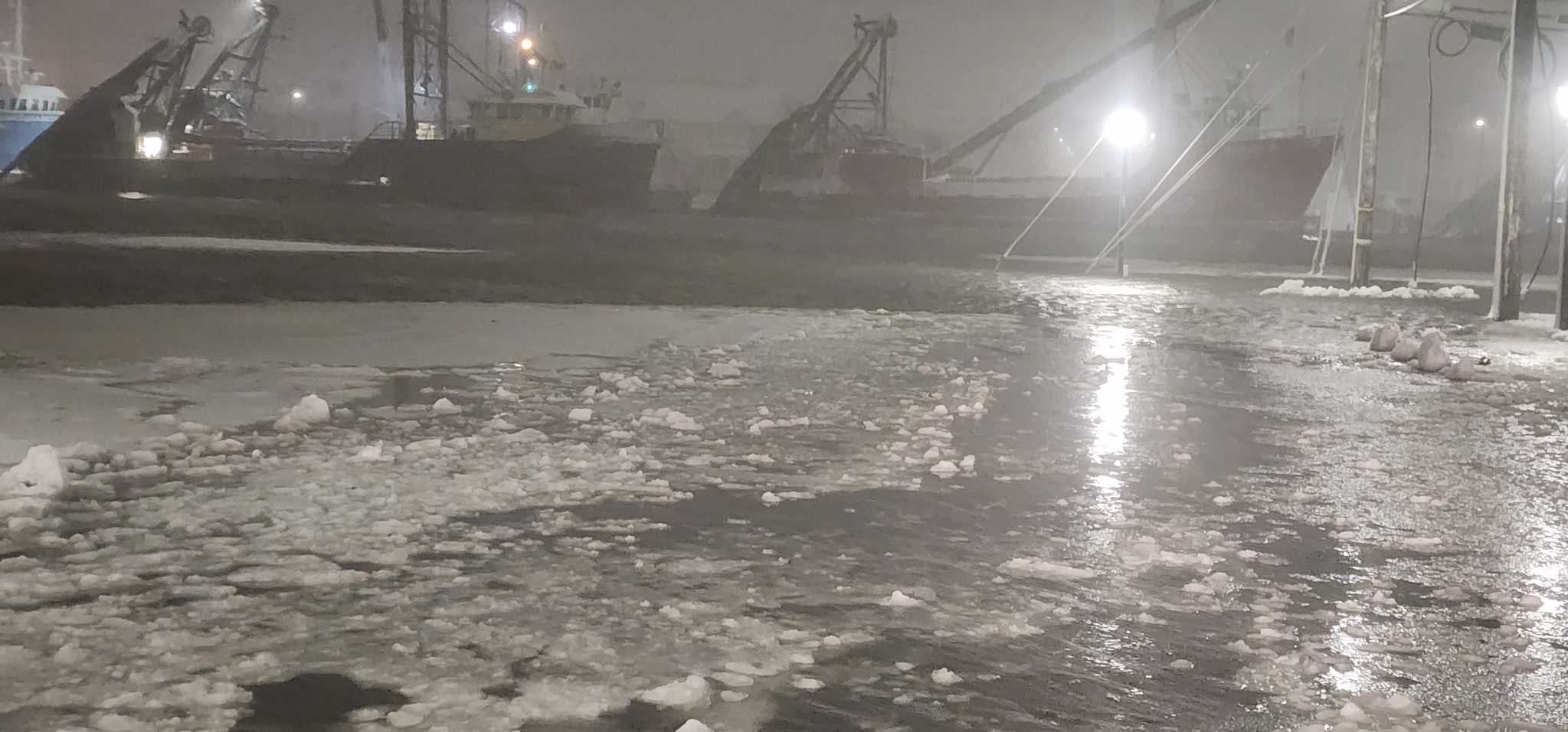
Ice floods onto the street along Massachusetts Avenue in Atlantic City overnight Monday, Feb. 23, 2026.
Scott Evans, Atlantic City’s Fire Chief and head of Emergency Management, said flooding in the coastal city was not as bad as feared. “The flooding definitely underperformed in a good way,” he said. “We’ll take it any day.”
He described it as “the low end of moderate” level of flooding, something Atlantic City is used to dealing with. The city had about a foot of snow by daylight, he said, with persistent high winds over night prompting numerous calls for “arcing wires.”
At the 11 p.m. Sunday high tide through around 2:30 a.m., there was about 8 to 10 inches of water in “some of our lowest lying areas,” he said, including Massachusetts Avenue, Bungalow Park and Lower Chelsea.
“We were expecting to get more,” he said in a phone interview Monday morning. “No significant problems.”
The city was still seeing the “residual ice” in the streets from the flooding, he said. Crews were out plowing streets, he said, and had mostly tamed the city’s famous Boardwalk. “They always have a team assigned to the Boardwalk,” he said.
He said he was not expecting any issues from the next high tide around 12:15 p.m. in the back bays.
Hundreds of flights canceled at Philadelphia International Airport
Airport crew plow snow during a winter storm in Philadelphia last month.
At Philadelphia International Airport, 604 flights had been canceled as of Monday morning, as snow blanketed the city. Another 42 flights were canceled for Tuesday, according to FlightAware, which tracks flights.
“Passengers should check on the status of their flights with their airlines—the airlines will also provide guidance on what passengers should do in the event their flights are cancelled,” said airport spokesperson Heather Redfern.
The airport also announced ticketing at Terminal A-West, B, and C and TSA checkpoints would be closed Monday.
Some 40 million square feet need to be cleared at the airport when snow falls, including on airplane runways and taxiways. The airport also has an additional 11.9 million square feet of space on roadways, ramps and parking lots.
While airplanes are deiced by the airlines, the department of aviation is required to ensure runways and taxiways are clear.
More than two inches of dry snow or half an inch or wet snow trigger closing a runway, according to regulations by the Federal Aviation Administration, noted Redfern. Even if flights are canceled by airlines or in the event that the FAA issues a ground stop, the airport does not close, Redfern noted in January ahead of another snowfall.
Snow will continue across the Philly area through the morning
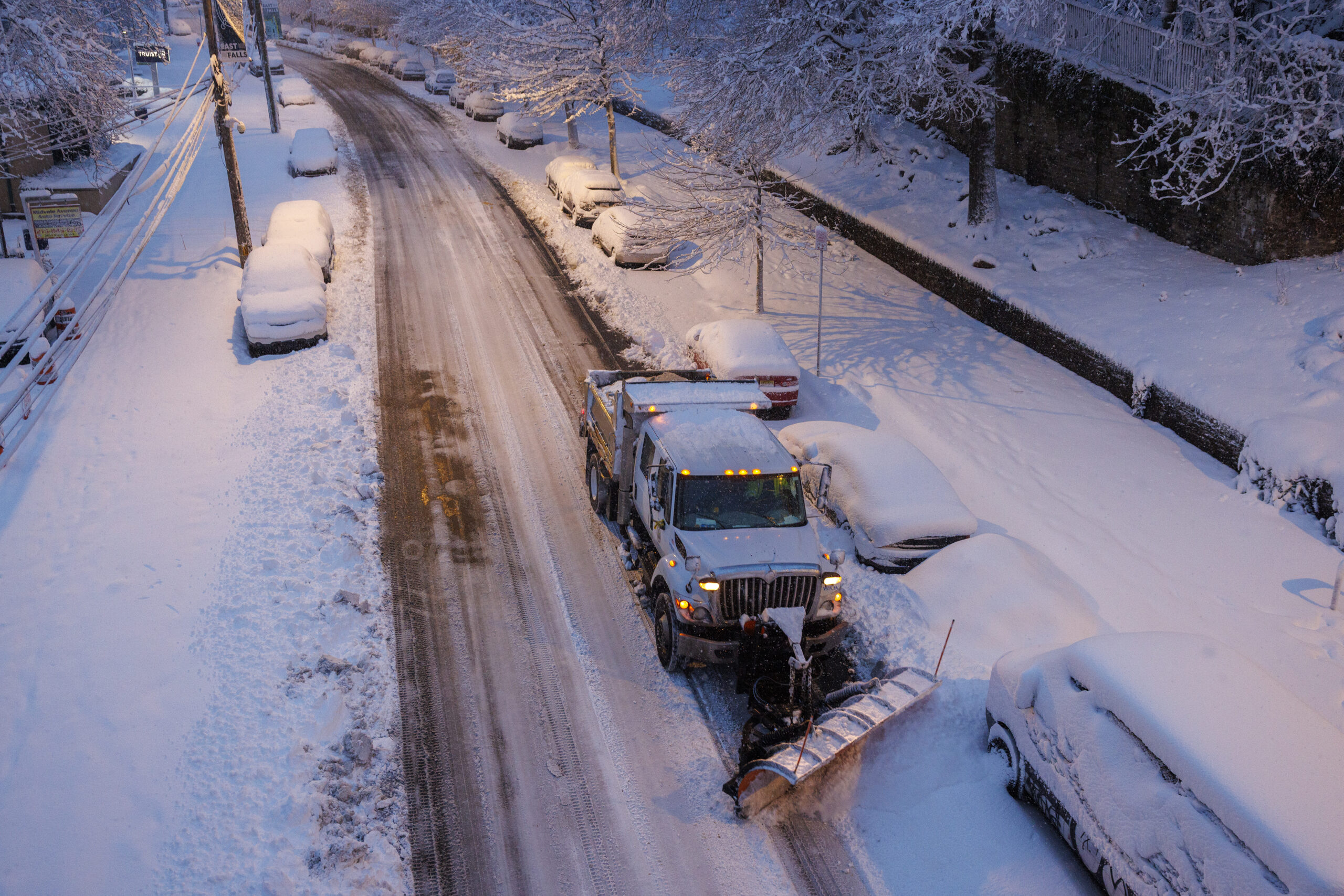
A Sanitation Department dump truck clears snow on Midvale Avenue in the East Falls section of Philadelphia Monday.
As much as a foot of snow fell overnight across the Philadelphia region as heavy snowfall from a massive winter storm continues across the Delaware Valley.
Due to heavy snow bands, the totals varied widely. Ten inches of snow were recorded in Boothwyn Monday morning, while 11 inches dropped overnight in Mount Ephraim, Camden County.
Snow will continue throughout the morning, with another 3 to 5 inches expected to fall in Philadelphia, according to National Weather Service meteorologist Sarah Johnson.
The highest totals are expected along the northern and central Jersey Shore, with the heaviest bands dropping as much as 2 inches of snow per hour or greater. Another 4 to 6 inches of snow is possible for Southern New Jersey and parts of Central and Southern Delaware.
At the National Weather Service’s Mt. Holly observatory, 18.5 inches of snow had fallen as of 5:15 a.m. Monday morning.
2:30 AM Monday: Near blizzard conditions at our office under the main snow band. We are now up to 14.0" of snowfall. Snowfall rates remain around 2" per hour under the band. Please do not travel if you are in the Blizzard Warning area! #NJwxpic.twitter.com/t8VCjczG2y
Snow is expected to taper off by noon, forecasters said, but strong winds and blowing snow will continue through at least 5 p.m., creating dangerous driving conditions. Wind gusts in Philadelphia could reach upwards of 40 miles per hour during the day.
One bit of good news: Tidal flooding isn’t expected along the Delaware River due to the direction of the wind, so it won’t be a concern for Philly or the immediate area.
Why have these storms been happening on the weekend?
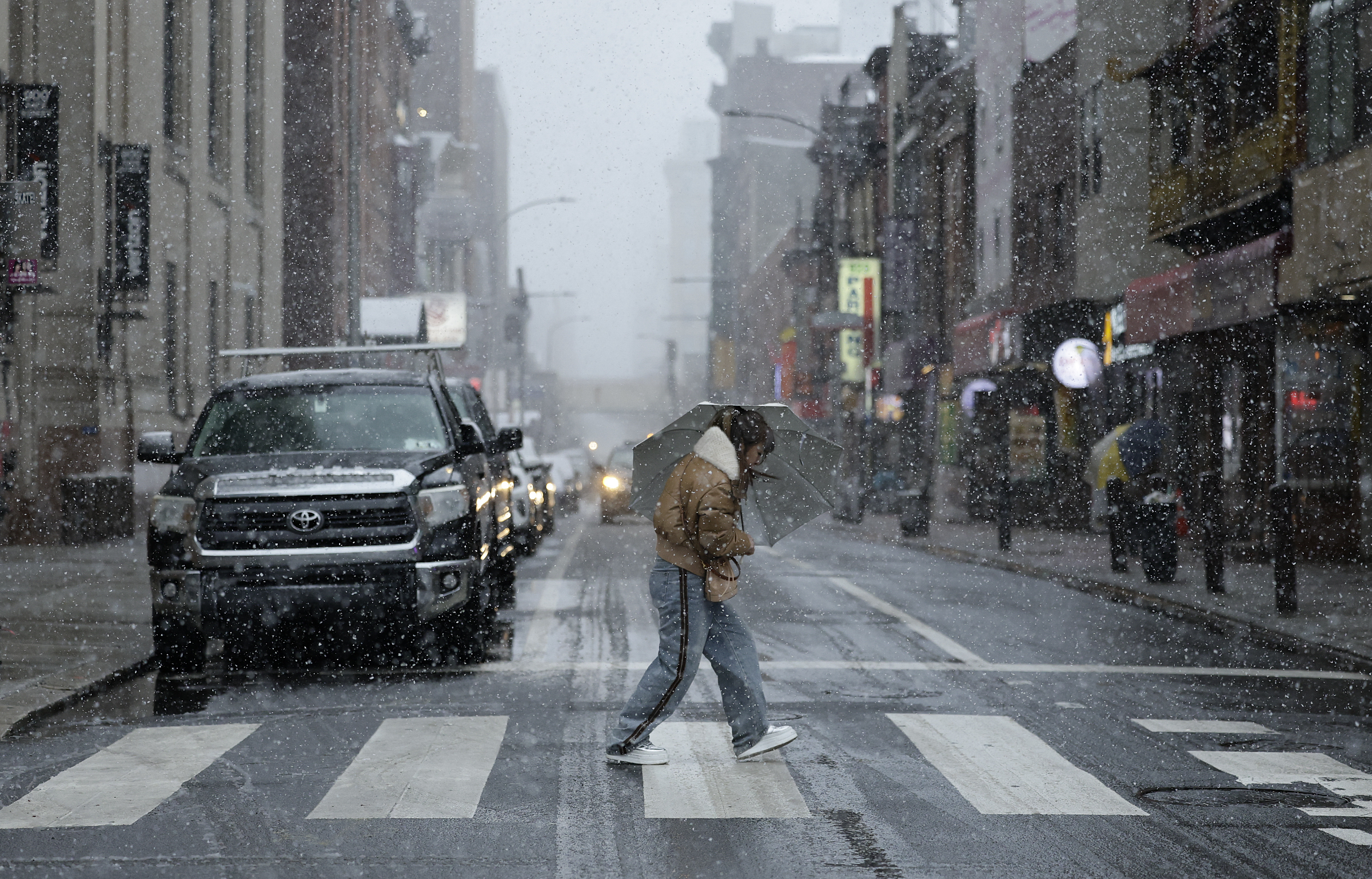
A pedestrian walks across Race Street in Chinatown Sunday.
If you perceive the atmosphere for whatever reason has a grudge against weekends, that’s understandable.
Precipitation has fallen on six of the last seven weekends, with snowflakes making appearances in all of them, most emphatically on Jan. 25, when 9.3 inches of snow and sleet balls accumulated, and then refused to leave.
The storm rhythm actually is a quite common one, meteorologists say.
It has to do with the spacing between weather systems. Sometimes they show up in roughly 3½-day cycles, taking that long to traverse the country, and often it’s the second one in the cycle that is the stronger storm.
Like so many things in the atmosphere — droughts, wet periods — they keep happening, until they don’t.
We’re probably about due for a don’t, but not this weekend.
On an icy, 13-degree Saturday morning in January, José Hernández sat in his pickup truck outside a Bensalem church, waiting for his phone to ring.
It didn’t take long.
Calls, texts, and emails have become constant, as Hernández, a machinist by trade, has become a crucial connection for many township residents who are living in the United States without official permission.
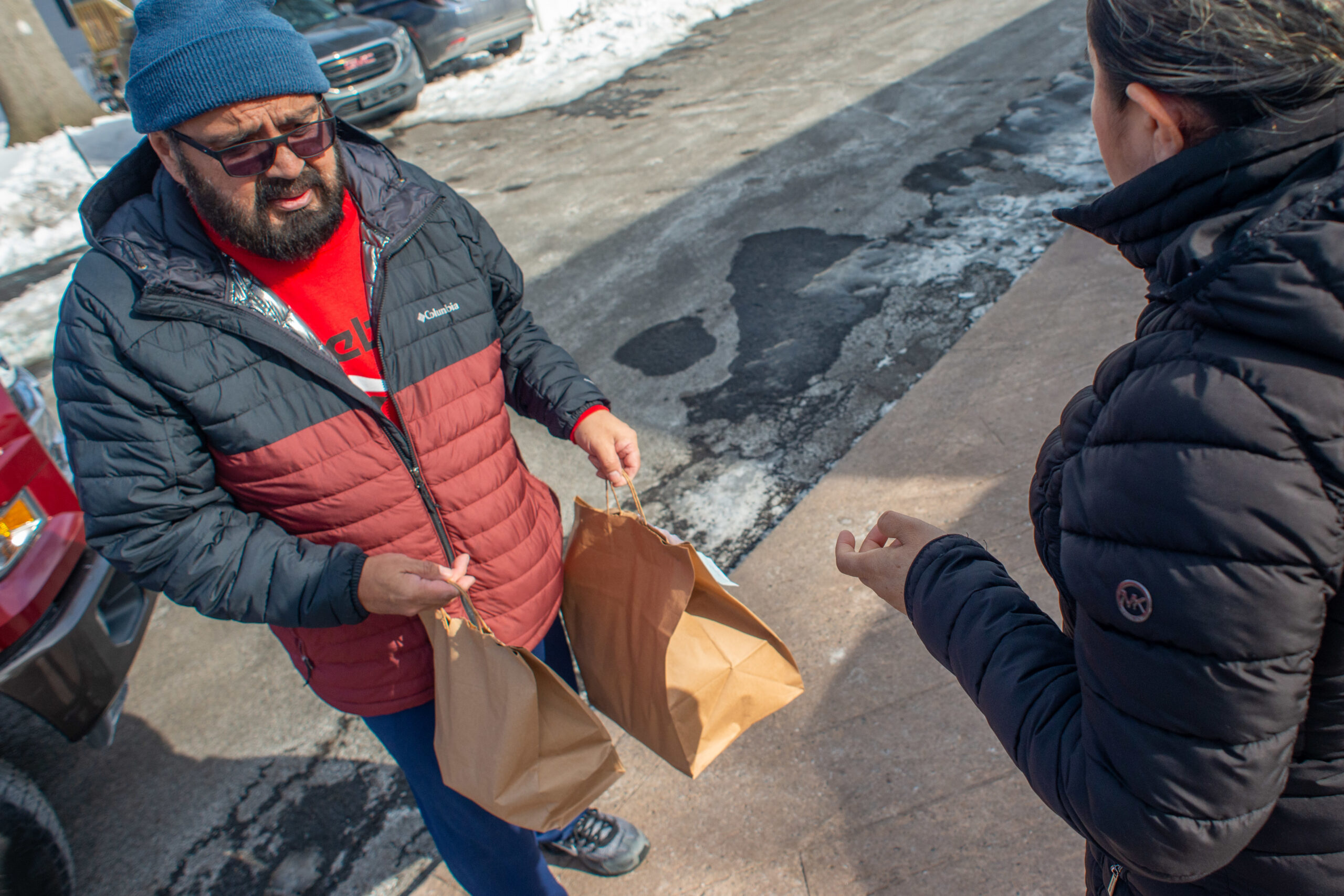
What started as a simple good deed, delivering groceries to a few people worried about attracting ICE attention, has for Hernández, 61, become a full-time, unpaid job. Worry has hardened into fear amid the Trump administration’s dramatic escalation in immigration enforcement, leaving some people afraid to leave their homes.
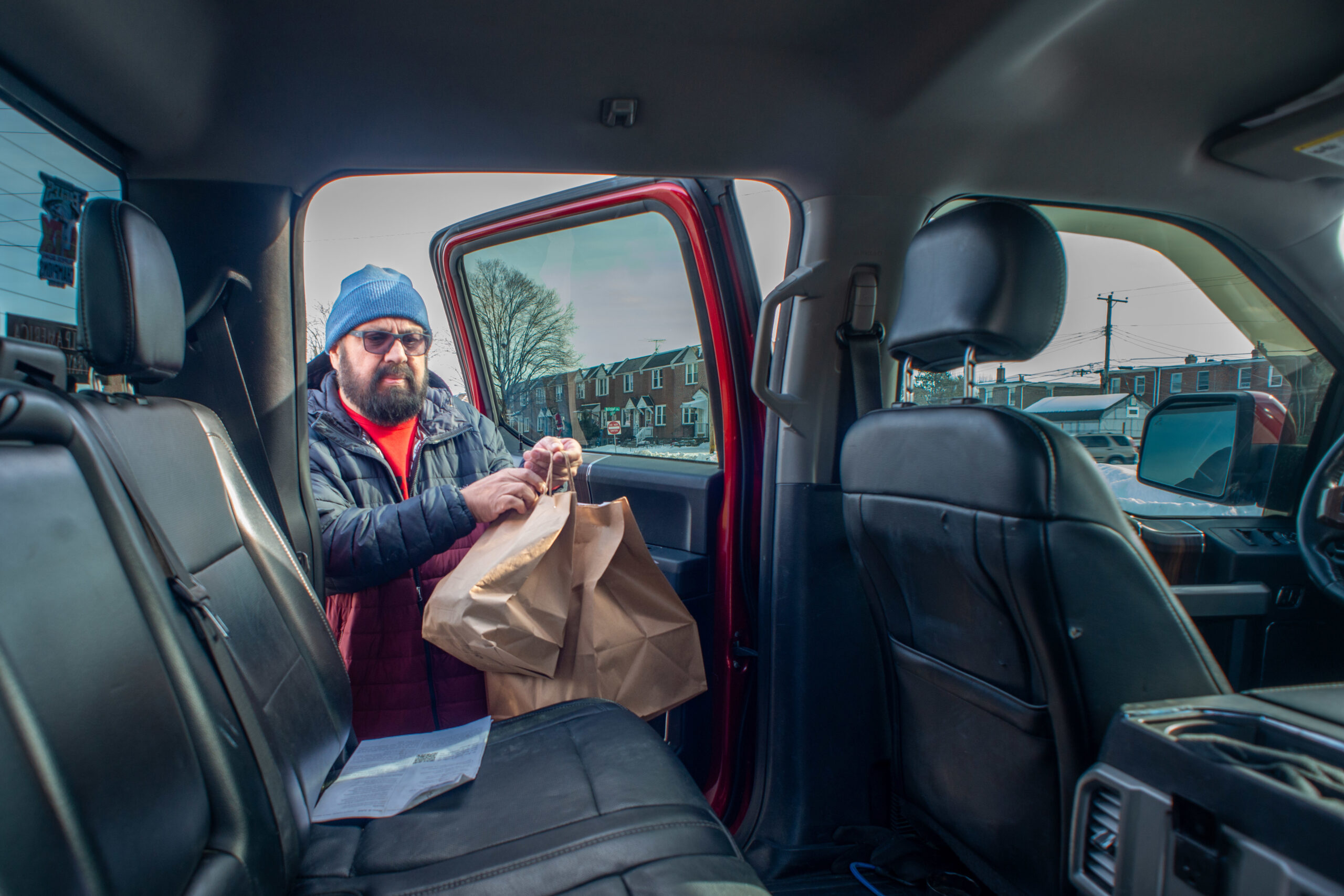
Hernández’s weekend rounds ― picking up people’s grocery orders at stores, bringing the food to their homes, always with a glance over his shoulder ― ensures sustenance for families for whom discovery would mean arrest, separation, and likely deportation.
About 14% of the Bucks County township’s 63,000 residents are Latino. Among immigrants, everyone has a friend or family member who has been arrested by ICE and not seen again. And many fear that they’ll be next.
Connie and Ivan came from Mexico over two decades ago. Fear of being detained by ICE has led them to turn to Hernández for food-delivery help.
“They come out to pick up their order and you can see the fear in their faces,” Hernández said. “Many people come out saying, ‘Please hurry up, los delHielo can be here any second.’”
That’s what some community members call ICE agents — los del Hielo, meaning “the iced ones.” There are other names too, like elEscalofrío (“the chills”) and los Helados (“the frozen ones”).
The nicknames come not from anger but from anxiety — fear that even speaking aloud the words Immigration and Customs Enforcement could summon danger.
“We try to only go out when the darkness of the night protects us,” said an Ecuadoran mother, 32, who declined to provide her name for fear of arrest. “It’s a false sense of safety, but we must hold on to it.”
Hernández recently delivered two bags of groceries and a birthday cake to her home, as her son was turning 12.
“When I am in school,” the boy said, “the only thing I think about is if dad will make it home today. I wait all day, and then he comes, and I am happy he is still here. I am learning that being an American means that I have to be worried for the people I love.”
A third of his immediate family ― an uncle and two cousins ― was arrested in November and December.
José Hernández works to deliver groceries to local undocumented immigrants.
Intensified ICE enforcement in the region and the nation has altered their lives ― exactly as the Trump administration intended when it promised to carry out the largest deportation program in U.S. history.
For undocumented residents, freedom is no longer guaranteed by living quietly, obeying the law, and staying off the government radar. Now, discovery of having entered the country without approval, a civil violation, often means the end of an American life built across years.
As a result, people are staying indoors.
Many have stopped going to the doctor. And to church. They keep their children home from school when news of ICE activity surges. Businesses have had to temporarily close when workers stay away.
ICE officials did not reply to requests for comment.
In 2025, the agency detained 307,713 people in the U.S. ― detentions closely mirror arrests ― compared to 93,342 in 2024.
That’s more than a 230% increase.
Today more and more of those arrested face no criminal charges, even as the Trump administration pledges to deport “the worst of the worst.”
Hernández uses his own money, earned from his job as a machinist, to pay for gas for deliveries.
Hernández didn’t plan to be doing this work, spending his weekends traversing Bensalem.
A decade ago he founded a group called Movimiento Guadalupano, a committee to organize Catholic activities. That grew into a broader support group for Latinos, and now he’s one of four volunteers who have become a central source of assistance and information on ICE activity.
“Don’t go out today,” the Movimiento website warned on a recent weekend. “Volunteers will deliver your groceries from Hispanic stores to your home free of charge.”
Hernández is a U.S. citizen, born in this country. He carries no fear of ICE, but plenty of worry that people in the Latino community will struggle without reliable food deliveries.
In the truck, Hernández’s phone rang.
Soon he was parked and walking through the doors of a Bensalem store stocked with traditional Mexican foods. He looked around, to be sure he wasn’t followed, but also so he could update Movimiento’s Facebook page if he saw ICE agents.
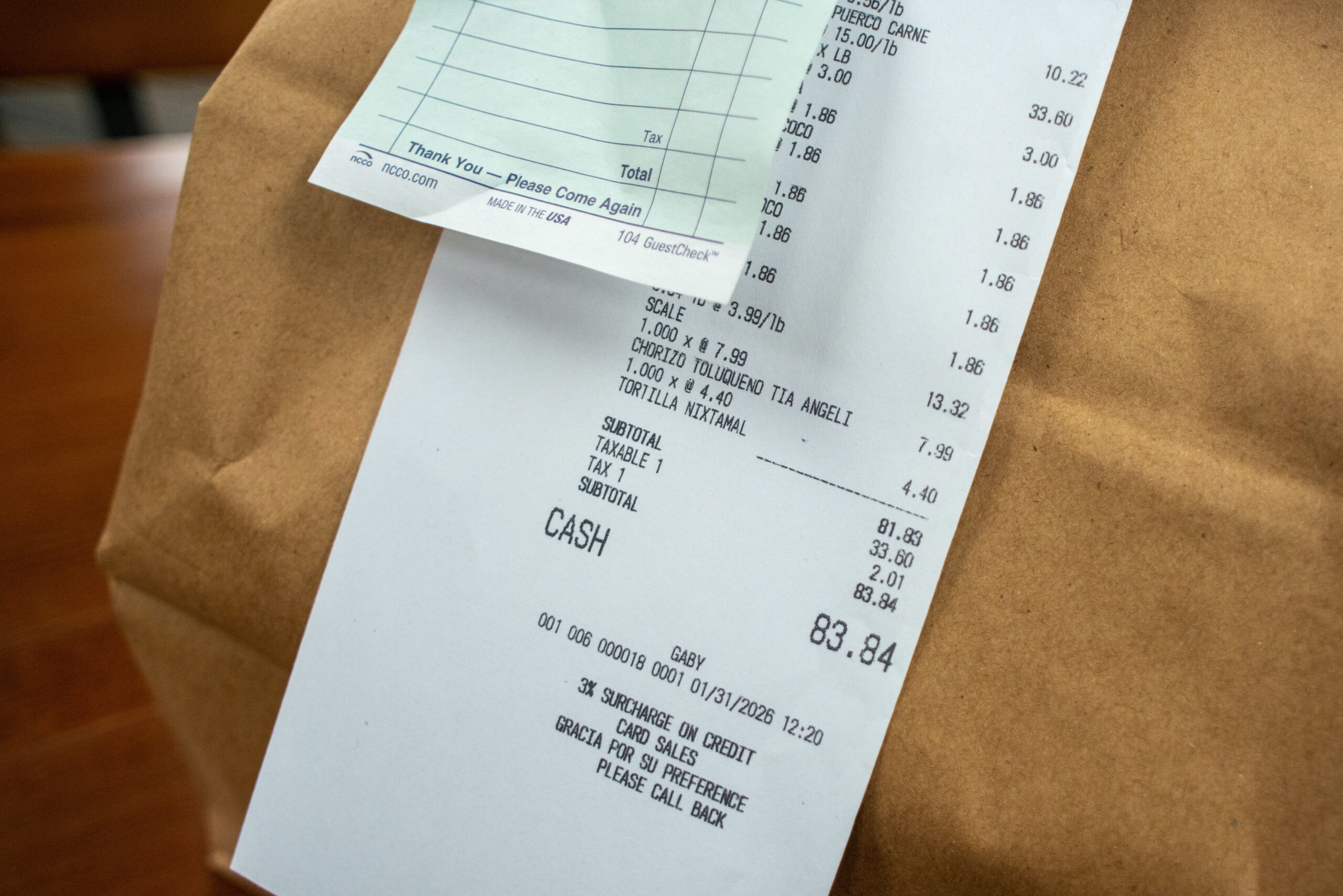
A married couple shopping at the store recognized him and said hello ― Hernández had brought groceries to their home, bags of chorizo, tortillas, milk, cereal, and coffee.
“Having the groceries delivered has been a huge relief,” said the man, Ivan, 44, who declined to provide his surname for fear of being identified to ICE. “We don’t have to choose between risking ourselves and feeding our children.”
Maira wasn’t acquainted with Hernández, as her sister usually delivers her groceries. A recent medical emergency made it impossible, and with her family of four running out of food, she dialed the number Movimiento listed for delivery.
Bensalem has been their home for 24 years, the couple explained, but their efforts to obtain legal status have failed. Meanwhile personal disaster has crept close.
In December, at a construction site where he worked, Ivan said, two coworkers left for lunch and never returned. He later learned they had been arrested by ICE.
“It’s just very difficult to be in a country that we know isn’t ours,” said Ivan’s wife, Connie, “but we love it as if it were.”
A clerk interrupted: Hernández’s food order was ready. He grabbed the bag and headed out, Ivan watching him as he left.
“He could be at home with his family, instead, he is helping,” Ivan said. “He brings a little bit of peace in this environment, like we still are a community.”
Ten minutes later, Hernández slowed his truck near a row of houses, looking for anyone who might seem like they were waiting.
A woman at a doorway froze when their eyes met.
“Did you order a delivery?” Hernández called to her from the truck, watching relief come over her face.
“You scared me,” she said, explaining that his car looked like one driven by a man who phones ICE to report people.
The woman, who asked to be identified only by her first name, Maira, because she worried about immigration enforcement, said her husband hasn’t left the house since late November, when he barely escaped an ICE raid at a Norristown construction site. She still goes to work each morning, once she and her sister, who is a U.S. citizen, check the Movimiento site for a safe route.
“I feel like crying all the time,” said Maira, 48. “I feel like a fugitive without having done anything, but I still have to keep working and paying taxes.”
A receipt attached to a bag of groceries that José Hernández will deliver to local undocumented immigrants in Bensalem.
After 25 years, she said, she thought she was part of Bensalem. That changed when a neighbor complained there were “too many cars” on Maira’s driveway when her sister visited. After that, she said, she stopped hosting family gatherings, concerned that the neighbor would call ICE.
Hernández handed her the groceries and turned to leave.
Maira tried to give him a $5 bill.
“No, no, no,” he said. “How can I be of help if I charge you?”
Hernández likes to think he brings more than groceries, that with him comes a kind word, a smile, and maybe even some hope. Don José, as folks call him, says his worry is not the weight of the bags or the length of the checkout lines in stores.
“I am scared,” he said, “that we will get used to this [ICE enforcement], that it will be so normalized that people stop helping one another.”
As the day wound down, Hernández’s wife phoned to see how he was doing. He drove to a nearby Walgreens pharmacy to check out a report that ICE agents were in the parking lot. They weren’t.
His phone rang.
“Hi, is this Don José?” a young man asked, apologizing for calling. “I really need your help with a delivery.”
“Don’t worry, place your order,” Hernández replied. “I will be right there.”
People are calling for the longtime Quakertown Borough police chief to resign, two days after videos emerged that appear to show him barreling into a crowd of teenagers, sustaining a barrage of punches, and grappling with a girl on the ground.
The incident happened Friday after about 35 Quakertown Senior High School students walked out of class to protest Immigration and Customs Enforcement (ICE). The school initially approved the walkout but canceled it for safety reasons earlier that morning. Quakertown Borough Police said it arrested five students and one adult after a scuffle with officers.
Police Chief Scott McElree and the police department have not responded to requests for comment over the weekend. But as videos of the incident have spread online, demands for answers and accountability have grown. Community members held a rally outside the police department Saturday morning. Hours later, the office of Bucks County District Attorney Joe Khan said that it is investigating the police response.
As of Sunday afternoon, more than 4,000 people have signed a Change.org petition, “Demand Chief Scott McElree’s resignation.” It’s not clear how many of the signers are locals.
“The video made me cry,” wrote a petition signer identified as Karen. “I know every one of those children. They were taught to trust the police. They were also taught to fight back against an attacker.”
Karen and other petition signers noted that McElree was not wearing anything identifying himself as a police officer in the videos.
Another petition signer, identified as Sora from Quakertown, said the students should be held accountable for walking out of class. But that didn’t justify McElree’s response.
“This protest got violent because the chief [of] police chose to start the violence, the students were ready to defend because they have seen everything happening in other states with ICE,” the commenter said.
“Once students left school grounds without authorization and walked into town … they were no longer under the district’s custodial control or supervision, and we have almost no legal ability to regulate or investigate their behavior,” Lisa Hoffman, acting superintendent of schools for Quakertown Community School District said in a statement Sunday night.
According to the Quakertown Borough website, McElree serves as chief of police, borough manager, and open records officer for the community. About 9,400 people live there, recent U.S. census numbers show. Quakertown is in northwest Bucks County about a half hour from Allentown.
McElree has served as both police chief and borough manager since 2007, according to news reports. He previously was a Whitemarsh Township police officer for about 30 years, according to his LinkedIn profile.
Contacted by phone Sunday, Quakertown Borough Council Member Michael Johnson said the council may discuss the matter at a work session set for Monday night at 7:30 p.m.
Johnson, who has earned accolades for his work as a local law enforcement officer, declined to say whether he was concerned about McElree.
“I’m going to wait to see all the video before I make any comments,” Johnson said.
Other council members and borough council president Donald E. Rosenberger did not respond to requests for comment Sunday.
Scant details are available about the teenagers’ status.
“These are juvenile arrests, and because of that, their files are shielded by the Pennsylvania Juvenile Act,” said Bucks County District Attorney’s Office spokesperson Manuel Gamiz Jr.
Due to a major storm expected Sunday night, Gamiz noted, the Bucks County Justice Center is closed Monday.
That could potentially delay the students’ legal proceedings.
Editor’s note: A statement from Quakertown school officials was added after publication.
Lincoln University at its board meeting Saturday announced new safety plans for large events after the on-campus shooting at homecoming last October that left one dead and six others shot.
No outdoor events will be permitted after dusk, and events will be held within “a controlled environment” so that guests can be screened, Lincoln University Police Chief Marc Partee told the board. The university will employ a zone plan for security with help from Chester County emergency management, the Pennsylvania State Police, and Lower Oxford Township, and at the upcoming Spring Fling event, only one registered guest will be permitted per student, Partee said.
University officials did not say at the meeting when Spring Fling would be held this year — Partee did not return a call for comment Sunday — but it’s typically in April.
“We’ve … cultivated those relationships that were sorely needed in this area so that we can do what we need to do and protect our students and keep the community itself happy about what we’re doing,” Partee said.
Lincoln, a historically Black university with 1,650 students in rural Chester County, has been under pressure from its neighbors and Lower Oxford Township to make changes since the Oct. 25 homecoming shooting. Several officials in Lower Oxford had reported ongoing problems with parking, trash on neighbors’ lawns, disturbances, and, in some cases, crime when the university hosts events. After thousands gathered for homecoming, emergency personnel had to use all-terrain vehicles to transport patients on stretchers because ambulances could not access the campus, given how many cars were parked around the venue, they said.
The township’s board of supervisors has been discussing a plan to enact a special events ordinance. A vote could come as soon as the supervisors’ March meeting.
Andrew Cope, who lived near Lincoln for nearly two decades and still owns property there, said Lincoln’s plan is “progress compared to past years,” but that concerns remain. He said there should be screening at the university gates, not just at the entry to an event, and that there was no indication as to how parking and trash will be managed.
A strong events ordinance is still needed with a permit process, he said.
“I am encouraged that we have seen a plan come out of the university,” he said. “I need to give them credit for doing something. I’m pleasantly optimistic … but I would still like to see some of the T’s crossed and I’s dotted.”
Partee said the new plans followed a meeting earlier this month between about 30 people from Lincoln, local and state law enforcement, emergency management, and the township. The Chester County district attorney and county detectives also participated, he said. And the collaboration will be ongoing, he said, as Lincoln plans for other events, such as homecoming
“We’re getting a lot more resources, a lot more collaboration,” Partee told the board.
But he said Lincoln ultimately has control over the plan.
“We’re not stepping back and saying, ‘We had this immense tragedy. Come in and take over,’” he said. “This is still our legacy.”
The plans also include input from the Student Government Association, he said.
Events after dark would be moved indoors, he said, noting issues that have arisen after dark at outdoor university events.
“What you’ll see is, and something that I saw, the crowd changed as the sun went down,” Partee told the board. “Our family started leaving. Other people started coming in.”
He noted potential sites for outdoor events, such as the auxiliary field with a fence.
“We’re able to control access to the fence, which means we can screen people coming in,” he said. “We have wands, all of these things that we can put in place to protect the event. We’re working on not having just a free-for-all because free-for-all gives people the impression that they can come here and do whatever they want to do.”
A sign for Lincoln University on its campus in Chester County.
He said events will be more structured, noting that students are talking about “zip lines and food trucks” for Spring Fling.
As for the zone security, Partee said his university police and security would man the “center ring” or “hot zone” for Spring Fling. The outer ring will be covered by Pennsylvania State Police, which have allocated 10 troopers that will be deployed in two-man teams, he said.
Other patrols will be stationed at areas outside the university gates to monitor illegal parking and other issues, he said. And Chester County, he said, has offered its mobile command post where cameras placed strategically around campus can be monitored and all radio communication can be patched together on one channel, he said.
“We’re going to have somebody dedicated to just watch cameras from Chester County Emergency Management,” Partee said.
For larger events, such as homecoming, more safety personnel will be deployed, he said.
“We’re able to scale it up and down,” he said of the plan. “Spring Fling will be our test case.”
It abuts an internationally famous garden. It may well be the most affluent community in the nation that hosts a prison, a source of some unwanted attention a few years back.
And, according to recently released U.S. Census data, picturesque Pocopson Township is in a rarified zone for wealth in the eight-county Philadelphia region, with an annual median household income of $230,000.
Chester County towns dominated the top 50 list in ananalysis of incomes in the region’s municipalities — compiled from self-reported American Community Survey data — calculated for the five-year period that ended in 2024.
But the analysis also showed that not only has Bucks County been gaining star power, some of its towns may merit the label “Big Bucks County.”
Legendary locale New Hope and neighboring Solebury — places associated with Real Housewives of Beverly Hills alumna Yolanda Hadid and actor Bradley Cooper — are among the towns that have made significant moves up the income chart, compared with the five-year period that ended in 2014.
Inflation-adjusted median annual incomes jumped 58% in New Hope, to $175,000. Incomes were up nearly 30% in Solebury, to $196,000,among the highest in the region.
The national median income was around $80,000, according to census figures.
Income figures are estimates, rounded to the nearest hundred, and are subject to margins of error. A total of 286 municipalities were included in the analysis; those with fewer than 2,500 residents were excluded. Here are some key findings.
window.addEventListener(“message”,function(a){if(void 0!==a.data[“datawrapper-height”]){var e=document.querySelectorAll(“iframe”);for(var t in a.data[“datawrapper-height”])for(var r,i=0;r=e[i];i++)if(r.contentWindow===a.source){var d=a.data[“datawrapper-height”][t]+”px”;r.style.height=d}}});
Chester County still has the wealthiest towns
Chester County towns held six of the top 10 spots, including Birmingham, adjacent to Pocopson.
The county evidently is rich in an amenity attractive to the wealthy — and to others.
“Chester County has been a leader in terms of the amount of land preserved,” said Andrew Svekla, Office of Smart Growth manager with the Delaware Valley Regional Planning Commission. “The availability of open space is an amenity that everyone is looking for.”
While the natural environment is an understandable attraction, not everyone who spends time in Pocopson comes for the green space: The Chester County Prison has been a mainstay in the township since 1959.
In August 2023, Pocopson and Longwood Gardens became international news when inmate Danilo Cavalcante escaped and set off a two-week investigative frenzy that mutated into a massive exercise of Where’s Danilo? He spent time hiding in Longwood and was eventually captured in South Coventry Township, about 20 miles away.
Otherwise, the likes of Pocopson and Birmingham have not exactly been centers of media attention, and the towns even have avoided the development-vs.-open-space conflicts that have erupted elsewhere, said Matthew J. Edmond, executive director of the Chester County Planning Commission.
“They aren’t in the path of growth,” he said. “These areas are off the beaten path.” The residents represent a mix of old and new money, he said.
He likened Chester County to a macro-version of Lower Merion Township, where neighborhoods vary from ultra-wealthy Gladwyne to the middle-class sections of Ardmore.
While overall the county has the highest median income in the state, “when you get down to the granular level, it’s a very diverse county,” he said.
Incomes in other counties in the region have grown
The overall picture of wealth in the eight-county region was quite a diverse one in the census survey, ranging from Pocopson’s median income to the $40,000 levels of Camden, the City of Chester, and Darby Borough.
But the preponderance of the higher incomes clearly were west of the Delaware River.
Jersey’s wealthier municipalities tend to be clustered in the New York metro area, Svekla said, and only six were on the top 50 list in the Philly region. They included Camden County’s Haddonfield, with a median income of$200,500, and Moorestown, at$160,000 anda favorite of professional athletes. They include ex-Phillie Nick Castellanos, onetime 76er Ben Simmons, Flyers legend Bobby Clarke, and former Eagle Terrell Owens, who famously drew media attention by doing push-ups on his driveway.
It also is the home of Kevin Patullo, the Eagles’ former offensive coordinator whose house was pelted with eggs in October after one of the team’s lackluster performances.
Haddon Heights and Haddon Township did not join Haddonfield in the top 50 but were high on the list of towns where incomes had grown substantially in the last 10 years.
Other places that experienced substantial paycheck bumps in the last 10 years included the Blue Route towns of Conshohocken and West Conshohocken. Both are close to I-476 interchanges and have experienced growth spurts in population and wealth since the highway connecting the Pennsylvania Turnpike to I-95 opened in the 1990s.
Bucks lags in population growth, but not wealth
Led by Chester County, population increased in all eight counties between the 2010 and 2020 census counts. “We’re growing mainly due to international immigration,“ said Greg Diebold, the Delaware Valley planning commission’s senior data analyst.
“Bucks has been one of the slower-growing counties,” he said, having added only about 4% to its population between 2010 and 2020.
In terms of median-income growthover the last 10 years, however, it had seven municipalities in the top 20, more than any other county.
window.addEventListener(“message”,function(a){if(void 0!==a.data[“datawrapper-height”]){var e=document.querySelectorAll(“iframe”);for(var t in a.data[“datawrapper-height”])for(var r,i=0;r=e[i];i++)if(r.contentWindow===a.source){var d=a.data[“datawrapper-height”][t]+”px”;r.style.height=d}}});
Not all the gainers were wealthy towns
One Delaware County town, Upland Borough, adjacent to the City of Chester and the location of part of the closed Crozer-Chester Medical Center, made the biggest-growth list with incomes up more than 40% to $61,000.
Bankrupt Chester itself, with one of Pennsylvania’s highest poverty rates, reported a 10% gain, to $41,000.
However, half of the 10 towns where incomes decreased the most were in Delaware County.
Speaking to the region’s overall prosperity, fewer than 25% of the 286 towns showed drops in income in the period that ended in 2024, compared with the five-year period that ended in 2014.
And only 20% this time around reported incomes below the national median.