Category: Pennsylvania News

  • ‘I’m on this roller coaster’: Philly teachers and school staff are stuck in limbo despite promises to save hundreds of jobs

    ‘I’m on this roller coaster’: Philly teachers and school staff are stuck in limbo despite promises to save hundreds of jobs

    When a deal was struck to save 340 classroom-based jobs in the Philadelphia School District, Mayor Cherelle L. Parker and Superintendent Tony B. Watlington Sr. declared it “Christmas in June.”

    It’s July now, but manystaffers still don’t have clarity on exactly who’s allowed to come back to positions that were almost cut and how that affects vacancies system-wide.

    “It’s a mess, and it’s getting messier,” said Alison Andrawos, a teacher at Potter-Thomas Elementary in North Philadelphia who accepted a job in another district after learning this spring that her position would be cut and still doesn’t know whether it will be restored.

    Monique Braxton, the school district spokesperson, said the system is “moving forward with restoring the approximately 340 school-based positions approved in the revised budget,” but that staffing the positions is separate from restoring them.

    “We have been meeting with our union partners on implementation and are now working with principals on school staffing,” Braxton said in a statement. “All approved positions will be restored in the district’s budget system by Wednesday, July 9.”

    The complex process is causing additional uncertainty for teachers and staff members and prolonging an already tumultuous hiring season as the district deals with fallout from 17 forthcoming school closings and the back-and-forth over millions in cuts stemming from a $300 million district budget deficit.

    Watlington this spring directed school principals to build their 2026-27 budgets factoring in the cuts, including about $50 million in school-based trims and the elimination of 340 classroom jobs. Parker then proposed a $1-per-trip rideshare tax she said would cancel the classroom cuts, but City Council balked, and for a time, the position losses appeared inevitable.

    After a breakthrough with city officials on June 10 — after the district’s deadline to pass its 2026-27 spending plan — officials triumphantly said the cuts were off the table.

    But restoring the positions was always going to be complicated.

    Schools’ hiring timeline means that many of the teachers, counselors, and climate staff who were told they were going to be force-transferred because of the cuts sought and found new jobs over the past few months, either inside the district or elsewhere. Now, those workers either must rescind their acceptance of those new jobs or say “no thanks” to returning. Either way, that creates new vacancies in July, months after most schools have filled jobs and when many people are on vacation.

    “We haven’t heard whether our positions are going to be reinstated, we don’t know what positions are available, and we don’t know what we’re doing in a few short weeks,” said Andrawos, an English as a second language specialist who began teaching in Philadelphia schools in 1997.

    ‘I’m pretty sure I’m going to be leaving’

    Andrawos said she didn’t want to leave the city, but amid the worry of the past few months, she felt she had to explore jobs outside the district. Andrawos has been offered a position at a Delaware County school that comes with a raise and a shorter commute.

    “I’m pretty sure I’m going to be leaving the School District of Philadelphia because of this,” Andrawos said.

    She said the decision is tough — she’s forged real bonds with her students’ families, and has been fielding messages saying they hope she stays at Potter-Thomas.

    It’s not clear whether Andrawos’ position at Potter-Thomas, in North Philadelphia, will be restored because of the complicated way budgets are built, and the latitude principals have to shift positions based on school need and their own judgment calls.

    Jobs are filled in city schools two ways — first, by a process called site selection, where principals hire any candidate they choose for open positions. Once the site selection window closes, district staff without positions choose from among open jobs in seniority order. Site selection closed weeks ago; force transfers without jobs have had their hiring sessions pushed back multiple times so far, and are still waiting.

    Jane Roh, a spokesperson for the Philadelphia Federation of Teachers, said the union notified members June 19 that all positions cut due to the deficit would be restored; the PFT was told that district notifications to affected employees would immediately follow. So far, that has not happened.

    That leaves staff sweating and frustrated by a lack of answers, some said.

    A roller coaster

    One K-8 teacher, who asked that his name be withheld because he feared repercussions, was on the force transfer list because of budget cuts. With no notice that’s being walked back, he’s left with the possibility of having to get emergency certified to teach in another subject area, which would mean taking more courses.

    The uncertainty is tough, and the answer to every question posed to the district and the union so far has been, we don’t know yet.

    “For this whole summer, where teachers are supposed to have the space to reflect and rest and plan, we can’t do that to any degree,” the K-8 teacher said.

    A teacher at a district high school, who also asked to remain anonymous because her employment situation is not settled, is in a similar boat. When her position was cut because of the deficit, she site selected into a job at another district high school.

    The process has been frustrating, she said. She once got an email saying her transfer was canceled, but that turned out to be incorrect, though she never got official notice from the district about its error and had to make calls herself to figure it out.

    When Parker and Watlington made their good-news announcement, she had no idea what to make of it. She still doesn’t, the teacher said.

    “I’m on this roller coaster; I literally don’t know which school I’m going to work at in the fall,” said the high school teacher, who would be teaching different classes, depending on where she lands. “I want to prepare for the upcoming school year, and that’s impossible if you don’t know what you’re teaching.”

    Staff at Olney High, the district school perhaps most affected by budget cuts, have been pressuring the district, publicly and in private, to halt the losses planned for their school — Olney had been slated to give up 17 staffers.

    The school had been overstaffed four years ago as it navigated a complicated, unprecedented transition from a charter school back to a district school. It has soared, adding programs and opportunities and building a strong school culture; the community fears weathering steep staff cuts would jeopardize its progress.

    Sarah Apt, a longtime Olney teacher active in the pushback against cuts, said Wednesday that the school was told it’s getting back three of its 17 staffers.

    “We’re happy about that, but still fighting for more,” said Apt.

    Among those still in limbo is Eric Baker, an Olney English teacher who’s been struggling with the back and forth, and the possible implications for the school he’s come to love — the school recruited students for a college prep track that’s potentially losing most of its teachers, including Baker.

    “Because of this uncertainty, I’ve had to interview other places. I don’t know where I’m going to go. I would rather have the certainty of knowing where I’m going to work than having to deal with this,” said Baker. “It’s been frustrating.”
  • What will Media look like in 2035? The borough is planning for diversified housing options, safer streets, and more retail

    What will Media look like in 2035? The borough is planning for diversified housing options, safer streets, and more retail

    What are the defining characteristics of Media, and how should the borough plan for the next decade?

    Those are the questions at the core of “Media 2035,” the comprehensive plan adopted by Media’s borough council last month designed to shape the next chapter of land use, housing, economic development, traffic planning, and environmental decision making in the 5,900-resident Delaware County community.

    “A comp plan is a long-term vision of how a community can look in the future,” Brittany Forman, Media’s borough manager, said.

    The 166-page plan, built on feedback from around 500 residents, is centered around four guiding principles: Preserving Media’s character, fostering inclusivity through housing diversity, preserving the environment, and becoming a more connected and less car-dependent borough.

    Municipalities in Pennsylvania are required to have a comprehensive plan under the Pennsylvania Municipalities Planning Code and must review them every 10 years.

    Media’s leaders have been tasked with stewarding a borough that has seen immense economic growth in recent decades, transforming it from a sleepy town wrought by financial disinvestment and crime to a cultural hub and destination for families settling in the suburbs. While Media’s metamorphosis has brought new residents and investment into the borough, it has also pushed the community’s limits around housing affordability, traffic, and growth.

    “We’re a victim of our success, and it’s a good thing to be a victim of your own success,” said borough Council President Mark Paikoff. “But careful planning really is helpful.”

    Here are four key takeaways from Media’s comprehensive plan.

    Media’s charm has made it a desirable, and increasingly unaffordable, place to live

    Surveyed residents said Media’s “small-town feel,” including its historic architecture, walkability, and diverse local businesses, is the borough’s most important asset. Yet the traits that make Media a great place to live have also made it a harder place to afford to stay.

    “For generations, Media has prided itself on being ‘Everybody’s Hometown,’ a motto that reflected a genuine reality: a community where wealthy professionals, hourly service workers, young families, and retirees lived side-by-side,” the comprehensive plan states, adding that economic diversity was made possible by a “varied housing stock that offered entry points for people at every stage of life.”

    As demand for walkable, transit-accessible living has surged in the Philly region, rising real estate costs are chipping away at this accessibility, creating a “severe burden” for a large segment of Media, notably seniors, teachers, nurses, and first responders, the plan states.

    Recommendations outlined in the plan include deepening partnerships with affordable housing agencies, updating the borough’s zoning code to spur housing development in key areas, and promoting non-traditional housing options like in-law suites. Officials said there’s a significant opportunity in converting underutilized office spaces into housing, as many of Media’s vacant offices are already located in former residential properties.

    Paikoff said the borough has had informal conversations with developers who are interested in both renovating older units and building new housing, though he stressed that bringing additional housing to the borough “will take some time.”

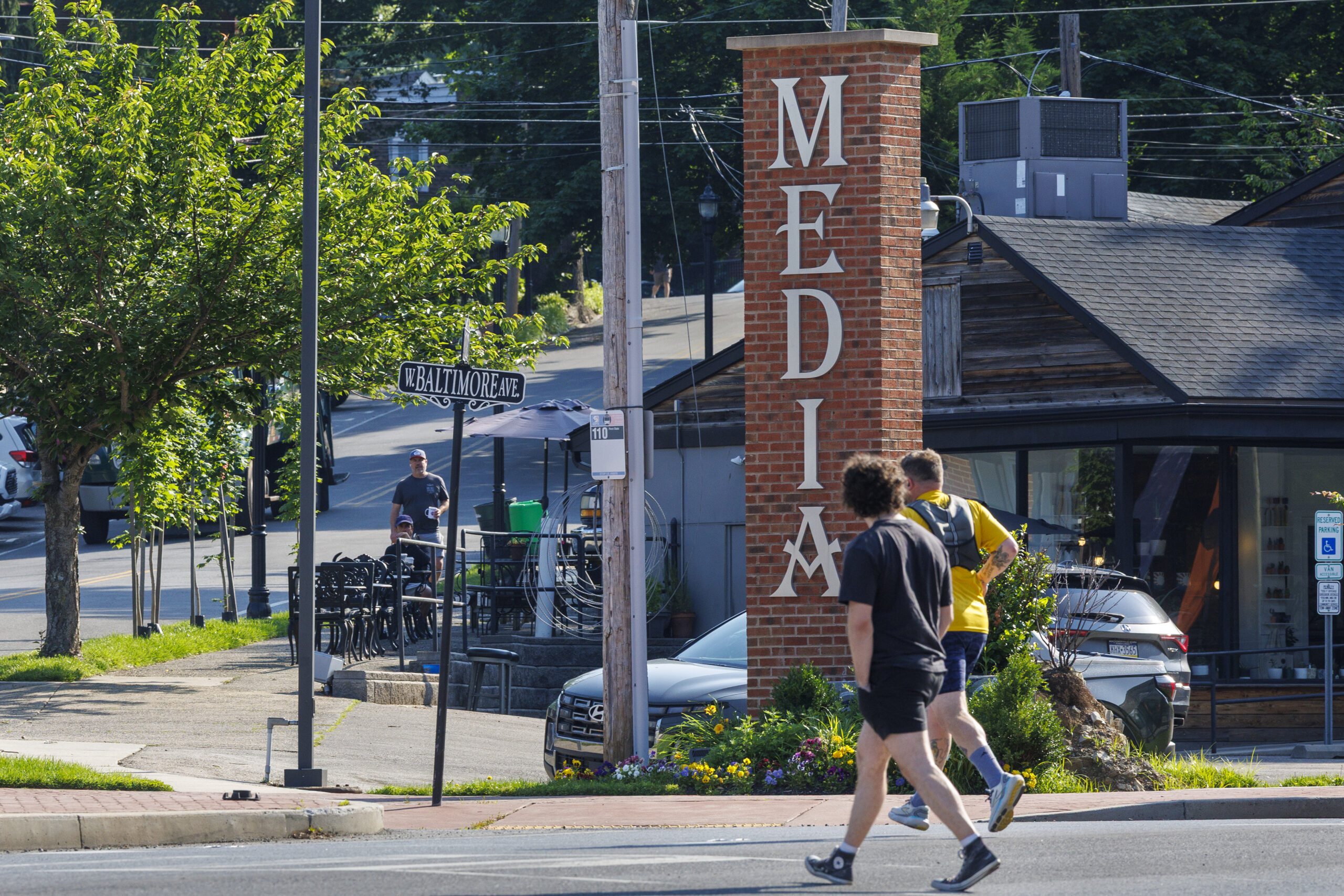
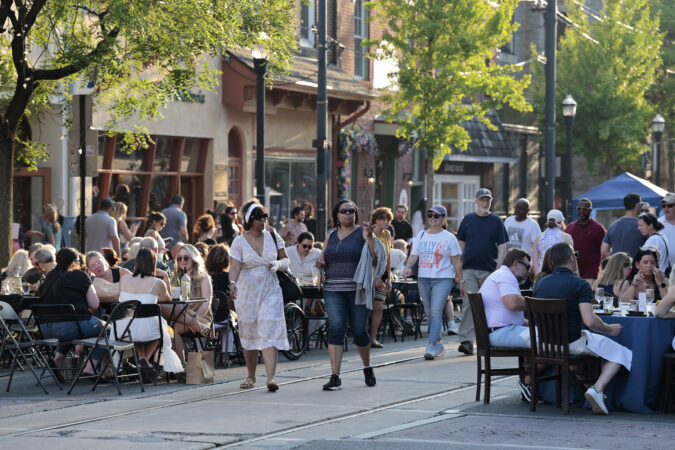
    Downtown Media on a June day.

    Media has strong transit access but ample traffic safety challenges

    Media is defined by its density. The borough’s footprint is under one square mile, and it’s a place where pedestrians, cyclists, cars, buses, and SEPTA trolleys regularly interact.

    “For a small town, I’d say we’re very sophisticated in terms of multimodal transportation,” said Forman.

    Yet Media’s density and busy streets have also created the conditions for traffic safety issues. The borough recorded eight vehicle crashes resulting in serious injury and two resulting in death between 2013 and 2024. A 2020 traffic study conducted by the borough found that drivers regularly speed, especially along Baltimore Avenue, and roll through stop signs. Media’s only bicycle infrastructure comes in the form of painted road markings. Residents expressed a desire for more crosswalks, less disruptive downtown traffic patterns, and protected bike lanes.

    Parking, too, remains a “source of friction.” The Baltimore Avenue parking garage is the anchor of the borough’s parking system, but it’s aging and requiring increased maintenance. At the same time, a surge in food delivery services has led to frequent double-parking outside of restaurants and blocking travel lanes. Media’s current parking and loading setup, the plan states, is “largely organized for a world that no longer exists.”

    The vast majority of Media’s workforce lives outside the borough

    Nearly all workers employed in Media commute from outside the borough. Of the approximately 9,800 primary jobs in Media, only 2.5% are held by residents. While Media’s accommodation, food service, healthcare, and arts and entertainment sectors have grown, its office administration, public administration, and wholesale trade sectors have shrunk. Overall tax revenues have increased in the past decade, led primarily by a growth in earned income tax revenues.

    The post-pandemic shift to hybrid and remote work has also “fundamentally altered” travel behavior in the borough, according to the plan. Twenty percent of Media residents worked from home in 2023, up from 3% in 2014, according to estimates from the U.S. Census Bureau. With fewer residents and workers commuting on a daily basis, traditional 9-to-5 traffic on SEPTA’s Regional Rail and trolley lines has shifted, following regional and national trends. Local neighborhood activity, on the other hand, has increased during the workday.

    Elizabeth Romaine, borough council vice president, said local businesses are already shifting to meet new consumer patterns, extending their hours or opening on weekdays when they would have previously been closed.

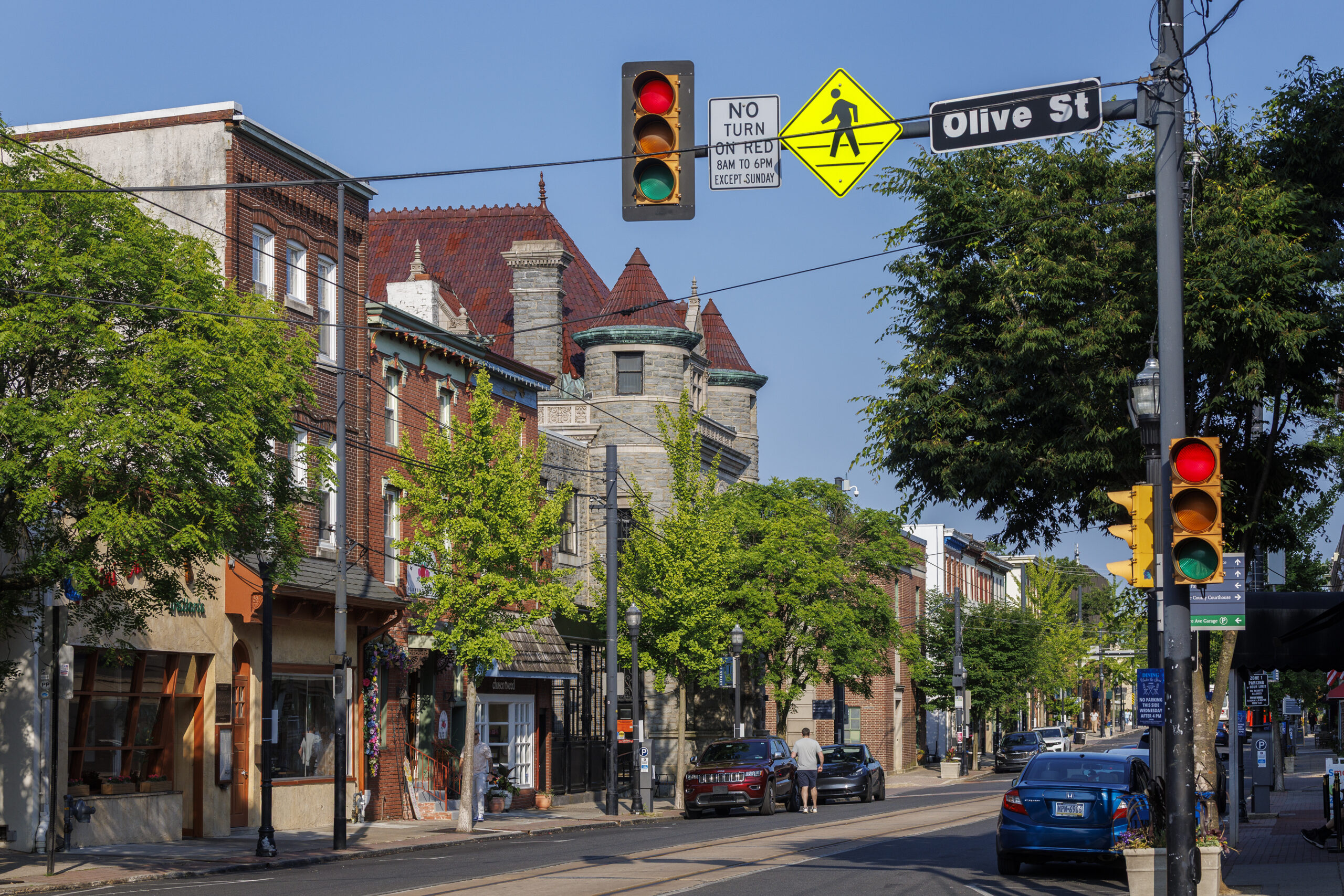
    The intersection of W. State Street and Baltimore Pike in Media.

    Residents love Media’s dining scene, but want more retail options

    Nearly 80% of surveyed residents reported satisfaction with Media’s vibrant restaurant scene, which draws diners from across the region. Media’s downtown is viewed as the borough’s “defining economic and social heart,” according to the plan.

    At the same time, residents expressed desire for a greater variety of retail, dining, and entertainment options. Non-food destinations and stores that fulfill everyday needs, specifically bakeries, clothing and home goods stores, and fitness centers, are outlined as particular areas of need.

    Romaine said Media has had some recent “retail successes,” like the opening of Sonny’s Vintage Clothing on State Street and the expansion of craft store Homesewn.

    The plan recommends increasing funding for the Media Business Authority, conducting a business-focused parking study and crosswalk inventory, and working to court new retailers. Recommendations also include enhancing programming at the Media Theatre to generate more foot traffic, deepen Media’s identity as a cultural destination, and “further solidify Media’s draw for visitors from across the region.”

    This suburban content is produced with support from the Leslie Miller and Richard Worley Foundation and The Lenfest Institute for Journalism. Editorial content is created independently of the project donors. Gifts to support The Inquirer’s high-impact journalism can be made at inquirer.com/donate. A list of Lenfest Institute donors can be found at lenfestinstitute.org/supporters.

  • A cow beauty pageant honors rural Pennsylvania’s shrinking dairy industry

    A cow beauty pageant honors rural Pennsylvania’s shrinking dairy industry

    TOWANDA, Pa. — Her full name was Cashells Jry Shakira-Red-ET — Shakira to keep it simple — and like her namesake, the big red and white Holstein had 6-foot hips that didn’t lie as she hoofed down Main Street.

    Shakira is a showgirl accustomed to winning, one of the few cows that allowed judges to place a floral crown on her head at the Bradford County dairy cow beauty pageant in Towanda on June 20, about 100 years after their last one.

    “The most beautiful dairy cow in Bradford County, folks,” said Duane Naugle, Bradford County’s community planner and the day’s emcee.

    A heifer is walked down Main St. in front of the County Courthouse in Towanda, Pa., for a cow beauty contest held on Saturday, June 20, 2026.

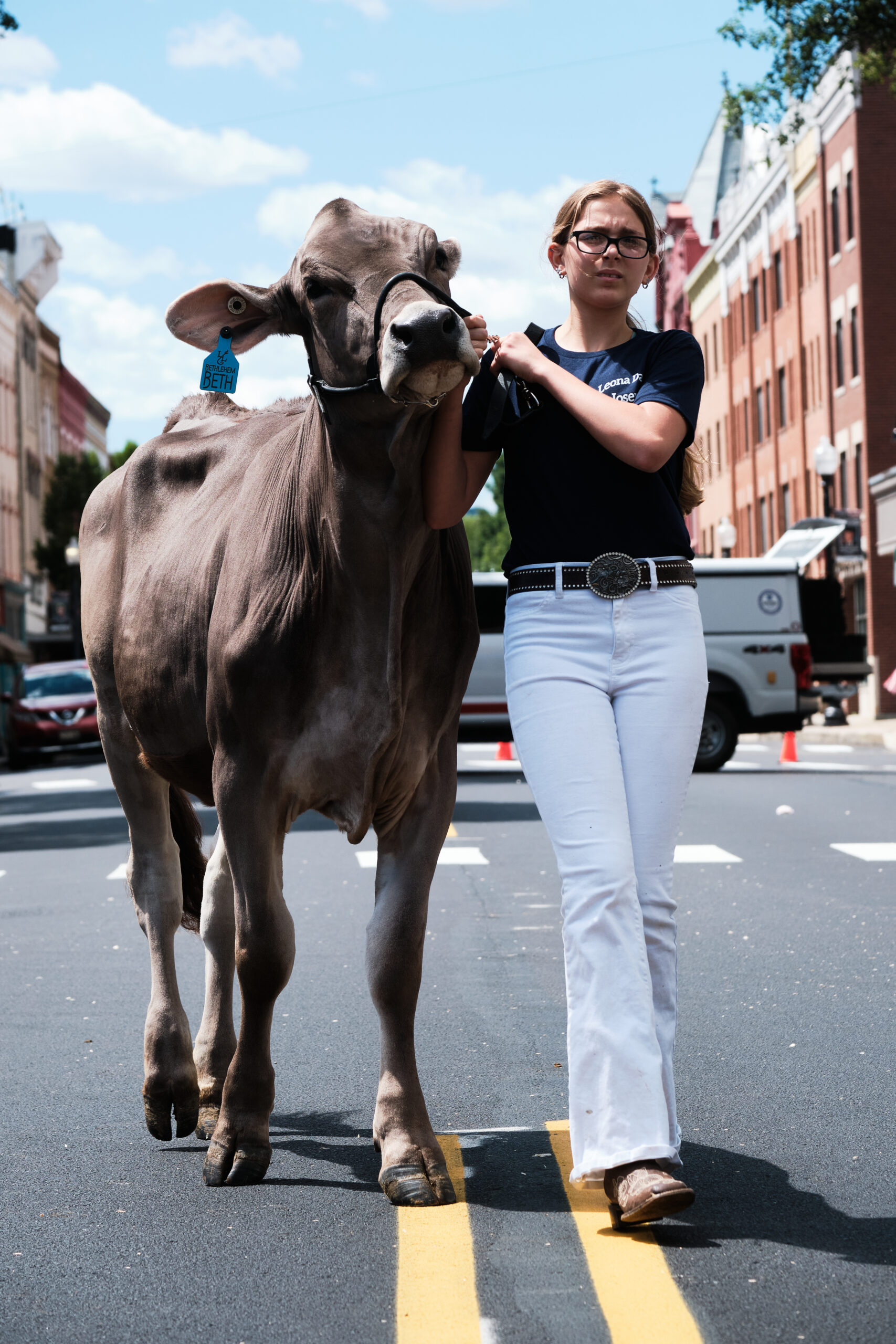
    Other winners were Skylar, a Lineback heifer, and Camo, a doe-eyed Brown Swiss calf.

    “They’re my favorite breed. They’re just so dopey and docile,” Miranda Neville, a dairy farmer out of Warren Center, said of Camo. “I mean, just look at her.”

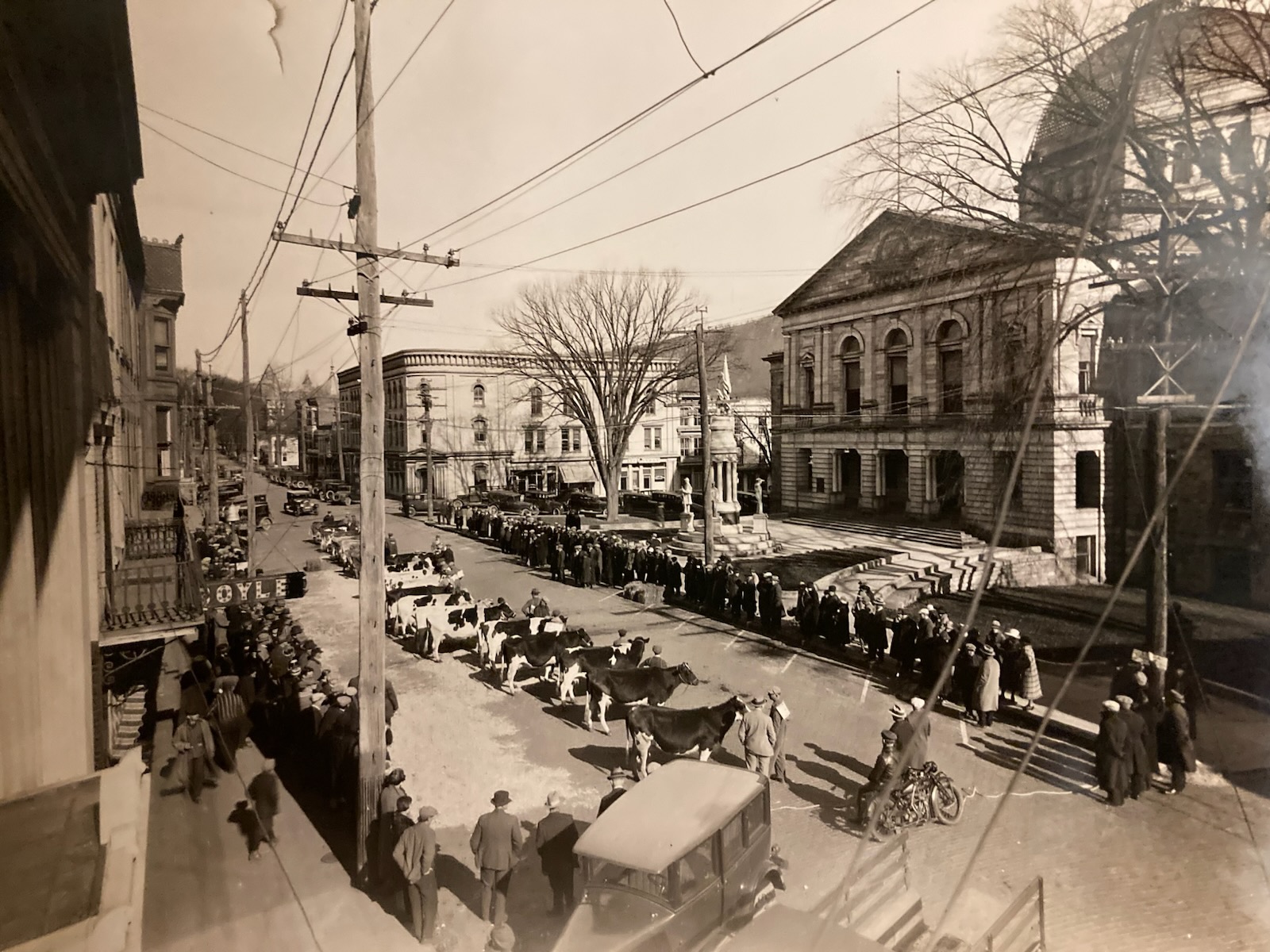
    Bradford County, population 59,600, sits about 175 miles northwest of Philadelphia in North Central Pennsylvania. County officials said they found an old, black-and-white photo of a similar beauty pageant from 1926 in the county courthouse recently.

    The 1926 event in Bradford County.

    The purpose of that contest a century ago, organizers said, was to highlight the county’s bustling dairy industry.

    “Getting down to the main idea, it may be stated that the Chamber of Commerce has seized upon this opportunity of giving recognition to the basic industry of Bradford County — dairying,” The Daily Review newspaper wrote in 1926.

    Officials figured that old photo was a sign, a good-enough reason to get cows on Main Street as part of the county’s ongoing celebration of America’s 250th. There was also free ice cream, a cow milking contest, and other livestock to pet.

    Dixie Joseph leads her heifer down Main Street in Towanda, Pa., for a cow beauty contest in front of the Bradford County courthouse on June 20.

    A lot has changed in dairy over the decades, as dairy farms have shuttered by the thousands, nationwide. In 2025, the USDA reported 23,609 dairy farms across the country, a 70% decrease in just 20 years.

    Earlier this year, The Inquirer chronicled the plight of a longtime dairy farm in New Jersey’s most rural county. Owners there were denied a variance to install solar panels and stopped milking shortly after.

    “We have been losing money for the last 10 years,” a young farmer there told The Inquirer.

    Henry Farley, the mayor of Sayre, Bradford County, said there were 41,311 dairy cows in the county in 1920. That number is down to 10,059 dairy cows today, he said.

    “We remain an agricultural county, and dairy is still a big part of it,” he said. “This is still rural America, and this was a great way to showcase that.”

    A cow owner glances back in front of a crowd gathered at the Bradford County courthouse for a cow beauty contest in Towanda, Pa., on June 20.

    Top employers in Bradford County include medical facilities, a mill, Walmart, and Cargill, a beef-processing plant in Wyalusing, where most major league baseballs are made from dairy cow hides.

    Many of the farmers in Towanda on June 20 owned small farms, which are the hardest to keep afloat. Most of the owners couldn’t depend on dairy as a full-time income and worked other jobs as a result.

    Many dairy farms in Bradford County have transitioned to beef, poultry, or swine.

    “Well, it’s pretty simple. Dairy prices are down, and beef is up,” said dairy farmer McKenzie Slater.

    Neville said she still milks 60 cows at her dairy, Vin-Deb Farms, but it’s not her only source of income. She also works for Bradford County’s conservation district.

    Sheyann of Campbell Farm rests on top of her calf, Norma, ahead of Bradford County’s cow beauty contest in Towanda, Pa., on June 20.

    “We all have full-time jobs, too, along with farming,” Neville said. “That’s normal around here.”

    Even Shakira, the showgirl, still milks, producing more than 11 gallons per day. She’s just preened and washed a bit more. Her udders hung low on Main Street.

    “She’s milking pretty heavy right now,” said owner Hannah Watson, of Columbia Crossroads, Bradford County. “It’s whole milk, straight from the cow.”

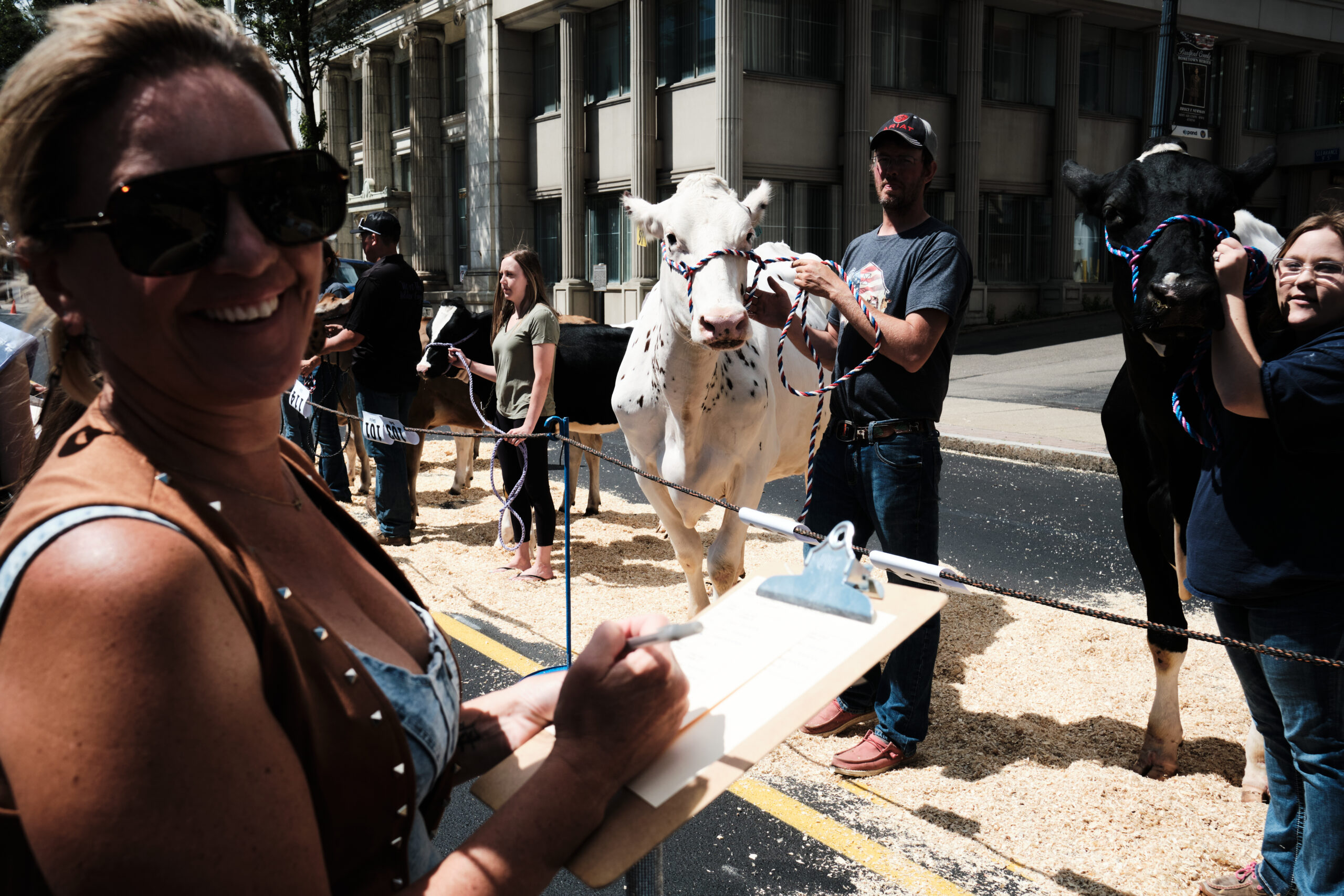
    A judge scores the cows on their beauty in front of the Bradford County courthouse in Towanda, Pa., on June 20.
  • Sharon Hill police killed his cousin. Now he is Delaware County’s new reform-minded sheriff

    Sharon Hill police killed his cousin. Now he is Delaware County’s new reform-minded sheriff

    Siddiq Kamara remembers standing side by side with his aunt outside of the Delaware County courthouse and calling for changes in how police are trained after a stray bullet fired by Sharon Hill police officers killed his cousin Fanta Bility.

    Three years later, his office is inside that same building.

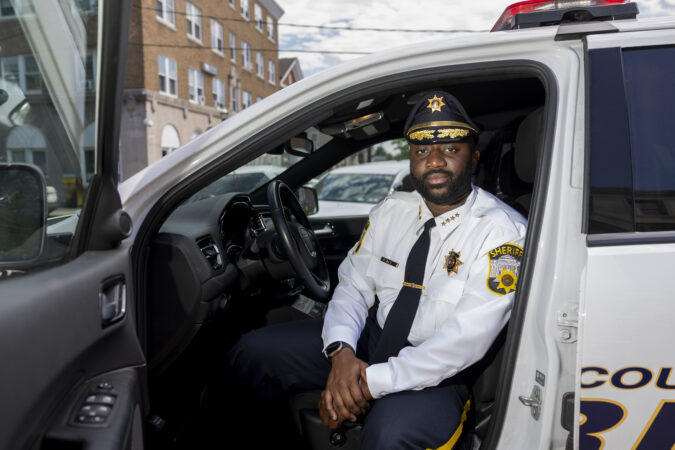
    Kamara, 30, became the youngest sheriff in Delaware County history when he cruised to victory in November with 63% of the vote. The son of Liberian immigrants, Kamara turned his family’s tragedy into a platform for improving the way community policing is carried out in his home county.

    “The people in Delaware County, I’m here to work with them, and my office is going to do that every single day,” he said.

    “This is the greatest country in the world. Being 30, being Muslim, being a first-generation immigrant and being the sheriff of one of the biggest counties in Pennsylvania, it’s unheard of. And I don’t take that lightly.”

    In his first six months in office, Kamara equipped all of his deputies with body cameras and beefed up recruiting efforts, including open fitness tests throughout the county, to help fill the 35 vacancies he inherited. He’s mandated de-escalation and regular firearms training for his deputies, in memory of his cousin.

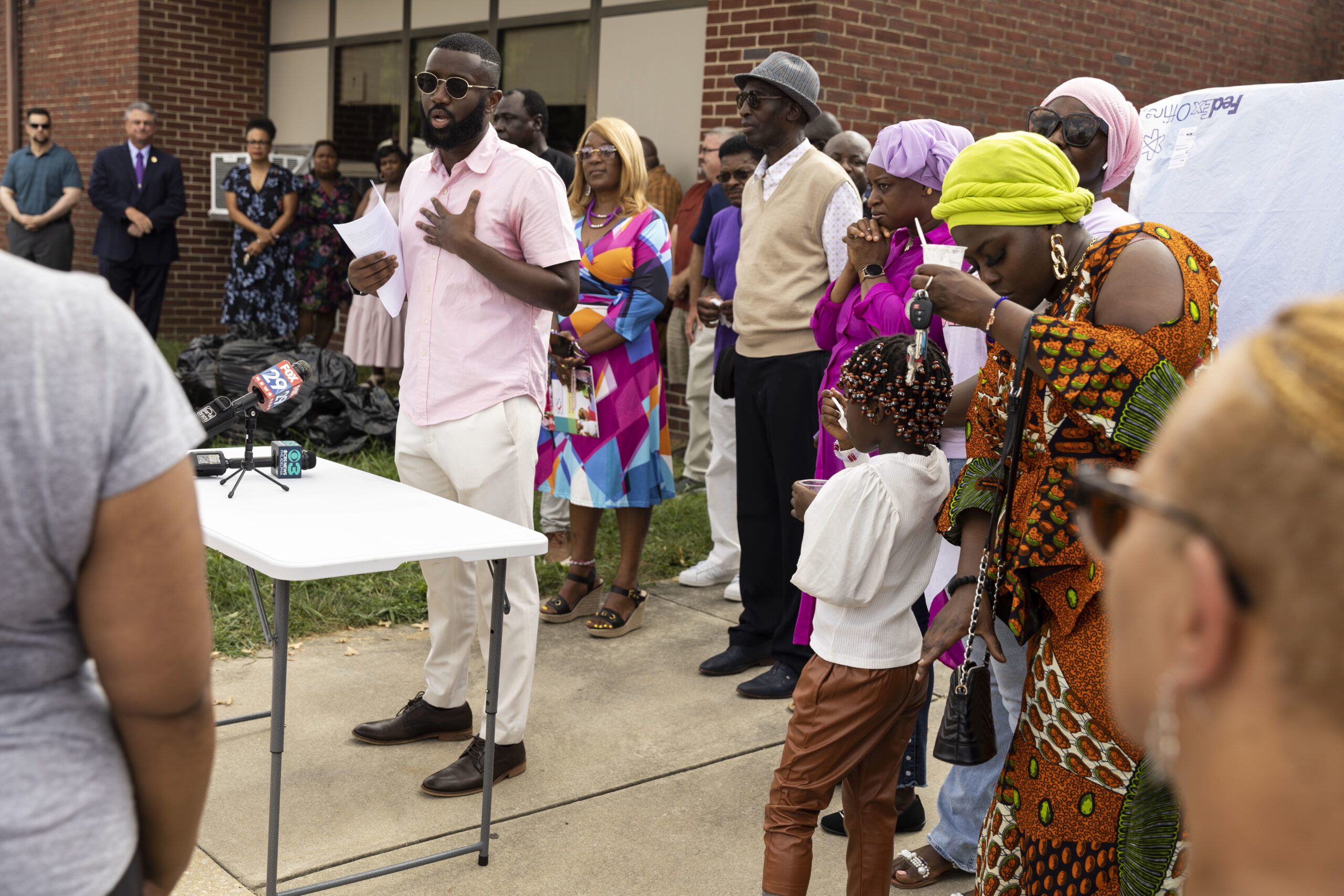
    Siddiq Kamara (left) stood by his aunt, Tenneh Kromah, in January 2025 as they renamed a park in Sharon Hill after his cousin Fanta Bility.

    Delaware County Council President Monica Taylor said Kamara is bringing a fresh perspective to a row office that often gets overlooked.

    “He doesn’t just talk. He does the work,” Taylor said. “That’s what makes him a great public servant. He’s bringing everyone to the table to make these improvements.”

    That’s notable for a county sheriff, given the role traditionally, doesn’t require officials to stray too far beyond the county courthouse. But Kamara wants to change that, making sure he and his deputies are a frequent presence in the towns they serve.

    That desire comes from Kamara’s own experience. After serving six years in the Army National Guard, Kamara became a police officer in Yeadon. He later took a job in the state Attorney General’s Office, working in various roles including narcotics and the personal protection detail for then-Attorney General Josh Shapiro.

    Kamara’s cultural background and linguistic skills — he speaks African dialects including Mandingo and Fula, as well as French — were called upon by federal investigators as they built their case against Laye Sekou Camara, a Liberian war criminal.

    He said he became a police officer because so many people in his community in Upper Darby, drawing on their experiences in their home countries, were distrustful of police.

    “We interact with the public every single day, and sometimes these individuals, we’re not getting them at their happiest time. It’s their most vulnerable time, and you have to use empathy,” he said. “So we’ve been sending some of our supervisors to trainings so they can understand the tools when they’re out there in the community and they can teach their fellow colleagues how to de-escalate situations.”

    But when Fanta Bility was gunned down in August 2021, Kamara’s professional ambitions changed. The 8-year-old was struck by a stray bullet after three Sharon Hill officers opened fire toward a crowd leaving a high school football game. They were aiming at a car they mistakenly believed was the source of a nearby shooting.

    Those officers were later fired and pleaded guilty to reckless endangerment. But Kamara knew something had to change.

    “If you understand what happened that day to my cousin, cops, unfortunately, we can’t make mistakes. It costs people’s lives,“ he said. ”And, that day, it cost my cousin’s life, so I wanted to make sure that in my capacity, as the sheriff, our officers are properly trained.”

    Siddiq Kamara speaks during a backpack giveaway at Sharon Hill Elementary School in August 2023 held in memory of Fanta Bility.

    State Sen. Anthony Hardy Williams, a Democrat who sponsored a bill nicknamed “Fanta’s Law” that would require all Delaware County police departments to be accredited and receive annual use-of-force training, has been a mentor and friend to Kamara for years.

    “Back then, he was annoying,” Williams joked. “But he learned from my team, and it grew from him just being unapologetically persistent and curious, to him understanding he has a real value.”

    From Kamara’s early days of volunteering at political events, it was clear to Williams that he was dedicated to public service. “Fanta’s Law,” Williams said, is their latest collaboration.

    “He’s here to improve things, not just here to say ‘I have a title and have a position,’” Williams said. “It’s clear he wants to find out how to use this position to improve the office and also improve the lives of people who don’t even know about the office.”

    Kamara, for his part, said he’s thankful for the opportunity to enact change in the county that raised him.

    “When you’re in an office, and I teach my deputies this all the time, is that we do the protection part, but we’ll forget sometimes about serving,” he said. “And serving goes a long way.”

  • Phoenixville’s Bluebird Distilling combines alcohol and artisanal dough making in new $2.2M expansion

    Phoenixville’s Bluebird Distilling combines alcohol and artisanal dough making in new $2.2M expansion

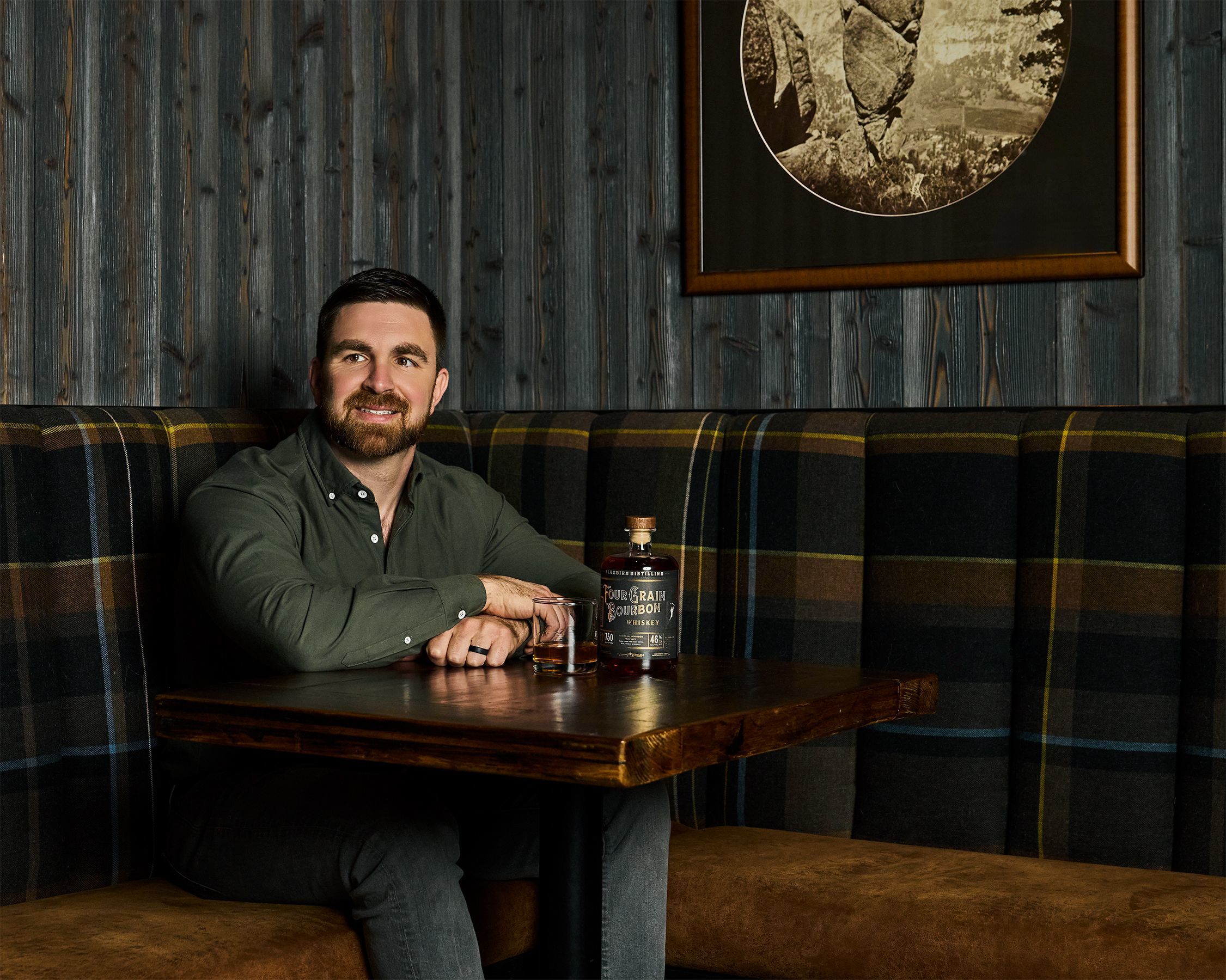
    When Jared Adkins gets interested in something, he goes all in. That’s how he ended up learning about distilling, opening Bluebird Distilling in Phoenixville roughly a decade ago. Then, he became infatuated with pizza dough.

    It’s led to an expansion of the business: Bluebird Distilling & Dough House, which will open its doors officially on Tuesday.

    The $2.2 million renovation adds a whole new component to the cocktail bar, which will now offer a “neo-Neapolitan” — a modern, Americanized take on the classic — pizzeria and restaurant. Changes also have expanded the bar itself, added to the dining room, and enhanced the retail and bottle shop.

    Adding food was something Adkins, Bluebird’s owner and master distiller, didn’t initially anticipate when they opened the distillery in 2015. But in 2022, he started to get the itch. He considered a full-scale restaurant, and began the early planning for one. But then there was just something about pizza dough that caught his attention.

    He signed himself up for pizza school, and spent three days in Washington, D.C., learning from chefs about the art of pizza making.

    “There was like a light bulb that went off,” he said. “We’re already doing so much fermenting that just seemed the natural next step to get into dough making.”

    Bluebird Distilling founder and master distiller Jared Adkins. The expansion has been a year in the making, a longer consideration for Adkins.

    As he threw himself into dough-making a few years ago, he connected with pizzaiolo Gregorio Fierro to learn the basics. That helped get his vision off the ground, as he began designing what the kitchen would look like.

    Devon Migeot is joining as executive chef to bring the menu to fruition every night. Migeot spent roughly a decade working as sous chef at Philadelphia’s Zahav and Laser Wolf, plus Tresini in Ambler, and as chef du cuisine at Rosalie in Wayne.

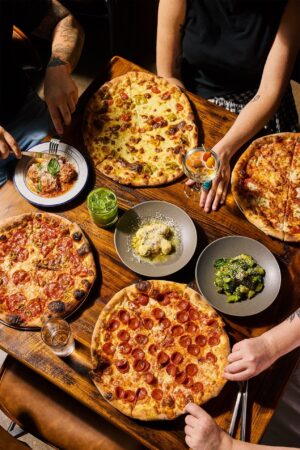
    Together, they’ll offer pizza made with 100% Petra stone-ground Italian flour, milled from 100% Italian wheat, with no preservatives or additives. The business will have house-baked breads, plus shareable small plates. Offerings will include ricotta gnudi with sweet corn, brown butter, and scallions; meatballs with beef, pork, gravy, and Parmesan; beets and burrata; chicory salad; a snacking plate of meats and cheeses; and more.

    The decision to expand into food comes at a particularly salient time, Adkins said. The industry as a whole has been seeing a decrease in people drinking.

    “It’s kind of perfect timing that it’s going to fill a niche where maybe people aren’t coming in solely just for drinks anymore as much, but now [we’re] giving another artisan aspect of having pizza, or something that we’re really putting a lot of time in, to craft the best,” he said.

    A look at the expanded cocktail bar, part of the distillery’s larger renovation.

    The distillery will still, of course, honor its roots with its spirits and cocktails. It’ll feature old favorites, such as Bluebird (a vodka, blueberry, lime, and mint mix) and the Phoenixville Old Fashioned.

    But new additions will join too. Customers can try the Huntsman, which will feature French cigar bourbon, morel-infused vermouth, tobacco bitters, and stave smoke; or the Rum Ham, a pancetta fat-washed Bluebird dark rum along with burnt pineapple syrup, and tiki bitters; or Off the Vine, a “garden-inspired” martini composed of Juniperus Gin, basil, lemon, agave nectar, Aleppo pepper, and “clarified” tomato.

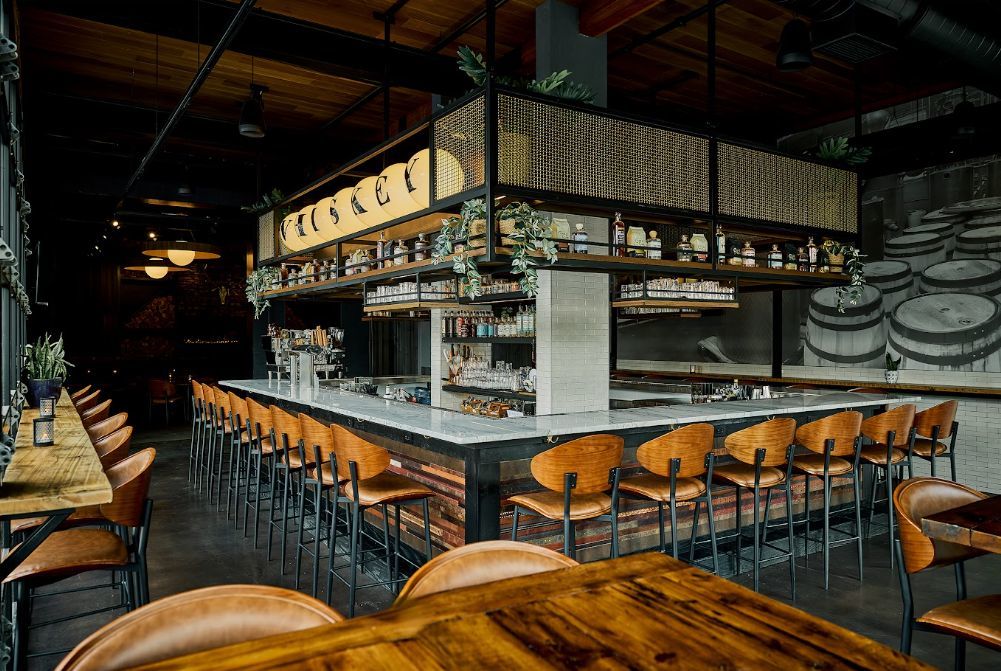
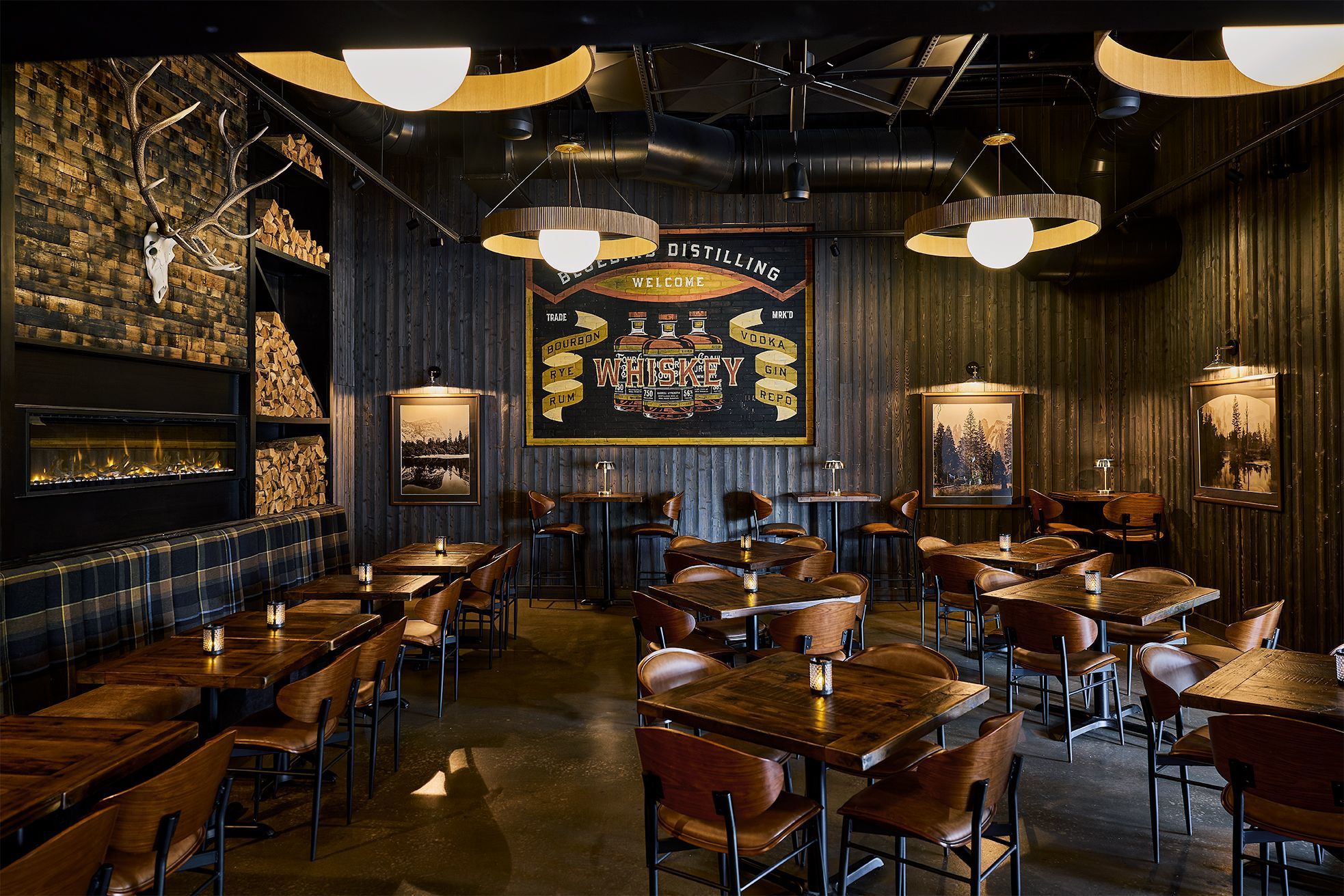
    The renovation also came with some aesthetic changes. In 2015, they led with a steampunk vibe, Adkins said. They refreshed the interior, using a Japanese-style charred wood that resembles the inside of a barrel.

    A transformed Bluebird Distilling will open July 7 after a $2.2 million renovation has expanded founder Jared Adkins’ vision. The space adds a new neo-Neapolitan pizzeria and restaurant, plus a reimagined cocktail bar, dining room, and retail and bottle shop.

    The outside patio is now enclosed, featuring a “huge” rectangular bar, which can seat up to 30 people. Adkins described the bar area as light and airy, where it feels communal and social. It feels more “upper casual” than “too-serious speakeasy.” Surrounded by windows, it feels like you’re sitting on the street, in the middle of the action, he said.

    When customers are ready for dinner, they can head back to the lounge, which curates a masculine, Western style.

    And the kitchen, where customers get to enjoy watching the whole process unfold, embraces that steampunk essence with barrels hanging from the ceiling.

    “I feel like as you walk through the area, you’re getting two or three different experiences all at once,” he said.

    The bar was open through renovations, but operating with 50% of the facility for the last seven or so months, and maintaining about 80% of their normal crowds. It took some ingenuity, he said.

    As they look at the new chapter, it feels like starting all over again, he said.

    “I think it fills a gap on one side for us there, of now we have something else that we can present to our customers for an overall experience,” he said. “That’s what we’re going for the most. We’re giving our cocktail experience, our spirits experience, and now a dough side of it.”

    This suburban content is produced with support from the Leslie Miller and Richard Worley Foundation and The Lenfest Institute for Journalism. Editorial content is created independently of the project donors. Gifts to support The Inquirer’s high-impact journalism can be made at inquirer.com/donate. A list of Lenfest Institute donors can be found at lenfestinstitute.org/supporters.

  • Where are tourists traveling to Philadelphia from for the World Cup?

    Where are tourists traveling to Philadelphia from for the World Cup?

    With Philadelphia’s final World Cup game Saturday, the city’s international soccer tourists, who have created generational memories for weeks here, will be heading home.

    From the sea of yellow-jerseyed Ecuadorians taking over the Rocky steps, and possibly cursing the team, to Ivorian soccer fans dancing outside the streets of Fan Festival, or the four Frenchmen who lied to their bosses to be here, global soccer fans have been thriving in Philadelphia.

    And there’s no better place in the world to celebrate fandom than in Philly, said Côte d’Ivoire-born Philadelphian Ahmadou Dia, who moved to the city a decade ago.

    “This is wonderful for Philadelphia and wonderful for America, welcoming everybody into this beautiful country,” Dia said. “The World Cup, the football itself, brings every country, every single person, together regardless of color. It doesn’t matter what you look like, because on the field or in that stadium, we’re family.”

    The World Cup is one of those global events where fans save thousands of dollars for years to make their way across the world to watch their favorite team.

    Ecuadorian native Francisca Castellanos traveled 14 hours to meet her father and other family in Quito, before heading to Philadelphia in time for the World Cup. Her father, Francisco, has attended the last 10 World Cup tournaments, including the 2022 World Cup in Qatar. When the United States was announced as a World Cup host, the Castellanoses were overjoyed.

    “A World Cup in the U.S is a lot more accessible to Ecuadorians because a lot of our population already lives in the U.S., and the currency is the same,” Castellanos said. “There is also language accessibility because people speak English here, unlike in Qatar, where communication was harder.”

    Ecuador national team fans cheer during the national anthems before the FIFA World Cup Group E match between Ecuador and Côte d’Ivoire on June 14, 2026, at Lincoln Financial Field in Philadelphia. The match marked the first FIFA World Cup game played in Philadelphia.

    The six matches played in Philadelphia brought tourists from Brazil, Côte d’Ivoire, Croatia, Curaçao, Ecuador, France, Ghana, Haiti, and Iraq, but where Philly’s World Cup and America’s 250th tourists are coming from spans the globe.

    Fraser McNaughton, a Scot visiting Philadelphia with family, couldn’t believe how inviting Philadelphians have been as he took photos with the Rocky statue last week.

    “Everywhere we’ve went, everyone’s been so friendly, so welcoming, helping us out when we need it,” McNaughton said. “It’s just a brilliant city.”

    “They go out of their way to say ‘Hello’ or ‘Welcome to Philly’ here,” said fellow Scot Michelle Thomson. “We’ve really loved it.”

    Here are the main takeaways, based on flight data shared by Sojern, a hospitality marketing platform that provides travel data to hotels, airlines, and tourism boards.

    (function () {window.addEventListener(‘message’, function (e) { var message = e.data; var els = document.querySelectorAll(‘iframe[src*=”‘ + message.id + ‘”]’); els.forEach(function(el) { el.style.height = message.height + ‘px’; }); }, false); })();

    Ecuadorian travelers surged this World Cup

    Ecuadorians don’t make up a sizable chunk of the international travelers coming to Philadelphia this summer. Canada, the United Kingdom, and Italy take that crown, in that order.

    However, Ecuadorian travelers, like the Castellanoses, were so pumped to experience a World Cup in person that the number of flights booked from Ecuador to Philadelphia surged by 622% compared to the year prior. Philadelphia hosted Ecuador’s first group match in the World Cup, convincing many Ecuadorians to make the 2,760-mile trip to the City of Brotherly Love.

    Danilo Carrión is a member of the group that organized the Ecuadorian event at the Rocky steps, where more than 2,000 Ecuador fans showed up to dance, sing, and accidentally jinx their team after putting Ecuador merch on Rocky.

    “It was the first game for Ecuador, so a lot of the Ecuadorians from Ecuador and the U.S. had to be here because there was a lot of expectation,” Carrión said.

    To the Ecuadorian-American who lives in New York, the influx of people was facilitated by an ease of travel between the South American country and the U.S.

    “It’s easier for us to travel to the States than to Europe or Qatar,” Carrión said. “And there are direct flights to LaGuardia and New York.”

    Ecuadorians require visas to enter Europe, Canada, and the United States. Even traveling to Mexico can involve visa procedures if they don’t have a U.S. visa first, a formality that has become more complex since Ecuador and Mexico broke international relationships in 2024, Carrión said.

    (function(){function e(){window.addEventListener(`message`,function(e){if(e.data[`datawrapper-height`]!==void 0){var t=document.querySelectorAll(`iframe`);for(var n in e.data[`datawrapper-height`])for(var r=0,i;i=t[r];r++)if(i.contentWindow===e.source){var a=e.data[`datawrapper-height`][n]+`px`;i.style.height=a}}})}e()})();

    Dutch Caribbean islands show up for Curaçao

    The small autonomous nations of Curaçao, Aruba, and Sint Maarten, all part of the Kingdom of the Netherlands, have seen a huge surge in flights this summer.

    Curaçao had the largest increase, almost 240%, despite being the smallest nation ever, with a population of 158,006 people, to qualify for the FIFA World Cup.

    “When we won tickets through the FIFA lottery for the Curaçao versus Ivory Coast in Philadelphia, we knew we had to make it happen, especially since the Curaçao match falls on my husband’s birthday,” said Vanessa Santine-Vinck, who traveled here from Curaçao with her partner and two sons.

    Travel from Sint Maarten and Aruba are also up — 193% and 117% respectively.

    Croatia and Hungary aren’t missing Philly’s World Cup

    Croatia claimed victory over Ghana at Philadelphia Stadium on June 27, and flights from the European country have jumped almost 100%.

    Neighboring Hungary has also seen a dramatic increase. There are almost 200% more flights from Hungary this summer than last summer.

    Dominican Republic shows steady growth

    Philadelphia’s Dominican community has grown in recent years, helping drive population growth in the city.

    With the World Cup in Philly this summer, travel from the Caribbean nation has increased 34%. While DR is not in the World Cup, their neighbor, Haiti, faced Brazil on June 19, losing 3-0.

    Philly’s French connection brings throngs of tourists

    This summer has brought a notable uptick in French tourism to Philadelphia, with 33% more flights. The cross-cultural connection runs deep, Parisian aesthetics have long influenced the city’s architecture.

    Throngs of Francophones across the city cheered on their national team to a 3-0 victory against Iraq on June 22.

    (function(){function e(){window.addEventListener(`message`,function(e){if(e.data[`datawrapper-height`]!==void 0){var t=document.querySelectorAll(`iframe`);for(var n in e.data[`datawrapper-height`])for(var r=0,i;i=t[r];r++)if(i.contentWindow===e.source){var a=e.data[`datawrapper-height`][n]+`px`;i.style.height=a}}})}e()})();

    France also ranks fourth in terms of total foreign travel this summer after Canada, the U.K.I, and Italy. Between the architecture, the French cuisine, and the fact that two of his family’s favorite teams, France and Côte d’Ivoire, would play in Philadelphia, traveling to the city was an easy choice for Frenchman Elias Pierson.

    He had already heard of the comparisons between the city and Paris, and as he walked through Independence Hall with his family last week, much of the architecture he saw reminded him of home.

    “We have a good relationship with the people of Philadelphia. We were just in the train station with a Philadelphian, and she explained to us where we needed to go and where the best French restaurants are,” Pierson said. “My favorite part of Philadelphia so far is City Hall and Old City because of the very beautiful buildings.”

    Now, before Pierson heads home, he said he hopes to get a coveted seat at Philly’s world-famous French bistro, Parc.

  • It’s hot, hot, hot in Philadelphia, with a third-straight 100-degree day possible Saturday

    It’s hot, hot, hot in Philadelphia, with a third-straight 100-degree day possible Saturday

    No question, it’s hot, hot, hot. But the city fell short of setting a record-high temperature on Friday for that date.

    Another record, however, appears likely: A new warmest low temperature for July 3. The record is 77 degrees, hit three times, most recently in 2002. The low on Friday as of nearly 8 p.m. was 82 degrees, which would be a record-setter.

    But there was still the potential for storms to knock that record down before the day is out.

    “We are still in the running for our new record warmest low temperature,” said Patrick O’Hara, meteorologist at the National Weather Service office at Mount Holly.

    The record high temperature for a July 3 stands at 104 degrees, set in 1966. As of about 4 p.m., the temperature had reached 102, the National Weather Service said.

    The Atlantic City Airport, however, hit 105 degrees, setting a new record there, O’Hara said.

    The temperature on Saturday is expected to reach a high of 100, O’Hara said. The record for that date is 103.

    Just because Philadelphia didn’t break a high-temperature record doesn’t mean the heat hasn’t had a big impact. The Wawa’s Salute to Independence Semiquincentennial Parade, scheduled for Friday, was canceled due to heat concerns.

    Storms also posed a risk. A severe thunderstorm watch was issued for the entire region on Friday, and on Saturday, the risk looked even greater.

    “Any storm could be strong to severe,” said Ray Martin, meteorologist at the National Weather Service office in Mount Holly.

    The risk on Friday was more to the north and west of the city, said Matt Benz, senior meteorologist with AccuWeather.

    On Saturday, Benz said there was about a 65% chance of thunderstorms in the evening when Philadelphia’s July Fourth concert is scheduled to be underway on the Benjamin Franklin Parkway.

    “At this point, it’s difficult to promise dry weather for fireworks,” he said.

    Philadelphia, where fireworks aren’t scheduled to start until close to 12 a.m., might have the best shot of not being impacted by weather, he said.

    “As we get close to midnight, we might start to dry out,” he said.

    Concern about lightning strikes could be more widespread than storms, Benz said.

    Meanwhile, AccuWeather said Philadelphia was forecast to only drop to 83 degrees overnight Friday into Saturday, which would tie the city’s all-time record for a high minimum temperature.

    The good news is both SEPTA and Peco reported no major weather-related problems Friday afternoon.

    Regional Rail trains were traveling 10 miles slower to alleviate stress on the overhead wire and tracks, which can be impacted by the heat, said Andrew Busch, spokesperson for SEPTA. The slower speed has led to some delays.

    Peco recommends that customers keep their thermostats between 75 and 78 during the day and shades drawn, said spokesperson Izamarie Camacho. All unnecessary lights and devices also should be turned off, Camacho said.

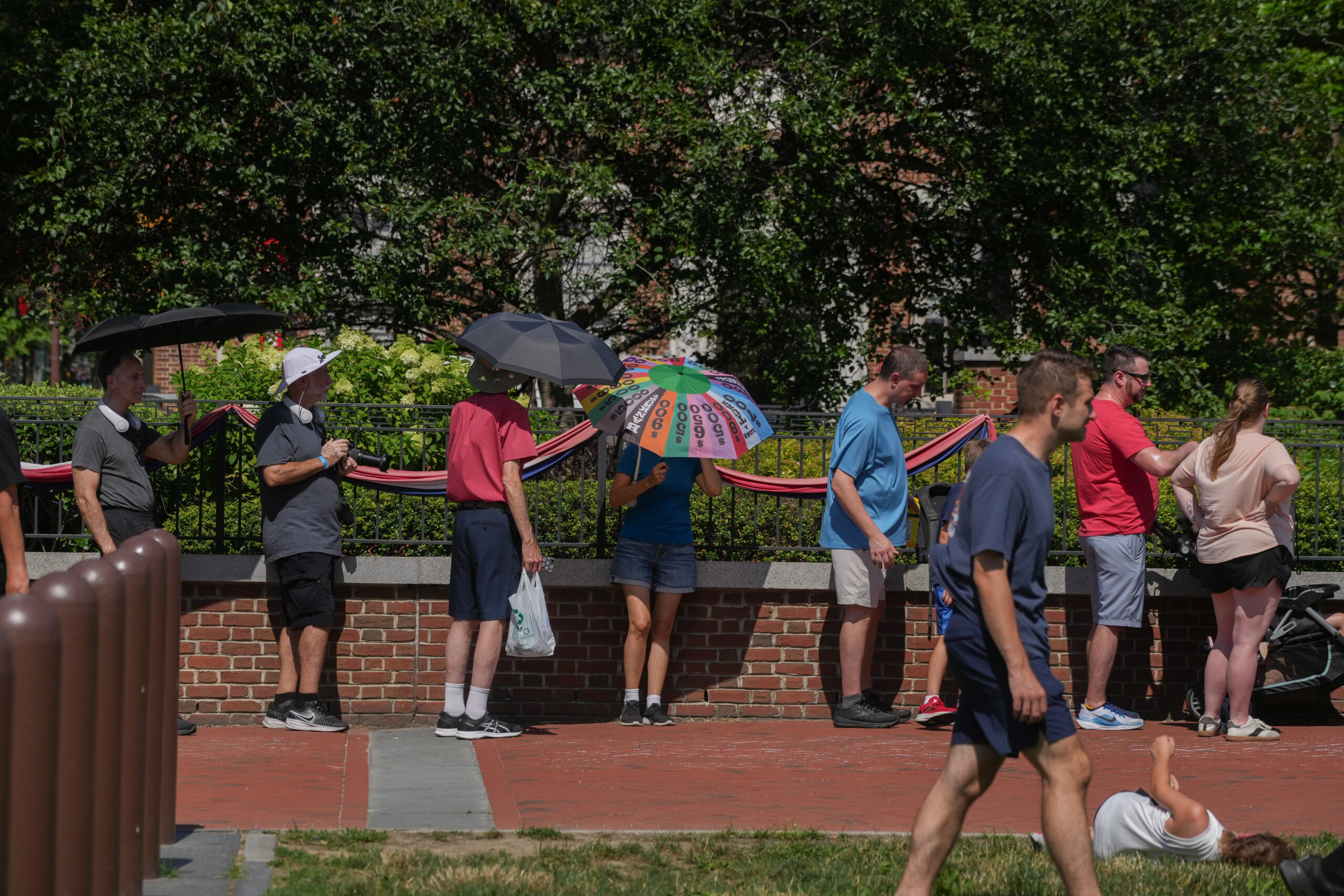
    Visitors in Philadelphia shade themselves from the sun, July 3, 2026.

    Local hospitals contacted didn’t report an uptick in heat-related illnesses or injuries. Temple University Hospital’s main campus had five heat-related cases on Friday as of 4:30 p.m., according to a spokesperson. No other information about the cases or whether it was an increase from prior days was available.

    The Philadelphia Fire Department has seen “a marked increase in calls” over the last few days, said Rachel Cunningham, communications director. There were more than 1,000 calls on Wednesday and Thursday, but the department didn’t have a breakdown on how many were heat-related.

    The number of calls on Friday was not available.

    The number of people seen at the department’s medic tents at Lemon Hill, where the FIFA World Cup Fan Festival is occurring, and Lincoln Financial Field, where the games are held, has remained relatively low. Just four people came in on Thursday, with two becoming patients and no one requiring transport to a hospital, Cunningham said. On Wednesday, five people came in, one becoming a patient and no one requiring transport. And on Tuesday, 14 people came in, with five becoming patients and two requiring transport to a hospital.

    The coolest spot in the region looks to be the Jersey Shore, Benz said. The Atlantic City boardwalk was 82 degrees at about 3 p.m. Friday.

    “You almost have to be touching the water to feel that kind of temperature,” he said.

    A sea dip is one sure way to get cool — ocean water temperatures are in the low 60s, he said.

    But for those celebrating the holiday in Philadelphia, Benz said “stay hydrated, take it easy, enjoy the Fourth, and keep an eye on the sky.”

  • Burlington County man caught in child trafficking sting drove an hour to have sex with underage girl, DA says

    Burlington County man caught in child trafficking sting drove an hour to have sex with underage girl, DA says

    Christopher Reynolds thought he was talking to a woman looking to exchange money for sex with her 13-year-old daughter, Bucks County prosecutors said Thursday.

    Reynolds was adamant about certain graphic details while negotiating the price for the encounter, and even offered a higher rate so the woman could buy her daughter an emergency contraceptive pill, according to the affidavit of probable cause for his arrest.

    But in reality, Reynolds was speaking to an undercover detective who investigates human trafficking. And Reynolds, 35, was arrested late Wednesday after driving nearly an hour from New Jersey to a motel in Bensalem.

    Reynolds, of Browns Mills, Burlington County, has been charged with criminal attempt to engage or perform a commercial sex act with a minor, criminal attempt to commit trafficking in individuals, and related crimes. He was held in lieu of $500,000 bail, and there was no indication that he had hired an attorney.

    District Attorney Joe Khan said Reynolds’ arrest “sends an unmistakable message to those who look to prey on children in our communities.”

    “This is the exact kind of proactive, aggressive enforcement the public can expect from our office’s revamped anti-trafficking operation,” he said. “We are going to use every tool and technology at our disposal, and we will continue to hunt down those who attempt to exploit vulnerable individuals.”

    Investigators say the undercover detective first started communicating with Reynolds on Tuesday, after he responded to an ad on a website offering “taboo” with an underage girl, the affidavit said.

    After negotiating the price and duration of the encounter, Reynolds agreed to meet the girl’s mother at a motel on Lincoln Highway. He nearly called off the appointment when detectives declined to send nude images of the girl, but relented when they sent a digitally de-aged photo of a female detective.

    Investigators arrested Reynolds as soon as he entered the motel, the affidavit said. He was carrying $300 and a bottle of Mountain Dew, items the undercover detective told him to bring to the meeting while posing as the girl’s mother.

    Reynolds is scheduled to appear before a district judge for his preliminary hearing on July 16.

  • Temple University IDs student killed by hit-and-run driver on Kelly Drive

    Temple University IDs student killed by hit-and-run driver on Kelly Drive

    Temple University on Tuesday identified a 20-year-old student who was killed last week by a hit-and-run driver on Kelly Drive.

    Bryce Wolfe, of Conyngham, a borough in Luzerne County, was an actuarial science major in the Fox School of Business and had just completed his sophomore year, said Temple President John Fry in a joint statement to the university community with Jodi Bailey Accavallo, vice president of student affairs, and Denise Wilhelm, interim vice president for public safety.

    Wolfe was riding a motorcycle when he was struck by a vehicle believed to be a white SUV, his parents said in an interview late Tuesday night.

    The unidentified driver dragged Wolfe for more than a mile on Kelly Drive, Clarence Wolfe III said.

    “We’re committed to getting justice for our son,” Lori Wolfe said.

    Philadelphia police said they responded to a report of a crash at Kelly and Reservoir Drives around 11:15 p.m. on June 24.

    Police said they believe the driver of a white SUV was traveling east on Kelly Drive and was trying to make an illegal turn onto Reservoir Drive, but then attempted to return to eastbound Kelly Drive when the SUV entered the westbound path of the red 2004 Triumph motorcycle Wolfe was riding.

    Wolfe became trapped beneath the SUV and was dragged to the area of Fountain Green Drive before his body was dislodged from the SUV, police said.

    Wolfe was transported by medics to Penn Presbyterian Medical Center and pronounced dead at 4:41 a.m. on June 25, police said.

    The suspected SUV sustained damage on the driver’s side and damage to the driver’s-side front wheel well, fender, and possibly driver’s-side door, police said.

    “Thanks to an anonymous donor, there is a $10,000 reward available for information leading to an arrest and conviction,” Fry said.

    Anyone with information about the case can contact police at 215-686-TIPS (8477), Fry said.

    Wolfe “had quickly established a reputation as both an excellent student and engaged member of the Temple community,” maintaining a high grade-point average while being enrolled in both Temple and Fox Honors program, Fry said.

    “Bryce was also deeply involved outside of class as he was a member of the student professional organization Gamma Iota Sigma and had recently started an internship with United States Liability Insurance Group,” Fry said.

    “There is no doubt that he had a very bright future ahead of him, and that’s what makes delivering this news especially difficult,” Fry said.

  • Bill Wine, Emmy Award-winning film and TV critic, and longtime La Salle professor, has died at 81

    Bill Wine, Emmy Award-winning film and TV critic, and longtime La Salle professor, has died at 81

    Bill Wine, 81, of Philadelphia, three-time Mid-Atlantic Emmy Award-winning film and TV critic, retired tenured associate professor of TV and film at La Salle University, onetime freelance TV critic for the Daily News, freelance writer, playwright, and popular lecturer, died Sunday, June 14, of complications from Parkinson’s disease at his home in Chestnut Hill.

    The son of two part-time amateur actors and a lifelong devotee of theater, film, TV, writing, and teaching, Mr. Wine was a film critic for WTXF-TV, Channel 29, for 12 years and KYW radio for 17 years. Known for his pithy, witty, and often acerbic reviews, and a breezy conversational style of writing, he worked at Channel 29 from 1990 to 2002 and KYW from 2001 to 2018.

    “Bill Wine was a character out of a Neil Simon comedy, more Oscar than Felix,” said Carrie Rickey, former Inquirer movie critic. “You didn’t have to wait long for the punchline.”

    Mr. Wine’s film reviews on Channel 29 were often funny and entertaining.

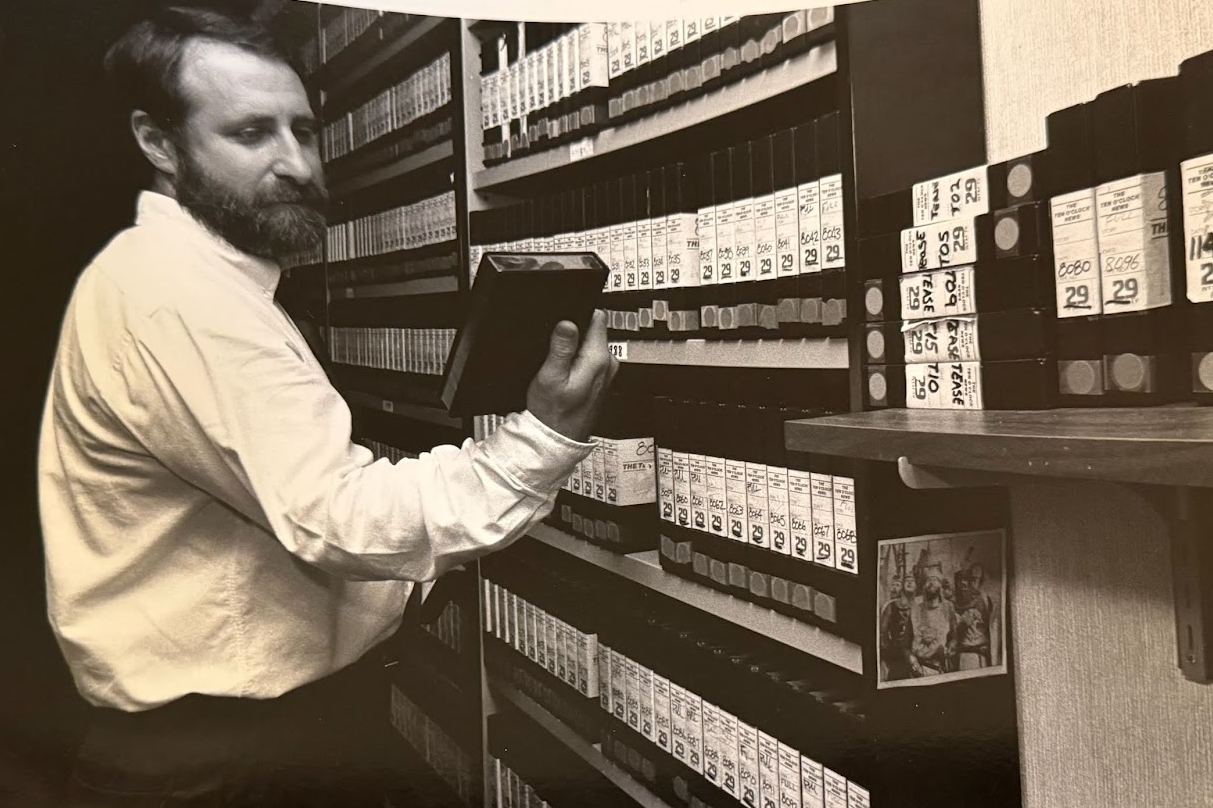
    At Channel 29, Mr. Wine was nominated for eight regional Emmy Awards for commentary and writing, and won three. He appeared regularly on the station’s Ten O’Clock News, in primetime movie preview and review programs, and later on Mondays, Wednesdays, and Fridays on Good Day Philadelphia.

    By 1990, he had already written hundreds of freelance film reviews for the Daily News and Courier-Post, done radio reviews for WPEN, and taught a variety of classes about film and writing for a decade at La Salle. So, despite no previous TV experience, he was hired at Channel 29 over 60 other film critic applicants.

    “I had never been on TV, but I wasn’t nervous,” he told the Daily News in 2001, “because I had been standing in front of 100 students for 10 years.”

    Mr. Wine worked at at WTXF-TV, Channel 29, for 12 years.

    He started at KYW radio in 2001 and usually aired reviews and reports on Thursdays, Fridays, and Saturdays. Sometimes, he watched three movies in one day. He left Channel 29 in 2002 and KYW in 2018 only after both companies eliminated their local film critic position.

    “When I started [writing film reviews], it was before the internet,” he told The Inquirer in 2018. “A lot of people [now] feel like, ‘Who the heck is a movie critic to come on in a minute and to dismiss something that took hundreds of people and millions of dollars to create?’”

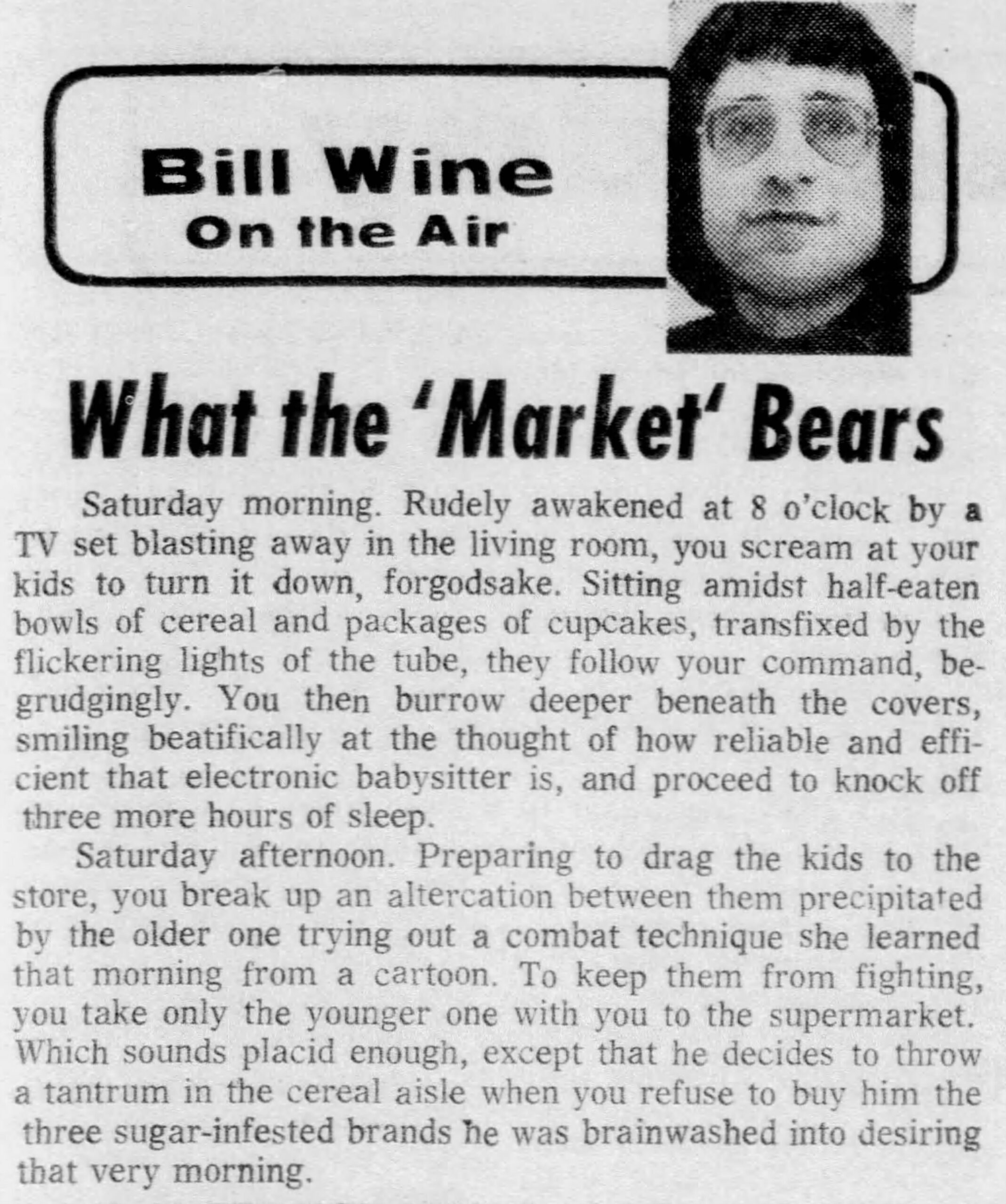
    In the 1970s and ‘80s, he wrote articles and reviewed films, TV shows, books, and plays for WPEN, The Inquirer, Courier-Post, Philadelphia Magazine, and other outlets. In 1975, he wrote dozens of freelance TV columns called “On the Air” for the Daily News.

    Mr. Wine wrote dozens of columns as a freelance TV critic for the Daily News in 1975.

    He spent three years in California in the 1970s working on plays and film and TV scripts. He hobnobbed with famous writers, producers, and actors in Los Angeles, staged one of his own plays, and was a winning contestant on a new TV game show.

    He wrote 11 plays over the years, and several made it to the stage. “Now the people who disagree with my reviews can come and find out if I’m as dumb as they think I am,” he told The Inquirer in 2002.

    He aired reviews on WIP radio and lectured often at libraries, schools, community centers, theaters, and other venues about his favorite films, adapting books to film, and other topics. “He could be wickedly funny, especially when delivering a pan of a movie,” his family said in a tribute. “One of his favorite quotes was: ‘I had a bad seat. It was facing the screen.’”

    Mr. Wine was a prolific playwright who enjoyed table readings with family and friends.

    Mr. Wine earned a bachelor’s degree in math at Drexel University and a master’s degree in communications at Temple University. He helped design La Salle’s nascent Communication Department in the 1980s, and school officials called him one of their “Founding Fathers.” He also taught briefly at Drexel, and came close to earning a doctorate at Temple.

    In 2001, he was featured in a Daily News story about “celebrity professors” and said: “You have to remind yourself that this is television, not the classroom. You mention, say, ‘film noir’ on TV, and you get a memo.”

    William David Wine was born June 21, 1944, in Germantown. He grew up in West Oak Lane and Cherry Hill, attended Central High School, and graduated from the old Cherry Hill High School.

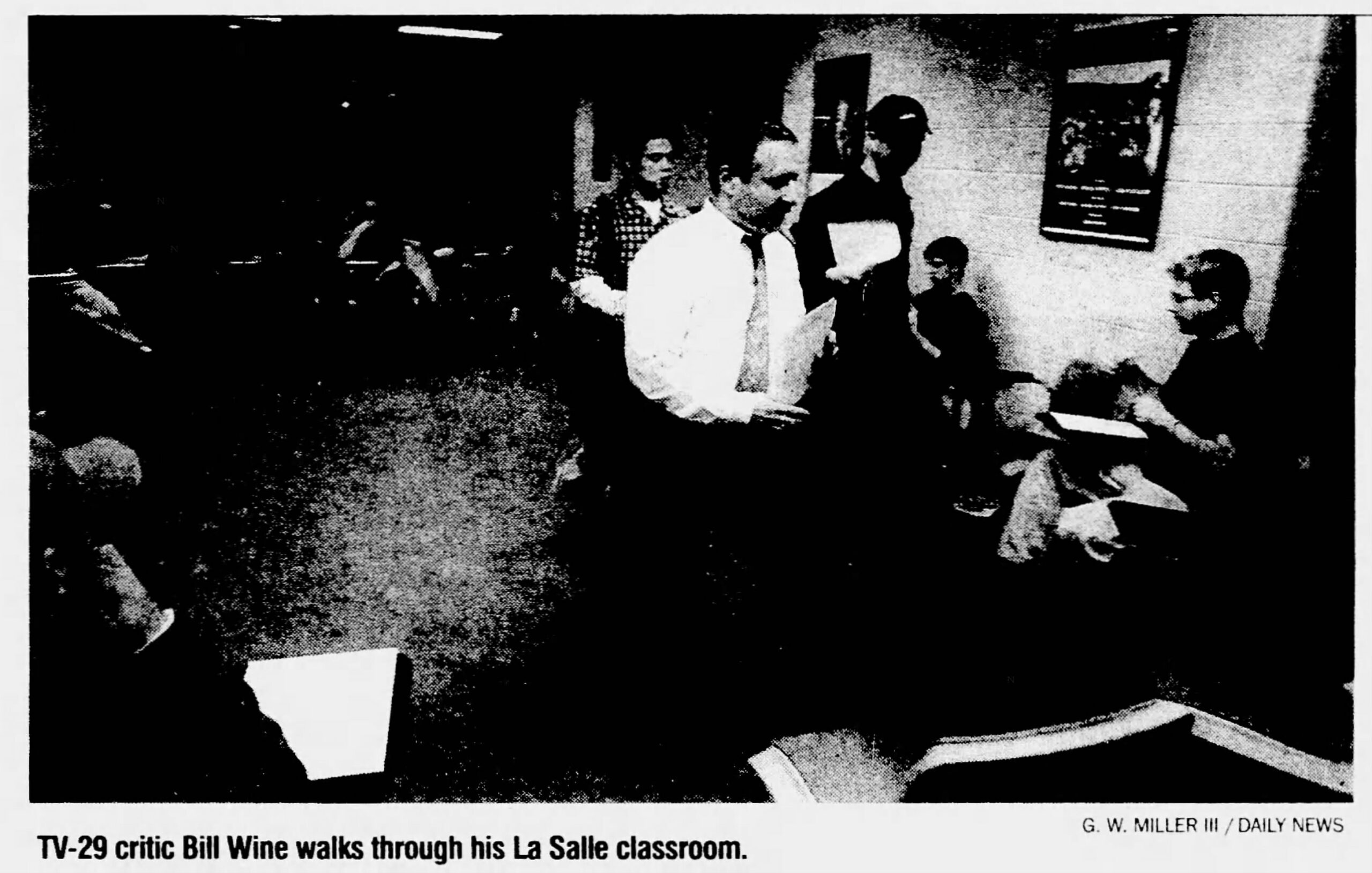
    A story and this photo of Mr. Wine about his time as a professor at La Salle appeared in the Daily News in 2001.

    As a boy, he devoured newspaper movie reviews and fell in love with film after seeing Alfred Hitchcock’s 1954 thriller Rear Window. He got positive reviews of his own freelance movie review when he was at Temple, and he knew then, he said later, that writing about movies was his creative niche.

    “The first time I saw my byline, I was hooked,” he told Drexel Magazine in 2016.

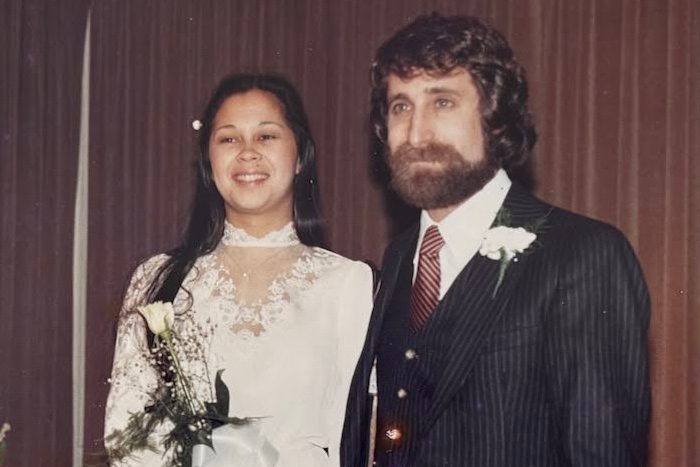
    He married Dina Lichtman, and they divorced later. He married Suzanne Monsalud in 1981, and they had daughters Simone and Paulina, and lived in Germantown, Wyncote, and Chestnut Hill.

    Mr. Wine and his wife, Suzanne, married in 1981.

    Together, Mr. Wine and his family traveled to Paris and London, and he and his wife honeymooned in Rio de Janeiro, Brazil. He doted on his daughters and sometimes took them to his La Salle classroom, the Channel 29 TV set, and movie screenings.

    Friends, former colleagues, and former students called him “a force of nature,” “smart and gifted,” and “a rare combination of kindness, professionalism, and humor.” His daughter Simone said: “His humor, warmth, and presence made life brighter.”

    Mr. Wine played tennis, third base on adult softball teams, and pickup basketball into his 70s. He followed the Phillies, 76ers, and Eagles closely, and hit tennis balls with Hall of Famer Rod Laver at a publicity event in Los Angeles.

    Mr. Wine and his family made memorable trips to Paris, London, and elsewhere.

    “He was a wonderful father and a dedicated teacher,” his wife said. “He was a real Philadelphian, and we complemented each other.”

    His daughter Paulina said: “Dad, I think you cracked the code. We’ll see you at the movies.”

    In addition to his wife and daughters, Mr. Wine is survived by three grandchildren, a sister, Marcia, and other relatives. A sister died earlier.

    A celebration of his life was held earlier.

    Donations in his name may be made to the Bill Wine Scriptwriting Award at La Salle University, 1900 W. Olney Ave., Philadelphia, Pa. 19141.

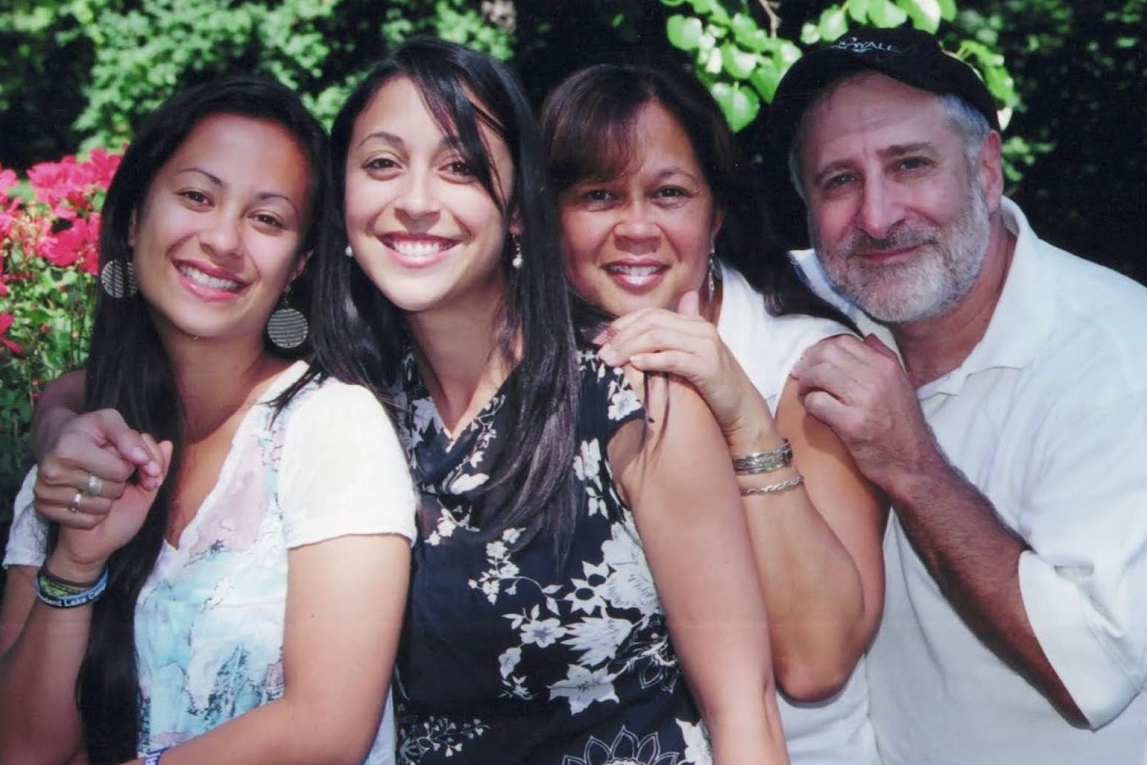
    Mr. Wine (second from left) enjoyed time with his family.