Democrats swept Delaware County Council elections for the fifth consecutive election, further solidifying their dominance in the former Republican stronghold in the suburbs.
In statements early Wednesday morning, the Democrats thanked their supporters.
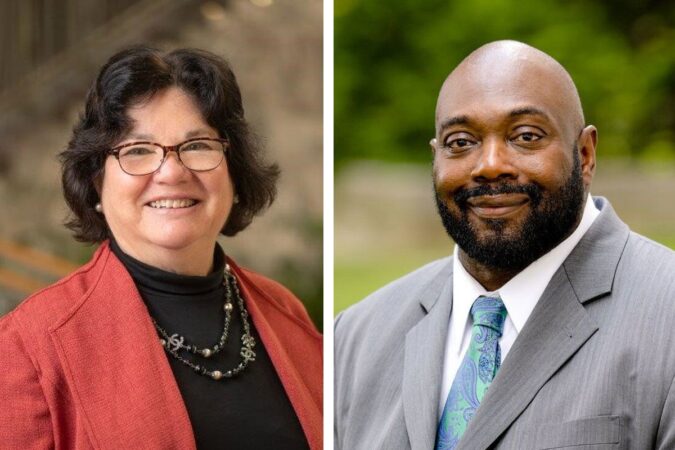
“I will continue to work hard and fight for the residents in our County. I look forward to working together with all parties to make Delaware County one of the strongest counties in the Commonwealth,” Womack said in a statement.
With all but one precinct reporting Wednesday, Republican challengers Brian Burke and Liz Piazza each trailed Womack and Phillips by roughly 50,000 votes.
In a statement Wednesday, Frank Agovino, the chair of the Delaware County GOP, said it appeared local issues were a “secondary concern” for Democrats this year.
“The State wide retention initiative was uncharted waters and it feels as though Dem turnout was positively impacted. Additionally, the Unrealistic disdain for the President from the majority of Democrats was also an undeniable factor,” Agovino wrote.
Democrats have held all five seats on the Delaware County Council since 2020, when the party took control of the county for the first time since the Civil War. Democrats flipped the county as part of a national trend of suburbs shifting left, which was accelerated during President Donald Trump’s first term in office. With Tuesday’s results, they will keep their supermajority for the next two years.
In the years since Democrats took control in Delaware County, they say they have worked to enhance county services and repair infrastructure. That has included establishing a health department — Delaware County was the largest county in Pennsylvania without one at the onset of the COVID-19 pandemic — and de-privatizing the county prison following a series of scandals.
Last year, the county increased property taxes 23%, citing the loss of federal pandemic relief dollars and inflation driving up salaries. Republicans made that increase the base of their campaign, telling voters that the Democrats were overspending and that more tax increases were on the way.
Republicans wanted voters to give the GOP a voice on the board, even though the party wouldn’t have the majority, to push back on budgetary decisions and hold the Democrats accountable.
But in the heavily Democratic county, that message was not enough to sway the independent and Democratic voters Republicans needed to win seats. Instead, voters demonstrated continued trust in the current county leadership.
“I truly respect Richard and Joanne as members of Council and hope they will listen to the voices of our residents and help bring to light some of their concerns,” Piazza said in a statement Wednesday.
On Election Day, Donald and Esther Newton, a Chester couple who have been married for more than 55 years, said they believed it was about time their city received more care and investment through property taxes.
“Our infrastructure needs to be fixed, and that takes money,” Esther Newton said.
Democrats swept all countywide races Tuesday.District Attorney Jack Stollsteimer, who was among the first Democrats to win countywide office in Delaware County, won a seat on Delaware County Court. He will have to step down from his current role to take the seat.
Staff writer Nate File contributed to this article.
This suburban content is produced with support from the Leslie Miller and Richard Worley Foundation and The Lenfest Institute for Journalism. Editorial content is created independently of the project donors. Gifts to support The Inquirer’s high-impact journalism can be made at inquirer.com/donate. A list of Lenfest Institute donors can be found at lenfestinstitute.org/supporters.
Bucks County voters on Tuesday did what protest and legal action could not, halting a controversial sheriff’s office alliance with ICE by electing a Democrat who has pledged to end the partnership.
Sheriff-elect Danny Ceisler said Wednesday that he will issue a moratorium barring deputies’ cooperation with ICE on his first day in office. From there, he said, he will figure out how to disentangle the sheriff’s office from the agreement signed by his predecessor.
Ceisler beat incumbent Republican Fred Harran by more than 10% of the vote in unofficial returns.
Ceisler and a cadre of immigration activists ― who saw an ACLU-led lawsuit falter ― had portrayed the election as the last chance to kill the affiliation, after a Bucks judge ruled last month that it had been legally implemented and could proceed.
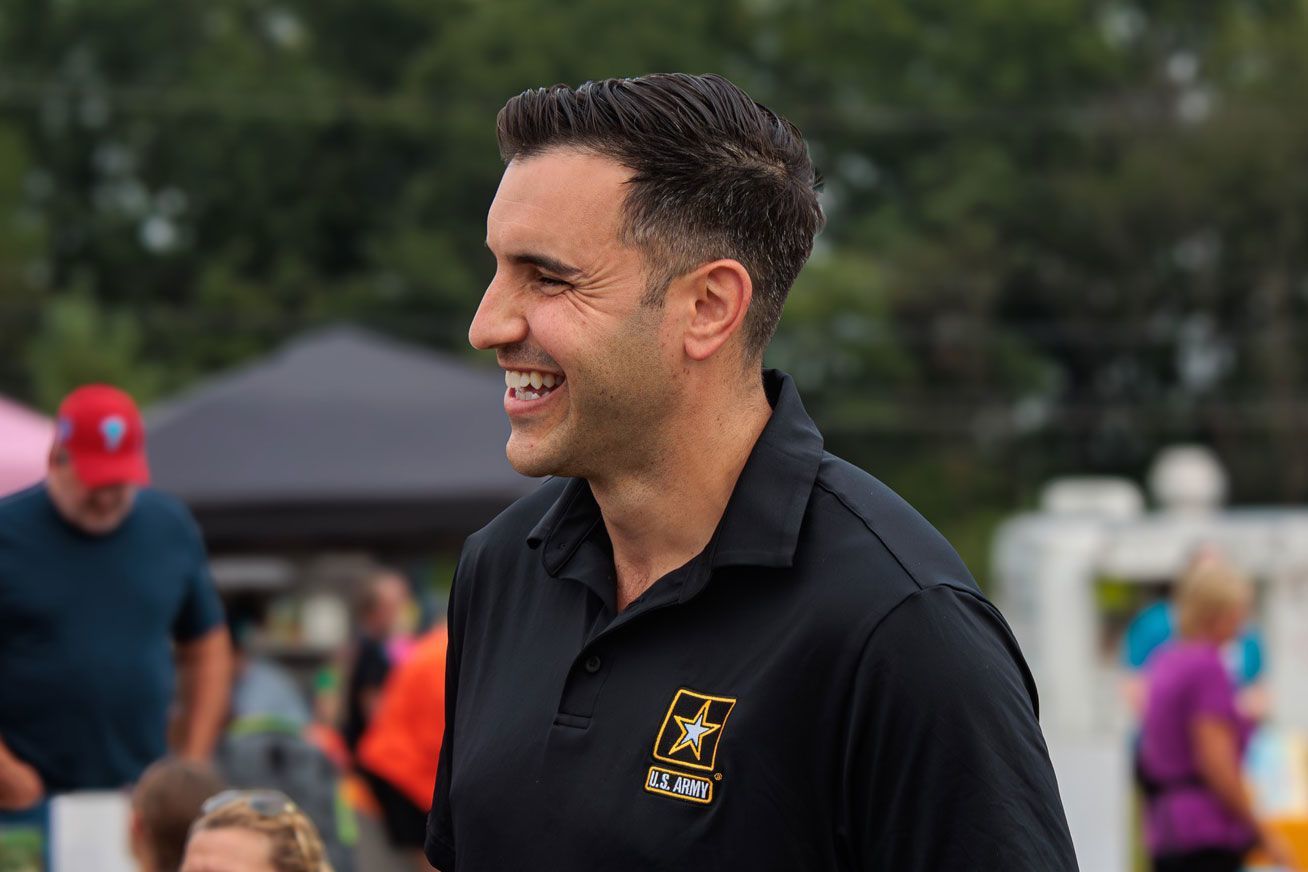
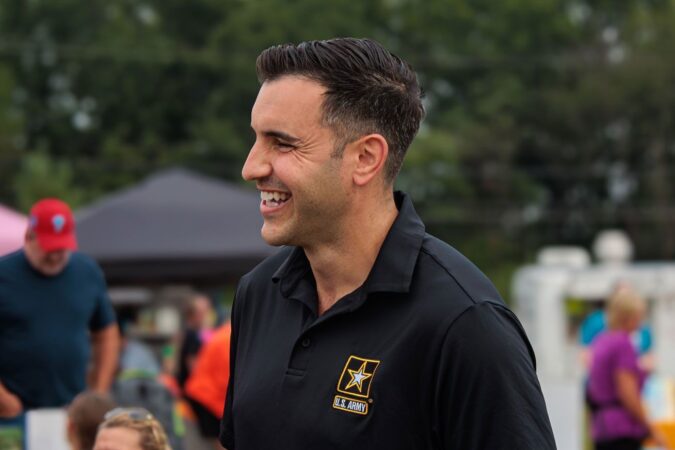
Army veteran Danny Ceisler won the hotly contested Bucks County sheriff race Tuesday night.
Harran, who led the Bensalem Police Department before being elected sheriff four years ago, said Wednesday that Ceisler will “have to answer for a person who becomes victimized by an individual that should have been deported. And he’ll have to sleep with that, and it’ll be on his head, not mine.“
His said his plans around the program had been misrepresented.
“Everyone knows my intentions. It was never making car stops on people who were dark-colored. My career speaks for itself in terms of my partnerships with the community.”
He had staunchly defended his decision to assist ICE, insisting it would make residents safer and even potentially bring new funding and police equipment to the county.
Ceisler called immigration the single biggest issue in this election.
“My goal was to provide an alternative which was a no-nonsense, reasonable approach to public safety,” Ceisler said Wednesday, noting that it was now “my responsibility to deliver on that.”
Officials with U.S. Immigration and Customs Enforcement declined to comment.
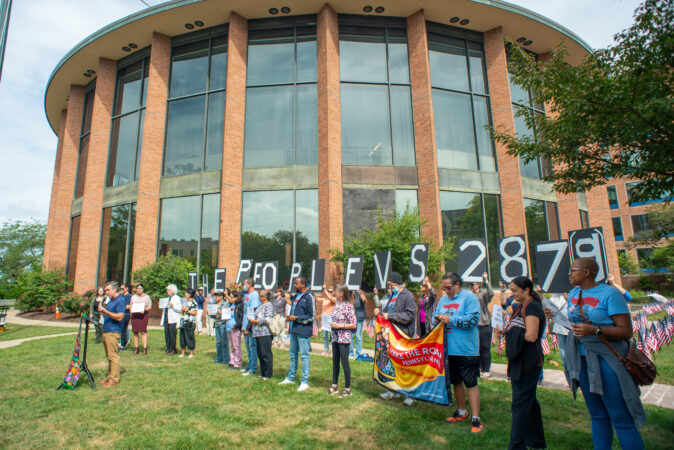
The partnership, which recently became active after months of planning, provoked backlash, including the lawsuit, public demonstrations outside the courthouse, and a repudiation by the Democratic-led Bucks County Board of Commissioners.
Nationally, only a few police agencies that signed on with ICE have dropped out of those agreements.
Ceisler’s victory was part of a Democratic sweep of county positions in a critical swing county that narrowly voted to elect President Donald Trump last year.
“I am walking on air,” said Laura Rose, a leader of Bucks County Indivisible, which supports immigrants and progressive causes. “Bucks County voters soundly rejected Sheriff Harran and his plan to turn county deputies into de facto ICE agents.”
In the spring, Harran and ICE officials signed what is called a 287(g) agreement, named for a section of a 1996 immigration law. It enables local police to undergo ICE training, then assist the agency in identifying, arresting, and deporting immigrants.
“Ceisler’s victory proves what we’ve always known ― 287(g) agreements don’t make us safer, they divide our community,” said Diana Robinson, co-executive director of Make the Road Pennsylvania, a plaintiff in the lawsuit.
The agreement with ICE “put Bucks County at risk,” and the election showed that “voters reject fear-based policies,” she said Wednesday.
Robinson and other opponents insist that turning local officers into immigration agents breaks community trust with the police and puts municipal taxpayers at risk of paying big legal settlements. ICE officials, however, say the program helps protect American communities, a force-multiplier that adds important staff strength to an agency workforce that numbers about 20,000 nationwide.
The number of participating police agencies has soared under Trump, with ICE having signed 1,135 agreements in 40 states as of Wednesday. Seven states, including New Jersey and Delaware, bar the agreements by law or policy.
The number of new agreements increases almost every day, and Trump has pushed hard for greater local involvement. On his first day in office he directed the Department of Homeland Security to authorize local police to “perform the functions of immigration officers” to “the maximum extent permitted by law.”
Shortly before the government shutdown, ICE was poised to begin backing its recruitment efforts with money, announcing that it would reimburse cooperating police agencies for costs that previously had been borne by local departments and taxpayers.
But activists focused on the difference between what Harran said he intended to do and the much broader powers conferred within the agreement with ICE.
Harran signed up for the “Task Force Model,” the most far-reaching of the three types of 287(g) agreements. It allows local police to challenge people on the streets about their immigration status and arrest them for violations.
Harran said his deputies would not do that. Instead, he said, they would electronically check the immigration status of people who have contact with the sheriff’s office because of alleged criminal offenses. Those found to be in the country illegally would be turned over or transported to ICE, if the federal agency desires, he said.
This suburban content is produced with support from the Leslie Miller and Richard Worley Foundation and The Lenfest Institute for Journalism. Editorial content is created independently of the project donors. Gifts to support The Inquirer’s high-impact journalism can be made at inquirer.com/donate. A list of Lenfest Institute donors can be found at lenfestinstitute.org/supporters.
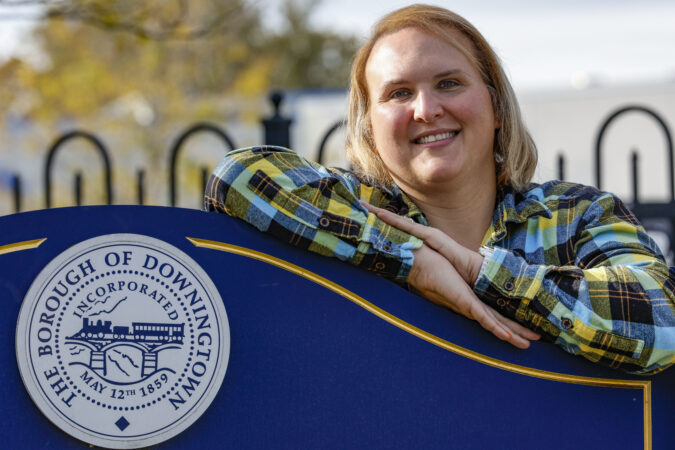
Erica Deuso will be Pennsylvanias first openly transgender mayor. She won Tuesday’s contest to lead Downingtown after a campaign focused on bread-and-butter local issues in the face of attacks to her identity.
The longtime Democratic advocate who works in management at a pharmaceutical company earned 64% of the vote as of Wednesday morning defeating Republican Rich Bryant who had 35% of the vote to serve as the next mayor of Downingtown, a Chester County borough of roughly 8,000 people.
“Voters chose hope, decency, and a community where every neighbor matters,” Deuso said in a statement at 1:30 a.m. Wednesday. “I am honored to be elected as Pennsylvania’s first openly transgender mayor. I carry that responsibility with care and with purpose.”
Deuso joins a small but growing rank of transgender officials in Pennsylvania and nationwide. There are 52 out transgender elected officials across the United States and three in Pennsylvania, all who govern at the local level , according to the Victory Institute, the research arm of the Victory Fund, which supports LGBTQ+ candidates and backed Deuso.
While her gender identity attracted attention, and online vitriol, Deuso’s campaign didn’t dwell on it. Instead she prioritized public safety, sustainable growth and community in the historic borough now home to Victory Brewing.
She ran with the support of the borough’s last two mayors, Democrats Phil Dague and County Commissioner Josh Maxwell.
Bryant, a retired cybersecurity expert, argued he was better experienced for the job, which primarily leads the borough police department. But Bryant faced accusations of bigotry as Deuso posted screenshots online of her opponentmaking misogynistic and transphobic remarks on X, (Bryant said 90% of the posts were AI-generated,but offered no proof.)
In a statement, Bryant congratulated Deuso and pledged to continue working to serve the community.
“To those who voted differently, I respect your decision and share your hope for a stronger, safer, and more united Downingtown. I will continue to serve, to listen, and to advocate for responsible growth, fiscal transparency, and accountable local leadership,” he said.
This suburban content is produced with support from the Leslie Miller and Richard Worley Foundation and The Lenfest Institute for Journalism. Editorial content is created independently of the project donors. Gifts to support The Inquirer’s high-impact journalism can be made at inquirer.com/donate. A list of Lenfest Institute donors can be found at lenfestinstitute.org/supporters.
Democrats swept two law enforcement races in Bucks County, ousting the incumbents and signalingthe swing county has soured on President Donald Trump just a year after voting for him.
Democrat Danny Ceisler, an Army veteran who held a public safety role in Gov. Josh Shapiro’s administration, led Republican Sheriff Fred Harran by 12 percentage points with all precincts reporting Wednesday morning. The sheriff race centered on Harran’s controversial decision to partner his agency with ICE as Trump ramps up immigration enforcement nationwide.
And former Bucks County Solicitor Joe Khan led Republican District Attorney Jen Schorn by eight percentage points. Democrats believe Khan is the first member of their party to ever be elected to the office.
Bucks County Democrats declared victory just after midnight Wednesday morning — sweeping every countywide race. The victories came in what appeared to be a blue wave election as voters rejected Republican candidates in Pennsylvania, New Jersey, and Virginia.
“What’s going on with our federal government is not normal, and voters saw that creeping into local offices, and they overwhelmingly rejected it,” Ceisler said Wednesday. “Bucks County doesn’t let extremism come inside.”
The hotly contested Bucks County races centered on some of the most contentious issues in national politics — Trump, crime, and immigration. Democrats sought to paint the incumbents as Trumpian ideologues, while Republicans warned voters of an influx of “Philly crime” if Democrats took office, even as the violent crime rate in the city has dropped from its pandemic peak.
Voters opted for a change, delivering both offices to Democrats and, as result, spelling the end to a controversial partnership between the sheriff’s office and U.S. Immigration and Customs Enforcement.
Bucks was the only county in the Philadelphia area to go for Trump last year and will be a key battleground in 2026 when Shapiro runs for reelection. Tuesday’s wins will give Democrats momentum going into the midterms.
Democrats, Khan said, had to work to prove to voters they could be trusted with public safety. They were aided by a favorable dynamic as voters rejected Trumpism.
“It was a campaign not about attacking somebody else but, really, making really clear that we deserve better than what we’ve got,” Khan said.
Voters at the polls persistently expressed frustration with Trump, and a sense that anyone from his party should not be trusted in office.
“They’re subject to his control, regardless of how they feel on issues,” said Stephanie Kraft of Doylestown. “And that affects everything, from our local courts on up to the higher courts in the state.”
The effort succeeded, indicating that Bucks voters are already disenchanted with the president they voted for just a year ago. The vote may set off alarm bells among Republicans as they prepare for next year’s election, when Republican Treasurer Stacy Garrity seeks to oust Shapiro and Republican U.S. Rep. Brian Fitzpatrick stands for reelection.
The Democratic victory is “on everything that Trump is doing to undermine the institutions of democracy, but it’s also on Trump’s failure to really reverse inflation,” said State Sen. Steve Santarsiero, the chair of the Bucks County Democratic Party.
Even so, for several voters, Harran’s partnership with ICE was the final straw.
Jill Johnson worried it would result in the targeting of Latino citizens, including her half-Mexican son, who is away at college.
“My biggest fear is that someone in a mask is going to come up and grab him because they think he’s here illegally,” Johnson said. “It’s scary. These are law-abiding people who have done nothing wrong.”
The partnership, which recently became active after months of planning, provoked backlash, including a lawsuit, public demonstrations outside the courthouse, and a repudiation by the Democratic-led board of commissioners.
Ceisler said Wednesday that he will issue a moratorium barring deputies’ cooperation with ICE on his first day in office. From there, he said, he will figure out how to disentangle the sheriff’s office from the agreement signed by his predecessor.
For his part, Harran said Wednesday that Ceisler will “have to answer for a person who becomes victimized by an individual that should have been deported. And he’ll have to sleep with that, and it’ll be on his head, not mine.”
Officials with U.S. Immigration and Customs Enforcement declined to comment.
Harran, an outspoken Republican who endorsed Trump last year and frequently clashes with the Democratic commissioners, was elected sheriff in 2021 after more than a decade leading Bensalem’s police department.
The Republican has expanded the role of the sheriff’s department, adding a K-9 unit and partnering with immigration officials, but faced criticism that he was failing to complete the basic duties of his job, such as executing warrants and protecting the courthouse.
Ceisler advocated taking politics out of the office, saying he would focus on domestic violence and pledging to end the partnership with ICE. He argued his experience in the Army and in a public safety leadership post under Shapiro prepared him to serve as sheriff — though Harran argued Ceisler would be unprepared for the job, having never worked in a sheriff’s office or police department.
“Being the sheriff isn’t on-the-job training,” Harran said at a Bristol polling place Tuesday. “You need knowledge and experience.”
Ceisler said he had spoken to Harran after the results came in and the incumbent promised to assist with a smooth transition.
Schorn, a veteran Bucks County prosecutor, lost in her bid for a full term after being appointed district attorney last year when her predecessor became a judge.
She had been an assistant district attorney in the county since 1999, prosecuting some of the county’s most high-profile cases. When she became district attorney, Schorn started a task force in the county to investigate internet crimes against children.
Khan, a former county solicitor and federal prosecutor, argued Schorn ran the office under “Trump’s blueprint” and criticized her decisions not to recuse herself when a Republican committeeperson was charged with voter fraud and not to prosecute alleged child abuse at Jamison Elementary School.
Schorn has said she was unable to discuss the details of the Jamison Elementary School case due to rules governing prosecutors, but Khan argued her explanations were insufficient as parents sought answers.
Schorn performed slightly better than her GOP counterparts in Bucks County on Tuesday. But, while many voters said they had no issue with Schorn’s policies, her political party was a turnoff.
“I just feel the Democrats would be better right now; I’m down on all Republicans,” said Marybeth Vinkler, a Doylestown voter who said she had no problems with how Schorn had run the district attorney’s office. “Everything happening in D.C. is trickling down around us.”
Schorn did not immediately comment on the results Wednesday.
Jim Worthington, who has run pro-Trump organizations in Bucks County, said Republicans failed to turn out voters on Election Day even as data showed Democrats held a significant lead on mail voting ahead of Tuesday.
“This is where the GOP was asleep at the wheel,” Worthington said.
Traditionally, voters trust Republicans more with law and order. The resounding victories for Democrats defied that trend.
“We now have an obligation to deliver and to show that Democrats can lead on the issue of safety,” Ceisler said.
“The ball is in our hands, and we’re ready to run with it.”
Staff writer Jeff Gammage contributed to this article.
This suburban content is produced with support from the Leslie Miller and Richard Worley Foundation and The Lenfest Institute for Journalism. Editorial content is created independently of the project donors. Gifts to support The Inquirer’s high-impact journalism can be made at inquirer.com/donate. A list of Lenfest Institute donors can be found at lenfestinstitute.org/supporters.
By most measures, Erica Deuso’s campaign for mayor of Downingtown is unremarkable.
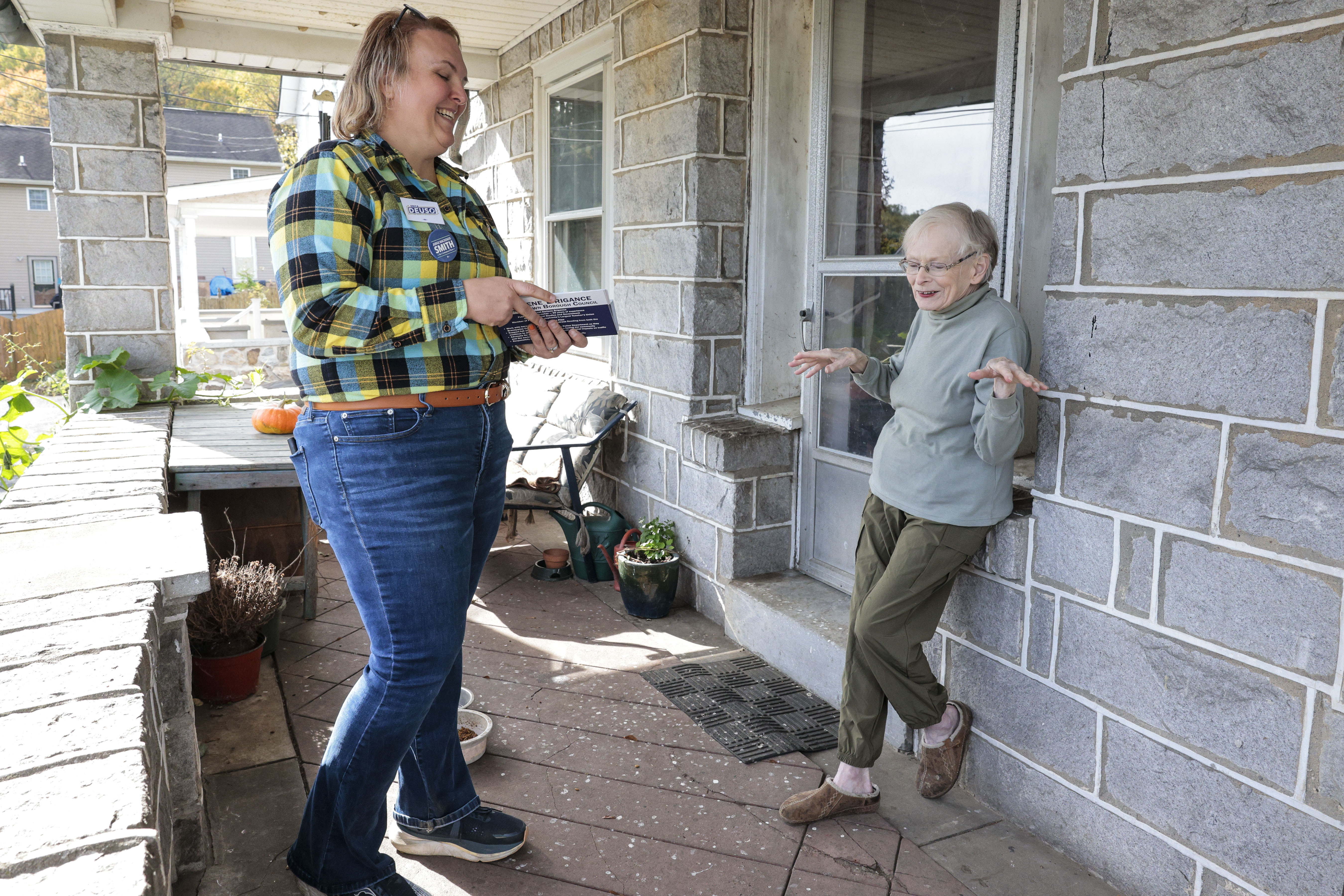
She spends Saturday mornings greeting residents at the farmers market and her weekend days knocking on doors in the Chester County borough. Most of the time, she’s talking about traffic and community events.
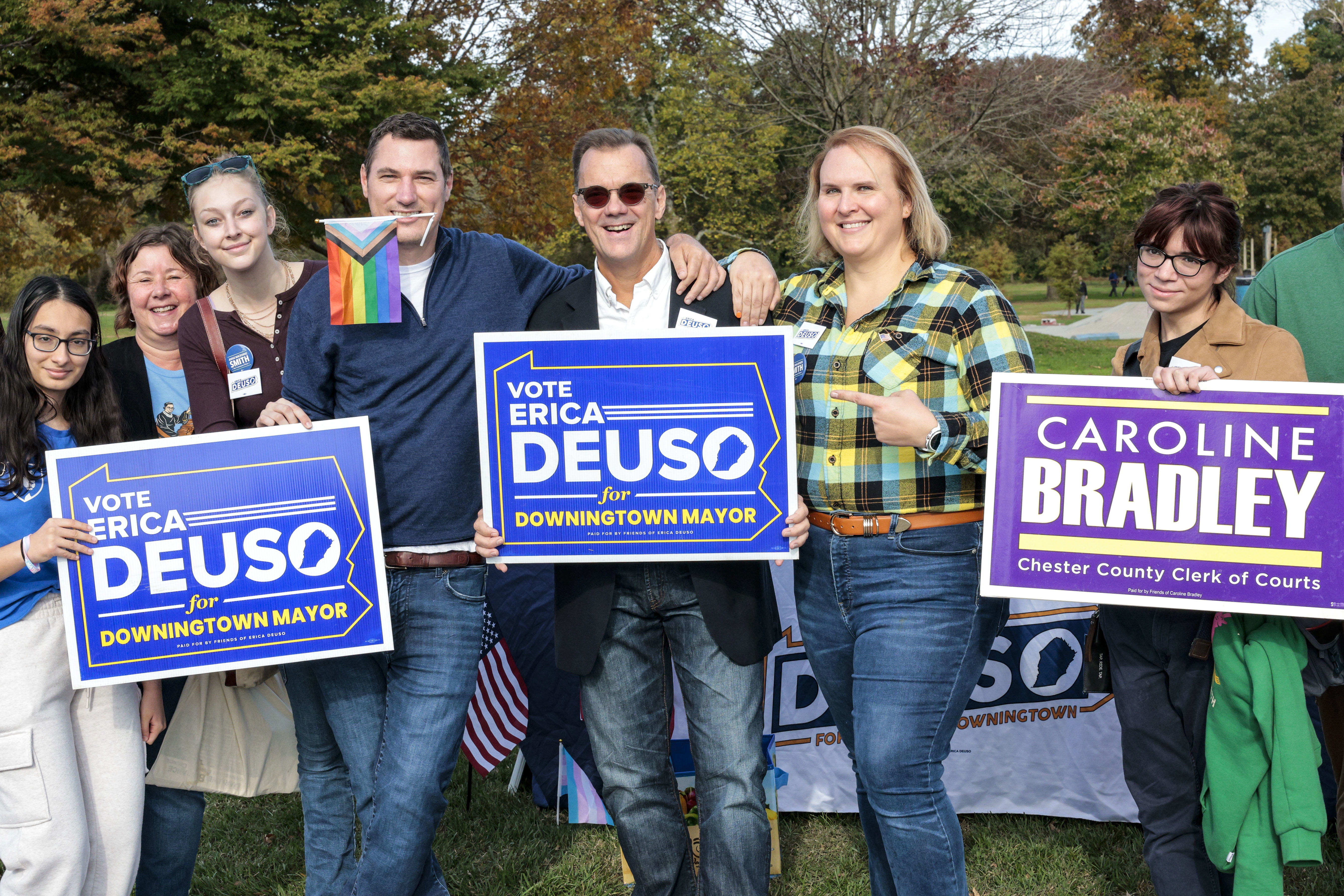
Democratic supporters pose with current Downingtown Mayor Phil Dague, center, Chester County Commissioner Josh Maxwell, center left, and mayoral candidate Erica Deuso, center right.
For most voters, though, those facts didn’t even register.
Deuso, who works in management at a pharmaceutical company, has lived in Downingtown for 18 years.
She is a committeewoman in the local Democratic Party, and board member for Emerge Pennsylvania, which trains women and LGBTQ+ people to run for office. Her platform centers on traffic control, domestic violence, community engagement, and sustainable development.
The Downingtown mayor has relatively limited power, overseeing the police department and acting as a tiebreaking vote on borough council. Deuso has promised not to sign an agreement between Downingtown police and U.S. Immigration and Customs Enforcement and said she wants to work on enhancing mental health services for officers while expanding their reach in the community to address concerns over traffic violations and e-bikes.
As she knocked on doors on a Saturday morning in October, Deuso’s gender identity rarely came up in her interactions with voters.
“I’m not running on being trans, that’s not something I ever do or ever wanted to do. I wanted to make it about the neighbors,” Deuso said. “It’s the other side making it about who I am, my identity.”
Going door-to-door looking for votes in Downingtown in October, Erica Deuso meets Nicole Flood at her door.
The historic nature of her campaign has likely driven attention and funds to the race. She has earned endorsements from several organizations that back LGBTQ+ and women candidates. And she’s received donations from outside the state and outside Chester County, including a $3,000 donation from Greater Than PAC, which supports progressive women.
But a scan of comments in community Facebook pages shows her identity has also driven more vitriol.
“There are people who refuse to use my correct name or pronouns, they’ve deadnamed me, all those sorts of things. But it’s been 16 years since I transitioned; I don’t really care,” Deuso said. But she’s mindful that LGBTQ+ youth are watching her. She engages in some of the posts, but not all of them.
“I want to handle it with grace.”
Those efforts are already influencing at least one local teen. Nicole Bastida-Moyer, a 39-year-old voter, told Deuso her candidacy had inspired her 14-year-old daughter to volunteer to help other students with their mental health. Both she and her daughter are pansexual.
“She deals with a lot of hate,” Bastida-Moyer said through tears about her daughter.
“Having Erica’s voice, it means a lot,” Bastida-Moyer said.
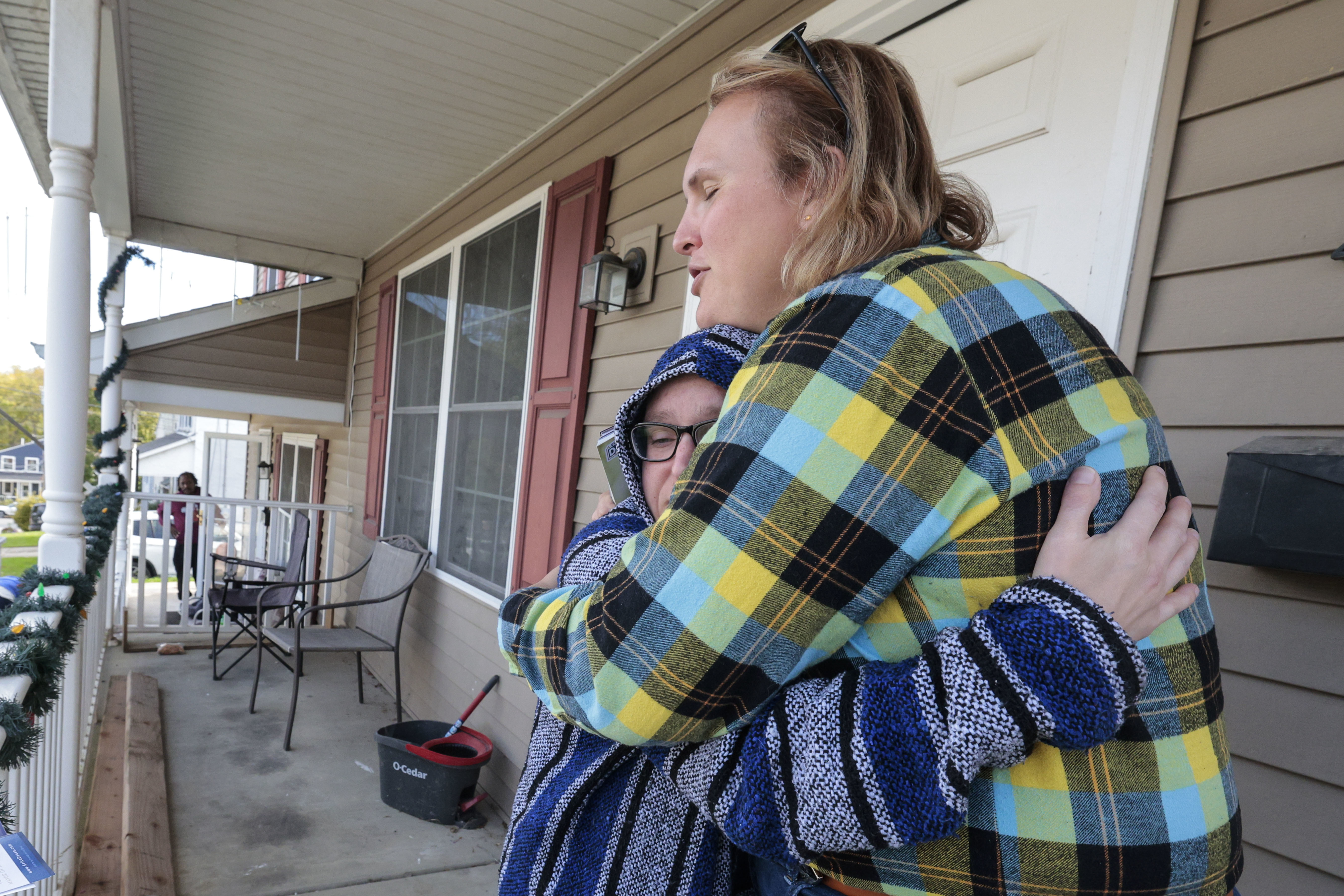
Nicole Bastida-Moyer gets a hug from Downingtown mayoral candidate Erica Deuso while campaigning in October.
Impact on voters
Deuso responds to comments on her Facebook page and other groups occasionally. She said she tends to do so only when she thinks a true conversation can come of it.
Door-knocking in her neighborhood, Deuso encountered just one voter who appeared to be hostile to her because of her gender identity. When Deuso approached one house, a woman came to the door and glanced at the candidate and her fliers through the screen door without opening it.
“I’m not voting for him,” the woman said. “For who?” Deuso asked as the woman turned and walked away.
Episodes like this are relatively rare, Deuso said
“People are generally much nicer in person than online,” said Jenn Fenn, who managed U.S. Rep. Chrissy Houlahan’s 2024 reelection campaign in a district that includes Downingtown.
Deuso’s opponent, Republican Rich Bryant, says he doesn’t condone those who attack Deuso based on her identity.
But Deuso has shared several screenshots on social media that appear to show Bryant insulting transgender women and making misogynistic remarks about cisgender women. At a canvass launch at the local farmers market, the township’s current mayor, Democrat Phil Dague, referenced these posts while comparing Bryant to Trump.
Current Downingtown Mayor Phil Dague talks with supporters for Erica Deuso listening at right. Saturday October 18, 2025.
Bryant claimed 90% of these posts are AI-generated but refused to say which posts are real and which are fake.
“I don’t like mud-slinging misinformation,” Bryant said. “I try to stay focused on what’s good for Downingtown.”
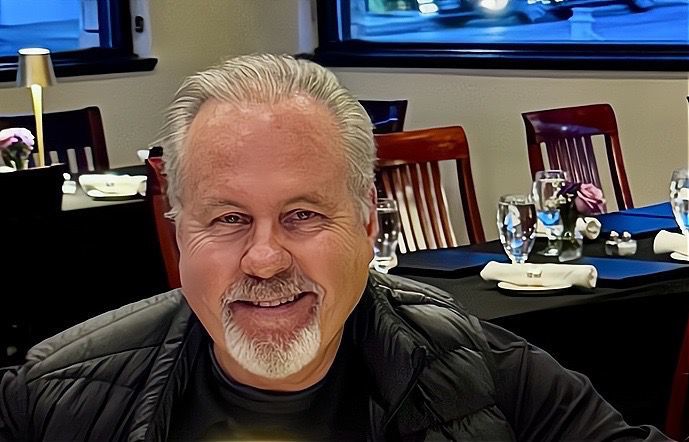
Rich Bryant is running as a Republican for Downingtown mayor.
He sought to present himself as better experienced than Deuso to be mayor, contending his career in cybersecurity has prepared him for the mayor’s primary duty of overseeing the local police department.
Alice Sullivan, an 80-year-old neighbor and donor to Deuso, had noticed some of the nastiness on social media and said she was voting for Deuso because, unlike her opponent, she wasn’t a “bigot.”
She lamented the online attacksagainst Deuso as disappointing — but unsurprising. The candidate’s gender identity shouldn’t matter, insisted Sullivan, who has lived in Downingtown for decades.
“Other people’s lives, genders, whatever is not my business,” she said.
Josh Maxwell, a Democratic county commissioner and former Downingtown mayor who had joined Deuso to knock doors, asked if Sullivan thought others would disagree in the historically Catholic community. But the people who cared, Sullivan argued, are “not going to vote Democrat anyway.”
“There might be some,” she said. “I don’t know very many.”
Campaigning in the west end of Downingtown Erica Deuso greets Alice Sullivan on Oct. 18.
As Deuso walked door to door, her conversations focused on local and community issues. She greeted every dog she saw and spoke to their owners about their safety concerns — drivers had been racing down quiet neighborhood streets — and their concerns about the community. Deuso is proposing a program to offer hotel rooms for one night to those facing domestic violence.
She also made it clear that she would be a resource, even on issues that went beyond the mayor’s official duties. She showed one voter how she had started a youth-driven art project at a recent township festival. And pointed to a home that, just weeks prior, she’d brought a misdelivered package to on behalf of a voter.
For weeks, Raul Hurtado, Deuso’s neighbor who immigrated from Colombia in the 1990s, has been rolling down his windows when he sees Deuso, telling her he’s voting for her.
“She is from this town, my neighbor, and we need someone to help us,” Hurtado told The Inquirer.
If she’s elected, Deuso told Hurtado, her goal is to be available to all residents through office hours at Borough Hall.
“We can have a face-to-face discussion,” she said. “Not through your car window.”
This suburban content is produced with support from the Leslie Miller and Richard Worley Foundation and The Lenfest Institute for Journalism. Editorial content is created independently of the project donors. Gifts to support The Inquirer’s high-impact journalism can be made at inquirer.com/donate. A list of Lenfest Institute donors can be found at lenfestinstitute.org/supporters.
A woman was shot in the wrist and a man was arrested after what police say appeared to be a road rage incident Monday evening in Bucks County.
Around 6:30 p.m., police responded to a reported shooting in the area of the Newtown Bypass and Woodbourne Road in Newtown Township.
The woman, who was driving one of the vehicles involved in the incident, was transported to St. Mary Medical Center and was listed in stable condition, police said.
A few minutes later, the man and the vehicle he was driving were located at Washington Crossing and Stoopville Roads, and he was taken into custody, police said. A gun was recovered for evidence.
Police said both vehicles reportedly were traveling east on Newtown Bypass during the initial encounter and then south onto Woodbourne Road.
Anyone who witnessed the incident or has information helpful to the case can contact the Newtown Township Police Department at 215-579-1000 ext. 317.
New Jersey’s beaches, still recovering from major sand losses from an offshore hurricane and a nor’easter, evidently are in for another assault this week as October is about to make a dramatic exit.
Gale-force gusts off the ocean could develop as early as Tuesday afternoon at the Shore, said Eric Hoeflich, a meteorologist at the National Weather Service office in Mount Holly, with brisk onshore winds persisting “maybe into Friday.”
A potent storm is forecast to affect the entire region Wednesday night into Thursday, with heavy rains in the immediate Philadelphia area, where drought conditions have been intensifying.
Also on Thursday, what is likely to become catastrophic Hurricane Melissa will be passing offshore, churning up the waves crashing on East Coast beaches.
“The coast once again is going to take a pretty good battering,” said Dave Dombek, senior meteorologist with AccuWeather Inc.
On the plus side, Hoeflich said, for the Shore, this week’s storm “doesn’t look as bad” as the beach-erasing nor’easter earlier this month. The path should be more inland, and the lunar influence on the tides would be less. Only minor flooding is expected, he said, subject to change.
However, not only would the track mean region-wide heavy rain, but it would also increase the potential for severe thunderstorms Thursday. A front is due to chase the rains Friday, but it may generate gusts to 50 mph, the weather service says. Power outages are possible both days.
The timetable for the winds and the storm in the Philly region
The National Weather Service has posted a gale warning for Tuesday into Wednesday morning for the waters along the immediate coast for winds from the east that could gust past 50 mph.
That would be more the result of high pressure to the north of the region. Winds circulate clockwise around centers of highs; thus, areas to the south of the center experience winds from the east.
The breezes will be getting a second wind as a storm develops in the Southeast and tracks north. Meanwhile, a weakened Hurricane Melissa will be churning the ocean as it passes well off the U.S. coast on Thursday.
A strong storm system will move across the region later this week. Here is a summary of expected impacts. pic.twitter.com/OvhoVAaS11
Rain for the last 30 days has been about a third of normal in the city and the neighboring Pennsylvania counties.
South Jersey has fared only slightly better, but precipitation is well less than half of normal.
What is the forecast for the trick-or-treaters?
It is all but certain that Friday will be a dry day, with temperatures in the low and mid-50s. Wind gusts are forecast to die down sometime after 5 p.m., but hold onto those brooms, just in case.
A Wilmington man brought his mother’s gun to Lincoln University’s campus Saturday, prosecutors said, and was still holding the loaded weapon when a deadly shooting tore through the school’s homecoming celebration.
Zecqueous Morgan-Thompson, 21, has not been charged in connection with the shooting, only with possessing the weapon without a concealed-carry permit. But investigators said they were still working Monday to determine whether his firearm was used in the incident at the historically Black university, which left one person dead and six others wounded.
Morgan-Thompson remained in custody Monday in lieu of $25,000 bail.
Chester County District Attorney Chris de Barrena-Sarobe said his office is trying to determine if more than one shooter was involved. Morgan-Thompson was arrested on the campus in the aftermath of the gunfire, holding a loaded Glock 28 .380-caliber handgun, according to the affidavit of probable cause for his arrest.
The shots rang out about 9:30 p.m. Saturday on the campus in Lower Oxford Township. De Barrena-Sarobe has said he does not believe the shooting was a coordinated attack targeting the school, but instead took place as the crowd swelled on the campus.
The motive for the shooting remained under investigation.
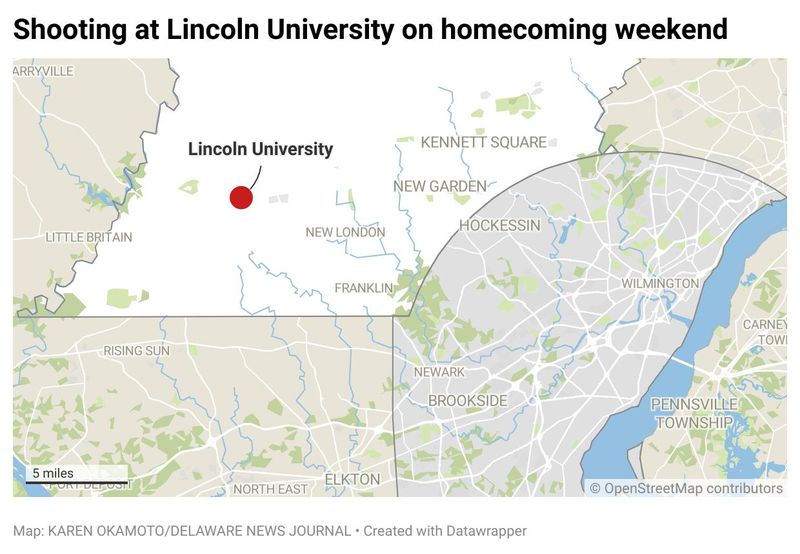
Gunfire rang out just before 9:30 p.m. Oct. 25 at Lincoln University in the parking lot of the International Cultural Center in Lower Oxford Township in Chester County, Pennsylvania. The university is about 15 miles from Hockessin.
Jujuan Jeffers, 20, of Wilmington, died after being shot in the head. It was unclear if Jeffers had any affiliation with Lincoln — investigators have said the victims included one alumnus and one current student.
Jeffers’ brother declined to speak with a reporter when contacted Monday.
The student who was hurt was recovering well, but obviously shaken, according to Chester County Commissioner Josh Maxwell, who is an adjunct professor at the school. Her injuries, he said, were not life-threatening.
Lincoln University canceled classes Monday in light of the shooting.
“Gun violence happens far too often in our country, and we are heartbroken that Lincoln University and its students are among the latest victims of such senseless violence,” the school said in a statement.
The rural campus was quiet Monday afternoon as students gathered for a vigil that gave members of the university community a chance to grieve and heal.
The service was not open to the media, and gates at various entrances to Lincoln’s campus were locked.
Geslande Sanne, a Lincoln University junior from Oregon, was in her dorm Monday morning, still coming to terms with the chaotic scene she experienced Saturday night.
“A lot of us on campus are processing it in our own different ways,” said Sanne, a political science and French major. “We are all reaching out to each other. Our professors are talking to each other and to us. Some students went home to be with their families. Some people are just resting.”
She said she intended to attend the university’s community healing session on campus at noon and later go to the hospital to visit her friend, who was the only Lincoln student shot during the incident.
Sanne recalled that she and a group of friends were on the outskirts of the crowd when they heard gunshots.
“Everybody started running and we started running, too,” she said. “We were confused. Did something really happen? After a few minutes, the music stopped, and we knew something really happened.”
She and her friends made a plan to get back to their dorms so they would be safe, but then decided to seek shelter inside the International Cultural Center building, not far from where the shooting took place.
After people started banging on the windows, she said, Sanne and her friends left there and walked carefully back to their dorms.
It all happened in about 20 minutes, she estimated.
Sanne said she chose to attend Lincoln because she wanted to go to an HBCU and was impressed by all its prominent graduates. She said she has received much encouragement and many opportunities at the school.
“It’s really inspired me,” she said, “that I can be a part of something positive despite everything going on in the country.”
She said she has always felt safe on Lincoln’s rural campus, safer than she does anywhere else. And Saturday night’s shooting hasn’t changed that.
“It wasn’t Lincoln’s fault,” said Sanne, who wants to be an international lawyer. “We do the best we can with the resources we have. It shouldn’t be an excuse to leave or disinvest in Lincoln. It’s a reason to pour in more resources and support these schools even more.”
Staff writer Jesse Bunch contributed to this article.
The transit agency has until Oct. 31 to complete the inspections, which were recommended after the National Transportation Safety Board released a report investigating five fires that occurred on the Silverliner IVs this year.
As of Oct. 9, SEPTA said that crews can handle about six Silverliner IV cars a day, with a goal of ramping up inspections to handle 12 cars a day with five-person crews per car.
Although SEPTA is rotating cars in and out of service for the inspections — instead of yanking all 225 from service at once — riders have experienced significant delays and some trains have been outright canceled. Without a full fleet, SEPTA says it is unable to respond as easily to typical delay-causing events, such as power outages and bad weather.
Riders should check the SEPTA app for real-time updates on how trains are running.
As the deadline approaches and delays persist, The Inquirer is tracking SEPTA’s inspection progress.
Mon., Oct. 27, 2025
95 inspections complete
Days until deadline: 4
Fri., Oct. 24, 2025
88 inspections complete
Days until deadline: 7
Wed., Oct. 22, 2025
78 inspections complete
Days until deadline: 9
Mon., Oct. 20, 2025
66 inspections complete
Days until deadline: 11
Fri., Oct. 17, 2025
58 inspections complete
Days until deadline: 14
story continues after advertisement
Wed., Oct. 15, 2025
46 inspections complete
Days until deadline: 16
Thurs., Oct. 9, 2025
12 inspections completed
Days until deadline: 22
Mon., Oct. 6, 2025
Inspections begin
Cars began undergoing inspections in SEPTA’s four regional maintenance facilities.
Greg Buzby, manager of Regional Rail vehicle engineering, shows some of the work being done for the safety inspections at the SEPTA Overbrook Maintenance Facility.Tyger Williams / Staff Photographer
“We’re looking for any signs of overheating or damage to any of the circuits, physical damage, making sure the bolted connections are tight,” said Greg Buzby, manager of Regional Rail engineering. “There’s also electrical testing that we have to do to make sure the insulation has its integrity.”
Inspections remaining: 225
Days until deadline: 25
Wed., Oct. 1, 2025
NTSB releases report
Noting that the Silverliner IV cars’ “outdated design … represents an immediate and unacceptable safety risk,” the National Transportation Safety Board urged SEPTA to sideline all the Silverliner cars immediately and to retrofit or replace them as soon as possible. The Silverliner IVs went into service between 1974 and 1976, with technology that was designed even before that time.
The NTSB’s findings are advisory.
More than 300 passengers were safely evacuated after a SEPTA Regional Rail train caught fire in February in Delaware County.Charles Fox / Staff Photographer
The Federal Railroad Administration, which regulates freight and passenger railroads, ordered SEPTA to undertake the inspections, concluding “that SEPTA’s maintenance and operation of its passenger rail equipment requires additional oversight and corrective action.”
Inspections remaining: 225
Days until deadline: 30
story continues after advertisement
Talk to our transportation team.
Do you have questions about what’s happening on Regional Rail? Ask here or share how your rides on Regional Rail have been impacted in October.
Staff Contributors
Reporting: Thomas Fitzgerald and Erica Palan
Graphics: John Duchneskie
Editing: Lizzy McLellan Ravitch
Digital Editing: Erica Palan
Subscribe to The Philadelphia Inquirer
Our reporting is directly supported by reader subscriptions. If you want more journalism like this story, please subscribe today
Curiosity killed the cat, the adage goes, but in the case of Ace the kitten, the fault lies with a defective pet-food container, according to a proposed class-action lawsuit filed in Philadelphia’s federal court.
Valentina Mallozzi, of Montgomery County, says in the complaint that, in July, Ace managed to get into a locked Iris pet food container she ordered from Amazon. But once the 3-pound kitten was inside, the airtight lid dropped and locked Ace inside.
The lawsuit, filed last week, accuses Iris USA of creating a defective product that it markets as safe for pets. The complaint says Mallozzi is one of many pet owners who tragically lost their cat to an Iris container.
The complaint aims to represent all people in the United States who purchased an Iris container. The complaint does not include an estimate of how many people are included in the class, or how much money Iris would owe each person.
Iris USA, a subsidiary of Japanese plastics manufacturer Iris Ohyama, did not respond to a request for comment.
Mallozzi bought the Iris airtight stackable containers for $29.99 from Amazon in March, the complaint says. The containers have a locking mechanism that Iris claimed is designed to “keep pets from sneaking a second or even third breakfast with the secure locking latch,” according to the complaint.
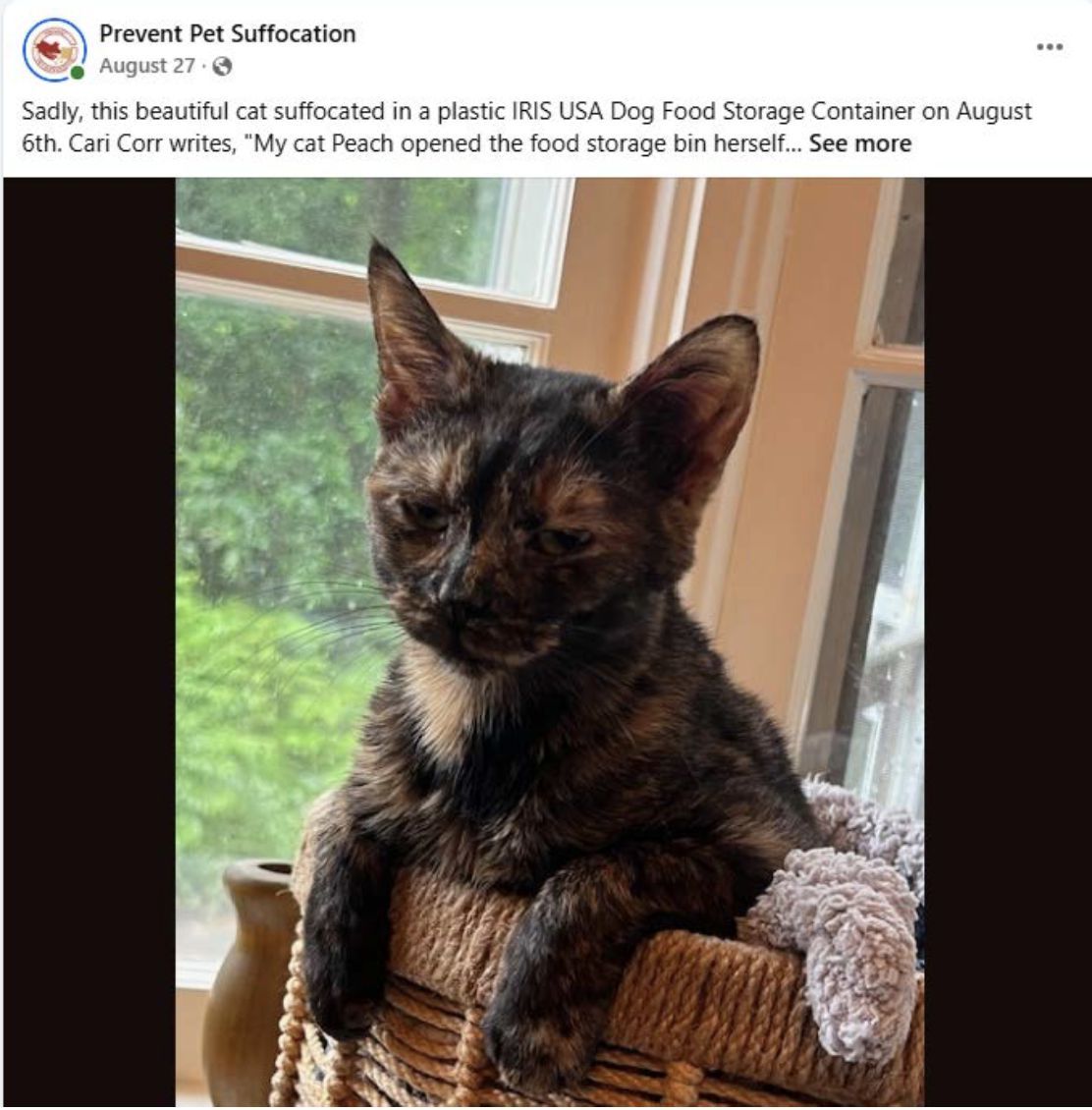
Screenshot of a post in the Prevent Pet Suffocation Facebook group, which shares the story of Peach the cat who died trapped in a Iris USA food storage container, from Valentina Mallozzi’s lawsuit against the company.
The problem, the suit says, is that cats can open the latch from outside, climb in, and get trapped as the mechanism automatically locks them in. The airtight seal that keeps pet food fresh makes the trap deadly, as a “pet will suffocate within a few minutes,” the complaint says.
The lawsuit cites posts from the Prevent Pet Suffocation Facebook group in which cat owners share stories about their beloved pets getting trapped in an Iris container.
One post included in the complaint shares the story of Baby Bear, a family’s cat who was found dead in an Iris container by an 8-year-old girl.
“My cat, Max, also suffocated in an Iris pet food container,” a woman responded. “I know the pain you’re going through.”
Iris USA was put on notice, and not only by people on social media, the complaint says. In March, the Center for Pet Safety, a Virginia-based nonprofit, put out a report evaluating the risk food containers represent for pet suffocation that specifically calls out Iris.
The latch mechanism on the lid “significantly increases the risk of pet suffocation,” the report says.
The lawsuit says the product should have come with a label warning of the suffocation risk for pets that can unlatch the lid.