When Nicole Lauria met Daniele Grovola more than a decade ago, it was clear that the little girl from Upper Darby would one day become a star employee at her karaoke company.
“She was amazing,” said Lauria, the owner of Lucky Music Productions. “A lot of people use the phrase, ‘She lit up a room.’ But she really did.”
Tragedy struck the Grovola family days before Christmas.
Police arrested the young woman’s mother, Diane Grovola, 57, whom they have accused of stabbing her daughter to death in the home. Her husband, John, Daniele Grovola’s father, discovered the horrific scene as he arrived home from an overnight shift at the airport, authorities said.
Friends of Daniele Grovola are shocked by a crime they are struggling to understand.
Photo of Daniele Grovola.
In the week since Grovola’s death, they have launched a fundraiser to support her father and cover the young woman’s funeral costs. The money will also go toward veterinary bills for the family’s dog, Ezra, which police suspect Grovola’s mother also stabbed that morning.
And loved ones are sharing memories of Daniele Grovola, who brought joy and warmth to those she encountered.
Lauria met John Grovola around 15 years ago, when he made the leap from singing karaoke to joining Lucky Music as an equipment manager and DJ. The company hosts events at venues throughout Delaware County and Philadelphia.
Grovola soon began to bring around his daughter, who took a fast interest in her father’s work.
The father and daughter were “immensely close,” Lauria said. Following in her father’s footsteps, Daniele Grovola eventually joined Lucky Music herself, managing the company’s DJ equipment.
She was training to become a bar trivia host before she died.
Her radiant personality shone on the job, according to Lauria, including at a karaoke party the company hosted in 2024 for children who had disabilities and were on the autism spectrum.
“[Daniele] was just amazing at encouraging them to sing, helping them to feel positive about themselves,” Lauria said. “She was just a warm person.”
Hailey Geller, 23, said she and Grovola had been best friends since the third grade. The girls went on to attend Upper Darby High School together.
“She was never a bother,” Geller said. “She was really good to me, and I was good to her.”
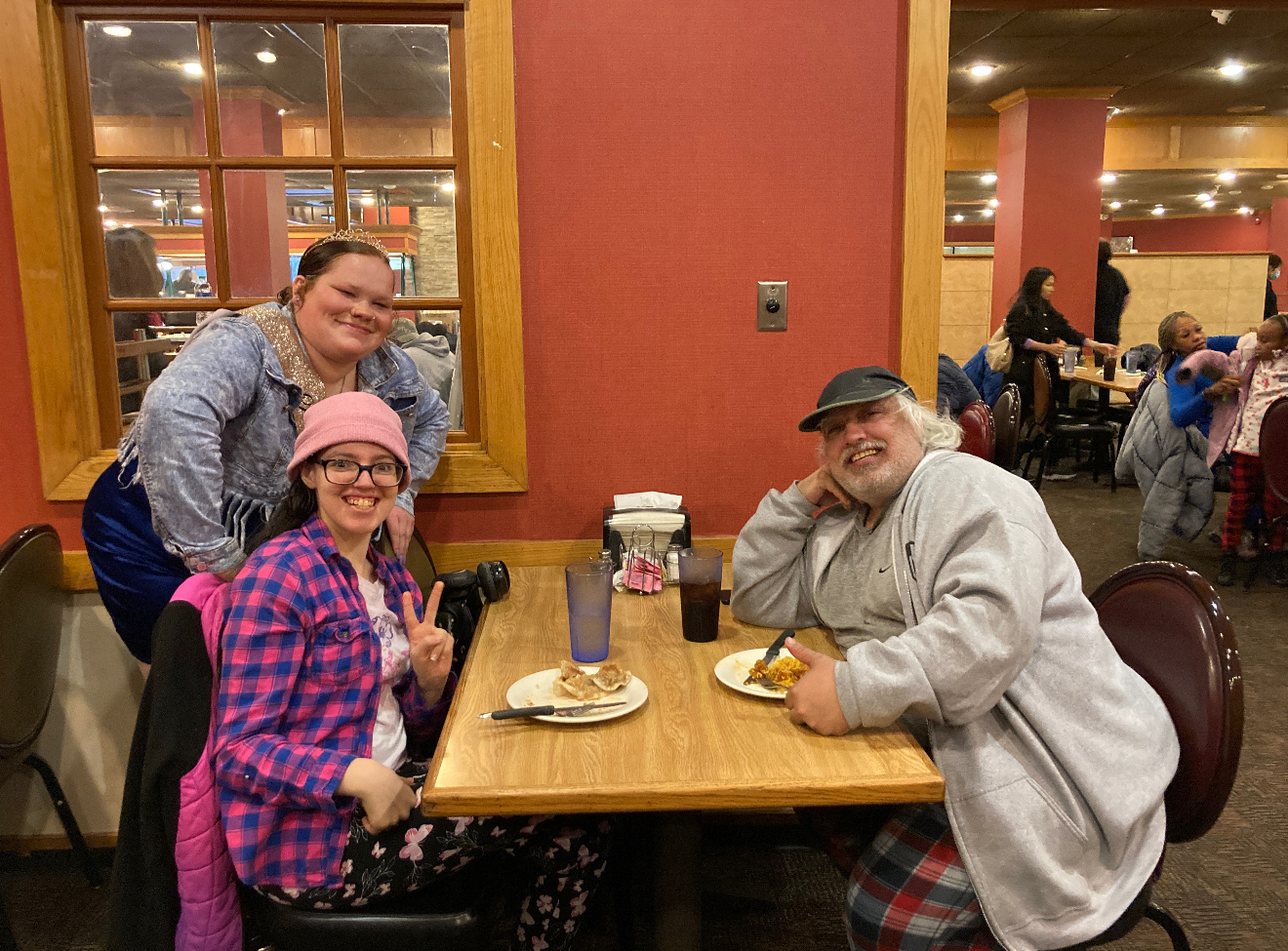
Hailey Geller with Daniele Grovola and her father, John.
Grovola had her quirks, Geller said, amusing friends with her obsession with Sharpies. The girls would spend afternoons at the mall, where Grovola would hunt for multicolored markers to use in her artwork.
She was an avid fan of anime shows, Geller added, and, as a music lover, adored her headphones.
Geller said Grovola was always there to confide in. In recent months, however, some of Grovola’s comments about her home life had concerned her.
Grovola told Geller that her mother had been “in and out” of local crisis centers. And Grovola described her mother as having “mental issues,” Geller said, once disclosing she had locked herself in the basement to avoid her.
Still, Geller believes Grovola did not share the complete story of possible tensions with her mother. Police have yet to identify a motive in the killing and continue to investigate.
Friends like Lauria said those who knew the Grovola family did not suspect such a crime was possible.
“It makes no sense,” Lauria said. “[Daniele] was a great daughter to her mother … loved her mother very much. This just came out of nowhere.”
With the election behind him and the top law enforcement job in Bucks County ahead, Joe Khan says he’s ready for his next challenge.
In January, Khan, a former federal prosecutor and onetime Bucks County solicitor, will become the first Democrat to serve as district attorney in the county since the end of the Civil War. (That’s not counting Ward Clark, a Republican who switched parties to run as a Democrat in 1965 and immediately switched back to his GOP roots after he won.)
Khan, 50, is also the first candidate from outside the district attorney’s office to win the top post after several decades in which voters routinely replaced outgoing district attorneys with successors from among inside the ranks of the office.
To claim that mantle, Khan decisively beat Jen Schorn, the Republican incumbent and a career prosecutor in the district attorney’s office, winning 54% of the vote in the November election, which broke a 20-year record for voter turnout.
County political leaders say Khan’s victory signals voters’ desire for regime change in the once GOP-dominated suburb.
“Democrats came out because they felt like it was necessary to push back on what Trump was doing,” said State Sen. Steve Santarsiero, the chair of the Bucks County Democratic Party. “And in the case of Joe, they recognized him as someone who is going to stand up to an administration that has shown it’s willing to flout the law.”
Khan, for his part, says politics is in the rearview mirror as he prepares for his new job.
“I don’t care what political party you’re from, I don’t care who you voted for president or for district attorney,” he said in a recent interview. “What I care about is that you’re here to support the mission of keeping Bucks County safe and seeking justice every day.”
Joe Khan greets and signs a poster for supporter Phyllis Rubin-Arnold as he waits for a meeting with the Buckingham Township Police chief. Khan says that politics has no role in his plans for the district attorney’s office.
And he said he would expand that work — Khan tapped Kristin McElroy, one of Schorn’s top deputies, to serve as his first assistant.
Drawing on his experience in the U.S. Attorney’s Office in Philadelphia, Khan said he would pursue environmental crimes and prosecute cases involving violations of workers’ rights.
“We have seen all kinds of advances in terms of the powers that DAs have in Pennsylvania, so I think it’s great to have an opportunity to look at things with fresh eyes,” he said.
Khan grew up in Northeast Philadelphia, where his father settled after emigrating from Pakistan. Like his brother, State Rep. Tarik Khan (D, Philadelphia), he took an early interest in public service. He followed those aspirations to Swarthmore College and, later, the University of Chicago Law School.
Khan said he was drawn to Bucks County later in his career, and has made it his home in the 14 years he has lived with his sons, Sam, 14 and Nathan, 11, in Doylestown Township. He and the boys’ mother are divorced but co-parent amicably, he said, and live a few doors down from each other.
After stints in the Philadelphia District Attorney’s Office and the U.S. Attorney’s Office — where he specialized in prosecuting gun crimes and locking up child predators — Khan ran for the top prosecutor’s job in Philadelphia in 2017, losing the race to Larry Krasner.
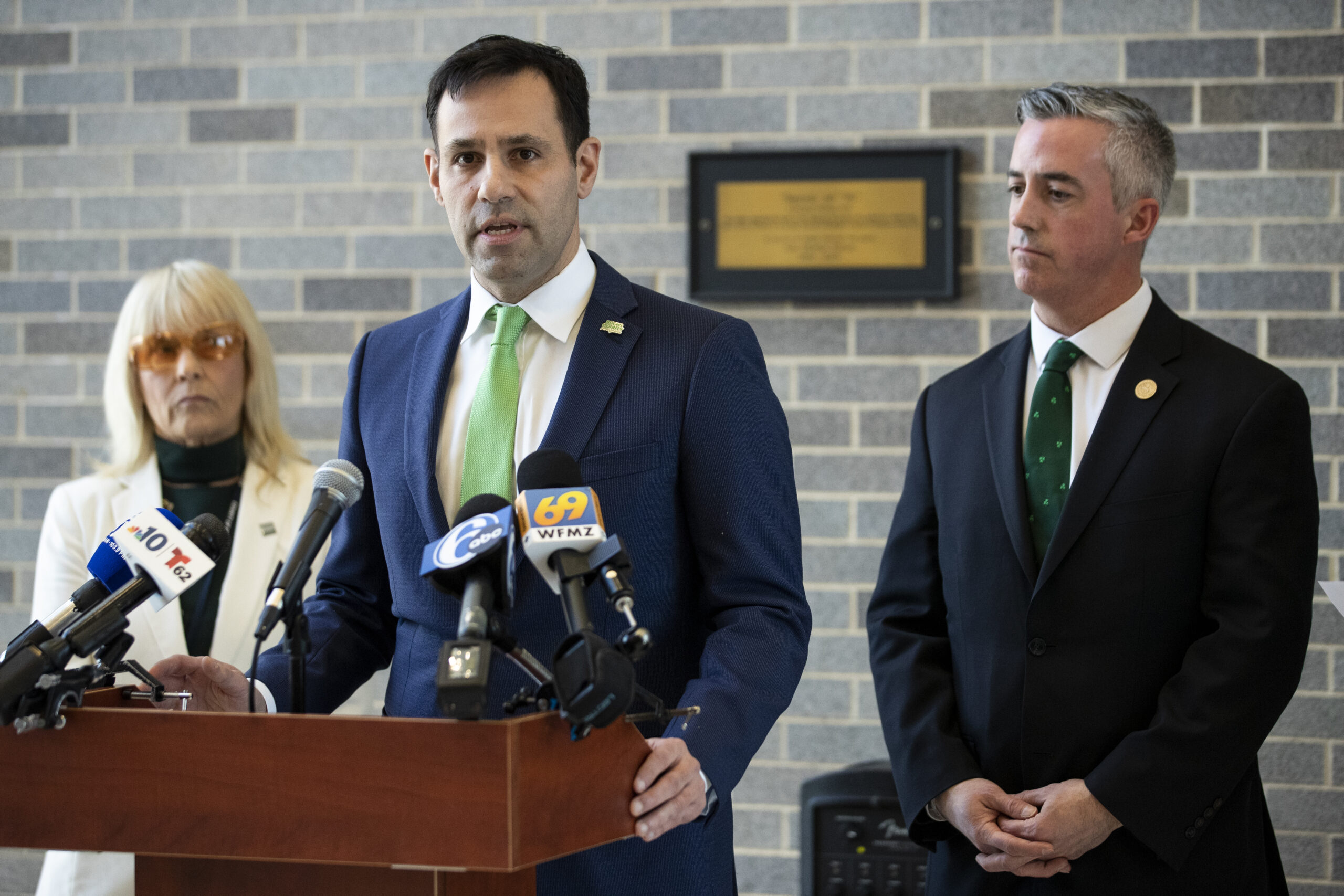
Joe Khan (center) is seen here in March 2023 alongside County Commissioners Diane M. Ellis-Marseglia and Robert J. Harvie Jr. as they announced a lawsuit filed against multiple social media companies for “fueling a mental health crisis among young people.”
Three years later, Khan took over as Bucks County solicitor. He developed an interest in local politics, he said, after watching the culture-war debates over library books and allegations of abuse that embroiled the Central Bucks School District, where his kids are enrolled.
“It’s really central to my view of what parents need from their government,” he said. “They need people in roles like this that are going to make life easier, not harder, and that are going to help them with the challenges that they’re facing.”
Not long after taking over the office, Khan challenged Trump’s efforts to dismiss mail-in ballots during the 2020 election. He also waged legal battles, taking on companies including 3M, DuPont, and Tyco by filing lawsuits over the “forever chemicals” that had leached their way into residents’ water supplies.
And he made headlines for joining a national lawsuit against social media giants like TikTok, bidding them to address the mental health of their young users.
When now-Gov. Josh Shapiro left the state attorney general’s office, Khan stepped down to join a crowded primary to replace him, running in 2023 on a platform to “continue what has been a lifelong fight to keep people safe.”
After losing that race, Khan set his sights on the top law enforcement job in his new home, challenging the long-standing Republican machine that had controlled it for decades.
“I think that if you do a good job and you let people know why you’re doing the things that you’re doing, whether or not they agree with you on every political position, if they know that you’re honest, you got a pretty good shot at earning their vote,” he said.
“And I think that’s a big part of how we won this election.”
A voter walks past the election lawn signs, including one for Joe Khan and his running mate, Danny Ceisler, outside the Bucks County Senior Citizens polling location in Doylestown on Nov. 4.
Santarsiero, the county Democratic Party chair, said he was confident that Khan would make a fine district attorney.
Winning the post required political prowess, of course, but he said that is a dichotomy unique to the office: Politics are required every four years to secure a position that is apolitical.
Party affiliation aside, he said, Khan would work for the good of the county.
Khan, for his part, says he is ready to give it his all.
“We are here to keep people safe, and we’re going to do that in new and exciting ways,” he said. “I have my values, I wear them on my sleeve, and I’m very clear about the direction that we’re going to go to make sure that people who deserve a healthy environment for their families are getting a higher level of service than they’re used to.”
Tianna Williams didn’t finish high school after becoming a mom at 16. As a teen dropout, she began flipping cars to make money, and by her late 20s, her car sales acumen led her to open a dealership in Lehigh Valley that grossed over $1 million in annual sales.
An opportunity to get a line of credit with one of the nation’s largest banks turned Williams’ dream into a nightmare, she said, which led the 30-year-old to file a lawsuit.
M&T Bank opened a fraud investigation into Williamsin spring 2023, says the suit filed in Common Pleas Court in Philadelphia in March. The bank inappropriately informed her financial partners that her business could be illegitimate, the complaint says. The bank froze her account, her partners cut ties, and her checks bounced. Williams’ growing businesses crashed.
The investigation found no fraud, M&T lawyers said in a September hearing. But Williams says the damage was done.
The complaint says the Black entrepreneur was a victim of the bank’s “racist and overzealous fraud investigator” who tormented the business owner for weeks. The investigator told Williams “you people” have ways of making fraudulent behavior seem legitimate, the suit says.
Despite eventually finding no fraud, the investigator shared an email with a colleague,signed with a smiley-face emoji, saying “doing my best to not let her win on my watch.”
“She killed my self-esteem,” Williams said of the investigator. “I lost all financial security.”
The phenomenon of Black people being treated with suspicion by financial institutions has been dubbed “banking while Black” and has a history going back at least to the 1930s, when red lines on maps labeled majority-Black neighborhoods as unworthy of mortgages. More subtle variations of the practice have continued into the 21st century, resulting in settlement agreements for millions of dollars.
Williams’ rags-to-riches story began in 2012, when she became pregnant at the age of 16. Her mother had recently been diagnosed with cervical cancer, and the family barely scraped by. After dropping out of high school before completing 10th grade, Williams learned how to flip cars from auctions with the help of a mentor she met through Facebook.
Her first car: a 2002 Lincoln that as a 17-year-old she sold the next day for a $700 profit.
The young hustler with a knack for sales got her auction license a couple of years later. She kept selling cars on Craigslist and through other social media connections. In 2018, she began working at an auto dealership. She learned the trade and became especially good at working with people who had low credit scores.
Williams’ cut from each sale at the dealership was a fraction of the overall profit, so she decided to go it alone. She bought a lot in Easton in 2020 and set to work. The cars she sold became newer and more expensive.
Tianna Williams next to the sign of her car dealership in Easton.
To sell cars for more than a couple of thousand dollars, Williams needed to offer financing options. She got her banking license and contracted with lenders. Her business was booming and she was planning to open a second location.
That’s when Shazard Mohammed from M&T reached out, the complaint says. He offered Williams a line of credit that would allow her to take her business to the next level, and she transferred her accounts to the bank.
Within days, Williams’ lenders contacted her to say they could no longer offer her financing because she was being investigated by M&T for fraud. Nearly overnight, she was without a business while owing about $200,000 in business and tax debts.
“M&T BANK basically told me that they suspected you of fraud,” one business partner told Williams in a text message, according to the complaint. “If that’s not true, then somebody really has it out for you.”
Records fight
The bank is now fighting in court to keep documents related to the investigation secret, despite an attorney representing M&T saying in a September hearing that “there was no finding of fraud,” according to a transcript.
M&T said in that hearing that Williams was investigated because of “red flags,” such as misspellings on checks that were immediately withdrawn as cash, and that the investigation lasted only seven days.
Common Pleas Court Judge Paula Patrick sanctioned the bank’s lawyers in October for their failure to produce documents and ordered them to pay nearly $8,000 in attorneys’ fees. The judge also found that most records should not be sealed. M&T is appealing the ruling.
Dean Malik, the attorney representing Williams, frames the case as a fight of David vs. Goliath. By issuing sanctions, he said, the judge reminded large entities that in court the playing field is leveled.
“The judge is sending a message that it doesn’t matter if you are a billion-dollar bank and have two law firms representing you with five lawyers, you are still bound by the orders of the court,“ Malik said.
Williams now cleans houses with her mother to support her family financially. She said her self-esteem has been shattered, and she hasn’t set foot inside a bank out of fear since her business closed in 2023.
“There is nothing else I know how to do,” Williams said. “All I know is cars.”
Right after Pennsylvania Attorney General Dave Sunday was sworn into office in January, he received a lunch invitation from across the Delaware River.
It didn’t matter that they came from different political parties, said New Jersey Attorney General Matthew Platkin, a Democrat appointed to his post by outgoing Gov. Phil Murphy.
Platkin wanted to get to know his neighbor, and invited Sunday out to lunch in Philadelphia.
The two men could not have more different approaches to their jobs. In a hyperpolarized political era, where attorneys general play an increasingly important role in national politics, Platkin has become a face of Democratic opposition to President Donald Trump’s administration. He has led or joined dozens of lawsuits by blue-state attorneys general and governors in arguing that the executive branch is acting unconstitutionally on issues like birthright citizenship, withholding congressionally approved funds, and more.
In contrast, Sunday, a Republican elected last year, has largely avoided suing Trump and has said he strives to be “boring,” focusing his efforts on oversight of his own office.
Even their jobs are different, despite sharing a title. New Jersey’s attorney general is in charge of the state’s 21 county prosecutors, oversight of state police, and protecting consumers, among other duties; Pennsylvania’s attorney general has wide-ranging powers to investigate corruption, enforce the state’s laws, represent the state’s agencies and interests in lawsuits, and more.
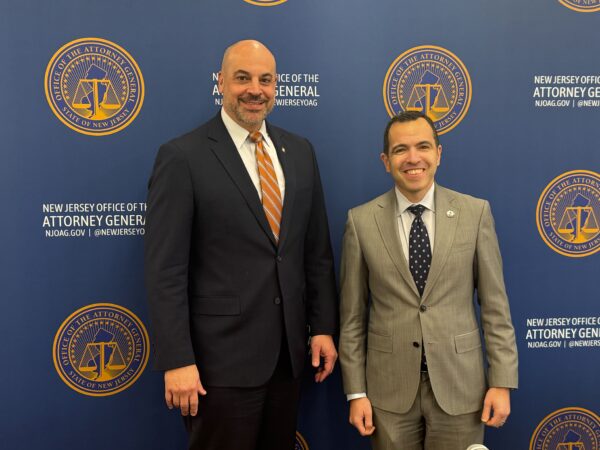
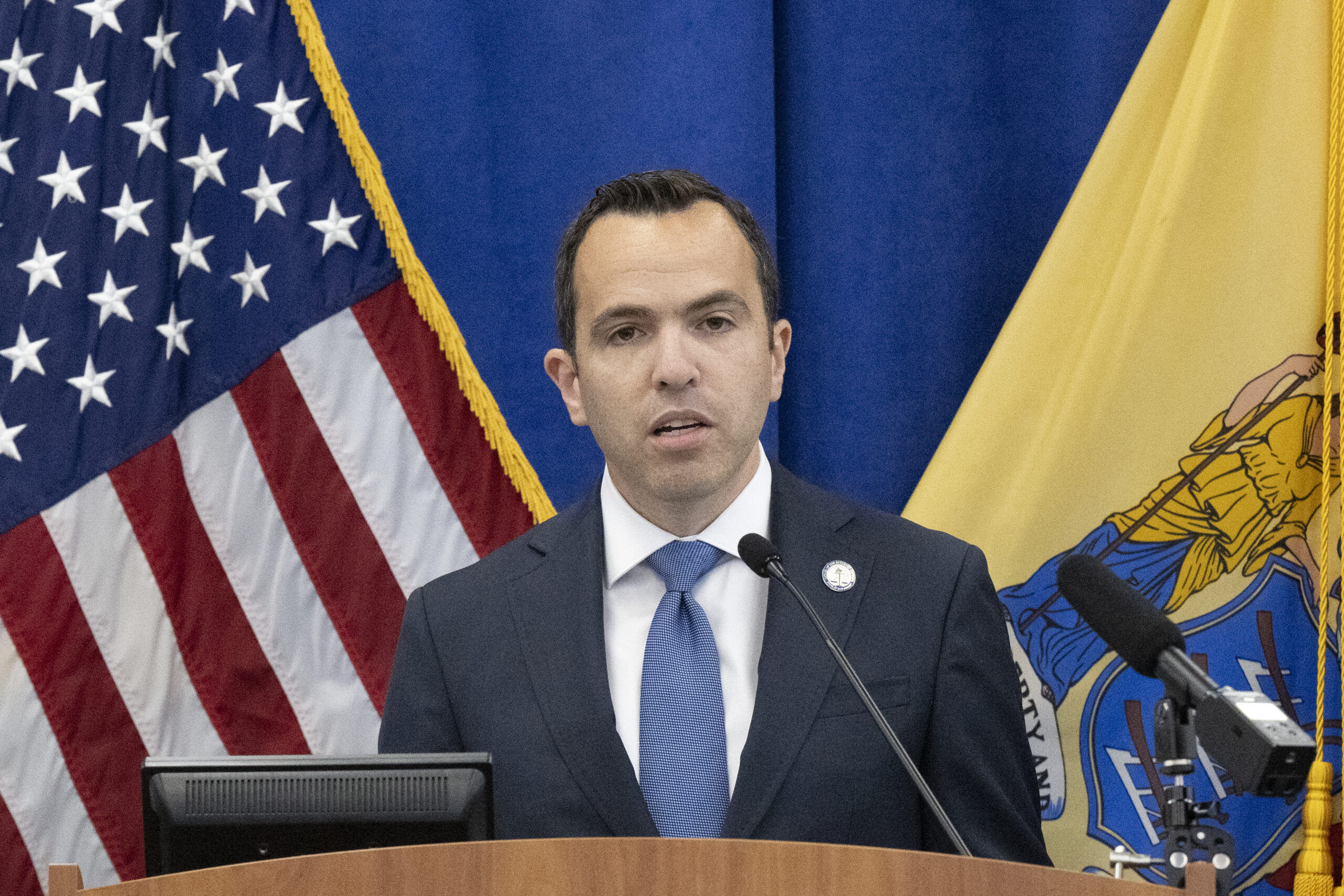
New Jersey Attorney General Matthew Platkin on Monday, June 17, 2024, at the Richard J. Hughes Justice Complex in Trenton, N.J.
Platkin, 39, is an ambitious lawyer who grew up in northern New Jersey and attended one of the best high schools in the state before attending Stanford University and Stanford Law School. He went on to work in private practice in New York and New Jersey before being appointed as chief general counsel to Murphy at 35 — the youngest person to ever hold the office.
Sunday, 50, grew up in a suburb of Harrisburg and has described his high school years as lacking direction. He joined the U.S. Navy after high school before attending Pennsylvania State University for undergraduate and Widener University Law School for his law degree, working at UPS to help put himself through school. He returned to south-central Pennsylvania for his clerkship, and was a career prosecutor in York County until his election to attorney general.
Pennsylvania Attorney General Dave Sunday stands to be recognized by Council President Kenyatta Johnson before Philadelphia Mayor Cherelle Parker gives her budget address to City Council, City Hall, Thursday, March 13, 2025.
But over salads at the Mulberry, Platkin and Sunday found common ground. And ever since, the two said in a joint interview this month, they have worked closely on issues affecting residents in their neighboring states.
“Just because you may not see eye-to-eye on [Trump] doesn’t mean you can’t see or don’t see eye-to-eye on many, many other issues,” Sunday said.
“When we have an auto theft problem, [residents] don’t care if there’s a ‘D’ or an ‘R’ after your name,” Platkin added. “They just want to see us working to solve it.”
The two have since worked together on issues that stretch from criminal investigations and human trafficking cases to challenging Big Tech companies as artificial intelligence rapidly advances, Sunday said.
Earlier this month, Sunday and Platkin led national efforts of coalescing approximately 40 attorneys general across party lines on the issues they say are most pressing for residents. The group wrote a letter to Big Tech companies in mid-December, detailing concerns about the lack of guardrails for AI chatbots like those available from ChatGPT or Meta’s Instagram AI chats, and the potential harm they could cause people in crisis or children who use them.
In two more letters sent this month, the attorneys general also voiced support for a workforce reentry bill before a U.S. House committee and requested that Congress approve additional funding for courtroom and judicialsecurity to protect the nation’s judges from safety threats. Platkin and Sunday said they were some of the first attorneys general to sign on to the letters.
“While the undersigned hold differing views on many legal issues, we all agree that the legal system cannot function if judges are unsafe in their homes and courthouses,” the group of 47 attorneys general wrote in a Dec. 9 letter to top leaders of Congress.
When it comes to lawsuits against the Trump administration and other litigation authored by partisan attorneys general associations, Sunday has largely avoided the fray. Earlier this month, he was elected Eastern Region chair of the National Association of Attorneys General, a nonpartisan group composed of the 56 state and territory attorneys general.
Platkin, on the other hand, has led the charge in pushing back against the administration’s policies in New Jersey, signing onto dozens of lawsuits such as ones challenging Trump’s efforts to end birthright citizenship and to withhold SNAP funding if a state does not turn over personal information about its residents.
Still, Pennsylvania has joined many lawsuits, including several challenging the federal government for withholding congressionally approved funds for electric vehicles and more, as Democratic Gov. Josh Shapiro, formerly the state’s attorney general, has signed on in his capacity as governor.
Platkin, who has served as New Jersey’s attorney general since 2022, will leave office when Murphy’s term ends next month, and Gov.-elect Mikie Sherrill will appoint someone new to the post. Sherrill, a Democrat, earlier this month nominated Jen Davenport, a former prosecutor and current attorney at PSE&G, New Jersey’s largest electric and gas company, to be Platkin’s successor.
Sunday’s team has already been in touch with Davenport to forge a similar cross-state working relationship.
What’s next for Platkin? He said he’s a “Jersey boy” and will remain in the state but declined to say what his next move might entail.
And both Platkin and Sunday say they will maintain their bipartisan friendship going forward.
“It’s OK to say we don’t agree on everything. We shouldn’t hate each other,” Platkin said. “We should be open about the fact that we like each other. … I don’t think there’s anything wrong with that.”
When U.S. Steel opted to build a new mill in Arkansas that had originally been planned for Allegheny County, then-Arkansas Gov. Asa Hutchinson jokedin 2022 that his state could have the mill built faster than Pennsylvania could have it permitted.
Three years later, Pennsylvania politicians and business leaders are hopeful that a series of permitting reforms — the latest of which were approved as part of the state’s $50.1 billion budget — have finally flippedthatdynamic.
The reforms, which are designed to expedite Pennsylvania’s Department of Environmental Protection’s permitting process to allow for quicker development, mark a major step forward in a project that has long been a goal for Democratic Gov. Josh Shapiro and Republican leaders in the General Assembly.
Pennsylvania’s Department of Environmental Protection is responsible for issuing a variety of permits for building plans to ensure they comply with state law and are environmentally safe. The latest reforms will force the agency to automatically approve certain permits relating to stormwater and groundwater within 60 days if it has not completed its review in that time period or sought an extension. For certain permits related to air quality, the changes allow for the permits to be automatically approved 30 days after submission if the DEP has not acted.
The budget, which Shapiro signed into law last month, also expanded an existing program, called SPEED, that allows companies to hire third-party inspectors for certain permits to expedite the process. And lawmakers required the state to create and maintain a database where companies can easily track the progress of their permit applications.
For Senate Majority Leader Joe Pittman (R., Indiana), the change represents a paradigm shift in the state. He recalled the 2022 loss of the U.S. Steel mill at a news conference last month.
“You cannot have economic development without shovels in the ground, and you can’t put shovels in the ground without permits,” Pittman said.
The reforms, he said, will “provide certainty,” which he called, “critical to economic development.”
A longtime goal
Amy Brinton, director of government affairs at the Pennsylvania Chamber of Business and Industry, said it has long been common for businesses to choose other states because of Pennsylvania’s arduous permitting process, and at times begin the process of building in Pennsylvania only to move out of state when permitting becomes a hurdle.
“We lose a lot of projects to Texas and Ohio because of our complicated permitting process,” Brinton said.
Remedying this through permitting reforms, as well as expedited certifications, have been among Shapiro’s top priorities as governor.
“When he took office in January 2023, Governor Shapiro promised to make state government work more efficiently and effectively for Pennsylvanians. Since then, the Shapiro Administration has delivered on that promise to get stuff done — streamlining permitting processes, reducing wait times for licenses, and cutting red tape to attract more businesses to the Commonwealth,“ Kayla Anderson, a spokesperson for Shapiro, said in a statement. ”This budget builds on the Governor’s success.”
Shapiro signed several executive orders aimed at that goal including developing a “Fast Track” program for high-priority projects. DEP has eliminated the 2,400 permit backlog that existed when Shapiro took officein 2023. Additionally, Shapiro’s office said, the average processing time for all permits dropped to 38 days in 2025 from 53 days in 2022.
Lawmakers first approved the SPEED program allowing for third-party inspectors in the 2024 budget. Shapiro’s office said the program has alreadyproduced results, cutting permit wait times in half in some cases.
These projects are a key part of Shapiro’s business-friendly approach, which he’s promoted as he bolsters his resume and bipartisan appeal ahead of a 2026 reelection campaign and a potential future presidential run.
“The permitting was awful,” Ward said in an interview last month. “Permitting now, instead of 300 days, we’re at 30 days. It’s amazing that we were able to come together and get that done.”
Brinton said she is hopeful that the combination of reforms will make it easier for businesses to choose to build in Pennsylvania because the timeline will be more predictable.
“Improved accountability, greater predictability, faster timelines — those are the key kind of drivers that we’re hoping this will continue to provide to our businesses in the hopes that when they look at Pennsylvania they won’t wince at the fact that this is going to take forever,” Brinton said.
A soggy, gloomy Monday was expected to give way to a blusterous Tuesday that brings a wind advisory as gusts of up to 50 mph blow their way into the Philadelphia region ahead of the New Year.
Strong winds arrived behind a cold front that descended upon the Philly area Monday afternoon, dropping temperatures from the 50s into the 30s. The gusts arrived amid a wind advisory issued by the National Weather Service office in Mount Holly in effect through 1 p.m. Tuesday, with sustained wind speeds of up to 25 mph expected.
“There could be some lulls in the morning, but there is no clear signal as to when we will see the lowest lulls” in wind speed Tuesday, said Sarah Johnson, a meteorologist with the weather service. “It will pretty much be windy all through the morning into midday.”
With gusts potentially reaching into the 50-mph range, Johnson said, the primary concern for Philly-area residents was power outages caused by downed trees and broken tree limbs. That element will especially be a possibility following Monday’s rainy weather, which softened the ground in the area and primed it for potential treefall that could also bring down power lines.
Peco, meanwhile, has said that it is aware of the wind advisory, and that its crews are actively monitoring weather conditions while remaining ready to respond to potential outages. The company on social media also advised residents to steer clear of downed power lines and report outages on its website.
Johnson also noted that the high winds posed a risk to loose objects outdoors, such as holiday decorations and light furniture. Those items, she said, should be secured or taken indoors to keep them from potentially being lost or causing damage should they be taken away in a strong wind.
Additionally, Tuesday’s forecast strong winds could create challenges for drivers — particularly those behind the wheels of “high-profile vehicles” like SUVs, trucks, and other large cars. Essentially, the larger a vehicle is, or the higher off the ground it sits, the more it is apt to be pushed around in high winds, she said.
“The closer you are to the ground, the less likely you are to be impacted by high winds,” Johnson said.
Tuesday’s windy weather, meanwhile, is not an uncommon occurrence for December in the Philadelphia region, Johnson added. Strong cold fronts are known to bring with them windy conditions as temperatures drop — and the cold is likely to remain throughout the week as New Year’s Eve and New Year’s Day come and go.
“It is normal for us to have the strongest temperature gradients — the biggest difference in temperature — in the winter seasons,” she said. “We tend to see those from late fall through early spring — pretty much prime season.”
The strongest winds are likely to move out later Tuesday, but Wednesday is expected to remain somewhat breezy, with gusts possibly reaching up to 20 mph. Those winds, however, fall well short of the wind forecast for Tuesday.
That may be welcome news for New Year’s Eve revelers set to ring in 2026 at Philadelphia’s first New Year’s Eve concert Wednesday. The concert, set to kick off at 8 p.m. on the Benjamin Franklin Parkway, will feature performances by LL Cool J, DJ Jazzy Jeff, Los Angeles rock band Dorothy, and Philadelphia High School for Creative and Performing Arts graduate Adam Blackstone.
Though Tuesday’s windy weather will likely abate in time for the holiday, colder temperatures with a high around 32 degrees are expected Wednesday, so attendees ought to bundle up. New Year’s Day on Thursday fits a similar description, with highs hovering near freezing and breezes up to 20 mph, Johnson said. There is only a slight chance of “lingering light snow or flurries,” according to weather service forecasts.
“It’s likely to be dry, but cold and maybe breezy” the first day of 2026, Johnson said.
Spotlight PA is an independent, nonpartisan, and nonprofit newsroom producing investigative and public-service journalism that holds power to account and drives positive change in Pennsylvania. Sign up for our free newsletters.
HARRISBURG — Gov. Josh Shapiro has not reappointed a longtime member of the Board of Pardons, a psychiatrist whom advocates have opposed for his votes against clemency applicants, lack of experience in criminal justice, and lines of questioning they find inappropriate.
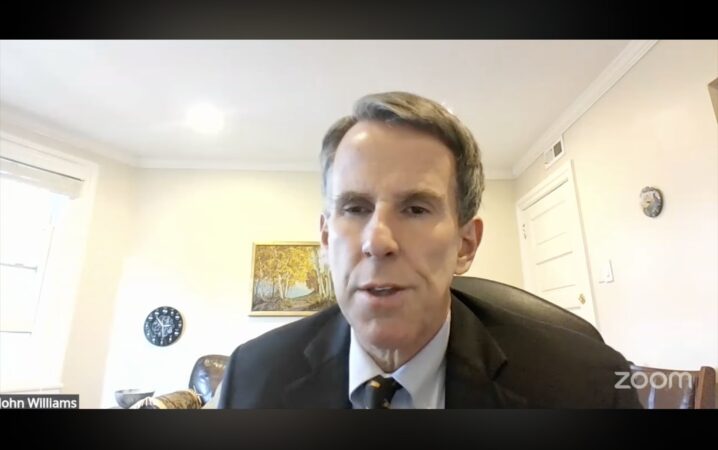
John Williams, a child psychiatrist practicing in Montgomery County, has served on the board since former Gov. Tom Corbett appointed him in 2013. He was reappointed in 2019, under former Gov. Tom Wolf. His second six-year term expired in November, leaving a vacancy on the five-member body.
Williams did not return an email from Spotlight PA requesting comment.
A representative for Shapiro’s office said the governor is working with state Senate leadership to “restore the board to its full complement.”
Shapiro’s office would not confirm whether the governor may still nominate Williams. Spokesperson Kayla Anderson said, “No final decision regarding a nominee has been made at this time.”
The Board of Pardons makes the ultimate decision on both commutation and pardon applications from people who are seeking to either shorten a prison sentence or wipe clean a criminal history.
The board comprises two elected officials, the attorney general, and lieutenant governor, and three political appointees — a corrections expert; a medical doctor, psychiatrist, or psychologist; and a victim advocate.
Applications the board deems “meritorious” are given a public hearing, after which the body votes to either deny the application or approve it for the governor’s consideration.
While pardons are recommended by the board in a majority vote, life sentence commutations, which allow a person to get out of prison, require unanimous approval — just one no vote dooms an application.
Earlier this year, a coalition of pro-clemency groups organized the Commutation Now campaign to pressure Shapiro to replace Williams, who frequently voted against both commutations and pardons.
In a report released in June, the group criticized Williams for routinely asking “inappropriate questions reflecting ‘lurid curiosity.’”
During a public commutations hearing in September 2024, Williams asked a victim speaking against the applicant to give increasingly specific details about the sexual abuse he endured as a child. When the man wasn’t sufficiently specific, Williams pushed for additional details. After the questioning, he acknowledged the man’s discomfort.
There was no reason for the line of questioning, said Etta Cetera, a longtime board watchdog and member of the Commutation Now campaign. Williams’ single no vote would have been sufficient to deny the commutation, Cetera said, negating the need to put a victim through an invasive line of questioning.
“When you come into these cases, any of these cases for people with life sentences are extremely sensitive. Somebody lost their life, and in other situations, there was other abuse and even sexual violence involved,” Cetera said.
“And it’s irresponsible to not take seriously the trauma that comes up for people when these hearings happen. And the way that the psychiatrist questioned the victims is totally not trauma-informed.”
After a public pardons hearing in 2021, a viewer wrote to then-Lt. Gov. John Fetterman to complain about Williams’ conduct. The letter, which was also reviewed by Spotlight PA, expressed concern that “Williams questioned a pardon applicant about which sex positions he used during the commission of a decades-old sexual offense,” according to the report.
Williams then asked the applicant’s wife about her sex life with the applicant, including which sexual positions they used, the letter alleges.
Commutations interviews are not public, but attorneys interviewed for the Commutations Now study reported Williams consistently asked about an applicant’s sexual abuse “in excruciating detail,” and pursued invasive and humiliating questions.
Commutations Now hand-delivered the report to legislative leaders, including the state Senate Republicans who will have to confirm Shapiro’s new appointee.
The nomination must undergo two committee votes before the full chamber weighs in, said Kate Flessner, a spokesperson for state Senate Majority Leader Joe Pittman (R., Indiana).
Tobey Oxholm, who works with pardons applicants statewide, said in recent years the number of applications exploded, but the board held only nine days of hearings in 2025. The backlog of potential pardons keeps people with nonviolent felonies from working in roles the state needs, he said, such as home health, elder, and childcare.
“The crushing numbers really requires somebody who is a systems thinker as well as somebody who has experience with the populations that are coming before the board,” Oxholm said of the position.
The advocate community wrote a letter to Shapiro in October recommending David DeMatteo, an attorney and forensic psychologist teaching at Drexel University. State Sen. Maria Collett (D., Montgomery) wrote to the governor endorsing him as well.
In the meantime, the board will be able to proceed with four people, as four still constitutes a quorum for all votes.
But Oxholm questioned why the position was allowed to lapse.
When there are only four people on the board, a person seeking a pardon has a narrower chance to have their application receive the three votes they need to move on from their felony conviction, which can keep them from jobs and housing opportunities.
“This indicates that there isn’t a full appreciation by the governor and the senate about the importance of this position to individuals, families, and their communities,” he said.
BEFORE YOU GO … If you learned something from this article, pay it forward and contribute to Spotlight PA at spotlightpa.org/donate. Spotlight PA is funded by foundations and readers like you who are committed to accountability journalism that gets results.
Driving west on the Pennsylvania Turnpike, Mary Wright was hoping for a Chick-fil-A. But as she watched the limited options on road signs pass, fond memories of roast beef sandwiches lured her to Roy Rogers.
“My mother liked Roy Rogers,” said Wright, who is in her 60s and from Collingswood. “That’s how long it’s been around.”
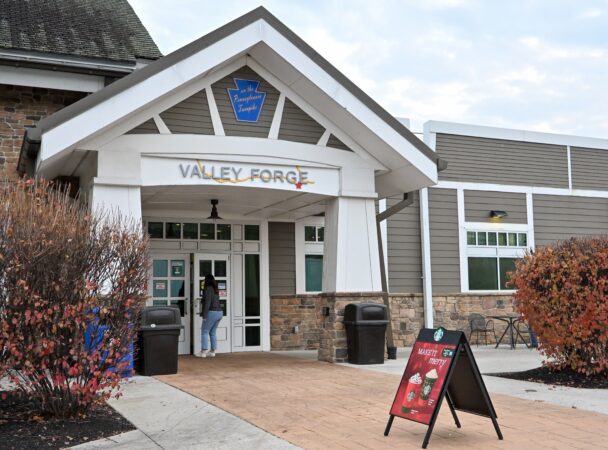
That’s pretty typical of the food offerings on the Pennsylvania Turnpike, where old-school brands such as Auntie Anne’s, Baskin-Robbins, and Sbarro dot many of the 17 service plazas.
That puts the turnpike behind the times compared with similar toll roads in New Jersey and New York, where travelers can hold out for newer brands like Chick-fil-A, Pret a Manger, and Shake Shack.
“I think the older generation likes Roy Rogers and all that, but younger people are more likely to like Shake Shack, for example,” said John Zhang, professor of marketing at the University of Pennsylvania’s Wharton School of Business.
Once on the toll road, people are faced with dining options decided almost entirely by one company. It’s what Zhang called a “captive consumer” environment. The reasons for this involve state policy, a corporate contract, and a little business history.
Mary Wright and Rich Misdom of Collingswood consider their options at the Roy Rogers located in the Peter J. Camiel Service Plaza on the Pennsylvania Turnpike in late November.
‘Applegreen determines the food concepts’
The commercial stakes are significant:More than 550,000 people drive on the turnpike every day, according to the Pennsylvania Turnpike Commission, and about 7.4 million travelers are expected to have used the toll road around the Christmas and New Year’s holidays.
Though the turnpike commission oversees the operation, a company called Applegreen primarily decides which restaurants fill the state’s 17 service plazas, according to turnpike commission spokesperson Marissa Orbanek.
Applegreen runs travel plazas in 12 states, including New Jersey and New York. The company, based in Ireland, was taken private for $878 million in 2020 and is majority-owned by the large private equity firm Blackstone Inc. Applegreen did not respond to requests to comment for this story.
For access to the service plazas, Applegreen pays the turnpike commission 4% of its gross food and beverage sales, amounting to about $2.4 million per year, Orbanek said.
“Applegreen determines the food concepts and seeks approval from the commission,” Orbanek said. “So the turnpike is certainly involved in this process.”
Of the 15 restaurant chains Applegreen lists on its website, nine appear on the Pennsylvania Turnpike. There are nine Auntie Anne’s, eight Burger Kings, one Cinnabon, seven Dunkin’s, two Popeyes, seven Roy Rogers restaurants, four Sbarros, 10 Starbucks outposts, and one Subway restaurant, according to the turnpike commission website. Pennsylvania also has six Baskin-Robbins locations, it shows.
In other states, Applegreen’s brands include Chick-fil-A, Nathan’s Famous Hot Dogs, Panda Express, Panera, Pret a Manger, and Shake Shack.
The service plaza contract dates back to 2006, when the turnpike commission signed a 30-year lease agreement with HMS Host Family Restaurants, giving the company “exclusive rights” to food and drink sales, Orbanek said.
Seven Dunkin’ locations dot the Pennsylvania Turnpike.
Until then, Applegreen decides which eatery goes where.
What’s with all the Roy Rogers restaurants?
When Applegreen bought HMS Host, it became the franchisee of the Roy Rogers restaurants on the turnpike, said Jim Plamondon, who co-owns the Frederick, Md.-based Roy Rogers brand with his brother.
Plamondon wants to keep the restaurants on the turnpike past 2036 — a decision that will depend in part on whether Applegreen sticks with the restaurants it acquired when it bought HMS Host.
“It’s all about developing relationships and hoping to grow with our operators,” Plamondon said.
As for Roy Rogers’ prominent position on the turnpike, that dates back to the 1980s, when Marriott Corp. managed the service plazas, Plamondon said. Back then, the restaurant was owned by Marriott — it had a licensing agreement with the showbiz cowboy of the same name — and Plamondon’s dad was an executive in the company.
These days, Plamondon said, nostalgia and curiosity for something a bit different have driven the restaurant chain’s modest growth: It has opened a few new locations in recent years, including one in Cherry Hill, and has a devoted fan base.
Fast-food restaurants are facing a number of challenges in the current economic climate. Wages and tariffs have pushed prices up, and low-income consumers in particular have started to reduce spending. Even McDonald’s, the largest fast-food chain in the U.S., has seen nearly double-digit decreases in traffic among low-income Americans, the company said in its third-quarter earnings report last month.
McDonald’s CEO Christopher Kempczinski told investors on a call announcing the third-quarter results that low-income consumers were having to absorb significant inflation, which was affecting spending behavior.
Roy Rogers has seen some of these challenges as well, Plamondon said. Costs have gone up, margins are thin, and people’s tastes are always changing. People are eating more chicken and want spicier options, he added. .
“It’s a really good menu, it’s great quality food, and I think our brand absolutely has a future to it, because at the end of the day, it’s about the food.”
Changing tastes
The Wharton School’s Zhang agreed that consumers’ tastes have shifted. “People increasingly want ethnic foods, and younger people want spicier food,” he said. “And people want to go upscale nowadays.”
Zhang noted a number of older brands on the Applegreen roster, such as Sbarro, the pizza restaurant that has faced two bankruptcies in the years since the turnpike commission approved the 30-year lease.
In terms of market forces, Zhang said, turnpike service plazas are “an aberration.” Unlike those in most suburban or urban areas, service plaza customers are willing to settle for what’s available, and pay more to get in and out, he said.
“If you’re a traveler on a holiday, you tend to be less price sensitive,” Zhang said. “You just want to have your food very quickly.”
A sign at the Peter J. Camiel service plaza on the Pennsylvania Turnpike.
That puts turnpike service stops at odds with the shifting consumer preferences that have bedeviled the fast-food industry over the last couple of decades, Zhang said, including the addition of food delivery services like DoorDash and GrubHub.
Zhang said that the lack of order-ahead options at turnpike eateries is puzzling. For people traveling down a strip of highway, it seems like calling ahead would make sense.
“For them, the customers just pass by once,” he said.
For Mary Wright and her traveling companion, Rich Misdom, their recent Roy Rogers visit did not exactly ignite enthusiasm.
“This is, like, old-school kind of stuff,” Misdom said, adding he was disappointed that this Roy Rogers restaurant was not serving roast beef. He settled for a cheeseburger, while Wright got a chicken sandwich.
“We don’t come here to fine dine,” Misdom said, between bites. “Let’s put it that way.”
A man died after being hit by a Trenton Line train Saturday afternoon, SEPTA officials said.
The Regional Rail train was traveling inbound about 12:30 p.m. when it struck the “trespasser” between the Croydon and Bristol stations, a SEPTA spokesperson said.
First, Danielle Delange saw the news alert: Bristol Health & Rehab, the nursing home where her mother lived, was on fire.
Within minutes, Delange got a phone call from an unfamiliar number. On the line, she heard her 64-year-old mother’s trembling voice.
“My mom said there was a gas explosion,” Delange said. “And I said, ‘How do you know it was a gas explosion?’ And she said, ‘Because we’d been smelling gas.’ … And I said, ‘Today?’ And she said, ‘No, for a couple days.’”
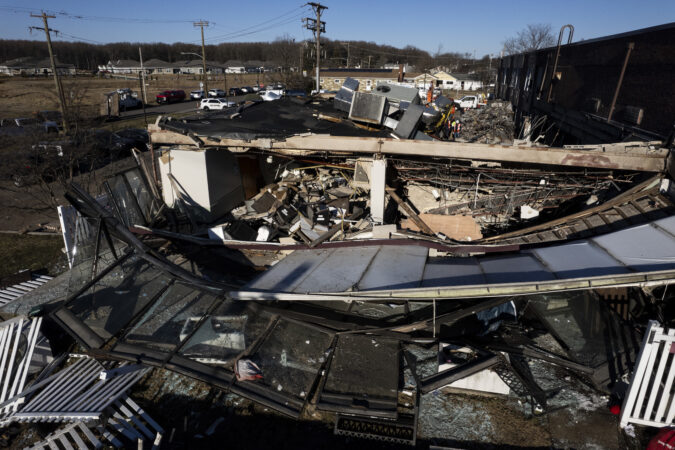
Her mother, Anna Grauber, who uses a wheelchair, was evacuated from the burning building soon after Tuesday’s devastating blast, which killed a nurse and a resident and injured 20 people. The cause of the explosion remains under investigation.
First responders work the scene of an explosion and fire at Bristol Health & Rehab Center, Tuesday, Dec. 23, 2025, in Bristol, Pa.
According to Delange, in the immediate aftermath of the explosion, her mother was outside, and she was starting to get uncomfortably cold.
Delange said her mother, who lives with COPD and emphysema, didn’t have the oxygen that she needs and was struggling to breathe. Even her emergency inhaler was back in her room.
Delange’s mother is one of the 119 residents who had to be relocated from the healthcare facility in Bristol Township, Bucks County, to other care homes across the region. With the facility now the scene of a federal investigation, Grauber and other residents are left without their possessions and, according to several families, they lack even basic necessities like clothes and phone chargers.
‘She doesn’t have pants’
The company that runs the nursing home, Saber Healthcare Group, says it’s doing all it can while it waits for the National Transportation Safety Board to determine whether people can safely return to the nursing home building at 905 Tower Rd.
But family members of residents, such as Delange, are questioning whether that’s enough.
Delange said her mother was promptly moved to another Saber Healthcare Group property, Statesman Health & Rehabilitation Center, a short drive away in Levittown. However, her mother had to go several days without one of her medications, Delange said, and was struggling to adjust.
Muthoni Nduthu’s son Clinton tears up while the family speaks with the media on Wednesday, Dec. 24, 2025, in Bristol Township, Pa. Muthoni Nduthu was killed in the explosion at Bristol Health and Rehab Center on Tuesday.
Delange said that when she visited her mother on Friday at her new home in Levittown, her mother was wearing men’s basketball shorts and a T-shirt. She said that Saber has not provided clothes for the relocated residents, and so staff have resorted to pulling clothes from a donation box.
“She doesn’t have pants,” Delange said. “And that got me thinking, like, what did my mom have on when she left there?”
‘No indication’ of issues
Zachary Shamberg, Saber’s chief of government affairs, said the company is doing everything it can to help the displaced residents — but right now, nobody is allowed in the Bristol facility.
Possibly as early as Monday, Saber may be cleared to reenter the building, Shamberg said. “We’ll survey the damage, we’ll see what can be salvaged, and we’ll get in touch with families to ensure any items were returned.”
Saber’s insurance company would likely handle replacement or compensation for items destroyed in the blaze, he said.
As far as he knows, Shamberg said, the company is not providing money or purchasing new clothes or essential items for residents. He encouraged residents’ families to contact leadership at the Bristol facility if they need anything.
Shamberg said many residents have been moved to other Saber-affiliated nursing homes in the area, and these residents would promptly get prescriptions refilled. In addition, the company has started working with Medicare and Medicaid to replace residents’ dentures and eyeglasses. However, because some Saber locations are full, people have been placed in other facilities.
In the immediate aftermath of the disaster, Shamberg said, the goal was to get people “to the best care setting as quickly as possible.” He added the company tried to keep residents as close as possible to their families.
“The focus, initially on Tuesday, was to make sure staff and residents were safe,” Shamberg said. “Now, we survey the damage. We assess the facility. And we decide what happens next in terms of rebuilding and moving forward.”
Gov. Josh Shapiro delivers remarks on the explosion at Bristol Health & Rehab Center, at Lower Bucks Hospital on Tuesday, Dec. 23, 2025, in Bristol, Pa.
Saber staff at Bristol are being paid for the next 30 days regardless of whether they work, Shamberg said, and the company is offering them positions at other locations. Some staff, such as care coordinators and facility leadership, have remained in close contact with residents’ families, he said.
Saber, a privately run for-profit company, acquired the Bristol nursing home from Ohio-based CommuniCare Health Services barely three weeks before the explosion. Under CommuniCare, the nursing home had received numerous citations for unsafe building conditions and substandard care.
Saber was aware of these issues, Shamberg said. However, he said, as the company took over, there was no indication of problems with its gas lines.
“When you acquire a nursing home, you inherit that nursing home’s survey history,” Shamberg said. “Even looking at the most recent survey, the October 30th survey, there’s nothing that indicated a potential gas leak or explosion.”
Bristol had not been the first choice for 49-year-old Lisa Harnick and her family when it came time to find a nursing home for her mother, Debra Harnick. However, since Lisa Harnick didn’t have a car, the family opted for a choice close to her home in Bristol Township.
Now, Lisa Harnick’s 77-year-old mother is about an hour away at York Nursing & Rehabilitation Center in Philadelphia, she said. (The facility is not part of Saber Healthcare Group.) And their weekly lunch date is on hold.
“We started going over every Tuesday to have lunch with her, and visit with her, and now I can’t do that,” Lisa Harnick said.
Debra Harnick is “completely bed-bound,” her daughter said, and has no possessions except for her iPad, which she uses to communicate with family. She does not have a cognitive impairment, is alert, and is not happy about her new situation, Lisa Harnick said.
She added that Saber has remained in touch.
“I’ve been in contact with the social worker, and the activities director,” she said. “And I’ve been in contact with the insurance company, too. They just wanted to verify that she was there.”