Category: Pennsylvania News

  • Meet the three Pa. Supreme Court justices up for retention on the November ballot

    Voters will decide whether the Pennsylvania Supreme Court should be transformed for years to come when they are asked next month whether they should retain three justices for another 10-year term or oust them.

    The justices — Justices Christine Donohue, Kevin Dougherty, and David Wecht — were each elected as Democrats in 2015 during a transitional period for the court when Democrats took a majority, the first time so many seats were open at one time, in part due to resignations of disgraced former justices. Since then, the three justices have played decisive roles on the 5-2 liberal majority of Pennsylvania’s highest court.

    Their decisions have had great impacts on the lives of the state’s residents, including rulings on whose mail ballots should be counted under the law, whether cities can set their own gun laws, and shoring up the state’s constitutional rights for gender equality.

    Now the justices will appear individually on Pennsylvania ballots, where voters will be asked “yes” or “no” on whether each should be retained for another 10-year term.

    Retention elections in Pennsylvania traditionally attract little attention and little money. But Republicans view this as an opportunity to overhaul the court, which has become an even more critical battleground in the Donald Trump era as state-level courts hold sway over everything from abortion rights to congressional redistricting.

    The GOP has spent millions to try to oust the three justices, while Democrats have spent even more to try to keep them on the bench. As of Friday, Republicans had spent or reserved nearly $2.5 million in ad buys, while Democrats had spent more than $7 million.

    The Inquirer spoke with the justices about their last 10 years on the bench, what it has been like to campaign in a hyper-partisan environment for what is intended to be a nonpartisan election, and more.

    Kevin Dougherty

    A small group of volunteers gathered in a Northeast Philadelphia parking lot on a gloomy Saturday afternoon in early September to knock on doors and urge residents to retain the current members of the Pennsylvania Supreme Court.

    Milling among the volunteers was Dougherty. Despite having been on the ballot for local or state office three times, Dougherty, of Philadelphia, never knocked on voters’ doors until this year.

    And he was disgusted by the fact that it was necessary.

    “Judges shouldn’t have to canvass,” Dougherty said several times over the course of the afternoon.

    Justice Kevin Dougherty talks with volunteers before they head out the canvass in Fox Chase Sunday Sept. 7, 2025. Dougherty is one of three Pennsylvania Supreme Court justices up for retention.

    He then proceeded to walk a Northeast Philly neighborhood alongside his son, State Rep. Sean Dougherty, a first-term Democrat who represents the area, and a family friend.

    Kevin Dougherty, 63, is from South Philadelphia and hails from one of the most well-known families in Philadelphia politics. His brother, John “Johnny Doc” Dougherty, is the once-powerful former leader of IBEW Local 98. John Dougherty was convicted in 2023 of embezzling funds from the union.

    Before running for the Pennsylvania Supreme Court, Dougherty spent nearly 15 years on the Common Pleas Court bench in Philadelphia, with much of that time spent serving in the family division.
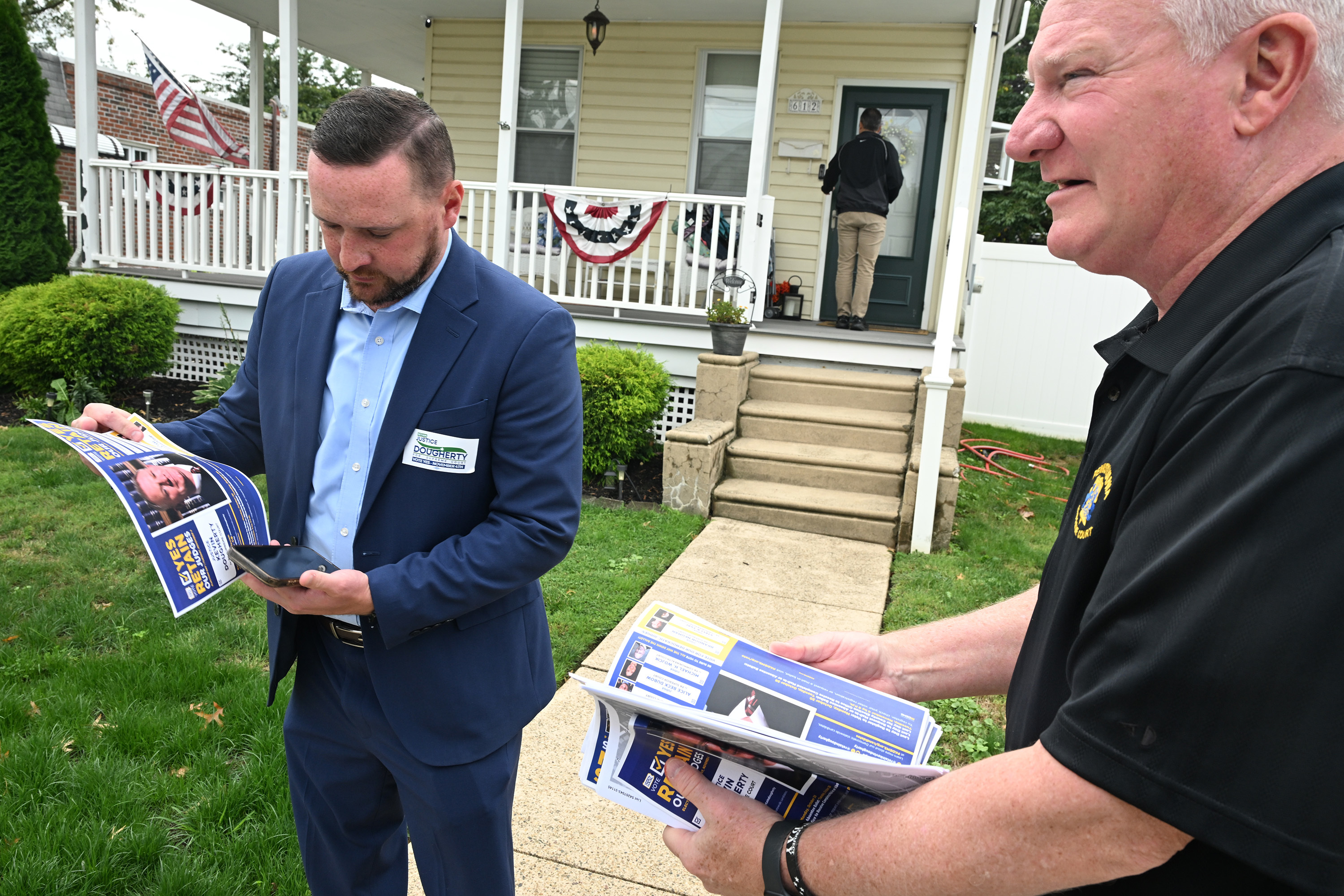
    Justice Kevin Dougherty (right) canvasses with his son, State Rep. Sean Dougherty (left), in Fox Chase Sunday Sept. 7, 2025.

    As a Supreme Court justice, Dougherty has highlighted his work on the autism in courts initiative as a key accomplishment. This program works to educate judges about the particular challenges people with autism spectrum disorder may face when dealing with the justice system, and has grown further into sensory-friendly courtrooms in more than a dozen counties.

    The program, Dougherty said, was inspired by his own experience on the bench when a child stood in his courtroom for a delinquency case showing “all the signs of an incorrigible person.” Then, Dougherty said, the child’s mother pulled him aside and told him her son was on the autism spectrum.

    “It was like a punch in my mouth because I had never been exposed,” Dougherty said. “You’re only ignorant once.”

    Dougherty said he self-educated and began working in Philadelphia to reform the way the court interacts with individuals with autism and brought those efforts to a statewide focus as a justice.
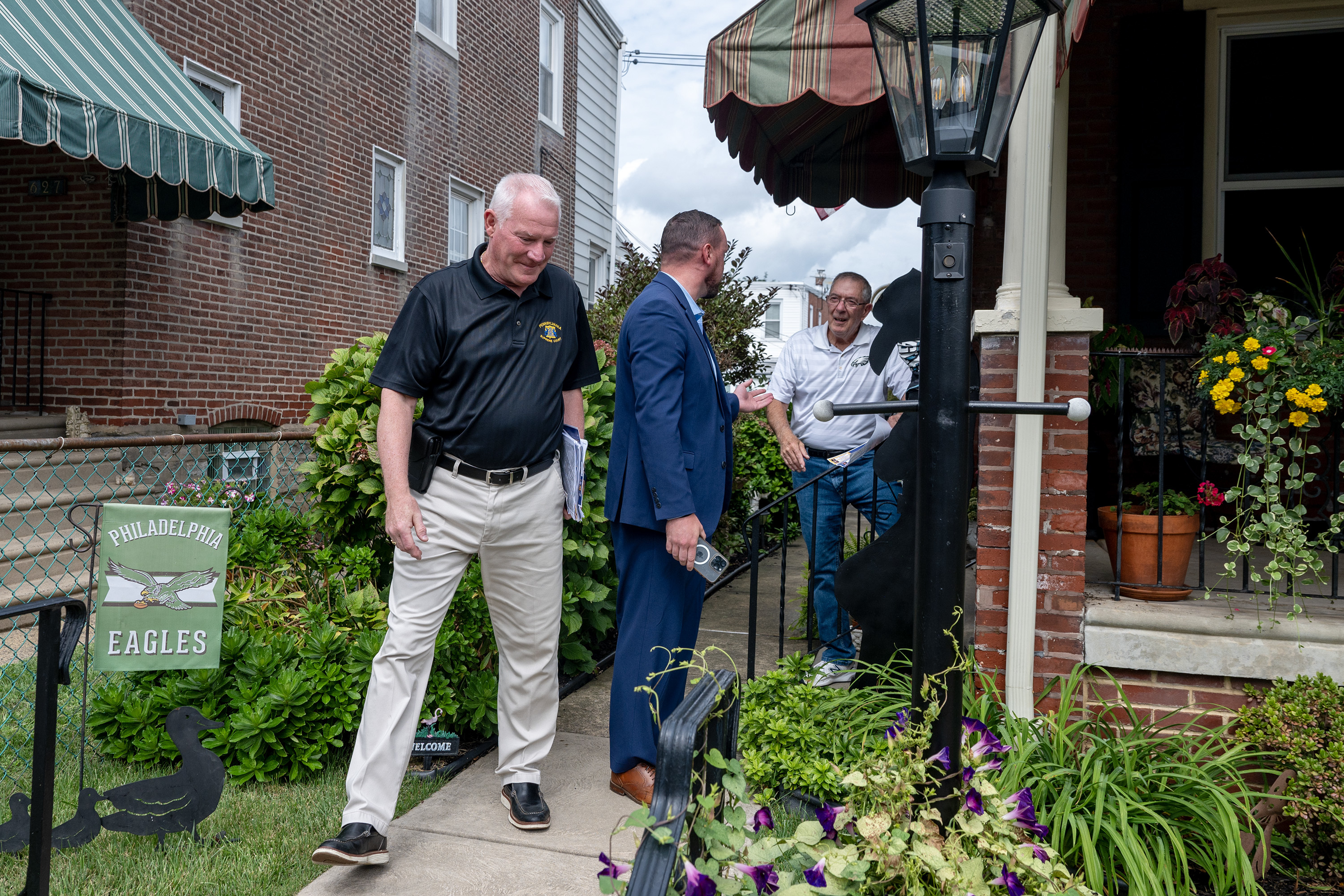
    Justice Kevin Dougherty (left) canvasses with his son, State Rep. Sean Dougherty (center), in Fox Chase Sunday Sept. 7, 2025, stopping at the home of voter Skip Nelson (right).

    “You need to make the system fair,” Dougherty said.

    On the court, Dougherty has often sided with the liberal majority. He recently wrote the majority opinion in a case that allowed local governments to use zoning law to limit where gun ranges could be located. In oral arguments, when attorneys get a chance to argue their cases before the Supreme Court’s seven justices, Dougherty often presses lawyers to refine their arguments.

    Christine Donohue

    Donohue is often the first justice to ask questions during oral arguments.

    Her quick interjections are because of her 27 years as a trial attorney prior to her career on the bench, she said. She cannot help but be inordinately prepared when she puts on her judicial robes and sits on the state’s highest court.

    “Thoroughness is one of my ‘things,’” she said, with a laugh.
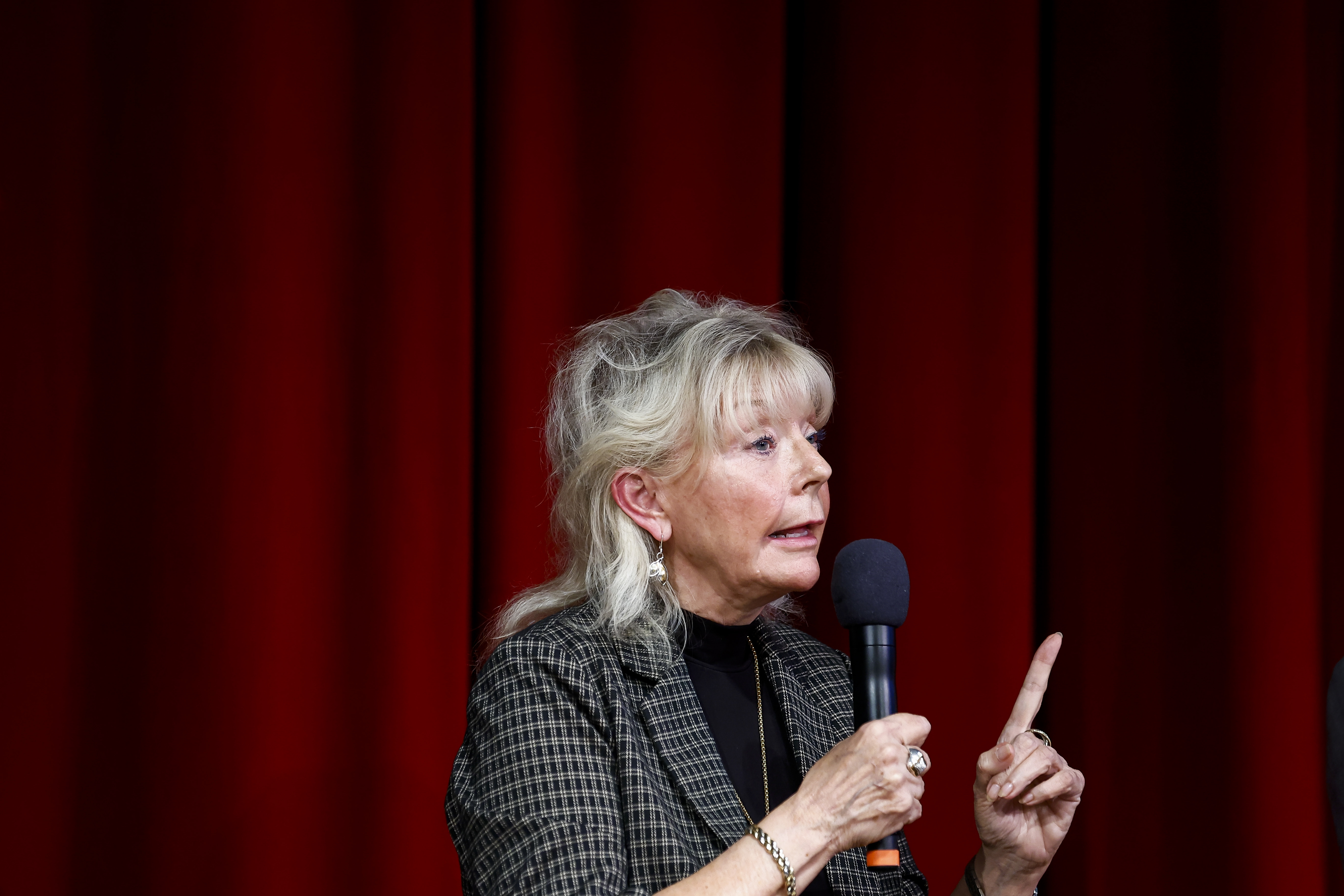
    Justice Christine Donohue speaks during a fireside chat at Central High School.

    Donohue, 72, would be able to serve for only two years of another 10-year term. But it wasn’t even a question to her whether she should step aside sooner. She believes she has fulfilled her duty as a justice, and she is prepared to do so until she hits the voter-set maximum age for a justice, 75.

    Donohue authored the court’s ruling last year that signaled some members of the court are prepared to find that the Pennsylvania Constitution secures the right to an abortion. But less discussed from that same opinion, Donohue said, she is proud to have shored up the state’s Equal Rights Amendment.

    Pennsylvania was the first state in the nation to amend its constitution to enshrine that every person has equal rights that cannot be “denied or abridged” because of an individual’s sex in 1971, and the first state to show support for amending the U.S. Constitution to guarantee the same.

    But a 1984 ruling by the state Supreme Court “diluted” the ERA in Pennsylvania, Donohue said. It wasn’t until the justices decided the Allegheny Reproductive Health case 40 years later that the court revisited the state’s Equal Rights Amendment to make it “perfectly clear that a biological difference cannot serve as the basis for a denial or an abridgment of a right,” she said.

    “To me, I’m very proud of many of the decisions I’ve been able to be involved with, but that one really sort of sets the record straight,” Donohue said.

    Outside her legal work on the state Supreme Court, she has been an advocate to offer more young lawyers the opportunity to try a case before a jury, which has become less and less frequent in recent years. Ensuring that the next generation of lawyers knows how to try a case before a jury is critical to guaranteeing the right to a fair trial, and would prevent a potential competency gap for future lawyers.

    David Wecht

    Like many of the justices on the Pennsylvania Supreme Court, Wecht spends much of his free time thinking about legal questions or ethical dilemmas. Or going on walks and listening to podcasts that deal with the same issues. (He recommends Amarica’s Constitution by Yale Law professor Akhil Amar or any of the podcasts by Jeffrey Rosen at the National Constitution Center, among others.)

    He works from his chambers in Pittsburgh each day, unless the court is at one of the state’s many satellite courtrooms for oral arguments. There are times when he is in his chambers reading and writing all day long, which he described as “very, very fun, and very, very interesting and exciting.”
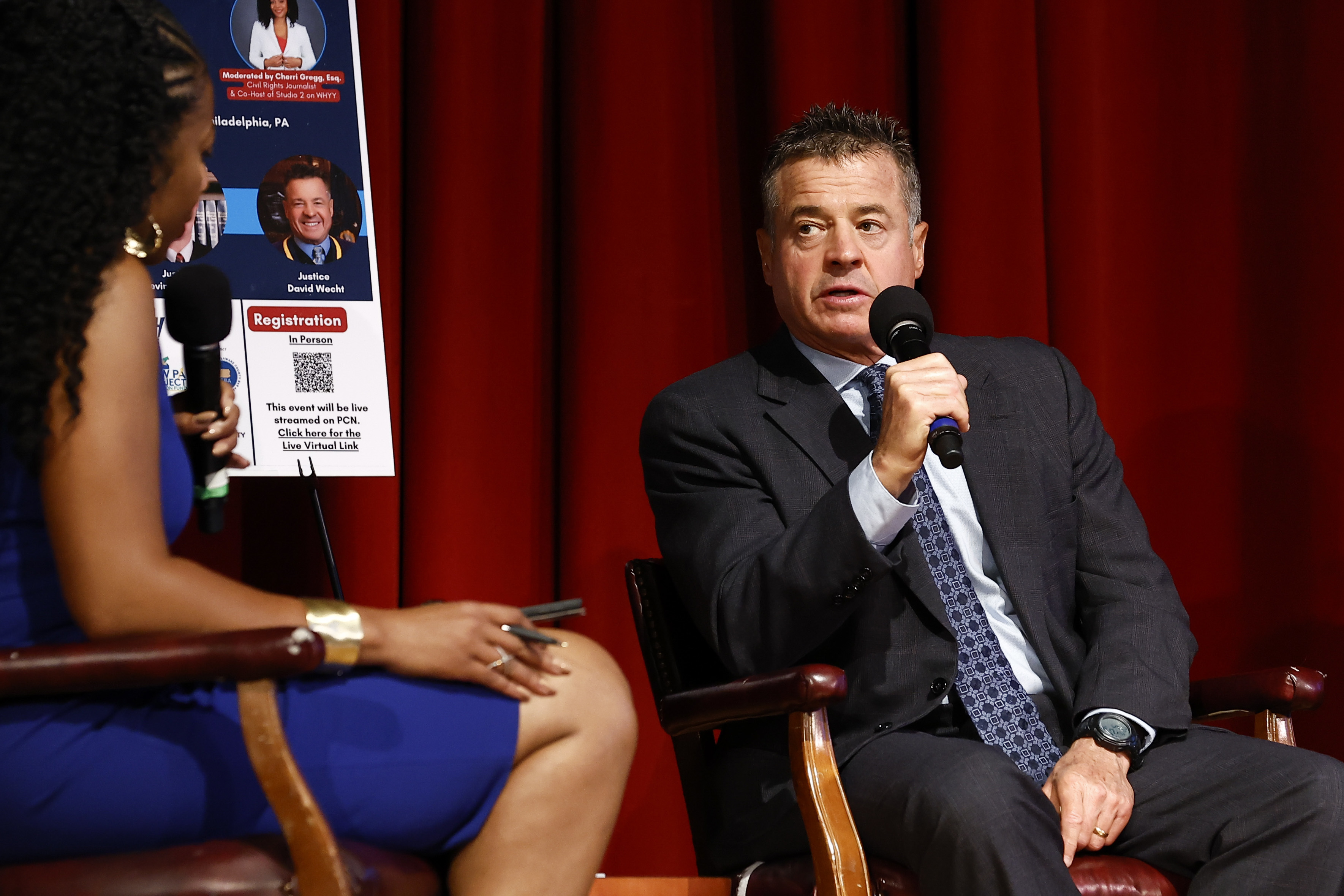
    Justice David Wecht speaks with moderator Cherri Gregg during a fireside chat on retention at Central High School.

    “The work is interesting. It is varied, It is never stagnant. We deal with all areas of the law,” Wecht said. “I’m very grateful that the voters gave me this job 10 years ago, and I hope they’ll see fit to provide me an additional term.”

    Wecht is a true student of the law and said he enjoys probing attorneys’ arguments and the back-and-forth between justices on the bench.

    He sees his role on the court as to decide cases. “Nothing grander, and nothing more,” he said.

    He and the whole court, he said, operate under a “philosophy of judicial restraint.”

    The court’s liberal majority has faced criticism from Republicans during the last 10 years — especially during the COVID-19 pandemic — for decisions they claimed were made by an “activist court.”

    But those rulings, Wecht said, were the justices’ best attempts at deciding what a law passed by the General Assembly means when the lawmakers left it ambiguous, or their best attempt to understand what the framers of the state constitution intended, even if he doesn’t agree with it.

    “It’s not our business whether we like them,” he said.

    Early Vote Action, a Republican group, urges voters to vote against retaining the justices at a Republican rally in Bucks County on Sept. 25, 2025 at the Newtown Sports & Events Center. The event was headlined by Treasurer Stacy Garrity, a Republican running for governor.

    Republican groups have attempted to mislead voters in mailers, Wecht has said, about the justices’ role in a 2018 decision that found Pennsylvania’s congressional maps were unconstitutionally gerrymandered. The GOP groups have had similarly misleading ads about the court’s actions on abortion and voting rights, even recently invoking the anti-Trump “No Kings” language to try to sway voters to vote “no.”

    Wecht is a professor at Duquesne School of Law and the University of Pittsburgh, where he has been teaching for years. He is also a visiting professor at Reichman University in Israel each year, and regularly teaches continuing legal education courses for attorneys, which are courses that all lawyers must complete on an annual basis to maintain their active attorney’s license in Pennsylvania.

  • 2 men charged in attempted robbery of armored truck that led to school lockdowns in Lower Merion

    2 men charged in attempted robbery of armored truck that led to school lockdowns in Lower Merion

    The FBI on Friday announced criminal charges against two men in connection with an attempted robbery of an armored truck on Oct. 3 that led to school lockdowns and a shelter-in-place order in Lower Merion Township.

    Dante Shackleford, 26, also was charged by indictment with two attempted robberies of armored trucks in Philadelphia in July and an armored truck heist in Elkins Park in August in which $119,100 was stolen.

    Mujahid Davis, 24, and Shackleford were charged with the Oct. 3 attempted robbery of an armored truck on the Philadelphia side of City Avenue that led to a pursuit and an hours-long incident. Several suspects were finally arrested in Lower Merion.

    The FBI announcement came just hours after another attempted robbery of an armored truck, this time outside a Wawa store in Philadelphia.

    Shortly before 8 a.m. on the 7700 block of Frankford Avenue, two male suspects attempted to rob a Loomis truck when the driver fired two shots at the suspects, who then fled. Police reported no injuries or arrests.

    The indictment against Shackleford and Davis filed in federal court on Thursday provided few details about the prior armored truck crimes.

    On July 15 and on July 22, Shackleford and others allegedly attempted to rob Brink’s trucks in Philadelphia, according to the indictment.

    On Aug. 12, Shackleford and others allegedly robbed a Brink’s truck in Elkins Park and got away with approximately $119,100 and the Brink’s employee’s gun.

    Then on Oct. 3, Shackleford and Davis allegedly attempted to rob a Brink’s truck in Philadelphia, which reportedly occurred in the area of City Avenue.

    Davis also is charged in Montgomery County Court with multiple counts related to what happened on Oct. 3, including fleeing law enforcement and evading arrest.

  • A changing death industry puts Philly cemeteries at risk

    A changing death industry puts Philly cemeteries at risk

    It always figured to be an emotional day when the Alter family gathered at Har Jehuda Cemetery in Upper Darby. They were commemorating their mother’s first yahrzeit, the anniversary of death in the Jewish tradition.

    But when the family arrived at her grave, they found it in devastating condition.

    Beatrice Reina Alter, 93, was buried last year next to her husband, Milton Alter, in plots that the couple bought in the Jewish cemetery in the 1990s. When their family came together for her yahrzeit in August, they expected there to be a new headstone to match Milton’s.

    Instead, her grave was covered in a fresh mound of dirt. The corner of a plywood board stuck out. And there was no headstone to be seen.

    “We were shaken and appalled,” said Daniel Alter, one of the couple’s five children.

    Yet issues at the cemetery — and for the burial industry — extend beyond placing headstones on time. Har Jehuda reflects an industry facing serious challenges to its longevity, where sometimes small, antiquated businesses must reinvent themselves. The country’s relationships with cemeteries and burials are changing, putting a seemingly timeless business at risk.

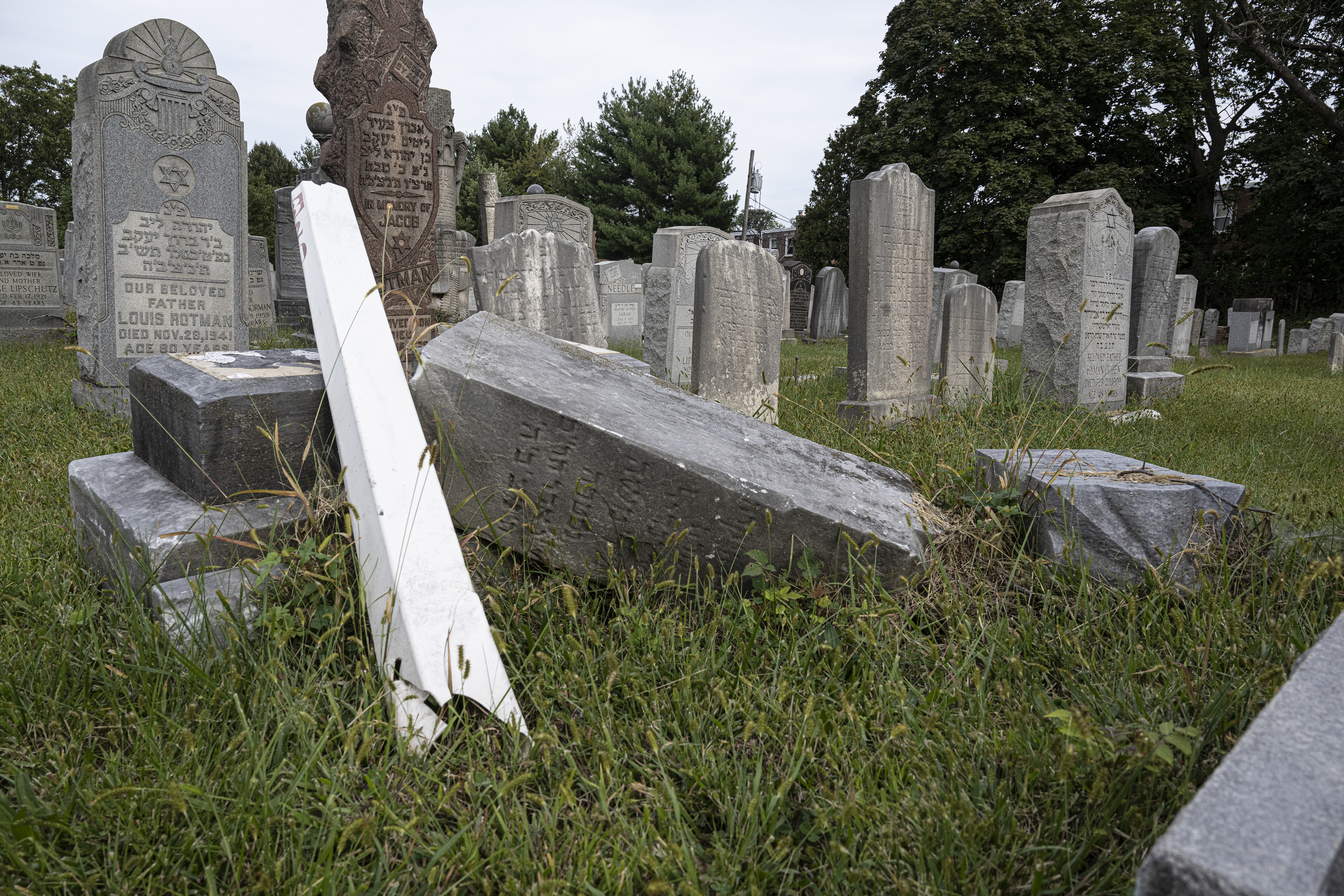
    Har Jehuda, for instance, has been an important institution for the region’s Jewish community since its founding in the 1890s, holding more than 20,000 graves. But today, its grounds are largely overgrown and unkept, and numerous gravestones have fallen into disrepair. A volunteer group has stepped in to cover some of the maintenance and landscaping costs but fears it cannot sustain the cemetery for long.

    Overgrown weeds and displaced headstones at Har Jehuda Cemetery in Upper Darby.

    “The reality is that there are not enough staff or funds to maintain the cemetery, and there hasn’t been for years,” Randi Raskin Nash, a member of the Friends of Har Jehuda Cemetery group, said by email.

    The cremation boom

    A hundred years ago, cremation was an unusual choice in the United States. Things started to shift in 1963, when the Catholic Church lifted its prohibition of the practice and Jessica Mitford’s book The American Way of Death, an exposé of the death industry, was published. Before then the cremation rate was reported to be in the single digits, and even as it rose, by 1999 only about 25% of Americans were cremated. But that is changing.

    Cremations are expected to double the number of burials in 2025, according to a report from the National Funeral Directors Association. By 2045, the cremation rate in Pennsylvania is projected to reach over 82%, with burials dropping to just under 14%.

    Several factors appear to be driving the shift, according to Christopher Robinson, the president of the association’s board of directors. Those include costs, environmental concerns, declines in religious affiliation, and growing cultural acceptance of cremation.

    window.addEventListener(“message”,function(a){if(void 0!==a.data[“datawrapper-height”]){var e=document.querySelectorAll(“iframe”);for(var t in a.data[“datawrapper-height”])for(var r,i=0;r=e[i];i++)if(r.contentWindow===a.source){var d=a.data[“datawrapper-height”][t]+”px”;r.style.height=d}}});

    But that is not the business model that most cemeteries were built upon.

    When folks secure a plot for interment, they are really buying an easement for burial rights, or essentially a license to use the cemetery’s land. Plots can cost thousands of dollars and are often nonrefundable.

    Once it comes time for a person to be buried, the cemetery may charge for other parts of the process, like digging and closing the plot, creating a headstone monument, or supplying a vault for the casket.

    Most cemeteries sustain themselves for the future by putting a portion of that revenue into an endowment fund, where the return on investment can be used for maintenance and repairs. Friends of Har Jehuda estimates that it requires roughly $50,000 to $75,000 just to cover lawn mowing and weeding per season.

    Cremations are much less profitable, particularly if a cemetery does not actually perform it — a walled recess with an engraved cover for a loved one’s urn may cost only a few hundred dollars.

    It’s unknown exactly how many cemeteries have formally closed or been abandoned in recent years, since the statistic does not appear to be widely tracked. What is clear is that cremation trends and dwindling space for future burials have left cemeteries struggling.

    “There’s going to be a lot of cemeteries going out of business in the next 20 years,” said Tanya Marsh, a law professor at Wake Forest University who teaches funeral and cemetery law, in an episode of The Economics of Everyday Things podcast last year.

    Would you get married at a cemetery?

    Some cemeteries have embraced the changes and creatively diversified their offerings.

    “We’re an outdoor museum. We’re a sculpture garden, we’re an arboretum … we’re more than just a cemetery,” said Nancy Goldenberg, CEO of Laurel Hill Cemeteries in Philadelphia.

    Laurel Hill uses its combined 265 acres on both sides of the Schuylkill to its advantage. On a given day at the historic cemetery, you might see visitors on a history tour, stretching out to watch a movie screening, attending a wedding, or meeting with the official book club, Boneyard Bookworms.

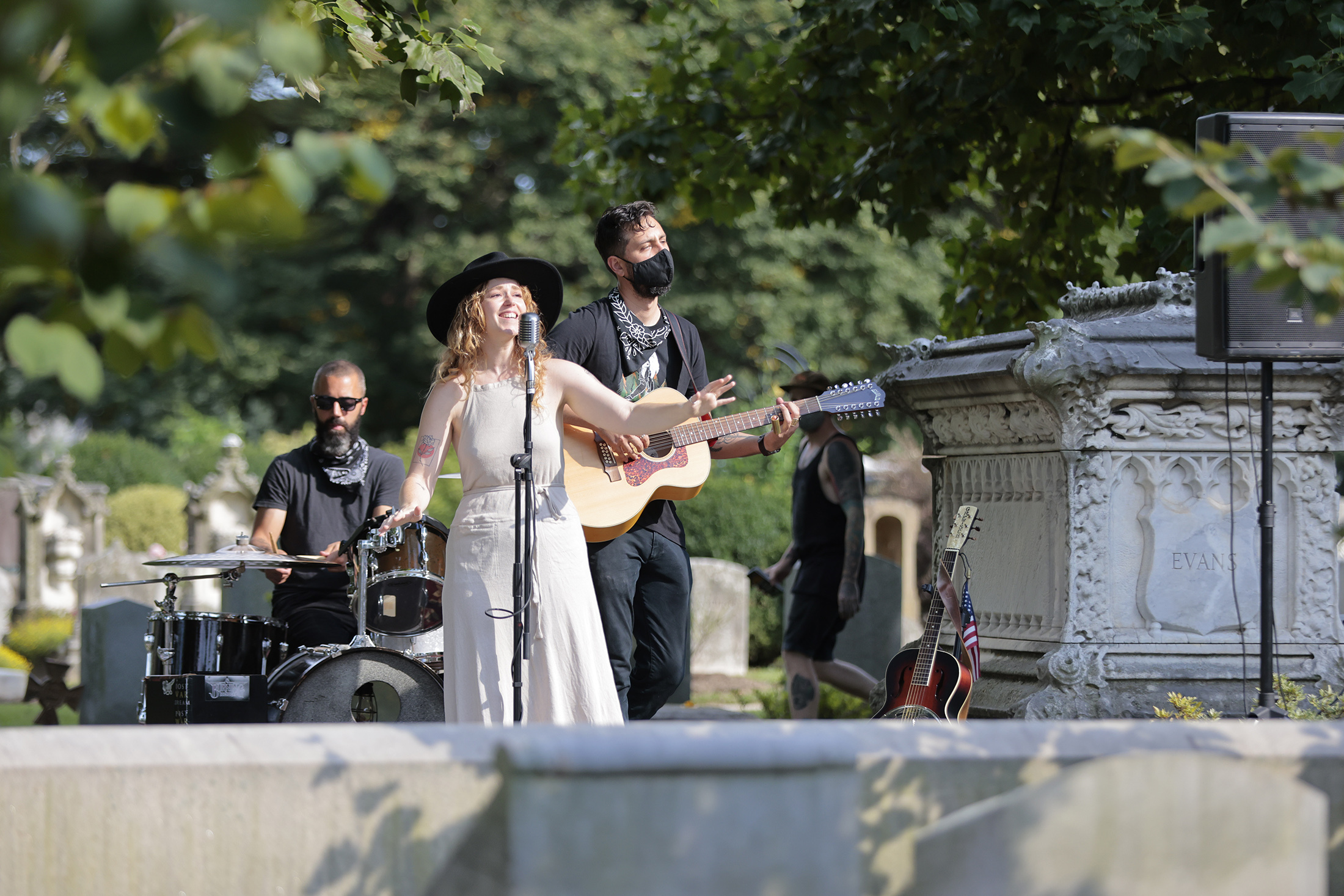
    The 49 Burning Condors singer Kimber Dulin, Christopher Tremogile on guitar and Jason Gooch on drums play as folks shop for unusual antiques, vintage items, artwork and handmade wares at the Market of the Macabre at the Laurel Hill Cemetery in 2021.

    Goldenberg said the extensive offerings are meant to build connections between people and the cemetery: They will be more likely to contribute money, or when they eventually need a resting place for their loved ones, they will look there first.

    This all used to be more common — the first U.S. cemeteries in the mid-19th century also served as the country’s first public parks, with open grassy fields fit for a picnic. Before then, people buried their dead in smaller graveyards that eventually became overcrowded and sources of disease.

    Laurel Hill is readying itself for a changing death industry, too. Goldenberg said she anticipates a rise in “green burials,” in which a person is buried without embalming or a casket, and said the cemetery was designating a section for them.

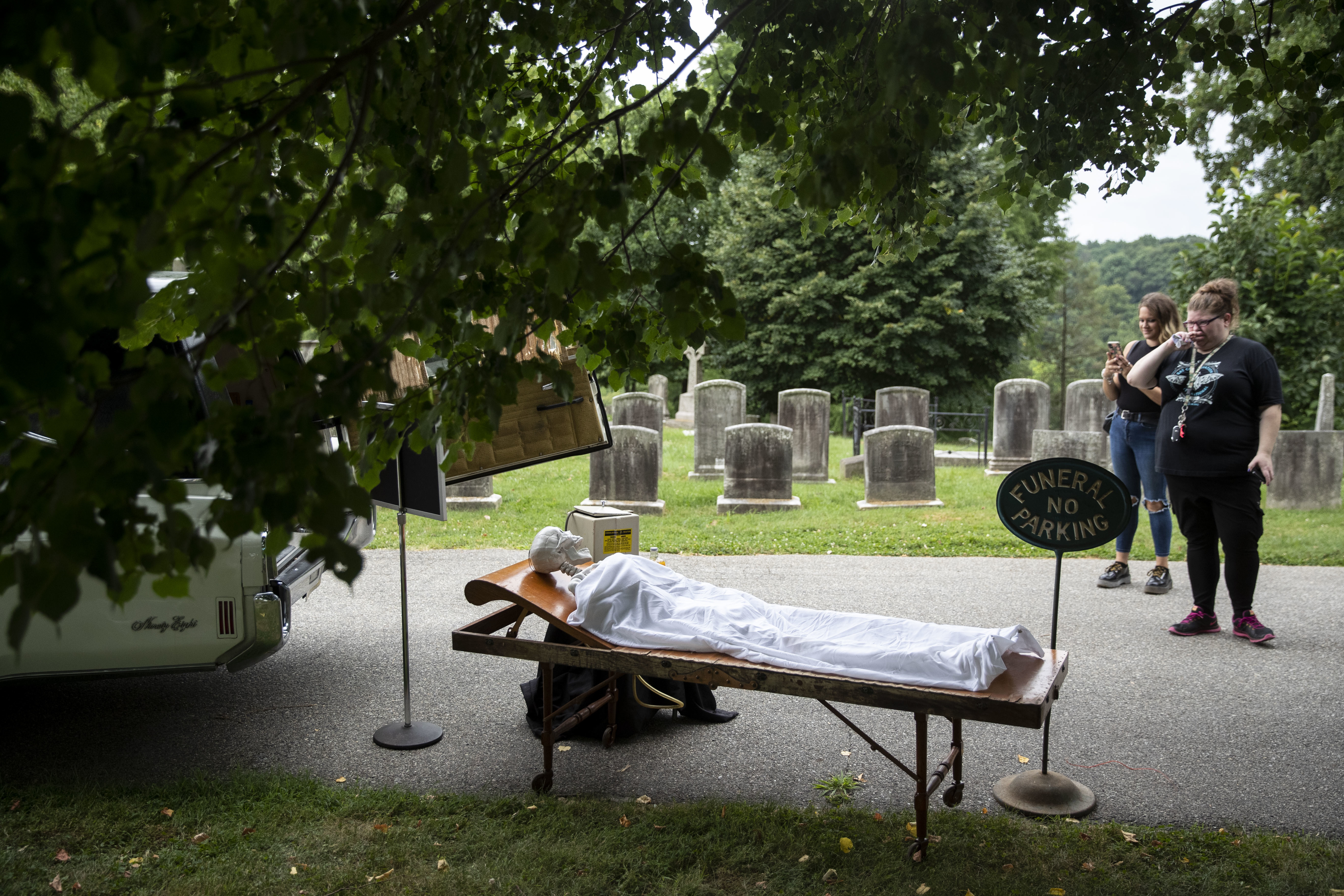
    Visitors view a display behind a hearse during the 13th Car & Hearse Show presented by the Mohnton Professional Car Club at Laurel Hill Cemetery in 2021.

    And while Goldenberg said she would be long gone before the cemetery runs out of space for new burials, it is a reality officials are planning for.

    Laurel Hill is adding space for an additional 225 niches for cremated remains.

    “There are small cemeteries, and once they fill up, that’s the revenue stream. … You have to be prepared for that,” she said.

    “If you don’t, that’s when you fall on hard times.”

    If a cemetery reaches the point of closure or abandonment, it’s not always clear what would happen to it. Last year, Gov. Josh Shapiro signed into law a bill sponsored by State Rep. Tim Brennan (D., Bucks) that would give financial relief to municipalities that take over abandoned cemeteries, since doing so can be a costly burden that local governments want to avoid.

    Uncertain futures for cemeteries

    Days after the Alter family made it through the prayers and memorial they planned, the emotional weight of the experience hit them even harder.

    Daniel Alter later confirmed with Har Jehuda that a fresh grave had been dug where he believed his mother was buried. Recently, he hired a ground-penetrating radar company to examine the burial site, which determined the freshly dug grave was directly adjacent to where his mother was buried. While Alter was relieved to learn his mother’s grave had not been disturbed, he said Har Jehuda could have prevented the anguish he and his family have felt over the last few months.

    Har Jehuda Cemetery’s owner, Larry Moskowitz, declined to comment for this article. Moskowitz was previously prosecuted by the state attorney general’s office over allegations that his other business, Wertheimer Monuments, had failed to deliver headstones to people who had paid for them. Complaints like these against the burial industry happen occasionally — the attorney general’s office also sued another Philadelphia monuments company in 2023 for failing to deliver headstones. There are multiple organizations dedicated to protecting consumers against predatory burial providers.

    The Alters, like other families, continue to visit and bury their loved ones at Har Jehuda, but they hope that no one else goes through their experience.

    “Our collective wish is that it never, ever, ever happens again to anyone in the Philly area,” Daniel Alter said.

  • Swarthmore Borough drops income tax proposal after contribution from Swarthmore College

    Swarthmore Borough drops income tax proposal after contribution from Swarthmore College

    Swarthmore Borough is tabling a proposal to implement an earned income tax after Swarthmore College stepped up to cover a funding gap left by the closure of Crozer-Chester Medical Center.

    Under a memorandum of understanding passed by Swarthmore Borough Tuesday, Swarthmore College will contribute $638,000 to the borough to help cover rising emergency service costs.

    The contribution allows the borough to drop a proposal to implement an earned income tax, which faced pushback from residents and some members of borough council.

    In a message to the community, Rob Goldberg, Swarthmore College’s vice president for finance and administration, said, “We’re happy we were able to work with the borough to avoid a new tax being imposed on College employees. We also value our long-standing partnership with the borough and remain committed to supporting the community we share. We’re grateful for the constructive dialogue that led to this outcome and for the continued collaboration that benefits both the borough and the College.”

    In a presentation given last month, the borough projected a 1% earned income tax would bring in at least $3.13 million in the second year of collection (some collection lags would occur in the first year). This would include $760,000 to $1.5 million in taxes collected from nonresidents who work in Swarthmore.

    An earned income tax is a local tax on salary, wages, and tips, but not on passive income like interest, dividends, capital gains, pensions, and Social Security benefits. These taxes are generally capped at 1%.

    If a taxpayer lives in a community with an earned income tax, they pay into their home community’s income tax base. If their home community does not have an earned income tax and the community where they work does, they pay into their work community’s income tax base. One major exception is Philadelphia’s wage tax, which overrides local earned income taxes. This means if a person works in Philadelphia and lives in a suburban municipality with an earned income tax, they would pay Philadelphia’s wage tax rather than their home community’s earned income tax.

    Cindy MacLeod, chair of the borough council’s finance committee, said the borough’s financial outlook is starkly different this year after the loss of Crozer’s ambulance services both increased the borough’s costs and brought down its revenue.

    In April, the borough adopted a declaration of disaster emergency following the closures of Crozer-Chester Medical Center in Chester and Taylor Hospital in Ridley Park. The closures resulted in “significant impacts” to emergency services in the region, the declaration said, including burdening remaining medical centers and increasing wait times for patients.

    According to preliminary estimates, the borough’s public safety costs are set to increase by 41% next year — from $3.1 million to $4.3 million. In addition to the loss of Crozer’s ambulance services, the borough is staring down steep fire equipment repair costs and a drop in the number of volunteer firefighters.

    “The cost assumptions around all these emergency services is a real and meaningful change,” said councilmember Scarlett McCahill at a Sept. 8 meeting. “It’s not that all of a sudden, surprise, we weren’t minding the shop and now we’re really behind and need to do a catchup. The actual costs to the community have changed significantly.”

    In addition to emergency service needs, Swarthmore officials say the borough has not been immune to more general inflationary pressures. Costs are rising for community services that the borough doesn’t want to cut, MacLeod said.

    Though the earned income tax is off the table for now, the borough is considering implementing an emergency services tax, a specific type of property tax that would be earmarked just for emergency services.

    “We hope we don’t have to do an emergency services tax, but we haven’t ruled that out,” MacLeod said.

    Budget discussions will continue at the borough’s Oct. 27 finance committee meeting.

    This suburban content is produced with support from the Leslie Miller and Richard Worley Foundation and The Lenfest Institute for Journalism. Editorial content is created independently of the project donors. Gifts to support The Inquirer’s high-impact journalism can be made at inquirer.com/donate. A list of Lenfest Institute donors can be found at lenfestinstitute.org/supporters.

  • A Bucks County couple built an architectural retreat in the woods

    A Bucks County couple built an architectural retreat in the woods

    When cookbook author Pamela Anderson and her husband, David, were looking for a bucolic escape in Bucks County, they found a forested stretch of land sandwiched between a high ridge and a stream to put down roots.

    The couple, who previously lived in New Hope, toured the 11-acre parcel in Riegelsville with an architect back in 2003, learning how their new home could flow with the land. Today, the focal point of Copper House might be the living room, with 180-degree views from floor-to-ceiling windows. It’s like forest bathing, from a comfortable couch.

    “We wanted a place to get away,” Anderson said on a recent October afternoon.

    Outside, they’ve woven gravel trails into countless grottos, fire pits, and other quiet gathering places for the numerous visitors who’ve descended upon their home for sound baths, yoga, and meditations. On this Friday afternoon, about a dozen architects and interior designers gathered at their home for a corporate retreat to learn about sustainable flooring.

    “Some people just want to come here to have a meeting in a lovely place,” Anderson said.

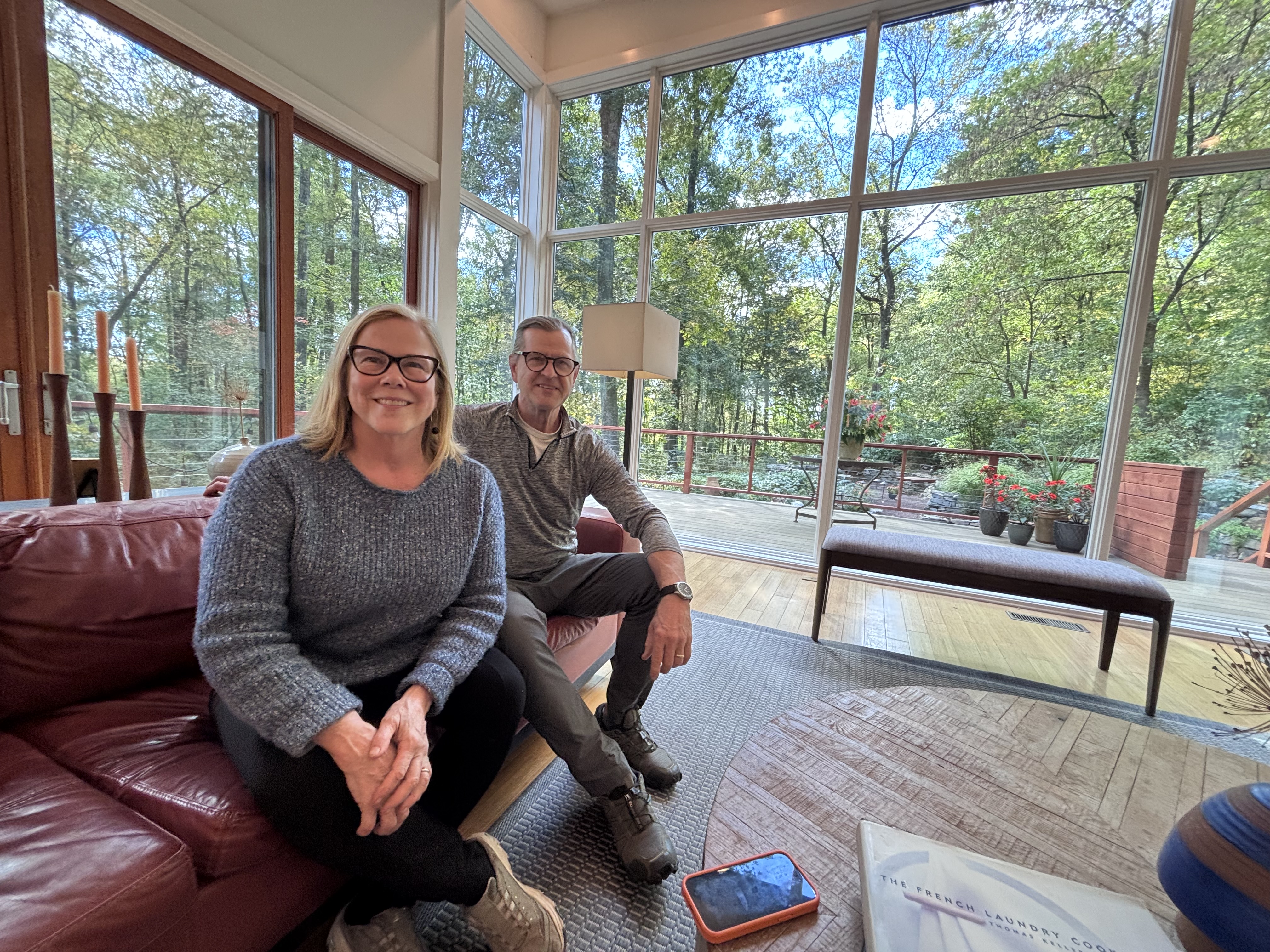
    Pamela and David Anderson sit on their couch in their home, Copper House, where they host events and retreats.

    The Andersons didn’t just want to live at Copper House, so they went beyond having friends over for dinner. They started hosting corporate events and retreats at their home during the early days of the COVID-19 pandemic, stopped for a bit, and got things back up again afterward.

    “We’ve done most of the work ourselves. We built all the walls ourselves from rocks we had here. It’s expensive to maintain this place, and these events help with that,” Anderson said. “It made sense for us.”

    Anderson, along with being a best-selling cookbook author, cooks most of the food for the retreats, harvesting local fruits and vegetables and cooking wood-fired pizza from an outdoor oven.

    “This was just a natural transition for me from that career to this one,” she said.

    David Anderson, a longtime Episcopal priest, said the landscape was wild when they first toured it, filled with brambles and invasive species. The couple has methodically rid the invasive species from various patches of their property, but that work never ends.

    Copper House in Upper Bucks County.

    Their latest retreat was hosted by Interface, an indoor flooring company that specializes in sustainable projects. Monica Blair-Smith, an account executive with Interface, said they’ve had meetings by a bonfire and in the labyrinth, so far, at Copper House. The team also took a sound bath.

    “We toured several places from here to southern New Jersey, but we really loved how much this space was integrated with nature. Hosting in such a beautiful space is important to us,” Blair-Smith said. “Once we toured it, we didn’t go anywhere else. It was a no-brainer.”

    Retreat packages at Copper House begin at $1,500.

    While events and retreats have become a lucrative business, the Andersons said Copper House is still a home they cherish.

    “You’re always seeing something new and different, and our senses are so heightened living here,” Pamela Anderson said. “In winter, it’s like living in a snow globe.”

  • Judge rules Bucks County sheriff’s agreement to cooperate with ICE was ‘reasonable and necessary’

    Judge rules Bucks County sheriff’s agreement to cooperate with ICE was ‘reasonable and necessary’

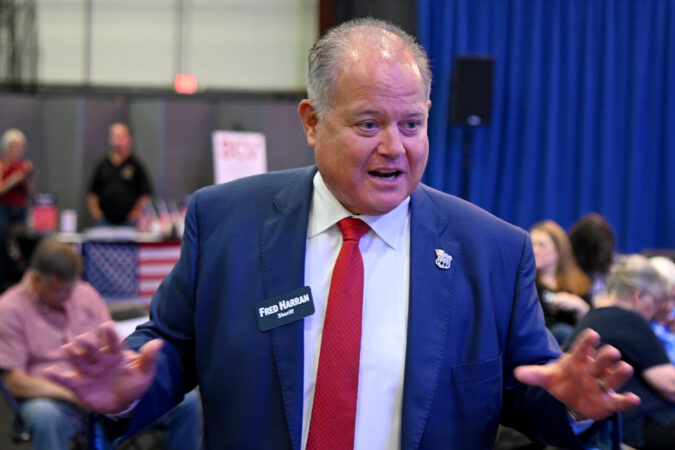
    Bucks County Sheriff Fred Harran acted legally in signing up to have his deputies help ICE enforce federal immigration laws, a judge ruled Wednesday in a case that has riled residents on both sides of a contentious issue.

    Bucks County Court Judge Jeffrey Trauger said Harran’s cooperation with the agency was “clearly lawful under Pennsylvania jurisprudence,” and both “reasonable and necessary” in fulfilling his lawful duty to keep the citizens of Bucks County safe.

    What the judge called “intergovernmental cooperation of law enforcement” is no different under the law at the county, state, or federal level, he wrote.

    The ACLU of Pennsylvania and other plaintiffs had asked Trauger to issue an injunction blocking the partnership from moving forward.

    Reached by phone Wednesday, Harran said he was pleased with the decision and expected his partnership with U.S. Immigration and Customs Enforcement to be fully operational by the end of next week.

    “I knew from the time I started this that I was in the right, that the county commissioners do not control the office of the sheriff,” Harran said.

    A spokesperson for Bucks County said the county intended to appeal.

    Those who sought to block Harran’s efforts said they would continue to battle.

    “This decision doesn’t mean that we’ll stop fighting to hold Sheriff Harran accountable,” said Diana Robinson, co-executive director of Make the Road Pennsylvania, an advocacy group that was one of the plaintiffs. ”Indeed, we will redouble our efforts in this case and continue to fight for what is right.”

    She said an alliance between Harran’s department and ICE was aimed at “turning our neighborhoods into surveillance zones” and “weaponizing local law enforcement to carry out ICE’s harmful agenda.”

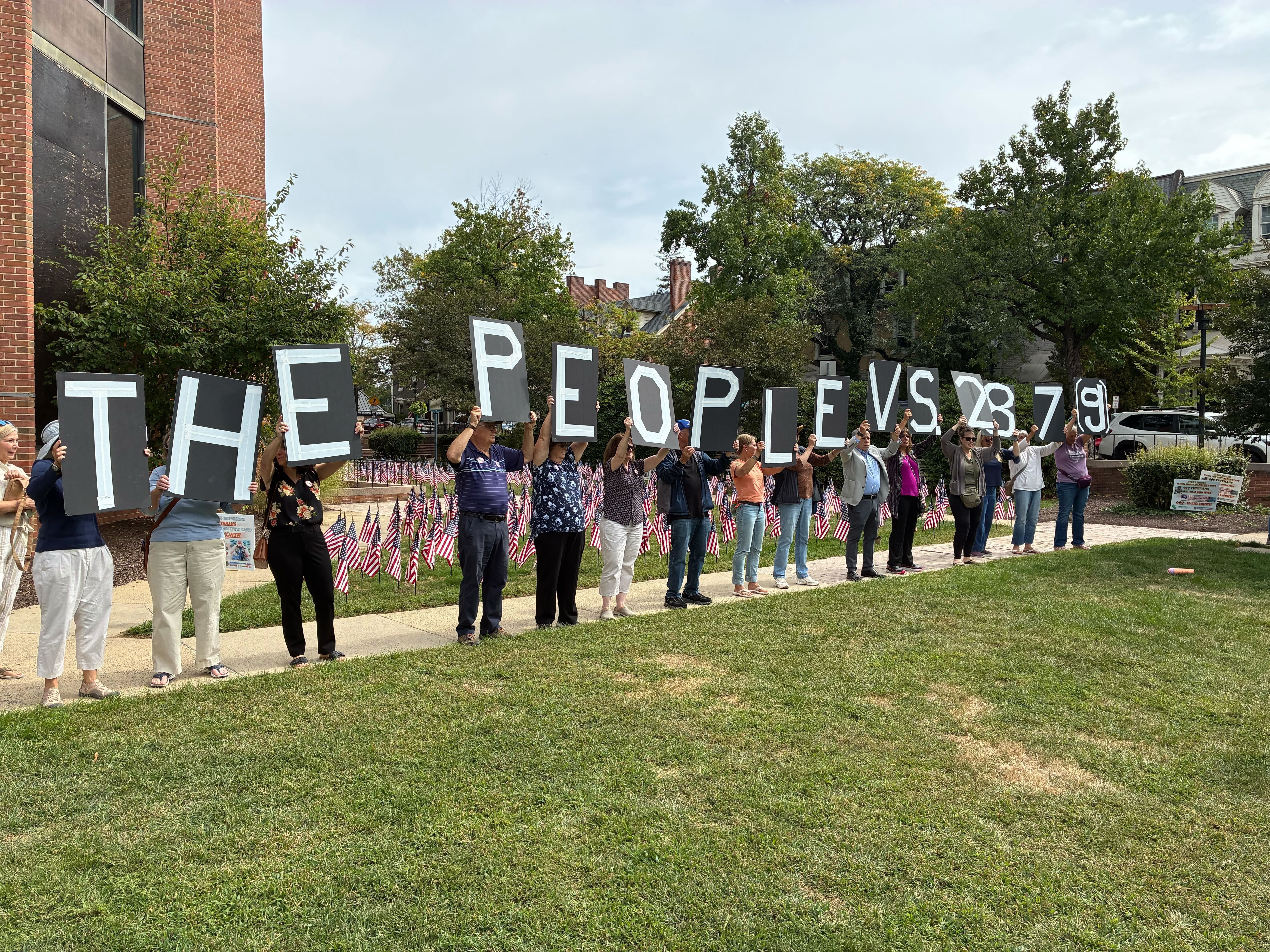
    Community members rally in Bucks County before civil rights groups asked a judge to block Sheriff Fred Harran’s controversial partnership with ICE.

    In his opinion, the judge said it did not appear that Make the Road, NAACP Bucks County, or Buxmont Unitarian Universalist Fellowship as organizations had clear standing to sue under Pennsylvania law.

    While individual members might have standing if they were caused harm by the sheriff’s office, he said, the injuries they alleged were “not immediate or substantial,” and their complaint was based in part on speculation about what might happen.

    ACLU of Pennsylvania attorney Stephen Loney, who helped lead the court fight, said Wednesday that he disagreed with the decision.

    “In the most respectful way I could possibly say it, I think the judge got it totally wrong,” he said. “It’s unfortunate.”

    He said the ACLU would appeal the decision.

    ICE officials did not immediately offer comment.

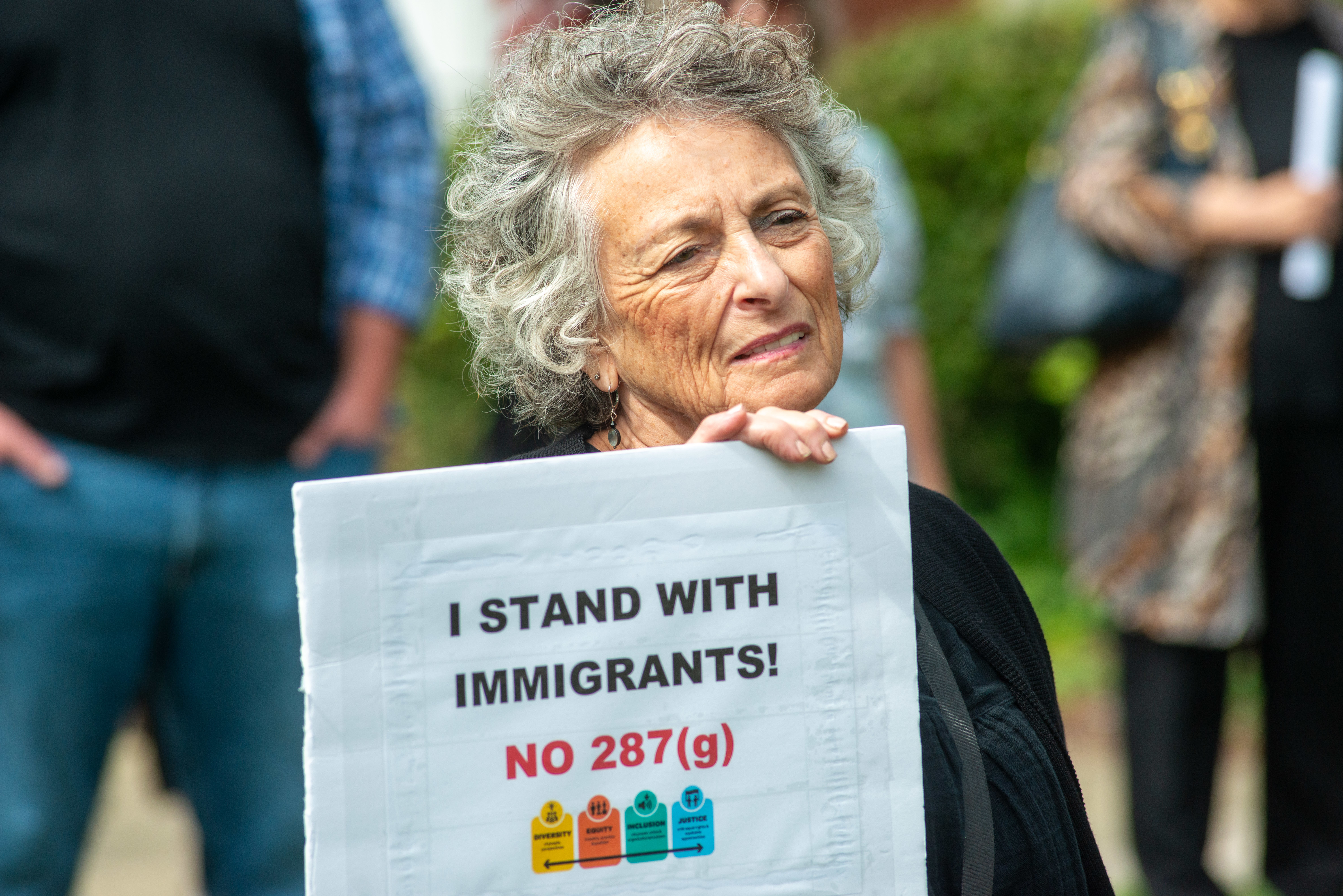
    Melanie Goldstein holds a sign as demonstrators rally outside the Bucks County Administration building before a hearing last month during which the ACLU and other organizations sought an injunction to stop the Bucks County sheriff from going through with his plan to help ICE enforce immigration laws.

    Laura Rose, an organizer with Indivisible Bucks County, said the group was “deeply disappointed in Judge Trauger’s decision” to let Harran proceed “without guardrails.”

    She called the ruling “a profound failure to protect both the immigrants and taxpayers of Bucks County.”

    Rose called on voters to end the local alliance with ICE by voting Harran out of office on Nov. 4.

    Harran’s lawyer, Wally Zimolong, called the decision “a victory for the rule of law and for the safety of Bucks County residents,” and accused the ACLU of maligning the sheriff with false claims.

    “Frankly,” he said, “it is mind-boggling that anyone would oppose this. It is also a vindication for Sheriff Harran, a good and honorable man and dedicated public servant. … It is a proud day when people of good character, like Sheriff Harran, prevail over those that lack it.”

    In the spring, Harran and ICE officials signed what is called a 287(g) agreement, a controversial program named for a section of a 1996 immigration law. It enables local police to undergo ICE training, then assist the agency in identifying, arresting, and deporting immigrants.

    The number of police agencies participating in the program has soared to more than 1,000 under President Donald Trump. Seven states, including New Jersey and Delaware, bar the agreements by law or policy.

    Shortly before the government shutdown, ICE was poised to begin backing its recruitment efforts with money, announcing that it would reimburse cooperating police agencies for costs that previously had been borne by local departments and taxpayers.

    Harran, who is seeking reelection in November, has pledged “zero cost” to local taxpayers.

    He insists the alliance with ICE will prevent crime and keep people safe. Civil rights groups say the sheriff is inviting racial profiling, taxpayer liability, and a loss of trust between police and citizens.

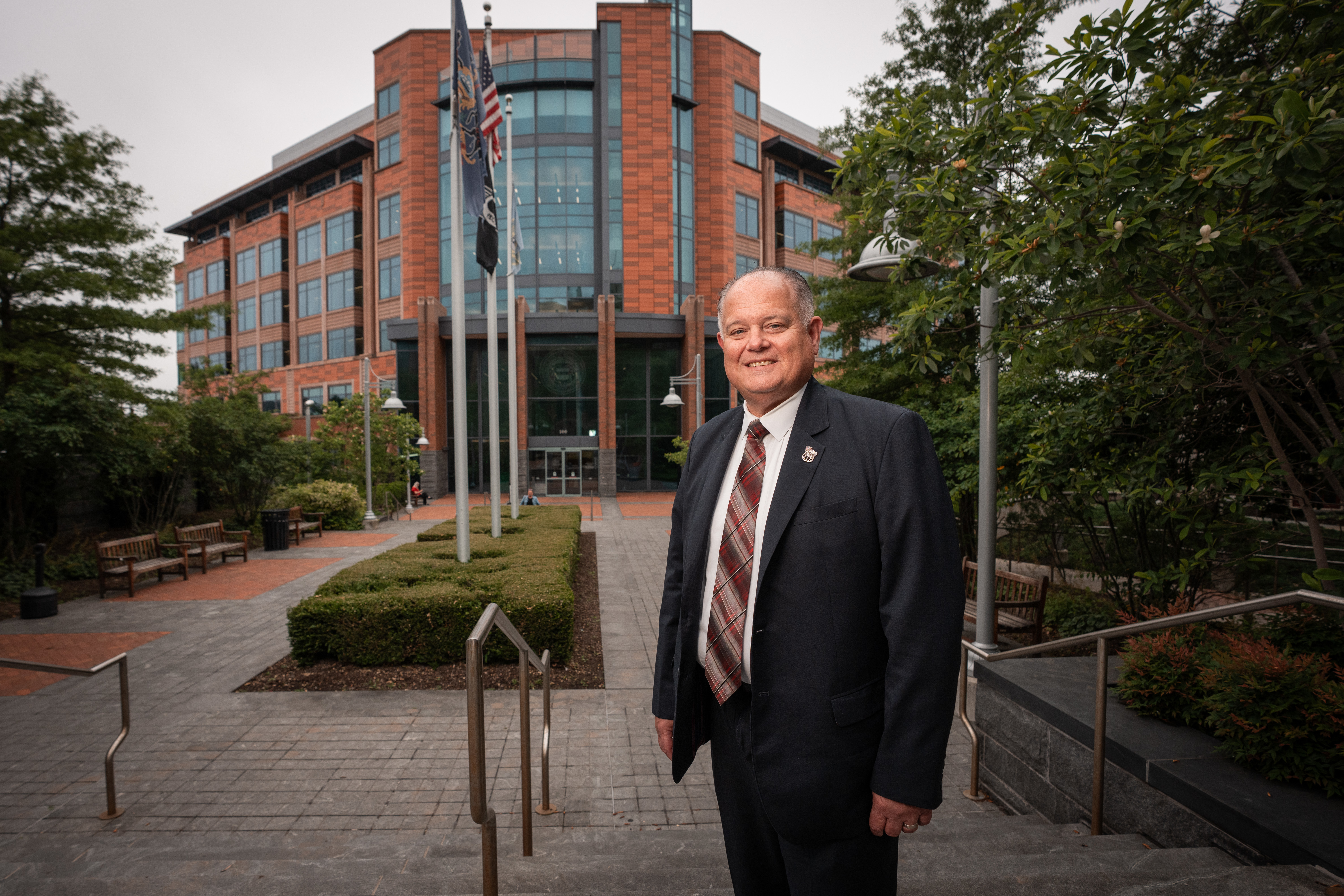
    Bucks County’s sheriff Fred Harran, outside the courthouse in Doylestown, PA, June 9, 2025.

    Contentious legal hearings have come against a backdrop of name-calling and rancor outside the courtroom.

    The Democratic-led Bucks County Board of Commissioners has disavowed Harran’s actions, voting 2-1, with the lone Republican opposed, to approve a resolution that declared the agreement with ICE “is not an appropriate use of Bucks County taxpayer resources.”

    The ICE issue has become central to Democrats’ effort to oust Harran, a Republican, while the sheriff says his intentions have been misconstrued by political opponents and the news media.

    “A judge ruling that he has the authority to enter into this deportation agreement does not make this any less dangerous,” Harran’s Democratic opponent, Danny Ceisler, said in a statement Wednesday.

    The last opportunity to end the partnership, Ceisler said, is by winning the election next month.

    A key issue has been the difference between what Harran says he intends to do and the much broader powers conferred within the agreement with ICE.

    Harran signed up for the “Task Force Model,” the most far-reaching of the three types of 287(g) agreements. It allows local police to challenge people on the streets about their immigration status and arrest them for violations.

    Harran said his officers won’t do that.

    Wednesday’s ruling, Harran said, recognized the limited scope of his plans, and he suggested that every county should partner with ICE.

    “I’m only interested in making the county safer, and I’m only interested in dealing with those folks that are in this country illegally that have committed crimes,” Harran said. “I am not the immigration police. I am not Immigration and Customs Enforcement.”

    Harran has said staff will electronically check the immigration status of people who have contact with the sheriff’s office because of alleged criminal offenses. Those found to be in the country illegally will be turned over or transported to ICE, if the federal agency desires, he said.

    Harran testified in court last month that he planned to create a sheriff’s office policy to specify the limits of his deputies’ powers but had not yet done so.

    He insisted that his office would take only the actions he has described.

    “We will not be stopping people to ask them on immigration status,” he said under cross-examination. “I know what I am doing, and that’s all I intend to do.”

    This suburban content is produced with support from the Leslie Miller and Richard Worley Foundation and The Lenfest Institute for Journalism. Editorial content is created independently of the project donors. Gifts to support The Inquirer’s high-impact journalism can be made at inquirer.com/donate. A list of Lenfest Institute donors can be found at lenfestinstitute.org/supporters.

  • How the 3 Pennsylvania Supreme Court justices on the ballot have ruled in major cases

    How the 3 Pennsylvania Supreme Court justices on the ballot have ruled in major cases

    Three Pennsylvania Supreme Court justices are on the ballot this November, when voters will decide whether to extend each of their tenures for another 10-year term.

    There are currently five justices who were elected as Democrats and two who were elected as Republicans on the bench.

    This year’s retention race has drawn heightened attention, as Republicans have launched a campaign to sink the retention bids of Justices Kevin Dougherty, Christine Donohue, and David Wecht — all elected as Democrats in 2015 — in hopes of flipping the court’s balance.

    Once on the bench, judges are expected to shed their partisan label, which is why Pennsylvania extends judicial terms through retention elections instead of head-to-head races.

    Still, advocacy groups on both sides of the aisle are trying to make the case that control of the judicial seats is critical, if not existential, to their causes.

    The Inquirer reviewed the cases that have come before the Pennsylvania Supreme Court over the last decade, and how Dougherty, Donohue, and Wecht voted.

    Here are some of the most significant cases of their tenure.

    Abortion

    Pennsylvania’s highest court stopped just short of recognizing a constitutional right to abortion access in January 2024.

    The ruling came in a case challenging a state law limiting Medicaid funding for abortions except in cases involving rape, incest, or danger to the life of the mother.

    The 219-page majority opinion included language that strongly endorsed access to abortion as a right derived from the Pennsylvania Constitution, but the judges could not agree on whether they were ready to make the call in this case.

    The majority sent questions about a specific funding limit and broader constitutional protection for abortion access back to a lower court — setting up another round of legal battles that will likely, again, make it before the state Supreme Court.

    How the three justices ruled: Donohue wrote and Wecht joined the majority opinion. The two justices said they believed Pennsylvania’s 1971 Equal Rights Amendment clearly established a right to abortion access. Dougherty wrote a separate opinion saying this case did not call on the court to opine on the right to an abortion. “At least, not yet,” he wrote.

    Voting rights and elections

    The Pennsylvania Supreme Court has ruled on a litany of challenges to Pennsylvania’s election rules, many of them focused on the state’s mail voting law.

    In 2018, the justices threw out the state’s GOP-drawn congressional maps as unconstitutionally gerrymandered.

    In 2020, the court issued a major ruling ahead of the presidential election allowing for ballot drop boxes and allowing local election offices to accept ballots for up to three days after the election as long as those ballots were postmarked by 8 p.m. on Election Day.

    How the three justices ruled: Donohue, Dougherty, and Wecht each joined the majority opinion in the redistricting case. On the 2020 election ruling, Dougherty and Wecht joined the majority opinion. Donohue joined the majority opinion but dissented from the decision to extend the ballot deadline.

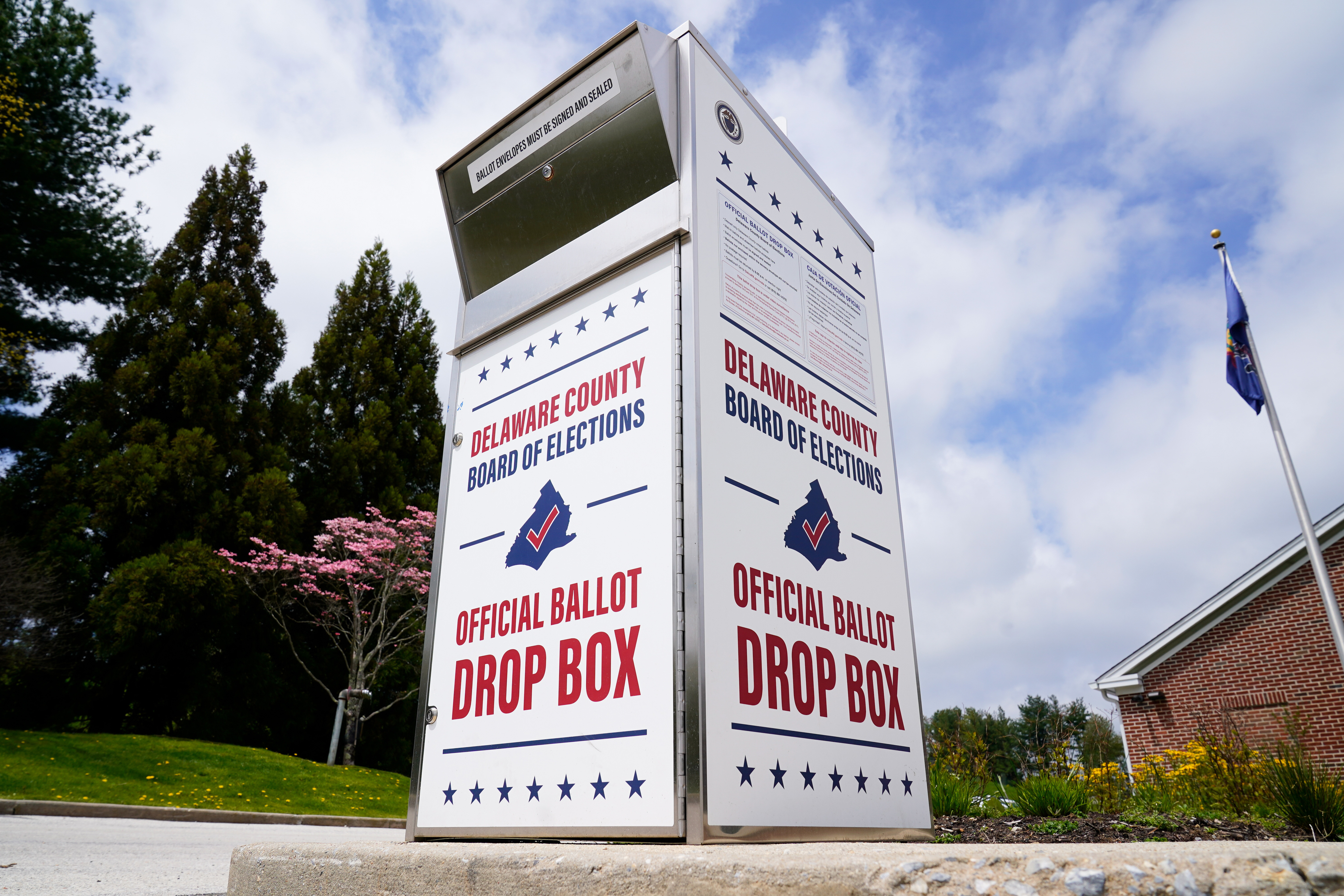
    A Delaware County secured drop box for the return of mail ballots in 2022 in Newtown Square.

    Education

    A Delaware County school district had the right to challenge Pennsylvania’s school-funding system, the Supreme Court ruled in 2017.

    The decision affirmed the role of courts in ensuring that state funding leads to equitable education and sent the case back to Commonwealth Court to proceed with litigation.

    In 2023, Commonwealth Court ruled, as part of the same case, that the state’s funding system for school districts led to disparities that prohibit quality education for all students, rendering it unconstitutional.

    How the three justices ruled: Wecht wrote the majority opinion, which Dougherty and Donohue joined.

    Environment

    Pennsylvania, which partly sits on the natural gas-rich Marcellus Shale, found itself in the midst of the fracking boom of the early 2000s.

    The state sold leases to oil and gas companies to drill wells. The practice raised questions, and legal challenges, as to how the state should use the revenues in the context of the Pennsylvania Constitution’s Environmental Rights Amendment.

    The court ruled in 2017 that it is unconstitutional for the state to use revenue from the royalties of oil and gas leases on public land to pay for anything but conservation and maintenance of the environment.

    How the three justices ruled: Donohue wrote the majority opinion, which Dougherty and Wecht joined.

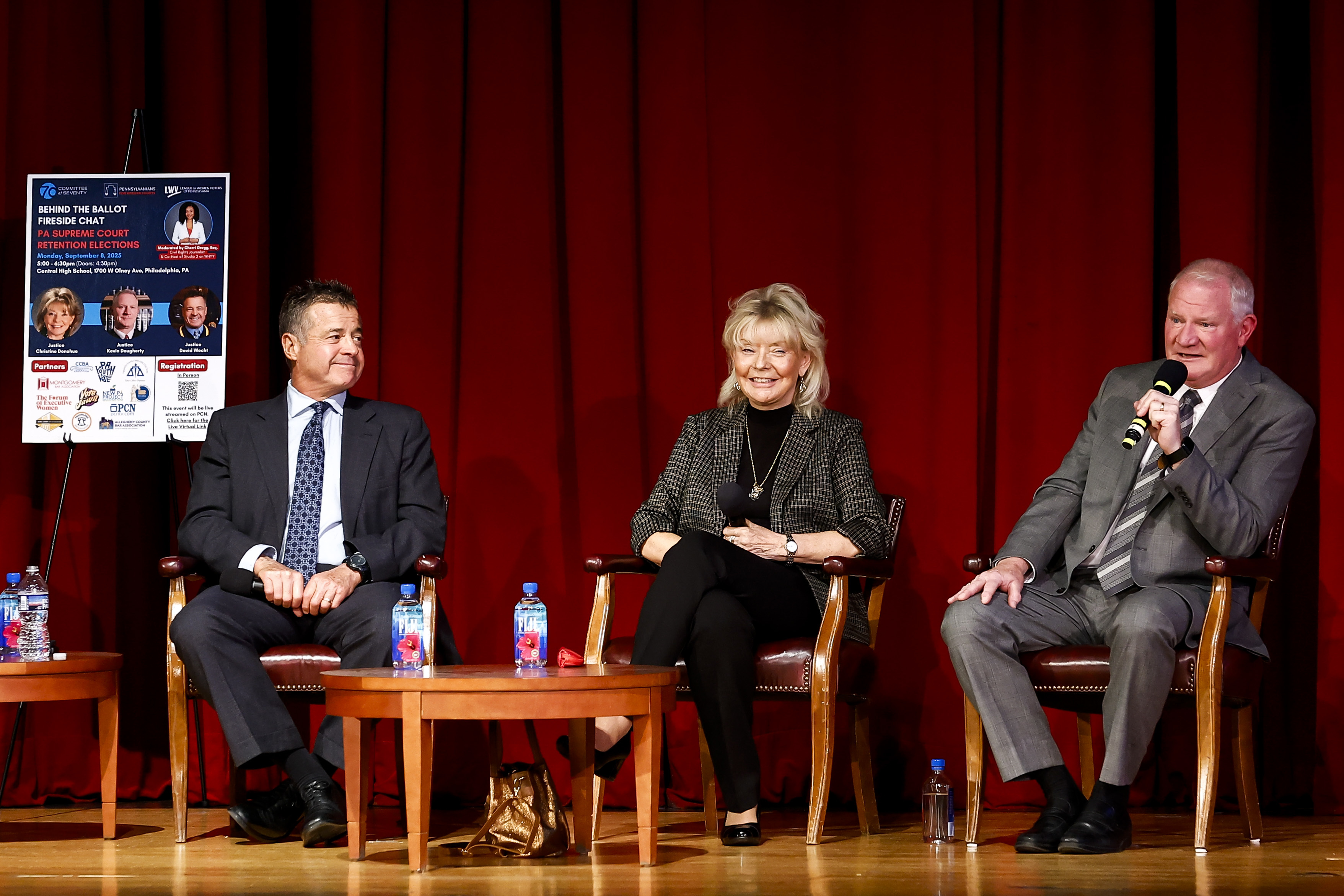
    Justices David Wecht, Christine Donohue and Kevin Dougherty sit onstage during a fireside chat at Central High School in September. The conversation was moderated by Cherri Gregg, co-host of Studio 2 on WHYY, and presented by the Committee of Seventy, Pennsylvanians for Modern Courts, and the League of Women Voters of Pennsylvania.
    Criminal justice

    Pennsylvania has had the nation’s largest population of juvenile lifers: people sentenced as minors to life in prison without the possibility of parole.

    In 2017, the Supreme Court made it harder to sentence a juvenile to life. The majority opinion says there is a “presumption” against life without parole for juveniles who are found guilty of murder, and prosecutors must show that the offender is “unable to be rehabilitated” when seeking the sentence.

    How the three justices ruled: Donohue wrote the majority opinion, which Dougherty and Wecht joined.

    Second Amendment

    In 2024, for the first time, the Pennsylvania Supreme Court issued an opinion that interpreted the wording in the U.S. Constitution that gives Pennsylvanians the right to bear arms.

    In Stroud Township, a zoning ordinance that prohibited the discharge of a firearm within the township’s borders limited the possible locations for shooting ranges. The ordinance barred a resident from having a personal outdoor shooting range on his property, and he sued the township for violating his Second Amendment rights.

    The court ruled that the ordinance was constitutional.

    How the three justices ruled: Dougherty wrote the majority opinion, which Wecht joined. Donohue wrote her own opinion, reaching the same conclusion as the majority but disagreeing with the analysis.

    Larry Krasner

    Did Republican lawmakers make a procedural error in their 2022 effort to impeach Philadelphia District Attorney Larry Krasner? The Supreme Court in 2024 said they did, effectively ending a campaign in Harrisburg to oust the progressive prosecutor.

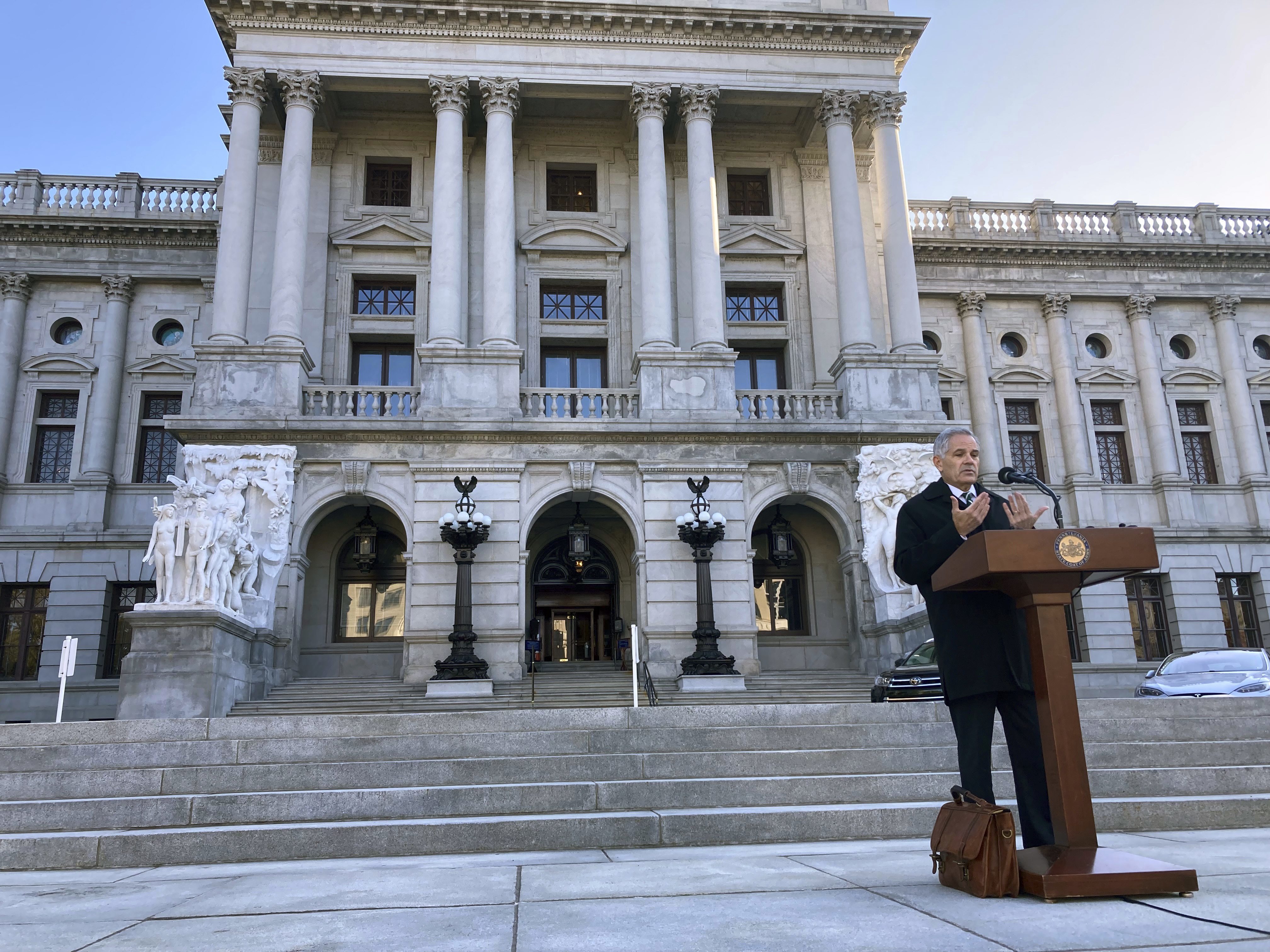
    Philadelphia District Attorney Larry Krasner talks about Republican-led efforts to investigate his record addressing crime and gun violence at the Pennsylvania Capitol in 2022.

    The decision said that the articles of impeachment approved by the state House in late 2022 were “null and void” because they were sent to the Pennsylvania Senate on the last day of that year’s legislative session, and the upper chamber did not complete its work on the matter before the next session began. The attempt to carry the process from one two-year session to the next was unlawful, the court said.

    The majority also agreed with a lower court that none of the articles of impeachment met the required legal standard of “misbehavior in office.”

    How the three justices ruled: Donohue and Wecht joined the majority opinion. Dougherty did not participate in the deliberations.

    Bill Cosby

    Disgraced actor and comedian Bill Cosby walked out of prison a free man in 2021 after the state Supreme Court reversed his sexual assault conviction.

    The court did not weigh in on the facts of the case or whether Cosby was guilty. Instead, it focused on a former Montgomery County prosecutor’s decade-old promise that Cosby would never be charged with drugging and assaulting Andrea Constand if he gave incriminating testimony in a civil case filed by his accuser. The justices found that the testimony was improperly used years later against Cosby at his criminal trial, calling it a “unconstitutional coercive bait-and-switch.”

    How the three justices ruled: Wecht wrote the majority opinion, which Donohue joined. Dougherty wrote a separate opinion, saying he would allow for Cosby to be retried, but would order his testimony from the civil case to be suppressed.

  • Pennsylvania court tells Lower Merion it can’t use zoning to regulate how gun shops do business

    Pennsylvania court tells Lower Merion it can’t use zoning to regulate how gun shops do business

    Lower Merion Township’s effort to limit where guns are sold violates state law, Commonwealth Court ruled Thursday.

    In a case that holds major implications for the power of local governments across Pennsylvania, the court threw out the township’s zoning ordinance that sought to block holders of federal firearms licenses from operating in walkable downtown areas and residential neighborhoods.

    The question at the heart of the case was whether the ordinance regulated land-use decisions, the bread and butter of local government, or the sale of firearms, which only the state can do.

    A majority opinion, signed by five judges, said the township’s ordinance violated state law that prohibits local governments from regulating guns because its requirements went beyond geographic limits.

    “The Township’s ordinance here is clearly intended to regulate the sale of firearms, rather than to regulate zoning,” wrote Judge Matthew Wolf in the opinion. “It is a gun regulation, not a zoning regulation.”

    In a statement, Todd Sinai, the Democratic president of the Lower Merion Board of Commissioners, said the township was considering its legal and legislative options.

    “We, of course, are disappointed in the Commonwealth Court’s decision today. It is a fundamental and important right of municipalities to be able to zone the location of uses to best serve their residents and property owners,” Sinai said.

    Frustrated with the lack of gun-control measures out of Harrisburg, advocates and officials have sought to use local ordinances to limit gun sales and where guns can be carried, and to ban certain firearms. Philadelphia has fought for years for the ability to enact gun laws. But ordinances passed by Philly and other cities, including Pittsburgh, have largely been struck down by courts.

    One strategy that has had limited success is the use of zoning ordinances to limit the locations of firearms-related activities, such as shooting ranges or gun stores. The Lower Merion case was seen by some as a test on how far zoning can go to bypass state preemption.

    “The Commonwealth Court has reaffirmed once again that local forms of government cannot regulate firearms and ammunition in any manner,” said Joshua Prince, an attorney with Civil Rights Defense Firm who filed the lawsuit.

    Lower Merion can appeal the decision to the Pennsylvania Supreme Court, which would have to agree to hear the case, but the ruling delivered a blow to gun-control advocates who had hoped Lower Merion’s ordinance could be replicated elsewhere in the state.

    “The decision to treat firearm operations as different within zoning than any other business is unusual and concerning,” said Adam Garber, the executive director of CeaseFire PA.

    The ruling, he said, creates a road map for how municipalities can zone firearm stores but also puts the impetus on the state to address gun regulations, something lawmakers in Harrisburg have refused to do.

    The township approved the zoning rules for firearms dealers in 2023 after the opening of Shot Tec, a gun training facility and seller in Bala Cynwyd, sparked community outrage. The zoning rules established a set of criteria for sellers to operate under and said they could open only in strip malls and industrial-use areas.

    The township argued that, while local governments are not allowed to regulate firearms, they have broad power over zoning and land use.

    Grant Schmidt, the owner of the Bala Cynwyd shop, sued after the zoning ordinance impeded his ability to open a second location in his home.

    He responded to the news of the ruling Thursday with a gif of Ric Flair cheering. His business, which offers training and education on firearms in addition to buying, selling, and storing them, has had four locations in five years. He said he hoped he could now focus on expanding his business rather than fighting local policies.

    “Now I’m looking to just grow and be normal and invest in my staff more,” Schmidt said.

    The litigation focuses on the requirements Schmidt had to adhere to for his most recent Rock Hill Road location, which is within one of the four districts that were zoned for businesses that require a federal gun license. The ordinance went beyond restricting place and imposed 12 additional requirements, such as installing smash-resistant windows, an alarm system, and internal video surveillance.

    Montgomery County Court found that all but three requirements were preempted by state law. Following Schmidt’s appeal, Commonwealth Court struck down the remaining requirements and the place restrictions.

    Lower Merion argued that other businesses, such as medical marijuana dispensaries, animal hospitals, and funeral homes, are subject to compatible conditions to operate. These types of requirements are “traditional local land use control not specific to firearms,” the township argued, according to the majority opinion.

    To make its case, Lower Merion cited a previous, non-precedential decision by Commonwealth Court that allowed Philadelphia to limit gun shops to specific zoning districts.

    The difference between the cases, Wolf wrote, is that Philadelphia limited the location of the gun shops but said nothing about how they need to operate. Lower Merion went a step further to restrict how gun shop owners “conduct their business.”

    Two judges, Renee Cohen Jubelirer and Lori Dumas, disagreed with the majority’s analysis, saying the decision “strips the Township of its traditional power over land use and zoning.”

    “Contrary to the Majority’s conclusion, none of the provisions of the ordinance at issue here regulate the ownership, transportation, or transfer of firearms, ammunition, or ammunition components,” Jubelirer wrote in the dissent.

    Correction: An original version of this story incorrectly identified the gif sent by Schmidt. It featured Ric Flair.

    This suburban content is produced with support from the Leslie Miller and Richard Worley Foundation and The Lenfest Institute for Journalism. Editorial content is created independently of the project donors. Gifts to support The Inquirer’s high-impact journalism can be made at inquirer.com/donate. A list of Lenfest Institute donors can be found at lenfestinstitute.org/supporters.

  • Gloria Del Piano, celebrated silk clothing and jewelry designer, has died at 72

    Gloria Del Piano, celebrated silk clothing and jewelry designer, has died at 72

    Gloria Del Piano, 72, of Philadelphia, celebrated designer of silk clothing, fashion accessories, and jewelry, former Italian TV producer and public relations director, energy therapist, Italian translator, voice-over actor, and community volunteer, died Wednesday, Oct. 1, of complications from cancer at the Hospital of the University of Pennsylvania.

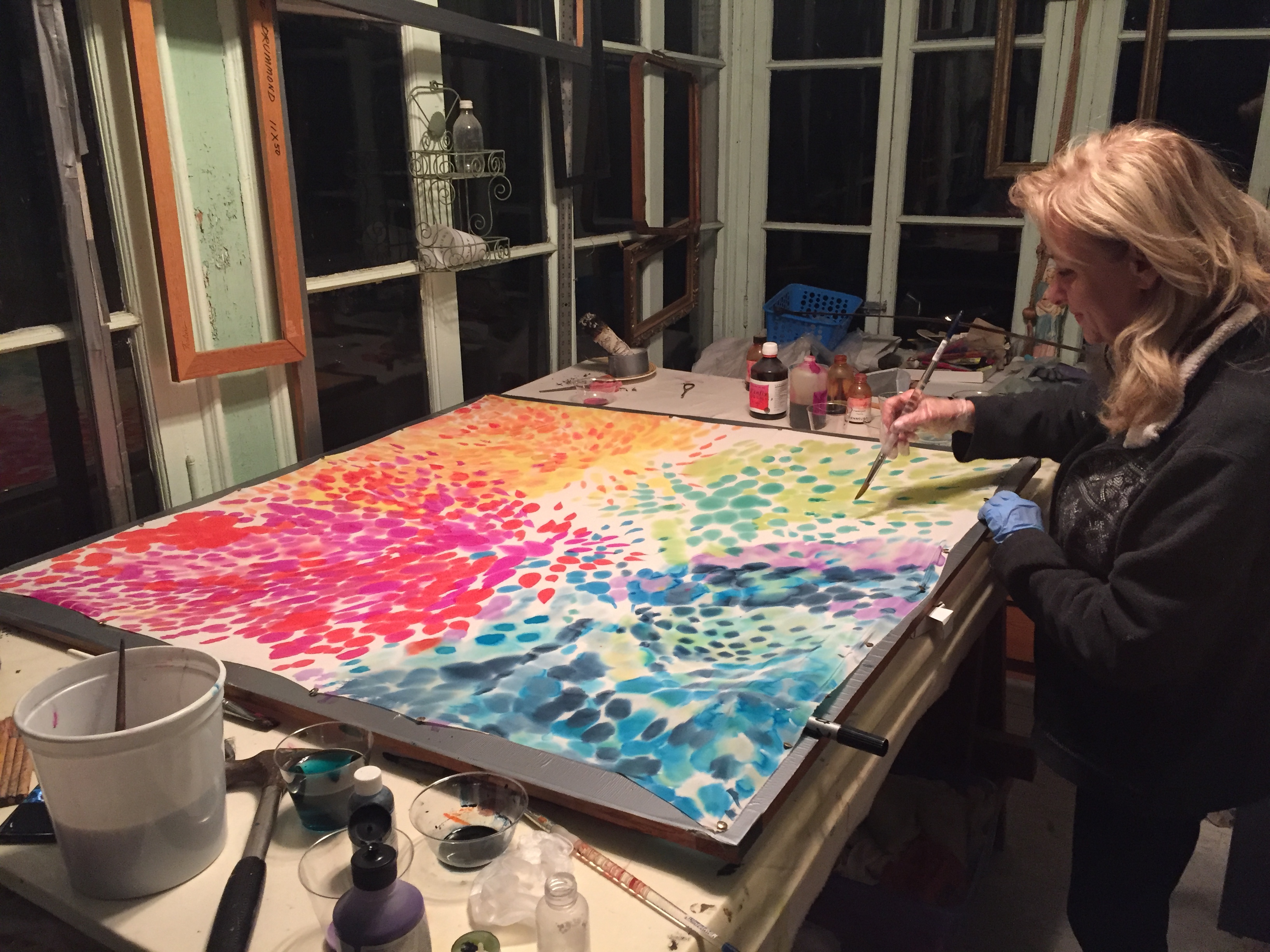
    Energetic, artistic, and indomitable, Ms. Del Piano was 31 when she arrived in Philadelphia from Rome in 1984. She had little money and knew little English. But she discovered her skill for silk painting in a do-it-yourself class, and the colorful hand-painted silk scarves, evening wraps, handkerchiefs, handbags, and original jewelry she went on to create turned Gloria Del Piano Accessories LLC into a fashion powerhouse.

    In just a few years, she opened a store on Bainbridge Street and contracted with Bergdorf Goodman, Neiman Marcus, Nan Duskin, Nordstrom, and hundreds of other fashion outlets to carry her designs in Philadelphia, New York, Los Angeles, San Francisco, Detroit, Minneapolis, and elsewhere around the country. Locally, her signature scarves and earrings were featured at gallery exhibits, charity benefits, private homes, and fashion shows at Penn’s Landing, Fairmount Park, the Wayne Art Center, and elsewhere.

    Many of Ms. Del Piano’s designs were colorful.

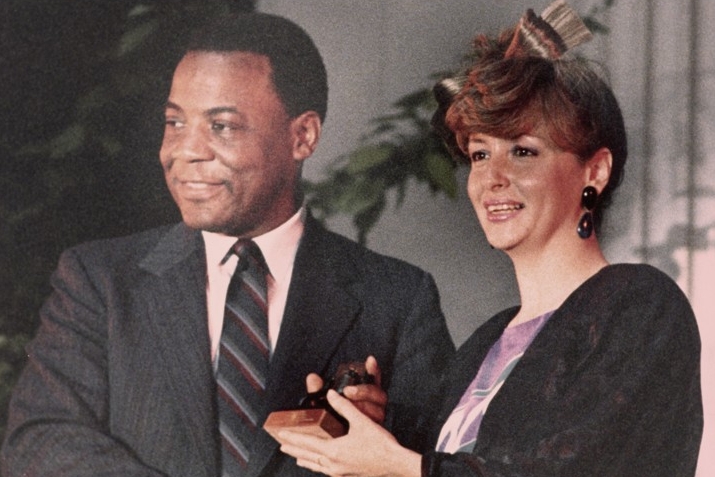
    Her line of accessories won awards for excellence and creativity at the Philadelphia Dresses the World fashion expos in 1986 and ’87, and she was inducted into the Philadelphia Get to Know Us Fashion Hall of Fame in 1988. The Inquirer, Daily News, Los Angeles Times, and other outlets publicized her exhibits, and a fashion writer for Newsday called her scarves, with flower and bird patterns, “exquisite” in a 1986 story.

    Some of her scarves were priced between $220 and $300 in 1986, and a black cape listed in 1988 at $495. In 1993, a gold lace-trimmed handkerchief was $45. A fellow artist exhibited with Ms. Del Piano at a Philadelphia festival and said in a fashion blog: “We watched her tie a scarf so many ways so fast it was like a magic act.”

    Earlier, from 1976 to 1984, Ms. Del Piano worked as a program producer and public relations director at GBR-TV in Rome during the station’s glory years. She also did Italian voice-overs, interpretations, and translations for clients of all kinds.

    Ms. Del Piano (right) smiles at a model wearing her designs at an event at Memorial Hall in Fairmount Park.

    She served on the board of the nonprofit Enabling Minds, volunteered in Philadelphia as a Court Appointed Special Advocate for Children, and raised funds for other organizations she championed. In a Facebook tribute, a friend said she was “bigger than life itself” with “a flare of the Italian opera star and the warmth of the Mother Earth itself.”

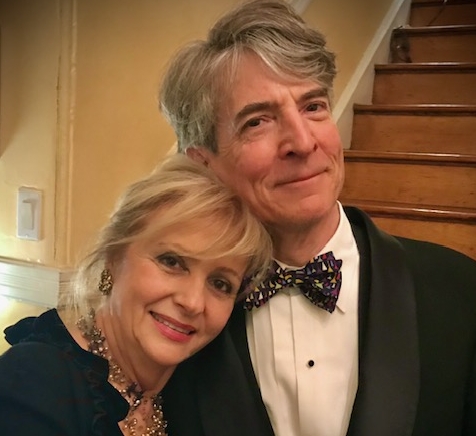
    Her partner, Wainwright Ballard, said: “She was generous and empathetic. She took care of everyone, including those abandoned or forgotten by others.”

    Gloria Del Piano was born Jan. 20, 1953, in Rome. She was artistic as a girl and always interested in spiritual growth and personal transformation. She studied sociology and business administration after high school in Italy, was certified by the Florida-based Barbara Brennan School of Healing in 2000, and led seminars in healing therapy for years.

    Ms. Del Piano and her partner, Wainwright Ballard, met in Chestnut Hill.

    She married Roberto Borea in 1985, and they divorced in 1992. She met Ballard at the Mermaid Inn in Chestnut Hill, and they spent the last eight years dancing, traveling, and enjoying life together.

    Ms. Del Piano doted on her family and friends in the United States and Italy, and returned often to Rome for reunions. She lived in Mount Airy and then a 20-room house in Germantown, and visitors marveled at her eclectic collection of art and antiques.

    She enjoyed music, gardening, thrift shopping, and chatting with friends. Friends called her “a philosopher,” “a noble soul,” and “a magician in the kitchen.” She delighted in cooking and entertaining, Ballard said, and always sent guests home with armloads of leftovers.

    Ms. Del Piano receives an award from then-Mayor Wilson Goode at a fashion expo in Philadelphia.

    Her “fabulous parties” were “fun and adventurous,” a friend said. Ms. Del Piano said on Facebook: “You never know how wonderful what you have is when you have it. It is when you miss it that we realize how lucky we were.”

    A friend said her “optimism, tenacity, enthusiasm, kindness, beauty, and elegance will always be with us.” Another friend said: “My life has been made richer having known Gloria Del Piano.”

    In addition to Ballard, Ms. Del Piano is survived by a brother, two sisters, and other relatives. Her former husband died earlier.

    A funeral mass is to be held at 9:30 a.m. on Tuesday, Nov. 4, at St. Vincent de Paul Church, 109 E. Price St., Philadelphia, Pa. 19144.

    Donations in her name may be made to Unite for Her, 22 E. King St., Malvern, Pa. 19355.

    Many of Ms. Del Piano’s designs featured flowers and birds.
  • Josh Shapiro’s GOP opponent Stacy Garrity steps in to offer counties $500 million in loans as Pa. budget remains at an impasse

    Josh Shapiro’s GOP opponent Stacy Garrity steps in to offer counties $500 million in loans as Pa. budget remains at an impasse

    HARRISBURG — Pennsylvania Treasurer Stacy Garrity stepped in on Wednesday to offer counties and early education programs $500 million in low-interest loans to hold them over until a final state budget deal is complete, sidestepping the General Assembly and Gov. Josh Shapiro as they near the start of a third month at an impasse.

    Garrity, a Republican who last month announced her bid to challenge Shapiro in next year’s gubernatorial election, announced the unprecedented move to allow the state Treasury to offer the loans to county human service departments for the many social services they provide, as well as for early education Head Start programs, at a 4.5% interest rate.

    Counties, schools, and social service providers have pleaded for months with the legislature to finalize a budget so they can begin receiving their expected state payments, which have been on hold since the beginning of the fiscal year on July 1. Some counties have had to secure private loans to hold them over until state payments begin, while others — including those around the Philadelphia region — have relied on their reserves. Other counties have frozen hiring and spending as they await a resolution to the budget stalemate.

    The move would allow counties to access millions of dollars for early education programs serving 35,000 children across the state, as well as for county social services — all of which have been operating for months without their state appropriation, with no end to the budget impasse in sight.

    Garrity’s decision to act unilaterally without the action of the General Assembly allows her to capitalize politically on the ongoing budget crisis over Shapiro, challenging his image as a moderate Democratic governor of a politically “purple” state willing to work across the aisle in a divided legislature. That brand, which he has built nationally as he is rumored to have interest in running for president in 2028, has been tested as he has so far been unable to secure a budget deal or a recurring funding stream for the state’s beleaguered mass transit agencies, including SEPTA.

    Shapiro, for his part, has described his role in budget negotiations as being a go-between for Senate Republicans and House Democrats, who control their respective chambers, and has said that the two caucuses remain “diametrically opposed” on some issues.

    A spokesperson for Shapiro said in a statement Wednesday that the real solution to the budget impasse is for Senate Republicans, whose leaders endorsed Garrity last week, to return to work in Harrisburg to finalize a budget deal with House Democrats. A spokesperson for House Majority Leader Matt Bradford (D., Montgomery) echoed the sentiment, arguing that Senate Republicans “refuse to negotiate on a realistic budget agreement.”

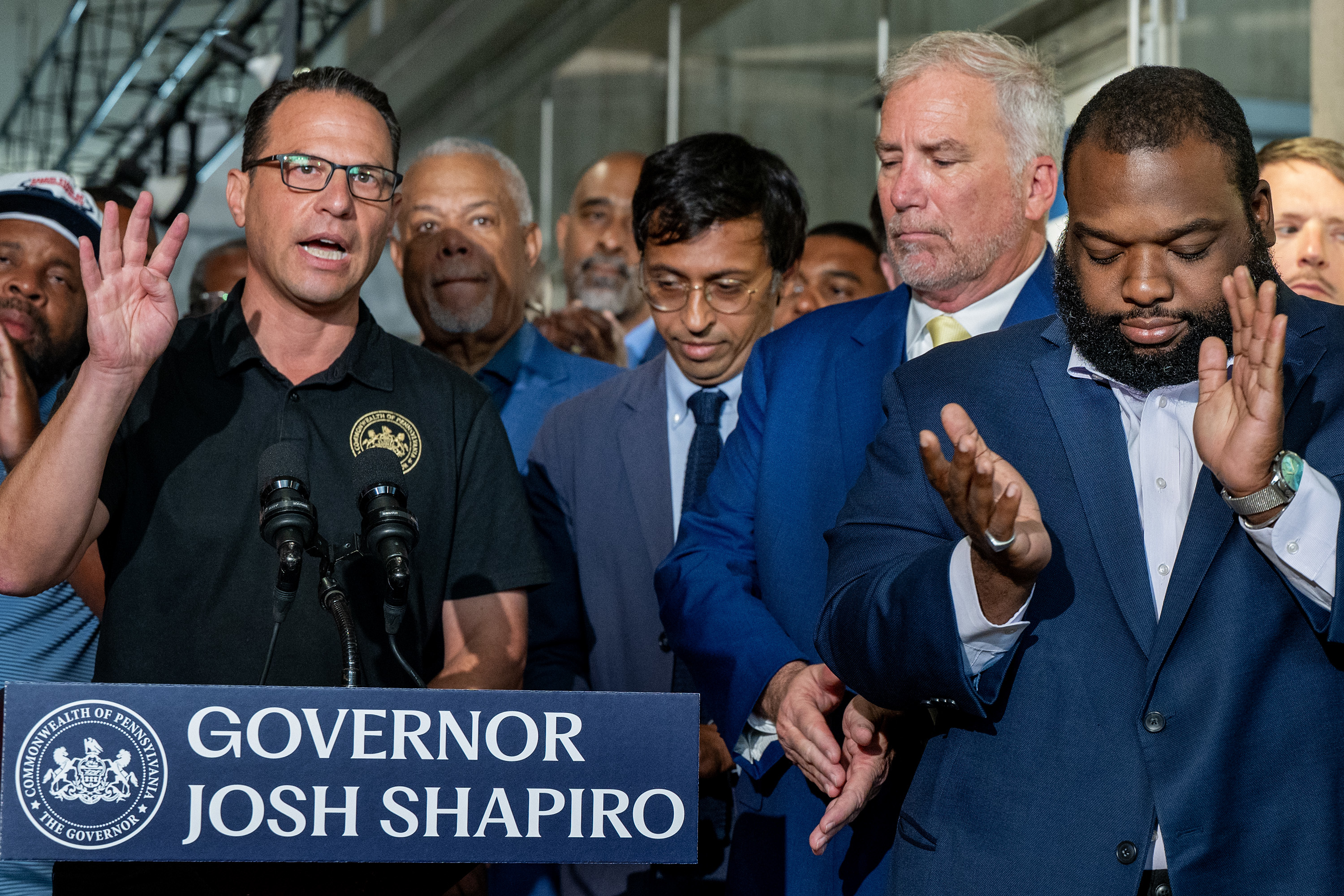
    Gov. Josh Shapiro visits SEPTA headquarters Sunday, Aug. 10, 2025 to discuss funding for the transit agency and to pressure Senate Republicans as planned service cuts are pending because of a budget shortfall. To his right, from left, are state Democratic legislators Sen. Anthony H. Williams; Sen. Nikil Saval; Rep. Ed Neilson; and Rep. Jordan Harris.

    Senate Majority Leader Joe Pittman (R., Indiana), the Senate’s top negotiator, who has met for months in closed-door budget talks with Bradford and Shapiro, said in a statement that it was Democrats who caused the prolonged impasse while demanding they include mass transit funding in the state budget. After mounting pressure as SEPTA enacted major service cuts, Shapiro ultimately sought to fund the agency on his own, and the issue will need to be revisited in two years.

    Garrity, who kicked off her “Help Is on the Way” introductory campaign tour around the state earlier this week, said Wednesday her decision to intervene in the state budget stalemate was not political, despite her burgeoning run against Shapiro. Rather, she said that she had been thinking about a way to do so for months, including ahead of her announcement of her run for governor, and that most Pennsylvanians don’t even realize the state budget is late. She argued that if she wanted to be political, she would not intervene and would “keep the pressure” on Shapiro over the late state budget.

    “I’m standing up here as Pennsylvania’s state treasurer, not as a candidate for governor,” Garrity said from a podium in the Harrisburg building that houses the state Treasury. “I think I have a responsibility to serve Pennsylvanians, that if I have something that I can do to provide some relief, then I should do it.”

    However, that didn’t stop Garrity from inviting Montgomery County Commissioner Tom DiBello — the lone Republican on the board where Shapiro once served — to the podium at the news conference to deliver some direct criticisms of Shapiro and to praise Garrity’s intervention as a “lifeline” for counties, alongside two other GOP county commissioners from south-central Pennsylvania. While Montgomery County remains one of the wealthiest counties in the state, the late budget has required Pennsylvania’s third-most-populous county to spend down its reserves, money that it usually relies upon to continue earning interest as part of its annual revenue, DiBello said.

    Pennsylvania Treasurer Stacy L. Garrity gives her acceptance speech after receiving the PA GOP’s endorsement for her campaign for governor during the Republican Party of Pennsylvania’s 2025 Fall Meeting at the Penn Stater Hotel & Conference Center in State College on Sept. 20.

    “It starts at the top. The governor is responsible,” DiBello said. “He’s got to pull it together. It’s his signature at the end of the day.”

    In response to Garrity’s announcement Wednesday, Montgomery County Commissioners Neil Makhija and Jamila Winder, both Democrats, said in a statement that the county needs a final state budget instead of a short-term loan program, urging Senate Republicans to “do their job.”

    “A short-term loan at 4.5% interest is the state profiting from a problem of their own making, at the expense of the taxpayers,” the two commissioners added.

    DiBello said he did not believe his invitation to Wednesday’s event had political motivations, adding: “I didn’t even think of that.” He also noted that he has come to Harrisburg to advocate on behalf of counties multiple times before.

    Senate President Pro Tempore Kim Ward (R., Westmoreland), who has been one of Shapiro’s biggest critics since his first budget in 2023 and was quick to support Garrity’s candidacy, prodded at Shapiro’s pledge to “get stuff done” while praising Garrity’s leadership.

    “Today, Treasurer Stacy Garrity made a bold move that shows what ‘get stuff done’ actually looks like,” Ward said in a statement. “Treasurer Garrity’s leadership is on display as her solution-driven option is exactly what we need, but has been glaringly missing from the present administration.”

    Garrity said at the news conference Wednesday that she offered the loan program specifically to Head Start programs and county governments’ human service departments because both had asked her to help them get through the budget impasse. The state budget was due by July 1, and Pennsylvania is the only state besides Michigan that has not yet passed its budget. She said she is willing to offer similar loans to schools or other state-subsidized or funded programs as requested.

    The Pennsylvania General Assembly can forgive the interest accrued by counties taking out loans during the budget impasse, Garrity said, adding that she would support legislation that does so.

    This suburban content is produced with support from the Leslie Miller and Richard Worley Foundation and The Lenfest Institute for Journalism. Editorial content is created independently of the project donors. Gifts to support The Inquirer’s high-impact journalism can be made at inquirer.com/donate. A list of Lenfest Institute donors can be found at lenfestinstitute.org/supporters.