A South Philadelphia woman shot and killed her sister and granddaughter before turning the gun on herself Monday in what police described as a double murder and suicide.
The women, identified Tuesday as Janice Picano, 67, Denise Grottini, 55, and Angelina Picano, 18, were found dead inside a home on the 2800 block of South 10th Street, according to police.
Police responded to the residence around 5:30 p.m. and found the women with single gunshot wounds to their heads.
They were pronounced dead at the scene by medics at 5:38 p.m., police said.
Janice Picano, who investigators say fired the fatal shots, was Grottini’s sister and Angelina Picano’s grandmother, according to a law enforcement source.
A gun was found at the home and was taken into evidence.
After 10 months of precipitation deficits, the Philadelphia region was due for some drought relief — but maybe not this much relief, this fast.
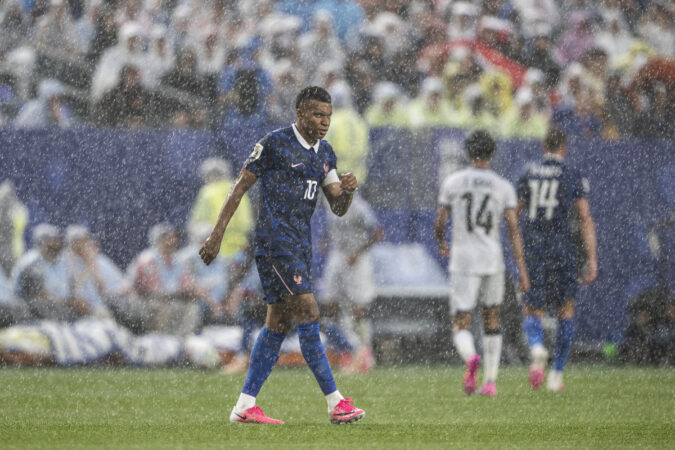
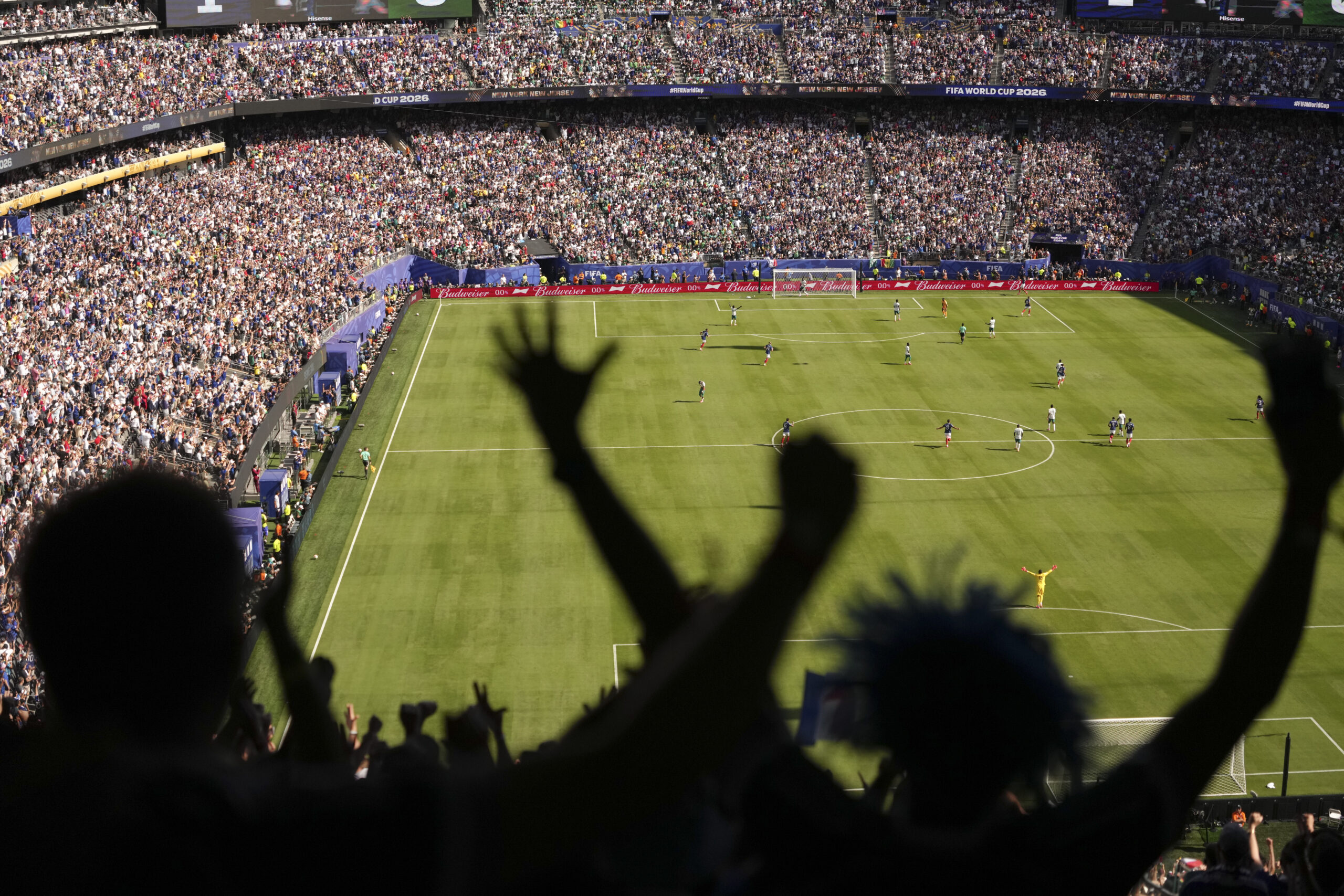
Powerful thunderstorms that set off tornado and severe-storm warnings and waterfall-like downpours arrived in the region Monday just in time for the peak afternoon commute and the France vs. Iraq World Cup match in South Philly.
And while the tornado warnings and the worst of the storms had backed off by nightfall, the rains were reluctant to give it up, and the National Weather Service warned that more heavy showers are possible Tuesday.
“It’s been a while since we had rains like this,” said Patrick O’Hara, a meteorologist at the National Weather Service Office in Mount Holly, which issued multiple flood warnings into the evening. Flooding occurred on the Schuylkill Expressway near Gladwyne, and several water rescues were reported in Cheltenham Township.
Frankford Creek in Philadelphia rose well into moderate flood stage.
The agency also had issued two tornado warnings for parts of Chester, Delaware, and Montgomery Counties after Doppler radar had detected radar signatures.
Multiple uprooted trees were reported in the Valley Forge area, officials said. Several reports of downed wires and trees branches and hailstones came from across the region from Chester County and South Jersey.
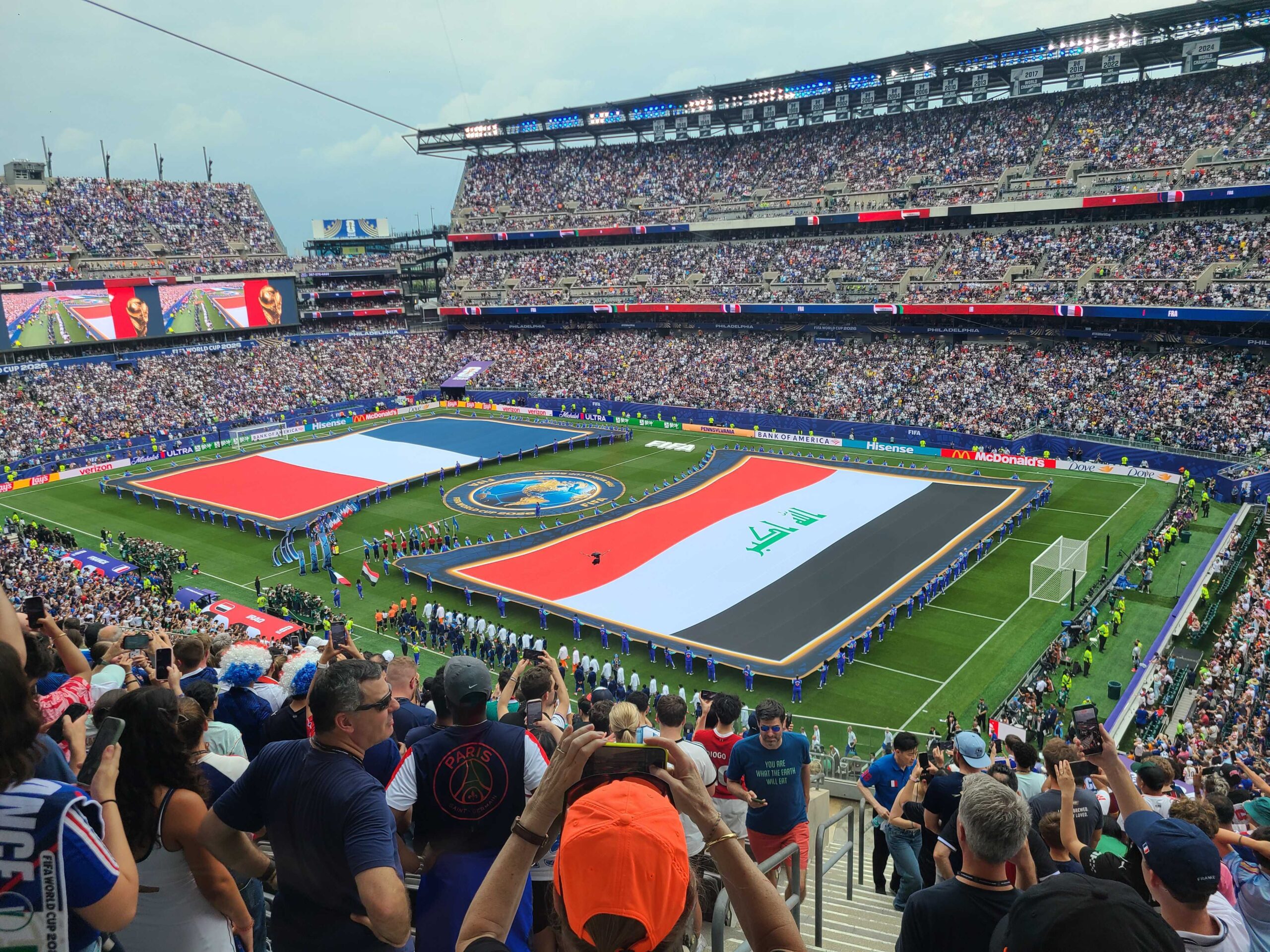
The timing could have been worse, but maybe not much worse for World Cup participants and the nearly 70,000 fans who came to watch the rain-interrupted match.
A severe-storm warning for Philly popped up just as the World Cup match between France and Iraq in South Philly was underway. That was quickly followed by one for Southwest Philadelphia, parts of Delco, and South Jersey.
The weather service’s flash flood watch remained in effect until 6 a.m. Tuesday.
On Monday afternoon an early arriving strong storm passed through parts of Philadelphia and Burlington County, snapping trees and taking down “multiple branches” in the Holmesburg section of the city, the weather service said.
That was followed by a potent storm that generated strong winds and torrential rains north and west of the city and then even stronger storms and flooding downpours throughout the region.
Will the rains end the Philly region’s drought conditions?
Not likely. Life is not fair, and neither is summer rain, which by its nature is capricious.
About 1.2 inches of rain was measured at Philadelphia International Airport on Monday, with over an inch of that falling between 6 p.m. and 8 p.m.
The rains weren’t evenly distributed across the region, but the Philly total is of some significance: It brought the city’s total close to the normal for June.
Based on the forecasts of the potential for more substantial rains Tuesday, Phllly stands to break an impressive streak of 10 consecutive months of below-normal precipitation.
Most of the region is in “moderate drought” according to the inter-agency U.S. Drought Monitor, and Cape May County, most of Delaware, and New Jersey areas along the Delaware Bay are in “extreme drought.”
It is unclear how helpful Monday’s rains were in terms of dousing the drought condtions.
Downpours aren’t known for their attention spans, and rains can run off rapidly.
“If the rain doesn’t penetrate the soil, it doesn’t help,” said O’Hara, “Ideally, it would soak into the ground over a couple-day period. That would really help.”
A Philadelphia woman pleaded guilty Monday to voting twice in the 2024 election — first in northern New Jersey, then in the city.
Miya Pack, 40, said little beyond responding to routine legal questions as she pleaded guilty to a charge of voter fraud before U.S. District Judge Joshua D. Wolson.
Pack has been registered to vote since 2004 in Bergen County, N.J., prosecutors said in court documents, and she’s also been registered to vote in Philadelphia since 2016. She is not affiliated with any political party, voter records show.
On Oct. 26, 2024, prosecutors said, Pack cast a ballot in that year’s presidential election in Bergen County. Then, 10 days later, prosecutors said, she cast a ballot in the same contest in Philadelphia on Election Day.
They did not say whom she voted for, and she declined to comment as she left the courtroom Monday.
Pack was charged by federal prosecutors last September. Prosecutors announced her indictment alongside the indictment of another man, Matthew Laiss, who was separately charged with voting twice in the 2020 election.
Laiss later said in court documents that he voted twice for Trump, and unsuccessfully sought to claim that his actions were covered by pardons Trump extended to people who tried to help him overturn the results of the 2020 election.
Laiss was convicted of voter fraud earlier this year at trial and is awaiting sentencing.
Pack is scheduled to be sentenced in October. She faces the possibility of prison time, although prosecutors said in court that federal guidelines suggest a term of no jail time to six months.
Thunderstorms are expected to make their way through the Philadelphia region later Monday evening, potentially interrupting the World Cup match between France and Iraq (5 p.m, Fox).
The strongest storms are forecast to move in beginning around 4 p.m., bringing with them heavy rain, wind gusts approaching 60 mph, and the potential for an isolated tornado.
“Storms will certainly have lightning with them,” said Zack Cooper, a meteorologist at the National Weather Service’s Mount Holly station.
An inch or two of rain could fall in and around the city, Cooper said, but depending on the storm’s severity that could all come in an hour or less, leading to flash flooding. Philadelphia and the surrounding region are under a flood watch.
“Exactly how much would fall on a given thunderstorm is impossible to know, but we could certainly see some pretty high rain rates in these storms tonight,” Cooper said.
For those going to the game, umbrellas aren’t allowed in the stadium, but you can bring a poncho.
FIFA will pause play if there is a lightning strike within eight miles of the stadium. The match will remain paused for 30 minutes, with any subsequent lightning strikes resetting the clock.
Six Club World Cup matches were delayed by severe weather last summer. A match between Chelsea and Benfica at Bank of America Stadium in Charlotte, N.C., was delayed multiple times due to lightning strikes, taking four hours and 38 minutes to finish.
The FIFA Fan Fest at Lemon Hill Park in Fairmount would close if lightning is detected within an eight-mile radius. Fans would need to exit the grounds and move to a safe location, and could re-enter after 30 minutes if no additional lightning is detected.
Festivities were interrupted Thursday evening, when high winds prompted the event to close early.
Lincoln Financial Field has been renamed “Philadelphia Stadium” for the duration of the World Cup. In addition to five group stage games, the city will host a Round of 16 game on July 4.
France tops Iraq 3-0 in weather-delayed World Cup match
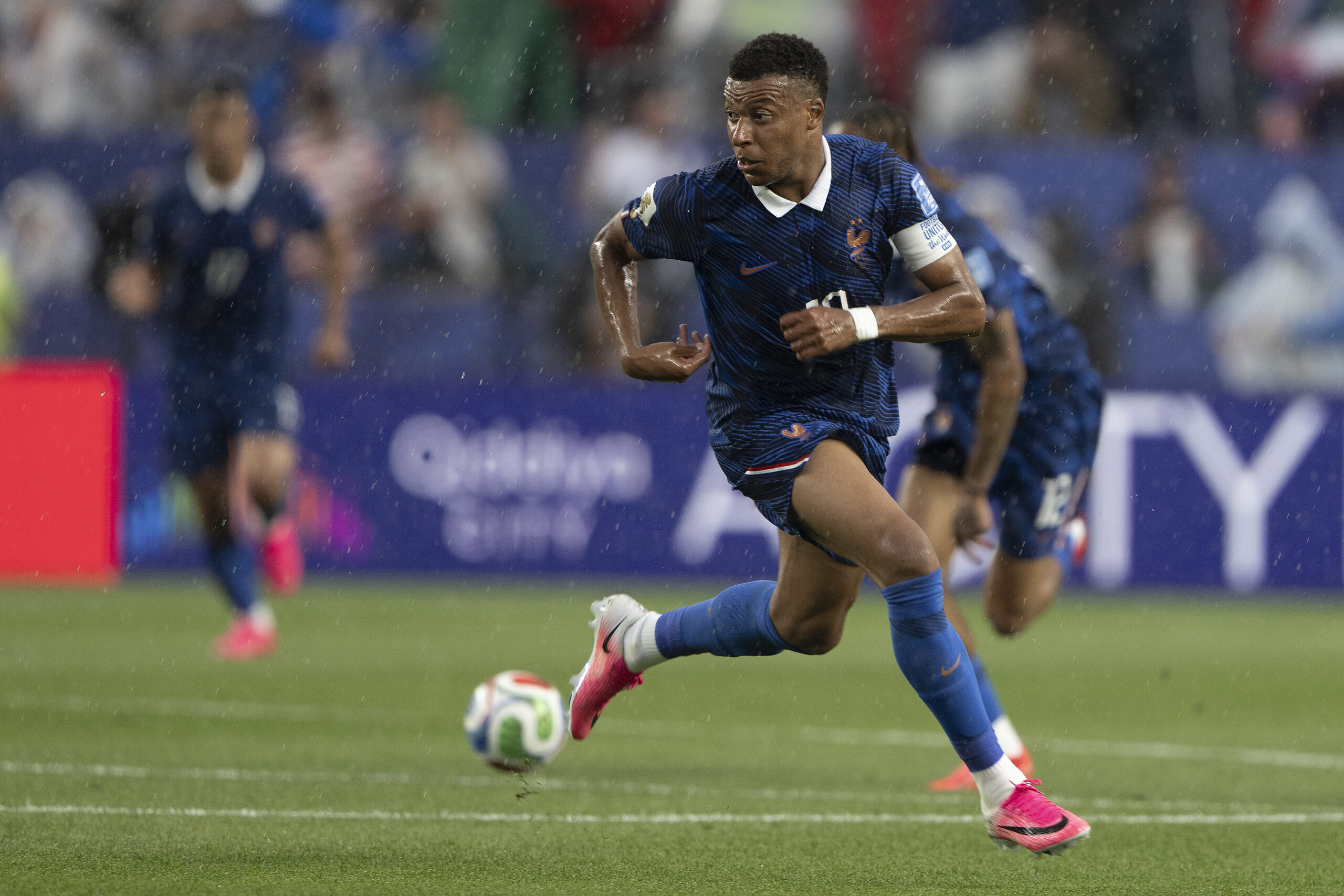
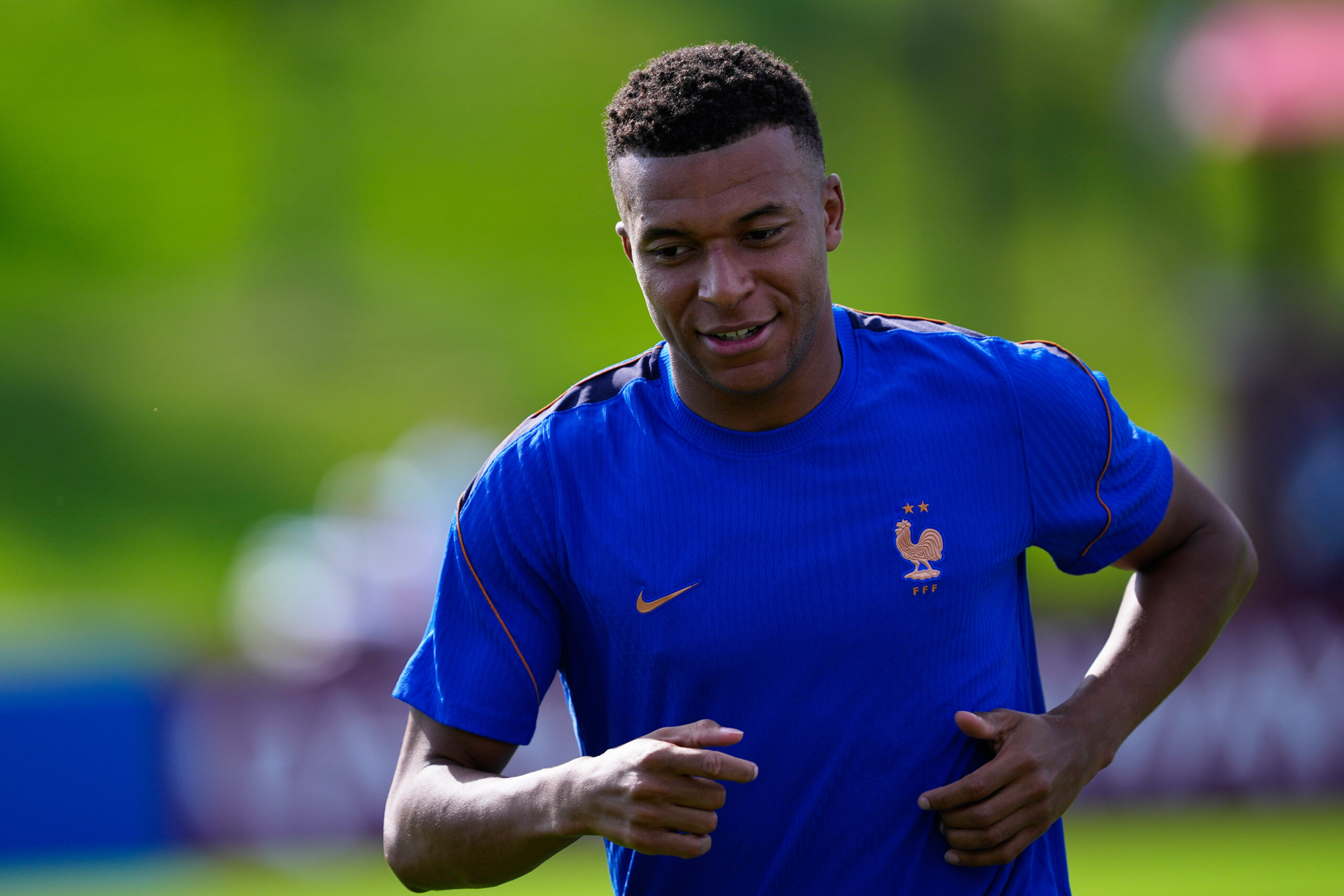
Kylian Mbappé scored two goals in France’s win.
Kylian Mbappé scored two goals and reigning Ballon D’or winner Ousmane Dembele fueled a 3-0 win against Iraq inside Philadelphia Stadium, with Dembele’s goal and Mbappé’s second both arriving after a near one hour, 30 minute rain delay at Philadelphia Stadium.
The goals for Mbappe were his fourth and fifth of the tournament and the 16th of his World Cup career. He trails only Lionel Messi, who has 18 World Cup goals, after scoring two earlier today in Argentina’s win against Austria in Group J.
With the win, France secured its place in the knockout round, but have yet to win Group I outright with Norway on their heels. At the time of this report, the Norwegians were up 1-0 against Senegal.
As for the Iraqis, its World Cup hasn’t yet come to a close but they’d need to win their final match against Senegal on Friday (3 p.m., FS1) and hope for the misfortune of teams in other groups to work in their favor.
France will also play its final match on Friday against Norway (3 p.m., Fox29) with a chance to win Group I outright.
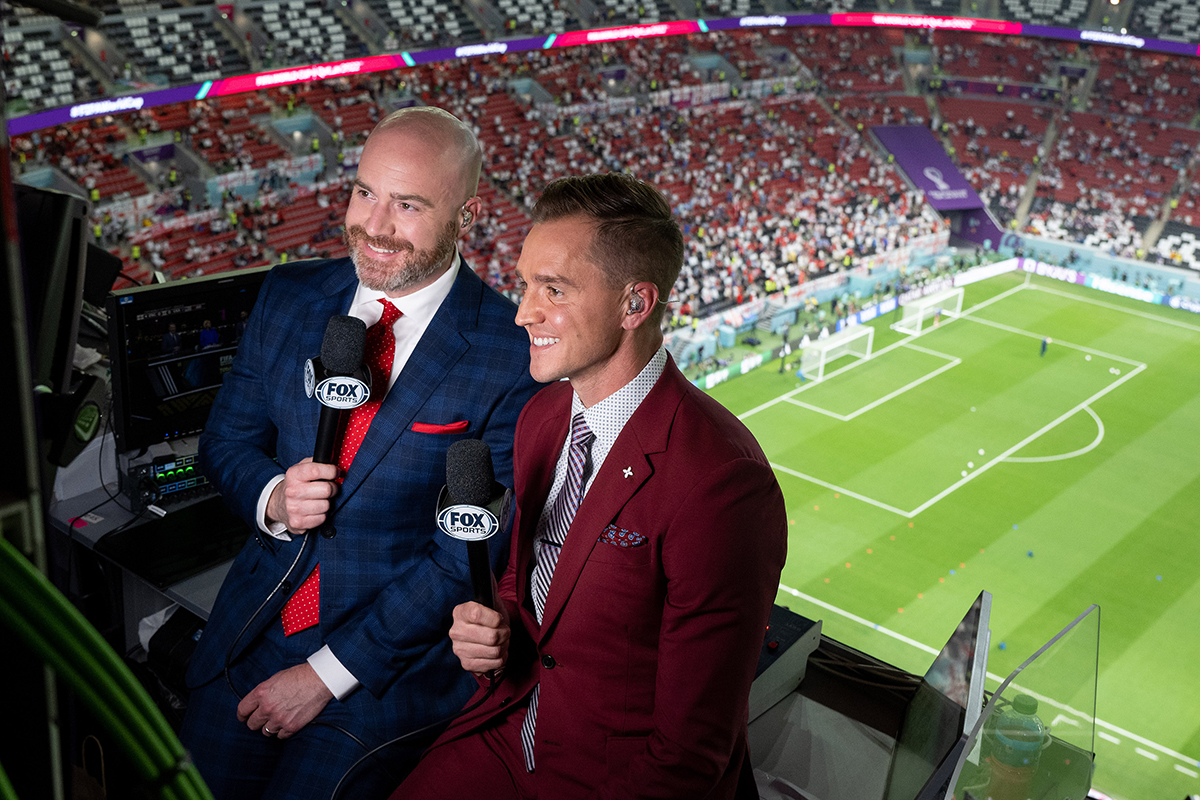
Ex-Villanova star Collin Gillespie get a few seconds of airtime during Fox’s broadcast of Monday’s World Cup match between France and Iraq, though fans watching at home might have been scratching their heads.
Mbappé scores second goal, extending France’s lead
Make that two goals for Kylian Mbappé.
The French star scored his second goal of the night shortly after play resumed, but it was largely due to a terrible mistake made by Iraq’s goalkeeper.
A MASSIVE mistake at the back for Iraq and Mbappé capitalizes 🇫🇷
Mbappé is now tied for No. 2 all time in men’s World Cup goal-scoring with Germany’s Miroslav Klose. Lionel Messi, who scored two more goals today, remains No. 1.
Thunderstorm threat subsides, but more rain expected for Philly
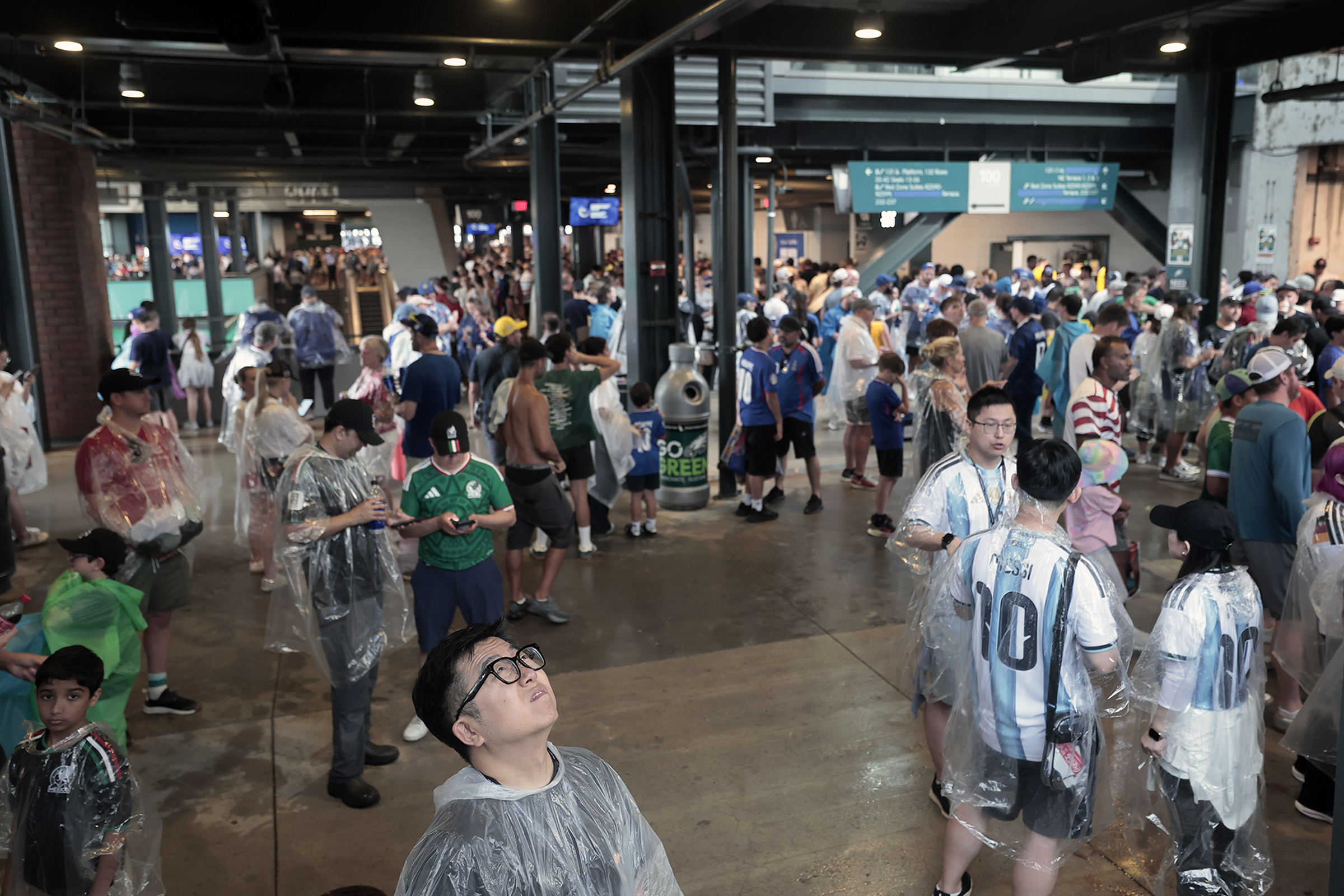
Fans seek shelter from the rain at Lincoln Financial Field.
The severe thunderstorms storms have backed off in the immediately Philadelphia area, but soaking rains are expected to continue through the night, and perhaps Tuesday.
The National Weather Service has posted several flash-flood warnings, as near to the stadium as Center City.
IRVINE, Calif. – I am sitting in my hotel room here, where it is definitely not thunderstorming, but I’ve been waiting out the delay in France-Iraq like everyone else.
As it happens, an old friend of mine is in Philadelphia today to do one of the many radio broadcasts back to France of the game.
Julien Froment is the director of the sports department at Radio France, one of that country’s biggest broadcasters, and his team is perched in the outside media seats in the upper deck.
Or at least they’re supposed to be. When the worst of the storms hit, they had to evacuate the stands for a while along with all the fans who did. But they couldn’t take all their broadcasting equipment with them, and I can tell you from enough experience doing radio work that it’s expensive – and hard-to-find – stuff.
FIFA kindly provided plastic covers to all the TV and radio networks in the open seats. But Julien and his crew went a step further. The technician, Virginie Lorda, brought a folded tarp, some rope to tie it down with, and a roll of duct tape. When they all had to go back on air before the rain had fully stopped, they started broadcasting from under the tarp.
As Julien wrote on Instagram, MacGyver would be proud.
Alex Freeman’s fast rise with the U.S. team has no bigger fan than his father, former Eagles and Green Bay Packers wide receiver Antonio Freeman. When Alex scored the game’s second goal against Australia, he achieved the rare feat of scoring a World Cup goal in a stadium where his father scored two touchdowns 30 years earlier.
Antonio stopped by Monday’s practice to talk with the media and share his joy.
“I’m sure Alex has heard enough from other people about my success and my moments,” he said. “I don’t really talk about those moments too much. But it was definitely a full circle moment. to just have a father and son combination in any sport have an impact on a game in the same stadium, same state, it’s pretty amazing.”
He called it “a credit to all the work that Alex has put in, the commitment that he’s made. This is his ride, and I’m just happy to be his biggest supporter.”
And what was the father’s message to his son after the game?
“He just continued to amaze me, and that’s all it is,” he said. “When I see him, it’s like, ‘Yeah, boy, that’s what I’m talking about!’ — That’s our little thing. But just keep working, Alex, keep being you. People love who you are, don’t change, just keep working hard.”
He also praised soccer’s growth in the United States, saying this World Cup “has really heightened the awareness in the U.S., and people from all walks of life are getting involved, rallying behind the [U.S.] team.”
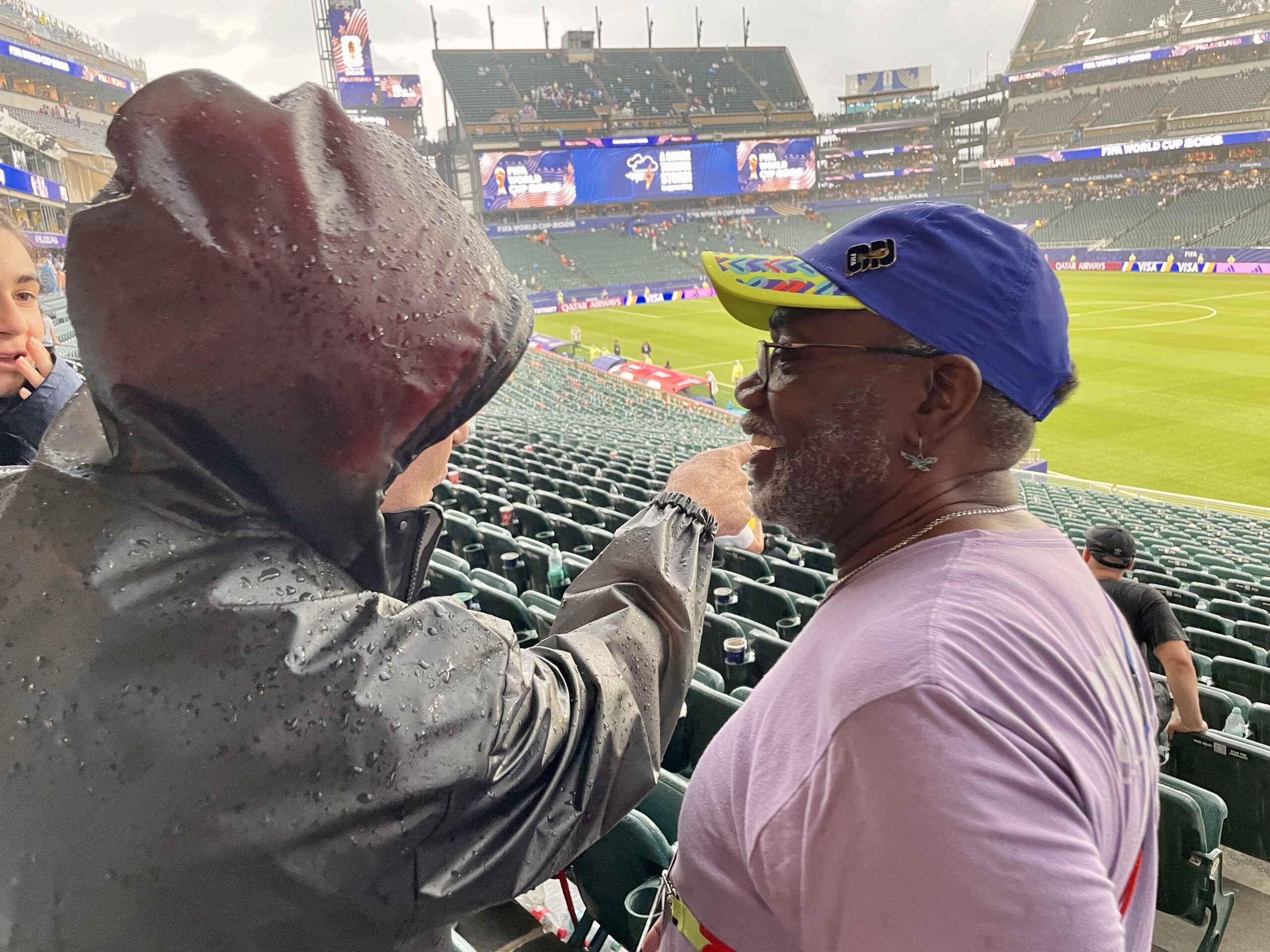
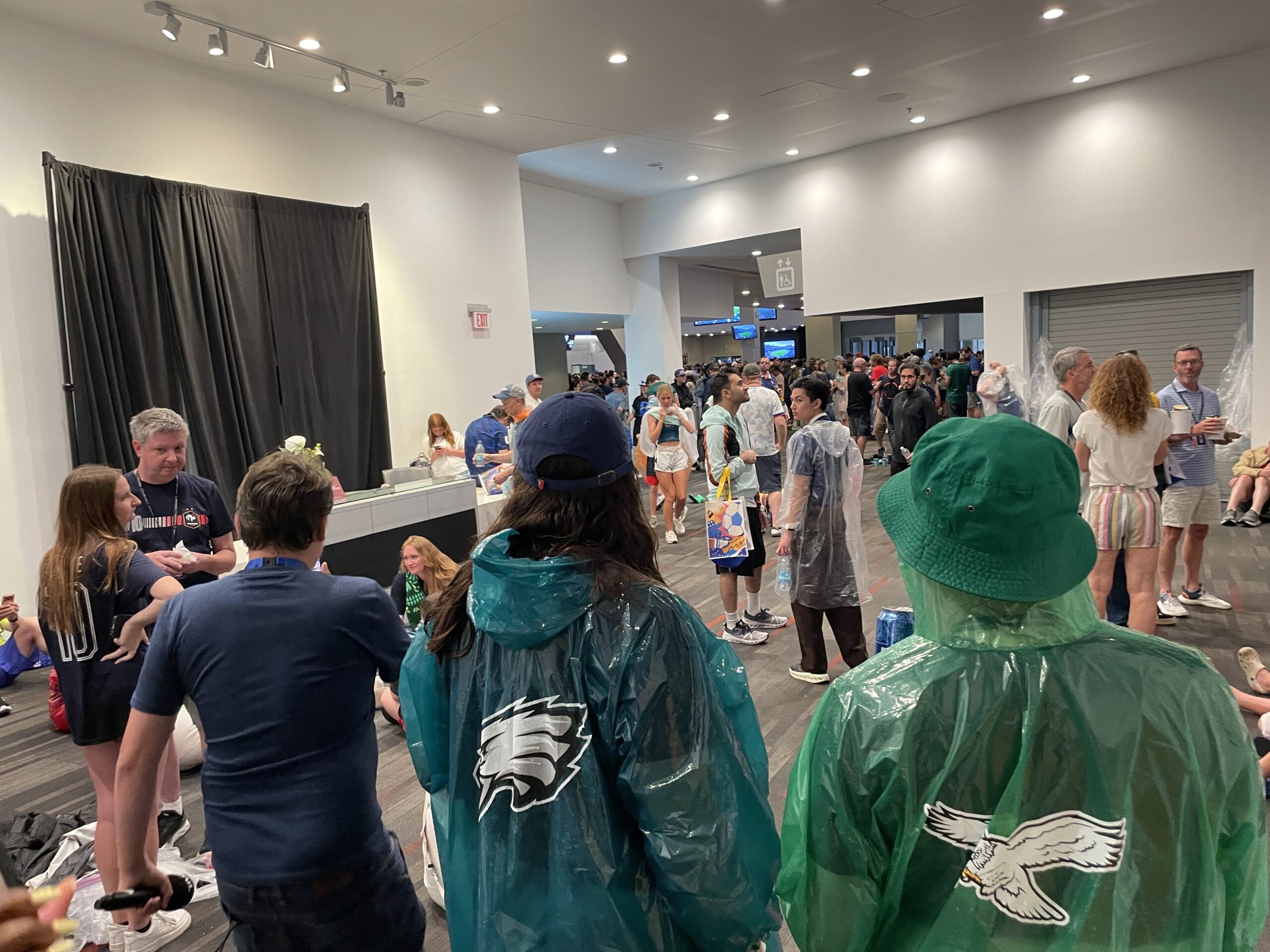
A fan services official speaks to a French fan during a weather delay at Lincoln Financial Field.
Loud cheers erupted twice from the steamy main concourse level of Philadelphia Stadium after it was announced that fans were able to return to their seats. A band of sunlight crept through and hit sections 118-121.
It looked like the game was set to return. However, public address announcer Kevin Casey notified fans that the match was still suspended, cheers changed to groans, but in true Philly fashion, people still milled to their seats.
During the downpour, a fan services official in section 106 was overheard saying, “these people paid good money for their seat, I can’t be the one to tell them to get up if they don’t want to, and if they want to get loud with me, that’s what Apex [stadium security services] is for.
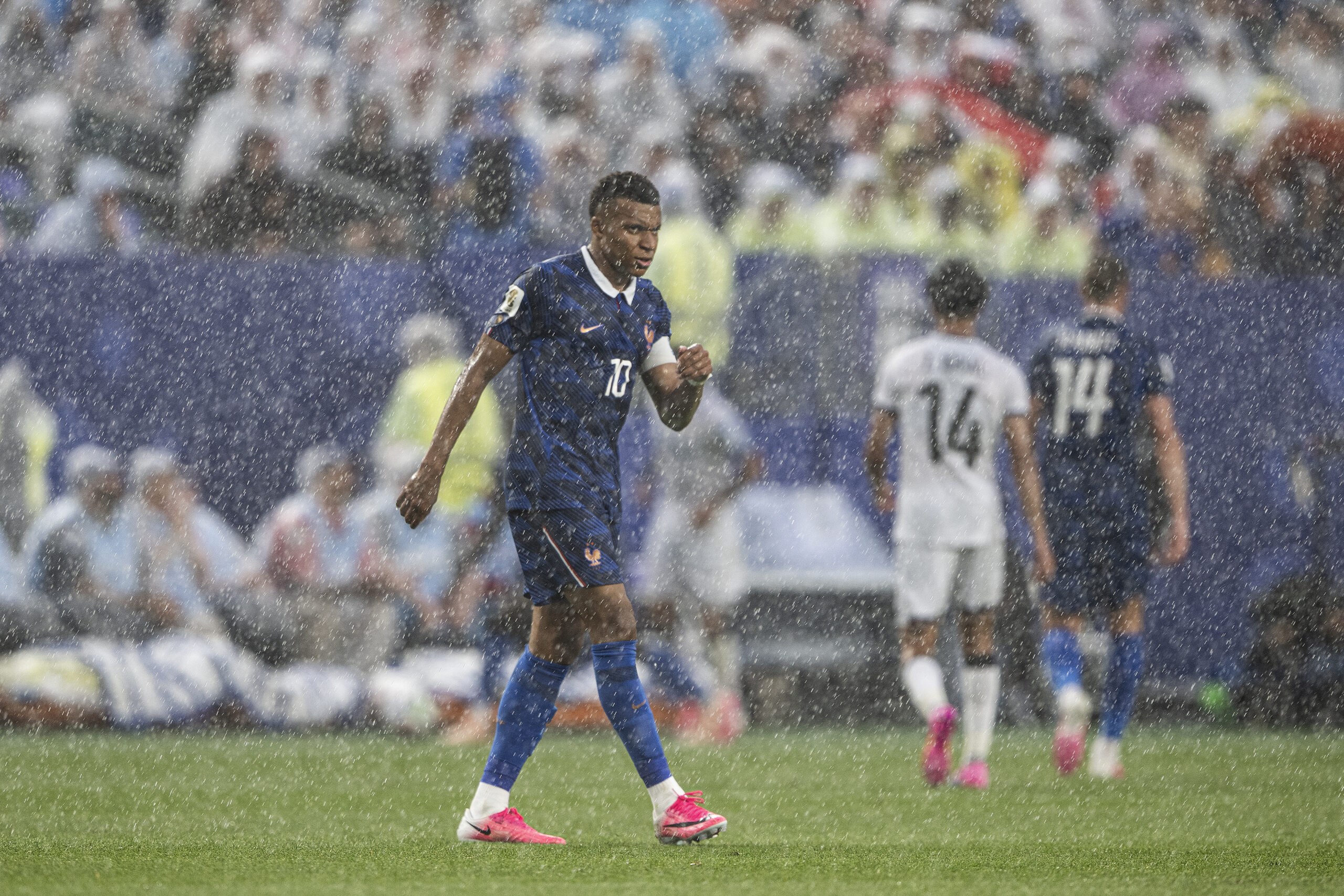
France forward Kylian Mbappé walks off the field during a thunderstorm delay. The game remains suspended.
Monday’s World Cup match between France and Iraq remains delayed as severe storms linger in and around Philadelphia.
“FIFA will follow the safety protocols established by the local authorities in the region, and will resume the match as soon as it’s safe to do so,” a FIFA spokesperson said. “The safety and security of all individuals is FIFA’s priority.”
It is unclear when the game will resume. Some fans have trickled back to their seats, even as they’re being told to seek shelter. Parts of the stadium remain empty as FIFA assess the situation.
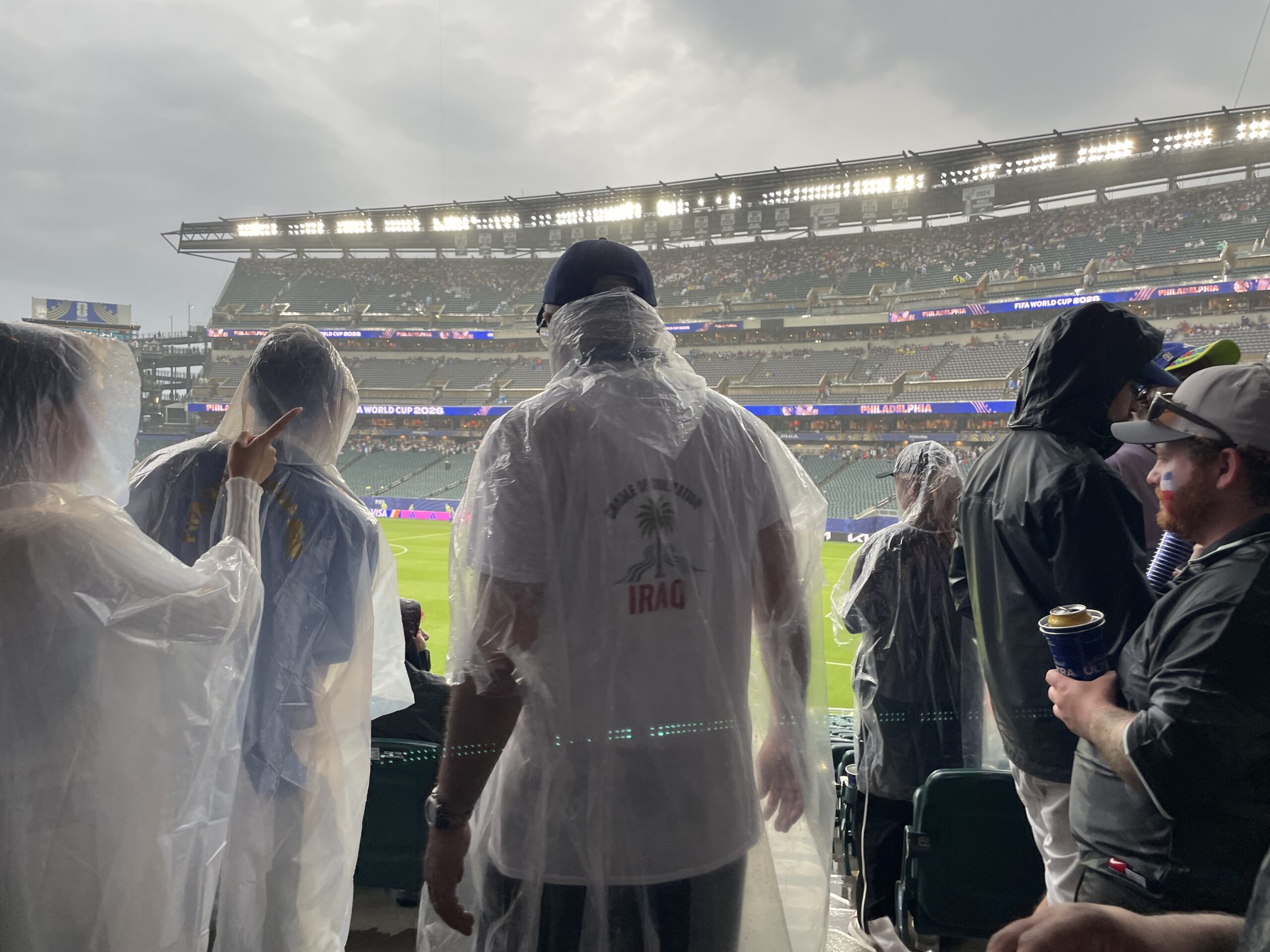
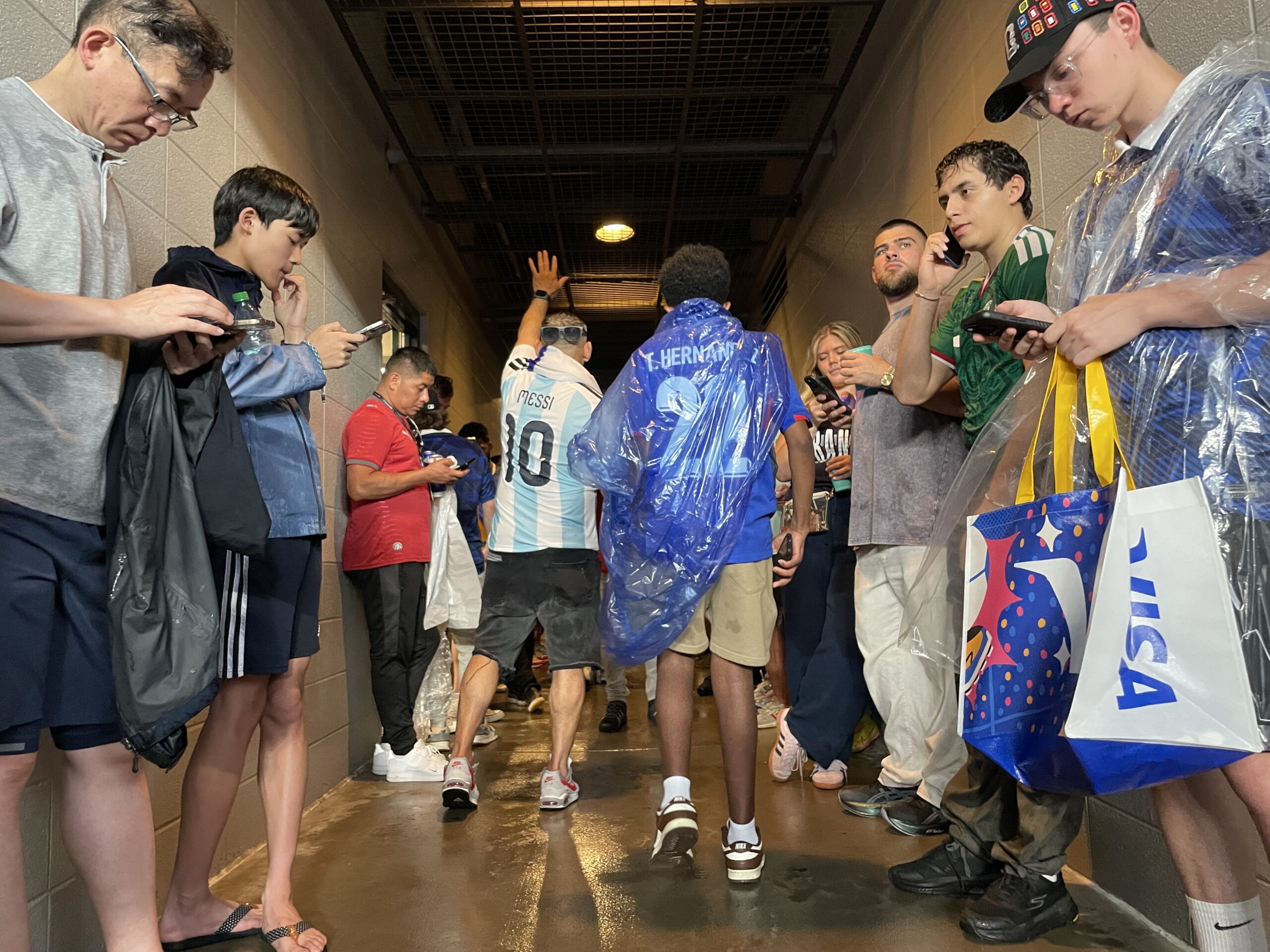
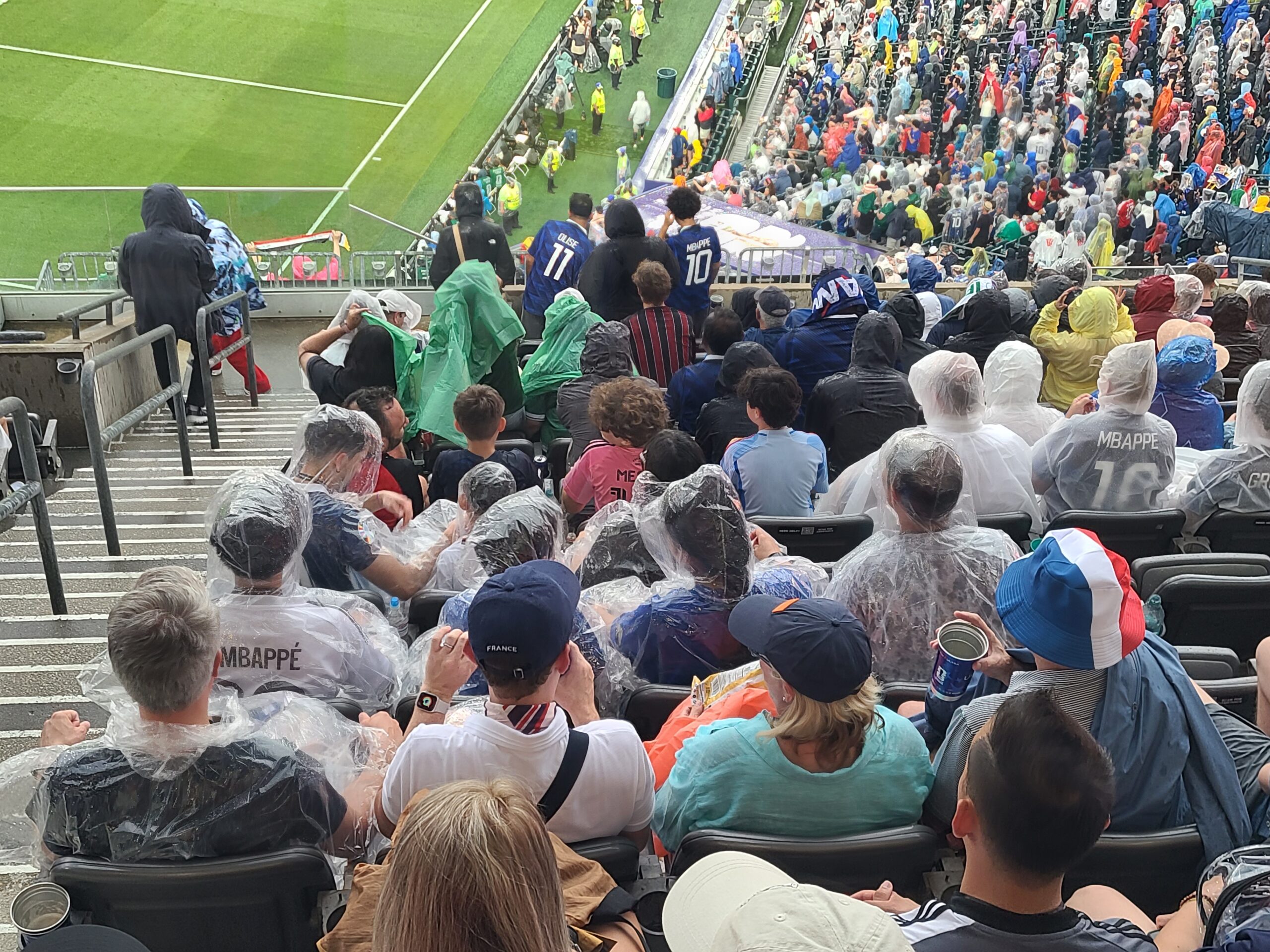
Fans try to stay dry as storms pass over Lincoln Financial Field.
Rain coming down in Philly as France and Iraq play on
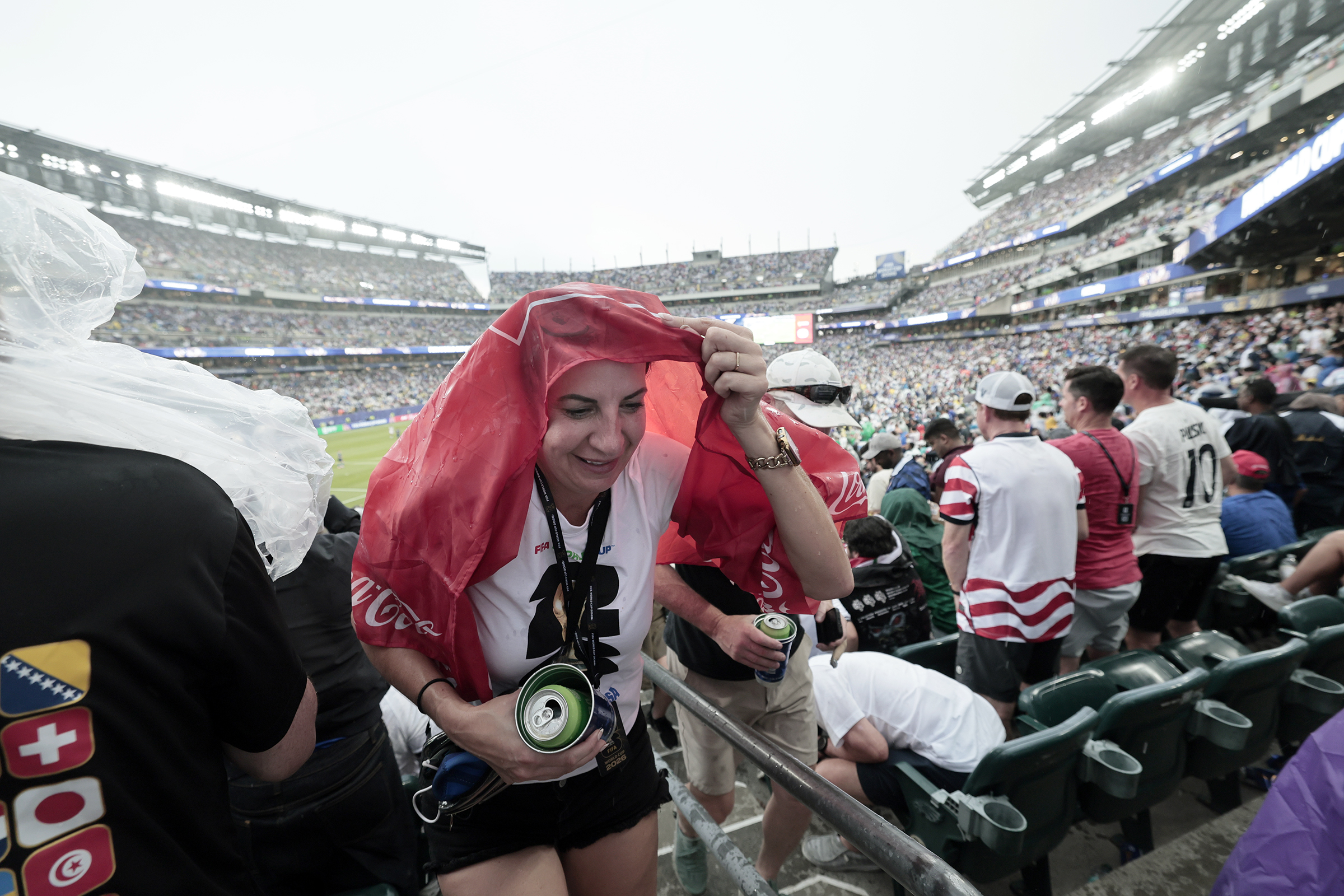
Fans poncho up as rain begins to fall at Lincoln Financial Field as France plays Iraq.
It’s pouring in South Philadelphia as severe storms move through the region.
FIFA will only pause play if there is a lightning strike within eight miles of the stadium. If that happens, the match will remain paused for 30 minutes, with any subsequent lightning strikes resetting the clock.
A storm warning is in effect until 6:15 p.m. if it rains like it did out in Valley forge way, this could turn into a swim meet.
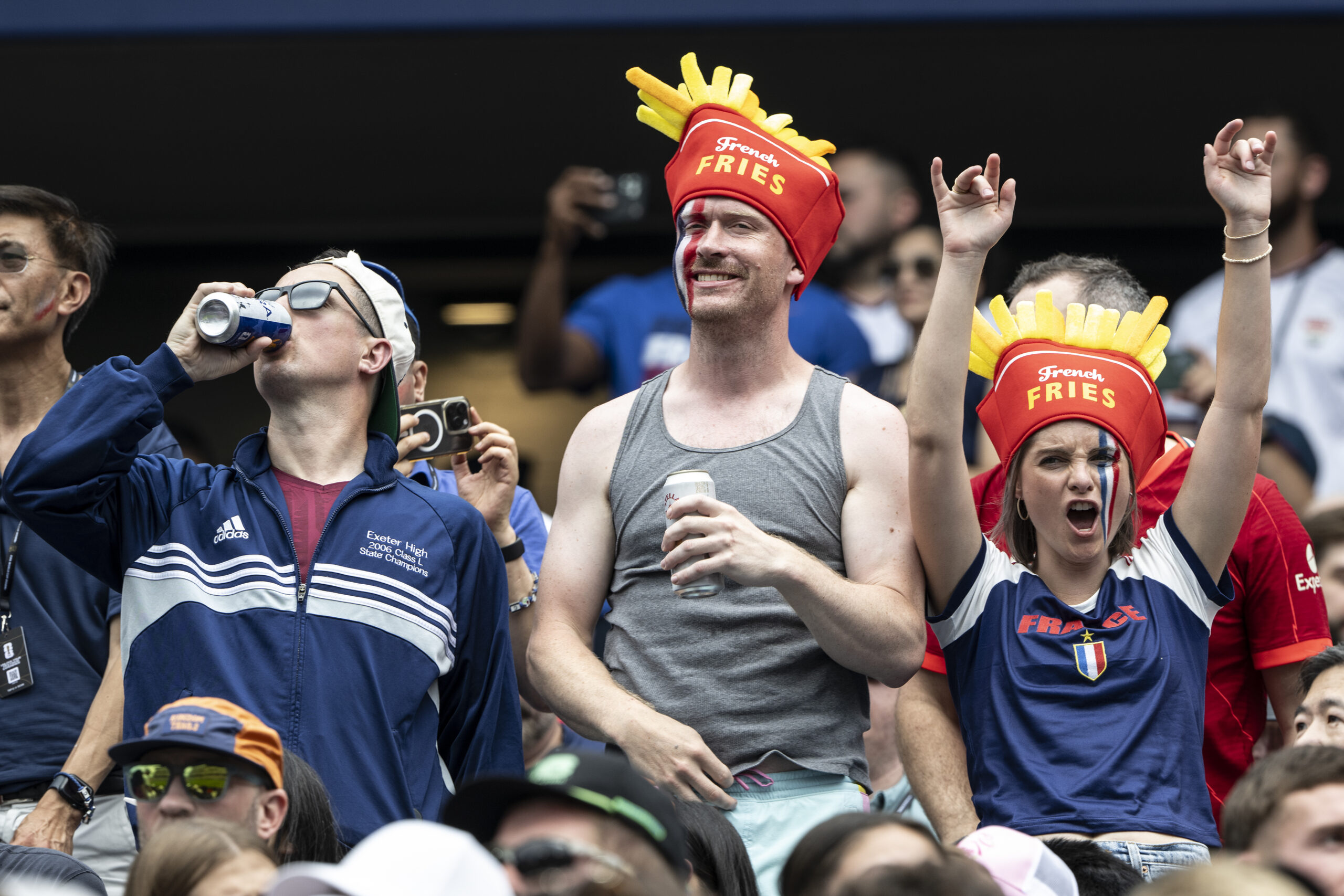
France fans cheer in the stands at the Linc during Monday night’s match against Iraq.
For the most part, French fans in Philadelphia for Monday’s game seemed to agree.
“The architecture looks quite French,” said French fan Tao Taumas, pointing to City Hall on Monday. “Yes, a lot, and we are living in Montreal now, and it looks exactly like the French part of Montreal.”
Vincent Magardeau, who traveled to Philadelphia with Taumas, did not fully agree with his friend’s conclusion.
“I’m pretty surprised that you say that,” Magardeau said after being informed of Philadelphia’s similarities to Paris. “But now that you say it, you can see the architecture here and there, but I wouldn’t say that this is the most French city that I could see.”
Gabriel Sabinaud, who “never heard about anything in Philadelphia,” arrived in the city early Monday morning after staying in New York City. A local informed Sabinaud to try a soft pretzel before he leaves, so he headed to the Philly Pretzel Factory near City Hall before the game. Sabinaud, although having limited time to explore, definitely saw the similarities between the two cities.
“The east side of the U.S. is definitely more European than the west side,” Sabinaud said. “I’ve been to San Francisco as well, not European. No, it’s not. So [Philadelphia] is definitely more European and Parisian at some points. You’ve got tiny streets with lots of people making noise with their cars. Very similar, more similar to Paris than the west side.”
Many French fans explored Center City before taking the Broad Street Line to South Philadelphia for the game. For a moment, before it began to rain heavily, “Les Bleus” had taken over downtown.
“You can see the vibe of French people here,” Taumas said. “With the World Cup, I would say it’s a French city, because everyone is wearing French jerseys, so you might be the Frenchest city in the U.S.”
Iraqi social media star serves dolma outside the Linc
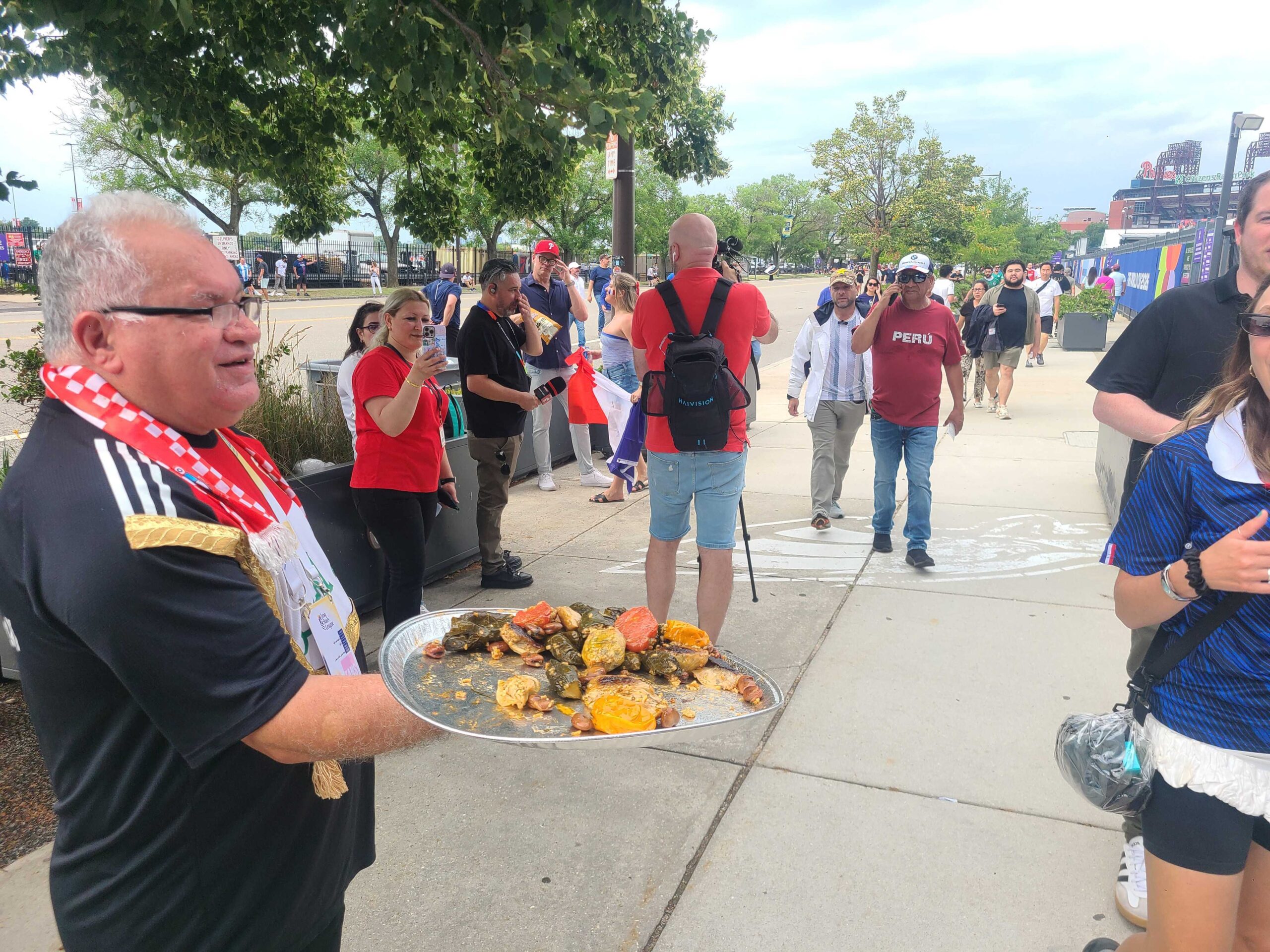
Fawzi Bedaweed serves dolma from his native Iraq outside Lincoln Financial Field Monday.
Fawzi Bedaweed, an Iraqi native from Zakho, traveled to Philadelphia by way of Texas to watch his beloved “Lions of Mesopotamia” take on France.
A budding social media star, Bedaweed has built up a loyal following on social media sharing Iraqi culture during the World Cup. In Philadelphia, that took the form of handing out authentic Iraqi food like dolma to fans outside Lincoln Financial Field.
“We’re going to win! Iraq!” Bedaweed chanted, dancing on the sidewalk.
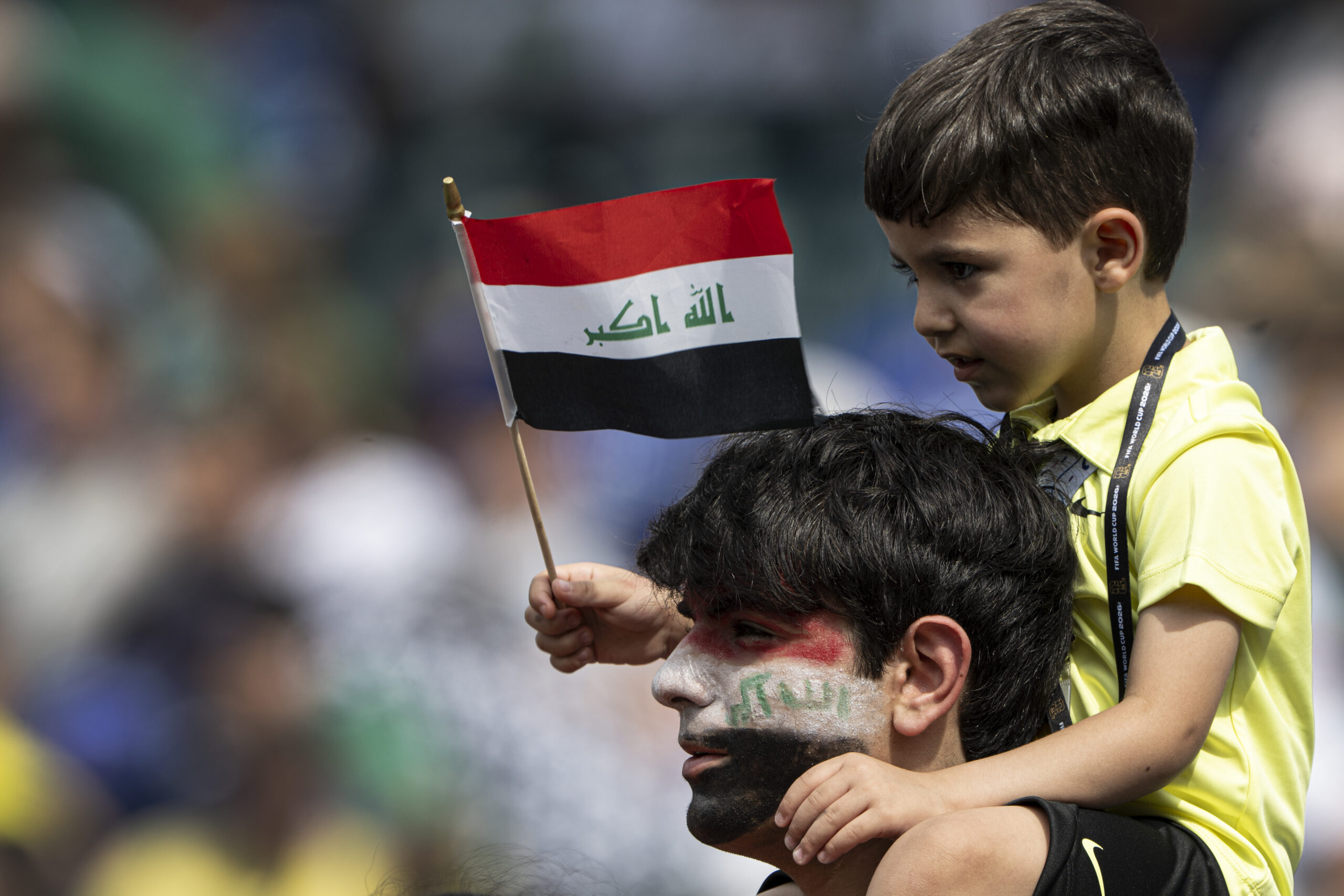
While France were clear favorites heading into the game, a strong contingent of Iraqi fans filled the southern stands behind the net at the stadium.
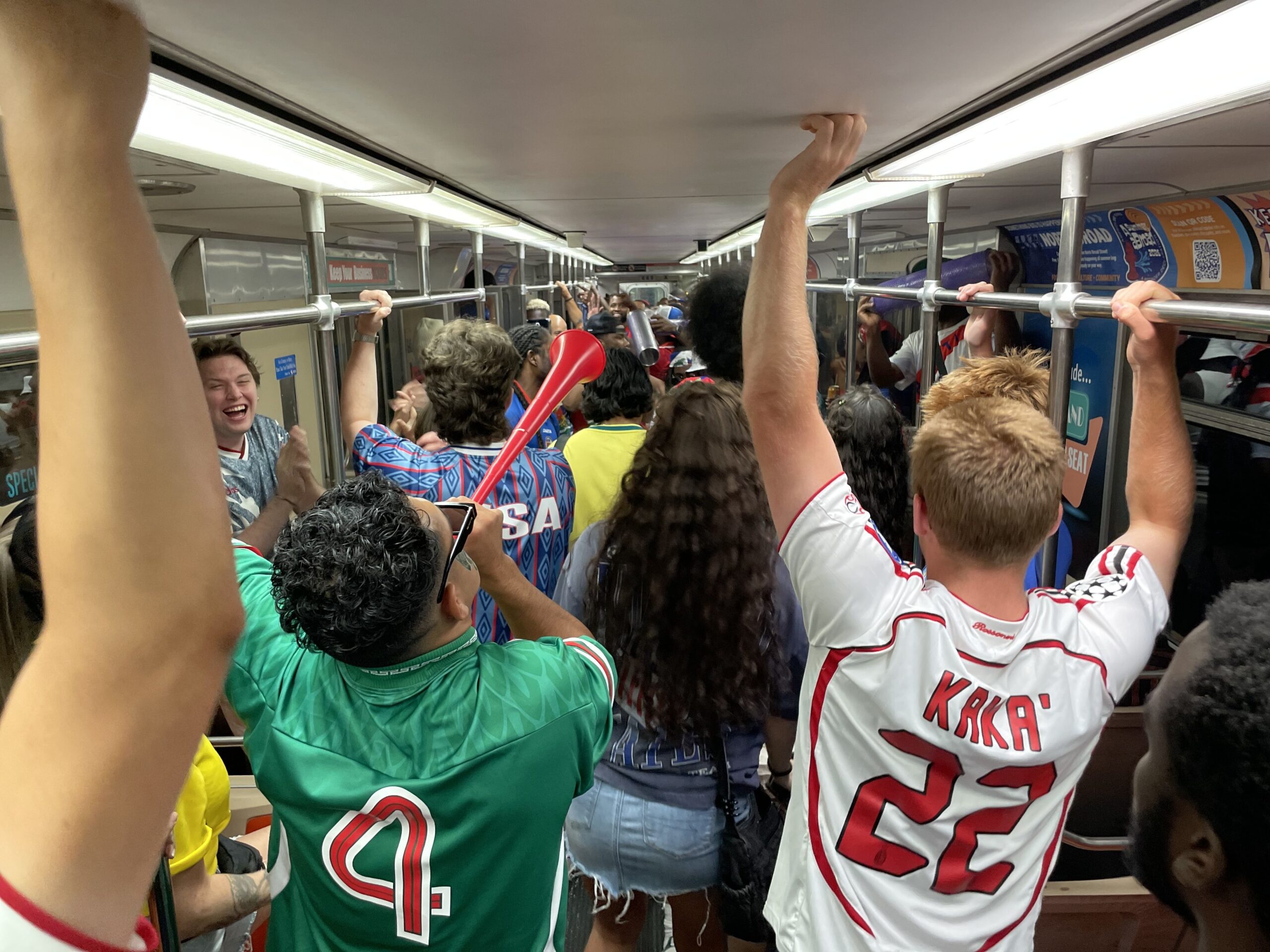
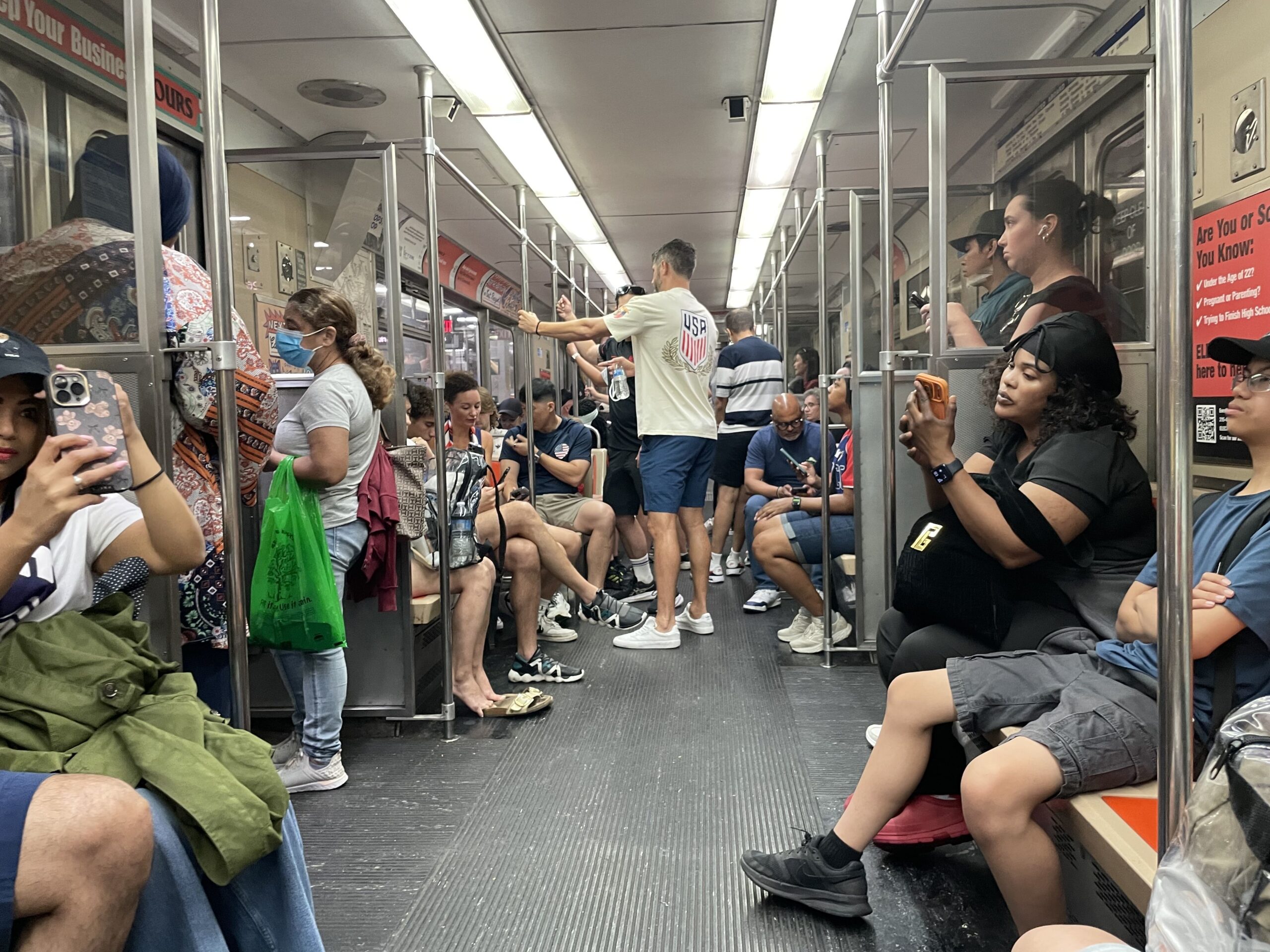
It could just be the time of day, or that fact that it’s a 5 p.m. match on a Monday, but the revelry, excitement, and energy that transpired on SEPTA’s Broad Street Line an hour before kickoff compared to Friday’s match between Brazil-Haiti has fallen off.
That’s not to say there won’t be a significant crowd in-stadium, but traveling the express subway down was not the method of choice at this hour.
The subway line was packed heading to the match after the City Hall stop on Friday at 8 p.m., a little less than hour before the game started. Let’s just say it was a vibe.
Fans pack the Broad Street Line ahead of the World Cup game between Brazil and Haiti on Friday, June 19, 2026.
On the way in to France-Iraq one hour before kickoff after City Hall? Not so much.
Fans ride the Broad Street Line ahead of the World Cup game between Iraq and France on Monday, June 22, 2026.
Philly will see France’s biggest stars in the starting lineup
Whenever the France-Iraq game kicks off, Philly fans will get to see some of soccer’s biggest stars on the field.
Les Bleus will have Kylian Mbappé, Bradley Barcola, Ousmane Dembélé, and Michael Olise as the front four in their attack, as fearsome a quarter as there is anywhere in the world’s game.
It’s a little bit of lineup rotation from the group that started France’s entertaining 3-1 win over Senegal in the Meadowlands on Tuesday, as Barcola comes in for Désiré Doué — another of the world’s brightest young talents.
Mbappé scored two brilliant goals in that game, playing his own role in the chase for the all-time World Cup scoring record. He now has 14, four behind Lionel Messi’s new record of 18. Messi scored twice in Argentina’s 2-0 win over Austria Monday, after having scored a hat trick in the reigning champions’ 3-0 win over Algeria.
Germany’s Miroslav Klose was the previous men’s World Cup record holder with 16. The overall World Cup record belong to Brazilian women’s legend Marta with 17, until Messi passed that mark Monday.
Iraq’s lineup includes a player from MLS, Nashville SC’s Ahmed Qasem, on the left flank in midfield. There will also be a familiar face from the league in the center circle, as veteran Canadian referee Drew Fischer takes charge of the whistle.
At least so far, FIFA has not delayed the kickoff time from the scheduled 5 p.m.
France and Iraq's starters are out.
Mbappé, Dembélé, Barcola and Olise all line up for France.
Nashville SC's Ahmed Qasem goes for Iraq.
Another familiar face from MLS, Canada's Drew Fischer, is the referee.
Fans ready for today’s Philly match: ‘I just enjoy that vibe’
The FIFA Fan Festival is shut down for the day, but the pre-match party is rolling on across the city.
Mahir Sanori and Gene Lazarraga staked out their spot across from the bar at Lion Sports Bar in Chinatown by 3:20 p.m., more than an hour before France and Iraq’s scheduled kick-off time.
Sanori and Lazarraga have no connection to France, aside from Lazarraga’s French classes at Delran High School in Burlington County, but the former high school classmates chose to cheer on Les Bleus.
“We were both free this day, so [we said], ‘let’s just do it,’” Sanori said.
Lazarraga was wearing a Nike-branded navy blue French kit, while Sanori sported a white T-shirt colored in with fabric marker to make the French tricolor.
The pair also picked up some France face stickers and a French flag at Walmart, the latter of which was draped over Sanori’s shoulders.
Sanori and Lazarraga arrived just after Lion Sports Bar finished hosting a group of French supporters for some pre-match festivities, but both said they appreciated the influx of global culture brought to the region by the beautiful game.
“Seeing all these different groups of people come together, that’s kind of a rare sight in America,” Lazarraga said. “Especially with the sports here, people just go at each others’ throats. But, different countries [are] coming together, everyone’s just having a fun time. I just enjoy that vibe. That’s why we’re here right now.”
IRVINE, Calif. – Star playmaker Christian Pulisic was back on the field in practice for the U.S. men’s soccer team on Monday, taking part for the first time since before the tournament opener against Paraguay.
That was a good sign as the Hershey native recovers from the calf injury that kept him out of the second group stage contest against Australia. But it’s just one step, and practice was open to the media for the first 15 minutes. So we don’t know what happened after that.
Since the United States has already clinched first place, there isn’t much reason to play Pulisic in Thursday’s group finale against Turkey (10 p.m., Fox29, Telemundo 62). There also isn’t much reason to play the players on yellow cards — defenders Chris Richards and Antonee Robinson, midfielder Tyler Adams, and striker Folarin Balogun — since a booking in that game would get them suspended from the round of 32.
Still, it was a good sign to see Pulisic making progress.
The other injury news is that midfielder Cristian Roldan is day to day with a muscle strain. If he can’t play against Turkey, that will leave the United States shallow. Balogun also got a lighter day of practice, with a U.S. Soccer spokesperson saying: “Extra recovery. No issues.”
Opening gate time delayed at Philadelphia Stadium ahead of Iraq-France game
France v Iraq – June 22, 2026
Due to inclement weather in the region, gates opening will be delayed. If you are not in the area, please do not travel to Philadelphia Stadium at this time. A new gates opening time will be communicated once the weather has passed. If you are near…
— Lincoln Financial Field (@LFFStadium) June 22, 2026
// Timestamp 06/22/26 2:17pm
Philly fan festival is closed the rest of the day
Due to inclement weather, FIFA Fan Festival will close for the remainder of Monday. pic.twitter.com/BajUl4whLk
— FIFA World Cup 26 Philadelphia™ (@FWC26Philly) June 22, 2026
// Timestamp 06/22/26 2:02pm
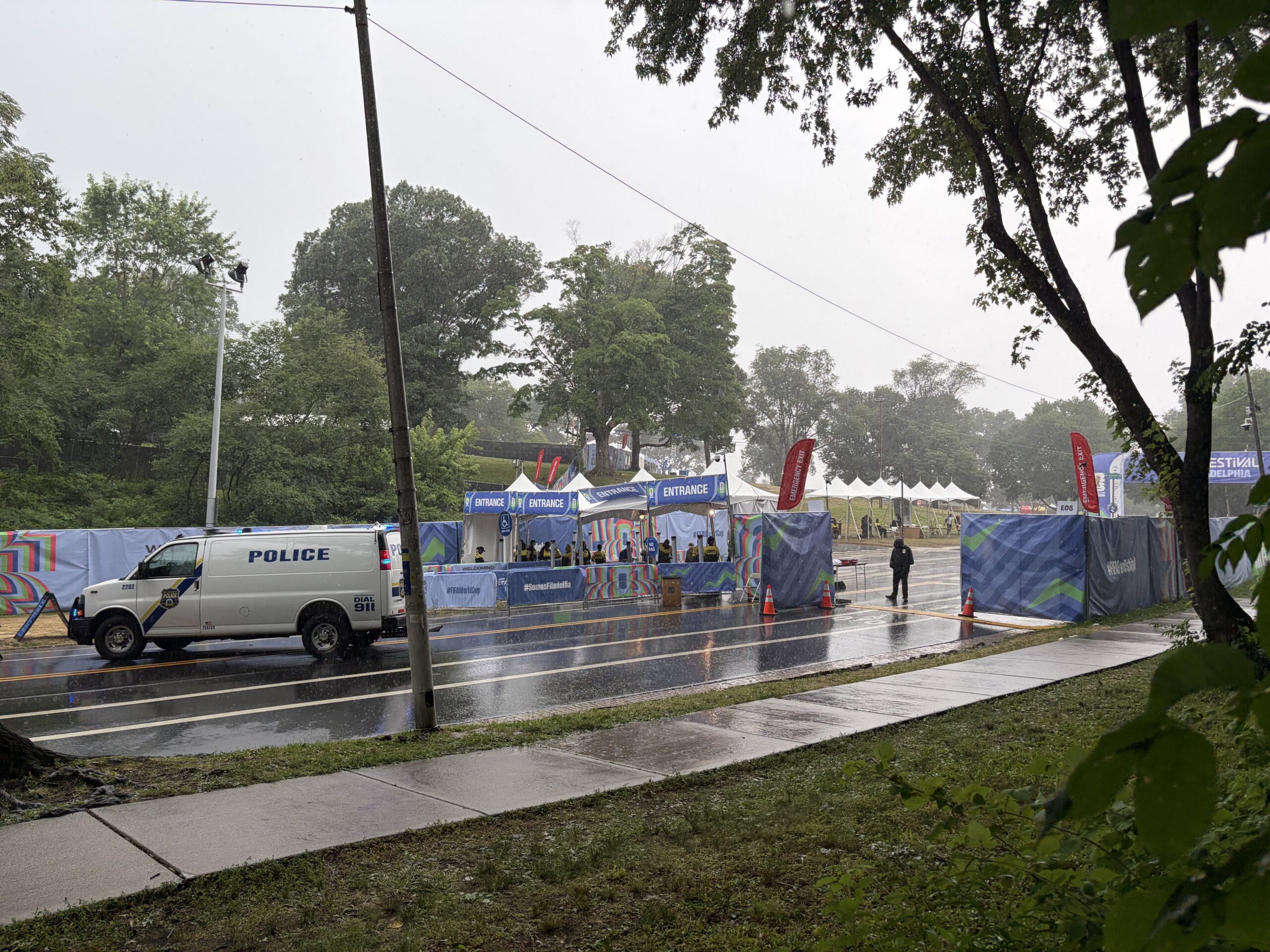
Fan fest at Lemon Hill shuts down due to weather
Stormy weather shut down the World Cup fan festival on Lemon Hill during the afternoon on Monday, June 22, 2026.
The broadcast screens at the FIFA Fan Festival went from showing the Argentina-Austria match to an orange screen with a warning that thunderstorms were approaching the area around 1:40 p.m.
Minutes later, the orange warning switched to a red warning, indicating that “a thunderstorm with lightning is approaching the park.”
Festival organizers said the grounds could re-open if the storm passes through the area quickly. The festival asked fans to pay attention to its social media feeds for further updates on Monday’s schedule.
Organizers would not make an official commitment on whether the grounds would open again, but a member of the festival staff was informing food vendors that they were to shut down for the day as fans were exiting the grounds.
France and Iraq will have to contend with forecast thunderstorms when they kick off at Lincoln Financial Field at 5 p.m.
‘This is Philly, man’: Gov. Josh Shapiro hits Fan Fest
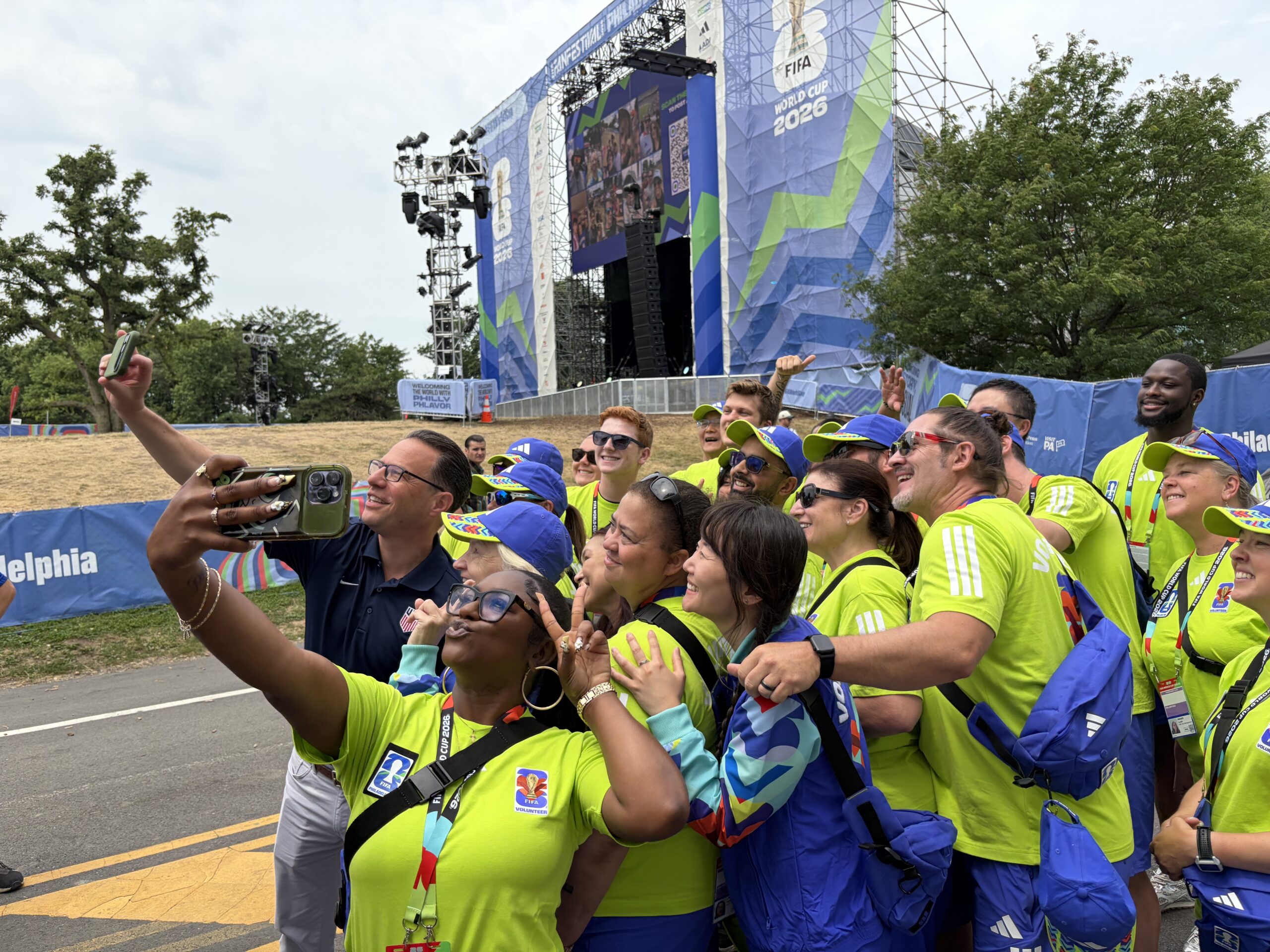
Pennsylvania Gov. Josh Shapiro poses with volunteers at FIFA Fan Fest at Fairmount Park in Philadelphia Monday.
Gov. Josh Shapiro became the latest elected official to visit the FIFA Fan Festival when he stopped by Lemon Hill Park on Monday afternoon, ahead of France and Iraq’s meeting in Philadelphia this evening.
Shapiro, sporting a navy blue U.S. Soccer polo, walked the festival grounds before kick-off of Monday’s first match, between defending champion Argentina and Austria.
“What a unique event and historic moment for our city at this historic juncture of 250 years,” Shapiro said. “To be able to be together and just celebrate one another, celebrate this great sport and enjoy yourself… I think the world needs some more togetherness, needs some more cheer, and this is a great opportunity for that.”
He was greeted by lines of volunteers as he entered the festival, then followed in Mayor Cherelle L. Parker’s footsteps by customizing a charm bracelet at the Bank of America tent — Shapiro chose charms that read 250.
In a brief news conference in front of the festival stage, Shapiro hailed Philadelphia’s Fan Festival as the best “in the country.”
“This is Philly, man,” Shapiro said. “We know how to do big things. It’s extraordinary to see people come out happy and joyful, cheering for their team. Unlike a typical Philly sports event, our fans aren’t cheering against others. There’s just happiness and joy … I’m glad that Philly is a welcoming city and welcoming people from all across the world to be here.”
Shapiro stopped to chat with dozens of attendees inside Visit PA’s booth and play a large arcade-style video game with a young fan in a Paris Saint-Germain kit. He asked French fans in line if Argentina’s Lionel Messi or France’s Kylian Mbappé was the better player, and stopped with an Argentina fan to recount Messi’s performance in Argentina’s win over Algeria.
One of the people Shapiro introduced himself to was 18-year-old Esra Asfaw, who had a French flag draped over his shoulders. Asfaw, a George Mason student originally from Addis Ababa, Ethiopia, said he did not know who Shapiro was when the governor introduced himself.
“I was so surprised,” Asfaw said.
Asfaw traveled up from Virginia to Philadelphia to see Les Bleus face Iraq. He paid $1,089 on the resale market for his 200-level seats. Asfaw said he is not worried about France’s chances against Iraq, but instead about the weather, as looming thunderstorms in the evening could impact the match.
“Maybe the match might get delayed,” Asfaw said. “That’s the only thing I’m worried about. If it rains and they play, then that’s enough for me.”
France’s Kylian Mbappe will take the field in Philly tonight, even if it’s pouring.
That’s the front page headline today in L’Équipe, France’s national sports newspaper and one of the most influential sports outlets in Europe.
Whether or not they read The Inquirer (we hope they do!), the word is out that thunderstorms are on the way to South Philadelphia, and are expected to hit the stadium around the time that France and Iraq are on the field (5 p.m., Fox29, Telemundo 62).
The paper’s coverage setting the stage for the game includes some teaching of Philadelphia lore. And of course, it’s Rocky-themed, since Iraq’s challenge is a classic World Cup underdog story.
The front page of @lequipe-actu.bsky.social today:
“It’s the kind of moment that makes you want to strike up a fanfare, to sound the trumpets and the Rocky theme, to be ready to go up the Philadelphia Museum of Art steps four by four, before a run along the waterfront, a spar with a hunk of meat in a cold room, or a World Cup game at ‘the Linc,’ the Eagles’ stadium,” lead soccer reporter Vincent Duluc writes. “It’s been 50 years since visitors to Philly have raised their arms at the top of these steps, jumping in place. But it’s also a moment to remember that this piece of popular culture celebrates an unexpected hero – and that the France team that’s getting ready to face Iraq in Philadelphia feels more like Apollo Creed than Rocky Balboa.”
Elsewhere in the paper, there’s a little feature on the history of Lincoln Financial Field — Philadelphia Stadium during the World Cup — and its place in the city’s culture.
“Here, the Eagles aren’t just a NFL team, they’re a local religion,” reporter Hugo Guillemet writes. “Their logo is omnipresent on the streets, in shop windows, and in the bars of South Philly. Their hymn, ‘Fly, Eagles, Fly,’ is a popular chant on game days, and when it resonates in the stadium, the stands shake.”
As for social media, if you want a fun French perspective, check out Radio France’s sports reporter Julien Froment. He’s been posting lots of videos on his X and Instagram accounts as he travels around town. Here’s one from the France fans’ pep rally on the Art Museum steps yesterday.
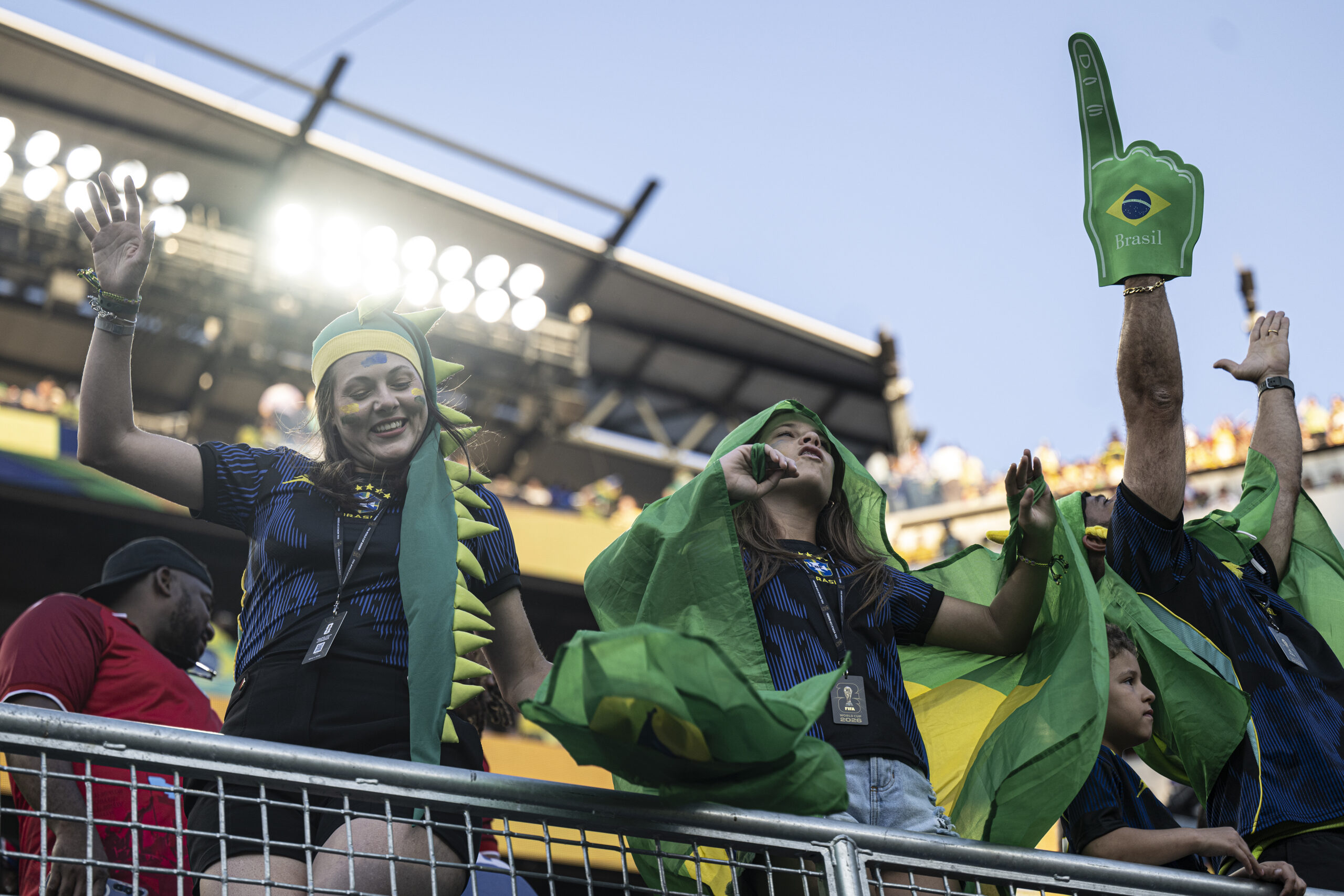
Brazilian fans cheers before their country’s match against Haiti in Philadelphia Friday night.
France, a favorite by many to win the whole tournament, will take on Iraq in the second game of Group I tonight, but if it’s anything like the previous two matches, the game itself will once again not be the story.
Because for the past two games, the attraction has been that of the fans, and the unbridled passion people have for not just a team and its players, but the nation so many have bought jerseys for, the emblem they proudly wear above their heart, or in the middle of their chest.
This spectacle of what will result in 104 matches of underdogs becoming story lines, a U.S. men’s national team exercising the type of dominance very few expected, has also seen Philly lead the way on the main stage, creating lasting memories for thousands of fans who have flocked to the city, all while becoming lore, in the process.
Soccer in its purest form has provided an escape for a nation that desperately needed one. And what it’s also proved in the process is that people of different races, colors, and creeds don’t hate each other as much as their social media algorithms might suggest.
Proof was on display right here in Philly in the form of fans who packed the stands over the last two matches.
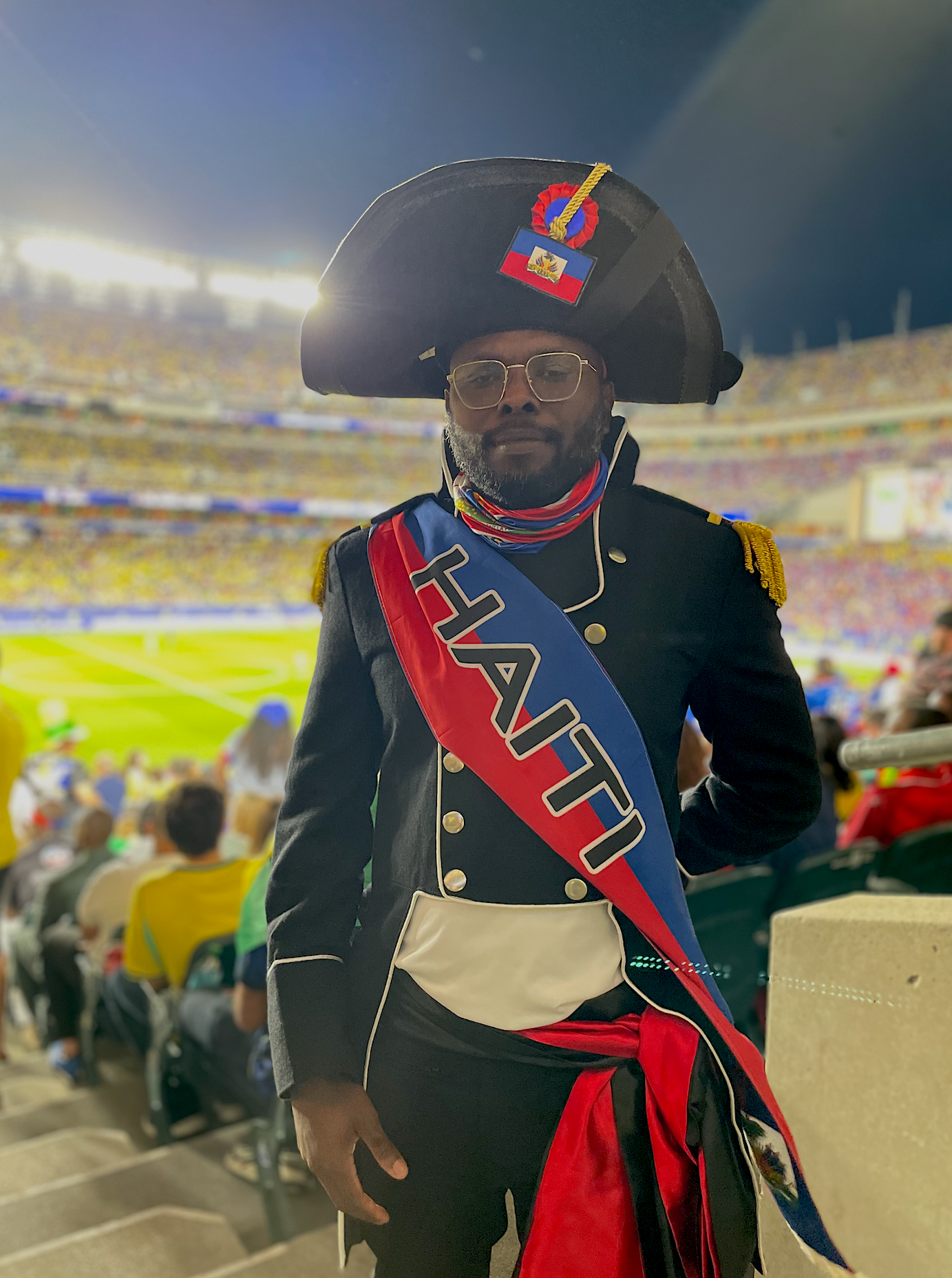
Fans like Maxence Jeanty, a 41-year-old Haitian native living in Chicago who traveled to Philly from the Windy City, dressed in a suit depicting liberator Jean-Jacques Dessalines, a key figure of the Haitian Revolution.
Maxence Jeanty, 41, a fan from Chicago.
“When I was growing up in Haiti as a kid, I watched the World Cup, and I’ll never forget watching the 1994 World Cup,” Jeanty said. “It’s been so long that my people haven’t made it to the World Cup that the choice was to choose either Brazil or Argentina [as the nation to support]. But now, we’re stepping on the field as equals, and no matter what happens, we’re stepping on the field as equals. The pride that brings to me and to every Haitian fan here, man, that’s indescribable.”
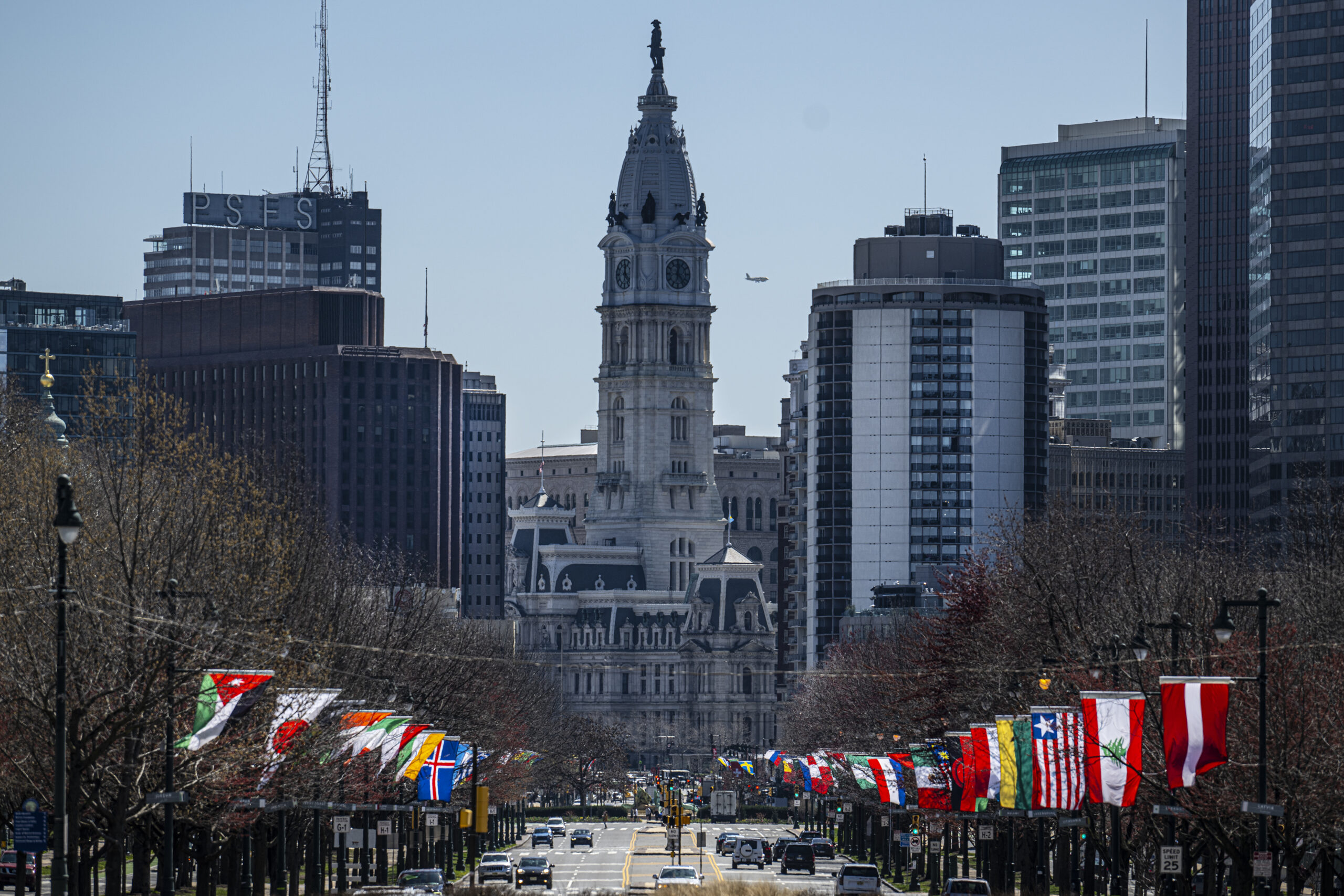
Benjamin Franklin Parkway is one example of urban planners borrowing from the French.
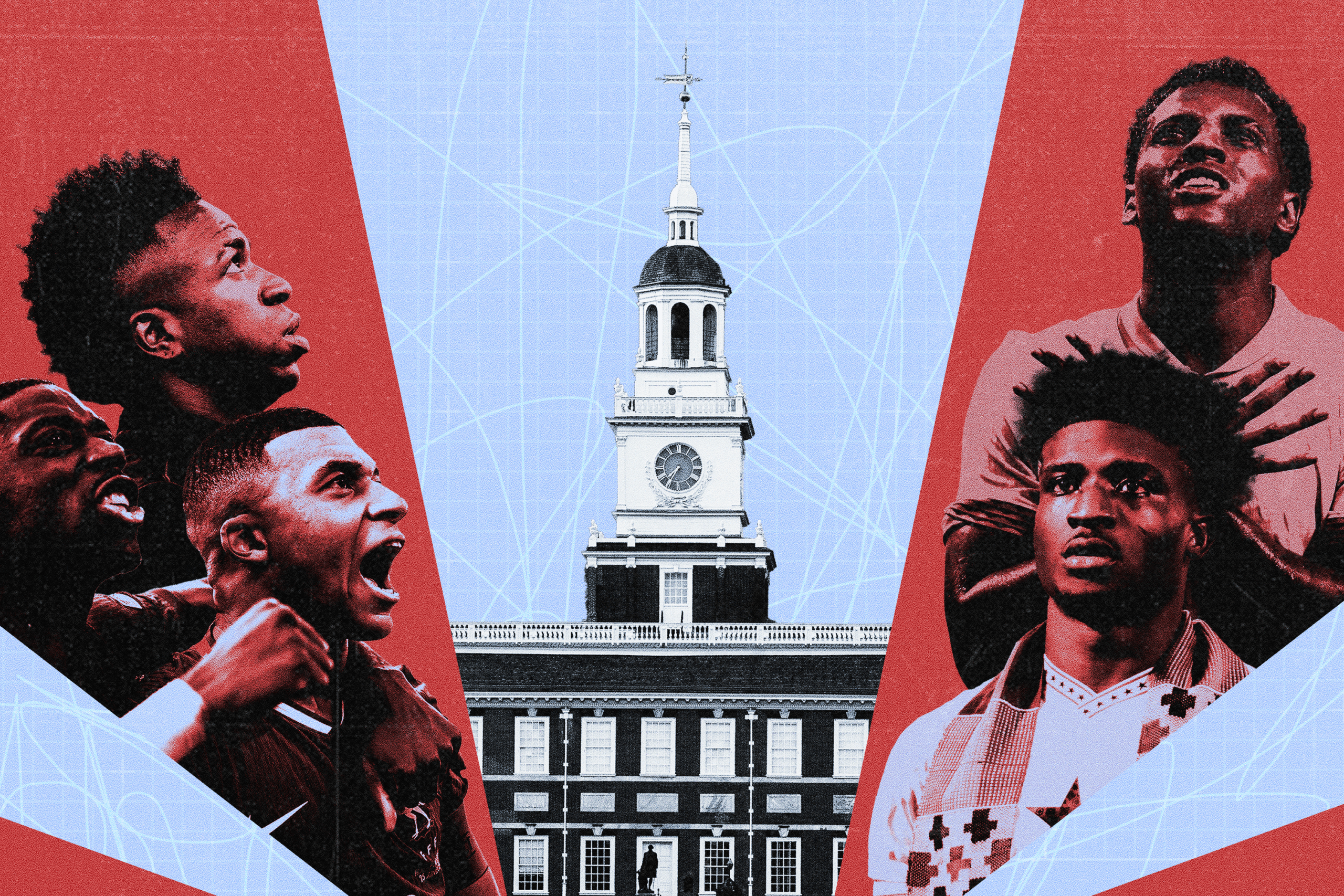
Some have called Philadelphia the “Paris of America.” Really.
It might be hard for locals to wrap their heads around the title, but there is some truth to the comparison — mostly due to the cities’ similarities in architecture. With France in town to take on Iraq in the World Cup Monday night, here’s a look at some of Philadelphia’s Parisian connections.
The Benjamin Franklin Parkway is the most glaring example of Philadelphia borrowing from the French. Finished in 1929, the parkway was designed primarily by two Frenchman, architect Paul Philippe Cret and city-planner Jacques Gréber. Their inspiration? Paris’ Champs-Élysées, a similarly grand avenue that stretches throughout the city. The two also both boast similar end points. The Champs-Élysées concludes with the grand Arc de Triomphe while Philadelphians can spot the Philadelphia Museum of Art from the parkway’s start at City Hall.
French fans just need to know not to dress the Rocky Statue atop of art museums steps.
Shortly after the conclusion of World War I, but before the signing of The Treaty of Versailles, Gréber displayed hope that the construction of the parkway would bring in tourists just as the Champs-Élysées does.
“I am glad to say that, if by this work the city of Paris may be enabled to bring its sister in America the inspiration of what makes Paris so attractive to visitors,” Gerbner said in 1918. “It will be the first opportunity of Paris to pay a little of the great debt of thankfulness for what Philadelphia and its citizens have done for France during the last three years.”
Meanwhile, Cret was also the mind behind the Benjamin Franklin bridge and a redesign of Rittenhouse Square, which also get Parisian comparisons. City Hall also looks like it could have been picked up in Paris and plopped down in Philadelphia as it was built in the French Second Empire style.
— Conor Smith
// Timestamp 06/22/26 10:24am
World Cup teams that have qualified for the next round and been eliminated
The U.S. is already in the Round of 32 and have won two group stage games for the first time since 1930.
Heading into Monday’s World Cup matches, three teams have already punched their ticket to the next round of the tournament.
Among them is the United States, which have won two games in the World Cup group stage for the first time since 1930. The U.S. has one more group stage match – against Turkey Thursday night – and will play in the Round of 32 on July 1 in San Francisco Stadium at 8 p.m. Philly time.
Here’s a rundown of all the World Cup teams that have qualified for the next round, and those that have already been eliminated from contention:
Thunderstorms in Philly could interrupt tonight’s World Cup match
Scattered severe thunderstorms could move through the region tonight.
Thunderstorms are expected to make their way through the Philadelphia region later this evening, potentially interrupting tonight’s World Cup match between France and Iraq.
The strongest of the storms are forecast to move in beginning around 4 p.m., bringing with them heavy rain, wind gusts approaching 60 mph, and the potential for an isolated tornado.
“Storms will certainly have lightning with them,” said Zack Cooper, a meteorologist at the National Weather Service’s Mt. Holly station.
An inch or two of rain could fall in and around the city, Cooper said, but depending on the storm’s severity that could all come in an hour or less, leading to flash flooding. Philadelphia and the surrounding region are currently under a flood watch.
FIFA will pause play if there is a lightning strike within eight miles of the stadium. The match will remain paused for 30 minutes, with any subsequent lightning strikes resetting the clock.
The FIFA Fan Fest at Lemon Hill Park in Fairmount would also be forced to close if lightning is detected within an eight-mile radius. Fans would need to exit the grounds and move to a safe location, FIFA said in a statement, and could re-enter after 30 minutes if no additional lightning is detected.
The Storm Prediction Center in Norman, Okla., which issues severe storm watches, listed a 2% chance of tornadoes, and an “isolated” twister can’t be ruled out, said Nick Guzzo, meteorologist with the National Weather Service in Mount Holly.
Four Frenchmen skipped work to go to the World Cup in Philly
Fans react during France’s opening match against Senegal on June 16. Some of those fans have taken up residence in Philadelphia ahead of Monday’s match against Iraq.
Eight years ago, when FIFA announced that the World Cup would be coming to the United States in 2026, a student in France felt a rush of excitement. He and his friends had been watching the international soccer tournament on television since they were kids.
They’d never seen it in person. The last time their native country hosted the competition was in 1998, before all four Frenchmen were born. In the years since, they’d tried to make it to a game, but to no avail.
Russia hosted in 2018, but the four friends were unable to get visas. Qatar hosted in 2022, but this time, they were attending different colleges, which made traveling logistically complicated. So, they looked ahead to 2026 and started saving money.
One man picked up extra work shifts at his Parisian brasserie. Another taught English lessons on the side. All four made a conscious effort to cut back on drinking and eating out.
There was one problem. The men worked in upscale restaurants, and summers were extremely busy. The Parisians knew that they wouldn’t be able to get a few days off, let alone a few weeks.
In the spirit of Ferris Bueller, the 20-something-year-olds decided to tell a white lie. And now, three years and $12,000 in savings later, they are in Philadelphia, enjoying everything it has to offer (unbeknownst to their employers).
“Momo,” the Parisian waiter who organized this trip, participated on the condition that he and his friends’ last names would be omitted (out of fear of losing their jobs).
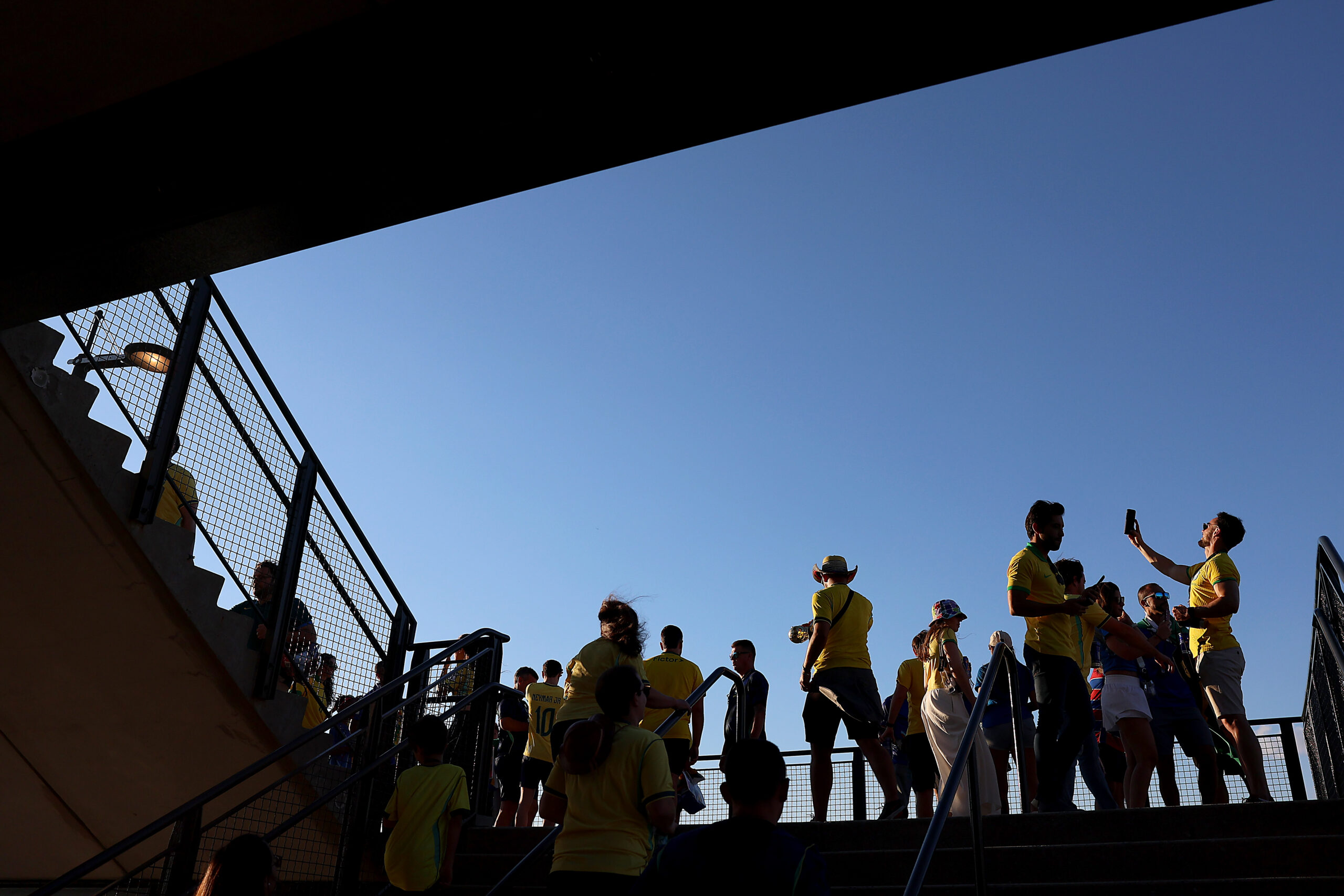
Fans navigate the stairs in the upper concourse of Lincoln Financial Field, rebranded as Philadelphia Stadium.
Philadelphia has hosted two World Cup matches so far – Ivory Coast’s upset of Ecuador, and Brazil’s blowout of Haiti.
Philadelphia Stadium, as it’s called during the tournament, will host four more World Cup games, including a Round of 16 matchup on July 4.
Unfortunately, Philly won’t host the U.S., which clinched a first-place finish in the group stage. They needed to finish in third place to even have a chance of winding up the the Linc.
Here’s Philly’s remaining World Cup schedule:
France vs. Iraq: Monday, June 22, 5 p.m. (Fox)
Curaçao vs. Ivory Coast: Thursday, June 25, 4 p.m. (FS1)
Croatia vs. Ghana: Saturday, June 27, 5 p.m. (FS1)
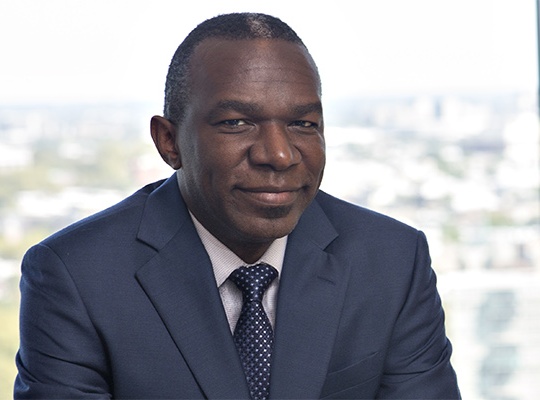
As Philadelphia’s city solicitor, heading a staff of more than 200 lawyers, Sozi Pedro Tulante sued some of the nation’s biggest corporations, accusing them of loan discrimination and pushing lethal painkillers.
Now he’s apartner at Dechert LLP, a Philadelphia-founded, international corporate law firm, where the work includes defending big national corporations from the kinds of complaints he used to file.
Corporate targets during his 2016-18 stint as the city’s top civil lawyer included Wells Fargo & Co., the third-largest U.S. bank, which settled his lending-discrimination complaint for a promise of $10 million in donations to housing programs, and six pharmaceutical companies, four of which were major Pennsylvania employers, for promoting addictive opioids. The city later got a nearly $200 million share of a national settlement.
Tulante’s job also included routine legal reviews. He defended the city’s soda tax and its sanctuary city immigration status.
After leaving his city position in 2018, Tulante — son of a refugee, a Northeast High School and Harvard University graduate, and a former federal prosecutor — lectured at the University of Pennsylvania’s law school.
He joined Dechert’s litigation department the next year, then spent 2022 to 2025 as general counsel at Boston-based Form Energy, which builds iron-based batteries for data centers and other clients at its plant in Weirton, W.Va.
More companies are now aware of the risk. They adjust.
There are extreme cases where litigation ends a company. But for the most part you factor it in.
Who gains from a litigious climate?
Sophisticated national companies have clients everywhere. They know they are going to get sued. They study to minimize litigation. For example, don’t use flip messaging. Just be familiar where the threats may come from. Know what litigation the city is pursuing.
Many of the big companies facing litigation in Philadelphia are more likely to engage counsel that is locally respected and recognized in the area. In Philly, if you can’t answer the question, “Where did you go to high school?” [with a name the parties recognize], it’s a disadvantage. Here, we fight the plaintiff attorney, but we also serve on the same board and attend the same continuing legal education [CLE] classes.
There are great lawyers on the other side, at [plaintiffs’] firms like Kline & Specter and Ross Feller Casey, sophisticated counsel who walk into court and get instant respect.
Part of my role at Dechert is to represent clients in Philadelphia and nationally who are thinking about how Philadelphia has changed as a place of litigation and how that litigation impacts business.
Businesses are saying, “We have the tax burden, the regulatory burden, we’ll comply, but you are pushing on the edges.”
What recent laws have changed the legal climate for business?
The new consumer protection ordinance, passed in 2024, has given the city more power to bring some major cases [through national law firms] that are broader than before. Life sciences cases. Firearms liability. Fair workweek litigation. They may go after [national] retailers in certain cases. The city can go forward and get penalties up to $2,000 per violation.
As city solicitor, I was reminded that government has the broadest power of regulation at the local level. The police authority government has is really broad. Unless there’s some preemption by state or federal government. It’s something folks pay attention to.
Is part of Philadelphia’s affordability a result of its failure to attract private-sector employers?
I live in West Philly. I work at the law school. I have three children in public schools. I want the city to have a secure tax base. I want to make sure investment goes where it needs to.
It’s challenging. One of the biggest challenges is getting people from Temple, Penn, Drexel, and St. Joe’s to stay.
In Philadelphia the strength ultimately is in eds and meds. We have doctors and nurses, lab technicians, people with a high level of training. Philadelphia takes credit for helping solve COVID by our Nobel Prize winners Drew Weissman and Katalin Karikó at Penn, which has led to investments in gene therapy.
What was the most satisfying thing you did as city solicitor?
Working to get local control of the school district and disbanding the state’s School Reform Commission. It was humiliating, the way the state was running our schools. We should have a stake. The most important thing we can do is educate our children and prepare them for businesses that want to hire talent.
Why did you choose the law?
It’s not the ability to argue that makes a good lawyer. You have to solve problems. You have to be really good at writing. And you have to be able to talk to people — to be personable, to make the hard stuff simple, to help them understand.
I like a career where people ask you to help them solve really big problems. They can be CEO of a major company or a pro bono client that needs a habeas petition. They require the same level of skill.
How did you come to be a Philadelphian?
I came here at age 8 in 1983 [after his father, a military official in Angola, fled to Congo following a change in government, was imprisoned, then was resettled in North Philly by a refugee agency].
It was a difficult time to grow up here. I graduated in 1993 from Northeast High School. I got into Harvard, then Harvard Law School.
Eight years ago, I left the city, to be general counsel at a startup.
But it came back to family and affordability. Philadelphia is that place for me, within the larger Northeast corridor.
What gives you hope?
My dad drove a cab when he came here. My mom worked in the prison system. Now here I am, a Black attorney from the public school system.
I am a big booster of today’s public schools. My children are at Central, at Masterman — I couldn’t get into those, I still hold a grudge! — and at Penn Alexander in West Philly.
I want my children with other children who really want to achieve. I motivate them, the teachers motivate them, they are self-motivated, but the friends they are with have more of an impact on them.
And I think we are finally putting into place an infrastructure for understanding government. You know Philadelphia has more political ads and advertising than almost anyplace, a big city in a swing state. But we have not always centered our education on civics. Now my son understands more than I did.
I’m glad to be back at Dechert. I can see a lot from this perch.
This story has been updated to correct some biographical information about Sozi Pedro Tulante.
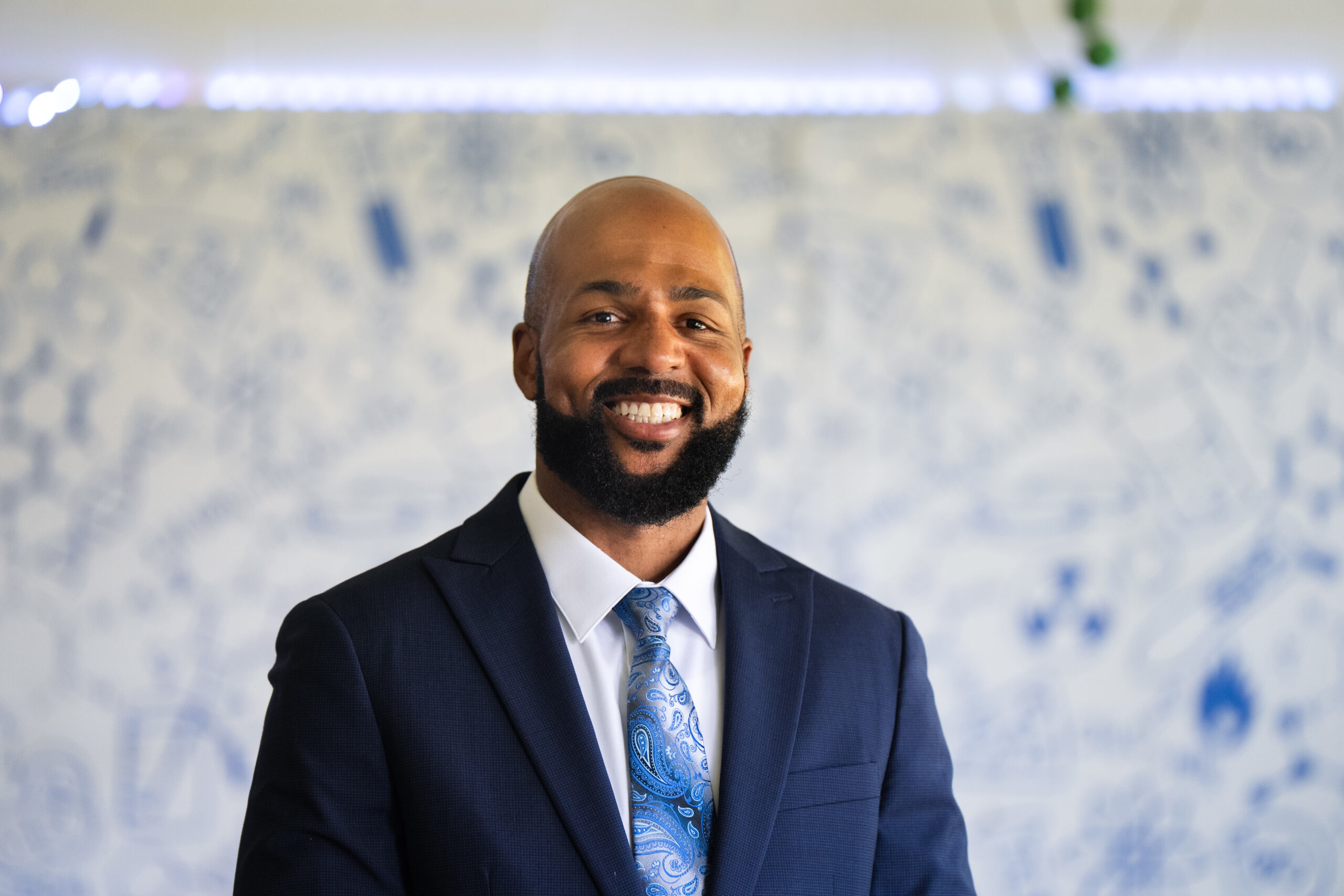
As the newly appointed National Teacher of the Year, Haverford High School’s Leon Smith has been celebrated on television: from CBS Mornings and Good Morning America to the Kelly Clarkson Show.
But as the lone Black teacher when he started teaching at Haverford 25 years ago, Smith got a different reception. He experienced racism, he told a group of young people interested in teaching, and if it weren’t for a Black vice principal that listened and supported him, he might not still be teaching today.
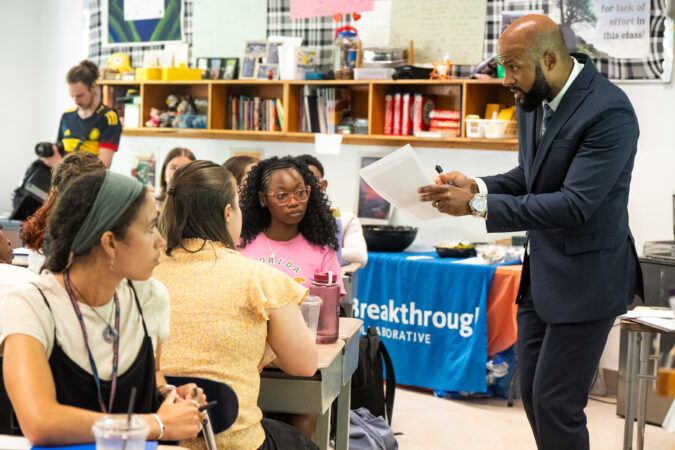
“She would just be very honest with me, and be like, ‘First of all, you’re an excellent educator. … Keep being you. Somebody calls and says something crazy, I’m just hanging up,’” Smith told teaching fellows gathered in Germantown on Wednesday with Breakthrough of Greater Philadelphia, a nonprofit that trains aspiring teachers to lead enrichment programs for middle-school students.
The event, sponsored by the Equitable Foundation, was just one of many for Smith during his yearlong stint as Teacher of the Year, a platform he was awarded in April by the Council of Chief State School Officers. In that role, he’s spending the year traveling the country to advocate for the teaching profession and growing its ranks.
Smith, who teaches Advanced Placement U.S. History and Advanced Placement African American Studies at Haverford, spoke passionately to the fellows Wednesdayabout his motivation to be the teacher he didn’t have growing up, and the immense impact teachers can have on students’ lives — presenting the profession as a deeply rewarding opportunity to help kids recognize their talents.
But he was also honest about the challenges. Fielding questions about his career from fellows gathered in an auditorium on the Germantown Friends School campus, Smith said he had struggled to find his way as a new teacher, staying up too late trying to perfect lessons.
He described the sometimes lonely experience of being his predominantly white high school’s only Black teacher, and how he developed strategies to respond to racism, including learning when to walk away and when to speak out.
He told fellowsto find supportive colleagues and to be selective when they considered job offers.
“Do your research. Make sure it’s a space that’s going to take care of you,” he said.
Smith also described feeling self-conscious when he was younger about some of his lessons — worrying that students would say, “‘Oh, all he does is talk about Black history,’” Smith said. But he began hearing from students about how grateful they were to have learned about subjects that hadn’t been covered in other classes; an audit later identified African American studies as a class community members wanted to see added.
‘My why’
His comments resonated with the teaching fellows, some of whom said they’re committed to careers in education.
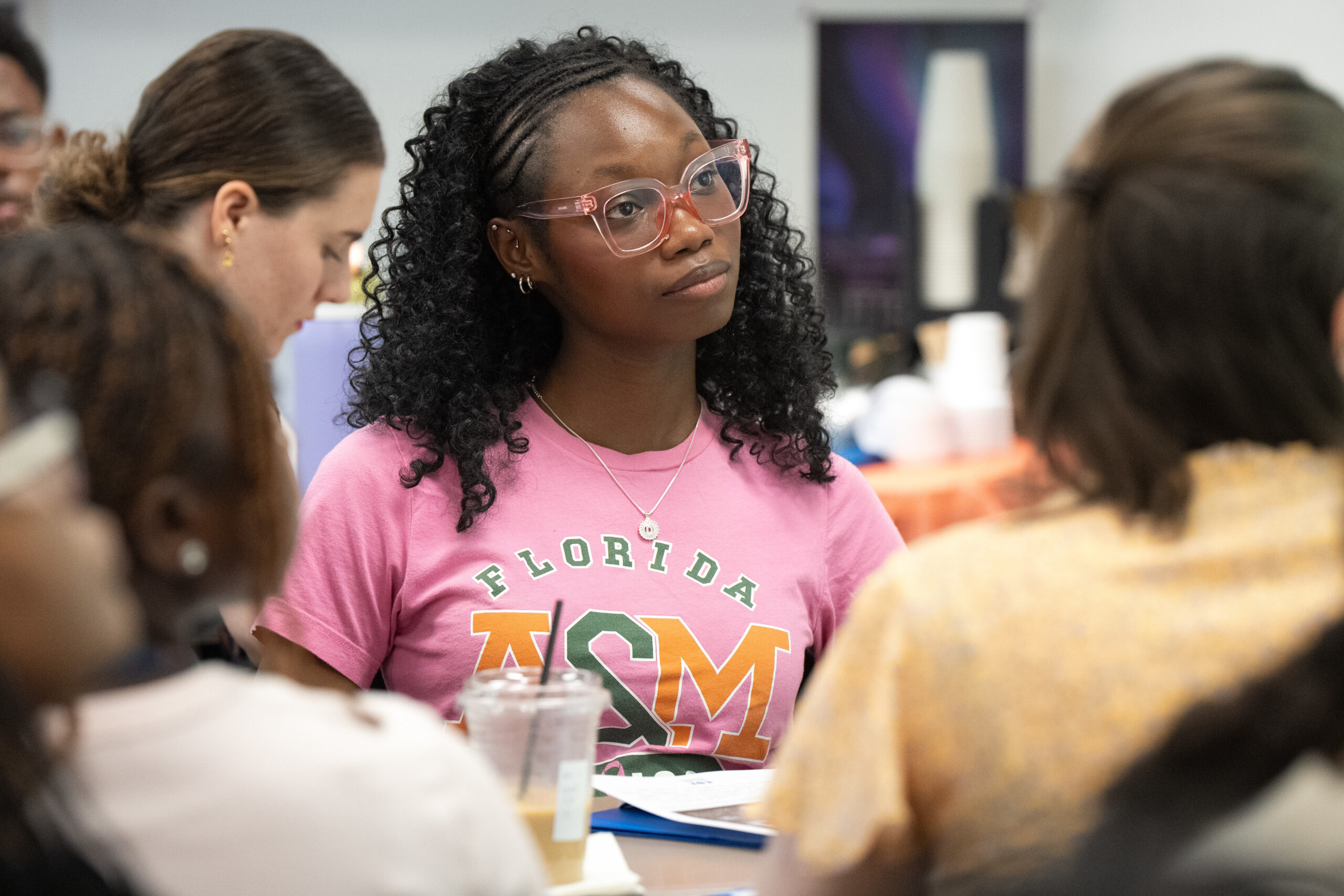
Dominique Sidae, a 23-year-old rising senior at Florida A&M University, is planning to become a special-education teacher. She said she wasinspired by her appreciation for a teacher who helped her younger brothers, who have autism.
Sidae said she is often the only Black person in teaching spaces. “It feels good to know this isn’t only happening to me,” she said. “You don’t really learn that in college.”
Dominique Sidae, 23, a fellow with the Breakthrough of Greater Philadelphia, listens to a talk by Leon Smith last week.
Miles Baldwin, an 18-year-old graduate of Harriton High School in Lower Merion, isn’t sure he wants to become a teacher. But he enjoyed working with students last summer in the Breakthrough program — “a lot of kids came in hating it, and left wanting more,” he said — and Smith’s pitch about being a mentor was compelling to him.
“Honestly, yeah,” he said, when asked if hearing from Smith made him more interested in teaching.
Smith’s agenda this summer includes attending the National PTA Convention in Pittsburgh and giving a keynote speech at the Smithsonian’s National Education Summit. He also will be joining other state teachers of the year at Space Camp in Alabama and participating in professional development.
But addressing the Breakthrough teaching fellows Wednesday “reminds me of my why,” Smith said in a brief interview. He said the fellows’ eagerness to ask questions “shows they want to be the best they can be,” and reflects qualities of good teachers: “You have to be curious, sometimes silent … often humbled,” Smith said.
Leon Smith, a teacher at Haverford High School, was named National Teacher of the Year this spring.
Teaching students to lead
In a model lesson after his talk, Smith put some of those skills on display. He started by gathering the 34 fellows in a circle, asking them each to share their name and a brief story about it; the group periodically broke into laughter at humorous anecdotes.
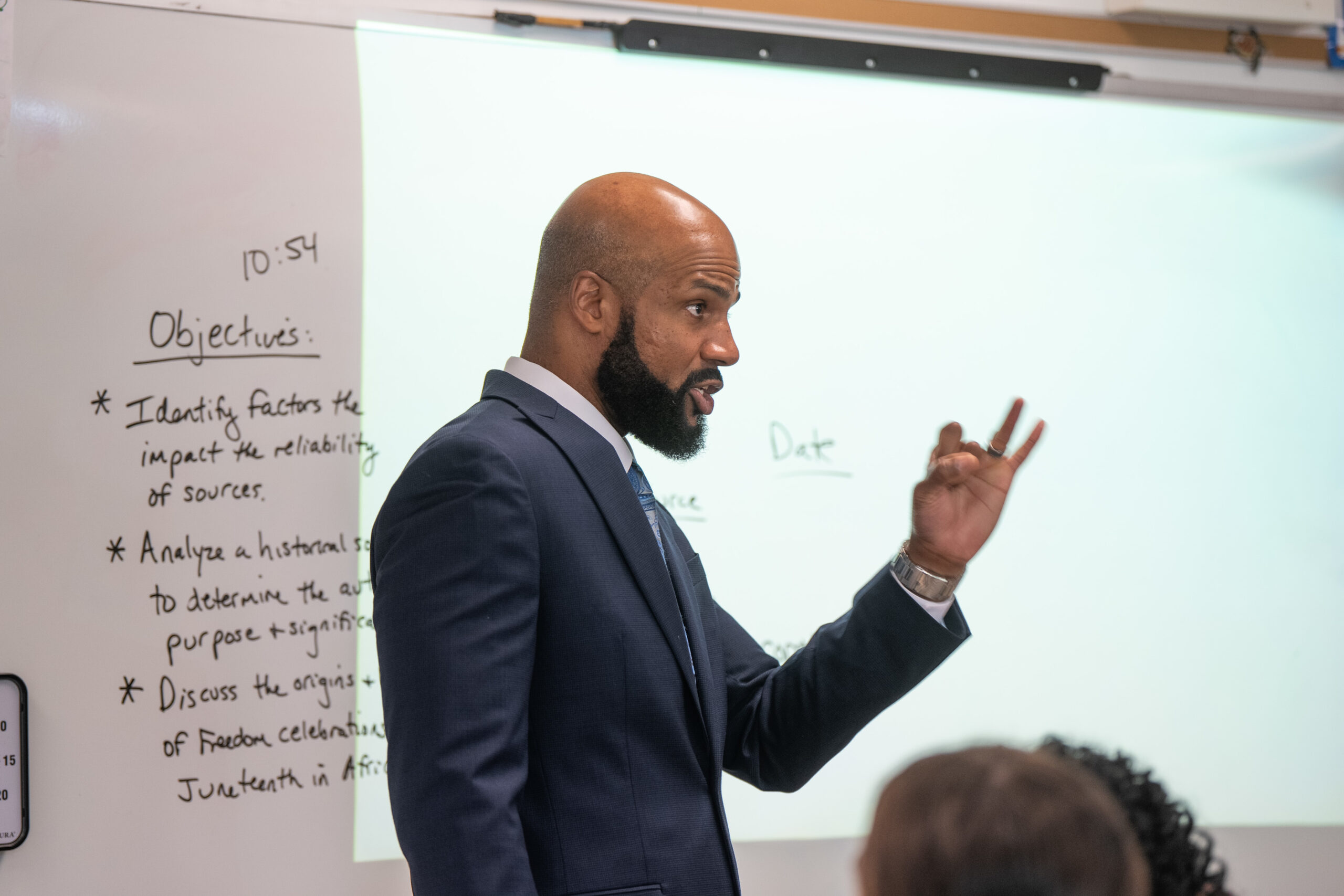
Smith then outlined the objectives for his lesson about assessing the credibility of sources. He passed out copies of a photo, asking fellows to silently write and then discuss in small groups whether it provided strong evidence of the Fukushima power plant explosion.
“I always tell my students, you want to be a leader,” Smith said, encouraging fellows to stand by their analyses, even if others disagreed. He then called on people, asking them to explain their thinking while challenging some of their points.
Leon Smith talks to fellows at Breakthrough Collaborative last week.
Matt Greenawalt, co-dean of faculty for the Breakthrough summer program and a teacher at Germantown Friends — which supports Breakthrough — was planning to breakdown Smith’s approach for the fellows after the lesson. He noted how Smith was walking through the room, engaging with the fellows as they talked, and Smith’s ability to affirm and redirect them when an answer wasn’t on point.
Smith’s visit came on day three of a two-week orientation for the fellows, before they would begin teaching students during Breakthrough’s six-week free summer program.
While access to academics is key for the program’s students, many of whom come from Germantown, “a big piece of it too is having role models,” Greenawalt said.
Smith told fellows that when the students arrived, “they’re going to just admire you so much.”
“You’re going to be able to see the light inside of them, and sometimes it just takes someone else to notice, right? … They’ll just kind of be doing their work, and then as you get to know them, you’ll notice certain characteristics and you’ll just pour into it.”
What really helps make a connection with kids, Smith said, is “just you being yourself.”
“You walking in there and walking in your own life, and bringing your passion and all the reasons why you wanted to become a teacher,” he said. “Your students are going to feel that.”
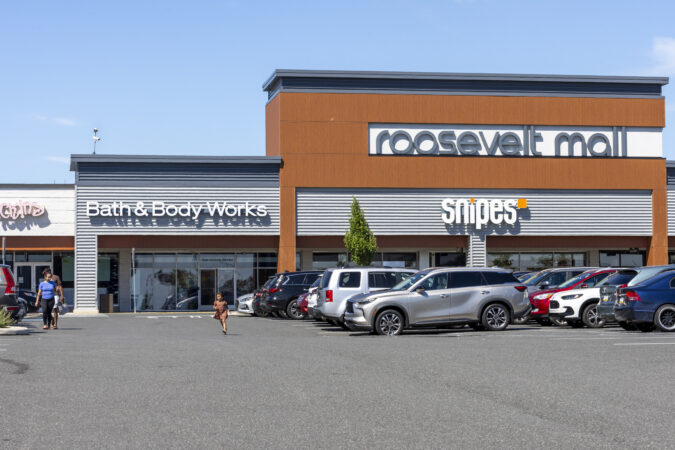
As Brixmor Property Group executives began transforming the Roosevelt Mall, they briefly debated whether to change the name.
After all, the 60-year-old Northeast Philly shopping center is undergoing a more than $70 million makeover that promises to bring it into the modern age with new tenants, upgraded facades, and a better layout.
As Brixmor executives walked around the 620,000-square-foot complex on a recent day, they said they already see the outdoor mall becoming a community hub — with a gym, an organic grocer, and new fast-casual dining options.
Despite these changes, they have decided the Roosevelt Mall should not be rebranded.
“It’s an iconic name,” said David Vender, Brixmor Property Group’s executive vice president for the north region, who is based in Conshohocken. “People know it as a landmark.”
Brixmor operates about 350 shopping centers nationwide, but some of its top executives — including new CEO Brian Finnegan, who grew up in Roxborough — have soft spots for Philly, forged by personal or family connections to the region.
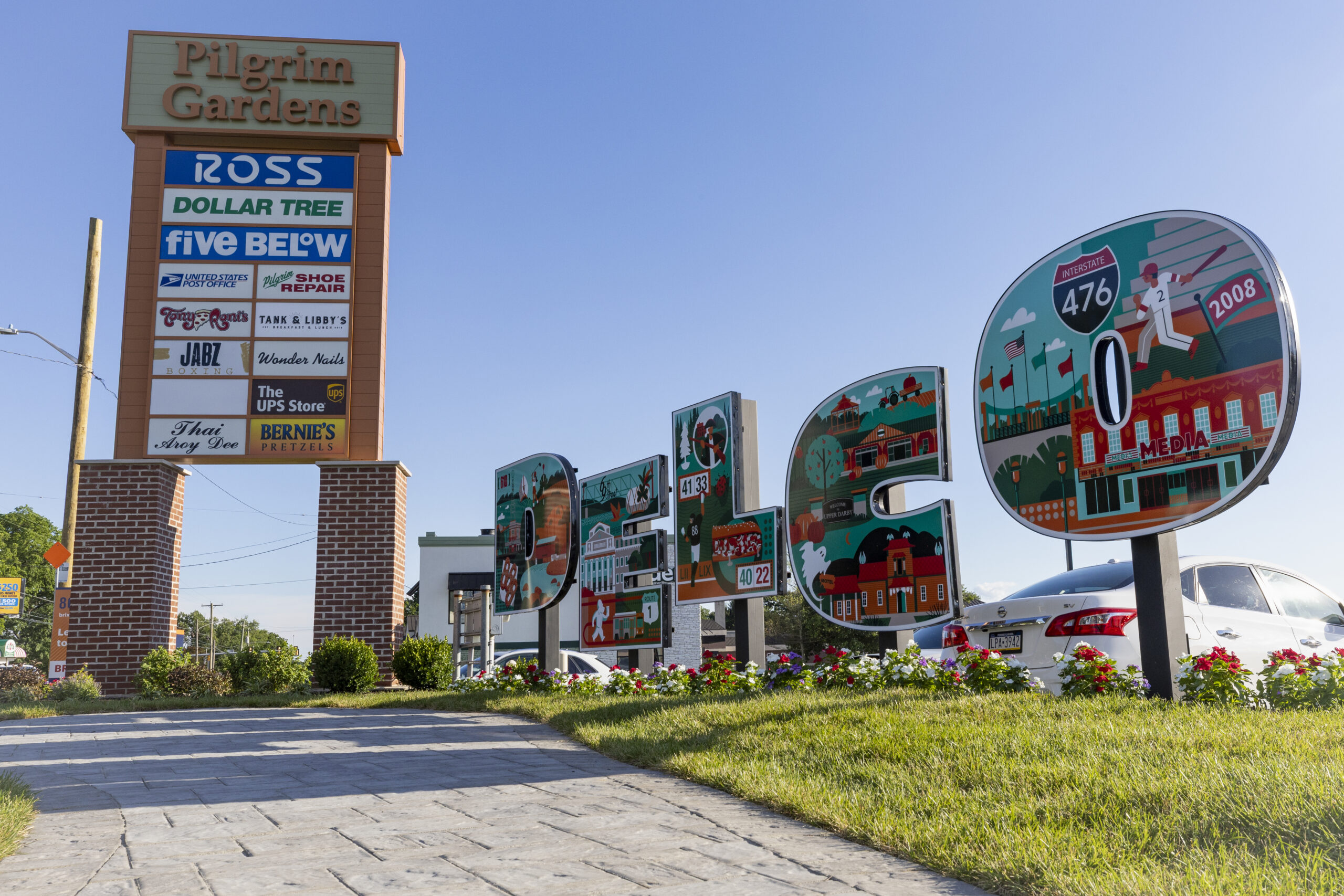
A new Delco sign is shown at Pilgrim Gardens in Drexel Hill on June 16.
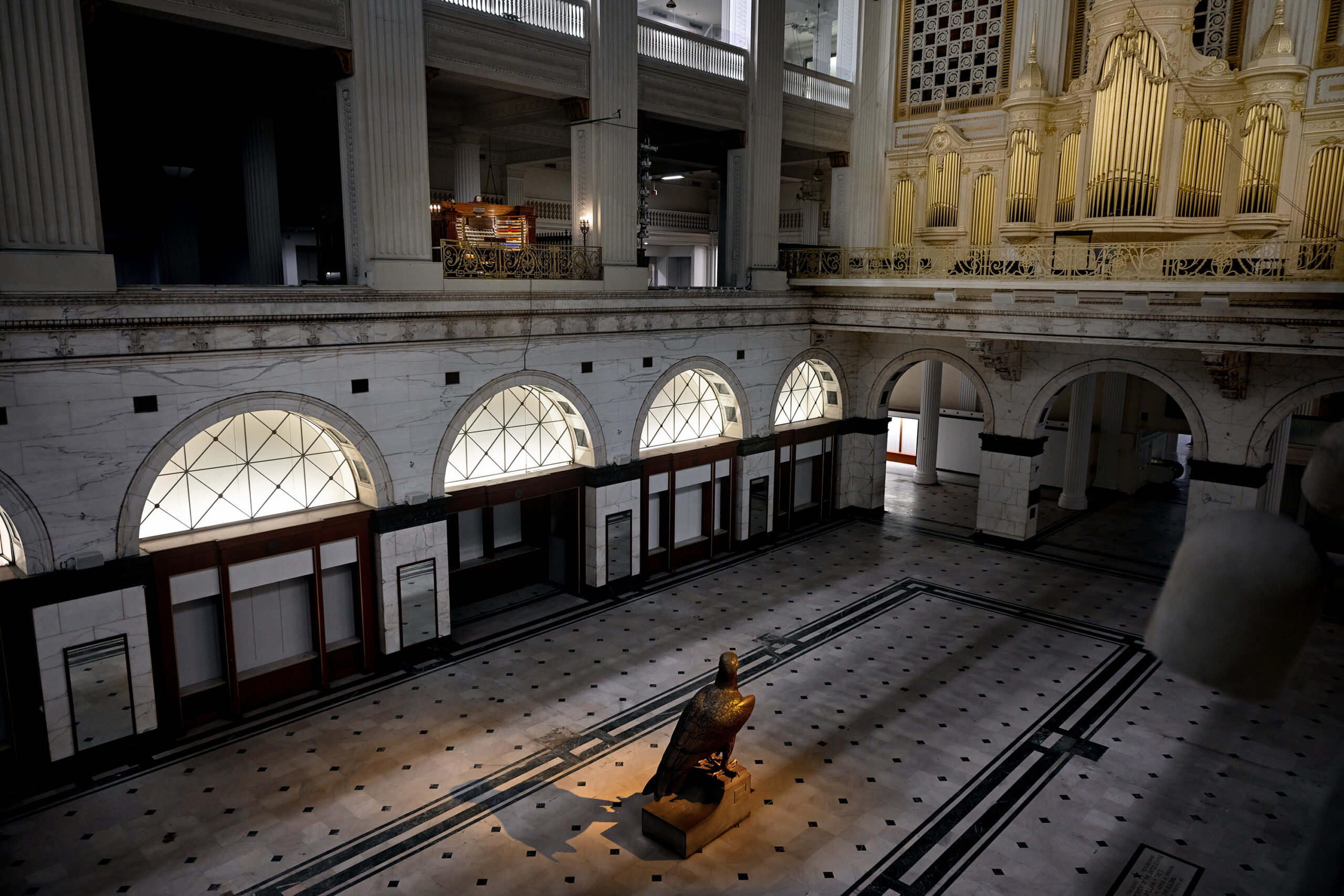
And they said their connection to the community around the Roosevelt Mall has only grown stronger since last year’s plane crash, which killed eight people, injured two dozen, damaged nearby homes, and left an 8-foot-deep crater in front of the mall.
Even before the tragedy, they said, they considered how their local redevelopments affected the Philly-area residents who shop, eat, and drive by their centers every day.
At the Roosevelt Mall — which sits on 36 acres between Cottman Avenue, Roosevelt Boulevard, and Bustleton Avenue — these decisions have begun to pay off.
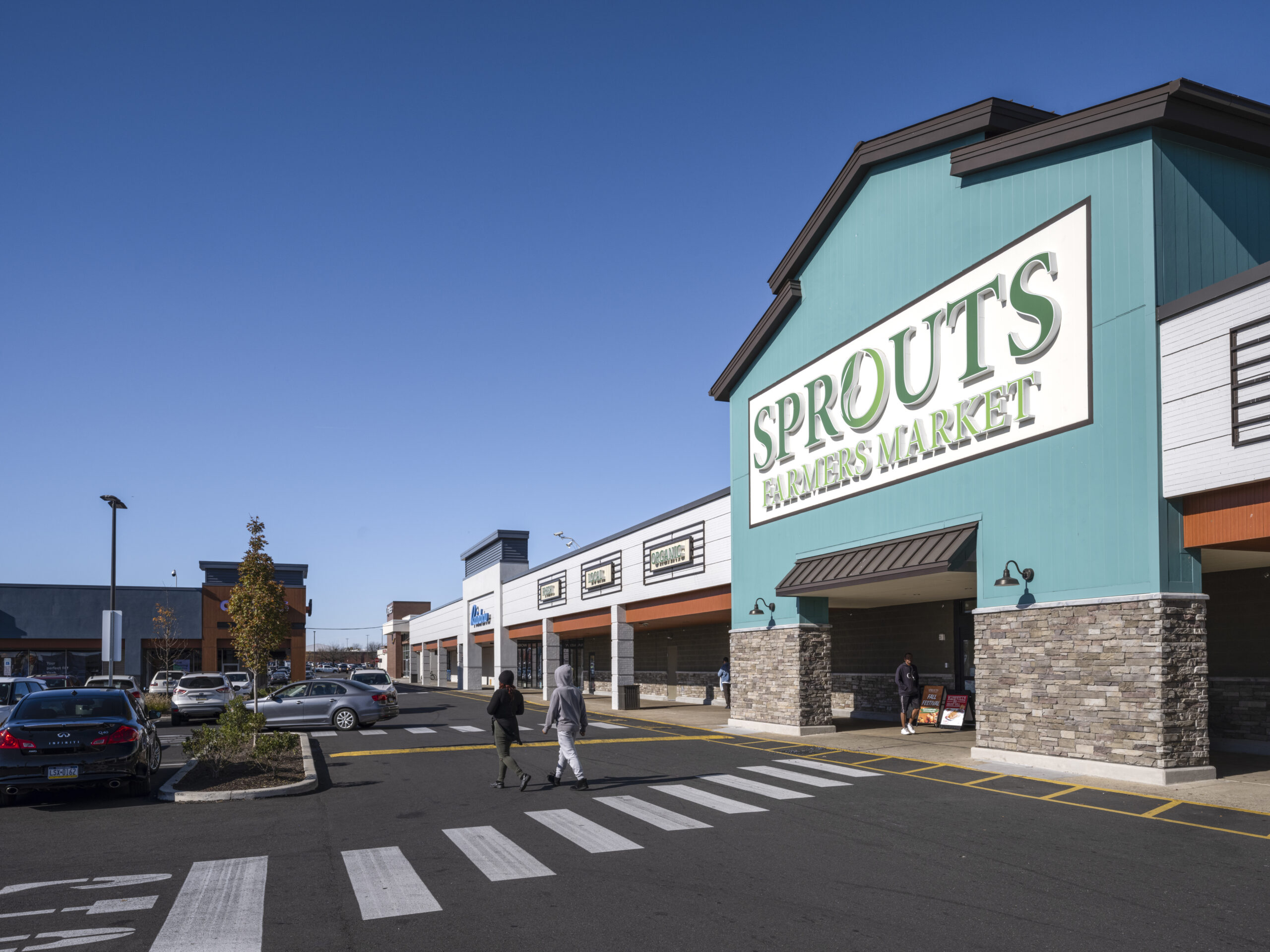
In the last year, the center logged 6.3 million visits, a 5% year-over-year increase and a 19% jump when compared with the 12 months before Sprouts Farmers Market’s 2024 opening, according to company executives.
Occupancy was over 98% this spring, they said, and customers spend about 35 minutes there on average, on par with the national average for all Brixmor complexes.
When you’re able to bring together “higher-quality food and beverage, fitness, service … then you’re also able to attract more elevated retail” stores, said Finnegan, noting that Ulta Beauty and Victoria’s Secret are among the tenants signed on for the next phase of the Roosevelt Mall’s redevelopment.
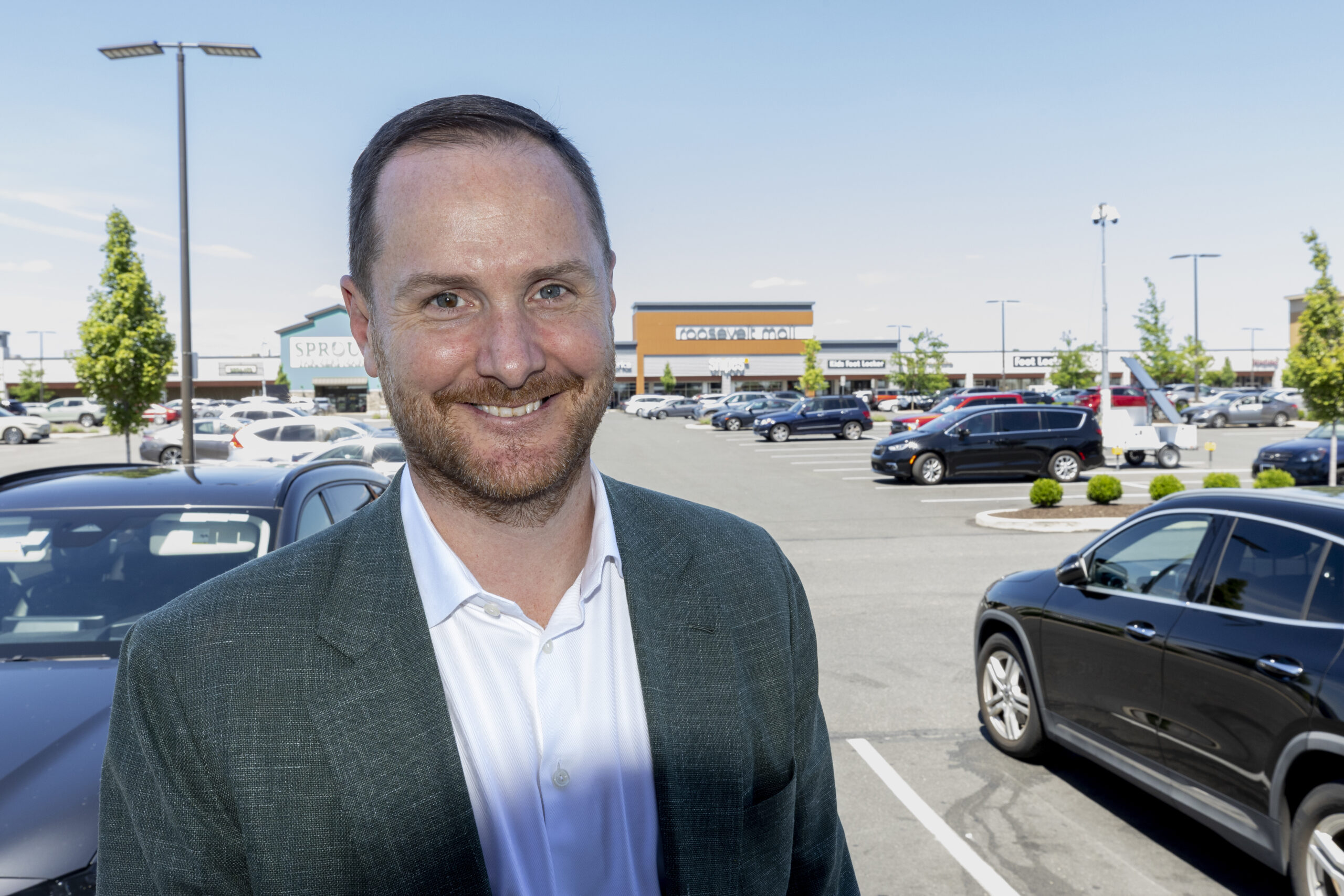
Brian Finnegan, CEO and president, at Brixmor Property Group, at the Roosevelt Mall in Northeast Philadelphia.
Achieving the tenant mix of a modern shopping center
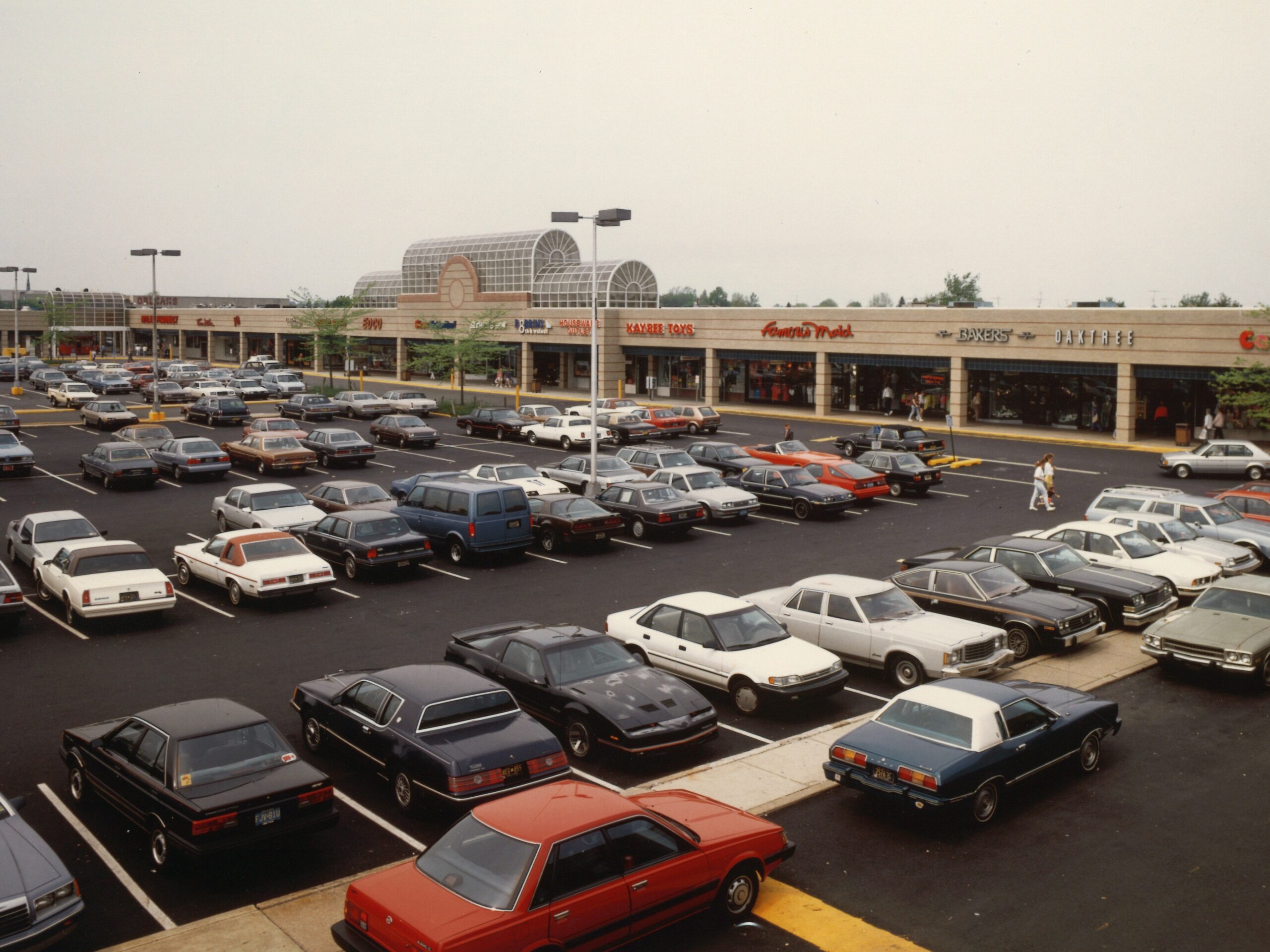
When the Roosevelt Mall opened in 1964, its main promenade was referred to as “Chestnut Street Northeast,” with several outposts of Center City clothing stores, according to an Inquirer article from the time.
The shopping center had apparel shops, such as Baker Shoes and Famous Maid, as well as “the Cavalier, a cafeteria-style restaurant with a game room and a retail bakery,” The Inquirer reported. It was anchored by an S. Klein’s discount department store.
The Roosevelt Mall was built as part of the Roosevelt Boulevard shopping complex, bordered by Cottman and Castor Avenues. The larger development — which also had Gimbels and Lit Bros. department stores — was called the country’s largest “in-town” shopping center at the time.
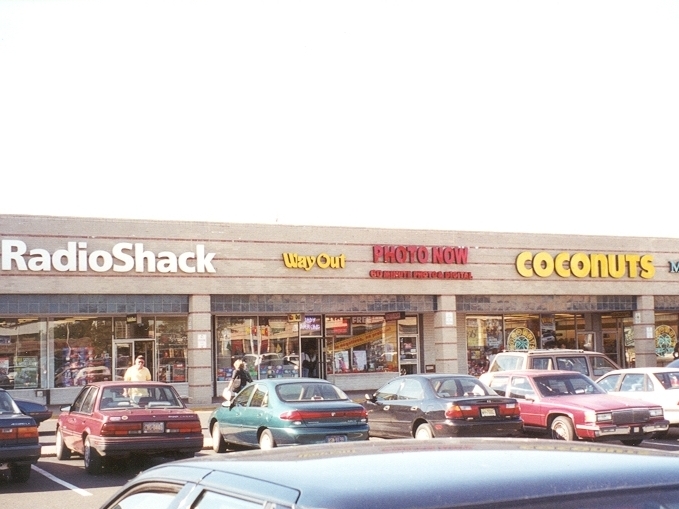
Roosevelt Mall in Northeast Philadelphia is shown in earlier days, long before Brixmor Property Group remodeled the property.
They said they have intentionally brought in tenants that customers may visit multiple times a week and added more pedestrian walkways, open-air plazas, and outdoor seating.
“Historically, shopping centers were very utilitarian, and now they’re really becoming more community assets, so we’re really careful about our merchandising mix,” said Ryan Guheen, Brixmor’s senior vice president of development.
Roosevelt Mall in Northeast Philadelphia is shown in earlier days, long before Brixmor Property Group remodeled the property.
The latest redevelopment push began around 2020, when Brixmor opened an LA Fitness outpost on the site of a former Turf Club off-track betting venue, near a new Oak Street Health clinic.
Since then, the company has constructed buildings in underused sections of the parking lot and filled them with popular chain eateries like Raising Cane’s chicken; the American-Chinese food spot Panda Express; and Tous les Jours, a Korean-French bakery and coffee shop.
Annual customer visits to Roosvelt Mall have increased 13% since Sprouts organic grocer opened there in 2024.
The 37,000-square-foot under-construction building, set to house a Victoria’s Secret and an Ulta, will also include fast-casual staples like Shake Shack and Cava, which serves Mediterranean bowls and pitas.
Tenants like these, Guheen said, provide “multiple opportunities for people to stay on property to shop retail, get their workout in, go to the bakery, get a coffee.”
Some mall retailers have found homes in shopping centers
As Brixmor executives diversify the tenant mix at their shopping centers, they say they do not see retail stores going extinct.
Elsewhere in the Northeast, the Franklin Mall, formerly Franklin Mills, has been in decline for years and was recently listed for sale. Real estate investor Dean Adler has said he wants to buy the 137-acre mall and turn it into a youth sports complex with a hotel and Margaritaville-themed water park.
Seven miles away, the Roosevelt Mall is home to several shops that were once found almost exclusively in enclosed malls, such as Bath & Body Works, Foot Locker, and the forthcoming Victoria’s Secret. These companies’ higher-ups have pivoted in recent years, adding more locations in open-air centers.
“It’s not like retailers are leaving malls en masse … at least in the best malls,” Finnegan said. But “as they open stores in open-air shopping centers with grocery stores, with fitness uses, with elevated food and beverage, they’re seeing the sales performance” — and then want to keep investing in shopping centers.
Longer-standing retail tenants are continuing to see success, too. Finnegan said the Roosevelt Mall’s 300,000-square-foot standalone Macy’s is among the company’s top-performing locations in the region, rivaling the King of Prussia Mall store.
The department store is the center’s largest driver of traffic, recording more than 900,000 annual visits, said Brixmor executives, who are not worried about the department store closing as the Center City store did last year.
As seen in September, the Macy’s in the Wanamaker Building in Center City now sits empty. It closed last year.
Company executives said they are optimistic this momentum will continue. Along with the under-construction section, redevelopment plans also include another standalone building that has yet to break ground — and the cost of which is not included in the current price tag.
Finnegan put it simply: “Opportunity begets opportunity.”
To make its best first impression on the droves of visitors expected this summer in Philadelphia, the city has launched an anti-graffiti cleanup campaign. But those cleanup areas do not match up with where Philadelphia residents actually ask for it the most.
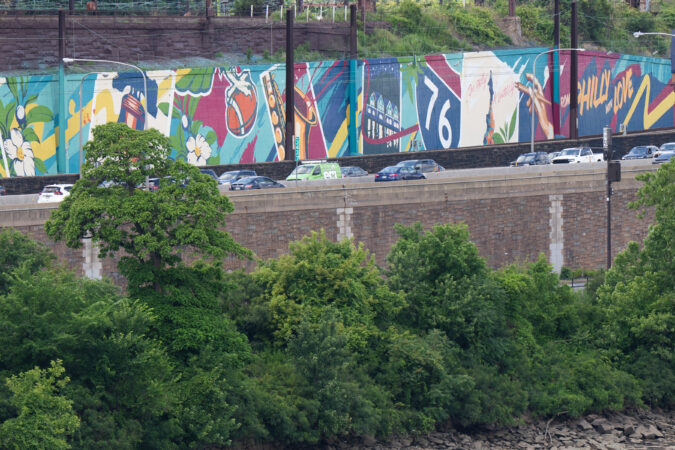
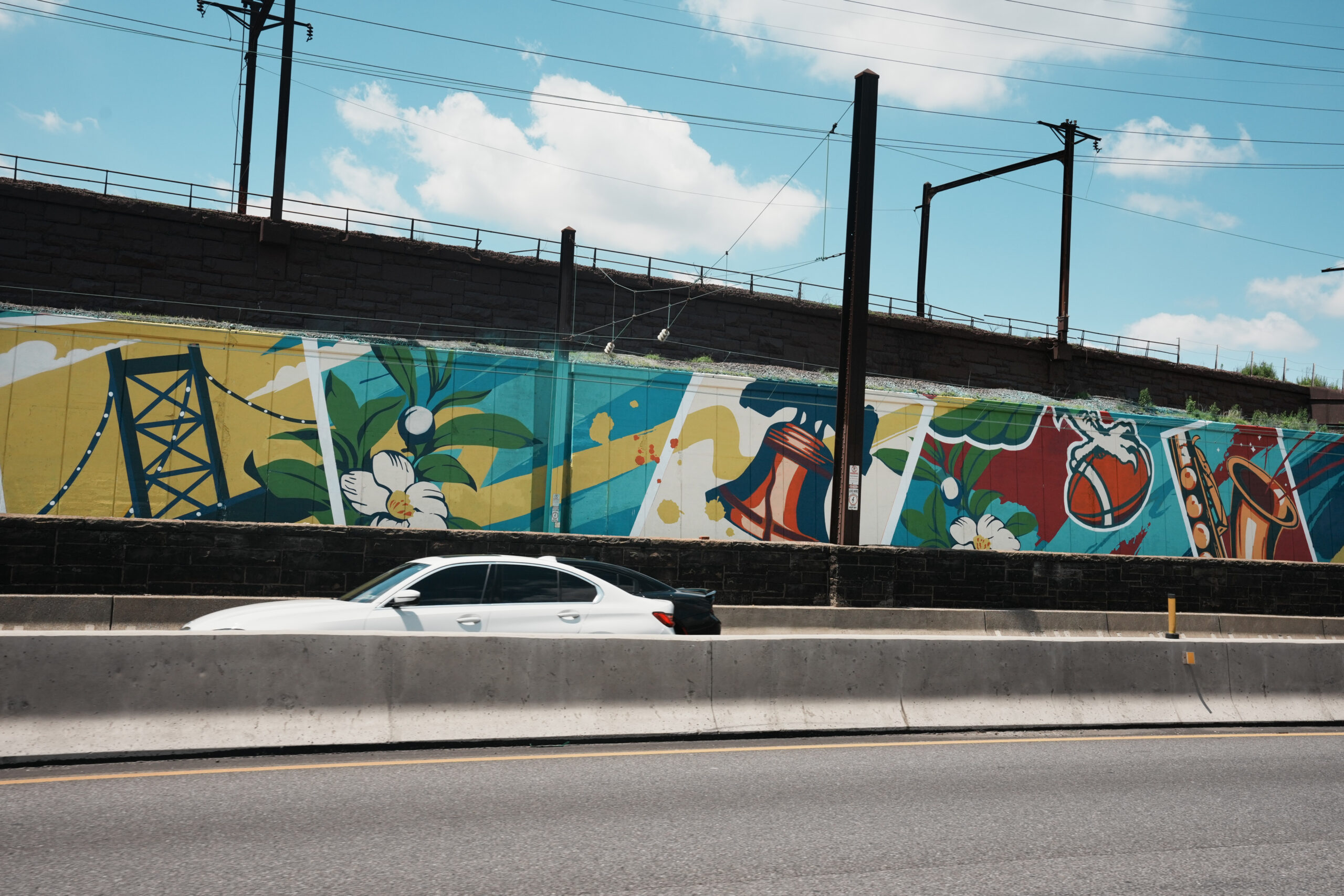
In the fall, the city began an $11.5 million beautification project ahead of this summer’s series of major events — the World Cup, the nation’s 250th celebration, and theMLB All-Star Game— that included new landscaping and graffiti cleanup. The Gateways to Philadelphia project focused on seven major transit areas that could be a visitor’s first glimpse of the city, where new murals and fresh flowers replace sparse medians and graffiti.
Those gateways were:
26th Street Gateway at Penrose Avenue.
South Street Bridge, walls, medians, and ramps.
30th Street Station walls, medians, and ramps.
I-676 interchange at 15th and 16th Streets and Vine Street.
I-676 interchange at Sixth and Eighth Streets and Callowhill/Vine Streets.
I-76 and I-95 interchange at Second and Third Streets and Callowhill/Vine Streets.
CSX/Amtrak wall at Spring Garden Street.
Meanwhile, the hot spots for graffiti cleanup requests through 311 last year were most densely clustered in West Philly, South Philly, and Northern Liberties. Despite three gateway locations being a short distance from high-density areas, they are on the opposite side of the Schuylkill from the hot spots.
In 2025, residents submitted 10,141 requests for graffiti removal, and nearly all of them have since been marked closed. There was a seasonal spike in the spring, with residents filing over 1,100 requests each in March and April.
(function() {
var l2 = function() {
new pym.Parent(‘iframe_test’,
‘https://media.inquirer.com/world_cup_graffiti/iframe_graffiti_wc_map.html’);
};
if (typeof(pym) === ‘undefined’) {
var h = document.getElementsByTagName(‘head’)[0],
s = document.createElement(‘script’);
s.type = ‘text/javascript’;
s.src = ‘https://pym.nprapps.org/pym.v1.min.js’;
s.onload = l2;
h.appendChild(s);
} else {
l2();
}
})();
Sara Lorenz, 45, lives in one of the corridors with a high amount of graffiti cleanup requests, along Baltimore Avenue in West Philly. She said graffiti typically gets cleaned up fairly quickly in the area, particularly near businesses, but sometimes it lingers and becomes an eyesore. Lorenz makes a distinction between artful graffiti and careless markings, and said it would do some good if the city had an initiative targeting the latter on blocks like hers.
Lorenz said she understands the city’s desire to make its best appeal to tourists this summer, but it would be nice if the beautification efforts went toward the typical Philadelphian, too.
“As residents, we also deserve respect,” she said.
The city has painted a new, wide postcard style mural to cover graffiti.
Efficient response time
It could be that some Philly residents also wantgraffiti removed from the city’s chosen gateways, and that people are less likely to contact 311 for what they witness while driving on major roadways. Some other residents living near Lorenz said they had not noticed graffiti much around them and were not bothered about the city’s beautification plans.
The city is clear that the gateways project was prompted by visitors, but there are plans for at least some of it to continue after the guests leave. The beautification project is expected to be completed sometime this summer, and a maintenance plan has been put in place for the new installations, according to Keisha McCarty, a spokesperson for the Philadelphia Office of Clean and Green Initiatives.
“If you want the city to look clean, you want to do it where it’s most visible,” said Fikru Bekele, 75, the owner of multiple properties along Baltimore Avenue, who said he understands the city’s focus on visitors. He said he has gotten used to residents not receiving as much attention as higher-profile projects do.
“It’s not the right thing but it’s the way it is. … Neighborhoods need to be taken care of, too,” he said.
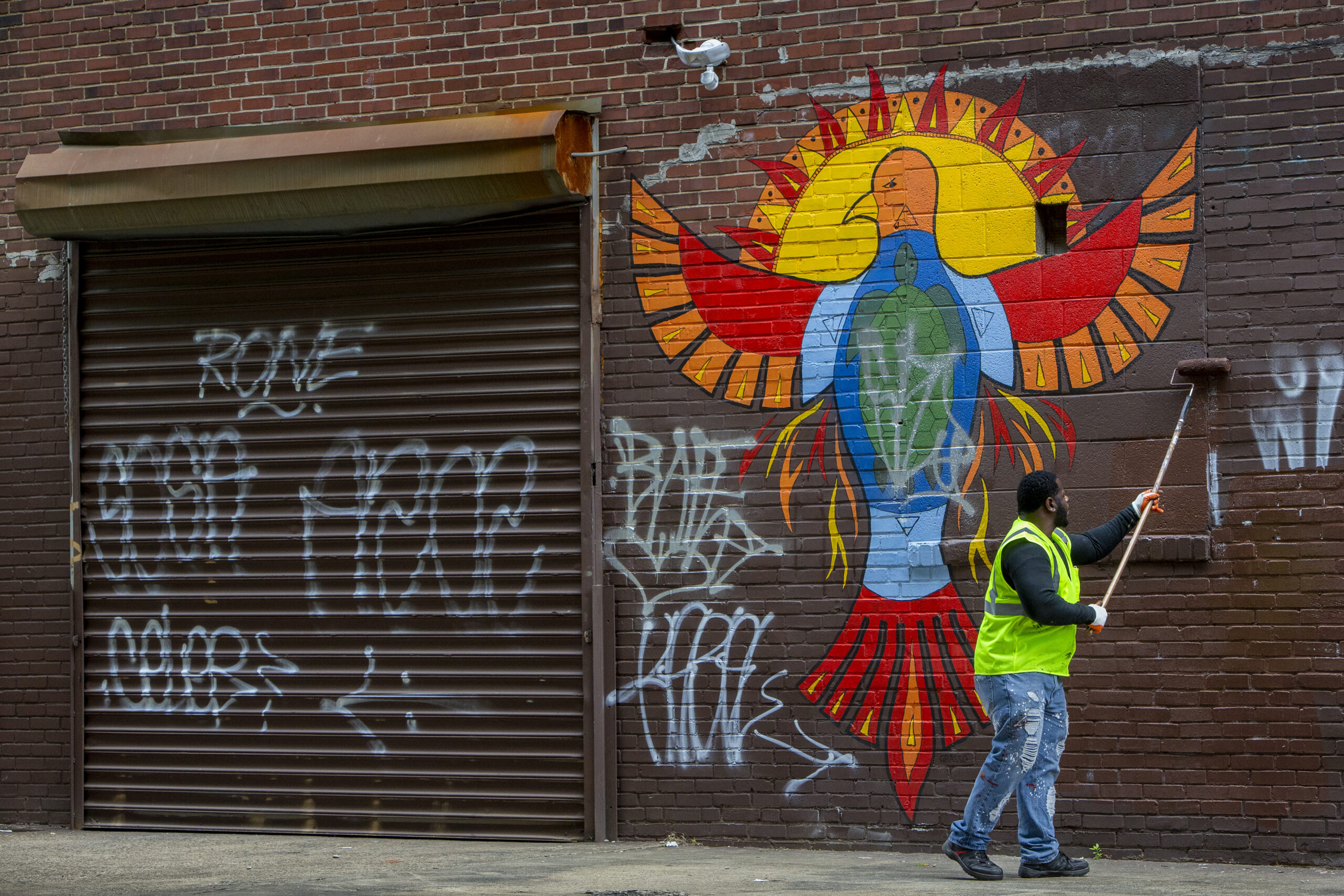
William Scott with the CLIP, Community Life Improvement Program, removes graffiti from wall around a colorful bird along North 9th Street near Jefferson on Tuesday, April 20, 2021.
However, graffiti removal in Philadelphia neighborhoods might not need additional focus, because the city’s existing program appears to be working efficiently. Graffiti removal requests submitted to 311 are passed along to the Philadelphia Community Life Improvement Program, known as CLIP. It took 311 and CLIP crews eight days on average to close graffiti removal requests last year, with five days as the median closure time.
If there is a 311 submission in South Philly, there is a decent chance it’s coming from Joe Eastman. The retired Navy veteran is a 311 neighborhood liaison, part of a city program that trains certain residents how to report issues more effectively. Eastman, 75, goes on walks and reports what he sees in the neighborhood, and often finds himself alerting 311 to the same spots, like a stop sign near Broad Street and Snyder Avenue.
“I’m sure if I go back in two weeks it’ll have graffiti again,” he said.
Eastman is pleased with 311 and CLIP’s responsiveness, and said he has no problem with the anti-graffiti focus on visitors if CLIP continues at its current pace.
“I get what they’re doing. And as long as they are being as responsive as they have been, I think we can all get along with this,” he said.
Given the atmosphere’s impatience, it would be understandable if some folks believe that the summer of 2026 began weeks ago.
But officially, the astronomical summer does not start until 4:24 a.m. Sunday, the instant of the solstice, when the sun beams its most direct light on the Tropic of Cancer. (That’s the one that bisects Mexico.)
Perhaps the pleasant temperatures this weekend are an overdue solstice gift to the region.
Officially, on 14 days this year, the temperature has reached at least 90 degrees at Philadelphia International Airport. While not a record — this happened 21 times before the 1991 summer solstice — that is a total more appropriate to midsummer. The annual average is about 30, and usually this kind of heat doesn’t get a jump start in mid-April.
Is it going to get hot again?
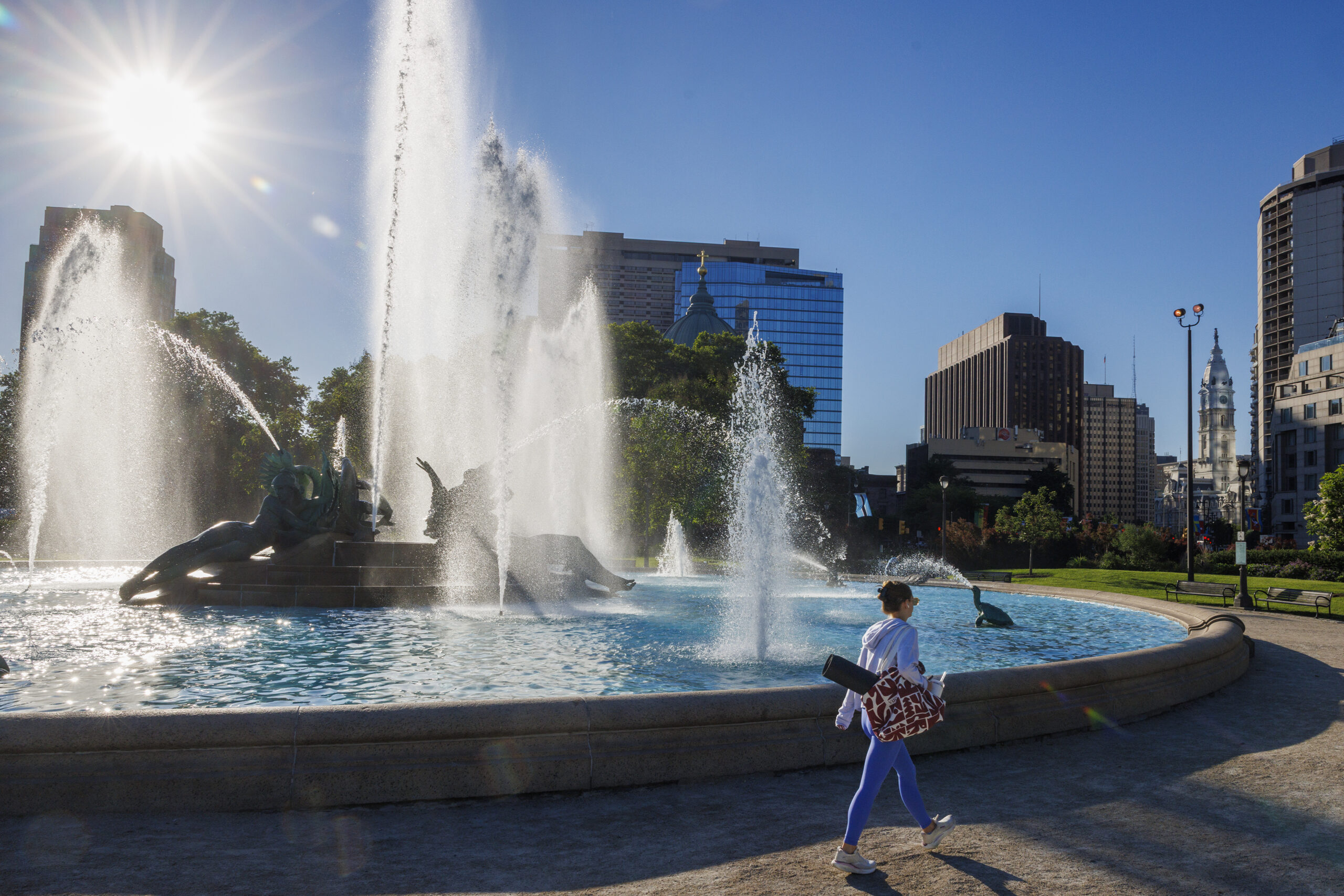
A woman walks past Swann Memorial Fountain as the sun rises last month.
Are polar bears white?
At least three veteran seasonal forecasters have commented that they expect the burgeoning El Niño event to work against punitive hot spells in the region.
During El Niño, sea-surface temperatures remain above normal in the tropical Pacific for several months, agitating the overlying air and affecting weather across the globe. This one may be among the strongest and is forecast to mature during the summer, earlier than usual.
During six early-developing strong El Niños, summer temperatures in Philadelphia were near or below average.
However, the scientists at the government’s Climate Prediction Center evidently are not buying it. In both the July and the July 1-through Aug. 31 outlooks posted Thursday, they saw the odds favoring above-normal temperatures.
On average Philly has a combined 20 days of 90-degree highs in July, when the Earth is the farthest it gets from the sun, and August. (Along with a September bonus of two more.)
How come it’s warmer, if we’re farther from the sun?
On average the Earth is about 93 million miles from the sun, but since its orbit is an imperfect circle the distance varies by roughly 3 million miles.
At 1 p.m. on July 6 our planet will be 94.5 million miles from the sun, by EarthSky’s calculation, its farthest distance of the year. It makes its annual closest approach in January, which is why winter in the Northern Hemisphere is the shortest season; the gravitational bump speeds up the trip, and February gets shortened.
The seasonal weather rhythms are about the Earth’s axial tilt, not distance from the sun, and the planet takes its time responding to the changes in solar energy. Just as January is colder than December on average, July is more than 5 degrees warmer in Philly than June on average. Just how warm it gets the rest of this summer may have a lot to do with how much drier it gets.
Will the drought conditions ever end?
They always have, but this has been quite an extraordinary run, even if the plant life has managed to avoid major distress.
The entire region, save for extreme northeastern Bucks County, is in a state of “severe drought,” according to the U.S. Drought Monitor, with Cape May County in “extreme drought.”
The promised rain to start the workweek should help, but Philadelphia has experienced 10 consecutive months of below-normal precipitation, a rarity in an area in such proximity to bodies of water that are sources of rainfall. All of New Jersey and Chester County remain under drought emergencies.
Dryness can promote heating, since the sun does not have to divert energy evaporating water.
However, unusual coolness also can accompany dryness, said Sarah Johnson, warning coordination meteorologist at the National Weather Service office in Mount Holly. Having lived in North Dakota for 20 years, she knows her dry air.
A lack of moisture can be a boon for cooler nights. Water vapor in the air inhibits nighttime cooling by blocking heat from escaping into the atmosphere.
It also happens that less vapor in the air is ideal for sky-watching, and that could come in handy in August.
This could be a big year for the Perseids
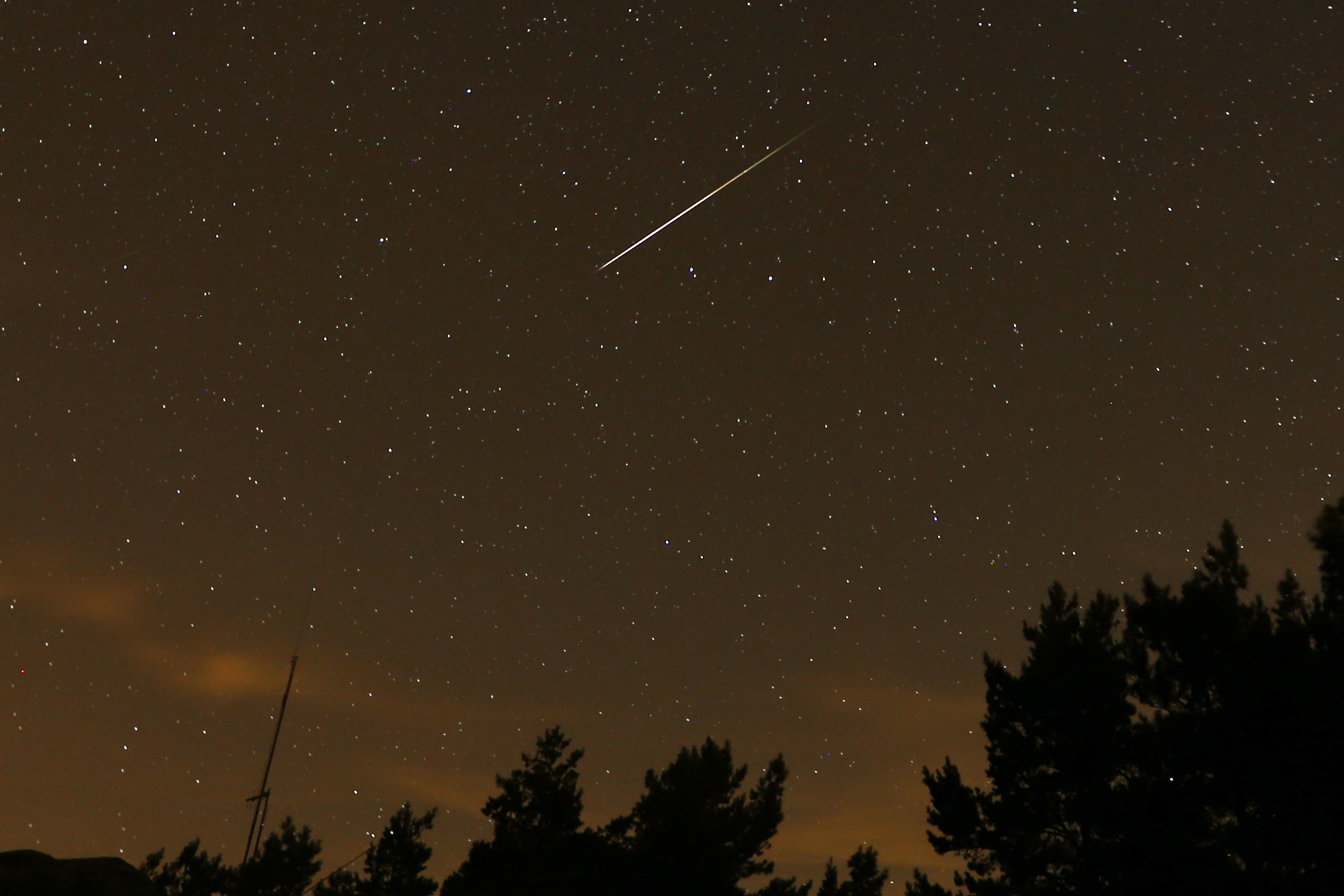
In this long exposure photo, a Perseid meteor streaks above Madrid.
Last year, you may recall that the moon showed its big face during the peak of the annual Perseid meteor showers, the most popular of the year.
This time around, the moon is getting out of the way, and will be in its “new” phase during the peak early mornings of Aug. 12 and 13.
While the Geminids, which occur in December, are considered the most prolific showers of the year, according to the American Meteor Society, they are not as popular as the Perseids: People tend to prefer August nights to December’s.
The Perseids are so named because the cometic detritus that is ignited by the atmosphere appears to radiate from the constellation Perseus. In the early-morning hours, that typically is low in the northern sky.
Under ideal conditions — ultra-dark, light-pollution free skies — as many as 90 meteors an hour might be visible, EarthSky says.
But the moon will be the star in late August
Billy Penn waves at the moon during a lunar eclipse.
Two weeks after the Perseid peak, Philadelphia and most of the rest of the Western Hemisphere will be treated to a lunar eclipse in which just about all of the moon will be in shadow.
The show begins at 9:24 p.m. Aug. 28, and more than 90% of the moon will be obscured by Earth’s shadow three hours later. It willbe all over around 4 a.m.
Chances are excellent that the region will still be needing rain, but may it choose another night.