A 35-year-old man was fatally shot while trying to drive away from an altercation with another man Wednesday night in the Castor section of Northeast Philadelphia, police said.
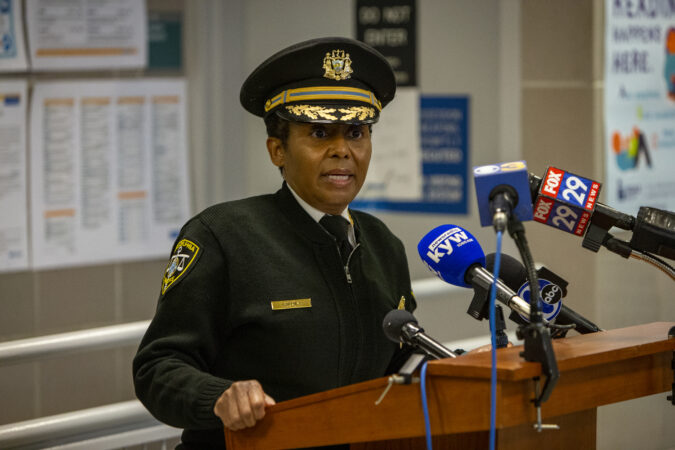
Just after 7:10 p.m., police were called to the area of Summerdale and Magee Avenues and found the victim lying on the ground next to an SUV with the engine still running, said Chief Inspector Scott Small.
The man, who had at least one gunshot wound to his back, was transported to Jefferson Torresdale Hospital, where he was pronounced dead at 7:47 p.m., Small said.
The SUV was parked outside a neighborhood store, and the victim and another man were inside the store when an argument occurred, Small said.
The victim got into the driver’s seat of the SUV and the other man started shooting through the front passenger-side door, Small said.
The shooter then ran from the scene.
Police were told that both men were regular customers at the store, Small said.
The victim was found lying next the front driver-side door with a handgun on the ground next to him.
Police believe the gun belonged to the victim, Small said.
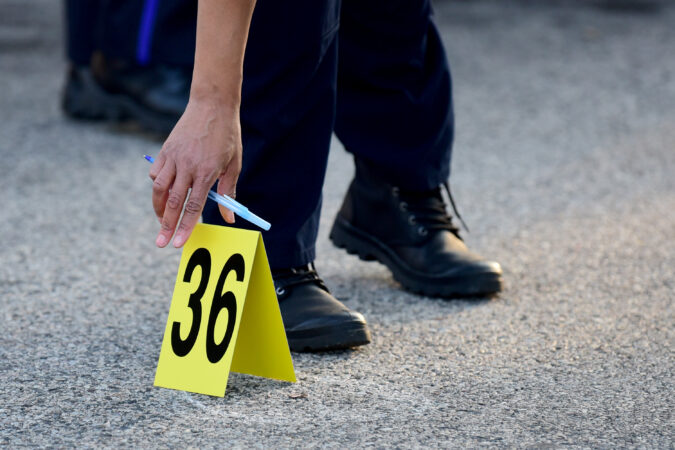
Police recovered three spent shell casings next to the passenger door as well as three live rounds.
A former Bucks County man who claimed he was covered by pardons given by President Donald Trump to supporters who tried to overturn the 2020 election was found guilty Wednesday by a federal jury in Philadelphia of voting twice for Trump in 2020.
Matthew Laiss, 32, was charged by indictment in September of one count of voting more than once in a federal election and one count of voter fraud. He is scheduled to be sentenced on June 10 and faces a maximum of five years in prison on both counts.
Laiss, who prosecutors said is currently a resident of Bethehem, Pa., had been a resident of — and was registered to vote in — Ottsville, Bucks County, from at least 2012 to around August 2020, prosecutors said. Laiss then moved to Frostproof, Fla., where he obtained a driver’s license and registered to vote there.
Around Oct. 31, 2020, Laiss filled out and returned a mail-in Pennsylvania ballot, then on Nov. 3, 2020, Laiss went to a polling place in Florida and voted again.
“Casting a ballot in more than one jurisdiction undermines public trust and dilutes the votes of others. Our office will continue to protect the integrity of federal elections and hold accountable those who violate the law,” Metcalf said.
The case was investigated by the FBI, with assistance from the Pennsylvania Department of State, and is being prosecuted by Assistant U.S. Attorney Mark Dubnoff.
Federal defenders who represented Laiss could not be reached for comment Wednesday night.
Laiss was not among the 77 people Trump listed when specifying who would receive relief, but Laiss’ lawyers said the proclamation’s preamble included language making it applicable to “all United States citizens” for conduct, voting, or advocacy surrounding the contest.
His lawyers wrote that Trump allies including Rudy Giuliani, Sidney Powell, and Mark Meadows were all explicitly pardoned for “exponentially more egregious alleged conduct.” Extending relief to them while denying it to Laiss, his lawyers wrote, “would be outrageous.”
Prosecutors said they checked with Trump’s Office of the Pardon Attorney and were told that the lawyers there did not believe the pardon proclamation applied to Laiss.
In January, Leeson ruled against Laiss’ motion to dismiss the indictment, explaining that the court was without jurisdiction to decide the matter because Laiss had not applied to the Office of the Pardon Attorney, or had received a certificate of pardon.
SEPTA expects to receive about $5.5 million from a federal appropriation to offset the cost of providing transit service in Philadelphia during the FIFA World Cup.
The regional transportation authority projects it will spend $21.5 million for additional transit runs and extended service hours during the World Cup as well as a the celebration of the nation’s 250th birthday, officials said.
On Tuesday, the U.S. Department of Transportation announced about $100 million in funding to 11 cities and regions hosting FIFA championship matches, apportioned by formula.
“We are going to pull out all the stops to serve those big events — while also not missing a beat for our riders who rely on SEPTA every day,“ General Manager Scott Sauer said in a statement. He thanked the region’s congressional delegation and U.S. DOT for the ”much-needed investment to support this historic year.“
SEPTA said it would spend $18 million for overtime for transit operators and Transit Police, cleaning expenses, longer customer service hours and ambassadors to help people navigate the system.
Other extra operating costs for the events:
$1 million on safety and security, for portable surveillance equipment and a communications system to send police where they’re needed most.
$825,000 for signage, including World Cup branded signage, website and app upgrades to help visitors get around, as well as translation services.
Another $1.3 million will be spent on support services, SEPTA said.
Congress earmarked the money to help World Cup host cities and regions in this year’s federal budget, but improvements are required to benefit the general public, not just soccer fans.
“With the world coming to Philadelphia in 2026, we have a responsibility to be ready,” U.S. Rep. Brendan Boyle (D., Pa) said.
The federal largesse will “strengthen our transit system so it can handle the surge in ridership during the World Cup,” Boyle said. “Just as importantly, these improvements will benefit Philadelphians long after the tournament.”
In addition to the extra spending on operations, SEPTA said it is investing about $30 million for infrastructure upgrades in advance of 2026 events, including improvements at Broad Street Line and Market-Frankford Line rail stations expected to be primary hubs for event goers.
The projects include:
Roof replacement and platform resurfacing at NRG Station on the Broad Street Line, which serves Lincoln Financial Field and Citizens Bank Ballpark, where the Major League All-Star game will be held this summer.
Upgrades to the Second Street Station headhouse on the Market-Frankford Line.
Fern Rock Transportation Center lighting and painting.
Realignment of the fare line at City Hall Station on the BSL, as well as platform resurfacing and new LED lighting.
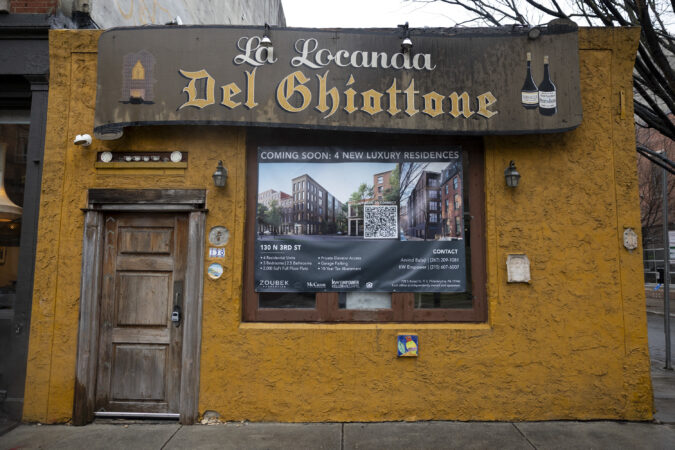
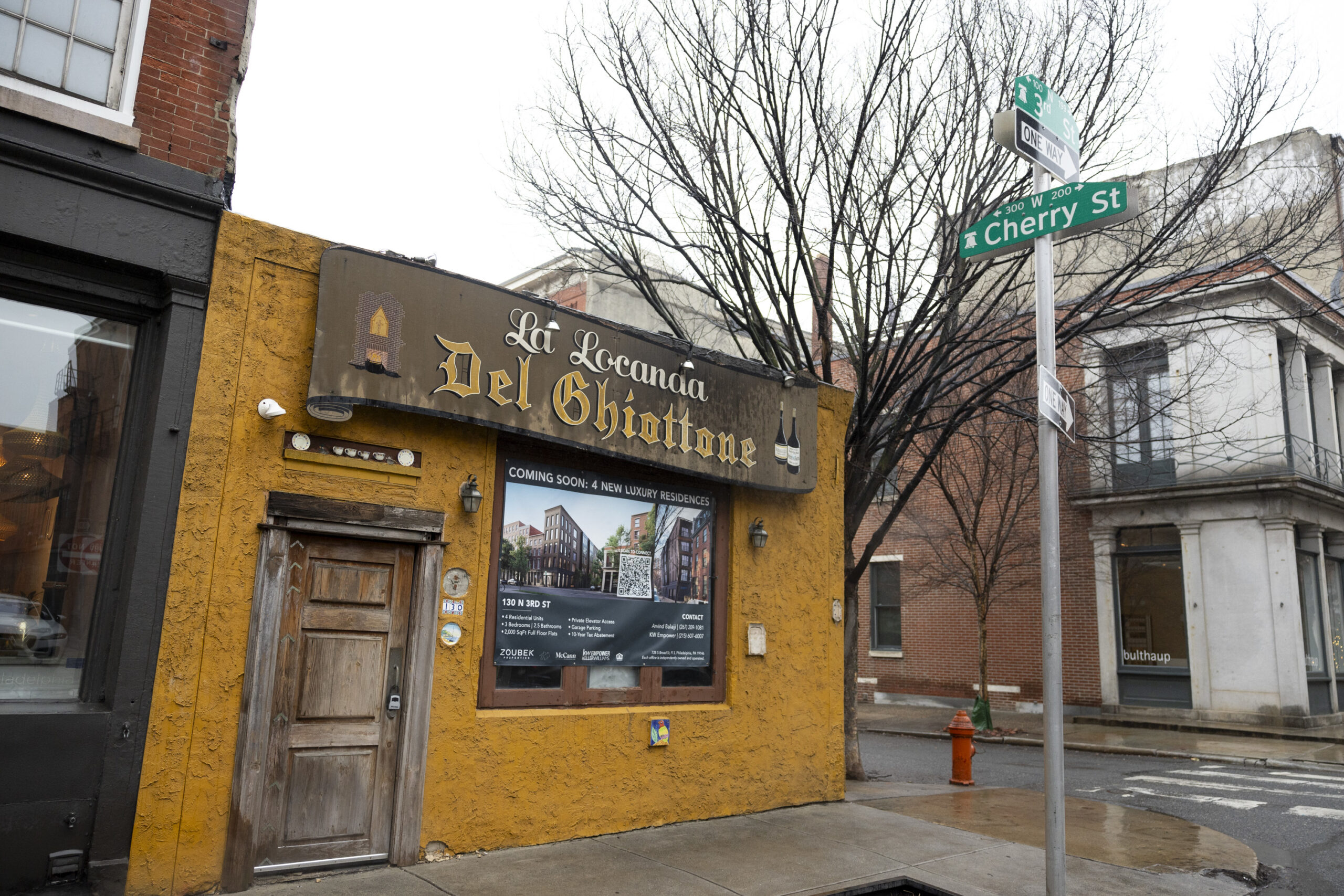
The quaint mustard yellow former home of La Locanda Del Ghiottone, a former Italian restaurant in Old City, is slated for demolition, according to city records.
Brian Zoubek, the developer behind the hotel down the block, Sosuite at the Loxley, plans to turn the lot into luxury condos.
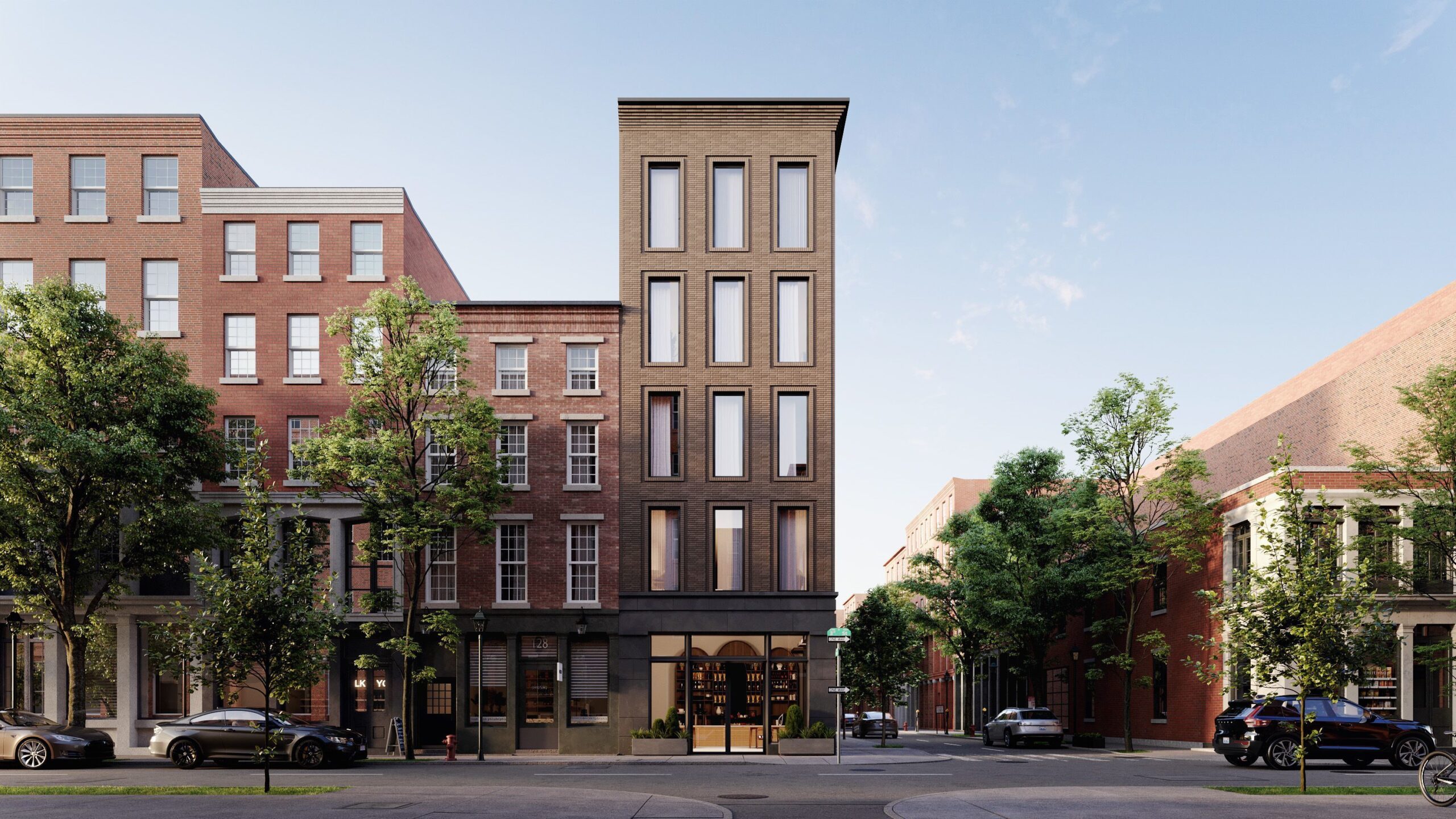
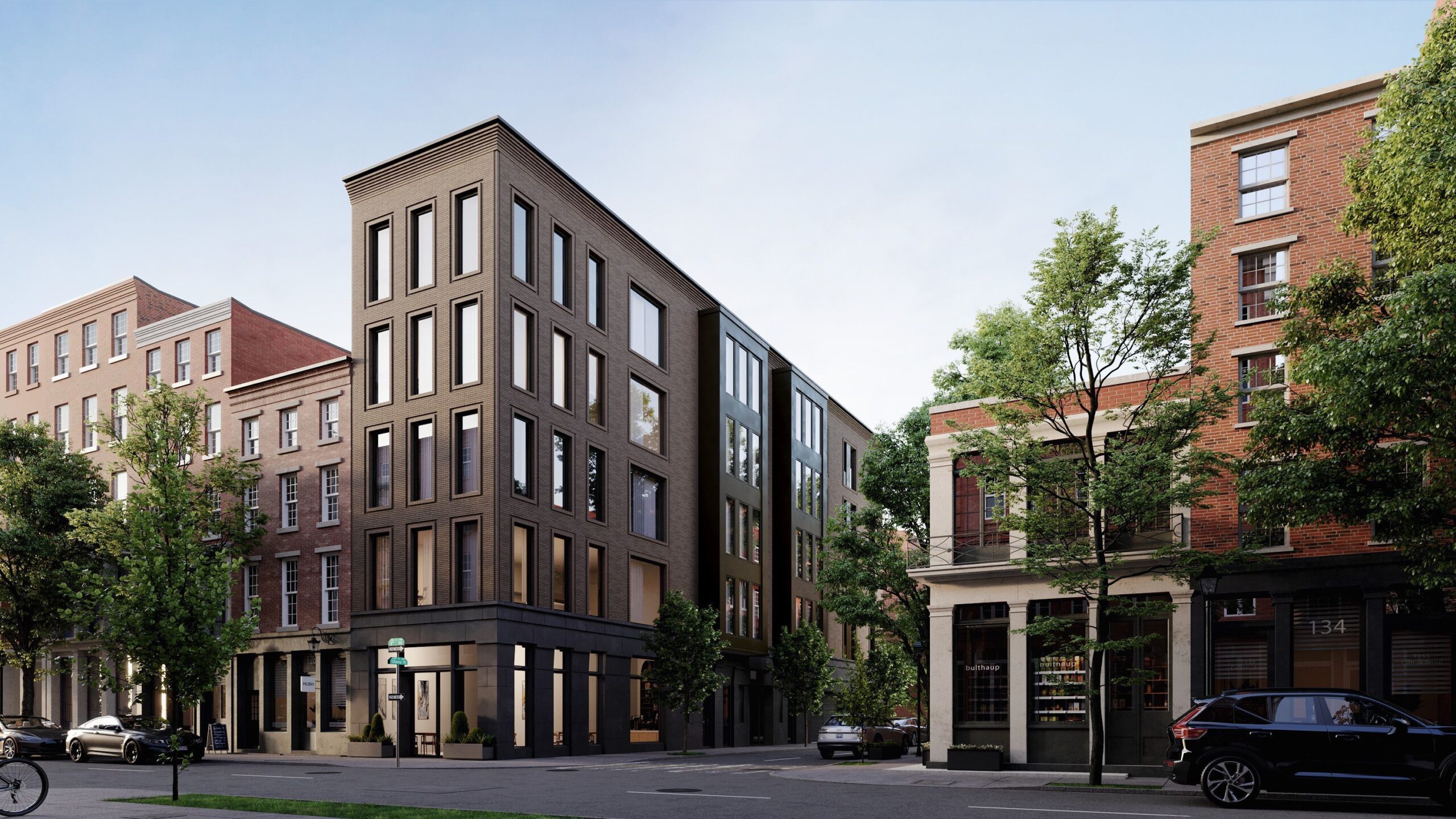
The property will take on a new character, Zoubek said. Gone will be the vibrant, squat structure decorated in colorful plates. In its place will stand a sleek, narrow five-story mixed-use building. The bottom floor will be retail and the four floors above will each feature one condo. Prices will range from around $1.6 million to about $1.95 million per unit, he said.
A rendering of a new five-story building coming to the corner of Third and Cherry Streets in Old City.
Zoubek said he’s expecting demolition to start this month and construction to take about 12 to 14 months. He’s hoping the condos will open next summer. He purchased the building in 2022, according to city property records.
To align the new building with the historic aesthetic of that block, he said the building will be covered in brick with a stone facade on the first floor.
A rendering of a new five-story building coming to the corner of Third and Cherry Streets in Old City.
Residential use is a change for the property anchoring the southwest corner of Third and Cherry Streets. It hit the market in 2020 when La Locanda Del Ghiottone relocated to Port Richmond.
The restaurant’s history at the property dates back to 1989, when Giuseppe Rosselli, an immigrant from northern Italy, took over the building at 130 N. Third St.
Rosselli, a character who used to post screeds outside the restaurant, originally named the 35-seater Trattoria Dell’Artista. In 1992, Rosselli opened L’Osteria dell’Artista down the block at 114 N. Third St., and a year later, renamed his original restaurant Ristorante der Ghiottone (”the glutton”). He later tweaked the name to La Locanda Del Ghiottone. Rosselli died at age 51 in 2000.
Ghiottone was a favorite of Inquirer critic Jim Quinn, who raved about the “rough and ready cuisine moded on the bargain-price restaurants of Italy. Portions are huge, prices extremely low, and all food is rushed directly from the stove to you.”
La Locanda Del Ghiottone’s building, seen on March 3, 2026, will be demolished and replaced with luxury condos.
Reporter Michael Klein contributed to this article.
A convenience store worker shot during a September armed robbery has sued a “skill games” manufacturer, alleging the casino-style devices on the premises motivated the attack.
Ahmedine Maham, 27, was working the night shift at Philly Market in Frankford on Sept. 14, the suit says, when two armed men entered the store and shot Maham in the face, according to the complaint, which was filed Monday in the Philadelphia Court of Common Pleas.
“The robbers targeted the store because the high amount of cash required to be on hand for gambling machine payouts,” the lawsuit says.
Banilla Gaming, a North Carolina-based skills game manufacturer, is aware of the dangers associated with its “gambling devices,” the suit says.
The complaint also names Philly Market and associated businesses as defendants.
Banilla did not respond to a request for comment. The Inquirer was unable to reach Philly Market’s owners based on publicly available records.
The slot-like devices, commonly placed in bars and gas station convenience stores, have evaded Pennsylvania’s gambling regulations and exist in a gray area of the law. Manufacturers argue the games are based onskill, and are distinct from slot machines that are only legal within the walls of casinos.
Because they do not fall under gaming laws they are untaxed and unregulated. But their status has been subject to debates in Harrisburg for years.
Skill games regulations were on the table during last year’s prolonged budget negotiations but lawmakers again punted on the issue, despite bipartisan agreement that they are needed. Gov. Josh Shapiro called the matter “unfinished business,” leaving the door open for future action.
Law enforcement officials have raised concerns over skill games for years, and earlier this month the Pennsylvania District Attorneys Association sent a letter to Shapiro asking for the devices to be taxed and regulated in a way that would “ensure consumer protection, require security measures, and prevent underage gambling.”
The Supreme Court of Pennsylvania is considering a case challenging the status of the devices. In a November hearing, justices didn’t seem to view them as different from slot machines.
Philadelphia enacted a ban on “skill games” in 2024 motivated by concerns the machines attract crime to low-income neighborhoods. Philadelphia Police Department officials testified in City Council in favor of the ban.
Matthew Haverstick, a lawyer for Pace-O-Matic who argued in front of the PennsylvaniaSupreme Court on behalf of the “skill games”company, said in 2024 that the games were “not crime magnets” but a revenue stream for “small businesses that survive on really thin profit margins.”
Maham’s lawsuit is the latest in an effort to hold skill games manufacturers, distributors, and store owners accountable for the violence the devices allegedly draw.
A Philadelphia jury awarded $15.3 million last year to the estate of Ashokkumar Patel, a Hazelton store clerk killed during a 2020 robbery. That suit similarly placed the blame for the violence at the feet of the “skill games” industry.
Robert Zimmerman, a Saltz Mongeluzzi Bendesky lawyer who represents Maham and represented the Patel’s estate, said the devices force store clerks to act as casino operators without the security measures required in gaming regulations.
Game manufacturers could improve safety without waiting for regulations, Zimmerman said, by placing terminals in stores that dispense payouts instead of relying on store clerks. But the industry has been resistant to changes that could bite into its profit stream, according to the attorney.
“This is a danger not only for low-wage workers at these convenience stores, but they are a danger to everyone in the community,” Zimmerman said.
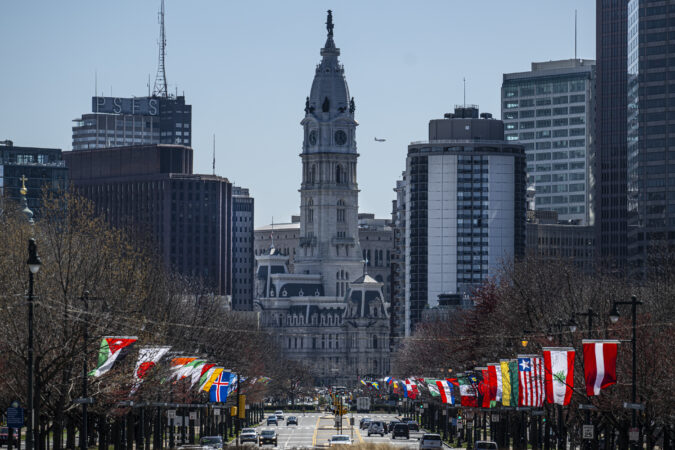
But what some Philadelphians may not know is that the 109 country flags are taken down multiple times every year. In this week’s case of the missing flags, it’s just the city’s biannual replacement job for new custom-made flags with reinforced stitching, a city spokesperson said.
The flags will be back up in time for the St. Patrick’s Day Parade.
The Inquirer responded to this reader question in December through the Curious Philly question portal, where readers can ask Inquirer journalists to look into peculiarities around town.
We found out that the flags are overseen by the city’s Department of Public Property and are regularly replaced about twice per year, or as needed.
Crews perform weekly checks to monitor them for wear and tear, especially during strong weather and winds, which stress the flags the most, the department said. Extended exposure to the sun can also wither the flag’s liveliness. The bungles holding the flags to the poles are also screened for damage during these checks.
Philadelphia first mounted the flags in 1976, taking inspiration from Paris’ Champs-Élysées, as part of the U.S. Bicentennial celebration. The original 90 flags were meant to represent the various populations of people living in Philadelphia. The city added 19 more in 2010. Arranged in alphabetical order, the flags line the Parkway from 16th Street up to the Eakins Oval out front of the Philadelphia Museum of Art.
Staff writer Nate File contributed to this article.
A man has been arrested in connection with two shootings last year that left one person dead and another hospitalized.
Nasir Brooks, 24, turned himself in to the Philadelphia Police Department on Tuesday for the killing of 23-year-old Hasan Mason. Brooks allegedly fatally shot Mason near Broad Street and Packer Avenue in October and shot another 23-year-old that same day in front of the Chickie’s and Pete’s nearby, police say.
Police previously arrested Abou Keita, 22, a month after the shooting, charging him with murder, attempted murder, aggravated assault, and other offenses in relation to the Oct. 9 shooting.
The shooting unfolded just after 6:10 p.m., when police responded to reports near Packer Avenue and Broad Street. What they found on scene was an Audi sedan filled with 15 bullet holes just south of the intersection, police said.
Police found Mason lying on Broad Street just north of the intersection with multiple gunshot wounds. He was taken to Thomas Jefferson University Hospital, where he was pronounced dead.
The other 23-year-old, who police have not identified, was found in front of the Chickie’s & Pete’s near the sports complex on Packer Avenue, with gunshot wounds to the torso. He was taken to Penn Presbyterian Medical Center, where he was placed in stable condition.
It was at the end of last year in the hazy stretch between Christmas and New Year’s when time doesn’t feel real, and some of Philly’s top Democrats were huddled around a secret proposal, racing to meet a deadline.
The group — convened by Mayor Cherelle L. Parker, her aides, and some key Philadelphia boosters — was preparing a lengthy bid to bring the Democratic National Convention back to the city in either 2028 or 2032, a potential economic boon and a chance to show off in front of lawmakers, celebrities, and international media.
The confidential proposal to the Democratic National Committee included everything from the city’s hotel space to police outfitting to nitty-gritty details about the electrical grid and voltage capacity at Xfinity Mobile Arena. SEPTA officials drafted a section about the public transportation Philadelphia could offer visitors, and tourism agencies chipped in with insights on hotels and restaurants.
David L. Cohen, a longtime Democratic fundraiser and the president of the recently formed nonprofit host committee called Pick Pennsylvania, said that while the mayor led the effort, the bid also emphasized the “unity of the region and the commonwealth.”
“She wanted it to be really clear this is more than a Philadelphia bid,” he said. “This is a unified Pennsylvania bid.”
It appears the Democratic National Committee was impressed. On Monday, the DNC announced that it is considering five cities, including Philadelphia, to host the 2028 convention, where a Democratic presidential nominee will be coronated. The party is also looking closely at Atlanta, Denver, Chicago, and Boston to hold the early August event.
What comes next is a campaign to lure the convention to Philly, complete with a carefully coordinated public relations effort and a significant fundraising push. Philadelphia’s host committee for 2016, the last time the city held a presidential nominating convention, raised more than $85 million.
The DNC has asked host cities to raise $5 million before being selected. Philly’s fundraising, Cohen said, “will be substantially higher than that number.”
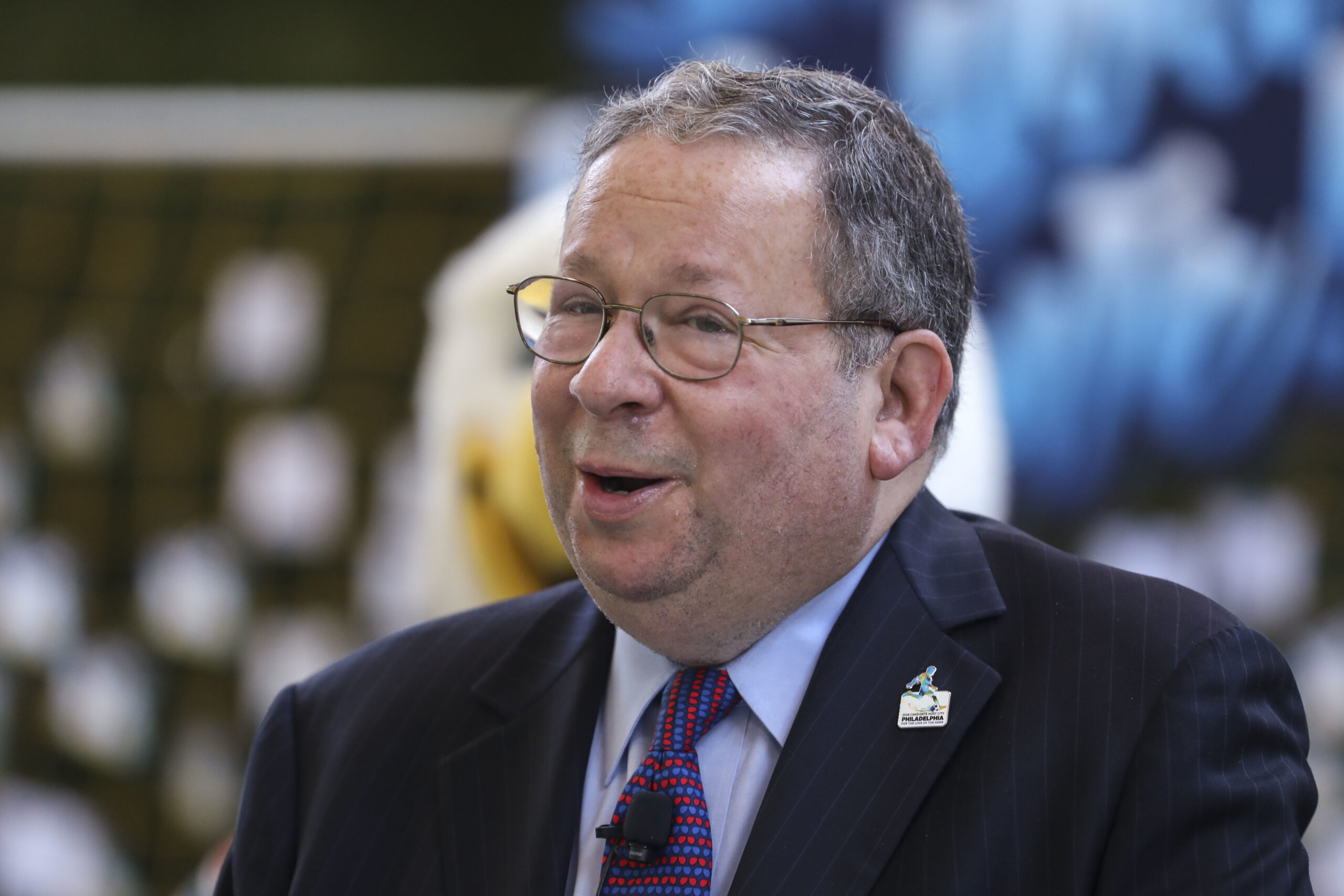
In this 2021 file photo, David L. Cohen speaks as Philadelphia Soccer 2026, the city’s World Cup 2026 bid committee, launched an interactive exhibit at the Independence Visitors Center in Philadelphia. He is now heading an effort to bring the Democratic National Convention to Philadelphia.
Cohen, a former Comcast executive and erstwhile chief of staff to former mayor Ed Rendell, is leading the effort alongside Daniel J. Hilferty, now the CEO of Comcast Spectacor.
Hilferty and Cohen have worked together repeatedly over the last two decades to bring major events to Philadelphia, including a successful bid to become one of a handful of North American cities to host World Cup games this year.
Also involved in coordinating the DNC proposal was Erin Wilson, a Philadelphia native who was a top aide to former Vice President Kamala Harris. She was the national political director for former President Joe Biden’s campaign and planned his 2021 inauguration.
When the DNC comes to town
DNC officials are expected to make a final decision on the 2028 site later this year. That call will likely be made by chair Ken Martin in consultation with top advisers and the committee’s Technical Advisory Group, which assesses logistics and operational matters.
Philadelphia could also have an advocate in State Rep. Malcolm Kenyatta, who represents parts of North Philadelphia and is a DNC vice chair. He is known to have a close relationship with Martin.
Committee officials and the advisory group will tour each of the five finalist cities for a yet-to-be-scheduled site visit this spring.
If history is any indication, the city will roll out the red carpet. In 2014, when 18 members of the DNC came to Philly to check out the city ahead of the 2016 convention, the host committee spent six figures to charm them.
The trip included a tour of Philly’s most popular sites, like Reading Terminal Market and the Philadelphia Museum of Art, as well as a swanky rooftop party and a breakfast at the Comcast Center. Predictably, cheesesteaks were also involved.
“The site visits are as much about feel as they are about technical details,” Cohen said. “After site visits, the teams who are making choices leave here and they have their socks knocked off. They can’t believe how vibrant the city is.”
In this 2014 file photo, Congressman Bob Brady, left, talks with DNC CEO Amy Dacey, center, as they have lunch at Pat’s Steaks in South Philadelphia.
Ryan Boyer, the head of the Philadelphia Building and Construction Trades Council and a close Parker ally, said one of Philadelphia’s best assets might be its mayor. Parker is an unabashed cheerleader for the city and is leading preparations for several major events this year, including World Cup games, the MLB All-Star Game, and the commemoration of America’s 250th anniversary.
“She’s the most effective advocate for bringing people together,” Boyer said, “with just her level of passion, her love of the city, and her love of the job.”
Cohen said he spoke to Parker last year about the potential to bid for the convention, and when she asked him to lead the host committee, he said yes because the city has “a serious chance.”
“As a friend and longtime supporter of hers, if I didn’t think we had a legitimate shot, I would try to talk her out of it,” Cohen said. “If anything, I have poured gasoline on her flames of enthusiasm and said, ‘We should be all in for this.’
”I said, ‘Do what you do best,’” he added. “Get everyone excited about this.’”
That means there is a chance that Shapiro, who was raised in Montgomery County and whose family still lives there, could be nominated in what is essentially his hometown.
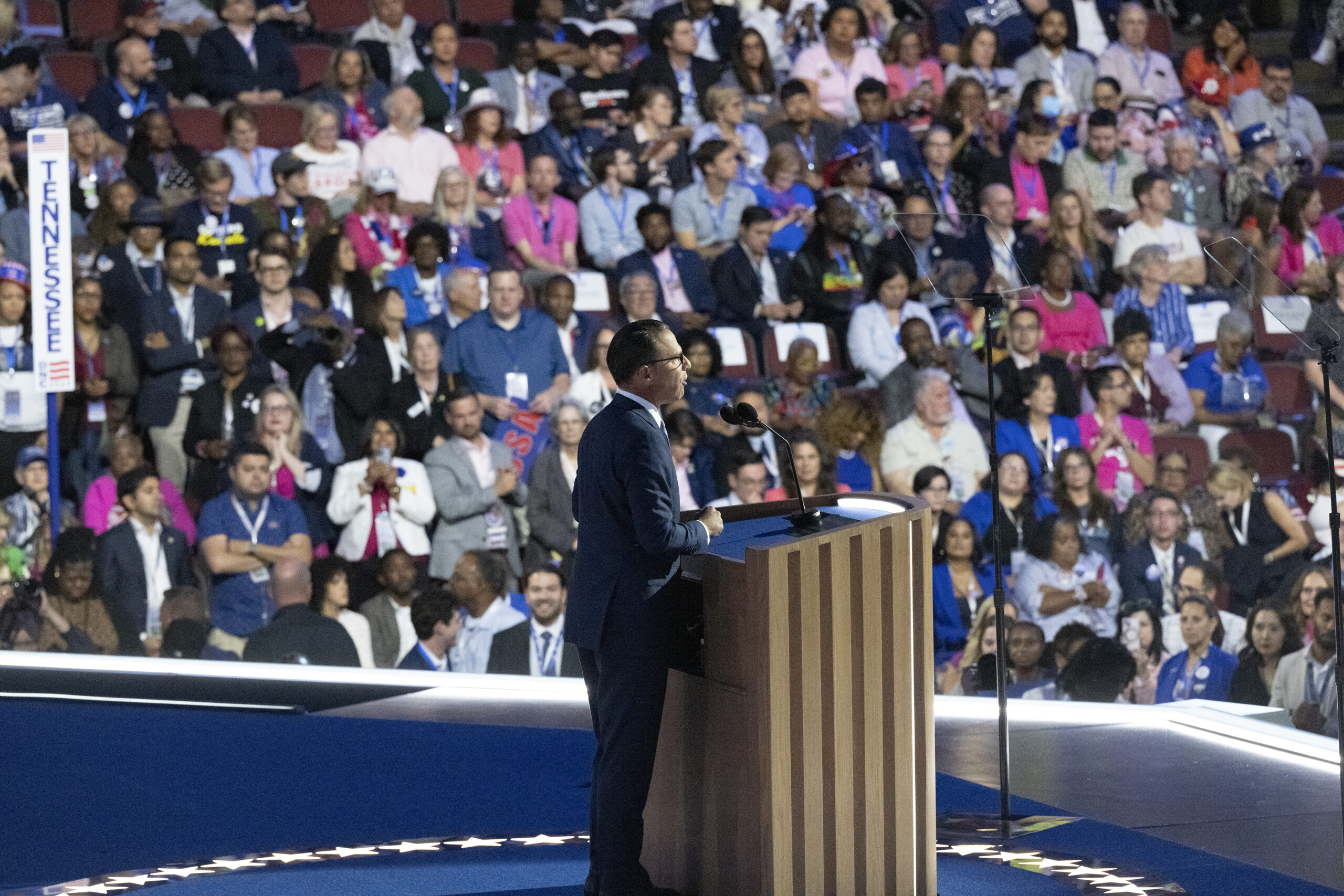
Pennsylvania Gov. Josh Shapiro speaks during the Democratic National Convention Aug. 21, 2024, in Chicago.
In a letter to Martin, Shapiro wrote that Philadelphia “would see substantial economic benefits” from hosting the convention and vowed that the state would be “prepared to ensure our infrastructure, public safety agencies, workforce, and business community are equipped to host thousands of delegates and attendees.”
What’s next: a close look at security and logistics
Behind the pomp of the DNC’s spring site visit will be a serious evaluation of security, transportation, hotels, and arena logistics.
The DNC said in a statement Monday that it will value “new and innovative approaches” to hosting a large-scale event that is likely to bring thousands of tourists. In 2016, the convention drew more than 5,000 attendees and an additional 29,000 visitors — nearly 20,000 of whom were media members.
Nominating conventions are typically designated as National Special Security Events, meaning the federal government leads security because the event is deemed at high risk for terrorism or other criminal activity. That means planners need to know specifics about law enforcement staffing, gear, and other capabilities.
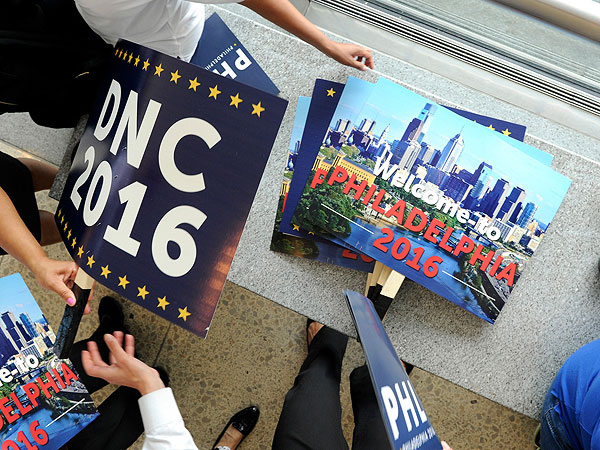
Placards promoting Philadelphia as the host city of the Democratic National Convention in 2016, while the Democratic National Committee was touring the city in August.
Support will also have to come from outside the city. During past conventions, federal law enforcement teamed up with Philadelphia police to secure the venue, and they were joined by officers from across the region.
The DNC also said in its announcement Monday that the committee would prioritize “the importance of forging a strong partnership between the DNC and the host city, including its community, political, and business leaders.”
To that end, the host committee and Parker asked elected officials and civic leaders from across the state to write letters of support that accompanied the city’s bid.
Authors ranged from City Council President Kenyatta Johnson, whose district includes the South Philadelphia stadium complex, to labor leaders to Democrats from the Philadelphia collar counties.
Montgomery County Commissioner Neil Makhija, who wrote a letter to the DNC boosting the bid, said it is important for the committee to see that local governments and law enforcement agencies outside the city are willing to offer support, because “pulling something like this off requires a lot of cooperation on many different fronts.”
“A real concern now when you’re thinking about hosting a political convention is ‘How are we going to manage public safety and a threat environment?’” he said. “There are a number of reasons to point to our region and see a level of collaboration that inspires confidence.”
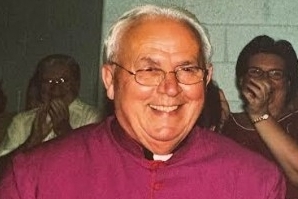
Philip C. Ricci, 90, formerly of Conshohocken, retired Catholic monsignor, founding pastor emeritus at Mary, Mother of the Redeemer Parish in North Wales, talented pianist, singer, artist, and mentor, died Saturday, Feb. 14, of complications after a fall at Villa St. Joseph senior living community in Darby.
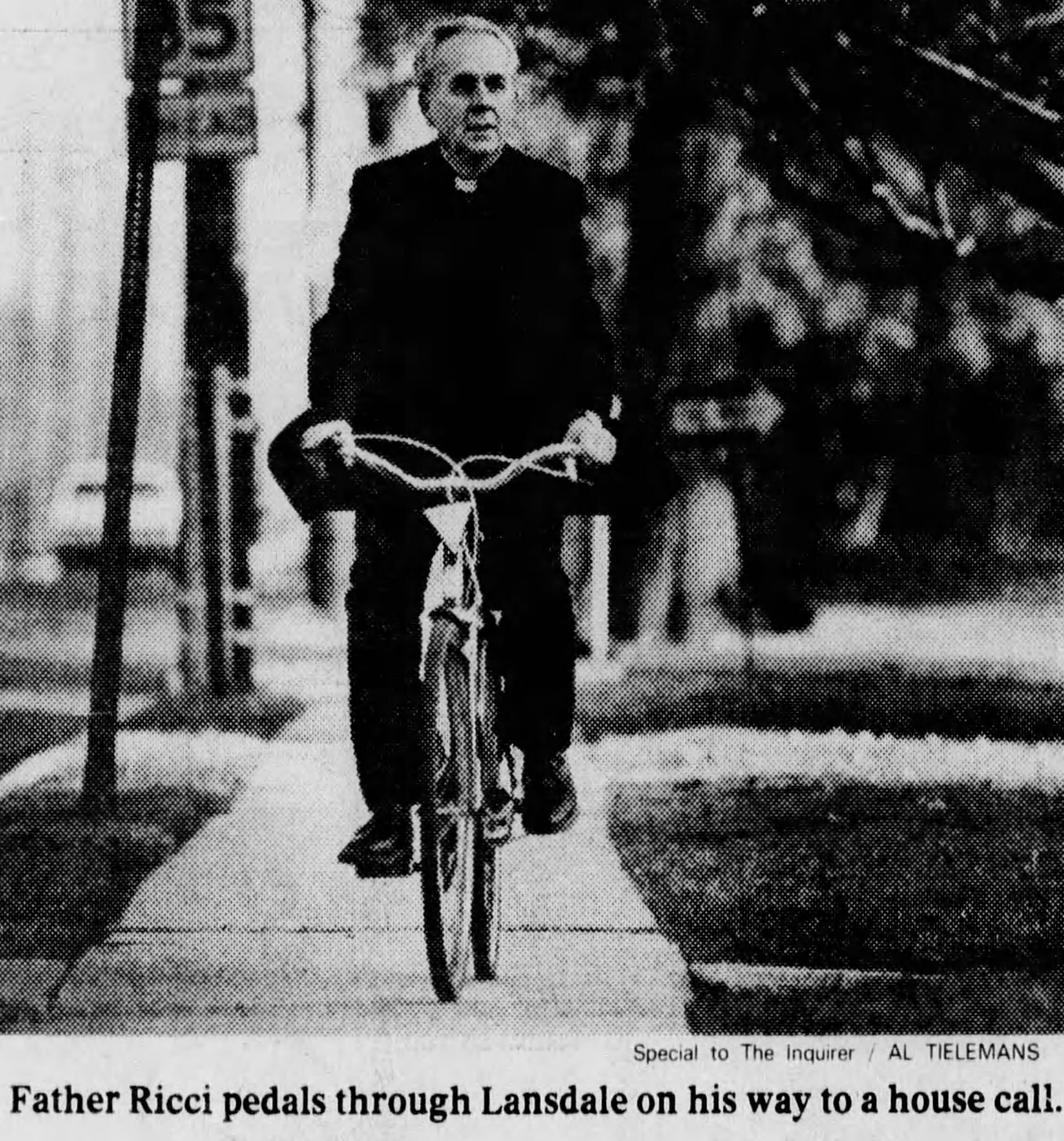
Ordained in 1965 by Cardinal John Krol, Msgr. Ricci was named founding pastor of Mary, Mother of the Redeemer Parish in 1987. Over the next 23 years, until his retirement in 2010, Msgr. Ricci worked many 16-hour days, made spiritual house calls on bicycle, spurred significant fundraising, and helped grow the Montgomery County parish from 600 founding families to 3,500.
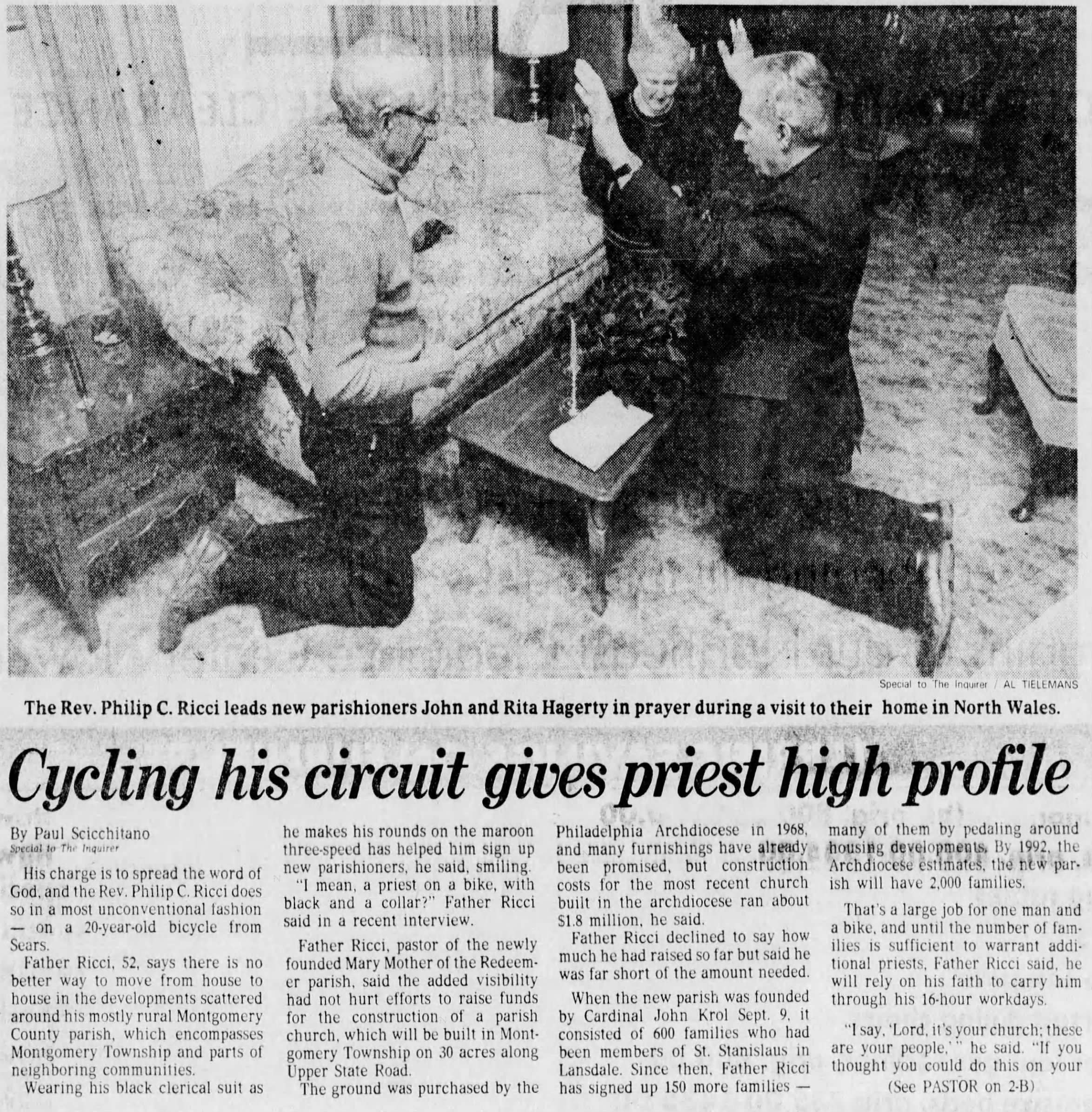
The Inquirer wrote about his house calls in 1987 and opened the story with: “His charge is to spread the word of God, and the Rev. Philip C. Ricci does so in a most unconventional fashion — on a 20-year-old bicycle from Sears.”
His niece, Christine, said: “He could talk to anybody about anything.”
Msgr. Ricci lived and held services in a 200-year-old farmhouse from 1987 until the new church building was completed. Pope John Paul II elevated him to monsignor in 2003.
He was active with school activities, and his homilies were often about mercy and compassion. In 2010, he told members of his congregation at a retirement celebration: “We must always accept people where they are and then allow God’s grace to work in patient understanding.”
In an online tribute, colleagues at St. Matthew Parish in Conshohocken said his “kindness, wisdom, and steady presence touched countless lives.” Others called him “the perfect priest” and “the epitome of what a Catholic priest should be.” One friend said: “He was without a doubt the nicest person I have ever met.”
In a tribute, his family said: “His priesthood was not simply a role. It was the core of who he was.”
Msgr. Ricci first served in the 1960s as a chaplain at the old Holmesburg Prison in Philadelphia and pastor at the Riverview Home for the Aged and St. Margaret’s Home for Girls. He went on to be assistant pastor at St. Joseph Parish in Ambler, St. Stanislaus Parish in Lansdale, St. Anastasia Parish in Newtown Square, and St. Margaret Parish in Narberth.
In 1974, he became spiritual director of the college division at St. Charles Borromeo Seminary. He also earned a master’s degree in spirituality from Creighton University in Nebraska.
Ministering to people, no matter where he was, he told the Main Line Times in 2010, was personal. “You don’t go out forming community,” he said. “You go out and form one-on-one. I can’t separate who I am as a man, as a Christian, and as a priest.”
The Inquirer published a story about Monsignor Ricci making spiritual house calls on his bicycle in 1987.
Msgr. Ricci played piano and sang before church services and after Communion. He directed choirs, and friends presented him with his own piano at his retirement.
He returned to his family home in Conshohocken after leaving Mary, Mother of the Redeemer but continued to assist others at nearby parishes and visit those in hospitals and nursing homes. “Father was a Renaissance man, an artist, musician, writer, deep thinker,” a former colleague said on Facebook. “He could speak about the liturgy or the Eagles, the football team or the band. He related well to everyone regardless of age, religion, or background.”
Philip Cosmo Ricci was born Sept. 26, 1935, in Conshohocken. He graduated from the old Conshohocken High School, took night classes at the University of Pennsylvania’s Wharton School, and, inspired by his parents, entered St. Charles Borromeo Seminary to study the priesthood.
“When the Lord wants you, he gets you,” he told the Main Line Times. “I couldn’t fight it. It was always there.”
Monsignor Ricci’s house calls were featured in this 1987 Inquirer article.
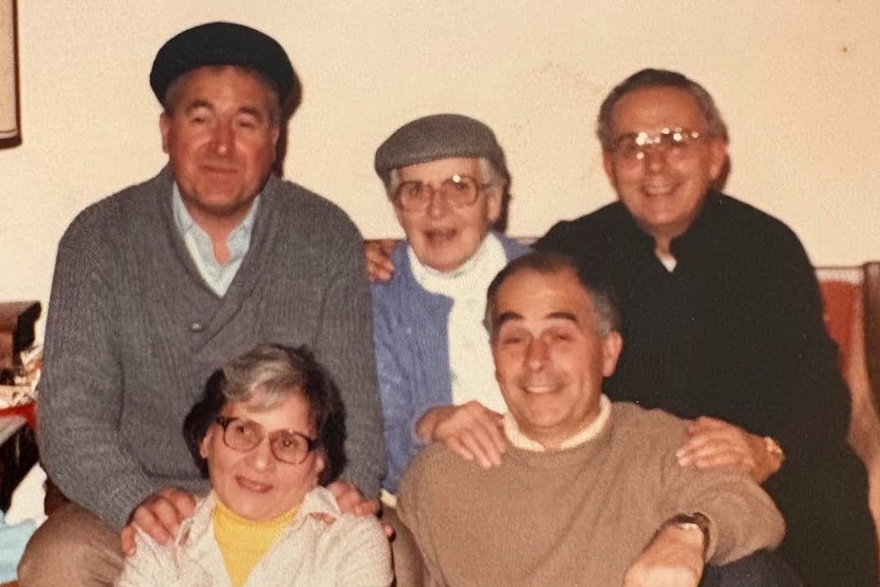
He played piano in a dance band when he was young and enjoyed gardening. He was good at drawing and cooking. He followed the Eagles, Phillies, and 76ers, and invented a beanbag toss game the family played at gatherings.
It was fitting, his niece said, that he died on Valentine’s Day because he embraced love and service to others. “Faith for Uncle Phil was never theoretical,” she said. “It was lived. It was action. It was presence.”
In addition to his niece, Msgr. Ricci is survived by his brothers, John and Francis, and other relatives. A sister died earlier.
A federal jury in Philadelphia awarded $1.67 million to the sons of a diabetic man who died in a city jail in 2023, finding the death was part of a pattern in which the Philadelphia Department of Prisons failed to provide access to healthcare for its population.
Louis Jung Jr. was found dead on Nov. 6, 2023, in his cell at the Curran-Fromhold Correctional Facility. The 50-year-old man died of a condition called diabetic ketoacidosis, in which blood becomes acidic due to high sugar levels.
His last known insulin dose was two days prior, according to medical records.
In a four-day trial presided over by U.S. District Judge Timothy J. Savage, attorneys for Jung’s sons argued the death was preventable and the result of jail staff ignoring their father’s medical needs.
“When the government keeps custody, the government has a duty for care,” Nia Holston, an attorney from the Abolitionist Law Center representing Jong’s sons, told the jury.
The jury on Monday found that Lt. Wanda Bloodsaw and the city violated Jung’s constitutional right to medical care during his incarceration. The seven jurors cleared a correctional officer, Gena Frasier.
The jurors further found the failure was part of a pattern under former Prisons Commissioner Blanche Carney’s leadership, which lasted from 2016 to 2024.
It is notable that a jury held the “highest echelons” of the city jails accountable, said Bret Grote, the legal director of the Abolitionist Law Center, who also represented Jung’s sons.
“This trial represented justice for the Jung family,” Grote said. “But it’s also a capstone from a very grim era in the Philadelphia Department of Prisons.”
YesCare, the company contracted to provide medical services in the jail, and three of its medical staffers settled for undisclosed amounts before trial. An additional nurse, working for a separate contractor, settled for $200,000.
The jury awarded Jung’s sons $1.5 million in compensatory damages. It also awarded $170,00 in punitive damages against Bloodsaw.
“We are reviewing the verdict and do not have a comment at this time,” Ava Schwemler, a spokesperson for the city’s law department, said in a statement.
Not ‘a single drop’ of insulin
Jung was arrested in December 2021 on robbery charges, and his diabetes was poorly managed while incarcerated, the lawsuit says. He was hospitalized for high blood sugar levels four days after he arrived at the correctional facility, and twice more during his first six months there.
In spring 2023, a judge sent him to Norristown State Hospital for psychiatric evaluation of his ability to stand trial.
He returned to Curran-Fromhold Correctional Facility on Oct. 28. During his intake, Jung’s blood sugar level was over four times higher than the upper limit of the normal range, according to the complaint.
Louis Jung Jr., who died in November 2023 in a Philadelphia jail.
On Nov. 5, Jung asked Frasier to see a nurse. The correctional officer brought a licensed practical nurse to Jung’s cell, where he lay down on the floor at the entrance, according to testimony and video surveillance.
Frasier and the nurse briefly stood over Jung and walked away.
A few minutes later Bloodsaw, who supervised the housing unit that day, stood over Jung as two incarcerated men put him back in his cell. That was the last known interaction between Jung and jail staff until his death roughly 20 hours later.
In that time period, the father of three did not receive “a single drop of lifesaving insulin,” Holston told the jury.
Frasier and Bloodsaw ignored signs of a medical emergency, and failed to follow a jail policy that requires a follow-up with a medical providers after an incarcerated person refuses to take medications, the attorneys said.
An internal investigation found that Bloodsaw did not comply with jail policies, and officials suspended her for 15 days. The suspension has not taken place yet, which attorneys for Jung’s sons said demonstrates a culture that does not emphasize accountability.
The attorneys showed to the jury the results of more than a dozen internal death investigations between 2018 and 2023 that concluded staff did not provide appropriate aid or check their units as required.
Carney testified that the incidents were not part of a systemic failure. The majority of correctional officers follow their duty with fidelity, the former commissioner said, and should not be painted with a “broad brush” because of the failures of a few.
Attorneys for the city told the jury that jail staff followed the medical assessment of YesCare staff, and that Jung was noncompliant.
“I don’t know why he was refusing his insulin,” city attorney Michael Pestrak said. “But he was.”
The city pointed to a 2023 report commissioned by Carney to review medical care in the jail, including diabetes care, and other policy changes as evidence that city officials were paying attention to medical needs and attempting to improve care.
Jung’s ex-wife, Evelyn Tyson, provided emotional testimony about the impact of his death. He remained her “best friend” after the divorce, she said, and was committed to their three children, including their eldest, who requires full-time care due to cerebral palsy.
“I don’t live anymore,” Tyson said.” I’m just existing.”