Temple University will offer a voluntary retirement program for faculty, the school announced Wednesday.
The move comes as the university attempts to close a budget deficit that stood at $27 million earlier this year but that worsened when the school did not meet projected enrollment targets for its main campus — which president John Fry had said translated to $10 million less in revenue.
“It is important for us to explore strategies that will allow the university to make meaningful changes, as this is key to optimizing the budget and improving our financial results moving forward,” Fry and interim provost David Boardman said in a message to the campus community.
The university did not say how many faculty it hopes will take the offer, but those who are 62 years and older and have at least 10 continuous years of experience are eligible. They must be tenured, tenure-track, or appointed as non-tenure-track under a contract that expires after June 30.
Temple did not immediately provide the number of eligible faculty.
The move also will allow the university to hire new tenure-track faculty over time, Fry and Boardman said.
Fry said the university would fund the program with federal COVID-19 stimulus funds that came in a onetime tax credit reimbursement to businesses that kept employees during that period. Temple last offered faculty a voluntary retirement program in 2023.
Pennsylvania State University last year offered buyouts to its faculty and staff on its Commonwealth campuses as it made plans to close seven of those campuses. More than 380 employees — 21% of those eligible — took the buyout in June 2024.
Also on Wednesday, Temple announced it had tapped Rob Reddy, formerly the vice president for enrollment management at St. Louis University, to serve as interim vice provost for enrollment management. He will begin Jan. 1
Reddy replaces Jose Aviles, who left Temple last month for a new enrollment job at Rutgers University. He has three decades of experience in admissions, financial aid, and veterans’ relations, Boardman said in an announcement to the campus community.
“Rob comes to us with deep experience in the field and a reputation for taking on challenging assignments,” Boardman said.
He previously served as assistant vice chancellor of enrollment management and dean of student financial services at Northeastern University.
The university intends to launch a search for a new enrollment leader in the spring, Boardman said.
Eduard “Teddy” Einstein, a beloved professor and mathematician, was biking home from a haircut when a driver killed him earlier this month.
Einstein, 38, was struck and killed by the 18-year-old driver on Dec. 3 while riding his bicycle on Providence Road in Upper Darby. No charges have been filed in Einstein’s death, according to Upper Darby police, but an investigation is continuing, and police said the driver cooperated with police at the scene of the crash.
The West Philadelphia husband and father of two young children, Charlie and Lorcan, was known for his sharp wit, encouraging students, and scouring cities for the most interesting, and spiciest, foods. Einstein was, above all else, dedicated to his family.
“He didn’t need much more than me and the boys. It was like he was my home, and I was his,” Einstein’s wife, Ruth Fahey, 45, said. ”That’s kind of how we agreed that we would move around the country together as a family, and it was wonderfully freeing.”
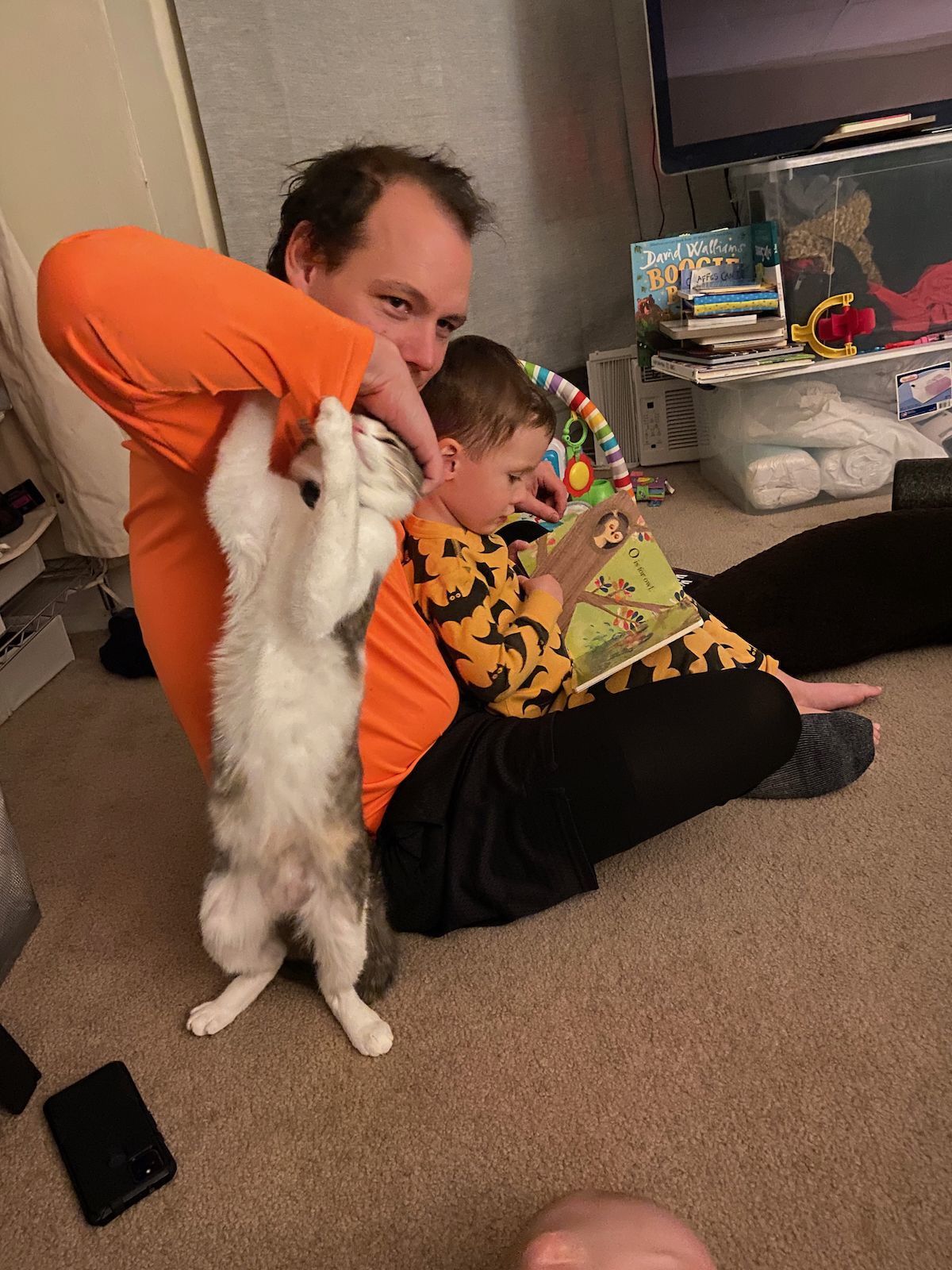
Teddy Einstein (left) reading a book to his son while the family cat plays with his arm. Einstein was a devoted husband and father who covered the lion’s share of storytelling and bedtime, but especially cooking, as he was an avid chef who liked trying new recipes, his wife Ruth Fahey said. Einstein was killed on Dec. 3, 2025, while riding his bike in a bike lane when he was hit by a driver on Providence Road in Upper Darby, Pa.
Born in Santa Monica, Calif., Einstein graduated from Harvard-Westlake School before receiving a bachelor’s degree in mathematics from Pomona College, a master’s in mathematics from University of California, Santa Barbara, and his Ph.D. from Cornell University. He would go on to hold postdoctoral fellowships at the University of Chicago and the University of Pittsburgh, where he taught, and most recently completed a three-year teaching term at Swarthmore College.
“He loved mathematics and wrote a first-rate thesis,” said Einstein’s Ph.D. adviser, Jason Manning. “Many mathematicians, even those who write a good thesis, don’t do much after graduate school. But Teddy’s work really accelerated during his postdoc at the University of Illinois at Chicago, and he was doing even more exciting work when he passed.”
His colleagues describe a mathematician working at, to put it simply, the intersection of algebra and geometry. Building on the work of mathematicians before him, including modern geometric breakthroughs in years past, Einstein studied abstract 3D shapes that cannot be visually represented in the real world. Work like that of Einstein and others contributes to a tool chest of solutions that scientists can use to study physics, neuroscience, and more.
“It is a terrible loss, especially to his family,” Manning said. “But also to his part of the mathematics community.”
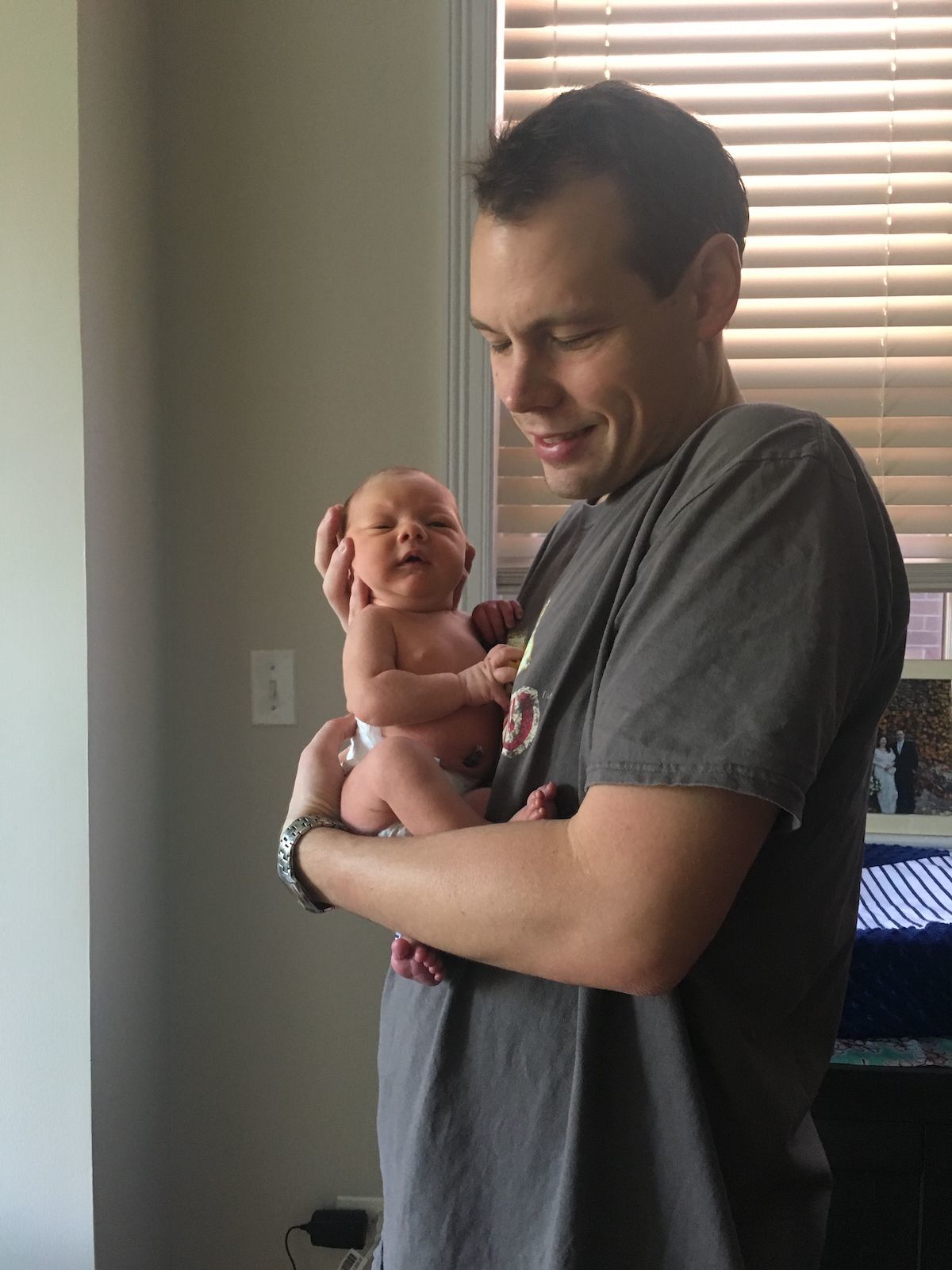
Teddy Einstein (right) holds his second-born, Lorcan, soon after he was born.
As his term at Swarthmore ended earlier this year, Einstein had been working on research that was seven years in the making, Fahey said. This would help springboard him into the next chapter of his career.
Fahey said the day he was killed, Einstein was biking back from a fresh haircut to impress his potential new employers at Florida Gulf Coast University.
Mr. Einstein’s work ethic matched his appetite for camaraderie. He fed grad students out of his tiny Cornell kitchen and hosted a weekly trivia night. That is where he met Fahey. “He just loved to entertain with food,” she said.
Every week, he cooked for Fahey and the boys, from his prized favorites of Korean short ribs and fried chicken to testing out falafel recipes. A keg of home-brewed beer was always in the house so that Einstein could share his creations with friends. Fahey said his most recent yeast yield is still waiting to be processed.
Maddie Adams-Miller, who took Einstein’s math classes in her freshman year at Swarthmore, said her funny and wise math teacher never wanted to see a student fail.
“I loved talking to my friends from high school and telling them I had ‘Professor Einstein’ for math. Teddy always wore funny T-shirts to class and made a lot of jokes,” said Adams-Miller, now a senior. “When I was taking his course, I was struggling with my confidence and was not performing my best academically. Teddy reached out to me to offer support and genuinely wanted me to succeed in his class.”
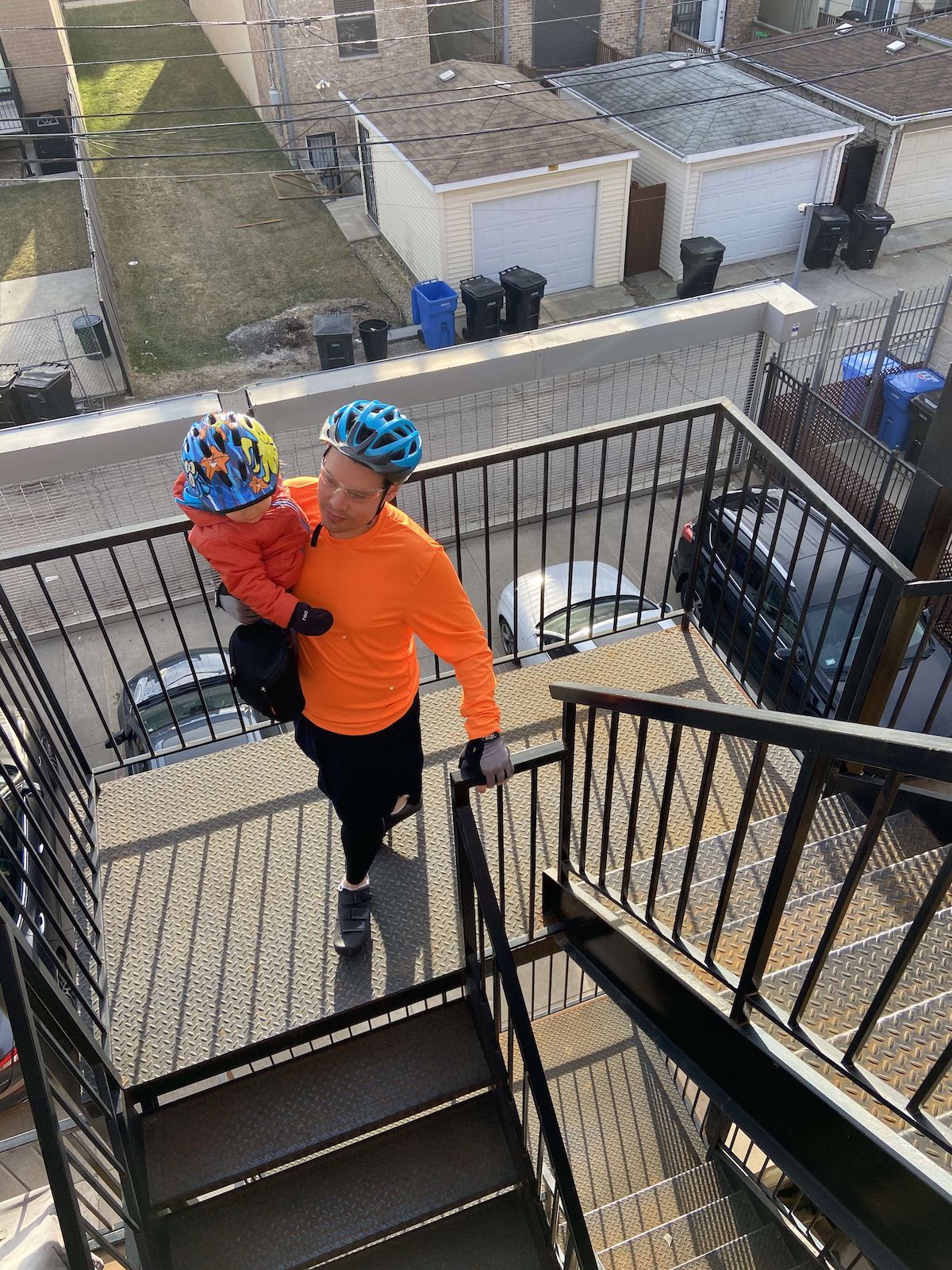
Teddy Einstein (left) holds his eldest son, Charlie, while he walks down a flight of steps wearing the usual safety gear that he wore while riding his bike. The precautions Einstein took to bike safely weren’t enough to stop a driver from crashing into him on Providence Road in Upper Darby earlier this month, leaving his wife, Ruth Fahey, and their two sons without a father.
An avid cyclist who biked everywhere and advocated for safer streets, Einstein was killed doing one of the activities he loved most. Philly Bike Action, an advocacy organization that Einstein and his wife frequented and his friend Jacob Russell organizes for, shared that he was hit by the driver while riding in an unprotected bike lane and wearing a helmet and high-visibility clothing.
“But there will never be a helmet strong enough or a clothing bright enough to make up for dangerous infrastructure. All Philadelphians deserve the freedom to travel without fear of tragedy,” the group said in a statement.
Russell believes safety improvements will not come solely from attempting to change laws or behavior, but rather by changing the road infrastructure, so that even “when mistakes happen, there aren’t tragedies,” he said.
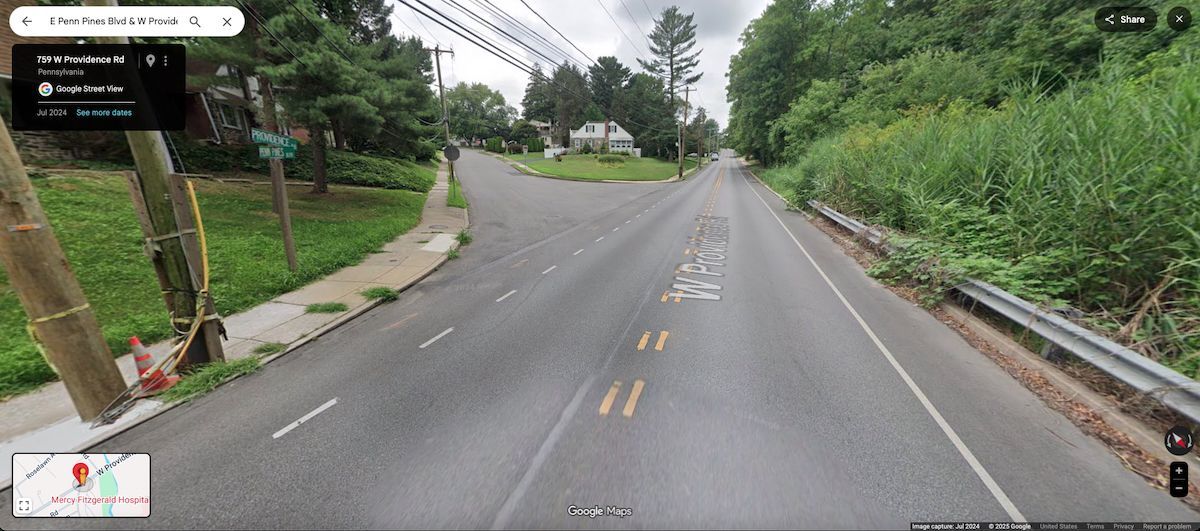
A screenshot, dated July 2024, from Google Maps showing the intersection where Teddy Einstein was killed on Dec. 3, 2025, in Upper Darby, Pa.
Providence Road, where Einstein was hit and where he biked weekly, is considered a dangerous road by local planning commissions, appearing on the Regional High Injury Network map as a thoroughfare where multiple people have died or been seriously injured in vehicle, pedestrian, or bicycle crashes. Delaware County is currently in the process of onboarding most of its townships onto a “Vision Zero” plan to end all traffic fatalities by 2050 — similar to Philadelphia’s own Vision Zero.
The Delaware County Planning Commission said the county does not own the roads, which are overseen by the Pennsylvania Department of Transportation or specific municipalities; however, officials are “actively working to obtain additional funding for further safety improvements, and are continuing to work with our partners in our 49 municipalities on either our Vision Zero plan or to help them develop their own,” said Delco spokesperson Michael Connolly.
Fahey said she won’t rest until Providence Road’s lack of safety is addressed and will continue campaigning for safety improvements in Philadelphia.
A GoFundMe has been set up for Fahey to help fund efforts to protect Einstein’s legacy as a teacher and advocate, as well as to invest in campaigns to make streets safer, with an emphasis on the road where Einstein was killed. It has already raised more than $60,000.
In addition to his wife and children, Einstein is survived by his parents, K. Alice Chang and Thomas Einstein, and siblings, Michael Einstein and Lily Einstein. The family encouraged people to donate to Fahey’s GoFundMe to honor Einstein’s legacy.
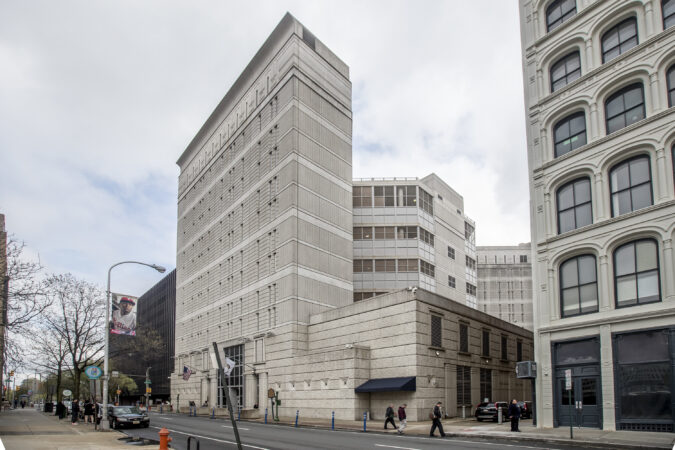
A former corrections officer at Philadelphia’s Federal Detention Center pleaded guilty Wednesday to sexually assaulting a female prisoner inside her cell last year — a violent attack that occurred while the victim was in protective custody because of ongoing mental health issues, prosecutors said.
Michael Jefferson, 43, said little as he entered his plea before U.S. District Judge Joshua D. Wolson. He is scheduled to be sentenced in April and faces a maximum penalty of life behind bars.
Jefferson was charged earlier this year with crimes including aggravated sexual abuse and deprivation of rights for attacking a prisoner inside the detention center on the 700 block of Arch Street on July 6, 2024.
Prosecutors said Jefferson entered the woman’s cell, where she had been sleeping; placed his hands on her shoulders and told her not to say anything; then pinned her down and sexually assaulted her.
The victim reported the assault to other guards the next morning, once Jefferson’s shift was over, prosecutors said. Evidence supported her account of having been sexually abused, prosecutors said, and showed she had been physically injured during the attack.
The victim, who was not identified in court documents, later sued Jefferson, describing the attack as a rape and saying it occurred while she was housed in isolation and on suicide watch.
Her lawyers have accused the Bureau of Prisons of failing to protect her from Jefferson, in part because they said another officer either ignored the assault or was improperly absent from his post when it occurred.
The detention center can house up to 950 prisoners, most of whom are either awaiting federal trial or serving short sentences after being convicted.
The man who walked through the streets of Kingsessing and shot people at random in 2023, killing five and wounding five others in one of Philadelphia’s deadliest mass shootings, pleaded guilty Wednesday to multiple counts of murder and was sentenced to decades in prison.
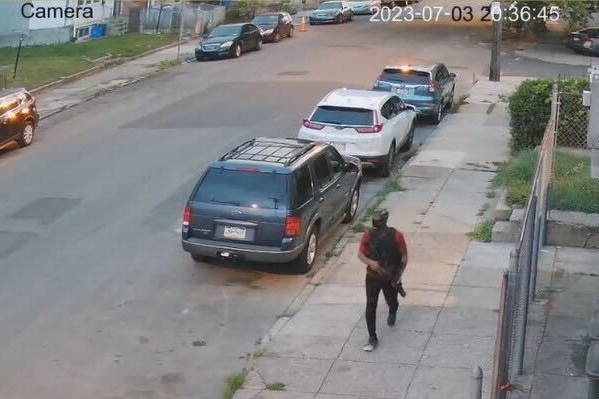
Kimbrady Carriker, 43, admitted that on the evening of July 3, 2023, he calmly walked through a Southwest Philadelphia neighborhood dressed in body armor and wearing a ski mask, and pointed his AR-15-style rifle at seemingly random passersby — then pulled the trigger.
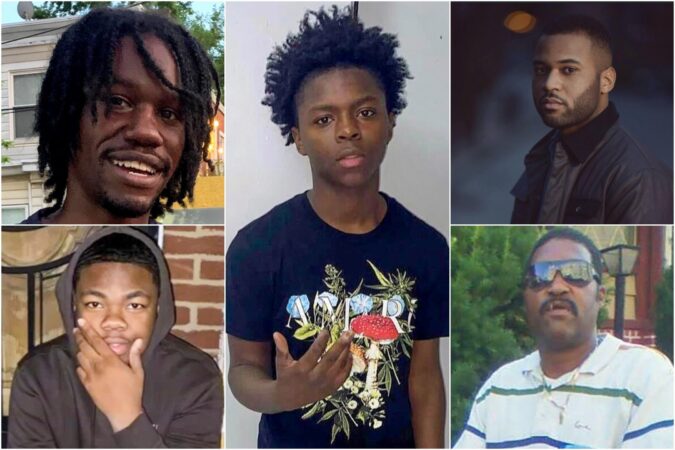
He killed five people: DaJuan Brown, 15; Lashyd Merritt, 21; Dymir Stanton, 29; Ralph Moralis, 59; and Joseph Wamah Jr., 31.
Five others were injured: a 13-year-old boy he shot multiple times in the legs, and a mother who was driving with her 2-year-old twins and 10-year-old niece when he fired more than a dozen bullets into her car.
Wamah was killed first in the early morning of July 2, targeted in his home for reasons that remain unclear. Carriker returned to Wamah’s block nearly two days later, armed with the same gun, and shot the others.
Carriker’s admission to the killings marks the end of the legal saga in a shooting that shocked the city, shattered families’ lives, and traumatized a community.
“This was 14 minutes of terror for the residents of the Kingsessing neighborhood,” Assistant District Attorney Robert Wainwright said of Carriker’s carnage.
Prosecutors say surveillance video showed Kimbrady Carriker, dressed in a ballistic vest and ski mask, walking through Southwest Philadelphia shooting people at random on July 3, 2023.
Carriker’s attorneys had been expected to argue at trial that he was legally insane when he gunned down his victims, and that he should be housed in a secure psychiatric facility for most of his life, not state prison.
Carriker suffered from “severe delusions and religious preoccupations” and “had a fixed illusion that he was working for the National Security Agency,” said Gregg Blender, assistant defender at the Defender Association of Philadelphia.
Even after he was arrested, taken to Norristown State Hospital, and medicated, he believed that he had done something wrong only because the “National Security Association personnel did not come and rescue me,” Blender said he told doctors.
Prosecutors disagreed that Carriker was legally insane and said his actions were deliberate and he should spend the rest of his life in state prison. But as they prepared for trial, an expert hired by the Philadelphia District Attorney’s Office interviewed Carriker and agreed with defense lawyers that he did not appear to know that what he was doing that night was wrong.
Prosecutors did not want to risk that a jury might find Carriker not guilty by reason of insanity, Wainwright said. So they offered Carriker the opportunity to plead guilty to five counts of third-degree murder, five counts of attempted murder, and gun crimes. They asked a judge to sentence him to 37½ to 75 years in prison.
On Wednesday, Carriker agreed.
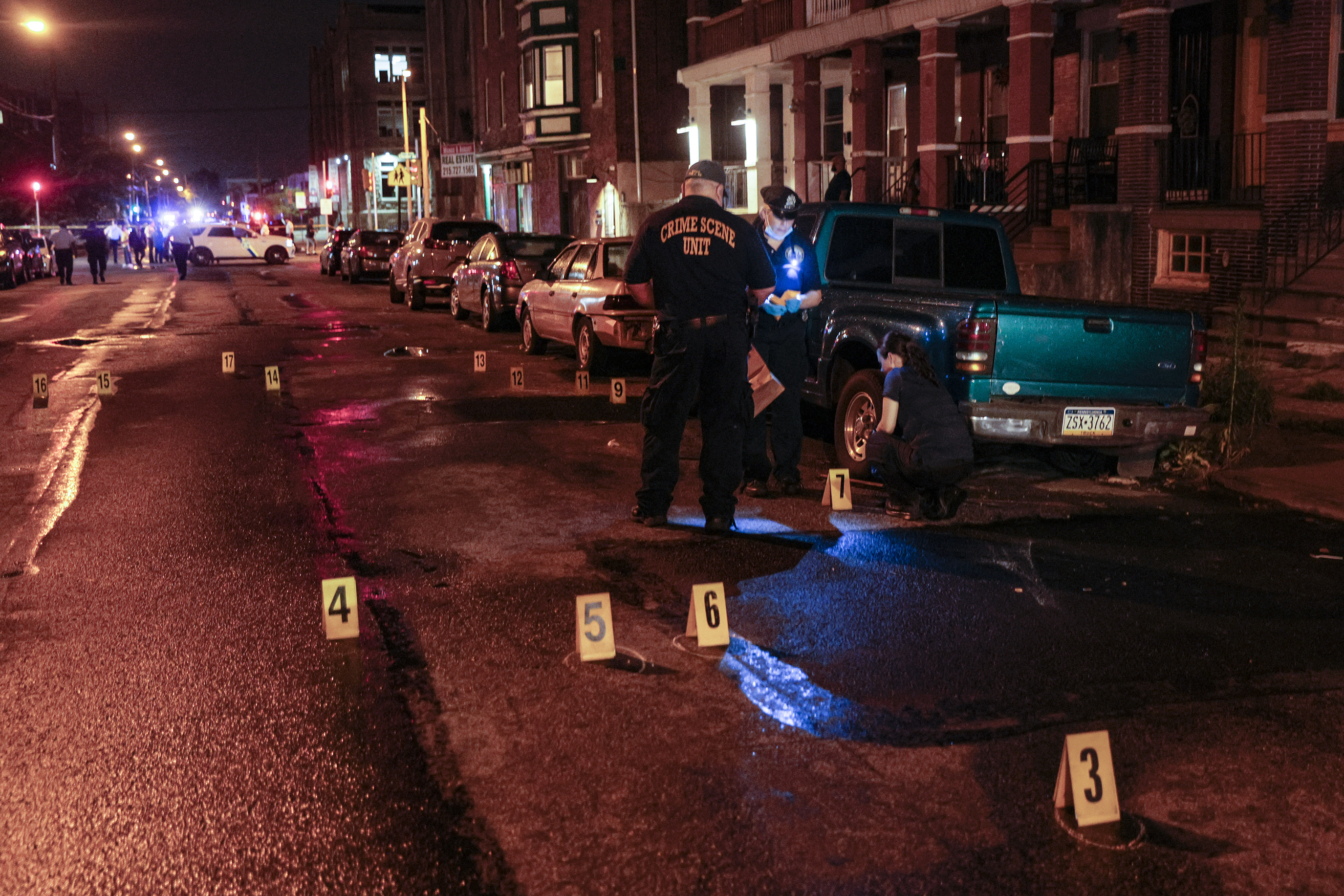
Police gather evidence near 56th Street and Chester Avenue after the mass shooting on July 3, 2023.
Common Pleas Court Judge Glenn B. Bronson sentenced Carriker to the agreed-upon decades behind bars. The judge said that, in his 15 years of handling homicide cases, this was the worst he had seen, but that he would respect the deal reached by prosecutors and Carriker’s defense team.
“It traumatized an entire community,” the judge said of the shooting. “It traumatized an entire city.”
Survivors of the shooting, and loved ones of the people who died, spoke emotionally in court Wednesday of the devastation of that July night, and the lasting impact on their lives.
The father of Joseph Wamah Jr., consumed by the trauma of finding his son’s dead body inside his home, died earlier this year. His daughter said he could not mend his broken heart, and spiraled into a health crisis.
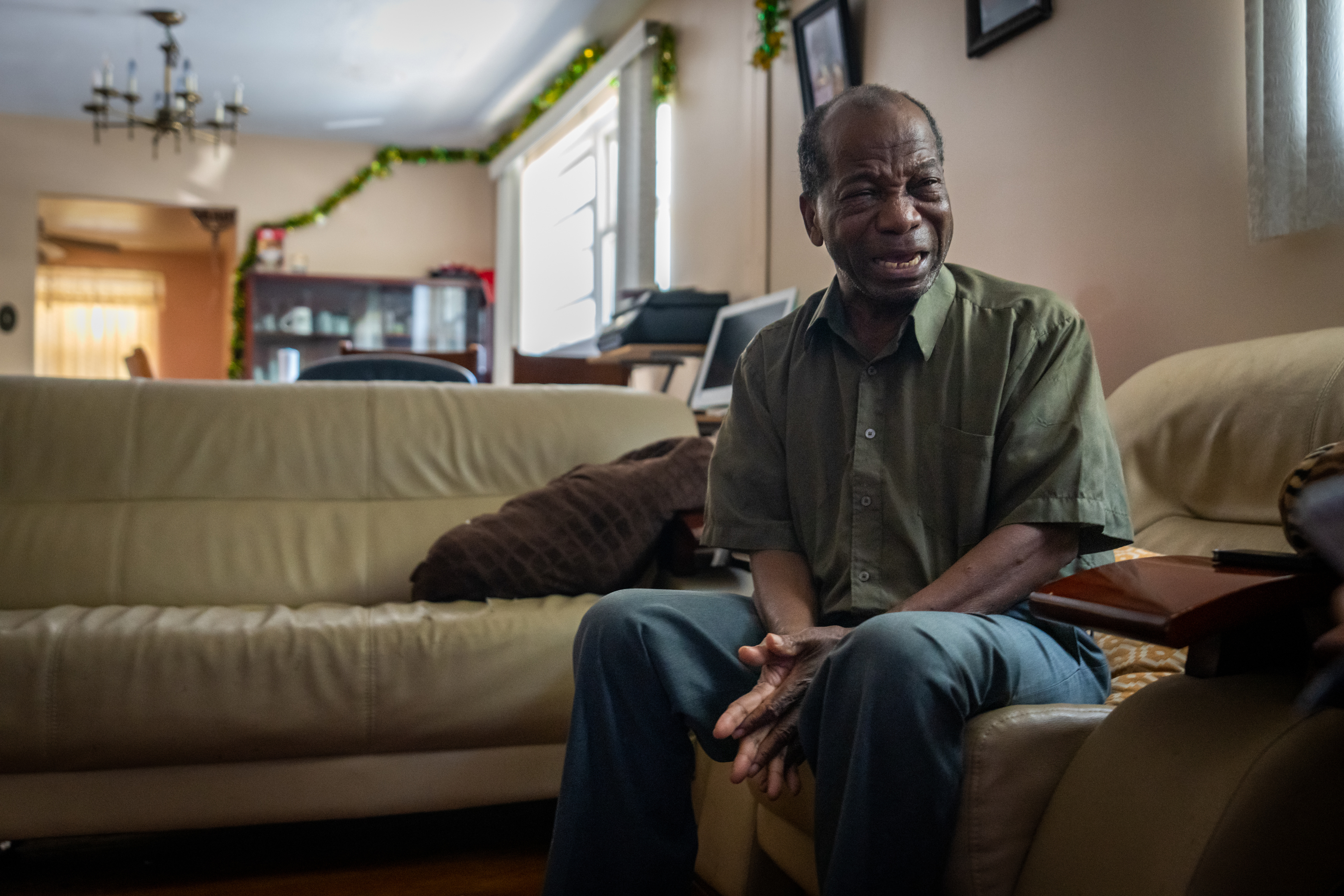
Jonah Wamah, the father of Joseph Wamah, one of the victims in the Kingsessing mass shooting, spoke of the impact of losing his son in June 2024. He died earlier this year, in September, after his family said he could not recover from the grief of his son’s killing.
“He faded in front of my eyes,” Jasmine Wamah said of her father.
Other family members spoke of being hospitalized for their mental health, of looking after children without fathers and caring for kids with bullet scars in their legs.
Odessa Brown spoke of holding her 15-year-old grandson as he bled out from his injuries.
“When DaJuan was born, he was given to me and I held him in his arms,” she said. “And that day, I held him when he was on the ground, dying, praying, asking God, please save my child.”
Ralph Moralis’ daughter, Taneisha Moralis, said that, at six months pregnant, she can’t stop thinking about how her child will never know their grandfather.
And Charlotte Clark, the girlfriend of Dymir Stanton, said she struggles to get up each day to care for their daughter, who was only 3 when her father was killed.
“I am still yearning for him from my soul. It makes me crazy,” she said, shaking.
She said she hoped Carriker would rot in prison for what he took from her family.
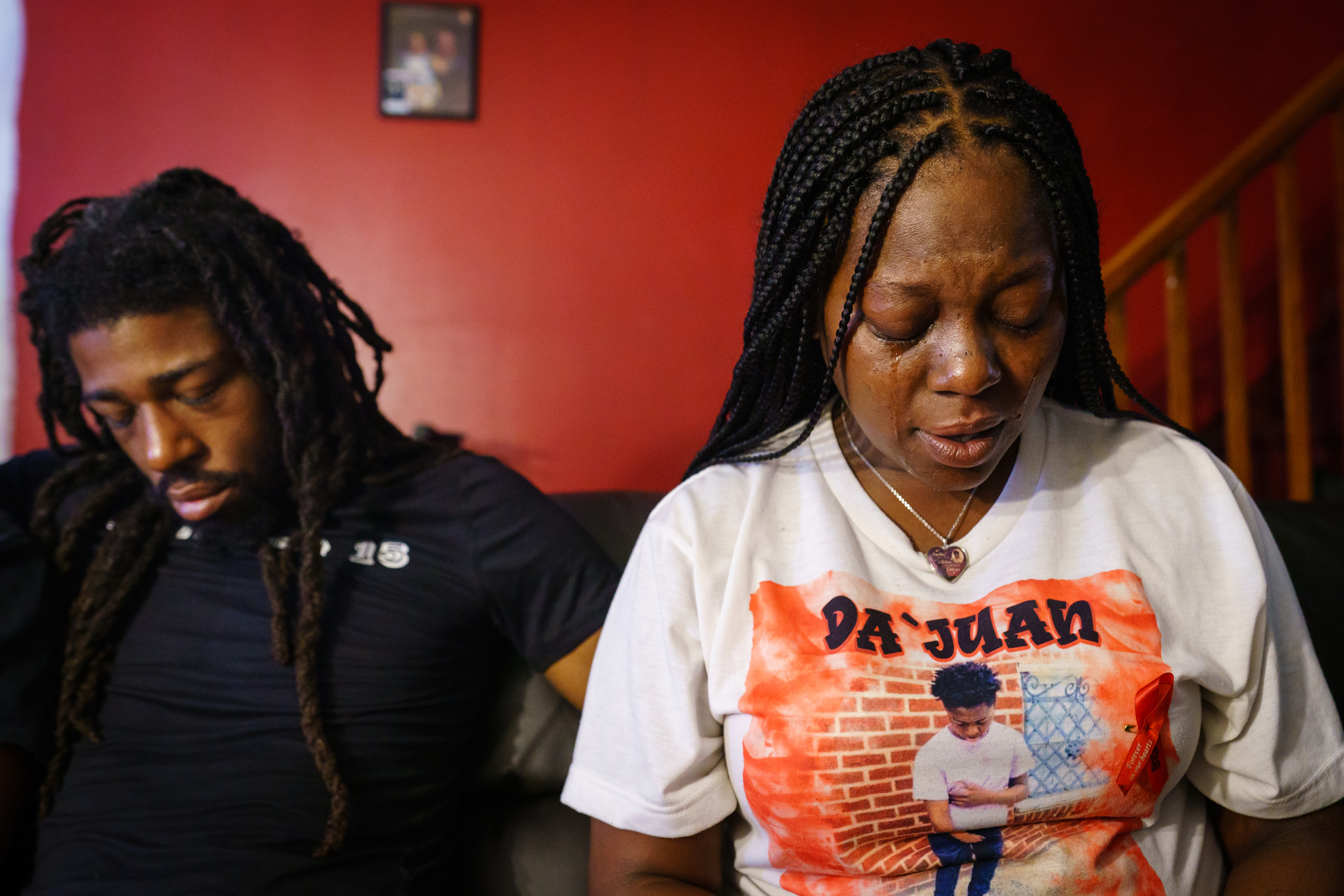
Nyshyia Thomas misses her son, DaJuan, every day. At the sentencing of her son’s killer on Wednesday, she said: “I will never get to see his face as a grown man. I will always just know the child.”
A killing spree
Carriker’s killing spree began shortly after midnight on July 2, when he showed up at Wamah’s home on the 1600 block of South 56th Street. He shot multiple bullets through the door, then walked in and shot Wamah nine times.
It remains unclear why Carriker targeted Wamah. Police did not know he had been killed until days later.
Nearly two days later, just before 8:30 p.m., Carriker returned to that block with the same rifle and a semiautomatic handgun. First, he fired 18 shots into the Jeep of Octavia Brown, a young woman driving her 2-year-old twins and 10-year-old niece to a family barbecue.
One of the toddlers was shot multiple times in the leg, and the other twin was grazed by a bullet. Glass shards exploded into Brown’s face and eye. The boys survived their injuries, but the family was traumatized. Brown said Wednesday that her son still has pain in his legs from the shooting.
As nearby police rushed to the scene, Carriker walked south down 56th Street, coming across 13-year-old Ryan Moss and shooting him multiple times in the legs. His friend, DaJuan Brown, was on his grandmother’s porch and ran out to help his friend. DaJuan and a responding officer found the boy screaming for help behind a car.
As DaJuan ran home for help, Carriker shot him multiple times, killing him.
Carriker continued on, next shooting Moralis as he got out of his car. Then, as he reached Greenway Avenue, he came to face Lashyd Merritt leaving his home, and shot him. Both men died.
Carriker then turned up South Frazier Street, where he shot and killed Dymir Stanton. Stanton’s brother, Kaadir, shot at Carriker in self-defense as he tried to get to his brother.
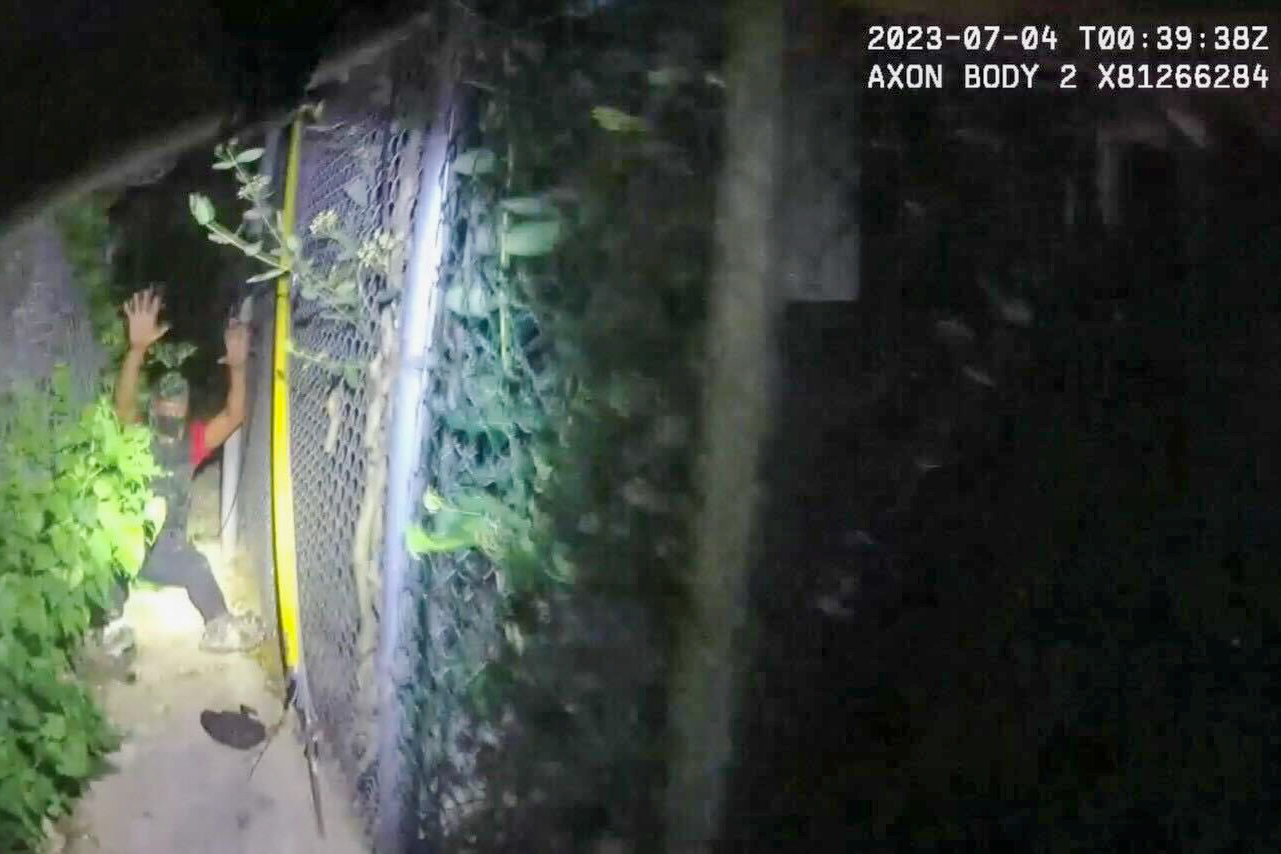
Philadelphia police responded to a sprawling scene nearly a mile long. Officer Ryan Howell ran toward the sounds of gunfire, then found Carriker in a dark alleyway. The gunman quickly surrendered.
Police Officer Ryan Howell’s body worn camera footage showed how he found Kimbrady Carriker surrendering in a narrow alleyway.
‘I am sorry’
Prosecutors said Carriker told Howell “good job” as he took him into custody, and said, “I’m out here helping you guys.” Law enforcement sources have said Carriker told police that the shooting spree was an attempt to help authorities address the city’s gun violence crisis, and that God would be sending more people to help.
Carriker’s attorneys said he was profoundly delusional and did not understand the impact of his actions.
Blender, of the defender association, said Wednesday that there was nothing he could say to comfort to the victims’ families — or the relatives of Carriker, who live with their own guilt.
“He was under a mental health disease that prevented him from understanding what was going,” Blender said. “It is not an excuse. It is not to justify this horrific, horrific behavior.”
Later in the sentencing, Carriker, dressed in a red jumpsuit, attempted to apologize.
“All I ever wanted to do was help my community. I never meant to cause this harm,” he said. “I am sorry for the pain I have caused. I would take it back, but I can’t, so I will say that I am sorry and maybe one day you can forgive me.”
After the hearing, the heartbroken families poured into the streets.
A man who said he was like a father to Carriker said: “All families are hurting. If there’s anything that we could ever say, it’s that we are sorry that this happened.”
And the loves ones of the victims left with little comfort. Wamah’s sister did not get the answer to the question that she says haunts her every day: “Why?”
When she asked Carriker in court, he said nothing.
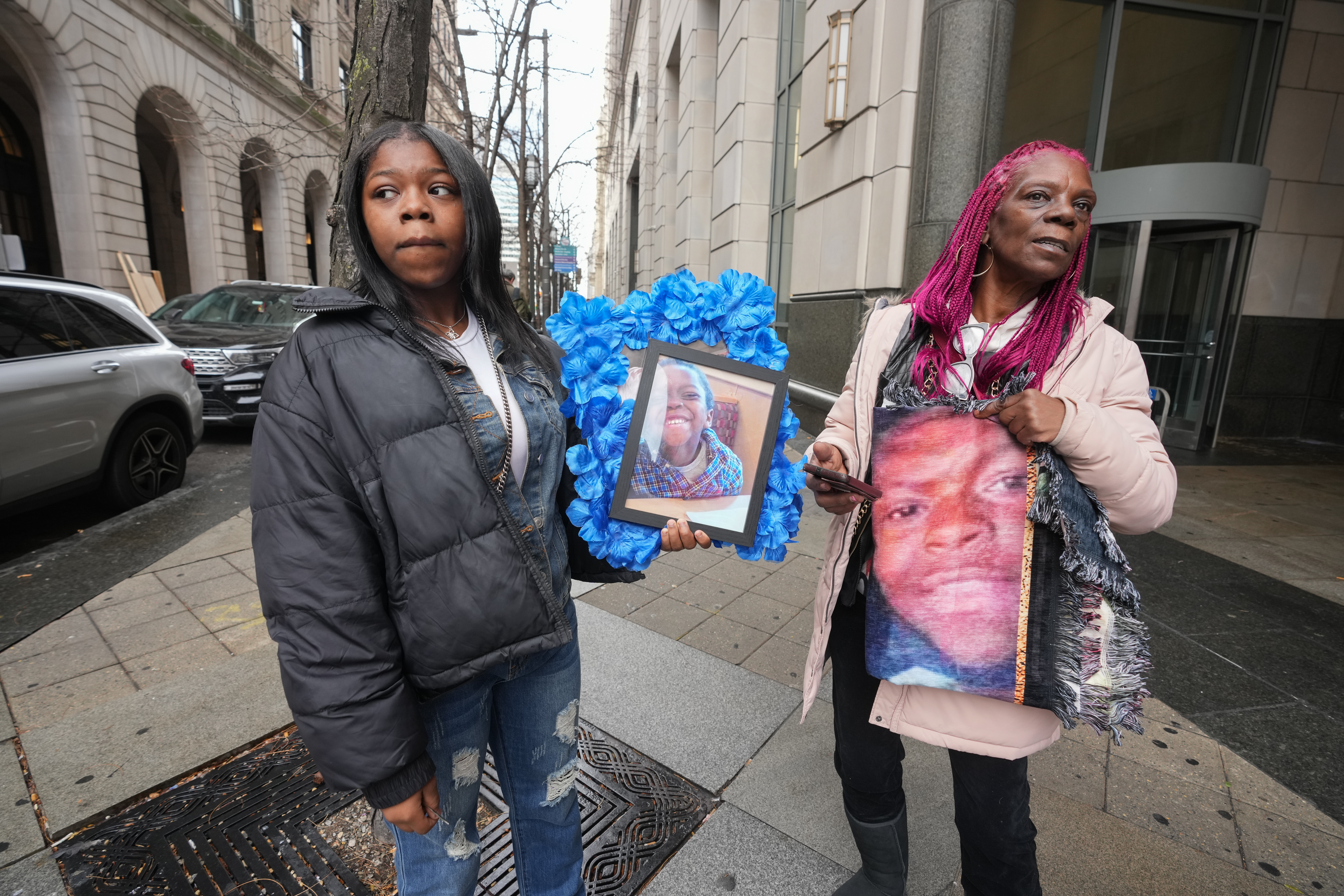
Ne’siyah Thomas-Brown, left, sister of Da’Juan Brown, and, Odessa Brown, right, grandmother, outside the Juanita Kidd Stout Center for Criminal Justice, in Philadelphia, December 17, 2025.
There will be no Christmas miracle for trolley riders.
The Center City trolley tunnel will remain closed at least through the end of December, SEPTA said Wednesday. Officials did not offer a precise reopening date but were hopeful service would resume in January.
The tunnel has been closed since the beginning of November for repairs to its overhead catenary wire system. In October, damage caused two separate incidents in which trolleys were stopped and hundreds of riders were evacuated inside the tunnel.
“We want to make sure that we don’t reopen before we feel that the risk has been reduced as low as possible that we could have another event in the tunnel,” said Kate O’Connor, SEPTA’s assistant general manager of engineering, maintenance, and construction.
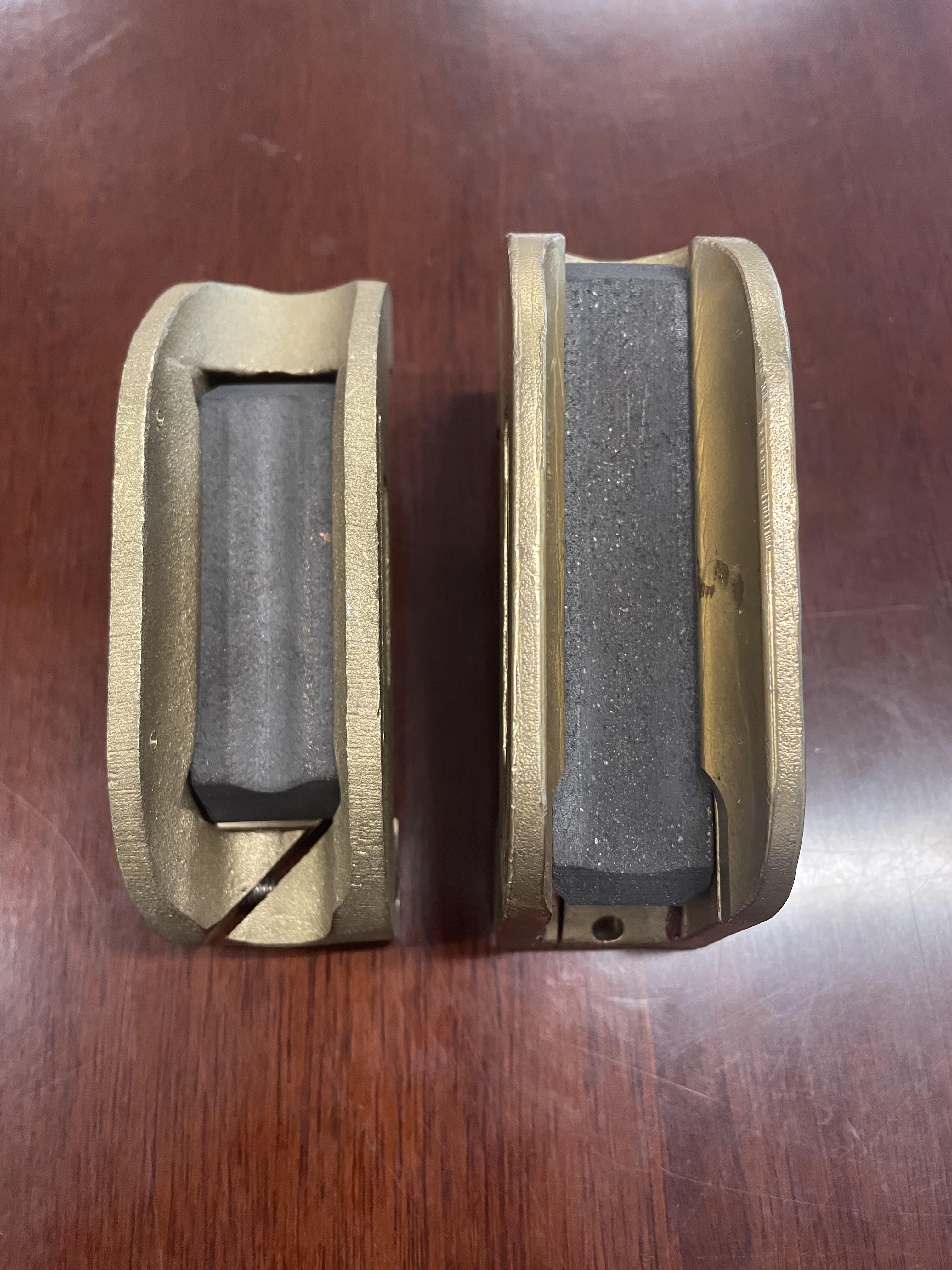
Issues began earlier this fall after SEPTA changed the size of the brass sliders that hold chunks of carbon that rub off and coat the wires carrying electricity to the trolleys. The carbon coating helps the trolleys move smoothly.
A 3-inch slider, left, and a 4-inch slider, which coats electric powered wires with carbon to reduce friction. When they fail, trolleys are stranded.
The switch from 3-inch to 4-inch sliders was meant to prolong their lifespan and lower maintenance costs, but it proved to do the opposite. Inside the tunnel, where there are more curves on the tracks and more equipment holding the wire to the ceiling, the new sliders and carbon burned through more quickly.
SEPTA had tested the 4-inch sliders before the change was made, but observed no issues,O’Connor said. The tests proved to be too limited, she said, and did not adequately measure how the sliders would work across an entire fleet.
SEPTA changed back to the 3-inch slider, but because the overhead wires were now damaged, the once-reliable sliders began to wear out more quickly, too.
“We could hear the rubbing on the brass” after less than a day, said Jason Tarlecki, SEPTA’s deputy chief engineer of power.
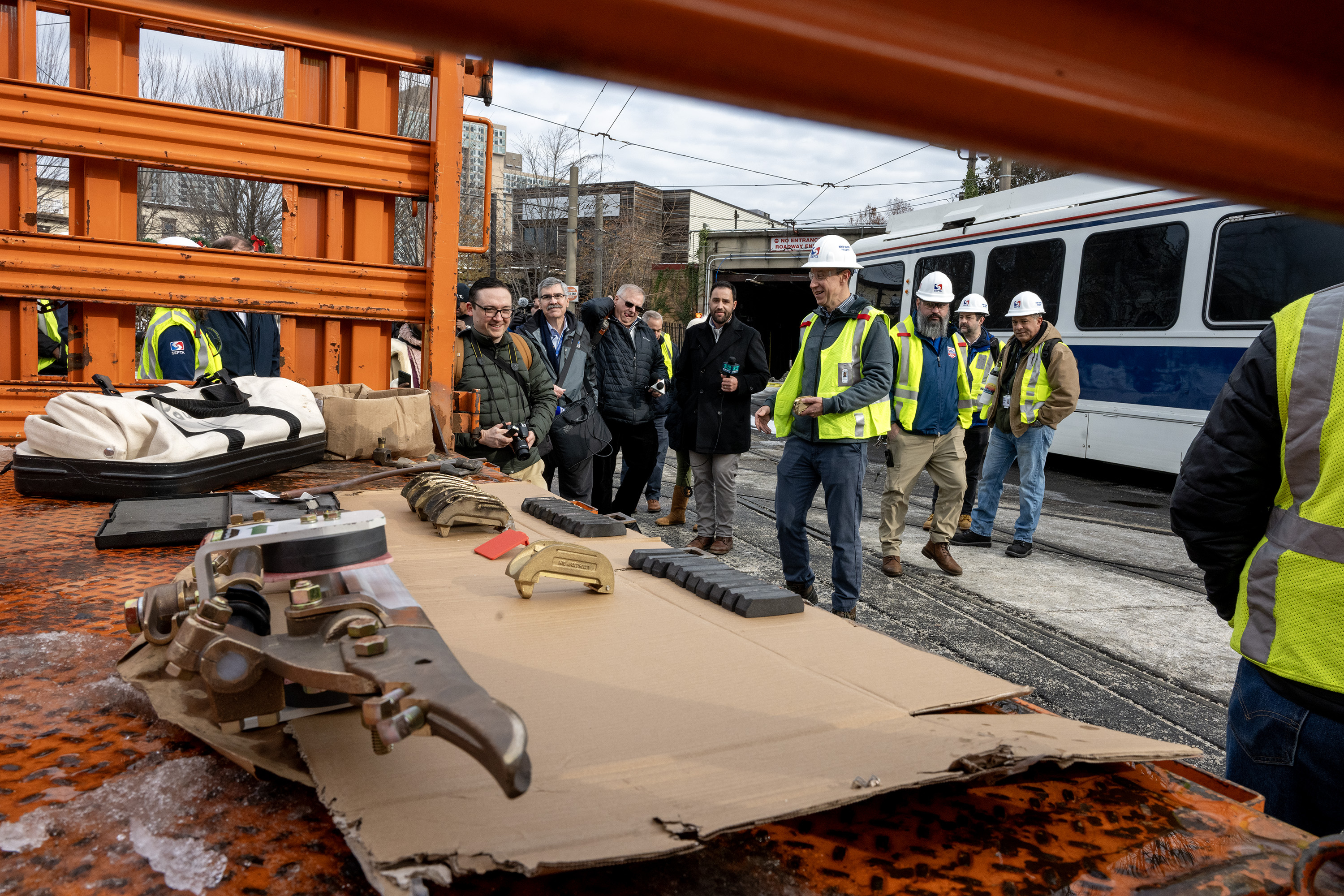
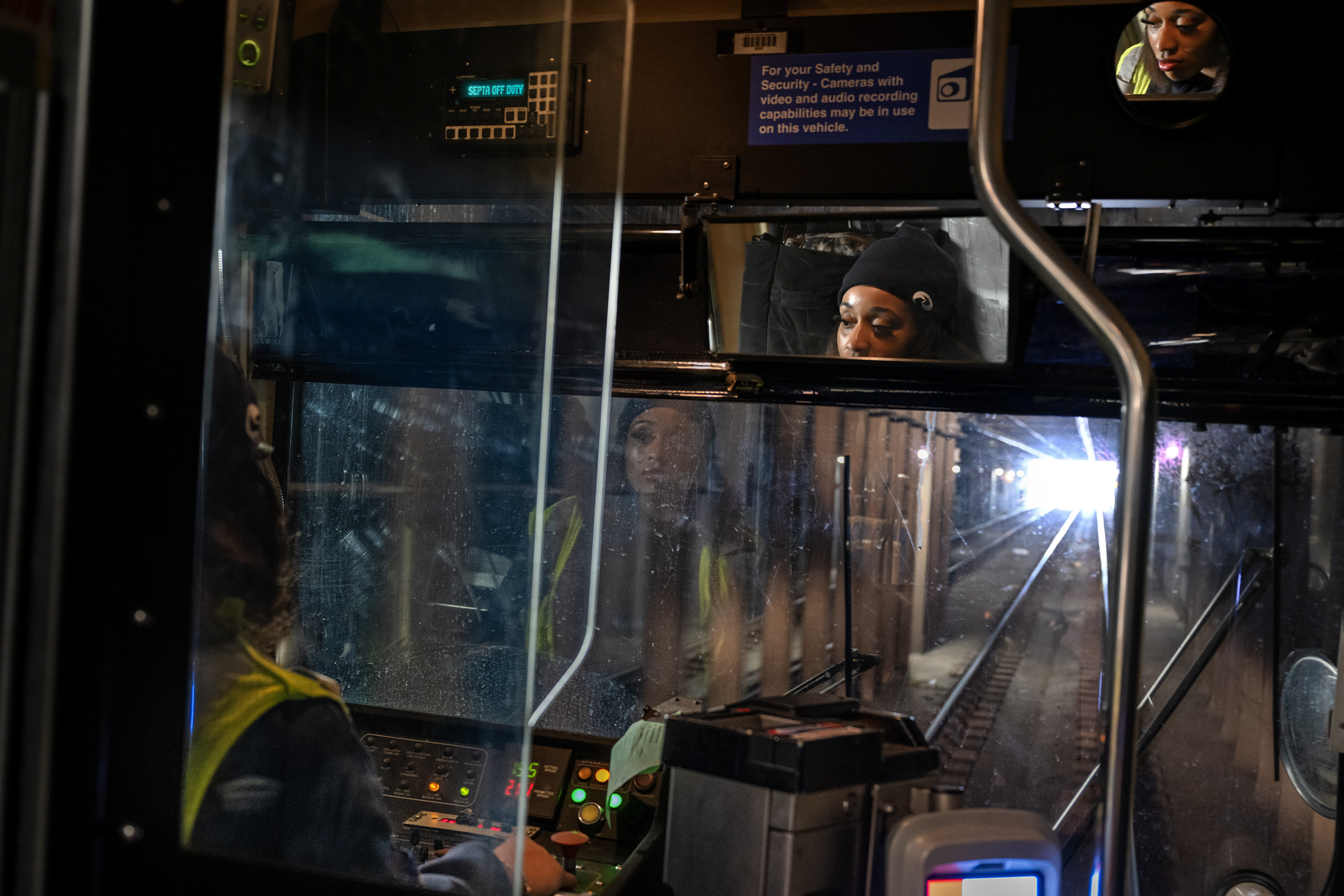
Trolley slider parts are on display as Jason Tarlecki, acting SEPTA chief engineer of power, talks with the news media at the 40th Street trolley portal (rear) Wednesday, Dec. 17, 2025.
SEPTA determined it needed to replace the tunnel’s roughly five miles of overhead copper wiring, Tarlecki said, after the excess wear left it “shattered and raw” in sections.
Those repairs have taken longer than originally projected. According to SEPTA officials, supply-chain issues stemming from the pandemic have created longer wait times for new parts. New wiring needs to build up a carbon coating over time, and SEPTA has been running trolleys along the system during the closure for the patina to develop. And the transit authority has been conducting tests, like experimenting with reduced-speed zones and readjusted wire tension, to ensure that the issue does not arise again.
On Thursday morning, City Councilmember Jamie Gauthier and State Rep. Rick Krajewski (D., Philadelphia) plan to lead a canvass pushing for SEPTA and the city to help riders during the closure of the tunnel.
“I know how challenging and frustrating it’s been for the tens of thousands of West and Southwest Philadelphians who rely on the trolley to get to school, work, and other essentials. [Market-Frankford Line] riders dealing with crush crowds and drivers stuck in trolley diversion gridlock are suffering too. … Only a sustainable investment from our state government can solve the root cause of this problem: SEPTA’s aging infrastructure,” Gauthier said in a statement.
Even once the tunnel does reopen and service returns, the slider saga might not be over. O’Connor said that it was possible SEPTA would close the tunnel again occasionally, possibly for a weekend, as it continues to replace sections of the wiring.
SEPTA trolley operator Victoria Daniels approaches the end of the tunnel, heading toward the 40th Street Trolley Portal Wednesday, Dec. 17, 2025, after a tour to update the news media on overhead wire repairs in the closed tunnel due to unexpected issues from new slider parts.
A federal judge on Wednesday tossed a proposed class-action lawsuit by Jefferson Health patients accusing the Philadelphia area’s largest health system of allowing Facebook’s third-party tracking technology, Meta Pixel, access to private patient information.
District Judge Cynthia M. Rufe rejected the request and dismissed the lawsuit, writing in an opinion that the plaintiffs had “ample opportunity to identify any defects or issues” over the last two years.
“They have not identified any discovery or new evidence to justify such delay, nor have they explained how counsel’s due diligence did not determine the limitations of Plaintiffs’ claims,” Rufe wrote.
The judge noted that the attorneys also missed the deadline to file for class certifications and did not respond to discovery requests.
Attorneys David Cohen and James Zouras of the Stephan Zouras firm, who filed the complaint, did not respond to a request for comment.
The original lawsuit was filed in 2022 in the Eastern District of Pennsylvaniaon behalf of RobertStewart and Nancy Murphy, who said they suspected that their health information had been compromised when they started seeing Facebook ads related to medical issues, such as diabetes, kidney stones, and smoking cessation, that they had discussed with Jefferson providers through the patient portal.
The lawsuit says Jefferson patients were tracked on the health system’s public-facing homepage, as well as within a password-protected portal where doctors and patients communicate.
Jefferson denied in legal filings that it used Meta Pixel on its patient portals. It acknowledged using third-party tracking technology on its public-facing websites, which do not contain private medical information.
Jefferson did not respond to a request for comment.
In April, Cohen and Zouras asked the court to replace Stewart and Murphy with a third patient, Cathryn Thorpe, as the named plaintiff representing the patients in the class action.
The attorneys said Stewart and Murphy would remain members of the proposed class of harmed patients.
Jefferson’s attorneys argued in court filings that the request to replace the named plaintiffs was an admission that there was “no live controversy” and the suit should be tossed out.
Rufe could not square how the patients’ case was too problematic to serve as named plaintiffs but they couldstill remain members of the class. She denied the request and dismissed the lawsuit.
Another book by South Philly author Liz Moore is heading to the small screen.
Netflix announced it has ordered a series adaptation of The God of the Woods, a multigenerational mystery drama set in the Adirondacks.
Moore will serve as a co-showrunner, writer, and executive producer, Netflix said. It marks the author’s second book that has been adapted for TV.
The 2024 novel is about a teenage girl who disappears from her summer camp in 1975 and how the investigation uncovers years of family secrets and mysteries.
Earlier this year, Moore’s best-selling Long Bright River, which focuses on Kensington’s opioid crisis, was turned into a series for Peacock. That crime thriller premiered in March.
The author, who lives in South Philly, earned local credibility for her efforts to depict Kensington honestly in her book and with producers for the Peacock series. She said at the time her aim was to make something that countered misguided depictions of the neighborhood.
Moore teaches at Temple’s College of Liberal Arts and is the director of the school’s creative writing MFA program.
The God of the Woods is Moore’s fifth novel. It collected several accolades, including multiple Book Club shortlists and a spot on Barack Obama’s Summer Reading List.
No additional details have been publicized about the Netflix series’ cast or release date.
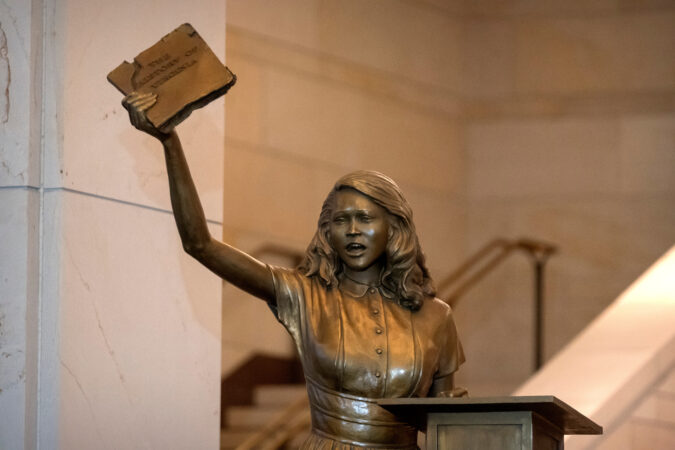
Back in 1951, a teenage Barbara Rose Johns led a walkout at her segregated high school in Virginia that would go on to contribute to the U.S. Supreme Court’s landmark decision in Brown v. Board of Education. Now, a statue of her is on display in the U.S. Capitol, replacing a sculpture of Confederate Gen. Robert E. Lee.
“The Commonwealth of Virginia will now be properly represented by an actual patriot who embodied the principle of liberty and justice for all,” House Minority Leader Hakeem Jeffries (D., N.Y.) said at a ceremony Tuesday unveiling the statue. “And not a traitor who took up arms against the United States to preserve the brutal institution of chattel slavery.”
And while Johns today is remembered as a seminal civil rights figure who hailed from Virginia, she spent much of her adult life in Philadelphia.
Born in New York City in 1935, Johns as a child moved to Prince Edward County, Va., where she lived on a farm with her grandmother. The county’s public schools were segregated, and in the late 1940s, she began attending an all-Black high school in Farmville known as Robert Russa Moton High School.
Johns, according to the Moton Museum, became frustrated with the poor conditions at the school, which lacked resources and was overcrowded compared with white facilities. In April 1951, when she was 16, she led a walkout with hundreds of other students to protest the conditions, ultimately gaining the support of NAACP lawyers, who filed a lawsuit that challenged the practice of segregated education.
Known as Davis v. Prince Edward, the lawsuit went on to become one of the five cases that the U.S. Supreme Court reviewed in Brown v. Board of Education. The high court’s landmark 1954 decision declared “separate but equal” public schools unconstitutional. Despite resisting the court’s decision, Prince Edward County schools were ultimately integrated by the mid-1960s.
People take photos of a statue of Virginia civil rights activist Barbara Rose Johns, whose statue will replace one of Robert E. Lee as one of Virginia’s two statues on display at the Capitol, at a dedication ceremony Tuesday, Dec. 16, 2025, in Washington.
Following the walkout, Johns’ parents were worried for their daughter’s safety and sent her to live in Montgomery, Ala., where she resided with her uncle, the Rev. Vernon Johns, who was a pastor and civil rights leader in his own right. She completed high school there and studied for a time at Spelman College in Atlanta, according to the Farmville Herald, Farmville’s local newspaper.
In 1954, she married the Rev. William Rowland Powell, and the pair later moved to Philadelphia. As a resident, Johns continued college at Drexel University, from which she graduated in 1979 with a bachelor’s degree in library science, according to the 2018 bookRecovering Untold Stories: An Enduring Legacy of the Brown v. Board of Education Decision.
Johns would go on to have five children, and worked for more than 20 years as a librarian for the Philadelphia School District. Public information about her time in Philadelphia is scarce, and neither Drexel nor the school district immediately responded to requests for comment.
On Sept. 25, 1991, Johns died in Philadelphia following a battle with cancer. Her family, the Farmville Herald reported, knew little of activism and her involvement in the Moton walkout, only learning of it late in her life.
The statue of Johns is part of the National Statuary Hall Collection at the Capitol, in which each state can contribute two statues. The other statue representing Virginia is of George Washington.
The National Statuary Hall displays 35 of the statues. Others are in the Crypt, the Hall of Columns, and the Capitol Visitor Center. House Speaker Mike Johnson (R., La.) said the Johns statue will be placed in the Crypt.
Former Democratic Virginia Gov. Ralph Northam had requested the removal of the Lee statue. In December 2020, a state commission recommended replacing Lee’s statue with a statue of Johns. The removal occurred during a time of renewed national attention over Confederate monuments after the death of George Floyd, and the Lee statue was relocated to the Virginia Museum of History and Culture.
Johns is also featured in a sculpture at the Virginia Civil Rights Memorial outside the state Capitol in Richmond. Her former high school is now a National Historic Landmark and museum.
“She was brave, bold, determined, strong, wise, unselfish, warm and loving,” said Terry Harrison, one of her daughters, at Tuesday’s unveiling, according to NPR. “We’re truly grateful that this magnificent monument to her story, the sacrifices that her family and her community made, may continue to inspire and teach others that no matter what, you too can reach for the moon.”
This article contains information from the Associated Press.
The trickle begins in the fall, some principals say: Students with a history of behavior or disciplinary problems or other issues show up in Philadelphia School District schools, often from city charters.
Students switch schools after the start of the school year for many reasons — and changing schools is fairly common in Philadelphia.
But at times, it seems like some students are off-loaded from charters because they’re tough to educate, according to interviews with a dozen district administrators. In district schools, administrators cannot remove students for such issues.
Advocates at the Education Law Center have noted that trend, as has the head of the district’s principals union — all of whom call it concerning, especially in a school system with large numbers of needy students and not enough resources to educate them.
“In October, in November, in December, that’s when we see the counseling out, the threats of expulsion that say, ‘We’re going to expel you, but you can go to a district school and then you won’t be expelled,’” said Margie Wakelin, a lawyer with the Philadelphia-based Education Law Center-PA.
Cassandra St. Vil, chief executive officer of a group that represents a large number of Philadelphia charters, said she is not aware of any data to support those anecdotal claims.
“For years, opponents of charter schools have tried to use this message and yet there has never been any evidence to back it up,” said St. Vil, of Philadelphia Charters for Excellence. “And conversely, we hear from charter school leaders the exact same thing, that students come to them.”
District data show that over the last three years, there has been a steady flow of charter students transferring to district schools throughout the school year. In the 2024-25 school year, for instance, 161 students transferred from brick-and-mortar charters to district schools in September. By June, it was 843 students, just a fraction of the total charter sector.
window.addEventListener(“message”,function(a){if(void 0!==a.data[“datawrapper-height”]){var e=document.querySelectorAll(“iframe”);for(var t in a.data[“datawrapper-height”])for(var r,i=0;r=e[i];i++)if(r.contentWindow===a.source){var d=a.data[“datawrapper-height”][t]+”px”;r.style.height=d}}});
Charters educate more than 64,000 Philadelphia students; there are about 114,000 in district schools.
“While this is not an issue across the entire charter sector, the district is looking at the data, and working with the Charter Schools Office,” Christina Clark, a district spokesperson, said in a statement. “The district is working to analyze enrollment trends across all sectors.”
Robin Cooper, president of Commonwealth Association of School Administrators, Teamsters Local 502, said many district schools get a stream of students beginning in the fall, after district schools’ budgets are locked in on Oct. 1, then another in the spring, just before state testing. (Students’ scores count for the schools they attended on Oct. 1, even if they switch schools after that date.)
“They’re not sending the kids who get A’s, the good kids, they’re sending you the kids who might have problems,” said Cooper, who was a longtime district principal before assuming the union presidency. “It negatively impacts your climate, and the charter is getting the money for the student.”
One district principal, who declined to be named for fear of reprisal, said they recently stopped in a hallway to talk to a student who had just transferred to the district school from a charter.
“She said, ‘They kicked me out for fighting,’” the principal said. “Here, we can’t kick a student out for fighting. I said, ‘Welcome to our school. I’m in the business of growing children.’”
Students ‘counseled out’ of charters
Charter schools — which are publicly funded but privately managed, though authorized by local boards of education — have transformed Philadelphia’s educational landscape since they first came to Pennsylvania in 1997.
Charters are funded by per-student payments from the school district, but are paid only for the number of days enrolled.
By law, charters are open to all students, and most operate on citywide lotteries — though some are neighborhood schools.
A 2017 Education Law Center analysis of the enrollment of special education students in Pennsylvania charters found that “while a number of individual charter schools equitably serve all students, the charter school sector taken as a whole generally underserves these vulnerable student populations.”
Anecdotally,district principals say in some cases, they see students with behavior problems or learning differences accepted to some charters, but thensome of themare “counseled out.” That means they arenot officially expelled or forced to leave, but strongly encouraged or pressured to do so after a disciplinary issue crops up.
In district schools, the bar for expulsion is much higher — for incidents such as using a weapon, or threatening mass violence.
Wakelin, of the Education Law Center, said sherecently spoke to a parent whose child has a significant disability. The parent had multiple conversations with the charterschool about the child’s needs. She said the school kept telling the family: We’ll help.
“And then very recently, the charter school said, ‘You know, you might be better served in a district school that has more resources for a student with autism,’” said Wakelin, who declined to name the school in question.
‘It’s no secret’
After the start of the school year, another district principal said, comes a bump in charter transfers.
“We see an increase every year,” said the principal, who, like othercurrent and former district administrators who spoke to The Inquirer, asked not to be identified for fear of reprisal. “It’s not talked about, but in the schools, it’s no secret.”
When new students transfer in, an administrator often asks why they left their old school.
“Most of them say it’s because they were kicked out of whatever charter school they were at — they got into a fight, or whatever,” the principal said. “And most of the times, it’s things that we can’t move students for in the Philadelphia School District.”
Lawrence Jones, longtime chief executive officer of the Richard Allen Preparatory Charter School in Southwest Philadelphia, said there is “an urban myth” that charters off-load problem students to district schools and then benefit financially for doing so. (There is a common perception that charters get paid for students based on their Oct. 1 enrollment counts, and keep the money if students go elsewhere, but charters actually get paid for the number of days students are enrolled.)
“The gain that you could potentially get for dropping those kids, financially and other funding, would be less than if you held onto those students,” said Jones.
But a third district principal called the issue a particular challenge for neighborhood schools, which already typically tend to have higher concentrations of children with complicated needs. Public schools often get needy students midyear, but no additional funding. Their budgets are projected in the spring, but finalized in the fall.
“It’s just not fair,” said the third principal. “We’re not getting their best kids.”
That principal is currently experiencing what they call “the season when we get charter kids,” they said. “They send them to us for discipline issues, uniform violations.”
‘A sword that cuts both ways’
The practice engenders deep frustration, principals say.
“Public schools can’t turn kids away. It’s not like the charter world where you can say, ‘No, I’m full, have a nice day.’ In public school, you take the kid, crowded or not, and figure it out,” a fourth principal said.
St. Vil, of Philadelphia Charters for Excellence, which represents 64 schools, disputes that characterization. She noted that nearly 80% of the city’s charter students are Black or Latino, and many have special needs or are English learners.
“These schools are achieving real success stories for students who too often haven’t thrived in one-size-fits-all settings,” St. Vil said.
Jones, of Richard Allen Preparatory Charter School, said that while there may be some isolated instances where a charter counsels out a student with difficulties, “it’s a sword that cuts both ways.” Students sometimes come to charters from district schools with inadequate special-education plans, he said.
Parents enrolling their children at Richard Allen have told him that they were told his school “could provide better services,” Jones said. “I asked, ‘By who?’ And they said, ‘By staff at the former school, the district school.’”
Capstan Therapeutics’ sale this year for $2.1 billion, the highest price paid for a private early-stage biotech company since 2022, was a triumph for its founders at the University of Pennsylvania.
Unfortunately for Philadelphia, the company is based in San Diego. Investors wanted an executive who lives there to be CEO.
Capstan was a miss for Philadelphia, said Jeffrey Marrazzo, who cofounded a high-profile regional biotech company, Spark Therapeutics, and is now an industry investor and consultant.
If Philadelphia had a bigger talent pool of biotech CEOs, “it would have and should have been here,” he said.
The Philadelphia region has lagged behind other biotech centers in landing companies and jobs, but industry experts are working to close the gap and better compete with Boston, the San Francisco Bay Area, and San Diego.
According to Marrazzo and others, the Philadelphia region’s relatively shallow pool of top biotech management is a key challenge.
Big investors go to managers who have proven ability to deliver big investment returns, said Fred Vogt, interim CEO of Iovance Biotherapeutics, a California company with a manufacturing facility in the Navy Yard.
“They want the company to perform. They’ll put it in Antarctica, if that was where the performance would come from,” he said.
The Lilly announcement last month also reflects Philadelphia’s national biotech stature. It’s the fourth U.S. city to get a Lilly Gateway Lab, behind Boston, the San Francisco Bay Area, and San Diego.
Those places have far outpaced Philadelphia in the creation of biotech research and development jobs, even as the sector’s growth has slowed.
From 2014 through last year, the Boston area added four biotech research and development jobs for every one job added here, according to an Inquirer analysis of federal employment data.
window.addEventListener(“message”,function(a){if(void 0!==a.data[“datawrapper-height”]){var e=document.querySelectorAll(“iframe”);for(var t in a.data[“datawrapper-height”])for(var r,i=0;r=e[i];i++)if(r.contentWindow===a.source){var d=a.data[“datawrapper-height”][t]+”px”;r.style.height=d}}});
Penn’s role in Philadelphia biotech
Philadelphia’s reputation as an innovation center — boosters like to call the region “Cellicon Valley” — starts with the University of Pennsylvania, which has long been a top recipient of National Institutes of Health grants to advance scientific discovery.
Research at Penn has contributed to the creation of 45 FDA-approved treatments since 2013, according to the university.
“Penn discoveries help spark new biotech companies, but we can’t build the whole ecosystem in this area alone,” said John Swartley, Penn’s chief innovation officer. “Great science is just one ingredient. We also need capital, experienced leadership, real estate and manufacturing infrastructure, and strong city and state support.”
Penn was one of two Philadelphia institutions receiving more than $100 million in NIH funding in the year that ended Sept. 30. The otherwas the Children’s Hospital of Philadelphia.
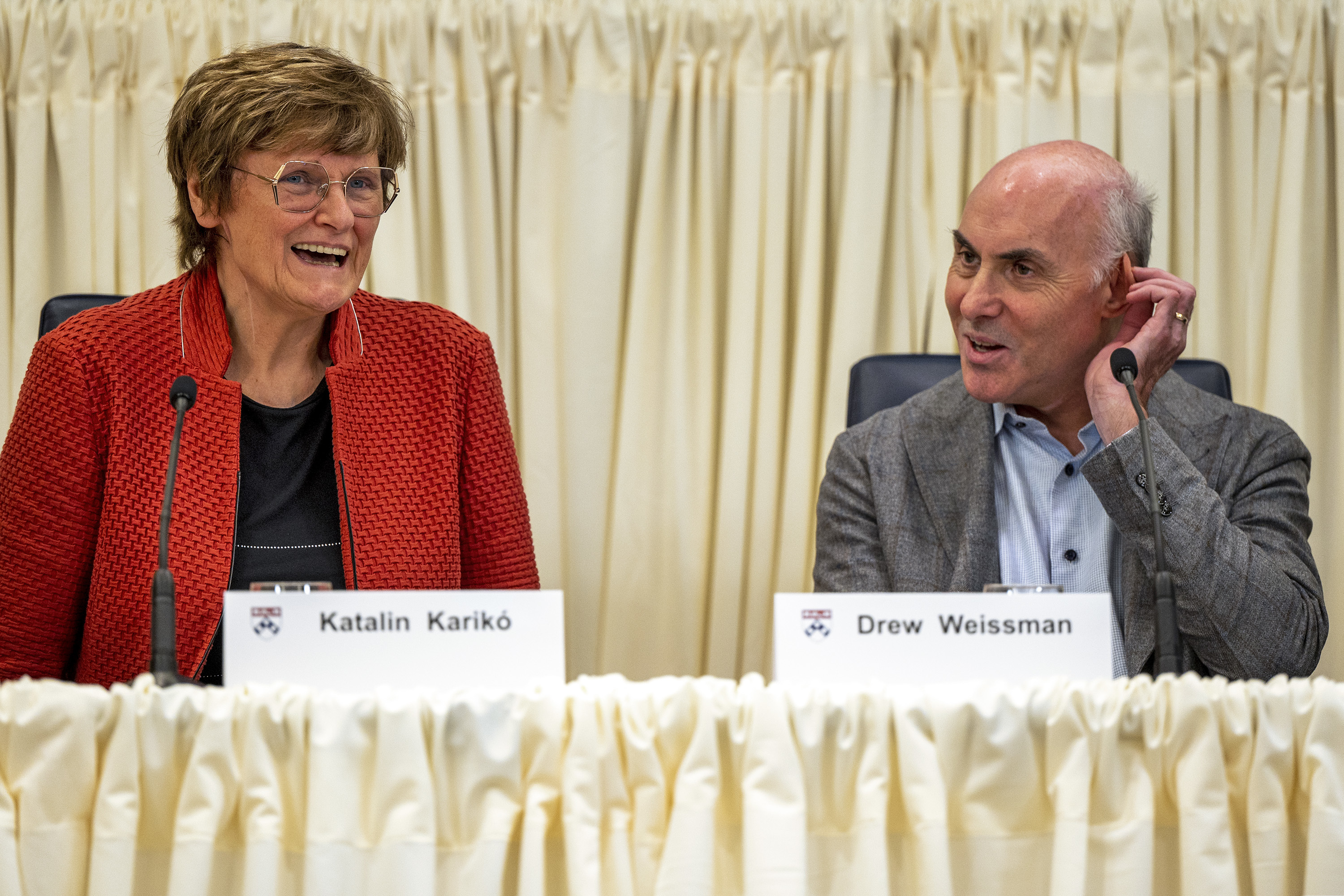
Katalin Karikó and Drew Weissman spoke at a University of Pennsylvania news conference after they were named winners of a 2023 Nobel Prize in medicine. Their work was instrumental to modifying mRNA for therapeutic uses, such as the rapid development of lifesaving vaccines during the COVID-19 pandemic.
By contrast, the Boston area was home to 10 institutions with at least $100 million in NIH grants, generating more spinoffs and jobs.
The Philadelphia region has a healthy number of biotech spinouts, but the biggest markets have more from a larger number of research institutions, said Robert Adelson, founder Osage University Partners, a venture capital firm in Bala Cynwyd.
That concentration of jobs and companies in the Boston area — where nearly 60,000 people worked in biotech R&D last year — makes it easier to attract people. By comparison, there were 13,800 such jobs in Philadelphia and Montgomery County, home to the bulk of the regional sector.
If a startup fails, which happens commonly in biotech, “there’ll be another startup or another company for me to go to” in a place like Boston, said Matt Cohen, a managing partner for life science at Osage.
Another challenge for Philadelphia: It specializes in cell and gene therapy, a relatively small segment of the biotech industry, whose allure to investors has faded in the last few years.
Such market forces shaped the trajectory of Spark, a 2013 Children’s Hospital of Philadelphia spinout that developed Luxterna, the first FDA-approved gene therapy, used to treat an inherited form of blindness. The promise of Spark’s gene therapy work for a form of hemophilia spurred its 2019 acquisition by Swiss pharmaceutical titan Roche for $4.8 billion.
The company still employs about 300 in the city, a spokesperson said, and work continues on its $575 million Gene Therapy Innovation Center at 30th and Chestnut Streets in University City.
The long arc of biotech
A handful of companies dominated the early days of U.S. biotech. Boston had Biogen and Genzyme, San Francisco had Genentech, San Diego had Hybritech, and Philadelphia had Centocor. All of them started between 1976 and 1981.
Centocor started in the University City Science Center because one of its founders, virologist Hilary Koprowski, was the longtime director of the Wistar Institute. Centocor’s first CEO, Hubert Schoemaker, moved here from the Boston area, where he had gotten his doctorate at the Massachusetts Institute of Technology.
Another drug still under development at the time of the sale, Stelara, went on to become J&J’s top-selling drug as recently as 2023 with $10.9 billion in revenue. Stelara, approved to treat several autoimmune disorders, remains a testament to Centocor’s legacy.
Despite its product success, Centocor didn’t have the same flywheel effect of creating new companies and a pipeline of CEOs as peer companies did in regions outside of Philadelphia.
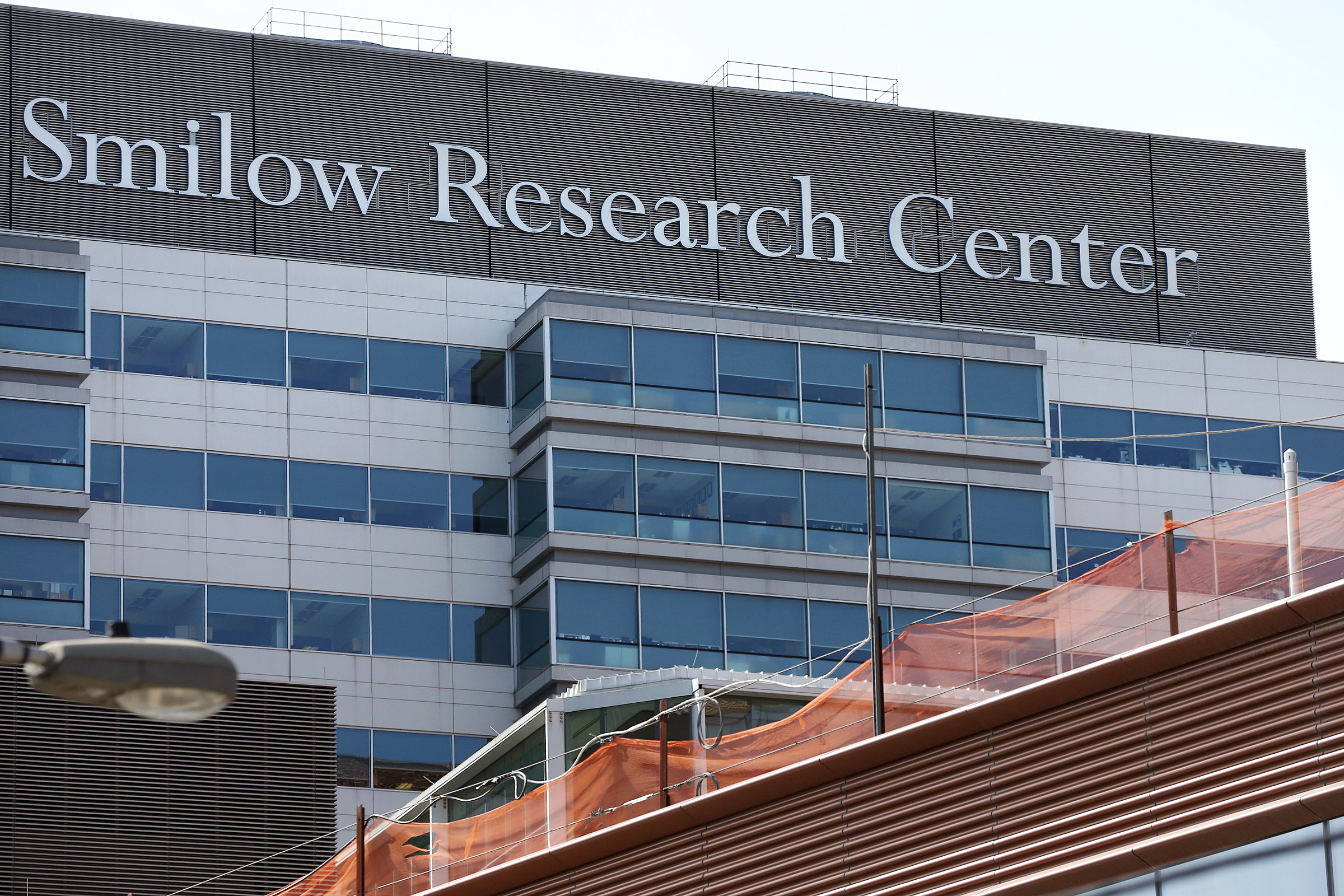
The University of Pennsylvania’s Smilow Center for Translational Research, shown in 2020, is one of the school’s major laboratory buildings.
“There are a lot of alums of Centocor that are really impressive, but they seem to have wound up elsewhere,” said Bill Holodnak, CEO and founder of Occam Global, a New York life science executive recruitment firm.
Among the Centocor executives who left the region was Harvey Berger, Centocor’s head of research and development from 1986 to 1991. He started a new company in Cambridge, Mass.
At the time, the Philadelphia area didn’t have the infrastructure, range of scientists, or management talent needed for biotech startups, he said.
Since then, he thinks the regional market has matured.
“Now, there’s nothing holding the Philadelphia ecosystem back. The universities, obviously Penn, and others have figured this out,” Berger said.
Conditions have changed
Penn’s strategy for helping faculty members commercialize their inventions has evolved significantly over the last 15 years.
It previously licensed the rights to develop its research to companies outside of the area, such as Jim Wilson’s gene therapy discoveries and biochemist Katalin Karikó and immunologist Drew Weissman’s mRNA patents. Now it takes a more active role in creating companies.
Among Penn’s latest spinouts is Dispatch Bio, which came out of stealth mode earlier this year after raising $216 million from investors led by Chicago-based Arch Venture Partners and San Francisco-based Parker Institute for Cancer Immunotherapy.
Dispatch, chaired by Marrazzo, is developing a cell therapy approach that uses a virus to attach what it calls a “flare” onto the cells it wants the immune system to attack.
Marrazzo said in July that he wasn’t going to be involved in Dispatch if it wasn’t based largely in Philadelphia. As of July, 75% of its 60 employees were working in Philadelphia. Still, Dispatch’s CEO is in the San Francisco Bay Area.
The Philadelphia region is increasingly well-positioned for the current biotech era, said Audrey Greenberg, who played a key role in launching King of Prussia’s Center for Breakthrough Medicines about five years ago. The center is a contract developer and manufacturer for cell and gene therapies.
“You no longer need to move to Kendall Square to get a company funded,” she said, referring to Cambridge’s biotech epicenter. “You need good data, a credible translational plan, experienced advisers, and access to patient capital, all of which can increasingly be built here.”
Greenberg now works as a venture partner for the Mayo Clinic, with the goal of commercializing research discoveries within the health system’s network of hospitals in Minnesota, Arizona, and Florida.
She plans to bring that biotech business to the Philadelphia region.
“I’m going to be starting my companies all here in Philadelphia, because that’s where I am. And I know everybody here, and everybody I’m going to hire in these startups that are going to be based here,” she said.