A 21-year-old Temple University student was arrested Monday on charges that he conspired with nine other people, including journalist Don Lemon, to interfere with the First Amendment rights of worshipers during a Jan. 18 anti-ICE protest at a church in St. Paul, Minn.
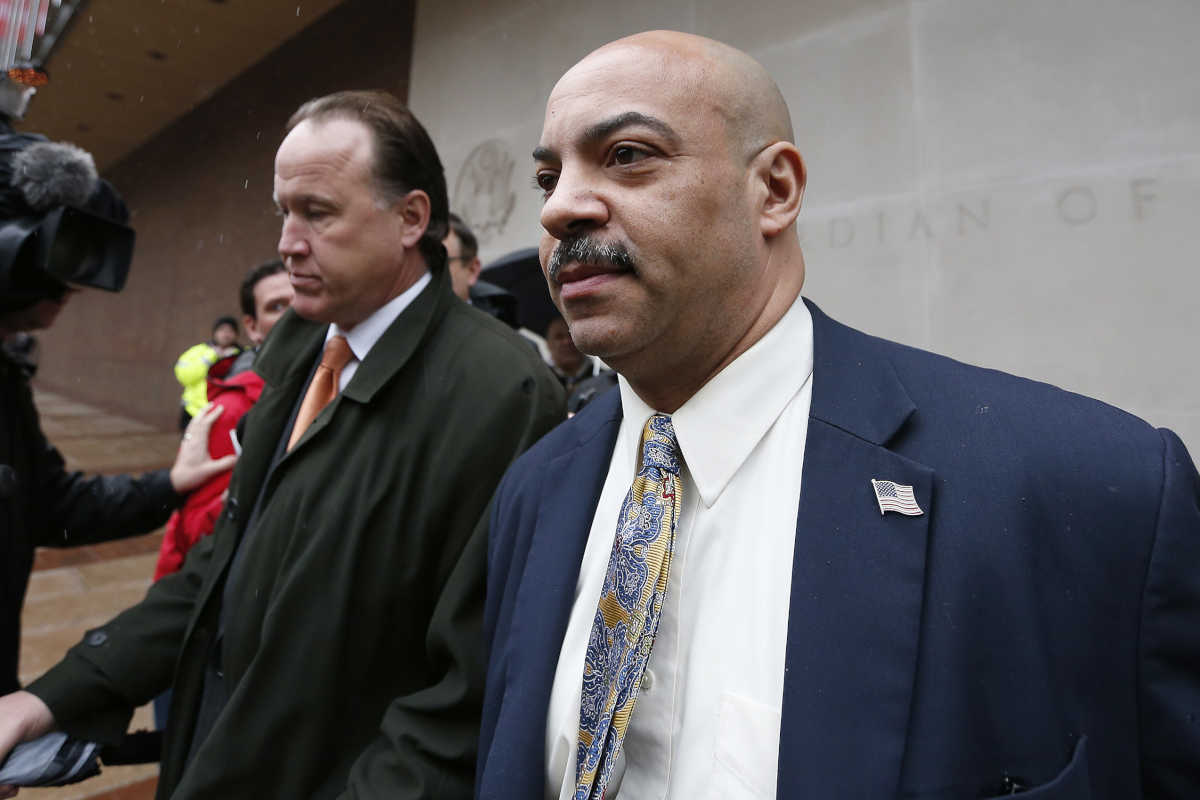
Jerome Richardson, 21, a senior at Temple who is a native of St. Paul, turned himself in Monday morning to federal authorities in Philadelphia, according to a post on a GoFundMe page created to pay for his legal defense. A photo was posted showing Richardson entering the United States Custom House with several federal law enforcement officers apparently waiting for him at the entrance.
The arrests of Richardson and Ian Davis Austin, an Army veteran from Montgomery County, were announced at 9:10 a.m. on X by Attorney General Pam Bondi. Austin was arrested Friday.
“If you riot in a place of worship, we WILL find you,” Bondi wrote. “We have made two more arrests in connection with the coordinated attack on Cities Church in St. Paul, Minnesota: Ian Davis Austin and Jerome Deangelo Richardson.”
The arrest of Don Lemon was made public on Friday.
The protesters went to Cities Church because a pastor there is also a U.S. Immigration and Customs Enforcement official.
If you riot in a place of worship, we WILL find you.
We have made two more arrests in connection with the coordinated attack on Cities Church in St. Paul, Minnesota: Ian Davis Austin and Jerome Deangelo Richardson.
Lemon entered the church while livestreaming and said repeatedly: “I’m not here as an activist. I’m here as a journalist.” He described the scene before him, and interviewed churchgoers and demonstrators.
A magistrate judge had rejected prosecutors’ initial bid to charge the veteran journalist. Lemon was charged, as were Richardson and seven others, by grand jury indictment last Thursday.
The indictment described the protest as a “coordinated takeover-style attack” on the church that caused people to flee in fear. Protesters chanted “ICE out!” and “Hands up! Don’t shoot!” The indictment quotes Lemon, who in the moment described the scene as “traumatic and uncomfortable.”
Before his arrest, Richardson shared a video online in which he said he feared for his safety and needed help to pay legal bills.
Richardson said he assisted Lemon “by helping with logistics and connecting him with local contacts.”
“Don was reporting on the situation,” Richardson said, adding that he was proud to help.
“As a consequence of this support, I am now being targeted by Trump and the federal administration,” Richardson said, adding that he was proud of the other defendants in the case.
“This is the price of being unapologetic about humanity and love of Christ,” he said.
Richardson, who traced his activism to the murder of George Floyd in 2020, said he still hoped to complete his degree and graduate from Temple in May.
In a statement, Temple University said it was aware of media reports about the arrest of a student.
“We understand that the circumstances surrounding this matter are developing. Out of respect for the privacy of the student and the ongoing legal process, the University will not comment on the specifics,” the statement says.
“As we’ve shared previously, we deeply value the First Amendment, including the rights of free speech, a free press, and the freedom to exercise religion,” the statement says. “We encourage and educate our students to engage thoughtfully and lawfully to advocate for their beliefs and values, raise awareness and contribute to constructive dialogue.”
This article contains information from the Associated Press.
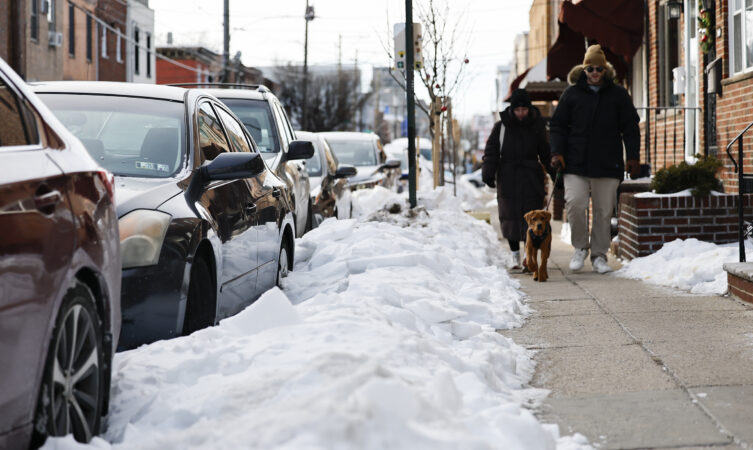
The Philadelphia Parking Authority will begin enforcing all parking regulations and resuming the towing and impoundment of illegally parked vehicles on Tuesday, the authority said.
PPA enforcement of meter and time-limit violations has been relaxed since the night before the Jan. 25 snow and sleet storm, when the city declared a snow emergency. Only safety violations, such as parking next to fire hydrants, were enforced.
Enforcement remained limited because the city still had piles of curbside snow throughout the city.
Full enforcement will begin at 8 a.m. Tuesday, the authority said. Towing and impoundment of illegally parked vehicles also will resume Tuesday.
The snow removal efforts are continuing, with the Streets Department announcing a temporary parking ban along a 1½-mile stretch of South Broad Street that will start at 7 a.m. Tuesday.
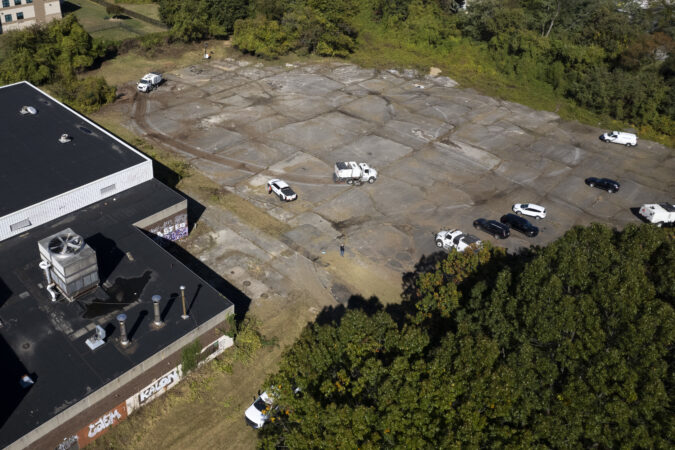
Two weeks after Kada Scott vanished, Philadelphia Police Detective Joseph Cremen stood over a patch of disturbed ground in a wooded stretch near an abandoned school in East Germantown.
He pushed aside a layer of loose twigs and pressed a six-foot branch into the soil. It sank only a few inches before stopping short.
That, Cremen testified Monday, was when he realized he’d found a shallow grave.
The Oct. 18 discovery ended a two-week search for Scott, 23, who disappeared on Oct. 4 after leaving the Chestnut Hill senior living center where she worked. An autopsy later determined that she had been shot in the head.
Cremen testified that the location of the grave was not discovered at random, but emerged from weeks of reviewing surveillance footage, digital data, and tips that helped authorities trace a path from the Awbury Arboretum to the wooded area where Scott was buried — and that linked her killing to Keon King, who is charged with murder, abuse of a corpse, and related crimes.
During a preliminary hearing Monday that stretched nearly five hours, prosecutors methodically laid out that evidence, replaying video after video on a courtroom TV as detectives testified about how they tracked Scott’s final movements and King’s efforts, they say, to conceal her death.
At the conclusion of the hearing, Common Pleas Court Judge Karen Simmons ruled that prosecutors had presented sufficient evidence for the case to proceed and ordered it held for court.
An attorney for Scott’s parents, Brian Fritz, called the ruling a “first step” in getting justice for their daughter.
“Kada Scott’s family is grieving,” he said. “In fact, their grief is unimaginable. But, so is their commitment for accountability and justice for Kada.”
Detectives testified that surveillance cameras at the Awbury Arboretum recorded a silver hatchback vehicle pulling into a parking lot less than an hour before Scott’s Apple Watch transmitted its final location at 1:14 a.m. on Oct. 5. Footage from the same cameras appeared to show two men removing an object from the car and walking in the direction investigators later followed to Scott’s burial site.
An anonymous tip helped lead investigators into the woods nearby the Ada H.H. Lewis Middle School in East Germantown.
Kim Matthews (second from left), mother of Kada Scott, holds a image of her daughter before a Domestic Violence Awareness walk at the Philadelphia Art Museum on Oct. 26, 2025.
Additional street cameras, prosecutors said, captured the same hatchback parked in a driveway behind homes on the 2300 block of 74th Avenue. Moments later, video showed a sudden flash of light and flames as the car was set on fire, destroying what authorities believe may have been physical evidence inside.
Investigators did not rely on any single camera, prosecutors emphasized. Instead, detectives testified that they reconstructed the timeline by stitching together footage from dozens of surveillance systems across the city. That effort, they said, led them to King, 21.
Street cameras recorded a 1999 gold Toyota Camry registered to King traveling in the vicinity of the arboretum around the same times activity was captured there, they said. Police also tracked the movements of one of Scott’s Apple devices after she left work, comparing its location data with license plate readers and surveillance video, detective Robert Daly testified.
“Everywhere this device went, Mr. King’s car went,” Daly said.
Cell phone records presented at the hearing showed that King and Scott had exchanged text messages in the hours before her disappearance, Daly testified.
The last message Scott sent asked King to call her when he arrived at the senior living center. The final incoming call on her phone, at 10:12 p.m. on Oct. 4, was from King, according to police.
Before Simmons ruled, King’s defense attorney, Robert Gamburg, argued that the prosecution’s case relied too heavily on circumstantial evidence and failed to place his client directly at the scene of the killing.
The surveillance footage, he said, did not clearly identify any faces and could not establish who was inside and around the vehicles.
He also pointed to testimony from a senior living center employee who said she saw Scott leave work that night and noticed a dark-colored Jeep parked outside the facility, not a silver hatchback.
“There is absolutely nothing connecting this young man to what happened to Ms. Scott,” Gamburg said, urging the judge to dismiss the case.
“At this level, with this quantum of evidence, for this type of case, it should be discharged today,” he said.
Assistant District Attorney Ashley Toczylowski countered that investigators had assembled a detailed and corroborated account of Scott’s final hours, one that showed not only King’s proximity to her disappearance, she said, but also steps taken afterward to destroy evidence.
“This isn’t coincidence,” she told the court. “It’s corroboration.”
Parking restrictions along a 1½-mile stretch of South Broad Street will take effect at 7 a.m. Tuesday so the Streets Department can begin removing piles of curbside snow, the city said.
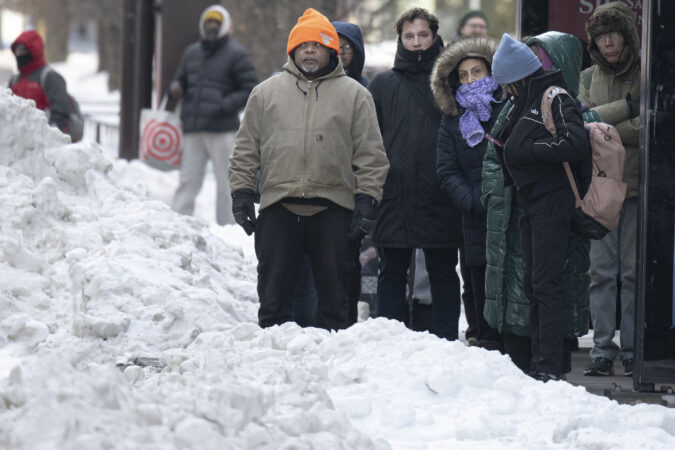
Snow removal has gone slowly since the storm more than a week ago because of the ongoing deep freeze across the region.
Parked vehicles must be moved from Broad between Washington and Oregon Avenues ahead of 7 a.m. to clear the way for a Streets Department “lifting operation” that will remove the snow, the city said.
Free off-street parking will be available at lot U near Citizens Bank Park between 7 a.m. and 6 p.m. Tuesday, the city said. All vehicles must be moved from the parking lot by 6 p.m.
The operation, which will involve excavators and loaders, may temporarily disrupt traffic, the city said.
“The Streets Department urges everyone traveling near this lifting operation, and others taking place across Philadelphia, to plan extra travel time, slow down, and help keep our crews safe by giving them plenty of space to do their work,” the department said.
If it appears that the tenacious meringue of snow and ice that landed on the region two weekends ago hasn’t budged, it hasn’t.
Among Philadelphia winters, this one is approaching a rarefied status.
Not long after Phil predictably saw his shadow in Punxsutawney, the National Weather Weather Service contractor at Philadelphia International Airport reported a snow depth of six inches on Monday.
That marked the eighth consecutive day of a snow cover of at least six inches, a streak unmatched since February 2010 — which included a five-day period in which 44 inches of snow had fallen.
And what’s out there now may get a fresh frosting on Tuesday night that could affect the Wednesday morning commute, and perhaps snow squalls on Friday with the approach of another Arctic front as the freezer reopens.
Don’t be surprised if next Monday morning looks a lot like this one.
“The snowpack is not going anywhere,” said Amanda Lee, meteorologist at the weather service office in Mount Holly.
What explains the durability of the snow cover
The primary factor locking in the regional glacier has been the obvious — the cold. Sunday marked the ninth consecutive day that temperatures failed to surpass freezing, the longest stretch since 2004. The temperature did reach above freezing at Philadelphia International Airport on Monday.
Temperatures since Jan. 24 have averaged 14 degrees below normal in Philly. January temperatures ended up finishing 2.2 degrees below normal, even though the month had a nine-day warm spell in which the highs went past 55 on five days.
In addition to the cold, the icy layers of sleet that have put a cap and a patent-leather sheen on the several inches of snow that fell Jan. 25, have limited melting. Ice is way slower to melt than snow.
Eight days after an official 9.3 inches of snow and ice was measured officially, about two-thirds of it has survived.
The forecast for the next several days
The region is in for a modest — very modest — warming trend. Readings cracked freezing Monday, reaching 35 degrees at 4 p.m. and are forecast to top out near 32 on Tuesday and Wednesday, and hold in the upper 20s Thursday. Those readings still would be several degrees below normal.
Some light snow is possible Tuesday night, “maybe up to an inch,” Lee said. The weather service on Monday was listing a 72% probability of something measurable — defined as 0.1 inches or more — falling in Philly.
Given the cold and the solidly frozen paved surfaces, “it could make things slippery for the morning commute on Wednesday,” said Matt Benz, senior meteorologist with AccuWeather Inc.
Friday afternoon, he said, the region could see snow squalls — brief, mini-blizzards that can come on without notice and reduce visibility dangerously.
Then it’s back to the freezer with expected weekend lows in single digits and highs struggling to reach 20.
For those ready for something completely different, NOAA’s Climate Prediction Center on Monday suggested the potential for significant pattern change, although this may require a little patience around here.
Its extended outlook for the six-to-10 day period that begins Sunday has most of the nation warmer than normal, with odds strongly favoring below-normal readings in the Philadelphia-to-Boston corridor. But a “rapid warmup” in the Philly region is possible around mid-month, the climate center says.
“I did not see anything that concerned me about the condition, because there are some marks, but I can’t portray where they are from, and I do not believe that they’re in a worsened condition now,” Judge Cynthia M.Rufe told reporters after spending about 30 minutes in the storage facility, which is controlled by the National Park Service even though the center is not part of the agency.
After the inspection, Rufe ordered the government to safeguard the removed exhibits and mitigate any potential harm to them.
The suit came after National Park Service employees took down educational panels about slavery from the President’s House at Independence National Historical Park on Jan. 22.
It also follows a hearing in federal court Friday in which city attorneys and U.S. attorneys sparred over the removal of the exhibits. During the hearing, Rufe, a George W. Bush appointee, chastised a U.S. attorney representing President Donald Trump‘s administration for talking out of “both sides of his mouth” and making “dangerous” arguments.
Rufe issued an order Monday preventing further removals or changes to the President’s House until further notice. The judge also instructed the city to file a new injunction request to clarify what it is seeking, and gave the U.S. attorney’s office another week to respond.
Michael Coard, leader of advocacy group Avenging the Ancestors Coalition, which helped develop the President’s House in the early 2000s and is providing legal backing to the city’s suit, told reporters that he didn’t see any damage to the panels, but “there was desecration.”
What he saw was“completely disrespectful, demoralizing, defiling, and desecration,” Coard said, noting that the signs, many of which are fragile, were not cushioned and that some were against the wall on a cement floor.
Coard joined the judge and attorneys in the storage facility as a representative for the coalition’s legal support of the lawsuit.Members of the press were not allowed to review the exhibits.
Before going to the storage facility Monday, Rufe and the attorneys gathered in the lobby of the Constitution Center, which has a direct view to Independence Hall from Arch Street to Chestnut.
Rufe invoked the iconic building Friday to set the stakes for the city’s suit against Interior Secretary Doug Burgum, acting National Park Service Director Jessica Bowron, and their respective agencies.
“It’s threatening to think that that could happen to Independence Hall tomorrow,” Rufe said during the hearing. “It’s frightening to think that the citizenry would not be involved in such an important change.”
After having been in limbo for months, the informational panels were removed by Park Service employees using wrenches and crowbars onorders from the Trump administration, provoking outrage from Philadelphians. The displays were then piled into the back of a pickup truck and transported to the storage facility.
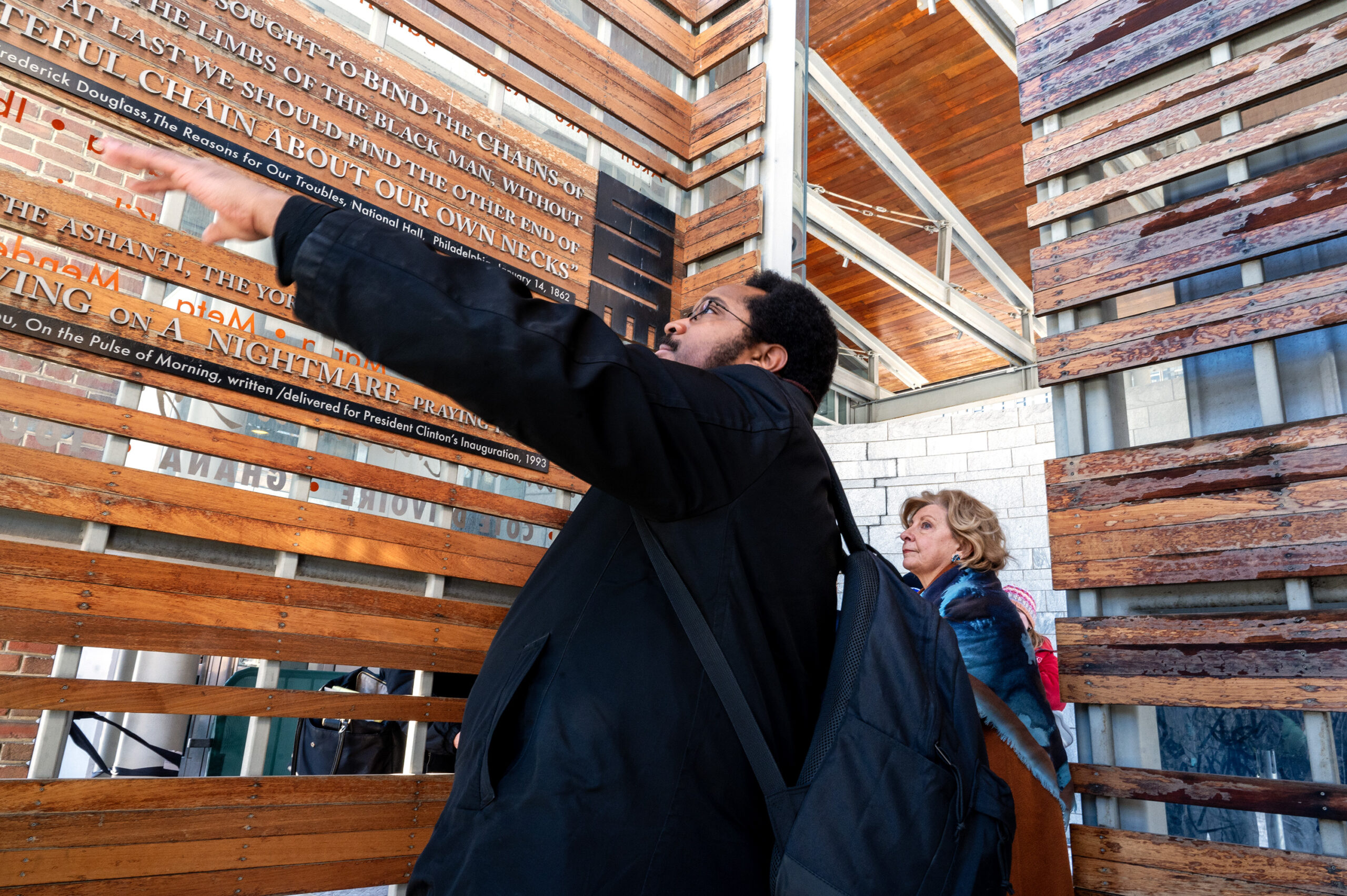
Mijuel Johnson (left), a guide with The Black Journey: African-American Walking Tour of Philadelphia, shows Judge Cynthia Rufe (right) around the President’s House in Independence National Historical Park on Monday.
The exhibits are stored by the National Parks Service in a room accessible through the National Constitution Center, but the civics-nonprofit “does not oversee that space, and Center staff have no knowledge of what materials may be stored there,” a spokesperson said in a statement.
After reviewing the removed exhibits for roughly 30 minutes, Rufe and her law clerks walked across Independence Mall toward the President’s House, a block away at Market Street. The judge stood at the site of the former home of Presidents George Washington and John Adams, as a guide from The Black Journey explained the historical significance of the slavery exhibit.
“This is the first of its kind memorial on federal property to the enslaved people of the United States,” said Mijuel Johnson, who led the tour.
Johnson directed the judge’s attention to panels telling the story of the presidency and the enslaved Africans who lived on the property, part of the routine tour script, but the walls were bare.
Rufe asked questions about the removed panels and what exhibits could be further removed. She walked around the site, still not cleared of the previous weekend’s snow, to review a wall in which the names of the President’s House enslaved residents are etched into the stone.
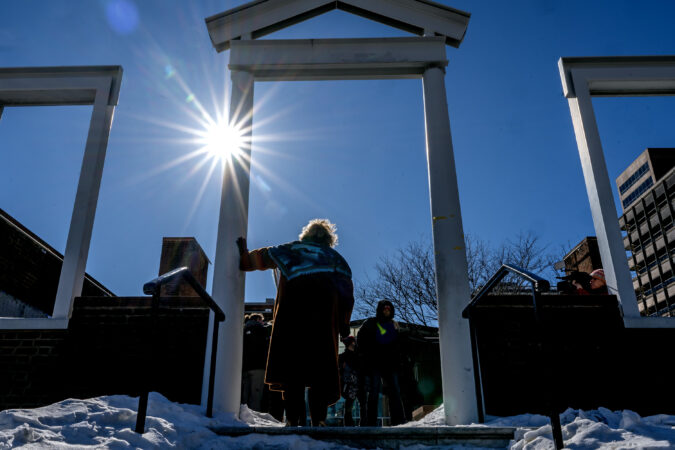
Judge Cynthia Rufe views the “Memorial to Enslaved People of African Descent in the United States of America,” during a visit to the President’s House in Independence National Historical Park on Monday. This exhibit was not removed with other panels at the site on Jan. 22. The judge visited the site while hearing the Parker administration’s suit to have President Trump’s administration restore the panels.
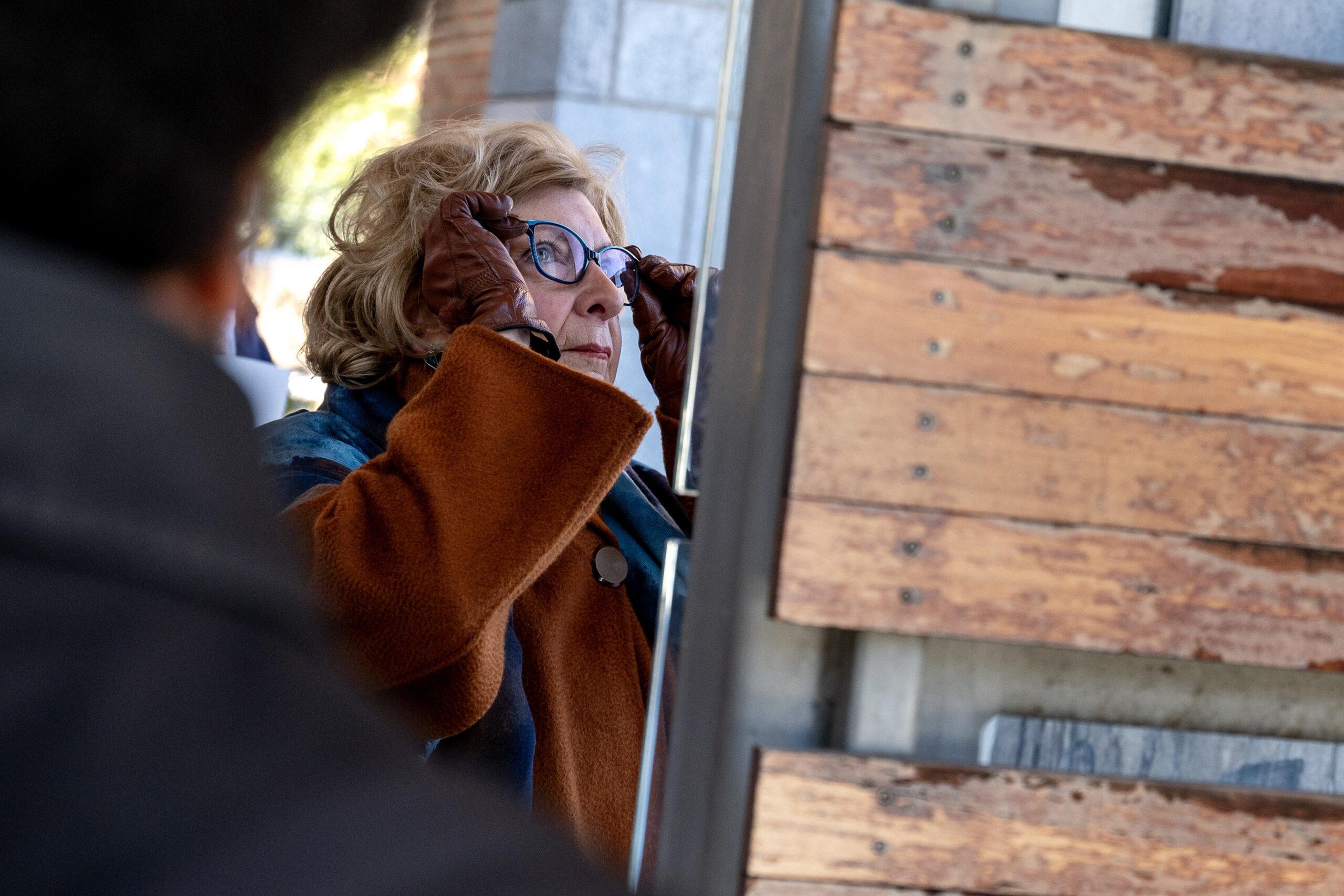
Outside the location that served as the slaves’ quarters, adjacent to the Liberty Bell, Rufe paused and took out her glasses to read a memorial panel.
“This enclosed space is dedicated to millions of men, women and children of African descent who lived, worked and died as enslaved people in the United States of America,” the panel read. “They should never again be forgotten”
Relevant to the core disagreement in the lawsuit, about who has the right to change the site, the bottom of the memorial panel bears the names of two entities: the National Park Service and the City of Philadelphia.
It was so cold Monday at Farrell Elementary, a Philadelphia public school in Northeast Philadelphia, that middle schoolers — a group seemingly constitutionally averse to bundling up — were wearing coats indoors.
That was just one example of trouble for the Philadelphia School District amid the prolonged frigid spell bearing down on the region, with a number of schools plagued by burst pipes, broken heaters, and other issues.
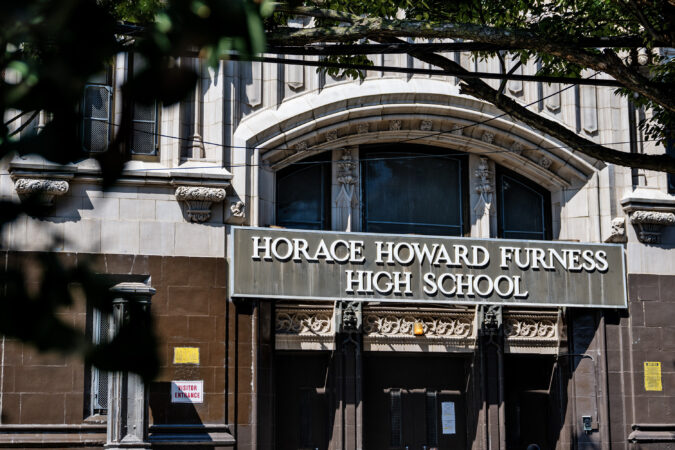
Furness High, in South Philadelphia, moved to virtual instruction Monday “due to ongoing heating challenges.”
“The safety and comfort of our staff remains our top priority,” wrote Teresa Fleming, the district’s chief operating officer. “Moving to virtual instruction for the day allows necessary work to continue while allowing minimal disruption to learning.”
Though Farrell’s heat was on the fritz for the third school day in a row, the district did not pivot to virtual learning there. Instead, it was one of four schools that dismissed early due to heating issues. For much of the day until classes ended, Farrell students and staff were forced to either bundle up or find space to relocate in more-adequately heated spots in the overcrowded school, according to staffers who asked not be named because they are not authorized to speak to the media.
Six Farrell classes camped out in the auditorium, including one class of 38 eighth graders. But the auditorium had to do double duty because the unplowed state of the yard where students typically play meant that students who’d typically be in the yard before or after eating lunch had to be in the auditorium also, Farrell employees said.
Meaningful learning was “absolutely not” going on in the auditorium, one staffer said. “It’s almost impossible.” Students were instructed to complete work on Google Classroom, and teachers were balancing crowd control and working with students individually.
In other cases, teachers and students just stayed in cold rooms, bundled up. Small-group instruction had to happen in hallways because of the population overflow; the hallways were also freezing.
“It’s just ridiculous,” said the Farrell staffer, of the school conditions.
They and others were frustrated that though district officials knew Farrell was plagued by heating issues, students and staff were required to be in the building, especially while other schools were permitted to go virtual.
District students had a snow day last Monday, learned virtually on Tuesday and Wednesday, then went back for in-person instruction on Thursday, though conditions were tough in many schools. In some places, heating issues have resolved.
“The safety and well-being of our students and staff remain our highest priorities,” district spokesperson Monique Braxton said. “Due to sustained frigid temperatures following the recent snowstorm, combined with the age of some School District of Philadelphia facilities, several schools are experiencing heating-related challenges.”
In addition to Farrell, Greenberg Elementary, another school in the Northeast, dismissed early because of heating issues, Braxton said. So did the U School and Parkway Center City Middle College, two district high schools.
District workers and independent contractors are “actively addressing both ongoing and newly identified facilities issues to ensure that all students can safely return to a full day of in-person instruction as soon as possible,” Braxton said.
At Farrell, one teacher brought in their own heater to try to keep warm, a staffer said, and one teacher known for wearing shorts every day finally broke down and wore pants.
And then there were the middle schoolers.
“Even the older ones have on coats,” the staffer said. “It’s so cold that they wore coats.”
Younger students, the staffer said, are more curious.
“They say, ‘Why is it so cold in my classroom?’“ said the Farrell staffer.
By lunchtime, word started to spread that both Farrell and Greenberg were dismissing early, staff there said.
But that late call came with its own set of headaches — while some parents would be able to react to the news quickly and pick up their children early, others may be stuck at work and unable to get to school at dismissal.
Arthur Steinberg, Philadelphia Federation of Teachers president, remained frustrated and angry by the district’s call. Steinberg said last week that the district’s return to buildings was “dangerous” given conditions in some places.
“They shouldn’t have brought people in if they knew the buildings were going to be this cold,” Steinberg said.
As to why one school was permitted to be virtual while others were brought in with inadequate heat, Steinberg was stumped.
As Train 9710 pulled out of the Trenton Transit Center at 7:25 a.m. Monday, something looked out of place.
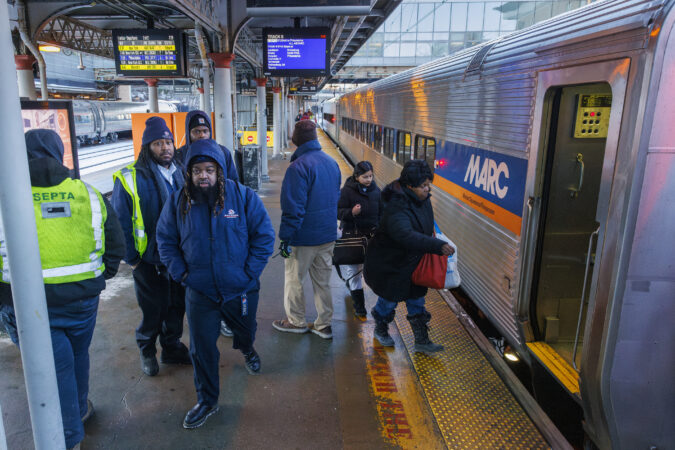
Five passenger coaches in the Philadelphia-bound Regional Rail train bore foreign “MARC” logos and orange-and-blue markings, all pulled by a properly labeled SEPTA electric locomotive.
The substitute cars initially will be running on the Trenton and West Trenton lines, where riders for months have endured packed trains due to a shortage of available 50-year-old Silverliner IVs.
The transit agency is paying $2.6 million to lease the new coaches for a year.
SEPTA’s records show it canceled at least 2,544 Regional Rail trips in the last three months of 2025. Delays and skipped stops also have plagued commuters for months.
SEPTA is using its ACS-64 electric locomotives, which it bought in 2019, to pull the MARC coaches and its own fleet of 45 coaches.
Silverliner cars do double duty; they carry passengers and have motors that provide their own locomotion through electricity drawn from overhead wires.
SEPTA said in a statement that the schedules will add trips on the Wilmington, Trenton, and Chestnut Hill East lines and increase the frequency of service from Wayne Junction directly to the Philadelphia International Airport on the Airport line.
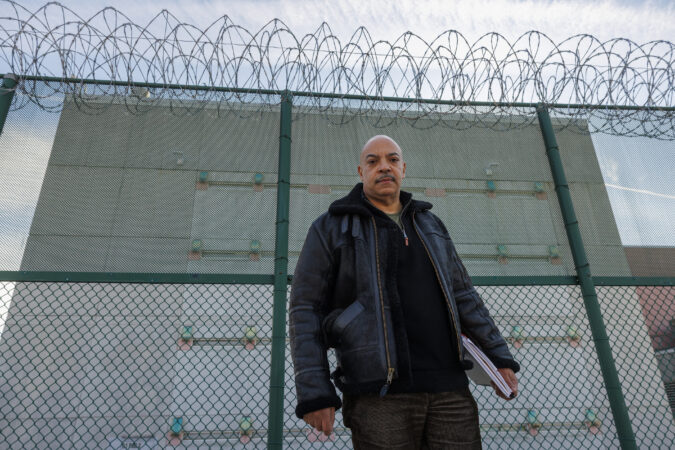
He walked toward the cellblock in Riverside Correctional Facility, pulling a cart of books behind him.
For a moment, it was quiet. The only sounds that echoed off the jail’s cinder block walls were the squeaks of his cart’s wheels.
But as a heavy door to a busy unit swung open, Seth Williams’ work was set to begin.
“Chaplain up!” one of the inmates inside yelled.
Williams smiled at the crowd of prisoners who began walking toward him and his squeaky cart, which was filled with Bibles, Qurans, and other religious texts.
“Step into my office,” he said, placing his hand on an inmate’s shoulder.
The role’s expectations are modest. He offers spiritual counseling and religious programming to the 600 or so prisoners held at Riverside. It is part-time and pays about $21 per hour.
Still, for Williams, the position was uniquely appealing. After putting people in jail as the city’s top prosecutor, then spending five years in federal prison as an inmate himself, he believes he can use what he learned from that journey to help young men avoid committing crimes in the future.
“I can be a better advocate, a better vessel, to help prevent crime and reduce recidivism … by helping people learn the skills they need to keep jobs and de-escalate conflict,” Williams said. “The best use of my experience … is helping people who are incarcerated the way I was.”
Williams believes his efforts now can help reduce recidivism among young men in jail.
It is a long way from the halls of power that Williams once inhabited as the city’s first Black district attorney — and from his standing as a politician who was viewed as a possible future mayor.
Still, Williams says, he is fulfilled by this more humble form of service. And becoming chaplain is not the only role he has taken up behind bars: For the last two years, he has also volunteered at Curran-Fromhold Correctional Facility, teaching weekly classes on career preparedness and poetry, and at State Correctional Institute Phoenix, where he directs a volunteer program about Christianity.
Last month, Williams agreed to allow an Inquirer reporter to join him inside the city’s jails as he counseled inmates. He shared stories about his time in prison, delivered socks and toothpaste to indigent inmates, gathered a group to recite the rosary, and gave books to men who expressed interest in spiritual counseling.
He was energetic, open, and passionate. He spoke openly about his past misdeeds, but remained defiant about his federal prosecution — saying he was wrong for not reporting gifts he received as DA, but insisting that he did not sell his office to his benefactors, as the U.S. Attorney’s Office alleged.
Williams acknowledged that his path to becoming a jailhouse chaplain and volunteer has been unusual. He pointed out, for instance, that the room where he teaches his Career Keepers course is just down the hall from the jail’s print shop — which once printed the DA’s letterhead with his name at the top.
Prisons Commissioner Michael Resnick said Williams’ transformation is one of the key attributes he brings to the job.
“He just has a passion for this work, to get people on the right path,” Resnick said.
And Williams said he feels as if he is doing more to help people now than he ever has.
“What if the worst thing that happens in your life,” he said, “could be used for good?”
From rising star to ‘criminal’
To understand where Williams is now, it helps to recall where he came from.
After he was elected district attorney in 2009, Williams, then 42, promised to reform the office where he had spent a decade working as a line prosecutor. He said he would assign lawyers to handle cases by neighborhood, place greater emphasis on charging crimes correctly at the outset, and divert minor offenses into community-based treatment programs.
His policy positions were part of his appeal, but he also leaned into a compelling personal story: Abandoned in an orphanage at birth, Williams was adopted at age 2 and raised in Cobbs Creek. He went on to graduate from Central High School, Pennsylvania State University, and Georgetown University’s law school before returning to his hometown to work as an assistant district attorney.
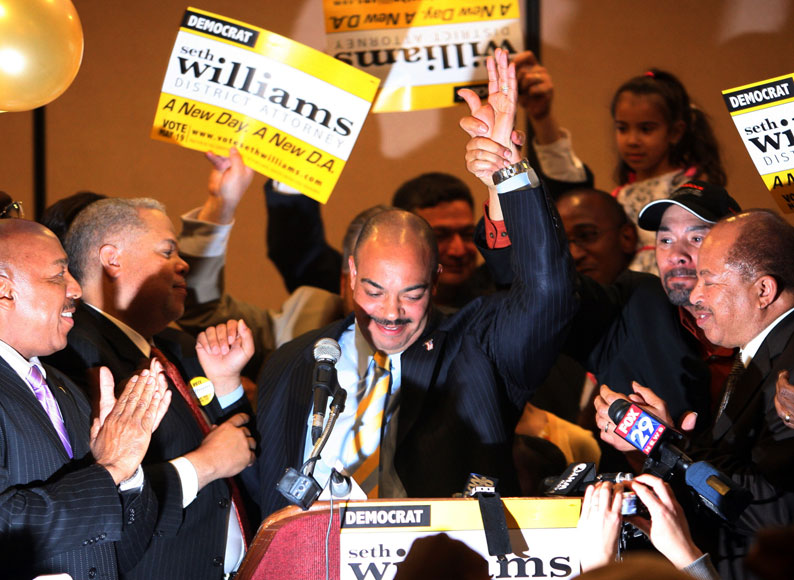
When he ran to become the city’s top prosecutor in 2009 — his second attempt after a narrow loss four years earlier — he had a campaign slogan that matched his aspirations: “A new day, a new D.A.”
Williams thanks supporters after winning the Democratic primary for district attorney in 2009.
And for a while, some political observers said, he was living up to that mantra. In addition to engineering an ambitious restructuring of the office, he made headlines during his first term by charging West Philadelphia doctor Kermit Gosnell with killing babies during illegal late-term abortions, and by charging Msgr. William Lynn, a top official in the Archdiocese of Philadelphia, with shielding sexually abusive Catholic priests.
Charismatic and camera-friendly, Williams was easily reelected to a second term in 2013, and homicides began falling to their lowest levels in decades. Some began wondering if he might leverage his success as DA into a run for City Hall.
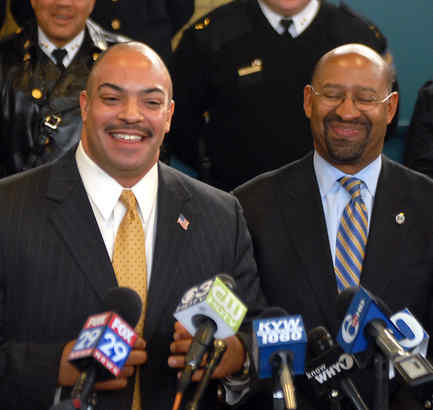
Williams and then-Mayor Michael Nutter at a press conference in 2010.
Beneath the surface, though, challenges in Williams’ personal life began to mount.
He now admits he was also drinking too much, “numbing myself from the daily trauma with too much Jack Daniel’s and martinis and Yuenglings.”
By 2015, the FBI was investigating whether he had been misusing campaign funds to live beyond his means. And two years after that, he was indicted on charges of wire fraud, honest services fraud, and bribery-related crimes.
Federal prosecutors said he not only misspent political money but also sold the influence of his office to wealthy allies who showered him with vacations, clothing, and a used Jaguar convertible.
Williams outside of federal court, where he was charged with bribery and related crimes.
Williams insisted he was not guilty and took his case to trial. But midway through the proceedings, he accepted an offer from prosecutors to plead guilty to a single count of violating the Travel Act.
U.S. District Judge Paul Diamond showed no mercy — jailing Williams immediately, then imposing a five-year prison term, the maximum allowed by law. The judge called Williams a “criminal” who surrounded himself with “parasites” and “fed his face at the trough” of public money.
A mentor in solitary
During the first five months of Williams’ incarceration, he was held in solitary confinement at Philadelphia’s Federal Detention Center. That was intended to protect him — former law enforcement officers can become targets behind bars — but it left him confined to a cell for 23 hours a day.
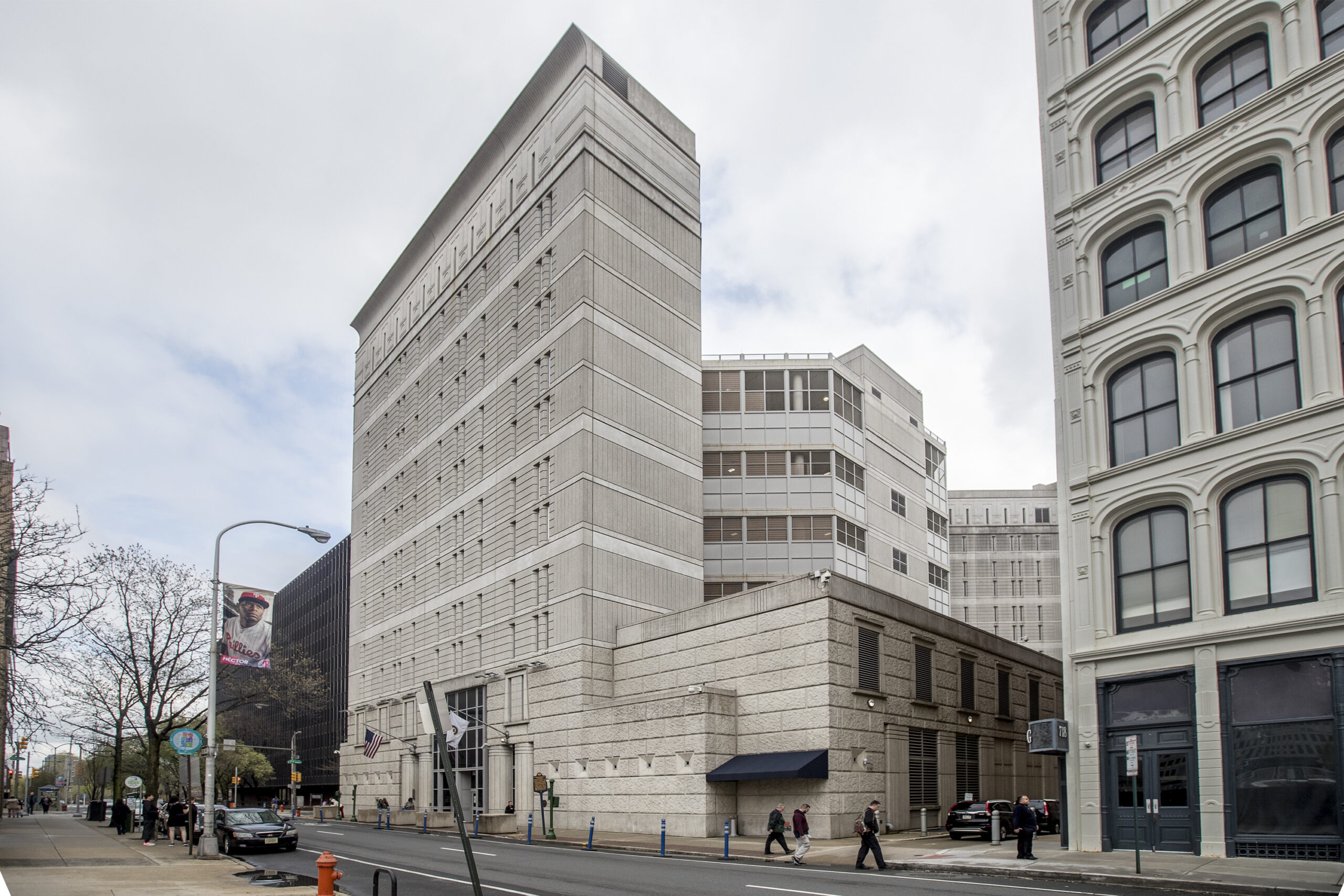
The Federal Detention Center, at 7th and Arch Streets.
Beyond the once-monthly 15-minute phone call he was allowed to make to his daughters, Williams said, there was one thing that helped him endure isolation: Friar Ben Regotti.
Regotti, then a resident at Center City’s St. John the Evangelist Catholic Church, served as the detention center’s chaplain. And when Williams was in solitary, he said, Regotti came to his cell every day and offered an escape: praying with him through a slit in the thick steel door, hearing his confession, and offering him books, including the Bible, which Williams — who was raised Catholic — said he finally read cover-to-cover for the first time.
“I’d lost everything,” Williams recalled. “But Father Regotti was the kindest person to me.”
When he was transferred to a prison camp in Morgantown, W.Va., Williams continued his spiritual journey by attending weekly Masses, Bible studies, and services for other religions. He also completed substance abuse classes, taught classes to help prisoners get high school diplomas, and learned how to play the saxophone.
He made some unlikely friends while he was locked up, including Michael Vandergrift of Delaware County, who is serving a life sentence plus 20 years for killing a rival drug dealer as part of a hired hit; and Bright Ogodo of Brooklyn, N.Y., who was sentenced to more than six years in prison for running a sophisticated identity-theft ring out of TD Bank branches.
Williams said Ogodo later told him he was considering taking his own life — he had even written a letter to his family, convinced they would be better off without him. But when Ogodo saw that Philadelphia’s former DA was in jail, too, Williams said, Ogodo changed his mind.
“He said, ‘I saw you walking with your head up, and [thought], if you can survive, so shall I,’” Williams said.
Three years ago today, I walked out of prison. My friend Bill, picked me up in Morgantown, WV and drove me home. In many ways being incarcerated was less difficult than Re-Entry. I am grateful for all that I have learned. Thank you God. 🙏🏽 pic.twitter.com/393p8KQXmg
Williams was released from prison in 2020, but said almost no one was willing to help him get back on his feet. Before he was incarcerated, he said, he had visited the governor’s mansion and taken his daughters to the Easter egg roll on the White House lawn. But afterward, few people would even take his calls.
“Nobody would hire me,” he said, describing people’s default position toward him as “the Heisman,” the college football statue with an arm extended to keep opponents away.
So Williams — whose law license was suspended when he was convicted — found work at a Lowe’s Home Improvement store in Havertown, unloading trucks and fulfilling online orders from 7 p.m. until 5:30 a.m.
Most of his coworkers, he said, had also recently been released from prison. And while working, he said, he was “kind of providing pastoral care [to them] daily,” similar to his teaching of GED courses in prison, or participating in Bible studies.
In time, he said, he began developing his ideas about self-improvement into formal programs for nonprofits, providing ways for recently incarcerated people to learn the skills needed to maintain consistent employment — developing a resumé, for instance, but also focusing on topics like conflict de-escalation.
Much of his motivation for doing that work, he said, came from research showing that recidivism is greatly reduced among people who receive substance abuse counseling, career coaching, and regular spiritual practice.
“What all three have in common,” Williams said, “is changing the hearts and minds of people.”
Federal Supervised Release ended Friday. First time at the beach since 2016. First time going outside of the Eastern District of Pennsylvania WITHOUT having to ask for permission since ‘17 made me cry! If you want to know my thoughts on Judge Diamond or federal prosecution ask me pic.twitter.com/pwzb9Qa0IR
In 2023, he ran into Terrell Bagby, then a deputy commissioner in Philadelphia’s jail system, and the two discussed the possibility of bringing Williams’ teachings into the jails. That’s how he ended up bringing his volunteer courses — Career Keepers and Prison Poets — into Curran-Fromhold, the city’s largest jail, he said.
In a recent session of Career Keepers, Williams was at the head of the class as nine prisoners sat at a U-shaped table around the room. They took turns practicing public speaking by delivering updates on the weather, sports, and news, then discussed topics including how to reward positive behavior — rather than linger on bad choices — and how to display gratitude.
In the moments after the prisoners were escorted back to their blocks, Williams said the men he has taught over the years have often been more open and vulnerable than he expected. Some have shared stories about traumatic experiences — such as being shot or sexually abused — and then discussed how those experiences affected their lives.
“I spent all this time trying to get out of prison,” he said, “and then I found myself loving being there, trying to help the inmates themselves.”
Becoming a presence
Inside his spare chaplain’s office at the jail, Williams has a desk, a few shelves, and scores of religious books. He keeps packs of white T-shirts, socks, and toothpaste to put into care packages for prisoners and, before making his rounds, keeps a list of people he wants to see.
His time on the cellblocks can be brief. During his rounds on a recent day, his presence did not always seem to have much of an impact. As he passed through each unit’s main expanse, where dozens of prisoners have cells overlooking a bustling common area, some prisoners were more interested in getting their lunch or hanging out by the phones than in checking out what Williams had to offer.
But other times, during several different stops, Williams sat and prayed with prisoners. And the care packages he hands out have become a frequent request, he said.
He wound down his shift in a room near the law library, reciting the rosary with a half-dozen men who had expressed interest in praying with him.
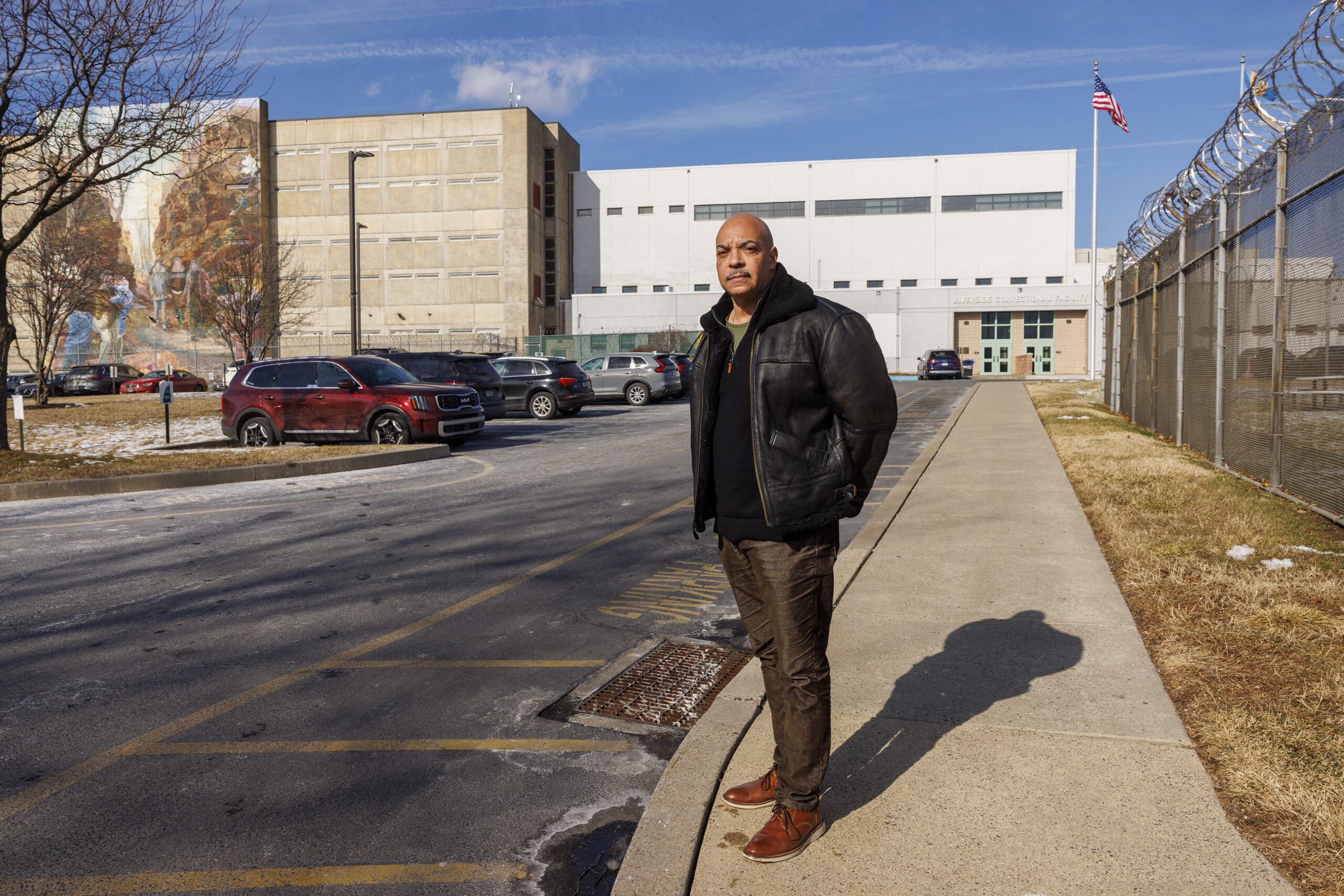
Williams’ chaplaincy is centered at the Riverside Correctional Facility in Northeast Philadelphia.
Regotti, the chaplain Williams had encountered in solitary, said in an interview that even though they first met while the former DA was behind a thick steel door, Regotti could immediately sense his curiosity, intellect, and desire to better himself.
“Going from feeling absolutely desperate to finding ways to cope, it was kind of a mark of his own personal resilience,” Regotti said. “He really developed into somebody that was in touch with God’s grace.”
Williams said he now aspires to be for people what Regotti was for him — a comforting presence in a dark place, and someone who, he hopes, can help provide guidance that can last well beyond someone’s time in confinement.
“The cheapest way to do that is by spreading the gospel,” he said. “People don’t want you to preach to them. They just want your presence — they want you to be there.”
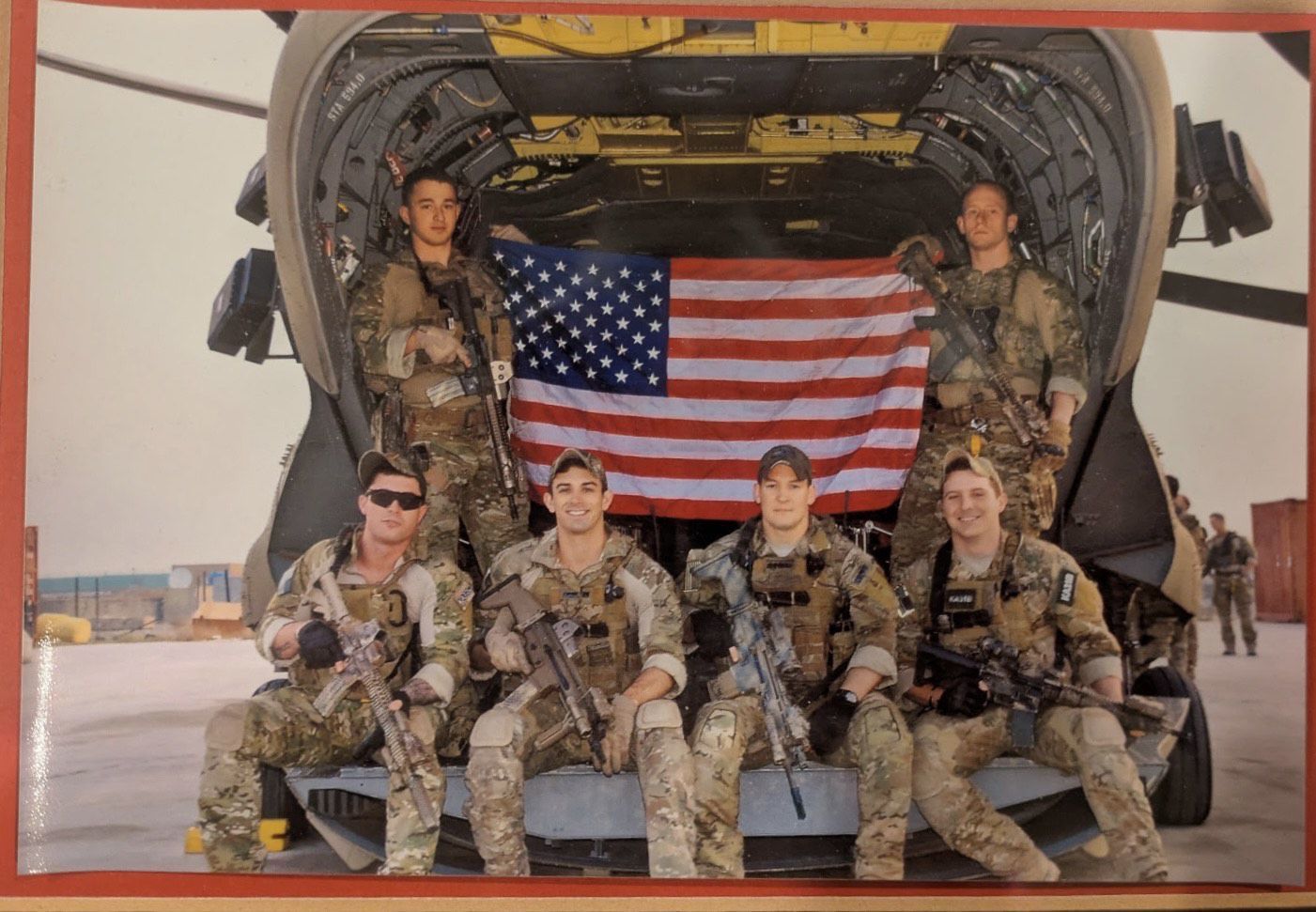
A decorated U.S. Army veteran from Montgomery County was arrested Friday for participating in a protest at a St. Paul, Minn., church, just two days after a video of him speaking out against the Trump administration went viral.
Ian Austin, 35, of Bryn Athyn, is one of nine people facing felony charges for their involvement in a Jan. 18 protest at Cities Church in St. Paul. Former CNN host Don Lemon, who was covering the protest, is also a defendant. Lemon’s arrest, and that of another journalist who attended the protest, has brought criticism from media and civil rights advocates.
The Department of Justice indicted Austin for conspiring to interrupt a church service and “injure, intimidate, and interfere with exercise of right of religious freedom” at a place of worship, federal court documents state.
But Austin’s parents in Bryn Athyn say their son’s actions are in keeping with his sense of duty to his country, and his determination to help others however he can.
“Those are things he cares about more than political party,” his mother, Paige Austin, said. “It’s more about what does it mean to be human, and to treat people justly and kindly, regardless of where you live.”
In a video clip dated Jan. 20 and posted online days before his arrest, Austin said that he believed as an Army veteran it was his duty to travel to Minnesota.
“We took an oath to the Constitution, and it’s just being shredded right now,” Austin said in the video, which racked up hundreds of thousands of likes across multiple social media platforms.
“This has all of the signs from every fascist movement in history that we’re going to lose the opportunity to resist,” he said. “So that’s why I’m here.”
The protesters said they targeted the church because one of its pastors, David Easterwood, leads the Immigration and Customs Enforcement (ICE) St. Paul field office. The church’s website lists David Easterwood as a pastor, and news outlets have reported that his personal information appears to match that of the David Easterwood identified in court filings as the acting director of the ICE St. Paul field office.
In the video, Austin said he’d previously been detained for protesting outside the Bishop Henry Whipple Federal Building before being released without charges. It was during that detainment, he said, that a Department of Homeland Security officer questioned him about why someone “from Philadelphia” would be in Minneapolis.
“And I’m like, ‘Well, because the nation that I was willing to die for is being systematically oppressed with men in military uniforms, a private army told by the president that they have no other laws to follow than his, and they’re systematically attacking and even killing our neighbors — in the United States of America,” Austin said.
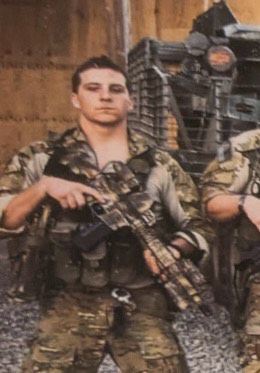
This undated photo shows Ian Austin and other U.S. Army soldiers.
Valorous service
Austin grew up in Huntingdon Valley, a couple miles outside of Philly in Montgomery County. His parents, Kenneth and Paige Austin, said he went to Academy of the New Church high school, where he excelled at baseball and wrestling, earning a spot in the J. Robinson Intensive Wrestling Camp in Minnesota.
“It’s brutally hard,” Kenneth Austin said in an interview with The Inquirer. “It’s like boot camp. He did very well. I think that planted a seed for the military.”
Austin graduated from high school in 2008, celebrated the Phillies’ World Series win with family and friends, and weeks later, shipped out to Army basic training.
His parents confirmed that as a member of the U.S. Army’s elite 1st Ranger Battalion, Austin served six combat deployments in Afghanistan. In 2013, he was awarded a Joint Commendation Medal with Valor device, according to a news report.
The valor device is given to soldiers who displayed “an act or acts of heroism by an individual above what is normally expected while engaged in direct combat with an enemy of the United States, or an opposing foreign or armed force, with exposure to enemy hostilities and personal risk,” according to a military website.
This detail shot of an undated family photo shows Ian Austin while serving in the U.S. Army 1st Ranger Battalion.
After his Army contract ended in 2014, Austin returned home, his parents said. He was diagnosed with post-traumatic stress disorder, and he threw himself into his recovery process with the same passion he put into his training, Kenneth Austin said. He had his share of setbacks; in 2021, Austin pleaded guilty to disorderly conduct and fighting after refusing to leave a local bar, his parents noted.
But as Austin took college classes at La Salle University and elsewhere, he became increasingly interested in social justice and helping others.
During the 2020 George Floyd protests in Philly, Austin packed his backpack with medical supplies and water, Paige Austin said. “He would go down there and sort of join the protest, but he was there also to help, because part of the Ranger training was emergency medical training.”
Kenneth Austin recounted that his son even carried a backpack full of water, snacks, and first aid supplies during the parade after the Philadelphia Eagles’ 2025 Super Bowl victory, earning him the nickname “headquarters” from some of those out celebrating.
“It was a little much for me,” his father said. “But it really struck me, like, he’s … here to have fun, but he’s also looking out for everyone, and becoming buddies with everyone, and making sure everyone’s OK.”
A protest in a church
A few weeks after ICE agent Jonathan Ross shot and killed Renee Good in Minneapolis, Austin told his parents he was going to Minnesota. Three hours later, his truck was packed, and after a 17-hour drive, he was out protesting.
Austin is being held in the Sherburne County Jail in Minnesota, county records show. His attorney, Sarah Gad, said that she took on his case pro bono after seeing agents arrest him Friday. Gad said that based on what she’s seen in similar cases, she expects him to be released on his own recognizance as early as Monday.
Video of the protest shows protesters in the church chanting “Renee Good,” “Don’t shoot,” and “ICE out,” while a pastor shouted “shame on you” into a microphone. As the protest continued, many congregants can be seen leaving the church, while others stayed put or filmed the takeover. A few church attendees struck up conversations with protesters.
“I understand that what has happened is wrong, and I agree with that,” one congregant said to the person filming. “But this can’t happen. This is the house of the Lord.”
The federal indictment states that between 20 and 40 “agitators” occupied the main aisle and front of the church and yelled at the pastor and congregants. The indictment alleges that some protesters intimidated church members and prevented them from moving about freely in the church.
Austin, the indictment states, stood with other protesters, “approached the pastor and congregants in a menacing manner, and near the end of the operation, loudly berated the pastor with questions about Christian nationalism and Christians wanting their faith to be the law of the land.”
News reports have noted that Cities Church has ties to prominent Christian nationalists and powerful figures in the MAGA movement. Slate reported that its founder, Joe Rigney, is now a pastor at Christ Church in Moscow, Idaho. That church is run by Doug Wilson, who wants America to become a theocracy, according to a New York Times interview. Defense Secretary Pete Hegseth attends an affiliated church.
Austin’s attorney said this is a unique case, but it doesn’t surprise her that the Department of Justice would want to make an example of anti-ICE protesters who were allegedly disrupting a place of worship.
“I think that this is being taken very seriously by the United States attorney,” Gad said, though she added, “federal cases often look much more alarming at the front end than they turn out to be.”