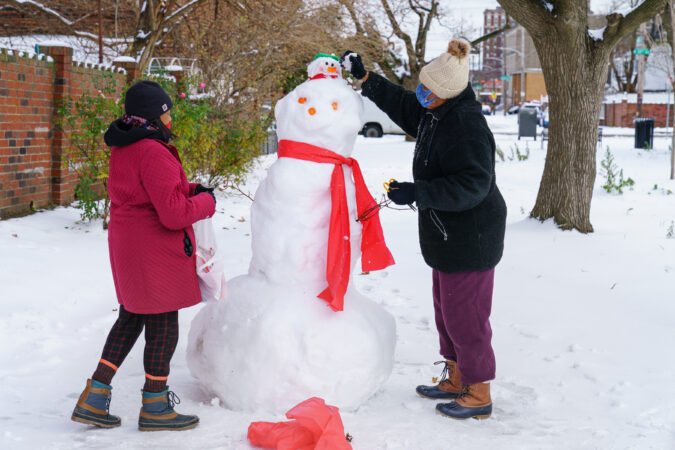
The first measurable snowfall of the winter of 2025-26 evidently is all but a done deal for Philly this weekend, and it has a chance to be the biggest in two winters — not that the bar is ultra-high in a period when snow has been mightily lacking.
The National Weather Service has issued a winter storm warning for 3 to 5 inches of snow across the region, with a near 100% likelihood of at least an inch of snow.
That was in line with the AccuWeather Inc. outlook.
The weather service has a 76% chance of at least 4 inches and 43% of 6 or more.
With the caveat that timing and duration of precipitation aren’t in the wheelhouse of atmospheric science, the weather service is expecting snow or snow mixed with rain to start late Saturday night.
If it’s a mix at the outset it would quickly become all snow as temperatures fall below freezing, and continue into midmorning.
The snow would be generated primarily by an upper-air disturbance, said Matt Benz, senior meteorologist for AccuWeather. It’s possible that the storm may regroup off the coast, however, that “probably will form too late to have any impact.”
In a forecast discussion, the weather service said inch-an-hour snowfall rates are possible early Sunday.
“There is a potential for a concentrated area of 4-5 inches of snowfall somewhere near the I-95 corridor and immediately south and east,” the forecasters said.
They noted a 20% to 30% chance that some places get over 5 inches.
And the snow is likely to stick around until at least midweek, with high temperatures Sunday, Monday, and Tuesday expected to be around freezing or lower and the sun angles about as low as they get.
After that February storm, the temperature climbed to near 50 a day later, and the strengthening sun made quick work of the snow cover.
That February snow turned out to be the biggest of a season in which the 8.1-inch total at Philadelphia International Airport barely bested the 8 inches of New Orleans. That winter, the I-95 corridor found itself in a snow hole, and Philly a snow hole within a snow hole. The highest total in the winter of 2023-24 was 4.6 inches during a snowy January week.
Snow fell to the north, west, and south, and that trend has continued in the early going. With 6 inches so far this winter, Richmond, Va., now has measured 22.8 inches since last December, nearly triple the Philly total.
Official totals at Philadelphia International Airport have been less than half of normal for four consecutive winters. The normal for a season is 23.2 inches.
The meteorological winter, which began Dec. 1, certainly is off to a wintry start, with temperatures averaging more than 6 degrees below normal.
It is not off to a particularly wet start, however, and whatever falls this weekend isn’t expected to exceed a half inch of liquid.
In its long-term outlooks through Dec. 26, NOAA’s Climate Prediction Center is on the fence regarding whether precipitation will be above or below normal.
With high confidence it is calling for a national warm-up.
In any given year, the odds are greatly against Christmas snow in Philly or elsewhere along the I-95 corridor.
But it does look like the region is about get a white Sunday.
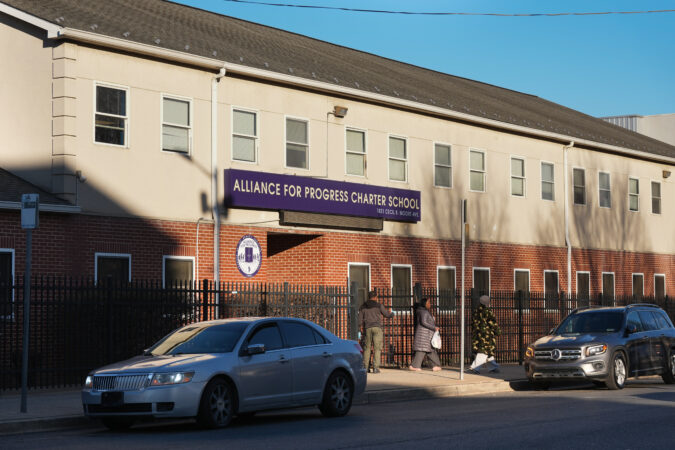
When Raheem Harvey discovered possible improprieties at his new employer, Alliance for Progress Charter School in North Philadelphia, he sounded the alarm.
Harvey, the director of business and compliance, notified officials earlier this year about what he saw as significant issues, he said: violations of state and local bidding requirements, a contract issued without board approval, and board members’ failure to disclose personal relationships with potential vendors.
He flagged a student enrollment problem and skipped payroll taxes.
Alliance for Progress’ leader and its board brushed him off, Harvey said in a recently filed whistleblower lawsuit. Ultimately, they disciplined him and, after threatening to demote him, he resigned.
School officials say Harvey’s story is untrue.
“We categorically deny all the allegations asserted by this disgruntled former employee,” Stacey Scott, CEO of Alliance for Progress, said in a statement.
Officials from the Philadelphia School District’s charter school office had no comment.
What are the allegations?
Harvey started working at Alliance for Progress, on Cecil B. Moore Avenue, in February.
By August, he began raising issues to his bosses, Harvey’s lawyers said in a lawsuit filed in Philadelphia Common Pleas Court.
They included a contract issued to a vendor for services related to a school playground — worth more than $75,000 — that was awarded without competitive bidding.
Alliance for Progress, Harvey said, “directly awarded the contract to a vendor whose principal is a personal friend of one of the AFPCS board members. The board member did not recuse himself from discussions or decisions related to the contract, despite the clear conflict of interest created by his close relationship with the vendor” — a violation of ethics rules, he said.
Harvey also said the school failed to follow state rules around enrollment procedures. Alliance for Progress says it provides enrollment preference for siblings of students. But, Harvey said, the school ignored him “and failed to apply its own sibling-preference policy to the sibling of a currently enrolled student. Instead, AFPCS placed the sibling on a waitlist and later pressured the child’s parents to withdraw the enrollment application.”
Scott, Harvey said, also violated federal privacy laws by providing someone outside the organization access to a student’s educational records — including academic and disciplinary records — without parental consent.
School officials also used Alliance for Progress credit cards to purchase food and other items through their personal accounts, according to the lawsuit complaint,“allowing them to aggregate rewards points and loyalty benefits that they did not return to AFPCS.”
Alliance for Progress also paid a retired employee for work with a paper check instead of going through its payroll system, the complaint alleges.
The school “issued payments in this manner to enable the retired employee to avoid paying taxes on the wages she received,” the lawsuit said.
‘Hostile and retaliatory’
According to Harvey, once he reported the compliance problems, Scott and other officials began targeting him — suggesting he was opening packages addressed to the school without authorization and purchasing office supplies without proper authorization.
Harvey was shut out of leadership meetings, the suit said, then reprimanded for failing to show up to a meeting, entering Scott’s office without permission, and placing an unauthorized order.
“Increasingly hostile and retaliatory conduct” was directed toward him, Harvey said. He was suspended for 10 days, and had his keys to the administrative offices taken away.
In September, a human resources official told Harvey “that he should forget about the compliance issues he had raised because they had been resolved” but provided no evidence. Harvey said she told him Alliance for Progress planned to demote him.
The school’s “wholesale failure to remediate the compliance concerns” and its “refusal to implement safeguards to protect him” from retaliatory treatment ultimately caused Harvey to resign on Sept. 30,according to the lawsuit.
Harvey is demanding reinstatement, plus back pay, benefits, seniority rights, and damages.
We’ll show you a photo taken in the Philly-area, you drop a pin where you think it was taken. Closer to the location results in a better score. This week’s theme is all about Hanukkah. Good luck!
Round #11
Question 1
Where is this synagogue?
Loading…
ClickTap on map to guess the location in the photo
ClickTap again to change your guess and hit submit when you're happy
You will be scored at the end. The closer to the location the better the score
Levi Jiang / Staff
Pretty good/Not bad/Way off! Your guess was from the location.Spot on! Your guess was exactly at the location. Here's also where a random selection of Inquirer readers guessed.
This is Temple Beth Zion-Beth Israel on South 18th Street. The synagogue was formed through the 1964 merger of Beth Zion (created in 1946) and Beth Israel (created in 1840).
Quiz continues after ad
Question 2
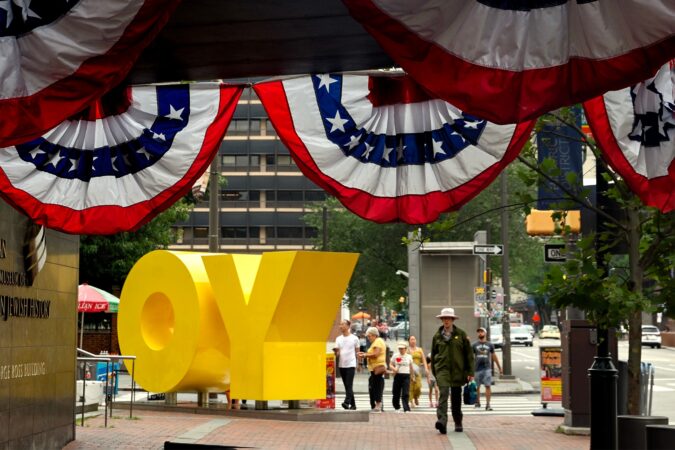
Where can you find this yellow statue?
Loading…
Tom Gralish / Staff Photographer
Pretty good/Not bad/Way off! Your guess was from the location.Spot on! Your guess was exactly at the location. Here's also where a random selection of Inquirer readers guessed.
The OY/YO Statue is located outside the Weitzman National Museum of American Jewish History. According to the museum, “YO” references the greeting, while “OY” is a common Yiddish phrase.
Quiz continues after ad
Question 3
Where is this deli?
Loading…
Michael Klein / Staff
Pretty good/Not bad/Way off! Your guess was from the location.Spot on! Your guess was exactly at the location. Here's also where a random selection of Inquirer readers guessed.
This is Koch's Deli located on Locust Street in West Philly. The deli was created in 1966 by Sidney and Frances Koch and is known for its stacked sandwiches.
Your Score
ARank
Amazing work. You've achieved the miracle of the eight days!
BRank
Good stuff. You've lit most of the candles.
CRank
C is a passing grade, but most candles remain unlit.
DRank
D isn’t great. You just missed all eight nights!
FRank
We don’t want to say you failed, but you didn’t not fail.
You beat % of other Inquirer readers.
We’ll be back next Saturday for another round of Citywide Quest.
I was so close. If I had made it through one or two more green lights while driving from my last assignment… Or if I had not waited so long for the “right” car to pass in front of the building I was photographing for a real estate story…
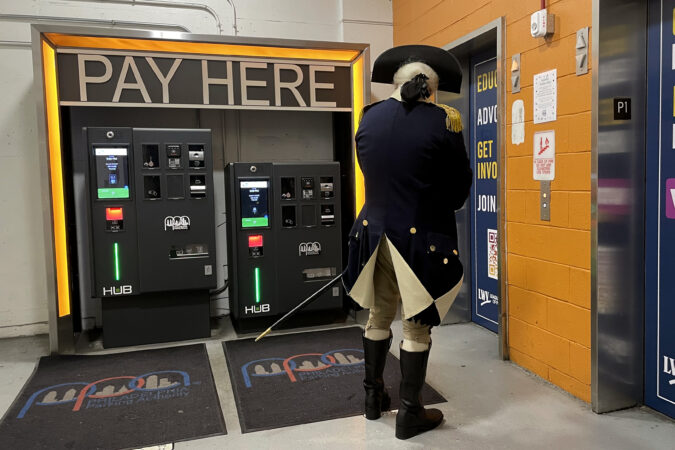
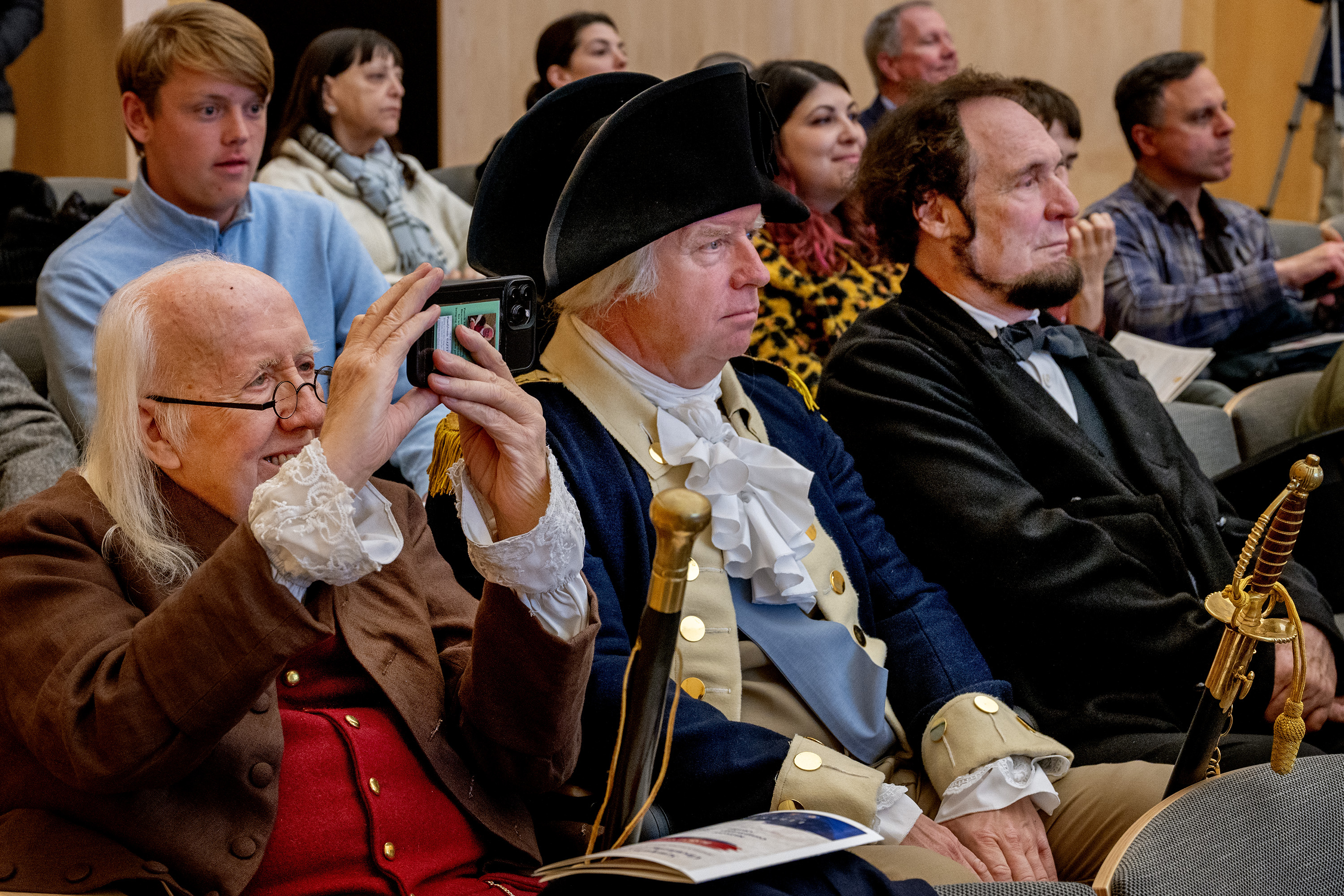
Then I might’ve been there seconds earlier when Gen. Washington stood at the back of his SUV placing his sword on the hip of his dress uniform. Or photographed him walking through the empty parking garage.
Instead, I arrived at the elevators seconds after he did.
Historical interpreters Benjamin Franklin (from left) Gen. George Washington and President Abraham Lincoln are in the audience as the U.S. Mint unveils new coins for America’s 250th birthday.
There isn’t a day that goes by that I am not reminded how photography is all about the timing. And I don’t mean just the 1/500th of a second your camera shutter is open.
There is an expression “f/8 and be there” often attributed to legendary photographer Arthur “Weegee” Fellig. The “there” has come to mean not fussing over the technical aspects — an f-stop/lens aperture — of taking pictures but instead being “in the moment.”
Weegee, however, meant it literally. He was a New York crime scene photographer in the 1930s and 1940s famous for arriving before the police and made his living getting there and taking a picture before his competition (there were a dozen newspapers and tabloids in Manhattan back then).
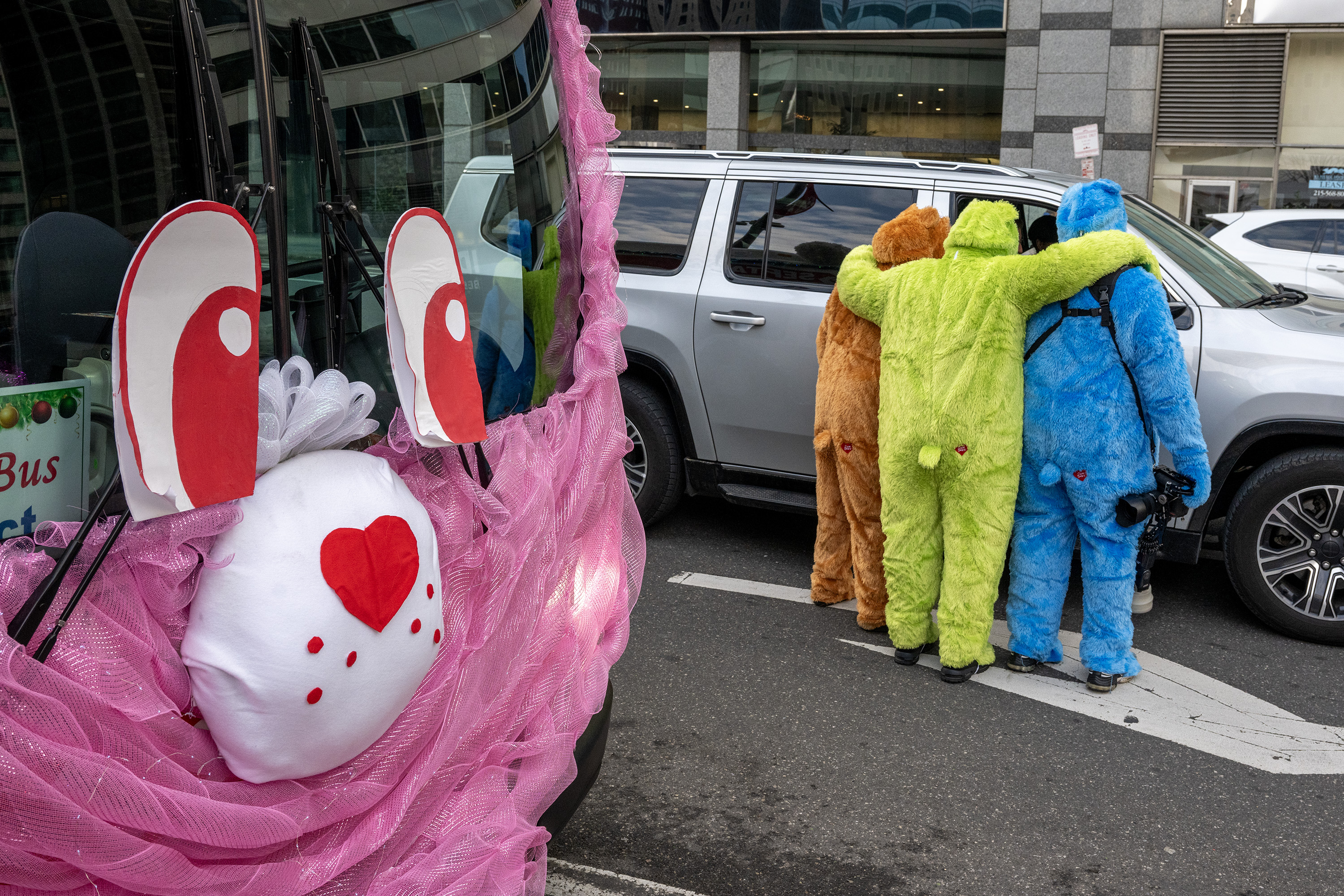
Another “good timing” came for me last Saturday. I was in Center City with my family on my day off. There were so many people in the Christmas Village in LOVE Park we walked along the outskirts, where we found the annual Festibus competition. That’s where SEPTA employees volunteer their time to decorate buses for the holidays and compete for bragging rights. And let riders vote for their favorites among the eight decorated buses parked along JFK Boulevard and 15th Street.
I made a fast photo of SEPTA workers costumed as Care Bears who went over to a passing coworker stopped in traffic. But I couldn’t leave with only a photo of the backsides of mechanic Raymond Borges and operators Jose DeCos and James Smith.
So I stayed behind to document more of their greeting visitors and some of the other buses.
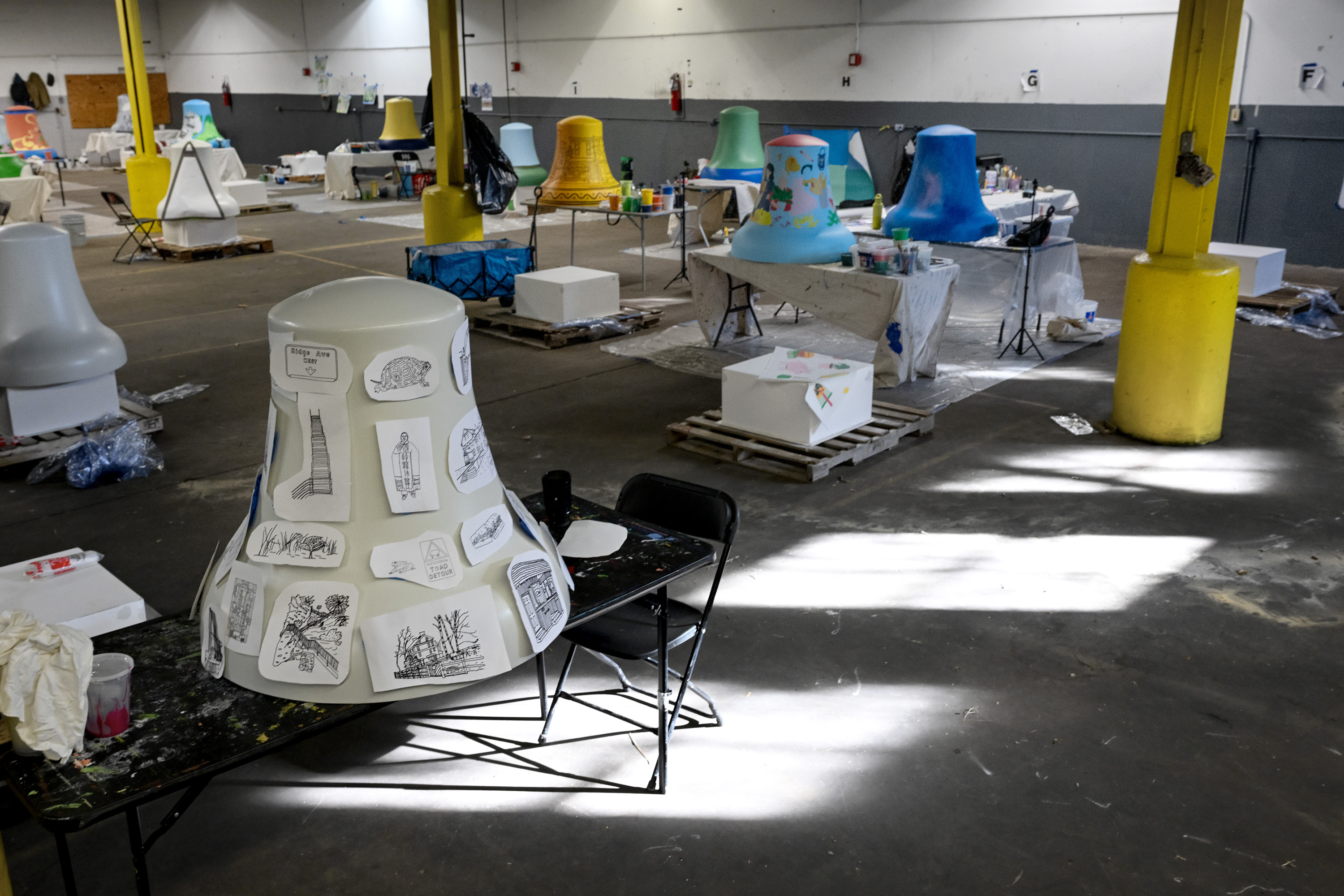
Walking out of the garage where the artists were working, I heard a news helicopter and looked up, then over to see a column of smoke rising to the north.
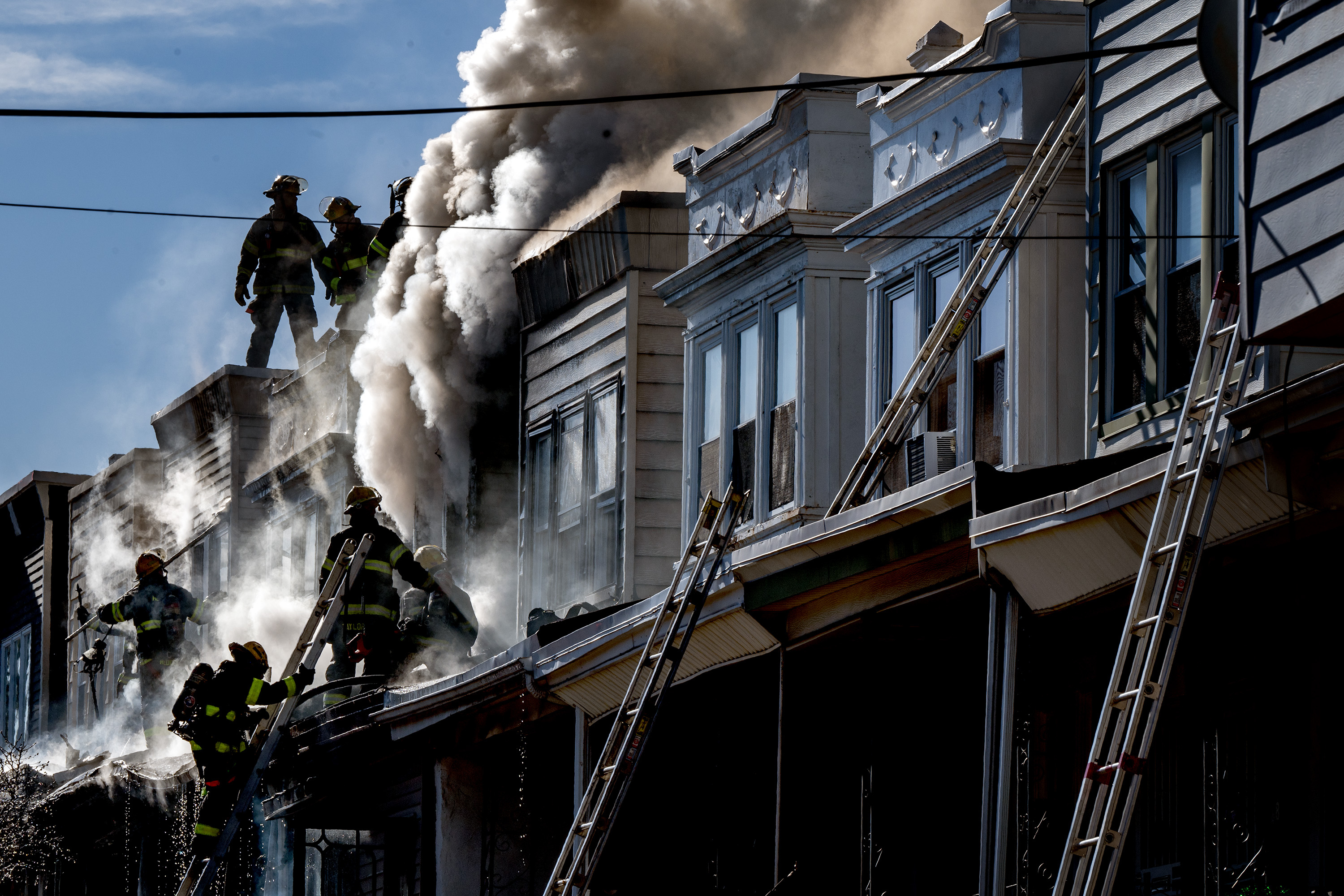
I got there as firefighters were just starting to climb up to the rowhouse roofs on North Lambert Street.
The fire, near La Salle University, was placed under control within an hour. But sadly, a 70-year-old mother of three did not get out in time and died in the blaze.
Since 1998 a black-and-white photo has appeared every Monday in staff photographer Tom Gralish’s “Scene Through the Lens” photo column in the print editions of The Inquirer’s local news section. Here are the most recent, in color:
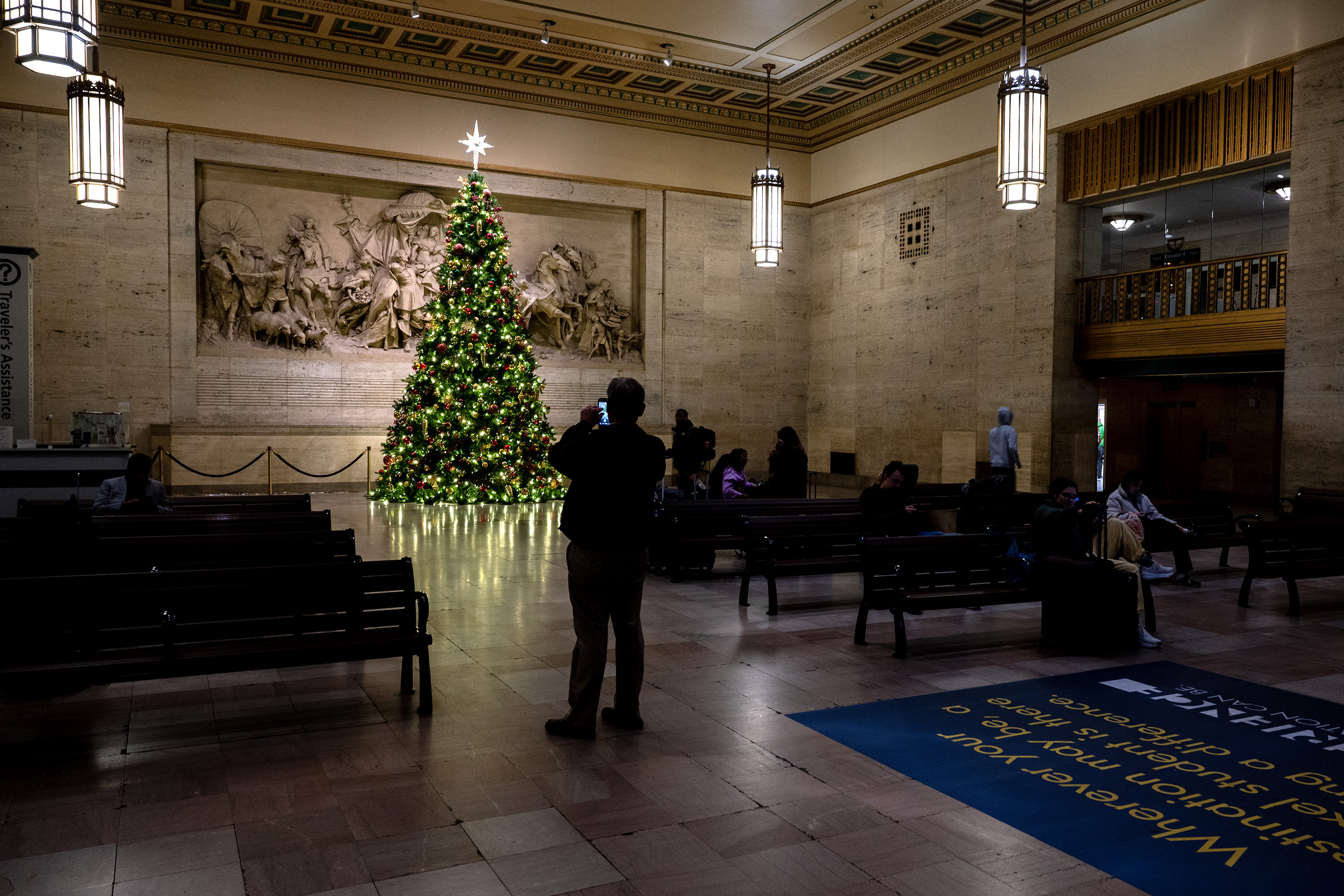
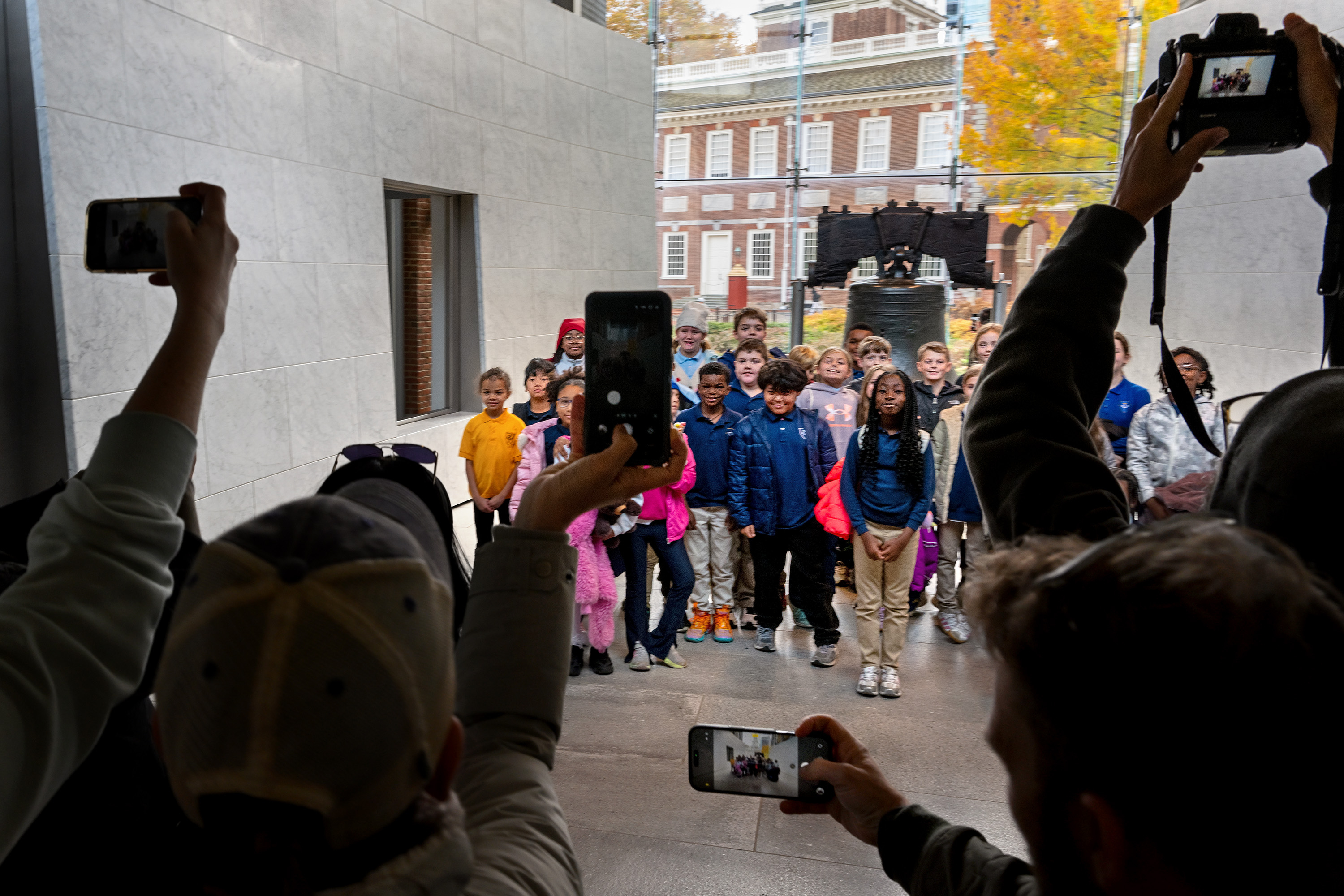
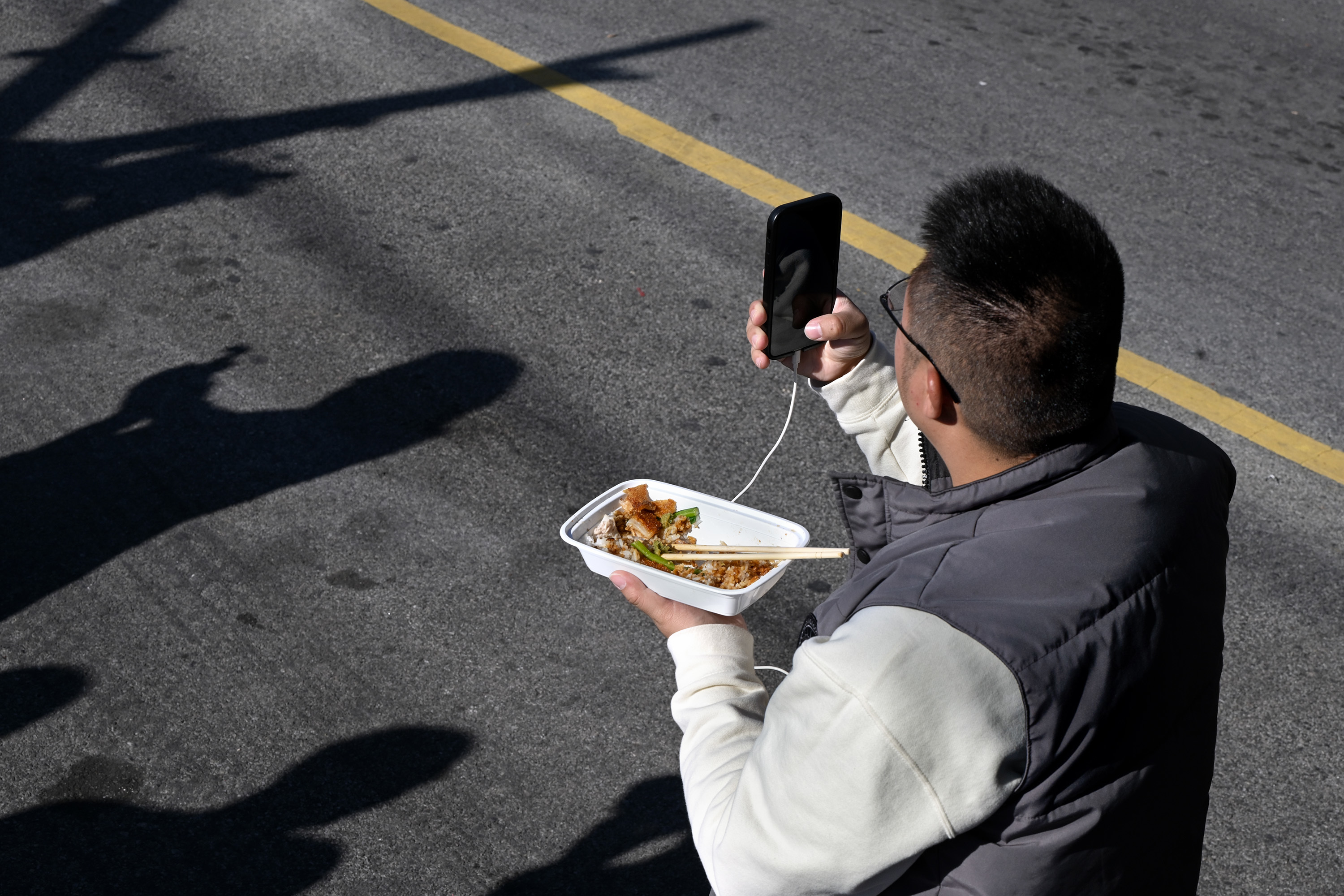
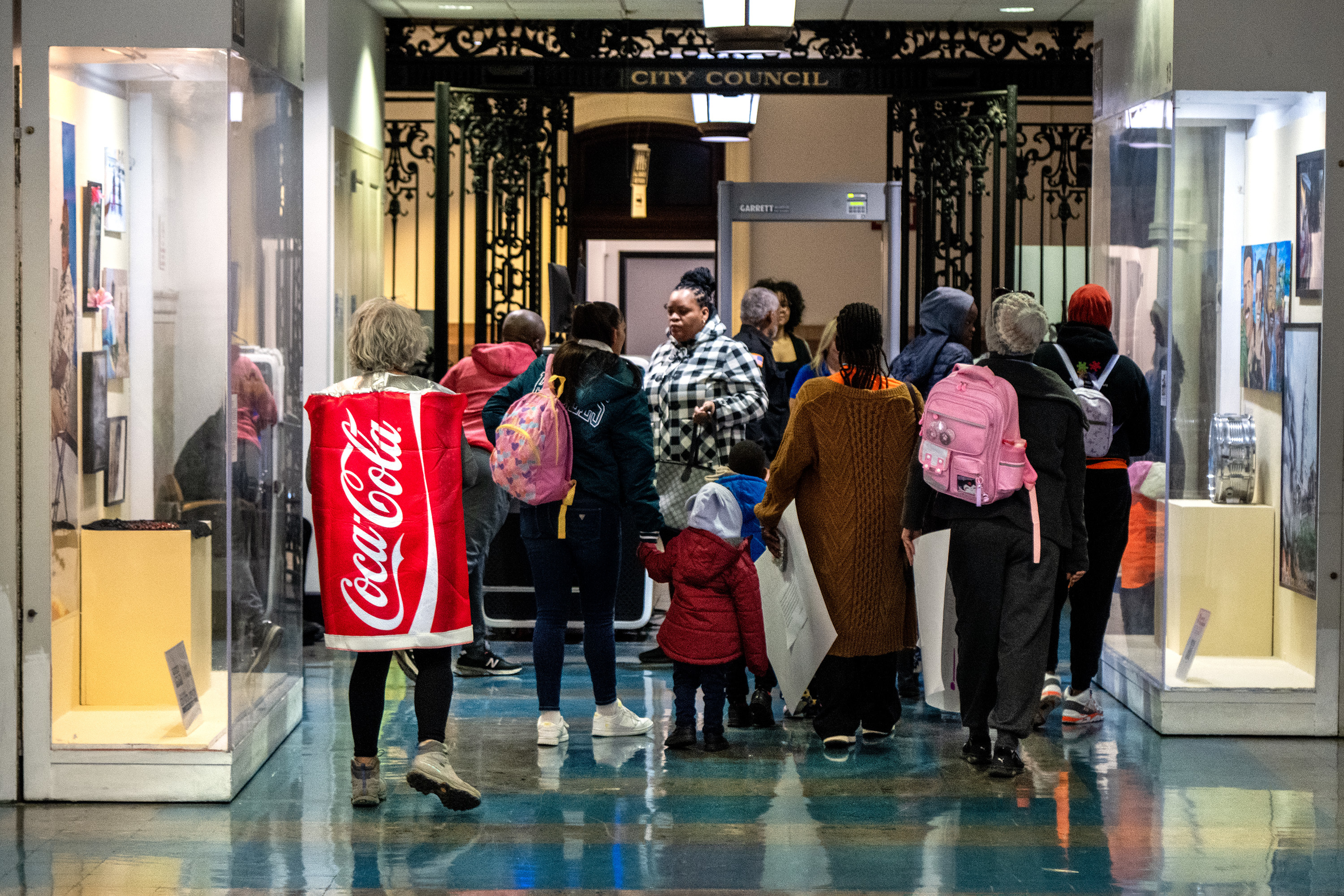
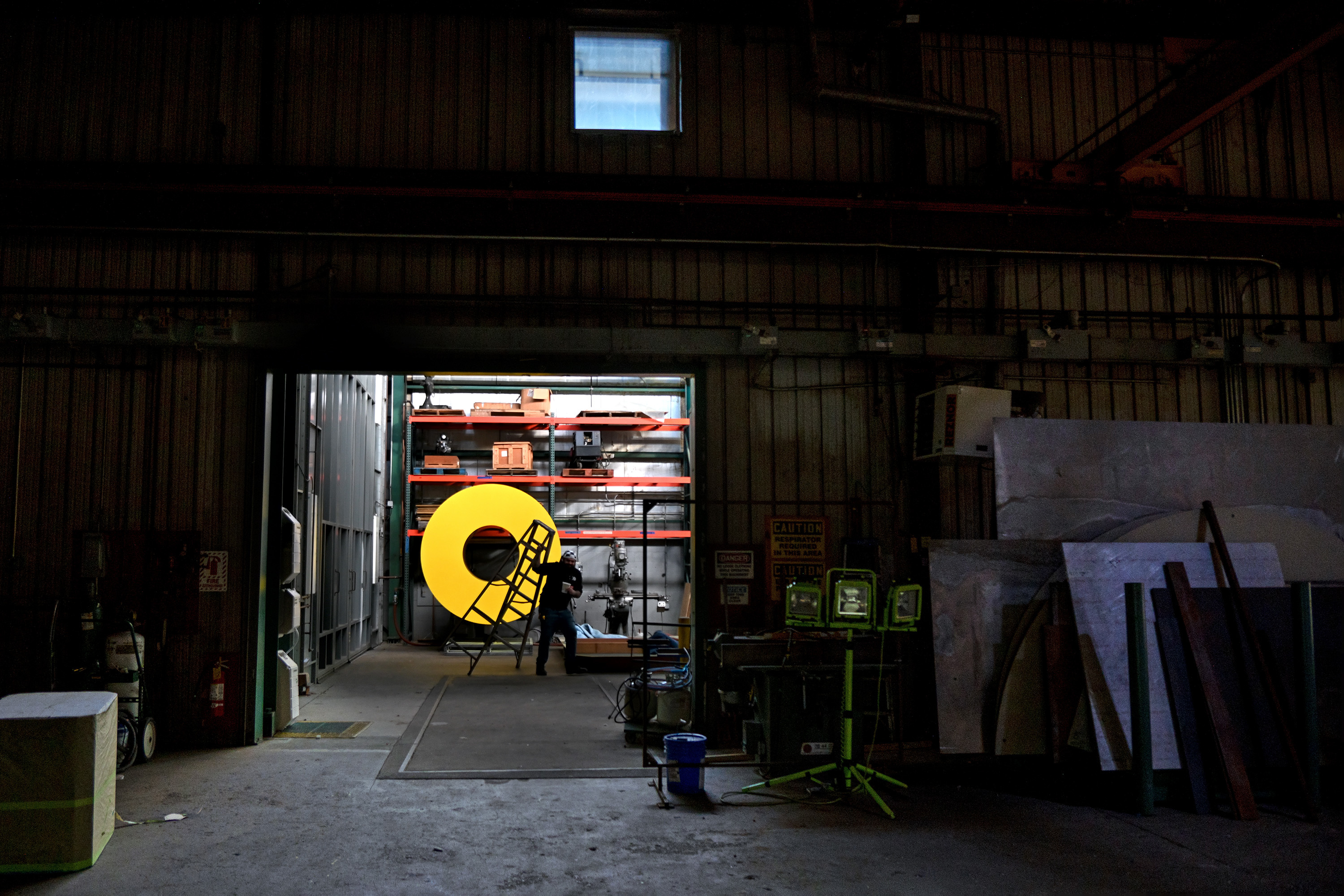
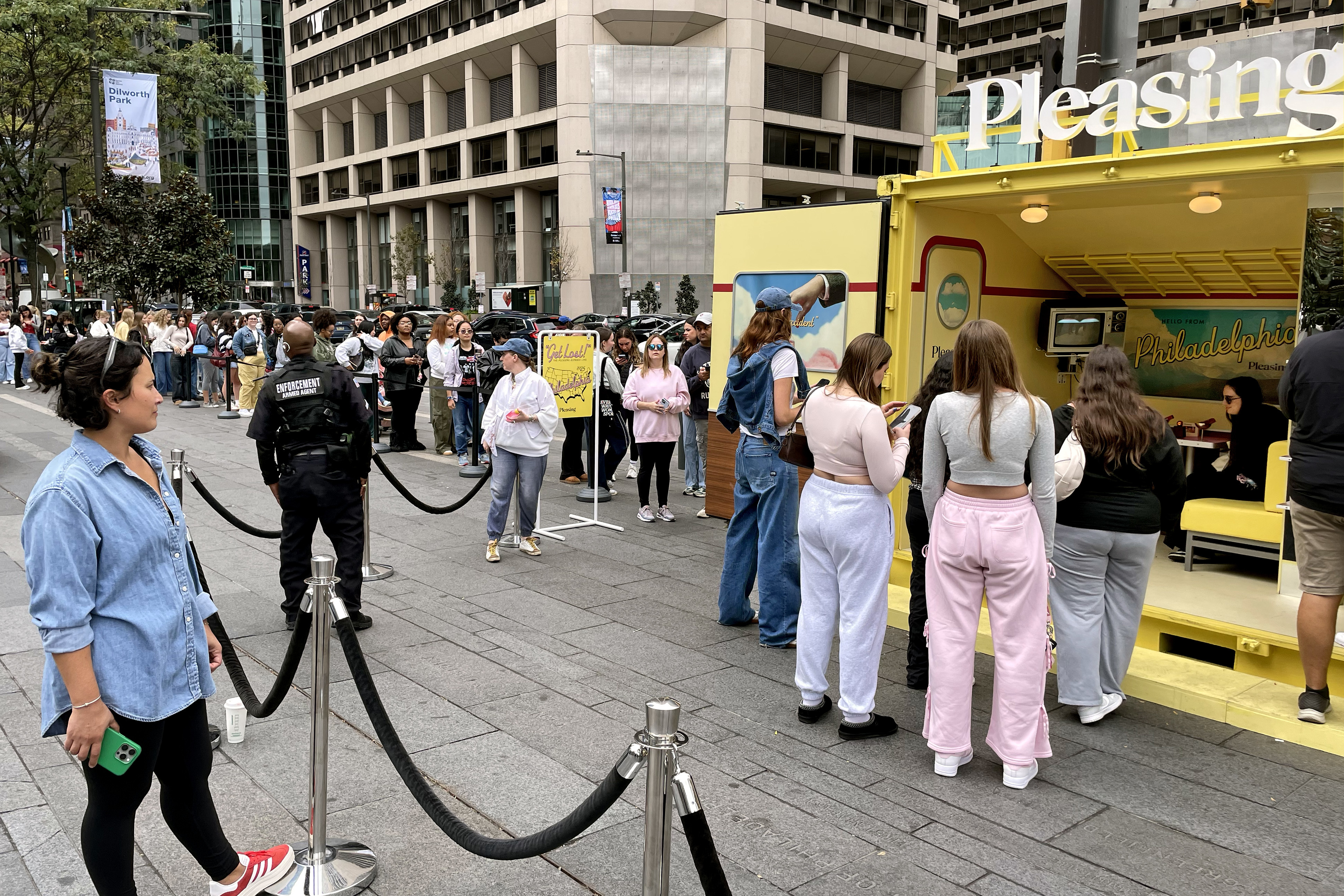
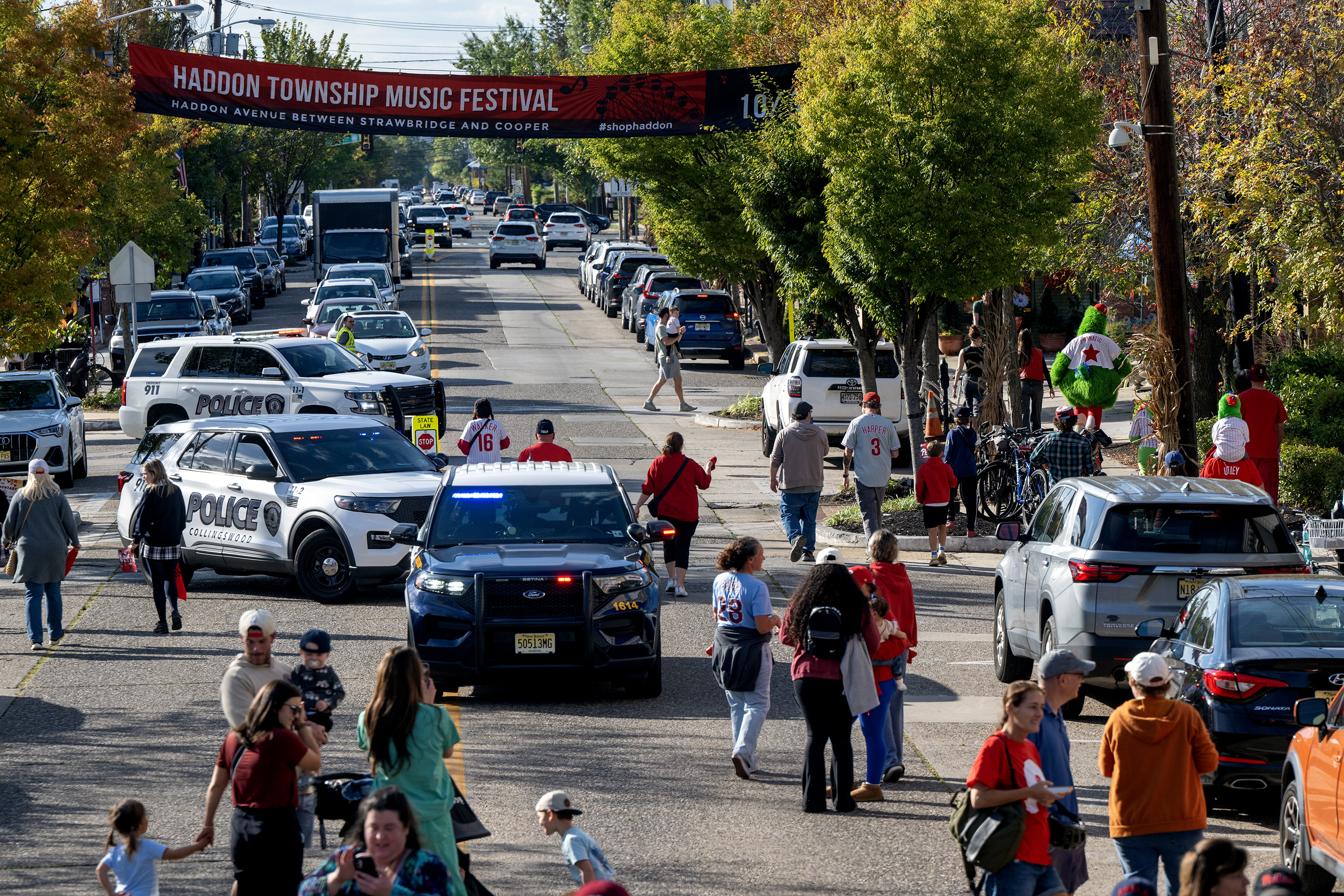
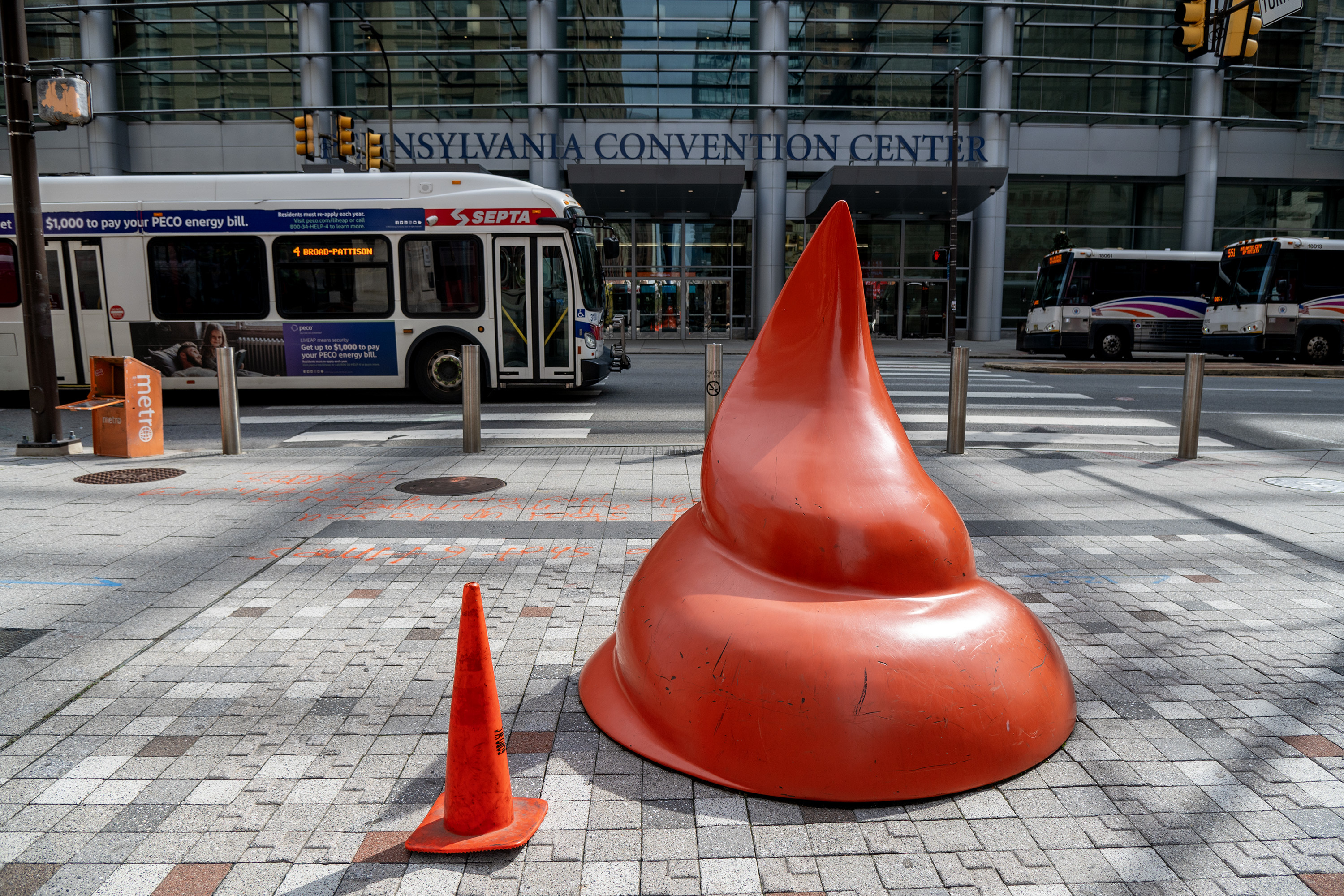
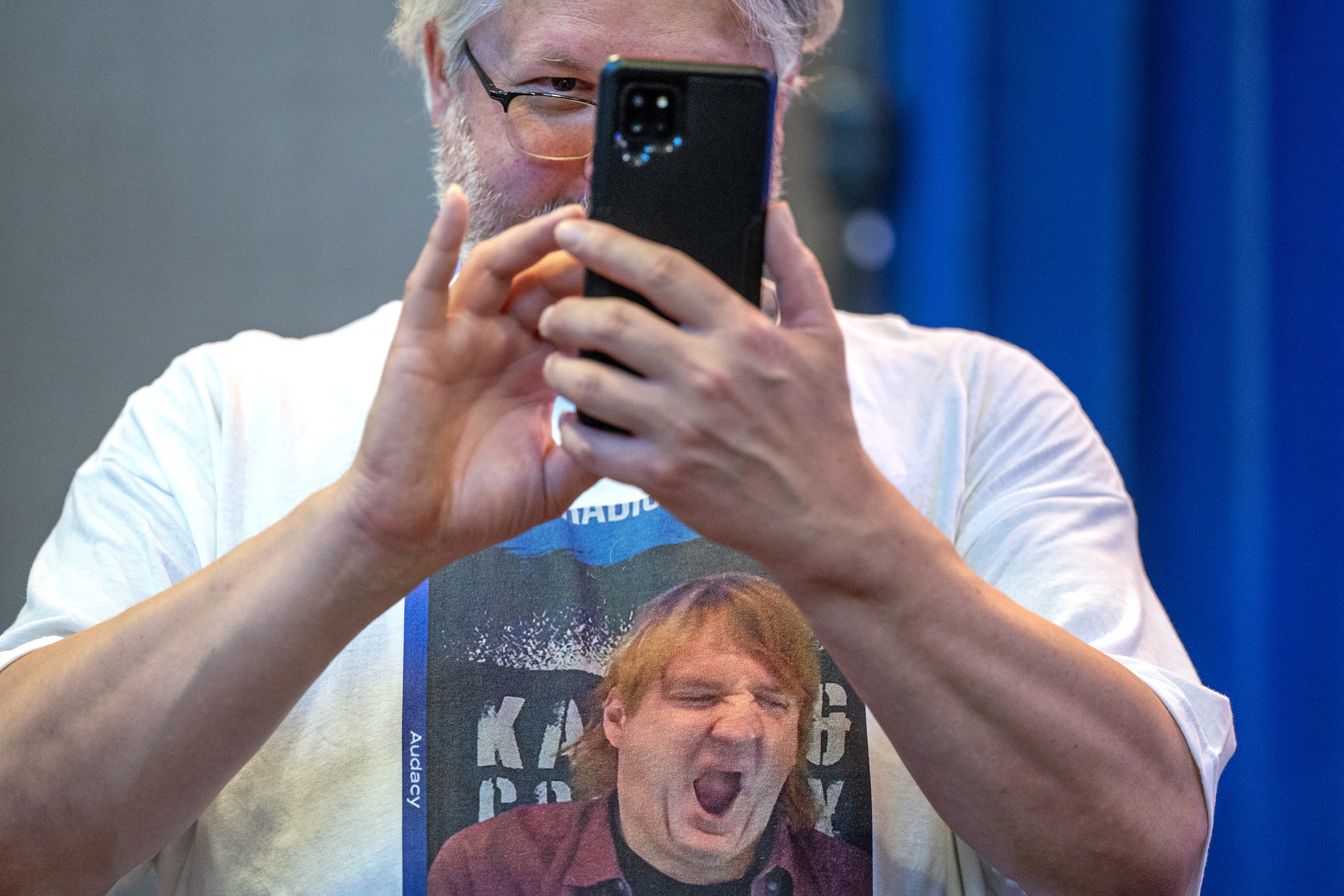
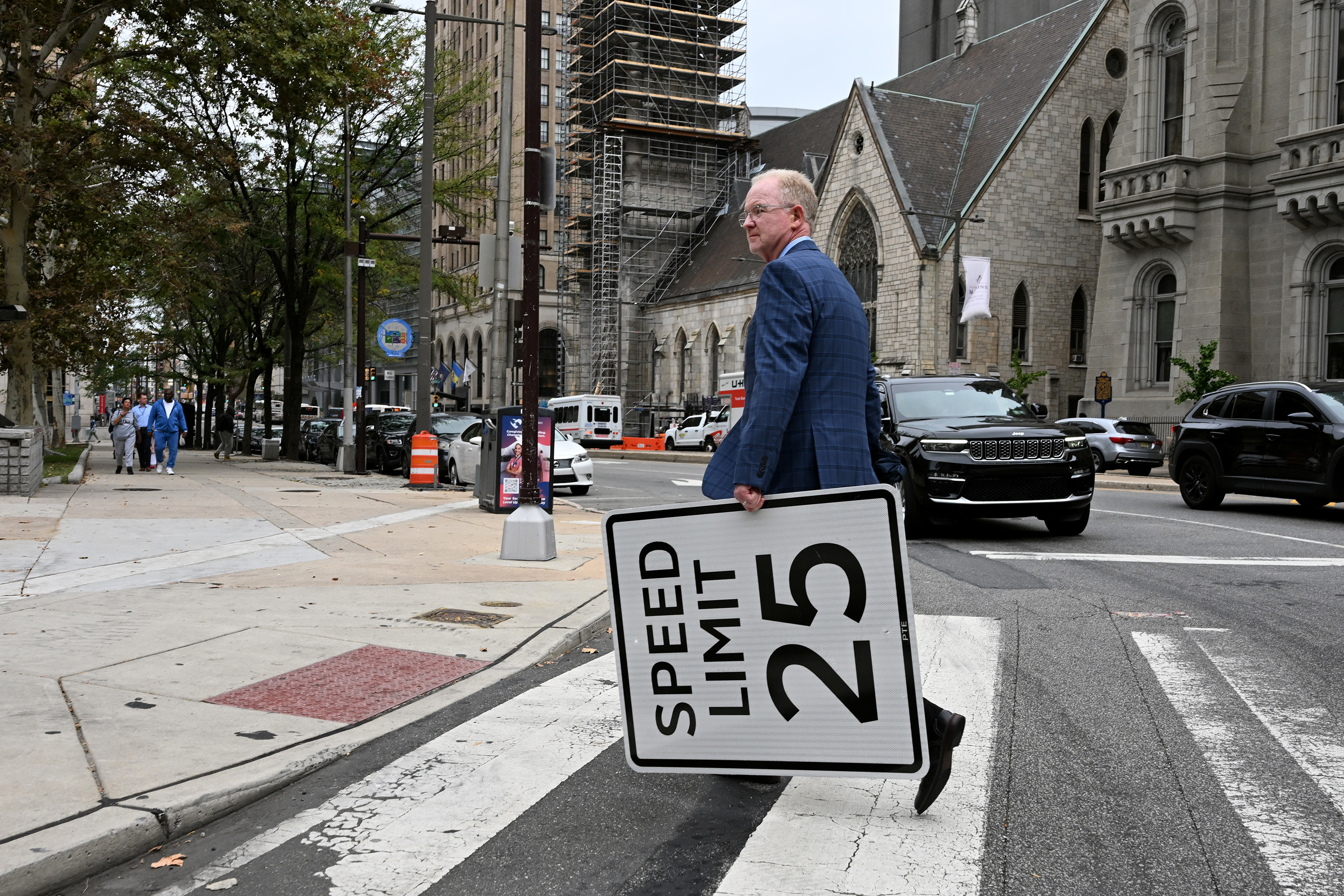
December 8, 2025: The Benjamin Franklin Bridge and pedestrians on the Delaware River Trail are reflected in mirrored spheres of the “Weaver’s Knot: Sheet Bend” public artwork on Columbus Boulevard. The site-specific stainless steel piece located between the Cherry Street and Race Street Piers was commissioned by the City’s Public Art Office and the Delaware River Waterfront Corporation and created and installed in 2022 by the design and fabrication group Ball-Nogues Studio. The name recalls a history that dominated the region for hundreds of years. “Weaver’s knot” derives from use in textile mills and the “Sheet bend” or “sheet knot” was used on sailing vessels for bending ropes to sails. November 29, 2025: t’s ginkgo time in our region again when the distinctive fan-shaped leaves turn yellow and then, on one day, lose all their leaves at the same time laying a carpet on city streets and sidewalks. A squirrel leaps over leaves in the 18th Century Garden in Independence National Historical Park Nov. 25, 2025. The ginkgo (Ginkgo biloba) is considered a living fossil as it’s the only surviving species of a group of trees that existed before dinosaurs. Genetically, it has remained unchanged over the past 200 million years. William Hamilton, owner the Woodlands in SW Phila (no relation to Alexander Hamilton) brought the first ginkgo trees to North America in 1785.November 24, 2025: The old waiting room at 30th Street Station that most people only pass through on their way to the restrooms has been spiffed up with benches – and a Christmas tree. It was placed there this year in front of the 30-foot frieze, “The Spirit of Transportation” while the lobby of Amtrak’s $550 million station restoration is underway. The 1895 relief sculpture by Karl Bitter was originally hung in the Broad Street Station by City Hall, but was moved in 1933. It depicts travel from ancient to modern and even futuristic times. November 17, 2025: Students on a field trip from the Christian Academy in Brookhaven, Delaware County, pose for a group photo in front of the Liberty Bell in Independence National Historical Park on Thursday. The trip was planned weeks earlier, before they knew it would be on the day park buildings were reopening after the government shutdown ended. “We got so lucky,” a teacher said. Then corrected herself. “It’s because we prayed for it.” November 8, 2025: Multitasking during the Festival de Día de Muertos – Day of the Dead – in South Philadelphia.November 1, 2025: Marcy Boroff is at City Hall dressed as a Coke can, along with preschoolers and their caregivers, in support of former Mayor Jim Kenney’s 2017 tax on sweetened beverages. City Council is considering repealing the tax, which funds the city’s pre-K programs. October 25, 2025: Austin Gabauer, paint and production assistant at the Johnson Atelier, in Hamilton Twp, N.J. as the finished “O” letter awaits the return to Philadelphia. The “Y” part of the OY/YO sculpture is inside the painting booth. The well-known sculpture outside the Weitzman National Museum of American Jewish History was removed in May while construction continues on Market Street and has been undergoing refurbishment at the Atelier at the Grounds for Sculpture outside of Trenton.October 20, 2025:The yellow shipping container next to City Hall attracted a line of over 300 people that stretched around a corner of Dilworth Park. Bystanders wondered as they watched devotees reaching the front take their selfies inside a retro Philly diner-esque booth tableau. Followers on social media had been invited to “Climb on to immerse yourself in the worlds of Pleasing Fragrance, Big Lip, and exclusive treasures,” including a spin of the “Freebie Wheel,” for products of the unisex lifestyle brand Pleasing, created by former One Direction singer Harry Styles.October 11, 2025: Can you find the Phillie Phanatic, as he leaves a “Rally for Red October Bus Tour” stop in downtown Westmont, N.J. just before the start of the NLDS? There’s always next year and he’ll be back. The 2026 Spring Training schedule has yet to be announced by Major League Baseball, but Phillies pitchers and catchers generally first report to Clearwater, Florida in mid-February.October 6. 2025: Fluorescent orange safety cone, 28 in, Poly Ethylene. Right: Paint Torch (detail) Claes Oldenburg, 2011, Steel, Fiberglass Reinforced Plastic, Gelcoat and Polyurethane. (Gob of paint, 6 ft. Main sculpture, 51 ft.). Lenfest Plaza at the Pennsylvania Academy of the Fine Arts on North Broad Street, across from the Convention Center.September 29, 2025: A concerned resident who follows Bucks County politics, Kevin Puls records the scene before a campaign rally for State Treasurer Stacy Garrity, the GOP candidate for governor. His T-shirt is “personal clickbait” with a url to direct people to the website for The Travis Manion Foundation created to empower veterans and families of fallen heroes. The image on the shirts is of Greg Stocker, one of the hosts of Kayal and Company, “A fun and entertaining conservative spin on Politics, News, and Sports,” mornings on Talk Radio 1210 WPHT.September 22, 2025: A shadow is cast by “The Cock’s Comb,” created by Alexander “Sandy” Calder in 1960, is the first work seen by visitors arriving at Calder Gardens, the new sanctuary on the Ben Franklin Parkway. The indoor and outdoor spaces feature the mobiles, stabiles, and paintings of Calder, who was born in Philadelphia in 1898, the third generation of the family’s artistic legacy in the city.September 15, 2025: Department of Streets Director of Operations Thomas Buck leaves City Hall following a news conference marking the activation of Automated Speed Enforcement (ASE) cameras on the Broad Street corridor – one the city’s busiest and most dangerous roads. The speed limit on the street, also named PA Route 611, is 25 mph.
The Phillies resigning Kyle Schwarber (and extending Rob Thomson): B-
Look, we love Kyle Schwarber. The city loves Kyle Schwarber. Dogs wearing tiny Schwarber jerseys love Kyle Schwarber. The man hits baseballs into orbit, leads the clubhouse, and has basically willed this team to look alive some Septembers when vibes were bleak. Him staying in Philly always felt inevitable.
But here’s the uncomfortable truth we’re all circling: We’ve seen this movie before.
Schwarber is now locked in through age 37. Harper, Turner, Nola — all extended into their late 30s too. The Phillies are doubling (and tripling) down on the same aging core that keeps putting up big regular seasons and then… evaporating in October.
Yes, Schwarber smashed 56 homers in 2025. Yes, he’s historically elite. Yes, Rob Thomson deserved his extension, four straight postseasons don’t grow on trees. But also: This team has repeatedly stalled in the playoffs, and running it back with the same core isn’t exactly a bold correction.
Dombrowski insists they’re “not just bringing the band back,” but right now it feels a lot like the band tuning up the same setlist and we already know how ends: a killer eighth-inning rally in June, a heartbreaking NLDS in October.
If the Phillies really want a different result, they still need a third true power bat behind Schwarber and Harper — the Rhys Hoskins void has been haunting them for three seasons. Until they fill it, this roster is basically an expensive version of “just try that again.”
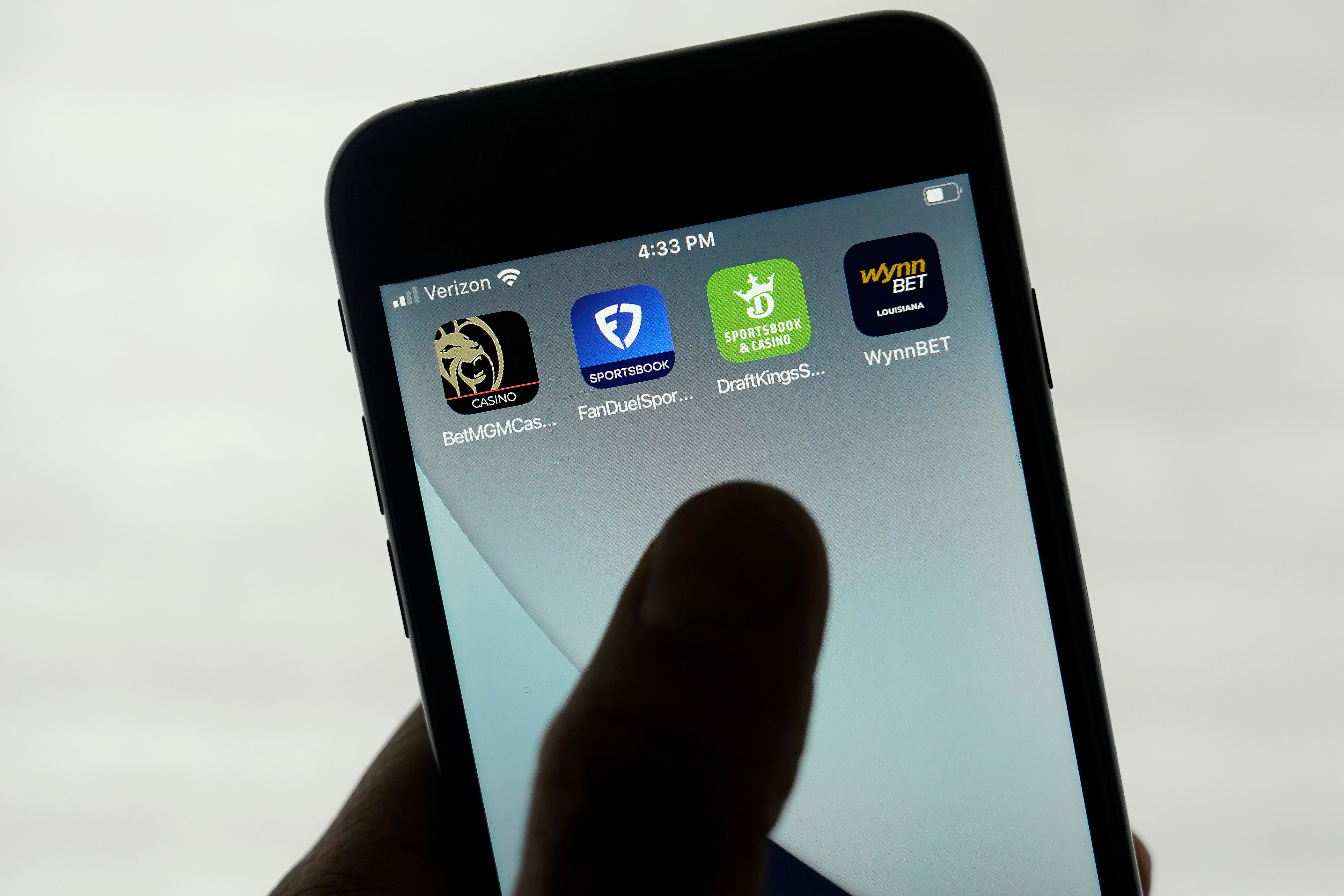
FanDuel, DraftKings, and other online gambling apps are displayed on a phone in San Francisco, Sept. 26, 2022.
Philly is the No. 1 market for online gambling: D-
Philly finally beat New York and Vegas at something — unfortunately, it’s being the top target for online gambling ads. Companies dropped $37 million this year convincing us that our phones are tiny casinos that fit in our pockets and aren’t ruining our credit scores.
And guess what? It worked! Calls to 1-800-GAMBLER about online betting have nearly tripled since 2021. Penn State says 30% of Pennsylvanians now bet regularly, and about 785,000 people in our commonwealth of 13 millionare estimated to be problem gamblers, which, coincidentally, is also the number of people who think the Sixers will “definitely cover tonight.”
The hotline stories are brutal: drained retirements, missed mortgages, broken marriages, people betting on Russian table tennis at 3 a.m.
Yes, Harrisburg pockets tax money. No, that does not offset the fact that some folks are blowing entire paychecks faster than a Broad Street Line train skips your station.
The Eagles have installed the “positivity rabbit” into the locker room
It showed up today and the offensive line stressed to me they are not sad they just wanted a good vibes bunny 👍 pic.twitter.com/zJi0M93SEr
The Eagles’ positivity rabbit: B for bunny (but trending toward D if they keep losing)
Only in Philadelphia could a three-game skid lead to the installation of a giant inflatable “positivity rabbit” in the Eagles’ locker room, the kind of holiday décor your aunt buys at Lowe’s, except this one is supposed to fix the offense.
According to NBC Sports Philly, the O-line wanted “good vibes.” So the Eagles brought in a five-foot inflatable bunny. Reddit immediately turned it into a full-blown prophecy, a meme, and possibly a new religion. Some fans think it’s the 2025 answer to the underdog masks; others think it looks like the guy who egged Patullo’s house finally got caught.
And then Jason Kelce stepped in with the dagger: “To be honest, I don’t really like the rabbit. It’s a little hokey… It didn’t work. You have to ditch the rabbit.”
The vibes bunny now sits at a dangerous crossroads. If the Birds win out: parade float. Philly embraces it forever. Etsy shops explode. If they don’t: that thing gets thrown on I-95 like HitchBOT.
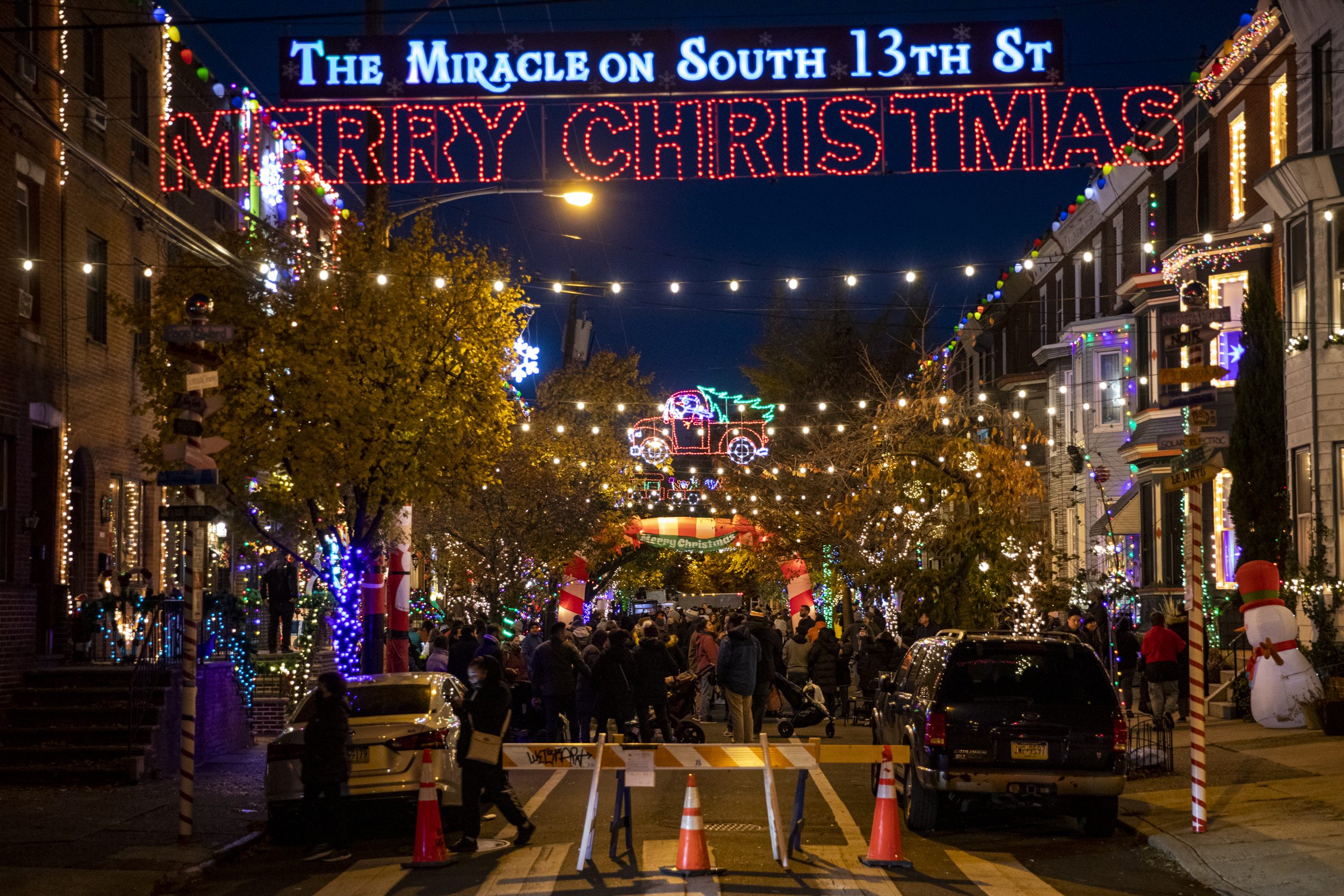
The Miracle on South 13th Street block party is filled with Christmas lights and decorations in 2021.
Miracle on South 13th Street traffic chaos: C+
South Philly’s favorite holiday tradition is back — and so is the gridlock, horn-honking, and pure, uncut neighborhood rage that comes with funneling half the region down a street roughly the width of a rowhouse hallway.
This year, 6abc reported that Morris Street briefly closed and pushed even more cars onto 13th, turning a beloved Christmas display into a live reenactment of Uncle Frank screaming “Look what you did, you little jerk!” Residents are understandably asking the city the obvious South Philly question: How exactly is an ambulance supposed to get through when Karen from Cherry Hill parks her Highlander on a diagonal to get the perfect photo?
Neighbors want more open-street hours, as in let people walk, let cars chill. Councilmember Squilla says he’s willing to talk about it, which is Philly for “maybe… if everyone stops yelling.”
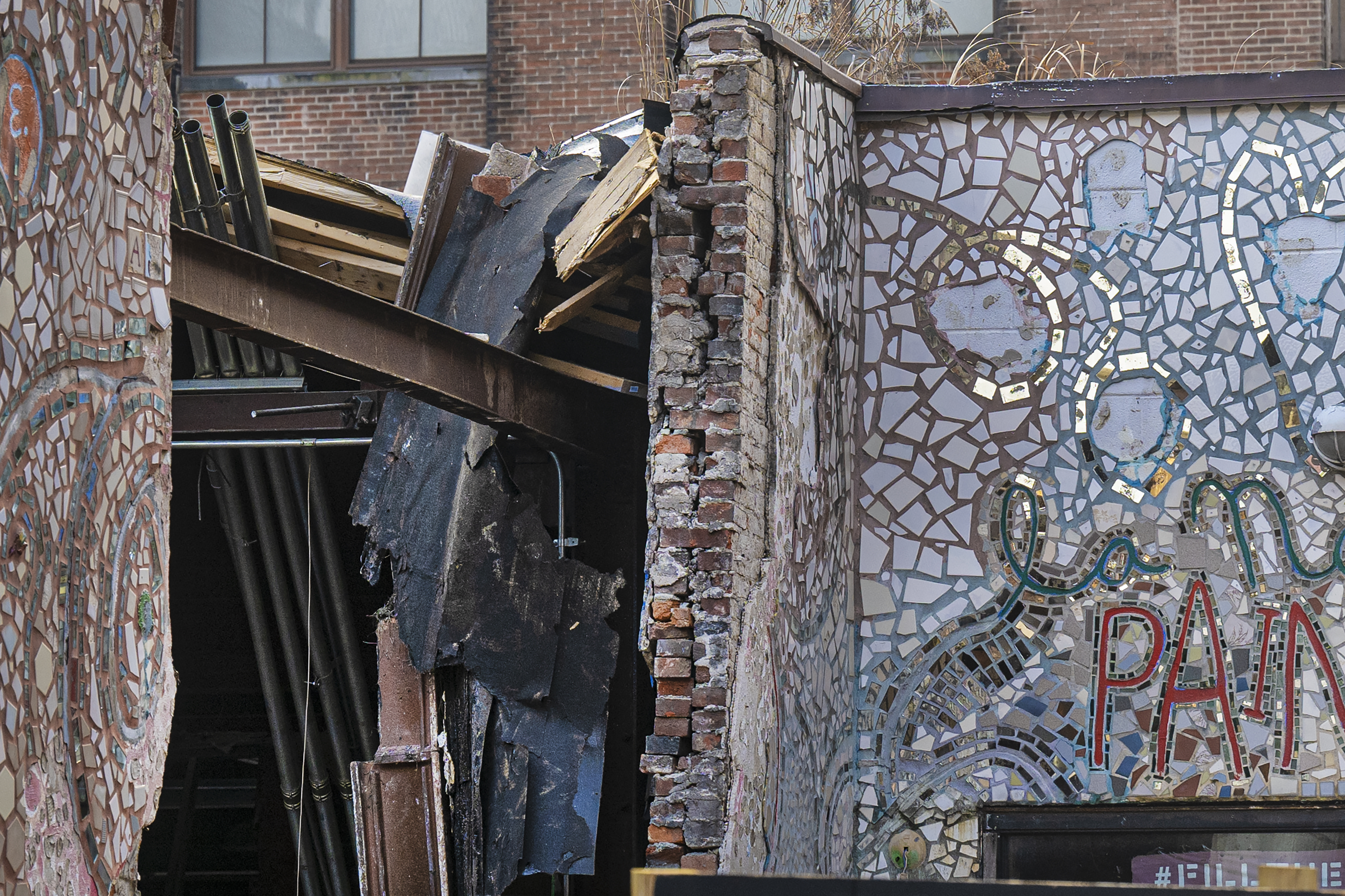
The former Painted Bride Art Center at 230 Vine St. is shown Thursday, Dec. 11, 2025, during demolition to make way for new apartments and commercial space.
The Painted Bride’s long fall: D
The demolition of the Painted Bride isn’t just another development story. It’s the slow, painful end of something that felt uniquely, defiantly Philadelphia. After nearly six years of lawsuits, appeals, zoning wars, neighbor fights, preservation pleas, and enough public testimony to qualify as its own Fringe Festival show, the Old City building that once held Isaiah Zagar’s 7,000-square-foot mosaic is officially coming down.
If you grew up here, walked past it, or just have a pulse, the loss hits hard. The Painted Bride wasn’t a blank canvas waiting for a luxury building. It was already the art. It was the kind of place tourists would stumble upon, go “What is this?” and locals would answer, “Oh, that’s just Philly being weird and beautiful.” Now it’ll be dust, plywood fencing, and a future apartment building trying its best to pretend a few salvaged tiles can replace an entire iconic facade.
Neighbors didn’t want height. The Bride didn’t want the building. The city didn’t want to officially call it historic. The developer wanted to preserve it until a court told him he couldn’t.
This is the kind of loss that feels bigger than one building. Philly’s magic is fragile. Sometimes it’s protected (hello, Wanamaker Organ), and sometimes it’s chipped away, boxed up, and repurposed as lobby decor.
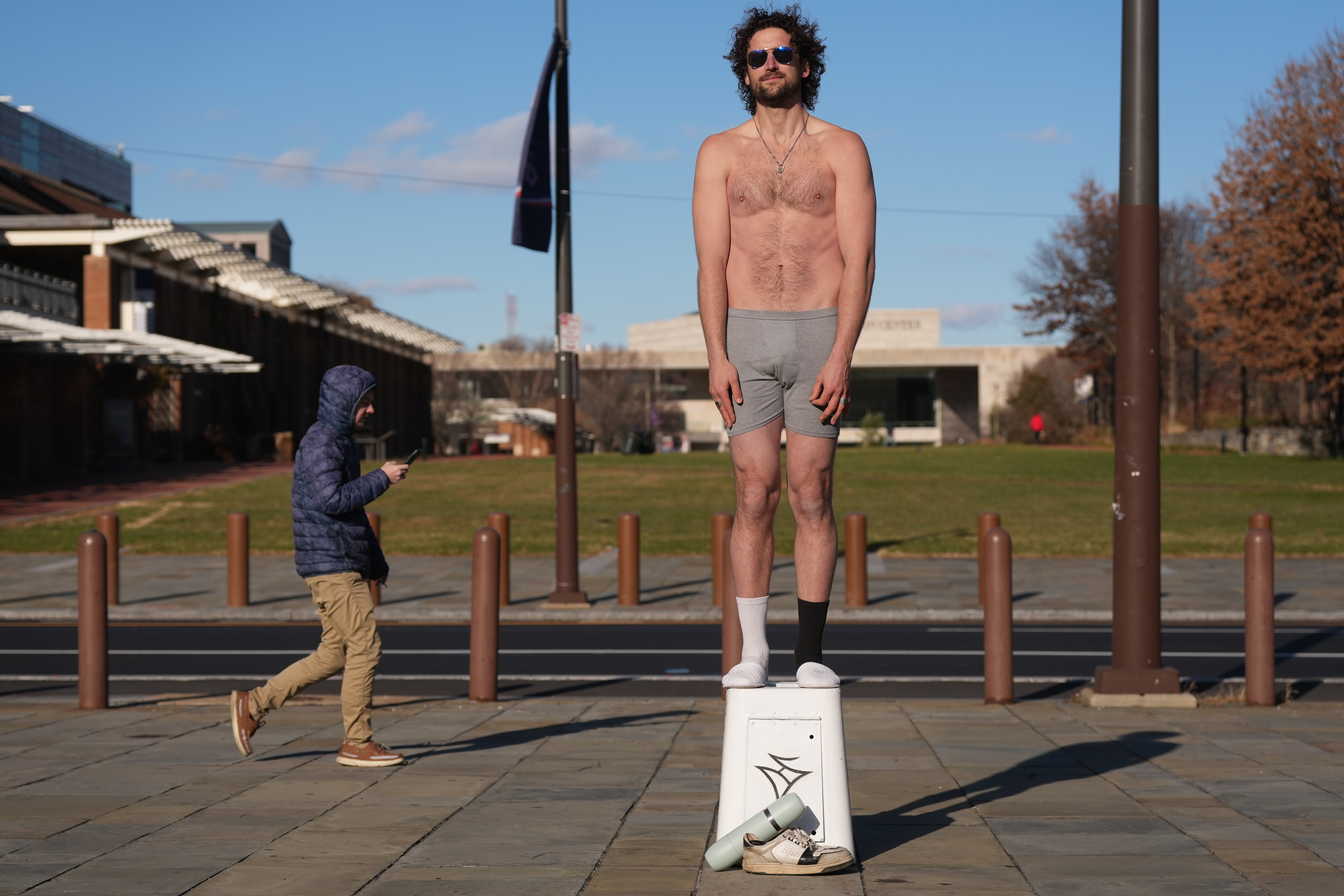
An artist named Ham, the architect of this cold weather performance piece, in Philadelphia, December 11, 2025.
A nearly-naked man standing on a box by the Liberty Bell: A+
Tourists stared. Rangers grew concerned. Locals did what locals always do — tried to figure out if this was art, a bet, or a fantasy-football punishment gone horribly wrong.
Turns out it was art. The man, an artist from Baltimore named Ham (“like the sandwich”), calls the whole thing a commentary on social media. Instead of posting content, he becomes the content.
Ham has done this in New York, Berlin, and even a Norwegian village but claimed Philly gave him the best interactions: confused tourists, National Park rangers offering him clothing, a police officer checking in, and Philadelphians who stopped just long enough to ask, “Buddy… why?”
In a very Philly twist, he’s putting the money people hand him toward an engagement ring, which somehow makes the whole thing feel less like performance art and more like a South Street side quest.
No matter how you interpret it, it’s peak Philadelphia: a nearly naked man shivering by one of America’s most sacred monuments, and the city responding with equal parts curiosity, concern, and “yeah, that tracks.”
Ham planned to stand out there through the weekend — but only until around 4:30 p.m., because even performance artists know better than to be half-naked in Center City after dark.
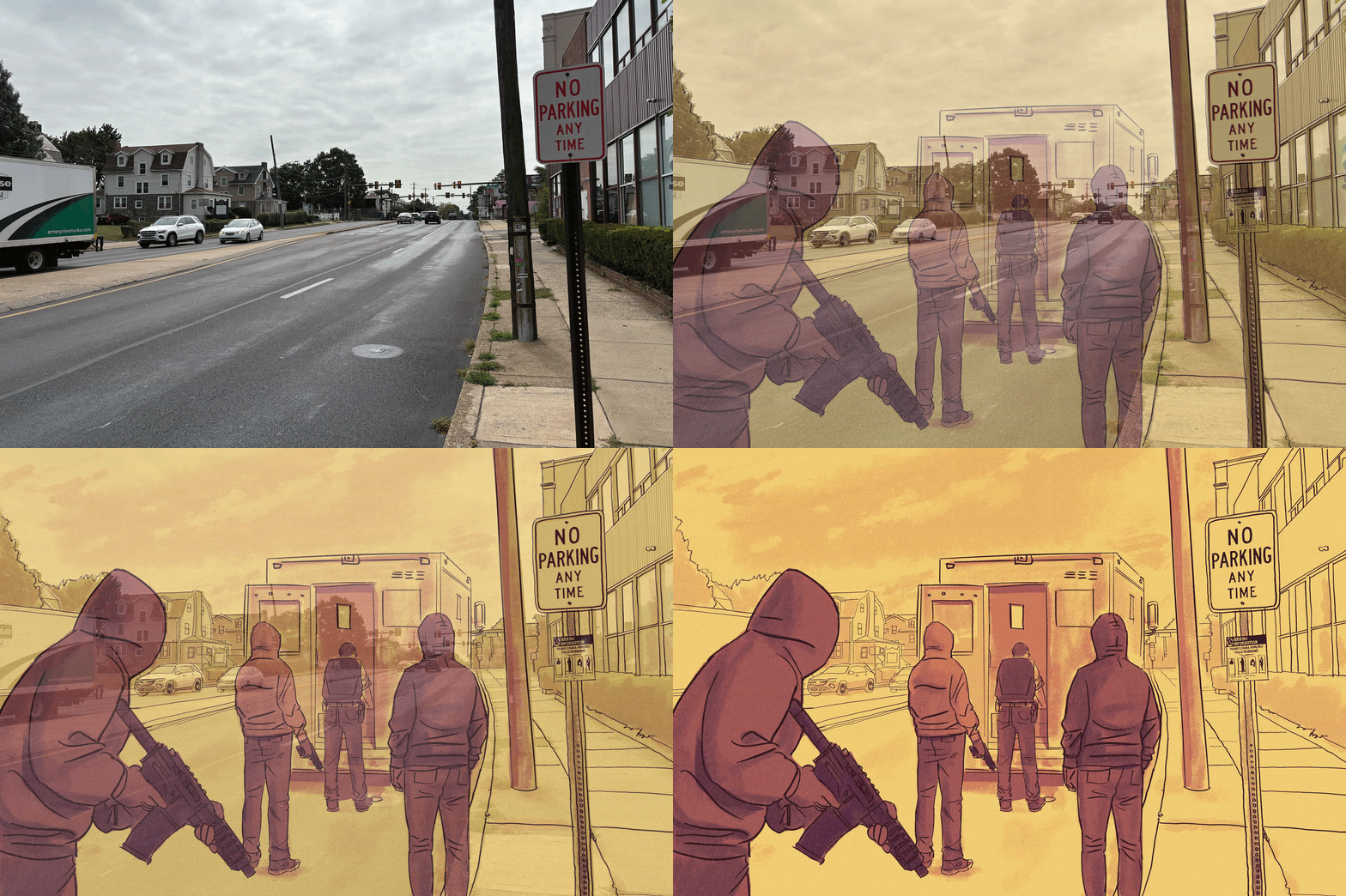
They had moved with surgical precision, the two masked thieves and their getaway driver. Their MO was simple: ambush an armored truck guard, seize his service weapon, grab his delivery bag, then go.
In the space of six early summer days, they executed two robberies, each in broad daylight, in busy Philadelphia shopping centers.
Each heist had taken only a few moments, and no one had been injured. But an unexpected wrinkle — a flinch, a scream, a jumpy truck guard with more bullets than sense — could easily escalate a robbery into a tragedy.
To members of the crew, though, this was all high comedy.
In a group chat after the second stickup, four men — two of whom authorities would later identify as members of the robbery ring — joked about a Fox 29 Instagram post that detailed the heists.
“Don’t say my name lol,” wrote one man.
Another suggested that law enforcement would set a trap for the thieves.
The tone of the group chat is breezy, dotted with laugh-crying emojis.
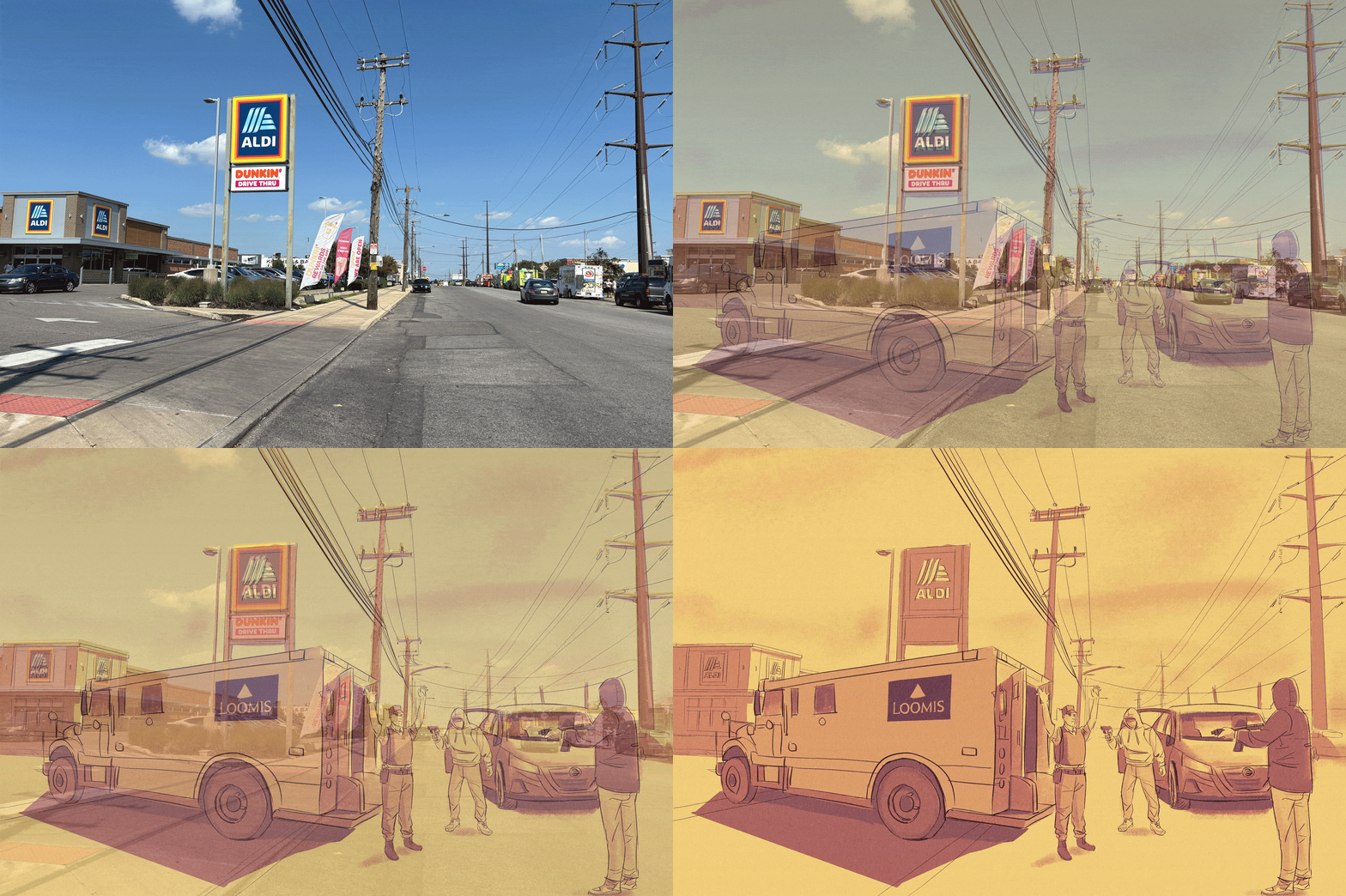
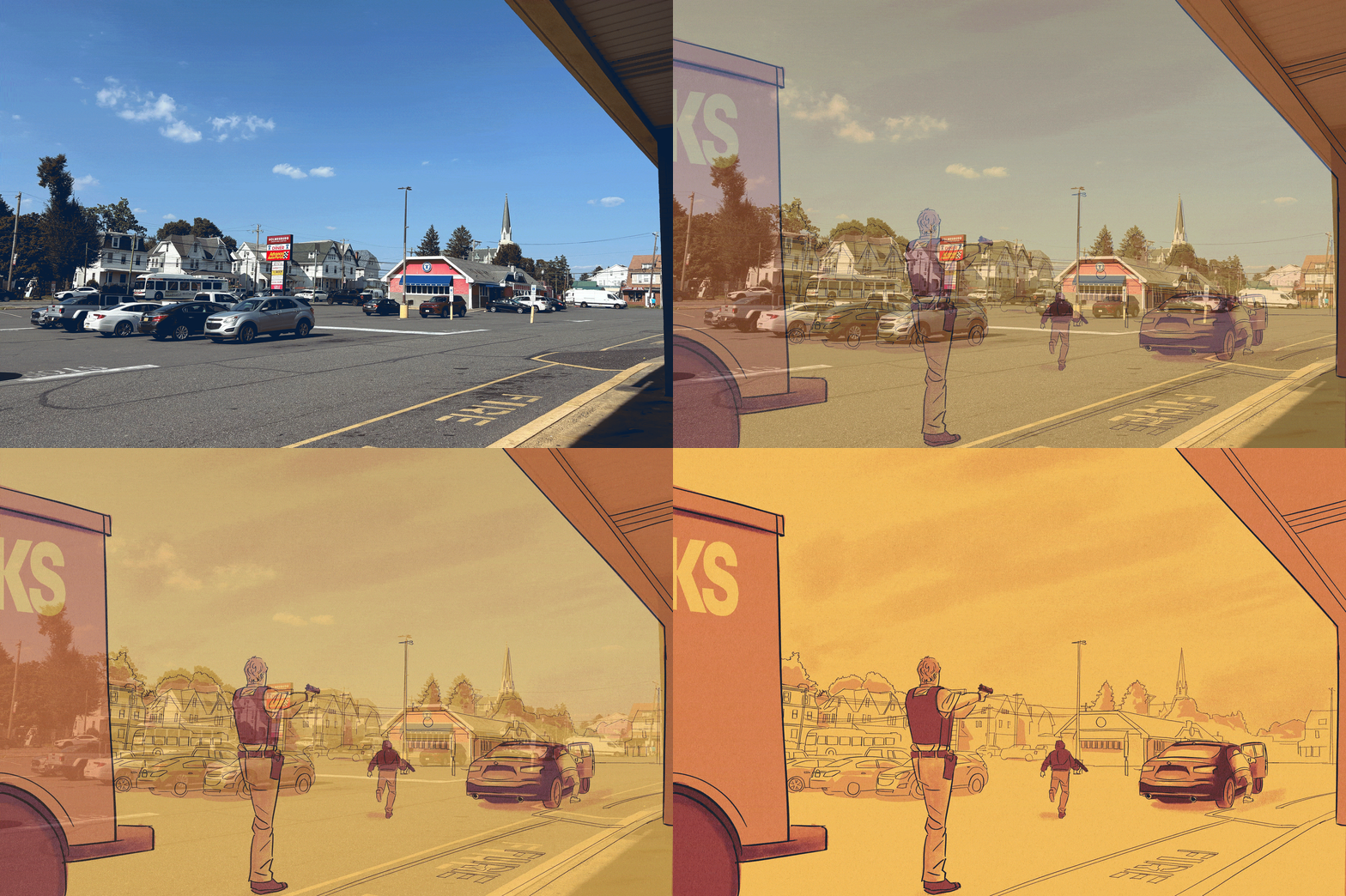
On June 26, as Philadelphia recovered from three consecutive days of 99-degree heat, armed thieves robbed a Loomis driver outside a Crescentville Aldi.
A federal agent would later recount this exchange, and several others, in a 29-page affidavit that details how an alphabet soup of agencies — the FBI’s Violent Crime Task Force, Philadelphia police, Cheltenham police, the District Attorney’s Office, the Bureau of Alcohol, Tobacco, Firearms and Explosives — worked to identify, track, and ultimately arrest members of the crew that allegedly attempted to rob five armored truck drivers between June 26 and Aug. 12.
This was not a simple whodunnit, solved with TV-drama efficiency.
It took a mélange of elements — old-fashioned detective work, high-tech digital surveillance, an anonymous tip, and a seemingly unrelated probe into automobile thefts — to help authorities zero in on the armored truck thieves.
Among the information that investigators collected along the way was the conversation about the Fox 29 post, which was sent to two members of the robbery crew and a third man by Tykee Smith, a Tampa Bay Buccaneers safety.
Smith, 24, grew up in West Philly, but his connection to the crew is unclear. He has not been accused of committing a crime. The FBI did not redact his Instagram handle from the affidavit, but did elect to hide the identities of other figures in the case.
Asked about Smith, an FBI spokesperson wrote in an email: “I would have to defer to the public documents.”
Representatives for Smith and for the Buccaneers declined to comment.
For a while, after their busy summer, the thieves seemingly went underground.
Then, in early fall, investigators learned that the crew had obtained a stolen white Honda Accord with a paper license plate tag.
On Oct. 3, police officers spotted the Accord outside a City Avenue Target — lurking near a Brinks truck.
The Accord peeled off, igniting a heart-thumping chase that spilled into Lower Merion Township, where the driver and his passenger ditched the sedan on a leafy, horseshoe-shaped road.
Police and news helicopters were soon thrumming over the area’s million-dollar properties. Some curious residents ventured outside and were met by teams of rifle-wielding cops who hollered to get back in their homes.
The officers’ radios hissed with speculation: Had the men fled along the nearby Cynwyd Heritage Trail, which leads to Manayunk?
By early afternoon, the suspense — and the manhunt — had drawn to a close.
Officers apprehended one individual, Mujahid Davis, hiding in the basement window well of a house on Colwyn Lane.
His partner managed to evade the dragnet in Lower Merion Township with the help of someone who picked him up in a Dodge Charger.
The escape was short-lived: Police caught up to the Charger soon after in West Philly and arrested the passenger, Dante Shackleford.
On Oct. 16, a federal grand jury charged Shackleford, 26, with one count of Hobbs Act robbery for stealing more than $100,000 from a Brinks driver on Aug. 12, attempted robberies on July 22 and Oct. 3, and brandishing a firearm in relation to a crime of violence.
It was Shackleford who had joked to not say his name when Smith shared the Instagram post about the robberies. Cell tower data showed that his phone was at the scene of some of the summer heists.
If convicted, Shackleford’s sentence could range from seven years to life in prison. He has pleaded not guilty. His attorney, Angela Levy, declined to comment.
Davis, 24, was charged with the Oct. 3 attempted robbery. He has pleaded not guilty.
More indictments might follow in January, when trial dates for Shackleford and Davis will be set, the records show.
Vito Roselli, a retired FBI agent who once worked on bank and armored car robbery investigations in Philadelphia, called the phone evidence in the affidavit “devastating.”
“A lot of robbery crews wise up with cell phones, and just use burner phones. It’s spy tradecraft,” he said. “This crew is not doing that. They’re pretty open about what they’re doing, and they’re running their mouths.”
‘Take all the tracking s— out’
While the FBI tried in early July to generate leads on Philly’s armored truck bandits, other law enforcement agencies were busy in the city with the seemingly unrelated pursuit of an alleged car thief and gun dealer.
Salim Sutton, 31, had been on the run since February. A Common Pleas Court judge had placed Sutton on house arrest while he awaited trial on firearms and theft charges. But Sutton had other plans, and allegedly cut off an ankle bracelet monitor, then absconded.
In June, police officers began investigating a series of complaints about cars having been stolen or broken into near Front and Callowhill Streets. Surveillance footage gave them a look at the alleged culprit: Sutton.
Investigators determined that Sutton had been selling firearms that he’d stolen from vehicles. Given the widening scope of Sutton’s alleged offenses, police and the District Attorney’s Office’s Gun Violence Task Force sought the assistance of the ATF.
The added manpower almost immediately yielded results. On July 10, ATF agents nearly captured Sutton, but he slipped beyond their grasp while riding in a black Nissan Maxima with tinted windows, black rims, and a blacked-out rear emblem.
Afterward, Sutton joked about the encounter on Instagram.
The next day, Sutton traded text messages with a man who wanted to purchase a stolen car.
“I’m bout to hurry up and take all the tracking s— out of it now,” Sutton wrote, according to the records.
“Got you send a cash app,” replied the man, whom the FBI refers to only as “Suspect 1.”
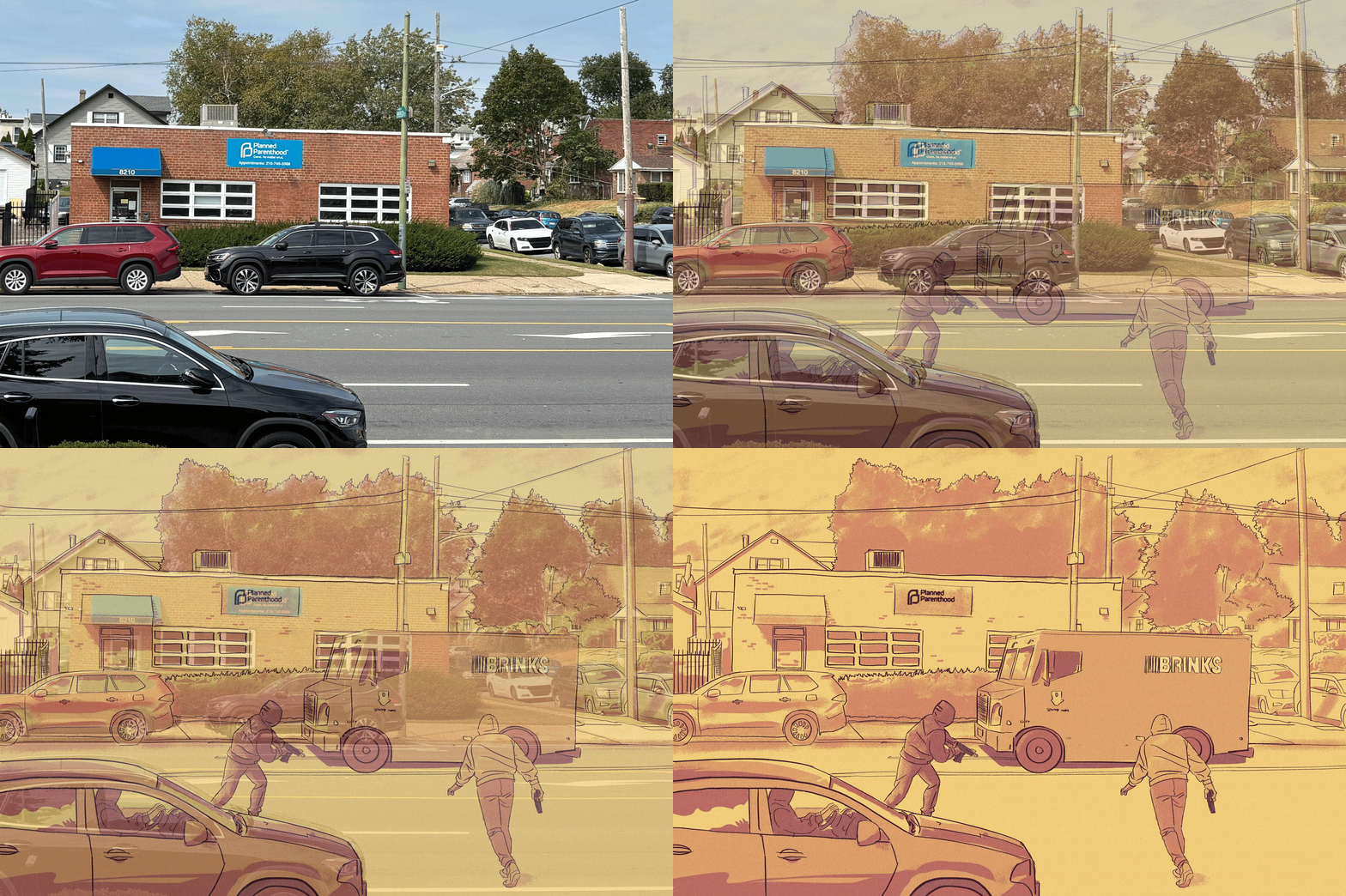
Four days later, on July 15, a Brinks guard parked on Castor Avenue in Rhawnhurst to make a delivery to a Planned Parenthood office.
A Brinks driver opened fired when armed thieves tried to rob him near a Planned Parenthood office on Castor Avenue.
The guard noticed that he was being approached by a man who was wearing a black facemask, a black hoodie, and latex gloves — and brandishing a handgun.
A second man, armed with an AR-style rifle, lurked near the intersection of Castor and Emerson.
The guard drew his service weapon and opened fire, getting off eight shots but not hitting anything.
One of the would-be robbers ran away. Surveillance cameras recorded his partner fleeing in a getaway car: a black Nissan Maxima with tinted windows, black rims, and a blacked-out rear emblem.
Hours after the attempted heist, photos of the getaway began to circulate across social media. Sutton saw one such image on social media, a clear look at the Nissan’s trunk — and its license plate.
He took a screen shot, then messaged the man to whom he had sold the Nissan and asked whether he had switched the car’s license plate.
The two men began discussing more vehicle transactions. Sutton said he had a black 2015 Mercedes-Benz S550 that he could sell for $800.
For the buyer, the price was too steep. He explained that he needed something cheaper, maybe in the $200 to $300 range, just so long as its windows were tinted.
“…we use em for bouncing,” he wrote, “that’s it[,] not to have[.]”
Eyes in the sky
As Philadelphia fell deeper into an uncomfortable, humid summer — punctuated by an eight-day garbage strike — the FBI was still trying to identify the men responsible for the armored truck heists.
They knew that after the first robbery, of a Loomis guard on June 26, two masked thieves and a driver escaped with a meager haul — the guard’s handgun, and a canvas bag that contained $1,000 — in a gray or brown Nissan Altima with tinted windows.
Philadelphia police stopped the Altima on July 2. Its license plate had been stolen from another car.
Officers determined that the driver had nothing to do with the heists. But he did share a valuable piece of information: He had rented the Altima, he said, from someone on Instagram.
Eyewitnesses watched as three armed men ambushed a Brinks guard outside a Dollar General in Holmesburg on July 2.
On July 22, the stick-up crew struck again.
A Brinks driver climbed out of his truck to make a delivery to an H Mart grocery store in a Cheltenham Township shopping center. He realized he was being watched by three people in a black Dodge Durango.
Each of the occupants was masked. Two appeared armed with what the Brinks driver said he thought was a long gun.
The driver darted into H Mart and called police.
For the crew, there was only one sensible option: they had to drive away before patrol cops could reach the H Mart.
But the getaway was not entirely clean. Surveillance cameras recorded footage of the Durango arriving at the shopping center’s parking lot at 8:57 a.m.
Unbeknownst to the thieves, an automated license plate reader had also captured a clear look that morning at the Durango — and its license plate — riding on North Broad Street.
‘Don’t f— move’
The two parallel investigations — the ATF’s pursuit of a car thief and the FBI’s hunt for the armored truck bandits — would soon dovetail.
On Aug. 5, through a combination of physical and video surveillance, investigators saw Sutton driving a sport utility vehicle: a black Dodge Durango. Its license plate matched the Durango that had stalked a Brinks driver at the More Shopping Center two weeks earlier.
On Aug. 7, the ATF arrested Sutton. Investigators quickly obtained state and federal warrants to begin extracting data from Sutton’s phone.
The DA’s Office filed more than a dozen charges against Sutton, including theft, receiving stolen property, conspiracy, and firearms violations, and set his bail at $6.7 million. His attorney could not be reached for comment.
Authorities now had an extensive record of Sutton’s interactions with members of the armored heist crew, who were about to resurface.
The heist grew ambushed a Brinks driver near an H Mart on Old York Road — and escaped with more than $100,000.
On Aug. 12, at 10:22 a.m., a female Brinks driver carried a delivery satchel towards the same H Mart that the thieves had targeted in July.
When she was mere steps from the store’s entrance, two robbers pounced.
One pressed the barrel of an AR-style rifle against her neck, according to court records.
“Don’t f— move, don’t f— move,” he said. “Give it to me.”
The other assailant pressed a handgun against the woman’s back. They took her service weapon and the satchel, which held $119,100, then fled into a waiting black Acura sedan.
Two days later, a Cheltenham Township police detective opened a letter that had been mailed to the department’s headquarters. The handwritten message claimed that a paralyzed man was responsible for planning the recent H Mart robberies. The writer also divulged the identity of one of the alleged thieves.
His name was Dante Shackleford.
Fresh lead in hand, the FBI began collecting every digital footprint that it could trace to Shackleford: cell phone records, social media activity, a newly opened bank account.
The records showed that Shackleford and the paralyzed man — whom the FBI referred to as “Suspect 1” — were indeed associates and had shared Instagram posts and messages with one another.
Among the exchanges that would be recounted in a later affidavit was the Fox 29 post that Smith — the Tampa Bay Buccaneers defensive back, who attended Imhotep Institute Charter High School in Philadelphia — had sent through Instagram to Shackleford, “Suspect 1,” and another man.
In a bid to gather even more evidence, the FBI on Aug. 26 announced a $10,000 reward for information that could lead to the arrests and convictions of the crew’s members.
Investigators found Shackleford’s number, meanwhile, in Sutton’s phone.
And cell tower data indicated that Shackleford’s phone was at the scene of three of the heist crew’s crimes, during the same window of time that the robberies occurred.
City surveillance cameras and cell phone location data provided another crucial piece of information: As of Oct. 2, Shackleford was likely operating or a passenger in a stolen white Honda Accord.
‘Get back inside!’
A day later, when Philadelphia police chased Shackleford and Mujahid Davis into Lower Merion Township, investigators were tracking Shackleford’s cell phone location data.
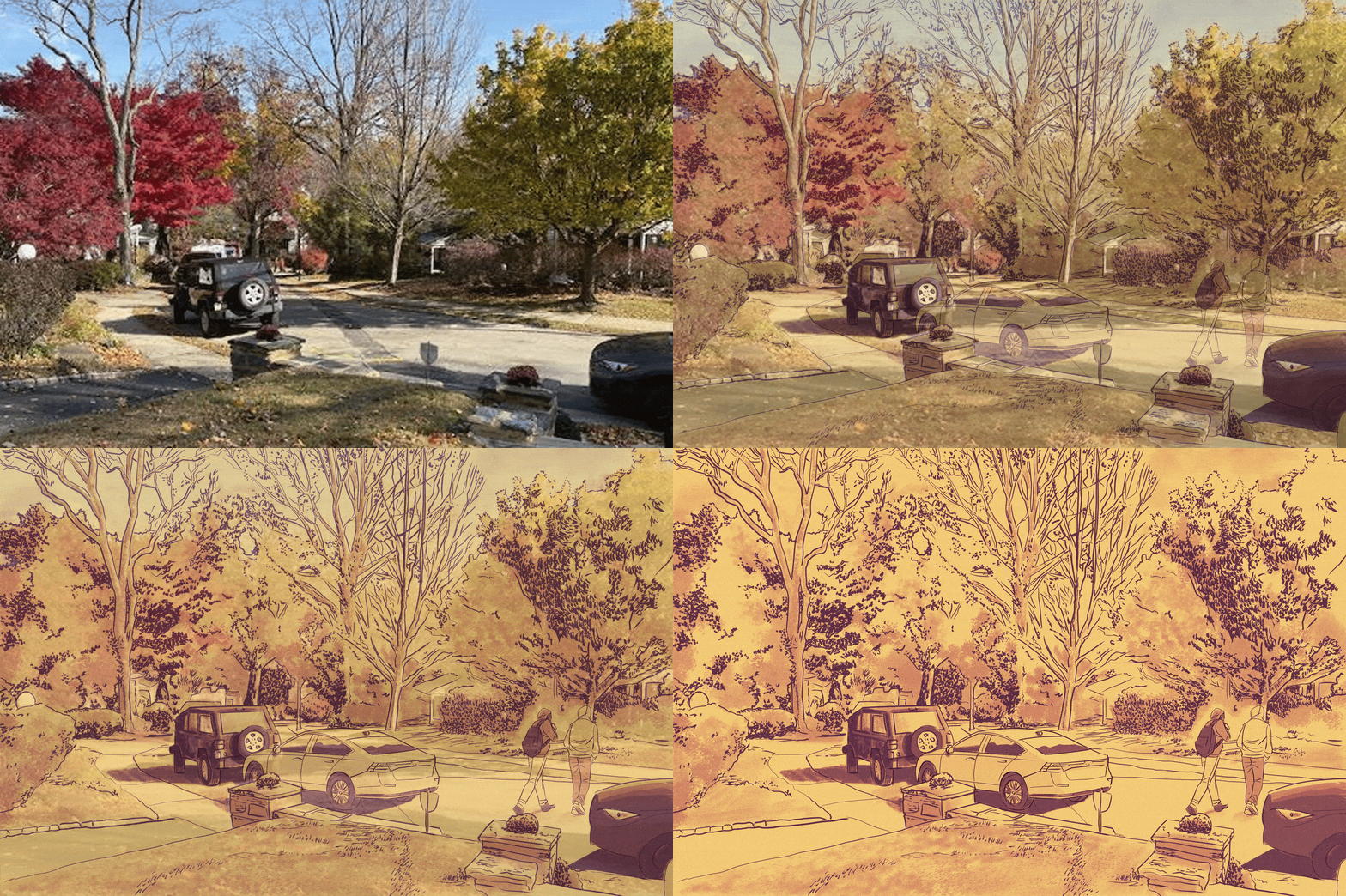
With law enforcement close behind them, Shackleford and Davis ditched the Accord on Snowden Road, a gently curving, tree-lined block in Bala Cynwyd.
Christine Weatherwax was getting ready to make a late morning supermarket trip when she heard helicopters hovering over her house on Snowden.
She stepped outside and saw that someone had parked a sedan — a white Accord — against her husband’s Jeep.
Residents on Snowden Road in Bala Cynwyd found helicopters and scores of police outside their homes on Oct. 3 — and a stolen Honda Accord that had been abandoned by the suspects on their block.
“My husband thought someone had forgotten to put on their parking brake,” said Weatherwax, 51. “He started walking around, looking for the owner.”
Another neighbor, John Wuetig, ventured outside and fixed on an unusual sight: 10 cops, rifles in hand, marching down the street, accompanied by eager police canines.
“The officers yelled, ‘Get back inside!’” Wuetig, 51, recalled.
Later, Wuetig reviewed his Ring camera footage and saw a sequence that he and the officers had missed: two individuals running from the Accord.
As they attempted to flee, the men shed some of their clothes, the Honda’s key fob, and a Glock handgun in neighbors’ yards, according to court records.
In the Accord, police would find an AR-style pistol.
Some residents spotted Davis on Colwyn Lane, a 14-minute walk from Snowden Road.
Police swept down the block, and found a house with an unopened front door.
The property owner, Todd Miselis, 50, had left to run to a store. Inside, a friend of his slept in a guest bedroom.
“I got a text from my friend that said, ‘911. Cops are all over!’”
Miselis wondered if his friend was joking.
He returned home and found his closet doors ajar. It appeared that someone had rummaged under his beds. His friend then explained that five armed cops had barged into Miselis’ house and woken him by pointing flashlights in his face.
Soon after, the officers found Davis hiding in the basement window well of Miselis’ neighbor.
But where was Shackleford?
A day earlier, the FBI had learned through surveillance footage that Shackleford had been riding in a white Dodge Charger.
That information was shared across police radio. Officers soon spotted the Charger in West Philadelphia, where it came to a stop at 52nd and Parrish Streets.
Shackleford and the driver, whose name has not been released, were arrested without incident.
At the scene, one investigator decided to dial a number that had helped unlock a significant portion of the case.
Inside the Dodge Charger, Shackleford’s phone began to ring.
The first measurable snowfall of the winter of 2025-26 evidently is all but a done deal for Philly this weekend, and it has a chance to be the biggest in five winters — not that the bar is ultra-high in a period when snow has been mightily lacking.
The National Weather Service Saturday has issued a winter storm warning for 3 to 5 inches throughout the region, listing a 98% likelihood of at least an inch.
The AccuWeather Inc. forecast was similar.
The weather service foresaw a 76% chance of 4 inches in the immediate Philly area, and a 43% chance of 6 or more.
With the caveat that timing and duration of precipitation aren’t in the wheelhouse of atmospheric science, the weather service is expecting snow or snow mixed with rain to start late Saturday night.
If it’s a mix at the outset it would quickly become all snow as temperatures fall below freezing, and end around daybreak. As the weather service pointed out, the timing couldn’t be much better for minimizing disruption.
However, snow showers and wind chills in the teens are expected when the Eagles host the Oakland Raiders in South Philly.
The accumulating snow would be generated primarily by an upper-air disturbance, said Matt Benz, senior meteorologist with AccuWeather. It’s possible that the storm may regroup off the coast; however, that “probably will form too late to have any impact,” Benz said.
The weather service said inch-an-hour snowfall rates are possible in the early morning hours of Sunday.
And the snow is likely to stick around until at least midweek, with high temperatures Sunday, Monday, and Tuesday expected to be around freezing or lower and the sun angles about as low as they get.
After a 3.1-inch snowfall in February, the temperature climbed to near 50 a day later, and the strengthening sun made quick work of the snow cover.
That February snow turned out to be the biggest of a season in which the 8.1-inch total at Philadelphia International Airport barely bested the 8 inches of New Orleans. That winter, the I-95 corridor found itself in a snow hole, and Philly a snow hole within a snow hole. The highest total in the winter of 2023-24 was 4.6 inches during a snowy January week.
Last season, snow fell to the north, west, and south, and that trend has continued in the early going. With 6 inches so far this winter, Richmond, Va., now has measured 22.8 inches since last December, nearly triple the Philly total.
Official totals at Philadelphia International Airport have been significantly below normal for four consecutive winters. The normal for a season is 23.1 inches.
The meteorological winter, which began Dec. 1, certainly is off to a wintry start, with temperatures averaging more than 6 degrees below normal.
It is not off to a particularly wet start, however, and whatever falls this weekend isn’t expected to exceed a half inch of liquid.
In its long-term outlooks through Dec. 26, NOAA’s Climate Prediction Center is on the fence regarding whether precipitation will be above or below normal.
With high confidence it is calling for a national warm-up.
In any given year, the odds are greatly against Christmas snow in Philly or elsewhere along the I-95 corridor.
But it does look like the region is about to get a white Sunday.
When a Southwest Philly resident reported a KKK flier had been taped to a pole outside their home this week, people got angry.
The Pennsylvania Human Relations Commission looked into the incident and put out a statement denouncing hate. Angry commenters on the 51st Ward’s Facebook page about the flier dared white supremacists to show their faces.
But 51st Ward Democratic leader Gregory Benjamin said while he understands the alarm and does not intend to dismiss people’s concerns, he believes this all may be some kind of misunderstanding.
“We want to calm that,” he said.
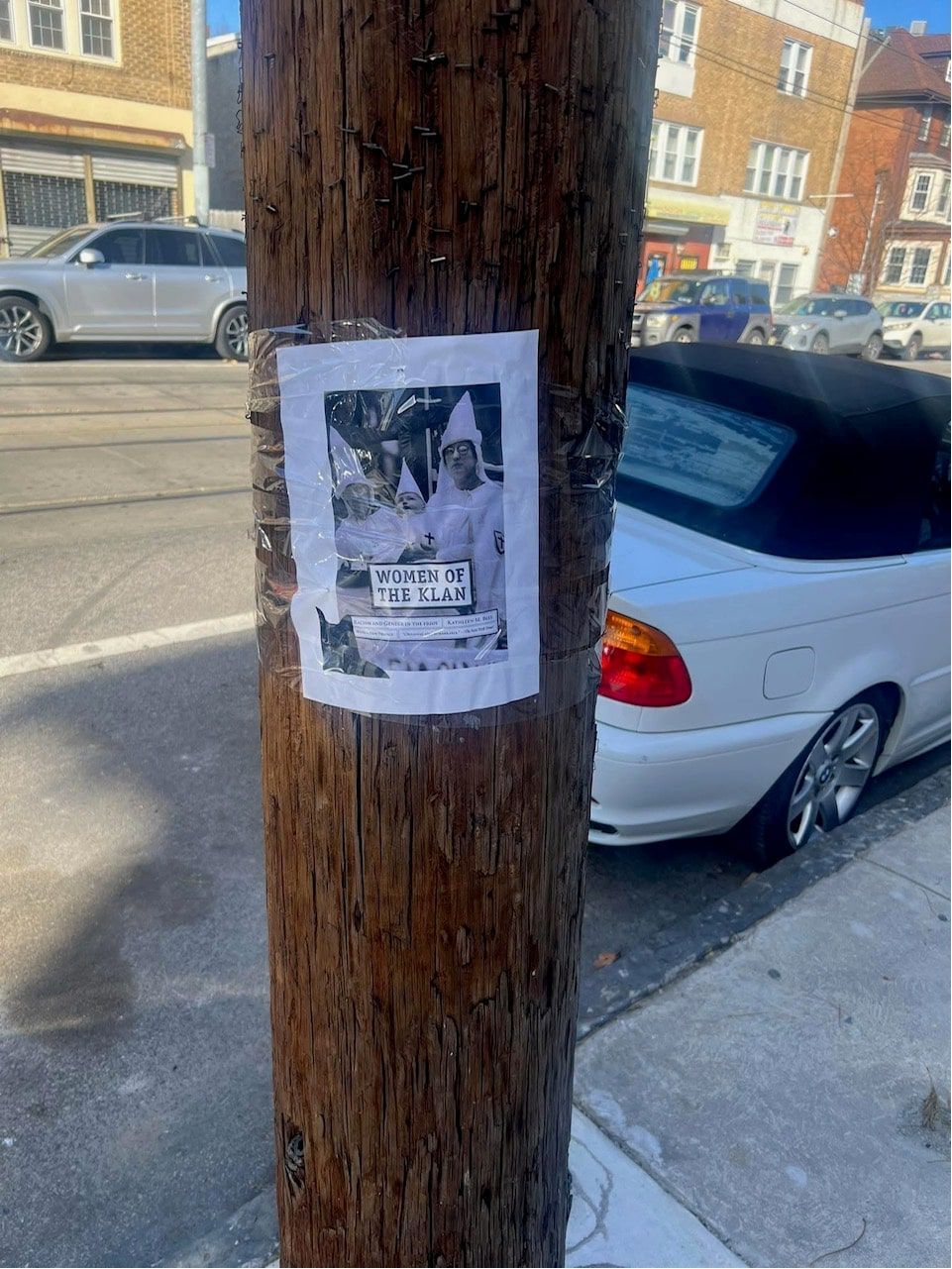
On Tuesday, a neighbor called Benjamin to let him know that they’d discovered a flier depicting members of the KKK on an electrical pole outside their home on the 5100 block of Chester Avenue.
A flier posted earlier this week in Southwest Philly is a copy of the cover from a book titled “Women of the Klan: Racism and Gender in the 1920s”.
The flier is black-and-white copy of the cover of a book written by University of Pittsburgh sociologist Kathleen M. Blee, Women of the Klan: Racism and Gender in the 1920s. The cover features a photograph of three generations of klans-people — an older woman, a younger adult woman, and a baby — all wearing white pointed robes, with a cross and American flag behind them.
It’s unclear what message whoever put up the flier intended to send. Blee’s book, originally published in 1991, is a study of the role that women played in the Jim Crow-era KKK and the covert ways they carried out the Klan’s mission, not an endorsement of the group’s ideology. The first page of the book describes the Klan as “one of U.S. history’s most vicious campaigns of prejudice and hatred.”
The flier still raised concerns. Residents contacted the Human Relations Commission, and its Philadelphia advisory council was notified, as well as police. It’s possible another identical flier wasposted nearby around the same time, Benjamin said, but all fliers have since been removed.
No person or group has taken responsibility for the flier so far. While there is no indication the flier was put up by a white supremacist group, the manner in which it was posted can still be harmful, said Chad Dion Lassiter, executive director of the Pennsylvania Human Relations Commission.
“These things, they take an emotional toll on individuals,” he said.
Even if the flier was a piece of trolling or a message targeted at white people, Lassiter said it was crucial not to ignore it.
“We take all of these things [seriously]… we’re in a moment where people want to continue to deny the surge of white nationalism and white supremacy,” he said.
Representatives of the Pennsylvania Human Relations Commission will attend the 51st Ward’s monthly community meeting onSaturday at noon at the Kingsessing Library, located at 1201 S. 51st St.
Benjamin said the meeting would be an opportunity for community members to share more information about the incident and ease any remaining tension. He said he hopes this experience will encourage neighbors to connect more and communicate better.
“Maybe we can bring something constructive out of this. Demonstrate that the community is more interested in [doing] something positive than anything else,” he said.
Correction: An earlier version of this article misstated the publication date of Blee’s book. It was originally published in 1991.
It’s no secret that times are tough for landlords around Temple University.
An eight-bedroom rowhouse at 1734 N. Gratz St., for example, languished on the real estate market after being listed for sale, like many dormlike apartments left in the wake of a rental boom that fizzled amid declining student enrollment.
The property went up for sale in April 2024 for $475,000 — $40,000 less than the owner had paid two years prior. It sat on the market for one year with no takers.
Then real estate agent Patrick C. Fay got involved.
In April 2025, the Gratz Street rowhouse was re-listed for $875,000. The very same day, it was listed as a pending sale, with Fay representing the buyer, according to real estate data from the Realtors Multiple Listing Service.
An Inquirer review of 33 other sales Fay brokered over the last year showed a similar pattern.
After properties went unsold at lower prices, Fay stepped in as the buyer’s agent and almost immediately arranged a sale for anywhere from $290,000 to nearly $550,000 more than sellers originally asked for.
On average, Fay’s clients have paid about double the original listing.
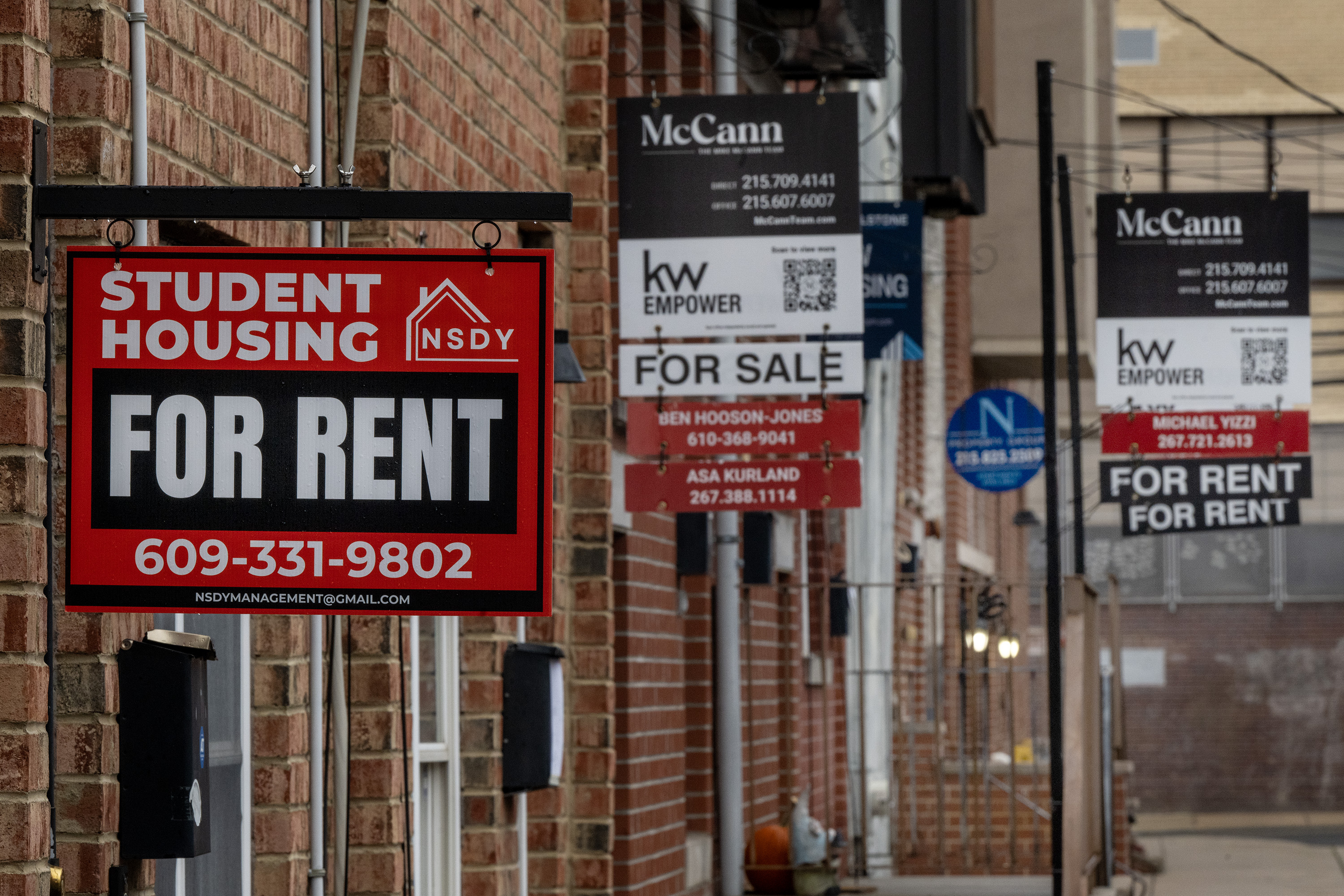
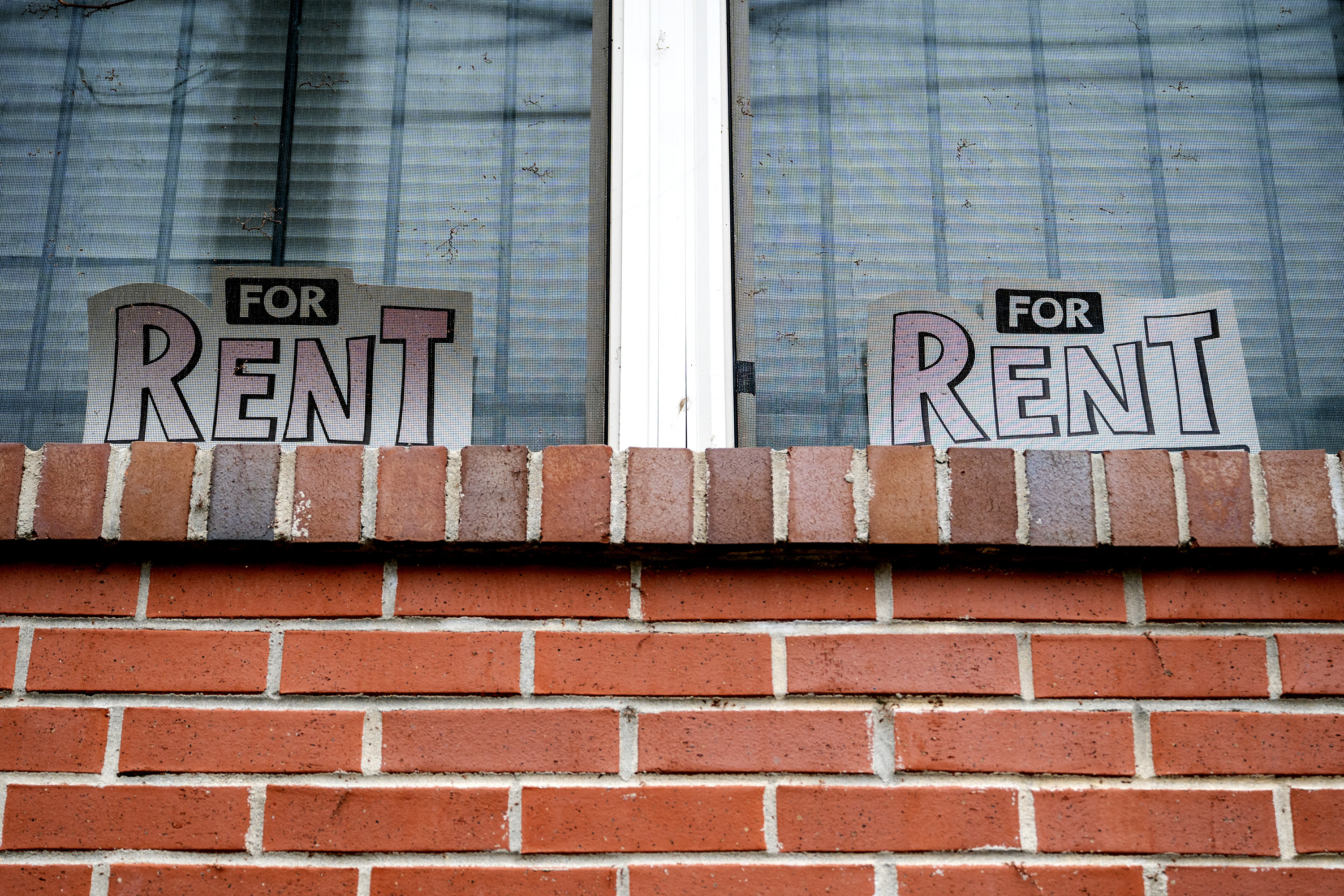
The value of rental properties around Temple has dipped in recent years. Many property owners have sold. Some blocks, like the 1700 block of Arlington St., are lined with for-rent and for-sale signs.
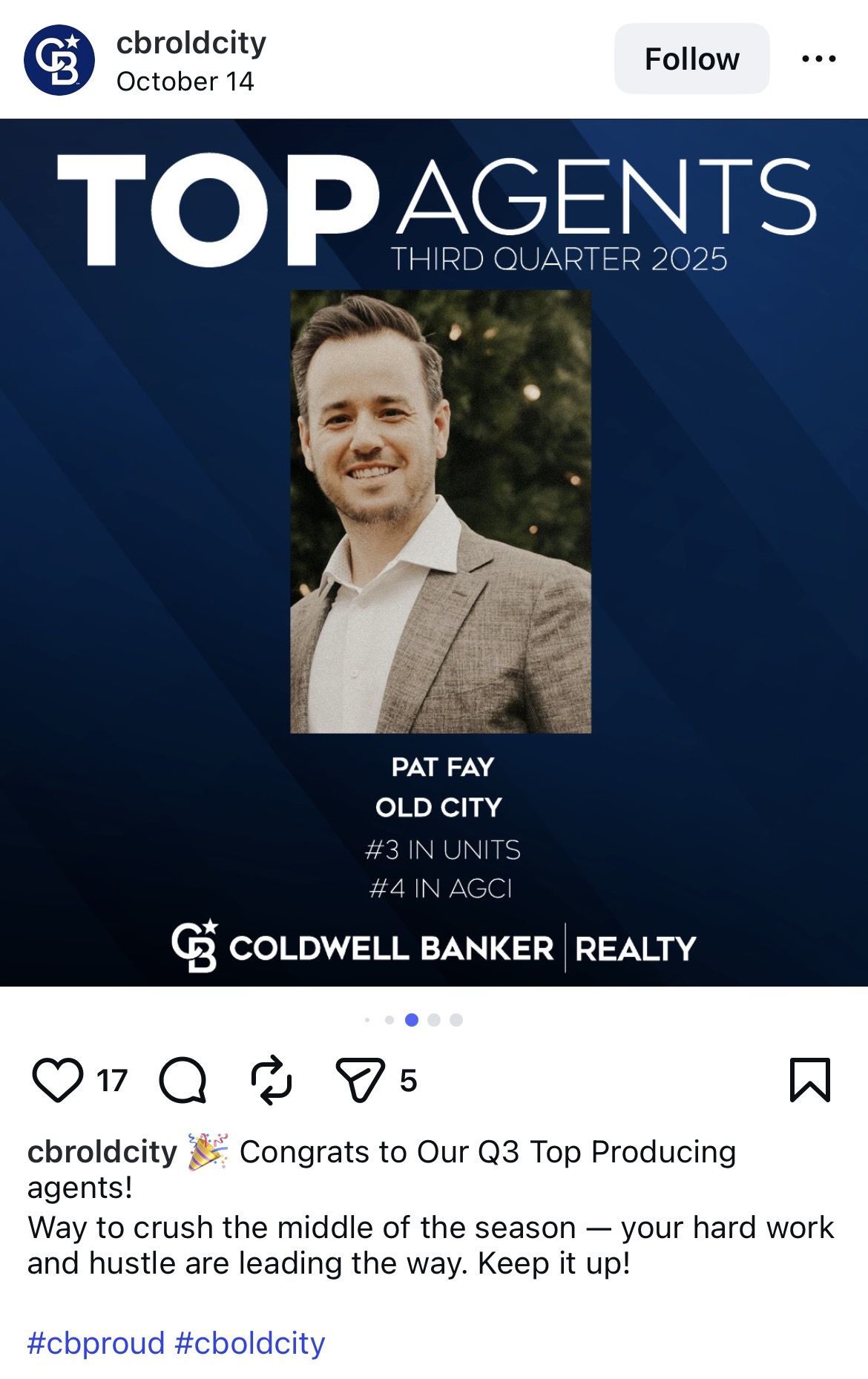
Fay, who worked out of Coldwell Banker’s offices in Old City and Moorestown, Burlington County, has now represented buyers in at least $40 million worth of settled or pending real estate deals involving multifamily properties around Temple.
(After this article published online Friday, the real estate firm cut ties with Fay and his biographical page was removed from its site. “The agent is no longer affiliated with Coldwell Banker Realty,” a company spokesperson said by email.)
Of about a dozen properties in the area that sold for more than $750,000 over the last 90 days, every one listed Fay as the buyer’s agent.
The Inquirer’s examination of the deals found the sales involve a small group of repeat buyers, including two linked to an earlier prosecution over a 2000s-era mortgage fraud scheme. In that case, federal investigators found that the group was involved with purchasing distressed homes using artificially inflated mortgages, pocketing the excess money and allowing the properties to lapse into foreclosure.
Fay, who is one of the top agents in his Coldwell office, said his transactions were all aboveboard. He credited the high sale prices to rebounding demand for student housing in the Temple University area.
“I think it’s a desirable area for sure,” said Fay, who lives in Moorestown. “They just had their biggest enrollment of all time.”
Pat Fay has been one of the top real estate agents this year in Coldwell Banker’s Old City office. His clients have been purchasing properties around Temple University, but at steep markups.
Actually, Temple’s head of admissions resigned last month after the university missed its annual enrollment goal. Its student population remains below 30,000, down from a high eight years ago of more than 40,000.
“This is not a good time for being a property owner around Temple,” said Nick Pizzola, vice president of the Temple Area Property Association, a group that represents many landlords and was formed to “encourage responsible development and property management” in the area.
“Rents are down, vacancies are up,” he said. “It’s a buyer’s market.”
The financing on Fay’s sales is provided by higher-risk private lenders, which grew in popularity as conventional bank lending contracted in the wake of the 2008 real estate crash.
Jon Hornik, head of the National Private Lenders Association, a trade group that represents firms like the ones that lent to Fay’s clients, recently flagged sales around Temple on a watch list the group maintains for suspicious transactions.
He had a simple explanation for these market-defying sales.
“These are bad actors inflating the value of the real estate through the sale structure, and therefore borrowing more money than they really should be able to,” Hornik said in an interview. “There’s real estate there. There’s a borrower there. But the values are off.”
Off-campus housing in North Philadelphia is still popular among some Temple students, but university President John Fry recently announced plans for a new dorm.
Fay, who describes himself on Instagram as a partnerin the upscale Center City Irish bar the Mulberry, has been pursued in New Jersey Superior Court by seven credit card companies or lenders in connection with roughly $57,000 in debts. Most were linked to unpaid credit card bills, and most have ended in default judgments.
Business records show Fay is listed as debtor to an Atlanta-based company called Real Commissions, which lets real estate agents tap into cash based solely on the promise of a forthcoming commission, so long as they have a signed agreement of sale in hand.
In an email Thursday, Fay cited several 2022 student rental sales in the $800,000 to $900,000 range to support his sale prices, insisting that “at no point did either party set or influence those values.” He did not respond to questions about why his clients would pay twice what a seller had initially been asking.
The real estate agent’s narrative of a booming rental market around Temple was also disputed by a recent seller in one of his deals.
The former property owner, who asked not to be named because he feared legal repercussions, acknowledged that he tried to unload his rental property last year but found no takers. He said his real estate agent then brought him Fay’s offer to broker a sale for $875,000, which he said was actually just the amount that would be recorded on the deed.
In reality, he said, he made the sale for only $385,000, or $15,000 less than what it was originally listed for.
The seller said he knew the deal was suspicious, but his agent advised him that he was unlikely to find a better deal.
“I had a mortgage, but I couldn’t get any renters,” the seller explained. “It’s called desperation.”
He took the deal, recording an official sale price that was more than $250,000 higher than any comparable properties recently sold on that block.
Then, anotherproperty across the street sold in June for the exact same price — $875,000 — shortly after being re-listed from $475,000.
The real estate agent on that sale: Pat Fay.
‘Strange stuff’
Historically a commuter school, Temple has long had room for just a fraction of its total student body in traditional dorms. But as Philadelphia’s fortunes improved in the 20th century and more students sought to live on or near campus, the housing shortage intensified.
Private developers stepped in. Blocks that had long served as home to mostly Black working-class residents transformed into rows of student housing units, sometimes prefabricated.
But during the pandemic, the boom in rentals came to a grinding halt. Classes went virtual, driving student renters away. Surging homicide rates — including the 2023 shooting death of a Temple police officer — drove a public-safety crisis for the university.
Recently, Temple president John Fry announced a plan to steer more students back to campus with the university’s first new dorm in years.
Today, even with homicide rates now at historic lows and enrollment creeping up again, many of the blocks once flooded with student housing are underpopulated.
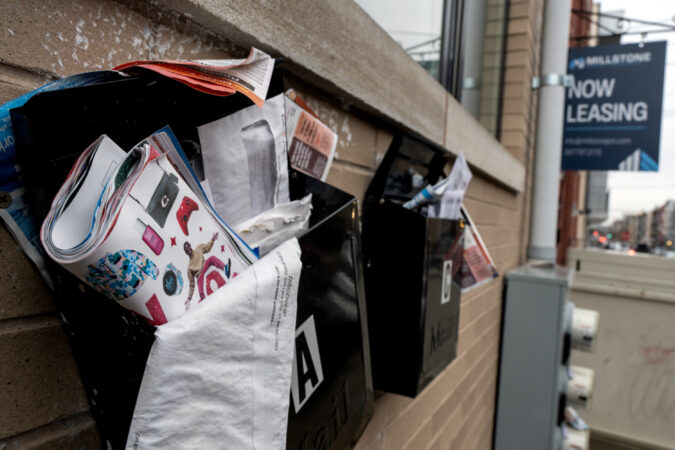
For-rent and for-sale signs line both sides of the 1700 block of Arlington Street. Around the corner, on 18th Street, mailboxes overflow with unopened letters, and the chirps of dying smoke detector batteries in vacant units create an eerie birdsong.
Landlords on the 1900 block of N. 18th St and elsewhere are looking for renters. It is unclear why a small network of buyers is overpaying for nearby properties.
Pizzola said membership is down in the Temple Area Property Association as building owners have looked to get out of the rental business.
“Since COVID hit, it just turned the market upside down,” he said. “If you’re an investor who was buying off-campus housing right before COVID, you got slaughtered.”
Bart Blatstein, a developer who was heavily involved in the mid-2000s Temple-area housing boom, said the recent transactions are highly unusual.
“I’ll give you a commission if you can get twice what my properties are worth,” Blatstein joked.
Officially, more than 40 different corporations have purchased student rental buildings in sales brokered by Fay. But those companies trace back to a handful of purchasers, according to Pennsylvania corporate registries.
Some of these buyers, contacted by The Inquirer, described Fay more as a participant among a loose but unnamed group of “real estate investors,” rather than a mere agent.
Stephen L. Johnson, a Montgomery County resident, was linked to companies involved in six purchases, totaling $5.2 million. Several of the companies were registered to the home of Johnson’s mother, although in an interview she said she was unaware her rowhouse was being used as a nominal corporate headquarters and referred questions to her son.
Reached by phone, Johnson echoed Fay’s enthusiasm for the future of the real estate market around Temple, predicting a surge in values if the university seeks to expand.
“The investment was all about Temple buying up everything and making it better,” Johnson said of his purchases. “In 10 or 20 years, they’ll probably own all of North Philly.”
Johnson could not explainwhy one of his companies, 17th Street Estates LLC, had paid so much for properties like 2113 N. 17th St., which was listed for $475,000 but sold for $900,000.
“I’d have to talk to Patrick about that,” said Johnson, who referred to Fay as “the main guy.”
“It’s like a team,” he added. “We all help each other out.”
Another one of Fay’s clients, Tanjania Powell-Avery of Pottstown, Montgomery County, is a former real estate agent charged in 2010 by the U.S. Attorney’s Office as part of a mortgage fraud ring.
Prosecutors said Powell-Avery aided two men who “purchased distressed properties at low prices, found buyers for the properties at a much higher price, and submitted false documents to the mortgage lender in support of mortgage applications,” according to the federal indictment. She pleaded guilty and was sentenced to five years’ probation and nine months’ house arrest.
Despite this, and a 2012 bankruptcy, companies linked to Powell-Avery appeared in at least two recent sales around Temple, both brokered by Fay. These companies tapped $1.3 million in mortgages to close sales with a combined value of $1.6 million — each for about double its initial listing price.
Powell-Avery did not respond to a request for comment.
Her two codefendants in the 2010 federal indictment, Joseph Tookes and Othniel Tookes, also pleaded guilty. Both men are relatives of Abigail Tookes, a resident of a Norristown apartment complex who was pursued by creditors in 2020 after defaulting on a loan, leading to a $46,067 court judgment against her.
Even so, companies tied to Abigail Tookes were linked to at least $3.4 million in mortgages to finance the acquisition of at least five properties in sales involving Fay. In all five purchases, Tookes’ company recorded sale prices at double the original values.
Reached by phone, Tookes insisted the sales were “totally legitimate transactions.”
“There’s no fraudulent activity. It’s just an investment group,” she said. “There’s no story here. These are real estate transactions between the buyers and sellers. They all agreed to the sale. It doesn’t matter why.”
Other people linked to companies in Fay’s sales — Patrick M. Williams, Miles Fambro, and Angel Rodriguez — did not return calls for comment.
Many of the Temple-area sales featured the same mortgage broker: Viva Capital Group.
Reached by email, Viva president Juan Arguello said his Florida-based company operated “in full accordance with state and federal guidelines, rules, and regulations” and does “not have any contact with the sellers or their agents.”
He also said his company relied on an outside appraisal management company to approve mortgage values. He did not respond to questions about which appraiser had been used to support the Philadelphia sales.
Pizzola, who owns student-rental properties in the area, said these recent sale prices would eventually start driving up neighborhood property assessments, leading to higher tax bills, particularly on blocks where Fay’s clients have purchased multiple properties.
He said he suspects there is fraud involved.
“The fact that you’re seeing multiple sales at twice the average market value, it doesn’t pass the smell test,” he said.
Uncertain future
A prospectus for a property on Cecil B. Moore Avenue, listed for sale at $850,000 in October by several other real estate agents, included a string of Fay’s recent sales as comparable sales to justify the high asking price.
That property has yet to sell.
Over the last three weeks, at least three more properties near Temple have gone under contract — all with Fay as real estate agent.
Fay had been listed as an agent on a large apartment complex on the 1300 block of North Broad Street that was listed for sale at just under $6 million in late October. In November, the property was re-listed for $12 million.
The city has begun placing liens for unpaid water bills on the buildings in some of the earliest deals Fay arranged. Many of the properties have skipped out on biannual commercial trash hauling fees imposed by the city.
Some of the buildings do not appear to be occupied.
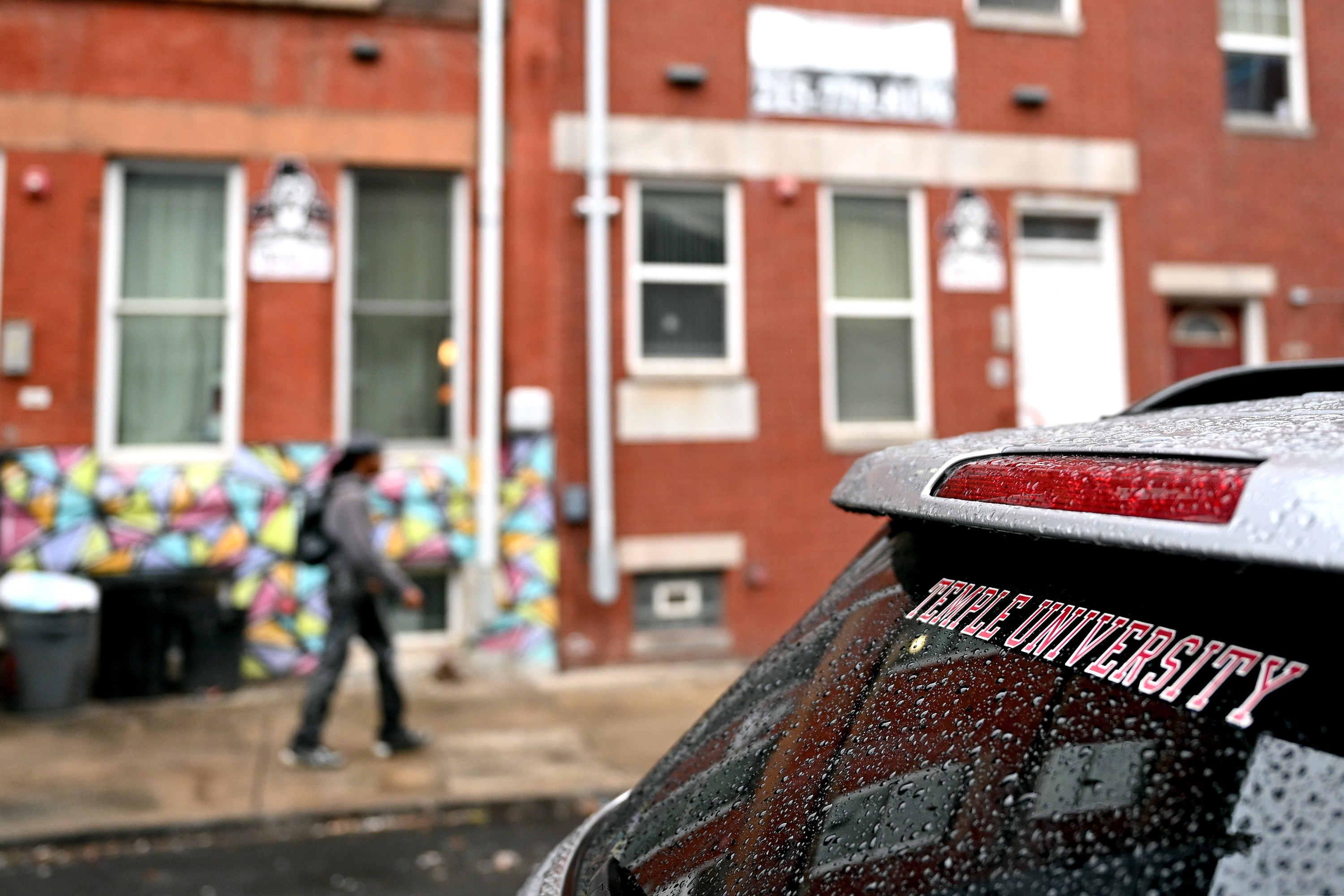
Someone appeared to have busted open a door, which was ajar with broken locks. A Temple sticker was on an upstairs window.
Hornik, from the NPLA, said that unless Fay’s purchasers figure out a way to extract enough rental income from these properties to cover mortgage costs, a mass foreclosure by lenders was likely in North Philadelphia — leaving the ownership of dozens of properties up in the air.
“If the loan goes negative, the lender has to foreclose,” he said, “and they’re not going to recover that money.”
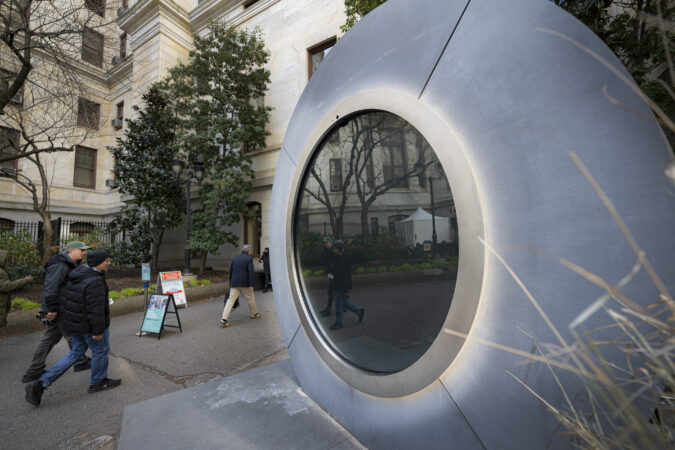
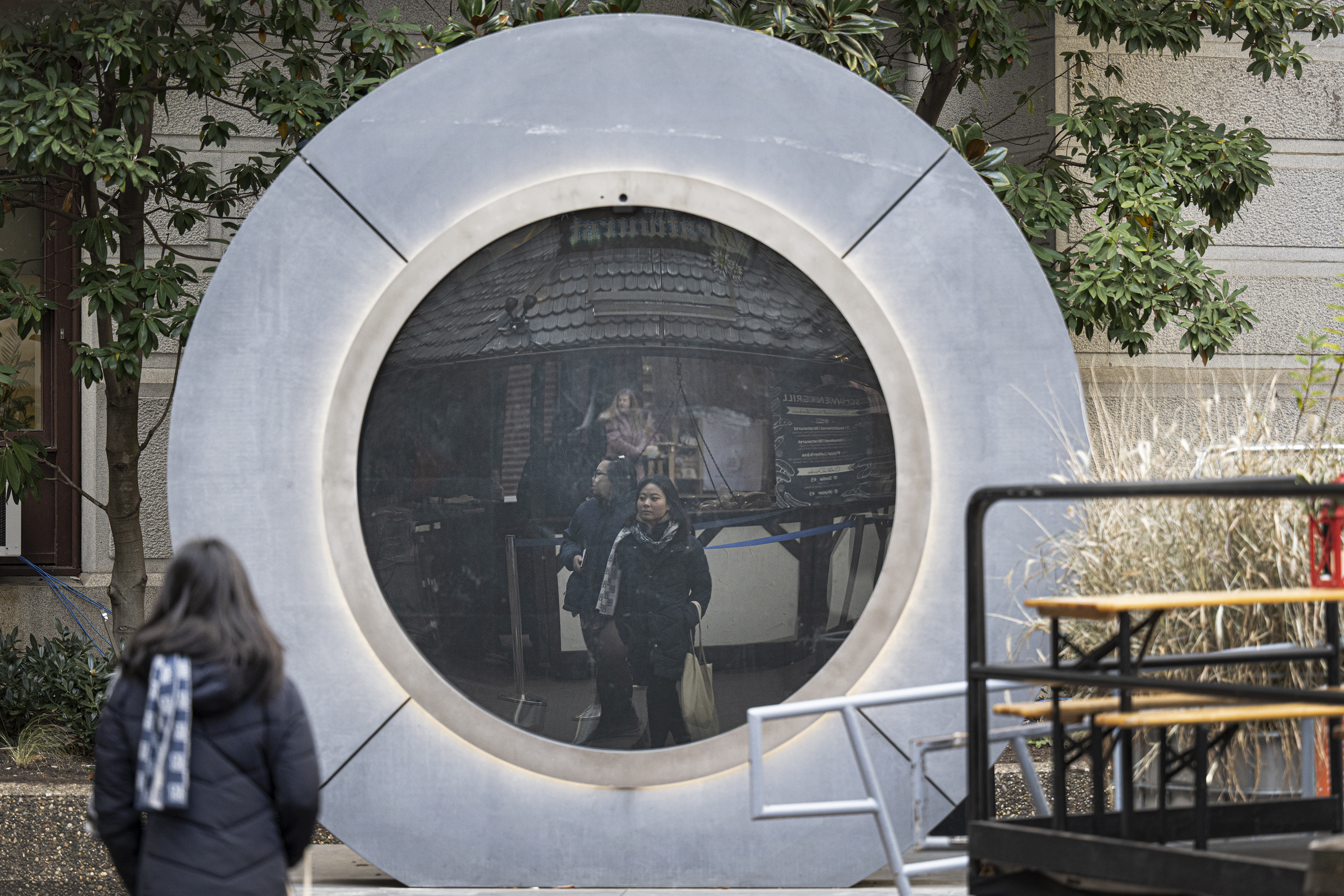
With its screen blank, the sculptural art installation that usually connects people in different cities around the world was akin to a void Friday afternoon, idling in the City Hall courtyard as the magic of Center City’s Christmas Village swirled around it.
It’s unclear exactly how long the Portal has been out of commission; according to city spokesperson Leah Uko, a technical issue “has disrupted the live stream in recent weeks,” and Portal officials expect a fix next week. The operators of the Portal did not respond to requests for comment by publication time.
“Turn the Portal back on, we demand it,” one onlooker said.
Another scoffed, “It must be nighttime there.”
Pedestrians walk by “The Portal” art installation on Friday, Dec. 12, 2025, in the Philadelphia City Hall courtyard.
Yonas Legesse, 22, and Martina Gebrail, 24, trekked more than two hours from Secaucus, N.J., and Jersey City, respectively, in hopes of seeing the famous Portal.
“We were definitely gonna stop here, go wave at some people, and now it’s off,” Legesse said. “It kind of hurts.”
Gebrail was amazed by the technology she saw on TikTok: The 3.5-ton circular video screen beams real-time, 24-hour, unfiltered livestreams from and to places like Dublin, Ireland; Vilnius, Lithuania; and Lublin, Poland.
Despite their disappointment, Legesse and Gebrail said they would come back to see an operative Portal. It’s expected to stay in Philadelphia through the country’s Semiquincentennial celebration in 2026.