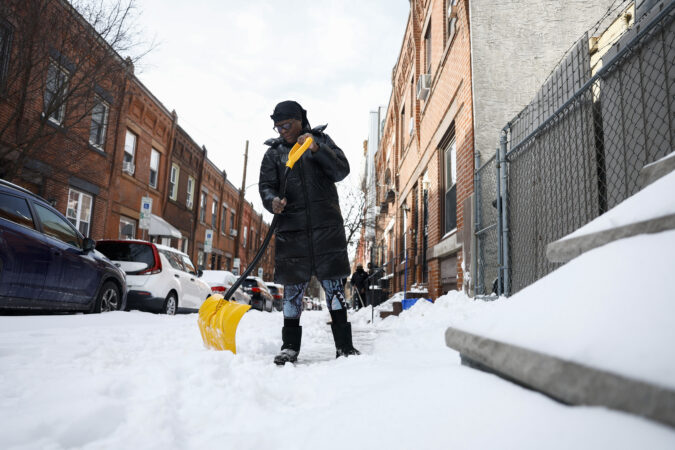
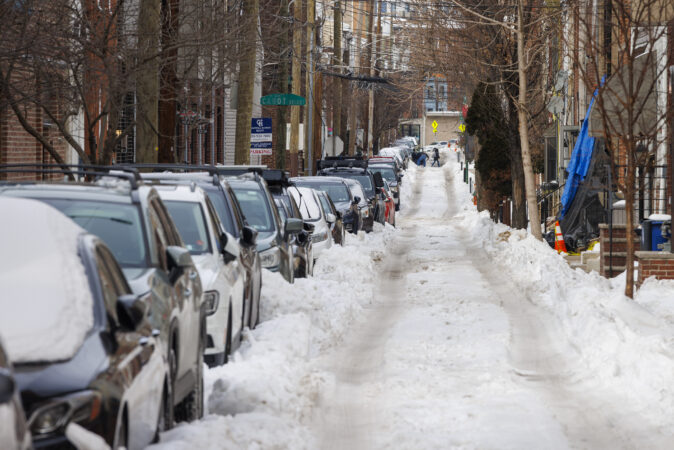
The storm that hit Philadelphia Sunday brought with it 9.3 inches of snow for the city proper — the most we’ve seen at one time in a decade. And while that really sells the wintery vibe — especially when combined with the bitter cold we’re experiencing — cleanup efforts are ongoing.
Highways and public transportation in the region are largely restored, but some city streets remain packed with snow and ice. City school buildings Wednesday were in their third day of snow-related closures. And we might even be looking at more snow to come.
Here is what you need to know:
Roads (mostly) cleared
PennDot’s vehicle and speed restrictions have been lifted on all interstates and major highways across the Philadelphia region, as were those on state roads in New Jersey. But street plowing in the city remains a work in progress.
Residents from around the city told The Inquirer many side streets and some secondary streets remained coated in several inches of snow and ice, making traveling on them difficult or impossible. Data from PlowPHL, a service that tracks plow movement, indicated Tuesday that roughly a quarter of city streets had not received any snow treatment since the storm.
Parking enforcement resumes
The Philadelphia Parking Authority reopened its offices Wednesday, and began on-street parking enforcement for safety violations including parking in bus zones and in front of fire hydrants. The 24-hour $5 emergency garage parking rate was also rescinded, with PPA garages returning to their usual rates, the authority said.
Public transit resuming
SEPTA on Monday restored all of its subway, trolley, and suburban trolley services, and as of Wednesday was running Regional Rail lines on their normal weekday schedules. Bus service, SEPTA notes online, is largely operational, though several routes remain suspended due to road conditions.
Among the suspended buses Wednesday were routes 3, 5, 40, 41, and 115, according to the agency’s alerts page. The suspended routes, SEPTA indicated, would be restored “once it is safe to do so.”
PATCO, meanwhile, returned to its normal weekday schedule Tuesday.
Airport operational
Philadelphia International Airport experienced hundreds of flight cancellations and delays due to the storm, but remained open despite the inclement weather, Parker said at a news conference this week.
As of early Wednesday afternoon, the airport had experienced about 87 delays and 57 cancellations, according to flight data tracking website FlightAware. On Monday, the day after the storm, there were 326 delays and 290 cancelations, followed by 255 delays and 156 cancelations Tuesday, FlightAware indicated.
Archdiocesan high schools and city parochial schools will also go back to in-person classes Thursday.
Students and staff who arrive late to class due to weather-related issued would not have their lateness counted against them, Superintendent Tony B. Watlington Sr. said.
This week’s disruption to the usual school schedule had begun taking its toll on some parents. Outside the city, many suburban districts had already reopened by Wednesday.
More snow possible
Post-storm, the Philadelphia region faces frigid temperatures that are expected to remain well below freezing until at least Feb. 4. Highs were expected to top out around the teens, and lows consistently in the single digits — along with wind chills reaching down into the negatives.
And then, of course, there is the potential for more snow this weekend.
Forecasters said Wednesday that it remained unclear exactly what we should expect, but a major coastal storm is likely to appear during the weekend. Early computer models indicated that the system would remain far offshore enough to spare the Philadelphia area from major snowfall, but accumulation predictions remain in flux.
On the second day her kindergartener was off from his Philadelphia public school because of snow, Karen Robinson shut herself away in her Fairmount home, hoping to take a 15-minute meeting for an important work project.
Her husband had put up a baby gate to signal to 5-year-old Sam that mom was briefly off limits.
Naturally, “my son crawled under the baby gate to come find me,” said Robinson, whose son attends Bache-Martin Elementary. “If I’m working, he wants to be right next to me.”
Superintendent Tony B. Watlington Sr. gave beleaguered parents a reprieve Wednesday afternoon, saying schools would re-open for in-person learning Thursday. But the week was tough for many to navigate.
For parents who rely on hourly work, or jobs that have no remote flexibility, the inclement weather-forced school changes have meant either foregoing pay or figuring out childcare arrangements that are often costly, complicated, or both.
North Philadelphia mom Asjha Simmons’ son attends a charter school that’s been closed — no virtual learning — since Monday.
Simmons runs her own business, so is able to be flexible with her schedule and stay home with her son. But she’s getting antsy.
“I feel forced to be in the house and it’s killing me,” Simmons said. “I would rather be in the gym than in the house. And I don’t even go to the gym.”
Simmons’ son, who’s 12, relishes the down time since “he has every screen known to man on,” she said. She keeps the snacks coming, and it’s all good. (He was less than thrilled when Simmons made him shovel snow, she said.)
Leigh Goldenberg said she was having uncomfortable flashbacks to the pandemic, when her daughter completed virtual kindergarten.
“For me, it’s an emotional regression to that terrible time,” said Goldenberg. “And I feel for the people that didn’t build up that muscle before.”
Virtual school with a fifth grader is much easier than virtual school with a kindergartener, said Goldenberg, whose daughter attends Kirkbride Elementary in South Philadelphia. Her daughter spent 30 minutes on Tuesday completing schoolwork, and managed to keep herself busy socializing with friends online and outside, a short walk away in their neighborhood.
Goldenberg is trying to keep things in perspective — this is not forever, this is not the pandemic.
But, she’s still frustrated.
“All the suburban schools around us went back already, but here in the city, we’re stuck with a giant pile of snow at the end of our street, and it feels pretty unfair,” she said.
Coral Edwards was prepared for Monday’s snow day, but when the district announced a virtual day Tuesday, she began to panic.
“I was like, oh my gosh, there’s a real possibility the entire rest of the week will be virtual,” said Edwards, who lives in Graduate Hospital and has a seven-year-old son who attends Nebinger Elementary and a four-year-old daughter in a private prekindergarten program.
Her daughter’s pre-K is reopened Wednesday with a two-hour delay. And that means dropoff time came when Edwards would haveneeded to be helping her first grader with virtual learning. So instead, she paid to send both children to Kids on 12th, a Center City school open the full day, so she can get her work done as a marketing consultant and leadership coach.
The scramble has also summoned up emotions and frustrations she last experienced during the pandemic, when her son was 1 and his daycare shut down. While she acknowledged that she is “incredibly privileged,” she said the fact thatparents like herself are in such a bind speaks to a larger systemicproblem with childcare, Edwards said.
“There’s literally no one to help us,” she said. “There’s just no systemic support whatsoever.”
Streets are being plowed, SEPTA is running, and trash is getting picked up, “but there’s nothing in press conferences about how we’re supporting parents and students,” Edwards said. “The schools are like, ‘we have this virtual learning environment’ — are we just supposed to pull another parent out of our butts?” she said.
Edwards’ husband works in-person as a research physician running a lab, and the burden of childcare logistics falls to her.
“There’s a lot of rhetoric about supporting parents, and raising women up, … but when push comes to shove, something about our kids’ childcare is changed or tightened, it falls on those people,” she said.
Hannah Sassaman, a West Philadelphia parent of a district fourth grader and ninth grader, is making it through.
“We had another fourth grader live here for 24 hours randomly. I think they went to school? My ninth grader seems to be going to school. We’re just lucky we don’t have little kids,” said Sassaman.
“The questions that I have knowing that the storm was coming for over a week,” Sassaman said, “is what could the administration have done to help resource our sanitation workers and the rest of our incredible city servants to really focus on what it would take to get our kids back in schools, our teachers and the other staff back in their buildings safety to support not just the economy, but also all of the important supports and services kids access at schools every day?”
After three days out of school buildings, Philadelphia public students and staff will be back to in-person learning Thursday.
Officials announced the call Wednesday afternoon.
Archdiocesan high schools and city parochial schools will also be back to traditional classes Thursday, officials said.
In the aftermath of a significant winter storm and sub-freezing temperatures, Superintendent Tony B. Watlington Sr. gave students and staff a full snow day Monday, with no learning or teaching obligations.
He pivoted the district’s 125,000 students to virtual instruction Tuesday and Wednesday as conditions remained tricky to navigate.
Temperatures are expected to dip even lower Thursday, and many side streets and sidewalks aren’t clear, but officials have said they prioritize in-person learning when conditions are safe for students and staff.
“School District and City of Philadelphia officials have been working around the clock to clear snow and ice from roads and walkways to support a safe return to in-person learning,” Watlington wrote in a message to families and staff Thursday.
Any students arriving late because of weather-related challenges will not have their lateness counted against them, the superintendent said. The same goes for staff not able to make it into work on time because of weather-related commuting challenges.
Yellow bus service will operate as usual, though delays might occur, Watlington said.
After school activities are on, the central office will be open, and the school-selection deadline has been extended from Wednesday to Friday so families can confer with school counselors they may have had difficulty reaching because of the snow closures.
Philadelphia’s school board meeting, also scheduled for Thursday, will also happen in person. Board members and members of the public have the chance to participate virtually, as well.
District Attorney Larry Krasner on Wednesday announced the formation of a new coalition of progressive prosecutors committed to charging federal agents who violate state laws.
Krasner joined eight other prosecutors from U.S. cities to create the Project for the Fight Against Federal Overreach, a legal fund that local prosecutors can tap if they pursue charges against federal agents.
The move places Krasner at the center of a growing national clash between Democrats and the Trump administration over federal immigration enforcement and whether local law enforcement can — or should — charge federal agents for actions they take while carrying out official duties.
It is also the latest instance in which Krasner, one of the nation’s most prominent progressive prosecutors, has positioned himself as Philadelphia’s most vocal critic of President Donald Trump. He has made opposing the president core to his political identity for a decade, and he said often as he was running for reelection last year that he sees himself as much as a “democracy advocate” as a prosecutor.
Krasner has used provocative rhetoric to describe the president and his allies, often comparing their agenda to World War II-era fascism. During a news conference Tuesday, he said federal immigration-enforcement agencies are made up of “a small bunch of wannabe Nazis.”
The coalition announced Wednesday includes prosecutors from Minneapolis; Tucson, Ariz.; and several cities in Texas and Virginia. It was formed to amass resources after two shootings of U.S. citizens by federal law enforcement officials in Minnesota this month.
Renee Good, 37, was shot and killed in her car by an ICE officer on Jan. 7 as she appeared to attempt to drive away during a confrontation with agents. The FBI said it would not investigate her killing.
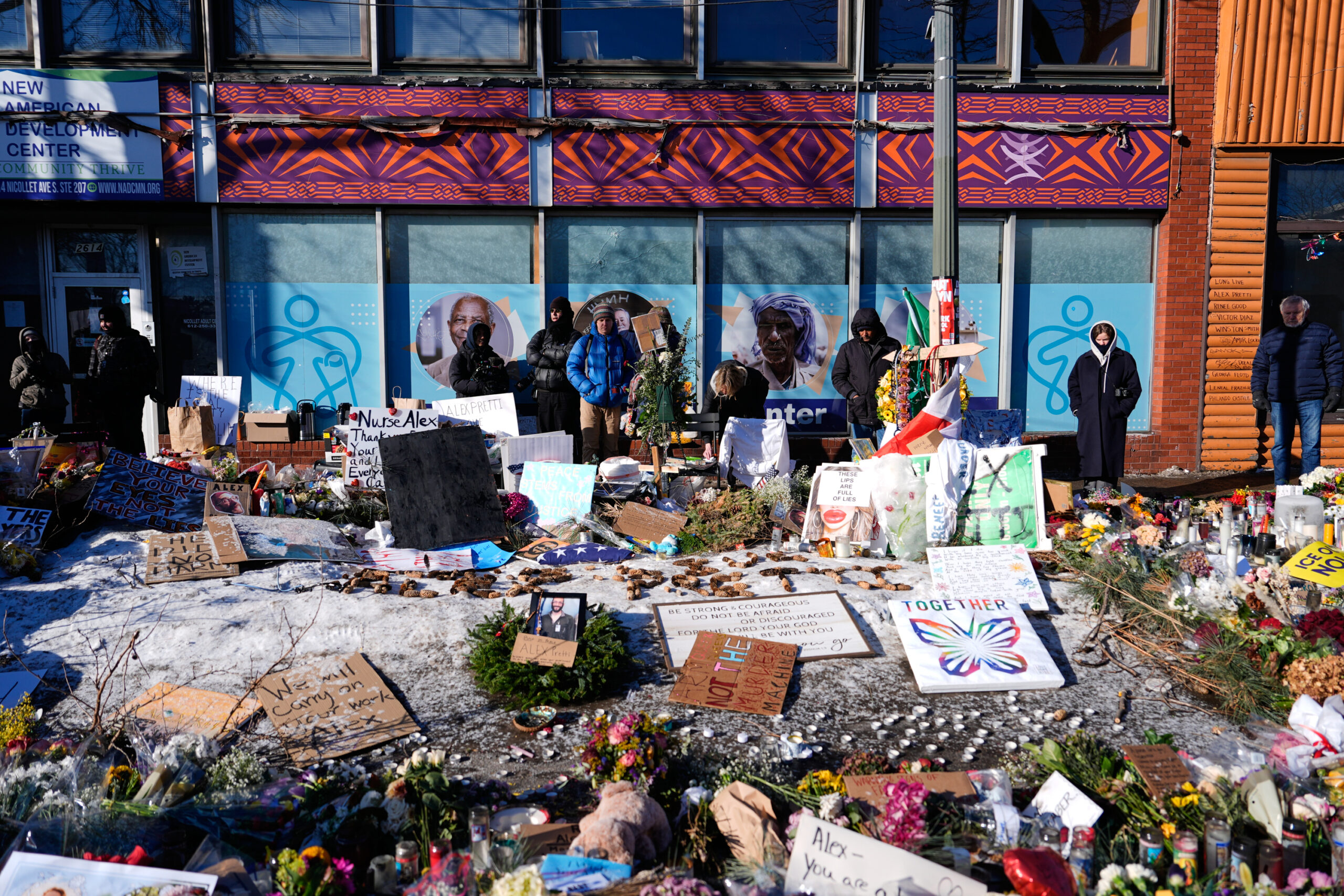
People visit a memorial for Alex Pretti at the scene in Minneapolis where the 37-year-old was fatally shot by a U.S. Border Patrol officer.
Then, on Saturday, Alex Pretti, 37, was killed after similarly confronting agents on a Minneapolis street. Video of the shooting, which contradicted federal officials’ accounts, appeared to show Border Patrol agents disarming Pretti, who was carrying a legally owned handgun in a holster. They then shot him multiple times. Federal authorities have attempted to block local law enforcement from investigating the shooting.
Krasner said that, despite Vice President JD Vance’s recent statement that ICE officers had “absolute immunity” — an assertion the Philadelphia DA called “complete nonsense” — prosecutors in FAFO are prepared to bring charges including murder, obstructing the administration of justice, tampering with evidence, assault, and perjury against agents who commit similar acts in their cities.
“There is a sliver of immunity that is not going to save people who disarm a suspect and then repeatedly shoot him in the back from facing criminal charges,” Krasner said during a virtual news conference Wednesday. “There is a sliver of immunity that is not going to save people who are shooting young mothers with no criminal record and no weapon in the side or back of the head when it’s very clear the circumstances didn’t require any of that, that it was not reasonable.”
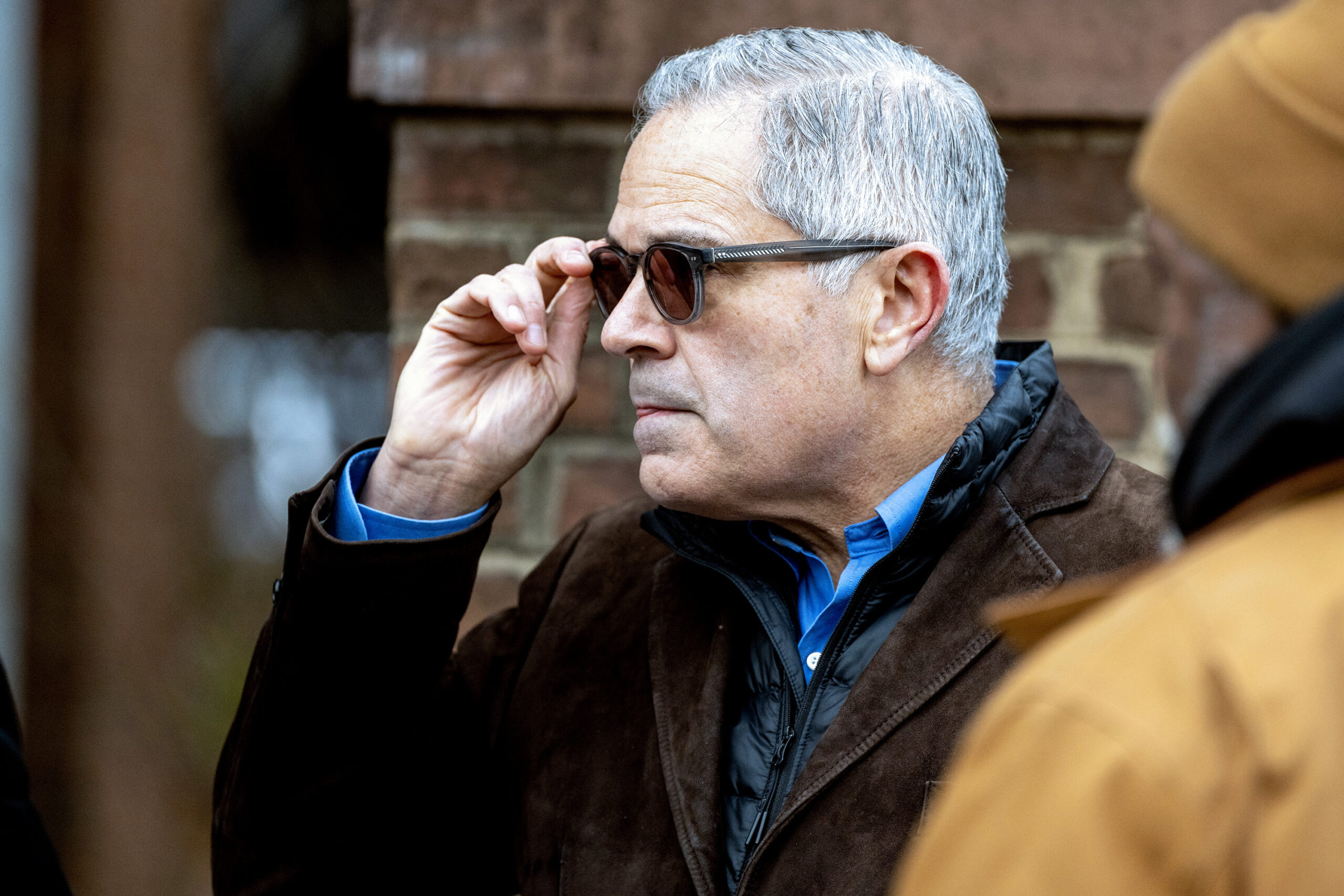
Philadelphia District Attorney Larry Krasner attends an event at Independence National Historical Park on Dec. 21, 2025.
How will FAFO work?
The coalition has created a website, federaloverreach.org, and is soliciting donations.
Prosecutors who spoke during the news conference said those donations would be toward a legal fund that would allow prosecutors to hire outside litigators, experts, and forensic investigators as they pursue high-profile cases against federal agents.
“This will function as a common fund,” said Ramin Fatehi, the top prosecutor in Norfolk, Va., “where those of us who find ourselves in the tragic but necessary position of having to indict a federal law enforcement officer will be able to bring on the firepower necessary to make sure that the federal government doesn’t roll us simply through greater resources.”
The money raised through the organization will not go to the individual prosecutors or their political campaigns, they said Wednesday.
Scott Goodstein, a spokesperson for the coalition, said the money will be held by a “nonpartisan, nonprofit entity that is to be stood up in the coming days.” He said the prosecutors are “still working through” how the fund will be structured.
Krasner said it would operate similarly to how district attorneys offices receive grant funding for certain initiatives.
Most legal defense funds are nonprofit organizations that can receive tax-deductible donations. Those groups are barred from engaging in certain political activities, such as explicitly endorsing or opposing candidates for office.
Goodstein said the group is also being assisted in its fundraising efforts by Defiance.org, a national clearinghouse for anti-Trump activism. One of that group’s founders is Miles Taylor, a former national security official who, during the first Trump administration, wrote under a pseudonym about being part of the “resistance.”
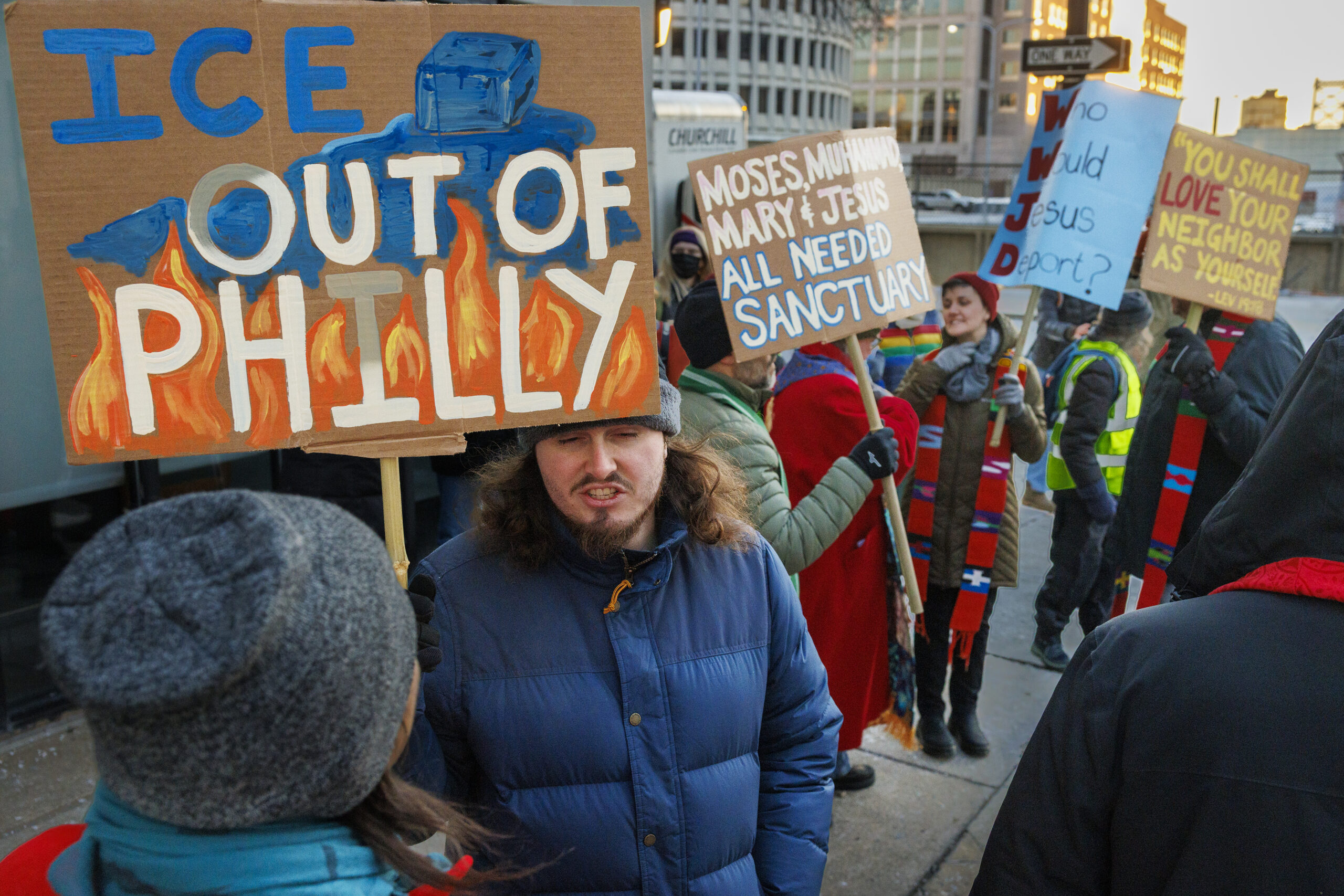
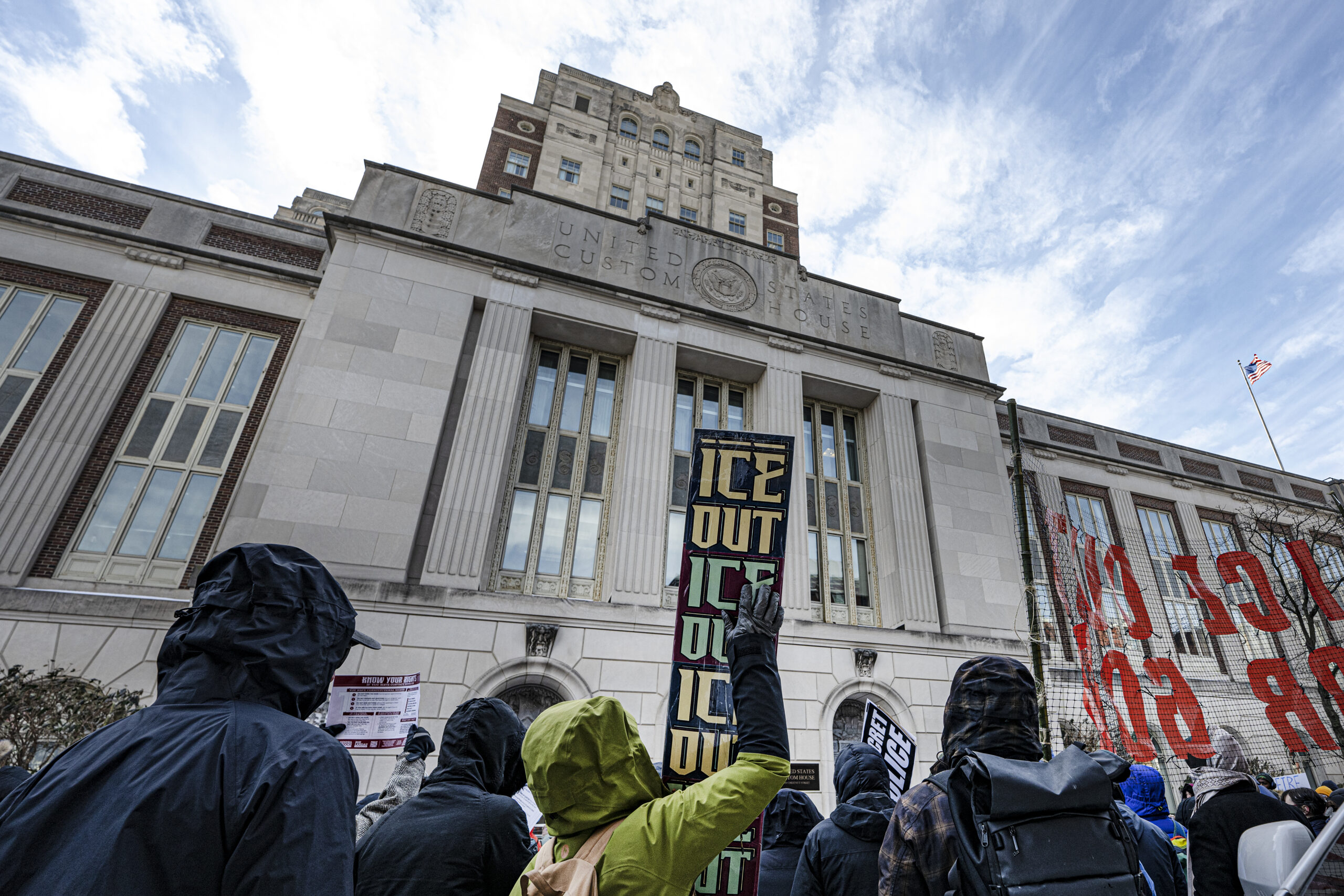
Demonstrators from No ICE Philly gathered to protests outside the U.S. Immigration and Customs Enforcement, office at 8th and Cherry Streets, on Jan. 20.
‘Who benefits?’
In forming the coalition, Krasner inserted himself into a national controversy that other city leaders have tried to avoid.
His approach is starkly different from that of Mayor Cherelle L. Parker, a centrist Democrat who has largely avoided criticizing Trump. She says she is focused on her own agenda, and has not weighed in on the president’s deportation campaign.
Members of the mayor’s administration say they believe her restraint has kept the city safe. While Philadelphia has policies in place that prohibit local officials from some forms of cooperation with federal immigration enforcement, the Trump administration has not targeted the city with surges of ICE agents as it has in other jurisdictions — such as Chicago and Los Angeles — where Democratic leaders have been more outspoken.
Parker and Police Commissioner Kevin Bethel have at times been frustrated with Krasner’s rhetoric, according to a source familiar with their thinking who spoke on the condition of anonymity to discuss internal communications.
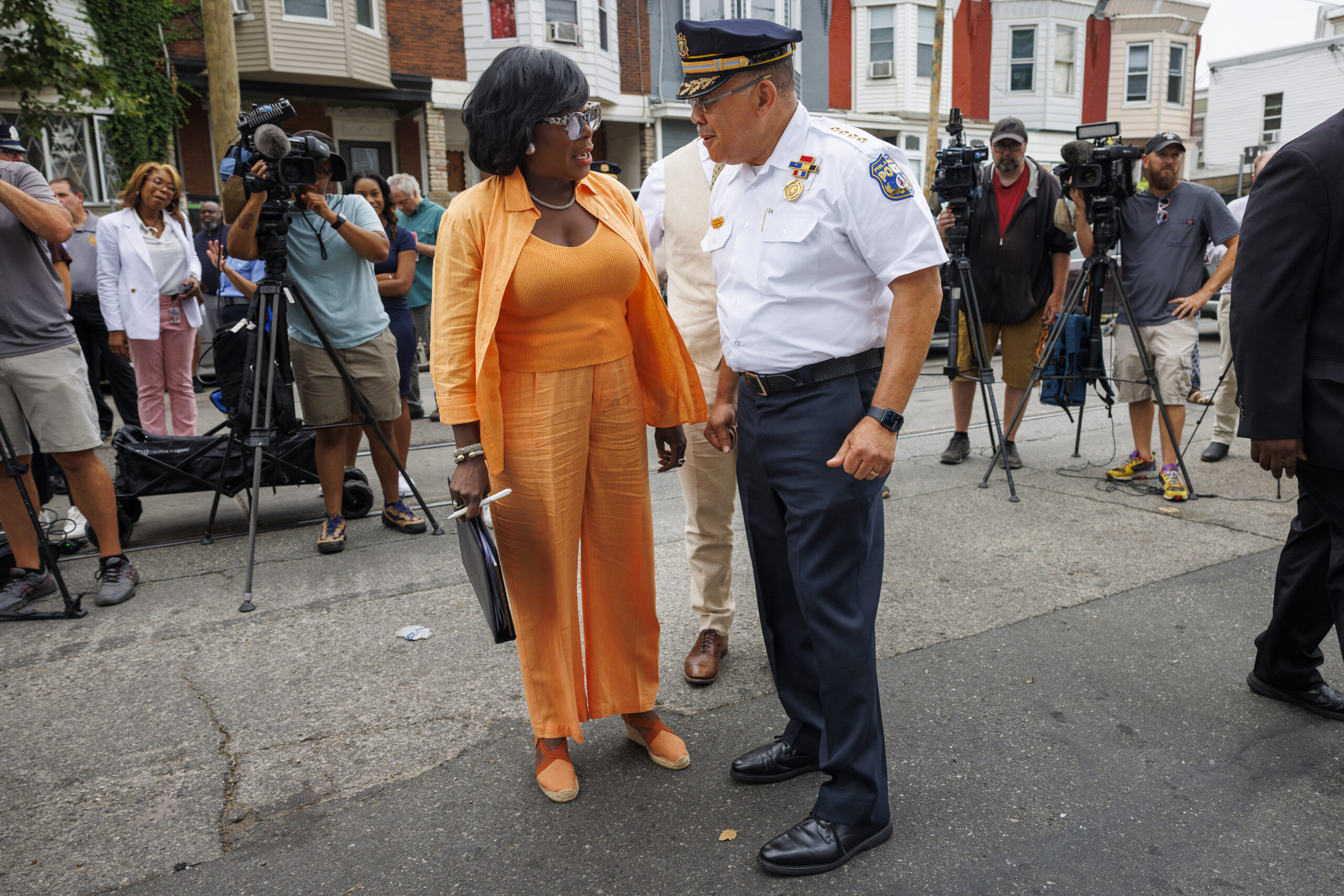
Philadelphia Mayor Cherelle Parker and Police Commissioner Kevin Bethel speaking ahead of a July 2024 press conference.
That was especially true this month when Krasner hosted a news conference alongside Sheriff Rochelle Bilal. The pair made national headlines after Krasner threatened to prosecute federal agents — something he has vowed to do several times — and Bilal called ICE a “fake” law enforcement agency.
Bethel later released a statement to distance the Police Department from the Sheriff’s Office, saying Bilal’s deputies do not conduct criminal investigations or direct municipal policing.
The police commissioner recently alluded to Parker’s strategy of avoiding confrontation with the federal government, saying in an interview on the podcast City Cast Philly that the mayor has given the Police Department instruction to “stay focused on the work.”
“It is not trying to, at times, potentially draw folks to the city,” Bethel said. “Who benefits from that? Who benefits when you’re putting out things and trying to… poke the bear?”
As for Krasner’s latest strategy, the DA said he has received “zero indication or communication from the mayor or the police commissioner that they’re in a different place.”
“I feel pretty confident that our mayor and our police commissioner, who are doing a heck of a lot of things right,” he said, “will step up as needed to make sure that this country is not invaded by a bunch of people behaving like the Gestapo.”
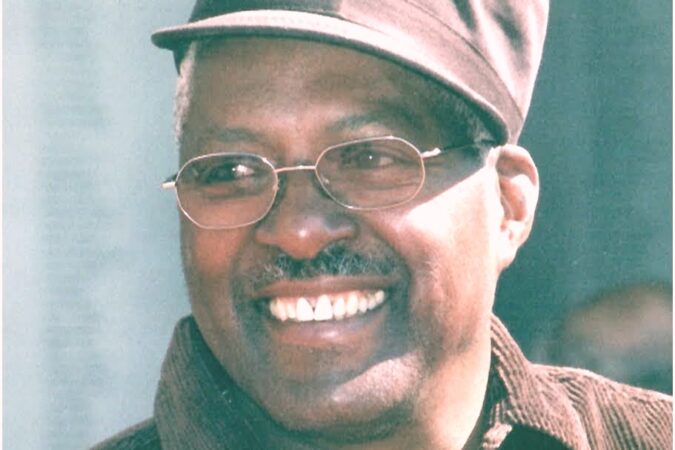
Evonn Wadkins, 88, formerly of Philadelphia, retired Philadelphia Mounted Police Officer, basketball and football star at Simon Gratz High School, builder, carpenter, plumber, bus driver, and volunteer, died Sunday, Jan. 11, of complications from a stroke at Bryn Mawr Extended Care Center.
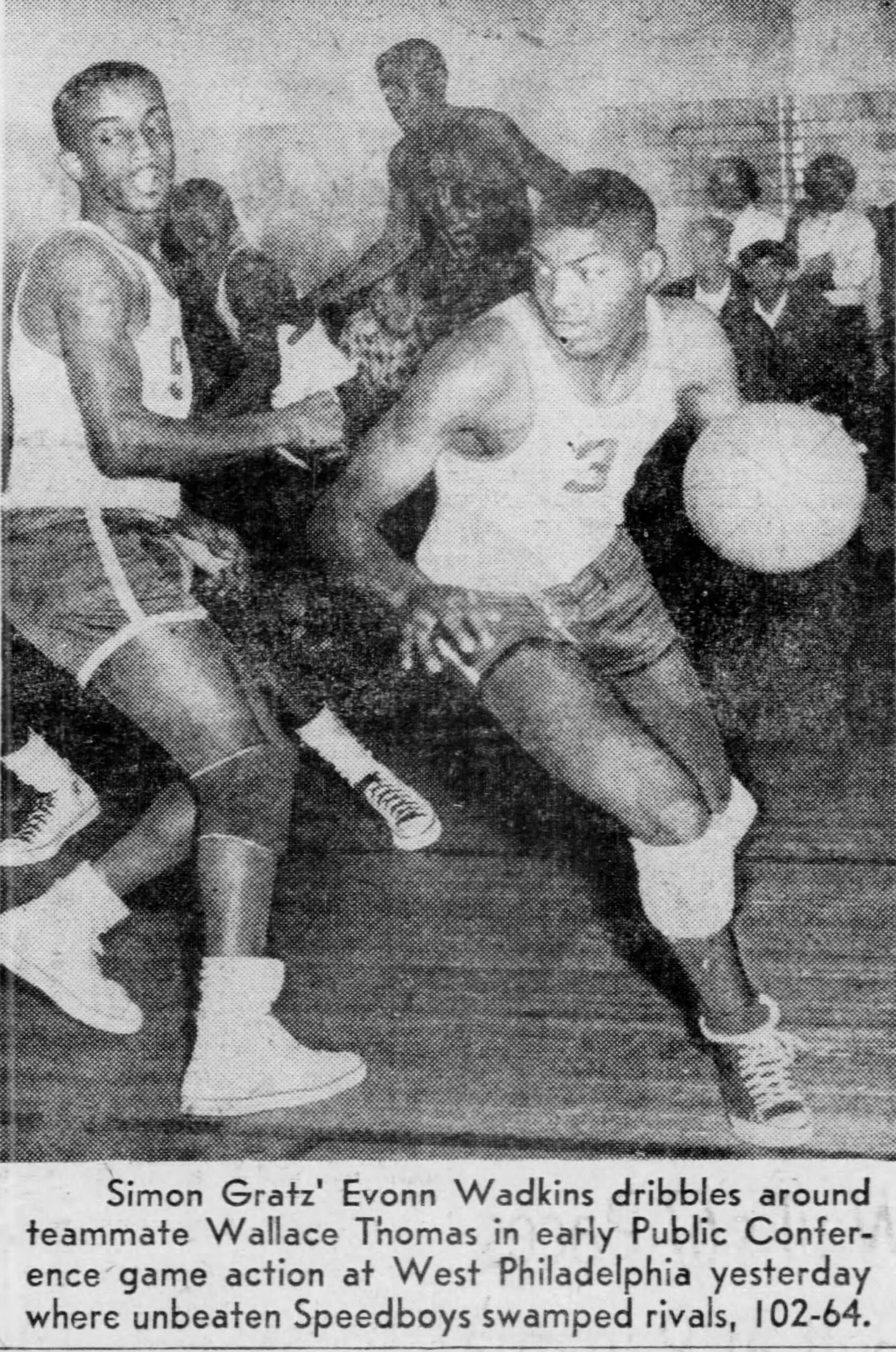
A gifted athlete with an innate desire to help others and be part of a team, Mr. Wadkins played basketball and football on Philadelphia playgrounds, in youth leagues and high school, and later with adults in semipro leagues and the Charles Baker Memorial Basketball League. He usually scored in double digits for the Gratz basketball team and went head-to-head against the legendary Sonny Hill and Wilt Chamberlain.
He overcame a severe ankle injury when he was young and retired from the Baker League years later only after age and ailments forced him off the court. He was a “speedy end” on the football team at Gratz, the Daily Journal in Vineland said in 1955.
His name appeared often in The Inquirer and other local newspapers in 1955 and ‘56, and they noted his 55-yard touchdown catch against Dobbins, 25-yard scoring reception against Vineland, and 44-yard scoring catch-and-run against Northeast in 1955.
Mr. Wadkins (right) drives with the ball in this photo that was published in The Inquirer in 1956.
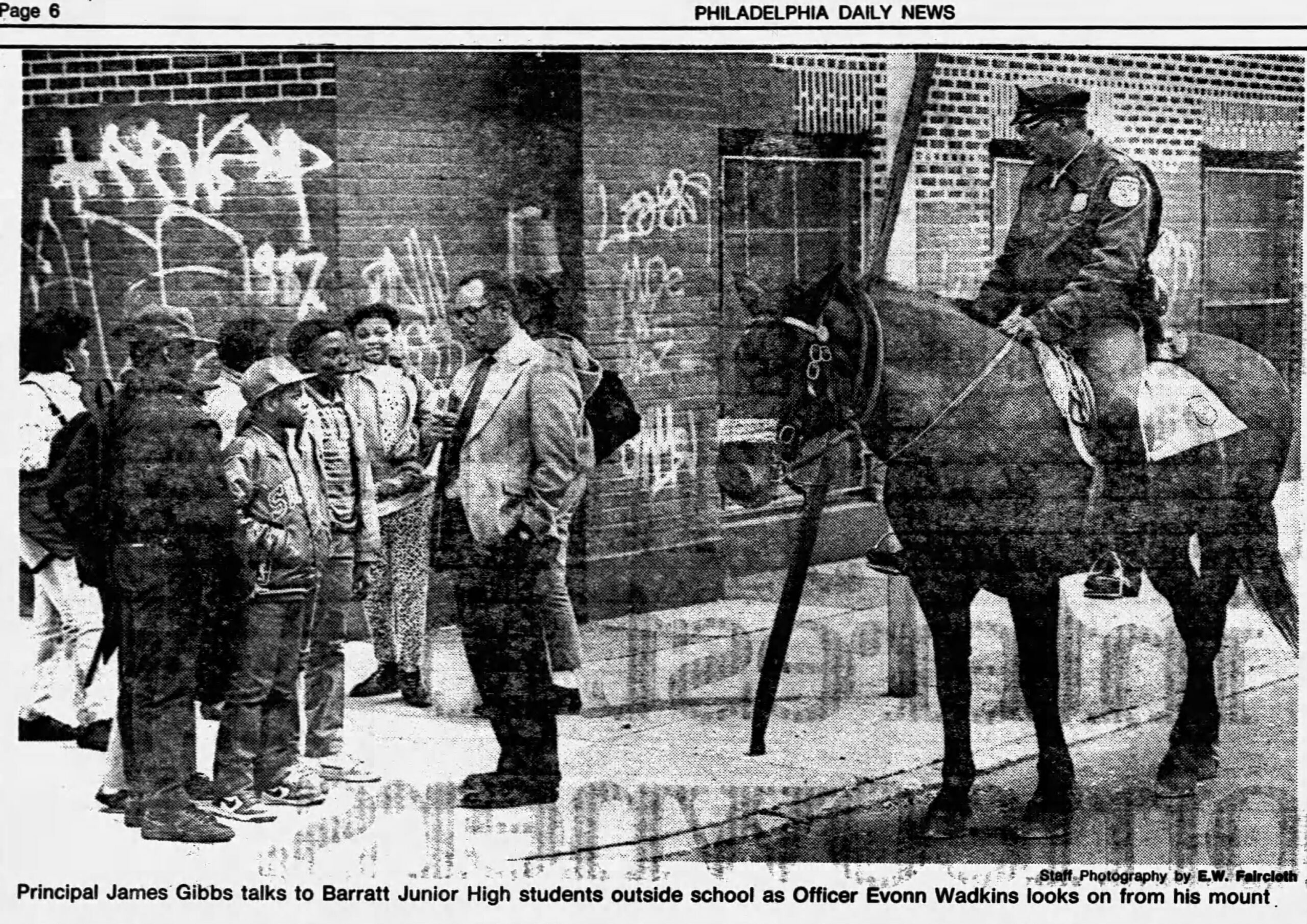
Mr. Wadkins graduated from the Philadelphia Police Training Center in 1963 and spent 11 years patrolling Fairmount Park and elsewhere in the Traffic Division. He transferred to the Mounted Unit — and met Cracker Jack — in 1974, and officer and horse rode the Philly streets together until they both retired in 1988.
“When he went on vacation, nobody could ride Cracker Jack,” said Mr. Wadkins’ wife, Elaine. “They could groom him. But Cracker Jack wouldn’t let anyone else ride him.”
He also worked construction side jobs with neighbors and friends, and learned plumbing, heating, and carpentry skills. “Family and friends are still sleeping comfortably on his one-of-a-kind beds more than 40 years later,” his family said in a tribute.
He drove a school bus for the School District of Philadelphia for 10 years in the 1980s and ’90s, and made friends with many of the students. He moved with his wife to Goochland, Va., 35 miles northwest of Richmond, in 1998.
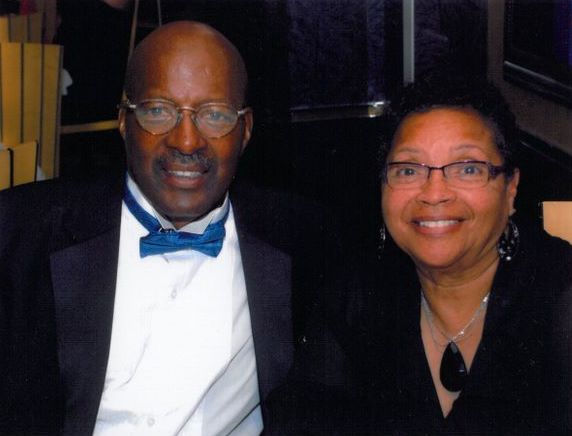
Mr. Wadkins and his wife, Elaine, married in 1959.
He joined the Goochland chapter of the NAACP and volunteered at the Second Union Rosenwald School Museum. At the Second Union Baptist Church, he mentored boys and young men, and supervised the media ministry.
He was serious about community service. “He never met a stranger,” his wife said.
Evonn LeFrancis Wadkins was born June 4, 1937, in Philadelphia. He was the fifth of six children and earned his high school degree at night school after leaving Gratz early.
He met Flora Elaine Poole at Gratz in 1954, and they married in 1959. They set up house in West Philadelphia a few years later and had daughters Evette and Elise, and a son, Evonn.
This photo of Mr. Wadkins on his horse appeared in the Daily News in 1987.
Mr. Wadkins, familiar with Fairmount Park from his time on police patrol, liked to share historical tidbits when the family drove through. He loved cars and traveled to Canada with his wife and to Germany with his brother to shop for several that caught his eye.
He and his family traveled to Florida for a New Year’s party and to South Dakota to fly over Mount Rushmore. He and his wife cruised the Caribbean and toured the United States and Europe.
He even flew with a friend to two Super Bowls. “He was a man on the go,” his family said.
Mr. Wadkins liked McDonald’s pancakes and coached a few youth league basketball teams, one to a championship. When asked how he was doing, his usual response was: “Livin’ slow.”
Mr. Wadkins enjoyed time with his family.
His wife said: “He was a good provider. He was a great husband.”
In addition to his wife and children, Mr. Wadkins is survived by five grandchildren, five great-grandchildren, a brother, and other relatives. Two brothers and two sisters died earlier.
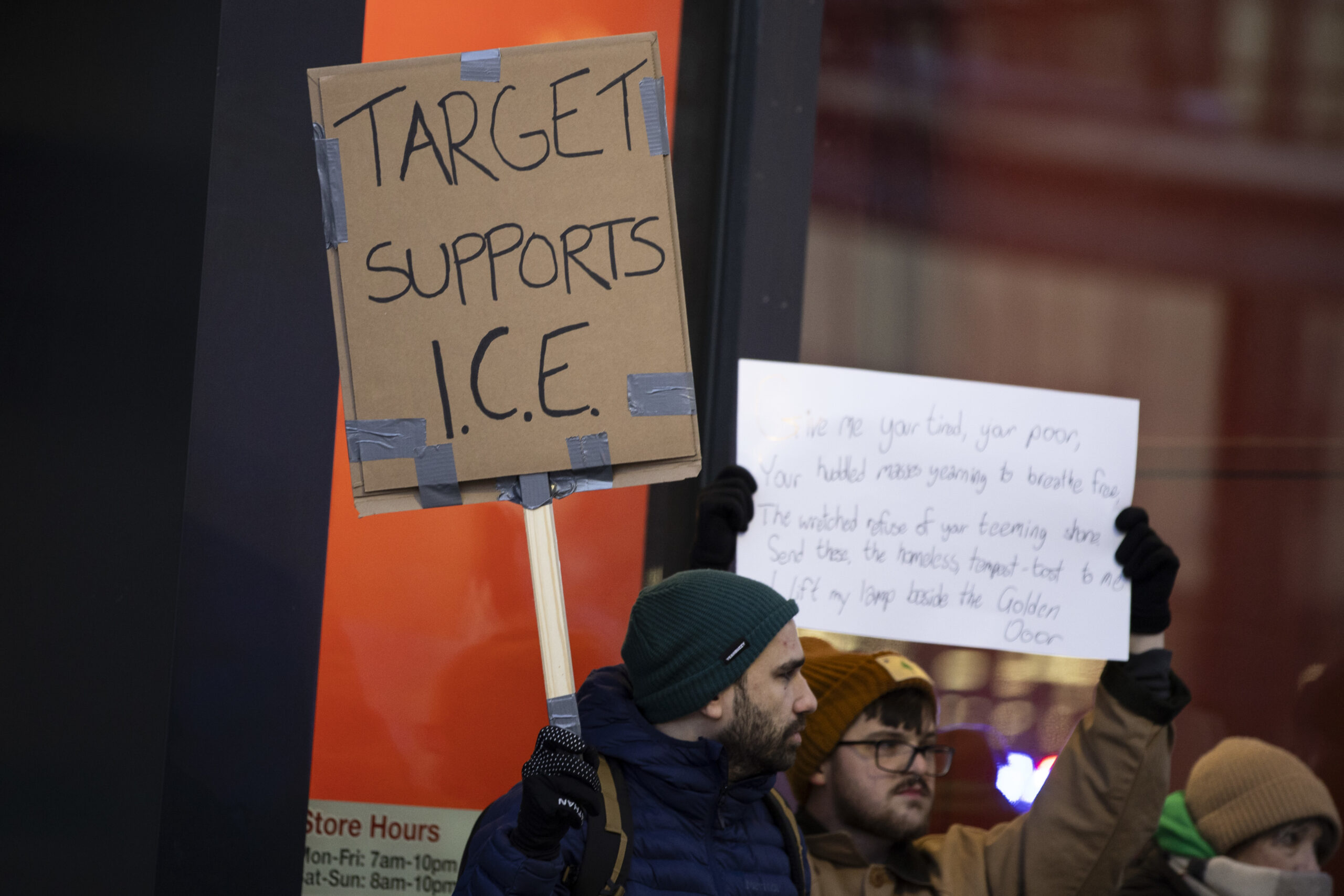
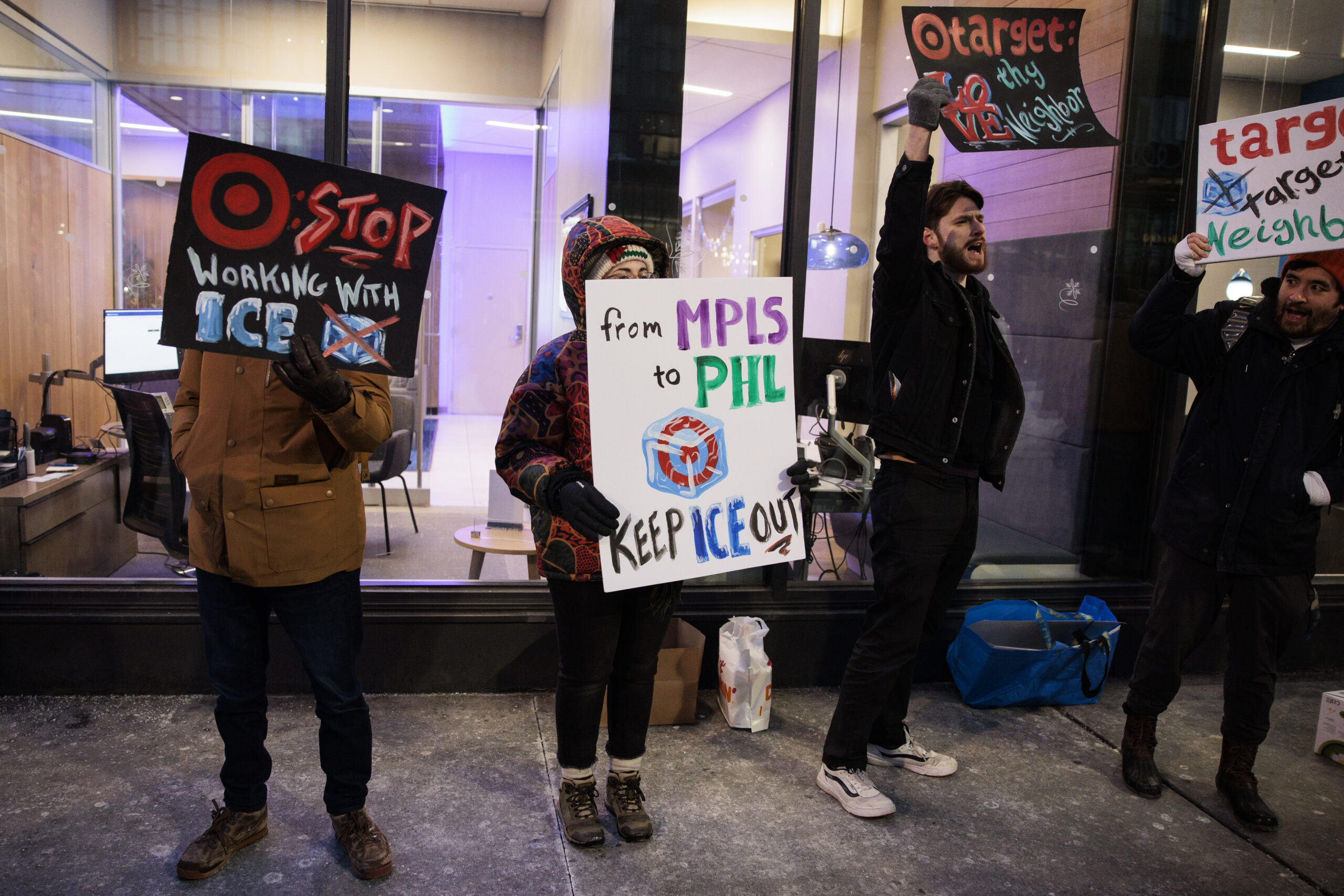
Activists with No ICE Philly demonstrated at Target stores in the city on Tuesday evening, attempting to slow business operations at a company that they say wrongly cooperates with federal immigration enforcement.
Stores in South Philadelphia, Rittenhouse, Fairmount, Port Richmond and on Washington Avenue and City Avenue were among those targeted, the group said.
Advocates say the retailer has failed to speak out against U.S. Immigration and Customs Enforcement, to safeguard employees and customers, and has allowed the agency to set up operations in its parking lots.
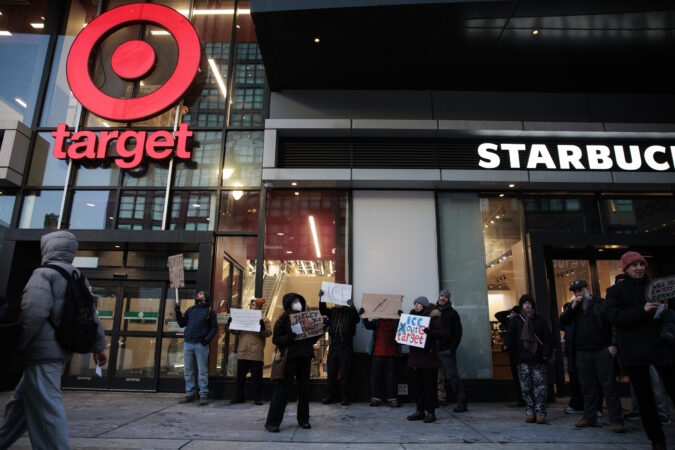
More than 40 people rallied on a frozen, 19-degree night outside the Target at Broad Street and Washington Avenue, holding signs that showed solidarity with Minneapolis residents who have resisted ICE in their community.
“From MPLS to PHL, keep ICE out,” read one sign.
Demonstrators gathered outside of the Target at Broad and Washington on Tuesday in Philadelphia.
Inside, some masked customers bought ice trays and single bottles of table salt. As soon as they paid for the items at the checkout counters, they headed to the “Returns” area to seek refunds.
Items were quickly restocked on store shelves by staff, only to be purchased and returned again.
Demonstrators visited at least seven stores, according to the Rev. Jay Bergen, a leader of No ICE Philly and pastor at the Germantown Mennonite Church.
“Our actions are in solidarity with people across the country responding to the call from Minneapolis communities to pressure Target,” Bergen said Wednesday.
Company spokespeople did not immediately reply to a request for comment on the protests in Philadelphia. Target, founded in 1962, operates 1,989 stores across the United States and has a net revenue of more than $100 billion a year.
At Broad and Washington on Tuesday, members of No ICE Philly handed out pocket-sized fliers that described their goals as they urged shoppers to go elsewhere. Some people turned away after talking to demonstrators. Others who went inside were met with boos.
“Find another store!” the protesters shouted, as a police officer looked on.
Elijah Wald, 66, said the Washington Avenue location was his neighborhood Target.
“Our main hope is that businesses will understand that they need to protect their employees, that they need to not collaborate with a government that right now is targeting everybody,” he said.
Wald, whose mother was a Jewish refugee who fled Nazi Austria, said he has always felt positive about immigration, that the United States was built of “people who are used to moving to find work, moving to find cheaper housing.”
But the discourse over ICE operations in major cities has gone beyond undocumented people, said Wald.
“They’re shooting U.S. citizens now,” he said.
Demonstrators gathered outside of the Target at Broad and Washington Streets on Tuesday.
At the Target at Snyder Plaza, about 20 demonstrators encouraged people to do their shopping elsewhere.
“Protest with your wallet; Acme is right there,” a protester said through a sound system.
Celine Bossart, 34, said boycotts are an effective way to denounce ICE actions.
“As citizens, our power is limited, but a big part of the power that we do have is where we choose to spend our money,” she said, “and at the end of the day, corporations aren’t necessarily going to listen until it hits their bottom line.”
A man in a Flyers jersey stopped to heckle the demonstrators, who responded with words of their own. Bossart said the protest did not aim to make anyone’s day difficult.
“Our neighbors are people who work at Target, people who work at Acme; these are the neighbors who we’re trying to protect,” she said. “So we’re just trying to send a message to upper, upper management.”
Last week, demonstrators held a sit-in at a store in Minneapolis, where the company is headquartered, chanting, “Something ’bout this isn’t right ― why does Target work for ICE?”
At other Minnesota stores, demonstrators formed long lines to buy bags of winter ice melt, then immediately got back in line to return them, slowing the checkout process.
No ICE Philly, which has led demonstrations against the agency, and against the arrests of immigrants outside the city Criminal Justice Center, said Target must:
Publicly call for Immigration and Customs Enforcement to leave Minnesota.
Post signs in its stores that deny entrance to immigration agents, absent a signed judicial warrant.
Train store staff on how to respond if agents arrive.
Publicly call for Congress to end ICE funding.
Chief executives of Target and more than 60 large Minnesota companies issued a public letter on Sunday calling for an “immediate de-escalation of tensions.” It marked the first time, The New York Times reported, that the most recognizable businesses in the state weighed in on the turmoil in Minneapolis.
Critics said the letter offered too little, too late, coming after two local U.S. citizens were shot to death by federal agents.
Two teenage boys, ages 14 and 15, were injured in a shooting Tuesday night in North Philadelphia, police said.
The shooting, which happened shortly after 7 p.m. at the corner of 24th Street and Cecil B. Moore Avenue, was captured on surveillance video, said Chief Inspector Scott Small.
The boys were walking toward a store at the corner when they appeared to get into a verbal altercation with another male, Small said.
The shooter fired at least two times and then ran north on 24th Street, Small said. The 14-year-old was shot in the foot and the 15-year-old was shot in the abdomen.
The teens, who are friends, then ran to a nearby house where one of them lives on the 2400 block of Turner Street, Small said. They were then taken by police to Temple University Hospital, where they were listed in stable condition.
Police found one spent shell casing at the shooting scene, Small said.
It is a sentiment long held by residents across Philadelphia, especially those living on side streets, dating back to when snowfall was a more frequent occurrence than it has been in recent years: Don’t expect the city to do a thorough plowing job.
That belief is one that Philadelphia Mayor Cherelle L. Parker has said she is trying to shake with action.
Two days before a storm that whacked the city with 9.3 inches of snow and sleet, Parker, surrounded by the leaders of various agencies, including the Philadelphia Streets Department, vowed to buck precedent on the plowing issue.
“We will make every effort to get to every primary, secondary, and tertiary street in the city of Philadelphia, and that is our standard,” she said, adding it would take “as long as it takes,” citing worker safety.
“But know that we won’t leave any neighborhood, any block, or any community behind.”
Still, residents across the city Tuesday said they were losing patience as side streets and even some secondary streets remained packed with several inches of snow and ice, locking cars in and making navigating intersections impossible.
Fishtown resident Rohan Khadka, 22, was hoping plowing might happen overnight. Instead he woke up Tuesday to streets that were hard for him to cross even with the proper footwear.
“A lot of our roads down here look exactly the same,” he said. “Most of the cleanup that has happened, to my knowledge, has either been by other residents or just cars happening to clean it because they’re using those roads.”
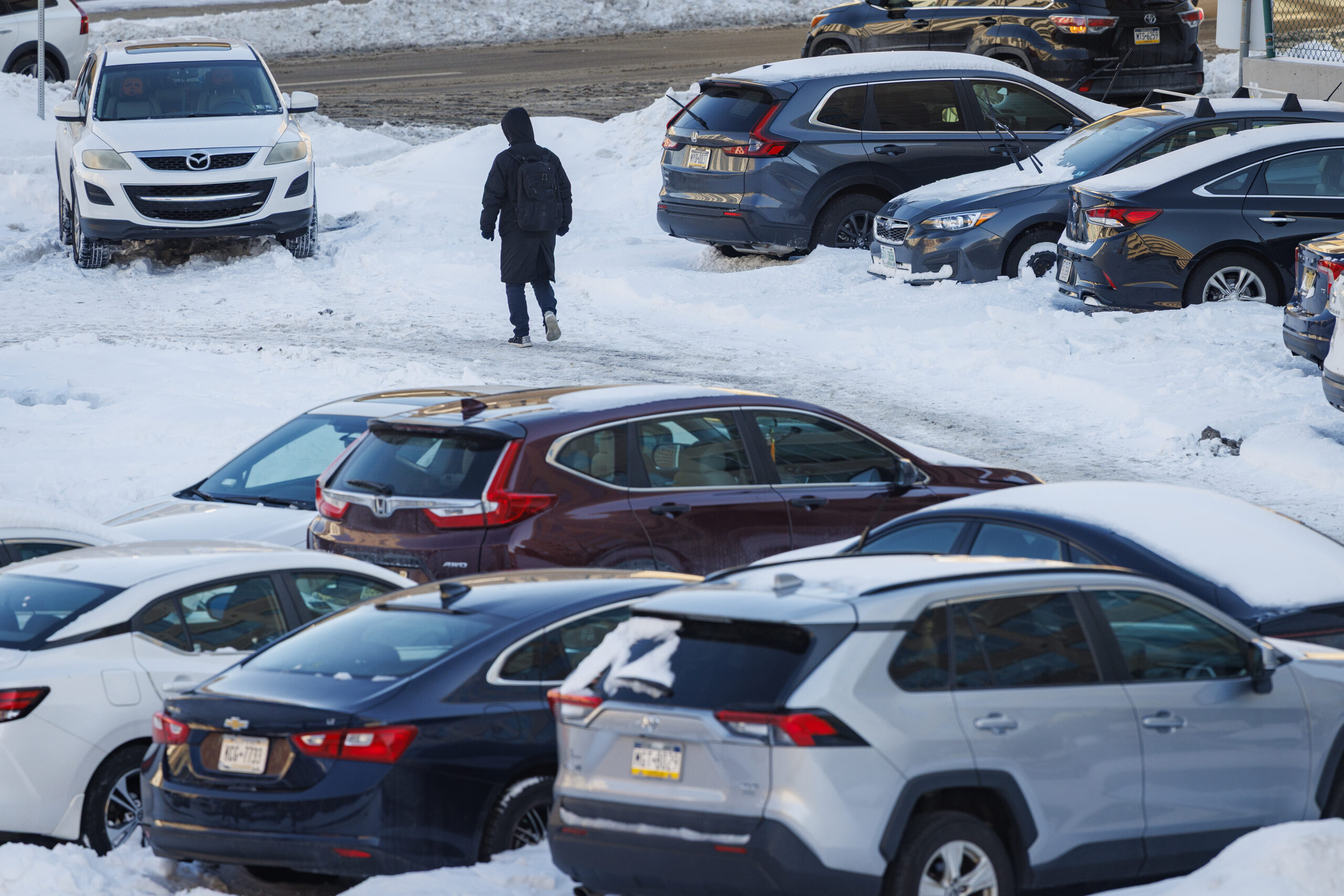
A pedestrian walks through a snow-covered parking lot at Ninth and Arch Streets in Center City Philadelphia, Tuesday, Jan. 27, 2026.
Analysis of the City of Philadelphia’s PlowPHL data, which tracks the movement of plows via GPS data, showed that about a quarter of streets citywide had received no snow treatment at all — including salting or plowing — after the conclusion of the storm Sunday night.
Some areas were worse off than others.
In places like Overbrook and Wynnefield, the city had salted or plowed about 70% of streets by the end of Sunday morning, when the storm began. But the majority of streets in these neighborhoods received no additional plowing or salting since Sunday, according to city data.
The same was true for about a third of streets in South Philadelphia.
The streets department said Tuesday it was deploying over 200 vehicles and excavators as part of a so-called lifting operation. Fourteen teams were fanning across the city to scoop up snow from the narrow roads and load it into dump trucks on nearby primary streets.
The snow hauls were then being taken to storage sites across the city.
Director of Clean and Green Initiatives Carlton Williams drove through parts of South Philadelphia on Tuesday afternoon, as dozens of the side-street-size excavators made their way through the city’s narrowest byways.
“It is the smaller tertiary streets that are challenging,” he said. “There’s more of them. It’s difficult to navigate through those streets.”
As Williams passed a side street with several inches of snow packed, he noted a car illegally parked on the corner, which would make it difficult for machines to get through.
Williams said this storm came with additional challenges. Not only did the snow fall in a condensed period of time, but it was followed by sleet and frozen rain.
“We wouldn’t have many of the challenges that we’re facing today, slowdowns, if those other weather conditions beyond our control did not exist,” he said. “But again, I want to reassure the public that we’re aware. You see us out here today. We’ll be out here tomorrow, and we’ll continue to fight this storm.”
But for Philadelphians waiting for a plow, time is of the essence.
311 ringing off the hook
For Moya Ferenchak, 30, the effectiveness of the operation carries serious health implications. They started pet sitting on the 1500 block of South Capitol, a South Philly side street, for a friend last Tuesday, bringing exactly one week’s worth of food and lifesaving medication — more than they expected to need.
Ferenchak, who lives with a disability that causes limited mobility, cannot shovel. Calling a car not only is expensive but also would require Ferenchak to travel with all their belongings to an intersection that is not blocked by snow.
Adding to frustrations across the city were reports of inundated 311 phone lines.
“I called first thing this morning, and there was a 50-plus-person queue,” Ferenchak said. “Then I called again, and there was like a 70-plus-person queue. I waited for like an hour or so, and then it hung up on me.”
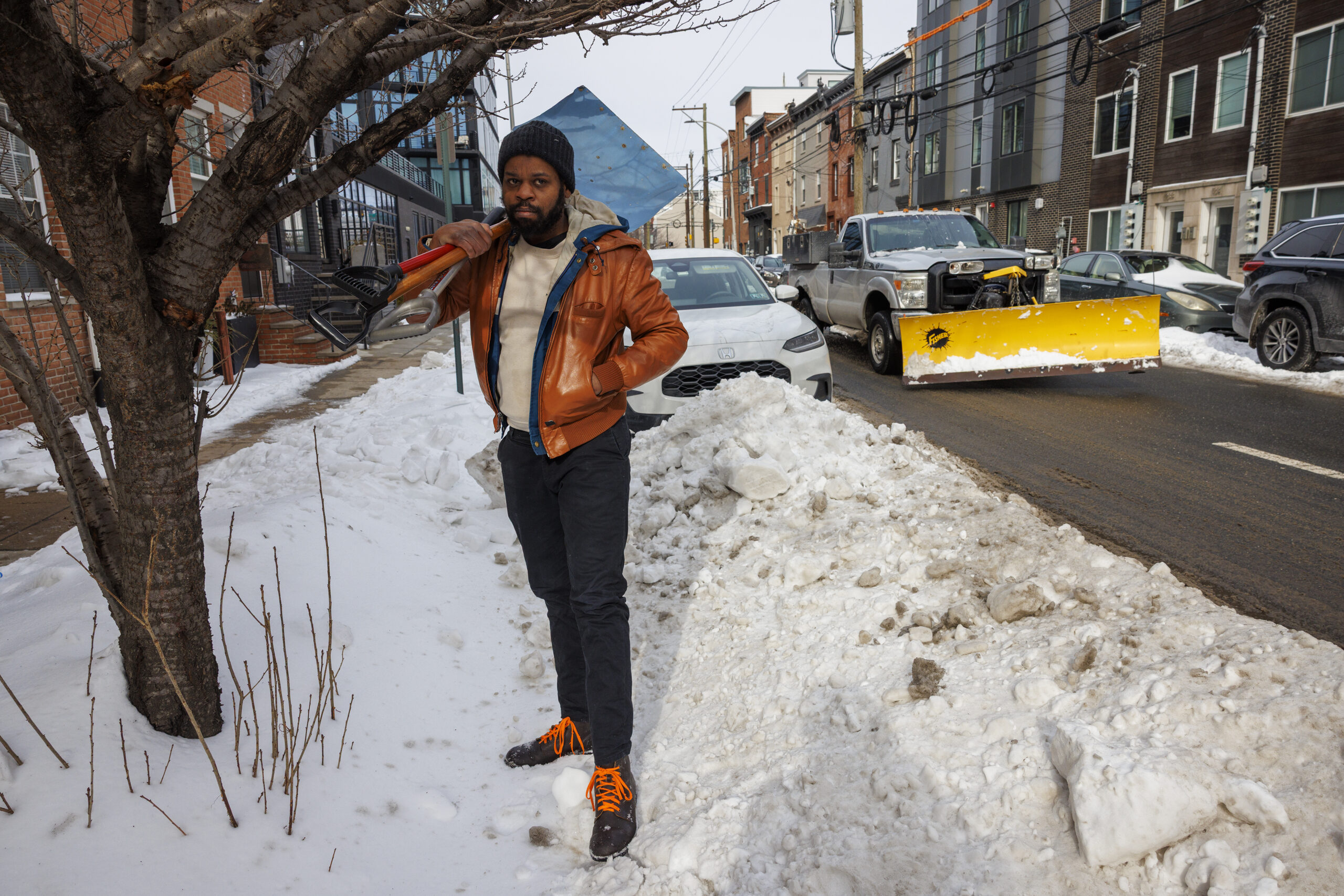
Alex Wiles of Philadelphia has been hustling during the recent snow, shoveling sidewalks and digging out cars. This photograph was taken along North Second Street near his home, Tuesday, Jan. 27, 2026. He was heading to the bus for a trip to his next client.
The processing of online 311 tickets has also been a source of confusion for residents who wonder if they are being paid attention to. Williams said the complaints are populating a map used to direct plows to avoid redundancies.
“We’ll take that data and get it within the operation,” he said.
Some homes feel the impact more than others
On the 4800 block of Regent Street in West Philadelphia, Justin Rothrauff described the road as “treacherous” for the mix of families and older residents who live there.
“One of the big problems, besides the street not being plowed, is that the plowing that they have done on some of those primary roads has blocked the secondary and tertiary roads,” the 43-year-old teacher said, adding even if he could somehow get his car out of his block, he is not sure he would make it back in.
While Rothrauff had heard of people paying to have their roads shoveled, he feels no one should have to.
“I refuse to pay anyone money, I pay enough taxes in the city,” he said.
For some Philadelphians, some information could go a long way. A much-touted live map of plow operations has been reported for mistakenly listing some streets as plowed, according to the residents who live there.
Ken Wong shovels snow on Waverly Street, in Philadelphia, Monday, Jan. 26, 2026.
Krista Dedrick-Lai, 45, a South Philly resident, hopes the city will do more to tell people about plowing statuses, and explain why their streets are still covered in snow days after the storm, even if the answers are not what they are hoping to hear.
“Sometimes context can make everyone feel better,” she said, noting her block on Federal Street got a plow Monday and Tuesday, but the snow banks had blocked cars in.
Fortunately, she said, she and her husband have not needed to leave their house to work or to help their child learn through third-grade virtual learning modules.
Others, however, do not have that flexibility. Making matters worse, more snow may be on the horizon this weekend.
The Streets Department on Tuesday is removing snow that has piled up around City Hall, and the operation requires street closures on nearby blocks, the agency said.
With the region expected to remain in a prolonged deep freeze, there is no chance the snow piles will melt anytime soon. And weather forecasters say the region might be hit with another storm this weekend, so the city is eager to get rid of the existing snow.
The “lifting operation” includes the removal of snow using dozens of vehicles, including excavators and loaders, the department said Tuesday.
The city already has been conducting lifting operations in North Philadelphia, removing snow from Girard Avenue and nearby neighborhoods since Sunday evening, the department said.
In Harrisburg, a top Democrat floated making Pennsylvania a so-called sanctuary state to protect undocumented immigrants.
And in Washington, senators faced mounting pressure to hold up funding for the Department of Homeland Security, an effort that could result in a government shutdown by the end of the week.
Across the nation, lawmakers are fielding calls to rein in U.S. Immigration and Customs Enforcement after President Donald Trump’s administration surged forces into Minneapolis as part of his aggressive nationwide deportation campaign. Frustration with the agency reached new heights Saturday after agents fatally shot protester Alex Pretti, the second killing of a U.S. citizen there this month.
Democrats nationwide slammed ICE and called on Trump to pull the forces out of Minnesota. Sen. John Fetterman, the Pennsylvania Democrat who has at times sided with Trump on immigration matters, said DHS Secretary Kristi Noem should be fired.
Anti-ICE activists demonstrate outside U.S. Sen. John Fetterman’s Philadelphia office on Monday, calling for an end to federal immigration enforcement policies.
A growing number of Republicans have also signaled their discomfort with the Minneapolis operation, including Trump allies who called on members of the administration to testify before Congress. Sen. Dave McCormick, a Pennsylvania Republican, has called for an independent investigation into Pretti’s killing.
Trump, for his part, showed some willingness to change course, sending border czar Tom Homan to Minneapolis to meet with Democratic leaders there. The president on Tuesday called Pretti’s death a “very sad situation.”
Rue Landau shown here during a press conference at City Hall to announce a package of bills aimed at pushing back against ICE enforcement in Philadelphia on Tuesday.
However, a chorus of Democrats and activists said Tuesday that the agency needs to change its tactics and be held accountable for missteps. And local leaders said they are laying out plans in case a surge of immigration enforcement comes to Philadelphia, home to an estimated 76,000 undocumented immigrants.
“We have spent hours and hours and hours doing tabletop exercises to prepare for it,” Gov. Josh Shapiro, a Democrat, said during a Monday night interview on The Late Show with Stephen Colbert.
Philadelphia officials said the best way they can prepare is by limiting the city’s cooperation with federal immigration enforcement.
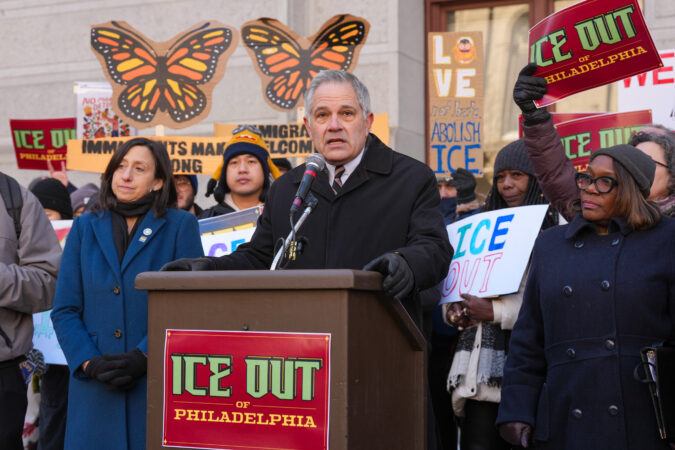
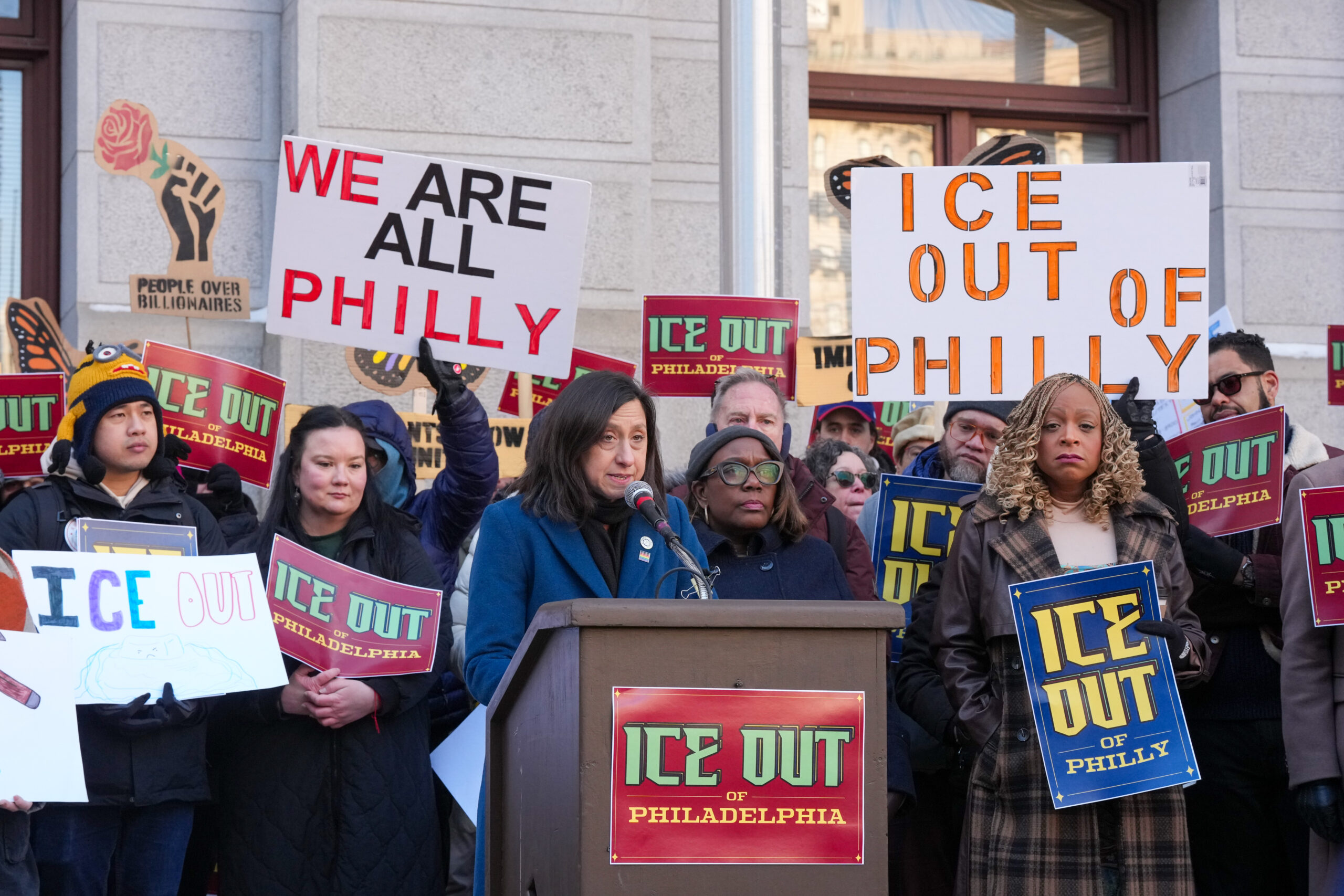
City Councilmember Kendra Brooks, of the progressive Working Families Party, and Councilmember Rue Landau, a Democrat, were joined by dozens of activists and other elected officials during a news conference Tuesday to unveil a package of legislation aimed at codifying into law the city’s existing “sanctuary city” practices.
Those policies, which are currently executive orders, bar city officials from holding undocumented immigrants in custody at ICE’s request without a judicial warrant.
Landau and Brooks’ legislative package, expected to be introduced in Council on Thursday, goes further, preventing ICE agents from wearing masks, using city-owned property for staging raids, or accessing city databases.
Erika Guadalupe Núñez, executive director of immigrant advocacy organization Juntos, said the legislation “goes beyond just ‘We don’t collaborate.’”
Juntos gets regular calls about ICE staging operations at public locations in and around Philadelphia, and people have been worried, despite official assurances, whether personal information held by the city will be secure from government prying.
“We deserve a city that has elected leadership that’s willing to step forward with clear and stronger protections,” Núñez said.
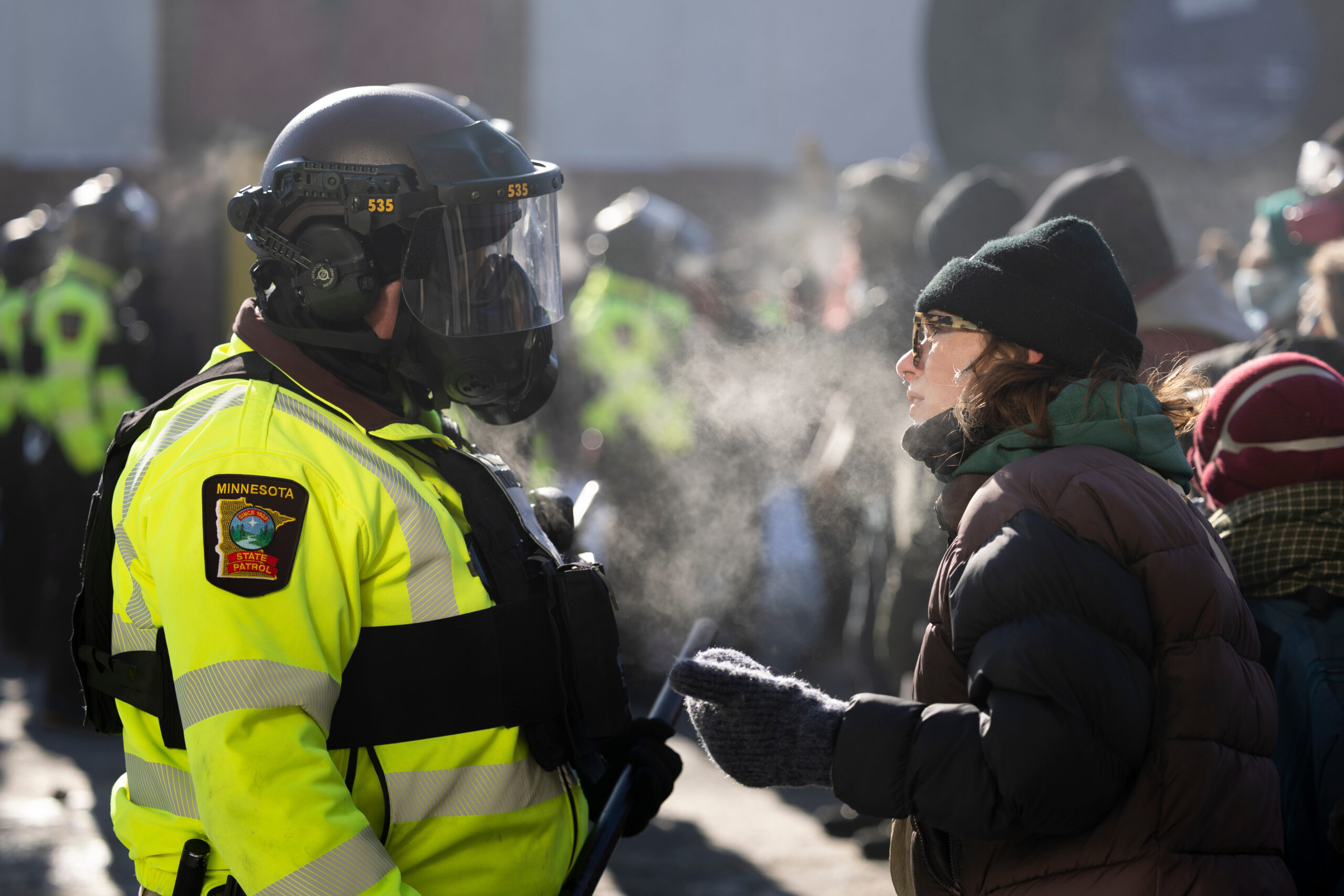
A protester speaks to a Minnesota State Patrol officer near the site of the fatal shooting of 37-year-old Alex Pretti by federal agents in Minneapolis on Saturday.
If the legislation is approved, Philadelphia would have some of the most stringent protections for immigrants in the country.
Oregon has especially strong restrictions against cooperation with federal immigration authorities, including barring local law enforcement from detaining people or collecting information on a person’s immigration status without a judicial warrant.
In Illinois, local officers “may not participate, support, or assist in any capacity with an immigration agent’s enforcement operations.” They are also barred from granting immigration agents access to electronic databases or to anyone in custody.
California, New York, Colorado, Vermont — and individual jurisdictions in those states — also provide strong protections for immigrants.
In New Jersey, Gov. Mikie Sherrill, a Democrat who was sworn in last week, has kept the state’s sanctuary directive in place as lawmakers seek to expand and codify the policy into law. Legislators came close in the final days of former Gov. Phil Murphy’s administration, but he killed a related bill that had won approval in Trenton, saying he worried that enacting a law that included changes to the state’s current policy would invite new lawsuits.
Meanwhile, some conservatives say bolstering sanctuary policies risks community safety.
“If an illegal immigrant breaks the law, they should be dealt with and handed over to federal law enforcement, not be released back into our neighborhoods to terrorize more victims and commit more crime,” said James Markley, a spokesperson for the Pennsylvania Republican Party.
He added: “Sanctuary policies don’t protect communities, they endanger all of us by shielding criminals from accountability for their crimes.”
Democrats are taking varying approaches
The widespread outrage over ICE’s tactics in Minneapolis has exposed sharp divisions in elected Democrats’ responses.
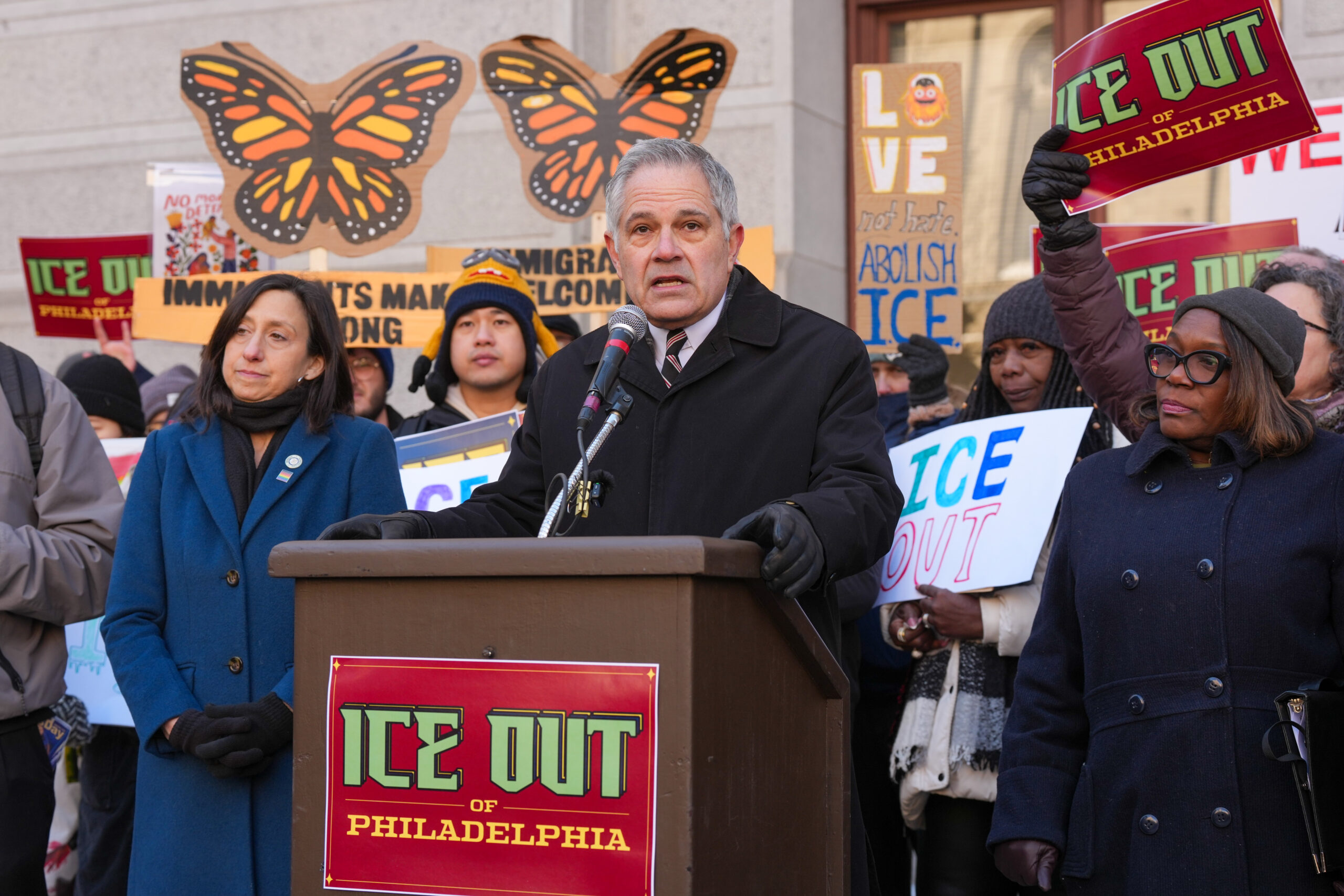
“There will be accountability now. There will be accountability in the future. There will be accountability after [Trump] is out of office,” Krasner said Tuesday. “If we have to hunt you down the way they hunted down Nazis for decades, we will find your identities.”
District Attorney Larry Krasner speaks during a news conference at City Hall on Tuesday to announce a package of bills aimed at pushing back against ICE enforcement in Philadelphia.
Somewhere in the middle is State Sen. Sharif Street, a Philadelphia Democrat and former head of the state party who is running for Congress.
Street does not have Krasner’s bombast, but this week he announced plans to introduce legislation to prevent state dollars from funding federal immigration enforcement. The bill has less of a chance of becoming law in Pennsylvania’s divided state legislature than similar measures would in Philadelphia, where City Council is controlled by a supermajority of Democrats.
“Who knows the amount of money that the state could incur because of Trump’s reckless immigration policies?” Street said in an interview Tuesday. “I don’t think state taxpayers should be paying for Donald Trump’s racist, reckless policies.”
The mayor’s critics have said her approach is not responsive to the city’s overwhelmingly Democratic residents.
“To the people of Philadelphia, I want to say: I hear you. You want ICE out of our city, and you want your local government to take action,” Brooks, the Council member, said Tuesday. “Some people believe that silence is the best policy when dealing with a bully, but that’s never been an option for me.”
Kendra Brooks shown here during a news conference at City Hall on Tuesday to announce a package of bills aimed at pushing back against ICE enforcement in Philadelphia.
Others say Parker’s conflict-averse strategy is appropriate.
“All of us have different roles to play,” Street said. “The mayor has to manage the city. She’s got to command law enforcement forces. … As a state legislator, we make policy.”
Rafael Mangual, a fellow who studies urban crime and justice at the right-leaning Manhattan Institute in New York City, said legislative efforts to erect barriers between federal and local law enforcement could backfire.
“If you don’t engage at all, and you do something that seems to actively frustrate the federal government,” Mangual said, “that would seem to be an invitation for the federal government to prioritize a city like Philadelphia.”
Staff writers Alfred Lubrano, Aliya Schneider, and Gillian McGoldrick contributed to this article.