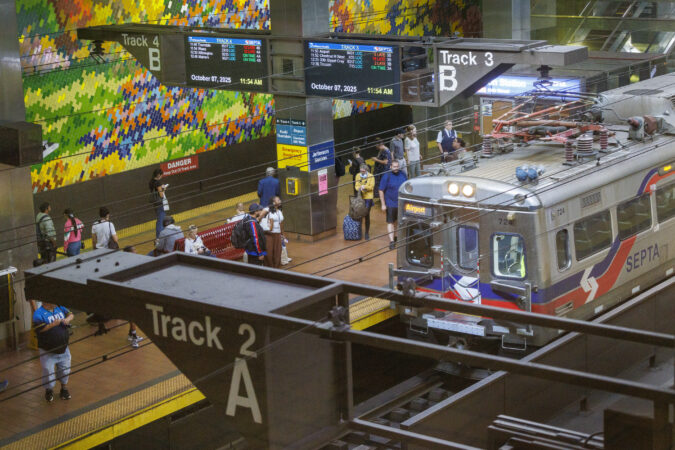
A burst water pipe caused SEPTA to close a section of Jefferson Station in Center Cityon Monday night, but Regional Rail trains were still making stops there for commuters, an agency spokesperson said.
The water started flooding into Section A of the station around 6 p.m., and the water was shut off shortly after 7 p.m., said SEPTA spokesperson Andrew Busch.
Section A closed Monday night for cleanup but opened in time for the morning rush Tuesday, Busch said.
All trains were still running with boardings and exits at other platforms, Busch said.
“We believe the pipe burst was likely due to the change in temperature,” Busch said in an email Monday. “We also had one at the Allegheny subway station today, and a few last week on the days it got above freezing.”
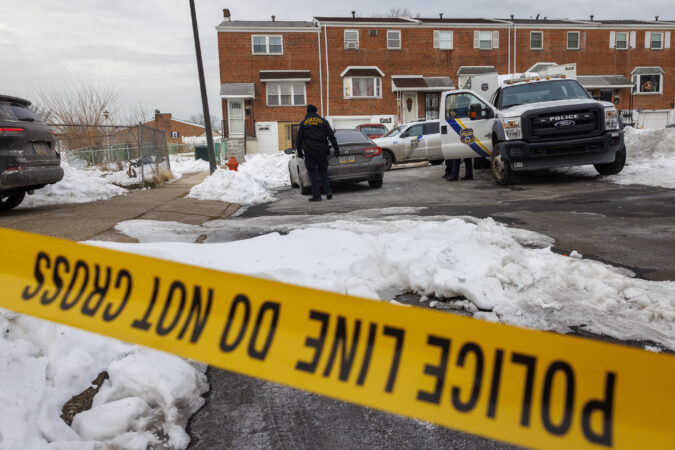
An off-duty sheriff’s officer shot a 17-year-old in Southwest Philadelphia early Tuesday morning.
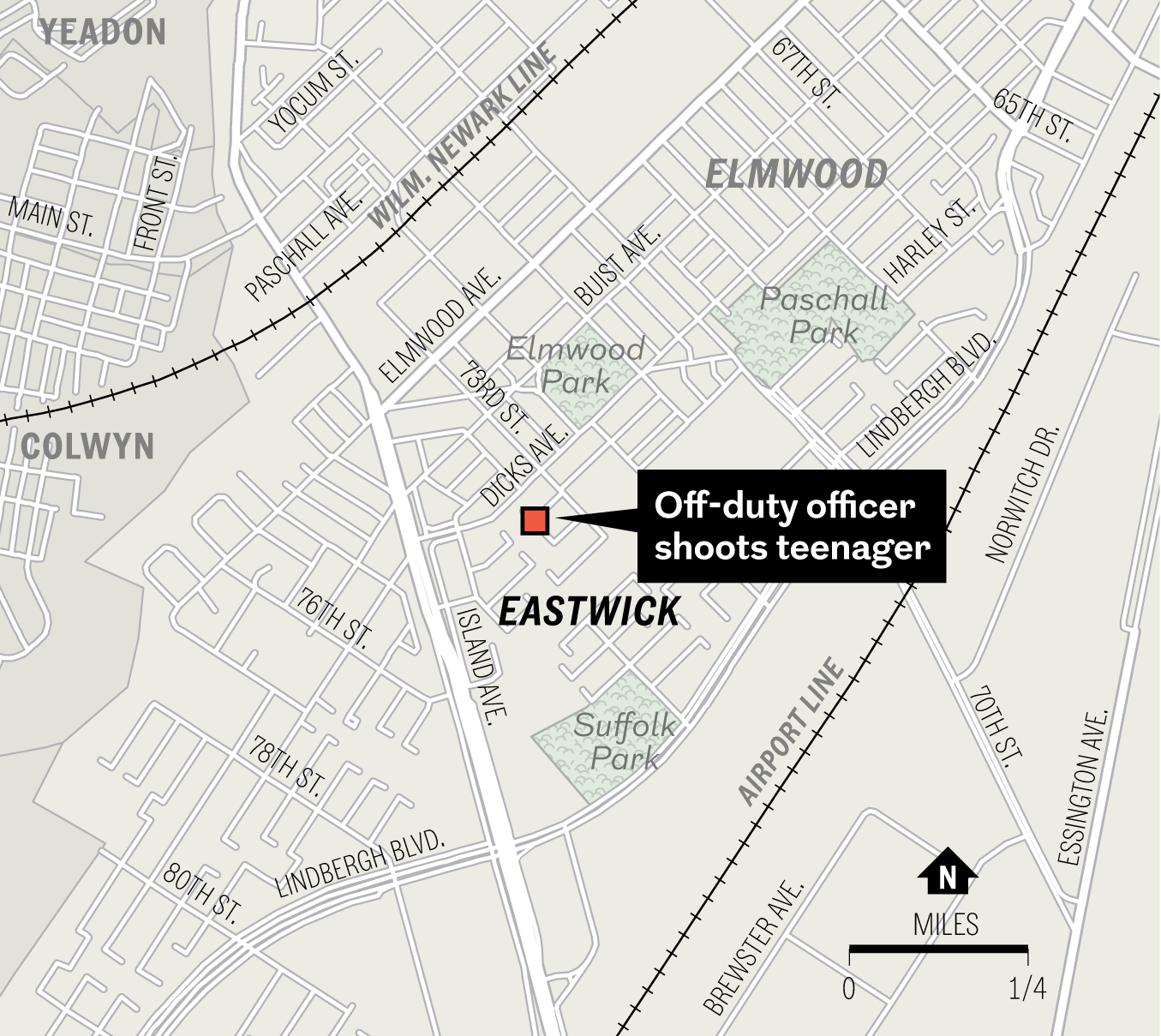
Philadelphia Police Chief Inspector Scott Small told reporters the off-duty officer saw the teenager,who has not been identified, breaking into his private vehicle around 3:32 a.m. on the 7300 block of Bunting Place.
“For reasons unknown at this time,” the officer, and a member of the officer’s family, fired their guns at the teen inside the car, Small told reporters.
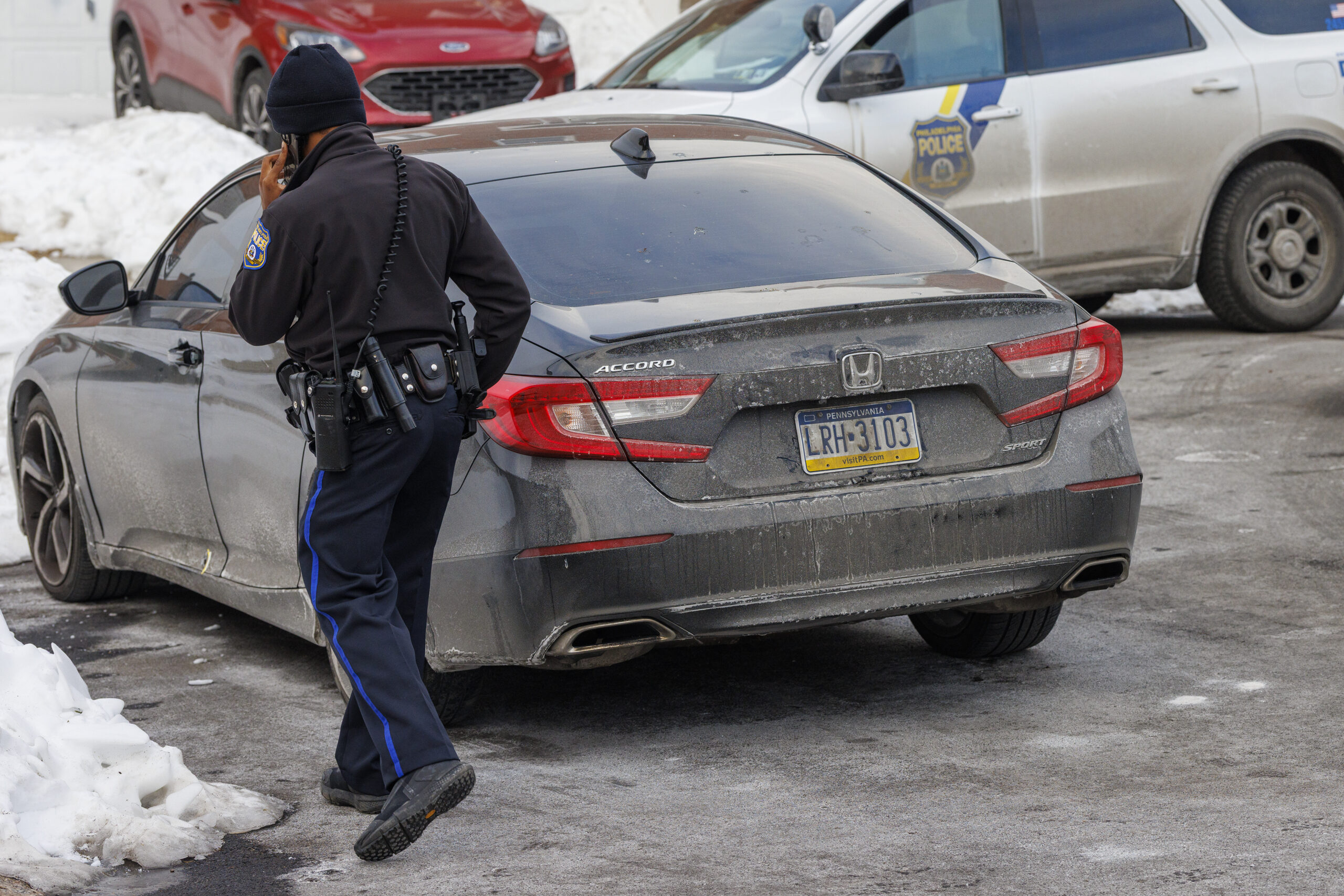
Philadelphia police crime scene unit gathers evidence at shooting by off-duty sheriff at 7300 block of Bunting Place, early Tuesday, Feb. 10, 2026. An off-duty Philadelphia sheriff’s deputy and a family member shot a teen, allegedly trying to steal their car, a Honda Accord.
Four shots total were fired, according to Small, before the teen fled the scene.
Around 20 minutes later,a teenager was transported by a private vehicle to Presbyterian Medical Center, where the officer involved in the shooting identified the wounded teen. The teenager was placed in stable condition.
Map of where an off-duty sheriff’s officer shot a 17-year-old in Southwest Philadelphia on Feb. 10.
Small noted that the teen was in possession of commonly used car theft tools, like a screwdriver, extra key fob, and other items. He told reporters at the scene that investigators found four spent shell casings and newly broken locks on the car’s doors.
The teenager was placed in custody at the hospital with charges pending.
The off-duty sheriff’s officer and their family member are uninjured and cooperating with the investigation. The family member involved in the incident had a license to carry the firearm used in the shooting, Small said.
Lankenau High’s 11th-grade class is tiny — just 25 students.
That’s one of the reasons why closing the school is for the best, Philadelphia School District Associate Superintendent Tomás Hanna said at a community meeting last week.
At small schools, Hanna said, programming options are limited and “what’s left behind is very difficult environment for young people.”
The district proposes merging Lankenau into Roxborough High as an honors program — a move that officials say will maximize opportunities for students at both schools. That proposal has been met with fierce opposition from the Lankenau community, whose members say stripping the school of its identity and removing it from its unique location on 400 wooded acres is unjustifiable.
When the school system dramatically revamped its special-admissions process in 2021, moving to a centralized lottery from a system where principals had discretion over who got into the district’s 37 criteria-based schools, enrollment dropped at some magnets.
For the 2022-23 school admissions cycle, Lankenau, Motivation, Parkway West, and Parkway Northwest — four of the 20 schools tagged to close — had dozens of unfilled seats in their ninth-grade classes.
window.addEventListener(“message”,function(a){if(void 0!==a.data[“datawrapper-height”]){var e=document.querySelectorAll(“iframe”);for(var t in a.data[“datawrapper-height”])for(var r,i=0;r=e[i];i++)if(r.contentWindow===a.source){var d=a.data[“datawrapper-height”][t]+”px”;r.style.height=d}}});
The district setacademic standards for admission to those schools, and stopped allowing schools to admit students who were close to meeting academic requirements and who demonstrated they would be a good fit for the individual schools, as had been done in the past. (Officials said they wanted to centralize admissions to avoid demographic imbalances at schools; those four magnets did not have a history of them.)
The district’s using Lankenau’s tiny now-junior class to justify closings infuriated many, including Matthew VanKouwenberg, a science teacher at the school.
Lankenau’s size “is a district-designed and district-created problem,” VanKouwenberg said. Though the lottery was begun for equity reasons, “the result is disastrous.”
But Tonya Wolford, the district’s chief of evaluation, research, and accountability, said Lankenau, Motivation, Parkway West, and Parkway Northwest had declining numbers of students applying prior to the lottery changes.
And for years, those schools accepted large numbers of students who didn’t meet the district’s criteria, Wolford said.
Dramatic enrollment drops after district orders
The data are clear: After the district pushed changes to the admissions process, the four schools all saw dramatic drops in enrollment — and some of them never recovered.
Motivation, in West Philadelphia, had a freshman class of 83 students and a total enrollment of 336 in 2022-23. It saw a 77% drop in its ninth- grade class — just 19 freshman in 2023-24. The school now has 151 students, and the district wants to close it and make it an honors program inside Sayre High School. It is operating at only 15% of its full capacity.
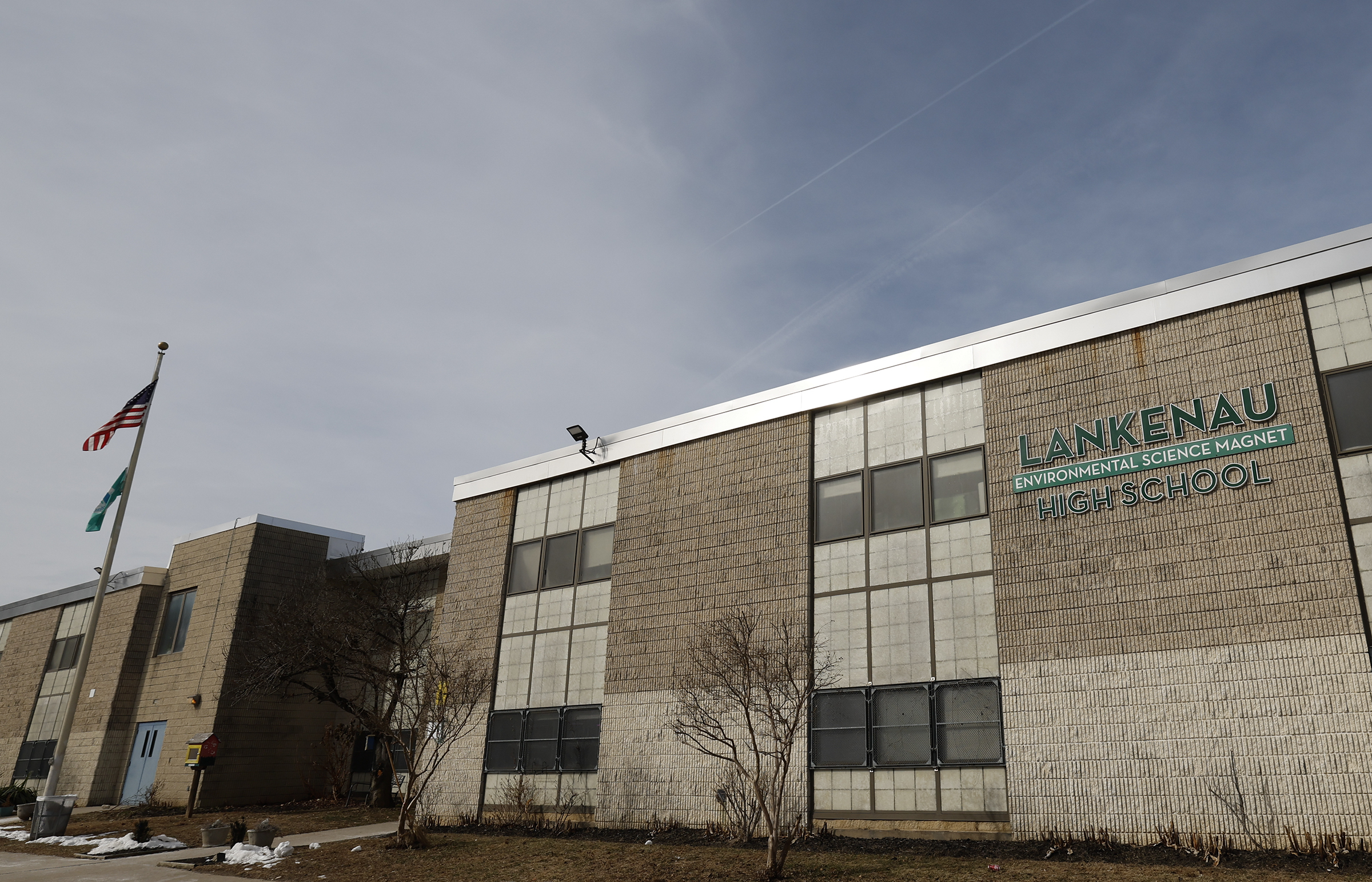
The Lankenau Environmental Science Magnet High School in Roxborough.
Lankenau, in Upper Roxborough, had 91 freshman in 2022-23, then 31 in 2023-24, a 66% decline. It now enrolls 225 students. The school is using 49% of its capacity.
Parkway Northwest had 77 ninth graders in 2022-23, then dropped to 30 in 2023-24, a 61% decrease, and is 60% full. It’s got 248 students this year, and the district wants to close it and make it an honors program of Martin Luther King High.
And Parkway West had 54 freshman in 2022-23, then 19 the following year, a 65% decrease. It now has just 140 students, and is using 40% of available seats. It’s proposed to close and become part of Science Leadership Academy at Beeber.
A staffer who worked at Parkway West as the special-admissions process changes rolled out said they were devastating to the school, which typically filled three-quarters of its slots for incoming ninth graders with students who qualified on every measure, and a quarter by feel.
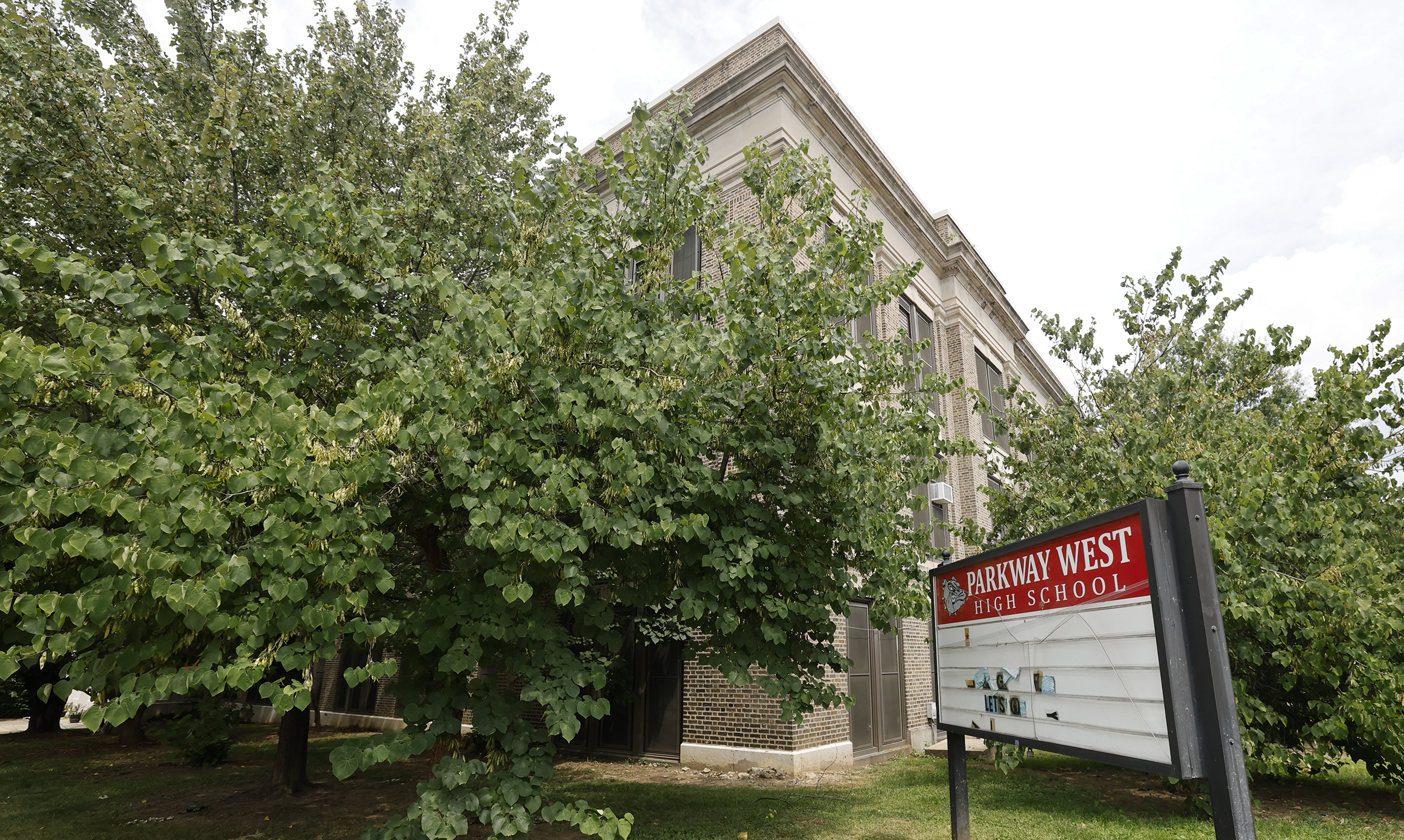
Parkway West High School, in West Philadelphia, is proposed to close under a Philadelphia School District facilities proposal.
“We found kids who maybe missed one criteria, but they were good kids, and had strong recommendations,” said the staffer, who asked not to be identified because they were not authorized to speak to a reporter.
When Parkway West lost that ability, its enrollment tumbled, and never recovered.
Lankenau community members say interest in their unique school has never waned, but the size of their incoming classes continues to be limited by the district — even beyond the admissions changes.
For the applicant class set to start high school in the fall, 107 students listed Lankenau as their first choice, staff said, and 95 have accepted Lankenau’s school board offer.
But since 2022-23, district officials have limited Lankenau to two sections of ninth graders, and with class sizes capped at 33. So despite having interest and students enough for 99 freshmen, it won’t have staff for more than 66.
In the last few years, staffers said, more than 66 students show up at the start of the school year. But with only enough teachers for 66, classes are overcrowded and some students end up transferring out.
“That is the only reason we lose enrollment,” said Erica Stefanovich, a Lankenau teacher. “We wouldn’t be in this situation if they hadn’t put us in it. This is an artificial problem.”
But, Wolford said the trend lines were clear for Lankenau and other schools.
In 2019-20, for instance, the prior to the district’s admissions changes just 34 students met Lankenau’s criteria, but 81 students accepted offers for the ninth-grade class, Wolford said. That same year, eight students qualified for Parkway Northwest on paper, but 34 were admitted, according to district data.
Schools like Lankenau and Parkway Northwest “were existing without following the criteria,” said Wolford.
Trees, bees, and a Lorax
Lankenau is putting up a spirited battle to stay open.
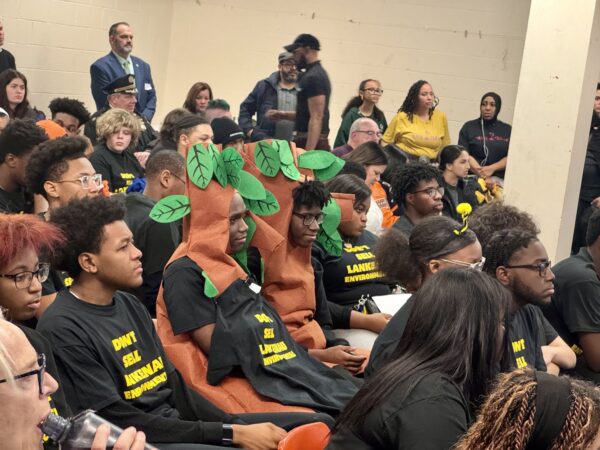
Last week, an overflow crowd — more than 100 students, staff, parents, representatives from Lankenau’s many partner organizations, and community members — packed the school for a student showcase and district-led meeting about the closure. Some students dressed as trees, bees, and a Lorax, the Dr. Seuss character who “speaks for trees” — to emphasize the importance of their school’s setting amid 400 acres of woods.
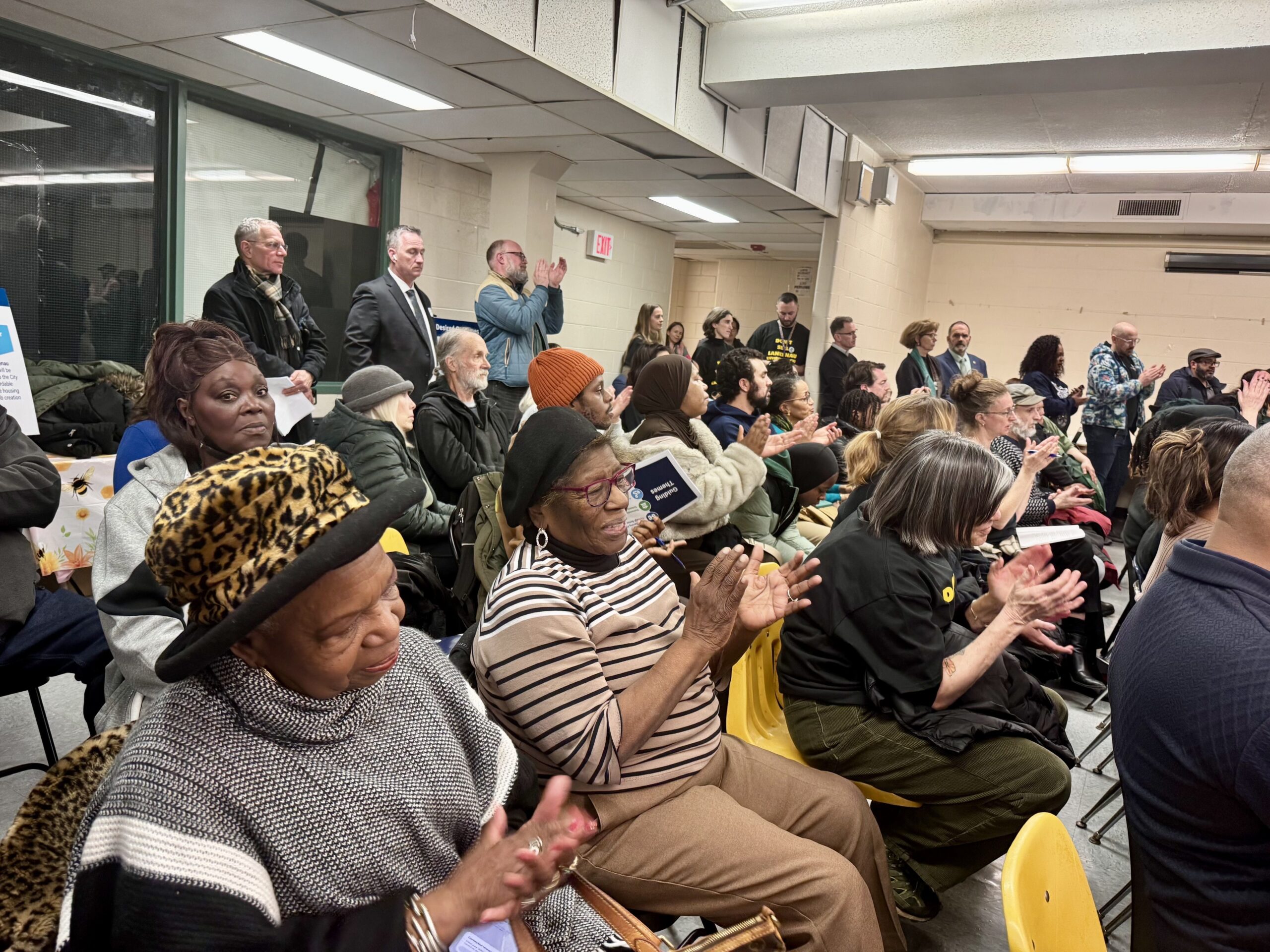
Community members at Lankenau High School applaud a student telling district officials why the school should not close. Lankenau is one of 20 Philadelphia School District schools proposed for closure.
First, Lankenau students wowed visitors with presentations — about their study of natural resources, about the experience of foraging for ingredients to brew their own artisan teas — and then, it was down to business. Lankenau is too small, officials said, and the district must find ways to offer a more equitable experience for all students.
“I don’t discount that there is magic inside of these walls,” Deputy Superintendent Oz Hill said. “What I’m sharing with you is if we can take that magic and enhance it with more extracurricular activities, more expanded academic programming, the sky’s the limit.”
The parents, students, and staff in the audience weren’t having it.
Lankenau was just certified to become the state’s only three-year agriculture, food, and natural resources career and technical education program — a designation that took years to achieve, and cannot transfer to a new building.
Officials are proposing closing Lankenau a year and a half from now; that’s not enough time for the district to reapply for the designation for a new Lankenau-inside-Roxborough CTE program.
District officials said at the meeting that they believe their “close relationship” with the state education department will give them enough time to get a new Roxborough program certified in time for the Lankenau closing.
Multiple parents told district leaders they would not send their children to Roxborough High.
And Akiraa Phillips, a Lankenau ninth grader, said she couldn’t imagine attending school in another setting.
In Lankenau’s current setting, “learning doesn’t stop at the desk. Our campus is the classroom,” Akiraa said. “We learn science by being in it. Here, we don’t just talk about ecosystems, climate, and sustainability, we walk through it. That kind of learning sticks with you. You can’t stick this into any random building and expect it to work.”
The community turned out in full force, but politicians and other decision-makers were in the room, too. Three school board members, including president Reginald Streater, attended the meeting.
State Sen. Sharif Street (D., Philadelphia), the front-runner to replace U.S. Rep. Dwight Evans in Congress, said he “was against closing the school,” but noted that the decision didn’t rest with him, and said the state needed to better fund schools “because we have not met our obligation to fully fund the program.”
And Councilmember Cindy Bass said she was particularly incredulous that the district was attempting to close a successful magnet — Lankenau has a 100% graduation rate.
“If it works, why are you breaking it?” Bass said. “I do not understand what the logic and the rationale is that we are making these kinds of decisions. We’re not just closing a school, we’re disrupting the lives of young people.”
In June 1776, before the Declaration of Independence was signed, a group of leaders from Philadelphia and its surrounding 10 counties — Bucks, Berks, Chester, Lancaster, York, Cumberland, Bedford, Northampton, Northumberland, and Westmoreland — met in Carpenters Hall for the Pennsylvania Provincial Conference. There, the Commonwealth of Pennsylvania was born.
Carpenters Hall, a hidden landmark just two blocks from Independence Hall in Philadelphia’s Old City, is the true birthplace of Pennsylvania, where the state declared its independence from Britain — jump-starting the framework of the state’s influential constitution that would serve as a model for the U.S. Constitution.
Now, the little-known and privately owned historic site is celebrating Pennsylvania’s 250th birthday — which coincides with America’s Semiquincentennial — by holding commemorative events across the state to reflect on Pennsylvania’s history and ask residents how the state constitution should be strengthened in 2026 and beyond.
“It’s the piece of the story we should own and celebrate and use as a platform for civic engagement,” said Michael Norris, the executive director of Carpenters Hall.
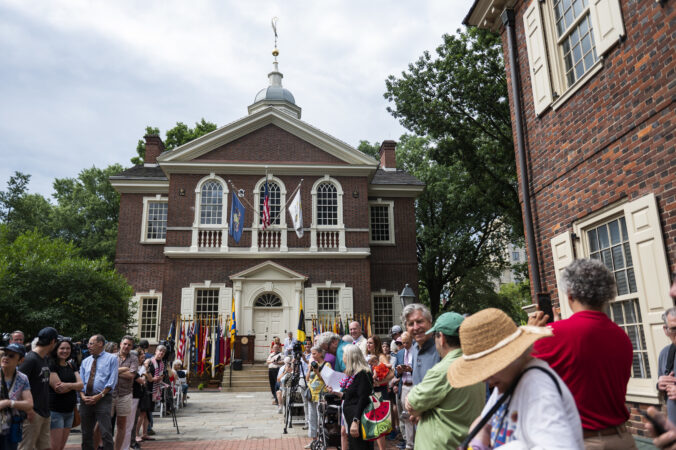
Executive director Michael Norris makes remarks at the reopening ceremony at Carpenters Hall on July 3, 2023.
Last week, Norris and others from Carpenters Hall traveled from Philadelphia — the state’s first capital— to Harrisburg to announce their yearlong schedule of events celebrating Pennsylvania’s founding, including those about the state’s constitution and its past and future.
At a news conference last week, Rep. Mary Isaacson (D., Philadelphia) noted that she occupies the seat once held by former Pennsylvania House Speaker Benjamin Franklin. She said she sees the Carpenters Hall events as “more than learning about a key moment in Pennsylvania history.”
“It’s also about exploring the vital importance of our state constitution in our democracy today and what citizens can do to engage,” she added.
The commemorative events include an interactive town hall series hosted in Philadelphia, Pittsburgh, Harrisburg, and Erie to discuss the importance of the Pennsylvania Provincial Conference in the United States’ founding. The group will also host several events at Carpenters Hall, including the installation of a blue historical marker outside the hall on June 18, in addition to a three-part virtual lecture series on Pennsylvania’s constitution.
The events, funded by America 250 PA and the Landenberger Family Foundation, are open to the public and intended to reach Pennsylvania’s “lifelong learners” who are interested in history and civics,as well as the legal community, who will be eligible for Continuing Legal Education credits for attending the virtual lectures, Norris said.
“To me, 250 is about reflection and engagement,” Norris said. “It’s not about parties and buildings. It’s really a moment to reflect and say, ‘What are we doing here? Do we still want this democracy, and how do we protect it and keep it going?’”
The Carpenters’ Company — the nation’s oldest craft guild, which built and still owns Carpenters Hall — will also conduct polling about how Pennsylvania’s constitution, as well as the U.S. Constitution, should be changed to better represent citizens in a modern time, Norris said. The poll results will be made public at an in-person event in Philadelphia on Sept. 28, the 250th anniversary of when the state constitution was ratified.
Historic flags are displayed outside at the reopening ceremony at Carpenters Hall on July 3, 2023. The building opened for the first time to the public since April 2022.
Rhode Island was the first colony to declare independence from England in May 1776, and Delaware became the first state in December 1787. Pennsylvania followed days after, and its constitution influenced the country’s founding documents. Pennsylvania’s expansive constitution — viewed as radical at the time — focused on personal freedoms and liberties in its “Declaration of Rights,” after which the Bill of Rights was modeled.
Carpenters Hall was the nation’s first privately owned historic landmark, and remains owned by the Carpenters’ Company today, which offers free admission for 150,000 visitors each year. Because it is privately owned, it is not overseen by the National Park Service, which has in recent weeks dismantled exhibits about slavery at the nearby President’s House Site in Independence National Park thatPresident Donald Trump’s administration contends “inappropriately disparage” the United States.
History may not repeat itself, but at least in Philadelphia, it sure does rhyme.
Twenty years ago, our famed Rocky statue made the move from its former perch at the stadium complex in South Philly to the base of the steps of the Philadelphia Museum of Art, where it has stood since.
Now, the city’s statue of former world heavyweight champion “Smokin’” Joe Frazier could soon do the same.
“Relocating the Joe Frazier statue to this prominent civic and cultural space would … create a respectful dialogue between two complementary representations of Philadelphia’s spirit,” chief cultural officer Valerie V. Gay and public art director Marguerite Anglin wrote in a letter to the Art Commission. “Rocky Balboa as a symbol of hard work and aspiration, and Joe Frazier as the embodiment of those values lived out in real life.”
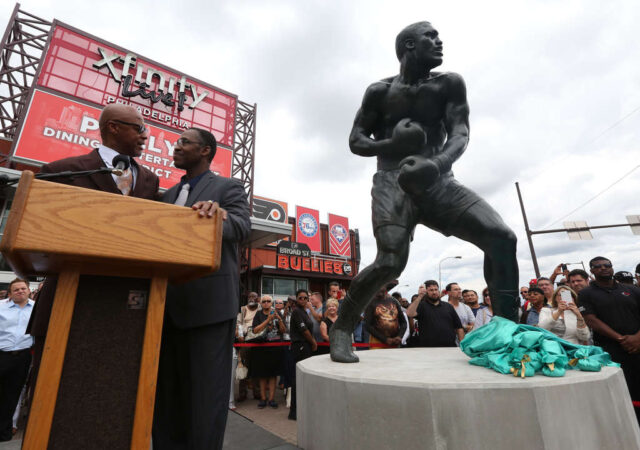
Created by sculptor Stephen Layne in 2014, the Frazier statue has stood in the sports complex outside what is now Stateside Live! for about a decade, and has been a part of the city’s public art collection since its inception. In an effort led by Joe Hand, the owner of Feasterville’s Joe Hand Boxing Gym and a longtime friend of Frazier’s, the statue’s commission was funded by the boxer’s family and supporters before its donation to the city.
The statue, standing at about 12 feet tall, depicts Frazier just moments after besting Muhammad Ali in the so-called “Fight of the Century” — the March 1971 bout in which Ali suffered his first professional loss after 15 grueling rounds.
Frazier, who died in 2011, was a well-accomplished boxer before that matchup, having won an Olympic gold medal in 1964 in Tokyo. He held the heavyweight championship title from 1970 to 1973, when he lost the belt to fellow legend George Foreman following a bout in Kingston, Jamaica, in a matchup referred to as “The Sunshine Showdown.” He retired in 1976, the year following a vicious loss to Ali in the famed “Thrilla in Manila” fight. After returning for a 1981 match against “Jumbo” Floyd Cummings that resulted in a draw, Frazier left the sport for good.
Relocating the Frazier statue to the Art Museum is expected to cost roughly $150,000 in city funds, and has support from leaders including Mayor Cherelle L. Parker, City Councilmember Katherine Gilmore Richardson, State Sen. Sharif Street, and State Sen. Anthony Hardy Williams, according to Creative Philadelphia’s Art Commission proposal.
“Placing the Joe Frazier statue at the Art Museum affirms Philadelphia’s commitment to honoring real-life achievement alongside cultural mythology,” Parker wrote in a letter supporting the move. “Together, these figures reflect the city’s spirit, where determination, resilience, and opportunity meet.”
Friends of Frazier also expressed support in letters included as part of Creative Philadelphia’s proposal — in part, at least, because the Art Museum has higher foot traffic than where the statue currently stands.
The move “will give the Frazier statue many more eyes on it than at the Xfinity area,” wrote Nicholas L. Depace, the boxer’s friend and former physician.
Frazier served as a major inspiration for the Rocky Balboa character, with the man and the character sharing several key elements, according to Creative Philadelphia. Like Rocky, Frazier trained for boxing matches by hitting frozen raw meat, ran the Art Museum steps, and faced opponents that closely mirrored those actor Sylvester Stallone’s character faced in the franchise.
“Stallone made 5 Rocky movies mostly based on the real life humble champion Smokin’ Joe Frazier from Philadelphia,” wrote Smokin’ Frazier Championship Foundation Inc. CEO Pete Lyde in a letter of support for the move. “Joe Frazier’s statue at the Philadelphia Art Museum Steps symbolizes and celebrates the real life human heart and potential within us all worldwide.”
The Rocky statue, meanwhile, is cleared for installation atop the Art Museum steps following its exhibition in “Rising Up: Rocky and the Making of Monuments,” an Art Museum program slated to run from April to August. After that, the statue now displayed at the top of steps — which Stallone lent to the city for the inaugural RockyFest in December 2024 — will head back to the actor’s collection, and the original, screen-used statue will take its place.
It was not immediately clear when the Frazier statue could head to the Art Museum. Creative Philadelphia did not immediately respond to a request for comment.
“Placing the Smokin’ Joe Frazier statue at the Art Museum steps would not only correct a historical imbalance but also serve as an inspirational symbol for residents and visitors alike,” wrote Councilmember at-large Jim Harrity in a letter of support. “It would elevate a true Philadelphia champion whose impact reached far beyond the boxing ring and whose contributions to sports, labor history, and community service continue to resonate today.”
Philadelphia’s Democratic Party has endorsed State Sen. Sharif Street for the city’s open congressional seat.
The endorsement Monday came as no surprise, given Street’s insider connections. He previously chaired the Pennsylvania Democratic Party and is close to party leaders in the city. And Bob Brady, who chairs the Democratic City Committee, said last fall that he expected his fellow ward leaders to vote to endorse Street.
But it nonetheless strengthens Street’s status as the favorite in the race among the local Democratic establishment. Street, the son of former Mayor John F. Street, was endorsed by the politically powerful unions in the Philadelphia Building & Construction Trades Council last year.
“I am deeply honored to have received the overwhelming support of the grassroots leaders who power our party,” Street, who represents a North Philadelphia district in the state Senate, said in a statement. “This endorsement is more than just a vote of confidence — it is a demonstration that we are building a broad-based coalition.”
Street has also emerged as the front-runner in the financial race. Recently disclosed campaign reports showed he raised $348,000 from donors in the last quarter of 2025, the largest haul among the candidates.
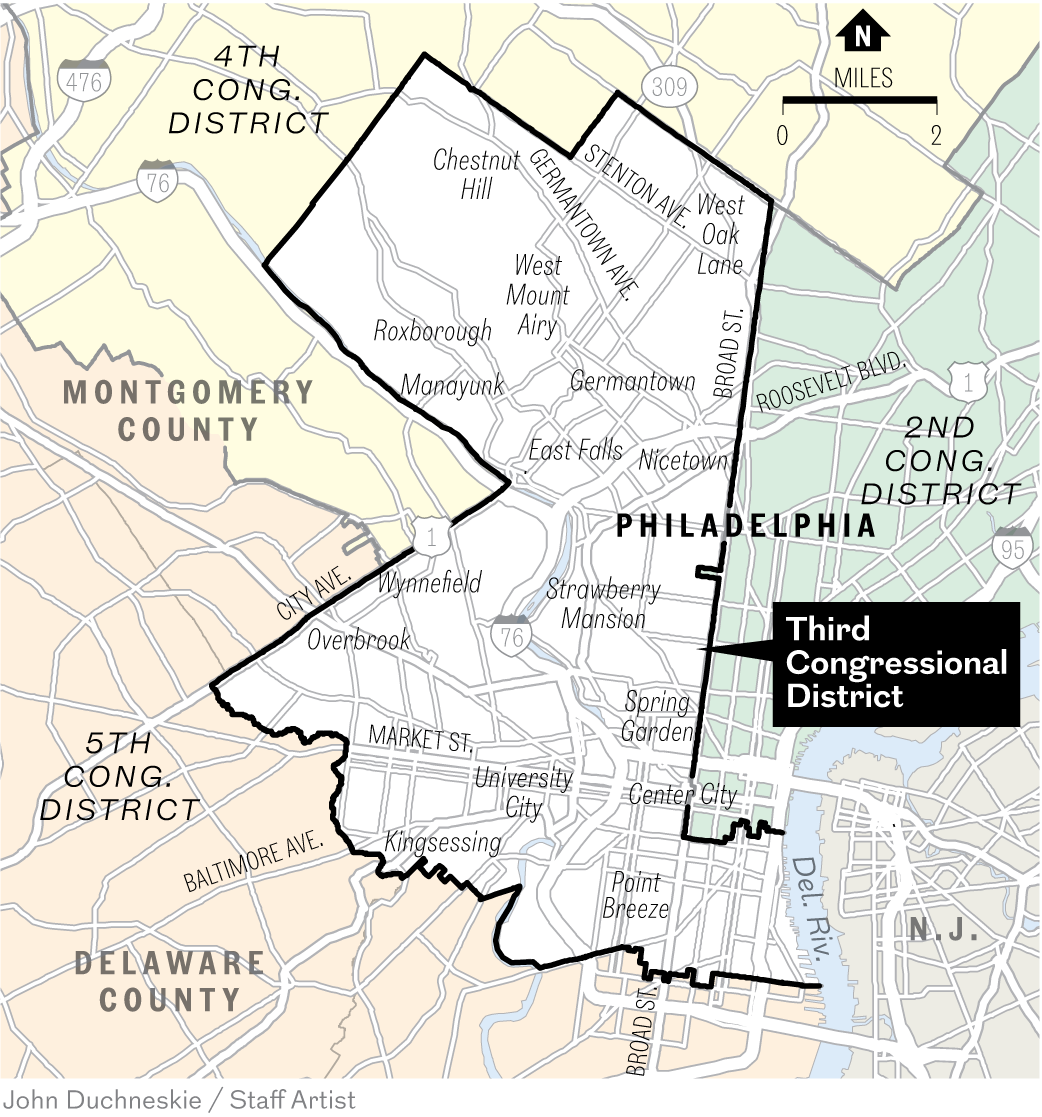
The 3rd Congressional District is, by some measures, the most heavily Democratic district in the U.S. House, and includes West and Northwest Philadelphia and parts of Center City, Southwest, South, and North Philadelphia.
The winner of the Democratic primary in May is all but guaranteed victory in November. Democrats hold a 7-to-1 voter registration edge over Republicans in Philadelphia.
Map of Pennsylvania’s Third Congressional District.
Earning the party nod may help Street stand out in a crowded field and will bolster his ground game for campaigning, activating the party’s hundreds of committeepeople to get out the vote for him.
But it doesn’t guarantee victory. Insurgent candidates have defied the party’s dominance several times in recent city elections, and the district includes several progressive pockets that could open the door for a candidate who can coalesce the left against Street.
The endorsement followed a vote by the Democratic ward leaders in the district. A candidate must receive at least 50% of the vote to win the party endorsement.
If no candidate reaches that mark, each ward prints its own sample ballots with its preferred candidates, which often happens in open contests like this year’s primary.
The party’s endorsement of Street means all ward leaders are now encouraged to include him in the literature distributed to voters before and on election day. Some wards, however, choose to print their own slates anyway.
The party did not immediately disclose the final vote tally at the endorsement meeting.
Northwest Philadelphia’s 50th Ward, which is led by Mayor Cherelle L. Parker, has not yet made an endorsement in the race, said Aren Platt, executive director of the mayor’s campaign, People for Parker.
Top candidates in the race, including Street, were scheduled to face off at a candidates forum hosted by the Center City Residents Association on Monday night.
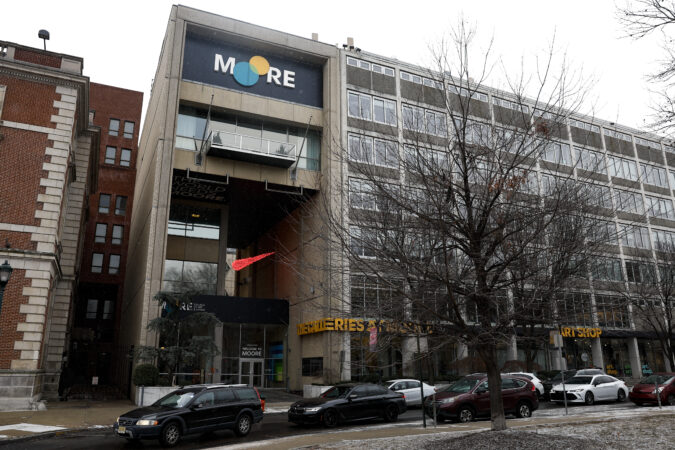
Moore College of Art and Design will consider opening its undergraduate programs to men for the first time in its 177-year history.
The Philadelphia school, which touts its role as “the first and only historically visual arts college for women in the nation,” cited the need to make arts programs more accessible in the region and the expected national decline in the available pool of high school graduates.
The college, which enrolls about 500 students, will study and discuss with its community the prospect of admitting men over the next four months and make a decision by June, the school announced in emails to alumni, faculty, and students Monday. If the school decides to admit all genders, the first class admitted would be for 2027.
“We will explore all of this together in an inclusive way for students, faculty, staff, and alumni,” wrote Moore president Cathy Young and Frances Graham and Art Block, chairs of the school’s board of trustees and board of managers, respectively. “Your voices are essential. No decision has been made at this time. The boards want your feedback.”
Moore College of Art and Design president Cathy Young.
If Moore goes coed, Bryn Mawr College would be the only remaining women’s school in the Philadelphia region. (In Allentown, Cedar Crest College remains primarily a women’s college.)
Several other colleges in the region that were formerly for women have gone coed over the last decades, including Rosemont on Philadelphia’s Main Line in 2008, Immaculata University in Chester County in 2005, and Chestnut Hill College in Philadelphia in 2003.
Nationally, the number of women’s colleges has been declining from a high of over 200 to just 31 as of 2022, according to a 2025 report by the Pew Research Center.
It wouldn’t be the first change in Moore’s admissions policy in recent years.
In 2015, Moore began admitting “all qualified students who live as women and who consistently identify as women at the time of application.”
Then in 2020, Moore also began accepting nonbinary and gender-nonconforming students. Since then, the number of those students has been growing. They made up 6% of the first freshman class under the new policy in 2021. By fall 2022, they accounted for 21%, and by fall 2023, 26%. Last fall, that grew to one-third of the freshman class.
Moore’s graduate programs and most of its continuing education programs already include men.
Moore officials said they are making the decision from a position of financial and academic “strength.” The school has had operating surpluses for the last 24 consecutive years, a school spokesperson said. Many small schools have faced financial strain in recent years, but Moore fared among the top small private colleges in the Philadelphia region for financial health in a 2024 Inquirer review.
Moore’s net tuition climbed from $10.8 million to $12.7 million in fiscal 2024 and to $16.5 million in fiscal 2025, financial records show. The school also saw a big gain in private gifts and grants last year to $2.2 million, up from $885,383 the year before.
This year’s enrollment is the school’s second highest behind fall 2024, when the college accepted 112 students from the University of the Arts, which abruptly closed in June 2024. The school also took 12 students that year from the Delaware College of Art and Design, which closed that year, too.
Moore opened a new residence hall in Rittenhouse Square last fall, which is just a seven-minute walk from campus and will allow the school to guarantee students housing for all four years.
In announcing the possibility of accepting all genders, Moore officials noted UArts’ closure and the end of degree-granting programs at the Pennsylvania Academy of Fine Arts.
“There is a void in Philadelphia’s higher ed creative landscape, and that begs the question: Shouldn’t all creatives, regardless of gender, have access to Moore …” they wrote. “The answer doesn’t have to be “yes,” but it is our responsibility to explore it.”
College surveys of applicants have shown that the school’s status as a women’s college isn’t a big draw. Only 6% cited it as important to their decision out of 885 survey respondents over the last dozen years, the school said. Meanwhile, a quarter said it was one of the important reasons they didn’t choose Moore.
Moore officials also cited the expected drop in the high school graduate population beginning this year because of declining birth rates. A decline of 10% is expected by 2037, they noted.
“There are simply fewer students,” they wrote. “No responsible institution can ignore factors like these. And we won’t.”
They said they will discuss ways “to preserve and activate in new ways” Moore’s history and legacy as part of the exploration.
Between February and April, Moore plans to host about 20 sessions for faculty, staff, and alumni to share their thoughts, as well as providing an opportunity for online comments.
Staff writer Harold Brubaker contributed to this article.
Hours before Ahmad Shareef was arrested for killing his wife, he called his mother and confessed.
“I cut her head off,” he told her, according to the affidavit of probable cause for his arrest.
On Monday, Shareef, 37, was sentenced to 16 to 42 years in prison in the decapitation death of Leila Al Raheel inside the couple’s Northeast Philadelphia home. Shareef pleaded guilty to third-degree murder and related crimes in the November 2022 slaying.
“I don’t think I’ve ever seen a case like this,” said Common Pleas Court Judge Charles Ehrlich.
New details of the killing also surfaced during the hearing.
After Shareef confessed to his mother, she asked a neighbor to go to her son’s home in the 300 block of Magee Avenue and check on Al Raheel, according to the affidavit. The neighbor found Al Raheel dead in the dining room, she later told police.
Officers who responded to the house discovered Al Raheel’s headless body on the kitchen floor, the affidavit said. They found Shareef about four miles away, hiding in bushes in front of a house. His sweatpants, the document said, were stained red with blood.
Inside a police interview room, Shareef waived his Miranda rights, according to the affidavit. He told detectives he’d argued with Al Raheel after she had called him names.
Then, he said, he cut off her head with a kitchen knife.
In court Monday, the neighbor described how discovering Al Raheel’s body upended her life. She said she has been diagnosed with post-traumatic stress disorder. “This isn’t something that time simply erases,” she said.
No one testified on Shareef’s behalf. His mother, who had been expected to appear, was ill and unable to attend, his defense attorney, Gregg Blender, said.
Al Raheel, who came to the U.S. with Shareef and his family in 2011, “has no family to speak on her behalf,” said the prosecutor, Maggie McDermott.
The judge imposed a sentence slightly below the prosecution’s request of 23 to 47 years, after Shareef’s attorney urged him to consider his client’s traumatic childhood and long-standing mental illness, which he said went largely untreated.
As a child, Shareef moved with his mother from Kuwait to Iraq and later to Syria, fleeing both war and abusive men who, Blender said, subjected them to violence. At the insistence of his family, Shareef later married Al Raheel, a neighbor, Blender said.
In the U.S., Shareef was treated repeatedly for mental health crises, Blender said. In 2012, he was hospitalized after striking himself and cutting his wrists, and in 2019, Blender said, Shareef stabbed himself in the neck.
Blender urged the judge to weigh what he described as his client’s “horrific upbringing” against what he acknowledged was “nothing less than a horrific crime.”
McDermott called the killing the “peak of domestic violence” and “unspeakably awful,” and warned that Shareef posed a continuing danger. If he was capable of such violence toward someone he loved, she argued, then even strangers were at risk.
Ehrlich said the sentence reflected both Shareef’s traumatic past and the threat he posed going forward.
“To sever a head with a kitchen knife takes a lot of effort,” he said. “Mr. Shareef, you have lived a life of horrors. I don’t think anyone in this courtroom disputes that.” The question, he added, was what needed to be done to protect others.
“I’m very concerned about the future — I’m going to be honest with you,” the judge said. “What happened to you as a child was not your fault. But people with this kind of damage can hurt others.”
After the slaying, neighbors told The Inquirer that several people had been living in the house, which had become an eyesore on the block. Shareef, they said, stood out: He behaved aggressively to other residents, and sometimes appeared outside wearing only underwear.
Since late 2016, police responded to more than 50 calls on the 300 block of Magee Street for domestic disturbances, reports of weapons, and other complaints. However, police would not disclose exact addresses, and it remains unclear how many of those calls — if any — originated from the home Shareef shared with Al Raheel, where she was eventually killed.
The city’s Department of Licenses and Inspections also confirmed that inspectors visited the house more than a year before Al Raheel was killed, following reports that the house’s garage was being used as a living space. But the inspectors weren’t able to gain access to the property, according to the department. Instead, they issued violations for weeds and combustible storage.
Building woes triggered by a sustained blast of cold weather continue at some Philadelphia schools.
Staff at Strawberry Mansion High reported that about half the building was without heat Monday, with some classrooms in the 40s and hallways not much warmer.
And staff and students at Greenberg Elementary in the Northeast had to relocate to the old Meehan Middle School after nearly a week of virtual school because of heating problems.
“Due to insufficient heat throughout the building, Greenberg is not able to safely support in-person learning at this time,” district officials wrote to parents this weekend. “Our facilities team is actively working to resolve the heating issue as quickly as possible. At this time, the repair timeline is still being assessed, but we will continue to provide updates as more information becomes available.”
Meehan is one of the district’s “swing spaces” — it no longer operates as a school, but is used as an alternate location for schools that need it. It recently housed Thomas Holme Elementary while a new building was constructed for that school. It’s unclear how long Greenberg students will need to stay at Meehan.
The move rankled some Greenberg parents, who had logistical and safety concerns about sending their children to a different location.
Katy Foley-Gallagher, mom of a Greenberg kindergartener and third grader, said virtual learning was a challenge — on days she had to work, her husband had to take off from his job to manage their daughter and son.
But moving to Meehan isn’t ideal either, Foley-Gallagher said.
“Everybody’s getting anxious — this is disrupting their learning,” said Foley-Gallagher. “They district is not taking care of their building, and they don’t keep up with the infrastructure at all.”
It’s not yet clear whether Greenberg would receive upgrades as part of that process. And that plan, which the school board is expected to vote on this winter, would take years to implement.
Greenberg, like other district schools in the Northeast, is overcrowded, with over 1,000 students in a building whose capacity is 800. Students can no longer leave their classrooms for art or music; those rooms have been repurposed to accommodate extra classes.
“They’re going to put them back in these crowded rooms,” said Foley-Gallagher. “Greenberg is such a good school, but I worry that this is going to drive people out of the school, out of the city.”
District officials said they were taking steps to ensure “a smooth transition for students and families” as Greenberg relocates to Meehan.
The district is providing shuttle service for students who normally walk to Greenberg, though the shuttle leaves at 8 a.m., a half hour after classes begin.
“We understand that unexpected changes can be challenging for families, and we appreciate your patience and partnership as we work to restore normal building operations,” district chief operating officer Teresa Fleming wrote in an email to parents. “The safety and well-being of our school community remain our highest priority.”
A Philadelphia man was charged with murder after fatally shooting his girlfriend in Levittown this weekend, shortly after she told police he had sexually assaulted her, authorities said.
Yujun Ren, 32, turned himself in to police inMiddletown Township Sunday and told them he had been trying to scare the woman, Yuan Yuan Lu, when the firearm he carried accidentally discharged, killing her.
Investigators believe otherwise, according to the affidavit of probable cause for Ren’s arrest.
In addition to murder, prosecutors charged Ren with stalking and a gun crime. He is being held without bail.
Bristol Township police discovered Lu’s body shortly after noon Sundayin the driver’s seat of a white Hyundai in a residential neighborhood, according to the affidavit.
Lu had been shot in the head. Police found that the driver’s side window had been struck by gunfire, and they recovered an expended shell casing from a small caliber handgun.
In Ren’s interview with investigators, he told them that Lu had said “hurtful things and took their cats and dogs,” the affidavit said, leading him to pull the handgun in an attempt to scare her.
A day earlier, Lu had told Philadelphia police that Ren had sexually assaulted her at his home on South Orianna Streetin Pennsport.
The assault, which Lu said happened around 1 p.m. Saturday, led her to end the relationship and pack her things to leave while Ren was at work, according to the affidavit. Lu told police she was afraid of Ren and said “he had a firearm he carried everywhere,” the document said.
Ren legally owned a Mossberg MC20 9mm pistol, investigators found.
The day Ren turned himself in, a woman who told police that she was Ren’s aunt turned that firearm over to Middletown Township authorities, according to the affidavit.
Bucks County District Attorney Joe Khan said in a statement that the killing was a “sobering reminder of the lethal nature of domestic violence.”
“Our investigation revealed a chilling course of conduct,” said Khan, adding that investigators recovered evidence showing Ren stalked Lu in the early morning hours before shooting her.
Ren is set to appear in district court Tuesday for a preliminary hearing.