Category: Obituaries

  • Joe Walsh, Hall of Fame football coach and longtime West Chester teacher, has died at 75

    Joe Walsh, Hall of Fame football coach and longtime West Chester teacher, has died at 75

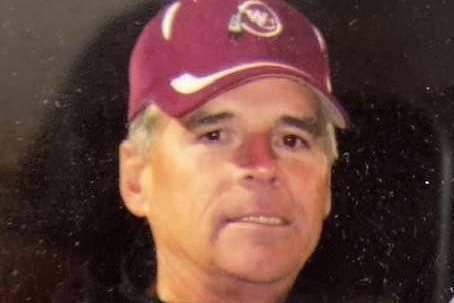
    Joe Walsh, 75, of West Chester, member of four athletic Halls of Fame, longtime high school and college football coach, retired health and physical education teacher at West Chester Henderson High School, mentor, and neighbor extraordinaire, died Tuesday, Jan. 27, of cancer at his home.

    Mr. Walsh grew up in the Farmbrook section of Levittown, Bucks County, and played football at the old Woodrow Wilson High School and what is now West Chester University. He got a job as a health and physical education teacher and assistant football coach at Henderson in 1972 and spent the next five decades coaching thousands of high school and college athletes, teaching thousands of high school students, and mentoring hundreds of friends and colleagues.

    He coached football, wrestling, lacrosse, and tennis at Henderson, and his football teams at Henderson and Sun Valley High School combined to win four league championships. He coached in 13 all-star football games and was named the Chester County area football coach of the year four times, the Ches-Mont League coach of the year three times, and the Del-Val League coach of the year once.

    In 1992, an Inquirer reporter asked him to describe himself. “I am an easygoing, volatile kind of coach,” he said with a big chuckle, the reporter wrote. “Actually,” he said, “I think I’m a player’s coach. I think my rapport with my players is my strong point.”
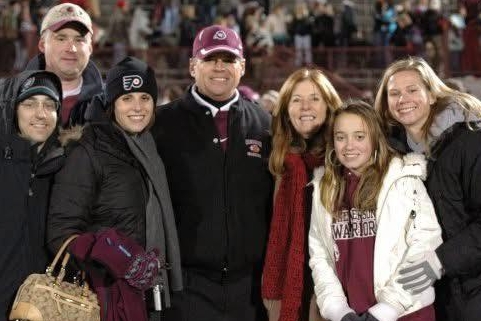
    Mr. Walsh (center) had many occasions to celebrate with family and friends on the football field.

    Former colleagues, players, and friends said in online tributes that Mr. Walsh was “an inspiration,” “a great coach,” and “a positive example for many, many young people.” On Threads, his brother, Russ, called him a “Hall of Fame human being.”

    “He was always there,” said John Lunardi, assistant principal at Henderson, who played quarterback for Mr. Walsh and served later as his assistant coach, “a steady, reliable role model, somebody who could be counted on no matter what.”

    In 20 years as head football coach at Henderson, from 1992 to 2011, Mr. Walsh’s teams won 131 games, lost 104, and captured three Ches-Mont League championships. From 1988 to 1991, he went 17-25 as head coach at Sun Valley and won the 1990 Del-Val League championship.

    His 2007 team at Henderson went 12-2, won the Ches-Mont title, and made it to the district championship game. “Our motto,” he told The Inquirer in 2004, “is no excuses, just results.”
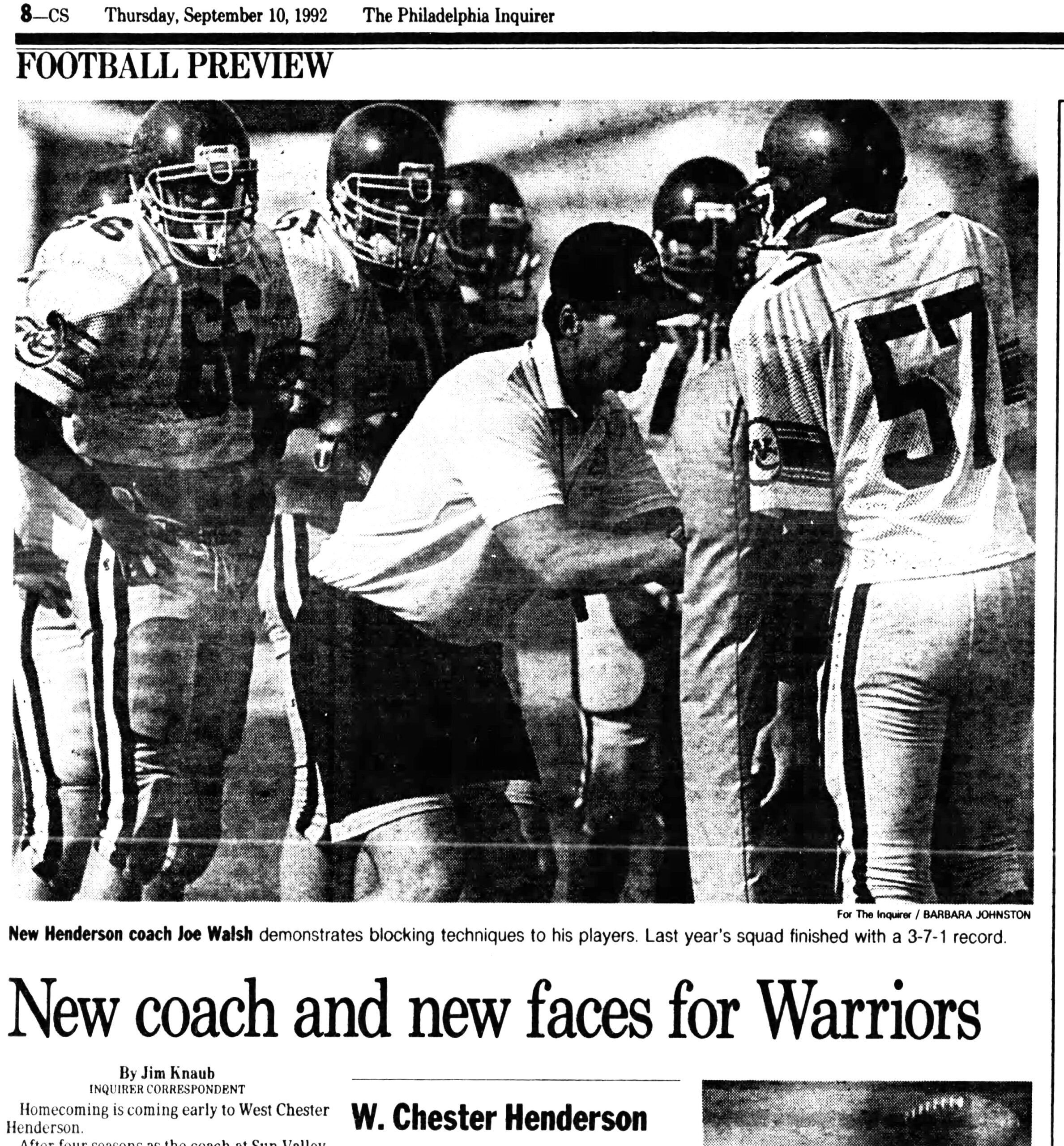
    Mr. Walsh and his Henderson football team were featured in The Inquirer’s 1992 preview section.

    He coached the West Chester University defensive linemen as an assistant for seven seasons after leaving Henderson and was inducted into the university’s Killinger Football Foundation Hall of Fame in 2001. He entered the Pennsylvania State Football Coaches Association Hall of Fame in 2014 and the Ches-Mont League Hall of Fame in 2018.

    In 2025, he was inducted into the Chester County Sports Hall of Fame, and colleagues there noted his “remarkable achievements and contributions to local athletics” in a Facebook tribute. He earned a standing ovation after speaking at the ceremony, and Henderson officials recognized his legacy with a moment of silence at a recent basketball game. They said in a tribute: “Joe Walsh was a Hall of Fame person in every possible way.”

    Mr. Walsh taught health and physical education at Henderson from 1972 to 2008. He organized offseason clinics to encourage all students to join sports teams and told The Inquirer in 1992: “I’ve always tried my best to get as many people out and make it enjoyable for them so they stay out.”

    He served as board president for the Killinger Football Foundation and cofounded W & W Option Football Camps LLC in 2001. “It wasn’t about the wins and losses for him,” said his wife, Pam. “It was all about the kids, and he was that way in all aspects of his life.”

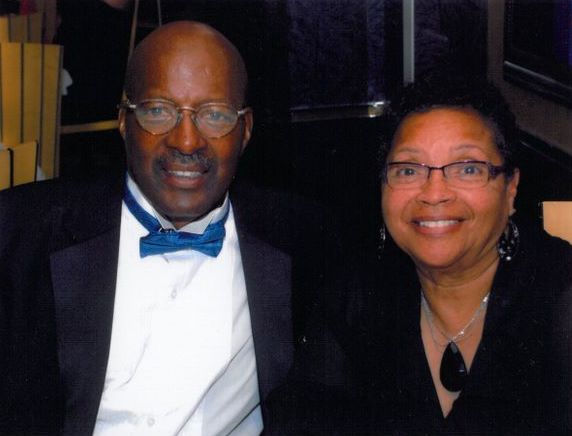
    Mr. Walsh and his wife, Pam, had many adventures together and spent countless afternoons at football games.

    Joseph Richard Walsh was born Feb. 5, 1950, in Philadelphia. He lettered in football, wrestling, and track in high school, and graduated from Wilson in 1968.

    He earned a bachelor’s degree in health and physical education at West Chester in 1972 and played center on its two-time championship football team.

    He married Sharon Clark, and they had a son, Joe, and a daughter, Kelly. After a divorce, he married Pam Connor in 1978, and they had a daughter, Jen, and lived in Downingtown and then West Whiteland Township since 1985.

    Mr. Walsh enjoyed all kinds of fishing and golf. In 2023, he and his wife visited half a dozen college football stadiums on a wild cross-country road trip to Yellowstone National Park.
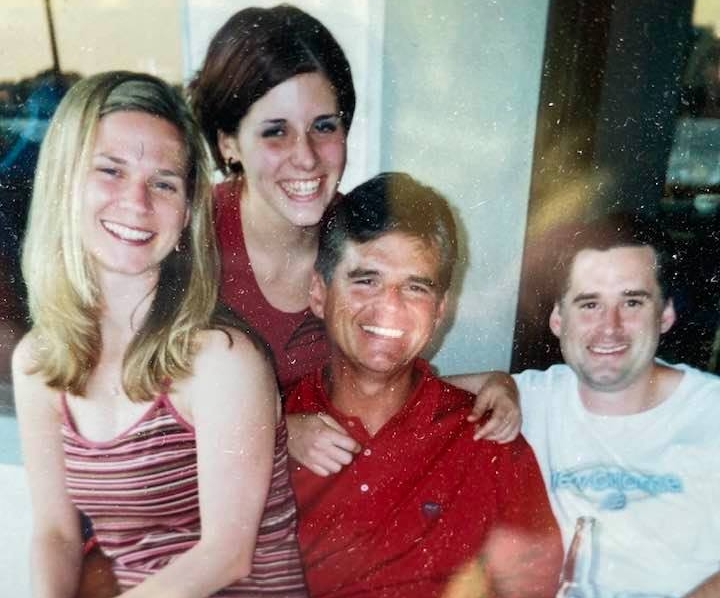
    Mr. Walsh enjoyed time with his children.

    They entertained often at home, and his gourmet soups were usually the hit of the party. He doted on his children and grandchildren, and never lost his sense of humor, they said.

    He was the best neighbor ever, friends said. He cleared miles of sidewalks and driveways with his snowblower every winter, hosted late-into-the-night firepit parties every summer, and could fix practically anything.

    “He was gentle but strong,” his wife said. “He was kind and considerate, and he never badmouthed anybody. He truly was a great man.”

    In addition to his wife, children, brother, and former wife, Mr. Walsh is survived by seven grandchildren, one great-granddaughter, sisters Eileen and Ruth, and other relatives.
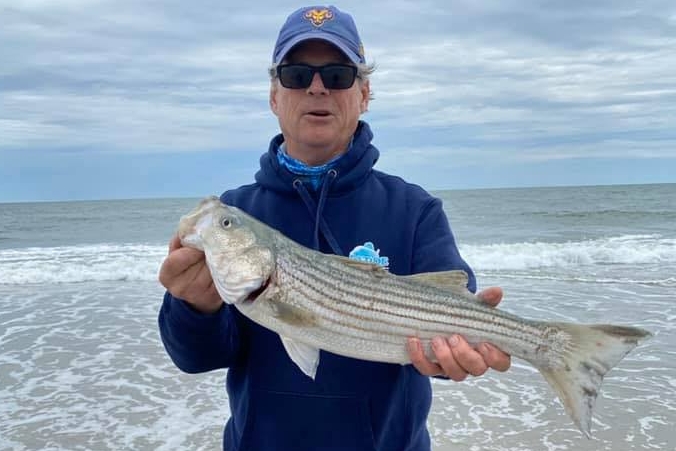
    Mr. Walsh rarely let the big ones get away.

    Visitation with the family is to be from 5 to 8 p.m. Thursday, Feb. 5, and from 9 to 10:30 a.m. Friday, Feb. 6, at DellaVecchia, Reilly, Smith & Boyd Funeral Home, 410 N. Church St., West Chester, Pa. 19380. A celebration of his life is to follow Friday at 10:30.

    Donations in his name may be made to the Joe Walsh Scholarship Fund, c/o the Athletic Department, West Chester Henderson High School, 400 Montgomery Ave., West Chester, Pa. 19380.
  • Evonn Wadkins, high school sports star at Simon Gratz and retired Philadelphia Mounted Police Officer, has died at 88

    Evonn Wadkins, high school sports star at Simon Gratz and retired Philadelphia Mounted Police Officer, has died at 88

    Evonn Wadkins, 88, formerly of Philadelphia, retired Philadelphia Mounted Police Officer, basketball and football star at Simon Gratz High School, builder, carpenter, plumber, bus driver, and volunteer, died Sunday, Jan. 11, of complications from a stroke at Bryn Mawr Extended Care Center.

    A gifted athlete with an innate desire to help others and be part of a team, Mr. Wadkins played basketball and football on Philadelphia playgrounds, in youth leagues and high school, and later with adults in semipro leagues and the Charles Baker Memorial Basketball League. He usually scored in double digits for the Gratz basketball team and went head-to-head against the legendary Sonny Hill and Wilt Chamberlain.

    He overcame a severe ankle injury when he was young and retired from the Baker League years later only after age and ailments forced him off the court. He was a “speedy end” on the football team at Gratz, the Daily Journal in Vineland said in 1955.

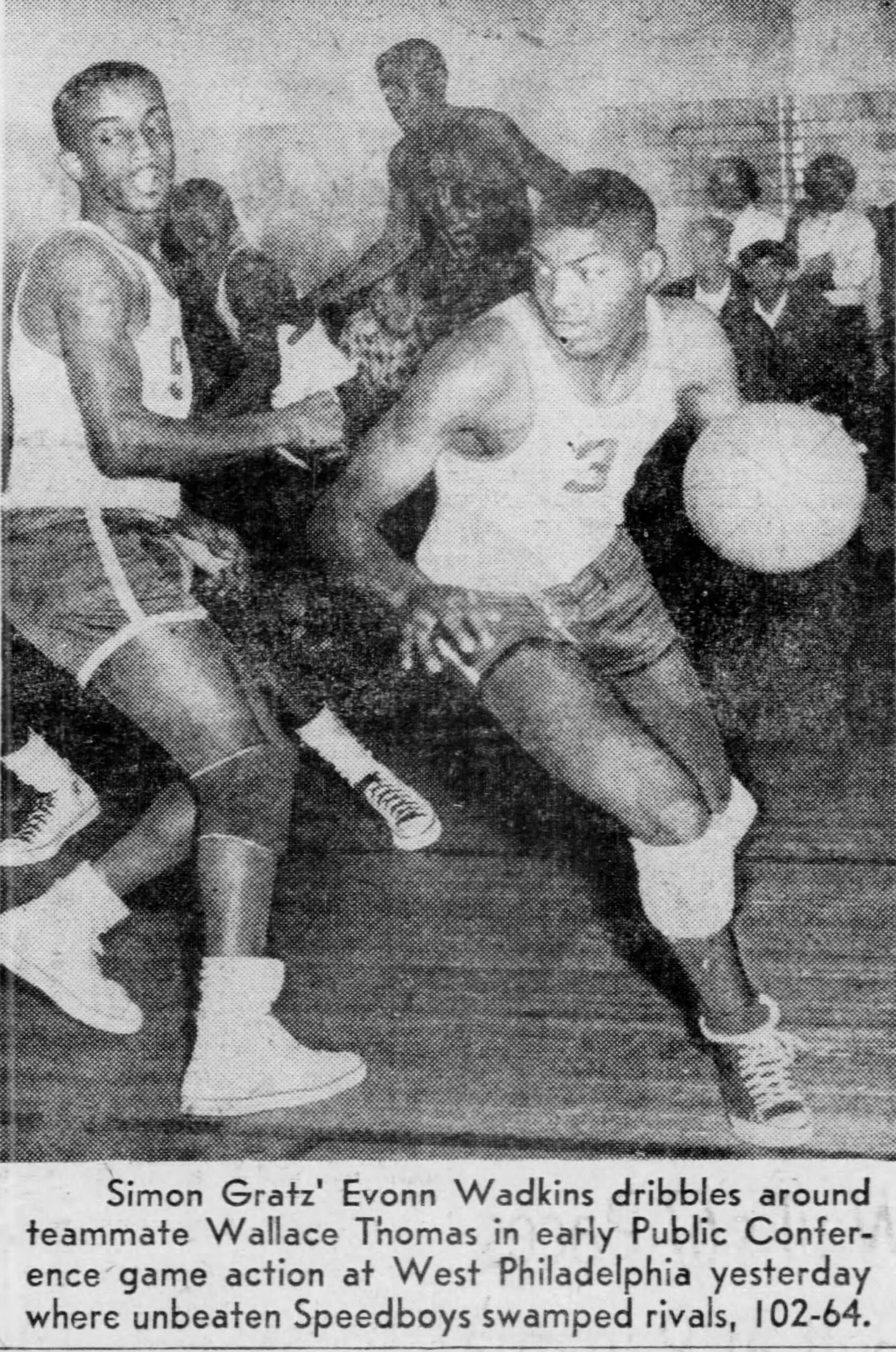
    His name appeared often in The Inquirer and other local newspapers in 1955 and ‘56, and they noted his 55-yard touchdown catch against Dobbins, 25-yard scoring reception against Vineland, and 44-yard scoring catch-and-run against Northeast in 1955.

    Mr. Wadkins (right) drives with the ball in this photo that was published in The Inquirer in 1956.

    Mr. Wadkins graduated from the Philadelphia Police Training Center in 1963 and spent 11 years patrolling Fairmount Park and elsewhere in the Traffic Division. He transferred to the Mounted Unit — and met Cracker Jack — in 1974, and officer and horse rode the Philly streets together until they both retired in 1988.

    “When he went on vacation, nobody could ride Cracker Jack,” said Mr. Wadkins’ wife, Elaine. “They could groom him. But Cracker Jack wouldn’t let anyone else ride him.”

    He also worked construction side jobs with neighbors and friends, and learned plumbing, heating, and carpentry skills. “Family and friends are still sleeping comfortably on his one-of-a-kind beds more than 40 years later,” his family said in a tribute.

    He drove a school bus for the School District of Philadelphia for 10 years in the 1980s and ’90s, and made friends with many of the students. He moved with his wife to Goochland, Va., 35 miles northwest of Richmond, in 1998.

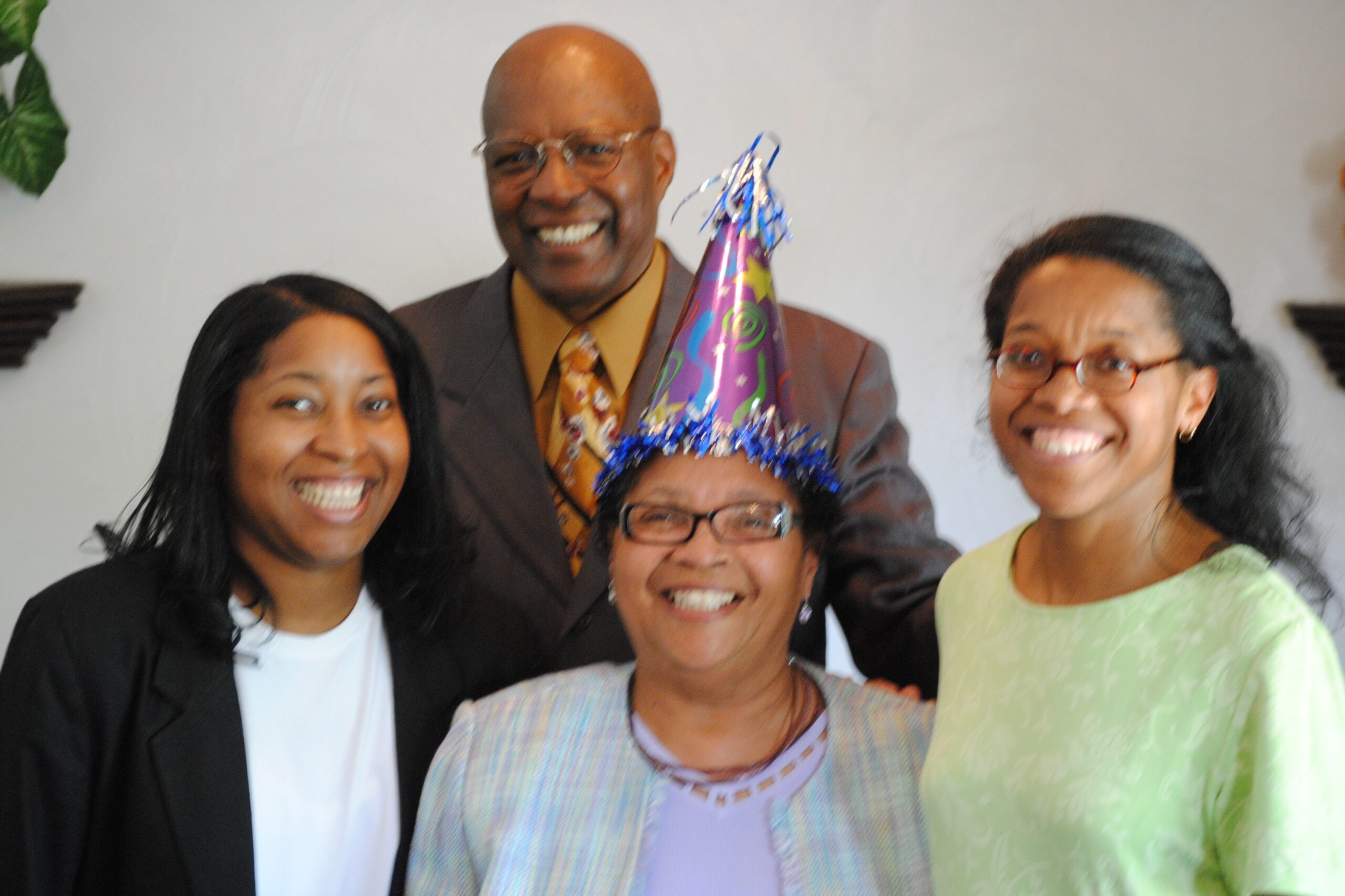
    Mr. Wadkins and his wife, Elaine, married in 1959.

    He joined the Goochland chapter of the NAACP and volunteered at the Second Union Rosenwald School Museum. At the Second Union Baptist Church, he mentored boys and young men, and supervised the media ministry.

    He was serious about community service. “He never met a stranger,” his wife said.

    Evonn LeFrancis Wadkins was born June 4, 1937, in Philadelphia. He was the fifth of six children and earned his high school degree at night school after leaving Gratz early.

    He met Flora Elaine Poole at Gratz in 1954, and they married in 1959. They set up house in West Philadelphia a few years later and had daughters Evette and Elise, and a son, Evonn.

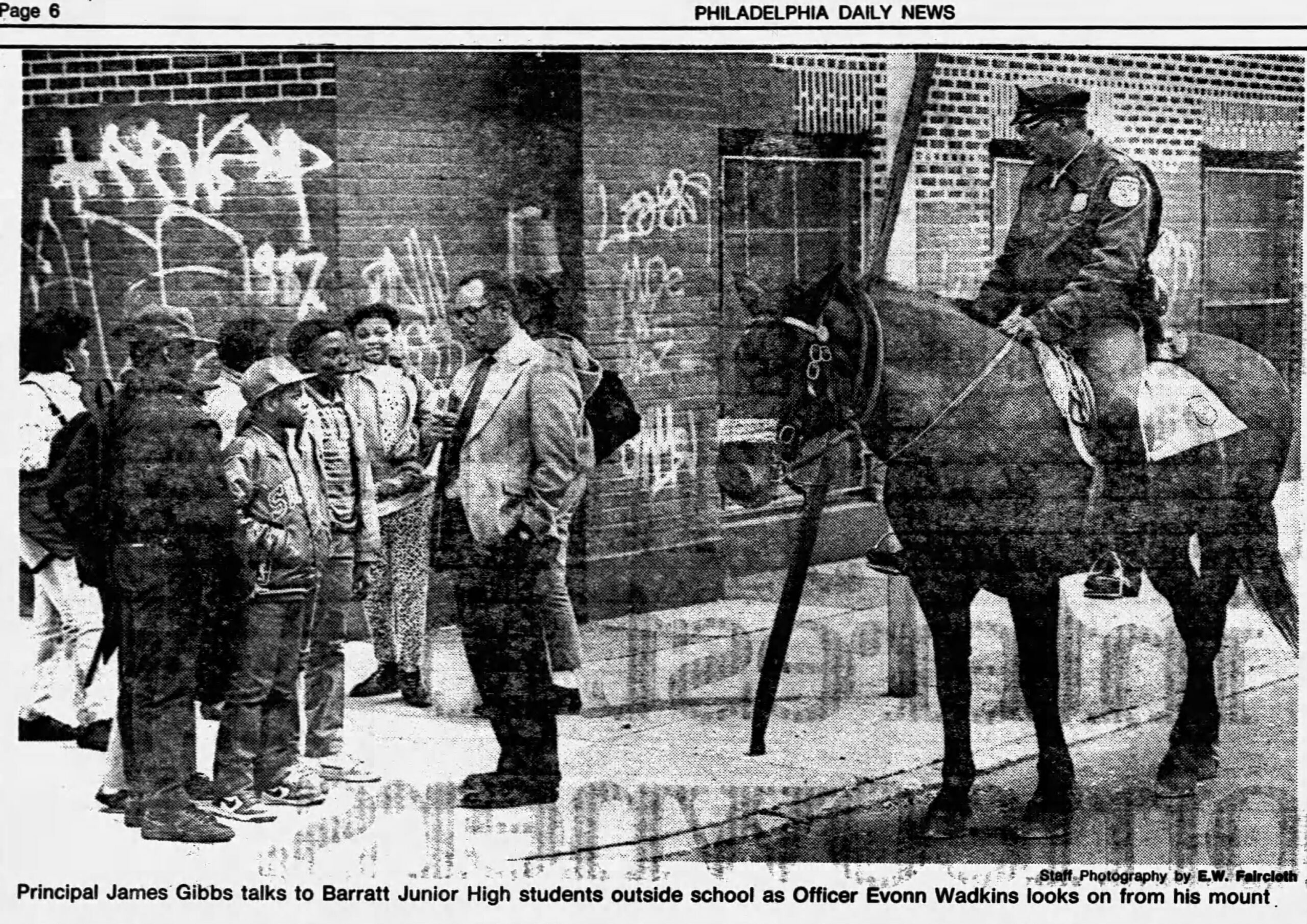
    This photo of Mr. Wadkins on his horse appeared in the Daily News in 1987.

    Mr. Wadkins, familiar with Fairmount Park from his time on police patrol, liked to share historical tidbits when the family drove through. He loved cars and traveled to Canada with his wife and to Germany with his brother to shop for several that caught his eye.

    He and his family traveled to Florida for a New Year’s party and to South Dakota to fly over Mount Rushmore. He and his wife cruised the Caribbean and toured the United States and Europe.

    He even flew with a friend to two Super Bowls. “He was a man on the go,” his family said.

    Mr. Wadkins liked McDonald’s pancakes and coached a few youth league basketball teams, one to a championship. When asked how he was doing, his usual response was: “Livin’ slow.”

    Mr. Wadkins enjoyed time with his family.

    His wife said: “He was a good provider. He was a great husband.”

    In addition to his wife and children, Mr. Wadkins is survived by five grandchildren, five great-grandchildren, a brother, and other relatives. Two brothers and two sisters died earlier.

    Private services were held earlier.

    Donations in his name may be made to the Police Athletic League of Philadelphia, 3068 Belgrade St., Philadelphia, Pa. 19134; and the Second Union Rosenwald School Museum, 2843 Hadensville-Fife Rd., Goochland, Va.

  • Helen Cherry, prolific illustrator and artist, has died at 101

    Helen Cherry, prolific illustrator and artist, has died at 101

    Helen Cherry, 101, formerly of Philadelphia, prolific illustrator, artist, and show tunes devotee, died Thursday, Jan. 15, of age-associated decline at her home in the Woodland Pond retirement community in New Paltz, N.Y.

    “It was her decision entirely,” said her daughter, Lynne. “She knew her own mind and made the decision that it was time for her to take flight to the Great Beyond.”

    A lifelong artist, Mrs. Cherry grew up drawing and painting in West Philadelphia. She earned a scholarship to the old Philadelphia College of Art, sold illustrations to the Jack and Jill children’s magazine, and took a 20-year hiatus in the 1950s and ’60s to rear her three children.

    She resumed her career at 50 in 1974 and went on to illustrate 30 books and dozens of magazine stories for Highlights, Cricket, and other publications. Using a combination of her maiden name, Cogan, and her married name, Cherry, she was published under the pseudonym of Helen Cogancherry.

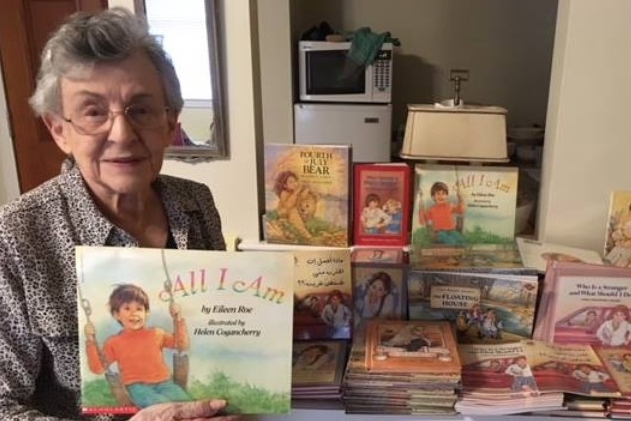
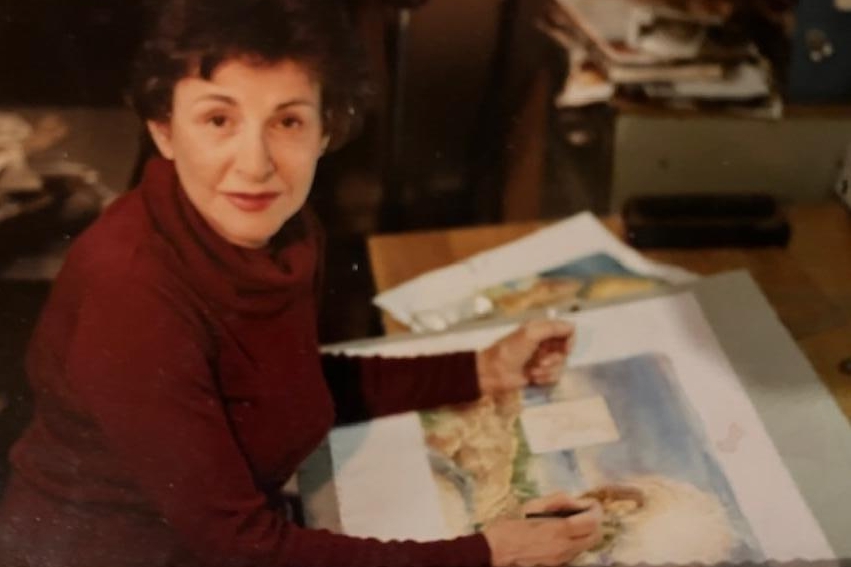
    Mrs. Cherry at work illustrating 1991’s “Fourth of July Bear.”

    “She was always an artist,” said her daughter, also an illustrator and writer. “Art was her hobby, her passion, her work. She said it was something that she can’t not do.”

    Mrs. Cherry was a keen and imaginative observer of life, adept at creating visuals that reflected the concepts of the writers with whom she worked. She illustrated many children’s books, such as All I Am, Warm as Wool, and The Floating House.

    She told The Inquirer in 1986 that a book she illustrated helped a girl she knew address a difficult childhood situation. “That made a profound impression on me,” she said. “I saw how my little books could help children.”

    Her career was featured in several publications, and she told The Inquirer that breaking back into the business in the 1970s was “discouraging at first.” She said: “I remember coming home sometimes and telling my husband that it was hopeless. He kept encouraging me to keep at it.”

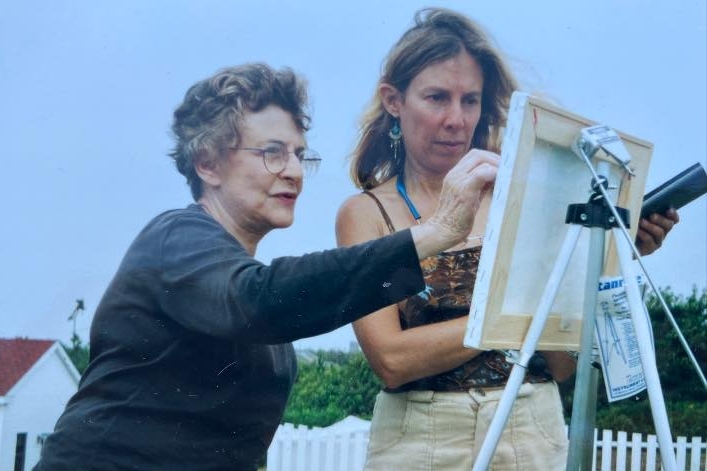
    Mrs. Cherry (left) and her daughter, Lynne, work on a project.

    Helen Cogan was born July 9, 1924, in a West Philadelphia rowhouse beneath the elevated railroad tracks. The middle of three children, she looked up to her sister, Molly, and cared for her younger brother, Robert, while her parents ran the small grocery store they lived above.

    She contributed illustrations to the yearbook and graduated from West Philadelphia High School. She met Herbert Cherry in French class and sent him beautifully illustrated letters while he served overseas during World War II.

    They married in 1950 and had a daughter, Lynne, and sons Steven and Michael. She helped her husband operate Cherry’s Pharmacy in Ridley Park for years, and they lived in Milmont Park and Wallingford in Delaware County, and Carlisle, Pa. She moved to New Paltz after her husband died in 2000.

    Mrs. Cherry often sang show tunes with family and friends, and while she worked. She whipped up memorable meals, especially on holidays, and enjoyed idyllic summers on family vacations at the Jersey Shore in Ventnor.

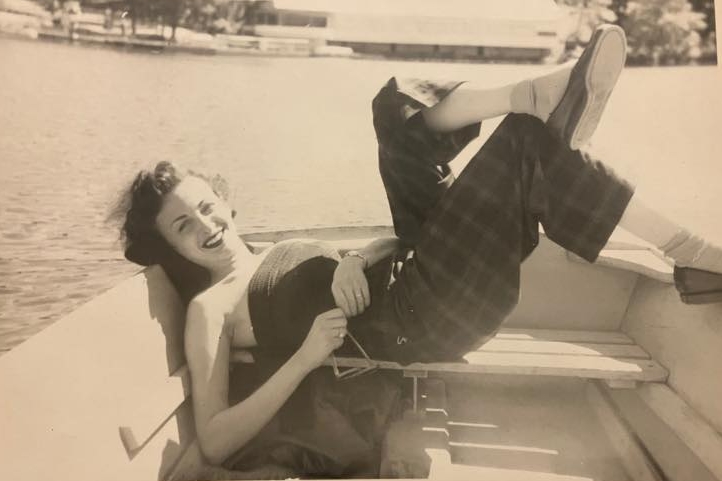
    Mrs. Cherry grew up in West Philadelphia.

    She tutored her children and their friends, and later her grandchildren, in drawing and painting. She showed everybody, her daughter said, “how to be a good human being in this world.”

    On Facebook, friends called her “warm,” “beautiful,” and “a talented giver.” One said: “The joy she radiated her whole life long was magical.”

    Her daughter said: “She was quiet and understated but strong.”

    Her favorite song was “Life is Just a Bowl of Cherries.” It opens with: “Life is just a bowl of cherries. Don’t take it serious. Life’s so mysterious.”

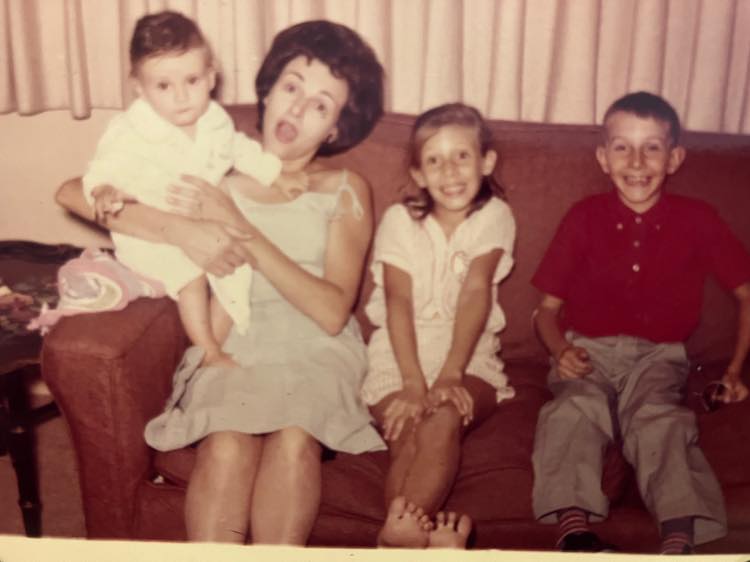
    Mrs. Cherry enjoyed time with her children.

    In addition to her children, Mrs. Cherry is survived by five grandchildren, a great-granddaughter, her brother, and other relatives. Her sister died earlier.

    A memorial service was held Sunday, Jan. 18. A celebration of her life is to be held later.

    Donations in her name may be made to the Children’s Environmental Literacy Foundation, Suite 130, 500 Summit Lake Dr., Valhalla, N.Y. 10595.

    Mrs. Cherry and her husband, Herbert, married in 1950.
  • Geoffrey Mason, 85, TV producer of 1972 Munich Olympics hostage crisis

    Geoffrey Mason, 85, TV producer of 1972 Munich Olympics hostage crisis

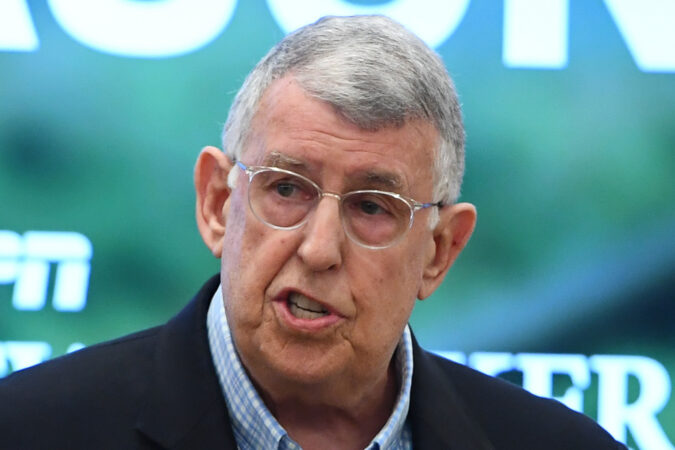
    Geoffrey Mason, who had a five-decade career in sports television and was best known as the coordinating producer for ABC’s coverage of the 1972 Munich Olympic Games hostage crisis, has died. He was 85.

    ESPN said Mr. Mason died Sunday in Naples, Fla. He died of natural causes, according to his family.

    “Geoff was a giant visionary in television, never seeking credit. He preferred leading and mentoring teams, connecting people to projects, and was devoted to people and recovery of all sorts. He was a great teacher and mentor to everyone who came in his orbit,” former ESPN President Steve Bornstein said.

    Over the course of his career, Mr. Mason worked on eight Olympics. As a young producer on Sept. 5, 1972, he was in the control room in Munich, Germany, when the Palestinian militant group Black September stormed the Olympic village and took Israeli Olympic team members hostage.

    ABC provided continuous coverage for 22 hours, culminating in a failed rescue attempt in which six Israeli coaches and five athletes died. Jim McKay broke the news with, “They’re all gone.”

    Mr. Mason was a consultant on the script and every aspect of production for the 2024 feature film September 5, which recreates what it was like in the ABC control room that day. The international broadcast center in Munich was 100 yards away from where the hostage crisis was taking place in the Olympic village.

    The movie recreates the moment when West German police stormed the control room and pointed guns at Mr. Mason’s face. This happened because one of ABC’s cameras was showing a tactical squad taking position on the roof above the hostages. Mr. Mason ended up cutting off the camera’s feed.

    It is estimated that nearly 900 million people worldwide at some point viewed ABC’s coverage.

    “Geoff told me that day there was no chance to think. Their singular goal was to stay on the air to keep the story going, to do their job as sports broadcasters,” said John Magaro, who played Mr. Mason, in 2025. “Once the clock starts ticking, there’s no chance to think.”

    Mr. Mason’s career was largely spent with ABC and ESPN, but he also worked for NBC, Fox, NFL Network, and other television entities. He began as a production associate at ABC Sports in 1967, working on Wide World of Sports and the 1968 Winter and Summer Olympics. Over the years, he earned 24 Emmy Awards and was inducted into the Sports Broadcasting Hall of Fame in 2010.

    He also worked on Super Bowl 25, Monday Night Football, the World Series, horse racing’s Triple Crown, the Indianapolis 500, and the FIFA Men’s and Women’s World Cup tournaments.

    He is also known for his coverage of the 1986-87 America’s Cup from Fremantle, Australia.

    “Geoff Mason was a friend and a colleague who had a storied career, touching just about every corner of the sports television industry,” said Bob Iger, CEO of the Walt Disney Company, which owns ABC and ESPN. “He had a passion for the business, which was evidenced in his prodigious work ethic and the constant love and enthusiasm he exhibited on everything he worked on.”

    Mr. Mason was selected by Jim Valvano as a founding board member of the V Foundation for Cancer Research and was a longtime board member of the Hazelden Betty Ford Foundation. He delivered a eulogy during Betty Ford’s funeral in 2011.

    “Geoffrey was a force of nature in our industry for six decades, but more important is all the help he gave to so many people through his association with the Betty Ford Center. He changed so many lives personally and professionally,” said former CBS Sports chairperson Sean McManus, who worked with Mr. Mason at both ABC and NBC.

    Mr. Mason was a veteran of the U.S. Navy and graduated from Duke University with a bachelor of arts degree in sociology in 1963. Survivors include wife Chris, son Geoff Jr., and brother David.

  • William Foege, 89, leader in smallpox eradication

    William Foege, 89, leader in smallpox eradication

    ATLANTA — William Foege, a leader of one of humanity’s greatest public health victories — the global eradication of smallpox — has died.

    Dr. Foege died Saturday in Atlanta at the age of 89, according to the Task Force for Global Health, which he co-founded.

    The 6-foot-7 inch Dr. Foege literally stood out in the field of public health. A whip-smart medical doctor with a calm demeanor, he had a canny knack for beating back infectious diseases.

    He was director of the U.S. Centers for Disease Control and Prevention in the late 1970s and early 1980s, and later held other key leadership roles in campaigns against international health problems.

    But his greatest achievement came before all that, with his work on smallpox, one of the most lethal diseases in human history. For centuries, it killed about one-third of the people it infected and left most survivors with deep scars on their faces from the pus-filled lesions.

    Smallpox vaccination campaigns were well established by the time Dr. Foege was a young doctor. Indeed, it was no longer seen in the United States. But infections were still occurring elsewhere, and efforts to stamp them out were stalling.

    Working as a medical missionary in Nigeria in the 1960s, Dr. Foege and his colleagues developed a “ring containment” strategy, in which a smallpox outbreak was contained by identifying each smallpox case and vaccinating everyone who the patients might come into contact with.

    The method relied heavily on quick detective work and was born out of necessity. There simply wasn’t enough vaccine available to immunize everyone, Dr. Foege wrote in House on Fire, his 2011 book about the smallpox eradication effort.

    It worked, and became pivotal in helping rid the world of smallpox for good. The last naturally occurring case was seen in Somalia in 1977. In 1980, the World Health Organization declared smallpox eradicated from the Earth.

    “If you look at the simple metric of who has saved the most lives, he is right up there with the pantheon. Smallpox eradication has prevented hundreds of millions of deaths,” said former CDC director Tom Frieden, who consulted with Dr. Foege regularly.

    Dr. Foege was born March 12, 1936. His father was a Lutheran minister, but he became interested in medicine at 13 while working at a drugstore in Colville, Wash.

    He got his medical degree from the University of Washington in 1961 and a master’s in public health from Harvard in 1965.

    He was director of the Atlanta-based CDC from 1977 to 1983, then held other international public health leadership roles, including stints as executive director at the Carter Center and senior fellow at the Bill and Melinda Gates Foundation.

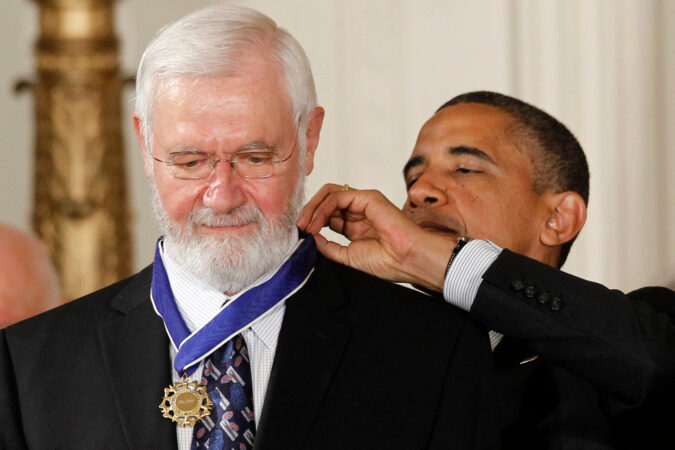
    In 2012, President Barack Obama presented Dr. Foege with the Medal of Freedom, the nation’s highest civilian honor. In 2016, while awarding Dr. Foege an honorary degree, Duke University President Richard Brodhead called him “the Father of Global Health.”

    “Bill Foege had an unflagging commitment to improving the health of people across the world, through powerful, purpose-driven coalitions applying the best science available,” Task Force for Global Health CEO Patrick O’Carroll said in a statement. “We try to honor that commitment in every one of our programs, every day.”

  • Joseph R. Syrnick, retired chief engineer for the Streets Department and CEO of the Schuylkill River Development Corp., has died at 79

    Joseph R. Syrnick, retired chief engineer for the Streets Department and CEO of the Schuylkill River Development Corp., has died at 79

    Joseph R. Syrnick, 79, of Philadelphia, retired chief engineer and surveyor for the Philadelphia Streets Department, president and chief executive officer of the Schuylkill River Development Corp., vice chair of the Philadelphia City Planning Commission, former adjunct professor, college baseball star at Drexel University, mentor, and “the ultimate girl dad,” died Saturday, Jan. 17, of cancer at his home in Roxborough.

    Reared on Dupont Street in Manayunk and a Roxborough resident for five decades, Mr. Syrnick joined the Streets Department in 1971 after college and spent 34 years, until his retirement in 2005, supervising hundreds of development projects in the city. He became the city’s chief engineer and surveyor in 1986 and oversaw the reconstruction of the Schuylkill Expressway and West River Drive (now Martin Luther King Jr. Drive) in the 1980s, and the addition of new streetlights and trees on South Broad Street and the upgrade of six city golf courses in the 1990s.

    He was an optimist and master negotiator, colleagues said, and he worked well with people and the system. “You have concepts that seem simple,” he told The Inquirer in 1998. “But when you commit them to writing, they raise all kinds of other questions.”

    In 2000, as Republicans gathered in Philadelphia for their national convention, Mr. Syrnick juggled transit improvements on Chestnut Street and problems with the flags on JFK Boulevard. He also helped lower speed limits in Fairmount Park and added pedestrian safety features on Kelly Drive.

    He beautified Penrose Avenue and built a bikeway in Schuylkill River Park. He even moderated impassioned negotiations about where the Rocky statue should be placed.

    Since 2005, as head of the Schuylkill River Development Corp., he deftly partnered with public and private agencies, institutions, and corporations, and oversaw multimillion-dollar projects that built the celebrated Schuylkill River Trail, renovated a dozen bridges, and generally improved the lower eight-mile stretch of the Schuylkill, from the Fairmount Dam to the Delaware River, known as Schuylkill Banks.

    In an online tribute, colleagues at the Schuylkill River Development Corp. praised his “perseverance and commitment to revitalizing the tidal Schuylkill.” They noted his “legacy of ingenuity, optimism, and service.” They said: “Joe was more than an extraordinary leader. He was a great Philadelphian.”

    Dennis Markatos-Soriano, executive director of the East Coast Greenway Alliance, said on Facebook: “He exuded confidence, humility, and unwavering commitment.”

    Mr. Syrnick reviews plans to extend a riverside trail in 2009.

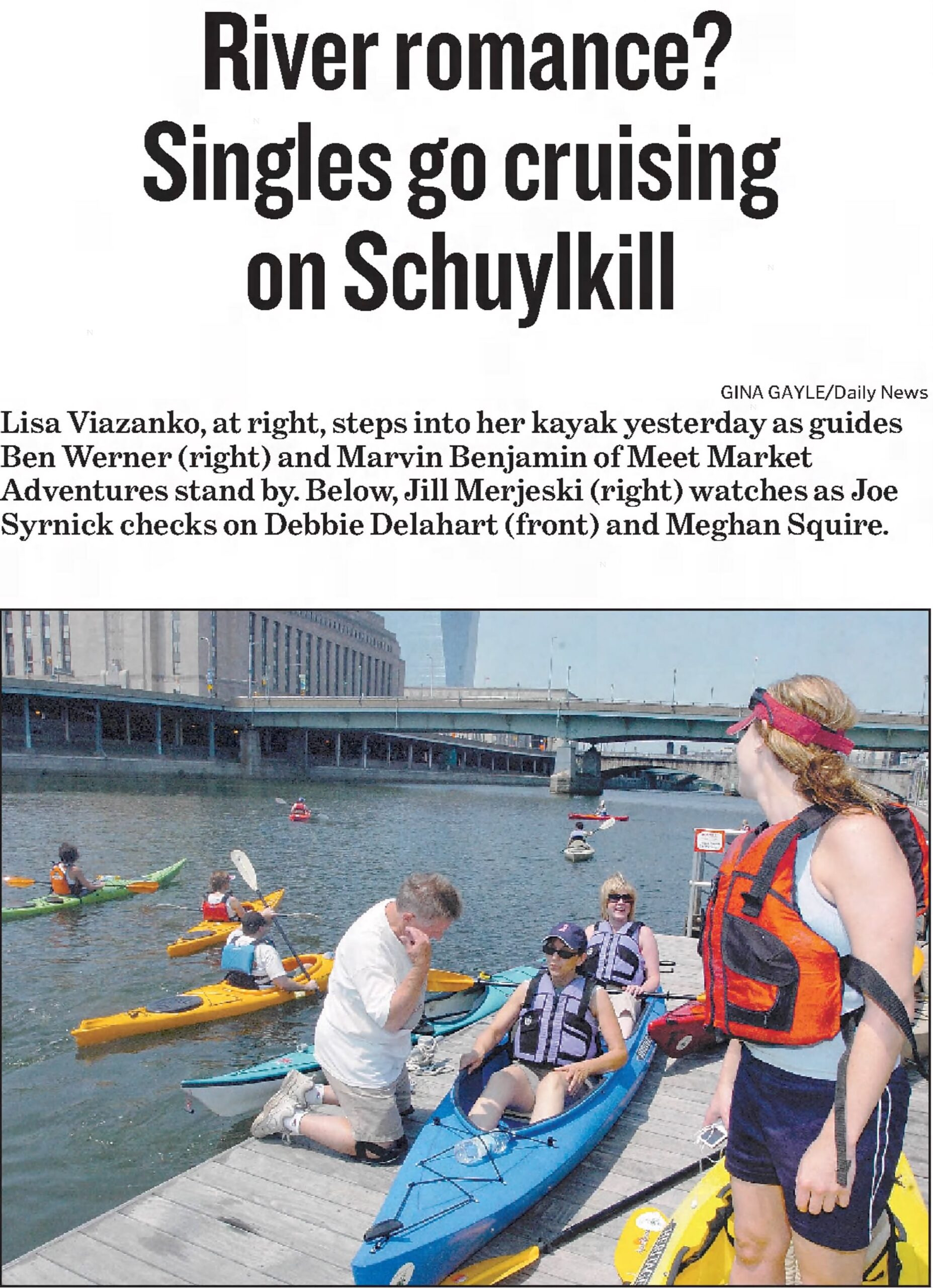
    Mr. Syrnick was a constant presence on riverside trails, other hikers said. He organized regattas and movie nights, hosted riverboat and kayak tours, cleaned up after floods, and repurposed unused piers into prime fishing platforms.

    “Great cities have great rivers,” Mr. Syrnick told The Inquirer in 2005. “Here in Philadelphia, we have Schuylkill Banks.”

    He was a Fairmount Park commissioner for 18 years, was named to the Philadelphia City Planning Commission in 2008, and served as vice chair. He lectured about the Schuylkill often and taught engineering classes and led advisory panels at Drexel. In 2015, he testified before the state Senate in support of a waterfront development tax credit.

    Friends called him “a visionary,” “a true hero,” and “a Philly jewel.” One friend said: “He should be honored by a street naming or something.”

    Mr. Syrnick (fourth from left) and his family pose near a riverboat.

    Paul Steinke, executive director of the Preservation Alliance for Greater Philadelphia, said on Facebook: “He left his native Philadelphia a much better place.”

    Mr. Syrnick was president of the Philadelphia Board of Surveyors and active with the American Society of Civil Engineers, the Engineers’ Club of Philadelphia, and other organizations. At Drexel, he earned a bachelor’s degree in civil engineering in 1969 and a master’s degree in 1971.

    In 2024, Drexel officials awarded him an honorary doctorate for “his visionary leadership in engaging diverse civic partners to revive the promise of a waterfront jewel in Philadelphia.”

    He played second base on the Roman Catholic High School baseball team. He was captain of the 1968 Drexel team and later played against other local standouts in the old Pen-Del semipro league.

    Mr. Syrnick (center in white shirt) had all kinds of way to publicize fun on the Schuylkill. This photo appeared in The Inquirer in 2007.

    Most of all, everyone said, Mr. Syrnick liked building sandcastles on the beach and hosting tea parties with his young daughters and, later, his grandchildren. He grew up with three brothers. Of living with three daughters, his wife, Mary Beth, said: “It was a shock.”

    His daughter Megan said: “It was a learning experience. Whether it was sports or tea parties, he became the ultimate girl dad.”

    Joseph Richard Syrnick was born Dec. 19, 1946, in Philadelphia. He spent many summer days riding bikes with pals on Dupont Street and playing pickup games at the North Light Community Center.

    He knew Mary Beth Stenn from the neighborhood, and their first date came when she was 14 and he was 15. They married in 1970, moved up the hill from Manayunk to Roxborough, and had daughters Genevieve, Amy, and Megan.

    Mr. Syrnick received his honorary doctorate from Drexel in 2024.

    Mr. Syrnick enjoyed baseball, football, and golf. He was active at St. Mary of the Assumption and Holy Family Churches, and he and his wife traveled together across Europe, Africa, the Middle East, and Asia.

    “He was humble,” his daughter Megan said. “He was quiet in leadership. He always said: ‘It’s the team.’”

    In addition to his wife and daughters, Mr. Syrnick is survived by seven grandchildren, his brother Blaise, and other relatives. Two brothers died earlier.

    Visitation with the family is to be from 6 to 8 p.m. Friday, Jan. 23, at Koller Funeral Home, 6835 Ridge Ave., Philadelphia, Pa. 19128, and 9:30 a.m. Saturday, Jan. 24, at Holy Family Church, 234 Hermitage St., Philadelphia, Pa. 19127. A Mass celebrating his life is to follow at 11 a.m.

    Donations in his name may be made to the Basilica Shrine of Our Lady of the Miraculous Medal, 475 E. Chelten Ave., Philadelphia, Pa. 19144; and Holy Family Parish, 234 Hermitage St., Philadelphia, Pa. 19127.

    Mr. Syrnick (left) and his brother, Blaise, enjoyed being around water.
  • Carla Washington Hines, longtime dancer, choreographer, and teacher, has died at 72

    Carla Washington Hines, longtime dancer, choreographer, and teacher, has died at 72

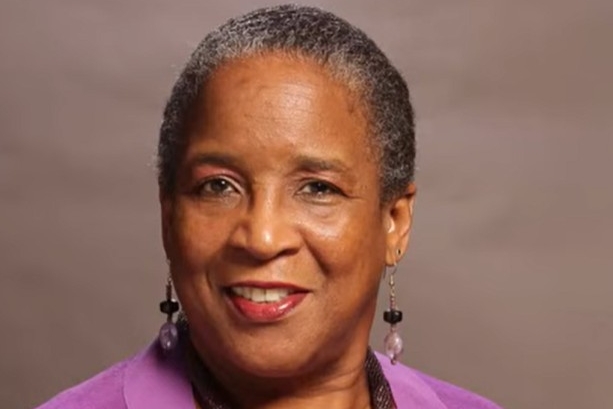
    Carla Washington Hines, 72, of Philadelphia, longtime dancer, pioneering choreographer, celebrated teacher, former artistic director, collaborator extraordinaire, and mentor, died Sunday, Nov. 2, of sepsis at Temple University Hospital-Jeanes Campus.

    Mrs. Hines came to Philadelphia from Virginia in 1974 after college and spent the next four decades dancing, teaching, lecturing, traveling, and generally advocating for arts in education from kindergarten through college. She danced with the Sun Ra Arkestra, the John Hines Dance Co., and other troupes at all sorts of venues in Philadelphia, New York, Chicago, elsewhere in the United States, and throughout Europe.

    She choreographed original performances such as “Montage in Black,” “Reflections,” and “Life Cycle,” and collaborated with notable jazz musicians Herbie Hancock and Alice Coltrane, and other musical stars. She was a guest on TV and radio shows, read poetry at public events, and earned awards from the Pennsylvania Council on the Arts and the Philadelphia-based Bartol Foundation for education.

    She was an expert in jazz dance, modern dance, ballet, and posture, and she lectured, organized workshops, and taught the elements of dance and choreographic principles at schools, colleges, art centers, drama guilds, libraries, and elsewhere around the country. Her mother, Thelma, was a dancer and teacher, too, and Mrs. Hines championed the connection between an interest in the arts and academic success.

    “In dance, I can be anything I want to be,” she said in an online interview. “That’s the magic of the arts.”

    She created an afterschool residency at a Universal charter school and taught dance at E.M. Stanton Elementary School, Strawberry Mansion High School, and other schools. She said in the online interview that her curriculum “is based on the appreciation of dance and movement,” and that it helps students “make sense of their lives using dance as a tool for learning.”

    She said: “I want them to be able to understand through movement exploration how dance can change one’s life.”

    She was artistic director for the Philadelphia chapter of the Institute for the Arts in Education and at the Point Breeze Performing Arts Center. “Her creative guidance helped students tell powerful cultural stories through movement,” her family said.

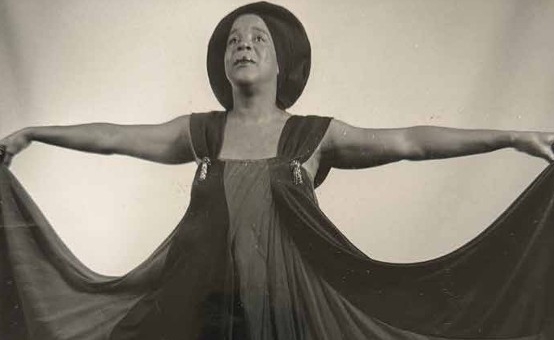
    Mrs. Hines performed with the Jones-Haywood Dance School in Washington before moving to Philadelphia.

    As longtime community engagement manager for the Philadelphia Clef Club of Jazz and Performing Arts, Mrs. Hines wrote grants and choreographed performances. She was executive director of the John Coltrane Cultural Society and active at the old University of the Arts.

    Her family said: “She devoted her life to creativity and to nurturing talent in others.”

    Carla Yvette Washington was born Nov. 3, 1952, in Charleston, W.Va. Her family moved to Grambling, La., when she was young, and she graduated from high school in 1970.

    She was named Miss Freshman at what is now Grambling State University, joined the Alpha Kappa Alpha Inc. sorority, and earned a bachelor’s degree in recreation in 1973. In 1981, she earned a master’s degree in fine arts and dance at the old Philadelphia College of the Performing Arts.

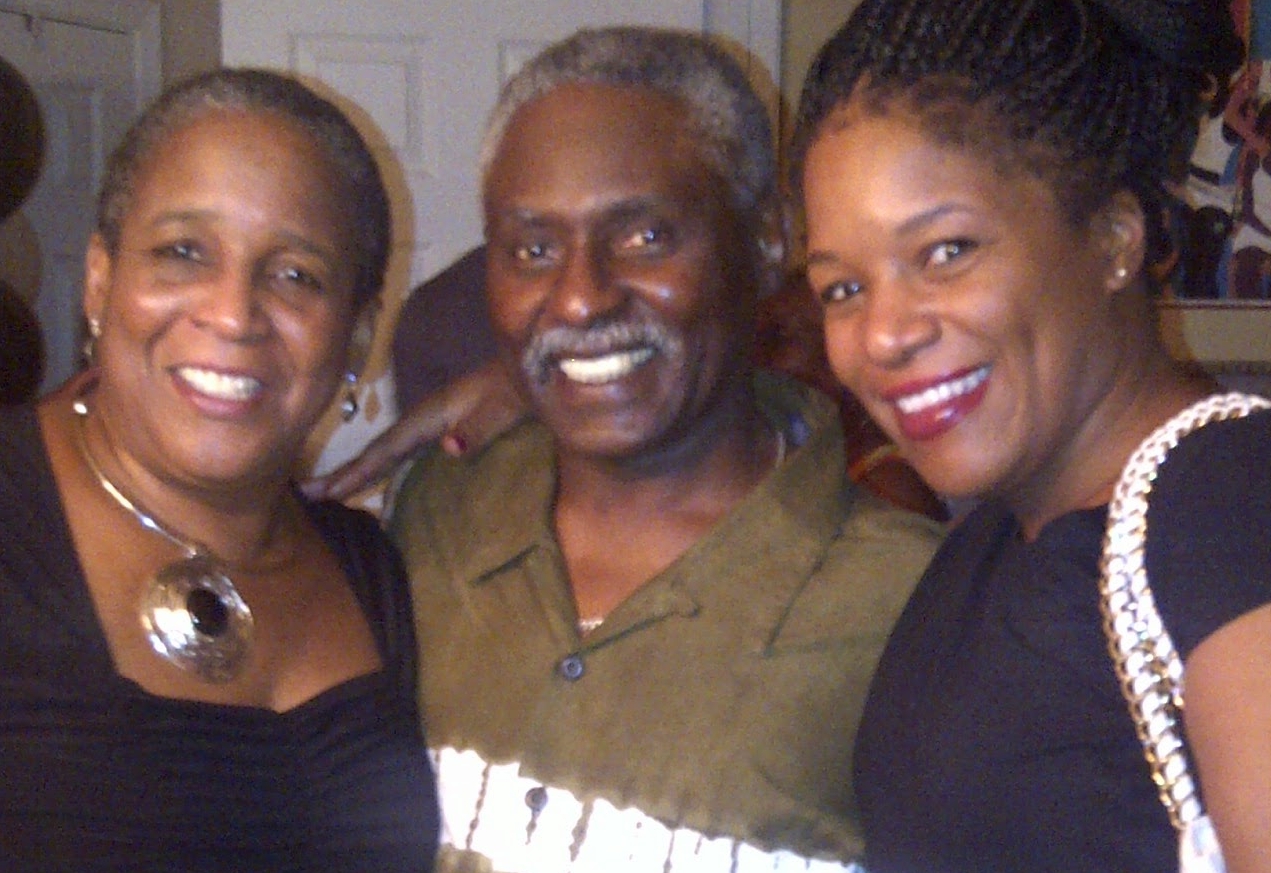
    Mrs. Hines (left) smiles with her husband, Lovett, and their daughter, Zara.

    She worked as a dance teacher for the Fairfax County Department of Recreation in Virginia after college and performed with the Jones-Haywood Dance School in Washington before moving to Philadelphia.

    She met jazz musician Lovett Hines Jr. when they were students at Grambling and they married in 1984 and lived in West Oak Lane. They had a daughter, Zara, and Mrs. Hines welcomed her husband’s son, Lovett III, and his family into her family.

    “She introduced many creatives to dance and culture, and sparked their creative careers,” her stepson said. “That is the essence of her legacy.”

    Mrs. Hines and her husband, their daughter said, were “a partnership of two geniuses.” He played the saxophone and was artistic director at the Clef Club. She loved the drums, and they collaborated seamlessly on many notable projects.

    Friends called her “a sweetheart” and “a beautiful soul” in online tributes. One said she “made an impact on Philadelphia and beyond in countless ways.” Her sister, Alicia Williams, said: “Everyone had a special relationship with her.”

    Mrs. Hines graduated from Grambling High School in Louisiana in 1970.

    Mrs. Hines was diagnosed with a lung disease in 2024 and Stage 4 cancer in 2025. “She was stern but soft,” her daughter said, “loving but able to tell you like it is.”

    Her husband said: “She had special relationships with so many musicians, so many people. It was through insight, understanding, and patience. In them, we see her everyplace, feel her everyplace.”

    In addition to her husband, daughter, mother, and stepson, Mrs. Hines is survived by three sisters, two step-grandsons, and other relatives. A brother died earlier.

    Services were held Wednesday, Dec. 17.

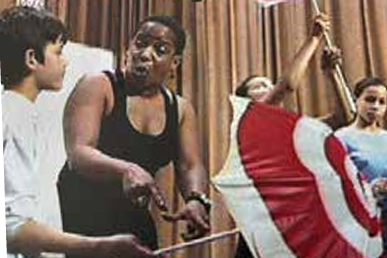
    Mrs. Hines (center) said she adapted her teaching techniques to suit the needs and ages of the students.
  • Daniel Segal, longtime Philadelphia attorney and community activist, has died at 79

    Daniel Segal, longtime Philadelphia attorney and community activist, has died at 79

    Daniel Segal, 79, of Philadelphia, cofounder and shareholder of the Hangley Aronchick Segal Pudlin & Schiller law firm, adjunct law professor at the University of Pennsylvania, former cochair of the Philadelphia Soviet Jewry Council, onetime board president at the Juvenile Law Center, mentor, and “mischievous mensch,” died Thursday, Jan. 8, of stomach cancer at his home.

    Born and reared in Washington, Mr. Segal moved to Philadelphia in 1976 to teach at what is now Penn Carey Law School. He went into private law practice in 1979, became cochair of a litigation department in 1993, and joined with colleagues in 1994 to establish Hangley Aronchick Segal & Pudlin.

    For more than 40 years, until his recent retirement, Mr. Segal handled all kinds of cases for all kinds of clients, including The Inquirer. He was an expert in juvenile law, defamation, the First Amendment, professional ethics, education, civil rights, and other legal issues.

    He was president of the board at the Juvenile Law Center and worked pro bono for years, beginning in 2009, to help represent more than 2,400 juvenile victims and win millions of dollars in settlements in what is known as the Luzerne County “kids-for-cash” case. In that case, two judges were convicted of taking kickbacks for illegally sending juveniles to two private for-profit detention facilities.

    “This is one of the worst judicial scandals in history,” Mr. Segal told The Inquirer in 2009. “The people you’re stepping on are the true, true little guys.”

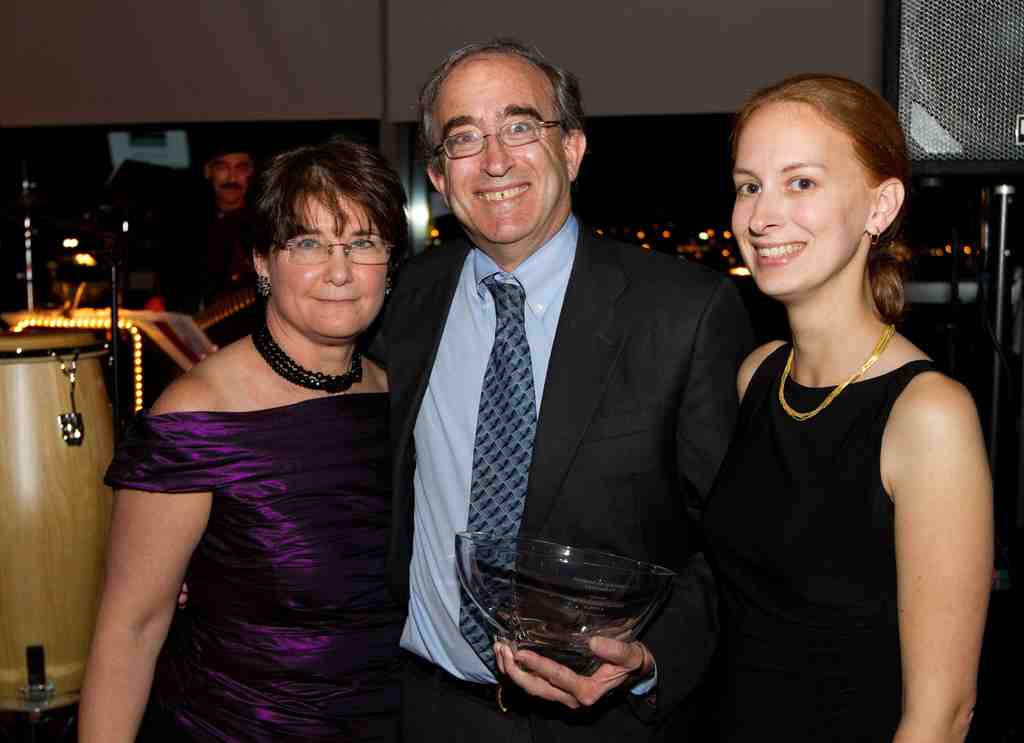
    Mr. Segal was honored in 2010 by the Philadelphia Bar Foundation.

    Among his other notable cases are a 1985 workplace racial discrimination dispute, a 1990 libel case against The Inquirer, and a 2000 trial about the city taxing outdoor advertisers. “Dan Segal was a living testament to professional excellence,” said Mark Aronchick, his law partner and longtime friend.

    Law partner and friend John Summers said: “He was a great teacher and mentor.” Marsha Levick, cofounder of the Juvenile Law Center, said: “He was a brilliant, steady partner who made us smarter and kept us laughing.”

    Mr. Segal clerked for Chief Judge David Bazelon in the U.S. Court of Appeals for the District of Columbia Circuit in 1974 and for Supreme Court Associate Justice Thurgood Marshall in 1975. He was active with the Philadelphia Bar Association, Philadelphia Common Pleas Court, and the Penn Law School American Inn of Court.

    He wrote articles for legal journals and letters to the editor of The Inquirer and Daily News. He spoke at panels and conferences, earned honors from legal organizations and trade publications, and was named the Thomas A. O’Boyle adjunct professor of law at Penn in 1992.

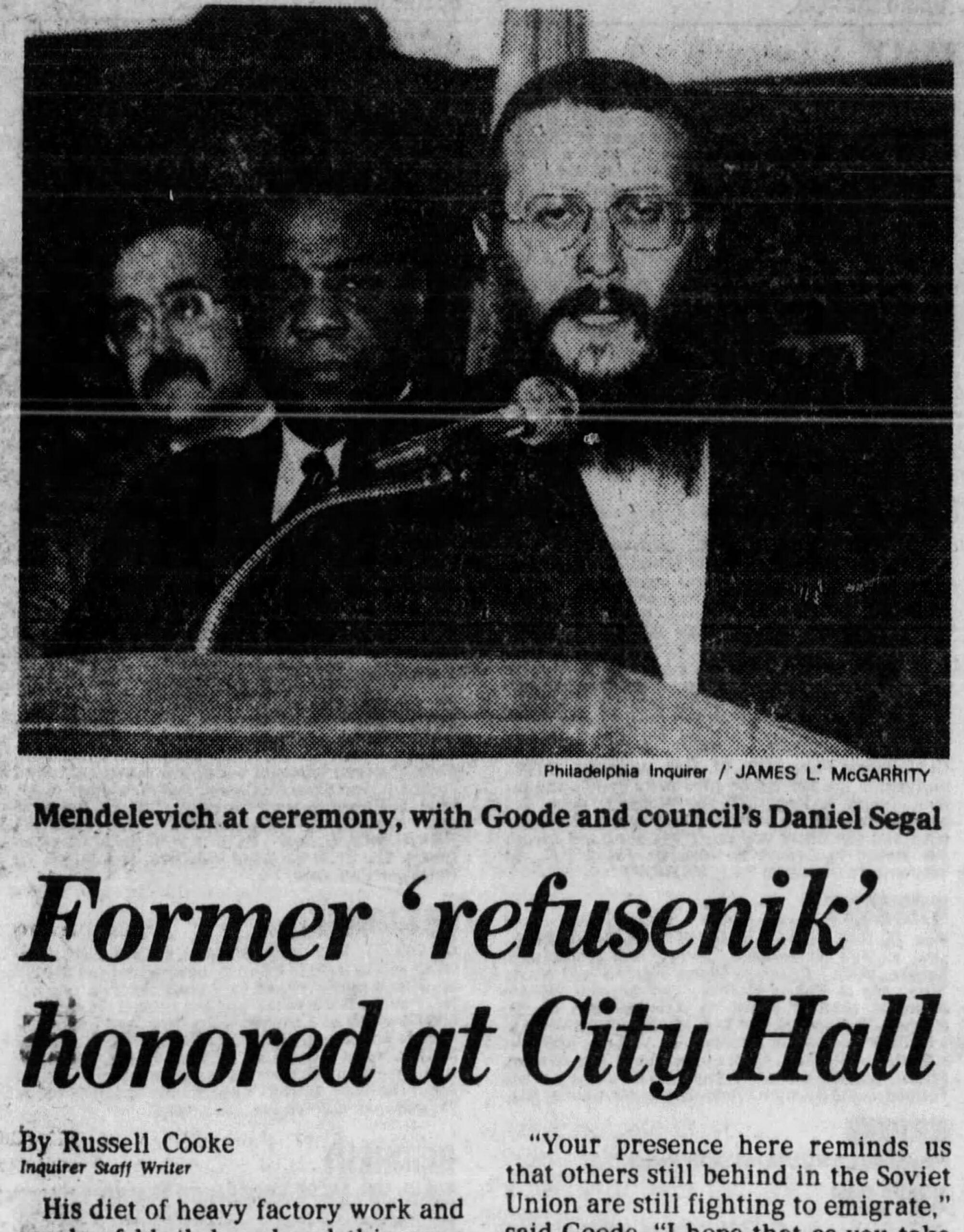
    This story and photo features Mr. Segal (left) and appeared in The Inquirer in 1984.

    The son of a rabbi, Mr. Segal was cochair of the Soviet Jewry Council in the 1980s, and he organized rallies and marches for social justice and human rights. He traveled to Israel often and to the old Soviet Union several times to secretly support Jews not permitted by government officials to immigrate to Israel.

    “We are persuaded that the Soviet Jews are pawns in the Soviet-American relationship,” he told The Inquirer in 1985.

    He served as president of the board of directors at what is now Jack M. Barrack Hebrew Academy and held leadership roles with the Jewish Community Relations Council, the New Israel Fund, Mazon: A Jewish Response to Hunger, and other organizations.

    Colleagues at the New Israel Fund praised his “characteristic kindness” and “gentle and sparkling humor” in an online tribute. They said: “He was everyone’s favorite board member.”

    Mr. Segal and his wife, Sheila, married in 1968.

    Mr. Segal enjoyed pranks and funny jokes, even at work, and neighbors called him Silly Dan. His son Josh said: “His warmth, humor, and humility meant that he could connect with just about anyone.” A friend said he was a “mischievous mensch.”

    He earned his law degree in 1973 and was executive editor of the Law Review at Harvard University Law School. He earned a bachelor’s degree in politics and economics at Yale University in 1968 and a master’s degree in international relations from the London School of Economics in 1969.

    He taught elementary school for a year in Washington and spent another year in Europe before moving to Philadelphia. “He taught us just how important it is to stand up for what is right,” his son Eli said, “and to do so not only with conviction but with humility and kindness, and without a thought of getting personal credit.”

    Daniel Segal was born July 4, 1946. He started dating Sheila Feinstein in ninth grade, and they married after college in 1968. They had sons Josh and Eli, and lived in Center City and Lower Merion before moving to Fairmount in 2018.

    Mr. Segal’s sons said: “Our dad showed us that relationships are the heart of a life well-lived by nurturing lifelong friendships.”

    Mr. Segal loved chocolate and ice cream. He recovered from a traumatic brain injury 20 years ago, and he and his wife traveled to Iceland, Peru, Vietnam, Europe, Japan, and elsewhere.

    He doted on his family and friends, and he and his wife rented vacation places every summer to bring his sons and their families together. “Neither of us were surprised that our dad always made our kids feel so loved,” his son Eli said. “Because that was just how he made us feel.”

    In addition to his wife and sons, Mr. Segal is survived by six grandchildren, a sister, a brother, and other relatives.

    Services were held Sunday, Jan. 11.

    Donations in his name may be made to the New Israel Fund, 1320 19th St. N.W., Suite 1400, Washington, D.C. 20036; and Mazon: A Jewish Response to Hunger, Box 6095, Albert Lea, Minn. 56007.

    Mr. Segal’s sons said: “He was always there for us and made clear that he always would be for as long as he could.”
  • Frank P. Olivieri, longtime owner of Pat’s King of Steaks, has died at 87

    Frank P. Olivieri, longtime owner of Pat’s King of Steaks, has died at 87

    Frank P. Olivieri, 87 — whose uncle and father invented the steak sandwich and who ran the landmark Pat’s King of Steaks for nearly four decades — died Sunday, Jan. 18. He had been under care for dementia, said his son, Frank E. Olivieri, who has run the shop since his father’s 1996 retirement.

    Though the Olivieri name spread through Philadelphia over the years through various shops, Mr. Olivieri spent his entire working life at the intersection of Ninth, Wharton, and Passyunk in South Philadelphia. “I’m on my own little island,” he told The Inquirer in 1982.

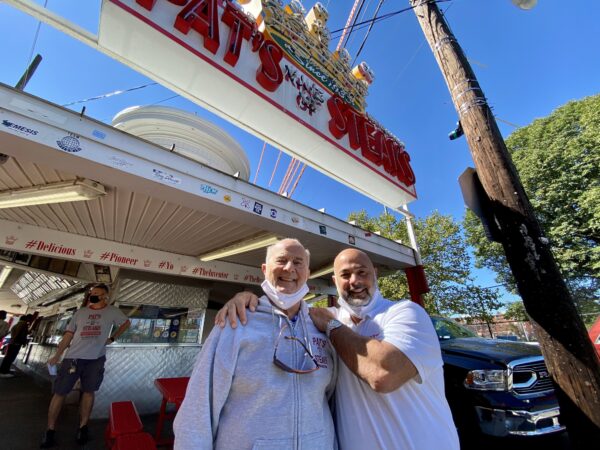
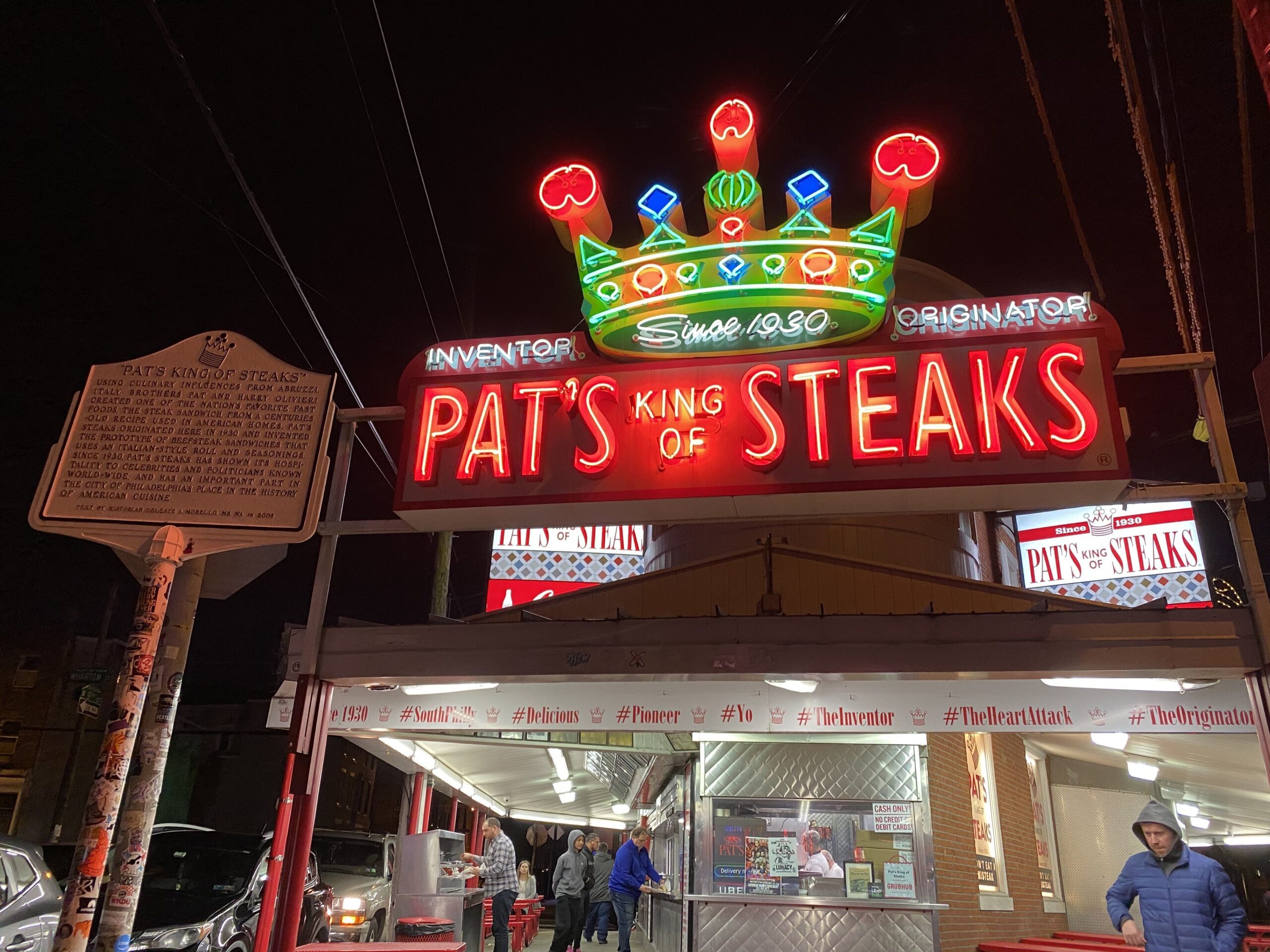
    Pat’s King of Steaks, at Ninth Street, Wharton Street, and Passyunk Avenue, in 2020.

    The legend began in 1930 (in some accounts 1932) when Mr. Olivieri’s father, Harry, and his uncle, Pasquale “Pat” Olivieri, started selling hot dogs for a nickel at that corner. (Pat, the elder, got the naming rights.) One day, as the story goes, they got tired of eating hot dogs and bought a loaf of Italian bread and some steaks, sliced them up, and put them on the grill. (Cheesesteaks came along in 1951.) Curious cabdrivers begged for the sandwiches. “Pretty soon, they forgot all about the hot dogs and did nothing but steaks,” Mr. Olivieri told The Inquirer in 1982.

    Mr. Olivieri told The Inquirer that he started working at the stand at age 11, selling watermelon and corn on the cob out front. He turned down the opportunity to go to the University of Pennsylvania to become an attorney, and chose to go into the family business, his son said.

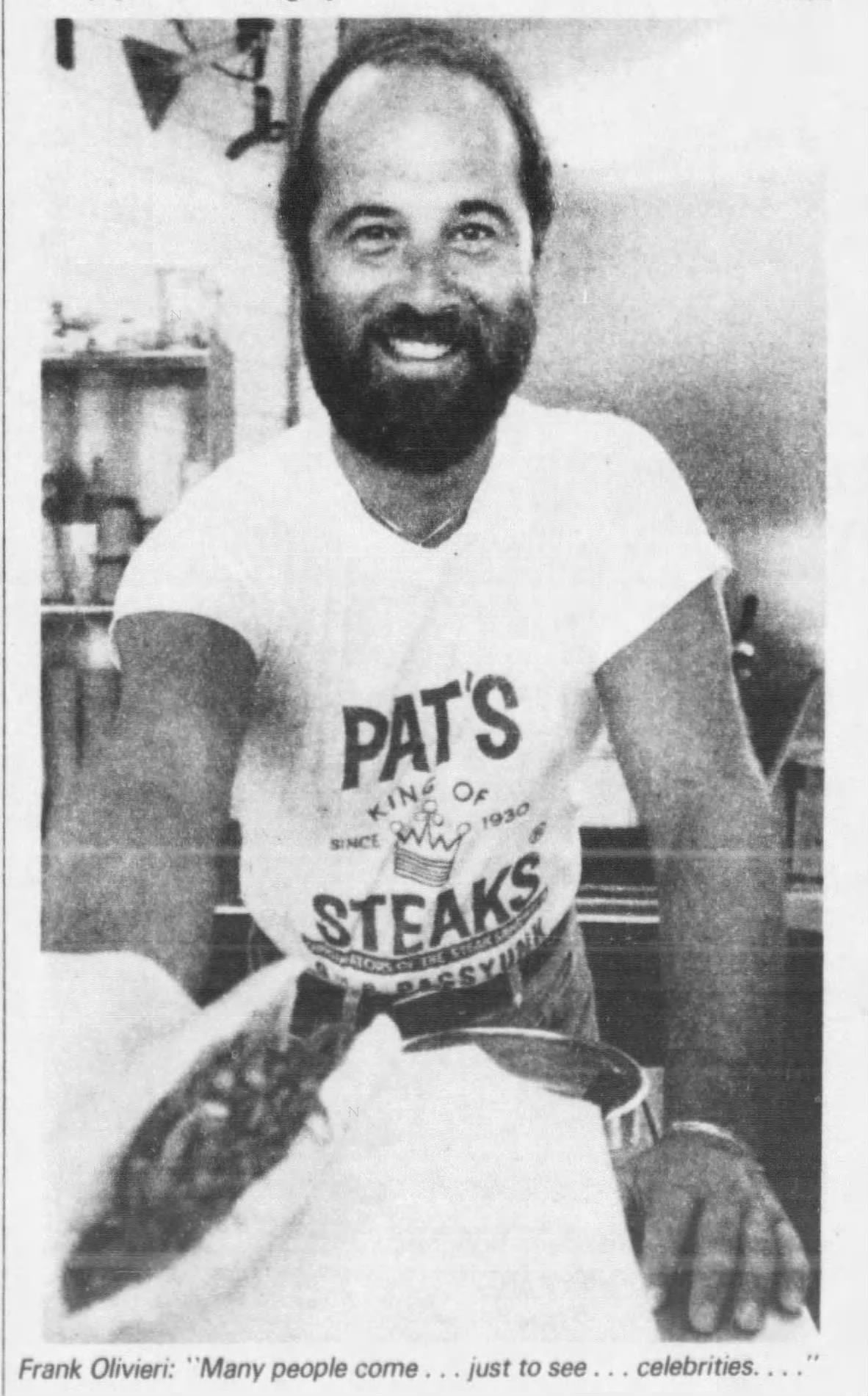
    Frank Olivieri working the grill at Pat’s King of Steaks in 1980.

    Pat Olivieri moved to California in the 1960s; he died in 1970. In 1967, father and son Harry and Frank Olivieri bought the original stand, while Pat’s son Herb obtained licensing and franchising rights to the name.

    Herb Olivieri opened Olivieri’s Prince of Steaks in Reading Terminal Market in 1982 and later ran a Pat’s location in Northeast Philadelphia (unaffiliated with the original). Herb’s son Rick owned sandwich shops, including the reflagged Rick’s Steaks at Reading Terminal, as well as stands at the Bellevue and Liberty Place food courts.

    Pat’s, meanwhile, had become a 24-hour destination. Limos and tour buses, then as now, roll up at all hours.

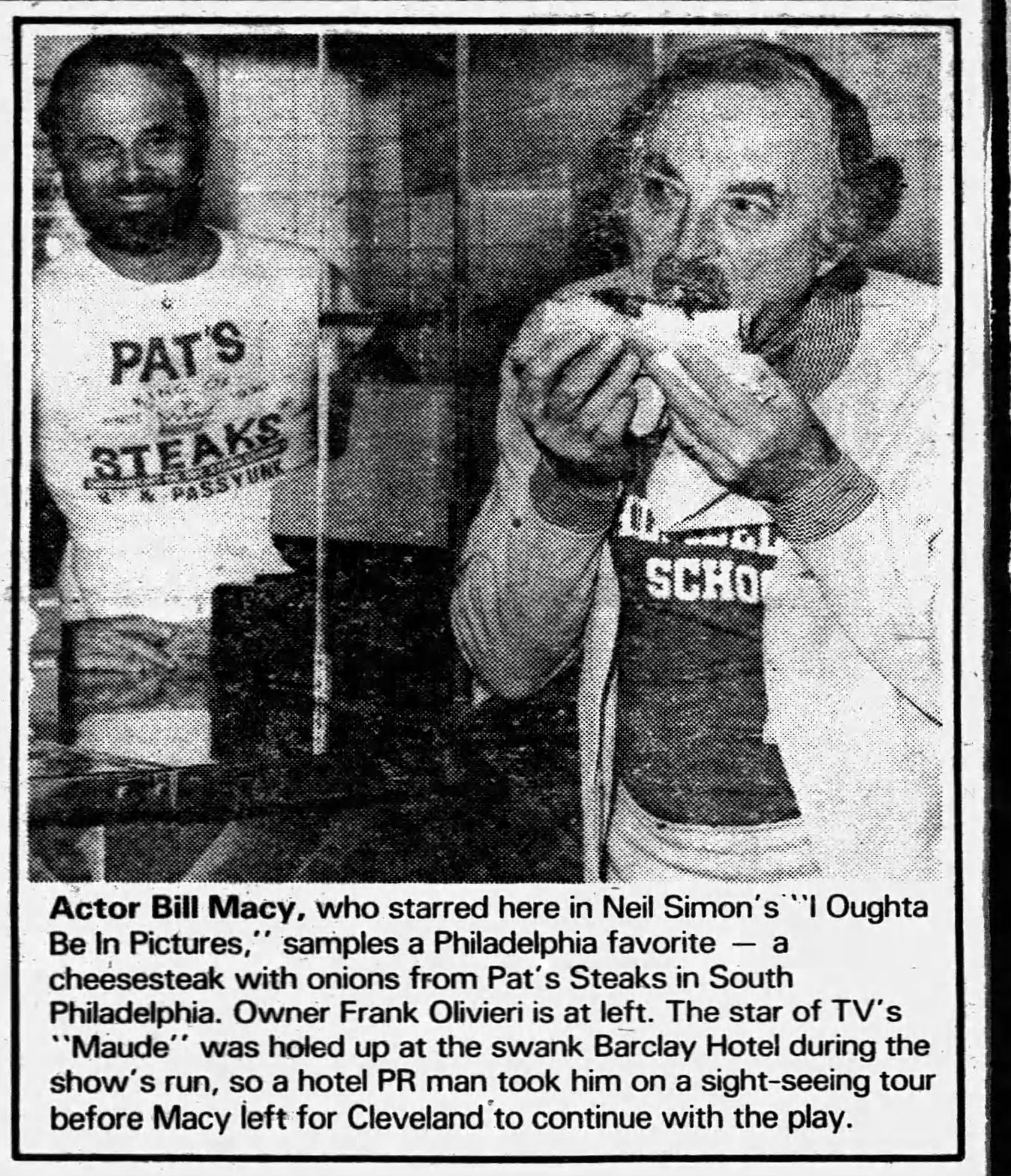
    Frank Olivieri (left) watching actor Bill Macy eating a cheesesteak from Pat’s King of Steaks in 1981. Macy was touring Philadelphia sites while starring at the Forrest Theater in a pre-Broadway run of “I Oughta Be in Pictures.”

    When Sylvester Stallone filmed part of Rocky outside of Pat’s in 1976, he invited Mr. Olivieri to a private party afterward.

    “I had to tell him I can’t go,” Mr. Olivieri recalled. “We didn’t get to be No. 1 by letting the business run itself.” Back then, Mr. Olivieri lived in Packer Park, kept a summer home in Brigantine, and was rarely more than an hour away.

    “I can be here any time,” he said. “And I am here lots and lots of the time.”

    In 1966, a competitor arrived across the street: Geno’s Steaks, owned by Joey Vento, a former Pat’s employee. The Pat’s-Geno’s rivalry — buzzing neon, dueling lines, endless debates over quality — is, in fact, wildly overblown. Current owners Frank E. Olivieri, popularly known as Frankie, and Geno Vento, Joey’s son, are good friends.

    Mr. Olivieri, who served for many years on the board of directors of Provident Bank, was a whiz with numbers, his son said. He also was an avid fisherman and yachtsman who had his captain’s license. “He also taught me everything I know about electrical work, plumbing, woodworking, and how to fix just about anything,” his son said. “The reason I know how to do all of that is because if he couldn’t do something himself, I had to learn how to do it. Without his guidance, I wouldn’t know how to do any of it.”

    Mr. Olivieri’s son recalls his father’s burgundy 1974 Corvette. “One of the happiest moments of my week was sitting in the passenger seat with him on Saturdays and Sundays,” he said. When they turned from Broad onto Wharton Street, “by the time we hit around 10th Street, I could already smell the onions cooking. He always had the T-tops off for me in the summer. That was my first introduction to being at the store.”

    Besides his son, Mr. Olivieri is survived by his wife of 65 years, Ritamarie; daughters Danielle Olivieri and Leah Tartaglia; 10 grandchildren; and three great-grandchildren.

    Viewing will be from 9 to 11 a.m. Friday, Jan. 23, at Baldi Funeral Home, 1327-29 S. Broad St. A prayer service and memorial tributes will begin at 11 a.m. The family requests donations to St. Maron Church, 1010 Ellsworth St., Philadelphia, Pa. 19147.

  • Valentino, 93, fashion designer to the jet set

    Valentino, 93, fashion designer to the jet set

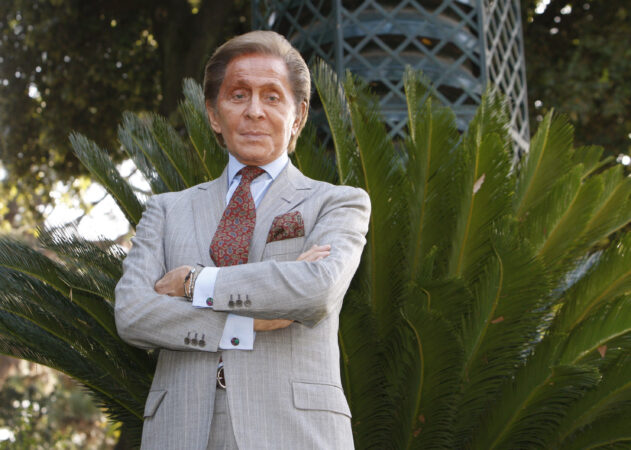
    MILAN — Valentino Garavani, the jet-set Italian designer whose high-glamour gowns — often in his trademark shade of “Valentino red” — were fashion show staples for nearly half a century, has died at home in Rome, his foundation announced Monday. He was 93.

    “Valentino Garavani was not only a constant guide and inspiration for all of us, but a true source of light, creativity and vision,″ the foundation founded by Mr. Garavani and his partner, Giancarlo Giammetti, said in a statement posted on social media.

    Universally known by his first name, Valentino, Mr. Garavani was adored by generations of royals, first ladies, and movie stars, from Jackie Kennedy Onassis to Julia Roberts and Queen Rania of Jordan, who swore the designer always made them look and feel their best.

    “I know what women want,” he once remarked. “They want to be beautiful.”

    Though Italian-born and despite maintaining his atelier in Rome, he mostly unveiled his collections in Paris, and spoke French with his Italian partner Giammetti, an entrepreneur.

    Alessandro Michele, the current creative director of the Valentino fashion house, wrote in Instagram that he continues to feel Mr. Garavani’s “gaze” as he works on the next collection, which will be presented March 12 in Rome, departing from the usual venue of Paris. Michele remembered Mr. Garavani as “a man who expanded the limits of the possible” and possessing “a rare delicacy, with a silent rigor and a limitless love for beauty.’’

    Another of Mr. Garavani’s successors, Pierpaolo Piccoli, placed a broken heart emoji under the announcement of his death. Former supermodel Cindy Crawford wrote that she was “heartbroken,” and called Valentino “a true master of his craft.’’

    Condolences also came in from the family of the late designer Giorgio Armani, who died in September at the age of 91, and Donatella Versace, who posted two photos of Mr. Garavani, saying “he will forever be remembered for his art.’’

    Italian Premier Giorgia Meloni remembered Mr. Garavani as “an indisputable maestro of eternal style and elegance of Italian high fashion.”

    Never one for edginess or statement dressing, Mr. Garavani made precious few fashion faux pas throughout his nearly half-century-long career, which stretched from his early days in Rome in the 1960s through to his retirement in 2008.

    His fail-safe designs made Mr. Garavani the king of the red carpet, the go-to man for A-listers’ awards ceremony needs. His sumptuous gowns have graced countless Academy Awards, notably in 2001, when Roberts wore a vintage black and white column to accept her best actress statue. Cate Blanchett also wore Valentino — a one-shouldered number in butter-yellow silk — when she won the Oscar for best supporting actress in 2004.

    Mr. Garavani was also behind the long-sleeved lace dress Jacqueline Kennedy wore for her wedding to Greek shipping magnate Aristotle Onassis in 1968. Kennedy and Mr. Garavani were close friends for decades, and for a spell the one-time U.S. first lady wore almost exclusively Valentino.

    He was also close to Diana, Princess of Wales, who often donned his sumptuous gowns.

    Beyond his signature orange-tinged shade of red, other Valentino trademarks included bows, ruffles, lace, and embroidery; in short, feminine, flirty embellishments that added to the dresses’ beauty and hence to that of the wearers.

    Perpetually tanned and always impeccably dressed, Mr. Garavani shared the lifestyle of his jet-set patrons. In addition to his 152-foot yacht and an art collection including works by Picasso and Miro, the couturier owned a 17th century chateau near Paris with a garden said to boast more than a million roses.

    Mr. Garavani and his longtime partner Giammetti flitted among their homes — which also included places in New York, London, Rome, Capri, and Gstaad, Switzerland — traveling with their pack of pugs. The pair regularly received A-list friends and patrons, including Madonna and Gwyneth Paltrow.

    “When I see somebody and unfortunately she’s relaxed and running around in jogging trousers and without any makeup … I feel very sorry,” the designer told RTL television in a 2007 interview. “For me, woman is like a beautiful, beautiful flower bouquet. She has always to be sensational, always to please, always to be perfect, always to please the husband, the lover, everybody. Because we are born to show ourselves always at our best.”

    Mr. Garavani was born into a well-off family in the northern Italian town of Voghera on May 11, 1932. He said it was his childhood love of cinema that set him down the fashion path.

    “I was crazy for silver screen, I was crazy for beauty, to see all those movie stars being sensation, well dressed, being always perfect,” he explained in the 2007 television interview.

    After studying fashion in Milan and Paris, he spent much of the 1950s working for established Paris-based designer Jean Desses and later Guy Laroche before striking out on his own. He founded the house of Valentino on Rome’s Via Condotti in 1959.

    From the beginning, Giammetti was by his side, handling the business aspect while Mr. Garavani used his natural charm to build a client base among the world’s rich and fabulous.

    After some early financial setbacks — Mr. Garavani’s tastes were always lavish, and the company spent with abandon — the brand took off.

    Early fans included Italian screen sirens Gina Lollobrigida and Sophia Loren, as well as Hollywood stars Elizabeth Taylor and Audrey Hepburn. Legendary American Vogue editor-in-chief Diana Vreeland also took the young designer under her wing.

    Over the years, Mr. Garavani’s empire expanded as the designer added ready-to-wear, menswear, and accessories lines to his stable. Mr. Garavani and Giammetti sold the label to an Italian holding company for an estimated $300 million in 1998. Mr. Garavani would remain in a design role for another decade.

    In 2007, the couturier feted his 45th anniversary in fashion with a 3-day-long blowout in Rome, capped with a grand ball in the Villa Borghese gallery.

    Mr. Garavani retired in 2008 and was briefly replaced by fellow Italian Alessandra Facchinetti, who had stepped into Tom Ford’s shoes at Gucci before being sacked after two seasons.

    Facchinetti’s tenure at Valentino proved equally short. As early as her first show for the label, rumors swirled that she was already on her way out, and just about one year after she was hired, Facchinetti was indeed replaced by two longtime accessories designers at the brand, Maria Grazia Chiuri and Pierpaolo Piccioli.

    Chiuri left to helm Dior in 2016, and Piccioli continued to lead the house through a golden period that drew on the launch of the Rockstud pump with Chiuri and his own signature color, a shade of fuchsia called Pink PP. He left the house in 2024, later joining Balenciaga, and has been replaced by Michele, who revived Gucci’s stars with romantic, genderless styles.

    Valentino is owned by Qatar’s Mayhoola, which controls a 70% stake, and the French luxury conglomerate Kering, which owns 30% with an option to take full control in 2028 or 2029. Richard Bellini was named CEO last September.

    A public viewing will be held at the Valentino Garavani and Giancarlo Giammetti Foundation on Wednesday and Thursday, and a funeral will be held Friday in the Basilica di Santa Maria degli Angeli e dei Martiri in central Rome.