Category: Obituaries

  • Neil Sedaka, the singer-songwriter behind dozens of hits of the 1960s and ’70s, has died at 86

    Neil Sedaka, the singer-songwriter behind dozens of hits of the 1960s and ’70s, has died at 86

    NEW YORK — Neil Sedaka, the hitmaking singer-songwriter whose boyish soprano and bright melodies made him a top act in the early years of rock and roll and led to a second run of success in the 1970s, has died.

    Mr. Sedaka, whose hits included “Breaking Up Is Hard to Do” and “Laughter in the Rain,” died Friday at age 86.

    “Our family is devastated by the sudden passing of our beloved husband, father and grandfather, Neil Sedaka,” his family said in a statement. “A true rock and roll legend, an inspiration to millions, but most importantly, at least to those of us who were lucky enough to know him, an incredible human being who will be deeply missed.”

    No other details of his death were immediately available.

    A key member of the Brill Building songwriting factory, Mr. Sedaka teamed with lyricist and boyhood neighbor Howard Greenfield on songs that reflected the teen innocence of the post-Elvis, pre-Beatles era of the late 1950 and early 1960s, including “Happy Birthday Sweet Sixteen,” “Calendar Girl,” and “Oh! Carol,” a lament for his high school sweetheart, Carole King.

    After a long dry spell, he reemerged with such smashes as “Laughter in the Rain” and “Bad Blood.” The Captain & Tennille’s cover of his “Love Will Keep Us Together” was a chart-topper in 1975.

    Short and dark-haired, with a big smile and high-pitched voice, he was a Juilliard-trained, Brooklyn-born son of a Jewish taxi driver who began performing as a teen and kept at it for decades.

    Mr. Sedaka still played dozens of concerts a year well into his 80s. He retained the enthusiasm and broad vocal range of his youth and never tired of the standards he had sung hundreds of times.

    “Past 70, Pavarotti told me the vocal cords are not what they used to be. I’m very fortunate that my voice has held,” he told the Associated Press in 2012. “It’s nice to be a legend, but it’s better to be a working legend.”

    Mr. Sedaka’s songs sold millions worldwide and have been covered by a range of performers, from Elvis Presley and Frank Sinatra to The 5th Dimension and Nickelback. Mr. Sedaka helped propel the career of Connie Francis with “Stupid Cupid” and “Where the Boys Are,” the latter for the soundtrack of the movie with the same name. The Captain & Tennille received a best-album Grammy thanks largely to “Love Will Keep Us Together” and included a nod to Mr. Sedaka at the end of the song, when Toni Tennille exclaimed “Sedaka’s back!”

    Growing up in Brooklyn, loving performing

    Mr. Sedaka grew up in Brooklyn’s Brighton Beach neighborhood, pampered by his grandparents, aunts, and mother in a two-bedroom apartment he shared with 11 relatives. He has a street there named in his honor, Neil Sedaka Way.

    But his music compensated for his unpopularity as a kid, he once recalled. His talent was recognized by a second-grade teacher who urged his homemaker mother, Eleanor, to buy him a piano. She went to work in a department store to pay for a secondhand upright and managed his career for years, as did his wife, Leba.

    Mr. Sedaka loved songwriting and never quit, but he craved performing.

    “Once a performer, always a performer. It’s that adrenaline rush. It’s like a natural high when you’re in front of an audience, and if you get that standing ovation, it’s infectious,” he told the AP.

    At 16, Mr. Sedaka was chosen by Arthur Rubenstein in a contest as the city’s best high school piano student and performed on a classical radio station as a prize. It was the same year he discovered rock and roll, when he performed a song, “Mr. Moon,” he had written with Greenfield, his classmate at Abraham Lincoln High School.

    “I sang it in the auditorium for a ballyhoo show and I remember there was a bit of a riot. The kids were jumping and screaming,” Mr. Sedaka said. “After that I was able to go into the sweet shop with the tough kids with the leather jackets.”

    After high school, and then Juilliard, Mr. Sedaka and Greenfield were signed to Don Kirshner’s Aldon Music, where they scored their first hit with Francis, “Stupid Cupid.”

    Sedaka churns out hits, until the Beatles

    In 1958, at age 19, Mr. Sedaka signed with RCA Victor Records and his first single, “The Diary,” enjoyed modest success. He began touring and promoting his songs through regular TV appearances on Dick Clark’s American Bandstand and Shindig!

    At the Brill Building, Mr. Sedaka and Greenfield were joined by other up-and-coming writers and lyricists including King, Neil Diamond, and Paul Simon.

    “Neil Sedaka was so talented, and he inspired me to follow my dream of being a songwriter,” King said on her Facebook page Friday. “With love and gratitude and condolences to his family.”

    Micky Dolenz of the Monkees also paid tribute to Mr. Sedaka, saying on Instagram that he was “one of those rare songwriters who could do it all.”

    From 1959 to 1962, Mr. Sedaka had 10 records in the Top 10, including “Calendar Girl,” “Oh! Carol,” “Happy Birthday Sweet Sixteen,” and “Next Door to an Angel.” But in the mid-1960s, the Brill Building sound, influenced by the doo-wop groups of the New York City streets, was pushed off the charts by the Beatles -led British Invasion and the psychedelic and protest music that followed. Mr. Sedaka would endure 13 years “in the wilderness,” as he described it to the AP.

    Sedaka’s unlikely comeback, with help from Elton John

    Mr. Sedaka was among the lucky, however, enjoying a renaissance that began in the mid-’70s thanks to the patronage of Elton John, whom he met at a party after Mr. Sedaka moved his wife and two kids to England to take advantage of his lingering popularity there. John signed him to his fledgling, U.S.-based Rocket Records label, providing him a chance at more hits with the album Sedaka’s Back.

    At Rocket, Mr. Sedaka and a new writing partner, Philip Cody, topped charts with “Bad Blood” and the joyous “Laughter in the Rain.” He also achieved a rare feat with “Breaking Up Is Hard to Do.” His original up-tempo version went No. 1 in 1962. He rerecorded it as a slow ballad in 1975 and that, too, went No. 1.

    He recorded five albums from 1972 to 1976. They included hits “Standing on the Inside,” “That’s Where the Music Takes Me,” and “Our Last Song Together,” about his breakup with Greenfield, with whom he began writing songs when Mr. Sedaka was only 13 and Greenfield 16.

    He was inducted into the Songwriters Hall of Fame, but the Rock & Roll Hall of Fame eluded him despite a fan petition drive.

    Mr. Sedaka married wife Leba in 1962. They had two children. Daughter Dara recorded a duet with dad in 1980, “Should’ve Never Let You Go.” It was a hit, but she never joined him in the music business. Son Marc is a film and television writer.
  • Noel Mayo, groundbreaking Black industrial designer and college professor, has died at 88

    Noel Mayo, groundbreaking Black industrial designer and college professor, has died at 88

    Noel Mayo, 88, formerly of Philadelphia, widely recognized as the first Black owner of an American industrial design firm, first Black American college chair of an industrial design department, first Black industrial design graduate of Philadelphia College of Art, award-winning super mentor, and champion of professional diversity, equity, and inclusion, died Thursday, Jan. 29, of a probable heart attack at an assisted living center in Delaware County.

    Rejected for an industrial design job after college because he was Black, Professor Mayo went on to found Noel Mayo Associates Inc. in Philadelphia in 1964. He spent 11 years in the late 1970s and ’80s as a professor and first Black chair of the industrial design department at what became the now-defunct University of the Arts, and 27 years, from 1989 to 2016, as a governor-appointed eminent scholar in art and design technology at Ohio State University.

    “Dr. Mayo leaves behind a transformative legacy,” former colleagues at Ohio State said in a tribute, “whose impact shaped generations of students, elevated the field of design, and advanced diversity and inclusion across the profession.”

    As the trailblazing owner and president of Noel Mayo Associates for decades, he and his staff designed all kinds of products, interiors, exteriors, graphics, mobile exhibits, and signage systems for companies and private clients around the world. He worked with NASA, IBM, Black & Decker, Philadelphia International Airport, museums, government agencies, and public institutions.

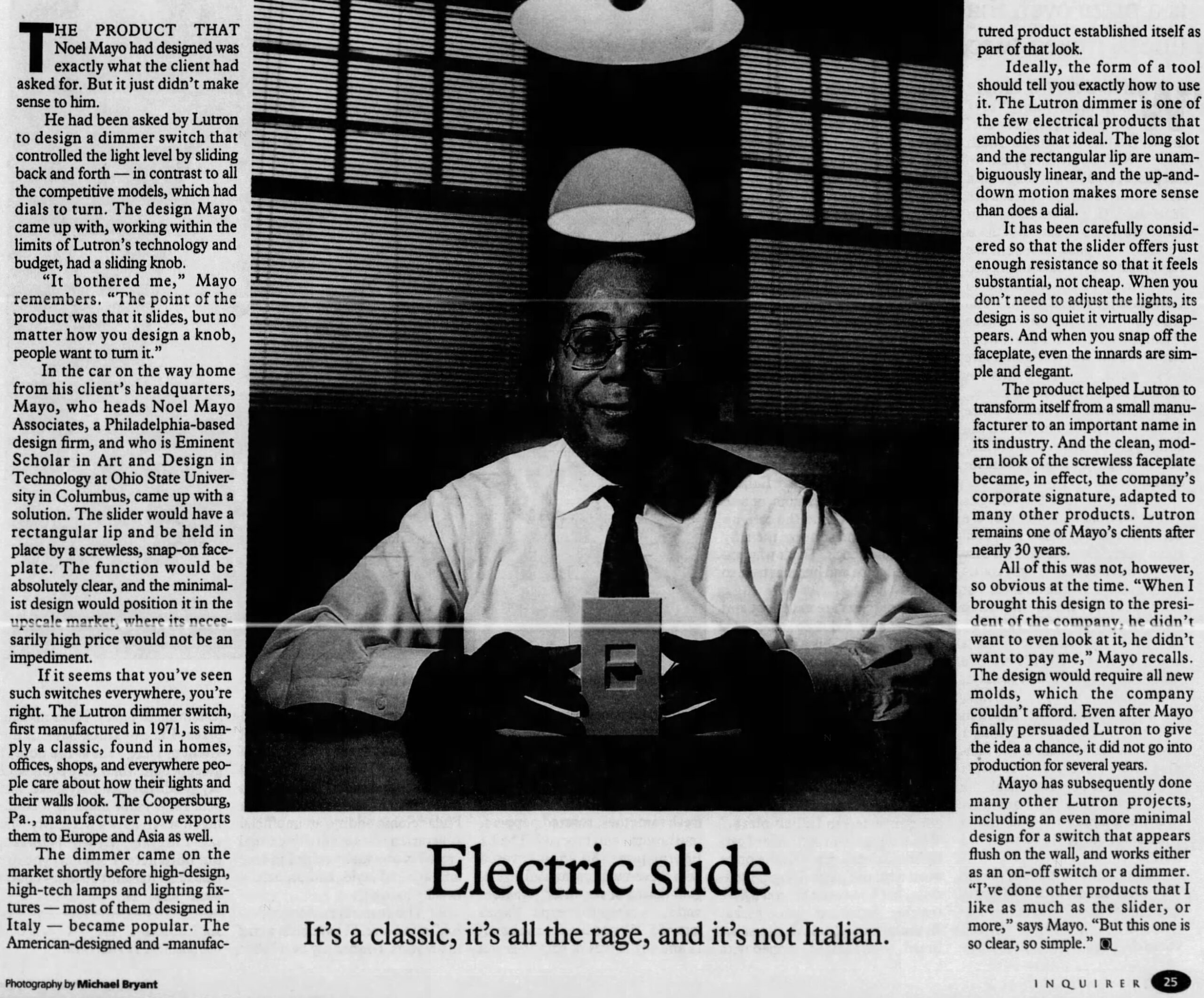
    He collaborated with Lutron Electronics for 45 years and is named on hundreds of its design and utility patents. In 1984, he remodeled the mayor’s City Hall office after Wilson Goode replaced Bill Green. In 1988, he advised officials at the old Spectrum on the placement of a Julius Erving statue in South Philadelphia.

    He designed computer-driven telephones in the 1980s that could dial 96 phone numbers automatically and leave messages. “I realize how pressured this is,” he told the Daily News for a 1984 story about design and technology’s effect on modern life. “But people want it.”

    Professor Mayo was featured in a 1977 story by Inquirer design critic Ellen Kaye, and she praised the “visual fluidity” he created in a refurbished Bala Cynwyd high-rise condo. She wrote about his work again in 1978, and he said design “revolves around problem-solving from a logical point of view.”

    In a 1995 story, Inquirer design critic Thomas Hine noted his commercial success with early light-dimmer switches and said it “helped Lutron to transform itself from a small manufacturer to an important name in its industry.” In a recent video interview, Professor Mayo said: “I see the problems as kind of opportunities that other people didn’t see. … So I look for opportunities for innovation.”

    Professor Mayo was featured in The Inquirer in 1995.

    As chair at Philadelphia College of Art and its successor, University of the Arts, he grew the industrial design department from the school’s ninth largest to its third largest. In online tributes, former students called him “a true icon” and “a doorway into a world of possibility, dignity, and community.”

    He told The Inquirer in 1978: “Something looks good when it looks rational. That is how I work myself, and that is what I try to teach my students.”

    At Ohio State, Professor Mayo taught product, interior, and graphic design courses, and researched accelerated learning processes using music, color, relaxation techniques, interactive computers, and video. Former colleagues there praised “his blend of rigor, generosity, calmness, and mentorship” in a tribute.

    Professor Mayo worked hard to recruit Black and other minority designers and students to his company and college courses. He created mentoring programs and developed an extensive network of minority business contacts.

    Professor Mayo designed this telephone.

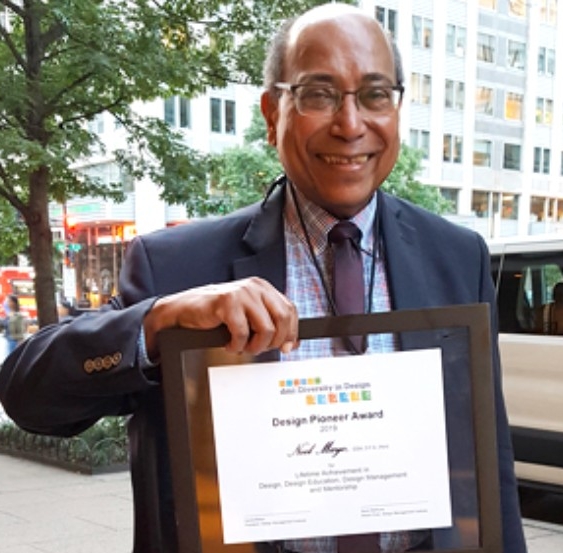
    “He did not treat diversity as a slogan,” a former colleague said in an online tribute. He earned lifetime achievement awards from the Industrial Designers Society of America in 2006 and the Design Management Institute in 2019. In 2021, Ohio State alumni created and funded the Mayo Mentoring Program.

    He was one-time president of the Philadelphia Economic Council and the Greater Philadelphia Community Development Corp. He wrote articles for many publications and served on boards at University of the Arts, the Society for Environmental Graphic Design, and other groups.

    He was a fellow of the Interior Design Council of Philadelphia, a juror for art and design competitions, and a member of the Philadelphia Art Commission. Asked to advise young designers in the recent video interview, he said: “Try to be as innovative as you can. … Ask questions. … Being open is critical.”

    Noel Mayo was born Dec. 30, 1937, in Orange, N.J. He attended a boarding school in Chester County and earned a bachelor’s degree in design in 1960 at what became Philadelphia College of Art and then University of the Arts.

    Professor Mayo designed this exterior.

    He married, divorced, and later married Leslie Butler.

    Professor Mayo enjoyed roller skating, was good at darts, and earned an honorary doctorate from Massachusetts College of Art and Design.

    “He was easygoing with a great sense of humor,” said Virginia Gehshan, a design colleague and longtime friend. “He was really an amazing genius. He was ahead of his time.”

    In addition to his wife, Professor Mayo is survived by other relatives.

    A celebration of his life is to be held later.

    Professor Mayo received the Design Pioneer Award in 2019.
  • Jeff Galloway, Olympic runner who inspired ‘Jeffing’ technique, has died at 80

    Jeff Galloway, Olympic runner who inspired ‘Jeffing’ technique, has died at 80

    Jeff Galloway, an Olympic distance runner who inspired hundreds of thousands of Americans to exercise by extolling the virtues of taking walking breaks during races — or “Jeffing,” as adherents called his signature method — died Feb. 25 in Pensacola, Fla. He was 80.

    Mr. Galloway died in a hospital after suffering a stroke, his son Westin Galloway told the Washington Post.

    Mr. Galloway described himself as an average runner as a teen who enrolled in his first marathon in Atlanta “because of the size of the trophy” and, by persistence more than talent, ascended to the U.S. Olympic team. For the 1972 Olympics in Munich, he qualified for the 10,000-meter race and was an alternate for the marathon. The next year, he set a U.S. record in the 10-mile road race.

    Despite reaching the peaks of his grueling discipline, Mr. Galloway became most widely known for a training program with an everyman philosophy that spoke to reluctant runners and preached, of all things, walking.

    Mr. Galloway began pioneering what he called a “Run Walk Run” technique — taking breaks to walk during training runs and even races — in the 1970s as he taught running to beginners. He championed the method as a way to reduce injury, control fatigue and, most importantly, motivate newcomers to “get off of the couch and run.”

    Legions of new runners did just that. Mr. Galloway’s philosophy, espoused in books and an online training program, has reached more than a million people, his organization has said, and changed how athletes approach distance running.

    Mr. Galloway had “the ability to empower runners, or people that didn’t even see themselves as runners,” his son Westin said, “giving them the space to be the athlete or the person that they never thought they could be through the benefits of exercise.”

    John Franks Galloway was born in Raleigh, N.C., on July 12, 1945. His father was an educator and a sailor in the Navy; his mother worked at a private school in Atlanta that his father founded.

    Mr. Galloway, who grew up in Atlanta, was not initially a prodigious running talent. He enrolled in a track conditioning program in eighth grade because his school required sports participation each quarter and the track coach was rumored to be the most lenient of the sports instructors, he wrote on his website.

    “I can identify with the struggles of sedentary, overweight adults and kids, for I was one,” Mr. Galloway wrote.

    Two months of running through forest trails got him hooked. Mr. Galloway qualified for the state high school championships in Georgia his senior year, then attended Wesleyan University, where he studied history and was an all-American runner.

    Mr. Galloway served for three years in the Navy after college, a tour that sent him to Vietnam. Upon returning to the United States in 1970, he enrolled in graduate school at Florida State University with the goal of qualifying for the upcoming Olympics.

    Even after years of training, it felt like a long shot, Mr. Galloway wrote. On a 90-degree summer day at the 1972 national championship in Seattle, he squeaked onto the 10,000-meter Olympic team in a close race — perhaps because he took it slow.

    “Many of the runners had started too fast, and I did not,” Mr. Galloway recalled on his website. “I found myself catching up to the stragglers, passing one, then another.”

    As a fitness boom took hold in the U.S. after the Munich Olympics, Mr. Galloway founded a running store, Phidippides, opened vacation fitness camps, and wrote several books about running. “Jeffing,” or “the Galloway method,” became his most famous innovation.

    At running clinics across the country, Mr. Galloway promoted his framework. Giving runners permission to take walking breaks while training encouraged beginners, he said, and the staggered runs could help even veteran marathoners improve their times. His charm and relentless focus on reaching novice runners set him apart from other instructors, Westin Galloway said.

    “A lot of coaches were very focused on faster times and pushing people’s bodies to do the best that they could,” he said. “And he kind of looked at it from the other perspective of, running has an amazing way of changing a person’s life, and if he could get more people out there doing it, the world would be a better place.”

    Mr. Galloway remained a fixture of the running community and continued to run and help organize races as he grew older. At 70, he ran the Marine Corps Marathon in Arlington in honor of a Marine killed in the 2015 Chattanooga, Tenn., shooting at a Navy operations center. He returned to running after suffering a heart attack in 2021 that kept him hospital-bound for almost a month.

    In the months before his death, Mr. Galloway had been fixated on run-walking another race at the age of 80. He had planned to run the Honolulu Marathon in December but fell and broke his kneecap. That didn’t discourage him, either, he told the New York Times in December.

    “Doing another marathon, to me, feels like the strongest goal I’ve ever had in my life,” Mr. Galloway said to the Times.

    Mr. Galloway is survived by his wife, Barb, 72; his sons Westin and Brennan; and six grandchildren. They are all runners, and Westin manages Mr. Galloway’s organization that continues to share his training program with runners around the world.

    “Jeffing” has recently seen a renewed surge of interest, Westin Galloway said, as more people have taken up running since the coronavirus pandemic. Asked whether the influx of new adherents made Mr. Galloway proud, Westin demurred.

    “He was happy talking to a single individual,” Westin said. “He didn’t care about numbers. He didn’t care about getting on the news or having big stories published about him. He cared about helping one person at a time.”

  • Penguin Press founder Ann Godoff, a powerhouse editor of bestsellers and prizewinners, dies at 76

    Penguin Press founder Ann Godoff, a powerhouse editor of bestsellers and prizewinners, dies at 76

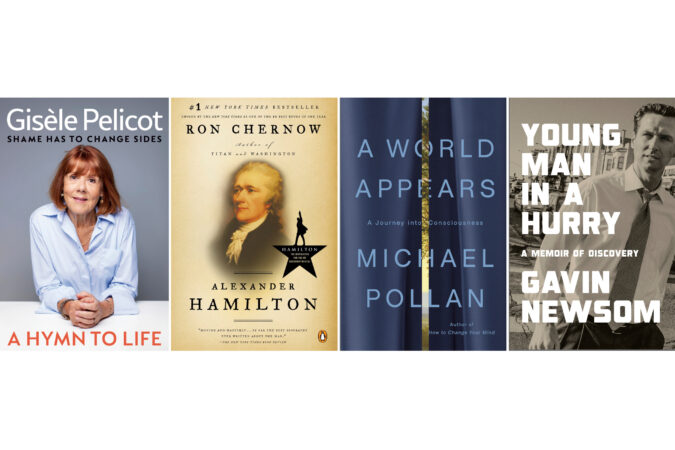
    NEW YORK — Ann Godoff, a leading book publisher for more than 30 years with an eye for timely and timeless works from Alexander Hamilton and Midnight in the Garden of Good and Evil to current bestsellers by Gisèle Pelicot and California Gov. Gavin Newsom, has died. She was 76.

    Ms. Godoff died of cancer Tuesday in Albany, N.Y., according to a statement from Penguin Press, which she had founded in 2003.

    “Ann’s impact on American book culture over the past four decades is incalculable,” Penguin Press publisher Scott Moyers said in a statement. “An editor of immense range in fiction, nonfiction, and poetry, Ann shepherded into print innumerable New York Times bestsellers, multiple winners of every major award, and works that have appeared on all manner of best books lists — of the year, the decade, and the century.”

    A onetime NYU film student who studied under then-faculty member Martin Scorsese, sold cars and assisted on Dr. Joyce Brothers’ television show, Ms. Godoff was a late bloomer who didn’t begin her publishing career until her early 30s and soon revealed uncommon gifts for spotting and cultivating talent. As a rising editor at Random House in the 1990s, she published such debut phenomena as John Berendt’s Midnight in the Garden of Good and Evil and Caleb Carr’s The Alienist.

    She also worked with Salman Rushdie, E.L. Doctorow, and Arundhati Roy and had lasting relationships with Michael Pollan and Ron Chernow, whose books with Ms. Godoff have included a Pulitzer Prize-winning biography of George Washington and the Hamilton biography that was the basis for the prizewinning stage musical.

    “Ann supervised me with a rather light touch and never got lost in the details,” Chernow wrote in an email to the Associated Press.

    “She was no less gifted in fashioning a design for the book — everything from the cover art to the paper stock — with a look fully consistent with my portrait of the character,” he added. “Everything was of a piece and that was carried straight through to the marketing and publicity. I always felt myself in the most capable hands.”

    Ms. Godoff was eventually promoted to president and editor-in-chief of Random House, and her stature was so high that when she was forced out in 2003 amid corporate restructuring, her departure set off debates — evergreen in the industry — over the feared decline of literary publishing.

    But Penguin soon signed her up to lead the new Penguin Press imprint. Chernow, Pollan, and other authors moved there with her, and she continued to publish bestsellers and critical favorites, including such Pulitzer Prize winners as Steve Coll’s Ghost Wars and John Lewis Gaddis’ George F. Kennan.

    When Random House and Penguin merged into Penguin Random House in 2013, Ms. Godoff was under the same roof as her old company. Right up to the time of her death, she was shaping the public conversation. Pelicot’s A Hymn to Life recounts her horrifying marriage and how she came to be a leading voice against sexual violence, while Newsom’s Young Man in a Hurry is widely seen as a building block for a 2028 presidential run.

    Ms. Godoff was born in 1949 in New York City, grew up in New York and California, and graduated from Bennington College. She started out at Simon & Schuster in the early 1980s as an assistant to Alice Mayhew, the renowned editor of Bob Woodward and Doris Kearns Goodwin among others. After serving as editor-in-chief at Atlantic Monthly Press, Ms. Godoff joined Random House in 1991.

    Her marriage to Malcolm Drummond ended in divorce in 2012 after a long separation. The same year, Godoff married her partner, the writer-photographer Annik LaFarge. Besides LaFarge, her survivors include her brother, Peter Godoff.

    Ms. Godoff was never the outsized personality of such Random House predecessors as Bennett Cerf and Harold Evans. She was regarded by many as serious, hard-working and committed, known for saying “The book will abide.” But she was competitive, and she didn’t mind making news. She paid a reported $8 million for Cold Mountain author Charles Frazier’s next novel, a sum many found excessive at the time, and a comparable amount for a memoir by former Federal Reverse Chairman Alan Greenspan.

    Bestselling author Roger Lowenstein, whose seven books have all been published by Ms. Godoff, wrote in an email to the AP that she was an exacting but precise editor. He remembered a “blistering memo” from her while shaping the manuscript for Ways and Means: Lincoln and His Cabinet and the Financing of the Civil War, a prizewinning history published in 2022. His final draft was 90 pages shorter and he couldn’t think of a “single word” that he regretted being cut.

    “She generally reserved her praise, at least in my case, until the end of the process, often in letters that arrived unexpected in the mail,” he wrote. “Nothing was ever sweeter, because one worked so hard to get there, and because you knew that she meant it.”

  • Eleanor M. Kelley, longtime French teacher, lifelong athlete, and mentor to many, has died at 79

    Eleanor M. Kelley, longtime French teacher, lifelong athlete, and mentor to many, has died at 79

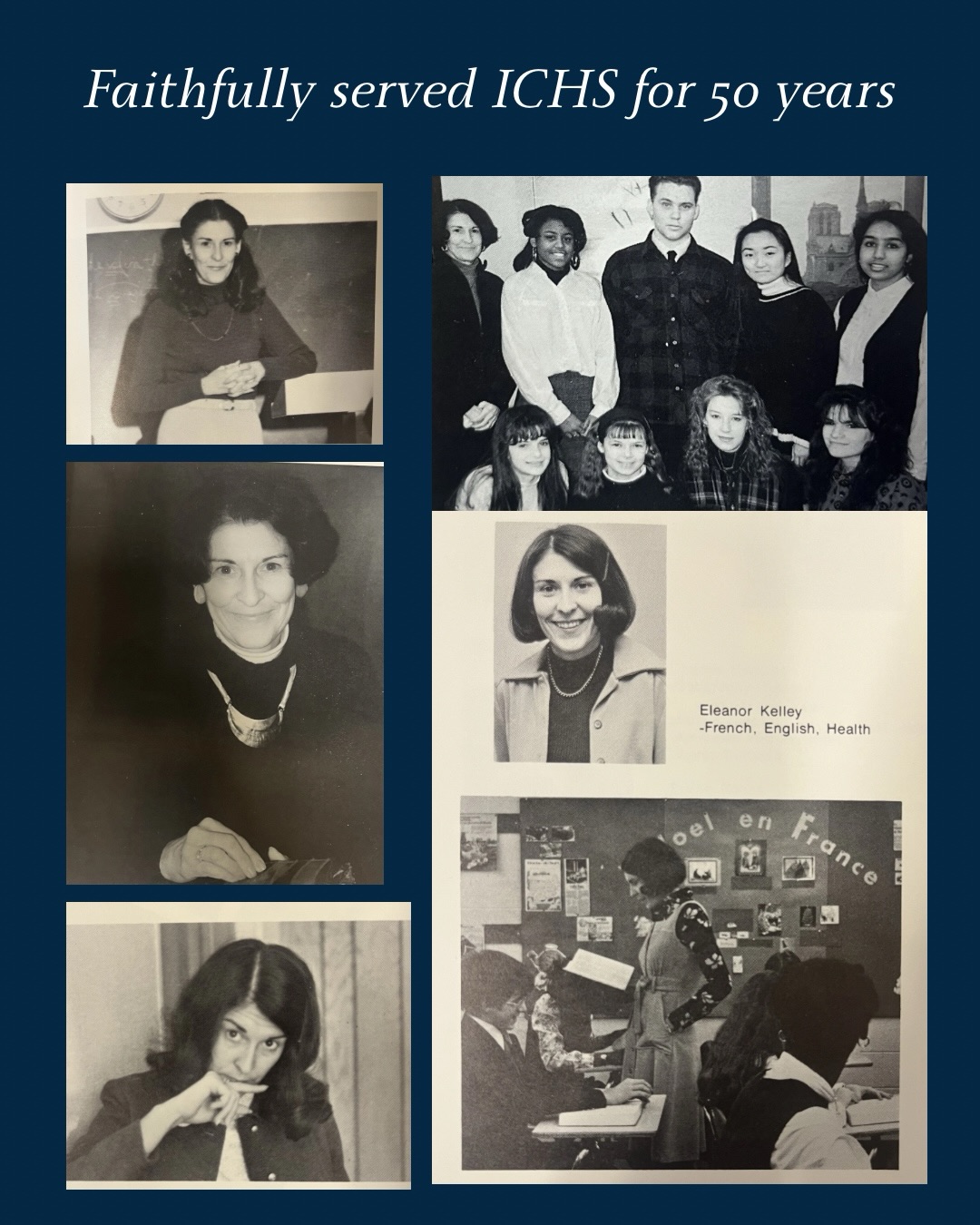
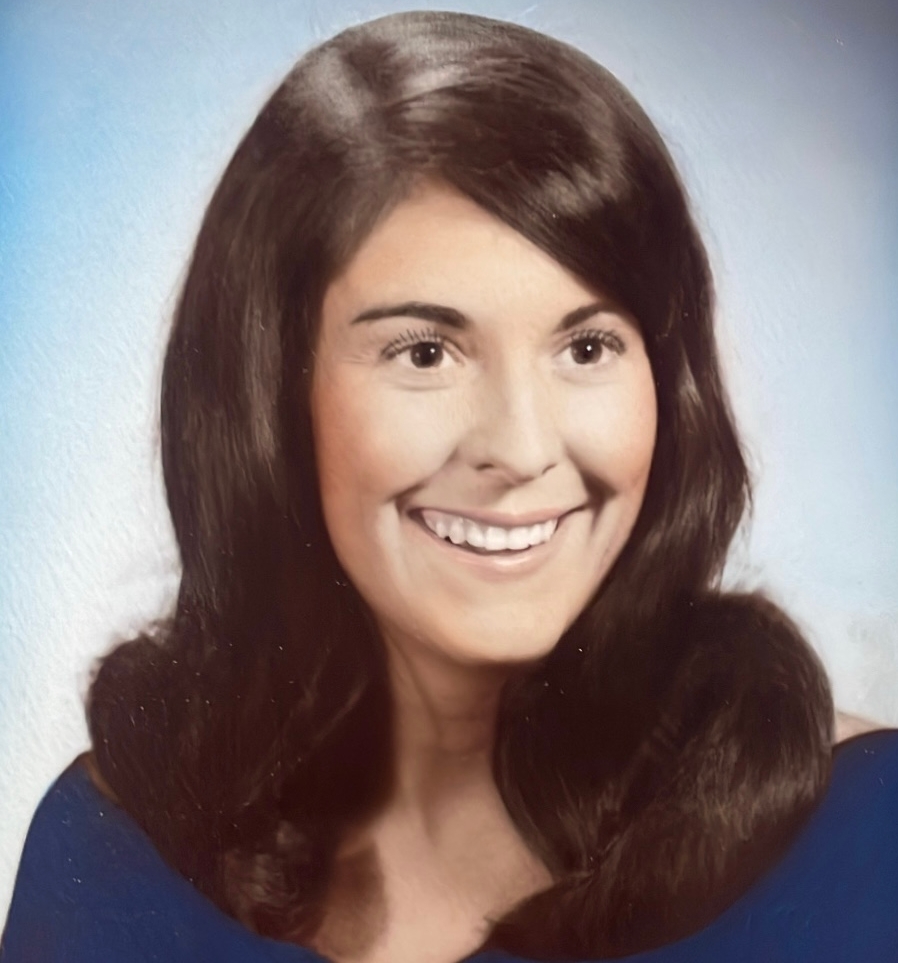
    Eleanor M. Kelley, 79, of Philadelphia, longtime French teacher at International Christian High School, onetime adjunct professor at Temple University, role model, mentor to many, and lifelong athlete, died Friday, Feb. 20, of complications from Parkinson’s disease at Rydal Park & Waters retirement community in Jenkintown.

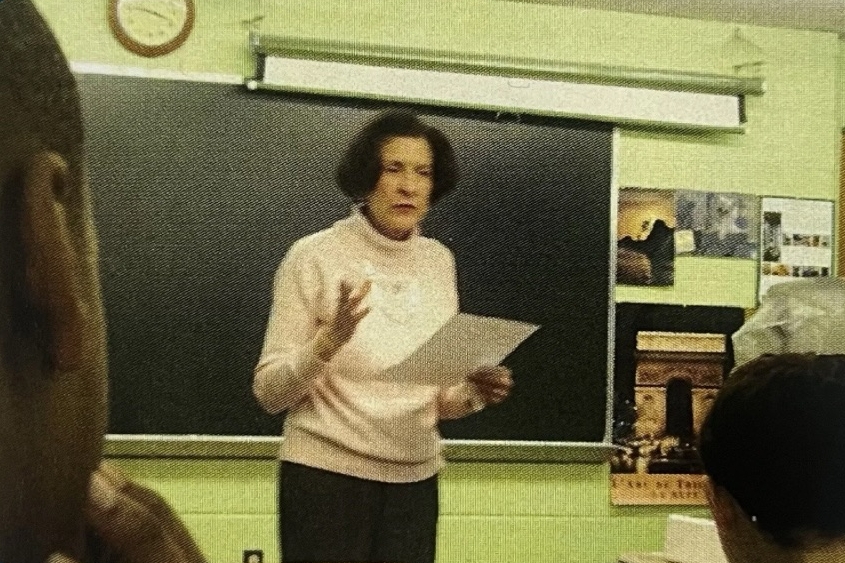
    An honors graduate at Abraham Lincoln High School and twice at Temple, Mrs. Kelley was a compassionate, faith-driven intellectual who excelled at languages, teaching, and friendship. She taught French for two years as an adjunct professor at Temple and then for 48 years, from 1972 to 2020, at Cedar Grove Christian Academy and its successor, International Christian High School.

    She worked with thousands of students from around the world at International Christian in Olney and chaperoned nine trips to Paris with her French classes. She connected with students, they said in online tributes, by smiling often and singing songs and quoting the Bible in French.

    Former students called her “intellectually challenging” and “fiery when it came to teaching French.” They said: “You never gave up on us.”

    Mrs. Kelley was honored online by colleagues at International Christian High School.

    Her achievements were recognized by educational organizations, and she told her husband, Bill: “I need to find new ways to challenge the students. I must avoid getting caught up in the routine of teaching.”

    Nearly everyone called her Madame Kelley, and they dedicated three school yearbooks to her. Several of her online tributes were written in French. “Au revoir, Madame,” they said. “Merci.”

    On Facebook, Benjamin Brittin, head administrator at International Christian, said: “Mrs. Kelley was a devoted co-worker, wise, fair-minded, loving, and faithful in her support of both students and colleagues.”

    She also taught English and health, and was the school’s discipline administrator and director of the Honors Society. She served on school and church committees, and helped her husband coach the International Christian boys’ basketball team.

    Mrs. Kelley played basketball and volleyball at Abraham Lincoln High School.

    “She was one in a million,” a former school colleague said in a Facebook tribute. Another said: “I will never stop striving for the perfection you maintained with incredible grace.”

    Mrs. Kelley played basketball and volleyball in high school, and later earned 10 medals and trophies at local running events. One time, her husband said, she slowed near the end of a race so a friend could pass her and win a medal.

    She earned three awards for coaching the boys’ basketball team at International Christian, and she and her husband ran often in Wissahickon Valley Park and along Kelly Drive.

    “Teaching was her passion, indeed a promissory gift to so many of her students,” her husband said. “She was a fisher of minds and souls who made ideas matter.”

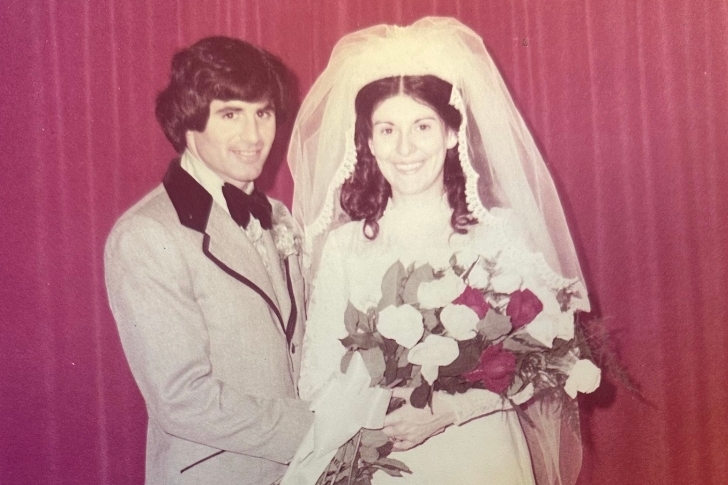
    Mrs. Kelley and her husband, Bill, married in 1972.

    Eleanor Mary Tolia was born Feb. 12, l947, in Philadelphia. She enjoyed family vacations in Atlantic City when she was young and graduated summa cum laude from Abraham Lincoln High.

    She met Bill Kelley when both were students at Temple, and they married in 1972. He was on his way to basketball practice one afternoon when he saw her in her father’s diner, and he stopped in to meet her.

    They lived in Roxborough, and he doted on her for more than five decades, including daily visits to her bedside over the last year. At Temple, she earned summa cum laude bachelor’s and master’s degrees in French.

    Mrs. Kelley and her husband made memorable trips to Cape Cod Bay in Massachusetts and the Jersey Shore. She loved flowers and Italian food, adopted three stray cats, and framed and displayed all 54 of the poems her husband wrote for her every Christmas.

    Mrs. Kelley “gifted me more of my humanity,” her husband said.

    She usually mailed more than 125 Christmas cards and stayed in touch with former students who became old friends. She wrote letters to the editor of The Inquirer about local events, filled 30 albums with photos, and saved practically every note and letter she ever received.

    Friends called her Ellie Kelley. “She showed more humanity than anyone I ever met,” her husband said. “She gifted me more of my humanity. She was my life. She was my hero.”

    In addition to her husband, Mrs. Kelley is survived by a brother and other relatives.

    Private services are to be held later.

  • Daniela Petroff, AP’s longtime fashion and Vatican reporter, has died at 80

    Daniela Petroff, AP’s longtime fashion and Vatican reporter, has died at 80

    ROME — Daniela Petroff, who helped shape the Associated Press’ fashion and Vatican coverage for nearly four decades with style, authority and wit, has died in Rome. She was 80.

    Ms. Petroff died Tuesday at home, where she was recovering from a fall, said her husband, Victor Simpson, the retired AP Rome bureau chief.

    Ms. Petroff worked for the Chicago Tribune and Time magazine in Rome before moving onto the AP as a Vatican reporter and Milan fashion correspondent. She launched what became a mainstay of the AP’s culture report, covering the four weeks of menswear and womenswear each year.

    In 1985, the Simpsons endured an unfathomable tragedy: Their 11-year-old daughter, Natasha, was killed during the Dec. 27, 1985, terrorist attack at Rome’s airport that also wounded their son, Michael. When their youngest daughter, Debbie, was born two years later, Pope John Paul II called to congratulate Ms. Petroff.

    In announcing Ms. Petroff’s death, Simpson wrote that she had gone to sleep after lunch and decided not to wake up, “to finally embrace again her beloved Natasha.”

    Led AP’s Milan fashion coverage

    Fluent in Italian, German, French and English, Ms. Petroff spearheaded AP’s Milan fashion coverage just as Giorgio Armani was becoming an international figure, setting the pace for other reporters with informative, succinct, fact-based dispatches that stayed away from opinion and reviews.

    “She had a gift for putting the facts into kind of a very artful context,” said Lisa Anderson, who covered Milan fashion for the Chicago Tribune for nearly a decade starting in the mid-1980s. “She looked at that industry, which often takes itself too seriously, with a lot of amusement as well as respect, which is probably the right combination of qualities to approach fashion reporting.”

    Ms. Petroff’s last AP byline appeared in September, when her authoritative profile of Armani was published following the designer’s death.

    “Starting with an unlined jacket, a simple pair of pants and an urban palette, Armani put Italian ready-to-wear style on the international fashion map in the late 1970s, creating an instantly recognizable relaxed silhouette that has propelled the fashion house for half a century,” Ms. Petroff wrote.

    She covered the rise of Gianni Versace, Gucci in the Tom Ford era, Karl Lagerfeld at Fendi, and the Missoni fashion dynasty, and often put her fashion knowledge and smart wordsmithing to work on the Vatican beat.

    In one 2014 story about Pope Francis’ new batch of cardinals, she mused: “But with the ‘slum pope’ now calling the sartorial shots, fashionistas and Vaticanistas are wondering how his new cardinals — who hail from some of the poorest places on Earth, including Haiti, Burkina Faso and Ivory Coast — will dress themselves for their new role.”

    In between those assignments, Ms. Petroff covered some of the biggest cultural events in Italy, including the 2003 reopening of Venice’s La Fenice opera house after a devastating fire. “True to its namesake the phoenix, La Fenice has risen up from the ashes,” she wrote at the reopening.

    Early life in Paris, New York

    Born in 1945 in Mecklenburg, Germany, Ms. Petroff grew up first in Paris and then New York, where she attended the all-girl Convent of the Sacred Heart Catholic school. An only child, her parents and she moved to Rome for Ms. Petroff’s final two years of high school, which she completed at Marymount International School.

    After attending Manhattanville College in New York, Ms. Petroff returned to Rome and graduated from La Sapienza University with a degree in modern languages. In Rome, she soon met the new AP news editor, Victor Simpson. They were married in 1973.

    A childhood friend from New York, Gail Willett Bejarano, recalled ice-skating in Central Park, afterschool ice cream at Schraftt’s, and pushing the rules with the nuns at Sacred Heart. While Ms. Petroff was a top student, she was also part of the posse of girls who would go to ogle the boys at nearby Loyola, “hike your uniform up and put lipstick on, all forbidden,” Bejarano recalled.

    After retiring from AP in 2017, Ms. Petroff dedicated herself to her alma mater, Marymount, where she served as chair of the board.

    A private funeral is scheduled Thursday. A memorial service is planned for Monday at Marymount.

    In addition to Simpson, Ms. Petroff is survived by her son, Michael, and daughter, Debbie.

  • Paul F. Engstrom, award-winning pioneer in cancer prevention and control at Fox Chase Cancer Center, has died at 89

    Paul F. Engstrom, award-winning pioneer in cancer prevention and control at Fox Chase Cancer Center, has died at 89

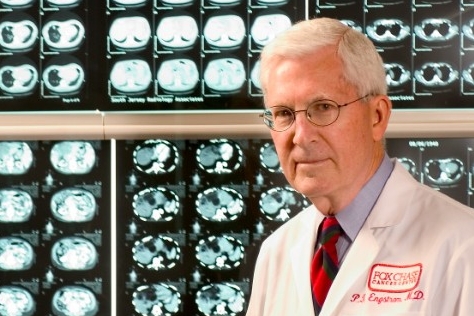
    Paul F. Engstrom, 89, formerly of Ambler, Montgomery County, celebrated pioneer in cancer prevention, education, and treatment, former chair and professor emeritus of the hematology and oncology department at Fox Chase Cancer Center, retired vice president of cancer control and senior adviser to the president at Fox Chase, Army veteran, and mentor, died Friday, Dec. 26, of Parkinson’s disease at Normandy Farms Estates in Blue Bell.

    The son of a small-town doctor, Dr. Engstrom accompanied his father on house calls in Minnesota when he was young and assisted sometimes on routine procedures. Later, after earning his medical degree at the University of Minnesota, he excelled at identifying cancer-related health problems and creating solutions.

    Starting in the 1960s and ’70s, Dr. Engstrom noticed large gaps in cancer prevention programs and treatment strategies. So he compiled comprehensive clinical care guidelines for cancer doctors and hospitals around the world, forged sustainable oncology research networks and community education partnerships, and established one of the country’s first cancer prevention and control programs at Fox Chase.

    “Most doctors and oncologists in the 1970s were training to treat cancer, not necessarily to prevent it,” former Fox Chase colleague Carolyn Fang said in a 2018 story for Fox Chase’s Forward magazine. “He was one of the first to recognize that prevention was important.”

    In 1991, Dr. Engstrom told the Daily News: “Changing the behavior of the public is only part of my job. We must change the physicians, too.” In 2000, he told The Inquirer: “Nowadays, the trend is toward identifying high-risk individuals and treatments we can give to prevent cancer from ever starting.”

    Dr. Engstrom was adept at organization and collaboration, former colleagues said in online tributes. He recruited other cancer experts to Fox Chase and established cutting-edge programs for cancer screening, smoking cessation, and education at hospitals, schools, private companies, and other organizations.

    He taught clinical science classes, secured vital grants from the National Cancer Institute and other groups, and made seminal clinical trials available to many more patients. “He was really aware of the need to integrate the community into this work.” Fang said in 2018.

    Dr. Engstrom joined the old American Oncologic Hospital in Philadelphia in 1970 and oversaw its merger with the Institute for Cancer Research in 1974 to become the Fox Chase Cancer Center. He was named vice president of cancer control and continuing education in 1984, and head of community cancer program activities in 1989.

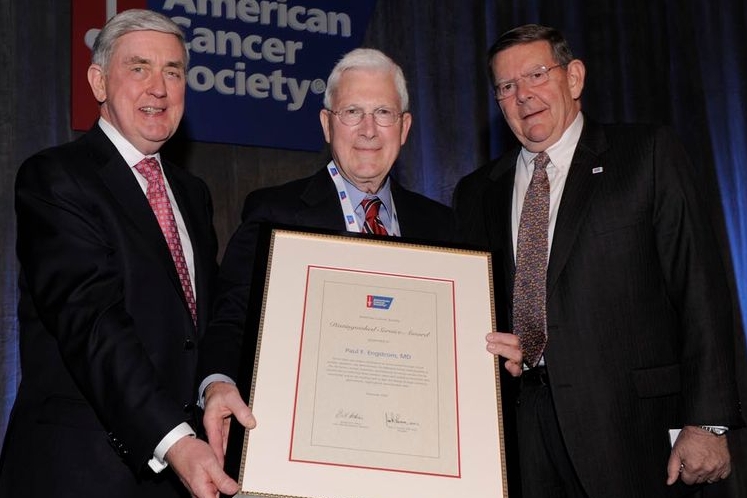
    Dr. Engstrom (center) earned many awards over his long career.

    He was also vice president for population science and held the Samuel M.V. Hamilton endowed chair in cancer prevention. He specialized in treating gastrointestinal cancers and neuroendocrine tumors. He retired in 2018 but continued as a special adviser to the Fox Chase president.

    He cofounded the National Comprehensive Cancer Network and was a fellow of the American College of Physicians and longtime member of the American Association of Cancer Research and other groups. He served on many boards and earned a clinical care achievement award in 2013 from the Association of Community Cancer Centers.

    In 2016, Dr. Engstrom and his wife, Janet, were honored by Fox Chase colleagues for their combined 80 years of service to the center. In 2020, colleagues published a series of articles about his career in the journal Cancer Prevention Research. In 2023, friends, colleagues, patients, and his family established the Paul F. Engstrom professorship in oncology at Fox Chase.

    Dr. Engstrom edited, wrote, or cowrote hundreds of research papers and lectured around the world. He was drafted into the Army in 1967, rose to the rank of major, and served three years as head of hematology and oncology at Tripler Army Hospital in Honolulu.

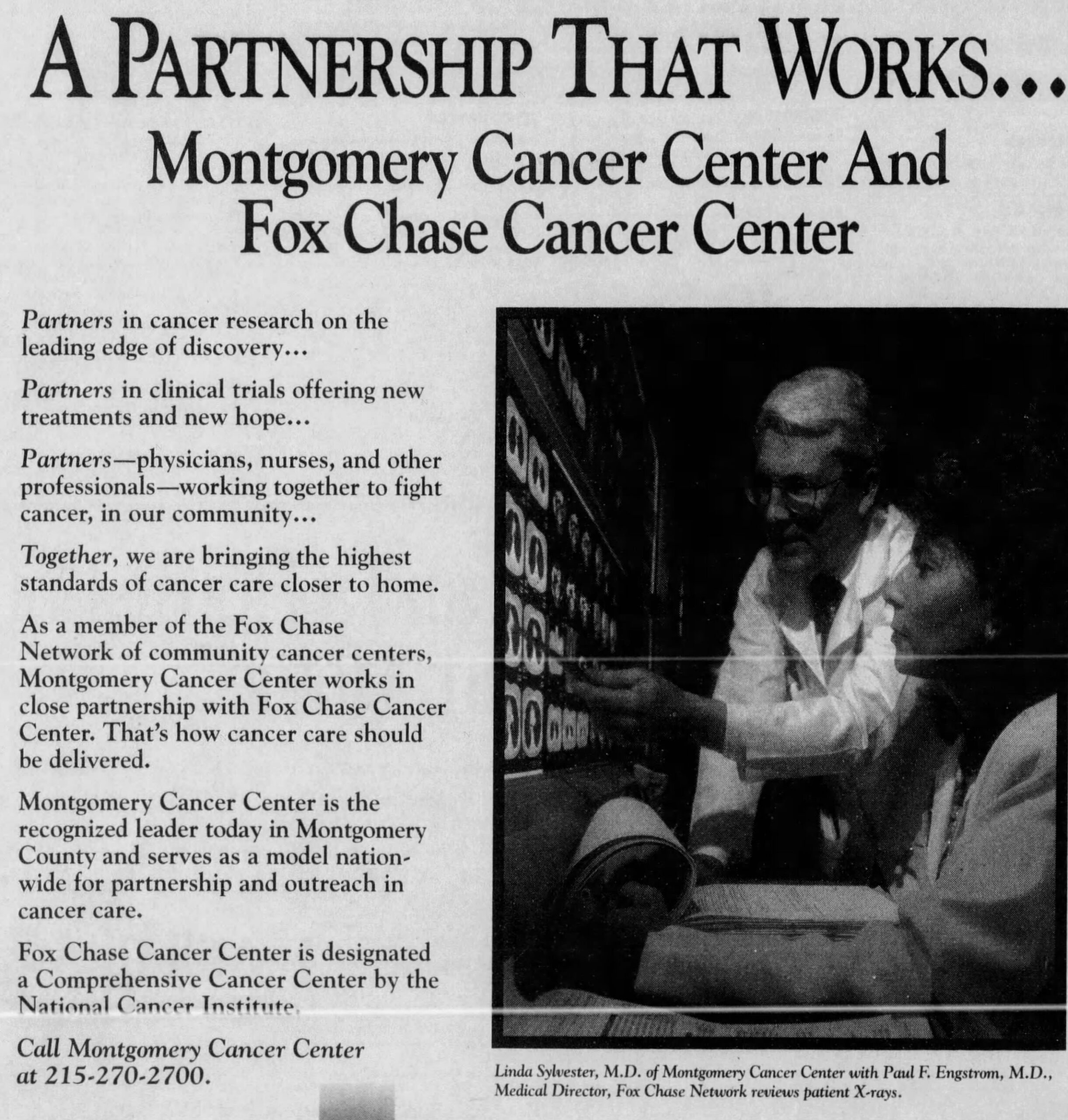
    Dr. Engstrom (left in the photo) appeared in many print advertisements for the Fox Chase Cancer Center, such as this 1995 ad in The Inquirer.

    “Medicine is a great career,” he said in 2018. “It is still the most satisfying and the best opportunity to do well, but most importantly to do good.”

    Paul Frederick Engstrom was born May 28, 1936, in St. Cloud, Minn. He played football and basketball, ran track, played trombone in the high school band, and sang in the school chorus.

    His father was the only doctor in Belgrade, Minn., and Dr. Engstrom knew early he was going to be a doctor, too. He earned a bachelor’s degree at St. Olaf College in Minnesota and completed a public health fellowship at the California Department of Health during medical school.

    He met nurse Janet Johnson during a procedure in a Minnesota hospital in 1960, and they married in 1961. They lived in Hawaii while he served in the Army and in Ambler until recently, and had daughters Karin and Maria, and a son, David.

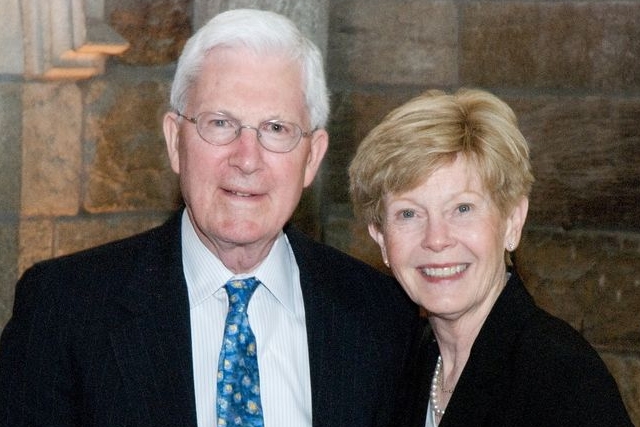
    Dr. Engstrom met his wife, Janet, when she was an intensive care unit nurse.

    Dr. Engstrom and his wife enjoyed the orchestra, ballet, and theater in Philadelphia. He liked to garden, read, and travel. He was thrifty, his wife said.

    He followed many of the local college and professional sports teams, especially the Eagles, and sang in the choir at Christ’s Lutheran Church in Oreland. He survived prostate cancer and remained a lifelong learner.

    “He liked being a student,” his wife said. “He was quiet. He was persistent.”

    His family said in a tribute: “He cherished every moment spent with his wife, children, and grandchildren.”

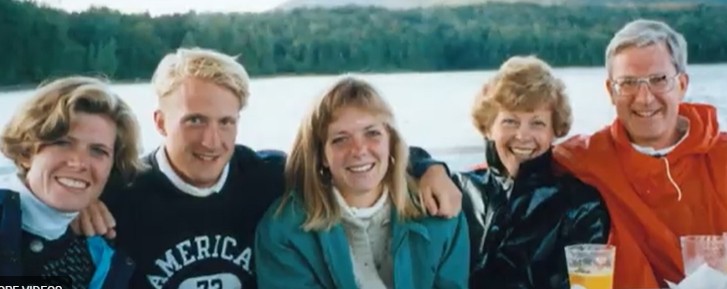
    Dr. Engstrom (right) enjoyed time with his family.

    In addition to his wife and children, Dr. Engstrom is survived by eight grandchildren, a brother, and other relatives. A brother died earlier.

    A celebration of his life was held earlier.

    Donations in his name may be made to the Fox Chase Cancer Center, 333 Cottman Ave., Philadelphia, Pa. 19111; and Christ’s Lutheran Church, 700 E. Pennsylvania Ave., Oreland, Pa. 19075.

  • Robert Carradine, ‘Revenge of the Nerds’ and ‘Lizzie McGuire’ star, has died at 71

    Robert Carradine, ‘Revenge of the Nerds’ and ‘Lizzie McGuire’ star, has died at 71

    Robert Carradine, the youngest of his prolific Hollywood family and whose biggest hit was the 1984 comedy Revenge of the Nerds, has died at 71.

    In a Tuesday statement, his family said he lived with bipolar disorder for two decades. His brother told Deadline that Mr. Carradine died by suicide.

    “We want people to know it, and there is no shame in it,” Keith Carradine told Deadline. “It is an illness that got the best of him, and I want to celebrate him for his struggle with it, and celebrate his beautiful soul. He was profoundly gifted, and we will miss him every day.”

    Known for both his film and television work, Robert Carradine worked steadily in the industry for over 40 years. Though he collaborated with some of the most respected directors of the day, he never gained the worldwide recognition of his more famous siblings Keith Carradine (also the father of Martha Plimpton) and half brother David Carradine, who died in 2009.

    Robert Carradine, a Los Angeles native and son to character actor John Carradine, was introduced to audiences with roles on the television series Bonanza in 1971 and in the John Wayne western The Cowboys in 1972.

    Despite his family background, acting wasn’t his first calling, though.

    “I always had a passion to be a race car driver, and that’s what I thought I was going to do, and at some penultimate moment … I think I was sitting with my brother David when The Cowboys was being cast, and they were interested in David as the bad guy, and he didn’t want to be the guy that shot John Wayne in the back,” Mr. Carradine recalled in a 2013 interview with Popdose. “But he said, ‘You know, it is called The Cowboys, and they’re meeting all these young guys. Why don’t you go in?’”

    In addition to starring in a short-lived television spinoff of The Cowboys, and appearing alongside David Carradine in his popular ABC series Kung Fu, he would go on to nab roles in Martin Scorsese’s Mean Streets, Hal Ashby’s Vietnam drama Coming Home, and Samuel Fuller’s World War II film The Big Red One.

    The heights of his brother David’s success eluded Robert Carradine, but the two could often be seen in the same projects, including in Walter Hill’s The Long Riders and Paul Bartel’s Cannonball.

    Robert Carradine’s biggest hit would come in 1984 with the off-color comedy Revenge of the Nerds, in which he played head nerd Lewis Skolnick, with his abrupt, infectious, and guttural laugh. He reprised the role for the big-screen sequel and two made-for-television follow-ups, and continued to pay homage to the beloved character with a guest role on the series Robot Chicken and as a co-host (with Revenge of the Nerds co-star Curtis Armstrong) of the pop culture competition show King of the Nerds, which aired for three seasons.

    In the late 1980s and 1990s, according to the family statement, Mr. Carradine realized his racing ambitions and was a driver for Lotus. In the 2000s, Mr. Carradine gained small-screen success in The Disney Channel’s Lizzie McGuire as the eponymous character’s father.

    “It’s really hard to face this reality about an old friend,” Hilary Duff, who played Lizzie McGuire, wrote on Instagram. “There was so much warmth in the McGuire family and I always felt so cared for by my on-screen parents. I’ll be forever grateful for that. I’m deeply sad to learn Bobby was suffering.”

    Work remained consistent even if the projects diminished in prestige and quality. Then Quentin Tarantino, ever the champion of fading character actors, cast Mr. Carradine in Django Unchained as one of the trackers in the 2012 film after seeing a “very furry” photograph, as Mr. Carradine told Popdose.

    In 2015, Mr. Carradine was cited for a Colorado crash that injured him and his wife, Edith Mani. They later divorced, after more than 25 years of marriage.

    Mr. Carradine’s survivors include his three children, actor Ever Carradine, Marika Reed Carradine, and Ian Alexander Carradine.

    “Whenever anyone asks me how I turned out so normal, I always tell them it’s because of my dad. I knew my dad loved me, I knew it deep in my bones, and I always knew he had my back,” Ever Carradine wrote on Instagram. “I think it’s partly because we basically grew up together. Twenty years age difference really isn’t that much, and while I never ever thought of him as a sibling, I did always think of him as my partner. We were in it together.”

    This story includes discussion of suicide. If you or someone you know needs help, the national suicide and crisis lifeline in the U.S. is available by calling or texting 988.

  • Charlotte Ann Albertson, cooking school founder and culinarian, has died at 90

    Charlotte Ann Albertson, cooking school founder and culinarian, has died at 90

    Charlotte Ann Albertson, 90, a pioneer in Philadelphia’s culinary scene through her long-running cooking school, died Sunday, Feb. 15, 2026, at her home in Harveys Lake, PA.

    For more than five decades, Mrs. Albertson, a longtime Wynnewood resident, ran Albertson Cooking School, which has introduced generations of home cooks and aspiring professionals to global cuisines, wine, and hospitality. In the years before round-the-clock food television, the school also helped to elevate the profiles of local chefs.

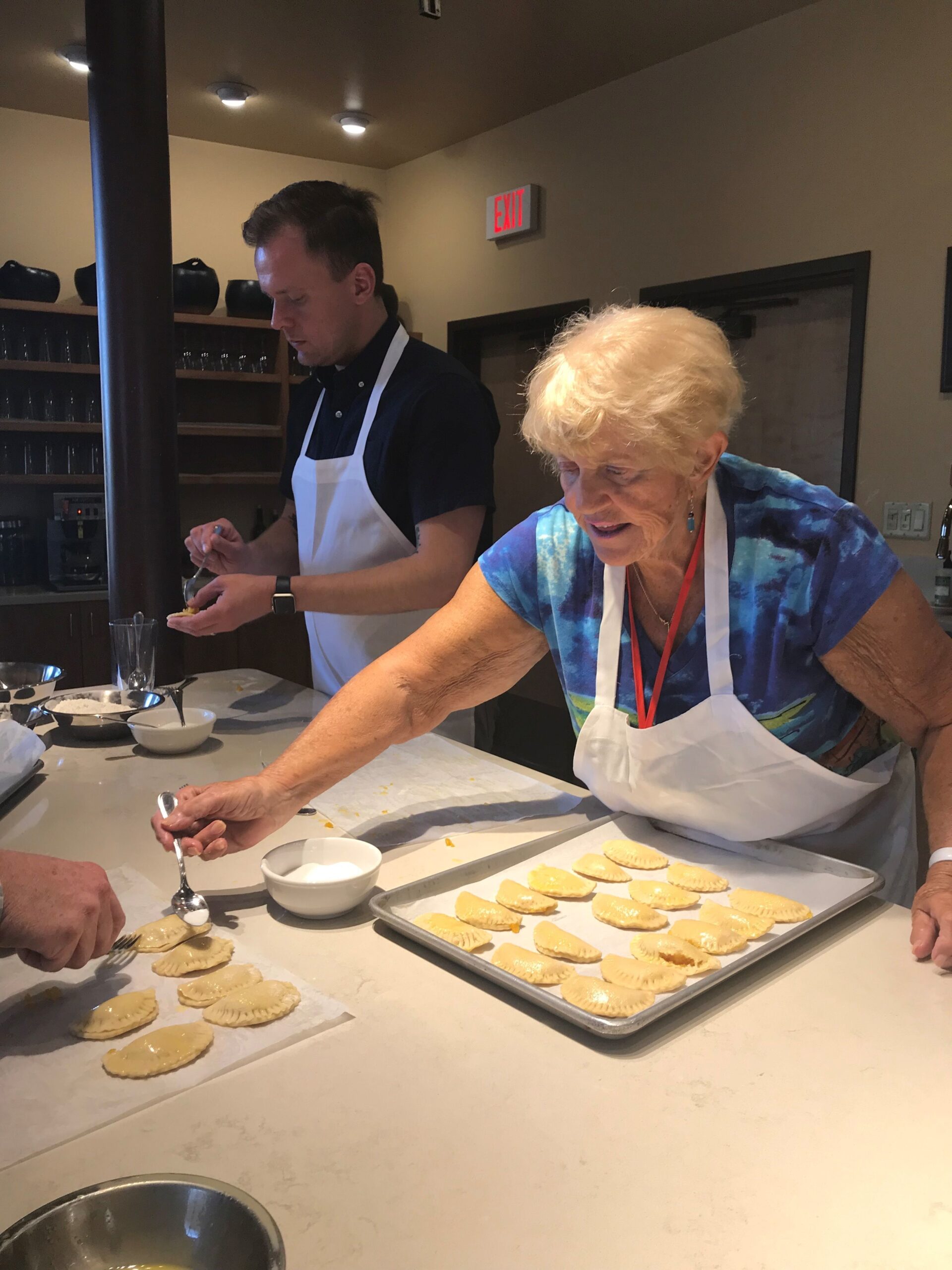
    Charlotte Ann Albertson in her element, leading a cooking class.

    Born in Chicago to Joseph and Veronica Sutula, she grew up in Scranton and attended Marywood Seminary and Marywood College, graduating in 1957. She earned a master’s degree in education from the University of Pennsylvania, where she met her husband, Dr. Richard P. Albertson, an anesthesiologist and president of the medical staff at Lankenau Hospital; he died in 2024.

    After their marriage in 1961, Mrs. Albertson taught fifth- and sixth-grade English at the former Wynnewood Road School in Lower Merion. In 1974, after taking classes with food writer/teacher Ethel Hoffman, she launched L’Epicure, later Albertson Cooking School.

    Mrs. Albertson proved adept at recruiting talent for the school, which relies on itinerant faculty. “Her term was always: ‘Be bullheaded — don’t ever take no for an answer,’” said her daughter Ann-Michelle.

    Charlotte Ann Albertson and her husband, Richard, toast at Christmas dinner in 2004.

    Mrs. Albertson’s classes, held at first in her condo kitchen and later at a variety of venues, ranged from the sublime to the whimsical. She booked a woman whom she saw teaching cake-decorating at a department store to share the secrets to the butter cookies of her native Scandinavia. She hired a baker from the Commissary (one of the most popular restaurants in town in the late ’70s) to demonstrate desserts, got a Japanese friend to teach sukiyaki and tempura, and landed a cheese artist to teach how to sculpt cheddar into footballs and pine cones.

    Lankenau Hospital was a rich recruiting ground. Her early instructors included the hospital’s chef, Bruce Cooper. “She was a tremendous supporter from the start, even investing in Jake’s [the landmark restaurant in Manayunk that opened in 1987] for its initial five years,” Cooper said last week.

    In 1977, she met Le Bec-Fin chef Georges Perrier at Lankenau after his teenage stepson required surgery and Dr. Albertson was the anesthesiologist. She persuaded Perrier to teach, and he led classes even as his and his restaurant’s international reputation grew.

    That same year, after reading about the impending closure of the Bellevue Stratford Hotel, Mrs. Albertson invited its executive chef to teach. “He said that he was too old, but he recommended a new guy in town, a master chef working at the Marriott,” Mrs. Albertson told The Inquirer for a 1994 profile.

    He was Tell Erhardt. Although he had a heavy German accent, she said, he was “a charmer” and led 16 classes for her. Chef Tell parlayed that into spots on local TV and, later, frequent appearances on Regis and Kathie Lee and Saturday Night Live. (Chef Tell also inspired the gibberish-speaking Swedish chef on The Muppet Show.)

    Charlotte Ann Albertson (left) with her family (from left): Daughters Ann-Michelle Albertson and Kristin Keifer, grandchildren Caroline and Cole Keifer, and her husband, Richard.

    Mrs. Albertson traveled and studied extensively, taking classes at La Varenne and Le Cordon Bleu in Paris. “She showed us the world — Vietnam, South Africa, Brazil, Chile, Argentina, Italy, China,” Ann-Michelle said. “Everywhere she went for culinary work, she took us with her.”

    She and her husband were also notably open about their choice to adopt. “I was adopted in 1967, when it was still pretty taboo,” Ann-Michelle said. “But from the beginning, the message was: ‘You were picked out special.’” The family maintained ties to St. Joseph’s Center in Scranton, from which Ann-Michelle and middle child Peter were adopted. Their third child, Kristin, was adopted privately in 1976.

    Kristin’s dearest memories of the cooking school were the hands-on birthday party classes for kids; children were taught how to bake and decorate a cake from scratch as well as make pizza using homemade dough. “Getting to meet Julia Child multiple times and dine with countless celebrity chefs are also at the top of the list of my fond memories,” all thanks to her mother, Kristin said.

    Beyond the classroom, Mrs. Albertson consulted for food and wine companies, libraries, and cultural institutions. She received the Delaware Valley Restaurant Association’s Panache Award in 1993 for promoting professional growth through education.

    Only later did Ann-Michelle — a pediatric speech pathologist who now runs the cooking school — fully grasp her influence. “People would stop me and say, ‘Your mom did so much for me. I wouldn’t be where I am without her,’” she said.

    As the business grew, Mrs. Albertson directed its success toward philanthropy, supporting causes including the Ronald McDonald House and Alex’s Lemonade Stand Foundation.

    Mrs. Albertson attended Our Lady of Lourdes Roman Catholic Church in Overbrook and Our Lady of Victory at Harveys Lake. “We went to church every Sunday,” Ann-Michelle said. “The perk at the lake was that I could water-ski to church — and ski back.”

    Mrs. Albertson was a charter member of the International Association of Culinary Professionals and belonged to the Confrérie de la Chaîne des Rôtisseurs, Les Dames d’Escoffier, Société Mondiale du Vin, the Philadelphia Culinary Guild, and the American Institute of Wine & Food.

    She is survived by her children, Ann-Michelle Albertson, Kristin Keifer, and Peter Albertson; seven grandchildren; and a great-grandchild.

    A funeral Mass will be celebrated at 11 a.m. Saturday, April 25, at Presentation B.V.M. Church, 204 Haverford Rd., Wynnewood. A celebration of life will follow at 12:30 p.m. at Savona, 100 Old Gulph Rd., Gulph Mills.

    In keeping with her spirit, her family asks attendees to wear bright colors in remembrance of her zest for life.

  • Willie Colón, 75, architect of urban salsa music, has died

    Willie Colón, 75, architect of urban salsa music, has died

    Willie Colón, the Grammy-nominated architect of urban salsa music and social activist, died Saturday. He was 75.

    Over his decades-long career, the trombonist, composer, arranger, and singer produced more than 40 albums that sold more than 30 million copies worldwide. He collaborated with a wide range of artists, including the Fania All Stars, David Byrne, and Celia Cruz.

    His celebrated collaboration with Rubén Blades, Siembra, became one of the bestselling salsa albums of all time, and the pair were known for addressing social issues through the genre.

    Mr. Colón’s family and manager confirmed his death through social media posts.

    “Willie didn’t just change salsa; he expanded it, politicized it, clothed it in urban chronicles, and took it to stages where it hadn’t been heard before,” manager Pietro Carlos wrote. “His trombone was the voice of the people, an echo of the Caribbean in New York, a bridge between two cultures.”

    Mr. Colón, who was nominated for 10 Grammys and one Latin Grammy, made famous songs such as “El gran varón,” “Sin poderte hablar,” “Casanova,” “Amor verdad,” and “Oh, qué será.”

    Blades said on the social platform X that he confirmed “what I was reluctant to believe” and offered his condolences to Mr. Colón’s family.

    The path to the trombone — and fame

    Born in New York’s Bronx borough, Mr. Colón was raised by his grandmother and aunt, who from a young age nurtured him with traditional Puerto Rican music and the typical rhythms of the Latin American repertoire, including Cuban son and tango.

    At age 11 he ventured into the world of music, first with flute, then bugle, trumpet, and finally trombone, with which he stood out in the then-nascent genre of salsa.

    His interest in trombone arose after hearing Barry Rogers playing it on “Dolores,” Mon Rivera’s song with Joe Cotto.

    “It sounded like an elephant, a lion … an animal. Something so different that, as soon as I heard it, I said to myself: ‘I want to play that instrument,’” he recalled in an interview published in the Colombian newspaper El Tiempo in 2011.

    At 17 he joined the group of artists that formed the famous record label Fania Records, led and created by Jerry Masucci and Johnny Pacheco. Fania was largely responsible for the new sound that was produced in the Latin world of New York and would later be called “salsa.”

    Mr. Colón’s main characteristic as a musician was the fusion of rhythms, as he harmonized jazz, rock, funk, soul, and R&B with the old Latin school of Cuban son, cha-cha-cha, mambo, and guaracha, adding the nostalgia of the traditional Puerto Rican sound that encompasses jíbara, bomba, and plena music.

    In 2004 the Latin Recording Academy awarded Mr. Colón a special Grammy for his career and contributions to music.

    Community leader and activist

    As a community leader, Mr. Colón fought for civil rights, mostly in the United States. He was part of the Hispanic Arts Association, the Latino Commission on AIDS, the Arthur Schomburg Coalition for a Better New York, and the Congressional Hispanic Caucus Institute, among others.

    In 1991 he was honored with the Chubb fellowship from Yale University, a public service recognition also awarded to the likes of John F. Kennedy, Moshe Dayan, the Rev. Jesse Jackson, and Ronald Reagan, among others.

    In the political arena, he served as special assistant to David Dinkins, New York’s first Black mayor, and was later appointed special assistant and adviser to Mayor Michael Bloomberg.

    Mr. Colón had little luck running for public office himself, however. He failed in a challenge to then-U.S. Rep. Eliot Engel in the 1994 Democratic primary, and in 2001 came in third in the Democratic primary for New York’s public advocate.

    He backed Hillary Clinton’s presidential campaign in 2008, but he told the Observer that he voted for Donald Trump in 2016.

    Mr. Colón had public clashes with artists and politicians. His friendship with Blades ruptured after Mr. Colón sued for breach of contract over the 2003 concert “Siembra … 25 years later,” held in Puerto Rico. He also sparked a controversy when he called the then-president of Venezuela, Hugo Chávez, “rotten” on a social network.

    Mr. Colón acted in films such as Vigilante, The Last Fight, and It Could Happen to You, and on TV in Miami Vice and Demasiado Corazón. More recently he appeared in Bad Bunny’s music video for “NuevaYol.”

    He is survived by his wife and four sons.