Category: Obituaries

  • Thousands of fans celebrate life of Grateful Dead guitarist Bob Weir in San Francisco

    Thousands of fans celebrate life of Grateful Dead guitarist Bob Weir in San Francisco

    SAN FRANCISCO — Thousands of people gathered Saturday at San Francisco’s Civic Center to celebrate the life of Bob Weir, the legendary guitarist and founding member of the Grateful Dead who died last week at age 78.

    Musicians Joan Baez and John Mayer spoke on a makeshift stage in front of the Bill Graham Civic Auditorium after four Buddhist monks opened the event with a prayer in Tibetan. Fans carried long-stemmed red roses, placing some at an altar filled with photos and candles. They wrote notes on colored paper, professing their love and thanking him for the journey.

    Several asked him to say hello to fellow singer and guitarist Jerry Garcia and bass guitarist Phil Lesh, also founding members who preceded him in death. Garcia died in 1995; Lesh died in 2024.

    “I’m here to celebrate Bob Weir,” said Ruthie Garcia, who is no relation to Jerry, a fan since 1989. “Celebrating him and helping him go home.”

    Saturday’s celebration brought plenty of fans with long dreadlocks and wearing tie-dye clothing, some using walkers. But there were also young couples, men in their 20s, and a father who brought his 6-year-old son in order to pass on to the next generation a love of live music and the tight-knit Deadhead community.

    The Bay Area native joined the Grateful Dead — originally the Warlocks — in 1965 in San Francisco at just 17 years old. He wrote or co-wrote and sang lead vocals on Dead classics including “Sugar Magnolia,” “One More Saturday Night,” and “Mexicali Blues.” He was generally considered less shaggy looking than the other band members, although he adopted a long beard like Garcia’s later in life.

    The Dead played music that pulled in blues, jazz, country, folk, and psychedelia in long improvisational jams. Their concerts attracted avid Deadheads who followed them on tours. The band played on decades after Garcia’s death, morphing into Dead & Company with John Mayer.

    Darla Sagos, who caught an early flight out of Seattle Saturday morning to make the public mourning, said she suspected something was up when there were no new gigs announced after Dead & Company played three nights in San Francisco last summer. It was unusual, as Weir’s calendar often showed where he would be playing next.

    “We were hoping that everything was OK and that we were going to get more music from him,” she said. “But we will continue the music, with all of us and everyone that’s going to be playing it.”

    Sagos and her husband, Adam Sagos, have a 1-year-old grandson who will grow up knowing the music.

    A statement on Weir’s Instagram account announced his passing Jan. 10. It said he beat cancer, but he succumbed to underlying lung issues. He is survived by his wife and two daughters, who were at Saturday’s event.

    His death was sudden and unexpected, said daughter Monet Weir, but he had always wished for the music and the legacy of the Dead to outlast him.

    American music, he believed, could unite, she said.

    “The show must go on,” Monet Weir said.

  • Dilys E. Blum, senior curator emeritus at the Philadelphia Art Museum, has died at 78

    Dilys E. Blum, senior curator emeritus at the Philadelphia Art Museum, has died at 78

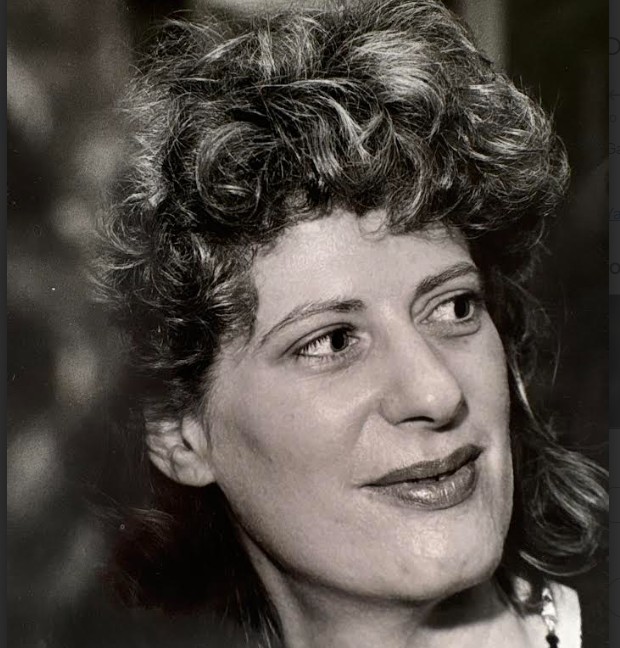
    Dilys E. Blum, 78, of Philadelphia, senior curator emeritus of costume and textiles at the Philadelphia Art Museum, author, lecturer, mentor, and world traveler, died Saturday, Dec. 27, of complications from cancer at Thomas Jefferson University Hospital.

    For 38 years, from 1987 to her retirement in 2025, Ms. Blum served as the museum’s curator of costume and textiles. In that role, she organized the museum’s vast treasure trove of textile artifacts, traveled the world to research noted fashion designers and eclectic collections, and created more than 40 memorable exhibitions about Renaissance velvets, contemporary fashion, Asian textiles, carpets, African American quilts, and dozens of other curios.

    Among her most popular presentations were 1997’s “Best Dressed: 250 Years of Style,” 2011’s “Roberto Capucci: Art into Fashion,” and 2025’s “Boom: Art and Design in the 1940s.” She organized two displays simultaneously in 2007, and The Inquirer said: “One exhibit is elegant, one’s eccentric, both are impressive.”

    She was cited as the world’s foremost authority on avant-garde Italian fashion designer Elsa Schiaparelli, and her 2003 exhibition “Shocking! The Art and Fashion of Elsa Schiaparelli” drew 83,000 visitors. Francesco Pastore, the heritage and cultural projects manager at the House of Schiaparelli in Paris, said: “Her remarkable research, her generosity in sharing knowledge, and her contribution to fashion studies have deeply enriched our field.”

    Ms. Blum (right) and colleague Monica Brown tend to a museum exhibit in 2011.

    In a recent tribute, former museum colleagues marveled at her “technical expertise and cultural insight,” and credited her for reinvigorating the once-neglected textiles collection. Daniel Weiss, director and chief executive officer of the museum, said: “She transformed this museum’s costume and textiles department into a program respected around the world.”

    She told The Inquirer in 1990: “We wanted to remind them that we were here.”

    Before Philadelphia, Ms. Blum was a textile conservator at the Chicago Conservation Center and the Brooklyn Museum, and senior assistant keeper of the costume and textile department at the Museum of London. She earned a bachelor’s degree in art history at Connecticut College and studied afterward at the University of Manchester in England and the Courtauld Institute of Art at the University of London.

    “She was fearless in her pursuit of perfection in her work,” said her sister Galen. Her sister Sydney said: “She was dedicated to her craft and scholarship.”

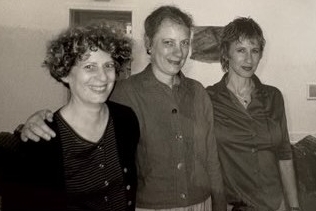
    Ms. Blum (left) was close to her sisters Sydney (center) and Galen.

    An avid reader and writer, Ms. Blum wrote and cowrote several books about textiles and designers, and 2021’s Patrick Kelly: Runway of Love, coauthored with former colleague Laura L. Camerlengo, earned a 2023 honorable mention publication award from the Costume Society of America. She also wrote essays for exhibition catalogs, served on editorial boards for journals, lectured around the world, and was active with the International Council of Museums, the Association of Art Museum Curators, and other groups.

    In 2025, to celebrate Ms. Blum’s retirement, Camerlengo praised her “deep knowledge, creative vision, and contagious passion for the field.” She said: “Dilys is one of the most influential figures in the world of fashion and textile arts.”

    Ms. Blum’s work and fashion viewpoints were featured often in The Inquirer. In 1997, she said: “People don’t dress up anymore.” In 1999, she said: “I think we’ve lost the joy in dressing. There’s this trend away from clutter in dress and decorating. It’s pared down to the point of visual boredom.”

    In 2001, she said it was easy to differentiate between New Yorkers and Philadelphians. “New Yorkers,” she said, “will invariably be wearing the accessory of the moment, a pashmina shawl, a Kate Spade bag, a Prada loafer.”

    Ms. Blum left “an enduring legacy woven through the art museum and the generations of scholars and visitors who now see costumes and textiles as central to the story of art,” former museum colleagues said.

    Dilys Ellen Blum was born July 11, 1947, in Ames, Iowa. She and her parents moved to Hamilton, N.Y., when she was 1, and the family traveled with her father, an economics professor at Colgate University, on teaching sabbaticals abroad. When she was 12, Ms. Blum spent a year with her parents and sisters living in Norway and touring Europe in a Volkswagen Beetle.

    Her mother was an artist and seamstress, and she and Ms. Blum spent many nights poring over clothes patterns on their dining room table. She enjoyed reading murder mysteries and traveling the world in search of new museum-worthy artifacts.

    She lived in South Philadelphia, was diagnosed with cancer three years ago, and talked often with her sisters on the telephone. “I admired her seriousness and humility,” Sydney said. Galen said: “From my perspective, I was in awe of her.”

    In addition to her sisters, Ms. Blum is survived by a niece, Juniper, and other relatives.

    A memorial service is to be held later.

    Former museum colleagues said Ms. Blum’s writing “consistently amplified the makers and wearers of extraordinary objects, and their intertwined relationships.”
  • Jeffrey A. Woodley, internationally celebrated celebrity hairstylist, has died at 71

    Jeffrey A. Woodley, internationally celebrated celebrity hairstylist, has died at 71

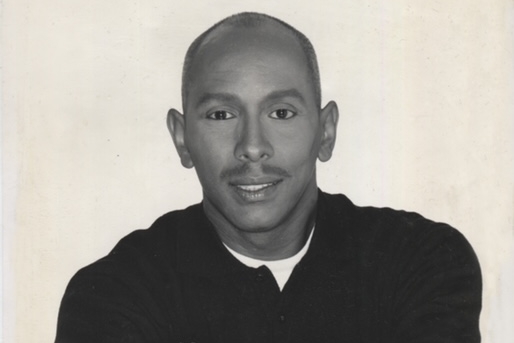
    Jeffrey A. Woodley, 71, formerly of Philadelphia, internationally celebrated celebrity hairstylist, scholar, youth track and field star, mentor, and favorite uncle, died Wednesday, Dec. 10, of complications from acute respiratory distress syndrome at Mount Sinai West Hospital in Manhattan.

    Reared in West Philadelphia, Mr. Woodley knew early that he was interested and talented in hairstyling, beauty culture, and fashion. He experimented with cutting and curling on his younger sister Aminta at home, left Abington High School before his senior year to attend the old Wilfred Beauty Academy on Chestnut Street, and quickly earned a chair at Wanamakers’ popular Glemby Salon at 13th and Chestnut Streets.

    He went to New York in the mid-1970s after being recruited by famed stylist Walter Fontaine and spent the next 30 years doing hair for hundreds of actors, entertainers, models, athletes, and celebrities. He styled Diahann Carroll, Whitney Houston, Aretha Franklin, Anita Baker, Angela Bassett, Halle Berry, and Tyra Banks.

    He worked with Denzel and Pauletta Washington, Eddie Murphy, Jasmine Guy, Lynn Whitfield, Pam Grier, Melba Moore, Jody Watley, and Karyn White. His hairstyles were featured in GQ, Vanity Fair, Ebony, Jet, Essence, Vibe, Vogue Italia, and other publications, and in advertising campaigns for L’Oréal and other products.

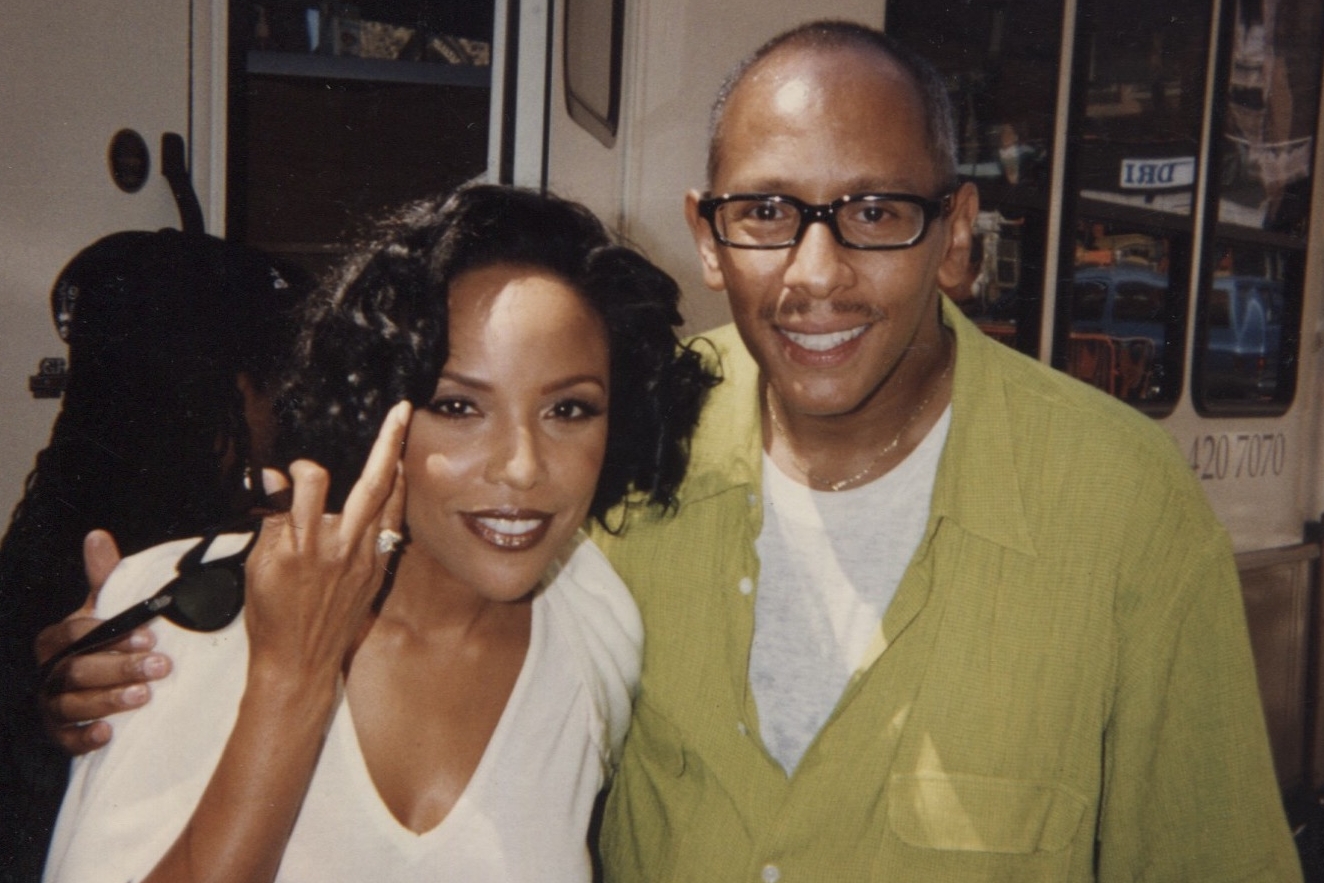
    Mr. Woodley poses with actor Lynn Whitfield.

    For years, actor Terry Burrell said, “He was the go-to hair stylist for every Black diva in New York City.” Pauletta Washington said: “He was responsible for so much of who I became as an artist and a friend.”

    Mr. Woodley worked for Zoli Illusions in New York, Europe, Africa, and elsewhere around the world, and collaborated often with noted makeup artists Reggie Wells and Eric Spearman. Model Marica Fingal called Mr. Woodley “uber talented” on Instagram and said: “He was one of the most skilled artists, creating stunning, innovative styles for models and celebs alike.”

    Friendly and curious, Mr. Woodley told Images magazine in 2000 that learning about the people in his chair was important. “A woman’s hairstyle should take into account the type of work she does, her likes, her dislikes, and her fantasies,” he said. “I’m a stylist, but I never impose hair styles on any client. When we arrive at our finished style, it’s always a collaboration.”

    His hairstyles appeared on record albums and at exhibitions at the Philadelphia Art Museum and elsewhere. He was quoted often as an expert in coiffure and a fashion forecaster. In 1989, he told a writer for North Carolina’s Charlotte Post: “Texture is the key. … Cut will still be important, but the lines will be more softened and much less severe.”

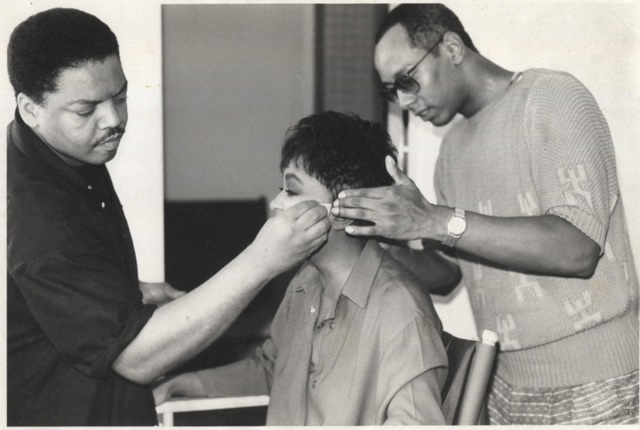
    Mr. Woodley (right) handles hair styling for singer Anita Baker while makeup artist Reggie Wells attends to her face.

    In 2000, he told Images that “low maintenance is the way of the future.” He said: “Today’s woman is going back to school. She has the corporate job. She has children that she needs to send off to school. She doesn’t have time anymore to get up and spend 35 to 40 minutes on her hair. She wants something she can get up and go with.”

    He retired in 2005 after losing his sight to glaucoma. So he earned his General Educational Development diploma, attended classes at the Borough of Manhattan Community College, and studied literature, Black history, and spiritual writing.

    “The entirety of his life was inspired by an insatiable thirst for knowledge,” said his friend Khadija Kamara.

    He was working on his memoir and still taking classes when he died. “He lived life on his own terms,” Burrell said, “and my respect and admiration for his determination will forever be inspiring.”

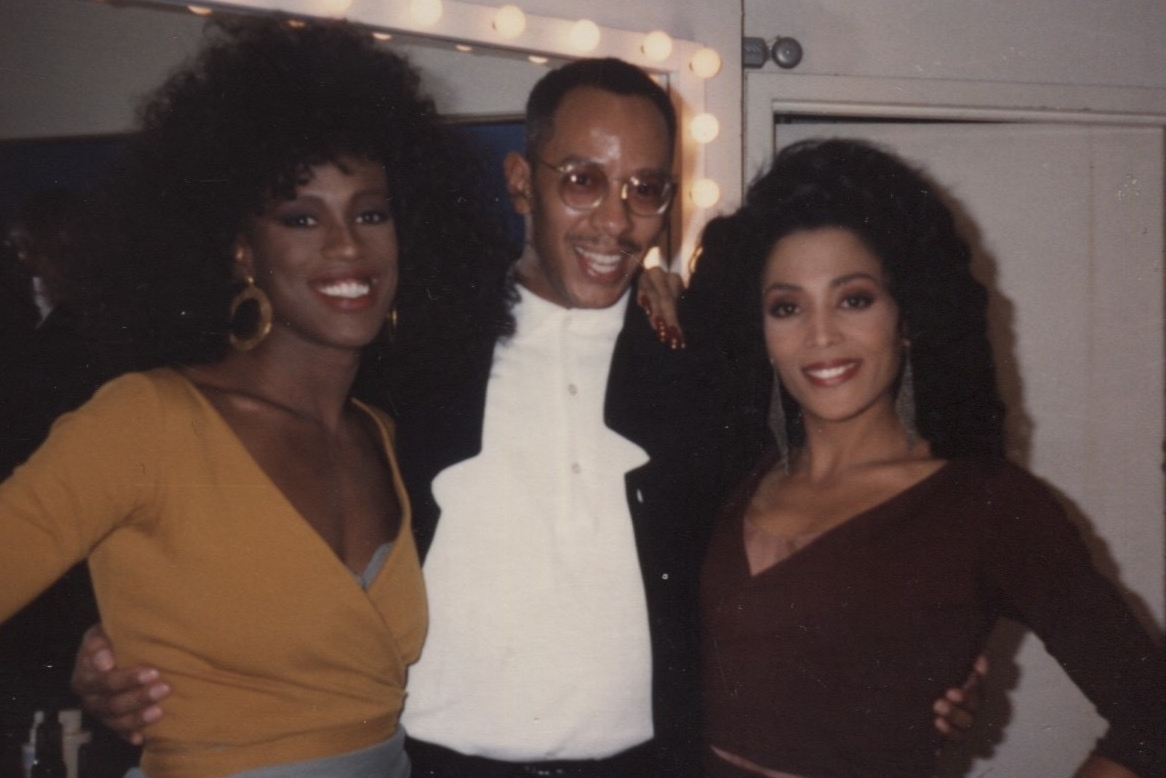
    Mr. Woodley smiles with track stars and celebrities Jackie Joyner-Kersee (left) and Florence Griffith Joyner.

    As a youth, Mr. Woodley excelled in sprints, relays, and the high jump at St. Rose of Lima Catholic School and Abington High School, and for the Philadelphia Pioneers and other local track and field teams. He ran on Abington’s 440-yard relay team that won the PIAA District 1 championship race at the 1970 Penn Relays and helped set a meet record in the four-lap relay at a 1971 Greater Philadelphia Track and Field Coaches Association indoor meet.

    Family and friends called him authentic, generous, and proud of his Philadelphia roots. He mentored his nieces and nephews and hosted them on long visits to his home in New York.

    “He was one of the most talented people around and always a lot of fun,” a friend said on Facebook. “A beautiful soul and spirit who made others beautiful.”

    Jeffrey Alan Woodley was born May 30, 1954, in Philadelphia. He had an older brother, Alex, and two younger sisters, Aminta and Alicia, and ran cross-country as well as track in high school.

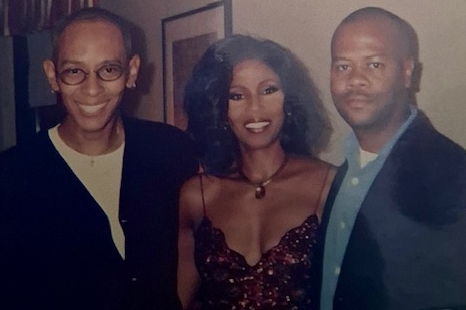
    Mr. Woodley (left) worked with actor and musician Pauletta Washington and makeup stylist Eric Spearman.

    He was always an avid reader and loved dogs, especially his guide dog Polly. He was a foodie and longtime member of the Abyssinian Baptist Church choir in Harlem. His close family and friends called him Uncle Jeff.

    “He was a fun-loving, spirited, and passionate individual,” his brother said. “Uncle Jeff loved the Lord and poured his heart into his work as well as family.”

    His sister Aminta said: “He had a wonderful spirit. He knew the Lord, lived life to the fullest, and was a joy to be with.”

    In addition to his mother, Anna, brother, and sisters, Mr. Woodley is survived by nieces, nephews, and other relatives.

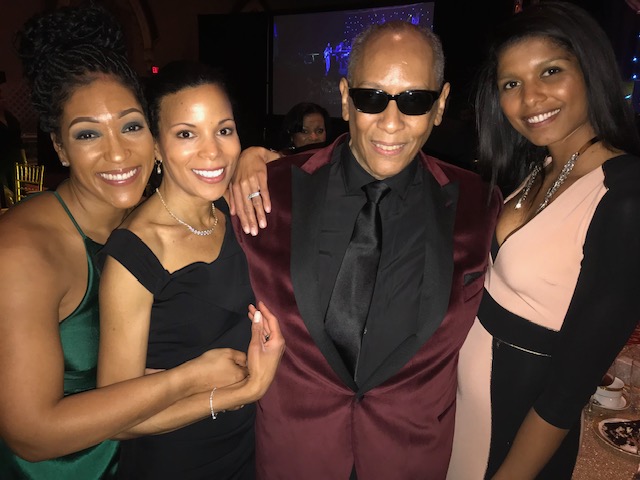
    Mr. Woodley doted on his nieces and nephews.

    A celebration of his life was held Dec. 22.

    Donations in his name may be made to Abyssinian Baptist Church, 132 W. 138th St., New York, N.Y. 10030; and the Anna E. Woodley Music Appreciation Fund at Bowie State University, 14000 Jericho Park Rd., Bowie, Md. 20715.

  • Claudette Colvin, who refused to move seats on a bus at start of civil rights movement, dies at 86

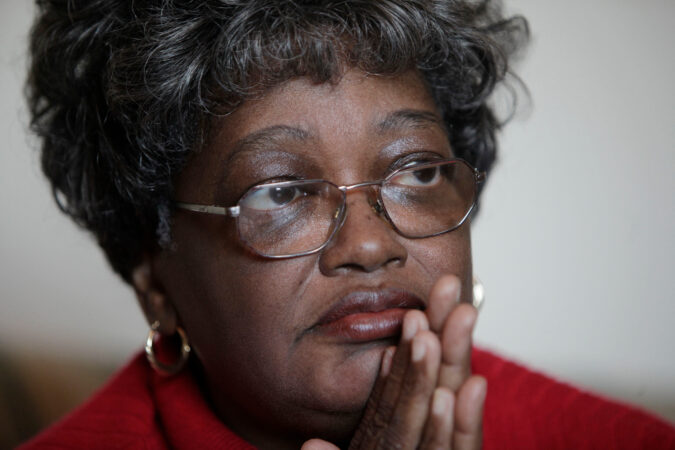
    Claudette Colvin, who refused to move seats on a bus at start of civil rights movement, dies at 86

    On March 2, 1955, a 15-year-old Black high school junior named Claudette Colvin boarded a segregated city bus in Montgomery, Ala., taking a window seat near the back. When the driver ordered her to give up her seat so a white woman could be more comfortable, Ms. Colvin — who had been studying Black history in class, learning about abolitionists like Harriet Tubman and Sojourner Truth — did not budge.

    “History had me glued to the seat,” she said later, recalling how it felt as though Tubman and Truth had their hands on her shoulders, giving her “the courage to remain seated.”

    History would record that it was Rosa Parks, the longtime secretary of the local NAACP, who helped kick-start the modern civil rights movement by refusing to give up her seat on a crowded Montgomery bus.

    Yet it was Ms. Colvin, nine months earlier, who engaged in one of the first defiant challenges to the city’s Jim Crow transit system, remaining in her seat until police dragged her backward off the bus.

    While Parks’ stand proved far more consequential, leading to a year-long bus boycott that thrust the Rev. Dr. Martin Luther King Jr. to national prominence, Ms. Colvin’s arrest inaugurated what King described as a pivotal period for Black people in Montgomery. Community leaders formed a committee to meet with city and bus company officials, calling for improved treatment for Black passengers. Those discussions proved fruitless, King recalled in a memoir, but “fear and apathy” gradually gave way to “a new spirit of courage and self-respect.”

    Historian David Garrow said in an interview for this obituary that “Colvin’s experience proved a major motivating force for adult Black activists” including Jo Ann Robinson, who helped launch and sustain the bus boycott. Another leading figure in the boycott, lawyer Fred Gray, brought the federal lawsuit that overturned bus segregation, with Ms. Colvin serving as a plaintiff and star witness.

    “I don’t mean to take anything away from Mrs. Parks,” Gray said, “but Claudette gave all of us the moral courage to do what we did.”

    Ms. Colvin, who died Jan. 13 at 86, was almost forgotten in the annals of civil rights. Overshadowed by Parks and other activists, she spent decades in obscurity, caring for elderly patients as a nurse’s aide before gaining late-in-life recognition through the efforts of historians and writers such as Phillip Hoose, whose 2009 biography, Claudette Colvin: Twice Toward Justice, won the National Book Award for young people’s literature.

    “Young people think Rosa Parks just sat down on a bus and ended segregation, but that wasn’t the case at all,” Ms. Colvin told the New York Times in 2009. “Maybe by telling my story — something I was afraid to do for a long time — kids will have a better understanding about what the civil rights movement was about.”

    A movie based on her life, Spark, was announced in 2022, with actor Anthony Mackie lined up to make his directorial debut, and Saniyya Sidney slated to star.

    In the days after Ms. Colvin’s arrest, civil rights leaders in Montgomery wondered if her case might offer a chance to put segregation itself on trial. But, as Robinson later wrote in a memoir, “opinions differed where Claudette was concerned.”

    Some deemed her too young and immature, saying she was prone to profane outbursts. (Ms. Colvin said she never cursed.) There were also concerns about her class and background: She was looked down upon, Montgomery activist Gwen Patton once recalled with frustration, because she “lived in a little shack.”

    The deciding factor was the discovery by labor organizer E.D. Nixon, the local NAACP president, that Ms. Colvin was expecting a child. She later said that she became pregnant in the months after the bus standoff as a result of an encounter with a married man, which she described as statutory rape.

    “Even if Montgomery Negroes were willing to rally behind an unwed pregnant teenager — which they were not — her circumstances would make her an extremely vulnerable standard-bearer,” author Taylor Branch observed in Parting the Waters, a Pulitzer Prize-winning civil rights history.

    Ms. Colvin often said Nixon and other organizers were right to rally around Parks, who exuded a quiet authority, was familiar to activists from her work in the NAACP, and had an appeal that crossed class divisions through her job as a department-store seamstress.

    But Ms. Colvin remained frustrated by what she described as a lack of support and recognition in the years after she was arrested, when she struggled as a single mother to find work and eventually left Alabama for New York.

    “They wanted someone, I believe, who would be impressive to white people. … You know what I mean? Like the main star,” she told the Guardian in 2021. “And they didn’t think that a dark-skinned teenager, low income without a degree, could contribute. It’s like reading an old English novel when you’re the peasant, and you’re not recognized.”

    ‘I had had enough’

    Claudette Austin, as she was then known, was born in Birmingham, Ala., on Sept. 5, 1939. Her father, C.P. Austin, left the family when she was young.

    Her mother, Mary Jane Gadson, was unable to support Ms. Colvin and her younger sister by herself, and turned the children over to her aunt and uncle, Mary Ann and Q.P. Colvin. The older couple lived on a farm in Pine Level — the rural Alabama community where, by chance, Parks had gone to elementary school — and gave the girls their last name.

    When Ms. Colvin was 8, the family moved to nearby Montgomery, where her adoptive parents were hired by white families to do home and yard work. Her sister died of polio in 1952, shortly before Ms. Colvin started her first year at Booker T. Washington High School.

    Ms. Colvin was still grieving her sister’s death when her neighbor Jeremiah Reeves, an older schoolmate, was arrested and charged with raping a white woman. Following a confession he gave under duress and later retracted, he was convicted by an all-white jury, sentenced to death, and executed in 1958, at age 22.

    His arrest “was the turning point of my life,” Ms. Colvin said. As she saw it, the case embodied the hypocrisies of the legal system: Reeves was sent to death row as a juvenile because of a false confession, but when a white man raped a Black girl, “it was just his word against hers, and no one would ever believe her.”

    Ms. Colvin told Hoose that on the day the bus driver asked her to give up her seat, “rebellion was on my mind.”

    She was sitting in a row near the rear exit, joined by three schoolmates as the bus started filling up, and passengers stood in the aisle. Before long, a white woman was standing over Ms. Colvin and her peers. The driver asked for all four of their seats, so that the woman wouldn’t have to sit in the same row as a Black passenger.

    “I might have considered getting up if the woman had been elderly, but she wasn’t,” Ms. Colvin recalled. “She looked about 40. The other three girls in my row got up and moved back, but I didn’t. I just couldn’t.”

    Ms. Colvin remained seated as the driver grew exasperated — “Gimme that seat! Get up, gal!” — and hailed a transit policeman, who in turn summoned a squad car. Ms. Colvin said that as the police arrived, she began crying but remained defiant, telling the officers, “It’s my constitutional right to sit here as much as that lady. I paid my fare, it’s my constitutional right!”

    By her account, one of the officers kicked her as she was pulled off the bus. (One of the officers alleged that it was the other way around.) She was placed in handcuffs and put in a squad car, where, according to Ms. Colvin, the officers took turns trying to guess her bra size.

    Bailed out of jail by her minister, she returned home to fears of retaliation. Her adoptive father didn’t sleep that night, staying awake with a shotgun in case the Ku Klux Klan arrived. At school, classmates began to consider her a troublemaker, describing her as “that crazy girl off the bus.”

    Ms. Colvin was charged with assault and disorderly conduct in addition to violating the segregation law. Tried in juvenile court because of her age, she was found guilty of assault (a judge dismissed the other two charges), placed on indefinite probation and ordered to pay a small fine.

    Over the next few months, other Black women defied Montgomery’s segregated bus policy. The group included Lucille Times, who staged a one-woman boycott after an altercation with a driver, and 18-year-old Mary Louise Smith, who was arrested, convicted and fined after refusing to give up her seat.

    As with Ms. Colvin, organizers worried that Smith wasn’t right for a marquee case: Her father was said to be an alcoholic, and the family was deemed too low-class. It wasn’t until Parks’s arrest on Dec. 1, 1955, that a citywide bus boycott was organized.

    As the boycott progressed, Ms. Colvin became one of several plaintiffs in Browder v. Gayle, a federal lawsuit brought by Gray that challenged the city and state laws enforcing bus segregation in Montgomery. The case reached the U.S. Supreme Court, which ordered an end to bus segregation in late 1956.

    Ms. Colvin gave birth to her first son, Raymond, earlier that year. She never publicly identified the father and said she was expelled from high school as a result of her pregnancy.

    After passing a high school equivalency exam, she briefly attended Alabama State College in Montgomery and then moved in 1958 to New York, where she got a job as a live-in caregiver.

    She had a second son in 1960 and moved back and forth between New York and Montgomery — where her adoptive mother helped care for her children — before settling in New York City in 1968 and receiving training as a nurse’s aide.

    “The only thing I am still angry about is that I should have seen a psychiatrist,” she told The Washington Post in 1998, reflecting on her life after the movement. “I needed help. I didn’t get any support. I had to get well on my own.”

    Ms. Colvin’s death was confirmed by Ashley D. Roseboro, a spokesman for the family and for the Claudette Colvin Foundation. He said she died in hospice in Texas but did not share additional details.

    Her son Raymond died in 1993. Her younger son, Randy, worked as an accountant. He survives her, as do several sisters and grandchildren.

    In 2021, Ms. Colvin successfully petitioned to have her juvenile arrest record expunged, a symbolic act recognizing the injustice of the segregation laws.

    “I’m not doing it for me, I’m 82 years old,” she explained to the Times. “But I wanted my grandchildren and my great-grandchildren to understand that their grandmother stood up for something very important, and that it changed our lives a lot, changed attitudes.”

  • Ena Widjojo, owner and longtime celebrated chef at Hardena in South Philadelphia, has died at 73

    Ena Widjojo, owner and longtime celebrated chef at Hardena in South Philadelphia, has died at 73

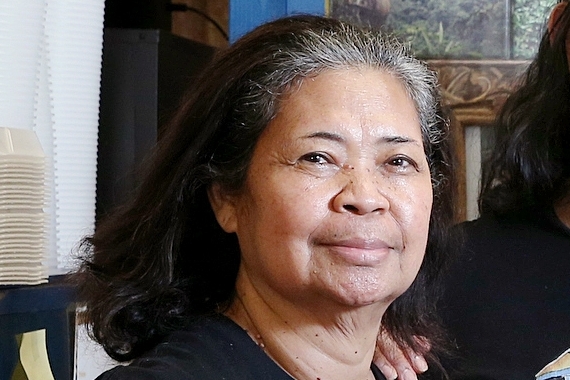
    Ena Widjojo, 73, of Philadelphia, owner and longtime celebrated chef at the Hardena restaurant in South Philadelphia, mentor, and mother, died Wednesday, Dec. 24, of cancer at her home.

    Born and reared in Java, Indonesia, Mrs. Widjojo came to the United States in 1969 when she was 17. She opened a cantina at the Indonesian Consulate in New York in 1977, worked as a caterer in the 1990s after the cantina closed in 1989, and moved to Philadelphia in 2000 to open Hardena with her husband, Harry.

    Over the next decade and a half, until she retired in 2017, Mrs. Widjojo grew Hardena, described by the Daily News in 2007 as “a postage-stamp-size luncheonette at Hicks and Moore Streets in a gritty section of South Philly,” into a culinary and cultural connection for thousands of local Indonesians and other diners who enjoyed her homemade Southeast Asia cuisine.

    The corner restaurant’s name is a blend of their names, Harry and Ena, and features Indonesian specialties such as golden tofu, goat curry, saté chicken, beef rendang, and tempeh. “It’s the best Indonesian food in Philadelphia, a great mix of Indian and Chinese flavors,” elementary schoolteacher Aaron MacLennan told the Daily News in 2007.

    This photo of Mrs. Widjojo appeared in the Daily News in 2007

    In 2012, Philadelphia Magazine named Hardena one of its Best of Philly Indonesian restaurants, calling it a “no-frills, high-flavor buffet.” In February 2018, Mrs. Widjojo and two of her three daughters were named semifinalists for the James Beard Foundation’s best chef award for the Mid-Atlantic states. In October 2018, Inquirer food critic Craig LaBan praised the restaurant’s “aromatic steam table of homestyle cooking that’s been a well-priced anchor of Indonesian comfort for 18 years.”

    Friendly and ever present at the lunch and dinner rushes, Mrs. Widjojo was known as Mama to many of her customers and friends. She learned how to bake and cook from her mother, a culinary teacher in Java, and later incorporated many of her mother’s recipes into her own memorable melting pot of Indian, Chinese, Arab, Portuguese, Spanish, English, and Dutch dishes at Hardena.

    “She served me greens once, and I felt like I was at home,” a friend said on Instagram.

    She and her husband traveled weekly between Philadelphia and Queens while their daughters — Diana, Maylia, and Stephanie — finished school in New York. Maylia and Diana assumed control of Hardena when Mrs. Widjojo retired, and Diana opened the restaurant Rice & Sambal on East Passyunk Avenue in 2024.

    Earlier, at the consulate in New York, Mrs. Widjojo made meals for former Secretary of State Henry Kissinger and former Indonesian President Suharto and his large entourage. “I cooked for all the diplomats.” she told The Inquirer in 2018.

    Mrs. Widjojo (second from right) smiles with her husband and three daughters.

    She grew chili peppers and lime trees in her South Philly backyard, was happy to share kitchen tips and cultural traditions with visitors and cooking classes, and helped her daughters cater the 2019 James Beard Foundation’s annual Media Awards in New York.

    She worked six days a week for years and told edible Philly in 2017 that her retirement was good for her daughters. “If I’m cooking all the time,” she said, “they’re not learning.”

    Ena Djuneidi Juniarsah was born April 24, 1952. She baked cakes in a charcoal oven for her mother in Java and sold cookies and pastries after school when she was young. “

    Her mother was strict about cooking, Mrs. Widjojo said in 2018, and discarded any and all imperfect creations. “Like me, with my kids’ cooking,” she said, “if you’re not good, that’s no good.”

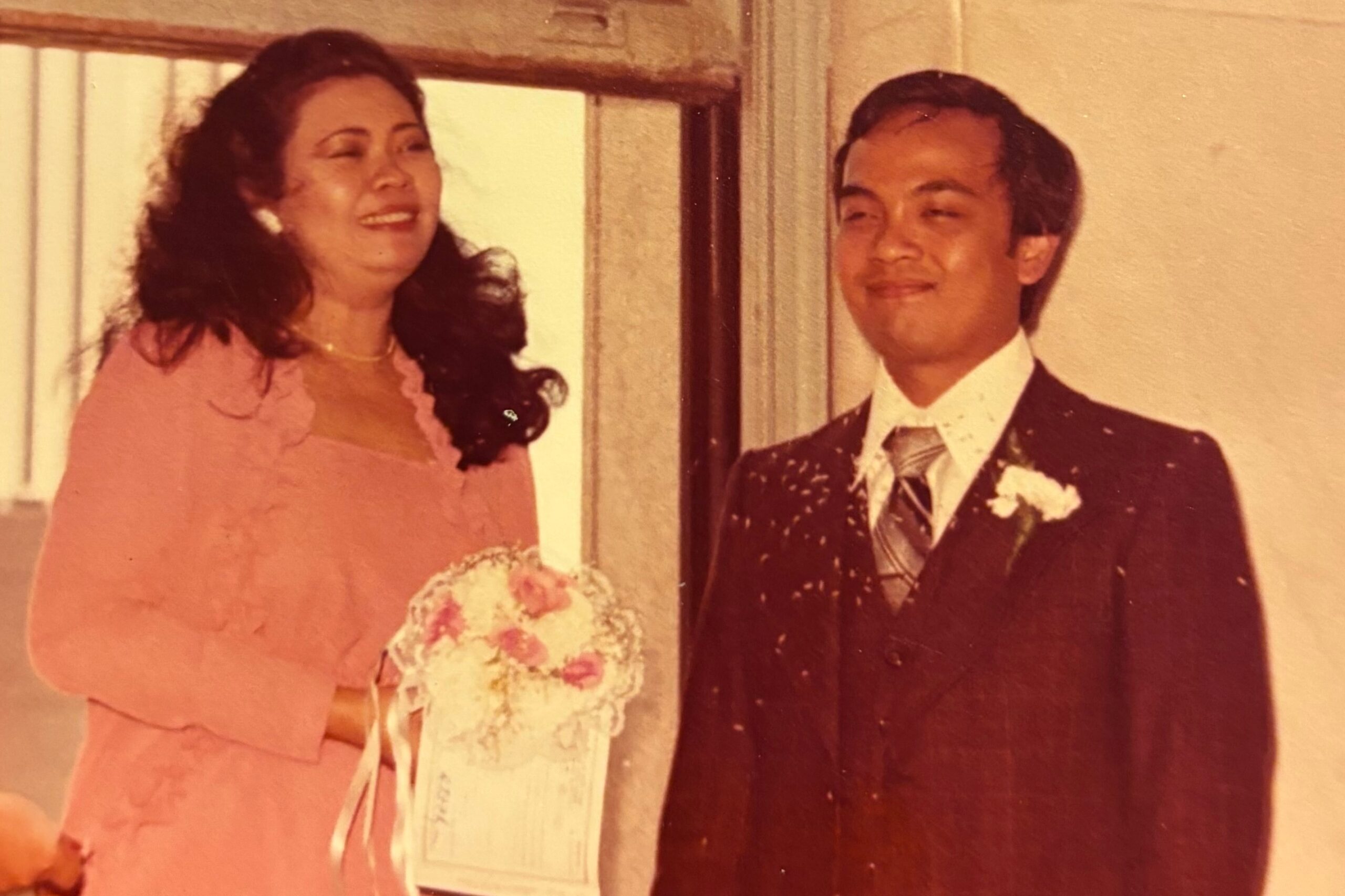
    She married fellow restaurateur Harry Widjojo in New York and spent time as a singer, beautician, florist, and nanny before cooking full time. Away from the restaurant, she enjoyed drawing, painting, crocheting, and family strolls in the park.

    Mrs. Widjojo and her husband, Harry, were married in New York.

    She could be goofy, her daughters said. She sang “You Are My Sunshine” when they were young and served as their lifelong mentor and teacher.

    Friends called her “sweet,” “amazing,” “a beautiful soul,” and “warm and welcoming” on Instagram. She was diagnosed with cancer in 2015.

    “Her life, generosity, and talent enriched the hearts of all who met her,” her family said in a tribute. “She taught us that feeding people is one of the purest ways to show love, have pride in our culture, and support our family.”

    Maylia said: “She was always giving.”

    Stephanie said: “She was always there for me.”

    Mrs. Widjojo (center) stands in Hardena with her daughters Maylia (left) and Diana in 2020.

    Diana said: “She saw the world with open arms and an open heart. She was a wonder woman.”

    In addition to her husband and daughters, Mrs. Widjojo is survived by two grandchildren, a sister, two brothers, and other relatives. A sister and two brothers died earlier.

    A celebration of her life was held Dec. 27.

    Donations in her name may be made to Masjid Al Falah Mosque, 1603 S. 17th St. Philadelphia, Pa. 19145.

    Mrs. Widjojo came to the United States from Java when she was 17.
  • Scott Adams, the ‘Dilbert’ creator who poked fun at bad bosses, dies at 68

    Scott Adams, the ‘Dilbert’ creator who poked fun at bad bosses, dies at 68

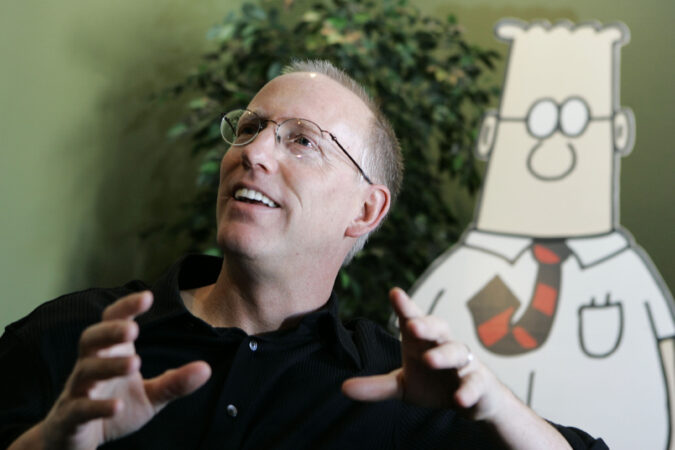
    Scott Adams, who became a hero to millions of cubicle-dwelling office workers as the creator of the satirical comic strip Dilbert, only to rebrand himself as a digital provocateur — at home in the Trump era’s right-wing mediasphere — with inflammatory comments about race, politics, and identity, died Jan. 13. He was 68.

    His former wife Shelly Miles Adams announced his death in a live stream Tuesday morning, reading a statement she said Mr. Adams had prepared before his death. “I had an amazing life,” the statement said in part. “I gave it everything I had.”

    Mr. Adams announced in May 2025 that he had metastatic prostate cancer, with only months to live. In a YouTube live stream, he said he had tried to avoid discussing his diagnosis (“once you go public, you’re just the dying cancer guy”) but decided to speak up after President Joe Biden revealed he had the same illness.

    “I’d like to extend my respect and compassion for the ex-president and his family because they’re going through an especially tough time,” he said. “It’s a terrible disease.”

    Mr. Adams was working as an engineer for the Pacific Bell telephone company when he began doodling on his cubicle whiteboard in the 1980s, dreaming of a new, more creatively fulfilling career as a cartoonist. Before long, he was amusing colleagues with his drawings of a mouthless, potato-shaped office worker: an anonymous-looking man with a bulbous nose, furrowed pate, and upturned red-and-white striped tie.

    His doodles evolved into Dilbert, a syndicated comic strip that debuted in 1989 and eventually appeared in more than 2,000 newspapers around the world, rivaling Peanuts and Garfield in popularity.

    Years before the film comedy Office Space and TV series The Office satirized the workplace on-screen, Dilbert poked fun at corporate jargon, managerial ineptitude, and the indignities of life in the cubicle farm.

    In one strip, the title character is awarded a promotion “with no extra pay, just more responsibility,” because “it’s how we recognize our best people.” In another, he’s presented with an “employee location device” — a dog collar.

    Other Dilbert cartoons could be crassly funny. Seeking to improve the company’s image, Dilbert’s pointy-haired boss hires an ad agency that uses a computer program to come up with a new “high-tech name” for the firm, using random words from astronomy and electronics. Their suggestion: “Uranus-Hertz.”

    Mr. Adams proved adept at growing his audience during the tech boom of the 1990s, creating a Dilbert website long before most other cartoonists took to the internet. He also became the first major syndicated cartoonist to include his email address in his comic strip, an innovation that allowed readers to contact him directly with ideas. Their feedback convinced him to focus the cartoon entirely on the workplace, after some of the strip’s early installments explored Dilbert’s home life.

    Interviewed by the Wall Street Journal in 1994, Mr. Adams observed that “the universal thread” uniting the strip’s readers “is powerlessness. Dilbert has no power over anything.”

    By the end of the decade, Dilbert seemed to be everywhere, appearing on the cover of business magazines and in book-length compendiums. Mr. Adams signed off on the creation of a Dilbert Visa card and a Ben & Jerry’s ice cream flavor, branded as Totally Nuts; licensed his cartoon characters for commercials; and partnered with Seinfeld writer Larry Charles to develop an animated Dilbert television series, which aired for two seasons on the now-defunct UPN network.

    Capitalizing on the cartoon’s success, he also put out a shelfful of satirical business books, beginning with the 1996 bestseller The Dilbert Principle. Inspired by the Peter Principle, a management concept in which employees are said to be promoted to their level of incompetence, Mr. Adams argued that “the most ineffective workers are systematically moved to the place where they can do the least damage: management.”

    He wasn’t entirely joking. As he saw it, the people who spouted inane ideas, sucked up to management and pretended they knew more than they did were the ones who got promoted. The workplace was a mess, he suggested, but by calling out bosses’ bad behavior, Dilbert could be a force for good.

    “I heard from lots of people who told me, ‘My boss started to say something that was ridiculous — management fad talk, buzzwords — but he stopped himself and said, “OK, this sounds like it came out of a Dilbert comic,’ and then started speaking in English again.’

    “There is a fear of being the target of humor,” Mr. Adams told the Harvard Business Review.

    Companies such as Xerox incorporated the character into communications and training programs. But some critics found the cartoon’s sarcasm more corrosive than entertaining. Author and progressive activist Norman Solomon, who wrote a book-length critique of the comic, argued that Dilbert was hardly subversive, saying that it offered more for bosses than workers.

    Dilbert does not suggest that we do much other than roll our eyes, find a suitably acid quip, and continue to smolder while avoiding deeper questions about corporate power in our society,” Solomon wrote.

    Mr. Adams scoffed at the criticism, lampooning Solomon by name in his books and comic strips. “My goal is not to change the world,” he told the Associated Press in 1997. “My goal is to make a few bucks and hope you laugh in the process.”

    In interviews, he was often self-deprecating, declaring that his comic strip was “poorly drawn” and noting that long before he made Dilbert he “failed at many things,” including computer games he attempted to program and sell. His other failures included the Dilberito, a line of vitamin-filled veggie wraps that ended up making people “very gassy,” and his short-lived attempt at managing an unprofitable restaurant, Stacey’s at Waterford, that he owned in the Bay Area.

    “Certainly I’m an example of the Dilbert Principle,” he told the New York Times in 2007, a few months into his stint as a restaurant boss. “I can’t cook. I can’t remember customers’ orders. I can’t do most of the jobs I pay people to do.” (Employees told the newspaper that Mr. Adams was loyal and kind, yet totally clueless. “I’ve been in this business 23 years, and I’ve seen a lot of things,” the head chef said. “He truly has no idea what he’s doing.”)

    On the side, Mr. Adams blogged about fitness, politics, and the art of seduction — drawing, he said, on his training as a certified hypnotist, which he learned before becoming a cartoonist. He also wrote about his struggles with focal dystonia, a neurological disorder, which caused spasms in his pinkie finger that made it difficult to draw. Mr. Adams said he developed tricks to get around the issue, holding his pen or pencil to the paper for just a few seconds at a time, and underwent experimental surgery to treat a related condition, spasmodic dysphonia, that hindered his ability to speak.

    Politically, he cast himself as an independent, saying he didn’t vote and was not a member of any party. But he also veered into far-right political terrain on his blog, including in a 2006 post in which he questioned “how the Holocaust death total of 6 million was determined.” A few years later, writing about “men’s rights,” he compared society’s treatment of women to its treatment of children and people with mental disabilities.

    “You don’t argue with a 4-year old about why he shouldn’t eat candy for dinner. You don’t punch a mentally handicapped guy even if he punches you first. And you don’t argue when a woman tells you she’s only making 80 cents to your dollar. It’s the path of least resistance,” he wrote.

    Mr. Adams made headlines with his prediction that Donald Trump, whom he considered a master of persuasion, would win the 2016 presidential election. He was later invited to the White House after publishing the 2017 nonfiction book Win Bigly: Persuasion in a World Where Facts Don’t Matter. (The book’s cover art featured an orange-hued drawing of Dogbert, Dilbert’s megalomaniacal pet dog, with a Trumplike swoosh of hair.)

    “He was a fantastic guy, who liked and respected me when it wasn’t fashionable to do so,” Trump said Tuesday in a Truth Social post, referring to Mr. Adams as “the Great Influencer.” “My condolences go out to his family, and all of his many friends and listeners.”

    Amid a national reckoning on race in the 2020s, Mr. Adams sparked a backlash for his criticisms of diversity, equity, and inclusion programs, and for social media posts in which he joked that he was “going to self-identify as a Black woman” after President Joe Biden vowed to nominate an African American woman to the Supreme Court. In 2022, he introduced Dilbert’s first Black character, an engineer named Dave who announces to colleagues that he identifies “as white,” ruining management’s plan to “add some diversity to the engineering team.”

    The following year, Dilbert was dropped by hundreds of newspapers, including The Philadelphia Inquirer and Daily News, after Mr. Adams delivered a rant that was widely decried as hateful and racist. Appearing on his YouTube live-stream show, Real Coffee With Scott Adams, he discussed a controversial Rasmussen poll asking people if they agreed with the statement “It’s OK to be white,” a slogan associated with the white supremacist movement. About a quarter of Black respondents said “no.”

    Mr. Adams was appalled by the results. He declared that African Americans were “a hate group,” adding: “I don’t want to have anything to do with them. And I would say, based on the current way things are going, the best advice I would give to white people is to get the hell away from Black people.”

    Within a week his syndicate and publisher, Andrews McMeel Universal, cut ties with the cartoonist. Mr. Adams defended his comments, saying he had meant the remarks as hyperbole, and found support from conservative political activists as well as billionaire Tesla executive Elon Musk.

    In a follow-up show on YouTube, he disavowed racism against “individuals” while also telling viewers that “you should absolutely be racist whenever it’s to your advantage.” Weeks later, he relaunched Dilbert on the subscription website Locals, vowing that the comic would be “spicier” — less “PC” — “than the original.”

    “Only the dying leftist Fake News industry canceled me (for out-of-context news of course),” he tweeted in March 2023. “Social media and banking unaffected. Personal life improved. Never been more popular in my life.”

    From bank teller to cartoonist

    Scott Raymond Adams was born in Windham, N.Y., a ski town in the Catskills, on June 8, 1957. His father was a postal clerk, and his mother was a real estate agent who later worked on a speaker-factory assembly line.

    Growing up, Mr. Adams copied characters out of his favorite comic strips, Charles M. Schulz’s Peanuts and Russell Myers’ Broom-Hilda. He applied for a correspondence course at the Famous Artists School but was rejected, he said, because he was only 11. The minimum age was 12.

    Mr. Adams eventually took a drawing course at Hartwick College in Oneonta, an hour’s drive from his hometown. He received the lowest grade in the class and decided to focus instead on economics, receiving a bachelor’s degree in 1979. He moved to San Francisco, got a job as a bank teller at Crocker National Bank and, in his telling, was twice robbed at gunpoint while working behind the counter.

    At night, he took business classes at the University of California at Berkeley. He earned an MBA in 1986 and joined PacBell as an applications engineer, though he found himself deeply unhappy. “About 60 percent of my job at Pacific Bell involved trying to look busy,” he wrote in a 2013 book, How to Fail at Almost Everything and Still Win Big: Kind of the Story of My Life.

    After watching a public television series, Funny Business: The Art in Cartooning, he decided he had found his calling. Mr. Adams struck up a correspondence with the show’s host, cartoonist John “Jack” Cassady, who encouraged him to submit to major magazines like Playboy and the New Yorker.

    All his cartoons were rejected. But with Cassady’s encouragement, Mr. Adams continued to draw, waking up at 4 a.m. and sitting down with a cup of coffee to work on doodles of Dilbert and other characters. He stayed motivated in part by writing an affirmation: “I, Scott Adams, will become a famous cartoonist.”

    Even after he signed a contract to publish Dilbert through United Feature Syndicate, Mr. Adams continued to work at his day job, making $70,000 a year and gathering ideas for his strip while sitting at cubicle No. 4S700R. He left the company in 1995, and two years later he won the National Cartoonists Society’s highest honor, the Reuben Award for cartoonist of the year.

    Mr. Adams was twice married and divorced, to Shelly Miles and Kristina Basham. Information on survivors was not immediately available.

    Looking back on his career, Mr. Adams said he was especially proud of two novellas he had written, God’s Debris (2001) and the sequel The Religion War (2004). The latter was set in 2040 and revolved around a civilizational clash between the West and a fundamentalist Muslim society in the Middle East.

    Discussing the plot in a 2017 interview with Bloomberg Businessweek, Mr. Adams said that the Muslim extremists are defeated after the hero builds a wall around them and “essentially kills everybody there.”

    “I have to be careful, because I’m talking about something pretty close to genocide, so I’m not saying I prefer it, I’m saying I predict it,” he added.

    The magazine reported that Mr. Adams believed the novellas, not Dilbert, would be his ultimate legacy.


  • Harry Spivak, a caterer who straddled the music and hospitality worlds, has died at 66

    Harry Spivak, a caterer who straddled the music and hospitality worlds, has died at 66

    Harry A. Spivak, 66, a veteran caterer and connector in the city’s hospitality sector, died of natural causes on Dec. 31 after a short illness.

    Over the decades in catering, event production, and consulting, he was known as the person who knew whom to call, how to staff a last-minute job, where to source the right equipment, and how to make complicated events run smoothly.

    “He was a sage when it came to organization and bartending and everything that goes into making an event work,” said Jon Spivak, a brother who was his partner at the now-closed Max & Me Catering. “But his real gift was connecting people. He had what I call ‘a Rolodex brain.’ That was his true genius.”

    Harry Spivak (left) with his uncle Herb Spivak and his brother Jon.

    Mr. Spivak, the oldest of Joseph “Jerry” and Sally Spivak’s five children, grew up immersed in hospitality and music through the family’s businesses.

    In 1968, Jerry Spivak and brothers Herb and Allen were among the founders of the Electric Factory, the pioneering music venue that grew into the industry’s largest concert-promotions company, Live Nation. In 1972, the Spivak brothers opened H.A. Winston & Co., a casual restaurant that grew to 22 locations on the East Coast.

    Mr. Spivak himself only dabbled in the restaurant business — opening the short-lived Bala Rouge in Bala Cynwyd in 1985 with his brother Jon and cousin Adam Spivak after his graduation from the University of Colorado in Boulder. He later spent eight years in the San Francisco Bay Area before returning to the Philadelphia area to raise his daughter, Katie.

    Friends say Mr. Spivak possessed a rare mix of business instinct and personal warmth. He could talk logistics one minute and relationships the next.

    “He had this incredible memory,” said Jon Spivak, who is a chef. “You could mention someone you worked with 20 years ago in Colorado or New York, and Harry would remember where they went to school, who they worked for, and who they might know that could help you now.”

    It also would take only one move to play the 1990s parlor game “Six Degrees of Kevin Bacon” with Mr. Spivak.

    “Harry was my first friend,” Bacon said Monday, describing him as a “kind, gentle, big-hearted man.” The Spivaks moved onto Van Pelt Street in Center City in 1967, around the corner from the Bacon family’s house on Locust Street. “I was immediately taken in by the Spivak family, and their house became my second home,” Bacon said.

    Three decades ago, Mr. Spivak’s talents as a social bridge created a chapter in music history when he suggested that Bacon and his older brother Michael perform together as the Bacon Brothers. Kevin Bacon confirmed that Mr. Spivak also arranged their area debut at the TLA on South Street, then owned by Electric Factory.

    “Harry and I shared countless adventures through the years on the Philly streets, the Electric Factory, the Spectrum, Northern California, and Bucks County,” Bacon said.

    Mr. Spivak also was his family’s historian, a daunting role given that his grandfather — taproom owner Harry “Speedie” Spivak — was one of 13 children. “Anyone in the family could call him and say, ‘I just met someone named Susan — how are we related?’” Jon Spivak said. “Harry would immediately say, ‘She’s your grandfather’s third sister’s daughter’s kid.’”

    Mr. Spivak was happiest when he was in motion — building teams, solving problems, and making sure everyone had what they needed.

    “He was a jack of all trades,” said Jon Spivak. “But more than that — he was the guy you wanted in your corner.”

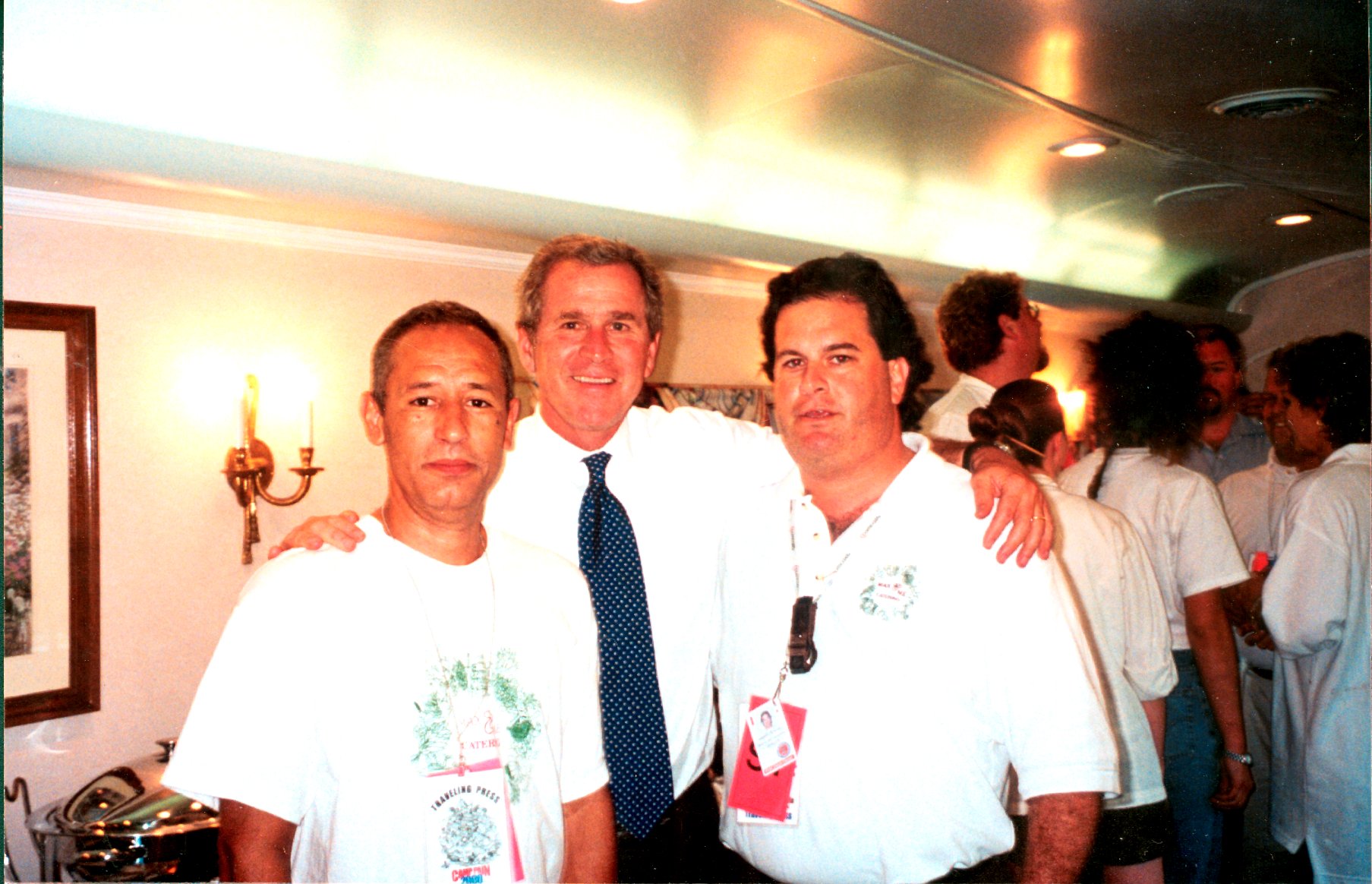
    Jon Spivak and his Max & Me business partner Max Hansen relied on him in 2000 for catering jobs at the Republican National Convention in Philadelphia. After the convention, Max & Me was hired to cater aboard the Bush-Cheney campaign’s train for a three-day whistle-stop tour through the Midwest.

    Harry Spivak (right) with then-presidential candidate George W. Bush and Max & Me Catering colleague Ariel Alejandro on a train after the Republican National Convention on Aug. 31, 2000.

    Assigned to oversee beverages for the media, Secret Service agents, campaign staffers, and railroad employees, Mr. Spivak loaded 15 cases of beer, 21 cases of bottled water, 22 cases of sodas, and eight cases of juices, plus wines and spirits.

    The baggage car used for storage, however, was separated from the kitchen and dining car by four 100-foot cars. Rather than navigate the narrow aisle, Mr. Spivak waited for station stops, unloaded the boxes onto the platform, transferred them by hand truck, and reloaded them onto the train. “My body didn’t stop hurting for weeks,” he told The Inquirer later.

    Friends and relatives also remembered him for his role as the family’s fun uncle, who took nieces and nephews for ice cream, bent the rules, and encouraged adventure. “What I’ll remember most is his love of fun,” his brother said. “He didn’t take life too seriously.”

    During the COVID-19 pandemic, Mr. Spivak became an advocate for feeding homeless people and worked to direct meals and resources to those most affected by shutdowns. “He didn’t live inside a box,” his brother said. “He did his own thing. People loved him because he had a huge heart and would do anything for anybody.”

    In addition to his daughter and brother, Mr. Spivak is survived by siblings Jenny, Betsy, and Josh, and dozens of cousins, nieces, and nephews.

    A celebration of Mr. Spivak’s life will begin at 1 p.m. Jan. 25 at Underground Arts, 1200 Callowhill St., Philadelphia. Memorial contributions may be made to Chosen 300 Ministries, Box 95, Ardmore, Pa. 19003.

  • Erich von Däniken, Swiss writer who spawned alien archaeology, has died at 90

    Erich von Däniken, Swiss writer who spawned alien archaeology, has died at 90

    BERLIN — Erich von Däniken, the Swiss author whose best-selling books about the extraterrestrial origins of ancient civilizations brought him fame among paranormal enthusiasts and scorn from the scientific community, has died. He was 90.

    Von Däniken’s representatives announced on his website on Sunday that he had died the previous day in a hospital in central Switzerland.

    Von Däniken rose to prominence in 1968 with the publication of his first book Chariots of the Gods, in which he claimed that the Mayans and ancient Egyptians were visited by alien astronauts and instructed in advanced technology that allowed them to build giant pyramids.

    The book fueled a growing interest in unexplained phenomena at a time when thanks to conventional science humankind was about to take its first steps on the Moon.

    Chariots of the Gods was followed by more than two dozen similar books, spawning a literary niche in which fact and fantasy were mixed together against all historical and scientific evidence.

    Public broadcaster SRF reported that altogether almost 70 million copies of his books were sold in more than 30 languages, making him one of the most widely read Swiss authors.

    While von Däniken managed to shrug off his many critics, the former hotel waiter had a troubled relationship with money throughout his life and frequently came close to financial ruin.

    Born in 1935, the son of a clothing manufacturer in the northern Swiss town of Schaffhausen, von Däniken is said to have rebelled against his father’s strict Catholicism and the priests who instructed him at boarding school by developing his own alternatives to the biblical account of the origins of life.

    After leaving school in 1954, von Däniken worked as a waiter and barkeeper for several years, during which he was repeatedly accused of fraud and served a couple of short stints in prison.

    In 1964, he was appointed manager of a hotel in the exclusive resort town of Davos and began writing his first book. Its publication and rapid commercial success were quickly followed by accusations of tax dodging and financial impropriety, for which he again spent time behind bars.

    By the time he left prison, Chariots of the Gods was earning von Däniken a fortune and a second book, Gods from Outer Space, was ready for publication, allowing him to commit himself to his paranormal passion and travel the world in search of new mysteries to uncover.

    Throughout the 1970s von Däniken undertook countless field trips to Egypt, India, and above all Latin America, whose ancient cultures held a particular fascination for the amateur archaeologist.

    He lectured widely and set up societies devoted to promoting his theories, later pioneering the use of video and multimedia to reach out to ever-larger audiences hungry for a different account of history.

    No amount of criticism dissuaded him and his fans from believing that Earth has been visited repeatedly by beings from outer space, and will be again in the future.

    In 1991 von Däniken gained the damning accolade of being the first recipient of the “Ig Nobel” prize for literature — for raising the public awareness of science through questionable experiments or claims.

    Even when confronted with fabricated evidence in a British television documentary — supposedly ancient pots were shown to be almost new — von Däniken insisted that, minor discrepancies aside, his theories were essentially sound.

    In 1985 von Däniken wrote Neue Erinnerungen an die ZukunftNew Memories of the Future — ostensibly to address his many critics: “I have admitted (my mistakes), but not one of the foundations of my theories has yet been brought down.”

    Although his popularity was waning in the English-speaking world by the 1980s, von Däniken’s books and films influenced a wave of semi-serious archaeological documentaries and numerous popular television shows, including The X-Files, which featured two FBI agents tasked with solving paranormal mysteries.

    His last major venture, a theme park based on his books, failed after just a few years due to lack of interest. The Mystery Park still stands, its human-made pyramids and otherworldly domes rotting as tourists prefer to explore the charms of the nearby town of Interlaken and the imposing Swiss Alps that surround it.

    Erich von Däniken is survived by his wife of 65 years, Elisabeth Skaja, daughter Cornelia, and two grandchildren.

  • Grateful Dead founding member Bob Weir has died at 78

    Grateful Dead founding member Bob Weir has died at 78

    LOS ANGELES — Bob Weir, the guitarist and singer who as an essential member of the Grateful Dead helped found the sound of the San Francisco counterculture of the 1960s and kept it alive through decades of endless tours and marathon jams, has died. He was 78.

    Mr. Weir’s death was announced Saturday in a statement on his Instagram page.

    “It is with profound sadness that we share the passing of Bobby Weir,” a statement on his Instagram posted Saturday said. “He transitioned peacefully, surrounded by loved ones, after courageously beating cancer as only Bobby could. Unfortunately, he succumbed to underlying lung issues.”

    The statement did not say where or when Mr. Weir died, but he lived in the San Francisco Bay Area for most of his life.

    Mr. Weir joined the Grateful Dead — originally the Warlocks — in 1965 in San Francisco at just 17 years old. He would spend the next 30 years playing on endless tours with the Grateful Dead alongside fellow singer and guitarist Jerry Garcia, who died in 1995.

    Mr. Weir wrote or co-wrote and sang lead vocals on Dead classics including “Sugar Magnolia,” “One More Saturday Night,” and “Mexicali Blues.”

    After Garcia’s death, he would be the Dead’s most recognizable face. In the decades since, he kept playing with other projects that kept alive the band’s music and legendary fan base, including Dead & Company.

    The Dead were beloved in Philadelphia. “Only sports teams have played the Spectrum more than the Grateful Dead,” Inquirer music critic Dan DeLuca wrote when the band played its last concert at the now-demolished arena on May 2, 2009. DeLuca wrote that the Dead had sold out the arena more than 50 times.

    “For over sixty years, Bobby took to the road,” the Instagram statement said. “A guitarist, vocalist, storyteller, and founding member of the Grateful Dead. Bobby will forever be a guiding force whose unique artistry reshaped American music.”

    Mr. Weir’s death leaves drummer Bill Kreutzmann as the only surviving original member. Founding bassist Phil Lesh died in 2024. The band’s other drummer, Mickey Hart, practically an original member since joining in 1967, is also alive at 82. The fifth founding member, Ron “Pigpen” McKernan, died in 1973.

    Dead and Company played a series of concerts for the Grateful Dead’s 60th anniversary in July at Golden Gate Park in San Francisco, drawing some 60,000 fans a day for three days.

    Born in San Francisco and raised in nearby Atherton, Mr. Weir was the Dead’s youngest member and looked like a fresh-faced high schooler in its early years. He was generally less shaggy than the rest of the band, but he had a long beard like Garcia’s in later years.

    The band would survive long past the hippie moment of its birth, with its ultra-devoted fans known as Deadheads often following them on the road in a virtually nonstop tour that persisted despite decades of music and culture shifting around them.

    “Longevity was never a major concern of ours,” Mr. Weir said when the Dead got the Grammys’ MusiCares Person of the Year honor last year. “Spreading joy through the music was all we ever really had in mind, and we got plenty of that done.”

    Ubiquitous bumper stickers and T-shirts showed the band’s skull logo, the dancing, colored bears that served as their other symbol, and signature phrases like “ain’t no time to hate” and “not all who wander are lost.”

    The Dead won few actual Grammys during their career — they were always a little too esoteric — getting only a lifetime achievement award in 2007 and the best music film award in 2018.

    Just as rare were hit pop singles. “Touch of Grey,” the 1987 song that brought a big surge in the aging band’s popularity, was their only Billboard Top 10 hit.

    But in 2024, they set a record for all artists with their 59th album in Billboard’s Top 40. Forty-one of those came since 2012, thanks to the popularity of the series of archival albums compiled by David Lemieux.

    Their music — called acid rock at its inception — would pull in blues, jazz, country, folk, and psychedelia in long improvisational jams at their concerts.

    “I venture to say they are the great American band,” TV personality and devoted Deadhead Andy Cohen said as host of the MusiCares event. “What a wonder they are.”

  • Kenneth W. Ford, hydrogen bomb physicist, educator, and author, has died at 99

    Kenneth W. Ford, hydrogen bomb physicist, educator, and author, has died at 99

    Kenneth W. Ford, 99, of Gwynedd, Montgomery County, theoretical physicist who helped develop the hydrogen bomb in 1952, university president, college professor, executive director, award-winning author, and Navy veteran, died Friday, Dec. 5, of pneumonia at Foulkeways at Gwynedd retirement community.

    Dr. Ford was a 24-year-old physics graduate student at Princeton University in 1950 when he was recruited by a colleague to help other scientists covertly build a hydrogen bomb. “I was told if we don’t do it, the Soviet Union will,” Dr. Ford told The Inquirer in 2023, “and the world will become a much more dangerous place.”

    So he spent one year at the Los Alamos National Laboratory in New Mexico and another back at Princeton, creating calculations on the burning of the fuel that ignited the bomb and theorizing about nuclear fission and fusion. The H-bomb was tested in 1952.

    Dr. Ford’s expertise was in nuclear structure and particle and mathematical physics. He and Albert Einstein attended the same lecture when he was young, and he knew Robert Oppenheimer, Fredrick Reines, John Wheeler, and dozens of other accomplished scientists and professors over his long career.

    He came to Philadelphia from the University System of Maryland in 1983 to be president of a startup biotech firm. He joined the American Physical Society as an education officer in 1986 and was named executive director of the American Institute of Physics in 1987.

    “He always seemed to be the head of something,” his son Jason said.

    He retired from the AIP in 1993 but kept busy as a consultant for the California-based Packard Foundation and physics teacher at Germantown Academy and Germantown Friends School. Michael Moloney, current chief executive of the AIP, praised Dr. Ford’s “steady and transformative leadership” in a tribute. He said: “His career in research, education, and global scientific collaboration puts him among the giants.”

    As president of the New Mexico Institute of Mining and Technology from 1975 to 1982, Dr. Ford oversaw improvements in the school’s enrollment, faculty, budget, and facilities. He “was an accomplished researcher, scholar and teacher,” Michael Jackson, interim president of New Mexico Tech, said in a tribute, “a techie through and through.”

    Dr. Ford wrote “Building the H Bomb,” and it was published in 2015.

    Before Philadelphia, he spent a year as executive vice president of the University System of Maryland. Earlier, from 1953 to 1975, he was a researcher at Indiana University, physics professor at Brandeis University in Massachusetts and the University of Massachusetts, and founding chair of the department of physics at the University of California, Irvine.

    Officials at UC Irvine said in a tribute: Dr. Ford “leaves an enduring legacy as a scientist, educator, and institution builder. … The School of Physical Sciences honors his foundational role in our history and celebrates the broad impact of his distinguished life.”

    He told The Inquirer that he hung out at the local library as he grew up in a Kentucky suburb of Cincinnati and read every book he could find about “biology, chemistry, geology, you name it.” He went on to write 11 books about physics, flying, and building the H-bomb.

    Two of his books won awards, and 2015’s Building the H Bomb: A Personal History became a hit when the Department of Energy unsuccessfully tried to edit out some of his best material. His research papers on particle scattering, the nuclear transparency of neutrons, and other topics are cited in hundreds of publications.

    Dr. Ford was a popular professor because he created interesting demonstrations of physics for his students.

    In 1976, he earned a distinguished service citation from the American Association of Physics Teachers. In 2006, he earned an AAPT medal for notable contributions to the teaching of physics.

    He was the valedictorian at Phillips Exeter Academy in New Hampshire in 1944. He served two years in the Navy and earned a summa cum laude bachelor’s degree in physics at Harvard University and his doctorate at Princeton in 1953.

    In 1968, he was so opposed to the Vietnam War that he publicly declined to ever again work in secret or on weapons. “It was a statement of principle,” he told The Inquirer.

    Kenneth William Ford was born May 1, 1926, in West Palm Beach, Fla. He married Karin Stehnike in 1953, and they had a son, Paul, and a daughter, Sarah. After a divorce, he married Joanne Baumunk, and they had daughters Caroline and Star, and sons Adam and Jason. His wife and former wife died earlier.

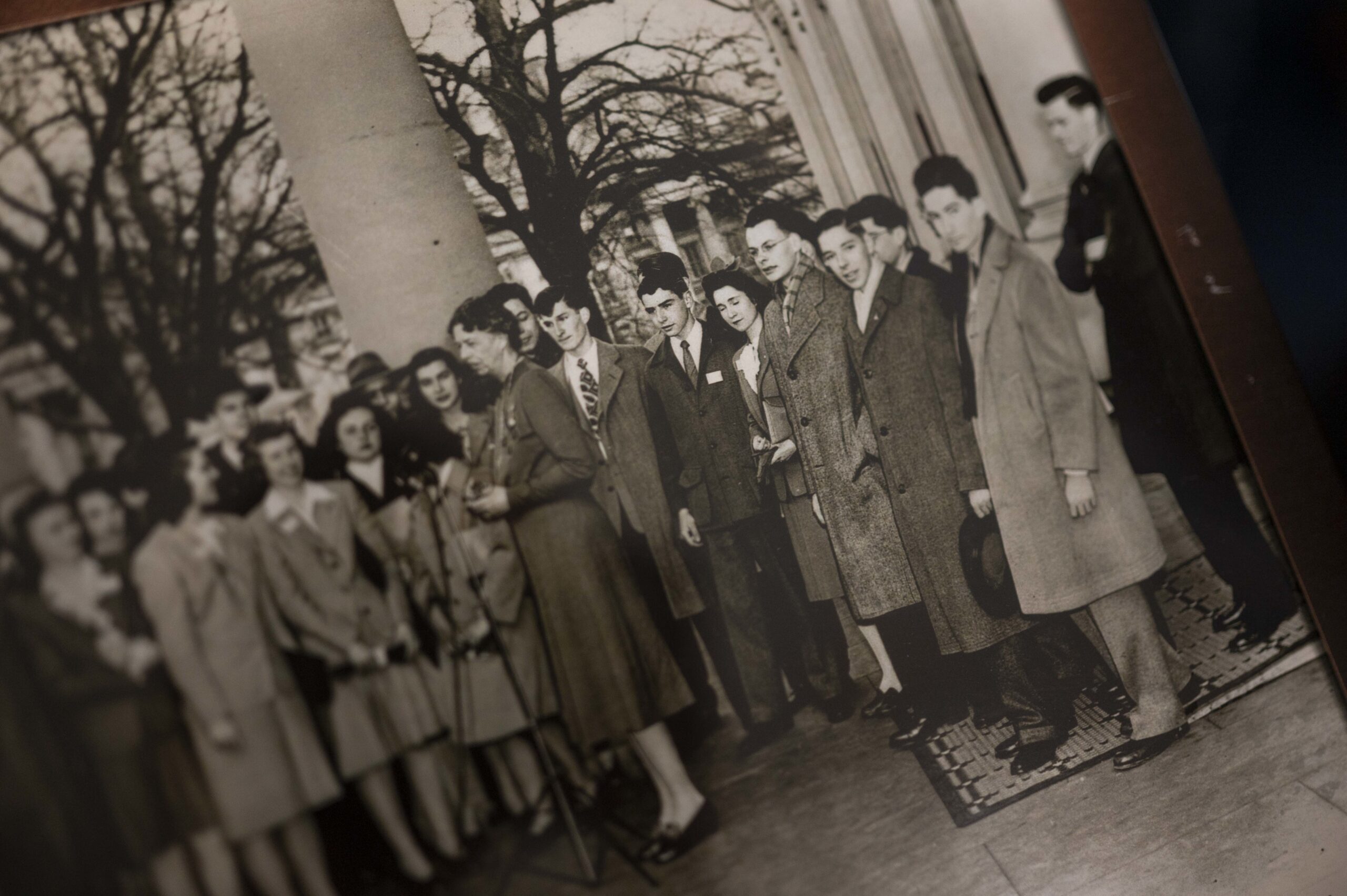
    This photo shows Dr. Ford (center) and other students listening to former First Lady Eleanor Roosevelt speak in 1944.

    Dr. Ford lived in University City, Germantown, and Mount Airy before moving to Foulkeways in 2019. He was an avid pilot and glider for decades. He enjoyed folk dancing, followed the Eagles closely, and excelled at Scrabble and other word games.

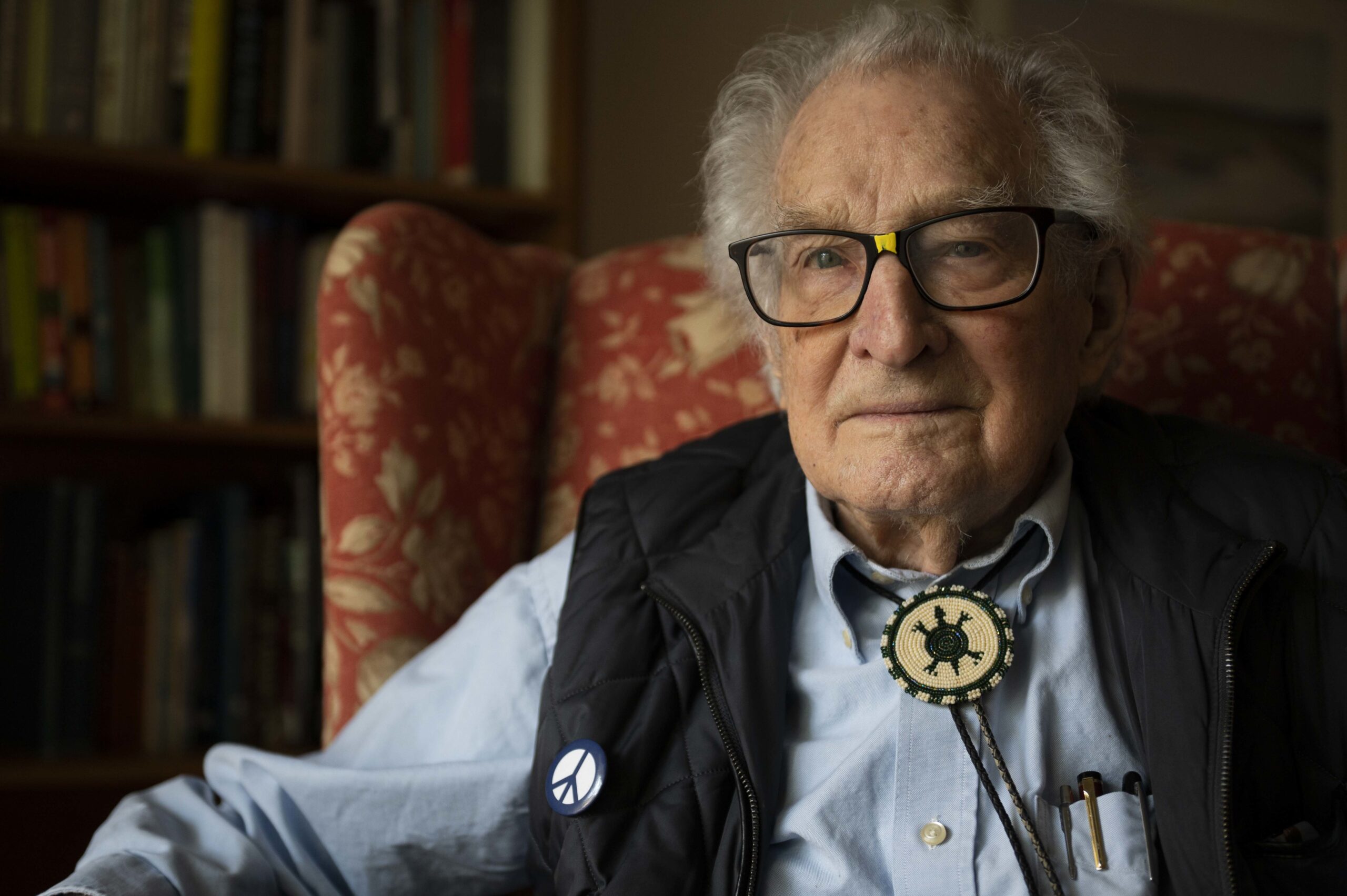
    He loved ice cream, coffee, and bad puns. He became a Quaker and wore a peace sign button for years. Ever the writer, he edited the Foulkeways newsletter.

    In 2023, he said: “I spent my whole life looking for new challenges.” His son Jason said. “He found connections between things. He had an active mind that went in all different directions.”

    In addition to his children, Dr. Ford is survived by 14 grandchildren, a great-grandson, a sister, a stepdaughter, Nina, and other relatives.

    Services are to be from 2 to 4:30 p.m., Saturday, Jan. 24, at Foulkeways at Gwynedd, 1120 Meetinghouse Rd., Gwynedd, Pa. 19436.

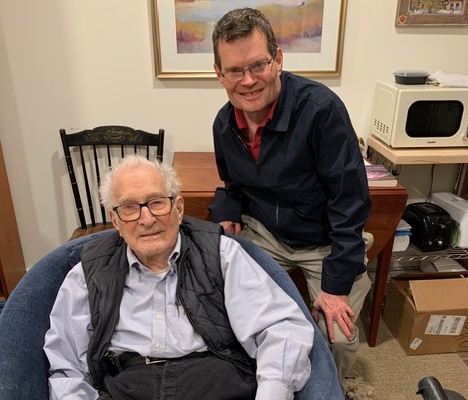
    Dr. Ford and his son Jason
    Dr. Ford wore a peace sign button for years.