Category: Commentary

  • Term limits offer Pennsylvania rare bipartisan opportunity

    Term limits offer Pennsylvania rare bipartisan opportunity

    For decades, Congress has been the land of the permanent incumbent. Nearly nine in 10 Americans support congressional term limits, yet every attempt to impose them has failed because Washington won’t limit itself. But Pennsylvania has the power to change that.

    As I previously argued in the Hill, there’s a path forward that doesn’t require Congress to vote against its own interests, or the near-impossible task of a constitutional amendment. The answer lies in coordinated state action that could force the U.S. Supreme Court to reconsider its 1995 decision in U.S. Term Limits v. Thornton.

    In Thornton, the Supreme Court ruled that states cannot add qualifications for federal office beyond those in the Constitution. That decision effectively shut down state-led reform, even though the people overwhelmingly support it.

    But landmark Supreme Court reversals often emerge when multiple states pass laws that force the court to reexamine old precedents. From Brown v. Board of Education to Dobbs v. Jackson Women’s Health Organization, coordinated state action has repeatedly succeeded in prompting judicial reconsideration.

    The strategy is straightforward: Pennsylvania, along with states like Texas, Florida, and Tennessee, would pass identical laws establishing term limits for their members of Congress. Each law would face legal challenges and be struck down under Thornton, as expected. But with multiple states acting simultaneously, the issue would surface across several federal circuits, creating pressure for the Supreme Court to revisit the question.

    Under the Articles of Confederation, delegates were not permitted to serve more than three of any six years, a clear endorsement of rotation in office. The founders never intended public service to become a lifelong career.

    If term limits are enacted, they should apply prospectively, with current members grandfathered in and everyone’s “term clock” beginning at zero. This avoids endless lawsuits while setting a new standard for the future.

    Pennsylvania is uniquely positioned to lead this effort. While the commonwealth has a divided legislature, with Republicans controlling the Senate and Democrats holding a narrow House majority, term limits have historically drawn bipartisan support. This is precisely the kind of reform that could bridge partisan divides and demonstrate that Pennsylvania can lead on issues that matter to voters across the political spectrum.

    The state has recent experience standing up to federal overreach. In 2025, Pennsylvania Secretary of the Commonwealth Al Schmidt, a Republican, fought back against the U.S. Department of Justice’s demand for sensitive voter data, calling it “unprecedented and unlawful” federal overreach.

    Schmidt emphasized that, in America, states run elections, not the federal government. This bipartisan defense of state sovereignty, supported by officials across party lines, demonstrates Pennsylvania’s willingness to assert its constitutional authority when necessary.

    Pennsylvania voters overwhelmingly support this reform. A January poll found that 78% of Pennsylvania voters support term limits on Congress, including 79% of Republicans, 78% of Democrats, and 80% of independents. This rare consensus across party lines makes term limits legislation an opportunity for Pennsylvania’s divided government to demonstrate it can work together on reforms that voters clearly want.
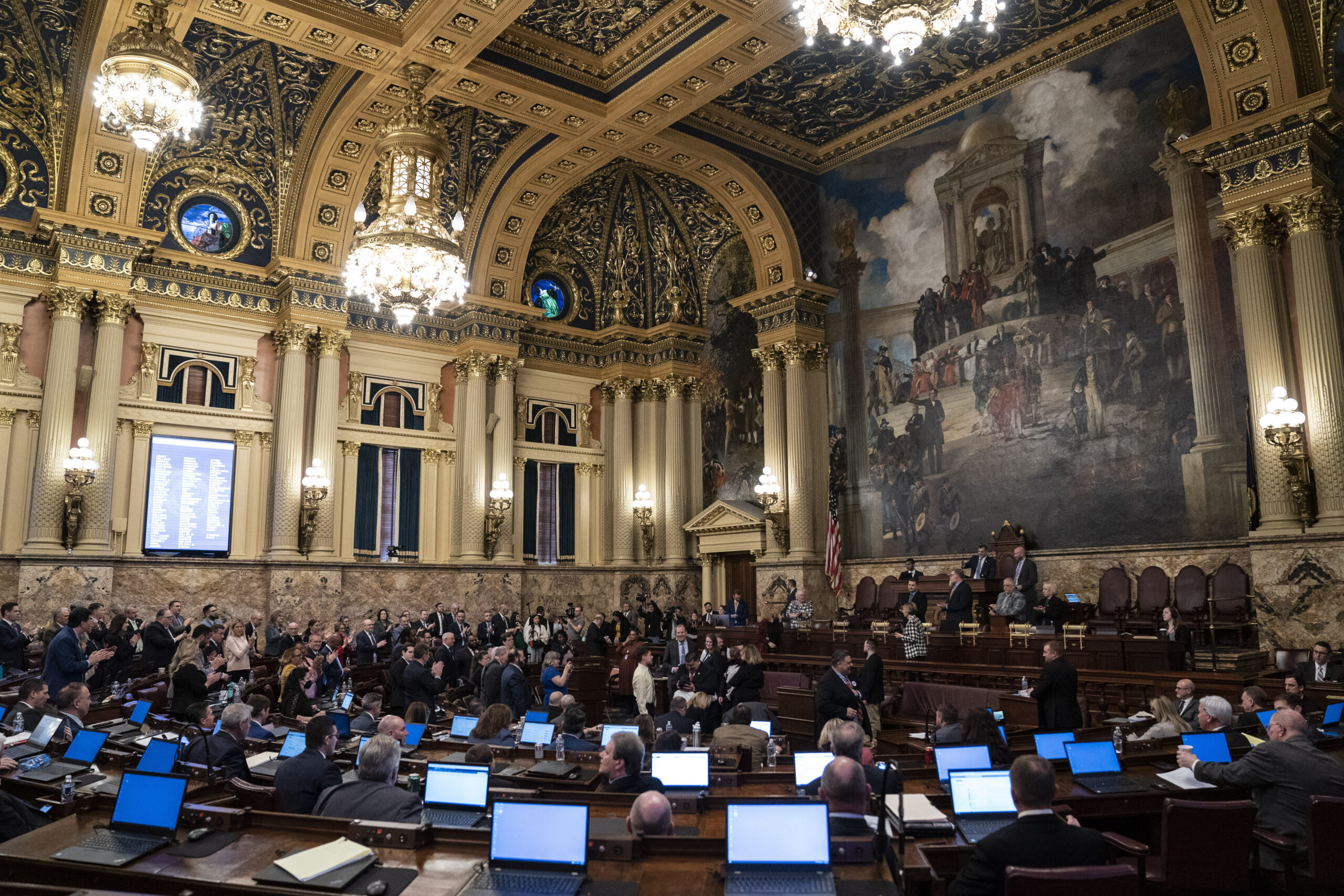
    Working to pass term limits legislation would be consistent with the Pennsylvania General Assembly’s history of defending state authority against federal intrusion, writes Tanner Willis.

    The Pennsylvania legislature has shown it can take principled stands on constitutional questions when there’s sufficient public support. Passing term limits legislation, knowing it will be challenged under Thornton, would be consistent with Pennsylvania’s history of defending state authority against federal intrusion. If Pennsylvania acts alongside states like Utah, Arizona, and Kentucky, the combined pressure could succeed where individual efforts have failed.

    If Congress won’t act, and the people can’t amend the Constitution directly, Pennsylvania still has one powerful tool: coordinated challenge.

    The path forward is simple. Pass the law, invite the challenge, and let the Supreme Court decide. The only question is whether Pennsylvania has the courage to lead.

    Tanner Willis is a business operations analyst based in Arlington, Va. He is the author of the book “Smoke and Silence: The Lives of Ol’ Mort.”

  • Resolve to save a life in the new year. Register as an organ donor.

    Resolve to save a life in the new year. Register as an organ donor.

    My husband, Phil, a New Jersey native, father of three children under 7, and former Penn State University football receiver, needs a kidney.

    According to the National Kidney Registry, more than 90,000 people in the United States are currently waiting for a donor kidney. In the Philadelphia metropolitan area, that number hovers around 5,000.

    My husband suffered an acute kidney injury in December 2023 caused by liver rejection medicine, a complication that affects 4% of transplant recipients.

    Chronic kidney disease is common in the U.S., affecting one in seven adults. Most people don’t feel symptoms at first, but if it gets worse, it can lead to kidney failure and serious health problems. Dialysis is a lifesaving treatment for kidney failure, but requires the patient to be hooked to a dialysis machine for hours at a time, often for several days each week.

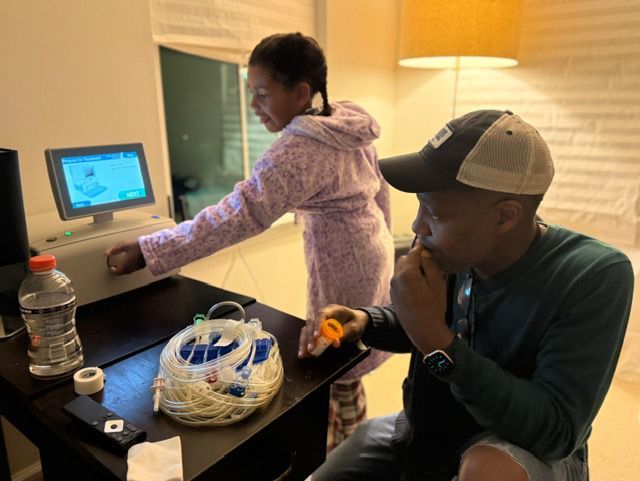
    Phil Collins and his daughter, Charlie, set up the dialysis machine.

    The small joys and normalcy of daily life quickly shift around dialysis schedules and doctors’ appointments.

    It’s been nearly two years since we were placed on the transplant list, and our three small children rely on us to keep their world from being turned upside down even more than it already is.

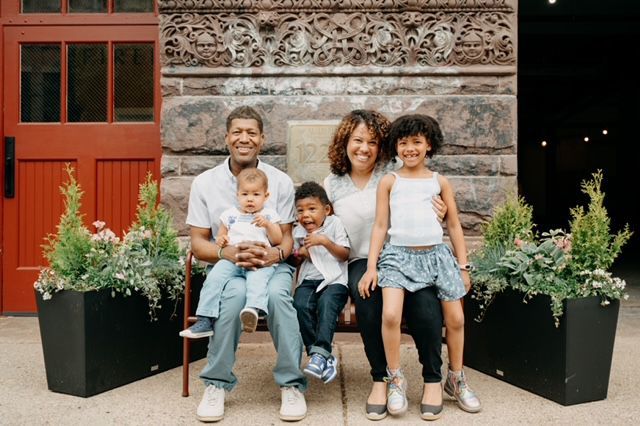
    Phil Collins and Morgen Perdue-Collins with their children. Collins has been waiting for a donor kidney for two years.

    They see the dialysis boxes stacked taller than they are in the front room, the catheter that we have to be careful of during playtime with their dad, and the frequent hospital visits because of a weakened immune system. Our daughter is even able to set up the peritoneal dialysis machine with help from Phil.

    As a partner of someone on the transplant list, my grief is silent and omnipresent. I find myself torn between supporting my sick husband, bringing my best self to the classroom each day, and ensuring our three little ones can simply be kids.

    When I drive to work, I see the billboards off I-95 for others who need a kidney; the wives and husbands and grandchildren and parents who are feeling just as overwhelmed and hopeful as I am. Maybe there is a match out there; perhaps someone will see their billboard, car magnet, or transplant profile and respond.

    Like so many other families with someone on the transplant list, I help the best way I can. I work to know what the weekly lab numbers mean, whether my husband’s sluggishness is due to low iron and blood count, and if there are early signs of an infection.

    Each December, his weakened immune system seems to lead him to the hospital, where he spends more time than our family would like. There is also guilt in not being able to know everything, and how best to help him in every critical time of need.

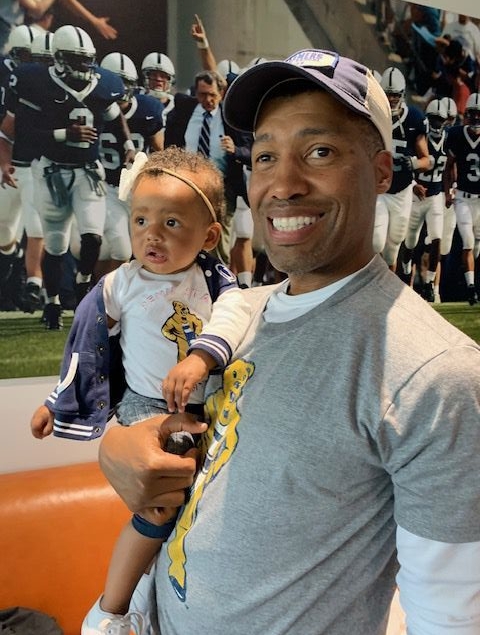
    Phil Collins with his daughter, Charlie, at a Penn State game after his liver transplant, but before he suffered an acute kidney injury in 2023 caused by the liver rejection medicine. According to his wife, Morgen Perdue-Collins, it is a complication that affects 4% of transplant recipients.

    Throughout this journey, Phil remains ever the optimist. Always looking on the positive side, while struggling to stay awake or suffering from terrible headaches and exhaustion. He remains diligently waiting and hoping things will turn around.

    But it has been two years, and we are still waiting.

    There are ways to help; for example, getting a donor match screening, as my friend, Meredith, did. She donated with extraordinary grace to a stranger last April, and this year, her family member received a kidney thanks to her advanced donation.

    To become an organ donor, you have a few options:

    • Join your state’s registry. Visit the Donate Life America website to sign up for your state’s online donation registry.
    • Use your driver’s license. Declare your intentions to be an organ donor on your driver’s license.
    • Start the donor screening process. On the Donate Life America website, you can also scroll down to “Start the donor screening process.”
    • Donate through the National Kidney Registry. If you want to donate a kidney to someone in need, you can visit the National Kidney Registry.

    Hesitation about organ donation, whether during life or after death, can stem from cultural beliefs, religious views, or medical mistrust. Many common myths about organ donation have long been disproven, but becoming a living organ donor is a demanding process, with a full return to normal taking eight weeks.

    According to the United Network for Organ Sharing, 11 people die every day waiting for a kidney.

    The truth remains simple: You have the power to save a life, to restore a family, and to give someone like Phil the most extraordinary gift of all.

    Morgen Perdue-Collins is a Philadelphia teacher, and her husband, Phil, is still looking for a match. You can visit his kidney donation page here. And visit the National Kidney Donation site here.

  • Using a migrant’s shooting death to attack immigration itself

    Using a migrant’s shooting death to attack immigration itself

    In the days after the mass shooting at Brown University and the killing of a Massachusetts Institute of Technology professor, the Trump administration suspended the diversity visa “green card lottery,” saying the suspected shooter, a Portuguese national, had obtained permanent residency through it. It’s a convenient move that redirects attention from what happened to whom to blame.

    But one of the two students killed at Brown was a migrant, too.

    Mukhammad Aziz Umurzokov was a Brown freshman, raised by a family that came to the United States from Uzbekistan to build a life here. Those who knew him described his kindness and generosity. Friends and family said he dreamed of becoming a neurosurgeon, a goal shaped in part by the brain surgery he needed as a child.

    Mukhammad Aziz Umurzokov, 18, a college freshman and immigrant from Uzbekistan, was killed in the shooting at Brown University on Dec. 13.

    This young man represented what so many families come here hoping for: safety, education, a bright future. His death should have sparked a national reckoning with gun violence. Instead, the policy response once again targeted immigration, even as an immigrant family is among those grieving.

    Freezing the diversity visa lottery doesn’t touch the core problem of mass shootings at schools across the country. It doesn’t answer the question that matters most in the wake of any campus shooting: How is it so easy to get a gun, let alone bring it into a place built for learning?

    The administration’s response hinges on a simple narrative in which the suspected shooter’s immigration history becomes the headline, and the first policy move becomes a freeze on a visa program that has nothing to do with how a gun was obtained or used.

    Even the publicly reported timeline is more complicated than that talking point suggests. What’s clear is that the suspension of this visa program diverts attention from gun access and campus safety.

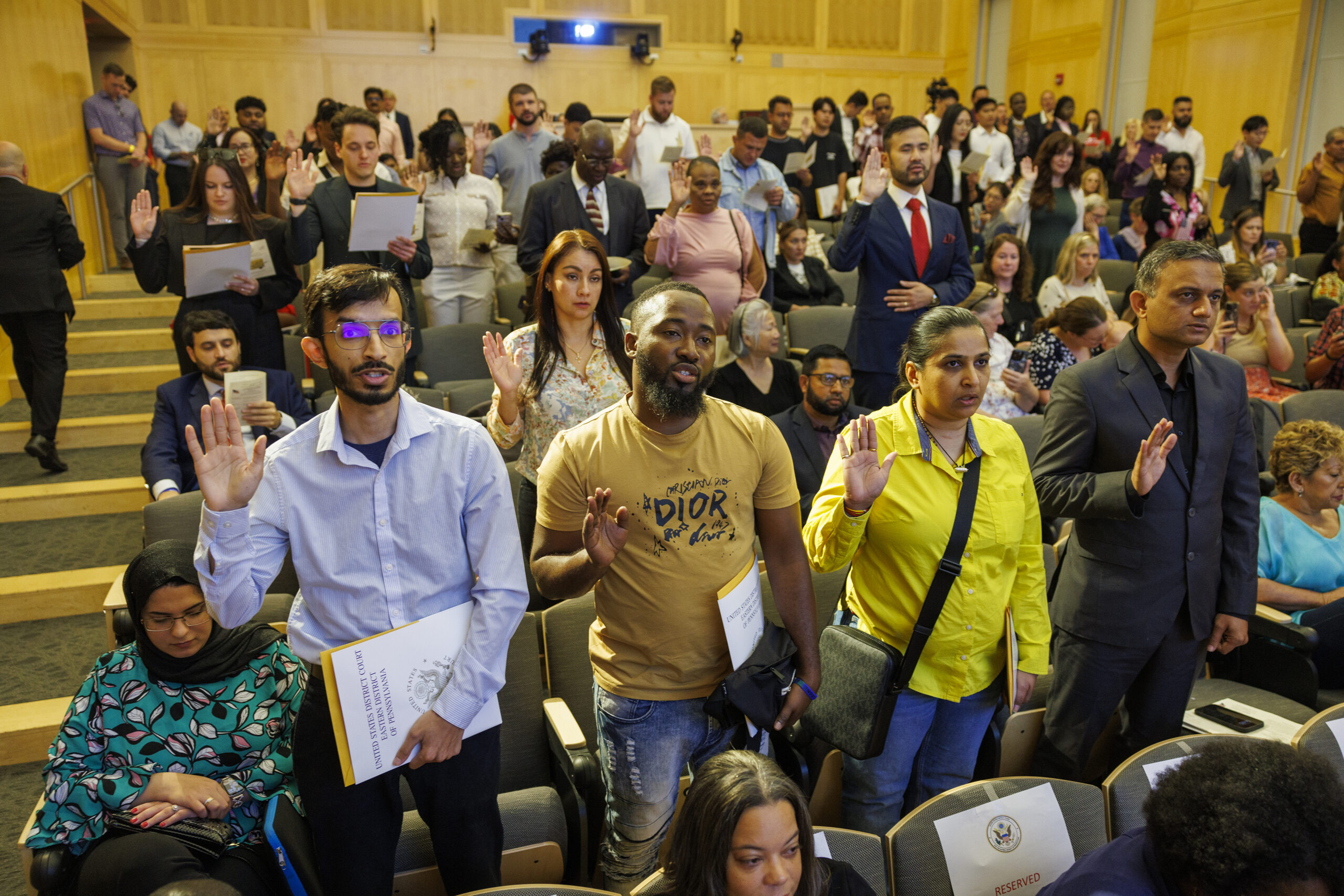
    Immigrants from around the world take the U.S. citizenship oath at the National Constitution Center in Philadelphia in 2024.

    The diversity visa lottery is one of the few legal routes for people from underrepresented countries to come to the United States. This year alone, more than 5,500 people from Uzbekistan were selected in the lottery. For many families, it represents the only legal path forward. The administration has closed the door on that pathway.

    So when the administration suspends the program in the name of “safety,” it does more than change a policy. It tells grieving immigrant families that their place here can shift with every news cycle.

    It also asks the public to draw the wrong lesson from what happened at Brown. If leaders want to prevent another campus shooting, they have to deal with the common denominator across these tragedies: easy access to guns and the absence of meaningful guardrails.

    Suspending a visa program does not keep a firearm out of an attacker’s hands. It does not make a classroom safer. It does not protect the next student walking into an engineering building on an ordinary day.

    Umurzokov should not be an afterthought in this debate. His family came here to build a future. He earned his place at Brown. He wanted a life spent helping others. Yet none of that kept him safe.

    If we are serious about honoring the lives of people like Mukhammad Aziz Umurzokov, we should resist the impulse to turn grief into scapegoating.

    In a nation built by immigrants and now mourning an immigrant student, leaders should be focused on preventing the next shooting, not using this tragedy to deepen fear while guns remain exactly where they are.

    Mehri Hamrokulova grew up between the U.S. and Uzbekistan, and recently graduated from Colgate University with a degree in sociology, focusing on immigrant experiences.

  • Pa. just gave low-income workers a tax credit boost. Now it’s Philadelphia’s turn.

    Pa. just gave low-income workers a tax credit boost. Now it’s Philadelphia’s turn.

    Last month, Gov. Josh Shapiro and the General Assembly adopted the state’s first working Pennsylvanians tax credit, ensuring anyone who qualifies for the federal earned income tax credit (EITC) will also automatically receive a state credit equal to 10% of the federal credit when they file taxes next year.

    Pennsylvania joins 31 states and the District of Columbia in giving low-income workers an effective, research-backed wage boost; in 2024, the federal and state credits combined lifted an estimated 6.8 million working people from poverty.

    While the new state EITC is incredibly welcome and historic, it is relatively modest compared with other refundable state EITCs. Most range from 20% to 50% of the federal credit, with a handful below 10% or over 50%. This major step forward still won’t overcome the hardship facing low-wage workers — hardship compounded by Pennsylvania’s and Philadelphia’s deeply regressive overall tax structure.

    The Institute on Taxation and Economic Policy’s “Who Pays?” report found that the lowest-income Pennsylvanians pay 15.1% of their income in state and local taxes — more than double the share paid by the wealthiest 1%, making the new state EITC essential for offsetting the lopsided tax code.

    In the same way states are building upon federal tax credits, localities should consider building on state tax credits.

    In Philadelphia, low earners pay an even higher share of their income in state and local taxes, in part due to the highly regressive, flat wage tax.

    The city’s wage tax refund ordinance, a well-intentioned credit aiming to address regressivity by retroactively reducing the city’s income tax to 1.5%, reaches very few people. This year, 2,700 applications were approved, even though 50,000 were eligible, a dismal 4.5% take-up rate (which is actually double last year’s rate).

    One major reason for this abysmal take-up is linkage to the state’s special income tax forgiveness program, requiring people to first be approved by the Pennsylvania Revenue Department for individuals earning no more than $8,750, or $24,750 for a family of three.

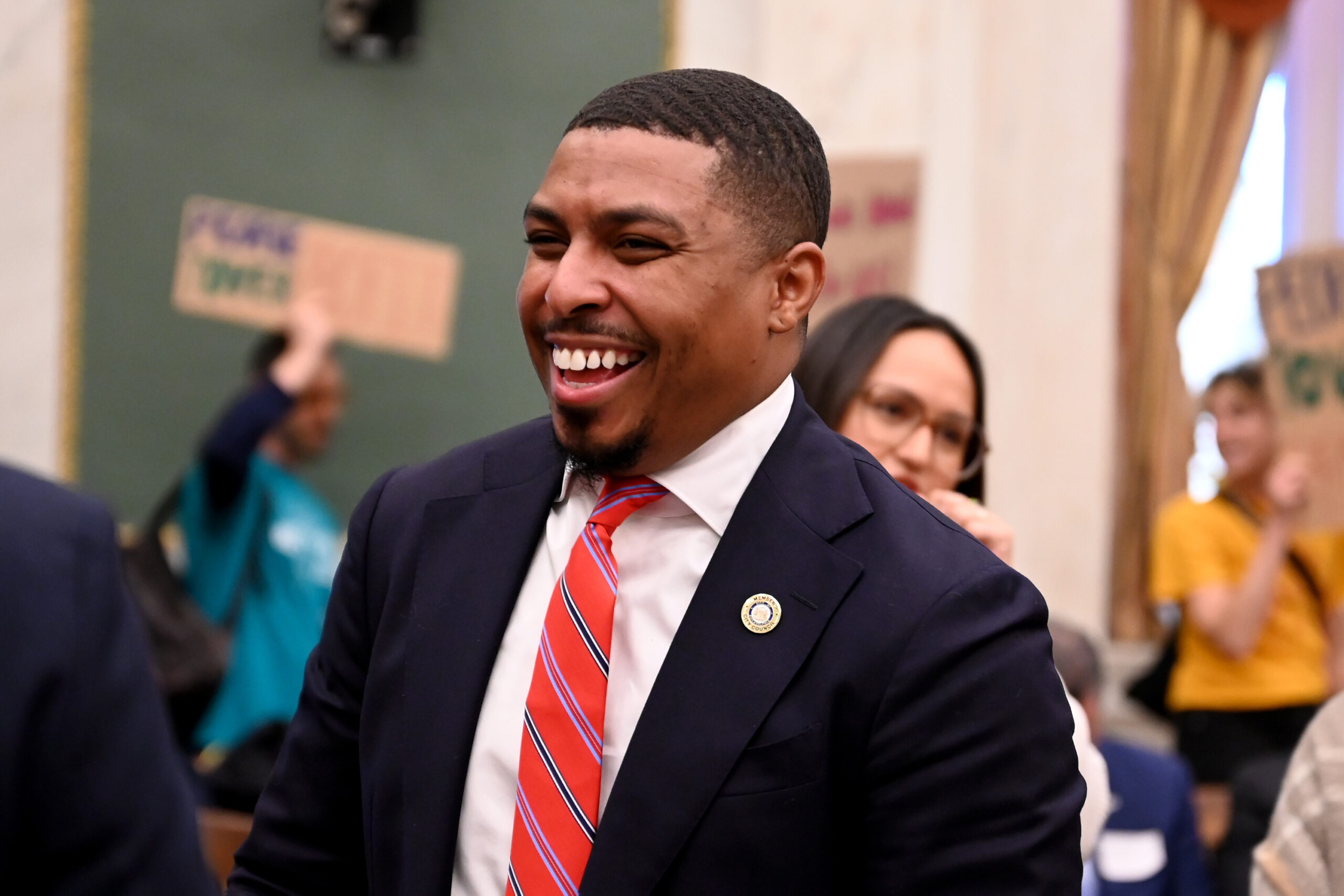
    Councilmember Kendra Brooks in chambers as City Council meets Dec. 11.

    Councilmembers Kendra Brooks and Nicolas O’Rourke introduced legislation as part of the People’s Tax Plan that would raise income eligibility to that of the PACENET prescription assistance program and expand the wage tax refund to include the entire 3.75% wage tax, but the proposals have not moved forward.

    Councilmember Nicolas O’Rourke in chambers as City Council meets Dec. 11.

    Pennsylvania’s new state EITC opens the door for a far more generous and administratively simple wage tax refund that reaches more residents. Tying the wage tax refund directly to the new state EITC and coordinating with the state can streamline this process.

    Montgomery County, Md., pioneered one practical and high take-up approach: It partners with the state to automatically deliver the refundable portion of its county credit to all residents receiving a refund from the state. The credit is directly deposited or mailed with no additional application required.

    Similarly, Philadelphia can improve eligibility for the wage tax refund by disconnecting it from the state’s income tax forgiveness program and instead linking it to the state’s working Pennsylvanians tax credit. Local policymakers should also automate applications, wage and residence documentation, and payouts.

    Our city’s poverty rate is nearly double the state average. Local refundable credits, such as earned income tax credits and child tax credits, are anti-poverty tools proven to quickly lift incomes and stabilize households facing increasingly high costs. With the federal government retreating from long-standing health and economic security programs, the responsibility now falls even more heavily on states and cities to step up.

    A strengthened, refundable, and automatic local EITC is exactly the kind of targeted investment that can help Philadelphia reverse decades of persistent poverty.

    Kamolika Das is the local tax policy director at the Institute on Taxation and Economic Policy, a nonprofit, nonpartisan tax policy organization that conducts analyses of tax and economic proposals. She lives in Queen Village with her husband and daughter.

  • Bring back vintage panic and rage

    Bring back vintage panic and rage

    Remember Y2K? That panic was cute.

    In 1999, we simultaneously braced for a new millennium and the end of the world.

    Y2K loomed ahead, a huge question mark. Best Buy convinced us that everything from air traffic to banking to the machine in your “computer room” would be affected. Chaos was to ensue.

    Or maybe not. It was a curious, innocent type of fear — not the gut-punching terror that dominates today’s news.

    This was before smartphones, before push alerts every five minutes. Panic traveled by television anchors, phones tethered to the kitchen wall, office rumors, and chain emails that screamed “FWD: URGENT!!”

    We prepared for the chaos with zeal, clearing out Wawa like we were preparing for a decade underground. Nothing says “national crisis” like a region hoarding Shortis and Tastykakes. If the world were ending, we were not going down without one last soft pretzel.

    Looking back, the panic feels almost sweet. No one knew exactly why we were worried — something about floppy disks and zeros? It was an amusing type of fear — not the adrenaline surges and terror layered across today’s news feeds.

    A big crowd packed Veterans Stadium for the final opening day in its history at the start of the 2003 season.

    Here in Philly, our emotion was focused wholly on saying goodbye to Veterans Stadium, beer-soaked basement jail and all. We panicked more about losing that stadium than we ever did about losing our computers. Underneath the apocalyptic preparation was a communal consciousness that understood we were safe.

    Freedom Fries

    A few years later, our national anxiety shifted from computers to potatoes. In 2003, “French fries” were hastily rebranded as “Freedom Fries.” Restaurants reprinted menus. Congress cafeterias complied. Late-night comics had a field day.

    It was Red October at McDonald’s. The poor soul who ordered French — not freedom — fries got no potato side with disapproval to boot, writes Angela Ryan.

    In an unprecedented show of unity, Americans declared a “War on Terror” and pushed for an invasion of Iraq. France wouldn’t participate, so the U.S. did the most Philly thing we’ve ever done and declared a nationwide rebranding of the French fry.

    It was Red October at McDonald’s. The poor soul who ordered French — not freedom — fries got no potato side, with disapproval to boot.

    This was the norm for national crises then. They were the civic version of Dikembe Mutombo: gentle and kinda funny. We felt safe. Disagreements were just that — disagreements. They didn’t split families, and they weren’t the origin story for the latest school shooter.

    National conversations were civilized (as much as they can be in Philly), respectful, and safe. Things felt steady. We felt safe. When Mutombo hugged Allen Iverson after big wins, it felt like the whole city was getting that hug. We were together. We were OK.

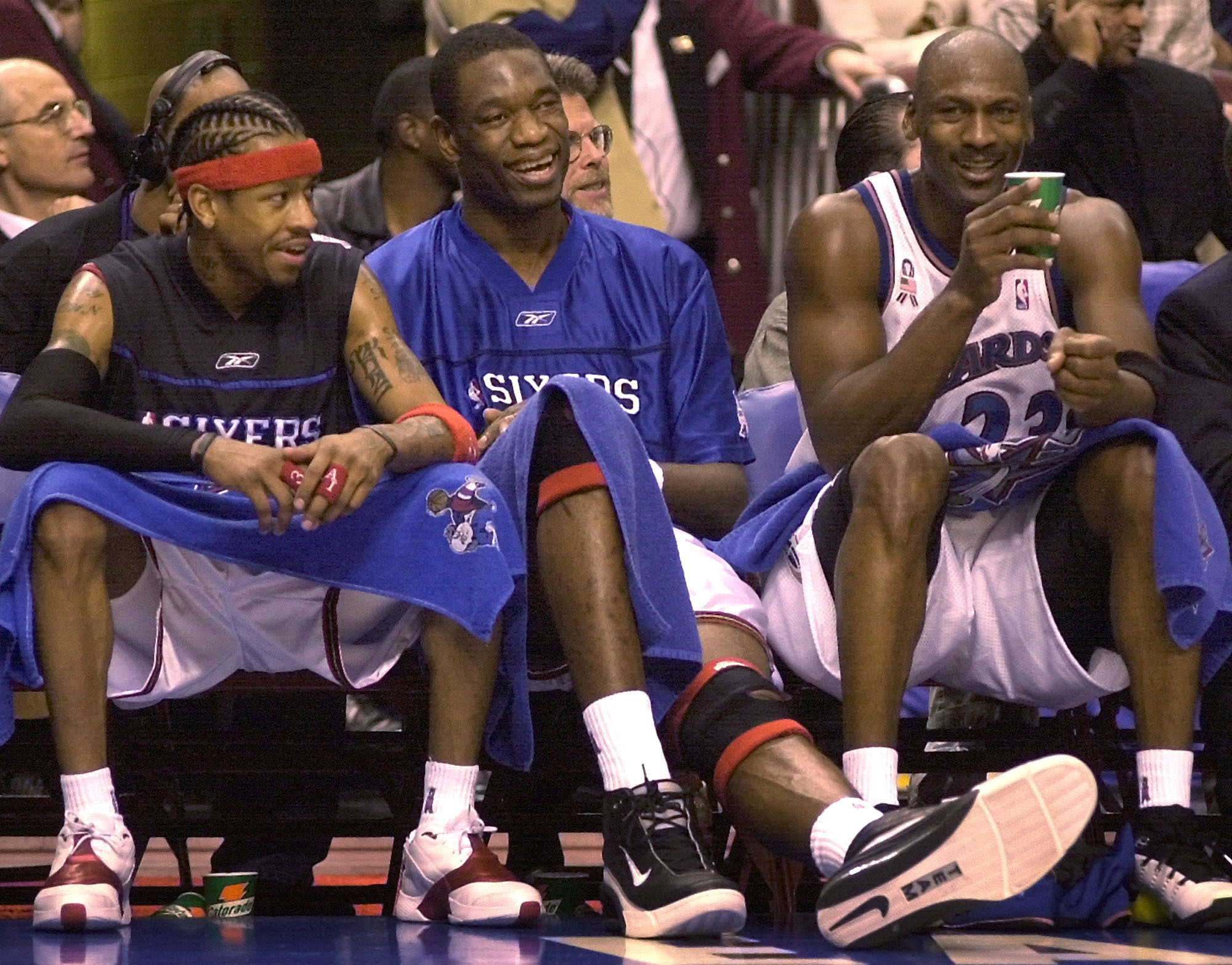
    Eastern Conference All-Stars Allen Iverson (3) and Dikembe Mutombo (55), of the Philadelphia 76ers, and Michael Jordan (23), of the Washington Wizards, watch from the bench during the 2002 NBA All-Star game in Philadelphia, Sunday, Feb. 10, 2002.

    Those were what I call vintage panics — silly enough to laugh at later, harmless enough to leave us intact.

    Y2K didn’t kill us. Freedom Fries resulted in menu changes, not bloodshed. The Vet came down. Wawa expanded. This was the era of the DREAM Act. Diversity in most any form was encouraged. Panics were survivable.

    Rage then vs. rage now

    Today’s rage is different. It’s constant, heavy, and often deadly. Rage is in our politics, our traffic, our classrooms, our feeds. It no longer renames a side dish; it breaks communities. It divides families. Sometimes it takes lives.

    Another awful headline recently made me stop and think: Maybe this is it. Maybe we’ve gone too far. The contrast with the potato wars of 2003 could not be sharper.

    Back then, we funneled our fury into countdown clocks, menu edits, and worrying whether Mutombo’s knees would last through the NBA Finals. Now the stakes are so much higher.

    Y2K didn’t take us out. Freedom Fries didn’t tear us apart. Sports heartbreak never broke this city’s spirit — if we survived those four straight trips to the NFC championship, we could survive anything.

    What we have now? Much harder.

    A call to calm

    We’ve tried a call to arms. We’ve armed ourselves with anger, suspicion, conspiracy, and endless fights. It hasn’t worked.

    So here’s another option: A call to calm.

    To put down the rage, the hostility, the weapons, both literal and digital. To remember there was a time when our national arguments were about VCR clocks and potatoes. When even our panics were crispy, golden, and — in hindsight — almost sweet.

    Because potatoes don’t storm capitols. Potatoes don’t undermine democracy. Potatoes don’t bleed.

    And maybe we should offer a long-overdue apology to the French. You gave us the Statue of Liberty. You didn’t deserve to be demoted for the sake of alliteration.

    And much like that movement, this idea is so crazy it might work: a National Chicken Tender Movement. Not aimed at treating our fellow citizens with suspicion or rage — but with tenderness.

    Because we don’t need bigger enemies.

    We do need smaller panics.

    And maybe what we all need most right now is this:

    Small fries.

    A little calm.

    And a touch of Mutombo-level kindness.

    Angela B. Ryan is a writer, lawyer, former Villanova Law professor, and mother to four under 4 based in Villanova. She started the National Chicken Tender Movement today, and she is the only person left in the country who refers to French fries as Freedom Fries.

  • The shooting at Brown haunts me. It should haunt us all.

    The shooting at Brown haunts me. It should haunt us all.

    Nearly two weeks after the shooting at Brown University, I still struggle to understand what happened on my campus.

    Since rushing back to Gettysburg the evening afterward, I’ve repeatedly sat down with myself and tried to come to grips with the fact that the community I treasure has been torn apart.

    Every description of that night and the following days feels cliché. Not because my feelings are simple, but because they’ve been reported hundreds of times. Everything I’ve ever read in the news about the aftermath of a shooting is true: the inability to comprehend what has happened, the feeling that this could never happen to you until it does, the anger toward political leaders who never act.

    But there is still no way to convey the heartbreak that underlies the anxiety and anger.

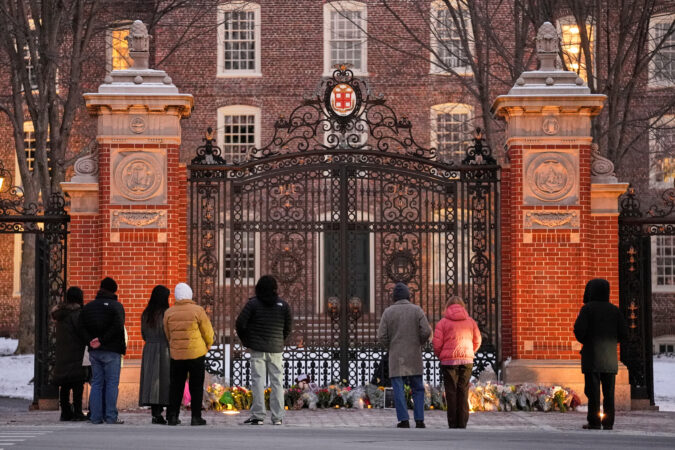
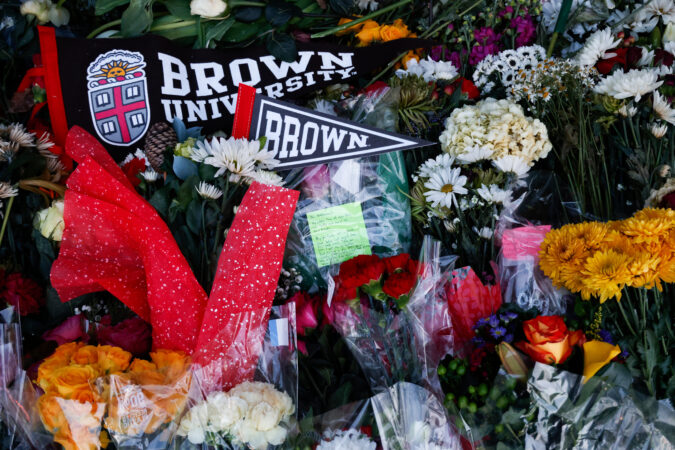
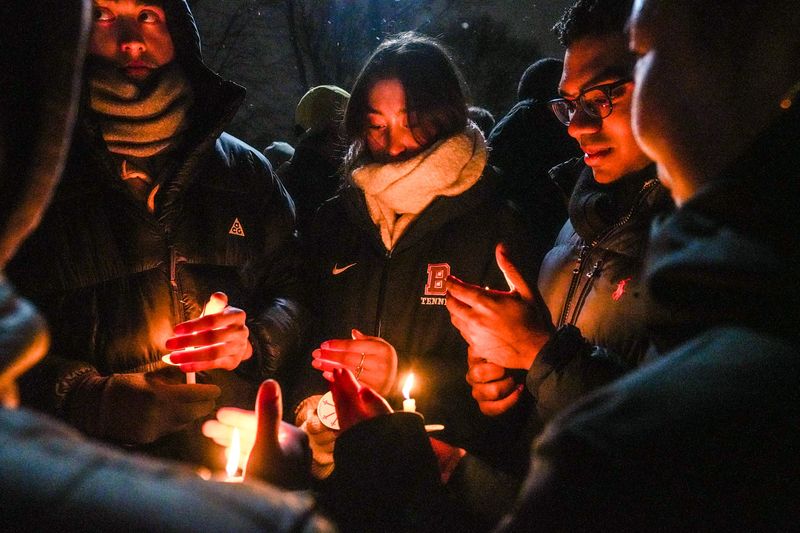
    Hundreds gathered in Providence, R.I.’s Lippitt Park on Dec. 14 to honor victims of the mass shooting at Brown University.

    The attack against our campus is an attack against the entire nation, one that prides itself on some of the best academic institutions in the world. The campus community is a sacred bond, something that has become even more apparent to me since Dec. 13. It extends beyond College Hill in Providence, R.I., throughout the United States and the world. And when one of these communities is ripped apart, they all are.

    We live in a country where active shooter drills are the norm. Those drills proved useful to me.

    When I barricaded myself into a conference room where I sat for nine hours, I operated on autopilot. I knew exactly what to do. At first, this was comforting. But as time has passed, it has haunted me more than anything.

    There is a weird sort of satisfaction in applying something you learned practically, but this skill is one I never wanted to have to learn, let alone take to college with me.

    During the entirety of my high school career, nothing was more exciting than the prospect of attending college. I dreamed of decorating my dorm room, attending classes, and forging a sense that I belonged to something bigger than myself. Brown has surpassed all of my expectations.

    But I’ve found it difficult to hold onto this dream since that Saturday afternoon. When I open Instagram to see that our local Indian restaurant is offering free meals to students, a little bit of my faith is restored. When my friends, professors, and colleagues text to check in on me, I still get the warm feeling of home. But it’s a home I know is forever changed, and perhaps that is the hardest part.

    Push for change

    When I received the alert reporting an active shooter, I was studying for a political theory class that discusses the philosophies of injustice and resistance. The most valuable thing I have learned is that change cannot come without active advocacy. I ask that, in the coming weeks and months, we all actively advocate for change, even when it is inconvenient and uncomfortable.

    When I call my elected representative, I get the common response: He is praying for me. This is a response I will no longer accept. None of us should. We must refuse to let our legislators sit in session without a substantive response to this tragedy — and the many thousands that came before it, hundreds of them just in the last year.

    Ella Cook and Mukhammad Aziz Umurzokov, who were killed, deserve better. The nine others injured deserve better. Brown deserves better. Our nation deserves better.

    CJ Lair is a sophomore at Brown University and an opinions editor at the Brown Daily Herald. He studies political science and is from Gettysburg.

  • Celebrating a Jewish tradition: Chinese food on Christmas

    Celebrating a Jewish tradition: Chinese food on Christmas

    For years, I envied Jews who enjoyed Christmas without getting into the weeds of what it’s all about, who put up a tree and lights without a sense of guilt. I admired Jews who wrote the best Christmas songs in history (google it), even though the holiday will never be their own.

    But the day itself has never been my favorite. It ranks slightly ahead of Good Friday and Easter, but not by much. While no mindful Jew needs to be reminded of what a small minority we are, Christmas puts us in our tribal place. No amount of secular candy canes or court-ordered ecumenical neutrality softens the reality that the day is not for us.

    This is not a complaint or a condemnation of the celebration. If there is a war on Christmas, I am not a combatant.

    Unlike the Grinch, I never begrudge others their joy, even though I can’t embrace it. I wish others a merry Christmas and mean it. Why shouldn’t they be happy?

    Adaptation

    I have no resentment toward public displays of Christmas decorations. So long as they are not paid for with tax dollars, who are they hurting? There are far greater injustices to litigate, more serious public displays to mourn. With antisemitism on the rise, nobody has the luxury of getting upset over a creche.

    To survive, one need not assimilate; one need only adapt. And Jews are masters of it. Take, for example, the now cliché practice of our eating Chinese food on Christmas.

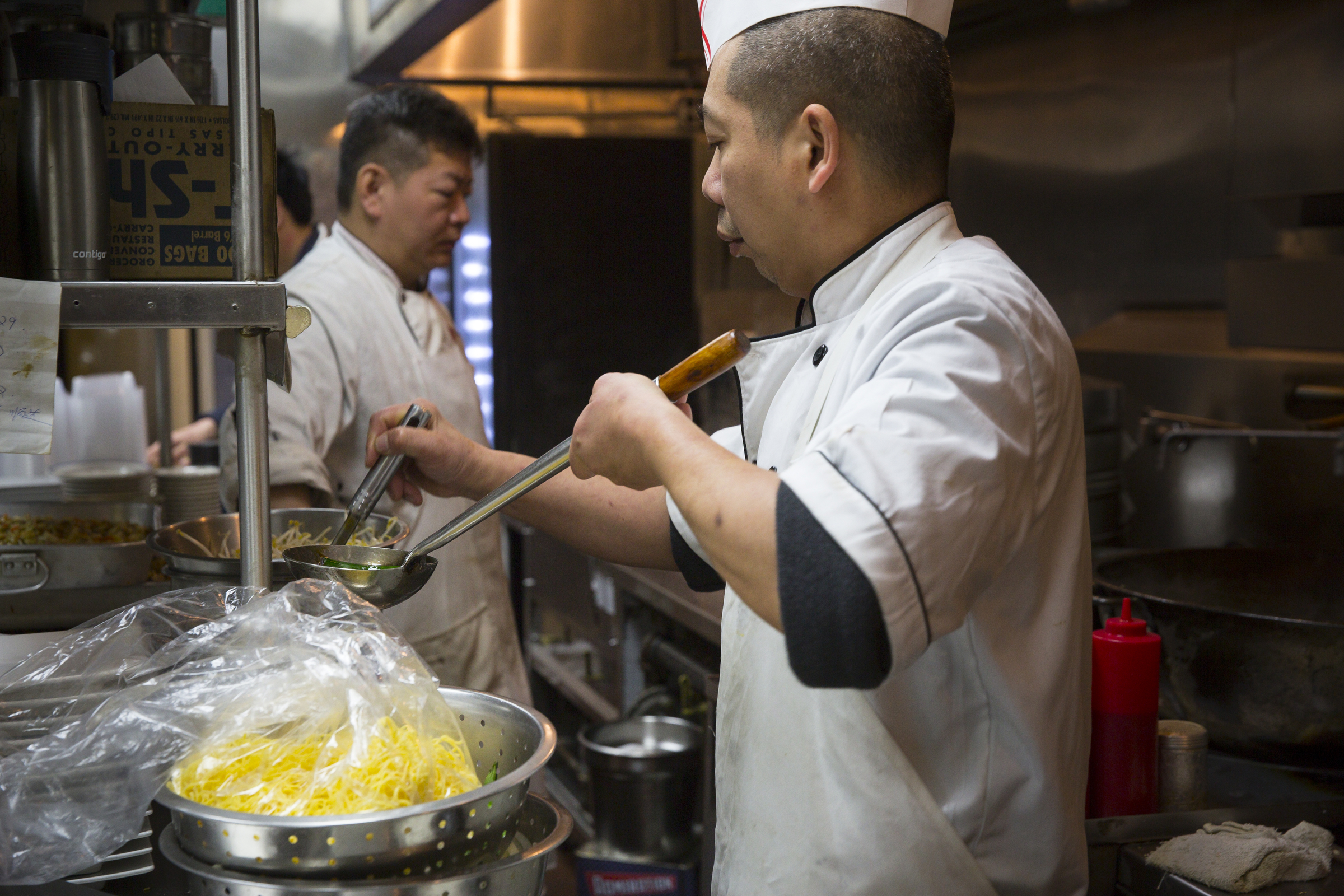
    Chef Rui Guang Yu prepares long life noodles at Nom Wah in Philadelphia. Chinese food generally does not violate kosher dietary laws.

    But it has become more than an adaptation.

    Tradition

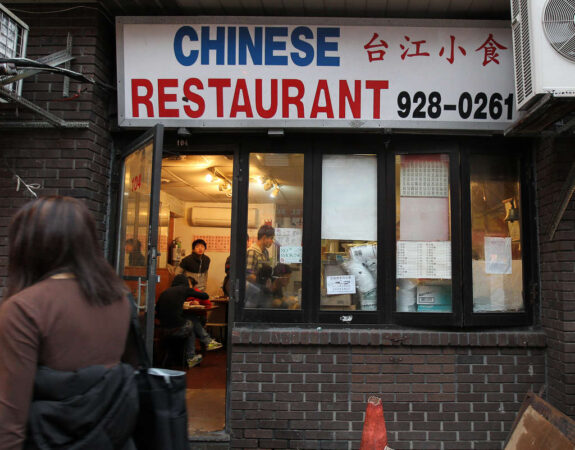
    The Christmas Chinese dinner is one of the truly great and unique nights of the American Jewish year. Jewish families patronize the same restaurant every year with the dedication generally reserved for delis and houses of worship.

    What makes the night different from all other nights is the special joy that can only be found in our shared otherness. Being with those who share your identity — religious and otherwise — is always a blessing. But that feeling of togetherness is never more poignant than in those moments when what makes us different from others also makes us so alike among ourselves.

    And it is often reciprocated by the people feeding us. The owners of the restaurants seem as happy to see us as we are to see them. And to share in our joy.

    That I especially feel my Jewishness in a Chinese restaurant on a Christian holiday is the stuff of comedy.

    And thus humanity.

    Jonathan Shapiro is an Emmy- and Peabody Award-winning TV writer and the author of the recent “How to Be Abe Lincoln: Seven Steps To Leading a Legendary Life.”

  • Behind the holiday lights: My Christmases in the grip of addiction

    Behind the holiday lights: My Christmases in the grip of addiction

    Christmas hasn’t always meant warmth, family, or celebration for me. For nearly a decade, the holidays were some of the most frightening days of my life. While others wrapped gifts and prepared meals, I was consumed with one mission: securing enough pills to avoid opioid withdrawal.

    People rarely talk about this side of addiction — the logistics, the panic, the constant calculations. For me, the days leading up to Christmas weren’t merry or bright. They were a dangerous countdown.

    My entire holiday hinged on whether a doctor would answer the phone before the office closed. I’d sit in my car with trembling hands, rehearsing my tone before calling, trying to sound calm even as fear tightened my stomach.

    I knew exactly which doctors might authorize an early refill and which ones suspected I had become addicted. My 10-year addiction, which began when I was prescribed painkillers after knee surgery, had me cycling through more than 65 doctors in a half dozen states — each one recorded in the many calendars I hid in drawers. They were my secret maps for survival.

    I would flip through them frantically, searching for any appointment I could make to save me from a night of withdrawal. I wasn’t looking for relief or euphoria. I was looking for a way to avoid the sickness that came the moment I ran out.

    Many of the pharmacies I used were inside large chain stores. While they stayed open late, their pharmacies did not. As the metal grates rolled down over the pharmacy windows, the rest of the store hummed on. That contrast haunted me — bright aisles full of shoppers on one side, and on the other, the closed counter that meant I would be sick by morning. Once those grates came down, my options disappeared.

    My withdrawals weren’t mild. At the height of my addiction, I was taking close to 30 pills a day just to feel normal.

    At the height of my addiction, I was taking close to 30 pills a day just to feel normal, writes Chekesha Lakenya Ellis.

    When the supply ran low, withdrawal hit me brutally and immediately. My stomach would bubble, my skin would prickle, and waves of nausea and trembling would take over. My chest tightened until breathing felt like work. Fear of that sickness controlled my entire life — especially during the holidays.

    There were Christmas Eves when I sat alone in my car, looking at my dwindling supply of pills, trying to make it last through the night. I would delay doses longer than my body was used to, forcing myself to wait, bargaining with myself, fighting back tears each time the sickness crept in. It wasn’t safe. It wasn’t smart. But that was all I could do.

    At family gatherings, I appeared frail and hollow. While everyone raved about my mother’s sweet potato pie, I barely touched my plate. My stomach was in knots, and nausea had stolen my appetite.

    I’d slip into the bathroom, sit on the edge of the tub, and try to steady my breathing before returning to the table. People often assume addiction is about chasing a high. Mine wasn’t. Mine was about avoiding the physical collapse that came when the drugs left my system. I wasn’t celebrating Christmas — I was surviving it.

    Addiction has a way of making you disappear, even when you’re standing right in front of the people who love you.

    Today, my holidays are very different. More than 15 years into recovery, I can sit at a Christmas table fully present. I can breathe without fear. I can enjoy a meal. I can laugh. I can be myself again.

    The holidays are hard for many people, but especially for those battling addiction, writes the auuthor.

    But I never forget the version of me who couldn’t.

    And I haven’t forgotten the people who are living that experience right now.

    If you’re struggling this holiday season — if you are using, withdrawing, unhoused, hiding your pain, or simply trying to make it to tomorrow — I want you to know something:

    Your story is not over.

    You are not beyond help.

    You are not alone.

    Even if all you can do today is stay alive, that is enough. The holidays are hard for many people, but especially for those battling addiction. I survived nights I didn’t think I would survive. And if I could make it out, so can you.

    This Christmas, my prayer is that you hold on — just long enough for the light to break through.

    There is life beyond this moment. Even if you can’t feel hope right now, hope can still find you.

    Chekesha Lakenya Ellis is a certified peer recovery specialist. The Burlington County resident uses Facebook to raise awareness about addiction and recovery.

  • Why I like the commercialization of Christmas

    Why I like the commercialization of Christmas

    With the announcement of record sales across the country on Black Friday, including $11.8 billion in online transactions, the holiday shopping season was off to a great start. In the next few weeks, the average person was expected to spend about 10% of their annual shopping budget. By Dec. 25, the National Retail Federation expected a record-setting $1 trillion to be spent nationwide on consumer goods.

    As a Christian, I am not supposed to like the commercialization of Christmas. I was taught from childhood that the birth of Jesus is “the reason for the season,” not gifts. In recent years, critics of all faiths — and none — have joined a growing chorus of anti-consumerist sentiment toward the holidays.

    But rather than dismissing holiday shopping as a symbol of materialism and excess, I have come to view it as an expression of generosity and joy that captures the purpose of the season.

    Rather than dismissing holiday shopping as a symbol of materialism and excess, I have come to view it as an expression of generosity, writes B. G. White.

    The tradition of giving gifts at Christmastime was introduced several centuries ago in Europe by Christians who took stories about the gift-giving of an ancient saint, Nicholas of Myra, and turned him into the modern Santa Claus. As the Industrial Revolution created a new middle class and increased the availability of consumer goods, the tradition grew.

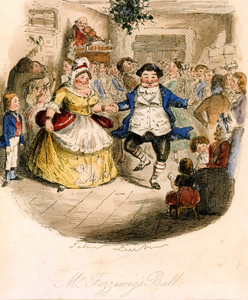
    The importance of material generosity at Christmas was especially championed by Charles Dickens in his 1843 novella A Christmas Carol, which depicts the infamous Ebenezer Scrooge’s transformation from a penny-pinching grump to a joyful philanthropist.

    Hand-colored plate illustration from the first-edition/first-issue copy of Dickens’ “A Christmas Carol.”

    Dickens’ largely secular vision of giving gifts at Christmas helped to make a holiday originally confined to Christians more accessible for an increasingly pluralistic world.

    Of course, there are problems with the connection between Christmas and shopping. I do not like how it can exacerbate class difference, revealing a vast disparity in the quantity and quality of gifts from one household to the next. The upper and middle classes can use Christmas as another opportunity for an exotic vacation or the acquisition of yet another status symbol.

    One only needs, however, to recall the refrain from so many holiday movies to realize that the vast expenditure inherent to the season is not the main problem.

    As Charlie Brown struggles in A Charlie Brown Christmas to pull together the perfect Christmas play, he realizes that, while he may need a Christmas tree for the set, it does not need to be particularly tall, pretty, or even upright. A short, scrawny tree will do just fine.

    Instead of trying to buy happiness, or a better relationship with a loved one, or the perfect Christmas tree, we can use Christmas to focus on what someone really needs, writes B. G. White.

    Christmas is about being content with what you already have and, out of that contentment, being generous to others. Instead of trying to buy happiness, or a better relationship with a loved one, or the perfect Christmas tree, we can use Christmas to focus on what someone really needs.

    To keep ourselves focused on others and avoid unnecessarily lavish gifts, my wife and I use holiday sales as a means to get a discount on items that we would otherwise buy for our kids at some other point in the year. We also focus on practical gifts people will actually use — last year, we got a battery caddy for my mom and gardening gloves for my dad. Our son requested an expensive toy this year — an electric train set — so we found a small one that is in good secondhand condition, which reduces waste and expenditure.

    Perhaps the greatest reason why I like to give gifts at Christmas is that they embody the heart of the Christmas story — the one, ironically, that so many Christians use to create skepticism about Christmas gifts — in which God “gave” Jesus as a savior for the world (John 3:16).

    Perhaps, then, giving gifts does not destroy Christmas; it captures its very essence.

    B. G. White is a faculty member in the theology department at Boston College.

  • Catholic Charities helps those in need both surmount life’s hardships and celebrate its many little joys | Philly Gives

    Catholic Charities helps those in need both surmount life’s hardships and celebrate its many little joys | Philly Gives

    Heather Huot, the top executive at Catholic Charities, named her only daughter after Lidia, a homeless, mentally ill, and often cranky elderly woman she met as a young social worker at Women of Hope Vine, a transitional housing facility run by the organization Huot now leads.

    As “mean spirited” as Lidia was, Huot said, Lidia still celebrated forsythia.

    When their bright yellow blossoms heralded winter’s end, Lidia would drag Huot outside to marvel. “Despite all the hardships,” Huot said, “there are things to be celebrated.”

    Which brings us to the Christmas holiday season.

    Even if it were possible, which it’s not, to overlook all the troubles in our world, with wars and starvation, or even to overlook all the troubles in our nation, there would still be the troubles of the season — too much work, too much loneliness, too many struggles.

    Where’s the forsythia?

    Two weeks ago, it was outside the Archdiocesan Pastoral Center in the form of a living Nativity scene, complete with a wee baby goat named Lady, an artificial-snow machine, an actual camel, and an elementary school choir in their Catholic school uniforms singing “Joy To the World.”

    Yes, “Joy To The World,” because 500 children, some of whom live in tough circumstances, got a chance to celebrate Christmas and with it, maybe, the hope that the holiday brings. It was the 70th annual Archbishop’s Benefit for Children, a Catholic Charities of Philadelphia event funded by a grant from the Riley Family Foundation. No expense was spared.

    Heather Huot, the chief of Catholic Charities Philadelphia, pets a calf during a living Christmas scene in front of the Archdiocesan Pastoral Center in Center City Philadelphia.

    More than 60 volunteers from area high schools lunched on pizza and cookies before heading across the street to a lavishly decorated ballroom in the Sheraton Philadelphia Downtown. Balloons, banners, party favors, huge plates of cookies, a container of ice cream cups, and a bucket of all different flavors of milk awaited at each table. Kids and chaperones crowded the dance floor, only to make way for an appearance by Santa, who high-fived his way around the ballroom. At the party’s end, the volunteers sprang into action distributing bags of toys — all beautifully wrapped.

    In a way, the party is a metaphor for Catholic Charities as a whole. Both the party and the organization are big and multifaceted with lots of moving parts, involving all types of people, not only Catholics.

    Each year, Catholic Charities spends about $158 million to run about 40 different programs in four main categories — care for seniors; support for at-risk children, youth, and families; food and shelter; and its biggest category, many-pronged assistance for people with intellectual and developmental disabilities and their families.

    As an overview, there’s housing for at-risk youth in Bensalem. In Philadelphia, people may be familiar with St. John’s Hospice on Race Street, which provides food, showers, shelter, and case management to men. There are several smaller transitional housing shelters for women in the city.

    Social workers funded by Catholic Charities assist students at six Catholic high schools across the region. Other social workers handle case management under contract with the City of Philadelphia. A program teaches teenagers involved in the juvenile justice system about conflict resolution. Family navigators step in to assist families with issues ranging from employment to parenting support. There are adoption and foster-care services.

    For the elderly, Catholic Charities supports senior centers and works to help seniors stay independent through case management.

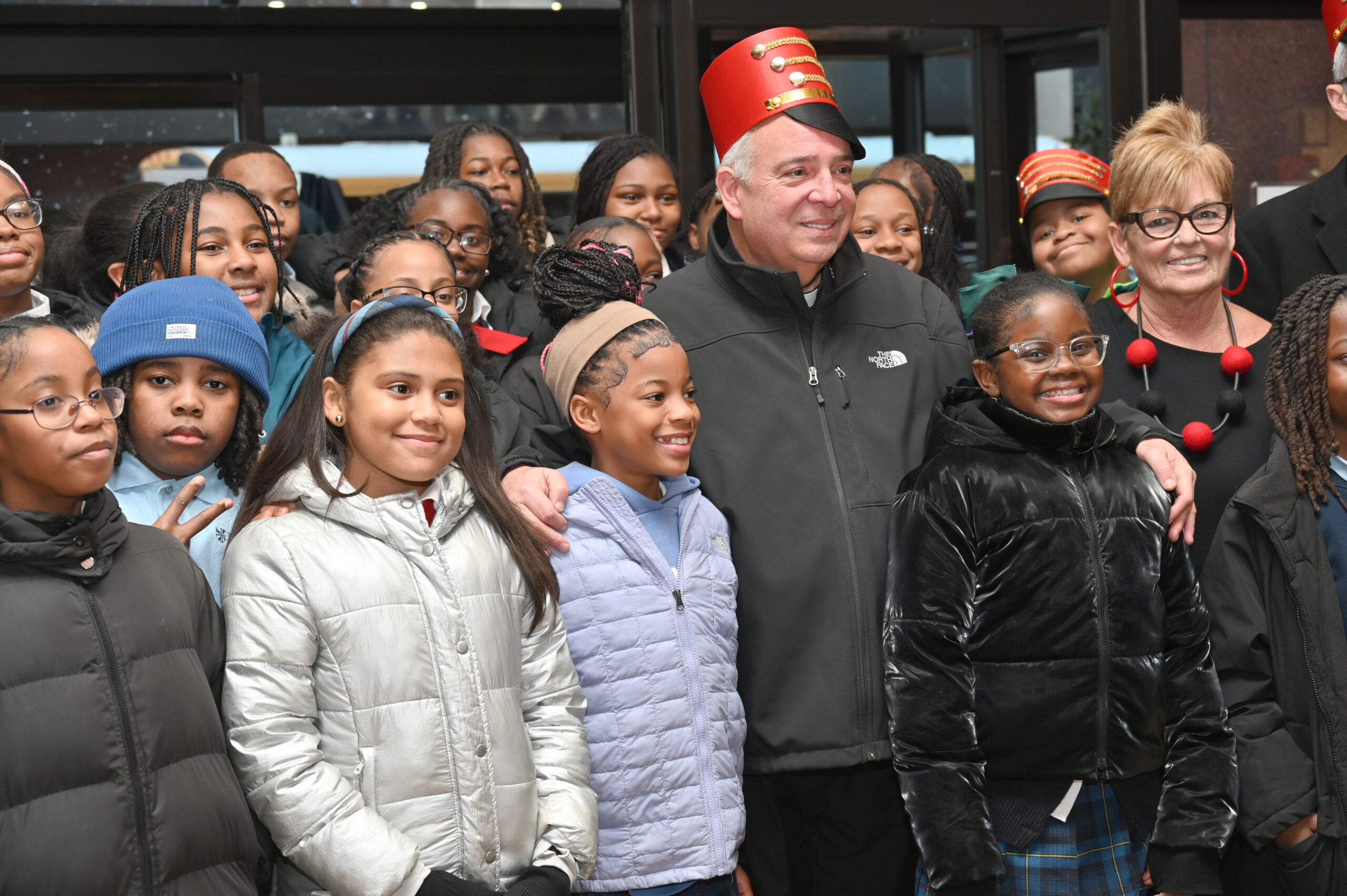
    Archbishop Nelson Pérez poses with students during a holiday party.

    Just over half of Catholic Charities’ annual budget is allocated to supporting people with intellectual or developmental disabilities. A major focus is housing for adults. For example, at the Divine Providence Village in Springfield, Delaware County, 72 women live in six cottages on a 22-acre campus with a pool, greenhouse, and picnic pavilion.

    In addition, there is employment support, a day program, field trips, a family-living program, and respite care to help families overwhelmed by caregiving responsibilities.

    Nearly 80% of Catholic Charities’ funding comes from government sources, which, these days, requires Huot to focus her prayers. “I ask God to help me get through this and to give me the strength and the people around me to get through this,” she said. “At the same time, we have to recognize that God provides in ways you don’t expect.

    “We’ve been blessed with generous benefactors who have stepped in,” she said. “The Philadelphia community is incredibly generous. We get a bad rap as the people who throw snowballs at Santa Claus, but Philadelphians will give you the shirt off their backs. They are passionate about caring for one another.”

    The generosity moved Lakisha Brown to tears as she shepherded her two children and a third to the party earlier this month. Brown, 44, lives in a three-bedroom subsidized housing apartment at Catholic Charities’ Visitation Homes in Kensington.

    “This is the best I ever lived,” she said. But, she said, just outside her door “is a constant reminder of where I came from and where I never want to go.”

    Brown’s father died when she was in elementary school and her mother struggled with alcohol addiction. Brown left home when she was 16 under the protection of a man who started their relationship with gifts and ended it with beatings.

    “He left me in a coma,” she said.

    Brown had her own struggles with addiction. She spent many nights without a roof over her head. If lucky, she could sleep in safety in an abandoned car on a quiet block. One night, she went to a party in a hotel. When she woke up, her clothes were off. Whatever happened wasn’t consensual.

    Soon after, she learned she was pregnant and, knowing that, she vowed to give her baby a clean birth. She found a drug program and a place to live. Slowly, through housing and support from Catholic Charities, she rebuilt her life.

    Erika Hollender holds up her grandchild so Layani, 3, can touch Percy the camel.

    “They help us with budgeting, with money management,” said Brown, who relies on disability, welfare, and food benefits while trying to cope with her own mental health issues. “When we get some money, we want to spend it on the children. We were parenting out of guilt and shame.”

    Those are the big things, but what Brown wants people to understand is that the level of care is deep, personal, and specific. It’s being able to ask a staff person for a roll of toilet paper and trash bags — basics that are sometimes unaffordable when money must be allocated to food and shelter.

    “A mom’s job is never done,” she said, explaining why people should donate to Catholic Charities. “It is needed for mothers who come from nothing. It is needed.”

    For more information about Philly Gives, including how to donate, visit phillygives.org.

    About Catholic Charities of Philadelphia

    People served: 294,000 annually (in the 2023-24 fiscal year)

    Annual spending: $158.6 million across four pillars of mercy and charity

    Point of pride: Catholic Charities of Philadelphia is the heart of the church’s mission in action, serving all people regardless of background. With decades of experience, nearly 40 comprehensive programs, and deep community partnerships, Catholic Charities turns compassion into action, and action into lasting and impactful change.

    You can help: By serving meals, volunteering at a food pantry or shelter, hosting a food or clothing drive, and sharing your gifts and passions with seniors.

    Support: phillygives.org

    What your Catholic Charities donation can do

    • $25 provides five nutritious lunches for children through the School Lunch Program.
    • $50 provides three hot lunches at St. John’s Hospice for individuals experiencing food insecurity.
    • $100 provides an instructor and supplies for an art or recreation class for 50 to 100 seniors at a senior community center.
    • $275 provides one week of groceries for a family of four.
    • $325 provides a mother with formula, diapers, and wipes for a month.
    • $550 provides emergency shelter and meals for a week for someone experiencing homelessness.