Category: Commentary

  • Philly’s troubled history of militarized policing

    Philly’s troubled history of militarized policing

    More than a hundred years ago, the Lanzetta family seemed to be living the American dream in South Philly.

    Immigrants from Italy, the family patriarch, Ignazio, worked hard at local restaurants, while his wife, Michelina, tended to their growing family, which included six boys by the early 1920s.

    They lived in the heavily Italian Our Lady of Good Counsel parish, where neighbors described them as “religious” and “such nice people.”
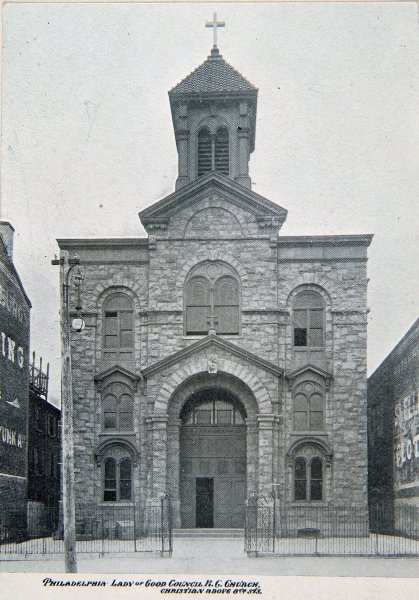
    The former Our Lady of Good Counsel church on Christian Street.

    But times were hard in 1920s Little Italy, and some native-born Americans scapegoated the recent arrivals for much of Philadelphia’s woes.

    Mayor W. Freeland Kendrick, a Republican, decided to recruit a U.S. Marine general to “clean up” the whole city, where, he claimed, “vice and crime [were] rampant” and “disregard of law and order [was] almost unbelievable,” as the New York Times put it in July 1924.

    This required White House approval, ultimately causing clashes between local and federal officials — not unlike the ones we are seeing today, with National Guard troops and U.S. Immigration and Customs Enforcement and Border Patrol agents on the streets of many U.S. cities over the objections of state and municipal authorities.

    Just last month, federal law enforcement made over 130 arrests in Charlotte, N.C.
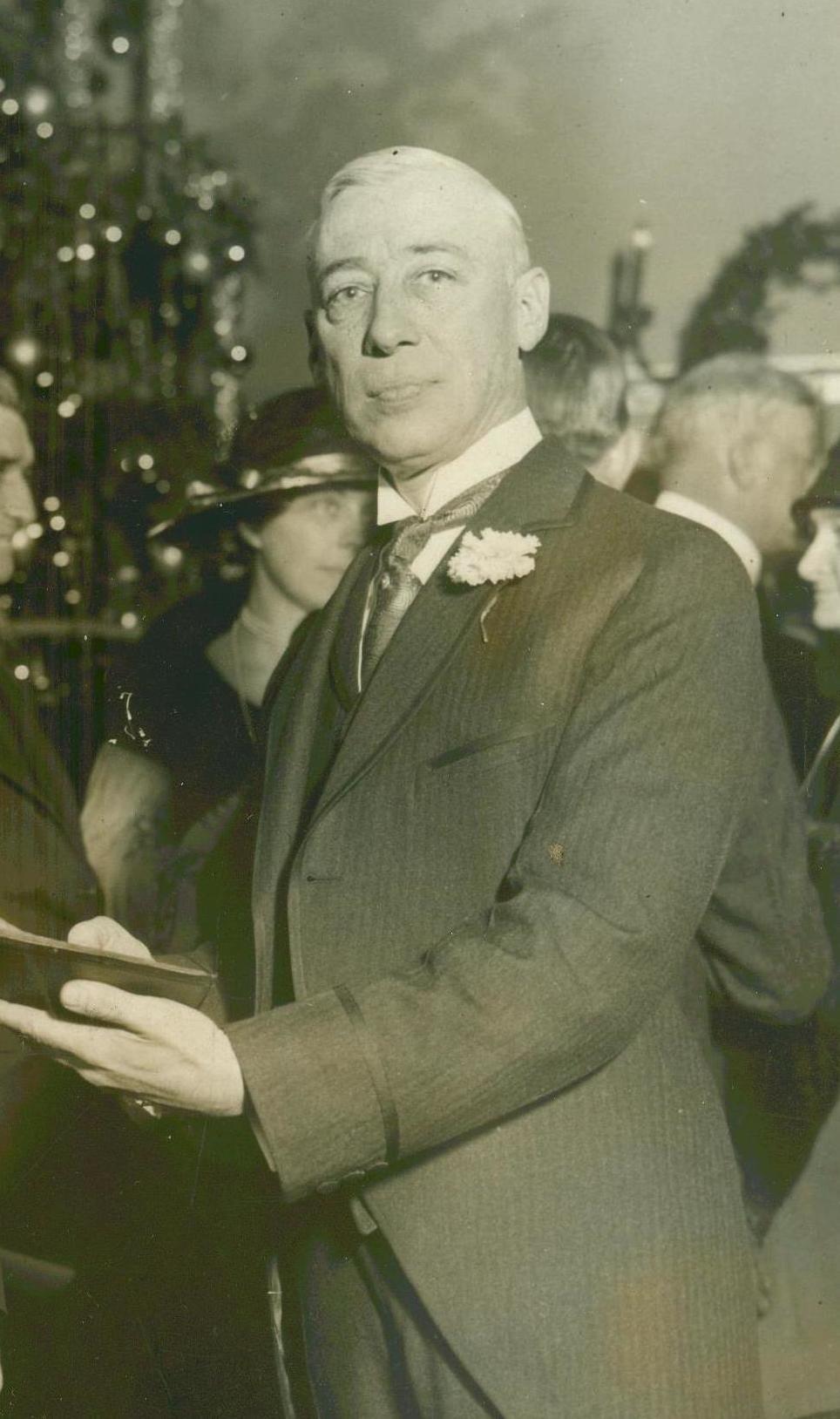
    W. Freeland Kendrick, a Republican, served as the 84th mayor of Philadelphia from 1924 to 1928.

    Democrats — including Gov. Josh Shapiro, who is often mentioned as a 2028 presidential candidate — have denounced President Donald Trump’s use of federal man power.

    “I think the way the President has chosen to deploy the [National Guard] … is extremely dangerous,” Shapiro said in October, as two dozen states tried to block what critics call Trump’s “militarization” of urban police work.

    Long forgotten today are the travails of immigrants like the Lanzettas. They and other newcomers to the United States were branded as undesirable and accused of turning Philadelphia into a city where “banditry, promiscuous sale of poisonous liquor, the sale of dope, viciousness and lawlessness of all kinds are rampant,” as Mayor Kendrick put it, according to The Inquirer in 1923.

    President Trump has used even harsher rhetoric to justify deploying federal agents and troops to Washington, D.C., Los Angeles, and Memphis, while threatening to do the same in Philadelphia.

    Back in the Roaring Twenties, city officials were particularly worried that organized crime, fueled in part by Prohibition, would mar the citywide Sesquicentennial celebrations marking America’s 150th birthday in July 1926.
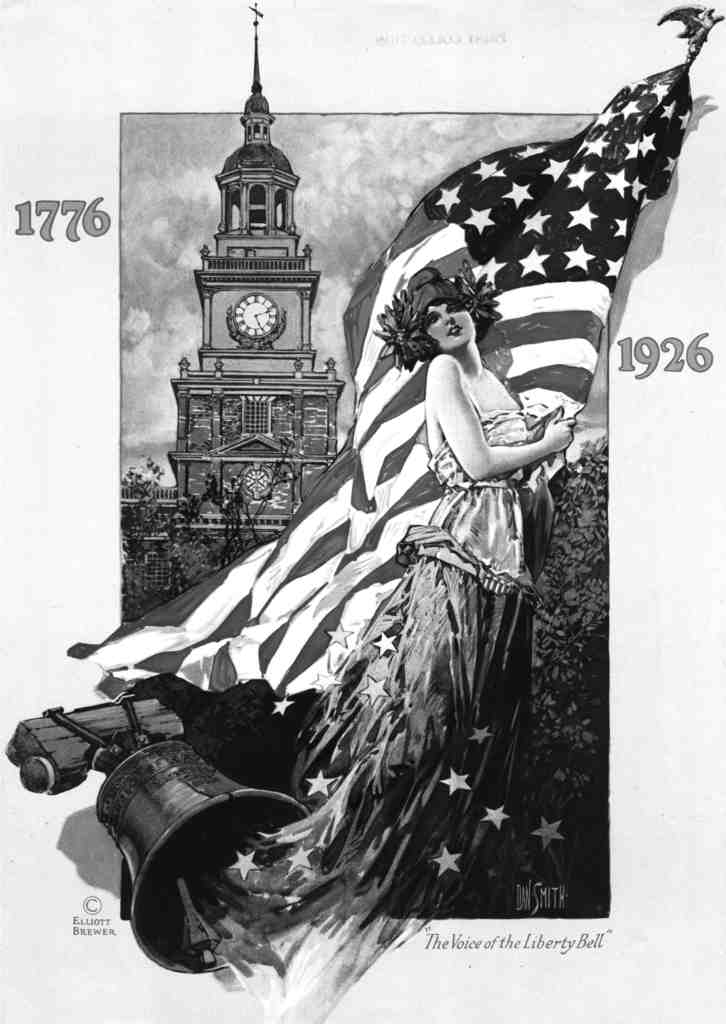
    A poster for the Sesquicentennial International Exposition in Philadelphia.

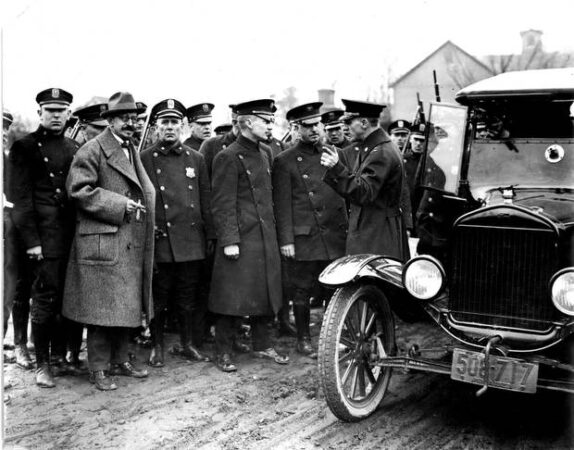
    When President Calvin Coolidge finally gave the go-ahead for Brig. Gen. Smedley Darlington Butler to suspend his Marine duties in January 1924, the West Chester native and Haverford graduate swiftly established his authority as the city’s director of public safety.

    “You have a cesspool in Philadelphia,” declared Butler. “If necessary you should pass laws taking [Philadelphia’s] government away if they don’t know how to run it.”

    Butler had two decades of experience in Latin America, the Philippines, the Boxer Rebellion in China, as well as France during World War I, earning two Medals of Honor and eventually rising to the rank of major general. Only a tough, experienced Marine could tame Philly, Mayor Kendrick and local reformers believed.

    And while Butler didn’t have soldiers to command, he was later quoted as saying that his ideal job title would be “martial law commander of Philadelphia with 5,000 Marines under me. Then I would not be hampered by writs and magistrates hearings.”

    During Butler’s two-year tenure, as many as 17,000 Philadelphians were arrested for various offenses, big and small.

    “Cleaning up Philadelphia,” he later lamented, “was worse than any battle I was ever in.”

    By the end of 1925, even Kendrick had come to see some of Butler’s more authoritarian initiatives as “intolerable.” Criticisms of any federal role in combating local crime grew louder and louder.

    J. Hampton Moore, who preceded and then succeeded Kendrick as mayor, called the Butler controversy a “spectacular misuse of the White House.”

    According to an Associated Press article from Nov. 4, 1925, a congressman bluntly asked Kendrick: “Would you favor the president designating an Army or Navy or Marine to do police work in every one of the big cities of the country?”

    “Mine is an exceptional case,” Kendrick responded.

    To which the congressman snapped, “Some of us don’t see it that way.”

    Butler ultimately agreed and returned to the Marines.

    Though largely forgotten, this controversy has clear lessons — and warnings — for today.

    Polls show Americans are highly skeptical of recent ICE raids and National Guard patrols — a problem Republicans could have avoided if they stuck to their long-standing preference for local rather than federal solutions.

    But Gov. Shapiro should also remember that Trump won the 2024 election, in part, because voters didn’t trust Democrats on urban crime.

    This is no mere philosophical discussion.

    Consider Michelina and Ignacio Lanzetta, those striving South Philly immigrants. Their sons were pulled into “every vice and crime of the day,” historian Celeste A. Morello has written, and two of them were ultimately murdered.

    With the nation’s 250th birthday almost upon us, Philadelphia might finally guide Americans toward a resolution to these long-standing conflicts over local crime and federal power.

    Tom Deignan has written about history for the New York Times and the Washington Post. He is working on a book about violence in and around Philadelphia in the 1920s.
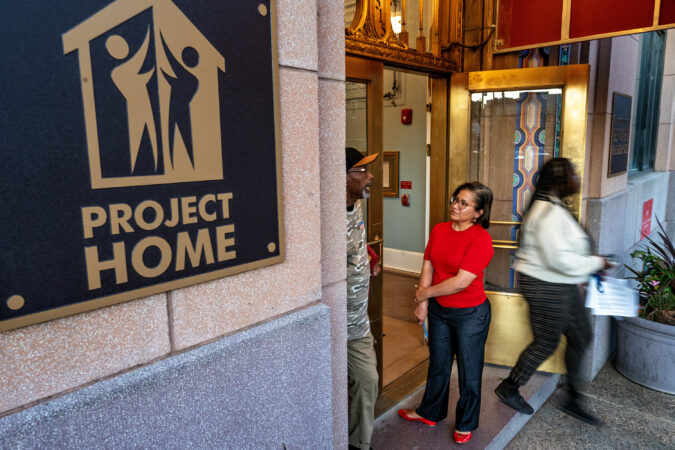
  • HUD funding shift would disregard proven solutions to homelessness and destabilize programs

    HUD funding shift would disregard proven solutions to homelessness and destabilize programs

    Organizations providing homelessness services were thrown into crisis mode last month when the U.S. Department of Housing and Urban Development announced an extreme shift in funding priorities.

    The department has since withdrawn the notice, but it offered a stark preview of an administration willing to gamble with the futures of our most vulnerable neighbors and the crippling changes that could still be coming — unless neighbors make their opposition known, and lawmakers work to stop it.

    HUD’s fiscal year 2025 Continuum of Care Competition Notice of Funding Opportunity brought widespread changes and signaled a drastic shift away from proven permanent supportive housing solutions to combat homelessness in favor of transitional housing.

    We at Project HOME immediately recognized the danger this posed to Philadelphia’s communities and the people we serve. The outcry from fellow organizations on the front lines and elected officials was swift and fierce. Gov. Josh Shapiro even joined a multistate lawsuit challenging HUD’s move.

    While HUD has temporarily paused the Notice of Funding Opportunity, the department remains intent on reshaping funding requirements to reflect new priorities. For now, organizations have been spared the chaotic rush to adjust grant applications based on the changes. But make no mistake: The administration’s intentions have been revealed, and if future funding notices are similar, the consequences could be devastating.

    The changes would disregard proven solutions and could destabilize established programs, putting people’s homes — and their lives — in jeopardy.

    The reality is, permanent supportive housing is a proven and effective approach to breaking the cycle of homelessness. Per the Urban Institute, “Rigorous studies consistently show that it is the most effective solution to increasing housing stability and reducing chronic homelessness.”

    At Project HOME, we witness the transformative power of permanent supportive housing every single day. Our model has leveraged permanent supportive housing as the foundation of our H-O-M-E model in tandem with opportunities for employment, medical care, and education services. The most critical step in a person’s journey to break the cycle of homelessness is to have a safe and stable place to call home.

    Consider David, who spent 25 years experiencing chronic homelessness before finding stability and hope in our community. With access to housing and supportive services through our H-O-M-E model, David rebuilt his life — moving into permanent supportive housing, pursuing adult education, and securing employment through our social enterprise program.

    Today, David is a pillar of our community: He organizes an annual back-to-school barbecue for neighborhood children and continually looks for ways to help others still struggling on the streets. Whether he’s distributing coats, offering comfort at memorials, or lending a helping hand, David embodies the power of proven solutions to break the cycle of homelessness, restore dignity, and inspire lasting change.

    Stories like David’s are not isolated — they are why we remain steadfast in our commitment to permanent supportive housing.

    Critics point to a rise in homelessness nationwide as a failure of permanent supportive housing approaches, but the real culprit is a nationwide shortage of affordable housing.

    According to the National Low Income Housing Coalition (NLIHC), there were only 35 rental homes that were affordable and available for every 100 extremely low-income households in 2024. That’s a shortfall of 7.1 million rental homes across the country. Without pathways to affordable, permanent supportive housing for people at risk of homelessness, the crisis would be so much worse, and more unsheltered people would be on the streets.

    We recognize it is not the administration’s intention to increase rates of unsheltered homelessness in Philadelphia and countless other communities nationwide. No one wants to see more people living on the streets — not neighbors, not service providers, not civic and business leaders, and certainly not the administration. Yet, if these changes go forward, that could very well be the outcome.

    The reduction in permanent supportive housing threatens to have a drastic effect on people like David. They’d risk falling back into the cycle of homelessness, and local businesses and neighborhoods would be forced to grapple with the effects.

    Homelessness is the defining crisis of our time. Yes, we must always strive to improve our response and evolve best practices. But change must be rooted in evidence, not theory.

    Philadelphia has made steady progress over three decades and has been on the front line of developing best practices that work.

    We don’t want to go backward. We must hold our elected officials accountable and demand proven solutions that benefit communities and honor the dignity and progress of every person.

    Donna Bullock is the president and CEO of Project HOME.

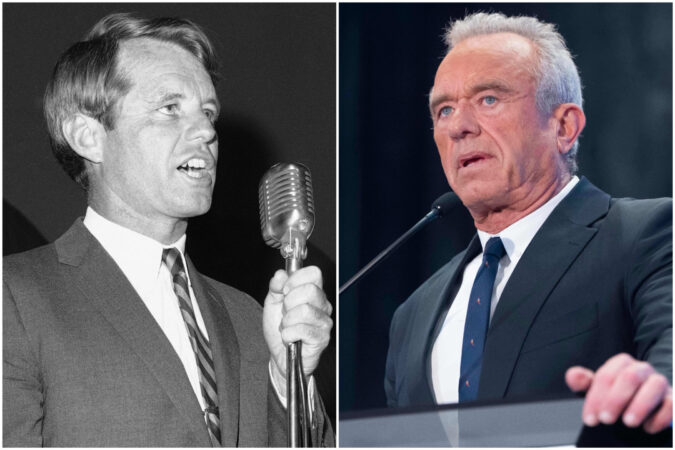
  • Bobby Kennedy sought to unite the nation. Junior is part of an administration that sows division.

    Bobby Kennedy sought to unite the nation. Junior is part of an administration that sows division.

    I find it impossible, like many my age, to think of Robert F. Kennedy Jr. without thinking about his father.

    It isn’t easy. Considering the late Attorney General Robert Kennedy and his son together requires a leap of memory but a far larger one of faith.

    Attorney General Robert F. Kennedy, right, wife Ethel Kennedy, and children, from left, Bobby, Joseph, and Kathleen, second right, at Kennedy International Airport in New York, July 1, 1964, shortly after they returned from a one-week trip to West Germany and Poland.

    Bobby Kennedy sought unity. His son, the secretary of Health and Human Services, is part of the same Donald Trump team that sells national division on every possible front.

    Americans of an older generation recall watching the funeral train back in 1968 that carried Sen. Robert F. Kennedy’s body from New York’s St. Patrick’s Cathedral to Washington, where he would join his brother already interred in Arlington Cemetery.

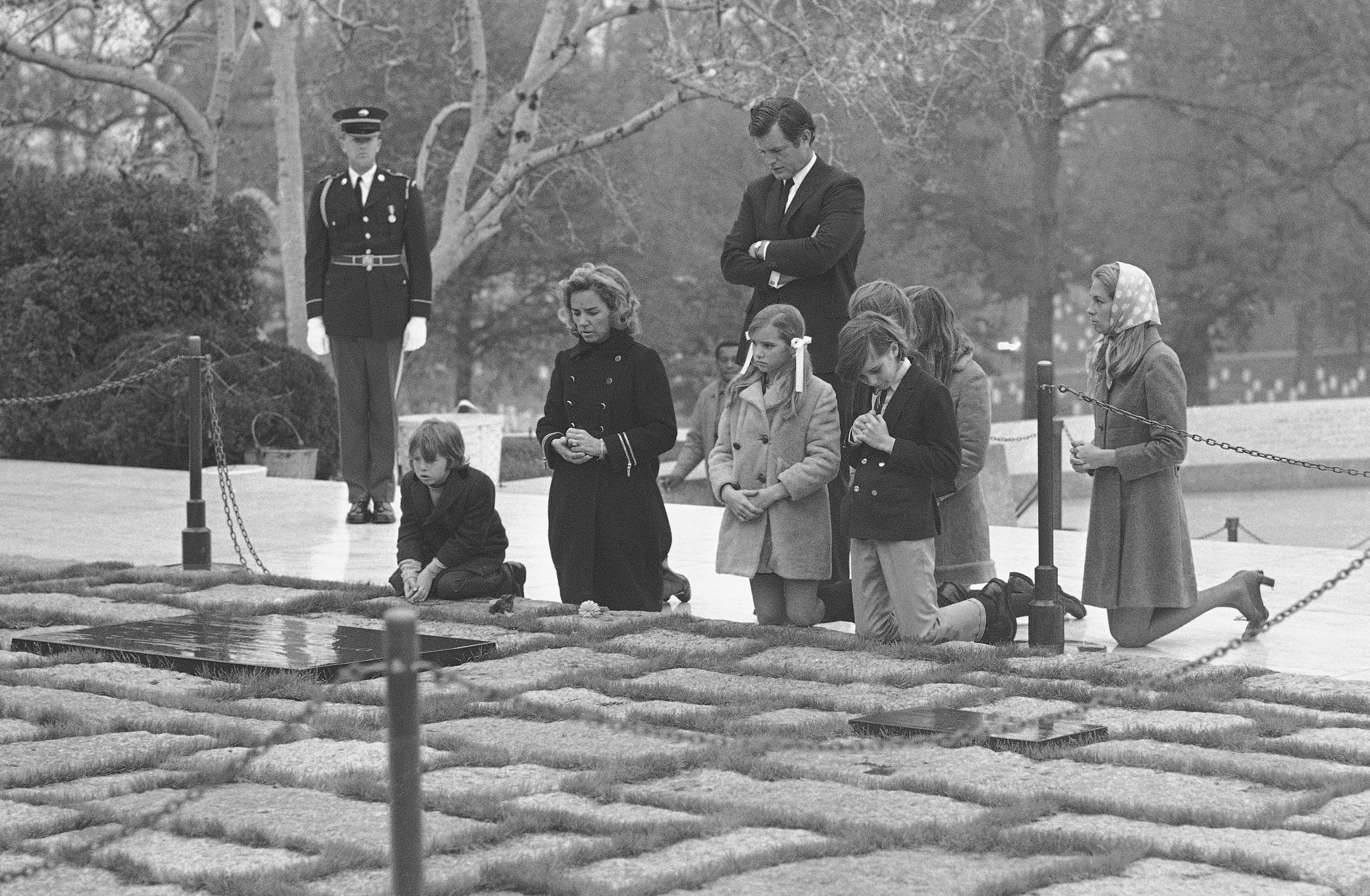
    Sen. Edward Kennedy, back, pauses at the grave of assassinated President John F. Kennedy in Arlington National Cemetery, Nov. 20, 1970, with his wife Joan, right. With them are the widow of former Sen. Robert F. Kennedy, Ethel Kennedy, and her five children.

    All along the tracks we saw the faces, white and Black, of working people for whom Bobby Kennedy held such promise. His presidential candidacy in 1968 meant an end to the brutal American conflict in Vietnam, an economic shift in our country’s wealth from the war in Southeast Asia to the dire needs of our major cities.

    That June Saturday offered none of the pageantry of President Kennedy’s death five years earlier. There were no marching bands, no riderless cavalry horse, no President Charles de Gaulle or Haile Selassie, no heroic “Day of Drums.”

    In Bobby’s case it was only about loss.

    I can still feel the anguish in Frank Mankiewicz’s words making the sad announcement:

    “Senator Robert Kennedy died at 1:44 this morning … June 6, 1968 … He was 42 years old.”

    Kennedy had made his name as a U.S. attorney general fighting for civil rights. He took on Deep South governors to desegregate Ole Miss and the University of Alabama. He pushed his brother behind the scenes, to give the historic Civil Rights speech of 1963.

    U.S. President John F. Kennedy, right, confers with his brother Attorney General Robert F. Kennedy at the White House in Washington, D.C., on Oct. 1, 1962, during the buildup of military tensions between the U.S. and the Soviet Union that became the Cuban missile crisis later that month.

    But what made him unique, as New York columnist Jack Newfield once wrote, was that he “felt the same empathy for white working men and women that he felt for Black, Latino, and Native American working men and women. He thought of police officers, waitresses, construction workers, and firefighters as his people.”

    Bobby made a call for racial unity a part of his 1968 presidential campaign.

    In the Indiana primary, he rode through the streets of Gary in an open convertible, Richard Hatcher (the city’s first African American mayor) on one side, Tony Zale, the middleweight boxing champ, so popular with the city’s white working people, on the other.

    “I have an association with those who are less well off, where perhaps we can accomplish something: bringing the country together.

    “I think we can end the divisions within the United States — whether it’s between Blacks and whites, between the poor and the more affluent, or between groups on the war in Vietnam. We can start to work together. We are a great country, an unselfish country. I intend to make that my basis for running,” Robert Kennedy said after winning the California Democratic Primary in 1968, minutes before his assassination.

    Sen. Edward M. Kennedy waves from the rear platform of the observation car bearing the remains of his slain brother, Sen. Robert F. Kennedy, as the funeral train passed through North Philadelphia Station, June 8, 1968. Others on the platform are unidentified.

    And these were the very people who showed up for Bobby when his funeral train passed through Newark and Trenton and Philadelphia and Baltimore that grim Saturday in June.

    Chris Matthews is the host of “Hardball” on Substack and the author of “Lessons from Bobby: Ten Reasons Robert F. Kennedy Still Matters.

  • Combatting Islamophobia through days filled with ordinary decency

    Combatting Islamophobia through days filled with ordinary decency

    Stepping out of my apartment building, a neighbor stopped me to say he was sorry for the Islamophobia he felt circulating lately in Donald Trump’s America.

    At the post office, the man behind the counter asked if I could write “Happy Holidays” in Arabic for a sign he wanted to hang. I wrote it carefully, conscious of my uneven hand. He thanked me and taped it up. I hope the small sign does its modest work, easing someone without calling attention to itself, doing what such gestures often do best when they pass quietly.

    At the bus station, a large man asked to borrow my phone. When he handed it back, he asked where I was from. I said Egypt. He swore, laughed, and spoke with me for a few minutes about the world, about worry, about what people owe one another. Before boarding, he offered a blessing.

    These moments remind me how relatively easy my passage as an immigrant has been.

    I have not encountered violence directly. What I have met, mostly, is ignorance, and even that only recently.

    I have rarely felt compelled to take it personally. I tend to think that most people would not speak as they do if their lives had widened just enough to complicate what they take for granted, if familiarity had been allowed to interrogate fear.

    That belief comes from observation over decades and across cultures. People are rarely changed by argument alone. They are altered by proximity, by repeated exposure to what does not confirm the story they have been told about others or about themselves. Knowledge and kindness work slowly. They loosen bias and false certainty by degrees.

    I carry sorrow for the violent pain and murderous ignorance that continue to surface where I come from, and far beyond it. The point is not to rank suffering or distribute blame. The point is recognition: We are capable of living far better than we do.

    After the recent mass shooting at a Hanukkah celebration at Bondi Beach in Sydney, where 15 people were killed, a Muslim man, Ahmed al Ahmed, intervened by tackling and disarming one of the attackers. He was shot twice in the process and is credited with saving lives. Past narrow religious allegiances, this was a human refusal to stand aside.

    In this photo released by the Prime Minister’s office, Australian Prime Minister Anthony Albanese meets Ahmed al Ahmed at St George Hospital in Sydney on Dec. 16.

    That matters, because it interrupts the story we are encouraged to believe about what people inevitably are.

    In recent months, reported incidents of anti-Muslim harassment and threats have risen across the country, echoing what many Americans are experiencing in daily life.

    Living in the United States for nearly two decades, I am well aware that this country has inflicted violence both inside its borders and far from its shores, for generations, often while renaming it, often while insisting on its necessity.

    Any serious reckoning with this asks more of us than explanations shaped for a news cycle.

    It asks for patience, attention, and the willingness to trace continuities rather than isolated events. It asks us to notice how harms travel, and how language perpetuates those harms. It asks us to notice how easily whole communities are reduced to headlines, faiths are flattened into caricature, and violence becomes explanatory shorthand.

    When we make others suffer, we do not escape the damage. We carry it, often without knowing how it has narrowed us.

    But none of this survives sustained attention. What does endure are the small acts that refuse the terms we are handed and the gestures that loosen suspicion.

    Goodness is practiced. It appears in ordinary exchanges.

    In the traditions that have shaped my thinking, love is not postponed until some imagined future. Mercy is learned here, among people who misunderstand one another, who arrive carrying inherited fear, who fail but try again.

    Decency is possible. I encountered it on the street, from ordinary people who spoke plainly and put distance between the human being and the headlines.

    As a discipline of perception, it is worth the effort to try to see the Divine in everyone. Much depends on the effort, repeated daily, without witnesses.

    Yahia Lababidi is an Egyptian-American writer and poet, the author of 12 books, including Palestine Wail: Poems. His work has appeared in World Literature Today, The New Arab, NPR, and PBS.

  • At SEAMAAC, long-settled immigrants devote themselves to helping new arrivals | Philly Gives

    At SEAMAAC, long-settled immigrants devote themselves to helping new arrivals | Philly Gives

    To escape the soldiers, Mai Ngoc Nguyen swam across the Mekong River as Laotian snipers on the riverbank fired into the water. She and four others fled Laos together, but only Nguyen made it to safety in Thailand. The rest drowned before they could reach the opposite shore.

    On her first night in Philadelphia, Kahina Guenfoud, an Algerian immigrant eight months pregnant with her first child, was exhausted. When it was time to sleep, she pulled what she could out of her single suitcase and tried to get comfortable on the floor of an empty house.

    To this day, Thoai Nguyen remembers how he, his parents, and seven siblings were airlifted from South Vietnam to an aircraft carrier in the ocean. As the North Vietnamese moved into the area at the end of the Vietnam War, there would have been no mercy for his father, who had worked for the American government.

    Every immigrant has a story and SEAMAAC can hold them all, serving the city’s low-income and immigrant community in more than 55 languages from its headquarters in South Philadelphia — just blocks from where Guenfoud spent her first night. Thoai Nguyen, the chief executive officer, still lives nearby in the South Philadelphia house where his family found refuge in 1975.

    The majority of people who work for SEAMAAC (Southeast Asian Mutual Assistance Associations Coalition) are immigrants in an organization that began in 1984 by serving people from countries like Vietnam and Cambodia and now assists all low-income and marginalized people, including immigrants from Asia, Africa, Europe, and South and Central America.

    A half century ago, Thoai Nguyen, his parents, and seven siblings were airlifted from South Vietnam to an aircraft carrier in the Pacific. Today, he is SEAMAAC’s chief executive officer.

    “It’s about the feelings,” Guenfoud, SEAMAAC’s adult literacy and access coordinator, said. “We feel what they feel. We have all left our families. We still have that emptiness inside.”

    It’s why staffer Biak Cuai, SEAMAAC’s outreach worker to Philadelphia’s Burmese community, keeps her phone next to her bed at night. Everyone has Cuai’s number and they call when there is an emergency. “They call me and ask me to call 911: `My stomach hurts and I can’t breathe.’”

    The hour doesn’t matter, she said, because she understands.

    Many of the people who come to Philadelphia from what is now known as Myanmar are illiterate in their own language because education is no longer readily available back home, Cuai said. Here, even the basics, like opening a bank account, using email, or dealing with paperwork from their children’s schools, seem insurmountable.

    “They come here because they feel America is the top country in the world, but the problem is that everything is new and unfamiliar,” she said. “They have fear. They are scared.

    “I feel the same way because I am an immigrant,” she said.

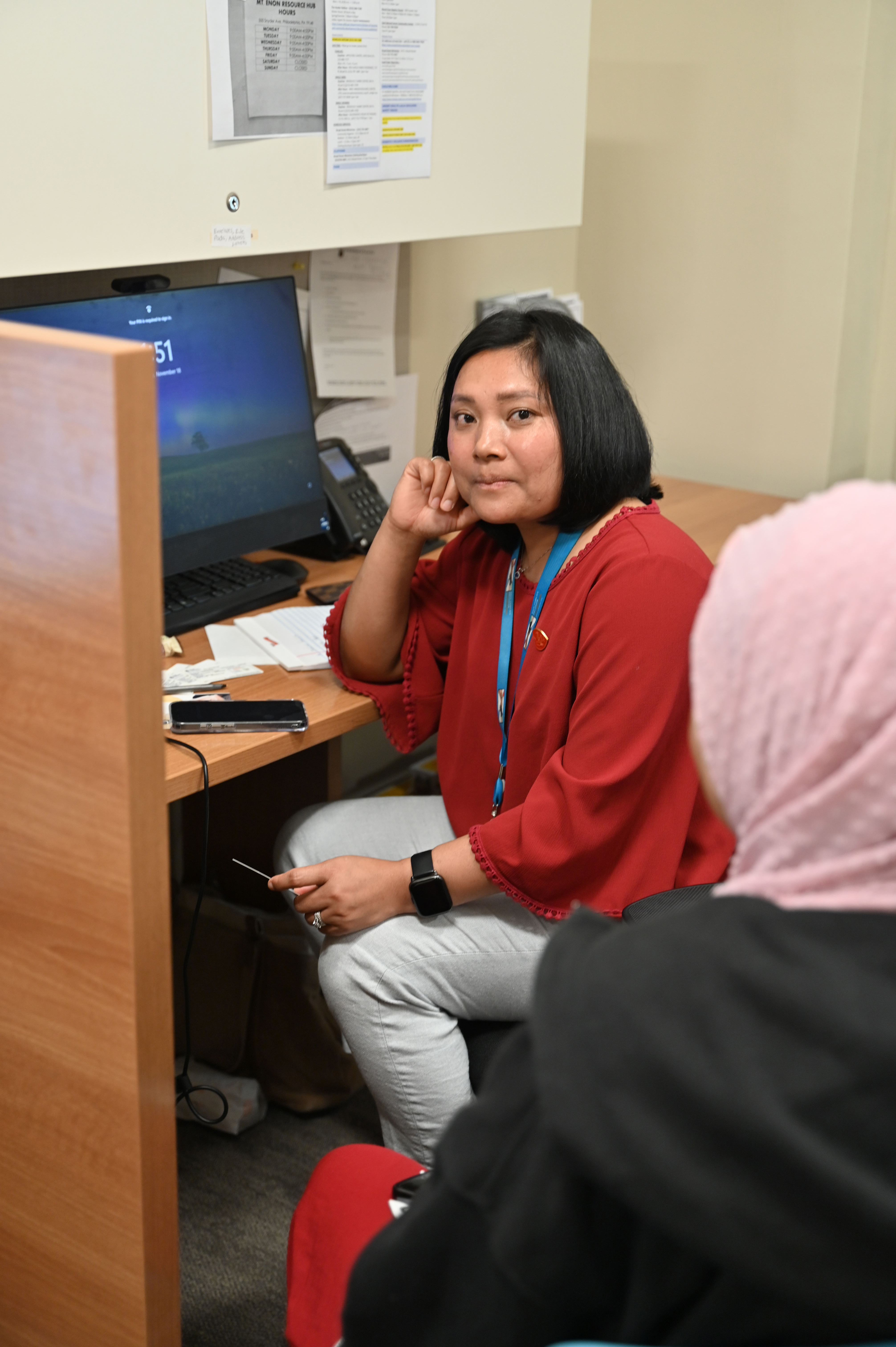
    Biak Cuai, SEAMAAC’s outreach worker to Philadelphia’s Burmese community, works with a client.

    “I prayed to my God to guide me to my dream job, so I can serve my people,” she said. “They knock on my door. I tell them, ‘if you have any problem, you can reach out at any time.’”

    The stories are dramatic and the help is real.

    In broad strokes, SEAMAAC provides education with classes in digital literacy and English as a second language (although for most immigrants, it’s English as a third, fourth, or fifth language).

    “It’s about feeling and belonging,” Guenfoud said. “When you learn English you learn the culture, and if you learn the culture, you belong in this country. You’ll find your place here.”

    There’s social work and legal assistance to help people obtain benefits or apply for citizenship. A separate stream of funding finances SEAMAAC’s support for children who are missing school due to difficult family situations.

    SEAMAAC works with domestic violence survivors and has co-produced a short, animated film offering hope and support in 10 languages — Lao, Cantonese, Hakha Chin, Nepali, Bahasa Indonesia, and Khmer, among others.

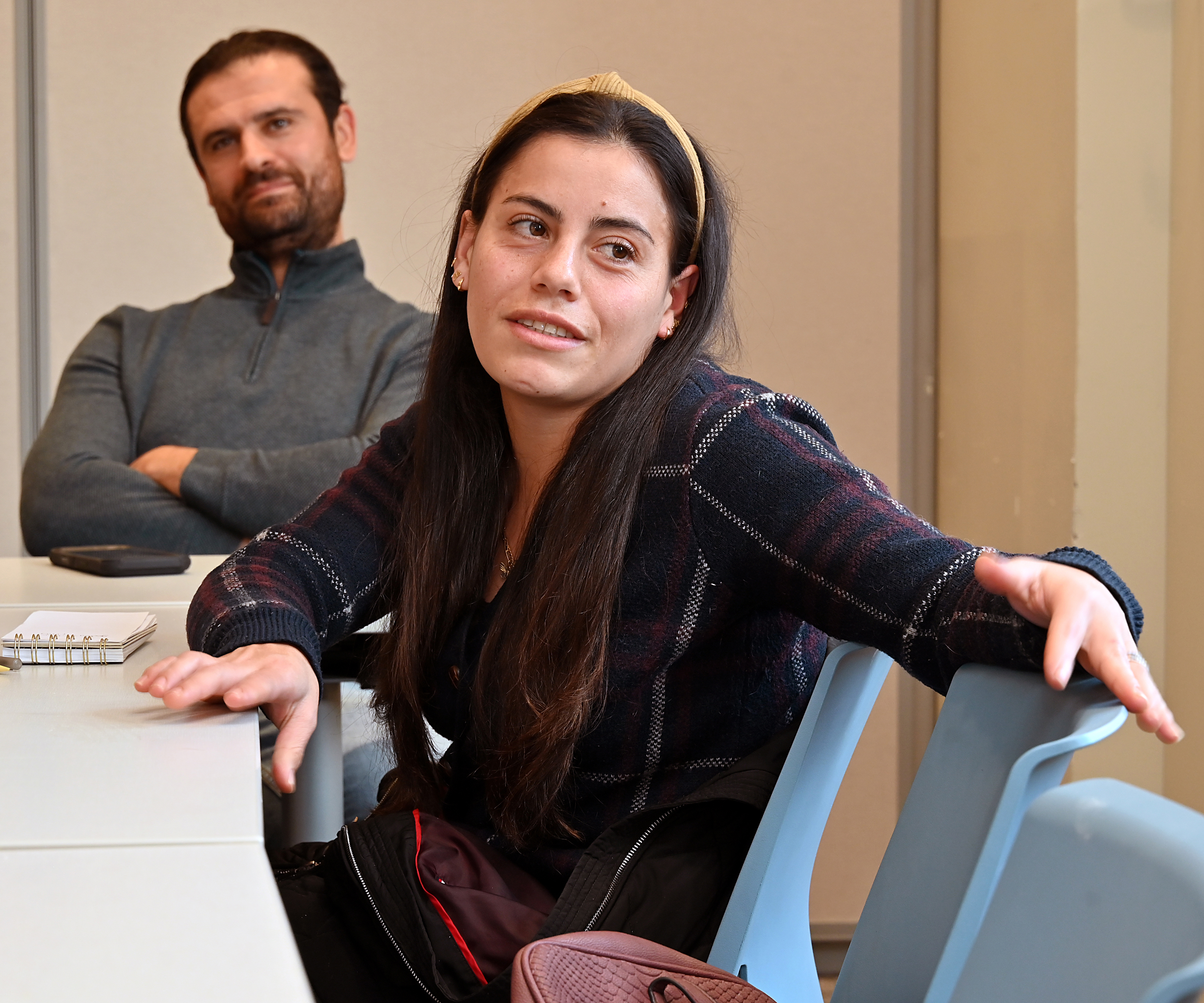
    Laura Rodriguez, from Colombia, discusses food for the Thanksgiving holiday during an English as a second language class at SEAMAAC. Seated behind her is Leo Boumaza, from Algeria.

    Art therapy helps survivors cope with trauma. A domestic violence survivors group produced a collection of mosaics, each with a teacup, surrounded by shards of glass. What was broken, explained Christa Loffelman, health and social services director, can become something beautiful.

    Many of the people who come to SEAMAAC have experienced trauma. “Everyone’s been through multiple layers of trauma,” she said. “You are displaced from your home country — not by choice — and you are going to a refugee camp in a different country. Their entire system has been disrupted.”

    Traditional Western-style talk therapy doesn’t help. For one thing, the language isn’t there, and secondly, it’s not part of many cultures. What has worked, Loffelman said, is expressing feelings through art, and being together while doing it.

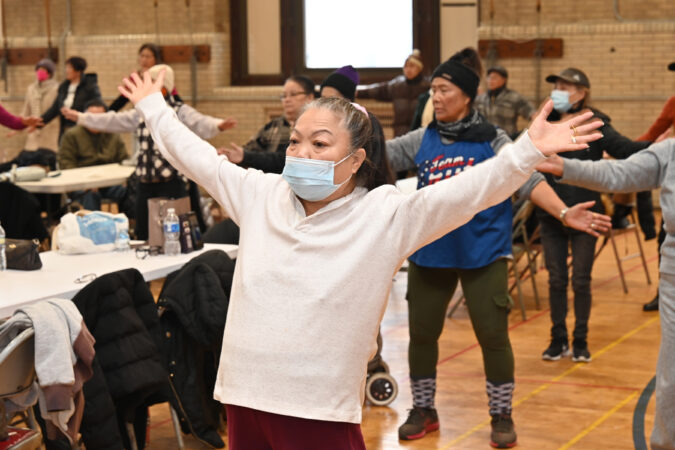
    To counter the social isolation of seniors, SEAMAAC organizes meetings of “the Council of Elders.” They gather in a drafty gym at the Bok building, a former high school in South Philadelphia where SEAMAAC offers classes and counseling.

    Often, the elders practice qigong, a form of movement meditation, or on a less esoteric level, enjoy multicultural bingo. Languages may be different, but when someone holds up a G-32 poster, everyone understands. If they don’t, Mai Ngoc Nguyen, a volunteer who can speak Laotian, Thai, Vietnamese, and English can help.

    She has experienced plenty of trauma and heard plenty of traumatic stories. She’ll never forget the mother who gave her baby medicine so it wouldn’t cry in a boat carrying refugees away from their country. The boat capsized. The baby drowned.

    “She comes into the refugee camp and she became crazy, yelling `Where is my baby?’ Her brain got messed up” and she never recovered.

    Luckily for Mai Ngoc Nguyen, then age 12, she was a strong swimmer and ready to cross the Mekong as she made her escape. But she had to kick away a friend who was clinging to her, dragging her under. Her friend never made it to the opposite shore.

    “If you ask me, I’ll talk about it,” she said. “But if you don’t ask, I won’t talk.”

    But she will joke, saying that she knows the Mekong alligators didn’t get her because they knew she needed to help her family back home.

    It’s a lot of trauma, but every day at SEAMAAC isn’t full of anxiety. The elders coming out of the gym after bingo were smiling. And in a nearby classroom, students practicing their English last month traded jokes as they learned about Thanksgiving.

    Fatma Amara, from Algeria, has been here long enough that she’ll serve a turkey on Thanksgiving, but the apple pie she makes will be Algerian, with seasoned apples layered among thin sheets of dough.

    For her, SEAMAAC is more than a language class.

    “At first, you feel lonely. You’re anxious. It’s stressful,” said Amara, who works in a hospital and is getting better and more confident with her English. “I take the classes, and we talk together and I feel better.

    “Thanksgiving is my favorite holiday in America. It’s an international holiday. It’s about food and God and family,” she said. “You thank God for all you have.”

    For all the blessings SEAMAAC provides, these days, funding is a struggle.

    In 2024, SEAMAAC learned that the federal government had approved its application for a $400,000 multiyear federal grant to improve digital “equity.” But after President Donald Trump took office, federal staffers targeted “equity” programs. “That’s $400,000 we’ll never see,” said Thoai Nguyen, the executive director. “We would have had some of that money by now.”

    Federal cuts since Trump took office have slashed SEAMAAC’s budget by 20%, he said. Hunger relief programs had to be curtailed, with 1,500 families who relied on SEAMAAC for food losing that lifeline.

    “We’re in a moment,” he said, “where intentional cruelty is considered an acceptable form of political discourse.”

    This article is part of a series about Philly Gives — a community fund to support nonprofits through end-of-year giving. To learn more about Philly Gives, including how to donate, visit phillygives.org.

    For more information about Philly Gives, including how to donate, visit phillygives.org.

    About SEAMAAC

    Mission: To support and serve immigrants and refugees and other politically, socially, and economically vulnerable communities as they seek to advance the condition of their lives in the United States. Services include ESL classes, job readiness, domestic violence survivor support, services for low-income elders, food assistance, public benefit counseling, health and nutrition education, and civic engagement.

    People served: 8,000 families

    Annual spend: $3,360,401 in fiscal year 2024

    Point of pride: SEAMAAC plans to increase our impact to serve even more Philadelphians at its new South Philly East (SoPhiE) Community Center on Sixth Street and Snyder Avenue, scheduled to open in December 2026. In January, SEAMAAC, partnering with the American Swedish Historical Museum, will welcome visitors to “Indivisible: Stories of Strength,” an art exhibition showcasing the art and stories of South Philadelphians.

    You can help: SEAMAAC provides many volunteer opportunities through our work in beautifying and improving Philadelphia’s neighborhoods through our work in urban gardening, tree planting, neighborhood and public park cleanings, and beautification of public schools and places of worship. Additional opportunities are available through our civic engagement and neighborhood unity events as well as by delivering groceries in our hunger relief efforts.

    Support: phillygives.org

    What your SEAMAAC donation can do

    • $40 provides shelf stable foods for a family impacted by the SNAP shutoffs for one week.
    • $50 provides holiday presents for two children.
    • $100 helps maintain one plot in SEAMAAC’s community garden for an entire growing season, providing tools, culturally appropriate seedlings, and soil.
    • $100 covers the full cost of supplies for one youth participant in SEAMAAC’s summer programs — giving young people the tools they need for career and college readiness.
    • $200 covers four hours of ESL instruction.
    • $250 provides 50 elders with a freshly made breakfast.
    • $250 provides a family with emergency food, hygiene items, diapers, and social service support for one month.
    • $300 supports a domestic violence survivor moving into safe housing, by covering the cost of utility hookups and household supplies.
    • $300 provides ingredients and cooking supplies for a nutrition education workshop.
    • $1,000 covers the full cost for one high school student to participate in SEAMAAC’s eight-week summer career exploration program.
  • We are at a generational inflection point in healthcare. It’s time for Gen X physicians to assert themselves as the stewards of our profession.

    We are at a generational inflection point in healthcare. It’s time for Gen X physicians to assert themselves as the stewards of our profession.

    Thanksgiving brought a revelation. I was sous-chef to my children and my mother, a sounding board for my son as he completed college applications and my parents as they navigated different doctors, and the planner working around the needs of my children, husband, parents, and in-laws. I now realize what it means to be part of the “sandwich generation.”

    My generation is also squeezed between older and younger cohorts in the professional world — especially medicine and healthcare. I am solidly Gen X and lie squarely between the boomers and the millennials.

    These days, no matter where you turn, the realities of the U.S. healthcare crisis are impossible to ignore. From access to medications, availability of health insurance, affordability of medical costs, even trust and reliability in the messaging or directives we hear, the situation is daunting at best and overwhelmingly dark at worst.

    Perhaps the canary in the coal mine has been the growing healthcare workforce crisis.

    Physician burnout and moral injury, worsened by COVID-19, drove millennial and even Gen X doctors and nurses to leave the field. Adding to the dearth of primary care physicians as the U.S. population ages with worsened chronic diseases, the imminent retirement of a large cohort of boomers results in projections of a shortage of a combined 400,000 physicians and nurses by 2037.

    I can’t help but feel the weight and responsibility of my generation of doctors in the world of medicine, along parallel lines of my personal life.

    The same voices, same perspectives, and same ideas have been echoing across institutions for years — even when not representative of the rest of younger medical professionals, writes the author.

    When we were born and grew up shapes the decisions we make and the ways we manifest and execute them. In his book Birth and Fortune, Richard Easterlin, an economist and demographer who researched happiness, posits that the size of the cohort you are born into shapes your generational opportunity.

    Large cohorts, such as the baby boomers, face competition, but they also get the benefits of institutions that bend to their size. Smaller cohorts in the shadow of the larger generation ahead of them often contend with fewer resources and less investment. That’s Gen X in a nutshell.

    And it models my experiences in the world of Philadelphia medicine almost perfectly.

    Even within these cohorts, Easterlin illustrates, there are differences and disparities. Resources and opportunities available to early boomers became scarce to the later boomers, as the systems were slow to meet their needs. Those returning from the Vietnam War later were more likely to feel this dearth of structures and resources — such was the “birth” of homelessness as we recognize it now.

    I saw that firsthand in Philly as a member of the Homeless Death Review team — a small group of experts from across the city convened by the Medical Examiner’s Office. We reviewed every death of a person experiencing homelessness in Philadelphia.

    The author makes a home visit, as part of Pathways to Housing Philadelphia, in 2018, to care for a client who was at that time part of the Prevention Point community in Kensington.

    From a systems-level view, it became clear that a lack of resources decades ago created a disparity that was perpetuated throughout the lives of specific demographics. They contributed to their premature deaths.

    Boomers created the healthcare system we know today. Building on advances in science, research, and opportunity, they expanded and deepened training pipelines. They established medical specialties, subspecialties, and leadership roles.

    They also continued long-standing practices anchored in hierarchy and compliance, where gravitas comes from the company you keep and not always the merit and competency you demonstrate.

    A look across academic medical leaders in Philadelphia shows several with tenures that started in their 40s or early 50s and continued for well over 20 years, ongoing even now. Our city’s medical leadership — whether it be the Philadelphia County Medical Society, Pennsylvania Medical Society, or the American Medical Association — shows many of these same individuals making decisions across organizations.

    The same voices, same perspectives, and same ideas have been echoing across institutions for years — even when not representative of the rest of us.

    Take the American Medical Association. While being known for having the largest lobbying budget of all medical associations, it represents only 20% of the doctors across the country. The AMA designed and owns the Current Procedural Terminology — the five-digit codes that are commonly used in medical billing. That coding system creates an avenue for higher payments for procedures over primary care prevention with a percentage for them as middleman.

    Years ago, I wrote about how my approach to being an emergency physician evolved as I saw a changing world of healthcare that was not meeting the needs of the patients who turned to me for help.

    That same month, the Wall Street Journal reported on the shift among doctors from “GOP stalwarts” to Democratic voters. My Gen X brethren look different from the generation before us: more women, more people of color, a broader range of ethnicities and cultures. It makes sense that we vote differently, in line with our priorities, values, and missions. Just as it makes sense that we lead differently, as well.

    As Gen X doctors, we trained under the “old rules” of loyalty, compliance, endurance, and strict hierarchy. We worked with paper charts, well before computers became the central source of our clinical work. We mastered clinical skills and memorized reams of information. We also understood how issues outside the exam room and beyond our control impacted our patients.

    My cohort went on to learn to practice medicine as the corporatization of hospitals took hold and our profession took on the additional contours of a business. We met productivity quotas and metrics around how quickly we saw patients and moved on to the next. We eventually even learned to ask corporate conglomerates for permission to get the tests, procedures, and medications our training and expertise, together with our direct evaluation, told us our patients needed, through prior authorizations.

    Boomers continued to adhere to their definition of an ideal physician over the last 25 years — fixating on their commanding expertise and a brand of patient care they developed. In the process, they ceded governance of medicine, including financial oversight and systems design, to non-medical stakeholders. They often treated these issues as beneath them.

    For the bulk of our careers, we Gen Xers were complicit — through our silent obedience and compliance. Many of us had learned from personal experience that speaking up or being seen as contrarian to those in power was overtly punished or covertly met with retaliation.

    Now however, Gen X physicians are positioned to do something the generation before could not: carry medicine’s core values forward while shedding the destructive traditions and practices that broke the system.

    We are facing AI in medicine, further decentralization of medical care, technology and innovation, unprecedented availability of our own health data through wearables, simultaneously with more difficult access to the doctors we have always turned to, and fewer hospitals in our communities.

    I see us at a critical generational inflection point. And it’s time to assert ourselves in a few tangible ways:

    • Claim leadership by redefining it. We don’t have to wait to inherit positions when those who have inhabited them for decades finally vacate. Gen X knows well that true leadership doesn’t come through hierarchy or titles. In the words of my dear friend Jeremy Nowak: “Power belongs to the problem solvers.”
    • Reclaim and own our voice. Our predecessors confused apolitical detachment with impartial professionalism. In the process, the discussions, decisions, and policymaking that shaped physicians’ reality excluded us. It’s time we lean in unapologetically and stop waiting for permission. 
    • Reject passive compliance as a virtue. Our silence has helped no one. The courage we spent decades swallowing is exactly the courage we need now to right this ship. We must be intentional in how we define ourselves, our profession, and our value: clinical integrity, collaboration, dignity, empathy, humanity, all come to mind as our unmatched superpowers. 

    It feels we are standing at the precipice of the unfamiliar and unknown. Where technology and AI will redefine what is possible, but the needs of our patients will demand practical and accessible solutions.

    Sustainable change will come from us — crammed in the middle. At the risk of making a sweeping generalization, Gen X believes in fairness, head-down work, and accomplishment. We have learned and adapted throughout our lives. Unlike the boomers and millennials on either side of us, we are “raised analog, fluent digital, comfortable with a rotary phone and an AI dashboard.”

    We are the stewards of the medical profession — not its museum guards. We can bridge the meaningful lessons of our past with the awareness of today and the promise of the future, while centering empathy, values, missions, and ethics.

    The silver lining is this: Our hard-earned lessons have become the foundation for a new kind of courage. It’s one that refuses passivity, demands better, pushes into all the spaces that exclude us, and insists that we show up not just for ourselves, but for our colleagues, our patients, our community, and the generations coming behind us.

    Priya E. Mammen is an emergency physician, healthcare executive, and public health specialist who helps the nation’s most impactful companies integrate clinical integrity at scale.

  • In the face of terror, one man’s courage shows us the way forward

    In the face of terror, one man’s courage shows us the way forward

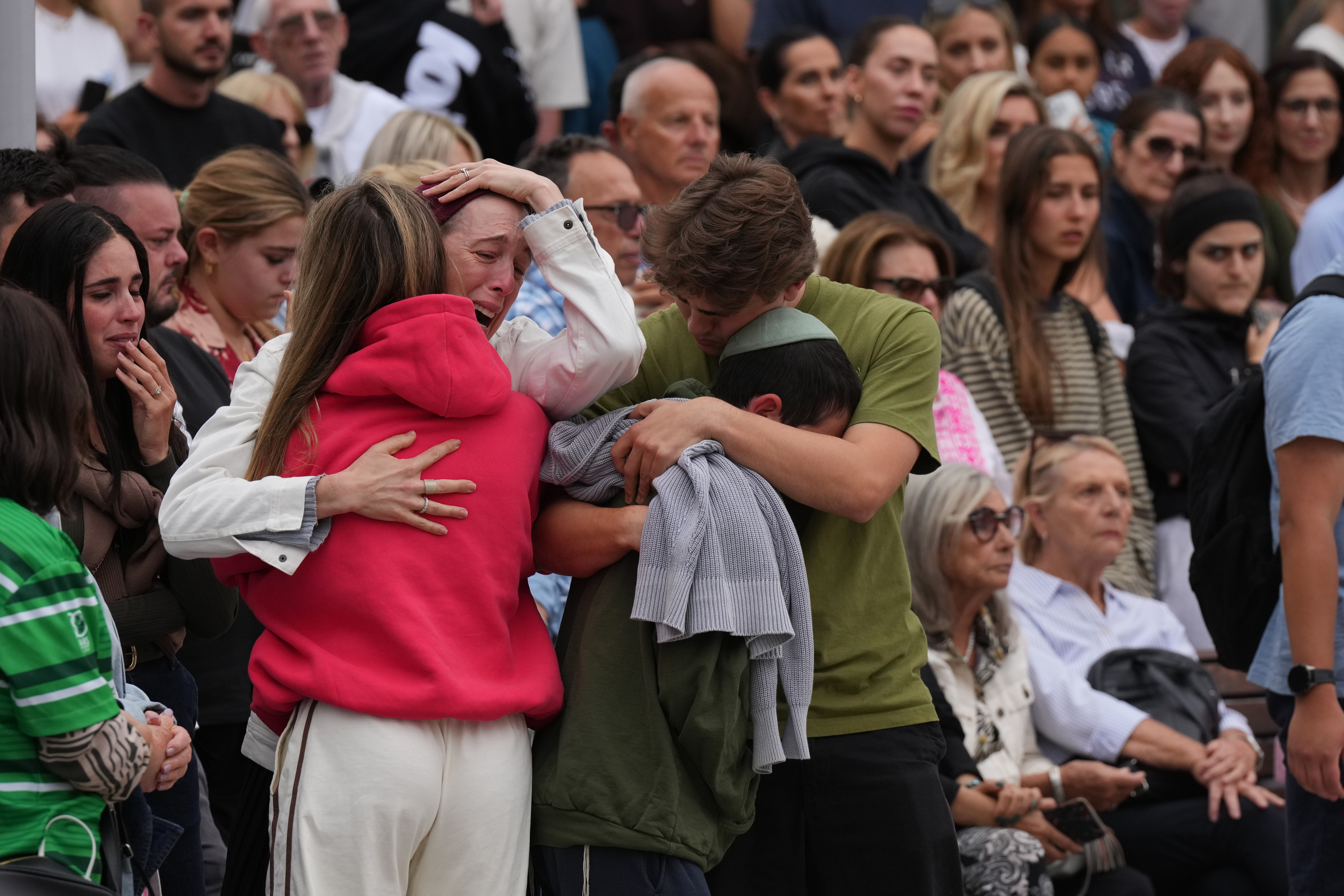
    This Hanukkah season, as Jewish families gathered at Sydney’s Bondi Beach to celebrate the Festival of Lights, terrorists opened fire. At least 15 people were killed and dozens more injured in an attack that has sent shockwaves through Jewish communities worldwide.

    For many Jewish families, this attack feels horrifyingly familiar. I know that fear personally. As I wrote in these pages last year, I had to hire armed security for my son’s bar mitzvah — a celebration that should have been filled with only joy, but instead required armed guards and threat assessments. That shouldn’t be our reality. But it is.

    Since that bar mitzvah, the situation has only intensified. The Anti-Defamation League documented more than 460 antisemitic incidents in Pennsylvania in 2024. Nationally, the numbers are equally alarming. Jewish families are making calculations our grandparents hoped we’d never have to make: Is it safe to go to synagogue? Should we display our menorah in the window? Will our children be targeted for wearing a Star of David?

    Family members of a victim from Sunday’s shooting mourn at a flower memorial made after the shooting at the Bondi Pavilion at Bondi Beach on Dec. 16 in Sydney, Australia.

    But amid the horror of Bondi Beach, there emerged an image we cannot ignore: Ahmed al-Ahmad, a civilian, tackling one of the gunmen to the ground and saving countless lives.

    When hatred showed its ugliest face, Ahmed didn’t calculate the risk. He didn’t hesitate. He ran toward danger to protect people he didn’t know, celebrating a holiday he didn’t observe, from terrorists who claimed to share his faith.

    This matters — not as a feel-good footnote to a tragedy, but as a fundamental truth we must hold onto in these dark times.

    The alleged attackers reportedly followed ISIS ideology. But Ahmed al-Ahmad, a Muslim man, risked his life to stop them. This is precisely why we cannot — we must not — paint entire communities with the brush of their worst actors.

    When individuals commit acts of hatred, we should hold specific perpetrators accountable — not entire identity groups. Yet, these days: Often Jews are blamed collectively for events in the Middle East and Muslims are blamed for the actions of terrorists, like what occurred at Bondi Beach.

    Resisting communal blame is essential to defeating hate. Because here’s the truth: Neither courage nor hatred belongs to any one group. There are heroes and villains in every community. The sooner we recognize this; the sooner we can build the coalitions necessary to fight antisemitism, hate, and extremism in all its forms.

    Creating moments of solidarity matter as much as the hate incidents themselves, perhaps more. I am personally grateful for the phone calls and emails that I did receive from allies following the attack at Bondi Beach. They show that the voices against antisemitism and hate are greater in number and in moral force than those who traffic in it.

    But solidarity requires more than social media posts and attendance at rallies. It demands courage. Ahmed al-Ahmad showed us what that looks like.

    Here’s what each of us can do:

    Become an active bystander. When you witness hatred or harassment, you have the power to intervene safely — to distract, delegate, document, or directly address the situation.

    Reject collective blame. When acts of terror occur, resist the urge to blame entire communities. Hold perpetrators accountable while standing with those who share a background but not the hatred.

    Show up. Share in Hanukkah and Christmas celebrations, attend a Ramadan iftar, join in a Juneteenth event. Our presence in each other’s celebrations builds the relationships that sustain us through dark times.

    Report hate incidents. Whether it’s antisemitism, Islamophobia, racism, or any other form of bias, report it to law enforcement and organizations like ADL that track incidents. Silence allows hate to fester.

    As we light the menorah this Hanukkah, we commemorate the ancient victory of light over darkness. That light endures not because it was never threatened, but because in every generation, people chose to protect it — people from all backgrounds, all faiths, all walks of life.

    Ahmed al-Ahmad chose to be one of those people. The question for the rest of us is: Will we?

    Andrew Goretsky is the senior regional director of the Anti-Defamation League’s Philadelphia office, serving Eastern Pennsylvania, Southern New Jersey, and Delaware.

  • Civility in the courtroom should be a model for our public life

    Civility in the courtroom should be a model for our public life

    Public discourse today feels like a shouting match — hostile, polarized, and quick to “cancel” those who disagree.

    Yet in the courtroom, there remains a model for conflict that doesn’t turn toxic. There, fierce disagreement unfolds with civility when the stakes couldn’t be higher. The norms that make justice possible serve as an example for the public square.

    Shakespeare’s famous line: “The first thing we do, let’s kill all the lawyers,” is often quoted as a jab. But in Henry VI, the line is spoken by a would-be tyrant’s accomplice.

    Shakespeare understood that to impose tyranny, one must first destroy the lawyers — the guardians of due process and rational debate. Rather than mock the profession, the line underscores the indispensable role of civility in preserving liberty, justice, and our way of life.

    Reasonable people can differ

    Law is built on the recognition that reasonable, ethical people can look at the same facts and reach opposite conclusions.

    One lawyer argues for conviction, another for acquittal. One sees a statute as broad, another as narrow. Their task is not to despise each other, but to argue — forcefully, yes, but intellectually within rules, procedures, and professional decorum.

    In court, a lawyer does not shout down an opponent. A judge does not belittle the losing side. Objections are made in accordance with established procedures and professional standards. Rulings are issued without personal attack.

    This disciplined approach requires patience, listening, and respect. The process is grounded in fairness and reason. Contrast that with today’s public square — particularly social media. People who differ are demonized. Disagreement is cast as patriots vs. traitors. No wonder our democracy feels frayed.

    The legal profession offers a vital lesson: Disagreement is not only inevitable but healthy. Truth is sharpened by opposing arguments. What keeps the system intact is the civility with which those arguments are conducted.

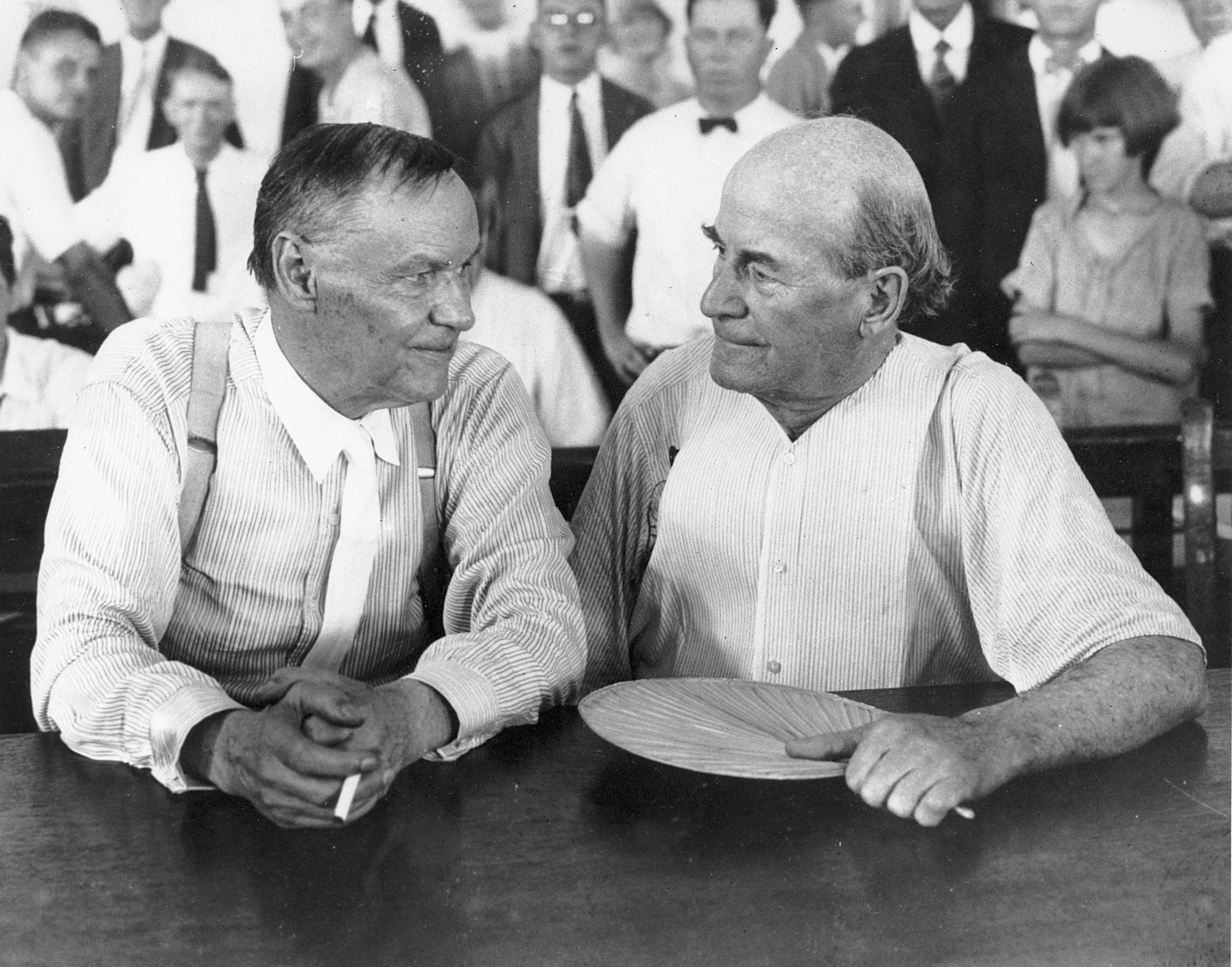
    Defense attorney Clarence Darrow (left) and prosecutor William Jennings Bryan talk civilly during the Scopes “monkey trial” in 1925.

    Picture a trial: The gavel strikes. Two sides rise, ready to battle over questions of fact and law. The plaintiff’s attorney delivers a fiery close. The defendant’s attorney responds just as vigorously.

    Afterward, no matter the outcome, the two shake hands. The judge thanks both for their professionalism. Each has fought hard, yet neither has questioned the other’s intent or integrity. Even in profound disagreement, opponents are not enemies. Respect prevails.

    Imagine if political debates resembled appellate arguments: sharp, disciplined, but respectful. Imagine if social media mirrored courtroom decorum, where civility restrains the loudest voice and allows reasoned discourse to be heard.

    It is possible to disagree passionately without resorting to insults or treating opponents as enemies.

    Civility is not surrender

    Of course, lawyers and judges are human. They sometimes fall short. Bar associations remind members of their duty of civility because the temptation toward hostility is real. Judicial misconduct, including poor courtroom demeanor, is policed in many states by independent boards and commissions.

    But the profession understands that its legitimacy depends on restraint. When civility fails, the entire system suffers. So does democracy.

    Civility does not mean surrender. Lawyers cross-examine with intensity. Judges write sharply worded opinions. Citizens, too, can argue with passion. But passion that eclipses respect erodes the common good.

    We are living in a moment in time when polarization tempts us to see neighbors as enemies. The courts remind us of a better way. American justice is built on adversaries treating one another as colleagues, with respect and decency, bound by a higher purpose.

    That lesson could not be timelier.

    P. Kevin Brobson is a justice of the Supreme Court of Pennsylvania.

  • ‘Deadnaming’ Rachel Levine is not a small act. It’s a warning to the medical profession.

    ‘Deadnaming’ Rachel Levine is not a small act. It’s a warning to the medical profession.

    When the U.S. Department of Health and Human Services quietly altered the nameplate on Rachel Levine’s official portrait during the recent government shutdown — replacing her legal first name with the one assigned to her at birth — it might have seemed to some like an insignificant gesture.

    But symbols matter. Names matter. And, as we are constantly reminded by the pioneering example of Levine — the first openly transgender person confirmed for a government role by the U.S. Senate — identity matters.

    And the deliberate act of using a transgender or nonbinary person’s birth name (or a previous name) after they’ve chosen a new one — a demeaning practice known as “deadnaming” — is more than just an insult to one nationally recognized medical leader. It’s a signal about what our health system is becoming.

    It tells every transgender clinician, trainee, staff member, and patient: Your identity is provisional here. Your legitimacy is negotiable. Your name can be taken from you. For a profession that depends on psychological safety, this is no small thing.

    Imagine training as a transgender medical resident and watching the federal government manipulate the image of one of the country’s most illustrious physicians — someone who helped lead Pennsylvania through the opioid epidemic, someone who oversaw critical COVID-19 responses, and someone so accomplished that they hold the rank of admiral in the U.S. Public Health Service.

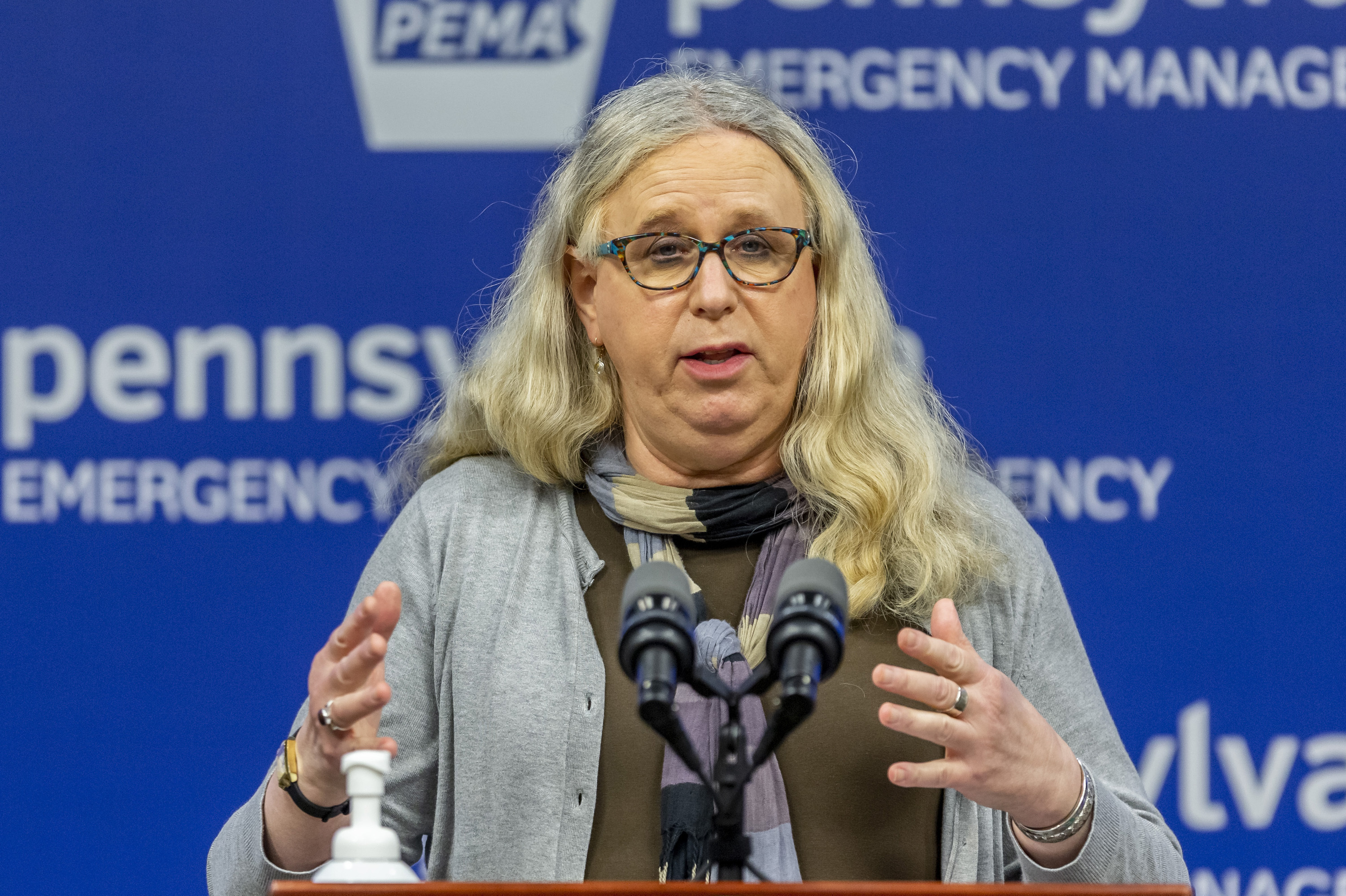
    Then-Pennsylvania Secretary of Health Rachel Levine meets with the media at The Pennsylvania Emergency Management Agency headquarters in Harrisburg in May 2020.

    Imagine treating transgender youth in a climate where federal agencies publicly invalidate the very concept of gender identity.

    Imagine being a transgender patient, already vulnerable, and seeing your government insist that who you are is, at best, a clerical preference and, at worst, a threat to national security.

    We sometimes tell ourselves that culture wars don’t reach the clinic. They do.

    They show up when patients avoid care because they fear being misgendered or judged.

    They show up when medical students stay closeted to avoid being targeted, derailing careers before they begin.

    They show up when clinicians feel pressured to hide their families or their own identities in order to survive training environments already marked by burnout, moral injury, and hierarchy.

    They show up in public health, where trust is essential — whether in vaccines, harm-reduction programs, or pandemic response. When government institutions themselves engage in targeted stigmatization, entire communities disengage.

    And they show up in professional integrity. A health system that claims to uphold evidence yet endorses policies contradicted by every major medical association — including the treatment of gender dysphoria — erodes its credibility. When science is invoked only when politically convenient, clinicians feel the ground shift under their feet.

    Levine showed grace by calling the deadnaming “petty.” In a sense, she’s right: The act is juvenile. But if the rest of us don’t call it out, we risk missing the larger threat.

    Professional erasure begins with symbolic gestures — the removal of names, the reclassification of identities, the retelling of who someone “really” is. History is rife with examples of how stripping titles, credentials, or names precedes efforts to diminish authority and restrict participation.

    A physician’s portrait is not just a piece of decor. It is a public acknowledgment of service, expertise, and contribution. Altering it is an attempt to rewrite not only identity but legacy.

    If medicine is to retain its moral center, clinicians must resist the temptation to disengage. This is not “politics” in the partisan sense. It is professional ethics.

    We can start by naming the harm clearly. Deadnaming is not a clerical correction; it is a form of psychological violence aimed at delegitimizing identity.

    We must also educate our colleagues, many of whom underestimate the downstream effects of identity-based policies on patient trust, engagement, and health outcomes.

    At the same time, we have an obligation to actively support trainees and colleagues — especially those who are transgender or gender-expansive — who may feel newly unsafe or exposed within training environments and workplaces.

    Defending evidence-based care is essential: Transgender medicine is medicine. Period. And we must insist that federal agencies speak truthfully about science.

    A selective invocation of “scientific reality” is not reality at all; it is ideology masquerading as evidence. Medicine is facing a pivotal question: Are we willing to let political ideology dictate whose identities are valid within our clinics, hospitals, and public health institutions?

    Rachel Levine’s portrait matters because deleting her name is an invitation to delete others. It is an attempt to redefine professional legitimacy by biology rather than biography — by chromosomes rather than contributions.

    Yet her life is proof that gender identity neither diminishes competence nor negates service.

    When a government tries to rewrite that narrative, the medical profession must ask itself: If we do not stand up for the integrity of our colleagues, who will stand up for the integrity of our patients?

    Arthur Lazarus is an adjunct professor of psychiatry at the Lewis Katz School of Medicine at Temple University.

  • As we search for autism’s cause, we ignore those living with it

    As we search for autism’s cause, we ignore those living with it

    Top federal officials talk about finding a cause for autism, generating more buzz by the day. More substantively, the owner of the Philadelphia Eagles gave an extraordinary sum — $50 million — to a local hospital to discover its cause and develop new treatments.

    While such gifts deserve praise, another urgent crisis goes largely unnoticed: how to care for the millions of adults already living with autism.

    Each year, more than 120,000 young people with autism turn 18 and “age out” of pediatric medicine. They enter an adult system that is unprepared to help them. They enter a world with no standardized guidelines for care, no specialized training for physicians, and far less support. Families must navigate a cliff, not a bridge. More than five million adults now push past herculean obstacles for what is often worse care.

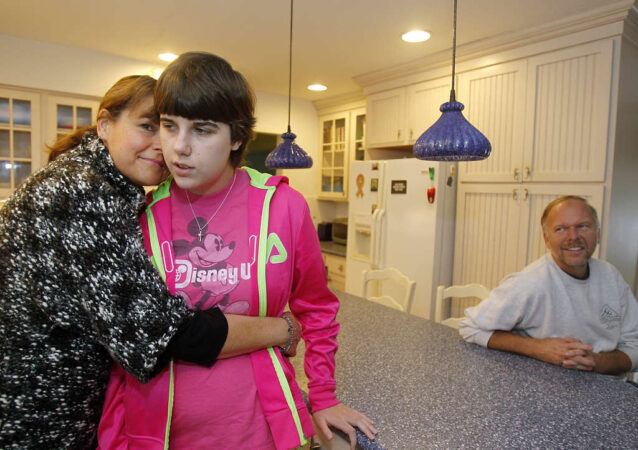
    I view this crisis as a pediatric emergency medicine doctor and as the mother of a transition-age autistic son.

    Fear for the future

    We parents are terrified by what will happen to our adult children when we are no longer around to care for them. Parents weep — and sometimes wail — when I refer them to an alternate site for adult care. Our system can no longer remove an appendix or mount a crisis intervention once these children cross over.

    As a doctor, I know how this change can cause unnecessary admissions and a loss of social work and case management. Caregivers must suddenly educate the provider on the patient’s basic needs. As a parent, I watch my son Alexander and others hop from one tiny island of support to another.

    When Alexander broke his arm at age 6, surgeons were called in to pin his shattered bone and clean the wound where the disrupted muscle had burst through the skin. Alexander was ridiculously compliant and poised; I was less so.

    His surgeons accidentally cut one of the three main motor nerves in the arm when they tried to stabilize his floppy elbow. It took many visits over eight weeks to get proper attention. By then, his arm was floppy from a medical error.

    In our home, we work hard to protect him: Trampolines are forbidden, helmets always on, seat belts firmly buckled. Yet, I failed to anticipate how Alexander’s autism could hurt him. This label — his scarlet letter “A” — kept his surgeons at a dangerous distance.

    Could it happen again when I am no longer around?

    We know autistic adults suffer more illness and death compared to their peers. They are more likely to be misunderstood, dismissed, or undertreated. The data are abundant — and damning. We fail these people.

    Deserve tailored care

    I continue to teach Alexander to be responsible for his care so he will thrive when I cannot be beside him. In 2023, the National Institutes of Health formally designated people with disabilities as disadvantaged. I am relieved to see a growing acknowledgment of autistic people as a vulnerable group, at risk for health disparities, deserving of tailored care.

    Justin Pierce (center), who has autism and is an account support associate, meets with his team at Ernst & Young offices in Chicago.

    I have also gained confidence in my voice as an advocate for Alexander. I’ve become a “gang member.”

    Senior staffers for Gov. Josh Shapiro respectfully dubbed my fellow autism advocates as “the mom gang.” It is reassuring only in this context that I present as intimidating. Our band of six wants to make sure that half-baked federal plans to create a national autism registry never happen in Pennsylvania without privacy safeguards.

    Meanwhile, the autism community holds diverse opinions on what to do. Should profound autism be classified separately from other presentations? Is “cure” the right goal? Is Tylenol a risk factor?

    While these conversations pull us in different directions, we must not lose sight of a common purpose to create a better system.

    Autistic adults deserve accessible and affirming change. There are models, tools, and innovations in which to invest:

    • Training emergency, inpatient, and outpatient teams to recognize how autism presents in adults
    • Designing calming public environments that ease communication
    • Creating dedicated consult services — including behaviorists, communication specialists, and caregivers — available in person and via telehealth
    • Prioritizing prevention and de-escalation over restraint
    • Highlighting the voices of autistic individuals in policy decisions that affect them
    • And, critically, funding and scaling programs that treat autism across the lifespan

    Lack of resources

    Resources are scarce. Historic gifts fill some gaps from interrupted government funds pulled from disability and diversity programming. Casualties include the Department of Education’s “Charting My Path for Future Success” transition program, a research-based effort to help high school students with disabilities enter the workforce or higher education.

    We may all agree there is an immediate need to build better supports for adults with autism.

    I worry for my son. I need to know I have pushed every edge of possibility to smooth his way forward. I do this for my daughters, too, who learned from their earliest days their brother needs the same supports they are accustomed to, but he is often denied.

    One day, they will take my place slaying this dragon.

    Eron Friedlaender is a public health investigator, an emergency medicine physician at Children’s Hospital of Philadelphia, and a board member of the Institute for Human Centered Design.