In the five-county Philadelphia region, nearly 34,000 veterans depend on U.S. Department of Veterans Affairs disability benefits. These benefits are not just a lifeline; they are a powerful economic engine that pumps nearly $955 million into our local economy every year.
But on Oct. 29, the U.S. Senate Veterans’ Affairs Committee held a hearing to “reform” the disability system, laying the groundwork to gut this vital support by using a false narrative that targets the very veterans who need it most.
The hearing was built around a proposal by Sen. Tommy Tuberville (R., Ala.) to create a commission similar to a Base Realignment and Closure (BRAC) procedure to fast-track changes, and by the testimony of one star witness, Daniel Gade.
Gade, a retired Army colonel, professor, and disabilities activist who was badly wounded in Iraq and is now running for a U.S. Senate seat in Virginia, argued that disability benefits “rob veterans of purpose” and that conditions like tinnitus and hypertension should not be compensated.
As a Navy veteran and a medical student, I was alarmed by the medical and data-driven inaccuracies used to justify this attack.
Questioning PTSD
Gade’s claim that PTSD is “curable,” and thus shouldn’t be permanently compensated, is medically false. As any first-year medical student knows, post-traumatic stress disorder is a chronic condition that, at best, can be managed into remission. It is not “cured.”
Gade’s dismissal of hypertension as a “lifestyle” condition is equally dangerous. As the Disabled American Veterans (DAV) has testified, hypertension is scientifically linked to military service and associated with common toxic exposures to Agent Orange and other toxic substances. These conditions are not lifestyle choices; they are the documented, latent wounds of military service.
My research at Temple University involves analyzing large medical data sets, and the data here is clear: The fraud narrative is a myth. The DAV’s testimony confirmed that the VA sees “fewer than 200 fraud convictions annually” out of nearly “3 million claims.” That is a fraud conviction rate of less than 1/100th of 1%.
This isn’t just a national story. This rhetoric insults the 33,816 veterans in the Philadelphia region who receive these earned benefits.
In other words, the “veteran fraud” narrative is a dangerous distraction from the real problem: a broken VA disability system. The Government Accountability Office (GAO) agreed, confirming that the system has been on its “High Risk List” since 2003 due to “longstanding challenges” concerning oversight and training.
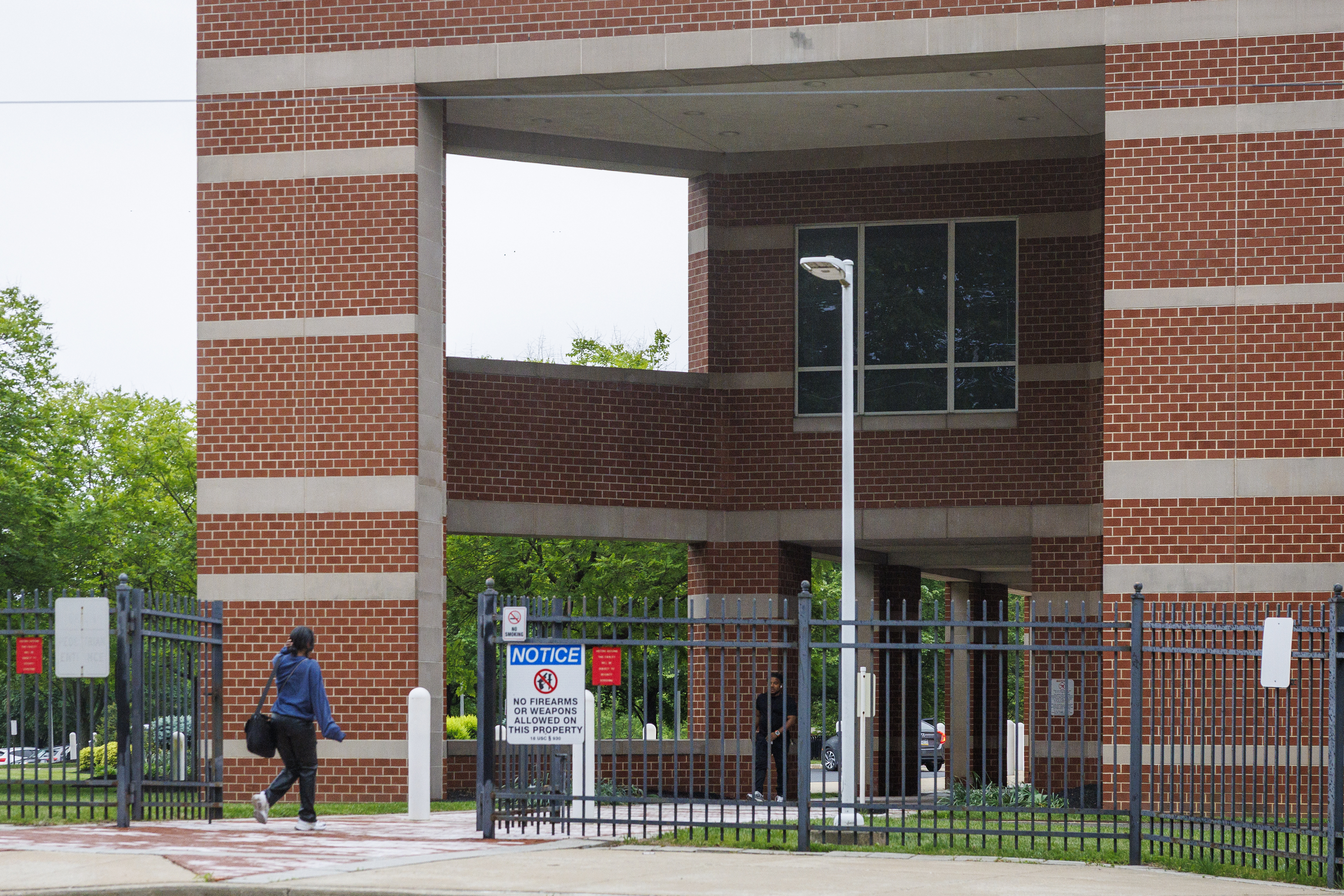
Exterior of Philadelphia Veterans Affairs Regional Benefit Office, 5000 Wissahickon Ave.
While Sens. Dave McCormick and John Fetterman do not sit on the Veterans’ Affairs Committee, the financial stability of over 33,000 of their constituents, and nearly a billion dollars in our local economy, is on the line.
I urge them to publicly oppose this dangerous commission and demand Congress focus on the real problems: cracking down on the claim sharks who prey on veterans, and fixing the VA management failures the watchdogs have identified for decades.
Alyster Alcudia is a U.S. Navy veteran, a former nuclear submarine warfare officer, and a medical student in Philadelphia.
Before the shutdown started on Oct. 1, air traffic controller staffing was below targeted levels, with many already working mandatory overtime and six-day weeks.
These effects snowballed such that while just 11 flights were canceled between Oct. 1 and 29 because of controller staffing, the number surged to 4,162 between Oct. 30 and Nov. 9. Of those, 3,756 were between Nov. 7 and 9. To mitigate risk, an emergency order from the Federal Aviation Administration was issued, targeting a 10% reduction in flights at 40 high-traffic airports across the country.
A Delta Airlines plane comes in for a landing over the air traffic control tower at Denver International Airport on Nov. 9.
As essential workers, air traffic controllers were required to work unpaid. Faced with mounting expenses, many workers took second jobs to cover their bills, cutting into their sleep. Others faced stress-induced insomnia from unpaid bills and job uncertainty. Overtime prevents recovery of sleep and increases fatigue-related error risk. Unsurprisingly, the White House warned that absenteeism among unpaid federal workers would increase.
Even under normal conditions, irregular schedules, undiagnosed sleep disorders, and lifestyle factors contribute to fatigue-related errors. Shutdowns amplify these dangers.
Air traffic controllers perform mentally demanding tasks requiring sustained vigilance. Controllers often work “rattler” schedules: five eight-hour shifts in four days, ending with a day shift followed by a night shift. These offer only 10 hours off between shifts, far too little for sleep recovery.
One night of sleep loss can significantly impair performance. A 2008 University of Pennsylvania study found that sleep-deprived Transportation Security Administration agents were less able to detect weapons in bags.
A NASA study found that 70% of air traffic controllers had nearly dozed off while actively working, and more than half of those who made operational errors cited fatigue as a contributing factor.
Critically, people often misjudge their own level of sleepiness. One landmark study found that people rate themselves as only moderately sleepy even when their cognitive performance has significantly declined. As a result, well-intentioned workers may unknowingly put lives at risk.
Many mistakenly believe they can overcome sleepiness through willpower and dedication to a task. However, sleepiness is not a minor inconvenience; it is a physiological condition that impairs judgment and performance.
There is currently no real-time safety monitoring system in place that can determine whether an air traffic controller is fit for duty. The insidious effects of accumulated fatigue and stress may continue to linger long after the shutdown, as flight disruptions remain expected.
Even though the shutdown has ended, air traffic controller leadership must take active steps, including restricting overtime, monitoring signs of fatigue, and avoiding reliance on self-reported assessments of fatigue.
If necessary, airports should continue to scale back operations to allow workers time to rest. No one responsible for critical safety operations should be expected to perform under sustained, elevated fatigue levels.
Allowing exhausted and compromised workers on the job is a recipe for disaster. The safety of millions depends on acknowledging the real threat of fatigue and taking immediate action to prevent avoidable disasters from becoming a reality.
Jocelyn Y. Cheng is vice chair of the Public Safety Committee of the American Academy of Sleep Medicine.
It’s suddenly December, and the Thanksgiving leftovers are mostly eaten. That means it’s once again time to make the big decision: Is this the year to finally stop sending holiday cards?
When I graduated from college, I promptly embraced the trappings of adult life, from getting a job to buying a car to moving into my own apartment. But the step that made me feel most adultlike was sending out my own holiday cards. A holiday card from a separate address says: “This is my household. Not my parents’ household, mine.”
Not cheap
Sending holiday cards isn’t cheap.
There are the cards themselves, which go up in price if you’re sending a photo card or selecting fancy lined envelopes. Stamps are currently 78 cents apiece, which doesn’t sound like much, unless you’re sending out 50 cards or more.
And then there’s the issue of time: You have to decide on the cards and purchase them, write a little note in each card, address the envelopes, then make your way to the post office.
Yet, despite the costs in money and time, I’ve always sent out cards, even in my younger, poorer years. There has always been a satisfaction in reaching out to people I don’t see regularly, but who nevertheless have a place in my heart and my history.
A customer at Paper Source in Chicago on Dec. 18, 2018. The greeting cards retailer filed for bankruptcy the next week.
Then, about 10 years ago, I realized we were receiving fewer cards each year.
The clogged mailbox became progressively emptier over a span of years, like a dying mall. This shift shows up in statistics from the U.S. Postal Service, which notes that mail bearing postage stamps, including cards, letters, and bill payments, dropped from 16.5 billion pieces of mail in 2019 to 10.7 billion last year.
For the first few years, I worried the non-senders were going through challenging times. A person doesn’t feel very merry if they’ve gotten divorced or been laid off or had a death in the family. But it turned out that — fortunately — very few had faced hardship. They just weren’t sending cards anymore.
“It’s a lot of trouble,” said one. “I don’t have the time,” said another.
People who used to send holiday cards can now share photos online of their family and their travels. Because they’re regularly connecting with those far-flung cousins and high school friends on social media, mailing out cards has become redundant and maybe even pointless to them.
The young adults in my life, including my own grown children, who are now in their 30s, haven’t just decided against sending cards; the idea never occurred to them in the first place.
So once again, at this time of year, I consider whether to keep the tradition going. But there are several relatives who are not on social media, and there are a few longtime friends I’m in touch with only through holiday cards.
It’s a poignant yearly ritual to go over the list of recipients, noting who has moved, who has married, who has had a baby, and who has passed away. People come and people go, and nothing underscores this quite like the holiday card list.
Better to let them know they’re loved, right now.
So I will get to the task, laying cards and envelopes neatly on the kitchen table. My husband will look at me blankly.
“Are we still doing that?” he’ll ask.
Elizabeth Luciano writes essays and fiction and teaches composition at Bucks County Community College.
One day, an English teacher at my gigantic public high school in Manhattan paused the lesson.
He placed his hands shoulder-width apart on his ancient desk. He hooked his toes on the rim of the chalkboard behind him, and there he was: suspended in the air, floating above the sullen earth toward the end of third period on a dismal November day.
“Have you ever seen anyone do this before?” he asked.
He looked around from his perch, mischievous joy sparkling in his eyes beneath his mop of white hair. He held the pose, and then the period bell rang.
That the teacher happened to be Frank McCourt, who would later win a Pulitzer Prize for his memoir Angela’s Ashes, is only partly relevant. Mr. McCourt was celebrating the weirdness and joy of being human, the possibility and story in every moment.
Messing with our heads
And, like all good artists, he was messing with our heads to pop us out of our usual selves, into the realms of creativity and new thought that have always moved civilizations forward.
For a teenager unhappy to be in school at all, he was a welcome light.
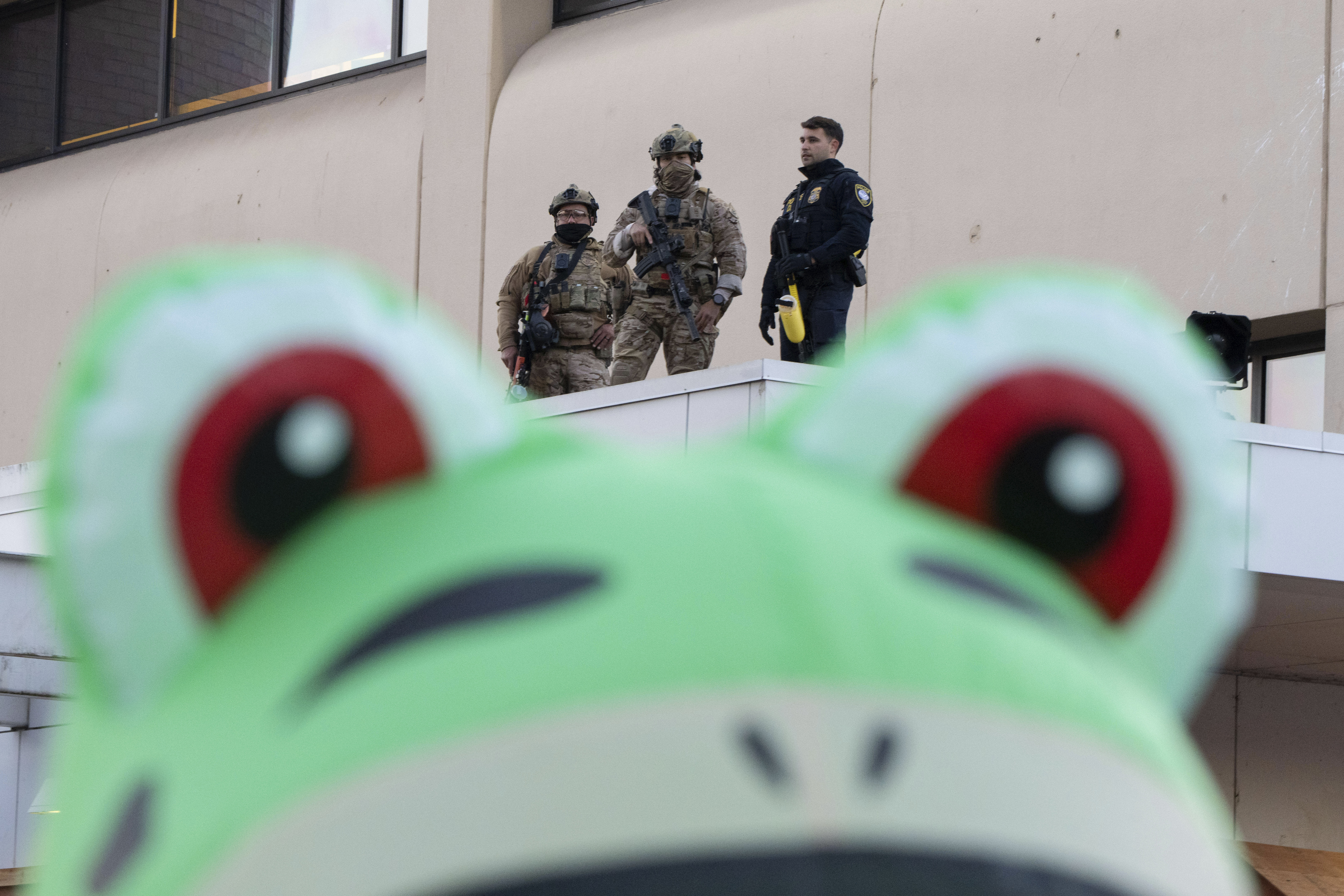
Federal law enforcement officers watch from atop the ICE facility in Portland, Ore., as a protester in a frog costume demonstrates.
The Portland Frog reminded me of that moment, now 40 years ago, the way it stood there with its belly out like a 3-year-old asking for cookies, and the unbelievable, cowboy-laconic toughness the suit’s occupant expressed after an ICE agent pepper-sprayed his vent hole: “I’ve definitely had spicier tamales.”
Contrast this great fun to today’s singularly humorless White House, as best exemplified by press secretary Karoline Leavitt. In a recent exchange, a reporter inquired about the significance of a Putin-Trump summit meeting proposed for Budapest, Hungary. Why there? In 1994, that’s where Russia promised not to invade Ukraine if that country gave up its nuclear weapons.
Leavitt responded with a string of insults. But the question was actually interesting and thoughtful: It would have been more fun to mull its implications than to be a jerk.
Used to be funny
Deranged as Donald Trump is, he has always been funny. But even that modestly redeeming trait seems gone in this bleakly self-serious White House. If I were an autocrat in training, I’d be worried about that, on durability grounds.
The late anthropologist David Graeber and the archeologist David Wengrow are known for rethinking early human history in a way that credits Neolithic peoples with intelligence and whimsy. In the spirit of the Portland Frog or Mr. McCourt, early humans may have initially avoided labor-intensive agriculture because they had other things to do, including storytelling, masquerades, or traveling. Maybe early signs of trade were not nascent capitalism, they argue, but the result of vision quests, or of women gambling.
Our best human projects survive because they are aspirational, offbeat, and fun. Early democracy in the U.S. was certainly colored by those qualities. When an exhausted John Adams arrived in Philadelphia for the first Continental Congress, he went straight to a bar — City Tavern. Pursuit of happiness, anyone? And yes, dark projects occur, but they rarely last long.
Visiting my mother recently in that same city of Philadelphia, close to her 88th birthday, I wondered what characteristics lead to a long life and other lasting human projects.
My mom marched in “No Kings” Day. She suggested we visit a unique beer shop with hundreds of ales to get some Thai beer to pair with our meal. And perhaps, she also offered, you would like to attend the euphonium concert I’m hosting tomorrow night?
Helping her declutter her storage closet, I held up a Chock full o’Nuts coffee can. “What are we doing with this?” I asked. “I was saving it because it had the twin towers on it … It might be valuable.”
Indeed, the can featured the skyline of my youth. “It’s art,” I said. “We’ll keep it,” placing it on a shelf for display, an Arabica-scented monument to a city as it once was, still a place of joy and loss and resilience.
Photos from within U.S. Immigration and Customs Enforcement detention centers show a contrasting vision of the city: pictures of humans in distress, put upon by violent, masked, monstrous agents. The victims’ faces were a panoply of the diversity of the American experience. Perhaps some were vicious criminals, but most seemed to be moms, children, or laborers.
If they were really Tren de Aragua, would they be crying?
In the contrast between that dungeon and my mom’s happiness project, I caught a glimpse of the reason our country has endured and thrived, even despite many imperfections.
As parents enter this fall’s college application season, they’ve likely been warning their children incessantly that a degree in art history or philosophy won’t pay the bills.
“Study something practical,” they’re muttering, “so you can get a job.”
But a report from the Federal Reserve Bank of New York tells a different story. Census data from 2023 on recent college graduates reveal that the unemployment rate of students majoring in art history and philosophy, in fact, resembles that of some STEM majors.
This is welcome news. Studying the humanities — which includes art history and philosophy, but also history, literature, language, religion, and music — isn’t an impractical luxury. Rather, these subjects offer a competitive, if still hidden, advantage and return on investment in the job market.
The humanities prepare students not just to get a job, but to keep it, and excel while doing so. And Wall Street seems to be noticing.
“We have more and more conviction that we need people who majored in history, in English, and things that have nothing to do with finance or technology,” he said, adding, “It’s that diversity of thinking and diversity of people and diversity of looking at different ways to solve a problem that really fuels innovation.”
Death reports exaggerated
Yes, despite grim headlines about the “death” of the humanities and the end of the English major, the chief operating officer of BlackRock, arguably America’s largest multinational investment company, is now actively seeking college graduates in the humanities.
Why are the humanities, then, continuing to lose ground on college campuses? Partly because their most important financial benefits do not show up immediately upon graduation. But this myopic perspective, which has long devalued the humanities, is now affecting the perception of what has been the most popular major in recent years: computer science.
Only recently, professors Mary Shaw and Michael Hilton of Carnegie Mellon University wrote in the New York Times a persuasive defense of computer science, whose majors have seen such a rapid decline with the rise of generative artificial intelligence that graduates cannot even get a job at Chipotle.
Computer science majors should not panic, however.
“The rise of generative A.I.,” Shaw and Hilton said, “should sharpen, not distract us from, our focus on what truly matters in computer science education: helping students develop the habits of mind that let them question, reason and apply judgment in a rapidly evolving field.”
By the same token, as AI reshapes the world, the content of humanities education is more vital than ever for addressing the ethical and existential questions such change provokes.
The skills cultivated by majoring in the humanities are equally worthy of defense as those of computer science. The wide-ranging studies of the economics of education show that humanities degrees are being underestimated for the job skills they promise students in tomorrow’s workforce.
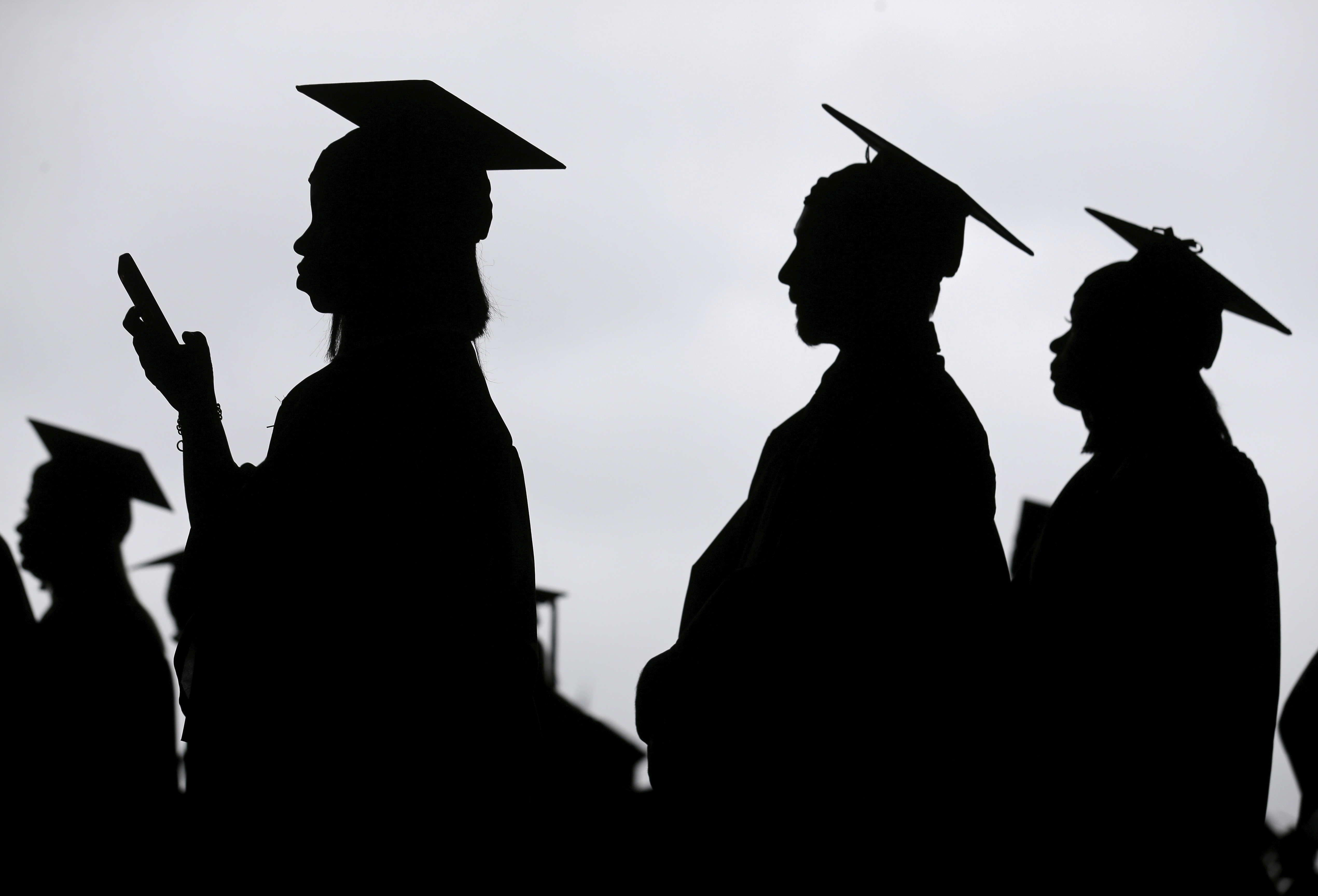
Graduates await diplomas. Derided in the age of technology, a humanities degree can bring untold rewards, writes Gene Andrew Jarrett.
Finally, the critical skills they develop can withstand the rapidly changing technologies that force workers to relearn demanding job tasks. Studying the humanities, then, is akin to investing in academic stock today for long-term professional gain.
One recent study tells us that the “wage-by-major statistics” parents and students review before declaring a major undervalue how “an education in history increases a student’s labor market value — perhaps through the development of critical reading and writing skills or because reading history texts cultivates a transferable attention to detail — that enables them to earn higher wages when they seek employment after graduation.”
Transferable skills
The “transferable” nature of skills is a significant educational benefit of the humanities. A 2020 study describes the labor market returns to the specific, or technically specialized, nature of a college major. That “specificity” determines how much the skills inculcated by this major are transferable across different jobs.
In short, the humanities consistently produce some of the most transferable skills across professions.
Another 2020 study looks at earnings dynamics, changing job skills, and careers in science, technology, engineering, and math (STEM). Studying the humanities can develop the skills that overcome the following conundrum: When a person acquires only “specific skills that are in high demand but also changing rapidly over time,” that person likely will need “to learn many new tasks each year.”
To make a long story short, a humanities education results in one of the slowest measurable rates of counterproductive “skill change.” This means the skills learned through a humanities degree endure resiliently, even in the face of massive technological changes.
The humanities, of course, have substantive educational benefits. Their themes enable students to learn several critical things about humanity, such as the impact of human intelligence and creativity, the evolution of ideas about humankind, and the vitality of language and culture in how to see and survive in the world.
But the true value of the humanities includes their ability to build the professional skills students need to thrive in the global workforce — especially at a time when colleges may be deciding whether to consolidate or eliminate humanities departments, majors, and courses.
The question, then, that parents and children should ask isn’t, “What can you do with a degree in art history or philosophy?” The better question is, “What can’t you do with it?”
Yes, contrary to what you might think, a degree in the humanities, alongside degrees in computer science and many in between, remains one of the smartest investments students can make.
Gene Andrew Jarrett is dean of the faculty and William S. Tod Professor of English at Princeton University.
While those of us concerned about the future of our nation’s scientific institutions and safety net feel distraught without a way to protect them, we doomscroll and spiral out further. Yet, it is in that doomscrolling that a solution may lie.
Why are we giving away our attention to plutocrats, for free, when we could be investing it in the direction of the common good?
Meta, the parent company of Facebook and Instagram, made over $160 billion in advertising revenue last year, largely generated by our clicks, our scrolling, and the algorithms that entrap us and, too often, damage our children’s mental health.
That $160 billion flowed into a corporate machine with a primary duty to its shareholders, not to the public.
Gutting research
Meanwhile, the federal government canceled $8 billion in research grants to more than 600 colleges and universities through the National Institutes of Health and the National Science Foundation. And that was just in the first six months of the second Trump administration. That’s a mere 5% of Meta’s profits.
And while an exact figure for Donald Trump’s contested cuts to nonprofits remains elusive, he did try to cut $400 million from AmeriCorps, and tried to claw back $49 million in aid to the lawyers representing abused and neglected children. The nonprofit sector stands to lose even more if the president’s budget reinforces changes to the tax code.
That’s the bad news.
But we believe these catastrophic losses to research and charity can be turned into wins. We believe it is time to rewrite the social contract of social media.
Cell phones are ubiquitous, and social media generates billions. A new platform could direct money to nobler purposes, the authors write.
Imagine a nonprofit social media platform run with input from universities, nonprofits, and research institutions — a competitor to Facebook, Instagram, TikTok, and X — where every dollar from advertising and sponsorship supports charitable missions and research.
The model is radical in its simplicity: users engage much as they do now, advertisers pay to reach them, sponsors chip in, and instead of profits accruing to billionaires, the revenue stream funds scientific research and humanitarian programs.
You like cat videos? Great — so do the researchers fighting pediatric cancer that your ad clicks just helped fund. Need a dopamine rush from someone liking a picture of your sandwich? So does the charity furnishing apartments for unhoused people. Why cede the attention economy entirely to the for-profit sector?
Imagine if even a fraction of Meta’s $160 billion in ad revenue were redirected into research into Alzheimer’s and other diseases. On a new social media platform, users could earmark the revenue they generate for particular causes or research institutions.
Critics will scoff: “You can’t compete with Facebook.” But Myspace once seemed unassailable. TikTok rose from nowhere to global dominance in under five years.
Attention is fickle. Platforms age. Generations shift. And when they do, new players emerge — players who can ride the next wave of interface design, AI integration, and community-driven features.
Or, starting small but growing with time, we can build an economic engine designed with community input and guardrails to serve the public good.
Ours is not a utopian dream.
The infrastructure exists. The advertising market is there, especially among small local businesses and nonprofits. We don’t know yet what innovative features the platform can offer, but the human desire to connect online isn’t going anywhere. The only missing piece is the will to claim a piece of that market for purposes nobler than quarterly earnings.
The call here is straightforward: Help us build our social media platform, CommonLoop. We are starting off as a lawyer and a journalist with an email account, seeking an anchor sponsor and early participants.
If you’re a university president, a nonprofit director, a philanthropist, or simply someone with the resources and skills to help launch such a platform — now is the time. The start-up costs are real, but so is the prize: a self-sustaining system that turns the most lucrative business model of the digital age into a public trust.
Click, scroll, like — but this time, make it count.
To this day, George Matysik, executive director of Share Food Program, can’t bite into a South Indian dosa without remembering a daily act of kindness that mattered to him when he was a young man, a paycheck away from poverty.
When he would arrive for his 6 a.m. shift as a housekeeper at the University of Pennsylvania’s engineering school building, the engineering school’s librarian would hand him a homemade dosa, a thin crepe redolent with the warm smells of curry and potatoes.
“My stomach was growling by then,” he said, sitting in a warehouse full of food ready to be packed for the nearly three million people who rely on the Philadelphia nonprofit for food.
“The moment of her handing me that dosa, I felt like I was going to be OK,” he said. Matysik, who graduated from Mercy Career and Technical High School across the street and down the block from Share’s main warehouses near Henry, Hunting Park, and Allegheny Avenues, went on to earn a degree in urban studies from Penn.
“I felt supported,” he said. Now, Matysik leads an organization that supports people who are missing meals and are worried about getting their next ones.
Look, Matysik said, society has many problems, and most are difficult to solve. Homelessness is complicated. Addiction grips its victims in its relentless stranglehold. “They don’t have simple solutions,” he said.
“But with hunger, it is simple. It’s getting food to the people who need it,” he said, like the dosa that began his day of washing floors and cleaning toilets at Penn.
“It’s frustrating to me that in the richest country in the world, a food program like Share has to exist at all,” Matysik said. “Food is a human right, and hunger is solvable. We have the resources in this country to eliminate food insecurity, and we can do it in Philadelphia if organizations like Share can get the resources.”
But it’s daunting.
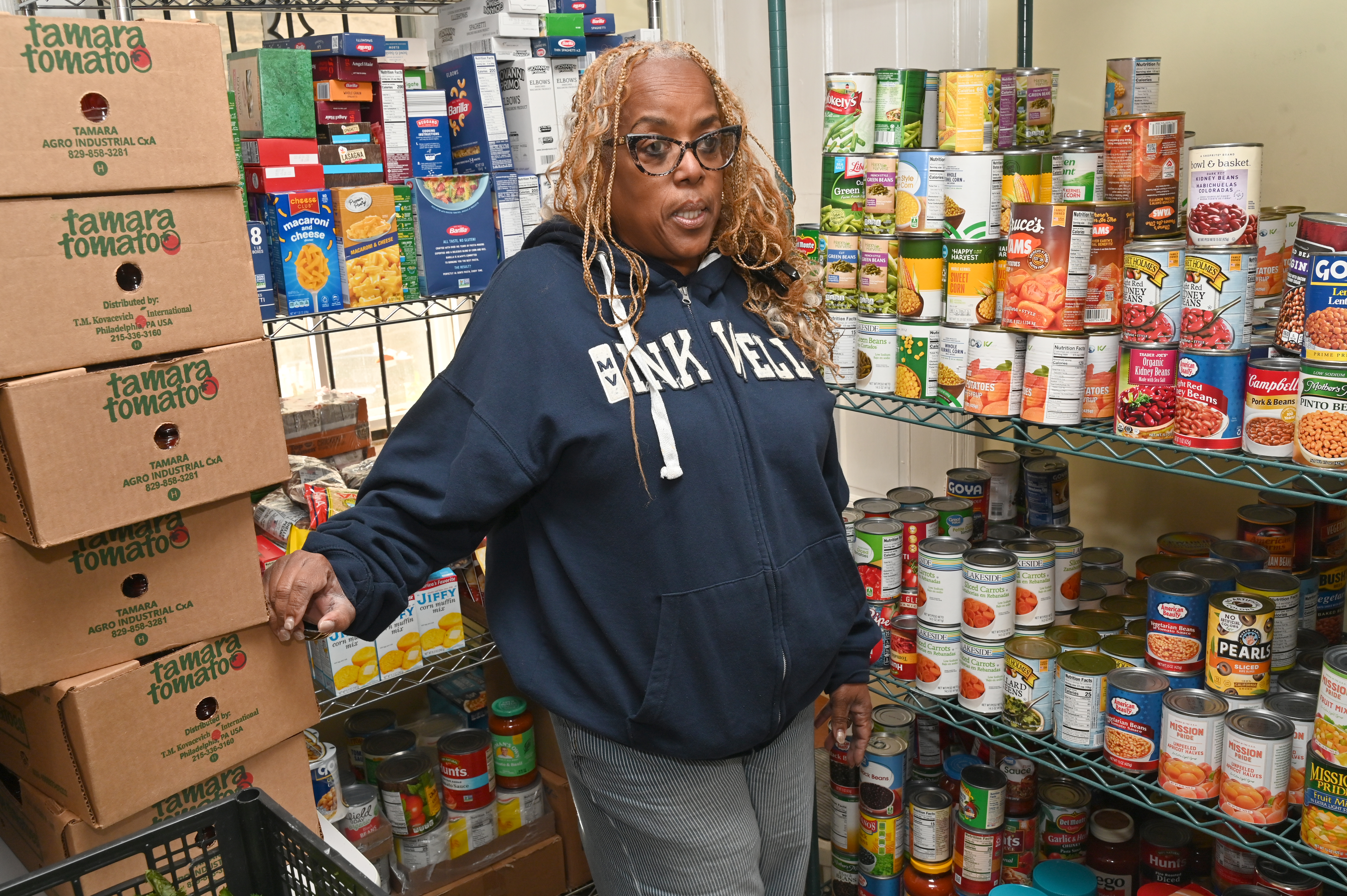
Jimmette Hughes, a volunteer at the Canaan Baptist Church’s Family Life Center, which distributes food contributed by Share.
Since the start of President Donald Trump’s second term in office in January, Share’s funding from the federal government has been cut by $8.5 million, or about 20% of the nonprofit’s annual expenses.
Also, the cost of the food Share buys wholesale by the pallet has risen. The increase in food costs will come as no surprise to grocery shoppers around the nation, Matysik said. “We can all see our receipts.”
Even as Share’s resources are being depleted, demand for the food it provides is increasing. Share distributes food to nearly 400 community partners — religious groups, food pantries, neighborhood organizations — and all of them are telling Share that more and more people are coming for food.
Community partners report that the number of new families or individuals registering to receive food has increased 12-fold. For example, in the past, a community partner might register five new families or individuals a week. But in late October and early November, with the government shutdown and the delay in government SNAP food benefits, that number might have risen to 60.
And more people than ever are coming to receive food. Organizations that served 100 people or families on their food distribution days were seeing 150 in line, Matysik explained.
“It’s making it more and more challenging for families to get the resources they need,” he said.
Patricia Edwards understands. When Edwards, a retired security guard, opened her refrigerator on Veterans Day in mid-November, she saw one box of powdered milk. That was it.
Supplemental Nutrition Assistance Program benefits had provided barely enough in the past, but with all the back-and-forth during the shutdown, her benefits weren’t available. “I’m looking at a bare cabinet and a bare refrigerator,” she said.
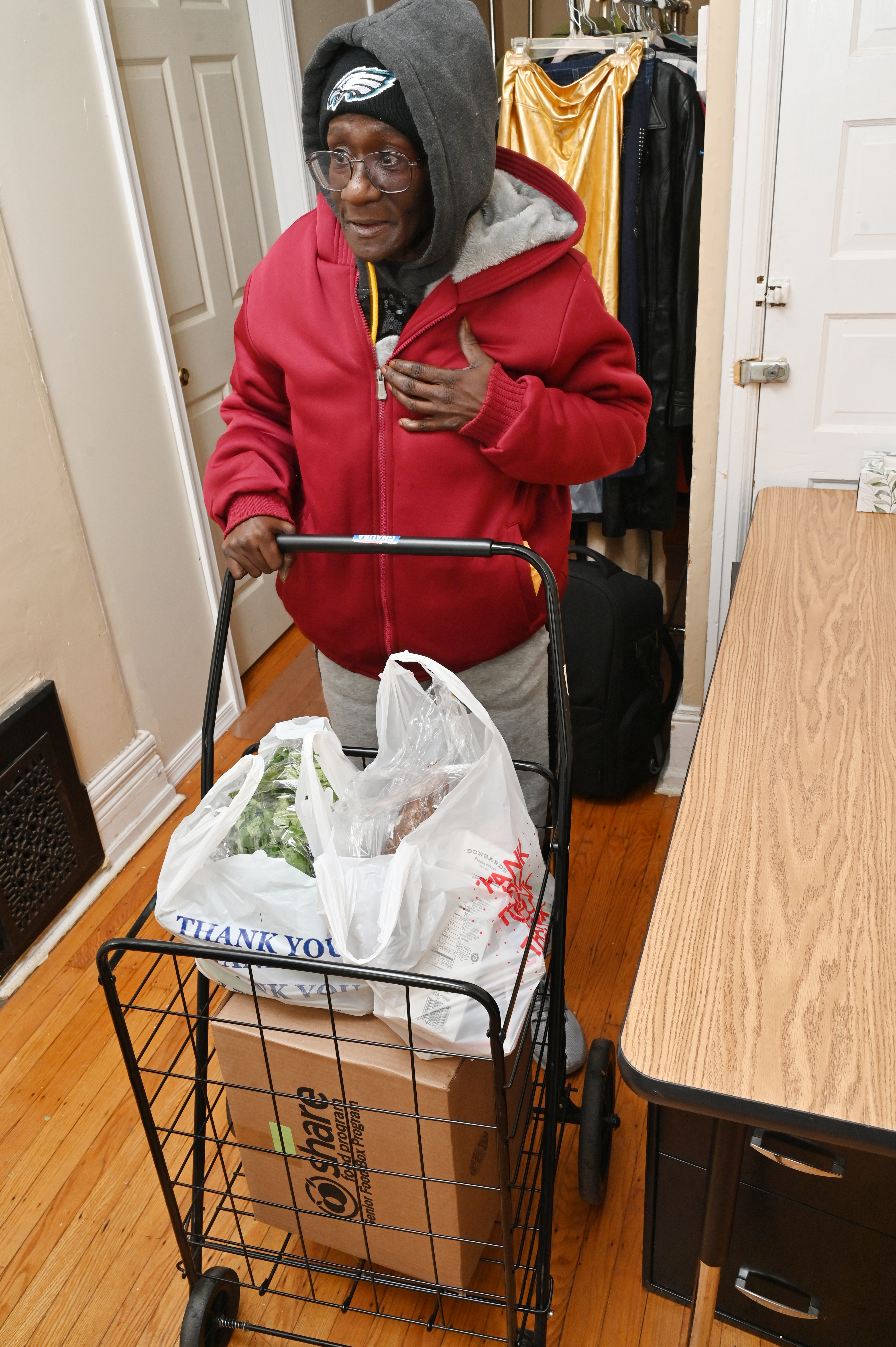
Patricia Edwards picks up food, including a Share box of food in her cart, at the Canaan Baptist Church’s Family Life Center.
The only reason Edwards had anything to eat leading up to Veterans Day was that a neighbor stopped by with some prepackaged meals.
“I didn’t know what to do. I didn’t know where to go,” she said, “but a neighbor told me about this.”
So, on that cold November day, Edwards walked a few blocks from her home in Germantown to the Canaan Baptist Church’s Family Life Center, hoping she could get some groceries at its weekly food pantry. “I need some food in the house,” she said.
She wound up with a box of food from Share and two bags of groceries filled with tuna, noodles, cereal, and vegetables.
“It’s a blessing,” she said.
Of course, those blessings cost money.
Share pays $12,000 to $14,000 a month for electricity to keep its warehouses running. Each tractor-trailer-sized truckload of food costs $40,000. Each industrial-sized freezer costs $800,000, and Share bought three of them in the last two years.
Three years ago, Share expanded into two warehouses, one in Ridley Park in Delaware County and the other near Lansdale in Montgomery County, the better to serve people in Philly’s surrounding communities.
Share needs money for forklifts, for payroll, for trucks. Funding pays for food, of course, but it’s also necessary to bankroll the infrastructure required to move not just boxes of food, but tons of it, to the people who need it. Share pays drivers to deliver food to homebound seniors. Even that’s a cost.
Share also has government contracts to provide school meals to 300,000 kids per day in public and charter schools in 70 districts, including Philadelphia’s public schools.
It’s a source of revenue, “but we lose money on it,” Matysik said.
Beyond that, Share runs gardens and greenhouses, which serve both as food sources and educational laboratories for young people.
Years ago, Matysik was one of those young people crossing the street from his high school to pack boxes as a Share volunteer.
These days, his work at Share involves budgeting and fundraising — balancing demand against resources.
“I’ve never been more disappointed in the American government,” he said, “And yet, I’m inspired every day by the American people stepping up to support organizations like ours.”
This article is part of a series about Philly Gives — a community fund to support nonprofits through end-of-year giving. To learn more about Philly Gives, including how to donate, visit phillygives.org.
For more information about Philly Gives, including how to donate, visit phillygives.org.
About Share Food Program
Mission: Share Food Program leads the fight against food insecurity in the Philadelphia region by serving an expansive, quality partner network of community-based organizations and school districts engaged in food distribution, education, and advocacy.
People served: 2,901,243 in 2024
Annual spending: $42 million, including $25 million distribution of in-kind donations and $6 million to purchase food.
Point of pride: In 2024, Share Food Program supported nearly 400 food pantry partners across the region, provided more than 6,500 30-pound senior food boxes each month, ensured over 300,000 children had access to nutritious food every day through its National School Lunch Program, and rescued and redistributed nearly six million pounds of surplus food. Altogether, Share distributed 32,214,873 pounds of food.
You can help: Volunteer your time packing boxes, rescuing food, or make calls from home to help coordinate senior deliveries.
Over the course of three days, I met with 13 congressional legislators or their staffers, spoke to representatives of the U.S. Department of Agriculture and the White House, as well as fellow farmers, to discuss a very real threat impacting our nation: the instability of our food system.
Across the United States, food system organizations — from regenerative farms and gleaning networks, to food access nonprofits and community grocers — are all under immense pressure because of federal funding cuts, rising tariffs, and labor shortages. The entire food chain is strained, and the effects are compounding.
Recently, during the government shutdown, families across the country were not receiving SNAP benefits. American farms and families are still struggling and need relief now.
Farmers suffer even as food prices rise
While food prices continue to rise, farmers make less than 16 cents on every food dollar spent, according to the National Farmers Union. Even worse, there has been a severe labor shortage because of outdated agricultural workforce policies, while large corporate farms are making record profits.
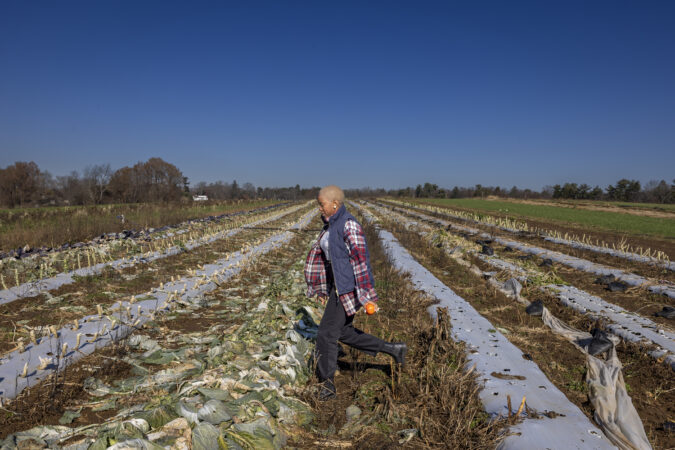
Suicide among farmers is at an all-time high, and the sixth highest among all occupational groups. As the largest Black food grower in Pennsylvania, I am seeing these challenges each and every day.
In addition to the impact this will have on our children and our most vulnerable communities, the killing of this program is having a direct impact on small and first-generation farmers like me. My produce farm lost upwards of $150,000 between contracts with local food banks that were supported by the LFPA Program and the loss of the Agriculture Department’s Climate Smart Partnerships.
These drastic cuts have strained our operations and have impacted our ability to promptly pay our workers and ensure our communities have access to food that is not only locally and regeneratively grown, but also 100% chemical-free.
Food anchors social drivers
At the heart of this challenge is a simple truth: Food is the anchor to all social drivers of health. When food is unstable, so is health, education, safety, economic opportunity, and environmental well-being.
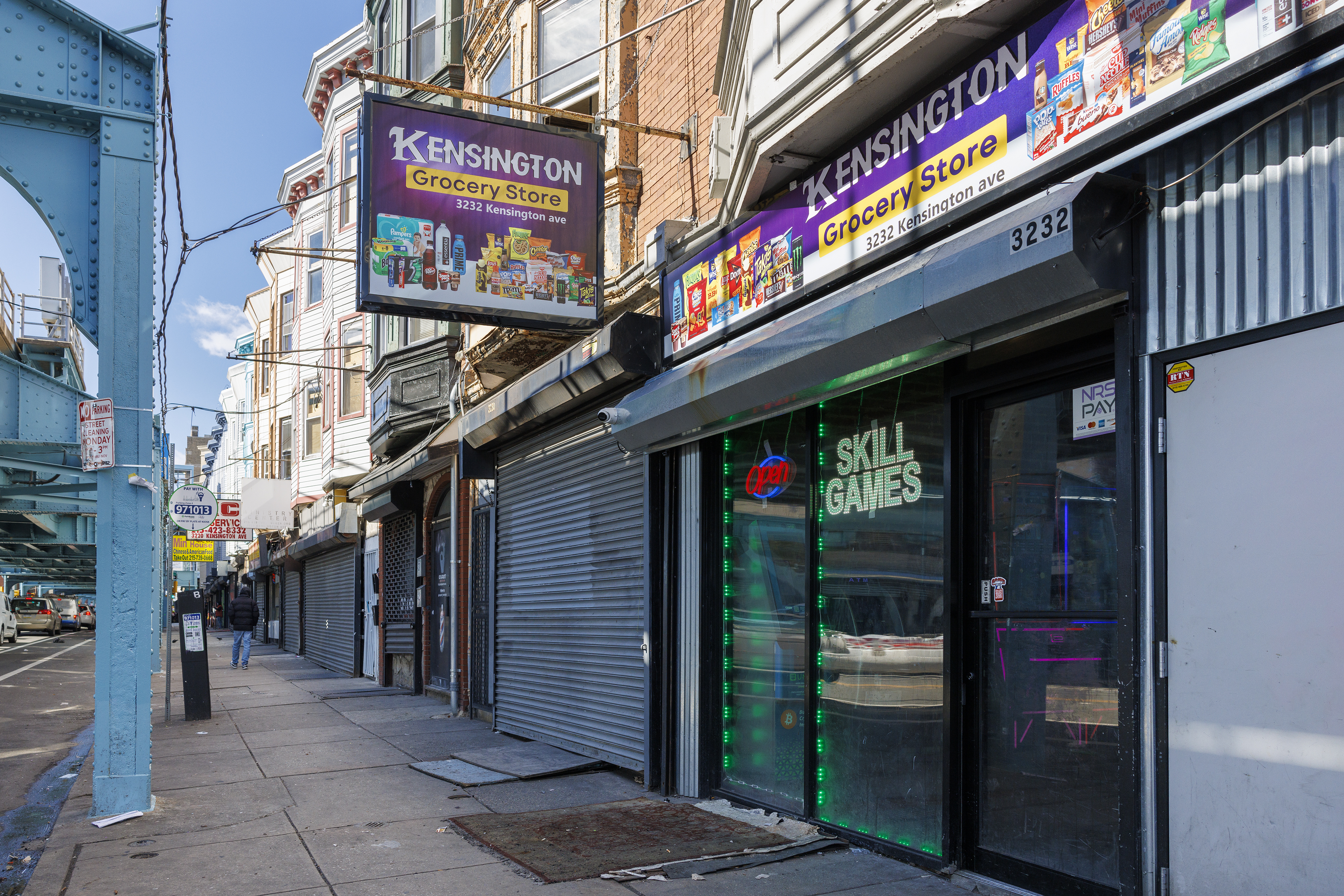
This is evident in North Philadelphia’s Kensington neighborhood, which is plagued by an opioid epidemic, crime, food apartheid, and nutrition insecurity.
A corner store in Philadelphia’s Kensington neighborhood. Such stores should be part of the local food system, writes Christa Barfield.
According to a 2019 report released by the city of Philadelphia and Drexel University’s Dornsife School of Public Health, Upper Kensington ranked last out of 46 Philadelphia neighborhoods in terms of health factors and health outcomes.
Addressing food access through a regenerative and localized lens is not just a response — it is a long-term strategy for national security.
In my September conversations with members of Congress, it became abundantly clear that an updated Farm Bill would not be passed into law by the Sept. 30 deadline. And it wasn’t.
Due to this failure to prioritize the needs of small family farmers, we must now turn inward and rely on our communities to design and implement a scalable, regionally coordinated food system.
This is possible by supporting local farmers and workers through fair, reliable markets, reducing food waste via efficient, community-based recovery, and empowering neighborhoods with increased food sovereignty and local ownership.
I founded FarmerJawn Agriculture seven years ago, and I know that for a community or nation to be healthy, it must be well-fed. Food is medicine. Good food means good health.
Despite the challenges we face, this idea is more relevant now than ever. I am eager to launch CornerJawn, a farm-to-store operation that will reimagine the corner store as a preventative healthcare hub.
CornerJawn will increase access to fresh and nutrient-dense food that is both convenient and affordable through a dignified pricing model.
It will enhance urban living for the strategically forgotten communities that are now seeing record development in hopes of creating, what? Wealth? True wealth is measured in longer lives with beautified communities and healthier families.
We must treat food like medicine, invest in those specialty farms that feed us, and watch our country thrive.
Remember: Agriculture is the Culture.
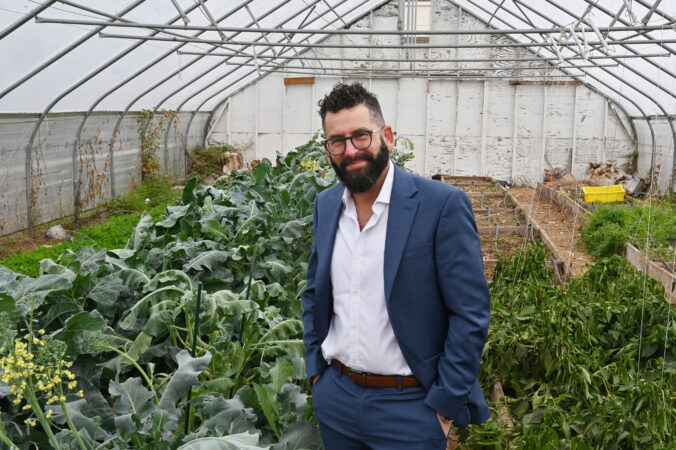
Christa Barfield, a.k.a. FarmerJawn, is a healthcare professional turned regenerative farmer, an entrepreneur, an advocate for food justice, and a James Beard Award winner. As the founder of FarmerJawn Agriculture, she manages 128 acres across three counties in Pennsylvania, making her the largest Black food grower in the state.
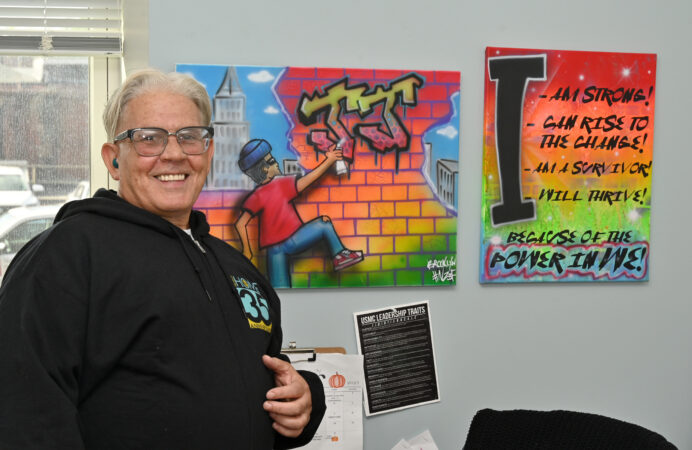
As charming and ebullient as Nephtali Andujar is (lots of hugs, compliments, and gifts of his homemade pottery), the 61-year-old is also pretty blunt about why people should give to Project HOME, one of the city’s largest nonprofit housing agencies.
Because of Project HOME, said Andujar, who spent years living on the streets, he is no longer desperate — desperate to get money to feed a heroin addiction, desperate to scrape $5 together to pay someone to let him drag a discarded mattress into an abandoned house for a night’s sleep out of the rain.
“It’s not just giving someone an apartment,” said Andujar, who sheepishly described a past that included stealing cars and selling drugs. “It’s the snowball effect.
“You are not just helping the homeless,” he said. “You are helping the city. You are helping humanity.”
In the agency’s name, the letters HOME are capitalized, because each letter stands for part of the multipronged approach that Project HOME takes in addressing homelessness and combating poverty for the 15,000-plus people it serves each year.
There’s H, for Housing — not only housing in the literal sense, but also in the teams of outreach workers who comb through the city’s neighborhoods looking for people like Andujar. One outreach worker found Andujar in 2021 at a critical moment in his life — clean, just out of the hospital for liver treatment, and back on the streets of Kensington ready to begin anew.
“We know we have to do the most we can to preserve these resources that we’ve come to rely on,” says Donna Bullock, president and CEO of Project Home.
For Andujar, it was a race. What would find him first?
Would it be heroin, as it had so often been in the past? It was tempting. It’s painful being on the street — cold, hungry and dirty, ashamed and alone. “When you do heroin, you don’t feel the cold. It kills the hunger,” he said. “When you use the drugs, you don’t have to suffer for hours. Heroin numbs you.”
Instead, though, it was the outreach worker — someone who had been through Project HOME’s recovery program — who plucked Andujar off the street in the nick of time and took him to a shelter.
A year later, that same outreach worker helped Andujar move to his own room at Project HOME’s Hope Haven shelter in North Philadelphia.
“You get tired of the streets. They were killing me,” Andujar said.
Next Andujar found Project HOME manager JJ Fox, who helped him get a birth certificate and other documents, and arranged for him to stay. But he needed more than a warm bed.
The problem with getting straight after a heroin addiction, Andujar explained, is finding a new purpose and direction. For so long, life was focused on a repeat cycle of getting the next fix and then becoming numb to pain while it was working.
So when he got to Project HOME, he needed a new direction, which is where both the O and E in HOME came in for Andujar.
“JJ Fox gave me direction,” he said, and so did Project HOME employment specialist Jamie Deni.
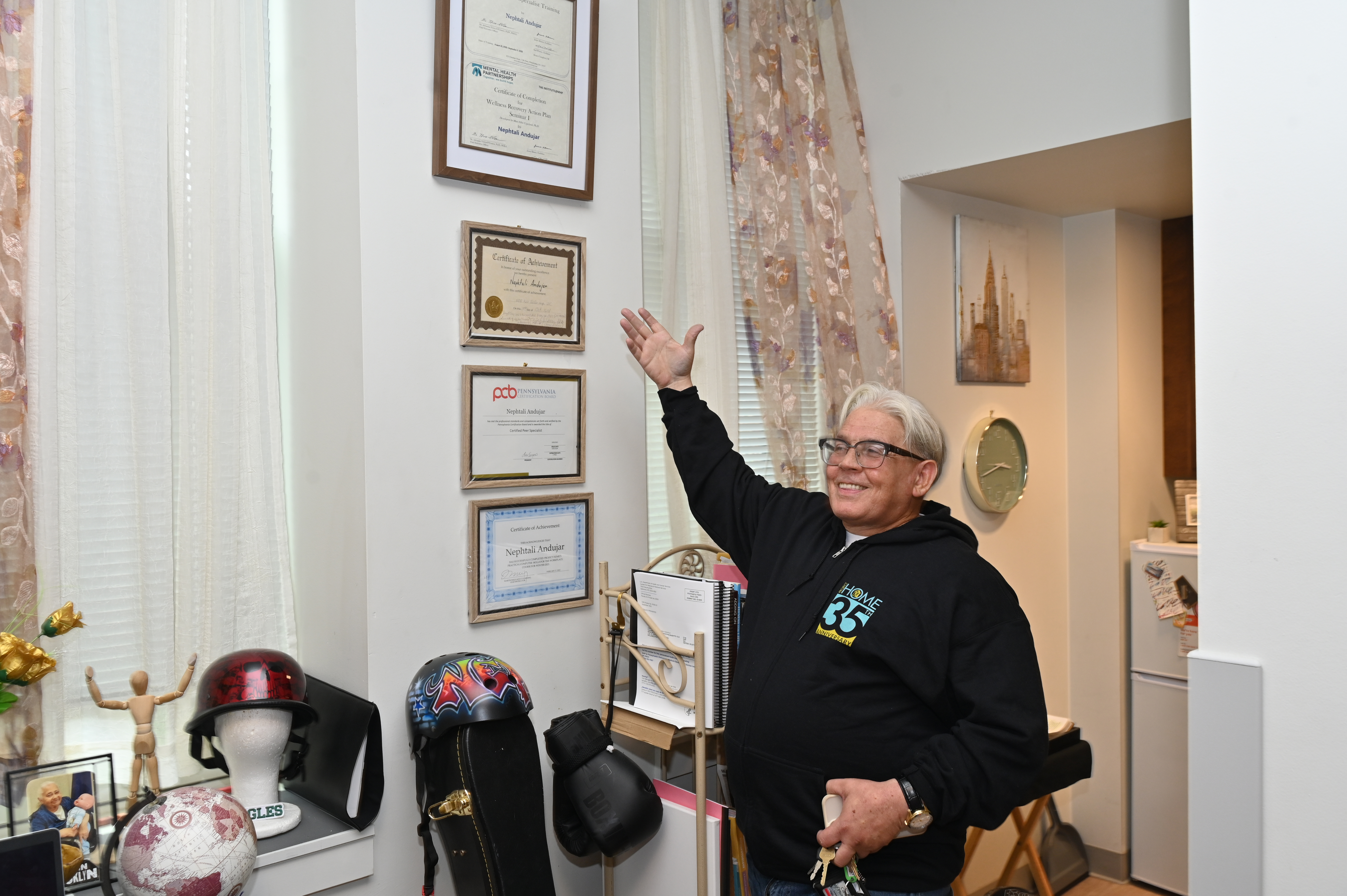
Training certificates cover a wall in Nephtali Andujar’s studio apartment in Project HOME’s Inn of Amazing Mercy in Kensington.
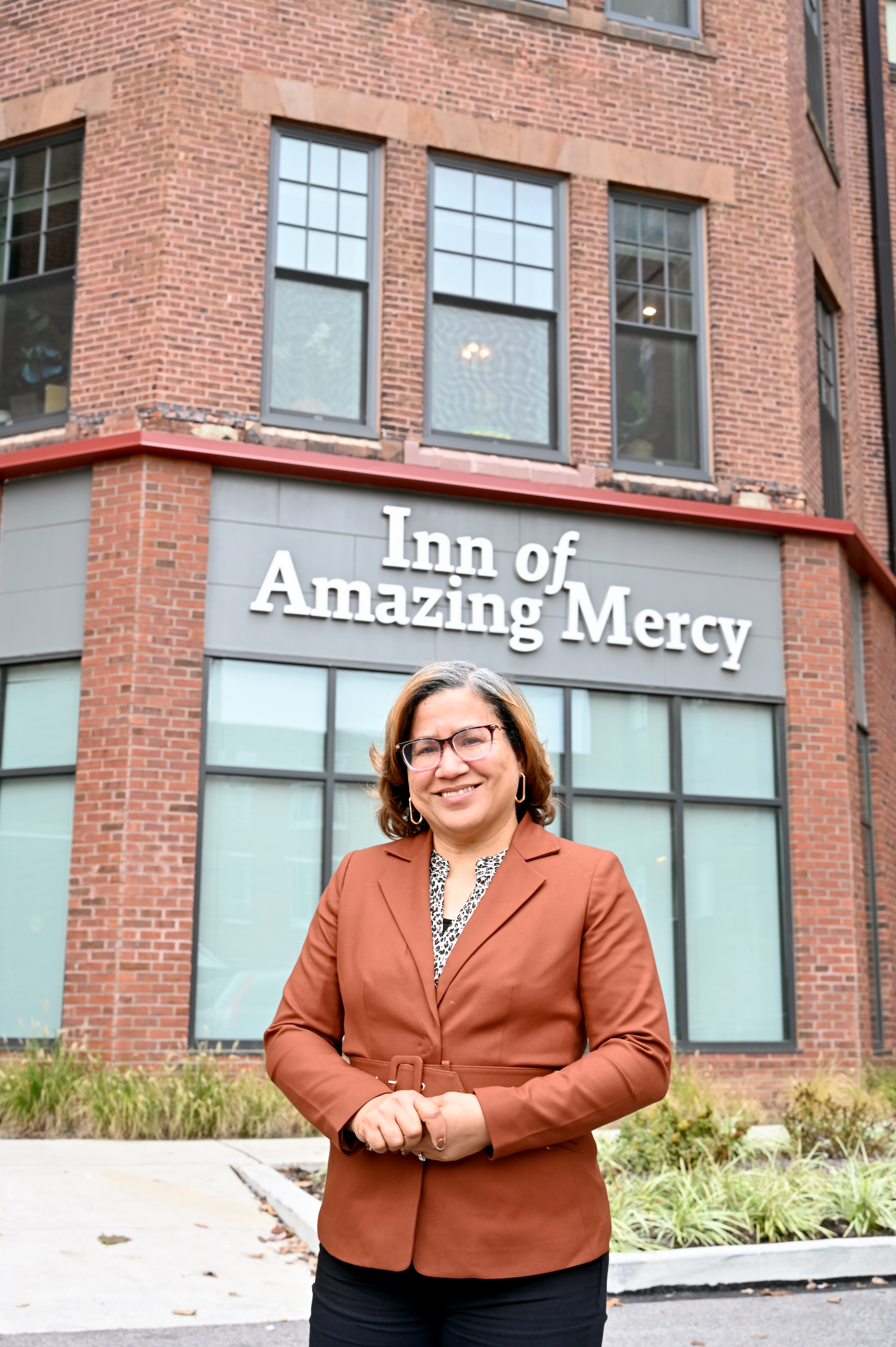
The “O” in HOME has to do with Opportunities for employment. Certificates cover one wall in Andujar’s studio apartment in Project HOME’s Inn of Amazing Mercy, a 62-unit apartment building and offices in a former nursing school dormitory in Kensington. He can point to his accomplishments in computer skills, barbering, and training as a peer specialist to help others the way the outreach worker helped him.
But Andujar is not in good health, as vigorous as he appears. His addictions will someday exact their price, even though with cirrhosis of the liver, he is already living years beyond what his doctor predicted.
Full-time work is not an option. So Andujar is part of the “E,” as in Education. Deni helped him get a grant to take art classes at Community College of Philadelphia. She helped him understand CCP’s education software so he could turn in his homework.
Project HOME offers classes in graphic design, music production training, ServSafe food handling, forklift and powered industrial trucks certification, and website building, among other courses.
The M stands for Medical. Project HOME doctors, nurses, and other health practitioners treat 5,000 people a year, both in a fully equipped health center and by sending medical teams into the streets, caring for people, literally, where they live.
“My dad always told me that you need three things — housing, food, and love. You get all that here,” Andujar said.
And for him, it goes beyond that. During a stable period in his life, Andujar had a partner and a child. His daughter is now 14 and living with her aunt in New Jersey. Her mother, who was also stable for many years, fell into addiction but is clean now. She is living in another Project HOME apartment.
Like Andujar, Omayru Villanueva, 49, another resident at the Inn of Amazing Mercy, recalls her first night of homelessness.
She remembered a cold slushy rain.
She remembered sweeping every corner of her house, determined to leave it clean, no matter what. Her husband had been convicted and jailed for a federal crime. She couldn’t make the payments on the house, so she sold or stored all of her belongings and prepared to leave.
On her last morning at home, she and her school-age twin sons walked out the door before the sheriff came. Her older daughter was able to find a place in a shelter. Her second daughter, just under 18, said she was living with a boyfriend, but it turned out that she had been trafficked.
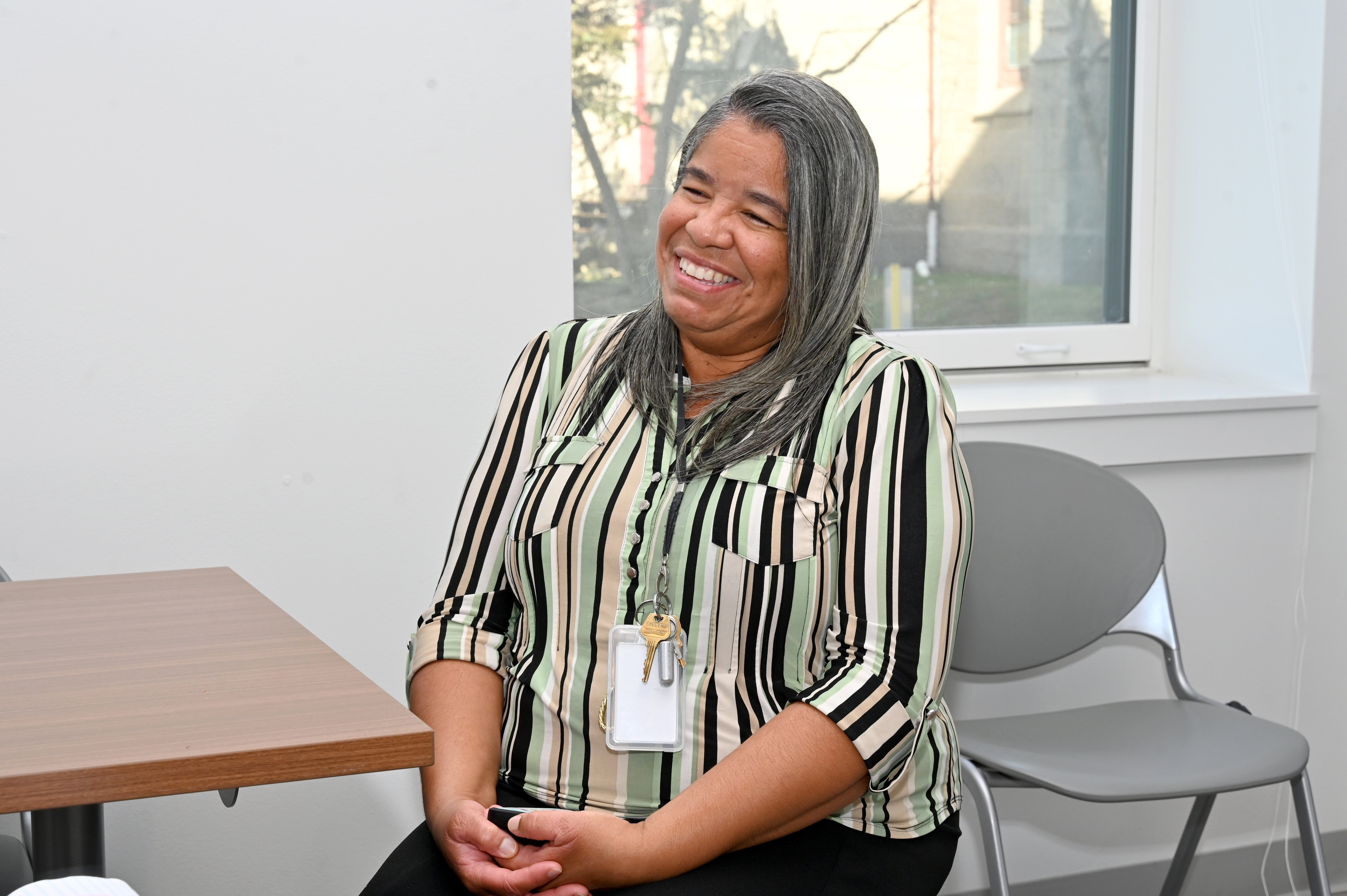
“There’s a sense of dignity and respect when you have your own place,” says Omayra Villanueva, another resident of the Inn of Amazing Mercy.
By that evening, Villanueva was desperate. She took her boys to a hospital emergency room. At least they could sit indoors while she figured out something. “I was crying inside.” Finally, she called a friend from church who took her and her sons in.
From there, they moved from shelter to shelter, and ultimately to a Project HOME apartment with two bedrooms.
“That night we had a pizza party. We were so happy,” she said. “There’s a sense of dignity and respect when you have your own place. You can take your worries away from having a place to live, and you can focus on other things.”
She remembered lying in her new bed, “thanking God and rubbing my feet against the mattress.” The next day, she woke up, opened the window, and listened to the birds. Then she asked her sons what they wanted for breakfast. “When you are in a shelter, you eat what they give you.”
Three of her four children, scarred from the experience, have also been homeless and living on the street. Her two sons, now 23, are in Project HOME apartments. Both daughters are now fairly well-established.
Villanueva appreciates the medical help she has been given at Project HOME, particularly for mental illness stemming from the trauma she has experienced with her ex-husband’s arrest and homelessness.
“Anybody can end up being homeless,” she said. “I wasn’t a drug addict. I wasn’t an alcoholic. It can happen to anybody.”
She thinks of her daughter, who has a house, a job, and a car. But if something happens to the car, her daughter won’t be able to get to work. She won’t be able to pay her mortgage, and she could wind up homeless. It’s that simple.
“It’s important to donate because people can help break the cycle of homelessness,” Villanueva said.
“It’s about housing and education. It’s about medical help. It’s about employment,” she said. “Project HOME helped me a lot.”
The truth is that every person in Project HOME has a story. Those stories keep Donna Bullock, president and chief executive, motivated to preserve and protect the agency founded just over 35 years ago by Sister Mary Scullion and Joan Dawson McConnon.
She worries about how the city will respond to federal executive orders amounting to the criminalization of homelessness. Will there be tightened requirements for agencies that provide shelter?
Project HOME is reimbursed for some of the medical care it provides, but Bullock worries that new rules involving Medicaid reimbursement will impact the agency’s budget, while cutbacks in services increase demand.
“It’s terrifying,” she said. “We know we have to do the most we can to preserve these resources that we’ve come to rely on.
“In this job, I’ve learned to appreciate the humanity of folks — the residents and the stories they tell and the contributions they make to our community.”
Sometimes, she said, Project HOME residents walking the path of recovery slip and fall away. Sometimes the results are tragic, the losses devastating.
“We’re experiencing all these moments — communal grief and communal celebrations as well. We talk a lot about how every journey of recovery is unique. Everyone walks their own journey. We can’t do the walk for you, but we can walk with you,” she said.
Bullock invites others to the journey, promising that when people give to Project HOME, they can be assured that their money is carefully managed. “We’re good stewards of the resources entrusted in our care. We know how to leverage the resources given to us.
“Folks expect a return on their investment, and the return is the difference in individual lives and also building a community,” she said. “Your investment is magnified 10 times over.”
This article is part of a series about Philly Gives — a community fund to support nonprofits through end-of-year giving. To learn more about Philly Gives, including how to donate, visit phillygives.org.
For more information about Philly Gives, including how to donate, visit phillygives.org.
About Project HOME
Mission: To empower adults, children, and families to break the cycle of homelessness and poverty, to alleviate the underlying causes of poverty, and to enable all of us to attain our fullest potential.
People served: More than 15,000 annually — with street outreach, housing, opportunities for employment, medical care, and education.
Annual spend: $49.06 million
Point of pride: Project HOME, which operates 1,038 housing units, broke ground in October for construction of 45 new apartments; also under construction are 20 respite beds. In the pipeline are an additional 44 apartments. Project HOME also operates the Honickman Learning Center Comcast Technology Labs, Stephen Klein Wellness Center, Helen Brown Community Center, and Hub of Hope.
You can help: Volunteers tutor students, serve meals, participate in neighborhood cleanups, and organize donation drives at their organizations for household items or other items useful to families or people still experiencing street homelessness.
Here are some ways that a gift can help the people we serve:
$25 provides warm clothing and new socks for a visitor at the Hub of Hope.
$50 supports a behavioral health counseling visit.
$100 provides a month’s worth of hygiene products and toiletries for a family.
$250 provides a welcome basket for a new resident complete with sheets, towels, and cooking supplies.
$500 supports five dental visits at the Stephen Klein Wellness Center.
$1,000 funds six weeks of summer camp at the Honickman Learning Center Comcast Technology Labs, keeping a child’s mind active during the summer and supporting moms who work.
$1,500 funds a certification program through the Adult Education and Employment program leading to employment readiness.
Thanksgiving is the sole American holiday whose name tells us exactly what we are meant to do.
This Thanksgiving — among many other blessings — I am giving thanks for our country’s vibrant, independent local journalism, and for the nation of laws and press freedoms that help preserve and defend it.
More than any other American holiday, Thanksgiving is about the exercise of free speech. Whether cordial or contentious, our views of our families, our culture, our sports teams, or our politics are debated freely over the American Thanksgiving table.
In a world in which we spend far too much time living in our own information bubbles, Thanksgiving allows — indeed forces — us to communicate across the table, across generations, and across sometimes deep partisan divides.
From the outset, the notion of Thanksgiving and freedom has been intertwined. In George Washington’s Thanksgiving Proclamation of October 1789, the new president asked the nation to give thanks “for the civil and religious liberty with which we are blessed, and the means we have of acquiring and diffusing useful knowledge.”
As worded, the proclamation is more a celebration of American freedoms than the blessings of a sumptuous meal. If Independence Day celebrates the declaration of American freedoms, then Thanksgiving celebrates their enactment and — one hopes — their permanence.
But on this, more than any Thanksgiving in memory, a free and independent American press seems in peril.
The current administration has orchestrated the virtual elimination of Voice of America and other vital U.S. international broadcasting and the defunding of NPR and PBS, among several other legal suits and regulatory intimidations.
The Inquirer is now the largest American newspaper under nonprofit ownership. The newspaper remains editorially independent of its parent company to protect the very freedoms for which its owner stands.
Thanks, in part, to this nonprofit structure, The Inquirer and its independent, high-impact journalism enjoy the funding support of individual donors, large and small, and of foundation and corporate contributors, both local and national.
It is said that “all politics is local,” and the same may be said of news. What happens in our nation or on our planet can often be best understood when reported from a local perspective.
The Inquirer, and the dynamic Philadelphia-area journalism scene of which it is a part, are a blessing for our city, our region, and our country.
Over the past year, a skilled, dedicated, and high-integrity group of women and men from The Inquirer, our region’s local TV stations, WHYY, WURD Radio, Impacto, the Philadelphia Tribune, Spotlight PA, and a diverse array of community news organizations have reported on the region’s biggest challenges: from the plight of our immigrant communities to solutions for gun violence, to economic mobility in what remains among the poorest big cities in America, to electoral politics in America’s largest swing state. This work saves lives, makes kids safer, and holds local and state government to account.
All those who report and edit the news, all who stand ready to defend their words in the courts or in the court of public opinion, everyone who helps fund great local journalism with their subscriptions or their donations, and all who read and act upon the vital insights of a free and independent local press deserve our thanks — and these days, our prayers.
Jim Friedlich is CEO and executive director of The Lenfest Institute for Journalism, the nonprofit organization that owns The Inquirer. @jimfriedlich