Since his 2023 election, 5th District Councilmember Jeffery “Jay” Young has earned a reputation as City Council’s quarrelsome contrarian. His penchant for swooping in and obstructing projects at the last minute has upset everyone from progressive community activists to affected developers.
Young is a single vote on Philadelphia’s 17-member legislative body, but thanks to the tradition of councilmanic prerogative — where the rest of Council yields to district representatives regarding land-use decisions — he wields absolute power over an area that includes Rittenhouse Square and City Hall to the south, Strawberry Mansion to the west, part of Northern Liberties and Fishtown to the east, and Hunting Park to the north.
Projects impacted by his objections include a long-standing proposal to build senior housing in Strawberry Mansion, a plan to protect students with speed cameras in school zones, and the renovation of the Cecil B. Moore Library.
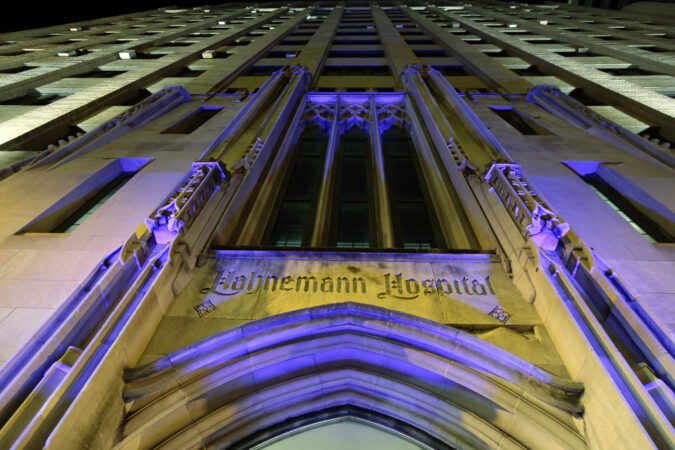
Young’s latest disruptive gambit — ill-conceived and misguided — is a bill that targets the proposed redevelopment of the former Hahnemann University Hospital patient towers in Center City into hundreds of apartments.
Established in 1885, the hospital healed generations of Philadelphians, and its south tower was the first skyscraper teaching hospital in America. Beyond the loss of medical services, when Hahnemann closed six years ago, it left a gaping hole in the heart of the city.
Located along a stretch of North Broad Street that is heavily underutilized, the vacant buildings are begging for a new lease. Dwight City Group has proposed refilling the campus with housing. The plan would add hundreds of new residents right next to Center City and the Broad Street Line, and within walking distance of Suburban Station.
To most housing, development, and planning experts, the idea is perfectly sound. Philadelphia would add workforce housing (around 1% of Mayor Cherelle L. Parker’s goal) in a location that already has the infrastructure and amenities residents require, and the city would not have to spend any taxpayer money to make it happen.
And yet, Young is opposed.
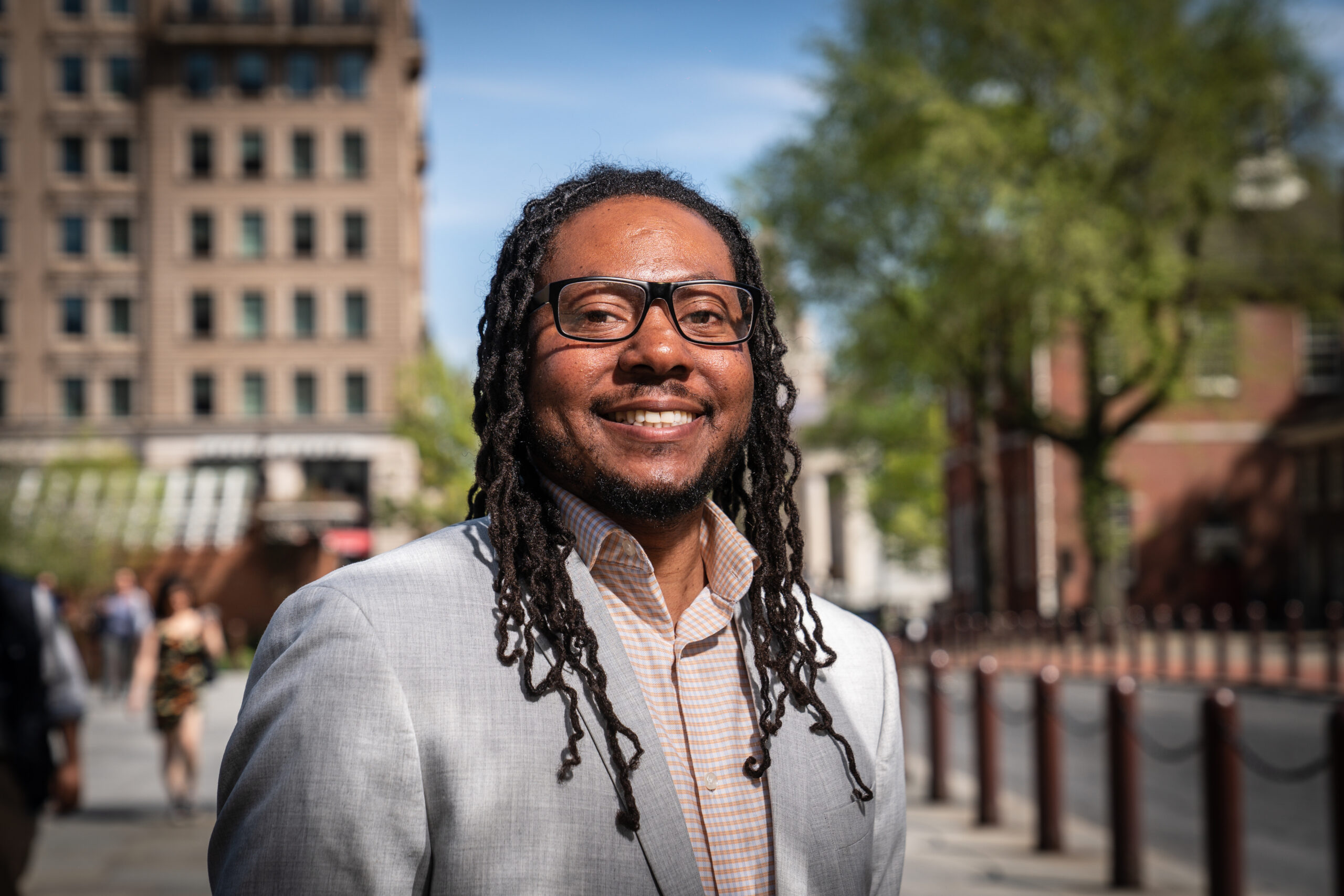
Jeffery “Jay” Young represents Philadelphia’s 5th District.
In a statement to the Editorial Board last year, Young defended the move as being motivated by a desire to grow jobs in the city by limiting development in the area to commercial use. That’s an admirable goal. But who is going to buy the goods and services these hypothetical new businesses would offer? The redevelopment of Hahnemann into an apartment building would only increase local entrepreneurial opportunities.
Thankfully, in this case, it looks like Young’s obstructive desires may be a moot point — at least when it comes to his proposed legislation.
Because Council adjourned for its winter break without voting Young’s bill out of committee, the developer was able to secure zoning permits to build 361 apartments, with space for commercial use in the building’s ground floor.
While the Dwight City Group did not want to comment, CEO Judah Angster earlier told Inquirer reporter Jake Blumgart they remain in negotiations with Young. Given the fact that the developer may have to deal with the councilmember in the future, there is a chance the Hahnemann project may be curtailed to avoid Young’s ire elsewhere.
Were that to happen, it would mark another missed opportunity for positive growth in the city, thanks to councilmanic prerogative.
For decades, Philadelphia has trailed peer cities in job growth and economic activity. While high business taxes, deep poverty, and other factors play a role, prerogative stands out as an impediment that is entirely self-inflicted.
The practice — no matter how strongly it is defended by Young and his colleagues — is a constant detriment to the city. While there is merit in giving district representatives a strong voice to protect their constituents from unwanted development, councilmanic prerogative too often allows the whims of a single person to override the will of the people.
The only thing Philadelphia would lose by eliminating councilmanic prerogative is the opportunity for Council members to grandstand and feed their egos.
In short, many of Trump’s policies are making people sicker, poorer, and less safe. In that context comes Trump’s latest attack on the Federal Reserve, which will ultimately hurt all Americans.
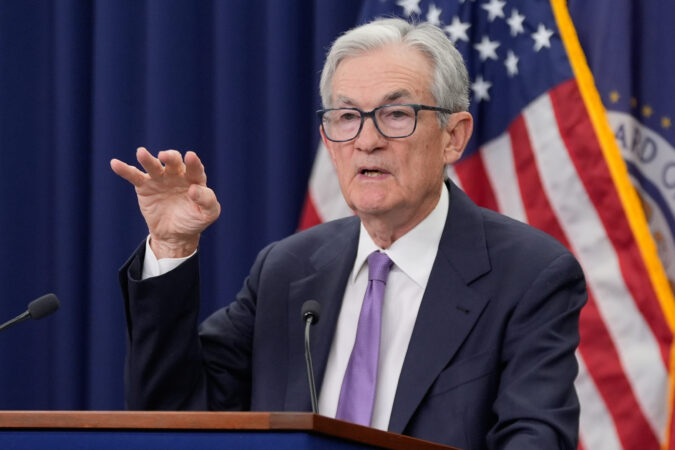
Since returning to office last year, Trump has pressured Federal Reserve Chairman Jerome Powell to speed up interest rate cuts in an effort to boost the economy. But the Fed has moved cautiously to avoid further inflation.
Trump’s economic approach has been reckless and shortsighted.
In July, he threatened to fire Powell. Last month, Trump said he may sue Powell for “gross incompetence.”
On Friday, the U.S. Department of Justice opened a criminal investigation into Powell involving his testimony before the Senate Banking Committee regarding the increased costs of renovations to the Fed’s headquarters in Washington.
Trump claimed not to know anything about the investigation, but he had previously criticized the renovation costs. Let’s be clear: Trump’s long-running attacks on the Fed chair are the only reason Powell faces any legal trouble.
The Powell investigation shows yet again how Trump continues to pervert the once-independent Justice Department, using it as a political tool to go after his perceived enemies.
Attorney General Pam Bondi continues to do Trump’s bidding. She has launched bogus investigations into other public officials, including former FBI Director James Comey and New York Attorney General Letitia James.
Add Powell to the political hit list that is making a mockery of American justice.
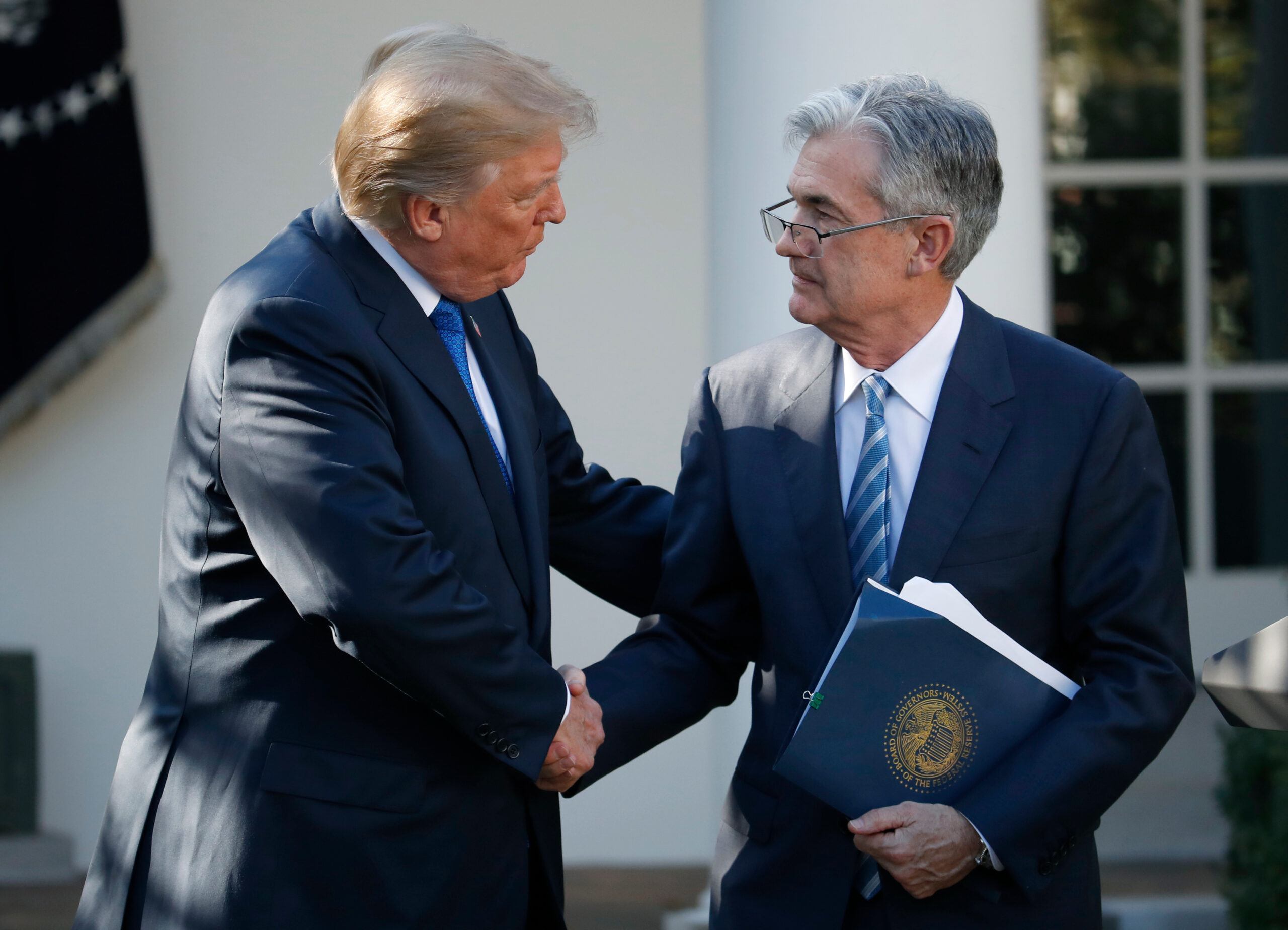
President Donald Trump shakes hands with Federal Reserve board member Jerome Powell after announcing him as his nominee for the next chair of the Federal Reserve, in the Rose Garden of the White House in 2017.
In a rare sign of political courage, some Republican lawmakers mustered the nerve to criticize Trump’s attack on Powell.
Sen. Lisa Murkowski (R., Alaska) said that “the administration’s investigation is nothing more than an attempt at coercion.”
Sen. Thom Tillis (R., N.C.) said the “independence and credibility” of the Department of Justice “are in question.” He promised to oppose the nomination of a new Fed chair until the legal issues are resolved.
But until more Republicans stand up to the president, expect more abuses of power.
Trump’s attack is especially petty, since Powell’s term as Fed chair ends in May, though he can remain on the board through January 2028.
Trump actually nominated Powell to be chairman during his first term in the White House. In a sign of Powell’s independence, former President Joe Biden renominated him to a second term.
By most accounts, Powell has done an impressive job steering monetary policy through uncharted territory involving the pandemic, followed by inflation brought on by increased government spending.
Trump’s pressure campaign on Powell has broader repercussions on America’s financial system.
The Fed’s independence is a cornerstone of U.S. financial markets, as it instills trust in investors, business leaders, economists, and other governments around the world that U.S. monetary policy is set without regard to political pressure.
Without that firewall, presidents could push for rate cuts to boost the economy before an election, potentially causing higher inflation and instability down the road just for short-term political gains.
In this instance, Trump clearly has his eye on revving up the economy before the midterms. (Trump would likely blame any subsequent inflation on Biden.)
Politicizing the Fed creates instability and will harm investors and consumers in the long run. Reports of the Powell investigation already rattled financial markets, prompting investors to sell American stocks and bonds.
To his credit, Powell has remained steadfast and made clear that the stakes surrounding the investigation are much bigger. “This is about whether the Fed will be able to continue to set interest rates based on evidence and economic conditions — or whether instead monetary policy will be directed by political pressure or intimidation.”
But the damage to the Fed is already done, as Trump continues to place his political and financial interests ahead of those of the American people.
Renee Nicole Good, 37, was shot and killed by U.S. Immigration and Customs Enforcement agents on Wednesday in Minneapolis. She is the second person killed after the Trump administration unleashed masked, armed, and increasingly unaccountable federal forces upon U.S. cities.
Unless the government immediately changes course, she will not be the last.
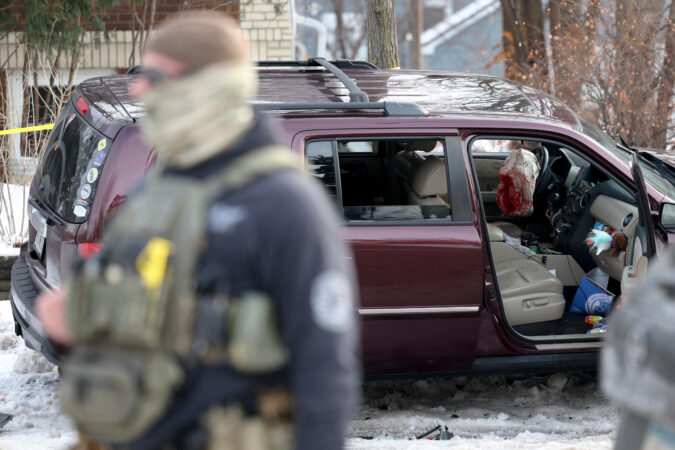
Several videos posted to social media show the deadly encounter. If you believe your eyes, Good was fatally shot as she attempted to drive away from agents who were yelling obscenities at her and violently trying to open her vehicle’s door.
If you believe the U.S. Department of Homeland Security, Good was part of a group of “violent rioters” who “weaponized her vehicle” and tried to “run over our law enforcement officers in an attempt to kill them.” Good, according to DHS spokesperson Tricia McLaughlin, was engaged in an act of “domestic terrorism.”
The stark disconnect is telling. The administration’s reflexive lying is emblematic of the moral rot at the heart of President Donald Trump’s militarized mass deportation efforts. It reflects a worldview where all immigrants are criminals, and all dissenters are rioters or terrorists.
By all accounts, Good was neither. She was a mother, a neighbor, a self-described poet, writer, and poor guitar player. In death, she joins Silverio Villegas-Gonzalez, a 38-year-old Chicago resident who was killed by ICE in September during a similar incident. The Mexican immigrant was shot in the neck shortly after he dropped off one of his children at school and another at daycare.
These deaths were as preventable as they were foreseeable.
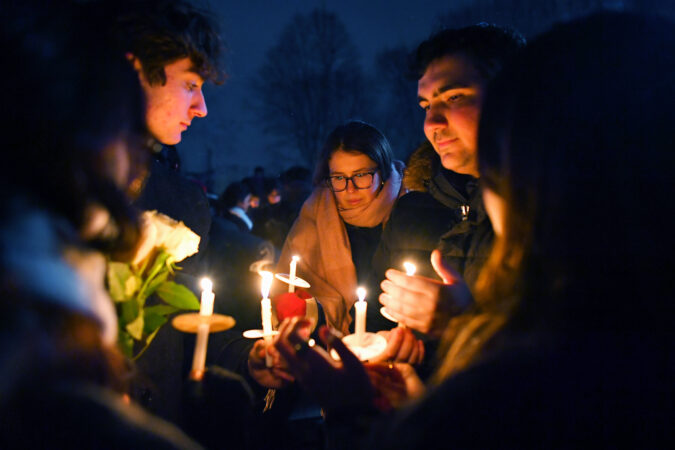
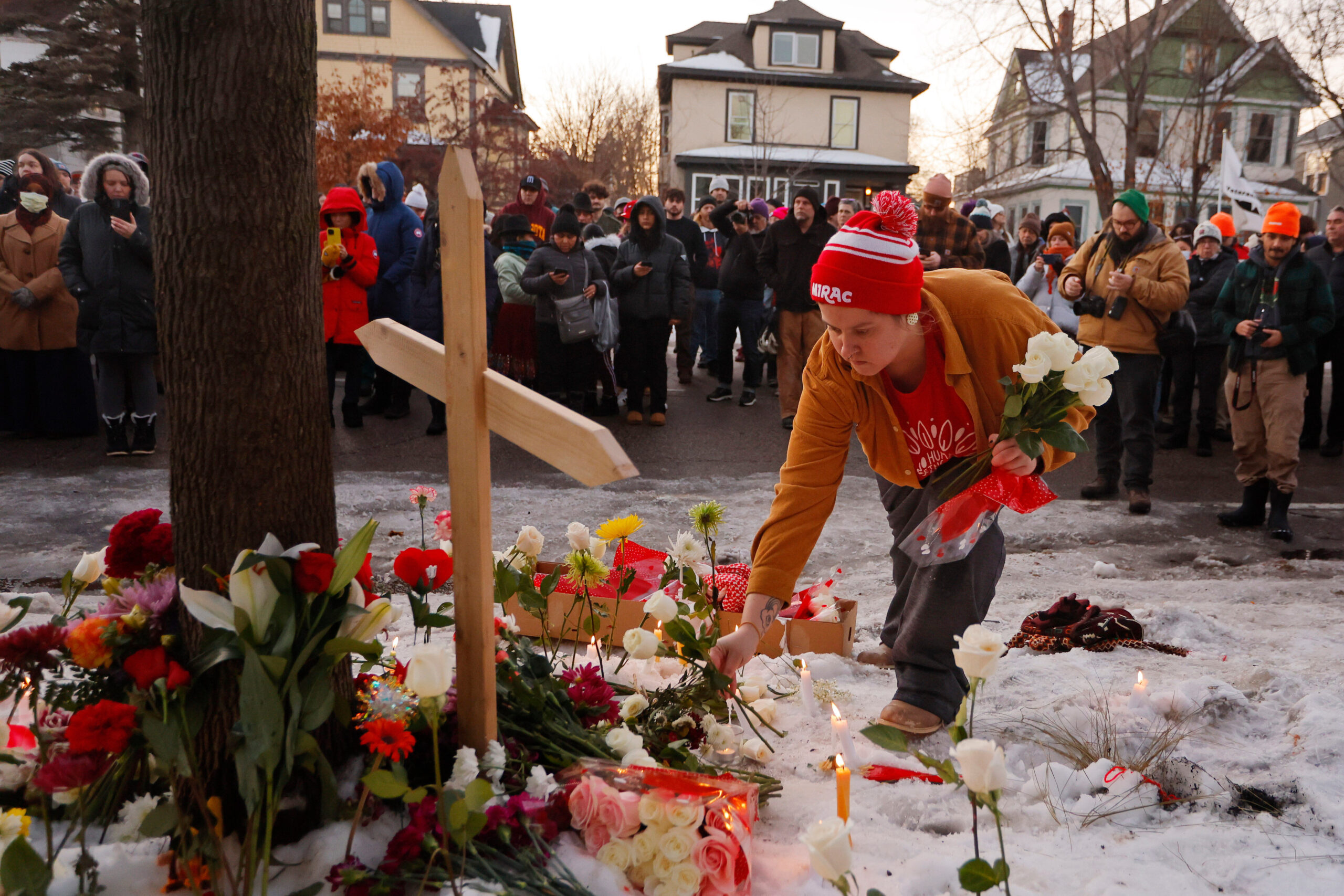
People gather for a vigil after a U.S. Immigration and Customs Enforcement agent shot and killed a motorist earlier in the day.
In her Nov. 20 ruling ordering federal agents to limit aggressive tactics in Chicago, U.S. District Judge Sara Ellis wrote that “agents have used excessive force in response to protesters’ and journalists’ exercise of their First Amendment rights, without justification, often without warning, and even at those who had begun to comply with agents’ orders.”
Dozens of videos, from cities around the nation, have shown federal agents engaging in violent behavior during their enforcement duties. Any one of those incidents could have turned deadly. That more people have not been killed in the administration’s reckless and ill-advised efforts can best be attributed to providence.
Reported close calls in California include Border Patrol agents smashing windows and firing on a truck as it drove away during a traffic stop, a man who claimed he wanted to warn agents there were children nearby was shot in the back by an ICE agent, and a TikTok streamer was shot as ICE agents smashed his car window.
In Chicago, a woman was shot multiple times after she allegedly rammed the vehicle of a U.S. Customs and Border Protection agent. The charges against her were dismissed in the face of glaring inconsistencies in the government’s story.
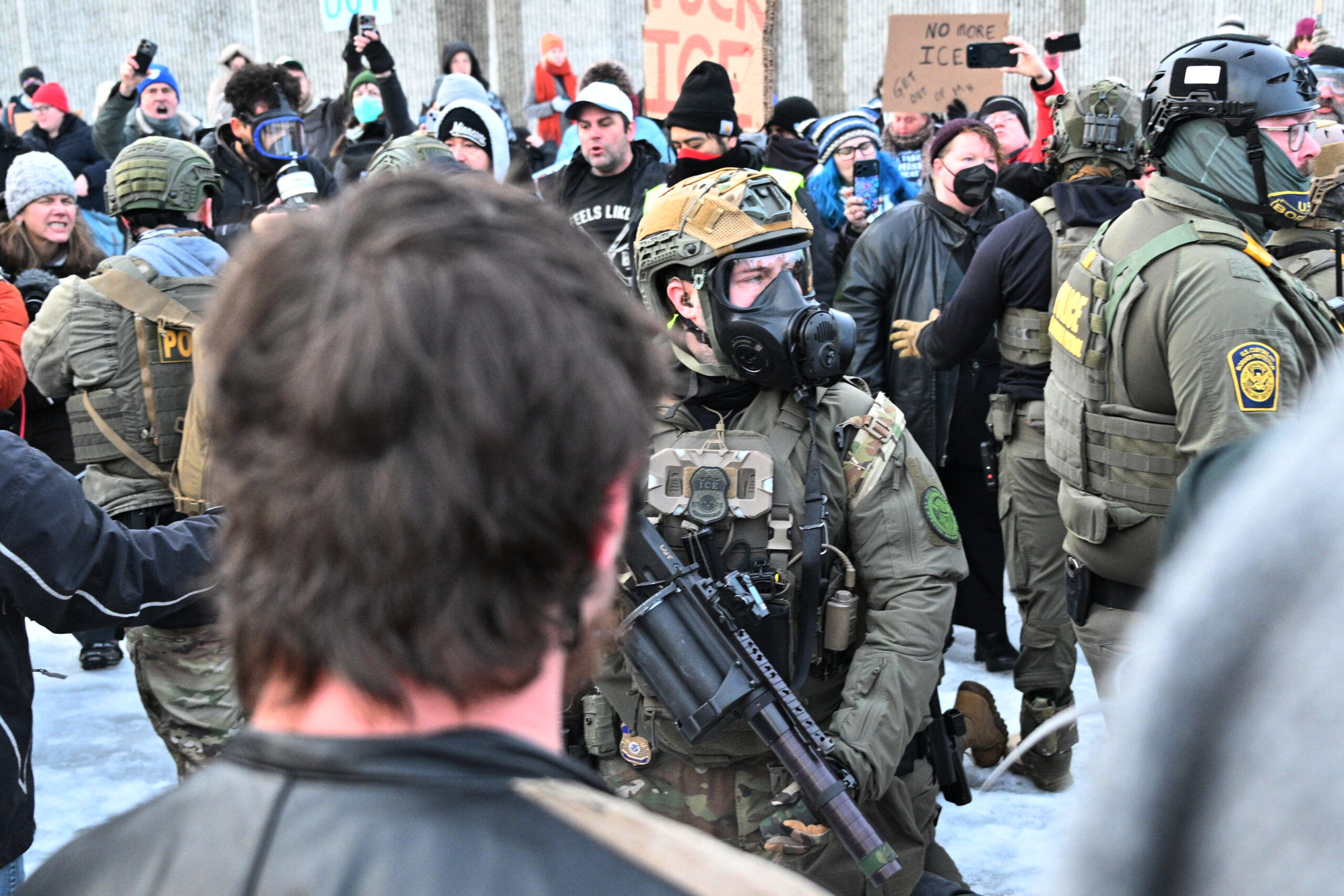
Federal agents confront protesters outside the Bishop Henry Whipple Federal Building on Thursday in Minneapolis.
On Thursday, a day after Good’s killing, two people were reportedly shot by Border Patrol agents in Portland, Ore., after a vehicle stop. DHS once again claimed the driver “weaponized his vehicle” and attempted to run over the agents.
The conduct of too many federal agents involved in immigration enforcement not only violates the norms of decency and order but also goes against the various agencies’ use-of-force policies and rights enshrined in the Constitution.
All of that is meaningless, however, to an administration that has repeatedly shown disdain for the law and which has overtly condoned violence as an acceptable response to nonviolent behavior.
It may be too late for Congress to use its power of the purse to rein in these out-of-control agencies. Republicans have already given the president $30 billion to recruit thousands more ICE agents, even as hiring requirements are lowered and training time is reduced — a recipe for disaster.
Legislators not in thrall to the Trump administration must use every oversight opportunity they can muster to shine the spotlight on abuse and hold rogue officials accountable.
Local and state governments must lawfully push back and protect their residents — including investigating and charging federal law enforcement with crimes. In the Good case, the former is already proving to be a challenge, as Minnesota’s attorney general notes that state law enforcement officials are being pushed aside, and that the investigation will be conducted solely by the FBI.
Even as the president puts his thumb on the scales, the courts must stand firm and uphold the law.
And in communities across the country, everyday Americans like Renee Nicole Good must continue to peacefully exercise and defend our civil rights against those who would use fear and intimidation to gain control. The risk has never been greater, but the stakes have never been higher.
Jan. 6, 2021, should be a date that lives in infamy, like Dec. 7, 1941, and Sept. 11, 2001.
But five years after an angry mob stormed the U.S. Capitol, Donald Trump’s insurrection marches on.
Instead of accountability, Trump parlayed the grotesque events that unfolded on Jan. 6 into an incomprehensible return to power and profiteering.
And ever since, Americans have been forced to endure one battle after another.
It began with Trump rewarding the Jan. 6 insurrectionists by pardoning more than 1,500 attackers who were convicted or charged with crimes, including many who beat police officers and some who have since been charged with new crimes.
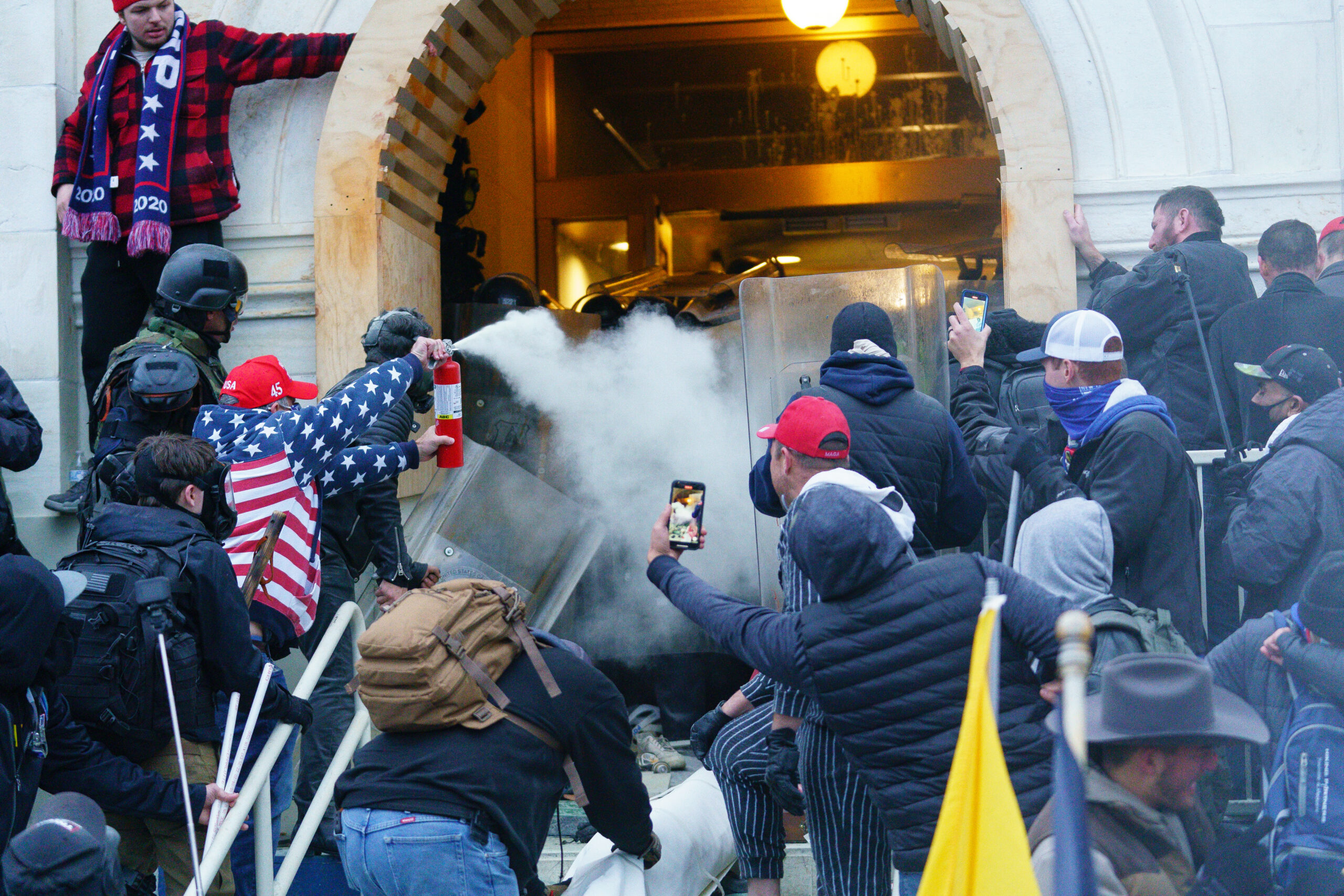
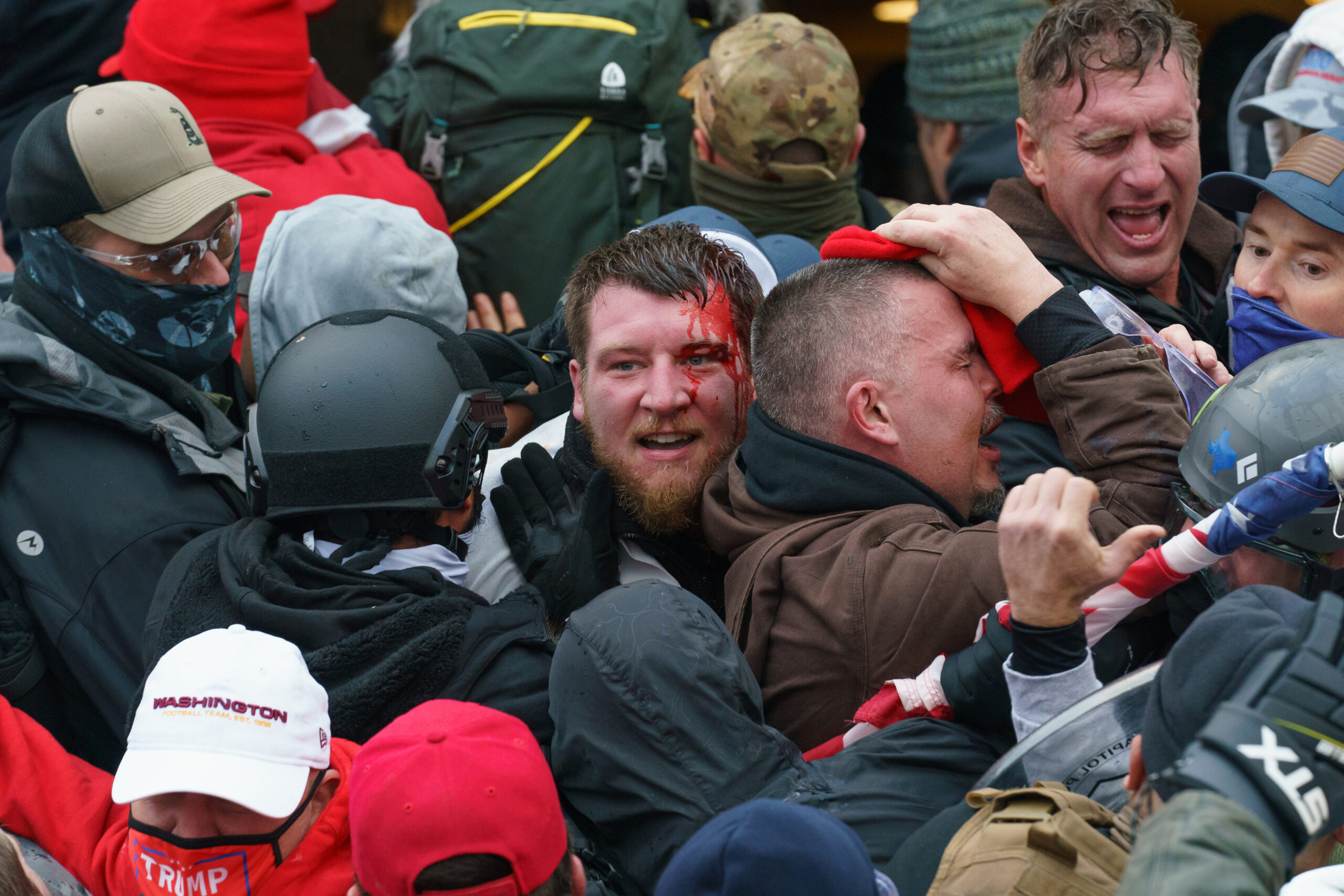
Rioters clash with police to try to gain entry to the U.S. Capitol building during the insurrection on Jan. 6, 2021.
Trump has continued to attack the government he swore an oath to protect, causing grave and lasting damage.
Elon Musk’s chain saw-wielding assault on federal agencies failed to root out much fraud or waste, but it did cause massive disruptions to many departments while upending the lives of more than 300,000 workers who lost their jobs.
Trump sicced the U.S. Department of Justice on political enemies, marshaling flimsy criminal cases against them while pardoning cronies. The rule of law — a cornerstone of American democracy — remains under assault.
Meanwhile, the FBI shifted away from investigating terrorist groups and is now said to jokingly stand for Foolish, Belligerent, and Incompetent.
Trump unleashed Robert F. Kennedy Jr. to “go wild” on health, medicine, and food. Since taking over the U.S. Department of Health and Human Services, Kennedy, who has no medical training, has canceled billions of dollars in contracts for medical research, fired thousands of workers, upended vaccine policies that saved millions of lives, and embraced discredited and fringe theories.
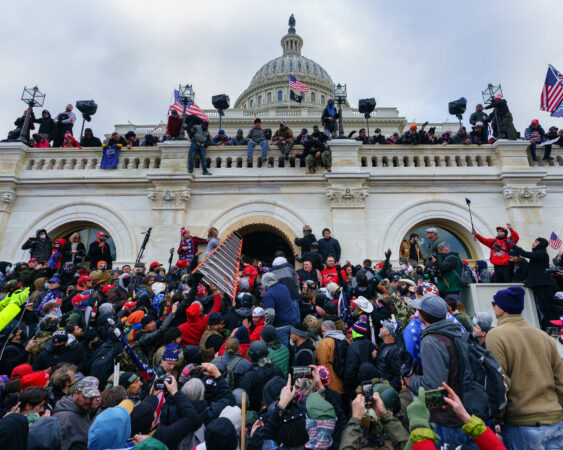
Pro-Trump protestors grapple with police outside the U.S. Capitol on Jan. 6, 2021.
Trump has also launched unprovoked attacks overseas, increasing tensions with allies and adversaries while likely inspiring future terrorists.
He ambushed Ukrainian President Volodymyr Zelensky, an ally, in the Oval Office, while rolling out the red carpet for Russian leader Vladimir Putin, a wanted war criminal. Instead of aiding Ukraine, Trump is abetting Russia — an epic blunder that risks the peace in Europe that American soldiers helped to secure in World War II.
Trump endorsed Israel’s demolition of Gaza and bombed Iran’s nuclear facilities, a move U.N. Secretary-General António Guterres called a “dangerous escalation in a region already on the edge — and a direct threat to international peace and security.”
Trump has illegally bombed small boats in Central and South America, summarily killing more than 100 alleged drug smugglers without presenting any evidence or trials.
Over the weekend, Trump approved a plan to snatch Venezuelan President Nicolás Maduro and his wife and bring them to the U.S. to face criminal charges.
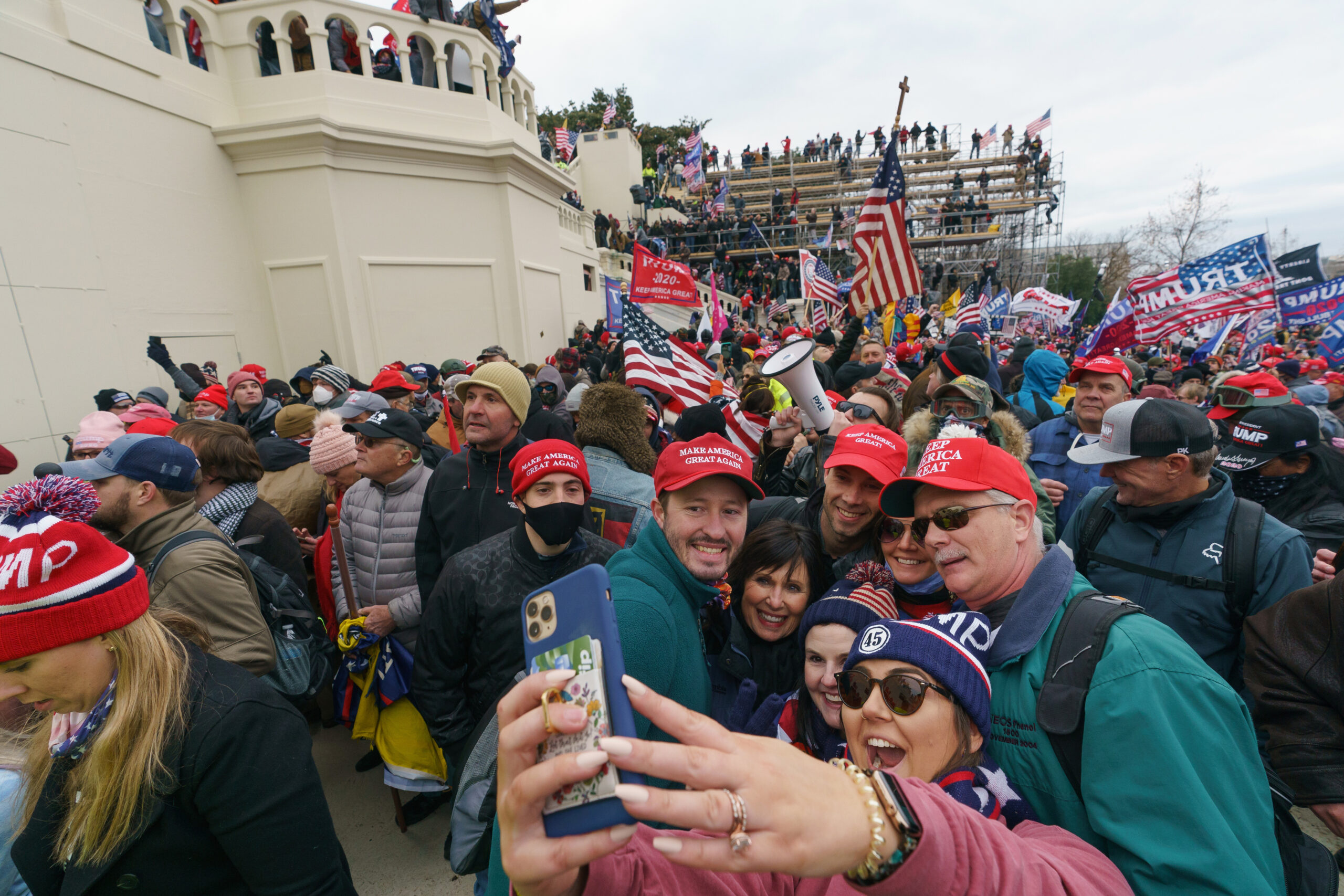
Trump supporters take a selfie at the U.S. Capitol during the insurrection on Jan. 6, 2021.
While no one is shedding tears for Maduro, Trump has no clear plan — or total control — for what comes next. Trump claims the U.S. is going to run Venezuela and take charge of its oil, while spouting loose talk about invading Cuba, Colombia, Mexico, and Greenland.
That sounds like imperialism run amok.
The U.S. is headed into dangerous and uncharted territory because of the failure of Congress, the courts, and voters to hold Trump accountable. The upshot has been to breed further lawlessness.
Trump was impeached for inciting the Jan. 6 riot. But then-Senate Leader Mitch McConnell and most other Republicans in Congress — in a gross dereliction of their sworn duty — voted against convicting him even though many said he was liable.
Trump was also criminally indicted for his role in attempting to overturn the 2020 election, which led to the Jan. 6 insurrection. The case was dropped after he was reelected, but special prosecutor Jack Smith recently told the House Judiciary Committee that a conviction was likely since there was “proof beyond a reasonable doubt.”
Trump brought out the worst in America on Jan. 6. Five years later, the damage continues to grow.
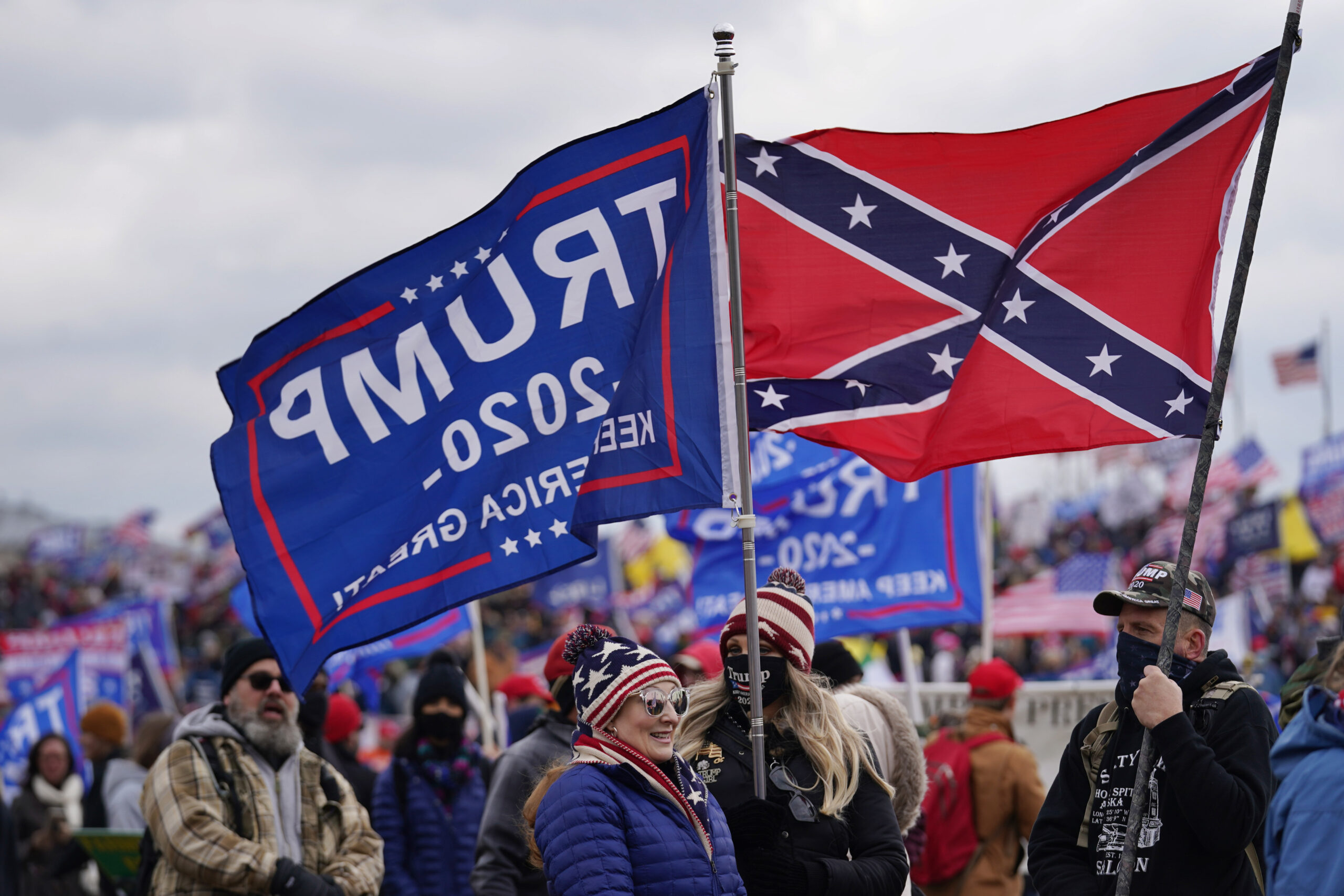
Candria (with sunglasses) and Cynthia Crisp speak with another Trump supporter holding a Confederate flag near the Washington Monument, on Jan. 6, 2021.
President Trump mounted an illegal invasion of Venezuela, kidnapping president Nicolás Maduro and his wife and spiriting them out of the country.
The breathtaking use of military force against a sovereign state has no legal justification. It opens the door for anarchy in Venezuela and threatens to make the United States a pariah with no moral authority for other dictatorships around the globe.
Trump acted without the authorization of Congress, in clear violation of the Constitution. But then again Trump has long mocked the Constitution he swore to uphold.
Former President George W. Bush at least sold a phony story about weapons of mass destruction to get Congress to go along with his reckless invasion of Iraq. That catastrophic folly lasted nearly nine years, resulting in tens of thousands of needless deaths and costing taxpayers roughly $3 trillion.
Trump once promised to avoid forever wars and claimed to be the president of peace. But without any provocation or convincing explanation, he launched a military buildup in the Caribbean and began illegally bombing small boats, killing alleged drug smugglers in Central and South America.
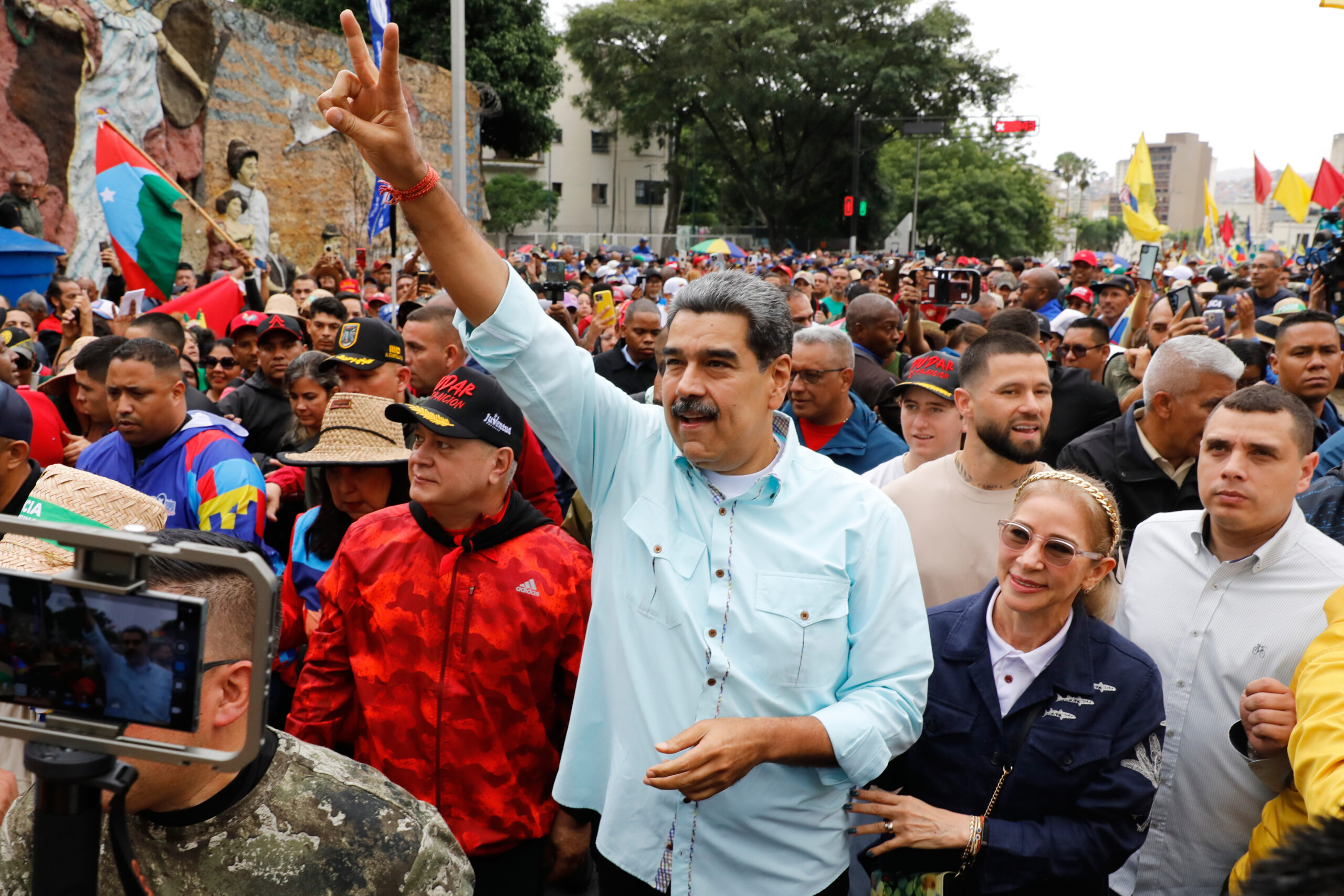
President Nicolás Maduro joins a rally in Caracas, Venezuela, on Dec. 10, 2025. The Trump administration designated Cartel de los Soles, which it says is headed by Maduro, a foreign terrorist organization.
Trump has offered shifting explanations — and even less evidence — for the military action ranging from wanting to stop drug trafficking to accusing Maduro of “stealing” U.S. oil and land.
After the attack, Trump came clean on just how out of control the operation is, claiming the U.S. is ”going to run the country” and take over oil production.
Congress, which under the Constitution, has the sole power to declare war, rejected efforts to rein in Trump’s warmongering. House Speaker Mike Johnson, a Trump puppet, praised the attack as a “justified operation that will protect American lives.”
Sen. Andy Kim (D., N.J.) called the move “disastrous” and said Secretary of State Marco Rubio and Defense Secretary Pete Hegseth “blatantly” lied to Congress when they said the goal of the military buildup was not to topple Maduro.
To be sure, Maduro is a corrupt and undemocratic leader who has brought economic ruin and death to Venezuela. Under his repressive regime, roughly 8 million people have fled the country.
But if the Trump doctrine is the removal of corrupt and undemocratic leaders, where do the military actions end? How does Trump square the removal and prosecution of Maduro with his outrageous pardon last month of former Honduras President Juan Orlando Hernández, who was convicted of drug trafficking by federal prosecutors?
Trump’s strongman act will do little to spread peace and democracy around the globe. In fact, the military actions in Venezuela may embolden China to invade Taiwan. It also signals to Russian dictator Vladimir Putin that Trump is not serious about defending Ukraine or Europe.
It is painfully clear there is a corrupt and unrestrainedmadman in the White House. Yet, the conservatives on the U.S. Supreme Court and the Republicans in Congress have abandoned their role to act as checks on the executive branch, starting with the insurrection Trump fomented nearly five years ago.
Under Trump, the American democracy that is getting ready to celebrate 250 years, is backsliding. A Harvard professor who studies democracies said flatly: “We are no longer living in a democratic regime.”
The unauthorized attack in Venezuela is just the latest example of Trump’s growing authoritarian rule.
For nearly a decade, city transportation and public safety officials have taken part in Vision Zero, an ambitious, nationwide program designed to help communities reduce the number of lives lost to traffic collisions.
In recent years, City Hall has narrowed lanes, installed red-light cameras, and built speed humps in roadways in an effort to slow traffic and keep pedestrians safe.
According to an analysis by the Bicycle Coalition of Greater Philadelphia, the city has suffered 94 fatalities this year. That’s a 39% decrease from the 155 Philadelphians who lost their lives in 2020.
According to the Bicycle Coalition of Greater Philadelphia’s “Traffic Victims Report,” pedestrian fatalities this year are down 39% compared with 2024.
City officials, including Mayor Cherelle L. Parker, deserve credit for swimming against this national tide. While there is little City Hall can do to regulate vehicle size, officials have used the tools that are available to reduce fatalities.
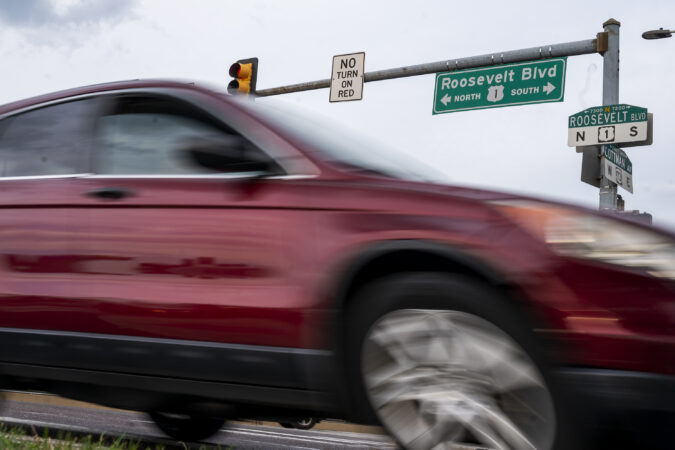
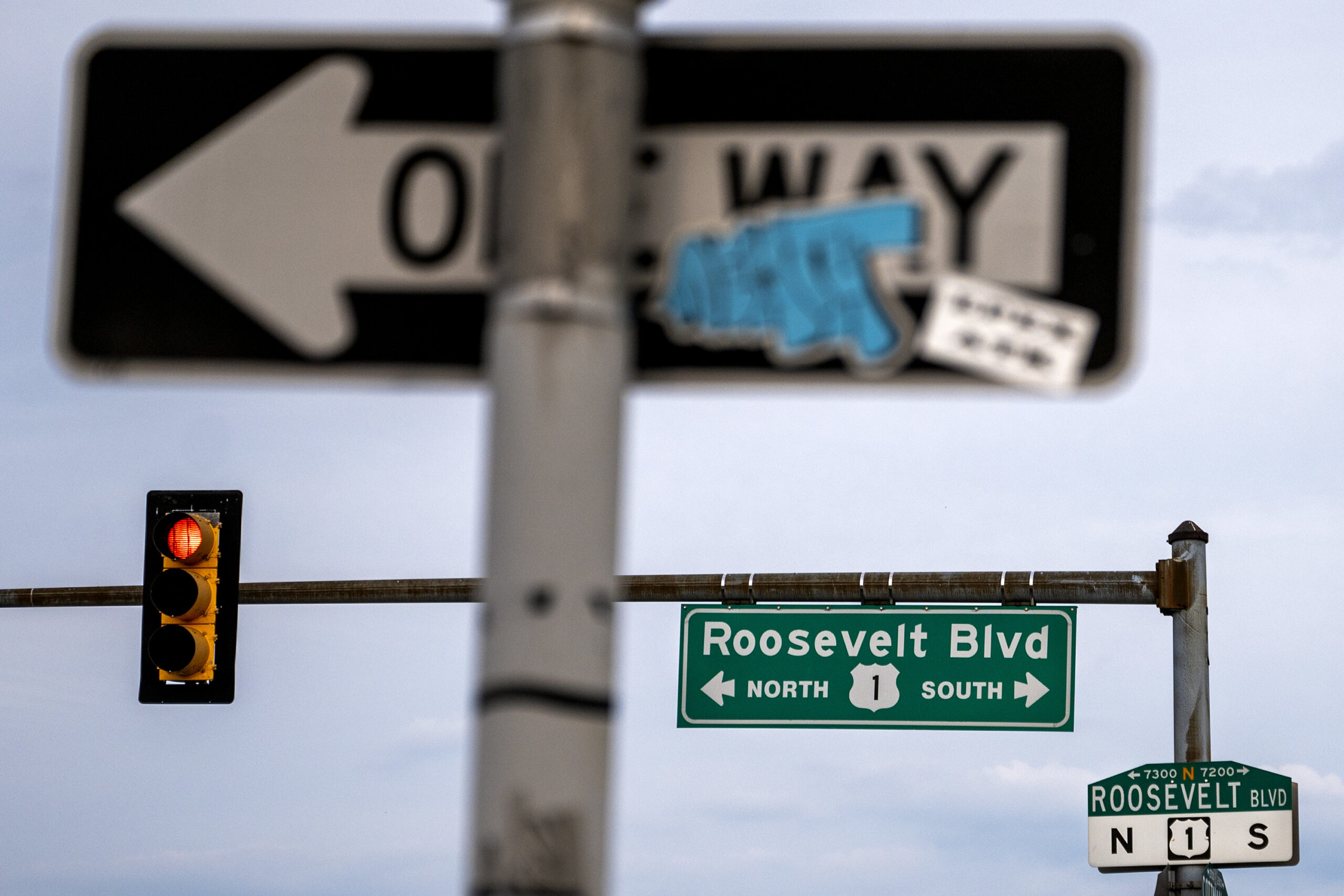
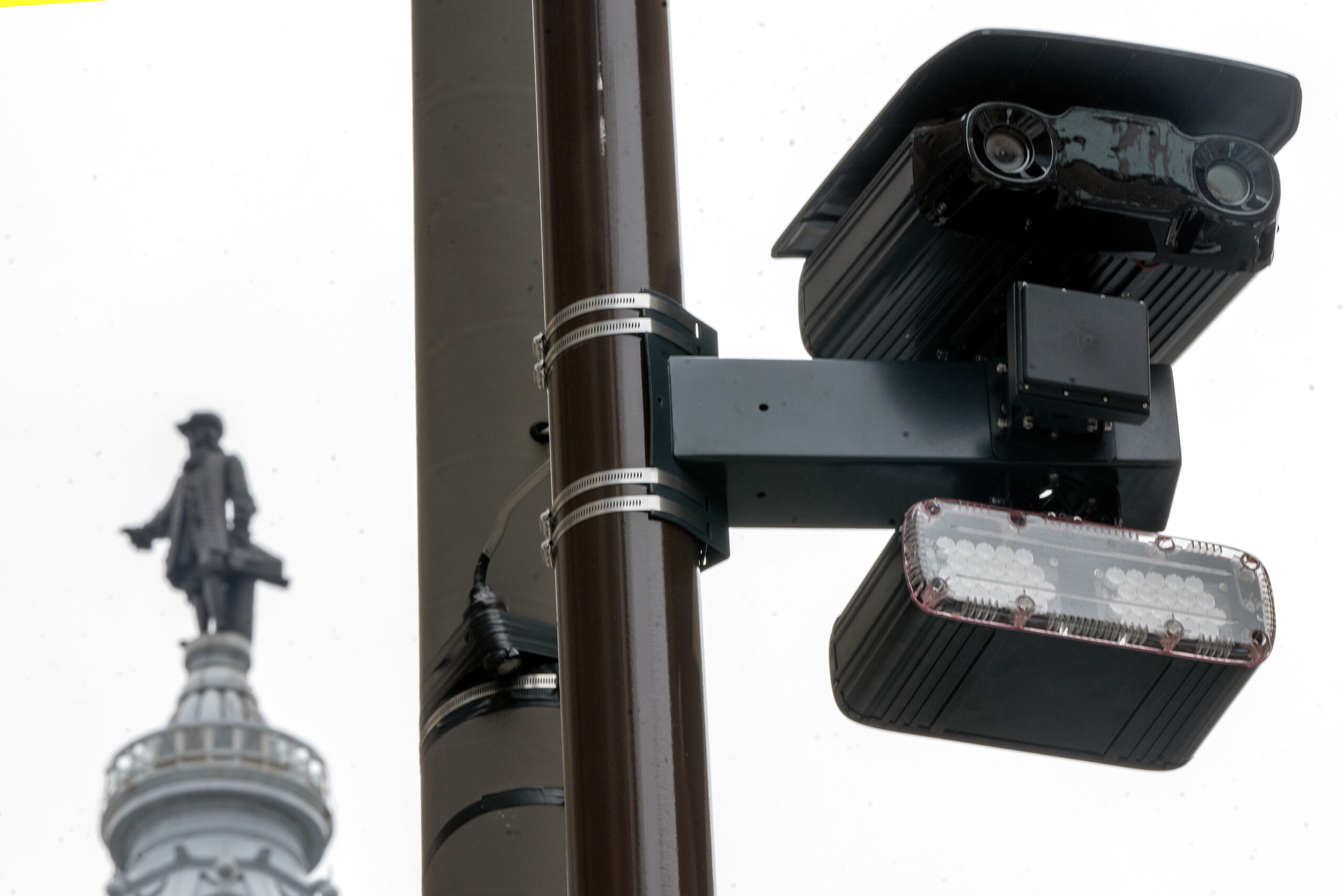
The city’s biggest success story is Roosevelt Boulevard. Once dubbed one of the most dangerous roads in America, the Boulevard is no longer even the most dangerous corridor in Philadelphia (Broad Street now holds that dubious distinction). The change is largely a result of the installation of speed cameras, which officials credit with saving around 50 lives since they were installed in 2020. The cameras have now been installed for Broad Street, as well.
Additionally, the Parker administration has placed a welcome focus on safety around schools and playgrounds. Given that an average of about five Philadelphia children are struck by a vehicle every week, those efforts should be accelerated. After some initial consternation, City Council approved speed cameras for seven school zones this year. If those programs show success, they should be expanded.
An automated speed enforcement camera is mounted on North Broad Street at Arch Street.
So, too, should support from the police. In an interview with Philadelphia Magazine, Police Commissioner Kevin J. Bethel responded to a plea for more traffic enforcement with a reference to ongoing staffing issues, saying that his officers must prioritize the most serious calls. With 100 Philadelphians dying in collisions each year, citations and arrests for traffic violations should remain a point of emphasis.
The plan to reduce traffic fatalities also requires some assistance from Harrisburg. City officials would like to set their own speed limits, arguing that state rules that are designed for rural and suburban communities don’t work in dense, urban areas with heavy pedestrian traffic.
There is still much to be done when it comes to keeping pedestrians in the city safe, but Philadelphians can take comfort in knowing that the tools currently in place are doing what they’re intended to do — save lives.
Donald Trump’s first year back in the White House has brought only one surprise: the speed with which he has upended the American Experiment. This board spent 2024 warning of the dangers a second Trump administration could bring. It was hardly soothsaying.
Sadly, Trump’s 2025 performance has reminded many voters that his undeniable luck, charisma, and bravado may be entertaining, but the reality of governance demands more. The office of the presidency demands more.
For his second term, no longer constrained by the guardrails the conservative establishment placed on his first presidential stint, and surrounded by sycophants and incompetents, Trump has wasted no time trying to live out his authoritarian fantasies while being unable to keep the trains running on time.
Indeed, he is very much the man whose administration helped give the world a COVID-19 vaccine in record time before bowing to anti-vax conspiracy theories that ultimately cost American lives.
Instead of allowing inflation to continue to abate and the U.S. economy to live up to its label as “the envy of the world,” he haphazardly and likely illegallyinstituted tariffs on global trading partners that amount to a tax on American consumers. Rather than sitting back and taking credit for curtailing immigration at the southern border, which concerned a large number of voters, he’s lost public support as masked federal agents abuse, harass, and intimidate immigrants and citizens alike.
Trump’s signature legislation, the One Big Beautiful Bill Act, is set to make the rich richer and the poor poorer, all while a shrinking middle continues to lose faith in America’s institutions — some of which have willingly acquiesced to whatever Trump demands.
But while Trump has failed to make life better for everyday people, he has been successful in enriching himself, his family, and his cronies. He has captured the U.S. Department of Justice and the FBI, pushing them to pursue his perceived political enemies; used the U.S. Department of Homeland Security to implement cruel immigration policies and as a de facto secret police; and devastated America’s standing in the world by destroying the U.S. Agency for International Development, which helped generate enormous goodwill while improving the lives of millions of people around the globe.
The following appraisal of Trump’s presidency so far is not a “we told you so,” because we are all in this together. It is a reminder that those of us who value democracy and the rule of law must continue to stand fast and push back in defense of the ideals that fueled our nation’s founding and the rights and obligations codified in the Constitution.
As 2025 ends and a new year begins, we must not allow the avalanche of outrages to numb us to the fact that Trump remains unfit for office.
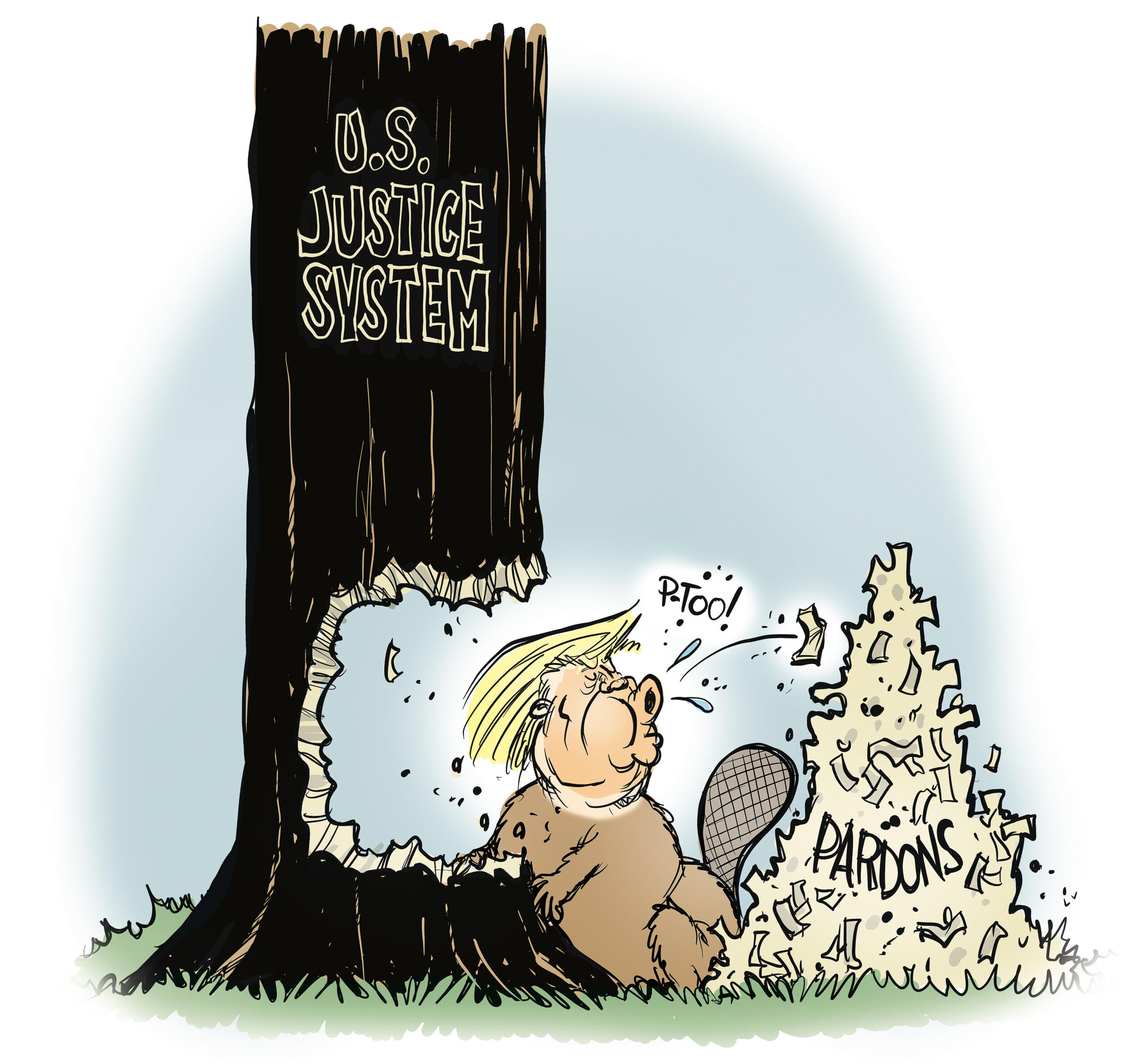
Donald Trump and his administration have attacked judges and maligned the courts, while the president has used his pardon power to eliminate accountability for his political allies and business interests.
Pardoned lawlessness
As far as ominous indicators of dire times ahead, “Abandon hope, all ye who enter here” is difficult to beat. But Trump’s blanket pardon of the roughly1,600 people involved in the attack on the Capitol comes in a close second.
Signed shortly after he took power, among a raft of other troubling executive orders, the clemency shown to the insurrectionists — including those who brutally assaulted law enforcement officers — showed the administration had no interest in accountability for its political allies nor any true concern for the rule of law.
Among Trump’s biggest abuses of presidential power are pardoning Rudy Giuliani and dozens of others accused of trying to overturn the 2020 election, campaign donor and convicted fraudster Trevor Milton, cryptocurrency kingpin Changpeng Zhao, and former Honduran President Juan Orlando Hernández, who had been sentenced to 45 years in prison for drug trafficking.
But why wait for a pardon when the president can simply pressure Justice Department lawyers to drop the corruption case against New York Mayor Eric Adams, or dismiss allegations that Trump border czar Tom Homan took $50,000 from FBI agents posing as business executives.
It is part of the administration’s stifling hypocrisy that while it righteously claims to seek justice by going after people like former FBI Director James Comey or New York Attorney General Letitia James, or labels all undocumented immigrants as criminals, it brazenly ignores due process — a bedrock principle of the American legal system.
If there are bright spots in a U.S. justice system in which the attorney general operates more like the president’s lawyer than a servant to the American people, it’s that grand juries remain independent, refusing to indict on trumped-up charges. And the courts — run by judges appointed by presidents of both parties, including some by Trump himself — are still a bulwark against the administration’s abuses.
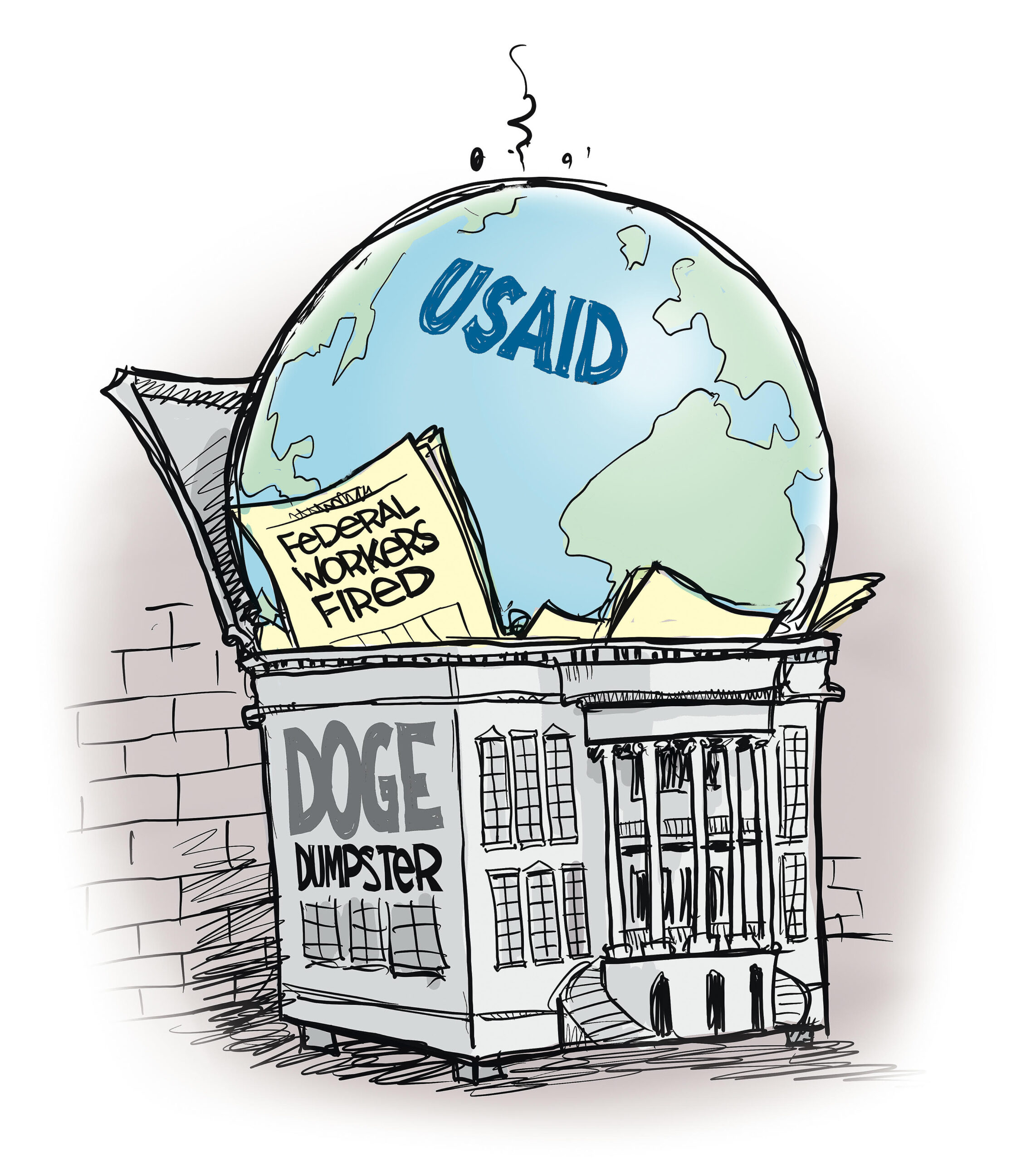
Donald Trump allowed billionaire Elon Musk to fire hundreds of thousands of government workers as head of the so-called Department of Government Efficiency. It is estimated that DOGE’s dismantling of the U.S. Agency for International Development has already led to the deaths of nearly 700,000 people.
Costly savings
The Department of Government Efficiency was Elon Musk’s chance to eliminate the U.S. Agency for International Development, an agency he called a “criminal organization” that needed to die. That the tech billionaire’s passion to eliminate USAID dovetailed with a bullet point in the conservative blueprint for Trump’s second term was likely welcomed by the administration.
Musk, who spent $250 million to help get Trump elected, was the public face of DOGE and promised to eliminate $2 trillion in government spending by identifying and eliminating waste, fraud, and abuse. What he did was bring in a squadron of techies more versed in crunching code than in carefully evaluating government services.
The chaos that followed meant not only the dismantling of USAID — which, as of Dec. 22, was estimated to have led to almost 700,000 deaths, more than half of them children, through the elimination of health and nutrition programs — but the firing or early retirement of nearly 300,000 federal employees.
DOGE also terminated more than $2.6 billion in contracts at the National Institutes of Health tied to medical research and clinical trials, leading to setbacks that may impact Americans’ health for generations.
So what was the result of DOGE’s actions? How much of that promised $2 trillion will show up on the positive side of the government’s ledger? According to an analysis by the libertarian Cato Institute, DOGE had no noticeable effect on the trajectory of government spending.
It did reduce the federal labor force, with savings that may amount to about $40 billion annually. That’s a lot less than it sounds when you consider it’s equal to 0.57% out of around $7 trillion in U.S. spending.
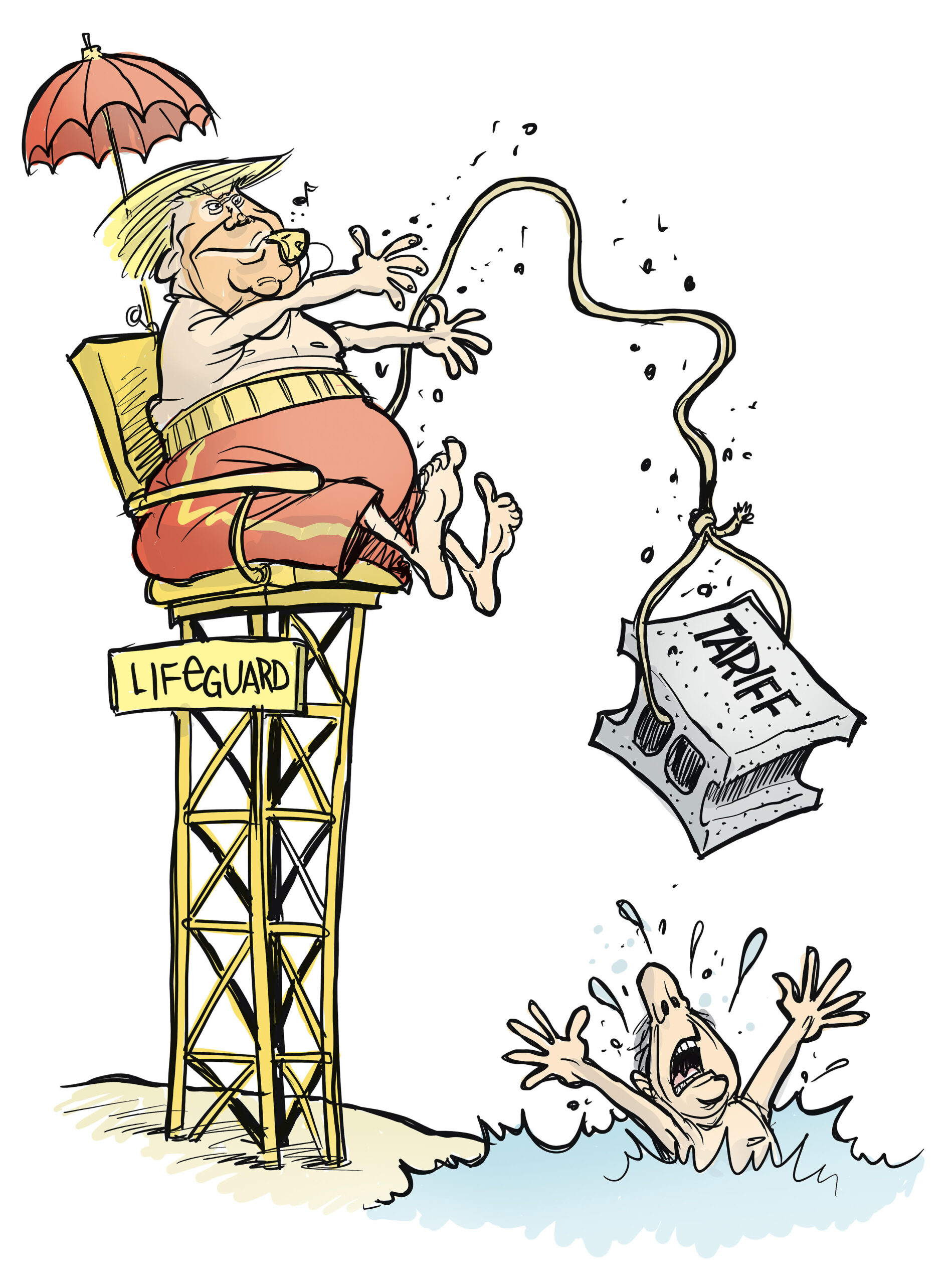
In his campaign for the president, Donald Trump promised he would lower consumer prices. A dubious pledge under most circumstances was made worse by policies, including the chaotic application of tariffs, that threaten the economy as a whole.
Self-inflicted decline
Looking at the data, it was easier to see why Vice President Kamala Harris did not distance herself from President Biden’s economic policies in her 2024 run for the White House. After all, after suffering through the pandemic like the rest of the world, the U.S. economy was bouncing back faster and stronger than that of other developed nations.
Unfortunately for Harris, to many voters, “Bidenomics” did not mean higher wages, lower unemployment, record stock market gains, and that post-pandemic inflation was starting to ease. It certainly didn’t mean billions in investment in infrastructure projects or in domestic production of critical semiconductors through the CHIPS and Science Act.
It meant the high cost of a dozen eggs.
Trump took advantage of the bad economic vibes and pledged to lower prices on Day One if elected. This was a dubious promise under most circumstances. Considering the president’s signature economic policies — indiscriminate tariffs and mass deportations — were destined to actively hurt consumer prices, it was political malpractice.
It is no wonder, then, that people have begun to sour on Trump’s economy, with the latest polling finding 57% of Americans disapprove. People are worried about losing their jobs, as unemployment has increased, and household debt levels are at record highs.
The impact of the president’s tariffs, which are taxes paid by the importer, not the exporter, is gradually being felt on the price of goods. Meanwhile, the administration’s crackdown on immigration, both legal and illegal, is hurting industries that depend on immigrant labor, including construction, agriculture, and health services.
According to the administration, fewer immigrants in jobs means more jobs for native workers, but so far, that result has not materialized. Instead, the projected economic impact of mass deportation on the labor force and consumer market (i.e., fewer people in the country purchasing goods and services) could reduce the U.S. gross domestic product — a common measure of economic growth — by 4.2% to 6.8%, according to the American Immigration Council. On the low end, that would be similar to the impact of the Great Recession on GDP.
Trump also promised to reduce energy prices by half within 18 months of taking office. The growing demand from data centers and the administration’s continued efforts to delay or kill renewable energy projects make it unlikely he will be able to deliver.
Trump infamously said his tariffs meant kids would get “two dolls instead of 30” come Christmas, but even that may have been optimistic, as data find more Americans are relying on installment or buy-now-pay-later plans to cover their holiday shopping.
The president, who had called Americans’ affordability concerns a “fake narrative” and a “con job,” backtracked in a prime-time speech on Dec. 18 in the most Trumpian way possible: He lied.
Trump falsely blamed immigrants for driving up the cost of housing, claimed gasoline is $2.50 a gallon “in much of the country,” and took credit for the mathematically impossible “400, 500, and even 600%” reduction in the cost of some prescription drugs, and for securing $18 trillion in investments in the U.S.
“Inflation has stopped, wages are up, prices are down, our nation is strong,” Trump said.
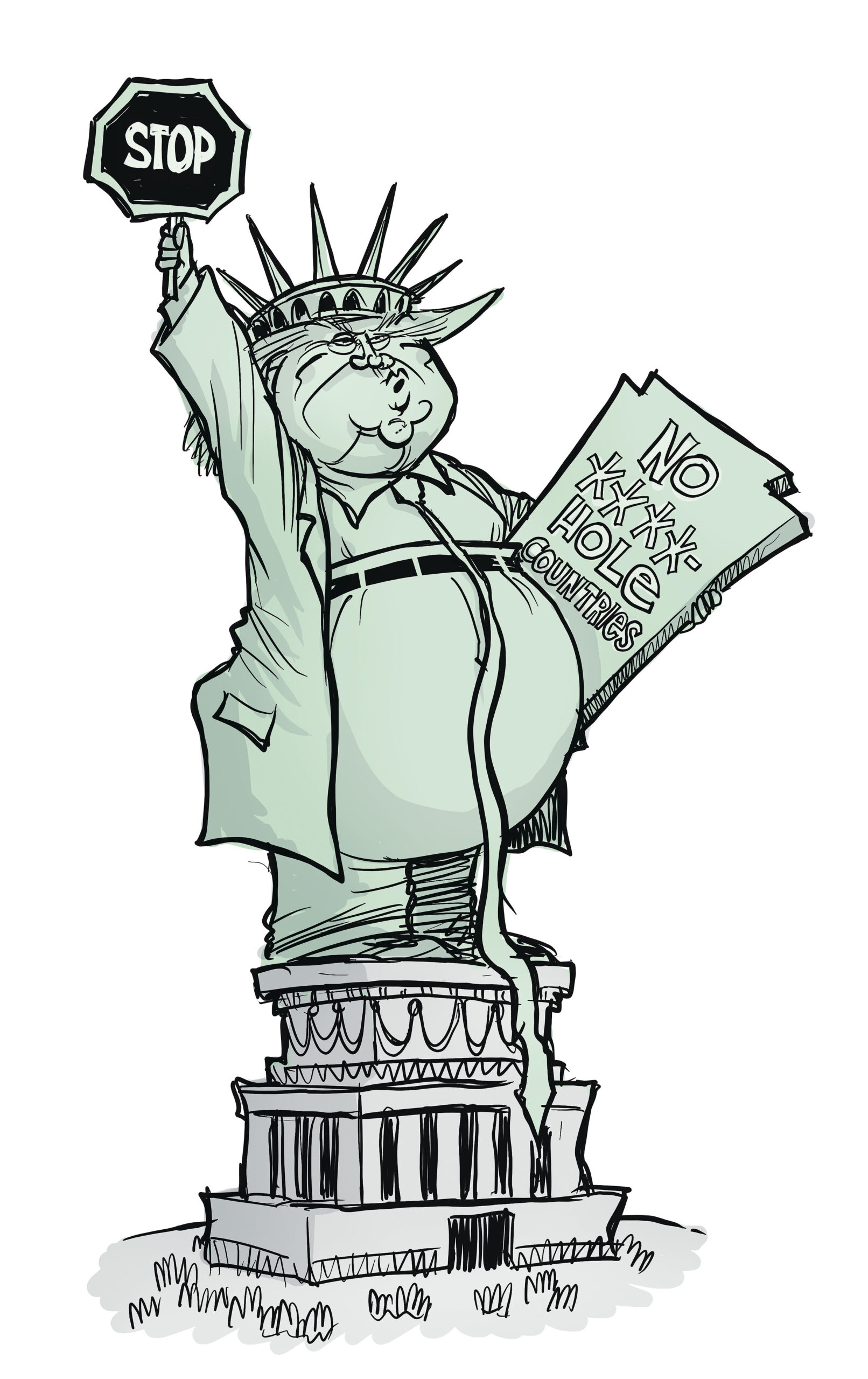
Donald Trump’s immigration enforcement agencies are seeding terror in communities while his administration’s immigration policies are unashamedly bigoted.
Anti-American sentiment
The Trump administration does not like immigrants. Period.
It does not like those who crossed the border illegally in search of a better life, nor those who are fleeing persecution and are seeking asylum in the land of opportunity. It does not like those who come here to study in America’s universities, nor those who want to fill jobs in fields in which there are not enough native-born workers.
The administration is looking for any excuse — any one example it can point to — to paint all immigrants as rapists, as murderers, as garbage. Any excuse to shut the golden door that has welcomed people from across the world to the benefit of a nation that is as dynamic as it is diverse.
What Trump and the ethnonationalists who surround him fail to understand is that the United States is an ideal — one so strong it has held disparate groups of people together for almost 250 years. The secret to America’s success is that everyone has the right to life, liberty, and the pursuit of happiness.
Perhaps that’s why the administration’s immigration enforcement feels so wrong to so many. Why it’s losing support even among those who voted for Trump.
That is why people are standing up against Trump’s tactics. They are organizing and pushing back, peacefully, against people being snatched up off the streets, against neighbors being intimidated, families split apart, cities roiled by chaos of the government’s own making.
Because while the administration may not like immigrants, America does.
Donald Trump called the very real threat of climate change a “con job.” His administration’s policies not only ignore efforts to mitigate the problem, they actively seek to make it worse.
Climate of denial
The American people’s concern about affordability is at least not the biggest “con job,” according to Trump. That distinction belongs to climate change, humanity’s era-defining challenge that the president has long called “a hoax.”
Speaking to the United Nations in September, Trump said predictions about the impact of a warming planet “were made by stupid people that have cost their countries fortunes and given those same countries no chance for success.”
Never mind that the effects of climate change are already evident in rising sea levels, increasing temperatures, and more frequent extreme weather events such as wildfires and flooding.
Not content with simply ignoring decades of science that prove greenhouse gas emissions caused by human activity are negatively affecting the planet, the Trump administration has swiftly moved to defund climate research, reverse U.S. climate change mitigation efforts, and impede the development of clean energy sources.
On Monday, the government suspended all large offshore wind farms under construction, citing “national security risks.” It was the latest example of Trump using regulatory red tape to hinder these kinds of projects to the detriment of both the environment and clean energy jobs.
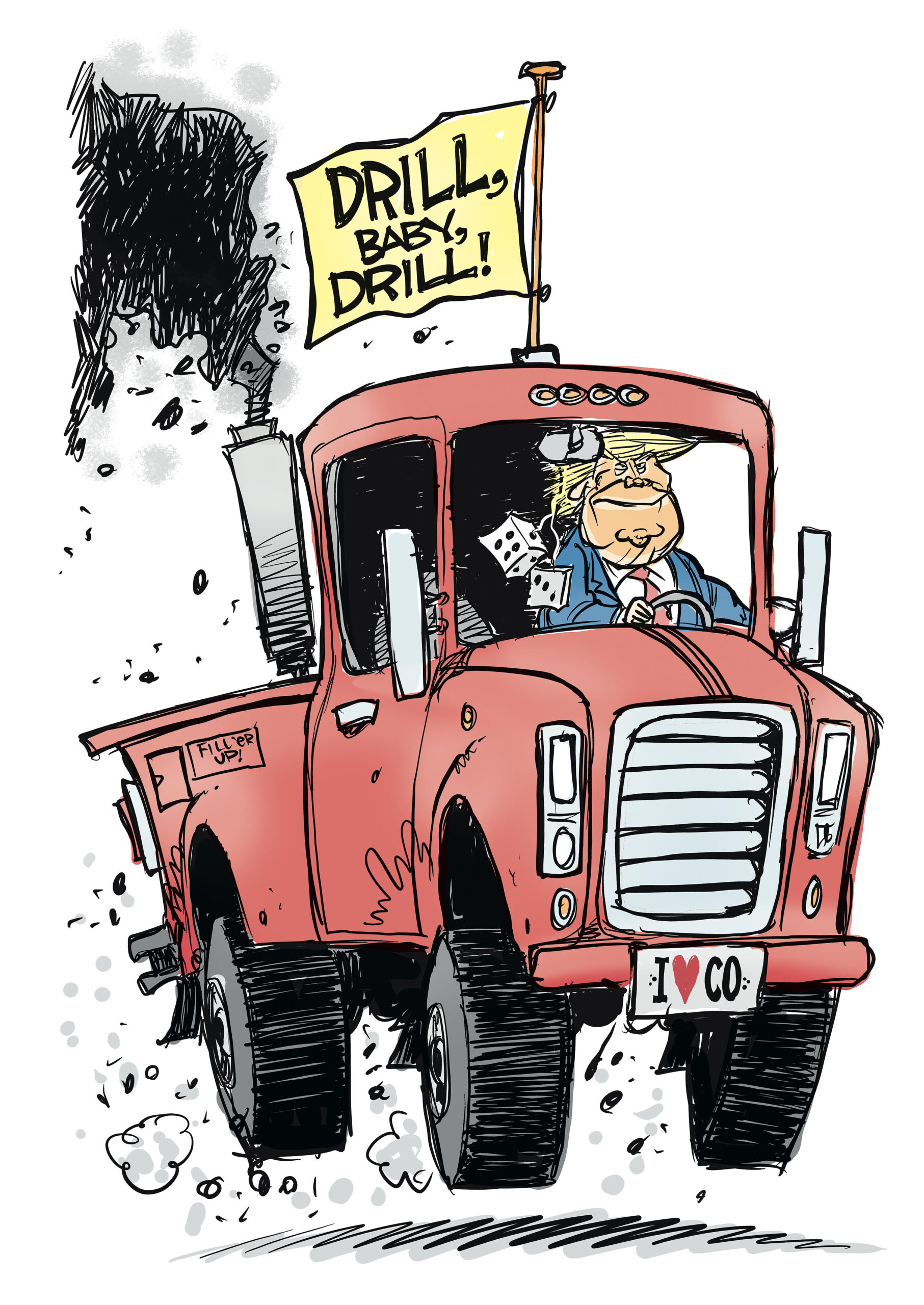
Trump and his allies in Congress have also eliminated subsidies for solar panels, wind turbines, and electric vehicles — all while promoting fossil fuel use, including oil, gas, and coal.
While Trump’s climate and energy policies are a danger to the entire world, his administration’s policies also put Americans at risk in their own backyards. The Environmental Protection Agency has rolled back multiple efforts to promote clean air and water, including limits on toxic pollutants from coal-fueled power plants, greenhouse gas emission limits from coal- and gas-fueled power plants, and delayed timelines for water utilities to remove some “forever chemicals” from drinking water.
As Trump tries to leave a legacy by demolishing part of the White House to build a $300 million ballroom or emblazoning his name atop the Kennedy Center, it may be his shortsighted gutting of climate and environmental rules that truly leaves a mark for the ages.
Since retaking the White House, Donald Trump has added billions of dollars to his personal wealth, much of it through crypto and other digital currency schemes.
Shameless enrichment
The man who once couldn’t make money off a casino is $3.4 billion richer since he took office on Jan. 20. He did this, as reported in a comprehensive piece by the New Yorker’s David D. Kirkpatrick, by ignoring conflicts of interest and gauchely trading on the prestige and power of the U.S. presidency for personal gain.
The corruption is so flagrant and transparent that many voters perhaps think this is normal. But while there is likely nothing illegal in what is known about the president’s business ventures, no clear evidence of any quid pro quo, there is nothing ordinary or ethical about what Trump and his associates are doing.
For example, potential access to Trump at his Mar-a-Lago club now comes with a $1 million initiation fee — up from $100,000 in 2016. In May, the president hosted a gala at a Virginia golf club for the biggest buyers of his meme coin, an intrinsically worthless digital token for which the 220 attendees at the event shelled out $148 million. The venture, along with a separate $MELANIA meme coin, reportedly netted the Trumps $385 million.
Cryptocurrency is where Trump and his family are profiting the most.
The digital currency, which can be traded without relying on banks to verify transactions — or regulate or report them — has so far earned the Trump family billions. It is here where some of the most egregious conflicts of interest are made manifest, as individuals and foreign governments with interests before the United States, including government regulation of crypto itself, have made large investments that end up in Trump’s coffers.
Shortly after Trump won the election, a Chinese billionaire accused of fraud invested $30 million in World Liberty Financial, a Trump family cryptocurrency interest. In May, an Abu Dhabi, United Arab Emirates-backed investment firm put $2 billion into the company.
While Trump’s two sons strike lucrative business deals around the world, Trump’s foreign policy seems to be dictated by his drive for fortune. A plan for the “Gaza Riviera” was tied to the end of the war between Israel and Hamas, while either mineral deals from Kyiv or business ventures in Russia have become part of the calculus around the war in Ukraine.
In his short time back in the White House, Trump has shown that the presidency of the United States is open for business.
The U.S. Department of Justice, which seems to otherwise have no trouble doing Donald Trump’s bidding under Attorney General Pam Bondi, continues to drag its feet in releasing the Jeffrey Epstein files mandated by Congress.
Protecting the powerful
Among the promises Trump made in his bid for the White House in 2024, releasing the investigation files regarding convicted sex offender Jeffrey Epstein should have been the easiest to fulfill. Yet, more than a year later, it took an act of Congress to force the Department of Justice to release the files — or at least some of them, at least partially.
The documents made available recently were criticized by lawmakers and victims as incomplete and full of heavy redactions, with some of the published material quickly taken down over unspecified administration concerns.
Epstein, who took his own life in 2019 inside a federal jail cell, was accused of exploiting or abusing hundreds of women and girls over decades, procuring them for his famous friends, who included financial titans and political leaders.
Despite the president’s denials, he and Epstein once shared a friendship, reportedly bonding over the pursuit of women. There are videos and photos of them together, and Trump repeatedly flew on Epstein’s plane (known as “the Lolita Express”), though the president claimed he “never had the privilege” to visit Epstein’s notorious island.
The island, Little St. James, was once described by government officials as “the perfect hideaway and haven for trafficking young women and underage girls for sexual servitude, child abuse and sexual assault.”
The Trump administration’s efforts to delay and obfuscate regarding the files remain an affront to justice and decency. Survivors of the horrors perpetrated by Epstein and the rich and powerful he catered to deserve a public accounting of what happened to them, and there must be accountability for those who participated.
If the president has nothing to hide, if the “privilege” was indeed never his, then whose was it? Whom is Trump protecting?
Of course, not all of the Jeffrey Epstein files were released.
Even some files made available late Friday were quickly removed. Large portions were heavily redacted. Some portions contained boldfaced names, but there was little mention of Donald Trump.
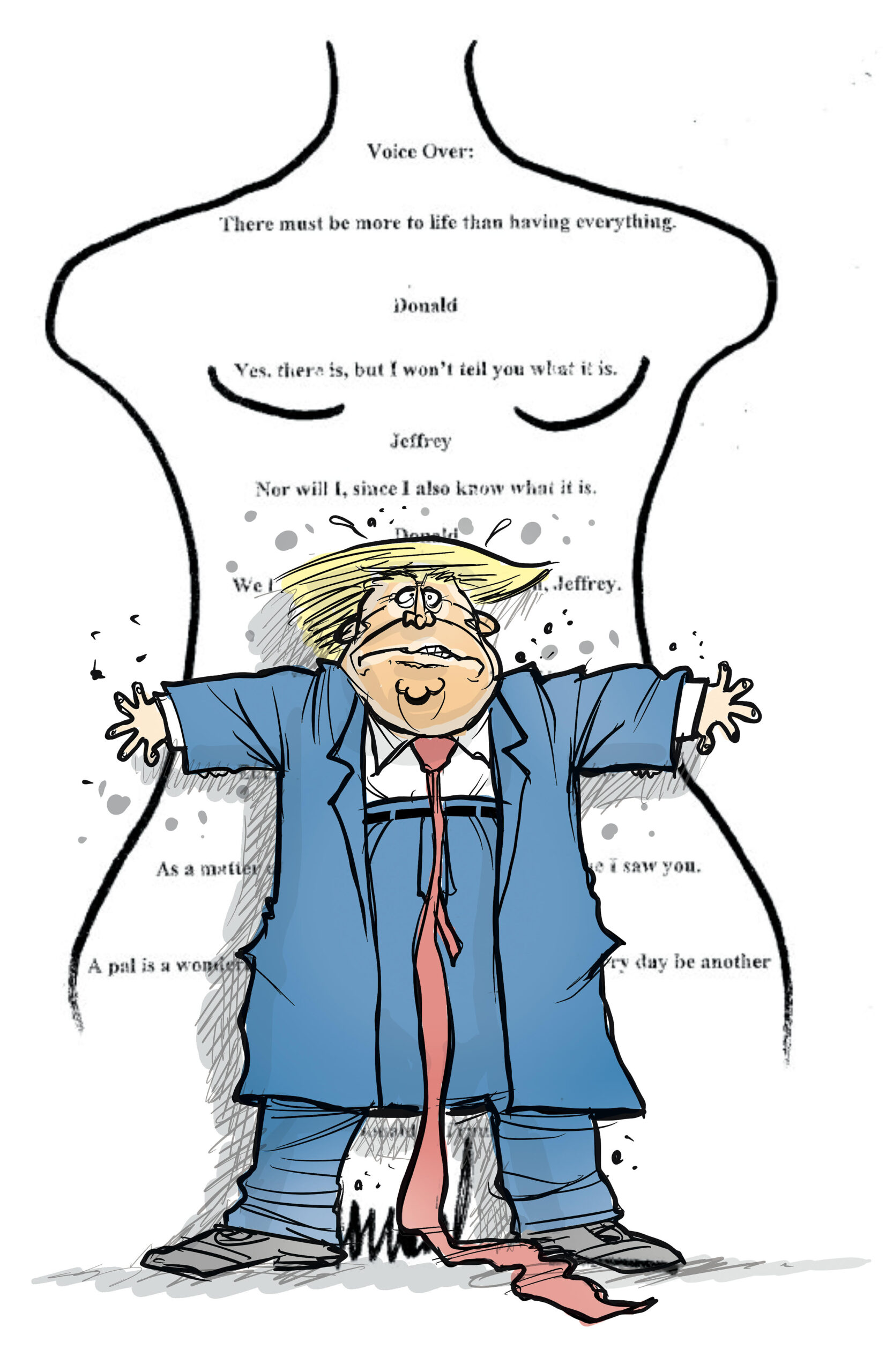
As long as Trump keeps his thumb on the scales at the U.S. Department of Justice, no one should ever expect a fair shake — let alone an honest accounting of the yearslong connection between a convicted sex offender and a convicted president who is a congenital liar.
This is life under a brazenly corrupt administration that rewards billionaire cronies, punishes hundreds of political enemies, kills in broad daylight, and tramples the Constitution.
Better to prepare for how to defend against three more years of authoritarian rule mixed with kabuki theater.
In normal times, the Trump administration’s continued cover-up of the Epstein files would be an epic scandal, prompting hearings, investigations, and accountability.
But the Republicans who control the House and Senate have been a profile in cowardice. Until enough voters wake up, Trump and the GOP will continue to provide misdirection, denials, and a flouting of the law.
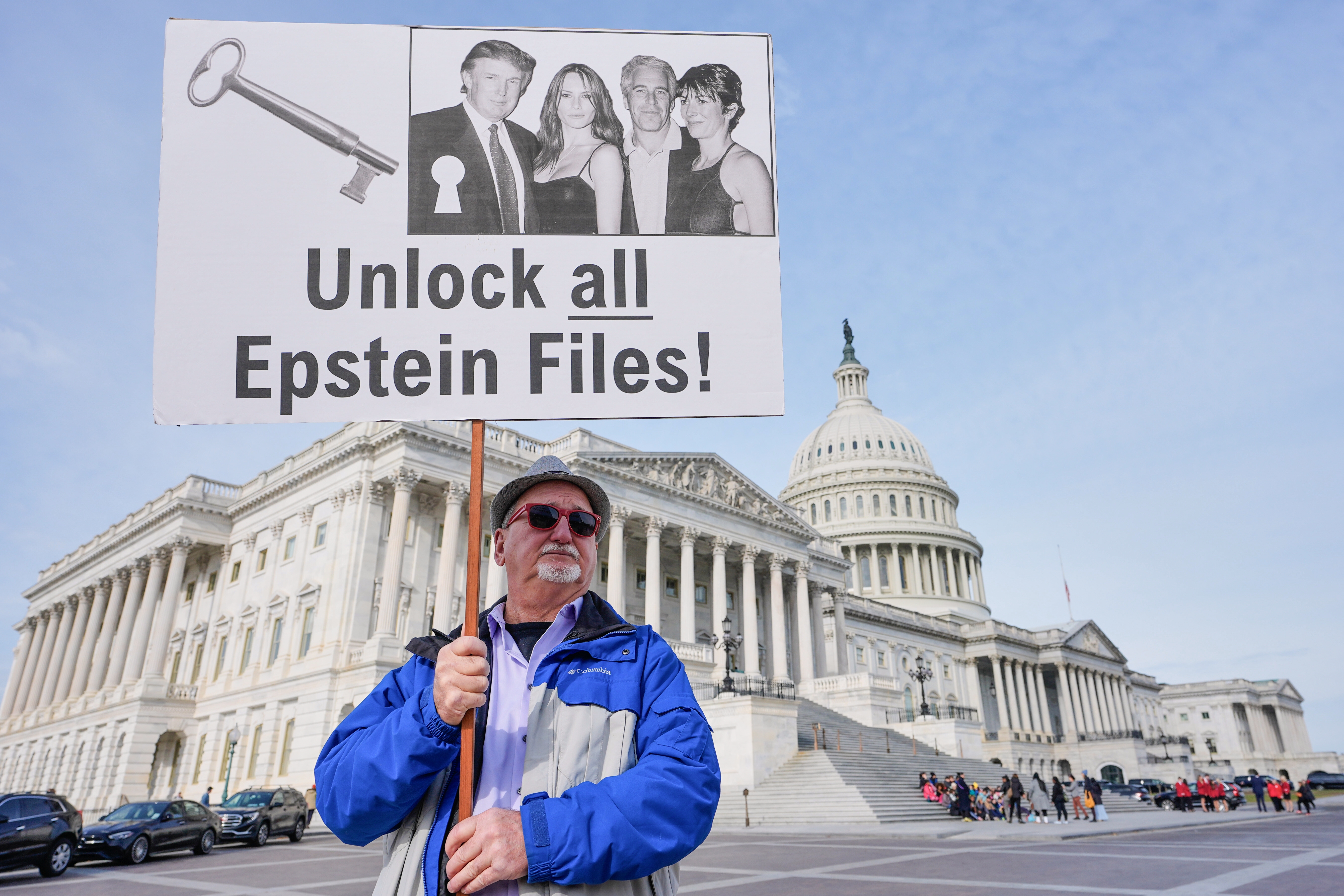
Gary Rush, of College Park, Md., holds a sign outside the U.S. Capitol urging the release of the full Epstein files in November.
Trump has not been implicated in any wrongdoing, but his enablers — including Attorney General Pam Bondi and FBI Director Kash Patel, and most Republicans in Congress — inexplicably continue to protect him.
Doing so obliterates any trust in the justice system and the rule of law.
The main tragedy involves the yearslong sex trafficking, rape, and abuse of hundreds of underage girls, including one alleged 11-year-old, and young, vulnerable women by Epstein and his many rich and powerful friends.
Epstein’s survivors have demanded that the files be released so there can be at least some public accounting of the horror they endured. But instead, the survivors have had to relive the trauma and fear of death threats.
One survivor who Epstein recruited from Trump’s Mar-a-Lago spa when she was a teen took her own life earlier this year. In atelling admission of how Trump views women as objects, he said earlier this year that Epstein “stole” her from him.
A recent story by the New York Times detailed how Trump and Epstein “pursued women in a game of ego and dominance” where “female bodies were currency.”
But the American people have been misled and abused, as well, while other pressing issues have been ignored or made worse.
Trump’s disregard for women has been well documented.
More than two dozen women have accused Trump of sexual abuse. He was caught on tape bragging about grabbing women by their genitals.
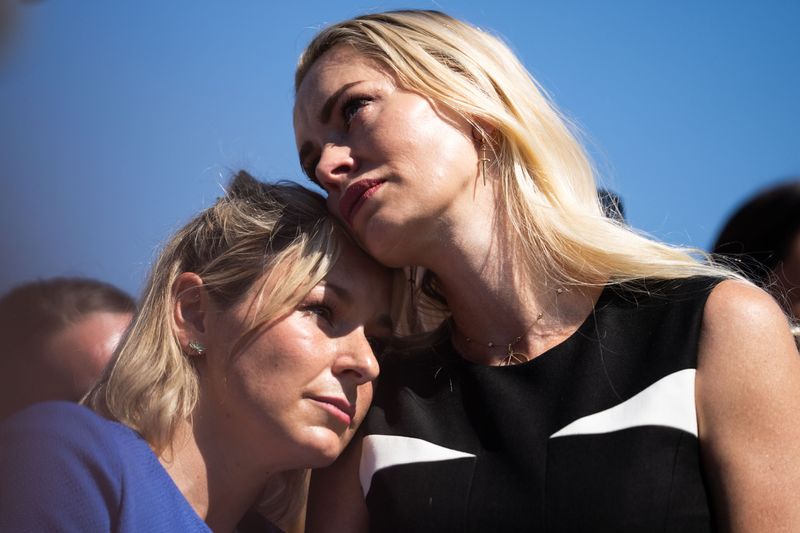
Danielle Bensky (left) and Anouska De Georgiou, victims of convicted sex offender Jeffrey Epstein, embrace during a news conference in Washington, D.C., in September.
A separate video showed Trump and Epstein partying at Mar-a-Lago, while Trump patted a woman on her behind. In 2023, a jury found Trump liable for sexually abusing a woman.
Everyone knew Trump was a lout, but more than 77 million Americans, including millions of women, voted for him anyway. And the Republicans in Congress have dutifully stood by him for years, bringing repeated shame to themselves and the country.
During last year’s election campaign, Trump used the Epstein files to stoke conspiracies and rally his supporters. He promised to release the files if elected, but after returning to the White House, called them a hoax.
(Trump also promised to lower prices, but that is a separate editorial, just as is his promise to end the war in Ukraine in one day.)
After mounting pressure from his base, and a 427-1 House vote last month to release the Epstein files, Trump ultimately signed a bill to make them public by Dec. 19.
The deadline passed, and all the files have yet to come out. Expect more gamesmanship and Truth Social rants.
The Epstein saga is a microcosm of Trump’s modus operandi. Lie, steal, cheat. Deny, deflect, delay, and degrade. Blame, complain, pressure, and sue. Line pockets whenever possible. Always overpromise and underdeliver.
Truth, honesty, humility, compassion, or responsibility are nowhere to be found.
Trump’s sinking poll numbers indicate that many supporters are finally catching on. The midterms loom, but so does three more years of hell.
But could the end of our long national nightmare be near?
By most accounts, the Philadelphia Police Department has had a good year.
Crime is down, a majority of residents feel safer and many give Commissioner Kevin J. Bethel high marks.
But as is often the case with the PPD, the good work of many dedicated officers gets marred by one scandal after another.
In February, former homicide detective James Pitts was sentenced to at least 2½ years in prison for fabricating evidence in a murder investigation and then lying about it on the witness stand.
In May, Officer Mark Dial was convicted of voluntary manslaughter and other crimes after he shot Eddie Irizarry six times, killing him seconds after encountering him in his car with the windows rolled up.
In November, nine current or former police officers, including a former captain, were charged with theft and conspiracy in connection with the misuse of city anti-violence funds surrounding a youth boxing program.
Earlier this month, more than 130 drug cases were tossed out after three narcotics officers repeatedly gave false testimony in court. When all is said and done, nearly 1,000 cases are expected to get dismissed because the officers apparently lied about drug deals that never happened or they did not witness.
The string of scandals is not the case of a few bad apples, as the police often like to claim. It points to a systemic problem that has undermined the department for decades. Stamping out the skullduggery will require a change in recruitment practices, training, culture, and accountability.
The latest scandal resulting in hundreds of dismissed drug cases underscores the disturbing tolerance for corruption that runs through the department.
Common Pleas Court Judge Lillian Ransom vacated the first tranche of 134 drug cases after prosecutors said the testimony of three officers on the Narcotics Strike Force was deemed unreliable.
Hundreds of additional cases built on the officers’ testimony are expected to be voided in the coming months. Amazingly, Officers Jeffrey Holden, Eugene Roher, and Ricardo Rosa remain on the job and assigned to their narcotics squad.
Commissioner Bethel declined to speak with the Editorial Board but issued a statement that said an internal affairs investigation was launched in March 2024 and remains ongoing. That’s good, but what is taking so long?
He added that “thus far we have not identified any evidence that would raise concerns of misconduct or criminal behavior on the part of those officers.”
In other words, move along folks. Nothing to see here. Just about 1,000 criminal cases falling apart because three police officers apparently lied over and over again.
Credit for uncovering the injustice goes to the overworked and underpaid lawyers at the Defenders Association of Philadelphia.
In particular, Paula Sen and Michael Mellon of the Defenders’ Police Accountability Unit uncovered video footage that contradicted the evidence mounted by the officers.
More disturbing, this is not the first time the Defenders Association caught the police cooking cases.
In 2015, Bradley Bridge, a longtime public defender, got more than 950 drug convictions vacated after discovering six narcotics officers robbed and beat drug dealers and then filed bogus paperwork.
Bridge, who came out of retirement to help on the recent cases, estimated he has overturned about 2,500 drug convictions since 1995.
Therein lies the problem. Different day, same corruption.
Bethel said the Police Department takes “potential credibility issues with our officers extremely seriously.” But the department’s history of corruption over the past half century or more indicates otherwise.
To be sure, Philadelphia does not have a monopoly on police corruption. Problems exist in other big cities and small towns.
And despite recent reforms, it is unclear if all have been for the better.
A high-quality police department begins with high quality recruits. But to combat staffing shortages, the department — like many others — eliminated the need for college credits and lowered the requirements for physical training.
There must also be independent accountability. But a Citizens Police Oversight Commission created in 2022 has not conducted a single investigation.
Bad cops reduce morale and must be weeded out. But most corrupt officers not only avoid criminal charges but get to keep their jobs — thanks to a police union that goes to bat for every cop, good or bad. A recent analysis found friendly arbitrators reinstated 85% of fired officers.
Dirty cops undermine community trust and the good work of committed officers who risk their lives to keep the city safe. Even worse, the wrongful prosecutions can take away a person’s liberty and upend lives and families.
Police corruption also costs taxpayers real money. Over a recent 18-month stretch, Philadelphia taxpayers spent more than $60 million to settle cases stemming from police misconduct.
The recent reduction in crime is welcome, but a question remains: Will there ever come a day when the Philadelphia Police Department is not plagued by scandal?
Two horrific mass shootings over the weekend offered a contrasting study in political leadership.
In Australia, after a father and son allegedly killed at least 15 people and injured more than two dozen others who gathered on a Sydney beach to celebrate the start of Hanukkah, Prime Minister Anthony Albanese called an emergency meeting and announced immediate reforms to the country’s already strict gun laws.
In the United States, after a shooter killed two students and injured nine others at Brown University, President Donald Trump essentially shrugged and said, “Things can happen.”
Trump then showed his distinctive lack of empathy by offering the victims and their families his “deepest regards and respects from the United States of America.” For good measure, he lamely added “and we mean it.”
It did not seem as if Trump could get hollower than that. But hours later he showed his bottomless capacity to go lower.
After Hollywood director Rob Reiner and his wife were found stabbed to death in their home, Trump turned the tragedy into a narcissistic social media post that suggested the deaths were all about him.
The Reiners’ son Nick, who battled addiction, was arrested, but any motive for the killings remains unknown.
Yet, Trump claimed without evidence that Reiner, 78, a successful actor and director who was active in Democratic politics and critical of Trump, died because of “the anger he caused others through his massive, unyielding, and incurable affliction with a mind crippling disease known as TRUMP DERANGEMENT SYNDROME, sometimes referred to as TDS.”
Rob Reiner and Michele Singer Reiner arrive on the red carpet at the State Department for the Kennedy Center Honors gala dinner in Washington in December 2023.
Amid a weekend of unspeakable violence, Trump managed to make things worse. So, don’t expect any leadership, let alone efforts to unite or console the country, during times of crisis or tragedy.
If Trump cared about the safety and welfare of others beyond himself, he could offer sympathy rather than solipsism. He would condemn the carnage and vow to crack down on the gun epidemic that continues to kill, maim, and traumatize the United States.
Instead, taxpayers will get zero effort by Trump or any Republican state or federal lawmaker to do a damn thing about the mass shooting or nearly 50,000 annual suicides that have become all too routine. Sorry, “things can happen.”
This year there have been nearly 14,000 gun deaths and more than 25,000 injuries in the United States, according to the Gun Violence Archive, which also counts 392 mass shootings. (Important reminder: Despite Trump’s innuendo about crimes committed by immigrants and Black Americans, the majority of mass shootings are carried out by white males.)
There have also been at least 75 school shootings. The school shootings have become so routine at least two Brown University students had survived previous attacks and trauma when they were in high school.
It does not have to be this way.
A woman kneels in prayer at a memorial to shooting victims outside the Bondi Pavilion at Sydney’s Bondi Beach on Monday, a day after a shooting.
But the powerful gun lobby spends millions to essentially buy off Republican elected officials and prevent the passage of gun measures. So the bloodletting in America continues.
While the mass shooting in Australia was heartbreaking, it was also rare.
In 1996, after a gunman killed 35 people, then-Prime Minister John Howard, a conservative, responded 12 days later with a sweeping overhaul of the country’s gun laws that included banning high-powered automatic weapons.
After gun reform and a massive gun buyback program believed to have taken about a million firearms out of circulation, the country did not have another mass shooting until 2018, when a man killed six members of his own family.
One day after the latest mass shooting, Australia’s elected leaders agreed to bolster gun laws already considered the gold standard by implementing a national registry and limiting the number of guns a person can own.
While Trump rambles on social media, real political leaders in Australia have already acted.
Nothing will change in the U.S. until voters fed up with mass shootings hold elected officials accountable.


![As long as [REDACTED] has his thumb on the scales of justice, the Epstein files were always going to be [REDACTED] | Editorial](https://wp-brooklyn.enclave.vn/wp-content/uploads/2025/12/56QJ6RRBRHQJHDGZ7NKUDPNTPU-675x450.jpg)