The National Park Service does not need to restore the exhibits for the the moment, the order said, but is enjoined from damaging the exhibits and required to take “all necessary steps” to ensure they are not harmed.
The order further prohibits the federal government from making any other changes to the site, including setting up replacement exhibits, which the Department of Interior said would have been installed “in the coming days” if not for the injunction.
“[The Department of Interior and National Park Service] are to preserve the status quo as to the President’s House as of the entry of this order,” Hardiman wrote.
The order is not accompanied by an opinion or memorandum explaining which of the government’s arguments Hardiman found compelling.
Hardiman’s ruling landed an hour before the deadline District Judge Cynthia M. Rufe set for the administration to restore the site to its condition before the Jan. 22 abrupt removal of the exhibits.
In a legal filing Friday, U.S. attorneys said National Park Service staff had begun planning to reinstall the exhibits once they received the Feb. 16 order to restore the site.
On Thursday, 16 of 17 glass panels were reinstalled, with the remaining one needing repairs. Prior to the Third Circuit order, National Park Service employees on Friday restored panels around the site’s glass-enclosed archaeological dig, the wayside panel identifying the site, and four functioning video monitors, the federal government said.
The federal government also had not reinstalled 13 metal panels, but was in the process of doing so prior to the stay, according to the filing.
The city declined to comment on Hardiman’s order. The National Park Service did not immediately respond to a request for comment.
The government argued to the Third Circuit that Rufe misunderstood the difference between the laws and agreements that govern the 55-acre Independence Hall National Historic Park and the stricter rules regarding Independence Hall National Historic Site, the city-owned block between Chestnut and Walnut Streets.
The President’s House, on the corner of Sixth and Market Streets, sits on federal land and the law “imposes no restriction on the government’s removal of the President’s House exhibit,” the filing said.
The city failed to demonstrate harm from the removal of the exhibits, the administration argued, because it has other avenues to promote the history of slavery in the President’s House.
But an injunction forcing the restoration of the exhibits violates the federal government’s free-speech rights, the stay request argued.
“It requires the display and operation of expressive exhibits — at a marquee national historic site in the run-up to the nation’s 250th anniversary — when the government has chosen not to display those exhibits,” the court filing said.
The city responded to the request in a letter in which it expressed confusion about what the administration was asking for. After all, the government already began restoring the exhibits.
“It is not clear whether the United States is asking the court for permission to re-remove the panels that were just reinstalled yesterday, or whether they are asking to be relieved of the duty to reinstall the remaining panels, or whether they are asking for more time to restore the remaining panels because today’s deadline is not feasible,” the city’s letter said.
Either way, the city reiterated its opposition to a stay.
Philadelphia’s lawsuit was the first in the nation challenging the removal of exhibits from national parks in accordance with Trump’s March executive order, which instructed the Interior Department to remove any content or displays that “inappropriately disparage Americans past or living.”
The site will see no further changes for now. Hardiman placed the injunction appeal on an expedited track. With the current deadlines set by the judge, a ruling on the injunction is unlikely before May.
WASHINGTON — The Supreme Court struck down President Donald Trump’s far-reaching global tariffs on Friday, handing him a stinging loss that sparked a furious attack on the court he helped shape.
Trump said he was “absolutely ashamed” of some justices who ruled 6-3 against him, calling them “disloyal to our Constitution” and “lapdogs.” At one point he even raised the specter of foreign influence without citing any evidence.
The decision could have ripple effects on economies around the globe after Trump’s moves to remake post-World War II trading alliances by wielding tariffs as a weapon.
But an unbowed Trump pledged to impose a new global 10% tariff under a law that’s restricted to 150 days and has never been used to apply tariffs before.
“Their decision is incorrect,” he said. “But it doesn’t matter because we have very powerful alternatives.”
The court’s ruling found tariffs that Trump imposed under an emergency powers law were unconstitutional, including the sweeping “reciprocal” tariffs he levied on nearly every other country.
Trump appointed three of the justices on the nation’s highest court during his first term, and has scored a series of short-term wins that have allowed him to move ahead with key policies.
Tariffs, though, were the first major piece of Trump’s broad agenda to come squarely before the Supreme Court for a final ruling, after lower courts had also sided against the president.
The majority found that it is unconstitutional for the president to unilaterally set and change tariffs because taxation power clearly belongs to Congress. “The Framers did not vest any part of the taxing power in the Executive Branch,” Chief Justice John Roberts wrote.
Justices Brett Kavanaugh, Samuel Alito, and Clarence Thomas dissented.
“The tariffs at issue here may or may not be wise policy. But as a matter of text, history, and precedent, they are clearly lawful,” Kavanaugh wrote. Trump praised his 63-page dissent as “genius.”
The court majority did not address whether businesses could get refunded for the billions they have collectively paid in tariffs. Many companies, including the big-box warehouse chain Costco, have already lined up in lower courts to demand refunds. Kavanaugh noted the process could be complicated.
“The Court says nothing today about whether, and if so how, the Government should go about returning the billions of dollars that it has collected from importers. But that process is likely to be a ‘mess,’ as was acknowledged at oral argument,” he wrote.
The Treasury had collected more than $133 billion from the import taxes the president has imposed under the emergency powers law as of December, federal data show. The impact over the next decade has been estimated at some $3 trillion.
The tariffs decision doesn’t stop Trump from imposing duties under other laws. Those have more limitations on the speed and severity of Trump’s actions, but the president said they would still allow him to “charge much more” than he had before.
Vice President JD Vance called the high court decision “lawlessness” in a post on X.
Questions about what Trump can do next
Still, the ruling is a “complete and total victory” for the challengers, said Neal Katyal, who argued the case on behalf of a group of small businesses.
“It’s a reaffirmation of our deepest constitutional values and the idea that Congress, not any one man, controls the power to tax the American people,” he said.
It wasn’t immediately clear how the decision restricting Trump’s power to unilaterally set and change tariffs might affect trade deals with other countries.
“We remain in close contact with the U.S. Administration as we seek clarity on the steps they intend to take in response to this ruling,” European Commission spokesman Olof Gill said, adding that the body would keep pushing for lower tariffs.
The Supreme Court ruling comes after victories on the court’s emergency docket have allowed Trump to push ahead with extraordinary flexes of executive power on issues ranging from immigration enforcement to major federal funding cuts.
The Republican president had long been vocal about the tariffs case, calling it one of the most important in U.S. history and saying a ruling against him would be an economic body blow to the country. But legal opposition crossed the political spectrum, including libertarian and pro-business groups that are typically aligned with the GOP. Polling has found tariffs aren’t broadly popular with the public, amid wider voter concern about affordability.
While the Constitution gives Congress the power to levy tariffs, the Trump administration argued that a 1977 law allowing the president to regulate importation during emergencies also allows him to set import duties. Other presidents have used the law dozens of times, often to impose sanctions, but Trump was the first president to invoke it for tariffs.
“And the fact that no President has ever found such power in IEEPA is strong evidence that it does not exist,” Roberts wrote, using an acronym for the International Emergency Economic Powers Act.
Trump set what he called “reciprocal” tariffs on most countries in April 2025 to address trade deficits that he declared a national emergency. Those came after he imposed duties on Canada, China, and Mexico, ostensibly to address a drug trafficking emergency.
A series of lawsuits followed, including a case from a dozen largely Democratic-leaning states and others from small businesses selling everything from plumbing supplies to women’s cycling apparel.
The challengers argued the emergency powers law doesn’t even mention tariffs and Trump’s use of it fails several legal tests, including one that doomed then-President Joe Biden’s $500 billion student loan forgiveness program.
Justices reject use of emergency powers for tariffs
The three conservative justices in the majority pointed to that principle, which is called the major questions doctrine. It holds that Congress must clearly authorize actions of major economic and political significance.
“There is no exception to the major questions doctrine for emergency statutes,” Roberts wrote. The three liberal justices formed the rest of the majority, but didn’t join that part of the opinion.
The Trump administration had argued that tariffs are different because they’re a major part of Trump’s approach to foreign affairs, an area where the courts should not be second-guessing the president.
But Roberts, joined by Justices Neil Gorsuch and Amy Coney Barrett, brushed that aside, writing that the implications for international relations don’t change the legal principle.
Small businesses celebrated the ruling, with the National Retail Federation saying it provides “much needed certainty.”
Illinois toy company Learning Resources was among the businesses challenging the tariffs in court. CEO Rick Woldenberg said he expected Trump’s new tariffs but hoped there might be more constraint in the future, both legal and political. “Somebody’s got to pay this bill. Those people that pay the bill are voters,” he said.
Ann Robinson, who owns Scottish Gourmet in Greensboro, N.C., said she was “doing a happy dance” when she heard the news.
The 10% baseline tariff on U.K. goods put pressure on Robinson’s business, costing about $30,000 in the fall season. She’s unsure about the Trump administration’s next steps, but said she’s overjoyed for now. “Time to schedule my ‘Say Goodbye to Tariffs’ Sale!”
WASHINGTON — The late Rev. Jesse Jackson will not lie in honor in the United States Capitol Rotunda after a request for the commemoration was denied by the House Speaker Mike Johnson’s office due to past precedent.
Johnson’s office said it received a request from the family to have Jackson’s remains lie in honor at the Capitol, but the request was denied, because of the precedent that the space is typically reserved for former presidents, the military, and select officials.
The civil rights leader died this week at the age of 84. The family and some House Democrats had filed a request for Jackson to be honored at the U.S. Capitol.
Amid the country’s political divisions, there have been flare-ups over who is memorialized at the Capitol with a service to lie in state, or honor, in the Rotunda. During such events, the public is generally allowed to visit the Capitol and pay their respects.
Recent requests had similarly been made, and denied, to honor Charlie Kirk, the slain conservative activist, and former Vice President Dick Cheney.
There is no specific rule about who qualifies for the honor, a decision that is controlled by concurrence from both the House and Senate.
The Jackson family has announced scheduled dates for memorial services beginning next week that will honor the late reverend’s life in Chicago, Washington, D.C., and South Carolina. In a statement, the Jackson family said it had heard from leaders in both South Carolina, Jackson’s native state, and Washington offering for Jackson to be celebrated in both locations. Talks are ongoing with lawmakers about where those proceedings will take place. His final memorial services will be held in Chicago on March 6 and 7.
Typically, the Capitol and its Rotunda have been reserved for the “most eminent citizens,” according to the Architect of the Capitol’s website. It said government and military officials lay in state, while private citizens in honor.
In 2020, Rep. John Lewis, another veteran of the Civil Rights movement, was the first Black lawmaker to lie in state in the Capitol Rotunda after a ceremony honoring his legacy was held outside on the Capitol steps due to pandemic restrictions at the time.
Later that year, then-House Speaker Nancy Pelosi allowed services for Supreme Court Justice Ruth Bader Ginsburg at the Capitol’s Statuary Hall after agreement could not be reached for services in the Capitol’s Rotunda.
It is rare for private citizens to be honored at the Capitol, but there is precedent — most notably Civil Rights icon Rosa Parks, in 2005, and the Rev. Billy Graham, in 2018.
A passionate civil rights leader and globally-minded humanitarian, Jackson’s fiery speeches and dual 1984 and 1988 presidential campaigns transformed American politics for generations. Jackson’s organization, the Rainbow PUSH Coalition, became a hub for progressive organizers across the country.
His unapologetic calls for a progressive economic agenda and more inclusive policies for all racial groups, religions, genders and orientations laid the groundwork for the progressive movement within the Democratic Party.
Jackson also garnered a global reputation as a champion for human rights. He conducted the release of American hostages on multiple continents and argued for greater connections between civil rights movements around the world, most notably as a fierce critic of the policies of Apartheid South Africa.
NEW YORK — The nation’s highest court struck down some of President Donald Trump’s most sweeping tariffs on Friday, in a 6-3 decision that he overstepped his authority when using an emergency powers law to justify new taxes on goods from nearly every country in the world.
Trump has launched a barrage of new tariffs over the last year. Despite Friday’s ruling, many sectoral levies remain in place — and the president has already said that he’ll turn to other options for more import taxes, including plans to impose a new 10% tariff globally. But the Supreme Court decision upends a core set of tariffs that Trump rolled out using the 1977 International Emergency Economic Powers Act, or IEEPA.
IEEPA authorizes the president to broadly regulate commerce after declaring a national emergency. Over the years, presidents have turned to this law dozens of times, often to place sanctions on other countries. But Trump was the first to use it to implement tariffs.
Here’s a look at the now-overturned tariffs Trump imposed using IEEPA — and other levies that still stand today.
‘Liberation Day’ tariffs
Trump used IEEPA to slap import taxes on nearly every country in the world last spring. On April 2, which Trump called Liberation Day, he imposed “reciprocal” tariffs of up to 50% on goods from dozens of countries — and a baseline 10% tariff on just about everyone else.
The 10% tax kicked in early April. But the bulk of Liberation Day’s higher levies got delayed by several months, and many rates were revised over time (in some cases after new “framework” agreements). Most went into effect Aug. 7.
The national emergency underlying these tariffs, Trump argued at the time, was the long-running gap between what the U.S. sells and what it buys from the rest of the world. Still, goods from countries with which the U.S. runs a trade surplus also faced taxes.
Major trading partners impacted by Liberation Day tariffs include South Korea, Japan and the European Union — which combined export a range of products to the U.S., like electronics, cars, and car parts and pharmaceuticals. Following trade talks, Trump’s rates on most goods stood at 15% for the EU, Japan and South Korea ahead of Friday. But just last month, Trump threatened to hike levies on certain South Korean products to 25% — and countries worldwide still face sector-specific, non-IEEPA tariffs.
‘Trafficking tariffs’ on Canada, China and Mexico
At the start of his second term, Trump used IEEPA to impose new tariffs on America’s three biggest trading partners: Mexico, Canada, and China.
Ahead of Friday’s decision, “trafficking tariffs” on Canadian and Mexican imports were 35% and 25%, respectively, for goods that don’t comply with the 2020 United States-Mexico-Canada Agreement. China, meanwhile, faced a 10% fentanyl-related tariff. That’s down from 20% imposed by Trump earlier last year. Chinese goods also once saw sky-high levies after Liberation Day, but rates had since come down during trade talks.
Top U.S. imports from China include mobile phones and other electronics, as well as clothing, toys and household appliances. Meanwhile, Canada and Mexico are both major sources of cars and auto parts. Canada is also the U.S.’s largest supplier of crude oil. And Mexico is a key exporter of fresh produce, beverages and more.
Tariffs on Brazil over Bolsonaro trial
Trump also used IEEPA to slap steep import taxes on Brazilian imports over the summer, citing the country’s policies and criminal prosecution of former President Jair Bolsonaro.
Brazil already faced Trump’s 10% baseline Liberation Day rate. The Bolsonaro-related duties added another 40%, bringing total levies to 50% on many products ahead of Friday.
The U.S. has actually run a consistent trade surplus with Brazil over the years. But top exports from the country include manufactured products, crude oil and agricultural products like soybeans and sugar.
Tariffs on India linked to Russian oil
India has faced additional IEEPA tariffs, too. After Liberation Day, Trump slapped a 25% levy on Indian imports — and later added another 25% for the country’s purchases of Russian oil, while also citing the emergency powers law, bringing the total to 50%.
But earlier this month, the U.S. and India reached a trade framework deal. Trump said Prime Minister Narendra Modi agreed to stop buying Russian oil, and that he planned to lower U.S. tariffs on its ally to 18%. Meanwhile, India said it would “eliminate or reduce tariffs” on all U.S. industrial goods and a range of agricultural products.
India’s top exports to the U.S. include pharmaceuticals, precious stones, clothing and textiles.
What are other non-IEEPA tariffs that countries still face today?
Despite the Supreme Court knocking down sweeping import taxes Trump imposed with IEEPA, most countries still face steep tariffs from the U.S. on specific sectors.
Citing national security threats, Trump has used another law — Section 232 of the 1962 Trade Expansion Act — to slap levies on steel, aluminum, cars, copper, and lumber worldwide. He began to roll out even more Section 232 tariffs in September, on kitchen cabinets, bathroom vanities and upholstered furniture.
Amid pressure to lower rising prices, Trump has rolled back some of his tariffs recently. Beyond trade frameworks, that’s included adding exemptions to specific levies and scrapping import taxes for goods like coffee, tropical fruit and beef.
Still, Trump has threatened more sectoral levies are on the way. And following Friday’s decision, he said that he would sign an executive order to enact a 10% global tariff — using another federal law, known as Section 122. Those tariffs would be limited to just 150 days, unless they are extended legislatively.
Pennsylvania Gov. Josh Shapiro joined President Donald Trump at the White House for a breakfast on Friday, following weeks of uncertainty and strife over whether any Democrats would attend the traditionally bipartisan annual event after Trump reversed course on a decision to disinvite two other blue-state governors from the meeting.
A spokesperson forShapiro said he decided to attend the meeting at the White House once Maryland Gov. Wes Moore and Colorado Gov. Jared Polis were invited, despite Trump previously declaring the pair of Democratic leaders were not welcome.
“Gov. Shapiro chose to join his colleagues and go to the White House to raise real issues and harm the Trump administration is doing to Pennsylvania,” Rosie Lapowsky, Shapiro’s press secretary, said in a statement.
Trump initially planned to invite only Republican governors to the annual event that coincides with the National Governors Association winter meeting in Washington, D.C., but faced pushback by the group’s GOP chair. Trump then invited Democrats, as well, but rescinded the invitations for Moore and Polis. In a post on his Truth Social platform earlier this month, Trump wrote that the two Democratic governors were “not worthy of being there.”
The weekslong back-and-forth threatened the nonpartisan nature of the National Governors Association that represents 55 governors, including those from all 50 states and five U.S. territories. Ultimately, the NGA declined to facilitate the annual breakfast event, and Trump later re-invited Polis and Moore.
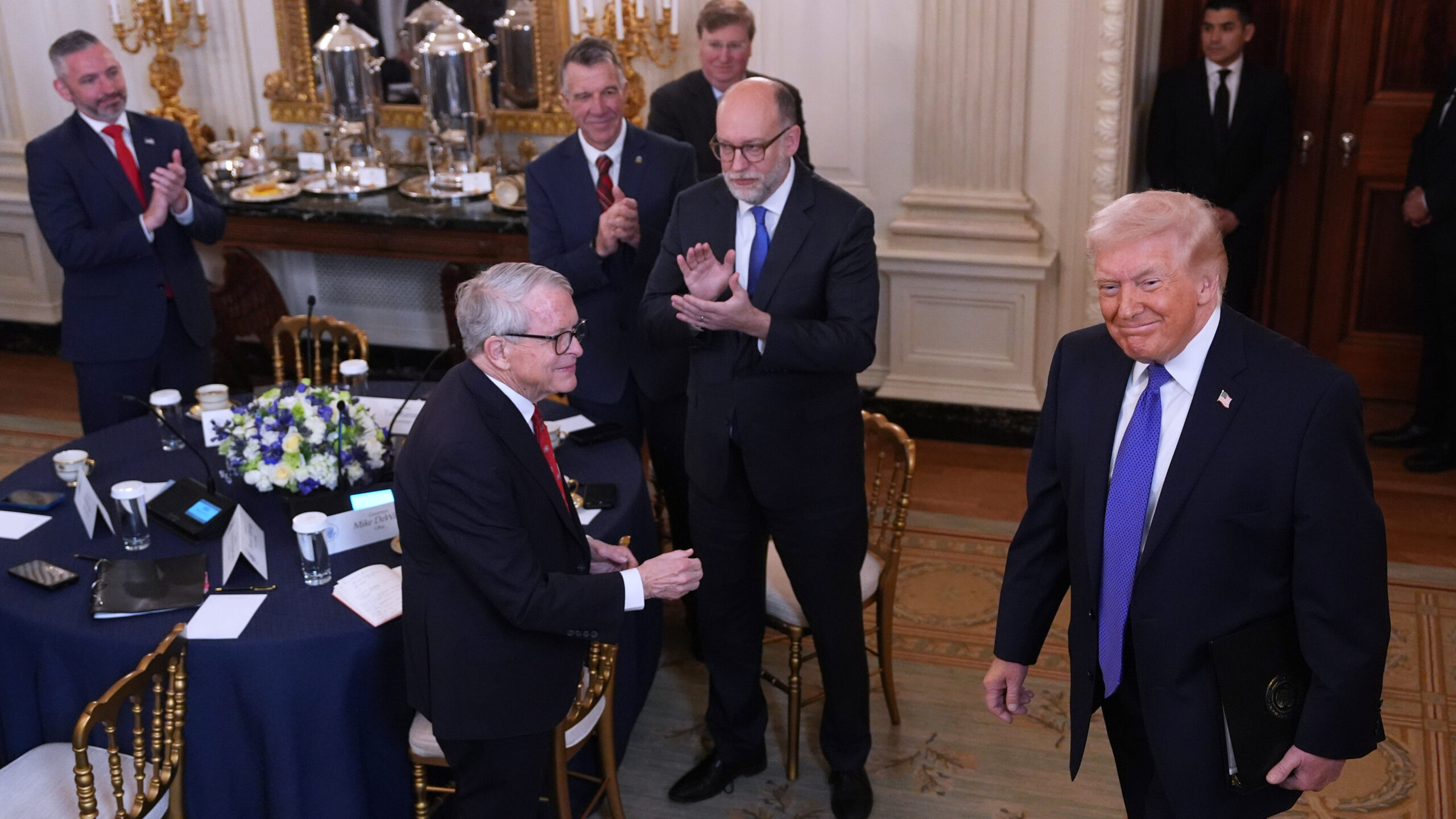
President Donald Trump arrives to speak during a breakfast with the National Governors Association in the State Dining Room of the White House, Friday, Feb. 20, 2026, in Washington. (AP Photo/Evan Vucci)
Moore, Polis, and Shapiro were among the more than two dozen governors who attended the White House breakfast Friday, where Trump delivered brief remarks. Other Democrats, including New Jersey Gov. Mikie Sherill, decided against going.
Sherrill, a former member of Congress who just began her term last month, said in a statement that she opted to skip the White House breakfast to “focus on other NGA meetings.”
“The president’s chaotic back-and-forth about the NGA was counterproductive and Gov. Sherrill decided not to attend,” said Sean Higgins, a spokesperson for Sherrill.
What Shapiro talked about
Shapiro described the closed-door meeting between Trump, the governors, and all of Trump’s cabinet as productive for him to advocate for specific issues directly with federal leaders.
“Folks were respectful to me,” Shapiro told reporters following the meeting. “I went there with a mission to talk about things that were important to Pennsylvania.”
Shapiro, who is currently running for reelection and touts his ability to work across partisan lines, has expressed an openness to working with Trump on issues specific to Pennsylvania, though he has challenged the president more than a dozen times in court since Trump took office last year.
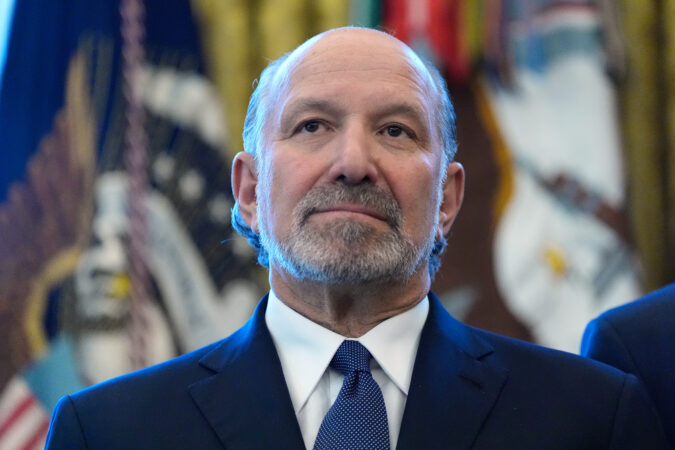
Shapiro said he was able to discuss his top issues directly with federal officials. He said he spoke with U.S. Department of Agriculture Secretary Brooke Rollins about the reemergence of the avian flu in Pennsylvania; discussed releasing withheld broadband funding with Treasury Secretary Howard Lutnick about releasing withheld broadband funding; and talked with U.S. Secretary of Health and Human Services Robert F. Kennedy Jr. and Director of the Office of Management and Budget Russ Vought about the ways “their policies are hurting rural Pennsylvanians.”
New York Gov. Kathy Hochul, another Democrat who attended the meeting, said afterward in a news conference that she was glad to hear what lessons Trump said he learned from his administration’s immigration enforcement mission in Minneapolis that led to mass protests and the fatal shootings of two U.S. citizens by federal agents.
Hochul said Trump told the group that “we’ll only go where we’re wanted,” alleviating concerns among some Democratic governors that their states may be the next to see a full-scale federal presence upending daily life.
Weeks of back-and-forth ahead of the White House breakfast
“Democratic governors have a long record of working across the aisle to deliver results and we remain committed to this effort,” they said in a joint statement on Feb. 10 through the Democratic Governors Association. “But it’s disappointing this administration doesn’t seem to share the same goal. At every turn, President Trump is creating chaos and division, and it is the American people who are hurting as a result.”
They added: “Democratic governors remain united and will never stop fighting to protect and make life better for people in our states.”
In comments to CNN last week, Sherrill said that “worse decisions” would be made without all the governors there.
“For the president to pick and choose who he is going to have to sort of undermine the very focus of this, of coming together to get stuff done for the country just seeds more … chaos,” the New Jersey Democrat said.
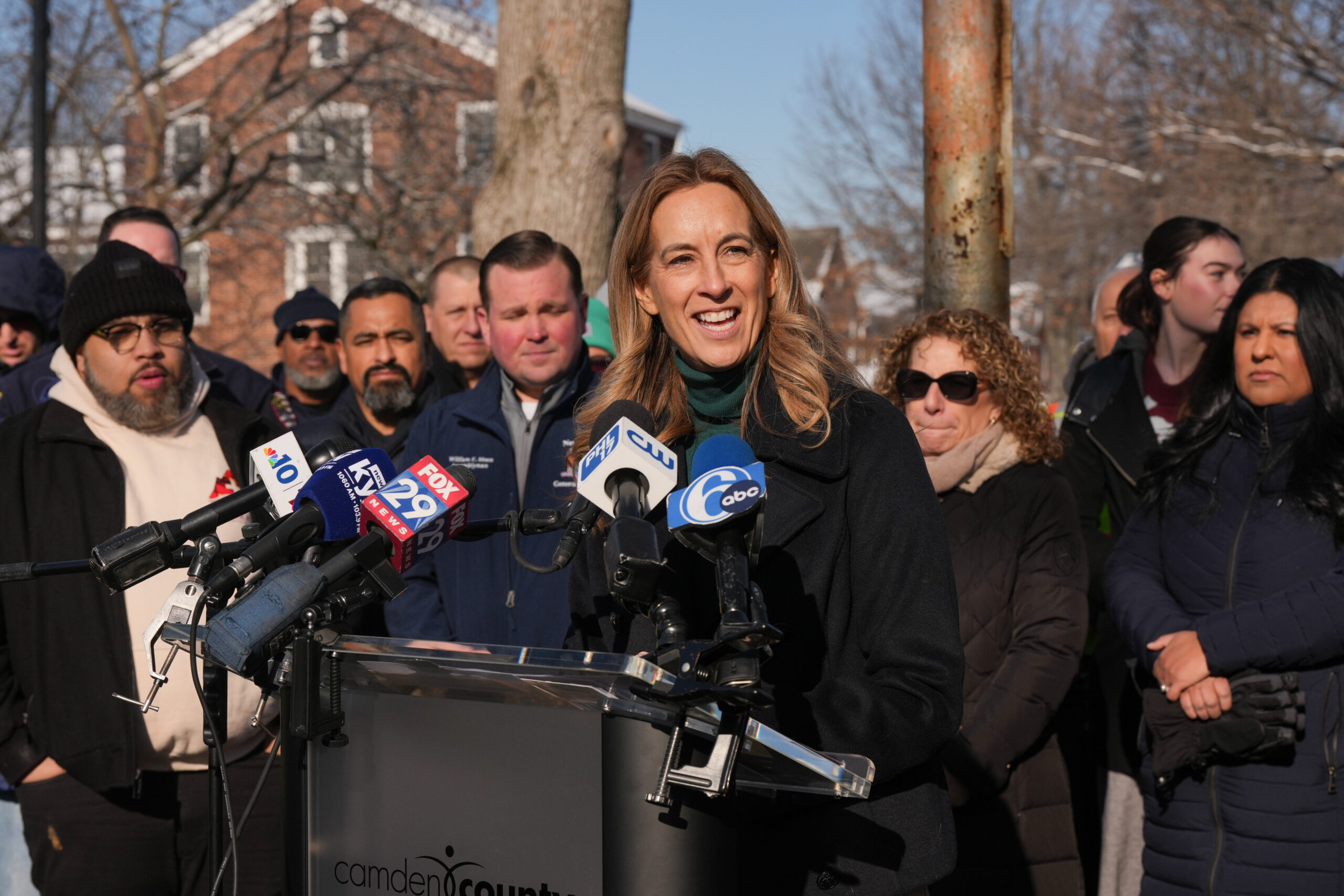
Gov. Mikie Sherrill, shown here at a news conference as volunteers gather prior to shoveling snow at Fairview Village on Martin Luther King Day during a day of service, in Camden, New Jersey, January 19, 2026.
Moore, the nation’s only Black governor, and Polis, the first openly gay man elected to U.S. governor, were the only two leaders Trump singled out, raising concerns by civil rights groups.
Trump, however, cited different reasons for his objections to Moore and Polis’ attendance. He said he wanted to exclude Polis because his state continues to incarcerate a former county clerk over her conviction related to allowing election-denier activists access to election data following the 2020 election. Trump also expressed a number of grievances toward Moore, including his handling of the rebuilding of the Francis Scott Key Bridge and Baltimore’s crime rates.
Following the meeting Friday, governors from both parties reaffirmed that they were still committed to working with Trump despite the turmoil.
“It’s really important imagery that we stand together as governors of our states and represent all of America, and just remind people that there’s really more that brings us together and unites us than divides us,” said Oklahoma Gov. Kevin Stitt, a Republican who chairs the NGA.
Shapiro separately told reporters that he has worked with directly Trump to “save steelworker jobs” but remains ready to challenge them in court if they threaten Pennsylvanians’ rights.
Asked whether he has a good relationship with Trump, Shapiro said: “We have a relationship where we can work for the people of Pennsylvania, that’s my job.”
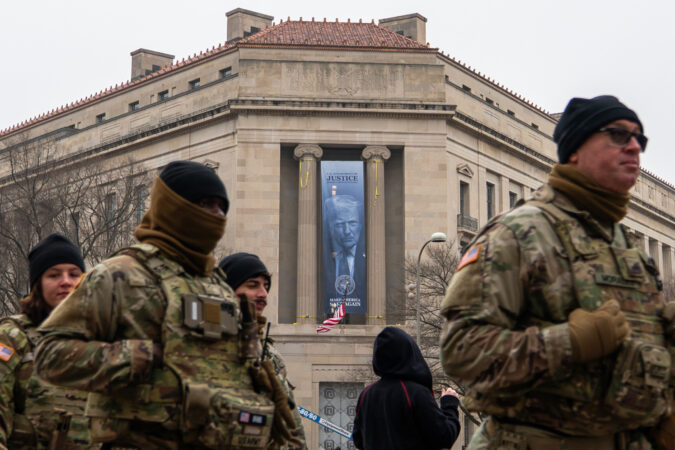
A new banner hanging along the facade of the Justice Department’s headquarters in Washington is sparking criticism from Democrats and a former FBI director, who suggest that it exemplifies President Donald Trump’s encroachment on the agency, which has long prided itself on being independent from the White House.
The tall banner displays a portrait of Trump, cast in a dark blue hue, staring down at tourists, commuters and cars along Washington’s bustling Pennsylvania Avenue. “MAKE AMERICA SAFE AGAIN,” reads the banner, which is emblazoned with the Justice Department’s seal.
A Justice Department spokesperson said the banner was hung in commemoration of the United States’ Semiquincentennial, writing in a statement: “We are proud at this Department of Justice to celebrate 250 years of our great country and our historic work to make America safe again at President Trump’s direction.”
Similar banners have appeared recently on other government buildings in Washington. But Democrats said that the decision to install one at the Justice Department symbolizes the influence Trump has wielded over the agency during his second term and that the display is comparable to the imagery deployed by authoritarian regimes.
“The irony of a twice-impeached, convicted felon putting his own picture on the wall of the Department of Justice,” Sen. Ben Ray Luján of New Mexico wrote on X. “President Trump is weaponizing the DOJ as his own personal law firm.”
Rep. Mike Quigley of Illinois shared an image of the banner online and wrote: “POTUS is putting his face on the Justice Department. … This is not the work of an independent and impartial justice system.”
“Ok Kim Jong Un,” Rep. Jim McGovern of Massachusetts wrote.
A pair of similar banners hung at the U.S. Department of Agriculture showed Trump and Abraham Lincoln’s portraits emblazoned with the phrase: “Growing America Since 1862.” (A government purchase order for the pair of banners at USDA showed they cost $16,400.) And banners hung on the Labor Department’s building featured portraits of Trump and Theodore Roosevelt that read, “American workers first.”
The addition to the Justice Department building follows a pattern of norm-breaking efforts that critics say amount to Trump using the agency as a personal cudgel against his political enemies.
In a speech delivered inside the building last year, Trump declared himself the nation’s “chief law enforcement officer.” Attorney General Pam Bondi rarely misses an opportunity to praise the president and credit him with the department’s success, including at a contentious congressional oversight hearing last week in which she repeatedly described him “the greatest president in American history.”
To Trump’s critics, the banner is also striking given his status as a felon. He was found guilty in 2024 in a New York state case on 34 counts of falsifying business records to conceal a hush money payment to an adult-film actress.
Less than two years ago, Justice Department prosecutors had been pursuing two federal cases against him led by former special counsel Jack Smith. One focused on efforts to overturn the 2020 election, while the other related to Trump’s handling of classified documents.
Trump is continuing to appeal his state court conviction in New York. A Georgia criminal case against Trump related to efforts to change the 2020 election result was dismissed last year.
The two federal cases were also dismissed. One ended because of issues with Smith’s appointment. The other Smith withdrew after Trump’s 2024 election victory, in line with long-standing Justice Department policies preventing prosecution of a sitting president.
Trump and his Justice Department appointees have contended that the prosecutions arose out of a Biden-era weaponization of the justice system to punish political foes.
Since his return to the White House, Trump has ordered several prosecutions of political rivals on social media. Federal prosecutors brought charges against former FBI Director James B. Comey and New York Attorney General Letitia James last year — both of whom Trump had demanded Bondi move swiftly to prosecute. Those cases were later thrown out over issues with the appointment of the U.S. attorney selected to oversee them.
Comey, in a social media post Thursday, called the installation of the banner outside the Justice Department headquarters “sickening.”
“But they forgot to cover the inscription on the Pennsylvania Avenue side: ‘WHERE LAW ENDS TYRANNY BEGINS,’” he wrote.
The banner is hardly the first time the Trump administration has been accused of adopting aesthetics and deploying imagery typically associated with imperialism or authoritarianism since his return to office last year.
The administration, for example, roiled the art world when the Department of Homeland Security used images of Americana paintings to bolster support for Trump’s large-scale deportation campaign.
There was also a massive military parade in Washington last year, which ran against an American tradition of avoiding public displays of martial strength more common in authoritarian regimes. The president is also planning a giant triumphal arch across from the Lincoln Memorial, which could dwarf the size of that and other monuments.
Pennsylvania lawmakers say Congress should reclaim its power over taxes and tariffs after the U.S. Supreme Court quashed President Donald Trump’s controversial global tariffs.
The nation’s high court ruled 6-3 Friday that Trump overstepped with tariffs imposed under an emergency powers law, dealing a significant blow to the president’s economic agenda and reasserting congressional authority.
Chief Justice John Roberts and Justices Neil Gorsuch and Amy Coney Barrett — both Trump nominees — joined liberal justices in the majority. Justices Brett Kavanaugh, Clarence Thomas, and Samuel A. Alito Jr. dissented.
Trump told reporters at the White House Friday that he was “ashamed” of the three Republican-appointed justices for not having “the courage to do what’s right for our country.”
But local lawmakers celebrated the decision as a step toward alleviating inflation exacerbated by Trump’s tariffs.
It’s “the first piece of good news that American consumers have gotten in a very long time,” said U.S. Rep. Brendan Boyle (D., Philadelphia), the ranking member of the House Budget Committee.
The decision is unlikely to be the end of the road for Trump’s efforts to impose tariffs. The court struck down the broad authority Trump had claimed to impose sweeping tariffs, but he could still impose additional import and export taxes using powers he employed in his first term.
Friday’s decision centers on tariffs imposed under an emergency powers law, including the “reciprocal” tariffs he waged on other countries, The Associated Press reported.
What’s next
It remains unclear what will happen to tariff revenue that’s already been collected — about $30 billion a month since Trump took office last year, NPR reported. But Pennsylvania lawmakers are pushing for Congress to reassert its power to control the country’s purse strings.
“As the Supreme Court validated this morning, Congress has the authority to levy taxes and tariffs,” Boyle said. “It’s time now for us to finally reclaim that authority and bring some certainty and rationality to our tariff policy, which under Donald Trump has been all over the map and changes day by day, even hour by hour.”
Casey-Lee Waldron, a spokesperson for U.S. Rep. Brian Fitzpatrick (R., Bucks), said in a statement Friday that the lawmaker “applauds” the high court’s decision, “which validates the Congressman’s opposition to blanket and indiscriminate tariffs that are not narrowly tailored, and that do not lower costs for the American consumer.”
Waldron added that Fitzpatrick supports enforcing trade laws, but “this should always be done in a collaborative manner with a bipartisan, bicameral majority in Congress.”
Pennsylvania Gov. Josh Shapiro and N.J. Gov. Mikie Sherrill, both Democrats, celebrated the decision Friday in statements that noted the challenges the tariffs had caused for local economies.
Speaking to reporters at the National Governors Association meeting in Washington, Shapiro said tariffs had done real harm to Pennsylvanians, citing rising prices for farmers and for consumer goods.
“There is a direct line connecting those price increases to the president pushing the tariff button,” Shapiro said. “I think the Supreme Court got it right, and I say that as a former attorney general, and I say that as someone who actually follows the law.”
U.S. Sen. Dave McCormick (R., Pa.), however, came to the defense of Trump’s tariff policies, saying in a statement that he believes Trump “was using legitimate emergency authorities very effectively to protect our national security and achieve fair trade for U.S. companies and American workers.”
McCormick, a former Treasury official and former hedge fund executive, said he was disappointed with the court’s ruling and called to find other ways to accomplish Trump’s economic and national security goals, which include preventing “foreign competitors from cheating Pennsylvania workers.”
Shockwaves in Philly and beyond
Trump enacted the sweeping tariffs early last year, arguing that the move would incentivize companies to bring operations back to the United States and even trade deficits with other countries.
The move, however, sent shock waves through the U.S. economy as prices increased and U.S. exports, including Pennsylvania’s lumber sales, suffered.
Tariffs slowed business at the Port of Philadelphia, which reported cargo volume down across the board.
Philly is a major gateway for produce, bringing in more fresh fruit than any other U.S. port, largely from Central and South America. The port saw record container volume last year, handling almost 900,000 units, up 6% over 2024. About two-thirds of that cargo was refrigerated — fruit and meat, for example.
But this year got off to a slow start. “The story is increased competition and tariffs,” Sean Mahoney, marketing director at the Philadelphia Regional Port Authority (PhilaPort), said during the agency’s board meeting on Wednesday.
Leo Holt, president of the city’s primary terminal operator Holt Logistics, hopes companies that see savings would pass them on to consumers. In practice, he acknowledged many would likely take a conservative approach.
“I think consumers are going to demand that at least there’s an accounting for what they’re paying,” Holt said Friday.
U.S. Sen. Chris Coons (D., Del.) said in a statement that he knows many Republican colleagues of his “are privately breathing sighs of relief this morning at the court’s decision.”
“They should instead be asking themselves why they didn’t use their legislative authority to do more to stop these tariffs when they had the chance — and what they’ll do differently next time when President Trump inevitably tries again,” Coons said.
‘Nobody is going to rush to drop their prices’
The Supreme Court’s ruling will be welcome news for some businesses, but it also sparks uncertainty.
Not all of Trump’s tariff increases came through the use of the International Emergency Economic Powers Act, and therefore some will remain in place, said Julie Park, a partner at London-based tax and business advisory firm Blick Rothenberg.
“This decision brings further uncertainty for businesses,” she said in a statement. That’s in part because Trump could seek to reimpose tariffs through other legal tools, leaving “businesses in limbo about if they will get refunded.”
U.S. exporters will also be closely following what happens next, since the fate of Trump’s tariffs will likely determine whether other countries, like Canada, keep their retaliatory measures in place. Canada is Pennsylvania’s biggest export market, with the state sending more than $14 billion in goods there in 2024. Top exports included machinery, cocoa, iron, and steel.
Pennsylvania’s dairy industry has also been caught in the middle of the global trade war, as China and Canada imposed extra taxes on those goods in response to U.S. tariffs.
It’s also unclear whether companies will receive refunds for the tariffs they’ve paid in the past year.
Tim Avanzato, vice president of international sales at Lanca Sales Inc, said his New Jersey-based import-export company should be eligible for as much as $4 million in tariff refunds.
“It’s going to create a paperwork nightmare for importers,” he said, noting that he doesn’t expect the Trump administration to make it easy to retrieve this money.
Avanzato said he is also watching for ways the administration may implement new tariffs. Consumers, he said, shouldn’t expect changes in the immediate term.
“Companies are not very good at passing on savings,” Avanzato said. “Nobody is going to rush to drop their prices.”
Sen. Andy Kim (D., N.J.) said Trump cost Americans “a lot of money.”
“Trump 2.0: You pay for his tariffs, tax breaks for his billionaire donors, & insane corruption for his friends and family,” the South Jersey Democrat added in a social media post.
The Supreme Court’s decision is “a step” in righting wrongs by the Trump administration, he said, but there’s “so much more to go.”
Staff Writers Katie Bernard, Max Marin, Aliya Schneider and Rob Tornoe and The Associated Press contributed to this article.
Haverford College president Wendy Raymond is considering convening a committee that would review whether mega donor and U.S. Commerce Secretary Howard Lutnick’s name should remain on the campus library.
Raymond’s statement to the campus community this week follows concerns expressed by Haverford students and alumni about Lutnick’s ties to sex offender Jeffrey Epstein. She noted “a growing number of Fords have written to express their dismay.”
“While forming a naming review committee does not predetermine any outcome, it is a serious step and not something I would take lightly,” Raymond wrote to the campus. “I will take the time necessary to continue to reflect and to engage with thought partners before determining whether to activate a review committee.”
Under Haverford’s gift policy, the school can rename a building if “the continued use of the name may be deemed detrimental to the college, or if circumstances change regarding the reason for the naming.” If Raymond convenes a committee, she would then consider its recommendations and make her recommendation to the external affairs committee of the board of managers, as well as to its chair and vice chair. The external affairs committee then would make its recommendation to the full board of managers.
Lutnick, a 1983 graduate and former chair of the college’s board of managers, is one of the school’s biggest donors, having given $65 million. Documents released by the U.S. Justice Department this month show that Lutnick had contact with the late financier as recently as 2018, long after Epstein pleaded guilty to obtaining a minor for prostitution and soliciting a prostitute.
And during congressional testimony last week, he said he visited Epstein’s private island with his family in 2012. Lutnick previously said he had not been in a room with Epstein, whom he found “disgusting,” since 2005.
The outside of the Lutnick Library at Haverford College.
Raymond’s announcement comes one day after students held a town hall to discuss their concerns and feelings about Lutnick‘s ties to Epstein.
Students who organized the town hall said Raymond’s communications about Lutnick have fallen short. They said they had hoped at least to see a review committee started.
“Many students, including myself, are deeply disappointed and, in many cases, hurt by the neutral and softened language in these communications,” senior English major Paeton Smith-Hiebert wrote to Raymond.
Smith-Hiebert is co-founder of the Haverford Survivor Collective, which started in 2023 and is led by Haverford students and survivors of sexual assault. She said while Raymond notes she is having conversations about the topic, the collective hasn’t been consulted.
“Given the gravity of this situation, survivors are among those most directly affected,” she wrote. “Many are feeling significant harm and institutional betrayal … While I understand there are many stakeholders to consult, it is difficult to reconcile the stated commitment to engagement with the apparent absence of those most impacted.”
Raymond’s message, she said, also should have included a reference to resources or support for survivors who are struggling, she said.
Between 50 and 100 students attended the nearly two-hour town hall, several attendees said, with no students speaking in favor of keeping Lutnick’s name on the building. Students introduced an open letter with demands that has since been signed by 235 students, staff, and alumni as of 8:30 a.m. Friday, said Smith-Hiebert. The letter calls on the college to immediately convene a review committee, rename the library, acknowledge the distress and harm members of the community are experiencing, and “adopt a clear and unambiguous morals clause” in the gift policy.
Students also discussed the possibility of protest actions to urge the college to act as soon as possible.
The issue of Lutnick’s name on the library is likely to come up at a plenary session,where students discuss and vote on important campus issues. That session is scheduled forMarch 29.
If the students were to pass a resolution calling for the removal of Lutnick’s name from the library, it would go to Raymond for signing.
Milja Dann, 19, a sophomore psychology major from Woodbury, N.J., said she went through all of the Epstein files that mention Lutnick and Epstein and saw references to at least seven planned in-person encounters. Students compiled a 10-page document on the Lutnick-related material in the files.
“I feel it is extremely difficult for survivors of sexual violence to see that name and know it is so closely associated with a man who has perpetuated violence and harm to so many people,” Dann said.
A Commerce Department spokesperson told the Associated Press last month that Lutnick had had “limited interactions” with Epstein, with his wife in attendance, and had not been accused of “wrongdoing.” Lutnick told lawmakers last week: “I did not have any relationship with him. I barely had anything to do with him.”
Some students at the town hall talked about the difficulty of going in the library, which is the heart of the academic campus.
“For me, walking into that space has been uncomfortable for a while,” Smith-Hiebert said, referring to when Lutnick was named President Donald Trump’s commerce secretary. “That discomfort has only intensified given this news.”
Lutnick, formerly chairman of Cantor Fitzgerald L.P., a New York City financial firm that lost hundreds of employees in the 9/11 World Trade Center attacks, served on Haverford’s board for 21 years.
In addition to the library, which also bears his wife Allison’s name, the indoor tennis and track center is named for his brother Gary Lutnick, a Cantor Fitzgerald employee who was killed on 9/11, and the fine arts building carries the name of his mother, Jane Lutnick, a painter. He also funded the college’s Cantor Fitzgerald Art Gallery.
Students discussed whether removing Lutnick’s name from the library would be enough or if other references should come down, too, said Cade Fanning, the associate editor of the Clerk, Haverford’s student newspaper, who attended the meeting.
“That had the most split opinions,” said Fanning, 21, a senior history major from Annapolis.
But people were concerned thatseeing the Lutnick name on anything, even if it was a relative, would be difficult for survivors, Fanning said. And the relatives’ names still signify Lutnick’s “imprint” on the college, he said.
Students also discussed that while they want his name off the library, the college should install a plaque explaining the history, rather than erasing it, Smith-Hiebert said.
The Supreme Court ruled Friday that most of President Donald Trump’s widespread tariffs put in place last year are invalid — but that doesn’t mean shoppers will suddenly see prices drop.
The high court ruled that Trump overstepped his authority by relying on a decades-old emergency law to impose tariffs on goods from nearly every country.
Now, the fate of the tariffs is uncertain. Trump indicated at a news conference Friday that he would not back off from his prominent economic policy and would impose tariffs using other laws.
Here’s what the ruling means for American consumers and what happens next.
Does this mean all tariffs are off?
No. The Supreme Court’s ruling applies to the tariffs Trump imposed under the International Emergency Economic Powers Act (IEEPA). That includes the country-specific tariffs such as a 15% levy on goods from European Union countries or a 20% tariff on imports from Vietnam.
That includes most of the tariffs Trump put into place last year, but not all of them. Sector-specific tariffs, such as duties on steel, aluminum, and autos will remain in place.
What does this mean for prices?
Tariffs contributed to rising prices throughout the past year, though not as significantly as some analysts had initially feared. Still, the Yale Budget Lab estimates that the average household would lose about $1,800 because of the cost of tariffs in the short term.
Federal Reserve Chair Jerome H. Powell said in December that tariff price increases caused much of the overshoot in inflation, which has remained stubbornly higher than the Fed’s target rate of 2%.
But even with IEEPA tariffs gone, consumers are unlikely to see much immediate relief in their shopping bills.
“Generally, prices don’t go down once they’ve gone up,” said Joe Feldman, senior managing director and retail analyst at Telsey Advisory Group. “We might see a little bit of relief.”
Companies may be wary to reduce prices when so much uncertainty remains about the future of tariffs.
For months last year, many companies stocked up on imports in anticipation of tariffs. That gave them a cushion before they had to raise prices to make up for the increased cost of goods. That advance inventory started running out for many late last year, but it’s possible that throwing out the IEEPA tariffs will prevent future price increases that would have otherwise taken place.
Will I get any rebates?
Probably not. For the most part, tariffs are paid by importing companies during a Customs and Border Protection process. Individual consumers eventually see some of those fees in the form of cost increases but do not pay tariffs directly.
It’s unlikely that individual businesses will refund customers for price increases.
Trump said several times last year that he planned to use the tariff revenue, which was about $200 billion as of mid-December, to give stimulus checks to Americans. But there are many challenges inherent in that plan, including that tariff funds go to the Treasury and must be allocated by Congress before they are used.
Will businesses get refunds from tariff payments?
Maybe. There’s already a process in place for importers to adjust and dispute the duties they’ve paid at the border, and it’s possible that companies will use that system to appeal the fees they’ve paid over the past several months.
But the government has yet to say if or how refunds would work or how long they might take to reach companies. The Supreme Court did not address what to do about refunds.
At a news conference shortly after the decision was announced, Trump criticized the Supreme Court for not addressing the refund issue.
“I guess it has to get litigated for the next two years,” he said.
Businesses are preparing for a potential refund process, and some had already started petitioning CBP for refunds even before the court ruled, in the hopes of getting put in the front of the line.
Costco, one of the nation’s largest retailers, sued customs officials in late November, saying separate legal action was needed to guarantee its refund rights.
What does this mean for the future of tariffs?
Trump is unlikely to simply dismiss the idea of tariffs because of the legal setback. Members of the Trump administration have already discussed other avenues to impose levies. After the Supreme Court oral arguments, Trump told reporters his team would “develop a ‘game two’ plan.”
There are more traditional — albeit slower — ways to put tariffs in place, such as the sector-specific tariffs on steel, aluminum, and copper. Those are generally proceeded by a government investigation and are more specific than the countrywide tariffs Trump imposed last year.
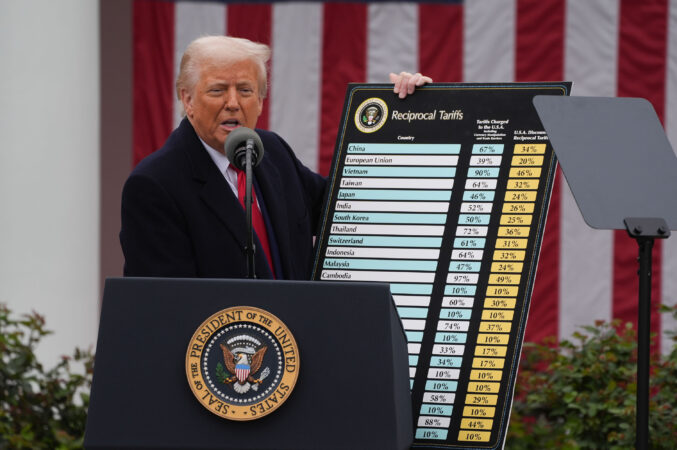
Trump said Friday after the decision that the government would use a separate law, Section 122, to implement a 10% global tariff. That law allows tariffs to be imposed for 150 days.
He also said he would impose “several” new tariffs under Section 301, which applies to unfair trade practices.
One way Trump might proceed would be to use a different law to temporarily put in place tariffs of up to 15% for about five months, said Patrick Childress, an international trade attorney at Holland & Knight in D.C. and a former assistant general counsel at the Office of the U.S. Trade Representative. During that time, the Trump administration could conduct investigations using a separate law to potentially put in place country-specific tariffs.
“This is the path I think the administration is most likely to take because it gives them speed. They have flexibility to raise tariffs up or down, and they result in country-specific tariffs much like the IEEPA tariffs,” Childress said.
If that’s how the White House ultimately tackles tariffs, it could mean that not much changes at all for consumers.
Justices wrote the Constitution “very clearly” gives Congress the power to impose taxes, which include tariffs, and that Trump could not invoke emergency powers to impose them.
Philly area lawmakers, area businesses react to Supreme Court ruling
President Donald Trump slammed Republican-nominated Supreme Court justices who ruled against him Friday.
Pennsylvania lawmakers say Congress should reclaim its power over taxes and tariffs after the U.S. Supreme Court quashed President Donald Trump’s controversial global tariffs.
The nation’s high court ruled 6-3 Friday that Trump overstepped with tariffs imposed under an emergency powers law, dealing a significant blow to the president’s economic agenda and reasserting congressional authority.
Chief Justice John Roberts and Justices Neil Gorsuch and Amy Coney Barrett — both Trump nominees — joined liberal justices in the majority. Justices Brett Kavanaugh, Clarence Thomas, and Samuel Alito dissented.
Trump told reporters at the White House Friday that he was “ashamed” of the three Republican-appointed justices for not having “the courage to do what’s right for our country.”
But local lawmakers celebrated the decision as a step toward alleviating inflation exacerbated by Trump’s tariffs.
It’s “the first piece of good news that American consumers have gotten in a very long time,” said U.S. Rep. Brendan Boyle (D., Philadelphia), the ranking member of the House Budget Committee.
The decision is likely not the end of the road for Trump’s efforts to impose tariffs. The court struck down the broad authority Trump had claimed to impose sweeping tariffs but he could still impose additional import and export taxes using powers he employed in his first term.
President of Philly port operator says Supreme Court ruling ‘hard to interpret’
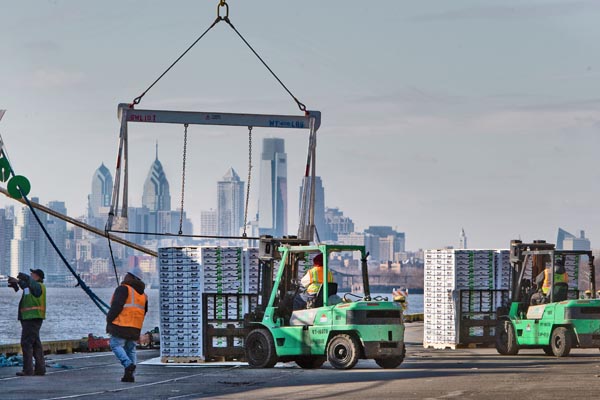
Workers move cargo at the Tioga Marine Terminal in Port Richmond.
Andrew Sentyz is president of Delaware River Stevedores, which operates the Port of Philadelphia’s publicly owned Tioga Marine Terminal in Port Richmond.
“It’s kind of hard to interpret,” he said of the Supreme Court ruling. “…I don’t know if I have a handle on what exactly it’s going to impact, and what it’s not. Some [tariffs] are still there, some are not.”
“Our business is a lot like a public utility in that there’s a demand and there’s a supply and we’re like the conduit the goods pass through,” he said. “…Trade policy massively affects how much moves or how much doesn’t move and in which direction.”
Sentyz said he’s cautiously optimistic about a normalization in trade.
“From the perspective that people have more certainty, I think it is welcome,” he said of the court ruling. “People receiving the cargo, they like a market that’s predictable. When it’s unpredictable it makes their business much harder. We’re impacted by how much they buy or sell.”
Will companies get refunds for paying tariffs the Supreme Court has now ruled were illegally imposed?
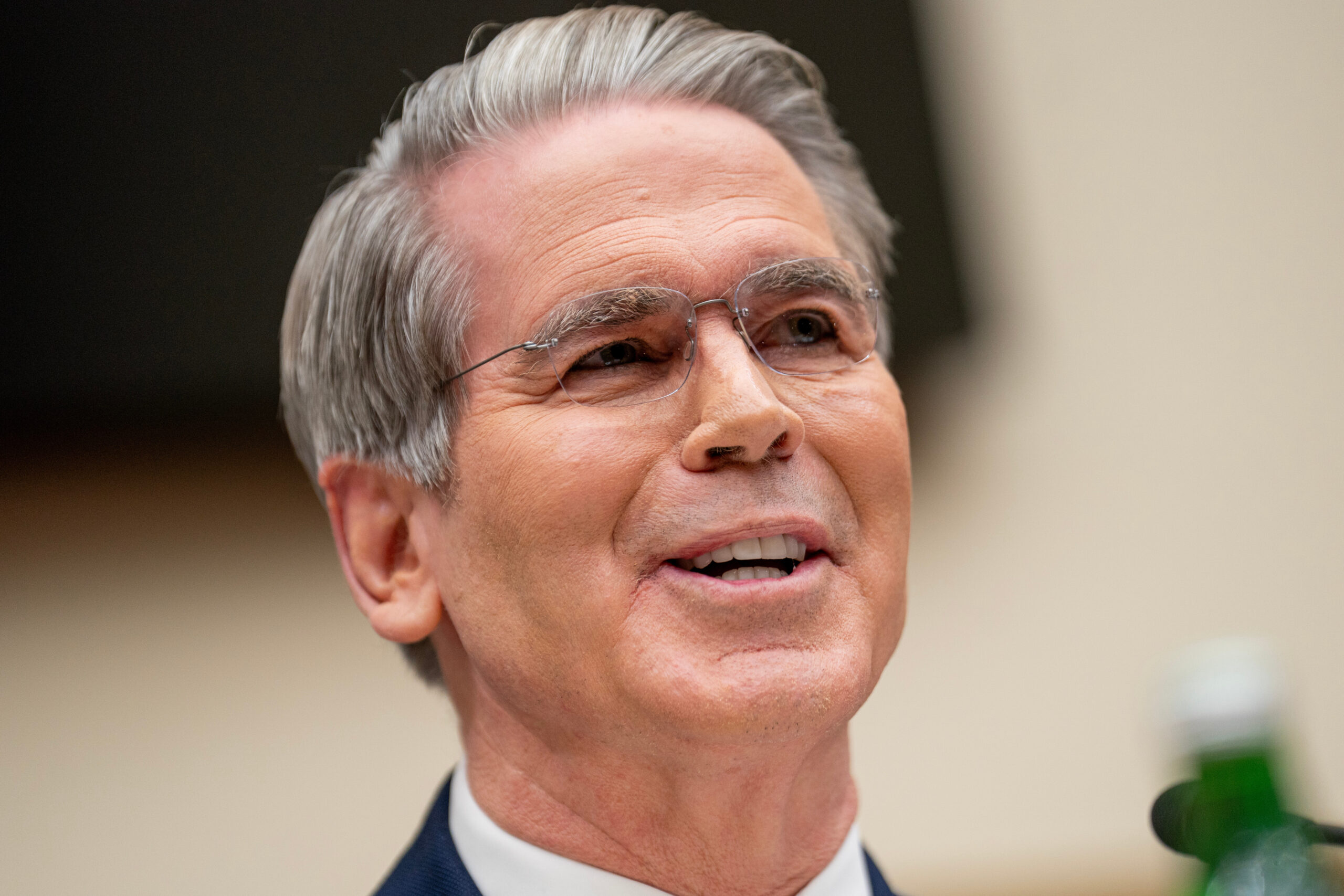
Treasury secretary Scott Bessent doesn’t think it’s likely.
“I got a feeling the American people won’t see it,” Bessent said during an interview at the Economic Club of Dallas Friday,
Bessent said he expects tariff revenue to be “virtually unchanged” in 2026 because the administration plans to turn to alternate methods to collect the levies.
Trump has already announced he plans to impose a 10% global tariff using an untested section of the 1974 Trade Act meant to address issues with international payments.
Reaction from Europe focuses on renewed upheaval, confusion
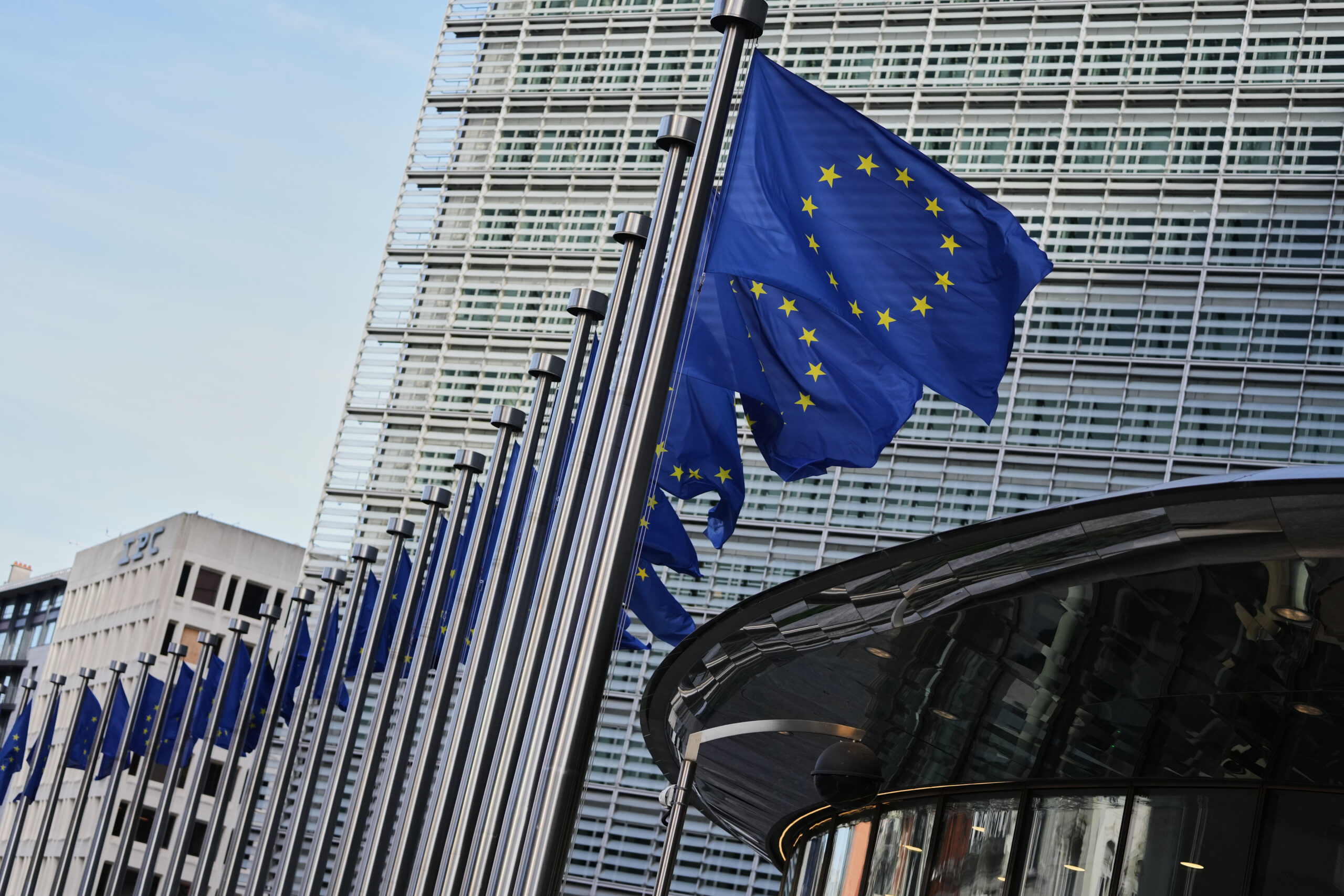
European Union flags flap in the wind outside of EU headquarters in Brussels.
The initial reaction from Europe focused on renewed upheaval and confusion regarding costs facing businesses exporting to the US.
The European Commission had reached a deal with the Trump administration capping tariffs on European imports at 15%. The deal gave businesses certainty that helped them plan, a factor credited with helping the 21 countries that use the euro currency skirt a recession last year.
“Uncertainty remains high for German enterprises doing business in the US,” said the German Chamber of Commerce and Industry. “Because there are other instruments for trade limitations in the hands of the US administration that German companies must prepare themselves for.”
Trump could resort to laws permitting more targeted tariffs that could hit pharmaceuticals, chemicals and auto parts, said Carsten Brzeski, global head of macro at ING bank: “Europe should not be mistaken, this ruling will not bring relief. … The legal authority may be different, but the economic impact could be identical or worse.”
— Associated Press
// Timestamp 02/20/26 3:08pm
Supreme Court ruling the beginning of a long legal battle
Among those following the issue, the Supreme Court ruling was “widely expected,” said Villanova University professor of international business Jonathan Doh.
In oral hearings, the Trump administration had argued that the tariffs were necessary due to trade disputes that constituted an emergency, said Doh, who had served as a trade policy negotiator during the 1990s.
However, the administration then touted the tariffs’ revenue-generating capacity — saying they’ve raised about $175 billion, Doh said. Supreme Court justices took notice of this when they weighed whether this was really an emergency.
“The justices spent as much time arguing about whether the remedy [for the trade dispute] was tariffs,” Doh said.
The 6-3 decision is having immediate effects, Doh said. Importers can no longer collect tariffs through this act. Companies are already looking for ways to recoup what they paid from the federal government. And the Trump administration has already announced it plans to implement “temporary” tariffs through another legal mechanism.
This “shifting playing field” only adds uncertainty to a business community that’s been watching tariffs closely since the start of Trump’s second term, Doh said. All of this will play out in legal battles in the lower courts.
“The decision was extremely significant, but it’s not the end of the story,” Doh said. “In some ways it’s just the beginning.”
Shapiro calls on Trump to ‘listen’ to the Supreme Court
Speaking to reporters on Friday, Gov. Josh Shapiro said he agreed with the Supreme Court’s decision to strike down Trump’s tariffs.
“I have made no bones about the fact that these tariffs are really harming,” the governor said. “I spend a lot of time on farmlands in our commonwealth. Farmers are getting killed by this.”
“We are hearing from folks in our rural communities sort of questioning why would the president do this,” Shapiro continued. “At the same time we’re seeing grocery prices go up, consumer goods go up, and there is a direct line connecting those price increases to the president pushing the tariff.”
Inflation reports show Trump’s tariffs inflated prices across household consumer items by as much as 5% at times.
Shapiro concluded by taking a jab at the president.
“I think the Supreme Court got it right. I say that as a former attorney general, and I say that as someone who actually follows the law,” he said. “And I think the president needs to actually listen to the Supreme Court and drop this and stop the pain for Pennsylvania and stop the pains for the Americans who are dealing with rising prices directly as a result of his tariffs.”
Bucks County Republican Rep. Brian Fitzpatrick ‘applauds’ Supreme Court decision
U.S. Rep. Brian Fitzpatrick (R., Pa.) is a moderate who represents Bucks County.
Casey-Lee Waldron, a spokesperson for U.S. Rep. Brian Fitzpatrick (R., Bucks), said in a statement Friday the lawmaker “applauds” the high court’s decision, “which validates the Congressman’s opposition to blanket and indiscriminate tariffs that are not narrowly tailored, and that do not lower costs for the American consumer.”
Waldron added that Fitzpatrick, a moderate who represents purple Bucks County, supports enforcing trade laws but that “This should always be done in a collaborative manner with a bipartisan, bicameral majority in Congress.”
Rep. Mary Gay Scanlon, a Delaware County Democrat, joined the chorus of lawmakers applauding the decision Friday afternoon.
In a post to X she called the decision a “win for the American people.”
“If the President stands by his disastrous tariff policy, it’s because he doesn’t care about lowering costs for American families,” Scanlon wrote.
Trump says he’ll impose a 10% tariff on all countries using untested statute
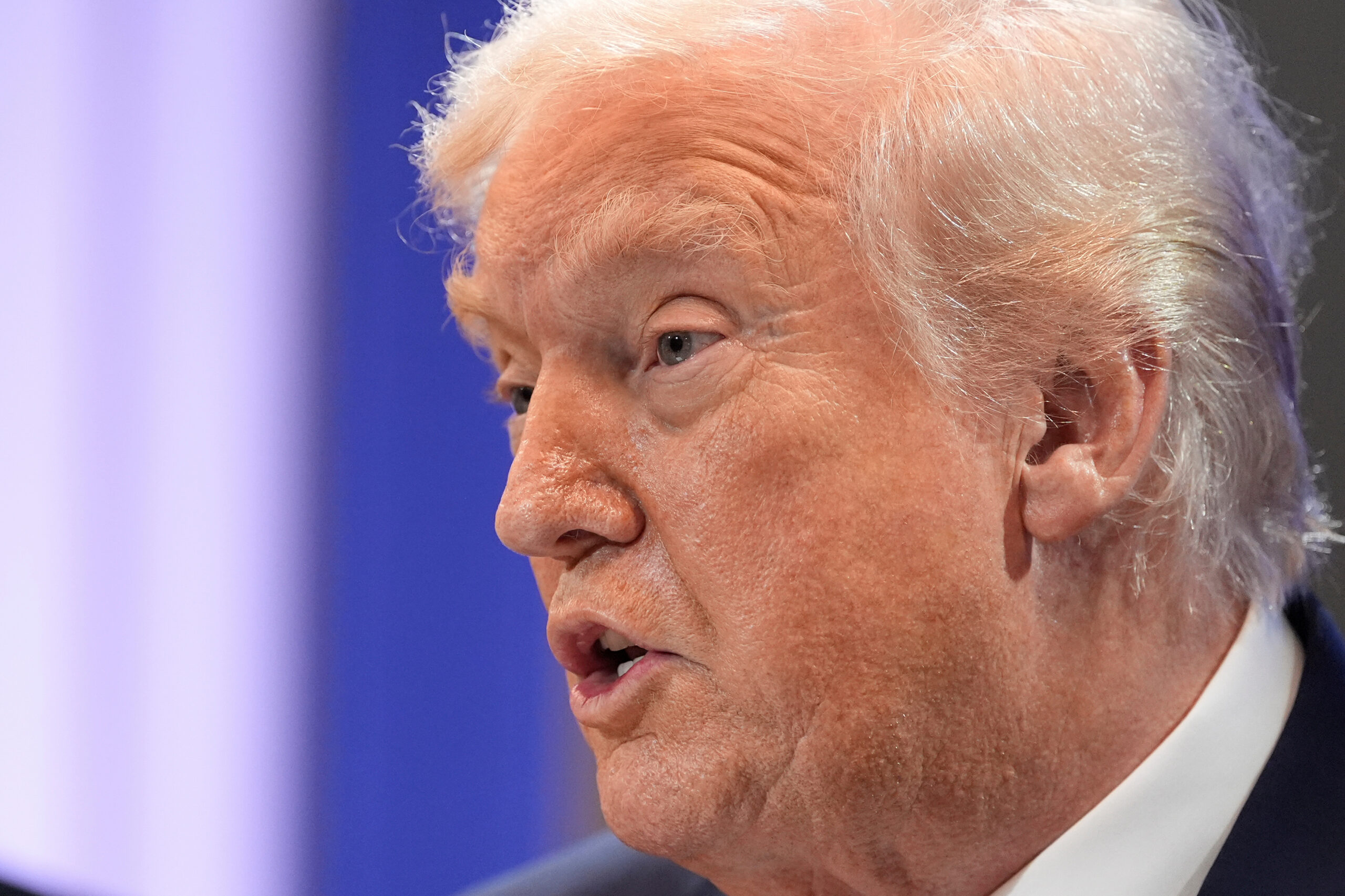
President Donald Trump speaks with reporters Friday.
President Donald Trump told reporters he plans to sign an executive order enacting 10% global tariffs following the Supreme Court’s decision.
“Today, I will sign an order to impose a 10% global tariff under Section 122, over and above our normal tariffs already being charged,” Trump said Friday. “And we’re also initiating several section 301, and other investigations to protect our country from unfair trading practices of other countries and companies.”
Section 122, a statute created by the 1974 Trade Act, allows the president to impose temporary tariffs on countries to address issues with international payments. The statute, which has never been invoked by a president, limits tariffs to 150 days.
National Association of Manufacturers president: U.S. trade policy needs ‘clarity and durability’
Jay Timmons, president of the National Association of Manufacturers, said he and other leaders of the 14,000-member manufacturers’ group share President Trump’s goal of “ushering in the greatest manufacturing era.” But, he added, the court decision “underscores the importance of clarity and durability in U.S. trade policy.”
Timmons was in Philadelphia Friday morning to meet with leaders from the port, shipyard, Chamber of Commerce, and others in industry.
Stable tariffs and policies boost investment and hiring, but “legal and policy uncertainty make it more difficult” for American companies to compete, Timmons added in a statement. Since the court has ruled, “now is the time for policymakers to work together to provide a clear and consistent framework for trade.”
In the future, tariffs should be limited, according to the NAM leader. Timmons said punitive tariffs should target “specific unfair trade practices,” especially in “nonmarket” nations where government controls production.
NAM has pledged to work with Congress and the Trump administration on “durable” solutions to boost U.S. manufacturing and factory workers, he concluded.
‘Fools and lapdogs’: Trump says Republican-appointed Supreme Court justices lacked loyalty in tariff ruling
President Donald Trump speaks to reporters Friday.
President Donald Trump slammed three Republican-appointed Supreme Court justices for voting in favor of striking down his tariffs on foreign goods.
Two justices Trump nominated — Neil Gorsuch and Amy Coney Barrett — joined with chief justice John Roberts in ending Trump’s central economic policy.
Speaking to reporters at the White House Friday, Trump said he was “ashamed” the three justices — two of whom he nominated — didn’t have “the courage to do what’s right for our country.”
Trump also went after the court’s three Democratic appointees, calling them “automatic no” votes on any of his policies that make their way to the Supreme Court.
“You can’t knock their loyalty,” Trump said. “It’s one thing you can do with some of our people … They’re just being fools and lapdogs for the RINOs and radical-left Democrats.”
“Trump’s tariffs are FAR from over,” says Gene Marks, small business columnist for The Inquirer and founder of small-business consulting firm Marks Group in Bala Cynwyd.
Marks notes, “As Karoline Leavitt said back in June ‘we can walk and chew gum at the same time’ and as Scott Bessent said in December: ‘The administration will be able to replicate tariffs even if the SCOTUS rules against.’”
Some ways it could do so, Marks added, include:
The 1930 Smoot Hawley Act allows the U.S. to impose tariffs up to 50% on imports from countries that “discriminate” against U.S. goods through unfair duties, taxes, or regulations. But it requires congressional approval.
Section 122 of the Trade Act of 1974 gives the president “balance-of-payments” authority. This has a 150-day limit unless extended by Congress, and a 15% maximum rate.
Section 232 of the Trade Expansion Act of 1962/Section 301 of the Trade Act of 1974 allow tariffs on sectors or industries. These would require investigations and public comment.
“The only thing certain about tariffs in 2026 is that there will be a lot of uncertainty,” Marks said.
Tariffs had been impacting business at the Port of Philadelphia
Cranes at the Packer Avenue Marine Terminal in South Philadelphia.
Tariffs have slowed business at the Port of Philadelphia lately, with cargo volume down across the board — containers, steel, automobiles, and other commodities.
Philly is a major gateway for produce, bringing in more fresh fruit than any other U.S. port, largely from Central and South America. The port saw record container volume last year, handling almost 900,000 units, up 6% over 2024. About two-thirds of that cargo was refrigerated — fruit and meat, for example.
But the year got off to a slow start. “The story is increased competition and tariffs,” Sean Mahoney, marketing director at the Philadelphia Regional Port Authority (PhilaPort), said during the agency’s board meeting on Wednesday.
Container volume in January was down 14% over the year-earlier period. Auto imports fell 17%, and breakbulk cargoes (steel, paper, lumber) fell too. (Tariffs weren’t the only factor; Mahoney noted that ports in early 2025 happened to see more cargo than usual in part because shippers ordered more goods amid labor negotiations between employers and unions representing dockworkers.)
Shapiro hails Supreme Court decision to stop Trump’s ‘reckless approach’
Pennsylvania Gov. Josh Shapiro has been a vocal opponent of Trump’s tariffs.
Gov. Josh Shapiro, who has been a frequent critic of the tariffs, posted to X Friday applauding the Supreme Court’s decision.
“Donald Trump’s tariffs have been a disaster — wreaking havoc on Pennsylvania farmers, small business owners, and families who are just trying to make ends meet,” Shapiro wrote.
He urged Trump to follow the court’s ruling and “drop this reckless approach to economic policy that has done nothing but screw over Americans.”
New Jersey import-export company doesn’t expect it will be easy to get refunds
Now that the Supreme Court has made its decision, one big question for companies is whether they’ll be able to get refunds for the additional tariffs they’ve paid since “liberation day” 10 months ago, said Tim Avanzato, vice president of international sales at Lanca Sales Inc.
The New Jersey-based import-export company should be eligible for as much as $4 million in tariff refunds, Avanzato said. But getting that money is far from guaranteed.
“It’s going to create a paperwork nightmare for importers,” he said, and he doesn’t expect the Trump administration to make it easy.
He’ll also be on the lookout for other ways the Trump administration may implement tariffs, further complicating the matter.
Avanzato said President Trump was right when he said that other countries have been taking advantage of the U.S. with their tariffs — and in principle, the president was right to apply his own.
“He should have done more with a scalpel than with a bomb,” Avanzato said.
Though companies may be able to recoup some of what they lost, the same won’t go for consumers, he noted.
“Companies are not very good at passing on savings,” Avanzato said. “Nobody is going to rush to drop their prices.”
Supreme Court ruling brings uncertainty to Pennsylvania businesses
Canada is Pennsylvania’s biggest export market, with the state sending more than $14 billion in goods there in 2024.
The Supreme Court’s decision may be welcome news for U.S. businesses that pay the import taxes, but one immediate effect is more uncertainty as firms weigh whether to hire and make investments.
Not all of President Donald Trump’s tariff increases came through the use of the International Emergency Economic Powers Act and therefore some will remain in place, said Julie Park, a partner at London-based tax and business advisory firm Blick Rothenberg.
“This decision brings further uncertainty for businesses,” she said in a statement. That’s in part because Trump could seek to reimpose tariffs through other legal tools, leaving “businesses in limbo about if they will get refunded.”
U.S. exporters will also be closely following what happens next, since the fate of Trump’s tariffs will likely affect whether other countries like Canada keep their retaliatory measures in place. Canada is Pennsylvania’s biggest export market, with the state sending more than $14 billion in goods there in 2024. Top exports included machinery, cocoa, iron, and steel.
Pennsylvania’s dairy industry has also been caught in the middle of the global trade war, as China and Canada imposed extra taxes on those goods in response to U.S. tariffs.
President Donald Trump will hold a news briefing at 12:45 p.m. to address the Supreme Court’s ruling, White House Press Secretary Karoline Leavitt announced on social media.
// Timestamp 02/20/26 12:17pm
Gov. Mikie Sherrill, other New Jersey officials celebrate Supreme Court ruling
New Jersey Gov. Mikie Sherrill, seen here in November.
New Jersey Gov. Mikie Sherrill celebrated the court ruling on President Donald Trump’s tariffs, which she said have raised costs by $1,700 per New Jersey family and had a negative impact on small businesses and jobs.
“I’m thrilled that folks and businesses will start to see the relief they deserve – with no thanks to the president,” she added.
The new governor ran on a message combining affordability and fighting Trump. She took particular aim at his tariffs and visited small businesses in South Jersey to discuss their impact on local economies in the state.
Sen. Andy Kim, a South Jersey Democrat, said the Supreme Court’s decision is “a step” in righting wrongs by Trump’s administration, but that there’s “so much more to go.”
Calling the tariffs “unpopular and illegal,” the senator said the president cost Americans “a lot of money.”
“Trump 2.0: You pay for his tariffs, tax breaks for his billionaire donors, & insane corruption for his friends and family,” he added in a social media post.
Sen. Cory Booker, a North Jersey Democrat, lauded the Supreme Court for ruling “what we’ve all known: this administration cannot ignore the rule of law and Congress’ role to protect America’s economy from reckless and chaotic tariffs.”
“For nearly a year, Trump abused our trade tools to curry favors with foreign officials and exact revenge on his rivals, all while America’s working families and small businesses paid the price,” Booker said on social media. “Trump raised the cost on everything from the food we eat to the clothes we wear, and also failed to bring back good-paying jobs or fix our broken economy.”
Philly Rep. Dwight Evans calls on Congress to reassert its constitutional power
Congressman Dwight Evans, seen here in 2025.
U.S. Rep. Dwight Evans (D., Pa.), who represents parts of Philadelphia, called the ruling a win for the wallets of Americans and called on Congress to reassert its power over the country’s economy.
“The Constitution is clear — only Congress has the power to levy tariffs and other taxes,” Evans wrote on social media. “I’m a co-sponsor of legislation to return this power to Congress — it’s long past time Republicans work with Democrats to pass it!”
The bill, which has no chance of passing in the Republican-controlled House, would require congressional approval for all new tariffs and the reversal of tariffs imposed on Mexico and Canada enacted through the United States-Mexico-Canada Agreement.
His call was echoed by Sen. Chuck Grassley, an Iowa Republican who serves as the chairman of the Senate Judiciary Committee.
In a statement, Grassley wrote, “I’ve made clear Congress needs to reassert its constitutional role over commerce, which is why I introduced prospective legislation that would give Congress a say when tariffs are levied in the future.”
President Trump described the Supreme Court decision as “a disgrace” when he was notified in real time during his morning meeting with several governors.
That’s according to someone with direct knowledge of the president’s reaction, who spoke on the condition of anonymity to discuss the private conversation. Trump was meeting privately with nearly two dozen governors from both parties when the decision was released.
— Associated Press
// Timestamp 02/20/26 11:03am
Brendan Boyle celebrates Supreme Court ruling as ‘good news’ for consumers
U.S. Rep. Brendan Boyle during a hearing on Capitol Hill in Washington, D.C., in November.
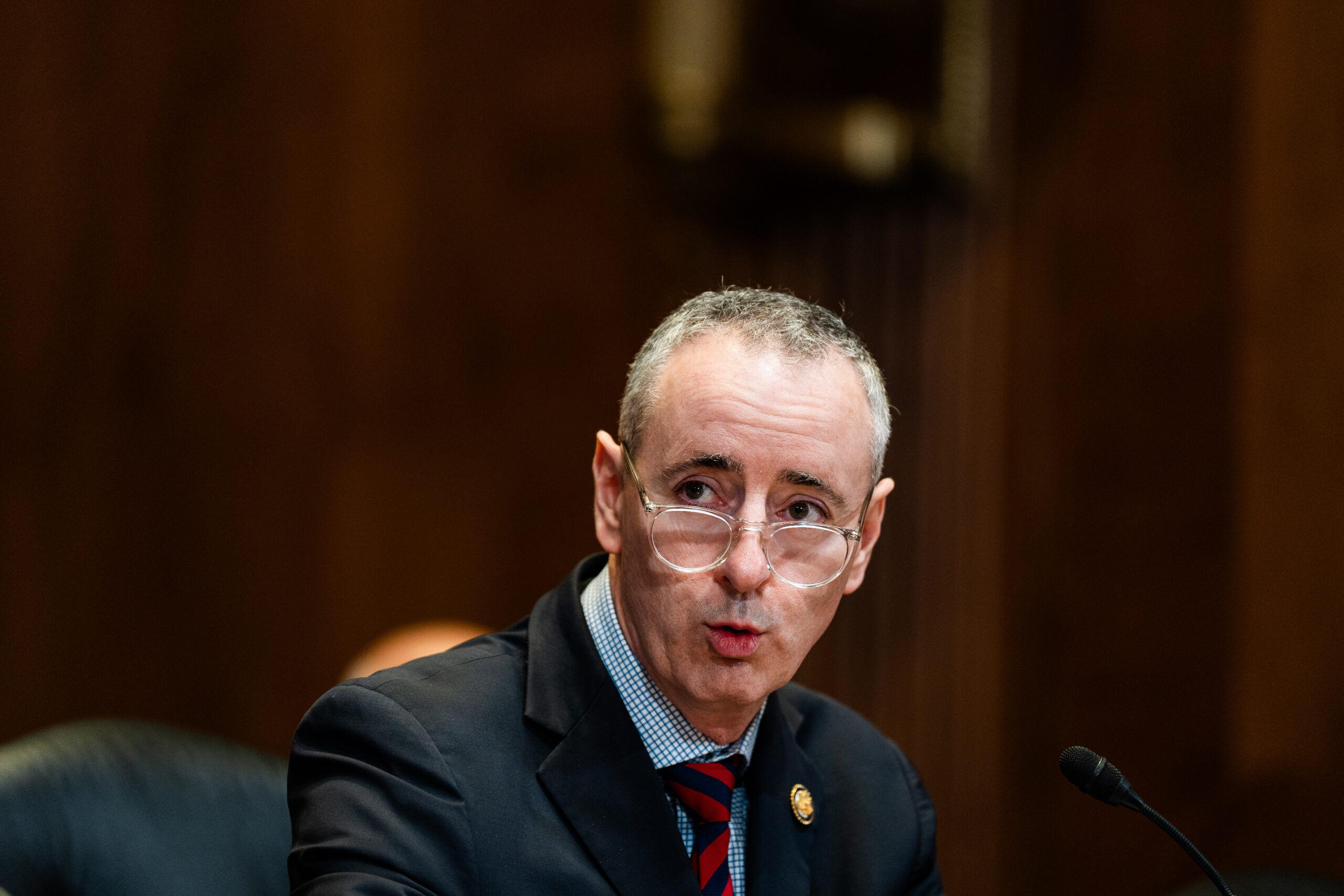
The decision is “the first piece of good news that American consumers have gotten in a very long time,” said U.S. Rep. Brendan Boyle (D., Philadelphia), the ranking member of the House Budget Committee, said in an interview Friday.
Boyle noted that the public will eventually see prices go down, but it remains unclear what will happen to tariff revenue that’s already been collected. But Pennsylvania lawmakers, including Boyle, are pushing for Congress to reassert its power to control the country’s purse strings.
“As the Supreme Court validated this morning, Congress has the authority to levy taxes and tariffs,” Boyle said. “It’s time now for us to finally reclaim that authority and bring some certainty and rationality to our tariff policy, which under Donald Trump has been all over the map and changes day by day, even hour by hour.”
Boyle and U.S. Rep. Dwight Evans (D., Philadelphia) have cosponsored a bill that would require congressional approval for all new tariffs and the reversal of tariffs imposed on Mexico and Canada enacted through the United States-Mexico-Canada Agreement. It’s unlikely that it will pass the Republican-controlled U.S. House.
Will businesses get refunds? One Supreme Court justice says the process will be a ‘mess’
Supreme Court Justice Brett Kavanaugh, who was one of three who ruled against striking down the tariffs.
Companies have collectively paid billions in tariffs. Many companies, including the big-box warehouse chain Costco, have already lined up for refunds in court, and Justice Brett Kavanaugh noted the process could be complicated.
“The Court says nothing today about whether, and if so how, the Government should go about returning the billions of dollars that it has collected from importers. But that process is likely to be a ‘mess,’ as was acknowledged at oral argument,” Kavanaugh wrote in the dissent.
We Pay the Tariffs, a coalition of more than 800 small businesses that has been advocating against the tariffs, said a process for refunding the tariffs is imperative.
“A legal victory is meaningless without actual relief for the businesses that paid these tariffs,” executive director Dan Anthony said in a statement. “The administration’s only responsible course of action now is to establish a fast, efficient, and automatic refund process that returns tariff money to the businesses that paid it.”
— Associated Press
// Timestamp 02/20/26 10:36am
The Supreme Court strikes down Trump’s tariffs
The Supreme Court struck down President Donald Trump’s far-reaching global tariffs on Friday, handing him a significant loss on an issue crucial to his economic agenda.
The 6-3 decision centers on tariffs imposed under an emergency powers law, including the sweeping “reciprocal” tariffs he levied on nearly every other country.
It’s the first major piece of Trump’s broad agenda to come squarely before the nation’s highest court, which he helped shape with the appointments of three conservative jurists in his first term.
The majority found that the Constitution “very clearly” gives Congress the power to impose taxes, which include tariffs. “The Framers did not vest any part of the taxing power in the Executive Branch,” Chief Justice John Roberts wrote.
Justices Samuel Alito, Clarence Thomas, and Brett Kavanaugh dissented.
“The tariffs at issue here may or may not be wise policy. But as a matter of text, history, and precedent, they are clearly lawful,” Kavanaugh wrote in the dissent.
The economic impact of Trump’s tariffs has been estimated at some $3 trillion over the next decade, according to the Congressional Budget Office. The Treasury has collected more than $133 billion from the import taxes the president has imposed under the emergency powers law, federal data from December shows. Many companies, including the big-box warehouse chain Costco, have already lined up in court to demand refunds.
— Associated Press
// Timestamp 02/20/26 10:34am
Trump could still impose tariffs under other laws
The Supreme Court’s tariffs decision doesn’t stop President Donald Trump from imposing duties under other laws.
While those have more limitations on the speed and severity of Trump’s actions, top administration officials have said they expect to keep the tariff framework in place under other authorities.
“It’s hard to see any pathway here where tariffs end,” said Georgetown trade law professor Kathleen Claussen. “I am pretty convinced he could rebuild the tariff landscape he has now using other authorities.”
The Constitution gives Congress the power to levy tariffs. But the Trump administration argued that a 1977 law allowing the president to regulate importation during emergencies also allows him to set tariffs. Other presidents have used the law dozens of times, often to impose sanctions, but Trump was the first president to invoke it for import taxes.
Trump set what he called “reciprocal” tariffs on most countries in April 2025 to address trade deficits that he declared a national emergency. Those came after he imposed duties on Canada, China, and Mexico, ostensibly to address a drug trafficking emergency.
A series of lawsuits followed, including a case from a dozen largely Democratic-leaning states and others from small businesses selling everything from plumbing supplies to educational toys to women’s cycling apparel.
The challengers argued the emergency powers law doesn’t even mention tariffs and Trump’s use of it fails several legal tests, including one that doomed then-President Joe Biden’s $500 billion student loan forgiveness program.
— Associated Press
Two Trump Supreme Court appointees ruled against his tariffs
Chief Justice John Roberts wrote the court’s majority opinion, joined by Justices Neil Gorsuch and Amy Coney Barrett, two of Trump’s three Supreme Court picks. The three liberal justices were also part of the majority.
Justice Brett Kavanaugh, Trump’s other appointee, wrote the main dissent, joined by Justices Clarence Thomas and Samuel Alito.