Category: Politics

Political news and coverage

  • Gov. Mikie Sherrill says fighting data centers is part of her response to extreme weather during Camden visit after flooding

    Gov. Mikie Sherrill says fighting data centers is part of her response to extreme weather during Camden visit after flooding

    New Jersey Gov. Mikie Sherrill climbed onto an emergency water vehicle in Camden on Tuesday with Camden Fire Chief Jesse Flax. That vehicle, called the High Water One, was used by local emergency responders on Monday to rescue 14 people from the flooded streets of Camden, Flax said.

    The vehicle had arrived in the city one week earlier, just in time for what officials said was the worst flooding they had ever seen in the city, including from Hurricane Sandy in 2012.

    “I’ve never seen this in my whole career,” said Flax, who has worked in the city for three decades. “I’ve seen bad fires, I’ve seen a lot of different things. But I’ve never seen it flood in this capacity.”

    The new High Water Rescue vehicle that was used in the recent rainfall and flooding at the Fire Administration Building in Camden on Tuesday.

    No one was reported injured among 1,000 calls to emergency services.

    Sherrill thanked emergency responders and comforted Maria Perez, a Camden resident recovering from surgery who worked with her neighbors to fight the flooding by “telling them what to do and keeping them calm.”

    “I wanted them to keep plastic bags on their feet, too, because you don’t know what’s in that water. … I’m so glad that we had such a great team,” Perez, a member of the Camden schools advisory board, said in an interview.

    The governor’s visit came just a little more than an hour after she signed legislation in Salem County aimed at data centers. She said that very work can help prevent strain on the power grid during future storms and that the electrical grid is “top of mind” for her.

    Gov. Mikie Sherrill, left, speaks with Maria Perez, center, and Sen. Nilsa Cruz-Perez, right, at the fire house in Camden on Tuesday.

    “We are seeing these extreme weather events more and more and more frequently,” said Sherrill, who was dealt a historic snowstorm just weeks into her term and has recently seen a deadly heat wave. After her stop in Camden, she went to a BJ’s Wholesale Club store in Monmouth County where a roof fell in from Monday’s flooding.

    One of the bills Sherrill signed into law on Tuesday creates a new ratepayer class and rate structure for data centers that is meant to ensure they pay for their own energy. Another creates more oversight for utility companies’ grid upgrades to try to save money.

    “We’ve set them aside in a separate class of utility users, so that if we have storms like this, they will be first impacted, not normal rate payers,” Sherrill said.

    Data centers have caused concern on both sides of the aisle in South Jersey, with towns including Medford taking steps to block their development locally. But according to county spokesperson Dan Keashen, Camden did not have widespread power outages during the storm, just a handful that were rectified the same day.

    Oscar Parra makes his way to his car in the flooded parking lot at the Ferry Avenue PATCO station in Camden on Monday amid a flash flood threat for the region.

    So what about the damage in Camden?

    Sherrill said residents should report damage through the New Jersey Office of Emergency Management so the state can calculate how much federal assistance to request.

    “There are technical things we need to meet,” she said. “I think we probably will, but we’re collecting that now.”

    American Red Cross workers in Camden on Tuesday were providing cleaning supplies like mops, bleach cleaners, gloves, and tarps — as well as snacks and water, said Diane Concannon, the organization’s communications director for the New Jersey region.

    “Flooding is horrible for any family … because everyone wants to be able to save everything,” she said.

    While the rain was intense, it cleared up quickly because the city has maintained its sewers so well, Sherrill said.

    “They have done a really good job here in Camden with some of these resiliency efforts,” she said. “It’s why this wasn’t worse.”

  • Democrats begin to clash over who replaces Platner even before he exits

    Democrats begin to clash over who replaces Platner even before he exits

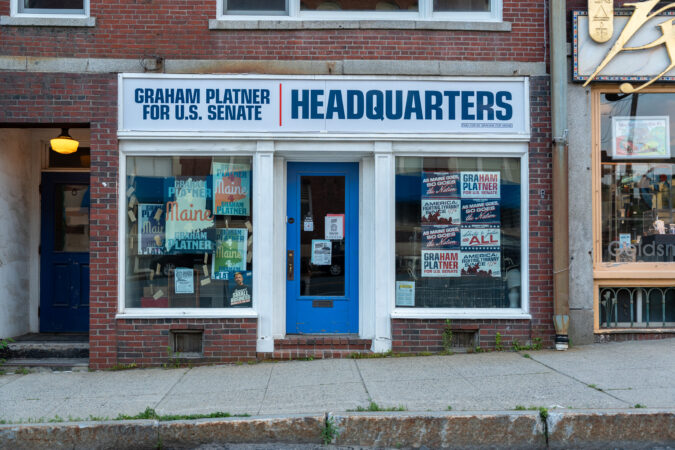
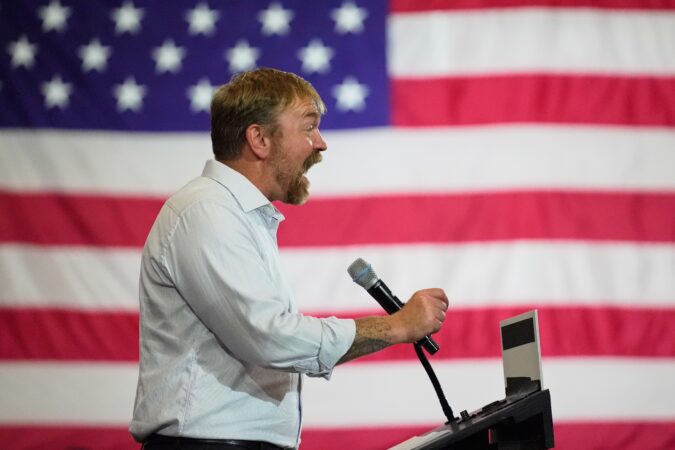
    The implosion of Graham Platner’s campaign for Senate in Maine after an accusation of rape has ripped open divisions inside the Democratic Party as its progressives and moderates battle to pick his successor even before he has said he will step aside.

    National Democrats have grown alarmed that a seat seen as crucial to winning control of the Senate could be slipping from the party’s grasp. Platner had survived a series of controversies — about a tattoo with Nazi symbolism, inflammatory old Reddit posts, and his relationships with women — but many in the party abandoned him after the rape accusation, including the leaders of the Maine Democratic Party and Senate Minority Leader Chuck Schumer.

    They have demanded that Platner step down before a Monday deadline for him to be replaced on the ballot to find a new Democrat to run against Sen. Susan Collins, a longtime Republican fixture in the state. The main super political action committee for Democratic Senate candidates said it would redirect $24 million in ad reservations to other states if he remained.

    Sen. Bernie Sanders (I., Vt.), one of Platner’s earliest and most prominent backers, joined the chorus on Tuesday afternoon.

    “I have spoken with Graham Platner about the best path forward for Maine,” Sanders said in a statement. “In light of these very serious allegations, I have recommended that he step aside.”

    Platner, who has denied the allegation, said on a private call with his campaign staff on Monday evening that he believed he still had leverage to influence which candidate would replace him on the ticket, according to three people familiar with the conversation. On the call, he did not announce plans to withdraw but implied such a decision would be coming, the people said.

    Platner’s campaign had stopped running ads on Meta’s platforms, such as Facebook and Instagram, as of Tuesday, according to the company’s ad disclosure database. He had been running multiple ads as recently as Monday evening.

    The drama comes almost exactly two years after the Democratic Party was roiled by the exit of Joe Biden, then the president, from his reelection race and the speedy anointment of Vice President Kamala Harris as the Democratic nominee. That process — and Democrats’ ultimate loss in 2024 — has left deep scar tissue for many in the party.

    Many on the left — including, it appears, Platner himself — want any replacement to come from the progressive wing of the party after he won the primary over Gov. Janet Mills, a moderate two-term Democrat, who withdrew over a month before the election.

    “To the Democratic establishment: This is not your opening,” said Joseph Geevarghese, executive director of Our Revolution, a group that emerged from Sanders’ 2016 presidential campaign. Referring to Senate Democrats’ campaign arm, he added, “Mainers did not vote by an overwhelming margin against Janet Mills and the DSCC’s handpicked pick just to be handed another status-quo candidate anyway.”

    On the flip side, many in the party establishment believe those on the left should show some humility after Platner’s collapse.

    A range of Democratic groups and activists engaged in the politics of “I told you so.”

    “When women raise the alarm, listen,” said a social media post from EMILY’s List, a group that works to elect Democratic women and that had backed Mills. “Graham Platner’s behavior is disqualifying (AS WE HAVE SAID THIS WHOLE DAMN TIME), and he should end his campaign.”

    On Tuesday morning, more Democrats who are ideological allies of Platner called for him to step aside, including New York City Mayor Zohran Mamdani.

    “I believe that it’s time for him to drop out of the race,” Mamdani said when asked at a news conference. “I think the focus of today should be to respond to the gravity of what so many of us have read, and I think the only appropriate response is for the campaign to come to an end.”

    Mamdani and Platner share several advisers, including Morris Katz and Rebecca Katz of the Fight Agency.

    The progressive group MoveOn also dropped its endorsement.

    As the situation in Maine threatened to spiral out of control, Schumer and the Democratic Senatorial Campaign Committee are set to host major donors this week for a fundraising retreat at the Broadmoor in Colorado Springs. Donors are asked to contribute $44,300 to attend, according to a copy of the invitation.

    The event, which was previously scheduled, was billed as a “special weekend to discuss the DSCC’s strategy and campaigns for taking back the Democratic Senate majority,” but now talk is likely to be consumed by the developments in Maine.

    Platner can be replaced as the Democratic nominee if he withdraws voluntarily by Monday. The state Democratic Party would then have until July 27 to pick his replacement, under state law. But the law does not dictate how the state party itself needs to pick Platner’s replacement.

    What that would look like remains unclear. The options under discussion include a convention or a statewide caucus in late July.

    “We ask for your patience as this work continues,” Devon Murphy-Anderson, the state party’s executive director, wrote in a message to committee members on Tuesday, adding: “Whatever process is ultimately adopted must reflect our Democratic values. It should be open, inclusive, transparent, and fair.”

    A range of candidates are being discussed, with some early attention on those who ran and lost the primary for governor this year. Those Democrats include Troy Jackson, a former president of the Maine Senate; Nirav Shah, a former director of Maine’s public health agency; and Shenna Bellows, Maine’s secretary of state. But some Democrats were concerned about elevating someone who just lost.

    Supporters of Jackson, who had backed Platner in the primary, created a Draft Troy website, and he filed paperwork with the Federal Election Commission for a Senate exploratory committee. Shah put out a statement that said he had received “hundreds of encouraging messages,” adding that anyone who ran for the nomination should commit to a televised debate and “multiple town halls across every corner of the state.”

    Another possible candidate is Dan Kleban, a co-founder of the Maine Beer Co., a brewery outside Portland. He briefly ran for Senate last year before dropping out and endorsing Mills. But like Platner, he has never held elected office or been through the rigors of a campaign.

    Yet another possibility is Jordan Wood, who also previously ran for Senate and dropped out. Wood ran instead in the primary for Rep. Jared Golden’s House seat and lost.

    Golden, a moderate Democrat and veteran who holds the most pro-Trump House seat of any Democrat in Congress, is retiring and previously said he was ready to step away from elected office.

    In recent days, Golden has fielded calls gauging his interest in a run for Senate, according to two people familiar with those conversations who spoke on the condition of anonymity to describe private discussions.

    Golden has not commented since the latest allegations against Platner emerged.

    More unconventional picks were being bandied about, as well. One Democratic firm in recent days included actor Patrick Dempsey in a poll. (He was viewed favorably by 52% of voters in the survey.) Others floated the popular liberal historian Heather Cox Richardson, who is based in Maine.

    Some Democrats erupted after the news emerged that Platner wanted a replacement who was aligned with him politically. One person familiar with the Platner campaign’s internal discussions said Monday that Platner would seek a guarantee he would be replaced by someone in agreement with “the values and vision and policy agenda” that he had pressed.

    Others argued that under the circumstances, Platner’s support would be damaging.

    Joe Baldacci, a state senator who ran and lost in the primary for Golden’s House seat this year, said the idea that Platner would bless a replacement would be the equivalent of “tying a lead weight” to the person.

    “After you have put the Democratic Party in a shambles and undermined all Democratic candidates running for office in Maine then you should have no say in who will be your successor,” Baldacci wrote on social media. He added, “Any connections to Platner will doom that person’s campaign from the very beginning.”

    This article originally appeared in the New York Times.

  • Trump-promoted Freedom Fuel gas stations are opening around Philly. Here’s what we know.

    Trump-promoted Freedom Fuel gas stations are opening around Philly. Here’s what we know.

    Philadelphia-area drivers can now fill up their tanks with less-expensive gasoline promoted by President Donald Trump’s administration, but details on the entire enterprise remain scarce.

    The White House on Tuesday announced the opening of the first Freedom Fuel gas station in Upper Dublin Township, at a former Sunoco station.

    In the undated video, drivers happily filled their tanks for $3.47 a gallon, which the White House said was to honor “our 47th President.” That’s cheaper than the least-expensive gas at nearby stations, according to prices posted by GasBuddy.

    The Freedom Fuel station in Dresher is near a McDonald’s and across the street from a shopping plaza. But what sets it apart from other nearby gas stations is the assortment of American flags planted across its footprint — and the cheaper gas.

    While a nearby Citgo station, about five minutes away, prices regular gas at $3.79 a gallon, and a Gulf offers it at $3.85, Freedom Fuel offers it at $3.47 a gallon.

    For many patrons stopping by Tuesday afternoon, the branding was new — and secondary to savings.

    The Freedom Fuel Network gas station at 1400 Dreshertown Road in Dresher.

    Jessiah Brice, 25, said the Freedom Fuel station was convenient because it is near her job. She had noticed the new branding after the July Fourth holiday and had no idea what it was about, but she welcomed the idea regardless of the affiliation with Trump.

    “Gas should be cheaper,” she said. “My only issue is: How is it $3.47 here and $5 by me?”

    Another gas buyer, who declined to give her name out of privacy concerns, said she had heard of Trump’s efforts to bring cheaper gas to people but had not connected it to her local gas station.

    “What’s not to love?” said another patron, before driving away with a full tank.

    Seyer Hamidi, 36, stumbled upon the station after picking up his car, which he likes to fill up with premium gas, from the mechanic. He, too, welcomed the idea.

    “Gas is going to be high whether you’re a Republican or Democrat,” the Republican said, noting the cheaper gas was a step in the right direction.

    A lot remains unclear, including the names of the participating businesses and how they are able to sell gasoline cheaper than nearby competitors.

    A White House spokesperson confirmed that a website for the Freedom Fuel Network, which showed 25 locations across the Philadelphia region and South Jersey, was accurate. The White House did not confirm that all 25 locations are open and did not provide information about the company.

    The list includes stations in Elmwood Park, Bustleton, and Hunting Park, but it was unclear if every location on the Freedom Fuel website was open.

    A White House spokesperson said the Freedom Fuel Network was a private company and not a government program, adding that the company was not purchasing gasoline at a discount and that the administration has not provided funding. The spokesperson said the business was simply making gas more affordable for drivers in Pennsylvania and New Jersey but did not elaborate.

    The company behind the Freedom Fuel Network did not respond to a request for comment.

    The fuel pumps at the Freedom Fuel Network gas station at 1400 Dreshertown Road in Dresher.

    Beyond that, not much information was available beyond the White House social media post and a statement made by Trump, who wrote on his Truth Social account last week that a “very smart retailer” located throughout the Northeast was “stepping up” to offer a discount at the pump.

    Patrick De Haan, head of petroleum analysis at GasBuddy, crunched the numbers and said there was no profitable way for Freedom Fuel stations to sell gas so cheaply.

    “Stations selling at this price, it’s not sustainable,” De Haan said. “Generally, when losses happen, somebody’s got to pay for it.”

    De Haan had no insight on who owns the stations or what deals they might have made to purchase gas, but did confirm many of the stations exist in GasBuddy’s database, though the names were “vastly different.”

    Gas prices have been dropping in recent weeks after peaking in May. Prices soared after the United States attacked Iran and the Strait of Hormuz — a key shipping lane — was shut down.

    The average cost of a gallon of gas in Philadelphia on Tuesday was $3.95, according to AAA. That was up nearly 20% from this time last year, when the cost of a gallon of gas averaged $3.31.

  • Platner should drop out of Maine’s U.S. Senate race after sexual assault allegation, Sanders says

    Platner should drop out of Maine’s U.S. Senate race after sexual assault allegation, Sanders says

    PORTLAND, Maine — Sen. Bernie Sanders on Tuesday became the latest and most notable lawmaker to pull support for Maine Democratic U.S. Senate nominee Graham Platner following an allegation of sexual assault, adding to a chorus of calls for him to step aside as party leaders scramble to determine the next steps.

    Sanders, a Vermont independent who caucuses with Democrats, has long backed Platner in the high-stakes race against Republican Sen. Susan Collins, but he said in a statement that he spoke with the candidate and “in light of these very serious allegations, I have recommended that he step aside.”

    Platner, who denies the allegation, has not heeded the wave of calls to resign as the nominee. Instead, he posted a video on Monday saying he’s considering the next steps for his campaign while canceling town hall events.

    Platner posted the video after reports that a woman who previously dated the first-time candidate said he drunkenly forced her to have sex after she told him to stop.

    The allegation is the latest in a string a controversies Platner has faced and so far weathered since the oyster farmer and Marine veteran entered the race. But the seriousness of the assault claim has put the Maine contest — and Democrats’ ability to win control of the Senate — at risk, with even some of his strongest supporters questioning whether Platner should continue his campaign.

    A Platner voter is ‘heartbroken’

    Joanie Monteith, a passionate supporter from the southern Maine town of York who organized a trivia night about Platner in March, said through tears Tuesday that she was “numb” and “heartbroken” at the news. She was waiting for another public statement from Platner before making a decision about whether she could keep supporting him.

    “I’m in tears. I’m numb and I’m waiting for what Graham has to say. I’m trying not to be a part of this public trial. And I’m heartbroken. And I’m heartbroken for him and his wife.”

    She added she believes the allegations are serious.

    “I’m not going to blame a victim. Because if this is true I feel very bad for the woman,” she said. “You just don’t know how to feel.”

    Jenny Racicot, who lives in Maine, told Politico that Platner entered her home in 2021 while drunk and assaulted her. Racicot said she had been in an on-and-off relationship with Platner, but she cut off contact with him after that night and told him the incident wasn’t consensual. She said in a CNN interview on Monday evening that she opted not to fight back for fear of Platner, a former Marine, becoming more violent.

    Another Maine voter, Lee Holman, said she wants Platner to stay in the race.

    “I feel like the people of Maine have spoken,” the Democrat said. “If they wanted Janet Mills, they could have voted for her.”

    She said the allegation against Platner may be legitimate, but she questions the timing. Democrats, she added, can be too quick to “throw the baby out with the bathwater” by calling on politicians facing allegations to resign.

    “Every time we think we have a chance to snatch our democracy back, something gets in the way,” she said.

    Replacing Platner may further divide Democrats

    The pressure for Platner to withdraw from the Senate race has only increased given the short deadlines Maine law allows for replacing general election candidates. There is no mechanism for Democrats to remove Platner from the ballot, meaning Platner must first opt to drop out of the general election before a replacement can be selected. The deadline to withdraw is 5 p.m. on July 13.

    Just who should replace Platner if he drops out appeared to already be further splintering Democrats. Some argued the next Democrat should echo Platner’s progressive messaging, pointing to his success at rallying voters across the state. Others cautioned that having ties to Platner will only doom an already uphill campaign against Collins.

    Joe Baldacci, a Democratic state senator, said he’s concerned about what the latest allegations will do to the voter excitement over the past year.

    “I think the major concern, even with a nominee, a new replacement, is that person is going to start very much behind the eight ball,” Baldacci added.

    Gov. Janet Mills, who sought the Democratic nomination but dropped out before the June 9 primary, could be considered as a nominee. Mills was supported by Democratic Senate leader Chuck Schumer but abandoned her campaign, saying she couldn’t raise the money needed to compete.

    Another possible replacement is Troy Jackson, Maine’s former state senate president, who unsuccessfully ran to be the Democratic gubernatorial nominee earlier this year with the backing of Platner and Sanders.

    While he hasn’t publicly said he’d run for the Maine Senate seat, U.S. Rep. Ro Khanna threw out his name as someone who stands up for “progressive values” after the California Democrat withdrew his support for Platner.

    Other names include Nirav Shah, the former director of Maine’s Center for Disease Control and Prevention. Shah came in second in this year’s Maine Democratic gubernatorial primary, where he was considered more moderate compared with Jackson.

    In a statement Tuesday, Shah said he’s “evaluating” whether he should enter the race should Platner step aside.

    Other potential replacements include Shenna Bellows, the current Maine Secretary of State; Dan Kleban, founder of Maine Beer Company; Maine U.S. Rep. Jared Golden, who is not running for reelection; and Hannah Pingree, currently Maine’s Democratic gubernatorial nominee.

  • A union fight inside Philly DA Larry Krasner’s office may test his pro-labor reputation

    A union fight inside Philly DA Larry Krasner’s office may test his pro-labor reputation

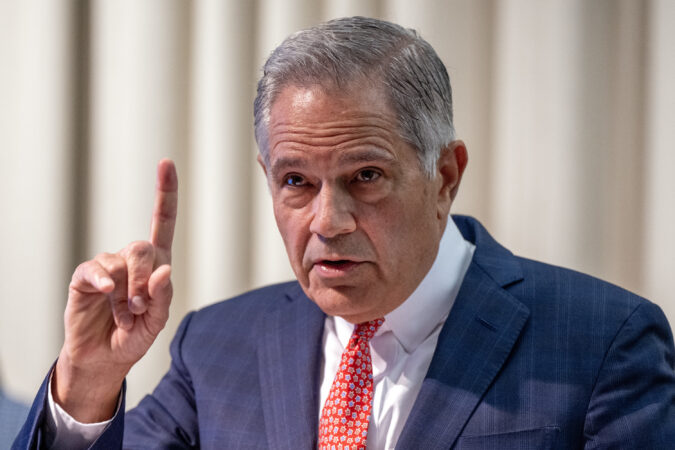
    Philadelphia District Attorney Larry Krasner has long said he’s a friend to organized labor. As prosecutors in his office are gearing up for an election to authorize their union, Krasner has said their efforts could ensure his own legacy, because “whatever person might take my seat later cannot easily undo what we have done.”

    But not everyone in his office is feeling the support.

    More than 100 lower-level employees in the District Attorney’s Office, including paralegals and victim and witness coordinators, are separately trying to secure their own union — and some say they’re meeting resistance.

    Several workers said that Krasner’s administration has put up roadblocks and taken positions that they see as at odds with his public image as a leader of the city’s progressive movement.

    Five paralegals and coordinators, all of whom spoke to The Inquirer on the condition of anonymity to avoid retribution before a union is in place, said the unionization process has left them disappointed with Krasner.

    “He was elected in large part because of a number of very important pro-labor organizations in Philadelphia,” said one employee. “If the DA just came out and publicly supported it, that’s what I would expect from the most progressive DA in America.”

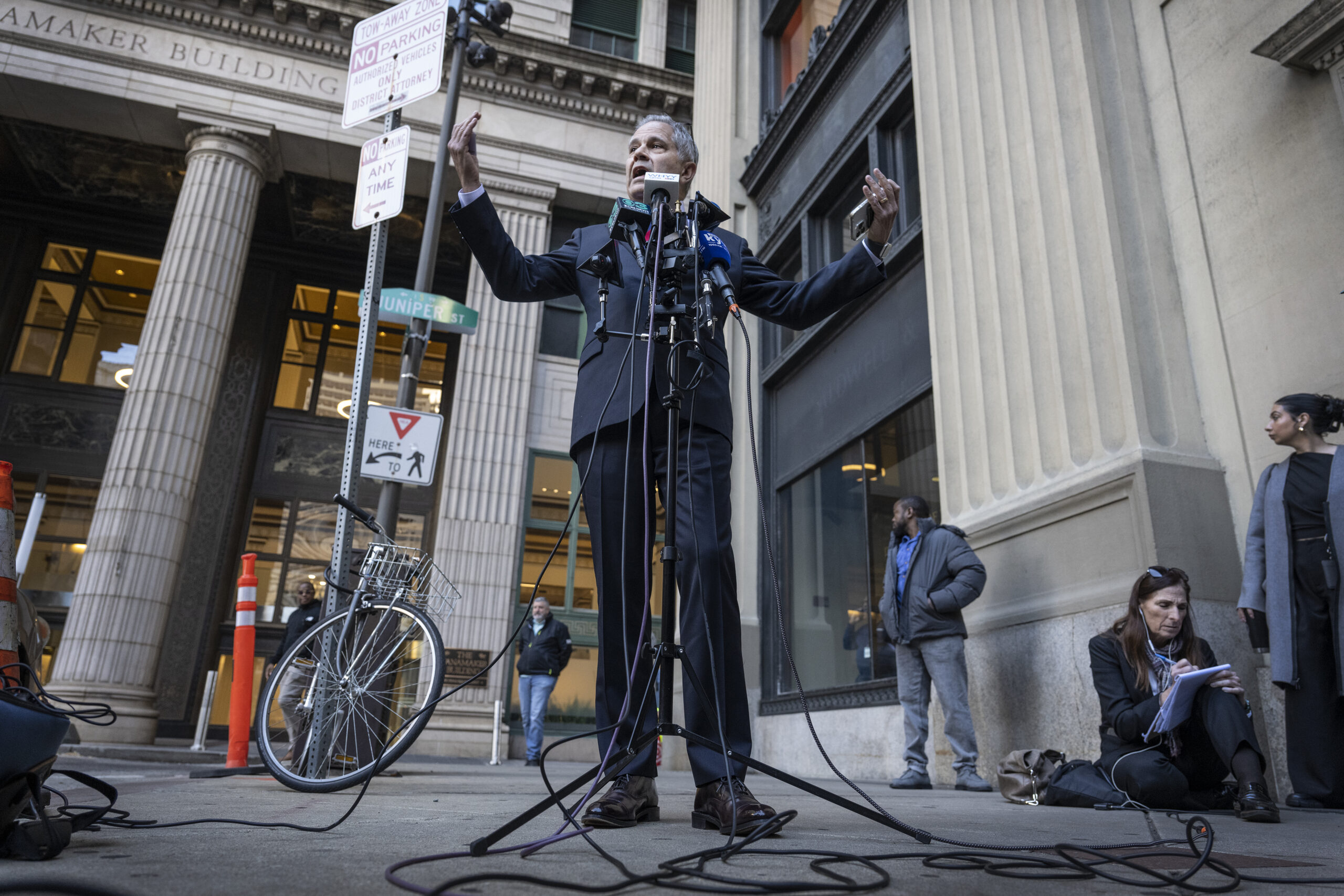
    District Attorney Larry Krasner speaks during a press conference about a homicide in May.

    And meanwhile, the lower-level employees say there’s been a separate Wild West-style standoff between two unions, which are both vying to represent them.

    Krasner said in an interview on Monday that he supports his employees’ right to organize a union through a “properly conducted free, fair, and final election.”

    “I will support them 100% in whatever decision they make to form or not to form a union, and whatever union they choose if they do form one,” he said.

    Still, it all could become a political flashpoint for Krasner, a third-term progressive Democrat whose name has been floated by some in the city’s political class as a potential candidate for higher office. He has not ruled out running next year, when Mayor Cherelle L. Parker, a more centrist Democrat, will be up for reelection.

    While Krasner has positioned himself as supportive of organized labor, his relationship with some leaders of the city’s politically powerful unions has been strained. He’s received steadfast support from the unions that tend to align with left-leaning politicians, but clashed with others, including the leaders of the building trades unions that last year backed his challenger.

    Krasner last month publicly criticized Parker for not acquiescing to his office’s requests for additional funding, to which Parker countered that his funding has increased every year since she became mayor. He said this week that he believes the unionization effort among his employees is the result of his office being underfunded during Parker’s administration.

    Paralegals and victim and witness coordinators said that they have explored unionization to improve wages. Several staffers described living paycheck-to-paycheck and holding second jobs to meet expenses.

    The starting annual salary for paralegals, who assist attorneys with legal research and drafting documents, and for coordinators, who shepherd victims and witnesses through the court process, is $46,000.

    Several employees also said they’re seeking union representation to improve their workplace culture. Two said the expectations of them change frequently, and that responsibilities often expand with little warning.

    But the road to get there, they said, has not been smooth.

    To unionize, the lower-level employees partnered last year with organizers at the United Steelworkers Local 286. The union represents workers in a diverse range of industries, including school bus drivers, pharmaceutical packaging plant workers, and some clerks in the city’s court system.

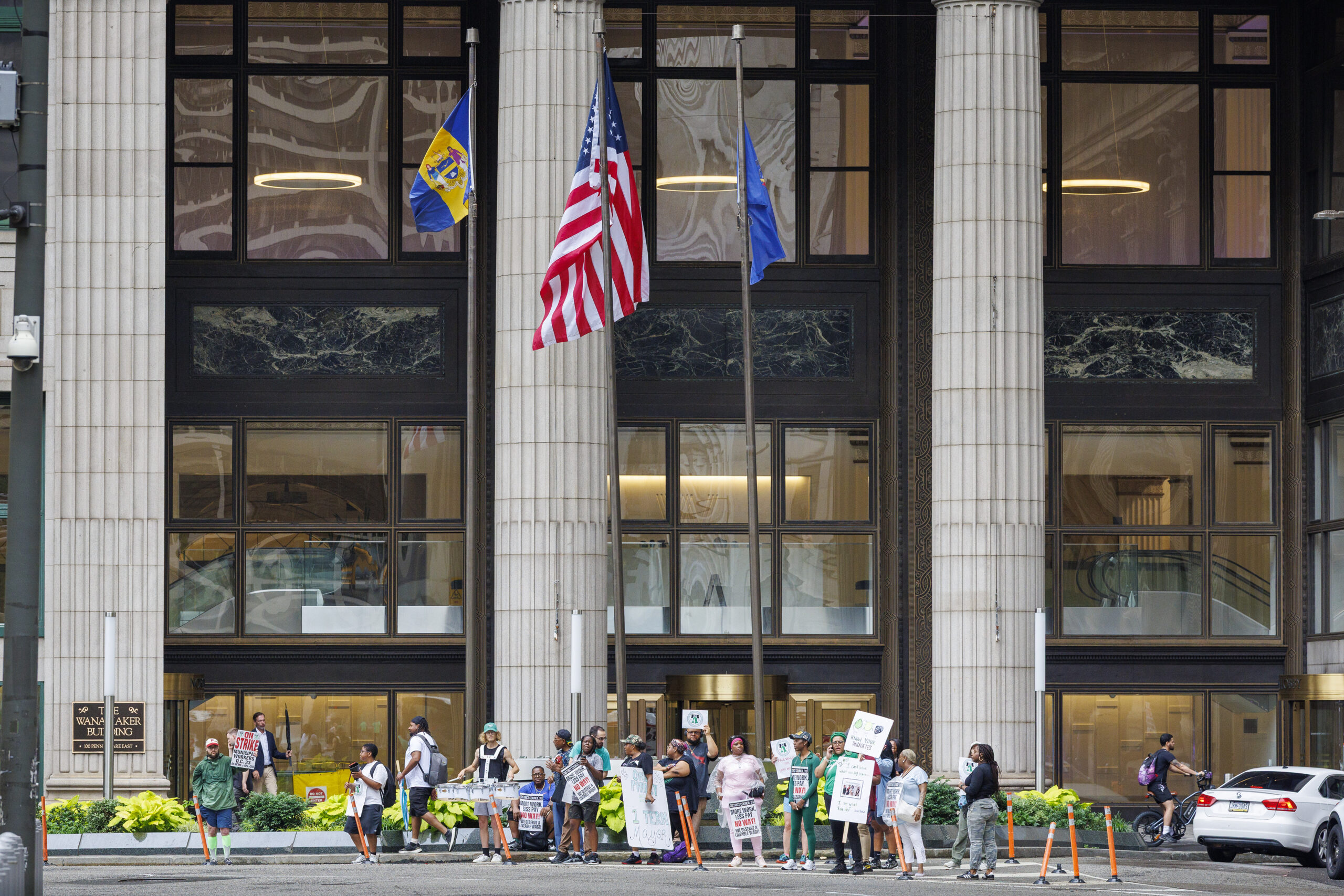
    Picketers employed in the District Attorney’s Office picket outside during the AFSCME District Council 33 strike on Wednesday, July 2, 2025. DC 33 already employs some workers in the DAO.

    Carlo Simone Jr., the union’s president and business manager, said his local has been seen by some city employees in recent years as “an alternative” to the American Federation of State, County and Municipal Employees District Council 33 and District Council 47.

    Those two much larger unions represent thousands of city employees, with DC 33 largely representing blue-collar workers and DC 47 working primarily with white-collar staff.

    The prosecutors in Krasner’s office will be represented by DC 47 if their election is successful. But several of the lower-level workers in the District Attorney’s Office had preexisting relationships with USW and said that they thought the steelworkers’ union would be the best fit to represent them.

    In December, USW filed a petition with the Pennsylvania Labor Relations Board, asking the state to authorize an election that would lead to them representing the paralegals.

    But DC 33 had other plans. In February, DC 33 filed paperwork with the state and argued that the paralegals instead belong in their municipal workers’ union, setting up a power struggle with the steelworkers.

    The PLRB agreed with DC 33.

    Last month, the board issued a preliminary ruling that said DC 33 is the appropriate union to organize the workers. The board reasoned that, under longstanding precedent, DC 33 is responsible for representing “nonprofessional” employees — or those that don’t require advanced professional education — who are designated as members of the civil service.

    The vast majority of city employees are members of the civil service, which is the city’s merit-oriented system for hiring and promotion. It is intended to separate municipal employment from political considerations.

    But for decades, most employees in the District Attorney’s Office have been exempt from the designation. Under the Philadelphia Home Rule Charter, employees are civil service unless they are specifically exempted. Assistant district attorneys and some investigators in the DA’s office are exempt, but there is no carve-out for paralegals or victim and witness coordinators.

    The lower-level employees who spoke to The Inquirer said they want their jobs to be classified as civil service, because the designation would require job descriptions and afford them protections against arbitrary discipline.

    But Krasner’s office last month filed paperwork opposing the PLRB ruling, saying that lower-level workers in his office have not been designated as civil service for decades and that the labor board doesn’t have the authority to reclassify them.

    Krasner called the PLRB’s decision a “rogue finding that was illegal.”

    “This is a law enforcement agency. We have to follow the law,” he said. “If there’s going to be civil service, it will be because our workers’ rights are protected because they decide it’s beneficial to them and because legal processes are followed.”

    In this November file photo, District Attorney Larry Krasner speaks to reporters during a news conference outside the District Attorney’s Office after he won reelection.

    But employees said they saw Krasner’s opposition as a slight.

    “He is not pushing for us,“ one employee said, ”and in fact is making this process way longer than it should have been.”

    The PLRB has yet to issue a final ruling, and it’s unclear when one may come. A spokesperson declined to comment. DC 33 also declined to comment.

    If the PLRB’s ruling stands, paralegals and victim and witness coordinators would be represented by DC 33, and it’s not clear if they’d have the ability to pursue organizing with another union.

    Simone, of the steelworkers’ group, said that USW is encouraging employees in the DA’s office to “stay the course,” even if they ultimately join a different union.

    “It might not be as soon as they want it,” he said, “but they will be OK.”

  • The demand for purity in Trump’s GOP comes from the death of the party’s moderate wing

    The demand for purity in Trump’s GOP comes from the death of the party’s moderate wing

    With the 2026 midterm elections shaping up to be one of the most consequential in recent memory, President Donald Trump has gone on offense — not only against Democrats, but also against Republicans who he has accused of disloyalty. In fact, in recent primary elections, Trump has targeted candidates in his own party, from those running for state office to U.S. senators seeking reelection, including John Cornyn and Bill Cassidy.

    Most of those targeted by Trump have lost, which has sent a clear message: there is no longer room for debate within the GOP; only complete allegiance to MAGA orthodoxy — and by extension to Trump himself — is acceptable. This is a far cry from the GOP of yesteryear, which comfortably included staunch conservatives like Barry Goldwater and Ronald Reagan, as well as a robust moderate-to-liberal wing centered in the Northeast, upper Midwest and on the West Coast. In Pennsylvania and New Jersey alone, moderate Republicans like Hugh Scott Jr., Arlen Specter, Thomas Kean Sr. and Christie Whitman, routinely won Senate and gubernatorial elections into the 21st century.

    In fact, an often-forgotten chapter in the career of Richard Nixon — the president most often compared with Trump — vividly illustrates that the ideological boundaries in the GOP were once quite malleable. Nixon regularly shapeshifted and operated across multiple wings of the GOP as he rose from congressman to senator to vice president, and finally, to president. Yet, as Republicans have become more ideologically rigid, such moves have become increasingly difficult, replaced by debates over who qualifies as a “real Republican” — and who is a Republican in Name Only (RINO).”

    The Richard Nixon who embarked on a political career in 1945 was nothing like the figure who resigned the presidency in disgrace three decades later. When he launched his first campaign in California’s 12th Congressional District, Nixon pledged to local Republicans that he would wage an “aggressive, vigorous campaign on a platform of practical liberalism” to defeat the popular incumbent congressman, Jerry Voorhis.

    At this time, Nixon modeled himself on Republican Harold Stassen, the former “boy wonder” governor of Minnesota. Stassen had built a national reputation in the late 1930s for his bipartisan “middle way” approach to governance, which blended fiscal discipline, civil service reform and bipartisan labor legislation. By 1943, when he resigned from the governorship to serve in the Navy during World War II, Stassen had become one of the country’s most prominent progressive Republicans.

    In Stassen’s success, Nixon saw a model for how a newcomer could win over liberal and independent voters in California. He wrote to the Minnesotan, “I have been very interested in following your campaign to liberalize the Republican Party because I feel strongly that the party must adopt a constructive progressive program in order to merit the support of voters.” Key to this program was retooling the principles of Democrat Franklin D. Roosevelt’s vaunted New Deal instead of rejecting them outright like many conservative Republicans did.

    This formula included accepting popular New Deal programs like Social Security — and even bolstering them. It also involved advocating against American isolationism and in favor of increased international cooperation. On labor rights — another thorny issue — Nixon, like Stassen, sought a middle ground: he supported arbitration to avoid strikes, while balancing the interests of workers and management. In a campaign speech, Nixon claimed that he “would not be a candidate if he were not strongly in favor of unions and small business.”

    This platform proved successful for Nixon, who the Minneapolis Star Tribune dubbed a “Stassen Candidate.”

    Shortly after he upset Voorhis and became the representative-elect for the 12th District, a former Whittier College classmate wrote to Nixon to offer “hearty congratulations” — despite being a Democrat who hadn’t voted for him. Nixon’s progressive message resonated with his former classmate, who expressed hope not only for Nixon’s success but “for the success of the progressive and liberal elements” within the Republican Party.

    In the coming years, Nixon would dash this hope as he illustrated the ease with which politicians moved between ideological camps in the GOP. During his early years in Congress, Nixon hung his hat not on the progressive vision of Stassen, but on staunch anti-Communism and red baiting. In 1947, Nixon joined the House Un-American Activities Committee (HUAC), where his pursuit of former State Department official Alger Hiss generated national attention. The case helped transform Nixon from an anonymous freshman congressman into one of the nation’s most prominent anticommunists.

    In 1950, Nixon further cemented his anti-Communist reputation during a successful Senate campaign against Rep. Helen Gahagan Douglas, who he portrayed as soft on Communism by repeatedly linking her voting record to that of left-wing Congressman Vito Marcantonio.

    Nixon’s reputation as an anti-Communist crusader compelled Dwight Eisenhower to select him for the 1952 GOP ticket as an olive branch to disgruntled conservatives after he beat their preferred candidate for the nomination, Ohio Sen. Robert Taft.

    Eisenhower’s election was a victory for progressive Republicans as he promised an era of “Modern Republicanism” — which paired a commitment to free enterprise with a belief that the government had an obligation to improve society and provide a basic social safety net.

    The GOP’s right flank derided this philosophy, and Nixon often spent time mediating between the two wings of the party. His ability to move comfortably between the camps reflected the ideological flexibility that still characterized the Republican Party during the 1950s.

    Made By History sponsors. FOR USE ON MADE BY HISTORY STORIES ONLY.

    Yet, even as he tried to reassure conservatives, Nixon embraced Modern Republicanism; he represented the Eisenhower administration abroad, including during his highly publicized exchanges with Soviet Premier Nikita Khrushchev. This engagement reflected the desire to contain communism through diplomacy and alliances, and the administration’s internationalist approach.

    Domestically, Nixon served as the administration’s point man on civil rights, supporting measures such as the Civil Rights Act of 1957 and overseeing efforts to combat employment discrimination through his leadership of the President’s Committee on Government Contracts. In 1958, Martin Luther King Jr. expressed his belief that “Nixon would have done much more to meet the present crisis in race relations than President Eisenhower has done.”

    In 1960, Nixon embarked on his first presidential campaign. During an October question-and-answer session at the University of Southern California, the vice president turned to the question of whether he considered himself a liberal or a conservative.

    He started by offering a definition of liberalism from Roosevelt. “A liberal is a man who wants to build bridges over the chasms that separate humanity from a better life,” Nixon explained. To him that meant, “we’re all liberals … We all want a better life.” Nixon concluded his answer by describing himself as a “practical progressive” — an echo of the “practical liberalism” he embraced during his 1946 campaign.

    Nixon went on to lose that race narrowly. But in 1968, he rebounded, by once again successfully navigating the party’s competing factions. He appealed to conservatives with his Southern Strategy and rhetorical emphasis on “law and order,” while reassuring moderates that he remained an experienced and pragmatic Republican.

    As president, he did some things that were progressive by today’s standards, including enacting the first federal affirmative action program and signing the Clean Air and Clean Water Acts. Simultaneously, however, he tangled with the liberal wing of his party over Vietnam and several Supreme Court appointments, and he vetoed legislation to provide federally funded daycare for children.

    Nixon is typically remembered for helping to usher in the populist conservative tide that would eventually sweep GOP politics. Today, he’s often compared with Trump because of his embrace of white grievance politics, his demands for personal loyalty and his abuse of power.

    Yet, his career also highlights how the Republican Party once had a vibrant and popular progressive and moderate wing. When Nixon launched his career, the idea of branding someone a RINO would have been far-fetched because the GOP comfortably managed to include staunch conservatives like Taft, as well as progressives like Stassen. The progressive or moderate wing of the party survived into the 1990s and 2000s; in Pennsylvania, Specter won the first of five Senate terms in 1980, while in New Jersey, Kean and Whitman both served as governors in the 1980s and 1990s.

    Yet, their careers tell the story of what happened as the brand of populist conservatism that Nixon capitalized on to win the presidency gained steam: In 2009, Specter switched parties and became a Democrat for his last years in the Senate, and Whitman is now a national co-chair of the Forward Party, and has endorsed Democrats in the last three presidential elections.

    Their departures reflected the rise of a new hard-line conservative Republican base with little tolerance for moderation or compromise. The collapse of the GOP’s liberal wing made today’s battles of who counts as a “real Republican” not just possible, but inevitable.

    Gaetano V. Della Torre is a New Jersey-based historian and educator. His article “Nixon’s Practical Liberalism: How Richard Nixon Tapped Harold Stassen’s Progressive Vision in 1946” is forthcoming in the Southern California Quarterly.

    Made by History takes readers beyond the headlines with articles written and edited by professional historians. Opinions expressed do not necessarily reflect the views of The Inquirer.

  • Democrats begin pulling Platner endorsements after Maine candidate faces sexual assault allegation

    Democrats begin pulling Platner endorsements after Maine candidate faces sexual assault allegation

    A woman who previously dated Maine Democratic Senate candidate Graham Platner said he drunkenly forced her to have sex after she told him to stop, according to a Politico report released Monday, leading prominent supporters to pull their endorsements and throwing a must-win race for the party into turmoil.

    Platner denied the allegation, but said he would be considering next steps for his campaign.

    “Regardless of the inaccuracy of the reporting but mindful of the political reality it will inflict, we’re taking the time to reflect on the best path forward,” he said in a video released on social media.

    Jenny Racicot, who lives in Maine, told Politico that Platner entered her home in 2021 while drunk and assaulted her. Racicot said she had been in an on-and-off relationship with Platner, but she cut off contact with him after that night and told him the incident wasn’t consensual. A voicemail left at a number listed for Racicot seeking comment did not receive an immediate response, but she said in a CNN interview on Monday evening that she opted not to fight back for fear of Platner, a former Marine, becoming more violent.

    “He violated multiple layers of consent that night,” Racicot said.

    Platner’s campaign did not immediately respond to an email and phone message from The Associated Press seeking comment.

    “Any accusation of non-consensual behavior is categorically false,” Platner said in his video.

    Uproar in the Democratic Party

    Platner won the Democratic nomination last month, setting himself up to face Republican Sen. Susan Collins, who has beaten back previous attempts to dislodge her from the seat that she’s held for nearly three decades.

    Although Platner has long been controversial, the sexual allegation sparked a flight away from the candidate, who canceled a handful of town hall events. The main campaign arm of Senate Democrats called on Platner to drop out and said it would spend no money on the race, which is considered critical to control of the chamber, if he is the nominee.

    “Graham Platner needs to immediately withdraw as the Democratic nominee for Senate and allow Maine Democrats the opportunity to choose a new candidate who can defeat Susan Collins,” Kirsten Gillibrand, chair of the Democratic Senatorial Campaign Committee, and Chuck Schumer, the top Senate Democrat, said in a joint statement.

    The Democratic National Committee sent out an email soliciting money for Senate races hours after the Politico report posted, but Maine was not one of them. Ken Martin, the party chair, said, “Maine Democrats should select a new nominee.”

    Rep. Ro Khanna, a California Democrat who stood by Platner even as the candidate faced previous controversies, said Monday’s allegation was enough. “I’ve been very clear that sexual assault or violence against women is a red line,” Khanna said. “These allegations are very serious and credible. Graham Platner should drop out from the race. I am withdrawing my endorsement.”

    Arizona Sen. Ruben Gallego and Massachusetts Sen. Elizabeth Warren announced they were pulling their endorsements and called on Platner to drop out. The Democratic leaders of Maine’s legislature and top officials at the state Democratic Party did the same.

    “This Senate race comes at a pivotal moment in the struggle against a government, supported by Senator Collins, that serves the interests of the wealthy and powerful at the expense of ordinary Maine people. It is essential that we refocus this campaign on that struggle,” party chair Charlie Dingman, vice chair Imke Schessler and executive director Devon Murphy-Anderson said in a joint statement.

    Collins issued only a brief statement.

    “These allegations are appalling,” she said. “Nevertheless, it is not up to me to choose the Democratic nominee for Senate.”

    State law allows Platner to be replaced on the ballot if he withdraws by July 13. The replacement candidate must be named by July 27.

    The Associated Press generally does not name victims of sexual assault, but in this case Racicot spoke in an interview with Politico.

    A succession of campaign controversies

    Platner had never before held elected office, and Democratic leaders in Washington preferred Gov. Janet Mills in the primary. However, Mills, 78, dropped out as Platner, 41, consolidated support with help from progressive leaders at a time when Democratic voters have grown disenchanted with the party establishment.

    While some Democrats came around to support him after his commanding primary win, Platner’s controversial history had already left others openly despairing of their chances of winning the race. A veteran who also worked for a private security contractor, Platner has a chest tattoo recognized as a Nazi symbol, reportedly sexted with other women shortly after getting married and had a history of inflammatory comments on social media.

    In 2013, Platner posted on Reddit that people shouldn’t get so drunk “they wind up having sex with someone they don’t mean to” and that sexual assault victims should “just take some responsibility for themselves.” He’s since apologized for the post and says he no longer holds those beliefs.

    The New York Times also reported that Platner had volatile relationships with previous girlfriends, one of whom said an argument became physical. Platner denied the allegation.

    Hasan Piker, a leftist commentator and streamer who backed Platner, seemed to reverse himself Monday following the Politico report.

    “If new evidence presents itself, I’m going to change my perspective — it’s that simple,” Piker said during a livestream on Twitch, adding: “This is a clear-cut instance of verifiable sexual assault allegations. It’s completely irredeemable.”

    Our Revolution, a progressive organization founded by Sen. Bernie Sanders of Vermont, said Platner should withdraw because the allegations “are too serious to treat as a distraction from the campaign or the issues.”

    It also hinted at the potential battle over who would replace Platner.

    “Whoever leads this movement forward must be someone who has actually lived the fight Graham Platner ran on: a record with working people, with unions, against corporate money, already tested and trusted by the same base that delivered this result,” said a statement from Joseph Geevarghese, executive director of Our Revolution.

    Platner had pitched himself as a blue-collar oysterman and veteran who could reach disaffected voters. But as controversies mounted, some state Democrats had heartburn, embodied by Mills’ refusal to endorse Platner after she dropped out of the primary. Chatter circulated about possible replacements, including former state senator and logger Troy Jackson and Secretary of State Shenna Bellows.

    “I’ve known this has been coming,” said Marie Follayttar, a Democrat and community organizer in Maine, talking about the growing whispers inside the state’s small population that had been bracing for yet another revelation surrounding Platner. “I’ve been scared and I’ve been sick waiting.”

    Mike Connelly, a business owner and Democrat in Brunswick, Maine, said in an interview that he wants Platner to drop out after the latest allegations. But Connelly said he’d vote for him if he stays in.

    “I would vote for a comatose Democrat before I would vote for Susan Collins,” Connelly said.

  • Pa. officials mourn the death of former State Sen. Shirley Kitchen, who represented North Philly for 20 years

    Pa. officials mourn the death of former State Sen. Shirley Kitchen, who represented North Philly for 20 years

    Pennsylvania elected officials are mourning the death of former State Sen. Shirley Kitchen, the second Black woman to serve in the state Senate and a champion for progressive issues who represented parts of North Philadelphia for more than two decades. She died Saturday at 79. A cause of death was not immediately clear.

    Kitchen represented the 3rd Senatorial District, composed of parts of North Philadelphia, for 20 years. She is remembered by her former colleagues as a pillar and matriarch of her community who worked tirelessly to improve the lives of low-income people, even after she retired.

    “She did so many things for so many people. Now that I’m old enough to appreciate it, I’m not quite sure how she did it — and she did it with such force,” said State Sen. Anthony H. Williams (D., Philadelphia), who served alongside Kitchen in the Senate and had known her for decades. Kitchen was elected to the state Senate in 1996 and served five terms before retiring in 2016.

    Her former colleagues, some through tears, credited many of Pennsylvania’s recent criminal justice reforms as being born under Kitchen’s leadership, with her early legislative proposals paving the way for their passage years later. For example, Kitchen authored early drafts of what is now known as the Clean Slate Act, which automatically seals some nonviolent convictions after 10 years, hiding them from most employer and landlord background checks. She first introduced similar legislation in Harrisburg years earlier and it failed. In 2018, two years after Kitchen retired, the Clean Slate Act became law in Pennsylvania and was heralded as a first-in-the-nation model for criminal justice reform.

    Elected officials across the city shared their condolences, remembering Kitchen as an advocate who cared deeply for her community.

    Mayor Cherelle L. Parker in a social media post on Sunday recalled Kitchen as “fighting for people who often had no one else to fight for them,” and as a trailblazer for Black women in politics.

    “Shirley Kitchen cared about working people, and she cared about Philadelphia,” said Parker, the city’s first Black female mayor and a former state representative.

    City Council President Kenyatta Johnson said in a statement that Kitchen “never forgot who she was fighting for,” dedicating her life to making people’s lives better.

    State Rep. Joanna McClinton (D., Philadelphia), Pennsylvania’s first Black female speaker of the House, wrote in a social media post that Kitchen was “a mentor and her service in the state House and Senate inspired me greatly.”

    Williams added that Kitchen also sought to elevate other Black politicians, like himself, to elected office — and laid the groundwork for much of the city’s current political progressivism.

    “The reality is that a lot of the infrastructure that helps them, Shirley had everything to do with it, and more,” Williams said, noting her advocacy and experience during the Civil Rights Movement. “I would hope the progressives in this generation would tip their hat to a generation that really created the progressive movement.”

    State Sen. Sharif Street (D., Philadelphia) had known Kitchen since he was a child, and said she helped him see the power a Senate seat has in improving the lives of his neighbors. When she decided to retire, Kitchen encouraged Street, who was on her staff at the time, to run to fill the vacancy in the 3rd District following her fifth and final term in the state Senate.

    Williams and Street recalled Kitchen as a fair but demanding mentor.

    “If she told you to do something, you better do it,” Williams said, with a laugh.

    For Street, Kitchen “didn’t limit her advice. She had opinions about everything in my life, including when my wife was right and I needed to listen to her.”

    Street said he spoke with Kitchen weekly, and Williams said he remained in touch with her as recently as last month. She often had ideas or issues she wanted the senators to take up. Street spoke with her last week about a forthcoming Registered Community Organization meeting that she was leading about a new proposed development nearby, emblematic of her continued involvement in her community.

    Prior to her election to the state Senate, Kitchen was involved in the National Welfare Rights Movement, which was a progressive advocacy group for the dignified treatment of women and children, largely led by Black women, during the 1960s and 1970s, Williams said.

    Kitchen served as the minority chair of the Senate Public Health and Welfare committee, in which she often leaned on her social work experience to inform her legislative proposals.

    A Democrat in a time where Republicans controlled the state legislature, she served her entire tenure in the minority party, but was still able to garner bipartisan support for some of her legislative proposals.

    “This image of her being an urban Black woman from Philadelphia would limit her ability to get stuff done in the Senate just wasn’t true,” Williams added. “She could analyze people and figure out what way to approach them with exceptional skill.”

    Born in 1946 in Augusta, Ga., Kitchen attended the Philadelphia School District and graduated from Antioch University in 1979 with a bachelor’s degree in human services, according to her Senate Library biography. She went on to work for former Philadelphia Mayor John Street, Sharif Street’s father, before she was elected to the state House in a special election in 1987. After she lost reelection to the seat in 1989, Kitchen returned to Harrisburg a decade later after her election to represent the 3rd Senatorial District.

    “She was a transformational figure that loved her community and understood that the purpose of those of us holding elected power is to be able to make a difference in the lives of the people we serve, in a way that they can feel and see,” Sharif Street added.

    Funeral services will be announced in the coming days, he said.

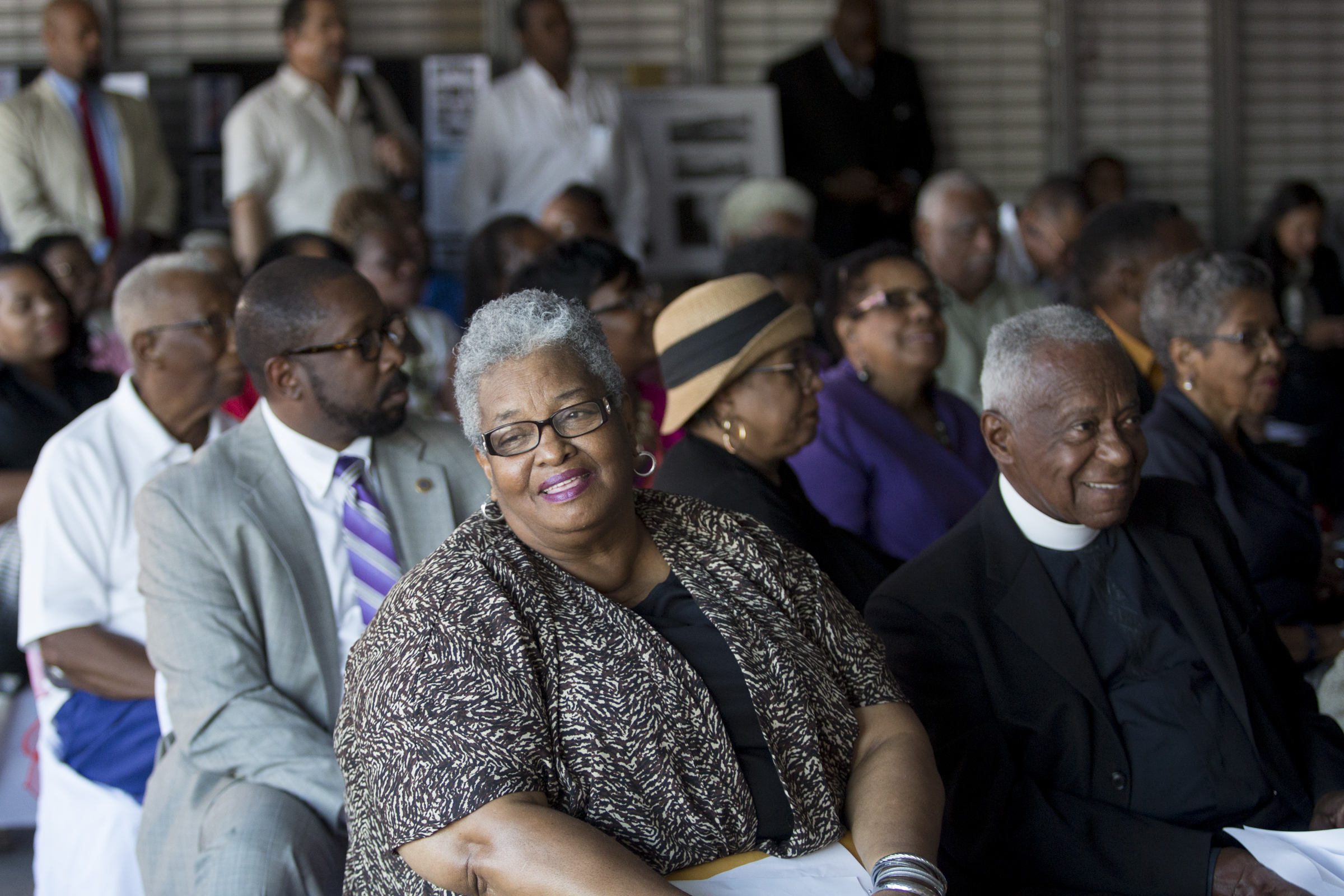
    Senator Shirley Kitchen in the audience during speeches in honor of the historical marker that was unveiled at Sullivan Progress Plaza September 14, 2016. The plaza was the first black-owned and operating shopping center in America. Wednesday, Sept. 14, 2016.
  • Democrats invoke ‘big, beautiful bill’ far more than Republicans as midterms near

    Democrats invoke ‘big, beautiful bill’ far more than Republicans as midterms near

    Republicans’ sprawling One Big Beautiful Bill Act was meant to be their party’s crowning legislative achievement heading into the 2026 midterms. But Democrats are bringing up the legislation much more frequently on the campaign trail, saying its constrictions on the social safety net make it a liability for the GOP despite the tax cuts it delivered.

    Congressional Democrats talk about the law twice as often as Republicans, according to a Washington Post analysis of public statements and social media posts. The legislation has emerged as a central talking point for the Democratic Party, with candidates deriding it as the “Big Ugly Bill” and tying the changes it brought to Medicaid and food assistance programs to voters’ anxieties about the cost of living.

    In California, for instance, Rep. Derek Tran has blasted the legislation as jeopardizing benefits for the Supplemental Nutrition Assistance Program, formerly known as food stamps. In Florida, Rep. Kathy Castor has said the law is killing clean energy projects necessary to meet rising energy demands and protect the environment. In Nevada, Rep. Susie Lee derided the legislation as the “largest transfer of wealth from working families to the rich in history.”

    Republicans have largely retreated from talking about the law by name, as they did more often earlier last year —opting instead to focus on the tax cuts under it. Democrats assert that the shift is a sign of the Republican Party’s acknowledgment of the law’s low overall approval.

    “Instead of boosting GOP midterm prospects, the bill has turned into a political albatross and vulnerable House Republicans are stuck defending this disastrous legislation in an already brutal midterm environment,” the Democratic Congressional Campaign Committee wrote in a memo last week advising Democratic House candidates to lean heavily into some of the law’s provisions.

    But Republicans haven’t entirely abandoned their biggest legislative win of President Donald Trump’s second term. GOP candidates regularly discuss individual provisions of the law that poll favorably, such as tax cuts on tipped wages, during campaign events.

    In Wisconsin, for instance, Rep. Derrick Van Orden has toured manufacturing centers to tout the tax cuts for working voters. In California, Reps. David G. Valadao and Vince Fong held a roundtable focused on healthcare that featured the $50 billion rural hospital fund established by the law. And in New York, Rep. Mike Lawler and Trump have praised the law’s temporarily raised deduction caps on state and local taxes.

    The legislation is Republicans’ marquee accomplishment in the current Congress, featuring the lion’s share of Trump’s legislative priorities. It extends the tax cuts included in Trump’s 2017 Tax Cuts and Jobs Act and creates stricter work requirements for Medicaid and food assistance programs. Those priorities polled well among voters when the law was being negotiated.

    Failing to extend the 2017 tax cuts would have led to one of the largest tax increases in U.S. history, and new tax cuts, including credits for tipped wages and overtime, also landed well among voters. Republicans continue to defend the legislation for saving taxpayers an average of almost $2,300 per filer, according to estimates by the nonpartisan Tax Foundation.

    “I don’t care what you call it. It’s what delivers for America,” said House Republican Conference Chair Lisa McClain (Mich.), who ticked off several provisions in the legislation, including the Trump Accounts, a program that allows parents to open investment accounts for children born during Trump’s second term and receive $1,000 from the government.

    “That legislation resonates for real people,” said McClain, who has taken the lead in framing advice on how her party talks about the legislation.

    The dynamic illustrates the challenge of controlling the narrative around massive catchall legislation, which often polls more poorly as a whole than on its individual parts.

    McClain acknowledged that the sheer scale of the legislation — spanning more than 900 pages and touching on issues as varied as transgender athletes, border security, and student loans — could distract from the tax provisions.

    Democrats had similar difficulty selling the benefits of what they dubbed the Inflation Reduction Act during the 2022 midterm elections. That law sought to lower prescription drug costs, invest in clean energy production, and raise corporate taxes, among other provisions.

    “These bills just become conglomerations in people’s minds. Like, nobody knows what’s in these bills,” said Neera Tanden, who directed the Domestic Policy Council in President Joe Biden’s White House. Republicans rebranded Democrats’ marquee legislation, which included the largest ever investment in combating climate change, as driving up gas prices by disincentivizing fossil fuel production.

    But Tanden said Republicans have a unique challenge in selling their catchall legislation because there are visible and immediate impacts to voters’ access to healthcare.

    The nonpartisan Congressional Budget Office predicted that the legislation’s changes to Medicaid, including new 80-hour-per-month work requirements, would result in around 10 million Americans losing healthcare coverage by 2034. Numerous lawmakers, including several Republicans who wound up voting for the legislation, voiced concerns while it was being negotiated that a provision related to Medicaid funding could lead to more hospital closures, particularly in rural areas.

    Some of those outcomes are already becoming reality, Democrats say. Iowa state senator Sarah Trone Garriott, a Democrat running to unseat Rep. Zach Nunn (R) in a competitive race, said a number of health clinics have closed or announced plans to close in her district, citing federal funding and policy changes to Medicaid that she said added to long-standing financial difficulties.

    “Here in Iowa, healthcare was already hanging by a thread, and then when Medicaid was cut, those cuts were so significant that hospital systems are already making changes to try to anticipate the impact,” Trone Garriott said. “My congressman said that it was a myth that it was going to close rural hospitals. It is already happening.”

    Nunn disputed that the closures were directly caused by the changes to Medicaid and noted his community opened a major health clinic that will be aided by the rural hospital fund included in the Trump law. He added that “work requirements for able-bodied adults are how we prevent fraudsters from stealing billions and keep Medicaid strong for the Iowans who truly need it.”

    Several Republicans in vulnerable seats warned last year that proposals in the legislation affecting Medicaid and food assistance could make reelection difficult. The anxiety led to fierce conflicts between moderates, who wanted stronger protections for Medicaid, and deficit hawks, who placed a greater emphasis on curbing spending, that nearly derailed the entire package.

    “Communities like ours won us the majority, and we have a responsibility to deliver on the promises we made,” a dozen Republicans in swing districts wrote in a letter to GOP leadership in April last year. All of the signatories eventually voted for the legislation after securing compromises that could cushion some of the political pushback, including the $50 billion fund for rural hospitals that could see funding dry up because of Medicaid changes.

    A number of components of the legislation don’t go into effect until after the midterms, including the Medicaid work requirements, which start in January. Democrats accused Republicans of delaying the provision to avoid backlash during the November elections.

    “That is so conniving,” said Marni von Wilpert, a Democrat running for a competitive open seat around San Diego. Von Wilpert said that she encounters Medicaid recipients who are unaware of the coming work requirements and that conveying them to voters has been a challenge.

    McClain said the changes to Medicaid and other social safety programs were aimed at gutting fraud and abuse, a concern that she said voters continue to cite in internal Republican polling.

    Republicans have also combated Democrats’ attempt to cast the legislation by rebranding it. Their new preferred name for the law: the “Working Family Tax Cuts Act.”

  • ‘I’m on this roller coaster’: Philly teachers and school staff are stuck in limbo despite promises to save hundreds of jobs

    ‘I’m on this roller coaster’: Philly teachers and school staff are stuck in limbo despite promises to save hundreds of jobs

    When a deal was struck to save 340 classroom-based jobs in the Philadelphia School District, Mayor Cherelle L. Parker and Superintendent Tony B. Watlington Sr. declared it “Christmas in June.”

    It’s July now, but manystaffers still don’t have clarity on exactly who’s allowed to come back to positions that were almost cut and how that affects vacancies system-wide.

    “It’s a mess, and it’s getting messier,” said Alison Andrawos, a teacher at Potter-Thomas Elementary in North Philadelphia who accepted a job in another district after learning this spring that her position would be cut and still doesn’t know whether it will be restored.

    Monique Braxton, the school district spokesperson, said the system is “moving forward with restoring the approximately 340 school-based positions approved in the revised budget,” but that staffing the positions is separate from restoring them.

    “We have been meeting with our union partners on implementation and are now working with principals on school staffing,” Braxton said in a statement. “All approved positions will be restored in the district’s budget system by Wednesday, July 9.”

    The complex process is causing additional uncertainty for teachers and staff members and prolonging an already tumultuous hiring season as the district deals with fallout from 17 forthcoming school closings and the back-and-forth over millions in cuts stemming from a $300 million district budget deficit.

    Watlington this spring directed school principals to build their 2026-27 budgets factoring in the cuts, including about $50 million in school-based trims and the elimination of 340 classroom jobs. Parker then proposed a $1-per-trip rideshare tax she said would cancel the classroom cuts, but City Council balked, and for a time, the position losses appeared inevitable.

    After a breakthrough with city officials on June 10 — after the district’s deadline to pass its 2026-27 spending plan — officials triumphantly said the cuts were off the table.

    But restoring the positions was always going to be complicated.

    Schools’ hiring timeline means that many of the teachers, counselors, and climate staff who were told they were going to be force-transferred because of the cuts sought and found new jobs over the past few months, either inside the district or elsewhere. Now, those workers either must rescind their acceptance of those new jobs or say “no thanks” to returning. Either way, that creates new vacancies in July, months after most schools have filled jobs and when many people are on vacation.

    “We haven’t heard whether our positions are going to be reinstated, we don’t know what positions are available, and we don’t know what we’re doing in a few short weeks,” said Andrawos, an English as a second language specialist who began teaching in Philadelphia schools in 1997.

    ‘I’m pretty sure I’m going to be leaving’

    Andrawos said she didn’t want to leave the city, but amid the worry of the past few months, she felt she had to explore jobs outside the district. Andrawos has been offered a position at a Delaware County school that comes with a raise and a shorter commute.

    “I’m pretty sure I’m going to be leaving the School District of Philadelphia because of this,” Andrawos said.

    She said the decision is tough — she’s forged real bonds with her students’ families, and has been fielding messages saying they hope she stays at Potter-Thomas.

    It’s not clear whether Andrawos’ position at Potter-Thomas, in North Philadelphia, will be restored because of the complicated way budgets are built, and the latitude principals have to shift positions based on school need and their own judgment calls.

    Jobs are filled in city schools two ways — first, by a process called site selection, where principals hire any candidate they choose for open positions. Once the site selection window closes, district staff without positions choose from among open jobs in seniority order. Site selection closed weeks ago; force transfers without jobs have had their hiring sessions pushed back multiple times so far, and are still waiting.

    Jane Roh, a spokesperson for the Philadelphia Federation of Teachers, said the union notified members June 19 that all positions cut due to the deficit would be restored; the PFT was told that district notifications to affected employees would immediately follow. So far, that has not happened.

    That leaves staff sweating and frustrated by a lack of answers, some said.

    A roller coaster

    One K-8 teacher, who asked that his name be withheld because he feared repercussions, was on the force transfer list because of budget cuts. With no notice that’s being walked back, he’s left with the possibility of having to get emergency certified to teach in another subject area, which would mean taking more courses.

    The uncertainty is tough, and the answer to every question posed to the district and the union so far has been, we don’t know yet.

    “For this whole summer, where teachers are supposed to have the space to reflect and rest and plan, we can’t do that to any degree,” the K-8 teacher said.

    A teacher at a district high school, who also asked to remain anonymous because her employment situation is not settled, is in a similar boat. When her position was cut because of the deficit, she site selected into a job at another district high school.

    The process has been frustrating, she said. She once got an email saying her transfer was canceled, but that turned out to be incorrect, though she never got official notice from the district about its error and had to make calls herself to figure it out.

    When Parker and Watlington made their good-news announcement, she had no idea what to make of it. She still doesn’t, the teacher said.

    “I’m on this roller coaster; I literally don’t know which school I’m going to work at in the fall,” said the high school teacher, who would be teaching different classes, depending on where she lands. “I want to prepare for the upcoming school year, and that’s impossible if you don’t know what you’re teaching.”

    Staff at Olney High, the district school perhaps most affected by budget cuts, have been pressuring the district, publicly and in private, to halt the losses planned for their school — Olney had been slated to give up 17 staffers.

    The school had been overstaffed four years ago as it navigated a complicated, unprecedented transition from a charter school back to a district school. It has soared, adding programs and opportunities and building a strong school culture; the community fears weathering steep staff cuts would jeopardize its progress.

    Sarah Apt, a longtime Olney teacher active in the pushback against cuts, said Wednesday that the school was told it’s getting back three of its 17 staffers.

    “We’re happy about that, but still fighting for more,” said Apt.

    Among those still in limbo is Eric Baker, an Olney English teacher who’s been struggling with the back and forth, and the possible implications for the school he’s come to love — the school recruited students for a college prep track that’s potentially losing most of its teachers, including Baker.

    “Because of this uncertainty, I’ve had to interview other places. I don’t know where I’m going to go. I would rather have the certainty of knowing where I’m going to work than having to deal with this,” said Baker. “It’s been frustrating.”