Category: Politics

Political news and coverage

  • After America’s 250th, Trump will test how far he can push NATO allies

    After America’s 250th, Trump will test how far he can push NATO allies

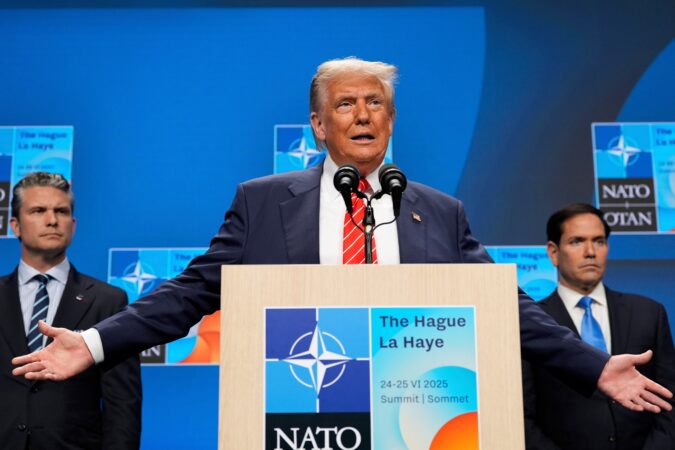
    Fresh off a week of star-spangled celebrations of America’s 250th, President Donald Trump departs for Turkey on Monday to meet with fellow leaders of NATO. They hope he wouldn’t declare independence from them.

    Trump has long been skeptical about NATO and European allies, asserting that the alliance the United States forged after World War II to fend off the Soviet Union has been taking advantage of Washington’s largesse. Deep into his second term, the president by now is now well acquainted with the theatrics of NATO gatherings, reveling, according to his associates, in the drama of threatening fellow leaders and watching them scramble to keep him happy.

    The strains increase every year, with Trump’s popularity sinking in Europe after he threatened to seize Greenland in January and sent energy prices spiking with his attack on Iran. The president has fumed that European allies didn’t do enough to help Washington in its war. And in recent days, he has renewed complaints about their defense spending, though he has successfully driven big increases.

    Now, the alliance will again attempt to weather Trumpian pressure, by flattering him where possible and avoiding unnecessary confrontations.

    Trump is scheduled to arrive in the Turkish capital of Ankara on Tuesday and will meet Turkish President Recep Tayyip Erdogan before having dinner with fellow NATO leaders that evening.

    The substantive meeting will be Wednesday morning, which diplomats have kept short to minimize potential disruptions. Afterward, Trump plans to meet with Ukrainian President Volodymyr Zelensky and Syrian President Ahmed al-Sharaa before holding a news conference and returning to Washington, according to White House spokeswoman Anna Kelly.

    The president’s grievances have already subsumed much of NATO’s business. NATO Secretary General Mark Rutte laid the foundation last month, praising the president’s stewardship and delivering a presentation in the Oval Office of what he called the “Trump trillion,” with poster boards in golden, “Art of the Deal”-style lettering boasting increases in Europe’s defense spending over the last decade.

    Trump told Rutte that he would skip the gathering altogether were it not being hosted by Erdogan, who for 23 years has ruled his nation with an increasingly tight grip.

    Asked what he wanted from allies, Trump said alongside Rutte that “I just want their loyalty.”

    He has rewarded allied leaders in recent months whom he perceives as friends, including Polish President Karol Nawrocki, whose country has been promised 5,000 more U.S. troops. And he has moved to punish those he views as insufficiently deferential, including German Chancellor Friedrich Merz, who faced weeks of open criticism from Trump after questioning the president’s Iran strategy during a public conversation with schoolchildren.

    Trump began and ended one day last week with angry posts about NATO on his social media account, declaring that “the United States spends more money on NATO than any other country, by far, to protect them, without getting any benefit from so doing.” But behind the public criticism, a senior White House official said, the president views the summits as an opportunity to impose pressure, leaning into his tough-guy role and seeing how leaders respond.

    The last summit, held in June 2025 in the Netherlands, “was great fun,” the official said, referring to an event in which Rutte called Trump “daddy,” comparing him to a father who needs to use authority to stop kids from fighting on a schoolyard. The comment went viral online and was boosted by the White House’s edit of the video clip with the Usher song “Hey Daddy (Daddy’s Home).”

    “The president always has fun at NATO, contrary to what people think,” the White House official said, speaking on condition of anonymity to speak candidly about the sensitive politics of these encounters.

    NATO officials and diplomats from NATO countries don’t expect Trump to threaten to pull from the alliance this year, as he did in 2018. But they know the president likes to surprise, and they say much will depend on his mood when he lands in Turkey. It is expected to be the first international trip on the refurbished, luxury Boeing 747 that he pushed Qatar to give him for use as Air Force One.

    One senior European diplomat fretted that Trump would arrive in Turkey exhausted and angry after a week of tiring travel, including a 3:30 a.m. Saturday return from an event at Mount Rushmore and a rally on the National Mall later that day in the sweltering Washington heat.

    Europeans are “nervous that the way [Trump] feels about NATO is that this is not fundamentally in U.S. interests and so [they] are nervous that the summit could be more calamitous,” said Max Bergmann, an expert on U.S.-Europe relations at the Center for Strategic and International Studies, a think tank. “Especially now as there’s more domestic political pressure on European leaders to be seen as standing up to Trump.”

    NATO officials are coming to the summit armed with big numbers that play to Trump’s wishes. They will trumpet an extra $139 billion spent on defense by European allies and Canada last year. They will make a show of signing billions of dollars of weapons deals and letters of intent, according to senior NATO diplomats speaking on condition of anonymity to discuss the sensitive planning around the meeting.

    And they hope to promise as much as they can to help ensure security in the Strait of Hormuz, although many countries say they need Tehran’s assent if they are to deploy naval missions there to remove the Iranian mines that are hampering shipping traffic.

    But many of NATO’s core security issues have been overshadowed by Trump’s dispute with the alliance. Ukraine and Russia have stepped up attacks on each other in recent weeks, but U.S. efforts to mediate a peace deal have all but halted. Trump’s peace envoys, Steve Witkoff and Jared Kushner, have been focused on Iran, and the White House hasn’t empowered other officials to engage, despite the deep ranks of policymakers who might do so.

    NATO diplomats are negotiating a pledge for Ukraine of about $70 billion in military aid for this year and the next, to be announced at the summit. Washington would not take part, but it has not opposed language supportive of Ukraine, as it sometimes did last year, two diplomats said, speaking on the condition of anonymity to share internal deliberations.

    The alliance has shelved work on a strategy for responding to threats from Russia, a consequence, European diplomats say, of White House caution about doing anything that would portray Moscow as an adversary.

    Some U.S. officials have downplayed the tensions. The U.S. ambassador to NATO, Matthew G. Whitaker, said last week that the summit “really is going to be a measurement of the progress,” since allies pledged last year to each spend 5 percent of their annual economic output on defense by 2035.

    Whitaker offered assurances that “the U.S. isn’t going away” but said the administration would try to reward the countries that are spending the most. He said the Pentagon and State Department have discussed possible benefits such as “more time with leaders” and “priority in acquisition and procurement.”

    Asked if the U.S. was considering measures targeting nations that are lagging behind, he said yes, but did not elaborate.

    The Trump administration has made disjointed troop announcements in recent months, with the Pentagon at times out of step with the White House. After the Pentagon surprised Poland by canceling a planned troop rotation, for instance, Trump scrapped it and promised an increase. In other cases, the president has suggested some cuts were punishment for European criticism of the war on Iran.

    European leaders plan to declare their commitment to assume increased responsibility of the continent’s defenses — a message many of them have converged on with the Trump administration, which is intent on pulling U.S. resources.

    European policymakers describe their vow to rearm as a response to an increasingly tense confrontation with Russia and shifting U.S. priorities, rather than just a bid to placate Trump. But policymakers including in France and Germany have pressed their U.S. counterparts to coordinate any military drawdown.

    Some Europeans, especially those in Western Europe, have started to work with Pentagon planners on an orderly handover. French Deputy Defense Minister Alice Rufo said Paris has long led calls for greater European autonomy, and “today it is the Americans saying it” too.

    “What we need to achieve at this summit is for this shift to happen in a coherent manner for collective defense, which also concerns the Americans,” Rufo said. “It’s in our best interest to ensure that this shift takes place in an orderly, efficient manner to deter our adversaries, and not to create frictions among us.”

    But the effort is creating strains in the alliance. Rutte is still trying to preserve a robust U.S. presence in Europe. And many policymakers in countries that border Russia still trust Washington more than France and Germany to defend them in a war with Moscow. They believe that old American instincts to defend democracies would kick in, along with pressure from hawkish Republican lawmakers.

    A senior NATO diplomat said there was a sense of optimism ahead of the summit but also a recognition that “things can derail.”

    The diplomat mentioned Italian Prime Minister Giorgia Meloni, a far-right leader who shares much of Trump’s skepticism about migration and is sympathetic with many of his issues. But the two leaders traded barbs in recent weeks in a dispute that originated with Trump’s anger at Italy’s initial caution about allowing its bases to be used to attack Iran.

    “Can I totally exclude that something like that will happen? No. I’m optimistic because I think the leaders know what is at stake,” he said. “And if something does occur, then we always have the ultimate marriage counselor, Mark Rutte, to smooth things over.”


  • In 2026, like in 1770, standing armies in our cities erode freedom

    In 2026, like in 1770, standing armies in our cities erode freedom

    In January, Bruce Springsteen released a passionate anti-ICE ballad, “The Streets of Minneapolis,” in which he named U.S. Immigration and Customs Enforcement (ICE) “King Trump’s private army.” Dedicated to the memory of two protesters who died at the hands of armed government agents in a frigid Minnesota winter, the song invites comparisons to Paul Revere’s famous and equally passionate engraving of the 1770 Boston Massacre. Revere’s image depicts a bloodthirsty line of soldiers shooting directly into a crowd of unarmed Bostonians, killing five and injuring six more. In calling ICE a king’s private army, Springsteen drew on a long history of protest against standing armies, one built on the belief that accountability to the people and their representatives is the foundation for political liberty.

    Since the Magna Carta, Britons had been hostile to the idea of a standing or permanent army, one that existed even in peacetime, and that was paid for through taxes rather than staffed by volunteers. The 1689 Bill of Rights explicitly prohibited a standing army except with Parliament’s blessing. Within a few years, however, Parliament had softened its stance against armies in peacetime, since Britain was engaged in nearly continuous and often undeclared wars against France and Spain. In response, Britons firmed up other ground rules for a standing army: military power must always be subordinate to civilian authority, and some form of legislative consent was necessary. Without these guardrails, people feared, a monarch could simply turn his military might on his own subjects to quell dissent.

    The army could be used as a British police force, but not without complications. Magistrates and mayors regularly requested troops to come to their aid as they tried to catch smugglers and control rioting. Although a justice of the peace might occasionally be able to disperse a crowd by reading the Riot Act, those civilian authorities usually required military support. Eighteenth-century soldiers were trained for battle in the field, not to police civilians, and magistrates soon begged the war office to remove rowdy soldiers from their towns, and especially from the public houses where they were quartered.

    In 1768, the Massachusetts governor, like so many magistrates before him, asked the British War Office to send him troops in response to colonial protests against new tariffs set by Parliament. Bostonians felt deeply betrayed by the news of arriving troops. As one minister wrote: “To have a standing army! Good God! What can be worse to a people who have tasted the sweets of Liberty?” They were less concerned with the violence soldiers might bring than with the threat that a peacetime army posed to society and especially to the political rights of civilians.

    When the first two regiments of Redcoats landed in Boston Harbor in October 1768, they marched with flags flying and drums beating along the central Long Wharf into the heart of the city, where they appropriated Boston Common and Faneuil Hall as temporary campsites. Determined to demonstrate to the world that their peaceful town had no need of troops to keep order, Bostonians mostly refused to rise to the bait. For at least a while, there was nothing for the troops to do.

    Instead, the Sons of Liberty turned to the press to protest the troops’ arrival. In the year and a half that British soldiers lived in Boston, the newspapers were crammed with examples of how the very presence of a standing army could destroy every part of a civilized society, from church services (when the army band deliberately played music during the sermon) to parental authority (as young women defied their fathers to date Redcoats).

    Most of all, colonists feared the impact of a standing army on political freedom. How could a free people debate, much less protest, at the point of a bayonet? When the British army pointed its cannons at the door of the Massachusetts legislature, it was hard to escape the conclusion that a standing army was the king’s way of taking back political power. In sum, as the Massachusetts assembly complained to the governor in 1769, “establishing a Standing Army in this Colony, in a Time of Peace, without the Consent of the General Assembly of the same, is an Invasion of the natural Rights of the People.”

    The death of British protesters at the hands of soldiers was not uncommon in England, and colonists and officers alike knew that a violent clash was only a matter of time. On March 5, 1770, troops fired into a crowd of civilians in downtown Boston, killing Crispus Attucks, Samuel Gray, and James Caldwell immediately; Patrick Carr and teenager Samuel Maverick later died of their wounds. Even 256 years later, the exact sequence of events that led to the shooting is impossible to discover. Its importance for shaping the American Revolution, however, is clear.

    On the night of the shooting, the acting governor of Massachusetts rushed to the scene and was horrified to see people bleeding to death on the snow before the seat of governmental power, today the Old State House. He swore he would launch a full civilian investigation with local law enforcement, and he promised, “I will live and die by the law.”

    The governor was as good as his word. That night, the captain in charge turned himself in to the local jail, as did the men under his command. John Adams, urged by the Sons of Liberty to demonstrate Bostonians’ equally strong commitment to the rule of law, took on the defense of the British soldiers, successfully winning acquittals for most of them. Three years later, Adams reflected that defending the soldiers was “one of the most gallant, generous, manly and disinterested Actions of my whole Life, and one of the best Pieces of Service I ever rendered my Country.” And he was quite convinced that the jury verdict “was exactly right.”

    At the same time, Adams agreed that Boston should certainly “call the Action of that Night a Massacre.” In fact, he wrote, “[I]t is the strongest of Proofs of the Danger of standing Armies.” The experience of living with — and dying at the hands of — a standing army forever damaged Bostonians’ trust in the British empire.

    In 1776, Congress highlighted the Boston Massacre in its list of grievances against George III. The 11th complaint drew directly from the Massachusetts legislature’s complaint seven years earlier: “He has kept among us, in times of peace, Standing Armies without the Consent of our legislatures.” It was not the violence that so horrified colonists; it was the lack of legislative consent.

    Despite the striking parallels, the shootings of Renee Good and Alex Pretti in Minneapolis earlier this year were not just retreads of the Boston Massacre. For the Redcoats, face coverings and anonymity were not options; they had been living among Bostonians for a year and a half, becoming neighbors and sometimes even family. No one claimed the troops had legal immunity, and even the royal governor, who had requested the troops, believed in holding individual soldiers accountable for their actions.

    In those ways, the shooting in Boston defied fewer norms than the activities of ICE in Minneapolis two and a half centuries later. Even so, the Boston Massacre and its consequences were no small part of the forces that impelled colonists toward a final break with the British empire.

    Serena Zabin is the Stephen R. Lewis Jr. Professor of History and the Liberal Arts at Carleton College and the author of “The Boston Massacre: A Family History.”

    The “Road to 250” series is an initiative of Historians for 2026, a group of early American academics, public historians, archivists, and educators devoted to shaping an accurate, inclusive, and just public memory of the American Founding for the 250th anniversary.

    Made By History takes readers beyond the headlines with articles written and edited by professional historians. Opinions expressed do not necessarily reflect the views of The Inquirer.

    Made By History sponsors.
  • Pa. residents stand to lose an average of $520 a month in Social Security benefits in six years unless Congress acts

    Pa. residents stand to lose an average of $520 a month in Social Security benefits in six years unless Congress acts

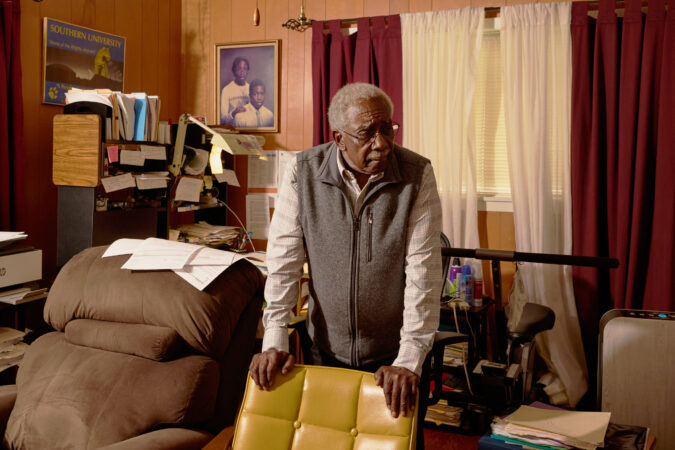
    For 30 years, Nettie King, 92, has relied on Social Security to survive.

    She and her former employers at the Oak Lane Diner near her home paid into Social Security through payroll taxes for years.

    While the storied institution closed in 2015, the Social Security benefit checks that King’s work generated have kept coming. “It’s been comfortable,” explained King, who said she was the diner’s first server of color in 1963.

    But now there’s a problem.

    King is among 68 million Americans facing possible reductions of 22% to their benefits by 2032 unless Congress acts, according to a new report by Social Security Administration (SSA) trustees released last month.

    Pennsylvania residents could lose an average of $520 each from their monthly Social Security checks, according to the Committee for a Responsible Federal Budget, a nonpartisan think tank. That would affect an estimated 255,000 Philadelphians receiving Social Security benefits, according to Olivia Mitchell, director of the Boettner Center on Pensions and Retirement Research at the Wharton School of the University of Pennsylvania.

    “Losing that much would be a disaster,” King said. “I pray the money doesn’t stop.”

    It won’t if Congress overcomes its partisan divide and creates a workable solution to make Social Security solvent, say advocates for the elderly — including AARP, whose senior vice president Bill Sweeney warned in a recent press call that “the longer they wait, the harder it gets.”

    Speaking for the Trump administration, Treasury Secretary Scott Bessent said in a statement, “We are working to preserve Social Security … and recognize that more work remains to secure benefits for future beneficiaries.”

    Someday soon

    Analysts have long predicted the Old Age and Survivors Insurance trust fund from which most retired Social Security claimants draw benefits could dissipate, said Temple University labor economist Samuel Solomon. But that was always regarded as a “someday” event.

    “Someday” may now be just six years away. “That’s a big deal,” Solomon said.

    The SSA wouldn’t stop paying benefits altogether, Mitchell said. Although the report predicts the fund’s reserves could be tapped out by 2032, “continuing payroll tax revenue [from people currently working] would cover about 78% of scheduled retirement benefits,” she added.

    At nearly $1.6 trillion annually, Social Security represents more than 20% of the U.S. budget and is the nation’s largest single expense, Solomon said.

    Various factors have combined recently to accelerate the fund’s potential depletion, according to the report submitted by SSA trustees, who include Bessent, as well as Health Secretary Robert F. Kennedy Jr.

    First, the fertility rate this year is going down faster than predicted: 1.75 children per woman vs. 1.9.

    Also, immigration is lower than estimated. That trend will continue as the government maintains restrictive immigration policies, experts say. It represents a potentially immense loss of revenue, according to Wharton research, which shows that “unauthorized immigrants” paid $24 billion in Social Security payroll taxes in 2024, despite being ineligible to collect any benefits.

    Both the slowed fertility and diminished immigration rates have lowered the anticipated number of workers and the payroll taxes they’d have contributed to Social Security, said Kathleen Romig, Social Security expert with the Center on Budget Priorities and Policies, a left-leaning research group.

    The final factor, the trustees report said, is that the One Big Beautiful Bill Act that decreased income tax rates has reduced revenue that would’ve flowed into the program.

    The SSA didn’t respond for requests to comment.

    The Social Security system had been strained long before the trustees report. The giant baby boomer generation has been retiring since around 2011, siphoning millions from the program, Solomon said.

    In 1950, when the first boomers were 4 years old, every 100 workers paid the Social Security benefits of 13 elderly people, Solomon said. Today, it’s 25 elderly people per 100 workers — “more responsibility on a single working person to support more retirees,” Solomon said.

    That worries Doris Kitt, 81, of Jenkintown, a Social Security benefits recipient who still works at a South Jersey pediatric dental practice.

    Doris Kitt talks with coworker Asia Bagby. Kitt, who is 81, still works and also collects Social Security benefits.

    “Less Social Security when rent and food continue to cost more is a challenge,” Kitt said.

    ‘Give me what I’m due’

    Through the years, Republicans and Democrats have forwarded competing remedies for repairing Social Security.

    GOP suggestions include raising the retirement age to 70, and privatizing the system.

    Democrats call for raising payroll taxes and ending the payroll tax cap. (Currently, wages above $184,500 are not subject to Social Security taxes. Democrats would eliminate the cap so higher-income earners pay into the system on 100% of their earnings.)

    In a statement, U.S. Rep. Brendan Boyle, a Northeast Philadelphia Democrat running for reelection in November against Republican challenger Jessica Arriaga, said the trustees report makes it clear that “we must act to protect Social Security benefits for all generations.“

    He referenced a bill he introduced in May 2025 that would require Americans earning more than $400,000 to contribute a greater percentage of their wages to Social Security. It’s now before the House Ways and Means Committee.

    U.S. Rep. Lloyd Smucker, a Republican representing Lancaster County, also issued a statement, saying Social Security could be fixed by a “bipartisan fiscal commission” to “build consensus” and eliminate depletions of benefits. Smucker is being opposed by Democrat Nancy Mannion in his bid for reelection.

    “We must preserve the trust fund millions of Americans rely on and keep our promise to those who have been paying into the system their entire lives,” he said.

    That covenant must be honored, said Shirley Stringfield, 70, a retired city worker from Germantown.

    “I spent 55 years of my life paying into Social Security,” she said, “so I want them to give me my due. I expect to receive my benefits until I expire. I need every cent.”

  • Supreme Court’s dramatic moves will reshape elections — and give the GOP a midterm boost

    Supreme Court’s dramatic moves will reshape elections — and give the GOP a midterm boost

    The Supreme Court dramatically reshaped elections in recent months, sharply limiting a law that has been a cornerstone of minority voter empowerment, allowing states to gerrymander maps, and loosening campaign finance regulations.

    The conservative majority says the series of decisions helps correct an election system that has run afoul of the Constitution. In rulings, they cite ideas they have long championed — undoing programs that advantage minorities, allowing partisan redistricting, and eliminating restrictions that impinge on free speech rights.

    Most of the rulings, which have rolled out as the country heads toward pivotal midterm elections, benefit Republicans. That’s led critics — starting with some of the court’s liberal justices — to complain the court’s conservative majority has gone beyond enunciating broad legal principles and put a thumb on the scale in upcoming races.

    What is clear is that the Supreme Court has tilted this fall’s electoral landscape toward Republicans as they struggle with voter discontent.

    In one of the most consequential rulings of the term, the conservative majority in April significantly weakened the Voting Rights Act’s last pillar, which required states to draw congressional districts to ensure the voting power of minorities under certain circumstances. In its opinion, the court said the protection was no longer needed by a country that has made “great strides in ending entrenched racial discrimination.” That decision touched off a push by Republican-controlled states to eliminate districts mostly held by Black Democrats across the South.

    Other rulings cleared the way for specific voting maps preferred by Republicans. And one loosened campaign finance limits — a change that brings the most immediate boost to Republican candidates.

    Democrats notched few outright victories, but they avoided some outcomes that they would have viewed as particularly disruptive. In one case, the court allowed states to continue to tally mail-in ballots even if they arrive after Election Day. Mail voting in recent years has become more popular among Democrats than Republicans.

    Legal experts said the justices’ intervention amid an election cycle and the pace at which the court is moving to implement changes that largely benefit one party is all but unprecedented in recent years.

    Richard L. Hasen, an expert in election law and political science at UCLA, said Chief Justice John G. Roberts Jr., who is known for his slow, methodical approach, lately appears to be a justice “in a rush.”

    “The court has been moving toward weakening voting rights, freeing up campaign money, and letting partisan actors run loose — that’s not a new trend,” Hasen said. “But the speed with which things are happening is much faster.”

    The decisions represent a dramatic coda to more than a decade of work by the justices, who have rewritten election law under Roberts in ways that one analysis found have pushed it to the right of any other court over the past 70 years.

    Republicans face an uphill battle in November’s contests because the president’s party historically loses seats in the midterms, and Trump’s low approval rating, the high price of gas, and the unpopular conflict in Iran have been a drag on GOP candidates.

    Democrats have a shot at taking the House and Senate, but the Supreme Court’s moves have erected a higher hurdle. Today, Republicans control 219 seats to Democrats’ 212 in the House, while Republicans enjoy a more solid advantage in the Senate, with 53 seats to 47.

    Earlier this year, the nonpartisan Cook Political Report had rated 217 House seats out of 435 as leaning Democratic, and projected Democrats needed to win only one of the tossups in November to capture the House.

    Cook recalibrated after the Supreme Court’s landmark Voting Rights Act ruling sparked the push to redistrict. It now lists 206 House seats as leaning toward Democrats, meaning Democrats need to win at least 12 of 18 tossups to gain control.

    “The fundamental question for 2026 is whether or not the structural firewall that Republicans have built up around their majority is strong enough to withstand what is shaping up to be a punishing political environment,” said Amy Walter, the publisher and editor of Cook.

    Democrats have issued bitter recriminations over the rulings as polling shows many in their base believe the court’s rulings are motivated by politics.

    “This is the most partisan Supreme Court in the history of the nation,” Sen. Ruben Gallego (D., Ariz.) recently posted on X.

    Roberts publicly addressed such criticisms at an appearance in early May, denying politics was a factor in the court’s rulings.

    “I think at a very basic level, people think we’re making policy decisions. … We’re saying we think this is what things should be as opposed to this is what the law provides,” Roberts said. “I think they view us as truly political actors, which I don’t think is an accurate understanding of what we do.”

    In its latest ruling, the court struck down limits on political parties spending money in coordination with candidates, finding they violated parties’ constitutional free-speech rights. Justice Brett M. Kavanaugh, writing for the majority, said the ruling ”treats all political parties equally” and will allow them to “participate more freely and compete more fully in the political process.”

    It’s unclear which party will benefit long term, but there’s one clear winner for the midterms: the GOP.

    Republican party committees have amassed a more than $100 million advantage over their Democratic counterparts, some of whom have struggled to raise money.

    Several of the high court’s other rulings have centered around how officials split their states into voting districts, creating maps that can give either political party an edge.

    In one of its earlier cases of the term, the high court greenlit Texas Republicans’ unusual move to redraw the state’s congressional maps between censuses, an effort that touched off a nationwide redistricting war. The decision could net the GOP up to five additional congressional seats in Texas alone.

    The justices later blocked New York from redrawing the district of Republican Rep. Nicole Malliotakis. That reversed the mandate of a state court, which had ordered officials to include more Black and Latino voters, a change that could have likely flipped the seat to Democrats.

    And in May, the court rejected a longshot emergency bid by Virginia Democrats to revive a gerrymandered voting map that would have allowed the party to pick up as many as four seats in the House in November.

    In its most sweeping decision of the term related to voting, the high court pared back a key part of the Voting Rights Act known as Section 2 that required states to draw maps that help minority communities elect candidates of their choice under certain circumstances. In the process, the court struck down a second Black-majority district in Louisiana, saying it was an unconstitutional racial gerrymander.

    With the help of the ruling, Republicans have drawn 16 districts with more favorable lines since last year, compared to six for Democrats.

    In the wake of the VRA ruling, a complicated fight over Alabama’s congressional map has raised questions about what room remains for minority communities to pursue claims that discriminatory redistricting violates the Constitution, possibly signaling even greater gains for Republicans.

    In June, the high court allowed Alabama to revert to a map with one Black-majority congressional district instead of two, a move that will likely flip a Democrat-controlled seat to the GOP.

    The decision came over a lower court finding that Alabama intentionally discriminated against the state’s Black voters in creating the map and then defied a court order to remedy the racial bias. In its ruling, the high court’s majority rejected that finding, citing “our colorblind Constitution.”

    The ruling was notable because the conservative majority held its Voting Rights Act ruling did not disturb the Constitution’s protections for minorities from “present-day intentional racial discrimination regarding voting.”

    But voting rights and minority advocates said the Alabama ruling indicates that protection might be a dead letter. Deuel Ross, director of litigation at the Legal Defense Fund, which advocates for racial justice, said in a statement he worries minority groups will lose political power.

    “The Supreme Court’s decision gives cover to Alabama and others to deliberately and openly discriminate against Black voters without fear of any consequence,” Ross said.

    Not every case went Republicans’ way. The Supreme Court dealt the GOP a setback when it upheld a Mississippi law that allows mail-in ballots to arrive up to five days after polls close. The ruling could have affected 13 other states with similar laws. Voting by mail is particularly popular with Democrats.

    Nevada Secretary of State Cisco Aguilar (D), who oversees elections in his battleground state, praised the Watson v. Republican National Committee case on mail ballots, but said the decision meant less in light of other rulings this term.

    “The fact that they destroyed the Voting Rights Act is detrimental to the fundamental foundation of our democracy,” he said. “Yes, they may have done something with Watson, but in the totality of it, the Supreme Court has become politically active in the overall administration of our election.”

    The clearest win for Democrats came when the court allowed California to gerrymander its voting maps to give Democrats up to five additional House seats. The California push came in response to Texas’ move to redraw its maps.

    The court’s liberals and some legal scholars have not just taken issue with the substance of the court’s decisions, but how the justices have arrived at them.

    The Supreme Court has regularly invoked the Purcell principle, a doctrine that holds federal courts should not change election law too close to elections because it can create confusion among voters.

    In the Texas redistricting case in December, with primary elections a few months away, the conservative majority referenced Purcell in allowing the use of redrawn maps favoring Republicans. A lower court had blocked the maps.

    “The District Court improperly inserted itself into an active primary campaign, causing much confusion and upsetting the delicate federal-state balance in elections,” the majority wrote of the primary scheduled for March.

    But in April during an active primary, the conservative majority struck down Louisiana’s second majority-Black congressional district in the Voting Rights Act decision. The seat is held by a Democrat.

    The decision came after thousands of voters had already returned mail-in ballots in the contest. The Supreme Court then expedited the ruling, paving the way for Louisiana Republicans to quickly redraw the district to favor Republicans.

    Liberal Justice Ketanji Brown Jackson issued a sharp rebuke, saying the conservative majority was willing to employ the Purcell principle in the Texas case when it favored Republicans, but ignore it in Louisiana when it did not.

    “The Court unshackles itself from both constraints today and dives into the fray,” Jackson wrote in a dissent. “And just like that, those principles give way to power.”

    Conservative Justice Samuel A. Alito Jr. shot back in a concurrence that the claim the court was acting in a partisan manner was “a groundless and utterly irresponsible charge” and it needed to act to prevent an election in Louisiana from going forward with an unconstitutional map.

    The court’s liberals have also accused conservatives of misusing Purcell in the Alabama and New York redistricting cases.

    Legal scholars differ over whether the court was employing Purcell in an evenhanded fashion. Edward B. Foley, who specializes in election law at Ohio State University, said the rulings were hard to square.

    “They may think they are being principled and consistent, but it sure doesn’t look that way,” he said of the court’s use of Purcell. “This principle seems to favor Republican partisan results.”

    Derek Muller, a Notre Dame law professor who specializes in election law, said he saw a legal logic to the court’s moves.

    “The Supreme Court is stepping back from cases in Alabama and Louisiana. It’s not issuing a rule to alter the rules of the election,” Muller said. “It’s allowing the legislatures to issue the rules they want.”

    The way the court handled the New York redistricting case also became an issue of contention. Liberal Justice Sonia Sotomayor accused the conservative majority of carrying out an “unprecedented” power grab by ruling before a state Supreme Court had a chance to weigh in.

    Sotomayor said the move trampled precedent against federal courts intervening in state court cases while litigation is still ongoing.

    “The Court’s 101-word unexplained order can be summarized in just 7: ‘Rules for thee, but not for me,’” Sotomayor wrote.

    Alito wrote in a concurring opinion that the intervention was necessary because New York courts approved a map that “blatantly discriminates on the basis of race.”

    Justin Riemer, former chief counsel at the Republican National Committee, rejected the notion the court is making partisan rulings, saying it had issued rulings favoring Democrats in recent years.

    He highlighted decisions dismissing a challenge to Trump’s 2020 election loss and rejecting arguments put forward by Republicans in 2023 that state legislatures could set election rules without interference from state courts.

    “I really don’t think that they’re in the tank one way or the other,” said Riemer, president of the group Restoring Integrity and Trust in Elections. “I think they have a judicial philosophy that they apply … that works for the types of claims we bring.”

    The redistricting and campaign finance decisions may provide immediate benefits to Republicans, but they may not last for long, said New York University law professor Richard Pildes.

    Democrats will have opportunities to redraw congressional districts in states they control after the midterms and political parties typically adapt to campaign finance rulings to keep up with their opponents, he said.

    Democratic anger over the decisions is intense, and it could fuel efforts to ban mid-decade redistricting, limit partisan gerrymandering, and pack the Supreme Court with more justices, he said. One Democratic congressman went so far as to introduce articles of impeachment against Roberts.

    “This is a real sort of avalanche that’s kind of been unleashed,” Pildes said.

    Legal experts said the court’s decisions this term are of a piece with its rulings on voting rights and campaign finance over the last 15 years.

    Those include the 2010 Citizens United decision that loosened campaign finance restrictions on corporations and unions, the 2013 Shelby County ruling that knocked down a section of the Voting Rights Act that required states with a history of racial discrimination to get federal pre-clearance to change voting laws, and the 2019 Rucho decision that found federal courts could not hear partisan gerrymandering claims.

    Guy-Uriel Emmanuel Charles, a Harvard law professor who focuses on political power and race, said regardless of which party benefits, this term’s cases could supercharge the era’s bare-knuckle politics.

    “This Court is sending a clear message: It will not impose many limits,” Charles wrote in an email. “The Court is incentivizing political parties to push the boundaries as far as possible to gain an advantage.”

  • Democrat Bob Harvie sends cease-and-desist letter to Rep. Brian Fitzpatrick, claiming defamation in campaign ads

    Democrat Bob Harvie sends cease-and-desist letter to Rep. Brian Fitzpatrick, claiming defamation in campaign ads

    The Democratic nominee for a crucial swing seat in Pennsylvania is accusing the Republican incumbent of making categorically false and defamatory statements, the latest move as escalating attack ads circulate in the Bucks County district.

    Attorneys representing Bob Harvie sent a cease-and-desist letter to U.S. Rep. Brian Fitzpatrick, a five-term Republican incumbent facing a competitive reelection, and his campaign for a “series of defamatory allegations” that, they say, misleadingly portray Harvie’s role in an FBI investigation.

    A lawyer representing Fitzpatrick and his campaign confirmed receipt of the letter but did not respond to additional requests for comment.

    The advertisements purport that Harvie, a Bucks County commissioner, is currently under criminal investigation for stealing taxpayer money, assertions his campaign said falsely stem from a federal case that appeared to have quieted after the grand jury met in Philadelphia in 2022. The probe was about problems related to contracts, unions, and a Pennsylvania school district.

    Harvie is not and never was under investigation, his lawyers said, nor was he the subject of the federal case, but mailers and television spots continue to blur the lines.

    The election fights are ramping up as both men compete to win Pennsylvania’s 1st Congressional district in November, and with it, decide fate over which party controls the U.S. House. It’s one of four seats in the commonwealth being targeted by both political parties during the high-stakes midterm elections. Fitzpatrick has represented the area since 2017.

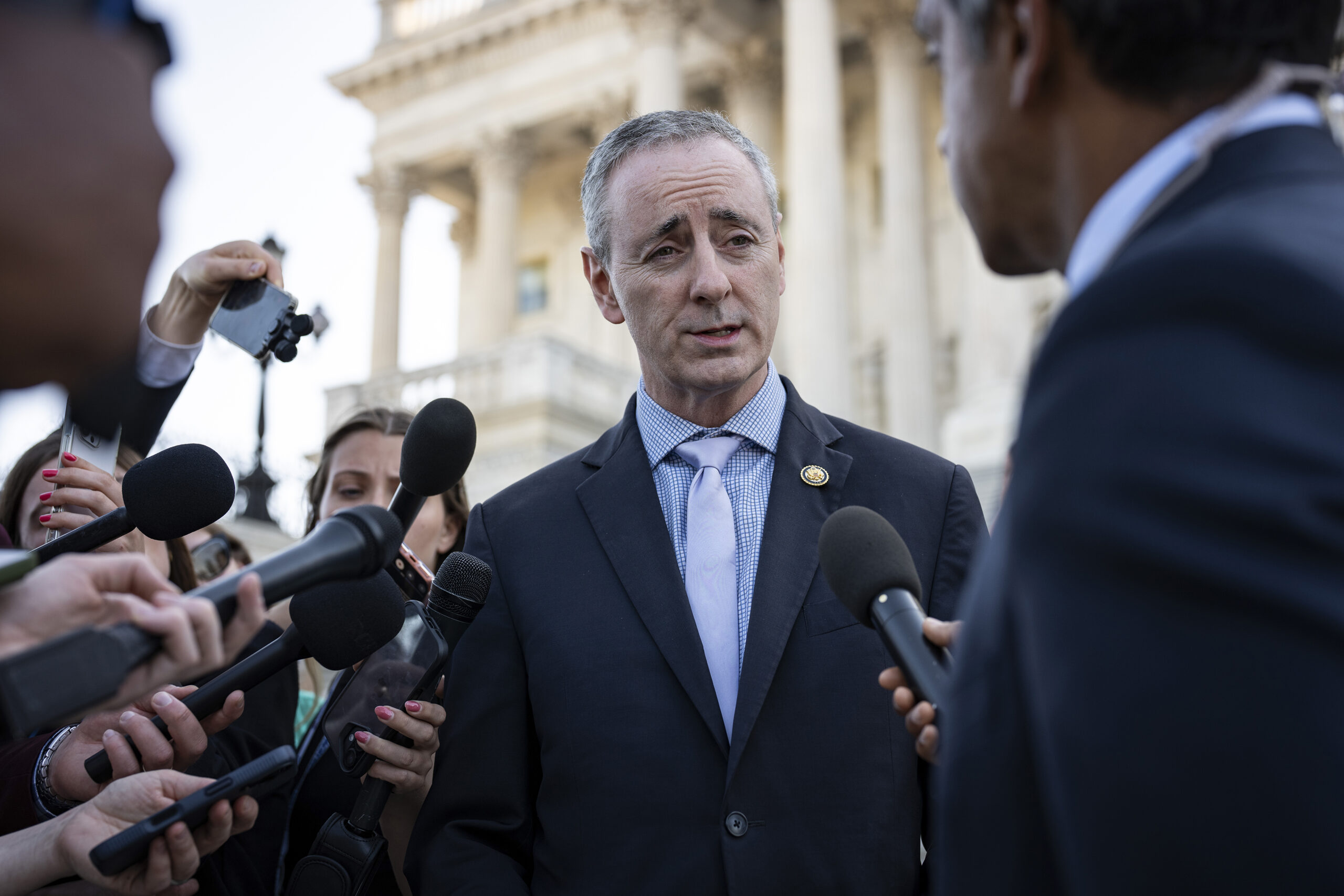
    Rep. Brian Fitzpatrick (R., Pa.) speaks to reporters on June 3 after the House passed an Iran war powers resolution.

    Harvie’s attorneys sent Fitzpatrick and his campaign the letter Thursday shortly after 5 p.m. and gave the campaign 24 hours to respond.

    “Brian Fitzpatrick’s lies are intended to deceive the voters and that’s a disgrace to this district,” Harvie said in a statement.

    Further action will depend on whether and how Fitzpatrick and his campaign proceeds, Harvie’s campaign said.

    Defending America PAC, a political action committee that supports Fitzpatrick, has also used similar language in social media posts, news releases, and video content that said Harvie is the subject of an FBI investigation. Harvie’s campaign sent Defending America PAC a cease-and-desist letter Thursday, too, around 9 a.m.

    In a statement, Chris Pack, president of the PAC, said further legal action from Harvie would be an effort “to chill protected political speech.”

    What happened with the FBI investigation?

    The FBI in 2020 interviewed several people with connections to Falls Township and the Pennsbury School District, LevittownNow reported in September 2022.

    Harvie and several other officials were among those who testified before a grand jury in the probe, which has not been active since 2022, the campaign said. But Harvie and his lawyers in the letter maintain he “is not now and has never been the subject of any criminal investigation” or stealing money from taxpayers to throw himself a party.

    Political advertisements, paid for by the Fitzpatrick campaign, suggest otherwise.

    In a television spot that has aired on three cable systems that run across the district since June 30, a man is seen asking, “Commissioner Harvie, why did you steal taxpayer money to throw yourself a party” while the words “BOB HARVIE UNDER FBI INVESTIGATION” are displayed on screen. His campaign committee, Brian Fitzpatrick for All of Us, paid for the ads.

    The letter also accuses Fitzpatrick, a former FBI agent himself, of “actual malice,” which would require proof in court that he made the advertisements with knowledge that the allegations were false or with reckless disregard to whether they were false or not.

    When similar charges were made in 2023 in a race for county commissioner, Harvie denied the claims as false.

    “There comes a line where you cannot straight up lie about folks,” said Dan McCormick, Harvie’s campaign manager.

    What other action could be taken?

    Harvie’s campaign could file a lawsuit claiming Fitzpatrick has defamed him, but that would involve likely months of subpoenas, depositions, and evidence gathering before the case potentially goes to a judge or jury — a process that could extend past November’s election.

    The Federal Election Commission, an independent agency in the U.S. government, oversees federal elections and campaign finance, but defamation is under the jurisdiction of courts, not the commission.

    The television stations that have aired the advertisements have also been alerted to the defamation claims, Harvie’s campaign said. The Federal Communications Commission, another independent U.S. agency, monitors communications by radio, television, wire, satellite, and cable. However, it also does not investigate or resolve defamation claims.

    It’s not uncommon for campaigns to trade cease-and-desist letters as elections heat up, and some are outright ignored.

    How much money has been spent on the campaign?

    A competitive U.S. House seat has drawn state and national attention, resources, and lots of dollars.

    Fitzpatrick entered April with $7 million already stored in the bank, allowing him to spend early on ads against Harvie — even before the Democrat won his May primary. Some of Fitzpatrick’s money went to attacking Harvie in his race against Lucia Simonelli, a grassroots candidate and climate policy expert.

    In total, Fitzpatrick has already spent $2.81 million from Jan. 1, 2025, to April 29, 2026, according to campaign finance reports — with roughly four months left to go before the campaign. During the entire 2024 campaign cycle, he spent $3.47 million.

    In addition to the FBI investigation ads, other TV hits and mailers have framed Harvie as a “career politician” who “voted to give himself a raise” and voted to count faulty mail ballots during a U.S. Senate recount, in violation of a state Supreme Court ruling.

    Prior to beginning his tenure as commissioner in 2020, Harvie was on the Falls Township Board of Supervisors for 17 years, and spent 12 of those as chair. As chair of the Bucks County Board of Commissioners in 2022, Harvie approved an annual 1% increase in salaries for commissioners and several other local offices.

    Fitzpatrick and the National Republican Congressional Committee have placed a joint ad buy starting Tuesday. This type of purchase was made more possible after the Supreme Court case, announced this week, that allows coordinated campaigns and direct campaigns to work more in tandem.

    Harvie, though, has his own stash of cash. He’s raised $1.45 million, according to campaign finance reports, and has released ads that connect Fitzpatrick to President Donald Trump’s agenda — even as the lawmaker has voted against Trump on numerous issues and earned his ire. The next financial disclosure will be released July 15, and Harvie’s campaign said it has now raised about $2 million.

    National Democrats have also thrown resources behind him, and the Democratic Congressional Campaign Committee has listed Harvie on its “Red to Blue” list as a key seat to flip.

    “This is a defining moment in this campaign: After nearly a decade in D.C., Fitzpatrick has been caught with egg on his face by resorting to the very kind of gutter politics that he pretends to stand against,” said DCCC spokesperson Eli Cousin.

    Harvie was one of four swing-districts Democratic candidates Gov. Josh Shapiro supported ahead of the May primary, as he looks to elevate the party in fall and help win control of Congress.

    Staff writer Fallon Roth contributed to this article.

  • Trump administration gets final legal OK to install own panels at President’s House, city appeals

    Trump administration gets final legal OK to install own panels at President’s House, city appeals

    A Philadelphia-based federal appeals court gave President Donald Trump’s administration the final go-ahead to install its own exhibit at the President’s House.

    The new panels, which historians have criticized for whitewashing George Washington’s role in enslaving nine people, have been manufactured and stand ready to install, the Justice Department told the court.

    The procedural step, which the U.S. Court of Appeals for the Third Circuit took on an observed federal holiday, followed a Thursday request by Justice Department attorneys to allow the National Park Service to “begin work immediately and install its new exhibits.” The Third Circuit ruled last month that the city has no rights over the President’s House.

    “The President’s House is an important national historical site, and the Government submits that the President’s House exhibits should be fully installed without further delay,” the government’s filing said.

    Only two of 11 new panels mention the people enslaved at the President’s House, which was the exhibit’s original purpose. The exhibits are not factually wrong, historians said, but cast Washington in a more sympathetic light.

    “Slaves living in the President’s House experienced a greater modicum of autonomy than elsewhere in the South such as to explore the city and sometimes even attend the theater, with Washington buying the tickets,” one panel reads.

    The city quickly appealed and asked the Third Circuit court to recall the Friday-morning order, saying it didn’t have time to respond to the Justice Department’s Thursday request.

    And while the federal government asked to install the exhibits “immediately,” the request did not identify a reason for the rush.

    “That is not an emergency,” the city’s filing said, “it is a preference for speed.”

    The court shouldn’t have issued its final approval for changes without waiting the 90 days Philadelphia had to appeal last month’s order, the filing said.

    The city also repeated the argument, which has not found purchase with the appellate judges so far, that allowing the Trump administration to install its own exhibit would cause the city and public irreparable harm.

    The city’s motion does not automatically pause the court’s order.

    But in addition, the city filed a motion for a stay, while the Third Circuit considers the appeal, with District Judge Cynthia M. Rufe, who issued the now-vacated injunction ordering the Trump administration to restore the exhibits it had removed.

    The city and the Department of the Interior did not immediately respond to requests for comment.

    The President’s House has been subject to litigation in federal courts since the Trump administration dismantled the slavery exhibit in January.

    It has been in legal limbo in recent weeks because of litigation in a Boston federal court, where conservation groups sued to stop the Interior Department’s implementation of Trump’s 2025 executive order requiring no national parks displays that “inappropriately disparage Americans past or living.”

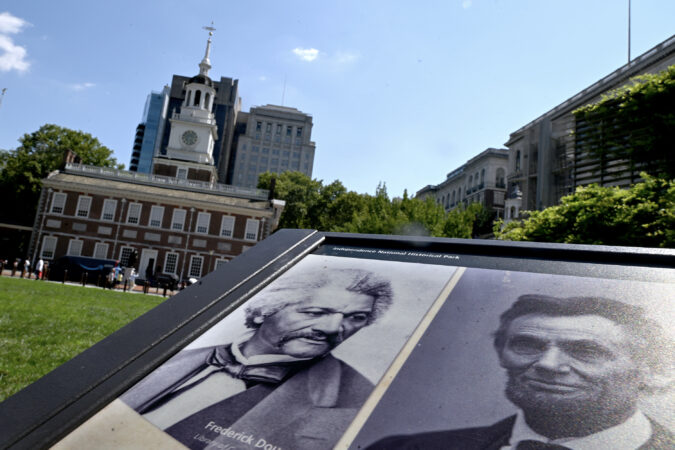
    At least 50 exhibits were removed from more than 30 sites nationwide, according to court records. Among them are also mentions of slavery at Independence Hall and the Second National Bank of the United States that the Trump administration quietly removed.

    A federal judge in Boston last month ordered the National Park Service to restore all removed exhibits to parks across the nation. But the Court of Appeals for the First Circuit disagreed and stayed that order Thursday.

    Hours later, Justice Department attorneys asked the Philadelphia-based federal court to clear the final procedural step — and the court obliged before noon Friday.

    The biggest question remaining is whether the Trump administration will attempt to install the panel during this historic July 4 weekend marking the United States’ 250th anniversary.

  • Trump wants to ease rules on mailing guns. His son’s company could benefit.

    Trump wants to ease rules on mailing guns. His son’s company could benefit.

    On an earnings call in May, GrabAGun’s chief executive had a hopeful message for investors: The Trump administration’s proposed rollback of gun regulations could be a boon to the company, which hopes to be “the Amazon of guns.”

    “This could be the most significant change to firearms retail distribution in decades,” Marc Nemati said, according to a public recording of the call. “GrabAGun is uniquely positioned for this opportunity.”

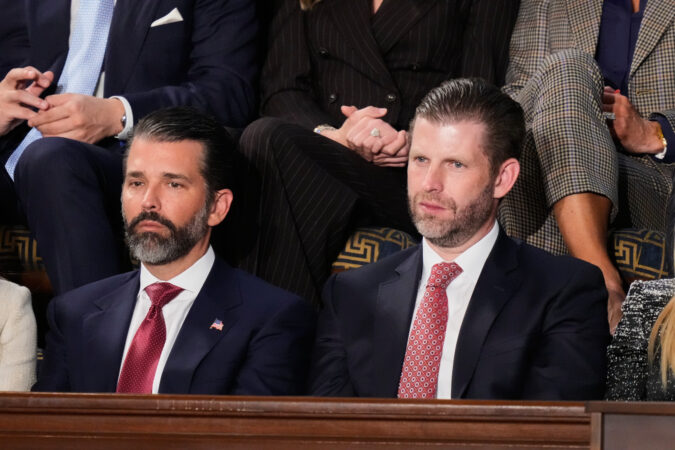
    What Nemati did not mention was that the company also had a powerful voice on its side. Donald Trump Jr., the president’s son, is on GrabAGun’s board and is a consultant to the company.

    The younger Trump was present at the New York Stock Exchange in July 2025 when the company went public, with photos showing him making a gesture like holding a gun to celebrate the moment as he helped ring the bell.

    And, with a 1.1% ownership stake in the company, Trump Jr. stands to prosper if the company fulfills its goal of being a dominant seller of firearms online.

    “To be able to come back to the New York Stock Exchange and actually take a gun company public feels like such a vindication of all the insanity, all of the woke nonsense that we’ve been watching and facing for the last decade in America,” Trump Jr. said on Fox Business ahead of GrabAGun going public. “It’s a triumphant return.”

    GrabAGun sells and ships ammunition, and some gun accessories, directly to consumers in some states using its website. But it must rely on middlemen to actually transfer the firearm to the customer.

    That’s because federal regulations prohibit sending handguns to individuals through the mail, and they require that firearms background checks and transfers be conducted in person. The administration has proposed regulatory changes that, for the first time, would let firearms sales take place entirely online, with handguns mailed directly to buyers’ doorsteps.

    Such changes could enormously benefit GrabAGun and the president’s son, creating a potential conflict of interest that has attracted the attention of ethics watchdogs.

    Many Republicans were highly critical of Hunter Biden’s tenure as a board member of the Ukrainian energy company Burisma at a time when his father, Joe Biden, was vice president and a key player on Ukraine. In the Trumps’ case, the president’s son could benefit directly from policies adopted by his father’s administration.

    “There is no question about the company’s ties to the son of the president,” said Jordan Libowitz, a spokesperson for Citizens for Responsibility and Ethics in Washington, which investigates and litigates matters involving ethics in governance. “It is always going to raise red flags and question how decisions are made within the administration.”

    In a statement, a spokesperson for GrabAGun said, “We appreciate the proposed rulemaking may allow a more streamlined purchase process for firearms for everyone who wishes to legally secure firearms, from enthusiasts to sportsmen. There is a lengthy rulemaking process ahead. GrabAGun has submitted a public comment on one of the proposed rules, and will be participating in the public comment process.”

    A spokesperson for Trump Jr. said he is a longtime promoter of gun rights who is pursuing an attractive business opportunity and has no connection to the ATF rule changes.

    “Don is a lifelong businessperson and vocal advocate of our Second Amendment rights,” the spokesperson said. “He does not interface with the federal government as part of his role with any company that he invests in or advises and had zero involvement in this particular decision.”

    A White House official said the ATF proposals were driven by the administration’s interest in protecting the Second Amendment and had nothing to do with Trump Jr.’s business interests.

    The Trump family’s sprawling business ventures, which have thrived during President Donald Trump’s second term, are facing heightened scrutiny. The president’s latest financial disclosure forms show that his reported income soared to more than $2.2 billion in 2025, as he took in more than $1.4 billion from cryptocurrency, digital tokens, and related partnerships.

    The president has said he is not involved in the day-to-day operation of his businesses while in the White House. But his two oldest sons have continued to manage the family’s eponymous real estate empire and invest in new ventures, often in countries heavily reliant on the goodwill of the U.S. government.

    Trump Jr., for example, has invested in AI-related companies, data centers, and more.

    Trump Jr. became formally involved in GrabAGun in December 2024, shortly after his father was elected to his second term. Under his agreement with the company, Trump Jr. would serve as a consultant in exchange for 300,000 shares of stock, or just over 1% of the company’s value, according to filings with the Securities and Exchange Commission.

    He would also be responsible for helping to execute the company’s marketing strategy, developing partnerships, and “serving as a spokesperson for the Company to effectively communicate the Company’s mission and initiatives,” the filings say.

    GrabAGun Digital Holdings is a 16-year-old Texas-based company that aims to digitize the gun-buying process, according to SEC filings. It hopes to reach a more youthful cohort of firearms users, who company executives say would be more likely than their older peers to buy firearms online.

    Since going public, the company — which is valued at nearly $70 million — has dropped in value, public records show. On the earnings call, company executives blamed the loss in value on the costs of going public and expanding.

    Trump Jr. has made it clear that the company’s path toward greater profitability is internet sales.

    “Younger people are actually getting into the Second Amendment,” he said on Fox News in January 2025. “They understand the fundamental importance of being able to protect themselves and their freedoms. … This is a way — with an incredible tech site — for them to shop the way they shop for everything else.”

    On the campaign trail, the elder Trump promised to roll back Biden-era firearms regulations, such as a rule that prohibits the sale of stabilizing brace firearm accessories, and received the backing of major gun rights groups. In April, the Bureau of Alcohol, Tobacco, Firearms and Explosives — the law enforcement agency within the Justice Department tasked with regulating the nation’s hundreds of millions of firearms — proposed amending or eliminating 34 gun regulations.

    Experts said some of those changes, taken together, would transform the firearms market from one that largely plays out in storefronts across the country into a potentially lucrative digital marketplace.

    Currently, licensed firearms dealers must verify a potential buyer’s identity and run a federally mandated background check in person. That stems from Congress’ move to tighten the rules in 1968, after Lee Harvey Oswald used a fake name on a mail order to buy the gun he used to assassinate President John F. Kennedy in 1963.

    Gun rights groups say the regulations are outdated in the digital era. Under one of the ATF proposals, firearms sellers would be able to verify someone’s identity and check their background online.

    Erich Pratt, senior vice president of Gun Owners of America, said the Gun Control Act of 1968 went beyond the government’s authority in restricting gun purchases, given the Second Amendment right to bear arms. Pratt, the ATF, and other gun rights groups have said that the proposal has ample measures in place to ensure the safe sale of firearms online.

    “The right of Americans to buy guns — even online — is something that is deeply rooted in our nation’s text, history, and tradition,” Pratt said, echoing the language of recent Supreme Court decisions. “It is as American as apple pie.”

    GrabAGun’s business model allows customers to order firearms on the company’s website or mobile app. The guns are shipped not to their homes but to a licensed dealer in their states, and the customers must undergo background checks at the store before they can pick up the firearms.

    As the ATF moves to allow background checks online, a separate proposal would loosen a century-old ban on sending handguns to people’s homes through the U.S. Postal Service. Under the proposed rule, licensed firearms dealers could ship guns to residents of their state. The proposal follows a Justice Department memo in January, authored by lawyers in the department’s Office of Legal Counsel, declaring the gun-mailing ban unconstitutional.

    If the ATF and Postal Service rule changes are enacted, GrabAGun could sell firearms online and ship them directly to consumers, at least in states where the company is licensed. GrabAGun is a licensed dealer in Texas, according to public records, and firearms experts say it would not be difficult for the company to get licensed in many other states.

    The ATF announced its proposals on April 29, beginning a 90-day public comment period that will expire in early August. The public comment period for the Postal Service measure has closed, and those comments are under review. Multiple state attorneys general have said they are against the Postal Service proposal, suggesting that it could face legal challenges if adopted.

    The administration says its proposals would remedy the misinterpretation of the law and Constitution by Biden-era officials.

    “ATF regulation changes reflect President Trump’s commitment to the rule of law, and that includes protecting the Second Amendment rights of all Americans,” a White House official said. “We refuse to bypass Congress and use the regulatory process to harass law-abiding Americans seeking to exercise their rights,” as the administration claims its predecessors did.

    Advocates for stricter gun laws say it is critical that potential buyers have in-person interactions before they acquire handguns. In face-to-face interactions, they say, gun sellers can pick up on any red flags suggesting that it would be unsafe for the potential buyer to possess a firearm.

    Gun-control advocates cite another administration proposal that, they say, could help GrabAGun but threaten public safety.

    Under existing ATF regulations, residents of states with rigorous procedures for obtaining concealed-carry permits can bypass the federal background check. Under the new proposal, more states, including those with laxer procedures, would qualify for the waiver.

    Marianna Mitchem, senior industry adviser for Everytown for Gun Safety, a gun-control advocacy group, said she fears that the administration’s proposals would make it simpler for gun traffickers, criminals, and underage people to get their hands on firearms through online platforms such as GrabAGun.

    Mitchem, who was a senior official at ATF overseeing inspections of gun shops before leaving the agency in 2025, said the agency during the Biden administration never discussed easing regulations to enable online sales.

    “This is going to make it so much easier for dangerous people to get firearms,” Mitchem said. “You are eliminating [gun shops’] ability to be the first line of defense.”

    GrabAGun’s executives disagree, and they submitted a comment to ATF supporting online background checks.

    “The Second Amendment is in our blood,” Jonathan B. Wolens, GrabAGun’s general counsel, wrote in the comment, which is available online. “We support this rule change because we believe it will promote efficiency and support compliance by enabling more timely, accurate confirmation of license validity.”

    ATF said the proposed rule would require a rigorous identification process while updating the gun sales process for the 21st century. “ATF’s proposed rule modernizes and strengthens identity-verification requirements … and reduces burden on consumers,” an ATF spokesperson said in a statement.

    GrabAGun appears poised to move fast if the rule changes are enacted. In October — months before the proposals were introduced — GrabAGun formed a subsidiary called Pew Logistics, with a stated mission of selling software to provide “next-generation, white-label direct-to-consumer fulfillment solutions to modernize the firearms supply chain.”

    That software would be sold to gun manufacturers, helping them sell directly to consumers online.

    Trump Jr. has multiple other financial ties to GrabAGun that could enable him to profit if the company takes off.

    GrabAGun offers a “Shoot Now Pay Later” financing option through a company called Credova Financial. Credova is a subsidiary of Public Square Holdings, where the president’s son is a board member and investor.

    In August, the Consumer Financial Protection Bureau dropped an investigation of Credova, which had been accused of wrongly charging fees to customers. It said the inquiry, which started during the Biden administration, was politically biased against companies affiliated with firearms.

    When GrabAGun went public, it merged with Colombier Acquisition Corp. II, a firm designed to combine with other companies and take them public. Colombier is led by Omeed Malik, a major Republican donor who chairs 1789 Capital, a venture capital firm that includes Trump Jr. as a partner.

  • Pope Leo XIV celebrates immigrants in speech to Philadelphia crowd amid clash with Trump ahead of 250th anniversary

    Pope Leo XIV celebrates immigrants in speech to Philadelphia crowd amid clash with Trump ahead of 250th anniversary

    Addressing a Philadelphia crowd live from the Vatican, Pope Leo XIV called for a “recommitment” to American ideals.

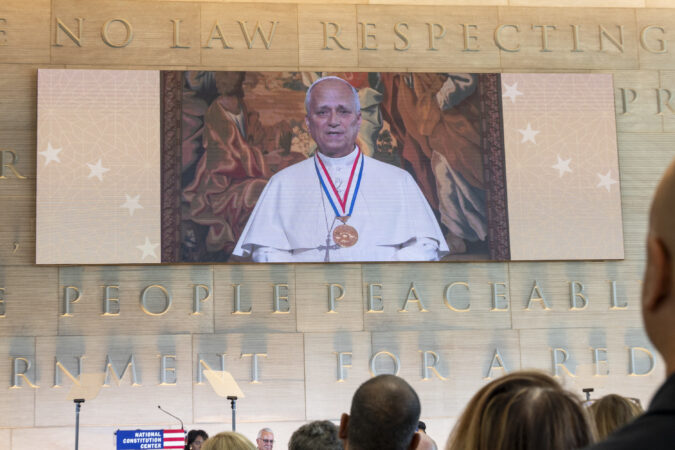
    The first U.S.-born pope delivered remarks virtually at an interfaith ceremony inside Philadelphia’s National Constitution Center on the eve of the United States’ 250th birthday to accept the center’s prestigious Liberty Medal.

    Facing a screen showing the live, cheering Philadelphia audience, the pontiff wore his Liberty Medal along with a cross around his neck.

    Leo, who grew up in Chicago and attended Villanova University, quickly pointed out his American roots, calling himself “a son of this great country.”

    “I join you in asking God’s blessings upon America’s future that the lofty ideals enshrined at the beginning of the Declaration of Independence may continue to guide the flourishing of the nation in unity, justice, and peace,” he said.

    Leo, who was elected pope last year, spent years serving the church in Peru and has been outspoken about calling for international peace. That’s landed him at odds with President Donald Trump’s administration on the issue of migrants, the war in Iran, and more.

    The pope leaned into some of those themes in his speech, even though he did not refer to the president directly.

    He nodded to his advocacy for humane treatment of immigrants and noted that the founders of the United States “made America a byword for freedom, as the country opened its doors to successive waves of immigrants, enabling them and their children to play their part in shaping the future of the nation.”

    He said the “love of freedom” in the United States has inspired the country “to look beyond itself and at great sacrifice to champion the cause of freedom beyond its own borders.” But he acknowledged that mission hasn’t been straightforward, noting that building a society that embodies such ideals “was not always easy and, in many respects, is still a work in progress.”

    The pontiff’s speech comes the day before he plans to visit Lampedusa, an Italian island known as a stop for migrants making the dangerous journey across the Mediterranean Sea from North Africa to Europe. His predecessor Pope Francis made his first official visit outside of Rome in 2013 to the same island and condemned the “globalization of indifference” toward migrants.

    Pope Leo XIV speaks at the Liberty Medal Ceremony at the National Constitution Center in Philadelphia on Friday.

    Julie Silverbrook, the chief content and learning officer for the National Constitution Center, emphasized in a Friday interview that Leo is a “global leader who has been uniquely shaped by American ideals.”

    “He has brought together people of different faith traditions, and through his ministry really reflected his belief in the inherent dignity of all human beings,” she said.

    Leo declined an invitation from Trump to the United States to celebrate the country’s 250th birthday on July Fourth, the New York Times reported. The first American-born pope opting to visit migrants instead sends a stark message as the president pursues his mission of mass deportations.

    But the pontiff’s participation in the Philadelphia program highlights his connections to the region, which isn’t lost on the National Constitution Center.

    The Philadelphia-based private nonprofit organization chose Leo for the award due to “his lifelong work promoting religious liberty and freedom of conscience and expression around the world — ideals enshrined by America’s founders in the First Amendment to the U.S. Constitution.” That, and also because he is the first pope born in the United States, and has connections to Philadelphia, Silverbrook said.

    “He was shaped by those freedoms … in much the same way that the Declaration of Independence was shaped by the city of Philadelphia, and of course a reflection of American values that have been carried globally,” she said.

    When a delegation from Philadelphia’s National Constitution Center met with Leo at the Vatican in April to present him with the medal in person, they also bore a few local goodies: a bundle of Villanova swag, a replica of George Washington’s Acts of Congress, and a Wawa tote bag filled with Tastykakes.

    “I think he very much so feels a connection to Philadelphia, both having been educated here, and I think in this semiquincentennial moment, I think the eyes of the world are on Philadelphia, and we’re thinking about the ideals that have emanated from this place for 250 years,” Silverbrook said.

    Leo, a 1977 Villanova alum, recently passed on a surprise message to graduates of his alma mater. Vince Stango, the interim president and CEO of the National Constitution Center, also went to the Augustinian university on the Main Line, which co-sponsored the NBC10 broadcast of the event along with the archdiocese and Malvern Prep.

    (From left to right) Gov. Josh Shapiro, Rev. Nelson J. Pérez, Mayor Cherelle L. Parker, Interim President & CEO of National Constitutional Center Vince Stango, Rev. Carolyn C. Cavaness, Imam Quaiser D. Abdullah, Rev. Luis A. Cortés Jr., and Rabbi Jill L. Maderer, pose for a photo at the Liberty Medal Ceremony at the National Constitution Center in Philadelphia, Pa., on Friday.

    Clashing with Trump

    The pope has contended that it’s up to each country to determine how they want to accept migrants while also denouncing the Trump administration’s “extremely disrespectful” treatment of them.

    He has also spoken out against Trump’s threats against Iran, and declined to participate in the president’s “Board of Peace” for Gaza’s reconstruction.

    In an April social media rant, Trump complained that he doesn’t “want a Pope who criticizes the President of the United States.” The president called the Catholic leader weak and accused him of “catering to the Radical Left.”

    Leo told reporters that month that he has “no fear, neither of the Trump administration, nor of speaking out loudly about the message in the Gospel, and that’s what I believe I am called to do, what the church is called to do.”

    In his Friday remarks, the pope made a call for unity but warned that a country should come together with “ideals that do not fade with the passing of time.”

    He called on the United States to recognize its values of “peace and prosperity, a country characterized by generosity and nobility of heart,” and said the values of “shared human dignity, equality, and the rights laid out in the Declaration of Independence” can help unite and guide the nation.

    The Liberty Medal

    The Liberty Medal was created in 1988 and has been hosted by the National Constitution Center since 2006.

    The award has gone to storytellers, philanthropists, civil rights leaders, and politicians on both sides of the aisle, such as Ukrainian President Volodymyr Zelenskyy, former Supreme Court Justice Ruth Bader Ginsberg, the Bushes, Malala Yousafzai, and Thurgood Marshall.

    The center describes its recipients as individuals who “strive to secure the blessings of liberty to people around the globe.”

    The process of selecting Leo began about a year ago, Silverbrook said.

    The speech was initially going to be projected on Independence Mall, but the event was moved indoors due to the extreme heat and livestreamed by the center online.

    Rich Russo, 63, a Fishtown resident who attended the event in person, called the experience “once in a lifetime.”

    “How many times do you get the pope talking to you?” said Russo, who works for a bank.

    Gov. Josh Shapiro, who is Jewish, and Mayor Cherelle L. Parker, a Baptist — both Democrats who have been outspoken about their own faiths — joined Philadelphia Archbishop Nelson J. Pérez and other religious leaders who made remarks on stage prior to the pope’s speech. Pennsylvania Attorney General Dave Sunday, a Republican, rang a replica Liberty Bell outside.

    “Philly is proud that the pope is a graduate of Villanova University who spent time living and working in our region,” Pérez said on stage. “Pope Leo knows us, and we feel like we know him, too.”

    “His influence, however, extends beyond Philadelphia,” the archbishop added.

  • Read the full text of Pope Leo XIV’s speech to the National Constitution Center

    Read the full text of Pope Leo XIV’s speech to the National Constitution Center

    Here is the full text of Pope Leo XIV’s speech to the National Constitution Center, livestreamed from the Vatican on July 3 for his acceptance of the Liberty Medal. The Inquirer’s coverage of the event can be found here.

    Thank you very much.

    Dear friends,

    I am honored to accept the Liberty Medal of the National Constitution Center in this year that marks the 250th anniversary of the founding of the United States of America with the signing of the Declaration of Independence on July 4, 1776. On the eve of this momentous occasion, I offer a warm greeting to all those assembled at the National Constitution Center in Philadelphia. As a son of this great country, founded by courageous men and women who dreamed of liberty and of a better life for themselves and for their children, I join you in asking God’s blessings upon America’s future, that the lofty ideals enshrined at the beginning of the Declaration of Independence may continue to guide the flourishing of the nation in unity, justice and peace.

    From our youth, most of us have admired the eloquence of those words, with their resounding appeal to the law of nature and to nature’s God as the basis of their assertion that all men and women are created equal and endowed by their Creator with certain inalienable rights, including the right to life, liberty and the pursuit of happiness. While couched in the language of the Enlightenment, that claim is ultimately grounded in an understanding of the human person inspired by the great biblical vision of man and woman being created in the divine image. It is indeed here that we discover the basis of human dignity; dignity which precedes the establishment of any state, and whose custody constitutes its very purpose.

    In these past 250 years, for so many peoples throughout the world, it was the firm resolve to achieve the noble vision of the nation’s founders that made America a byword for freedom, as the country opened its doors to successive waves of immigrants, enabling them and their children to play their part in shaping the future of the nation. It was this same love of freedom that inspired the United States, in the darkest hours of the last century, at the time of the two world wars, to look beyond itself and, at great sacrifice, to champion the cause of freedom beyond its own borders.

    As every American knows, however, the path to building a society that would embody those high ideals of liberty and justice for all was not always easy and, in many respects, is still a work in progress. Indeed, the effort to realize this vision is one that must be taken up anew in each generation and in the face of ever new challenges. Today, as we look to the future, this historic anniversary presents us with the opportunity to reflect once again on the nation’s founding principles in the hope that America will remain ever true to the dream that has earned it the title of land of the free and home of the brave.

    The first right enshrined by the nation’s founders was the right to life, for no one who is deprived of life can enjoy liberty or pursue happiness. A country’s vitality is deeply tied to the value it affords to human life in every form and condition, acknowledging the dignity endowed upon every human person by virtue of their very existence. The inherent worth of every human life has led the noble hearts of generations to praise the marvelous works of the Creator and stand in reverence before so precious a gift. Indeed, it is precisely this reverence that we must continue to cultivate — one that sways the hearts of individuals and inspires laws that recognize and safeguard this gift from the moment of conception to natural death. Reverence, too, will aid us in discovering that we are guardians and stewards of those entrusted to our care. In this regard, the moral greatness of a nation is manifested, above all, in its capacity to support, protect and cherish the lives of all, especially the most vulnerable and those whose worth is questioned.

    Following the right to life, liberty was and is preeminent among the principles revered by the men and women who have sought within this nation’s borders a new beginning, often equating it with previously undreamed-of hope. Though frequently understood as the ability to act as one would like, authentic freedom runs much deeper. It is founded upon the human person’s capacity to know the truth and adhere to what is good, even at great cost — a sacrifice well known to many who have labored to shape this country. The desire for truth and freedom, as well as the very pursuit of happiness, continues to inspire people of all generations to ask fundamental questions regarding the meaning of life, our ultimate purpose, and indeed about God, and it is proper for magnanimous hearts to endeavor to answer these questions with sincerity. These answers inevitably determine the direction which we seek to give to our lives, and America has long championed the religious freedom necessary to follow responsibly the dictates of conscience in this regard, free from fear and coercion, as enshrined in the First Amendment to the United States Constitution.

    It is this freedom that holds sacred the inner sphere of the person where convictions are formed and where conscience can guide the decisions made in the intimacy of the human heart. This same freedom also ensures the right of every person to worship according to one’s own belief, and of individuals, communities and associations to give public expression to their faith. In fact, religious freedom gave rise to the American tradition of allowing for interfaith dialogue and interreligious cooperation in promoting the public good and enriching the debates on the great moral and ethical issues that have faced the nation and shaped the course of its history. It is my hope that this tradition will continue to bear fruit in a public discourse marked by moderation, respect for the views of others and an ongoing effort to find common ground in promoting the cause of peace and reconciliation, at home and abroad.

    The forbearers of this country, men and women of diverse backgrounds, religions and languages, were able to find that common ground and the strength necessary to pursue a better future. The principles that inspired America’s founders, rooted as they are in the truth of the human person, brought them together in a single cause, a common dream. Unity lent strength to that dream, giving rise, under God, to the United States of America. E pluribus unum — out of many, one. In order for a nation to flourish, it must be truly united; united not by goals bound to momentary endeavors, but by ideals that do not fade with the passing of time. May the principles we have reflected upon today — a shared human dignity, equality and the rights laid out in the Declaration of Independence — ever be a source of such unity and a guiding light for the present moment and the years to come.

    In accepting this award, I therefore pray that this, the 250th anniversary of the founding of this great nation, may be the occasion of a solemn recommitment to these ideals that have made America a country that values peace and prosperity, a country characterized by generosity and nobility of heart. I commend all of you, as well as the future of the nation, to the One who is himself the source of true freedom and lasting peace, the One whose very name is Peace.

    May God bless America!

  • Frederick Douglass’ critical lesson for the 250th: ‘Contend, contend’

    Frederick Douglass’ critical lesson for the 250th: ‘Contend, contend’

    As the country moves toward the 250th celebration, the official directive from the Trump administration is clear: be proud, be grateful, and rejoice in our great nation. This rosy narrative overlooks the global political conflicts, fractured economy, and longstanding racial and gendered inequalities that have shaped our country from its founding. These difficult realities are not footnotes to American history but a reminder of all of the ways that our nation continues to fail to live up to its espoused values. This is why one of the greatest speeches in American history resonates this time of year and especially on the eve of our nation’s 250th birthday: Frederick Douglass’s “What to the Slave is the Fourth of July?”

    Born into slavery, Frederick Douglass escaped from bondage to become the foremost African American abolitionist, orator, and intellectual of the nineteenth century. His famous “Fourth of July” speech is a profound declaration of faith in the promise of America and its “saving principles.” In this speech, delivered pointedly on July 5, 1852, not July 4, in Rochester, New York, Douglass argues that the foundations of American democracy are not fundamentally rotten, just mistaken in their implementation, and that the values enshrined in the founding mythology and documents might yet redeem America from its sins. It is a galvanizing and patriotic text, and it anticipates what W.E.B. Du Bois would say in 1935 in Black Reconstruction in America: that “democracy died save in the hearts of Black folk.”

    But this year, a different piece by Douglass resonates: “The Reason Why the Colored American is Not in the World’s Columbian Exposition,” written in 1893, just two years before he died. In that pamphlet, Douglass criticizes another national commemoration that asked Americans to set aside painful realities in favor of a more flattering narrative. His argument—that the struggle against racial injustice must continue not because success is guaranteed, or even likely, but because it is the right thing to do when confronted with injustice—continues to matter today.

    The pamphlet, “The Reason Why: The Colored American is not in the World’s Columbia Exhibition,” had to be distributed and discussed from the Haitian exhibition space at 1893 World Fair in Chicago because African Americans were denied any real role in the Fair.

    In this pamphlet, Douglass protested the World’s Fair in Chicago, a grand celebration of the 400th anniversary of Christopher Columbus’s 1492 arrival in the “New World.” The fair, Douglass argued, distorted American history by erasing the contributions of Black Americans whose labor and suffering had made that very “progress” possible. By this time, Douglass had witnessed the Emancipation Proclamation and Reconstruction and the violent undoing of Reconstruction. He had seen the Supreme Court strike down the Civil Rights Act of 1875. As white Americans imposed the brutal logic of Jim Crow across the nation, Douglass came to believe that the consciences he had spent his life appealing to had been so corrupted by white supremacy that they could no longer be relied on to redeem America.

    And yet, in the closing passages of the pamphlet, Douglass did not embrace despair or advocate for retreat. Instead, he offered the metaphor of a ship that must embrace the dangers of the open sea. The ship might remain safely anchored in harbor but this safety, he argued, is deceptive. The ship must weather the storm. And he followed it up with something even more profound: “Next to victory is the glory and happiness of…contending for it. Therefore, contend, contend! That we should have to contend and strive for what is freely conceded to other citizens without effort or demand may indeed be a hardship, but there is compensation here as elsewhere. Contest is itself ennobling. A life devoid of purpose and earnest effort is a worthless life. Conflict is better than stagnation.” For Douglass, the act of contending itself is meaningful. The struggle testifies to the injustice it intends to repair.

    Made By History sponsors. FOR USE ON MADE BY HISTORY STORIES ONLY.

    The origins and reception of the pamphlet reveal the fault lines in American society at the end of the 19th century. Douglass had appealed to Black communities across the nation for funds to print the pamphlet and had received almost nothing. Discouraged, he told his collaborator, Ida B. Wells, that he wanted to abandon the effort. It was Wells who insisted otherwise, organizing with many Black women’s organizations to raise the necessary resources. Ironically, the man who would close his pamphlet urging Black Americans to “contend, contend” had to be persuaded to continue contending himself.

    The reception of the pamphlet was divided and harsh. Many prominent white journalists called Douglass a complainer. Even within the Black press, there was hardly consensus. Some Black journalists endorsed his indictment of the fair while others argued that Black economic and educational enfranchisement were more important than another lament of prejudice. This was a broader debate within the Black community that Douglass did not settle in the pamphlet. What he offered instead was something harder and arguably more important today: the argument that we must continue to fight even when we are not winning the war.

    This is an extraordinary argument coming from Douglass at the end of his life. He had every reason to give up the fight. He had spent decades working to change America, and America had proven far more resistant to that change than he had originally hoped. And yet he insisted: contend, contend.

    At this moment of democratic fracture and racial retrenchment in America, Douglass’s argument deserves a second hearing. The Supreme Court has dismantled affirmative action, executive orders have unraveled federal civil rights commitments, and disparities in housing, education, healthcare, and criminal justice persist and deepen. The fight against racial injustice must continue not because we can be assured of our triumph but because our commitment to America’s “saving principles” should not falter even when those principles seem out of reach. Douglass’s refusal to abandon the fight—his willingness to steer into the storm—is not merely a biographical detail about an American at the end of his life. It is an argument about what it means to celebrate America and her saving principles.

    Happy 250th birthday, America. Contend, contend.

    Dr. Amy Gais is a Lecturer in the Department of Political Science and Comparative Literature and Thought at Washington University in St. Louis. She is the author of The Coerced Conscience (Cambridge University Press, 2024) and is currently working on a book project on dissimulation, resistance, and freedom in African American political thought.

    Made by History takes readers beyond the headlines with articles written and edited by professional historians. Opinions expressed do not necessarily reflect the views of The Inquirer.