Category: National Politics

  • Chips, a Christmas tree, and the Liberty Bell: Here’s what’s inside Pennsylvania’s new showcase at the Great American State Fair

    Chips, a Christmas tree, and the Liberty Bell: Here’s what’s inside Pennsylvania’s new showcase at the Great American State Fair

    WASHINGTON — A replica Liberty Bell, a Knoebels amusement park bench, hundreds of bags of potato chips, and dozens of sweating tourists packed into Pennsylvania’s location at President Donald Trump’s Great American State Fair on Tuesday — a stark turnaround from when the signature 250th anniversary event opened in Washington last week without a Keystone State presence.

    Pennsylvania was one of the few Democratic-led states that — describing the two-week fair as too partisan — had either decided not to participate or failed to find another host to showcase local history and memorabilia.

    The interest, Gov. Josh Shapiro said at the time, was just not there.

    But after a weekend-long sprint initiated by U.S. Sens. Dave McCormick (R., Pa.) and John Fetterman (D., Pa.) to dredge up that interest, Pennsylvania’s pavilion opened Tuesday with nearly every inch of the space filled.

    The walls were covered by antique flags and signs lent by York County’s Jeff R. Bridgman Antiques. Children stood in line for a U.S. Steel penny-press machine, grabbed bags of Middleswarth chips made in Snyder County, and Crayola crayons from Easton. (Additional chip donations from Utz and Martin’s will be arriving soon.)

    Tourists collected pamphlets about Gettysburg and the Pennsylvania Farm Bureau. They took pictures of anthracite coal and a drill bit used for fracking, both of which were on loan from U.S. Rep. Dan Meuser (R., Luzerne).
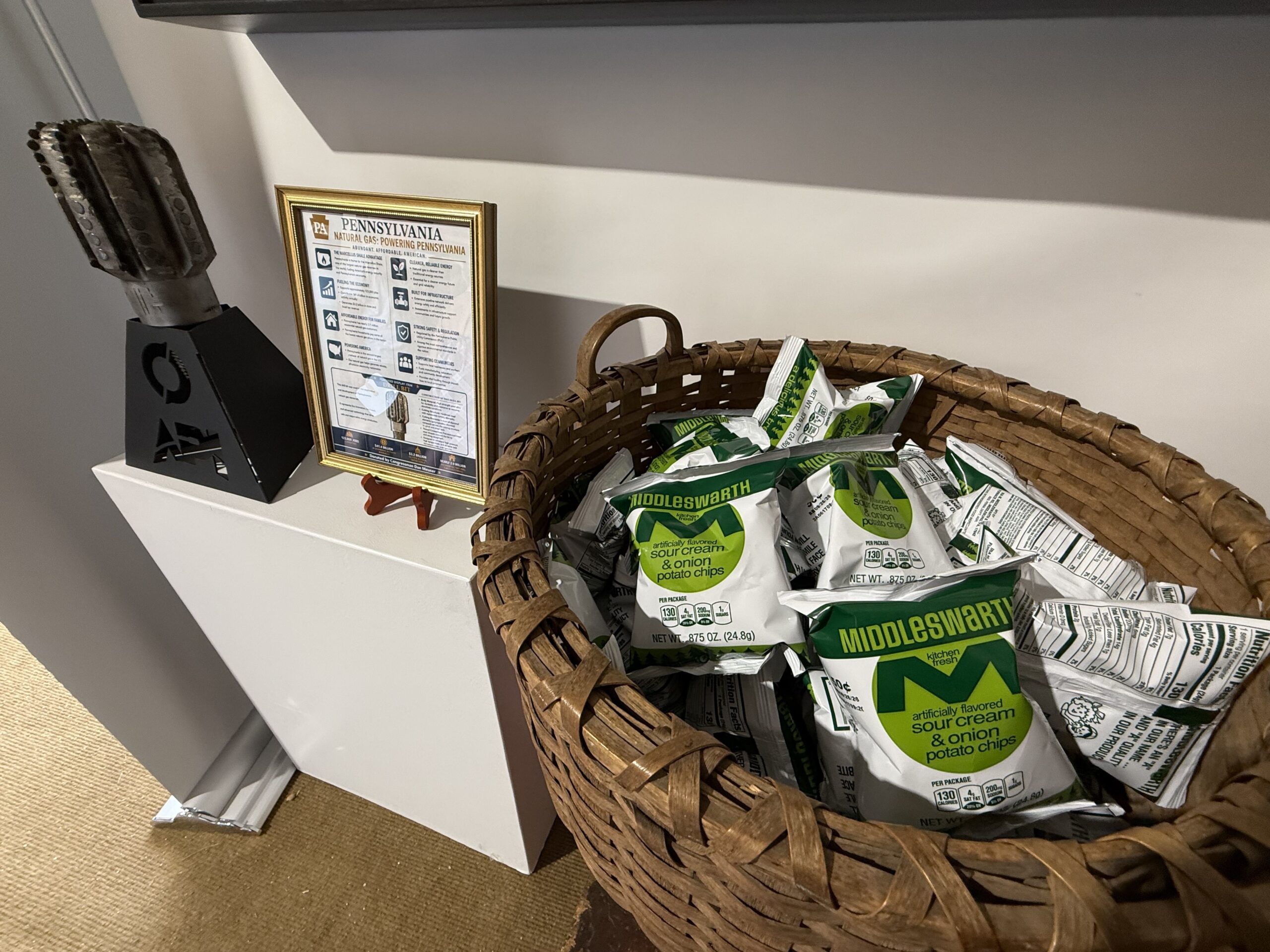
    Pennsylvania’s pavilion showcases a natural gas drill bit and Middleswarth chips at the Great American State Fair on June 30, 2026, in Washington, D.C.

    “I always look for an opportunity to highlight our industry,” Beth Ann Bossio, a Christmas tree farmer from Fayette County, said after driving three and a half hours to drop off a tree to display in the center of the space.

    Pennsylvania is one of the largest producers of Christmas trees, and Bossio said it was important to her that both the state and its farmers were represented at the fair.
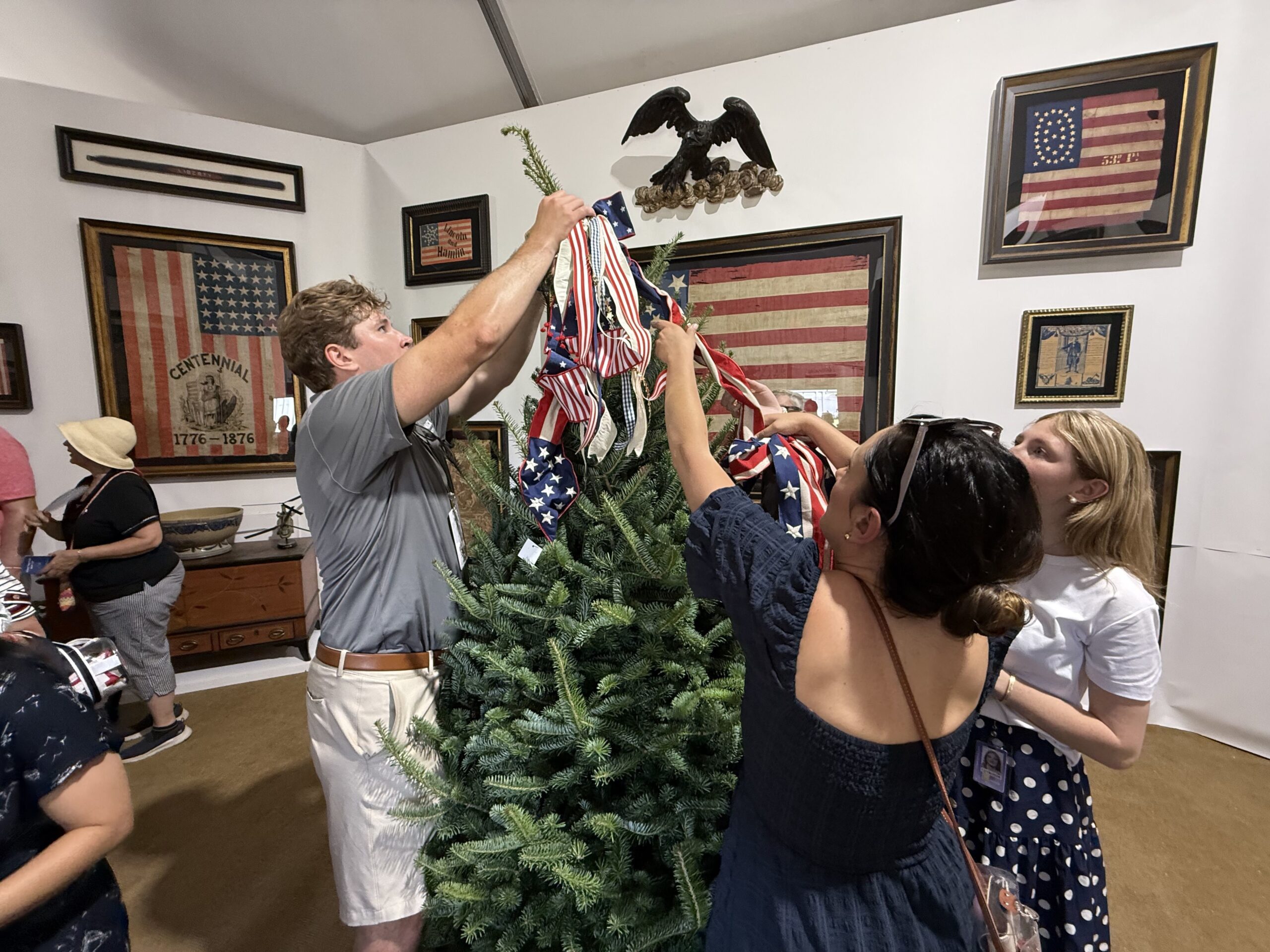
    Beth Ann Bossio (front center), a Christmas tree farmer from Fayette County, helps staff from U.S. Sen. Dave McCormick’s office set up a tree she brought for Pennsylvania’s pavilion at the Great American State Fair on June 30, 2026, in Washington, D.C.

    “That was my vision to come here, to make sure that Pa. is being reflected of what we are, and what we represent,” she said before tying an American flag-themed bow on the tree. “Farmers are very proud of that. We’re patriotic. We take pride in our land and how we steward it.”

    The packed room on the National Mall came together in a rush in recent days, after Shapiro joined Democratic governors from other states in declining to use state resources to create and staff a pavilion, which his office said would have run a tab of “hundreds of thousands of taxpayer dollars.”

    He also said his administration’s search for another Pennsylvania host came up short. No companies or other kinds of groups were interested, he said, even as businesses and local governments stepped up to fill the spaces in other states.

    While Shapiro last week blamed the lack of interest on the president’s polarizing impact on the 250th celebrations, he said in an interview Tuesday with The Inquirer that it “was never a political exercise. This was an exercise in practicality.”

    Shapiro said Pennsylvania’s pavilion would have cost the state $700,000, all of which was money he saw better spent on the major events happening in Pennsylvania this year, including the NFL Draft, PGA Championship, MLB All-Star Game, the ongoing World Cup games, and a number of events across the state for the nation’s 250th birthday.

    “My focus is on spending the taxpayer dollars here,” he said.

    His administration spent two or three weeks reaching out to businesses and to the Pennsylvania Chamber asking them if they wanted to participate. None of them did, Shapiro said.

    “They obviously had a change of heart at the last minute. That’s fine,” Shapiro said about the revived Pennsylvania pavilion.

    Organizing the booth in Shapiro’s place were the state’s two senators, a bipartisan duo who have often worked together.

    McCormick and Fetterman withheld any direct criticisms of Shapiro while talking about their effort, though Fetterman has clashed with the governor in the past and has also repeatedly broken Democratic ranks to support Republican-led efforts.

    McCormick said he understood Shapiro’s desire not to spend taxpayer money, but when he found out there would be nothing to represent the state that is “the center of America’s history,” he sprang into action.

    The freshman Republican said he and Fetterman spoke Saturday morning and quickly made calls to the Pennsylvania Chamber of Business and Industry, the Pennsylvania Farm Bureau, and individual businesses to donate time and resources.

    “It’s just inconceivable that we wouldn’t have a booth that would represent all that Pennsylvania had to offer,” said McCormick, whose staff greeted guests at the pavilion all day Tuesday.

    Fetterman, who has said Pennsylvania’s role as a purple state means he should consistently work across the aisle, said he was proud to work with McCormick on the effort.

    “America’s turning 250 years old,” Fetterman said alongside McCormick during an appearance in Philadelphia on Monday. “Can’t we all just celebrate that and not just find new ways to fight about the politics and the dynamic right now?”

    McCormick’s office listed 23 companies or groups that signed up to help, though only a few corporate sponsors were front and center in the space.

    Two large signs showcase the Marcellus Shale Coalition, a natural gas advocacy group that has a significant lobbying presence in Harrisburg. And U.S. Steel, the Pittsburgh-based company that benefited from a Trump-approved takeover by a Japanese-owned company last year, offered the penny press and colorful wristbands reading “forging the future.” Hats and signage commemorating Yuengling and Mack Trucks were lent from the Pennsylvania Manufacturers’ Association.
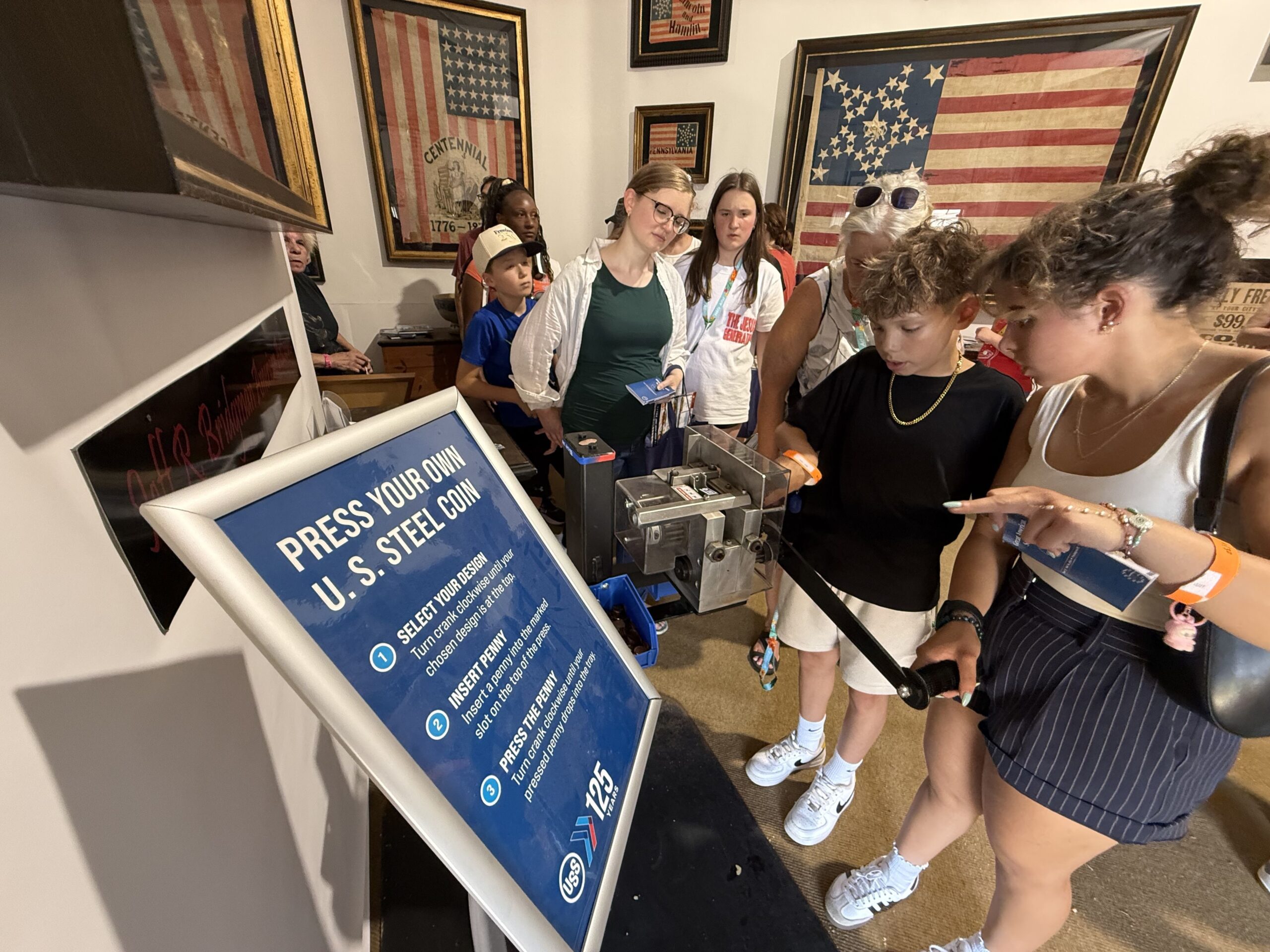

    Tourists use a U.S. Steel penny-press machine on display at Pennsylvania’s pavilion at the Great American State Fair on June 30, 2026, in Washington, D.C.
    Pennsylvania’s pavilion showcases state history and memorabilia at the Great American State Fair on June 30, 2026, in Washington, D.C.

    Some organizations have acknowledged earlier conversations with Shapiro’s office to participate that didn’t go anywhere.

    A report from The New Republic that Pennsylvania would not be participating in the affair “caught us off guard because that was not our experience at all, nor was it what we had communicated to the [the governor’s] office,” said Jon Anzur, the senior vice president of public affairs for the Pennsylvania Chamber of Business and Industry. “It’s unfortunate that it occurred that way.”

    He said the governor’s office approached the chamber less than two weeks out from the start of the fair to help get companies involved.

    “It just seems odd that we were approached at the eleventh hour and now it sounds like the governor’s office is trying to point fingers when there was ample time to get ducks in a row,” he said.

    The Hershey Co. is among the Pennsylvania-based companies that declined to participate.

    “We were asked by Gov. Shapiro’s office in mid June and then again over the weekend by Sen. McCormick’s office,” said Todd Scott, a spokesperson for the chocolate business.

    Both were told that the size of the ask and the limited amount of time to make it happen was not possible.

    “We were asked so late in the game that logistically we couldn’t make that happen. We just cannot provide on a moment’s notice that amount of product that they would have been asking for,” he said.

    But the summer weather was also a factor.

    “There’s no refrigeration on the mall, and with extreme heat, chocolate doesn’t do well in 100-degree temperatures,” he said. “We always want to make sure that people have the best experience with our products that they can.”

    But another candy company, Asher’s Chocolate Co. in Souderton, decided to join.

    “Asher’s was asked to participate by the Chamber of Commerce [Monday] and agreed to donate prepackaged bite-size pieces of fudge, which were on hand,” said David Neff, who represents Asher’s. “Asher’s is deeply committed to America and celebrating America’s 250.”

    Bob Asher, a longtime influential GOP leader in Southeastern Pennsylvania from Montgomery County, was previously involved with the company but he has no remaining financial interests, Neff said. Asher donated thousands of dollars to Treasurer Stacy Garrity, Shapiro’s Republican opponent for governor, and is her honorary campaign chair.

    Other Philadelphia-area companies are also financially supporting Trump’s effort.

    SAP, the German business-software giant whose U.S. headquarters and 2,000 staff are in Newtown Square, Delaware County, donated $5.6 million to Trump’s Freedom 250 initiative.

    “SAP is committed to the communities where our customers, employees, and partners live and work. SAP’s support of America’s 250th anniversary celebrations reflects our long‑standing commitment to supporting innovation, economic strength, and workforce development,“ SAP spokesperson Bridget Carroll said in a statement.

    SAP software is used by the U.S. military and its NATO allies to track troop deployments, military supply chains, and equipment maintenance.

    The military aircraft producer Lockheed Martin, which has engineering centers in King of Prussia and in Moorestown, N.J., is the top donor to Trump’s initiative, giving nearly $20 million.

    This story has been updated to clarify Bob Asher’s role in Asher’s Chocolate Co.

    Staff writer Joseph N. DiStefano contributed to this article.

    This story was updated to clarify that Bob Asher is no longer involved in Asher’s Chocolate Co.
  • Supreme Court upholds state laws banning transgender girls and women from school athletic teams

    Supreme Court upholds state laws banning transgender girls and women from school athletic teams

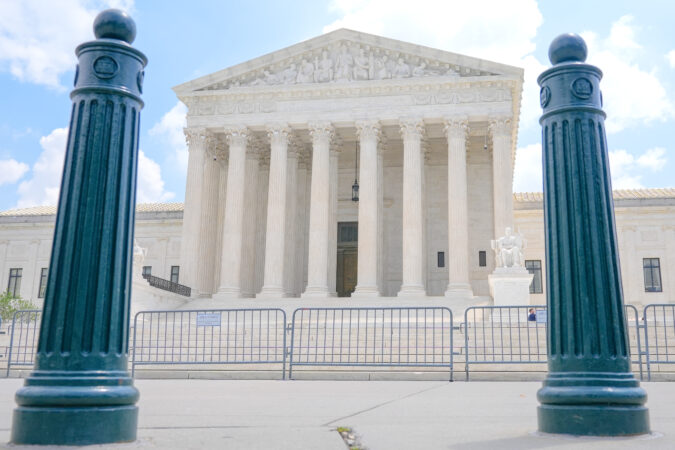
    The Supreme Court on Tuesday upheld bans in Idaho and West Virginia on transgender athletes playing on girls’ and women’s sports teams, the latest in a string of legal setbacks for the LGBTQ+ community before the high court.

    In a decision led by the court’s six conservatives — but joined in parts by its three liberals — the justices found that states can separate teams based on “biological sex” without offending the Constitution’s guarantee of equal protection and Title IX, a landmark 1972 antidiscrimination law involving education.

    “Separate sports teams for biological males and biological females are reasonable: Given the inherent physical differences between the sexes, allowing only biological females to play on women’s and girls’ teams can reduce the risk of physical injury and ensure fair competition,” Justice Brett M. Kavanaugh, who coached his daughter’s youth basketball team, wrote for the majority.

    The court’s three liberals, led by Justice Sonia Sotomayor, agreed that West Virginia’s ban did not violate Title IX. But they disagreed with the majority on several fronts, especially the conclusion that the West Virginia law withstands scrutiny under the Constitution’s guarantee of equal protection for all.

    Sotomayor wrote that a lower court should have the chance to sort out a question central to the case of the teenage plaintiff from West Virginia, Becky Pepper-Jackson: whether trans girls who have not undergone male puberty have physical advantages in sports.

    “Because of the Court’s decision today, West Virginia, and any other state actor, can deny B.P.J. and others like her these experiences simply because it thinks they have an inherent athletic advantage, even if the facts show that they do not,” Sotomayor wrote.

    The court did not address what is arguably the flip side of its ruling — whether schools and states can adopt policies allowing transgender athletes to compete on girls’ and women’s teams, as some liberal states and communities do.

    “That question is currently the subject of litigation in some lower courts,” Kavanaugh wrote in a footnote. “Nothing in this opinion is intended to decide that question.”

    The ruling is among several in recent terms that are consequential for the LGBTQ+ movement. The Supreme Court in March ruled a Colorado law banning “conversion therapy” for gay and transgender youths probably violated the free-speech rights of a religious counselor who wants to counsel such young people according to biblical teachings.

    Earlier that month, the court sided with Christian parents in blocking, for now, California policies that discourage schools from informing parents of a student’s sexual orientation or gender identity without the student’s consent. Last year, the court upheld bans on gender transition treatment for minors.

    Questions over whether transgender girls and women should play on girls’ and women’s sports teams has been a particular flash point in a broader conversation about transgender rights. Dozens of states have bans amid intense public debate about fairness at all levels of competition.

    The debate over the allowance of transgender women in collegiate athletics gained national attention in 2022 after Penn swimmer Lia Thomas won the national title in the women’s 500-yard freestyle. Thomas, who is a transgender woman, competed for the Quakers men’s team during the 2018-19 season before medically transitioning.

    In July 2025, Penn struck a deal with the Trump administration regarding Thomas’ participation. According to the deal, Penn agreed to ban transgender athletes, vacate Thomas’ records, release a statement in support of Title IX “as interpreted by the Department of Education,” and send personalized letters of apology to Thomas’ former women’s teammates. The deal came after the White House had paused $175 million in federal funding to Penn because of Thomas’ participation on the Quakers’ women’s team in 2021-22. The federal funding was restored following the agreement.

    The issue came to the high court in a pair of cases, brought separately by Pepper-Jackson, a teen from West Virginia, and Lindsay Hecox, a Boise State University student in Idaho. Both argued that the bans in their states discriminated on basis of sex and violated the Constitution’s equal protection clause. In January, the justices appeared sympathetic to arguments for keeping the bans in place as the cases were argued back-to-back.

    LGBTQ+ activists said the decision would be devastating for some young people.

    “This is a heartbreaking ruling for our clients and transgender girls like them who’ve asked for nothing more than the same opportunities afforded to their peers,” said Joshua Block, senior counsel for the American Civil Liberties Union’s LGBTQ & HIV Rights Project, who argued the case for Pepper-Jackson.

    Sasha Buchert, director of nonbinary and transgender rights at Lambda Legal, said the decision was upsetting but also narrow.

    The ruling is “a serious loss — we’re not minimizing that,” she said. But noting that the court did not impose a national ban on transgender athletes in female sports, Buchert added, “This ruling says, sure, a state may discriminate, not that they must discriminate.”

    Twenty-seven states have passed laws banning transgender student-athletes from competing on women’s or girls’ sports teams. Supporters of the bans say they are necessary to ensure fairness and safety because of inherent physical differences between males and females. Opponents say the laws discriminate against trans people and should be struck down.

    President Donald Trump early last year signed an executive order aimed at keeping transgender women out of women’s sports. The administration has argued that there are only two sexes — male and female — and that they “are not changeable.”

    Soon after the executive order on sports, the NCAA and the U.S. Olympic and Paralympic Committee updated their policies to bar trans women from playing on women’s sports teams. Since then, the administration has aggressively investigated schools that allow trans girls to participate in girls’ and women’s sports.

    Education Secretary Linda McMahon welcomed the court’s decision Tuesday.

    “For years, ideologues distorted Title IX to advance a radical transgender agenda, subjecting women to immeasurable harm,” she said in a statement.

    Nicole Neily, founder and president of Defending Education, a conservative advocacy group, called the decision an “exercise in judicial humility” and noted that it may be disappointing to conservatives in liberal states that allow transgender athletes to participate.

    “Although it’s certainly not as sweeping as parent activists would have liked, it means that the action shifts to the states and is now a persuasion game,” she said in a statement.

    Views among Americans on transgender issues are nuanced. A Pew Research Center survey published in February 2025 showed 56% of adults support policies aimed at protecting transgender people from discrimination in jobs, housing, and public spaces.

    But over the past few years, Americans also have become more supportive of restrictions for transgender people, according to the Pew survey. Fifty-six percent of Americans supported bans on providing gender transition care for minors, up 10 percentage points from 2022, the study found.

    But athletics have always stood out.

    The Pew survey found that 66% favored laws that require trans athletes to compete on teams that match their sex assigned at birth, up eight points from 2022. Even before the general shift in public opinion, a majority of Americans opposed allowing trans women to compete against other women at all levels of sports, according to a Washington Post-University of Maryland poll.

    The science concerning biological advantages of transgender girls and women in sports is evolving and remains hotly debated. The case featured competing evidence about whether transgender girls are inherently better at sports. The transgender plaintiffs presented evidence that transitioning before puberty prevents them from building enough body mass to have an advantage in high school and college sports.

    Lawyers for the states countered with studies that showed that nontransgender boys and men perform better at all ages. The study found that boys between the ages of 7 and 12 ran about 4% faster and jumped about 7% farther than girls in the same age group.

    “The legislatures and the schools are better equipped — and under the Constitution, are the more appropriate entities — to assess the competing medical and scientific considerations and draw appropriate lines,” Kavanaugh wrote in the majority opinion. “Of course, no line that the States draw will satisfy everyone.”

    While there’s no comprehensive tally of trans athletes nationally, an estimated 300,100 transgender youths between the ages of 13 and 17 live in the United States, according to the Williams Institute at the UCLA School of Law. The Human Rights Campaign, an LGBTQ+ advocacy group, has estimated that 14% of trans boys and 12% of trans girls play on a sports team.

    Inquirer Staff Writer Conor Smith contributed to this article.

  • Congress considers sidestepping filibuster to pass Trump’s voting restrictions

    Congress considers sidestepping filibuster to pass Trump’s voting restrictions

    House Republicans are considering using a fast-track process to bypass the filibuster and pass President Donald Trump’s sought-after voting restrictions.

    House Speaker Mike Johnson (R-Louisiana) said Monday that Republicans are moving forward with a plan to establish a grant program that would incentivize states to adopt stricter election rules outlined in the Safeguard American Voter Eligibility (Save America) Act, which includes a new requirement to provide documented proof of citizenship and a photo ID at the time of voting.

    The move would use the so-called reconciliation process, designed to overcome the filibuster, because it can be passed with a simple majority in both chambers, bypassing Democrats.

    “If you put it into a grant program or something similar, then it does make it part of reconciling the budget,” Johnson told reporters Monday, after meeting with Trump at the White House. “It does ultimately work that way.”

    “The only way to get that to the president’s desk, we’ve been shown many times, is to put it on reconciliation,” Johnson said.

    Doing so, Johnson argued, would allow the Save America Act to comply with Senate rules.

    However it’s not clear whether Trump would be on board with voting restrictions administered through a grant program. And many Senate Republicans have expressed doubt about passing more legislation through the fast-track process this year.

    Trump has been trying to pressure Republicans to pass the act, including refusing to sign a bipartisan bill aimed at helping Americans with housing, which was sent to his desk Monday.

    Speaking at the White House on Monday, Trump said it is “even more important” that Congress passes the Save America Act and said he doesn’t understand why Senate Majority Leader John Thune (R-South Dakota) won’t fire the parliamentarian, a nonelected, independent arbiter who advises the Senate on how to navigate laws and rules.

    “[He] has the right to immediately fire her and put somebody else there and it’s not even believable that she’s still there,” Trump complained.

    Senate Republican leaders have repeatedly told Trump that the votes are not there to pass his election bill, which would require proof of citizenship to vote in federal elections and restrict mail-in voting, among other provisions. The House passed a version of the bill earlier this year that did not include all the provisions Trump has demanded.

    Under this new plan, House Republicans said they believe that establishing a grant program that incentivizes states to implement the new election restrictions — rather than establishing them outright — should comply with Senate rules and allow them to pass the legislation with Republican votes only.

    However, Senate rules would likely prevent much of the Save America Act as written from being included as provisions passed through the process must be budgetary.

    At least four Republicans in the Senate have expressed opposition to the Save America Act and previously voted against adding the language to another must-pass measure. It is unclear whether these senators would support the new grant provision.

    Johnson said House Republicans will first attempt to pass a procedural rule that would merge the Save America Act and the National Defense Authorization Act, which is an annual defense policy bill, upon passage of the latter and send both bills together to Senate.

    Rep. Anna Paulina Luna (R-Florida) and a group of GOP hard-liners have been holding up most action on the House floor since last week as a protest against Senate inaction on the Save America Act. They have refused to vote for rules, which are necessary to bring most legislation to the floor.

    On Monday evening, Luna said she opposes the merger maneuver, and she also expressed skepticism over the grant program. The Florida Republican said Johnson had not spoken to her about either option.

  • ‘No one’s coming to save us but us’: Generation Z runs for office

    ‘No one’s coming to save us but us’: Generation Z runs for office

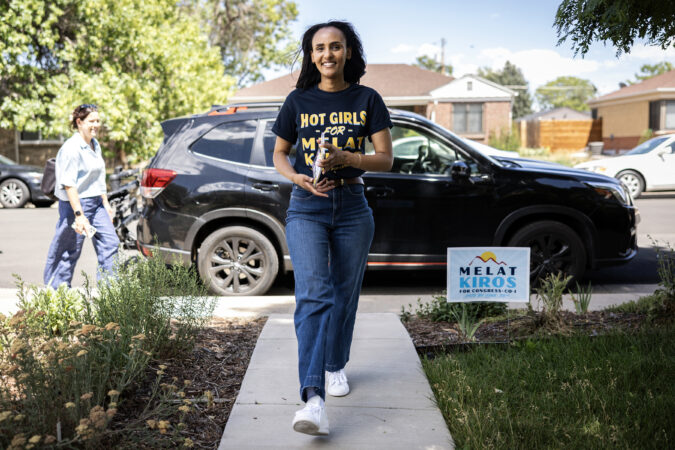
    Melat Kiros was fresh out of Notre Dame Law School in 2023 when she was fired by her New York law firm after publishing a lengthy letter sharply criticizing Israel’s government, raising questions about its historical legitimacy and challenging the firm’s response to law students engaging in pro-Palestinian activism.

    In Tuesday’s Democratic primary in Colorado, under the banner of the Democratic Socialists of America, Kiros, 29, is again challenging the establishment. This time, she hopes to defeat Rep. Diana DeGette, 68, a liberal Democrat who was elected to her Denver-area seat a year before Kiros was born.

    The showdown is the latest between the mainstream Democratic Party and its ascendant, youthful left wing, but Kiros represents more than the DSA. She is one of several Generation Z candidates this year fueled by the generational frustrations of their pandemic-marred youth, social media-fueled isolation, artificial intelligence and the war in the Gaza Strip.

    The upset pulled off by Darializa Avila Chevalier, 32, a socialist doctoral student, over Rep. Adriano Espaillat, 71, in last week’s New York Democratic primary may have only set the stage for the generational and ideological fights to come — on both sides of the political aisle.

    Melat Kiros, right, who is running for Congress and hopes to defeat Rep. Diana DeGette (D-Colo.), who was elected to her Denver-area seat a year before Kiros was born, records a video with Eric Cheng of the podcast “Wait, Say More” while campaigning in Denver, June 27, 2026. Kiros is one of several Gen Z candidates this year fueled by the generational frustrations of their pandemic-marred youth, social media-fueled isolation, artificial intelligence and the war in Gaza. (Chet Strange/The New York Times)

    “When you’re living through these kinds of moments on such a regular basis, it feels impossible to be able to change course and believe your vote actually makes a difference,” Kiros said.

    But, she added, “we’re seeing just how broken the system is, and we’re seeing that no one’s coming to save us but us.”

    DeGette sees lawmakers of all ages working together as important, citing her work with younger members of Congress like Alexandria Ocasio-Cortez, 36, and Jake Auchincloss, 38, on “Medicare for All” legislation. But DeGette still believes experience and community involvement are tantamount to age.

    “What voters look at in these races is they look at who they think is going to most effectively represent them and who can have the power and leadership to fight against Donald Trump,” she said.

    For Generation Z voters, youth and recent history have shaped their views. They did not experience the exhilaration of Barack Obama’s hope-fueled 2008 campaign or George W. Bush’s calls to service after the attacks of Sept. 11, 2001. Instead, they have weathered a decade of Trump’s “American carnage” narrative and the gerontocracy of Joe Biden. Their beefs tend to be less with the other party than their elders.

    Generation Z voters express higher levels of party alienation than any other generation; two-thirds of Generation Z respondents in a recent New York Times/Siena poll expressed dissatisfaction with both Democrats and Republicans. Among Generation Z Democrats, 68% said they were unhappy with their own party.

    But the rise of Generation Z and young millennial candidates demanding change is not limited to Democrats.

    Joe Mitchell, the founder of Run GenZ, an organization aiming to elect young conservatives, is vying to fill the seat of Rep. Ashley Hinson of Iowa, a Republican running for Senate. Mitchell, 29, who runs a real estate development company, represents a brand of young male Republicans inspired by Charlie Kirk, the slain conservative activist, and driven by their Christian faith and by values aligned with Trump’s political movement.

    “Everything I do is going to be America first,” said Mitchell, a former state representative. “Everything we do should be focused on, ‘how can we help the American worker?’”

    Brendan Trachsel remembered celebrating his 16th birthday as he watched election results come in for Trump’s first presidential win in 2016. Although he grew up in a conservative household in the San Diego suburbs, he said he was in “utter shock that someone who is completely OK with treating people so horribly would get into office.”

    After starting at Northern Arizona University in 2019, he registered with the Green Party. Now 25, Trachsel is running for the Arizona House of Representatives in a Democratic-held district near Flagstaff, focusing on labor organizing, data center moratoriums and tighter protections for online privacy.

    James Thibault, a state representative in New Hampshire, in Northfield, N.H., June 27, 2026. For Gen Z voters, youth and recent history have shaped their views. (Veasey Conway/The New York Times)

    If he wins, Trachsel would be the first third-party official in the Arizona Legislature. He cited Zohran Mamdani’s mayoral campaign in New York as an inspiration.

    “It was just so people-focused, so intent on just shutting up and hearing what people needed and want,” Trachsel said.

    Startled by Trump’s return in 2024, Leila Staton, 22, and her mother formed the Insufferable Wenches of Iowa, a progressive group designed in part to link like-minded but socially isolated rural residents. No Democrat had filed to run this year against the two-term Republican state legislator representing her district, so Staton, who lives in Stout, population around 200, decided to run herself.

    College graduates from rural Iowa tend to leave the state. Staton pointed to a state Legislature, where in 2023 the average age was 54, as unrepresentative of her generation.

    Staton has focused her campaign on public education, which has been drained of cash by a new school voucher program; family farms struggling with rising costs and corporate pressure; drinking water that is contaminated with nitrates; and Iowa’s rapidly rising cancer rates.

    “There’s a lack of opportunity, prices are rising, wages are stagnant,” she said, “and our cancer crisis has no clear solution.”

    Generation Z politicians are also the first largely born after the Columbine massacre in 1999 and raised amid the drumbeat of school shootings that followed.

    Tyler Smith, 26, was in a Los Angeles high school when, in 2018, a gunman killed 17 people at Marjory Stoneman Douglas High School in Parkland, Florida. He joined school walkouts and watched as a young breed of activists emerged from Parkland.

    While working for a gun control group, Smith decided to run as a Democrat for a Texas House seat this year in the Houston area held by a staunch conservative, insisting, “People right now are sick and tired of the same old, same old.”

    Braxton Mitchell, a 26-year-old Montana state representative, also became involved in political activism in 2018. But for him, the gun control walkouts that followed Parkland did not represent his “way of life,” so he spearheaded a counter walkout, against gun control, at his high school in Columbia Falls, Montana. After graduation, he got on a plane for the first time and flew to Washington to meet Kirk, who had been sending him messages of support.

    A year and a half later, the state Republican Party chair, Don Kaltschmidt, encouraged Mitchell to run for his local legislative seat, then held by a Democrat. He won and is now running for reelection.

    “We need all generations at the table, especially in places like the state legislature, because the decisions being made are going to impact my generation the most,” Mitchell said.

    He’s working on a school safety bill to put panic alert systems in rural schools across the state — without gun control.

    COVID-19 is another shared experience. James Thibault, the son of a landscaper and a nursing assistant in New Hampshire, had no political aspirations until the pandemic shut down schools. Then politicians reopened them with mask mandates that Thibault, a high school freshman at the time, found onerous and not conducive to learning.

    He protested at school board meetings. He was appointed to a youth legislative council. Then he filed to run for state representative before he graduated from high school. He was elected at 18 as a Republican, becoming the youngest state legislator.

    “COVID was a wake-up call,” said Thibault, 20, who is running for reelection this year.

    In Denver, Kiros also cited the pandemic as consequential to her own politics. “Stagnant” cultural norms that demanded working in offices suddenly gave way to acceptance of remote work, she said. The burning of fossil fuels plunged. Then those social benefits went in reverse.

    Her frustrations with current representatives have only grown deeper.

    “I don’t know if it’s ego,” Kiros said. “I don’t know if it’s recklessness. There really is just no sense of preparing or leaving the world better than where they found it.”

    This article originally appeared in The New York Times.

  • Florida shows how not to teach U.S. history on the republic’s 250th anniversary

    Florida shows how not to teach U.S. history on the republic’s 250th anniversary

    The state of Florida recently released a new American history high school course with a conservative tilt. Troublingly, it glosses over the relationship between the founders and slavery—a topic that should in 2026 promote a rich understanding of the U.S. past, but one that has also been a subject of controversy, including in Philadelphia at the site of the President’s House. In fact, slavery was central to the economic growth and expansion of the young republic, so much so that it would take a long and brutal war to get rid of it. As Abraham Lincoln, dealing with slavery during the Civil War, put it: “Fellow-citizens, we cannot escape history.”

    On the 250th anniversary of the founding of the American republic, it bears repeating that the history of the United States is neither the linear, uninterrupted history of American exceptionalism that the Florida framework promotes nor is it solely an unremitting story of racism and reaction. Students benefit from learning about the brutality of slavery as well as the bravery of those ordinary Americans, men and women, Black and white, who resisted it. Emphasizing just one part of this equation is incomplete and bad history.

    The Florida course framework portrays the founding generation of American revolutionists as unanimously antislavery. The truth is more complex. While most of the northern founders like Benjamin Franklin, Alexander Hamilton, and John Jay lent the prestige of their names to abolition societies, most southern founders did not. Their actions reflected the reality on the ground. Between 1779-1804, northern states gradually abolished slavery. But southern slavery not only persisted but expanded considerably in the early American republic. If the founders were unanimous, what explains this divergence?

    While Jefferson and Madison professed to abhor slavery in their writings, like most southern enslavers they did not free their slaves. Jefferson made an exception for his own progeny, freeing select enslaved people. During his presidency, George Washington famously pursued his slave Ona Judge, who had escaped enslavement, with a relentless energy. However, New Hampshire authorities refused to render her back to the President—a signal of diverging attitudes and policies about slavery in the early republic.

    Washington did become the only prominent member of the so-called Virginia dynasty of Presidents to free his slaves on his death. It was a belated gesture. As the Black abolitionist Reverend Richard Allen noted in his eulogy of Washington in 1799, “he dared to do his duty, and wipe off the only stain with which man could ever reproach him.” While Washington was lauded as the Father of the Nation, few southern slaveholders followed his example, as Allen had hoped.

    The Florida history standards also present the U.S. Constitution, which was signed in 1787, ratified in 1788, and went into effect with the launch of the federal government in 1789, as an antislavery document rather than one that contained expedient compromises on the issue of slavery. One particularly egregious example of this relates to the three-fifths clause, which counted the enslaved population at a three-fifths proportion for representation and taxes. The Florida guidelines consider this an antislavery clause because the enslaved population was not counted fully. But this compromise led to southern domination over the federal government until Lincoln’s election as it gave the slave states disproportionate representation in Congress.

    The framers of the Constitution were careful not to use the words slavery and slaves in the fundamental legal document of the republic. Instead, they employed euphemisms such as “persons held to service” or “all other persons.” But that did not prevent contemporary abolitionists from bemoaning its fugitive slave clause, a part of the Constitution that gave southern laws of slavery extraterritoriality in the free states—an endless source of political friction between the states—and the continuation of the African slave trade, an execrable commerce whose tortures were well known then, until 1808.

    While Florida students under the new guidelines would learn about a debate among abolitionists like William Lloyd Garrison and Frederick Douglass on whether the Constitution was a proslavery or antislavery document, they would miss other important context. For example, the guidelines elide the equally important debate among abolitionists on the extent of the complicity of American churches in upholding slavery. Instead, abolition is framed as a Christian movement—with no mention of the schism over the issue of slavery leading to religious divisions that still exist today, including northern and southern Methodist and Baptist denominations.

    The framework also includes words of praise for proslavery theorist John C. Calhoun, a planter politician from South Carolina, as a constitutional thinker. Confederate generals like Robert E. Lee and Thomas “Stonewall” Jackson are portrayed as “honorable,” pious, and militarily skilled with little mention of their cause of human bondage, which Ulysses Grant called “one of the worst for which a people ever fought.” Mississippi’s “Declaration of the Immediate Causes which induce and justify Secession” clearly stated: “Our position is thoroughly identified with the institution of slavery — the greatest material interest of the world.”

    Indeed, Lee’s army enslaved free Black people in Pennsylvania while retreating from Gettysburg in 1863—not a very honorable thing to do and explicitly condemned in the Bible as man stealing. But this context is missing in the new Florida guidance.

    The histories of Reconstruction and the Progressive era are not particularly well understood by the public. The Florida guidelines portray Lincoln as being at odds with Radical Republicans who implemented Reconstruction. He wasn’t. It also casts Andrew Johnson as continuing his “lenient” policy to the south, a canard that Johnson assiduously promoted to oppose Reconstruction. In fact, before his death, Lincoln became the first U.S. President to endorse Black citizenship and male suffrage, the cornerstone of Reconstruction. Radicals such as Thaddeus Stevens and Charles Sumner as well as moderate Republicans like Lincoln championed the constitutional amendments and federal laws that comprised Reconstruction.

    Echoing a viewpoint espoused by white Southern elites at the time, Reconstruction gets short shrift and is deemed a failure in Florida’s new standards. Actually, the Reconstruction amendments and the first federal civil rights laws were tremendous achievements. We know the first 10 amendments to the Constitution as the “Bill of Rights” today because the author of the consequential Fourteenth Amendment that established national citizenship by birthright or naturalization, John Bingham, gave them that moniker and it eventually stuck. And Reconstruction didn’t fail; a systematic campaign of domestic racist terror in the south and reactionary judicial decisions by the United States Supreme Court overthrew it.

    The Jim Crow era that followed became a cautionary tale of how quickly and completely a country can lose its democracy and rights gained. But the Florida guidelines casts more than half a century of Jim Crow as a blip or aberration from a national history otherwise committed to democratic ideals.

    Students will be better prepared to be citizens of the republic when presented with differentiated historical narratives rather than having sanitized versions of the past served up to them. The Florida standards not only whitewash the past, they evoke an unchanging founding moment and pristine originalism—as though Americans in the founding era did not argue, debate, or change their thinking about slavery over time.

    Made By History sponsors. FOR USE ON MADE BY HISTORY STORIES ONLY.

    It also distorts how Americans continue to fight to expand—or curtail—access to rights and democracy more broadly. For instance, Progressive era reforms that included government regulation of the economy and working conditions are portrayed as “unbound by traditional constitutional restraints.”

    Most historians argue that our modern democracy was founded during Reconstruction, whose seeds later grew in the 20th century and were expanded by the Civil Rights revolution of the 1960s. But, as in previous eras, the fundamental questions remain contested and unsettled. That is both clear in the historical record and the foundational knowledge students must understand to continue to expand or improve our democracy today.

    Manisha Sinha is the Draper Chair in American History at the University of Connecticut and author most recently of The Rise and Fall of the Second American Republic: Reconstruction, 1860-1920.

    Made by History takes readers beyond the headlines with articles written and edited by professional historians. Opinions expressed do not necessarily reflect the views of The Inquirer.

  • Trump administration quietly removed mentions of slavery from Independence Hall, Thomas Jefferson portrait

    Trump administration quietly removed mentions of slavery from Independence Hall, Thomas Jefferson portrait

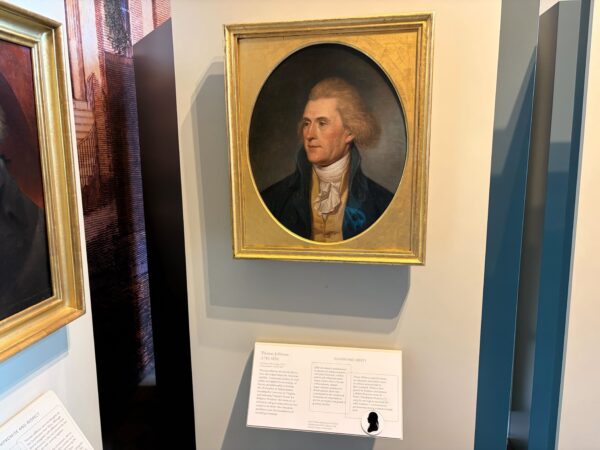
    President Donald Trump’s administration has wiped almost all mentions of slavery from a panel accompanying a portrait of Thomas Jefferson at the Second Bank of the United States.

    As the Founding Father who wrote the words “all men are created equal” while enslaving more than 600 people throughout his life, Jefferson embodies the paradox at the heart of the revolutionary era.

    The description under his iconic portrait attempted to grapple with that tension.

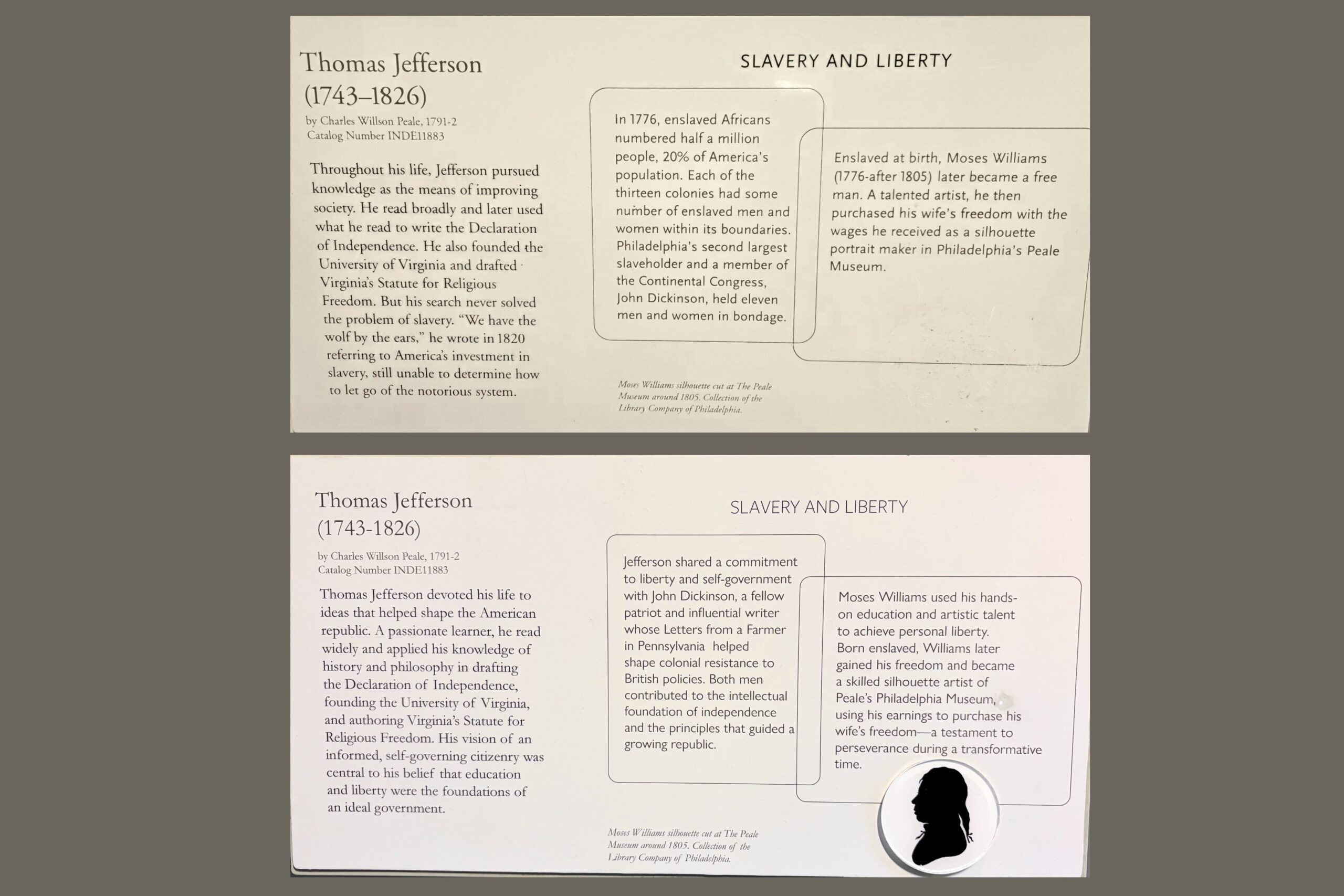
    Despite Jefferson’s lifelong pursuit of knowledge, he “never solved the problem of slavery“ and was ”unable to determine how to let go of the notorious system,” the original plaque read.

    But a new panel simply states that Jefferson’s “vision of an informed, self-governing citizenry was central to his belief that education and liberty were the foundations of an ideal government,” among other changes.

    It’s not the only change the administration has made to exhibits around Philadelphia’s Independence National Historical Park ahead of the 250th anniversary.

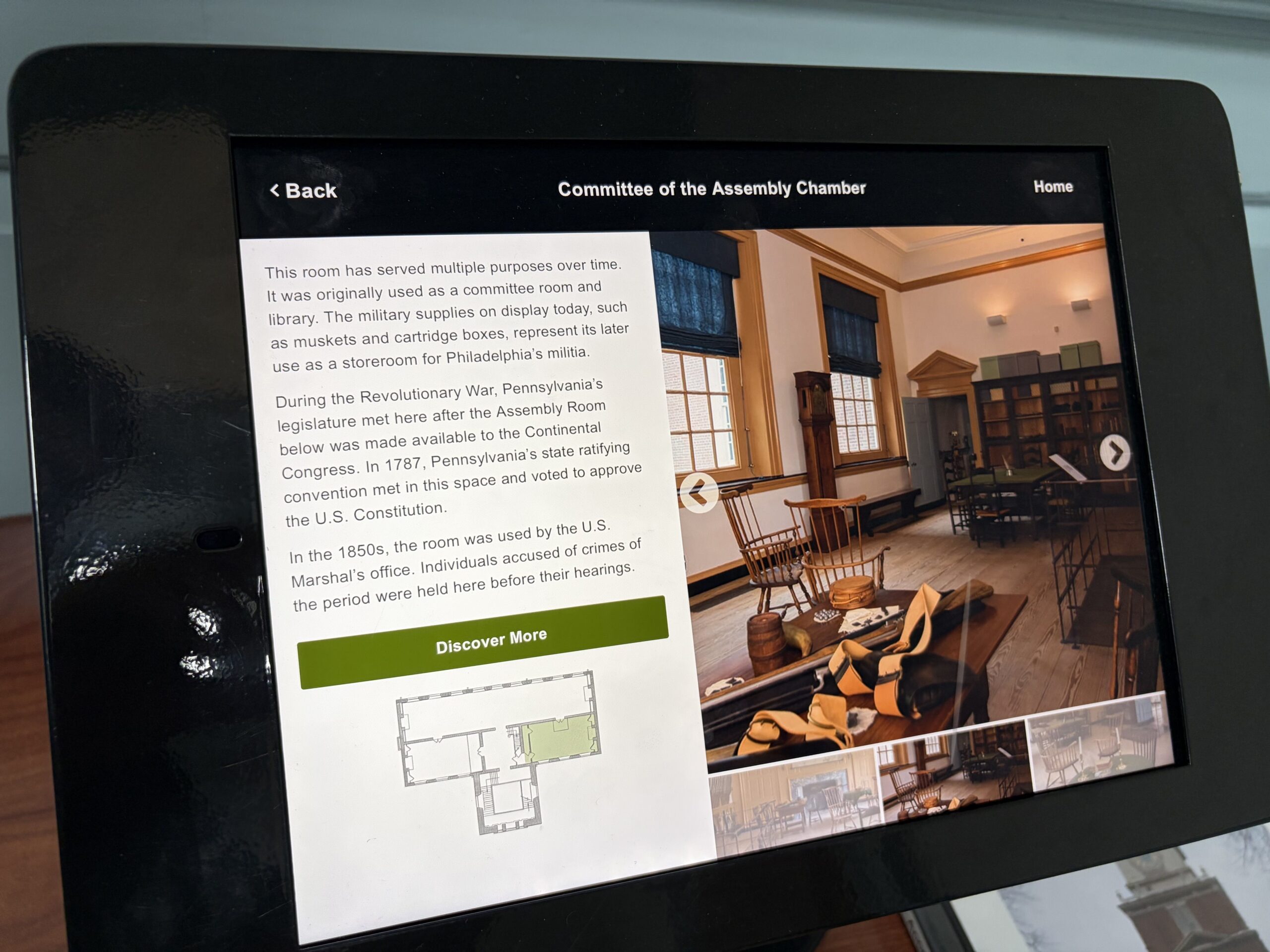
    A touchscreen with a virtual tour of Independence Hall’s second floor now tells visitors that one of the rooms was used to hold “individuals accused of crimes of the period” before their court hearings.

    Who were these individuals? A previous version stated clearly: “accused fugitives from slavery.”

    A side by side of the original and new descriptions Thomas Jefferson’s portrait at the Second Bank of the United States. The references to slavery have largely been removed by President Donald Trump’s administration.

    The Second Bank and Independence Hall sites — in addition to the President’s House, where slavery exhibits were dismantled by the federal government earlier this year — had been scrutinized by the administration since last summer.

    While the changes are more subtle than those that took place at the President’s House in January — and the new exhibits the government proposed a few months later — they further underscore the Trump administration’s goal to sanitize U.S. history, as signified by his executive order to review or remove content at national parks that “inappropriately disparage Americans past or living.”

    They also show a lack of transparency. The change to the description under Jefferson’s portrait was only acknowledged following a demand by a federal judge in Boston that the National Park Service share a list of all removals the administration undertook to comply with Trump’s “restoring truth and sanity” edict ahead of the country’s 250th celebration.

    In a statement Monday, Avenging the Ancestors Coalition — which has helped lead the efforts to protect the President’s House — said the additional changes were “extremely troubling.”

    “The preservation of history requires ongoing vigilance,” the organization said. “Restoring historical interpretation is only one part of the work; protecting it from future revision or erasure is equally important.”

    Cheryl LaRoche, a historical and archaeological consultant who helped excavate the President’s House during its development in the early 2000s, said the changes were like “somebody committing murder and wiping the murder weapon clean, so that there is no trace.”

    “One of the greatest disappointments of my life, is that we get to the 250th anniversary of this country, and we are still trying to evade the truth of our founding,” LaRoche said.

    Among the most blatant examples of the federal government’s desire to retell history has happened at the President’s House, which opened almost two decades ago to memorialize the nine people George Washington enslaved at his Philadelphia home. It also serves as a symbol of exploring the stark juxtaposition of slavery and liberty during the nation’s founding.

    But the moves at the Second Bank and Independence Hall signify that the administration is not letting any stone go unturned when it comes to ridding or softening even smaller mentions of slavery at Philadelphia’s most iconic historic sites.

    The Department of Interior did not answer repeated questions about the changes.

    “No changes have been made,” a spokesperson said via email, citing the President’s House litigation. When an Inquirer reporter pressed again about changes to Independence Hall and the Second Bank, the government spokesperson repeated that there were no changes to the President’s House during the litigation. The Department of Interior did not respond to further inquiries.

    At the Second Bank, the panel under Jefferson’s iconic portrait also informed visitors about the population of persons enslaved in 1776, that John Dickinson — a member of the Continental Congress — was an enslaver, and about the life of Moses Williams, an artist who was enslaved at birth and later became a free man.

    That’s drastically changed in the new panel.

    Jefferson’s grappling with slavery is no longer present and Dickinson is referred to as a “fellow patriot and influential writer. …” The only mention of slavery remaining is Williams’ story, though it’s reworded.

    And at Independence Hall, the touchscreen kiosk describing the second floor Committee of Assembly Chamber previously outlined the irony of the space being used for ratifying the U.S. constitution and later housing the office “where accused fugitives from slavery were held before their hearings, right above the room where the Declaration of Independence had been signed.”

    A touch screen at the entrance to Independence Hall with photos and descriptions of the building’s second floor. The description of the Committee of the Assembly Chamber has been edited to replace the words “accused fugitives from slavery” to “individuals accused of crimes of the period.”

    But the reference to slavery has been removed, among other rewordings.

    It remains unclear when these changes were made. The Inquirer reported last summer that these items — and an interactive exhibit at the Benjamin Franklin Museum about the Founding Father’s conflicting views on slavery, which is still intact — were flagged for review.

    Earlier this month, a federal judge in Boston ordered the Interior Department and National Park Service to restore before July 4 all the removed exhibits nationwide. The order also required the administration to submit to the court a list of all removed items.

    An appeal court has since paused the judge’s order, all but guaranteeing that visitors on July 4 won’t see the original exhibits.

    In addition to the President’s House exhibits, the list says the administration removed a “portrait description” and cites “disparages Americans past or living” as the reason it is gone.

    No entry in the list corresponds to the change made at Independence Hall, which Philadelphia owns.

    The city did not immediately respond to a request for comment.

    All material changes at Independence Hall should be done after consultation with the city, said Cynthia MacLeod, former superintendent of Independence National Historical Park.

    But the Court of Appeals for the Third Circuit ruled that the administration can make changes to the President’s House, which is owned by the National Park Service.

    “The National Park service has been known for excellent historians and interpreters and its a shame that they are being muzzled now,” MacLeod said. “It’s a shame and a disservice to all the visitors not to have a more complete history told.”

  • Supreme Court rules states can count late-arriving mailed ballots, rejecting Trump-led challenge

    Supreme Court rules states can count late-arriving mailed ballots, rejecting Trump-led challenge

    WASHINGTON — The Supreme Court on Monday ruled that states can count ballots that arrive after Election Day, a persistent target of President Donald Trump.

    The decision rejected a Republican-led attack on laws in more than half the states and the District of Columbia that permit mailed ballots to arrive and be counted some number of days after the election, provided they are postmarked by Election Day. The outcome spares officials the headache of changing their ballot rules just a few months before the 2026 midterm congressional elections.

    In just over half those states, the more forgiving deadlines apply only to ballots cast by military and overseas voters.

    The legal challenge was part of Trump’s broader attack on most mail balloting, which he has said breeds fraud despite strong evidence to the contrary and years of experience in numerous states. Trump has repeatedly claimed that his loss to Joe Biden in 2020 resulted from fraud even though more than 60 court decisions and his own attorney general said that argument had no merit.

    The court heard arguments in March in a case from Mississippi pitting the state against Trump’s Republican administration and the Republican and Libertarian parties. At issue was whether federal law sets a single Election Day that requires ballots to be both cast by voters and received by state officials.

    The federal appeals court in New Orleans struck down a Mississippi law allowing ballots to be counted if they arrive within five business days of the election and are postmarked by Election Day.

  • Partisanship, divisive Trump presidency hang over 250th celebrations in Philadelphia and Washington

    Partisanship, divisive Trump presidency hang over 250th celebrations in Philadelphia and Washington

    WASHINGTON — Fifty years ago this week, President Gerald Ford’s helicopter arrived at Valley Forge in a dense fog.

    After a speech to 15,000 people, he designated the Revolutionary War landmark as a national park before heading to Philadelphia, where an estimated crowd of 1 million gathered outside Independence Hall. Ford spoke soberly, recounting the story of a nation that, on its 200th birthday, should find confidence in its ability to both celebrate its founding ideals and ask “hard questions” in the pursuit of something better.

    “The American adventure,” Ford said on July 4, 1976, “is a continuing process.”

    Philadelphia’s 250th anniversary celebrations this week are set to feature no appearances from the president. No reflections on self-improvement from the commander-in-chief at the birthplace of American democracy, no luncheons with the Philadelphia mayor near City Hall, as Ford also did after his speech.

    President Donald Trump has said he will instead use the occasion to throw “the most spectacular TRUMP RALLY” on the National Mall — one of several ways the president’s critics have said he has injected partisanship and self-serving events into what should be a unifying moment.

    Trump’s stamp on “America 250” has been clear.

    A UFC fight on the White House lawn branded as “Freedom 250” overlapped with the president’s 80th birthday and featured adulations directed at him. The Great American State Fair, which some Democratic-led states declined to participate in, opened last week with a campaign-style speech in which the president railed against DEI and transgender athletes. It also featured the U.S. Marine Band playing the Village People’s “Y.M.C.A.,” a Trump campaign rally staple. Transportation Secretary Sean Duffy, using an offensive term that combines liberal with a slur for people with intellectual disabilities, said the band was better than the “libtards” who canceled their performances because of concerns over Trump’s partisan behavior.

    “This is really, more than anything else, an opportunity to attempt to bring us all together as Americans. That’s what past celebrations have done,” said U.S. Rep. Brendan Boyle, a Democrat whose district includes Independence Hall. “It’s just so tragic that for this anniversary, the president we have is Donald Trump, someone who is completely not capable of doing any sort of national unity-type event.”

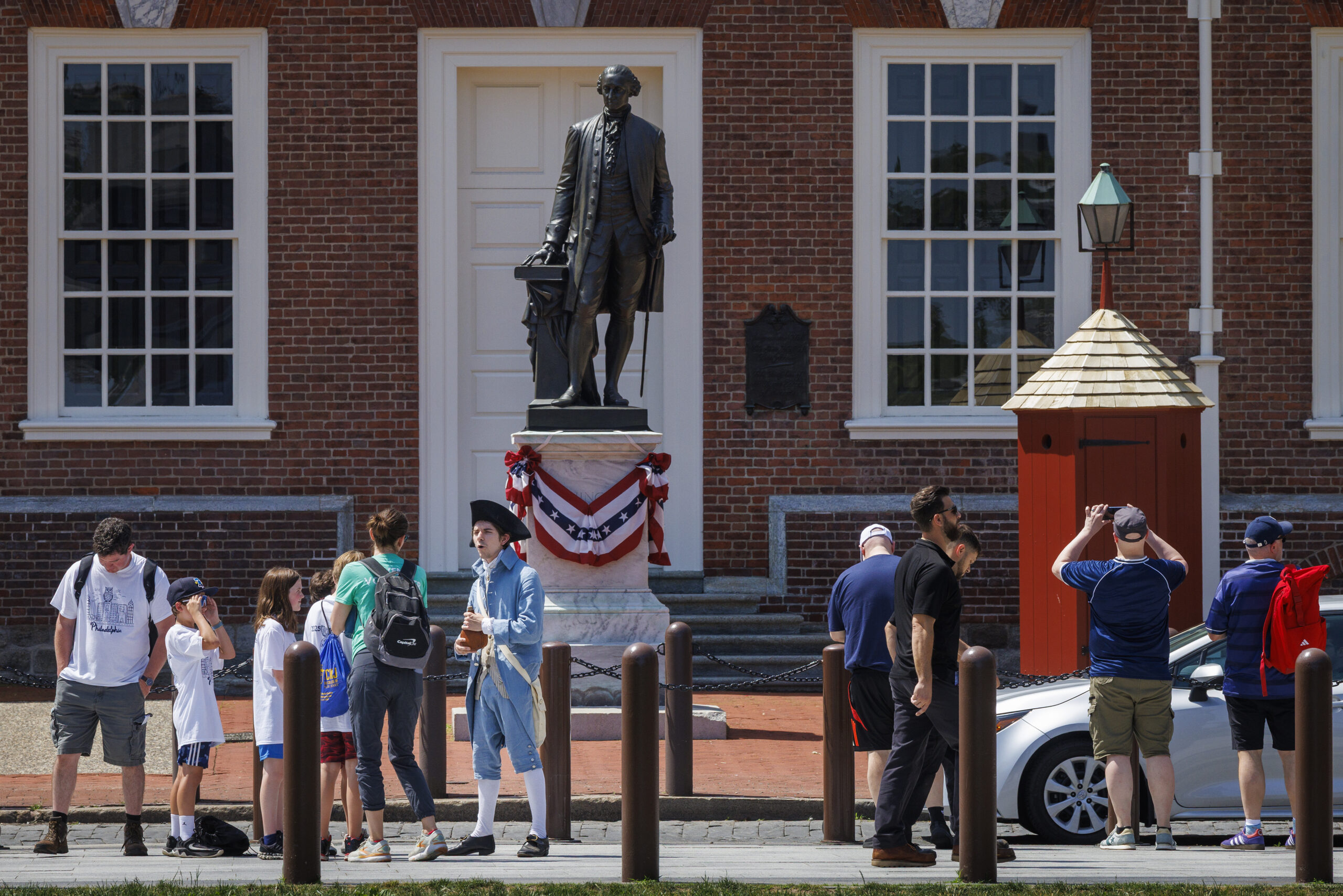
    Historic Interpreter, Lane Norris, as Alexander Hamilton, speaks with tourists outside Independence Hall in Philadelphia.

    Boyle worked for years to arrange a ceremonial gathering of Congress at Independence Hall for the 250th, which is set for Thursday. Though not officially a joint session outside of Washington — which has only occurred two other times since the capital relocated from Philadelphia — the event will mark the moment on July 2, 1776, when the Second Continental Congress voted to adopt a resolution for independence.

    The commemorative moment “just gives me chills to think about it,” said U.S. Rep. Mary Gay Scanlon, a Delaware County Democrat who represents part of Philadelphia and plans to attend Thursday. Scanlon said she was hopeful the event will be bipartisan at a time when the president’s divisiveness was “taking an edge off the celebratory aspect” of the 250th.

    Both Scanlon and Boyle described the president’s lack of plans to mark the moment in Philadelphia as disappointing. The White House did not respond to questions for this article, including whether it made any attempts to plan an event with the president in the city.

    “I always just kind of assumed that the president of the United States would, at some point in the days leading up to the Fourth of July or even on Fourth of July itself, be in Philadelphia,” Boyle said. “But obviously this president has different priorities.”

    Injecting polarization into apolitical events

    Matthew Levendusky, a University of Pennsylvania political science professor who has studied how July Fourth celebrations affect sentiments about national identity and polarization, said previous presidents participated in “patriotic, but not political,” events like concerts, fireworks, and parades.

    Trump has taken a distinctly different path since his first term, Levendusky said, noting the military parade in 2019 and a speech at Mount Rushmore in 2020 when, after the murder of George Floyd in Minneapolis, he used the moment to criticize the removal of monuments that symbolized racial oppression.

    The 250th events are an example of how Trump, a “conflict entrepreneur,” makes such events more political at a time when American society has already become more partisan, Levendusky said.

    “There’s more debate over the meaning of American identity than there was a decade or 15 years ago — in part because there’s been more polarization,” said Levendusky, the director of Penn’s Institutions of Democracy at the Annenberg Public Policy Center. “But he’s also done things that inject polarization into that process.”

    President Donald Trump, first lady Melania Trump, UFC president and CEO Dana White, and other guests pose inside the octagon after UFC Freedom 250 on the South Lawn of the White House, Monday, June 15, 2026, in Washington. (Evan Vucci/Pool Photo via AP)

    Those actions appear to have affected how voters feel about America’s democracy 250 years in — at least among Philadelphia’s largely Democratic electorate.

    According to a new Suffolk University/Philadelphia Inquirer poll that surveyed 500 city residents, 70% of Philadelphians believe Trump’s presidency has made them feel less confident in the country’s democracy. The answers were strongly correlated to political party, with more Republicans than Democrats saying that Trump’s presidency made them feel more confident in democracy or that it made no difference.

    Tourists flocking to the city have reflected those ideological divides but also a bipartisan desire to set politics aside for a historic milestone.

    “We’re all Americans, I don’t care who the president is,” said Greg Sage, 55, a Republican from Michigan who voted for Trump and toured the city’s historic sites this month. “I try not to politicize it, you know? But I believe we’ve been around 250 years. Maybe we’ll make another 250.”

    Phyllis Ahnberg, 68, a Democrat from California, said that it was “empowering” to visit Philadelphia’s sites and that she would not let one person or administration change how she celebrated a moment for unity. Still, it was hard to ignore Trump’s impact during a recent trip to Washington.

    “We were up at [the] Washington Monument, and we were looking, and it was disgusting to see the White House and this, like, fight thing,” Ahnberg said, referencing the towering structure built to host the UFC fight on June 14. “And to see the East Wing torn down … I mean, it was disgusting. Nobody hired this man to do that.”

    U.S. Sen. Dave McCormick, Pennsylvania’s highest-ranking Republican and a close Trump ally, attended the fight and posted on social media that it was an “incredible evening” that honored “the strength, resilience and spirit of the American people.” His office did not grant a request for an interview for this article.

    Pennsylvania’s empty booth at the Great American State Fair on Thursday in Washington. On Saturday, Sens. David McCormick (R., Pa.) and John Fetterman (D., Pa.) announced that they had secured private-industry sponsors for the booth at no cost to taxpayers.

    A debate over past and future America

    Other Republicans on Capitol Hill have defended Trump’s role in the anniversary while using the moment to say they believe left-leaning Democrats are the primary threat to America’s democracy.

    “We are in a fight right now to save the republic, and every American needs to take this seriously. You need to wake up,” an animated House Speaker Mike Johnson (R., La.) said at a news conference last week after three insurgent candidates backed by New York Mayor Zohran Mamdani, a democratic socialist, won competitive congressional primaries.

    “Are we going to maintain our status as a constitutional republic on our 250th anniversary?” Johnson continued. “Or are we going to make a new choice and go down some road toward a communist utopia?”

    Chris Rabb, who won Philadelphia’s competitive primary in May to succeed retiring U.S. Rep. Dwight Evans (D., Philadelphia) next year, endorsed two of the candidates Johnson criticized and is likely to join them in the most progressive bloc in Congress next year.

    A democratic socialist and state legislator, Rabb has been adamant about what he sees as a need for “radical” change. After speaking at an event titled “The Next American Revolution: Breaking Oligarchy and Making a New Democracy” in Washington last week, he said in an interview that Trump’s presidency has in some ways been a “valuable distraction.”

    Instead of celebrating the anniversary in traditional — or what Rabb called “milquetoast” — ways, Trump is creating an opportunity for more critical, nuanced discussions about American identity and history, he said.

    It is a particularly meaningful opportunity for him personally. A longtime family genealogist, Rabb has spoken often about his heritage as the descendant of both a signer of the Declaration of Independence — the slave-owning Philip Livingston — and Black abolitionists.

    “I am an embodiment of the hypocrisy and the complexity of choices and systems that have never really been addressed … [and] that are very similar to what we had 250 years ago,” Rabb said. “Unless and until we have a real public, ongoing, and substantive conversation, it will be more of the same.”

    Staff writer Andrea Padilla contributed to this article.

  • How the Philly suburbs are celebrating the 250th, from a Revolutionary War trail map to a critter from a Montco zoo

    How the Philly suburbs are celebrating the 250th, from a Revolutionary War trail map to a critter from a Montco zoo

    From George Washington crossing the Delaware and the Continental Army lodging at Valley Forge to the so-called real Penn’s Landing and the Battle of Brandywine, the Philadelphia suburbs played a crucial role in the early development of the United States.

    And though Philadelphia — the birthplace of American democracy — has taken center stage for this year’s Semiquincenntenial celebrations, Bucks, Montgomery, Delaware, and Chester Counties have spent years preparing for 2026 and have curated an extensive list of activities for residents and visitors alike who are looking to honor the United States’ 250th birthday outside the city.

    Here is what the Philly suburbs have in store for the 250th:

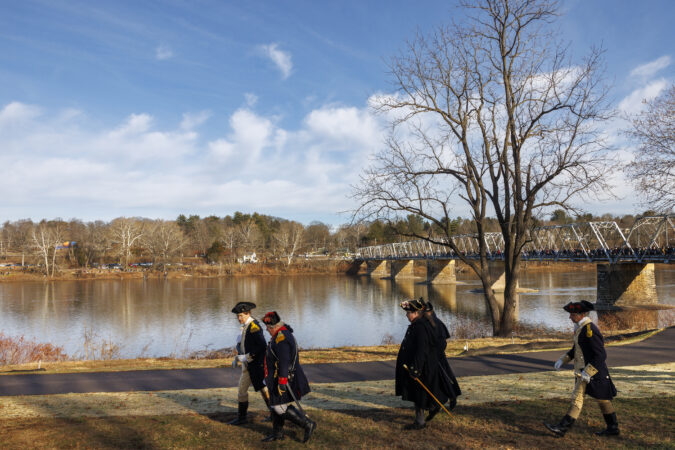
    Reenactors fire off a Galloper gun during a reenactment of George Washington’s river crossing, Washington Crossing Historic Park, Washington Crossing, Pa., Thursday, December 25, 2025.

    Bucks County’s history-packed celebrations

    For Bucks County — established by William Penn in 1682 — 2026 is set to be chock-full of celebratory events tied to the founding of the U.S.

    Bucks’ commission in charge of planning 250th celebrations has partnered with numerous nonprofits to promote their events on a shared calendar on a dedicated county America 250 website.

    Forthcoming activities include art exhibitions, a Doylestown bash featuring big-band music and the reading of the Declaration of Independence, tours of a Revolution-era exhibit at the Mercer Museum, and fireworks at Washington Crossing Historic Park on July Fourth. Not to mention the annual reenactment of Washington crossing the Delaware River on Christmas Day.

    The group also worked with the Bucks County Planning Commission and the Bucks County Herald to release a Revolutionary War trail map that takes participants throughout the county to visit historical sites.

    Bucks gave $7,500 to the 250th commission in July 2024 in support of the celebrations, a county spokesperson said. Other financial support has come from sponsors, including several companies that have dished out at least $10,000 apiece.

    Bucks County Commissioner Bob Harvie, who chairs the county’s 250th commission, said these events underscore the pride that communities have in their rich history.

    “It’s also a chance for us to think back, I think, and remind ourselves about the foundation of this country, and the values that united us, because especially now we’re seeing a lot of attempts, unfortunately, within our country to divide us,” said Harvie, a Democrat who is running for U.S. Congress.

    It is difficult to predict how this year’s 250th celebrations will affect the county’s tourism numbers, but Bucks typically hosts about 8 million visitors a year, Harvie said.

    “We’ve been pitching ourselves sort of — no pun intended — for people who are coming here for the World Cup,” Harvie said. “We’re right between Philadelphia and New York, where you happen to have a place that’s sort of a central hub.”

    The Valley Creek Trail at Valley Forge National Historical Park in Valley Forge, Pa., on Tuesday, Feb. 20, 2024.

    A ‘birthday bash’ and celebrating Valley Forge

    Montgomery County’s 250th commission has curated months of events to commemorate the Semiquincentennial, but a free “birthday bash” on Monday at the county courthouse will kick off the height of the July Fourth celebrations.

    Attendees can graze food trucks, take pictures, and meet an animal from the Elmwood Park Zoo.

    Other programs this year include fireworks and live readings of the Declaration of Independence over July Fourth weekend, exhibits to commemorate the 50th anniversary of Valley Forge becoming a national park, and a gathering (with food and drink, of course) at a Skippack farmstead to honor Washington and his troops’ encampment in the town in 1777.

    The 250th events have been planned by the county and local municipalities, said Jamila Winder, chair of the county commissioners, as an “opportunity to create meaningful, inclusive celebrations” and cultivate “civic pride.”

    Montgomery County typically gets about 8 million visitors a year and are projecting an additional 1 million to the region for the 250th, said Winder, a Democrat.

    To help fund this year’s festivities, the county started a grant program through which municipalities can apply to receive up to $500 to support their 250th events between now and Dec. 1.

    The county has allotted a $35,000 budget for 250th celebrations, including the grant program, which 22 of 62 municipalities are a part of, a spokesperson said.

    “It’s an opportunity for visitors to see how Montgomery County played a unique role in America’s founding, including our deep ties to Valley Forge in the Revolutionary area,” Winder said. “You know, people always think about Philadelphia, right? Philadelphia is a big piece of this story, but Montgomery County plays a huge role in that.”

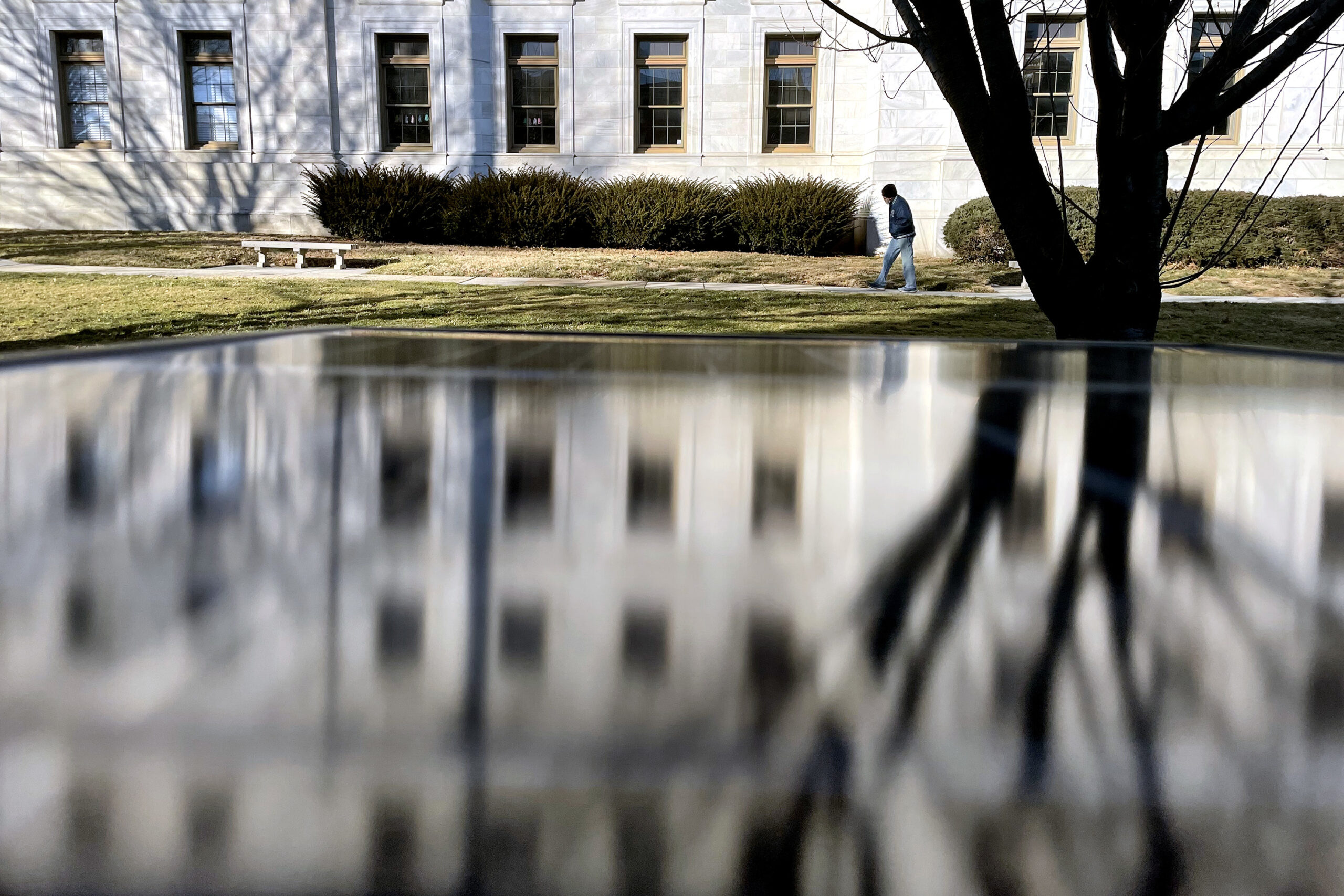
    The Delaware County Courthouse in Media is reflected in a solar panel atop one of the borough’s on-street parking kiosks along Front Street.

    Delco is ‘pretty lit’ about its 250th celebrations

    “If you thought Delaware County residents were proud of being Delco before America 250 — you’re just, like, next-leveling it now.”

    That’s what Delaware County Council member Elaine Paul Schaefer said about Delco’s excitement leading up to the 250th, making sure to set the record straight that William Penn’s storied first steps in the New World hundreds of years ago were actually in Chester, not at Penn’s Landing in Philadelphia.

    The county — through its America250PADelco commission — is promoting over 100 county, town, or nonprofit events through November, from art exhibits, concerts, and fireworks to “dining under the stars” in Media, a late-summer drone show, and a reading of the Declaration of Independence on the county courthouse steps.

    “Delco is pretty lit about this,” said Schaefer, a Democrat.

    The county’s 250th commission has disbursed more than $650,000 in grants for various initiatives. That grant money comes from a mix of funds from the American Rescue Plan Act and from different county agencies.

    Delco also has numerous sponsors, according to the county’s 250th website.

    Schaefer said she hopes the events encourage residents to harness a connection to their communities, particularly through the county’s 250th volunteer program.

    “You can do something small, do something big. … It’s a really great way to get people involved and connected, and I think that kind of volunteerism and increasing connection to the community will carry on after this big celebration,” Schaefer said.

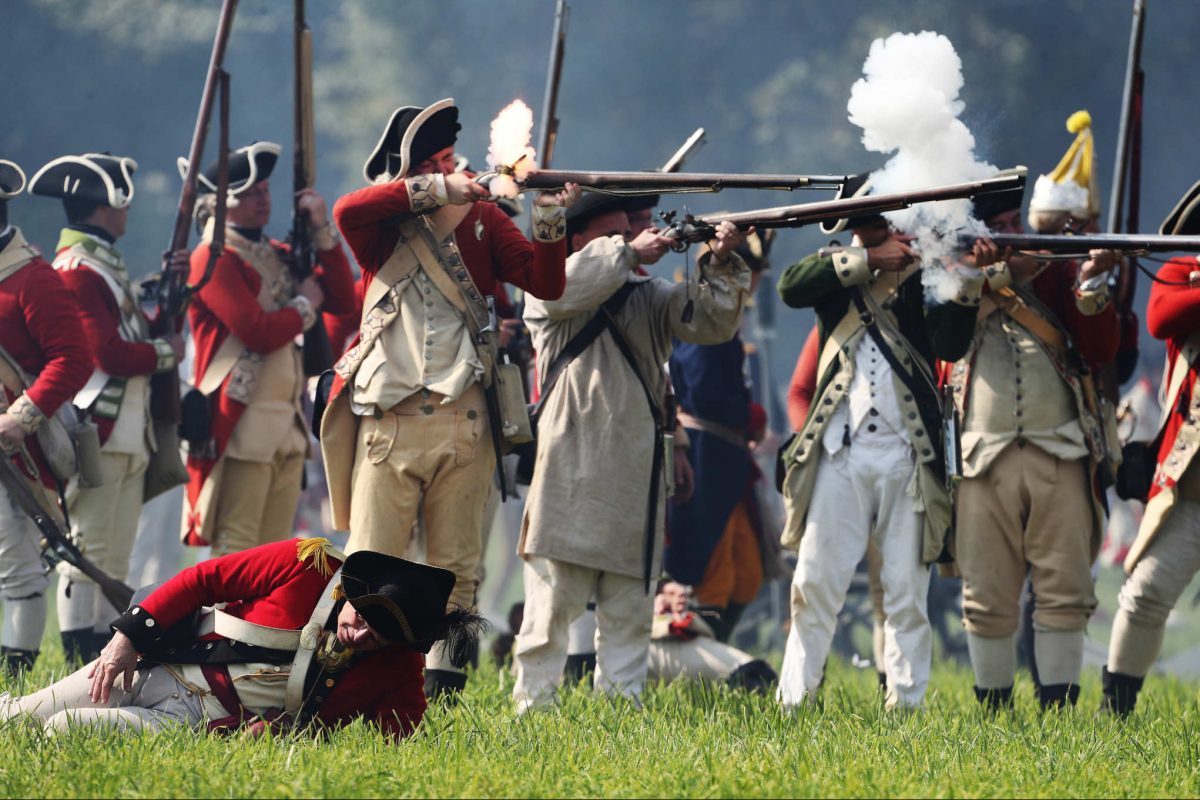
    About 800 Battle of Brandywine reenactors in Chester County.

    For Chester County, the party will last through next year

    Chester County joins Bucks and Philadelphia as one of the three original counties of Pennsylvania, created in 1682.

    And the events planned for this year (and next year, as it honors various Revolutionary War-era battles, including the Battle of Brandywine) are key to celebrating the county’s role in the founding of the United States.

    Residents and visitors have a wide array of activities to choose from outlined on the commission’s website, including driving tours of historical sites and Declaration of Independence readings. On the evening of July Fourth, the Chester County Concert Band will be playing patriotic music as a precursor to the fireworks show.

    As opposed to hosting tons of large-scale events, Chesco is more focused on local events that can foster community building, said David Blackburn, heritage preservation coordinator at the Chester County Planning Commission. The commission is working with the county’s 250th commission to carry out plans.

    “We’re really oriented to supporting the communities of the county to share their stories,” Blackburn said.

    The county has invested over $170,000 in educational materials and programming related to the 250th, in addition to a more than $330,000 grant from the state, a spokesperson said.

    But once the clock strikes midnight on New Year’s Eve, the celebrations won’t end for Chester County, said Matthew J. Edmond, executive director of the planning commission.

    In 1777, many significant Revolutionary War battles took place in the collar counties, and Chester is planning to pour a lot of resources into commemorating those historical events next year.

    “We are actively talking with our commission board about ways to celebrate, ways to fundraise for it, and ways that we can make maybe 2027 to be even better than celebrations in 2026,” Edmond said.

  • Josh Shapiro says progressives’ wins in New York show voters ‘are channeling that pain into purpose’

    Josh Shapiro says progressives’ wins in New York show voters ‘are channeling that pain into purpose’

    The Democratic Party should be a big tent and welcoming to a diversity of voices, Gov. Josh Shapiro told MS NOW’s Jen Psaki in a live event in Philadelphia on Thursday.

    Following Tuesday’s primary races in New York that saw the elections of more progressive and socialist candidates, Shapiro said the results there and around the country show that voters are eager for change.

    “I appreciate the passion that we are seeing from voters all across this country,” Shapiro said during the event at the Academy of Music, part of MS NOW’s celebration of America’s 250th birthday.

    People are feeling the strain and opting to support more progressive candidates, Shapiro said, because of rising health insurance costs, struggles to purchase a house, and the feeling that their rights are being stripped away.

    “They are channeling that pain into purpose, they’re channeling that into showing up at the ballot box, they’re channeling that into showing enthusiasm,” he said. “That is a good thing.”

    But he stopped short of explicitly endorsing more left-leaning ideologies. In a separate interview with CNN on Thursday, Shapiro added that the successful candidates must now deliver results.

    “I get that there are some candidates out there that just say a lot words and attract a lot of attention but what we need to do as a party is drill down on how we take those words turn them into actions and make people’s lives better,” he said.

    In Philadelphia, voters elected Chris Rabb, the democratic socialist who has challenged the city’s political establishment, in May’s Democratic primary for Pennsylvania’s 3rd Congressional District. Shapiro did not get directly involved in Rabb’s district, despite making endorsements in other races.

    He also dodged direct criticism of Sen. John Fetterman, a fellow Pennsylvania Democrat who has become increasingly unpopular among the party’s voters, after Psaki posed some of the senator’s recent comments to Shapiro.

    Fetterman referred to the New York congressional candidates, endorsed by Mayor Zohran Mamdani, as “the dirtbag left” and “outrageous” on Fox News. (The phrase “dirtbag left” comes from the leftist podcast Chapo Trap House and refers to a strand of democratic socialism that counters the political right by mimicking its dark humor, among other tactics.)

    Shapiro said “John should answer for himself.”

    In both Philadelphia and New York, the victorious progressive candidates during their campaigns heavily criticized Israel’s war in Gaza and the United States’ role in supporting its material.

    Psaki did not ask Shapiro, who supports Israel but has been critical of Prime Minister Benjamin Netanyahu, about the issue during the event. And he did not refer to it when talking about the New York results.

    To show voters that Democrats hear their pain, the party needs to get “real stuff done to make people’s lives better,” he said.

    Sandra Dungee Glenn, who attended the event Thursday, said Shapiro could have been even more forceful against Fetterman, who is viewed unfavorably by 43% of Philadelphia residents, according to a recent poll.

    “Don’t even mention that name,” said Glenn, who lives in West Philadelphia, referring to Fetterman. “He’s a big disappointment.”

    In addition to his own reelection campaign in November, Shapiro is focused on getting Democrats elected in four competitive congressional seats and flipping the Pennsylvania state Senate, which has been under Republican control for three decades.

    Should the chamber flip, Shapiro said his immediate priority would be raising the state’s minimum wage and codifying the right to access abortion — blaming Republicans for standing in his way.

    But Shapiro, a first-term Democrat, is also looking ahead, past 2026 and Donald Trump’s presidency, as he builds a national profile and becomes a likely contender for the presidency in 2028.

    He said Congress should pass a 28th Amendment to the U.S. Constitution that guards against corruption and gerrymandering, and railed against the 2024 U.S. Supreme Court decision that gave presidents absolute immunity from criminal prosecution for actions taken within their constitutional authority, following Trump’s efforts to overturn the 2020 election.

    Shapiro said he is also open to adding more justices to the Supreme Court, which has been set at nine justices since 1869.

    “I think we’ve got to have everything on the table. We’ve got to be bold,” he said.

    Expansion has been pushed by progressives as a way to reform the court and end its conservative majority.

    Leslie Berger, 69, who attended MS NOW’s event Thursday said she supports adding more justices to the court.

    “These norms we have aren’t etched in stone,” she said. “We need to change this justice system and more justices would be a great start.”

    Democrats, Shapiro said, need to be aggressive and elevate candidates who will drive down costs, increase access to healthcare, repair the country’s standing in the world and rein in artificial intelligence.

    “We’ve got to understand that our sole mission right now is winning in these midterms and providing a check against Donald Trump at the state and the federal level,” he said. “Then as we go forward, I think we have to understand that rebuilding a federal government like it was before Donald Trump showed up cannot be the answer to the Democratic Party.”