Category: National Politics

  • Victories by pro-Palestinian Democrats show the party’s shift on Israel

    Victories by pro-Palestinian Democrats show the party’s shift on Israel

    NEW YORK — Three Democrats who made criticism of Israel central to their political identities swept to victory in House primary races in New York City on Tuesday, signaling a new era of skepticism in their party toward the Jewish state and its actions.

    The striking results reflected a fast-moving shift in liberal politics. Democratic voters are now more likely to be critical of Israel and its government than they are to be supportive, according to several recent polls, a monumental change in American sentiment.

    And while many Democratic officials remain supportive of Israel, next year’s class of congressional Democrats is on track to be more wary about the United States’ relationship with Israel than at any other moment since the Jewish state was established after World War II.

    The primary triumphs in deep-blue districts of Brad Lander, Claire Valdez, and Darializa Avila Chevalier came after each was endorsed by Mayor Zohran Mamdani of New York, whose advocacy for the Palestinian cause has been integral to his rapid political rise. At a rally for the candidates last week, he called the nation’s leading pro-Israel organization part of a group of “monsters” that he said were too powerful in American politics.

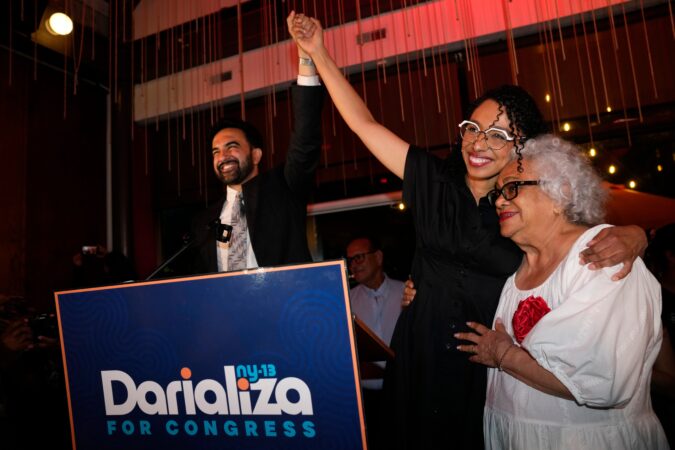
    At Avila Chevalier’s victory party Tuesday night in Harlem, supporters chanted “free Palestine” while she pushed her campaign’s “babies, not bombs” slogan. She suggested in her victory speech that her win represented a shift in how Democrats in New York would operate.

    “Today, we make it clear: The politics of the past ends today,” she said.

    Super political action committees allied with the American Israel Public Affairs Committee, the pro-Israel group, have spent huge amounts of money on this year’s midterm elections to try to turn the tide in voter opinion. The organization has had some victories, saying in a statement Tuesday night that 180 Democrats and Republicans it had endorsed had advanced to the November election. The group congratulated a Maryland House candidate its allied super PAC spent millions backing and said this would “ensure this seat remains represented by pro-Israel leadership.”

    But despite those successes, AIPAC has largely been on the defensive.

    Polls show that support for Israel among Democrats has sharply and steadily eroded since the Hamas-led terrorist attacks on Oct. 7, 2023, and Israel’s subsequent destruction of most of the Gaza Strip. A New York Times/Siena survey this spring found that 60% of Democratic supporters said they were more sympathetic to Palestinians than Israelis, compared with 15% who were more supportive of Israel.

    “You’re seeing more and more Democrats making it clear that we should provide no U.S. taxpayer support to the government of Israel,” Sen. Chris Van Hollen (D., Md.) said in an interview Tuesday. Next year, he added, “I hope we will see a Congress that doesn’t provide reflexive unconditional support to the government of Israel.”

    Perhaps the most significant of the New York races pitted Rep. Dan Goldman, a two-term Democrat from Brooklyn, against Lander, the former New York City comptroller, who staked his campaign on opposing Goldman for being insufficiently critical of Israel.

    The race between the two men, Jews who both describe themselves as liberal Zionists, symbolized how Democratic voters, especially younger ones, have shifted away from support for Israel.

    But perhaps the most outspoken anti-Israel Democratic candidate who won in New York City, Avila Chevalier, defeated Rep. Adriano Espaillat, who has been a steadfast supporter of Israel in his decade in Congress. Avila Chevalier spoke often of having lived in the West Bank and attended a rally on Oct. 8, 2023, that was widely criticized for featuring speakers who appeared to justify the attacks a day earlier.

    Like Lander and Valdez, Avila Chevalier is now the Democratic nominee in a solidly blue House district and is a heavy favorite to wind up in Congress come January.

    New York Mayor Zohran Mamdani (left) congratulates Brad Lander after his victory in the Democratic primary election for the seat held by Rep. Daniel Goldman (D., N.Y.) in Brooklyn on Tuesday night.

    The fights in New York became increasingly nasty in the final days of the campaign. A local coffee shop chain wrote on social media that Goldman, who is critical of Israel’s government but has opposed banning aid to the country, was not welcome because it did not serve “genocide enablers.”

    Pitched midterm battles over Israel

    The main super PAC tied to AIPAC, the United Democracy Project, has spent more than $25 million so far this year, in addition to at least $5 million it has funneled to create new super PACs.

    That sum may be just a fraction of what is to come. The group started the year with more than $96 million, making it one of the best-funded PACs in the country.

    Its most prominent spending battles so far have been in New Jersey and Illinois. But Israel also became a driving issue in several House primaries in California.

    The results have been mixed. In the Chicago suburbs, Daniel Biss, the mayor of Evanston, Ill., won a House primary after explicitly attacking AIPAC. The group spent $7 million in the race, mostly aimed at defeating Biss, who is Jewish. But in the final days of the primary, when it became clearer that a candidate even more critical of Israel than Biss could win, the super PAC dialed back its attacks on him.

    In New Jersey, the AIPAC-tied super PAC targeted Tom Malinowski, a popular former member of Congress who supported more restrictions on aid to Israel. But in an embarrassing turn for AIPAC, Analilia Mejia, a progressive organizer who was loudly critical of Israel, beat him in the special election and then won a later primary.

    AIPAC has won victories, too. Two of its preferred candidates in Illinois won crowded primaries, even as another anti-AIPAC Democrat won in a Chicago district.
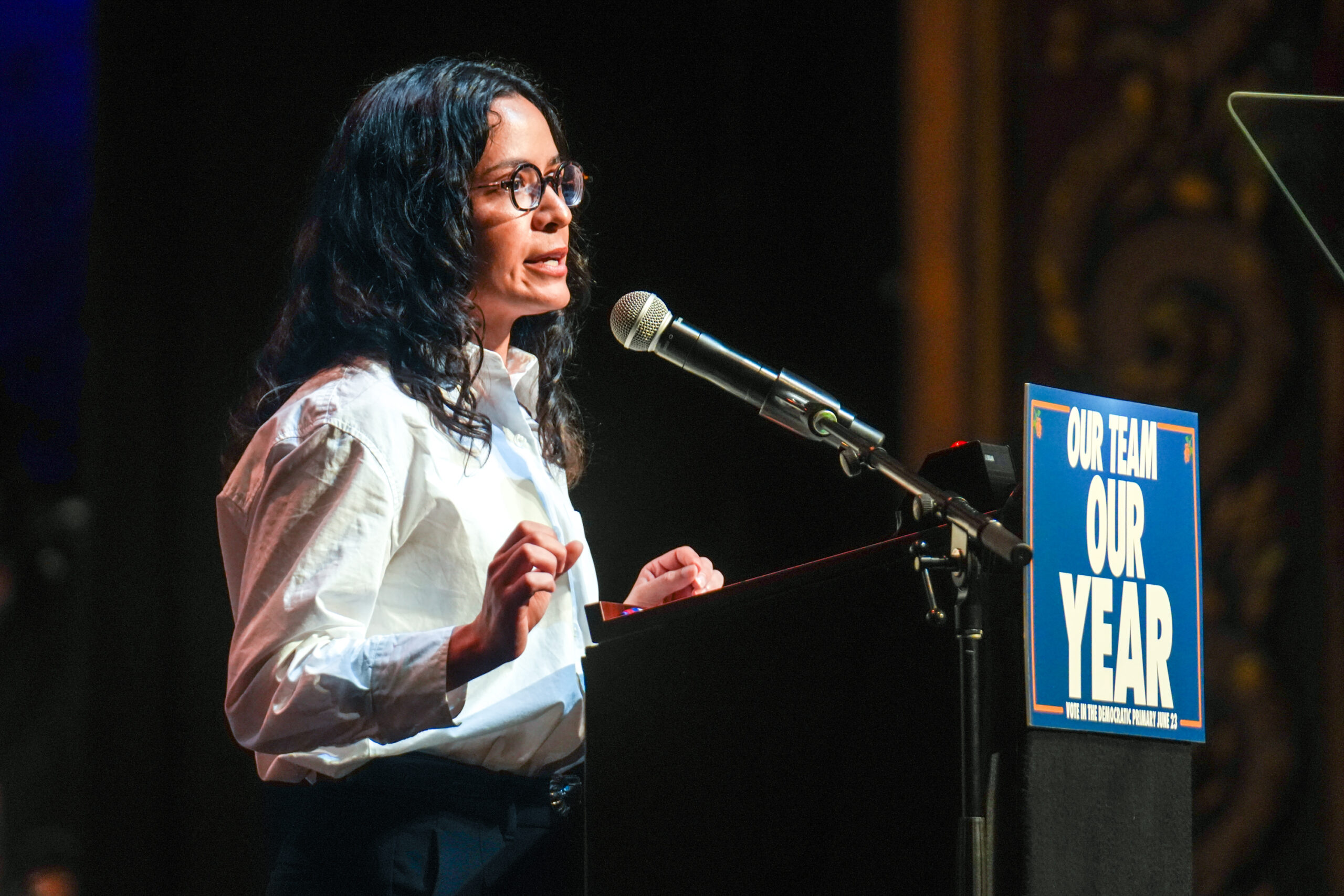
    Democratic congressional candidate Claire Valdez speaks during a June 18 rally in Brooklyn ahead of New York’s primary election.

    In Washington, defending Israel has fallen out of favor among many congressional Democrats, with a large majority of senators who caucus with the party voting this year to block some U.S. arms sales to Israel.

    “Do I think the Overton window on Israel has shifted more in the last six months than my entire career?” said Amy Rutkin, the longtime chief of staff to Rep. Jerry Nadler of New York, the longest-serving Jewish Democrat in the House, who is retiring. “It surely, absolutely has.”

    The shift is part of a generational change after the retirements of longtime Democratic leaders such as former House Speaker Nancy Pelosi of California and Rep. Steny Hoyer of Maryland, the longest-serving Democrat in the House, both of whom are stalwart supporters of Israel. Rep. Hakeem Jeffries of New York, the minority leader, is also a backer of Israel.

    But among Democratic voters, support for Israel has crumbled. And even House Democrats who are broadly supportive of Israel are highly critical of Benjamin Netanyahu, the country’s prime minister. Few enthusiastically support the right-wing Israeli government, and many are openly counting down until elections there, which are scheduled for October.

    Shifting winds in New York

    The Democratic shift on Israel has been particularly notable in New York, home to the country’s largest Jewish population and a mayor who has frequently focused on the plight of Palestinians.

    “The monsters that we are up against, they take many different forms,” Mamdani said at a recent rally for his endorsed candidates, before adding that AIPAC believed “the only thing more frightening than democracy being allowed to run its course is an end to genocide and Netanyahu’s wars.”

    Many Jewish leaders and groups criticized the remarks, arguing that they echoed antisemitic tropes at a time of increased hate crimes targeting Jews.

    One of the candidates the mayor backed, Avila Chevalier, defeated Espaillat, the chair of the Congressional Hispanic Caucus. He was the only candidate in New York who was explicitly backed by AIPAC’s super PAC, which transferred money to a separate group that supported him.

    In the 10th Congressional District, which includes lower Manhattan and a large area of Brooklyn and is one of the most Jewish districts in the country, Goldman frequently argued that a focus on foreign policy was misplaced given voters’ domestic priorities. Those arguments fell flat: He lost badly, trailing late Tuesday by more than 30 percentage points.

    Several Jewish Democrats who are most likely heading to the House, including Lander and Biss, have taken a more antagonistic tone toward the current Israeli government. But whether they will take radically different approaches to policy remains to be seen.

    AIPAC as a litmus test

    For decades, AIPAC was the leading voice of a bipartisan congressional consensus on the importance of the U.S.-Israel alliance. Now, many Democrats in contested primaries want nothing to do with it.

    The organization has become a symbol of dark money, alongside organizations backing the cryptocurrency and artificial intelligence industries. And all three interest groups are spending money on many of the same races.

    None of the advertisements paid for by the AIPAC super PAC even mention Israel, focusing instead on top-polling issues in each area.

    In Maryland, the super PAC spent more than $5 million to back Adrian Boafo, a state legislator, in the primary to replace Hoyer. The ads focused on Boafo’s biography and his accomplishments in Annapolis. Cryptocurrency interests spent an additional $3.4 million to back Boafo, according to AdImpact, a media tracking firm. He ended up finishing well ahead of a crowded Democratic field.

    The next Democratic primaries to revolve around Israel will come in August, when Minnesota, Michigan and other states are holding competitive intraparty contests.

    At a Democratic primary debate for Senate last week in Minnesota, Lt. Gov. Peggy Flanagan declared that “I don’t take AIPAC money because my values don’t align with AIPAC.” Her opponent, Rep. Angie Craig, who has been endorsed by AIPAC in the past, replied that she had taken “not one penny” from the group and called for Netanyahu to lose his reelection bid in October.

    The most divisive race, however, will be in Michigan, which has large Jewish and Muslim populations.

    The Democratic Senate primary there includes Rep. Haley Stevens, a staunch backer of Israel, and Abdul El-Sayed, a progressive public health official who has called Israel’s actions a genocide and opposes any military aid to the country. A third candidate, State Sen. Mallory McMorrow, has tried to take a middle path on Israel, but is struggling in the polls.

    This article originally appeared in The New York Times.

  • The history of American Jews exposes the fundamental questions of citizenship

    The history of American Jews exposes the fundamental questions of citizenship

    The history of American Jews’ citizenship makes the president’s case to eliminate birthright citizenship, now awaiting a Supreme Court decision, no surprise—but this should offer little comfort.

    The central plotline of the story of Jews in the United States tends to revolve around citizenship: Jews arrived, gained citizenship, the end. Yet this story accounts for neither how citizenship has worked for Jews nor how it works in general. A far more accurate history of Jewish citizenship in the United States exposes the persistent political questions asked, answered, and unresolved when policymakers try to decide who is and isn’t “American.”

    For the past 250 years, American leaders have used citizenship law to draw and re-draw the lines of individual belonging through collective categories. From the beginning, Congress granted “any alien being a free white person” access to citizenship, writing into naturalization law in 1790 broad thresholds for membership. In 1868 the Fourteenth Amendment revolutionized citizenship by opening it to “all persons born or naturalized in the United States.” Yet Congress also legislated that for the purposes of naturalization, “all persons” only included “free white persons” and “aliens of African nativity…and African descent,” not Chinese people or “Asiatics.”

    Jews who immigrated from Europe tended to gain access to naturalization as “white” under citizenship law, but government officials found Jews a useful—and sometimes confounding—guide to help them apply the law, even when Jews were not directly involved.

    Take a 1909 naturalization appeal from four men, described in their rejected application as “Armenians by race.” The men were not Jewish, but Judge Henry Cabot Lowell, who presided over their appeal, nonetheless found himself contemplating Jewish citizenship. Harvard-educated and hailing from an elite Boston family, Lowell consulted scientific treatises to conclude that “Hebrews” and Armenians were both “Asiatic” in origin. Prevailing scientific racism of the day convinced him that neither met the threshold of whiteness. As he wrote in his decision, it was “hard to find loophole for admitting the Hebrews” to citizenship. But at least until Congress acted, he saw no reason to exclude Armenians if Jews could benefit from the loophole.

    Jewish leaders panicked when they witnessed high-level government officials slotting them into racialized categories other than “white.” They understood that the historical fact of citizenship would not necessarily protect Jews in years to come, especially as eugenicist ideas gained traction among policymakers designing new restrictive immigration laws. In the early 20th century, elite Jews lobbied politicians, filed reports, intervened in naturalization cases, and testified at congressional hearings to bolster Jews’ claims to citizenship. Their efforts met partial success. As passed in the 1920s, immigration quota laws dropped the classification of Jews as “Hebrews,” instead counting Jews among others of their same “national origin.” Still, the countries from which most Jews immigrated, such as Russia and Poland, now faced some of the harshest restrictions.

    In practice, the new quota laws reduced the number of Jews who could naturalize and raised suspicion about those who did. Foreign-born Americans from many different backgrounds experienced discrimination that legal status did not avert.

    But accusations of foreignness and dual loyalty clung to Jews in unique ways, as illustrated by a remarkable case from 1947. That year, a naturalized Jewish man sought to return to the United States after living in British-mandate Palestine for over a decade. Detained by U.S. border control agents, the Ukrainian-born man learned that his American passport had been revoked under a 1940 law that prohibited naturalized citizens from living abroad for over five years. Native-born citizens were not subject to the same law. The ACLU, American Jewish Committee, and American Jewish Congress seized on this fact to call the law unconstitutional and defend the Jewish man on his appeal. But for the Jewish organizations, the constitutional violation was a piece of a much larger threat to Jewish citizenship in the United States. When Congress authorized the 1940 statute, it did so under pressure from a State Department official who insisted that “these Zionists” regularly manipulated the protections of American citizenship for their own nationalist ends.

    The court rejected the Jewish man’s appeal, and in doing so diminished the distinctly Jewish dimension of the case by tying him to other naturalized Americans, such as Japanese-Americans, whose constitutional rights to equal protection could be overridden by national interests according to recent Supreme Court precedent.

    Citizenship debates routinely entangled Jews’ status with that of other groups because the categories of citizenship were neither self-evident nor self-executing. Only in motion, by scrutinizing groups, comparing them to one another, and gauging the changing winds of national interests, did government officials bend citizenship to their will.

    In a remarkable exchange on the Senate floor in the spring of 1964, two senators debated the exclusion of religion from proposed anti-discrimination legislation targeting federally-funded programs. Albert Gore, Sr., a Democrat from Tennessee, contended that Jews lacked shelter under the law’s categories of “race, color, or national origin” because Jews were a religion. Joseph Clark, a fellow Democrat from Pennsylvania, countered that those categories protected Jews just fine because many Jews lacked any faith, so whatever discrimination they faced must be race-based. Signed into law that summer as Title VI of the Civil Rights Act, the statute (unlike many others in the same law) did not include religion among its protected categories.

    For many decades, the question of Jews’ standing under Title VI seemed to be resolved in practice, as government officials and Jewish leaders agreed that its jurisdiction did not include Jews. But it was only a matter of time before the answer faded back into a question.

    Over the last two decades—and especially since Oct. 7, 2023—government officials and many Jewish leaders have argued that Jews should have standing in anti-discrimination laws on the basis of race, color, or national origin. Detractors argue that Jews—or certain expressions of Jewishness such as Zionism—do not fit squarely into those categories. The arguments matter because the categories of citizenship law are consequential, but their answers aren’t intrinsic to citizenship. Rather, citizenship remains a tool to ask questions about belonging; as political aims change so too will its meaning.

    Made By History sponsors. FOR USE ON MADE BY HISTORY STORIES ONLY.

    For American Jews, citizenship has not offered a singular point of arrival or a final answer to the puzzle of national belonging. This lesson from the history of American Jews may offer some reassurance that Trump’s bid to overturn birthright citizenship is just another stop on a zig-zagging journey. Whether the Supreme Court endorses the administration’s tendentious reading of the 14th Amendment or not, the twisted and entangled process of arguing over citizenship will continue.

    A less sanguine lesson from the same history should warn all American citizens that an attack against birthright citizenship is an attack against them. No one is naturally or natively a citizen, wherever they were born. Political leaders are constantly remaking citizenship—just look at how the categories used to define, question, or defend Jews have changed over time. The protections of citizenship are as mutable as they are unreliable.

    Faith in any fundamental meaning of citizenship not only misses the point but also carries profound risk. Even the most capacious understanding of citizenship will not resolve the question of human belonging, but the starkly narrow one on offer from the Trump administration today threatens our ability to keep asking the question.

    Lila Corwin Berman is a professor of history at NYU and author of Who Is American? Belonging and the Question of Jewish Citizenship.

    Made by History takes readers beyond the headlines with articles written and edited by professional historians. Opinions expressed do not necessarily reflect the views of The Inquirer.

  • Federal citizenship data tool cannot be used to screen voters, judge rules

    Federal citizenship data tool cannot be used to screen voters, judge rules

    WASHINGTON — A federal judge on Monday barred the Trump administration from letting states query a centralized national database of citizens built for checking immigration status to screen their voter rolls, finding that the repurposing of the federal data to monitor voting violated at least three laws.

    In a sharply worded ruling, Judge Sparkle L. Sooknanan ordered the Department of Homeland Security to stop permitting states to search the data, which also incorporates Social Security records.

    President Donald Trump had ordered several agencies last year to pool data that states could use to verify citizenship. The combined data set allows state and local election officials to search immigration records stored by Homeland Security about migrants, as well as a much larger database of information maintained by the Social Security Administration.

    Sooknanan, who was appointed by former President Joe Biden, wrote that the executive order had resulted in a rush by agencies to “haphazardly” adopt a system that they knew was flawed and that would flag eligible voters along with those who might have registered illegally. She warned that states were already “actively” using it to potentially purge eligible voters before an election.

    “All in all, the federal government has knowingly trampled on the privacy rights of American citizens in a manner that threatens the sacred right to vote,” she wrote. “This court cannot stand idly by while that happens.”

    Repurposing the immigration database — known as the Systematic Alien Verification for Entitlements, or SAVE, system — into a tool to check voter eligibility unlawfully abused sensitive data stored by the government for other purposes, Sooknanan wrote. She added that federal agencies were joining to together over the last year to “create a centralized federal database that contains the private information of United States citizens, including Social Security numbers, citizenship status and other sensitive data” that violated protections Congress had intended to guard personal data.

    Sooknanan wrote that evidence presented in the case showed Homeland Security officials acknowledged in internal communications that the infrastructure it had built violated federal privacy law and could incorrectly flag eligible voters as noncitizens. She wrote, for instance, that the database included outdated information that could result in naturalized citizens who had been assigned Social Security numbers long ago incorrectly appearing as ineligible to vote.

    James Percival, the department’s general counsel, responded to the ruling on social media, calling it the “latest example” of “how hard the Left will fight to stop us from solving problems they insist do not exist.”

    At Trump’s direction, the federal government has intensified efforts this year to intervene in state administration of elections, as he pushes discredited theories about voter fraud and claims that immigrants in the U.S. illegally and others who are ineligible to vote can be found on state rolls.

    The Justice Department has also contributed to efforts to build a national voter database, suing a number of Democratic-led states that resisted the push to obtain their records.

    Earlier on Monday, a federal judge in Maryland dismissed a lawsuit by the department seeking the state’s voter records, the latest of more than half a dozen decisions that have gone against the Trump administration.

    The lawsuit before Sooknanan dates to an executive order Trump signed in March 2025 requiring more aggressive federal oversight of elections, inserting the federal government into roles historically reserved for states. Among other things, the order required Homeland Security and Social Security to collaborate to verify the immigration status of registered voters or new voters signing up.

    The lawsuit was brought by the League of Women Voters, the Electronic Privacy Information Center and several members of those organizations who argued the Trump administration had unlawfully pooled their sensitive personal data into a tool that could be abused for voter suppression.

    “As the Trump-Vance administration continues its attack on the right to vote, this is an important victory for the American people and our democracy,” said Skye Perryman, president of Democracy Forward, which helped represent the coalition.

    In November, Sooknanan initially denied a request by the groups to halt the overhaul of the SAVE system, writing that while she “doubts the lawfulness of the government’s actions,” it was unclear that the Trump administration had actually misused the data. But on Monday, she wrote that states, including Texas and Louisiana, had now started using the system to check voter registrations and had flagged eligible voters for removal.

    Separately, at Trump’s direction, the U.S. Postal Service submitted a plan this month under which it could refuse to deliver mail ballots in states that decline to share their voter rolls with the federal government. The Postal Service is also facing pressure to assist with the creation of state-by-state voter lists that it could consult and use to justify refusing mail-in ballots of people left off the lists.

    In May, Judge Carl J. Nichols declined to immediately block Homeland Security from compiling and distributing those lists to state election workers.

    This article originally appeared in The New York Times.

  • With win in Washington, socialists have momentum in urban America

    With win in Washington, socialists have momentum in urban America

    The biggest city in the country is led by a democratic socialist, and another is in the running to lead the second biggest. Seattle has a socialist mayor. And in 2027, a democratic socialist will almost certainly be taking the reins of the nation’s capital.

    With her convincing victory in the Democratic primary in Washington last week, Janeese Lewis George, 38, became the latest candidate to claim victory with the once-forbidden “S word” in her biography and an ambitious left-wing agenda, promising to harness the power of municipal government to tackle the costs and challenges of urban living.

    Tapping into frustrations about housing and the cost of raising children, Lewis George pledged to greatly expand childcare assistance, build tens of thousands more homes and expand rent stabilization. Her critics derided those promises as unrealistic; voters ate them up.

    “I think people were like, ‘I don’t buy that the status quo is all we can do,’” Lewis George said in an interview. Instead, she said, they thought, “‘I want to see leaders do something more than tell people what they can’t do.’”

    Lewis George, who in a city as blue as Washington is close to a lock in the general election, joins a vanguard of young democratic socialists, including the new mayors of New York City and Seattle. Some are formal members of the organized Democratic Socialists of America, some not, but all have won on platforms of robust government action, arguing that the older Democratic establishment has failed.

    Democratic socialists say that solutions to challenges like the rising costs of childcare and housing lie in community organizing and direct government action, not the free market or timeworn tax incentives. While they cast themselves more in the mold of a mayor from Stockholm than Leningrad, they do not shy from confrontation with business interests, whether that means private utilities or landlords, oligarchs or plutocrats.

    Not everyone running from the left in big blue cities has won, as losers of the most recent mayoral races in San Francisco and Philadelphia can attest.

    But socialist success indicates an ascendant left — a generational movement as much as a political one — might have considerably more room to run.

    “We’re seeing real opportunities open up here,” said Kurtis Hagans, chair of the DSA chapter in the Washington metro area. “It’ll be interesting to see how the Democratic establishment wants to move forward into the midterms.”

    Zohran Mamdani, 34, who twice beat Andrew Cuomo, the former New York governor, in his unlikely rise to the New York City mayor’s office, is in many ways the lodestar for the rising brigade of democratic socialist candidates. He unapologetically pledged in his inauguration speech to “replace the frigidity of rugged individualism with the warmth of collectivism.”

    He has since moderated positions in deference to the political realities of governing a city of 8 million. He retained Jessica Tisch, a relatively moderate billionaire heiress, as police commissioner and ceded significant policy control to her. He has backed away from his vow to give up unilateral control of the school system, and from his pledge to expand an expensive housing subsidy program.

    He has developed a strong working partnership with New York Gov. Kathy Hochul, a relative moderate in the Democratic Party, and he has struck up a surprisingly amiable relationship with President Donald Trump, despite once characterizing him as a despot. “Sewer socialism,” with images of an army of volunteers shoveling snow or squads of pothole fillers, has become as much a Mamdani calling card as his campaign promise of free buses.

    The act of governing is the big test for a movement propelled by idealism and bold promises, along with a disenchantment with the compromises that its followers believe are too often made by those in power.

    But fiscal constraints on municipal government can be strict, particularly in Washington, a federal enclave subject to extensive congressional oversight. And at a time when Washington’s finances are suffering from the impacts of federal job cuts as well as a lingering pandemic downturn, the city has had a hard enough time paying for the social programs already in place.

    “Especially at the local level, governing is a practical affair,” said Mary Cheh, a former council member who endorsed Lewis George’s main rival in the primary but acknowledged the appeal of her message.

    “There will be some change, I’m sure,” she said. “But it’s not going to be all that they hoped for.”

    The limits of idealism have inevitably led to compromise and, at times, friction.

    In Los Angeles, Nithya Raman, 44, a City Council member and a democratic socialist, is in a runoff against Karen Bass, the Democratic mayor who is running for reelection. Raman’s ascent in 2020 coincided with the Black Lives Matter protests that rippled through big cities across the country.

    Support for Raman in her first race that year, against an incumbent on the City Council, became a kind of social shorthand for progressive politics at a moment when flying a Black Lives Matter flag outside of a home was de rigueur among Los Angeles’ wealthy liberals.

    But in recent years, Raman, as a council member, has broken with the DSA on some issues, including how to alleviate Los Angeles’ crushing housing crisis. While she and her DSA-aligned colleagues have both sought protections for poor tenants, Raman has also backed more development-friendly housing policies.

    Up the coast in Seattle, Katie Wilson, a self-identified socialist but not a DSA member, has largely avoided the ideological battles many had expected after her upset victory in November.

    Tension between Wilson and a Seattle City Council that is more moderate has so far led to negotiations rather than conflict, as when she agreed to turn on newly installed security cameras in the city’s stadium district during the World Cup, despite her initial opposition.

    Like many of her fellow politicians of the left, Wilson has made housing a priority. She promised to open 500 new shelter beds or emergency housing units by the start of the World Cup but appears to have fallen short by more than 400. She has pledged to build 1,000 new units by the end of her first year and 4,000 by the end of her four-year term, a tall order.

    “I certainly have a learning curve, but I don’t want to portray myself as coming in with some kind of unrealistic idea that this would be easy,” she said in an interview last month. “There’s the way things have been done for a very long time, and it takes a very long time to change that. I’m not surprised at where we’re at.”

    But at a time when voters across the political spectrum feel like government has stopped working for them, the promises of a robust and responsive public sector have clearly resonated among voters, regardless of the fiscal or partisan realities.

    “When people see you deliver on the small things,” Lewis George said, “they trust that you can also deliver on the big things.”

    This article originally appeared in The New York Times.
  • Judge blocks bans on using food stamps for sugary drinks and candy

    Judge blocks bans on using food stamps for sugary drinks and candy

    WASHINGTON — A federal judge on Monday blocked the Trump administration from barring the use of food stamps to buy sugary drinks and candy.

    Since last year, the Agriculture Department has approved waivers in more than 20 states that allow them to bar participants in the federal Supplemental Nutrition Assistance Program from using their benefits to buy soda, energy drinks, candy or other prepared desserts. In March, recipients in five states sued the agency over the waivers, arguing that the limits were unlawful and confusing and made it difficult to manage health conditions such as diabetes.

    Judge Amy Berman Jackson of the U.S. District Court in Washington, in a 68-page decision, agreed with the recipients that the Agriculture Department did not have the authority to approve the waivers and also failed to abide by a notice period. Monday’s decision was a rollback of restrictions that officials have characterized as a major achievement of the Make America Healthy Again movement.

    Jackson wrote that while the law allows for the department to approve projects related to the administrative and logistical efficiency of the SNAP program, the agency essentially “purports to waive not just a mere administrative or technical obstacle, but the very definition of ‘food’ as it was laid down by Congress.”

    “The federal defendants and the states may have a genuine desire to improve the health of SNAP households by encouraging healthy choices at the store, and they can take lawful steps to meet those goals,” she wrote. “But what they cannot do is violate the law and their own regulations along the way.”

    The case was brought by the National Center for Law and Economic Justice, a nonprofit that advocates on behalf of low-income people, and Shinder Cantor Lerner, an antitrust law firm.

    Katharine Deabler-Meadows, a senior attorney at the National Center for Law and Economic Justice, said in a statement that the decision was “a major step in restoring essential food assistance to the millions of families that rely on SNAP nationwide.”

    The Agriculture Department did not immediately respond to a request for comment about the ruling. A spokesperson for the agency had earlier told The Associated Press that it “will not be backing down from the fight to Make America Healthy Again.”

    This article originally appeared in The New York Times.
  • Brian Fitzpatrick ties the knot with Fox News’ Jacqui Heinrich in NYC wedding

    Brian Fitzpatrick ties the knot with Fox News’ Jacqui Heinrich in NYC wedding

    U.S. Rep. Brian Fitzpatrick (R., Pa.), who represents Bucks County, and Fox News senior White House correspondent Jacqui Heinrich got married Saturday in New York City.

    The wedding was attended by high-profile figures in politics and media and featured a nighttime cruise around the Statue of Liberty.

    The celebrations for the newlyweds and their 302 guests included a ceremony at St. Patrick’s Cathedral and a reception on a yacht called Horizon’s Edge, with a 10-piece brass band and the toasts of former GOP House Speaker Kevin McCarthy and former Sen. Joe Manchin (I., W. Va.), People magazine reported.

    The nuptials of Fitzpatrick, 52, and Heinrich, 37, comes almost a year after their engagement and amid the Republican’s high-stakes reelection campaign to represent Pennsylvania’s 1st Congressional District against Democratic challenger Bob Harvie.

    Fitzpatrick and Heinrich said they chose New York for their wedding because of its significance in jumpstarting their respective careers as an FBI agent and a network news reporter and its connection to their families’ immigration journey, People reported. It was also a central meeting point for the couple’s families from New England and Pennsylvania.

    The reception featured other nods to family — Heinrich’s parents got married on a chartered cruise and the couple’s cake-cutting song was an “Irish tune,” People reported, written by Fitzpatrick’s great-uncle, an NYPD officer who was killed in the line of duty, according to People.

    Former Sen. Joe Manchin (I, W.Va) and former GOP House Speaker Kevin McCarthy (right) give a toast to U.S. Rep. Brian Fitzpatrick and Fox News reporter Jacqui Heinrich’s nuptials.

    Guests took to social media to congratulate the newlyweds including Heinrich’s Fox News colleagues, U.S. Rep. Don Bacon (R., Neb.), and President Donald Trump’s former Labor Secretary Lori Chavez-DeRemer.

    Pennsylvania Gov. Josh Shapiro was invited to the wedding, but the Democrat was unable to attend.

    Fitzpatrick and Heinrich met in Washington when Heinrich was a correspondent on Capitol Hill. After she switched beats to cover the White House, Fitzpatrick asked her on a date to the Kennedy Center Honors.

    Heinrich’s LinkedIn page shows she began working as Fox News’ White House correspondent in May 2021 during former President Joe Biden’s term.

    They are one of the most high-profile couples on Capitol Hill, sometimes earning the ire of Trump.

    Last month, after Fitzpatrick won his GOP primary unopposed, Trump threatened Fitzpatrick, without saying his name, when asked a question by Heinrich, who is vice president of the White House Correspondents Association.

    “Her husband votes against me all the time. Can you imagine? I don’t know what’s with him,” Trump said. “You better ask what’s with him. She’s married to a certain congressman. He likes voting against Trump, You know what happens with that? It doesn’t work out well.”

  • Trump to visit Pa. on Tuesday as the battle for control of Congress heats up in the Lehigh Valley

    Trump to visit Pa. on Tuesday as the battle for control of Congress heats up in the Lehigh Valley

    President Donald Trump is scheduled to speak Tuesday at a truck manufacturing facility in the Lehigh Valley, where a competitive race for Congress this year could determine which party controls the U.S. House for the second half of his term.

    Trump will deliver remarks at Mack Trucks in Macungie in Lehigh County, according to the White House and two local members of Congress.

    The visit will mark Trump’s fourth Pennsylvania appearance in his second term and his first this year ahead of November’s high-stakes midterm elections.

    Pennsylvania has four competitive U.S. House districts — the most of any state — and the Lehigh Valley-based 7th District is widely considered one of the most likely in the nation to flip from Republican to Democrat.

    GOP U.S. Rep. Ryan Mackenzie won that seat by 1 percentage point in 2024 as Trump defeated Democrat Kamala Harris statewide. Bob Brooks, a union leader and retired firefighter whom many prominent Democrats rallied behind before last month’s competitive primary, is facing Mackenzie in November.

    The event Tuesday is scheduled as an official White House event, not a campaign event, and it could be the first of several trips by the president to the region and across Pennsylvania in the coming months.

    “We’re looking forward to joining President Trump at Mack Trucks — one of our nation’s most iconic manufacturers,” Mackenzie wrote on social media.

    “By investing in American workers and supporting domestic manufacturing, President Trump and Republicans in Congress have helped to put the Lehigh Valley and the Poconos at the forefront of our nation’s industrial revitalization. We appreciate President Trump coming to the region to help us highlight the work we’ve done together to support American workers, families, and industries.”

    Mackenzie spoke Friday at a different Mack facility outside of Allentown to highlight part of a contract the company won from the U.S. Army last year to produce heavy dump trucks. The deal is worth up to $221.8 million, and Mack Defense said it received $47 million in the latest Department of Defense appropriations act.

    A White House spokesperson said Trump will “stand with the American workers he has fought for” during his visit.

    “Under the President’s leadership, key domestic industries are being revitalized, historic investments are pouring back into communities like Macungie, and families across the country are securing new, high-paying jobs,” Liz Huston said. “Pennsylvanians placed their trust in President Trump, and he has delivered for them.”

    Former President Joe Biden visited the same Mack facility in 2021 for a speech focused on supporting American manufacturing.

    Trump last appeared in Pennsylvania in December for a rally at the Mount Airy Casino Resort in Mount Pocono, which is in the neighboring 8th Congressional District where another freshman Republican is looking to fend off a Democratic challenger. Pitched as a speech to address voters’ concerns about affordability, the president repeatedly veered off script and called affordability concerns a “hoax.”

    Some of the president’s former supporters in the region have since said they regretted voting for him, and national Democrats have made the area a priority as they look to win back a seat that Mackenzie flipped two years ago. Brooks, the Democratic nominee, has leaned into his working-class background while saying he understands voters’ financial concerns.

    U.S. Rep. Dan Meuser, a Republican who represents a different neighboring district, said Trump’s visit signals the president’s support for workers.

    “Mack Trucks are a symbol of America’s manufacturing strength,” Meuser said on social media. “Their Lehigh Valley operations are a pillar of the local economy, employing Pennsylvania workers and driving the nation’s trucking industry. Thank you, President Trump, for supporting American workers.”

  • Invading Cuba would be a disaster, and history proves it

    Invading Cuba would be a disaster, and history proves it

    Recently, President Donald Trump declared “I do believe I’ll have the honor of taking Cuba.” He mused that, “whether I free it, take it, I think I could do anything I want with it.” Trump’s increasingly hostile rhetoric has led to a debate over whether the U.S. should invade Cuba and remove the island nation’s government from power.

    History suggests that the answer is no. An intervention by the U.S. in Cuba will end badly for both Americans and Cubans. It may prompt a flood of Cuban Americans returning to the island, and the very sort of economic development that, in the past, produced a revolution and ignited a chain of events that led to the current situation.

    U.S. intervention in the Caribbean to “bring democracy” or promote American corporate interests is nothing new — and Cuba is no exception.

    In 1898, the U.S. took control of Cuba after it won a quick victory in the Spanish-American War. What most Americans do not know is that Spain’s defeat was just the epilogue to a Cuban war for independence that had raged for three years.

    The American victory meant that, instead of the independence for which Cubans had been fighting, they became an American colony. Worse, a series of independence wars, dating back to 1868, had left the fledgling Cuban government and landowners bankrupt as the warring factions destroyed property in an effort to break the other’s morale. As a result, many previously wealthy Cubans sold off their properties to American investors.

    U.S. business owners and companies poured money into the island, purchasing some of the best properties in the agricultural zones, as well as telecommunications, mining and railroad infrastructure. These purchases gave Americans dominance over the Cuban economy. At one point 70% of Cuba’s foreign trade was with the United States, and U.S. companies and investors owned 90% of the telephone and telegraph industry, 83% of the railways and 42% of sugar production.

    U.S. industries, like the United Fruit Company, primarily hired Americans to work in upper management, which limited the upward mobility of Cubans. They built enclaves for their managers that frequently segregated them from the Cuban population-at-large except for the laborers who provided services. Often, they even built infrastructure, including railroads and ports, to extract goods and wealth from Cuba rather than serve the people of the island.

    Even worse, as historian Louis A. Pérez, Jr. has eloquently argued, this economy paved the way for a corrupt political system fueled by patronage and pay offs. Engaging in the system became the principal pathway to wealth for Cubans.

    Four years after the occupation, in 1902, the U.S. granted Cuba independence — sort of.

    The U.S. agreed to withdraw its troops, but only after Cuba signed a treaty allowing the U.S. to militarily intervene when its self-interests were imperiled — the so-called Platt Amendment. Cuba also agreed to lease to the U.S. in perpetuity a vast tract of land around Guantanamo Bay for use as a naval base. The lease could only be voided if both parties agreed to end it, which gave the U.S. veto power.

    In 1906, the U.S. demonstrated that Cuba’s “independence” was illusory. Concerned by a faltering Cuban government, the U.S. dispatched troops who would occupy the island until 1909. In 1912, U.S. Marines again invaded eastern Cuba to help put down a local uprising.

    The interventions sent the unmistakable message: Cuban officials had to maintain U.S. support. Accordingly, every Cuban government until 1933 sought to please the U.S. government and powerful American economic interests.

    When the government did try to boost Cuban industries, it often had to reverse course after Washington balked to protect American corporate interests.

    Cubans resented an economy that served U.S. companies well, but not Cubans. They also resented their government for putting American interests ahead of Cuban ones. That led to a powerful backlash typified by the slogan “Cuba for Cubans.” In 1933, Cubans finally revolted.

    The uprising produced some economic and political reforms, including the establishment of an eight-hour work day, a minimum wage, guarantees that industries would maintain a minimum percentage of Cuban workers and the abrogation of the Platt Amendment.

    However, in the ensuing years, the U.S. meddled in Cuban politics in an attempt to temper the revolutionary fervor. Behind the scenes, the U.S. Embassy worked with political groups to try to ensure a compliant Cuban government. They went so far as to help rig the 1936 presidential election to secure victory for a candidate favorable to military dictator Fulgencio Batista (who ruled the island on several occasions between the 1930s and 1950s) and the military. American officials saw the dictator as a stabilizing force in Cuban politics.

    Made By History sponsors. FOR USE ON MADE BY HISTORY STORIES ONLY.

    The U.S. also maintained economic dominance over the island by purchasing most of Cuba’s primary export: sugar. That made it impossible even for democratic Cuban governments to undertake the substantial land reform necessary to create economic prosperity for small farmers. Such reform would have taken land from American owners and therefore risked an U.S. boycott of Cuban sugar or other economic sanctions. The loss of their primary market would have devastated Cuban tenant farmers.

    In 1952, however, the U.S. made a fatal mistake. After an eight-year absence from power, Batista led a coup against democratically elected president Carlos Prio Socarrás. The Eisenhower administration quickly recognized Batista’s government, failing to grasp that it had little popular support.

    Enter Fidel Castro, who quickly built a strong opposition movement, precipitating the Cuban Revolution in 1959. During a visit to the U.S. a few months after his triumph, Castro described his revolution as “humanist.”

    Yet, the Eisenhower Administration suspected that Castro was a Communist at heart. The new leader confirmed their worst fears when he presented a modest land reform plan in June 1959 that would distribute unused parcels of land to tenant farmers. This proposal led to a rapid escalation of American sanctions against Cuba. The Cuban government responded by seizing property owned by American business interests. The escalating bellicosity from the U.S. drove Castro into a closer relationship with the Soviet Union. In April 1961, this cycle of escalation culminated in the fiasco that was the Bay of Pigs invasion by Cuban exiles, backed by the U.S.

    Scholars have long debated whether Castro was a Communist when he took power, but it was not until the day before the Bay of Pigs that he made it official by declaring this is a “socialist and democratic revolution of the humble, by the humble and for the humble.”, In October 1962, the conflict between the two nations culminated in the Cuban missile crisis, when the Soviet Union placed nuclear weapons in Cuba. After 13 days of brinkmanship between the U.S. and Soviet Union, the Soviets agreed to withdraw the missiles. As part of the deal, President John F. Kennedy pledged never to invade Cuba.

    Over decades, however, memory of the cycle that led to the Cuban Revolution — and the rise of a government hostile to the U.S. — has faded. And that has left Americans and Cubans, once again, at a crossroads.

    Cuba, already impoverished by government mismanagement, is being squeezed further by a fuel blockade and new economic sanctions imposed by the U.S. The Trump Administration is seeking a collapse of the Cuban Government. It has not ruled out direct military intervention either to capture former President Raúl Castro (Fidel’s brother) or displace the government.

    Yet, the history of Cuban-American relations suggests that such a move would be a mistake. It is easy to envision Miami Cubans flooding back to the island, some with property claims dating back more than 65 years, and others with mucho dinero ready to invest in Cuban tourism and other economic opportunities. Investment sounds like a great idea but as the first half of the 20th century demonstrated, investment from Americans and American interests probably will not focus on what is good for Cubans.

    If the U.S. recreates an economy dominated by outsiders like it did after the Spanish-American War, trampling all over Cuban sovereignty in the process, that will fuel resentments and anti-American sentiment, and could sow the seeds of revolution once again. If history is any guide, the result will be catastrophic for Cubans and Americans alike.

    Frank Argote-Freyre is a Latin American history professor at Kean University, Argote-Freyre’s first book, Fulgencio Batista: From Revolutionary to Strongman, was published in 2006. He is the author of dozens of scholarly works, journalistic articles, and public policy papers on a wide variety of topics from mental health to housing to public education. He is currently working on his next book, Fulgencio Batista: From President to Dictator.

    Made by History takes readers beyond the headlines with articles written and edited by professional historians. Opinions expressed do not necessarily reflect the views of The Inquirer.

  • Trump, claiming vandalism, says reflecting pool will be drained

    Trump, claiming vandalism, says reflecting pool will be drained

    WASHINGTON — President Donald Trump said on Saturday that “multiple individuals” had been arrested for vandalizing the Lincoln Memorial Reflecting Pool, and that problems with a more than $14 million renovation project had become so severe that the pool would have to be at least partly drained for “necessary repairs.”

    The president’s announcement late Saturday, made on social media, was his starkest acknowledgment of the pool’s rapid deterioration in recent days. The water this week became covered by clouds of blooming algae, which were obscuring a floor that had just been painted a shade that Trump has called “American flag blue.” The paint then began to peel off, making it a tourist destination for unusual reasons.

    Among those accused of vandalism was David Carter Hearn, 67, a cyclist and three-time Olympian as a canoeist who says he stopped at the site Friday just to have a look, then reached down to touch a strip of peeling blue paint mixed with the algae.

    The U.S. Park Police arrested Hearn shortly after, accusing him of destroying government property, a crime that can carry up to a 10-year prison sentence. Hearn denies the charge.

    “I was just a curious, concerned citizen,” he said in an interview. “I guess I was there at the wrong place, wrong time.”

    The administration has not released the names of others accused of vandalizing the pool, a crime that Trump said Saturday could lead to “years in jail.” In a later post, he said without evidence that vandals had “poured corrosive and destructive chemicals into the Pool.”

    The project, one of many Trump is undertaking around the capital as the United States nears its 250th birthday, has faced intense scrutiny, including from engineers and other experts who warned that the hastily undertaken project was unlikely to undo the problems that have plagued the pool for decades. A construction company tied to Trump was awarded a no-bid contract and painted the bottom of the pool.

    Trump said Saturday that he had met with contractors earlier in the day to discuss the state of the pool.

    The Interior Department said this week that agency workers had “killed the algae” that had expanded with heat and humidity. But on Friday afternoon, the water was stained by clumps of algae where National Park Service staff members had scrubbed away bright green blooms along the bottom of the basin. The pool’s new coating was also missing large sections, including a gap roughly the size of a park bench. Underneath appeared to be the original concrete basin.

    Hearn, of Bethesda, Maryland, said that he was on a 50-mile bike ride before stopping at the pool, and that Park Police officers detained him for more than four hours Friday at a facility south of the National Mall without allowing a phone call. They also did not say more about why he had been arrested, he added. The White House and Park Police did not respond to requests for comment.

    Late Friday, Trump claimed on social media that the “inside surface that was just installed” had been damaged by vandals.

    Hearn said that he had “reached into the water to feel the characteristics” of a dislodged paint piece “still attached to the bottom.” He compared his actions to those of Jonathan Karl, an ABC News reporter who lifted a detached piece of paint at the pool Thursday in a video the news organization published.

    “I didn’t remove anything,” Hearn said. “I was bending and feeling this 2-millimeter-thick, rubbery flap.”

    Until his retirement 18 months ago, Hearn ran a company selling special materials for building canoes. That, he said, made him particularly interested in the materials contractors had used before the paint at the base of the pool began peeling.

    Hearn said that he had already received offers of pro bono representation following his arrest.

    “I’m getting a lot of support from my community,” he added.

    This article originally appeared in The New York Times.

  • ICE plans to offload Pa. and N.J. warehouse properties intended to be mass detention centers

    ICE plans to offload Pa. and N.J. warehouse properties intended to be mass detention centers

    U.S. Immigration and Customs Enforcement is planning to offload its two warehouse properties in Pennsylvania and another in New Jersey — bought for a total of more than $336 million — that had been purchased to further support President Donald Trump’s mass deportation agenda.

    In total, ICE is planning to disown seven warehouses across the country by either handing the properties off to other federal agencies or selling them, the New York Times reported.

    The agency will continue to pursue spaces in Texas, Arizona, and Maryland.

    The move signifies a notable shift in priorities within the Department of Homeland Security under Secretary Markwayne Mullin — tapped to lead the department after the abrupt firing of former Secretary Kristi Noem, whose costly warehouse purchases were a pillar of her highly controversial tenure carrying out Trump’s escalating immigration enforcement agenda.

    In contrast, Mullin, the Times reported, wants DHS to keep a lower profile.

    It remains unclear why DHS is aiming to get rid of some sites while planning to keep others. A spokesperson for the department touted the Trump administration’s immigration agenda and said that “DHS is moving swiftly to utilize EXISTING detention space with our state and county partners.”

    ICE’s new course would be a win for officials in Pennsylvania and New Jersey who have railed against the agency’s plans to use the warehouses as sites for the mass detention of immigrants, citing harmful community impact.

    A source close to Pennsylvania Gov. Josh Shapiro’s administration confirmed to The Inquirer on Friday that they had heard discussions about ICE’s plans to offload the Pennsylvania sites.

    Shapiro penned a letter to Noem earlier this year saying he would “aggressively pursue every option” to prevent the ICE warehouses that were slated for Berks and Schuylkill Counties.

    Pennsylvania Gov. Josh Shapiro speaks with members of the media on May 19 outside his polling place in Rydal.

    In the February letter, he questioned the legality of the facilities, highlighted possible harmful environmental impacts, and slammed the department’s immigration enforcement tactics. Cabinet secretaries and the Pennsylvania Department of Environmental Protection also issued five administrative orders in March that would have prevented the warehouses from using local water and sewage systems unless DHS complied with state and federal regulations.

    U.S. Sen. John Fetterman (D, Pa.), who backed Mullin’s nomination, voiced his opposition to the warehouse centers in an April letter to the secretary.

    Public records indicate that in February, the Department of Homeland Security purchased a property in Hamburg, Berks County, for $87.4 million and a property in Tremont, Schuylkill County, for $119.5 million.

    In New Jersey, the agency purchased a property in Roxbury Township, Morris County, for $129.3 million, records show.

    ICE has been hit with several lawsuits across the country, including in New Jersey, questioning the environmental and community impacts of the warehouses.

    New Jersey Gov. Mikie Sherrill and Attorney General Jennifer Davenport filed a joint lawsuit with Roxbury Township against ICE and DHS in March.

    On Thursday, Sherrill and Davenport said in a statement: “DHS’s plans were always illegal: the Roxbury warehouse is a logistics center fit for packages, not thousands of people, and did nothing to make New Jersey safer.”

    Discussions surrounding ICE warehouses also spurred local officials in the Philadelphia region to voice their concerns about such sites.

    In Bucks County, commissioners unanimously passed a resolution in February opposing any immigration detention or processing facilities. U.S. Rep. Brian Fitzpatrick (R., Pa.), who represents Bucks County and a sliver of Montgomery County, said he received assurances from the federal government that no ICE warehouses were planned in his district.

    Staff writer Stephen Stirling contributed to this article.