Category: National Politics

  • Trump administration can install its own slavery exhibits at President’s House, Third Circuit rules

    Trump administration can install its own slavery exhibits at President’s House, Third Circuit rules

    President Donald Trump’s administration can replace the slavery exhibits it removed in January from George Washington’s Philadelphia residence, a federal appeals court ruled Thursday.

    A three-judge panel of the U.S. Court of Appeals for the Third Circuit unanimously agreed to toss out an injunction issued by a Philadelphia district court judge in February that ordered the National Park Service to restore interpretive panels telling the history of the nine individuals who were enslaved by Washington at the President’s House Site.

    The city does not have a right to dictate the content of the panels, the court found.

    The judges further found that the federal government’s proposed replacement panels, which historians say whitewash Washington’s role in slavery, “are full of historical context.”

    The proposed panels “highlight the momentous events that took place in the President’s House and the other sites at Independence National Historical Park,” Judge Thomas M. Hardiman, a President George W. Bush appointee, wrote in the opinion. “They acknowledge the evil of slavery, including its injustices and hypocrisies, and, by telling the story of the nine slaves that Washington kept in the President’s House, remind us of their essential humanity.”

    Judges Luis F. Restrepo, appointed by President Barack Obama, and Peter J. Phipps, appointed by Trump, joined the opinion.

    It was not immediately clear what would happen next at the site. The federal government did not immediately outline its next steps, and there are conflicting court rulings over the Trump administration’s push to remove displays from national parks that “inappropriately disparage Americans past or living.”

    But the ruling does bring to a close a chapter in the President’s House litigation, the first courtroom clash between Trump and Mayor Cherelle L. Parker’s administration. Any further review of the injunction is at the discretion of the three judges, the full Third Circuit, or the Supreme Court and is not guaranteed.

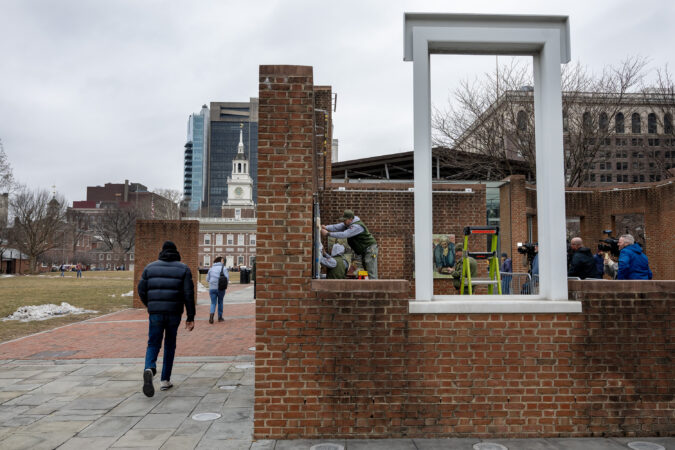
    Mijuel Johnson, a guide with The Black Journey: African-American Walking Tour of Philadelphia, leads District Court Judge Cynthia Rufe (right) as she visits the President’s House in Independence National Historical Park in February.

    The city was unable to convince the Third Circuit panel it has joint decision-making power with the federal government over the entirety of Independence National Historical Park because of the local ownership of Independence Hall.

    Philadelphia has standing to argue in court that the federal government violated the contract signed when the city donated the President’s House to the National Park Service, Hardiman wrote. The agreement included a guarantee the federal agency would maintain the site.

    But the city had to prove it could win based on that argument to keep the injunction alive, and the judges disagreed.

    “The duty to ‘maintain’ is better understood as a general management obligation that accompanies ownership, not a promise that the exhibits will forever remain in place regardless of the owner’s wishes,” the opinion said.

    The city’s claim that the removal was “arbitrary and capricious” under the Administrative Procedure Act also did not find purchase. The federal law allows challenges only to “final” agency actions, but the newly proposed panels show the January removal was not the Trump administration’s “last word on the matter,” the opinion said.

    The ruling vacates U.S. District Judge Cynthia M. Rufe’s injunction from February that ordered the full restoration of the site to its state before exhibits were removed. The National Park Service restored some exhibits, but some metal interpretive panels could not be reinstalled because they required fixes.

    Avenging the Ancestors Coalition, one of the advocacy groups leading efforts to protect the President’s House, said in a statement that the group was disappointed by the decision but would persevere. The coalition was consulting its legal team to consider potential next steps.

    “This is definitely not the end of this fight, nor does it diminish the importance of ensuring that the full truth of our nation’s history is preserved and presented accurately,” the organization said.

    In a video statement Thursday, Parker said, “I will pursue every legal action possible in efforts to reverse this decision.”

    A spokesperson for the U.S. Department of the Interior simply said: “Trust in Trump.”

    Debate over history

    A worker cleans the glass on the panel for Oney Judge after re-hanging it at the President’s House in Independence National Historical Park in February.

    The ruling is an inflection point in the tumultuous legal saga over whether the federal government has power to determine which version of U.S. history is displayed for public viewing — an issue even more salient ahead of the country’s 250th birthday on July Fourth.

    The Trump administration ordered the removal of the President’s House exhibits in January after almost a year of scrutiny of the site. Months later, the government offered its own vision for how those panels would be replaced, quietly uploading them to the National Park Service website in April.

    An Inquirer review of the panels found that the federal government had softened Washington’s role as an enslaver.

    For instance, one proposed panel argues the people who were enslaved at the President’s House “experienced a greater modicum of autonomy than elsewhere in the South such as to explore the city and sometimes even attend the theater, with Washington buying the tickets.”

    Historians argued the original panels were accurate, well-researched, and site-specific. The development of the site in the early 2000s was the product of collaboration across various disciplines including historians, artists, architects, and advocates.

    But Thursday’s ruling says the Trump administration’s proposed displays offer a nuanced view on Washington’s and John Adams’ roles in or opinions on slavery, adequately highlight the stories of the nine people enslaved at the President’s House, thoroughly acknowledge the horrors and brutality of slavery, and uplift key figures in Black history.

    “One panel … explains that Washington ‘often expressed discomfort with the institution and a desire to see it abolished,’ but, ‘as a Virginia plantation owner, his wealth and livelihood were deeply tied to it,’“ Hardiman wrote. ”Other panels provide an even broader overview of slavery and the struggle to extirpate it.”

    The ruling landed just less than three weeks before the 250th anniversary celebrations, and one day before Juneteenth. Attorneys for the federal government said the new panels had been manufactured and were ready to be installed.

    U.S. Rep. Brendan Boyle (D., Philadelphia), whose district includes Independence Park, said in a statement that Thursday’s ruling highlighted the urgency of passing his Protecting American History Act, which would shield historical displays at the park from government censorship.

    “Just a block away from where our nation was founded, Donald Trump is choosing the path of tyrants who rewrite history instead of learning from it,” Boyle said. “As we approach America’s 250th anniversary, we must tell the full truth of our nation’s history — the good and the bad.”

    Another legal case

    Last week, U.S. District Judge Angel Kelley in Massachusetts ordered the Trump administration to restore all exhibits it had removed as part of its “restoring truth and sanity to American history” push. Following the Third Circuit ruling, the appointee of President Joe Biden rejected a Justice Department request for a stay on the order, saying other circuits’ rulings were not binding on her.

    The administration has appealed to the U.S. Court of Appeals for the First Circuit.

    There is not a prescriptive way to resolve such conflicting rulings, which is why some legal scholars argue against so-called universal injunctions, in which one district judge’s ruling affects the entire country. The Supreme Court signaled its discomfort with those types of orders last year.

    Conflicting rulings have become more prevalent during Trump’s tenure, as his administration has issued drastic measures that take immediate effect, said Michael Foreman, a professor at Penn State Dickinson Law.

    Which order ends up prevailing will depend on whether the Massachusetts ruling is stayed, or if the issue escalates to the Supreme Court.
  • Trump FDA chief is leaving after angering pharma CEOs, vaping lobbyists, and anti-abortion groups

    WASHINGTON — The head of the Food and Drug Administration, Marty Makary, is resigning after a rocky tenure that drew months of complaints from health industry executives, anti-abortion activists, vaping lobbyists, and other allies of President Donald Trump.

    News of Makary’s departure Tuesday came just 13 months after he was confirmed to lead the powerful regulatory agency.

    A surgeon and health researcher, Makary came to prominence among Republicans as an outspoken critic of COVID-19 health measures during the pandemic, when he frequently appeared on Fox News Channel. But he struggled to manage the FDA’s bureaucracy and failed to win the confidence of its staff after mass layoffs, leadership upheavals, and a series of controversies in which the agency’s scientific principles appeared to be overridden by political interests, including those of Health Secretary Robert F. Kennedy Jr.

    “He’s a great doctor, and he was having some difficulty,” Trump told reporters outside the White House. “But he’s going to go on and he’s going to do well.”

    Trump later confirmed in a social media post that Kyle Diamantas, the agency’s chief for foods, is expected to take over as acting commissioner. Diamantas is an attorney with personal ties to Donald Trump Jr.

    In that post, the president included what appeared to be a text message from Makary submitting his resignation. In it, he noted that “I announced 50 major FDA reforms. Joe Biden’s FDA had none,” and thanked Trump for the chance to serve.

    The FDA commissioner, as the leader of an agency that regulates billions of dollars in consumer goods and medicines, is often required to juggle competing priorities that straddle science and politics.

    Makary faced a unique challenge in balancing calls by Trump and other Republicans to cut red tape at the FDA, while also tending to Kennedy’s interest in scrutinizing the safety of vaccines, drugs, and food additives. The decision to get rid of Makary was made by Kennedy, and then the White House signed off on it, according to an administration official who was granted anonymity because they were not authorized to describe internal dynamics.

    Virtually all of the FDA’s senior career officials resigned, retired or were forced out in the first year of the second-term Trump administration, leading to a steady stream of leaks and negative stories in the media cataloging low morale, dysfunction and frustration among staff.

    Makary’s handpicked deputy, Vinay Prasad, was pushed out of the agency twice in less than a year for running afoul of specialty drugmakers and groups for patients with rare diseases. Makary appeared poised to weather the controversy, despite an ongoing pressure campaign calling on Trump to fire him.

    Recent weeks brought fresh criticisms from other interest groups that the White House considers key to Republican chances in November elections.

    Anti-abortion groups have accused Makary of slow-walking an internal review of the abortion pill mifepristone, which has been on the market for 25 years but remains a target for conservative activists. They are seeking to roll back FDA rules that currently allow the pill to be sent through the mail.

    “We look forward to a new FDA commissioner who will put an end to the mail-order abortion drug regime,” said Marjorie Dannenfelser, president of Susan B. Anthony Pro-Life America.

    Vaping executives told Trump that Makary was blocking approval of their products, including new flavored e-cigarettes seen as crucial to the industry’s survival.

    Last week, the agency abruptly changed course, authorizing the first fruit-flavored e-cigarettes and issuing guidelines that loosened marketing for major manufacturers. But it wasn’t enough to keep Makary in the job.

    A permanent replacement for the FDA job will need to be nominated by Trump and confirmed by the Senate.

    Faster drug reviews are overshadowed

    As a former regular on Fox News, Makary was aggressive about promoting his accomplishments on cable television and podcasts and in online opinion pieces.

    A string of initiatives from Makary aimed to speed up or streamline FDA drug reviews, including dropping certain study requirements, incorporating artificial intelligence into drug evaluations and offering expedited reviews to medicines that support “national interests.”

    But pharmaceutical executives rely on the predictability and consistency of FDA decisions, even more than speedy reviews. Makary’s efforts on drug reviews were overshadowed by internal conflicts and disputes that created headaches for drugmakers, investors and patients.

    More than a half-dozen drugmakers studying therapies for rare or hard-to-treat diseases said they received rejection letters or requests to run additional studies for drugs that had previously been given the go-ahead by FDA staff. Those drugs were primarily overseen by Prasad, who stepped down for a second time from his role as the FDA’s vaccine and biotech chief in April.

    Vaccine moves denounced

    Prasad repeatedly overruled vaccine staffers to restrict eligibility for new coronavirus shots. In February, Prasad initially refused to even consider Moderna’s mRNA shot for flu. The FDA was forced to reverse itself after Moderna pledged to formally challenge the decision and called for intervention by the White House.

    Some of Makary and Prasad’s most controversial vaccine proposals never came to fruition, despite stoking confusion and anxiety within the FDA and beyond.

    In an internal memo in November, Prasad claimed — without publishing evidence — that the FDA had linked COVID-19 shots to the deaths of 10 children. Prasad used that to justify a planned overhaul of the agency’s approach to approving vaccines.

    A dozen former FDA commissioners issued a scathing denunciation of the plan, warning it would “undermine the public interest” and decimate vaccine development. The FDA has not released its analysis of the deaths or its plan for the vaccine overhaul.

    FDA’s drug center had a revolving door

    In the FDA’s drug center, which is the agency’s largest division, Makary oversaw a revolving door of leadership changes. Six people served as director over the course of one year.

    Makary’s initial pick for the job, George Tidmarsh, was forced to resign after allegations that he used his FDA position to pursue a personal vendetta against a former business partner.

    His replacement, longtime FDA cancer specialist Rick Pazdur, announced he would retire after just three weeks on the job, after clashing with Makary on multiple issues surrounding drug reviews.

    With Makary’s departure, the fate of many of his fledgling initiatives is uncertain.

    Most of the programs Makary introduced have not gone through federal rulemaking required to enshrine them in U.S. law. Democrats in Congress have questioned the legality of some of those efforts, including a program that offers drugmakers expedited reviews for innovative medicines.

  • New Jersey lawmaker pushes for more ICE oversight after indictment for visit

    New Jersey lawmaker pushes for more ICE oversight after indictment for visit

    She came to the detention facility to examine the conditions for the detainees inside — not to end up with the threat of years behind bars herself.

    One year and three federal charges later, the life of 39-year-old Rep. LaMonica McIver (D., N.J.) — a defendant in a legal battle that could redefine how members of Congress do their jobs — would be unrecognizable to the woman who showed up at a federal migrant detention facility in her district on the afternoon of May 9, 2025.

    On Tuesday, McIver, along with two colleagues who joined her at the facility that day, plans to introduce a bill to strengthen oversight protections for members of Congress scrutinizing the Trump administration’s immigration tactics, as her own legal battle is about to escalate.

    McIver was charged with three counts of assaulting, resisting, impeding and interfering with federal officers during a clash outside the New Jersey facility last spring. McIver denies wrongdoing and says the charges are politically motivated. A federal appeals court is expected to hear arguments in June on her bid to have those charges dismissed before trial. A district judge overseeing that case already ruled against her. McIver could face up to 17 years in prison.

    The bill from McIver and Reps. Bonnie Watson Coleman and Robert Menendez Jr., both New Jersey Democrats, is unlikely to pass in a Republican-controlled House. But the lawmakers are seeking to mark the anniversary of the episode and refocus attention on ways the Trump administration has made it more challenging for lawmakers to conduct visits to assess the conditions at detention facilities as it has waged an aggressive immigration crackdown.

    On Friday, a federal appeals court rejected a Trump administration attempt to bar members of Congress from conducting unannounced oversight visits at immigration detention facilities. The ruling emerged from a lawsuit brought by congressional Democrats and upheld an earlier decision from a U.S. district court that overturned policies the Department of Homeland Security attempted to implement last year.

    “The main point of this bill, you know, is to make sure that the Trump administration is adhering to Congress’s ability to have oversight,” McIver said.

    The bill is “an attempt to raise the issue, to close some of the loopholes, to hold the contractors accountable and to hold this administration accountable,” Watson Coleman said. “And if we can’t get it through the system, at least we get to raise it on our various platforms.”

    The lawmakers’ bill would reaffirm language in a 2019 appropriations law that effectively requires immigration detention centers to grant entry to members of Congress who are conducting oversight.

    But McIver’s legislation goes further. The bill would require the homeland security secretary and any entity that contracts with DHS to grant members of Congress immediate access to immigration detention facilities for oversight visits. The legislation would mandate that facilities train their employees accordingly, and that DHS sever its contract with any entity that does not certify its personnel have that training.

    In a statement, DHS called the bill “completely unnecessary,” arguing the department already complies with congressional oversight, and said the department needs to ensure “adequate agency support” for oversight visits. “These requests must be part of legitimate congressional oversight activities, and far too often they are just for a media act. Without proper support, such visits threaten the safety of ICE personnel, the detainees, and Members of Congress alike,” DHS said.

    The bill’s chances of House passage could increase dramatically if Democrats regain control of the chamber after the November election.

    According to court documents and interviews with the three representatives, when they arrived for an unannounced visit to check out the prison in McIver’s district that had newly reopened as a detention facility, they identified themselves and walked in through an entry gate. Newark Mayor Ras Baraka arrived about a half-hour later. He waited nearly an hour to be cleared for entry. Then, the mayor was asked to leave. Eventually, about a dozen federal agents approached Baraka with handcuffs and tried to arrest him. A crowd of protesters, the three Congress members and their staff gathered around Baraka.

    In a 68-second encounter outside the facility, the Justice Department alleges McIver struck one federal agent with a forearm, and “slammed” her arm into and “reached out and tried to restrain” another. McIver wrapped her arm around Baraka and said repeatedly, “Don’t touch us,” video shows. During the ensuing scuffle, McIver and federal agents made physical contact multiple times. No one was injured. After the commotion, members, including McIver, were invited to tour the facility.

    Federal prosecutors said they would bring a misdemeanor trespassing case against Baraka to trial. Later, interim New Jersey U.S. attorney Alina Habba said she was dropping the charge against Baraka and announced the charges against McIver.

    On June 23, three judges on the appeals court will consider whether to dismiss the charges. An appeal from there would send the case to the Supreme Court, which would decide whether to take it up.

    McIver’s attorneys argue that the charges are politically motivated and that the legal principle of legislative immunity protects lawmakers from being sued or prosecuted for actions they take as part of their official duties. Her attorneys claim the Constitution’s speech or debate clause, which has been traditionally interpreted to support the concept of legislative immunity, protects her actions at the facility because she was acting in an official capacity. If the courts decide against McIver, the case could upend modern understandings of protected legislative work and restrict how members conduct oversight.

    “I, of course, am of the view that everything that happened that day and what we were there to do was squarely within our right and role as members of Congress. But it hasn’t stopped the administration from bringing an action against her,” Menendez said.

    McIver and her colleagues said that Congress should reassert its constitutional role as a check on the executive branch and that their bill should draw bipartisan support.

    “This is about [Republicans’] right to have oversight as well,” McIver said. “Donald Trump will not be the president forever. … Republicans should be concerned about their ability to do their job on behalf of their constituents who have elected them.”

    The past year has been stressful, McIver said. It feels like it’s been a week, not a year, since she first entered that gate at the detention facility. Her life has become a juggling act: working with lawyers, raising money to fund her legal defense, taking care of her daughter — and keeping up with the responsibilities of Congress. She’s always worried about her family.

    “It’s been tough,” Watson Coleman said. “I admire the fact that she’s gone through this with such strength and conviction and continues to do her job. But it angers me that she has to go through what I think is an unlawful prosecution.”

    The three lawmakers knew each other well enough before this all happened. Now, they talk frequently in a group chat. Watson Coleman sits with McIver on the House floor. Sometimes, she texts McIver just to check in.

    Next month, McIver will turn 40. Three days later, she will sit in a courthouse in Wilmington, Delaware. Then, she will find out whether what happens next will come down to the opinions of nine justices, yards away from her congressional office.

    McIver thinks a lot about the people fighting the Trump administration. She thinks of everyone who came before her who made it possible for her to serve in Congress.

    “I think to myself, who are we to really get weary in this moment?” McIver said. “ … We have to continue to keep on.”

  • Haverford College president declines to consider removing Howard Lutnick’s name from the library

    Haverford College president declines to consider removing Howard Lutnick’s name from the library

    Haverford College will not consider removing U.S. Commerce Secretary and mega donor Howard Lutnick’s name from its library despite student calls to do so, the school announced Wednesday.

    President Wendy Raymond’s announcement came 30 days after the student body voted by an overwhelming majority to ask that she establish a review committee to consider removing his name. But Raymond said she will not accept the student body’s resolution.

    “I do not believe this matter meets the threshold necessary to move forward with a committee,” Raymond wrote in an email to the students’ council copresidents.

    Haverford College President Wendy Raymond announced she would not consider removing Howard Lutnick’s name from the school’s library.

    Concern has been mounting about Lutnick, the former chair of Haverford’s board of managers, since Department of Justice documents released earlier this year showed he had contact with sex offender Jeffrey Epstein as recently as 2018, long after Epstein pleaded guilty to obtaining a minor for prostitution and soliciting a prostitute.

    Raymond did not elaborate on her reasons and declined to comment through a spokesperson, but the decision was immediately panned by students.

    The council copresidents expressed their “deep disappointment” in an email to students.

    “The committee would have been a valuable step in our college’s ongoing reckoning with sexual assault,” wrote Ben Fligelman and Sarah Weill-Jones. “We hope that in the coming weeks and months, President Raymond will reevaluate her decision and understand the profound importance of convening a review committee.”

    The outside of the Lutnick Library at Haverford College.

    The Haverford Survivor Collective, which started in 2023 and is led by Haverford students and survivors of sexual assault, called the decision “disappointing, unsurprising and categorically insulting” in a statement. It is even more painful that the decision was released on Denim Day, an international day of support for survivors, the collective wrote.

    “What should have been a meaningful day of solidarity and collective support has instead become a stinging reminder of how far Haverford still has to go,” the group wrote.

    Senior English major Paeton Smith-Hiebert, co-founder of the collective, said Raymond in a meeting with some students Tuesday shared her reasoning for why the Lutnick situation did not meet the threshold.

    Raymond said, according to Smith-Hiebert, there needed to be “pretty unambiguous evidence of harm being directly committed” and that “association wasn’t enough.”

    Arshia Seth, another student who is a member of the collective board, said when pressed by those present, Raymond said the threshold would be if Lutnick had “direct ties to trafficking.”

    The president also told students she wished she had had more time to make the decision, but plenary rules require that she respond within 30 days, Smith-Hiebert said. Whether that means she will continue to weigh the matter is unclear.

    “Looking forward, … I — and future presidents — will retain the ongoing responsibility to consider the relevant facts at any given moment in time, and to act in consideration of the best interests of Haverford’s educational mission,” Raymond, who announced in November she would retire as president in June 2027, said in her statement. “…The board of managers too will remain engaged.”

    Raymond’s announcement Wednesday also said she and the college “stand in solidarity with survivors of sexual violence.”

    Raymond previously said she had heard from “a growing number” of Haverford alumni “who have written to express their dismay” about Lutnick’s ties to Epstein, which included a visit by Lutnick and his wife to Epstein’s private island. She said in February that she would consider forming a review committee.

    Lutnick’s name was put on the library after a then-record $25 million donation he and his wife made in 2014. Lutnick, a 1983 Haverford graduate, has given the school $65 million and is one of its biggest donors.

    If Raymond had established a committee, it would have kick-started a multistep process that the school follows when considering changing building names. Raymond would have considered the committee recommendation before then making her own recommendation to the external affairs committee of the board of managers, as well as to its chair and vice chair. The external affairs committee then would have made its recommendation to the full board of managers, who ultimately decide whether a building should be renamed.

    Under Haverford’s gift policy, the school can rename a building if “the continued use of the name may be deemed detrimental to the college, or if circumstances change regarding the reason for the naming.”

    The students’ vote came during their plenary session on March 29. At least 66% of the student body living on campus had to be present at the session for discussion and votes to occur, and to pass, the resolution needed to win a simple majority. That 66% represents almost 900 students.

    “Students feel harmed and hurt by the presence of his name and association on campus,” Milja Dann, a sophomore psychology major from Woodbury, N.J., said in March, after attending the session.

    The Haverford Survivor Collective had been urging the college to form a committee even before the plenary.

    “Given the gravity of this situation, survivors are among those most directly affected,” Smith-Hiebert had written to Raymond earlier this year. “Many are feeling significant harm and institutional betrayal … While I understand there are many stakeholders to consult, it is difficult to reconcile the stated commitment to engagement with the apparent absence of those most impacted.”

    The student resolution asked the college to include student representation on the review committee, along with staff from several offices, including institutional diversity, equity, and access. It also called on college leadership “to stand in solidarity with victims of assault.”

    And it asked the board of managers to consult directly with students before making final decisions to rename the library and or whom it would be named for.

    The resolution also called into question Lutnick’s leadership at Cantor Fitzgerald, the New York City financial firm where he formerly served as chairman. The Securities and Exchange Commission charged the firm in 2024 with violating laws related to regulatory disclosure, and Cantor agreed to pay a civil penalty. Cantor Gaming in 2016 agreed to pay $16.5 million in penalties to the federal government “to resolve a criminal investigation into the company’s past involvement in illegal gambling and money laundering schemes,” according to a release from the U.S. Attorney’s Office.

    During congressional testimony, Lutnick said he visited Epstein’s island with his family in 2012. Lutnick previously said he had not been in a room with Epstein, whom he found “disgusting,” since 2005.

    A Commerce Department spokesperson told The Associated Press in January that Lutnick had had “limited interactions” with Epstein, with his wife in attendance, and had not been accused of “wrongdoing.” Lutnick told lawmakers during his testimony: “I did not have any relationship with him. I barely had anything to do with him.”

    The outside of the Lutnick Library at Haverford College.

    In addition to the library, which also bears the name of Lutnick’s wife, Allison, Haverford’s indoor tennis and track center is named for his brother Gary Lutnick, a Cantor Fitzgerald employee who was killed on 9/11, and the fine arts building carries the name of his mother, Jane Lutnick, a painter. Lutnick also funded the college’s Cantor Fitzgerald Art Gallery.

    Students, however, said they were focusing on the library in the resolution because of its prominence.

    Before Raymond’s decision was announced, Adam Marcello, a Haverford student, in an opinion piece for the Haverford Clerk, the student newspaper, said students needed to keep the pressure on.

    “If students want the renaming to succeed, they will need to sustain visible, organized pressure,” Marcello wrote. “Epstein posters scattered across the library or letters tacked to the doors are not enough. We need to make inaction more costly than action.”

  • Philly congressional candidate Ala Stanford dropped out of a live debate, leaving her rivals to face off without her

    Congressional hopeful Ala Stanford on Wednesday morning announced she was dropping out of a WHYY candidates debate two hours before it was scheduled to begin, saying her campaign could not agree with the public radio station on a format for the debate and criticizing her opponents in the race for “misogynistic attacks.”

    “I have never been afraid of a hard room,” Stanford said in a statement. “After engaging in good faith with WHYY, we could not reach terms on a format that would deliver the serious accountability voters in PA-03 deserve.”

    Stanford’s campaign manager emailed the announcement to reporters around 10 a.m., two hours before the debate on WHYY’s Studio 2 was supposed to take place.

    In her statement, Stanford did not clarify what problems she had with the debate format. She also did not provide details on any attacks from her opponents in the Democratic primary for Pennsylvania’s 3rd Congressional District.

    A Stanford spokesperson declined to comment beyond her written statement.

    Stanford’s surprise announcement came less than three weeks before the May 19 primary, and followed a series of missteps for her campaign, including the revelation that a staffer used artificial intelligence to help answer a candidates’ questionnaire and her stumbling through a question about immigration enforcement in an interview with NBC10.

    A recent Inquirer report on her stewardship of the Black Doctors Consortium also found that the organization omitted details about her income that were required to be included on nonprofit tax forms filed with the Internal Revenue Service.

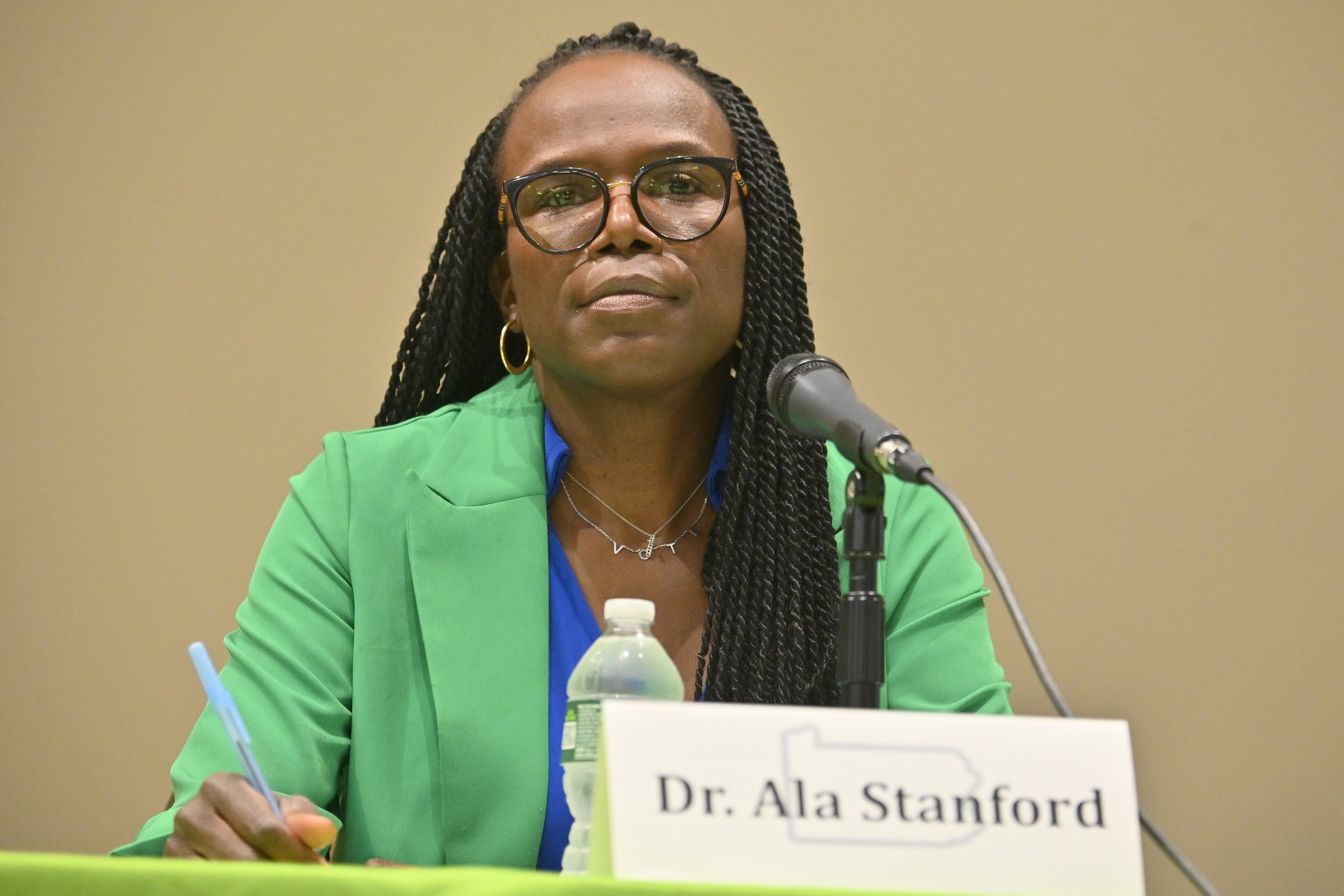
    Ala Stanford, pediatric surgeon and founder of the Black Doctors Consortium, participates in the debate for Pennsylvania’s 3rd Congressional District at Center in the Park in Germantown on Tuesday, April 14, 2026.

    Stanford’s exit from the Wednesday event meant the other two top contenders in the race, State Rep. Chris Rabb and State Sen. Sharif Street, were the only candidates to participate in the debate featured on WHYY’s Studio 2, the highest-profile live and on-air debate thus far.

    It was a relatively subdued affair compared to some of the other more gloves-off style campaign events in the open race. Street and Rabb took questions from moderators and largely agreed on policy, with both saying they support expanding universal healthcare, abolishing U.S. Immigration and Customs Enforcement, and impeaching President Donald Trump.

    The two state lawmakers sought to contrast their styles, with Street portraying himself as a more competent legislator.

    “I get things done,” said Street, the former head of the state Democratic Party. “Rep. Rabb and I share a lot of value propositions. But the difference is I deliver on ideas.”

    Rabb, a progressive who has been endorsed by the Working Families Party, said Street is too closely aligned with the Democratic establishment, and that his ideas are not bold enough.

    “There’s so many people who think we can’t do things big and bold,” he said. “They play around the edges, because that’s what establishment politics does.”

    State Sen. Sharif Street (left) and State Rep. Christopher Rabb (right) wait for the WHYY studio door to close Wednesday, April 29, 2026 before start of their debate in the Democratic primary for the 3rd Congressional District. The third leading candidate, Ala Stanford declined to attend at the last moment.

    Both candidates were also asked about Stanford’s absence and her charge Wednesday that the race has been “marred by misogynistic attacks and lies from both of my opponents.”

    Stanford, a first-time political candidate, is the only woman on the ballot.

    Rabb said he wasn’t sure what she was referring to, but pointed out that when Stanford was recently heckled by some of his own supporters during a candidates forum, he repeatedly told them to let her speak.

    And Street said he has not attacked her directly, but acknowledged that she’s faced criticisms.

    “She has been attacked. I’ve been attacked. Everybody on this campaign, I’m sure, has been attacked at some point,” he said.

    Rabb and Street said their campaigns did not negotiate with WHYY on the format of the event.

    Kevin McCorry, an executive producer and host at the station, said WHYY engaged with Stanford’s campaign “in good faith” and acquiesced to her staff members’ requests, including allowing her to have notes on the table and bring extra staffers to sit in the audience.

    He said WHYY learned that she was pulling out when Stanford’s campaign manager released a statement to reporters from multiple news outlets.

    “We were flexible with her requests,” McCorry said. “At no time did they say, ‘If X doesn’t change, we’re backing out.’”

    State Sen. Sharif Street (left) and State Rep. Christopher Rabb (right) appear in a debate at WHYY studios Wednesday, April 29, 2026 for the Democratic primary in the 3rd Congressional District. The third leading candidate, Ala Stanford declined to attend at the last moment.

    Street spokesperson Anthony Campisi accused Stanford of dropping out to avoid tough questions, adding that “her campaign is in free fall.”

    “Rather than answer these questions in a debate that’s aired on radio and television, she appears to be taking her ball and going home, which is not what Philadelphians expect from their member of Congress,” Campisi said Wednesday. “Philadelphians deserve a member of Congress who is ready to fight for them and against Donald Trump, not someone who runs from a fight.”

    Rabb said that when it comes to campaign events, he and his team “don’t negotiate, we just show up.”

    “Even if I didn’t like the format, which is not uncommon, I still show up,” he said, “because I’m a public servant and I’m a public candidate, and I got to reach people wherever they are.”

    In her statement, Stanford, a physician, noted she has taken the Hippocratic Oath “to first do no harm.”

    “I challenge everyone in this race to join me in promoting the kind of spirited, but serious and meaningful dialogue Philadelphians should expect from those asking to serve,” she said. “In the meantime, I will be where I have always been — on doorsteps, in church basements, and on the corners of the wards that built me.”

    Shaun Griffith, a tax adviser and the fourth candidate in the race, did not participate in the debate because he did not meet WHYY’s criteria, which included a fundraising threshold.

    He attended the event and sat in the audience, and said afterwards that it was “frustrating to be watching other people get to answer questions and not have the opportunity to do so myself.”

  • Supreme Court limits key provision of the landmark Voting Rights Act

    WASHINGTON — The Supreme Court on Wednesday sharply weakened a key provision of the landmark Voting Rights Act, a ruling that limits the consideration of race in drawing voting maps and could usher in Republican gains in the House.

    The decision is expected to touch off a scramble by Republicans to redraw majority-minority districts, especially in the South. New districts could shift the balance of power in Congress by imperiling the reelection prospects of some Black Democrats, possibly as soon as November’s midterms in some instances. Representatives of color in state legislatures and local offices could also be redistricted out.

    The court’s conservative majority found Louisiana unlawfully discriminated by race when it created a second majority-Black congressional district to comply with the VRA. But the court did not strike down the provision, known as Section 2, as unconstitutional, as many voting rights advocates had feared it would. Still, the court’s liberal justices and voting rights experts said it was effectively gutted.

    The ruling carries significant symbolic weight, scaling back the last major pillar of a 60-year-old law long considered one of the marquee achievements of the civil rights era. The Voting Rights Act bans discriminatory voting practices such as literacy tests and poll taxes, and has helped greatly increase minority representation in state and federal offices.

    In an ideologically divided 6-3 ruling, the conservative justices created a higher bar for the law’s powerful provision that allows states to use race to draw maps that help minority communities elect candidates of their choice. Section 2 is aimed at combating discriminatory gerrymandering that weakens the power of Black, Latino, Native American, and Asian voters.

    States must walk a careful line when drawing maps for voting districts. The Voting Rights Act directs states to consider race to some degree when redistricting to ensure that racial minority groups have an opportunity to elect representatives who reflect their priorities. Maps explicitly drawn along racial lines, however, violate the equal-protection clause of the 14th Amendment and the 15th Amendment’s ban on racial discrimination in voting practices.

    Justice Samuel A. Alito Jr. wrote the opinion for the majority, saying it was time to rework Section 2 given gains in ending racial discrimination, the use of VRA lawsuits for partisan purposes, and advances in technology that have made it easier to draw legislative districts that balance partisan interests and racial considerations.

    Alito wrote that going forward, plaintiffs would have to show that a state intentionally discriminated against a minority group in drawing a map, rather than simply showing that members of the minority group did not have the opportunity to elect a candidate of their choice when certain circumstances are met.

    “Section 2 of the Voting Rights Act … was designed to enforce the Constitution — not collide with it,” he wrote. “Unfortunately, lower courts have sometimes applied this Court’s [Section] 2 precedents in a way that forces States to engage in the very race-based discrimination that the Constitution forbids.”

    The decision came over the sharp objections of the court’s three liberals. Justice Elena Kagan delivered the dissent from the bench, signaling strong disagreement. In her opinion, Kagan lamented that in rulings over the last decade, the court’s conservative justices had carried out a “demolition” of the VRA that was now complete. She predicted a precipitous decline in minority representation in political office.

    “The consequences are likely to be far-reaching and grave. Today’s decision renders Section 2 all but a dead letter. In the States where that law continues to matter — the States still marked by residential segregation and racially polarized voting — minority voters can now be cracked out of the electoral process,” Kagan wrote, referring to the process of drawing maps that break up minority voting blocks.

    The decision continues a trend by the court’s conservative majority to roll back race-conscious efforts to redress discriminatory practices. It comes two years after another major decision to restrict race-based affirmative action in college admissions.

    The ruling lands as a nationwide redistricting war has broken out between Republicans and Democrats, both of which have taken the unusual step of redrawing district lines between censuses to try to secure partisan advantages in this year’s races for Congress. Republicans currently hold a slim majority.

    Professor Richard L. Hasen, an election law expert at UCLA, said Section 2 of the Voting Rights Act still stands but is all but eviscerated.

    “The opinion weakens application of the Voting Rights Act to make it a much weaker, and potentially toothless, law,” Hasen wrote on his blog. “It is hard to overstate how much this weakens the Voting Rights Act.”

    NAACP president Derrick Johnson said in a statement that the ruling was a major strike to minority political power.

    “Today’s decision is a devastating blow to what remains of the Voting Rights Act, and a license for corrupt politicians who want to rig the system by silencing entire communities,” Johnson said. “The Supreme Court betrayed Black voters, they betrayed America, and they betrayed our democracy. This ruling is a major setback for our nation and threatens to erode the hard-won victories we’ve fought, bled, and died for.”

    The Trump administration hailed the ruling in a statement.

    “This is a complete and total victory for American voters,” White House spokesperson Abigail Jackson wrote. “The color of one’s skin should not dictate which congressional district you belong in. We commend the court for putting an end to the unconstitutional abuse of the Voting Rights Act and protecting civil rights.”

    Louisiana Attorney General Liz Murrill called the ruling “seismic” and applauded it in a statement.

    “The Supreme Court has ended Louisiana’s long-running nightmare of federal courts coercing the state to draw a racially discriminatory map,” Murrill said.

    The complicated dispute over the Louisiana voting district has dragged on for years and had been before the court last term.

    The case began in 2022 when Black voters and civil rights groups sued Louisiana under Section 2, saying a new voting map drafted after the 2020 Census shortchanged African American voters. The map had only one Black-majority district out of six. African Americans make up one-third of the state’s population.

    A federal court ruled for the plaintiffs and ordered the state to draw a new map with a second Black-majority district. After further legal wrangling, the Louisiana legislature drafted one in 2024.

    The new map, which was drawn in part to protect the seats of Republican incumbents, including House Speaker Mike Johnson and House Majority Leader Steve Scalise, created a Black-majority district that meandered across the state from Baton Rouge to Shreveport.

    A group of self-described “non-Black voter[s]” sued, arguing the new map was an unconstitutional racial gerrymander that violated the equal-protection clause. A federal district court panel ruled for the non-Black plaintiffs and put a hold on the redrawn map.

    The Supreme Court eventually allowed the map with two Black-majority districts to go into effect for the 2024 congressional election. Voters chose Cleo Fields, a Black Democrat, for the new district.

    The non-Black voters brought their case to the Supreme Court once again. Last term, the justices decided to hold off on a ruling and asked both sides to address whether creation of the second Black-majority district violated the 14th and 15th Amendments, before taking up the case again this term.

    During arguments in October, Louisiana Solicitor General Benjamin Aguiñaga told the justices that any “race-based redistricting is fundamentally contradictory to our Constitution.” He also said that Louisiana had changed in recent decades, so the need for Section 2 had been obviated.

    “It requires striking enough members of the majority race to sufficiently diminish their voting strength, and it requires drawing in enough members of a minority race to sufficiently augment their voting strength,” Aguiñaga said. “Embedded within these express targets are racial stereotypes that this court has long criticized.”

    Kagan asked an attorney for Black voters in Louisiana what impact gutting Section 2 would have.

    “The results would be pretty catastrophic,” said Janai Nelson, the president of the NAACP Legal Defense Fund.

    “We only have the diversity we see across the South because of litigation” under the voting rights law, Nelson said, adding that it had been “crucial to diversifying leadership” in Louisiana and other states. She said no Black person has been elected to statewide office in Louisiana to date.

    The decision follows another by the Supreme Court involving Section 2 in 2023. In that case, the justices ruled Alabama created electoral maps that unlawfully diluted the power of Black residents. That ruling surprised many court watchers because the justices have chipped away at the VRA in recent years.

    In the most significant ruling in 2013, the justices struck down Section 5 of the VRA, which required states with a history of discriminating against minority voters to get changes to electoral law approved by the federal government or a judge. Most of the states covered by the provision are in the South.

    The latest ruling is likely to contribute to the uncertainty surrounding the nation’s electoral maps amid the unprecedented wave of mid-decade redistricting. Ordinarily, states redraw their lines at the beginning of each decade after the U.S. Census Bureau alerts states to population shifts.

    President Donald Trump, concerned Republicans could lose their fragile House majority, began pressing Republican-led states last summer to draw new lines ahead of the midterm elections. Republicans drew better lines for themselves in Ohio, Missouri, North Carolina, and Texas that could give them strong shots at picking up nine more seats.

    Florida Republicans are planning to carve up their districts to give their party up to four more districts, and were debating their plan on the floor of the state House when the court released its decision. Legislators approved the plan Wednesday afternoon.

    In response, voters in California approved a new map that will give Democrats up to five more House seats, and voters in Virginia approved a plan to redraw their map. The Supreme Court turned aside a challenge to the California map in February.

    The Supreme Court’s decision probably gives Republicans an opportunity to draw even more districts in their favor.

    The deadlines for most states to redraw their maps before the midterms have passed, but it is possible some states push to change those rules. Either way, the ruling could set Republicans up for advantages in 2028 and beyond. In the wake of the decision, Sen. Marsha Blackburn (R., Tenn.) called on lawmakers in her state to redraw maps to create an extra Republican seat in Memphis.

    This Supreme Court term is shaping up as a consequential one for election-related law.

    In one major case, the court will decide the constitutionality of counting mail-in ballots that arrive after an election, provided they are postmarked by Election Day. The justices also allowed a lawsuit by a Republican congressman from Illinois who is challenging the state’s mail-in ballot law.

    The justices heard arguments in December over whether to lift restrictions on parties spending money in coordination with candidates, which could be the latest chance for the court to curtail campaign finance limits.

    This article contains information from the Associated Press.

  • Trump plans to attend Wednesday’s Supreme Court hearing on his bid to limit birthright citizenship

    WASHINGTON — President Donald Trump plans to sit in on Wednesday’s Supreme Court hearing on birthright citizenship, making him the first sitting president to attend oral arguments at the nation’s highest court.

    The Republican president’s official schedule, sent out by the White House, included a stop at the Supreme Court, where justices will hear Trump’s appeal of a lower court ruling that struck down his executive order limiting birthright citizenship.

    The order, which Trump signed on the first day of his second term, declared that children born to parents who are in the United States illegally or temporarily are not American citizens. It’s an about-face from the long-standing view that the Constitution’s 14th Amendment and federal law since 1940 confer citizenship to everyone born on American soil, with narrow exceptions.

    It’s not the first time Trump has considered showing up for a high court hearing. Last year, Trump said that he badly wanted to attend a hearing on whether he overstepped federal law with his sweeping tariffs, but he decided against it, saying it would have been a distraction.

    On Tuesday, however, Trump seemed more sure he’d be in court for Wednesday’s hearing while he spoke with reporters in the Oval Office.

    “I’m going,” Trump said, when the upcoming arguments in the birthright citizenship case were mentioned. To a follow-up question clarifying that he planned to go in person, Trump said, “I think so, I do believe.”

    Trump went to the Supreme Court in his first term for the ceremonial swearing-in of the first justice he appointed, Neil Gorsuch. Two other justices he appointed — Brett Kavanaugh and Amy Coney Barrett — also sit on the court.

    Other presidents have dealt directly with the court, but don’t appear to have done so while in office. Richard Nixon argued a case between his time as vice president and president, and William Howard Taft served as chief justice after his presidency.

    Trump, asked to whom he would be listening most closely, went on a lengthy detour Tuesday describing a court he viewed as mostly partisan, between justices appointed by Republican and Democratic presidents.

    “I love a few of them,” he said. “I don’t like some others.”

    The citizenship restrictions are a part of Trump’s broader immigration crackdown, but they have not yet taken effect anywhere in the country after being blocked by several courts.

    A definitive ruling from the Supreme Court is expected by early summer.

  • There’s now a ‘Club America’ at Great Valley High School. Turning Point USA says interest grew after Charlie Kirk’s assassination.

    Making his pitch to the Great Valley school board, Jed Lu said he and fellow students seeking to bring slain conservative activist Charlie Kirk’s Turning Point USA organization into their high school weren’t racists or extremists.

    “We simply have a different perspective,” Lu told the board at a late February meeting.

    The Chester County district is one of the latest in the Philadelphia area to approve a Club America chapter — the high school offshoot of Kirk’s group. The organization seeks to mobilize “anti-woke warriors” and has rapidly been adding new local chapters since his assassination in September, provoking debate around right-wing influence in public schools.

    Nationally, chapters have nearly tripled — from 1,200 prior to Kirk’s death, to more than 3,300, according to Turning Point officials. Governors in Republican-led states like Arkansas and Nebraska are partnering with Turning Point to expand clubs throughout their states.

    In eastern Pennsylvania, there were 11 Club America chapters at the end of last school year. Now, “we’re currently approaching 40,” said Nick Cocca, Turning Point’s enterprise director.

    The group’s expansion might be overstated in the Philadelphia region. Seven area high schools listed by Turning Point on its website or Instagram graphics as having Club America chapters said they didn’t have clubs.

    Souderton Area High School, for instance, appears on Turning Point’s map, but doesn’t have a club. The school’s assistant principal, Matthew Haines, said “a student made an inquiry” in September about starting a chapter, but never applied to do so.

    In some schools, like Springfield High School in Delaware County, “we have a few students who started running an after-school student pilot a few months back,” said principal Monica Conlin, but the district doesn’t officially recognize the club. Conlin said new clubs must complete a three-year pilot before gaining district approval.

    Still, the organization has gained traction. In addition to Great Valley, Penncrest High School in Rose Tree Media School District lists Club America among its student clubs; district officials and staff didn’t respond to requests for comment.

    Turning Point says it also has a Club America chapter at Pennsbury High School, and an Instagram account for “Club America at Pennsbury” invited students to a Feb. 25 meeting to discuss the State of the Union and “participate in prayer for law enforcement and our nation.” District officials didn’t respond to requests for comment.

    ‘An outpouring of support’ after Kirk’s death

    A spokesperson for Turning Point couldn’t explain the discrepancy between its list and schools that say they don’t have any Club America chapters.

    The organization was also unable to provide a local student willing to be interviewed.

    Cocca said Turning Point “saw an outpouring of support and outreach from young people across the country” in the wake of Kirk’s Sept. 10 assassination. To support its growth, the organization is hiring more field representatives to work with high school students, Cocca said.

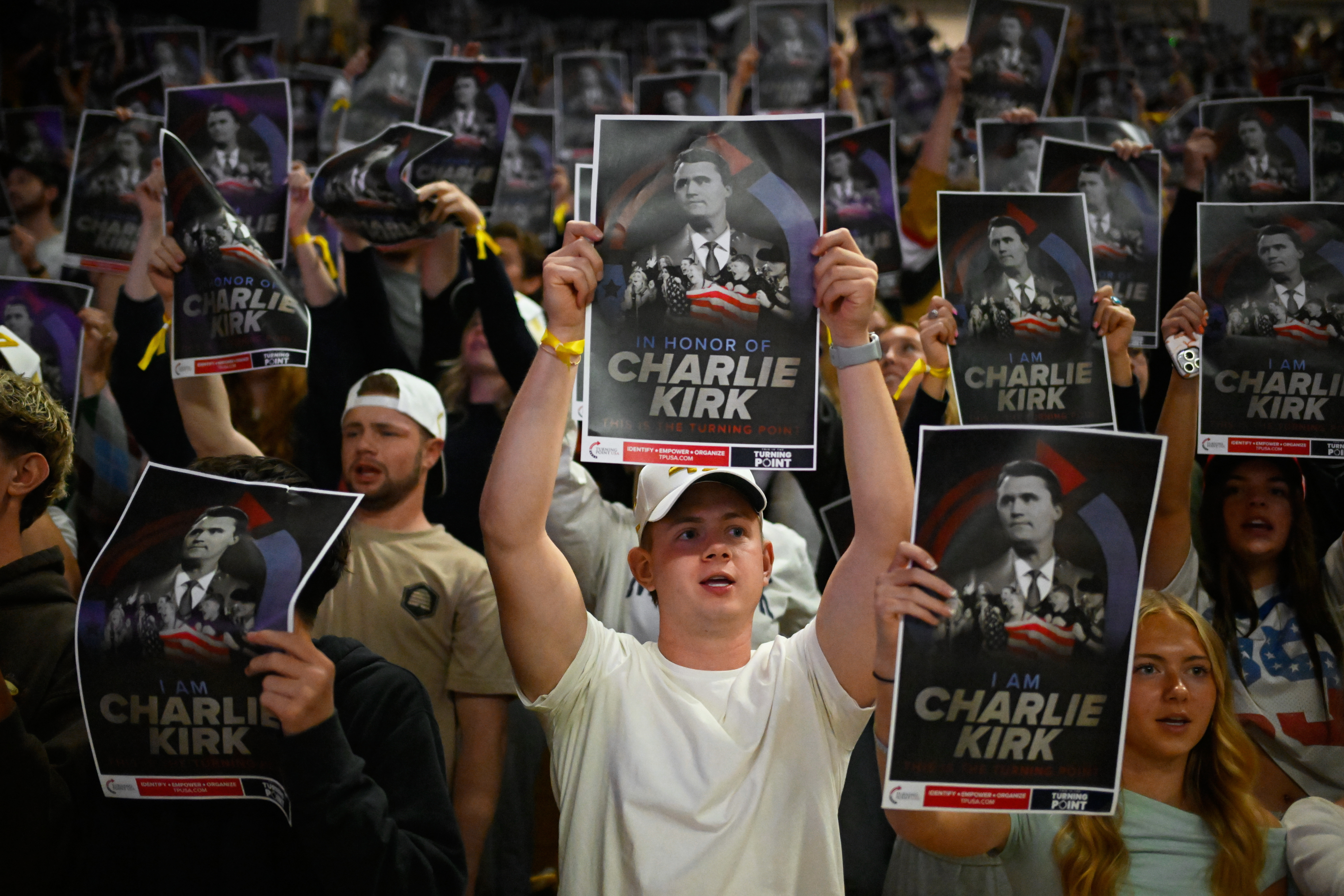
    People hold posters of Charlie Kirk during a Turning Point USA rally at Utah State University, as a part of the organization’s push to memorialize Kirk in Logan, Utah, in September.

    Turning Point, which began as an organization advocating for conservative views on college campuses, had previously been expanding its presence in high schools. (A Turning Point chapter launched years ago at Pennridge High School in Upper Bucks County, for example.)

    Turning Point last July renamed its high school operation Club America. “We wanted a brand that spoke specifically to them,” Cocca said. He said that “when Charlie was alive, he used to say ‘I want a Club America chapter in every high school in America.’”

    The expansion has spurred conflict. Critics have highlighted Kirk’s controversial statements, including referring to the Rev. Dr. Martin Luther King, Jr. as “an awful person” and calling the passage of the 1964 Civil Rights Act a “mistake.”

    Kirk also promoted the so-called “great replacement theory,” framing non-white immigration as a plot to replace white populations.

    “This club is an easy way to incorporate hate and discrimination within our high school. This should not be normalized,” a Change.org petition launched in January against a proposed Club America chapter at West Chester East High School read. An update to the petition later declared that Turning Point “was shut down at West Chester East.”

    Molly Schwemler, a district spokesperson, said that earlier this year, some students expressed interest in starting a Club America chapter.

    But “after discussing the process and need for sponsorship from a teacher with school administration,” students “instead decided to organize independently outside of the school,” Schwemler said. (On its website, Turning Point lists West Chester East as having a chapter.)

    In an Instagram post, the club said it decided to operate independently “because people can’t be mature, open minded or respectful at our school.”

    Activism hubs and kits

    In addition to identifying a teacher adviser, students looking to form clubs often have to supply information to administrators like their purpose, planned activities, and funding needs.

    Schools have little discretion to reject a new club, based on the federal Equal Access Act and First Amendment, said Jeffrey Sultanik, a solicitor for numerous Philadelphia-area districts.

    Districts need “to be viewpoint-neutral,” Sultanik said, noting that “once you open up the door to clubs coming in,” administrators can’t pick and choose which to permit.

    In its handbook for Club America chapters, Turning Point calls it “imperative that every chapter works to become officially recognized by the school,” offering students help if schools deny them.

    Students can form an “activism hub” outside of school for a specific geographic area “as a last resort,” the handbook says.

    In Downingtown — where Turning Point says there is an activism hub — a school district spokesperson said the district has not sponsored any clubs “related to religious or political groups in recent history.” (Some other area schools have official political clubs: Penncrest High School, for instance, lists Penncrest Democrats of America.)

    Turning Point says its Club America chapters are nonpartisan and don’t support specific candidates.

    But the group’s ideology is clear from materials it supplies to student members. Presentations available in Turning Point’s “Activism Library” for students to use have titles including “Taxes Are Shady,” “Socialism Kinda Sus,” and “Big Gov Scares.”

    “Why are those on the left not proud to be Americans?” a presentation titled “Always Love America” asks.

    Kids can order “Activism Kits” from Turning Point with posters and stickers. A “2A” kit features slogans like “Gun rights are women’s rights” and “Guns are the greatest equalizer.”

    Cocca said Turning Point provides students “anything they may need, to promote what they want to promote, and what they want to make their club about” — whether that’s registering students to vote, or learning about the Constitution, he said.

    “Ultimately, it’s up to the students to use those resources the way they want to use them,” he said.

    Opposition to Club America groups

    Critics accuse Turning Point of trying to indoctrinate high schoolers.

    “They are grooming at the high school level, and college level, for a generational change,” said Sherry Lawrence, a parent in Great Valley who opposed the district’s new Club America chapter. “All the red flags are there for people who don’t subscribe to this brand of conservatism, or this brand of Christianity.”

    Lawrence questioned whether adults were driving some efforts to organize Club America chapters.

    In an October Facebook post in a Turning Point Pennsylvania Action group, George Sabo, then a GOP candidate for township supervisor in East Whiteland, said his daughter was starting a chapter at Great Valley High School. “We had discussed it over the summer but pulled the trigger after Charlie’s assassination,” Sabo wrote.

    In a brief phone interview, Sabo said it was his daughter’s idea to start the chapter.

    “My daughter and family, who believe in the Bible, and believe God is king, value those properties and want to see that brought more into the school district,” Sabo said.

    He said that while there had been pushback from other kids, “there’s some support from other kids, too.”

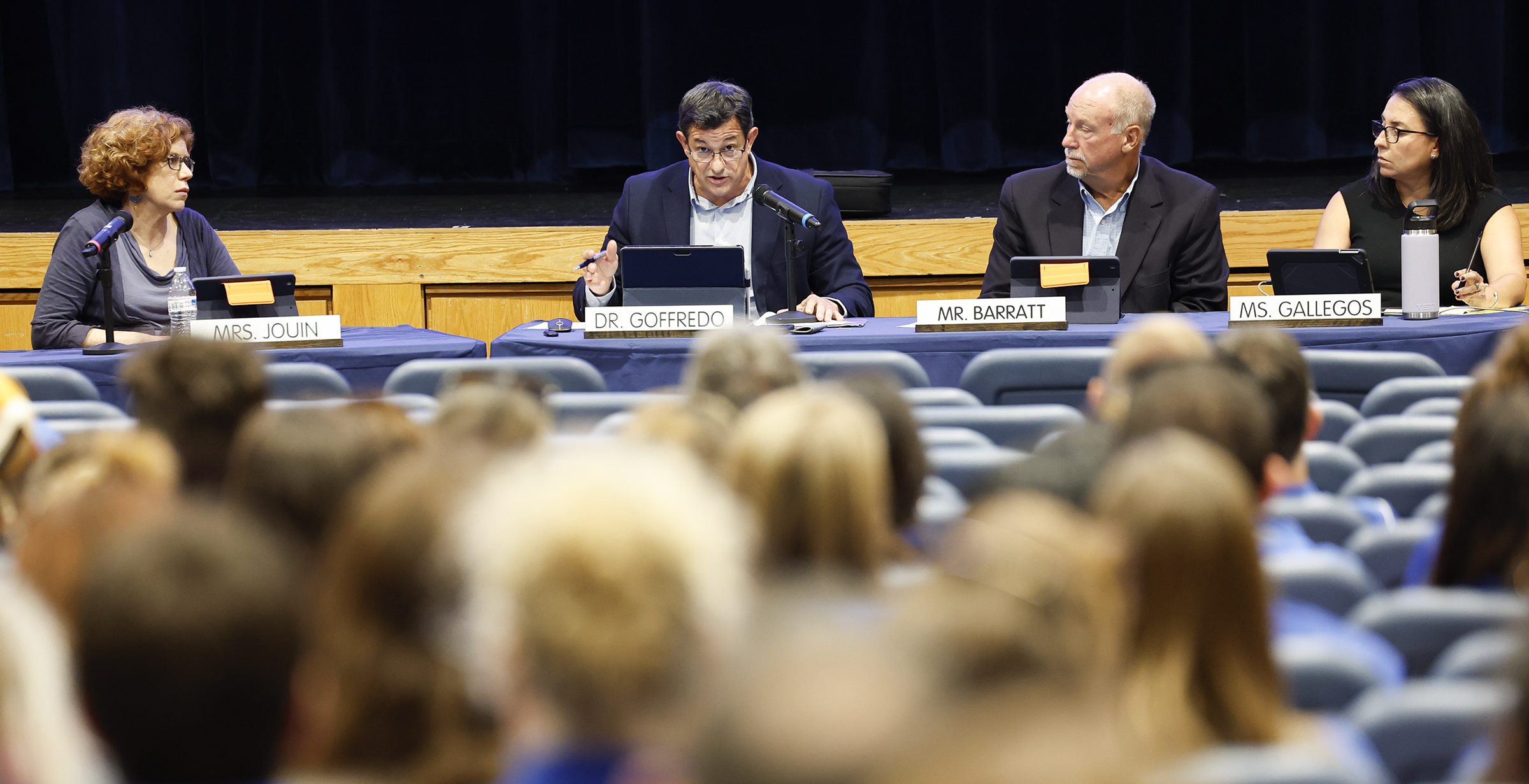
    Great Valley school board members during a meeting at Great Valley High School in Malvern in 2024.

    The Great Valley board approved the club 7-0 at its February meeting.

    At the board meeting, Lu, the club president, said he and the three other club officers had initiated its formation.

    While the club has a “conservative viewpoint,” Lu said, “our purpose is civic debate and civil discussion.” He added that the club is motivated by “the Christian value of love and compassion.”

    The club hopes to be an “impactful addition to Great Valley High School,” Lu said.

  • Kash Patel’s push against Democratic lawmaker raises concerns within FBI

    Kash Patel’s push against Democratic lawmaker raises concerns within FBI

    FBI Director Kash Patel is pressing to release a decade-old investigative file involving Rep. Eric Swalwell (D., Calif.) and a suspected Chinese intelligence operative, recently dispatching agents in the bureau’s San Francisco office to quickly redact the files before they are released publicly despite no evidence of wrongdoing by Swalwell, according to three people familiar with the effort.

    The potential release is part of the Trump administration’s aggressive push to investigate Swalwell, a vocal critic of President Donald Trump and a leading Democratic candidate for California governor, according to the people familiar with the effort. It is highly unusual for the FBI to release case files tied to a probe that did not result in criminal charges.

    As FBI director, Patel has focused on trying to bring a criminal case against the outspoken Democrat, reassigning multiple agents in San Francisco to work on the matter, the current and former officials said. FBI leaders have even discussed sending agents to China to talk to the suspected intelligence operative, believing she could have damaging information about Swalwell, according to two of the people familiar with the investigation. The people familiar with the matter spoke on the condition of anonymity to discuss an investigation that has not been made public.

    The Chinese woman at issue is Christine Fang, also known as Fang Fang, who reportedly courted Swalwell and other California politicians in the United States from 2011 to 2015. She helped with fundraising for Swalwell’s 2014 reelection campaign and even helped place an intern in his congressional office. When federal agents conveyed their concerns about Fang to Swalwell around 2015, he reportedly cut off ties with her and said he helped investigators.

    Swalwell was not accused of any wrongdoing when the FBI investigated his relationship with Fang a decade ago. In 2023, the Republican-led House Ethics Committee closed a two-year investigation into the congressman, deciding to “take no further action.”

    Despite that, FBI leaders have recently suggested in internal discussions that the government could try to arrange for Fang to get a U.S. visa in exchange for speaking with FBI agents about the Democrat, according to the three people with knowledge of Patel’s efforts. It would be highly unorthodox to grant a visa to a person suspected of being an intelligence agent for a foreign superpower.

    An FBI spokesperson disputed any notion of improper motives. “The contentions in this story are incorrect,” the spokesperson said. “This FBI, being the most transparent in history, prepares documents for numerous different reasons, including for release to different agencies and departments to further review investigations that may have been opened under previous administrations.”

    The push to publicly release the investigative files, the people interviewed said, suggests that the FBI has struggled to so far build a criminal case against Swalwell. Even if there is no incriminating evidence in the files, an extensive case file could contain revealing and personal details about Swalwell and his campaign operations.

    The lengths that Patel’s circle is going to in the bid to pursue a political foe of the president has raised alarms within the bureau, where some officials fear that releasing the files — even with redactions — could compromise law enforcement sources and investigatory methods, making it harder for the FBI to gain trust with potential witnesses.

    They also said they feared the repercussions of sending agents to the territory of an adversarial nation to dig up information on a sitting congressman. Such an interview, legal experts said, would be impossible without Chinese interference, and Fang would be considered an unreliable witness.

    “Most troubling about this is that we are now literally at war. We also face threats against the homeland,” Swalwell said in a statement to the Washington Post. “Kash Patel should be spending every moment trying to keep us safe, not scoring political points. A lot of people have bent the knee to this administration. But I will not, and neither will the people of California.”

    Rep. Eric Swalwell (D., Calif.) speaks to reporters after a campaign event on Nov. 3, 2025, in San Francisco.

    Swalwell, who unsuccessfully sought the Democratic presidential nomination in 2020, has been an unusually aggressive and colorful critic of the president, frequently criticizing the president in media interviews and on the dais as a member of the House Judiciary Committee. Swalwell also was a House “manager” — essentially, a prosecutor — in Trump’s 2021 impeachment for his role in the Jan. 6, 2021, attack on the U.S. Capitol.

    Swalwell’s district in Northern California includes a large Chinese American population. Republicans and media personalities frequently criticize Swalwell for his ties to Fang and the Chinese community, suggesting that he is improperly working with them.

    But FBI agents typically need a specific investigative reason to reopen a closed investigation. The people familiar with the probe said it is unclear how or why the FBI reopened its examination of Swalwell.

    Internal Justice Department policy has long said that law enforcement should refrain from taking any public investigatory steps against a political candidate in the 60 days before an election, to prevent even the appearance of the department using its power to sway the vote.

    The Justice Department is not legally bound to follow this rule, however, and it is unclear whether it would do so in Swalwell’s case. The California gubernatorial primary is June 2.

    In California’s primaries, the top two vote-getters, regardless of party affiliation, move on to the November general election. Two Republicans currently lead the governor’s race in recent polls, despite the state’s liberal leanings, as a large number of Democrats — led by Swalwell — split the vote. Democratic leaders hope their voters ultimately coalesce around one or two candidates, but the outcome remains uncertain.

    The investigatory files are likely to include numerous interviews with Swalwell, his aides, friends and others about the congressman’s interactions with Fang, details about his campaign and more.

    Under a long-standing legal principle, agencies do not release potentially damaging material about people against whom they were unable to build a case strong enough to take to court.

    The department recently released the investigatory files in the case of sex trafficker Jeffrey Epstein, who had been indicted on federal sex trafficking charges but had not yet faced trial before killing himself. But in that case, the department’s hand was forced by political pressure and ultimately an act of Congress.

    Republicans and Democrats criticized the Justice Department’s handling of the Epstein release, saying the rollout was disorganized with few effective systems in place to ensure that appropriate redactions were made.

    Since Trump took office, his administration has mounted an aggressive campaign to use federal law enforcement agencies to pursue his political adversaries.

    The Justice Department filed criminal cases against former FBI Director James B. Comey and New York Attorney General Letitia James, for example. A judge threw out both indictments in November, ruling that Lindsey Halligan, the prosecutor overseeing both cases, had been unlawfully appointed.

    Federal Housing Finance Agency Director Bill Pulte — a staunch Trump ally — referred Swalwell to the Justice Department for criminal prosecution over mortgage fraud allegations, but the department never indicted Swalwell. Swalwell sued Pulte, saying he unlawfully looked used his position to look through private mortgage fraud documents, but he ultimately dropped the lawsuit.

    The department is also investigating Federal Reserve Chair Jerome H. Powell over the cost of the Fed’s recent building renovations. A federal prosecutor acknowledged in a closed-door hearing this month that the department did not have evidence of wrongdoing, the Post has reported.

    Even against this backdrop, a proposal to release extensive files, send agents to China to interview a suspected intelligence operative and offer her a U.S. visa in exchange for revelations about a U.S. congressman would be extraordinary.

    Patel, who before becoming FBI director was a conservative firebrand who attacked the “deep state” and vowed to “come after” Trump’s adversaries, has long been a critic of Swalwell. In his 2023 book Government Gangsters, Patel published a list of 60 names in an appendix that has been widely viewed by Patel’s critics as a sort of enemies list. It includes Trump foes, Democrats, and FBI agents who were involved in investigations into the president.

    Swalwell was among those named by Patel, who has said that his critics are mischaracterizing the appendix by calling it an enemies list.

    At a congressional hearing last year, Swalwell asked Patel if he would recuse himself from any investigation of people on the list, and Patel said no.

  • Republicans are launching a voting bill debate that could last days or even weeks

    Republicans are launching a voting bill debate that could last days or even weeks

    WASHINGTON — Republicans are launching an unprecedented effort on Tuesday to hold the Senate floor and talk for days about a bill that they know won’t pass — an attempt to capture public attention on legislation requiring stricter voter registration rules as President Donald Trump pressures Congress to act before November’s midterm elections.

    The talkathon could last a week or longer, potentially through the weekend, as Senate Majority Leader John Thune tries to navigate Trump’s insistence on the issue and Democrats’ united opposition. Trump has urged Thune to scrap the legislative filibuster, which triggers a 60-vote threshold in the 100-member Senate, or find another workaround to pass the bill, but Thune has repeatedly said he doesn’t have the votes to do that.

    Instead, Republicans intend to make a long, noisy show of support for the legislation, which would require Americans to prove they are U.S. citizens before they register to vote and to show identification at the polls, among other things. It’s a risky strategy, with no guarantee it will be enough for Trump, who has said he won’t sign other bills until the Safeguard American Voter Eligibility Act — also known as the SAVE America Act or the SAVE Act — is passed.

    The floor debate is expected to eventually end with a failed vote. Republicans need 60 votes to advance the bill to a final vote, but they hold 53 seats, and all 45 Democrats and both independents, who caucus with the Democrats, oppose it.

    Still, the debate will “put Democrats on the record,” Thune said last week.

    Creating strict voter registration rules

    Trump says, without evidence, that Democrats can only win in the midterms if they cheat and explicitly said Republicans need the SAVE America Act to win in November. The House passed the legislation earlier this year, but the Senate turned to other issues as it became clear that Republicans didn’t have the votes to pass it.

    But Trump made clear he wasn’t satisfied and pushed the Senate to act. The Republican president has said he won’t sign other legislation, including a bipartisan housing bill backed by the White House, until the voting bill passes.

    The bill contains a slew of provisions that Trump and his most loyal supporters have pushed as part of a broad effort to assert federal control over elections. It would require voters nationwide to provide proof of citizenship when they register and to show accepted voter identification when casting a ballot.

    It would also create new penalties for election workers who register voters without proof of citizenship and require states to hand voter data over to the Department of Homeland Security so federal officials could screen for voters who are in the country illegally.

    Trump also wants new provisions added to the bill, including a ban on most mail-in ballots.

    “It’ll guarantee the midterms,” Trump said of the bill last week. “If you don’t get it, big trouble.”

    Democratic opposition to the bill is firm

    Democrats and many groups that champion voter access say there is little evidence of noncitizens voting and say the bill would disenfranchise millions of voters — including Republicans — by creating new burdens to prove citizenship.

    It is already illegal to vote if you are not a U.S. citizen, but the bill would lay out strict new rules for paperwork that people would have to present to register to vote. Opponents of the measure say those documents are not always readily available for many people.

    “There is no new problem to solve here,” said Janai Nelson, president and director-counsel of the Legal Defense Fund, a civil rights law advocacy group. “There is an apparatus already to ensure that elections are safe and secure and that only eligible voters are casting ballots in our elections.”

    Senate Democratic leader Chuck Schumer said that Democrats are not opposed to voter identification but “this is about purging the voter rolls in a massive way, so you never even get the chance to show a voter ID when you showed up to vote because you’d be knocked off the rolls.”

    Expect a show on the Senate floor

    Trump, backed by Republican Sen. Mike Lee of Utah, has pushed for a talking filibuster, which would force Democrats to talk for days or weeks to delay passage of the bill. But Thune and the larger GOP conference rejected that idea, arguing that it would end in failure after giving Democrats a stage and the opportunity to offer endless amendments, potentially adding their priorities to the bill.

    Republicans are instead taking over the floor with their own speeches, proceeding under regular order but operating outside the normal time limits that are customary when debating legislation. Democrats are expected to answer with their own procedural hijinks, potentially forcing Republicans to come to the floor at all hours for votes, meaning they will need to stay close to the Senate for the duration.

    Lee said last week that it’s unclear how it will all play out. He said he thinks Trump “understands that we need to put in an aggressive effort here.”

    “And a lot of that,” he said, “is going to have to be determined in real time as we go about it.”

    The extent of Trump’s satisfaction with the process, Lee said, “will depend on whether, in his view, we gave it everything we have.”

    On Monday night, Lee was rallying Trump’s base voters on X.

    “Once we’re on this bill,” he wrote, “we must stay on it until it’s passed into law.”