Category: National Politics

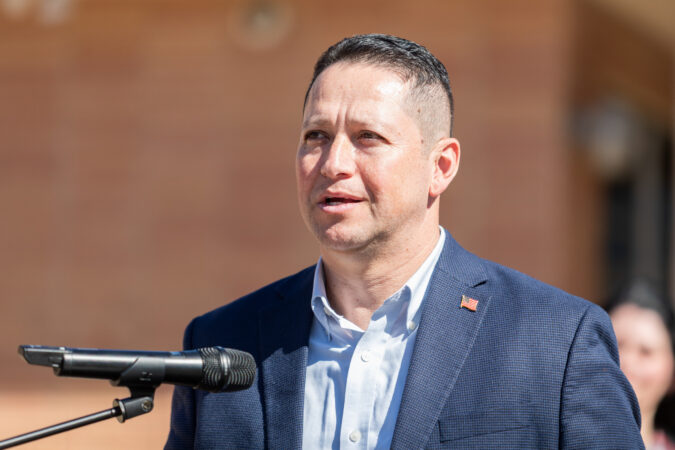
  • GOP Rep. Tony Gonzales of Texas ends reelection bid after admitting to affair with aide

    GOP Rep. Tony Gonzales of Texas ends reelection bid after admitting to affair with aide

    WASHINGTON — Republican Rep. Tony Gonzales of Texas said late Thursday he was withdrawing from his reelection race, after having admitted an affair with a former staff member who later died by suicide, but he vowed to finish out his term in Congress.

    He had faced calls from GOP leadership to end his reelection bid, and from others in Congress to resign.

    “After deep reflection and with the support of my loving family, I have decided not to seek re-election,” Gonzales said in a statement posted late Thursday to X.

    The move is the latest in a quickly changing situation that stunned Capitol Hill and resulted in a House Ethics Committee investigation into his conduct. Gonzales’ decision to bow out of the race appears to clear the field. On Tuesday, he had been forced into a May runoff against Brandon Herrera, a gun manufacturer and YouTube gun-rights influencer who narrowly lost to him in the 2024 primary.

    House Speaker Mike Johnson and the GOP leadership earlier Thursday had called on Gonzales to withdraw from reelection after Gonzales, a day earlier, acknowledged a relationship that has upturned the political world in his home state and in Washington.

    “We have encouraged him to address these very serious allegations directly with his constituents and his colleagues,” said Johnson, Majority Leader Steve Scalise, Whip Tom Emmer, and GOP Conference Chairwoman Lisa McClain in a statement.

    “In the meantime, Leadership has asked Congressman Gonzales to withdraw from his race for reelection.”

    Johnson, R-La., has been under enormous pressure from his own GOP lawmakers to take action, and several Republicans have already called for Gonzales to step aside. Rep. Anna Paulina Luna, R-Fla., has introduced two resolutions to punish Gonzales. The first seeks to remove him from his assignments on the House Appropriations and Homeland Security committees, while the second seeks to censure him.

    House Democratic Leader Hakeem Jeffries of New York, meanwhile, said he would support expelling Gonzales from the House, a rare step that requires a two-thirds vote from the chamber.

    GOP leaders notably did not call for Gonzales to resign from office as they struggle to maintain their slim majority in the House, which they hold by only a handful of seats.

    Their move came after Gonzales, appearing on the “Joe Pags Show,” was asked whether he had a relationship with the aide, Regina Ann Santos-Aviles.

    Santos-Aviles, 35, died after setting herself on fire in the backyard of her home in Uvalde, Texas. The Bexar County Medical Examiner’s Office later ruled her death a suicide.

    “I made a mistake and I had a lapse in judgment, and there was a lack of faith, and I take full responsibility for those actions,” Gonzales said.

    The congressman, now in his third term, had said he would not step down in response to the allegations, telling reporters recently that there will be opportunities for all the details and facts to come out.

    Gonzales, a father of six, first won his seat in 2020 after retiring from a 20-year career in the Navy that included time in Iraq and Afghanistan.

    In the interview broadcast Wednesday, Gonzales said he had not spoken to Santos-Aviles since June 2024. She died in September 2025.

    “I had absolutely nothing to do with her tragic passing, and in fact, I was shocked just as much as everyone else,” Gonzales said.

    Gonzales went on to say he had reconciled with his wife, Angel, and has asked God to forgive him. He also said he looked forward to the Ethics Committee investigation.

    Johnson and GOP leadership urged that committee to “act expeditiously.”

    Under House ethics rules, lawmakers may not engage in a sexual relationship with any employee of the House under their supervision.

  • More than 20 states sue over new global tariffs Trump imposed after his stinging Supreme Court loss

    More than 20 states sue over new global tariffs Trump imposed after his stinging Supreme Court loss

    WASHINGTON — About two dozen states — including Pennsylvania and New Jersey — challenged President Donald Trump’s new global tariffs on Thursday, filing a lawsuit over import taxes he imposed after a stinging loss at the Supreme Court.

    The Democratic attorneys general and governors in the lawsuit argue that Trump is overstepping his power with planned 15% tariffs on much of the world.

    Trump has said the tariffs are essential to reduce America’s longstanding trade deficits. He imposed duties under Section 122 of the Trade Act of 1974 after the Supreme Court struck down tariffs he imposed last year under an emergency powers law.

    Section 122, which has never been invoked, allows the president to impose tariffs of up to 15%. They are limited to five months unless extended by Congress.

    The lawsuit is led by attorneys general from Oregon, Arizona, California, and New York.

    “The focus right now should be on paying people back, not doubling down on illegal tariffs,” said Oregon Attorney General Dan Rayfield. The suit comes a day after a judge ruled that companies who paid tariffs under Trump’s old framework should get refunds.

    The new suit argues that Trump can’t pivot to Section 122 because it was intended to be used only in specific, limited circumstances — not for sweeping import taxes. It also contends the tariffs will drive up costs for states, businesses and consumers.

    Many of those states also successfully sued over Trump’s tariffs imposed under a different law: the International Emergency Economic Powers Act (IEEPA).

    Four days after the Supreme Court struck down his sweeping IEEPA tariffs Feb. 20, Trump invoked Section 122 to slap 10% tariffs on foreign goods. Treasury Secretary Scott Bessant told CNBC on Wednesday that the administration would raise the levies to the 15% limit this week.

    The Democratic states and other critics say the president can’t use Section 122 as a replacement for the defunct tariffs to combat the trade deficit.

    The Section 122 provision is aimed at what it calls “fundamental international payments problems.’’ At issue is whether that wording covers trade deficits, the gap between what the U.S. sells other countries and what it buys from them.

    Section 122 arose from the financial crises that emerged in the 1960s and 1970s when the U.S. dollar was tied to gold. Other countries were dumping dollars in exchange for gold at a set rate, risking a collapse of the U.S. currency and chaos in financial markets. But the dollar is no longer linked to gold, so critics say Section 122 is obsolete.

    Awkwardly for Trump, his own Justice Department argued in a court filing last year that the president needed to invoke the emergency powers act because Section 122 did “not have any obvious application’’ in fighting trade deficits, which it called “conceptually distinct’’ from balance-of-payment issues.

    Still, some legal analysts say the Trump administration has a stronger case this time.

    “The legal reality is that courts will likely provide President Trump substantially more deference regarding Section 122 than they did to his previous tariffs under IEEPA,’’ Peter Harrell, visiting scholar at Georgetown University’s Institute of International Economic Law, wrote in a commentary Wednesday.

    The specialized Court of International Trade in New York, which will hear the states’ lawsuit, wrote last year in its own decision striking down the emergency-powers tariffs that Trump didn’t need them because Section 122 was available to combat trade deficits.

    Trump does have other legal authorities he can use to impose tariffs, and some have already survived court tests. Duties that Trump imposed on Chinese imports during his first term under Section 301 of the same 1974 trade act are still in place.

    Also joining the lawsuit are the attorneys general of Colorado, Connecticut, Delaware, Illinois, Maine, Maryland, Massachusetts, Michigan, Minnesota, Nevada, New Jersey, New Mexico, North Carolina, Rhode Island, Vermont, Virginia, Washington, Wisconsin, and the governors of Kentucky and Pennsylvania.

  • Gisele Fetterman’s X and Instagram profiles are now inactive weeks after she spoke against ICE

    Gisele Fetterman’s X and Instagram profiles are now inactive weeks after she spoke against ICE

    Gisele Barreto Fetterman‘s social media accounts have been taken down after she spoke out about ICE earlier this year. Her X and Instagram accounts were both inactive as of Thursday morning.

    It was unclear on what date the two accounts were removed from the platforms, but she did use her X account to criticize the Trump administration a little more than a month ago. Her Facebook account has not been deactivated, though her last public post was in June.

    Barreto Fetterman, who had lived undocumented in the U.S. for more than a decade after emigrating from Brazil, posted about the emotional toll caused by President Donald Trump’s immigration crackdown in Minneapolis and other cities.

    “Every day carried the same uncertainty and fear lived in my body — a tight chest, shallow breaths, racing heart,” she said in a post on X in late January, the day after a Border Patrol agent fatally shot civilian Alex Pretti. In the same month, an ICE agent fatally shot civilian Renee Good and the agency detained 5-year-old Liam Conejo Ramos.

    “What I thought was my private, chronic dread has now become a shared national wound,” she added. “This now-daily violence is not ‘law and order.’ It is terror inflicted on people who contribute, love, and build their lives here. It’s devastatingly cruel and unAmerican.”

    Barreto Fetterman’s post preceded a statement from her husband, Sen. John Fetterman (D., Pa.), calling for DHS Secretary Kristi Noem to be fired in the wake of Pretti’s killing. Trump fired Noem on Thursday.

    That same week Fetterman joined fellow Democrats in blocking DHS funding in an effort to force reforms to immigration enforcement, but he has since spoken out against a proposal to prohibit Immigration and Customs Enforcement agents from masking while they perform their duties.

    The senator’s office did not comment Thursday about his wife’s social media hiatus.

    Fetterman has faced pushback online for aligning with Trump and being at odds with his party on certain issues.

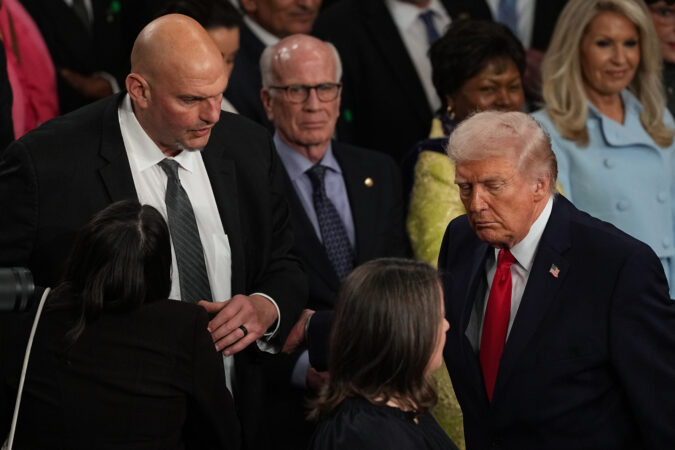
    After Fetterman stood out among Democrats for shaking Trump’s hand at the State of the Union last week, U.S. Rep. Brendan Boyle (D., Pa.) derided him as “Trump’s favorite Democrat” in a post on X. The senator in turn criticized his fellow Democrats for not standing to applaud at various moments through Trump’s marathon speech that he believed should have had bipartisan support.

    Fetterman has been vocal about the negative effects social media has had on him and has advocated for mental health warnings on social media platforms.

    This week, Fetterman was the only Democrat in the Senate to vote against advancing a war powers resolution that would have barred Trump from ordering further strikes on Iran without congressional approval.

    The Pennsylvanian has contended that military action is necessary to prevent Iran from developing nuclear weapons and had previously urged Israel and the U.S. to bomb the country.

    While Fetterman has touted his ability to work across the aisle, a recent Quinnipiac University poll found that 62% of Democratic voters in Pennsylvania disapprove of how Fetterman is handling his job (eight points higher than the percentage of Democrats who disapprove of Republican Sen. Dave McCormick).

    Barreto Fetterman has temporarily deactivated her online accounts before.

    She said in January 2024 that she had recently taken her social media down because she was “bored with it” and it “wasn’t adding anything to my life.” She had been subjected to negative comments on social media over her husband’s views, Newsweek reported.

    She previously posted in November 2023 that she was “3 weeks into a social media break that may last another month or forever,” according to news reports.

    She also said at the time that “treating someone as simply someone’s spouse is insulting and minimizing … did you know male spouses don’t get treated this way?”

    At that point, the senator had been facing pushback for his comments about the war in Gaza and his staunch support of Israel following the country’s response to Hamas’ Oct. 7, 2023, attack.

    Barreto Fetterman published a book last year called Radical Tenderness: The Value of Vulnerability in an Often Unkind World. She said in a July interview about the book on WHYY that she considers herself a “softie.”

    Barreto Fetterman is also a firefighter and runs a “free store” in Braddock, the Allegheny County town where her husband previously served as mayor. She said in the WHYY interview “every single day is a heartbreak” under Trump’s immigration crackdown.

  • A statue of a founding father who enslaved people was taken down in Wilmington. It’s moving to D.C.’s Freedom Plaza.

    A statue of a founding father who enslaved people was taken down in Wilmington. It’s moving to D.C.’s Freedom Plaza.

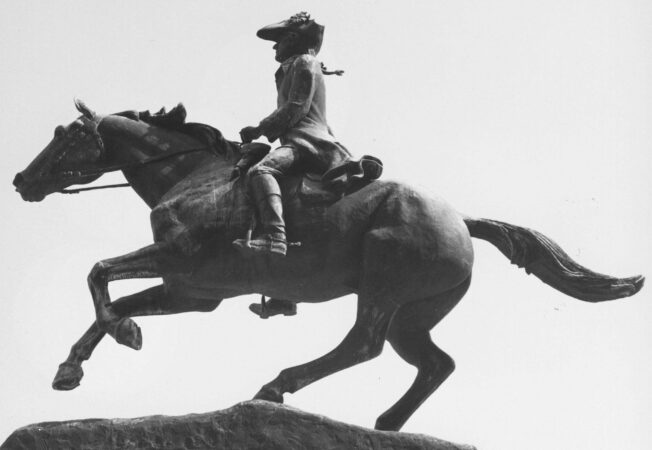
    The statue of a founding father who enslaved Black people in Delaware is moving from a New Castle storage facility to a venerated spot in Washington’s Freedom Plaza as part of President Donald Trump’s celebration of America’s 250th birthday.

    Wilmington officials took down the statue of Caesar Rodney in 2020 amid Black Lives Matter protests and a national reckoning over racism in America, taking it out of public view at the same time as the city removed a statue of Christopher Columbus for similar reasons.

    It wasn’t clear when the bronze monument of Rodney on a horse will be put on temporary display in the plaza on Pennsylvania Avenue, near the White House, according to the New York Times, which learned of the story from a Feb. 3 National Park Service memo.

    The statue had stood in Wilmington’s Rodney Square for around 100 years.

    Rodney’s legend includes a partially disputed story about riding two horses 82 miles from Dover to Independence Hall to sign the Declaration of Independence — a trip five times longer than Paul Revere’s more famous ride a year earlier.

    Rodney arrived spent and mud-spattered on July 2, 1776, to sign the Declaration before its formal adoption on July 4, breaking the tie between two other Delaware delegates, one of whom wouldn’t sign, said Dick Carter, chairman of the Delaware Heritage Commission. The near last-minute inscribing is true, Carter and others say, but it’s possible that Rodney, who suffered from facial cancer and was quite ill, may have covered some of the mileage in a carriage.

    Giving his life to public service, Rodney was a brigadier general in the Continental Army, a sheriff, a justice on the Delaware Supreme Court, and a delegate from Delaware to the Continental Congress.

    Rodney was also among the 41 out of 56 Declaration signers who enslaved people. He was a complex and contradictory figure, especially when viewed through a 21st-century lens, Carter said, adding that it is not fair to “judge historical figures by the norms and mores of the present day.”

    Rodney enslaved anywhere from 20 to 200 people on his estate near Dover. But his legacy also includes a bill he introduced in the state legislature to end the practice of importing enslaved people into Delaware. And upon his death, he freed the 18 people he’d enslaved at the time.

    Trump, during his first term in 2020, praised Rodney in a proclamation issued on the founding father’s birthday.

    In the proclamation, Trump condemned the removal of Rodney’s statue “as part of an ongoing, radical purge of America’s founding generation.”

    Trump said it was a “re-education attempt” and the “end result of an extreme anti-American historical revisionism,” generated by “critical race theorists … [and] mobs on city streets” who say that America is not an exceptional country “but an evil one.”

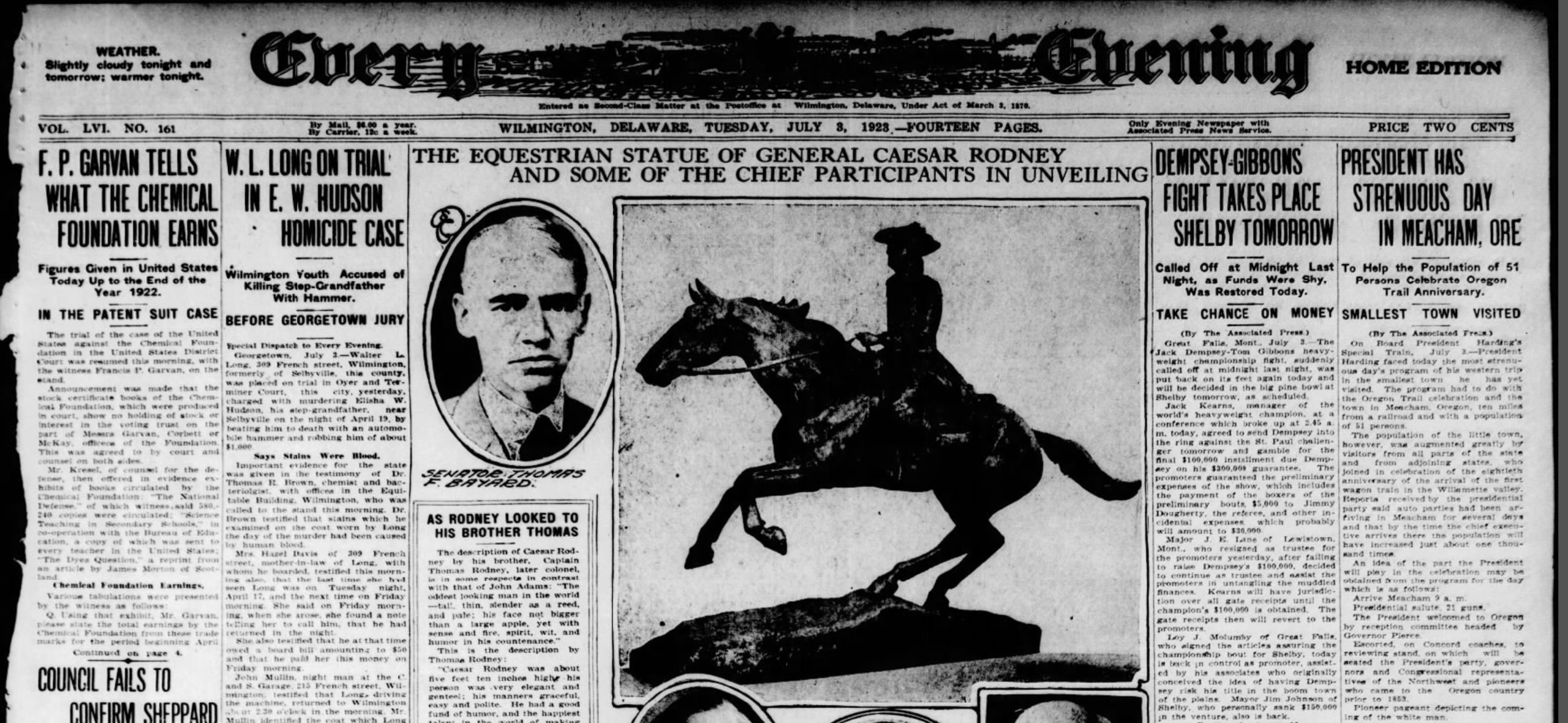
    An image of the front page of the July 3, 1923, edition of the News Journal of Wilmington, Del., which makes note of the dedication of the Caesar Rodney statue on the following day.

    Trump has expressed similar views during his second term and taken steps to change the way Americans are educated about the nation’s history.

    In January, the administration ordered the removal of exhibits depicting slavery at the President’s House in Independence National Historical Park. The U.S. Department of Interior said that the slavery-related materials were being reviewed “to ensure accuracy, honesty, and alignment with shared national values.” Last month, a federal judge ordered the exhibit’s restoration, though the administration is still pursuing the matter.

    In the summer of 2025, the administration restored two statues in the D.C. area that commemorated the Confederacy. One was a statue of Confederate Gen. Albert Pike, the only outdoor statue of a Confederate military leader in the nation’s capital.

    “We see a pattern of celebrating enslavers while reducing teaching about slavery in the United States and limiting diversity, equity, and inclusion,” said Timothy Wellbeck, director of the Center for Anti-Racism at Temple University. “Caesar Rodney has components of character not worth celebrating despite his contributions to America’s founding.”

    Shané Darby, a councilwoman from Wilmington, told the Times that glorifying Rodney was “a slap in the face of Black and brown people of this city… . You can have him, D.C.”

    That’s a view shared by other people in the Black community, said Syl Woolford, a member of the Delaware Heritage Commission. “Some folks in Wilmington are saying, ‘Get that white boy out of here,’” Woolford said. “They tell you there’s no place here for the statue of a slave owner.”

    But, he and other historians say, Rodney’s place in history shouldn’t be completely ignored. Even with the statue gone, elements of Rodney remain. He still appears on the quarter that honors Delaware. And his square continues to bear his name, although there’s discussion it’ll be renamed after President Joe Biden, whose ties to Delaware run deep, Carter said.

    The Department of Interior didn’t answer a request from The Inquirer to comment on criticism from Wellbeck and others that the Trump administration is exalting an enslaver. Instead, a spokesperson said, “Rodney’s journey itself reflected extraordinary courage.”

    “By telling the full story … we strengthen our shared understanding and ensure that future generations inherit not just the land we love, but the truth of the journey that brought us here,” the spokesperson added.

    To avoid further consternation in Wilmington, there’s a plan to send Rodney’s statue to Dover, not Wilmington, after the 250th celebration is over, said Republican State Sen. Eric Buckson.

    “Dover is Rodney’s birth and resting place,” Buckson said.

    He added, however, that “in this climate, folks are rightfully concerned about having monuments minimizing slavery.”

    So, whenever Rodney comes back, his statue will be amended, Buckson said.

    “It’ll include a plaque,” he added, “and that will have the story that, along with everything else, Caesar Rodney was a slave holder.”

  • John Fetterman is the only Democrat to vote against curbing Trump’s power to order strikes in Iran

    John Fetterman is the only Democrat to vote against curbing Trump’s power to order strikes in Iran

    U.S. Sens. John Fetterman and Dave McCormick voted Wednesday against advancing a war powers resolution that would have barred President Donald Trump from ordering further strikes on Iran without congressional approval.

    The vote came days after United States and Israel launched a missile attack on Iran, killing that nation’s supreme leader, Ayatollah Ali Khamenei. Six U.S. service members were killed in Iranian counterstrikes.

    Fetterman, who applauded Trump’s comments about Iran during last week’s State of the Union, was the lone Democrat to vote against the measure, which would require the termination of U.S. military force against Iran.

    Even before Trump ordered “Operation Epic Fury,” Democrats had pushed for a vote on a resolution to reassert congressional authority over military action.

    But Fetterman has been at odds with the rest of his party, contending that military action is necessary to prevent Iran from developing nuclear weapons.

    “Every member in the U.S. Senate agrees we cannot allow Iran to acquire a nuclear weapon. I’m baffled why so many are unwilling to support the only action to achieve that,” Fetterman said on X Monday. “Empty sloganeering vs. commitment to global security — which is it?”

    The resolution, led by Sen. Tim Kaine (D., Va.), failed 47 to 53, falling short of the required 60-vote threshold to advance in the U.S. Senate. U.S Sen. Rand Paul (R., Ky) was the only Republican to support the measure.

    The U.S. House will consider a similar measure on Thursday.

    U.S. Sen. Andy Kim (D., N.J.) compared Trump’s decision to attack Iran to former President George W. Bush’s 2003 invasion of Iraq.

    “We’ve seen this before. A president manufactures an imminent threat, chooses to start a war with unclear objectives and uses America’s resolve as an excuse for war without end because they’ve got no plan to end it,” Kim said in a Senate floor speech Tuesday in support of the resolution.

    But Kim also noted a point of contrast. Bush had obtained authorization from Congress for military force, a step Trump didn’t even try to take, Kim noted.

    “President Trump refused to make a case to the American people,” said Kim, who served on former President Barack Obama’s National Security Council.

    Lawmakers’ attempts to rein in Trump comes as the U.S. is “accelerating, not decelerating” its military efforts, Defense Secretary Pete Hegseth told reporters in the Pentagon Wednesday, CBS News reported.

    A 1973 law allows a single lawmaker to force a vote to withdraw troops or block military strikes, and it requires the president to obtain congressional authorization to commit the Armed Forces beyond 60 days.

    Both of Pennsylvania’s senators have been strong supporters of Trump’s strikes, which followed failed negotiations.

    McCormick (R., Pa.), an Army veteran and member of the Senate Foreign Relations Committee, said “the president has given the ayatollahs a chance for a deal, and they have rejected a path to peace and prosperity.”

    During the first Trump administration, the president withdrew from an agreement Obama struck with Iran intended to prevent it from developing nuclear weapons in exchange for lifting sanctions.

    U.S. Sen. Lisa Blunt Rochester (D., Del.), who voted to support the measure, said in a statement Wednesday that the Iranian government ”is a deadly one” and acknowledged the danger of the country’s nuclear capabilities.

    “But after attending the Senate briefing on Iran, it was strikingly clear that there was no rational justification for military action and no imminent threat to the United States,” she said. “This administration has failed to define its goals, explain an exit strategy, or provide any long-term plan for what comes next.”

    Her fellow Delaware Democrat, U.S. Sen. Chris Coons, also supported the resolution and this week called for Hegseth and Secretary of State Marco Rubio to appear before the national security committees to explain the lack of planning for the “protection and evacuation of Americans from their war of choice,” as U.S. citizens in the Middle East are scrambling to evacuate.

    U.S. Sen. Cory Booker (D., N.J.) said on X Saturday that Congress cannot “simply roll over” and invoked the lessons from past conflicts in the Middle East.

    “We should have learned from the last two decades of conflict in the Middle East that wars launched without clear goals and without an end-state in mind rarely end well,” he said. “They cost lives, destabilize regions, embolden adversaries, and weaken America’s moral standing.”

  • House committee votes to subpoena Attorney General Bondi to answer questions over the Epstein files

    House committee votes to subpoena Attorney General Bondi to answer questions over the Epstein files

    WASHINGTON — The House Oversight Committee voted Wednesday to subpoena Attorney General Pam Bondi to answer questions over the Justice Department’s handling of files related to the Jeffrey Epstein sex trafficking investigation.

    Five Republicans joined Democrats to support the subpoena proposed by GOP Rep. Nancy Mace of South Carolina in a sign of continued frustration with the department’s review and release of a tranche of documents regarding the disgraced financier.

    The Justice Department had no immediate comment on the subpoena.

    Former President Bill Clinton and his wife, former Secretary of State Hillary Clinton, recently sat with lawmakers on the committee for their own depositions over the former Democratic president’s connections to Epstein from more than two decades ago.

  • ‘MAGA is Trump’: President fires back at right-wing mutiny over Iran

    ‘MAGA is Trump’: President fires back at right-wing mutiny over Iran

    As President Donald Trump directs military strikes on Iran, he is also fighting online attacks at home from some of the loudest voices in his MAGA political movement.

    “This is Israel’s war. This is not the United States’ war,” former Fox News host Tucker Carlson said Tuesday on his weekly political podcast.

    “No one should have to die for a foreign country,” Megyn Kelly, another former Fox News host with a massive online following, said on her podcast Monday.

    Daily Wire podcaster Matt Walsh beseeched fellow conservatives on Monday to stop supporting Trump’s military campaign. “I can’t take the gaslighting, guys. I really can’t,” he wrote on X.

    MAGA critics of Trump’s new military conflict say they are struggling to reconcile it with his “America First” principles and long record of criticizing costly and protracted American military interventions. The president has said operations against Iran could go on for four to five weeks, or longer.

    “I think to them it feels legitimately like a betrayal on a fundamental tenet of Trumpism,” said Matthew Dallek, a professor at George Washington University’s Graduate School of Political Management.

    Trump has dismissed the idea that his critics could speak for the Make America Great Again movement: “MAGA is Trump,” he said in an interview with independent journalist Rachael Bade on Monday.

    Online infighting is common in political movements, but Dallek said the degree of open dissent among conservatives over Iran suggested it could be a “breaking point” for some of Trump’s most influential supporters. Carlson, Kelly, and Walsh together list more than 13 million subscribers among them on YouTube, with millions more on X and other platforms.

    Trump claimed that he alone spoke for MAGA after Bade asked him about the rebellion in the ranks of his supporters, according to a post she published late Monday. “MAGA wants to see our country thrive and be safe. And MAGA loves what I’m doing — every aspect of it,” he said.

    White House spokesperson Olivia Wales echoed the president’s comments in a statement to the Washington Post. “President Trump is MAGA and MAGA is President Trump,” she wrote in an email. “With Operation Epic Fury, President Trump is putting America first, eliminating the threat to our people, and securing our Nation and world for generations to come,” she added.

    Trump has made opposition to foreign military intervention a cornerstone of his political platform since he first sought the presidency. In the 2016 Republican primary, he called the Iraq War “a big, fat mistake” as he sought to tie rival Jeb Bush to his brother George W. Bush’s unpopular legacy. Running against Democrat Kamala Harris in 2024, Trump called himself “the candidate of peace,” and said in his election night victory speech: “I’m not going to start a war.”

    Stephen K. Bannon, Trump’s chief strategist for part of his first term in office, warned that turnaround could become a political problem for the president. He criticized the Iran operations after a guest on his War Room podcast over the weekend suggested the conflict could be “a hard slog.”

    “I’m just going to be brutally frank,” Bannon said. “That was not pitched in the 2024 campaign. It just wasn’t. We’re going to bleed support.”

    Whitney Phillips, a professor of information politics at the University of Oregon, said the president was severely testing his supporters’ loyalty.

    “Trump has put these people in such an impossible position,” she said. “He’s not asking them to bend a little — he’s asking them to entirely reconfigure themselves into a new kind of balloon animal.”

    Walsh, who has long urged Trump to take a hard line on immigration, transgender people, and diversity policies, is among the MAGA influencers refusing to reconfigure.

    He criticized the administration’s “confused” messaging on the justification for the Iran operation in an X post on Monday that drew a lengthy response from Trump’s press secretary, Karoline Leavitt. Her X post listed what she called the “clear objectives” of Trump’s military campaign.

    Instead of Walsh and others falling in line, an online fracas ensued. Some X users mused that Walsh might be fired by Daily Wire founder Ben Shapiro, who had opened his own podcast on Sunday by lauding the operation that killed Ayatollah Ali Khamenei. Shapiro did not respond to a request for comment. Walsh stepped up his online campaign against Trump’s strategy, taking aim at his fellow Trump supporters.

    “Conservatives are now running around saying ‘Iran has been waging war on us for 47 years,’” Walsh posted Monday on X. “Okay, then why didn’t any of you call for an attack on Iran at any point until now? … You and I both know that almost every conservative influencer in the business was opposed to war with Iran until just now.”

    Laura Loomer, a right-wing influencer who has described herself as “Trump’s loyalty enforcer,” has used her own online platform to attack critics of the war and sought to enlist Trump in hitting back at them. She posted on X that she had spoken to Trump and congratulated him, but also told him about the criticism he was receiving from Carlson, Kelly, Rep. Thomas Massie (R., Ky.) and former Rep. Marjorie Taylor Greene (R., Ga.) — a group she lumped in with “communist Democrats.”

    “I’m so glad I was able to speak to President Trump after the strikes on Iran and show him what the Woke Reich, including Tucker, Megyn, and Marjorie Traitor Greene have been saying about him,” Loomer added Tuesday. “He was not happy when I showed him, but he told me he is focused on winning and they aren’t.”

    Conservative figures opposing the war appear to be in the minority despite the attention their criticism has generated.

    An analysis by the Post of about 5,000 online posts, podcasts, and newsletters from 79 conservative politicians and commentators since the Iran conflict began last weekend showed that most supported the operation, but that more than a dozen criticized it at least some of the time. Only a few were staunchly opposed to Trump’s new military intervention in Iran.

    While Trump returned to office amid a wave of online loyalty from leading conservative voices, experts in political communication said that in just a few days the Iran attacks had begun to test the limits of his influence.

    A.J. Bauer, a professor of journalism at the University of Alabama, said the pushback has gained traction in part because the administration has struggled to articulate a clear message on Iran for the right to rally around. That has left conservative influencers to chart their own course based on their personal beliefs, their loyalty to Trump, and their assessment of the risk that the conflict becomes unpopular with MAGA voters.

    A flash poll conducted by the Post over the weekend found that Americans oppose Trump ordering airstrikes on Iran by 52% to 39%; 9% said they were unsure.

    Sam Rosenfeld, a professor of political science at Colgate University, said the influencer backlash over Iran also speaks to wider problems emerging for Trump. His approval rating was 39% ahead of last month’s State of the Union address.

    There is an “emerging sense that Trump’s centrality to right-wing politics has an endpoint in the not-so-distant future,” Rosenfeld said. “That all serves to loosen Trump’s symbolic grip on the right’s discourse.”

  • What Democrats need to do to flip Texas, and how Republicans can hang on

    What Democrats need to do to flip Texas, and how Republicans can hang on

    Texas primary voters of both parties voted with cool heads Tuesday, rejecting candidates who appealed to their parties’ bases with more inflammatory styles that could have proved riskier in a general election.

    But challenges remain for Democrat James Talarico — who won the primary outright on a unifying message of reaching out to all Texans — and for Republican Sen. John Cornyn, who nosed ahead of firebrand Attorney General Ken Paxton but now faces a punishing May 26 runoff against him.

    Democrats face an uphill battle to flip a Senate seat in the red state no matter what happens in the runoff, as they mount their long-shot bid to retake the Senate in November. The chamber is currently controlled by Republicans, 53-47, and Democrats would have to flip several deep-red states like Texas to regain control.

    The next few months will determine how well-positioned Texas Democrats are to regain a Senate seat that has eluded them for more than 30 years, as the party hopes unusually high voter enthusiasm and weariness with President Donald Trump could fuel their comeback. Talarico in the coming months must work to unite the party by attracting Black voters who strongly backed his opponent, all while fending off coming attacks from the right painting him as a radical.

    And Cornyn’s political survival may depend on the actions of someone who is notoriously hard to predict or corral — Trump. The president said Wednesday that he would soon endorse one candidate and that the other should quit the race. If he does not get Trump’s endorsement, Cornyn may struggle to clear the runoff, and either way the next few months will be a divisive slugfest between two Republicans with large megaphones.

    “We are not going to go quietly, and we are not going to let you buy the seat,” Paxton said at his election-night party in Dallas, referencing the tens of millions of dollars Cornyn and his allies poured into the race.

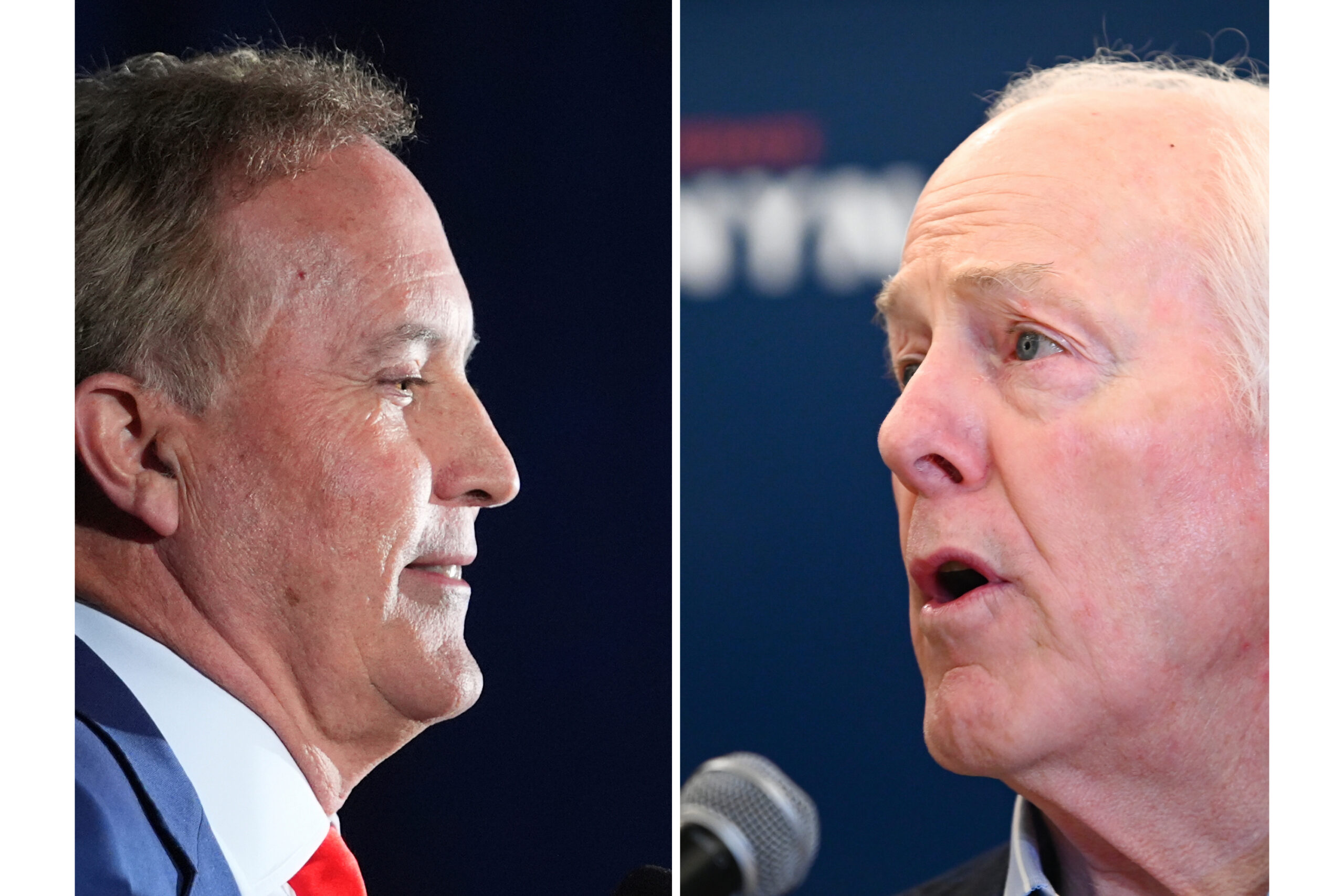
    FILE – This photo combination shows Texas Attorney General Ken Paxton, left, in Dallas and Sen. John Cornyn, R-Texas, in Austin, Texas, both on March 3, 2026. (AP Photo/Julio Cortez, Jack Myer)

    Cornyn, a fourth-term senator who is widely considered to be a stronger general-election candidate than the scandal-plagued Paxton, fell short of the 50% mark that would have avoided a runoff. Paxton was impeached by the GOP-controlled Texas House in May 2023 on charges of bribery but was acquitted by the Senate.

    Cornyn warned Paxton that “judgment” was coming for him. “I refuse to allow a flawed, self-centered, and shameless candidate like Ken Paxton to risk everything we’ve worked so hard to build,” he told reporters.

    The bitter intra-Republican warfare marked a stark contrast to the Democratic side of the ledger, where Rep. Jasmine Crockett set aside her earlier attacks on Talarico — and a legal challenge she filed Tuesday after voters were turned away from polling places in her Dallas district — and urged Democrats to come together Wednesday.

    “Texas is primed to turn blue and we must remain united because this is bigger than any one person,” Crockett wrote in a social media post.

    Talarico also urged unity, telling his supporters Tuesday, “The stakes in Texas are too high for division.”

    Mudslinging in the final weeks of the race may have caused some damage that Talarico will need to repair ahead of November, however. Crockett called the argument that Talarico was more electable than her a “dog whistle” and slammed him for not condemning ads run by a super PAC that supported him as “straight-up racist.” (Talarico does not control the super PAC, and the group denied darkening Crockett’s skin in an ad.)

    Crockett ran strong with the state’s Black voters, while Talarico appeared to run away with the Latino vote in the state. He beat Crockett by 30 percentage points or more in 21 counties that are more than 75% Latino. In counties that were 20% or more Black, Crockett won by 25 percentage points.

    Nancy Zdunkewicz, a Texas Democratic pollster, said she believed that much of the Crockett-Talarico tensions played out online rather than on the campaign trail and that the primary electorate was not divided.

    “She has conceded graciously, and I don’t want to overstate any damage done simply because of the social media dialogue, which was unnoticed by voters,” she said.

    Former Vice President Kamala Harris, who backed Crockett in the final days of the race, urged voters to unify. “I congratulate James Talarico for his win, and the inspiring campaign he continues to build,” she said in a statement. “I offer him my full support in the months ahead.”

    Republicans have a while to go before they can start their postprimary healing process, a delay that could dampen enthusiasm in November. It is also unclear whether Republicans will continue to vote with their heads instead of their hearts in May by backing Cornyn. Runoffs tend to feature a smaller, more intense group of voters compared with regular primaries, which could benefit Paxton. And it remains an open question whether Trump will support Cornyn, a nod that could put him over the top.

    Political analysts also do not know if the roughly 13% of Republicans who voted for GOP Rep. Wesley Hunt, who failed to make the runoff, will show up again in May and, if so, which candidate they would favor.

    Cornyn’s allies have warned the president that should Paxton be their nominee, the party would have to spend $200 million to get him over the finish line — a haul that would take away from other competitive Senate races Republicans are defending in Maine, North Carolina, and Ohio. Paxton historically has not been a strong fundraiser, and Democrats have nominated Talarico, whom they see as a stronger candidate than Crockett in the general election and who may take more resources to beat.

    Cornyn has Trump-connected allies on his side as they make this pitch, including Trump’s former campaign manager Chris LaCivita, who is running his super PAC, and Trump pollster Tony Fabrizio.

    Republicans in the state are sounding the alarm about record-breaking primary turnout for Democrats, which they see as a signifier of high enthusiasm going into November. Ross Hunt, a Republican pollster, called the turnout “a code red alert for Texas Republicans” in an analysis he published earlier this week. He predicted Democrats have added more than 480,000 voters to their turnout in the fall.

    “Republicans will need to do everything right this fall: we will need to select the best nominees for the General Election, maximize GOP turnout, practice intense message discipline, and have a clear-eyed and dispassionate understanding of where the new front line of defense stands after March 3rd,” he wrote.

  • Rep. Gonzales faces ethics investigation over allegations of affair with aide

    Rep. Gonzales faces ethics investigation over allegations of affair with aide

    The House Ethics Committee will investigate allegations that Rep. Tony Gonzales (R., Texas) had an affair with a former staff member who later died after setting herself on fire, the committee said Wednesday, ensuring that the scandal that has dogged Gonzales through his bitter primary race will continue to factor heavily as he heads into a runoff.

    An investigative subcommittee will look into allegations Gonzales “engaged in sexual misconduct towards an individual employed in his congressional office” and “discriminated unfairly by dispensing special favors or privileges,” Rep. Michael Guest (R., Miss.), chair of the Ethics Committee, wrote in a letter Wednesday.

    Under House rules, lawmakers are not permitted to engage in sexual relationships with staff.

    Gonzales, a married father of six, has been accused of having an improper relationship with a then-aide, Regina Ann Santos-Aviles, who died in September after lighting herself on fire in her backyard. Her death was ruled a suicide.

    Since then, the former aide’s estranged husband has shared text messages that showed Gonzales pressing Santos-Aviles for a “sexy pic” and asking her about her favorite sex position. Santos-Aviles pushed back against the lawmaker, writing, “This is going too far boss,” at one point in the May 2024 conversation.

    Gonzales recently declined to say whether the messages are authentic.

    Gonzales has denied any wrongdoing or improper relationship with Santos-Aviles, and he adamantly refused calls to resign from Congress or to end his reelection bid — several of which came from his Republican colleagues.

    Representatives for Gonzales’ office did not immediately respond to requests for comment Wednesday.

    House Speaker Mike Johnson (R., La.), who is holding onto a razor-thin majority in the House, has called the accusations against Gonzales “very serious” but not called on Gonzales to step aside, saying the issue would “play out” in his reelection bid.

    Gonzales on Tuesday fell short of the majority vote required to avoid a runoff. Now he will face off against the other top finisher in the GOP primary, Brandon Herrera, a YouTuber with a gun business who calls himself “the AK Guy.” Herrera maintained a narrow lead Wednesday morning with most of the votes counted.

    The Office of Congressional Conduct, a nonpartisan office governed by a board of private citizens, had begun looking into allegations against Gonzales in November, according to the San Antonio Express-News, and it was required to refer the matter to the House Ethics Committee by Wednesday for either further review or dismissal.

    Under House rules, the Ethics Committee has up to 90 days to release the OCC’s report — unless it creates an investigative subcommittee, as it has this time, in which case it still must release the OCC’s findings within a year. Members of the investigative subcommittee have not been selected yet, Guest said Wednesday, suggesting findings of the investigation will not be made public very soon. There is no timeline for Ethics Committee investigations, which can take months.

    Rep. Nancy Mace (R., S.C.), one of the GOP lawmakers who has called on Gonzales to resign, introduced a resolution last week that would compel the Ethics Committee to release, within 60 days of adoption, all reports related to sexual harassment violations involving lawmakers, their staff members, or lobbyists.

    “I mean, literally, [Santos-Aviles] killed herself in the most heinous way,” Mace told Fox News on Tuesday, referring to the Gonzales allegations that she said had motivated her to introduce the bill. “She literally lit herself on fire and died, and we’re just going to sit here and say, ‘Let the process play out’? No.”

    Voters do not always punish scandals, and this was apparent Tuesday night in other Texas primary races. Rep. Henry Cuellar (D., Texas) handily defeated a primary challenger, despite being charged in 2024 with bribery, money laundering, and conspiracy and being pardoned by President Donald Trump last year.

    Texas State Attorney General Ken Paxton, who faced a lengthy impeachment trial and a very public divorce in which his wife accused him of adultery, nevertheless will head into a runoff against Sen. John Cornyn (R., Texas) for his seat after neither captured a majority of the vote Tuesday.

  • Senate to vote on forcing Trump to end Iran strikes; John Fetterman says he’ll oppose it

    Senate to vote on forcing Trump to end Iran strikes; John Fetterman says he’ll oppose it

    The Senate is scheduled to take an initial vote Wednesday on blocking President Donald Trump from ordering further strikes on Iran, offering the first test of Congress’s support for a campaign that Trump launched without its consent.

    Democrats — along with Sen. Rand Paul (R., Ky.) — are forcing a vote on a war powers resolution over the opposition of most Republicans, who control the Senate. Democrats are imploring a handful of Republicans to break with their party to end the conflict and reassert Congress’s control over declaring war.

    At least four Republicans besides Paul would need to support the resolution for it to pass if every senator is voting. One Democrat, Sen. John Fetterman of Pennsylvania, has said he will oppose it.

    “I pray so hard for my colleagues to exercise the judgment that this is not the right time for more war,” Sen. Tim Kaine (D., Va.) said Monday on the Senate floor.

    But the resolution faces tough odds.

    Congress has voted on seven other war powers resolutions since June, all of which failed. Most Republicans support the U.S. and Israeli air campaign that started Saturday, which has killed Ayatollah Ali Khamenei and other top Iranian leaders, and they are working to defeat the resolution.

    “We should let him finish the job,” Sen. Lindsey Graham (R., S.C.) told reporters, referring to Trump. “We should cheer him on, in my view.”

    The House is set to vote Thursday on a similar war powers resolution, which Speaker Mike Johnson (R., La.) said he believes he has the votes to defeat.

    “The idea that we would take the ability of our commander in chief … to finish this job is a frightening prospect to me,” Johnson told reporters. “It’s dangerous, and I am certainly hopeful — and I believe we do — have the votes to put it down.”

    Even if the resolution passes the Senate and the House, Trump could veto it. Overriding Trump’s veto would require a two-thirds majority in both chambers. No war powers resolution has ever overcome a veto.

    The Senate vote Wednesday is an initial procedural vote to advance the resolution, and any Republicans who support it could still oppose its final passage.

    That’s what happened in January, when five Republicans — Sens. Lisa Murkowski of Alaska, Susan Collins of Maine, Josh Hawley of Missouri, Todd Young of Indiana, and Paul — voted with Democrats to advance the resolution blocking strikes on Venezuela. But Hawley and Young flipped days later after Trump wrote on social media that they “should never be elected to office again,” though they extracted some concessions.

    Democrats wanted to force a vote on the Iran resolution before the strikes, which Kaine said last week would increase its odds of passing. But they did not do so, in part because negotiations between the Trump administration and Iran were still underway.

    Some Democrats have compared Trump’s strikes on Iran to the Iraq War, although President George W. Bush sought and received authorization from Congress before the U.S. invasion in 2003. Trump has not asked for authorization to strike Iran.

    “I pray that my colleagues will vote to end this dangerous and unnecessary war that has already resulted in the loss of six servicemembers and injured others,” Senate Minority Leader Chuck Schumer (D., N.Y.) said in as statement. “We owe it to those in uniform, their families, and all Americans to not make the same mistakes that we made in Iraq and Afghanistan.”

    The U.S. invaded Afghanistan in the aftermath of the Sept. 11, 2001, attacks and occupied the country for nearly 20 years. While U.S. forces succeeded in killing Osama bin Laden, the architect of the attacks, in Pakistan in 2011, they never defeated the Taliban, which had sheltered bin Laden. The Taliban overthrew the American-supported Afghan government weeks before U.S. forces withdrew and remains in power.

    The War Powers Resolution, which Congress passed in 1973 in response to the Vietnam War, allows a single lawmaker to force a vote to withdraw U.S. forces from a conflict or to block strikes when hostilities are imminent. It also requires the president to withdraw forces after 60 days — or 90 days if the president seeks an extension — unless Congress declares war or authorizes the use of military force.

    Senate Majority Leader John Thune (R., S.D.) said Tuesday that he does not believe the Trump administration needed to seek authorization to continue the Iran campaign even if it lasts for longer than 90 days.

    “I think the president has the authority that he needs to conduct the activities, the operations that are currently underway there,” Thune told reporters.

    Secretary of State Marco Rubio, Defense Secretary Pete Hegseth, and other administration officials held briefings for lawmakers Tuesday, which Sen. Chris Murphy (D., Conn.) said convinced him that the campaign could last a long time.

    “I think they have contempt for Congress,” Murphy told reporters. “They have no plans to come to Congress for any authorization, even if they were to insert ground forces.”