Category: National Politics

  • Trump raises the possibility of a ‘friendly takeover of Cuba’ coming out of talks with Havana

    Trump raises the possibility of a ‘friendly takeover of Cuba’ coming out of talks with Havana

    WASHINGTON — President Donald Trump said Friday that the U.S. is in talks with Havana and raised the possibility of a “friendly takeover of Cuba” without offering any details on what he meant.

    Speaking to reporters outside the White House as he left for a trip to Texas, Trump said Secretary of State Marco Rubio was in discussions with Cuban leaders “at a very high level.”

    “The Cuban government is talking with us,” the president said. “They have no money. They have no anything right now. But they’re talking to us, and maybe we’ll have a friendly takeover of Cuba.”

    He added: “We could very well end up having a friendly takeover of Cuba.”

    Trump didn’t clarify his comments but seemed to indicate that the situation with Cuba, a communist-run island that has been among Washington’s bitterest adversaries for decades, was coming to a critical point. The White House did not respond to requests for more information Friday.

    The president also said that Cuba “is, to put it mildly, a failed nation” and “they want our help.”

    His remarks came two days after the Cuban government reported that a Florida-registered speedboat carrying 10 armed Cubans from the U.S. opened fire on soldiers off the island’s north coast. Four of the armed Cubans were killed, and six were injured in responding gunfire, according to Cuba’s government. One Cuban official also was injured.

    Cuba has been on Trump’s mind since at least early January, after U.S. forces ousted one of Havana’s closest allies, Venezuela’s socialist President Nicolás Maduro. Trump suggested in the aftermath of that raid that military action in Cuba might not be necessary because the island’s economy was weak enough — particularly in the absence of oil shipments from Venezuela that stopped after Maduro was taken into custody — to soon collapse on its own.

    “We’ve had a lot of years of dealing with Cuba. I’ve been hearing about Cuba since I’m a little boy. But they’re in big trouble,” he said Friday.

    Then, noting the exile community from the island living in the U.S., Trump said there could be something coming that “I think [is] very positive for the people that were expelled, or worse, from Cuba and live here.” He did not elaborate.

    The U.S. has maintained a strict trade embargo on Cuba since 1962, the year after a failed, CIA-sponsored invasion of the island at the Bay of Pigs. Trump nonetheless indicated earlier this month that talks with Cuban officials were underway.

    Cuba’s government confirmed earlier this week that it was communicating with U.S. officials following the shooting of the American boat. Rubio has said the U.S. Department of Homeland Security and Coast Guard are investigating what happened.

    An executive order that Trump signed in late January pledged to impose tariffs on countries providing oil to Cuba, threatening to further cripple a country already plagued by a deepening energy crisis, though U.S. authorities have since indicated that oil from Venezuela can be sold to Cuban interests in some cases.

    Carlos Fernández de Cossío, Cuba’s deputy foreign minister, posted, then later deleted on Friday that “the US maintains its fuel embargo against Cuba in full force, and its impact as a form of collective punishment is unwavering.”

    “Nothing announced in recent days changes this reality,” he wrote on X before the post was removed. “The possibility of conditional sales to the private sector already existed and does not alleviate the impact on the Cuban population.”

    Meanwhile, 40-plus U.S. civil society organizations sent a letter to Congress on Friday asking that it “press the Trump administration to reverse its aggressive policy towards Cuba” and saying that efforts to cut oil shipments to the Caribbean island would spark a humanitarian collapse.

    Signees included the Alliance of Baptists, ActionAid USA and the Presbyterian Church.

    “Policies that deliberately impose hunger and mass hardship on millions of civilians constitute a form of collective punishment, and as such are a grave violation of international humanitarian law,” the letter reads.

  • Slavery exhibits at President’s House on Independence Mall could be permanently restored under new bill from Brendan Boyle

    Slavery exhibits at President’s House on Independence Mall could be permanently restored under new bill from Brendan Boyle

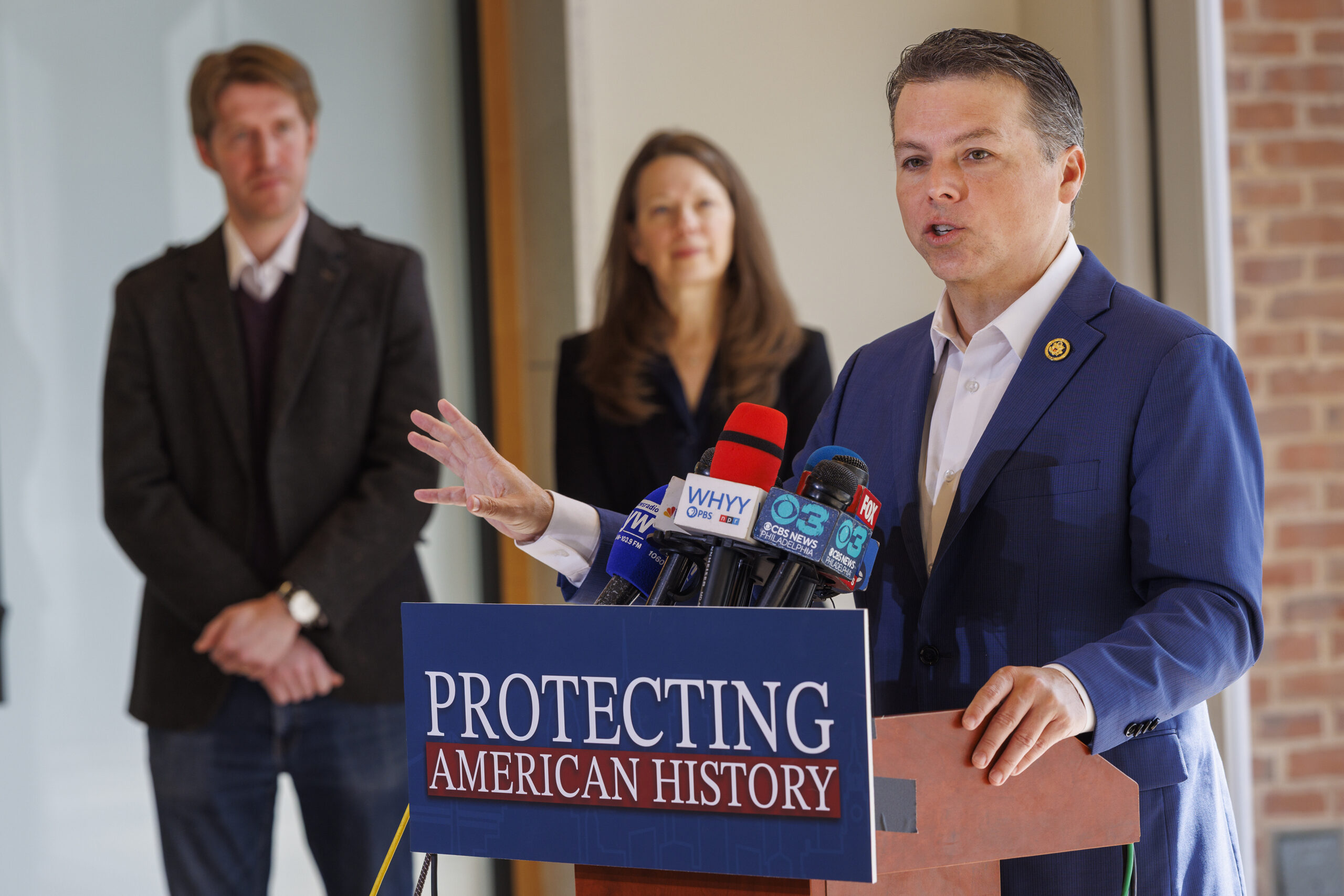
    U.S. Rep. Brendan Boyle (D, Philadelphia) announced legislation Friday that would permanently restore all exhibits to the President’s House Site that were removed by the Trump administration in January.

    The proposed Protecting American History Act comes as the future of the President’s House, which memorializes the nine people George Washington enslaved in Philadelphia, remains in limbo as a legal battle between the City of Philadelphia and the federal government continues to play out.

    “It is only dictatorships and communist countries that whitewash their history and give an official version, rather than the accurate version,” Boyle said during a news conference Friday. “Frankly, the most American thing in the world is to discuss and debate our nation’s history. It improves who we are as a people and where we’re going.”

    The National Park Service last month removed educational panels from the site under President Donald Trump’s executive order forbidding displays at national parks that “inappropriately disparage Americans past or living.”

    Some of that material was restored last week after a judge ruled in favor of the city, but those efforts were paused by a federal appeals judge while considering the Trump administration’s motion for a stay. The appeal of the lower federal court’s injunction that ordered them to restore the displays is also underway.

    “Court decisions alone are not enough… History should not depend on the whims of one federal judge. This issue is bigger than just one exhibit, as important as it is. This is about the history of our entire nation and our people,” Boyle told reporters Friday at the Independence Visitor Center.

    With Independence Hall towering behind him, Boyle said the bill calls for restoring all historical exhibits at the park, including the President’s House, to its status on Jan. 21, the day before the displays were taken down. It will also shield all historical displays at Independence National Historical Park, which Boyle’s district includes, from any future government censorship.

    The President’s House opened in 2010 after years of advocacy by local Black leaders. It juxtaposes the cruelty of slavery against the nation’s founding ideals.

    Michael Coard, an attorney and leader of Avenging the Ancestors Coalition, which helped shape the President’s House, said in a statement that his group is looking forward to working with Boyle on the legislation and will reach out to both Democratic and Republican lawmakers.

    “From day one, we have said this is not a partisan issue,” Coard said in a statement. “This is an American issue. The full history of our nation deserves to be told without censorship or political interference.”

    U.S. Rep. Brendan Boyle announces legislation called the Protecting American History Act at the Independence Visitor Center, Friday, Feb. 27, 2026.

    U.S. Reps. Dwight Evans and Mary Gay Scanlon, who also represent parts of Philadelphia, are the lead cosponsors on the legislation.

    The Democrats also joined Boyle last month in writing to Interior Secretary Doug Burgum and Acting National Park Service Director Jessica Bowron seeking answers about the President’s House by Jan. 30. As of Friday, the Trump administration officials had yet to respond, Boyle said.

    Boyle said that he has discussed this bill with Republican colleagues in the House, and they have expressed support, but it’s uncertain whether those lawmakers will publicly support his bill or whether it’ll receive a vote in the GOP-controlled chamber.

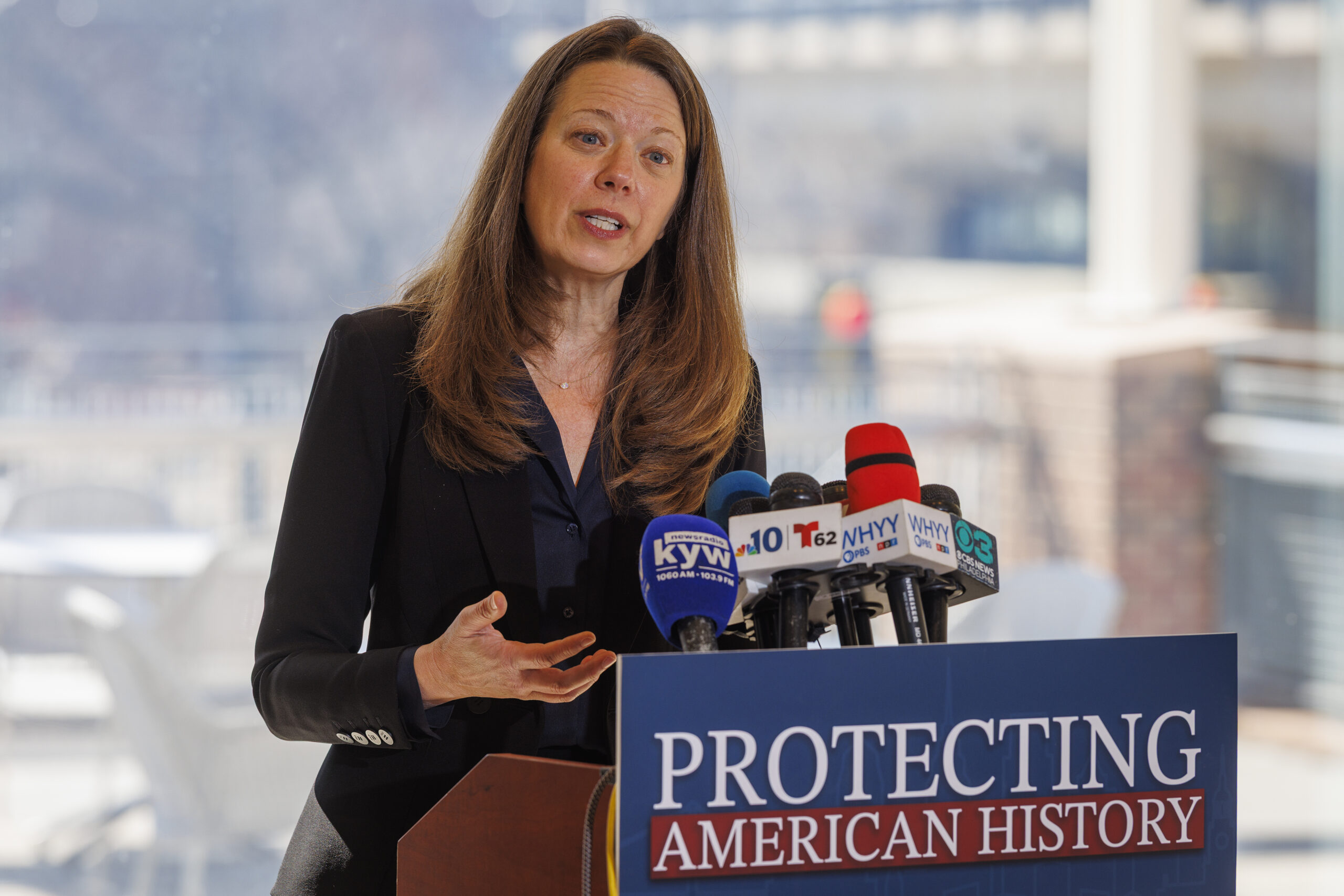
    In addition to lawmakers, Boyle’s bill is supported by the Rev. Beth Hessel, executive director of the Athenaeum of Philadelphia, a historic membership library, and Sean Connolly, executive director of Arch Street Meeting House, a Quaker historical site.

    Hessel and Connolly are two of the many Philadelphians who have joined the growing community activism to help preserve the story of the President’s House.

    Rev. Dr. Beth Hessel, executive director of the Athenaeum of Philadelphia, speaks in support of legislation from U.S. Rep. Brendan Boyle that would restore exhibits at the President’s House.

    The legislation focuses solely on Philadelphia, but the hope is, Boyle said, that it can serve as a model for other lawmakers throughout the country as the Trump administration attempts to rewrite history ahead of the nation’s 250th anniversary.

    Other historic sites and national parks have also had educational material removed in recent weeks, including the Grand Canyon, where the National Park Service took down signage about the mistreatment of Native Americans.

    Boyle said the present day is almost a full-circle moment from the country’s founding, comparing Trump to King George III.

    “Almost exactly 250 years ago, our founders were dealing with an out-of-control, dictatorial ‘Mad King.’ They opted on the side of honesty and truth and idealism… it is toward that more perfect union you still strive today.”

  • ‘Our heroes are dying.’ Why Jesse Jackson’s death leaves a void.

    ‘Our heroes are dying.’ Why Jesse Jackson’s death leaves a void.

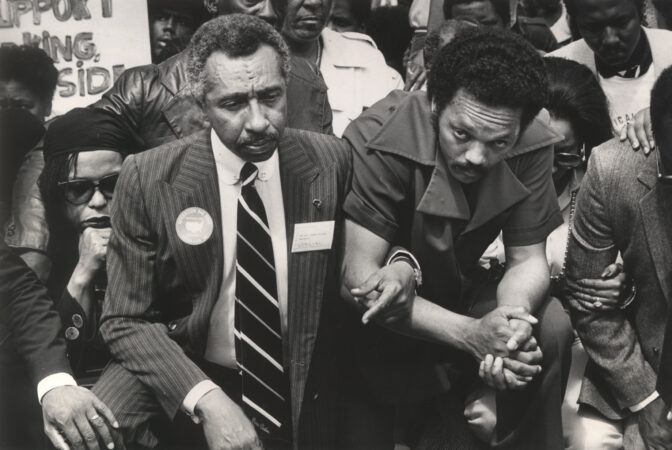
    In the early-morning hours after the Rev. Jesse Jackson died on Feb. 17, his family called another prominent pastor for prayer and solace. “A mighty lion has passed,” Bishop William Barber recalled the family saying.

    “I’ve been thinking about that imagery,” said Barber, who leads Repairers of the Breach, an organization that aims to bring moral and religious language to causes such as safeguarding voting rights and alleviating poverty. “Because lions, they protect the pride, but they also expand the territory of the pride.” And Jackson expanded the notion of civil rights in America, he said: from the Black community to the full spectrum of people seeking justice.

    Thousands are expected to pay respects Friday as Jackson’s remains lie in repose at Rainbow/PUSH headquarters in Chicago, following the decision by House Speaker Mike Johnson (R., La.) to decline to allow Jackson to lie in honor at the U.S. Capitol.

    Jackson’s death at age 84 comes at a perilous time for the civil rights crusade he helped lead for decades. Most of his iconic contemporaries are gone as President Donald Trump attacks their hard-fought principles, declaring war on diversity, equity, and inclusion initiatives while the foundational achievement of the civil rights movement, the 1965 Voting Rights Act, may be on the verge of being overturned by the U.S. Supreme Court.

    “Our heroes are dying, and the question has to be asked: Who comes next or what comes next?” said author and political commentator Bakari Sellers. “This new era of regression, this new era of Trumpism, has shown clearly that … our new leaders [are] not able to meet the moment.”

    It’s a major test of the movement in a fragmented landscape of social media and political division with no clear successor generation to rally a response. The wellspring that produced leaders such as Jackson and the Rev. Dr. Martin Luther King Jr. — the Black church — no longer plays the same role. Institutional religion doesn’t have the authority or power it once did in the United States, experts said, and the religious right for decades has been more loudly — and successfully — merging its view of Christianity and politics.

    “The Black church isn’t as important as it was. It’s harder to have a figure come out of that tradition and command the power and respect that Jesse Jackson did,” said Claflin University historian Robert Greene II. “It’s hard to imagine someone today being able to enter the political realm already seen as a moral authority.”

    If there is to be a robust defense of civil rights, many believe it will come from Jackson’s legacy of expansion — using the Voting Rights Act to get more people of color into voting booths and into elected office; broadening the definition of civil rights to include all marginalized communities, such as LGBTQ people and people with disabilities, in a common cause; and pushing beyond political rights to economic rights.

    In some ways, the fact that there is no obvious individual to take the mantle is part of Jackson’s legacy, say civil rights activists, elected leaders and scholars. He advocated for leaders at all levels of government and activism carrying out different parts of the mission.

    “We have democratized leadership in the civil rights movement and spread it throughout the country,” Virginia lawmaker Don Scott said.

    Scott said his own life found a new purpose when he was a college sophomore in 1984 and met Jackson, who was running for president. Forty years later, Scott became the first Black person elected speaker of the Virginia House of Delegates.

    “That’s the legacy of Jesse Jackson — he empowered a whole lot of folks to lift up their voice,” Scott said.

    Bryan Stevenson, a lawyer and founder of the Equal Justice Initiative, said it’s important to remember the historical arc of the civil rights movement. After the Civil War, Black men had a brief moment when they were able to participate in democracy. Then Jim Crow swooped in and disenfranchised Black voters in the South for more than half of the 20th century.

    During that time, without access to elected office, Black Americans looked elsewhere for leadership and resistance. Black churches filled that void, giving rise to the civil rights movement, Stevenson said, exemplified by King and other figures — such as Claudette Colvin, John Lewis and Fannie Lou Hamer — who blended the tone of the pulpit with politics.

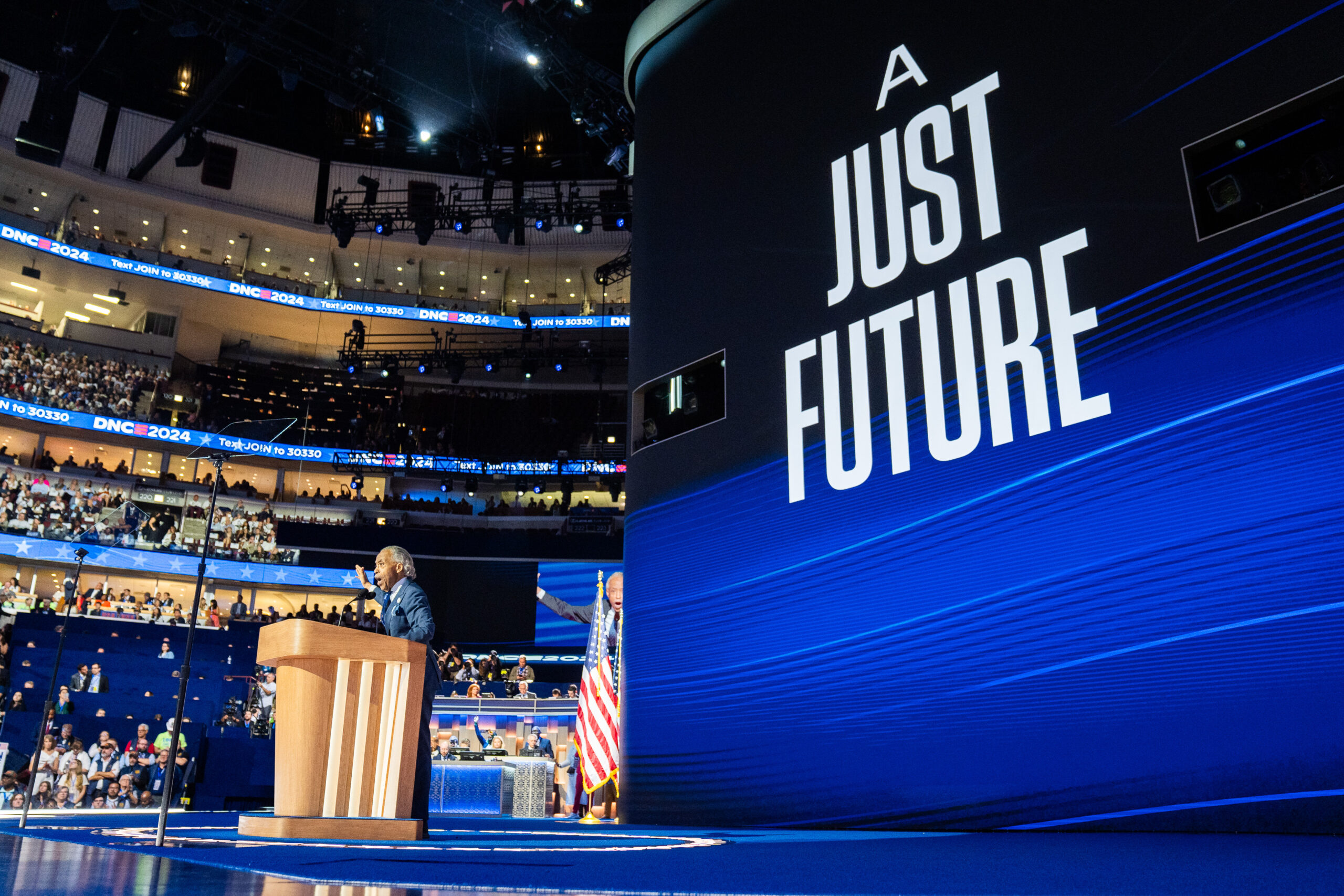
    The Rev. Al Sharpton speaks on the final day of the 2024 Democratic National Convention in Chicago.

    Younger generations of pastors — including those from more conservative traditions — were “inspired to be not just pastors but prophets as well,” said Tyler Burns, a Florida pastor and director of the Witness, a multimedia organization aimed at elevating the voices of Black Christians.

    Today there are some figures who echo Jackson in their focus on combining Black Christianity and politics to serve the disenfranchised, including U.S. Sen. Raphael G. Warnock (D., Ga.) and Barber, a North Carolina organizer who founded the Center for Public Theology & Public Policy at Yale University.

    But Jackson was one of a kind, said Jemar Tisby, a historian, writer, and podcaster on race and religion. He represented “the longer Black freedom struggle,” Tisby said, and harnessed a blend of charisma, ambition, and eloquence to an unusual moment of political opportunity.

    The Voting Rights Act of 1965, and Jackson’s immediate recognition of the door that it opened, “radically changed the opportunity for Black leadership,” Stevenson said. Jackson was particularly effective at voter registration, preaching the power of politics.

    “It’s a different landscape today as a result,” Stevenson said.

    The Supreme Court has already weakened much of the 1965 Voting Rights Act and will rule on whether to strike down its last major pillar in the coming months. The court could further limit the use of race in drawing legislative maps, which would most likely lead to a decline in the number of minorities holding public office.

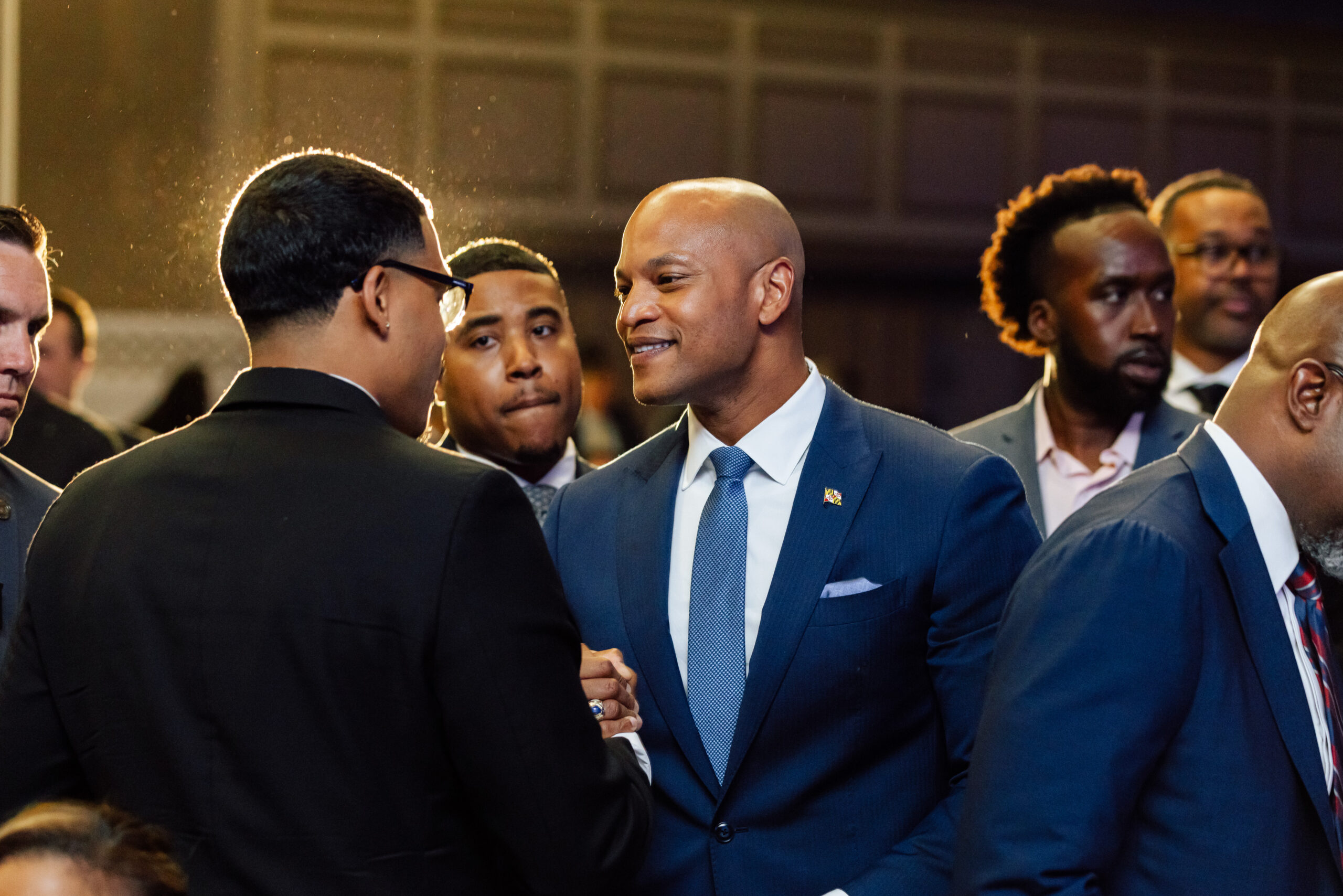
    Maryland Gov. Wes Moore, the state’s first Black governor and among only three African Americans ever elected governor of any state, said that “an attack on the VRA is in many ways an attack on decades of progress.”

    Maryland Gov. Wes Moore speaks with supporters at a Democratic Party gala in Baltimore last June.

    Jackson’s pivot after the passage of the law, which helped Black officials win congressional and legislative seats, spurred the movement’s success, Moore said. “He was able to make the transition from demanding change to saying, ‘I want to be one of the people to help make it,’ right? Because he understood that part of the power of the civil rights movement was the fact that they were able to get into rooms.”

    The Brennan Center for Justice at the NYU School of Law has tracked efforts to roll back access to the ballot box around the country, including states imposing voter ID laws, making registration more difficult, and aggressively purging voter rolls. Those actions are part of what Georgia politician Stacey Abrams calls “the exercise of diminishing democracy … [and] a wholesale attack on the pluralism of America.”

    Abrams, a former Georgia state lawmaker and gubernatorial candidate, said Jackson’s legacy is key to fighting back. His Rainbow/PUSH Coalition framed the fight for civil rights broadly, as “how do we make America meet its obligations to all its people,” Abrams said.

    That not only brought more marginalized groups into the struggle, she said, but it expanded the idea of civil rights beyond the political realm. “Now that we had voting rights and civil rights, we also had to have access to economic rights,” Abrams said.

    For all the years Jackson carried on his fight, “the through line was always that he worked to bring more people into the process … [so that] as many people as possible believe they have the right to participate,” she said.

    Former Richmond Mayor Levar Stoney — who, until term-limited out of office in 2025, was part of a new generation of young Black mayors around the country — said the effectiveness of Jackson’s work can be seen in state and local offices in the South, where minorities and women have made huge strides in representation.

    The phenomenon cuts across generations, Stoney said, pointing out that in Virginia, 82-year-old L. Louise Lucas is the first Black woman to serve as president pro tempore of the state Senate; Scott, 60, is the first Black speaker; and Jay Jones, 36, is the first Black person elected as the state’s attorney general.

    Apart from President Barack Obama, Stoney said, “I can’t foresee us ever looking to one singular leader.” He added, “There’s a collective of leaders now, [and] we expect to be represented by someone who looks like us.”

    What might be lost, though, is the unifying emotional resonance of a figure such as Jackson. One element that gets overlooked, Sellers said, is that Jackson, King, and other leaders of the day “were more patriotic than most.”

    They were able to “look at this country and call out its failures, call out its broken promises, and then try to reimagine her for what she should look like, which is an inclusive society built in the image of us all.”

    Jackson was able to lend that stature to others, which is what several remembered this week in the lead-up to his memorial services.

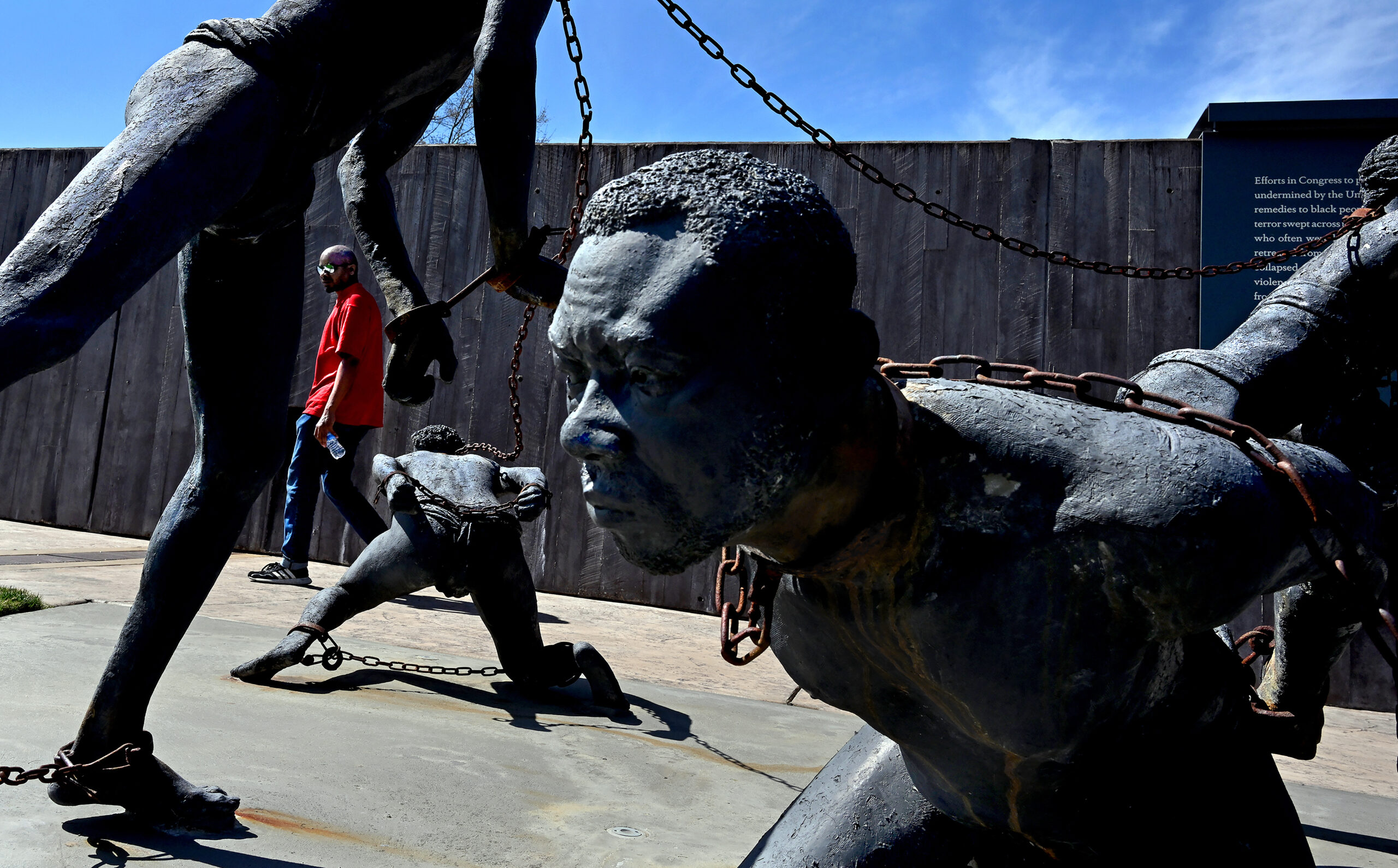
    Stevenson said he regularly conferred with Jackson in creating the National Memorial for Peace and Justice in Montgomery, Ala., which recognizes more than 4,000 African Americans lynched during the Jim Crow era. At the dedication for an affiliated memorial in 2024, Jackson had traveled to the ceremony but by then was using a wheelchair and had difficulty communicating. As Stevenson spoke before the crowd, he looked out and saw Jackson, who held his fingers in the shape of a heart.

    A work by Ghanaian artist Kwame Akoto-Bamfo depicting enslaved people in bondage is on display at the National Memorial for Peace and Justice in Montgomery, Ala.

    “It was so moving to me,” Stevenson said. “And I told him, you know, you had me almost in tears.”

    Abrams recalled the night in 2018 when it became clear that she had narrowly lost the election for Georgia governor. Jackson was on hand as she prepared to concede before supporters, and some of her staff tried to get him to move into a VIP area backstage. He refused.

    “He said: ‘I want to be here when she comes downstairs. I know what [defeat] feels like, and I need her to know that the work she’s done continues and she should still be proud,’” Abrams said.

    Barber said he intends to honor Jackson’s legacy by convening a group in the coming weeks to study his speech at the 1988 Democratic convention — when his performance in the primaries brought him closer to the presidential nomination than anyone thought possible — to galvanize a new voter movement.

    In the speech, Jackson called for unity to “keep hope alive,” and said he cherished America not as a uniform blanket but as a quilt.

    “My prayer and hope,” Barber said, “is that we’re working toward that end and bringing folk together. And that the dying of Jesse will not cause us to just say, ‘Woe is us’ and ‘Oh, just look at what he did.’ Because commemoration is not how you remember people like him. You remember people like him by engagement. By recommitting yourselves.”

  • The hypothetical nuclear attack that escalated the Pentagon’s showdown with Anthropic

    The hypothetical nuclear attack that escalated the Pentagon’s showdown with Anthropic

    As a standoff between artificial intelligence firm Anthropic and the Pentagon deepened this week, the two sides offered starkly different accounts of a key discussion about a hypothetical nuclear strike against the United States, revealing the intensity of their showdown over the American military’s potential use of lethal autonomous weapons.

    A defense official said the Pentagon’s technology chief whittled the debate down to a life-and-death nuclear scenario at a meeting last month: If an intercontinental ballistic missile was launched at the United States, could the military use Anthropic’s Claude AI system to help shoot it down?

    It’s the kind of situation where technological might and speed could be critical to detection and counterstrike, with the time to make a decision measured in minutes and seconds. Anthropic chief executive Dario Amodei’s answer rankled the Pentagon, according to the official, who characterized the CEO’s reply as: You could call us and we’d work it out.

    An Anthropic spokesperson denied Amodei gave that response, calling the account “patently false,” and saying the company has agreed to allow Claude to be used for missile defense. But officials have cited this and another incident involving Claude’s use in the capture of Venezuelan leader Nicolás Maduro as flashpoints in a spiraling standoff between the company and the Pentagon in recent days. The meeting was previously reported by Semafor.

    A face-to-face meeting Tuesday between Amodei and Defense Secretary Pete Hegseth escalated the situation, the Washington Post reported. The two sides are now careening toward a defining power struggle over whether the U.S. government should have the freedom to spy on or kill humans using the potent new technology, based in part on extreme hypotheticals and games of telephone.

    The Pentagon had given Anthropic until 5:01 p.m. Friday to drop its objections to using Claude in relation to autonomous weapons and mass surveillance of U.S. citizens. If not, officials had said they may use government authority to force Anthropic to hand over the technology anyway — while also blacklisting the company from future defense work.

    Sean Parnell, the Pentagon’s chief spokesman, said in an X post Thursday that the department had no interest in conducting mass domestic surveillance nor deploying autonomous weapons, but wanted to use AI for “all lawful purposes.”

    “This is a simple, common-sense request that will prevent Anthropic from jeopardizing critical military operations and potentially putting our warfighters at risk,” Parnell said.

    Amodei said in a statement late Thursday that his company was ready to continue working with the Pentagon, but would not change its stance. Current AI systems are not reliable enough to power robotic weaponry without putting troops and civilians alike at risk, he said, and existing laws on domestic surveillance do not account for the sweeping potential of AI snooping tools.

    “In a narrow set of cases, we believe AI can undermine, rather than defend, democratic values,” Amodei said in his first public comments on the battle. “Two such use cases have never been included in our contracts with the Department of War, and we believe they should not be included now.”

    Anthropic did not expect to end up in a fight with Pentagon leaders when it became the first major AI lab to strike a deal to work on classified U.S. military networks in late 2024. But the dispute highlights how the startup, founded in 2021 by safety-minded refugees from ChatGPT-maker OpenAI, has struggled to deftly navigate Washington in the second Trump administration. (The Washington Post has a content partnership with OpenAI.)

    Anthropic recently added a former deputy chief of staff to President Donald Trump to its board and explored taking investment from a fund led by Donald Trump Jr., according to people familiar with the pitch. Yet its leaders have also repeatedly clashed with the White House in public.

    In a coruscating post on X in October, David Sacks, Trump’s top AI adviser, accused the company of “fear-mongering” and pursuing “regulatory capture” in an attempt to bend the government to its will. Anthropic leaders have criticized one of the administration’s key AI policies in recent weeks, even as the dispute with the Pentagon was brewing.

    “There’s the subtext of Anthropic not being aligned with the MAGA agenda,” said Steven Feldstein, a senior fellow at the Carnegie Endowment, who researches the use of AI in war. “This is as much of a political fight as a military use issue.”

    Experts say the outcome of the clash could shape the trajectory of the burgeoning relationship between the AI industry and the U.S. military, potentially signaling to other leading firms that the cost of doing business with the Pentagon could be losing control of their innovations.

    Unlike a gun or a jet engine, the uses that AI might find on future battlefields keep changing. The U.S. already pushes autonomy into its weapons and AI-enabled systems are a part of almost every drone, ship, or aircraft under production or envisioned in the future force. The Trump administration is embarking upon a vast expansion of the military’s use of AI.

    But leading figures in the development of the technology have long had ethical and legal concerns about giving AI the power to make life-and-death decisions or turbocharging surveillance.

    Emil Michael, a former Uber executive who is now undersecretary of defense for research and engineering, has taken the lead in the discussions with Anthropic. He has argued the government and not individual tech firms should have the final say in how the technology is used, according to a person familiar with the discussions, who spoke on the condition of anonymity to describe internal deliberations. Michael did not respond to a request for comment.

    To the Pentagon that means having a policy permitting what Parnell called “all lawful purposes.” Amodei has held firm that Anthropic has red lines around autonomous weapons and surveillance, a stance that has won support from his employees and could serve as a recruiting tool for idealistic engineers as the company heads toward an expected initial public offering.

    Late Thursday, Michael accused Amodei of having a “God-complex” in a post on X. “He wants nothing more than to try to personally control the US Military and is OK putting our nation’s safety at risk,” Michael wrote.

    The escalating dispute has baffled people who study how the military uses AI.

    Dean Ball, a former Trump administration AI adviser, said he hoped the two sides could still find a way to step back from the brink. “The solution to that problem is to cancel the contract,” Ball said. “Going on a jihad against Anthropic is whole other layer of escalation.”

    Leapfrogging off Amazon

    Anthropic owes its head start at the Pentagon in part to a partnership the intelligence community forged with Amazon in 2013, which paved the way for classified material to be handled in Amazon’s cloud. Over the course of the next several years, the tech giant built out secure computing infrastructure for the intelligence community, beating out rivals for coveted contracts to house classified and top secret data.

    In 2023 and 2024, Amazon invested billions into Anthropic. The relationship greased the AI start-up’s path into the military’s closely guarded systems, according to a person familiar with the relationship, who spoke on the condition of anonymity to describe it. Amazon declined to comment. (Amazon founder Jeff Bezos owns the Post.)

    Anthropic also found an ally in software analytics firm and longtime defense contractors Palantir, which in 2024 teamed up with the AI firm and Amazon to offer Claude on its systems used by military and spy agencies. Anthropic said the partnership would boost the military’s ability to process huge amounts of data and make good decisions, saying it was proud to take on the work.

    Anthropic has “first mover status and their product is good,” said another person familiar with the military’s work with AI companies, who spoke on the condition of anonymity to describe sensitive issues relating to national security.

    Since Claude’s deployment with the Pentagon, Anthropic said Thursday, its technology has been put to use analyzing intelligence, planning operations and in cyberwarfare. The company has deepened its work with the government since Trump returned to office and pushed federal agencies to rapidly scale up their use of AI. In July it signed a $200 million contract with the Defense Department and made a deal the following month to provide its system to civilian agencies for a dollar apiece.

    But the company’s advantage has eroded as competitors like Google, OpenAI and xAI make deals of their own with the Pentagon. Officials say the other leading firms have agreed to its “all lawful purposes” policy for unclassified work, and that xAI has also signed a deal for classified systems. The three companies did not respond to requests for comment.

    Anthropic has differed from its rivals in simultaneously courting the administration for contracts while opposing it in other areas of policy.

    When the White House was pushing an executive order that would preempt restrictive state-level AI laws this winter, Anthropic was promoting a safety-oriented AI bill in California.

    Amodei has also criticized the Trump administration’s drive to allow exports of American AI chips to China. On the sidelines of the World Economic Forum in Davos, Switzerland last month, Amodei compared the policy to “selling nuclear weapons to North Korea.” After meeting with Amodei this month on Capitol Hill, Sen. Elizabeth Warren (D., Mass.) said she would introduce legislation to sharply limit any exports.

    Anthropic has also hired several former Biden administration officials.

    “The administration just wants everyone to bend the knee and [Amodei] won’t,” said an investor who works on defense technology, who spoke on the condition of anonymity to avoid getting into conflicts with any of the parties.

    In the past year, Anthropic has made moves that could smooth its relationship with the Trump administration. The company ramped up its lobbying in Washington, spending $3.1 million and bringing on a former senior aide to Secretary of State Marco Rubio, according to disclosures compiled by transparency group Open Secrets. It announced this month that it was adding Chris Liddell to its board, a former tech executive who served in the first Trump White House.

    The company also recently explored an investment from the Trump-allied venture capital firm 1789 Capital for funding, but was turned down, according to two people familiar with the pitch, who spoke on the condition of anonymity to describe private business discussions. Donald Trump Jr. is a partner at the firm, alongside Chris Buskirk, an ally of Vice President JD Vance.

    ‘Once and for all’

    Insiders in the world of defense technology argue that the current fight between the Pentagon and Anthropic appears to be more philosophical than technical, and that the administration had already soured on the AI company — even as rank-and-file military personnel were finding its services increasingly useful.

    “The administration and the Republicans are looking for ways to get rid of Anthropic once and for all,” the person familiar with the military’s work with AI companies said. The Pentagon clash could provide an opportunity to carry that through. In January, Hegseth issued a directive for the military to embrace AI as though the country were at war.

    The U.S. has committed to some guardrails on autonomous weaponry. France, the United Kingdom, China, and the U.S. all previously said they would require a human to be involved in all decisions to deploy nuclear weapons. In a statement to the Post, the Pentagon said the Trump administration intends to maintain that pledge.

    “It remains the Department’s policy that there is a human in the loop on all decisions on whether to employ nuclear weapons,” a senior defense official said. “There is no policy under consideration to put this decision in the hands of AI.”

    But that still leaves room for AI to influence decisions on targets and speed of response. In a recent nuclear war game at King’s College London, many leading language models including versions of ChatGPT, Claude and Google’s Gemini all quickly favored launching warheads. That could influence a human’s decision to fire, said Paul Dean, vice president of the global nuclear program at the nonprofit Nuclear Threat Initiative.

    “It’s not simply ensuring that there’s a human being in the decision-making loop,” Dean said. “The question is, to what extent will AI impact that human decision-making?”

    Neither side in this week’s faceoff knows for certain what AI’s use in war will ultimately look like, but both seem unwilling to trust in the other’s future decisions.

    “The Pentagon does not trust that Anthropic will be a reliable vendor, and Anthropic worries about misuse of its technology,” said Michael C. Horowitz, a director at the University of Pennsylvania who oversaw AI weapons policy during the Biden administration.

    Because Claude is already in use across the Defense Department, exiling Anthropic and switching to a rival could prove costly. Although Defense officials have suggested they could use the Defense Production Act to force the AI company to share its systems, experts are split on whether the law could be applied.

    Doing so would send a chilling message to the AI firms the Pentagon hopes to lean on that they may risk of having their own innovations seized if the government sees something it wants.

    That would cross a troubling line, said Katie Sweeten, a former liaison for the Justice Department to the Pentagon, and a partner at Scale LLP. “This is a literal nuclear option which I think rightfully companies should be very concerned about.


  • THC drinks in beer stores? New hemp regulation effort is brewing in Pennsylvania amid federal crackdown

    THC drinks in beer stores? New hemp regulation effort is brewing in Pennsylvania amid federal crackdown

    While Congress debates the impending ban on hemp-derived THC, a smaller push for regulation is brewing in Pennsylvania that hopes to put THC drinks in beer stores and regulate hemp alongside medical marijuana.

    State Rep. Steven Malagari (D., Montgomery) plans to introduce a bill that could put THC drinks in beer stores, while State Sen. Dan Laughlin (R., Erie), a major proponent of weed legalization — unlike his party’s leaders — is working on legislation that would open the door to hemp-derived THC being regulated like medical marijuana. Pennsylvania hemp businesses look toward these efforts with optimism, but as the clock races down, stakeholders are asking for urgency.

    Representatives from the hemp, medical marijuana, and beer wholesaler industries spoke to state regulators at January’s Pennsylvania Farm Show about shielding the hemp industry from the Nov. 12 deadline that would outlaw all intoxicating hemp products, including Delta-9 THC and CBD, which is what the majority of hemp is grown for in Pennsylvania. Under new rules, many of the state’s hemp farmers would be out of business by fall.

    Across all competing interests, industry representatives said one thing was clear: Lawmakers need to regulate the billion-dollar state hemp market.

    Testifying before the Center for Rural Pennsylvania, stakeholders, including Montgomery County District Attorney Kevin Steele, agreed, stressing the need for safeguards.

    “It’s not about taking away people’s livelihoods in hemp farming and people working in this industry,” Steele said during his testimony. “It’s about community safety and establishing guardrails through legislation to oversee that safety.”

    But, as Congress disagrees on when and if it will regulate hemp-derived THC — including if the ban deadline should be extended — those delays cascade to the states, where local lawmakers await federal guidance before regulating it themselves. While any state proposals for regulation are purely speculative until Congress passes hemp legislation, Laughlin’s and Malagari’s efforts in Pennsylvania imagine what is possible.

    It is important to note, however, that regulating intoxicating hemp products is an uphill battle in a state where recreational marijuana legalization is opposed by Republican state leadership.

    Whether these bills become law or save the state’s hemp industry as it currently stands is up in the air with federal delays, but local hemp businesses choose to be optimistic.

    A view of Tyler Shannon’s Adams County hemp farm. Unless regulations change, he will have to shut down his hemp farm by next year.

    What does any of this mean for Pennsylvania hemp?

    For Tyler Shannon, an Adams County hemp farmer, a full ban on hemp products would be devastating. With the vast majority of Pennsylvania’s hemp grown for cannabinoids, such as Delta-9 THC and CBD, it means that “if hemp is not saved, my family will lose everything, including our farm,” Shannon said.

    Shannon is not alone. Beau Whitney, a leading cannabis market analyst who testified at the January hearing, estimated that Pennsylvania’s cannabinoid market generates just under $1 billion in revenue annually. In his latest report, he found that the majority of Pennsylvania’s hemp-derived THC and CBD products were sold “legally” through semi-regulated channels, in stores or online. “As a result, there were 9,500 jobs, generating $382 million in wages in Pennsylvania,” Whitney said.

    Those in the local hemp industry are confident that a deadline extension will help protect them, but planting season is fast approaching, while hemp farmers have no reassurance that their crops will be legal come fall, Shannon said. His family farm is holding off on a planned $175,000 facility expansion due to the looming ban.

    As of now, no federal or state legislation has been passed to avert the impending doomsday scenario for hemp, and despite the constant regulatory discussions, small hemp farmers and businesses don’t feel on solid ground, Sebastian Stelmach of Manayunk’s Keystone Dispensary said.

    “It’s just scary to think that come November, I might be unemployed and close up shop,” Stelmach said. “A lot of lawmakers realize that we can’t let this industry die. I believe that they’re going to do something, but what that is, I don’t know.”

    Trade organizations, like the U.S. Hemp Roundtable, are lobbying Congress to extend the federal ban deadline by one year, giving regulators time to flesh out less restrictive standards for hemp products.

    “Even [federal agencies] said they don’t have enough time to enforce the rules under the current bill,” said Jonathan Miller, U.S. Hemp Roundtable’s general counsel. “We’ve created a mess here, and we really need this extension to be more deliberate and responsible.”

    In this 2019 file photo, Steve Groff is getting ready to harvest his first crop of hemp plants at his farm in Holtwood, Lancaster County.

    Intoxicating hemp regulated like marijuana

    Laughlin’s bill to establish a Cannabis Control Board would see the state’s medical marijuana program come under new oversight, similar to the liquor and gaming control boards.

    While hemp is not the primary focus of that legislation, organizations like the Pennsylvania Cannabis Coalition (PCC), which represents the state’s medical marijuana industry, hope to see hemp included in Laughlin’s bill to open the doors for more responsive hemp regulation.

    “The Cannabis Control Board would have the authority to deal with hemp products and decide what is safe for consumers as a single regulatory body,” said Meredith Buettner, executive director of PCC. Buettner said it makes the most sense for intoxicating hemp products to be regulated alongside cannabis.

    Laughlin argues that “if it’s a consumable cannabis product, it should fall under one clear regulatory structure.”

    How and where specific hemp THC products would be sold will be worked out in the legislation, but “intoxicating products should be sold through appropriate, regulated channels,” he said.

    Jake Sitler, who owns Lancaster-based Endo THC drinks and testified at the January regulatory hearing, is ready to support any regulation that saves the current hemp framework, like incorporating hemp into a control board, but worries small businesses will get cut out of the deal.

    “The hemp industry concern is where our seat is at the table and to make sure new laws are appropriate for our farmers and our industry,” Sitler said. “And that any new regulation isn’t used as a guise to out-regulate small business down the road.”

    THC and CBD-infused beverages on the shelves of Free Will Collective, an Ardmore smoke shop and wellness store owned by Will Angelos. As Congress moves to ban most intoxicating hemp products, business owners like Angelos aren’t sure they will be able to keep the doors open long past 2027 if current regulations go into effect.

    Delta-9 THC drinks in Pennsylvania beer stores

    The bill from Malagari would carve out regulation for hemp-derived Delta-9 THC drinks, which are among some of the most popular intoxicating hemp products, with a national market of $1.5 billion in annual sales.

    Malagari, who previously worked in beverage wholesale, wants to see THC drinks regulated similarly to beer and malt-beverage products in Pennsylvania.

    Pennsylvania operates a three-tiered system for beer, with licenses at the manufacturing level, distribution level, and retail level. THC drinks would be incorporated into this system, which would begin by allowing established three-tiered license holders to manufacture and sell hemp-derived Delta-9 THC drinks.

    Jake Sitler and his wife, Jamie, standing inside the Endo drinks warehouse. The Lancaster couple founded one of Pennsylvania’s first hemp-derived THC drinks and is grappling with the fact that their business might have to shut down if Congress doesn’t rework its hemp regulations.

    Common retail spaces for beer and malt beverages include beer distributors, grocery stores, restaurants, and bars.

    This legislation, if passed and signed into law, would not prohibit THC drinks from being sold in medical marijuana dispensaries and could work alongside Laughlin’s CCB bill, Malagari said. But he believes that lawmakers should approach THC beverages differently from hemp-derived flower and vapes.

    As an owner of a hemp beverage company, Sitler could benefit from Malagari’s bill, but also wonders if it is too early for beverage carve-outs before a fuller state framework is in place. “A hemp beverage bill with no overarching regulation is putting the cart a bit before the horse,” Sitler said.

  • Trump’s Justice Department sues New Jersey for voters’ personal information

    Trump’s Justice Department sues New Jersey for voters’ personal information

    New Jersey joined the growing list of states sued by the Department of Justice after refusing to share personal information of voters with President Donald Trump’s administration because of privacy concerns.

    The Justice Department sued New Jersey on Thursday alongside Utah, Oklahoma, Kentucky, and West Virginia as it escalates its effort to obtain voter data. It previously sued Washington, D.C., and 24 other states, including Pennsylvania.

    The suits follow Trump’s rhetoric in recent weeks about the need to “nationalize elections.” During his State of the Union address to a joint session of Congress this week, the president repeated the unsubstantiated allegation that “cheating is rampant in our elections.”

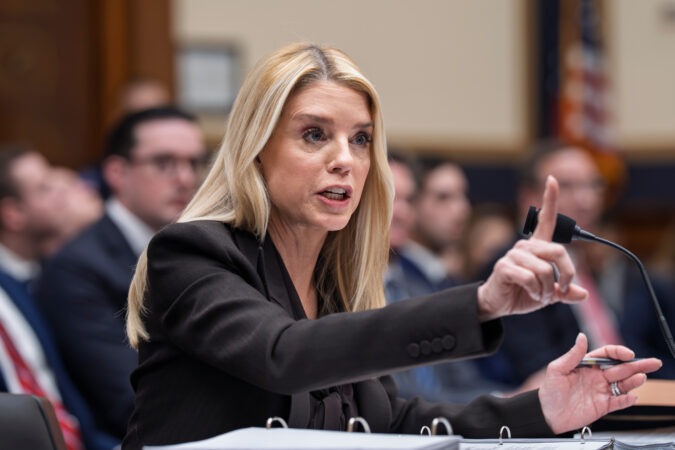
    The lawsuit in the New Jersey District Court accuses Dale Caldwell, who is serving as the Garden State’s lieutenant governor and secretary of state, of violating Title III of the Civil Rights Act of 1960 by refusing to hand over the list of the state’s registered voters to U.S. Attorney General Pam Bondi.

    “Accurate, well-maintained voter rolls are a requisite for the election integrity that the American people deserve,” Bondi said in a statement. “This latest series of litigation underscores that This Department of Justice is fulfilling its duty to ensure transparency, voter roll maintenance, and secure elections across the country.”

    Caldwell’s office did not immediately respond to a request for comment.

    Acting New Jersey Attorney General Jennifer Davenport said the state would defend against the lawsuit in court.

    “As several courts have already held, the Department of Justice’s request for voters’ personal information, including driver’s license numbers and Social Security numbers, is baseless,” Davenport’s statement said. “We are committed to protecting the privacy of ours state’s residents.”

    Bondi sent a letter to Caldwell on July 15 asking for the statewide voter registration list, the suit says. The letter cited alleged discrepancies in New Jersey’s voting registration statistics compared to national averages. For example, it says the state removes fewer duplicates from its voter rolls.

    A month later, the suit says, Bondi sent another letter asking for the full list including each voter’s full name, date of birth, address, and driver’s license or last four digits of their Social Security number.

    In the months following the August letter, former state Attorney General Matthew Platkin declined to share the information because of privacy concerns — a reason Pennsylvania officials have also cited.

    After the administration of Gov. Mikie Sherrill took office in January, DOJ sent a “courtesy email” to check if the state’s position on sharing the records has changed. But it didn’t.

    The suit is asking a federal judge to find that Caldwell violated federal law by refusing to share the records and order the state to pass over the information.

    The Justice Department filed a similar lawsuit in September against Pennsylvania Secretary of State Al Schmidt, a month after he refused to provide the data.

    Schmidt called the department’s request “unprecedented and unlawful” and promised to “vigorously fight the federal government’s overreach in court.”

    “I have an obligation to protect the personal information that Pennsylvania voters entrust us with, and I take that obligation extremely seriously,” Schmidt said in a September statement.

    The voter roll lawsuit is the second filed by the Justice Department against New Jersey this week. Bondi sued Sherrill on Tuesday over a Feb. 11 executive order that prohibits state agencies to allow federal immigration agents from entering state property for enforcement actions without a warrant.

    The lawsuit said the executive order would disrupt the ability of U.S. Immigration and Customs Enforcement to capture “dangerous criminals” who are in prisons or courthouses controlled by the state.

    Davenport said in a Tuesday statement that the state would continue to ensure the safety of the immigrant communities.

    “Instead of working with us to promote public safety and protect our state’s residents, the Trump administration is wasting our resources on a pointless legal challenge,” Davenport’s statement said.

  • Vance: ‘No chance’ U.S. will be in drawn-out war in Middle East

    Vance: ‘No chance’ U.S. will be in drawn-out war in Middle East

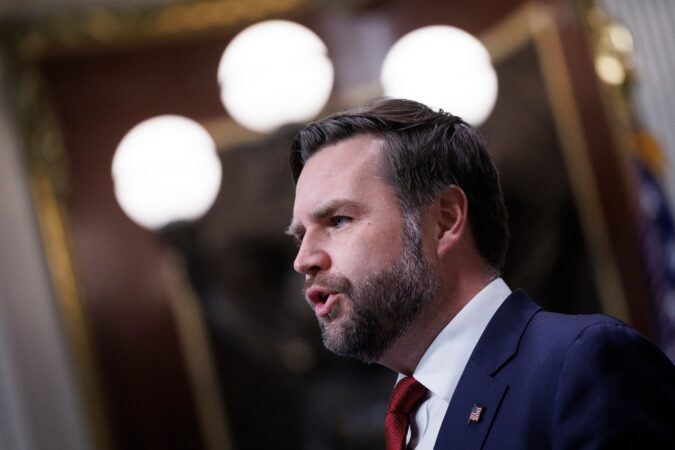
    ABOARD AIR FORCE TWO — Vice President JD Vance said Thursday that while military strikes against Iran remain under consideration by President Donald Trump, there is “no chance” that such strikes would result in the United States becoming involved in a yearslong, drawn-out war.

    Speaking with the Washington Post on Thursday, Vance said he does not know what Trump will decide to do about Iran, describing possibilities that include military strikes “to ensure Iran isn’t going to get a nuclear weapon,” or solving “the problem diplomatically.”

    But if Trump proceeds with another round of strikes on Iran — which some U.S. officials have suggested could be more comprehensive than the bombing of nuclear sites in June — Vance said confidently that it would not turn into the kind of conflict the vice president has harshly criticized.

    “The idea that we’re going to be in a Middle Eastern war for years with no end in sight — there is no chance that will happen,” he told the Post in an interview as he returned to Washington from an event in Wisconsin, effectively pushing back against predictions by some foreign policy experts that there would be no easy out if America got involved in a bigger conflict with Iran.

    Vance noted that last year’s operation in Iran and the January capture of Venezuelan President Nicolás Maduro were “very clearly defined.”

    Vance, a 41-year-old Marine veteran who served in the Iraq War, once said from the Senate floor that he had been “lied to” about the reasons for the United States’ involvement there. He said Thursday that he still sees himself as a “skeptic of foreign military interventions,” a description he believes continues to apply to Trump.

    “I think we all prefer the diplomatic option,” Vance said. “But it really depends on what the Iranians do and what they say.”

    Talks between the United States and Iran continued Thursday in Geneva amid a large-scale buildup of U.S. forces around Iran, though no resolution was reached, and mediators said the negotiations would continue next week.

    Trump has openly acknowledged that he is interested in bringing about regime change to topple Iran’s supreme leader, Ayatollah Ali Khamenei, telling reporters this month that it “would be the best thing that could happen.” The current presence of U.S. military forces in the region is among the largest in more than two decades, since before the Iraq War began in 2003.

    Asked whether, in his days as a commentator and senator offering criticisms of the Iraq War, he could have foreseen being attached to a presidency interested in bringing about a foreign regime change, the vice president chuckled.

    “Well, I mean, look. Life has all kinds of crazy twists and turns,” Vance said. “But I think Donald Trump is an ‘America First’ president, and he pursues policies that work for the American people.

    “I do think we have to avoid repeating the mistakes of the past. I also think that we have to avoid overlearning the lessons of the past. Just because one president screwed up a military conflict doesn’t mean we can never engage in military conflict again. We’ve got to be careful about it, but I think the president is being careful.”

    Prominent commentators within the conservative movement have spent months publicly quarreling over U.S. involvement in the Middle East, including debating what America’s attitude should be toward Israel.

    A growing number of conservatives — particularly young people — have soured on continued military support for the U.S. ally. Traditional conservatives have excoriated some of those voices, meanwhile, fueling a debate on the right about not only foreign policy but antisemitism as well.

    Vance has advocated for Israel-skeptical voices to be heard in the intraparty debate — a conversation that has upset Republican dogma of recent decades — while maintaining that he sees the nation as a strategic ally.

    The divide was apparent last week when former Fox News host Tucker Carlson, who now has his own podcast and frequently criticizes fellow conservatives’ deference to Israel, interviewed Mike Huckabee, the U.S. ambassador to Israel.

    Carlson, who has been a close ally of Vance, and Huckabee, a high-profile U.S. diplomat, have each found themselves in hot water for statements made during the filmed discussion. Huckabee said it would “be fine” if Israel took over other Middle Eastern countries whose land is referenced in Scripture, and Carlson suggested genetic testing to determine the true descendants of Abraham.

    Vance, an active peruser of X, said he had not yet watched the entire interview but had “seen a couple of clips here and there.” Despite calls from some pro-Israel conservative activists and even two Republican members of Congress for the White House to condemn Carlson, who visited the White House on Monday, Vance described the interview as a positive development.

    “I guess my takeaway is it’s a really good conversation that’s going to be necessary for the right, not just for the next couple years but for long into the future,” he said.

    What he has always liked about the political right — “even the people that I find annoying on our side” — is that “there is a real exchange of ideas,” Vance said.

    “And if you think of the Trump coalition in 2024 — and the way that I put it is, you had Joe Rogan, Mark Levin, Sean Hannity, Tucker Carlson, and JD Vance and a coalition of people … but to do that, you have to be willing to tolerate debate and disagreement,” he said. “And I just think that it’s a good thing.”

  • Hillary Clinton testifies she has no information on Epstein’s crimes and doesn’t recall meeting him

    Hillary Clinton testifies she has no information on Epstein’s crimes and doesn’t recall meeting him

    WASHINGTON — Former Secretary of State Hillary Clinton told members of Congress on Thursday that she had no knowledge of Jeffrey Epstein’s or Ghislaine Maxwell’s crimes, starting off two days of depositions that will also include former President Bill Clinton.

    “I had no idea about their criminal activities. I do not recall ever encountering Mr. Epstein,” Hillary Clinton said in an opening statement she shared on social media. The closed-door deposition concluded after over six hours of questioning Thursday.

    The depositions in the Clintons’ hometown of Chappaqua, a typically quiet hamlet north of New York City, come after months of tense back-and-forth between the former high-powered Democratic couple and the Republican-controlled House Oversight Committee as it investigates Epstein, who killed himself in a New York jail cell in 2019 while awaiting trial. It will be the first time that a former president has been forced to testify before Congress.

    Yet the demand for a reckoning over Epstein’s abuse of underage girls has become a near-unstoppable force on Capitol Hill and beyond.

    President Donald Trump, a Republican who has expressed regret that the Clintons are being forced to testify, bowed last year to pressure to release case files on Epstein. The Clintons, too, agreed to testify after their offers of sworn statements were rebuffed by the Oversight panel and its chairman, Rep. James Comer (R., Ky.) threatened criminal contempt of Congress charges against them.

    “Like every decent person,” Hillary Clinton added in her opening statement, “I have been horrified by what we have learned about their crimes.”

    She has previously said that her husband flew with Epstein for charitable trips but that she did not recall ever meeting Epstein. She had also interacted with Maxwell, Epstein’s former girlfriend and confidant, at conferences hosted by the Clinton Foundation.

    Maxwell, a British socialite, also attended the 2010 wedding of their daughter, Chelsea Clinton.

    As she exited the event center where the deposition was held, Hillary Clinton told reporters that Maxwell had come to the wedding as a guest of someone else and that she had told the committee she only knew Maxwell “as an acquaintance.”

    Republicans relish chance to question Clintons

    Bill Clinton, however, has emerged as a top target for Republicans amid the political struggle over who receives the most scrutiny for their ties to Epstein. Several photos of the former president were included in the first tranche of Epstein files released by the Department of Justice in January, including a number of him with women whose faces were redacted. Clinton has not been accused of wrongdoing in his relationship with Epstein.

    Comer has also pointed to Hillary Clinton’s work as secretary of state to address sex trafficking as another reason to insist on her deposition. Clinton defended her work to address sex trafficking around the world, saying that it remained important to help the millions of survivors of sex trafficking.

    The committee’s investigation has also sought to understand why the Department of Justice under previous presidential administrations did not seek further charges against Epstein following a 2008 arrangement in which he pleaded guilty to state charges in Florida for soliciting prostitution from an underage girl but avoided federal charges.

    Hillary Clinton accused Comer of running a one-sided investigation that has failed to hold Trump and other Republican officials to account. “This institutional failure is designed to protect one political party and one public official,” she said.

    Yet conspiracy theories, especially on the right, have swirled for years around the Clintons and their connections to Epstein and Maxwell, who argues she was wrongfully convicted. Republicans have long wanted to press the Clintons for answers. The deposition was paused after Rep. Lauren Boebert (R., Colo.) sent a photo of Hillary Clinton in the private proceeding to a conservative influencer who posted it on social media, violating the committee’s rules for depositions.

    Democrats said that the incident underscored how important it was for there to be a clear public record of the deposition. Rep. Robert Garcia, the top Democrat on the Oversight panel, said that Hillary Clinton, after the incident, repeated her longstanding demand that the deposition be made public, and Democrats called for a video and transcript of the complete proceedings to be released quickly.

    Comer said that he would work quickly to release a video and transcript of the deposition.

    “The purpose of the whole investigation is to try to understand many things about Epstein,” he told reporters outside the convention center where the depositions were being held. “How did he accumulate so much wealth? How was he able to surround himself with some of the most powerful men in the world?”

    Comer described the deposition as a bipartisan effort and said Thursday that it was “very possible” the committee would question Trump’s Commerce Secretary Howard Lutnick, who was Epstein’s neighbor and had several interactions with him. Under questioning from Democrats earlier this month, Lutnick acknowledged that he had met with Epstein twice after the late financier’s 2008 conviction for soliciting prostitution from a child, reversing his previous claim that he had cut ties with him after 2005.

    Democrats call for Trump to testify

    Democrats, now being led by a new generation of politicians, have prioritized transparency around Epstein over defending the former leaders of their party. Several Democratic lawmakers joined with Republicans on the Oversight panel to advance the contempt of Congress charges against the Clintons last month. Several said they had no relationship with the Clintons and owed no loyalty to them.

    Garcia also called on Trump to testify in the investigation. He argued that Bill Clinton’s appearance sets a precedent that should apply to Trump as well.

    “Let’s get President Trump in front of our committee to answer the questions that are being asked across this country from survivors,” Garcia said.

    Comer previously said that the committee can’t depose Trump because he is a sitting president.

    Still, Democrats are also coming off an effort this week to confront Trump about his administration’s handling of the Epstein files by taking women who survived Epstein’s abuse as their guests to Trump’s State of the Union address.

    Garcia and others are also challenging the Department of Justice’s assertion that it has met the requirements of a law passed by Congress last year that mandates the release of many of the case files on Epstein.

    Senate Democratic leader Chuck Schumer of New York said his caucus in the coming days would also review unredacted versions of the Epstein case files at a Department of Justice office. Schumer, who demanded that the department release all of the files and preserve all materials, said they will “pull on every thread” until they “reveal this massive cover-up.”

  • Anthropic CEO says AI company ‘cannot in good conscience accede’ to Pentagon’s demands

    Anthropic CEO says AI company ‘cannot in good conscience accede’ to Pentagon’s demands

    WASHINGTON — Anthropic CEO Dario Amodei said Thursday the artificial intelligence company “cannot in good conscience accede” to the Pentagon’s demands to allow wider use of its technology.

    The maker of the AI chatbot Claude said in a statement that it’s not walking away from negotiations, but that new contract language received from the Defense Department “made virtually no progress on preventing Claude’s use for mass surveillance of Americans or in fully autonomous weapons.”

    The Pentagon’s top spokesman has reiterated that the military wants to use Anthropic’s artificial intelligence technology in legal ways and will not let the company dictate any limits ahead of a Friday deadline to agree to its demands.

    Sean Parnell said Thursday on social media that the Pentagon “has no interest in using AI to conduct mass surveillance of Americans (which is illegal) nor do we want to use AI to develop autonomous weapons that operate without human involvement.”

    Anthropic’s policies prevent its models, such as its chatbot Claude, from being used for those purposes. It’s the last of its peers — the Pentagon also has contracts with Google, OpenAI, and Elon Musk’s xAI — to not supply its technology to a new U.S. military internal network.

    Parnell said the Pentagon wants to “use Anthropic’s model for all lawful purposes” but didn’t offer details on what that entailed. He said opening up use of the technology would prevent the company from “jeopardizing critical military operations.”

    “We will not let ANY company dictate the terms regarding how we make operational decisions,” he said.

    During a meeting on Tuesday between Defense Secretary Pete Hegseth and Amodei, military officials warned that they could cancel Anthropic’s contract, designate the company as a supply chain risk, or invoke a Cold War-era law called the Defense Production Act to give the military more sweeping authority to use its products, even if the company doesn’t approve.

    Amodei said Thursday that “those latter two threats are inherently contradictory: one labels us a security risk; the other labels Claude as essential to national security.”

    Parnell left out the threatened use of the Defense Production Act in the Thursday post on X and said Anthropic has “until 5:01 PM ET on Friday to decide.”

    “Otherwise, we will terminate our partnership with Anthropic and deem them a supply chain risk,” he wrote.

    The talks that escalated this week began months ago. Amodei said that given “the substantial value that Anthropic’s technology provides to our armed forces, we hope they reconsider.” But if they don’t, he said Anthropic “will work to enable a smooth transition to another provider.”

    Sen. Thom Tillis, a North Carolina Republican who is not seeking reelection, said Thursday that the Pentagon has been handling the matter unprofessionally while Anthropic is “trying to do their best to help us from ourselves.”

    “Why in the hell are we having this discussion in public?” Tillis told reporters. “This is not the way you deal with a strategic vendor that has contracts.”

    He added, “When a company is resisting a market opportunity for fear of negative consequences, you should listen to them and then behind closed doors figure out what they’re really trying to solve.”

    Sen. Mark Warner of Virginia, the ranking Democrat on the Senate Intelligence Committee, said he was “deeply disturbed” by reports that the Pentagon is “working to bully a leading U.S. company.”

    “Unfortunately, this is further indication that the Department of Defense seeks to completely ignore AI governance,” Warner said in a statement. It ”further underscores the need for Congress to enact strong, binding AI governance mechanisms for national security contexts.”

    As Pentagon officials say they always will follow the law with their use of AI models, Hegseth told Fox News last February, weeks after becoming defense secretary, that “ultimately, we want lawyers who give sound constitutional advice and don’t exist to attempt to be roadblocks to anything.”

  • Judge rejects request to block Trump White House from building its $400 million ballroom project

    Judge rejects request to block Trump White House from building its $400 million ballroom project

    WASHINGTON — A federal judge on Thursday rejected a preservationist group’s request to block the Trump administration from continuing construction of a $400 million ballroom where it demolished the East Wing of the White House.

    U.S. District Judge Richard Leon ruled that the National Trust for Historic Preservation was unlikely to succeed on the merits of its bid to temporarily halt President Donald Trump’s project. He said the privately funded group based its challenge on a “ragtag group of theories” under the Administrative Procedure Act and the Constitution, and would have a better chance of success if it amended the lawsuit.

    “Unfortunately, because both sides initially focused on the President’s constitutional authority to destruct and construct the East Wing of the White House, Plaintiff didn’t bring the necessary cause of action to test the statutory authority the President claims is the basis to do this construction project without the blessing of Congress and with private funds,” the judge wrote.

    The preservationists sought an order pausing the ballroom project until it undergoes multiple independent reviews and wins approval from Congress.

    Trump used his social media account to hail the ruling as “Great news for America.” The Republican president said the project was ahead of schedule and under budget and “will stand long into the future as a symbol to the Greatness of America.”

    Carol Quillen, president and CEO of the National Trust for Historic Preservation said the group was “disappointed” that no injunction was issued but “pleased that Judge Leon ruled that the National Trust has standing to bring this lawsuit, as we have asserted from the start.”

    “We are also pleased that he encouraged us to amend our complaint — specifically, to assert that the president has acted beyond his statutory authority — and we plan to do so promptly,” Quillen said in a statement. “The judge indicated he will rule expeditiously once we do so, and we will await his decision.”

    The White House announced the ballroom project over the summer. By late October, the Republican president had demolished the East Wing to make way for a ballroom that he said will fit 999 people. The White House said private donations, including from Trump himself, would pay for the planned construction of a 90,000-square-foot ballroom.

    Trump proceeded with the project before seeking input from a pair of federal review panels, the National Capital Planning Commission and the Commission of Fine Arts. Trump has stocked both commission with allies.

    The arts panel approved the project at a meeting last week. The planning commission is set to discuss it further at a March 5 meeting.

    During a preliminary hearing in December, Leon warned the administration to refrain from making decisions on underground work, such as the routing of plumbing and gas lines, that would dictate the scope of future ballroom construction above ground.

    The group challenging the project argued that Trump could be emboldened to go further — and possibly demolish the White House’s West Wing or Executive Mansion — if the court did not intervene.

    “The losers will be (the) American public, who will be left with a massive ballroom that not only overwhelms what is perhaps the nation’s most historically important building, but will have been built in violation of an astonishingly wide range of laws,” plaintiffs’ attorneys wrote.

    The administration said in a court filing that above-ground construction on the ballroom would not begin until April. In the meantime, government lawyers argued, the preservationist group’s challenge was premature because the building plans were not final.

    The administration also argued that other presidents did not need congressional approval for previous White House renovation projects, large and small.

    “Many of those projects were highly controversial in their time yet have since become accepted — even beloved — parts of the White House,” government lawyers wrote.

    Leon, who was nominated to the bench by Republican President George W. Bush, said the White House office behind the project is not an agency covered under the jurisdiction of the Administrative Procedure Act. The judge also said the preservationists, who argued that the ballroom usurped the authority of Congress, did not have the basis to invoke the power of the courts.

    As a result, “I cannot reach the merits of the National Trust’s novel and weighty statutory arguments” at this time, Leon said.