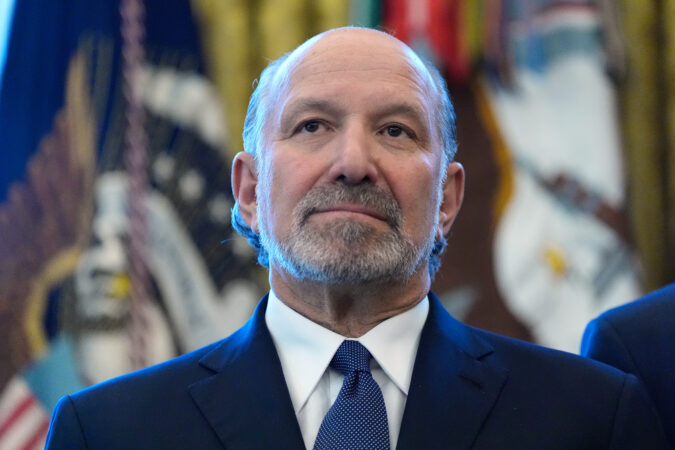
Commerce Secretary Howard Lutnick, a former Manhattan neighbor of Jeffrey Epstein, has agreed to voluntarily testify before the House Oversight Committee as part of its investigation into the convicted sex offender, the panel’s chairman announced Tuesday.
Lutnick has faced growing bipartisan pressure to testify about his ties to Epstein following the Justice Department’s release of a tranche of documents that suggested Lutnick maintained contact with Epstein years after claiming to have distanced himself from him.
“Secretary Lutnick has proactively agreed to appear voluntarily before the House Committee on Oversight and Government Reform,” Rep. James Comer (R., Ky.), the committee’s chairman, said in a statement. “I commend his demonstrated commitment to transparency and appreciate his willingness to engage with the Committee. I look forward to his testimony.”
Lutnick’s connection to Epstein also has caused controversy at Haverford College, where president Wendy Raymond is considering convening a committee that would review whether the mega donor’s name should remain on the campus library.
Lutnick will soon become the latest participant in a series of high-profile interviews conducted by the committee for its Epstein probe — the most recent of which included former President Bill Clinton and former Secretary of State Hillary Clinton. They took part in a pair of contentious, closed-door depositions in New York last week.
The Department of Commerce did not immediately respond to a request for comment about Lutnick’s interview.
“I look forward to appearing before the committee. I have done nothing wrong and I want to set the record straight,” Lutnick said in a statement to Axios, which first reported his planned appearance.
Testifying before Congress last month, the commerce secretary said he recalled meeting with Epstein three times over the course of 14 years. Lutnick also said he and his family had lunch with Epstein on his Caribbean island in 2012 — after previously claiming that he and his wife had distanced themselves from Epstein around 2005.
The exchanges made public by the Justice Department show that Lutnick, a former chairman of the financial services firm Cantor Fitzgerald, and Epstein kept communicating years after Epstein pleaded guilty to two charges of soliciting prostitution, including one involving a minor, and was sentenced to 13 months in jail.
Their last known exchange in the Justice Department documents came in 2018, when Lutnick reached out to Epstein about the Frick Collection, a museum near their neighboring homes, planning construction.
“Are you aware as to them building to block our park views,” Lutnick wrote in an email that his assistant forwarded to Epstein, “What should we do about it? Time is of the essence.” Lutnick also urged Epstein to involve a lawyer, to which Epstein replied, “Will do.”
The following year, Epstein was arrested on federal sex trafficking charges and later died in federal custody. His death was ruled a suicide.
Some lawmakers, including Rep. Robert Garcia of California — the top Democrat on the House Oversight Committee — as well as Rep. Thomas Massie (R., Ky.), have called for Lutnick to step down over his connection to Epstein. But President Donald Trump last week signaled he remained confident in Lutnick.
“Howard would go in and do whatever he has to say,” Trump told reporters on Friday about possible Epstein testimony. “He’s a very innocent guy. He’s doing a good job.”
The Oversight Committee has already scheduled depositions for Darren Indyke and Richard Kahn, the co-executors of Epstein’s estate, this month. And Rep. Anna Paulina Luna (R., Fla.) has said she plans to ask the committee to bring in “some of the [Epstein] co-conspirators that were given lesser sentences that were known to have trafficked young girls.”
Garcia told the Washington Post that if Democrats retake the House in November and become the majority next year, they will “absolutely” pursue an interview with Trump regarding Epstein. “There’s a long list of subpoenas that we will be engaged in,” Garcia added.
As an expanding Middle East war entered its fourth day, the Trump administration gave shifting rationales for its decision to attack Iran, even as U.S. officials with access to intelligence reports said they saw no sign the country had posed an imminent threat to the United States.
President Donald Trump and his top national security aides, defending a conflict that has tepid public backing and is incurring escalating risks, emphasized Iran’s arsenal of ballistic missiles rather than its nuclear program as the principal threat. But they provided different descriptions of the danger.
At his first public event since the attack began, Trump on Monday never mentioned a key part of his original rationale for the war: deposing Iran’s theocratic regime.
Instead, he emphasized thatIran would “soon” have missiles that could hit targets inside the United States.
What Trump had outlined over the weekend as an effort to devastate Tehran’s rulers so that the Iranian people could take over was, by Monday, “not a so-called regime change war,” in the words of Defense Secretary Pete Hegseth.
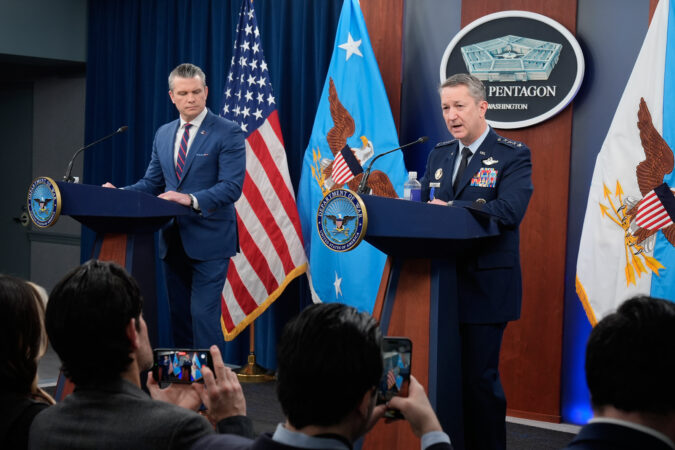
Hegseth told reporters at the Pentagon that the Islamic Republic was building sophisticated missiles and other conventional weapons to shield its plans for a nuclear bomb. “Iran had a conventional gun to our head as they tried to lie their way to a nuclear bomb,” he said.
Secretary of State Marco Rubio offered a third line of reasoning. The United States, he said, knew Israel was going to strike Iran, which would lead to counterattacks against U.S. forces and potential casualties, and decided to strike first to minimize the risk.
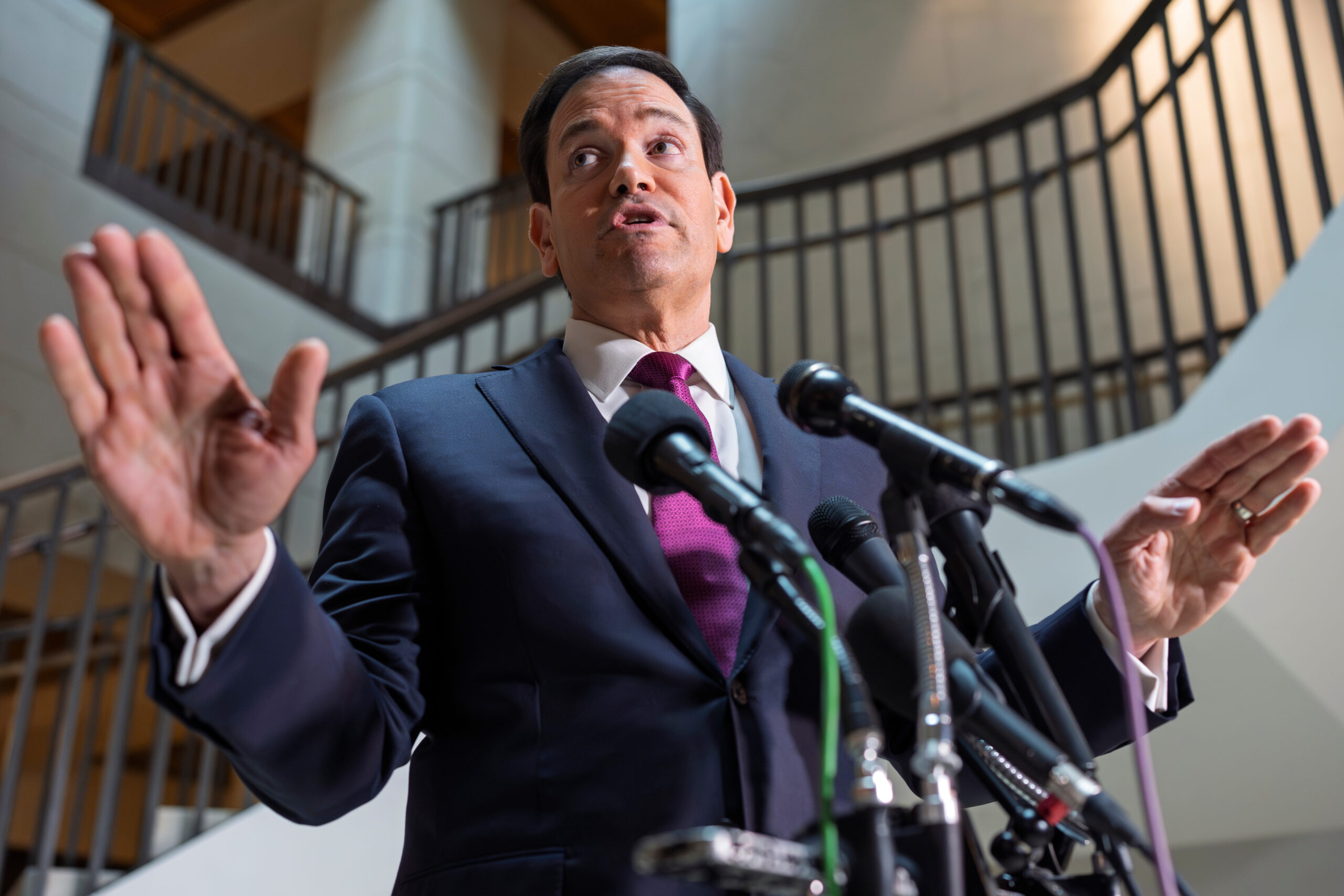
Secretary of State Marco Rubio speaks to reporters as he arrives for an intelligence briefing with top lawmakers on Iran, at the Capitol in Washington, Monday, March 2, 2026. (AP Photo/J. Scott Applewhite)
Iran’s voluminous missile arsenal, which was thinned by U.S.-Israeli strikes last June but still considered dangerous, consists mostly of short-range missiles threatening U.S. bases and allies in the Middle East. Over the last two years, Iran has fired those missiles in response to attacks on its territory or interests, but not preemptively.
As for an intercontinental ballistic missile capable of directly reaching the United States, the Pentagon’s Defense Intelligence Agency reported last year that Iran could have that weapon by 2035 “should Tehran decide to pursue the capability.”
Meanwhile, more than three days into the conflict and after more than a thousandairstrikes, U.S. and Israeli weapons so far have largely left Iran’s main nuclear installations untouched, suggesting those sites — significantly damaged last June — are not currently seen as a priority threat.
The White House’s shifting public goals for the war, and questions about the intelligence behind them, have contributed to a lack of clarity about when Trump might declare an end to the largest military operation since the 2003 invasion of Iraq.
As the war widened across the Middle East, Trump said operations against Iran could go on for four to five weeks, or longer. In an interview with the New York Post, the president said he would not rule out sending in U.S. ground troops, but added that they are “probably” not needed.
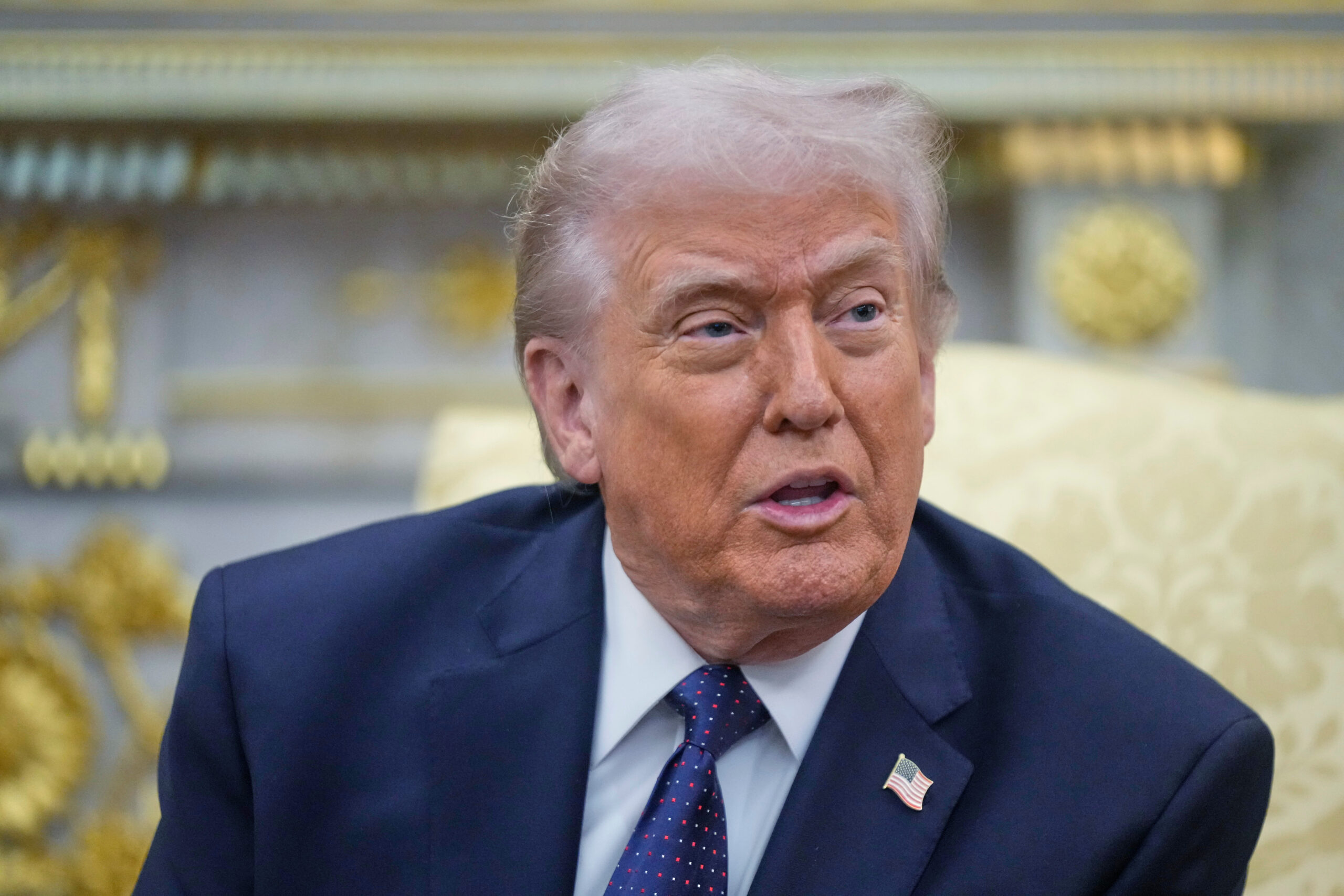
President Donald Trump speaks during a meeting with German Chancellor Friedrich Merz in the Oval Office at the White House, Tuesday, March 3, 2026, in Washington. (AP Photo/Mark Schiefelbein)
Republican lawmakers have largely backed Trump’s decision to strike Iran, citing its long record of terrorism against the United States and its allies, and its nuclear ambitions.
But Rubio’s decision to pin the justification for the attack on Israel angered prominent MAGA commentators and conservative pundits, who said an operation of this magnitude should be done squarely in the interests of the United States.
“My own feeling is no one should have to die for a foreign country. I don’t think those four service members died for the United States,” said Trump advocate and podcast host Megyn Kelly, referring to the first four acknowledged U.S. deaths in the war, a toll that later rose to six. “I think they died for Iran or for Israel.”
In a social media post Monday night, Iranian Foreign Minister Abbas Araghchi piled on. “Mr. Rubio admitted what we all knew: U.S. has entered a war of choice on behalf of Israel. There was never any so-called Iranian ‘threat,’” he wrote.
This week, the House and Senate are poised to vote on measures that would attempt to halt further military attacks in Iran without lawmakers’ approval, as Democrats frame the conflict as an “illegal war” launched without a clear rationale or an authorization from Congress.
A Washington Post flash poll found that 52% of Americans oppose the strikes “strongly” or “somewhat,” while 39% support them.
Even as the administration’s public case for war shifted, several U.S. officials with access to classified intelligence assessments said there was no information before the strikes began indicating Iran has made sudden, worrisome progress in its missile or nuclear programs.
“There was no imminent threat to the United States of America by the Iranians. There was a threat to Israel,” Sen. Mark Warner (D., Va.), the vice chair of the Senate Intelligence Committee, told reporters Monday.
Others said Iran’s weakness, amid severe economic problems and protests that challenged the regime, provided an opportunity to strike.
A former U.S. intelligence official said American spy agencies were concerned by the speed with which Iran reconstituted its missile program after the 12-day war in June. “If you wait a year from now, maybe the regime will have stabilized, the missile program will be more populated and federated,” said the former official, who spoke before the strikes began and requested anonymity to discuss a sensitive subject.
With Trump a potentially lame duck president in a year’s time, “Right now is the sweet spot,” he said.
Multiple legal experts argued that none of the administration’s public explanations for the attacks appeared to constitute a legitimate rationale to enter into such a major conflict, especially without authorization from Congress.
“Having a weapons capacity is not the same thing as presenting an imminent threat of an armed attack,” said Tess Bridgeman, a former senior lawyer on the National Security Council during the Obama administration.
The first days of U.S. and Israeli airstrikes appeared focused on decapitating Iran’s leadership and blunting its ability to retaliate by destroying missile infrastructure and disrupting its military command network.
Rafael Grossi, head of the International Atomic Energy Agency, said Monday that the U.N. nuclear watchdog agency has seen no “major military activity targeting the nuclear facilities” in Iran since the U.S.-Israeli attacks began early Saturday. That assessment, he said, is based on information from Iran as well as multiple satellite images, including those provided “by the U.S. and others.”
Grossi’s assessment came as Tehran charged there was an attack on its Natanz enrichment facility and as Israel warned civilians to evacuate areas around Isfahan, a major center of Iran’s nuclear program.
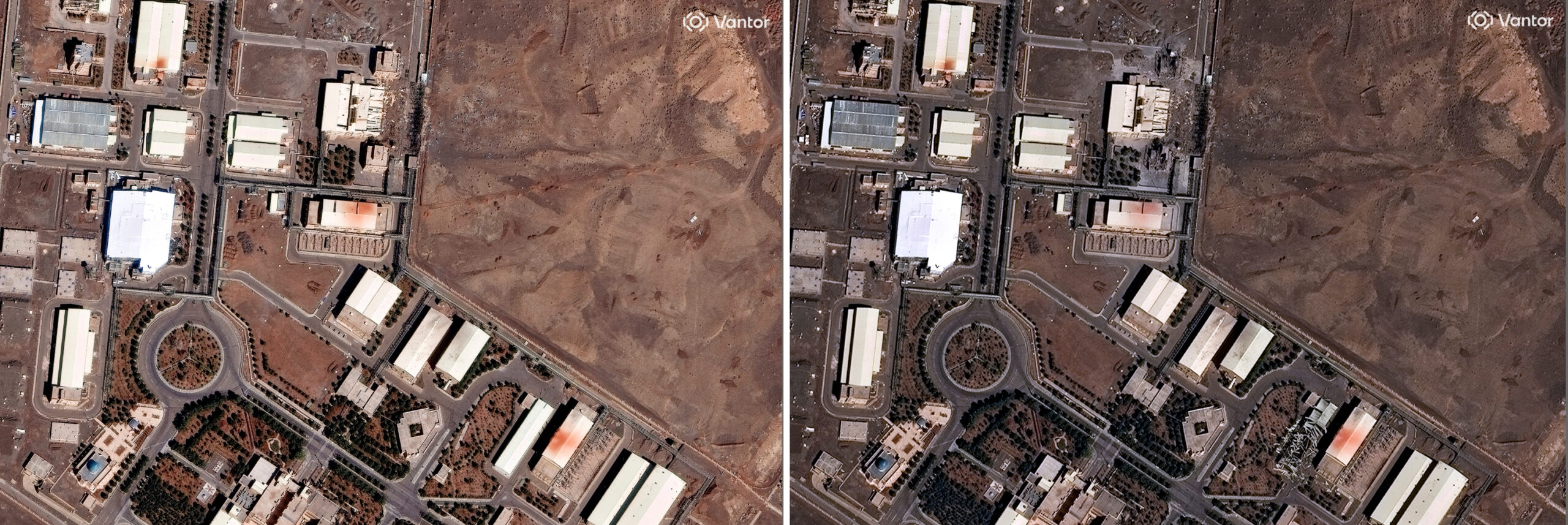
Satellite imagery of Natanz captured Monday showed damage to three buildings on the site, damage that Grossi indicated was fairly minor. Vehicle and personnel entrances to underground portions of the facility where centrifuges are kept appear to have been hit, according to the imagery.
The United States and Israel have long accused Iran of seeking to build a nuclear weapon under the cover of enriching uranium for civilian purposes. Last year’s strikes targeting Iran’s uranium enrichment facilities and other sites significantly delayed the program, U.S., Israeli, and IAEA officials said. Trump and Hegseth said Iran’s nuclear ambitions had been “obliterated.”
The Defense Intelligence Agency in a report produced before those strikes assessed that since 2019, in the wake of Trump leaving a nuclear deal with Iran that limited its nuclear program, the Islamic Republic had boosted uranium enrichment and expanded its stockpiles to the point that the time required to produce sufficient weapons-grade uranium for a first nuclear device had fallen to “probably less than one week.”
The actual time to produce a weapon ranged from two to four months, the agency estimated, according to people familiar with the assessments who spoke on the condition of anonymity because of the matter’s sensitivity.
The June strikes targeted Iran’s main enrichment plants at Natanz and Fordow. But the Iranians had been manufacturing centrifuge cascades long before the strikes and likely were storing them at other locations, the people said. “So their ability to do a breakout may or may not have been dependent at all” on the sites that were bombed, one person said.
Post-strike, the DIA and other U.S. intelligence agencies determined that the time Iran now needed to produce enough weapons-grade uranium to build a warhead in extremis — without rebuilding the damaged sites — had lengthened to between four and eight months, people familiar with the matter said.
Uncertainties about Iran’s nuclear program are heightened by the fact that IAEA inspectors left the country last July and haven’t returned.
“The return of the IAEA inspectors will be further delayed as a result of the renewed conflict, and without effective IAEA monitoring, the whereabouts and security of Iran’s highly enriched uranium will now become even more uncertain,” said Daryl Kimball, executive director of the Arms Control Association think tank.
In the meantime, Kimball said, “There hasn’t been any sign that Iran is rebuilding anything.”
The Republican-led House Oversight and Government Reform Committee released videos Monday of the closed-door depositions of former President Bill Clinton and former Secretary of State Hillary Clinton, part of its investigation into convicted sex offender Jeffrey Epstein.
Bill Clinton appeared before the committee on Friday, marking the first time a former president had been compelled to testify before Congress under a subpoena. During his lengthy deposition, the former president sought to distance himself from Epstein, saying he had no knowledge of Epstein’s crimes and stopped associating with him years before his first guilty plea, in 2008.
“There was nothing that I saw when I was around him that made me realize that he was trafficking women,” Clinton told the committee. “I saw nothing, and I did nothing wrong.”
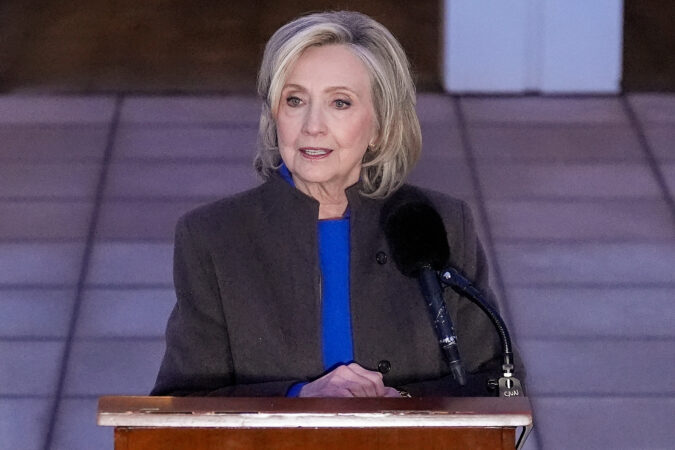
In her hours-long deposition Thursday, Hillary Clinton said she had no recollection of ever meeting Epstein and had known Epstein associate Ghislaine Maxwell only “casually, as an acquaintance.” Hillary Clinton derided the deposition as “political theater” and sharply questioned why she was being deposed.
House Republicans have issued subpoenas to several people — mostly Democrats — mentioned in the millions of files related to the federal government’s Epstein investigation that have been released by the Justice Department.
They have not called in President Donald Trump, who had a long-standing friendship with Epstein. The president has said that he knew Epstein socially in Palm Beach, Fla., and that they had a falling out in the mid-2000s. Trump has maintained that he did not know about Epstein’s criminal behavior.
Here are some of the highlights of the depositions:
Bill Clinton says Larry Summers connected him with Epstein
In his deposition, Bill Clinton said his former treasury secretary Larry Summers, then the president of Harvard University, first recommended that he strike up an acquaintance with Jeffrey Epstein.
As Clinton recalled, Summers — who recently resigned his positions at Harvard because of his association with Epstein — called Clinton shortly after he left office, in late 2001 or early 2002, when Clinton was setting up a charitable foundation.
Summers told him of “a man named Jeffrey Epstein” who had made a multimillion-dollar contribution to brain research, Clinton said, and described Epstein as an “information-hungry person” who owned a “massive airplane” and “wanted to spend some time talking to me about economics and politics.”
Clinton said he saw the plane as an economical means of doing international travel for his foundation.
After taking about a half-dozen trips aboard Epstein’s jet over a couple of years, Clinton said, he quit doing so because his foundation had launched and he had offers of transportation from people he knew better.
Clinton said he considered Epstein “an interesting man, but I didn’t think he was really interested in what I was doing.”
Clinton told the committee that he first learned of Epstein’s crimes “in 2008, when he was prosecuted. There was nothing that I saw when I was around him that made me realize that he was trafficking women.”
At another point, he told the committee, “I don’t believe any law enforcement agency has ever asked me [about Epstein], and I don’t know enough to volunteer anything.”
Hillary Clinton says she ‘knew nothing about’ Epstein
Hillary Clinton repeatedly testified that she did not know Epstein. She characterized him as not being on her “radar,” but was told in preparation for the deposition that she and Epstein both attended an event at the White House that was put on by the White House Historical Association.
“I have no recollection, in any way, of ever having any conversation at the White House or in any other place or on any kind of device of any sort. I knew nothing about him,” Hillary Clinton said when asked if she had any communication with Epstein.
She testified that she knew Maxwell “casually” as someone who dated an acquaintance of hers — Ted Waitt, a software developer.
Waitt, Clinton said, brought Maxwell as a guest to the wedding of the Clintons’ daughter, Chelsea, in 2010.
Clinton said that she did not consider Maxwell a friend and that her daughter would have been “friendlier” with Maxwell, but that she “had no idea” how often they interacted.
Clinton declined to characterize the relationship between Maxwell and Bill Clinton.
“He’ll have to answer that,” she said when asked if Bill Clinton and Maxwell were friends.
Bill Clinton reacts to hot tub photo during Asia trip
Bill Clinton was shown a photo of himself in a hot tub that was among the Epstein files and that has generated much attention.
He recalled that it was taken while he was in Brunei at the end of a long leg of one of his Asia trips.
He and his party, including Epstein, were guests at a hotel owned by the sultan of Brunei, with whom Clinton had established a warm relationship while he was president, and spent time in the hot tub and pool, which were located on the same floor as some of their suites.
“I swam around. I sat in the hot tub for five minutes or whatever it was. I got up and went to bed,” Clinton said.
Bill Clinton denies having visited Epstein’s island
A Democrat on the committee, Rep. Melanie Stansbury of New Mexico, grilled Bill Clinton on reports that he had been on Epstein’s island.
Clinton repeatedly denied he had ever visited the island. He also denied a report, cited by Stansbury, that he had visited Epstein’s home while he was president.
Bill Clinton says he’s not been in touch with Maxwell for a decade
Bill Clinton said his first recollection of meeting Maxwell was on his first flight aboard Epstein’s plane, when she was working for the financier.
Clinton’s relationship with her “lasted longer and was more extensive than my relationship with Mr. Epstein,” he said, because she started “going with” Waitt, the tech billionaire, who became a major donor to the Clinton Foundation.
Clinton said that, by his recollection, he has not been in contact with her for a decade or more.
He said he did not learn about her participation in Epstein’s sexual abuse of minor girls until “the first evidence against her came out in 2019.”
Hillary Clinton’s deposition was paused after photos were shared
Nearly 80 minutes into the deposition, Hillary Clinton’s lawyer interrupted Republican questioning, saying pictures of the former secretary of state testifying had been posted online.
The attorney argued that the pictures, which had been shared by Rep. Lauren Boebert (R., Colo.), violated the committee’s rules — and noted that the Clintons had repeatedly asked that the depositions be held in public.
Visibly frustrated, Hillary Clinton told Republicans that if they were going to be sharing pictures of the interview, she was “done.”
“You can hold me in contempt from now until the cows come home. This is just typical behavior,” she said. “We all are abiding by the same rules.”
The hearing was then paused. When the interview resumed, Rep. James Comer (R., Ky.), the committee’s chairman, said he advised Republicans that no pictures or videos of the deposition could be released.
The Clintons were accompanied by trusted lawyers
The Clintons were accompanied by two lawyers who for decades have been among the most trusted and protective allies in their orbit.
David Kendall is the Clintons’ longtime personal attorney, and Cheryl Mills was deputy White House counsel during Bill Clinton’s presidency and chief of staff to Hillary Clinton at the State Department. Both are known for their discretion and were part of the legal team that defended Bill Clinton in his 1999 Senate impeachment trial, in which he was acquitted.
Military officers will see their tuition assistance cut off at 22 schools and institutions, but the University of Pennsylvania is not among them.
The Ivy League institution, which counts President Donald Trump among its alumni, was on an initial list of 34 schools “at risk” of losing Pentagon-funded tuition assistance. But Penn was not part of the 22-university list released by Defense Secretary Pete Hegseth on Friday.
Penn did not immediately respond to a request for comment Tuesday.
Hegseth previously said he intendedto cut off schools where faculty members have “leftist political leanings” and “openly loathe our military,” but he cited no specific examples of bias or misconduct at the 22 schools that will lose tuition assistance beginning with the 2026-27 academic year.
“We will no longer invest in institutions that fail to sharpen our leaders’ warfighting capabilities or that undermine the very values they are sworn to defend,” Hegseth wrote in a letter released Friday with the final list.
It was not immediately clear why Penn and other schools were removed from the initial draft list.
Among the schools still set to lose access to the tuition-assistance program is Princeton University, where Hegseth obtained a bachelor’s degree in 2003. Carnegie Mellon University in Pittsburgh is also on the list, as is Yale University, where Vice President JD Vance obtained a law degree.
The move means members of the military will be banned from using Department of Defense tuition assistance to pay for Senior Service College Fellowship programs at those schools.
The impact will not be large — the Department of Defense said fewer than 100 military students are enrolled in programs at schools that will lose funding. Military personnel currently enrolled may complete their courses of study, Hegseth said, though it is unclear if they will have to change schools to continue receiving financial assistance.
Hegseth’s announcement did not mention several other financial assistance programs for undergraduates, including the GI Bill, which is administered by the Department of Veterans Affairs.
Here is the full list of schools losing tuition assistance from the Pentagon:
Educational institutions
Harvard University
St. Louis University
Massachusetts Institute of Technology
Tufts University
Georgetown University
Carnegie Mellon University
Brown University
Columbia University
Yale University
Middlebury College
Princeton University
George Washington University
College of William and Mary
International institution
Queen’s University (Canada)
Nonprofit institutions
Center for Strategic and International Studies
New America Foundation
Brookings Institution
Atlantic Council
Center for a New American Security
Council on Foreign Relations
Henry L. Stimson Center
Senior Service College
Johns Hopkins University School of Advanced International Studies West Space Scholars Program
WASHINGTON (AP) — For Democrats demoralized at being shut out of power in Washington, the past several months have offered reason for optimism.
A party often beset by ideological division has largely been unified in opposition to President Donald Trump’s hardline immigration tactics, particularly after two U.S. citizens were killed in Minneapolis. Heading into a midterm election year in which they are just a few seats shy of reclaiming the U.S. House majority, Democrats have also kept the White House on defense with criticism of Trump’s economic policies and ties to Jeffrey Epstein, the convicted sex offender.
But the U.S. and Israeli strikes against Iran could test the durability of that cohesion. Initially, Democrats balanced condemnation of Iran’s supreme leader, Ayatollah Ali Khamenei, who was killed over the weekend, with calls for Congress to quickly pass a war powers resolution that would restrain Trump’s attack options.
“As soon as our resolution comes to the floor, senators need to pick a side,” Senate Democratic leader Chuck Schumer said on Monday. “Stand with Americans who don’t want war, or stand with Donald Trump as he singlehandedly starts another war.”
Democratic divisions going into war powers vote
But some divisions are surfacing as a handful of Democrats, especially those who are strongly aligned with Israel, express reservations about the war powers measure. Rep. Greg Landsman, D-Ohio, won’t back an Iran resolution. Before the strike, Rep. Josh Gottheimer, D-N.J., also said he would vote no.
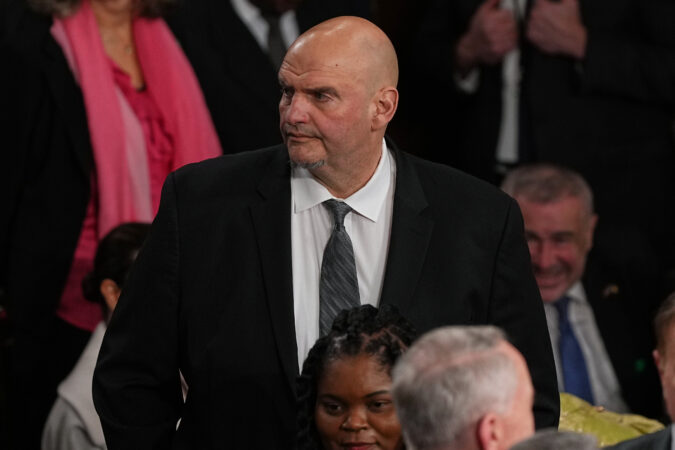
Sen. John Fetterman, D-Pa., who backed a war powers vote tied to Venezuela in January, also has broken with Democrats over the Iranian measure and rejected arguments that the attack was illegal, spurring frustration among some party leaders.
“John Fetterman knows better,” House Democratic leader Hakeem Jeffries said Monday on CNN.
Republicans are also facing internal dissent. Trump, who did little to prepare Americans for the prospect of such a dramatic conflict, said Monday the operation could last four to five weeks. He hasn’t articulated a clear exit strategy and warns that American casualties could mount, which will pose a severe test of voter patience for the conflict.
The war could also lead to rising gas prices and economic volatility that may bolster Democratic arguments that the president is out of touch with the financial realities facing many Americans.
Still, Republicans see an opportunity to portray Democrats as reflexively opposed to Trump.
“For my Democratic colleagues, this is not about what’s best for our national security or what’s best for protecting the American people,” said Sen. John Kennedy, R-La. “This is about how to defeat Donald Trump.”
A searing debate among Democrats over Israel
Democrats have undergone a searing internal debate over the party’s relationship with Israel in the wake of the war in Gaza. Then-President Joe Biden’s loyalty to Israel during the heat of the 2024 campaign was starkly at odds with younger generations outraged by the treatment of Palestinians in Gaza. By the time Kamala Harris rose to the top of the ticket that year, she struggled to win over some younger voters who are critical to Democratic success.
Paco Fabian, the political director for the progressive advocacy group Our Revolution, acknowledged that Democrats “aren’t monolithic.” But he also suggested a shift was underway, noting the results of a New Jersey special election last month.
During that campaign, the affiliated super PAC of the pro-Israel American Israel Public Affairs committee sought to thwart the moderate candidate, Tom Malinowski, after he questioned unconditional aid to the Israeli government. Those efforts appeared to backfire with the more progressive contender, Analilia Mejia, winning the primary.
“Given what’s going on right now, I don’t think the moment is doing AIPAC and Israel any favors,” Fabian said.
Sympathy toward Israel appears to be shifting. Three years ago, 54% of Americans sympathized more with the Israelis, compared with 31% for the Palestinians, according to Gallup polling released last month. Now, their support is about evenly balanced, with 41% saying their sympathies lie more with the Palestinians, and only 36% saying the same about the Israelis.
Americans’ initial reactions to airstrikes also appeared more negative than positive, early polling suggested. About 6 in 10 U.S. adults disapproved of the U.S. decision to take military action in Iran, according to a CNN poll conducted via text message over the weekend. A separate snap poll from The Washington Post conducted via text message on Sunday suggested that about half of those polled opposed the strikes, while 39% were in support. Roughly 1 in 10 were unsure.
Democrats and independents drove much of the disapproval in those early polls, while Republicans were much more supportive.
Elections this week could show impact of attacks
The initial political impact of the attacks in Iran could emerge as soon as Tuesday during the first primary elections of this year’s midterm campaign.
In North Carolina, Durham County Commissioner Nida Allam was already going into her bid to unseat two-term Rep. Valerie Foushee with backing from Our Revolution and other top progressives. After receiving support from groups tied to AIPAC during her 2022 campaign, Foushee’s campaign rejected such contributions this cycle. Over the weekend, she said she doesn’t support “Trump’s illegal war with Iran” and would back the war powers resolution.
Still, Allam, who would be the first Muslim elected to Congress from North Carolina, was quick to release a video ahead of Tuesday’s vote criticizing Trump for “starting another endless war” and promising to never accept support from “the pro-Israel lobby.”
In Texas, home to high-profile Senate primaries on Tuesday, Democratic voters expressed alarm at the attacks.
“It shouldn’t have happened,” said Charles Padmore, 45, an independent contractor in Houston. “Affordability should be the top priority on Trump’s list.”
Alex Diaz, 31, a biology high school teacher in Houston, called the bombing of Iran “uncalled for.”
“You’re trying to start World War III, and we don’t need that right now,” he said.
The fallout could spread to other contests this month. Ahead of the March 17 primary in Illinois, AIPAC-aligned groups have also criticized Daniel Biss, the Evanston mayor who is aiming to become the Democratic candidate to succeed the retiring Rep. Jan Schakowsky. In an interview, Biss spoke of the “backlash I’m hearing people have against AIPAC, their MAGA-aligned money and their Trump-aligned policy agenda.”
Asked about such predictions, Patrick Dorton, a spokesman for AIPAC’s affiliated super PAC, said “the key distinction will be between those who recognize that Iran is a murderous regime that tortures women for leaving their hair uncovered, hangs gay people, and executes peaceful democratic protestors, and those who will turn a blind eye to the regime’s atrocities.”
Calls for a ‘united opposition party’
As Congress moves toward a potential war powers vote this week, Biss said there was a need for Democrats to act as a “strong, clear, vocal, united opposition party.”
“I also would like to see the Democratic Party united not just on the procedural argument but on the basic acknowledgment that this war is wrong,” he added.
On Capitol Hill, Sen. Richard Blumenthal of Connecticut, a Democrat on the Armed Services Committee, said he was less concerned about party unity than the prospect of achieving a bipartisan vote on the war powers resolution. Three Republicans ultimately backed the Venezuela resolution in January.
“What I want to see happen is the war powers resolution pass,” he said. “I’m not focused on what Democrats as a whole do. We’re going to have differing opinions among Democrats and among Republicans.”
WASHINGTON — The U.S. Congress is about to launch a war powers debate over President Donald Trump’s authority to bomb Iran under largely unusual circumstances — he has already done it, and the country is essentially already at war.
Bombs are falling, people are dying and vows of revenge and retribution are being lobbed in escalating threats, all while untold taxpayer dollars are being spent on a military strategy that’s expected to continue for weeks with an undefined goal and conclusion. Unlike the run-up to the Iraq War in 2003, which included long debates in Congress in the aftermath of the Sept. 11, 2001, attacks, or the more recent U.S. military strikes on Venezuela that proved to be limited, the joint U.S.-Israel military attack on Iran, called Operation Epic Fury, is well underway, with no foreseeable end in sight.
The moment is a defining one for Congress, which alone has the authority under the U.S. Constitution to declare war, and for the Republican president, who has consistently seized power during his second term with an apparent limitless view of his own executive reach.
“The Constitution is intended to prevent the accumulation of power in any one branch of government — and in any one person in government,” said David Janovsky, acting director of The Constitution Project at the Project on Government Oversight, a watchdog organization.
“Congress is the people’s representatives in a way that the president isn’t, even though we tend to focus on the president,” he said. “We need the people’s representatives to weigh in on whether we, the people, are going to war right now.”
War powers as a check on presidential power
In the U.S., the Congress would need to affirmatively approve wartime operations, with a declaration of war, or with an authorization for the use of military force, to essentially approve of the actions. But this rarely happens.
In fact, Congress has declared war just five times in the nation’s history, most recently in 1941, to enter World War II a day after the Pearl Harbor attack. Congress approved an AUMF for the 1990 Gulf War and did so again in 2001 and 2002 to launch the 9/11-era wars into Afghanistan and then Iraq.
But Congress also created the war powers resolution during the Vietnam War-era, as something of a tool of last resort — deployed to slap back a president who had embarked on military excursions without congressional approval.
Both the House and the Senate have prepared war powers resolutions for votes this week.
Sen. Mark Warner, the top Democrat on the Senate Intelligence Committee, said Trump, as president, “does not have the right to do this on his own.”
“When the president commits American forces to a war of choice, he needs to come before Congress and the American people and ask for a declaration of war,” Warner said on CNN’s “State of the Union.”
While lawmakers have criticized the Iranian regime and its nuclear ambitions, Democrats said Trump has not provided a rationale for the war or outlined its strategy for what comes next, and Trump’s MAGA coalition is splintering over what it sees as the president’s failure to keep his “America First” campaign promise by leading the U.S. toward an overseas war. Many lawmakers are wary of a longer entanglement as the operation killed Iran’s Supreme Leader Ayatollah Ali Khamenei and hundreds of people in the region.
White House officials are scheduled to brief congressional leaders and lawmakers this week, but the question-and-answer sessions will be behind closed doors, without a watchful public.
Power of the purse can stop wars
Over time, presidents of both major political parties have accumulated vast authority to engage in what are often more limited U.S. military strikes to accomplish strategic national security goals without approval from Congress. Democrat Barack Obama’s military operations over Libya and Republican George H.W. Bush’s incursions into Panama were conducted without the nod from Congress.
But restraining a president’s war powers is something lawmakers past and present have rarely been able to accomplish. Even if Congress is able to pass a war powers resolution to curb Trump in Iran, the House and the Senate would be unlikely to tally the two-thirds majority needed to overcome a presidential veto.
Trump has shrugged at the power of Congress to dictate what he can and can’t do, in war and other matters. He made only a brief mention of Iran in his State of the Union address last week, treating lawmakers’ support as an afterthought.
John Yoo, a law professor at the University of California, Berkeley, said the Founding Fathers set up a constitutional system in which the president and Congress would battle it out over these issues — but with Congress having one particularly powerful tool, because it controls the federal funding.
“Congress, they know how to stop this if they want to,” said Yoo, who helped draft the Bush administration’s 2001 and 2002 use of force authorizations. The Vietnam War ended once Congress pulled funding, he said.
But Congress is controlled by a Republican majority that largely shares Trump’s view of focusing military power against Iran, and it recently approved massive new funds for the Pentagon, some $175 billion, in the big tax cuts bill that he signed into law last yar.
With the Republican president’s party in power in the House and the Senate, it’s no surprise they are unlikely to object, Yoo said: “They agree with him.”
Debate in Congress begins
Ahead of debates, Republican Sen. Tom Cotton, the chairman of the Senate Intelligence Committee, said Trump already laid out his vision for Iran.
Cotton said Sunday that Trump has made it clear the U.S. won’t be sending ground forces inside Iran. Instead, Americans should expect to see an “extended air and naval campaign” in the region, which could result in pilots being shot down, though he said the military personnel would be recovered.
He expects a weekslong campaign as Iran names a new leader and determines how it will react to the U.S. attack.
“There’s no simple answer for what’s going to come next,” Cotton said on CBS’ “Face the Nation.”
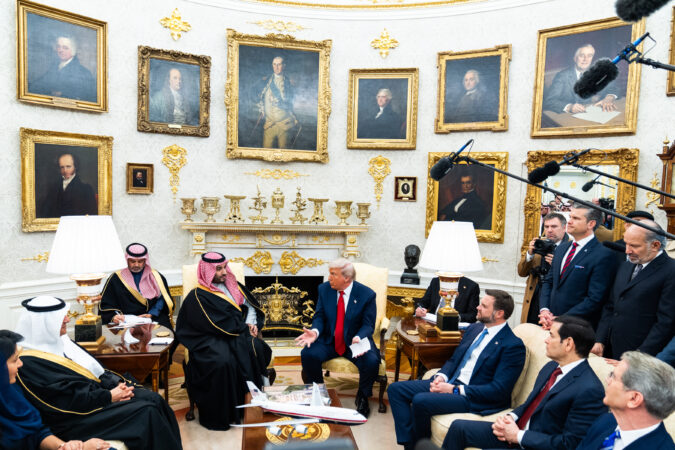
President Donald Trump launched Saturday’s wide-ranging attack on Iran after a weekslong lobbying effort by an unusual pair of U.S. allies in the Middle East — Israel and Saudi Arabia — according to four people familiar with the matter, as Israeli and U.S. forces teamed to topple Iranian Supreme Leader Ali Khamenei after nearly four decades in power.
Saudi Crown Prince Mohammed bin Salman made multiple private phone calls to Trump over the past month advocating a U.S. attack, despite his public support for a diplomatic solution, the four people said. Israeli Prime Minister Benjamin Netanyahu, meanwhile, continued his long-running public campaign for U.S. strikes against what he views as an existential enemy of his country.
The combined effort helped lead Trump to order a massive aerial campaign against Iran’s leadership and military, which in its initial hour led to the death of Khamenei and several other senior Iranian officials.
The attack came despite U.S. intelligence assessments that Iran’s forces were unlikely to pose an immediate threat to the U.S. mainland within the next decade. Saturday’s attack on Iran was a break from decades of U.S. decision-making to hold back from a full-scale effort to depose the regime of a country of more than 90 million people. It also marked a stark shift from Trump’s own previous military forays, which until now have been far narrower in scope.
Now Trump will bear the risk of the bet he has placed: that a major military operation conducted from the air can achieve political goals on the ground.
“No president was willing to do what I am willing to do tonight,” Trump told Iranians in a video address posted as U.S. bombs rained down on targets across Iran. “Now you have a president who is giving you what you want, so let’s see how you respond.”
The Saudi push for an attack came as presidential envoy Steve Witkoff and Trump’s son-in-law Jared Kushner pursued negotiations with Iranian leaders over the country’s nuclear and missile programs.
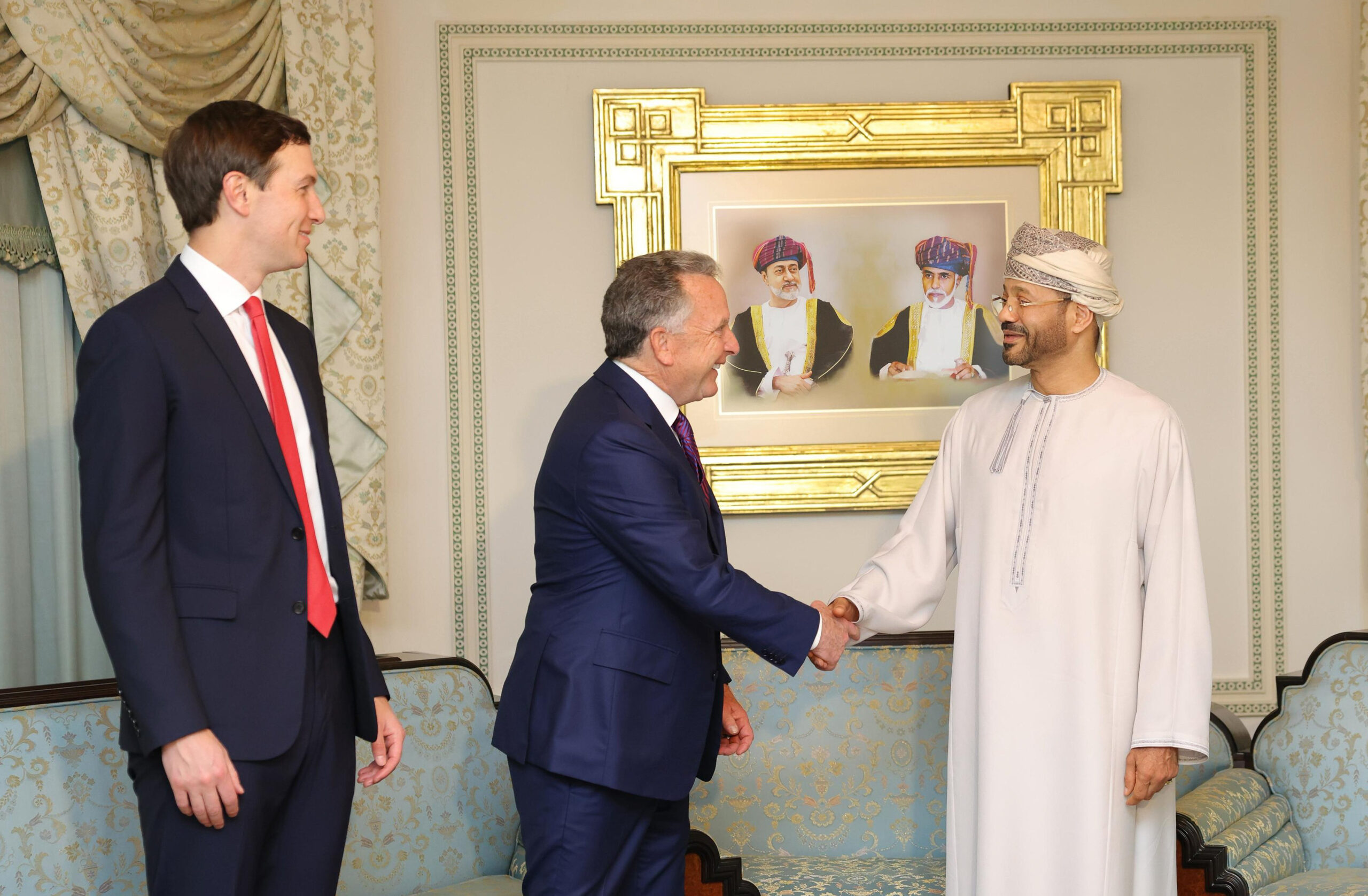
In this photo released by the Oman’s Foreign Ministry, Steve Witkoff, White House special envoy, centre, shakes hands with Oman’s Foreign Minister Sayyid Badr Albusaidi as Jared Kushner, left, looks on during their meeting prior to Iran and the U.S. negotiations, in Muscat, Oman, Friday, Feb. 6, 2026. (Oman Foreign Ministry via AP)
As those talks proceeded, Riyadh issued a statement, following a phone call between the crown prince and Iranian President Masoud Pezeshkian, that Mohammed would not allow Saudi airspace or territory to be used in an attack on Iran.
In his discussions with U.S. officials, however, the Saudi leader warned that Iran would come away stronger and more dangerous if the United States did not strike now, after amassing the largest military presence in the Middle East since the 2003 invasion of Iraq, said the people, who, like others, spoke on the condition of anonymity to discuss the sensitive situation.
Mohammed’s position was reinforced by his brother, Saudi Defense Minister Khalid bin Salman, who held closed-door meetings with U.S. officials in Washington in January and warned about the downsides of not attacking, the people said.
The Saudi leader’s complicated position probably reflected his desire to avoid Iranian retaliation against his country’s vulnerable oil infrastructure, weighed against his view of Tehran as Riyadh’s ultimate foe in the region, said those familiar with his thinking. Iran, dominated by Shiite Muslims, and Saudi Arabia, led by Sunnis, have long had an intense rivalry that has generated proxy wars in the region.
Following the initial U.S. attack on Saturday, Iran did retaliate against Saudi Arabia. Riyadh issued a furious statement condemning the attack and calling on the international community to “take all necessary and decisive measures” to confront Iran.
The Saudi Embassy did not respond to a request for comment.
Witkoff and Kushner had their final contacts with Iranian officials in Geneva on Thursday, their third high-level encounter since early February. They walked away believing that Tehran was playing games with them about its need for nuclear enrichment, according to a senior Trump administration official.
“It was very clear that the intent for them was to preserve their ability to do enrichment so that, over time, they could use it for a nuclear bomb,” the official said.
By Friday afternoon, when Trump arrived in Corpus Christi, Texas, for a campaign rally ahead of Tuesday primaries there, the president’s frustration — and his rhetoric — was escalating. He repeatedly declared himself “not happy” with Iranian negotiators.
“I’ve got a lot of things going on now,” he told the crowd toward the end of a rambling speech ostensibly focused on energy policy. “We have a big decision to make, you know that. Not easy, not easy. We have a very big decision to make.”
Later, he flew to Palm Beach for the weekend, where he mingled with supporters at his Mar-a-Lago resort Friday evening, looking tired but otherwise in good sprits before exiting to his private quarters to record a speech he would give announcing the attack, according to one person who was there and interacted with him.
The decision to launch the attack was in some ways foretold by the massive buildup of U.S. forces over the past two months. But there was little in Trump’s record to suggest that he would embrace a war of choice in the Middle East with the goal of regime change.
In explaining his decision, Trump on Saturday reached all the way back to Iran’s 1979 revolution. He described the U.S. attacks as payback for decades of conflict with Iran. He cited the 52 Americans held hostage for more than a year after the 1979 takeover of the American Embassy in Tehran; the deaths of 241 U.S. service members in 1983 bombing of their barracks in Beirut by Iran-backed Hezbollah during a Lebanese civil war; and the 2000 attack on the USS Cole, a naval destroyer docked in a Yemen, which Trump said Iran “probably” was involved in, although the United States has long attributed the suicide bombing to al-Qaeda.
Earlier Saturday, Trump said that the United States had faced “imminent threats from the Iranian regime.” Tehran was continuing to work toward producing a nuclear weapon and development of “long-range missiles that … could soon reach the American homeland.”
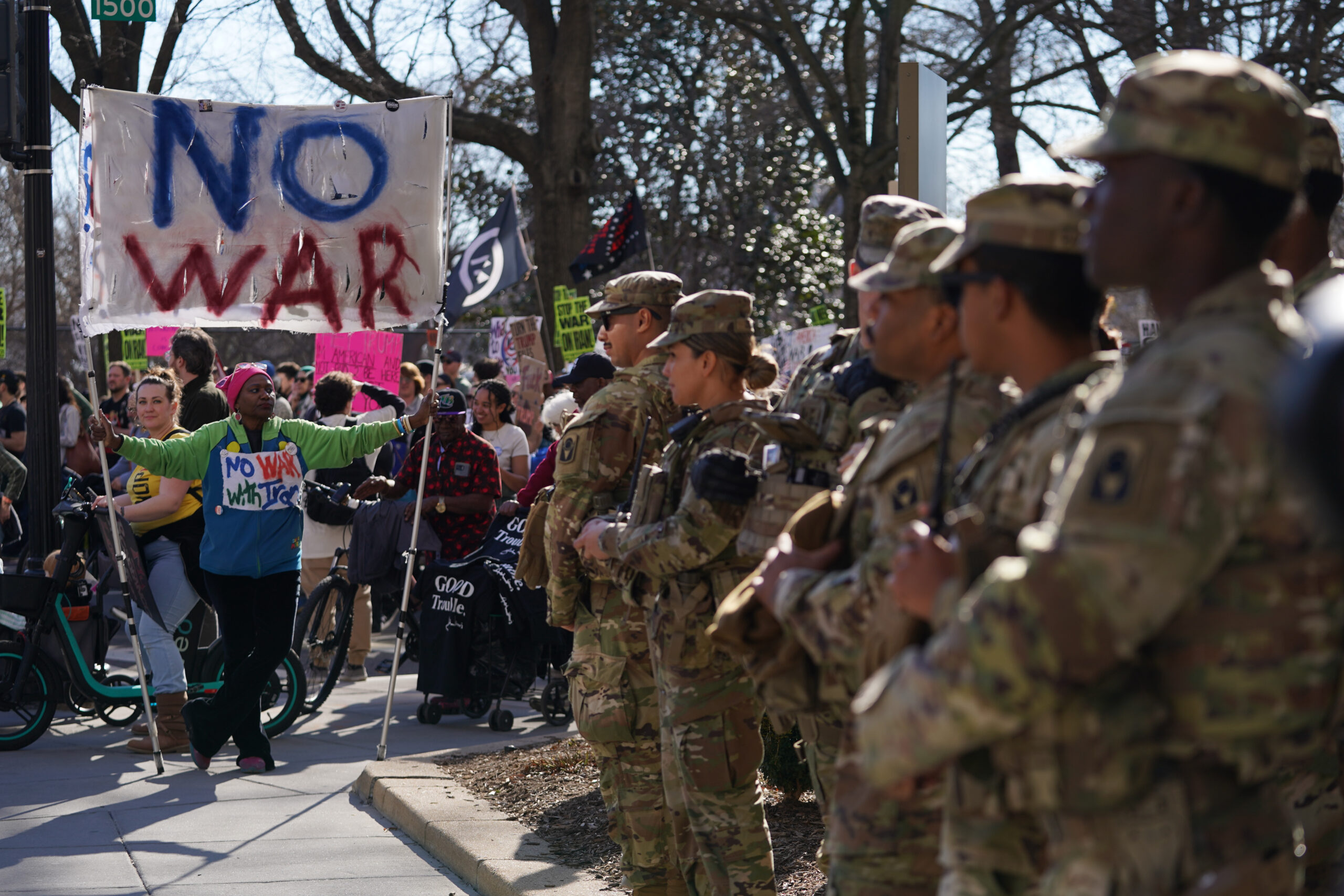
National Guard members watch as people protest near the White House against U.S. and Israeli strikes on Iran, Saturday, Feb. 28, 2026 in Washington. (AP Photo/Allison Robbert)
Both of those assertions have been challenged. Trump himself has vehemently maintained that the U.S. “obliterated” Iran’s nuclear program with airstrikes this past summer. The International Atomic Energy Agency has said there is no evidence Iran has restarted its uranium enrichment program following those strikes or that it has an active bomb-building plan. In an assessment last year, the U.S. Defense Intelligence Agency cited no indication that Iran was embarking on development of an intercontinental ballistic missile. If it decided to do so, the DIA said, it would take a decade to produce.
Trump directed anti-government Iranians to “take over” their government, but his call included no details. He declared that those within Iran’s extensive military and security infrastructure would be given “complete immunity” but provided no explanation how or by whom that would be done.
During both his first and second terms, Trump has said consistently there would be no American boots on the ground in military operations that he launched. Since taking office again, while launching air and missile attacks on seven countries — Nigeria, Syria, Yemen, Somalia, Venezuela, Iraq and Iran — he largely has kept that promise.
But it remains unclear whether aircraft and missile strikes can achieve his ever-expanding goals — among them new, U.S.-friendly regimes in Iran and Venezuela; an end to Iran-backed militant operations in Yemen; and the defeat of Islamic terrorist operations in Nigeria and Somalia.
“History is not kind to efforts to fundamentally alter and restructure the internal politics of a country using the air power alone,” said Aaron David Miller, a former U.S. diplomat who worked on Middle East issues for both Republican and Democratic administrations.
“This is very much Trumpian, in the sense that he’s tried to split the difference between getting bogged down in an interminable conflict which will undermine the American economy and cost Americans their lives, on one hand, and yet bringing to bear the power of the American military in a sort of roll-the-dice operation,” Miller said.
Months of planning for the 2003 U.S. toppling of Iraqi leader Saddam Hussein included thousands of invading American forces that remained there for nearly a decade and a large cadre of civilian U.S. officials on the ground to organize a new government.
Top Trump officials — some of whom have been sharp critics of the Iraq effort and other U.S. forays into the Middle East — have insisted in recent days that this time will be different.
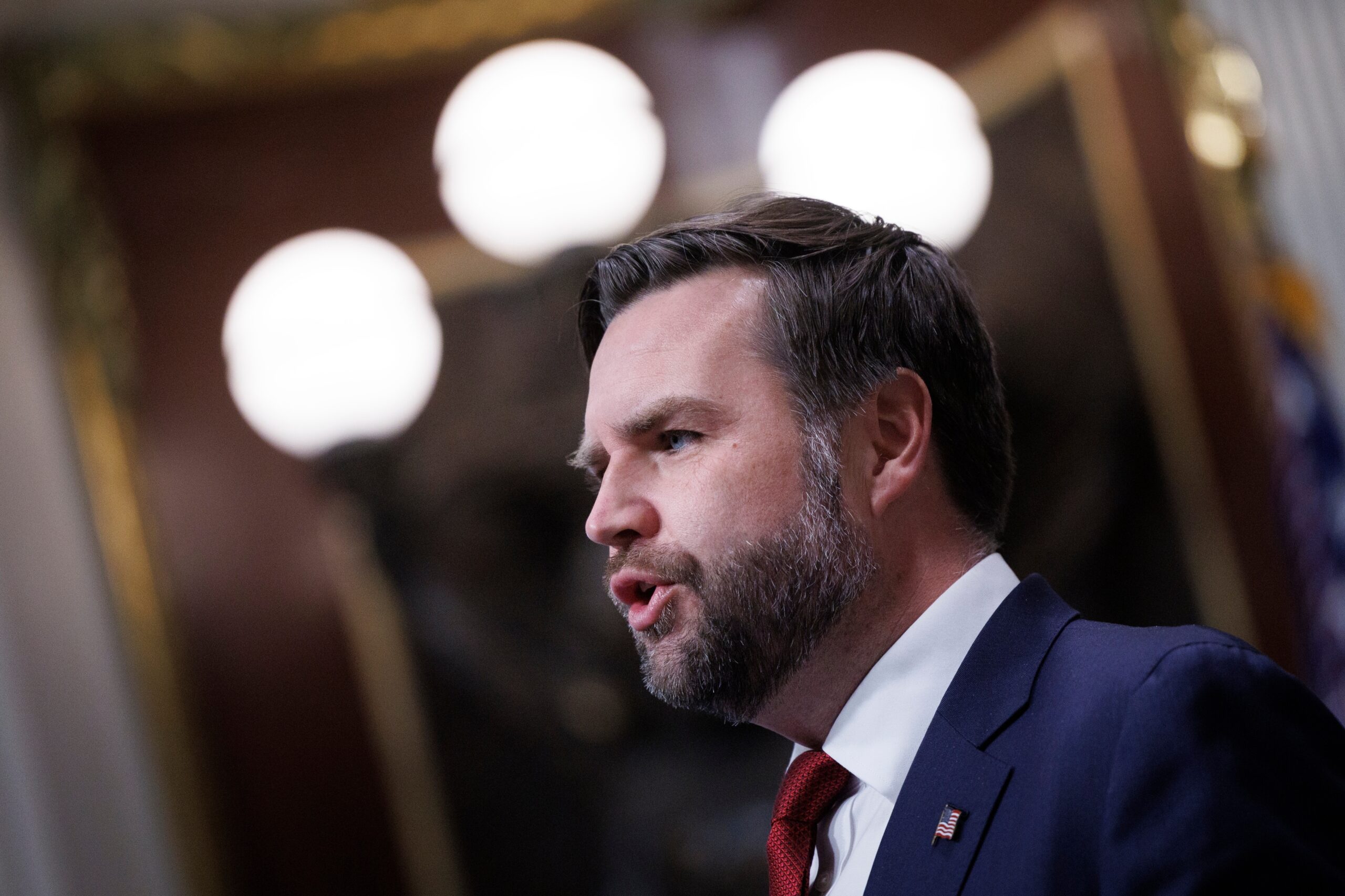
Vice President JD Vance speaks during a news conference in the Old Eisenhower Executive Office Building on the White House campus Wednesday, Feb. 25, 2026, in Washington. (AP Photo/Tom Brenner)
Vice President JD Vance on Thursday told the Washington Post that he still considers himself a “skeptic” of foreign military interventions — a description he said still applied to Trump, too. He said there was “no chance” any military operation by the U.S. in Iran would lead to a drawn-out war involving the Trump administration.
Vance on Saturday watched the military operation from the Situation Room at the White House, while dialed into a conference line that connected him to the president and his national security team, who were tracking Iran from Mar-a-Lago, according to a person with knowledge of the events. Vance was joined at the White House by Tulsi Gabbard, the director of national intelligence, who has long campaigned against war with Iran. Energy Secretary Chris Wright and Treasury Secretary Scott Bessent were in the Situation Room too, the person said.
Apart from Trump’s Saturday’s statements once the attack already started, the president has devoted little time to publicly justifying or explaining war with Iran, a break from previous practice of U.S. leaders.
Democrats on Saturday pushed Trump to explain his case to the American people.
“What was the imminent threat to America?” said Sen. Mark R. Warner (D., Va.), the senior Democrat on the Senate Intelligence Committee, in an interview. “I don’t know the answer.”
Warner, who participated in a classified briefing on Tuesday with Secretary of State Marco Rubio and CIA Director John Ratcliffe, said that senior lawmakers were given a “fair description of options” the administration was considering, but that he saw no threat that “would literally be worthy of putting our troops in harm’s way.”
In the briefing on Tuesday for the Gang of Eight, which consists of the leaders of the House, the Senate and each chamber’s intelligence committees, Secretary of State Marco Rubio indicated to lawmakers that the mission’s timing and goals were shaped by the fact that Israel was going to attack with or without the United States, according to a person familiar with the administration’s outreach to lawmakers.
“So the only debate that seemed to be remaining was whether the U.S. would launch in concert with Israel or if the U.S. would wait until Iran retaliated on U.S. military targets in the region and then engage,” the person said.
Now the question is what comes next.
For now, Trump says that he hopes that in the face of the death of Khamenei, Iran’s security forces and police “will peacefully merge with the Iranian Patriots, and work together as a unit to bring back the Country to the Greatness it deserves.” In January, those security forces killed thousands of Iranian protesters.
He vowed that “the heavy and pinpoint bombing, however, will continue, uninterrupted throughout the week or, as long as necessary to achieve our objective of PEACE THROUGHOUT THE MIDDLE EAST AND, INDEED, THE WORLD!”
President Donald Trump told The Washington Post early Saturday that his main concern is “freedom” for the Iranian people as the U.S. launched military strikes in the country.
A U.S. official said a multiday operation against Iran beganat about 1 a.m. Eastern time with a salvo of ship-launched Tomahawk cruise missiles and air-launched munitions from U.S. Air Force and Navy jets.
Iran quickly launched counterstrikes in response to the attack, which the Trump administration has named “Operation Epic Fury.” Multiple U.S. military bases were targeted by Iran, the official said, including the support facility for its 5th Fleet ships in Bahrain, according to the country’s state-run news service.
While the operations are ongoing, no U.S. service members have been injured, the official said, who spoke on the condition of anonymity to provide details that had not yet been publicly announced.Israel said it also launched attacks on Iran on Saturday.
“All I want is freedom for the people,” Trump said in a brief phone interview shortly after 4 a.m., when asked what he hopes his legacy will be as a result of the military action and a push for regime change in Iran.
“I want a safe nation, and that’s what we’re going to have,” the president said, his first reportable remarks since announcing “major combat operations” in a video message around 2:30 a.m.
Trump spoke from Mar-a-Lago, his home in Palm Beach, Fla., where he arrived Friday night just hours before the military strikes began. He spoke to the Post as television news played in the background.
Despite hisprevious criticism of U.S. involvement in Middle Eastern wars—particularly American lives lost during efforts to topple and install new regimes — Trump on Saturday made the case for the United States helping to bring about regime change in the country. In the video address, Trump urged Iranians once the strikes cease to “take over your government,” telling them “this will be probably your only chance for generations.”
Trump also conceded that U.S. troops were putting their lives at risk in this effort.
“The lives of courageous American heroes may be lost and we may have casualties,” Trump said in his taped remarks. “That often happens in war. But we’re doing this, not for now. We’re doing this for the future, and it is a noble mission.”
Less than a year ago, while visiting the Middle East, Trump decried the “so-called nation builders” who “wrecked far more nations than they built.”
“And the interventionalists were intervening in complex societies that they did not even understand,” Trump said in May at an investment conference in Riyadh, the capital of Saudi Arabia.
Now, the president is portraying himself as the one willing to assume substantial risk to save the Iranian people, urging them to “seize control” of their “destiny” with U.S. help.
“No president was willing to do what I am willing to do tonight,” Trump declared in the eight-minutevideo, which he said was filmed shortly after the attacks began in the early hours Saturday. He stood behind a lectern,wearing a white “USA” ball cap.
“Now you have a president who is giving you what you want, so let’s see how you respond,”he said, speaking to the Iranian people. “America is backing you with overwhelming strength and devastating force.”
Trump’s case to the American people for taking the country to war with Iran has never been urgently articulated.
While the president said the objective of the strikes is to “defend the American people by eliminating imminent threats from the Iranian regime,” in his video about the attacks, Trump accused Iran of a litany of sins: from working to build a nuclear weaponto roadside bombs to a campaign of “mass terror” he said the regime has carried out against the U.S. “for 47 years.”
Trump invoked the 1979 hostage crisis, in which 66 Americans were taken hostage at the U.S. Embassy in Tehran, and the 1983 bombing of U.S. Marine barracks in Beirut, in which 241 Americans were killed. He said Iran was “probably involved” in the al-Qaedaattack on the USS Cole in 2000 in Yemen.
“I built and rebuilt our military in my first administration,” Trump said, “and there is no military on Earth even close to its power, strength or sophistication.”
While speaking to the Post, the president did not take additional questions about the scope of ongoing operations or the potential for U.S. troop involvement on the ground. On Thursday, Vice President JD Vance said in an interview with the Post that any operation Trump initiates in Iran would not result in the U.S. becoming involved in a drawn-out war.
“The idea that we’re going to be in a Middle Eastern war for years with no end in sight – there is no chance that will happen,” Vance said.
Foreign policy experts have warned that, unlike the limited strikes the U.S. launched against Iranian nuclear sites in June, a wider conflict with Tehran could embroil Washington for years.
Trump’s views on U.S. intervention in the Middle East have evolved over time, with the president initially expressing support for the Iraq War at its outset more than two decades ago, before months later calling it a “terrible mistake.”
He built his political brand as an “America First” president opposed to adventures overseas, decrying the Iraq War during his 2016 campaign and in 2024 pledging a “stop to the endless wars and a return to peace in the Middle East.”
“We defeated [Islamic State] in record time, but we had no wars,” Trump said in his November 2024 election night victory speech, referring to his first term. “They said, he will start a war. I’m not going to start a war. I’m going to stop wars.”
WASHINGTON — The Trump administration on Friday ordered all U.S. agencies to stop using Anthropic’s artificial intelligence technology and imposed other major penalties, culminating an unusually public clash between the government and the company over AI safety.
President Donald Trump, Defense Secretary Pete Hegseth, and other officials took to social media to chastise Anthropic for failing to allow the military unrestricted use of its AI technology by a Friday deadline, accusing it of endangering national security after CEO Dario Amodei refused to back down over concerns the company’s products could be used in ways that would violate its safeguards.
“We don’t need it, we don’t want it, and will not do business with them again!” Trump said on social media.
Hegseth also deemed the company a “supply chain risk,” a designation typically stamped on foreign adversaries that could derail the company’s critical partnerships with other businesses.
Anthropic had said it sought narrow assurances from the Pentagon that its AI chatbot Claude would not be used for mass surveillance of Americans or in fully autonomous weapons. The Pentagon said it was not interested in such uses and would only deploy the technology in legal ways, but it also insisted on access without any limitations.
The government’s effort to assert dominance over the internal decision-making of the company comes amid a wider clash over AI’s role in national security and concerns about how increasingly capable machines could be used in high-stakes situations involving lethal force, sensitive information or government surveillance.
Trump and others lash out at Anthropic
Trump said Anthropic made a mistake trying to strong-arm the Pentagon. He wrote on Truth Social that most agencies must immediately stop using Anthropic’s AI but gave the Pentagon a six-month period to phase out the technology that is already embedded in military platforms.
“The United States of America will never allow a radical left, woke company to dictate how our great military fights and wins wars!” he wrote in all caps.
After months of private talks exploded into public debate this week, Anthropic said Thursday that the government’s new contract language would allow “safeguards to be disregarded at will.” Amodei said his company “cannot in good conscience accede” to the demands.
Anthropic can afford to lose the contract. But the government’s actions posed broader risks at the peak of the company’s meteoric rise from a little-known computer science research lab in San Francisco to one of the world’s most valuable startups.
The president’s decision was preceded by hours of top Trump appointees from the Pentagon and the State Department taking to social media to criticize Anthropic, but their complaints posed contradictions.
Top Pentagon spokesman Sean Parnell said on social media Thursday that Anthropic’s unwillingness to go along with the military’s demands was “jeopardizing critical military operations and potentially putting our warfighters at risk.” Hegseth said Friday that the Pentagon “must have full, unrestricted access to Anthropic’s models for every LAWFUL purpose in defense of the Republic.”
Trump’s social media post also mandated the company “better get their act together, and be helpful” during a six-month phase-out period or there would be “major civil and criminal consequences to follow.”
However, Hegseth’s choice to designate Anthropic a supply chain risk uses an administrative tool that has been designed for companies owned by U.S. adversaries to prevent them from selling products that are harmful to American interests.
Virginia Sen. Mark Warner, the top Democrat on the Senate Intelligence Committee, noted that this dynamic, “combined with inflammatory rhetoric attacking that company, raises serious concerns about whether national security decisions are being driven by careful analysis or political considerations.”
Anthropic didn’t immediately reply to a request for comment on the Trump administration’s actions.
Dispute shakes up Silicon Valley
The dispute stunned AI developers in Silicon Valley, where venture capitalists, prominent AI scientists and a large number of workers from Anthropic’s top rivals — OpenAI and Google — voiced support for Amodei’s stand in open letters and other forums.
The move is likely to benefit Elon Musk’s competing chatbot, Grok, which the Pentagon plans to give access to classified military networks, and could serve as a warning to two other competitors, Google and OpenAI, that have still-evolving contracts to supply their AI tools to the military.
Musk sided with Trump’s administration, saying on his social media platform X that “Anthropic hates Western Civilization.”
But one of Amodei’s fiercest rivals, OpenAI CEO Sam Altman, sided with Anthropic and questioned the Pentagon’s “threatening” move in a CNBC interview and a letter to employees that said OpenAI shared the same red lines. Amodei once worked for OpenAI before he and other OpenAI leaders quit to form Anthropic in 2021.
“For all the differences I have with Anthropic, I mostly trust them as a company, and I think they really do care about safety,” Altman told CNBC, hours before he gathered employees for an all-hands meeting Friday.
Retired Air Force Gen. Jack Shanahan, a former leader of the Pentagon’s AI initiatives, wrote on social media this week that “painting a bullseye on Anthropic garners spicy headlines, but everyone loses in the end.”
Shanahan said Claude is already being widely used across the government, including in classified settings, and Anthropic’s red lines were “reasonable.” He said the AI large language models that power chatbots like Claude, Grok, and ChatGPT are also “not ready for prime time in national security settings,” particularly not for fully autonomous weapons.
Anthropic is “not trying to play cute here,” he wrote Thursday on LinkedIn. “You won’t find a system with wider & deeper reach across the military.”
WASHINGTON — Former President Bill Clinton told members of Congress on Friday that he “did nothing wrong” in his relationship with Jeffrey Epstein and saw no signs of Epstein’s sexual abuse as he faced hours of grilling from lawmakers over his connections to the disgraced financier from more than two decades ago.
“I saw nothing, and I did nothing wrong,” the former Democratic president said in an opening statement he shared on social media at the outset of the deposition. The closed-door deposition ended after more than six hours of questioning from lawmakers who said he answered every question posed to him.
The closed-door deposition in Chappaqua, N.Y., marks the first time a former president has been compelled to testify to Congress. It came a day after Clinton’s wife, former Secretary of State Hillary Clinton, sat with lawmakers for her own deposition.
Bill Clinton has also not been accused of any wrongdoing. Yet lawmakers are grappling with what accountability in the United States looks like at a time when men around the world have been toppled from their high-powered posts for maintaining their connections with Epstein after he pleaded guilty in 2008 to state charges in Florida for soliciting prostitution from an underage girl.
“Men — and women for that matter — of great power and great wealth from all across the world have been able to get away with a lot of heinous crimes and they haven’t been held accountable and they have not even had to answer questions,” said Republican Rep. James Comer, the chair of the House Oversight Committee, before the deposition began Friday.
Hillary Clinton told lawmakers Thursday that she had no knowledge of how Epstein had sexually abused underage girls and had no recollection of even meeting him. But Bill Clinton will have to answer questions on a well-documented relationship with Epstein and his former girlfriend Ghislaine Maxwell, even if it was from the late 1990s and early 2000s.
Bill Clinton in his opening statement said that he would likely often tell the committee that he did not recall the specifics of events from more than 20 years ago. But he also expressed certainty that he had not witnessed signs of Epstein’s abuse.
Still, Republicans were relishing the opportunity to scrutinize the former Democratic president under oath.
Still, Republicans were relishing the opportunity to scrutinize the former Democratic president under oath.
“No one’s accusing anyone of any wrongdoing, but I think the American people have a lot of questions,” Comer said.
Republicans finally get a chance to question Bill Clinton
Republicans have wanted to question Bill Clinton about Epstein for years, especially as conspiracy theories arose following Epstein’s 2019 suicide in a New York jail cell while he faced sex trafficking charges.
Those calls reached a fever pitch late last year when several photos of the former president surfaced in the Department of Justice’s first release of case files on Epstein and Maxwell, a British socialite who was convicted of sex trafficking in December 2021 but maintains she’s innocent. Bill Clinton was photographed on a plane seated alongside a woman, whose face is redacted, with his arm around her. Another photo showed Clinton and Maxwell in a pool with another person whose face was redacted.
Epstein also visited the White House several times during Clinton’s presidency, and the pair later made several international trips together for their humanitarian work. Comer claimed the committee has collected evidence that Epstein visited the White House 17 times and that Bill Clinton flew on Epstein’s airplane 27 times.
“We are only here because he hid it from everyone so well for so long,” Bill Clinton said in his opening statement. “And by the time it came to light with his 2008 guilty plea, I had long stopped associating with him.”
Comer pledged extensive questioning of the former president. He claimed that Hillary Clinton had repeatedly deferred questions about Epstein to her husband.
Bill Clinton went after Comer for calling his wife before the committee, telling him that “including her was simply not right.”
The committee was working to quickly publish a transcript and video recording of her deposition.
Has a precedent been set?
Democrats, who have supported the push to get answers from Bill Clinton, are arguing that it sets a precedent that should also apply to President Donald Trump, a Republican who had his own relationship with Epstein.
“I think that President Trump needs to man up, get in front of this committee and answer the questions and stop calling this investigation a hoax,” said Rep. Robert Garcia, the top Democrat on the committee, on Friday.
Comer has pushed back on that idea, saying that Trump has answered questions on Epstein from the press.
Trump on Friday expressed remorse at Bill Clinton being forced to testify. “I like Bill Clinton, and I don’t like seeing him deposed,” he told reporters as he departed the White House en route to Corpus Christi, Texas.
Democrats are also calling for the resignation of Trump’s Commerce Secretary Howard Lutnick. Lutnick was a longtime neighbor of Epstein in New York City but said on a podcast that he severed ties with Epstein following a 2005 tour of Epstein’s home that disturbed Lutnick and his wife.
The public release of case files showed that Lutnick actually had two engagements with Epstein years later. He attended a 2011 event at Epstein’s home, and in 2012 his family had lunch with Epstein on his private island.
“He should be removed from office and at a minimum should come before the committee,” Garcia said of Lutnick.
Republican Rep. Nancy Mace questioned Hillary Clinton about Lutnick’s relationship to Epstein during the deposition on Thursday. On Friday morning, Mace joined in calling for the commerce secretary to come before the committee.
“I believe we will have the votes to subpoena him,” Democratic Rep. Ro Khanna said.