Category: National Politics

  • The Charlie Kirk purge: How 600 Americans were punished in a pro-Trump crackdown

    The Charlie Kirk purge: How 600 Americans were punished in a pro-Trump crackdown

    When Lauren Vaughn, a kindergarten assistant in South Carolina, saw reports that right-wing influencer Charlie Kirk had been shot at an event in Utah, she opened Facebook and typed out a quote from Kirk himself.

    Gun deaths, Kirk said in 2023, were unfortunate but “worth it” if they preserved “the Second Amendment to protect our other God-given Rights.” Following the quote, Vaughn added: “Thoughts and prayers.”

    Vaughn, a 37-year-old Christian who has taken missionary trips to Guatemala, said her call for prayer was sincere. She said she hoped reading Kirk’s words in the context of the shooting might prompt her friends to rethink their opposition to gun control.

    “Maybe now they’ll listen,” she recalled thinking.

    A few days later, Vaughn lost her job. She was one of more than 600 Americans fired, suspended, placed under investigation or disciplined by employers for comments about Kirk’s September 10 assassination, according to a Reuters review of court records, public statements, local media reports and interviews with two dozen people who were fired or otherwise disciplined.

    Some were dismissed after celebrating or mocking Kirk’s death. At least 15 people were punished for allegedly invoking “karma” or “divine justice,” and at least nine others were disciplined for variations on “Good riddance.” Other offending posts appeared to exult in the killing or express hope that other Republican figures would be next. “One down, plenty to go,” one said.

    Others, like Vaughn, say they simply criticized Kirk’s politics.

    In the pro-Kirk camp, at least one academic was put on administrative leave after threatening to “hunt down” those celebrating the assassination.

    This account is the most comprehensive to date of the backlash against Kirk’s critics, tracing how senior officials in President Donald Trump’s administration, local Republican lawmakers and allied influencers mobilized to enforce the Trump movement’s views. The story maps the pro-Trump machinery of retaliation now reshaping American political life, detailing its scale and tactics, ranging from shaming on social media to public pressure on employers and threats to defund institutions. Earlier reports by Reuters have documented how Trump has purged the federal government of employees deemed opponents of his agenda and cracked down on law firms defending people in the administration’s crosshairs.

    Americans sometimes lose their jobs after speaking out in heated political moments. Twenty-two academics were dismissed in 2020, the year George Floyd was murdered by a Minneapolis police officer, most for comments deemed insensitive, according to the Foundation for Individual Rights and Expression, a free-speech advocacy group. In 2024, the first full year following the outbreak of the latest Israel-Gaza war, more than 160 people were fired in connection with their pro-Palestinian advocacy, according to Palestine Legal, an organization that protects the civil rights of American supporters of the Palestinian cause.

    The backlash over comments about Kirk’s shooting stands apart because of its reach and its public backing from Trump, Vice President JD Vance and other top government officials. It represents a striking about-face for Republicans, who for years castigated the left for what they called “cancel culture” — the ostracism or punishment of those whose views were deemed unacceptable.

    Supporters of the firings say that freedom of speech is not freedom from consequence. Standards of behavior should be high for people like doctors, lawyers, teachers or emergency workers who are in positions of public trust, they said.

    In a statement, White House spokesperson Abigail Jackson said: “President Trump and the entire Administration will not hesitate to speak the truth – for years, radical leftists have slandered their political opponents as Nazis and Fascists, inspiring left-wing violence. It must end.” She added: “no one understands the dangers of political violence more than President Trump” after he survived two assassination attempts.

    Turning Point USA, the youth movement Kirk founded in 2012, said in a statement that it supported the right to free speech, “including that of private employers to determine when a bright line has been crossed and an employee deserves to be terminated.” The organization, however, cautioned that while celebrating or gloating over Kirk’s death was “evil and disqualifying behavior, respectfully disagreeing with his ideas, statements, or values is every American’s right.”

    Vaughn is challenging her dismissal in a federal lawsuit filed September 18, seeking reinstatement. As part of the case, she submitted a letter she received from the Spartanburg County School District superintendent that described her remarks as “inflammatory, unprofessional, and inappropriate.” Responding to the lawsuit, the district said Vaughn’ s post “appeared to endorse Mr. Kirk’s murder or indicate that it was ‘worth’ him losing his life to protect Americans’ constitutional rights.”

    The district declined further comment.

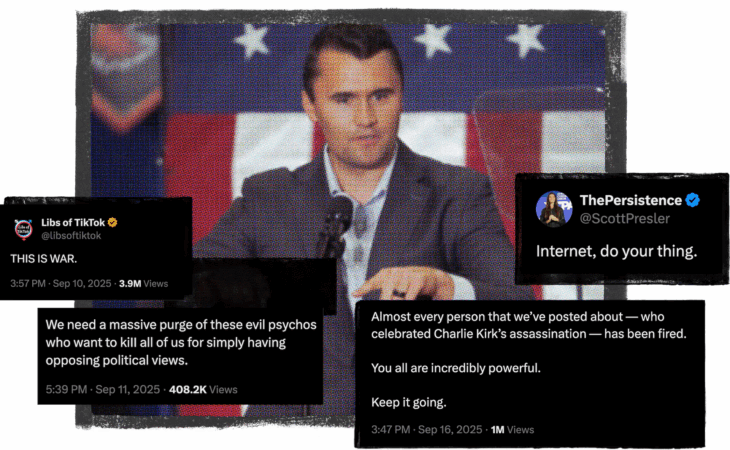
    The punishments have often been driven by social media campaigns that circulate screenshots of the offending remarks, along with the names and phone numbers of employers, and appeals such as, “Internet, do your thing.” What typically follows are hundreds of angry or threatening messages, Reuters found. Several individuals who were targeted said in interviews they were inundated with phone calls. One recalled receiving a call every minute for an entire day. At least two said the harassment was so intense they plan to sell their homes.

    Julie Strebe, a sheriff’s deputy in Salem, Missouri, lost her job after posting comments on Facebook about the shooting, including “Empathy is not owed to oppressors.” She later said she viewed Kirk as an oppressor because, in her words, he sought to marginalize vulnerable groups and used his platform to rally conservative white Christians behind “racist, sexist, hateful views.” She said her bosses were besieged with calls for her dismissal and that, at one point, a hand-drawn sign appeared across from her home reading, “Julie Strebe Supports the Assassination of Charles Kirk.”

    Strebe said she installed five surveillance cameras at her home and now fuels her car only at night to avoid neighbors. Moving from Salem would mean leaving extended family, but she said the small city has grown too hostile to stay. “I just don’t feel like I could ever let my guard down,” she said in an interview. Strebe’s former employer, the Dent County Sheriff’s Office, declined to comment.

    Many Republican officials have embraced the punitive campaign. Some have proposed extraordinary measures, including lifetime bans from social media for those deemed to be reveling in Kirk’s death. The U.S. State Department revoked visas for six foreigners who the agency said “celebrated the heinous assassination of Charlie Kirk.”

    Speaking on a special episode of Kirk’s podcast on September 15, Vice President JD Vance urged his listeners to inflict consequences on those celebrating Kirk’s death.

    “Call them out, and, hell, call their employer,” Vance said. Vance’s office pointed Reuters to comments made earlier this year in which the vice president said, “where I draw the line is encouraging violence against political opponents.”

    Some academics compared the backlash to the “Red Scare,” the anti-Communist purge that peaked in the 1950s, when officials, labor leaders and Hollywood figures were accused of Communist ties. Thousands were investigated in a climate of fear that shaped U.S. politics and culture for a generation. There are “very disturbing parallels,” said Landon Storrs, a University of Iowa history professor.

    Several prominent Republicans have voiced unease at the clampdown, especially after the Federal Communications Commission openly pressured broadcaster ABC to suspend talk show host Jimmy Kimmel following a monolog in which he suggested that Kirk’s assassin hailed from the political right. Police haven’t fully detailed the findings of their investigation into suspect Tyler Robinson and his motives. Robinson hasn’t entered a plea to the murder and other charges against him.

    Republican Senator Ted Cruz warned on his podcast that letting government decide “what speech we like and what we don’t” sets a dangerous precedent. Silencing voices like Kimmel’s might feel good, he said, but “when it’s used to silence every conservative in America, we will regret it.” His spokesperson declined further comment.
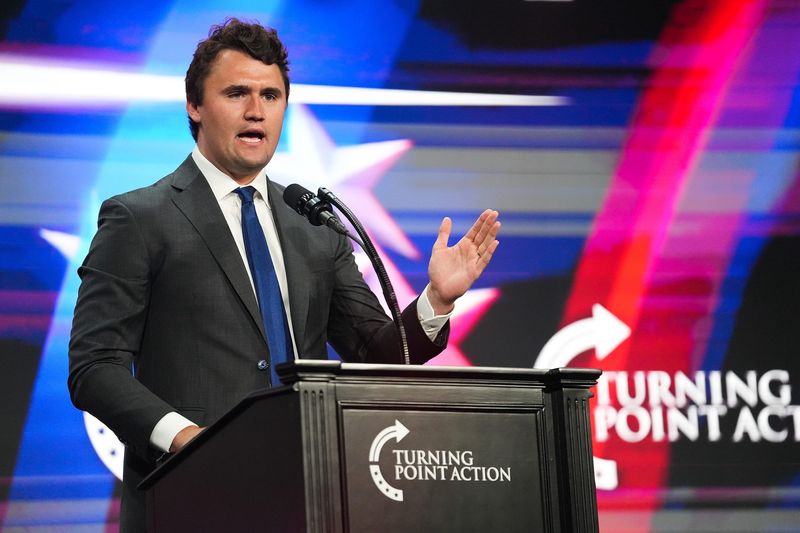
    Charlie Kirk, founder of Turning Point USA, speaks in 2022.

    ‘Massive purge of these evil psychos’

    The campaign to punish Kirk’s critics began almost immediately.

    About 30 minutes after Trump’s announcement that Kirk had died, right-wing influencers mobilized. Among the first was Chaya Raichik, operator of the widely followed Libs of TikTok account, which had posted on X, “THIS IS WAR,” before highlighting a Massachusetts teacher who had written: “Just a reminder, We’re NOT offering sympathy.”

    By night’s end, Libs of TikTok had published or reposted the professional details of 37 individuals, often accompanied by commentary such as “absolutely vile,” “Your tax dollars pay her salary,” or “Would you want him teaching your kids?”

    “It’s actually terrifying how many of them are teachers, doctors and military members,” Libs of TikTok wrote the next day. “We need a massive purge of these evil psychos who want to kiII all of us for simply having opposing political views.”

    In the week after the shooting, Libs of TikTok shared the names and profiles of at least 134 people accused of celebrating violence or mocking Kirk’s memory, frequently tagging Trump administration officials including Defense Secretary Pete Hegseth and Attorney General Pam Bondi. At times, the influencer posted disciplinary actions taken against specific government employees.

    “BREAKING: This marine was fired,” Libs of TikTok posted on September 12, a day after calling out a Marine Corps captain. The officer had responded to Kirk’s death by posting an emoji of clinking beer mugs, according to a screenshot the influencer shared with followers. Reuters could not verify the authenticity of the beer-mug post; the captain declined to comment. Libs of TikTok also reported similar disciplinary actions involving an Army Reserve officer and an Army colonel who had commented on the death on social media.

    The Pentagon and the Justice Department issued statements condemning celebrations of Kirk’s death but did not address questions about their relationship with Libs of TikTok.

    Right-wing influencer Scott Presler began posting screenshots of Kirk commentary, too.

    “Take a screenshot of EVERY single person celebrating today,” he told his followers on September 10. “You bet your behind we will make them infamous.” Over the next week, Presler shared posts on X about 70 people who had commented on the killing, and wrote in one message: “Almost every person we’ve posted about — who celebrated Charlie Kirk’s assassination — has been fired.” Presler didn’t respond to requests for comment.

    For many on the right, outraged by celebratory reactions from the left, the wave of firings became a form of catharsis.

    “It’s good that they are shamed and humiliated and must live with the repercussions for the rest of their lives,” right-wing podcaster Matt Walsh told his audience as he discussed the firings. “It’s good if they wake up every day until they die wishing they had not said what they said.” Asked for comment, Walsh emailed back: “f**k off.”

    On YouTube, video blogger and recovery coach JD Delay expressed glee as he read aloud names of those who had lost their jobs over their remarks.

    “I’m having fun! This is so much fun!” he shouted, raising his hands in excitement. Delay told Reuters that he believes in “accountability and consequences” and that “if you publicly say abhorrent things and get fired from your job, I’m going to laugh at you.”

    The punishment campaign sometimes veered off course. In at least five cases, people were wrongly blamed for comments made by others. In another case, a website that drew up a blacklist called “Expose Charlie’s Murderers” vanished after taking in tens of thousands of dollars in cryptocurrency donations. Attempts to identify and seek comment from the site’s creators were unsuccessful.

    President Donald Trump takes the stage during a memorial service honoring conservative activist Charlie Kirk in Glendale, Arizona, on Sept. 21, 2025.

    Several online influencers said they received hundreds — sometimes thousands — of tips from individuals seeking to get Kirk’s detractors fired. Reuters was unable to verify those figures. But at various points, Presler, Libs of TikTok and other right-wing personalities publicly urged tipsters to be patient as they worked through the volume of submissions.

    “Can’t keep up with all of you,” Presler wrote on X on September 12. “Post your submissions below & I’ll go through them as I can.”

    A day later, the post had drawn more than 2,700 replies.

    The tally of more than 600 people punished for criticizing Kirk is likely an undercount. Many companies and government organizations haven’t publicly disclosed terminations or suspensions.

    Those punished came from at least 45 states and represented a cross-section of society, from soldiers and pilots to doctors, nurses and police officers.

    In Michigan, an Office Depot employee was fired after being filmed refusing to print a poster memorializing Kirk. In Ohio, a Starbucks barista lost her job after she was accused of writing an anti-Kirk message on a cup of mint tea.

    Reuters couldn’t determine the identities of the Office Depot worker or the barista. Office Depot and Kroger — the grocery store chain that runs the Ohio Starbucks — condemned the anti-Kirk incidents and said the people involved were no longer employees.

    Requests to 21 federal agencies — including Homeland Security, Veterans Affairs and the Defense Department — for the number of suspensions or dismissals tied to the Kirk assassination were either ignored or declined. When the Office of the Director of National Intelligence was contacted, its deputy chief of staff responded on social media, accusing Reuters of trying to generate sympathy “for the ghouls who celebrate his death.”

    Educators among the main targets

    Teachers, academics and university administrators were among those most frequently punished for criticizing Kirk. More than 350 education workers were fired, suspended or investigated in the days following the assassination, including 50 academics and senior university administrators, three high school principals, two cheerleading coaches and a theology instructor.

    The prominence of educators in the backlash may stem from several factors. As leaders tasked with shaping young minds, teachers have long been cast by some conservatives as ideologues who aim to pull their students left. Their status as taxpayer-funded employees made any perceived partisan commentary especially combustible.

    In interviews and public statements, at least six teachers cited another reason for speaking out: concern over the frequency of gun violence at schools nationwide — and anger at those, like Kirk, who have championed widespread access to firearms.

    Vaughn, the South Carolina kindergarten assistant, said that was front of mind when she went to Facebook to quote Kirk’s 2023 remark dismissing some fatal shootings as the price to pay to protect gun rights. Like other teachers across the country, she said she regularly practiced active-shooter drills at her elementary school and saw fear on her five-year-olds’ faces as they learned how to hide from a gunman.

    As she defended her post on the day of Kirk’s death, she told a Facebook friend that she felt “no satisfaction” at the assassination. “Just heartbreak for everyone and anyone affected by gun violence and the hope that one day, enough will be enough.” Speaking to Reuters later, she said, “The one thing I want people to know is that my message was out of concern for the kids.”

    Many educators did celebrate Kirk’s death, including a Virginia teacher who wrote, “I hope he suffered through all of it,” and a Texas middle school intern who said the shooting “made me giggle.” Screenshots of both posts were circulated by right-wing influencers. Reuters could not locate the original posts, which may have been deleted or made private. The Virginia teacher was suspended and the Texas intern was fired. Neither could be reached for comment.

    While schools that suspended or fired educators cited disruptions to the learning environment, some private employers pointed to a violation of company values or safety concerns as the basis for terminations. Corporations caught up in the backlash gave a variety of explanations: Delta Air Lines CEO Ed Bastian said in a statement some employees’ comments were in “stark contrast” to the company’s values and violated its social media policy, while a United Airlines statement said the company had “zero tolerance for politically motivated violence or any attempt to justify it.”

    At least a dozen Kirk critics who took pains to condemn the shooting also found themselves out of jobs or suspended, sometimes after Republican lawmakers got involved.

    In the wake of Kirk’s death, Joshua Bregy, a climate scientist at Clemson University in South Carolina, shared another user’s Facebook post that read, in part: “No one should be gunned down — not a school child, not an influencer, not a politician — no one. But am I going to allow people to make a martyr out of a flawed human being whose rhetoric caused notable damage? Not a chance.”

    The Clemson College Republicans reposted part of his message, labeling him “ANOTHER leftist professor” and calling for his termination. The post was amplified by right-wing influencers and Republican state lawmakers who threatened to defund the public university unless Bregy was fired.

    Clemson initially pledged in a September 12 statement to “stand firmly on the principles of the U.S. Constitution, including the protection of free speech.”

    The next day, Trump himself reposted a state lawmaker’s call to “Defund Clemson.” On September 16, after South Carolina’s House speaker and Senate president sent a letter to Clemson’s trustees demanding they “take immediate and appropriate action,” the school fired Bregy. Bregy’s Facebook post was “blatantly unprofessional” and “seriously prejudicial to the university,” Clemson said in a letter informing Bregy he had been dismissed.

    Bregy is suing Clemson in a South Carolina federal court in a bid to be reinstated. His lawyer, Allen Chaney, said the academic would have kept his job “but for the really aggressive, coercive tactics of elected officials in South Carolina.”

    Clemson, State House Speaker Murrell Smith and Senate President Thomas Alexander did not respond to requests for comment. Clemson has yet to file a response to Bregy’s suit.

    In at least six other cases, Republican officials publicly threatened to deprive universities and schools of taxpayer funds unless specific critics of Kirk were fired.

    Chaney, who serves as legal director of the South Carolina chapter of the American Civil Liberties Union, said the threats to defund Clemson and others crossed a constitutional line. “The government can’t police speech by pressuring third parties,” he said. Last year, the Supreme Court unanimously held that government officials cannot use their authority to “attempt to coerce” private parties into punishing or suppressing speech they dislike.

    The threats to defund schools that resist firing Kirk’s critics were “stunning,” said Paul McGreal, a constitutional law professor at Creighton University Law School in Nebraska. “Government officials are threatening speakers with punishment because they disagree with what they’re saying. These are core First Amendment protections that they’re violating.”

    Kirk praised as Christ’s ‘13th disciple’

    Since Kirk’s assassination, many Republicans have cast him as a saintly champion of free expression. Evangelical figures have likened him to Saint Stephen, revered as Christianity’s first martyr. One Republican lawmaker told Congress “he’d have been the 13th disciple” had he lived in Biblical times. Trump compared Kirk to the ancient Greek philosopher Socrates, slain President Abraham Lincoln and assassinated civil rights icon Martin Luther King Jr. when posthumously awarding him the Presidential Medal of Freedom.

    Kirk’s legacy is complicated, however. He gained fame for debating college students as part of his work with Turning Point. Kirk also advocated criminalizing expression – such as pornography – that clashed with his Christian views. When Black football players started kneeling during the national anthem in protest at police brutality, he backed Trump’s call to strip the National Football League of taxpayer subsidies. The White House later said Trump was making a statement, not a proposal.

    Kirk repeatedly denigrated minorities, calling transgender people an “abomination,” warning of “prowling Blacks” in cities, accusing wealthy Jews of stoking “hatred against Whites,” and declaring Islam incompatible with Western civilization. He also dismissed Pope Francis as a Marxist.

    Some of those who spoke out against Kirk after his death said they were disturbed by the hagiography.

    “I just felt compelled to remind people who he was and what he stood for,” Kimberly Hunt, a human resources worker in Arizona, said in an interview. She had posted a video captioned, “Save your tears for his victims, not him.”

    In the video, Hunt cited Kirk’s record of using derogatory language about transgender people and Muslims, before adding that his children “are better off without him.” Hunt was fired soon after. Her employer, an Arizona construction firm, did not respond to requests for comment.

    Hunt told Reuters she understood her words sounded harsh but stood by them. She said they reflected Kirk’s stance in a debate last year that if he had a 10-year-old daughter who was impregnated through rape, “the baby would be delivered.”

    The retaliation has silenced many voices. Scores of people who posted anti-Kirk comments have since scrubbed or locked their accounts, Reuters found. Others said in interviews that they are pushing back.

    Hunt said she has raised more than $88,000 from a GoFundMe campaign titled, “Doxxed, Fired, but Not Silenced.” She said she wants to use the money to further her education, become a content creator, and keep calling out people like Kirk.

    “It’s definitely just emboldened me,” she said.

    At least 19 lawsuits have been filed against employers who punished Kirk critics, state and federal court records show. At least two plaintiffs have succeeded, including an academic in South Dakota who got his teaching job back.

    Karen Leader, an associate professor at Florida Atlantic University, took to social media after Kirk’s death to protest a narrative that he “was a shining inspiration to youth and a noncontroversial figure who just wanted to have open and civil dialog,” she said. “Anyone who’s in higher education knows that it’s not that simple.”

    She noted that Turning Point rose to prominence through its Professor Watchlist, a site that encouraged students to report faculty for allegedly holding “radical left” views or being a “terror supporter.”

    Kirk had described the Watchlist as an awareness tool, not a blacklist. Those on it have said in interviews, social media posts and public forums that it fostered harassment and intimidation. In 2023, a Turning Point reporter was accused of assaulting an Arizona professor who was on the watchlist after confronting him on camera about his sexuality and shoving him to the ground. The reporter admitted to harassment, assault and disorderly conduct and was ordered to complete a diversion program. A Turning Point cameraman admitted to harassment in the case.

    On September 10, Leader began posting Kirk’s past statements on X. She said she made a mistake by incorrectly accusing Kirk of having uttered an ethnic slur and then deleted it. The rest of her posts she said she stands behind, including one highlighting Kirk’s claim that Black Americans were “better” during Jim Crow.

    “None of it was me encouraging violence,” Leader said. “I was sharing evidence.”

    Jordan Chamberlain, a former staffer of Florida Governor Ron DeSantis, shared screenshots of several of Leader’s posts and tagged her university, asking if it approved of the content. Libs of TikTok shared Leader’s faculty headshot. The university’s president announced she had been put on administrative leave. Her address and phone number appeared online, and menacing messages followed.

    In one voicemail reviewed by Reuters, the caller said: “We’re coming to get you. Karen Leader, we know where you work. We’re gonna come to your home as soon as we have your location.” Leader said she has rarely left her apartment since.

    She reported the threats to Boca Raton police, which referred the case to campus officers, according to a police report. Florida Atlantic University police said their report could not be released because of an active criminal investigation.

    Florida Atlantic University confirmed Leader was one of three academics who were on leave pending investigations. It declined further comment. Chamberlain also didn’t return an email seeking comment.

    “Whether my career is over or not, I don’t know,” Leader said. “But my life has changed.”
  • Trump administration threatens to withhold $75 million from Pennsylvania over immigrant truck drivers

    Trump administration threatens to withhold $75 million from Pennsylvania over immigrant truck drivers

    The Trump administration threatened Thursday to withhold nearly $75 million in funding if Pennsylvania does not immediately revoke what the administration claims are illegally issued commercial driver’s licenses to immigrants.

    The move by U.S. Transportation Secretary Sean Duffy to target Pennsylvania follows similar action against California. Both states are run by Democratic governors who have criticized President Donald Trump’s administration and who are viewed as potential top-shelf contenders to be the party’s 2028 presidential nominee.

    Duffy has made it a priority to scrutinize how the licenses are issued since August, when a tractor-trailer driver not authorized to be in the U.S. made an illegal U-turn and caused a crash in Florida that killed three people. That incident thrust the issue into the public’s consciousness.

    In a statement Thursday, DOT spokesperson Danna Almeida said all states were being reviewed.

    It’s unclear how many people would be affected in Pennsylvania. In any case, Pennsylvania Gov. Josh Shapiro ‘s administration said the federal government didn’t identify a single commercial driver’s license issued to someone who wasn’t eligible.

    Still, a letter Thursday from the Republican administration to Shapiro cited an audit that found two out of 150 people whose licenses exceeded their lawful presence in the country.

    In four cases it had reviewed, the federal government said Pennsylvania provided no evidence that it had required noncitizens to provide legitimate proof that they were legally in the country at the time they got the license.

    The Trump administration called on Pennsylvania to stop issuing new, renewed and transferred commercial driver’s licenses and permits, as well as conduct an audit to identify those licenses whose expirations exceed the driver’s lawful stay in the U.S.

    It is also asking the state to void noncompliant licenses and remove those drivers from the road. The administration said approximately 12,400 noncitizen drivers hold an unexpired commercial learner’s permit or commercial driver’s license issued by Pennsylvania.

    The governors of California and Pennsylvania — Gavin Newsom and Shapiro — are tough critics of Trump, and both have been repeated targets of Trump’s administration.

    Shapiro’s administration said the state transportation department ceased issuing commercial driver’s licenses to noncitizens after the Federal Motor Carrier Safety Administration published a regulation in late September that would severely limit which immigrants can get one.

    A federal court has put the rule on hold for now, but Shapiro’s administration said its transportation department still hasn’t resumed issuing what are called “non-domiciled CDLs.”

    Pennsylvania’s transportation department said Thursday that it follows federal rules for verifying an immigrant applicant’s lawful presence in the country by checking the U.S. Department of Homeland Security’s database.

    But Shapiro this week suggested that DHS was falling short by failing to properly maintain that database, which states use to check an immigrant’s legal status before issuing a driver’s license to a noncitizen.

    His comments came after DHS said it had arrested an Uzbek national with a commercial driver’s license issued by Pennsylvania. The man, who had a work authorization granted in 2024, was wanted in his home country for belonging to a terrorist organization, the department said.

    But Shapiro said the state transportation department checked the federal database over the summer before issuing a CDL to the man, and he was authorized to get one. The state rechecked the database this week, and it still listed him as qualified to get a CDL, Shapiro said.

    “They clearly are not minding the shop, and they’ve gotta get better, because every single state in the country relies on this database when making a determination as to who qualifies for a CDL. We relied on the feds before issuing this one,” Shapiro said.

    California, which said it would revoke 17,000 licenses, is the only state the administration has acted against because it was the first one where an audit was completed. The government shutdown delayed reviews in other states, but the Transportation Department is urging all of them to tighten their standards. ___ Catalini reported from Trenton, New Jersey, and Levy from Harrisburg, Pennsylvania. Associated Press writer Josh Funk contributed.

  • Respect and remembrance for Cheney from Bush, Biden and past vice presidents as Trump is excluded

    Respect and remembrance for Cheney from Bush, Biden and past vice presidents as Trump is excluded

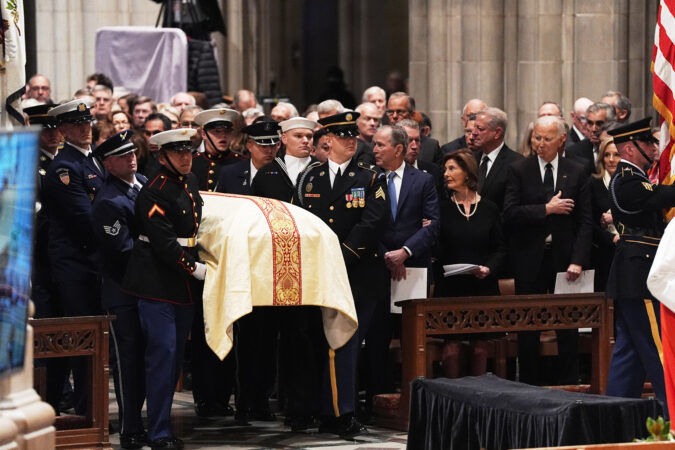
    WASHINGTON — They gathered at the Washington National Cathedral on Thursday — former presidents, vice presidents, sworn political foes and newfound friends — in a show of respect and remembrance for Dick Cheney, the consequential and polarizing vice president who became an acidic scold of President Donald Trump.

    Trump, who has been publicly silent about Cheney’s death Nov. 3, was not invited to the memorial service.

    Two ex-presidents came: Republican George W. Bush, who eulogized the man who served him as vice president, and Democrat Joe Biden, who once called Cheney “the most dangerous vice president we’ve had probably in American history” but now honors his commitment to his family and to his values.

    “Solid and rare and reliable,” Bush said at the service of his vice president, praising a man whose “talent and restraint” exceeded his ego. “Smart and polished, without airs.”

    Former President George W. Bush, speaks a tribute during the funeral service for former Vice President Dick Cheney at the Washington National Cathedral on Thursday.

    Bush and others noted the understated demeanor of a man who nevertheless wielded great influence in government. “Above all,” Bush said, “I wanted someone with the ability to step into the presidency without getting distracted by the ambition to seek it.”

    Among the eulogists, Liz Cheney, the eldest daughter, only obliquely addressed what amounted to a father-daughter feud with the president — a man her dad had called a “coward” for trying to overturn his loss in the 2020 election.

    She spoke of her father’s conviction that when confronted with a choice between defending the country and a political party, the country must come first. “Bonds of party must always yield to the single bond we share as Americans,” she said.

    Liz Cheney is a former high-ranking House member whose Republican political career was shredded by a MAGA movement angered by her investigation of the Jan. 6, 2021, riot at the Capitol. Thursday, she chose not to speak directly of Trump.

    She spoke of seeing clouds in the shape of angels just before her father died.

    A Who’s Who of Washington, minus you know who

    Moments before the service began, figures of recent but now receded power mingled: Bush and Biden and their wives sitting in a row together, former Vice Presidents Kamala Harris and Mike Pence chatting side by side in their pew with Al Gore and Dan Quayle together behind them.

    Biden greeted Republican Sen. Mitch McConnell, the former longtime Senate leader, and his wife, former labor and transportation secretary Elaine Chao. Behind them sat Democratic Rep. Nancy Pelosi, who spent time talking with another former House speaker, Republican John Boehner. All gathered among the soaring interior columns of the grand cathedral known as “a spiritual home for the nation.”

    Others delivering tributes at Thursday’s funeral were Cheney’s longtime cardiologist, Dr. Jonathan Reiner; former NBC News correspondent Pete Williams, who was Cheney’s spokesman at the Pentagon; and several of the former vice president’s grandchildren.

    “I’m happy to report that I haven’t given many eulogies,” Reiner said in his remarks. “Nobody wants a doctor who is great at funerals.”

    Reiner recalled doctors telling Cheney decades ago, after the first of multiple heart attacks, that he should abandon his political ambitions then. Yet he kept winning elections as a Wyoming congressman for years after that.

    Cheney, he said, was always the “calmest person in the room.”

    President George W. Bush and Vice President Dick Cheney meet in Washington, D.C., on Sept. 12, 2001, with members of the president’s national security team in the Cabinet room.

    Cheney had lived with heart disease for decades and, after the Bush administration, with a heart transplant. He died at age 84 from complications of pneumonia and cardiac and vascular disease, his family said.

    Trump’s vice president, JD Vance, on stage at another event in the morning, was asked about Cheney and said: “Obviously there’s some political disagreements there but he was a guy who served his country. We certainly wish his family all the best in this moment of grieving.”

    Vance was also not invited to the funeral, according to a person familiar with the details who was not authorized to speak publicly and spoke on condition of anonymity.

    The White House lowered its flags to half-staff after Cheney’s death, as it said the law calls for, but Trump did not issue the presidential proclamation that often accompanies the death of notable figures, nor has he commented publicly on his passing.

    The deeply conservative Cheney’s influence in the Bush administration was legendary and, to his critics, tragic.

    He advocated for the U.S. invasion of Iraq on the basis of what proved to be faulty intelligence and consistently defended the extraordinary tools of surveillance, detention and inquisition employed in response to the Sept. 11, 2001, attacks. Bush credited him with helping to keep the country safe and stable in a perilous time.

    Bad blood between the Cheneys and Trump

    After the 2020 election won by Biden, Liz Cheney served as vice chair of the Democratic-led special House committee that investigated the Jan. 6 Capitol riot. She accused Trump of summoning the violent mob and plunging the nation into “a moment of maximum danger.”

    For that, she was stripped of her Republican leadership position and ultimately defeated in a 2022 Republican primary in Wyoming. In a campaign TV ad made for his daughter, Dick Cheney branded Trump a “coward” who “tried to steal the last election using lies and violence to keep himself in power after the voters had rejected him.”

    Last year, it did not sit well with Trump when Cheney said he would vote for the Democrat, Harris, in the presidential election.

    Trump told Arab and Muslim voters that Dick Cheney’s support for Harris should give them pause, because he “killed more Arabs than any human being on Earth. He pushed Bush, and they went into the Middle East.”

  • What’s next now that Trump has signed bill releasing the Epstein files

    What’s next now that Trump has signed bill releasing the Epstein files

    WASHINGTON — President Donald Trump has signed a bill to compel the Justice Department to make public its case files on the convicted sex offender Jeffrey Epstein, a potentially far-reaching development in a yearslong push by survivors of Epstein’s abuse for a public reckoning.

    Both the House and Senate passed the bill this week with overwhelming margins after Trump reversed course on his monthslong opposition to the bill and indicated he would sign it. Now that the bill has been signed by the president, there’s a 30-day countdown for the Justice Department to produce what’s commonly known as the Epstein files.

    “This bill is a command for the president to be fully transparent, to come fully clean, and to provide full honesty to the American people,” Senate Democratic Leader Chuck Schumer of New York said Wednesday.

    Schumer added that Democrats were ready to push back if they perceive that the president is doing anything but adhering to “full transparency.”

    In a social media post Wednesday as he announced he had signed the bill, Trump wrote, “Democrats have used the ‘Epstein’ issue, which affects them far more than the Republican Party, in order to try and distract from our AMAZING Victories.”

    The swift, bipartisan work in Congress this week was a response to the growing public demand that the Epstein files be released, especially as attention focuses on his connections to global leaders including Trump, former President Bill Clinton, Andrew Mountbatten Windsor, who has already been stripped of his royal title as Prince Andrew over the matter, and many others.

    There is plenty of public anticipation about what more the files could reveal. Yet the bill will most likely trigger a rarely seen baring of a sprawling federal investigation, also creating the potential for unintended consequences.

    What does the bill do?

    The bill compels Attorney General Pam Bondi to release essentially everything the Justice Department has collected over multiple federal investigations into Epstein, as well as his longtime confidante and girlfriend Ghislaine Maxwell, who is serving a 20-year prison sentence for luring teenage girls for the disgraced financier. Those records total around 100,000 pages, according to a federal judge who has reviewed the case.

    It will also compel the Justice Department to produce all its internal communications on Epstein and his associates and his 2019 death in a Manhattan jail cell as he awaited charges for sexually abusing and trafficking dozens of teenage girls.

    The legislation, however, exempts some parts of the case files. The bill’s authors made sure to include that the Justice Department could withhold personally identifiable information of victims, child sexual abuse materials and information deemed by the administration to be classified for national defense or foreign policy.

    “We will continue to follow the law with maximum transparency while protecting victims,” Bondi told a news conference Wednesday when asked about releasing the files.

    The bill also allows the Justice Department to withhold information that would jeopardize active investigations or prosecutions. That’s created some worry among the bill’s proponents that the department would open active investigations into people named in the Epstein files in order to shield that material from public view.

    Rep. Marjorie Taylor Greene, a longtime Trump loyalist who has had a prominent split with Trump over the bill, said Tuesday that she saw the administration’s compliance with the bill as its “real test.”

    “Will the Department of Justice release the files, or will it all remain tied up in investigations?” she asked.

    In July, the FBI said in a memo regarding the Epstein investigation that, “we did not uncover evidence that could predicate an investigation against uncharged third parties.” But Bondi last week complied with Trump’s demands and ordered a federal prosecutor to investigate Epstein’s ties to the president’s political foes, including Clinton.

    Still, Rep. Thomas Massie, a Kentucky Republican who sponsored the bill, said “there’s no way they can have enough investigations to cover” all of the people he believes are implicated in Epstein’s abuse.

    “And if they do, then good,” he added.

    The bill also requires the Justice Department to produce reports on what materials it withheld, as well as redactions made, within 15 days of the release of the files. It stipulates that officials can’t withhold or redact anything “on the basis of embarrassment, reputational harm, or political sensitivity, including to any government official, public figure, or foreign dignitary.”

    Who could be named?

    There’s a widely held expectation that many people could be named in case files for investigations that spanned over a decade — and some concern that just because someone is named, that person would be assumed guilty or complicit.

    Epstein was a luminary who kept company with heads of state, influential political figures, academics and billionaires. The release of his emails and messages by a House Oversight Committee investigation last week has already shown his connections with — and private conversations about — Trump and many other high-powered figures.

    Yet federal prosecutors follow carefully constructed guidelines about what information they produce publicly and at trial, both to protect victims and to uphold the fairness of the legal system. House Speaker Mike Johnson raised objections to the bill on those grounds this week, arguing that it could reveal unwanted information on victims as well as others who were in contact with investigators.

    Still, Johnson did not actually try to make changes to the bill and voted for it on the House floor.

    For the bill’s proponents, a public reckoning over the investigation is precisely the point. Some of the survivors of trafficking from Epstein and Maxwell have sought ways to name people they accuse of being complicit or involved, but fear they will face lawsuits from the men they accuse.

    Massie said that he wants the FBI to release the reports from its interviews with the victims.

    Those reports typically contain unvetted information, but Massie said he is determined to name those who are accused. He and Greene have offered to read the names of those accused on the House floor, which would shield their speech from legal consequences.

    “We need names,” Massie said.

  • Philly-area federal workers are finally getting paid again. But they fear another shutdown.

    Philly-area federal workers are finally getting paid again. But they fear another shutdown.

    The longest ever federal government shutdown is now in the rearview mirror, but not for federal workers.

    With their jobs back to normal, some local federal employees said worries created by the shutdown remain — one said their credit score suffered, others noted their Thanksgiving tables will be less festive. And for many, another shutdown in a matter of weeks is a real concern.

    Federal employees — whether furloughed or required to work during the shutdown — missed paychecks during the 43-day lapse in federal appropriations, the longest ever in United States history. Workers sought out food pantries, delayed payments on bills, and tried to make ends meet for their families ahead of the holidays.

    “I will be paycheck to paycheck for the next couple of months maybe, before I can start accumulating my savings again,” said a Philadelphia Veterans Benefits Administration employee, who was working without a paycheck during the shutdown.

    The Inquirer agreed to withhold the names of federal employees interviewed due to their fear of retaliation for speaking out. Despite workers beginning to receive retroactive paychecks from the shutdown, they spoke of lingering financial damage and worries that yet another lapse in funding could happen in just a couple of months.

    The bill to end the shutdown, signed into law by President Donald Trump on Nov. 12, funds the government through Jan. 30. It includes protections for federal employees such as reversing layoffs that took place during the shutdown, and ensures back pay for all government workers throughout that time, which had been put into question by the Trump administration. And certain government agencies, such as Veterans Affairs, the Department of Agriculture, and the Food and Drug Administration, have been allocated a year’s worth of funding.

    But after Jan. 30, if lawmakers once again fail to agree on keeping the government open, some federal workers could once again face a lapse in their pay.

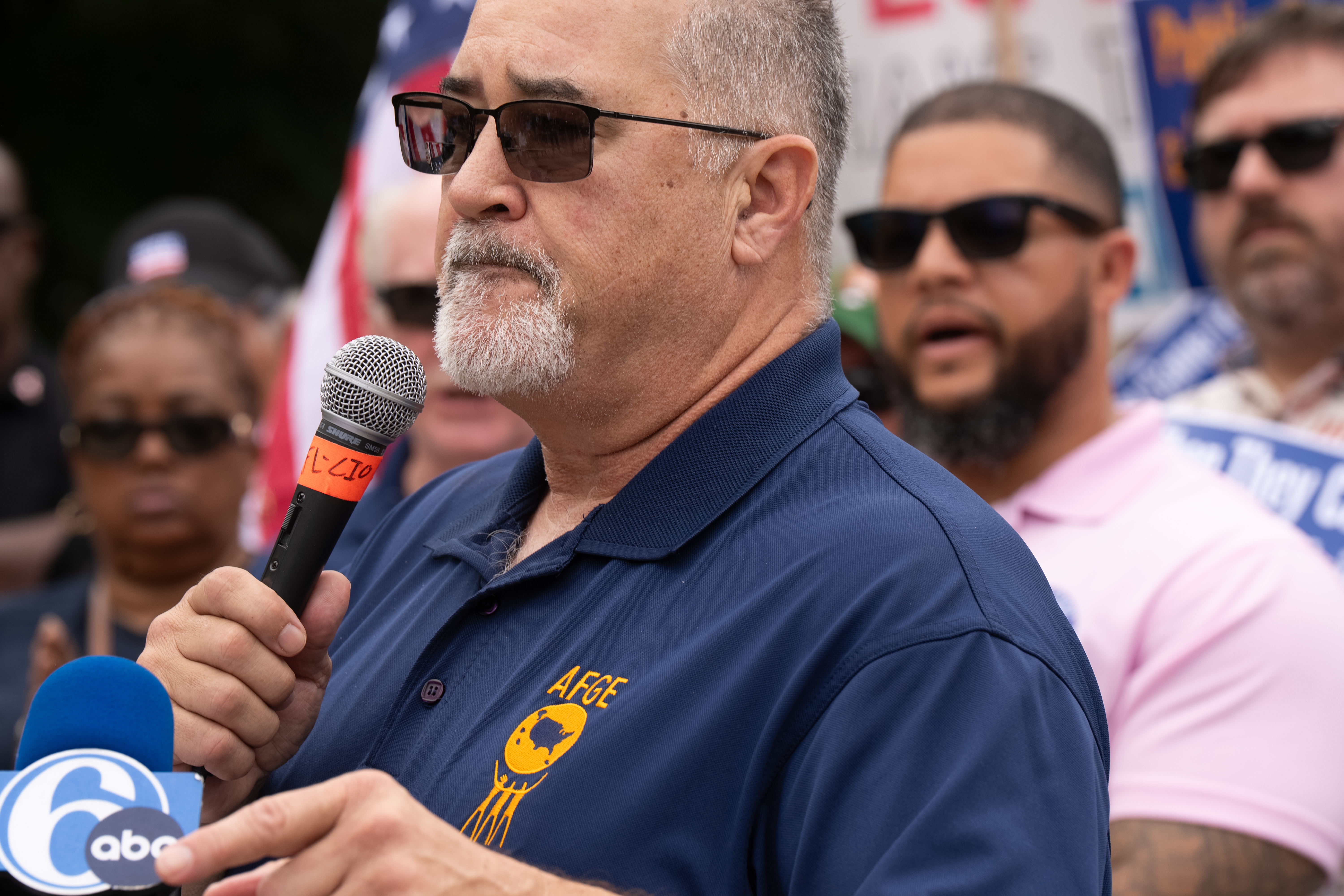
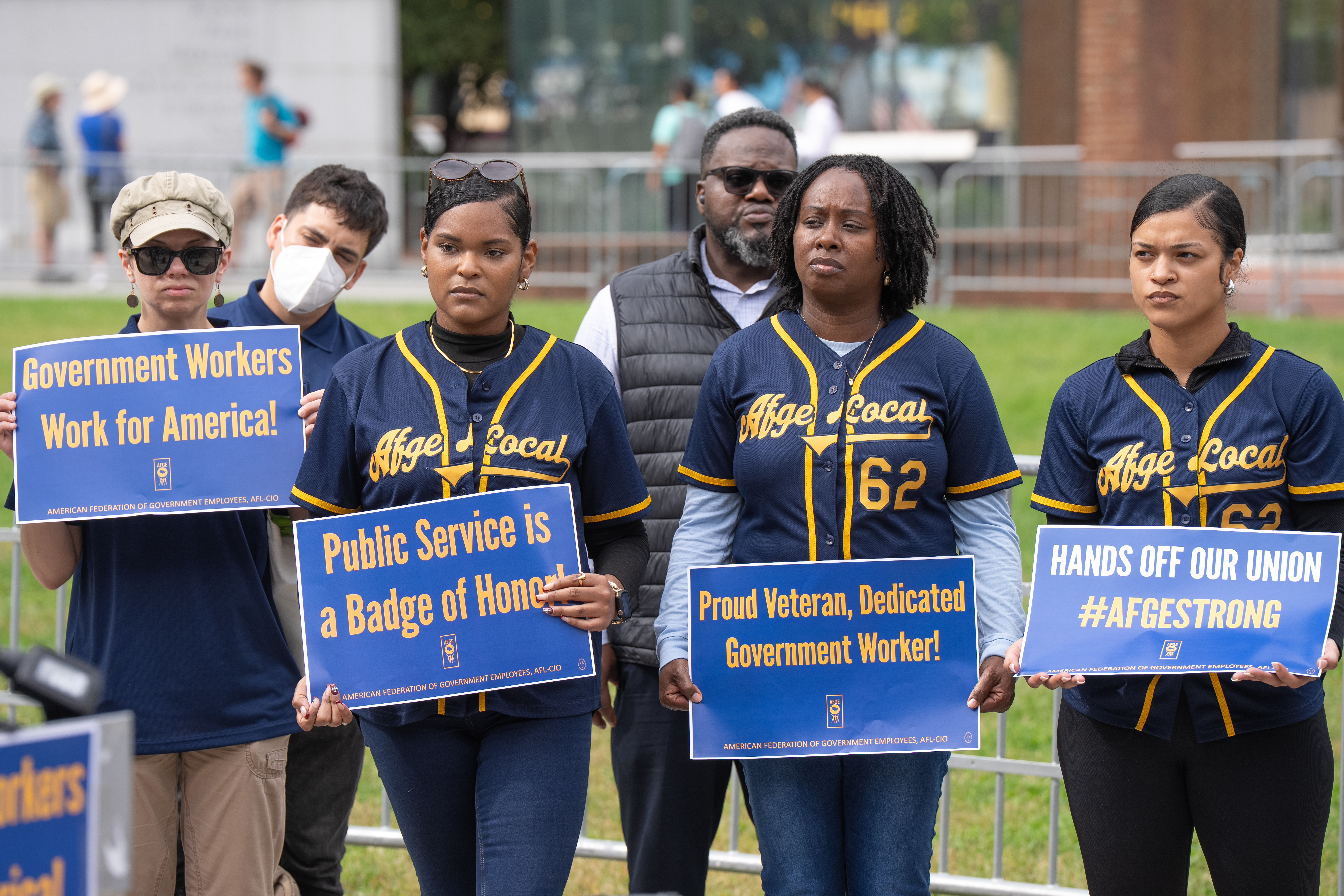
    “We’re bracing for Jan. 30,” said Philip Glover, national vice president of the American Federation of Government Employees District 3, the union that represents federal employees in Pennsylvania.

    The recent shutdown and the possibility of another are among a series of obstacles that government workers have faced this year. The Trump administration’s efforts to shrink and reshape the federal workforce have included layoffs, pushing employees to resign, and the dismantling of collective bargaining agreements. When government funding lapsed in October, the Trump administration used it as an opportunity for more firings.

    Philip Glover, AFGE District 3 national vice president, speaks at a news conference focused on federal workers amid the government shutdown, near the Liberty Bell on Oct. 7.

    Federal workers have been “dealing with a layer cake of trauma,” said Max Stier, founding president and CEO of the Partnership for Public Service, a federal government management organization.

    “This is not simply one incident, but it’s one on top of a bunch of them that this administration has put in their way,” Stier said.

    The financial strain

    At the Social Security Administration in Philadelphia a benefit authorizer said Monday that she and her coworkers had started getting their back pay, but she had already felt the impact of missing checks.

    “We assumed we could just call and everybody would place everything on hold, and that was not the case,” said the Social Security employee.

    The benefit authorizer had put her mortgage and car payments on hold, but some banks and utility companies weren’t as accommodating, and she accumulated overdraft fees from a credit union.

    Her role required her to work through the shutdown without pay. (In Pennsylvania, furloughed workers may apply for unemployment benefits, but those who continue to work, even without pay, may not.) The benefit authorizer looked for additional work, unsure how long the shutdown would last. Some of her colleagues in Philadelphia picked up gigs with Uber, DoorDash, and Instacart, she said.

    Union officials from AFGE gathered on Oct. 7 in front of Independence Hall to protest the government shutdown.

    Another Philadelphia Social Security employee, who has been with the agency for 15 years, noted that some colleagues picked up night shifts at Amazon or work in home healthcare.

    “People living paycheck to paycheck, they needed something to pay those bills that were absolutely essential that they had to pay,” the 15-year Social Security employee said.

    For one federal employee from Central Jersey, 2025 already came with an unexpected career turn when they lost their job at U.S. Housing and Urban Development, as part of a mass layoff of probationary employees. They found a job at the U.S. Department of Commerce, in Virginia, which allowed them to support their mother and three kids back in New Jersey.

    Wary of permanently moving to Virginia during such a volatile time in the federal workforce, the Commerce employee commutes eight hours by Amtrak twice a week and stays in a $200 per night hotel on workdays.

    During the federal shutdown, the Commerce employee had to work without a paycheck. They used up their savings paying for the commute, hotel, and other expenses. Ultimately, they took out a bank loan to cover their expenses.

    The government shutdown exemplifies a lack of stability in the workforce, the Commerce employee said. “To be honest, you feel unsafe all the time, and you feel like you’re not deserving that.”

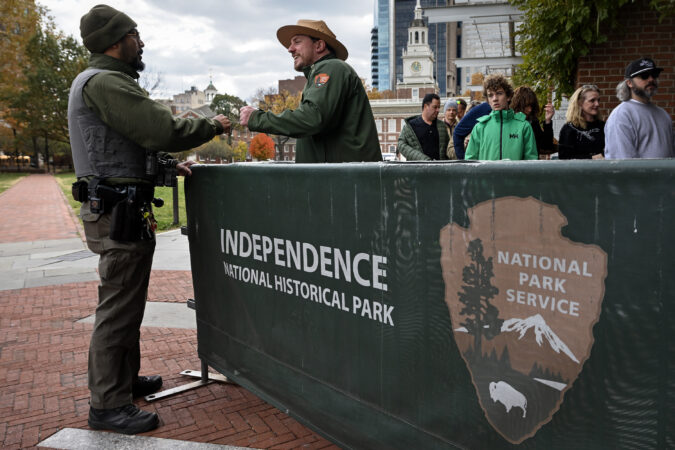
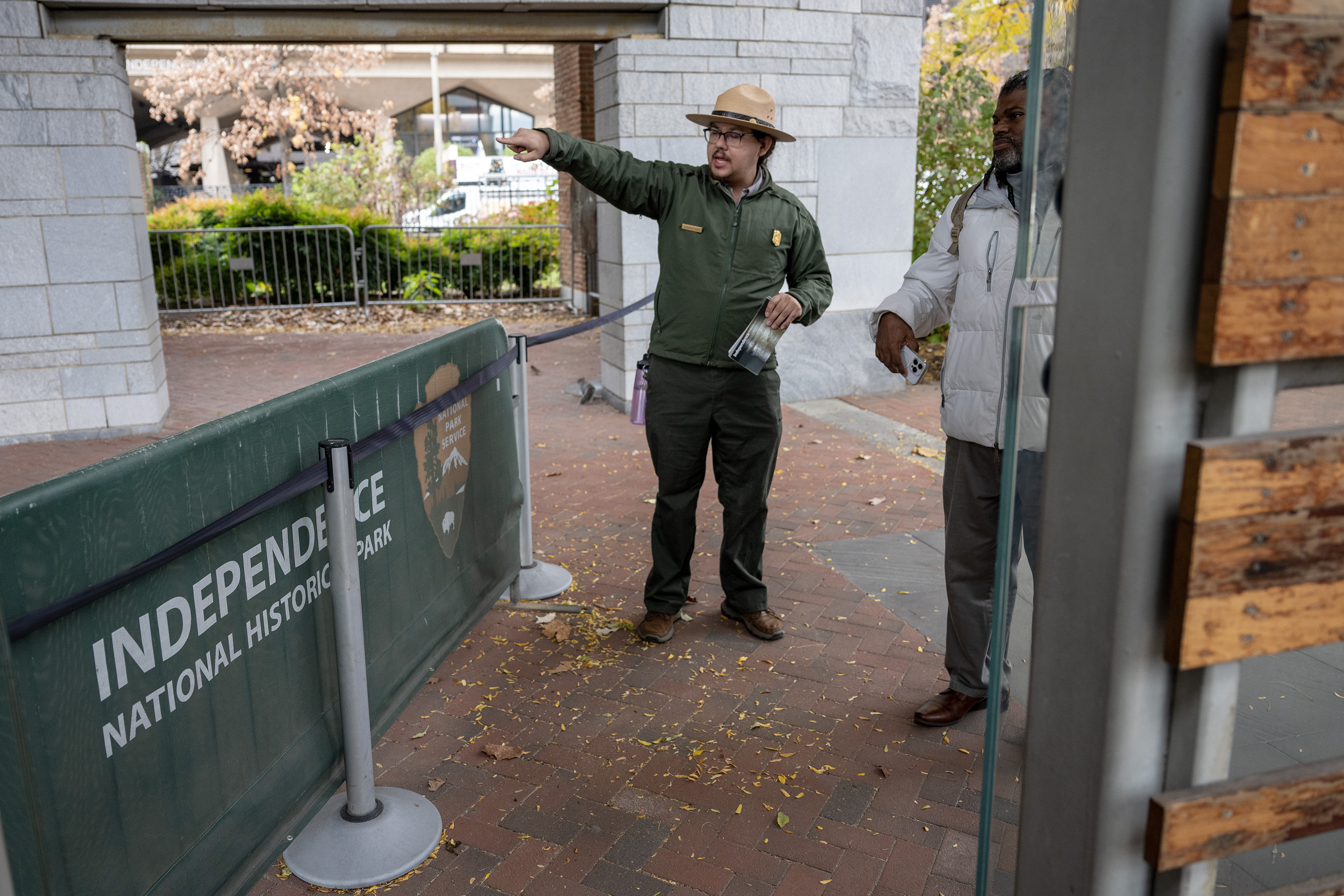
    National Park Service ranger Christopher Acosta talks with tourists outside the Liberty Bell Center on Nov. 13 after returning to work from the shutdown.

    Worries remain ahead of the holiday season

    The Philadelphia VBA employee, who worked without pay during the shutdown, received their back pay Monday. The single parent said they were one more missed paycheck away from turning to food pantries and living off credit cards.

    “Usually I’m the one donating around this time,” the employee said last week. “I usually adopt a family and provide them with the meal and then their gifts and stuff from our local community churches and outreach programs.”

    Thanksgiving is the time they “splurge,” but now the shutdown has made them contemplate their finances. “I haven’t even thought about the process of even having a Thanksgiving dinner on the table because I didn’t want to spend the money,” the VBA employee said. By Christmas, they hope to be caught up on payments.

    It’s a similar story for one Philadelphia VA Medical Center employee who worked without pay through the shutdown. Speaking days before the shutdown’s end, the employee said their credit score had taken a hit. They reached out to creditors and got some of their payments deferred, but relief won’t set in until the employee can catch up on their water, electric, gas, mortgage, and car bills.

    A “big feast” for Thanksgiving is off the table. “You can’t do that now because you don’t have the funds,” they said.

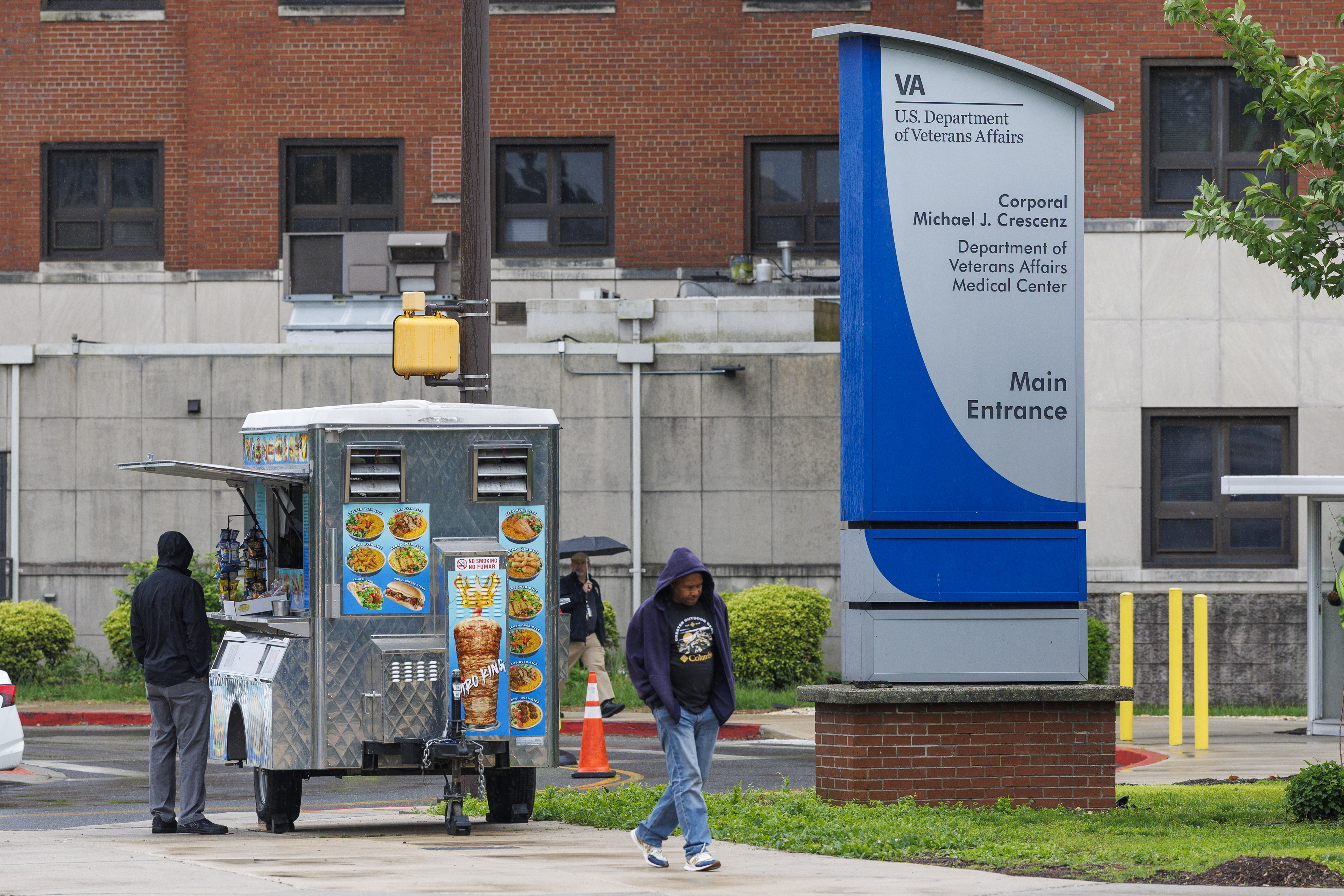
    The Corporal Michael J. Crescenz Department of Veterans Affairs Medical Center in Philadelphia.

    ‘Fear of what’s to come’

    Throughout the funding impasse, Philadelphia’s federal workers turned to each other for assistance.

    At the VBA, supervisors set up a small food pantry several weeks into the shutdown. The VBA employee said that didn’t feel especially helpful. “That was our second paycheck missed, and that was the best that they could come up with,” the employee said.

    “It’s business as usual in the eyes of the VA, and they expect us to work like nothing’s going on in our real lives.”

    At the Social Security Administration, workers banded together to start an impromptu food pantry, the Philadelphia benefit authorizer said.

    “Everything was taken. People needed it. People were really pinching pennies,” she said.

    The national office of AFGE, the largest federal workers’ union, backed the deal to end the government shutdown. “Government shutdowns not only harm federal employees and their families, they also waste taxpayers’ dollars and severely diminish services depended on by the American people,” AFGE national president Everett Kelley said in a statement on Nov. 10.

    But some thought it should have ended differently.

    In the days leading up to the deal, dozens of AFGE Local 3631 members, who are employed at the Environmental Protection Agency, said in a local union survey that they did not want their local to support budget legislation such as what passed. Their concerns were with an expected rise in healthcare expenses across the country.

    The union local had polled members at the end of October, according to local union officer Hannah Sanders. The survey got more than 100 responses, and over 85% said the local should only support a deal if it preserved subsidies for Affordable Care Act healthcare plans and avoided cuts to Medicaid.

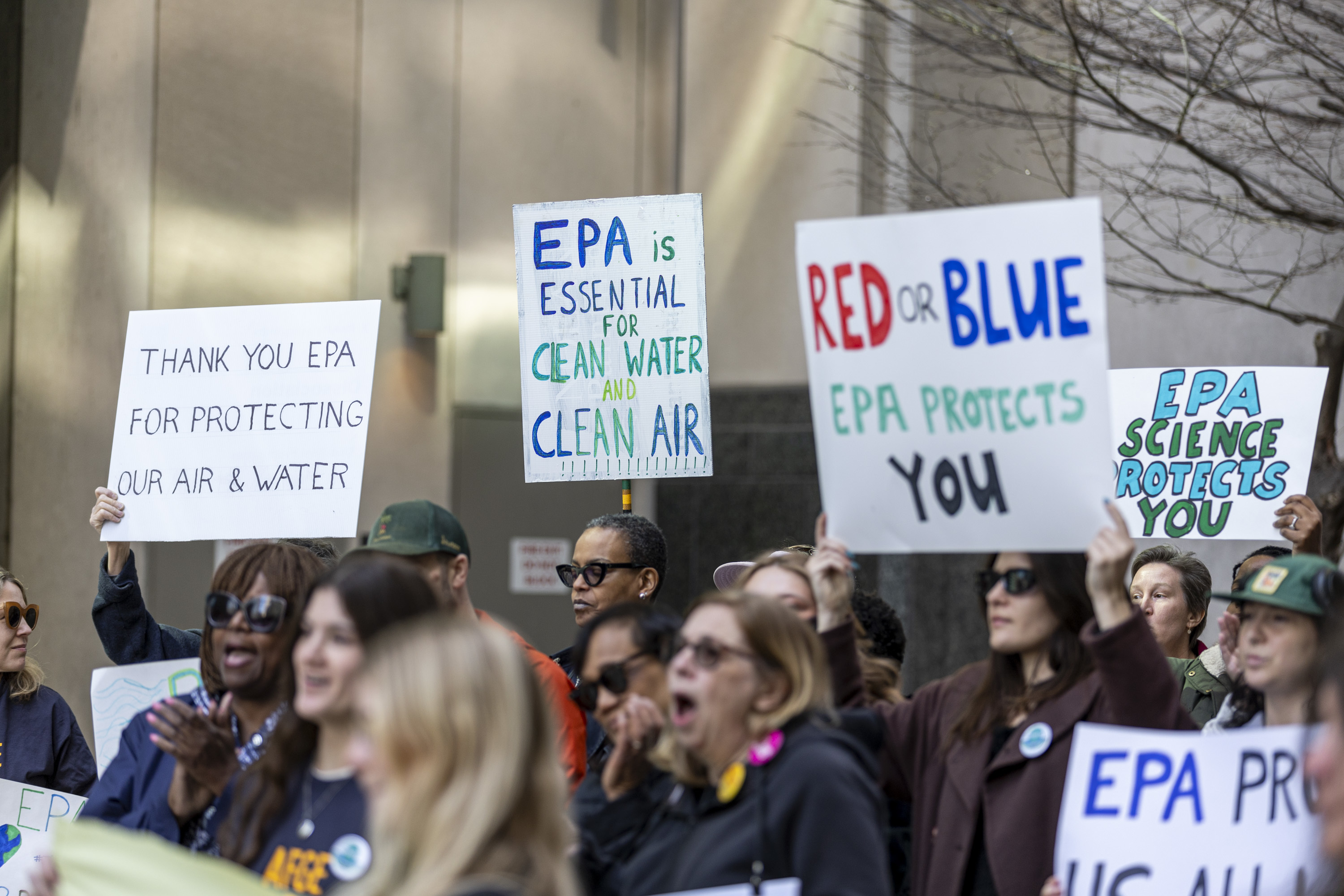
    EPA workers and supporters gathered outside their office for a solidarity march around Philadelphia’s City Hall in March.

    In Washington, most Senate Democrats held out, only supporting a vote on an appropriations bill that would extend ACA subsidies. But eight senators, including Sen. John Fetterman (D., Pa.), crossed party lines to back the Republican bill that omitted the subsidies.

    Sanders said there are few changes between the recently passed deal and the bill that could have averted the shutdown back in September. “We would have not had this shutdown, and people wouldn’t have, you know, gone without pay or gone without SNAP benefits and all these things. So it’s super frustrating to see that this is how it all resolved,” said Sanders.

    Now, the benefit authorizer at the Social Security Administration says, people are concerned that another shutdown could be on the horizon come Jan. 30.

    “We are in complete fear of what’s to come,” she said.

  • Trump signs bill to release Jeffrey Epstein case files after fighting it for months

    Trump signs bill to release Jeffrey Epstein case files after fighting it for months

    WASHINGTON — President Donald Trump signed legislation Wednesday that compels his administration to release files on convicted sex offender Jeffrey Epstein, bowing to political pressure from his own party after initially resisting those efforts.

    Trump could have chosen to release many of the files on his own months ago.

    “Democrats have used the ‘Epstein’ issue, which affects them far more than the Republican Party, in order to try and distract from our AMAZING Victories,” Trump said in a social media post as he announced he had signed the bill.

    Now, the bill requires the Justice Department to release all files and communications related to Epstein, as well as any information about the investigation into his death in a federal prison in 2019, within 30 days. It allows for redactions about Epstein’s victims for ongoing federal investigations, but DOJ cannot withhold information due to “embarrassment, reputational harm, or political sensitivity.”

    It was a remarkable turn of events for what was once a farfetched effort to force the disclosure of case files from an odd congressional coalition of Democrats, one GOP antagonist of the president, and a handful of erstwhile Trump loyalists. As recently as last week, the Trump administration even summoned one Republican proponent of releasing the files, Rep. Lauren Boebert of Colorado, to the Situation Room to discuss the matter, although she did not change her mind.

    But over the weekend, Trump did a sharp U-turn on the files once it became clear that congressional action was inevitable. He insisted the Epstein matter had become a distraction to the GOP agenda and indicated he wanted to move on.

    “I just don’t want Republicans to take their eyes off all of the Victories that we’ve had,” Trump said in a social media post Tuesday afternoon, explaining the rationale for his abrupt about-face.

    The House passed the legislation on a 427-1 vote, with Rep. Clay Higgins, R-La., being the sole dissenter. He argued that the bill’s language could lead to the release of information on innocent people mentioned in the federal investigation. The Senate later approved it unanimously, skipping a formal vote.

    It’s long been established that Trump had been friends with Epstein, the disgraced financier who was close to the world’s elite. But the president has consistently said he did not know of Epstein’s crimes and had cut ties with him long ago.

    Before Trump returned to the White House for a second term, some of his closest political allies helped fuel conspiracy theories about the government’s handling of the Epstein case, asserting a cover-up of potentially incriminating information in those files.

  • Trump administration tells Dems it has no timeline for confining immigrants at South Jersey base

    Trump administration tells Dems it has no timeline for confining immigrants at South Jersey base

    It doesn’t look like the Trump administration will begin holding undocumented immigrants at a South Jersey military base anytime soon.

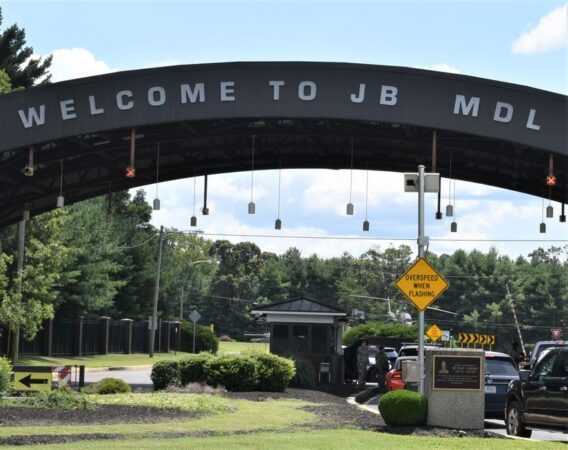
    Democratic elected officials said Wednesday that they received a letter from the administration saying there is currently no approved construction plan, nor a timeline, for confining people at Joint Base McGuire-Dix-Lakehurst.

    The administration previously announced plans to include the base among the military sites it wants to use as immigration detention centers, as it presses its arrest-and-deportation agenda.

    Estimates are that the base, which spans parts of Burlington and Ocean Counties, could hold 1,000 to 3,000 detainees. Specifics surrounding the when, where, and how of that undertaking remain unknown.

    New Jersey U.S. Reps. Donald Norcross and Herb Conaway, Democratic members of the House Armed Services Committee, announced that they received a response earlier this week from the Department of Homeland Security after requesting more information about the administration’s plans.

    “The Trump Administration’s ongoing disregard for due process and humane treatment of undocumented immigrants has required us to press repeatedly for answers and fulfill our congressional oversight responsibilities,” the lawmakers said in a joint statement. “While we acknowledge that the Department of Homeland Security has finally responded to our questions, we will continue to monitor for any further developments.”

    Their priority, the lawmakers said, is to uphold standards of human rights to ensure that plans to detain immigrants do not interfere with military readiness.

    The administration’s response said the government’s need for more detention space “reflects the Trump administration’s commitment to restoring the rule of law and ending the catch-and-release policies of prior years that jeopardized American communities.”

    Trump administration officials earlier named the base as one of two sites in the country now certified to assist in the president’s plan to remove millions of immigrants. The other is Camp Atterbury in Indiana.

  • Congress acts swiftly to force release of Epstein files, and Trump agrees to sign bill

    Congress acts swiftly to force release of Epstein files, and Trump agrees to sign bill

    WASHINGTON — Both the House and Senate acted decisively Tuesday to pass a bill to force the Justice Department to publicly release its files on the convicted sex offender Jeffrey Epstein, a remarkable display of approval for an effort that had struggled for months to overcome opposition from President Donald Trump and Republican leadership.

    When a small, bipartisan group of House lawmakers introduced a petition in July to maneuver around Speaker Mike Johnson’s control of the House floor, it appeared a longshot effort — especially as Trump urged his supporters to dismiss the matter as a “hoax.”

    But both Trump and Johnson failed to prevent the vote. The president in recent days bowed to political reality, saying he would sign the bill. And just hours after the House vote, senators agreed to approve it unanimously, skipping a formal roll call.

    The decisive, bipartisan work in Congress Tuesday further showed the pressure mounting on lawmakers and the Trump administration to meet long-held demands that the Justice Department release its case files on Epstein, a well-connected financier who killed himself in a Manhattan jail while awaiting trial in 2019 on charges he sexually abused and trafficked underage girls.

    For survivors of Epstein’s abuse, passage of the bill was a watershed moment in a years-long quest for accountability.

    “These women have fought the most horrific fight that no woman should have to fight. And they did it by banding together and never giving up,” said Rep. Marjorie Taylor Greene as she stood with some of the abuse survivors outside the Capitol Tuesday morning.

    “That’s what we did by fighting so hard against the most powerful people in the world, even the president of the United States, in order to make this vote happen today,” added Greene, a Georgia Republican.

    In the end, only one lawmaker in Congress opposed the bill. Rep. Clay Higgins, a Louisiana Republican who is a fervent supporter of Trump, was the only “nay” vote in the House’s 427-1 tally. He said he worried the legislation could lead to the release of information on innocent people mentioned in the federal investigation.

    The bill forces the release within 30 days of all files and communications related to Epstein, as well as any information about the investigation into his death in federal prison. It would allow the Justice Department to redact information about Epstein’s victims or continuing federal investigations, but not information due to “embarrassment, reputational harm, or political sensitivity.”

    Even before the bill’s passage Tuesday, thousands of pages of emails and other documents from Epstein’s estate have been released from an investigation by the House Oversight Committee.

    Those documents show Epstein’s connections to global leaders, Wall Street powerbrokers, influential political figures and Trump himself. In the United Kingdom, King Charles III stripped his disgraced brother Prince Andrew of his remaining titles and evicted him from his royal residence after pressure to act over his relationship with Epstein.

    Trump’s reversal on the Epstein files

    Trump has said he cut ties with Epstein years ago, but tried for months to move past the demands for disclosure.

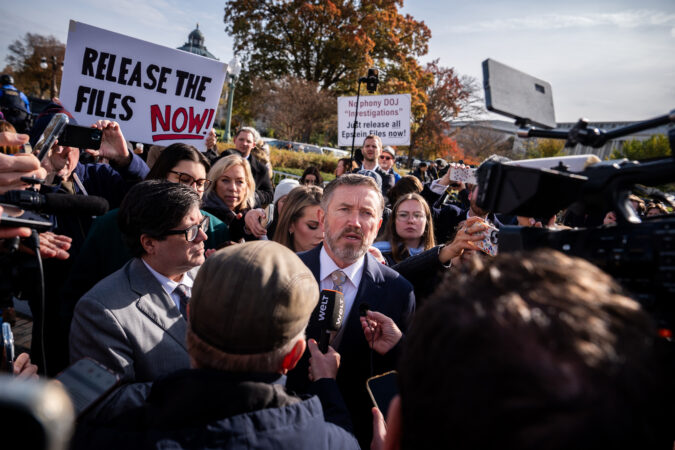
    Still, many in the Republican base continued to demand the release of the files. Adding to that pressure, survivors of Epstein’s abuse rallied outside the Capitol Tuesday morning. Bundled in jackets against the November chill and holding photos of themselves as teenagers, they recounted their stories of abuse.

    “We are exhausted from surviving the trauma and then surviving the politics that swirl around it,” said one of the survivors.

    Another, Jena-Lisa Jones, said she had voted for Trump and had a message for the president: “I beg you Donald Trump, please stop making this political.”

    The group of women also met with Johnson and rallied outside the Capitol in September, but have had to wait months for the vote.

    That’s because Johnson kept the House closed for legislative business for nearly two months and refused to swear-in Democratic Rep. Adelita Grijalva of Arizona during the government shutdown. After winning a special election on Sept. 23, Grijalva had pledged to provide the crucial 218th vote to the petition for the Epstein files bill. But only after she was sworn into office last week could she sign her name to the discharge petition to give it majority support in the 435-member House.

    It quickly became obvious the bill would pass, and both Johnson and Trump began to fold. Trump on Sunday said Republicans should vote for the bill.

    Yet Greene told reporters that Trump’s decision to fight the bill had betrayed his Make America Great Again political movement.

    “Watching this turn into a fight has ripped MAGA apart,” she said.

    How Johnson handled the bill

    Rather than waiting until next week for the discharge position to officially take effect, Johnson held the vote under a procedure that requires a two-thirds majority.

    But Johnson also spent a morning news conference listing off problems that he sees with the legislation. He argued that the bill could have unintended consequences by disclosing parts of federal investigations that are usually kept private, including information on victims.

    “This is a raw and obvious political exercise,” Johnson said.

    Still, he voted for the bill. “None of us want to go on record and in any way be accused of not being for maximum transparency,” he explained.

    Meanwhile, the bipartisan pair who sponsored the bill, Reps. Thomas Massie, R-Ky., and Ro Khanna, D-Calif., warned senators against doing anything that would “muck it up,” saying they would face the same public uproar that forced both Trump and Johnson to back down.

    “We’ve needlessly dragged this out for four months,” Massie said, adding that those raising problems with the bill “are afraid that people will be embarrassed. Well, that’s the whole point here.”

    Senate acts quickly

    Even as the bill cleared his chamber, Johnson pressed for the Senate to amend it to protect the information of “victims and whistleblowers.” But Senate Majority Leader John Thune quickly shut down that notion.

    As senators gathered in the chamber Tuesday evening for the first votes of the week, it became clear no one would object to passing the bill as written.

    Just before Senate Democratic leader Chuck Schumer called to pass the bill by unanimous consent, Oklahoma Sen. Markwayne Mullin, a Republican who is close to Trump, walked in the chamber and gave Schumer a thumbs-up. He then walked over to Schumer and shook his hand.

    “This is about giving the American people the transparency they’ve been crying for,” said Schumer, D-N.Y. “This is about holding accountable all the people in Jeffrey Epstein’s circle who raped, groom, targeted and enabled the abuse of hundreds of girls for years and years.”

  • EEOC sues Penn for failing to release information related to antisemitism investigation

    EEOC sues Penn for failing to release information related to antisemitism investigation

    The U.S. Equal Employment Opportunity Commission is suing the University of Pennsylvania for failing to release information related to an investigation it began in 2023 over the school’s treatment of Jewish faculty and other employees regarding antisemitism complaints.

    Penn, according to the complaint filed in federal court Tuesday, has not complied with a subpoena for information, including the identification of employees who could have been exposed to alleged harassment and the names of all employees who complained about the behavior.

    In its quest to find people potentially affected, the EEOC demanded a list of employees in Penn’s Jewish Studies Program, a list of all clubs, groups, organizations and recreation groups related to the Jewish religion — including points of contact and a roster of members — and names of employees who lodged antisemitism complaints.

    Penn usually does not comment on litigation, but in this case, the school ardently objected to the EEOC’s characterization of its cooperation and the personal nature of the material it was still seeking.

    The school said in a statement it has cooperated extensively with the EEOC, including providing more than 100 documents and over 900 pages.

    But the private university said it will not disclose personal information, specifically “lists of Jewish employees, Jewish student employees and those associated with Jewish organizations, or their personal contact information” to the government.

    “Violating their privacy and trust is antithetical to ensuring Penn’s Jewish community feels protected and safe,” the university said Tuesday.

    Penn also provided information on employees who complained and agreed that it could be shared, the school said, but the school would not provide information on those who objected.

    “Penn also offered to help the EEOC reach employees who are willing to speak with the agency by informing all employees of the investigation and how they could reach out to the agency,” the university said. “The EEOC rejected that offer.”

    The original complaint was launched by EEOC Commissioner Andrea Lucas, now chair of the body, on Dec. 8, 2023, two months after Hamas’ attack on Israel that led to unrest on college campuses, including Penn, and charges of antisemitism. It was also just three days after former Penn President Liz Magill had testified before a Republican-led congressional committee on the school’s handling of antisemitism complaints; the testimony drew a bipartisan backlash and led to Magill’s resignation days later.

    Lucas, who was appointed chair this year by President Donald Trump, also brought similar antisemitism charges against Columbia University that earlier this year resulted in the school paying $21 million for “a class settlement fund.”

    EEOC complaints typically come from those who allege they were aggrieved. Lucas, according to the complaint, made the charge in Penn’s case because of the “probable reluctance of Jewish faculty and staff to complain of harassing environment due to fear of hostility and potential violence directed against them.“

    The EEOC’s investigation ensued after Lucas’ complaint to the EEOC’s Philadelphia office that alleged Penn was subjecting Jewish faculty, staff, and other employees including students “to an unlawful hostile work environment based on national origin, religion, and/or race.”

    The allegation, the complaint said, is based on news reports, public statements made by the university and its leadership, letters from university donors, board members, alumni and others. It also cited complaints filed against Penn in federal court and with the U.S. Department of Education over antisemitism allegations and testimony before a congressional committee.

    The EEOC complaint pointed to public comments by Magill, addressing antisemitism while she led Penn.

    “I am appalled by incidents on our own campus, and I’ve heard too many heartbreaking stories from those who are fearful for their safety right here at Penn,” Magill said in 2023. “This is completely unacceptable.”

    Magill also in a message had addressed “a small number of Penn staff members” who “received vile, disturbing antisemitic emails that threatened violence against members of our Jewish community,” in November 2023.

    The complaint cited incidents of antisemitic obscenities being shouted on the campus, destruction of property in Penn’s Hillel, a swastika painted in an academic building, graffiti outside a fraternity and a pro-Palestinian encampment on the campus in 2024 that eventually was dismantled by police.

    “Throughout its investigation, the EEOC has endeavored to locate employees exposed to this harassment and to identify other harassing events not noted by respondent in its communications, but respondent has refused to furnish this information, thereby hampering the EEOC’s investigation,” the complaint said.

    Penn said it had received three antisemitism complaints, according to the federal complaint, but the EEOC questioned that number given the university’s workforce of more than 20,000. It demanded that the school provide names of all people who attended listening sessions as part of the school’s task force on antisemitism and all faculty and staff members who took the task force’s survey.

    Penn objected to the subpoena and the commission partially modified it in September, ordering the school to comply within 21 days, the complaint said.

    In its statement to The Inquirer, Penn defended its response to antisemitism.

    “Penn has worked diligently to combat antisemitism and protect Jewish life on campus,” the school said.

  • Court blocks Texas from using Trump and GOP-favored House maps for 2026 midterms

    Court blocks Texas from using Trump and GOP-favored House maps for 2026 midterms

    A federal court has blocked Texas from using its new congressional map for the 2026 midterm elections, directing the state to revert to its previous districts.

    The majority opinion said the coalition of voting and civil rights groups who sued was likely to prove at trial that Texas officials had “racially gerrymandered” a new map that “unconstitutionally sorts voters on the basis of race,” depriving the plaintiffs of “their right to participate in a free and fair election.”

    The judges were under a tight deadline to make a ruling since the candidate filing period for the 2026 midterm elections began on Nov. 8 and ends on Dec. 8.

    Republican Gov. Greg Abbott, a key proponent of the electoral changes, said he would appeal the ruling to the U.S. Supreme Court.

    “Any claim that these maps are discriminatory is absurd and unsupported by the testimony offered during ten days of hearings,” Abbott said. “This ruling is clearly erroneous and undermines the authority the U.S. Constitution assigns to the Texas Legislature by imposing a different map by judicial edict.”

    The decision marks a significant setback for the state and Republicans, which began with a contentious battle in its state legislature last summer, led to a vote to revise state maps for voting districts, and ultimately spurred other states to buck tradition and pursue mid-decade redistricting.

    Two judges, in a three-judge District Court panel, ruled on Nov. 18 that the injunction was necessary because “the racial minorities the Plaintiff Groups represent will be forced to be represented in Congress based on likely unconstitutional racial classifications for at least two years.”

    The majority opinion, written by U.S. District Judge Jeffrey V. Brown, a Donald Trump appointee, who sits in Galveston, Texas, was joined by Senior U.S. District Judge David C. Guaderrama, a Barack Obama appointee, in El Paso.

    U.S. Circuit Judge Jerry E. Smith, who was appointed to the bench by President Ronald Reagan, is expected to file a dissenting opinion.

    A Republican majority in the Texas legislature in August 2025 passed the new state congressional map after a weeks-long standoff with state Democrats. Their new law, at the urging of President Donald Trump, heavily advantaged the GOP in 2026 elections. If used, it could have potentially flipped as many as five Democratic-held seats to Republican control − a significant edge as the party maintains a slim majority in Congress.

    In his statement, Abbott said the Texas legislature passed the new maps to “better reflect Texans’ conservative voting preferences – and for no other reason.”

    The court ruling and any decision by the U.S. Supreme Court could push back the filing deadlines for the Texas primaries for 2026. The midterm general election includes the seat of U.S. Sen. John Cornyn, D-Texas, all the Texas House of Representatives and Senate seats, and the governor, lieutenant governor and attorney general.

    Republicans said redistricting targeted Democrats

    The ruling came more than a month after 10 days of testimony and arguments over the legality of the new redistricting map at the federal courthouse in El Paso. The key testimony during the hearing came from Adam Kincaid, executive director of the National Republican Redistricting Trust, who created the maps.Kincaid testified that he looked at no racial data when building the map, solely relying on targeting districts that historically voted for Democrats.

    He said he combined Democrat-leaning districts into one district. He took Republican portions of those districts to create their own districts. The outcome gave Democrats one less representative, adding more representation for Republican voters.

    Kincaid and Republican leaders said the redistricting was done “race blind.” He testified he targeted Democrats, not minorities, which is allowed under the U.S. Constitution.

    Voting rights groups say redistricting targets minorities

    Democratic leaders and voting rights representatives argued during the hearing that the only districts targeted and impacted were Hispanic and Black majority districts. Hispanic and Black voters historically vote for Democrats.

    In Texas, voters are not required to register by political party. They are free to vote in the primary of their choosing.

    The redistricting map suppresses the voice of Texas minorities, including Hispanics, who make up the largest minority population in the state, Democratic state leaders testified in the trial.“They are not built to give Hispanics or African Americans a candidate of their choice,” Rep. Joe Moody, D-El Paso, testified about the new maps.

    Democrats and voting rights advocates questioned why Trump focused on four districts and why they were the only districts that were dramatically altered. They said Republicans had already created the map before discussions were held in the Texas Legislature and the public had an opportunity to comment on it.

    “That’s not Texas,” testified Rep. Ramon Romero, D-Fort Worth. “That’s not how we do things here.”

    The redistricting vote that sparked a chain reaction

    The Texas legislators’ efforts earlier this year sparked a national redistricting war across several states, as Democratic and Republican governors responded with their own efforts to redraw maps. Democratic California Gov. Gavin Newsom recently landed a victory in a voter-approved measure to implement new districts likely to add more Democratic representatives.

    But that matter is also entangled in a court challenge, after the administration on Nov. 13 joined the California Republican Party to accuse the state of violating the Constitution by gerrymandering using race as a factor to favor Hispanic voters in the new map.