Category: Politics

Political news and coverage

  • How an anti-Trump crusader and a ‘boring’ Republican prosecutor forged an unlikely partnership

    How an anti-Trump crusader and a ‘boring’ Republican prosecutor forged an unlikely partnership

    Right after Pennsylvania Attorney General Dave Sunday was sworn into office in January, he received a lunch invitation from across the Delaware River.

    It didn’t matter that they came from different political parties, said New Jersey Attorney General Matthew Platkin, a Democrat appointed to his post by outgoing Gov. Phil Murphy.

    Platkin wanted to get to know his neighbor, and invited Sunday out to lunch in Philadelphia.

    The two men could not have more different approaches to their jobs. In a hyperpolarized political era, where attorneys general play an increasingly important role in national politics, Platkin has become a face of Democratic opposition to President Donald Trump’s administration. He has led or joined dozens of lawsuits by blue-state attorneys general and governors in arguing that the executive branch is acting unconstitutionally on issues like birthright citizenship, withholding congressionally approved funds, and more.

    In contrast, Sunday, a Republican elected last year, has largely avoided suing Trump and has said he strives to be “boring,” focusing his efforts on oversight of his own office.

    Even their jobs are different, despite sharing a title. New Jersey’s attorney general is in charge of the state’s 21 county prosecutors, oversight of state police, and protecting consumers, among other duties; Pennsylvania’s attorney general has wide-ranging powers to investigate corruption, enforce the state’s laws, represent the state’s agencies and interests in lawsuits, and more.

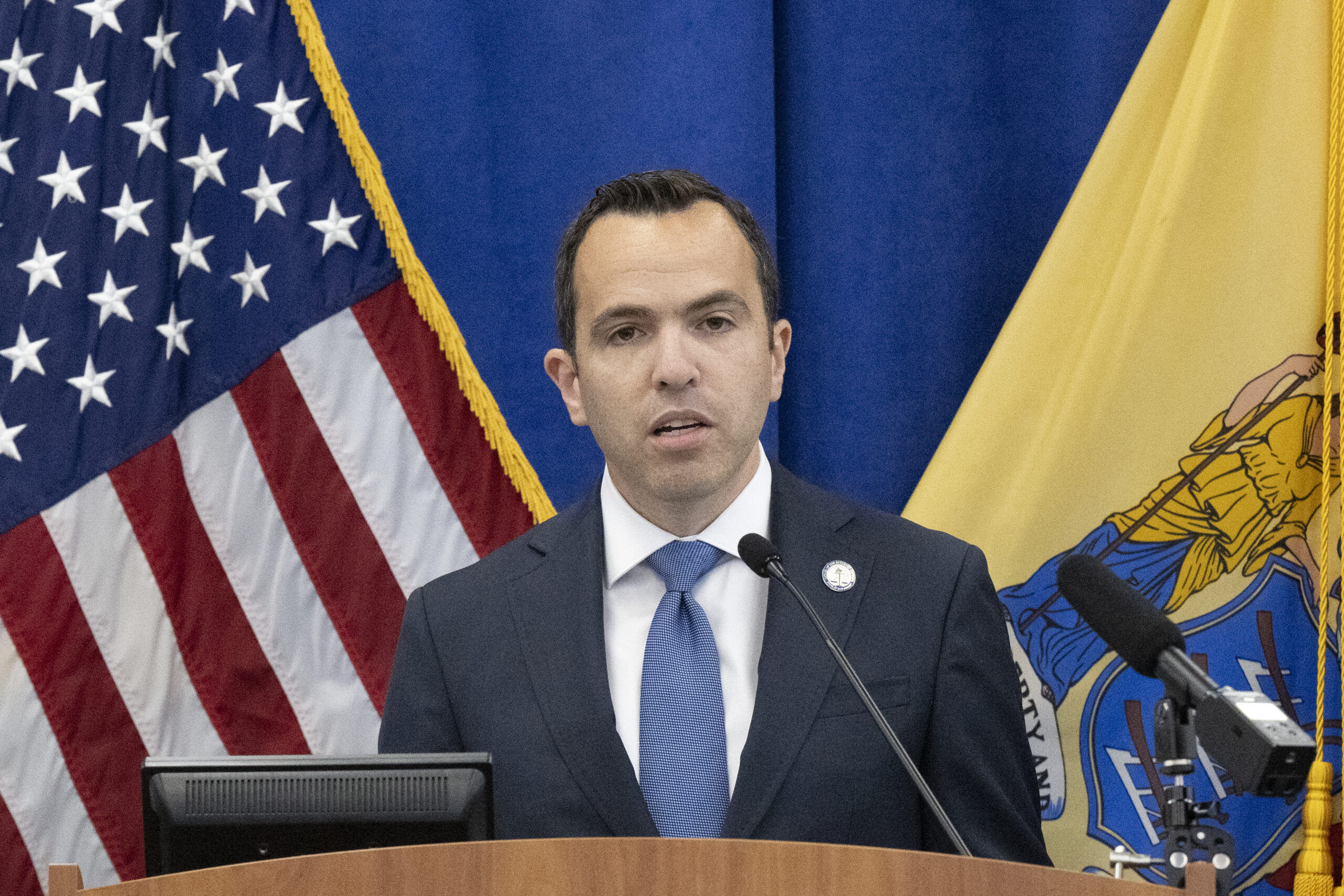
    New Jersey Attorney General Matthew Platkin on Monday, June 17, 2024, at the Richard J. Hughes Justice Complex in Trenton, N.J.

    Platkin, 39, is an ambitious lawyer who grew up in northern New Jersey and attended one of the best high schools in the state before attending Stanford University and Stanford Law School. He went on to work in private practice in New York and New Jersey before being appointed as chief general counsel to Murphy at 35 — the youngest person to ever hold the office.

    Sunday, 50, grew up in a suburb of Harrisburg and has described his high school years as lacking direction. He joined the U.S. Navy after high school before attending Pennsylvania State University for undergraduate and Widener University Law School for his law degree, working at UPS to help put himself through school. He returned to south-central Pennsylvania for his clerkship, and was a career prosecutor in York County until his election to attorney general.

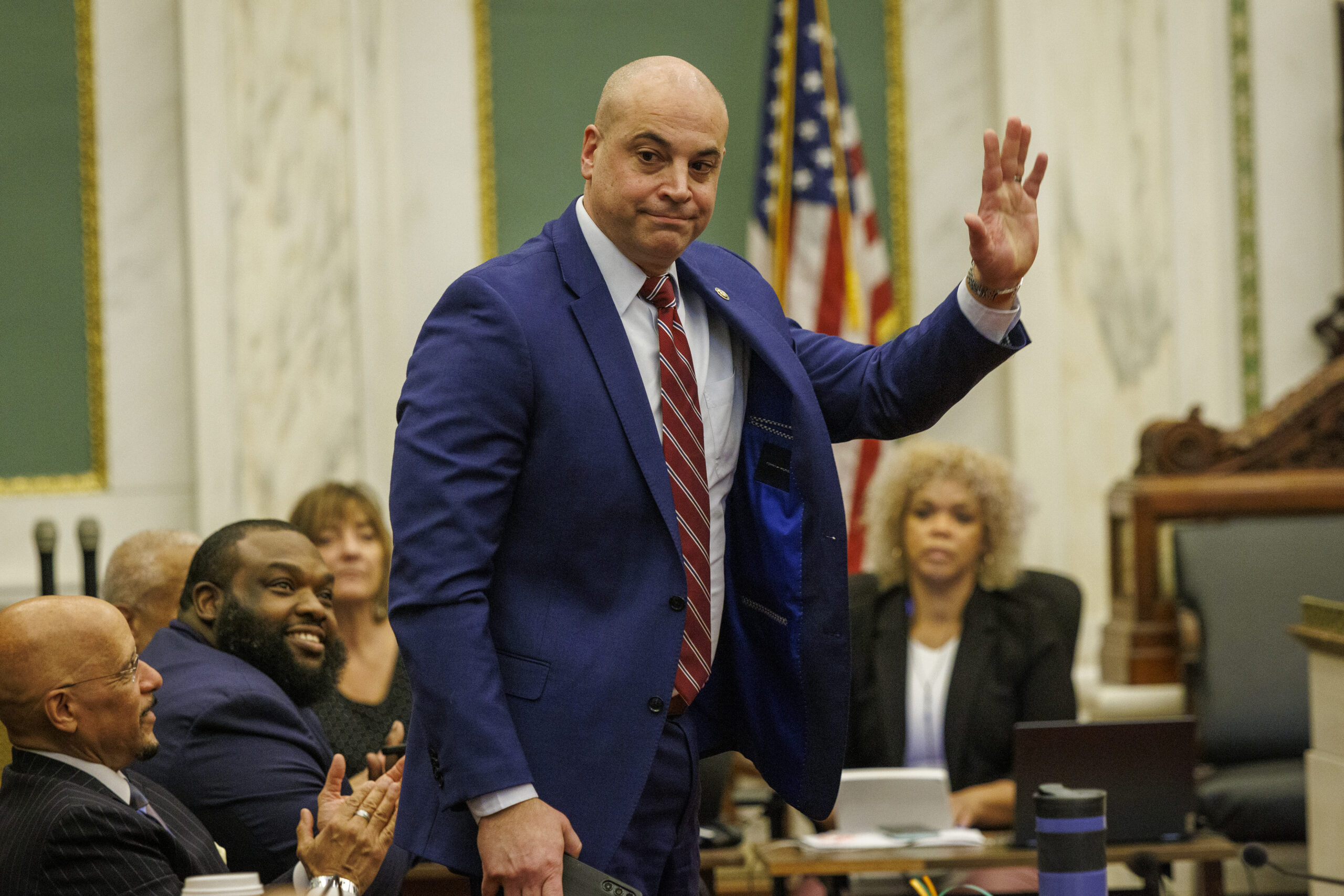
    Pennsylvania Attorney General Dave Sunday stands to be recognized by Council President Kenyatta Johnson before Philadelphia Mayor Cherelle Parker gives her budget address to City Council, City Hall, Thursday, March 13, 2025.

    But over salads at the Mulberry, Platkin and Sunday found common ground. And ever since, the two said in a joint interview this month, they have worked closely on issues affecting residents in their neighboring states.

    “Just because you may not see eye-to-eye on [Trump] doesn’t mean you can’t see or don’t see eye-to-eye on many, many other issues,” Sunday said.

    “​​When we have an auto theft problem, [residents] don’t care if there’s a ‘D’ or an ‘R’ after your name,” Platkin added. “They just want to see us working to solve it.”

    The two have since worked together on issues that stretch from criminal investigations and human trafficking cases to challenging Big Tech companies as artificial intelligence rapidly advances, Sunday said.

    Earlier this month, Sunday and Platkin led national efforts of coalescing approximately 40 attorneys general across party lines on the issues they say are most pressing for residents. The group wrote a letter to Big Tech companies in mid-December, detailing concerns about the lack of guardrails for AI chatbots like those available from ChatGPT or Meta’s Instagram AI chats, and the potential harm they could cause people in crisis or children who use them.

    In two more letters sent this month, the attorneys general also voiced support for a workforce reentry bill before a U.S. House committee and requested that Congress approve additional funding for courtroom and judicial security to protect the nation’s judges from safety threats. Platkin and Sunday said they were some of the first attorneys general to sign on to the letters.

    “While the undersigned hold differing views on many legal issues, we all agree that the legal system cannot function if judges are unsafe in their homes and courthouses,” the group of 47 attorneys general wrote in a Dec. 9 letter to top leaders of Congress.

    When it comes to lawsuits against the Trump administration and other litigation authored by partisan attorneys general associations, Sunday has largely avoided the fray. Earlier this month, he was elected Eastern Region chair of the National Association of Attorneys General, a nonpartisan group composed of the 56 state and territory attorneys general.

    Platkin, on the other hand, has led the charge in pushing back against the administration’s policies in New Jersey, signing onto dozens of lawsuits such as ones challenging Trump’s efforts to end birthright citizenship and to withhold SNAP funding if a state does not turn over personal information about its residents.

    Still, Pennsylvania has joined many lawsuits, including several challenging the federal government for withholding congressionally approved funds for electric vehicles and more, as Democratic Gov. Josh Shapiro, formerly the state’s attorney general, has signed on in his capacity as governor.

    Platkin, who has served as New Jersey’s attorney general since 2022, will leave office when Murphy’s term ends next month, and Gov.-elect Mikie Sherrill will appoint someone new to the post. Sherrill, a Democrat, earlier this month nominated Jen Davenport, a former prosecutor and current attorney at PSE&G, New Jersey’s largest electric and gas company, to be Platkin’s successor.

    Sunday’s team has already been in touch with Davenport to forge a similar cross-state working relationship.

    What’s next for Platkin? He said he’s a “Jersey boy” and will remain in the state but declined to say what his next move might entail.

    And both Platkin and Sunday say they will maintain their bipartisan friendship going forward.

    “It’s OK to say we don’t agree on everything. We shouldn’t hate each other,” Platkin said. “We should be open about the fact that we like each other. … I don’t think there’s anything wrong with that.”

  • Pennsylvania was known for an arduous permitting process. New policies aim to accelerate building projects.

    Pennsylvania was known for an arduous permitting process. New policies aim to accelerate building projects.

    When U.S. Steel opted to build a new mill in Arkansas that had originally been planned for Allegheny County, then-Arkansas Gov. Asa Hutchinson joked in 2022 that his state could have the mill built faster than Pennsylvania could have it permitted.

    Three years later, Pennsylvania politicians and business leaders are hopeful that a series of permitting reforms — the latest of which were approved as part of the state’s $50.1 billion budget — have finally flipped that dynamic.

    The reforms, which are designed to expedite Pennsylvania’s Department of Environmental Protection’s permitting process to allow for quicker development, mark a major step forward in a project that has long been a goal for Democratic Gov. Josh Shapiro and Republican leaders in the General Assembly.

    Pennsylvania’s Department of Environmental Protection is responsible for issuing a variety of permits for building plans to ensure they comply with state law and are environmentally safe. The latest reforms will force the agency to automatically approve certain permits relating to stormwater and groundwater within 60 days if it has not completed its review in that time period or sought an extension. For certain permits related to air quality, the changes allow for the permits to be automatically approved 30 days after submission if the DEP has not acted.

    The budget, which Shapiro signed into law last month, also expanded an existing program, called SPEED, that allows companies to hire third-party inspectors for certain permits to expedite the process. And lawmakers required the state to create and maintain a database where companies can easily track the progress of their permit applications.

    For Senate Majority Leader Joe Pittman (R., Indiana), the change represents a paradigm shift in the state. He recalled the 2022 loss of the U.S. Steel mill at a news conference last month.

    “You cannot have economic development without shovels in the ground, and you can’t put shovels in the ground without permits,” Pittman said.

    The reforms, he said, will “provide certainty,” which he called, “critical to economic development.”

    A longtime goal

    Amy Brinton, director of government affairs at the Pennsylvania Chamber of Business and Industry, said it has long been common for businesses to choose other states because of Pennsylvania’s arduous permitting process, and at times begin the process of building in Pennsylvania only to move out of state when permitting becomes a hurdle.

    “We lose a lot of projects to Texas and Ohio because of our complicated permitting process,” Brinton said.

    Remedying this through permitting reforms, as well as expedited certifications, have been among Shapiro’s top priorities as governor.

    “When he took office in January 2023, Governor Shapiro promised to make state government work more efficiently and effectively for Pennsylvanians. Since then, the Shapiro Administration has delivered on that promise to get stuff done — streamlining permitting processes, reducing wait times for licenses, and cutting red tape to attract more businesses to the Commonwealth,“ Kayla Anderson, a spokesperson for Shapiro, said in a statement. ”This budget builds on the Governor’s success.”

    Shapiro signed several executive orders aimed at that goal including developing a “Fast Track” program for high-priority projects. DEP has eliminated the 2,400 permit backlog that existed when Shapiro took office in 2023. Additionally, Shapiro’s office said, the average processing time for all permits dropped to 38 days in 2025 from 53 days in 2022.

    Lawmakers first approved the SPEED program allowing for third-party inspectors in the 2024 budget. Shapiro’s office said the program has already produced results, cutting permit wait times in half in some cases.

    These projects are a key part of Shapiro’s business-friendly approach, which he’s promoted as he bolsters his resume and bipartisan appeal ahead of a 2026 reelection campaign and a potential future presidential run.

    But Senate President Pro Tempore Kim Ward (R., Westmoreland) also celebrated the new reforms, as well as the state’s exit from a multistate carbon cap-and-trade program, as key wins for Republicans.

    “The permitting was awful,” Ward said in an interview last month. “Permitting now, instead of 300 days, we’re at 30 days. It’s amazing that we were able to come together and get that done.”

    Brinton said she is hopeful that the combination of reforms will make it easier for businesses to choose to build in Pennsylvania because the timeline will be more predictable.

    “Improved accountability, greater predictability, faster timelines — those are the key kind of drivers that we’re hoping this will continue to provide to our businesses in the hopes that when they look at Pennsylvania they won’t wince at the fact that this is going to take forever,” Brinton said.

  • Zohran Mamdani has bold promises. Can he make them come true as New York City mayor?

    Zohran Mamdani has bold promises. Can he make them come true as New York City mayor?

    Zohran Mamdani has promised to transform New York City government when he becomes mayor. Can he do it?

    Mamdani, a 34-year-old democratic socialist, already faces intense scrutiny, even before taking office in one of the country’s most scrutinized political jobs. Republicans have cast him as a liberal boogeyman. Some of his fellow Democrats have deemed him too far left. Progressives are closely watching for any signs of him shifting toward the center.

    On Jan. 1, he will assume control of America’s biggest city under that harsh spotlight, with the country watching to see if he can pull off the big promises that vaulted him to office and handle the everyday duties of the job. All while skeptics call out his every stumble.

    For Mamdani, starting off strong is key, said George Arzt, a veteran Democratic political consultant in New York who worked for former Mayor Ed Koch.

    “He’s got to use the first 100 days of the administration to show people he can govern,” he said. “You’ve got to set a mindset for people that’s like, ‘Hey, this guy’s serious.’”

    That push should begin with Mamdani’s first speech as mayor, where Arzt said it will be important for the city’s new leader to establish a clear blueprint of his agenda and tell New Yorkers what he plans to do and how he plans to do it.

    Mamdani will be sworn in around midnight during a private ceremony at a historic, out-of-use City Hall subway station. Then in the afternoon, he will be sworn in a second time on the steps of City Hall, while his supporters are expected to crowd surrounding streets for an accompanying block party.

    From there, Arzt said, Mamdani will have to count on the seasoned hands he’s hired to help him handle the concrete responsibilities of the job, while he and his team also pursue his ambitious affordability agenda.

    Managing expectations as a movement candidate

    Mamdani campaigned on a big idea: shifting the power of government toward helping working class New Yorkers, rather than the wealthy.

    His platform — which includes free childcare, free city bus service, and a rent freeze for people living in rent stabilized apartments — excited voters in one of America’s most expensive cities and made him a leading face of a Democratic Party searching for bright, new leaders during President Donald Trump’s second term.

    But Mamdani may find himself contending with the relentless responsibilities of running New York City. That includes making sure the trash is getting picked up, potholes are filled, and snow plows go out on time. When there’s a subway delay or flooding, or a high-profile crime or a police officer parked in a bicycle lane, it’s not unusual for the city’s mayor to catch some heat.

    “He had a movement candidacy and that immediately raises expectations locally and nationally,” said Basil Smikle, a Democratic political strategist and Columbia University professor, who added that it might be good for Mamdani to “Just focus on managing expectations and get a couple of good wins under your belt early on.”

    “There’s a lot to keep you busy here,” he said.

    A large part of Mamdani’s job will also be to sell his politics to the New Yorkers who remain skeptical of him, with Smikle saying “the biggest hurdle” is getting people comfortable with his policies and explaining how what he’s pushing could help the city.

    “It’s difficult to have this all happen on day one,” he said, “or even day 30 or even day 100.”

    Challenges and opportunities

    Mamdani’s universal freechild care proposal — perhaps one of his more expensive plans — is also one that has attracted some of the strongest support from New York Gov. Kathy Hochul, a moderate from Buffalo who endorsed the mayor-elect.

    Hochul is eager to work with Mamdani on the policy and both leaders consider the program a top priority, although it’s not yet clear how exactly the plan could come to fruition. The governor, who is up for reelection next year, has repeatedly said she does not want to raise income taxes — something Mamdani supports for wealthy New Yorkers — but she has appeared open to raising corporate taxes.

    “I think he has allies and supporters for his agenda, but the question is how far will the governor go,” said state Senate Deputy Leader Michael Gianaris, a Mamdani ally.

    “There’s an acknowledgment that the voters have spoken, and there’s very clear policies that were associated with his successful campaign,” he said, “so to not make progress on them would be us thumbing our noses at the voters.”

    Mamdani’s pledge to freeze the rent for roughly 1 million rent-stabilized apartments in the city would not require state cooperation.

    But that proposal — perhaps the best known of his campaign — is already facing headwinds, after the city’s departing mayor, Eric Adams, made a series of appointments in recent weeks to a local board that determines annual rent increases for the city’s rent stabilized units.

    The move could potentially complicate the mayor-elect’s ability to follow through on the plan, at least in his first year, although Mamdani has said he remains confident in his ability to enact the freeze.

    Other challenges await

    His relationship with some of the city’s Jewish community remains in tatters over his criticisms of Israel’s government and support for Palestinian human rights.

    The Anti-Defamation League, a prominent Jewish advocacy organization, plans to track Mamdani’s policies and hires as it pledged to “protect Jewish residents across the five boroughs during a period of unprecedented antisemitism in New York City.”

    Earlier this month, a Mamdani appointee resigned over social media posts she made more than a decade ago that featured antisemitic tropes, after the Anti-Defamation League shared the posts online.

    The group has since put out additional findings on others who are serving in committees that Mamdani set up as he transitions into his mayoral role. In response, Mamdani said the ADL often “ignores the distinction” between antisemitism and criticism of the Israeli government.

    The mayor-elect’s past calls to defund the city’s police department continue to be a vulnerability. His decision to retain Jessica Tisch, the city’s current police commissioner, has eased some concerns about a radical shake-up at the top of the nation’s largest police force.

    And then there’s Trump.

    Tensions between Trump and Mamdani have appeared to cool — for now — after months of rancor led into a surprisingly friendly Oval Office meeting. Future clashes may emerge given the sharp political differences between them, particularly on immigration enforcement, along with anything else that could set off the mercurial president.

  • How Vance brokered a truce between Trump and Musk

    How Vance brokered a truce between Trump and Musk

    Vice President JD Vance was doggedly working the phones, trying to quell a rebellion in his midst. Elon Musk had just declared his intention to form a third party this spring, turning a simmering feud into an all-out war against the MAGA movement.

    Backlash to Musk’s radical government cost-cutting campaign, the U.S. DOGE Service, along with his public swipes at President Donald Trump on social media, had damaged the relationship between the president and his billionaire backer. Now, Vance and those around him feared a new party could hurt the GOP in the 2026 midterms and beyond, according to two people familiar with his thinking, who spoke on the condition of anonymity to describe private conversations.

    Vance already had appealed to Musk directly. This time, he urged Musk allies to push him to back off his third party plans. And Vance would later personally lobby lawmakers to support restoring the nomination of Musk ally Jared Isaacman to head NASA, the agency that funds Musk’s space exploration business SpaceX, said the two people.

    The monthslong offensive by Vance and other White House officials, the details of which have not been previously reported, has worked. Having scrapped his third party project, Musk appeared at the White House in November, attending a dinner for Crown Prince Mohammed bin Salman of Saudi Arabia. The killing of conservative activist Charlie Kirk spurred Musk to put support behind GOP campaigns in the midterms, said a person directly familiar with his political operation, who spoke on the condition of anonymity to discuss its inner workings. Privately, Musk is considering reworking his donations by seeding existing groups with cash rather than wielding his own super PAC, the person added.

    But though Trump and Musk are once again on good terms, their truce is fragile, allies of both men say.

    This story is based on interviews with more than a dozen people familiar with the relationship between Musk and the White House and DOGE’s ongoing influence, most of whom spoke on the condition of anonymity to describe the private deliberations.

    The reconciliation offers a glimpse into the next phase of the singular political partnership — one that carries both risk and reward for all involved. Musk and Trump forged their relationship around a set of shared aims: winning an election and trimming back what they saw as government largesse. But there were deep gaps in their mutual understanding, six of the people said. Trump’s camp was surprised at the speed and brazenness with which Musk inserted himself into government, commandeered computer systems and email servers to briskly uproot federal agencies; moved to dismantle the U.S. Agency for International Development; and was willing to take shots at anyone — including Cabinet members.

    Though Musk is unpredictable, he is also a formidable ally. With his nearly unlimited resources and unmatched digital megaphone, Musk could prove a powerful asset to the MAGA movement once Trump leaves the stage.

    Vance in particular stands to benefit. Though the falling-out between Trump and Musk dominated the headlines, Vance’s role in the reunion highlights his own relationship with the billionaire. He talks regularly with Musk, who sees Vance as a viable 2028 candidate, according to one of the people. Musk and Vance, a former Silicon Valley investor, share not just a tech-infused worldview but a fondness for online performance — especially on Musk’s social media platform, X, where Vance has embraced a sharp, “own-the-libs” style that can mirror Musk’s own taste for provocation. Their alliance could further entrench the influence of tech titans in the White House, extending the authority of private entrepreneurs.

    But Vance, who has been dogged by criticism dating back to his 2021 Senate campaign that his close ties to billionaires undermine his populist bona fides, may have to tread carefully. Ties to a tech billionaire of Musk’s stature carry political risk at a moment when skepticism of Silicon Valley runs deep among many Americans — and even within the MAGA movement itself.

    And advisers to both Trump and Vance understand that Musk’s support comes with baggage beyond the usual demands of deep-pocketed donors, with Musk eager at times to command the spotlight — and drive policy toward his own worldview. Republican officials eager for Musk’s financial help are aware of that reality.

    “Obviously, we would love to see [Musk] contribute generously,” said Oscar Brock, a member of the Republican National Committee from Tennessee. “But he brings with him a lot of media attention, and so we want to be careful that he’s spreading the right word … we don’t want him taking sides on issues that aren’t aligned with the party right now.”

    But if a year ago the culture clash between a billionaire used to controlling his corporate fiefdom and a new administration attuned to public opinion came as a shock, now everyone involved understands the stakes.

    “He enjoys kind of that kingmaker role,” said the person familiar with Musk’s political operation. “Part of being a kingmaker is making sure everybody in the world knows you’re the king.”

    Vance and White House AI czar David Sacks, who is close to Vance and Musk, declined to comment. Musk did not respond to requests for comment.

    “President Trump pledged to cut the waste, fraud, and abuse in our bloated government, and the Administration is committed to delivering on this pledge for the American people,” said White House spokesperson Davis Ingle.

    Trump officials, including Vance, Sacks, White House chief of staff Susie Wiles, and Taylor Budowich, a former White House deputy chief of staff, sought a reconciliation on the grounds that it would be better for the country if the right’s two most prominent figures got along, the people interviewed for this story said.

    Musk, for his part, has emerged having learned some lessons, including understanding that the government doesn’t run like his businesses. “Best to avoid politics where possible,” he told podcaster Nikhil Kamath recently, describing it as a “blood sport.”

    Musk has said he is unlikely to take on another project like the U.S. DOGE Service, his signature cost-cutting venture, which fell far short of its promise to cut $2 trillion from the federal budget. The program continues in decentralized form, Trump administration officials and Musk allies have said, with a small number of people in the White House working on streamlining the design of government services — and former DOGE members embedded as full-time workers within an array of federal agencies.

    To some veterans of government reform, Musk’s DOGE is not a failed experiment, but a lasting wound. “The entire development world: crushed,” said Max Stier, the chief executive of the Partnership for Public Service, who described the effort as “Godzilla rampaging through the city.”

    Focusing on the gap between promised savings and actual results, he argued, misses the deeper damage. “It’s the wrong idea to say he promised $2 trillion and didn’t make it,” Stier said. “He promised $2 trillion and blew up the place. … He slammed our whole government into reverse.”

    Yet Musk is buoyed by a chorus in Silicon Valley and among remaining government allies, who argue that his effort achieved a higher goal: fundamentally reforming the workings of government, according to five of the people.

    The effort, they argue, helped eradicate taboos in Washington, normalizing aggressive hiring and firing, expanding the use of untested technologies, and lowering resistance to boundary-pushing startups seeking federal contracts. In short, he made it possible for the government to run more like a company.

    “That’s the cultural shift, the shift in the Overton window,” said Isaiah Taylor, CEO of the nuclear company Valar Atomics, referring to the political theory describing how a radical idea can become acceptable.

    The result, said Taylor, who was close to aspects of DOGE, is “a new urgency injected into government agencies. … We can actually allow American builders to move.”

    From first buddy to a falling-out

    Soon after Trump’s victory, Musk, who put more than $288 million toward electing GOP candidates during the 2024 cycle, began spending his days in Palm Beach, Fla. The billionaire traipsed around Mar-a-Lago, referring to himself as the first buddy while plotting the future Department of Government Efficiency, an effort Trump hailed as the potential “‘Manhattan Project’ of our time.”

    The outside group would be run by Musk and biotech entrepreneur Vivek Ramaswamy and report to budget office director Russell Vought, a White House official who had long advocated for radical government cuts. DOGE was the culmination of an ethos Musk had brought to his companies, where he’d cut large numbers of employees briskly — sometimes achieving wildly ambitious goals as he drew lawsuits and skirted regulatory guardrails.

    Despite that track record, seasoned operators in Washington were skeptical that DOGE could have the same slash-and-burn effect, assuming that Musk would be bogged down by bureaucratic processes and red tape.

    They were wrong. Swiftly after inauguration, DOGE began an unprecedented sweep through federal agencies, culling the federal workforce, hoovering up data, and dismantling entire organizations, including the U.S. Agency for International Development. It turned to creative methods: To end some federal grants, it stopped payments from going out. In February, Musk brandished a chain saw at the Conservative Political Action Conference to brag about his cost-cutting strategy.

    But the Tesla CEO’s work proved deeply unpopular and the company’s stock price plunged amid protests in front of its showrooms. Musk’s hard-charging style alienated those around him, including some of his DOGE recruits, who felt he had gone too far, particularly in breaking policies around extracting and manipulating government information, according to two of the people familiar with the workings of DOGE. His efforts to persuade Congress to issue legislation to support his changes were largely rebuffed.

    “He’s used to being the emperor,” said another Musk associate, speaking on the condition of anonymity to describe the billionaire’s thinking. “But he wasn’t treated with much respect in Congress. And he doesn’t do politicking.”

    He clashed repeatedly with administration officials, some of whom resented Musk’s taking command of personnel and other decisions within their agencies. By the time he left the White House at the end of May, Musk’s private spats with administration officials had leached into the public, with a roster of adversaries including Treasury Secretary Scott Bessent, Secretary of State Marco Rubio, Transportation Secretary Sean P. Duffy, Trade Adviser Peter Navarro, and White House aide Sergio Gor.

    The Gor dynamic would prove the most troublesome. On Musk’s final day as a special government employee, Gor, a White House aide involved in personnel matters, provided Trump with printouts showing that Jared Isaacman, a billionaire with ties to SpaceX whom Musk had pushed to lead NASA, had donated to Democrats, said a person familiar with Musk and Trump’s falling-out. Gor was aware that Trump was sensitive to hires that did not share his political ideology, the person said.

    Trump pulled Isaacman’s nomination, announcing the decision in a Saturday night post on Truth Social. Three days later, Musk railed on X against Trump’s signature tax and immigration legislation, the “One Big Beautiful Bill.”

    Privately, both Wiles and Vance began to back channel to Musk to de-escalate the situation, said two people with knowledge of the conversations. Vance and Musk were friends before the election, but the men had become closer since the billionaire came to Washington for DOGE, three people said. Days into the new administration, Vance invited Musk over for dinner with his family at the Naval Observatory in February, and the two talked multiple times a week in the months that followed. They had shared mutual friends in Silicon Valley, including Sacks, who had introduced the men years earlier. Musk had also lobbied Trump to pick Vance as his running mate, three people said.

    But Musk was undeterred. In June, he accused Trump on X of being in files related to the deceased convicted sex offender Jeffrey Epstein. In July, when Trump’s bill appeared headed for passage, Musk said he would start a new political party “to give you back your freedom.” He dubbed his new venture the “America Party.”

    The third party declaration sent shock waves through MAGA world. Musk’s funding of a party to rival the GOP could splinter the base, White House officials worried, delivering wins to Democrats.

    Vance began making calls to people in Musk’s circle in an effort to get him to back off of the plans, said three people familiar with the calls. Sacks stepped in, too, sharing with Musk his view that a splintering between the right’s two most prominent figures was bad for the country, one of the people said.

    But Musk’s associates say he doesn’t make empty threats. “Whenever Elon talks, there are only two possibilities,” said a longtime associate. “He’s either telling you what he wants you to do — or what he is going to do — or he is trying to be funny.”

    “I didn’t interpret [the third party announcement] as funny,” the person added.

    But a few factors altered Musk’s plans. The political operatives in Musk’s orbit were reluctant to start working on a third party — an effort that they saw as unlikely to be successful and one that could sabotage their own careers which, unlike Musk’s, were rooted in the GOP, according to the person directly familiar with his operation.

    Then in early September, Charlie Kirk was killed during an appearance on a Utah college campus. Musk felt compelled to act by what happened, the person familiar with his operation said. He has increasingly engaged with Republican operatives in recent months, even expressing a desire to return to politics for the 2026 midterm elections.

    Meanwhile, the White House began discussing ways to bring Musk back into the fold. Vance and others knew a top priority for Musk was the confirmation of his friend Isaacman as NASA administrator. Vance pushed for Isaacman to have the position again, speaking with relevant members on the Senate Commerce Committee to make sure Isaacman had the support he needed and would receive a quick confirmation. Wiles also worked behind the scenes to get Isaacman’s nomination restored, despite objections from acting NASA administrator Duffy, the people said.

    Then the White House reassigned Gor, the official who had intervened against Isaacman, to a foreign posting.

    “[Gor’s ouster] made it easier for everyone to go back to liking each other,” said one of the people familiar with the dynamic.

    Before long, Musk was back.

    The bloodstream of the government

    In late November, Musk gathered former DOGE operatives for a reunion of sorts in Bastrop, Texas, home of the Boring Company and other Musk ventures. Beaming in from a videoconferencing screen — Musk said he couldn’t be there in person because he feared an assassination attempt — he predicted the start of a “great 12-year span” of Trump’s second term followed by eight years of a Vance presidency, according to Politico.

    In Washington, people debated what had become of DOGE. “DOGE doesn’t exist anymore,” Scott Kupor, a Silicon Valley venture capitalist serving as director of the White House’s Office of Personnel Management, told Reuters in November.

    But as the headline zinged across the capital, Kupor clarified. Though it no longer had centralized leadership, “the principles of DOGE remain alive and well,” Kupor wrote on X. He named “deregulation; eliminating fraud, waste and abuse; reshaping the federal workforce; making efficiency a first-class citizen” as the principles that were carried forward.

    “DOGE catalyzed these changes,” he added. His team and the agencies would now “institutionalize them.”

    He listed other shifts, such as changes to the federal hiring process and such as a new Merit Hiring Plan, being carried out by his team. Kupor did not reply to a request for comment.

    Many of Musk’s DOGE hires have burrowed throughout government, where they still occupy key positions within federal agencies. And while DOGE must be evaluated based on its financial aims, focusing only on dollars saved misses a broader point, said several Silicon Valley executives with close ties to Vance, Musk and DOGE.

    To Musk and his deputy, Steve Davis, DOGE was primarily about changing the government, not about curtailing costs, said one person. Another said that administration officials deeply misunderstood the lengths that Musk would go to when he sought to destroy the “deep state.”

    “We would never have gotten reusable rockets if Elon hadn’t set a goal to occupy Mars. You have to set an audacious goal to make any incremental steps at all, and Elon is a master of that strategy,” the person said. “If you go in with a soft approach, you will be defeated by a bureaucratic leviathan.”

    Musk set the stage for his protégés as he stepped back from his government work last spring.

    “Is Buddha needed for Buddhism?” he asked then. “Was it not stronger after he passed away?”
  • U.S. offers Ukraine 15-year security guarantee as part of peace plan, Zelenskyy says

    U.S. offers Ukraine 15-year security guarantee as part of peace plan, Zelenskyy says

    KYIV, Ukraine — The United States is offering Ukraine security guarantees for a period of 15 years as part of a proposed peace plan, Ukrainian President Volodymyr Zelenskyy said Monday, though he said he would prefer an American commitment of up to 50 years to deter Russia from further attempts to seize its neighbor’s land by force.

    U.S. President Donald Trump hosted Zelenskyy at his Florida resort on Sunday and insisted that Ukraine and Russia are “closer than ever before” to a peace settlement.

    Negotiators are still searching for a breakthrough on key issues, however, including whose forces withdraw from where in Ukraine and the fate of Ukraine’s Russian-occupied Zaporizhzhia nuclear power plant, one of the 10 biggest in the world. Trump noted that the monthslong U.S.-led negotiations could still collapse.

    “Without security guarantees, realistically, this war will not end,” Zelenskyy told reporters in voice messages responding to questions sent via a WhatsApp chat.

    Ukraine has been fighting Russia since 2014, when it illegally annexed Crimea and Moscow-backed separatists took up arms in the Donbas, a vital industrial region in eastern Ukraine.

    Details of the security guarantees have not become public but Zelenskyy said Monday that they include how a peace deal would be monitored as well as the “presence” of partners. He didn’t elaborate, but Russia has said it won’t accept the deployment in Ukraine of troops from NATO countries.

    As indications suggest negotiations could come to a head in January, before the fourth anniversary of Russia’s full-blown invasion of Ukraine on Feb. 24, 2022, Russian President Vladimir Putin on Monday claimed that Russian troops are advancing in the eastern Donetsk region of Ukraine and are also pressing their offensive in the southern Zaporizhzhia region.

    Putin has sought to portray himself as negotiating from a position of strength as Ukrainian forces strain to keep back the bigger Russian army.

    He also emphasized at a meeting with senior military officers the need to create military buffer zones along the Russian border.

    “This is a very important task as it ensures the security of Russia’s border regions,” he said.

    Kremlin spokesman Dmitry Peskov said Monday that Putin and Trump were expected to speak in the near future but there was no indication the Russian leader would speak to Zelenskyy.

    French President Emmanuel Macron said Kyiv’s allies will meet in Paris in early January to “finalize each country’s concrete contributions” to the security guarantees.

    Trump said he would consider extending U.S. security guarantees for Ukraine beyond 15 years, according to Zelenskyy. The guarantees would be approved by the U.S. Congress as well as by parliaments in other countries involved in overseeing any settlement, he said.

    Zelenskyy said he wants the 20-point peace plan under discussion to be approved by Ukrainians in a national referendum.

    However, holding a ballot requires a ceasefire of at least 60 days, and Moscow has shown no willingness for a truce without a full settlement.

  • How Camden tells the story of Mikie Sherrill’s big win and New Jersey’s blue wave

    How Camden tells the story of Mikie Sherrill’s big win and New Jersey’s blue wave

    The story behind New Jersey Gov.-elect Mikie Sherrill’s landslide victory last month can be understood by looking at her strong performance in the city of Camden.

    The young, diverse, and working-class city exemplifies trends that played out across the state as Sherrill reversed rightward shifts among the voter groups Democrats desperately need to rebound with nationally.

    An Inquirer analysis of municipal-level data shows that Sherrill outperformed both former Vice President Kamala Harris in 2024 and outgoing Democratic Gov. Phil Murphy in 2021 across New Jersey’s 564 cities, boroughs, and townships, winning 300 — about 53% — of them as compared with Harris’ 252 last year and Murphy’s 210 four years ago.

    She reversed gains made by President Donald Trump last year that gave Republicans false hope that Jack Ciattarelli, who was aligned with and endorsed by Trump, would do much better in November than he actually did as Sherrill outperformed expectations.

    window.addEventListener(“message”,function(a){if(void 0!==a.data[“datawrapper-height”]){var e=document.querySelectorAll(“iframe”);for(var t in a.data[“datawrapper-height”])for(var r,i=0;r=e[i];i++)if(r.contentWindow===a.source){var d=a.data[“datawrapper-height”][t]+”px”;r.style.height=d}}});

    Camden’s population is more than 54% Hispanic and nearly 38% Black — Democratic-leaning voter groups that had shifted toward Trump nationally in 2024. Sherrill’s campaign had outreach operations geared toward both Black and Hispanic voters.

    Every demographic group in the state swung toward Democrats this year, but Sherrill’s most striking improvement over Murphy and Harris seemed to be among Hispanic people, who make up more than half of Camden’s population.

    She similarly made gains in areas across the state that have high populations of young voters, lower-income voters, and voters without college degrees — like Camden.

    Voters in Camden turned out for Sherrill resoundingly with 92% of the vote, more than 10 percentage points better than Harris performed in the city during her presidential run last year, and Sherrill outperformed the former vice president in every one of the city’s 40 precincts. The larger the Hispanic share of the voting district, the larger it shifted toward Sherrill.

    This was reflected statewide, with the state’s 10 largest Hispanic-majority cities moving an average of 18 points to the left while other New Jersey municipalities moved just about four points toward the Democrat.

    Latino outreach in Camden fueled Hispanic support

    window.addEventListener(“message”,function(a){if(void 0!==a.data[“datawrapper-height”]){var e=document.querySelectorAll(“iframe”);for(var t in a.data[“datawrapper-height”])for(var r,i=0;r=e[i];i++)if(r.contentWindow===a.source){var d=a.data[“datawrapper-height”][t]+”px”;r.style.height=d}}});

    Outreach to Hispanic voters was driven by a coordinated campaign between Sherrill’s campaign and the state Democratic Party, as well as independent expenditure groups. It seemed to pay off.

    In Camden’s most heavily Hispanic precinct, for example, voters gave Sherrill 92% of the vote, 12 points more than they gave to Harris.

    Sherrill’s campaign and its backers knew how important it was to win over these voters who had felt taken for granted by the Democratic Party.

    Sherrill had limited time to introduce herself to voters coming out of a six-way competitive primary in June — which she won big but with less success in some heavily Black and Hispanic areas. To many voters, especially in South Jersey, she was just another candidate.

    UnidosUS Action PAC experienced that unfamiliarity with Sherrill when its canvassers first started knocking on doors in Camden in September, said Rafael Collazo, the executive director of the PAC.

    “The question that Latino voters and voters that we spoke to had wasn’t if they were going to vote for Ciattarelli or not, because they were clearly against anyone associated with Trump,” Collazo said. “But they honestly weren’t sure if they were going to vote for Sherrill, because they didn’t feel like they knew her.”

    Sherrill’s campaign and backers tapped local leaders like pastors, nonprofit executives, and elected officials, and held events specifically catered to Latinos, said Vereliz Santana, the coordinated campaign’s Latino base vote director, who grew up in Camden.

    They spread the message through Spanish-speaking door knockers and Spanish-language ads, which Camden City Councilman Falio Leyba-Martinez, a Democrat, called “beyond impactful.”

    “She made it normal for people to understand that you don’t speak English,” he said.

    That was not always the case for New Jersey Democrats, according to Patricia Campos-Medina, a vice chair of Sherrill’s campaign and senior adviser for Sherrill’s Latino and progressive outreach. Democratic operatives in the state justified saving money on bilingual messaging over the last decade since most Latinos speak English, she said.

    “But the problem is that Latinos have to hear that you are talking to them … otherwise they feel like you’re just ignoring them,” she added.

    And it’s not just speaking Spanish. Showing cultural competency — such as using Puerto Rican slang or phrases like “reproductive healthcare” instead of “abortion rights” — is also critical, she said.

    window.addEventListener(“message”,function(a){if(void 0!==a.data[“datawrapper-height”]){var e=document.querySelectorAll(“iframe”);for(var t in a.data[“datawrapper-height”])for(var r,i=0;r=e[i];i++)if(r.contentWindow===a.source){var d=a.data[“datawrapper-height”][t]+”px”;r.style.height=d}}});

    Latino organizers in Camden said that community members who supported Trump or did not vote in 2024 have become frustrated by the high cost of living, slashed federal funding, and Immigration and Customs Enforcement’s tactics. Even those for whom immigration was not a top priority or who supported Trump’s plan to deport people who committed crimes have been dismayed, they said.

    Camden City Council President Angel Fuentes said videos circulating of immigrants being detained locally have been particularly resonant.

    “You can see the tears of these individuals,” he said. “You know, it’s so inhumane. I mean, I really want to use the f-word, but it’s so inhumane how they’re treated. Latinos … we are all family. We should not be treated like this.”

    Turnout increased compared to last race for governor

    Turnout is typically lower in cities with large numbers of lower-income voters and voters without college degrees, like Camden. But Democratic investments in the city seemed to make a difference this year.

    Camden saw a 63% increase in turnout compared with 2021. The jump in the city is more than double the 28% turnout increase statewide compared with the last race for governor.

    The city still has relatively low turnout compared with the full state, however, with only 26% of voters casting ballots in Camden compared with 51% statewide.

    Camden County as a whole was closer to the statewide turnout rate at 50%, but the county’s increase of 32% from 2021 was smaller than the city’s growth.

    Sherrill visited the city of Camden in July — early in her general election campaign — for a visit to CAMcare, a federally qualified health center that treats underserved communities, and went on to discuss it on a national podcast the next day.

    She did not return until October, at which point she visited the city three times in the lead-up to Election Day. Her campaign also held a rally outside city lines at the Camden County Democratic Party headquarters in Cherry Hill that Santana said was planned to feel “authentically Latino.”

    As part of their “scientific” strategy, Sherrill visited less-Democratic areas in the summer and early fall to try to win over swing voters before pivoting to bluer places like Camden, where they needed to motivate already-registered Democrats to cast their ballots, said Om Savargaonkar, the coordinated campaign director for Sherrill’s campaign and the New Jersey Democratic State Committee.

    As Sherrill zigzagged the state, a massive coordinated effort was underway to draw a strong Democratic turnout, bolstered by national funding from the Democratic National Committee.

    Sherrill’s coordinated campaign — the state party operation that worked with the campaign — made at least 19.5 million phone calls, door knocks, and text messages statewide, which was roughly 13 times more than the 1.5 million made for Murphy’s coordinated campaign in 2021, Savargaonkar said.

    Out of a roughly $12 million statewide investment, about $2 million to $3 million went directly to county parties to supplement the statewide turnout efforts, Savargaonkar said of the coordinated campaign.

    Sherrill did even better than previous Democrats in lower-income municipalities

    Democrats routinely score landslide wins in New Jersey’s working-class municipalities.

    Both Murphy and Harris posted double-digit margins in these communities, but Sherrill took that strong base and supercharged it. She won nearly two-thirds of the vote in the lowest-income municipalities and in places where fewer voters have college degrees — improving on Murphy’s and Harris’ performances by as much as eight percentage points.

    In Camden, fewer than one in 10 adults have a college degree and the typical household has an annual income of $40,000. That’s in a state where nearly 45% of residents are college-educated and with a median income of about $100,000.

    Sherrill’s campaign reached Latinos in Camden who voted for Trump last year because they believed he would make life more affordable but were having buyer’s remorse, organizers said.

    Her campaign spoke with locals about the negative impacts of Trump’s tariffs, engaging with everyone from distributors and manufacturers to local business groups, Santana said. Local surrogates also discussed Trump’s cuts to benefits and programs that help the community, said Camden Mayor Victor Carstarphen.

    And Sherrill’s focus on affordability and Trump resonated more broadly.

    She also won among voters in wealthier places, including the middle 50% of towns by median household income — places where Ciattarelli won four years ago and where Trump fought Harris to a near-draw last year. Like Harris before her, she managed to win the very wealthiest areas comfortably.

    While the city of Camden saw Sherrill’s biggest improvement over Harris in the county, her second-largest improvement came in nearby Runnemede, a borough in Camden County, where the typical household’s income is virtually identical to that of the state.

    Sherrill reversed losses among the youngest voters

    Trump made gains last year among younger voters across the country, and New Jersey was no different. The president won about 37% of the vote in the state’s youngest 25% of municipalities, beating Ciattarelli’s 2021 performance with that group by more than three percentage points even as he lost the state by nearly double Ciattarelli’s 2021 margin.

    This year, Sherrill reversed those inroads, improving on Harris’ performance by nearly eight points in places, including Camden, where the median age is 33. (New Jersey’s median age is 40.)

    Sherrill’s campaign made partnering with social media influencers a key part of her strategy as more young people focus their attention online. She appeared on national podcasts and in TikTok videos, on Substack, Reddit, and Instagram — often with Democratic-friendly hosts. Her team provided special access to influencers and held briefings with them.

    Sherrill appeared on 18 podcasts from January to October 2025, according to Edison Research, while Harris appeared on only eight during her campaign from July to November 2024.

    Her coordinated campaign’s statewide Latino effort also had its own social media, spearheaded by Frank Santos, a 33-year-old Camden resident of Puerto Rican and Nicaraguan descent. Santos and other staffers on the Latino outreach team represented different sub-demographics of “the larger Latino monolith,” Santana said.

    Organizers also catered their conversations to different sub-demographics through smaller and more “organic” events, she said, noting that younger voters were generally more progressive.

    “If you’re trying to connect with a community, knowing that you yourself reflect and represent that community, I think it makes the world of a difference,” she said.

    window.addEventListener(“message”,function(a){if(void 0!==a.data[“datawrapper-height”]){var e=document.querySelectorAll(“iframe”);for(var t in a.data[“datawrapper-height”])for(var r,i=0;r=e[i];i++)if(r.contentWindow===a.source){var d=a.data[“datawrapper-height”][t]+”px”;r.style.height=d}}});

  • Trump aides’ official religious messages for Christmas draw objections

    Trump aides’ official religious messages for Christmas draw objections

    Top officials in President Donald Trump’s administration posted messages from their government accounts hailing Christmas in explicitly sectarian terms, such as a day to celebrate the birth of “our Savior Jesus Christ.”

    The Department of Homeland Security posted three messages on social media Thursday and Friday, twice declaring, “Christ is Born!” and once stating, “We are blessed to share a nation and a Savior.” One DHS video posted on X displayed religious images, including Jesus, a manger and crosses.

    The messages sharply diverged from the more secular, Santa Claus-and-reindeer style of Christmas messages that have been the norm for government agencies for years. The posts provided the latest example of the administration’s efforts to promote the cultural views and language of Trump’s evangelical Christian base.

    That drew criticism from advocates of a strict separation of church and state.

    Those social media posts are “one more example of the Christian Nationalist rhetoric the Trump administration has disseminated since Day One in office,” Rachel Laser, president and CEO of Americans United for Separation of Church and State, said in a statement. “Our Constitution’s promise of church-state separation has allowed religious diversity — including different denominations of Christianity — to flourish in America.

    “People of all religions and none should not have to sift through proselytizing messages to access government information,” she added. “It’s divisive and un-American.”

    Administration officials aggressively defended their approach. Asked about the Christmas morning post on Defense Secretary Pete Hegseth’s official X account declaring, “Today we celebrate the birth of our Lord and Savior, Jesus Christ,” Pentagon press secretary Kingsley Wilson provided a one-sentence reply: “Merry Christmas to all, even the fake news Washington Post!”

    Conservative Christians make up an important part of Trump’s political support, even as the country has become less Christian in recent decades.

    The Pew Research Center’s most recent Religious Landscape Study, released earlier this year, found that 62% of Americans identify as Christian, a 16-point drop since 2007. The share of Americans who said they have no religion — including atheists, agnostics and those who say “nothing in particular” — was 29%, up from 16% in 2007. The share of the population following other religious traditions — Jews, Muslims, Hindus, Buddhists and others — has remained fairly constant, at around 6%.

    Just under 1 in 4 Americans identify as evangelical Christians. But those evangelical voters play a central role in Trump’s electoral coalition. He won 81% of white evangelical voters in the 2024 election, according to a separate Pew study of voters. Those voters made up about 3 in 10 of his supporters in the election.

    In 2015, as Trump campaigned for president, he told voters, “We’re going to be saying Merry Christmas again.” A decade later, officials in his second term have gone further in overtly seeking to align the administration with Christian advocacy in both language and action.

    Most recently, on Thursday, Trump justified airstrikes against alleged Islamic State camps in northwestern Nigeria by saying he was aiming to “stop the slaughtering of Christians.” Nigerian officials said they approved of the strikes but said Trump was wrongly injecting religion into a situation that was primarily about terrorism.

    How to celebrate Christmas while respecting the Constitution’s ban on “establishment of religion” has been an issue for federal officials at least since 1870 when President Ulysses S. Grant, seeking to unite the country after a brutal Civil War, designated Christmas — along with Thanksgiving and New Year’s Day — as federal holidays.

    Government officials sought to balance the celebration of a federal holiday rooted in a religious tradition with the country’s tradition of pluralism and secular public spaces. The result was often a Christmas message that avoided specific references to Christianity. For decades, it was common for government officials on both sides of the aisle to share celebratory yet secular messages about Christmas with images that did not carry overt religious meanings, like snowflakes and Christmas trees.

    Many still do. The State Department, for example, posted a secular Christmas message this year, directed at “all Americans.”

    Many of the Trump administration’s officials who are most active on social media, however, took a different approach.

    Just before 9 a.m. on Christmas Day, for example, Harmeet K. Dhillon, head of the Justice Department’s civil rights division, posted a message on X wishing “Christians nationwide” a happy holiday “celebrating the birth of Jesus!”

    In the post was a video more than a minute long in which Dhillon said the department uses the principle of “religious liberty” and the First Amendment on “a daily basis to protect Christians.” She did not mention protecting other religions.

    About two hours later, DHS’s official account posted on X that “we are blessed to share a nation and a Savior.” A video in the post began with text that said, “Remember the miracle of Christ’s birth,” followed by 90 seconds of religious images, including Jesus, Mary, and a manger, as well as several of Trump.

    Just before 3 p.m. the department posted another message on X, stating, “Christ is Born!”

    Hegseth posted his message around 8:30 a.m. Less than an hour later, Agriculture Secretary Brooke Rollins posted a video on X in which she stood in front of a Christmas tree and said “the very best of the American spirit … flows from the very first Christmas, when God gave us the greatest gift possible: the gift of his son and our savior, Jesus Christ.”

    Just after 10 a.m., Education Secretary Linda McMahon posted on X about how “we celebrate the birth of our Savior.” And just after 1 p.m., the Department of Labor wrote on X, “Let Earth Receive Her King.”

    Representatives for the departments of Justice, Agriculture, Education, Labor and Homeland Security did not respond to questions about their posts.

  • Files offer details on Epstein’s death in federal custody

    Files offer details on Epstein’s death in federal custody

    Among the tens of thousands of Jeffrey Epstein files released so far by the Justice Department are documents that provide new details on one of the most discussed aspects of the case — his death in federal custody in 2019.

    Epstein, who was indicted in July 2019 on federal sex-trafficking charges, had been locked up in the now-closed Metropolitan Correctional Center in New York for five weeks when, on Aug. 10, at roughly 6:30 a.m., he was found dead in his cell.

    He had been denied bail and, at age 66, was facing a potential 45-year sentence if convicted on all charges. The day before his death, federal judges in a separate civil lawsuit had unsealed 2,000 pages of records containing allegations of his sexual abuse of girls and young women.

    Six days after his death, New York City’s chief medical examiner, Barbara Sampson, whose office had conducted an autopsy of Epstein’s body, issued a finding that he had hanged himself.

    Ever since, a wide range of people, including members of Congress and some prominent supporters of President Donald Trump, have challenged that conclusion, asserting with no evidence that Epstein was killed and proffering theories about who might have done it.

    The documents released so far provide no support for those theories. They do offer additional evidence for the conclusion reached by previous investigations — both by the Justice Department and media organizations — that jail officials failed to properly monitor Epstein even though they had previously put him on suicide watch.

    Two jail staff members were charged after Epstein’s death with failing to watch him. Prosecutors said they slept through part of their shift, whiled away time shopping online and falsified log books to conceal their failure to conduct rounds every 30 minutes. They ultimately reached a deal to avoid trial. Jail officials also left Epstein alone in his cell, despite strict instructions not to do so.

    In the early hours of July 23, 2019, a couple of weeks after Epstein arrived at the jail, workers found him semiconscious on the floor of his cell with a makeshift orange noose around his neck, according to an investigative report from the Federal Bureau of Prisons included in Monday’s batch of documents. That previous apparent suicide attempt had been widely reported, but the newly released documents provide new details.

    The Bureau of Prisons did not respond to questions about Epstein’s confinement and death.

    After struggling to stand him up, staff members put Epstein in hand and leg restraints and carried him out on a gurney, the report said. A medical assessment found redness and abrasions around his neck. Photos in the report, timestamped 1:45 a.m. and labeled “possible suicide attempt,” show a disheveled Epstein in a blue antisuicide smock, his skin faintly red above the collarbone.

    Officials placed Epstein on suicide watch. An observation log from the morning of that apparent suicide attempt was also among the documents the Justice Department released this week. It shows handwritten notes from two staffers, entered at 15-minute intervals.

    A note from 2:15 a.m. says Epstein “states his cellmate tried to kill him.” The investigative report also states that Epstein told an officer that his cellmate had “attempted to kill him and had been harassing him.”

    At the time, Epstein was housed with Nicholas Tartaglione, a former police officer who was later convicted of a quadruple murder and sentenced to life in prison. Tartaglione and Epstein each said later that they did not have problems with each other, according to prison documents. Investigators did not find significant evidence that Tartaglione assaulted Epstein.

    A 2:30 a.m. note in the suicide watch log reads: “inmate sitting on bed trying to remember what happened.” Later notes simply read, “inmate sitting on bed” and “inmate standing at door.”

    Epstein told investigators in a July 31 interview that he hadn’t slept in “approximately 20 days,” according to the investigative report. He said he had woken up on the floor to the sound of snoring that turned out to be his own.

    Tartaglione said he had been asleep on the cell floor when he felt something hit his foot, the report says. He awoke to see Epstein snoring with his eyes open and thought he was having a heart attack, according to the report.

    Epstein appeared to recover quickly from the apparent suicide attempt, according to a Bureau of Prisons medical form filled out that morning. A healthcare provider noted that he was breathing normally, didn’t appear distressed and smiled during the visit. He declined to talk about what led to the incident, the document states, saying only that he “went to drink a little water and [woke] up snorting.”

    A separate document appears to contain notes from an interview with a prison psychologist who observed Epstein over the following two weeks.

    Epstein avoided questions about the incident, according to the notes, and said it was against his religion to kill himself. “E said he doesn’t like pain and didn’t want to hurt himself,” one bullet point read.

    “No signs in logbooks showing suicidality, participating in legal meetings,” read another. Other notes indicate Epstein tried to avoid being transferred back to special housing.

    Another logbook, dated July 24 through July 30, 2019, shows Epstein was allowed basic comforts while under psychological observation, including regular clothes, newspapers and magazines, books, legal mail, and a “safety toothbrush.” He made small talk with staffers about investment strategies and jail life, visited with lawyers, showered and slept, according to the logs.

    The documents also contain correspondence from the same period between a prison associate warden and a Bureau of Prisons regional director who asked for daily updates on Epstein after his apparent suicide attempt.

    A Bureau of Prisons spokesperson did not respond to a message seeking comment about those arrangements or other details in the correspondence.

    Less than 48 hours after the apparent suicide attempt, the associate warden emailed the regional director to say that Epstein could face a disciplinary hearing for violating the prison’s prohibition on “self-mutilation.”

    A doctor had “indicated that most likely he will be found competent because he is not mentally ill,” the email said. “We have supporting memorandums from the responding officers who indicated they observed inmate Epstein with a makeshift noose around his neck.”

    Further emails from senders whose names are redacted appear to show prison officials tracking Epstein’s progress in the days leading up to his death in custody.

    In a July 26 email, the prison’s chief psychologist indicated that a psychologist in the Bureau of Prisons headquarters in Washington “was concerned I stepped him down to psych obs rather than keeping him on SW,” probably referring to suicide watch.

    “I gave my justification and feel it is appropriate, but I just want to make sure I still feel that way when he is interviewed today,” the email read.

    Another exchange suggested that Epstein had spent “about 12 hours” with his attorney and had complained about being dehydrated because of limited bathroom breaks.

    “He also complained about having to go back up to SHU,” the July 27 email read, referring to the special housing unit, which is used for inmates with psychiatric problems and those requiring extra monitoring. The sender added that Epstein was “anxious about it and not being able to sleep there because of the noise of inmates banging and screaming at night.”

    An email dated the following morning read, “Inmate Epstein seems psychologically stable.”

    Prison workers sent Epstein back to special housing on July 30.

    Over the following days, Epstein’s lawyers wrote to prison officials with complaints about his conditions. They said he had no toilet paper, that his CPAP machine, used for sleep apnea, had been disconnected and that he had been allowed only two 15-minute calls on speaker phone with officers present, according to redacted emails.

    On Aug. 10, prison staffers delivering Epstein’s breakfast found him unresponsive in his cell, documents show.

  • Trump suffers several defeats in effort to punish opposing lawyers

    Trump suffers several defeats in effort to punish opposing lawyers

    Since taking office for the second time, President Donald Trump has suffered multiple losses in his efforts to strip security clearances from political opponents and prestigious Washington law firms. With several of those cases working through the courts, the issue could become one of the next Supreme Court fights over presidential power.

    The president’s latest loss came this week, when a federal judge in Washington temporarily blocked Trump’s efforts to strip a security clearance from national security attorney Mark Zaid. In 2019, Zaid represented the government whistleblower who accused Trump of trying to pressure Ukraine for damaging information about his political opponents. The accusations led to Trump’s first impeachment.

    In his Tuesday order, U.S. District Judge Amir Ali found that Zaid was likely to succeed on his claim that revoking Zaid’s security clearance violated the attorney’s constitutional free speech and due process rights. The order notes that Trump has called Zaid a “sleazeball” and said the lawyer should be sued for treason.

    “This case involves the government’s retribution against a lawyer because he represented whistleblowers and other clients who complained about the government,” wrote Ali, who was appointed by President Joe Biden.

    The case should not have been difficult, Zaid said in an interview. “But it’s surrounded by all sorts of constitutional analysis because of the assertion by the Trump administration that it has the power to do anything it wants without any oversight whatsoever.”

    He compared his situation — as well as Trump’s targeting of law firms more generally — to the line from William Shakespeare’s play Henry the VI, Part 2: “The first thing we do, let’s kill all the lawyers.” The line, spoken by one of the play’s villains, is about subverting lawyers “fighting for rule of law,” he said.

    The White House did not immediately respond to a request for comment.

    The case began with a March 22 presidential memorandum in which Trump revoked the security clearances of Zaid and 14 other individuals, saying that he had determined it was “no longer in the national interest” for the people to hold the clearances.

    The individuals included Democrats such as Biden, former vice president Kamala Harris and former secretary of state Antony Blinken. It also included New York Attorney General Letitia James (D), whom Trump’s Justice Department has tried, and so far failed, to indict in a mortgage fraud case. The administration has also revoked clearances of 37 current and former national security officials.

    This spring, Trump moved to summarily suspend the security clearances of several large Washington law firms that regularly do work for the government and have ties to his perceived political opponents. Trump argued that the law firms posed national security dangers to U.S. interests and said the firms’ diversity, equity. and inclusion policies resulted in “unlawful discrimination.”

    Though some law firms cut deals with the administration to keep their clearances, others successfully sued to block the actions.

    This year, federal judges in Washington blocked the administration’s attempts to suspend security clearances from the law firms Jenner & Block, Susman Godfrey, WilmerHale, and Perkins Coie. In each case, the judges found that the orders were retaliatory and violated the firms’ constitutional free speech rights.

    In the case of Jenner & Block, U.S. District Judge John D. Bates wrote that the president was trying “to chill legal representation the administration doesn’t like, thereby insulating the Executive Branch from the judicial check fundamental to the separation of powers.”

    The administration has appealed those cases and, depending on the outcomes in the court of appeals, the issue could be decided by the Supreme Court. The high court has heard a number of cases concerning presidential power this term, and it’s unclear how it would rule.

    Should his case reach the Supreme Court, Zaid said the issue could transcend judicial ideology. No matter which way they lean, the justices “recognize the importance and role that lawyers play in society,” he said. “And what the Trump administration is doing with clearance revocations … is a direct attack on our ability to enforce exactly what judges enforce: the rule of law.”

  • Trump’s farmer bailout caps tough year for loyal constituency

    Trump’s farmer bailout caps tough year for loyal constituency

    Mike Phillips has spent the past year reconciling his vote for Donald Trump with the uncertain future of his farm in central Iowa.

    The 72-year-old has been farming for five decades and tills 2,000 acres of soybeans and corn. Trump’s tough talk on trade has always appealed to Phillips, who thinks China’s relationship with American farmers desperately needs a reset. He voted for Trump in each of the past three presidential elections. He believes in GOP farming policies because “we’ve been burned so bad by the Democrats.”

    But the tariff war Trump started has been eating into Phillips’s bottom line and clouding his decisions about the best path forward. Thirteen months after Trump won a second term with wide support in farm-dependent parts of the country, Phillips wonders what will come first: Trump’s promised farm resurgence or his own retirement.

    “For the most part, farmers — we’ve been willing to kind of go along. But I don’t know about now,” Phillips said. “I know [Trump is] a more practical person. He’s trying to do something. I’m not sure the tariffs were a good idea. I guess I still support him but hope he can get something done.”

    Trump announced this month that he will use $11 billion to bail out farmers from “trade market disruptions and increased production costs that are still impacting farmers.” For farmers, trade groups, and industry advocates, however, the bailout marked a tacit admission that a year’s worth of Trump policies have upended their industry and threatened their livelihoods. Still unclear is whether policies that have hurt farmers will also sour the relationship between the president and one of his most loyal and politically symbolic constituencies.

    Trump won farm-dependent counties with an average of nearly 78% of the vote in 2024, according to Investigate Midwest. Discouraged by rising inflation during Joe Biden’s presidency, farmers hoped a second Trump term would usher in a more favorable climate, said Chad Hart, an agricultural economics professor at Iowa State University.

    But Trump’s far-reaching tariffs on imports — and reciprocal levies against some U.S. products — have blunted those hopes. Tariffs on countries including Canada and China, and on specific goods such as steel and aluminum, translated into rising costs for tractors, combines, and fertilizer. Even more damaging for Phillips and farmers like him was the escalating trade war with China, a country American soybean producers have relied on to import the bulk of their crops. Reciprocal tariffs swelled well into the triple digits.

    At the same time, Chinese leaders have worked to reduce their country’s reliance on American soybeans. China accounted for half — about $12.6 billion — of all U.S. soybean exports in 2024. In September, the country did not import American soybeans at all.

    “For soybean farmers, market losses due to the ongoing trade conflict with China are only exacerbating financial problems,” Caleb Ragland, the president of the American Soybean Association, said during testimony before Congress in October. He pointed to estimates that soybean producers would lose $109 per acre on their crops this year. “It is likely that a quarter of U.S. soy production will need to find new customers.”

    Aaron Lehman, a fifth-generation farmer who grows soybeans, corn, oats, and hay in Iowa’s Polk County and heads the Iowa Farmers Union, said farmers have “a big dissatisfaction with how this has gone.”

    “What we’re seeing right now is we’ve broken all of the trade structures without a real plan to put it back together in the right way,” Lehman said. “Farmers are willing to be a part of the solution, but I don’t think they’re willing just to be a pawn in a trade war that has no path or plan to get to true reform. That’s the disappointing part, because we’re not getting close to a fairer path.”

    For some farmers, the White House aid package may come too late. About 181 farmers filed for bankruptcy protection in the first half of the year, the Washington Post reported in October, a 60% increase from 2024. It was the highest six-month reading since 2020, court records show. And some of the shifts may be permanent, Phillips and other soybean farmers fear. Chinese importers have strengthened relationships with crop competitors like Argentina, Uruguay, Russia, and especially Brazil, the world’s largest exporter of soybeans.

    “The hope for a quick turnaround is now gone,” said Hart, the economics professor. “If you’re holding out hope, that hope is now, at best, looking like it won’t come until a year to three years down the road.”

    Sen. Chuck Grassley (R., Iowa) said farmers in his home state are experiencing a “not-so-perfect storm” of low grain prices, high input costs, industry consolidation and tariff uncertainty that mirrors the tumult of the 1980s, when more than 900 farmers killed themselves across six Midwestern states during what was dubbed the worst agricultural economic crisis since the Great Depression.

    “It kind of crept up on us at that particular time,” he said. “And, Congress didn’t see it coming soon enough. Congress waited too long to act.”

    During a roundtable announcing the package, Trump blamed the agricultural tumult on inflation linked to Biden — an assertion that industry leaders said is true. But Trump also said that “a small portion of the hundreds of billions of dollars we receive in tariffs” is helping to pay for the relief, a statement that many in the industry question.

    Trump did not appear to be concerned about his standing with U.S. farmers.

    “And, as you know, the farmers like me, because you know, based on — based on voting trends, you could call it voting trends or anything else, but they’re great people. They’re the backbone of our country,” Trump said.

    He seemed confident that his supporters in agriculture would blame Biden, not him, for their woes.

    “Biden turned that surplus into a gaping agricultural deficit that continues to this day, but we’re knocking it down,” Trump said. “It’s starting to go very good. In fact, China, as you know, is buying a tremendous amount of soybeans.” Trump did not say that China’s soybean imports have actually fallen.

    The economic policies that have put farmers in dire straits have been bipartisan in nature, said Tom Adam, the president of the Iowa Soybean Association. Inflation ate into crop profits in the latter portion of Biden’s tenure and has continued, he said, but tariffs have tacked on additional harm.

    “Expenses have been very high. Things just keep going up. Everything is getting higher, I don’t care if you’re buying groceries or buying fertilizers, and we just don’t have increasing crop prices,” he said. “We were pretty certain that there would be reciprocal tariffs when this happened. I think farmers support a lot of the things that Trump is doing on tariffs. But at the same time it’s getting pretty painful.”

    Adam said the aid is helpful, but “it’s probably not going to be enough. It’s not going to make a farmer wealthy by any means. And there will be some farms that may not make it through. Everyone’s in a little different financial situation, but you can’t rescue everyone. I’ve heard from many that are saying this could be their last year. Whether it’s bankruptcy or whether they want to just try something else.”

    Modern farms historically have relied on government assistance to stay afloat. The legislation Trump has called the One Big Beautiful Bill locked in more than $65 billion over 10 years in agricultural support programs. And during his first term, Trump released $16 billion in aid to farmers amid Chinese retaliation for tariffs. Corn and soybean advocacy groups have long pushed for policies that would force or encourage ethanol use in gasoline to increase demand for the two products.

    Speaking from his farm on a blustery December day, a few months before another round of difficult decisions about how to eke out the most profit from his land, Phillips said he’s also trying to determine how much of the promised government relief might end up in his pockets — even though he knows it won’t be there for long.

    “That money is not to the farmers. That money is going to go to their bankers or their machinery dealers or their chemical [fertilizer] companies to pay them,” he said.

    He said he understands the infusion is meant as a bridge to a better day, but he would prefer smarter trade policies over a government handout.