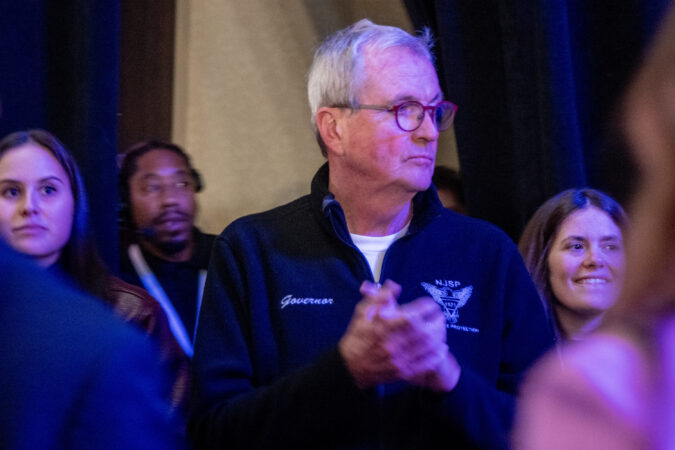
The governor’s pardon was issued Tuesday even before a jury convicted Harris Jacobs, 28, for a hit-and-run in Atlantic City that killed a pedestrian.
The pardon was one of 97 issued by former Gov. Phil Murphy in his final hours in office. Jacobs’ attorney, Lou Barbone, told the news site BreakingAC that his client was notified even before the jury came back with its verdict on Tuesday.
Harris Jacobs was involved in a fatal hit and run at 3:30 a.m.on Sept. 4, 2022 outside the Dunkin’ Donuts at Atlantic and Indiana in Atlantic City, according to the Atlantic County Prosecutor.
The pedestrian, Orlando Fraga, 76, was pronounced dead at the scene. Both Fraga and Jacobs were from Atlantic City.
Seven hours after the accident, Jacobs was arrested and charged with leaving the scene of an accident. He was initially jailed is in the Atlantic County Justice Facility, but later released pending his trial.
Surveillance video showed Harris stopping at the Dunkin’ Donuts and rushing to the injured man. He told his roommate what happened, according to BreakingAC’s account of the trial, and repeatedly called his father, but did not call police.
A first trial in May ended without a verdict. But the retrial ended in conviction on Tuesday, which was immediately nullified by the governor’s pardon.
Barbone did not immediately return a request for comment. The governor’s office also did not respond to a request.
The second-degree conviction would have carried a sentence of five to 10 years under New Jersey law.
MINNEAPOLIS — Federal prosecutors served six grand jury subpoenas Tuesday to Minnesota officials as part of an investigation into whether they obstructed or impeded federal law enforcement during a sweeping immigration operation in the Minneapolis-St. Paul area, a person familiar with the matter said.
The subpoenas, which seek records, were sent to the offices of Gov. Tim Walz, Attorney General Keith Ellison, Minneapolis Mayor Jacob Frey, St. Paul Mayor Kaohly Her, and officials in Ramsey and Hennepin counties, the person said.
The person was not authorized to publicly discuss an ongoing investigation and spoke to the Associated Press on condition of anonymity.
The subpoenas are related to an investigation into whether Minnesota officials obstructed federal immigration enforcement through public statements they made, two people familiar with the matter said Friday. They said then that it was focused on the potential violation of a conspiracy statute.
Mayor: Subpoenas are to stoke fear
Walz and Frey, both Democrats, have called the probe a bullying tactic meant to quell political opposition. Frey’s office released a subpoena, which requires a long list of records for a grand jury on Feb. 3, including “cooperation or lack of cooperation” with federal authorities and “any records tending to show a refusal to come to the aid of immigration officials.”
“We shouldn’t have to live in a country where people fear that federal law enforcement will be used to play politics or crack down on local voices they disagree with,” Frey said.
Her, a Hmong immigrant and a Democrat, also acknowledged a subpoena, saying she’s “unfazed by these tactics.” The governor’s office referred reporters to a statement earlier Tuesday in which he said the Trump administration was not seeking justice, only creating distractions.
The subpoenas came a day after the government urged a judge to reject efforts to stop the immigration enforcement surge that has roiled Minneapolis and St. Paul for weeks.
The Justice Department called the state’s lawsuit, filed soon after the fatal shooting of Renee Good by an immigration officer, “legally frivolous.”
“Put simply, Minnesota wants a veto over federal law enforcement,” government attorneys wrote.
Ellison said the government is violating free speech and other constitutional rights. He described the armed officers as poorly trained and said the “invasion” must cease.
The lawsuit filed Jan. 12 seeks an order to halt or limit the enforcement action. It’s not known when U.S. District Judge Katherine Menendez will make a decision.
Ilan Wurman, who teaches constitutional law at University of Minnesota Law School, doubts the state’s arguments will be successful.
“There’s no question that federal law is supreme over state law, that immigration enforcement is within the power of the federal government, and the president, within statutory bounds, can allocate more federal enforcement resources to states who’ve been less cooperative in that enforcement space than other states have been,” Wurman told the Associated Press.
Hard to track arrests
Greg Bovino of U.S. Border Patrol, who has commanded the Trump administration’s big-city immigration crackdown, said more than 10,000 people in the U.S. illegally have been arrested in Minnesota in the past year, including 3,000 “of some of the most dangerous offenders” in the last six weeks during Operation Metro Surge.
He did not elaborate, though he highlighted the capture of three people with criminal records from Laos, Guatemala and Honduras.
“These are not technical violations. As I mentioned, these are individuals responsible for serious harm,” Bovino said at a news conference.
Julia Decker, policy director at the Immigrant Law Center of Minnesota, expressed frustration that advocates have no way of knowing whether the government’s arrest numbers and descriptions of the people in custody are accurate.
“These are real people we’re talking about, that we potentially have no idea what is happening to them,” Decker said.
Bovino defends his ‘troops’ as ethical
Good, 37, was killed on Jan. 7 as she was moving her vehicle, which had been blocking a Minneapolis street where ICE officers were operating. Trump administration officials say the officer, Jonathan Ross, shot her in self-defense, although videos of the encounter show the Honda Pilot slowly turning away from him.
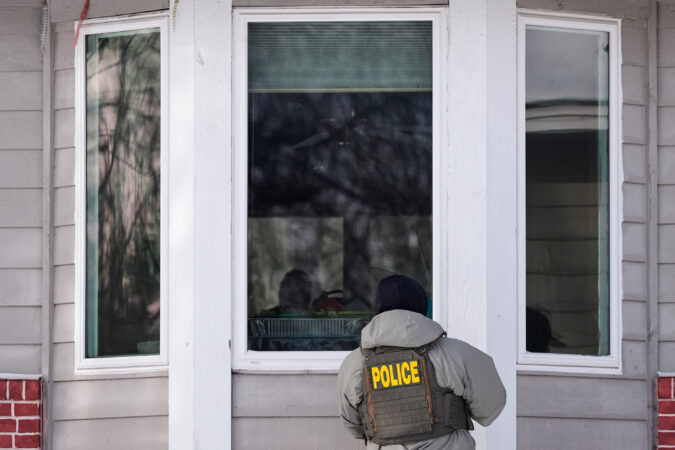
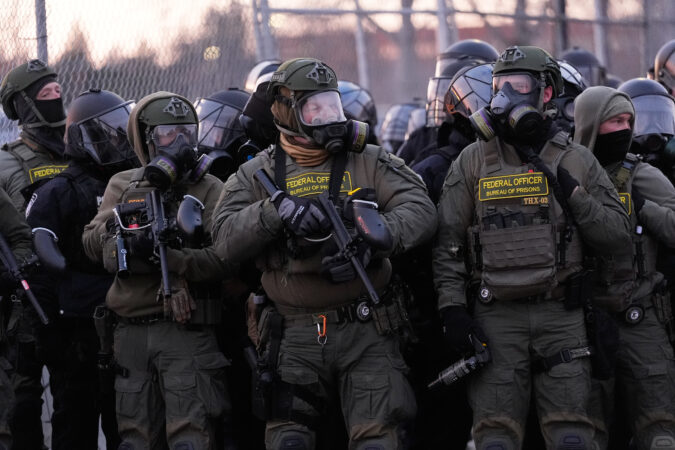
Since then, the public has repeatedly confronted officers, blowing whistles and yelling insults at ICE and Border Patrol. They, in turn, have used tear gas and chemical irritants against protesters. Bystanders have recorded video of officers using a battering ram to get into a house as well as smashing vehicle windows and dragging people out of cars.
Bovino defended his “troops” and said their actions are “legal, ethical and moral.”
“What we see when folks get swept up, as you say, oftentimes it’s as agitators, as rioters, and now I call them anarchists,” he told reporters, not “ordinary citizens, Ma, Pa America.”
Police in the region, meanwhile, said off-duty law enforcement officers have been racially profiled by federal officers and stopped without cause. Brooklyn Park police Chief Mark Bruley said he has received complaints from residents who are U.S. citizens, including his own officers.
WASHINGTON — A ballooning Immigration and Customs Enforcement budget. Hiring bonuses of $50,000. Swelling ranks of ICE officers, to 22,000, in an expanding national force bigger than most police departments in America.
The GOP’s big bill is “supercharging ICE,” one budget expert said, in ways that Americans may not fully realize — and that have only just begun.
“I just don’t think people have a sense of the scale,” said Bobby Kogan, senior director of federal budget policy at the Center for American Progress and a former adviser to the Biden administration’s Office of Management and Budget.
“We’re looking at ICE in a way we’ve never seen before,” he said.
Trump’s big bill creates massive law enforcement force
As the Republican president marks the first year of his second term, the immigration enforcement and removal operation that has been a cornerstone of his domestic and foreign policy agenda is rapidly transforming into something else — a national law enforcement presence with billions upon billions of dollars in new spending from U.S. taxpayers.
But Trump’s own public approval rating on immigration, one of his signature issues, has slipped since he took office, according to an AP-NORC poll.
“Public sentiment is everything,” said Rep. Nydia M. Velázquez (D., N.Y.) at a news conference at the Capitol with lawmakers supporting legislation to impeach Homeland Security Secretary Kristi Noem.
Americans, she said, are upset at what they are seeing. “They didn’t sign on for this,” she said.
Border crossings down, but Americans confront new ICE enforcements
To be sure, illegal crossings into the U.S. at the Mexico border have fallen to historic lows under Trump, a remarkable shift from just a few years ago when President Joe Biden’s Democratic administration allowed millions of people to temporarily enter the U.S. as they adjudicated their claims to stay.
Yet as enforcement moves away from the border, the newly hired army of immigration officers swarming city streets with aggressive tactics — in Los Angeles, Chicago, and elsewhere — is something not normally seen in the U.S.
Armed and masked law enforcement officers are being witnessed smashing car windows, yanking people from vehicles and chasing and wrestling others to the ground and hauling them away — images playing out in endless loops on TVs and other screens.
And it’s not just ICE. A long list of supporting agencies, including federal, state, and local police and sheriff’s offices, are entering into contract partnerships with Homeland Security to conduct immigration enforcement operations in communities around the nation.
House Speaker Mike Johnson (R., La.) has warned Democrats that this is “no time to be playing games” by stirring up the opposition to immigration enforcement officers in Minneapolis and other places.
“They need to get out of the way and allow federal law enforcement to do its duty,” Johnson said at the Capitol.
Noem has said the immigration enforcement officers are acting lawfully. The department insists it’s targeting criminals in the actions, what officials call the worst of the worst immigrants.
However, reports show that noncriminals and U.S. citizens are also being forcibly detained by immigration officers. The Supreme Court last year lifted a ban on using race alone in the immigration stops.
The Trump administration has set a goal of 100,000 detentions a day, about three times what’s typical, with 1 million deportations a year.
Money from the big bill flows with few restraints
With Republican control of Congress, the impeachment of Noem or any other Trump official is not a viable political option for Democrats, who would not appear to have the vote tally even among their own ranks.
In fact, even if Congress wanted to curtail Trump’s immigration operations — by threatening to shut down the government, for example — it would be difficult to stop the spend.
What Trump called the “big, beautiful bill” is essentially on autopilot through 2029, the year he’s scheduled to finish his term and leave office.
The legislation essentially doubled annual Homeland Security funding, adding $170 billion to be used over four years. Of that, ICE, which typically receives about $10 billion a year, was provided $30 billion for operations and $45 billion for detention facilities.
“The first thing that comes to mind is spending on this level is typically done on the military,” said Kathleen Bush-Joseph, a policy analyst at the Migration Policy Institute. “Trump is militarizing immigration enforcement.”
Ahead, Congress will consider a routine annual funding package for Homeland Security unveiled Tuesday, or risk a partial shutdown Jan. 30. A growing group of Democratic senators and the Congressional Progressive Caucus have had enough. They say they won’t support additional funds without significant changes.
Lawmakers are considering various restrictions on ICE operations, including limiting arrests around hospitals, courthouses, churches and other sensitive locations and ensuring that officers display proper identification and refrain from wearing face masks.
“I think ICE needs to be totally torn down,” said Sen. Ruben Gallego (D., Ariz.) on CNN over the weekend.
“People want immigration enforcement that goes after criminals,” he said. And not what he called this “goon squad.”
Big spending underway, but Trump falls short of goals
Meanwhile, Homeland Security has begun tapping the new money at its disposal. The department informed Congress it has obligated roughly $58 billion — most of that, some $37 billion, for border wall construction, according to a person familiar with the private assessment but unauthorized to discuss it.
The Department of Homeland Security said its massive recruitment campaign blew past its 10,000-person target to bring in 12,000 new hires, more than doubling the force to 22,000 officers, in a matter of months.
“The good news is that thanks to the Big Beautiful Bill that President Trump signed, we have an additional 12,000 ICE officers and agents on the ground across the country,” Assistant Secretary Tricia McLaughlin said in a December statement.
The department also announced it had arrested and deported about 600,000 people. It also said 1.9 million other people had “voluntarily self-deported” since January 2025, when Trump took office.
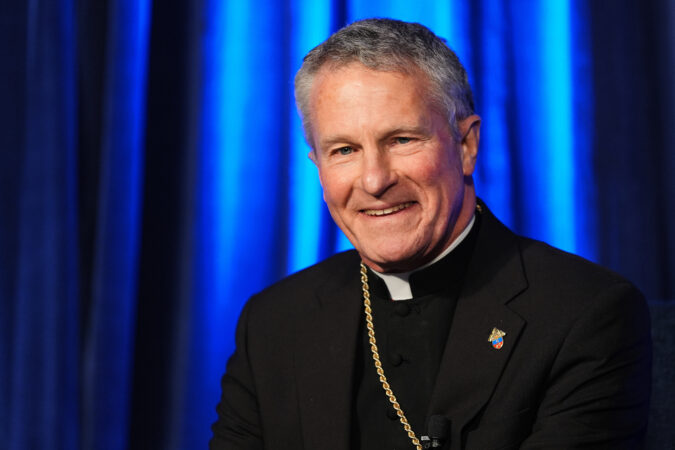
As the Trump administration intervenes in Venezuela, readies troops for a possible deployment to Minnesota, and threatens to seize Greenland, the Catholic archbishop for the U.S. armed forces said it “would be morally acceptable” for troops to disobey what violated their conscience.
Archbishop Timothy P. Broglio is one of a chorus of Catholic leaders questioning the administration’s use of force. His comments also underscored the mounting concern being voiced by the first American pontiff, Pope Leo XIV, as well as his top cardinals in the United States, over the Trump administration’s foreign policy.
“Greenland is a territory of Denmark,” Broglio told the BBC Sunday. “It does not seem really reasonable that the United States would attack and occupy a friendly nation.”
Asked whether he was “worried” about the military personnel in his pastoral care, Broglio replied: “I am obviously worried because they could be put in a situation where they’re being ordered to do something which is morally questionable.”
“It would be very difficult for a soldier or a Marine or a sailor to by himself disobey an order,” he said.“But strictly speaking, he or she would be, within the realm of their own conscience, it would be morally acceptable to disobey that order, but that’s perhaps putting that individual in an untenable situation — and that’s my concern.”
As head of the D.C.-based Archdiocese for the Military Services USA, Broglio oversees the chaplains who serve Catholics and others at U.S. military bases, Veterans Affairs healthcare facilities and diplomatic missions worldwide.
A former president of the U.S. Conference of Catholic Bishops, the Ohio native is seen as a church conservative. As the Obama administration was ending Don’t Ask, Don’t Tell, he spoke against allowing LGBT troops to serve openly. When the Trump administration disqualified transgender people from serving in the military, he said “sexual orientation and gender identity issues” reflected an “incorrect societal attitude.”
He has also criticized military strikes on boats the administration says are smuggling drugs. U.S. forces have killed at least 115 people in more than 30 such strikes in international waters in the Caribbean and the Pacific since September.
“In the fight against drugs, the end never justifies the means,” he said in a statement last month. “No one can ever be ordered to commit an immoral act, and even those suspected of committing a crime are entitled to due process under the law.”
He issued the statement after the Washington Post reported that commanders in the first known boat strike saw survivors and ordered a second barrage to kill them. He did not refer to the incident, but appeared to allude to it.
“As the moral principle forbidding the intentional killing of noncombatants is inviolable,” he said, “it would be an illegal and immoral order to kill deliberately survivors on a vessel who pose no immediate lethal threat to our armed forces.”
Trump is set to arrive Wednesday in Davos, Switzerland, for the World Economic Forum, at which European leaders plan to discuss his demand to seize and annex Greenland — a demand that has transformed the annual gathering of the world’s political and financial elite into an emergency diplomatic summit.
Members of the military take an oath to the Constitution, not to the president. They swear an oath of enlistment to “support and defend the Constitution of the United States against all enemies” and “obey the orders of the President of the United States and the orders of the officers appointed over me,” according to the Uniform Code of Military Justice. They have an obligation not to follow “manifestly unlawful orders,” but such situations are rare and legally fraught, The Washington Post reported. Military personnel can be court-martialed for failing to obey lawful orders.
The Pentagon in November announced an investigation into Sen. Mark Kelly (D., Ariz.), a prominent Trump critic and combat veteran, after he spoke in a video with five other Democrats reminding U.S. service members of their duty under military law to disobey illegal orders. The message move criticized by Trump at the time as “SEDITIOUS BEHAVIOR,” and the other lawmakers said this month they were now under investigation by his administration for the video.
Kelly filed a lawsuit earlier this month seeking to reverse Defense Secretary Pete Hegseth’s letter of censure and effort to potentially demote him in rank.
Broglio’s comments echoed concerns made in a joint statement Monday by the three highest-ranking U.S. Catholic archbishops, who warned that a resurgence in the use or threat of military force, including by the United States in Venezuela and Greenland, had thrown “the moral foundation for America’s actions in the world” into question.
“The events in Venezuela, Ukraine and Greenland have raised basic questions about the use of military force and the meaning of peace,” wrote Cardinals Blase Cupich of Chicago, Robert McElroy of D.C., and Joseph Tobin of Newark.
In the days after the U.S. operation in Venezuela to capture Nicolás Maduro, and after Trump said he was now “in charge” of that nation, the pope insisted on respect for Venezuela’s sovereignty.
In a Jan. 9 meeting with diplomats in Vatican City, Leo decried a new era in which multilateralism is being replaced by “a zeal for war” and “peace is sought through weapons as a condition for asserting one’s own dominion.” He did not name the United States.
Broglio, in his comment on the U.S. boat strikes, invoked just war theory. In Catholic teaching, the “defensive use of military force” against an aggressor may be legitimate as a final resort under strict criteria.
According to the Catechism of the Catholic Church, the damage inflicted by the aggressor must be “lasting, grave and certain”; all other means of stopping it “must have been shown to be impractical or ineffective”; there must be “serious prospects of success”; and the action “must not produce evils and disorders graver than the evil to be eliminated.”
If you’re starting to absorb the headlines, or embarking on your early-week doomscroll, you’re probably seeing a lot about Greenland.
President Donald Trump’s longtime interest in the Arctic island seems to be louder — and bolder — than ever, sparking a major geopolitical standoff.
But how did it all start? And where do things stand? Here are all your questions answered, so you’re prepared the next time someone asks you about Greenland.
How did Denmark acquire Greenland?
Greenland has been home to native peoples who crossed the Arctic from what is now Canada, Norse settlers, Lutheran missionaries, and U.S. military personnel who used it as a base to protect the United States from Nazi Germany and the Soviet Union.
As for when Denmark stepped in, the short answer is that Denmark’s control started with a colonial settlement, was formalized in 1953, and the agreement has since evolved into a self-governing structure with the Danish.
In the 1700s, a Danish missionary arrived in Greenland and started lining up settlements and establishing Danish colonization. Through most of the 18th and 19th centuries, Greenland was controlled by the Danish. The relationship was formally recognized by Denmark after World War II. In 1953, the island was fully incorporated as a Danish territory, giving Greenlanders Danish citizenship.
Things changed in the late 1970s. In 1979, Greenlanders voted in favor of home rule, establishing a local government. In 2009, Greenland earned even more autonomy, achieving self-government status. This stands today, with Greenland remaining part of Denmark but overseeing its own internal affairs. Denmark oversees defense and diplomacy issues, unless the regions opt to partner on an issue.
Is Greenland bigger than the United States?
Greenland is pretty big, but not bigger than the United States
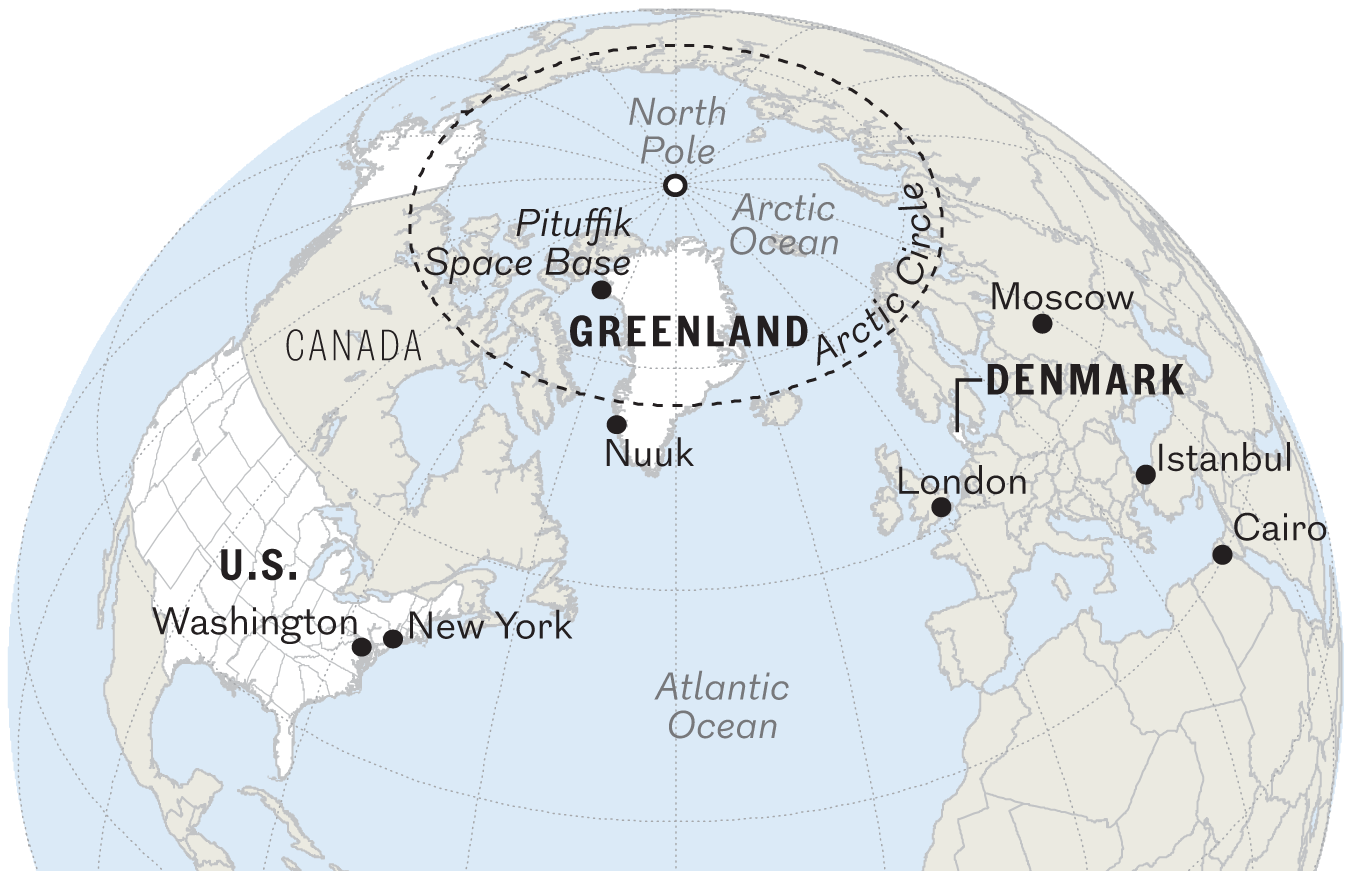
It is considered one of the biggest places in the world by geography and is about 20 times the size of Denmark, according to the territory’s tourism website. The island stretches about 836,000 square miles.
Map of Greenland, the U.S., and Denmark.
It is the world’s largest island that isn’t a continent and is larger than France, Germany, Spain, and the United Kingdom combined. It is also larger than the state of Alaska.
But, no, it’s smaller than the contiguous United States. All in all, the United States is about 4.5 times larger than Greenland.
The island has a population of roughly 56,480, according to the CIA. It is among the least densely populated countries in the world.
What natural resources does Greenland have?
Greenland is home to a bounty of natural resources, including oil, gas, and rare earth minerals. Those minerals are used for making batteries, electric vehicles, and other high-tech items, according to the New York Times. Currently, China dominates the global market for those minerals, meaning there is a reliance on China to source them.
Vice President JD Vance has touted Greenland’s “incredible natural resources” in the past. Last year, Republican senators held a hearing focused on Greenland’s importance and its rare earths.
But Greenland has only a few roads and ports, and environmentalists are opposed to developing on the island. That means mining and oil extraction in Greenland may not be productive.
Does the U.S. military have a base in Greenland?
Yep.
Formerly known as the Thule Air Base, the Pituffik (pronounced bee-doo-FEEK) Space Base was renamed in 2023 during the Biden administration to honor the native Greenlandic community and history.
It is the northernmost U.S. military installation and serves as an early warning missile detection site for North America. It is currently undergoing major upgrades.
How long has Trump talked about wanting Greenland?
It’s been awhile.
Trump first floated the idea of “buying Greenland” during his first term, comparing it to a “real estate deal.” When Danish leaders rejected his idea, he canceled a scheduled visit to Denmark in 2019.
When Trump began his second term, he spoke increasingly about his interest in the United States controlling Greenland, citing national security reasons.
But critics say his real intentions stem from personal feelings.
Is this really about Trump not winning the Nobel Prize?
Trump linked his aggressive stance on Greenland to last year’s decision not to award him the Nobel Peace Prize, telling Norway’s prime minister that he no longer felt “an obligation to think purely of Peace,” in a text message released Monday and verified by the White House.
Trump’s text to Jonas Gahr Støre, which he sent on Sunday, came a day after the president announced a 10% import tax on goods from the eight nations that have rallied around Denmark and Greenland, including Norway.
The text exchange, which was released by the Norwegian government, said in part: “Considering your Country decided not to give me the Nobel Peace Prize for having stopped 8 Wars PLUS, I no longer feel an obligation to think purely of Peace.” He concluded, “The World is not secure unless we have Complete and Total Control of Greenland.”
The Norwegian leader said Trump’s message was a reply to an earlier missive sent on behalf of himself and Finnish President Alexander Stubb, in which they conveyed their opposition to the tariff announcement, pointed to a need to de-escalate, and proposed a telephone conversation among the three leaders.
White House deputy press secretary Anna Kelly said of the text exchange that Trump “is confident Greenlanders would be better served if protected by the United States from modern threats in the Arctic region.”
Norway has since reaffirmed its support for Denmark and Greenland.
Also, for what it’s worth, the Nobel Peace Prize is awarded by an independent committee, not the Norwegian government.
Speaking Monday night to reporters before boarding Air Force One on his way back from Florida to Washington, Trump backtracked and said he didn’t “care about the Nobel Prize.”
What is Trump saying about Greenland now?
He’s doubling down.
Monday night, Trump took to his Truth Social platform and made a series of posts about how there was “no going back” when it comes to his push to take control of the island. He also posted private text messages he received from French President Emmanuel Macron and the head of NATO, and an AI-generated image of the American flag over Greenland and Canada.
Following Macron’s questioning of Trump’s approach, Trump suggested he could impose a 200% tariff on French wines.
Trump also announced he would meet with “various parties” to discuss Greenland during the World Economic Forum in Davos, Switzerland, this week.
On Tuesday, Trump held a nearly two-hour news conference, but largely did not acknowledge his stance on Greenland until asked by reporters.
He repeated his position that the U.S. needs to take control of the territory for the sake of national security.
“I think that we will work something out where NATO is going to be very happy and where we’re going to be very happy,” Trump said toward the end of the news conference.
Macron this week called for an emergency meeting in Paris with European leaders to address tensions with the U.S. over Trump’s pursuit to acquire Greenland in addition to increasing tariffs.
Trump told reporters he did not plan to attend the meeting and mentioned that Macron would not be leading France for much longer. Macron’s term ends in May 2027.
Do other politicians agree with Trump?
There is widespread disagreement over how Trump wants to handle Greenland.
Secretary of State Marco Rubio said the president wants to buy it, while top aide Stephen Miller suggested the U.S. could seize it by force. Vice President Vance’s discussion with Danish leaders last week ended in “fundamental disagreement.”
Several lawmakers across party lines have criticized Trump’s approach. GOP members, including Sen. Rand Paul of Kentucky and Rep. Mike Turner of Ohio, say the raised tariff threats could harm NATO and U.S. interests.
Rep. Don Bacon (R., Neb.) said last week that he would consider impeaching Trump if the U.S. invaded Greenland, describing the idea as “utter buffoonery.”
Sen. Lisa Murkowski (R., Alaska) called Trump’s coercive threats dangerous for alliances and “bad for America.” She and Sen. Jeanne Shaheen (D., N.H.) introduced bipartisan legislation that would prohibit the use of U.S. Defense or State Department funds to take control of Greenland or the sovereign territory of any NATO member state without that ally’s consent or authorization from the North Atlantic Council.
How are Greenland residents responding?
Copenhagen store owner Jesper Rabe Tonnesen wears a red cap for sale that he created with the slogans “Make America go away,” on the side, and on the front: “Nu det NUUK!,” a twist on the Danish phrase “Nu det nok,” meaning “Now it’s enough.”
Unsurprisingly, they’re not happy!
Over the weekend, hundreds of people in Greenland’s capital, Nuuk, braved near-freezing temperatures, rain, and icy streets to march in a rally in support of their own self-governance.
Thousands of people also marched through Copenhagen, many of them carrying Greenland’s flag. Some held signs with slogans such as “Make America Smart Again” and “Hands Off.”
A spoof Make America Go Away red cap in the style of Trump’s original MAGA campaign hat is surging in popularity in Denmark and has become a symbol of Danish and Greenlandic resistance.
“This is important for the whole world,” Danish protester Elise Riechie told the Associated Press as she held Danish and Greenlandic flags. “There are many small countries. None of them are for sale.”
The rallies occurred hours after a bipartisan delegation of U.S. lawmakers, while visiting Copenhagen, sought to reassure Denmark and Greenland of their support.
This article contains information from the Associated Press.
It was the start of a voicemail from the president to Pennsylvania Gov. Josh Shapiro, received one week after a man firebombed the governor’s residence in Harrisburg in an attempt to kill Shapiro while his family slept inside on the first night of Passover.
Shapiro hadn’t recognized the number Trump was calling from, and at first didn’t answer.
When Shapiro called back, Trump offered well wishes to the governor’s family, his usual braggadocio, and some advice: he shouldn’t want to be president, Shapiro recalls in his new memoir, set to be released later this month.
The book, Where We Keep the Light, which comes out on Jan. 27, has attracted a flood of attention as it signals Shapiro’s potential presidential aspirations and also serves as a retort to the unflattering portrayal of the governor in former Vice President Kamala Harris’ recent memoir.
In the 257-page book, Shapiro details his early life in Montgomery County, his two decades in elected office, his connection to his faith, and his pragmatic leadership approach.
And for the political observers who have watched Shapiro’s rise: He delves into his brief consideration of whether he should run for president after Joe Biden dropped out of the race in 2024, the whirlwind experience of being vetted to be Harris’ running mate, and the unfair scrutiny he felt he faced during that process.
Here are six takeaways from Shapiro’s forthcoming memoir, obtained by The Inquirer.
Trump to Shapiro: ‘He cautioned that I shouldn’t want to be president’
When Shapiro, 52, returned Trump’s call in April 2025, he received the president’s support and some unprompted compliments from Trump, he writes.
“[Trump] said he liked the way I talked to people and approached problems,” Shapiro retells, as Trump went through the list of potential 2028 Democratic Party presidential candidates. “He cautioned that I shouldn’t want to be president, given how dangerous it had become to hold the office now.”
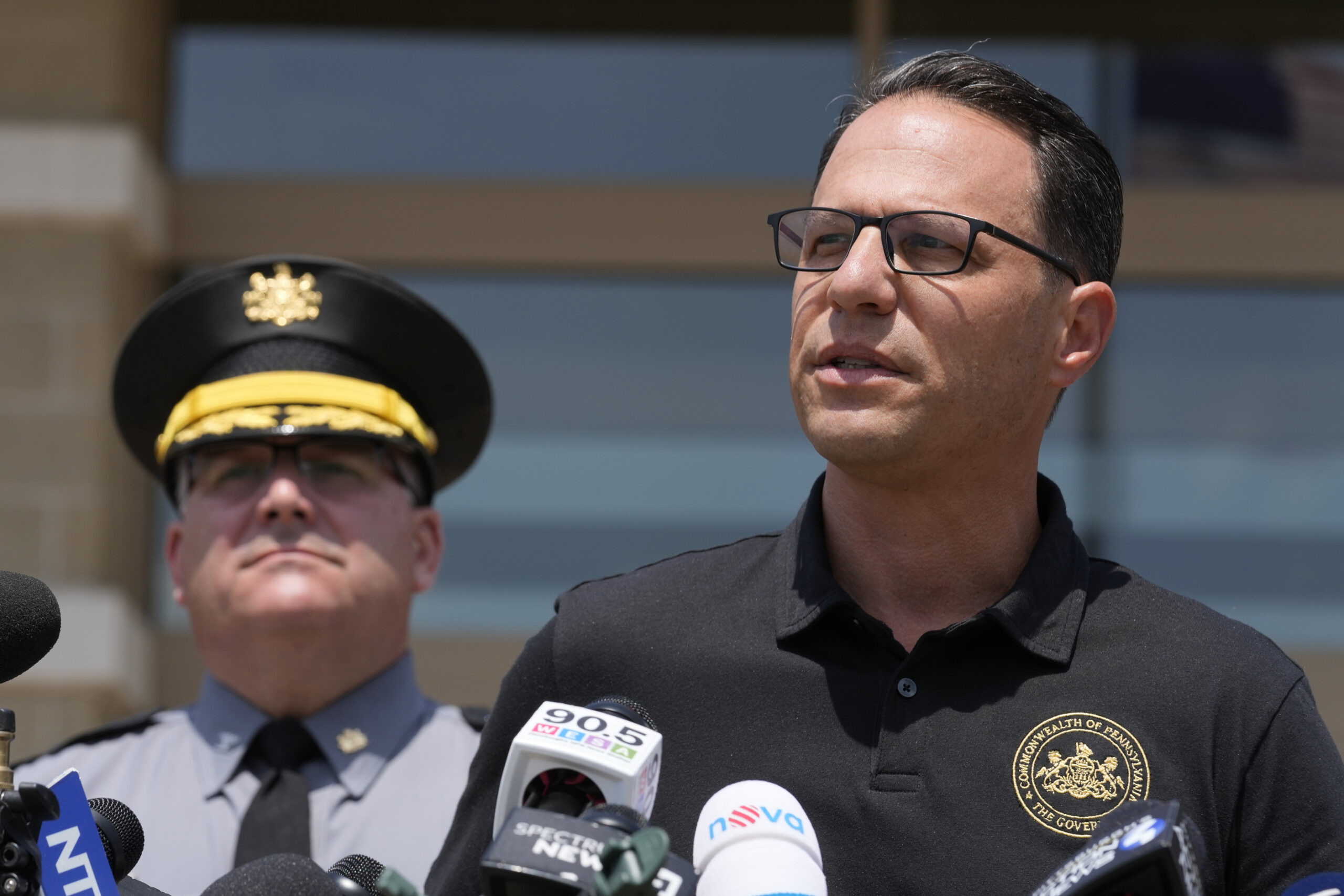
Gov. Josh Shapiro speaks during a news conference, in Butler, Pa., Sunday, July 14, 2024, following an assassination attempt on President Donald Trump.
(It is unclear whether Shapiro tried to call Trump after he experienced his own assassination attempt in Butler, Pa., the previous summer, though Shapiro publicly vehemently denounced the violence.)
Shapiro sells himself as a pragmatist and writes proudly of the times in which he has disagreed with his party or changed his positions.
For example, he recalls being asked by Harris’ vetting team about his past comments criticizing Democrats in federal, state, and local offices for how they handled COVID-19 closures. He stood by his criticism of former Gov. Tom Wolf at the time over business and school closures, and of the mask and vaccine mandates implemented by the Biden administration, he writes.
“I respectfully pushed back, asking if they believed that we had gotten everything right, to which they generally agreed that we had not,” Shapiro writes about his conversation with Harris’ vetting team. “I just had been willing to say the quiet part out loud, even if it wasn’t easy or popular or toeing the line to do so.”
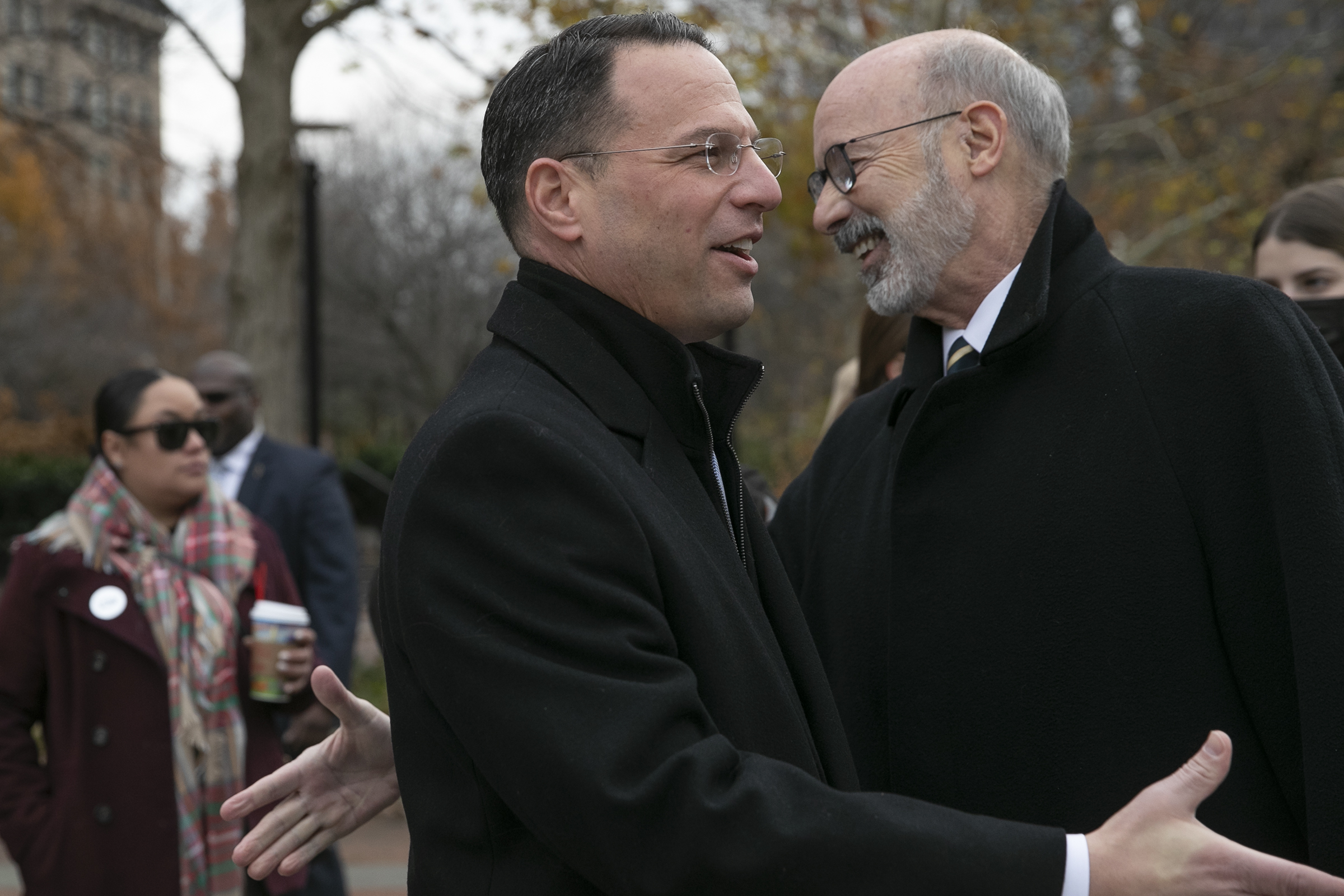
Then-Attorney General Josh Shapiro and Then-Gov. Tom Wolf both go in for handshakes before the start of a press conference on the harmful effects of anti-abortion policies at 5th and Market in Philadelphia on Thursday, Dec. 9, 2021.
He also writes about his journey to change his position on the death penalty over the years. In the days after the Tree of Life synagogue massacre in Pittsburgh, in which 11 Jewish people were killed while worshipping, he had initially supported the death penalty for the suspect. Since then, his views have evolved and he no longer supports capital punishment and called on the legislature to end the practice.
Lori Shapiro is behind most of her husband’s good ideas
Lori Shapiro, 53, mostly avoids her husband’s frequent appearances in the limelight.
But in his book, Shapiro writes that his wife has challenged him as she has supported his political rise, pushing him to question what he really wants, do the right thing, or even help him shape his messaging to voters. She discouraged him from running for U.S. Senate in 2016 after top Democrats approached him, which led him to run for attorney general instead. She was also his first call when Biden dropped out and he briefly considered whether he should run for president, and his voice of reason during the veepstakes.
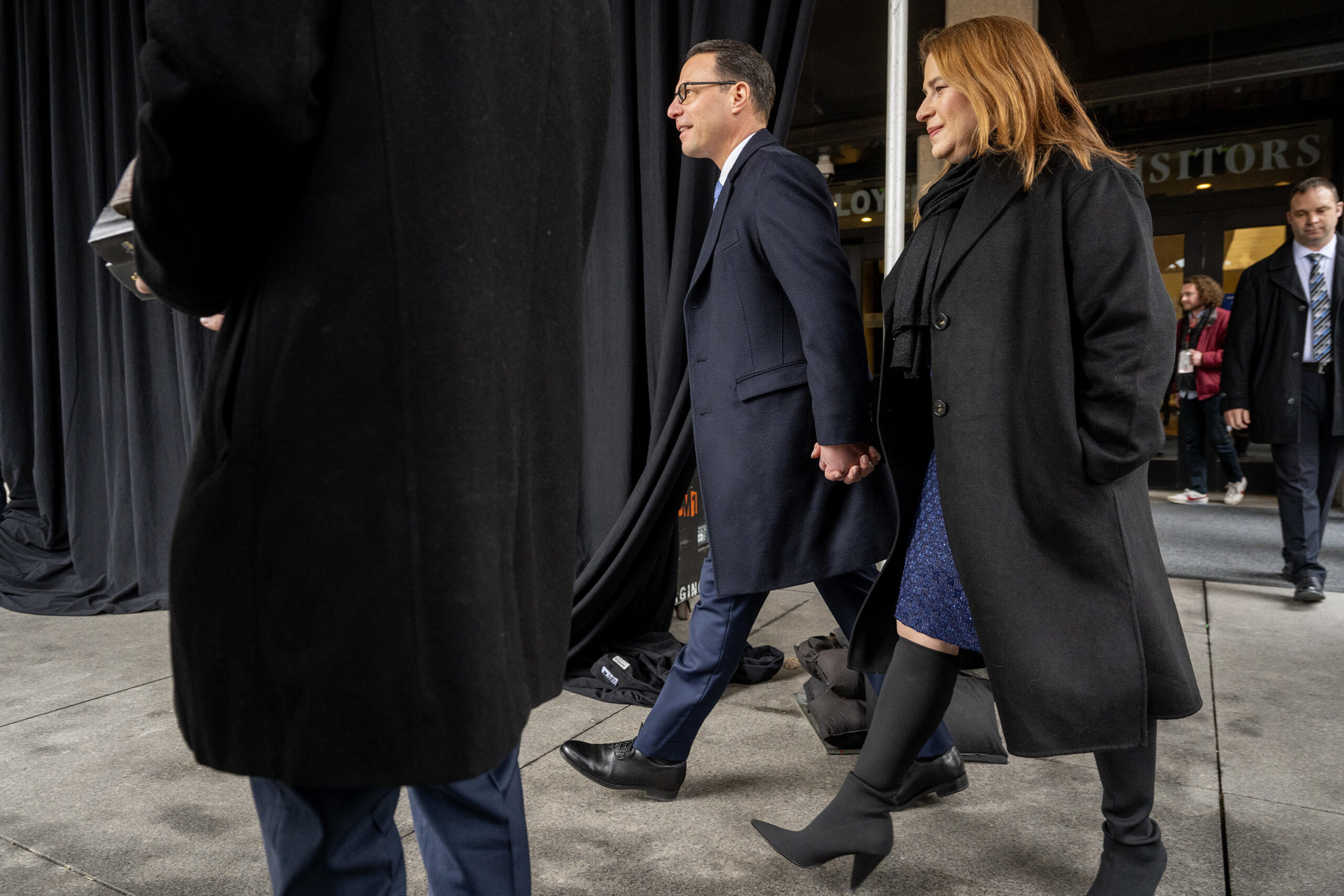
Josh Shapiro and his wife Lori leave the state Capitol in Harrisburg Tuesday, Jan. 17 2023, on his way to the stage to be sworn in as the 48th Governor of Pennsylvania.
The couple started dating in high school, before breaking up during college when they went to different universities in New York — he attended the University of Rochester, while she went to Colgate University. Shapiro writes that he quickly realized he missed her, and wrote her a letter in an effort to win her back.
“So I cracked my knuckles, and wrote my heart out. I was Shakespeare composing a sonnet. I was Taylor Swift before Taylor Swift. I was Lloyd Dobler in Say Anything, in a trench coat with the boom box over my head,” Shapiro writes. “I was getting the girl back.”
This earned Shapiro the title of “Mr. Lori” from her hall mates at Colgate. He did not win her back until years later, when the two reconnected in Washington after college, and quickly became engaged. The twomarried and had four children together, who each make frequent appearances throughout the book.
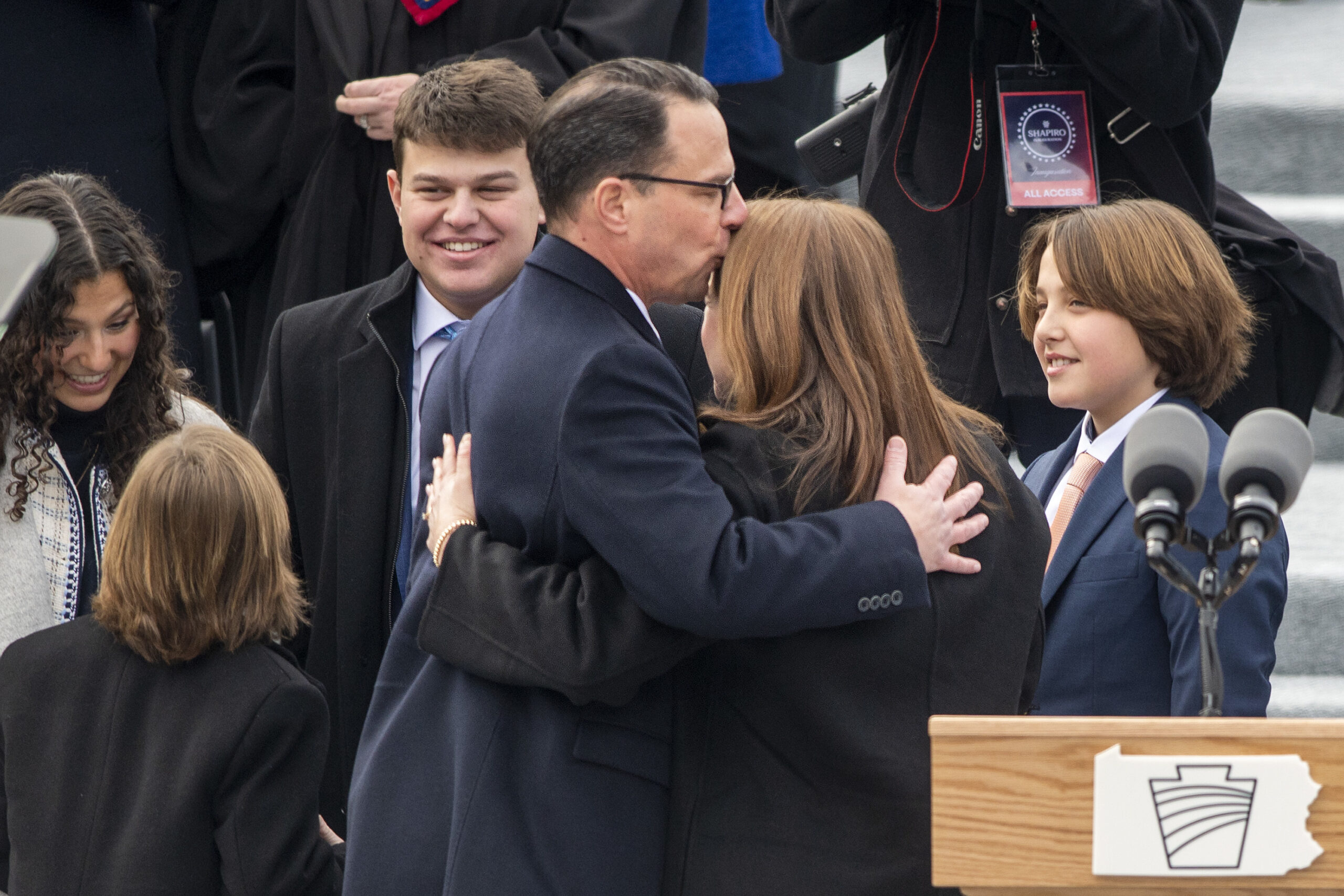
Surrounded by his four children, Gov. Josh Shapiro kisses his wife Lori after his is sworn in as the 48th Governor of Pennsylvania during inauguration ceremonies at the state Capitol in Harrisburg Tuesday, Jan. 17 2023.
Shapiro grapples with an early career move that kicked off his reputation as disloyal
Shapiro is not without regret for how some of his career moves and ambitions affected the people who helped him get where he is today, he writes.
Shapiro got his start in politics on the Hill under then-U.S. Rep. Joe Hoeffel, a Montgomery County Democrat. He quickly worked his way up to be Hoeffel’s chief of staff before returning to Abington Township to run for state representative.
But when Shapiro was done with frequent trips to Harrisburg and ready for his next rung on the ladder, Hoeffel was in the way. Shapiro had a plan to run for county commissioner and flip the board for the first time in more than 150 years — making Montco the first Philadelphia collar county to swing into Democratic control. Now all of the Philly suburban counties are controlled by Democrats, and Shapiro is credited for starting the trend. But Hoeffel was not a part of that calculation.
Shapiro writes that Hoeffel was “struggling politically.” He says he told him he would not run against him, but he also would not run with him.
“I knew that I couldn’t win with him, and I knew that it wasn’t the right thing for the party or the county, even if we could somehow eke out the victory,” Shapiro writes.
Hoeffel eventually decided not to run, and was quoted in The Inquirer in 2017 as saying that loyalty is not Shapiro’s “strong suit,” comments he has since stood by, in addition to praising Shapiro for his successes ever since.
“I’d hear about [Hoeffel] talking to the press or to people behind my back about how he thought I lacked loyalty, that I was someone who needed to be watched,” Shapiro writes. “It felt terrible, and of course, I never intended to hurt him in any way and I would never have run against him. I wanted the Democrats to have a shot, and I knew that I could get it done.”
Shapiro initially said antisemitism didn’t play into Kamala Harris’ running mate decision. Now he has more to say
In the days after Harris passed over Shapiro to be her running mate in favor of Minnesota Gov. Tim Walz, Shapiro said “antisemitism had no impact” on her decision.
Now, Shapiro questions whether he was unfairly scrutinized by Harris’ vetting team as the only Jewish person being considered as a finalist, including a moment when a top member of Harris’ camp asked him if he had “ever been an agent of the Israeli government.”
“I wondered whether these questions were being posed to just me — the only Jewish guy in the running — or if everyone who had not held a federal office was being grilled about Israel in the same way,” he writes.
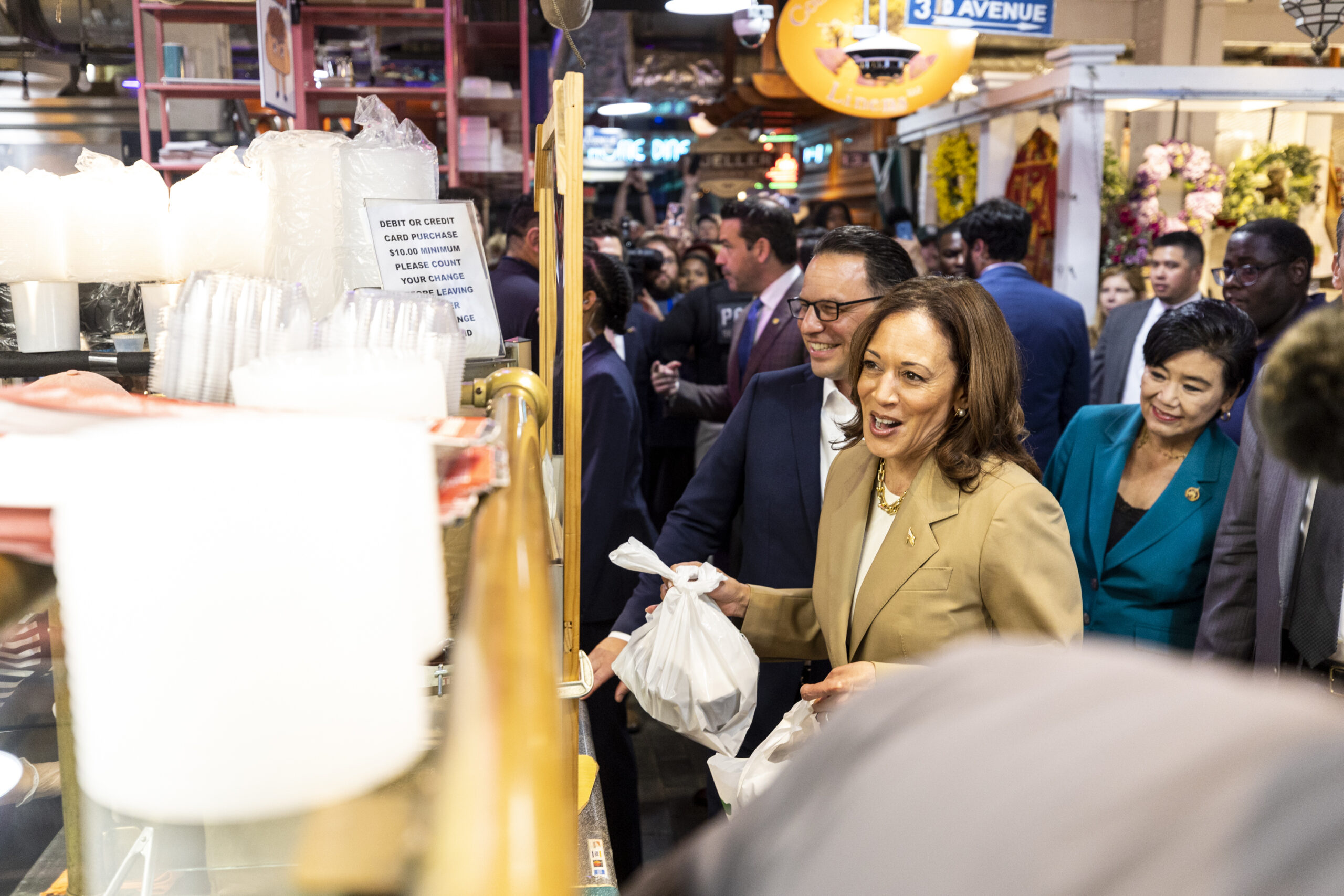
Vice President Kamala Harris visits Little Thai Market at Reading Terminal Market with Gov. Josh Shapiro after she spoke at the APIA Vote Presidential Town Hall at the Pennsylvania Convention Center in Philadelphia, Pa., on Saturday, July 13, 2024. The photo was taken eight days before President Joe Biden’s decision to exit the race.
He details his broader concerns with how he was treated during the process, including some perceived insults about his family’s lack of wealth or Lori Shapiro’s appearance.
Since Shapiro’s book was leaked to the media over the weekend, sources close to Walz confirmed to ABC News that the Minnesota governor was also asked whether he was an agent of a foreign government, due to his multiple trips to China.
Shapiro, for his part, has written about his time in Israel, including a high school program in which he completed service projects on a farm, on a fishery at a kibbutz, and at an Israeli army base. He once described himself in his college student newspaper as a “past volunteer in the Israeli army” — a characterization that circulated widely after it was reported by The Inquirer during the veepstakes.
Vereb had been along for the ride for Shapiro’s time in the state House as a fellow state representative from Montgomery County (though he was a Republican), as a top liaison to him in the attorney general’s office, and eventually a member of his cabinet in the governor’s office until his resignation in 2023.
New Jersey Gov. Mikie Sherrill was so excited to fulfill her promise of declaring a state of emergency on utility bills on her first day in office, she did it before finishing her inauguration speech.
“I’ve heard you, New Jersey — we are facing an affordability crisis, and you want costs to come down,” she said during her speech that followed her swearing-in. “And you want that to begin today.”
The first freezes utility rates in New Jersey, which she is able to do by directing the state Board of Public Utilities to provide credits to bill payers for increases. The board made a similar move over the summer under former Gov. Phil Murphy after significant bill increases. Those credits were funded with money from clean energy programs.
The public utilities board, known as the BPU, is a regulatory authority that oversees private utility companies in New Jersey and works on clean energy programs in the state. It is funded in part through a charge on utility bills.
BPU President Christine Guhl-Sadovy said in a statement that the board “looks forward to supporting the governor’s agenda to lower utility costs for New Jersey ratepayers while encouraging the development of new energy resources here in the Garden State.”
Sherrill also directed the public utilities board to consider pausing or modifying the schedule for proceedings in which utility companies seek rate increases — as much as the law allows — and called for a study into modernizing the current electricity distribution business model. She also called for the board to revise the Clean Energy Program for the upcoming FY 2026 budget.
Sherrill also signed an executive order on stage to increase power generation in the state as part of her effort to lower costs.
“This is just the beginning,” she said on stage.
“Not of my speech, of my work,” she joked.
Her second order rolls out efforts to make it easier and faster for companies to generate power in the state, particularly via solar and battery sources. She directs state agencies to pursue permitting reforms that can help speed up processes to get new energy sources up and running as part of this order.
She also calls on the New Jersey Department of Environmental Protection to expedite permitting processes for existing gas plants to expand capacity, run more efficiently, and reduce emissions.
In another request of the public utilities board, she asks officials to require electric utility companies to report on how much energy data centers request to assess “ghost loads,” which are forecasts for how much energy large projects may require. These predictions impact how much energy the regional grid operator PJM anticipates needing to handle, which can increase prices.
Sherrill has blamed PJM for high utility costs, and the regional grid operator has argued that it has simply responded to supply and demand issues as energy usage has drastically increased in recent years in part to the increasing demand for artificial intelligence.
The order also creates a Nuclear Power Task Force to support nuclear power generation.
“I heard the people of New Jersey loud and clear – these rate hikes are unacceptable – and as your governor, I will not stop fighting to lower costs and make New Jersey a more affordable place to live, work, and raise a family,” Sherrill said in a statement.
The Justice Department is considering loosening a slate of gun regulations as it seeks to bolster support from ardent Second Amendment advocates, according to three people familiar with the changes who spoke on the condition of anonymity to discuss plans that have not been made public.
Some of the changes are expected to ease restrictions on the private sale of guns and loosen regulations on shipping firearms.
Other changes to Bureau of Alcohol, Tobacco, Firearms and Explosives regulations under consideration would change the types of firearms that can be imported and make licensing fees refundable. Officials are also expected to change the form required to purchase guns to have applicants list their biological sex at birth. The current form asks applicants to list their sex.
Federal officials had considered announcing the changes to coincide with the National Shooting Sports Foundation gun trade show in Las Vegas, which began on Tuesday. Deputy Attorney General Todd Blanche is scheduled to speak at the annual show. The NSSF SHOT Show is one of the nation’s largest firearm trade shows, and Justice Department officials in both Democratic and Republican administrations have regularly attended it.
But officials are still finalizing their new regulations and the timing of the announcement, the people familiar with the matter said.
The back-and-forth over the rollout of the new gun rules highlights the Justice Department’s challenges as it seeks to placate a part of the president’s base that believes the administration has not been aggressive enough in easing firearm restrictions — while also preserving the law enforcement capabilities of ATF, which some gun rights advocates have sought to abolish.
The Trump administration has installed prominent gun rights advocates in senior political positions, and the president has allied himself with conservative advocacy groups, such as Gun Owners of America. The administration has pushed to slash about 5,000 law enforcement officers from ATF, cutting the number of inspectors who ensure gun sellers are in compliance with federal laws.
But some gun rights advocates have publicly expressed disappointment with Attorney General Pam Bondi, who as attorney general of Florida supported gun restrictions after the 2018 school shooting in Parkland.
Bondi and the Trump administration have faced criticism for not going as far as some lawmakers and gun rights advocates have demanded.
“The Biden Administration waged war against the Second Amendment, but that era has come to an end under Attorney General Bondi, who has led the Justice Department’s effort to protect the Second Amendment through litigation, civil rights enforcement, regulatory reform, and by ending abusive enforcement practices,” a Justice Department spokesperson said in a statement.
“Whenever law-abiding gun owners’ constitutional rights are violated, the Trump Administration will fight back in defense of freedom and the Constitution.”
Because ATF crafts regulations based on its interpretation of laws passed by Congress, Justice Department officials are allowed to amend its rules, though any changes risk legal challenges. ATF is part of the Justice Department, responsible for regulating the sales and licensing of firearms and working with local law enforcement to solve gun crimes. Federal and local law enforcement officials tout ATF’s gun tracing capabilities with helping to combat violent crime.
In the first months of the Trump administration, the Justice Department proposed merging the Drug Enforcement Administration with ATF — a move that ATF’s backers feared would leave the agency powerless. Opponents of ATF, meanwhile, feared that the merger would give the agency too much power. The merger plans have not come to fruition and, instead, the Trump administration in November quietly nominated a respected ATF veteran to lead the agency.
The nominee, Robert Cekada, is scheduled to have his hearing next month, and administration officials are worried about how the announcement of the new regulations could boost or hurt his nomination chances, according to one person familiar with the nomination process. Announcing the loosening of regulations ahead of his nomination hearing could risk the support of moderate Republicans, said the people, who spoke on the condition of anonymity to discuss personnel issues.
Winning confirmation to serve as ATF director is notoriously difficult. Only two people have won Senate approval as director since the position began requiring Senate confirmation in 2006. During his first term, President Donald Trump had to pull a nominee, Chuck Canterbury, the former head of the national Fraternal Order of Police, because some conservative Republicans thought he would restrict gun rights.
Trump had originally tapped FBI Director Kash Patel to simultaneously serve as ATF director. The Washington Post reported at the time that Patel never showed up to ATF headquarters and had scarce interaction with staff. The administration replaced Patel in early April with Army Secretary Dan Driscoll, who holds the two roles simultaneously. Cekada has been running the day-to-day operations of ATF since the ousting of the second-in-command at ATF in April.
The nomination of Cekada was considered a win for Bondi, who had wanted a law enforcement veteran leading the agency. Some Second Amendment groups had pushed for an advocate at the head of the organization.
Bondi pushed out ATF’s longtime general counsel and replaced her with a political appointee, Robert Leider — a former law professor who believes in a strict interpretation of the Second Amendment and has publicly written about how ATF too heavily regulates firearms.
The Post reported this past summer that the U.S. DOGE Service sent staff to ATF with the goal of revising or eliminating at least 47 rules and gun restrictions — an apparent reference to Trump’s status as the 47th president — by July 4, according to multiple people with knowledge of the efforts. Those plan hit roadblocks, in part, because the political appointees failed to realize how complicated and legally cumbersome it is to amend regulations, according to one person familiar with the process.
In addition to the regulatory changes, Leider and his team have been working to shrink the legally mandated 4473 Form that most buyers are required to fill out when purchasing a firearm, making it quicker to read and fill out the paperwork required to purchase and sell firearms.
In December, Assistant Attorney General Harmeet K. Dhillon, who heads the Civil Rights Division, announced creation of a new Second Amendment group within her division focused on expanding gun rights. In its first days, the newly created group filed a lawsuit challenging an assault weapon ban in D.C.
It’s unclear how much support Dhillon’s new group has received. Top Justice Department officials have not fully backed it, in part because Congress needs to approve the creation of a new section within the Civil Rights Division, according to people familiar with the group.
Dhillon so far has not hired many attorneys with legal expertise in the Second Amendment to work in the group, the people said. Instead, she has used existing attorneys within the Civil Rights Department to staff some of the group’s projects.
Top Democratic lawmakers on the Senate Judiciary Committee have questioned the creation and legality of Dhillon’s group.
“Since President Trump took office, you have decimated the Division’s nonpartisan workforce and changed the Division’s enforcement priorities to serve the President’s agenda in lieu of our federal civil rights laws,” Sens. Peter Welch (D., Vt.) and Dick Durbin (D., Ill.) wrote in a letter to Dhillon this month. “The creation of the Second Amendment Section is another example of this profound retreat from the core mission of the Civil Rights Division.”
Last week, the Justice Department’s Office of Legal Counsel issued an opinion saying that a federal ban on mailing firearms through Postal Service is unconstitutional. An OLC opinion is not binding, but it provides legal guidance across the federal government on how federal prosecutors view laws and signals the Justice Department’s future stances in court.
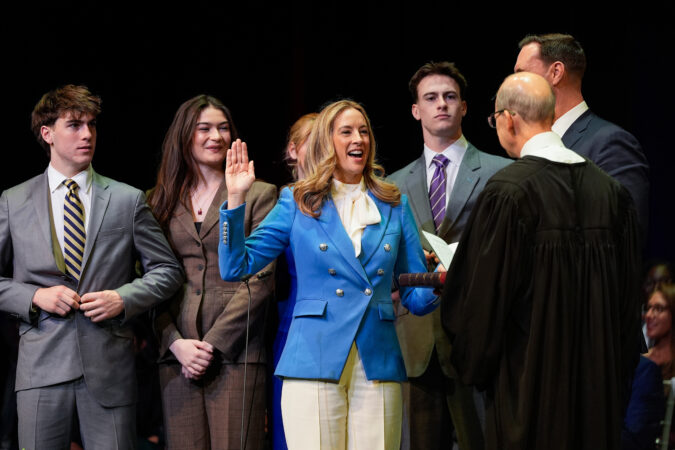
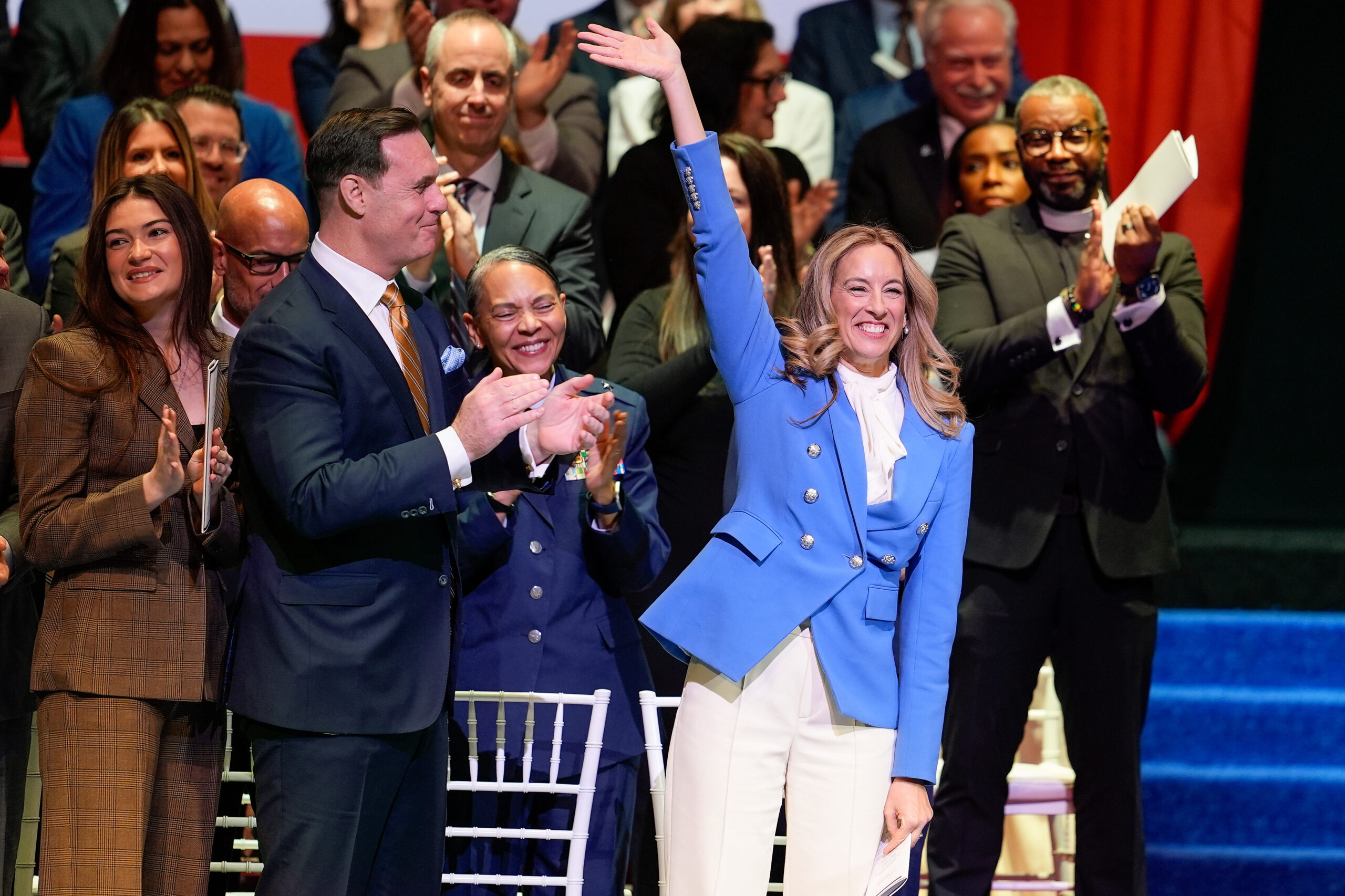
NEWARK, N.J. — Mikie Sherrill was sworn in as New Jersey governor Tuesday, becoming the second woman to govern the state and the first from the Democratic Party.
Sherrill, who is also the first female veteran from either party to be elected to the office, broke tradition by opting to be inaugurated in her home county of Essex, in northern New Jersey, instead of the state’s capital city, Trenton.
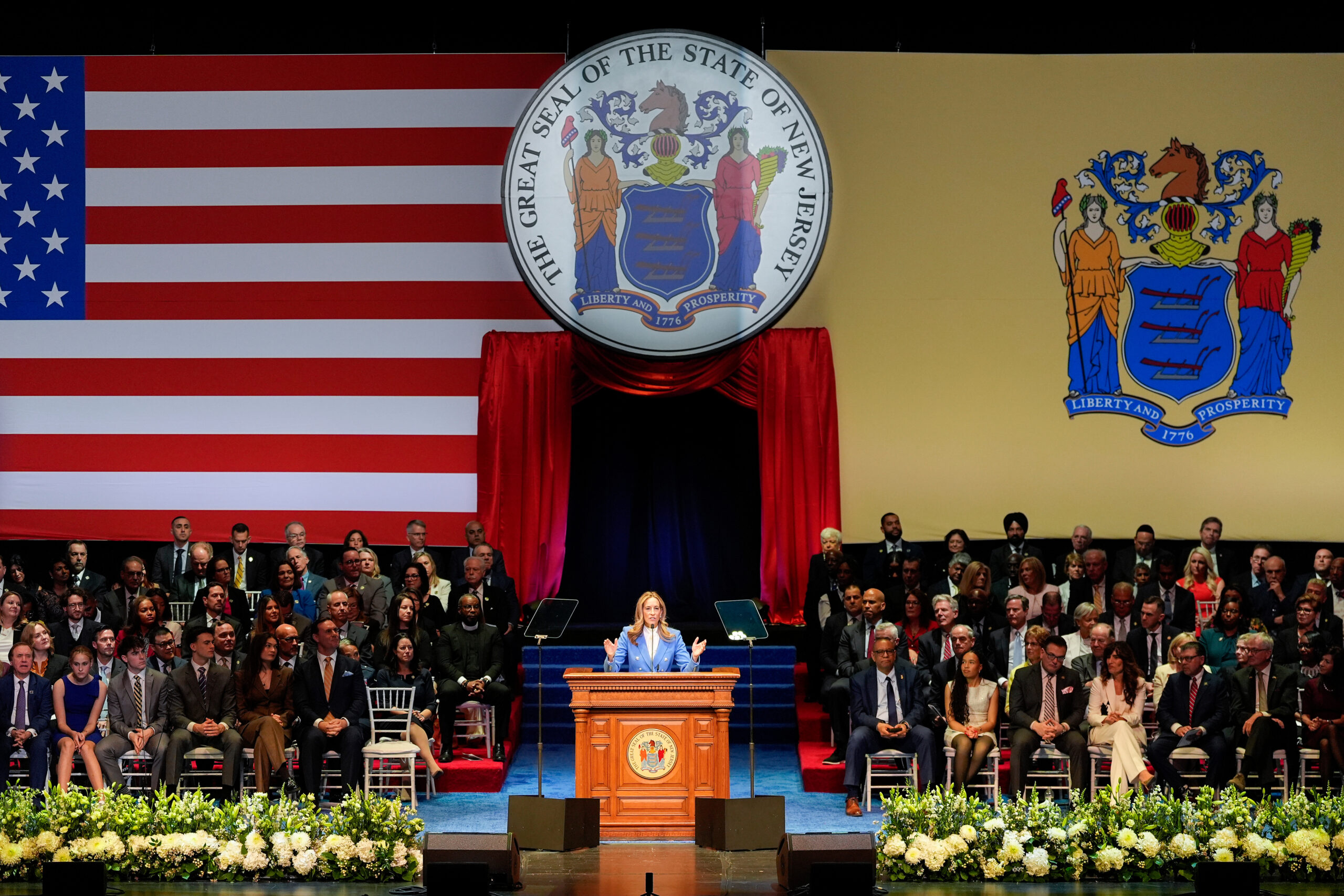
She took the oath at the New Jersey Performing Arts Center in Newark in the morning. Joined onstage by her family and high-profile Democrats, Sherrill spoke about her love for New Jersey and denounced President Donald Trump in a speech on Tuesday.
She also gave two shout-outs to South Jersey, noting that she learned on the campaign trail that South Jerseyans say “pork roll” instead of “Taylor Ham.”
“I have heard you in South Jersey, where you want jobs, transportation investments, innovative businesses, and not to be forgotten or left behind,” she also said.
New Jersey Governor-elect Mikie Sherrill waves as she arrives for her inauguration, Tuesday, Jan. 20, 2026, in Newark, N.J. (AP Photo/Seth Wenig)
She even referenced Philadelphia while talking about the founding of the United States — in a very Jersey way.
“In fact, not too far away, in the greater Camden metropolitan region, in a place called Philadelphia, Thomas Jefferson wrote a declaration of our independence, marking the birth of this great nation,” she said.
“This entirely unique and revolutionary declaration claims human beings had universal rights to life, to liberty, to the pursuit of happiness, not because of who their parents were, but because every human being is endowed with these rights by their creator, not by a king,” she added, and was met by applause.
She drew parallels between England’s king at the founding of the United States and Trump, whom Democrats have criticized through “no kings” protests. Sherrill said Trump is “illegally usurping power, unconstitutionally enacting a tariff regime to make billions for himself and his family while everyone else sees their costs go higher.”
Sherrill, a former Navy helicopter pilot, former federal prosecutor, and mother of four, was elected to Congress in 2018 and stepped down in November after winning the election, defeating Jack Ciattarelli, who had won the endorsement of Trump.
Sherrill, whose closely watched candidacy drew significant national support, promised during her campaign that she would make New Jersey more affordable and would stand up to Trump.
White flowers lined the front of the stage, and large American and New Jersey flags served as a backdrop.
Virginia Gov. Abigail Spanberger, Sherrill’s friend and former congressional colleague, was in attendance. Spanberger became Virginia’s first female governor on Saturday in a ceremony attended by Sherrill and other high-profile Democrats.
New Jersey and Virginia were the only states to hold gubernatorial races last year, and the Democratic victories were viewed as a positive sign for the party heading into the midterms with Trump in the White House.
Sherrill, who turned 54 on Monday, succeeds Gov. Phil Murphy, a Democrat who served two terms. It’s the first time the same party has held the governor’s mansion for three consecutive terms since 1970.
After the ceremony, Sherrill was slated to head to Trenton to sign more executive orders before going back north for an inaugural ball Tuesday evening at the American Dream in East Rutherford.
Sherrill’s lieutenant governor, Dale Caldwell, 65, was also sworn in Tuesday. Caldwell, a Middlesex County-based Methodist pastor, most recently worked as the first Black president of Centenary University. He has worked for state government, started nonprofits, and led charter schools.
In his speech Tuesday, Caldwell said his father marched with the Rev. Dr. Martin Luther King Jr., whom he and Sherrill both mentioned in their speeches.
“My father taught me that faith must be active, not passive. He taught me that justice is not an idea, it is a responsibility,” Caldwell said. “And he taught me that service is not optional, especially for those who have been blessed with opportunity.”
Her decision to be inaugurated up north was celebrated by Newark officials, but Trenton City Council member Jennifer Williams, a Republican, argued in an op-ed that it was an insult to Trenton.
Christine Todd Whitman, the first woman to serve as New Jersey governor, used the same venue as Sherrill when she was sworn in for her second term in 1998 while the war memorial in Trenton, the traditional site, was undergoing renovations.
Whitman served as a Republican from 1994 to 2001 before joining the Bush administration and has since left the Republican Party for the Forward Party. She endorsed Sherrill’s candidacy.
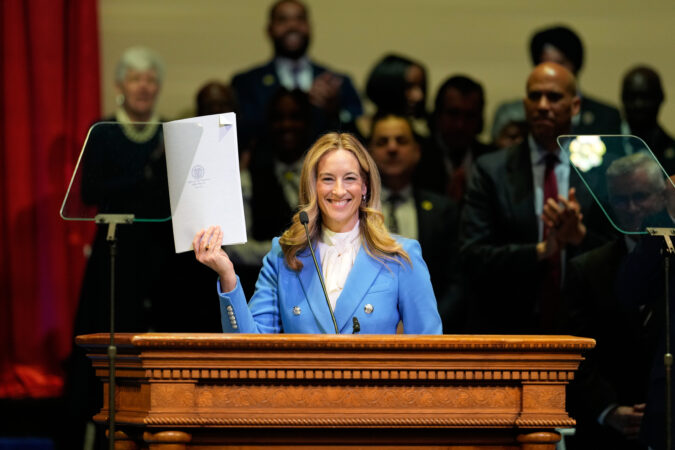
New Jersey Gov. Mikie Sherrill speaks after taking the oath of office during an inauguration ceremony, Tuesday, Jan. 20, 2026, in Newark, N.J. (AP Photo/Seth Wenig)
Protestors want ICE agents banned from the Criminal Justice Center in Center City, where immigrants have been trailed and arrested.
// Timestamp 01/20/26 9:39am
Anti-ICE demonstrators end their protest
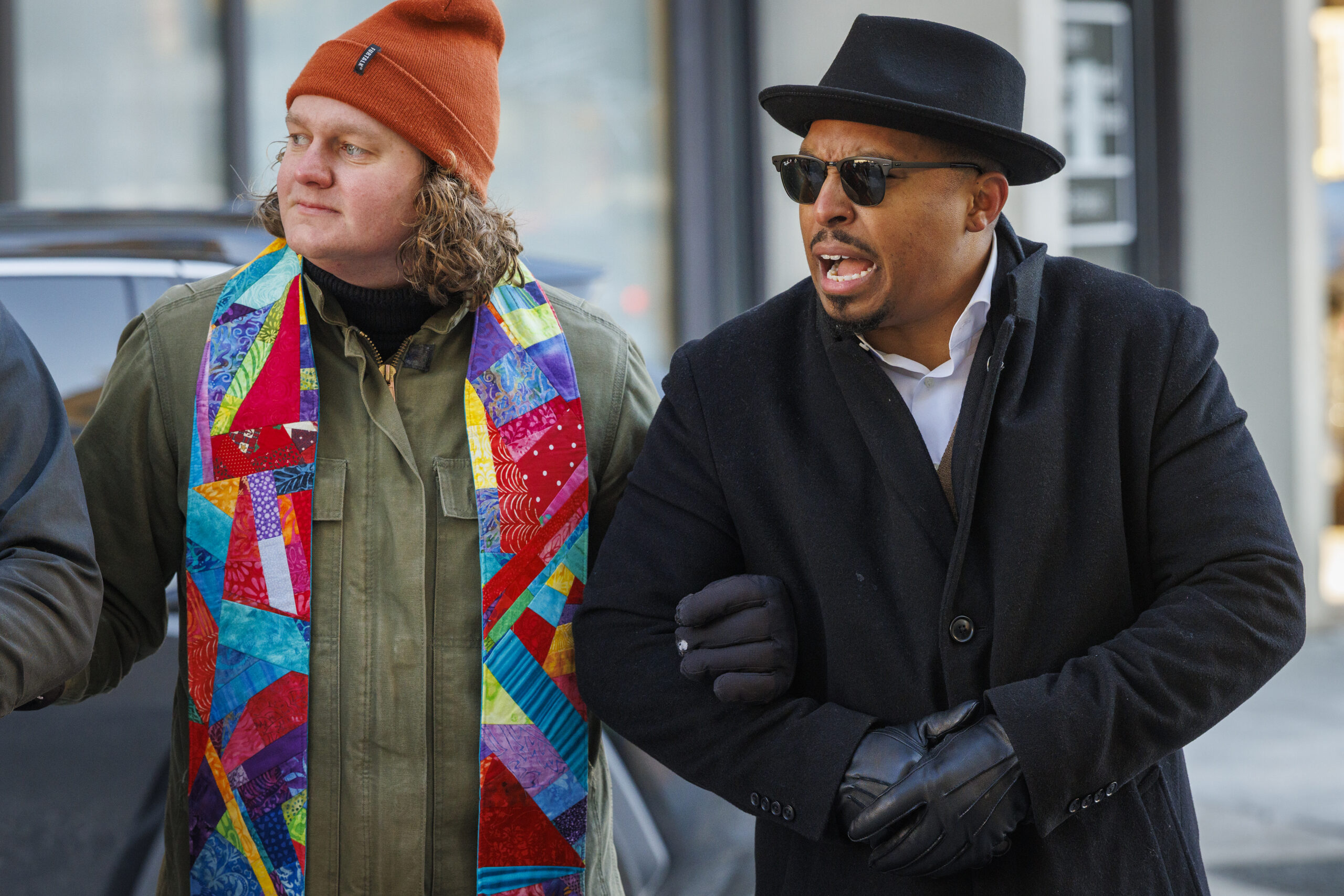
Rev. Jay Bergen, a leader of No ICE Philly, said the group had accomplished its goal – and that the brutal cold had become too much for older demonstrators, some of whom have medical conditions.
In his closing prayer, Bergen hoped the nearly 2 hour stretch was enough for ICE’s target to be somewhere else.
“All of us here have proven in our song and our prayer that we can slow down the machine of authoritarianism, of fascism, that we can delay the operations that will detain and kidnap and destroy our neighbors, our families, our community,” Bergen said.
ICE vehicle able to exit garage, helped by Philly police
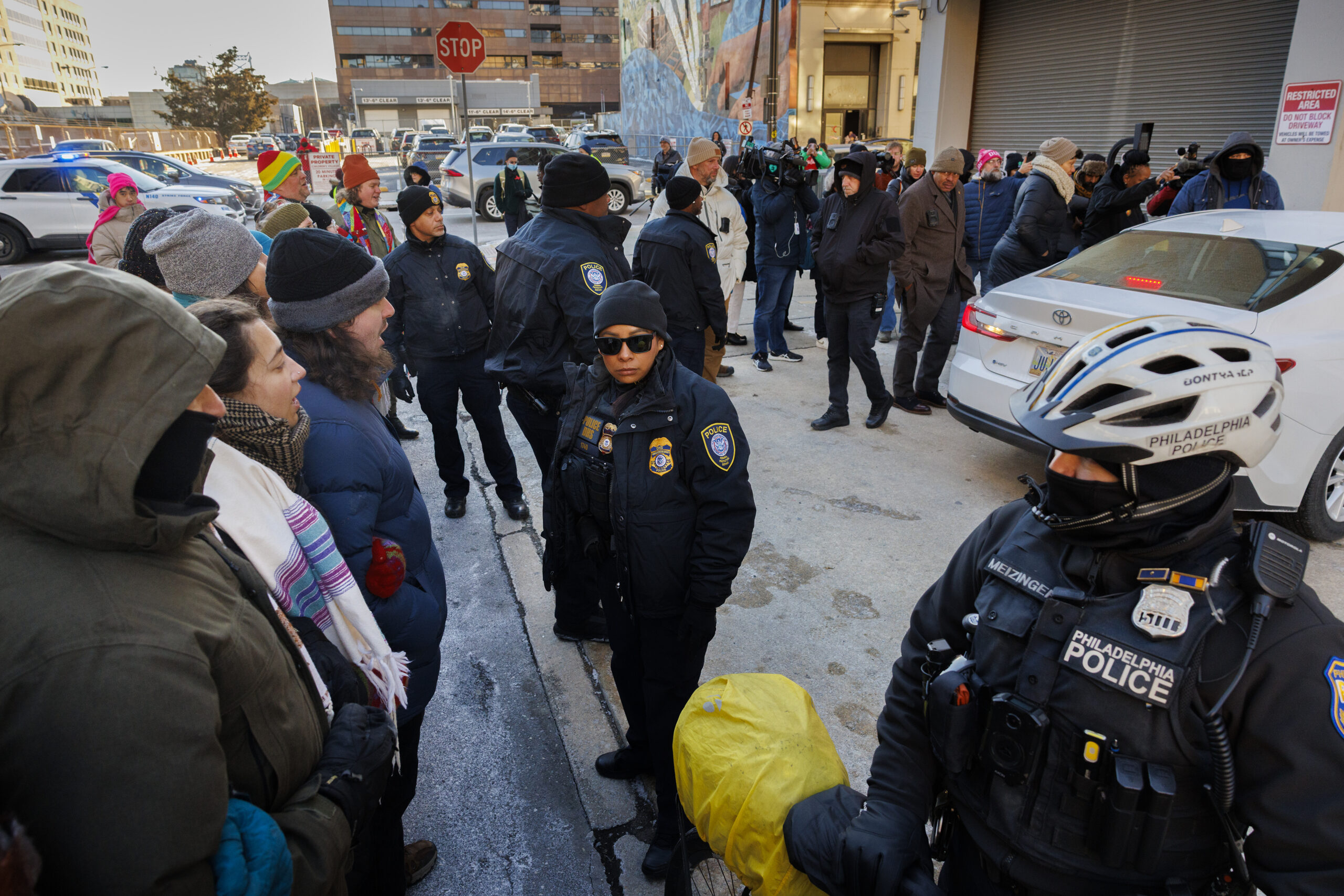
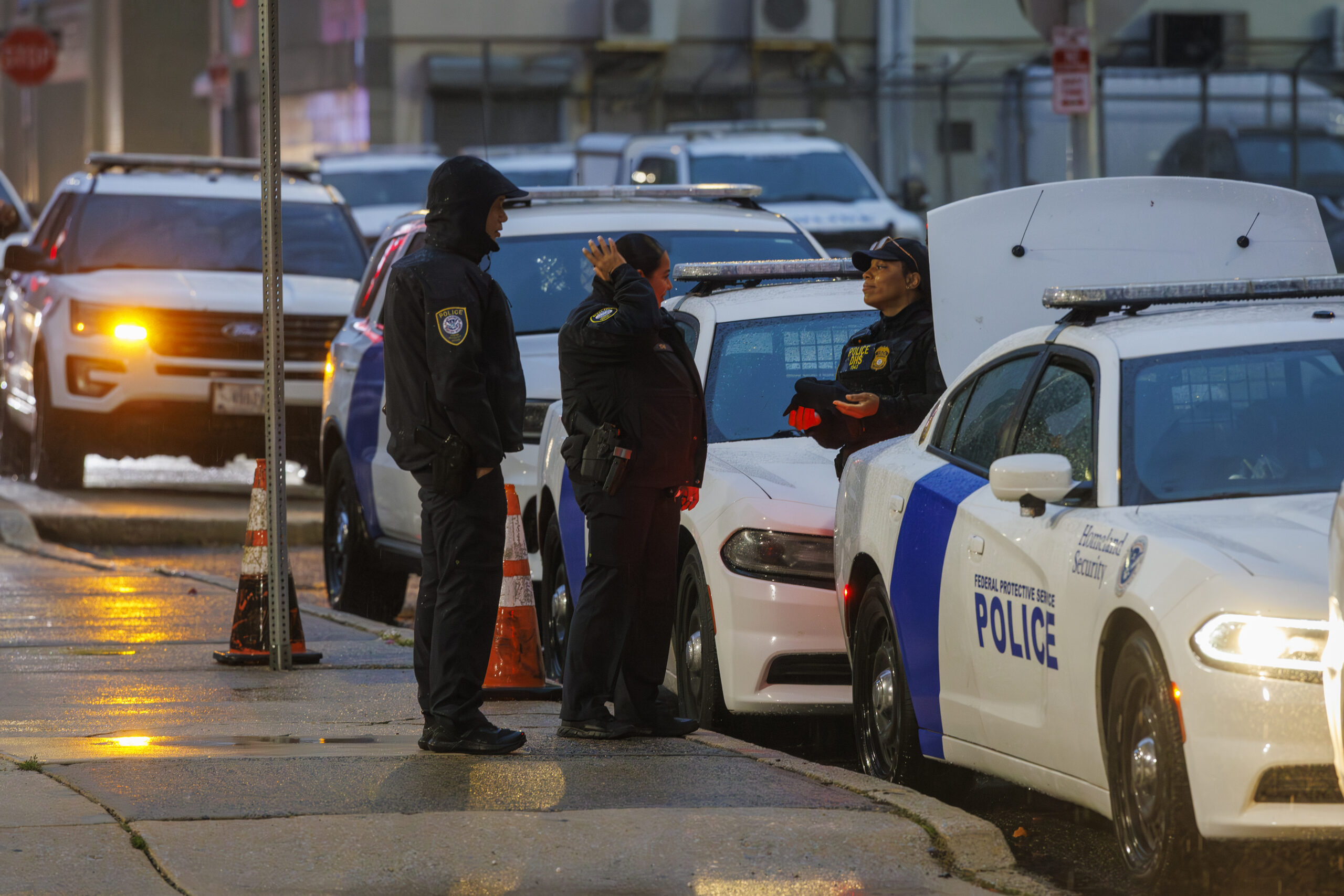
Philadelphia Police and Department of Homeland Security officials block protesters outside the garage at ICE’s Center City headquarters.
Just before 9:30 a.m., a white sedan – which had initially been blocked by protesters – was able to exit the ICE headquarters parking bay with the help of Philadelphia Police.
Philadelphia City Councilman Nicolas V. O’Rourke (right) joins the protest alongside Rev. Jay Bergen.
Protestors saw their ranks boosted by City Council member Nicholas O’Rourke, who is also a pastor of the Living Water United Church of Christ in Oxford Circle.
O’Rourke said it was only natural for him to join fellow clergy at Tuesday’s frigid demonstration.
A pastor of the Living Water United Church of Christ in Oxford Circle, O’Rourke said Tuesday’s action was part of a long tradition of faith leaders being at the forefront of the “struggle against oppression,” as seen with Rev. Dr. Martin Luther King Jr. and others.
“We are a day after King’s Day, and it’s important that we don’t just wax eloquent about the nice things that King said or the image that he’s been painted of now, but we continue in that tradition of resisting the oppression as he saw it, we’re doing in our own time,” said O’Rourke.
‘We need more people every day willing to do this’
Protesters sing and lock arms outside ICE headquarters in Center City Tuesday.
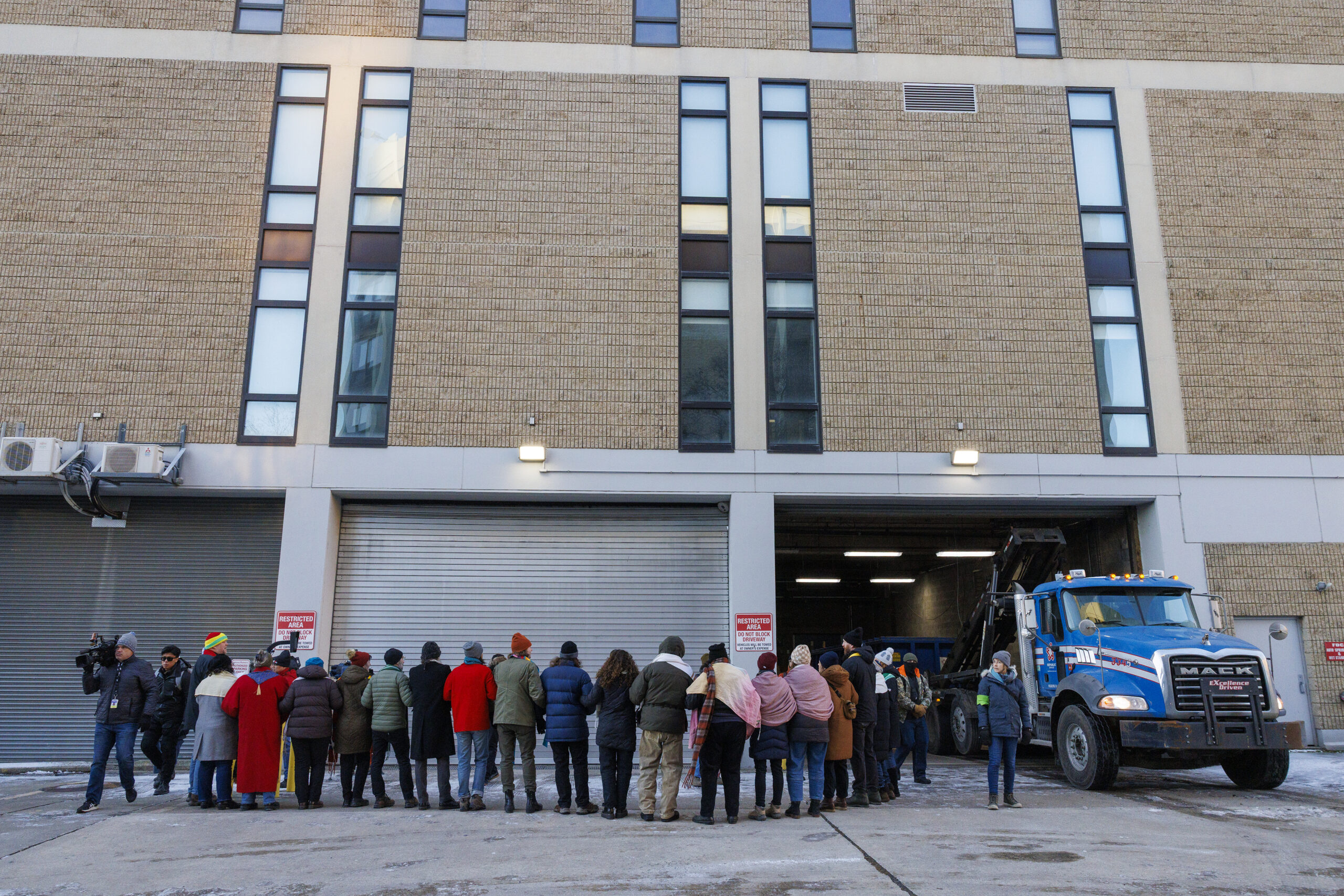
The group of clergy and immigration advocates continued to sing in locked arms in front of the parking bay in front of ICE headquarters in Center City after its initial “ICE block” in an effort to disrupt immigration enforcement.
Rev. Hannah Capaldi, minister at the Unitarian Society of Germantown, described the selection of participants as an intentional one as they face warnings from police, possible arrests, and citations.
Those present are leveraging a certain level of privilege, she said. All are citizens and many are clergy wearing collars, taluses, and stoles.
“We’re saying, listen, we have some level of moral authority in this city, and we’re trying to tell you where to look and what to pay attention to,” she said.
But in addition to drawing attention to ICE operations in Philadelphia, Capaldi hopes to plant “seeds of resistance” in the broader public, encouraging people to get involved.
“It doesn’t have to just be us, and we need more people every day willing to do this, to stand between the vehicles and the work that they’re doing to kidnap our neighbors,” she said.
“What ICE is doing in our communities is against our faith tradition,” said Rev. Jonny Rashid, a protest organizer. “We are gathered clergy, priests, rabbis, imams, and we are here to say no to ICE, and we want to demonstrate that publicly, and we’re willing to get arrested to do that. We’re blocking ICE’s garage as a symbol of saying you are not welcome in Philadelphia.”
He said he was not surprised by the lack of an overt Philadelphia police presence, though in the past groups of officers have been sent to anti-ICE protests.
“I don’t think the Philly police want to engage. They don’t want to make Philadelphia look like Minneapolis.”
Protestors are blocking the parking garage at ICE headquarters in Center City Philadelphia.
A group of about 30 immigration advocates, including local clergy, kicked off the frigid morning shortly before 8 a.m. with song in front of ICE headquarters.
They carried signs that read “Who would jesus deport?” and approximately at 7:55 a.m. the group locked arms calmly shouting “ICE block” as a white sedan tried to make its way out of a garage.
The gate to the garage closed back down almost immediately as the car pulled back in and the group continued in song.
Organizers with No ICE Philly say they’ll form a human blockade to stop ICE vehicles from departing the agency’s Center City headquarters beginning at 8 a.m. Tuesday.
They pledge to stay there, singing and chanting, until they are forcibly removed or arrested or both, in what they say is an effort to stop ICE from “leaving the facility to terrorize our neighbors.”
The ICE office is located at 8th and Cherry Streets, just southwest of the former Roundhouse police building.
Homeland Security officers with their cars along Cherry Street outside ICE’s Center City office in October.
In October, a No ICE Philly protest outside the agency headquarters erupted into physical confrontations with police, with several people knocked to the ground and four taken into custody.
A series of push-and-shove skirmishes broke out after about 35 protesters gathered for a Halloween Eve demonstration where they attempted to stop Immigration and Customs Enforcement vehicles from leaving the facility.
When an organizer shouted, “ICE Block!” about a dozen people poured onto Cherry Street to try to block the road. A series of scrums grew increasingly intense, with police shoving protesters back and in some cases to the ground.
The Department of Homeland Security, ICE, and Philadelphia police presence was substantial, with more than 30 officers outside the immigration agency’s big metal garage doors. Philadelphia police said four demonstrators were arrested and later released after being given citations for obstruction of highway, a violation that typically results in a fine.
That protest followed a September demonstration in which members of No ICE Philly acted as symbolic “building inspectors” who “condemned” the ICE facility. On the building they hung signs, bordered with yellow-and-black warning tape, that said, “ICE Raids Violate Philly Values.”
Protesters want Sheriff Rochelle Bilal to ban ICE agents from the courthouse in Center City.
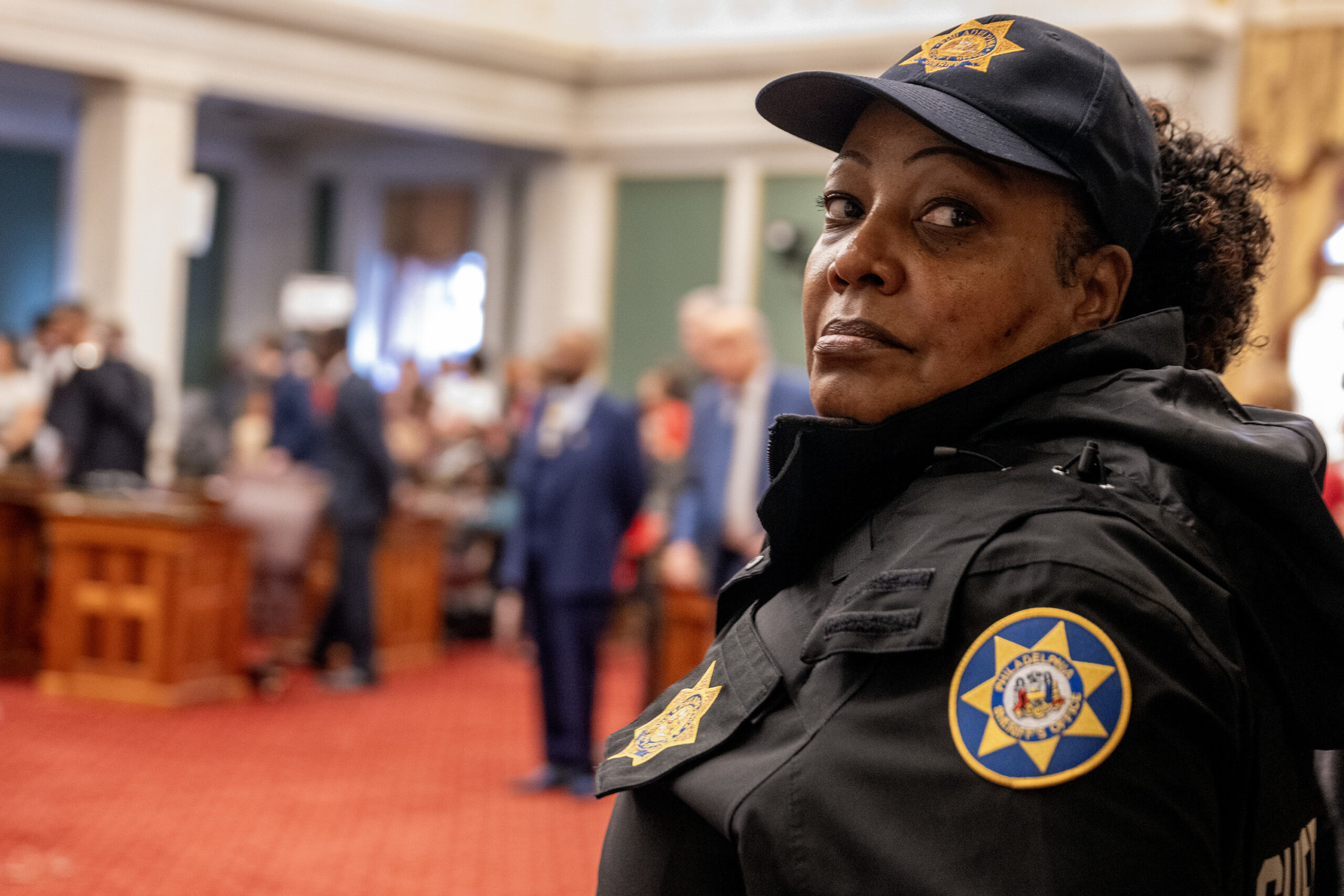
No ICE Philly has been a leader in protests outside the Criminal Justice Center in Center City, where it and other groups have demanded that Sheriff Rochelle Bilal ban immigration agents from the building.
Activists charge that the sheriff has allowed ICE to turn the property into a “hunting ground,” with at least 114 immigrants trailed from the courthouse by agents and arrested on the sidewalk.
On Wednesday the judicial district that oversees the Philadelphia court system said that authority for managing ICE’s presence rested with the sheriff, and that decisions around that were her “sole responsibility.”
Many people who go to the courthouse are not criminal defendants ― they are witnesses, victims, family members, and others in diversionary programs. But they have been targeted and arrested by ICE, immigration attorneys and government officials say, causing witnesses and victims to stay away from court and damaging the administration of justice in Philadelphia.