Category: Politics

Political news and coverage

  • U.S. plane used in boat strike was made to look like civilian aircraft

    U.S. plane used in boat strike was made to look like civilian aircraft

    The Trump administration’s first deadly strike on an alleged drug smuggling boat, in early September, was conducted by a secretive military aircraft painted to look like a civilian plane, multiple officials confirmed to The Washington Post on Monday.

    The crewed aircraft did not have any weapons showing when the attack occurred, two officials said, speaking, like some others, on the condition of anonymity to discuss a sensitive matter. Instead, the munitions were fired from a launch tube that allows them to be carried inside the plane, not mounted outside on the wing.

    Use of the plane prompted legal debate after the Sept. 2 operation over whether the concealment of its military status amounted to a ruse that violated international law, said current and former officials familiar with the matter. Eleven people were killed, including two who survived the initial attack by U.S. forces but died in a controversial follow-on strike.

    Feigning civilian status and then carrying out an attack with explicit intent to kill or wound the target is known as “perfidy” under the law of armed conflict, a war crime, according to legal experts.

    “If you arm these aircraft for self-defense purposes, that would not be a violation” of the law of war, said Todd Huntley, a former military lawyer who advised U.S. Special Operations forces for seven years at the height of the Pentagon’s counterterrorism campaign that followed 9/11. “But using it as an offensive platform and relying on its civilian appearance to gain the confidence of the enemy is.”

    The Trump administration has claimed that its lethal strikes on alleged drug boats in the waters around Latin America are lawful because President Donald Trump has determined the United States is in an “armed conflict” with drug cartels. That contention is widely disputed by legal experts, who say the U.S. is not at war with drug traffickers and that killing suspected criminals in international waters is tantamount to murder. Several analysts and former national security officials have said the entire campaign is, at its foundation, unlawful.

    “This isn’t an armed conflict,” said Huntley, director of the national security law program at Georgetown Law. “But what makes this so surprising is that even if you buy their argument, it’s a violation of international law.”

    The Pentagon did not immediately respond to requests for comment. A spokesperson for U.S. Special Operations Command, which carried out the Sept. 2 operation, declined to comment.

    The New York Times first reported the plane’s civilian paint scheme earlier Monday.

    The Sept. 2 military strike was the first of almost three dozen to date. The attacks have killed more than 100 people.

    The initial strike raised questions — among Democrats and law of war experts, principally — about whether a crime was committed when U.S. forces returned to the boat wreckage after the first strike to fire again and kill the two survivors as they clung to the hull.

    While the “double tap” to kill the survivors has drawn scrutiny on Capitol Hill, the military has closely guarded specifics of the aircraft involved in the operation.

    According to multiple officials, the plane is part of a fleet of crewed U.S. Air Force aircraft painted in civilian schemes and used in situations where it would not be advantageous for the military’s typical gray paint scheme to be seen. One official said the plane was already painted to look like a civilian aircraft before the Sept. 2 operation — it was not painted specifically for the boat strike, this person said.

    Firing on the alleged drug boat from an aircraft that looked like a civilian plane and had no visible weapons on it raised debate among some Pentagon officials after the strike, as well as concern that a classified capability was being “burned” in an operation targeting “civilians in a boat who pose no threat,” a former official said.

    “It’s not like they’re infiltrating downtown Tehran to kill some IRGC leader or something,” said the former official, referring to Iran’s military, the Islamic Revolutionary Guard Corps.

    Those familiar with the matter said the aircraft was broadcasting as a military aircraft. However, unless the men on the boat had technology on board to receive those transmissions, they would not have known it was a U.S. military plane.

    The Post reported late last year that Defense Secretary Pete Hegseth gave his approval ahead of the Sept. 2 operation to kill the passengers, sink the boat and destroy the drugs it was suspected of carrying. As the two survivors clung to the wreckage, Adm. Frank M. Bradley, the strike commander, determined they were still viable targets and, after consulting with a military lawyer, ordered a second strike that killed them, people familiar with the matter said.

    Shortly before the second strike, real-time surveillance video showed the two men waving their arms and looking skyward, people who saw the footage told The Post in December. But Bradley explained to lawmakers scrutinizing the operation that it was unclear why they were doing so, people familiar with his account said then.

    During multiple meetings with lawmakers after news of the double tap surfaced, Bradley said he looked for signs the men were surrendering, such as waving a cloth or holding up their arms, people familiar with his account have said. The admiral noted that he saw no such gesture, and did not interpret their wave as a surrender, people familiar with his interviews have said.


  • A disability rights watchdog group closes investigation into child abuse at Jamison Elementary, citing improvements

    A disability rights watchdog group closes investigation into child abuse at Jamison Elementary, citing improvements

    A disability watchdog group has closed its investigation into child abuse in the autistic support program at a Central Bucks elementary school.

    The group, Disability Rights PA, published an April 2025 report finding that students were abused at Jamison Elementary School and administrators failed to adequately investigate, setting off a firestorm of district investigations, terminations, and lawsuits. The group visited the elementary school in November and noticed improvements to district practices, policies, and personnel, according to a Dec. 19 letter from Andrew Favini, the organization’s staff attorney, to Central Bucks officials. They then closed the investigation.

    In the wake of the initial Disability Rights report, Central Bucks fired former Superintendent Steven Yanni and former Jamison principal David Heineman. Gabrielle McDaniel and Rachel Aussprung, the teacher and education assistant in the classroom who allegedly abused students, have also been terminated, the district said.

    During the November visit, Disability Rights PA found “no new reports of abuse and neglect” after conducting interviews with district staff that teach in or provide support to autistic support classrooms, according to the letter.

    The organization also interviewed new Jamison principal Lauren Dowd and assistant principal Dave Filson, who, according to Favini, appeared “earnest and sincere.” The administrators shared that they spent “significant time” in the autistic support classrooms and that there is new training on mandatory reporting for child abuse and using restraints in classrooms.

    “The changes presented to DRP during the November 21, 2025, visit were substantial and emphasized a focus and dedication to improving the autistic support programs,” Favini wrote in the letter.

    A spokesperson for Central Bucks also said the district’s pupil services program will be audited by the Center for Applied Research and Educational Improvement at the University of Minnesota.

    The evaluation will, among other things, identify areas for improvement and will focus on staffing, student outcomes, and conformity with state regulations, the spokesperson said.

    “The district and school board are committed to continuous improvement and pursuing and implementing multiple strategies to support this effort in all areas,” interim Superintendent Charles Malone said in a statement Monday.

    The April Disability Rights PA report found that McDaniel and Aussprung illegally restrained students in an autistic support classroom and did not report the use of restraints to the Pennsylvania Department of Education. They noted that students also observed or experienced demeaning treatment, nudity, and neglect.

    Room 119, the center of Disability Rights PA’s investigation, is no longer being used as an autistic support classroom at Jamison, Favini wrote in his letter. The class that would typically be in 119 has been relocated to another nearby room that administrators can more directly access.

    While the disability rights watchdog has closed its investigation, Favini noted in the letter that the district must continue to amend necessary policies and “support its staff with heightened awareness of the District’s history.”

    “As always, even though the investigation is closed, DRP will remain vigilant regarding reports of abuse within Central Bucks School District; we anticipate the District will do the same,” Favini wrote.

    Both Yanni and Heineman have appealed their terminations. Alyssa Wright, the district’s former director of pupil services whom Yanni and Heineman pointed fingers at during their public termination hearing in August, has sued the district and eight school board members, alleging that she was a whistleblower who was scapegoated.

    Yanni’s appeal in Bucks County Court of Common Pleas and Wright’s federal lawsuit are still pending, while the state Department of Education has not yet made a decision in Heineman’s appeal.

    Staff writer Abraham Gutman contributed to this report.

  • Fewer Americans sign up for Affordable Care Act health insurance as costs spike

    Fewer Americans sign up for Affordable Care Act health insurance as costs spike

    NEW YORK — Fewer Americans are signing up for Affordable Care Act health insurance plans this year, new federal data shows, as expiring subsidies and other factors push health expenses too high for many to manage.

    Nationally, around 800,000 fewer people have selected plans compared to a similar time last year, marking a 3.5% drop in total enrollment so far. That includes a decrease in both new consumers signing up for ACA plans and existing enrollees re-upping them.

    The new data released Monday evening by the Centers for Medicare and Medicaid Services is only a snapshot of a continuously changing pool of enrollees. It includes sign-ups through Jan. 3 in states that use Healthcare.gov for ACA plans and through Dec. 27 for states that have their own ACA marketplaces. In most states, the period for shopping for plans continues through Jan. 15 for plans that start in February.

    But even though it’s early, the data builds on fears that expiring enhanced tax credits could cause a dip in enrollment and force many Americans to make tough decisions to delay buying health insurance, look for alternatives or forgo it entirely.

    Experts warn that the number of people who have signed up for plans may still drop even further, as enrollees get their first bill in January and some choose to cancel.

    Healthcare costs at the center of a fight in Congress

    The declining enrollment comes as Congress has been locked in a partisan battle over what to do about the subsidies that expired at the start of the new year. For months, Democrats have fought for a straight extension of the tax credits, while Republicans have insisted larger reforms are a better way to root out fraud and abuse and keep costs down overall. Last week, in a remarkable rebuke of Republican leadership, the House passed legislation to extend the subsidies for three years. The bill now sits in the Senate, where pressure is building for a bipartisan compromise.

    Up until this year, President Barack Obama’s landmark health insurance program had been an increasingly popular option for Americans who don’t get health coverage through their jobs, including small business owners, gig workers, farmers, ranchers and others.

    For the 2021 plan year, about 12 million people selected an Affordable Care Act plan. Enhanced tax credits were introduced the following year and four years later enrollment had doubled to over 24 million.

    This year’s sinking sign-ups — sitting at about 22.8 million so far — mark the first time in the past four years that enrollment has been down from the previous year at this point in the shopping window.

    The loss of enhanced subsidies means annual premium costs will more than double for the average ACA enrollee who had them, according to the healthcare research nonprofit KFF. But extending the subsidies would also be expensive for the country. Ahead of last week’s House vote, the nonpartisan Congressional Budget Office estimated that extending the subsidies for three years would increase the nation’s deficit by about $80.6 billion over the decade.

    Americans begin looking for other options

    Robert Kaestner, a health economist at the University of Chicago, said some of those who abandon ACA plans may have other options, such as going on a partner’s employer health plan or changing their income to qualify for Medicaid. Others will go without insurance at least temporarily while they look for alternatives.

    “My prediction is 2 million more people will lack health insurance for a while,” Kaestner said. ”That’s a serious issue, but Republicans would argue we’re using government money more efficiently, we’re targeting people who really need it and we’re saving $35 billion a year.”

    Several Americans interviewed by The Associated Press have said they’re dropping coverage altogether for 2026 and will pay out of pocket for needed appointments. Many said they are crossing their fingers that they aren’t affected by a costly injury or diagnosis.

    “I’m pretty much going to be going without health insurance unless they do something,” said 52-year-old Felicia Persaud, a Florida entrepreneur who dropped coverage when she saw her monthly ACA costs were set to increase by about $200 per month. “It’s sort of like playing poker and hoping the chips fall and try the best that you can.”

  • Democrats seek answers on donor access tied to Trump’s White House ballroom

    Democrats seek answers on donor access tied to Trump’s White House ballroom

    Senate Democrats are asking the nonprofit group that is managing donations to the White House ballroom to explain how much money has been raised and whether donors have been promised any special access or influence in exchange for supporting the estimated $400 million project, a top priority of President Donald Trump.

    “You owe Congress and the public answers about your role in managing funds for President Trump’s ballroom,” Sen. Elizabeth Warren (D., Mass.) and colleagues wrote in a letter Tuesday to the Trust for the National Mall that was shared with the Washington Post. The lawmakers gave the group two weeks to respond.

    Democrats say limited public disclosure has made it impossible to assess whether safeguards are in place to prevent donors from gaining access or influence through the project. The concerns are heightened, they argue, by Trump’s personal involvement in both the project’s design and fundraising.

    The White House has said private donors will entirely cover the ballroom addition’s cost but has declined to share basic details about the value of those gifts, or whether donors were offered meetings, access or other consideration in return. Publicly identified donors, such as Amazon, Google and Lockheed Martin, collectively have billions of dollars in contracts before the administration. (Amazon founder Jeff Bezos owns the Washington Post.)

    The Trust for the National Mall, which has managed past fundraising campaigns to restore the Washington Monument and other projects, has largely referred questions to the White House and the National Park Service since its role in the ballroom project was announced last year. The group also is expected to retain a small percentage — about 2.5% — of donations to the ballroom project for its own use, Democrats wrote. The Trust did not immediately respond to a request for comment.

    Administration officials have said the Trust could receive hundreds of millions of dollars in donations tied to the ballroom project, placing the group at the center of a fundraising effort unlike any it has previously managed.

    Trump administration officials have shared few details about the project, the most significant change to the White House grounds in decades, including the building’s final design. The lack of disclosure has also drawn legal scrutiny. Historic preservationists last month sued the Trump administration, arguing that the ballroom construction is illegal because the project did not undergo required review by two federal panels and Congress did not appropriate funding. The White House has denied the allegations. A hearing in the case is tentatively scheduled for Jan. 29 in U.S. District Court in Washington.

    Trump administration officials made their first public presentation on the ballroom Thursday, justifying their rapid teardown of the White House’s East Wing annex last fall as a financial decision.

    “The cost analysis proved that demolition and reconstruction provided the lowest total cost ownership and most effective long-term strategy,” Joshua Fisher, a senior White House official who is helping manage the project, said at a meeting of the National Capital Planning Commission, a review board set to weigh in on the ballroom’s design.

    Trump has also steadily increased the project’s planned seating capacity and estimated cost since announcing the ballroom in July. Officials now say the ballroom will seat about 1,000 people.

    “I started off with a building half of the seats … and then it just kept growing and growing, and the money kept pouring in and pouring in,” the president told the New York Times last week, adding that he would make the ballroom “bigger” if he could.

    Shalom Baranes, the architect Trump tapped to lead the project, told the National Capital Planning Commission last week that the ballroom would not grow further.

    In their letter to the Trust for the National Mall, Warren and her colleagues asked the group to explain whether it has internal controls or has undertaken other steps to ensure that donors are not given preferential treatment by the Trump administration.

    “This leaves open the question of whether the Trust is being misused to facilitate special-interest access and influence,” the senators wrote. They also asked whether Meredith O’Rourke, a longtime Trump fundraiser who has been coordinating donations, is employed by the Trust or otherwise affiliated with the group. O’Rourke referred questions about her role with the Trust to the White House, which did not immediately respond.

    Warren’s office also shared letters the senator received from companies that have donated to the project, which offered varied explanations for how they expected their gift to be used. Comcast, for instance, said its donation “included no specific limitations or conditions,” while Microsoft said its gift would go toward construction. Trump has also said several companies have pledged to cover specific aspects of the project, such as Carrier offering to cover an estimated $17 million in air-conditioning and heating costs.

  • Camden’s planned 25-story Beacon Building could get a boost from new N.J. tax credit bill

    Camden’s planned 25-story Beacon Building could get a boost from new N.J. tax credit bill

    New Jersey lawmakers on Monday approved a bill that would make it easier for development projects in Camden to qualify for hundreds of millions of dollars in tax credits.

    That could be a boon to the Beacon Building — a planned 25-story office tower downtown whose backers have said they intend to seek state incentives — among other projects, according to the bill’s supporters.

    Under current law, most commercial real estate developers must show their projects would generate more dollars in economic activity than they would receive in subsidies in order to qualify for tax credits under New Jersey’s gap-financing program, known as Aspire.

    The new legislation — which was introduced late last month and approved by the Democratic-led Legislature days before Democratic Gov. Phil Murphy is to leave office — would exempt certain projects from the program’s so-called net benefit test.

    Lawmakers on Monday also passed a bill increasing the cap on the size of the Aspire tax-credit program from $11.5 billion to $14 billion and authorized $300 million in tax breaks to renovate the Prudential Center in Newark, home of the New Jersey Devils hockey franchise. The team is owned by Harris Blitzer Sports & Entertainment, which also owns the Philadelphia 76ers.

    ‘Competitive market’

    Supporters of the Camden bill, A6298/S5025, said it would make South Jersey more competitive in the Philadelphia market, while critics contended it would weaken a provision of a 2020 economic development law signed by Murphy that was intended to ensure fiscal prudence.

    The test has impeded big projects in South Jersey, said Assembly Majority Leader Louis Greenwald (D., Camden), a sponsor of the bill. Since the law was signed, the region hasn’t attracted a single “transformative project” — a designation in the Aspire program for developments that have a total cost of $150 million and are eligible for up to $400 million in incentives over 10 years, Greenwald said.

    “We started to ask people, what’s the barrier?” he said. “And when you look at the competitive market of what [developers] can get in Philadelphia or Pennsylvania compared to other areas in the state that don’t have to compete with that, that net operating loss test, that net benefits test, is a barrier.”

    The legislation was not drafted with a specific project in mind, Greenwald said, but he acknowledged that one that might benefit is Beacon, which would feature 500,000 square feet of office space.

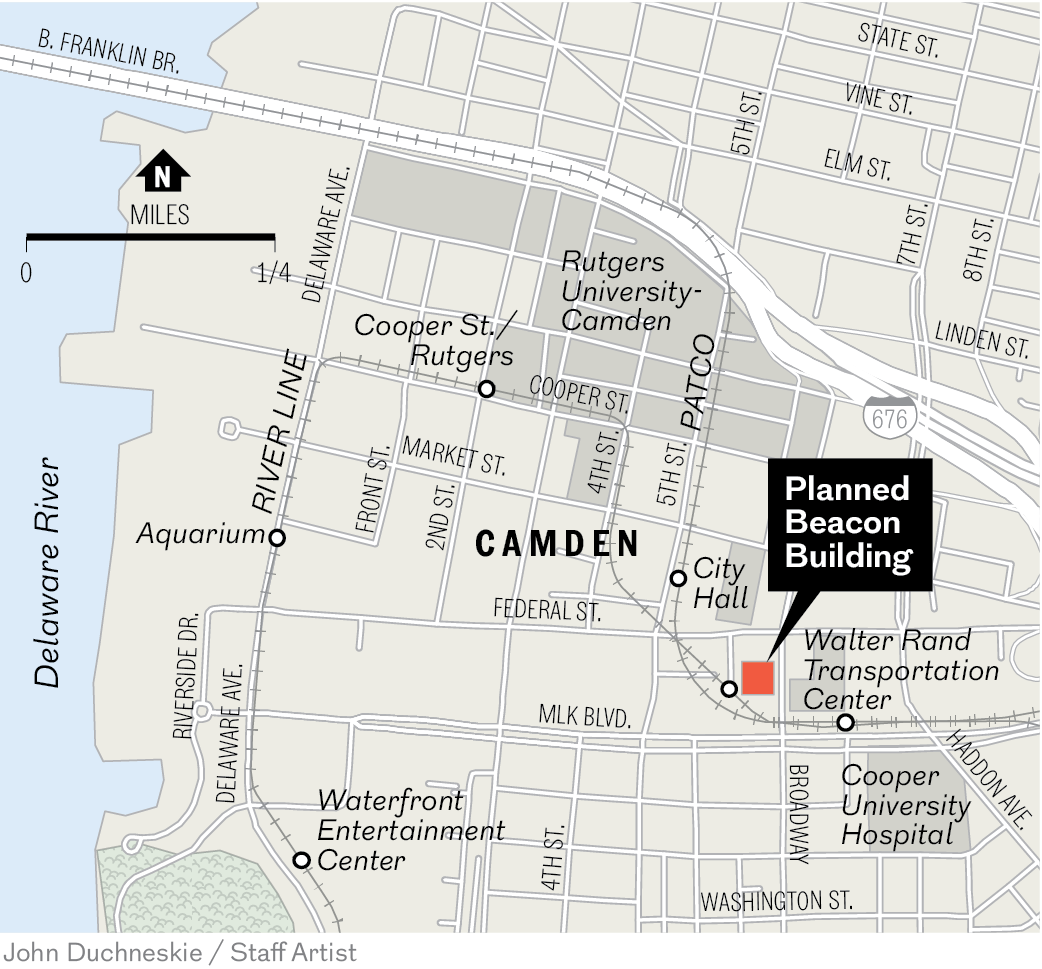
    Developer Gilbane is leading the project with the Camden County Improvement Authority at a vacant site on the northwest corner of Broadway and Martin Luther King Boulevard across the street from the Walter Rand Transportation Center and Cooper University Hospital.

    Map of the planned Beacon Building in Camden.

    “The goal is to attract projects, maybe like Beacon Tower, to capitalize off of the growth that we’ve seen in Camden city,” Greenwald said.

    Any project seeking Aspire subsidies must apply to the Economic Development Authority.

    Camden County officials have said they expect tenants to include Cooper University Health Care, which has said it needs additional office space to accommodate its $3 billion expansion. They also hope to entice civil courts to relocate there.

    County Commissioner Jeff Nash said last year that tenants had yet to commit, in part because the development team was still working on an application for Aspire tax credits.

    The incentives will help determine rent, he told the Cherry Hill Sun. The land is owned by the Camden Parking Authority, and Nash has said officials are still trying to determine who will own the site and the building going forward, according to Real Estate NJ.

    County spokesperson Dan Keashen said that those talks remain ongoing and that the improvement authority may issue a request for proposals for a new developer. Gilbane, the current master developer, didn’t respond to a request for comment.

    Wendy Marano, a spokesperson for Cooper University Health Care, said she didn’t have an immediate answer to a question about whether the hospital network planned to obtain an equity stake in the development.

    In 2014 the state awarded $40 million in tax credits to incentivize Cooper Health’s relocation of suburban office jobs to Camden, and Cooper later bought a stake in the development.

    The possible new state investment in Camden comes after Murphy’s administration separately allocated $250 million to renovate the state-owned Rand center — which serves two dozen NJ Transit bus lines and the River Line, and includes PATCO’s Broadway station.

    Construction on the transit center is expected to begin soon, according to county officials. While that renovation is underway, the Beacon site will serve as a temporary bus shelter, Keashen said, adding that possible construction on an office tower is still years away.

    Fast track

    Critics of the bill said that it was rushed through the Legislature with minimal public input and outside the normal budget process, and that it appeared to be designed to benefit specific projects. The bill passed the Assembly, 48-25, and the Senate, 24-14. It now heads to Murphy’s desk. The governor’s second term ends on Jan. 20, when he is to be succeeded by fellow Democrat Mikie Sherrill.

    The legislation applies to redevelopment projects located in a “government-restricted municipality” — language included in the Aspire program’s statute — “which municipality is also designated as the county seat of a county of the second class.” The project must also be located in “close proximity” to a “multimodal transportation hub,” an institution of higher education, and a licensed healthcare facility that “serves underrepresented populations.”

    “I say to you that there’s going to be one project that fits all those criteria,” Assemblyman Jay Webber (R., Morris) said on the floor of the chamber during debate Monday.

    “The net benefits test was put in as an accountability measure to make sure these projects were at least by some measure benefiting the taxpayer,” Webber added in an interview.

    “And now apparently one or more projects can’t meet that test,” he said. “And so rather than stick to the rules that they agreed to and pull the credits, they’re going to change the rules, lower the bar so that somebody can step over it. It’s wrong.”

    Greenwald said the legislation has “nothing to do with [Beacon] in particular,” adding that he hopes it is one of many projects that could benefit. Possible developments in Trenton and New Brunswick could also qualify for incentives under the bill, he said.

    Assembly Majority Leader Louis Greenwald in 2019.

    The net benefit test

    The test relies on economic modeling based on data such as projected jobs and wages. Under current law, most commercial projects seeking Aspire credits must demonstrate a minimum net benefit to New Jersey of 185% of the tax credit award — meaning, for instance, an applicant that receives $100 million in credits must generate $185 million in economic activity.

    The credits can be sold to the state Treasury Department for 85 cents on the dollar.

    Projects located in “government-restricted municipalities” — a half-dozen cities, including Camden, selected by the Legislature — already face a lower threshold of 150%, according to the state Economic Development Authority.

    Some projects, including residential and certain healthcare centers, are exempt from the net benefit test.

    The test was strengthened in the Economic Recovery Act of 2020, signed by Murphy, because “we saw in previous iterations of the tax credit program that if the guardrails weren’t strong enough … then companies could simply not meet the test, or, you know, not follow through on their promises, and nonetheless collect the funds,” said Peter Chen, senior policy analyst at New Jersey Policy Perspective, a liberal-leaning think tank.

    The 2020 law changed that, he said. “It’s one of the most important guardrails of the entire corporate tax credit program,” Chen said in an interview last week. “So exempting any project from the net benefit test requires a pretty large, pretty strong reason for doing so, and in this case, no reason was given.”

    Criminal case

    The renewed push for tax credits in South Jersey comes as a criminal case involving an earlier round of corporate subsidies continues to play out in court.

    Democratic power broker George E. Norcross III — founder of a Camden-based insurance brokerage and chairman of Cooper Health — and five codefendants were indicted in 2024 on racketeering charges related to development projects on the city’s waterfront.

    A judge dismissed the charges last year, and the state Attorney General’s Office is appealing the decision. Norcross has denied wrongdoing. He and his allies say state incentives have helped revitalize the city.

    During his floor speech on Monday, Webber alluded to “incredible allegations of corruption” in the earlier economic development program and noted that Murphy had previously championed reform of the system.

    The governor’s spokesperson, Tyler Jones, declined to comment on pending legislation.

  • Greenland official calls it ‘unfathomable’ that the U.S. is considering taking over the island

    Greenland official calls it ‘unfathomable’ that the U.S. is considering taking over the island

    NUUK, Greenland — A senior Greenland government official said Tuesday it’s “unfathomable” that the United States is discussing taking over a NATO ally and urged the Trump administration to listen to voices from the Arctic island’s people.

    Naaja Nathanielsen, Greenland’s minister for business and mineral resources, said people in Greenland are “very, very worried” over the administration’s desire for control of Greenland.

    She spoke a day before a key meeting in Washington between foreign ministers of the semi-autonomous Danish territory and Denmark and top U.S. officials, at a time of increased tensions between the allies over the stepped-up U.S. rhetoric.

    “People are not sleeping, children are afraid, and it just fills everything these days. And we can’t really understand it,” Nathanielsen said at a meeting with lawmakers in Britain’s Parliament.

    Earlier, a Danish government official confirmed that Denmark provided U.S. forces in the east Atlantic with support last week as they intercepted an oil tanker for alleged violations of U.S. sanctions.

    The official, who was not authorized to comment publicly on the sensitive matter and spoke on the condition of anonymity, declined to provide details about what the support entailed.

    The U.S. interception in the Atlantic capped a weeks-long pursuit of the tanker that began in the Caribbean Sea as the U.S. imposed a blockade in the waters of Venezuela aimed at capturing sanctioned vessels coming in and out of the South American country.

    The White House and Pentagon did not immediately respond to requests for comment. Danish support for the U.S. operation was first reported by Newsmax.

    Vice President JD Vance and Secretary of State Marco Rubio will meet with the foreign ministers of Denmark and Greenland on Wednesday at the White House to discuss Trump’s interest in acquiring Greenland, according to a U.S. official and two sources familiar with the plans who spoke on condition of anonymity because the meeting has not yet been formally announced.

    Denmark’s foreign minister, Lars Løkke Rasmussen, said earlier that Vance would host a meeting with him and his Greenlandic counterpart, Vivian Motzfeldt, in Washington this week, with Rubio in attendance.

    At a joint news conference with Danish Prime Minster Mette Frederiksen in Copenhagen, Greenlandic Prime Minister Jens-Frederik Nielsen reiterated that Greenland isn’t for sale, Danish media reported. Nielsen said Greenland doesn’t want to be owned or ruled by the U.S.

    Frederiksen also underlined Denmark’s willingness to invest in Arctic security. She said it hasn’t been easy to stand up to unacceptable pressure from a close ally and there are many indications that the most difficult part lies ahead.

    Nathanielsen, the minister, said of Greenland’s people: “We have no intentions of becoming American … but we have worked towards more collaboration with the Americans for many, many years.”

    “We feel betrayed. We feel the rhetoric is offensive,” she added, “but also bewildering.”

    NATO Secretary-General Mark Rutte refused to be drawn into the dispute, insisting that it was not his role to get involved.

    “I never, ever comment when there are discussions within the alliance,” Rutte said, at the European Parliament in Brussels. “My role has to be to make sure we solve issues.”

    He said that the 32-nation military organization must focus on providing security in the Arctic region, which includes Greenland. “When it comes to the protection of the High North, that is my role.”

    Tensions have grown this month as Trump and his administration push the issue and the White House considers a range of options, including military force, to acquire Greenland. Trump reiterated his argument that the U.S. needs to “take Greenland,” otherwise Russia or China would, in comments aboard Air Force One on Sunday.

    He said he’d rather “make a deal” for the territory, “but one way or the other, we’re going to have Greenland.”

    Nathanielsen said Greenlanders understand that the U.S. sees Greenland as part of its national security sphere.

    “We get it. We want to work with it,” she said, adding that “we understand the need for increased monitoring in the Arctic as a consequence of the growing geopolitical insecurity.”

    Nathanielsen said Greenland understands the need to “shake things up, to make things different … But we do believe that it can be done without the use of force.”

    She said “it is just unfathomable to understand” that Greenland could be facing the prospect of being sold or annexed.

    A bipartisan U.S. congressional delegation is headed to Copenhagen for meetings on Friday and Saturday in an attempt to show unity between the United States and Denmark.

    Nathanielsen said she thinks the people of Greenland have a say in their own future.

    “My deepest dream or hope is that the people of Greenland will get a say no matter what,” she said. ”For others this might be a piece of land, but for us it’s home.”

  • Clinton fails to show for Epstein deposition, threatened with contempt of Congress

    Clinton fails to show for Epstein deposition, threatened with contempt of Congress

    House Oversight Committee Chairman James Comer (R., Ky.) threatened Tuesday to hold Bill Clinton in contempt of Congress after the former president declined to appear before the panel for a closed-door deposition related to its investigation of convicted sex offender Jeffrey Epstein.

    “I think it’s very disappointing,” Comer told reporters Tuesday. ” … We will move next week in the House Oversight Committee … to hold former president Clinton in contempt of Congress.”

    Clinton, along with his wife, former secretary of state Hillary Clinton, were among 10 individuals the panel voted in July to subpoena for testimony related to crimes committed by Epstein and his former girlfriend Ghislaine Maxwell. Hillary Clinton is scheduled to testify Wednesday but does not plan to appear.

    Neither Clinton has been accused of any wrongdoing in connection with Epstein, and both have said they have no knowledge related to the investigation. A spokesman for the former president has previously said he met Epstein several times and took four trips on his airplane, but knew nothing about Epstein’s crimes. Bill Clinton has appeared in Epstein-related photographs released by Congress and the Justice Department.

    The Clintons called the subpoenas from the panel “invalid and legally unenforceable” in a letter obtained and published by the New York Times.

    In the letter, the Clintons noted that they had provided Comer with sworn statements similar to those he had accepted from other subpoenaed individuals, who were later excused from testifying before the committee.

    “We are confident that any reasonable person in or out of Congress will see, based on everything we release, that what you are doing is trying to punish those who you see as your enemies and to protect those you think are your friends,” the Clintons wrote.

    Contempt of Congress is punishable by up to a year in prison. If Comer’s committee moves forward with a contempt finding, the full House would next vote whether to refer the matter to the Justice Department for possible prosecution.

    Comer initially issued subpoenas for the testimony of both Clintons in August, according to aides, who said the committee had made several attempts to accommodate both of their schedules.

    Both were first scheduled for appearances in October, which were later moved to December. Those dates were moved again after the Clintons said they planned to attend a funeral, according to committee aides. Both Clintons declined to suggest alternative dates in January, the aides said.

  • A Montgomery County office that’s ‘outlived DOGE’ has helped save the suburb $14 million

    A Montgomery County office that’s ‘outlived DOGE’ has helped save the suburb $14 million

    A Montgomery County office — which one county commissioner described as a far less controversial version of Elon Musk’s Department of Government Efficiency — has helped the county find $14 million in savings within the past year and reduce the deficit by half.

    Montgomery County’s Office of Innovation, Strategy, and Performance (OISP), announced in February 2025, spent the last year meeting with department heads to identify areas for cost cutting and streamlining services, such as eliminating almost a dozen vacant positions worth hundreds of thousands of dollars, saving $1.5 million on a prescription benefits provider, and conserving half a million dollars by bringing some county legal services in house.

    In 2026, the office could consider integrating artificial intelligence into county services, with the support of all three commissioners, aimed at cutting red tape for residents and county employees.

    “It’s kind of like DOGE,” said Commissioner Vice Chair Neil Makhija, a Democrat, noting that the office has “outlived” DOGE’s period of high activity when Musk was in charge before he stepped away last spring.

    “We didn’t just take the richest person in the county and tell them to cut, you know, benefits for poor people, which is what the federal DOGE was,” Makhija said.

    Also unlike DOGE — which under Musk’s leadership was responsible for the haphazard slashing of thousands of federal workers’ jobs during the first year of President Donald Trump’s second term — the office does not envision layoffs becoming part of its mission.

    The office’s work comes on the heels of the county’s $632.7 million operating budget and a roughly $25.5 million deficit, resulting in a 4% property tax increase for residents.

    Republicans have made looking for inefficiencies in government part of their brand. But Democratic leaders in Pennsylvania have also started taking on streamlining government. Gov. Josh Shapiro has touted how he’s cut processing time for licenses and accelerated the permitting process for building projects.

    And in blue Montgomery County, a bipartisan group of leaders says that responsible government efficiency should be a pillar of good government, regardless of political party.

    “What happened with DOGE at the federal level was hard to watch and certainly not the approach that we’re going to take in Montgomery County, but, any leader … has to go through this exercise of are we optimizing our resources?
Are we leaving money on the table? Are there opportunities to improve the performance of our people?” said County Commissioner Chair Jamila Winder, a Democrat.


    “Like all of those are just disciplines that are industry agnostic, and so I don’t think it’s a Republican or a Democrat thing,” Winder added.

    Commissioner Tom DiBello, the only Republican on the board, agrees, saying that he has high expectations for the office and its ability to oversee the adequate spending of taxpayer dollars.

    “I mean, that’s our job. It has nothing to do with Republican or Democrat. My feeling, it has to do with taxpayer money,” DiBello said. “We’re supposed to be stewards of taxpayer money.”

    Jamila H. Winder (from left), Neil Makhija, and Thomas DiBello are seated together on stage at the Montgomery County Community College gymnasium Wednesday, Jan. 3, 2024, during ceremonies before they were sworn in as Montgomery County’s new Board of Commissioners.

    Is artificial intelligence the next step?

    The OISP was launched in February 2025 after the office previously served as the county COVID-19 pandemic “Recovery Office,” ensuring approximately $161 million in funds from the American Rescue Plan Act were being used appropriately.

    When Stephanie Tipton, deputy chief operating officer, was hired in Montgomery County in September 2024 after more than 16 years in leadership in Philadelphia, county officials started discussing how to translate that oversight practice at the “Recovery Office” to every facet of county spending and performance.

    That mentality helped the OISP cut the county deficit in half and focus on ways to reduce it in the long term, such as eliminating longstanding vacant positions around the county, including on the board of assessment, which does real estate evaluations. The office also helped develop performance management standards for departments.

    “What we were really interested in is finding things that we could make repeatable year after year, and that would move forward, whether that was restructuring positions and eliminating vacancies that we don’t carry forward” to doing a trend analysis on spending, said Eli Gilman, project director of the 11-person office. He noted that the team was “kind of building a plane while we were flying.”

    County governments are always trying to be efficient with taxpayer dollars, said Kyle Kopko, executive director of the County Commissioners Association of Pennsylvania, especially in the aftermath of last year’s state budget impasse. But Montgomery County’s decision to have a dedicated office for efficiency is fairly unique, he said.

    “This is something that has become more and more of a focus of counties everywhere just because we’re not sure if we’re going to have the consistency of on-time state funds,” Kopko said.

    The next phase for the office? Cutting red tape for residents. And part of that may be through enlisting artificial intelligence, something the county has been examining through the commissioners’ “Advisory Council on Artificial Intelligence for Public Good” established in April 2025.

    “The goal here is like, how can we leverage this new and emerging technology to help us make it easier for residents to access services,” Tipton said. “Make it easier, reduce the burden on our frontline staff, so they can spend more time in sort of customer-facing, client-facing activities.”

    AI will be something that many counties across Pennsylvania will be grappling with moving forward, Kopko said. Though some counties are wary of using it for sensitive information.

    Everyone has a different idea as to what they would want to see AI used for in Montgomery County.

    Makhija wants to make court documents accessible by chatbot. Winder says she wants to see AI help county employees be more efficient in their roles. And DiBello, who worked in tech software, said as long as accuracy is prioritized, AI could one day be used in situations where residents don’t have to speak directly to someone.

    But first, Tipton said, the county wants to internally test AI tools to “make sure that we have the right sort of governance and guardrails” before launching it to the public.

    When Tipton joined Montgomery County she said she had a “clear mandate from the commissioners” to look at department spending. She also wants it to be a transparent process for residents and the office plans to launch an open data site to the public in the second half of 2026.

    “We want to make sure that moving forward, when we are making investments in the budget we can really understand more clearly how that is impacting service delivery, so we can tie that more directly to work that we’re doing,” Tipton said.

  • Young Americans are increasingly rejecting Democratic and Republican parties, a new poll shows

    Young Americans are increasingly rejecting Democratic and Republican parties, a new poll shows

    WASHINGTON — Americans are increasingly rejecting the two major political parties, according to new polling.

    Just under half, 45%, of U.S. adults now identify as independents, a new Gallup survey found. That’s a substantial shift from 20 years ago, when closer to one-third of Americans said they didn’t identify with the Democrats or Republicans.

    This group appears, increasingly, to be driven by their unhappiness with the party in power, according to Gallup’s analysis. That’s a dynamic that could be good for Democrats in this year’s midterm elections, but doesn’t promise lasting loyalty. Independents have gravitated toward the Democrats over the past year when asked which party they lean toward, Gallup found, but attitudes toward the party haven’t gotten warmer. That suggests that the Democrats’ gains are probably more related to independents’ increasingly sour views of President Donald Trump.

    Younger people, in particular, are rejecting the parties at much higher rates than older generations. More than half of Generation Z and Millennials identify as political independents, while a majority of older generations side with a party. That’s different from the past, when more young adults identified with the Democrats or the Republicans. And it’s part of the reason why frequent, dramatic swings in political power may become increasingly normal.

    Democrats regain the edge with independents

    Independents have long been the largest political group in the U.S., and their numbers have increased over the last 15 years. But often, they’re more inclined to side with one of the parties over the other.

    This year, the Democratic Party gained the partisanship edge when independents were asked whether they lean more toward the Democratic or Republican Party. Nearly half, 47%, of U.S. adults now identify as Democrats or lean toward the Democratic Party, while 42% are Republicans or lean Republican. This is an indication of how Americans are feeling about their political affiliations, and it may not be reflected in voters’ actual registration.

    This shifted the 3-year party affiliation advantage that the Republican Party held while President Joe Biden was in office, reverting to where the Democrats stood during Trump’s first term.

    While that’s certainly not bad news for Democrats as they look to regain one or both houses of Congress in November, it’s likelier that they’re benefiting from independents’ unhappiness with Trump, rather than building lasting goodwill for themselves. Trump’s approval among independents has fallen steadily over the year, while Democrats’ favorability remains historically low.

    Young people drive independents’ strength

    Younger Americans are driving the recent rise in U.S. adults identifying as independents.

    The Gallup polling found majorities of Gen Z and Millennial adults — who were born between 1981 and 2007 — now identify as independents. Independent identity is softer in older generations, where only about 4 in 10 in Gen X currently call themselves independents and roughly 3 in 10 older adults do.

    Young adults today are more likely than previous generations to identify outside of the Democratic and Republican Party. While 56% of Gen Z adults call themselves independents, that’s higher than in 2012, when 47% of Millennials said they were independents, and 1992, when 40% of Gen X adults identified that way, according to the Gallup analysis.

    That means that this trend isn’t likely to shift, unless the parties are able to change the way younger people see them.

    Independent Americans are increasingly the moderates

    Americans who identify as moderates increasingly don’t see themselves in either party, Gallup’s polling shows.

    More independents have described their political views as “moderate” over the last decade, while Democrats and Republicans have grown less likely to identity as moderates.

    About half of independents, 47%, called themselves moderates in 2025, compared to about 3 in 10 Democrats and about 2 in 10 Republicans.

    At the same time, Democrats and Republicans have become increasingly polarized in their ideology. About 6 in 10 Democrats now call themselves liberal, while the share that consider themselves moderate is among the lowest it’s ever been. Among Republicans, 77% consider themselves conservative, and moderate identity is also at a low point.

    That creates another challenge for the parties to contend with, since appeals to the center to win the growing pool of independents could risk alienating the most committed people in their base.

  • Judge is asked for emergency hearing after Congress members blocked from ICE facility in Minneapolis

    Judge is asked for emergency hearing after Congress members blocked from ICE facility in Minneapolis

    WASHINGTON — The Trump administration secretly reimposed a policy limiting Congress members’ access to immigration detention facilities a day after a federal immigration officer fatally shot a woman in Minneapolis, attorneys for several congressional Democrats said Monday in asking a federal judge to intervene.

    Three Democratic members of Congress from Minnesota were blocked from visiting an Immigration and Customs Enforcement facility near Minneapolis on Saturday, three days after an ICE officer shot and killed U.S. citizen Renee Good in the city.

    Last month, U.S. District Judge Jia Cobb in Washington, D.C., temporarily blocked ICE from enforcing policies limiting Congress members’ access to immigration detention facilities. In a court filing on Monday, plaintiffs’ lawyers asked Cobb to hold an emergency hearing and decide if the duplicate notice policy violates her order.

    Cobb ruled on Dec. 17 that it is likely illegal for ICE to demand a week’s notice from members of Congress seeking to visit and observe conditions in ICE facilities. The judge said the seven-day notice requirement likely exceeds the Department of Homeland Security’s statutory authority.

    The attorneys asking Cobb for an emergency hearing say the matter is urgent because members of Congress are negotiating funding for DHS and ICE for the next fiscal year with DHS’ annual appropriations due to expire on Jan. 30.

    “This is a critical moment for oversight, and members of Congress must be able to conduct oversight at ICE detention facilities, without notice, to obtain urgent and essential information for ongoing funding negotiations,” the lawyers wrote.

    Cobb didn’t immediately rule on the plaintiffs’ hearing request. Government attorneys also didn’t immediately respond in writing to it.

    On Saturday, U.S. Reps. Ilhan Omar, Kelly Morrison, and Angie Craig attempted to tour the ICE facility in the Minneapolis federal building. They initially were allowed to enter but then told they had to leave about 10 minutes later.

    Officials who turned them away cited a newly imposed seven-day-notice policy for congressional oversight visits. Last Thursday, a day after Good’s death, U.S. Department of Homeland Security Secretary Kristi Noem secretly signed a new memorandum reinstating the same seven-day notice requirement, according to the plaintiffs’ lawyers.

    Cobb, who was nominated to the bench by Democratic President Joe Biden, ruled last month in favor of 12 other members of Congress who sued to challenge ICE’s amended visitor policies after they were denied entry to detention facilities. Their lawsuit accused Republican President Donald Trump’s administration of obstructing congressional oversight of the centers during its nationwide surge in immigration enforcement operations.

    Government attorneys had argued that the plaintiffs didn’t have legal standing to bring their claims. They also said it’s merely speculative for the legislators to be concerned that conditions in ICE facilities change over the course of a week. But the judge rejected those arguments.

    “The changing conditions within ICE facilities means that it is likely impossible for a Member of Congress to reconstruct the conditions at a facility on the day that they initially sought to enter,” Cobb wrote.

    A law bars DHS from using appropriated general funds to prevent members of Congress from entering DHS facilities for oversight purposes. Plaintiffs’ attorneys from the Democracy Forward Foundation said the administration hasn’t shown that none of those funds are being used to implement the latest notice policy.