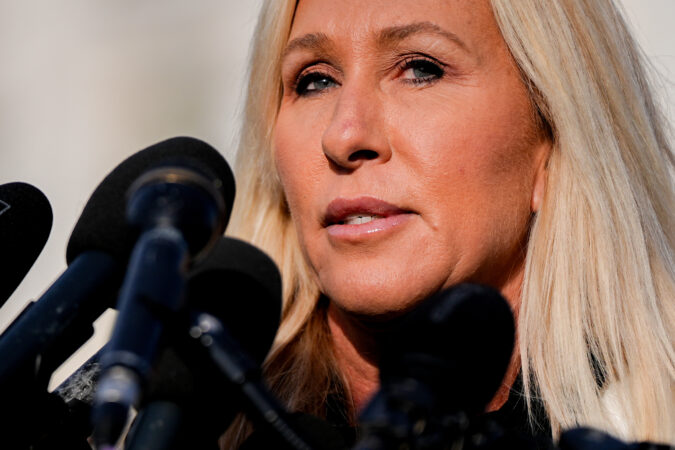
WASHINGTON — Rep. Marjorie Taylor Greene of Georgia, a loyal supporter-turned-critic of President Donald Trump who faced his political retribution if she sought reelection, said Friday she is resigning from Congress in January.
Greene, in a more than 10-minute video posted online, explained her decision and said she didn’t want her congressional district “to have to endure a hurtful and hateful primary against me by the president we all fought for,” she said.
Greene’s resignation followed a public fallout with Trump in recent months, as the congresswoman criticized him for his stance on files related to Jeffrey Epstein, along with foreign policy and health care.
Trump branded her a “traitor” and “wacky” and said he would endorse a challenger against her when she ran for reelection next year.
She said her last day would be Jan. 5, 2026.
The White House did not immediately respond to a message seeking comment Friday night.
Greene was one of the most vocal and visible supporters of Trump’s Make America Great Again politics, and she embraced some of his unapologetic political style.
Her break with him was a notable fissure in his grip over conservatives, particularly his most ardent base. But her decision to step down in the face of his opposition put her on the same track as many of the more moderate establishment Republicans before her who went crosswise with Trump.
The congresswoman, who recorded the video announcing her resignation while sitting in her living room wearing a cross necklace and with a Christmas tree and a peace lily plant behind her, said, “My life is filled with happiness, and my true convictions remain unchanged, because my self-worth is not defined by a man, but instead by God.”
A crack in the MAGA movement
Greene had been closely tied to the Republican president since she launched her political career five years ago.
In her video Friday, she underscored her longtime loyalty to Trump except on a few issues, and said it was “unfair and wrong” that he attacked her for disagreeing.
“Loyalty should be a two-way street and we should be able to vote our conscience and represent our district’s interest, because our job title is literally ‘representative,’” she said.
Greene swept to office at the forefront of Trump’s MAGA movement and quickly became a lightning rod on Capitol Hill for her often beyond-mainstream views. In her video Friday, Greene said she had “always been despised in Washington, D.C., and just never fit in.”
As she embraced the QAnon conspiracy theory and appeared with white supremacists, Greene was initially opposed by party leaders but welcomed by Trump. He called her “a real WINNER!”
Yet over time she proved a deft legislator, having aligned herself with then-GOP leader Kevin McCarthy, who would go on to become House speaker. She was a trusted voice on the right flank, until McCarthy was ousted in 2023.
While there has been an onslaught of lawmakers from both parties heading for the exits ahead of next fall’s midterm elections, as the House struggles through an often chaotic session, Greene’s announced retirement will ripple throughout the ranks — and raise questions about her next moves.
Greene was first elected to the House in 2020. She initially planned to run in a competitive district in northern Atlanta’s suburbs, but relocated to the much more conservative 14th District in Georgia’s northwest corner.
The opening in her district means Republican Gov. Brian Kemp will have to set a special election date within 10 days of Greene’s resignation. Such a special election would fill out the remainder of Greene’s term through January 2027. Those elections could take place before the party primaries in May for the next two-year term.
Conspiracy-minded
Even before her election, Greene showed a penchant for harsh rhetoric and conspiracy theories, suggesting a 2017 mass shooting in Las Vegas was a coordinated attack to spur support for new gun restrictions. In 2018, she endorsed the idea that the U.S. government perpetrated the attacks on Sept. 11, 2001, and mused that a “so-called” plane had hit the Pentagon.
Greene argued in 2019 that Reps. Ilhan Omar, D-Minn., and Rashida Tlaib, D-Mich., both Muslim women, weren’t “official” members of Congress because they used Qurans rather than Bibles in their swearing-in ceremonies.
She was once a sympathizer with QAnon, an online network that believes a global cabal of Satan-worshipping cannibals, including U.S. government leaders, operates a child sex trafficking ring. She eventually distanced herself, saying she got “sucked into some of the things I had seen on the internet.”
During the pandemic, she drew backlash and apologized for comparing the wearing of safety masks to the horrors of the Holocaust.
She also drew ridicule and condemnation after a conspiracy she speculated about on Facebook in 2018, in which she suggested a California wildfire may have been caused by “lasers or blue beams of light” controlled by a left-wing cabal tied to a prominent Jewish family.
When Trump was out of power between his first and second terms, Greene was often a surrogate for his views and brash style in Washington.
While then-President Joe Biden delivered his State of the Union address in 2022, Greene stood up and began chanting “Build the wall,” referring to the U.S.-Mexico border wall that Trump began in his first term.
Last year, when Biden gave his last State of the Union address, Greene again drew attention as she confronted him over border security and the killing of a nursing student from Georgia, Laken Riley, by an immigrant in the country illegally.
Greene, wearing a red MAGA hat and a T-shirt about Riley, handed the president a button that said “Say Her Name.” The congresswoman then shouted that at the president midway through his speech.
Frustration with the GOP
But this year, her first serving with Trump in the White House, cracks began to appear slowly in her steadfast support — before it broke wide open.
Greene’s discontent dates back at least to May, when she announced she wouldn’t run for the Senate against Democratic incumbent Jon Ossoff, while attacking GOP donors and consultants who feared she couldn’t win.
Greene’s restlessness only intensified in July, when she announced she wouldn’t run for Georgia governor, either.
She was also frustrated with the Republican leadership on Capitol Hill, which worked in lockstep with the president.
Greene said in her video that “the legislature has been mostly sidelined” since Republicans took unified control of Washington in January and her bills “just sit collecting dust.”
“That’s how it is for most members of Congress’ bills,” she said. “The speaker never brings them to the floor for a vote.”
Messages left with House Speaker Mike Johnson’s office were not immediately returned.
Republicans will likely lose the midterms elections next year, Greene said, and then she’d “be expected to defend the president against impeachment after he hatefully dumped tens of millions of dollars against me and tried to destroy me.”
“It’s all so absurd and completely unserious,” she said. “I refuse to be a battered wife hoping it all goes away and gets better.”
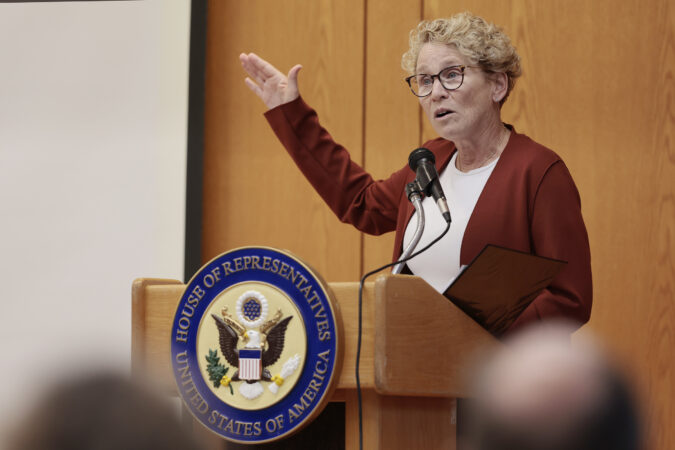
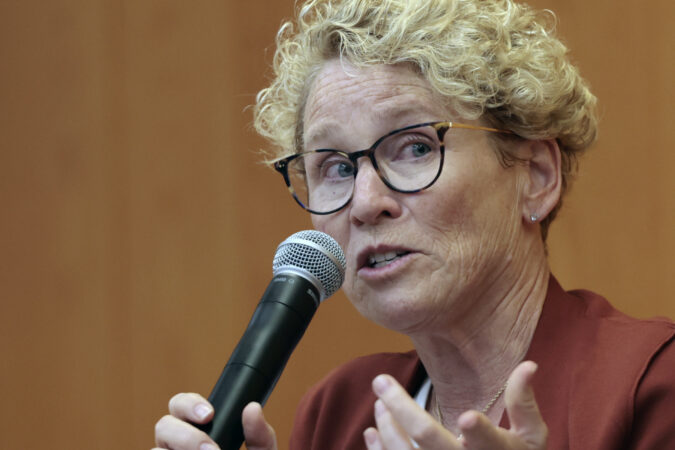
Spokespersons for U.S. Rep. Chrissy Houlahan, a Chester County Democrat, and Rep. Chris Deluzio, a Western Pennsylvania Democrat, reported that the legislators’ district offices had been targeted with bomb threats on Friday.
All six are military veterans or members of the intelligence community.
Early Friday evening, a spokesperson for Houlahan posted on the representative’s X account that her district office in West Chester was the target of a bomb threat.
“Thankfully, the staff there as well as the office in Washington, D.C. are safe. We are grateful for our local law enforcement agencies who reacted quickly and are investigating,” the post said.
A spokesperson for Deluzio posted on X late Friday afternoon that the representative’s district offices were targeted with bomb threats.
In response to the video, Trump went after the six congressional Democrats in a string of posts on Truth Social Thursday.
Houlahan lamented at a Friday news conference in Washington that “not a single” Republican in Congress “has reached out to me, either publicly or privately” since Trump’s posts.
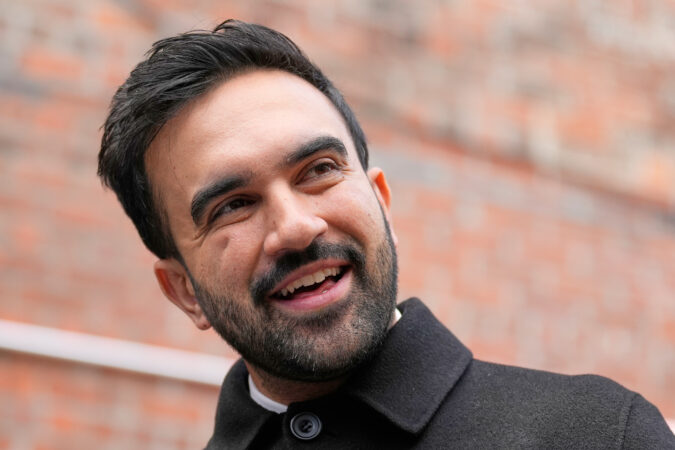
WASHINGTON — President Donald Trump on Friday met the man who had proudly proclaimed himself “Donald Trump’s worst nightmare,” but he seemed to find the opposite.
The Republican president and New York City’s Mayor-elect Zohran Mamdani were warm and friendly, speaking repeatedly of their shared goals to help Trump’s hometown rather than their combustible differences.
Trump, who had in the past called Mamdani a “100% Communist Lunatic” and a “total nut job,” spoke openly of how impressed he was with the man who had called his administration “authoritarian.”
“I think he is going to surprise some conservative people, actually,” Trump said of the democratic socialist as Mamdani stood next to him in the Oval Office.
The meeting offered political opportunities for both men. For Mamdani, a sit-down offered the state lawmaker — who until recently was relatively unknown — the chance to go head-to-head with the most powerful person in the world.
For Trump, it was a high-profile chance to talk about affordability at a time when he’s under increasing political pressure to show he’s addressing voter concerns about the cost of living.
Until now, the men have been political foils who galvanized their supporters by taking on each other, and it’s unclear how those backers will react to their genial get-together and complimentary words.
“We’re going to be helping him, to make everybody’s dream come true, having a strong and very safe New York,” the president said.
“What I really appreciate about the president is that the meeting that we had focused not on places of disagreement, which there are many, and also focused on the shared purpose that we have in serving New Yorkers,” Mamdani said.
Mamdani and Trump said they discussed housing affordability and the cost of groceries and utilities, as Mamdani successfully used frustration over inflation to get elected, just as the president did in the 2024 election.
“Some of his ideas are really the same ideas that I have,” the president said of Mamdani about inflationary issues.
The president brushed aside Mamdani’s criticisms of him over his administration’s deportation raids and claims that Trump was behaving like a despot. Instead, Trump said the responsibility of holding an executive position in the government causes a person to change, saying that had been the case for him.
He seemed at times even protective of Mamdani, jumping in on his behalf at several points. For example, when reporters asked Mamdani to clarify his past statements indicating that he thought the president was acting like a fascist, Trump said, “I’ve been called much worse than a despot.”
When a reporter asked if Mamdani stood by his comments that Trump is a fascist, Trump interjected before the mayor-elect could fully answer the question.
“That’s OK. You can just say yes. OK?” Trump said. “It’s easier. It’s easier than explaining it. I don’t mind.”
Trump stepped in again when a reporter asked Mamdani why he flew to Washington instead of taking transportation that used less fossil fuels.
Mamdani, who takes office in January, said he sought the meeting with Trump to talk about ways to make New York City more affordable. Trump has said he may want to help him out — although he has also falsely labeled Mamdani as a “communist” and threatened to yank federal funds from the city.
But Trump on Friday didn’t sling that at the mayor. He acknowledged that he had said he had been prepared to cut off funding or make it harder for New York City to access federal resources if the two had failed to “get along,” only to pull back from those threats during the meeting.
“We don’t want that to happen,” Trump said. ”I don’t think that’s going to happen.”
Afterward, Mamdani’s former campaign manager and incoming chief of staff Elle Bisgaard-Church told NY1 that the pair clearly disagreed on some issues but were able to find common ground on things like reducing crime.
“We discussed that we share a mutual goal of having a safe city where everyone can move around in comfort and ease,” she said, before later adding, “We know that there have been labels thrown all around that are just simply not fair and we kept it, again, at where we could find agreement on making the city affordable.”
Trump loomed large over the mayoral race this year, and on the eve of the election, he endorsed independent candidate and former Democratic Gov. Andrew Cuomo, predicting the city has “ZERO chance of success, or even survival” if Mamdani won. He also questioned the citizenship of Mamdani, who was born in Uganda and became a naturalized American citizen after graduating from college, and said he’d have him arrested if he followed through on threats not to cooperate with immigration agents in the city.
Mamdani beat back a challenge from Cuomo, painting him as a “puppet” for the president, and promised to be “a mayor who can stand up to Donald Trump and actually deliver.” He declared during one primary debate, “I am Donald Trump’s worst nightmare, as a progressive Muslim immigrant who actually fights for the things that I believe in.”
The president, who has long used political opponents to fire up his backers, predicted Mamdani “will prove to be one of the best things to ever happen to our great Republican Party.” As Mamdani upended the Democratic establishment by defeating Cuomo and his far-left progressive policies provoked infighting, Trump repeatedly has cast Mamdani as the face of Democratic Party.
Some had expected fireworks in the Oval Office meeting
The president has had some dramatic public Oval Office faceoffs this year, including an infamously heated exchange with Ukrainian President Volodymyr Zelenskyy in March. In May, Trump dimmed the lights while meeting with South African President Cyril Ramaphosa and played a four-minute video making widely rejected claims that South Africa is violently persecuting the country’s white Afrikaner minority farmers.
A senior Trump administration official who spoke on condition of anonymity to describe internal discussions said Trump had not put a lot of thought into planning the meeting with the incoming mayor — but said Trump’s threats to block federal dollars from flowing to New York remained on the table.
Mamdani said Thursday that he was not concerned about the president potentially trying to use the meeting to publicly embarrass him and said he saw it as a chance to make his case, even while acknowledging “many disagreements with the president.”
Instead, both men avoided a public confrontation in a remarkably calm and cordial series of comments in front of news reporters.
Mamdani, who lives in Queens — where Trump was raised — has shown a cutthroat streak just as Trump has as a candidate. During his campaign, he appeared to borrow from Trump’s playbook when he noted during a televised debate with Cuomo that one of the women who had accused the former governor of sexual harassment was in the audience. Cuomo has denied wrongdoing.
But the tensions were subdued Friday as Trump seemed sympathetic to Mamdani’s policies to want to build more housing.
“People would be shocked, but I want to see the same thing,” the president said.
U.S. Rep. Chrissy Houlahan, a Chester County Democrat, said Friday she is “profoundly disappointed” in her Republican colleaguesfor not speaking up after President Donald Trump accused her and five other Democratic lawmakers of sedition.
Houlahan was one of six Democrats in Congress — all militaryveterans or members of the intelligence community — featured in a videourging members of the military and intelligence community to “refuse illegal orders.”
In response, Trump went after the Democrats in a string of posts on Truth SocialThursday, accusing them of sedition that he said is “punishable by DEATH.”
Early Friday evening, a spokesperson for Houlahan posted on the representative’s X account that her district office in West Chester was the target of a bomb threat.
“Thankfully, the staff there, as well as the office in Washington, D.C., are safe. We are grateful for our local law enforcement agencies who reacted quickly and are investigating,” the post said.
A spokesperson for Rep. Chris Deluzio, a western Pennsylvania Democrat also on the video, posted on X late Friday afternoon that the representative’s district offices were targeted with bomb threats as well.
Houlahan lamented at a Friday news conference in Washington that “not a single” Republican in Congress “has reached out to me, either publicly or privately” since Trump’s post.
“And with this, I am profoundly disappointed in my colleagues,” she added.
In addition to calling for the lawmakers to be arrested and tried for sedition, Trump shared posts from supporters calling for retribution against the Democrats, including one that said “HANG THEM GEORGE WASHINGTON WOULD !!” and another calling them domestic terrorists.
“This is not normal political discourse,” Houlahan said Friday alongside other veteran members of Congress. “Indeed, it is, in fact, a explicit embrace of political violence against the opposition.”
“As a member who has spent my entire career calling for civility and decency and building relationships with the other side of the aisle, I’m dumbfounded by the silence,” added the Air Force veteran.
Beyond not reaching out to her specifically, Houlahan broadly said that “not a single Republican member has condemned this call for violence, not publicly, not privately.”
When reached by The Inquirer on Thursday, U.S. Rep. Brian Fitzpatrick (R., Bucks), a former FBI agent, condemned Trump’s rhetoric, but he did so without naming the president
“This exchange is part of a deeper issue of corrosive divisiveness that helps no one and puts our entire nation at risk,” he said. “Such unnecessary incidents and incendiary rhetoric heighten volatility, erode public trust, and have no place in a constitutional republic, least of all in our great nation.”
When asked for clarification, his spokesperson added that “He is 100% opposed to the president’s comments and 100% stands with all men and women who wear the uniform.”
Some Republicans justified Trump’s response by saying the Democrats who made the video were in the wrong — even if the president’s rhetoric was over the top.
House Speaker Mike Johnson (R., La.) said that he did not think the six Democrats committed “crimes punishable by death or any of that,” but criticized the Democrats’ video as irresponsible, Politico reported.
“The point we need to emphasize here is that members of Congress in the Senate [and] House should not be telling troops to disobey orders,” Johnson said. “It is dangerous.”
Karoline Leavitt, the White House press secretary, responded to a reporter asking if Trump wanted to “execute” members of Congress by saying “no,” and criticized the video put out by the veterans.
The video that inspired Trump’s ire did not point to any specific order from Trump as illegal, despite urging troops to resist such an order.
However, the video follows high-profile debates about the legality of Trump’s deployment of National Guard troops in U.S. cities and his ordering of strikes on boats in the Caribbean. Trump alleges that the boats are carrying drugs from Venezuela, but experts have said his claims about them are misleading.
“He has shown time and time again that when he threatens to abuse his power, he acts on it,” Houlahan said Friday at the news conference announcing a bill that would prohibit funds for military force in or against Venezuela without congressional approval.
Houlahan said Congress has not received intelligence on the strikes. She said that Trump’s administration has “repeatedly shown disregard for the military process.”
U.S. Rep. Seth Moulton(D., Mass.), one of the bill’s sponsors,said military leaders who have expressed concern about the legality of the strikes have been “sidelined.” He also pointed out that threatening a member of Congress is against the law.
“So put yourselves in the shoes of a young lieutenant or sergeant who’s in uniform right now watching the commander-in-chief threaten members of Congress to death for telling you to follow the law,” he said. “You’re watching him orchestrate legally dubious military strikes while sidelining military lawyers and commanders who say that those actions may be illegal and could therefore get you prosecuted for following those orders.”
Moulton was not one of the six lawmakers featured in the video, but he shares a similar background, having served four tours in Iraq as a Marine.
He said Congress should learn from its failure to question that war as it confronts the legality of Trump’s strikes in the Caribbean.
“I’ve seen what being in a moral and legal gray area means in war,” he said.
Staff writers Julia Terruso and Robert Moran contributed to this article.
WASHINGTON — The Supreme Court is meeting in private Friday with a key issue on its agenda — President Donald Trump’s birthright citizenship order declaring that children born to parents who are in the United States illegally or temporarily are not American citizens.
The justices could say as soon as Monday whether they will hear Trump’s appeal of lower court rulings that have uniformly struck down the citizenship restrictions. They have not taken effect anywhere in the United States.
If the court steps in now, the case would be argued in the spring, with a definitive ruling expected by early summer.
The birthright citizenship order, which Trump signed on the first day of his second term in the White House, is part of his administration’s broad immigration crackdown. Other actions include immigration enforcement surges in several cities and the first peacetime invocation of the 18th century Alien Enemies Act.
The administration is facing multiple court challenges, and the high court has sent mixed signals in emergency orders it has issued. The justices effectively stopped the use of the Alien Enemies Act to rapidly deport alleged Venezuelan gang members without court hearings, while they allowed the resumption of sweeping immigration stops in the Los Angeles area after a lower court blocked the practice of stopping people solely based on their race, language, job or location.
The justices also are weighing the administration’s emergency appeal to be allowed to deploy National Guard troops in the Chicago area for immigration enforcement actions. A lower court has indefinitely prevented the deployment.
Birthright citizenship is the first Trump immigration-related policy to reach the court for a final ruling. Trump’s order would upend more than 125 years of understanding that the Constitution’s 14th Amendment confers citizenship on everyone born on American soil, with narrow exceptions for the children of foreign diplomats and those born to a foreign occupying force.
In a series of decisions, lower courts have struck down the executive order as unconstitutional, or likely so, even after a Supreme Court ruling in late June that limited judges’ use of nationwide injunctions.
While the Supreme Court curbed the use of nationwide injunctions, it did not rule out other court orders that could have nationwide effects, including in class-action lawsuits and those brought by states. The justices did not decide at that time whether the underlying citizenship order is constitutional.
But every lower court that has looked at the issue has concluded that Trump’s order violates or most likely violates the 14th Amendment, which was intended to ensure that Black people, including former slaves, had citizenship.
The U.S. Court of Appeals for the 9th Circuit in San Francisco ruled in July that a group of states that sued over the order needed a nationwide injunction to prevent the problems that would be caused by birthright citizenship being in effect in some states and not others.
Also in July, a federal judge in New Hampshire blocked the citizenship order in a class-action lawsuit including all children who would be affected.
The American Civil Liberties Union, leading the legal team in the New Hampshire case, urged the court to reject the appeal because the administration’s “arguments are so flimsy,” ACLU lawyer Cody Wofsy said. ”But if the court decides to hear the case, we’re more than ready to take Trump on and win.”
Birthright citizenship automatically makes anyone born in the United States an American citizen, including children born to mothers who are in the country illegally, under long-standing rules. The right was enshrined soon after the Civil War in the first sentence of the 14th Amendment.
The administration has asserted that children of noncitizens are not “subject to the jurisdiction” of the United States and therefore not entitled to citizenship.
“The lower court’s decisions invalidated a policy of prime importance to the president and his administration in a manner that undermines our border security,” Solicitor General D. John Sauer wrote in urging the high court’s review. “Those decisions confer, without lawful justification, the privilege of American citizenship on hundreds of thousands of unqualified people.”
Rape crisis centers in the Philadelphia region are sounding the alarm that the slight increase in funding in the recently passed state budget won’t be enough to sustain or improve crucial services for survivors of sexual assault.
The Pennsylvania Coalition to Advance Respect (PCAR), which funds rape crisis centers via the state allocation, estimates centers will only see an average increase of $5,300 from the state to support their work assisting victims of sexual violence.
The Philadelphia Center Against Sexual Violence had to lay off most of its staff and reduce services due to the nearly five-month state budget impasse. And while leaders in the region appreciate the funding — the first increase for rape crisis centers in years — it’s only a fraction of what Philly’s only rape crisis center says it needs to survive.
“Even with the budget now passed, the funding increase is minimal compared to the overwhelming need,” said LaQuisha Anthony, senior manager of advocacy at the center, in a news release last week. The center is known as WOAR, the initials of its former name, Women Organized Against Rape.
Now advocates in Philadelphia and the suburbs are turning their focus to next year’s budget, pushing for an $8 million increase in state funding to rape crisis centers, which, among other services, offer victim advocacy, legal services, and crisis hotlines. A surge in funding will help provide stability for survivors and adequately compensate staff who dedicate their lives to this work.
“An $8 million increase would help ensure that every survivor across the Commonwealth, urban, suburban, and rural, has access to care, advocacy, and prevention,” said Joyce Lukima, coalition director and chief operating officer at PCAR, in a statement.
More than $12 million of a $50.1 billion state budget was allocated to rape crisis this year, a $250,000 increase from last year. Lukima said this $250,000 will be split among 47 rape crisis centers in the state.
In a statement, a spokesperson for the Pennsylvania Department of Human Services, which oversees rape crisis center funding, highlighted Gov. Josh Shapiro’s history of support for survivors of sexual violence.
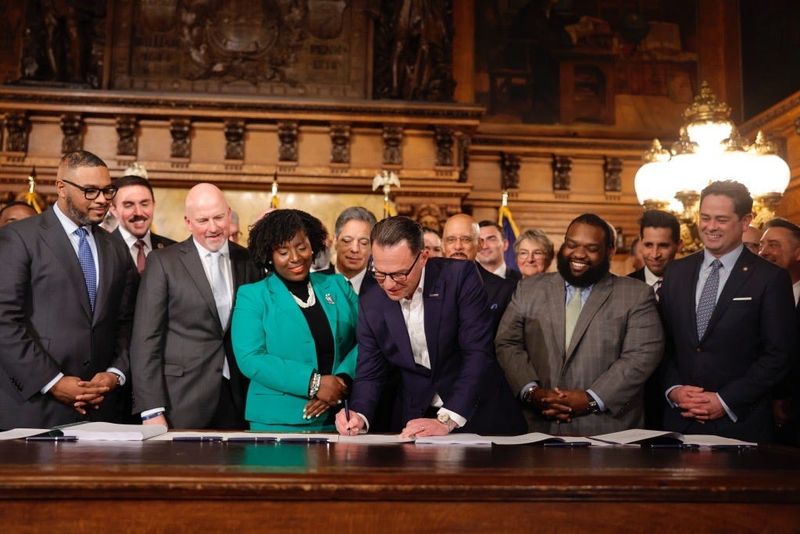
Gov. Josh Shapiro signs the fiscal year 2025-26 budget surrounded by General Assembly members on Nov. 12 at the Capitol in Harrisburg. The state budget had been due June 30, and Pennsylvania is the final state in the country to approve a funding deal.
“The final budget reflects the realities of working with one of the only divided legislatures in the entire country – but Gov. Shapiro will continue to fight for survivors and the Commonwealth’s rape crisis centers,” said Ali Fogarty, the DHS spokesperson.
Victim services centers in the suburbs, which also offer rape crisis services, are echoing WOAR and PCAR’s message, highlighting the urgent need for greater funding. These suburban centers receive funding from additional sources because they support victims of other crimes.
“For now, we’re doing OK, but another year of no increase in funding while the cost of living is going up has a significant impact on our staff as well as our organization,” said Penelope Ettinger, executive director of Network of Victim Assistance – Bucks County.
Trying to stay afloat
While Pennsylvania lawmakers were failing to come to an agreement on a far overdue state budget last month, rape crisis centers in Philadelphia and the suburbs were trying to make ends meet and provide services to survivors of sexual violence.
For instance, the Victim Services Center of Montgomery County had to use a line of credit, delay bill payments, institute a hiring freeze, increase the number of interns, and commit to “triaging services,” said Mary Onama, executive director.
“If they hadn’t passed the budget the time that they did, by December or January, we would have had to close, because we couldn’t go much longer,” Onama added.
At the Crime Victims’ Center of Chester County, it “added a layer of stress to an already very stressful job,” though the center did not have to reduce services, said Christine Zaccarelli, the organization’s CEO.
WOAR’s release last week said the closure of therapy and counseling services left “106 individuals wait-listed, 33 group clients waiting for services to resume, and eight child clients referred elsewhere for care.”
The center has been serving Philadelphia since 1971 and was one of the first rape crisis centers in the United States, according to the organization. Between January and October, the center said it responded to 3,820 calls on its crisis hotline.
The dysfunctional approval of the state budget, though, will have lingering effects on WOAR, warning in the news release that without a “long-term, sustainable investment,” the center won’t be able to meet a rising demand for resources.
The Bridge Loan, from the Pa. Treasury Department, provided WOAR funding owed for July through September, but it still wasn’t enough to return WOAR to full capacity, said Demetrius Archer, PCAR’s communications director. The center also brought back two employees this month, but it’s still in need of community support and is hoping to bring back more staff when possible.
“When services are underfunded, survivors and entire communities feel the impact,” said Fontan in the news release. “In a city as large and diverse as Philadelphia, every minute counts when someone is in crisis. Survivors deserve to know that when they reach out for help, someone will be there to answer.”
All eyes on Harrisburg
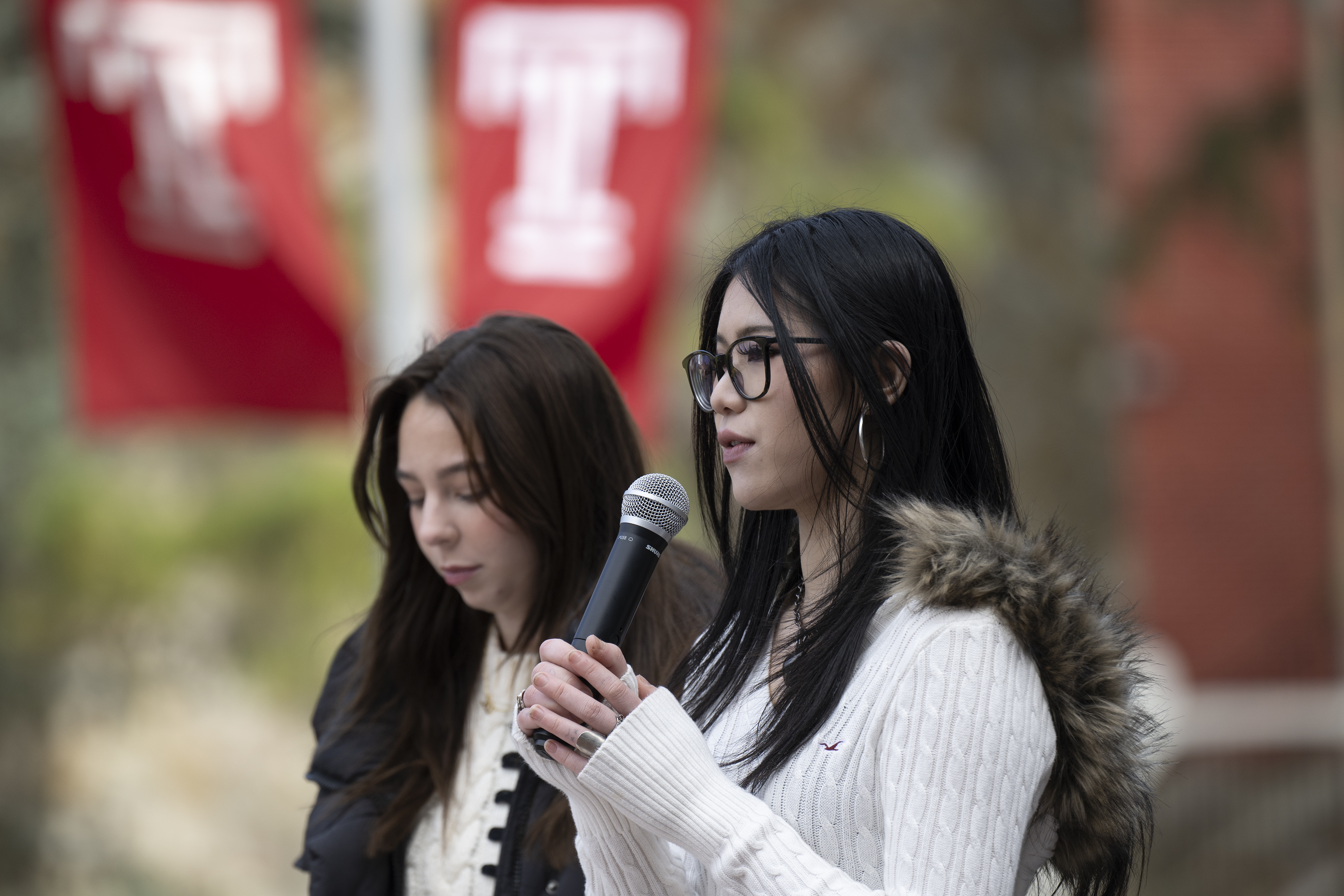
At Temple University’s campus Tuesday, student advocates bundled up in their coats, hats, and scarves and gathered at the Bell Tower to discuss an anti-sexual violence state bill they helped develop.
The Every Voice Bill, which primarily focuses on sexual violence prevention resources on college campuses, is even more important now that survivor services from WOAR are “unstable,” said Bella Kwok, a senior criminal justice major and president of Temple’s Student Activists Against Sexual Assault, in an interview prior to Tuesday’s event
“This bill would ensure that stability at least on an institutional level,” Kwok said.
Temple University students Emma Wentzel, left, and Bella Kwok speak at a podium on Polett Walk on Tuesday, Nov. 18, 2025, about campus sexual assault and a state bill they helped craft to strengthen protections against sexual violence at colleges.
Kwok is not the only one who is turning their attention to Harrisburg. PCAR and other rape crisis centers are continuing their push for next year’s budget to include an $8 million increase in the Pa. DHS line item for rape crisis.
As the first increase for rape crisis centers in a few years, the new budget’s funding gives advocates “hope,” even if the amount is “disappointing,” said Zaccarelli, of the Crime Victims’ Center of Chester County.
“Maybe our advocacy is making a little bit of a difference and shining a light on survivors and their needs and how important our centers are in the community,” Zaccarelli said.
Ettinger said that Bucks County’s state lawmakers have been supportive of NOVA Bucks, which had to place a hiring freeze on some positions and issue “significant” restrictions on spending due to the impasse, but that a lack of increased funding from the state is “very telling.”
“I believe that the fact that the state did not allocate a significant increase is very telling to what they believe, where they put it on the priority list,” Ettinger said.
For his part, Shapiro signed Act 122 in October 2024, which aimed to increase transparency by requiring a statewide electronic system to track evidence kits for sexual assaults, Fogarty, the DHS spokesperson said. And in December 2023, he signed Act 59, which aims to improve access to treatment for survivors of sexual assault.
It’s a “societal” problem, not a government problem, said Vincent Davalos, interim executive director of the Delaware County Victim Assistance Center.
“When we talk about sexual violence, the first thought is, of most people, is to say ‘Maybe this didn’t happen,” Davalos said. “And even if they do believe it happens… it’s just a really difficult topic for people to engage and talk about it plainly.”
This week, victim services leaders across Pennsylvania will gather in Harrisburg for an annual conference to address funding challenges among other concerns, Davalos said, noting that with more funding, his center could improve staff retention.
But this year, the newly passed state budget is likely to be top of mind.
“I think money is going to be a big topic,” Davalos said.
When Lauren Vaughn, a kindergarten assistant in South Carolina, saw reports that right-wing influencer Charlie Kirk had been shot at an event in Utah, she opened Facebook and typed out a quote from Kirk himself.
Gun deaths, Kirk said in 2023, were unfortunate but “worth it” if they preserved “the Second Amendment to protect our other God-given Rights.” Following the quote, Vaughn added: “Thoughts and prayers.”
Vaughn, a 37-year-old Christian who has taken missionary trips to Guatemala, said her call for prayer was sincere. She said she hoped reading Kirk’s words in the context of the shooting might prompt her friends to rethink their opposition to gun control.
“Maybe now they’ll listen,” she recalled thinking.
A few days later, Vaughn lost her job. She was one of more than 600 Americans fired, suspended, placed under investigation or disciplined by employers for comments about Kirk’s September 10 assassination, according to a Reuters review of court records, public statements, local media reports and interviews with two dozen people who were fired or otherwise disciplined.
Some were dismissed after celebrating or mocking Kirk’s death. At least 15 people were punished for allegedly invoking “karma” or “divine justice,” and at least nine others were disciplined for variations on “Good riddance.” Other offending posts appeared to exult in the killing or express hope that other Republican figures would be next. “One down, plenty to go,” one said.
Others, like Vaughn, say they simply criticized Kirk’s politics.
In the pro-Kirk camp, at least one academic was put on administrative leave after threatening to “hunt down” those celebrating the assassination.
This account is the most comprehensive to date of the backlash against Kirk’s critics, tracing how senior officials in President Donald Trump’s administration, local Republican lawmakers and allied influencers mobilized to enforce the Trump movement’s views. The story maps the pro-Trump machinery of retaliation now reshaping American political life, detailing its scale and tactics, ranging from shaming on social media to public pressure on employers and threats to defund institutions. Earlier reports by Reuters have documented how Trump has purged the federal government of employees deemed opponents of his agenda and cracked down on law firms defending people in the administration’s crosshairs.
Americans sometimes lose their jobs after speaking out in heated political moments. Twenty-two academics were dismissed in 2020, the year George Floyd was murdered by a Minneapolis police officer, most for comments deemed insensitive, according to the Foundation for Individual Rights and Expression, a free-speech advocacy group. In 2024, the first full year following the outbreak of the latest Israel-Gaza war, more than 160 people were fired in connection with their pro-Palestinian advocacy, according to Palestine Legal, an organization that protects the civil rights of American supporters of the Palestinian cause.
The backlash over comments about Kirk’s shooting stands apart because of its reach and its public backing from Trump, Vice President JD Vance and other top government officials. It represents a striking about-face for Republicans, who for years castigated the left for what they called “cancel culture” — the ostracism or punishment of those whose views were deemed unacceptable.
Supporters of the firings say that freedom of speech is not freedom from consequence. Standards of behavior should be high for people like doctors, lawyers, teachers or emergency workers who are in positions of public trust, they said.
In a statement, White House spokesperson Abigail Jackson said: “President Trump and the entire Administration will not hesitate to speak the truth – for years, radical leftists have slandered their political opponents as Nazis and Fascists, inspiring left-wing violence. It must end.” She added: “no one understands the dangers of political violence more than President Trump” after he survived two assassination attempts.
Turning Point USA, the youth movement Kirk founded in 2012, said in a statement that it supported the right to free speech, “including that of private employers to determine when a bright line has been crossed and an employee deserves to be terminated.” The organization, however, cautioned that while celebrating or gloating over Kirk’s death was “evil and disqualifying behavior, respectfully disagreeing with his ideas, statements, or values is every American’s right.”
Vaughn is challenging her dismissal in a federal lawsuit filed September 18, seeking reinstatement. As part of the case, she submitted a letter she received from the Spartanburg County School District superintendent that described her remarks as “inflammatory, unprofessional, and inappropriate.” Responding to the lawsuit, the district said Vaughn’ s post “appeared to endorse Mr. Kirk’s murder or indicate that it was ‘worth’ him losing his life to protect Americans’ constitutional rights.”
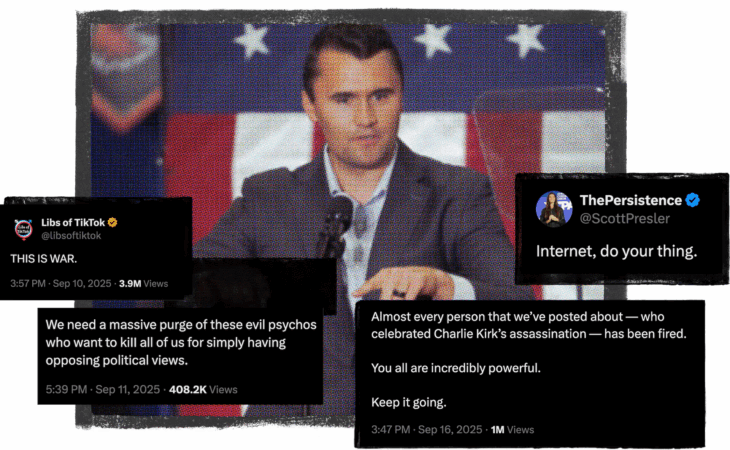
The punishments have often been driven by social media campaigns that circulate screenshots of the offending remarks, along with the names and phone numbers of employers, and appeals such as, “Internet, do your thing.” What typically follows are hundreds of angry or threatening messages, Reuters found. Several individuals who were targeted said in interviews they were inundated with phone calls. One recalled receiving a call every minute for an entire day. At least two said the harassment was so intense they plan to sell their homes.
Julie Strebe, a sheriff’s deputy in Salem, Missouri, lost her job after posting comments on Facebook about the shooting, including “Empathy is not owed to oppressors.” She later said she viewed Kirk as an oppressor because, in her words, he sought to marginalize vulnerable groups and used his platform to rally conservative white Christians behind “racist, sexist, hateful views.” She said her bosses were besieged with calls for her dismissal and that, at one point, a hand-drawn sign appeared across from her home reading, “Julie Strebe Supports the Assassination of Charles Kirk.”
Strebe said she installed five surveillance cameras at her home and now fuels her car only at night to avoid neighbors. Moving from Salem would mean leaving extended family, but she said the small city has grown too hostile to stay. “I just don’t feel like I could ever let my guard down,” she said in an interview. Strebe’s former employer, the Dent County Sheriff’s Office, declined to comment.
Many Republican officials have embraced the punitive campaign. Some have proposed extraordinary measures, including lifetime bans from social media for those deemed to be reveling in Kirk’s death. The U.S. State Department revoked visas for six foreigners who the agency said “celebrated the heinous assassination of Charlie Kirk.”
Speaking on a special episode of Kirk’s podcast on September 15, Vice President JD Vance urged his listeners to inflict consequences on those celebrating Kirk’s death.
“Call them out, and, hell, call their employer,” Vance said. Vance’s office pointed Reuters to comments made earlier this year in which the vice president said, “where I draw the line is encouraging violence against political opponents.”
Some academics compared the backlash to the “Red Scare,” the anti-Communist purge that peaked in the 1950s, when officials, labor leaders and Hollywood figures were accused of Communist ties. Thousands were investigated in a climate of fear that shaped U.S. politics and culture for a generation. There are “very disturbing parallels,” said Landon Storrs, a University of Iowa history professor.
Several prominent Republicans have voiced unease at the clampdown, especially after the Federal Communications Commission openly pressured broadcaster ABC to suspend talk show host Jimmy Kimmel following a monolog in which he suggested that Kirk’s assassin hailed from the political right. Police haven’t fully detailed the findings of their investigation into suspect Tyler Robinson and his motives. Robinson hasn’t entered a plea to the murder and other charges against him.
Republican Senator Ted Cruz warned on his podcast that letting government decide “what speech we like and what we don’t” sets a dangerous precedent. Silencing voices like Kimmel’s might feel good, he said, but “when it’s used to silence every conservative in America, we will regret it.” His spokesperson declined further comment.
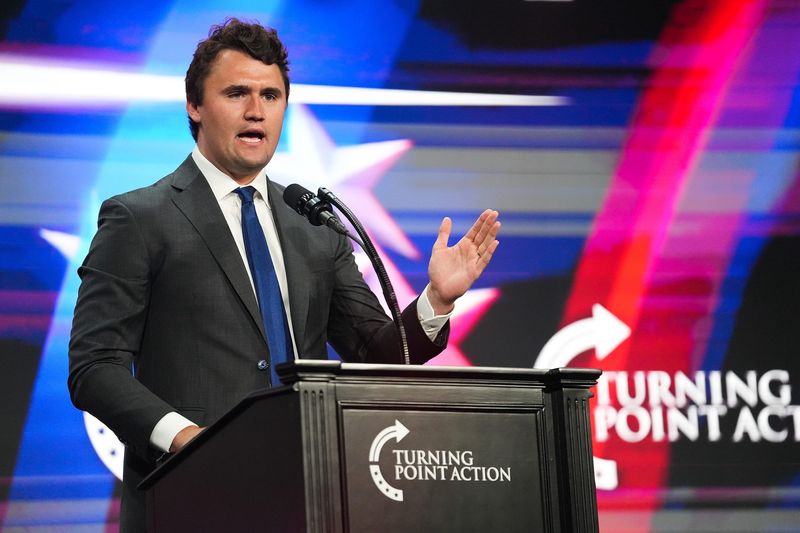
Charlie Kirk, founder of Turning Point USA, speaks in 2022.
‘Massive purge of these evil psychos’
The campaign to punish Kirk’s critics began almost immediately.
About 30 minutes after Trump’s announcement that Kirk had died, right-wing influencers mobilized. Among the first was Chaya Raichik, operator of the widely followed Libs of TikTok account, which had posted on X, “THIS IS WAR,” before highlighting a Massachusetts teacher who had written: “Just a reminder, We’re NOT offering sympathy.”
By night’s end, Libs of TikTok had published or reposted the professional details of 37 individuals, often accompanied by commentary such as “absolutely vile,” “Your tax dollars pay her salary,” or “Would you want him teaching your kids?”
“It’s actually terrifying how many of them are teachers, doctors and military members,” Libs of TikTok wrote the next day. “We need a massive purge of these evil psychos who want to kiII all of us for simply having opposing political views.”
In the week after the shooting, Libs of TikTok shared the names and profiles of at least 134 people accused of celebrating violence or mocking Kirk’s memory, frequently tagging Trump administration officials including Defense Secretary Pete Hegseth and Attorney General Pam Bondi. At times, the influencer posted disciplinary actions taken against specific government employees.
“BREAKING: This marine was fired,” Libs of TikTok posted on September 12, a day after calling out a Marine Corps captain. The officer had responded to Kirk’s death by posting an emoji of clinking beer mugs, according to a screenshot the influencer shared with followers. Reuters could not verify the authenticity of the beer-mug post; the captain declined to comment. Libs of TikTok also reported similar disciplinary actions involving an Army Reserve officer and an Army colonel who had commented on the death on social media.
The Pentagon and the Justice Department issued statements condemning celebrations of Kirk’s death but did not address questions about their relationship with Libs of TikTok.
Right-wing influencer Scott Presler began posting screenshots of Kirk commentary, too.
“Take a screenshot of EVERY single person celebrating today,” he told his followers on September 10. “You bet your behind we will make them infamous.” Over the next week, Presler shared posts on X about 70 people who had commented on the killing, and wrote in one message: “Almost every person we’ve posted about — who celebrated Charlie Kirk’s assassination — has been fired.” Presler didn’t respond to requests for comment.
For many on the right, outraged by celebratory reactions from the left, the wave of firings became a form of catharsis.
“It’s good that they are shamed and humiliated and must live with the repercussions for the rest of their lives,” right-wing podcaster Matt Walsh told his audience as he discussed the firings. “It’s good if they wake up every day until they die wishing they had not said what they said.” Asked for comment, Walsh emailed back: “f**k off.”
On YouTube, video blogger and recovery coach JD Delay expressed glee as he read aloud names of those who had lost their jobs over their remarks.
“I’m having fun! This is so much fun!” he shouted, raising his hands in excitement. Delay told Reuters that he believes in “accountability and consequences” and that “if you publicly say abhorrent things and get fired from your job, I’m going to laugh at you.”
The punishment campaign sometimes veered off course. In at least five cases, people were wrongly blamed for comments made by others. In another case, a website that drew up a blacklist called “Expose Charlie’s Murderers” vanished after taking in tens of thousands of dollars in cryptocurrency donations. Attempts to identify and seek comment from the site’s creators were unsuccessful.
President Donald Trump takes the stage during a memorial service honoring conservative activist Charlie Kirk in Glendale, Arizona, on Sept. 21, 2025.
Several online influencers said they received hundreds — sometimes thousands — of tips from individuals seeking to get Kirk’s detractors fired. Reuters was unable to verify those figures. But at various points, Presler, Libs of TikTok and other right-wing personalities publicly urged tipsters to be patient as they worked through the volume of submissions.
“Can’t keep up with all of you,” Presler wrote on X on September 12. “Post your submissions below & I’ll go through them as I can.”
A day later, the post had drawn more than 2,700 replies.
The tally of more than 600 people punished for criticizing Kirk is likely an undercount. Many companies and government organizations haven’t publicly disclosed terminations or suspensions.
Those punished came from at least 45 states and represented a cross-section of society, from soldiers and pilots to doctors, nurses and police officers.
In Michigan, an Office Depot employee was fired after being filmed refusing to print a poster memorializing Kirk. In Ohio, a Starbucks barista lost her job after she was accused of writing an anti-Kirk message on a cup of mint tea.
Reuters couldn’t determine the identities of the Office Depot worker or the barista. Office Depot and Kroger — the grocery store chain that runs the Ohio Starbucks — condemned the anti-Kirk incidents and said the people involved were no longer employees.
Requests to 21 federal agencies — including Homeland Security, Veterans Affairs and the Defense Department — for the number of suspensions or dismissals tied to the Kirk assassination were either ignored or declined. When the Office of the Director of National Intelligence was contacted, its deputy chief of staff responded on social media, accusing Reuters of trying to generate sympathy “for the ghouls who celebrate his death.”
Educators among the main targets
Teachers, academics and university administrators were among those most frequently punished for criticizing Kirk. More than 350 education workers were fired, suspended or investigated in the days following the assassination, including 50 academics and senior university administrators, three high school principals, two cheerleading coaches and a theology instructor.
The prominence of educators in the backlash may stem from several factors. As leaders tasked with shaping young minds, teachers have long been cast by some conservatives as ideologues who aim to pull their students left. Their status as taxpayer-funded employees made any perceived partisan commentary especially combustible.
In interviews and public statements, at least six teachers cited another reason for speaking out: concern over the frequency of gun violence at schools nationwide — and anger at those, like Kirk, who have championed widespread access to firearms.
Vaughn, the South Carolina kindergarten assistant, said that was front of mind when she went to Facebook to quote Kirk’s 2023 remark dismissing some fatal shootings as the price to pay to protect gun rights. Like other teachers across the country, she said she regularly practiced active-shooter drills at her elementary school and saw fear on her five-year-olds’ faces as they learned how to hide from a gunman.
As she defended her post on the day of Kirk’s death, she told a Facebook friend that she felt “no satisfaction” at the assassination. “Just heartbreak for everyone and anyone affected by gun violence and the hope that one day, enough will be enough.” Speaking to Reuters later, she said, “The one thing I want people to know is that my message was out of concern for the kids.”
Many educators did celebrate Kirk’s death, including a Virginia teacher who wrote, “I hope he suffered through all of it,” and a Texas middle school intern who said the shooting “made me giggle.” Screenshots of both posts were circulated by right-wing influencers. Reuters could not locate the original posts, which may have been deleted or made private. The Virginia teacher was suspended and the Texas intern was fired. Neither could be reached for comment.
While schools that suspended or fired educators cited disruptions to the learning environment, some private employers pointed to a violation of company values or safety concerns as the basis for terminations. Corporations caught up in the backlash gave a variety of explanations: Delta Air Lines CEO Ed Bastian said in a statement some employees’ comments were in “stark contrast” to the company’s values and violated its social media policy, while a United Airlines statement said the company had “zero tolerance for politically motivated violence or any attempt to justify it.”
At least a dozen Kirk critics who took pains to condemn the shooting also found themselves out of jobs or suspended, sometimes after Republican lawmakers got involved.
In the wake of Kirk’s death, Joshua Bregy, a climate scientist at Clemson University in South Carolina, shared another user’s Facebook post that read, in part: “No one should be gunned down — not a school child, not an influencer, not a politician — no one. But am I going to allow people to make a martyr out of a flawed human being whose rhetoric caused notable damage? Not a chance.”
The Clemson College Republicans reposted part of his message, labeling him “ANOTHER leftist professor” and calling for his termination. The post was amplified by right-wing influencers and Republican state lawmakers who threatened to defund the public university unless Bregy was fired.
Clemson initially pledged in a September 12 statement to “stand firmly on the principles of the U.S. Constitution, including the protection of free speech.”
The next day, Trump himself reposted a state lawmaker’s call to “Defund Clemson.” On September 16, after South Carolina’s House speaker and Senate president sent a letter to Clemson’s trustees demanding they “take immediate and appropriate action,” the school fired Bregy. Bregy’s Facebook post was “blatantly unprofessional” and “seriously prejudicial to the university,” Clemson said in a letter informing Bregy he had been dismissed.
Bregy is suing Clemson in a South Carolina federal court in a bid to be reinstated. His lawyer, Allen Chaney, said the academic would have kept his job “but for the really aggressive, coercive tactics of elected officials in South Carolina.”
Clemson, State House Speaker Murrell Smith and Senate President Thomas Alexander did not respond to requests for comment. Clemson has yet to file a response to Bregy’s suit.
In at least six other cases, Republican officials publicly threatened to deprive universities and schools of taxpayer funds unless specific critics of Kirk were fired.
Chaney, who serves as legal director of the South Carolina chapter of the American Civil Liberties Union, said the threats to defund Clemson and others crossed a constitutional line. “The government can’t police speech by pressuring third parties,” he said. Last year, the Supreme Court unanimously held that government officials cannot use their authority to “attempt to coerce” private parties into punishing or suppressing speech they dislike.
The threats to defund schools that resist firing Kirk’s critics were “stunning,” said Paul McGreal, a constitutional law professor at Creighton University Law School in Nebraska. “Government officials are threatening speakers with punishment because they disagree with what they’re saying. These are core First Amendment protections that they’re violating.”
Kirk praised as Christ’s ‘13th disciple’
Since Kirk’s assassination, many Republicans have cast him as a saintly champion of free expression. Evangelical figures have likened him to Saint Stephen, revered as Christianity’s first martyr. One Republican lawmaker told Congress “he’d have been the 13th disciple” had he lived in Biblical times. Trump compared Kirk to the ancient Greek philosopher Socrates, slain President Abraham Lincoln and assassinated civil rights icon Martin Luther King Jr. when posthumously awarding him the Presidential Medal of Freedom.
Kirk’s legacy is complicated, however. He gained fame for debating college students as part of his work with Turning Point. Kirk also advocated criminalizing expression – such as pornography – that clashed with his Christian views. When Black football players started kneeling during the national anthem in protest at police brutality, he backed Trump’s call to strip the National Football League of taxpayer subsidies. The White House later said Trump was making a statement, not a proposal.
Kirk repeatedly denigrated minorities, calling transgender people an “abomination,” warning of “prowling Blacks” in cities, accusing wealthy Jews of stoking “hatred against Whites,” and declaring Islam incompatible with Western civilization. He also dismissed Pope Francis as a Marxist.
Some of those who spoke out against Kirk after his death said they were disturbed by the hagiography.
“I just felt compelled to remind people who he was and what he stood for,” Kimberly Hunt, a human resources worker in Arizona, said in an interview. She had posted a video captioned, “Save your tears for his victims, not him.”
In the video, Hunt cited Kirk’s record of using derogatory language about transgender people and Muslims, before adding that his children “are better off without him.” Hunt was fired soon after. Her employer, an Arizona construction firm, did not respond to requests for comment.
Hunt told Reuters she understood her words sounded harsh but stood by them. She said they reflected Kirk’s stance in a debate last year that if he had a 10-year-old daughter who was impregnated through rape, “the baby would be delivered.”
The retaliation has silenced many voices. Scores of people who posted anti-Kirk comments have since scrubbed or locked their accounts, Reuters found. Others said in interviews that they are pushing back.
Hunt said she has raised more than $88,000 from a GoFundMe campaign titled, “Doxxed, Fired, but Not Silenced.” She said she wants to use the money to further her education, become a content creator, and keep calling out people like Kirk.
“It’s definitely just emboldened me,” she said.
At least 19 lawsuits have been filed against employers who punished Kirk critics, state and federal court records show. At least two plaintiffs have succeeded, including an academic in South Dakota who got his teaching job back.
Karen Leader, an associate professor at Florida Atlantic University, took to social media after Kirk’s death to protest a narrative that he “was a shining inspiration to youth and a noncontroversial figure who just wanted to have open and civil dialog,” she said. “Anyone who’s in higher education knows that it’s not that simple.”
She noted that Turning Point rose to prominence through its Professor Watchlist, a site that encouraged students to report faculty for allegedly holding “radical left” views or being a “terror supporter.”
Kirk had described the Watchlist as an awareness tool, not a blacklist. Those on it have said in interviews, social media posts and public forums that it fostered harassment and intimidation. In 2023, a Turning Point reporter was accused of assaulting an Arizona professor who was on the watchlist after confronting him on camera about his sexuality and shoving him to the ground. The reporter admitted to harassment, assault and disorderly conduct and was ordered to complete a diversion program. A Turning Point cameraman admitted to harassment in the case.
On September 10, Leader began posting Kirk’s past statements on X. She said she made a mistake by incorrectly accusing Kirk of having uttered an ethnic slur and then deleted it. The rest of her posts she said she stands behind, including one highlighting Kirk’s claim that Black Americans were “better” during Jim Crow.
“None of it was me encouraging violence,” Leader said. “I was sharing evidence.”
Jordan Chamberlain, a former staffer of Florida Governor Ron DeSantis, shared screenshots of several of Leader’s posts and tagged her university, asking if it approved of the content. Libs of TikTok shared Leader’s faculty headshot. The university’s president announced she had been put on administrative leave. Her address and phone number appeared online, and menacing messages followed.
In one voicemail reviewed by Reuters, the caller said: “We’re coming to get you. Karen Leader, we know where you work. We’re gonna come to your home as soon as we have your location.” Leader said she has rarely left her apartment since.
She reported the threats to Boca Raton police, which referred the case to campus officers, according to a police report. Florida Atlantic University police said their report could not be released because of an active criminal investigation.
Florida Atlantic University confirmed Leader was one of three academics who were on leave pending investigations. It declined further comment. Chamberlain also didn’t return an email seeking comment.
“Whether my career is over or not, I don’t know,” Leader said. “But my life has changed.”
President Donald Trump may no longer be a fan of Shane Gillis after listening to the comedian’s most-recent podcast.
Gillis, a Mechanicsburg, Pa., native, joked about the possibility 79-year-old Trump is beginning to show signs of mental decline on the most-recent episode of Matt and Shane’s Secret Podcast, which he co-hosts with fellow comedian Matt McCuster.
While Gillis expressed some sympathy for Lucey, he also joked about whether she deserved to be corrected by Trump and how awkward the plane flight must have been following the exchange.
“Think if you were next to her and hated her,” Gillis said.
Watch (caution: strong language):
Lucey, who has not spoken publicly about the matter, spent 12 years as a reporter at the Philadelphia Daily News covering everything from police corruption to local news. She left in 2012 and spent time reporting for the Associated Press and the Wall Street Journal before joining Bloomberg in March.
“Our White House journalists perform a vital public service, asking questions without fear or favor,” a Bloomberg News spokesperson told the Guardian. “We remain focused on reporting issues of public interest fairly and accurately.”
White House press secretary Karoline Leavitt defended Trump’s insult of Lucey, telling reporters Thursday the president “calls out fake news when he sees it and gets frustrated with reporters who spread false information.”
There’s no indication Lucey was spreading false information while asking Trump about the Epstein files.
After being fired by Saturday Night Live in 2019, Gillis has risen to fame in part thanks to his unflattering yet sympathetic portrayal of Trump. Gillis has amassed a huge audience of MAGA fans, including the president himself.
Gillis, an Eagles fan, met with Trump at the Super Bowl in New Orleans alongside country music star Zach Bryan.
At the Super Bowl, Trump meets comedian Shane Gillis and country star Zach Bryan. Both are big Eagles fans. pic.twitter.com/tHlKH03zpq
“Well, he’s a very good … I mean, on our side, right?” Trump later said in an interview with the Spector editor Ben Domenech, with the president adding he was a fan of Gillis and likes “everybody that’s on my side.”
Gillis recalled the meeting during an episode of his podcast, describing the room as “intense” thanks to the heavy presence of Secret Service agents.
“I finally had the moment — quick handshake,” Gillis said, though adding that Trump “has no idea who I am.”
Joe Rogan and Theo Von not-so-quietly cooling their support of Trump
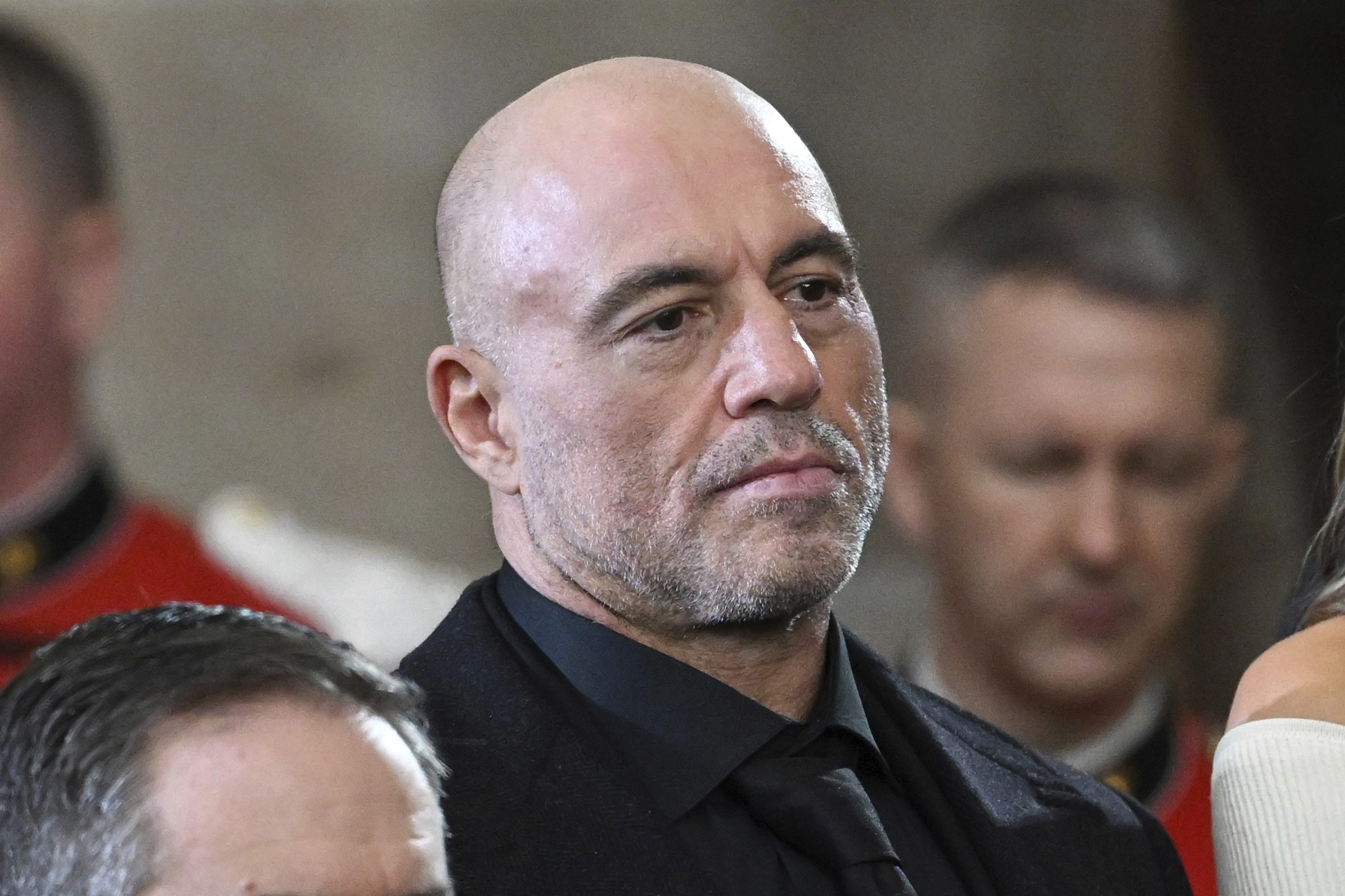
Joe Rogan at President Donald Trump’s inauguration in January.
Gillis is just the latest comedian within the so-called “manosphere” to begin to peel back their support of Trump.
Joe Rogan, host of the popular The Joe Rogan Experience podcast, mocked Trump over his handling of the Epstein files.
“I heard ‘there’s no files,’ I heard ‘it’s a hoax,’ ” Rogan said on the most-recent episode of his podcast. “And then all of a sudden, he’s going to release the files. Well, I thought there was not files.”
Rogan famously endorsed and interviewed Trump ahead of the 2024 election, with the episode reportedly drawing over 40 million listeners. He also attended Trump’s inauguration but recently has been criticizing the president over everything from U.S. Immigration and Customs Enforcement raids and mass deportations to his continued lies about the 2020 election.
“I feel like if you say that, you’ve got to have some, like, really good evidence that you could give out,” Rogan said on his podcast earlier this month about the 2020 election. “Either you don’t have any evidence that they stole the election, or you have evidence and you’re not telling me. Why would you not tell me? Why would you not tell me?”
Theo Von at Trump’s inauguration.
Theo Von, host of the This Past Weekend podcast, also interviewed Trump and attended his inauguration, but called out his administration after the Department of Homeland Security took a joke out-of-context and used it in a pro-deportation social media video that was later deleted.
“My father immigrated here from Nicaragua. One of my prized possessions is I have his immigration papers from when he came here. I have them in a frame,” Von said on his podcast last month.
The U.S. Department of Energy will loan $1 billion to help finance the reopening of Three Mile Island, a nuclear power plant in Pennsylvania that has been renamed the Crane Clean Energy Center.
The nuclear plant is owned by Constellation Energy Corp. and located on an island in the Susquehanna River just outside Harrisburg. The federal loan will lower Constellation’s price tag to get the mothballed plant running again, an effort that was already put on an accelerated timeline with the support of Democratic Gov. Josh Shapiro over the summer.
“Constellation’s restart of a nuclear power plant in Pennsylvania will provide affordable, reliable, and secure energy to Americans across the Mid-Atlantic region,” Secretary of Energy Chris Wright said in a statement. “It will also help ensure America has the energy it needs to grow its domestic manufacturing base and win the AI race.”
Constellation announced last year that it planned to spend $1.6 billion to reopen the plant as the demand for energy increases. The company announced a 20-year agreement with Microsoft to buy the power for its data centers.
Shapiro has supported that plan and touted pushing grid operator PJM to approve an early interconnection request for the site. Constellation employees celebrated with the governor in July with news that the plant’s last working reactor would be slated to open as early as 2027, a year ahead of schedule.
Joe Dominguez, president and CEO of Constellation, said in a statement this week that the DOE and Federal Energy Regulatory Commission have “made it possible for us to vastly expedite this restart without compromising quality or safety.”
Constellation spokesperson Mark Rodgers said Thursday the loan “supports” the already-existing plan.
When asked for comment on the federal loan, Shapiro did not mention the federal financing or the Trump administration at all, focusing instead on his own administration’s efforts.
“In Pennsylvania, we’re doubling down on our legacy of energy leadership by taking big, decisive steps to build new sources of power,” Shapiro said in a statement. “As an all-of-the-above energy Governor, my Administration is supporting new energy projects from all sources —from natural gas and solar to geothermal and nuclear.”
“The Crane Clean Energy Center takes advantage of our Commonwealth’s energy assets and brings more energy onto the grid, creating jobs and more opportunity for Pennsylvanians,” he added.
Trump’s administration has said bolstering nuclear power and artificial intelligence are among its priorities.
Constellation is working to restore equipment for the plant, including the turbine, generator, main power transformer and cooling and control systems. Its 835-megawatt reactor can power the equivalent of approximately 800,000 homes, according to the DOE.
The agency said in a statement that the reactor “will provide reliable and affordable baseload power,” in turn helping to lower electricity costs, strengthen the reliability of the energy grid, and “advance the Administration’s mission to lead in global AI innovation and restore domestic manufacturing industries.”
Sen. Dave McCormick, a Republican who has championed embracing tech and energy in Pennsylvania, said in a statement that the state is “leading America’s energy independence and the AI revolution by providing safe, clean, reliable nuclear power.” He said the center brings 3,400 jobs and “carbon-free electricity operating 24/7 to meet our increasing energy demands and economic growth across the region.”
The loan is being issued under an existing $250 billion energy infrastructure program initially authorized by Congress in 2022. Neither the department nor Constellation released terms of the loan.
The plan to restart the reactor comes during a sort of renaissance for nuclear power, as policymakers are increasingly looking to it to shore up the nation’s power supply, help avoid the worst effects of climate change, and meet rising power demand driven by data centers.
The Trump administration threatened Thursday to withhold nearly $75 million in funding if Pennsylvania does not immediately revoke what the administration claims are illegally issued commercial driver’s licenses to immigrants.
The move by U.S. Transportation Secretary Sean Duffy to target Pennsylvania follows similar action against California. Both states are run by Democratic governors who have criticized President Donald Trump’s administration and who are viewed as potential top-shelf contenders to be the party’s 2028 presidential nominee.
Duffy has made it a priority to scrutinize how the licenses are issued since August, when a tractor-trailer driver not authorized to be in the U.S. made an illegal U-turn and caused a crash in Florida that killed three people. That incident thrust the issue into the public’s consciousness.
In a statement Thursday, DOT spokesperson Danna Almeida said all states were being reviewed.
It’s unclear how many people would be affected in Pennsylvania. In any case, Pennsylvania Gov. Josh Shapiro ‘s administration said the federal government didn’t identify a single commercial driver’s license issued to someone who wasn’t eligible.
Still, a letter Thursday from the Republican administration to Shapiro cited an audit that found two out of 150 people whose licenses exceeded their lawful presence in the country.
In four cases it had reviewed, the federal government said Pennsylvania provided no evidence that it had required noncitizens to provide legitimate proof that they were legally in the country at the time they got the license.
The Trump administration called on Pennsylvania to stop issuing new, renewed and transferred commercial driver’s licenses and permits, as well as conduct an audit to identify those licenses whose expirations exceed the driver’s lawful stay in the U.S.
It is also asking the state to void noncompliant licenses and remove those drivers from the road. The administration said approximately 12,400 noncitizen drivers hold an unexpired commercial learner’s permit or commercial driver’s license issued by Pennsylvania.
The governors of California and Pennsylvania — Gavin Newsom and Shapiro — are tough critics of Trump, and both have been repeated targets of Trump’s administration.
Shapiro’s administration said the state transportation department ceased issuing commercial driver’s licenses to noncitizens after the Federal Motor Carrier Safety Administration published a regulation in late September that would severely limit which immigrants can get one.
A federal court has put the rule on hold for now, but Shapiro’s administration said its transportation department still hasn’t resumed issuing what are called “non-domiciled CDLs.”
Pennsylvania’s transportation department said Thursday that it follows federal rules for verifying an immigrant applicant’s lawful presence in the country by checking the U.S. Department of Homeland Security’s database.
But Shapiro this week suggested that DHS was falling short by failing to properly maintain that database, which states use to check an immigrant’s legal status before issuing a driver’s license to a noncitizen.
His comments came after DHS said it had arrested an Uzbek national with a commercial driver’s license issued by Pennsylvania. The man, who had a work authorization granted in 2024, was wanted in his home country for belonging to a terrorist organization, the department said.
But Shapiro said the state transportation department checked the federal database over the summer before issuing a CDL to the man, and he was authorized to get one. The state rechecked the database this week, and it still listed him as qualified to get a CDL, Shapiro said.
“They clearly are not minding the shop, and they’ve gotta get better, because every single state in the country relies on this database when making a determination as to who qualifies for a CDL. We relied on the feds before issuing this one,” Shapiro said.
California, which said it would revoke 17,000 licenses, is the only state the administration has acted against because it was the first one where an audit was completed. The government shutdown delayed reviews in other states, but the Transportation Department is urging all of them to tighten their standards. ___ Catalini reported from Trenton, New Jersey, and Levy from Harrisburg, Pennsylvania. Associated Press writer Josh Funk contributed.