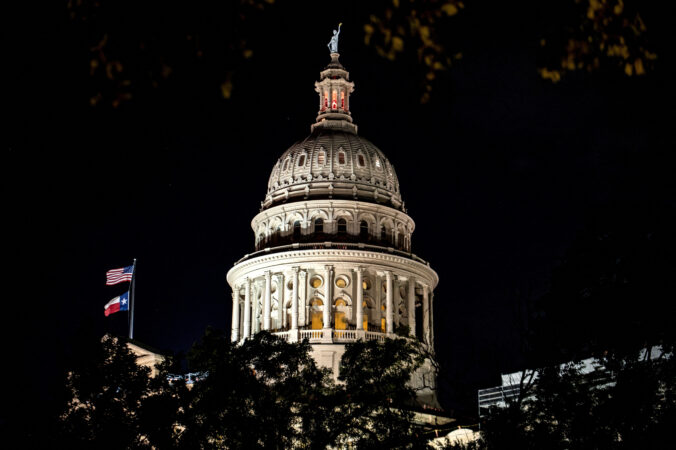
A federal court has blocked Texas from using its new congressional map for the 2026 midterm elections, directing the state to revert to its previous districts.
The majority opinion said the coalition of voting and civil rights groups who sued was likely to prove at trial that Texas officials had “racially gerrymandered” a new map that “unconstitutionally sorts voters on the basis of race,” depriving the plaintiffs of “their right to participate in a free and fair election.”
The judges were under a tight deadline to make a ruling since the candidate filing period for the 2026 midterm elections began on Nov. 8 and ends on Dec. 8.
Republican Gov. Greg Abbott, a key proponent of the electoral changes, said he would appeal the ruling to the U.S. Supreme Court.
“Any claim that these maps are discriminatory is absurd and unsupported by the testimony offered during ten days of hearings,” Abbott said. “This ruling is clearly erroneous and undermines the authority the U.S. Constitution assigns to the Texas Legislature by imposing a different map by judicial edict.”
The decision marks a significant setback for the state and Republicans, which began with a contentious battle in its state legislature last summer, led to a vote to revise state maps for voting districts, and ultimately spurred other states to buck tradition and pursue mid-decade redistricting.
Two judges, in a three-judge District Court panel, ruled on Nov. 18 that the injunction was necessary because “the racial minorities the Plaintiff Groups represent will be forced to be represented in Congress based on likely unconstitutional racial classifications for at least two years.”
The majority opinion, written by U.S. District Judge Jeffrey V. Brown, a Donald Trump appointee, who sits in Galveston, Texas, was joined by Senior U.S. District Judge David C. Guaderrama, a Barack Obama appointee, in El Paso.
U.S. Circuit Judge Jerry E. Smith, who was appointed to the bench by President Ronald Reagan, is expected to file a dissenting opinion.
A Republican majority in the Texas legislature in August 2025 passed the new state congressional map after a weeks-long standoff with state Democrats. Their new law, at the urging of President Donald Trump, heavily advantaged the GOP in 2026 elections. If used, it could have potentially flipped as many as five Democratic-held seats to Republican control − a significant edge as the party maintains a slim majority in Congress.
In his statement, Abbott said the Texas legislature passed the new maps to “better reflect Texans’ conservative voting preferences – and for no other reason.”
The court ruling and any decision by the U.S. Supreme Court could push back the filing deadlines for the Texas primaries for 2026. The midterm general election includes the seat of U.S. Sen. John Cornyn, D-Texas, all the Texas House of Representatives and Senate seats, and the governor, lieutenant governor and attorney general.
Republicans said redistricting targeted Democrats
The ruling came more than a month after 10 days of testimony and arguments over the legality of the new redistricting map at the federal courthouse in El Paso. The key testimony during the hearing came from Adam Kincaid, executive director of the National Republican Redistricting Trust, who created the maps.Kincaid testified that he looked at no racial data when building the map, solely relying on targeting districts that historically voted for Democrats.
He said he combined Democrat-leaning districts into one district. He took Republican portions of those districts to create their own districts. The outcome gave Democrats one less representative, adding more representation for Republican voters.
Kincaid and Republican leaders said the redistricting was done “race blind.” He testified he targeted Democrats, not minorities, which is allowed under the U.S. Constitution.
Voting rights groups say redistricting targets minorities
Democratic leaders and voting rights representatives argued during the hearing that the only districts targeted and impacted were Hispanic and Black majority districts. Hispanic and Black voters historically vote for Democrats.
In Texas, voters are not required to register by political party. They are free to vote in the primary of their choosing.
The redistricting map suppresses the voice of Texas minorities, including Hispanics, who make up the largest minority population in the state, Democratic state leaders testified in the trial.“They are not built to give Hispanics or African Americans a candidate of their choice,” Rep. Joe Moody, D-El Paso, testified about the new maps.
Democrats and voting rights advocates questioned why Trump focused on four districts and why they were the only districts that were dramatically altered. They said Republicans had already created the map before discussions were held in the Texas Legislature and the public had an opportunity to comment on it.
“That’s not Texas,” testified Rep. Ramon Romero, D-Fort Worth. “That’s not how we do things here.”
The redistricting vote that sparked a chain reaction
The Texas legislators’ efforts earlier this year sparked a national redistricting war across several states, as Democratic and Republican governors responded with their own efforts to redraw maps. Democratic California Gov. Gavin Newsom recently landed a victory in a voter-approved measure to implement new districts likely to add more Democratic representatives.
But that matter is also entangled in a court challenge, after the administration on Nov. 13 joined the California Republican Party to accuse the state of violating the Constitution by gerrymandering using race as a factor to favor Hispanic voters in the new map.
President Donald Trump is drawing widespread criticism after lashing out at a female reporter who was pressing for information about files related to Jeffrey Epstein.
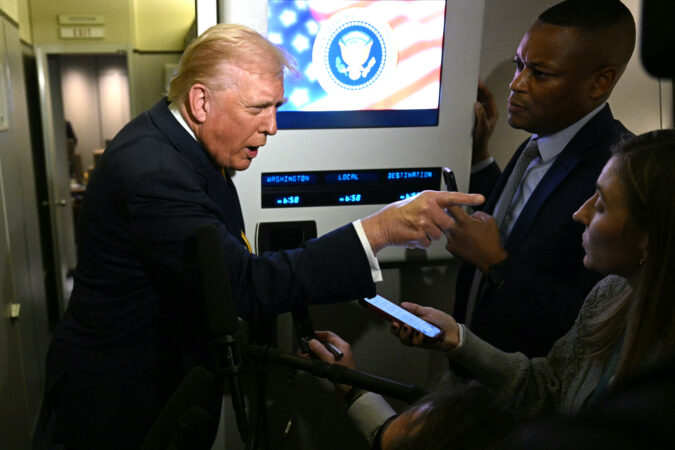
As Trump was speaking to reporters Friday on Air Force One, Bloomberg White House correspondent and former Philadelphia Daily News reporter Catherine Lucey attempted to ask him about the release of the so-called Epstein files, which the Trump administration has refused to make public.
“If there is nothing incriminating in the files —” Lucey said before being cut off.
“Quiet, quiet, piggy,” an angry Trump shot back while pointing at Lucey.
Neither Lucey nor Bloomberg has responded to The Inquirer’s requests for comment.
“Our White House journalists perform a vital public service, asking questions without fear or favor,” Bloomberg said in a statement to the Guardian. “We remain focused on reporting issues of public interest fairly and accurately.”
Lucey, who has not spoken publicly about the matter, was first identified by the Guardian and can be seen in photographs of the interaction with Trump on Air Force One.
Trump’s remarks drew criticism from across the media world. CNN anchor Jake Tapper called the president’s remarks “disgusting and completely unacceptable.” Former Fox News anchor Gretchen Carlson called the president’s comments “degrading.”
“The president continues to behave in ways that not a single parent I know would tolerate from their elementary-school-aged kids,” wrote the Atlantic’s McKay Coppins.
A White House official defended the remark in a statement to MS NOW’s Vaughn Hillyard, claiming without evidence Lucey “behaved in an inappropriate and unprofessional way towards her colleagues on the plane.” The official did not elaborate.
Though the exchange took place days ago, video footage began circulating Tuesday ahead of a House vote on the Epstein files. It has since gone viral among the masses, drawing ire from critics and being reposted by outlets like Pop Crave.
Trump has a history of making sexist comments toward female journalists. He has called women in the press corps “nasty,” “crazy,” and “losers” over the years. He also has used derogatory language about women, comparing them to pigs, dogs, and other animals.
Before her time in D.C., Lucey was a respected reporter in Philadelphia, spending 12 years at the Philadelphia Daily News covering everything from police corruption to local news — but her sweet spot was politics. Her portfolio included coverage of then-Mayor Michael Nutter’s administration and the city’s changing power dynamics.
Lucey left in 2012 to work for the Associated Press, focusing on Iowa state politics and presidential races for four years. From there, she headed to the Wall Street Journal, where she covered the Trump and Biden administrations. She joined Bloomberg in March, according to a news release.
ABC News reporter Mary Bruce asks a question in the Oval Office Tuesday.
Trump also drew criticism Tuesday afternoon after lashing out at ABC News reporter Mary Bruce, who also asked about the Epstein files during an Oval Office meeting between the president and Saudi Arabia Crown Prince Mohammed bin Salman.
“Why wait for Congress to release the Epstein files?” Bruce asked. “Why not just do it now?”
“It’s not the question that I mind, it’s your attitude,” Trump shot back. “You’re a terrible person and a terrible reporter.”
Until recently, Trump had strongly opposed efforts to release the Epstein files. Last week, he called the House’s efforts to press the Department of Justice to make the files available a “Democrat hoax.”
Trump’s social connections to Epstein have been known for decades. Reports show Trump was mentioned in Epstein’s emails more than 1,000 times, making him the most-cited person in the documents released last week by the House Oversight Committee.
But Trump has been reversing his stance on releasing the files, saying on Air Force One, “we have nothing to hide.”
On Tuesday, the House of Representatives passed the Epstein Files Transparency Act in a 427-1 vote, demanding the Justice Department release the unclassified documents on Epstein and his associate Ghislaine Maxwell, who was convicted of sex trafficking.
The Republican-controlled Senate moved quickly Tuesday evening, agreeing to pass the Epstein bill by unanimous consent once it arrived from the House.
The bill would then head to Trump’s desk, who said in recent days he would sign it into law.
WASHINGTON — Congress passed legislation Tuesday to require President Donald Trump’s administration to release troves of records related to notorious sex trafficker Jeffrey Epsteinafter months of pressure from Democrats and survivors on the issue.
The U.S. House voted427-1 to pass the bill on Tuesday, prompting lawmakers in the chamber to cheer. The legislation was then rapidly passed by the U.S. Senate through unanimous consent, a process that skips debate when no senator objects to a bill.
Despite the overwhelming bipartisan consensus, Tuesday’s House vote followed months of pushing by Democrats to bring it the floor as Trump unsuccessfully lobbied to prevent it from receiving a debate.
The president abruptly changed his stance on the bill this week after it became clear it had enough Republican support to pass against his objections. The veto-proof bill now heads to Trump’s desk for his signature.
U.S. Rep. Rob Bresnahan, a freshman Republican who represents Northeastern Pennsylvania, told The Inquirer after the vote that his office “had a lot of phone calls” about the bill.
“We listened to our constituents… and I want to thank the people at home for bringing this to our attention,” he said outside the House chamber.
U.S. Rep. Clay Higgins, a Louisiana Republican, was the sole no vote. Five House members did not vote.
Trump said this week he would sign the bill into law, but he doesn’t actually need congressional approval to order the release of the files and could have already done so — a fact noted by U.S. Rep. Dwight Evans in the lead-up to the vote.
“Let’s be clear — Donald Trump doesn’t have to wait until Congress votes on this resolution,” Evans, a retiring Philadelphia Democrat, said in a Monday post on X. “If he wanted to, he could tell the Justice Department to release the Epstein files TODAY.”
The bill, called the Epstein Files Transparency Act, requires the Department of Justice to publish all unclassified files related to the prosecution and investigation of Jeffrey Epstein, a well-connected financier and convicted sex offender who was found dead in his jail cell in August 2019 and determined to have died by suicide after being federally charged with sex trafficking underage girls. After his death, his close associate Ghislaine Maxwell was convicted of sexually exploiting and abusing girls with him over the course of a decade.
The bill was led by U.S. Rep. Ro Khanna, a California Democrat who grew up in Bucks County, and U.S. Rep. Thomas Massie, a Kentucky Republican who frequently breaks with party leadership. U.S. Reps. Mary Gay Scanlon and Chris Deluzio, both Pennsylvania Democrats, were cosponsors.
Trump suggested on the campaign trail that he would release files related to the Epstein investigation, but after his administration faced uproar over their lackluster release of information surrounding the investigation, he began discrediting the cause.
Trump is mentioned numerous times in files that have already been released, including in an email in which Epstein claims Trump “spent hours at my house” with a young woman who later said she was a victim of Epstein, the New York Times reported last week. The president was neighbors with Epstein in Florida and was photographed with him at numerous social occasions in the 1990s and 2000s. He has called the efforts for more transparency a Democratic “hoax” that had fooled “stupid” Republicans who would be committing a “hostile act” by supporting the release.
Bresnahan was hesitant to answer whether any of the mentions of the president concern him.
“I saw some of the email threads; a lot of it was snippets. I don’t know where it came from,” said Bresnahan, who represents a swing district.
“I want to look at the whole comprehensive picture,” he added.
House Speaker Mike Johnson (R., La.) wasn’t going to allow the bill to be voted on the floor, so Khanna and Massie successfully forced the vote through a discharge petition, which was supported by all House Democrats and just three other Republicans — U.S. Reps. Marjorie Taylor Greene of Georgia, Nancy Mace of South Carolina, and Lauren Boebert of Colorado.
Massie and Khanna started to gather signatures in September and got the 218th needed on Wednesday last week when U.S. Rep. Adelita Grijalva (D. Ariz.) was sworn into office after winning a special election in September.
U.S. Rep. Brendan Boyle, a Philadelphia Democrat, blamed the delay for Grijalva’s swearing in on Trump and Johnson‘s resistance to the bill getting to the floor.
“There is a reason why Donald Trump has worked so hard to keep these Epstein files covered up,” he said in a video he shared on social media.
The bill reaching the floor put Republicans in a new bind: their stance on the matter would be on the record. They had to choose whether their loyalty to Trump would outweigh pressure from constituents on the matter.
Once it became clear the president wouldn’t prevail, Trump had a complete about-face Sunday night and called for lawmakers to support the bill.
“House Republicans should vote to release the Epstein files, because we have nothing to hide, and it’s time to move on from this Democrat Hoax perpetrated by Radical Left Lunatics in order to deflect from the Great Success of the Republican Party,” he posted on Truth Social.
“I DON’T CARE!” he added in the post and claimed that the files are a “curse on the Democrats, not us.”
Khanna said that almost 100 Republicans would have voted for the bill before Trump changed course in an interview with The New York Times.
“Trump saw his MAGA coalition was splintering and the last thing he could have had is a hundred Republicans vote for a Democratic bill in defiance of what he wanted,” he said in the interview. “Obviously, he has enough political instincts to realize how much he was losing on this issue.”
Once Trump signaled support for the bill, Khanna said he would “be surprised if it’s not close to unanimous.”
A separate House Oversight Committee investigation has released thousands of files from Epstein’s estate that show his connections spanning from Trump to influential leaders on Wall Street and across the globe. The Wall Street Journal also revealed over the summer a sexually explicit birthday message that appeared to be from the president to Epstein.
Trump has since called on the Justice Department to investigate ties between his political adversaries and Epstein, particularly the Clintons.
Survivors of Epstein’s abuse rallied outside the Capitol in the cold Tuesday morning.
Liz Stein, a survivor of Epstein’s abuse, said in a statement that she hopes “our elected leaders show the courage to stand with survivors.”
“Those of us directly impacted and harmed by the crimes of Jeffrey Epstein and Ghislaine Maxwell deserve justice and for the world to know our story,” she said. “It’s time for real accountability and true transparency.”
Where did Pa. Republicans stand prior to Tuesday’s vote?
U.S. Rep. Brian Fitzpatrick, a Bucks County Republican and former FBI agent who represents a purple district, had been quiet on the issue.
World Without Exploitation, an anti-human trafficking group that has called for the release of all Epstein files, put a billboard up in Fitzpatrick’s district that says: “Courage is Contagious: Release ALL The Epstein Files.”
Fitzpatrick was also the subject of digital ads from the Democratic National Committee about the Epstein files over the summer that called him one of Trump’s “sycophantic enablers.”
Even though no Pennsylvania Republicans signed onto the petition to allow a vote on the bill, some had previously indicated that they wanted the records released.
Bresnahan said on FOX56 WOLF on Friday that he wouldvote to release the files while making sure victims are protected. He told The Inquirer after the vote that he made that decision “weeks ago.”
When asked whether he was surprised at the near-unanimous support from his Republican peers, he said he “really wasn’t talking to a lot of my peers as to where they were going to be on it.”
Other Republicans made statements over the summer after the Justice Department said it would not release any more files. Attorney General Pam Bondi suggested in February that she had Epstein’s “client list,” but the department released files that were long in the public eye before claiming in July that Epstein didn’t actually have a list of clients.
U.S. Rep. Ryan Mackenzie, a freshman Republican who represents the Lehigh Valley, said during a telephone town hallin July that he would support measures to release DOJ files on Epstein if Trump’s administration doesn’t do more, NPR reported. He echoed that position Monday night, according to news reports.
“I know they have not released as much as I would like to see to date, but hopefully they’re going to be doing that,” he said in July. “And if not, then Congress should potentially step in and compel them to do that because again, the American people deserve to have full transparency and information about what is in those files, and ultimately, we’re going to get there.”
U.S. Rep. Scott Perry, a Trump ally who represents parts of Central Pennsylvania, shared a letter to Bondi on July 18 expressing “serious concern” over how the Epstein case had been handled and said it “remains one of the most troubling examples of apparent failures within our justice system.”
He said the Trump administration’s handling of the case at that point had “only heightened public distrust.” He cited how the administration’s February 2025 release of documents “contained little new information” and its pivot on a supposed client list.
“The continued secrecy surrounding these records undermines public confidence in the Justice Department’s commitment to justice,” he said at the time, requesting a special prosecutor to investigate the handling of the case.
Perry supported a Democratic motion in July to subpoena the Justice Department for the Epstein files in an effort led by U.S. Rep. Summer Lee, a progressive Democrat from Pittsburgh. He also backed motions to subpoena former President Bill Clinton and former Secretary of State Hillary Rodham Clinton related to the case.
Fitzpatrick, Perry, Mackenzie, and Bresnahan all represent districts that will be targeted by Democrats during next year’s midterms.
Also in July, U.S. Rep. Dan Meuser (R., Luzerne) called for the release of “all the pertinent, credible Epstein files” but focused squarely on Clinton.
Other Republicans in the state have been pretty quiet on the matter.
Lee, the Pittsburgh Democrat who led the summer subpoena effort, said in a post on X after the vote that the Department of Justice has “slow-walked” the release of files for months and echoed that Trump hasn’t acted on his ability to compel the department to release the files.
“No matter how wealthy or well-connected, every person who is complicit, enabled, or abused women and girls will be brought to justice,” she added.
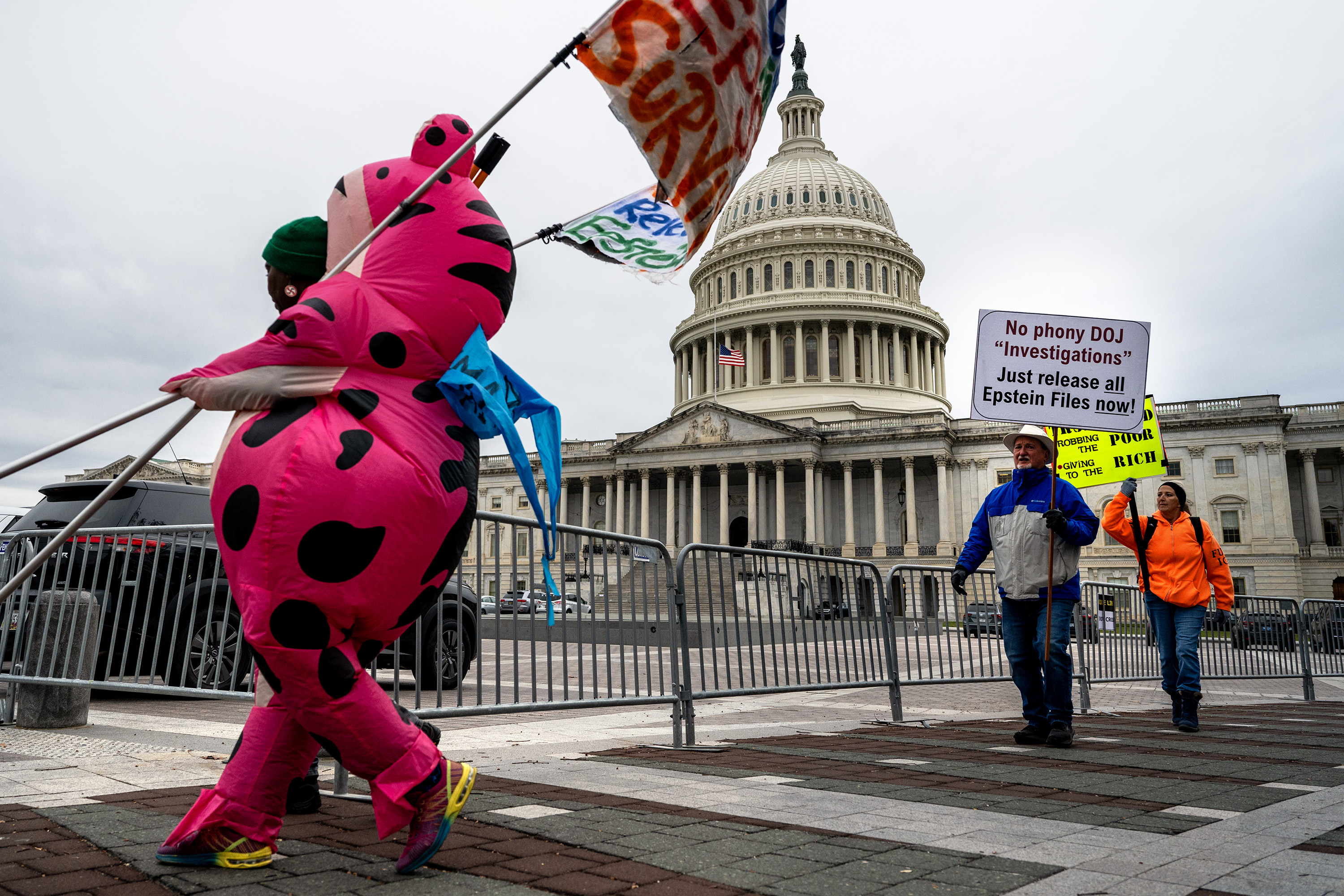
Protesters head to the U.S. Capitol in Washington D.C. Tuesday, Nov. 18, 2025 as a bill that would require the release of records relating to Jefrey Epstein comes to a vote.
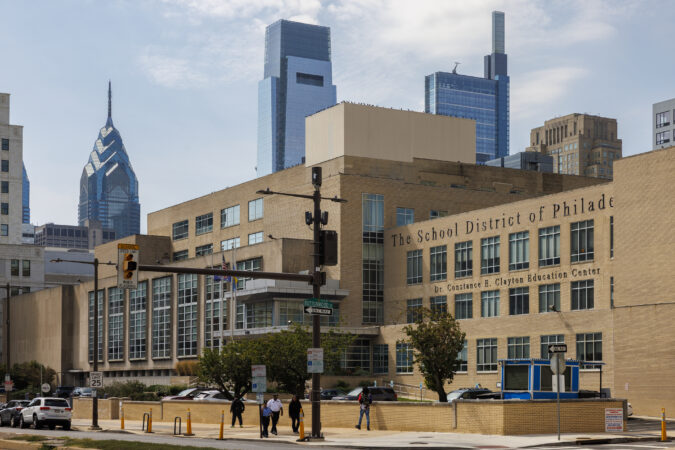
Sweeping changes are coming to the Philadelphia School District, with officials promising large-scale school closings, co-locations, grade reconfigurations, and new construction over the next several years.
But those working closely on the facilities planning process said Monday that four themes are emerging that will shape the recommendations: strengthening K-8 schools, reinvesting in neighborhood schools, reducing school transitions for students, and expanding access to grades 5-12 criteria-based schools.
“Many school programs with declining enrollment, or which operate in aging buildings, struggle to offer a full range of high-quality classes, activities, enrichment opportunities, and supports,” the district said.
Students and teachers in K-8 schoolsneed better spaces and staffing and more resources, and the district cannot achieve that in its current configuration — the district has 216 schools but about 300 buildings, many of which are in poor shape. And enrollment is unevenly distributed — some schools, particularly those in the Northeast, are overcrowded, whileothers have thousands of empty seats.
Citywide, there are 70,000 excess seats in district schools.
The district might merge two schools or co-locate multiple schools in a single building, said Claire Landau, a senior adviser to Watlington tasked with steering the facilities planning process. It might also invest in “more suitable buildings.”
Reinvesting in neighborhood high schools
“Some neighborhood high schools lack a full range of academic enrichment and post-high school preparation pathways, while some smaller magnet high schools lack extracurricular programs and diverse enrichment opportunities,” the district said.
Possible outcomes for reinvesting in neighborhood high schools include “targeted building improvements,” partnerships, and theme-based or career-connected programs in the district’s traditional neighborhood high schools.
Reducing school transitions for students
“Transitions for schools can be disruptive to learning and community connection. Research supports that students do better when they have fewer transitions between school programs during their pre-K-12 experience,” the district said.
There are currently 13 different grade configurations in the district; the aim is to shrink that. To achieve this, the district could increase pre-K-8 schools and adjust grade configurations.
Expanding access to grades 5-12 criteria-based schools
“Philadelphia community desires schools that allow students to learn in one community from middle grades through high school,” the district said. (Some of those already exist — Masterman, for instance, and GAMP.)
To achieve that goal, the district could create more seats at existing 5-12 schools, or create new 5-12 pathways, with an eye toward neighborhood equity.
“This is not going to be a plan that erases or proposes to move away from all of our more traditional middle school grade spans, but we will be looking for opportunities to provide more access to pre-K-through-8 programming and 5-through-12 programming — because of how much support we’ve heard for it from communities across this process as well as what the research shows as far as students doing better in these environments,” said Landau.
The mayor weighs in
Mayor Cherelle L. Parker weighed in on the matter at a district hearing before City Council on Tuesday, saying she was in lockstep with Watlington and the school board president.
“We need to recreate a comprehensive plan for repurposing every underutilized school building in the city of Philadelphia,” Parker said.
But, the mayor said, “that plan will have to include housing, and that includes housing for public servants and educators who deserve to live in the communities that they serve, along with thinking about access to the repurposing of those buildings, to aid us in our desire to build affordable and workforce housing in the city of Philadelphia.”
The Education Department plans to announce Tuesdaythat it will move multiple parts of the agency to other federal departments, an unprecedented and unilateral effort to dismantle an agency created by Congress to ensure all Americans have equal access to educational opportunity and better coordinate federal programs.
The move was described by three people informed of the plan ahead of the announcement. Two of these people said six offices within the department would be shifted elsewhere; the third person said it was at least two.
President Donald Trump signed an executive order in March seeking to close the department and asked Education Secretary Linda McMahon to work with Congress to do so. The agency, which was created in 1979, has long been derided by conservatives as unnecessary and ineffective. But Congress has not acted on or seriously considered Trump’s request.
McMahon has acknowledged that only Congress can eliminate the department but vowed to do everything in her power to dismantle it from within.
Asked for comment, an Education Department spokeswoman suggested some information provided to The Post about the plan was inaccurate, but did not offer specifics.
Supporters of the department say that the agency is effective in coordinating multiple aspects of education in one place and keeping priorities important to students, parents and schools high on the federal agenda.
Offices that could be moved out of the agency include the Office for Civil Rights, which investigates allegations of discrimination on the basis of race, sex and disability; the Office of Special Education and Rehabilitative Services, which administers the $15 billion Individuals with Disabilities Act program; and the Indian Education program; the Office of Elementary and Secondary Education, which administers K-12 grant programs; and the Office of Postsecondary Education.
Federal law directs that these programs be housed in the Education Department. The Trump administration is employing a work-around, the people briefed on the matter said, whereby other government agencies would run the Education programs under a contract with the Education Department. The people spoke on the condition of anonymity because they were not authorized to discuss the changes.
The Trump administration laid the groundwork for this changeearlier this year when it signed an agreement to move career, technical and adult education grantsout of the Education Department to the Labor Department. Under the arrangement, Education retains oversight and leadership while managing the programs alongside Labor, a way of sidestepping thefederal statute.
“We believe that other department functions would benefit from similar collaborations,” McMahon wrote in an op-ed essay published Monday in USA Today.
More broadly, McMahon has argued that the recently ended government shutdown showed how unnecessary her agency is.
“Students kept going to class. Teachers continued to get paid. There were no disruptions in sports seasons or bus routes,” she wrote. “The shutdown proved an argument that conservatives have been making for 45 years: The U.S. Department of Education is mostly a pass-through for funds that are best managed by the states.”
The turning point in Pennsylvania’s budget impasse, by Gov. Josh Shapiro’s telling, came just before Halloween, when he and leaders in Harrisburg gathered in his stately, wood-paneled office to meet twice daily to hash out a deal to end the bitter, monthslong stalemate.
The long grind eventually led to compromises 135 days in, and a deal Shapiro said he thinks is far better than what national Democrats, hoping to extend healthcare subsidies, got in Washington at the end of the federal shutdown.
“Sometimes you’ve got to show that you’re willing to stay at the table and fight and bring people together in order to deliver,” Shapiro told The Inquirer in an interview Friday, touting the state budget agreement finally signed that week.
“I think it’s a stark contrast, frankly, with what happened in D.C., where they didn’t stay at the table, they didn’t fight, and they got nothing,” he said.
Washington is controlled by Republicans, while in Pennsylvania, Democrats control the state House and governorship, and Republicans hold a majority in the Senate.
Both state and federal budgets were signed the same day, offering Pennsylvanians relief from more than a month of government dysfunction at two levels. But for Shapiro — an exceedingly popular Democratic governor facing reelection in 2026 as whispers swirl over his potential 2028 presidential ambitions — the moment was bigger than a procedural win. In the end, Shapiro, preaching his oft-used slogan of “getting things done,” cast the outcome as proof he can muscle through gridlock of a divided legislature, cut deals under pressure, and hold firm where others cave.
So what if it took almost five months? Shapiro argues. At least he didn’t fold.
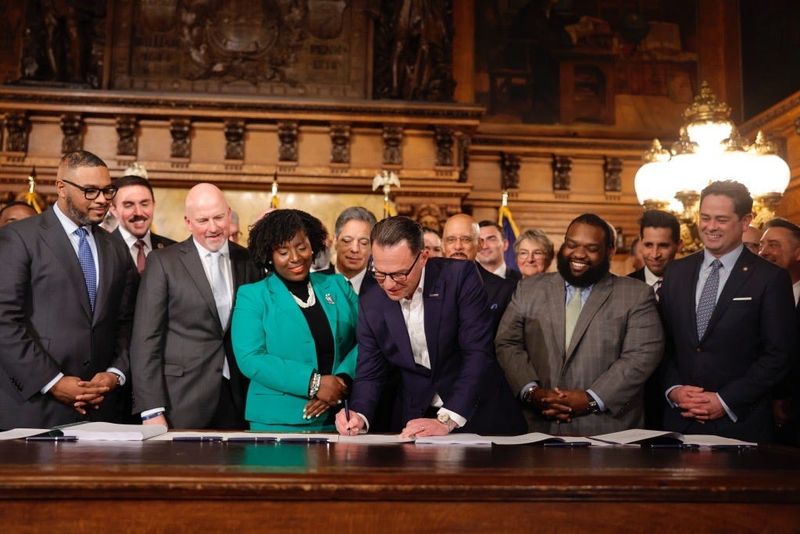
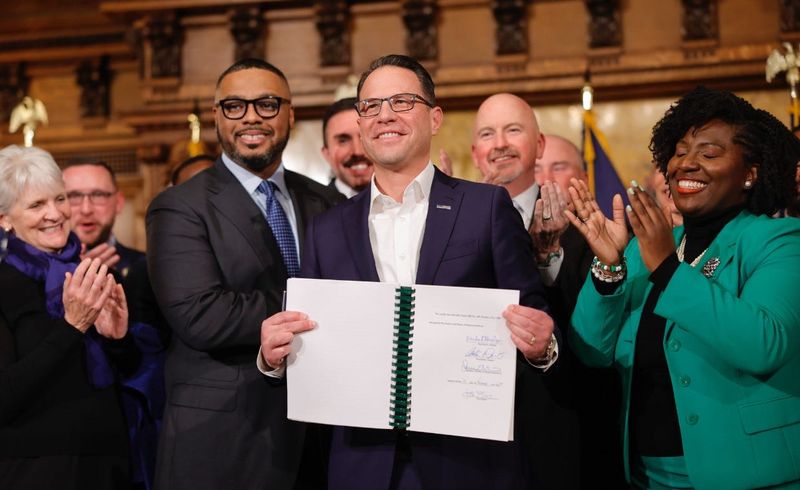
“I would have hoped to have gotten this budget done, you know, 100 or so days earlier,” Shapiro said, putting pen to paper in the state Capitol building’s baroque reception room last week. “But I think what you also saw was the result of having the courage to stay at the table and keep fighting for what you believe in. And we got a lot more than we gave in this budget.”
Gov. Josh Shapiro signs the fiscal year 2025-26 budget surrounded by General Assembly members on Nov. 12 at the Capitol in Harrisburg. The state budget had been due June 30, and Pennsylvania the final state in the country to approve a funding deal.
Critics are quick to note it took the self-proclaimed dealmaker so long to get a deal. Counties, school districts, and nonprofits struggled through four months without state payments while officials remained at loggerheads.Pennsylvania was the last state in the nation to pass a spending plan for the 2025-26 fiscal year.
“He’s five months late. He’s the governor of the fifth-biggest state in the country and the last state to get a budget done,” GOP consultant Vince Galko said. “It’s not a failing grade because it got done, but it’s still a D.”
‘A tremendous cost’
The $50.1 billion budget includes several key priorities for Shapiro and Democrats: significant increases in public education funding, a new tax credit for lower- and middle-income residents, continuation of a popular student-teacher stipend, and other economic and workforce development initiatives.
House Speaker Joanna McClinton (D., Philadelphia) heaped praise on Shapiro during a Monday news conference celebrating the budget’s new Working Pennsylvanians tax credit. “I am grateful that here in Harrisburg we have a hero among us for working families, and his name is Josh Shapiro.”
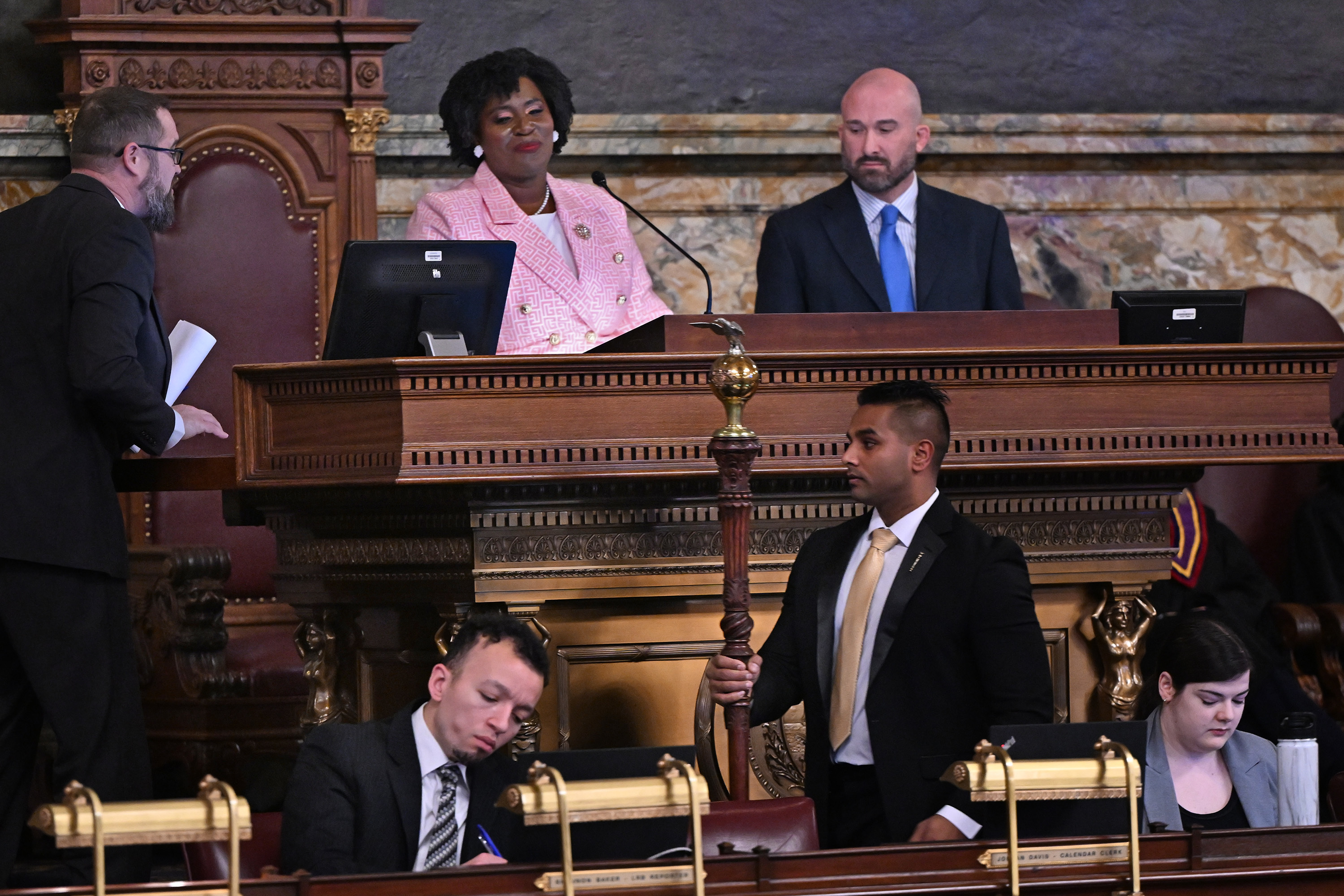
State Rep. Joanna McClinton (D., Philadelphia) is on the rostrum in the House chamber on Jan. 7 after she was reelected speaker of the House despite an initial 101-101 tie vote along party lines.
State Sen. Nikil Saval, a progressive lawmaker who represents part of Philadelphia, was one of a handful of Democrats to vote against the bipartisan Pennsylvania budgetbill that was largely lauded by Democrats and Republicans in Harrisburg and beyond. Saval applauded the school funding, anti-violence grant funding, and childcare support but slammed the absence of transit funding and Democrats’ agreement to end their pursuit to join a key climate program.
“Unfortunately, it comes at this tremendous cost,” he said.And ultimately, Saval said, the finished product didn’t seem to justify the time it took to get there.
Gov. Josh Shapiro visits SEPTA headquarters on Aug. 10 to discuss funding for the transit agency. To his right, from left, are state Democratic legislators Sen. Anthony H. Williams; Sen. Nikil Saval; Rep. Ed Neilson; and Rep. Jordan Harris.
It was not just transit funding that took a back seat to get the budget deal over the line. To thedelight of Republicans — and the chagrin of some progressive Democrats and the climate-conscious — the deal also pulled the state out of the Regional Greenhouse Gas Initiative, a cooperative among states to reduce carbon emissions.
“For years, the Republicans who have led the Senate have used RGGI as an excuse to stall substantive conversations about energy,” Shapiro said. “Today, that excuse is gone.”
The powerful Pennsylvania Building and Construction Trades Council had lobbied heavily for lawmakers to walk away from the initiative, and it was a top win for state Republicans, who have long said the state should not join the multistate cap-and-trade emissions program they see as hamstringing Pennsylvania’s energy industry from accessing the state’s plentiful natural resources.
‘Two-a-days’
Shapiro said he spent months “running back and forth” to broker a deal between Senate Majority Leader Joe Pittman (R., Indiana) and House Majority Leader Matt Bradford (D., Montgomery). The three met on-and-off in private talks, attempting to hammer out a compromise between the Democratic House and Republican-controlled Senate. But the week of Oct. 27, more than four months into the stalemate, Shapiro said a “breakthrough” finally came when he broadened the talks to include McClinton and Ward.
Minority leaders Rep. Jesse Topper (R., Bedford) and Sen. Jay Costa (D., Allegheny) also joined the group, as it became clear that neither of the tightly controlled chambers would have the votes needed to pass a final budget deal.
The group met twice daily in a conference room in Shapiro’s office. Shapiro, always a fan of the sports metaphor, called the meetings “two-a-days.”
“We would come in the morning, go over the issues. We’d have our homework for a few hours, then come back in the afternoon and talk about, you know, the progress that we made,” Shapiro said. Coming out of that week, the governor said, leaders “had a clear direction on where we were going to go.”
Pennsylvania Lt. Gov. Austin Davis and Gov. Josh Shapiro show a budget document moments after it was signed Nov. 12 while surrounded by legislators at the state Capitol. A deal struck Nov. 12 ended a budget delay that lasted more than four months.
At the negotiating table, Shapiro served as “referee and facilitator” between House Democrats and Senate Republicans, McClinton said in an interview Monday.
“The man is nothing if not dogged and determined,” Bradford said of Shapiro last week.
Two officials in the closed-door talks said Topper’s presence, as the House minority leader who understands House Democrats and Senate Republicans, helped change the dynamic and got leaders on track toward a deal. Other officials in negotiations noted that once the state’s two top leaders — McClinton and Ward, who are both the first women to serve in their roles — the breakthrough deal swiftly came together.
Topper, for his part, didn’t try to take credit for striking the final budget deal, calling himself “a neutral arbiter” and “someone all sides can trust to have an honest dialogue.”
There were other signs of tensions easing as the legislators worked through the fall. Ward, a top critic of Shapiro since he reneged on a promise he made over school vouchers during his first budget negotiations, joined the conversations. The two had not met in person since 2023, and had barely communicated. Suddenly, they were sitting across from one another.
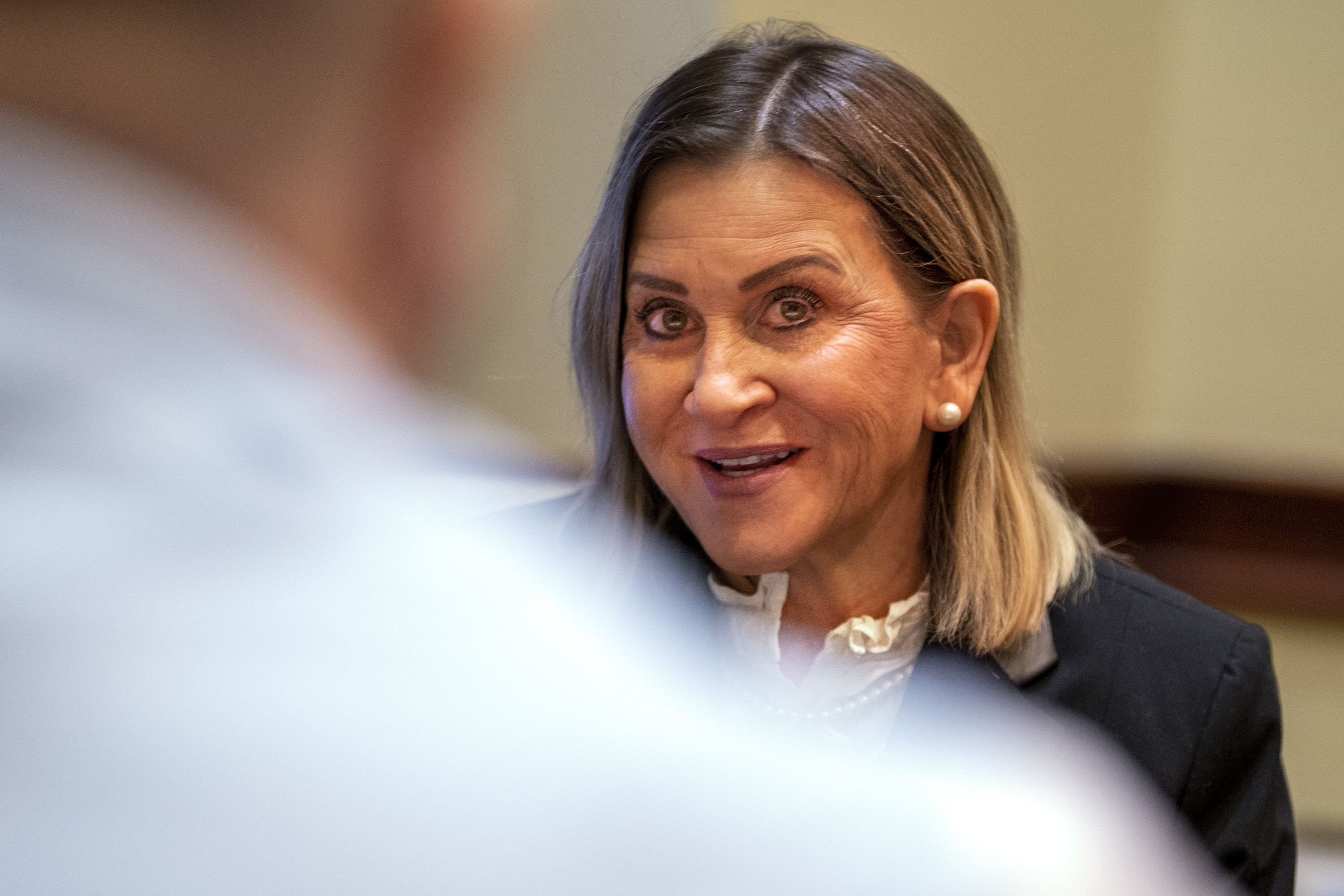
Kim Ward, president pro tempore of the Pennsylvania Senate, talks with her chief of staff Rob Ritson in her office Tuesday, Jan. 17, 2023, before heading out to preside over the swearing-in of Lt. Gov. Austin Davis in the Senate chambers.
Ward said her criticisms of Shapiro still stand — she wants him to be more transparent, among other disagreements. But she described the conversations as “very cordial, very professional.” And there were moments of levity that helped, said the top Republican leader in the Senate, who is known for her wry humor.
“He did leave me a sugar sprinkle heart [cookie] one day at my seat, and I told him, ‘You know, I’m too old for you, and we’re both married,’” she joked.
“I can’t understand why all these legislators think they did a great job,” she said on The Conservative Voice radio program, breaking with GOP leaders, like Ward and Pittman, who lauded the deal. “… Next year, they’re going to have to dip into the Rainy Day Fund to plug a budget, and then taxes are going to go up.”
Because of how long this budget took to finalize, Shapiro will already need to introduce his next budget in just three months, and in proximity to the 2026 midterms and Pennsylvania governor’s election. But it’s unclear whether those negotiations will be as fraught, given budgets tend to get resolved faster in election years with both parties eager to focus on the campaign trail.
“In this day and age, I would not downplay the fact that there was compromise,” said Berwood Yost, a pollster with Franklin and Marshall College. “People want their problems solved. They want politicians to do things that help their everyday lives and that, for most people, means some kind of compromise. Getting this problem solved fits with his narrative.”
Galko, the GOP consultant, looked further ahead to a potential 2028 presidential election. The budget impasse, he said, could provide material for Democratic rivals on the national stage. The possible field is filled with other governors, several from blue states, like Gov. JB Pritzker of Illinois and Gov. Gavin Newsom of California, where in-state dealmaking is easier among a uniform legislature.
“If he’s unable to negotiate with the Pennsylvania Senate, what’s he gonna do when he goes up against China or Russia?” Galko asked, previewing the possible attack.
Ultimately, history suggests Shapiro’s political success is likely to hinge less on the nuts and bolts of a budget only some Pennsylvanians — and even fewer outside Pennsylvania — are familiar with, and more on his ability to bolster his image as a bipartisan governor in a purple state.
On Friday morning in South Philadelphia, Shapiro sported a bomber jacket while posing for selfies with Eagles fans, nodding along to a rock band’s cover of “Santeria” in a tent outside the Xfinity Mobile Arena at an event hosted by radio station WMMR.
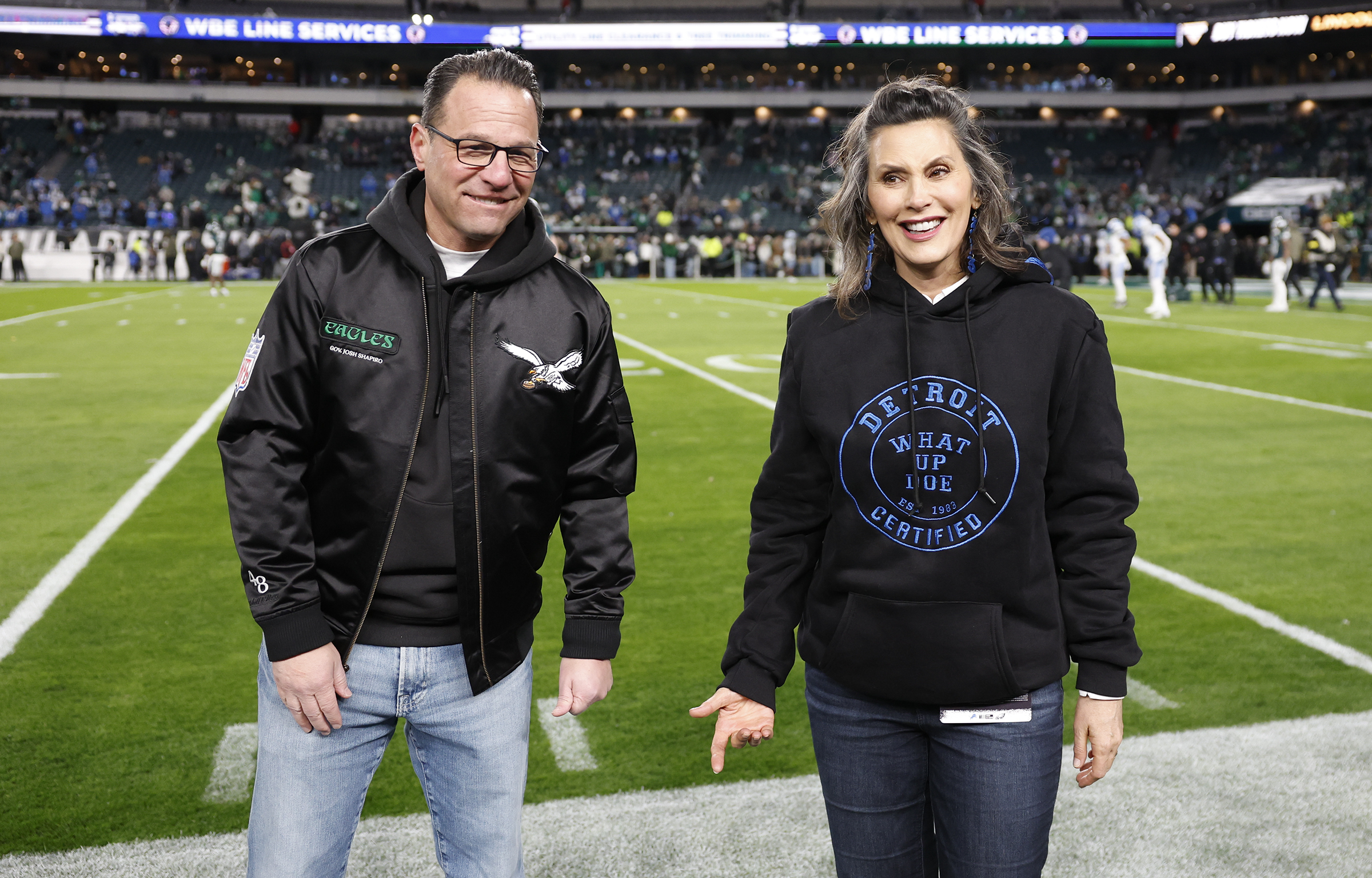
Casually, almost as a throwaway line, Shapiro mentioned to radio hosts Preston and Steve during an interview that he planned to bring Michigan Gov. Gretchen Whitmer — a fellow swing-state governor seen, too, as a possible 2028 Democratic contender — as his guest to the Eagles-Lions game at the Linc that Sunday.
“She actually said, ‘Is it OK if I wear Lions stuff?’” Shapiro told the kelly green-clad crowd in Philadelphia, riffing on the friendly football rivalry — the undercurrents of national politics left unspoken. “And I’m like, ‘No problem. You’re on your own in the parking lot. I can’t protect you.’”
Michigan Gov. Gretchen Whitmer joined Pennsylvania Gov. Josh Shapiro at Sunday’s game between the Eagles and Detroit Lions at Lincoln Financial Field.
The event was a food drive but also served as a tribute to the station’s beloved late host, Pierre Robert. Shapiro brought along a commendation from the governor’s office for the occasion.
“He created community, created joy, brought people together,” Shapiro said of Robert. “You think about just how divided we are as a world, there’s a few things that still bring us together, right?”
“By the way, I’ve learned those lessons. That’s what I try and do governing with a, you know, divided legislature.”
Music and sports, the governor mused before the crowd of Philadelphia fans, are two things that bridge the gap. “Go Birds,” he added with a grin.
Staff writer Katie Bernard contributed to this article.
Fetterman has not announced whether he will run for reelection in 2028, but the progressive party put out a public declaration Tuesday pledging to endorse — and, if necessary, recruit and train — a challenger.
The announcement, first reported by The Inquirer, is a remarkable step for the left-leaning organization to take more than two years before an election and speaks to the degree of frustration with Fetterman among progressives.
“At a time when Donald Trump and Republicans in Congress are doing everything they can to make life harder for working people, we need real leaders in the Senate who are willing to fight for the working class,” Shoshanna Israel, Mid-Atlantic political director for the Working Families Party, said in a statement.
“Senator Fetterman has sold us out, and that’s why the Pennsylvania Working Families Party is committed to recruiting and supporting a primary challenge to him in 2028.”
Fetterman did not immediately return a request for comment about the Working Families Party’s announcement.
The Working Families Party is a progressive, grassroots political party that is independent from the Democratic Party, but it often endorses and supports Democratic candidates.
Though he supports extending federal healthcare subsidies, Fetterman has long said he is against government shutdowns as a negotiating tactic and will always vote to get federal coffers flowing and federal employees paid.
“I’m sorry to our military, SNAP recipients, gov workers, and Capitol Police who haven’t been paid in weeks,” Fetterman said in a post on X after the vote. “It should’ve never come to this. This was a failure.”
Already one of the most well-known and scrutinized senators in Washington, Fetterman was back in the spotlight this week as he returns to work following a hospitalization after a fall near his home in Braddock. His staff said he suffered a “ventricular fibrillation flare-up” and hit his face, sustaining “minor injuries.”
Ventricular fibrillation is the most severe form of arrhythmia — an abnormal heart rhythm — and the most common cause of sudden cardiac death.
He spent Thursday and Friday in the hospital and was released Saturday, saying he was feeling good and grateful for his care with plans to be back in the Senate this week.
Working Families on the offensive
Israel said in addition to the online portal, the party will hold a number of recruitment events across Pennsylvania in the coming months to train candidates and campaign staff on the basics of running for office and managing a campaign with hopes of finding quality candidates for a variety of races ahead of 2028.
The party is also pledging a robust ground game and fundraising for a potential challenger it supports.
It wouldn’t be the first time the Working Families Party has opposed Fetterman. In the 2022 Democratic Senate primary, WFP endorsed State Rep. Malcolm Kenyatta (D., Philadelphia) over Fetterman, who was lieutenant governor at the time.
The book makes no mention of a reelection bid but laments the ugly politics he experienced in both the Democratic primary and his general election race against Mehmet Oz.
Fetterman said in the book that Oz’s attacks during his rehabilitation from his stroke became so mentally crushing he felt he should have quit the race.
And he grapples with criticism he faced during the primary surrounding a 2013 incident in which he wielded a shotgun and apprehended a Black jogger he suspected of a shooting. Fetterman calls the backlash an early trigger of his depression.
Fetterman has said he will remain a Democrat even as Republicans have lauded his independent streak and willingness to work with the GOP.
Earlier this year, Fetterman was the first Senate Democrat to support the Laken Riley Act, a Republican immigration bill that requires U.S. Immigration and Customs Enforcement to detain and take into custody individuals who have been charged with theft-related offenses, even without a conviction. Critics of the law say it severely cracks down on due process for immigrants.
Fetterman was the sole Senate Democrat to vote to confirm Attorney General Pam Bondi, who was one of Trump’s attorneys when he tried to overturn the results of the 2020 election.
“He has repeatedly shown disregard for the rights of Palestinians,” the Working Families Party release said. “Refusing to support a two-state solution and breaking with the rest of the Democratic caucus on Israel’s illegal annexation of the West Bank.”
Staff writer Aliya Schneider contributed to this article.
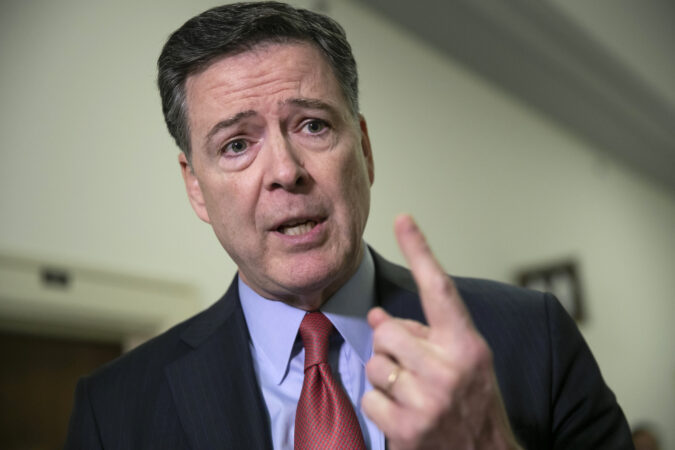
WASHINGTON — The Justice Department engaged in a “disturbing pattern of profound investigative missteps” in the process of securing an indictment against former FBI Director James Comey, a federal judge ruled Monday in directing prosecutors to provide defense lawyers with all grand jury materials from the case.
Those problems, wrote Magistrate Judge William Fitzpatrick, include “fundamental misstatements of the law” by a prosecutor to the grand jury that indicted Comey in September, the use of potentially privileged communications during the investigation and unexplained irregularities in the transcript of the grand jury proceedings.
“The Court recognizes that the relief sought by the defense is rarely granted,” Fitzpatrick wrote “However, the record points to a disturbing pattern of profound investigative missteps, missteps that led an FBI agent and a prosecutor to potentially undermine the integrity of the grand jury proceeding.”
The 24-page opinion is the most blistering assessment yet by a judge of the Justice Department’s actions leading up to the Comey indictment. It underscores how procedural missteps and prosecutorial inexperience have combined to imperil the prosecution pushed by President Donald Trump for reasons separate and apart from the substance of the disputed allegations against Comey.
A different judge is set to decide by Thanksgiving on the challenges by Comey and James to Halligan’s appointment.
Though grand jury proceedings are presumptively secret, Comey’s lawyers had sought records from the process out of concern that irregularities may have tainted the case. The sole prosecutor who defense lawyers say presented the case to the grand jury was Halligan, a former White House aide with no prior prosecutorial experience who was appointed just days before the indictment to the job of interim U.S. attorney for the Eastern District of Virginia.
In his order Monday, Fitzpatrick said that after reviewing the grand jury transcript himself, he had come away deeply concerned about the integrity of the case.
“Here, the procedural and substantive irregularities that occurred before the grand jury, and the manner in which evidence presented to the grand jury was collected and used, may rise to the level of government misconduct resulting in prejudice to Mr. Comey,” Fitzpatrick said.
The Justice Department responded to the ruling by asking that it be put on hold to give prosecutors time to file objections. The government said it believed Fitzpatrick “may have misinterpreted” some facts in issuing his ruling.
Fitzpatrick listed, among nearly a dozen irregularities in his ruling, two different comments that a prosecutor — presumably, Halligan — made to the grand jury that he said represented “fundamental misstatements of the law.”
The actual statements are blacked out, but Fitzpatrick said the prosecutor seems to have ignored the fact that a grand jury may not draw a negative inference about a person who exercises his right not to testify in front of it. He said she also appeared to suggest to grand jurors that they did not need to rely only on what was presented to them and could instead before assured that there was additional evidence that would be presented at trial.
The judge also drew attention to the jumbled manner in which the indictment was obtained and indicated that a transcript and recording of the proceedings do not provide a full account of what occurred. Halligan initially sought a three-count indictment of Comey, but after the grand jury rejected one of the three proposed counts and found probable cause to indict on the other two counts, a second two-count indictment was prepared and signed.
But Fitzpatrick said it was not clear to him in reviewing the record that the indictment that Halligan presented in court at the conclusion of the process had been presented to the grand jury for their deliberation.
“Either way, this unusual series of events, still not fully explained by the prosecutor’s declaration, calls into question the presumption of regularity generally associated with grand jury proceedings, and provides another genuine issue the defense may raise to challenge the manner in which the government obtained the indictment,” he wrote.
The two-count indictment charges Comey with lying to Congress in September 2020 when he suggested under questioning that he had not authorized FBI leaks of information to the news media. His lawyers say the question he was responding to was vague and confusing but the answer he gave to the Senate Judiciary Committee was true.
The line of questioning from Sen. Ted Cruz appeared to focus on whether Comey had authorized his former deputy director, Andrew McCabe, to speak with the news media. But since the indictment, prosecutors have made clear that their indictment centers on allegations that Comey permitted a separate person — a close friend and Columbia University law professor, Dan Richman — to serve as an anonymous source in interactions with reporters.
The FBI executed search warrants in 2019 and 2020 to access messages between Richman and Comey as part of a media leaks investigation that did not result in charges. But Fitzpatrick said he was concerned that communications between the men that might have been protected by attorney-client privilege — Richman was at one point functioning as a lawyer for Comey — were exposed to the grand jury without Comey having had an opportunity to object.
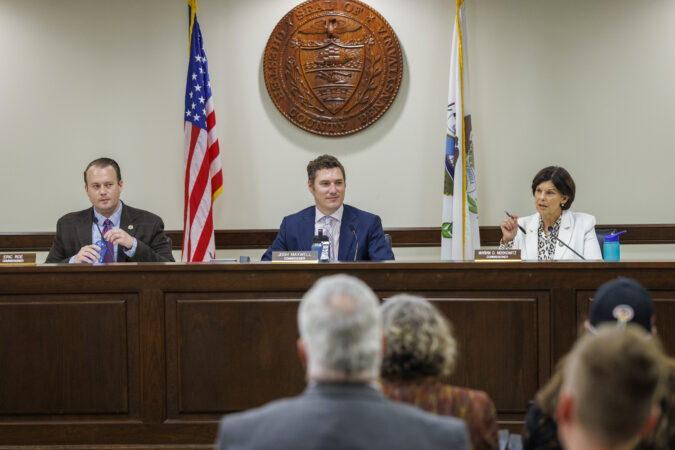
The Chester County Board of Elections rejected Republican challenges to provisional ballots Monday as the board prepares to launch an investigation into a poll book error that forced thousands of independent and third-party voters to cast provisional ballots during this month’s election.
In a nearly six-hour meeting, the Democratic-led board heard from dozens of voters and poll workers who described the chaos they endured on Nov. 4 during the high-turnout municipal election. The election resulted in more than 12,000 provisional ballots being cast primarily by independent and third-party voters blocked from voting on machines — an unusually high amount.
The election board, which is made up of the county’s commissioners, voted to count the vast majority of the provisional ballots, arguing that the county’s mistake allowed the board to accept ballots that would be rejected under normal circumstances.
“People’s ballots deserve to be counted in this circumstance,” said Josh Maxwell, a Democrat who chairs the three-member board. “If we make a mistake, we have to remedy it.”
The error was caused when officials mistakenly sent poll books to precincts that did not include the names of independent and third-party voters. Until supplemental poll books were provided to precincts late in the day, those voters were asked to cast a provisional ballot.
Provisional ballots are cast when voters are unable to vote by machine on Election Day, most often because they already requested a mail ballot or are at the wrong polling place.
The ballots require an additional level of review before they are counted. Provisional ballots are often more likely to be rejected than mail ballots or ballots cast on voting machines in person because voters are less familiar with the voting method and are required to place ballots in a secrecy envelope and sign in two places.
The Chester County Republican Committee objected to the counting of more than 1,000 ballots ahead of Monday’s meeting. That number whittled down as the committee withdrew objections to ballots where the error was likely caused by election workers. But the GOP committee’s attorney argued that it would be illegal to count ballots missing the first required voter signature or a secrecy envelope.
By allowing the votes to count, she argued, the board was setting a dangerous precedent.
“These votes are not going to change the outcome of elections, but what they do is they change the way the law is interpreted. They give someone the ability to bypass the safeguards that are in the law,” said Dolores Troiani, an attorney for the county GOP.
In response, the letter said, county officials should not certify the November election.
Democratic officials rejected all the GOP challenges.
“We should not, especially when it is of no fault of their own, be disenfranchising voters,” said Democratic Commissioner Marian Moskowitz.
Republican Commissioner Eric Roe voted against counting the ballots, arguing that there was no legal basis to do so.
“If the legislaturewanted to make exceptions, it should have and would have said so,” Roe said. “I will be relying on what the law says and not what I wish it says.”
Voters on Monday voiced frustration and confusion at having learned their ballot, which they were told would count, would be rejected for an error they were not aware of at the polling place. Several were angry that the county GOP asked for eligible voters’ ballots to be rejected.
Edith Jones, a poll worker, approached the podium nearly in tears Monday to tell commissioners that she worried she’d caused more than a dozen voters to have their ballots thrown out. As the day began, she said, she directed voters to fill out their provisional ballots but forgot to provide them with the required secrecy envelope.
“I gave them instructions, but when somebody in authority tells you what to do, who’s going to read all those words on the paper?” Jones said.
Throughout testimony, voters and the Republican Partyquestioned how the error could occur and demanded remedy moving forward.
“We have no guarantee they’ll fix it,” Troiani said in an interview after the meeting. However, the attorney said the party would not appeal the board’s decisions.
Last week, the county announced plans to hire an outside firm to investigate the poll book error.
This suburban content is produced with support from the Leslie Miller and Richard Worley Foundation and The Lenfest Institute for Journalism. Editorial content is created independently of the project donors. Gifts to support The Inquirer’s high-impact journalism can be made at inquirer.com/donate. A list of Lenfest Institute donors can be found at lenfestinstitute.org/supporters.
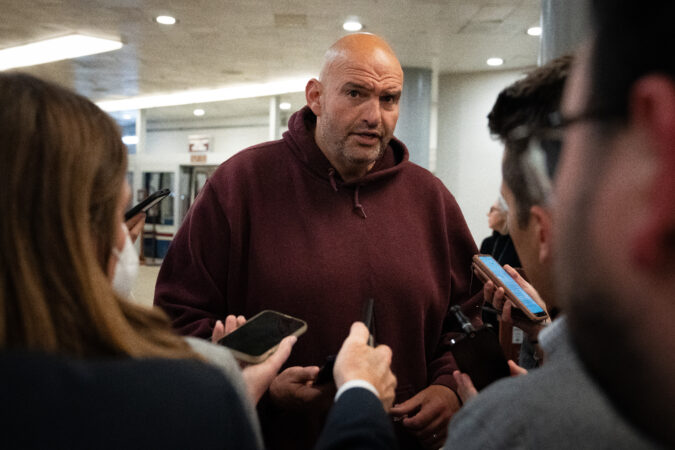
Sen. John Fetterman is back to work after recovering from a fall that required hospitalization.
Fetterman (D., Pa.) was hospitalized last week following a fall after he experienced a heart issue, an unnamed spokesperson announced Thursday. On Saturday, Fetterman shared a selfie after being released from the hospital with a coffee in hand.
Come Monday he was back in the public eye, appearing at an event hosted by the Jewish Federations of North America (JFNA)in Washington. His presence sent the message that he’s back in commission.
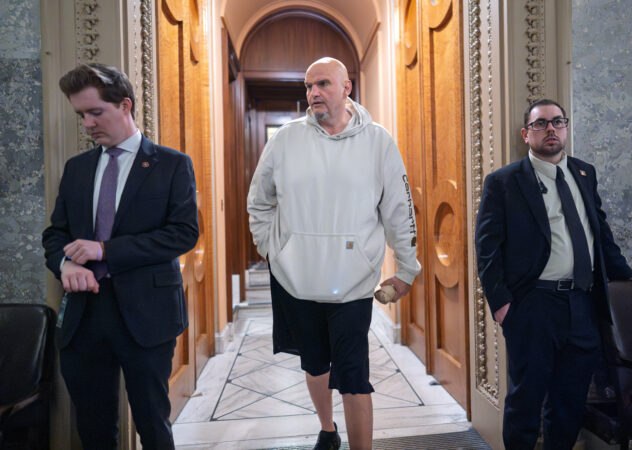
Photos posted by attendees on social media show the senatorwearing his signature hoodie and shorts.
His face is still healing from the fall after what he described in his Saturday post as “20 stitches later and a full recovery.”
“See you back in DC,” he said on X.
20 stitches later and a full recovery, I’m back home with @giselefetterman and the kids.
I’m overwhelmed + profoundly grateful for all the well-wishes.
Truly.
Grateful for @UPMC for the incredible medical care that put me back together.
Fetterman’s Monday appearance was part of the JFNA’s General Assembly — which began on Sunday and will continue through Tuesday. The three-day event is described on the group’s website as a gathering for Jewish community leaders, professionals, philanthropists, and community partners to “address pressing issues, explore best practices, and cultivate innovative solutions.”
Fetterman sat on stage during a session called “Monday Morning Plenary: Protecting Our Communities Today.” It was advertised as giving attendees the opportunity to “hear from leaders on the front lines who are building stronger systems of protection and trust.”
Other guests listed alongside Fetterman for the morning program included Annie Sandler, president of the Joint Distribution Committee; the Rev. Juan Rivera, president of the Hispanic Israel Leadership Coalition; Zibby Owens, founder of Zibby Media; and Olivia Reingold, staff writer at the Free Press. The Free Press is a center-right outlet that Fetterman had provided an exclusive excerpt of his book to ahead of its release.
Steven Schimmel, executive director of the Jewish Federation of Central Massachusetts, said in a post on X that Fetterman shared on the JNFA stage that his wife Gisele’s free store “has been vandalized by anti-Israel activists.”
His unnamed spokesperson had said his fall last week was due to a ventricular fibrillation “flare-up.” Ventricular fibrillation is a life-threatening heart issue. The incident comes after the senator suffered a near-fatal stroke in 2022.
The medical incident came just two days after he released his new memoir, Unfettered, in which he discusses his recovery from the stroke and his battle with depression that followed.