Democratic veterans in Congress, including two from Pennsylvania, are taking personally comments U.S. Rep. Scott Perry made to a conservative radio station asserting that Democrats in Congress “hate the military” — and the lawmakers are hitting back.
“That’s only a credential that they get when they want to run for office,” Perry said, of Democrats, during an interview last week on The Chris Stigall Show.
”They join the military, they serve a little bit, they get the credential and then they run for office and wear the uniform and say, ‘Look at me — I support America.’ But let’s face it, all their votes say they don’t support America.”
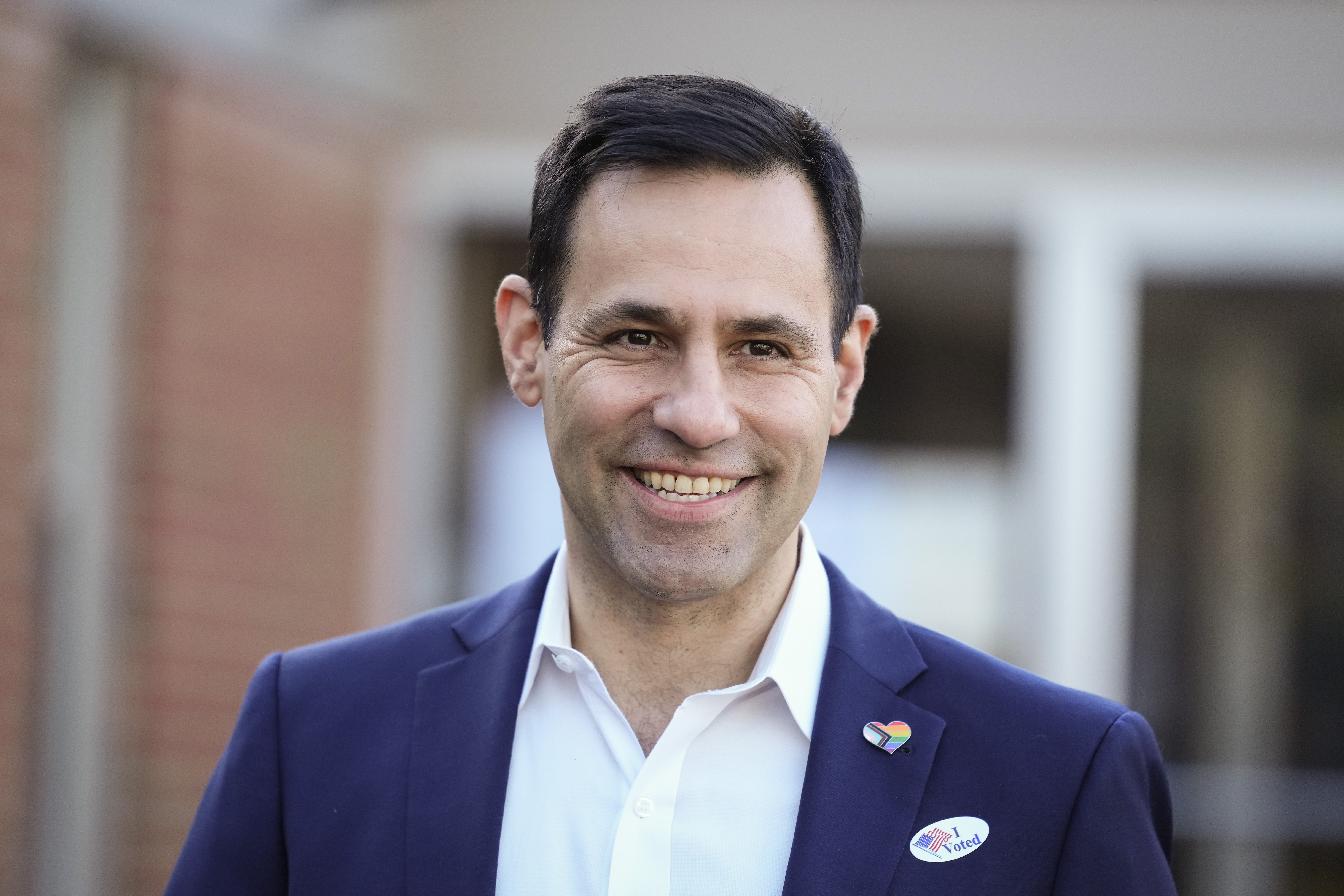
Perry made the commentslast week, but a report this week from the New York Times prompted backlash from Perry’s colleagues on the other side of the aisle, including U.S. Rep. Chris Deluzio, a Democrat who represents the Pittsburgh suburbs and served six years in the Navy.
On Wednesday, members of the Democratic Veterans Caucus, cochaired by Deluzio and U.S. Rep. Pat Ryan (D., N.Y.) called the remarks “insulting to their service,” in a statement shared with The Inquirer.
“It’s disgusting to see a sitting member of Congress attack the integrity and honor of veterans and servicemembers due to their political party,” the veterans wrote. “He should immediately apologize to his constituents for insulting their service and questioning their patriotism.”
The statement blasted Perry as an “oathbreaker,” noting he was part of an effort to throw out Pennsylvania’s electoral votes after President Donald Trump’s loss in the 2020 election. The lawmakers also criticized Perry’s unwillingness to hold in-person town halls, something very few Republican lawmakers have been doing since Trump’s first administration.
“If he had a spine he’d stand in front of the Democratic veterans he represents and say this garbage to their faces, but Scott Perry doesn’t have the guts,” his House colleagues wrote.
Perry, in a statement, pushed back clarifying his remarks were not about “all Democrats,” but “Leftists in Congress who served in the military and use that as a shield to insulate themselves from accountability for their radial and corrosive ideologies.”
“The leftists now stomping their feet about my response are the same leftists who caused our government to shut down,” Perry said in his response.
Still, the comments from Perry about his colleagues and their jilted response illustrate the ways in which political insults have accelerated. Lawmakers who have served in the military had long been one of the few bipartisan groups bonded through service. A group of Democratic and Republican former service members serving in Congress called For Country Caucus still meets for early morning breakfasts on the Hill.
Perry, a House member since 2013, served in the U.S. Army and has been a staunch conservative voice, unabashed with his criticism of Democrats. Perry retired from the Army National Guard in 2019 with the rank of brigadier general after 39 years of service.
HARRISBURG — The Republican-led Pennsylvania Senate sent a $47.9 billion spending plan to the state House on Tuesday, but the proposal was dead on arrival and deemed “unserious” in the Democratic-controlled chamber, marking the latest chapter of the nearly four-month-long budget impasse in the state’s bitterly divided legislature.
The Senate GOP plan, which passed the chamber by a 27-23 vote along party lines, included a $300 million, or 0.6%, total increase over last year’s budget that is intended to cover the state’s debt service and pension obligations, in addition to cutting operational spending for the legislative body by 5%, said Senate Majority Leader Joe Pittman (R., Indiana).
The House Democrats’ $50.25 billion spending bill was a slight decrease from the $51.5 billion budget proposal Democratic Gov. Josh Shapiro pitched in February. And it was an attempt by House Democrats at reaching a compromise — decreasing their proposed spending by 2.4% over Shapiro’s initial pitch — after encouragement from Senate President Pro Tempore Kim Ward (R., Westmoreland) for legislative leaders to bring the usually closed-door budget negotiations into the public eye.
But the Senate GOP’s counteroffer passed Tuesday included little compromise and little increase in spending. However, it is a budget that would fund Pennsylvania’s needs rather than wants, several top GOP senators said during floor debate on the bill.
“All it takes is one day and one vote to end this ‘Shapiro Shutdown,’” Pittman said in his floor remarks in support of the GOP budget bill.
Several GOP senators noted the state’s fiscal outlook as the reason lawmakers cannot afford to spend much more over last year, as Pennsylvania is on track to bring in $46.4 billion during the 2025-26 fiscal year, which is significantly less than Shapiro and House Democrats want to spend.
Pennsylvania is sitting on approximately $10 billion in reserves, from its leftover balance from the 2024-25 fiscal year and its hefty Rainy Day Fund. Democrats want to tap into those reserves and reinvest them in the state, while Republicans believe it is critical to protect those funds to maintain the state’s bond rating or cut taxes as a way to reinvest those surpluses back into taxpayers’ pockets.
Top Senate Republicans on Tuesday urged the state House to return to session and pass their $47.9 billion spending plan as the most responsible way to protect Pennsylvania taxpayers in future years. And some offered criticism of Shapiro, who has continued to host news conferences around Pennsylvania during the 113-day budget impasse, accusing the governor of failing to lead in Harrisburg on budget negotiations.
“If you want to have an honest conversation about how to get this budget done, a governor gallivanting across the state taking potshots at members of this caucus doesn’t help,” Pittman said.
What was not mentioned Tuesday among Senate Republicans was that $47.9 billion is the highest number that the most conservative members of the GOP Senate caucus have pledged to spend. Sen. Dawn Keefer (R., Cumberland), who led the House Freedom Caucus before her election to the state Senate last year, even went as far as to take a flamethrower to a replica of Shapiro’s budget proposal in a social media video earlier this year while promising viewers through a rhyme that she would “hold the line at $47.9″ billion.
Sign posted by the PA Senate at the Pennsylvania State Capitol in Harrisburg Aug. 26, 2025, reminds visitors of the state’s “multi-billion dollar structural deficit.”
Senate Democrats firmly rejected the GOP plan as a farce that would not cover the state’s obligations for this fiscal year or make critical increases to public education funding needed to improve Pennsylvania’s school funding system. The top Senate Democratic leader, Sen. Jay Costa (D., Allegheny), tried several legislative maneuvers to try to get the Senate to vote on the House Democrats’ bill instead of the GOP proposal, all of which failed.
“They thumbed their noses and they said, ‘Go to heck,’” State Sen. Vincent Hughes (D., Philadelphia), the minority chair of the Senate Appropriations Committee, said of his GOP colleagues’ response to the House bill ahead of Tuesday’s vote.
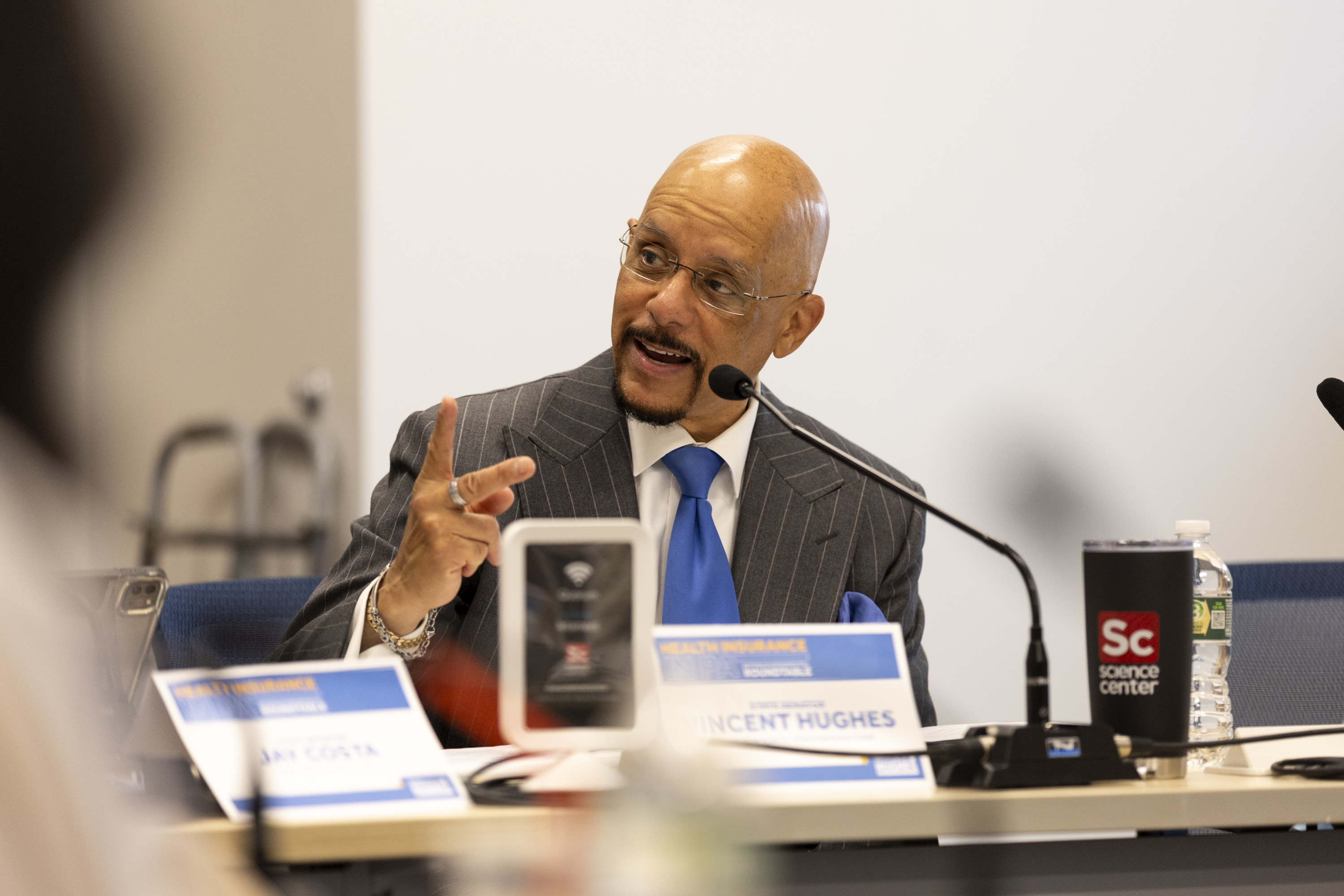
Senator Vincent Hughes, speaks at the Round table with Pennsylvania lawmakers, stakeholders, health systems to discuss potential cuts to Medicaid and ACA at the University City Science Center in Philadelphia, Pa., on Tuesday, April 22, 2025.
Shapiro, following a news conference in Allegheny County on Tuesday, voiced a similar sentiment when he told reporters the Senate’s proposal was “a joke” and “not designed to be serious or get the job done.” He again urged top GOP Senate leaders to begin meeting with top House Democrats to finalize a budget deal.
“I’m sorry transit didn’t get funded. But just because your top priority didn’t get addressed doesn’t mean that our priorities are no longer relevant, and that’s a hard truth,” Pittman,who has been critical of Pennsylvania’s mass transit systems and was a major roadblock in finalizing a deal, said Tuesday.
And, as evidenced by Tuesday’s vote, leaders still do not agree on how much Pennsylvania should spend for the current fiscal year, now almost in its fifth month. Pennsylvania is the only state in the nation without any spending plan. North Carolina, which passed a six-month budget in early summer, returned to session this week to finish budget negotiations.
Sen. John Fetterman (D., Pa.) said he would back a Republican plan to override the Senate filibuster if it meant passing a bill to reopen the government.
In an interview with The Inquirer on Tuesday, Fetterman admonished fellow Democrats who balk at the notion of using the so-called nuclear option to end the filibuster: “When I ran for Senate, everyone, including myself, said we’ve got to get rid of the filibuster. I don’t want to see any Democrats clutching their pearls about it now.
“If we’d had our way, the filibuster wouldn’t have been around for years.”
A staple of the Senate that has long been debated, the filibuster requires 60 votes to pass most legislation in the chamber.
Republicans have long vowed to protect the filibuster, noting that the 60-vote threshold presents a check on Democrats when they have the majority,but it’s now the rule standing in the way of their government funding bill. And in recent months, leaders have made moves to further weaken the minority party’s power, including bypassing the need to get Democratic support to confirm a slate of President Donald Trump’s nominees last month. Senate Majority Leader John Thune (R., S.D.) has thus far said he won’t use the same tactic to reopen the government.
Fetterman’s comments on Tuesday followed several Republicans floating the idea of getting rid of the filibuster in recent days.
Fetterman is one of three members of the Democratic caucus who voted with Republicans to reopen the government earlier this month, joining Sens. Catherine Cortez Masto of Nevada and Angus King, a Maine independent.
“If you look at my record, I’ve been voting the Democratic line, but this is different now. The tactic is wrong,” Fetterman said.
He said his main concern is the possibility that people in the state and across the country would face hunger if the federal government shutdown continues and Americans lose their Supplemental Nutrition Assistance Program (SNAP) benefits beginning Nov. 1.
“Nobody checks their political party when they’re hungry,” he said. “It’s not about a political side blinking. The only losers are the American people now.”
Fetterman added that he is in favor of extending tax credits, as Democrats are demanding during the shutdown. With those tax credits set to expire, people are going to start seeing higher prices when they sign up for health insurance come open enrollment in November, experts say.
“I don’t want people clobbered,” Fetterman said. “But Democrats designed them to expire this year. We passed these things when we were in the majority.”
Seeing room for dialogue, Fetterman said Thune “is an honorable man, and I believe a productive conversation to extend tax credits can be had with him.”
Sen. Andy Kim (D., N.J.) said he had multiple conversations with Senate Republicans on Tuesday who said they would “adamantly oppose” ending the filibuster.
“That’s been a huge part of how they’ve been able to lock down power here in D.C. before,” Kim said.
He said from his perspective, Senate Democrats are focused on getting the House back to work to negotiate a deal that includes the extended healthcare subsidies in a government funding bill.
“This is not an issue of Senate procedure. This is an issue of just doing our job.” Kim did not comment on Fetterman’s support for a filibuster carveout to end the shutdown.
In 2022, according to the media and politics site Mediaite, every Senate Democrat with the exceptions of then-Sens. Joe Manchin of West Virginia and Kyrsten Sinema of Arizona voted to eliminate the filibuster in a failed effort to pass former President Joe Biden’s elections overhaul.
A sometimes contrary figure, Fetterman has taken controversial stands in the past and is one of few Democrats who actively works with Republicans.
He has been criticized by progressives for his unwavering support of Israel in its war against Hamas.
And Fetterman garnered the enmity of some Democrats (and the praise of President Donald Trump) when he defended Immigration and Customs Enforcement by saying fellow Democrats’ calls to abolish the agency were “inappropriate and outrageous.”
As nearly 2 million Pennsylvanians brace for the loss of their food assistance next month due to thefederalgovernment shutdown, the Pennsylvania Department of Human Services is pinning the blame on Republicans on Capitol Hill.
States administer the federally funded Supplemental Nutrition Assistance Program, which provides support to low-income people, including families with children. But as the standoff in Congress prevents federal funding from flowing to states, Democratic Gov. Josh Shapiro’s administration entered the messaging battle over the cause of the disruption to benefits.
“Because Republicans in Washington D.C., failed to pass a federal budget, causing the federal government shutdown, November 2025 SNAP benefits cannot be paid,“ reads a pastel orange banner on the DHS website from Friday, alerting recipients of the Supplemental Nutrition Assistance Program to the impending changes.
The message reflects the mounting impacts of the government shutdown, which is in its third full week, and the growing political tensions between Republicans and Democrats on the state and national levels after lawmakers failed to pass funding to avert a government shutdown by Oct. 1.
Shapiro has frequently gone head-to-head with the Trump administration, but the use of a state government website is a notable escalation.
The governor said in a news release Monday that Congress already had kicked off hundreds of thousands of Pennsylvanians from Medicaid and SNAP when it passed President Donald Trump’s One Big Beautiful Bill Act in July.
“Now, Republicans are once again threatening vital support for Pennsylvania families and children — it’s time for them to pass a federal budget and end this shutdown.”
Pennsylvania Human Services Secretary Val Arkoosh added that “Inaction from Republicans in Congress” jeopardizes the well-being of Pennsylvanians.
A significant impact will be felt next month in Philadelphia, where half a million people will not receive SNAP benefits. The program,which is funded by the U.S. Department of Agriculture, serves households including elderly people, individuals with disabilities, and children.
Another Democratic-led state, Illinois, also referred to the lapse in funding as the “Republican federal government shutdown” on its benefits webpage. Other Democratic-led states near Pennsylvania, New Jersey and Delaware, have not posted political messages on their states’ SNAP benefits pages.
Republicans in Pennsylvania criticized the use of the DHS website for a partisan message.
“Public service isn’t a political weapon and using a government website to fuel your partisan agenda is indefensible,” the Pennsylvania GOPwrote Monday in a post on X.
The shutdown is “Democrat-led,” says the Trump administration’s State Department website.
“The Radical Left in Congress shut down the government,” declares a bright red banner on the U.S. Department of Housing and Urban Development homepage.
The rising political pressure comes as the Trump administration began rolling out highly politicized messaging to the public and federal employees after the government shutdown began earlier this month.
And some federal workers — nonpartisan civil servants who have been coping with plummeting morale and either being furloughed or working without pay during the shutdown — have been on the receiving end of politicized messaging, too.
On Tuesday, Harper — an imprint of HarperCollins Publishing — announced the release of Shapiro’s forthcoming memoir, Where We Keep the Light: Stories From a Life of Service, which will hit shelves on Jan. 27, 2026.
Shapiro, 52, has worked in some level of government for his entire career: on Capitol Hill as a staffer, in Montgomery County as a commissioner, and in Harrisburg as a state representative, attorney general, and now governor. He has noted that he has never lost an election, going back to his election as student body president his freshman year at the University of Rochester. Along the way, elected officials have whispered about his talents as a politician, orator, and rumored presidential ambitions.
The Montgomery County native has become a key player in the national Democratic Party, touting a brand as a governor of a split legislature in the most sought-after swing state. His administration’s motto is “Get Stuff Done,” which he defines as bringing Democrats and Republicans together to accomplish long-delayed reforms, or restarting residents’ trust by improving their interactions with state government. (Pennsylvania still has not finished its state budget, which was due July 1, as legislators from the Democratic-controlled House and GOP-controlled Senate cannot agree on how much they should spend this fiscal year and causing school districts, counties, and nonprofits to take out significant loans to continue offering services during the 113-day budget impasse.)
Shapiro’s rise through the Democratic Party ranks skyrocketed last year, when he became a front-runner for vice president during Harris’ whirlwind, 107-day presidential campaign, in which she ultimately chose Minnesota Gov. Tim Walz as her running mate. Harris also released a book this year, which includes stories from her interview with Shapiro for the role.
Shapiro, who was born in Kansas City, Mo., before moving to Montgomery County, has credited his upbringing by his parents — his father a pediatrician, and his mother an educator — as laying the foundation for his life in public service. Shapiro has four children and is married to his high school sweetheart, Lori. He and his family still live in Abington Township and split their time between their family home and the governor’s mansion in Harrisburg.
Nearly 2 million Pennsylvanians — including 500,000 Philadelphia residents — won’t receive SNAP benefits in November if the federal government shutdown continues, state officials said.
The Supplemental Nutrition Assistance Program provides $366 million a month to low-income people in the state, according to the Pennsylvania Department of Health and Human Services (DHS). Most households that receive SNAP benefits consist of elderly people, children, or individuals with disabilities, according to hunger experts.
This is the first federal shutdown in at least 20 years in which SNAP will not be made available, said George Matysik, executive director of the Share Food Program, a food bank that serves 500,000 people living in the region.
“It’s like a horror movie where the call is coming from within the house,” Matysik said in an interview last week. “Our own federal government is making the choice to take benefits from Pennsylvanians,” who are among 42 million people nationwide who participate in the program.
In Philadelphia, Share has seen a 120% increase in food need over the last three years, Matysik said. “And that was with SNAP,” he added, saying the city faces a greater food crisis now than it did during the pandemic.
In an email Monday, the Pennsylvania DHS blamed Republicans “who control the U.S. Senate, the U.S. House, and the White House” for failing to pass a budget and causing the current difficulties Americans endure.
“We urge Republicans in Congress to reopen the government and protect vulnerable Pennsylvanians at risk because of this inaction,” the email said.
Gov. Josh Shapiro’s office could not be reached for comment. In May, Shapiro said that the commonwealth would be unable to replace lost funding for SNAP should the federal government fail to pay.
The U.S. Department of Agriculture, which administers SNAP, did not return calls for comment. The White House issued a statement that the shutdown is affecting personnel in its press office, delaying responses. The statement blamed Democrats for the government’s closure: “Please remember this could have been avoided if the Democrats voted for the clean Continuing Resolution to keep the government open.”
To receive SNAP benefits, individuals carry EBT (electronic benefits transfer) cards that are loaded monthly with the amounts to which they are entitled.
The shutdown began Oct. 1 after Congress could not reach a compromise to allow funding to continue. The region’s 46,000 federal workers found themselves without paychecks. The Trump administration, meanwhile, began laying off federal workers, with a goal of sacking 4,000 of them. A federal judge in California intervened to halt the layoffs. A hearing is scheduled for Tuesday.
Like other states, New Jersey faces the same funding difficulty. If the federal government remains closed by Nov. 1, about 800,000 people will be without SNAP benefits.
Elderly people who rely on SNAP will suffer throughout Pennsylvania because, for them, “food is medicine,” said Allen Glicksman, director of research at the Eastern Pennsylvania Geriatrics Society in Newtown Square. “Without it, there’s the chance of a health catastrophe that will cost more money in Medicaid and in emergency room visits.”
There are 234,638 Philadelphians age 65 and older, 104,972 (45%) of whom live below the federal poverty line ($21,150 for two individuals in a household), Glicksman calculated.
Brian Gralnick, executive director of the Center for Advocacy for the Rights and Interests of Elders (CARIE) in Center City, agreed. “Consequences will be devastating. Without federal government dollars, ending or even addressing hunger in the region will be as successful as draining the Delaware River using Eagles helmets.”
For children, the potential shortage of SNAP benefits will be no less calamitous, said sociologist Judith Levine, director of the Public Policy Lab at Temple University.
“Food is a necessary element for brain development and growth,” she said. “And there’s a clear connection between hunger and the ability to perform in school.
“This is a complete crisis we are facing.”
One in four Philadelphia children experiences food insecurity — lack of enough food over the course of a year to live a healthy life — according to a City Council report.
In the neighborhoods, the word about the halt to SNAP benefits is circulating. Fear and confusion had already been growing after the Trump administration announced changes to the SNAP program that would make it more difficult for some people to access benefits.
Among the changes: Some SNAP recipients ages 18 to 54 who are able to work and do not support a child under 18 are now required to report at least 20 hours of work, training, or volunteering per week, or 80 hours per month, to keep their benefits.
Despite the revisions to the program, however, many people these days are more worried about what happens if SNAP halts.
“People are very anxious about that,” said Pastor Tricia Neal, director of the Feast of Justice food pantry at St. John’s Lutheran Church in the Northeast.
“The anxiety level is driving more people to come here, and, because we serve 5,500 households, we are well beyond the capacity of what we can support. It’s really horrendous to look at what’s happening here.”
That much is clear, according to Rosemary Diem, who tries to stave off hunger for her and her husband by combining SNAP benefits with visits to Feast of Justice.
“Everything at the pantry is running low,” said Diem, 60, who is disabled, as is her husband, Joseph, 63. “I see us getting hurt without SNAP. There won’t be money for milk and eggs.
Bucks County Republicans are stoking fears about crime in Philadelphia even as violent crime in the city steadily drops from its high during the pandemic.
Republicans in the purple collar county hope the message will boost the GOP incumbents, District Attorney Jen Schorn and Sheriff Fred Harran, as they face off this fall against their respective Democratic challengers, Joe Khan and Danny Ceisler.
“We’re letting anarchy take over our country in certain places, and that’s not something we want in Bucks,” said Pat Poprik, the chair of the Bucks County Republican Party.
“Democrats are far more enthusiastic about voting precisely because they see what’s happening on the national level. They are really infuriated by what Donald Trump is doing,” State Sen. Steve Santarsiero, who chairs the Bucks County Democratic Party, said. “They’re going to make their displeasure heard by coming to the polls.”
The local races in the key county, which Trump narrowly won last year,will be a temperature check on how swing voters are responding to Trump’s second term and will gauge their enthusiasm ahead of the 2026 midterms, when Shapiro stands for reelection.
As the Nov. 4 election approaches, early signs indicate Democrats’ message might be working — polling conducted by a Democratic firm in September found their candidates ahead, and three weeks before Election Day, Democrats had requested more than twice as many mail ballots as Republicans.
“I think the Republican Party has the same problem it always does. … They turn out when Trump’s on the ticket, but when he’s not, there’s less enthusiasm,” said Jim Worthington, who has run pro-Trump organizations in Bucks County. “Truth be told, the Democrats do a hell of a job just turning out their voters.”
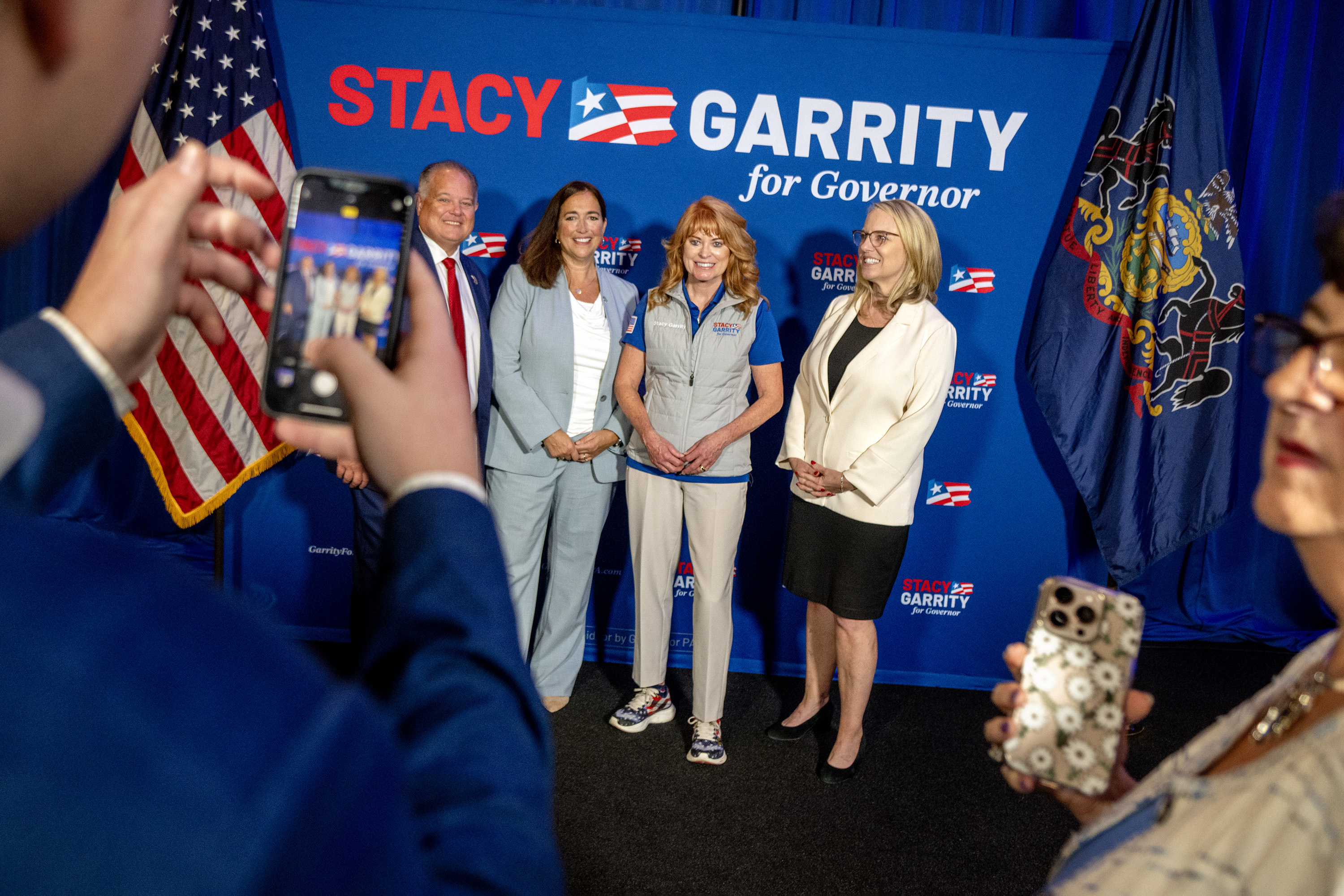
State Treasurer Stacy Garrity, a Republican running for Pa. governor, poses with Bucks County elected officers following her campaign rally Sat the Newtown Sports & Events Center. From left: Bucks County Sheriff Fred Harran; Bucks County District Attorney Jennifer Schorn; Garrity; and Pamela Van Blunk, Bucks County Controller.
GOP warns of ‘dangerous’ policies
Republican messaging in the two races focuses on the idea that Bucks County is safe, but its neighbors are not.
GOP ads, which have run over the course of four months, suggest that Khan and Ceisler would enact “dangerous” policies in Bucks County such as “releasing criminals without bail” and “giving sanctuary to violent gang members.”
They frame Harran and Schorn in stark contrast to their opponents as lifelong Bucks County law enforcement officers with histories of holding criminals accountable.
“I think it resonates beyond the Republican base,” said Guy Ciarrocchi, a Republican analyst, who contended frequent news coverage of Krasner makes the message more viable.
Khan, a former assistant Philly district attorney who unsuccessfully ran against Krasner in the 2017 primary, has noted that he campaigned “very, very vigorously” against Krasner and challenged his ideas on how to serve the city.
“I accept the reality that I didn’t win that election,” said Khan, whose platform in 2017 included a proposal to stop prosecuting most low-level drug offenses. “Unlike my opponent, who seems to basically enjoy the sport of scoring political points by sparring with the DA of Philadelphia.”
Schorn, however, is adamant that politics has never played a role in her prosecutorial decisions. Her mission, she said, is “simply to get justice.”
A lifelong Bucks County resident who has been a prosecutor in the county since 1999, Schorn handled some of the county’s most high-profile cases and spearheaded the formation of a task force for internet crimes against children.
Bucks County District Attorney Jennifer Schorn speaks at a Republican rally at the Newtown Sports & Events Center in September.
“This has been my life’s mission, prosecuting cases here in Bucks County, the county where I was raised,” she said. “I didn’t do it for any notoriety. I didn’t do it for self-promotion. I did it because it’s what I went to law school to do.”
Harran spent decades as Bensalem’s public safety director before first running for sheriff in 2021. He is seeking reelection amid controversy caused by his decision to partner his agency with ICE, a move that a Bucks County judge upheld last week after a legal challenge.
“Being Bucks County Sheriff isn’t a position you can learn on the job. For 39 years, I’ve woken up every day focused on keeping our communities safe,” Harran said in an email to The Inquirer in which he criticized Ceisler as lacking experience.
Although Ceisler has never worked directly in law enforcement, he argues the sheriff’s job is one of leadership in public safety. That’s something he says he’s well versed in as a senior public safety official in Shapiro’s administration who previously served on the Pentagon’s COVID-19 crisis management team.
Harran, who described his opponent as a “political strategist,” criticized “politicians” for bringing “half-baked ideas like ‘no-cash bail’” into law enforcement. The concept, which is repeatedly derided in the GOP ads, sets up a system by which defendants are either released free of charge or held without the opportunity for bail based on their risk to the community and likelihood of returning to court.
Khan and Ceisler each voiced support for the concept in prior runs for Philadelphia district attorney and Bucks County district attorney, respectively.
Both say they still support cashless bail. Neither, however, would have the authority to implement the policy if elected, though Khan as district attorney could establish policies preventing county prosecutors from seeking cash bail in certain cases.
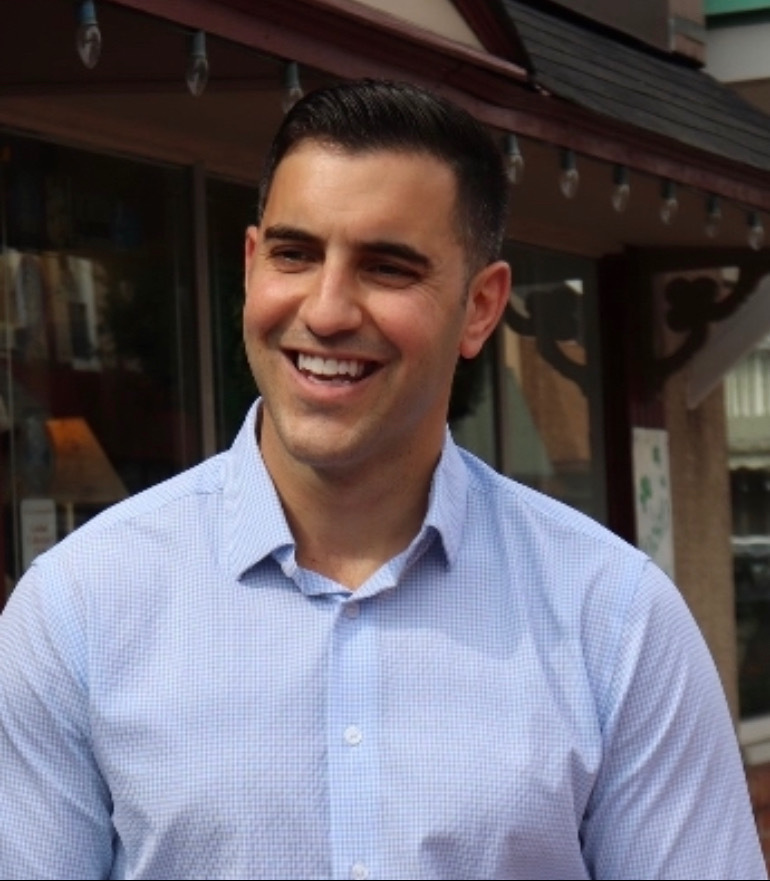
Joe Khan, a Democratic candidate running for Bucks County DA, walks from his polling place in Doylestown, Pa. in April 2024 when he was running for attorney general.
“When a defendant is arrested and they come into court, every prosecutor answers this question: Should this person be detained or not?” Khan said. “If the answer is yes, then your position in court is that this person shouldn’t be let out, and it doesn’t matter how much money they have. And if the answer is no, then you need to figure out what conditions you need to make sure they come to court.”
Democrats claim to ‘keep politics out’
Even as Democrats view voter anger at Trump as a key piece of their path to victory, they are working to present themselves as apolitical.
Democraticads attack Schorn for not investigating a pipeline leak in Upper Makefield and Harran as caring about nothing but himself. Positive ads highlight Ceisler’s military background and Khan’s career as a federal prosecutor.
Khan and Ceisler, the Democratic Party’s ads argue, will “stop child predators, stand up to corruption, and they’ll keep politics out of public safety.”
The jet fuelcase was turned over to the environmental crimes unit in Pennsylvania Attorney General Dave Sunday’s office. And prosecutorial rules bar Schorn from discussing the alleged abuse.
“During the last, I don’t know, 13 years when [Khan] has been pursuing politics, I’ve been a public servant,” Schorn said.“For someone accusing me of putting politics first, he seems to be using politics to further his own agenda.”
At a September rally in Newtown for Treasurer Stacy Garrity, a Republican running for governor, Harran cracked jokes about former President Joe Biden’s age as he climbed onto the stage and falsely told voters that they will “lose [their] right to vote” if they don’t vote out three Pennsylvania Supreme Court justices standing for retention.
“I’m a cop who ran to keep being a cop. This isn’t about politics for me — it’s about doing everything I can to keep my community safe,” Harran said.
Harran’s opponent, Ceisler, paints a different picture as he draws a direct line between the sheriff and the president.
Danny Ceisler, a Democrat, is running for Bucks County sheriff.
Trump, Ceisler said, has inserted politics into public safety in his second term, and he contended that Harran has done the same.
“[Harran] used his bully pulpit to help get the president elected, so to that extent he is linked to the president for better or worse,” Ceisler said in an interview.
Ceisler has pledged to take politics out of the office and end the department’s partnership with ICE if elected.
At an event in Warminster last month, voters were quick to ask Ceisler which party he was running with. Ceisler asked them to hear his pitch about how he would run the office first.
“Don’t hold it against me,” he quipped as he ultimately admitted to one voter he’s a Democrat.
Staff writer Fallon Roth contributed to this article.
This suburban content is produced with support from the Leslie Miller and Richard Worley Foundation and The Lenfest Institute for Journalism. Editorial content is created independently of the project donors. Gifts to support The Inquirer’s high-impact journalism can be made at inquirer.com/donate. A list of Lenfest Institute donors can be found at lenfestinstitute.org/supporters.
HARRISBURG — Pennsylvania Treasurer Stacy Garrity stepped in on Wednesday to offer counties and early education programs $500 million in low-interest loans to hold them over until a final state budget deal is complete, sidestepping the General Assembly and Gov. Josh Shapiro as they near the start of a third month at an impasse.
Garrity, a Republican who last month announced her bid to challenge Shapiro in next year’s gubernatorial election, announced the unprecedented move to allow the state Treasury to offer the loans to county human service departmentsfor the many social services they provide, as well as for early education Head Start programs, at a 4.5% interest rate.
Counties, schools, and social service providers have pleaded for months with the legislature to finalize a budget so they can begin receiving their expected state payments, which have been on hold since the beginning of the fiscal year on July 1. Some counties have had to secure private loans to hold them over until state payments begin, while others — including those around the Philadelphia region — have relied on their reserves. Other counties have frozen hiring and spending as they await a resolution to the budget stalemate.
The move would allow counties to access millions of dollars for early education programs serving 35,000 children across the state, as well as for county social services — all of which have been operating for months without their state appropriation, with no end to the budget impasse in sight.
Garrity’s decision to act unilaterally without the action of the General Assembly allows her to capitalize politically on the ongoing budget crisis over Shapiro, challenging his image as a moderate Democratic governor of a politically “purple” state willing to work across the aisle in a divided legislature. That brand, which he has built nationally as he is rumored to have interest in running for president in 2028, has been tested as he has so far been unable to secure a budget deal or a recurring funding stream for the state’s beleaguered mass transit agencies, including SEPTA.
Shapiro, for his part, has described his role in budget negotiations as being a go-between for Senate Republicans and House Democrats, who control their respective chambers, and has said that the two caucuses remain “diametrically opposed” on some issues.
A spokesperson for Shapiro said in a statement Wednesday that the real solution to the budget impasse is for Senate Republicans, whose leaders endorsed Garrity last week, to return to work in Harrisburg to finalize a budget deal with House Democrats. A spokesperson for House Majority Leader Matt Bradford (D., Montgomery) echoed the sentiment, arguing that Senate Republicans “refuse to negotiate on a realistic budget agreement.”
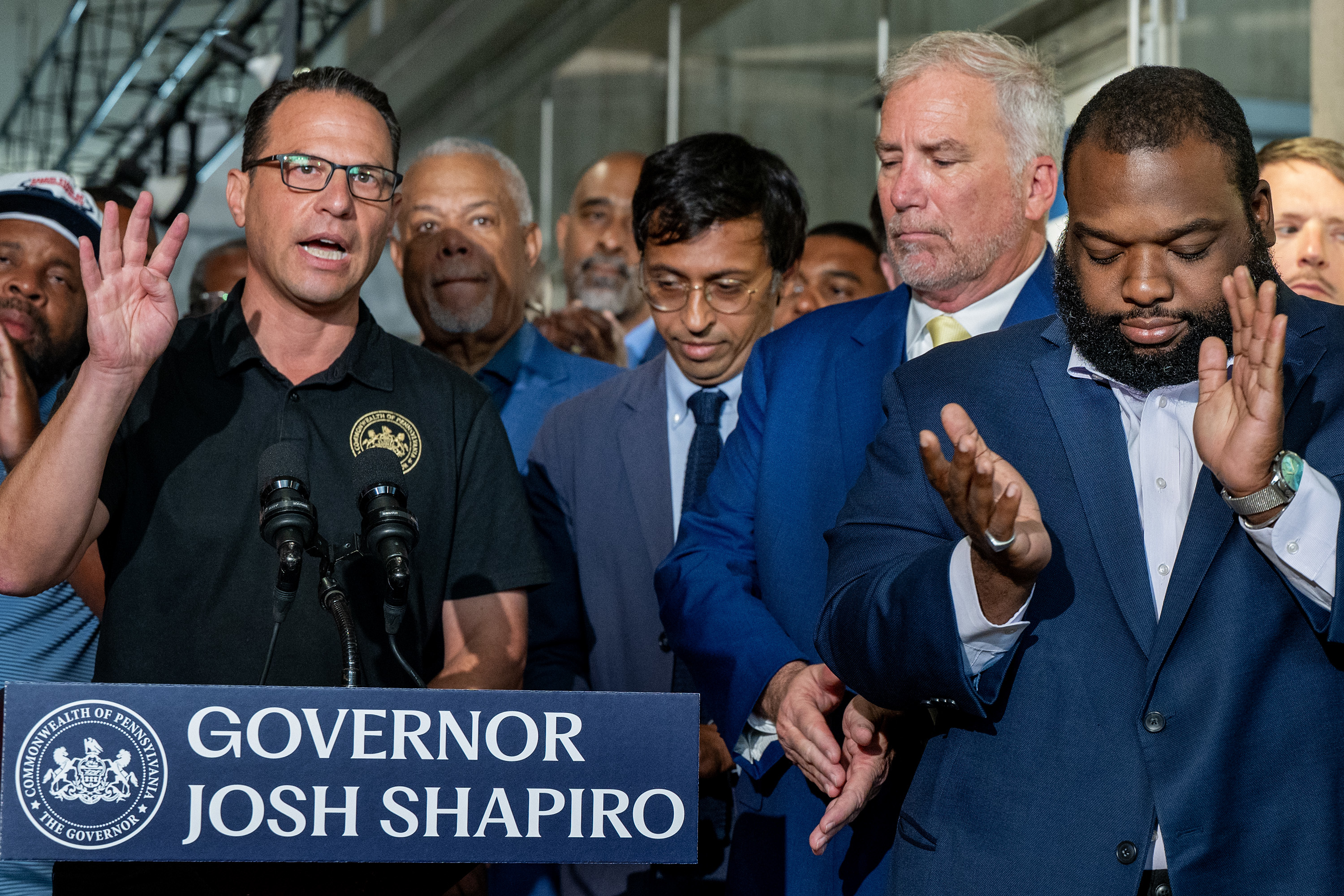
Gov. Josh Shapiro visits SEPTA headquarters Sunday, Aug. 10, 2025 to discuss funding for the transit agency and to pressure Senate Republicans as planned service cuts are pending because of a budget shortfall. To his right, from left, are state Democratic legislators Sen. Anthony H. Williams; Sen. Nikil Saval; Rep. Ed Neilson; and Rep. Jordan Harris.
Senate Majority Leader Joe Pittman (R., Indiana), the Senate’s top negotiator, who has met for months in closed-door budget talks with Bradford and Shapiro, said in a statement that it was Democrats who caused the prolonged impasse while demanding they include mass transit funding in the state budget. After mounting pressure as SEPTA enacted major service cuts, Shapiro ultimately sought to fund the agency on his own, and the issue will need to be revisited in two years.
Garrity, who kicked off her “Help Is on the Way” introductory campaign tour around the state earlier this week, said Wednesday her decision to intervene in the state budget stalemate was not political, despite her burgeoning run against Shapiro. Rather, she said that she had been thinking about a way to do so for months, including ahead of her announcement of her run for governor, and that most Pennsylvanians don’t even realize the state budget is late. She argued that if she wanted to be political, she would not intervene and would “keep the pressure” on Shapiro over the late state budget.
“I’m standing up here as Pennsylvania’s state treasurer, not as a candidate for governor,” Garrity said from a podium in the Harrisburg building that houses the state Treasury. “I think I have a responsibility to serve Pennsylvanians, that if I have something that I can do to provide some relief, then I should do it.”
However, that didn’t stop Garrity from inviting Montgomery County Commissioner Tom DiBello — the lone Republican on the board where Shapiro once served — to the podium at the news conference to deliver some direct criticisms of Shapiro and to praise Garrity’s intervention as a “lifeline” for counties, alongside two other GOP county commissioners from south-central Pennsylvania. While Montgomery County remains one of the wealthiest counties in the state, the late budget has required Pennsylvania’s third-most-populous county to spend down its reserves, money that it usually relies upon to continue earning interest as part of its annual revenue, DiBello said.
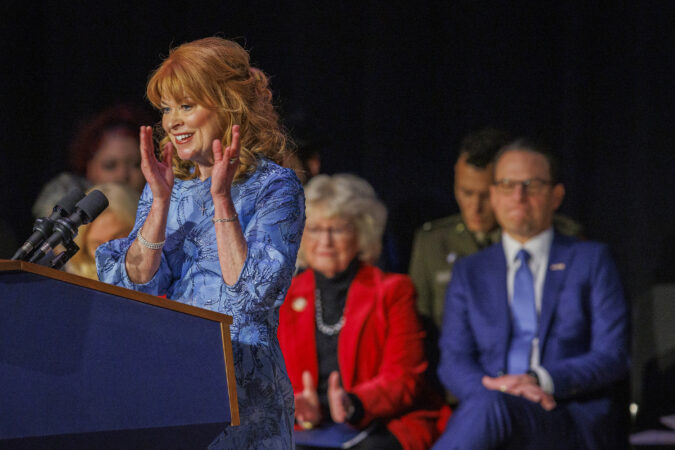
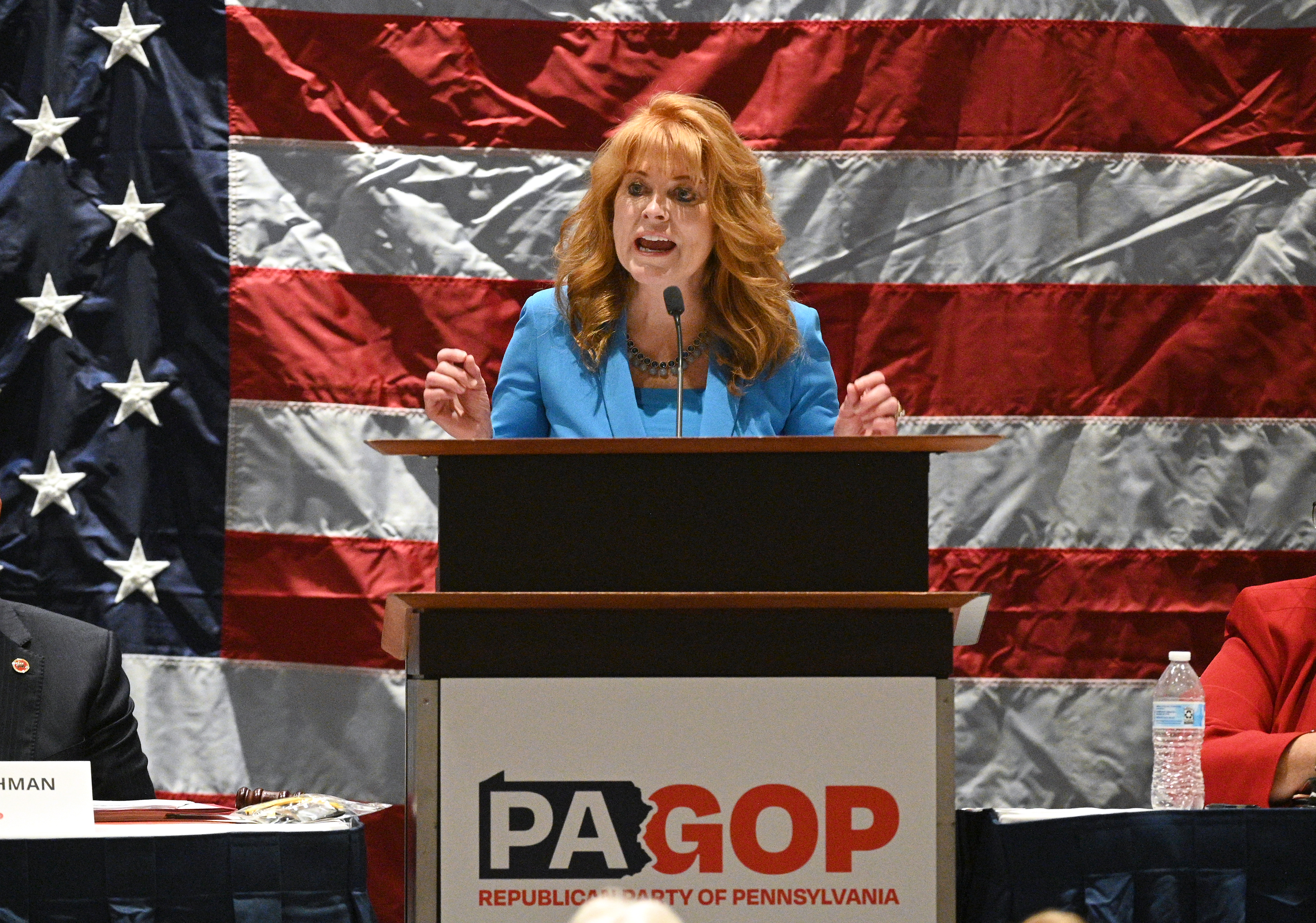
Pennsylvania Treasurer Stacy L. Garrity gives her acceptance speech after receiving the PA GOP’s endorsement for her campaign for governor during the Republican Party of Pennsylvania’s 2025 Fall Meeting at the Penn Stater Hotel & Conference Center in State College on Sept. 20.
“It starts at the top. The governor is responsible,” DiBello said. “He’s got to pull it together. It’s his signature at the end of the day.”
In response to Garrity’s announcement Wednesday, Montgomery County Commissioners Neil Makhija and Jamila Winder, both Democrats, said in a statement that the county needs a final state budget instead of a short-term loan program, urging Senate Republicans to “do their job.”
“A short-term loan at 4.5% interest is the state profiting from a problem of their own making, at the expense of the taxpayers,” the two commissioners added.
DiBello said he did not believe his invitation to Wednesday’s event had political motivations, adding: “I didn’t even think of that.” He also noted that he has come to Harrisburg to advocate on behalf of counties multiple times before.
Senate President Pro Tempore Kim Ward (R., Westmoreland), who has been one of Shapiro’s biggest critics since his first budget in 2023 and was quick to support Garrity’s candidacy, prodded at Shapiro’s pledge to “get stuff done” while praising Garrity’s leadership.
“Today, Treasurer Stacy Garrity made a bold move that shows what ‘get stuff done’ actually looks like,” Ward said in a statement. “Treasurer Garrity’s leadership is on display as her solution-driven option is exactly what we need, but has been glaringly missing from the present administration.”
Garrity said at the news conference Wednesday that she offered the loan program specifically to Head Start programs and county governments’ human service departments because both had asked her to help them get through the budget impasse. The state budget was due by July 1, and Pennsylvania is the only state besides Michigan that has not yet passed its budget. She said she is willing to offer similar loans to schools or other state-subsidized or funded programs as requested.
The Pennsylvania General Assembly can forgive the interest accrued by counties taking out loans during the budget impasse, Garrity said, adding that shewould support legislation that does so.
This suburban content is produced with support from the Leslie Miller and Richard Worley Foundation and The Lenfest Institute for Journalism. Editorial content is created independently of the project donors. Gifts to support The Inquirer’s high-impact journalism can be made at inquirer.com/donate. A list of Lenfest Institute donors can be found at lenfestinstitute.org/supporters.