Bob Yantorno, a Republican candidate for a seat on the Upper Darby Township Council, is facing scrutiny over material he posted three years ago that Democrats have decried as racist.
Yantorno, 65, is a former commanding officer of the Narberth Police Department,a former paramedic, and a veteran of other law enforcement agencies. He’s running in the township’s 3rd District.
Yantorno denies that anything he has ever posted was motivated by racism andsaid his social media comments reflected his outrage over incidents of violence.
The controversy stems from posts Yantorno made in 2022 on Twitter, now known as X, in response to crime news stories from Fox 29 that involved Black suspects.
“Take him out back n bullet in occipital section,” Yantorno wrote about a suspect from Drexel Hill charged with two homicides.
“Arrest convict bury,” Yantorno wrote in response to a booking photo of a Camden man accused of rape.
In a 2022 reply to an Upper Darby Police Department statement about a rash of thefts from automobiles, Yantorno wrote under four photos of young men in hoodies walking near cars but not stealing anything, “Common denominator?”
The race of the men was not obvious from the photos posted by the department.
Democrat Noah Fields, 25, who is running for one of two at-large council seats, neither of which Yantorno is seeking, condemned Yantorno in an interview for what he said was “shocking” and “hateful” speech, as well as “violent rhetoric.”
Fields said that “racism has no place in Upper Darby.” He added that “this guy is calling for the execution of people without due process. The violent rhetoric we’re hearing on the national level is trickling down to local politics.”
State Rep. Heather Boyd (D., Delaware), who represents Upper Darby, said the posts were “really upsetting, offensive, and disappointing.”
She added, “We don’t want anyone in a position of influence to not consider people’s right to due process and the rule of law.”
Asked about the posts in an interview Wednesday, Yantorno initiallysaid he was unaware of their existence.
“I have no idea what you’re talking about. What Democrats are saying is slanderous. People put stuff out there about me that’s not true,” Yantorno said. “All I can tell you that in the Narberth Police Department, my reputation was stellar.”
Yantorno said he didn’t know how posts with his name, photo, and personal details got onto X.His page says he joined the platform in 2022 and features a profile photo of him in police uniform.
He bristled at being called racist. He added, “I would never put a picture of somebody of any color and disparage them because of their race.”
Yantorno said that personal experience has made him sensitive to race bias. He said that when he and his first wife, whom he identified as a woman of color, moved into a house in Stonehurst, an Upper Darby neighborhood, someone stuck a cross in their lawn.
It was, Yantorno said, a symbol of hatred aimed at his then-wife.
Similarly, he said, when he was a police officer in Yeadon, he and hisformer wife “fell in love” with a house they wanted to buy, but had to back out of the deal because their real estate agent said if they moved in, “someone would burn down the house and the real estate office.”
Yantorno added without being asked: “You will never see anything from me online using the N-word. That’s not how I roll, brother.”
A statement emailed Thursday by the Upper Darby Republican Campaign Committee included remarks attributed to Yantorno that differed from his original explanation.
In the new statement, Yantorno no longer said he was unaware of the posts. Instead, he said, “those comments reflected my frustration and anger over the senseless violence in our community and had nothing to do with race.” He added that “claims of racism are offensive and absurd.”
A GOP committee statement, which was not attributed to a specific person, emphasized Yantorno’s commitment to public service and said that he does not deserve a “fabricated inference that has no basis in reality.”
Jeff Jones, an Upper Darby real estate developer who has been a Republican candidate for the council in the past, defended Yantorno.
“I read the tweets. They were comments made by a gentleman 35 years in law environment who’s seen criminals and victims at their worst, and the frustration came through in those tweets,” said Jones, who is Black.
Melissa DiNofia-Bozzone, Yantorno’s Democratic opponent for the 3rd District seat, declined to comment on the posts, saying, “I’m focused on running a positive campaign.”
Friends describe Yantorno, a veteran, as a gregarious person with a desire to help his community.
In 2020, he biked across the United States to raise money for families of slain police officers. He also did the ride, he said, for the family of Daniel Faulkner, the Philadelphia police officer who was killed in 1981. Mumia Abu-Jamal received the death penalty for the shooting, which was later reduced to a life sentence without parole.
Yantorno is also the author of a 1995 crime novel set in Philadelphia called Brutal Mercies. According to the publishing company, Trafford, the story opens with “a horrific act of mutilation” in Overbrook that “leaves the police asking, ‘Why?’”
Staff writers Katie Bernard and Ryan W. Briggs contributed to this article.
Despite the public fall from grace, the voter said he missed John Dougherty’s leadership in Philadelphia, adding that he believed Dougherty had been good for workers in the city. They are brothers, Kevin Dougherty confirmed.
Justice Kevin Dougherty (left) canvasses with his son, State Rep. Sean Dougherty (center) in Fox Chase Sunday Sept. 7, 2025, stopping at the home of a voter. The elder Dougherty is one of three Pennsylvania Supreme Court justices up for retention.
But in this year’s unusually high-profile state Supreme Court retention race, the connection has, in some circles, become unavoidable. Republicans seeking to oust Kevin Dougherty and two of his colleagues, all initially elected as Democrats, have sought to tie the judge to his brother’s misdeeds. The justice, a son of South Philadelphia who previously led Philadelphia’s Family Court, has sought to distance himself, and has seen the continued support of labor unions in his retention campaign.
“Over the course of 25 years as a judge, including ten years as a Justice on the Supreme Court, Justice Dougherty has had the privilege and the benefit of meeting a multitude of Pennsylvanians including the working men and women of organized labor,” Shane Carey, Kevin Dougherty’s campaign manager, said in a statement. “Our campaign is proud to receive their support, as well as the support from almost 5,000 other individual donors.”
How Johnny Doc helped elect his brother to the Supreme Court in 2015
Kevin Dougherty didn’t choose to be related to one of the city’s most prominent power brokers, but he certainly benefited from his brother’s former union’s help, with significant support from the politically powerful Local 98 during his 2015 campaign for the state bench.
Local 98, where John Dougherty was the longtime business manager, contributed more than $620,000 during Kevin Dougherty’s 2015 campaign for the Pennsylvania Supreme Court. Local 98’s spokesperson at the time also served as Kevin Dougherty’s campaign manager and appears from campaign finance filings that year to have been paid by Local 98. The union also spent more than $480,000 on in-kind contributions for “professional services,” mailers, merchandise,and more.
Justice Kevin Dougherty talks with volunteers before they head out the canvass in Fox Chase Sunday Sept. 7, 2025. Dougherty is one of three Pennsylvania Supreme Court justices up for retention.
Kevin Dougherty is the only justice up for retention from Southeastern Pennsylvania. The other justices, Christine Donohue and David Wecht, live in Pittsburgh. They will each appear on the November ballot with no party and no home county. Voters will simply be asked “yes” or “no” whether each individual justice should be retained for another term.
Republicans working to oust the three justices this year have tried to leverage Kevin Dougherty’s past support from his brother to encourage voters to oppose his retention.
Scott Presler, an influencer aligned with President Donald Trump who has more than 2.4 million followers and runs a political action committee aimed at registering Republican voters, posted an AI-generated image of John Dougherty behind bars, tying, without evidence, Local 98’s contributions to Kevin Dougherty’s 2015 campaign to his brother’s convictions.
“Coincidence?” Presler wrote.
Johnny Dougherty, the former IBEW business manger, and his attorney Gregory J. Pagano as they leave the U.S. District Court, Reading, Pa. on the day he was sentenced to 6 years in prison Thursday, July 11, 2024.
For months, the conservative influencer has posted on social media urging followers to vote against retaining Kevin Dougherty and his colleagues, citing the times his name was mentioned during John Dougherty’s trials, such as when prosecutors alleged the justice received free home repairs or snow removal on the union’s dime. Kevin Dougherty’s lawyer at the time of the embezzlement trial said the judge never knowingly accepted services paid for with union funds.
While door-knocking in September, Kevin Dougherty dismissed attacks against him related to his brother as “misinformation,” noting his decades-long career as a judge.
Kevin Dougherty, 63, spent more than a decade as a Common Pleas Court judge in Philadelphia before his election to the state Supreme Court. During his tenure on the state’s highest court, he has authored majority opinions and is leading a statewide initiative to improve how Pennsylvania’s judicial system interacts with people with behavioral health issues.
“I spent close to a quarter of a century being a judge,” Dougherty said on a sidewalk in Northeast Philly. “I just don’t accept people’s comments and judgment. I want to know what the motive behind those comments are. Some of these comments are just partisan … and I believe in my reputation.”
The justice should be vetted on his own merits, said John Jones, a former U.S. District Court judge for the Middle District of Pennsylvania who was appointed to the bench by former President George W. Bush.
“You can pick your friends, but you can’t pick your relatives,” Jones, now president of Dickinson College, added. “You have to judge the justice on his own merits. This is not a country where we favor guilt by association.”
Kevin Dougherty still has broad union support, including from Local 98
With John Dougherty no longer at the helm of Local 98, labor unions in Pennsylvania this year still overwhelmingly supported the justice for retention, contributing $665,000 to Kevin Dougherty’s campaign as of September. While trades unions contributed the most of any interest group to all three justices — for a total of $903,000 as of the latest filings — Kevin Dougherty is the largest beneficiary of that support.
Among those contributors: Local 98. The union, which has reorganized and distanced itself from John Dougherty since he was first convicted in 2021, gave $70,000 to Kevin Dougherty’s retention campaign.
“IBEW Local 98 does not support candidates based on personal relationships,” said Tom Lepera, Local 98’s political director, in a statement. “We support candidates who understand and stand up for the needs of working men and women in organized labor. Justice Dougherty, along with Justices Donohue and Wecht, have consistently demonstrated their commitment to protecting the rights and interests of middle-class workers across this commonwealth.”
Kevin Dougherty’s campaign did not respond to several questions this weekabout his brother’s role in his 2015 campaign or whether his brother’s reputation has influenced the retention campaign.
Anti-retention material featuring President Donald Trump as Uncle Sam was on display at Republican rally in Bucks County last month headlined by Treasurer Stacy Garrity, a candidate for governor. The material is from Early Vote Action, a group led by GOP influencer Scott Presler.
Union leaders insist their support for Kevin Dougherty this year has nothing to do with his brother and is a reflection of his quality work in the judiciary. Labor unions often support Democratic candidates, who are often seen as more beneficial to unions and their priorities.
“It’s about keeping good judges on the bench,” said Ryan Boyer, leader of the Philadelphia Building and Construction Trades Council, an umbrella organization of local trades unions once commanded by John Dougherty. This year, the building trades gave just over $33,000 to each justice.
“We don’t live on Mars where we don’t know that sometimes familial connections can be there,” Boyer said, “and they try to exploit those things.”
Nonpartisan and Democratic groups favor Dougherty’s tenure on the bench
Like his colleagues running for retention, Kevin Dougherty has earned broad support from nonpartisan and partisan groups alike.
Lauren Cristella, CEO of the Committee of Seventy, the Philadelphia-based good-government group, noted that the justice was never charged or found guilty of wrongdoing.
Justices David Wecht, Christine Donohue and Kevin Dougherty sit onstage during a fireside chat at Central High School on Monday, Sept. 8, 2025 in Philadelphia.
“The Committee of Seventy relies on the findings of law enforcement and professional oversight organizations, such as the Bar Association, when evaluating judicial candidates. This year, the Pennsylvania Bar Association has evaluated Justice Dougherty and recommended him for retention. Our focus remains on transparency, accountability, and maintaining public trust in Pennsylvania’s courts,” Cristella said in a statement.
Dougherty and his fellow justices have also gained the support of Gov. Josh Shapiro, Pennsylvania’s popular Democratic governor, who in a fundraising email to Pennsylvania Democrats on Thursday urged voters to mark “yes” on retaining Dougherty, Donohue, and Wecht.
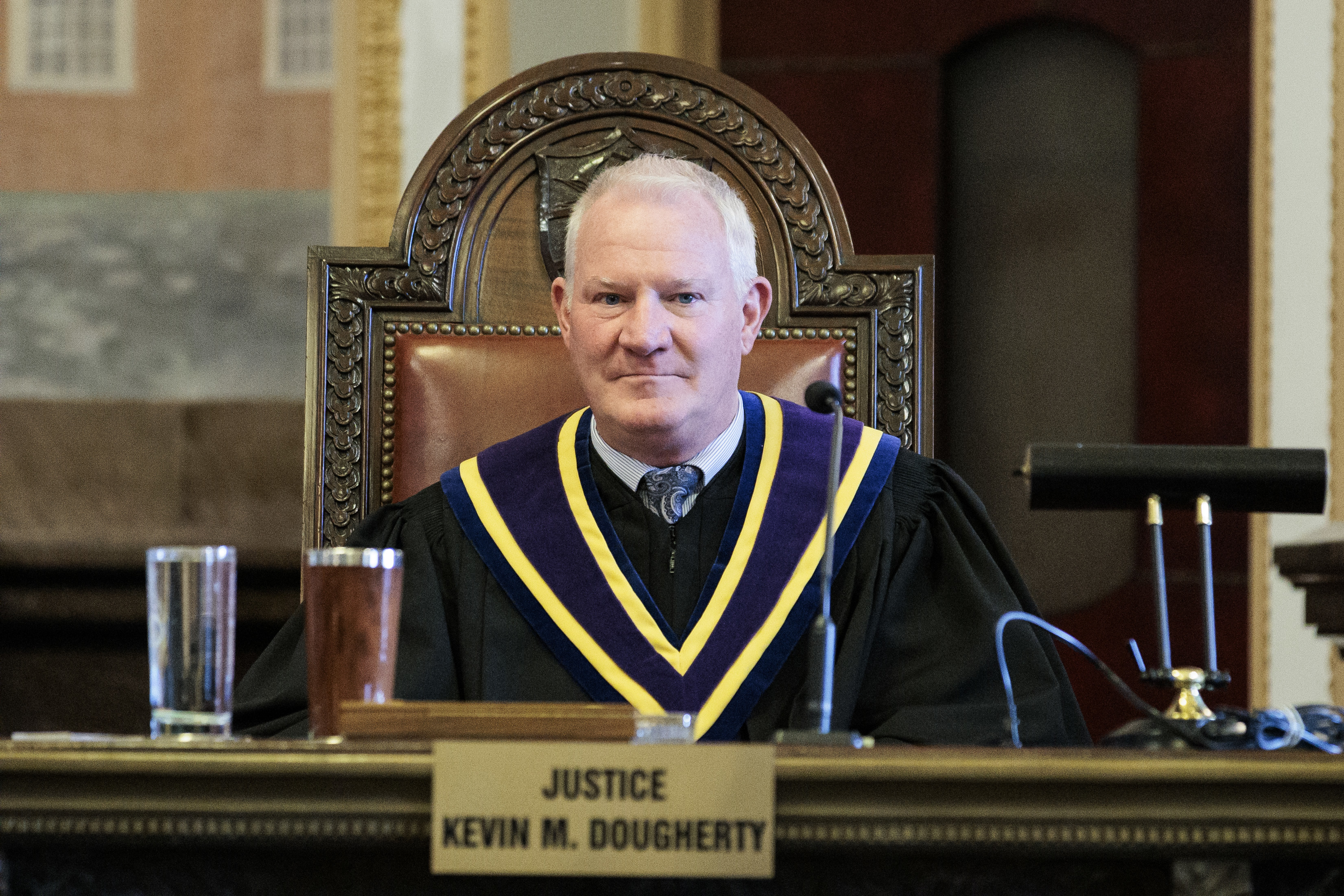
Justice Kevin M. Dougherty listens during a Courtroom Dedication Ceremony at the Supreme Court Courtroom in Philadelphia City Hall on Tuesday, Sept. 9, 2025 in Philadelphia.
“The threats to our freedoms are coming from all directions, and we need a Court that stands up for what’s right,” Shapiro said in the email. “Justices Donohue, Dougherty, and Wecht have proven that we can count on them to protect freedom, reproductive rights, and the rule of law.”
In a statement to The Inquirer, Kevin Dougherty didn’t mention his brother by name.
“With regard to my personal relationship I love my big brother. For obvious reasons, my brother is not participating in my Retention campaign,” he said.
More than 300,000 Pennsylvanians who struggle to pay their heating bills will need to wait longer for assistance from the state government due to funding stoppages caused by the federal government shutdown.
The Pennsylvania Department of Human Services said in a news release Wednesday that Pennsylvania will delay the opening of this year’s Low-Income Home Energy Assistance Program (LIHEAP) untilat least Dec. 3 because of a pause in federal funding due to the shutdown.The program was originally scheduled to open on Nov. 3.
The opening date for the program will be reassessed once the shutdown ends and is contingent on the state receiving the delayed federal funds, Brandon Cwalina, DHS press secretary, said in a statement Thursday.
LIHEAP distributes benefits to utility companies or home heating fuel providers for Pennsylvanians who need assistance paying their heating bills. The state has received more than $200 million each of the last two years from the federal government to carry out the program.
Pennsylvania Human Services Secretary Val Arkoosh said in the news release that the program “is especially critical for older adults and low-income families” as colder months approach.
Once DHS receives federal funding after the shutdown ends, the department will begin accepting LIHEAP applications and will continue processing applications that had been received during the shutdown.
This announcement comes the same week that DHS said nearly 2 million Pennsylvanians will not receive benefits from the Supplemental Nutrition Assistance Program (SNAP) next month if the shutdown continues. The food assistance program provides $366 million a month to low-income people in Pennsylvania,including roughly 500,000 in Philadelphia.
Joline Price, an attorney in the energy unit at Community Legal Services who works with clients to advocate for their access to water, heat, and electricity, said many of the same households could be affected by a lack of SNAP benefits and assistance in paying their heating bills, creating a “huge and devastating impact.” The program assisted 56,000 Philadelphia households last season, she noted.
“Even if some of these benefits become available later in November, they’re gonna be making really serious choices between food and utilities,” Price said. “It’s gonna be — I don’t even know that I have the words — it’s going to be bad.”
Other resources are available in the meantime — for instance, some electric and gas companies offer assistance programs — but there are gaps that remain with LIHEAP help beginning later than expected. For instance, Pennsylvania has an annual winter utility shut-off moratorium for qualified residents from Dec. 1 through March 31, though it does not eliminate any outstanding home heating bills, DHS said.
Prior to Dec. 1, low-income Pennsylvanians who are already “drowning” in utility costs could see their electric or gas shut off, Price said.
“Until then, folks are vulnerable to having their electric or their gas shut off, which would then bring them into the winter without safe heating sources,” Price said.
Democratic Gov. Josh Shapiro and members of his administration are arguing that impacts to crucial services are on the shoulders of Republicans in Washington, who hold both chambers of Congress and the White House. Meanwhile, Republicansare blaming the shutdown on Democrats because the majority party cannot pass funding legislation in the Senate without at least seven Democrats crossing the aisle.
Arkoosh echoed Shapiro’s messaging Wednesday, saying of LIHEAP: “Inaction from the Republican-controlled Congress now threatens access to this assistance.”
“I urge Congress and the White House to recognize the serious consequences that limiting heating assistance will have on the health and safety of people in Pennsylvania. Congress must come together for a solution that protects people most at risk,” she said.
Gov. Josh Shapiro is hitting the campaign trail in two key states this weekend.
With less than two weeks left until Election Day, Shapiro will campaign and raise cash for U.S. Reps. Mikie Sherrill (D., N.J.) and Abigail Spanberger, (D., Va.), two Democratic hopefuls in high-stakes gubernatorial races that could preview the national mood ahead of next year’s midterms.
Shapiro will campaign with Sherrill Saturday morning in Monroe Township at an event to mark the start of early in-person voting in the Democratic-leaning state which has grown increasingly red. The pair will then attend a Souls to the Polls event at a church in New Brunswick, Shapiro For Pennsylvania spokesperson Manuel Bonder said.
The governor is also expected to hold a fundraiser for the New Jersey Democratic State Committee to benefit Sherrill’s campaign later in the day.
On Sunday, Shapiro will head to Virginia to attend events in Portsmouth and Norfolk with Spanberger.
Sherrill has amped up her campaigning in recent weeks, and she’s brought out big Democratic names to help her. In the last three weeks, she’s campaigned with New Jersey Sens. Cory Booker and Andy Kim, and with Maryland Gov. Wes Moore. Former Secretary of Transportation Pete Buttigieg is planning a visit to New Jersey next weekend, and Sherrill’s campaign curtain call the Saturday before Election Day will feature a rally with former President Barack Obama.
This combination photo shows candidates for governor of New Jersey Republican Jack Ciattarelli, left, and Democrat Mikie Sherrill during the final debate in governors race, Oct. 8, 2025, in New Brunswick, N.J. (AP Photos/Heather Khalifa)
Why Shapiro is involved in the New Jersey governor’s race
Shapiro is a big draw on the campaign trail as he continues to build a national profile, and gears up for his own reelection campaign next year. The first-term governor, who is seen as a potential 2028 presidential candidate, announced the 2026 release of a memoir this week.
The poll also found that Shapiro is viewed favorably by some Republicans, an across-the-aisle appeal that appears to extend across the Delaware River.
Shapiro’s been lauded by Sherrill’s Republican opponent in the New Jersey race, Jack Ciattarelli, a trend chronicled recently by Politico.
Ciattarelli commended Shapiro’s willingness to criticize New York City mayoral candidate Zohran Mamdani’s past comments on Israel, and praised his handling of small businesses, energy and property taxes in Pennsylvania, contrastingly saying New Jersey faces a “crisis” in all three.
Sherrill has said frequently that she wants to mimic Pennsylvania’s success in cutting the time it takes business owners to get permits from state government.
This story has been updated to correct the location of Gov. Josh Shapiro’s first stop with U.S. Rep. Mikie Sherrill on the campaign trail Saturday.
Democratic veterans in Congress, including two from Pennsylvania, are taking personally comments U.S. Rep. Scott Perry made to a conservative radio station asserting that Democrats in Congress “hate the military” — and the lawmakers are hitting back.
“That’s only a credential that they get when they want to run for office,” Perry said, of Democrats, during an interview last week on The Chris Stigall Show.
”They join the military, they serve a little bit, they get the credential and then they run for office and wear the uniform and say, ‘Look at me — I support America.’ But let’s face it, all their votes say they don’t support America.”
Perry made the commentslast week, but a report this week from the New York Times prompted backlash from Perry’s colleagues on the other side of the aisle, including U.S. Rep. Chris Deluzio, a Democrat who represents the Pittsburgh suburbs and served six years in the Navy.
On Wednesday, members of the Democratic Veterans Caucus, cochaired by Deluzio and U.S. Rep. Pat Ryan (D., N.Y.) called the remarks “insulting to their service,” in a statement shared with The Inquirer.
“It’s disgusting to see a sitting member of Congress attack the integrity and honor of veterans and servicemembers due to their political party,” the veterans wrote. “He should immediately apologize to his constituents for insulting their service and questioning their patriotism.”
The statement blasted Perry as an “oathbreaker,” noting he was part of an effort to throw out Pennsylvania’s electoral votes after President Donald Trump’s loss in the 2020 election. The lawmakers also criticized Perry’s unwillingness to hold in-person town halls, something very few Republican lawmakers have been doing since Trump’s first administration.
“If he had a spine he’d stand in front of the Democratic veterans he represents and say this garbage to their faces, but Scott Perry doesn’t have the guts,” his House colleagues wrote.
Perry, in a statement, pushed back clarifying his remarks were not about “all Democrats,” but “Leftists in Congress who served in the military and use that as a shield to insulate themselves from accountability for their radial and corrosive ideologies.”
“The leftists now stomping their feet about my response are the same leftists who caused our government to shut down,” Perry said in his response.
Still, the comments from Perry about his colleagues and their jilted response illustrate the ways in which political insults have accelerated. Lawmakers who have served in the military had long been one of the few bipartisan groups bonded through service. A group of Democratic and Republican former service members serving in Congress called For Country Caucus still meets for early morning breakfasts on the Hill.
Perry, a House member since 2013, served in the U.S. Army and has been a staunch conservative voice, unabashed with his criticism of Democrats. Perry retired from the Army National Guard in 2019 with the rank of brigadier general after 39 years of service.
HARRISBURG — The Republican-led Pennsylvania Senate sent a $47.9 billion spending plan to the state House on Tuesday, but the proposal was dead on arrival and deemed “unserious” in the Democratic-controlled chamber, marking the latest chapter of the nearly four-month-long budget impasse in the state’s bitterly divided legislature.
The Senate GOP plan, which passed the chamber by a 27-23 vote along party lines, included a $300 million, or 0.6%, total increase over last year’s budget that is intended to cover the state’s debt service and pension obligations, in addition to cutting operational spending for the legislative body by 5%, said Senate Majority Leader Joe Pittman (R., Indiana).
The House Democrats’ $50.25 billion spending bill was a slight decrease from the $51.5 billion budget proposal Democratic Gov. Josh Shapiro pitched in February. And it was an attempt by House Democrats at reaching a compromise — decreasing their proposed spending by 2.4% over Shapiro’s initial pitch — after encouragement from Senate President Pro Tempore Kim Ward (R., Westmoreland) for legislative leaders to bring the usually closed-door budget negotiations into the public eye.
But the Senate GOP’s counteroffer passed Tuesday included little compromise and little increase in spending. However, it is a budget that would fund Pennsylvania’s needs rather than wants, several top GOP senators said during floor debate on the bill.
“All it takes is one day and one vote to end this ‘Shapiro Shutdown,’” Pittman said in his floor remarks in support of the GOP budget bill.
Several GOP senators noted the state’s fiscal outlook as the reason lawmakers cannot afford to spend much more over last year, as Pennsylvania is on track to bring in $46.4 billion during the 2025-26 fiscal year, which is significantly less than Shapiro and House Democrats want to spend.
Pennsylvania is sitting on approximately $10 billion in reserves, from its leftover balance from the 2024-25 fiscal year and its hefty Rainy Day Fund. Democrats want to tap into those reserves and reinvest them in the state, while Republicans believe it is critical to protect those funds to maintain the state’s bond rating or cut taxes as a way to reinvest those surpluses back into taxpayers’ pockets.
Top Senate Republicans on Tuesday urged the state House to return to session and pass their $47.9 billion spending plan as the most responsible way to protect Pennsylvania taxpayers in future years. And some offered criticism of Shapiro, who has continued to host news conferences around Pennsylvania during the 113-day budget impasse, accusing the governor of failing to lead in Harrisburg on budget negotiations.
“If you want to have an honest conversation about how to get this budget done, a governor gallivanting across the state taking potshots at members of this caucus doesn’t help,” Pittman said.
What was not mentioned Tuesday among Senate Republicans was that $47.9 billion is the highest number that the most conservative members of the GOP Senate caucus have pledged to spend. Sen. Dawn Keefer (R., Cumberland), who led the House Freedom Caucus before her election to the state Senate last year, even went as far as to take a flamethrower to a replica of Shapiro’s budget proposal in a social media video earlier this year while promising viewers through a rhyme that she would “hold the line at $47.9″ billion.
Sign posted by the PA Senate at the Pennsylvania State Capitol in Harrisburg Aug. 26, 2025, reminds visitors of the state’s “multi-billion dollar structural deficit.”
Senate Democrats firmly rejected the GOP plan as a farce that would not cover the state’s obligations for this fiscal year or make critical increases to public education funding needed to improve Pennsylvania’s school funding system. The top Senate Democratic leader, Sen. Jay Costa (D., Allegheny), tried several legislative maneuvers to try to get the Senate to vote on the House Democrats’ bill instead of the GOP proposal, all of which failed.
“They thumbed their noses and they said, ‘Go to heck,’” State Sen. Vincent Hughes (D., Philadelphia), the minority chair of the Senate Appropriations Committee, said of his GOP colleagues’ response to the House bill ahead of Tuesday’s vote.
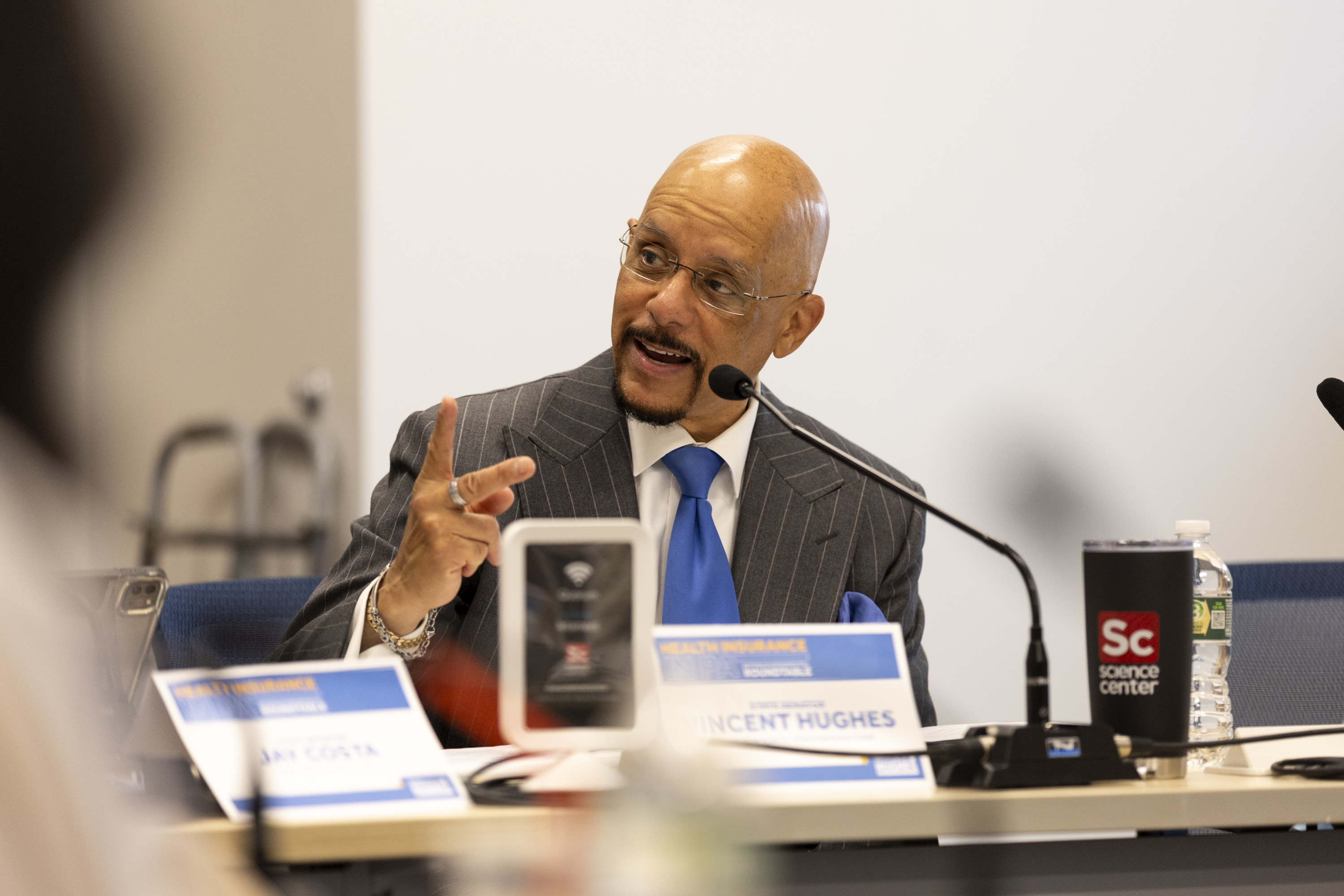
Senator Vincent Hughes, speaks at the Round table with Pennsylvania lawmakers, stakeholders, health systems to discuss potential cuts to Medicaid and ACA at the University City Science Center in Philadelphia, Pa., on Tuesday, April 22, 2025.
Shapiro, following a news conference in Allegheny County on Tuesday, voiced a similar sentiment when he told reporters the Senate’s proposal was “a joke” and “not designed to be serious or get the job done.” He again urged top GOP Senate leaders to begin meeting with top House Democrats to finalize a budget deal.
“I’m sorry transit didn’t get funded. But just because your top priority didn’t get addressed doesn’t mean that our priorities are no longer relevant, and that’s a hard truth,” Pittman,who has been critical of Pennsylvania’s mass transit systems and was a major roadblock in finalizing a deal, said Tuesday.
And, as evidenced by Tuesday’s vote, leaders still do not agree on how much Pennsylvania should spend for the current fiscal year, now almost in its fifth month. Pennsylvania is the only state in the nation without any spending plan. North Carolina, which passed a six-month budget in early summer, returned to session this week to finish budget negotiations.
Sen. John Fetterman (D., Pa.) said he would back a Republican plan to override the Senate filibuster if it meant passing a bill to reopen the government.
In an interview with The Inquirer on Tuesday, Fetterman admonished fellow Democrats who balk at the notion of using the so-called nuclear option to end the filibuster: “When I ran for Senate, everyone, including myself, said we’ve got to get rid of the filibuster. I don’t want to see any Democrats clutching their pearls about it now.
“If we’d had our way, the filibuster wouldn’t have been around for years.”
A staple of the Senate that has long been debated, the filibuster requires 60 votes to pass most legislation in the chamber.
Republicans have long vowed to protect the filibuster, noting that the 60-vote threshold presents a check on Democrats when they have the majority,but it’s now the rule standing in the way of their government funding bill. And in recent months, leaders have made moves to further weaken the minority party’s power, including bypassing the need to get Democratic support to confirm a slate of President Donald Trump’s nominees last month. Senate Majority Leader John Thune (R., S.D.) has thus far said he won’t use the same tactic to reopen the government.
Fetterman’s comments on Tuesday followed several Republicans floating the idea of getting rid of the filibuster in recent days.
Fetterman is one of three members of the Democratic caucus who voted with Republicans to reopen the government earlier this month, joining Sens. Catherine Cortez Masto of Nevada and Angus King, a Maine independent.
“If you look at my record, I’ve been voting the Democratic line, but this is different now. The tactic is wrong,” Fetterman said.
He said his main concern is the possibility that people in the state and across the country would face hunger if the federal government shutdown continues and Americans lose their Supplemental Nutrition Assistance Program (SNAP) benefits beginning Nov. 1.
“Nobody checks their political party when they’re hungry,” he said. “It’s not about a political side blinking. The only losers are the American people now.”
Fetterman added that he is in favor of extending tax credits, as Democrats are demanding during the shutdown. With those tax credits set to expire, people are going to start seeing higher prices when they sign up for health insurance come open enrollment in November, experts say.
“I don’t want people clobbered,” Fetterman said. “But Democrats designed them to expire this year. We passed these things when we were in the majority.”
Seeing room for dialogue, Fetterman said Thune “is an honorable man, and I believe a productive conversation to extend tax credits can be had with him.”
Sen. Andy Kim (D., N.J.) said he had multiple conversations with Senate Republicans on Tuesday who said they would “adamantly oppose” ending the filibuster.
“That’s been a huge part of how they’ve been able to lock down power here in D.C. before,” Kim said.
He said from his perspective, Senate Democrats are focused on getting the House back to work to negotiate a deal that includes the extended healthcare subsidies in a government funding bill.
“This is not an issue of Senate procedure. This is an issue of just doing our job.” Kim did not comment on Fetterman’s support for a filibuster carveout to end the shutdown.
In 2022, according to the media and politics site Mediaite, every Senate Democrat with the exceptions of then-Sens. Joe Manchin of West Virginia and Kyrsten Sinema of Arizona voted to eliminate the filibuster in a failed effort to pass former President Joe Biden’s elections overhaul.
A sometimes contrary figure, Fetterman has taken controversial stands in the past and is one of few Democrats who actively works with Republicans.
He has been criticized by progressives for his unwavering support of Israel in its war against Hamas.
And Fetterman garnered the enmity of some Democrats (and the praise of President Donald Trump) when he defended Immigration and Customs Enforcement by saying fellow Democrats’ calls to abolish the agency were “inappropriate and outrageous.”
As nearly 2 million Pennsylvanians brace for the loss of their food assistance next month due to thefederalgovernment shutdown, the Pennsylvania Department of Human Services is pinning the blame on Republicans on Capitol Hill.
States administer the federally funded Supplemental Nutrition Assistance Program, which provides support to low-income people, including families with children. But as the standoff in Congress prevents federal funding from flowing to states, Democratic Gov. Josh Shapiro’s administration entered the messaging battle over the cause of the disruption to benefits.
“Because Republicans in Washington D.C., failed to pass a federal budget, causing the federal government shutdown, November 2025 SNAP benefits cannot be paid,“ reads a pastel orange banner on the DHS website from Friday, alerting recipients of the Supplemental Nutrition Assistance Program to the impending changes.
The message reflects the mounting impacts of the government shutdown, which is in its third full week, and the growing political tensions between Republicans and Democrats on the state and national levels after lawmakers failed to pass funding to avert a government shutdown by Oct. 1.
Shapiro has frequently gone head-to-head with the Trump administration, but the use of a state government website is a notable escalation.
The governor said in a news release Monday that Congress already had kicked off hundreds of thousands of Pennsylvanians from Medicaid and SNAP when it passed President Donald Trump’s One Big Beautiful Bill Act in July.
“Now, Republicans are once again threatening vital support for Pennsylvania families and children — it’s time for them to pass a federal budget and end this shutdown.”
Pennsylvania Human Services Secretary Val Arkoosh added that “Inaction from Republicans in Congress” jeopardizes the well-being of Pennsylvanians.
A significant impact will be felt next month in Philadelphia, where half a million people will not receive SNAP benefits. The program,which is funded by the U.S. Department of Agriculture, serves households including elderly people, individuals with disabilities, and children.
Another Democratic-led state, Illinois, also referred to the lapse in funding as the “Republican federal government shutdown” on its benefits webpage. Other Democratic-led states near Pennsylvania, New Jersey and Delaware, have not posted political messages on their states’ SNAP benefits pages.
Republicans in Pennsylvania criticized the use of the DHS website for a partisan message.
“Public service isn’t a political weapon and using a government website to fuel your partisan agenda is indefensible,” the Pennsylvania GOPwrote Monday in a post on X.
The shutdown is “Democrat-led,” says the Trump administration’s State Department website.
“The Radical Left in Congress shut down the government,” declares a bright red banner on the U.S. Department of Housing and Urban Development homepage.
The rising political pressure comes as the Trump administration began rolling out highly politicized messaging to the public and federal employees after the government shutdown began earlier this month.
And some federal workers — nonpartisan civil servants who have been coping with plummeting morale and either being furloughed or working without pay during the shutdown — have been on the receiving end of politicized messaging, too.
On Tuesday, Harper — an imprint of HarperCollins Publishing — announced the release of Shapiro’s forthcoming memoir, Where We Keep the Light: Stories From a Life of Service, which will hit shelves on Jan. 27, 2026.
Shapiro, 52, has worked in some level of government for his entire career: on Capitol Hill as a staffer, in Montgomery County as a commissioner, and in Harrisburg as a state representative, attorney general, and now governor. He has noted that he has never lost an election, going back to his election as student body president his freshman year at the University of Rochester. Along the way, elected officials have whispered about his talents as a politician, orator, and rumored presidential ambitions.
The Montgomery County native has become a key player in the national Democratic Party, touting a brand as a governor of a split legislature in the most sought-after swing state. His administration’s motto is “Get Stuff Done,” which he defines as bringing Democrats and Republicans together to accomplish long-delayed reforms, or restarting residents’ trust by improving their interactions with state government. (Pennsylvania still has not finished its state budget, which was due July 1, as legislators from the Democratic-controlled House and GOP-controlled Senate cannot agree on how much they should spend this fiscal year and causing school districts, counties, and nonprofits to take out significant loans to continue offering services during the 113-day budget impasse.)
Shapiro’s rise through the Democratic Party ranks skyrocketed last year, when he became a front-runner for vice president during Harris’ whirlwind, 107-day presidential campaign, in which she ultimately chose Minnesota Gov. Tim Walz as her running mate. Harris also released a book this year, which includes stories from her interview with Shapiro for the role.
Shapiro, who was born in Kansas City, Mo., before moving to Montgomery County, has credited his upbringing by his parents — his father a pediatrician, and his mother an educator — as laying the foundation for his life in public service. Shapiro has four children and is married to his high school sweetheart, Lori. He and his family still live in Abington Township and split their time between their family home and the governor’s mansion in Harrisburg.
Nearly 2 million Pennsylvanians — including 500,000 Philadelphia residents — won’t receive SNAP benefits in November if the federal government shutdown continues, state officials said.
The Supplemental Nutrition Assistance Program provides $366 million a month to low-income people in the state, according to the Pennsylvania Department of Health and Human Services (DHS). Most households that receive SNAP benefits consist of elderly people, children, or individuals with disabilities, according to hunger experts.
This is the first federal shutdown in at least 20 years in which SNAP will not be made available, said George Matysik, executive director of the Share Food Program, a food bank that serves 500,000 people living in the region.
“It’s like a horror movie where the call is coming from within the house,” Matysik said in an interview last week. “Our own federal government is making the choice to take benefits from Pennsylvanians,” who are among 42 million people nationwide who participate in the program.
In Philadelphia, Share has seen a 120% increase in food need over the last three years, Matysik said. “And that was with SNAP,” he added, saying the city faces a greater food crisis now than it did during the pandemic.
In an email Monday, the Pennsylvania DHS blamed Republicans “who control the U.S. Senate, the U.S. House, and the White House” for failing to pass a budget and causing the current difficulties Americans endure.
“We urge Republicans in Congress to reopen the government and protect vulnerable Pennsylvanians at risk because of this inaction,” the email said.
Gov. Josh Shapiro’s office could not be reached for comment. In May, Shapiro said that the commonwealth would be unable to replace lost funding for SNAP should the federal government fail to pay.
The U.S. Department of Agriculture, which administers SNAP, did not return calls for comment. The White House issued a statement that the shutdown is affecting personnel in its press office, delaying responses. The statement blamed Democrats for the government’s closure: “Please remember this could have been avoided if the Democrats voted for the clean Continuing Resolution to keep the government open.”
To receive SNAP benefits, individuals carry EBT (electronic benefits transfer) cards that are loaded monthly with the amounts to which they are entitled.
The shutdown began Oct. 1 after Congress could not reach a compromise to allow funding to continue. The region’s 46,000 federal workers found themselves without paychecks. The Trump administration, meanwhile, began laying off federal workers, with a goal of sacking 4,000 of them. A federal judge in California intervened to halt the layoffs. A hearing is scheduled for Tuesday.
Like other states, New Jersey faces the same funding difficulty. If the federal government remains closed by Nov. 1, about 800,000 people will be without SNAP benefits.
Elderly people who rely on SNAP will suffer throughout Pennsylvania because, for them, “food is medicine,” said Allen Glicksman, director of research at the Eastern Pennsylvania Geriatrics Society in Newtown Square. “Without it, there’s the chance of a health catastrophe that will cost more money in Medicaid and in emergency room visits.”
There are 234,638 Philadelphians age 65 and older, 104,972 (45%) of whom live below the federal poverty line ($21,150 for two individuals in a household), Glicksman calculated.
Brian Gralnick, executive director of the Center for Advocacy for the Rights and Interests of Elders (CARIE) in Center City, agreed. “Consequences will be devastating. Without federal government dollars, ending or even addressing hunger in the region will be as successful as draining the Delaware River using Eagles helmets.”
For children, the potential shortage of SNAP benefits will be no less calamitous, said sociologist Judith Levine, director of the Public Policy Lab at Temple University.
“Food is a necessary element for brain development and growth,” she said. “And there’s a clear connection between hunger and the ability to perform in school.
“This is a complete crisis we are facing.”
One in four Philadelphia children experiences food insecurity — lack of enough food over the course of a year to live a healthy life — according to a City Council report.
In the neighborhoods, the word about the halt to SNAP benefits is circulating. Fear and confusion had already been growing after the Trump administration announced changes to the SNAP program that would make it more difficult for some people to access benefits.
Among the changes: Some SNAP recipients ages 18 to 54 who are able to work and do not support a child under 18 are now required to report at least 20 hours of work, training, or volunteering per week, or 80 hours per month, to keep their benefits.
Despite the revisions to the program, however, many people these days are more worried about what happens if SNAP halts.
“People are very anxious about that,” said Pastor Tricia Neal, director of the Feast of Justice food pantry at St. John’s Lutheran Church in the Northeast.
“The anxiety level is driving more people to come here, and, because we serve 5,500 households, we are well beyond the capacity of what we can support. It’s really horrendous to look at what’s happening here.”
That much is clear, according to Rosemary Diem, who tries to stave off hunger for her and her husband by combining SNAP benefits with visits to Feast of Justice.
“Everything at the pantry is running low,” said Diem, 60, who is disabled, as is her husband, Joseph, 63. “I see us getting hurt without SNAP. There won’t be money for milk and eggs.