Category: Pennsylvania Politics

  • The Pa. GOP and state Dems finalize their endorsements for the 2026 governor’s race

    The Pa. GOP and state Dems finalize their endorsements for the 2026 governor’s race

    HARRISBURG — The Pennsylvania Republican and Democratic Parties locked in their endorsements for the 2026 governor’s race Saturday at dueling committee meetings in the state’s capital, as they present different visions of the future for Pennsylvania and America.

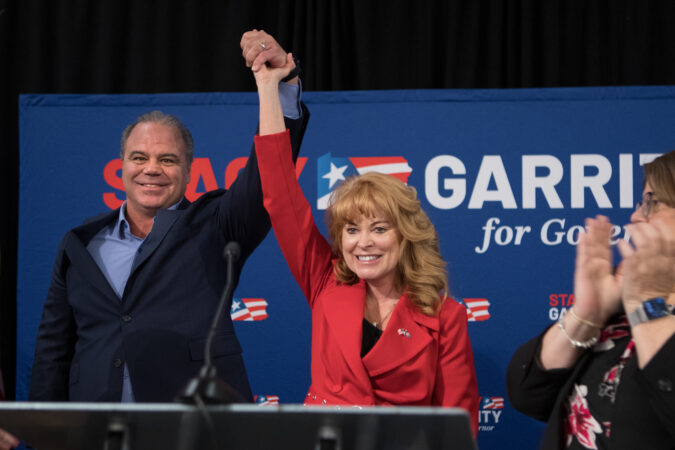
    The state GOP endorsed Jason Richey, a longtime Pittsburgh attorney and chair of the Allegheny County Republicans, for lieutenant governor to run alongside its endorsed gubernatorial candidate, Treasurer Stacy Garrity. On the other side of town, the state Democratic Party resoundingly endorsed Gov. Josh Shapiro and Lt. Gov. Austin Davis for reelection to a second term.

    By finalizing their endorsements for governor and lieutenant governor, the November election is all but officially set. The candidates are expected to be formally nominated by their parties in the May 19 primary.

    Garrity would be the state’s first female governor and would be a strong conservative leader who will protect the state from becoming “California East,” Richey said as he described another term under Shapiro in his acceptance remarks.

    State Republicans took the unprecedented step to endorse Garrity in September 2025, in an effort to give her six additional months to campaign for governor and coalesce support. However, Garrity did not announce Richey as her choice for running mate until last month. Several candidates had turned down the job, as Garrity faces an uphill battle to challenge Shapiro, a popular moderate Democratic governor, in a midterm election already advantageous to Democrats.

    There was no shortage of attacks on Shapiro at the state GOP meeting.

    “[Shapiro] is a charlatan. He is a phony who tries to talk like [former President Barack] Obama and has done nothing to help move this state forward,” Richey said. “Today is not just another meeting. Today is not just another endorsement. Today is the moment that the Pennsylvania Republican Party stands together and resolves to take back our commonwealth.”

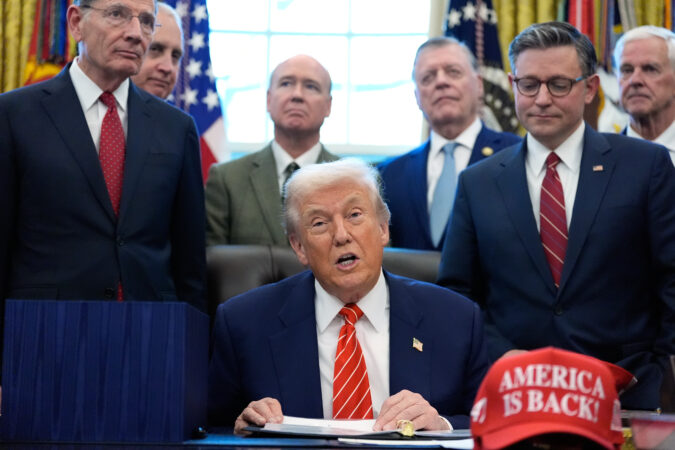
    Garrity last month received the coveted nod from the leader of the Republican Party, President Donald Trump, who called her an “America First Patriot.”

    Meanwhile, for state Democratic Party committee members, their attention was not on Garrity and Richey. They want to make Trump a lame-duck president by flipping four congressional seats and secure Shapiro a Democratic trifecta by retaining control of the state House and flipping the state Senate for the first time in more than 30 years.

    “These are people who are lawless. They are without a conscience, without a backbone, without any sense of right and wrong,” said U.S. Rep. Madeleine Dean (D., Pa.), describing the GOP colleagues she wants to unseat. “Four seats. That will be the U.S. House majority. We can get the gavels in our hands, and we can make Trump an even lamer duck than he already is, and we can move on with impeachments, convictions, whatever we can do.”

    Different outlooks on Pennsylvania and the U.S.

    To Republicans, Pennsylvania is falling behind, citing its U.S. News & World Report rankings as 41st in Best Overall States, 38th for its economy, and 39th for education. Trump’s White House, alternately, is heavily invested in Pennsylvania’s success, often inviting its GOP county commissioners to visit, said Lancaster County Commissioner Josh Parsons, delivering the GOP commissioners’ update to the state committee.

    “We’re going to keep Republicans in the majority in Congress, because if not, we’ve seen this show before. We know what’s going to happen: investigations, impeachments, and, worst of all, they will stop the agenda that Trump has created,” said state GOP chair Greg Rothman, noting Trump’s efforts to lower prices, end the war in Gaza, and more.

    For Democrats, it’s America that’s on the wrong track, while Pennsylvania is succeeding despite the “chaos in Washington,” as Shapiro described in his endorsement acceptance speech.
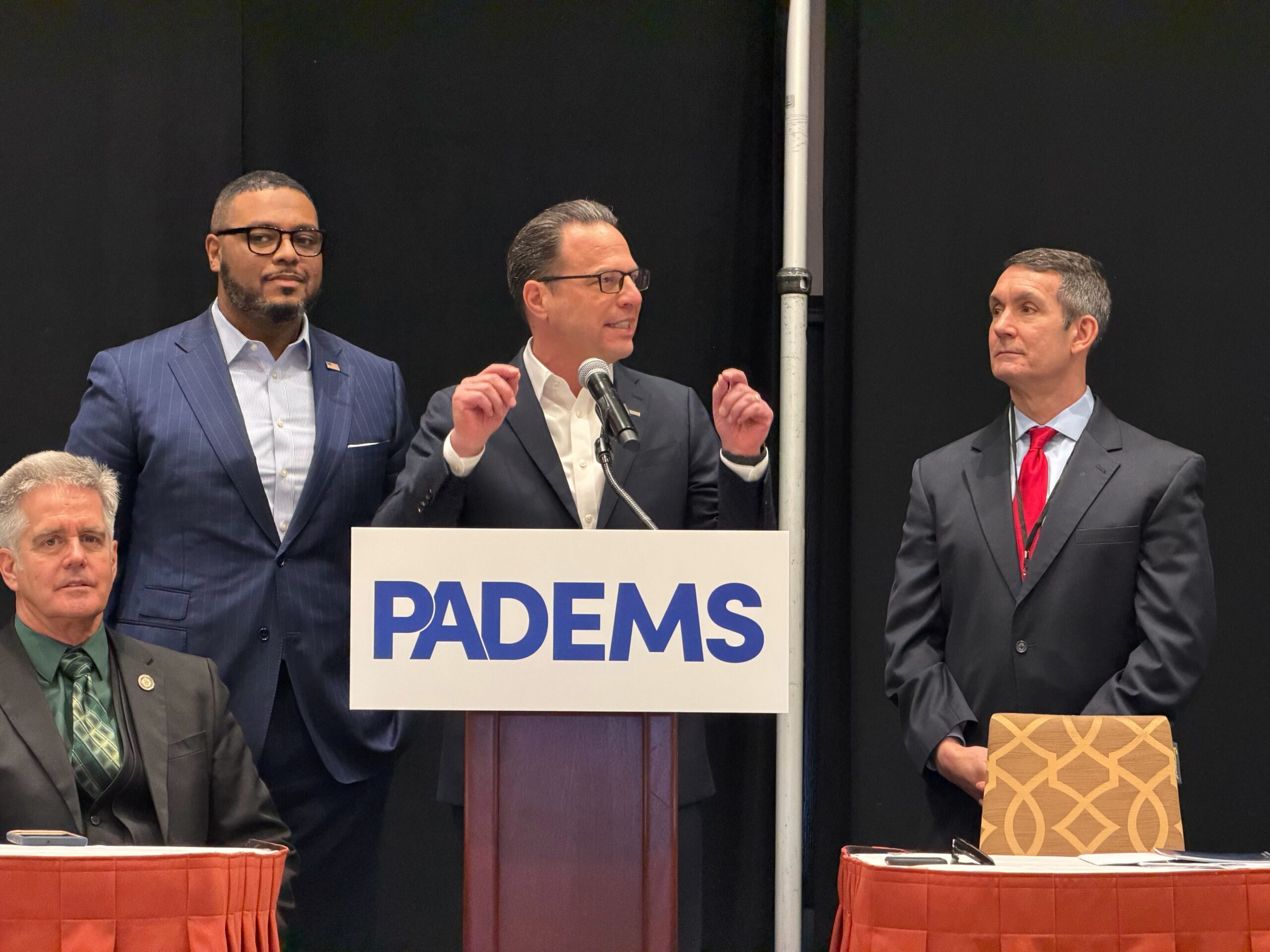
    Pennsylvania Gov. Josh Shapiro accepts the endorsement for a second term as governor at the state Democratic Party’s winter meeting in Harrisburg on Feb. 7, 2026. With him are Lt. Gov. Austin Davis (second from left) and Pennsylvania Democratic Party chair Eugene DePasquale (right).

    That positive view of Pennsylvania is due to Shapiro’s leadership in the state, said Pennsylvania Democratic Party chair Eugene DePasquale.

    “You look at the polls today, Donald Trump is at his historic low mark, while the governor is at a historic high mark,” DePasquale added. “Why is he at that high mark? They see the state heading in the right direction. They see him fighting the Trump administration to protect Pennsylvanians.”

    Candidates will begin circulating petitions later this month to secure a spot on the ballot. No candidates are expected to challenge Shapiro or Davis in the primary. There is at least one write-in campaign being run, for State Sen. Doug Mastriano (R., Franklin), who declined to challenge Shapiro for a second time. He lost to Shapiro by more than 15 percentage points in 2022.
  • After Trump shared a racist video about the Obamas, Pa. lawmakers of both parties condemn the post: ‘Absolutely unacceptable.’

    After Trump shared a racist video about the Obamas, Pa. lawmakers of both parties condemn the post: ‘Absolutely unacceptable.’

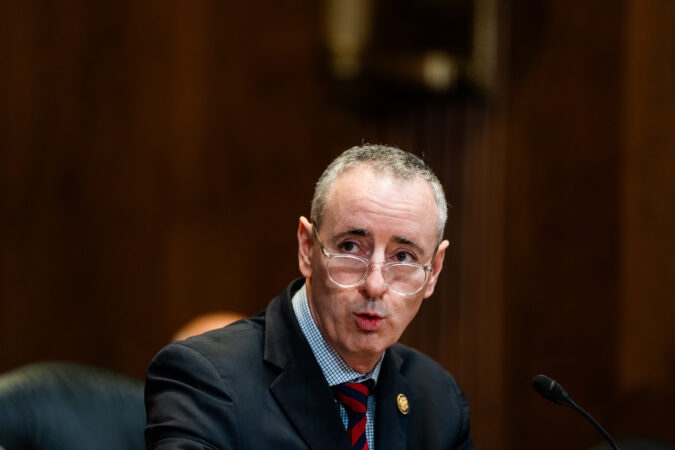
    U.S. Rep. Brian Fitzpatrick (R., Bucks) called on President Donald Trump to apologize for sharing a racist video Thursday night on Truth Social that depicts former President Barack Obama, the country’s first Black president, and former first lady Michelle Obama, as apes.

    “Whether intentional or careless, this post is a grave failure of judgment and is absolutely unacceptable from anyone — most especially from the President of the United States. A clear and unequivocal apology is owed,” Fitzpatrick wrote in a post on X Friday afternoon.

    The Bucks County Republican, who will be defending a key swing district this fall, joined a bipartisan ensemble of lawmakers who are condemning Trump’s post, which was deleted Friday after the widespread backlash.

    The president has a long history of promoting inflammatory content online and making racist remarks. This post also comes in the wake of his administration’s decision to remove exhibits about slavery and other injustices from Independence National Historic Park and other national parks.

    “Donald Trump is a bigoted, small-minded man who has long spewed racist remarks and tried to whitewash our nation’s history. Today he finds a new low,” said U.S. Rep. Dwight Evans (D., Philadelphia), a member of the Congressional Black Caucus, in a post on X. “His recent post is vile, disgusting, and abhorrently racist. Every elected official should speak up and condemn this hate.”

    Sen. John Fetterman (D., Pa.) in a statement to The Inquirer, called the president’s post “indefensible and horrendous.”

    “That garbage came from, and should forever remain in, the twisted and grotesque corners of the internet,” he said.

    Fitzpatrick, a moderate representing a purple county, has disagreed with Trump before but the lawmaker’s comments Friday serve as one of his strongest rebukes yet.

    “Racism and hatred have no place in our country — ever. They divide our people and weaken the foundations of our democracy,“ Fitzpatrick wrote. “History leaves no doubt: when division is inflamed by those in positions of power, the consequences are real and lasting.”

    The White House blamed a staffer for the video, which was posted just five days into Black History Month, The Associated Press reported. This came after White House press secretary Karoline Leavitt said there was “fake outrage” over the post and that it was a meme inspired by The Lion King.

    In addition to the Obamas, other Democratic leaders, including former President Joe Biden, were depicted as various animals in the video, which was set to “The Lion Sleeps Tonight” and features Trump as the “King of the Jungle.” The clip of the Obamas appears to have originally come from a conservative user on X, The New York Times reported.

    In addition to the election officials reacting with horror, Rt. Rev. Daniel G.P. Gutiérrez, bishop of the Episcopal Diocese in Pennsylvania, said that he was “repulsed and sickened” by Trump’s post and called on the president to resign.

    U.S. Sen. Dave McCormick (R., Pa) condemned the video late Friday afternoon after the White House had blamed it on a staffer.

    “Posting this video is unacceptable and thankfully it has been taken down. It should never have been posted and does not represent who we are as a nation. Racism has no place in America,” McCormick said in a post on X.

    Other Republican senators moved faster to publicly condemn Trump’s post.

    U.S. Sen. Tim Scott (R., S.C.), the only Black Republican in the U.S. Senate, said Friday morning, “It’s the most racist thing I’ve seen out of this White House. The President should remove it.”

    Democratic Gov. Josh Shapiro pointed to Scott’s comments when asked about the video during a stop in Philadelphia Friday.

    “I actually agree with [Republican] Sen. Tim Scott of South Carolina that it’s racist,” Shapiro said.

    Fitzpatrick has in the past avoided calling out Trump directly.

    The Republican was the only member of his party’s delegation in Pennsylvania to vote against Trump’s One Big Beautiful Bill Act on final passage, though he moved the legislation forward with an earlier vote. Trump called Fitzpatrick disloyal in response.

    Fitzpatrick also recently voted to extend Affordable Care Act subsidies alongside Democrats and two other swing-district Republicans.

    Fitzpatrick’s seat is one of four in Pennsylvania that is being targeted by the Democratic Congressional Campaign Committee, but he entered 2026 with significantly more campaign cash than any of his Democratic challengers.

    The Bucks County lawmaker remains the only Republican in Pennsylvania’s U.S. House delegation that has yet to receive an endorsement from Trump.

    Staff Writer Alfred Lubrano contributed to this reporting.

  • Shapiro blasts Trump for racist video of the Obamas and ICE’s ‘secretive’ warehouse purchase in Berks County

    Shapiro blasts Trump for racist video of the Obamas and ICE’s ‘secretive’ warehouse purchase in Berks County

    Gov. Josh Shapiro blasted U.S. Immigration and Customs Enforcement (ICE) Friday for buying a Berks County warehouse that may be used to detain people.

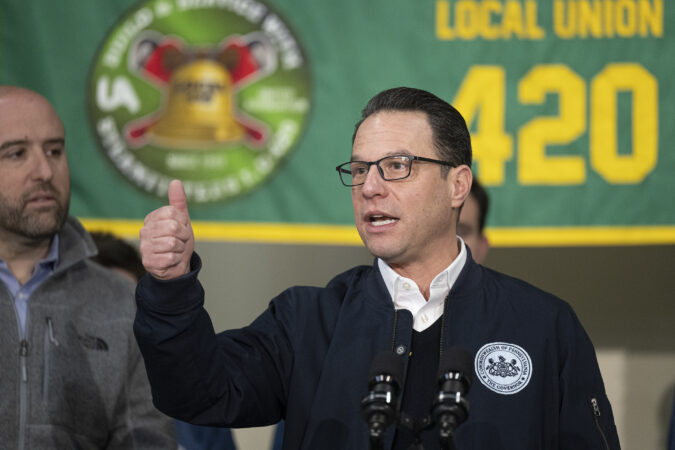
    “I’m strongly opposed to the purchase,” Shapiro said after speaking at an event at the Steamfitters Local 420 in Northeast Philadelphia.

    Shapiro said the facility is “not what we need anywhere in Pennsylvania,” adding that he was not alerted ahead of time of ICE’s $87 million acquisition of the warehouse on 64 acres in Upper Bern Township.

    “The secretive way the federal government went about this undermines trust,” Shapiro said.

    Shapiro has grown increasingly vocal in his criticism of ICE and President Donald Trump in recent weeks as he’s toured the East Coast promoting his new memoir. In addition to voicing his opposition to the warehouse, Shapiro criticized Trump for sharing a racist video attacking former President Barack Obama and former first lady Michelle Obama.

    The Democratic governor, who is widely seen as a contender for the White House in 2028, is in the midst of a reelection campaign against Trump-endorsed Republican Stacy Garrity, who has urged cooperation with ICE.

    He said the commonwealth is exploring “what legal options we may have to stop” the ICE procurement, but he acknowledged “those options are very slim, given that the federal government is the purchaser.”

    Shapiro told this audience of union workers and apprentices that the Berks County building would be better used for economic development.

    At the same event, Shapiro announced a new $3 million Redevelopment Assistance Capital Program (RACP) grant to expand the Steamfitters Local Union 420 Training Center, which he said would help “train the next generation of workers.”

    Shapiro criticizes Trump over racist anti-Obama video

    During the union hall event, Shapiro also leveled criticism at the Trump administration for sharing on social media a racist video depicting Obama, the first Black president, and his wife, as apes.

    When asked for a reaction, Shapiro said, “I actually agree with [Republican] Sen. Tim Scott of South Carolina that it’s racist.”

    Scott, the only Black Republican in the Senate, called the video “the most racist thing I’ve seen out of this White House,” after Trump shared it to his Truth Social account Thursday evening.

    Shapiro said that Trump “seems to always find a lower and lower common denominator. We’re not going to get sucked down into the depths that this president seems to reach for each day.”

    Trump took down the video early Friday afternoon.

    The governor also strongly chided Trump for recently saying the federal government should be in charge of elections.

    Specifically, Trump named Philadelphia, along with Detroit and Atlanta, as cities where the federal government should step in to run elections. The predominantly Black cities are in swing states and have long been targeted with Trump’s false claims of voter fraud.

    “The president of the United States doesn’t run our elections,” said Shapiro. “County officials run our elections, Republican and Democrat alike.”

    “We’re not going to have interference from the White House,” added the governor, who served as attorney general when Trump tried to overturn Pennsylvania’s election results in 2020.

  • Sandra Schultz Newman, the first woman elected to the Pa. Supreme Court, has died at 87

    Sandra Schultz Newman, the first woman elected to the Pa. Supreme Court, has died at 87

    Sandra Schultz Newman, 87, of Gladwyne, Montgomery County, the first woman elected to the Pennsylvania Supreme Court, the first female assistant district attorney in Montgomery County, the first woman named to the board of directors of the old Royal Bank of Pennsylvania, longtime private practice attorney, role model, mentor, and colorful “Philadelphia icon,” died Monday, Feb. 2. Her family did not disclose the cause of her death.

    Reared in South Philadelphia and Wynnefield, and a graduate of Drexel, Temple, and Villanova Universities, Justice Newman, a Republican, was elected to the Commonwealth Court of Pennsylvania in November 1993 and to the state Supreme Court in 1995. She won a second 10-year term on the Supreme Court in 2005 but, having to step down in just two years due to a mandatory retirement age, left at the end of 2006.

    “I love the court. I love my colleagues. The collegiality was great, and I’m going to miss that,” Justice Newman told The Inquirer. “But I just felt like I wanted to move on.”

    During her 10-year tenure, Justice Newman was chair of the Supreme Court’s Judicial Council Committee on Judicial Safety and Preparedness and the court’s liaison to Common Pleas Court and Municipal Court in Philadelphia. She ruled on hundreds of issues and wrote opinions about all kinds of landmark cases, from environmental protections to school funding to clergy privilege to the Gary Heidnik and John E. du Pont murder cases.

    She had worked in criminal and family law and handled many divorce and custody cases as a private attorney in the 1980s, and was praised later by court observers for her attention to Philadelphia Family Court matters. Lynn Marks, of Pennsylvanians for Modern Courts, told the Daily News in 2005: “She’s been a wonderful justice, and she’s made herself accessible to the public interest community.”

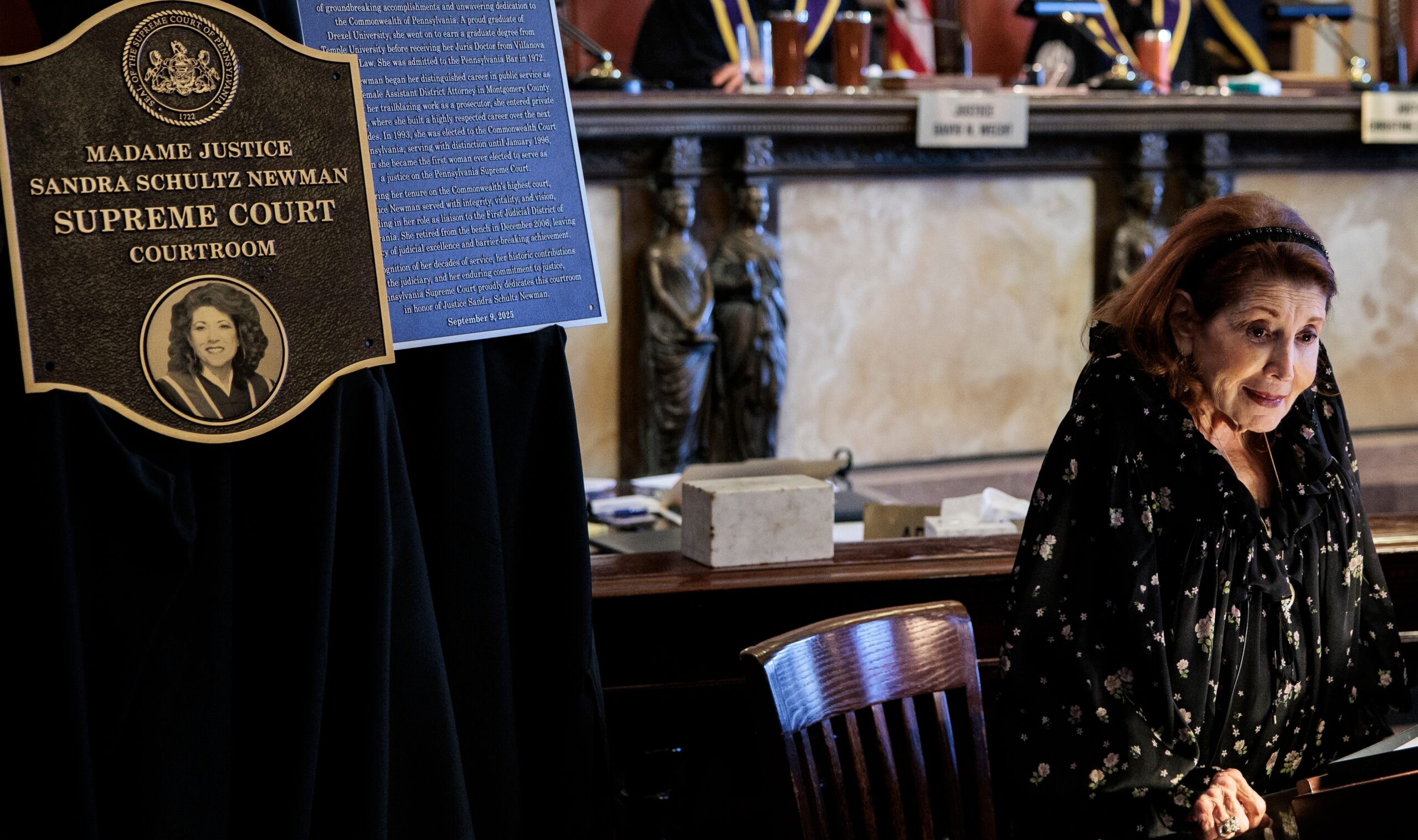
    In 2025, her colleagues on the Supreme Court named their Philadelphia courtroom after her. “She was a remarkable jurist, public servant, and trailblazer for women, whose work and impact will leave a legacy beyond the bench,” Supreme Court Chief Justice Debra Todd said in a tribute.

    News outlets across the state covered Justice Newman’s election to the Supreme Court as she campaigned in 1995, and she easily collected more votes in the Nov. 7 election than any of the other three candidates, all men. She told the Daily Item in Sunbury, Pa., in September ’95: “I don’t think anyone should be elected solely on their gender. But I don’t think anybody should not be elected because of it, either.”

    Justice Newman touted her collegiality and feminine life experience during the 1995 campaign and told The Inquirer she wanted to be a “role model for everyone in Pennsylvania.” She told the Press Enterprise in Bloomsburg, Pa.: “I think I can bring a sensitivity and understanding on many issues, such as criminal issues like rape. I have a deep sense for the need of a safe society.”

    Justice Newman speaks in 2025 during the ceremony in which the Supreme Court named its Philadelphia courtroom after her.

    After her election, Inquirer staff writer Robert Zausnersaid: “Wealthy yet down-to-earth, Newman talked often during the campaign about her grandchildren and insisted that people ‘call me Sandy’ once she was outside her courtroom.”

    Former Gov. Tom Ridge called Justice Newman a “pioneering legal giant” and said she “inspired generations of legal professionals across the Commonwealth.” Ezra Wohlgelernter, chancellor of the Philadelphia Bar Association, noted her “pathbreaking career” and “valuable service to our city and to the Commonwealth” in a tribute.

    Either “the first” or “the only” in many of her professional pursuits, Justice Newman was called a “Philadelphia icon,” “a force of nature,” and a “beautiful and radiant star” in online tributes. She flirted with running for political office several times and was colorfully profiled in Philadelphia Magazine in 1988. In that story, writer Lisa DePaulo called her “part woman/part tigress.”

    She famously endorsed a controversial cosmetic product on TV in 2006 and attended many galas and charity auctions, and her name appeared in the society and opinion pages nearly as often as the news section. In a 1983 feature, Inquirer writer Mary Walton described Justice Newman as “beautiful … with tousled auburn hair and a slender figure that she liked to cloak in expensive designer clothes.”

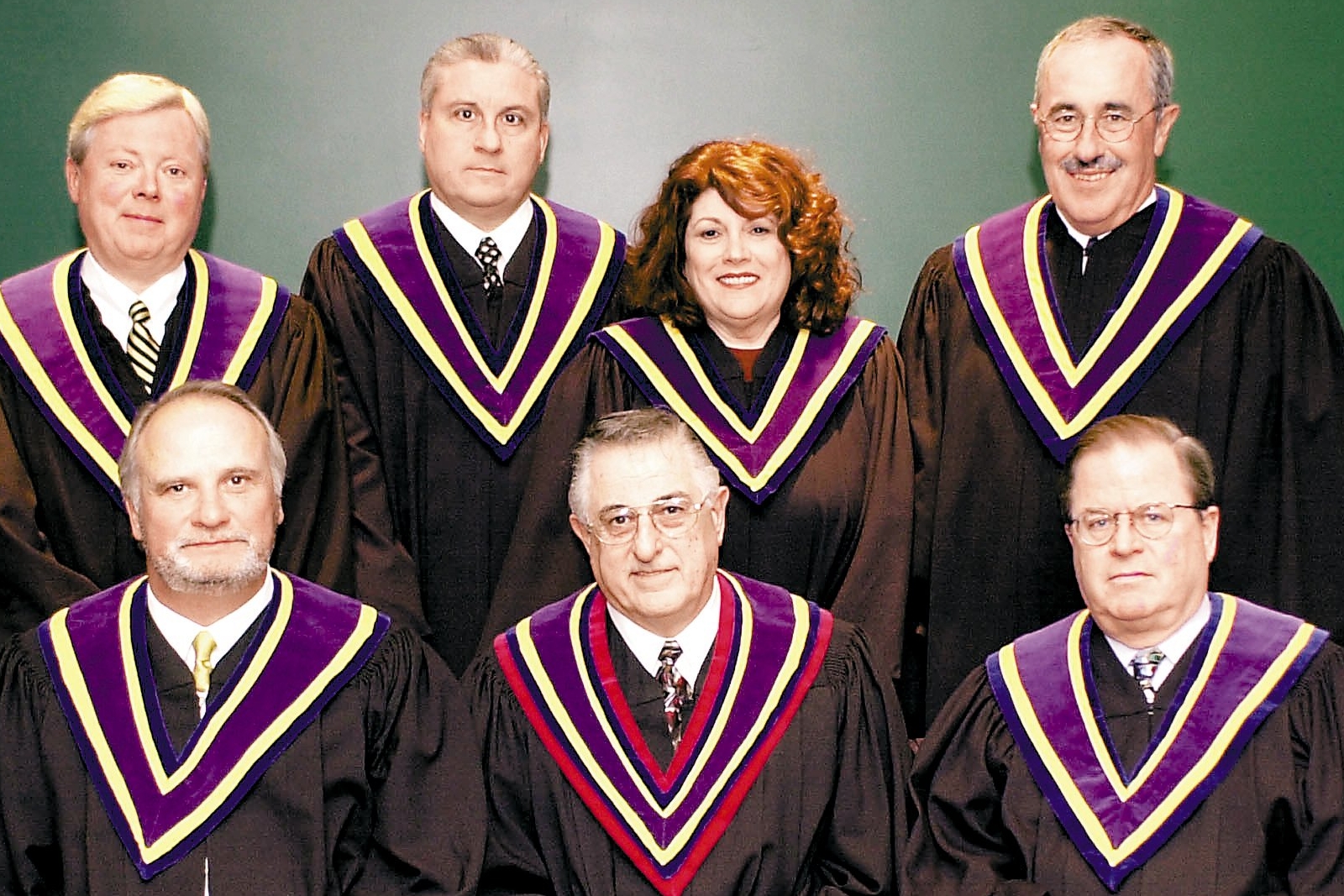
    Justice Newman was the only woman on the state Supreme Court in 2002.

    A friend said online she was “irrepressible in an Auntie Mame sort of way.” Another said: “The world has become a little quieter.”

    Justice Newman served as the first female assistant district attorney in Montgomery County from 1972 to 1974 and was an in-demand, high-profile partner at Astor, Weiss & Newman from 1974 to 1993. She returned to private practice in 2006 and handled mostly alternative dispute resolution cases until recently.

    She told the Press Enterprise in 1995 that colleagues in the Montgomery County District Attorney’s Office had adorned her desk with a green plant on her first day in 1972. “It was marijuana from the evidence room,” she said.

    She wrote papers and book chapters about trial practice, death penalty statutes, and the electoral system in Pennsylvania. She spoke about all kinds of legal topics at seminars, conferences, and other events.

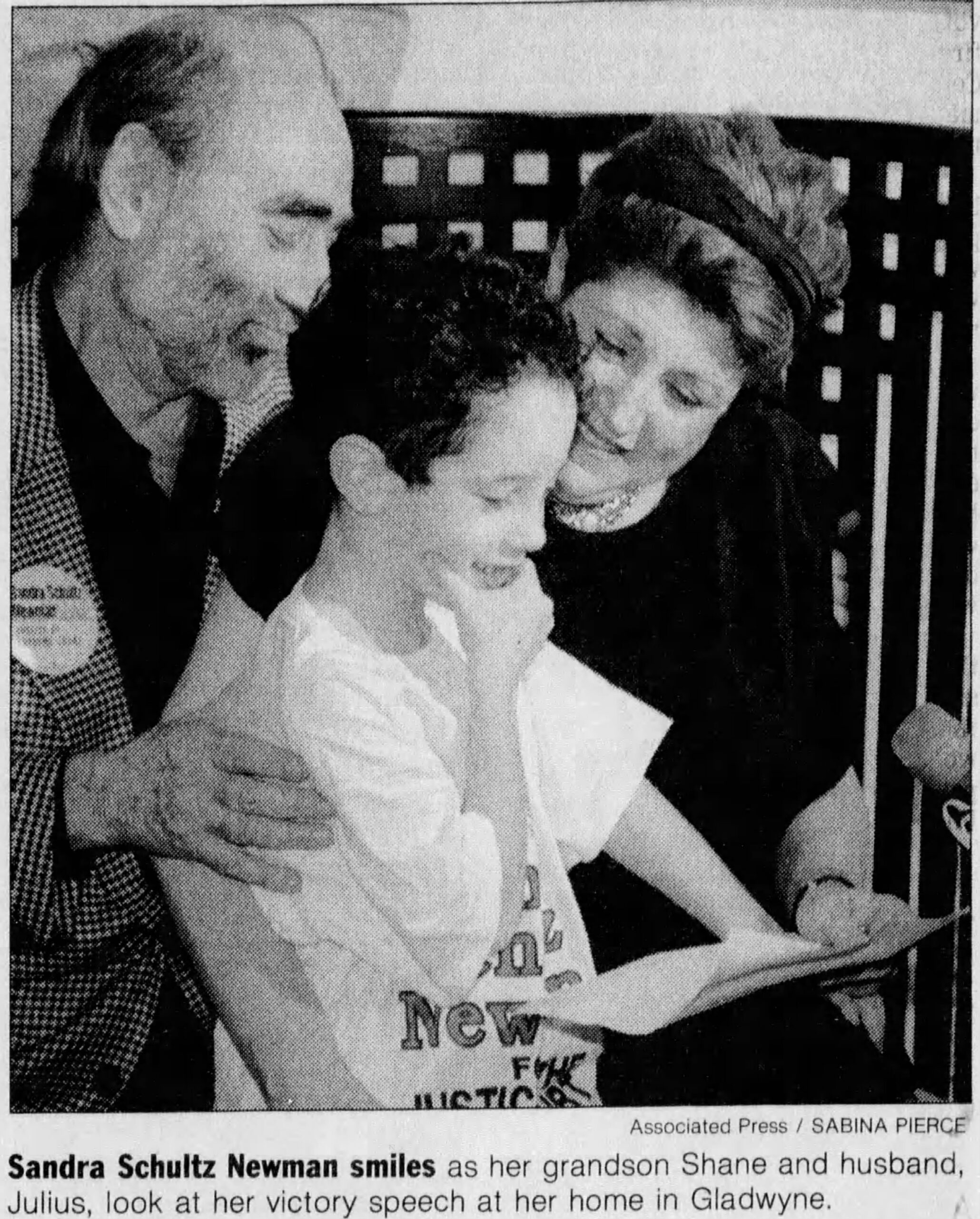
    This photo of Justice Newman, her husband, Julius, and grandson Shane was taken for The Inquirer after she won on Election Day in 1995.

    She cofounded what is now the Drexel University Thomas R. Kline School of Law in 2006, was a trustee for Drexel’s College of Medicine, and received dozens of service and achievement awards from Drexel, Villanova, the Pennsylvania and Philadelphia Bar Associations, the Women’s Bar Association of Western Pennsylvania, the Pennsylvania Association for Justice, and other groups.

    She was the president of boards, chair of many committees, and active with the National Association of Women Justices, the Juvenile Law Center, the American Law Institute, and other organizations. She taught law classes at the Delaware Law School of Widener University in 1984 and ’85, and at Villanova from 1986 to 1993.

    She earned a bachelor’s degree at Drexel in 1959 and a master’s degree in hearing science at Temple in 1969. In 1972, she was one of a handful of women to get a law degree at what is now Villanova’s Charles Widger School of Law. Later, she received four honorary doctorate degrees and was named a Distinguished Daughter of Pennsylvaniaby then-Gov. Ridge in 1996.

    Outside the courtroom, Justice Newman volunteered for charities and legal associations. She was part of a group that tried unsuccessfully to buy the Eagles from then-owner Leonard Tose in 1983, and she was criticized in the early 2000s for her financial involvement in a bungled long-running effort to fund a new Family Court Building in Philadelphia.

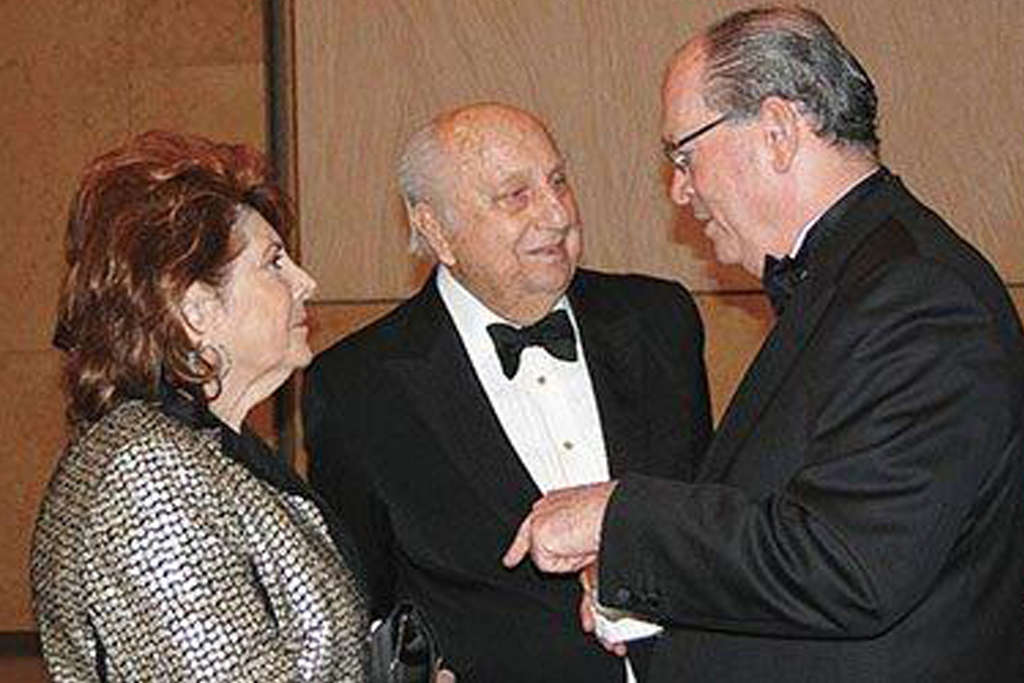
    Justice Newman chats with philanthropists and business leaders Raymond G. Perelman (middle) and Joseph Neubauer at the gala opening of the new Barnes Museum in 2018.

    “Justice Newman filled every room she entered with her strength, energy, and exuberance for life and for the law,” Supreme Court Justice P. Kevin Brobson said in a tribute. “She lived with intention and spent her entire career focused on creating and expanding opportunities for future generations of legal professionals, especially women.”

    Sandra Schultz was born Nov. 4, 1938. She graduated from Overbook High School and married cosmetic surgeon Julius Newman in 1959. They had sons Jonathan and David, and lived in Wynnefield, Penn Valley, and Gladwyne.

    Her husband and son David died earlier. She married fellow lawyer Martin Weinberg in 2007, and their union was annulled 11 months later.

    Justice Schultz was a longtime fashionista. She reveled in shopping trips to New York, and DePaulo reported in 1988 that her closet in Gladwyne was 800 square feet. She was also funny, generous, and kind, friends said.

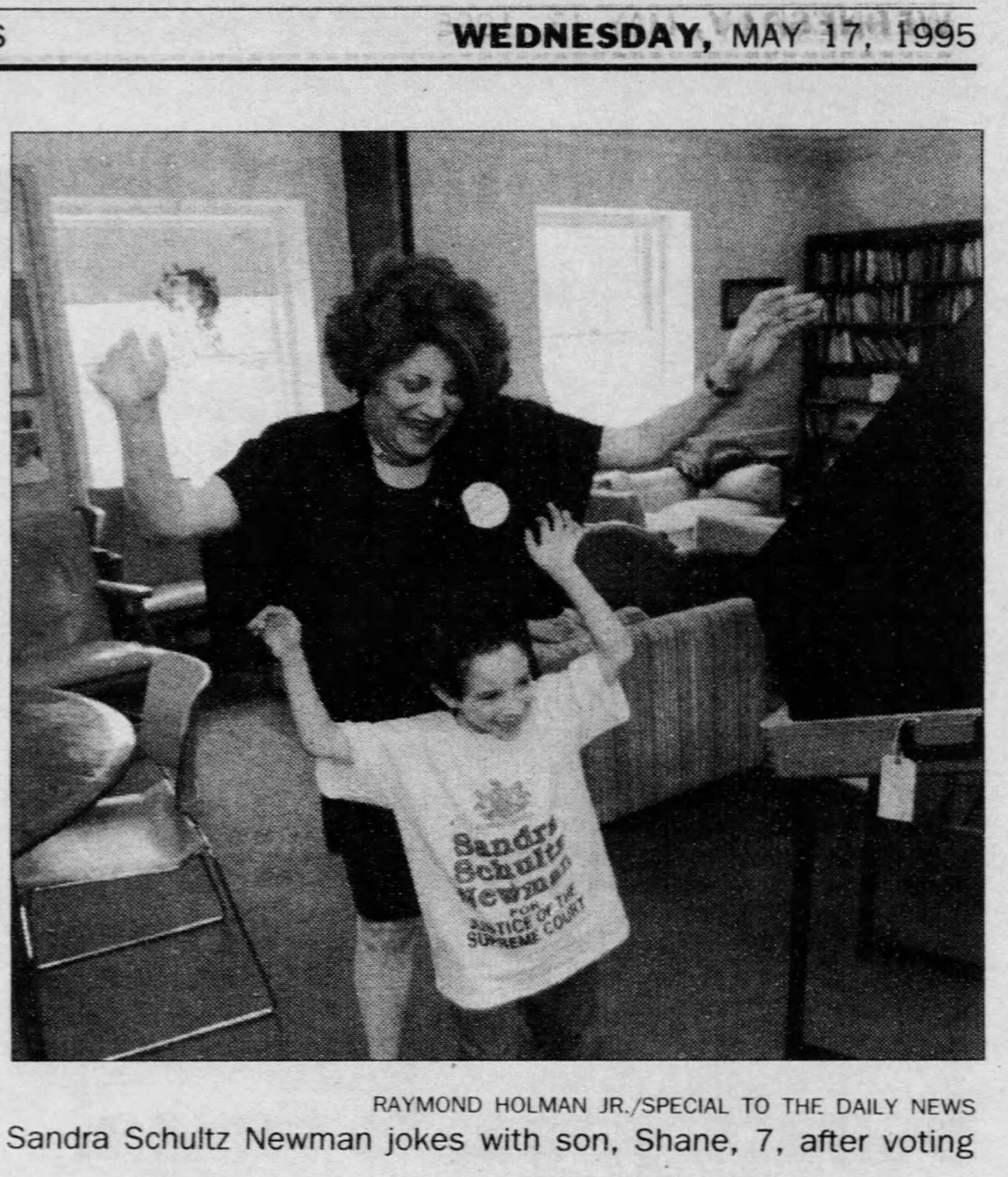
    Justice Newman dances with her grandson on Election Day in 1995. This photo appeared in the Daily News.

    She funded several college scholarships, collected art, owned racehorses, cooked memorable matzo balls, enjoyed giving gifts, and tried to have dinner every night with her family. Sometimes, DePaulo reported, in the 1970s, she took her young sons to her law school classes at Villanova.

    “Despite how busy she was, her family was always her priority,” said her brother, Mark. “She was also a true bipartisan who fought for equal rights and preserving our democratic institutions.”

    In 2003, she was asked by Richard G. Freeman, editor in chief of the Philadelphia Lawyer, to describe her judicial decision-making process. She said: “There are beliefs that you have to put aside. One of the wonderful things about being on our court is that you can make new law where your beliefs fit into the law.”

    In addition to her son Jonathan and brother, Justice Newman is survived by four grandchildren and other relatives. A grandson died earlier.

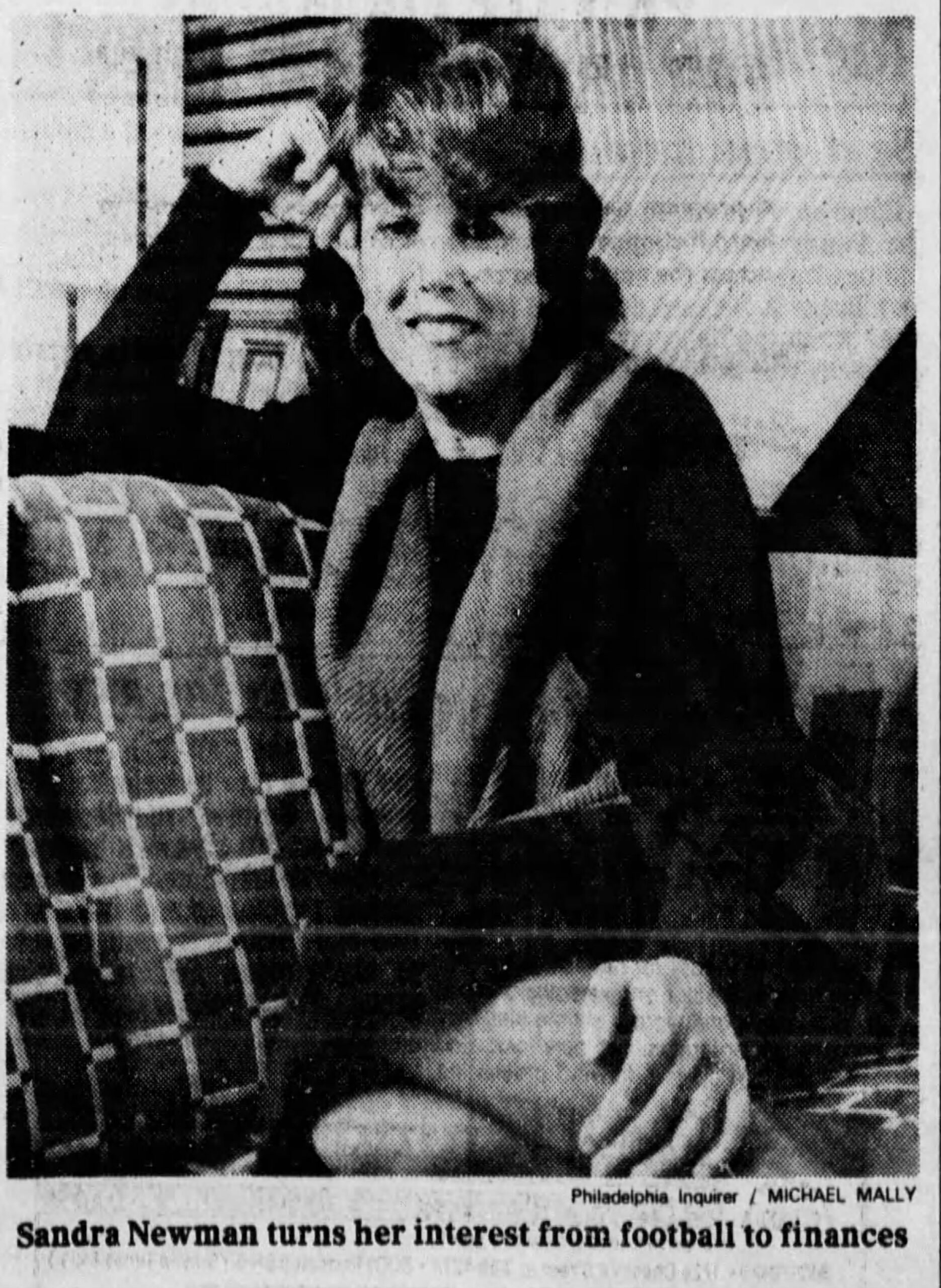
    This photo of Justice Newman appeared in The Inquirer in 1983.

    Services are private.

    Donations in her name may be made to the Crohn’s and Colitis Foundation, 733 Third Ave., Suite 510, New York, N.Y. 10017.

    Correction: One of the communities that Justice Schultz grew up in has been corrected.

  • After a historic win, Joi Washington settles into life as Media’s mayor

    After a historic win, Joi Washington settles into life as Media’s mayor

    Joi Washington’s first challenge as mayor came in the form of a winter weather emergency.

    On Jan. 5, Washington was sworn in as Media’s first new mayor in three decades. On Jan. 25, 9.3 inches of snow fell on Philadelphia, setting off a snow emergency declaration. Washington monitored the storm and worked to put parking restrictions and plowing operations into effect.

    It was “fascinating” — a headfirst dive into running a municipal government, she said.

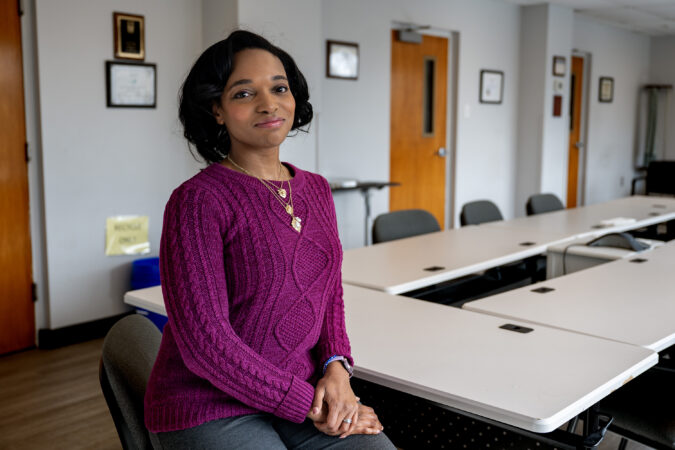
    A graphic designer by trade and former borough council member, Washington moved to Media from Philadelphia in 2013 and fell in love with its walkability and tight-knit community of 6,000. As she learns on the job, friends and colleagues say her intelligence and ability to work across the aisle make her the right person for the role. For Washington, learning how to be a good mayor is all about “being a good neighbor.”

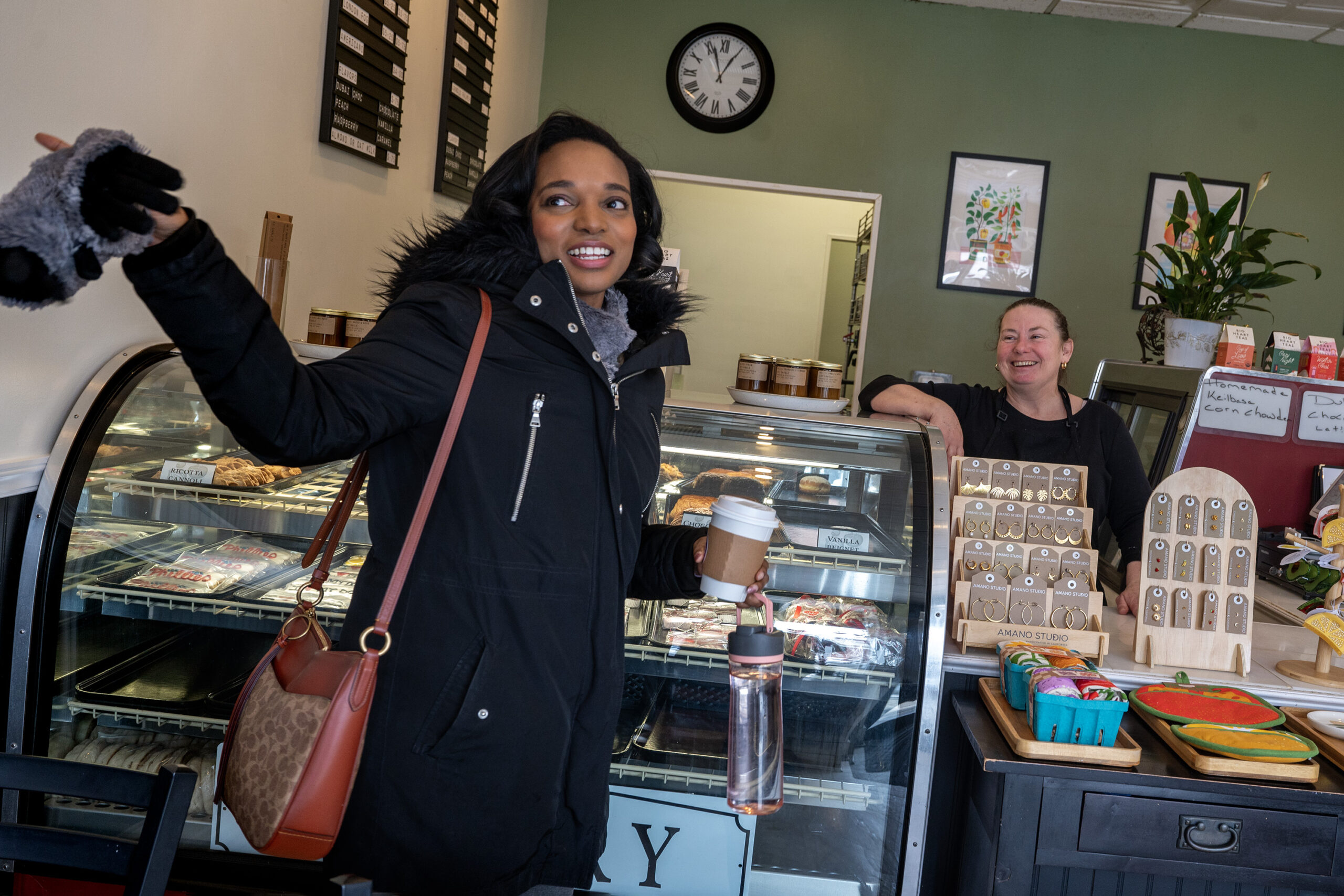
    Media Mayor Joi Washington talks with Garden Café owner Willow Culbertson in downtown Media on Sunday, Feb. 1.

    Who is Joi Washington?

    Washington, 39, was born and raised in Germantown. She graduated from Moore College of Art and Design in 2008 with a bachelor of fine arts in illustration. She has worked for numerous Philly-area companies doing graphic design, digital asset management, and storyboarding.

    Around a decade ago, Washington took a graphic design job in Media. The long commute from Roxborough, where she lived at the time, quickly became tiresome, so she packed up and moved. She met her husband at work, and the two have lived in Media since.

    Washington, a Democrat, was elected to Media’s borough council in 2021, serving until she became mayor last month.

    Katey McVerry, Media’s tax collector, was impressed with Washington as a borough council member. She described Washington as civically and politically engaged, “well known by her neighbors,” and able to work across the aisle.

    When Bob McMahon, Media’s mayor of 33 years, decided to retire last year, Washington stepped up.

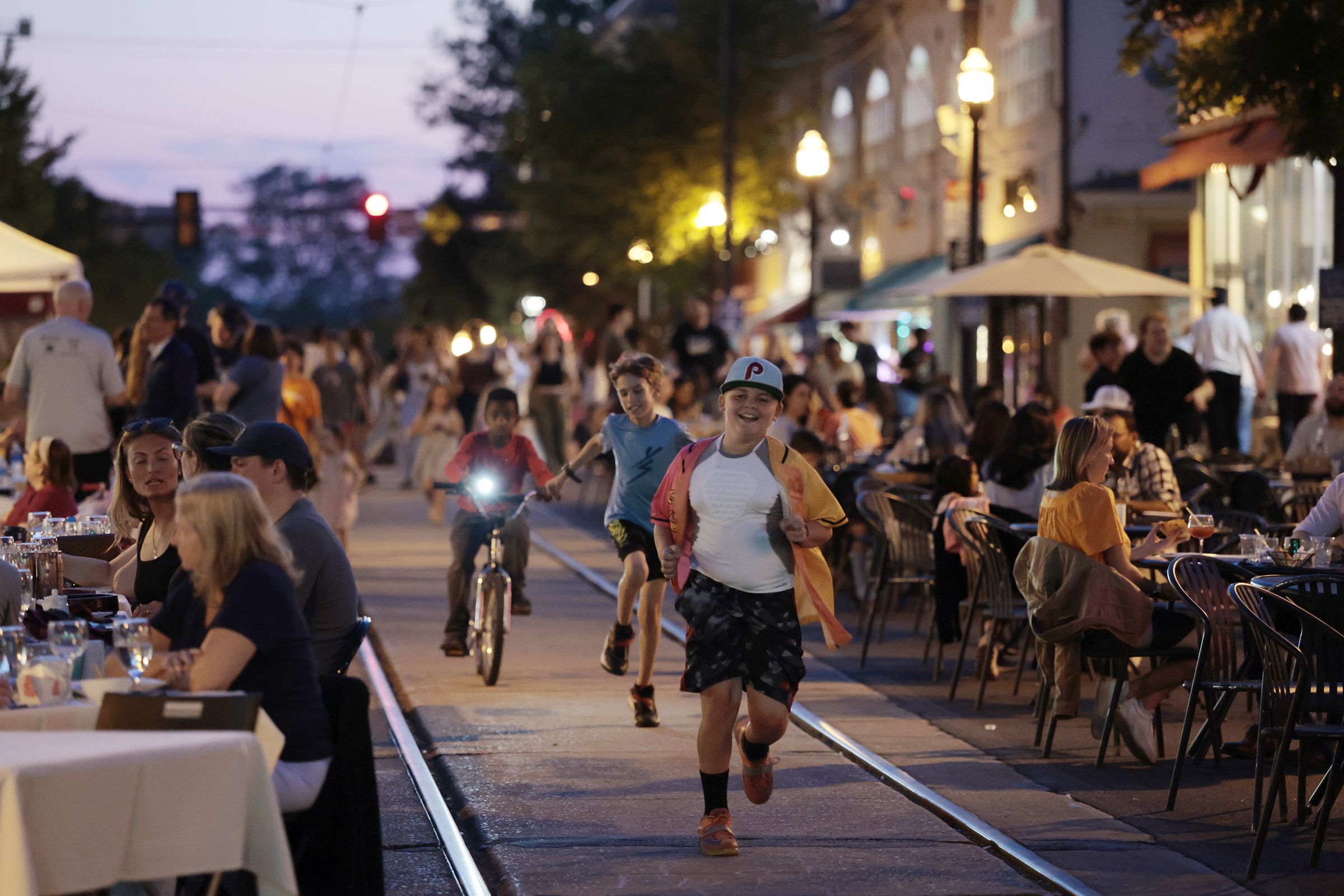
    Children played as folks dined on State Street during Media’s Dine Under the Stars event on Wednesday, June 4, 2025.

    A ‘resounding’ win

    Washington campaigned for mayor on expanding public transit options, supporting local businesses, and working with law enforcement to make streets safer for drivers, cyclists, and pedestrians. She was elected with 77% of the vote, beating out Republican Kevin Kellogg.

    Democrats swept local races in Media and Delaware County in November, winning seats on the Rose Tree Media school board, borough council, and Delaware County Council.

    Mary Tonita Austin helped campaign for Washington last year. Austin and Washington met at a Juneteenth celebration when Washington was still on borough council. Last year, when Austin ran for the Rose Tree Media school board, they found themselves in similar spots — Black women running for office in a county that remains largely white (Washington is the first woman and first person of color to be elected mayor of Media).

    Austin gladly handed out Washington’s campaign fliers along with her own.

    “She’s both intelligent and creative, which I think is so important for us to have,” Austin said of Washington.

    Malcolm Yates, a convener of the Delaware County Black Caucus, said Washington’s win was “resounding.”

    Media is 82% white, according to the most recent census estimates — a percentage nearly 1.5 times higher than the Philly metro area at-large. Before Democrats won three seats on the Delaware County Council in 2019, the body had been controlled by Republicans since the Civil War.

    “It shows that the county has been moving and progressing forward to be more of a melting pot,” Yates said of Washington’s win. “You don’t necessarily have to always look or identify a certain way to be a leader.”

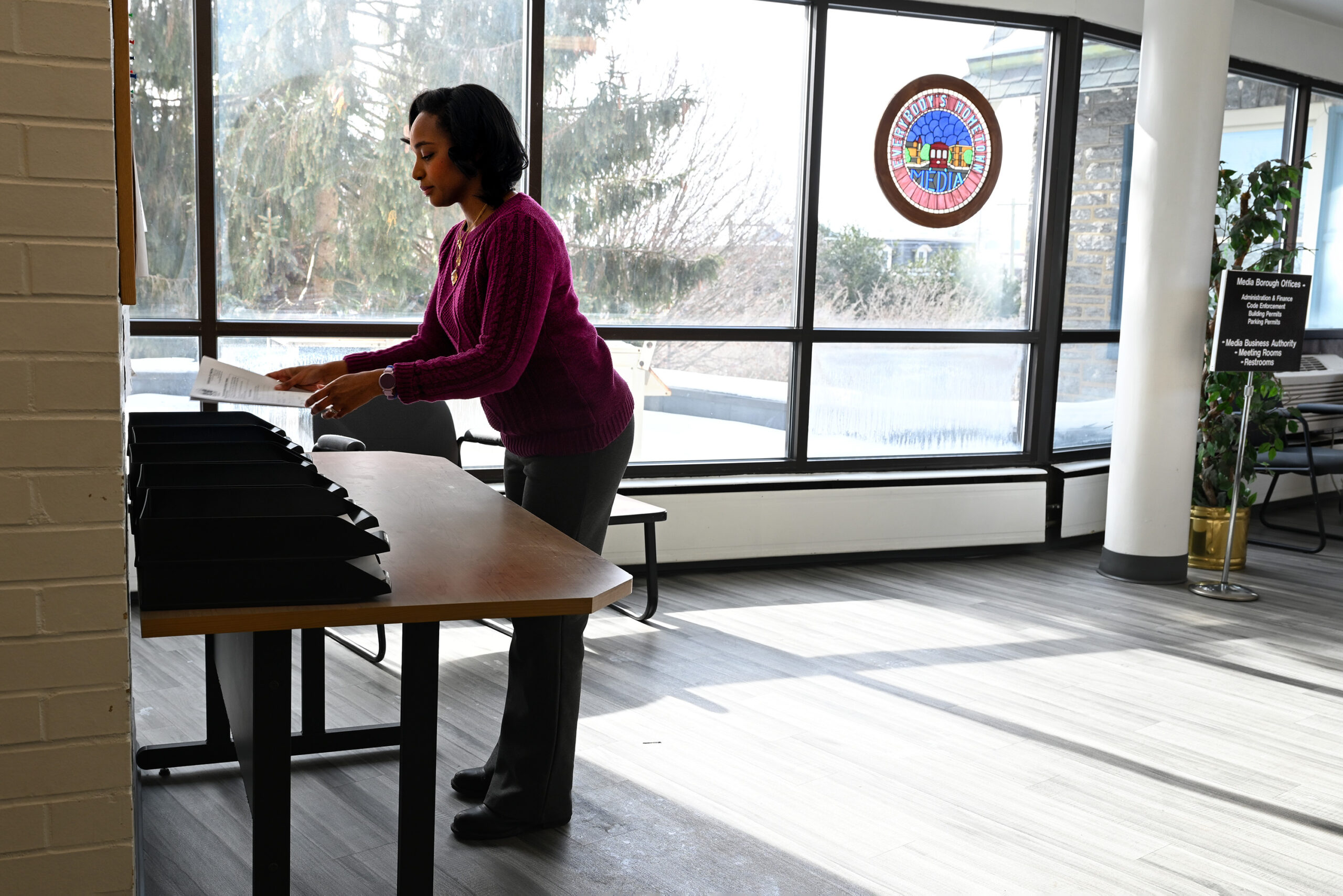
    Media Mayor Joi Washington at Media Borough Hall Sunday, Feb. 1, 2026.

    Becoming the mayor

    Washington describes the first few weeks of being mayor as a “whirlwind.” There are webinars to watch, police reports to study, hands to shake, and nuggets of advice to glean from McMahon, now retired, whom Washington has stayed in touch with.

    There’s a lot to look forward to, as well. Media recently secured grants to purchase a new ambulance, enhance walkability within the borough, and improve Barrall Community Park. Washington hopes to bring in visitors to shop and dine at Media’s small businesses, continuing the borough’s ascent as a Delco destination. Washington rattled off a list of forthcoming events with excitement: Dining Under the Stars, the completion of Plum Street Park, and the Media Spring Arts Show.

    As for her personal life, Washington said she is trying to find balance as mayor, which is a part-time gig in Media. Washington is still working as a freelance illustrator and graphic designer. She is also a natural introvert learning to manage an increasingly busy social calendar.

    “I’m also glad that I have two cats to keep me sane. My husband’s very supportive. I think it’s really good to have a life outside of politics,” she said.

    This suburban content is produced with support from the Leslie Miller and Richard Worley Foundation and The Lenfest Institute for Journalism. Editorial content is created independently of the project donors. Gifts to support The Inquirer’s high-impact journalism can be made at inquirer.com/donate. A list of Lenfest Institute donors can be found at lenfestinstitute.org/supporters.

  • Brian Fitzpatrick has more cash on hand than any other swing district Republican incumbent in the country

    Brian Fitzpatrick has more cash on hand than any other swing district Republican incumbent in the country

    U.S. Rep. Brian Fitzpatrick has more cash on hand than any other GOP incumbent in a swing district nationwide as the party prepares for a tough election.

    The Bucks County lawmaker raised about $4.3 million in the most recent cycle, more than any other House candidate in the state and the 21st most of all the candidates running for the 435-member House in 2026. He ended 2024 with nearly $4.4 million when removing debt and had more than $7.3 million cash on hand as of Dec. 31. That haul makes him the best-funded of the 16 candidates on the National Republican Congressional Committee’s Patriots program, a group of vulnerable incumbents in key swing districts, according to Federal Election Commission data.

    “Brian Fitzpatrick has years of electoral success under his belt and will continue to be unbeatable in Bucks County because Pennsylvanians know he’ll always put them first in Washington … this race was over before it began,” NRCC spokesperson Reilly Richardson said in a statement.

    But Fitzpatrick’s district is one of four in Pennsylvania that could determine the control of the U.S. House and has long been coveted by Democrats because of its purple electorate. It is one of nine GOP-held districts in the country that former Vice President Kamala Harris won in 2024.

    Bob Harvie, a Democrat who chairs the Bucks County commissioners, has emerged as the front-runner to face Fitzpatrick in the 2026 election.

    Harvie, who would need to win the May primary to face Fitzpatrick, raised nearly $930,000 last year and has more than $400,000 cash on hand. He surpassed $1 million after getting $100,000 in the first few weeks of the year, according to his campaign.

    “Based on the outpouring of support we are receiving, it’s clear voters agree and are fired up to be a part of this campaign,” Harvie said Wednesday in a news release about his fundraising.

    Harvie made history flipping the Bucks County board six years ago, has strong name recognition in the district, and has the backing of national Democrats. But Fitzpatrick ended the year with nearly 20 times more cash on hand.

    Fitzpatrick received more money from each of New York and Florida than from in-state donors in 2025, according to FEC data. Harvie received the vast majority of his money from Pennsylvania.

    Fitzpatrick could be less vulnerable than other swing-state Republicans

    Fitzpatrick has set himself apart as willing to vote against President Donald Trump without blocking the president’s flagship bills. He was the only Pennsylvania Republican to vote against Trump’s One Big Beautiful Bill Act on final passage, and Trump called him disloyal in response. But Fitzpatrick had cast a key vote that propelled an earlier version of the legislation forward.

    He recently joined Democrats and two other swing-district Republicans in the state to vote to extend Affordable Care Act subsidies, which Republicans quashed. Fitzpatrick criticized House Speaker Mike Johnson (R., La.) and called some of his Republican colleagues “intellectually dishonest.” But Democrats have argued that Fitzpatrick has not been critical enough of the president, whom he often avoids naming when challenging his policies.

    Fitzpatrick has consistently outperformed Trump in the suburban district. He won his most recent election by nearly 13 percentage points.

    Jim Worthington, a GOP mega-donor in Pennsylvania and owner of the Newtown Athletic Club, said that Fitzpatrick’s approach makes him “the perfect representative for a purple county.”

    “Everybody that’s moderate and people that are independents, they love him because he votes to what best represents his constituents, and by the way, sometimes he takes some votes that make me cringe a little bit, but I understand why he does it,” Worthington said.

    Heather Roberts, a spokesperson for Fitzpatrick’s campaign, attributed the incumbent’s fundraising success to his ability to break the partisan mold.

    “Strong fundraising follows strong leadership — and Congressman Fitzpatrick has built a broad coalition of Republicans, Democrats, and Independents who are rejecting the extremes and backing two-party, patriotic, common-sense solutions,” Roberts said in a statement.

    But Democrats are still trying to tie Fitzpatrick to the president, whose popularity is falling, according to Pew Research Center and other pollsters.

    Fitzpatrick “is no maverick and no John McCain — he is a doormat for Trump’s worst instincts and a greenlight for D.C. Republicans’ dangerous agenda that is hurting our community,” Harvie said Wednesday in a statement to The Inquirer.

    “Pennsylvanians deserve a Congressman who will stand up to Trump and actually do something to lower prices — but Fitzpatrick is weak and caves to his own party when it matters most,” said Eli Cousin, a spokesperson for the Democratic Congressional Campaign Committee, in a statement.

    Democrats, including Harvie, will also be trying to build on their successes from the November 2025 elections, when Democrats flipped two key row offices in Bucks — district attorney and sheriff — and saw wins on local school boards.

    But the nonpartisan Cook Political Report expects Fitzpatrick to be in a safer position than his swing-district colleagues, rating his district as “likely” Republican, while U.S. Rep. Rob Bresnahan’s Northeastern Pennsylvania seat is rated “lean” Republican. Republican U.S. Reps Scott Perry of York County and Ryan Mackenzie of Lehigh County are each in districts rated as a “toss up.”

    Harvie has less cash on hand than the other Democratic front-runners in the state’s swing districts.

    Janelle Stelson, a second-time challenger to Perry, ended 2025 with about $1.5 million cash on hand. Scranton Mayor Paige Cognetti, who is challenging Bresnahan, ended the year with a little more than $800,000 cash on hand. Former federal prosecutor Ryan Croswell, Mackenzie’s Democratic challenger with the most cash, has $612,000 for the Lehigh Valley race.

    Does name recognition make Harvie a ‘formidable’ challenger?

    Harvie’s campaign is confident that he can cash in on name recognition, having won two countywide commissioner races in the last seven years that could help raise his profile among voters in the 1st Congressional District, which includes all of Bucks County and a sliver of Montgomery County.

    Provided he wins the primary, Harvie would be the first Democratic challenger to Fitzpatrick’s seat who has held countywide elected office.

    But will that help Harvie’s chances?

    “The starting point that Bob Harvie has with his name ID as a commissioner is just a much better starting point,” said Brittany Crampsie, a Democratic consultant in Pennsylvania, noting that he would not need to spend as much money introducing himself to voters in an expensive Philadelphia-area media market.

    “He has a lot of advantages going into this race, not the least of which is his name ID, but he would be probably the most formidable matchup we’ve seen against Fitzpatrick in his tenure,” she added.

    “Maybe,” GOP consultant Christopher Nicholas said as to whether Harvie has valuable name recognition, adding that “among hardcore Democrats his name ID is decent because they’re hardcore Democrats.”

    “But if you stood out on the streets of Tullytown or Riegelsville or Dublin and said, ‘Who are your county commissioners?’,” residents may be unfamiliar, Nicholas said.

    As of October 2025, 43% of respondents to an internal Harvie campaign survey conducted by Public Policy Polling could identify Harvie, with 26% giving him a favorable rating and 17% an unfavorable. That poll had the commissioner and Fitzpatrick tied at 41%.

    This article has been updated to include a comment from Fitzpatrick’s campaign received after publication.

  • Democratic campaign manager charged in Chester County for allegedly filing fake signatures in 2024 primary race

    Democratic campaign manager charged in Chester County for allegedly filing fake signatures in 2024 primary race

    A Democratic campaign manager was charged Monday in Chester County with filing fraudulent nomination petitions in the 2024 primary for auditor general, including the forged signature of a Chester County judge, authorities said.

    Mariel Kornblith-Martin, 40, of Philadelphia, is accused of filing the false nomination petitions when serving as campaign manager for Mark Pinsley, the Lehigh County controller, as he sought to secure a place on the competitive Democratic primary ballot.

    Petitions for Pinsley’s campaign included the names of people who said they had not signed them, including Chester County Judge Alita Rovito, Coatesville City Council members Carmen Green and Khadija Al-Amin, and West Goshen Township Supervisor Nate Wolman, The Inquirer reported.

    Rovito reported the forgery to the Chester County District Attorney’s Office at the time, saying the signature was not hers and she did not sign nominating petitions for any candidate, “as to do so would be a violation of judicial ethics,” according to charging documents.

    Rovito, a Democrat, told The Inquirer at the time that “the use of my name and signature is concerning to me due [to] the potential implications on my role as a member of the independent judiciary.”

    Alita Rovito, a Chester County judge, poses for a portrait in West Chester, Pa. in 2020.

    In the criminal complaint filed against Kornblith-Martin, the Chester County District Attorney’s Office alleges that she gave three college students “stacks of pages containing signatures of supporters” and asked them to sign the required sworn declaration at the bottom of each page. Among the charges filed against Kornblith-Martin was solicitation to false swearing.

    Prosecutors say she paid the students, who are not named in the charging documents, $50 on at least three occasions to sign the petitions.

    “That’s disgraceful,” former U.S. Rep. Bob Brady, the chair of the Philadelphia Democratic Party, said of the charges against Kornblith-Martin. “She’s not one of our favorites.”

    The three college students were all working part-time on several campaigns run by Kornblith-Martin, according to the complaint.

    The students were previously identified by The Inquirer as paid volunteers attending Temple University.

    Kornblith-Martin described herself to investigators as a “political operative” in Philadelphia with 13 years of experience who had worked on 16 campaigns, according to the criminal complaint. She previously served in Philadelphia’s 39th Democratic Ward, but resigned last year, according to its ward leader, Traffic Court Judge Michael Sullivan.

    Kornblith-Martin did not respond to requests for comment on Wednesday or Thursday.

    She turned herself in on Wednesday and has been released on bail, which was set at $50,000.

    Kornblith-Martin said in 2024 that the campaign was conducting an “internal investigation” when asked about the alleged fraudulent signatures.

    Pinsley told The Inquirer on Wednesday evening his campaign “reviewed what was brought to our attention but did not have enough verified information to reach independent conclusions” when concerns were raised.

    “Petition drives can involve invalid or questionable signatures for many reasons, and we were not in a position to determine intent,” he added in a text message. “I was not personally involved in the signature collection, and I believe the legal process is the appropriate place for the facts to be established. If anyone knowingly falsified signatures, that would be wrong and should carry consequences.”

    Pinsley said he has “not been involved” with Kornblith-Martin since his auditor general campaign and does “not know the facts of this situation.” Pinsley is now running in the crowded Democratic primary to challenge Republican U.S. Rep. Ryan Mackenzie in the Lehigh Valley.

    Pinsley’s campaign was not the only one with signatures that came under scrutiny.

    State Sen. Nikil Saval’s 2024 campaign complained about signatures on then-candidate Allen King’s petitions, which included two of the same student circulators and contributed to his being booted from the ballot.

    King, an entrepreneur who still has political aspirations, told The Inquirer the incident had disillusioned him about the two-party system and inspired him to reapply to law school.

    “When ballot access becomes a game of shortcuts and challenges, democracy loses before voters ever enter the booth,” he said.

    The February 2024 revelation that Pinsley’s campaign may have submitted fraudulent petitions shook up the race for a little-known office responsible for conducting audits to ensure that state money is spent properly.

    Pinsley failed to secure the Democratic nomination over State Rep. Malcolm Kenyatta, who ultimately lost to incumbent Republican Auditor General Tim DeFoor as the GOP swept the state’s row offices in the general election.

    Kenyatta did not formally challenge Pinsley’s nominating petitions to remove him from the ballot during the primary. Reached Wednesday, Kenyatta said in a statement: “Fraud occurring within any stage of our electoral process is a direct assault on our democracy.”

    “The charges brought today are a first step in the legal process but accountability must not end here: the buck always stops with the candidate,” added Kenyatta, the vice chair of the Democratic National Committee.

    Investigators found at least nine pages of alleged forgeries of Chester County voters, according to the complaint.

    To get on the ballot in Pennsylvania for a statewide row office like auditor general, a candidate must submit 1,000 signatures, including at least 100 from at least five counties.

  • ‘The first step’: Chester County commissioners present poll book investigation to voters

    ‘The first step’: Chester County commissioners present poll book investigation to voters

    Chester County residents called for accountability after a poll book error led to thousands of voters being left off the rolls in November’s election, and said the recent investigation solicited by the county fell short of addressing problems they fear could happen again.

    Tuesday’s public meeting was the first time community members — and the county commissioners themselves — were able to respond to an independent firm’s investigation and report, which found that insufficient training, poor oversight, and staffing challenges in the county’s elections office forced more than 12,000 voters to cast provisional ballots in the general election. The poll book error occurred as the 25-person department has faced unusually high turnover in recent years, and as the director faces allegations of fostering a toxic workplace.

    “This is the first step, this is not the last step … to rebuilding trust with the public and improving elections in a way that ensures this never happens again,” Josh Maxwell, chairman of the county commissioners, told the attendees.

    The 24-page report, prepared by West Chester law firm Fleck, Eckert, Klein & McGarry LLC and published last month, found that two employees mistakenly included only registered Democrats and Republicans when using the statewide voter roll to create the poll book, omitting more than 75,000 registered independent and unaffiliated voters from the rolls.

    The employees, inexperienced and never formally trained, lacked direct supervision, the report said. No one in the county’s department checked the books until a poll worker noticed the omissions before polls opened on Election Day.

    There was no evidence of malfeasance, the report said. County officials said previously that everyone who wanted to vote could cast a ballot, despite the issue.

    Still, the error rocked Election Day in the county, with officials scrambling to print supplemental poll books and poll workers staying late to address the challenges. Republican Commissioner Eric Roe broke with his Democratic peers by voting against the certification of the election results in December, saying his conscience would not allow it.

    Community members said Tuesday the error further eroded trust in voting security.

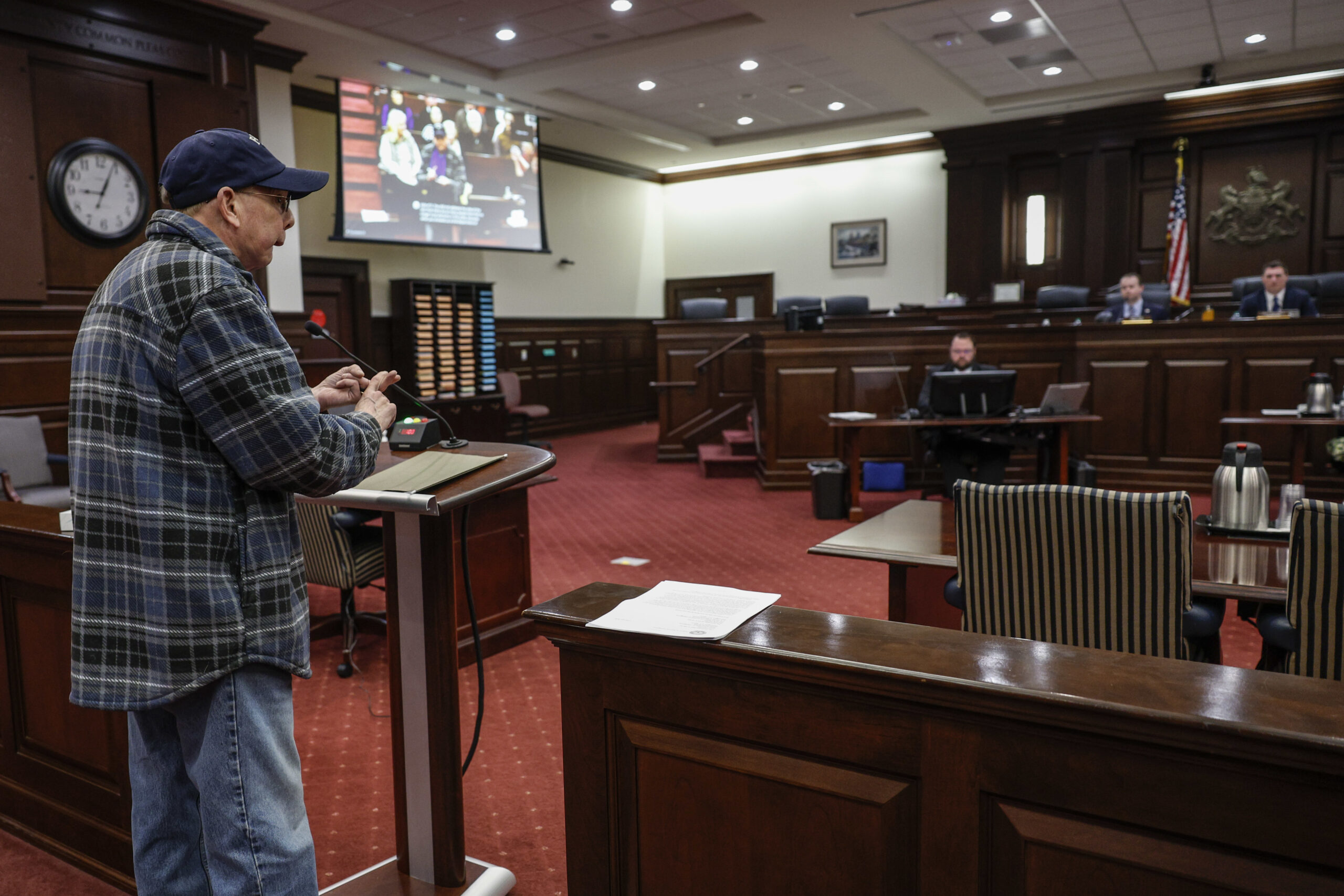
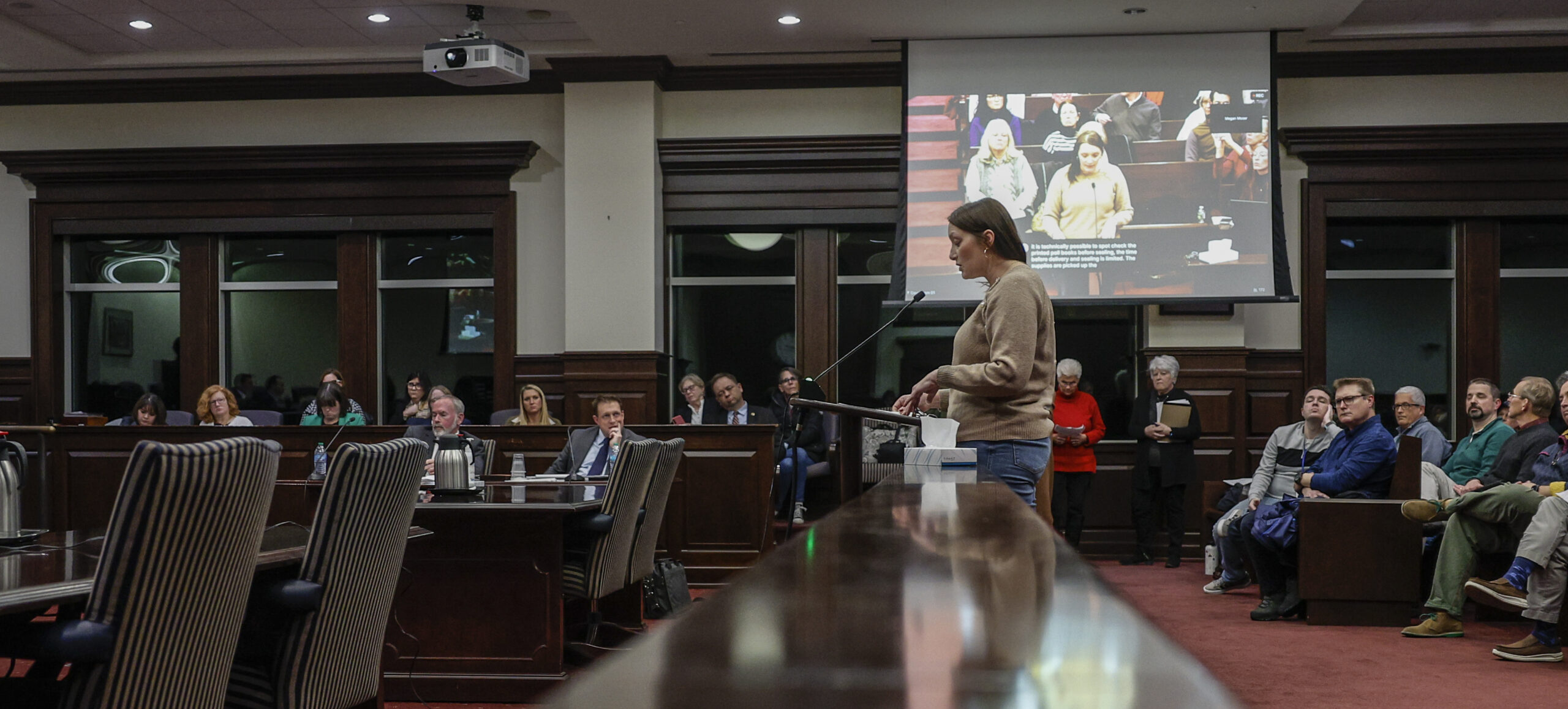
    John Luther addresses the Chester County Commissioners as they hold a public meeting to discuss the errors they had in the pole books during the November election. West Chester. Tuesday, February 3, 2026

    “How many voters were disenfranchised and did not vote?” resident John Luther asked the commissioners. “That is the most important thing. You guys can fix all the rest, but you can’t fix what you messed up in the front.”

    Kadida Kenner — who leads the New Pennsylvania Project, an organization dedicated to voter registration — said she rushed on Election Day to West Chester University, where the organization had helped students register to vote, to make sure they were not disenfranchised.

    “I see the impact of this mistake, this opportunity for change and growth,” she said. “The events of Election Day really did not help our efforts to be able to overcome feelings of individuals, as it relates to the electoral process, here in the commonwealth and across the country.”

    The report recommended more than a dozen changes for the county to prevent future errors, including improved training, reviewing processes and policies, and evaluating staff levels and pay. The county rolled out a plan to address the recommendations and intends to make monthly reports on its progress, saying some recommendations would be in place ahead of May’s primary.

    “Everyone in this room knows that a grievous error was made, and everyone is upset about it,” resident Marian Schneider said. “We can stop the browbeating and focus on the path forward.”

    The report stopped short of recommending personnel changes. Maxwell said the commissioners would not discuss personnel actions.

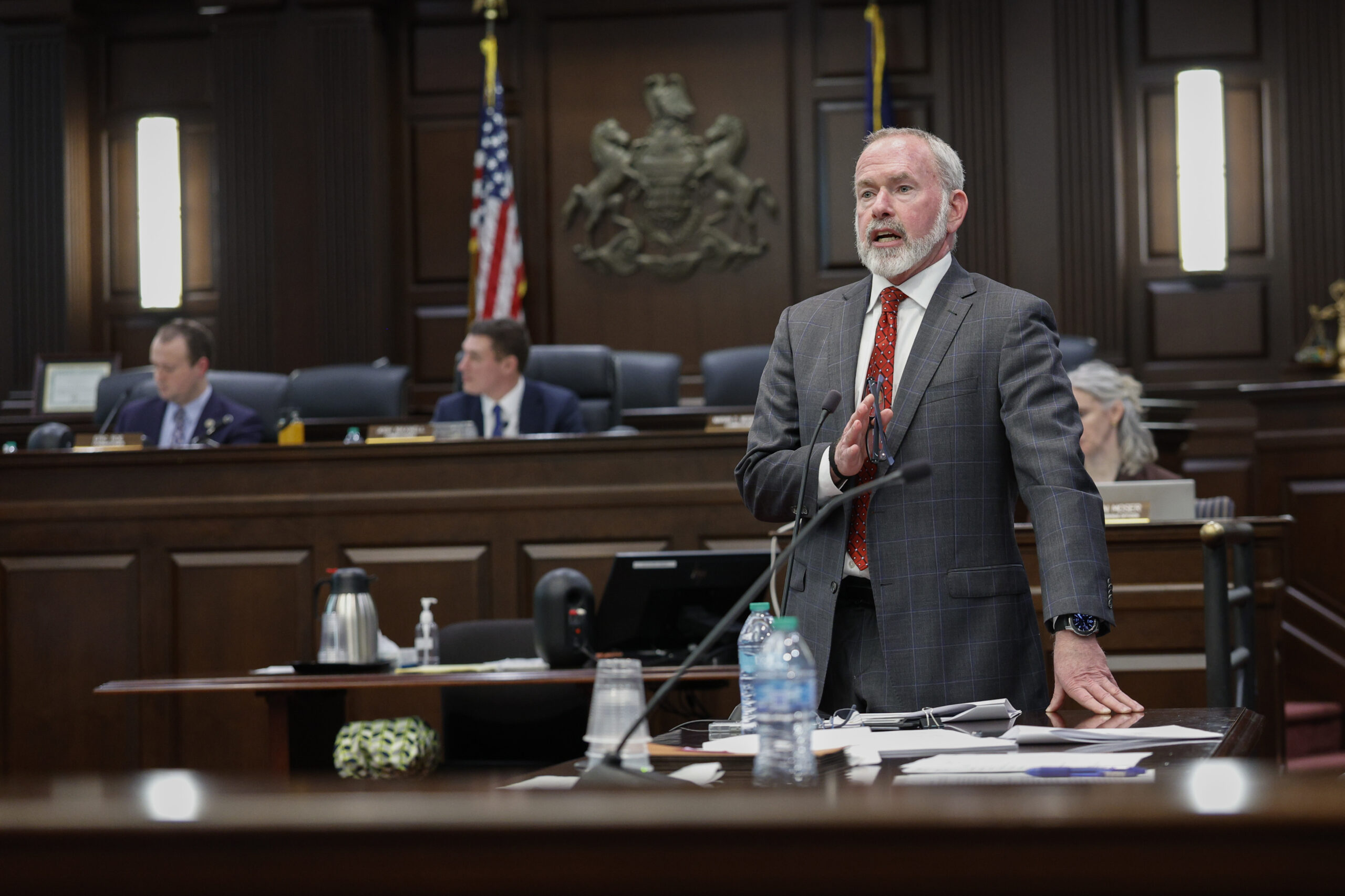
    Attorney Sigmund Fleck addresses the Chester County Commissioners as they hold a public meeting to discuss the errors they had in the pole books during the November election. West Chester. Tuesday, February 3, 2026

    “Bottom line, this appears to be a human error — clicking the wrong box,” said Sigmund Fleck, one of the attorneys who oversaw the report.

    Residents worried that those errors were symptoms of a deeper problem, and that the report’s scope did not fully address issues within voter services.

    “Yes, human error is a factor here,” Elizabeth Sieb told the commissioners. “This goes far beyond that. Mistakes of this magnitude require consequences.”

    Fleck pointed to larger issues with the state’s election system that culminated in the error, such as tight turnaround times for publishing the poll books, lack of statewide training, and a fairly old-school online voting roll system.

    Elizabeth Sieb addresses the Chester county commissioners as they hold a public meeting to discuss the errors they had in the pole books during the November election. West Chester. Tuesday, February 3, 2026

    But other counties deal with those same complications, some community members argued. November’s error came after the county omitted the office of the prothonotary on the ballot in May’s primary. The report found that error was due to the county solicitor’s office misinterpreting state law.

    “Sixty-seven counties face the same exact issues, except for one: management,” said Nathan Prospero Fox, a former voter services employee.

    Roe acknowledged the anger directed at county staff, but said: “The truth is, the buck doesn’t stop with staff. It stops with us.”

    “I am so sorry,” he continued. “This is not the end; there’s still time for accountability and improvement.”

    This suburban content is produced with support from the Leslie Miller and Richard Worley Foundation and The Lenfest Institute for Journalism. Editorial content is created independently of the project donors. Gifts to support The Inquirer’s high-impact journalism can be made at inquirer.com/donate. A list of Lenfest Institute donors can be found at lenfestinstitute.org/supporters.

  • Pa. officials push back as Trump targets Philly in call to nationalize elections ahead of 2026 midterms

    Pa. officials push back as Trump targets Philly in call to nationalize elections ahead of 2026 midterms

    Pennsylvania Secretary of State Al Schmidt on Wednesday rejected President Donald Trump’s false claims about voter fraud in the state as Trump targeted Philadelphia in his push to nationalize elections.

    The state’s top election official said Trump’s proposal would violate the Constitution, which he noted clearly gives states exclusive authority to administer elections.

    “Pennsylvania elections have never been more safe and secure,” said Schmidt, who served as Philadelphia’s Republican city commissioner in 2020, when the city was at the center of Trump’s conspiracy theories.

    “Thousands of election officials — Democrats, Republicans, and Independents alike — across the Commonwealth’s 67 counties will continue to ensure we have free, fair, safe, and secure elections for the people of Pennsylvania,” he said in a statement.

    Speaking to reporters Tuesday in the Oval Office, Trump cited Philadelphia, Detroit, and Atlanta as examples of where the federal government should run elections. He singled out three predominantly Black cities in swing states but offered no evidence of voter fraud or corruption to support his claims of a “rigged election.”

    “Take a look at Detroit. Take a look at Pennsylvania, take a look at Philadelphia. You go take a look at Atlanta,” Trump said. “The federal government should get involved.”

    Philadelphia has been a frequent target of Trump’s false claims of election fraud for several years, going back to his efforts to overturn his loss in the 2020 election. City and state officials have persistently pushed back on those claims, and there is no evidence that elections in the city have been anything but free and fair.

    Trump is advocating for taking control of elections in 15 states, though his administration has not named which ones.

    “The Republicans should say, ‘We want to take over,’” Trump said in December. “We should take over the voting, the voting in at least many — 15 places. The Republicans ought to nationalize the voting.”

    But, Pennsylvania officials and experts noted, he lacks the power to do so unilaterally.

    Congress has limited power to set rules for elections, but the U.S. Constitution grants control of elections to the states.

    “The president has zero authority to order anything about elections,” said Marian Schneider, an election attorney who was Pennsylvania’s deputy secretary of elections during the 2016 election.

    White House press secretary Karoline Leavitt claimed to reporters early Tuesday the president was referring to the SAVE Act, legislation proposed by House Republicans require citizens to show documents like a passport or driver’s license to register to vote.

    But Trump didn’t mention the legislation Tuesday.

    Trump will face an uphill battle in nationalizing elections as even some Republicans in Congress are already pushing back. Senate Majority Leader John Thune (R., S.D.) told reporters Tuesday he disagreed with Trump on any attempt to nationalize elections, calling it “a constitutional issue.”

    “I’m not in favor of federalizing elections,” Thune said.

    Still, Trump’s comments raised alarm as his administration continues to sow doubt in the nation’s elections.

    “This is clearly a case of Trump trying to push the boundaries of federal involvement in election administration because he has a problem with any checks on his power, democracy being one of them,” said Montgomery County Commissioner Neil Makhija, an attorney and a Democrat who chairs the Montgomery County Board of Elections.

    Trump’s comments came a week after the FBI seized ballots and voting records from the 2020 election from the Fulton County election hub in Georgia. In a statement, Fulton County Commissioner Marvin Arrington Jr. said the county will file a motion in the Northern District of Georgia challenging “the legality of the warrant and the seizure of sensitive election records, and force the government to return the ballots taken.”

    Lisa Deeley, a Democratic member of the Philadelphia city commissioners, who oversee elections, accused Trump of trying to distract from federal agents killing two civilians in Minnesota last month.

    “We all know the President’s playbook by now. His remarks on elections are an effort to change the conversation from the fact that the Federal Government is killing American citizens in Minneapolis,” Deeley said in a statement.

    Trump has been making similar claims since 2016, when he erroneously blamed fraud for costing him the popular vote.During a debate with his 2020 opponent, Joe Biden, Trump said, “Bad things happen in Philadelphia, bad things,” viewed at the time as an attempt to sow doubt about the election results and mail voting during the peak of the COVID-19 pandemic.

    Despite losing to Biden in Pennsylvania in 2020 by a little more than 80,000 votes, Trump has repeatedly claimed he actually won, lying about mail-in votes “created out of thin air” and falsely stating there were more votes than voters.

    “Every single review of every single county in the commonwealth has come back within a very small difference, if any, of the results reported back in 2020,” Kathy Boockvar, who served as Pennsylvania’s secretary of state during the 2020 election, told The Inquirer in 2024.

  • Local businessman and ‘Task’ stuntman is appointed to Kennett Square council

    Local businessman and ‘Task’ stuntman is appointed to Kennett Square council

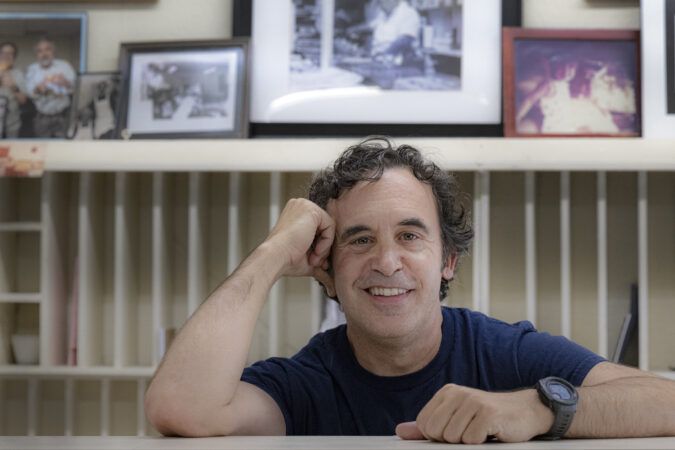
    Michael Bertrando’s first brush with Kennett Square’s council three years ago was to discuss a parking issue at his family’s legacy sandwich spot, Sam’s Sub Shop. He saw his neighbors, listened to them, and started to see how the council worked. Eventually, he became something of a regular.

    When the issue of short-term rentals came up last month, Bertrando had a lot of perspective: As an actor — you might have seen him on HBO’s Task — he has traveled extensively. He has seen the negative effects short-term rentals can have had on communities from New York to Argentina to Brazil. He spoke up.

    And then people started to drop by the sandwich shop, which he runs alongside his parents, suggesting that he put his name in for a vacant seat on the council.

    The council voted last month to appoint Bertrando, 52, from a crowded field of applicants to fill former council member Julie Hamilton’s seat through December 2027. He was sworn in Monday.

    The seat will be on the ballot for a four-year term in the 2027 general election. Hamilton resigned for a job in Texas, the Daily Local reported.

    Long ties to Kennett Square

    Council member is another job title the local businessman and Task stuntman can add to his resumé.

    “I’m volunteering to help the residents of my community; that’s my primary goal,” he said in an interview Tuesday.

    Bertrando — an actor, director, and producer — has worked at his family’s 80-year-old sub shop for decades. It drew him back home a few years ago, so he could help his aging parents run the shop.

    But in the years between, Bertrando left Kennett Square to pursue acting, appearing in commercials for brands like Mercedes, McDonald’s, Nintendo, and Oscar Mayer; traveling the world as a professional clown; and working the improv comedy circuit in New York and Chicago.

    His film career has continued back in Pennsylvania; Bertrando served as Mark Ruffalo’s stand-in and stunt double in Task, the HBO crime drama set in Delco. In his own productions, his hometown has seeped into his work. A short film, Italian Special, is set within Sam’s Sub Shop and Kennett Square.

    Since returning to the borough, Bertrando has been a frequent visitor to council meetings, and advised the borough alongside other business leaders on what was going well, and what wasn’t, in Kennett Square.

    Priorities on council

    His professional career and his family’s long lineage in Kennett Square have shaped his perspectives on the borough, and what he thinks he can add as a council member.

    He is motivated by the possible development of a new theater. Infusing more arts into the community would be beneficial, he said.

    Having worked on Task, he saw how other municipalities the show filmed in benefited from an influx of revenue: from parking to hiring police for traffic control, to renting out locations in town, to ordering food for lunches and snacks, to coffee runs, to overnight stays in hotels.

    “We have all the infrastructure needed for that to happen here in Kennett,” he said.

    Both Task and fellow Pennsylvania-based crime drama Mare of Easttown mention Kennett Square, but neither used the borough for filming.

    “When you have a theater or something arts-driven in the town, I think that’s a signal,” he said. “I think a theater can work as a beacon for revenue from other sources, like film production.”

    Beyond the intersection of his passion for film and the borough, he said the development of the former National Vulcanized Fiber land, a large undeveloped parcel that is being remediated for contamination in soil from the industrial site, has been of concern for residents.

    While the project would be years out even if ultimately approved, Bertrando said he would advocate for environmental transparency and affordable development that respects the existing neighborhoods.

    He would also like to improve communication between the municipality and its residents — the longtime community members, like Bertrando’s family, and those who are choosing to relocate.

    As he began his term on the other side of public comment, he said, he focused in, listening closely to what his neighbors were saying. He feels the burden to pay close attention, since he was appointed to the role, rather than elected.

    “I really have to make the effort to listen to their concerns and really try the best ways to help in their concerns,” he said. “Sitting on the other side was exciting. It was important. It’s serious. It’s my town. I really care about it.”