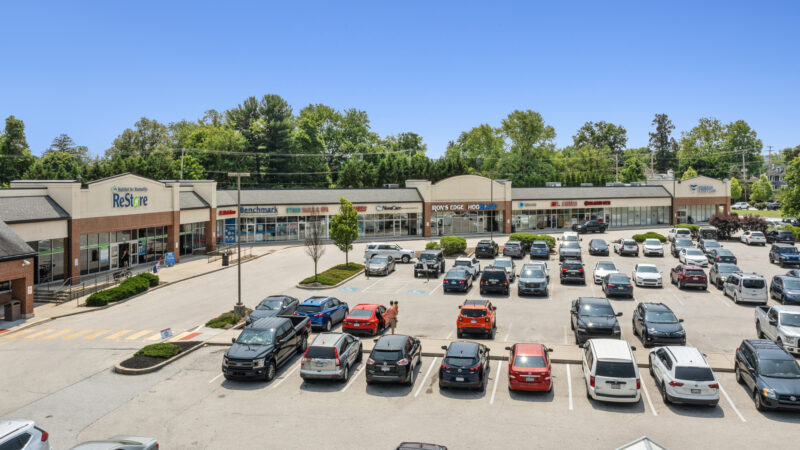
A fully occupied shopping center near downtown Phoenixville recently sold for nearly $7.4 million.
Chester County property records show that the 33,000-square-foot complex was sold in late November by one private investor based in Malvern to another based in Glen Mills, with both registered as limited liability companies. The sale was first reported Thursday by the Philadelphia Business Journal.
Located at 785 Starr St., the center is about a mile down the road from Phoenixville’s main drag. It is shadow-anchored by a corporately owned Acme, according to Marcus & Millichap, the firm that represented the seller. The Acme is connected to the rest of the shopping center — and drives traffic to other stores — but was not included in the sale.
The center’s other tenants include Benchmark Federal Credit Union, Habitat for Humanity ReStore thrift store, Fresenius Kidney Care, Labcorp, NovaCare Rehabilitation, and State Farm. It also has a martial arts gym, a dry cleaner, and several quick-service restaurants.
“This closing highlights the strength of essential-service tenants, 100% occupancy, and strong tenant performance,” Scott Woodard, senior director of investments for Marcus & Millichap, said in a statement. “Phoenixville’s expected population growth and proximity to major anchors, such as Acme, made this center a standout asset with long-term stability.”
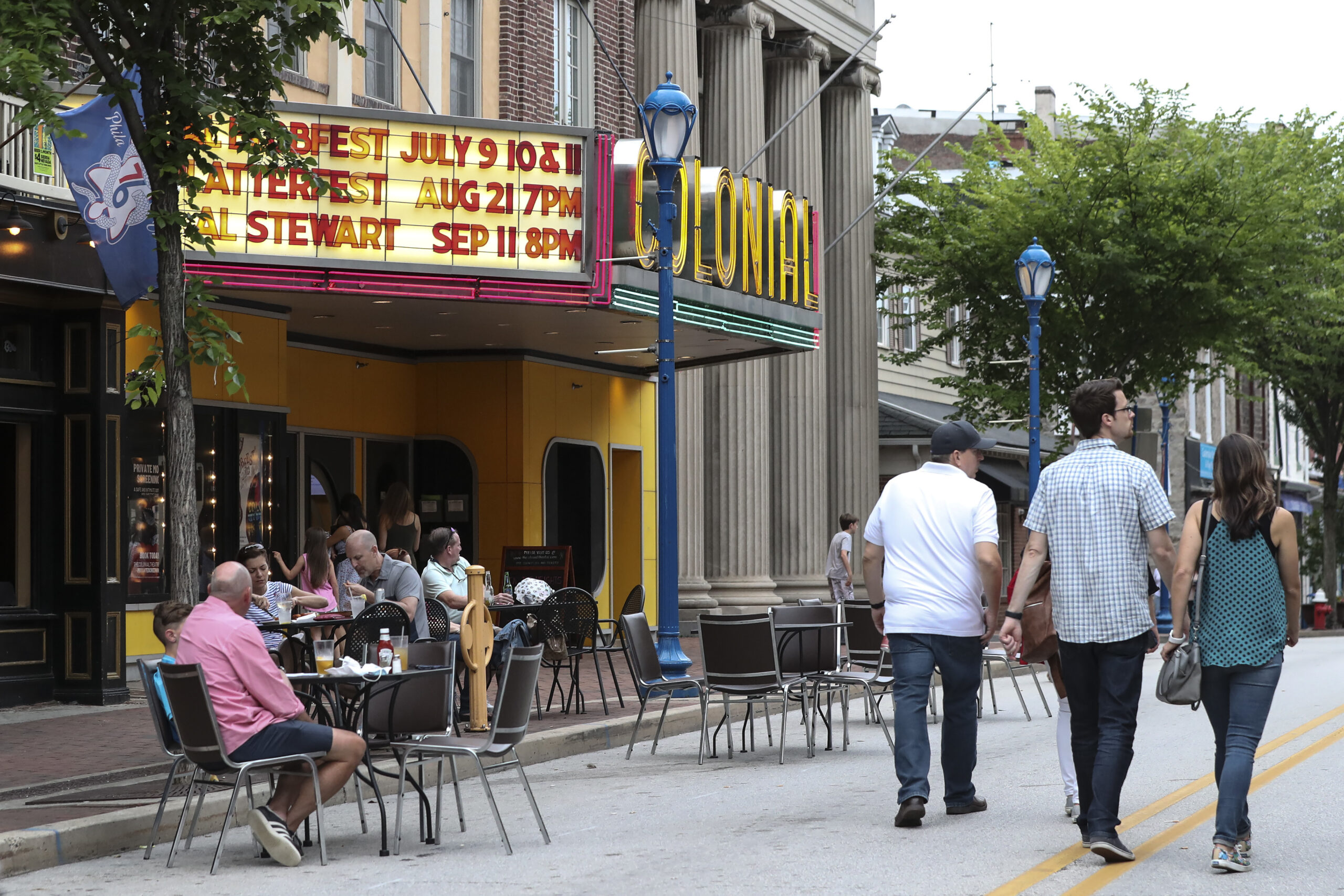
People walk along Bridge Street by the historic Colonial Theatre in Phoenixville in this June 2021 file photo.
Woodard represented the seller alongside Derrick Dougherty, senior managing director of investments.
The shopping center sits on 3.7 acres, near the corner of Nutt Road and Starr Street, and was built in 2007. According to Chester County property records, it previously sold for $6.35 million in 2018.
Prior to that, the property had last changed hands in 2006, when the land was purchased for $325,000, according to the records.
Its restaurant and bar scene has flourished, and Bridge Street is bustling, especially on the weekends. Luxury apartment complexes have attracted both millennials and empty nesters to the quaint 3.8-square-mile borough.
Since the pandemic, Phoenixville has continued to grow: Its population increased 9% between 2020 and 2024, according to census data.
In 2010, it was home to roughly 16,000 people. Today, that number is estimated to be more than 20,000.
The Acme shopping center sits just inside the bounds of Phoenixville, near its border with Schuylkill Township and not far from Valley Forge National Historic Park.
By the end of thisyear, Montgomery County will have three emergency short-term shelters with beds for 190 people in Pottstown, Lansdale, and Norristown.
In late 2024, it had zero full-time shelters, even as homelessness soared to new heightsin the county — Pennsylvania’ssecond wealthiest.
The three-member board of commissioners is currently composed of two Democrats and one Republican, but in the past year they have operated with an unusual degree of cohesion on both the challenge of homelessness and on a county budget that included a small property tax increase.
“We came in with similar goals around addressing the homeless problem throughout the county,” said Tom DiBello, the Republican commissioner. “We all heard it when we were campaigning [in 2023] and when we got elected, we felt that we needed to do something. We can’t continue doing it the way it’s always been done in the past, where people just kept talking about it.”
Although the Montgomery County commissioners have formed a united front on many issues last year, housing policy issues are more likely to divide them in 2026.
But the Democrat commissioners, Neil Makhija and Jamila Winder, have ideas about how to get around those limitations to directly fund more affordable housing and encourage local governments to allow more building.
DiBello is not excited about many of the proposals being considered by the two Democrats. He opposes creating new county-level taxes and says zoning powers should be left to localities.
Still, DiBello has further housing policy goals he would like to pursue — such asdeveloping more affordable homes for senior citizens.
As the county releases its 2026 housing blueprint, expected early this year, the first round of these debates will begin in earnest. This planning document, created by county government staff with commissioner feedback, lays out goals for the county based on a comprehensive housing policy — the first its seen in recent memory, Makhija says.
“It’s going to be the first time that the entire board has had a voice and a view on what our role is to address a crisis in the cost of housing,” said Makhija. “There are things we can do to help people.”
How the shelters got built
Making policy to address homelessness is difficult because many municipalities and community groups fight against having shelters placed in their neighborhoods.
The number of people in Montgomery County experiencing homelessnesshas grown with the cost of housing. In 2024, there were 435 people living without a roof over their heads. In 2025, the number grew to 534.
Meanwhile, Montgomery County’s last full-service homeless shelter closed in 2022.
Opposition to new shelters or affordable housing bloomed in Norristown, where officials said the rowhouse-dominated municipality was already asked to shoulder too many social services, and in Lower Providence where the local government denied a shelter application (the legal fallout is ongoing).
The county commissioners decided to get involved by courting local governments and personally attending zoning hearings about potential placements. DiBello attended meetings in Pottstown, near where he lives. Winder went to hearings in Norristown, including one that stretched past midnight, then stuck around to discuss neighbors’ concerns.
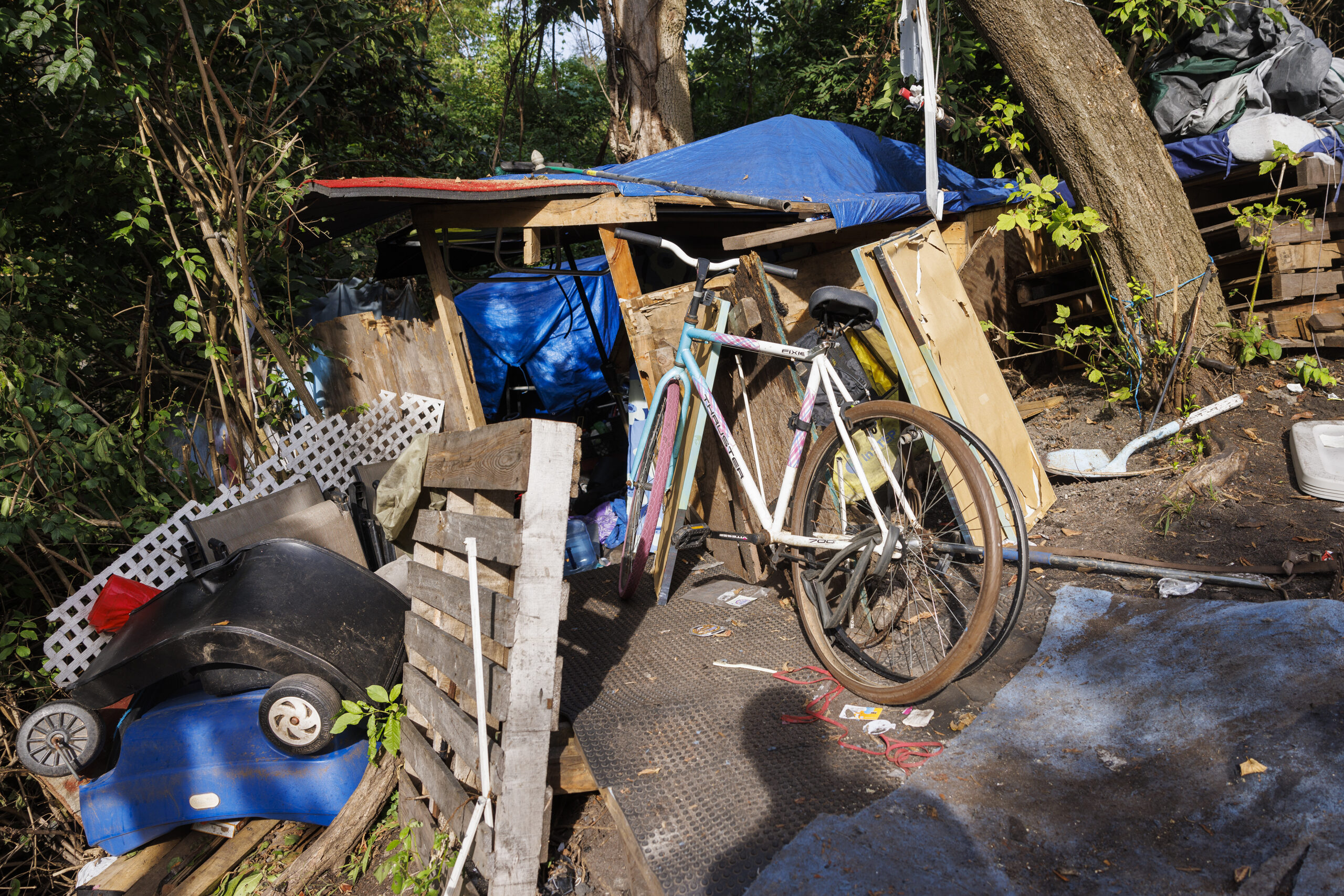
A homeless encampment near the Schuylkill River Trail and Norristown in Montgomery County.
In some parts of the county, efforts to address the issue overcame opposition.
Communities like East Norriton have established more code blue shelters, which only operate during freezing weather, and inwealthy Lower Merion, a new affordable housing complex for seniors and people with disabilities, called Ardmore House II, is under construction.
“It takes political courage in these moments,” Winder said,referring to local officials who have embraced shelters and affordable housing. “Sometimes you have loud voices in the room and just have to say, well, this is the right thing to do.”
The commissioners provided $5.3 million in county funding for the shelters. The county also provided a quarter of Ardmore House II’s $20 million budget. And as federal funding cuts loom under President Donald Trump’s administration, the commissioners have also been engaging with philanthropists and foundations.
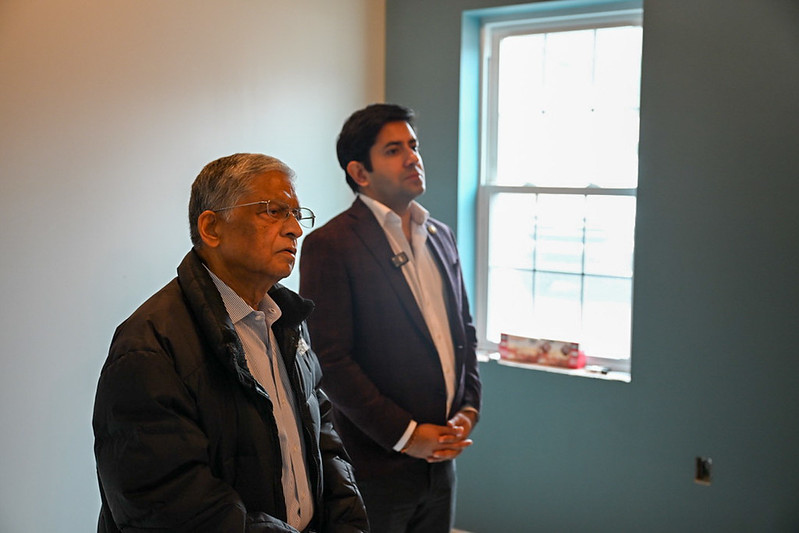
Earlier this month, Nand Todi, president of Montgomery County-based Penn Manufacturing Industries, announced a $1 million donation to the Lansdale shelter.
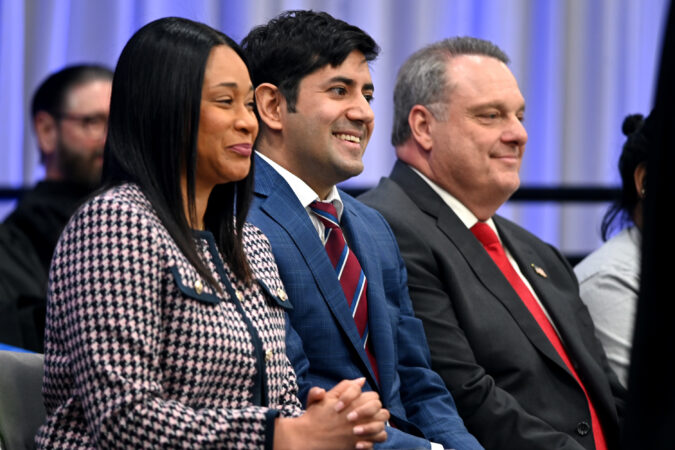
Nand Todi, president of Montgomery County-based Penn Manufacturing Industries, and County Commissioner Neil Makhija at a walk-through of the completed Lansdale shelter.
Winder hopes this example of generosity is just the beginning.
“I come from the private sector, so I believe in public-private partnerships,” said Winder. “We’re home to some of the largest corporations in the southeast area. We know that companies have social responsibility goals. So how do we partner with corporations?”
What can a county government do?
Thisyear, the commissioners want to continue to tackle housing issues.
But county-level politicians do not have large budgets at their command, and unlike their municipal-level counterparts, they do not set zoning policy.
Makhija and Winder wantto push those limits.
For example, the county dispenses infrastructure grants, and Makhija says the rules around that funding could be rewritten to incentivize municipalities to reform their zoning codes, perhaps using model ordinances established by the county.
Such ordinances could, for example, allow more transit-oriented development. Or they could legalize accessory dwelling units — small living spaces such as a garage apartment or in-law suite that can be rented out.
“If you have a grant program and it says these are the requirements, then people are going to prioritize getting those things done,” said Makhija, though, he said, he still has to make the case to his colleagues.
He also noted that county planning staff can help implement new municipality policies.
DiBello is skeptical of the county getting involved in local zoning policy.
“The governing structure in Pennsylvania is that municipalities are autonomous to county and state when it comes to zoning,” said DiBello. “It’s up to the communities.”
The Democrats would also like to find revenue sources to pay for more housing projects without increasing the property tax, which would cut against their goal of affordability.
“There are opportunities for us to advocate to the state legislature, to give counties like ours other means to generate revenue,” said Winder. “It’s not sustainable to continue to burden taxpayers by increasing property taxes, and we can’t fund these programs unless we have the money to do so.”
DiBello is also opposed to creating new taxes (if Harrisburg allows it), and doesn’t want to see more property tax increases either. But he still wants to see proactive housing investments by county government.
These debates will unfold next year as the housing blueprint dominates the commissioners’ agenda.
“We’re the second wealthiest county in Pennsylvania, and people struggling to find housing can be quite invisible in these communities,” said Winder. “We’ve got an embarrassment of riches, but there are people that are struggling and so we’re trying to be on the ground helping to solve these issues.”
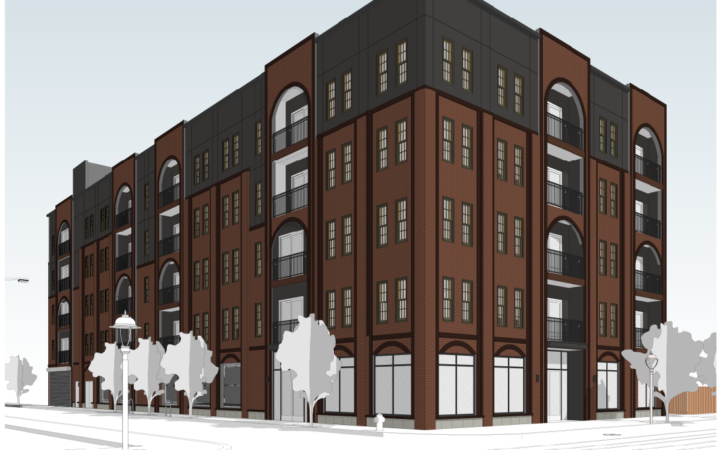
A new 46-unit apartment building is coming to 5322-28 Germantown Ave., from longtime Northwest Philadelphia developer Ken Weinstein.
The five-story building is in Germantown’s Penn Knox area. It also will include over 1,600 square feet of commercial space and 17 parking spaces.
The project comes amid a burst of new multifamily construction in Germantown, a neighborhood that garnered little interest from few developers in the second half of the 20th century.
“The demand for housing in Germantown continues to outpace the supply so more housing, at all income levels, is needed,” Weinstein said.
“Germantown is located near good public transit and Fairmount Park and is viewed as much more affordable than hot city neighborhoods in and around Center City,” he said.
Weinstein said that he will break ground on the building during the first week of January and that funding and contracting is already secured.
The project did not require any relief from the city’s Zoning Board of Adjustment, so Weinstein was not legally required to consult with the neighborhood group, Penn Knox Neighborhood Association.
But he met with the community group anyway to hear concerns they might have with the project.
“This is not an out-of-town developer; this is a developer from the area. He’s part of the community,” said Deneene Brockington, chair of the Penn Knox Neighborhood Association. “So I think there is a level of respect, and I think willingness to do as much as possible [in response to neighborhood concerns] as long as it doesn’t compromise the project.”
Brockington said that the community group’s main concerns were about building materials and lighting and that the developer had addressed both.
Weinstein said parking wasn’t the principal concern he heard from neighbors because the building is in a commercial corridor.
The apartment building’s 17 spaces are not required by the zoning code. Weinstein said he would have liked to include more, but he was constrained by the fact that all the spaces had to be on the ground floor and that the site’s land use rules require that he include commercial space.
“Underground parking is too expensive in middle neighborhoods like Germantown,” Weinstein said. “There will always be a divide between the number of parking spaces developers want to provide and what neighbors want.”
The building will include 28 one-bedroom apartments and 18 two-bedroom units, with rents ranging from $1,450 to $2,200. There will be no subsidized or affordable units set aside.
The project is expected to be completed within 18 months of the groundbreaking next month.
There is no definite tenant for the commercial space, but Weinstein has some ideas.
“With Uncle Bobbie’s moving to a new location, I would love to see a cafe or coffee shop lease the first floor,” Weinstein said. “There would be a lot of demand from students and staff at GFS [Germantown Friends School] and from the community.”
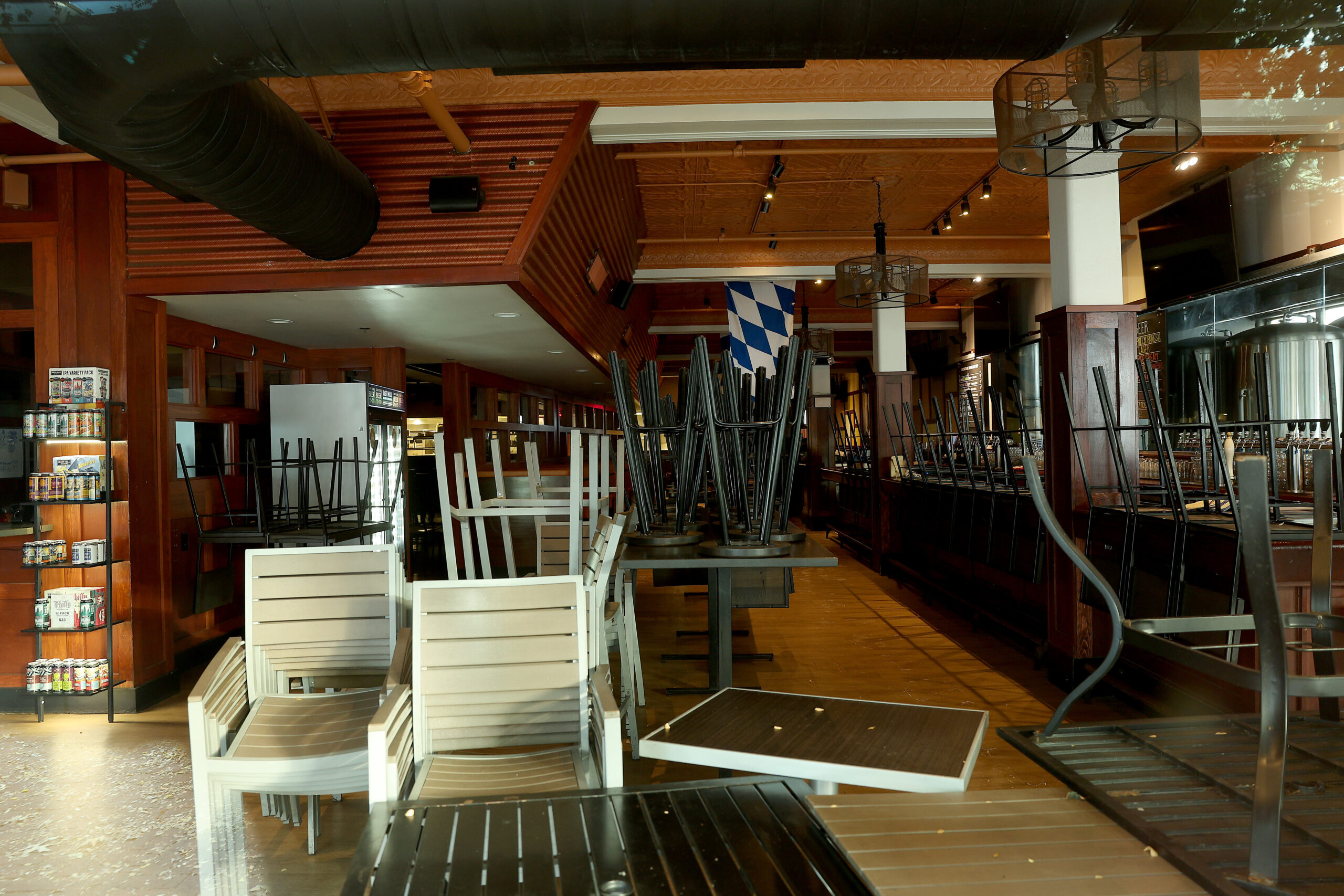
The search is on for a new restaurateur to take over the shuttered Iron Hill Brewery in West Chester, after the building’s owner bought the assets from the former CEO of Famous Dave’s BBQ.
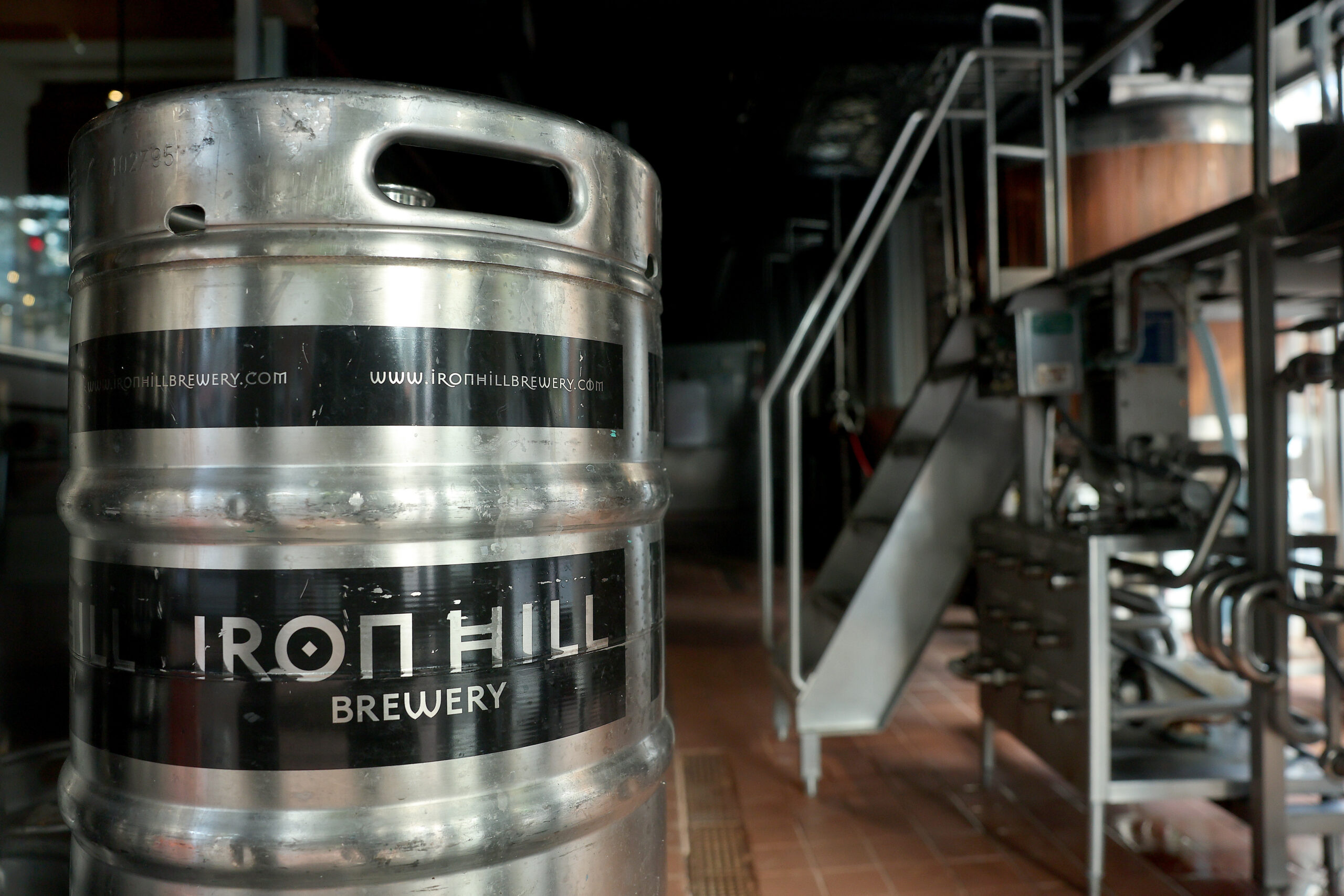
John Barry, a Massachusetts-based real estate investor who owns the building, and Jeff Crivello, the ex-CEO of Famous Dave’s, said Friday that Barry purchased the liquor license and all assets inside the former West Chester Iron Hill, one of 16 locations that closed abruptly this fall when the regional chain filed for bankruptcy.
In November, Crivello had said he intended to revive the West Chester Iron Hill, under the same name or as a new concept, after a bankruptcy judge approved his offer to buy the assets of the location and nine others in Pennsylvania, Delaware, and South Carolina.
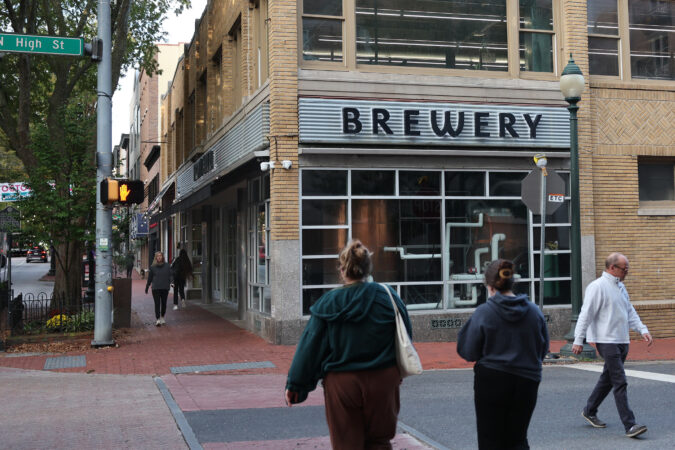
A view from the outside looking in of the closed Iron Hill Brewery in West Chester in October.
Both Barry and Crivello declined to disclose financial details of the West Chester deal, which was finalized on Christmas Eve. It was first reported Wednesday by Hello, West Chester, a local news website.
“As a landlord, I was hoping to have a chance to purchase the assets,” Barry said Friday in an interview. “I wanted to buy and keep the liquor license with the building. It allows me to get a better tenant in there that is probably going to pay a little bit more in rent.”
Situated at West Chester’s central corner of High and Gay Streets, Iron Hill had a 30-year lease, with a 15-year extension, Barry said.
Barry, a West Chester native who now lives outside Boston, purchased the nearly 30,000-square-foot building for $8.25 million in 2022, according to Chester County property records.
Barry said the next anchor tenant would take over a new lease for the now-vacant 10,000-square-foot space that can seat 300 people. He declined to specify what the lease terms might be.
“It will not be reopening as Iron Hill Brewery,” said Barry, who didn’t buy the rights to the name. “My goal would be to find something similar,” though not necessarily a brewery.
In buying the assets, Barry said the restaurant is essentially turnkey, with all the furniture and kitchen and brewing equipment still inside. A new tenant, however, may want to redesign, he said, or the space could even be subdivided for a restaurant and a retail space.
A view from the outside looking in the now closed Iron Hill Brewery in West Chester in October.
“It’s really important to me that we find the right tenant for the West Chester community,” Barry said. “It’ll take a little bit of time.”
But, he added, “my hope is we get somebody in there and operating by the summer.”
Elsewhere, Crivello said there is still hope that the Iron Hill brand could get another life.
“We’re working with a couple buyers that want to reopen [closed breweries] as Iron Hill,” Crivello said. He declined to say which locations could be resurrected.
In November, Crivello got the OK to acquire the assets of former Iron Hill brewpubs in Center City, Huntingdon Valley, Newtown, Wilmington, Lancaster, Hershey, and Rehoboth Beach, as well as West Chester and the two locations in South Carolina.
Crivello said Friday that he has since sold the assets of the former Iron Hills in Columbia and Greenville, S.C., to Virginia-based Three Notch’d Brewing Co. He said plans for the other locations were still in the works.
As California-based canned beverage manufacturer DrinkPAK eyed an East Coast expansion, Pennsylvania was always at the top of their list of potential sites.
But in the end Philadelphia’s Bellwether District — the sprawling site of the former South Philadelphia oil refinery — won out not only over other states like New Jersey, but other possible Pennsylvania destinations likeScranton and the Lehigh Valley as well.
“We looked at other geographies, but ultimately we’d like to be where the people are, where the jobs are,” said Jon Ballas, president of DrinkPAK. “We’re not scared of building in large city centers. It just provides an energy that doesn’t exist out in the more general manufacturing landscapes.”
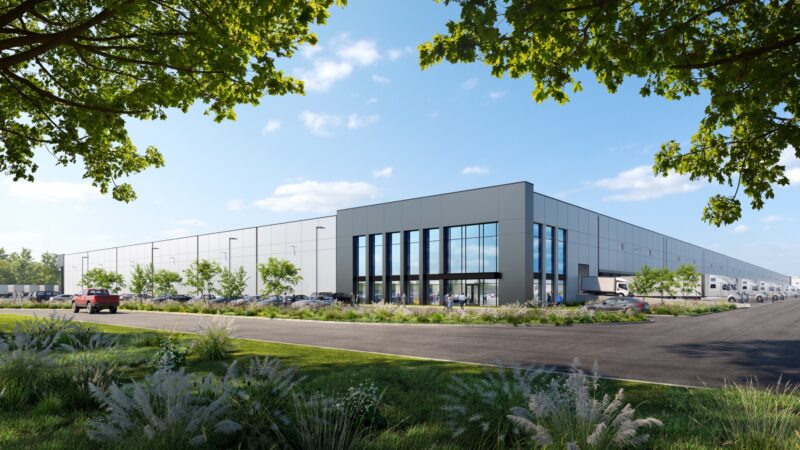
The 1.4 million-square-foot factory will be the first tenant for the 1,300-acre Bellwether District, which developer HRP Group (formerly known as Hilco Redevelopment Partners) hopes to turn into a new industrial and life sciences hub in the city.
Contractors broke ground on the manufacturing facility earlier this month, and the building’s shell should be complete by this time next year. Then construction on the internal mechanics will begin, with plans to complete it by April 1, 2027.
Once it’s operational, DrinkPAK’s manufacturing facility will operate 24 hours a day, seven days a week, cranking out 3 billion cans a year.
The factory will employ 174 people, largely on site because DrinkPAK doesn’t employ a lot of truck drivers. The workers will be operating the production line and managing machinery.
“We’re committed to hiring the best in the industry, [offering] competitive wages, some of the best benefit programs out there,” said Ballas. “These are very attractive jobs, high-paying jobs.”
DrinkPAK doesn’t work with the major soda or beer companies. Instead it manufactures cans for a variety of smaller, specialty beverage brands including alcoholic seltzer, energy drinks, and lower-calorie soda products.
“We’re not making your typical Coke and Pepsi,” said Ballas. “We’re making a lot of this innovative, better-for-you-type products.”
DrinkPAK was founded in 2020 and already has factories of similar capacity to its future Philadelphia facility in Southern California and in Texas.
There is some regional variation (more canned wine in California, and more health drinks on the coasts), but its production line’s output is largely determined by broad trends in the industry.
“Beverage is very cyclical,” said Ballas, and the facility needs to be designed with flexibility to make what’s most in demand. Right now, he noted protein drinks are “the hottest trend.”
“It takes a specific type of liquid handling equipment to handle all the protein hydration, to get that into solution in order to carbonate it into a can,” he said.
DrinkPAK’s facility is in the portion of the Bellwether District slated for industrial use, with the idea that warehouses and factories would be the tenants.
The HRP Group already built a 326,000-square-foot warehouse and second 727,000-square-foot warehouse, which were both built on spec — meaning without a prospective tenant in mind.
But the 3 billion-can production facility is the first official tenant.
“We’re looking forward to delivering this building for DrinkPAK and playing a small role in their company’s incredible growth trajectory,” said Andrew Chused, chief investment officer for HRP Group.
“DrinkPAK’s decision to build its flagship East Coast facility here is the first big step in turning this site into the dynamic commercial ecosystem we always envisioned,” said Chused.
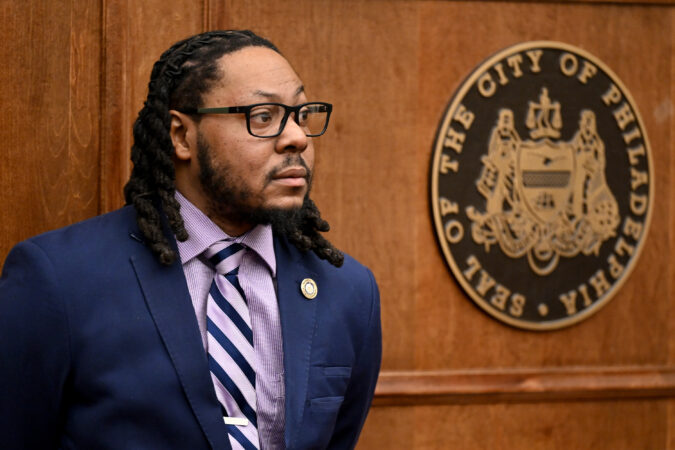
Philadelphia Councilmember Jeffery “Jay” Young introduced legislation at the last City Council meeting of 2025 that would ban residential development from the area that once housed Hahnemann University Hospital.
The bill would create a new zoning overlay — a hyperlocal patch on the code — covering the area “bounded by the north side of Race Street, the east side of North 16th Street, the south side of Callowhill Street, and the west side of North Broad Street.”
That covers the area where developer Dwight City Group plans to convert two former Hahnemann University Hospital patient towers into 288 apartments, and other related properties including those owned by Drexel University and Iron Stone Real Estate Partners.
The project does not yet have building orzoningpermits. The legislation would make the projectimpossible unless the developer could convince the Zoning Board of Adjustment to make an exception, if the law is passed.
Young pitched the bill as an employment-generating measure in the long term.
“It is for commercial preservation in that part of our district,” Young said last week. “We want to make sure that area keeps producing jobs for our city.”
Dwight City Group declined to comment on the legislation.
In an interview earlier this year, the company’s CEO Judah Angster said the apartments planned for the Hahnemann University Hospital patient towers would be moderately priced one- to two-bedroom units.
“We stick with middle-market apartments, not super high-end,” Angster said at the time. “We like to believe that there’s a lot of space for affordable luxury product in the area. That’s the only thing we do.”
But he also cautioned that the redevelopment would take a while, saying the buildings might not be leased up until 2030.
City Council returns on Jan. 22. The earliest Young’s bill could be enacted is February.If Young proceeds with the bill, the tradition of “councilmanic prerogative” would likely guarantee its passage because other Council members are usually unlikely to vote against a district member’s bills that only affect their territory.
Developers, good government groups, and housing advocates frequently decry City Council’s use of zoning overlays to create custom land use tweaks to specific corners of City Council districts, especially when they seem designed to help or hurt a particular project.
“Choking housing supply isn’t the direction that our city should take,” said Mohamed “Mo” Rushdy, who is managing partner of the Riverwards Group and chair of the Philadelphia Housing Development Corp.
“Overlays that prohibits housing units is generally a bad idea,” Rushdy said. “Overlays that target a ‘specific’ project is, let me be politically correct here, is simply unwise and not right.”
Young said his bill is simply meant to preserve the possibility of jobs, especially as a new 20-year tax abatement is considered next year for the redevelopment of old commercial, industrial, and public buildings into housing.
“Next year, we’re going to be facing, potentially, a bill that will allow abatements for underutilized commercial properties,” Young said. “We want to make sure that those benefits that the property owners can reap, that Philadelphians see those benefits with the creation of jobs in those locations.”
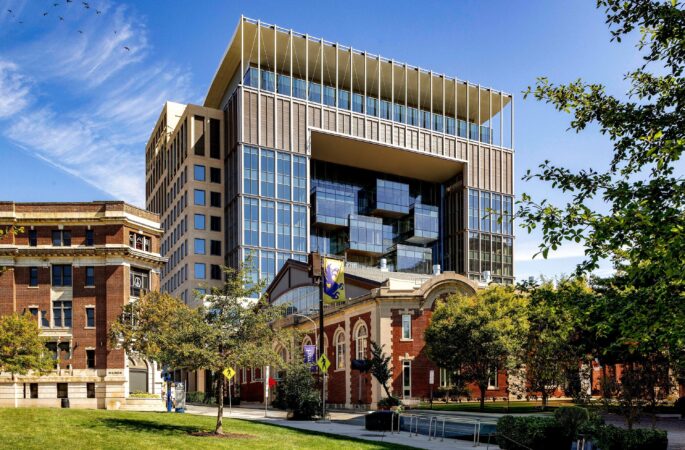
Drexel University has signed a lease that will enable it to consolidate its College of Medicine research labs in University City, Drexel and the developers of a new building at 3201 Cuthbert St. said Thursday.
Drexel’s space in the $500 million building, a joint project from Gattuso Development Partners and Vigilant Holdings, is slated for completion in 2027. Drexel researchers moving from sites in Center City and East Falls are expected to fill four floors of the structure.
“By bringing our research spaces together in University City, we will create an environment that fosters greater interdisciplinary collaboration, accelerates innovation, and strengthens our collective capacity for discovery,” Drexel president Antonio Merlo said in a message to the school community.
Drexel will occupy 150,741 square feet of the 11-story, 520,000-square-foot building. The developers’ goal is to fill the rest of the building with life sciences tenants, though that could be harder than it was in 2022, when the building was announced as a partnership between Drexel and Gattuso Development.
The move of research labs to University City is part of a long-term plan to centralize the Drexel College of Medicine, which includes the combined operations of the former Hahnemann Medical College in Center City and the former Medical College of Pennsylvania in East Falls.
Philly’s biggest development projects could bring more than 2,500 new homes and apartments; 1,800 parking spaces; and 118,000 square feet of storage space.
A rendering of the 380-foot tower proposed near Pennsport by a New York capital management firm.Perkins Eastman
Some developers still have big plans though, and if they want to build more than 50 new homes, or any project of over 50,000 square feet, they need to submit their plans to the Planning Commission for public input via the Civic Design Review committee.
story continues after advertisement
This year, 18 projects across Philadelphia went before the committee. These projects are large enough to remake neighborhood commercial corridors and create new hyperlocal landmarks, for better or worse. Most will be breaking ground in the new year.
Here’s your guide to what the committee considered this year.
What is Civic Design Review?
The Civic Design Review committee isan advisory-only board of architects, planners, and other experts who provide feedback on developments that will have an outsized impact on the cityscape.
“CDR gives communities a meaningful opportunity to make their voices heard, educates the public on principles of good design and use of shared spaces, requires developers to respond to questions in a public forum,” says Jessie Lawrence, the city’s director of Planning and Development.
But just because a project goes through Civic Design Review doesn’t always mean it will get built. The 76ers proposed Center City arenawent through the process, and famouslycame to naught earlier this year.
Nonetheless, Civic Design Review is still a rough proxy for what Philadelphians can expect to see in the near future. Here’s your guide to what the committee considered this year.
275 apartment units for Southwest Center City
1601 Washington Ave. | Ori Feibush of OCF Realty
Atrium Design Group
The former site ofHoa Binh Plaza has seen multiple redevelopment efforts since the popular Vietnamese shopping mall’s pre-pandemic closure. This latest isthe third from Feibush, who is offering a scaled-down version of an earlier 400-unit plan, with 10% of the units slated for affordable housing and 200 underground parking spaces.
Status: Ground breaking is slated for the second half of 2026.
84 apartments in Southwest Center City
914 S. Broad St. | Carl Dranoff of Dranoff Properties
JKRP Architects
Dranoff has been developing residential buildings on this stretch of South Broad Street for two decades. He has planned a new apartment building on this propertyfor years. He saw the drive-through McDonald’s that formerly occupied the site and closed in 2021, as a poor fit for one of Center City’s major thoroughfares.
Status: Ground breaking is projected for autumn 2026.
372-car garage for Fishtown and Northern Liberties
53-67 E. Laurel St. | Bridge One Management
Designblendz
As apartments have sprouted along this stretch of the Delaware River in recent years, new parking spaces have not kept apace. Investors hired Bridge One Management tobrainstorm new uses for this property, and the company thinks demand for parking is high enough for a new garage. The project also has 14,000 square feet of commercial space on the ground floor and another 16,000 on the roof.
Status: Permits have not yet been filed.
59-room hotel for Fishtown
1224 Frankford Ave. | Roland Kassis of Kassis & Co.
Gnome Architects
The developer who most helped remake Fishtown into the ultrahip neighborhood it is today haslong wanted to build a hotel on this vacant lot on the commercial corridor. An earlier, taller version of the project was approved before the COVID-19 pandemic, but those permits lapsed.
Status: Ground breaking is slated for the second half of 2026.
75 apartments in Kensington
3408 B St. | Dwight City Group
Raymond F. Rola
Far from the parts of Kensington where development is booming,this apartment project is meant to be priced to attract people who already live in the neighborhood. The developer, known for adaptive reuse, plans to revive the two-story remnants of a derelict warehouse as a base for the six-story apartment building.
Status: The project awaits a zoning board hearing in January.
162 units for rent and purchase in Port Richmond
2620 and 2650 Castor Ave. | Tim Ajvazi
Ambit Architecture
These two neighboring projects are thework of the same developer and were considered by the Civic Design Review in tandem. At 2650 Castor Ave., 68 homes are planned across eight triplexes and 22 duplexes. At 2620 Castor Ave., there is a proposal for a four-story apartment building of mostly one-bedroom units, which the zoning board approved earlier.
Status:: The zoning board approved the project on 1650 Castor Ave. on Wednesday.
232 new homes in North Philadelphia
2200 N. Eighth St. | Andre Herszaft
Harman Deutsch Ohler Architecture
This project has beenin the works for two years, and to gain community support before the zoning board the New Jersey-based developer has more than halved the number of planned units. Instead of apartments, the old trolley barn at this location will be replaced by dozens of duplexes and triplexes, assuming it wins permission from the ZBA.
Status: Neither zoning nor demolition permits have been filed yet.
384 apartments in Roxborough
4889 Umbria St. | Genesis Properties and GMH Communities
Oombra Architects
Thisapartment building is the largest in recent memory for the Northwest Philadelphia neighborhood of Roxborough, and while community groups were unhappy, they had few means to push back against it. The developer plans almost one-for-one parking at the site, but no commercial development, although a few existing businesses on site will remain, including furniture retailer Love City Vintage and Javies beer distributor.
Status: Ground breaking is slated for next year.
167 apartments in Manayunk
4045-61 Main St. | Urban Conversions
CBP Architects
This seven-story project from architect CBP Architects required thedemolition of a historic textile mill to move forward. Its proximity to the Schuylkill presented another challenge, which developers solved by proposing 160 parking spaces on its first two floors to lift the project out of the flood zone.
The project also required permission from the zoning board, where a height reduction was mandated. But the developer successfully argued the project was impossible with fewer stories and the ZBA reconsidered and will now allow its original size.
Status: Permitted, but ground has not been broken yet.
45 units for East Germantown
6225 Germantown Ave. | MGMT Residential
Ingram/Sageser
This deserted warehouse, tucked off Germantown Avenue, is slated for a small,four-story apartment building with a floor of parking. The developer still needs to demolish the old building.
Status: A demolition permit was issued in July, but the building still stands.
81-unit apartment building for Mt. Airy
6903-15 Germantown Ave. | Tierview Development
Barton Partners
Thisfive-story building includes space for retail, 11 parking spots in the rear, and plenty of greenery and brick detailing to fit in with its surroundings. Seven of the units are priced to be accessible to lower-income families, but all of the units are targeted to below-market-rate prices.
Status: Ground breaking slated for the first half of 2026.
495-car garage in University City
17 N. 41st St.. | University City Associates
ISA
This garage is called University Place 5.0 and is meant to accompany the developer’s earlier life-sciences-oriented University Place 3.0 next door. It is meant to provide vehicle storage for the developer’s existing holdings, and especiallyfor the city’s criminal forensics laboratory, which will have reserved use for a fifth of the space. Councilmember Jamie Gauthier fought for the crime lab in her district, and she had to change the property’s zoning to enable the garage.
Status: Ground breaking is slated for early next year.
This West Philadelphia developer isexpanding to a new part of the city with a project that redevelops the former St. Divine Mercy School into a 35-unit apartment building along with two new buildings to house the rest of the units. Sixteen will be slated for lower-income residents.
Status: Leasing for the former school begins in January; the two new buildings have yet to break ground.
204 apartments in North Philly
1322 West Clearfield St.| J Paul Inc.
Canno Design
This building, from architects CANNODesign,stirred controversy in its corner of North Philadelphia over what neighbors saw as a lack of adequate parking (although there were 82 underground spaces in the plans). The project needed a variance from the Zoning Board of Adjustment (ZBA), and was granted permission to move forward in December.
Status: Approved by the zoning board, but hasn’t broken ground yet.
65 affordable apartments in Sharswood
2006 Cecil B. Moore Ave. | PHA and the Frankel Enterprises
Blackney Hayes
This senior housing development is one of the last pieces of the Philadelphia Housing Authority’s 10-year redevelopment of North Philadelphia’s Sharswood neighborhood. (Itmoved its headquarters there from Center City.) This piece of the project is being orchestrated in partnership with the Frankel brothers, who are known for affordable housing projects across the city.
Status: Ground breaking is slated for autumn 2026.
620 apartments for Pennsport
1341 S. Christopher Columbus Blvd. | Brevet Capital Management
Perkins Eastman
This property to the east of Pennsport has seen many mega-project proposals come and go. The latest from a New York capital management firm promiseshundreds of new units, and more towers if the first round goes well.
Status: Permits have been filed but a ground-breaking date remains unknown.
1,005-car garage in Grays Ferry
3000 Greys Ferry Ave. | Children’s Hospital of Philadelphia
THA Consulting Inc.
CHOP is in the midst of a big expansion, and wants more employee parking. The site is about a mile from the hospital complex, and CHOP plans shuttles for the last leg of commutes. The projectstirred controversy for its location in a low-income neighborhood with already elevated asthma levels, which advocates say will be exacerbated by more cars.
Status: Under construction.
118,000 square feet of storage space in Fox Chase
7801 Oxford Ave. | BG Capital
Vissi Architecture
The developer reduced the planned size of its self-storage space to stave off community opposition to the project, which won approvals from the ZBA this summer. But BG Capitalnever intended to build the project itself, and instead is seeking to sell the permitted property to a developer with more experience in the self-storage industry.
Status: Permitted, unbuilt, and for sale.
Staff Contributors
Reporting: Jake Blumgart
Graphics: John Duchneskie
Editing and Digital Production: Erica Palan
Copy Editing: Lidija Dorjkhand
Subscribe to The Philadelphia Inquirer
Our reporting is directly supported by reader subscriptions. If you want more journalism like this story, please subscribe today
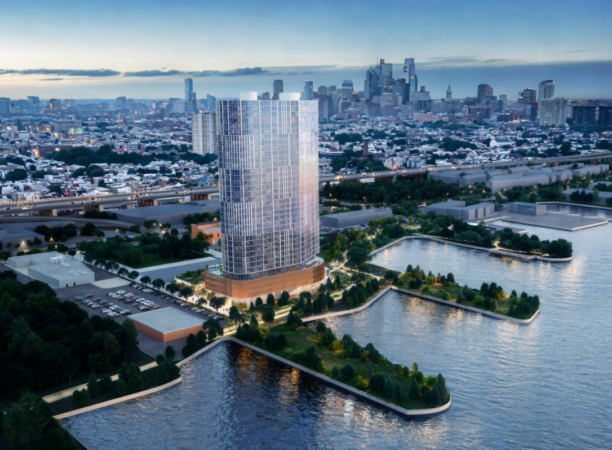
Executives at Happy Bear, which has sold coffee online for the past two years, said they recently signed a lease for a 3,000-square-foot space on the ground floor of 1201 Normandy Place, a mixed-use lab building optimized for life-science tenants, including those who do gene and cell therapy research and development.
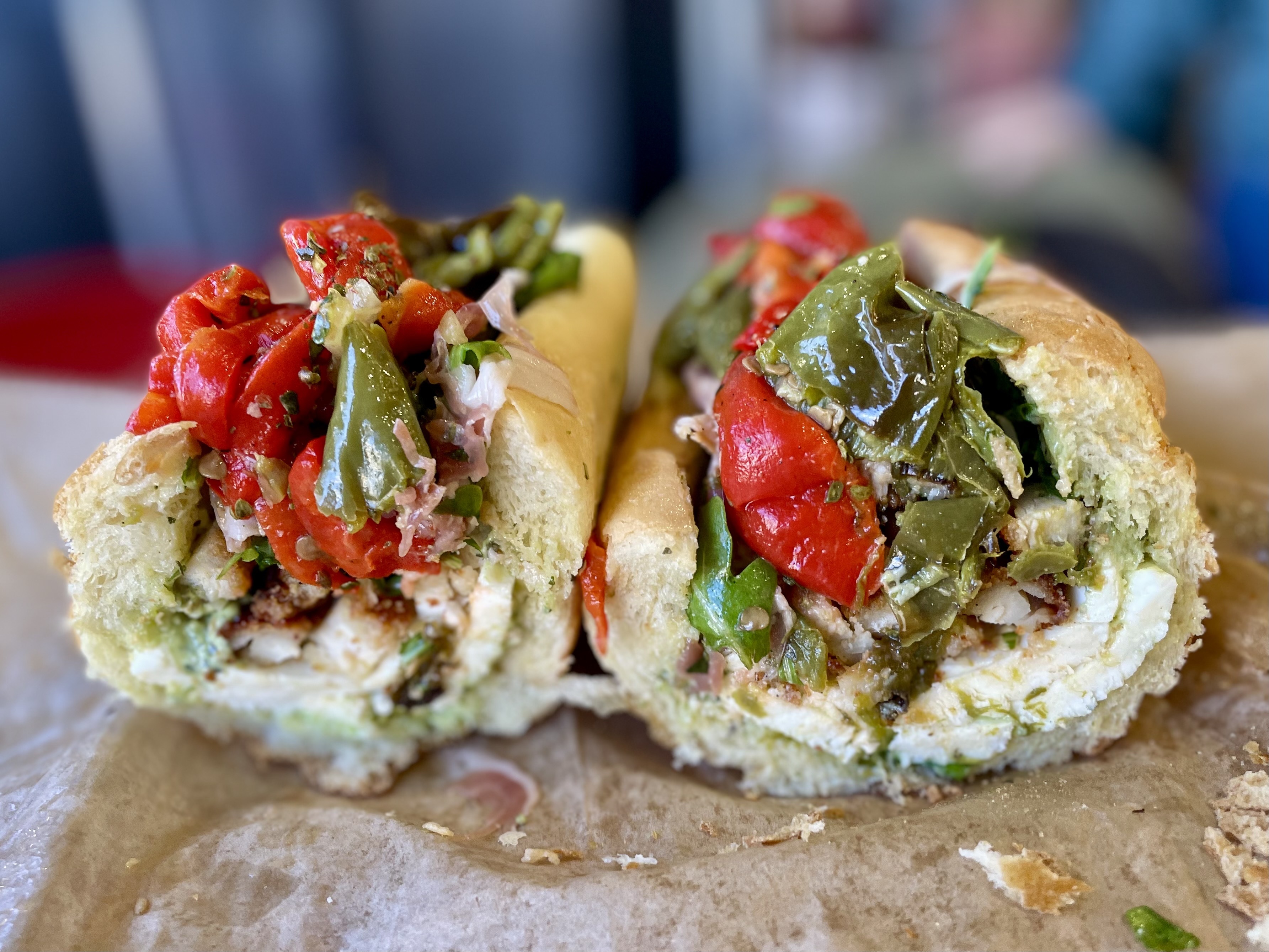
The Happy Bear cafe is set to serve coffee, wine, and grab-and-go food, including sandwiches, breakfast items, soups, salads, flatbreads, and tomato pie made in partnership with Carlino’s, the Ardmore-based specialty-food purveyor.
A Saquon hoagie special at Carlino’s Market in Ardmore. The specialty-food purveyor’s food will be available at the the Happy Bear Coffee Company’s first physical store at the Navy Yard.
The cafe will have indoor and outdoor seating overlooking the five-acre Central Green Park, and provide “a versatile setting for morning coffee, a quick lunch, or an evening glass of wine,” according to the news release.
“We wanted to create a place that feels like a daily ritual and a small retreat all in one,” Happy Bear cofounder Dan Kredensor said in a statement.
“With Carlino’s expertise as one of our culinary partners, we’re building a cafe that brings together wonderful specialty coffee, great flavors, and a welcoming atmosphere, right in the heart of the Navy Yard’s most exciting new district.”
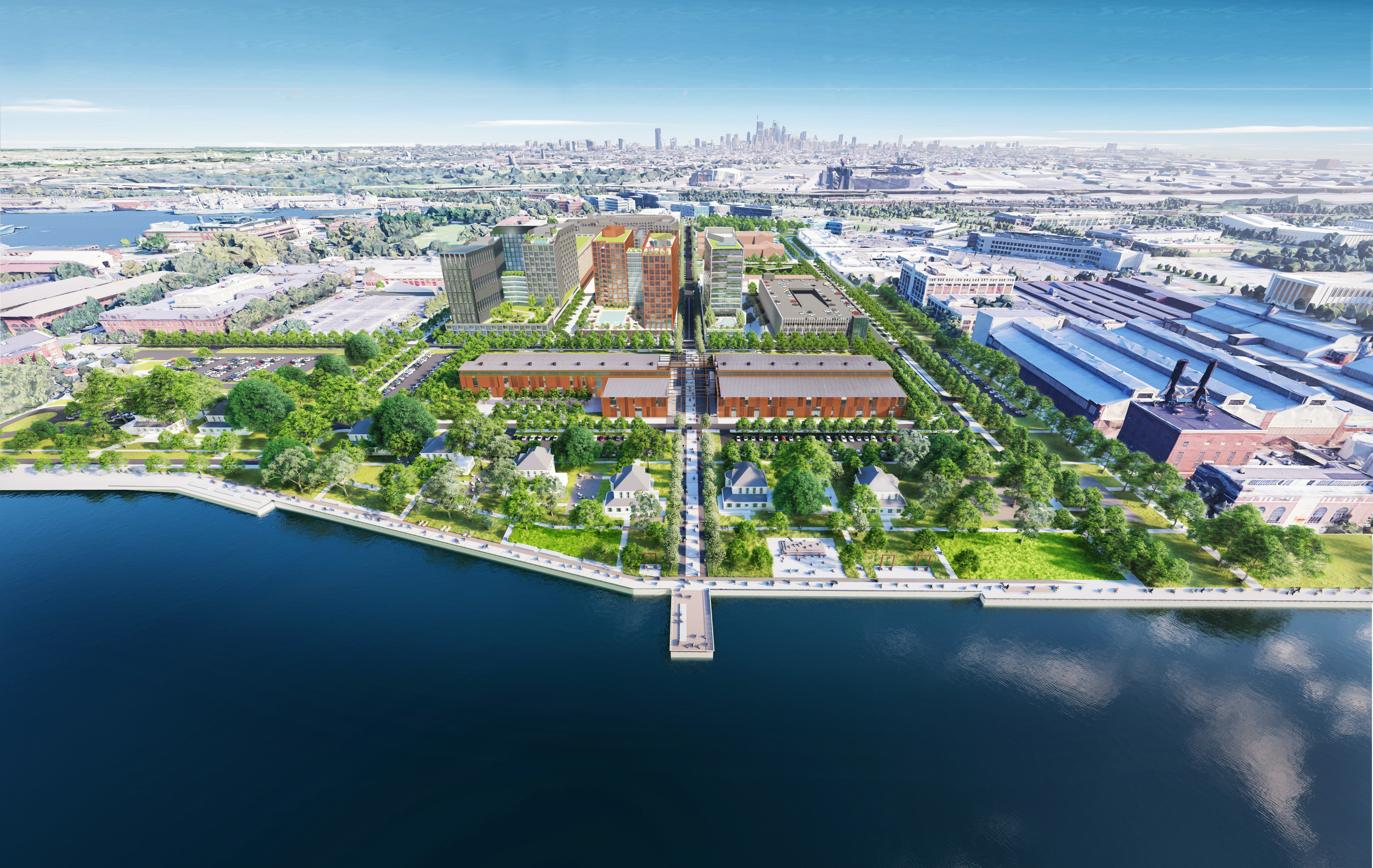
An artist’s rendering shows an aerial view of the proposed development plan for the Navy Yard.
Ensemble Real Estate Investments, of California, and Philly’s Mosaic Development Partners were selected in 2020 to lead an estimated $2.5 billion redevelopment of 109 acres of the former base.
Construction of 1201 Normandy was part of Ensemble/Mosaic’s first phase of redevelopment, which was estimated to cost $400 million.
“Happy Bear represents the type of dynamic, community-focused retail that will define the Navy Yard as it enters its next phase of growth,” said Nelson Way, vice president of leasing and development for Ensemble.
Happy Bear was founded by longtime friends Kredensor and Frank Orman, who bonded by exploring Philly’s coffee shops during their college years.
The pair’s first cafe will be near a 12-acre section of the Navy Yard that’s being called the Historic Core District, combining historic buildings with new construction.
An artist’s rendering of PIDC’s vision for the Navy Yard Historic District Core district, which would combine historic buildings and new construction.
In the same area, developers have built more than 600 apartments in a mixed-use community called AVE Navy Yard, which is expected to open next year.
The Philadelphia Industrial Development Corporation (PIDC), an independent nonprofit, manages the Navy Yard on the city’s behalf. It has owned the 1,200-acre site since the U.S. Defense Department decommissioned it as a military base in 2000.
The Navy Yard is home to 150 companies that employ 16,000 people, according to its online directory. Its tenants include Urban Outfitters, which is headquartered at the site, and Jefferson Health.
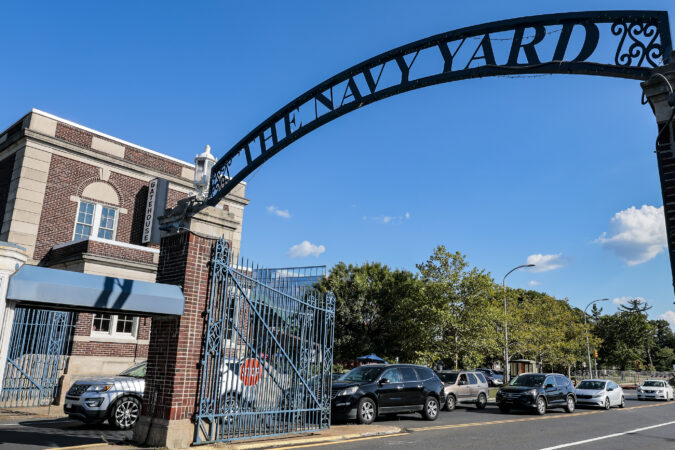
The property also has a Courtyard Marriott, several daytime food options, and a full-service restaurant called the Gatehouse.
Navy Yard stakeholders want the campus to eventually have nearly 4,000 new apartments; 235,000 square feet of retail; and more than 4.2 million square-feet of office, research and development, and manufacturing space, according to its 2022 redevelopment plan. Developers also want to bring another hotel to the site.
It’s your city. It’s your (Ritten)house. It’s your Rally House.
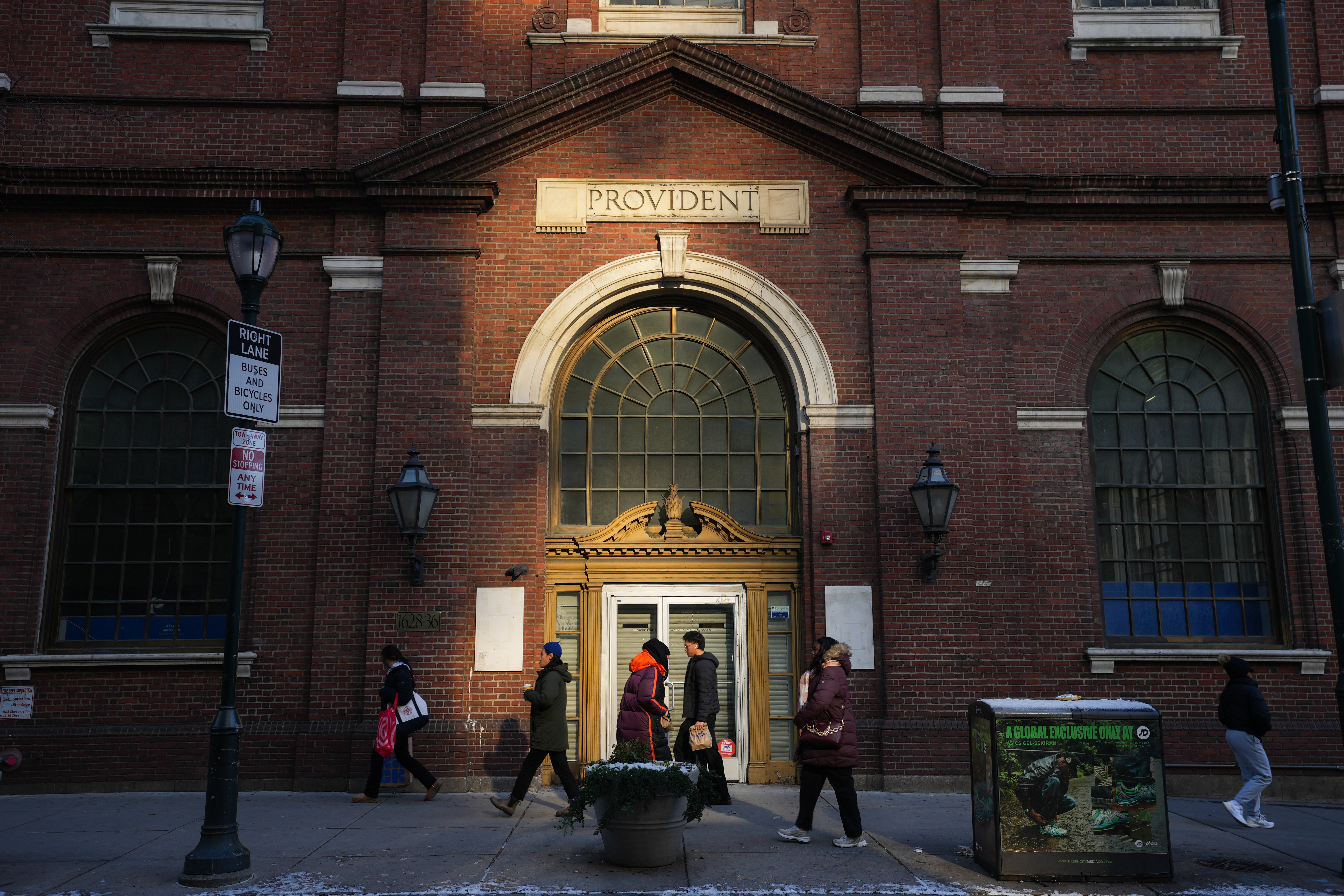
The sports apparel store with the earworm of a jingle plans to open its first Center City location in a former Rite Aid near Rittenhouse Square.
The Kansas-based chain has asked the city’s art commission for approval to put up signage outside the nearly 13,000-foot storefront at 17th and Chestnut Streets, according to its application, which is set to be reviewed at a Wednesday meeting. Rally House spokespeople did not return requests for comment Tuesday.
The company’s application was first reported Monday by the Philadelphia Business Journal.
Since the Rittenhouse Rite Aid closed, Spirit Halloween has occupied the storefront in the months leading up to Halloween.
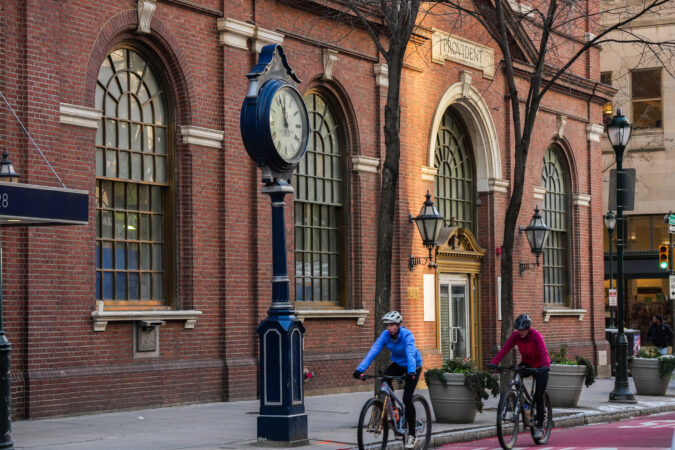
Since Rite Aid closed two years ago, the ground-floor retail space in the Provident Trust Co. building has been occupied seasonally by Spirit Halloween, but is otherwise vacant.
The building is owned by a partnership registered to Philadelphia-based developer Neal Rodin, according to property records. Rodin did not return requests for comment Tuesday.
Rally House already has about two dozen locations in the Philadelphia region, but the vast majority of them are in the suburbs. It has three city locations — on Temple’s campus, in West Philadelphia near Drexel and Penn, and in Roxborough.
If Rally House opens at 17th and Chestnut, it would bring continued momentum to the retail corridor around Rittenhouse Square, which has recently welcomed a slew of new businesses, including the luxury women’s fashion company Aritzia and North America’s first Nike Jordan World of Flight store.
It would also mark the latest example of how zombie Rite Aids can be resurrected.
Over the past three years, more than 170 Rite Aids have shuttered across the Philadelphia region, with dozens of stores closing even before the chain announced it was going out of business.
Like the Rittenhouse space, former Rite Aids are often 8,000 to 16,000 square feet, which is not ideal for many potential tenants, experts say. But some of these pharmacy shells have found new life as small grocers, discount stores, and medical offices.
Soon, sports apparel store may be added to that list.