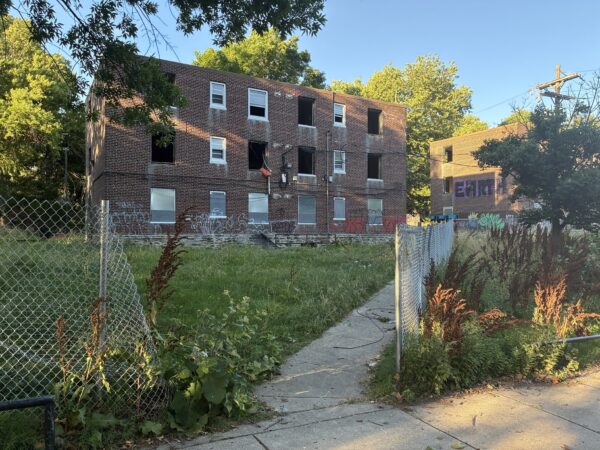
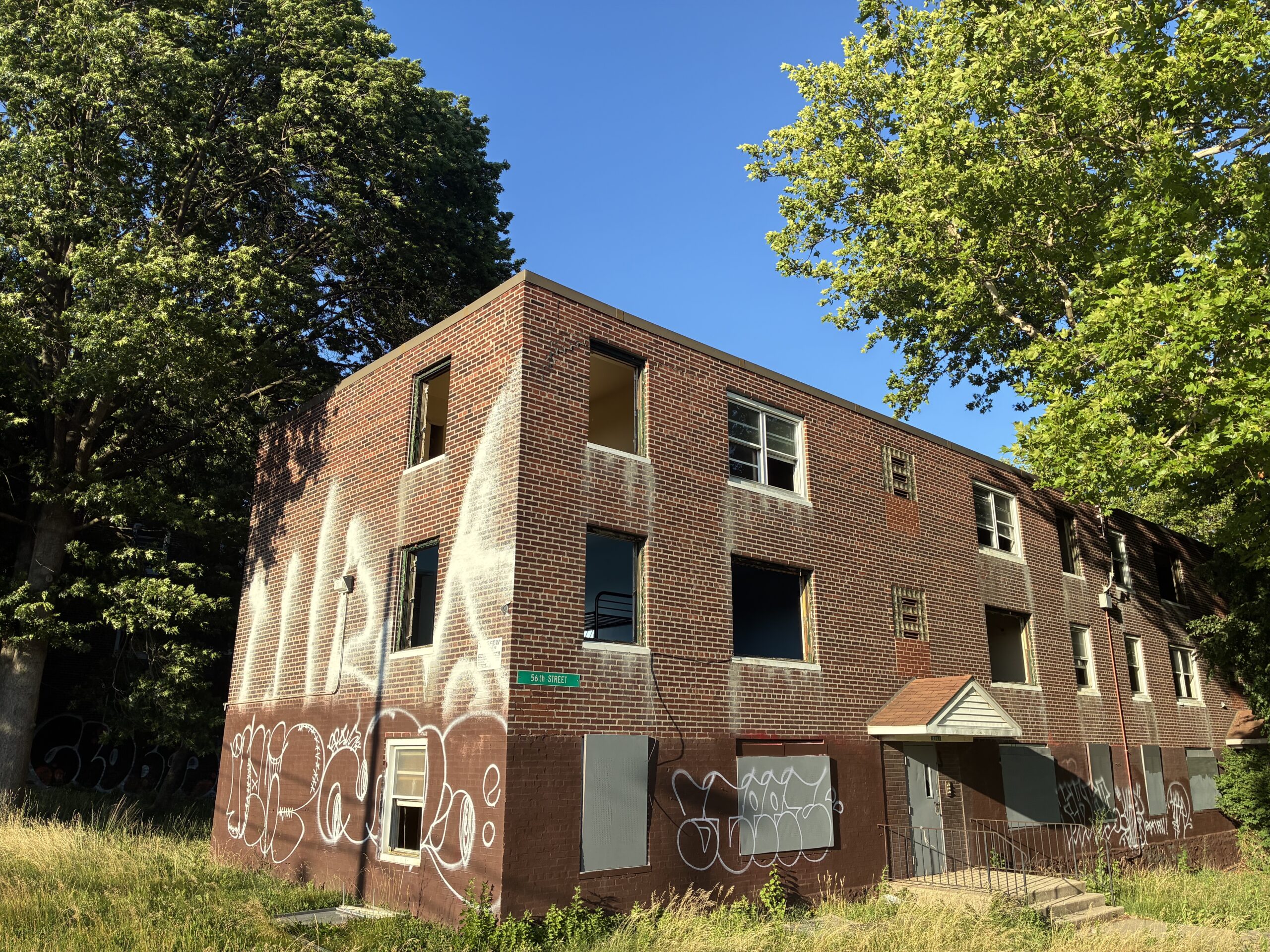
Mayor Cherelle L. Parker has declared a public safety emergency at Bartram Village, a vacant Philadelphia Housing Authority (PHA) complex in Southwest Philadelphia, after squatters moved in and caused extensive damage.
This declaration clears regulatory hurdles that had delayed PHA’s plans to rapidly demolish the 45-building complex, where the last tenant moved out in 2025.
“For too long, these vacant buildings have posed serious safety risks to surrounding residents and the broader community,” Parker said in a statement Thursday. “This action clears the way to remove those hazards and replace them with new housing, new opportunity, and new investment.”
Bartram Village dates to World War II, when it was built to host defense workers during the wartime industrial boom. The site was later transitioned to the traditional public housing program, providing affordable housing for up to 500 households.
PHA has been planning a probable demolition for a major redevelopment since at least 2018, when it was estimated the buildings required repairs reaching almost $200 million in today’s dollars. Former residents would have a right to one of the 688 new units planned for the site.
But after tenants were moved out, the 22-acre property attracted squatters despite PHA’s security patrols in the area. Beyond occupying the space, squatters tore copper wiring from the buildings and damaged the popular neighboring park and historic site of Bartram’s Garden.
“We boarded it up, it was secured, and almost immediately we realized that folks were penetrating those areas in the back and coming in through Bartram’s Garden,” said Kelvin Jeremiah, president of the housing authority. “But because of the size … it became a real issue. The more we removed people, the more they came in.”
Councilmember Jamie Gauthier’s office began raising alarms in February about the state of Bartram Village.
“I warned that failing to act quickly would [exacerbate] safety issues and cost taxpayers’ money,” Gauthier said. “The buildings became hot spots for squatters and provided cover for inflicting over half a million dollars of damage to Bartram’s Garden.”
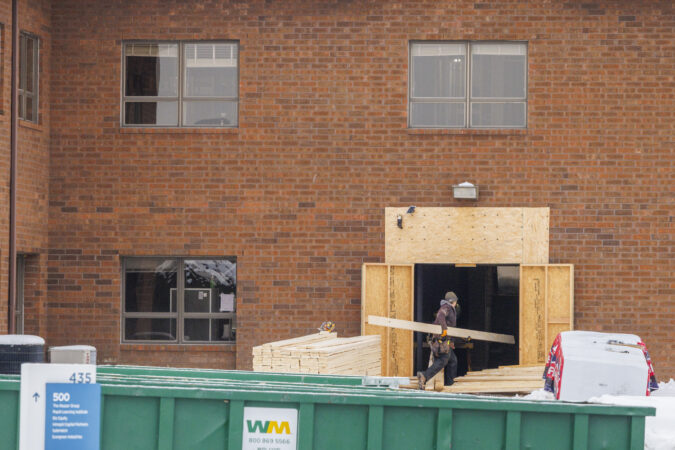
An abandoned Bartram Village apartment, which will soon be demolished.
Jeremiah said the housing authority couldn’t move to demolish the buildings immediately because Bartram Village is eligible for inclusion on the National Register of Historic Places. The mayor’s emergency declaration allows the agency to bypass a lengthy federal review process. The buildings are not protected by local preservation regulations.
Following Parker’s actions Thursday, “we are now prepared to move forward on an expedited basis to have the site demolished,” Jeremiah said.
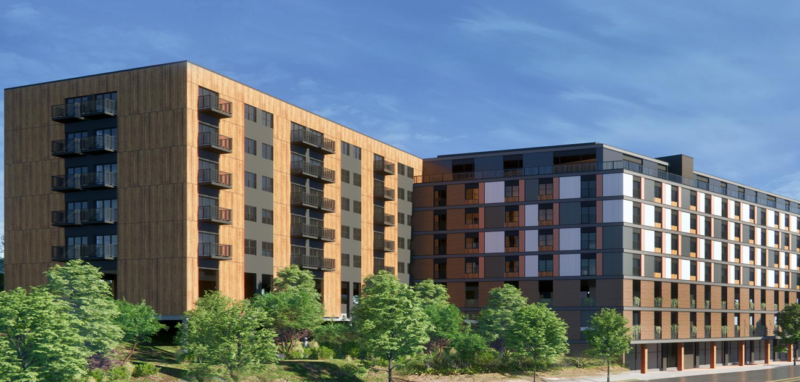
PHA plans nine apartment buildings and over 150 townhouses for the Bartram Village site, supported in part by a $50 million grant from the federal government.
It is a major part of Jeremiah’s aggressive plan to renovate all of the authority’s existing holdings while building 3,000 new units and buying at least 4,000 units from the private sector.
The redevelopment has been years in the making because of tenant relocations and the federally mandated delay in demolition.
“Southwest Philadelphians have waited far too long for promised improvements at Bartram Village,” said Gauthier, who represents the area.
“I’m glad that Mayor Parker took the important step today of signing a public safety declaration giving PHA permission to demolish existing structures because they have been causing unsafe conditions to the community for a very long time,” Gauthier said in a statement.
Brian and Robyn Emmons can’t sell their 12-year-old, $900,000 rowhouse in Northern Liberties in its current state.
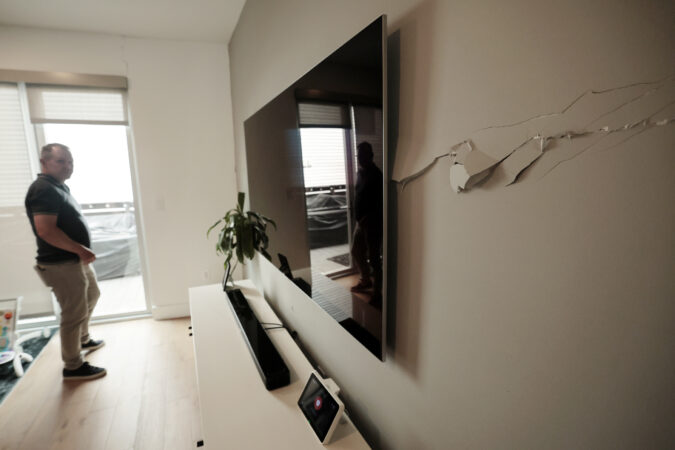
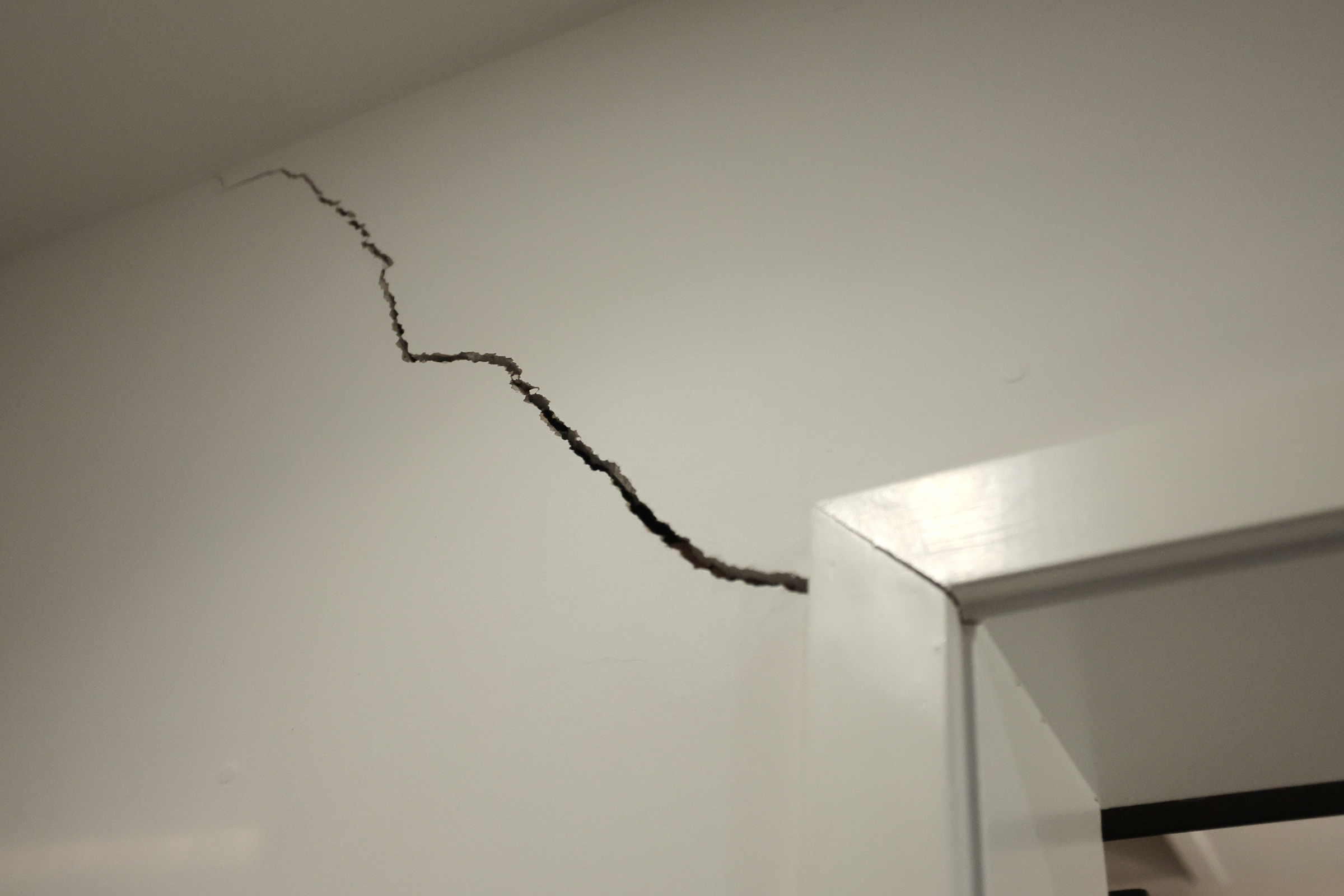
Fissures have spread across some of the walls in their home — which was built in 2014 — and cracks radiate from many doors and windows.
Three of their neighbors on Brown Street face similar issues. They say their homes were damaged by an apartment building constructed in 2023 that’s so close to the rear of their house they can almost touch it.
One family moved out after the city Department of Licenses and Inspections declared their home unsafe in 2024.
The Emmonses want to move to South Jersey, closer to family. Instead, as they wait for their second child to be born, they feel trapped.
“The fact that my neighbor was issued an order not to occupy the house, and it’s attached to our house, it’s just really scary,” said Brian Emmons, who has been a real estate developer in Philadelphia for almost 20 years. “We are stuck.”
Along with two neighbors, the Emmonses are suing the developer of the apartment building: Brian Zoubek, president and CEO of Zoubek Properties, who has built 250 houses in Philadelphia over his roughly decade-long career.
Since graduating from Duke University in 2010, where he played basketball for the Blue Devils, including on the national champion team that year, Zoubek tried his hand at a few occupations before settling on development. He has expanded his business to the Jersey Shore, recently debuting 10 almost million-dollar townhouses at a news conference with New Jersey Gov. Mikie Sherrill.
“I’m extremely proud of what we’ve built in Philadelphia,” Zoubek said in an email. “I put my own name on my work because I stand behind every project we build.”
Zoubek faces lawsuits from the owners of three properties, all alleging that he damaged their Brown Street homes. An Inquirer review of court records found that Zoubek’s companies were similarly taken to court over allegations of sloppy construction practices by their contractors in at least three prior development projects.
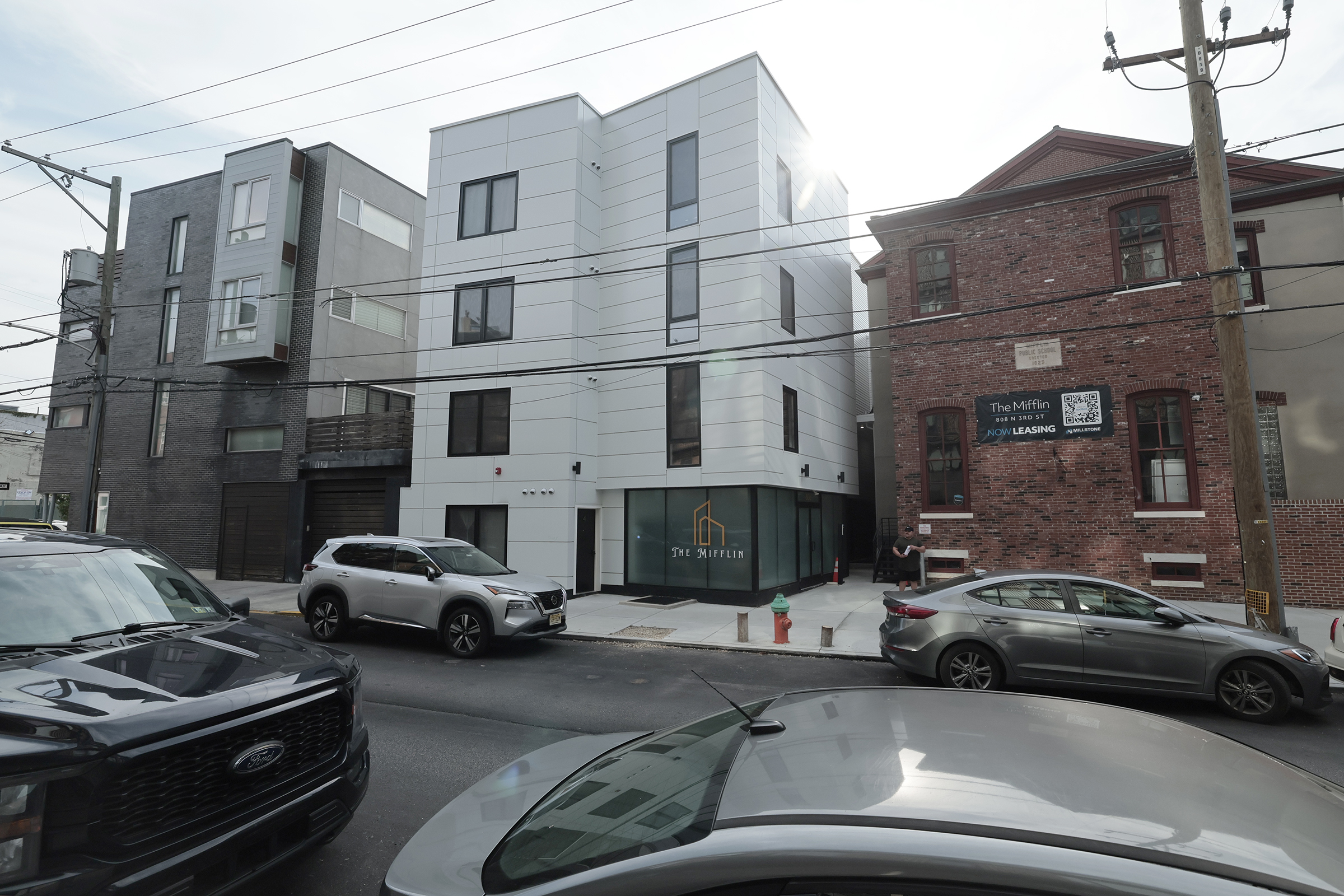
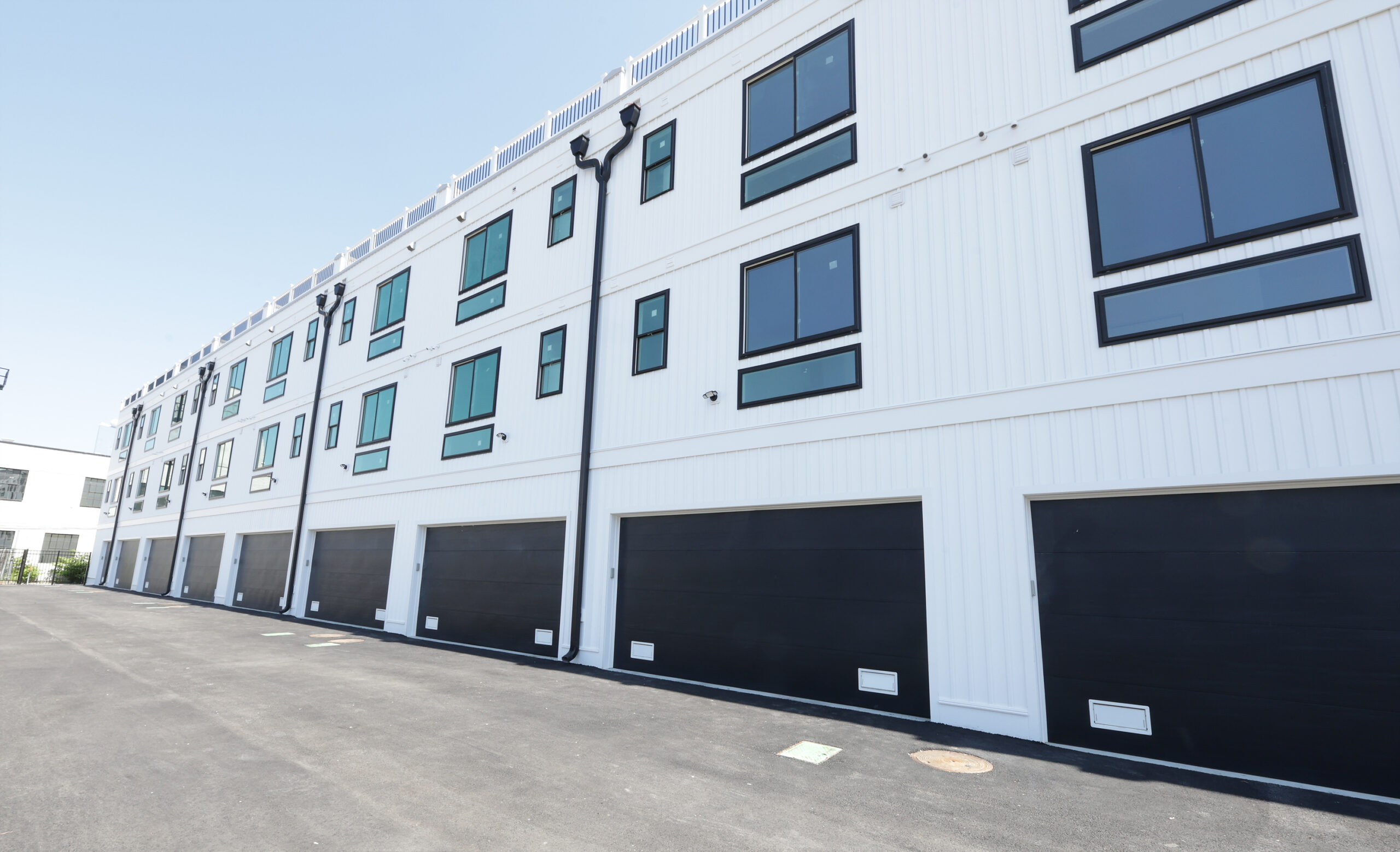
The eastern end of Brown Street with rowhouses (gray), the new apartment building Zoubek built next door (white), and the former school he transformed into apartments (red brick).
The Northern Liberties rowhouses
Emmons and his neighbors sued last year alleging that the damage to their homes is the direct result of Zoubek’s redevelopment of the Mifflin School, built in 1825, just to the north of their homes.
In mid-2021, Zoubek purchased the property — the oldest surviving public school building in Philadelphia — and carved it into 15 apartments with 14 more wedged into a four-story addition on a small lot between the Brown Street homes and the historic structure.
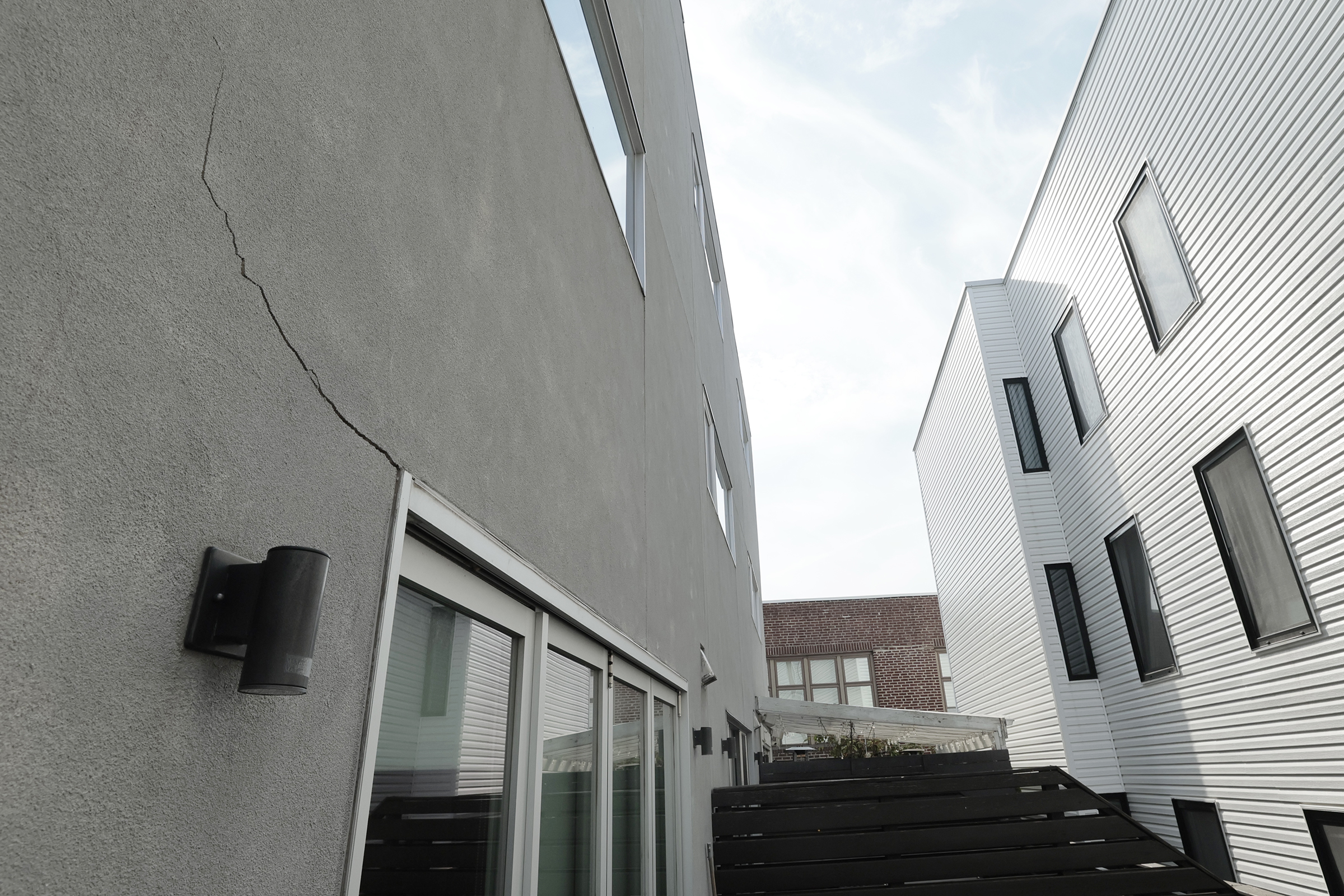
The recent lawsuits contend that the developer dug too deep while excavating the basement of the new building and damaged their adjacent foundations. Within the three homes — which The Inquirer toured with Emmons — cracks grow in walls, floors slant, the shared garage leaks, and residents have struggled to open some windows and doorways.
The other two homeowners declined to speak on the record, citing the ongoing lawsuits. The residents of a fourth house have resolved their case against Zoubek.
“We are aware of the pending litigation and are actively defending these claims,” Zoubek said in an email. “Given the involvement of multiple parties, we are engaged in ongoing discovery and investigation and are confident the process will bear out the facts.”
Zoubek was named in two earlier lawsuits that accused his construction crews of slapdash work that damaged neighboring properties. A third suit alleged that his company’s work triggered a floor collapse that injured two deliverymen.
Zoubek said in a statement that all prior suits have been resolved.
For Emmons, the experience on Brown Street has an irony to it. Ten years ago, he was the face of development in Philadelphia as president of the Building Industry Association (BIA) — a real estate advocacy group — and vice president of a development firm Toll Brothers runs in the city.
Usually in the position of advocating for new development, Emmons counseled his neighbors when the project was announced that it was allowed by the property’s zoning and not worth resisting. But he did ask his fellow developer about his plans for the new apartment addition to the Mifflin School.
A gaping crack in a first-floor wall in a home at 301B Brown St. in Philadelphia.
“He clearly was doing things the wrong way,” Emmons said. “And I know that because I’m in the construction industry.”
Zoubek contests Emmons’ assertion. He argues that many of his 30 building projects in Philadelphia involve basement excavation next to existing properties and that the Mifflin School project was fully permitted and supervised by skilled professionals.
“That experience, combined with the engineering oversight on this project, reflects how seriously we take this work,” Zoubek said in an email. “After concerns were raised, the project was reviewed by L&I, which did not issue violations or take enforcement action.”
A trail of lawsuits
Zoubek has been building in the Philadelphia area for more than 10 years, mostly developing small apartment buildings or a handful of rowhouses in the city’s booming river ward neighborhoods.
Zoubek, at 7-foot-1-inch, was a basketball star at Haddonfield Memorial High School and got into real estate after a stint running a cream puffery and, later, as a real estate agent for Cushman Wakefield.
He started his own firm, Zoubek Properties, in 2014 and a related construction management company called Z Builds. He also cofounded another company, Catalyst City Development, with childhood friend Tyler McNeil.
As his construction business grew, his enterprises were drawn into complex litigation alleging property damage or injury caused during construction.
Brian Zoubek in his now defunct cream puff shop Dream Puffz, a pre-development venture, in 2012.
According to one lawsuit, Catalyst, the company Zoubek cofounded, and Manayunk-based Grit Construction worked together on a small development on Hope Street in Northern Liberties in 2019. During construction, Grit ruptured a lateral pipe connecting a sewer main to a strip of nearby businessesfacing an adjacent block of Front Street.
Exhibits from that lawsuit show Zoubek proactively contacted the neighboring property owner, reassuring him that his crews had quickly rerouted the noxious flow by splicing in PVC piping until a more permanent fix could be made.
“Broke some sort of line,” Zoubek texted to the adjacent property owner, along with a photo of the messy scene. “So we put in a temp one.”
But a week later, business owners next door were complaining about chronic plumbing issues. The temporary line had become clogged with rubble and other debris from the ongoing construction.
According to the suit, in June, the toilets and sinks at a packing business on Front Street erupted as sewage backed up and flooded into the commercial unit. The next day, a barbershop next door was inundated with filth.
A plumber came out to snake out the line but discovered that Zoubek’s crews had capped the severed line. Eventually, tenants fled.
“Our tenants cannot continue with sewage backed up into their space,” a property manager for the commercial units next door wrote to Zoubek, in a 2020 email.
Zoubek said that the case had settled but offered few other details: “The matter was ultimately resolved between the parties.”
Zoubek Properties had also hired Grit and contractor All-State Services to demolish a building under the El in Fishtown in 2019 and build several new apartments.
In 2021, the owner of a neighboring apartment complex sued, saying that during teardown crews punched holes in the side of the adjacent building, damaging its roof, framing, and supports.
According to that complaint, tenants told a property manager about “a big noise and shaking in the building” during the demolition process.
After arriving on the scene a short time later, the manager “observed All-State Services employees drinking alcohol while on the job and stumbling down off of heavy equipment,” the complaint said.
Zoubek said that his contractor eventually repaired the wall and that a claim for further damages was handled by the two insurance carriers.
“The matter is fully resolved,” he said.
The new luxury townhouses on Kentucky Avenue known as the Residences at Orange Loop in Atlantic City, which Zoubek revealed with New Jersey politicians earlier this year.
As that suit unfolded, Zoubek had another project underway in Old City, again for a small apartment complex on the 100 block of North Third Street.
In 2021, two deliverymen bringing in elevator counterweights for the construction project were told to use a rear entrance to deposit their cargo, according to a personal injury lawsuit filed the next year.
The suit contends that both the delivery company and the workers quizzed Zoubek’s crews about whether the rear entrance of the partially constructed building was structurally sound enough to handle the extreme weight of their load. They were assured that it had been inspected and was safe.
Instead, the floor collapsed, sending the men and their equipment crashing into the basement, injuring both delivery workers.
The suit was later settled for $6.5 million default judgment against the subcontractor.
“That matter was resolved through the appropriate legal and insurance processes,” Zoubek said.
Construction damages 50 rowhouses a year
Lawsuits and claims of construction damage are endemic to the real estate industry. And building in the tight confines of Philadelphia’s dense rowhouse neighborhoods can be especially contentious.
In the case of Brown Street, a spokesperson for Zoubek pointed The Inquirer to the website of Fortis Construction & Design, which built the five rowhouses there in 2014 and is now suspended by the city for “unpermitted, potentially dangerous underpinning and excavation.”
Cracks on the exterior of a home at 303A Brown St. in Philadelphia (left) on June 9.
Emmons, however, argues that the fault lies with Zoubek: The extensive damage to the Brown Street homes appeared only after the basement was dug out for the expansion of the Mifflin in 2023.
“He can point the finger all he wants, but I hope he lies awake at night praying nobody gets injured or killed,” Emmons said in an email.
If you made the typical income in your community, could you afford to buy the typical home for sale there?
Across the Mid-Atlantic, “the answer is a resounding no in most places,” said Lisa Sturtevant, chief economist at the multiple listing service Bright MLS.
But in a region where buying a home can be challenging, Delaware County stands out.
It was the only county in the Philadelphia region where a household making the median income could afford to buy a median-priced home for sale at the end of last year, according to an analysis by Bright MLS. In Delaware County, the median asking price of homes in the last quarter of 2025 was $289,450, and the median household income was about $89,500.
Bright MLS calculated affordability based on a homebuyer’s ability to qualify to purchase a median-priced home, assuming a 10% down payment with the average interest rate for a 30-year, fixed-rate mortgage and average payments for property taxes and insurance.
Of the roughly 90 counties in the company’s service area across Pennsylvania, New Jersey, Delaware, Maryland, Virginia, West Virginia, and the nation’s capital, Delaware County was one of only five counties where the median-priced home was affordable for a household making the median income in the last quarter of 2025. The city of Baltimore also made the affordable list.
Sturtevant said everyone knows housing affordability is a challenge, but “when you see the data so starkly like this, it really brings the point home.”
window.addEventListener(“message”,function(a){if(void 0!==a.data[“datawrapper-height”]){var e=document.querySelectorAll(“iframe”);for(var t in a.data[“datawrapper-height”])for(var r,i=0;r=e[i];i++)if(r.contentWindow===a.source){var d=a.data[“datawrapper-height”][t]+”px”;r.style.height=d}}});
Across the Mid-Atlantic, median home prices are up 35% since 2020. The five counties that are most affordable are generally places with lower costs of living where the housing stock is older, she said.
Michael Maerten, a real estate agent on the board of directors for Tri-County Suburban Realtors, which represents members in Chester, Delaware, and Montgomery Counties, said Delaware County’s dense housing and smaller homes also help keep costs down.
He’s seen homebuyers in Chester and Montgomery Counties have a harder time affording homes. He said he’s working with a homebuyer who was originally focused on the area around Abington Township in Montgomery County and is now looking in the Haverford Township area of Delaware County where they can get what they want with the money they have.
“The running joke about Delaware County is people don’t leave,” he said.
But Delaware County’s spot on Bright MLS’ affordable list doesn’t mean households aren’t struggling to afford homes. It’s still challenging for many people, Sturtevant said.
First-time homebuyers in particular have it rough. Bright MLS found that across the about 90 counties it tracks, renters are effectively priced out of becoming homeowners. There is no county where a renter who makes the median income could afford to buy a starter home.
“That’s crazy to me,” Sturtevant said.
window.addEventListener(“message”,function(a){if(void 0!==a.data[“datawrapper-height”]){var e=document.querySelectorAll(“iframe”);for(var t in a.data[“datawrapper-height”])for(var r,i=0;r=e[i];i++)if(r.contentWindow===a.source){var d=a.data[“datawrapper-height”][t]+”px”;r.style.height=d}}});
Bright MLS defines starter homes as those priced at the 35th percentile, meaning 35% of homes are priced below that level and 65% are priced above.
Sturtevant said high construction costs have made building starter homes more difficult. At the same time, homeowners are holding onto smaller, more affordable homes instead of selling for a larger home because of elevated mortgage interest rates and uncertainty in the economy. So first-time buyers have fewer options and more competition.
Still, Maerten said a “good percentage” of his buyers are purchasing for the first time.
“They’re going through their struggles of making offers and competing in the suburbs,” he said.
Maerten said that in his experience, homebuyers know exactly where they want to purchase and are more likely to save money until they can buy where they want rather than buying in an area just because it’s more affordable.
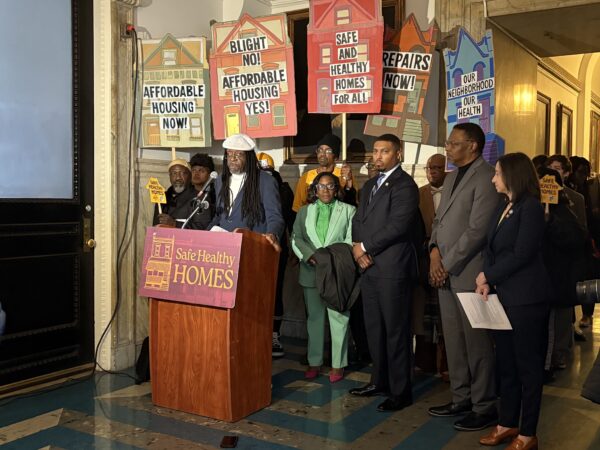
City Council’s housing committee advanced two bills on Wednesday meant to help Philadelphia renters living in unsafe or unhealthy homes.
One bill would protect tenants who complain about housing conditions from retaliation by rental property owners and affirm tenants’ rights to safe and sanitary homes.
The bills are the two remaining pieces of a legislative package of renter protections introduced by Councilmember Nicolas O’Rourke. The first bill in the Safe Healthy Homes Act passed last year and created an anti-displacement fund to give financial help to renters forced to move out of their homes because of unsafe or unhealthy conditions.
The remaining bills passed out of the housing committee Wednesday after months of discussions with Council members, Parker administration officials, and landlords.
All three bills were written in partnership with the groups OnePA Renters United Philadelphia, a coalition of renters unions and advocates, and Philly Thrive, an advocacy group for racial, economic, and environmental justice. At Wednesday’s Council hearing, tenants from these groups and others who rent homes across the city testifiedabout living with mold, pests, leaks, lack of heat, and falling ceilings.
“The stories that inform the creation of this legislation come from the tenants,” O’Rourke said. Philadelphia renters “have long had to fight for the right to dignified living.”
Proactive inspections
Bridget Collins-Greenwald, commissioner of L&I’s quality of life division, said the bill that allows for a program to proactively inspect rental homes incorporates the Parker administration’s feedback.
“We believe the administration’s concerns have all been addressed and that the bill as amended can be successfully implemented,” Collins-Greenwald said to cheers and applause from tenants in the audience.
A year ago, Collins-Greenwald testified at a Council hearing that L&I was working to create a proactive inspection program. According to a Pew report from 2021, the department inspected only about 7% of Philadelphia’s rentals in a year.
O’Rourke’s legislation would require L&I to provide annual reports to Council members about the progress of the proactive inspection program.
The bill also would require rental property owners to share a copy of their rental license with tenants and to inform tenants if the license is suspended. Landlords need a valid license in order to collect rent.
Owners would also have to tell tenants about outstanding health and safety violations.
Retaliation against renters
O’Rourke’s second bill would expand protections against landlord retaliation for renters who participate in tenant unions and/or investigations of code violations.
“With less fear of reprisal, tenants will be emboldened to advocate for themselves around severe habitability and repair issues,” she said. “Far too many Philadelphians live in rental units in need of significant repairs.”
The bill also would expand the city’s requirement that landlords have “good cause” for ending a tenancy — whether by lease nonrenewal or termination — and explain to tenants in writing why their tenancy is ending. Under the bill, this provision of the city’s landlord-tenant law would apply to most tenants, not just those with leases of less than a year, as it does now.
More amendments?
Groups that represent rental property owners and managers said that they support the broad goals of the bills, but that the legislation needs to be further amended. They said they worried about unintended consequences that could harm landlords, especially ones with only a few housing units.
The legislation includes a provision that would allow rental property owners to collect the full rent if they can show that the city was the reason they were unable to get a valid rental license on time. But landlords said they want more protections for rental property owners who strive to follow city laws but are stymied by government bureaucracy and frequently changing regulations.
For example, Steven Chintaman, vice president of government affairs at the Pennsylvania Apartment Association, said landlords should have to forfeit rent only if code violations impact the habitability of a home, “not [for] technical or administrative issues.”
“We remain committed to working collaboratively to preserve the intent of these bills while ensuring that they are balanced, workable, and do not unintentionally harm housing providers and the residents we serve,” Chintaman said.
O’Rourke said he would continue to work with rental property owners and other stakeholders and is open to further amendments as his bills move forward.
The Plaza Grande apartment complex, part of a Cherry Hill housing development that took almost two decades to complete, is now on the market.
The apartments in the 55+ housing complex near the former Garden State Park Racetrack were listed for sale last month, as first reported by the Philadelphia Business Journal. The 507 rental units across 16 buildings are located just south of the Cherry Hill Mall between Routes 70 and 38 and were completed last year.
The residential Plaza Grande at Garden State Park was the last piece of a $1 billion redevelopment of the former Garden State Park horse racing track and surrounding area. The mixed-use complex spans hundreds of acres and is known for Wegmans, Trader Joe’s, restaurants, and other stores.
Home construction at the 34-acre Plaza Grande portion began in 2007, and 101 condos were built. But several builders failed to finish the project in the face of hurdles that included the Great Recession and lawsuits.
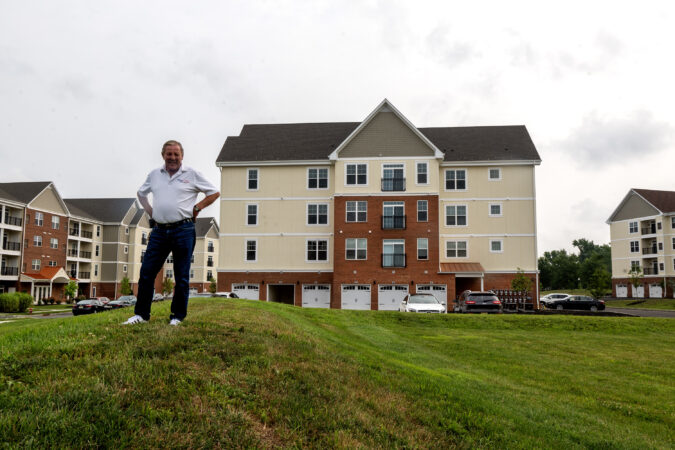
A few years ago, New York-based investor and developer William “Billy” Procida stepped in. He completed construction on the remaining283 of the 507 apartments last summer, and the units are now 80% leased.
“We’re not in the business of holding property,” he said. “But this one, I put so much blood, sweat, and tears in it, it’s a hard one to let go.”
Developer William “Billy” Procida poses in the lobby of the clubhouse at Plaza Grande at Garden State Park in Cherry Hill on Aug. 6, 2025.
He said he’d like to find a buyer “who’s going to treat it really nice.”
Offers are due in a month, said Samantha Kupersmith, senior director at JLL Capital Markets, which is handling the sale. The property listing does not include an asking price, as is generally the case for properties JLL handles, she said.
The property is in “such a good location with a lot of scale,” which makes this “a unique deal,” Kupersmith said.
One- and two-bedroom apartments at the Plaza Grande are currently available starting at $2,200 and $2,800 per month, respectively. Five three-bedroom apartments started at $5,500 but allare leased.
The property has an 18,500-square-foot clubhouse and offers programming such as cooking and fitness classes, concerts, and wellness events. Condo owners and renters have access to amenities that include a movie theater, a gym, tennis and pickleball courts, indoor and outdoor pools, and indoor golf.
Procida’s company announced last month that it had chosen Millstone Property Management to oversee operations at the apartment complex starting March 21. Millstone Property Management specializes in managing multifamily properties across Pennsylvania, New Jersey, Delaware, and Florida.
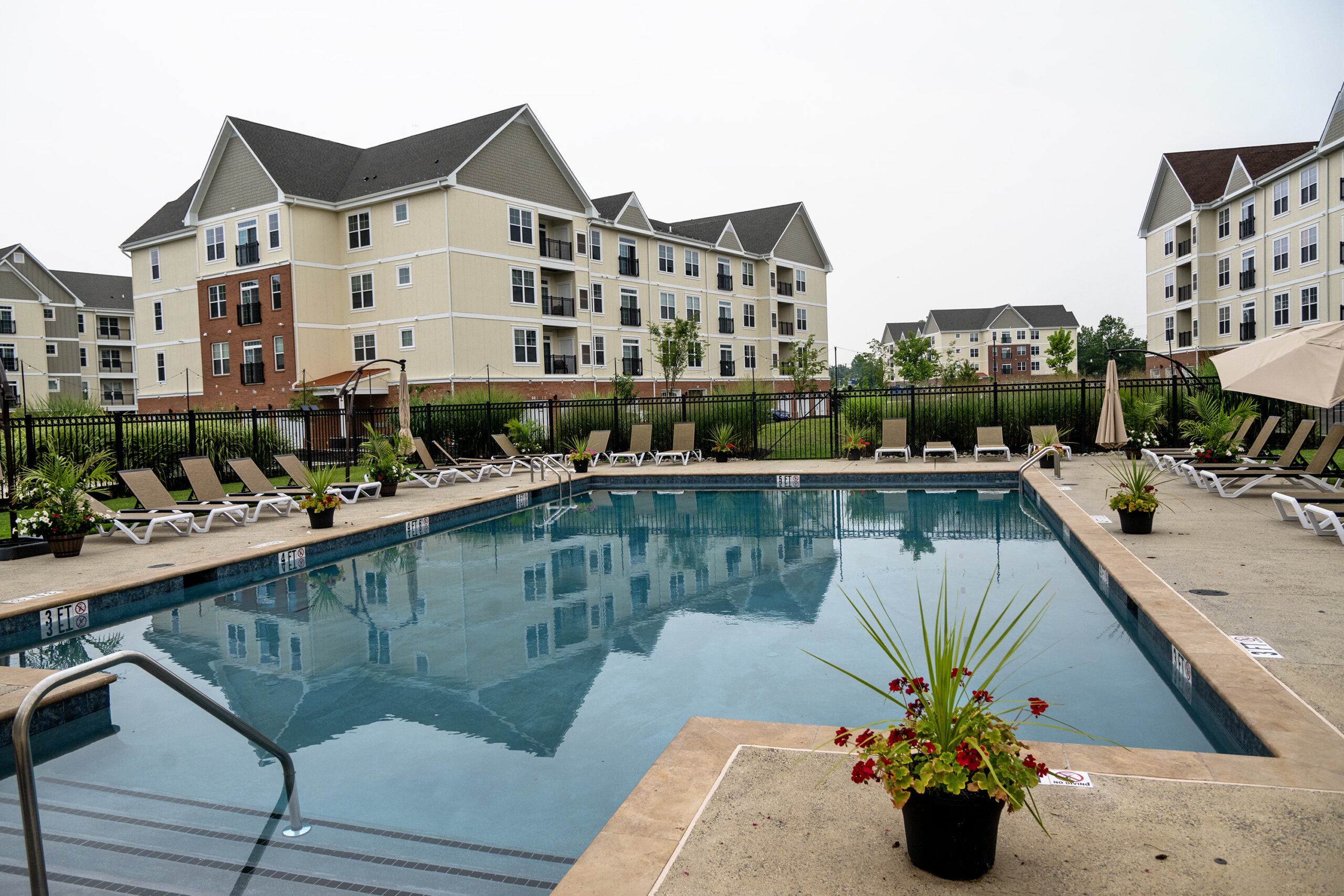
The newest rental apartments at Plaza Grande at Garden State Park in Cherry Hill are reflected in the clubhouse pool on Aug. 5, 2025.
But six years later, some sprawling campuses in suburbs like Horsham, Plymouth Meeting, and Wayne have soaring vacancies — andthere are only a couple suburban conversions underway.
Developers agree that the primary challenge is the buildings themselves, which have more difficult floor plans for residential development than their urban counterparts, making demolition easier than conversion in many cases.
“Transforming an office building tucked inside a suburban office park is a completely different equation than converting a building on Walnut Street steps from Rittenhouse Square,” said Sarah Maginnis, executive director of the Philadelphia chapter of the Commercial Real Estate Development Association. “Location, context, and building design all matter a lot.”
The lack of suburban office redevelopment is partly due to the fact that many of the highest-vacancy buildings are in remote, less desirable corners of the region. The patchwork quilt of hyperlocal zoning regulations across dozens of municipalities is a challenge, too, as builders have to negotiate with officials on almost every project.
“A lot of townships are fighting residential development because it comes with burdens on the school systems. Office buildings don’t do that,” said Glenn Blumenfeld, principal with Tactix Real Estate Advisors. “Zoning is more liberal in the cities [which is why residential conversion] has not come to the suburbs.”
Architectural challenges of conversion
Most suburban office buildings date to an era when office and residential structures began to look very different from each other.
When office work began to move into undeveloped land surrounding cities in the mid-20th century, developers generally built out instead of up, taking advantage of the abundant space. Almost everyone commuted by car, so vast parking lots were required.
Suburban office buildings often have a lot of dark interior space. The windows that do exist mostly cannot be opened because of ubiquitous air-conditioning. The parking lots that wreath the buildings make for unsightly and dull vistas.
In large rectangular glass buildings, residential conversion would entail what longtime suburban developer Eli Kahn calls “bowling-alley-shaped apartments … that just don’t work.”
“In the city, a 30-story office tower doesn’t look a whole lot different from an apartment building,” said Kahn, president of E. Kahn Development Corp.
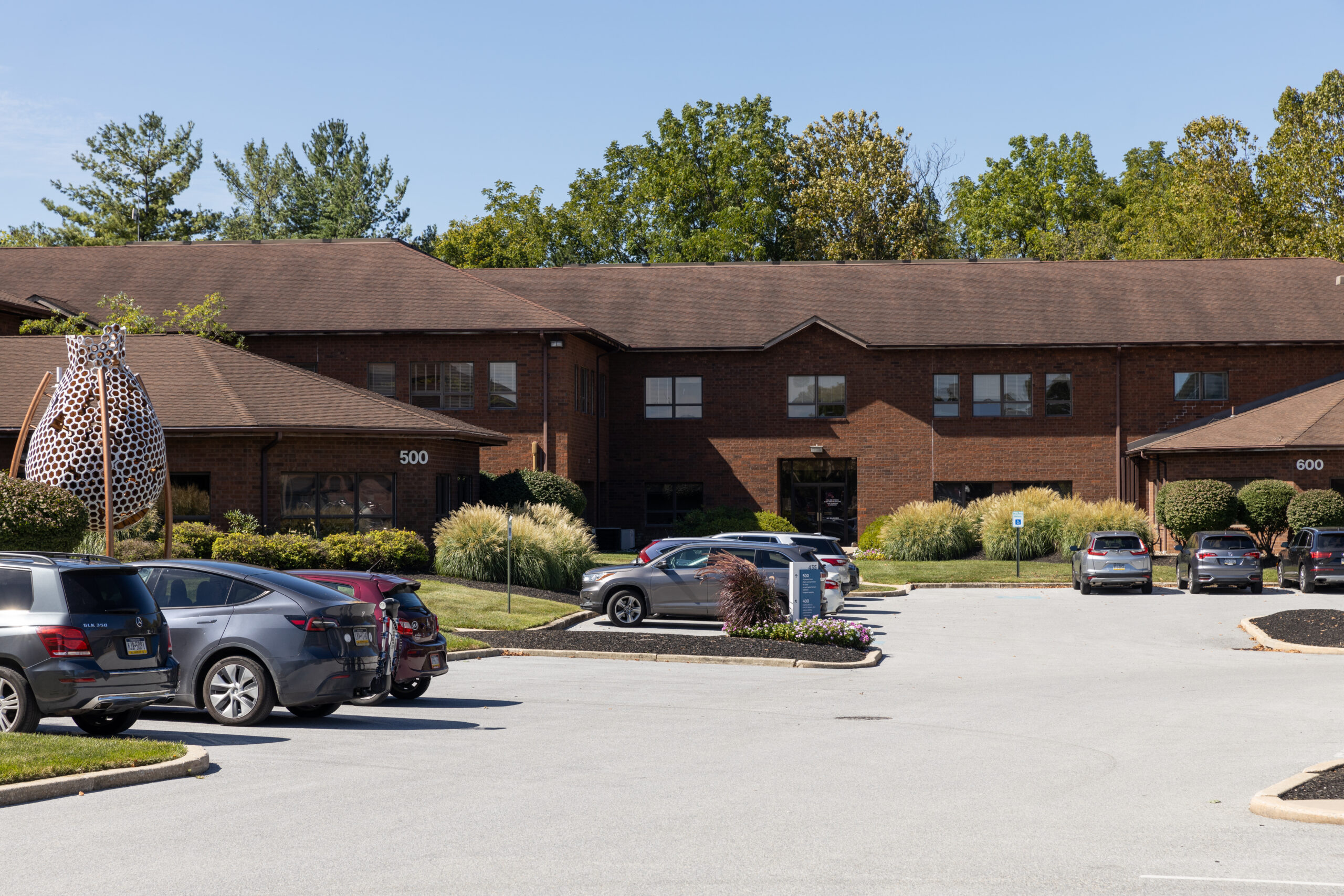
One of the eight two-story buildings at 435 Devon Park Dr. that have been used as offices and are being turned into apartments.
An exceptional suburban conversion
The redevelopment of an eight-building office complex at 435 Devon Park Dr. in Chester County’s Tredyffrin Township is one of the only suburban office-to-residential conversions underway right now.
Notably, none of its former office structures are big glass rectangles.
“This just happened to be perfect for conversion,” said Mark Thomson, founder of Love Communities, which is developing the project in partnership with E. Kahn Development Corp. and Triple Crown Corp.
“It’s going to be the largest garden-style suburban conversion in the whole Northeast, maybe even a bigger area than that,” Thomson said.
Kahn also is part of the team behind the conversion of 435 Devon Dr., and he developed the complex when it was built in the 1980s.
This office park broke from the standard big glass box model of suburban offices and instead offered two-story, L-shaped buildings with brick facades and windowsthat open.
That makes conversion cheaper, too. To make those big box buildings livable, the glass facade would need to be torn off and windows installed that actually open.
“The most expensive part of construction is the windows,” Thomson said. “If we had to do that, it would probably make this not economically feasible.”
The project is also able to move forward because it accords with the goals of local political leadership, who are wary of family-size apartments.
The 162-unit office-to-residential project will be largely composed of studio and one-bedroom apartments in an attempt to appease concerns about strains on the school district and to produce unsubsidized affordable housing in this wealthy township.
Zoning rules everything
In many suburbs, building apartments, townhouses, and other more modestly scaled housing is often not allowed by zoning laws. Office parks are usually zoned to exclude residential development.
That’s a sharp contrast with Philadelphia, which has few barriers to office-to-residential conversion in Center City, and a citywide10-year property tax abatement is available for building renovations. Wilmington also offers a variety of incentives.
In Tredyffrin, officials were opposed to the idea of either very high density apartments — at almost 10 acres, the site could support hundreds of units — or new single-family homes.
So to make 435 Devon Park Dr. work, the developers knew they couldn’t demolish the buildings and construct new homes.
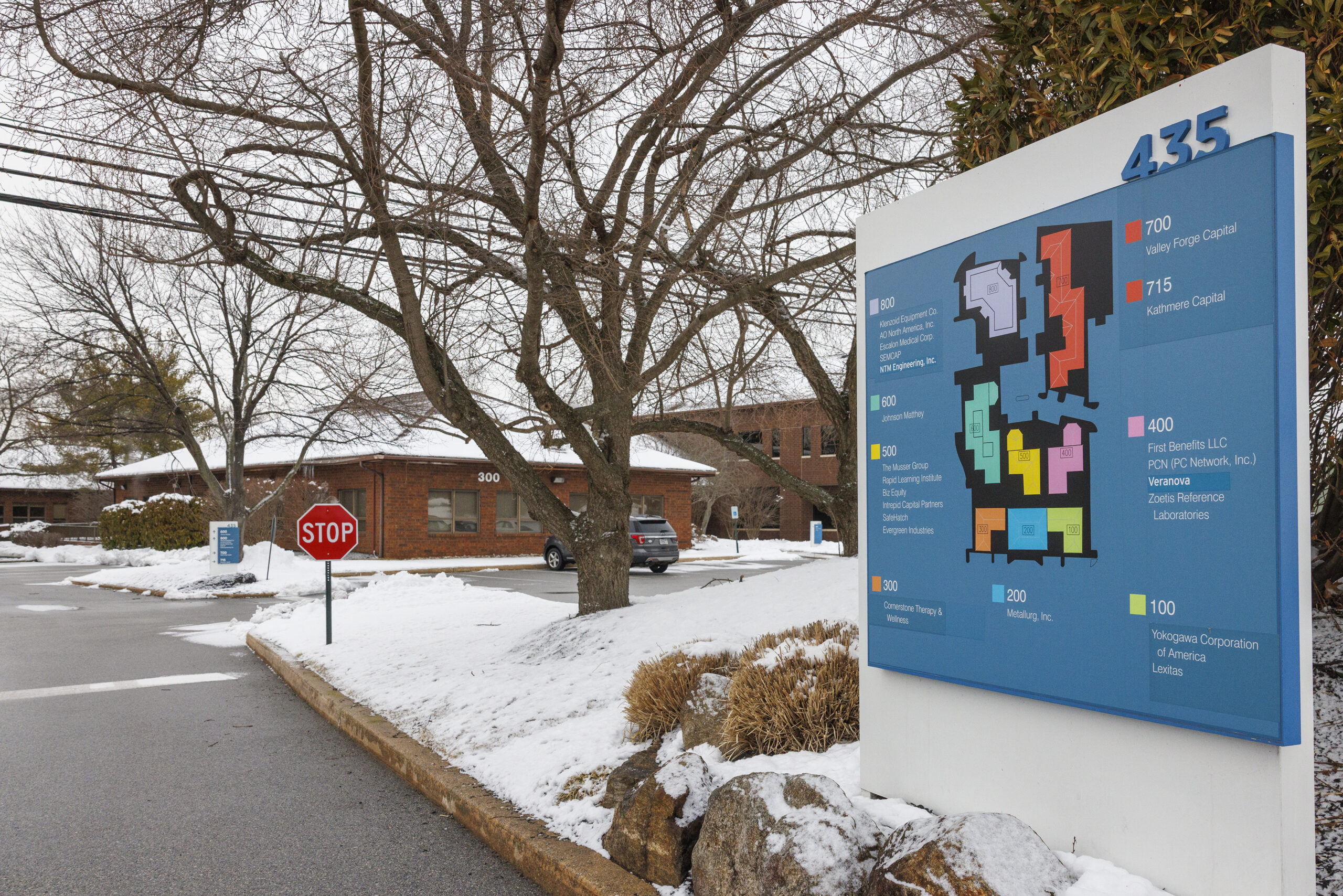
The entrance to 435 Devon Park Dr. with the brick office buildings, which are planned to be converted to residential in the background.
Instead, the developers pitched the conversion not as luxury apartments, but as affordable homes for nurses, teachers, and other middle-income workers in Tredyffrin. They also plan to convert some parking lots into green space for residents.
The units can be priced more affordably because of the relatively small scope of the conversion and because the developers essentially purchased the campus for its land value.
Working in partnership with Triple Crown Corp. also helps because the company has in-house contractors and architects.
The paucity of multi-bedroom units lowers rental costs, too, and assuages fears about overburdening schools.
“None of these communities have made it easy like Philadelphia, because they’re all their own fiefdoms,” Kahn said. “But if you make the right argument and you show them how it’ll benefit them financially, they generally come around.”
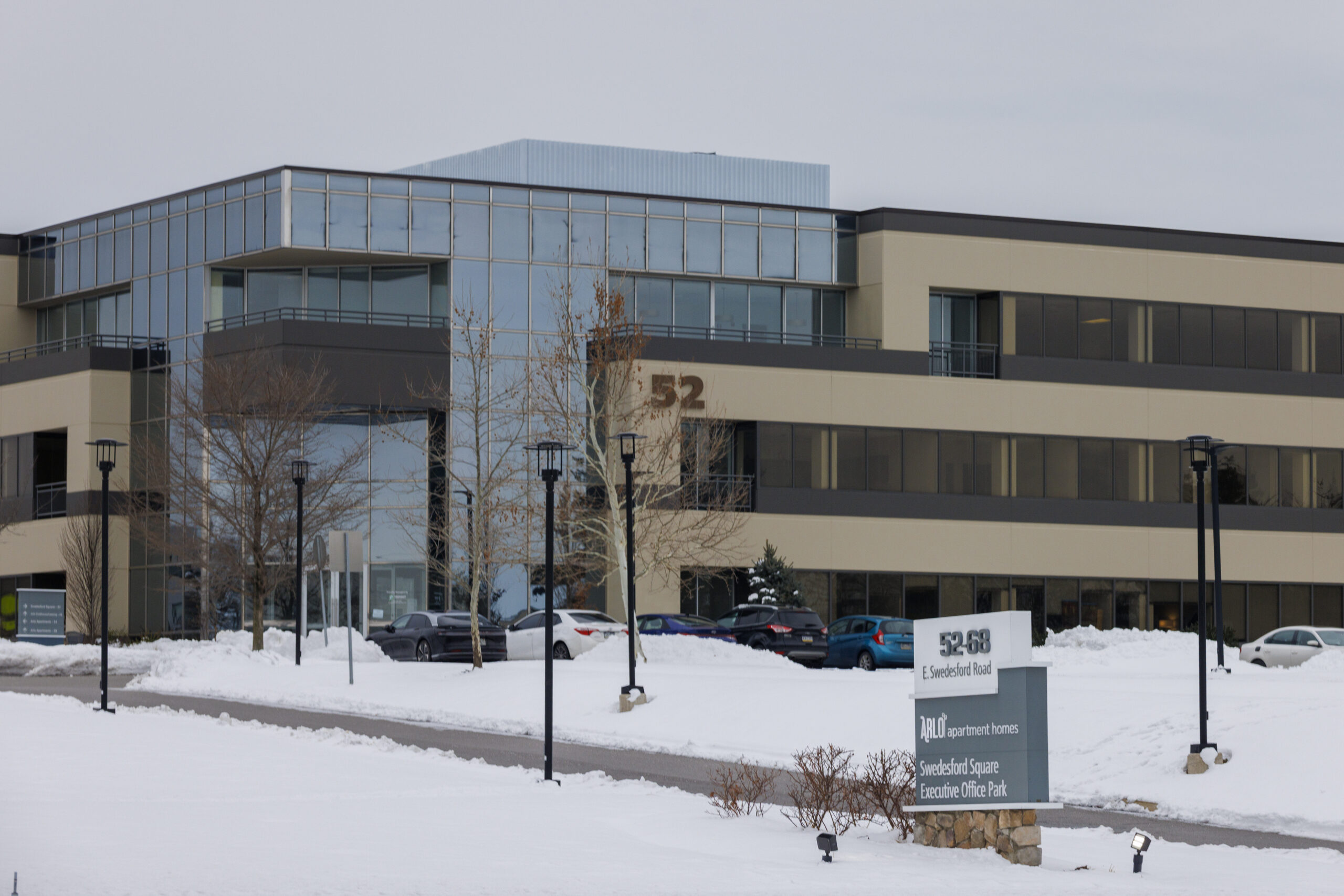
The East Whiteland office building at 52 Swedesford Rd., which is slated by TriPoint Properties for demolition and replacement with apartments.
The future of (some) suburban offices
There are few other conversion projectsunderway in Philadelphia’s suburbs.
Keystone Property Group has a more traditional office-to-apartment tower in the works at the Plymouth Meeting Mall. The Parkview Tower next to the Valley Forge casino was consideredfor conversion last year. The Buccini Pollin Group is weighing a conversion project at BNY Mellon’s old headquarters in Bellevue State Park, north of Wilmington, and is looking at opportunities in the Pennsylvania suburbs.
But it is more common for developers to consider demolishing old office buildings to make way for something new.
In Chester County’s East Whiteland Township, which contains the Great Valley Corporate Center, office-to-residential conversion proposals have met a chilly reception.
“The proposals to rezone large vacant office buildings for direct conversion to apartments were really viewed negatively,” said Scott Lambert, chairman of the East Whiteland Township Board of Supervisors. The plans were seen as “short-term fixes that created long-term challenges.”
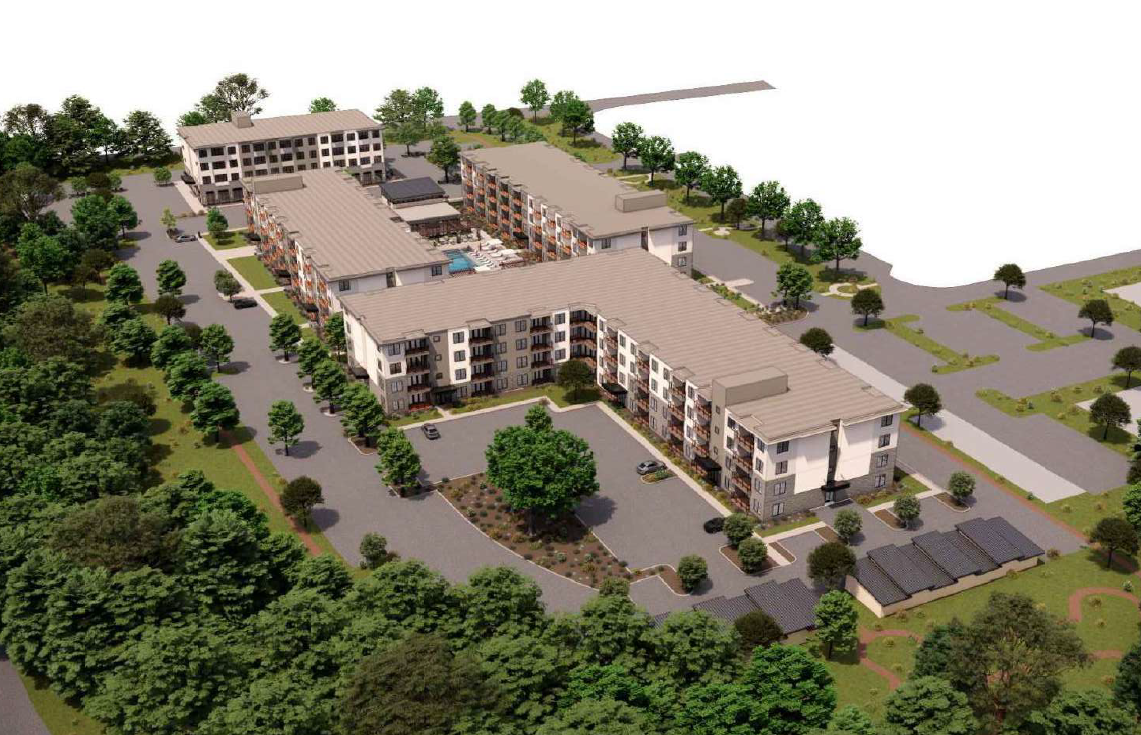
An overhead rendering of the 250-unit apartment project that will replace an old office building at 52 Swedesford Rd.
East Whiteland’s government looked more kindly on Tripoint Properties’ proposal to demolish a standalone office building at 52 Swedesford Rd. — outside the corporate center — and replace it with 250 apartments.
The vacant office building is surrounded by four-lane roadways, which eased congestion concern. Developers also proposed mostly small apartments, with 30 rented for below market rate, which helped earn support from the township.
“On the school side, they were OK with limiting the units to either one- or two-bedroom apartments,” Lambert said. “We would like to be in a position to limit the number of three-bedroom apartments in the township because of the impact it has on schools.”
But some real estate experts say eventually, municipalities will need to replace the tax revenue lost from dead office buildings.
“The centerpiece of tax bases in commercial areas has been office space,” Kahn said. “If the tax base goes down, and they can’t pay for the schools, who gets the burden? A couple years of 30% property tax increases on your constituents, you’re going to get voted out of office real quick.”
The Price Point compares homes listed for similar sale prices across the region to help readers set expectations about house hunting.
When homebuyers sit down to make their must-have lists, they usually have a property size in mind.
Maybe they’re outgrowing their home and need something bigger. Maybe their home is too big and they need to downsize.
A bigger home can mean a bigger price tag, but not always.
The latest installment in the Price Point compares homes in the region that are listed for sale for about the same price but vary widely in size.
The Upper Dublin Township home is about 1,000 square feet larger than the home in Riverton, Burlington County, which is about 1,000 larger than the home in Chestnut Hill.
But they’re all for sale for between $765,000 and $770,000. That’s more than twice the typical price of a home sold in the Philadelphia metropolitan area last month — $380,000, according to the multiple listing service Bright MLS.
Colonial in a special location
What makes this house in Upper Dublin Township special is its location, said listing agent Frank Blumenthal with Keller Williams Real Estate Tri-County.
It’s about three miles from Regional Rail’s Ambler and Fort Washington stations, close to the Pennsylvania Turnpike and other major roads, and not far from shops and restaurants.
And the home is a few hundred yards from Mondauk Common, a public park that includes a one-mile walking track, sports fields, exercise equipment, playground equipment, basketball courts, and pavilions. The park also hosts community events throughout the year.
The home has expansive side and rear yards.
Inside, the large primary bedroom includes a sitting room. The kitchen flows into the great room, which has a fireplace and lots of windows. The home also has an unfinished basement.
Within the last few years, the owner replaced the roof and heating and cooling systems. A buyer may want to update the kitchen and bathrooms, “but the big-ticket items are out of the way,” Blumenthal said.
The property was originally listed for $834,000 in September. The price dropped to $828,000 in November and $769,000 in February.
Fully renovated historical home
This house is more than a hundred years old and part of a historic district.
“Homes were just built differently back in the day than they are now, and they stand the test of time,” said listing agent Michelle Bishop with Real Broker LLC.
Because the home is historically protected, the investor who is flipping the property was limited in the exterior changes he could make. But he installed a new roof and new windows and fixed the siding.
The home’s interior was a gut job, Bishop said. The property was in rough shape before the renovations, which included tearing down walls and installing new mechanical systems.
The owner built a one-car detached garage and fixed up the in-ground pool.
The staircase and double-sided fireplace are original to the home. New features include an updated kitchen, striking light fixtures, and a soaking tub.
“The perfect buyer for this property is somebody who really appreciates historical homes but enjoys living in modern-day comfort,” Bishop said.
Bishop called Riverton “a cute little town” and said she’s seen families who like Moorestown but can’t afford to live there come over to the borough. The home is close to parks, the Riverton Country Club, the Delaware River, Routes 130 and 73, and a NJ Transit light rail station on the River Line.
The property was originally listed in January for $799,999, but the price dropped to $769,999 in February.
Detached house on a double lot
This property isn’t one that a potential buyer would typically see in this twin-filled part of Philadelphia.
“It’s a detached home in Chestnut Hill,” said listing agent Neil Dessecker with RE/MAX One Realty. And its double-wide lot offers large side and rear yards, which are fenced in.
On tours, many prospective buyers said they liked the property because they were looking for more space, he said.
The home also has more of the usual features of homes in the area, including a covered front porch and hardwood floors.
The kitchen includes high-end Bosch appliances, including an induction range. The owners converted the home from oil heating to central air-conditioning and heating.
The third floor is a flexible space that can be used as a bedroom, living space, or playroom.
The home doesn’t include parking, which Dessecker noted “usually skyrockets the price.” But the sellers said they almost always parked their two vehicles on the street right in front of their home.
“The sellers said it was an incredible block and they loved the people there,” Dessecker said.
The home is not far from the shops and restaurants along Germantown Avenue and is near an Acme. The Wyndmoor station on Regional Rail is at the end of the street.
“There’s just not a lot of inventory in Chestnut Hill,” Dessecker said. “So when something of quality becomes available, you have to seize the opportunity.”
Philadelphia is one of the most popular major cities among renters searching for apartments ahead of this year’s peak rental season.
The city ranks in the top 10 most popular out of the 150 largest U.S. cities, according to an analysis of millions of apartment searches by the nationwide apartment search platform RentCafe.
To rank cities at the start of the year, the platform measured page views for apartment listings, saved searches, listings that were marked as favorites, and the availability of units.
Rental activity is typically more dormant in the winter months before it heats up with the weather and peaks in the summer. “Looking out your window today, you can see a major reason why,” said Doug Ressler, manager of business intelligence at Yardi Matrix, a sister division of RentCafe.
Philadelphia came in at No. 8 in RentCafe’s ranking of in-demand rental markets in early 2026. The city often ranks high for popularity among renters because of its size, access to job hubs, and affordability compared to New York and other major East Coast cities.
RentCafe found that a majority of the interest in Philadelphia apartments comes from people already living in the city.
But out-of-town renters also want to move here. The majority of these apartment hunters searched from New York, followed by Boston and Washington. Renters in Atlanta, Los Angeles, and Houston also were interested in Philadelphia rentals.
Philadelphia fell three spots from last year in RentCafe’s ranking, because the number of saved apartment searches dropped, Ressler said. That’s partly because an apartment construction boom in the city has created many available units. So apartment hunters can more easily find homes and don’t need to save as many searches.
window.addEventListener(“message”,function(a){if(void 0!==a.data[“datawrapper-height”]){var e=document.querySelectorAll(“iframe”);for(var t in a.data[“datawrapper-height”])for(var r,i=0;r=e[i];i++)if(r.contentWindow===a.source){var d=a.data[“datawrapper-height”][t]+”px”;r.style.height=d}}});
Beyond Philadelphia
Midwestern and Southern cities dominated RentCafe’s rankings, with 11 of the 30 most in-demand cities located in the Midwest. Cincinnati took the No. 1 spot, followed by Atlanta and Minneapolis.
Washington and Baltimore rounded out the top-five list.
In top-ranked Cincinnati, RentCafe said renter interest was driven by people wanting to move from expensive areas along the coast to a midsizedcity that still offers a strong job market and positions in healthcare, manufacturing, and finance. Cincinnati also has become more appealing because of recent revitalization of downtown neighborhoods and the riverfront along the Ohio River.
Renter interest in El Paso, Texas, has grown the most out of the 150 large cities that RentCafe analyzed. The city climbed 115 spots to rank No. 28 this year.
A 260-apartment development, largely composed of one-bedroom units, is the latest residential project slated for 4401 Ridge Ave. in East Falls.
The almost two-acre site has been long vacant and is now covered in trees. It is owned by the Philadelphia Housing Authority, which operated a dozen rental homes there until the late 1990s. The property is under an agreement of sale, according to the agency.
Plans for the project were posted on the Philadelphia Planning Commission’s website Tuesday, showing a six-story building from Stokes Architecture & Design.
The zoning paperwork in city records is signed by Eric Marshall, who is the principal with MGMT Residential. The company, based in Northwest Philadelphia, owns and manages hundreds of units in neighborhoods including Roxborough and Manayunk.
MGMT itself is not the developer and will not own the property, according to the project’s zoning lawyer, Richard DeMarco, although the company will manage it once construction is completed.
The development team declined to comment in advance of a neighborhood meeting Wednesday night.
The plans show that the apartment building proposed for 4401 Ridge Ave. will offer 217 parking spaces. It will also host at least 8,000 square feet of commercial space, according to the East Falls Community Council, which has been negotiating with the developers.
The neighborhood group’s zoning chair, Hilary Langer, reports progress at the discussions.
He says that many neighbor concerns center on traffic, parking, and the preponderance of smaller units — a concern he does not personally share.
“The … fact is that one-bedroom apartments are in demand and their vacancy rate is [almost] 10%, which is really the same as annual natural turnover,” Langer said in an email.
Langer said that by his calculations, 115 two-bedroom apartments have been built in his neighborhood since 2021, and a quarter of them are still vacant. But 399 one-bedroom or studios have been constructed in that time frame, and only 12.5% of them are empty.
An aerial rendering of the 260-unit apartment building proposed for 4401 Ridge Ave.
The project needs approvals from the city’s Zoning Board of Adjustment to move forward, with a hearing set for March 25. It will appear before the advisory-only Civic Design Review committee on March 3.
The last proposal for the site came in 2021 from Baltimore-based Atapco Properties. That project included 189 parking spaces for 185 apartments.
Thatformer proposal’s frontage was pushed back from Ridge Avenue, which the East Falls Community Council feared would make an already pedestrian unfriendly environment even worse.
The newer development has the apartment building fronting on the sidewalk.
“You’re not going to get walkability if you just put in plazas and parking lots,” Langer said. “This building, at the very least, it provides the chance of walkability.”
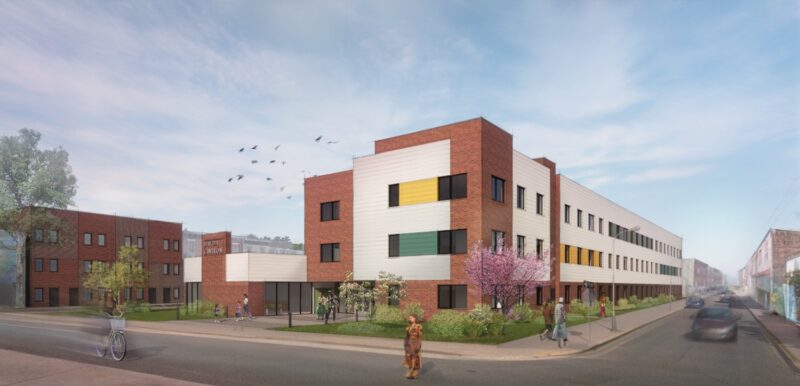
The Women’s Community Revitalization Project is planning a 34-unit apartment building, flanked by two triplexes, on city-owned land in Kensington.
All of the units will be available to those below 60% of area median income, or almost $72,000 for a family of four.
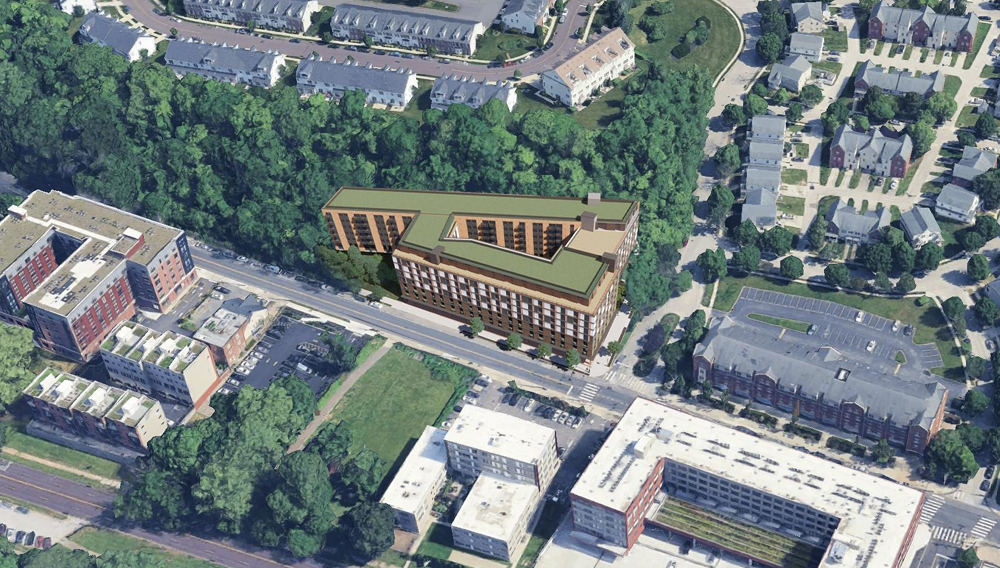
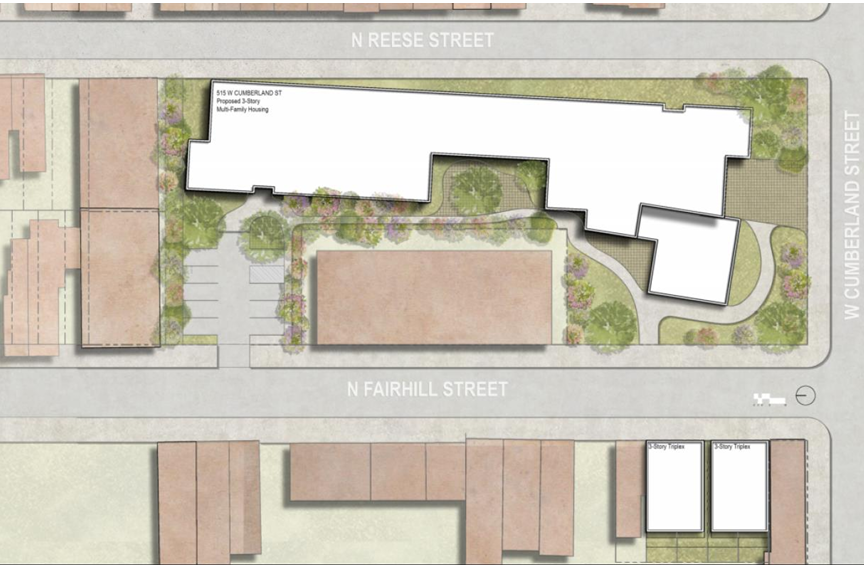
The apartment building at Cumberland and Reese Streets is designed at an angle slashing across the lot, using only a portion of the city-owned land.
“Having a solid wall of building directly across [from rowhouses], we just felt wasn’t really contextual to the neighborhood,” said Lorissa Luciani, who has been the executive director of Women’s Community Revitalization Project (WCRP) for the last nine months. “Then there’s height limitations so we couldn’t go any higher.”
The project is funded through federal Low Income Housing Tax Credits (LIHTC), which the nonprofit group obtained in 2025. The land will be obtained for a nominal cost from the city.
WCRP has been meeting with local community groups since 2024. Luciani said organizations such as Xiente, APM, and the 19th Ward RCO have been supportive of this project.
The development, designed by Philadelphia-based CICADA Architecture & Planning, will cost over $26 million and is slated for completion 18 months after the group settles on the land. It will include 10 parking spaces.
On Tuesday, the Philadelphia Land Bank’s board voted to approve the sale of the property to WCRP. The plan also has the backing of Councilmember Quetcy Lozada, which is essential because she will need to introduce legislation to move the property out of the Land Bank.
“It’s an amazing project,” Lozada said. “We are in need of partners like the Women’s Community Revitalization Project who understand the need for not just affordable housing, but deeply affordable housing.”
Without Lozada’s support, the project would be impossible.Final passage of the legislation could come as soon as later this month.
The three buildings being developed by WCRP can be seen from above, highlighted in white, with the apartment project’s slanted angle readily seen from above.
Luciani said WCRP would close on the project in the fall.
This will be Luciani’s first ground-up development with the organization. She joined the nonprofit in 2025 after WCRP’s longstanding executive director and founder Nora Lichtash retired from her leadership role with the group after 35 years. She still works for the group as a consultant.
WCRP was founded in 1986 to serve Fishtown, Kensington, and other neighborhoods in North Philadelphia east of Broad Street. Since then, it has developed projects in other corners of the city, such as Germantown and Point Breeze.
“My predecessor has a substantial amount of experience and relationships with many of these organizations” in Kensington, Luciani said.
“I’m trying to work to have my own relationships with them,” Luciani said. “They’re a really organized, sophisticated community that really understands their needs, and they’ll fight for it as hard as they need to.”
Luciani previously worked in New Jersey local and state government and planning for decades and has a deep familiarity with subsidized housing policy.
“I grew up in public housing in North Jersey,” Luciani said. “So it’s been a personal and professional lens that I utilize to try and continue the good work that helped my family in the hopes of helping others.”