Category: Transportation

  • These street sign artists are helping Philadelphia commuters answer an age-old question: Where’s the bus?

    These street sign artists are helping Philadelphia commuters answer an age-old question: Where’s the bus?

    While waiting for a bus earlier this year, two Philadelphia street artists who rely on public transportation diagnosed an all-too-familiar ailment: I have no idea when the bus will be here.

    “No one knows when the bus is coming,” one recalled saying.

    “We should really make something.”

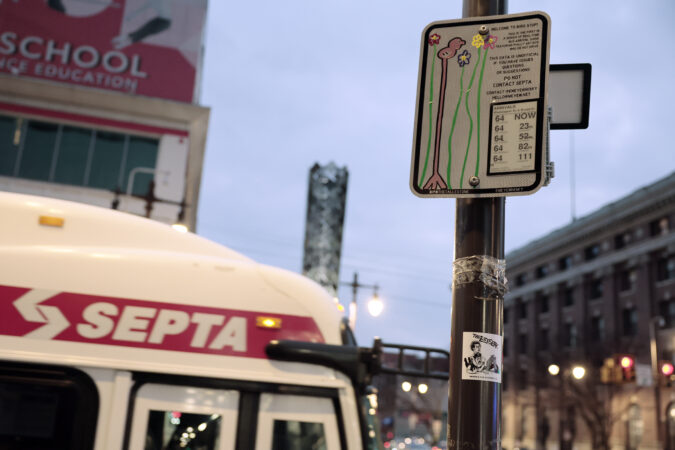
    Earlier this month, their brainchild — a solar-powered e-reader mounted into a street sign that provides bus arrival information — went live on the northeast corner of Broad Street and Washington Avenue in South Philadelphia, along bus Route 64.

    The device pulls real-time arrival times from publicly available data (the same dataset that feeds SEPTA’s app), according to artist Make It Weird, who engineered the rig and asked to remain anonymous because their work meanders into a legal gray area.
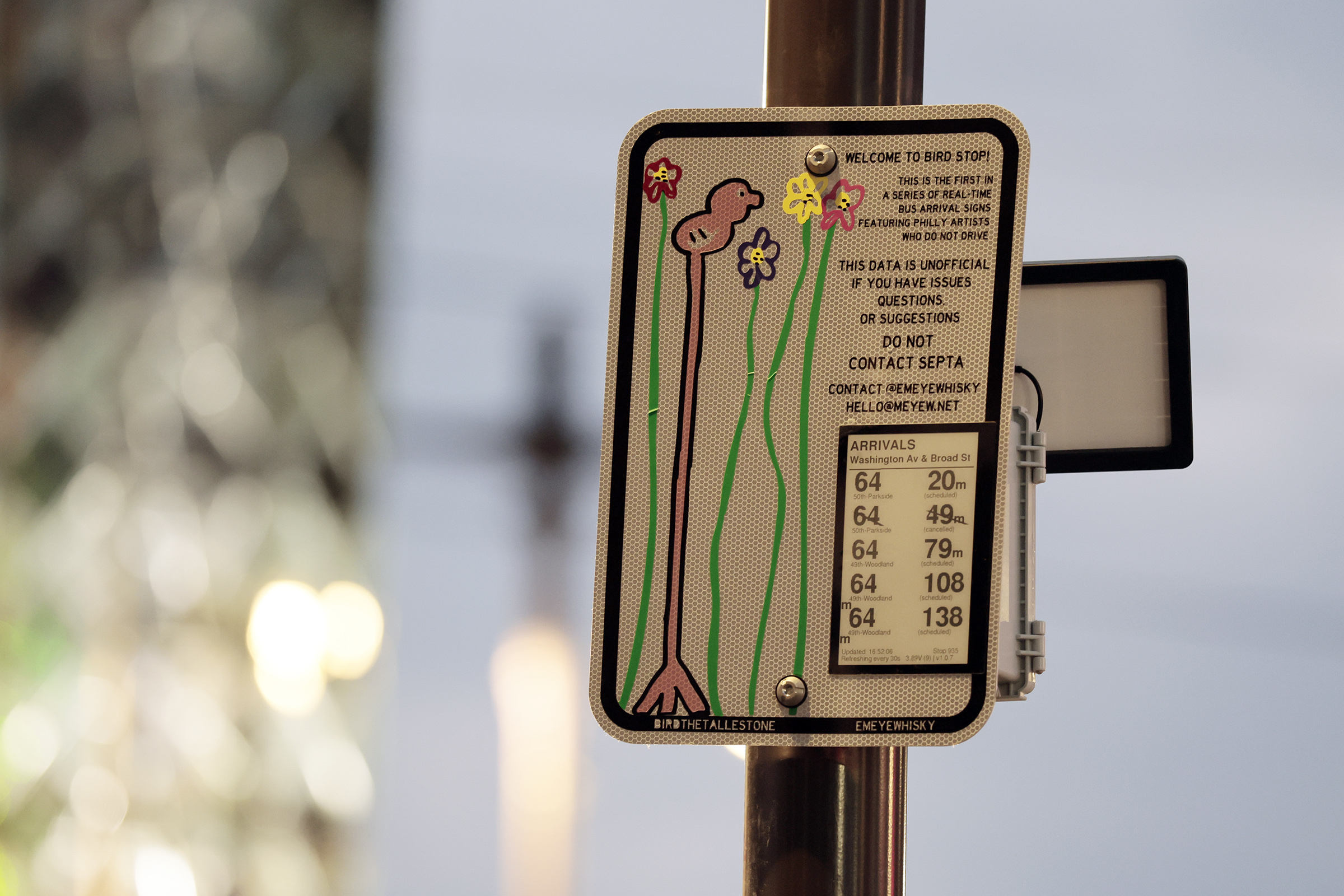
    The digital real-time bus tracker that has been installed at the Route 64 bus stop on the northeast corner of Broad Street and Washington Avenue in Philadelphia on Sunday, Dec. 7, 2025.

    Their creation is inconspicuous; to passersby, it could be a road sign graffitied with a lanky bird and stalky flowers. Commuters might get closer and see it reads, “This data is unofficial. … Do not contact SEPTA.”

    “We have a fundamental issue with funding transit in Pennsylvania,” Make It Weird said. “We, as citizens, often make excuses for real quality-of-life improvements that could be made by saying, ‘Well, SEPTA doesn’t have money, so quit complaining.’ We’re just saying, ‘This could be better.’”

    The sign is akin to a Band-Aid on a public transportation network plagued by infrastructure issues, financial turmoil, and an ever-constricting budget, as well as a resource for people who don’t have access to a smartphone with unlimited data or SEPTA’s app, said Make It Weird and collaborator Bird, the alias for the artist whose signature statuesque and slender pink bird appears on the sign.

    “Accessibility is something that’s hugely important to me,” Bird said. “It comes from a really large place of privilege that people always assume that everyone has a phone or can look something up, and that’s just not the case. Trying to provide that kind of accessibility for everyone — I think it’s an important place to start.”

    Late last month, a prototype of the device near South Philly’s Benna’s Cafe caught the attention of Conrad Benner and wound up on Streets Dept’s Instagram.

    The video has garnered more than 8,500 likes; the comments section is filled with fire emojis and clapbacks at SEPTA. One commenter wrote, “This is a sincere public service. Artists are extraordinary. Septa should hire them.” Another said, “Hopefully, it doesn’t find the same fate as Hitchbot did.”

    “I’ve been really appreciative of how many people think it’s cool,” Make It Weird said. “I’ve been also really appreciative of how many people say, ‘Yeah, other cities are doing this.’”

    Digital screens that feed real-time tracking information have already popped up in other major cities, like New York City and Minneapolis. But Philadelphia has been slow to adopt the tech: While a five-year, $6 million contract to install iPad-sized trackers mounted to bus stops was publicized last year, SEPTA spokesperson Kelly Greene said in an email that none of the screens have been deployed yet, citing cybersecurity.

    “We recognize the importance of real-time bus tracking for our customers and will provide an update on this initiative as soon as possible,” Greene said.

    Make It Weird started making goofy and whimsically mock street signs in June; all their signs are configured to meet the federal standards, they said, which helps their art meld with the monotonous “No Parking” and “Tow-Away Zone” verbiage. (One sign near City Hall said, “Stop Parking, Ride SEPTA: Fund Public Transit, Sell Your Car,” in the ubiquitous, red Highway Gothic sans-serif font. Another triptych read, “Go Birds,” “F— ICE,” and “Free Palestine,” quoting Hannah Einbinder’s bleeped Emmy acceptance speech.)

    The Route 64 sign is the first in hopefully a series of 10, all featuring collaborations with other Philly artists who don’t drive.

    “Transportation for all,” Bird said.

    Make It Weird said, “And it’s just fun.”
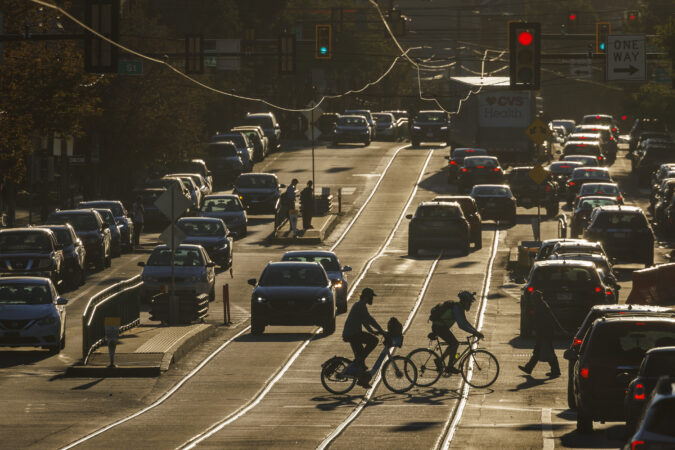
  • Commuting to work in Philadelphia takes longer than in most large cities in the U.S.

    Commuting to work in Philadelphia takes longer than in most large cities in the U.S.

    The average commute in Philadelphia takes longer than in most large U.S. cities — and it’s gotten slightly worse recently.

    In 2024, commuters spent on average 33.2 minutes getting to work in the city, according to a new report from Yardi Kube, a digital management platform for coworking spaces. That’s more than the national average and a 2.1-minute increase from the previous year.

    The increase in Philadelphia also reflects a larger national trend, according to the report. The average American’s commute time inched up in 2024 by nearly half a minute, to 27.2 minutes. Still, that’s less time than the average worker spent in transit to their job in 2019.

    Meanwhile, Philadelphia faced some of the worst traffic congestion in the country last year, and public transit has confronted several challenges this year that caused disruption for commuters.

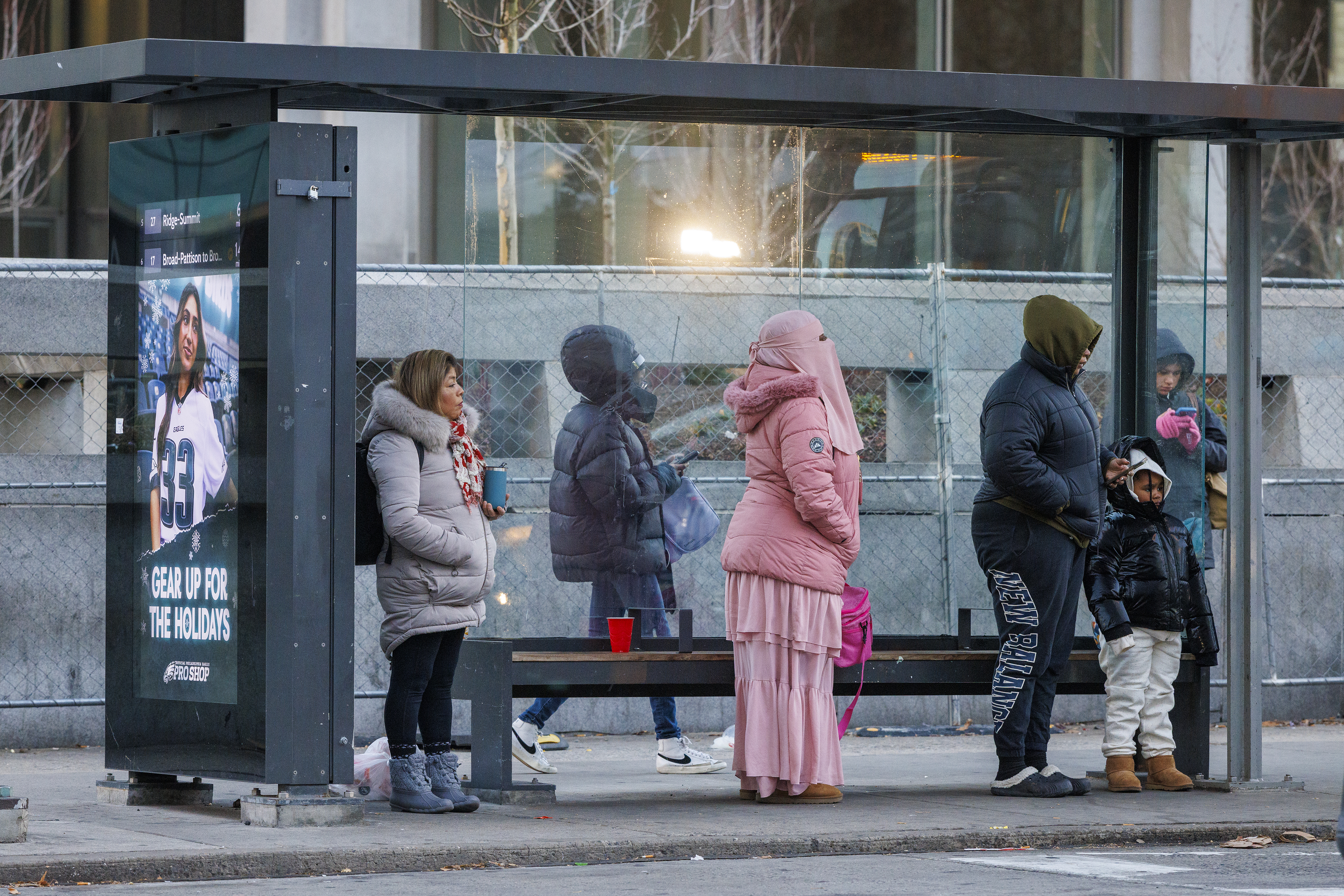
    Commuters at a bus stop at 15th Street and JFK Boulevard on a cold December morning in Philadelphia.

    The increase in Philadelphia and beyond comes as employers have increasingly called workers back to in-person work, reversing trends toward hybrid or remote arrangements during the pandemic. The report notes that as the number of Americans working from home has decreased, the average time spent commuting has inched up.

    “Across the United States, how people get to work — and how often they do — continues to evolve,” the report reads.

    “The rise of remote and hybrid work dramatically reshaped commuting habits, leading to sharp declines in travel times during the pandemic years,” it said. ”Yet as more employees return to the office, commute durations are climbing again, in some cases more quickly than before.”

    The report is based on data from the U.S. Census Bureau’s American Community Survey. It took into consideration the 50 largest cities based on the size of their population and evaluated the time spent commuting for a one-way trip, regardless of mode of transportation.

    window.addEventListener(“message”,function(a){if(void 0!==a.data[“datawrapper-height”]){var e=document.querySelectorAll(“iframe”);for(var t in a.data[“datawrapper-height”])for(var r,i=0;r=e[i];i++)if(r.contentWindow===a.source){var d=a.data[“datawrapper-height”][t]+”px”;r.style.height=d}}});

    While Philadelphia’s average commute lengthened from 2023 to 2024, it’s still shorter than the average of 34.3 minutes in 2019.

    But the region’s public transit system has seen a series of significant challenges this year, rankling commutes for many.

    Amid funding insecurity, SEPTA this year drafted a plan to cut service and began implementing it in August but was ordered to restore service by a judge and ultimately got approval from Gov. Josh Shapiro to use capital funds to sustain service.

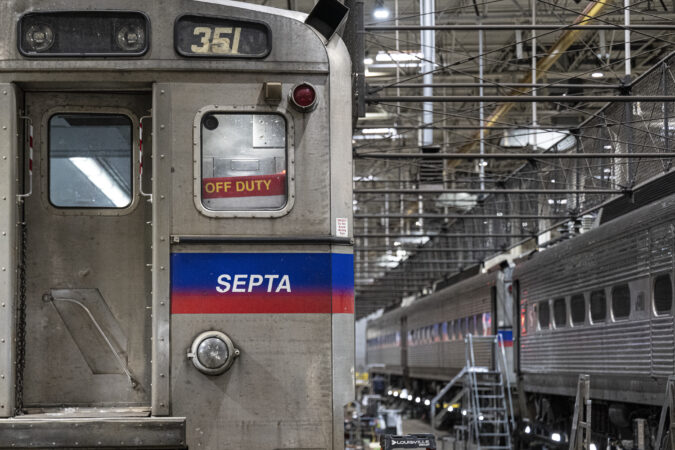
    And SEPTA‘s Regional Rail system has encountered significant disruption and delays this fall, as the transit authority was ordered to inspect all of its 50-year-old Silverliner IV train cars following five train fires this year.

    This week, SEPTA averted a worker strike, after coming to an agreement with Transport Workers Union Local 234 over improvements to the employee contract. The union represents some 5,000 SEPTA employees including operators of buses, subways, and trolleys.

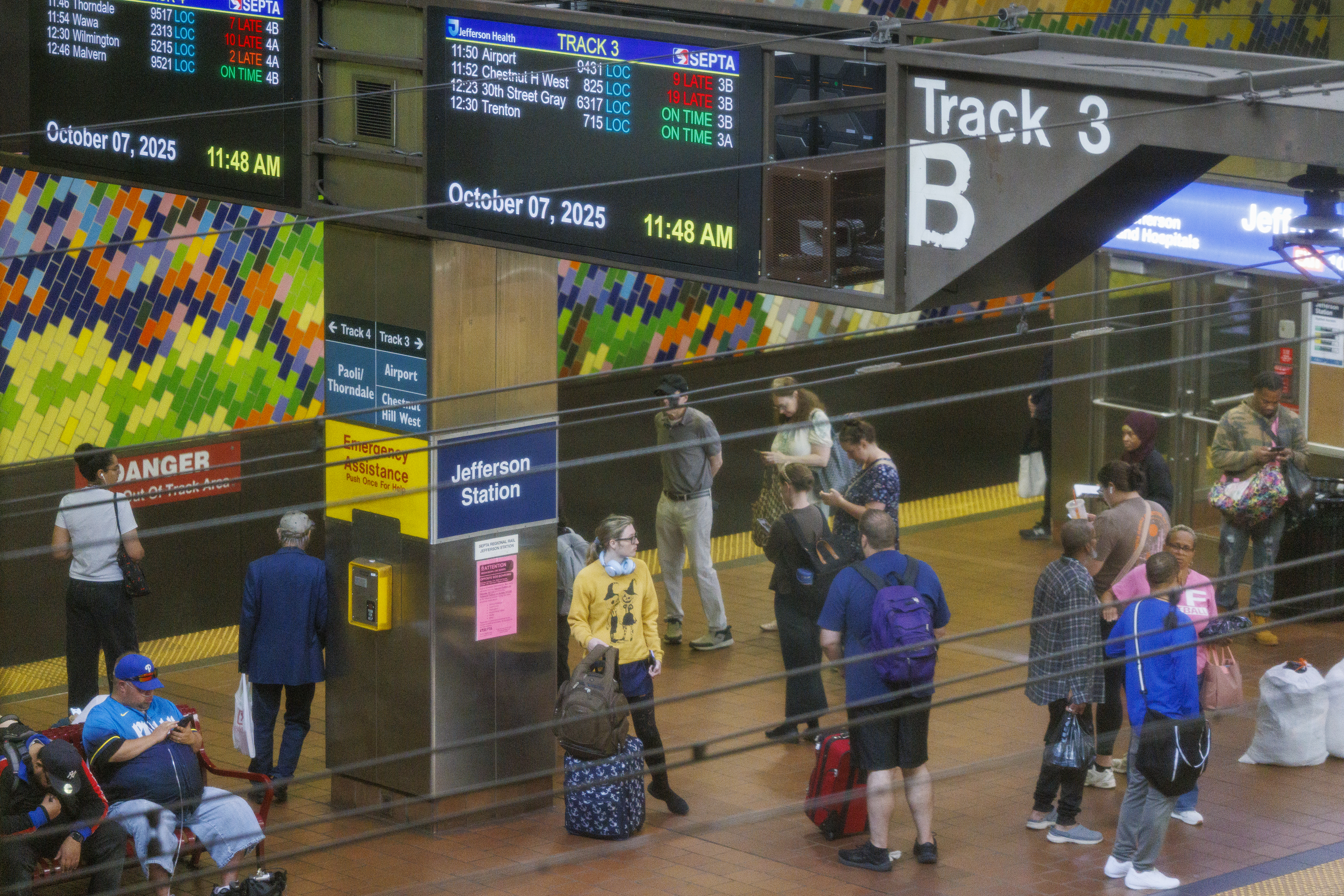
    Commuters waiting for SEPTA Regional Rail at Jefferson Station on Oct. 7.

    Other cities with long commutes last year include New York, Chicago, San Francisco, Los Angeles, and Boston. New Yorkers spent an average of 40.6 minutes getting to work in 2024, nabbing the worst commute time in the country. Chicago ranked second, with an average of 33.5 minutes in transit last year.

    All of those cities saw an uptick in their commuting time in the past year.

    Among the 50 most populous cities in the country, the places with the shortest commutes are Tulsa, Okla.; Omaha, Neb.; Memphis; Tucson, Ariz.; and Kansas City, Mo. Those cities had average commute times between 19.7 and 21.8 minutes last year.

  • Philly’s Greyhound station gets city’s OK to be resurrected

    Philly’s Greyhound station gets city’s OK to be resurrected

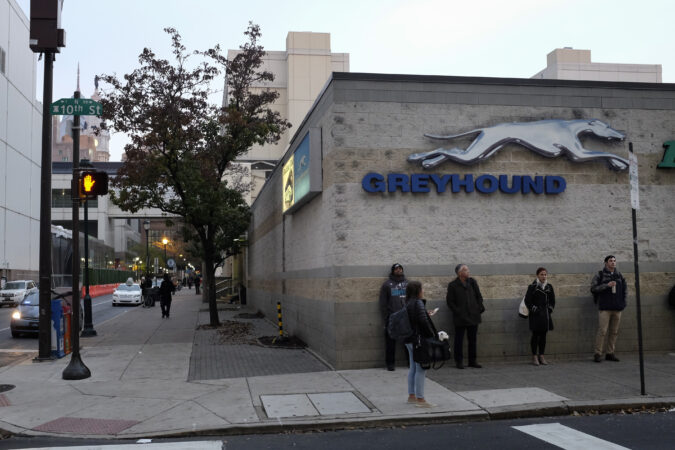
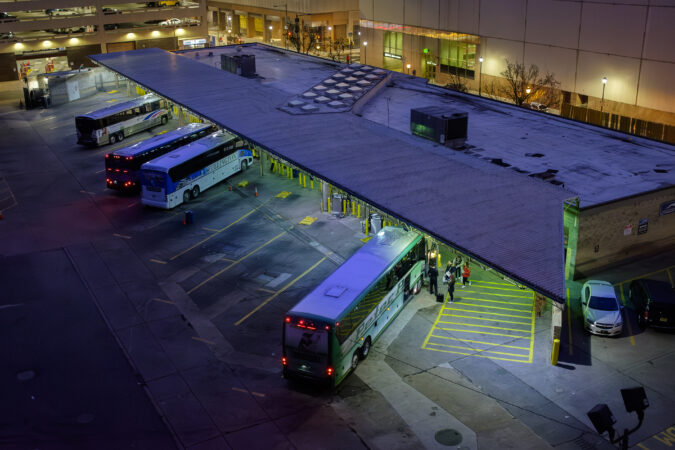
    City Council passed legislation Thursday to restore the abandoned Greyhound terminal on Filbert Street as Philadelphia’s new intercity bus station in time for an expected flood of tourists in 2026.

    Under the measure, the Philadelphia Parking Authority will operate the station on behalf of the city, collecting fees from bus companies to pay costs.

    A refurbished facility is scheduled to open in May 2026, which would resolve more than two years of chaos after Greyhound ended its lease, forcing the city to allow the bus companies to operate at the curbs of public streets with few amenities and no shelter for riders.

    The saga was embarrassing, and it became more untenable for city leaders with Philadelphia set to host celebrations of the 250th anniversary of the Declaration of Independence, and a round of international FIFA World Cup soccer matches.

    The plan came together over the last few months as at least three city departments collaborated and reached an agreement with the parking authority. Mayor Cherelle L. Parker’s administration sent a bill to Council.

    Councilmember Curtis Jones Jr. said in a Finance Committee hearing last week that he found the speed of “galvanized” departments working together impressive.

    “You can’t put that genie back in the bottle. I know you can cooperate now, and that’s going to be the expectation from now on,” Jones said.

    Greyhound ran the terminal at 10th and Filbert Streets for 35 years but ended its lease in June 2023 as the bus line (and its corporate parent) began shedding real estate and leases in the U.S. to cut costs.

    First, the buses operated along the 600 block of Market Street. Since November 2023 they have loaded and unloaded passengers in the open along Spring Garden Street.

    “This is an opportunity that kind of came from the heavens,” said Mike Carroll, the city’s assistant managing director for transportation.

    PPA has a 10-year lease agreement with the property’s owner, 1001-1025 West Filbert Street LLC, with an option to extend it.

    Bus companies would pay a $40 fee for each stop in the city until the terminal is open, when it would be increased to $65. A smaller number of buses subsidized by the Pennsylvania Department of Transportation under a program to provide rural service would pay $16 a stop.

    Operating the renovated terminal will cost $4.7 million to $4.8 million annually, Carroll said.

    City officials say they plan to keep researching other possible locations for an intercity bus station but note the lease provides stability.

    PPA will provide 24-7 security, 16-hour daily custodial coverage, maintenance staff, and an on-site program manager under terms of an intergovernmental agreement with the city that is part of the legislation.

    It also will be responsible for enforcing rules, such as one that will require buses to bypass the heart of Chinatown.

    Since the parking authority regulates rideshare and taxi services, its enforcement officers will help keep traffic flowing around the station, officials said.

    Councilmember Nina Ahmad pressed city officials to plan for retail tenants and other ways to generate municipal revenue.

    “There’s an element of rush,” Ahmad said during the Dec. 3 hearing. “I understand the urgency, but I hope we don’t overlook things that we should be doing to make it really a transit-oriented development.”

  • Gov. Shapiro ‘was instrumental’ in preventing SEPTA strike

    Gov. Shapiro ‘was instrumental’ in preventing SEPTA strike

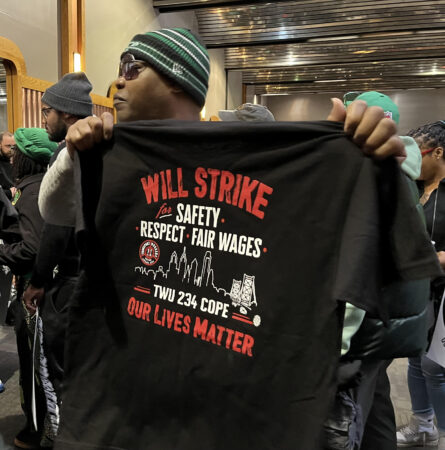
    Transport Workers Union Local 234 and SEPTA agreed Sunday night to continue contract talks in the morning, avoiding for now a strike that could have ground to a halt much of Philadelphia.

    Beginning in late afternoon, members of Gov. Josh Shapiro’s staff met with union leaders and SEPTA senior managers at the governor’s Philadelphia office. The goal was to unstick talks that had faltered, seeing if compromise was possible.

    The union’s push for an increase in pensions and SEPTA’s proposal for union members to pay a greater share of the cost of their healthcare coverage emerged over the last week as the biggest obstacles to an agreement, according to both union and transit authority sources.

    “Gov. Shapiro’s office brought the parties together and they made progress,” SEPTA spokesperson Andrew Busch said. “It was significant.”

    In a statement, the union said “significant progress” was made.

    “Gov. Shapiro was instrumental in preventing a strike that could have started as soon as Monday morning. We’re grateful for his close involvement,” said TWU Local 234 President Will Vera.

    Sticking points

    On Friday, Vera declared he was out of patience at what the union saw as SEPTA’s intransigence and threatened to lead members in a walkout.

    A work stoppage would have brought chaos to a mass transit system that carries a weekday average of 790,000 riders.

    TWU Local 234 represents 5,000 bus, subway, elevated train and trolley operators, as well as mechanics, cashiers, maintenance people and custodians, primarily in the city.

    Their one-year labor contract expired Nov. 7, but members stayed at their posts. On Nov. 16, they authorized Local 234’s leaders to call a strike if needed. The vote was unanimous.

    SEPTA and the union were not far apart on salary and both wanted a two-year deal after a series of one-year pacts during a time of financial crisis for the transit agency, sources said.

    Management wanted to hike what union members pay for health coverage and increase co-pays for doctor and hospital visits.

    The union pushed for an enhancement to the formula that determines retirees’ monthly pensions, based on years of service. It was last increased in 2016.

    SEPTA officials calculated that TWU’s proposed changes would have created an annual unfunded liability of about $6 million for an undetermined length of time. The union says the pension plan books showed a bump was affordable.

    Because TWU Local 234 is the largest SEPTA union, its contracts are used as a template for the other locals working for the transit system, which could boost costs.

    Regional Rail was a concern to SEPTA because commuter railroad workers, like others, receive a federal pension that has tended to be less generous. Those unions would have wanted a SEPTA sweetener to their retirement benefits too.

    TWU Local 234 also wanted changes to work rules involving sick time benefits and the length of time it takes new members to qualify for dental and vision benefits — currently 15 months.

    The local also represents several hundred suburban workers, primarily operators, in SEPTA’s Frontier district, which runs 24 bus routes in Montgomery County, Lower Bucks County, and part of Chester County.

    The Victory district has a similar number of employees, who are represented by SMART Local 1594. They run Delaware County’s two trolley lines, the Norristown High Speed Line, and 20 bus routes in the suburbs.

    Unions for both the Frontier and Victory districts could choose to strike alongside TWU Local 234. If that happened, Regional Rail, already plagued by delays and cancellations due to federally-mandated repairs on train cars, would be the only public transit running.

    Strike-prone reputation

    SEPTA unions have walked off the job at least 12 times since 1975, earning the authority a reputation as the most strike-prone big transit agency in the United States.

    TWU last struck in 2016. It lasted for six days and ended the day before the general election. Democrat Hillary Clinton’s presidential campaign was worried about voter turnout, and the city sought an injunction to end the strike. That proved unnecessary.

    Regional Rail would operate during a TWU strike. Locomotive engineers and conductors on the commuter service are represented by different unions than transit employees, and are working under current contracts.

  • SEPTA strike is ‘imminent,’ say TWU leaders

    SEPTA strike is ‘imminent,’ say TWU leaders

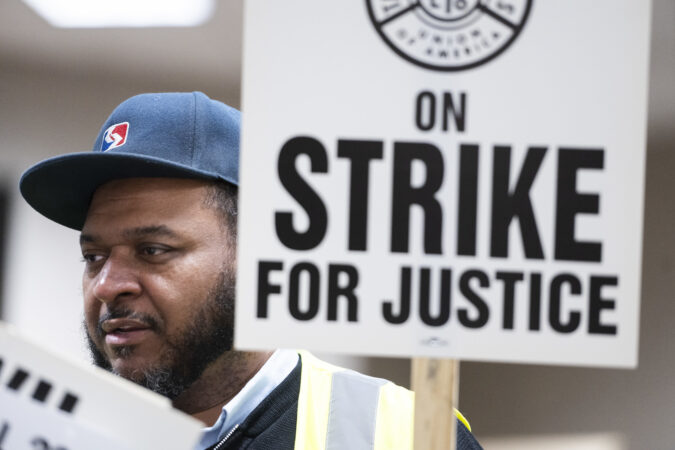
    Transport Workers Union Local 234, SEPTA’s largest union, may soon strike, according to president Will Vera.

    At a Friday afternoon news conference at TWU headquarters in Spring Garden, Vera said his “patience has run out,” and he said the union’s executive committee was meeting to decide when to call a strike.

    “I’m tired of talking, and we’re going to start walking,” said Vera, who was elected president in October.

    Local 234’s latest contract expired Nov. 7, and the 5,000-member local voted unanimously on Nov. 16 to authorize leaders to call a strike if needed during contract negotiations.

    The union represents bus, subway, and trolley operators, mechanics, cashiers, maintenance people, and custodians, primarily in the city.

    SEPTA unions have walked off the job at least 12 times since 1975, earning the authority a reputation as the most strike-prone big transit agency in the United States.

    John Samuelsen, president of TWU International and former president of NYC’s local, joined Vera at the news conference.

    “A strike is imminent,” Samuelsen said. “SEPTA is the most incompetent transit agency in the country … SEPTA is triggering a strike.”

    In an email sent Friday evening, Samuelsen called on leaders and staff members of TWU locals to travel to Philadelphia to help Local 234 in the event of a strike.

    Andrew Busch, spokesperson for SEPTA, said negotiations were “at an impasse,” noting that the negotiating committees met only twice this week. He said SEPTA’s leaders hoped TWU would “take us up on the offer to continue to talk so we can avoid a strike and the massive service disruption it would cause.” No meetings are scheduled for the weekend as of Friday evening.

    Vera agreed there was room for the two groups to keep talking, if SEPTA provided “a fair and reasonable” contract proposal.

    What TWU wants

    Three TWU contracts in a row have run for one year each.

    The union says it is looking for a two-year deal with raises and changes to what it views as onerous work rules, including the transit agency’s use of a third party that Vera said makes it hard for members to use their allotted sick time.

    SEPTA officials have signaled they are open to a two-year deal as a step toward labor stability.

    In recent weeks, TWU and SEPTA have been negotiating contributions to the union’s healthcare fund. Pensions have arisen as a sticking point.

    Union sources told The Inquirer that TWU leaders are increasingly frustrated with the pace of negotiations.

    Vera said the executive board meeting began at 4:30 p.m. on Friday. He hoped the board would reach a decision on when members would walk off the job.

    TWU last went on strike in 2016. It lasted for six days and ended the day before the general election. Democrat Hillary Clinton’s presidential campaign was worried about voter turnout, and the city sought an injunction to end the strike. It proved unnecessary.

    SEPTA’s financials

    TWU’s contract negotiations are happening as SEPTA is emerging from what it has called the worst period of financial turmoil in its history.

    Like many transit agencies, SEPTA was facing a recurring deficit due to inflation, fewer federal dollars, and flat state subsidies. It reported a $213 million recurring hole in its operating budget.

    Following a prolonged and contentious debate over mass transit funding in the state budget, Gov. Josh Shapiro in September directed PennDot to allow SEPTA to tap $394 million in state money allocated for future capital projects to pay for two years of operating expenses.

    And last month, he allocated $220 million to SEPTA, the second time in two years he’s flexed state dollars to support the financially beleaguered transit agency. While the $220 million is expected to go primarily toward capital expenses related to Regional Rail, the move helps SEPTA’s overall balance sheet.

    What riders should know

    SEPTA riders are no strangers to service disruptions.

    In August, the transit agency cut 32 bus routes, shortened 16 others, and trimmed service across the board as part of drastic cost-cutting measures. Riders complained bitterly about skipped stops, crowded vehicles, and longer commutes until a few days later when a Common Pleas Court judge ordered SEPTA to reverse the cuts.

    In the event of a strike, SEPTA says riders should monitor the app for news of service disruptions.

    A strike would shut down buses, trolleys, and the subway and elevated train lines operating in Philadelphia.

    It would not affect Regional Rail, paratransit, or the Norristown High Speed Line.

    SEPTA says 790,000 people ride transit each day. Eighty percent of those riders travel within the city limits.

  • SEPTA will be 7,000 feet of wire short of meeting Silverliner IV repair deadline

    SEPTA will be 7,000 feet of wire short of meeting Silverliner IV repair deadline

    Time and parts ran out on SEPTA.

    The transit agency says it will miss Friday’s federal deadline to finish outfitting all 223 Silverliner IV Regional Rail cars with a new heat-detection system. The reason: It needs to wait for 7,000 additional feet of thermal wire.

    About 30 of the 50-year-old cars have not yet had the safety feature installed, officials said. The wire required to finish the job is on back order.

    “I don’t think the suppliers expected one agency to raid their entire stockpile,” spokesperson Andrew Busch said.

    SEPTA needed about 39,000 feet of the thermal wire to outfit the entire fleet of Silverliner IV cars, he said. “It was an unusual demand on the supply chain,” Busch said. SEPTA has worked with two manufacturers and four distributors.

    The missing link is expected to arrive next week, and the installations should be finished the following week, Busch said.

    SEPTA worked with two manufacturers and distributors to get the large rolls of wire.

    The thermal wire is made of spring steel, separated by a polymer that melts at high temperature, allowing the steel conductor to touch and connect the electric circuit. That allows it to provide earlier warning of a potential problem so cars can be pulled from service.

    Delays, cancellations, station skips, and overcrowded trains running with fewer than the normal number of cars have been regular challenges for riders during the work, which started in October.

    Meanwhile, SEPTA is leasing 10 passenger coaches from Maryland’s commuter rail system, MARC, which Amtrak is scheduled to deliver late Friday night at 30th Street Station. They will be towed to SEPTA’s nearby Powelton yard.

  • Overnight closures to begin on westbound I-76 at 30th Street, PennDot says

    Overnight closures to begin on westbound I-76 at 30th Street, PennDot says

    The Pennsylvania Department of Transportation said lane restrictions and overnight closures will begin Sunday and last until June for a short westbound stretch of the Schuylkill Expressway at 30th Street to allow for overhead bridge construction.

    The work is part of a $148.9 million project to rehabilitate the bridges that connect Market Street over Amtrak and I-76, the Schuylkill River Trail, and CSX Railroad, PennDot said Wednesday.

    On Sundays through Thursdays from 9 to 10 p.m., I-76 West will be reduced to one lane between 30th Street and the I-676 interchange.

    Then from 10 p.m. to 5 a.m., all the westbound lanes will be closed and traffic will be detoured at 30th Street onto Schuylkill Avenue to then access the ramps to I-76 West and I-676 East.

    The changes will last through June 1.

    Because of the forthcoming holidays, there will be no overnight closures from Dec. 21 through Jan. 3.

    PennDot said motorists can visit www.marketstreetbridges.com to sign up for email notifications and learn more about the project.

  • Waymo starts self-driving tests in Philadelphia for its robo-taxi service

    Waymo starts self-driving tests in Philadelphia for its robo-taxi service

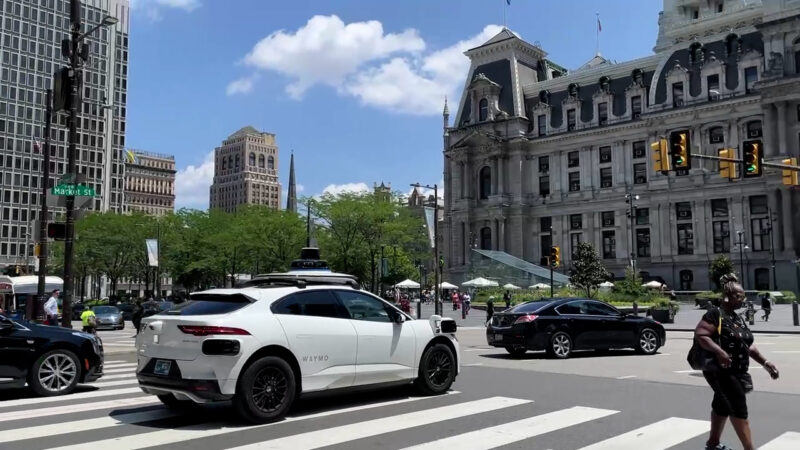
    Waymo, the self-driving car company owned by Google’s parent firm, said Wednesday that it has begun autonomous tests in Philadelphia and expects to offer its robo-taxis to customers at some point afterward.

    “We’re making it official, Philly: Waymo will bring our service to the City of Brotherly Love!” the company announced on its website.

    Ethan Teicher, a spokesperson for Waymo, said in an email: “We recently began driving autonomously with a specialist behind the wheel, after securing permission to do so from PennDOT. We’ll continue laying the groundwork in Philadelphia to open our fully autonomous ride-hailing service for the public in the future.”

    In July, a Waymo spokesperson said the company would begin mapping Philadelphia’s neighborhoods, manually “driving through the most complex parts of the city, including downtown and freeways.”

    In its Wednesday announcement, Waymo said it will begin the mapping process in Pittsburgh, and noted that city’s connection with autonomous driving history. Carnegie Mellon University, which is located in Pittsburgh, is known as the birthplace of self-driving technology.

    The company said mapping will also begin in St. Louis and Baltimore.

    Under a 2022 Pennsylvania law legalizing the commercial operation of “highly automated vehicles,” Waymo needs a “certificate of compliance” to conduct autonomous testing in specified locations. In July, the Pennsylvania Department of Transportation said it was reviewing an application from Waymo.

    PennDot’s website on Wednesday showed that Waymo now has a certificate for Philadelphia.

    The only other company with a certificate for the city is Perrone Robotics, which operates a self-driving shuttle service at the Navy Yard.

    In New Jersey, state law does not allow for commercial services using self-driving vehicles on public streets. Legislation recently was introduced to create a pilot program requiring three years of testing with a human driver in the vehicle.

    Waymo offers self-driving taxi service in Los Angeles, San Francisco, Phoenix, Austin, and Atlanta, and has test-driven in dozens of other cities. Testing began in New York City this summer.

    Currently, the company says it is performing a total of 250,000 rides a week using fully autonomous electric vehicles.

    A spokesperson for Mayor Cherelle L. Parker said Wednesday that the mayor and other city officials are “closely monitoring Waymo and its plans for Philadelphia” but declined to elaborate.

    Besides mapping and testing its vehicles, Waymo has “engaged with community organizations” in Philadelphia and Pennsylvania, including the Bicycle Coalition of Greater Philadelphia and the National Federation of the Blind of Pennsylvania, said Teicher, the company spokesperson.

    In the company’s announcement, it included a statement from Samantha Civitate, the Pennsylvania state director for Best Buddies, a nonprofit that brings together volunteers and people with intellectual and developmental disabilities.

    “Accessible transportation remains a vital piece of fostering independence and inclusion,” Civitate said.

    There has been no groundswell of opposition to Waymo coming to Philadelphia. The company, however, has had to deal with recent incidents elsewhere that have generated negative attention.

    A Waymo taxi in Los Angeles was caught on video making a left turn just feet away from an incident involving police officers positioned behind their vehicles shouting commands at a suspect who was lying facedown on the ground, apparently waiting to be arrested.

    In San Francisco on Sunday, a Waymo taxi hit an unleashed dog, which reportedly needed to be euthanized because of its injuries.

    Waymo vehicles have also been targeted, though mainly because they were in the wrong place at the wrong time. In June, several Waymo taxis were burned during anti-ICE protests in Los Angeles. The company temporarily halted service in the area.

  • Joint city-Parking Authority proposal to reopen Filbert Street bus station advances in Council

    Joint city-Parking Authority proposal to reopen Filbert Street bus station advances in Council

    The Philadelphia Parking Authority would renovate and run the abandoned Greyhound bus terminal on Filbert Street under legislation approved Wednesday by a key City Council committee.

    It was a step toward ending a two-year civic struggle to find a site for long-distance buses and their passengers. The renovated station could be ready for a series of big national and international events expected to draw millions of visitors next year.

    “A lot of people are going to be coming here for the first time, and when they’re in that station, they’re going to get their first taste of Philadelphia — and we want to make sure it’s a good one,” said Councilmember Mike Driscoll, who sponsored the bill on behalf of the Parker administration.

    The city will host events in 2026 for the 250th anniversary of the Declaration of Independence, as well as FIFA World Cup soccer matches and the Major League Baseball All-Star Game, among others.

    Greyhound ran the terminal at 10th and Filbert Streets for more than three decades but ended its lease in June 2023 when the business model of its parent company, Flixbus, called for divesting from real estate and moving toward cheaper curbside service in many U.S. cities.

    Since November 2023, customers of Greyhound, Peter Pan, and other interstate bus carriers wait, board, and arrive at curbside along Spring Garden Street in Northern Liberties — with no shelter from the weather and few amenities. It also has proved a nuisance to nearby businesses.

    Before that, the buses operated at curbside on Market Street between Sixth and Seventh Streets.

    PPA has a 10-year lease agreement with the property’s owner, 1001-1025 West Filbert Street LLC, with an option to extend it.

    The city senses that over the long term the owner anticipates selling the property, said Michael Carroll, assistant managing director for the Philadelphia Office of Transportation and Infrastructure Systems.

    “That’s the sweet spot, long enough that there’s a meaningful basis to invest in improvements and solve the problems,” Carroll told the committee.

    “At the 10-year mark, decisions will have to be made about whether this is a site that forever works best in Philadelphia, or whether there’s a better site,” he said.

    The unanimous Finance Committee vote came after it amended the measure to adjust the fees bus companies would be charged to stop in Philadelphia.

    Each stop in the city would cost $40 until the bus terminal is open, when it would move to a $65 fee. A smaller number of buses subsidized by the Pennsylvania Department of Transportation under a program to provide rural service would pay $16 a stop.

    Committee members also asked for suspension of a procedural rule so that all 17 lawmakers could consider the bill Thursday and clear the way for final passage before the holidays.

    In the agreement with the city that is part of the bill, PPA would run the terminal; assess the fees on bus carriers for the use of the facility and any street loading zones, such as those in University City; and handle enforcement.

    The Filbert Street proposal includes specific requirements designed to address concerns particular to Chinatown.

    For instance, the streets department would change traffic patterns so buses are routed to the station via Market Street instead of driving through the heart of the neighborhood as they did in the past.

    John Mondlak, first deputy and chief of staff of the city planning department, said that the through traffic had long been a chief complaint of residents and business owners in Chinatown.

    This story has been updated to include the name of the firm that owns the former Greyhound station.

  • A man died driving on Northwest Philly’s winding, wet roads. The neighborhood has tried addressing the danger for decades.

    A man died driving on Northwest Philly’s winding, wet roads. The neighborhood has tried addressing the danger for decades.

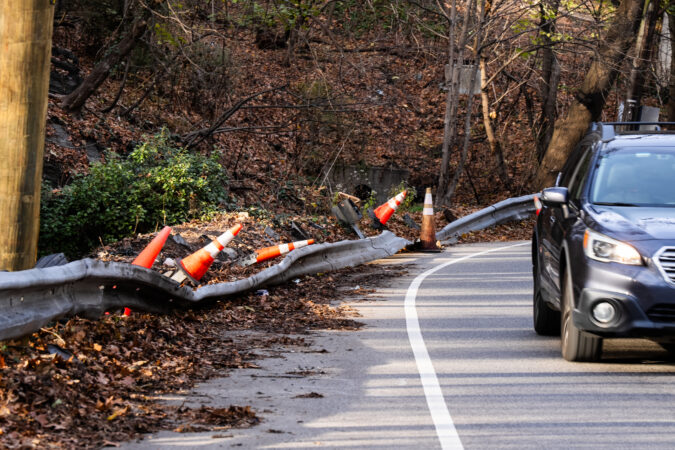
    A 65-year-old man died Sunday after he lost control of his vehicle on Cresheim Valley Drive in Chestnut Hill, striking a downed guardrail and flipping the car upside down into a creek. Just weeks before, another driver veered off the same road but survived.

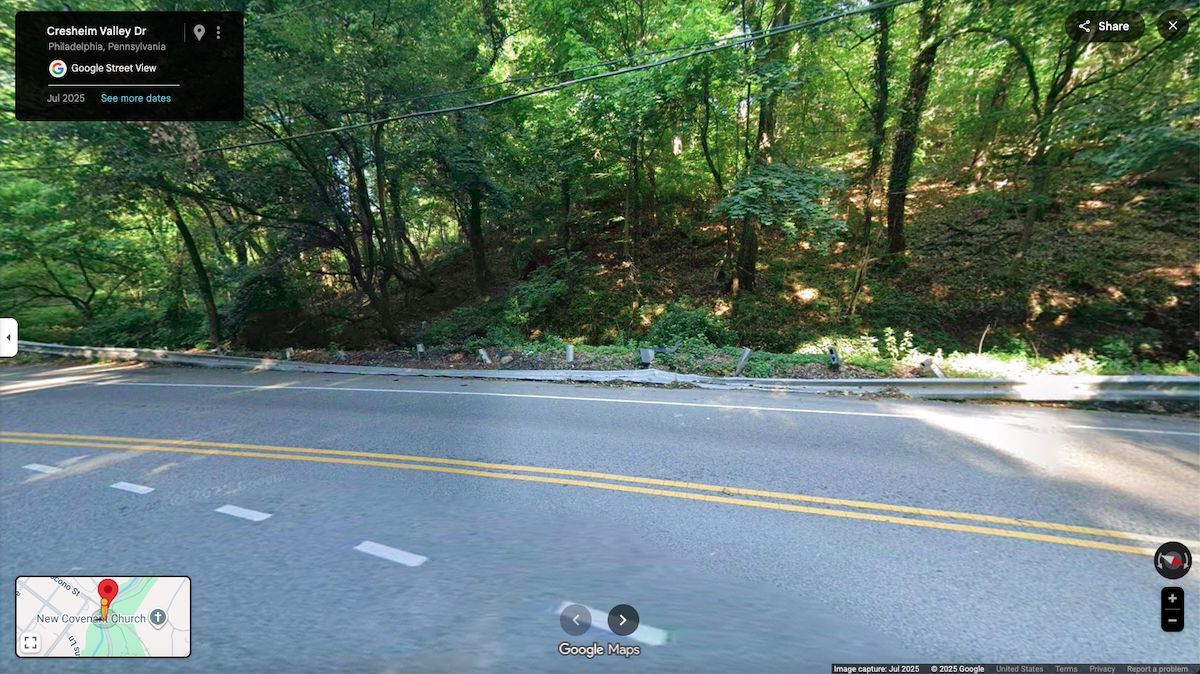
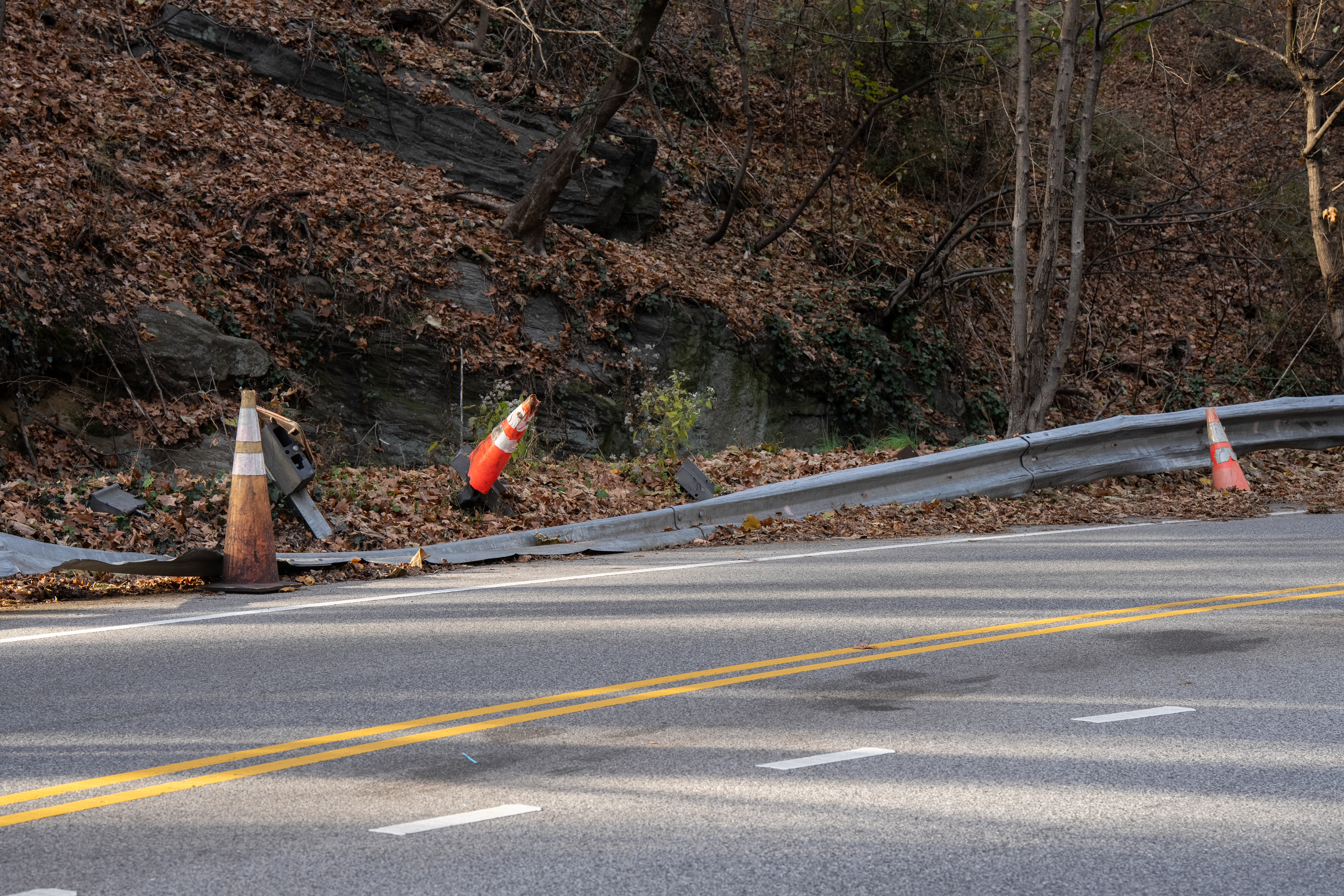
    Compounding this latest traffic death is the fact that the guardrail meant to prevent cars from swerving off the road was broken and nearly flattened from previous crashes, leaving a gap in the guardrails for months, said Josephine Winter, a Mount Airy resident and executive director of West Mount Airy Neighbors (WMAN). “The guardrail was down, and it was previously crumbled so it’s a frequent site of crashes,” she said. Images from Google Maps show the guardrail down as far back as July.

    The Philadelphia Streets Department is aware of the recent crash and is conducting an assessment of the guardrail on Cresheim Valley Road. “The streets department’s top priority is public safety,” a spokesperson said.

    A screenshot of a Google Map’s street view captured in July 2025 shows the downed guardrail on Cresheim Valley Drive in the Chestnut Hill neighborhood of Philadelphia. On Nov. 30, 2025, a 65-year-old man crashed and went over the guardrail, later succumbing to his injuries.

    Neighbors say accidents, sometimes fatal, have plagued the winding roadways in Chestnut Hill and Mount Airy for decades. These traffic safety concerns came to a head with Sunday’s deadly crash.

    “It’s a curvy, tricky road, especially when it’s wet, and people tend to speed on that road,” Winter said of roadways like Lincoln and Cresheim Valley Drives, which are lined with trees, have swooping dips and hills, and are prone to flooding.

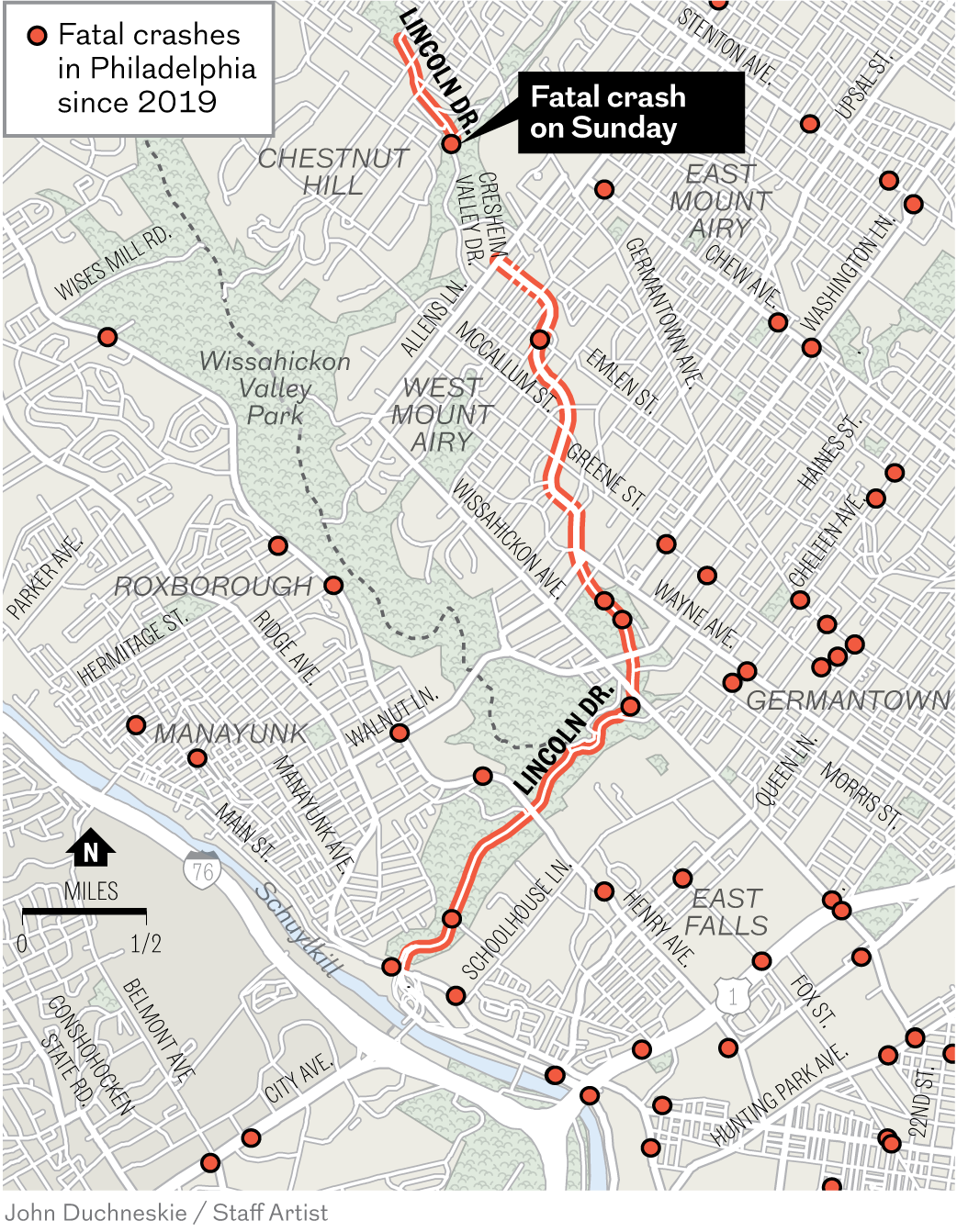
    Map of fatal crashes in Northwest Philadelphia since 2019.

    Since 2019, according to city crash data, at least five people have died while driving on the dark, winding sections of Lincoln Drive, which intersects with Cresheim Valley Drive, prompting many neighbors to fear walking down their street or leading them to invest thousands on giant boulders to protect their home and lawn.

    Winter, who leads WMAN’s traffic-calming committee, and other neighborhood organizations have petitioned for city support, urging the streets department to slow the speed of traffic on Cresheim Valley Drive, Lincoln Drive, and Wissahickon Avenue. The group’s efforts are so ingrained in the fabric of the neighborhood that, when digging through Temple University’s Urban Archives, Winter found an advertisement from 1968 stressing the need for cars in Mount Airy to “slow down to keep kids safe.”

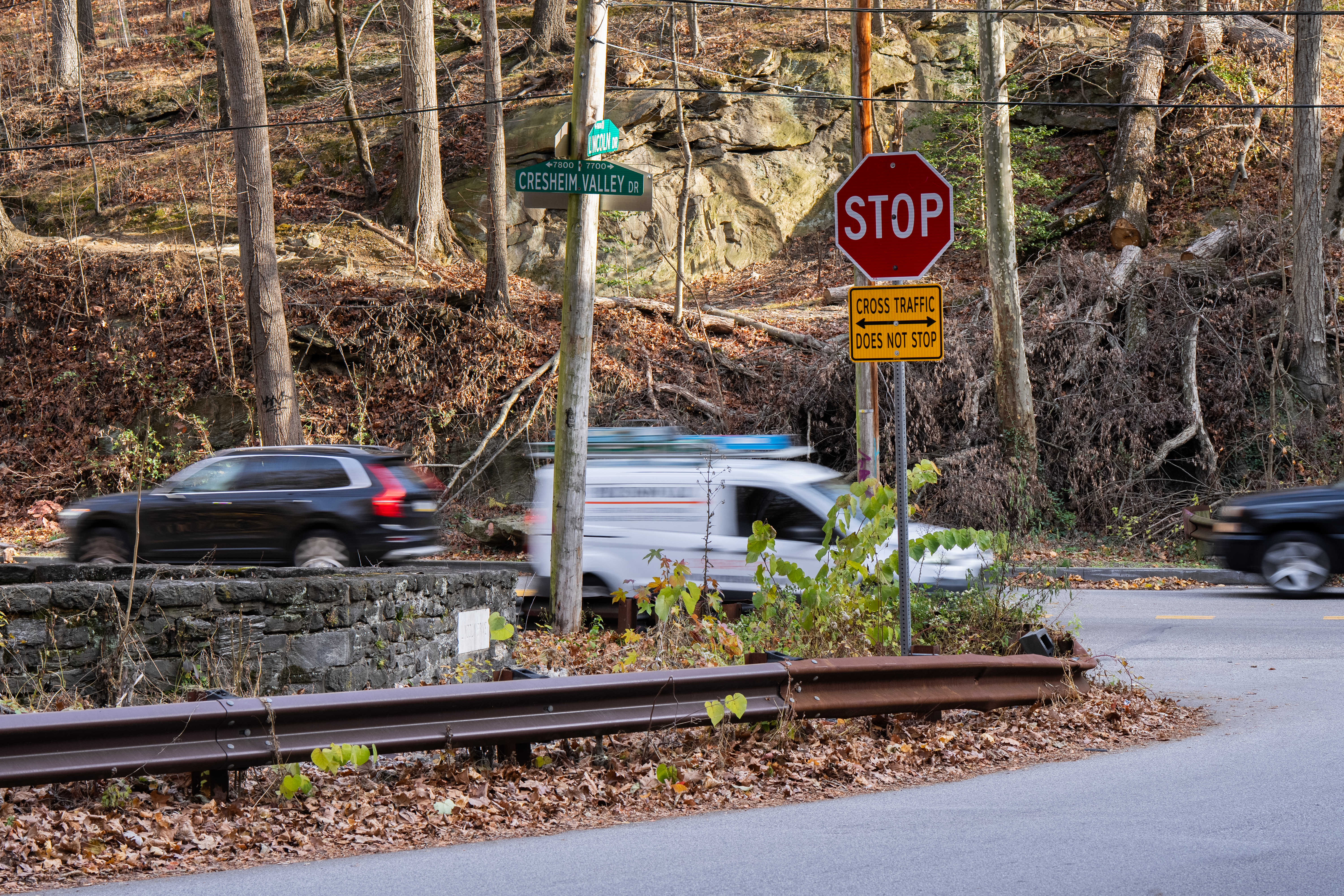
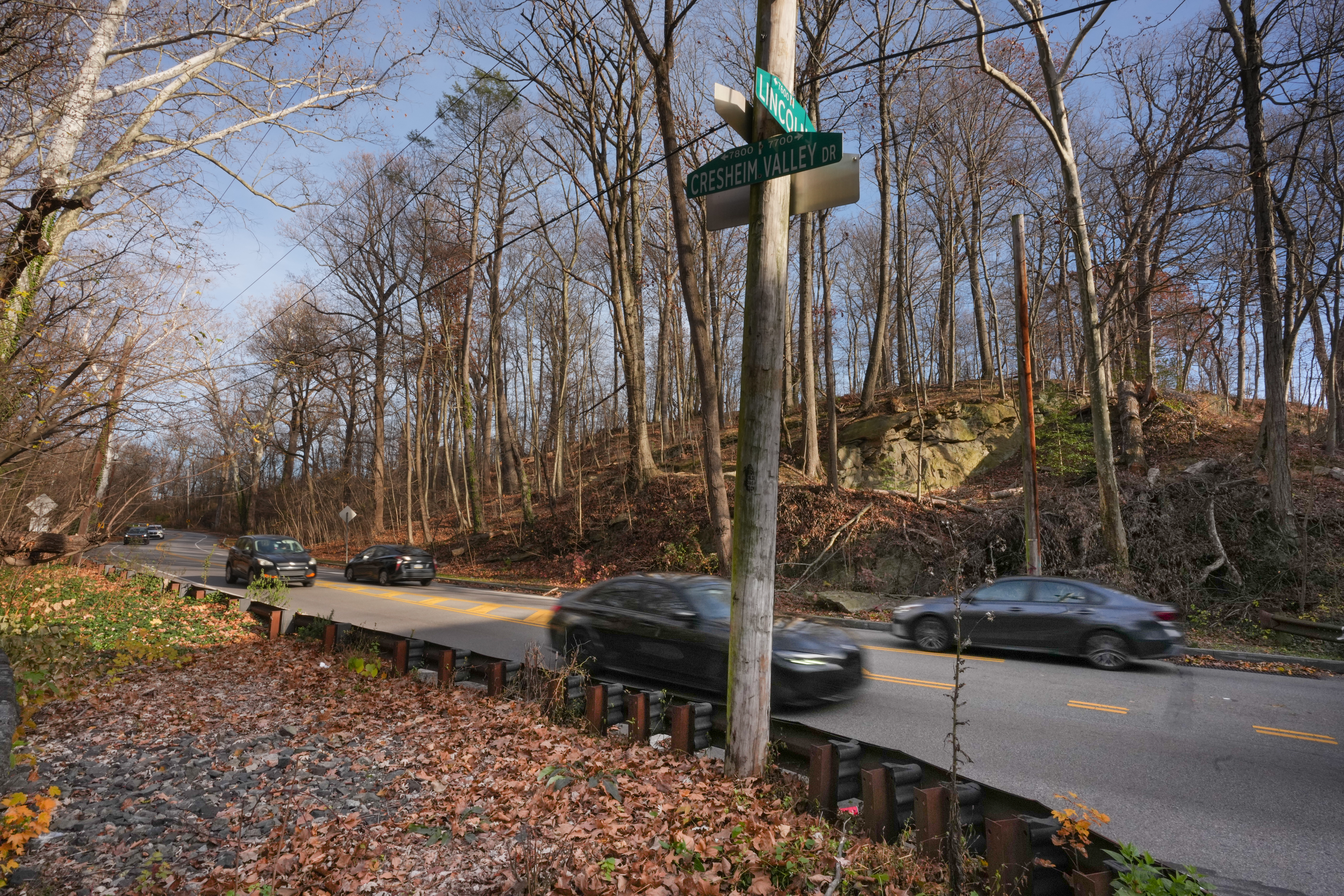
    The intersection of Cresheim Valley Drive and Lincoln Drive, in Philadelphia, PA, Dec. 1, 2025.

    The streets department installed “speed slots,” traffic-calming structures similar to speed bumps, earlier this year along Lincoln Drive between Allens Lane and Wayne Avenue. Along the same stretch of road, the Pennsylvania Department of Transportation installed rumble strips and speed tables to slow drivers down in 2023, in addition to traffic lane separators to keep drivers from using center lanes to pass other vehicles.

    In addition to the recently completed speed slots and traffic-calming measures on sections of Emlen Street, which becomes Cresheim Valley Road, signal upgrades are planned for Lincoln Drive as well.

    However, the work to improve these streets is not over, Winter said. Additionally, the streets department plans do not include changes to Cresheim Valley Drive, where Sunday’s crash happened.

    “We’ll need a collaborative approach as soon as possible to temporarily address the downed guardrail, and then see what the options are moving forward,” Winter said.

    The intersection of Cresheim Valley Drive and Lincoln Drive, in Philadelphia, PA, Dec. 1, 2025.

    Throughout the last decade, locals have suggested better-timed signals, more speed tables, and reducing the number of driving lanes from two in either direction down to one. They also want to see more roundabouts and curb bump-outs in the neighborhood to keep traffic flowing, but at a reasonable speed.

    A mere 50 to 100 feet from Cresheim Valley Drive is a parallel bike trail, where trail organizers like Brad Maule are accustomed to the crashes on the road nearby. Before Sunday’s fatal crash, he remembers two other cars that drove off the side of the road in recent months, not counting the crashes on the roadway itself. The city recently installed pedestrian crossing signs and repainted the crosswalk on nearby Cresheim Road, but Maule hopes speed bumps will follow.

    Cresheim Valley Drive near where it intersects with Lincoln Drive, in Philadelphia, PA, Dec. 1, 2025.

    While Winter said that engineers from the Philadelphia Streets Department were among the first calls she received Monday morning responding to the crash, and that the community appreciates the response, she, Maule, and other neighbors hope that more safety improvements will be considered to save more lives.

    “I’m just looking forward to the new measures of safety that come here,” Maule said. “Hopefully, people will abide by them.”

    Staff writers Max Marin and Dylan Purcell contributed to this article.